EP3611029A1 - Stationery - Google Patents
Stationery Download PDFInfo
- Publication number
- EP3611029A1 EP3611029A1 EP18783742.2A EP18783742A EP3611029A1 EP 3611029 A1 EP3611029 A1 EP 3611029A1 EP 18783742 A EP18783742 A EP 18783742A EP 3611029 A1 EP3611029 A1 EP 3611029A1
- Authority
- EP
- European Patent Office
- Prior art keywords
- marking
- paint
- pigment
- cholesteric
- stationery product
- Prior art date
- Legal status (The legal status is an assumption and is not a legal conclusion. Google has not performed a legal analysis and makes no representation as to the accuracy of the status listed.)
- Withdrawn
Links
Images


Classifications
-
- B—PERFORMING OPERATIONS; TRANSPORTING
- B43—WRITING OR DRAWING IMPLEMENTS; BUREAU ACCESSORIES
- B43M—BUREAU ACCESSORIES NOT OTHERWISE PROVIDED FOR
- B43M11/00—Hand or desk devices of the office or personal type for applying liquid, other than ink, by contact to surfaces, e.g. for applying adhesive
- B43M11/06—Hand-held devices
-
- B—PERFORMING OPERATIONS; TRANSPORTING
- B41—PRINTING; LINING MACHINES; TYPEWRITERS; STAMPS
- B41K—STAMPS; STAMPING OR NUMBERING APPARATUS OR DEVICES
- B41K1/00—Portable hand-operated devices without means for supporting or locating the articles to be stamped, i.e. hand stamps; Inking devices or other accessories therefor
- B41K1/36—Details
- B41K1/38—Inking devices; Stamping surfaces
- B41K1/54—Inking pads
-
- B—PERFORMING OPERATIONS; TRANSPORTING
- B42—BOOKBINDING; ALBUMS; FILES; SPECIAL PRINTED MATTER
- B42D—BOOKS; BOOK COVERS; LOOSE LEAVES; PRINTED MATTER CHARACTERISED BY IDENTIFICATION OR SECURITY FEATURES; PRINTED MATTER OF SPECIAL FORMAT OR STYLE NOT OTHERWISE PROVIDED FOR; DEVICES FOR USE THEREWITH AND NOT OTHERWISE PROVIDED FOR; MOVABLE-STRIP WRITING OR READING APPARATUS
- B42D25/00—Information-bearing cards or sheet-like structures characterised by identification or security features; Manufacture thereof
- B42D25/30—Identification or security features, e.g. for preventing forgery
- B42D25/36—Identification or security features, e.g. for preventing forgery comprising special materials
- B42D25/378—Special inks
-
- B—PERFORMING OPERATIONS; TRANSPORTING
- B42—BOOKBINDING; ALBUMS; FILES; SPECIAL PRINTED MATTER
- B42D—BOOKS; BOOK COVERS; LOOSE LEAVES; PRINTED MATTER CHARACTERISED BY IDENTIFICATION OR SECURITY FEATURES; PRINTED MATTER OF SPECIAL FORMAT OR STYLE NOT OTHERWISE PROVIDED FOR; DEVICES FOR USE THEREWITH AND NOT OTHERWISE PROVIDED FOR; MOVABLE-STRIP WRITING OR READING APPARATUS
- B42D25/00—Information-bearing cards or sheet-like structures characterised by identification or security features; Manufacture thereof
- B42D25/40—Manufacture
- B42D25/405—Marking
-
- B—PERFORMING OPERATIONS; TRANSPORTING
- B43—WRITING OR DRAWING IMPLEMENTS; BUREAU ACCESSORIES
- B43K—IMPLEMENTS FOR WRITING OR DRAWING
- B43K8/00—Pens with writing-points other than nibs or balls
- B43K8/02—Pens with writing-points other than nibs or balls with writing-points comprising fibres, felt, or similar porous or capillary material
-
- C—CHEMISTRY; METALLURGY
- C09—DYES; PAINTS; POLISHES; NATURAL RESINS; ADHESIVES; COMPOSITIONS NOT OTHERWISE PROVIDED FOR; APPLICATIONS OF MATERIALS NOT OTHERWISE PROVIDED FOR
- C09D—COATING COMPOSITIONS, e.g. PAINTS, VARNISHES OR LACQUERS; FILLING PASTES; CHEMICAL PAINT OR INK REMOVERS; INKS; CORRECTING FLUIDS; WOODSTAINS; PASTES OR SOLIDS FOR COLOURING OR PRINTING; USE OF MATERIALS THEREFOR
- C09D11/00—Inks
- C09D11/16—Writing inks
- C09D11/17—Writing inks characterised by colouring agents
-
- C—CHEMISTRY; METALLURGY
- C09—DYES; PAINTS; POLISHES; NATURAL RESINS; ADHESIVES; COMPOSITIONS NOT OTHERWISE PROVIDED FOR; APPLICATIONS OF MATERIALS NOT OTHERWISE PROVIDED FOR
- C09D—COATING COMPOSITIONS, e.g. PAINTS, VARNISHES OR LACQUERS; FILLING PASTES; CHEMICAL PAINT OR INK REMOVERS; INKS; CORRECTING FLUIDS; WOODSTAINS; PASTES OR SOLIDS FOR COLOURING OR PRINTING; USE OF MATERIALS THEREFOR
- C09D201/00—Coating compositions based on unspecified macromolecular compounds
-
- C—CHEMISTRY; METALLURGY
- C09—DYES; PAINTS; POLISHES; NATURAL RESINS; ADHESIVES; COMPOSITIONS NOT OTHERWISE PROVIDED FOR; APPLICATIONS OF MATERIALS NOT OTHERWISE PROVIDED FOR
- C09D—COATING COMPOSITIONS, e.g. PAINTS, VARNISHES OR LACQUERS; FILLING PASTES; CHEMICAL PAINT OR INK REMOVERS; INKS; CORRECTING FLUIDS; WOODSTAINS; PASTES OR SOLIDS FOR COLOURING OR PRINTING; USE OF MATERIALS THEREFOR
- C09D7/00—Features of coating compositions, not provided for in group C09D5/00; Processes for incorporating ingredients in coating compositions
- C09D7/40—Additives
- C09D7/41—Organic pigments; Organic dyes
-
- G—PHYSICS
- G02—OPTICS
- G02B—OPTICAL ELEMENTS, SYSTEMS OR APPARATUS
- G02B5/00—Optical elements other than lenses
- G02B5/30—Polarising elements
Definitions
- the present invention relates to a stationery product which is used to form a marking for authenticity identification on an object.
- a marking which cannot be easily duplicated is formed on the surface of an article which is required to be authentic, in order to prevent forgery of an article (see Patent Literature 1).
- a color shift pigment has been used in some cases in prior art (see Patent Literature 2).
- the present inventor conducted research on applying the marking onto an object using a label. Specifically, the research was conducted on applying the marking onto an object by sticking a marking-printed label to an object.
- sticking of a label may become difficult in some cases depending on the shape and material of the surface of an object to be stuck.
- there is a limit in the minimum size of a label and therefore an attempt to apply a small marking using a label was unsuccessful in some cases.
- Patent Literature 1 has proposed formation of a marking by screen printing. Then the present inventor conducted research on directly forming a marking on an object using screen printing. However, there is a limit in the position of a marking to be formed on an object by screen printing. For example, it is difficult to form a marking in a narrow interstice. In addition, there is a necessity of preparation of a screen mask corresponding to the shape of a marking in screen printing. Therefore, when a marking having an optional shape is to be formed, the number of types of screen masks to be prepared becomes enormously large. Furthermore, it is difficult to form a marking at any time at necessity by screen printing. Therefore, there is generally a limit in a timing at which a marking is formed. Consequently, there is a demand for a technology which increases flexibility in the formation of a marking so that a user can form a marking having an optional shape at an optional timing in an optional position of an object.
- Patent Literature 2 discloses a solid marking composition like a crayon containing a color shift pigment. Since such a solid marking composition can be optionally used with the hand of a user, a marking can be quickly formed at an optional timing. However, since this solid marking composition is in a solid state, the range of an applicable object is limited, and the flexibility of a marking is low. For example, when a minute marking is to be formed with the solid marking composition, it has been difficult to adjust the size, because the marking composition is in a solid state. Furthermore, since a solid marking composition is required to have a specific size or more in order to maintain the rigidity of the solid marking composition, it has been difficult to reduce the size.
- an attempt to form a minute marking with the solid marking composition is hindered by the limit of the possible minimum size of the marking.
- an attempt to form a marking with a solid marking composition on a sort of shapes and materials of an object may result in difficulty in forming the marking because of insufficiency in the adhesion force between the solid marking composition and the object.
- An object of the present invention is to provide a stationery product which can form a marking for authenticity identification with high flexibility regarding position, timing, and shape.
- the present inventor intensively conducted research for solving the aforementioned problem.
- the present inventor has found that application to a stationery product of a fluid-state paint containing a color shift pigment allows the user to form a marking for authenticity identification with high flexibility regarding position, timing, and shape.
- the present invention has been accomplished.
- the present invention includes the following.
- a marking for authenticity identification can be formed with high flexibility regarding position, timing, and shape.
- FIG. 1 is a perspective view schematically illustrating a dispenser as a stationery product according to a first embodiment of the present invention.
- the stationery product of the present invention is a tool which is used for forming a marking for authenticity identification on an object.
- This stationery product includes a fluid-state paint for authenticity identification and a housing part which houses the paint.
- a user applies the paint housed in the housing part onto an object to form a marking.
- applying a paint encompasses not only coating with a paint but also attaching a paint using a stamp or the like.
- the paint included in the stationery product contains a color shift pigment. Therefore, a marking formed with the paint also contains the color shift pigment.
- the color shift pigment has a property that wavelength of the reflection band thereof changes corresponding to the viewing angle. Therefore, the recognized color of the color shift pigment usually changes corresponding to the viewing angle. Accordingly, upon viewing of the marking, when, e.g., the color of the pigment changes corresponding to the viewing angle, the object on which the marking has been formed can be judged to be an authentic article.
- wavelength of the reflection band changes corresponding to the viewing angle, such change may not appear as a change in color depending on the type of the color shift pigment. Even in such a case, whether or not the object is an authentic article can be judged by an appropriate identification method corresponding to the type of the color shift pigment.
- a user can easily form a marking of an optional shape such as a letter, a symbol, and a picture.
- a marking with high flexibility regarding shape.
- the stationery product can generally be handled by a user in a simple manner. Therefore, with the aforementioned stationery product, a user can form a marking at an optional appropriate timing. Thus, a user can form a marking with high flexibility regarding timing.
- a marking can be formed in an optional position of an object regardless of the shape of the object.
- a marking can be easily formed in a position on which a marking is difficult to form with a solid marking composition such as a narrow interstice, a curved surface, and a rough surface.
- a user can form a marking with high flexibility regarding position.
- size control can be easily performed, and the size of a marking can be optionally adjusted by the amount to be applied.
- a user can form a marking with high flexibility regarding size.
- FIG. 1 is a perspective view schematically illustrating a dispenser 100 as a stationery product according to a first embodiment of the present invention.
- the dispenser 100 as a stationery product includes a barrel part 110, a nozzle part 120 as an application part, a pressing tool 130, and a paint 140 for authenticity identification.
- a housing part 150 as a room capable of housing fluid is formed inside the barrel part 110.
- the fluid-state paint 140 containing a color shift pigment is housed in this housing part 150.
- the nozzle part 120 is in provided in a manner of being connected to the barrel part 110 such that it can apply the paint 140 housed in the housing part 150 inside the barrel part 110 onto an object (not illustrated). Further, a discharge port 160 is formed at a terminal end of the nozzle part 120. The discharge port 160 is formed in a manner of communicating with the housing part 150 inside the barrel part 110 such that the aforementioned paint 140 can be discharged through the discharge port 160.
- the pressing tool 130 is a bent rod-shape member, and fixed to the barrel part 110 at its one end 131.
- the other end 132 of the pressing tool 130 is slightly separated from the barrel part 110.
- a user presses the pressing tool 130 as indicated by arrow A1 in FIG. 1 . Consequently, the side surface of the barrel part 110 is pressed by the other end 132 of the pressing tool 130, so that a pressure is applied to the housing part 150.
- the paint 140 is discharged through the discharge port 160 by the applied pressure.
- This discharged paint 140 may be applied onto an object in a manner of drawing a desired shape, so that a marking is formed on the object.
- a user can form a marking of an optional shape in an optional position of an object at an optional timing. Also, since the size of a marking can be optionally adjusted in the formation of a marking using this dispenser 100, there can be formed a marking which is smaller than that of prior art. Furthermore, a stable marking can be formed by appropriately adjusting components such as a binder contained in the paint 140 so that a color shift pigment strongly adheres to an object formed with a varied type of material. Consequently, according to the aforementioned dispenser 100, a marking for authenticity identification can be formed with high flexibility regarding position, timing, shape, size, and material of an object.
- FIG. 2 is a perspective view schematically illustrating a marker 200 as a stationery product according to a second embodiment of the present invention.
- the marker 200 as a stationery product includes a shaft tube 210, a housing part 220 disposed inside the shaft tube 210, a tip part 230 as an application part and a paint permeation part, and a paint 240 for authenticity identification.
- the housing part 220 as a container capable of housing a fluid is disposed inside the shaft tube 210.
- the fluid-state paint 240 containing a color shift pigment is housed in this housing part 220.
- the tip part 230 is formed with a porous material such as felt.
- the tip part 230 is connected to the housing part 220 so that the paint 240 housed in the housing part 220 permeates into the tip part 230 by the function of capillarity. Furthermore, the terminal end of the tip part 230 is provided in a manner of projecting from the shaft tube 210 such that the paint 240 having permeated into the tip part 230 can be applied onto an object (not illustrated).
- a user brings the tip part 230 into contact with an object in a manner of drawing a desired shape. Consequently, the paint 240 having permeated into the tip part 230 can be applied onto the object, and thereby a marking can be formed on the object.
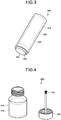
- FIG. 3 is a perspective view schematically illustrating a stamp 300 as a stationery product according to a third embodiment of the present invention.
- the stamp 300 as a stationery product includes a stamp base body 310, a housing part 320 disposed in the stamp base body 310, a printing body 330 as an application part and a paint permeation part, and a paint 340 for authenticity identification.
- the housing part 320 as a container capable of housing a fluid is disposed inside the stamp base body 310.
- the fluid-state paint 340 containing a color shift pigment is housed in this housing part 320.
- the printing body 330 is formed with a porous material such as felt.
- the printing body 330 is connected to the housing part 320, so that the paint 340 housed in the housing part 320 permeates into the printing body 330 by the function of capillarity.
- the printing body 330 has a printing face 350 having a shape corresponding to a desired marking.
- the printing face 350 contains a relatively projecting attachment part (not illustrated) and a relatively sinking non-attachment part (not illustrated), and the shape of the attachment part corresponds to the shape of a marking.
- the printing face 350 is provided in a manner of projecting from the stamp base body 310 such that the paint 340 having permeated into the printing body 330 can be applied onto an object (not illustrated).
- a user brings the printing face 350 into contact with an object. Consequently, the attachment part of the printing face 350 becomes in contact with the object, while the non-attachment part of the printing face 350 does not become in contact with the object, whereby the paint 340 having permeated into the printing body 330 is applied onto the object in such a manner that the shape of the attachment part is transferred. As a result, a marking can be formed on the object.
- the same advantage as the first embodiment can be usually obtained.
- the shape of a marking formed using the stamp 300 is limited to the shape corresponding to the shape of the printing face 350.
- the printing body 330 can be usually easily replaced, the flexibility regarding the shape of a marking is high.
- FIG. 4 is a perspective view schematically illustrating a marking tool 400 as a stationery product according to a fourth embodiment of the present invention.
- the marking tool 400 as a stationery product includes a container 410 as a housing part, a cap 420 of the container 410, a brush part 430 as an application part, and a paint 440 for authenticity identification.
- the fluid-state paint 440 containing a color shift pigment is housed in the container 410.
- the brush part 430 is provided such that the brush part 430 is housed inside the container 410 when the cap 420 is closed. Accordingly, the paint 440 housed in the container 410 adheres to the brush part 430.
- a user brings the brush part 430 into contact with an object in a manner of drawing a desired shape. Consequently, the paint 440 having adhered to the brush part 430 can be applied onto the object to thereby form a marking on the object.
- a variety of embodiments other than the stationery products described in the first to fourth embodiments may be adopted as the stationery products.
- Examples thereof may include a stationery product not including an application part such as a vermillion ink pad (a stamp pad for stamping a red seal) and a stamp pad.
- a vermillion ink pad or a stamp pad usually includes a container as a housing part, an ink pad housed in the container, and a paint having permeated into this ink pad to be retained.
- a seal or a stamp to function as an application part for applying a paint onto an object may be used in combination with the aforementioned vermillion ink pad or stamp pad for forming a marking.
- a color shift pigment is a pigment whose reflection band wavelength changes corresponding to the viewing angle.
- Such a color shift pigment is a special pigment, and is not readily available. Therefore, a marking formed with a paint containing this color shift pigment enables authenticity identification.
- a cholesteric pigment is a pigment which contains a layer of a resin having cholesteric regularity.
- a resin having cholesteric regularity may be appropriately referred to as a "cholesteric resin”.
- the cholesteric regularity is a structure in which the angle of molecular axes in stacking planes are shifted (twisted) as the planes are observed sequentially passing through the stacked planes, such that molecular axes in a certain first plane are oriented in a certain direction, molecular axes in a subsequent plane stacking on the first plane are oriented in a direction shifted by a small angle with respected to that of the first plane, and molecular axes in still another plane are oriented in a direction of a further shifted angle.
- a structure in which the direction of molecular axes twists in this manner is usually a helical structure, and is thus an optically chiral structure. In such a chiral structure, there occurs a phenomenon referred to as blueshift that is a shift of the reflection band to the short wavelength side as the viewing angle formed by the viewing direction to the normal line of a layer increases.
- the cholesteric resin to be used may include a cured product of a cholesteric liquid crystal composition.
- a material referred to herein as a "liquid crystal composition” encompasses not only a mixture of two or more substances but also a material constituted by a single material.
- the cholesteric liquid crystal composition refers to a composition which contains a liquid crystal compound capable of expressing a liquid crystal phase having cholesteric regularity (cholesteric liquid crystal phase) when the liquid crystal compound is oriented.
- the liquid crystal compound When the cholesteric liquid crystal composition is cured, usually the liquid crystal compound is polymerized in the state of expressing a cholesteric liquid crystal phase, and thereby there can be obtained a layer of a non-liquid crystal cholesteric resin having been cured while retaining the cholesteric regularity.
- the layer of the cholesteric resin usually has a circularly polarized light separation function. That is, it has a nature of allowing to pass therethrough one of clockwise circularly polarized light and counterclockwise circularly polarized light, and reflecting a portion or the entirety of the other. In the reflection in the layer of the cholesteric resin, circularly polarized light is reflected while retaining its chirality.
- a wavelength range in which the circularly polarized light separation function is exerted in this manner may be referred to as a "selective reflection band".
- a cholesteric pigment can reflect circularly polarized light having a color corresponding to the selective reflection band. Therefore, the color arrangement of a marking can be optionally adjusted by adjusting the selective reflection band.
- the specific wavelength for exerting the circularly polarized light separation function generally depends on the pitch of the helical structure in the layer of the cholesteric resin.
- the pitch of the helical structure is a distance in a plane normal line direction from a plane to the returning plane where the direction of molecular axes in the helical structure returns to the original direction of molecular axes as a result of shift of angles little by little as proceeding through planes.
- the pitch p of the helical structure and the wavelength ⁇ of reflected circularly polarized light usually have the relationship of the formula (X) and formula (Y).
- ⁇ C n ⁇ p ⁇ cos ⁇ ⁇ n o ⁇ p ⁇ cos ⁇ ⁇ ⁇ ⁇ n e ⁇ p ⁇ cos ⁇ ⁇
- ⁇ c indicates the center wavelength of the selective reflection band (hereinafter, this may be referred to as the "selective reflection center wavelength")
- n o indicates the refractive index in the minor axis direction of the liquid crystal compound
- n e indicates the refractive index in the major axis direction of the liquid crystal compound
- n indicates (n e + n ⁇ )/2
- p indicates the pitch of the helical structure
- 0 indicates the incident angle of light (an angle formed with the normal line of a plane).
- the selective reflection center wavelength ⁇ c depends on the pitch p of the helical structure of the polymer in the layer of the cholesteric resin.
- the selective reflection band can be changed by changing this pitch p of the helical structure.
- the pitch p of the helical structure is preferably set corresponding to the wavelength of circularly polarized light which is desired to be reflected on the layer of the cholesteric resin.
- Examples of the method for adjusting the pitch p may include a publicly known method described in Japanese Patent Application Laid-Open No. 2009-300662 A . Specific examples may include a method of adjusting the type or amount of the chiral agent in the cholesteric liquid crystal composition.
- Examples of the layer of the cholesteric resin as a cured product of the cholesteric liquid crystal composition may include those described in Japanese Patent Application Laid-Open No. 2015-27743 A .
- the cholesteric pigment contains the layer of the cholesteric resin, it usually has a single selective reflection band or multiple different selective reflection bands to the light perpendicular to the layer of the cholesteric resin.
- the light perpendicular to the layer refers to light traveling in the thickness direction of the layer.
- one type of cholesteric pigment may have multiple selective reflection bands.
- multiple types of cholesteric pigments each having a different selective reflection band may be used, so that the entirety of the cholesteric pigments contained in the paint may have multiple selective reflection bands.
- the cholesteric pigment preferably has a selective reflection band containing at least the visible range. That is, at least a portion of the selective reflection band of the cholesteric pigment is in the visible range. Furthermore, the cholesteric pigment preferably has one or more selective reflection bands which contain at least the visible range and have a specific bandwidth or more. The aforementioned bandwidth is preferably 100 nm or more, preferably 200 nm or more, and particularly preferably 400 nm or more. Furthermore, the selective reflection band possessed by the cholesteric pigment more preferably has the aforementioned specific bandwidth or more in the visible range. By having such a selective reflection band, the reflected light amount per a single pigment can be increased, and a marking of a design having higher design potential and visual recognizability can be formed.
- the particle shape of the color shift pigment may be any shape.
- the cholesteric pigment is usually produced by forming a layer of the cholesteric resin and pulverizing the layer of the cholesteric resin. Therefore, the cholesteric pigment usually has a shape of flakes.
- the average particle diameter of the color shift pigment is preferably 1 ⁇ m or more from the viewpoint of achieving decorative properties, and preferably 500 ⁇ m or less, more preferably 100 ⁇ m or less from the viewpoint of achieving favorable paint application properties.
- the average particle diameter of the color shift pigment may be measured by the following method. First, several sieves each having a different opening are used to measure the ratio of the pigment passing through the sieves having the corresponding openings. Then, from the size of the opening and the ratio of the pigment passing through the sieve having the opening, the particle diameter distribution of the pigment is expressed in terms of integrated weight percentage. The particle diameter at 50% in the integrated value of weight in the particle diameter distribution is calculated as the average particle diameter.
- the method for producing the color shift pigment may be any method.
- a cholesteric pigment may be produced by a method including a step of forming a layer of the cholesteric resin and a step of pulverizing the formed layer of the cholesteric resin.
- a specific manufacturing method for example, a method described in Japanese Patent Application Laid-Open No. 2015-27743 A may be used.
- the paint is a fluid-state material containing the color shift material.
- the fluid state includes not only a low-viscosity liquid state but also a high-viscosity gel state.
- the specific viscosity of the paint may be appropriately adjusted depending on the shape and size of a marking to be formed.
- the paint contains a dispersion medium, and the color shift pigment is dispersed in the dispersion medium.
- an inorganic solvent such as water may be used as the dispersion medium, but an organic solvent is usually used.
- the organic solvent may include organic solvents such as a ketone compound, an alkyl halide compound, an amide compound, a sulfoxide compound, a heterocyclic compound, a hydrocarbon compound, an ester compound, and an ether compound.
- a ketone compound is preferable in consideration of environmental load.
- the dispersion medium one type thereof may be solely used, and two or more types thereof may also be used in combination at any ratio.
- the amount of the dispersion medium is usually 40 parts by weight or more, preferably 60 parts by weight or more, and more preferably 80 parts by weight or more, and is usually 1,000 parts by weight or less, preferably 800 parts by weight or less, and more preferably 600 parts by weight or less, relative to 100 parts by weight of the color shift pigment.
- the paint may contain a binder for binding the color shift pigment after drying the dispersion medium.
- a binder a polymer is usually used.
- the polymer may include a polyester-based polymer, an acryl-based polymer, a polystyrene-based polymer, a polyamide-based polymer, a polyurethane-based polymer, a polyolefin-based polymer, a polycarbonate-based polymer, and a polyvinyl-based polymer.
- the binders one type thereof may be solely used, and two or more types thereof may also be used in combination at any ratio.
- the amount of the binder is usually 20 parts by weight or more, preferably 40 parts by weight or more, and more preferably 60 parts by weight or more, and is usually 1,000 parts by weight or less, preferably 800 parts by weight or less, and more preferably 600 parts by weight or less, relative to 100 parts by weight of the color shift pigment.
- the paint may contain an optional component in addition to the color shift pigment, the dispersion medium, and the binder.
- the optional component may include an antioxidant, an ultraviolet absorber, a light stabilizer, and a bluing agent.
- an antioxidant an ultraviolet absorber, a light stabilizer, and a bluing agent.
- one type thereof may be solely used, and two or more types thereof may also be used in combination at any ratio.
- the paint may contain a monomer of the polymer instead of the polymer as the binder or in combination with the polymer.
- a layer containing the color shift pigment and the binder may be produced by applying the paint onto a substrate, drying it, and polymerizing the monomer.
- the paint when it contains a monomer, it is preferable that the paint contains a polymerization initiator.
- the marking formed with the aforementioned stationery product contains a special pigment, i.e., a color shift pigment.
- a color shift pigment As the wavelength of the reflection band of this color shift pigment changes corresponding to the viewing angle, the color thereof usually changes corresponding to the viewing angle.
- authenticity can be identified on the basis of whether or not the color changes depending on the viewing angle.
- FIG. 5 is a cross-sectional view schematically illustrating an example of an article 500 obtained by forming a marking 520 on an object 510.
- FIG. 5 schematically illustrates paths of light reflected on the object 510 and the marking 520.
- various absorptions and reflections of light other than those described in the following may occur.
- major paths of light will be schematically described for the sake of convenience of explanation about the function.
- FIG. 5 illustrates major paths of light
- the marking 520 is formed with a paint containing a cholesteric pigment which reflects a portion of clockwise circularly polarized light in the visible range (specifically, light in the selective reflection band), and allow to pass a portion of the remainder of clockwise circularly polarized light and the entirety of counterclockwise circularly polarized light.
- Examples of an operation for authenticity identification by the marking 520 having such an action may include the following operations (I) and (II).
- non-polarized light such as natural light may be used as incident light.
- the marking 520 illuminated with such incident light is viewed through a filter which allows to pass therethrough only clockwise circularly polarized light (in the case of (I-R))
- a viewer views the reflected light A2R and A4R of clockwise circularly polarized light. Therefore, the marking 520 is viewed as a layer which reflects light by the cholesteric pigment.
- the marking 520 is mainly viewed with the color based on the reflection in the cholesteric pigment, and the shape or pattern of the marking 520 is viewed as an image.
- the marking 520 illuminated with the incident light is viewed through a filter which allows to pass therethrough only counterclockwise circularly polarized light (in the case of (I-L))
- a viewer views the reflected light A2L of counterclockwise circularly polarized light. Therefore, the marking 520 is viewed as a transparent layer.
- the marking 520 is not viewed with the color based on the reflection in the cholesteric pigment, and an image without the shape or pattern of the marking 520 is viewed.
- the article 500 having this marking 520 can be judged to be authentic.
- the article can be judged to be non-authentic.
- the object as a target to which a marking is to be formed with the aforementioned stationery product is not limited, and various articles may be adopted.
- the object may include fabric products such as clothes; leather products such as bags and shoes; metal products such as screws; paper products such as price tags; and rubber products such as tires.
- the object is not limited to these examples.
Landscapes
- Chemical & Material Sciences (AREA)
- Engineering & Computer Science (AREA)
- Life Sciences & Earth Sciences (AREA)
- Materials Engineering (AREA)
- Wood Science & Technology (AREA)
- Organic Chemistry (AREA)
- Physics & Mathematics (AREA)
- General Physics & Mathematics (AREA)
- Optics & Photonics (AREA)
- Manufacturing & Machinery (AREA)
- Inks, Pencil-Leads, Or Crayons (AREA)
- Pens And Brushes (AREA)
Abstract
Description
- The present invention relates to a stationery product which is used to form a marking for authenticity identification on an object.
- In some cases, a marking which cannot be easily duplicated is formed on the surface of an article which is required to be authentic, in order to prevent forgery of an article (see Patent Literature 1). As such a marking, a color shift pigment has been used in some cases in prior art (see Patent Literature 2).
-
- Patent Literature 1: Japanese Patent No
2960724 B - Patent Literature 2:
U.S. Patent No 6793720 - The present inventor conducted research on applying the marking onto an object using a label. Specifically, the research was conducted on applying the marking onto an object by sticking a marking-printed label to an object. However, in general, sticking of a label may become difficult in some cases depending on the shape and material of the surface of an object to be stuck. Furthermore, in general, there is a limit in the minimum size of a label, and therefore an attempt to apply a small marking using a label was unsuccessful in some cases.
-
Patent Literature 1 has proposed formation of a marking by screen printing. Then the present inventor conducted research on directly forming a marking on an object using screen printing. However, there is a limit in the position of a marking to be formed on an object by screen printing. For example, it is difficult to form a marking in a narrow interstice. In addition, there is a necessity of preparation of a screen mask corresponding to the shape of a marking in screen printing. Therefore, when a marking having an optional shape is to be formed, the number of types of screen masks to be prepared becomes enormously large. Furthermore, it is difficult to form a marking at any time at necessity by screen printing. Therefore, there is generally a limit in a timing at which a marking is formed. Consequently, there is a demand for a technology which increases flexibility in the formation of a marking so that a user can form a marking having an optional shape at an optional timing in an optional position of an object. - Patent Literature 2 discloses a solid marking composition like a crayon containing a color shift pigment. Since such a solid marking composition can be optionally used with the hand of a user, a marking can be quickly formed at an optional timing. However, since this solid marking composition is in a solid state, the range of an applicable object is limited, and the flexibility of a marking is low. For example, when a minute marking is to be formed with the solid marking composition, it has been difficult to adjust the size, because the marking composition is in a solid state. Furthermore, since a solid marking composition is required to have a specific size or more in order to maintain the rigidity of the solid marking composition, it has been difficult to reduce the size. Therefore, an attempt to form a minute marking with the solid marking composition is hindered by the limit of the possible minimum size of the marking. Furthermore, for example, an attempt to form a marking with a solid marking composition on a sort of shapes and materials of an object may result in difficulty in forming the marking because of insufficiency in the adhesion force between the solid marking composition and the object.
- The present invention has been devised in view of the aforementioned problem. An object of the present invention is to provide a stationery product which can form a marking for authenticity identification with high flexibility regarding position, timing, and shape.
- The present inventor intensively conducted research for solving the aforementioned problem. As a result, the present inventor has found that application to a stationery product of a fluid-state paint containing a color shift pigment allows the user to form a marking for authenticity identification with high flexibility regarding position, timing, and shape. Thus, the present invention has been accomplished.
- That is, the present invention includes the following.
- <1> A stationery product for forming a marking for authenticity identification on an object, the stationery product comprising a fluid-state paint for authenticity identification, and a housing part which houses the paint, wherein
the paint contains a color shift pigment whose reflection band wavelength changes corresponding to a viewing angle. - <2> The stationery product according to <1>, wherein the color shift pigment is a cholesteric pigment which contains a layer of a resin having cholesteric regularity.
- <3> The stationery product according to <2>, wherein the cholesteric pigment has a single reflection band or multiple different reflection bands to the light perpendicular to the layer.
- <4> The stationery product according to <3>, wherein the cholesteric pigment has one or more reflection bands containing at least the visible range and having a bandwidth of 100 nm or more.
- <5> The stationery product according to any one of <1> to <4>, comprising an application part for applying the paint housed in the housing part onto the object.
- <6> The stationery product according to <5>, wherein the application part includes a paint permeation part formed with a porous material, and
the paint permeates into the paint permeation part. - <7> The stationery product according to <5>, wherein the application part has a discharge port capable of discharging the paint when a pressure is applied to the housing part.
- According to the stationery product of the present invention, a marking for authenticity identification can be formed with high flexibility regarding position, timing, and shape.
-
FIG. 1 is a perspective view schematically illustrating a dispenser as a stationery product according to a first embodiment of the present invention. -
FIG. 2 is a perspective view schematically illustrating a marker as a stationery product according to a second embodiment of the present invention. -
FIG. 3 is a perspective view schematically illustrating a stamp as a stationery product according to a third embodiment of the present invention. -
FIG. 4 is a perspective view schematically illustrating a marking tool as a stationery product according to a fourth embodiment of the present invention. -
FIG. 5 is a cross-sectional view schematically illustrating an example of an article obtained by forming a marking on an object. - Hereinafter, the present invention will be described in detail with reference to embodiments and examples. However, the present invention is not limited to the following embodiments and examples, and may be freely modified for implementation without departing from the scope of claims of the present invention and the scope of their equivalents.
- The stationery product of the present invention is a tool which is used for forming a marking for authenticity identification on an object. This stationery product includes a fluid-state paint for authenticity identification and a housing part which houses the paint.
- A user applies the paint housed in the housing part onto an object to form a marking. As described herein, "applying" a paint encompasses not only coating with a paint but also attaching a paint using a stamp or the like.
- The paint included in the stationery product contains a color shift pigment. Therefore, a marking formed with the paint also contains the color shift pigment. The color shift pigment has a property that wavelength of the reflection band thereof changes corresponding to the viewing angle. Therefore, the recognized color of the color shift pigment usually changes corresponding to the viewing angle. Accordingly, upon viewing of the marking, when, e.g., the color of the pigment changes corresponding to the viewing angle, the object on which the marking has been formed can be judged to be an authentic article.
- However, even when wavelength of the reflection band changes corresponding to the viewing angle, such change may not appear as a change in color depending on the type of the color shift pigment. Even in such a case, whether or not the object is an authentic article can be judged by an appropriate identification method corresponding to the type of the color shift pigment.
- Also, with the stationery product, a user can easily form a marking of an optional shape such as a letter, a symbol, and a picture. Thus, a user can form a marking with high flexibility regarding shape.
- Furthermore, the stationery product can generally be handled by a user in a simple manner. Therefore, with the aforementioned stationery product, a user can form a marking at an optional appropriate timing. Thus, a user can form a marking with high flexibility regarding timing.
- Also, since a paint in a fluid state is used as the paint for use, a marking can be formed in an optional position of an object regardless of the shape of the object. For example, a marking can be easily formed in a position on which a marking is difficult to form with a solid marking composition such as a narrow interstice, a curved surface, and a rough surface. Thus, a user can form a marking with high flexibility regarding position.
- Furthermore, with the fluid-state paint, size control can be easily performed, and the size of a marking can be optionally adjusted by the amount to be applied. Thus, a user can form a marking with high flexibility regarding size.
- Also, by the addition of an appropriate binder in combination with the color shift pigment to the fluid-state paint, adhesion thereof to various types of materials with high adhesiveness can be achieved. Thus, a user can form a marking with high flexibility regarding material of an object.
-
FIG. 1 is a perspective view schematically illustrating adispenser 100 as a stationery product according to a first embodiment of the present invention. - As illustrated in
FIG. 1 , thedispenser 100 as a stationery product according to a first embodiment of the present invention includes abarrel part 110, anozzle part 120 as an application part, apressing tool 130, and apaint 140 for authenticity identification. - A
housing part 150 as a room capable of housing fluid is formed inside thebarrel part 110. The fluid-state paint 140 containing a color shift pigment is housed in thishousing part 150. - The
nozzle part 120 is in provided in a manner of being connected to thebarrel part 110 such that it can apply thepaint 140 housed in thehousing part 150 inside thebarrel part 110 onto an object (not illustrated). Further, adischarge port 160 is formed at a terminal end of thenozzle part 120. Thedischarge port 160 is formed in a manner of communicating with thehousing part 150 inside thebarrel part 110 such that theaforementioned paint 140 can be discharged through thedischarge port 160. - The
pressing tool 130 is a bent rod-shape member, and fixed to thebarrel part 110 at its oneend 131. Theother end 132 of thepressing tool 130 is slightly separated from thebarrel part 110. - When formation of a marking on an object using such a
dispenser 100 is intended, a user presses thepressing tool 130 as indicated by arrow A1 inFIG. 1 . Consequently, the side surface of thebarrel part 110 is pressed by theother end 132 of thepressing tool 130, so that a pressure is applied to thehousing part 150. When the pressure was applied to thehousing part 150 in this manner, thepaint 140 is discharged through thedischarge port 160 by the applied pressure. This dischargedpaint 140 may be applied onto an object in a manner of drawing a desired shape, so that a marking is formed on the object. - With the
aforementioned dispenser 100, a user can form a marking of an optional shape in an optional position of an object at an optional timing. Also, since the size of a marking can be optionally adjusted in the formation of a marking using thisdispenser 100, there can be formed a marking which is smaller than that of prior art. Furthermore, a stable marking can be formed by appropriately adjusting components such as a binder contained in thepaint 140 so that a color shift pigment strongly adheres to an object formed with a varied type of material. Consequently, according to theaforementioned dispenser 100, a marking for authenticity identification can be formed with high flexibility regarding position, timing, shape, size, and material of an object. -
FIG. 2 is a perspective view schematically illustrating amarker 200 as a stationery product according to a second embodiment of the present invention. - As illustrated in
FIG. 2 , themarker 200 as a stationery product according to a second embodiment of the present invention includes ashaft tube 210, ahousing part 220 disposed inside theshaft tube 210, atip part 230 as an application part and a paint permeation part, and apaint 240 for authenticity identification. - The
housing part 220 as a container capable of housing a fluid is disposed inside theshaft tube 210. The fluid-state paint 240 containing a color shift pigment is housed in thishousing part 220. - The
tip part 230 is formed with a porous material such as felt. Thetip part 230 is connected to thehousing part 220 so that thepaint 240 housed in thehousing part 220 permeates into thetip part 230 by the function of capillarity. Furthermore, the terminal end of thetip part 230 is provided in a manner of projecting from theshaft tube 210 such that thepaint 240 having permeated into thetip part 230 can be applied onto an object (not illustrated). - When formation of a marking on an object using such a
marker 200 is intended, a user brings thetip part 230 into contact with an object in a manner of drawing a desired shape. Consequently, thepaint 240 having permeated into thetip part 230 can be applied onto the object, and thereby a marking can be formed on the object. - With the
aforementioned marker 200, the same advantage as that in the first embodiment can be usually obtained. -
FIG. 3 is a perspective view schematically illustrating astamp 300 as a stationery product according to a third embodiment of the present invention. - As illustrated in
FIG. 3 , thestamp 300 as a stationery product according to the third embodiment of the present invention includes astamp base body 310, ahousing part 320 disposed in thestamp base body 310, aprinting body 330 as an application part and a paint permeation part, and apaint 340 for authenticity identification. - The
housing part 320 as a container capable of housing a fluid is disposed inside thestamp base body 310. The fluid-state paint 340 containing a color shift pigment is housed in thishousing part 320. - The
printing body 330 is formed with a porous material such as felt. Theprinting body 330 is connected to thehousing part 320, so that thepaint 340 housed in thehousing part 320 permeates into theprinting body 330 by the function of capillarity. Furthermore, theprinting body 330 has aprinting face 350 having a shape corresponding to a desired marking. Specifically, theprinting face 350 contains a relatively projecting attachment part (not illustrated) and a relatively sinking non-attachment part (not illustrated), and the shape of the attachment part corresponds to the shape of a marking. Theprinting face 350 is provided in a manner of projecting from thestamp base body 310 such that thepaint 340 having permeated into theprinting body 330 can be applied onto an object (not illustrated). - When formation of a marking on an object using such a
stamp 300 is intended, a user brings theprinting face 350 into contact with an object. Consequently, the attachment part of theprinting face 350 becomes in contact with the object, while the non-attachment part of theprinting face 350 does not become in contact with the object, whereby thepaint 340 having permeated into theprinting body 330 is applied onto the object in such a manner that the shape of the attachment part is transferred. As a result, a marking can be formed on the object. - With the
aforementioned stamp 300, the same advantage as the first embodiment can be usually obtained. Usually, the shape of a marking formed using thestamp 300 is limited to the shape corresponding to the shape of theprinting face 350. However, since theprinting body 330 can be usually easily replaced, the flexibility regarding the shape of a marking is high. -
FIG. 4 is a perspective view schematically illustrating amarking tool 400 as a stationery product according to a fourth embodiment of the present invention. - As illustrated in
FIG. 4 , the markingtool 400 as a stationery product according to a fourth embodiment of the present invention includes acontainer 410 as a housing part, acap 420 of thecontainer 410, abrush part 430 as an application part, and apaint 440 for authenticity identification. - The fluid-
state paint 440 containing a color shift pigment is housed in thecontainer 410. - The
brush part 430 is provided such that thebrush part 430 is housed inside thecontainer 410 when thecap 420 is closed. Accordingly, thepaint 440 housed in thecontainer 410 adheres to thebrush part 430. - When formation of a marking on an object using the
aforementioned marking tool 400 is intended, a user brings thebrush part 430 into contact with an object in a manner of drawing a desired shape. Consequently, thepaint 440 having adhered to thebrush part 430 can be applied onto the object to thereby form a marking on the object. - With the
aforementioned marking tool 400, the same advantage as that in the first embodiment can be usually obtained. - A variety of embodiments other than the stationery products described in the first to fourth embodiments may be adopted as the stationery products.
- Examples thereof may include a stationery product not including an application part such as a vermillion ink pad (a stamp pad for stamping a red seal) and a stamp pad. A vermillion ink pad or a stamp pad usually includes a container as a housing part, an ink pad housed in the container, and a paint having permeated into this ink pad to be retained. In this case, a seal or a stamp to function as an application part for applying a paint onto an object may be used in combination with the aforementioned vermillion ink pad or stamp pad for forming a marking.
- A color shift pigment is a pigment whose reflection band wavelength changes corresponding to the viewing angle. Such a color shift pigment is a special pigment, and is not readily available. Therefore, a marking formed with a paint containing this color shift pigment enables authenticity identification.
- As the aforementioned color shift pigment, a cholesteric pigment is preferable. A cholesteric pigment is a pigment which contains a layer of a resin having cholesteric regularity. In the following description, a resin having cholesteric regularity may be appropriately referred to as a "cholesteric resin". As described herein, the cholesteric regularity is a structure in which the angle of molecular axes in stacking planes are shifted (twisted) as the planes are observed sequentially passing through the stacked planes, such that molecular axes in a certain first plane are oriented in a certain direction, molecular axes in a subsequent plane stacking on the first plane are oriented in a direction shifted by a small angle with respected to that of the first plane, and molecular axes in still another plane are oriented in a direction of a further shifted angle. A structure in which the direction of molecular axes twists in this manner is usually a helical structure, and is thus an optically chiral structure. In such a chiral structure, there occurs a phenomenon referred to as blueshift that is a shift of the reflection band to the short wavelength side as the viewing angle formed by the viewing direction to the normal line of a layer increases.
- Examples of the cholesteric resin to be used may include a cured product of a cholesteric liquid crystal composition. For the sake of convenience, a material referred to herein as a "liquid crystal composition" encompasses not only a mixture of two or more substances but also a material constituted by a single material. The cholesteric liquid crystal composition refers to a composition which contains a liquid crystal compound capable of expressing a liquid crystal phase having cholesteric regularity (cholesteric liquid crystal phase) when the liquid crystal compound is oriented. When the cholesteric liquid crystal composition is cured, usually the liquid crystal compound is polymerized in the state of expressing a cholesteric liquid crystal phase, and thereby there can be obtained a layer of a non-liquid crystal cholesteric resin having been cured while retaining the cholesteric regularity.
- The layer of the cholesteric resin usually has a circularly polarized light separation function. That is, it has a nature of allowing to pass therethrough one of clockwise circularly polarized light and counterclockwise circularly polarized light, and reflecting a portion or the entirety of the other. In the reflection in the layer of the cholesteric resin, circularly polarized light is reflected while retaining its chirality. In the following description, a wavelength range in which the circularly polarized light separation function is exerted in this manner may be referred to as a "selective reflection band". When this selective reflection band is adjusted, a cholesteric pigment can reflect circularly polarized light having a color corresponding to the selective reflection band. Therefore, the color arrangement of a marking can be optionally adjusted by adjusting the selective reflection band.
- The specific wavelength for exerting the circularly polarized light separation function generally depends on the pitch of the helical structure in the layer of the cholesteric resin. The pitch of the helical structure is a distance in a plane normal line direction from a plane to the returning plane where the direction of molecular axes in the helical structure returns to the original direction of molecular axes as a result of shift of angles little by little as proceeding through planes. By changing the magnitude of this pitch of the helical structure, the wavelength in which the circularly polarized light separation function is exerted can be changed. In particular, when the magnitude of the pitch of the helical structure continuously varies in the layer, the circularly polarized light separation function over a wide band can be obtained by a single layer of a cholesteric resin.
- Specifically, when the helical axis representing a rotation axis around which molecular axes twist in the helical structure is parallel to the normal line of the layer of the cholesteric resin, the pitch p of the helical structure and the wavelength λ of reflected circularly polarized light usually have the relationship of the formula (X) and formula (Y).


In the formula (X) and the formula (Y), λc indicates the center wavelength of the selective reflection band (hereinafter, this may be referred to as the "selective reflection center wavelength"), no indicates the refractive index in the minor axis direction of the liquid crystal compound, ne indicates the refractive index in the major axis direction of the liquid crystal compound, n indicates (ne + nο)/2, p indicates the pitch of the helical structure, and 0 indicates the incident angle of light (an angle formed with the normal line of a plane). - Therefore, the selective reflection center wavelength λc depends on the pitch p of the helical structure of the polymer in the layer of the cholesteric resin. The selective reflection band can be changed by changing this pitch p of the helical structure. Accordingly, the pitch p of the helical structure is preferably set corresponding to the wavelength of circularly polarized light which is desired to be reflected on the layer of the cholesteric resin. Examples of the method for adjusting the pitch p may include a publicly known method described in Japanese Patent Application Laid-Open No.
2009-300662 A - Examples of the layer of the cholesteric resin as a cured product of the cholesteric liquid crystal composition may include those described in Japanese Patent Application Laid-Open No.
2015-27743 A - Since the cholesteric pigment contains the layer of the cholesteric resin, it usually has a single selective reflection band or multiple different selective reflection bands to the light perpendicular to the layer of the cholesteric resin. The light perpendicular to the layer refers to light traveling in the thickness direction of the layer. When the cholesteric pigment has multiple selective reflection bands, one type of cholesteric pigment may have multiple selective reflection bands. Alternatively, multiple types of cholesteric pigments each having a different selective reflection band may be used, so that the entirety of the cholesteric pigments contained in the paint may have multiple selective reflection bands.
- In particular, the cholesteric pigment preferably has a selective reflection band containing at least the visible range. That is, at least a portion of the selective reflection band of the cholesteric pigment is in the visible range. Furthermore, the cholesteric pigment preferably has one or more selective reflection bands which contain at least the visible range and have a specific bandwidth or more. The aforementioned bandwidth is preferably 100 nm or more, preferably 200 nm or more, and particularly preferably 400 nm or more. Furthermore, the selective reflection band possessed by the cholesteric pigment more preferably has the aforementioned specific bandwidth or more in the visible range. By having such a selective reflection band, the reflected light amount per a single pigment can be increased, and a marking of a design having higher design potential and visual recognizability can be formed.
- The particle shape of the color shift pigment may be any shape. The cholesteric pigment is usually produced by forming a layer of the cholesteric resin and pulverizing the layer of the cholesteric resin. Therefore, the cholesteric pigment usually has a shape of flakes.
- The average particle diameter of the color shift pigment is preferably 1 µm or more from the viewpoint of achieving decorative properties, and preferably 500 µm or less, more preferably 100 µm or less from the viewpoint of achieving favorable paint application properties.
- The average particle diameter of the color shift pigment may be measured by the following method. First, several sieves each having a different opening are used to measure the ratio of the pigment passing through the sieves having the corresponding openings. Then, from the size of the opening and the ratio of the pigment passing through the sieve having the opening, the particle diameter distribution of the pigment is expressed in terms of integrated weight percentage. The particle diameter at 50% in the integrated value of weight in the particle diameter distribution is calculated as the average particle diameter.
- The method for producing the color shift pigment may be any method. For example, a cholesteric pigment may be produced by a method including a step of forming a layer of the cholesteric resin and a step of pulverizing the formed layer of the cholesteric resin. As a specific manufacturing method, for example, a method described in Japanese Patent Application Laid-Open No.
2015-27743 A - The paint is a fluid-state material containing the color shift material. Herein, the fluid state includes not only a low-viscosity liquid state but also a high-viscosity gel state. The specific viscosity of the paint may be appropriately adjusted depending on the shape and size of a marking to be formed.
- Usually, the paint contains a dispersion medium, and the color shift pigment is dispersed in the dispersion medium. For example, an inorganic solvent such as water may be used as the dispersion medium, but an organic solvent is usually used. Examples of the organic solvent may include organic solvents such as a ketone compound, an alkyl halide compound, an amide compound, a sulfoxide compound, a heterocyclic compound, a hydrocarbon compound, an ester compound, and an ether compound. Among these, a ketone compound is preferable in consideration of environmental load. As the dispersion medium, one type thereof may be solely used, and two or more types thereof may also be used in combination at any ratio.
- The amount of the dispersion medium is usually 40 parts by weight or more, preferably 60 parts by weight or more, and more preferably 80 parts by weight or more, and is usually 1,000 parts by weight or less, preferably 800 parts by weight or less, and more preferably 600 parts by weight or less, relative to 100 parts by weight of the color shift pigment. By adjusting the amount of the dispersion medium within the aforementioned range, it is possible to improve the paint application properties.
- Further, the paint may contain a binder for binding the color shift pigment after drying the dispersion medium. As the binder, a polymer is usually used. Examples of the polymer may include a polyester-based polymer, an acryl-based polymer, a polystyrene-based polymer, a polyamide-based polymer, a polyurethane-based polymer, a polyolefin-based polymer, a polycarbonate-based polymer, and a polyvinyl-based polymer. As the binders, one type thereof may be solely used, and two or more types thereof may also be used in combination at any ratio.
- The amount of the binder is usually 20 parts by weight or more, preferably 40 parts by weight or more, and more preferably 60 parts by weight or more, and is usually 1,000 parts by weight or less, preferably 800 parts by weight or less, and more preferably 600 parts by weight or less, relative to 100 parts by weight of the color shift pigment. By adjusting the amount of the binder within the aforementioned range, it is possible to improve the paint application properties. Further, the color shift pigment can be stably bound after the dispersion medium is dried.
- Furthermore, the paint may contain an optional component in addition to the color shift pigment, the dispersion medium, and the binder. Examples of the optional component may include an antioxidant, an ultraviolet absorber, a light stabilizer, and a bluing agent. As these components, one type thereof may be solely used, and two or more types thereof may also be used in combination at any ratio.
- Further, the paint may contain a monomer of the polymer instead of the polymer as the binder or in combination with the polymer. In this case, a layer containing the color shift pigment and the binder may be produced by applying the paint onto a substrate, drying it, and polymerizing the monomer. However, when it contains a monomer, it is preferable that the paint contains a polymerization initiator.
- The marking formed with the aforementioned stationery product contains a special pigment, i.e., a color shift pigment. As the wavelength of the reflection band of this color shift pigment changes corresponding to the viewing angle, the color thereof usually changes corresponding to the viewing angle. Thus, upon the viewing of the marking, authenticity can be identified on the basis of whether or not the color changes depending on the viewing angle.
- Particularly, when a cholesteric pigment is used as the color shift pigment, authenticity can be identified by the circularly polarized light separation function possessed by the cholesteric pigment. Hereinafter, a method for identifying authenticity by a marking formed with a paint containing the cholesteric pigment will be described by referring to examples.
-
FIG. 5 is a cross-sectional view schematically illustrating an example of anarticle 500 obtained by forming a marking 520 on anobject 510.FIG. 5 schematically illustrates paths of light reflected on theobject 510 and the marking 520. In an actual article, various absorptions and reflections of light other than those described in the following may occur. However, in the following description, major paths of light will be schematically described for the sake of convenience of explanation about the function. In an example illustrated inFIG. 5 , the marking 520 is formed with a paint containing a cholesteric pigment which reflects a portion of clockwise circularly polarized light in the visible range (specifically, light in the selective reflection band), and allow to pass a portion of the remainder of clockwise circularly polarized light and the entirety of counterclockwise circularly polarized light. - When clockwise circularly polarized light A1R enters the top surface of the marking 520 of the
article 500 illustrated inFIG. 5 , a portion thereof is reflected on the cholesteric pigment (not illustrated) in the marking 520 to become reflected light A2R, and a portion of the remainder becomes transmitted light A3R. Although reflection can occur not only on the surface of the marking 520 but also inside the marking 520, as a schematic illustration, the reflection is illustrated inFIG. 5 as occurring on the surface of the marking 520. The transmitted light A3R reaches the top surface of theobject 510, which is located on the lower side of the marking 520. A portion thereof is absorbed there, and a portion of the remainder is reflected. The reflected light exits as reflected light A4R. - On the other hand, when counterclockwise circularly polarized light A1L enters the top surface of the marking 520, the entirety thereof reaches the top surface of the
object 510, which is located on the lower side of the marking 520. A portion thereof is absorbed there, and a portion of the remainder is reflected. The reflected light exits as reflected light A2L. - Examples of an operation for authenticity identification by the marking 520 having such an action may include the following operations (I) and (II).
- (I) With light including both clockwise circularly polarized light and counterclockwise circularly polarized light as incident light, the following images viewed are compared:
- (I-R) an image of the marking 520 viewed through a filter which allows to pass therethrough only clockwise circularly polarized light, and
- (I-L) an image of the marking 520 viewed through a filter which allows to pass therethrough only counterclockwise circularly polarized light.
- (II) The following images viewed are compared;
(II-R) an image of the marking 520 viewed with light including only clockwise circularly polarized light as incident light, and
(II-L) an image of the marking 520 viewed with light including only counterclockwise circularly polarized light as incident light. - In the operation (I), non-polarized light such as natural light may be used as incident light. When the marking 520 illuminated with such incident light is viewed through a filter which allows to pass therethrough only clockwise circularly polarized light (in the case of (I-R)), a viewer views the reflected light A2R and A4R of clockwise circularly polarized light. Therefore, the marking 520 is viewed as a layer which reflects light by the cholesteric pigment. Thus, the marking 520 is mainly viewed with the color based on the reflection in the cholesteric pigment, and the shape or pattern of the marking 520 is viewed as an image.
- On the other hand, when the marking 520 illuminated with the incident light is viewed through a filter which allows to pass therethrough only counterclockwise circularly polarized light (in the case of (I-L)), a viewer views the reflected light A2L of counterclockwise circularly polarized light. Therefore, the marking 520 is viewed as a transparent layer. Thus, the marking 520 is not viewed with the color based on the reflection in the cholesteric pigment, and an image without the shape or pattern of the marking 520 is viewed.
- Consequently, when such a difference is observed between the viewed images, the
article 500 having this marking 520 can be judged to be authentic. When such a difference is not observed, the article can be judged to be non-authentic. - In the operation (II), when the marking 520 is viewed with light including only clockwise circularly polarized light as incident light (in the case of (II-R)), an image based on only clockwise circularly polarized light is viewed, and the same image as in the aforementioned case of (I-R) is viewed. On the other hand, when the marking 520 is viewed with light including only counterclockwise circularly polarized light as incident light (in the case of (II-L)), an image based on only counterclockwise circularly polarized light is viewed, and the same image as in the aforementioned case of (I-L) is viewed. Therefore, the authenticity can be identified in the same manner as the operation (I).
- The object as a target to which a marking is to be formed with the aforementioned stationery product is not limited, and various articles may be adopted. Examples of the object may include fabric products such as clothes; leather products such as bags and shoes; metal products such as screws; paper products such as price tags; and rubber products such as tires. However, the object is not limited to these examples.
-
- 100
- dispenser
- 110
- barrel part
- 120
- nozzle part
- 130
- pressing tool
- 131
- one end of pressing tool
- 132
- other end of pressing tool
- 140
- paint
- 150
- housing part
- 200
- marker
- 210
- shaft tube
- 220
- housing part
- 230
- tip part
- 240
- paint
- 300
- stamp
- 310
- stamp base body
- 320
- housing part
- 330
- printing body
- 340
- paint
- 350
- printing face
- 400
- marking tool
- 410
- container
- 420
- cap
- 430
- brush part
- 440
- paint
- 500
- article
- 510
- object
- 520
- marking
Claims (7)
- A stationery product for forming a marking for authenticity identification on an object, the stationery product comprising a fluid-state paint for authenticity identification, and a housing part which houses the paint, wherein
the paint contains a color shift pigment whose reflection band wavelength changes corresponding to a viewing angle. - The stationery product according to claim 1, wherein the color shift pigment is a cholesteric pigment which contains a layer of a resin having cholesteric regularity.
- The stationery product according to claim 2, wherein the cholesteric pigment has a single reflection band or multiple different reflection bands to the light perpendicular to the layer.
- The stationery product according to claim 3, wherein the cholesteric pigment has one or more reflection bands containing at least the visible range and having a bandwidth of 100 nm or more.
- The stationery product according to any one of claims 1 to 4, comprising an application part for applying the paint housed in the housing part onto the object.
- The stationery product according to claim 5, wherein the application part includes a paint permeation part formed with a porous material, and
the paint permeates into the paint permeation part. - The stationery product according to claim 5, wherein the application part has a discharge port capable of discharging the paint when a pressure is applied to the housing part.
Applications Claiming Priority (2)
| Application Number | Priority Date | Filing Date | Title |
|---|---|---|---|
| JP2017080687 | 2017-04-14 | ||
| PCT/JP2018/014670 WO2018190253A1 (en) | 2017-04-14 | 2018-04-06 | Stationery |
Publications (2)
| Publication Number | Publication Date |
|---|---|
| EP3611029A1 true EP3611029A1 (en) | 2020-02-19 |
| EP3611029A4 EP3611029A4 (en) | 2020-12-16 |
Family
ID=63792518
Family Applications (1)
| Application Number | Title | Priority Date | Filing Date |
|---|---|---|---|
| EP18783742.2A Withdrawn EP3611029A4 (en) | 2017-04-14 | 2018-04-06 | Stationery |
Country Status (4)
| Country | Link |
|---|---|
| EP (1) | EP3611029A4 (en) |
| JP (1) | JPWO2018190253A1 (en) |
| TW (1) | TW201838836A (en) |
| WO (1) | WO2018190253A1 (en) |
Family Cites Families (10)
| Publication number | Priority date | Publication date | Assignee | Title |
|---|---|---|---|---|
| DE19726051A1 (en) * | 1997-06-19 | 1998-12-24 | Consortium Elektrochem Ind | Process and broadening of cholesteric reflection bands of photopolymerizable cholesteric liquid crystals and optical elements produced by this process |
| DE19737618A1 (en) | 1997-08-28 | 1999-03-04 | Consortium Elektrochem Ind | Machine-detectable security marking with increased protection against forgery, production of the security marking and security system comprising this security marking |
| JP2001234108A (en) * | 2000-02-23 | 2001-08-28 | Mitsubishi Pencil Co Ltd | Aqueous ballpoint pen ink composition |
| EP1146098A1 (en) * | 2000-04-14 | 2001-10-17 | Sicpa Holding S.A. | Solid marking composition as writing means, a writing instrument, an optically variable marking layer and use of a plurality of optically variable pigments |
| JP3966454B2 (en) * | 2002-03-05 | 2007-08-29 | 株式会社サクラクレパス | Viewing angle dependent pleochroic composition, ink composition for writing instruments and writing instrument |
| JP4658258B2 (en) * | 2004-09-15 | 2011-03-23 | パイロットインキ株式会社 | Color memory photochromic writing instrument, color memory photochromic writing instrument set using the same, and tautomatic expression method of color memory photochromic function of writing image |
| US20070082977A1 (en) * | 2005-10-07 | 2007-04-12 | The Pilot Ink Co., Ltd. | Ink composition for color-memorizing photochromic writing instrument and writing instrument using the same |
| EP1876216A1 (en) * | 2006-06-27 | 2008-01-09 | Sicpa Holding S.A. | Cholesteric multi-layers |
| JP5540473B2 (en) | 2008-06-12 | 2014-07-02 | 凸版印刷株式会社 | Cholesteric liquid crystal display supplies |
| JP6142714B2 (en) | 2013-07-30 | 2017-06-07 | 日本ゼオン株式会社 | Method for producing peeled piece of resin thin film, method for producing resin thin film pigment, paint, anti-counterfeit article, security article and decorative article |
-
2018
- 2018-04-06 JP JP2019512487A patent/JPWO2018190253A1/en active Pending
- 2018-04-06 EP EP18783742.2A patent/EP3611029A4/en not_active Withdrawn
- 2018-04-06 WO PCT/JP2018/014670 patent/WO2018190253A1/en not_active Ceased
- 2018-04-11 TW TW107112411A patent/TW201838836A/en unknown
Also Published As
| Publication number | Publication date |
|---|---|
| WO2018190253A1 (en) | 2018-10-18 |
| EP3611029A4 (en) | 2020-12-16 |
| JPWO2018190253A1 (en) | 2020-02-27 |
| TW201838836A (en) | 2018-11-01 |
Similar Documents
| Publication | Publication Date | Title |
|---|---|---|
| JP5678328B2 (en) | Piezochromic security element | |
| TWI487628B (en) | Magnetically oriented ink on primer layer | |
| CN100522647C (en) | Security element and methods for the production thereof | |
| TW528793B (en) | Multilayer reflective film or pigment with viewing angle dependent reflection characteristics | |
| JP6672552B2 (en) | Magnetic or magnetizable pigment particles and visual effect layer | |
| CN101636276B (en) | Safety elements, manufacturing method and application thereof, and data mediums equiped thereon | |
| US20110114733A1 (en) | Security element | |
| CN104619915B (en) | Optically-variable safety line and bar | |
| EP2042343A1 (en) | Security device, reflective coating and layer therefor, and associated method | |
| CN105324446A (en) | Thermally Sensitive Tamper Indicators | |
| CN113759622B (en) | Anti-counterfeiting device including a piezochromic fluorescent layer | |
| JP6983072B2 (en) | Optical film | |
| CN106457865B (en) | Cellulose nanocrystal body coating media for printing | |
| EP1748306A1 (en) | Authenticity judging medium, base material capable of judging authenticity, authenticity judging medium label, authenticity judging medium transfer sheet, sheet capable of judging authenticity, and information recording element capable of judging authenticity | |
| KR102373887B1 (en) | Method for Manufacturing Means Preventing Forgery and Falsification including Photonic Crystal Materials Complex | |
| GB2457911A (en) | Producing an optically variable security device | |
| EP3611029A1 (en) | Stationery | |
| US20240017562A1 (en) | Optical anti-counterfeiting element and manufacturing method therefor, and anti-counterfeiting product | |
| JP7327382B2 (en) | Flakes, method for producing the same, and paint | |
| JP7552689B2 (en) | Display media and display articles | |
| JP2007171310A (en) | Authenticator and medium with authenticator | |
| EP4502678A1 (en) | Identification medium | |
| HK1220663A1 (en) | Permanent magnet assemblies for generating concave field lines and process for creating optical effect coating therewith (inverse rolling bar) | |
| HK1218131B (en) | Magnetic or magnetisable pigment particles and optical effect layers | |
| HK1220663B (en) | Permanent magnet assemblies for generating concave field lines and process for creating optical effect coating therewith (inverse rolling bar) |
Legal Events
| Date | Code | Title | Description |
|---|---|---|---|
| STAA | Information on the status of an ep patent application or granted ep patent |
Free format text: STATUS: THE INTERNATIONAL PUBLICATION HAS BEEN MADE |
|
| PUAI | Public reference made under article 153(3) epc to a published international application that has entered the european phase |
Free format text: ORIGINAL CODE: 0009012 |
|
| STAA | Information on the status of an ep patent application or granted ep patent |
Free format text: STATUS: REQUEST FOR EXAMINATION WAS MADE |
|
| 17P | Request for examination filed |
Effective date: 20191009 |
|
| AK | Designated contracting states |
Kind code of ref document: A1 Designated state(s): AL AT BE BG CH CY CZ DE DK EE ES FI FR GB GR HR HU IE IS IT LI LT LU LV MC MK MT NL NO PL PT RO RS SE SI SK SM TR |
|
| AX | Request for extension of the european patent |
Extension state: BA ME |
|
| DAV | Request for validation of the european patent (deleted) | ||
| DAX | Request for extension of the european patent (deleted) | ||
| A4 | Supplementary search report drawn up and despatched |
Effective date: 20201116 |
|
| RIC1 | Information provided on ipc code assigned before grant |
Ipc: B41K 1/54 20060101ALI20201110BHEP Ipc: B43M 11/06 20060101ALI20201110BHEP Ipc: B44D 2/00 20060101ALI20201110BHEP Ipc: B42D 25/364 20140101ALI20201110BHEP Ipc: B43K 8/02 20060101ALI20201110BHEP Ipc: C09D 11/17 20140101ALI20201110BHEP Ipc: G02B 5/30 20060101ALI20201110BHEP Ipc: C09D 201/00 20060101ALI20201110BHEP Ipc: C09D 7/41 20180101ALI20201110BHEP Ipc: B43K 8/14 20060101AFI20201110BHEP |
|
| STAA | Information on the status of an ep patent application or granted ep patent |
Free format text: STATUS: EXAMINATION IS IN PROGRESS |
|
| 17Q | First examination report despatched |
Effective date: 20220909 |
|
| STAA | Information on the status of an ep patent application or granted ep patent |
Free format text: STATUS: THE APPLICATION IS DEEMED TO BE WITHDRAWN |
|
| 18D | Application deemed to be withdrawn |
Effective date: 20250614 |