EP3610787A1 - Wearable device, and method and apparatus for eliminating exercise interference - Google Patents
Wearable device, and method and apparatus for eliminating exercise interference Download PDFInfo
- Publication number
- EP3610787A1 EP3610787A1 EP17893507.8A EP17893507A EP3610787A1 EP 3610787 A1 EP3610787 A1 EP 3610787A1 EP 17893507 A EP17893507 A EP 17893507A EP 3610787 A1 EP3610787 A1 EP 3610787A1
- Authority
- EP
- European Patent Office
- Prior art keywords
- signal
- preset
- correlation coefficient
- dimensional acceleration
- motion interference
- Prior art date
- Legal status (The legal status is an assumption and is not a legal conclusion. Google has not performed a legal analysis and makes no representation as to the accuracy of the status listed.)
- Granted
Links
Images



Classifications
-
- A—HUMAN NECESSITIES
- A61—MEDICAL OR VETERINARY SCIENCE; HYGIENE
- A61B—DIAGNOSIS; SURGERY; IDENTIFICATION
- A61B5/00—Measuring for diagnostic purposes; Identification of persons
- A61B5/68—Arrangements of detecting, measuring or recording means, e.g. sensors, in relation to patient
- A61B5/6801—Arrangements of detecting, measuring or recording means, e.g. sensors, in relation to patient specially adapted to be attached to or worn on the body surface
- A61B5/6802—Sensor mounted on worn items
-
- A—HUMAN NECESSITIES
- A61—MEDICAL OR VETERINARY SCIENCE; HYGIENE
- A61B—DIAGNOSIS; SURGERY; IDENTIFICATION
- A61B5/00—Measuring for diagnostic purposes; Identification of persons
- A61B5/02—Detecting, measuring or recording for evaluating the cardiovascular system, e.g. pulse, heart rate, blood pressure or blood flow
- A61B5/024—Measuring pulse rate or heart rate
-
- A—HUMAN NECESSITIES
- A61—MEDICAL OR VETERINARY SCIENCE; HYGIENE
- A61B—DIAGNOSIS; SURGERY; IDENTIFICATION
- A61B5/00—Measuring for diagnostic purposes; Identification of persons
- A61B5/02—Detecting, measuring or recording for evaluating the cardiovascular system, e.g. pulse, heart rate, blood pressure or blood flow
- A61B5/024—Measuring pulse rate or heart rate
- A61B5/02416—Measuring pulse rate or heart rate using photoplethysmograph signals, e.g. generated by infrared radiation
-
- A—HUMAN NECESSITIES
- A61—MEDICAL OR VETERINARY SCIENCE; HYGIENE
- A61B—DIAGNOSIS; SURGERY; IDENTIFICATION
- A61B5/00—Measuring for diagnostic purposes; Identification of persons
- A61B5/02—Detecting, measuring or recording for evaluating the cardiovascular system, e.g. pulse, heart rate, blood pressure or blood flow
- A61B5/024—Measuring pulse rate or heart rate
- A61B5/02438—Measuring pulse rate or heart rate with portable devices, e.g. worn by the patient
-
- A—HUMAN NECESSITIES
- A61—MEDICAL OR VETERINARY SCIENCE; HYGIENE
- A61B—DIAGNOSIS; SURGERY; IDENTIFICATION
- A61B5/00—Measuring for diagnostic purposes; Identification of persons
- A61B5/72—Signal processing specially adapted for physiological signals or for diagnostic purposes
- A61B5/7203—Signal processing specially adapted for physiological signals or for diagnostic purposes for noise prevention, reduction or removal
- A61B5/7207—Signal processing specially adapted for physiological signals or for diagnostic purposes for noise prevention, reduction or removal of noise induced by motion artifacts
- A61B5/721—Signal processing specially adapted for physiological signals or for diagnostic purposes for noise prevention, reduction or removal of noise induced by motion artifacts using a separate sensor to detect motion or using motion information derived from signals other than the physiological signal to be measured
-
- A—HUMAN NECESSITIES
- A61—MEDICAL OR VETERINARY SCIENCE; HYGIENE
- A61B—DIAGNOSIS; SURGERY; IDENTIFICATION
- A61B5/00—Measuring for diagnostic purposes; Identification of persons
- A61B5/72—Signal processing specially adapted for physiological signals or for diagnostic purposes
- A61B5/7203—Signal processing specially adapted for physiological signals or for diagnostic purposes for noise prevention, reduction or removal
- A61B5/7207—Signal processing specially adapted for physiological signals or for diagnostic purposes for noise prevention, reduction or removal of noise induced by motion artifacts
- A61B5/7214—Signal processing specially adapted for physiological signals or for diagnostic purposes for noise prevention, reduction or removal of noise induced by motion artifacts using signal cancellation, e.g. based on input of two identical physiological sensors spaced apart, or based on two signals derived from the same sensor, for different optical wavelengths
-
- A—HUMAN NECESSITIES
- A61—MEDICAL OR VETERINARY SCIENCE; HYGIENE
- A61B—DIAGNOSIS; SURGERY; IDENTIFICATION
- A61B5/00—Measuring for diagnostic purposes; Identification of persons
- A61B5/72—Signal processing specially adapted for physiological signals or for diagnostic purposes
- A61B5/7225—Details of analogue processing, e.g. isolation amplifier, gain or sensitivity adjustment, filtering, baseline or drift compensation
-
- A—HUMAN NECESSITIES
- A61—MEDICAL OR VETERINARY SCIENCE; HYGIENE
- A61B—DIAGNOSIS; SURGERY; IDENTIFICATION
- A61B5/00—Measuring for diagnostic purposes; Identification of persons
- A61B5/72—Signal processing specially adapted for physiological signals or for diagnostic purposes
- A61B5/7235—Details of waveform analysis
- A61B5/7246—Details of waveform analysis using correlation, e.g. template matching or determination of similarity
-
- A—HUMAN NECESSITIES
- A61—MEDICAL OR VETERINARY SCIENCE; HYGIENE
- A61B—DIAGNOSIS; SURGERY; IDENTIFICATION
- A61B5/00—Measuring for diagnostic purposes; Identification of persons
- A61B5/72—Signal processing specially adapted for physiological signals or for diagnostic purposes
- A61B5/7271—Specific aspects of physiological measurement analysis
- A61B5/7278—Artificial waveform generation or derivation, e.g. synthesizing signals from measured signals
-
- A—HUMAN NECESSITIES
- A61—MEDICAL OR VETERINARY SCIENCE; HYGIENE
- A61B—DIAGNOSIS; SURGERY; IDENTIFICATION
- A61B2562/00—Details of sensors; Constructional details of sensor housings or probes; Accessories for sensors
- A61B2562/02—Details of sensors specially adapted for in-vivo measurements
- A61B2562/0219—Inertial sensors, e.g. accelerometers, gyroscopes, tilt switches
Definitions
- the present disclosure relates to the field of signal processing technology, and more particularly to a wearable device, a method and apparatus for eliminating motion interference.
- Heart rate is the speed of the heartbeat measured by the number of contractions of the heart per minute, and it is a very important physiological indicator in clinical diagnosis.
- Traditional medical devices require users to be at rest while measuring heart rate, and are not convenient to be carried. Therefore, many manufacturers have already produced wearable devices capable of performing heart rate measurement, so that users can measure heart rate in daily life occasions.
- PPG Photoplethysmogram
- a LED is used to emit light of a specific wavelength, the light is propagated, scattered, diffracted, and reflected via human tissue, then returned, and a returned optical signal is converted into an electrical signal, so as to obtain a corresponding PPG signal.
- intensity of light beams is attenuated due to the property of light absorbing by human tissues. For example, a value of light absorbing by static tissues such as skin, fat, muscle, etc. is a constant value.
- the PPG signal shows a periodic waveform that is consistent with the heartbeat. Accordingly, the heartbeat frequency can be measured with the PPG signal. Further, the PPG method is a non-invasive measurement method for measuring heart rate.
- heart rate measurement on the wearable device is more demanding on the PPG method because users need to measure the heart rate in a motion state.
- muscle and pressure will change in a motion state, which results in that a propagation path of light beams changes.
- a motion interference signal is also superimposed on the PPG signal.
- Different motion states produce different motion interference frequencies, and a value of the motion frequency cannot be guaranteed to be a constant value.
- the motion frequency is in a range of 0Hz to 4Hz in the state of walking, climbing and running, and the human heart rate is also in a range of 0.5Hz to 4Hz. Therefore, motion interference with unknown frequencies cannot be filtered by traditional FIR (finite impulse response), IIR (infinite impulse response) or wavelet filtering.
- a precondition for implementing the adaptive noise cancellation method is that the motion state has statistical stability, in this way, the adaptive filter is continuously in a convergent state. But the motion state cannot be kept stable in reality, such as up and down stairs.
- a precondition for the DST method is that blood oxygen saturation is relatively high, usually higher than 85%, thus this method is not suitable for users with dyspnea (whose blood oxygen saturation is relatively low).
- the DST method is computationally intensive and difficult to be implemented on wearable devices.
- the objective of some embodiments of the present disclosure is to provide a wearable device, a method and apparatus for eliminating motion interference, with which interference in motion can be effectively eliminated, and detection of signals with motion interference being eliminated is suitable in various motion states, meanwhile computational complexity is less, and implementation is easily be performed on the wearable device.
- An embodiment of the present disclosure provides a method for eliminating motion interference.
- the method is applied to a wearable device capable of acquiring a multi-dimensional acceleration signal and a measurement signal to be processed of the wearable device, and the measurement signal to be processed includes a first signal and a second signal having different wavelengths.
- the method comprises: performing dimensionality reduction on the multi-dimensional acceleration signal to obtain a one-dimensional acceleration signal that represents motion interference; mixing the first signal and the second signal through a plurality of preset coefficients respectively, so as to calculate a plurality of mixed signals corresponding to the plurality of preset coefficients; calculating a correlation coefficient between each of the mixed signals and the one-dimensional acceleration signal; obtaining a preset coefficient corresponding to the maximum correlation coefficient among the correlation coefficients and a preset coefficient corresponding to the minimum correlation coefficient among the correlation coefficients; calculating a signal with motion interference being eliminated from the measurement signal to be processed, according to the first signal, the second signal, the preset coefficient corresponding to the maximum correlation coefficient, and the preset coefficient corresponding to the minimum correlation coefficient.
- An embodiment of the present disclosure further provides an apparatus for eliminating motion interference.
- the apparatus is applied to the method for eliminating motion interference as described above.
- the apparatus comprises: a dimensionality reduction module configured to perform dimensionality reduction on a multi-dimensional acceleration signal to obtain a one-dimensional acceleration signal that represents motion interference; a first calculation module configured to mix a first signal and a second signal through a plurality of preset coefficients respectively, so as to calculate a plurality of mixed signals corresponding to the plurality of preset coefficients; a second calculation module configured to calculate a correlation coefficient between each of the mixed signals and the one-dimensional acceleration signal; an identification module configured to obtain a preset coefficient corresponding to the maximum correlation coefficient among the correlation coefficients and a preset coefficient corresponding to the minimum correlation coefficient among the correlation coefficients; and a third calculation module configured to calculate a signal with motion interference being eliminated from the measurement signal to be processed, according to the first signal, the second signal, the preset coefficient corresponding to the maximum correlation coefficient, and the preset coefficient corresponding to the minimum correlation coefficient.
- An embodiment of the present disclosure further provides a wearable device.
- the wearable device comprises a first sensor, a second sensor, a memory, and a processor connected to the first sensor and the second sensor.
- the first sensor is configured to acquire a multi-dimensional acceleration signal of the wearable device.
- the second sensor is configured to obtain a measurement signal to be processed, and the measurement signal to be processed includes a first signal and a second signal having different wavelengths.
- the memory is configured to store a plurality of instructions.
- the processor is configured to load the plurality of instructions and perform the function of the apparatus for eliminating motion interference as described above.
- dimensionality reduction is performed on the multi-dimensional acceleration signal to obtain a one-dimensional acceleration signal that represents motion interference; the first signal and the second signal are mixed through a plurality of preset coefficients respectively, and a plurality of mixed signals corresponding to the plurality of preset coefficients are calculated; a correlation coefficient between each of the mixed signals and the one-dimensional acceleration signal is calculated accordingly; then a preset coefficient corresponding to the maximum correlation coefficient among the correlation coefficients and a preset coefficient corresponding to the minimum correlation coefficient among the correlation coefficients are obtained; so that a signal with motion interference being eliminated from the measurement signal to be processed is calculated according to the first signal, the second signal, the preset coefficient corresponding to the maximum correlation coefficient, and the preset coefficient corresponding to the minimum correlation coefficient. That is, interference in motion is eliminated by using the correlation between motion interference and the multi-dimensional acceleration signal, and detection of signals with motion interference being eliminated is suitable in various motion states, meanwhile computational complexity is less, and implementation is easily be performed on the wearable device.
- This embodiment provides a specific method for calculating the mixed signal D r i ( t ).
- This embodiment provides a specific formula for calculating the signal with motion interference being eliminated.
- the correlation coefficient is a Pearson correlation coefficient. This embodiment provides a method for calculating the correlation coefficient.
- performing dimensionality reduction on the multi-dimensional acceleration signal to obtain a one-dimensional acceleration signal that represents motion interference specifically comprises: calculating a covariance matrix of a multi-dimensional acceleration matrix formed by the multi-dimensional acceleration signal; calculating a plurality of eigenvalues and a plurality of eigenvectors of the covariance matrix, the plurality of eigenvalues corresponding to the plurality of eigenvectors respectively; identifying, according to the plurality of eigenvalues, an eigenvector that includes a preset information weight from the plurality of eigenvectors; and multiplying the eigenvector with the multi-dimensional acceleration signal to obtain the one-dimensional acceleration signal.
- This embodiment provides a specific method of implementing dimensionality reduction processing on the multi-dimensional acceleration signal.
- the value of the plurality of preset coefficients is increased in an arithmetic progression manner.
- the signal with motion interference being eliminated is a PPG signal.
- the second sensor is a heart rate sensor.
- a first embodiment of the present disclosure provides a method for eliminating motion interference.
- the method is applied to a wearable device, such as a watch, a ring, a headband, an earphone, etc..
- the wearable device can acquire a multi-dimensional acceleration signal and a measurement signal to be processed of the wearable device.
- the multi-dimensional acceleration signal represents an acceleration signal in different directions (that is, different dimensions) generated in motion state of the wearable device.
- a light-emitting diode in the wearable device emits light of two different wavelengths, and an optical sensor capable of collecting optical signals of different wavelengths is disposed in the wearable device, therefore measurement signals to be processed that includes a first signal and a second signal having different wavelengths can be obtained.
- a signal with motion interference being eliminated can be obtained after eliminating motion interference in the measurement signal to be processed. Frequencies of the signals with motion interference being eliminated that are obtained from the first signal or the second signal are the same, that is, the wavelengths are the same.
- the signal with motion interference being eliminated is, for example, a PPG signal, and the measurement signal to be processed is actually a PPG signal including motion interference, thus the signal with motion interference being eliminated is obtained after motion interference in the measurement signal to be processed is eliminated.
- This embodiment takes the measurement signal to be processed that is a PPG signal with motion interference as an example.
- the detailed process of the method for eliminating motion interference is shown in FIG. 1 .
- Step 101 dimensionality reduction is performed on the multi-dimensional acceleration signal to obtain a one-dimensional acceleration signal that represents motion interference.
- a multi-dimensional acceleration signal of a wearable device usually is a three-axis acceleration signal G ( t ), that includes acceleration signals in three directions of X-axis, Y-axis, and Z-axis (X-axis, Y-axis, and Z-axis are a coordinate system determined by a current direction of the wearable device).
- Dimensionality reduction processing is performed on the three-axis acceleration signal G ( t ), so that a one-dimensional acceleration signal Acc(t) can be extracted from the three-axis acceleration signal G ( t ).
- the one-dimensional acceleration signal Acc(t) can be used to represent the motion interference.
- Step 102 the first signal and the second signal are mixed through a plurality of preset coefficients respectively, so as to calculate a plurality of mixed signals corresponding to the plurality of preset coefficients.
- the first signal is a photoelectric signal S ⁇ a ( t ) with a wavelength of ⁇ a
- the second signal is a photoelectric signal S ⁇ b ( t ) with a wavelength of ⁇ b
- t is a time window with a length of T
- t [to, to+T]
- the first signal S ⁇ a ( t ) and the second signal S ⁇ b ( t ) satisfy the following expressions:
- S ⁇ a t ppg ⁇ a t + M ⁇ a t + N ⁇ a t
- S ⁇ b t ppg ⁇ b t + M ⁇ b t + N ⁇ b t
- ppg ⁇ a ( t ) and ppg ⁇ b ( t ) are pulse signal components (that is, the signal with motion interference being eliminated) in the first signal and the second signal, respectively.
- M ⁇ a ( t ) and M ⁇ b ( t ) are motion interference components in the first signal and the second signal, respectively.
- N ⁇ a ( t ) and N ⁇ b ( t ) are noise components in the first signal and the second signal, respectively.
- the pulse signal component, the motion interference component, and the noise component in each of the first signal and the second signal are independent of each other.
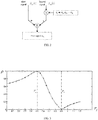
- the first signal and the second signal are mixed through a preset coefficient r i , as shown in FIG. 2 , so that a mixed signal D r i ( t ) can be obtained.
- the mixed signal D r i ( t )
- r i represents an i-th preset coefficient
- a traversal range of r i is [ r slow , r high ]
- r slow and r high are a lower limit and an upper limit of the traversal range, respectively.
- the value of the plurality of preset coefficients r i is increased in an arithmetic progression manner.
- FIG. 2 merely schematically provides a method for calculating the mixed signal, this embodiment makes no limitations thereto, and specific setting may be made according to a practical design scheme.
- the mixed signal D r i ( t ) is correlated to the one-dimensional acceleration signal Acc(t), and there is a correlation coefficient.
- r a represents an a-th preset coefficient, that is the preset coefficient corresponding to the correlation coefficient that takes a maximum.
- r v represents a v-th preset coefficient, that is the preset coefficient corresponding to the correlation coefficient that takes a minimum.
- N ( t ) N ⁇ a ( t ) - r i N ⁇ b ( t )
- the plurality of preset coefficients r i are traversed within the traversal range [ r slow , r high ] , so as to calculate a plurality of mixed signals D r i ( t ) corresponding to the plurality of preset coefficients. That is, each preset coefficient r i corresponds to one mixed signal D r i ( t ).
- Step 103 a correlation coefficient between each mixed signal and the one-dimensional acceleration signal is calculated.
- the existing correlation coefficient calculation methods include the Pearson correlation coefficient calculation method and the cosine similarity calculation method.
- This embodiment adopts the Pearson correlation coefficient calculation method, the correlation coefficient is a Pearson correlation coefficient.
- the Pearson correlation coefficient is irrelevant to amplitudes and baselines of the mixed signal D r i ( t ) and the one-dimensional acceleration signal, and is only related to shapes of the mixed signal D r i ( t ) and the one-dimensional acceleration signal, thus a shape similarity of the mixed signal D r i ( t ) and the one-dimensional acceleration signal can be measured accurately.
- the Pearson correlation coefficient calculation method calculates a Pearson correlation coefficient (that is, correlation coefficient) ⁇ ri of each mixed signal D r i ( t ) and the one-dimensional acceleration signal Acc ( t ):
- ⁇ ri represents a Pearson correlation coefficient of the mixed signal D r i ( t ) corresponding to the i-th preset coefficient and the one-dimensional acceleration signal Acc ( t ).
- each mixed signal D r i ( t ) has one Pearson correlation coefficient (that is, correlation coefficient) ⁇ ri , and each mixed signal D r i ( t ) corresponds to one preset coefficient r i , each Pearson correlation coefficient ⁇ ri corresponds to one preset coefficient r i .
- Pearson correlation coefficients that is, correlation coefficients
- a curve of the correlation coefficient ⁇ ri and the preset coefficient r i is shown.
- Step 104 a preset coefficient corresponding to the maximum correlation coefficient among the correlation coefficients and a preset coefficient corresponding to the minimum correlation coefficient among the correlation coefficients are obtained.
- the maximum correlation coefficient and the minimum correlation coefficient are identified from among the plurality of correlation coefficients ⁇ ri , and it can be known from the curve of the correlation coefficient ⁇ ri and the preset coefficient r i in FIG. 3 , the maximum correlation coefficient is close to 1, and the minimum correlation coefficient is close to 0.
- the correlation coefficient ⁇ ri takes a maximum value which is close to 1
- the correlation coefficient is r a
- the correlation coefficient ⁇ ri takes a minimum value which is close to 0.
- the correlation coefficient is r v ; that is, as shown in FIG. 3 , the preset coefficient corresponding to the maximum correlation coefficient is r a , which is 0.5, and a preset coefficient corresponding to the minimum correlation coefficient is r v , which is 0.9.
- Step 105 a signal with motion interference being eliminated from the measurement signal to be processed is calculated according to the first signal, the second signal, the preset coefficient corresponding to the maximum correlation coefficient, and the preset coefficient corresponding to the minimum correlation coefficient.
- the mixed signal D r i ( t ) and the one-dimensional acceleration signal Acc ( t ) have a weak correlation.
- the D rv ( t ) signal only includes the pulse signal (that is, the signal with motion interface being eliminated) and other small amount of noise, and the motion interference component has been eliminated.
- ppg ⁇ b ( t ) represents the signal with motion interference being eliminated
- r a represents the preset coefficient corresponding to the maximum correlation coefficient
- r v represents the preset coefficient corresponding to the minimum correlation coefficient.
- ppg ⁇ a ( t ) and ppg ⁇ b ( t ) both represent the signal with motion interference being eliminated; r a represents the preset coefficient corresponding to the maximum correlation coefficient, r v represents the preset coefficient corresponding to the minimum correlation coefficient.
- the pulse and other physiological parameters can be accurately calculated by using the signal ppg ⁇ a ( t ) or ppg ⁇ b ( t ) with motion interference being eliminated and adopting the time domain waveform algorithm or the frequency domain algorithm, according to needs.
- ppg ⁇ a ( t ) and ppg ⁇ b ( t ) are the pulse signals extracted from the first signal and the second signal with different wavelengths
- frequencies of the pulse signals that is, the signals with motion interference being eliminated
- ppg ⁇ a ( t ) and ppg ⁇ b ( t ) are the same, that is, they have the same wavelengths, thus, the pulse and other physiological parameters calculated according to the pulse signals (that is, the signals with motion interference being eliminated)
- ppg ⁇ a ( t ) and ppg ⁇ b ( t ) are the same.
- dimensionality reduction is performed on the multi-dimensional acceleration signal to obtain a one-dimensional acceleration signal that represents motion interference; the first signal and the second signal are mixed through a plurality of preset coefficients respectively, and a plurality of mixed signals corresponding to the plurality of preset coefficients are calculated; a correlation coefficient between each of the mixed signals and the one-dimensional acceleration signal is calculated accordingly; then a preset coefficient corresponding to the maximum correlation coefficient among the correlation coefficients and a preset coefficient corresponding to the minimum correlation coefficient among the correlation coefficients are obtained; so that a signal with motion interference being eliminated from the measurement signal to be processed is calculated according to the first signal, the second signal, the preset coefficient corresponding to the maximum correlation coefficient, and the preset coefficient corresponding to the minimum correlation coefficient. That is, interference in motion is eliminated by using the correlation between motion interference and the multi-dimensional acceleration signal, and detection of signals with motion interference being eliminated is suitable in various motion states, meanwhile computational complexity is less, and implementation is easily be performed on the wearable device.
- a second embodiment of the present disclosure provides a method for eliminating motion interference.
- This embodiment is a refinement of the first embodiment, and the main refinement lies in: detailed introduction is provided to step 101 of performing dimensionality reduction on the multi-dimensional acceleration signal to obtain a one-dimensional acceleration signal that represents motion interference.
- FIG. 2 A specific flow of the method for eliminating motion interference in this embodiment is shown in FIG. 2 .
- step 201 of performing dimensionality reduction on the multi-dimensional acceleration signal to obtain a one-dimensional acceleration signal that represents motion interference comprises the following sub-steps in details:
- a multi-dimensional acceleration signal usually is a three-axis acceleration signal G ( t ).
- the three-axis acceleration signal G ( t ) indicates the acceleration signals in different directions in a three-dimensional space.
- cov represents calculating a covariance
- Sub-step 2012 a plurality of eigenvalues and a plurality of eigenvectors of the covariance matrix are calculated.
- the eigenvalues of the covariance matrix C are ⁇ i
- the eigenvalues ⁇ i and the eigenvectors v i corresponding thereto can be obtained, that is, the plurality of eigenvalues correspond to the plurality of eigenvectors respectively.
- an eigenvector that includes a preset information weight is identified from the plurality of eigenvectors according to the plurality of eigenvalues.
- the preset information weight represents a percentage of each eigenvector in all eigenvectors, expressed as p %;
- an eigenvector V [ v 1 , ⁇ v I ] that includes a preset information weight can be identified from the plurality of eigenvectors.
- Sub-step 2014 the eigenvector is multiplied with the multi-dimensional acceleration signal, so as to obtain the one-dimensional acceleration signal.
- the eigenvector V that includes a preset information weight is multiplied with the three-axis acceleration signal G ( t ) (that is, the multi-dimensional acceleration signal), to obtain the dimensionality-reduced three-axis acceleration signal G' ( t ):
- G ′ t G t V
- G' ( t ) represents the dimensionality-reduced three-axis acceleration signal.
- this embodiment provides a specific mode of implementing dimensionality reduction processing on the multi-dimensional acceleration signal.
- a third embodiment of the present disclosure provides an apparatus for eliminating motion interference, which is applied to the method for eliminating motion interference in any one of the first embodiment and the second embodiment.
- the apparatus for eliminating motion interference includes a dimensionality reduction module 1, a first calculation module 2, a second calculation module 3, an identification module 4, and a third calculation module 5.
- the dimensionality reduction module 1 is configured to perform dimensionality reduction on a multi-dimensional acceleration signal to obtain a one-dimensional acceleration signal that represents motion interference.
- the first calculation module 2 is configured to mix a first signal and a second signal through a plurality of preset coefficients respectively, so as to calculate a plurality of mixed signals corresponding to the plurality of preset coefficients.
- the second calculation module 3 is configured to calculate a correlation coefficient between each of the mixed signals and the one-dimensional acceleration signal.
- the identification module 4 is configured to obtain a preset coefficient corresponding to the maximum correlation coefficient among the correlation coefficients and a preset coefficient corresponding to the minimum correlation coefficient among the correlation coefficients.
- the third calculation module 5 is configured to calculate a signal with motion interference being eliminated from the measurement signal to be processed, according to the first signal, the second signal, the preset coefficient corresponding to the maximum correlation coefficient, and the preset coefficient corresponding to the minimum correlation coefficient.
- dimensionality reduction is performed on the multi-dimensional acceleration signal to obtain a one-dimensional acceleration signal that represents motion interference; the first signal and the second signal are mixed through a plurality of preset coefficients respectively, and a plurality of mixed signals corresponding to the plurality of preset coefficients are calculated; a correlation coefficient between each of the mixed signals and the one-dimensional acceleration signal is calculated accordingly; then a preset coefficient corresponding to the maximum correlation coefficient among the correlation coefficients and a preset coefficient corresponding to the minimum correlation coefficient among the correlation coefficients are obtained; so that a signal with motion interference being eliminated from the measurement signal to be processed is calculated according to the first signal, the second signal, the preset coefficient corresponding to the maximum correlation coefficient, and the preset coefficient corresponding to the minimum correlation coefficient. That is, interference in motion is eliminated by using the correlation between motion interference and the multi-dimensional acceleration signal, and detection of signals with motion interference being eliminated is suitable in various motion states, meanwhile computational complexity is less, and implementation is easily be performed on the wearable device.
- a fourth embodiment of the present disclosure provides a wearable device, which is any one of a watch, a ring, a headband and an earphone.
- the wearable device comprises a first sensor 6, a second sensor 7, a memory 8, and a processor 9.
- the processor 9 is connected to the first sensor 6 and the second sensor 7.
- the first sensor 6 is configured to acquire a multi-dimensional acceleration signal of the wearable device.
- the second sensor 7 is configured to obtain a measurement signal to be processed; and the measurement signal to be processed includes a first signal and a second signal having different wavelengths.
- the second sensor 7 may be a heart rate sensor.
- the memory 8 is configured to store a plurality of instructions.
- the processor 9 is configured to load the plurality of instructions and perform the function of the apparatus for eliminating motion interference in the third embodiment.
- This embodiment provides a wearable device capable of eliminating motion interference.
Landscapes
- Health & Medical Sciences (AREA)
- Life Sciences & Earth Sciences (AREA)
- Engineering & Computer Science (AREA)
- Public Health (AREA)
- Molecular Biology (AREA)
- Veterinary Medicine (AREA)
- Signal Processing (AREA)
- Physics & Mathematics (AREA)
- General Health & Medical Sciences (AREA)
- Biophysics (AREA)
- Pathology (AREA)
- Biomedical Technology (AREA)
- Heart & Thoracic Surgery (AREA)
- Medical Informatics (AREA)
- Animal Behavior & Ethology (AREA)
- Surgery (AREA)
- Physiology (AREA)
- Cardiology (AREA)
- Computer Vision & Pattern Recognition (AREA)
- Artificial Intelligence (AREA)
- Psychiatry (AREA)
- Power Engineering (AREA)
- Measuring Pulse, Heart Rate, Blood Pressure Or Blood Flow (AREA)
- Measurement Of The Respiration, Hearing Ability, Form, And Blood Characteristics Of Living Organisms (AREA)
Abstract
Description
- The present disclosure relates to the field of signal processing technology, and more particularly to a wearable device, a method and apparatus for eliminating motion interference.
- With the improvement of living standards, people pay more and more attention to their own health. Heart rate is the speed of the heartbeat measured by the number of contractions of the heart per minute, and it is a very important physiological indicator in clinical diagnosis. Traditional medical devices require users to be at rest while measuring heart rate, and are not convenient to be carried. Therefore, many manufacturers have already produced wearable devices capable of performing heart rate measurement, so that users can measure heart rate in daily life occasions.
- The existing most commonly used method for measuring heart rate is Photoplethysmogram (PPG) method. In this method, a LED is used to emit light of a specific wavelength, the light is propagated, scattered, diffracted, and reflected via human tissue, then returned, and a returned optical signal is converted into an electrical signal, so as to obtain a corresponding PPG signal. When light beams are propagated through human tissues, intensity of light beams is attenuated due to the property of light absorbing by human tissues. For example, a value of light absorbing by static tissues such as skin, fat, muscle, etc. is a constant value. However, light absorbing by blood undergoes periodic volume changes due to contraction and diastole of the heart, thus the PPG signal shows a periodic waveform that is consistent with the heartbeat. Accordingly, the heartbeat frequency can be measured with the PPG signal. Further, the PPG method is a non-invasive measurement method for measuring heart rate.
- The inventor has found that there are at least the following problems: heart rate measurement on the wearable device is more demanding on the PPG method because users need to measure the heart rate in a motion state. However, muscle and pressure will change in a motion state, which results in that a propagation path of light beams changes. Besides a pulse wave signal, a motion interference signal is also superimposed on the PPG signal. Different motion states produce different motion interference frequencies, and a value of the motion frequency cannot be guaranteed to be a constant value. For example, the motion frequency is in a range of 0Hz to 4Hz in the state of walking, climbing and running, and the human heart rate is also in a range of 0.5Hz to 4Hz. Therefore, motion interference with unknown frequencies cannot be filtered by traditional FIR (finite impulse response), IIR (infinite impulse response) or wavelet filtering.
- There are two existing technical solutions for measuring heart rate in a motion state: one is an adaptive noise cancellation method based on an adaptive filter; and the other is an oxygen saturation discrete saturation transform (DST) method. However, a precondition for implementing the adaptive noise cancellation method is that the motion state has statistical stability, in this way, the adaptive filter is continuously in a convergent state. But the motion state cannot be kept stable in reality, such as up and down stairs. A precondition for the DST method is that blood oxygen saturation is relatively high, usually higher than 85%, thus this method is not suitable for users with dyspnea (whose blood oxygen saturation is relatively low). In addition, the DST method is computationally intensive and difficult to be implemented on wearable devices.
- The objective of some embodiments of the present disclosure is to provide a wearable device, a method and apparatus for eliminating motion interference, with which interference in motion can be effectively eliminated, and detection of signals with motion interference being eliminated is suitable in various motion states, meanwhile computational complexity is less, and implementation is easily be performed on the wearable device.
- An embodiment of the present disclosure provides a method for eliminating motion interference. The method is applied to a wearable device capable of acquiring a multi-dimensional acceleration signal and a measurement signal to be processed of the wearable device, and the measurement signal to be processed includes a first signal and a second signal having different wavelengths. The method comprises: performing dimensionality reduction on the multi-dimensional acceleration signal to obtain a one-dimensional acceleration signal that represents motion interference; mixing the first signal and the second signal through a plurality of preset coefficients respectively, so as to calculate a plurality of mixed signals corresponding to the plurality of preset coefficients; calculating a correlation coefficient between each of the mixed signals and the one-dimensional acceleration signal; obtaining a preset coefficient corresponding to the maximum correlation coefficient among the correlation coefficients and a preset coefficient corresponding to the minimum correlation coefficient among the correlation coefficients; calculating a signal with motion interference being eliminated from the measurement signal to be processed, according to the first signal, the second signal, the preset coefficient corresponding to the maximum correlation coefficient, and the preset coefficient corresponding to the minimum correlation coefficient.
- An embodiment of the present disclosure further provides an apparatus for eliminating motion interference. The apparatus is applied to the method for eliminating motion interference as described above. The apparatus comprises: a dimensionality reduction module configured to perform dimensionality reduction on a multi-dimensional acceleration signal to obtain a one-dimensional acceleration signal that represents motion interference; a first calculation module configured to mix a first signal and a second signal through a plurality of preset coefficients respectively, so as to calculate a plurality of mixed signals corresponding to the plurality of preset coefficients; a second calculation module configured to calculate a correlation coefficient between each of the mixed signals and the one-dimensional acceleration signal; an identification module configured to obtain a preset coefficient corresponding to the maximum correlation coefficient among the correlation coefficients and a preset coefficient corresponding to the minimum correlation coefficient among the correlation coefficients; and a third calculation module configured to calculate a signal with motion interference being eliminated from the measurement signal to be processed, according to the first signal, the second signal, the preset coefficient corresponding to the maximum correlation coefficient, and the preset coefficient corresponding to the minimum correlation coefficient.
- An embodiment of the present disclosure further provides a wearable device. The wearable device comprises a first sensor, a second sensor, a memory, and a processor connected to the first sensor and the second sensor. The first sensor is configured to acquire a multi-dimensional acceleration signal of the wearable device. The second sensor is configured to obtain a measurement signal to be processed, and the measurement signal to be processed includes a first signal and a second signal having different wavelengths. The memory is configured to store a plurality of instructions. The processor is configured to load the plurality of instructions and perform the function of the apparatus for eliminating motion interference as described above.
- In the embodiments of the present disclosure, dimensionality reduction is performed on the multi-dimensional acceleration signal to obtain a one-dimensional acceleration signal that represents motion interference; the first signal and the second signal are mixed through a plurality of preset coefficients respectively, and a plurality of mixed signals corresponding to the plurality of preset coefficients are calculated; a correlation coefficient between each of the mixed signals and the one-dimensional acceleration signal is calculated accordingly; then a preset coefficient corresponding to the maximum correlation coefficient among the correlation coefficients and a preset coefficient corresponding to the minimum correlation coefficient among the correlation coefficients are obtained; so that a signal with motion interference being eliminated from the measurement signal to be processed is calculated according to the first signal, the second signal, the preset coefficient corresponding to the maximum correlation coefficient, and the preset coefficient corresponding to the minimum correlation coefficient. That is, interference in motion is eliminated by using the correlation between motion interference and the multi-dimensional acceleration signal, and detection of signals with motion interference being eliminated is suitable in various motion states, meanwhile computational complexity is less, and implementation is easily be performed on the wearable device.
- Further, in the method for eliminating motion interference, the mixed signal Dr
i (t) is: Dri (t) = Sλa (t) - ri · Sλb , i=1, 2, 3, ...; Sλa (t) represents the first signal; Sλb represents the second signal; ri represents an i-th preset coefficient, and a traversal range of ri is [rslow, rhigh ], rslow , rhigh are a lower limit and an upper limit of the traversal range, respectively. This embodiment provides a specific method for calculating the mixed signal Dri (t). - Further, in the method for eliminating motion interference, the signal ppgλ
b (t) with motion interference being eliminated is expressed as:
b (t) represents the signal with motion interference being eliminated; ra represents the preset coefficient corresponding to the maximum correlation coefficient, rv represents the preset coefficient corresponding to the minimum correlation coefficient. This embodiment provides a specific formula for calculating the signal with motion interference being eliminated. - Further, in the method for eliminating motion interference, the correlation coefficient is a Pearson correlation coefficient. This embodiment provides a method for calculating the correlation coefficient.
- Further, in the method for eliminating motion interference, performing dimensionality reduction on the multi-dimensional acceleration signal to obtain a one-dimensional acceleration signal that represents motion interference specifically comprises: calculating a covariance matrix of a multi-dimensional acceleration matrix formed by the multi-dimensional acceleration signal; calculating a plurality of eigenvalues and a plurality of eigenvectors of the covariance matrix, the plurality of eigenvalues corresponding to the plurality of eigenvectors respectively; identifying, according to the plurality of eigenvalues, an eigenvector that includes a preset information weight from the plurality of eigenvectors; and multiplying the eigenvector with the multi-dimensional acceleration signal to obtain the one-dimensional acceleration signal. This embodiment provides a specific method of implementing dimensionality reduction processing on the multi-dimensional acceleration signal.
- Further, in the method for eliminating motion interference, the value of the plurality of preset coefficients is increased in an arithmetic progression manner.
- Further, in the method for eliminating motion interference, the signal with motion interference being eliminated is a PPG signal.
- Further, in the wearable device, the second sensor is a heart rate sensor.
- One or more embodiments are exemplified by the corresponding figures in the accompanying drawings, these illustrative explanations are not intended to limit these embodiments, elements with the same reference numbers in the drawings indicate similar elements. The figures in the accompany drawings do not present a proportional limit unless specifically declared.
-
FIG. 1 is a detailed flowchart of a method for eliminating motion interference according to a first embodiment of the present disclosure; -
FIG. 2 is a schematic diagram of calculating a mixed signal according to the first embodiment of the present disclosure; -
FIG. 3 is a curve diagram of a correlation coefficient and a preset coefficient according to the first embodiment of the present disclosure; -
FIG. 4 is a detailed flowchart of a method for eliminating motion interference according to a second embodiment of the present disclosure; -
FIG. 5 is a schematic block diagram of an apparatus for eliminating motion interference according to a third embodiment of the present disclosure; and -
FIG. 6 is a schematic block diagram of a wearable device according to a fourth embodiment of the present disclosure. - In order to make a purpose, a technical solution, and advantages of the present disclosure clearer, some embodiments of the present disclosure will be described in detail in accordance with the accompanying drawings. It should be understood that, the specific embodiments described herein are only used to explain the present disclosure, rather than to limit the present disclosure.
- A first embodiment of the present disclosure provides a method for eliminating motion interference. The method is applied to a wearable device, such as a watch, a ring, a headband, an earphone, etc.. The wearable device can acquire a multi-dimensional acceleration signal and a measurement signal to be processed of the wearable device. The multi-dimensional acceleration signal represents an acceleration signal in different directions (that is, different dimensions) generated in motion state of the wearable device.
- A light-emitting diode in the wearable device emits light of two different wavelengths, and an optical sensor capable of collecting optical signals of different wavelengths is disposed in the wearable device, therefore measurement signals to be processed that includes a first signal and a second signal having different wavelengths can be obtained. A signal with motion interference being eliminated can be obtained after eliminating motion interference in the measurement signal to be processed. Frequencies of the signals with motion interference being eliminated that are obtained from the first signal or the second signal are the same, that is, the wavelengths are the same. The signal with motion interference being eliminated is, for example, a PPG signal, and the measurement signal to be processed is actually a PPG signal including motion interference, thus the signal with motion interference being eliminated is obtained after motion interference in the measurement signal to be processed is eliminated.
- This embodiment takes the measurement signal to be processed that is a PPG signal with motion interference as an example. The detailed process of the method for eliminating motion interference is shown in
FIG. 1 . -
Step 101, dimensionality reduction is performed on the multi-dimensional acceleration signal to obtain a one-dimensional acceleration signal that represents motion interference. - Specifically, a multi-dimensional acceleration signal of a wearable device usually is a three-axis acceleration signal G(t), that includes acceleration signals in three directions of X-axis, Y-axis, and Z-axis (X-axis, Y-axis, and Z-axis are a coordinate system determined by a current direction of the wearable device). Dimensionality reduction processing is performed on the three-axis acceleration signal G(t), so that a one-dimensional acceleration signal Acc(t) can be extracted from the three-axis acceleration signal G(t). There is a strong correlation between the one-dimensional acceleration signal Acc(t) and a motion interference component in the measurement signal to be processed and there is no correlation between the one-dimensional acceleration signal Acc(t) and a pulse signal component in the measurement signal to be processed, thus the one-dimensional acceleration signal Acc(t) can be used to represent the motion interference.
-
Step 102, the first signal and the second signal are mixed through a plurality of preset coefficients respectively, so as to calculate a plurality of mixed signals corresponding to the plurality of preset coefficients. - Specifically, the first signal is a photoelectric signal Sλ
a (t) with a wavelength of λa , the second signal is a photoelectric signal Sλb (t) with a wavelength of λb. t is a time window with a length of T, t=[to, to+T], the first signal Sλa (t) and the second signal Sλb (t) satisfy the following expressions:

Herein, ppgλa (t) and ppgλb (t) are pulse signal components (that is, the signal with motion interference being eliminated) in the first signal and the second signal, respectively. Mλa (t) and Mλb (t) are motion interference components in the first signal and the second signal, respectively. Nλa (t) and Nλb (t) are noise components in the first signal and the second signal, respectively. The pulse signal component, the motion interference component, and the noise component in each of the first signal and the second signal are independent of each other. - The first signal and the second signal are mixed through a preset coefficient ri , as shown in
FIG. 2 , so that a mixed signal Dri (t) can be obtained. The mixed signal - Herein, ri represents an i-th preset coefficient, and a traversal range of ri is [rslow, rhigh ], rslow and rhigh are a lower limit and an upper limit of the traversal range, respectively. Preferably, the value of the plurality of preset coefficients ri is increased in an arithmetic progression manner.
- It needs to be noted that,
FIG. 2 merely schematically provides a method for calculating the mixed signal, this embodiment makes no limitations thereto, and specific setting may be made according to a practical design scheme. - The pulse signal component and the motion interference component in the first signal are correlated to the pulse signal component and the motion interference component in the second signal, respectively, so that the following expressions are satisfied:


- Herein, the mixed signal Dr
i (t) is correlated to the one-dimensional acceleration signal Acc(t), and there is a correlation coefficient. ra represents an a-th preset coefficient, that is the preset coefficient corresponding to the correlation coefficient that takes a maximum. rv represents a v-th preset coefficient, that is the preset coefficient corresponding to the correlation coefficient that takes a minimum. ra ≠ rv. - In view of the above, the mixed signal Dr
i (t) may be further represented as:
Herein, N(t) = Nλa (t) - riNλb (t), it is the noise component, and it is uncorrelated to ppgλb (t) and Mλb (t). - According to the above expression of the mixed signal Dr
i (t), the plurality of preset coefficients ri are traversed within the traversal range [rslow , rhigh ], so as to calculate a plurality of mixed signals Dri (t) corresponding to the plurality of preset coefficients. That is, each preset coefficient ri corresponds to one mixed signal Dri (t). -
Step 103, a correlation coefficient between each mixed signal and the one-dimensional acceleration signal is calculated. - Specifically, the existing correlation coefficient calculation methods include the Pearson correlation coefficient calculation method and the cosine similarity calculation method. This embodiment adopts the Pearson correlation coefficient calculation method, the correlation coefficient is a Pearson correlation coefficient. The Pearson correlation coefficient is irrelevant to amplitudes and baselines of the mixed signal Dr
i (t) and the one-dimensional acceleration signal, and is only related to shapes of the mixed signal Dri (t) and the one-dimensional acceleration signal, thus a shape similarity of the mixed signal Dri (t) and the one-dimensional acceleration signal can be measured accurately. - The Pearson correlation coefficient calculation method calculates a Pearson correlation coefficient (that is, correlation coefficient) ρri of each mixed signal Dr
i (t) and the one-dimensional acceleration signal Acc(t):
Herein, ρri represents a Pearson correlation coefficient of the mixed signal Dri (t) corresponding to the i-th preset coefficient and the one-dimensional acceleration signal Acc(t). Since each mixed signal Dri (t) has one Pearson correlation coefficient (that is, correlation coefficient) ρri , and each mixed signal Dri (t) corresponds to one preset coefficient ri , each Pearson correlation coefficient ρri corresponds to one preset coefficient ri . - In this embodiment, Pearson correlation coefficients (that is, correlation coefficients) ρri of i mixed signals Dr
i (t) and the one-dimensional acceleration signal Acc(t) are calculated respectively, that is, the i mixed signals Dri (t) are sequentially substituted into the above Pearson correlation coefficient (that is, correlation coefficient) calculation formula, then i Pearson correlation coefficients (that is, correlation coefficients) ρri can be obtained. Referring toFIG. 3 , a curve of the correlation coefficient ρri and the preset coefficient ri is shown. -
Step 104, a preset coefficient corresponding to the maximum correlation coefficient among the correlation coefficients and a preset coefficient corresponding to the minimum correlation coefficient among the correlation coefficients are obtained. - Specifically, the maximum correlation coefficient and the minimum correlation coefficient are identified from among the plurality of correlation coefficients ρri , and it can be known from the curve of the correlation coefficient ρri and the preset coefficient ri in
FIG. 3 , the maximum correlation coefficient is close to 1, and the minimum correlation coefficient is close to 0. - In addition, the mixed signal Dr
i (t) = (ra - ri ) · ppgλb (t) + (rv - ri ) · Mλb (t) + N(t), from which the following can be known: - When ri = ra, the mixed signal Dr
i (t) = (rv - ra )· Mλb (t) + N(t). In this case, the mixed signal Dri (t) and the one-dimensional acceleration signal Acc(t) have a strong correlation, and the correlation coefficient ρri takes a maximum value which is close to 1; - When ri = rv, the mixed signal Dr
i (t) = (ra - rv ) · ppgλb (t) + N(t). In this case, the mixed signal Dri (t) and the one-dimensional acceleration signal Acc(t) have a weak correlation, and the correlation coefficient ρri takes a minimum value which is close to 0. - Therefore, when the correlation coefficient ρri takes a maximum value which is close to 1, the correlation coefficient is ra, and when the correlation coefficient ρri takes a minimum value which is close to 0, the correlation coefficient is rv ; that is, as shown in
FIG. 3 , the preset coefficient corresponding to the maximum correlation coefficient is ra, which is 0.5, and a preset coefficient corresponding to the minimum correlation coefficient is rv , which is 0.9. -
Step 105, a signal with motion interference being eliminated from the measurement signal to be processed is calculated according to the first signal, the second signal, the preset coefficient corresponding to the maximum correlation coefficient, and the preset coefficient corresponding to the minimum correlation coefficient. - Specifically, when ri = rv , the mixed signal Dr
i (t) and the one-dimensional acceleration signal Acc(t) have a weak correlation. In this case, the mixed signal Dri (t) is:
- The Drv (t) signal only includes the pulse signal (that is, the signal with motion interface being eliminated) and other small amount of noise, and the motion interference component has been eliminated. However, the noise signal is small and negligible, so:

- Accordingly, the signal ppgλ
b (t) with motion interference being eliminated from the measurement signal to be processed can be calculated as: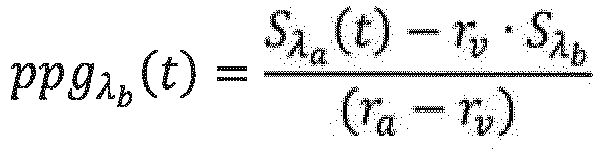
- Herein, ppgλ
b (t) represents the signal with motion interference being eliminated, ra represents the preset coefficient corresponding to the maximum correlation coefficient, rv represents the preset coefficient corresponding to the minimum correlation coefficient. - Accordingly, the signal with motion interference being eliminated may be represented by ppgλ
b (t) or ppgλa (t):

- Herein, ppgλ
a (t) and ppgλb (t) both represent the signal with motion interference being eliminated; ra represents the preset coefficient corresponding to the maximum correlation coefficient, rv represents the preset coefficient corresponding to the minimum correlation coefficient. - Subsequently, the pulse and other physiological parameters can be accurately calculated by using the signal ppgλ
a (t) or ppgλb (t) with motion interference being eliminated and adopting the time domain waveform algorithm or the frequency domain algorithm, according to needs. - It needs to be noted that, although ppgλ
a (t) and ppgλb (t) are the pulse signals extracted from the first signal and the second signal with different wavelengths, frequencies of the pulse signals (that is, the signals with motion interference being eliminated) ppgλa (t) and ppgλb (t) are the same, that is, they have the same wavelengths, thus, the pulse and other physiological parameters calculated according to the pulse signals (that is, the signals with motion interference being eliminated) ppgλa (t) and ppgλb (t) are the same. - In this embodiment, dimensionality reduction is performed on the multi-dimensional acceleration signal to obtain a one-dimensional acceleration signal that represents motion interference; the first signal and the second signal are mixed through a plurality of preset coefficients respectively, and a plurality of mixed signals corresponding to the plurality of preset coefficients are calculated; a correlation coefficient between each of the mixed signals and the one-dimensional acceleration signal is calculated accordingly; then a preset coefficient corresponding to the maximum correlation coefficient among the correlation coefficients and a preset coefficient corresponding to the minimum correlation coefficient among the correlation coefficients are obtained; so that a signal with motion interference being eliminated from the measurement signal to be processed is calculated according to the first signal, the second signal, the preset coefficient corresponding to the maximum correlation coefficient, and the preset coefficient corresponding to the minimum correlation coefficient. That is, interference in motion is eliminated by using the correlation between motion interference and the multi-dimensional acceleration signal, and detection of signals with motion interference being eliminated is suitable in various motion states, meanwhile computational complexity is less, and implementation is easily be performed on the wearable device.
- A second embodiment of the present disclosure provides a method for eliminating motion interference. This embodiment is a refinement of the first embodiment, and the main refinement lies in: detailed introduction is provided to step 101 of performing dimensionality reduction on the multi-dimensional acceleration signal to obtain a one-dimensional acceleration signal that represents motion interference.
- A specific flow of the method for eliminating motion interference in this embodiment is shown in
FIG. 2 . - Herein, steps 202 to 205 are roughly the same as
steps 102 to 105, no more details are repeated here. The main difference lies in: in this embodiment, step 201 of performing dimensionality reduction on the multi-dimensional acceleration signal to obtain a one-dimensional acceleration signal that represents motion interference comprises the following sub-steps in details: - Sub-step 2011, a covariance matrix of a multi-dimensional acceleration matrix formed by the multi-dimensional acceleration signal is calculated.
- Specifically, a multi-dimensional acceleration signal usually is a three-axis acceleration signal G(t). The three-axis acceleration signal G(t) indicates the acceleration signals in different directions in a three-dimensional space. The three-dimensional data G(t) = [x(t),y(t),z(t)], x(t),y(t),z(t) indicate the accelerations in three directions, respectively, thus the covariance matrix C of the three-dimensional data G(t) may be calculated as:

- Herein, cov represents calculating a covariance.
- Sub-step 2012, a plurality of eigenvalues and a plurality of eigenvectors of the covariance matrix are calculated.
- Specifically, the eigenvalues of the covariance matrix C are λi , and the eigenvectors corresponding to the eigenvalues λi are vi , herein i=1, 2, 3; thus, the following formula is satisfied:

- Accordingly, the eigenvalues λi and the eigenvectors vi corresponding thereto can be obtained, that is, the plurality of eigenvalues correspond to the plurality of eigenvectors respectively.
- Sub-step 2013, an eigenvector that includes a preset information weight is identified from the plurality of eigenvectors according to the plurality of eigenvalues.
- Specifically, the plurality of eigenvalues λi are sorted form maximum to minimum, and sequences of the eigenvectors vi corresponding to the eigenvalues λi are adjusted accordingly, the adjusted eigenvalues are represented by λI , and the corresponding eigenvectors are represented by vI ; herein 1=1, 2, 3.
- The preset information weight represents a percentage of each eigenvector in all eigenvectors, expressed as p%;
- When


- Accordingly, an eigenvector V = [v 1, ··· vI ] that includes a preset information weight can be identified from the plurality of eigenvectors.
- Sub-step 2014, the eigenvector is multiplied with the multi-dimensional acceleration signal, so as to obtain the one-dimensional acceleration signal.
- Specifically, the eigenvector V that includes a preset information weight is multiplied with the three-axis acceleration signal G(t) (that is, the multi-dimensional acceleration signal), to obtain the dimensionality-reduced three-axis acceleration signal G'(t):

Herein, G'(t) represents the dimensionality-reduced three-axis acceleration signal. - The dimensionality-reduced three-axis acceleration signal G'(t) is a T*I-dimensional matrix, 1=1, 2, 3, and it may be further represented as:

- Accordingly, the one-dimensional acceleration signal Acc(t) can be obtained,

- In comparison to the first embodiment, this embodiment provides a specific mode of implementing dimensionality reduction processing on the multi-dimensional acceleration signal.
- A third embodiment of the present disclosure provides an apparatus for eliminating motion interference, which is applied to the method for eliminating motion interference in any one of the first embodiment and the second embodiment. In this embodiment, as shown in
FIG. 5 , the apparatus for eliminating motion interference includes adimensionality reduction module 1, afirst calculation module 2, asecond calculation module 3, anidentification module 4, and athird calculation module 5. - The
dimensionality reduction module 1 is configured to perform dimensionality reduction on a multi-dimensional acceleration signal to obtain a one-dimensional acceleration signal that represents motion interference. - The
first calculation module 2 is configured to mix a first signal and a second signal through a plurality of preset coefficients respectively, so as to calculate a plurality of mixed signals corresponding to the plurality of preset coefficients. - The
second calculation module 3 is configured to calculate a correlation coefficient between each of the mixed signals and the one-dimensional acceleration signal. - The
identification module 4 is configured to obtain a preset coefficient corresponding to the maximum correlation coefficient among the correlation coefficients and a preset coefficient corresponding to the minimum correlation coefficient among the correlation coefficients. - The
third calculation module 5 is configured to calculate a signal with motion interference being eliminated from the measurement signal to be processed, according to the first signal, the second signal, the preset coefficient corresponding to the maximum correlation coefficient, and the preset coefficient corresponding to the minimum correlation coefficient. - In this embodiment, dimensionality reduction is performed on the multi-dimensional acceleration signal to obtain a one-dimensional acceleration signal that represents motion interference; the first signal and the second signal are mixed through a plurality of preset coefficients respectively, and a plurality of mixed signals corresponding to the plurality of preset coefficients are calculated; a correlation coefficient between each of the mixed signals and the one-dimensional acceleration signal is calculated accordingly; then a preset coefficient corresponding to the maximum correlation coefficient among the correlation coefficients and a preset coefficient corresponding to the minimum correlation coefficient among the correlation coefficients are obtained; so that a signal with motion interference being eliminated from the measurement signal to be processed is calculated according to the first signal, the second signal, the preset coefficient corresponding to the maximum correlation coefficient, and the preset coefficient corresponding to the minimum correlation coefficient. That is, interference in motion is eliminated by using the correlation between motion interference and the multi-dimensional acceleration signal, and detection of signals with motion interference being eliminated is suitable in various motion states, meanwhile computational complexity is less, and implementation is easily be performed on the wearable device.
- A fourth embodiment of the present disclosure provides a wearable device, which is any one of a watch, a ring, a headband and an earphone. In this embodiment, as shown in
FIG. 6 , the wearable device comprises afirst sensor 6, asecond sensor 7, amemory 8, and aprocessor 9. - In this embodiment, the
processor 9 is connected to thefirst sensor 6 and thesecond sensor 7. - The
first sensor 6 is configured to acquire a multi-dimensional acceleration signal of the wearable device. - The
second sensor 7 is configured to obtain a measurement signal to be processed; and the measurement signal to be processed includes a first signal and a second signal having different wavelengths. Herein thesecond sensor 7 may be a heart rate sensor. - The
memory 8 is configured to store a plurality of instructions. - The
processor 9 is configured to load the plurality of instructions and perform the function of the apparatus for eliminating motion interference in the third embodiment. - This embodiment provides a wearable device capable of eliminating motion interference.
- It is understandable to those ordinary skilled in the art that the above embodiments are specific examples in the present disclosure, and in practical applications, various changes can be made in form and in detail without deviating from the spirit and scope of the present disclosure.
Claims (10)
- A method for eliminating motion interference, which is applied to a wearable device capable of acquiring a multi-dimensional acceleration signal and a measurement signal to be processed of the wearable device, and the measurement signal to be processed includes a first signal and a second signal having different wavelengths; The method comprises:performing dimensionality reduction on the multi-dimensional acceleration signal to obtain a one-dimensional acceleration signal that represents motion interference;mixing the first signal and the second signal through a plurality of preset coefficients respectively, so as to calculate a plurality of mixed signals corresponding to the plurality of preset coefficients;calculating a correlation coefficient between each of the mixed signals and the one-dimensional acceleration signal;obtaining a preset coefficient corresponding to the maximum correlation coefficient among the correlation coefficients and a preset coefficient corresponding to the minimum correlation coefficient among the correlation coefficients; andcalculating a signal with motion interference being eliminated from the measurement signal to be processed, according to the first signal, the second signal, the preset coefficient corresponding to the maximum correlation coefficient, and the preset coefficient corresponding to the minimum correlation coefficient.
- The method according to claim 1, wherein the mixed signal Dr
i (t) is:
a (t) represents the first signal; Sλb represents the second signal; ri represents an i-th preset coefficient, and a traversal range of ri is [rslow , rhigh ], wherein rslow , rhigh are a lower limit and an upper limit of the traversal range, respectively. - The method according to claim 2, wherein the signal with motion interference being eliminated is expressed as:

a (t) = ra · ppgλb (t), and ppgλa (t) and ppgλb (t) both represent the signal with motion interference being eliminated; ra represents the preset coefficient corresponding to the maximum correlation coefficient, rv represents the preset coefficient corresponding to the minimum correlation coefficient. - The method according to claim 1, wherein the correlation coefficient is a Pearson correlation coefficient.
- The method according to claim 1, wherein performing dimensionality reduction on the multi-dimensional acceleration signal to obtain a one-dimensional acceleration signal that represents motion interference specifically comprises:calculating a covariance matrix of a multi-dimensional acceleration matrix formed by the multi-dimensional acceleration signal;calculating a plurality of eigenvalues and a plurality of eigenvectors of the covariance matrix; the plurality of eigenvalues corresponding to the plurality of eigenvectors respectively;identifying, according to the plurality of eigenvalues, an eigenvector that includes a preset information weight from the plurality of eigenvectors; andmultiplying the eigenvector with the multi-dimensional acceleration signal to obtain the one-dimensional acceleration signal.
- The method according to claim 1, wherein the value of the plurality of preset coefficients is increased in an arithmetic progression manner.
- The method according to any one of claims 1 to 6, wherein the signal with motion interference being eliminated is a PPG signal.
- An apparatus for eliminating motion interference, which is applied to the method according to any one of claims 1 to 7, the apparatus comprises:a dimensionality reduction module configured to perform dimensionality reduction on the multi-dimensional acceleration signal to obtain a one-dimensional acceleration signal that represents motion interference;a first calculation module configured to mix the first signal and the second signal through a plurality of preset coefficients respectively, so as to calculate a plurality of mixed signals corresponding to the plurality of preset coefficients;a second calculation module configured to calculate a correlation coefficient between each of the mixed signals and the one-dimensional acceleration signal;an identification module configured to obtain a preset coefficient corresponding to the maximum correlation coefficient among the correlation coefficients and a preset coefficient corresponding to the minimum correlation coefficient among the correlation coefficients; anda third calculation module configured to calculate a signal with motion interference being eliminated from the measurement signal to be processed, according to the first signal, the second signal, the preset coefficient corresponding to the maximum correlation coefficient, and the preset coefficient corresponding to the minimum correlation coefficient.
- A wearable device comprises a first sensor, a second sensor, a memory, and a processor connected to the first sensor and the second sensor;
wherein the first sensor is configured to acquire a multi-dimensional acceleration signal of the wearable device;
the second sensor is configured to obtain a measurement signal to be processed; and the measurement signal to be processed includes a first signal and a second signal having different wavelengths;
the memory is configured to store a plurality of instructions; and
the processor is configured to load the plurality of instructions and perform the function of the apparatus for eliminating motion interference according to claim 8. - The wearable device according claim 9, wherein the second sensor is a heart rate sensor.
Applications Claiming Priority (1)
| Application Number | Priority Date | Filing Date | Title |
|---|---|---|---|
| PCT/CN2017/083846 WO2018205176A1 (en) | 2017-05-10 | 2017-05-10 | Wearable device, and method and apparatus for eliminating exercise interference |
Publications (3)
| Publication Number | Publication Date |
|---|---|
| EP3610787A1 true EP3610787A1 (en) | 2020-02-19 |
| EP3610787A4 EP3610787A4 (en) | 2021-04-21 |
| EP3610787B1 EP3610787B1 (en) | 2022-04-27 |
Family
ID=59953873
Family Applications (1)
| Application Number | Title | Priority Date | Filing Date |
|---|---|---|---|
| EP17893507.8A Active EP3610787B1 (en) | 2017-05-10 | 2017-05-10 | Wearable device, and method and apparatus for eliminating exercise interference |
Country Status (4)
| Country | Link |
|---|---|
| US (1) | US11000234B2 (en) |
| EP (1) | EP3610787B1 (en) |
| CN (1) | CN107223037B (en) |
| WO (1) | WO2018205176A1 (en) |
Families Citing this family (5)
| Publication number | Priority date | Publication date | Assignee | Title |
|---|---|---|---|---|
| CN108592941B (en) * | 2018-06-15 | 2020-08-04 | 成都云卫康医疗科技有限公司 | Step counting method based on three-axis acceleration |
| CN111048089B (en) * | 2019-12-26 | 2023-07-28 | 江西佳芯物联有限公司 | Method for improving voice wake-up success rate of intelligent wearable device, electronic device and computer readable storage medium |
| CN112587111B (en) * | 2020-12-01 | 2022-08-19 | 清华大学 | Physiological signal acquisition method and system |
| CN115868945B (en) * | 2022-11-29 | 2025-09-12 | 北京理工大学 | A method and system for anti-motion interference and signal enhancement of PPG signals |
| CN119791614B (en) * | 2024-12-05 | 2026-05-05 | 北京津发科技股份有限公司 | Human-based intelligence-based physiological signal motion interference suppression method and electronic equipment |
Family Cites Families (13)
| Publication number | Priority date | Publication date | Assignee | Title |
|---|---|---|---|---|
| FI120133B (en) * | 2006-05-29 | 2009-07-15 | Polar Electro Oy | A wrist unit and a method for determining motion information |
| US20100145171A1 (en) * | 2008-12-05 | 2010-06-10 | Electronics And Telecommunications Research Institute | Apparatus for measuring motion noise robust pulse wave and method thereof |
| US10244949B2 (en) * | 2012-10-07 | 2019-04-02 | Rhythm Diagnostic Systems, Inc. | Health monitoring systems and methods |
| JP6201469B2 (en) * | 2013-07-12 | 2017-09-27 | セイコーエプソン株式会社 | Biological information processing apparatus and biological information processing method |
| US9918666B2 (en) * | 2014-01-13 | 2018-03-20 | The Board Of Regents, The University Of Texas System | Systems and methods for physiological signal enhancement and biometric extraction using non-invasive optical sensors |
| JP2016016203A (en) * | 2014-07-10 | 2016-02-01 | セイコーエプソン株式会社 | Biological information detection device |
| US10758133B2 (en) * | 2014-08-07 | 2020-09-01 | Apple Inc. | Motion artifact removal by time domain projection |
| CN105832315A (en) * | 2015-01-16 | 2016-08-10 | 中国科学院上海高等研究院 | Remote monitor system immune from individual state of motion, environment and locations |
| US10537245B2 (en) * | 2015-02-17 | 2020-01-21 | Halo Wearables, Llc | Measurement correlation and information tracking for a portable device |
| CN105184325B (en) * | 2015-09-23 | 2021-02-23 | 歌尔股份有限公司 | Mobile intelligent terminal |
| US11183303B2 (en) * | 2015-10-13 | 2021-11-23 | Salu Design Group Inc. | Wearable health monitors and methods of monitoring health |
| CN105919584B (en) * | 2016-06-23 | 2018-10-16 | 电子科技大学 | Heart rate method of estimation and device for wearable heart rate monitor apparatus |
| EP3518753B1 (en) * | 2016-09-27 | 2025-08-27 | Itamar Medical Spry 2021, Limited Partnership | Systems and methods for biological metrics measurement |
-
2017
- 2017-05-10 WO PCT/CN2017/083846 patent/WO2018205176A1/en not_active Ceased
- 2017-05-10 EP EP17893507.8A patent/EP3610787B1/en active Active
- 2017-05-10 CN CN201780000400.4A patent/CN107223037B/en active Active
-
2018
- 2018-07-30 US US16/049,075 patent/US11000234B2/en active Active
Also Published As
| Publication number | Publication date |
|---|---|
| EP3610787B1 (en) | 2022-04-27 |
| US20180338728A1 (en) | 2018-11-29 |
| WO2018205176A1 (en) | 2018-11-15 |
| US11000234B2 (en) | 2021-05-11 |
| EP3610787A4 (en) | 2021-04-21 |
| CN107223037B (en) | 2020-07-17 |
| CN107223037A (en) | 2017-09-29 |
Similar Documents
| Publication | Publication Date | Title |
|---|---|---|
| US11000234B2 (en) | Wearable device, method and apparatus for eliminating motion interference | |
| JP5333427B2 (en) | HEART RATE DETECTOR, HEART RATE DETECTING METHOD, AND PROGRAM | |
| US20160120477A1 (en) | Biological-information processing apparatus and biological-information processing method | |
| JP2017519548A (en) | Motion artifact reduction using multi-channel PPG signals | |
| CN112244794A (en) | Periodic feature-based vital sign detection method, device and storage medium | |
| CN113951885B (en) | Magnetoencephalogram source positioning method, storage medium and equipment | |
| CN109643579B (en) | Quality assessment method and device, model building method and module, wearable device | |
| US12213811B2 (en) | Systems, devices, and methods for developing a model for use when performing oximetry and/or pulse oximetry and systems, devices, and methods for using a fetal oximetry model to determine a fetal oximetry value | |
| KR20190011026A (en) | Apparatus and method of blood pressure measurement | |
| De Sá et al. | A matrix-based algorithm for estimating multiple coherence of a periodic signal and its application to the multichannel EEG during sensory stimulation | |
| US10470717B2 (en) | Pulse validation | |
| Lee | Motion artifacts reduction from PPG using cyclic moving average filter | |
| AU2020327715B2 (en) | A system for denoising motion artifact signals and method thereof | |
| CN117562523B (en) | Method and system for detecting heart rate based on photoelectric volumetric method and wearable device | |
| TWI504378B (en) | Denoising method and apparatus of pulse wave signal and pulse oximetry | |
| JP2016140373A (en) | Pulse wave measuring device and pulse wave measuring method | |
| US20260123879A1 (en) | Systems, devices, and methods for deteremining a fetal oximetry value using an in vivo fetal oximetry model and/or an augmented in vivo fetal oximetry model | |
| CN109620198B (en) | Cardiovascular index detection and model training method and device | |
| WO2019014931A1 (en) | Interference analysis method and apparatus for biological signal, and wearable device | |
| JP7262079B2 (en) | biosensor | |
| US20220323023A1 (en) | Method for determining respiratory rate | |
| US20250204821A1 (en) | Systems, devices, and methods for determining an oximetry value using an oximetry model | |
| Darwesh et al. | Robust heart rate estimation from a smartphone camera | |
| Nocera et al. | Development and Validation of a Frequency-Based Quality Index for Contactless Respiratory Volume Analysis | |
| Fujii et al. | Improvement of noncontact heart rate measurement by millimeter-wave radar utilizing respiratory components of biological signals |
Legal Events
| Date | Code | Title | Description |
|---|---|---|---|
| STAA | Information on the status of an ep patent application or granted ep patent |
Free format text: STATUS: UNKNOWN |
|
| STAA | Information on the status of an ep patent application or granted ep patent |
Free format text: STATUS: THE INTERNATIONAL PUBLICATION HAS BEEN MADE |
|
| PUAI | Public reference made under article 153(3) epc to a published international application that has entered the european phase |
Free format text: ORIGINAL CODE: 0009012 |
|
| STAA | Information on the status of an ep patent application or granted ep patent |
Free format text: STATUS: REQUEST FOR EXAMINATION WAS MADE |
|
| 17P | Request for examination filed |
Effective date: 20180802 |
|
| AK | Designated contracting states |
Kind code of ref document: A1 Designated state(s): AL AT BE BG CH CY CZ DE DK EE ES FI FR GB GR HR HU IE IS IT LI LT LU LV MC MK MT NL NO PL PT RO RS SE SI SK SM TR |
|
| AX | Request for extension of the european patent |
Extension state: BA ME |
|
| R17P | Request for examination filed (corrected) |
Effective date: 20180802 |
|
| R17P | Request for examination filed (corrected) |
Effective date: 20180802 |
|
| DAV | Request for validation of the european patent (deleted) | ||
| DAX | Request for extension of the european patent (deleted) | ||
| A4 | Supplementary search report drawn up and despatched |
Effective date: 20210318 |
|
| RIC1 | Information provided on ipc code assigned before grant |
Ipc: A61B 5/02 20060101AFI20210312BHEP Ipc: A61B 5/00 20060101ALI20210312BHEP Ipc: A61B 5/024 20060101ALI20210312BHEP |
|
| GRAP | Despatch of communication of intention to grant a patent |
Free format text: ORIGINAL CODE: EPIDOSNIGR1 |
|
| STAA | Information on the status of an ep patent application or granted ep patent |
Free format text: STATUS: GRANT OF PATENT IS INTENDED |
|
| GRAS | Grant fee paid |
Free format text: ORIGINAL CODE: EPIDOSNIGR3 |
|
| INTG | Intention to grant announced |
Effective date: 20220221 |
|
| GRAA | (expected) grant |
Free format text: ORIGINAL CODE: 0009210 |
|
| STAA | Information on the status of an ep patent application or granted ep patent |
Free format text: STATUS: THE PATENT HAS BEEN GRANTED |
|
| AK | Designated contracting states |
Kind code of ref document: B1 Designated state(s): AL AT BE BG CH CY CZ DE DK EE ES FI FR GB GR HR HU IE IS IT LI LT LU LV MC MK MT NL NO PL PT RO RS SE SI SK SM TR |
|
| REG | Reference to a national code |
Ref country code: GB Ref legal event code: FG4D |
|
| REG | Reference to a national code |
Ref country code: CH Ref legal event code: EP |
|
| REG | Reference to a national code |
Ref country code: AT Ref legal event code: REF Ref document number: 1486289 Country of ref document: AT Kind code of ref document: T Effective date: 20220515 |
|
| REG | Reference to a national code |
Ref country code: DE Ref legal event code: R096 Ref document number: 602017056722 Country of ref document: DE |
|
| REG | Reference to a national code |
Ref country code: IE Ref legal event code: FG4D |
|
| REG | Reference to a national code |
Ref country code: LT Ref legal event code: MG9D |
|
| REG | Reference to a national code |
Ref country code: NL Ref legal event code: MP Effective date: 20220427 |
|
| REG | Reference to a national code |
Ref country code: AT Ref legal event code: MK05 Ref document number: 1486289 Country of ref document: AT Kind code of ref document: T Effective date: 20220427 |
|
| PG25 | Lapsed in a contracting state [announced via postgrant information from national office to epo] |
Ref country code: NL Free format text: LAPSE BECAUSE OF FAILURE TO SUBMIT A TRANSLATION OF THE DESCRIPTION OR TO PAY THE FEE WITHIN THE PRESCRIBED TIME-LIMIT Effective date: 20220427 |
|
| PG25 | Lapsed in a contracting state [announced via postgrant information from national office to epo] |
Ref country code: SE Free format text: LAPSE BECAUSE OF FAILURE TO SUBMIT A TRANSLATION OF THE DESCRIPTION OR TO PAY THE FEE WITHIN THE PRESCRIBED TIME-LIMIT Effective date: 20220427 Ref country code: PT Free format text: LAPSE BECAUSE OF FAILURE TO SUBMIT A TRANSLATION OF THE DESCRIPTION OR TO PAY THE FEE WITHIN THE PRESCRIBED TIME-LIMIT Effective date: 20220829 Ref country code: NO Free format text: LAPSE BECAUSE OF FAILURE TO SUBMIT A TRANSLATION OF THE DESCRIPTION OR TO PAY THE FEE WITHIN THE PRESCRIBED TIME-LIMIT Effective date: 20220727 Ref country code: LT Free format text: LAPSE BECAUSE OF FAILURE TO SUBMIT A TRANSLATION OF THE DESCRIPTION OR TO PAY THE FEE WITHIN THE PRESCRIBED TIME-LIMIT Effective date: 20220427 Ref country code: HR Free format text: LAPSE BECAUSE OF FAILURE TO SUBMIT A TRANSLATION OF THE DESCRIPTION OR TO PAY THE FEE WITHIN THE PRESCRIBED TIME-LIMIT Effective date: 20220427 Ref country code: GR Free format text: LAPSE BECAUSE OF FAILURE TO SUBMIT A TRANSLATION OF THE DESCRIPTION OR TO PAY THE FEE WITHIN THE PRESCRIBED TIME-LIMIT Effective date: 20220728 Ref country code: FI Free format text: LAPSE BECAUSE OF FAILURE TO SUBMIT A TRANSLATION OF THE DESCRIPTION OR TO PAY THE FEE WITHIN THE PRESCRIBED TIME-LIMIT Effective date: 20220427 Ref country code: ES Free format text: LAPSE BECAUSE OF FAILURE TO SUBMIT A TRANSLATION OF THE DESCRIPTION OR TO PAY THE FEE WITHIN THE PRESCRIBED TIME-LIMIT Effective date: 20220427 Ref country code: BG Free format text: LAPSE BECAUSE OF FAILURE TO SUBMIT A TRANSLATION OF THE DESCRIPTION OR TO PAY THE FEE WITHIN THE PRESCRIBED TIME-LIMIT Effective date: 20220727 Ref country code: AT Free format text: LAPSE BECAUSE OF FAILURE TO SUBMIT A TRANSLATION OF THE DESCRIPTION OR TO PAY THE FEE WITHIN THE PRESCRIBED TIME-LIMIT Effective date: 20220427 |
|
| PG25 | Lapsed in a contracting state [announced via postgrant information from national office to epo] |
Ref country code: RS Free format text: LAPSE BECAUSE OF FAILURE TO SUBMIT A TRANSLATION OF THE DESCRIPTION OR TO PAY THE FEE WITHIN THE PRESCRIBED TIME-LIMIT Effective date: 20220427 Ref country code: PL Free format text: LAPSE BECAUSE OF FAILURE TO SUBMIT A TRANSLATION OF THE DESCRIPTION OR TO PAY THE FEE WITHIN THE PRESCRIBED TIME-LIMIT Effective date: 20220427 Ref country code: LV Free format text: LAPSE BECAUSE OF FAILURE TO SUBMIT A TRANSLATION OF THE DESCRIPTION OR TO PAY THE FEE WITHIN THE PRESCRIBED TIME-LIMIT Effective date: 20220427 Ref country code: IS Free format text: LAPSE BECAUSE OF FAILURE TO SUBMIT A TRANSLATION OF THE DESCRIPTION OR TO PAY THE FEE WITHIN THE PRESCRIBED TIME-LIMIT Effective date: 20220827 |
|
| REG | Reference to a national code |
Ref country code: CH Ref legal event code: PL |
|
| REG | Reference to a national code |
Ref country code: BE Ref legal event code: MM Effective date: 20220531 |
|
| REG | Reference to a national code |
Ref country code: DE Ref legal event code: R097 Ref document number: 602017056722 Country of ref document: DE |
|
| PG25 | Lapsed in a contracting state [announced via postgrant information from national office to epo] |
Ref country code: SM Free format text: LAPSE BECAUSE OF FAILURE TO SUBMIT A TRANSLATION OF THE DESCRIPTION OR TO PAY THE FEE WITHIN THE PRESCRIBED TIME-LIMIT Effective date: 20220427 Ref country code: SK Free format text: LAPSE BECAUSE OF FAILURE TO SUBMIT A TRANSLATION OF THE DESCRIPTION OR TO PAY THE FEE WITHIN THE PRESCRIBED TIME-LIMIT Effective date: 20220427 Ref country code: RO Free format text: LAPSE BECAUSE OF FAILURE TO SUBMIT A TRANSLATION OF THE DESCRIPTION OR TO PAY THE FEE WITHIN THE PRESCRIBED TIME-LIMIT Effective date: 20220427 Ref country code: MC Free format text: LAPSE BECAUSE OF FAILURE TO SUBMIT A TRANSLATION OF THE DESCRIPTION OR TO PAY THE FEE WITHIN THE PRESCRIBED TIME-LIMIT Effective date: 20220427 Ref country code: LU Free format text: LAPSE BECAUSE OF NON-PAYMENT OF DUE FEES Effective date: 20220510 Ref country code: LI Free format text: LAPSE BECAUSE OF NON-PAYMENT OF DUE FEES Effective date: 20220531 Ref country code: EE Free format text: LAPSE BECAUSE OF FAILURE TO SUBMIT A TRANSLATION OF THE DESCRIPTION OR TO PAY THE FEE WITHIN THE PRESCRIBED TIME-LIMIT Effective date: 20220427 Ref country code: DK Free format text: LAPSE BECAUSE OF FAILURE TO SUBMIT A TRANSLATION OF THE DESCRIPTION OR TO PAY THE FEE WITHIN THE PRESCRIBED TIME-LIMIT Effective date: 20220427 Ref country code: CZ Free format text: LAPSE BECAUSE OF FAILURE TO SUBMIT A TRANSLATION OF THE DESCRIPTION OR TO PAY THE FEE WITHIN THE PRESCRIBED TIME-LIMIT Effective date: 20220427 Ref country code: CH Free format text: LAPSE BECAUSE OF NON-PAYMENT OF DUE FEES Effective date: 20220531 |
|
| PLBE | No opposition filed within time limit |
Free format text: ORIGINAL CODE: 0009261 |
|
| STAA | Information on the status of an ep patent application or granted ep patent |
Free format text: STATUS: NO OPPOSITION FILED WITHIN TIME LIMIT |
|
| PG25 | Lapsed in a contracting state [announced via postgrant information from national office to epo] |
Ref country code: AL Free format text: LAPSE BECAUSE OF FAILURE TO SUBMIT A TRANSLATION OF THE DESCRIPTION OR TO PAY THE FEE WITHIN THE PRESCRIBED TIME-LIMIT Effective date: 20220427 |
|
| 26N | No opposition filed |
Effective date: 20230130 |
|
| PG25 | Lapsed in a contracting state [announced via postgrant information from national office to epo] |
Ref country code: IE Free format text: LAPSE BECAUSE OF NON-PAYMENT OF DUE FEES Effective date: 20220510 |
|
| PG25 | Lapsed in a contracting state [announced via postgrant information from national office to epo] |
Ref country code: SI Free format text: LAPSE BECAUSE OF FAILURE TO SUBMIT A TRANSLATION OF THE DESCRIPTION OR TO PAY THE FEE WITHIN THE PRESCRIBED TIME-LIMIT Effective date: 20220427 Ref country code: BE Free format text: LAPSE BECAUSE OF NON-PAYMENT OF DUE FEES Effective date: 20220531 |
|
| PG25 | Lapsed in a contracting state [announced via postgrant information from national office to epo] |
Ref country code: IT Free format text: LAPSE BECAUSE OF FAILURE TO SUBMIT A TRANSLATION OF THE DESCRIPTION OR TO PAY THE FEE WITHIN THE PRESCRIBED TIME-LIMIT Effective date: 20220427 |
|
| PG25 | Lapsed in a contracting state [announced via postgrant information from national office to epo] |
Ref country code: MK Free format text: LAPSE BECAUSE OF FAILURE TO SUBMIT A TRANSLATION OF THE DESCRIPTION OR TO PAY THE FEE WITHIN THE PRESCRIBED TIME-LIMIT Effective date: 20220427 Ref country code: CY Free format text: LAPSE BECAUSE OF FAILURE TO SUBMIT A TRANSLATION OF THE DESCRIPTION OR TO PAY THE FEE WITHIN THE PRESCRIBED TIME-LIMIT Effective date: 20220427 |
|
| PG25 | Lapsed in a contracting state [announced via postgrant information from national office to epo] |
Ref country code: HU Free format text: LAPSE BECAUSE OF FAILURE TO SUBMIT A TRANSLATION OF THE DESCRIPTION OR TO PAY THE FEE WITHIN THE PRESCRIBED TIME-LIMIT; INVALID AB INITIO Effective date: 20170510 |
|
| PG25 | Lapsed in a contracting state [announced via postgrant information from national office to epo] |
Ref country code: TR Free format text: LAPSE BECAUSE OF FAILURE TO SUBMIT A TRANSLATION OF THE DESCRIPTION OR TO PAY THE FEE WITHIN THE PRESCRIBED TIME-LIMIT Effective date: 20220427 |
|
| PG25 | Lapsed in a contracting state [announced via postgrant information from national office to epo] |
Ref country code: MT Free format text: LAPSE BECAUSE OF FAILURE TO SUBMIT A TRANSLATION OF THE DESCRIPTION OR TO PAY THE FEE WITHIN THE PRESCRIBED TIME-LIMIT Effective date: 20220427 |
|
| PG25 | Lapsed in a contracting state [announced via postgrant information from national office to epo] |
Ref country code: BG Free format text: LAPSE BECAUSE OF FAILURE TO SUBMIT A TRANSLATION OF THE DESCRIPTION OR TO PAY THE FEE WITHIN THE PRESCRIBED TIME-LIMIT Effective date: 20220427 |
|
| PG25 | Lapsed in a contracting state [announced via postgrant information from national office to epo] |
Ref country code: BG Free format text: LAPSE BECAUSE OF FAILURE TO SUBMIT A TRANSLATION OF THE DESCRIPTION OR TO PAY THE FEE WITHIN THE PRESCRIBED TIME-LIMIT Effective date: 20220427 |
|
| PGFP | Annual fee paid to national office [announced via postgrant information from national office to epo] |
Ref country code: DE Payment date: 20250521 Year of fee payment: 9 |
|
| PGFP | Annual fee paid to national office [announced via postgrant information from national office to epo] |
Ref country code: GB Payment date: 20250527 Year of fee payment: 9 |
|
| PGFP | Annual fee paid to national office [announced via postgrant information from national office to epo] |
Ref country code: FR Payment date: 20250528 Year of fee payment: 9 |