EP3610399B1 - Enabling program code on target data processing devices - Google Patents
Enabling program code on target data processing devices Download PDFInfo
- Publication number
- EP3610399B1 EP3610399B1 EP18719261.2A EP18719261A EP3610399B1 EP 3610399 B1 EP3610399 B1 EP 3610399B1 EP 18719261 A EP18719261 A EP 18719261A EP 3610399 B1 EP3610399 B1 EP 3610399B1
- Authority
- EP
- European Patent Office
- Prior art keywords
- data processing
- processing device
- target data
- program code
- encrypted
- Prior art date
- Legal status (The legal status is an assumption and is not a legal conclusion. Google has not performed a legal analysis and makes no representation as to the accuracy of the status listed.)
- Active
Links
Images


Classifications
-
- G—PHYSICS
- G06—COMPUTING OR CALCULATING; COUNTING
- G06F—ELECTRIC DIGITAL DATA PROCESSING
- G06F21/00—Security arrangements for protecting computers, components thereof, programs or data against unauthorised activity
- G06F21/10—Protecting distributed programs or content, e.g. vending or licensing of copyrighted material ; Digital rights management [DRM]
- G06F21/12—Protecting executable software
- G06F21/121—Restricting unauthorised execution of programs
- G06F21/123—Restricting unauthorised execution of programs by using dedicated hardware, e.g. dongles, smart cards, cryptographic processors, global positioning systems [GPS] devices
-
- G—PHYSICS
- G06—COMPUTING OR CALCULATING; COUNTING
- G06F—ELECTRIC DIGITAL DATA PROCESSING
- G06F21/00—Security arrangements for protecting computers, components thereof, programs or data against unauthorised activity
- G06F21/10—Protecting distributed programs or content, e.g. vending or licensing of copyrighted material ; Digital rights management [DRM]
- G06F21/105—Arrangements for software license management or administration, e.g. for managing licenses at corporate level
-
- G—PHYSICS
- G06—COMPUTING OR CALCULATING; COUNTING
- G06F—ELECTRIC DIGITAL DATA PROCESSING
- G06F21/00—Security arrangements for protecting computers, components thereof, programs or data against unauthorised activity
- G06F21/10—Protecting distributed programs or content, e.g. vending or licensing of copyrighted material ; Digital rights management [DRM]
- G06F21/12—Protecting executable software
- G06F21/121—Restricting unauthorised execution of programs
- G06F21/125—Restricting unauthorised execution of programs by manipulating the program code, e.g. source code, compiled code, interpreted code, machine code
-
- G—PHYSICS
- G06—COMPUTING OR CALCULATING; COUNTING
- G06F—ELECTRIC DIGITAL DATA PROCESSING
- G06F21/00—Security arrangements for protecting computers, components thereof, programs or data against unauthorised activity
- G06F21/30—Authentication, i.e. establishing the identity or authorisation of security principals
- G06F21/31—User authentication
- G06F21/34—User authentication involving the use of external additional devices, e.g. dongles or smart cards
-
- G—PHYSICS
- G06—COMPUTING OR CALCULATING; COUNTING
- G06F—ELECTRIC DIGITAL DATA PROCESSING
- G06F21/00—Security arrangements for protecting computers, components thereof, programs or data against unauthorised activity
- G06F21/60—Protecting data
- G06F21/602—Providing cryptographic facilities or services
-
- G—PHYSICS
- G06—COMPUTING OR CALCULATING; COUNTING
- G06F—ELECTRIC DIGITAL DATA PROCESSING
- G06F21/00—Security arrangements for protecting computers, components thereof, programs or data against unauthorised activity
- G06F21/70—Protecting specific internal or peripheral components, in which the protection of a component leads to protection of the entire computer
- G06F21/71—Protecting specific internal or peripheral components, in which the protection of a component leads to protection of the entire computer to assure secure computing or processing of information
- G06F21/72—Protecting specific internal or peripheral components, in which the protection of a component leads to protection of the entire computer to assure secure computing or processing of information in cryptographic circuits
-
- G—PHYSICS
- G06—COMPUTING OR CALCULATING; COUNTING
- G06F—ELECTRIC DIGITAL DATA PROCESSING
- G06F2221/00—Indexing scheme relating to security arrangements for protecting computers, components thereof, programs or data against unauthorised activity
- G06F2221/21—Indexing scheme relating to G06F21/00 and subgroups addressing additional information or applications relating to security arrangements for protecting computers, components thereof, programs or data against unauthorised activity
- G06F2221/2107—File encryption
Definitions
- the present disclosure relates to enabling program code on target data processing devices using a security data processing device.
- Modern software often checks that the user is in possession of a licence key before allowing itself to run, or enabling certain features of itself.
- the licence key is generally also embedded into the data processing device so that possession of the data processing device implicitly authorises the use of the software that is embedded into the data processing device.
- the data processing device has some unique identity
- licence keys have a value, because they allow software or optional features of that software to run on a device.
- these licence keys normally need to be generated in a third party manufacturing facility, either because of policy, or because the key includes information such as the unique identifier that is only available during the manufacturing process. For example the unique id may come pre-programmed into a reel of devices, where one of these devices is added to the data processing device during manufacture.
- US Patent application US2002/199110A1 (Kean ) relates to techniques used to protect intellectual property cores on field programmable gate arrays.
- US2002/199110A1 describes an approach to associate each field programmable gate array, or a limited number of field programmable gate arrays, with a secret key, each field programmable gate array may only be properly configured or programmed by an appropriate encrypted bitstream (which includes one or more intellectual property cores).
- US2002/199110A1 describes that this encrypted bitstream has been encoded by or for the secret key associated with a particular FPGA.
- the inventors have identified that, currently, the original designer of a product has to trust the third party manufacturer not to generate additional licences and hence manufacture additional devices which can be sold on the grey market. Experience has shown that this trust is often misplaced, so some mechanism for preventing this is of value to the original designer.
- the present disclosure relates to a method for secure generation of software licence keys at a third party manufacturing site.
- Embodiments of the present disclosure are directed to the provision in the factory of a mechanism to generate licence keys that the original designer can trust not to generate keys in excess of an authorised count provided by the original manufacturer.
- This may be achieved by the provision of a security data processing device to the third party manufacturer which the only method of accessing is to optionally provide a device identity, and receive a licence key in return.
- the security data processing device e.g. an HSM
- the original designer wants to authorise the manufacture of more devices, they can supply a new count encrypted in one of the standard ways so that the receiving security data processing device can validate that the count was sent by the original designer, and only the target security data processing device (or devices of its class) can decrypt the count.
- This image may be split into multiple parts where one part is responsible for licence validation, and the other part(s) each implement one or more features of the software.
- the original designer can send instructions for how to generate a licence key (e.g. a script) to the security data processing device so that the original designer can change the means of generating a licence key without obtaining a new version of the security data processing device.
- a licence key e.g. a script
- a security data processing device comprising a processor and a memory, according to claim 15.
- Using the security data processing device to generate the licence key from the device identifier may advantageously comprise generating the licence key by executing instructions stored on the security data processing device by a provider of the security data processing device.
- the program code stored on the target data processing devices that is enabled by the described methods would typically include a portion executable by the target data processing device to validate the licence key and enable another portion of the program code.
- the further program code stored on the target data processing device could be executable to validate the licence key and enable the program code stored on the target data processing devices that is enabled by the described methods.
- the instructions stored on the security data processing device may advantageously be executable by the security data processing device to generate a licence key, which licence key, when stored on the target data processing device, enables selected portions of the program code stored on the target data processing device, the selected portions being specified by the instructions stored on the security data processing device.
- Using the security data processing device to obtain the device identifier may advantageously comprise using the security data processing device to obtain a device cryptographic certificate including the device identifier.
- receiving the encrypted value comprises receiving a data carrier on which is stored the encrypted value
- using the security data processing device to decrypt the encrypted value and store the decrypted value on the security data processing device comprise using a hardware security module (HSM) to decrypt the encrypted value and store the decrypted value on the HSM.
- HSM hardware security module
- receiving the encrypted value may comprise receiving it via an Internet connection on an HSM and using the HSM to decrypt the encrypted value and store it on the HSM.
- a suitable HSM for use in the described methods is a Thales Solo HSM.
- receiving the security data processing device on which are stored the value and the instructions for execution by the security data processing device comprises receiving a Java (RTM) card on which are stored the value and the instructions.
- RTM Java
- a suitable Java (RTM) card is a Gemalto IDcore 10 Java (RTM) card.
- RTM Java
- the licence key may, for example, comprise at least a portion of the device identifier of the target data processing device.
- the licence key is derived from at least a portion of the device identifier of the target data processing device.
- the device identifier is, by design, easy to obtain from the target data processing device, use of a licence key comprising at least a portion of the device identifier could undermine the security of the described methods, because it could aid identification of the licence key when the licence key is stored on the target data processing device.
- the licence key be derived from at least a portion of the device identifier, and more preferably from the entire device identifier, for example by means of a cryptographic hash function, in order to make identification of the licence key more difficult.
- the method preferably includes the step of encrypting the licence key, and the further program code if used, before storing it on the target data processing device.
- Receiving the encrypted value and instructions may advantageously comprise receiving an encrypted cryptographic certificate including the value and the instructions and signed by a trusted entity.
- the trusted entity may, for example, be a provider of the program code stored on the target data processing devices.
- a security data processing device comprising a processor and a memory, the memory having stored on it a value of a permitted number of target data processing devices that are permitted to have program code stored on them enabled, and instructions executable by the processor to cause the security data processing device to:
- the method 10 of Figure 1 comprises receiving a smart card 12 in the form of a Java (RTM) card containing a cryptographic certificate that includes a value 14 of a permitted number of target data processing devices, further program code 16 for storage on target data processing devices and instructions 18 for execution by a hardware security module (HSM), the certificate having been signed using a private key of a public key encryption key pair of a developer of the further program code 16.
- RTM Java
- HSM hardware security module
- the smart card 12 establishes a shared key using public key cryptography with an HSM 20 that forms part of a device programmer 22.
- the smart card encrypts the cryptographic certificate using the shared key and transmits the encrypted certificate to the HSM 20 via a smart card reader (not shown) of the HSM.
- the HSM decrypts the encrypted cryptographic certificate and uses a public key of the key pair of the developer of the program code 16 to verify that the certificate was in fact signed by the developer.
- the HSM In order to prevent an untrusted entity from reusing the smart card, the HSM generates a cryptographic certificate including a zero value of the permitted number of target data processing devices, stores the certificate on the smart card 12 and verifies that the certificate has been correctly stored on the smart card. Unless the verification is successful, the HSM stops the method.
- the zero value of the permitted number of target data processing devices will be transmitted to the HSM and the HSM will stop the method when it checks that the value of the permitted number of target data processing devices is greater than zero.
- the HSM 20 obtains a device cryptographic certificate from a target data processing device 24, the certificate including a device identifier and being signed by a trusted entity such as a manufacturer of the target data processing device 24 or the developer of the further program code 16.
- the HSM 20 verifies that the certificate was in fact signed by the trusted entity, using the public key of a key pair of the trusted entity. If the verification is successful, the HSM executes the instructions 18, which causes the HSM to generate a licence key from the device identifier of the target data processing device 24, using a cryptographic hash function.
- the HSM establishes a shared key with the target data processing device 24 using public key cryptography and encrypts the licence key and the further program code 16 for storage on the target data processing device using the shared key.
- the HSM causes the device programmer 22 to store the encrypted licence key and further program code on the target data processing device 24.
- the target data processing device decrypts the licence key and further program code using the shared key and stores the decrypted licence key and further program code in the memory of the target data processing device.
- the target data processing device includes a protected region of the memory, it would be prudent to store the licence key and further program code in the protected region.
- the further program code stored in the memory is executable by the target data processing device 24 to obtain the device identifier of the target data processing device, generate a test code from the device identifier using the same cryptographic hash function as was used by the HSM to generate the licence key, to compare the test code with the licence key stored in the protected region of the memory, and to prevent other program code stored in the memory from being executed unless the licence key and the test code match.
- the protected region of the memory may be protected in various ways that will be familiar to those skilled in the art, such as being accessible only at boot time, or being accessible only when the target data processing device is operating in a secure mode.
- Embodiments of the invention enable a provider of program code to have a disabled version of program code stored on a large number of target data processing devices, and to control on how many of the target data processing devices the program code is enabled.
- the method 30 of Figure 2 comprises receiving a security data processing device in the form of a Java (RTM) card, i.e., a smart card 32, containing a value 34 of a permitted number of target data processing devices, further program code 36 for storage on target data processing devices and instructions 38 for execution by the smart card 32.
- RTM Java
- the smart card 32 executes the instructions 38, which causes the smart card to obtain, via a device programmer 40, a device cryptographic certificate from a target data processing device 42, the certificate including a device identifier and being signed by a trusted entity.
- the smart card verifies that the device certificate was in fact signed by the trusted entity, using a public key of a key pair of the trusted entity. If the verification is successful, the smart card establishes a shared key with the target data processing device 42 using public key cryptography.
- Execution of the instructions 38 causes the smart card to generate a licence key from the device identifier of the target data processing device 42, using a cryptographic hash function.
- the smart card encrypts the licence key and the further program code 36 for storage on the target data processing device using the shared key and stores the encrypted licence key and further program code on the target data processing device via the device programmer 40.
- the target data processing device 42 decrypts the licence key and further program code using the shared key and stores the decrypted licence key and further program code in a protected region of the memory of the target data processing device.
- the further program code stored in the protected region of the memory is executable by the target data processing device to carry out the same functions as described above in relation to Figure 1 , which will therefore not be repeated.
- the smart card 32 checks whether the value 34 stored on the smart card is greater than zero, and, if so, decrements the value 34 then carries out the steps set out above. Otherwise the smart card stops the method. It is envisaged that, when the value stored on the smart card reaches zero, the smart card would simply be discarded.
- Figure 3 shows in more detail as a flow diagram the method of Figure 1 .
- the smart card containing the cryptographic certificate including the value of the permitted number of target devices, program code for storage on target data processing devices and instructions for execution by the HSM is received.
- the smart card establishes the shared key with the HSM.
- the smart card encrypts the certificate using the shared key and transmits it to the HSM.
- the HSM decrypts the encrypted certificate using the shared key.
- the HSM verifies that the certificate was signed by a trusted entity. If the verification fails, the method stops.
- the HSM If the verification is successful, at step 59 the HSM generates a new cryptographic certificate including a zero value of the permitted number of target data processing devices and stores the new certificate on the smart card.
- step 60 the HSM verifies that the new certificate has been correctly stored on the smart card. If the verification fails, the method stops.
- step 61 the HSM determines whether the value of the permitted number of target data processing devices is greater than zero. If the determination fails, the method stops.
- step 62 the HSM decrements the value and obtains the device certificate from the target data processing device.
- the HSM verifies that the device certificate was signed by a trusted entity. If the verification fails, the method stops.
- step 66 the HSM generates the licence key from the device identifier.
- the HSM establishes the shared key with the target device, at optional step 70 the HSM encrypts the licence key and program code using the shared key and at step 72 the HSM stores the (optionally encrypted) licence key and program code on the target device.
- the HSM verifies that the licence key and program code have been correctly stored on the target device. If the verification fails, the HSM provides an indication that the verification has failed.
- step 61 The flow returns to step 61 to await presentation of another target device to the device programmer.
- Figure 4 shows in more detail as a flow diagram the method of Figure 2 .
- step 80 the smart card containing the value of the permitted number of target devices, further program code for storage on target data processing devices and instructions for execution by the smart card is received.
- the smart card determines whether the value of the permitted number of devices is greater than zero. If the determination fails, the method stops.
- step 84 the smart card obtains the device certificate from the target device.
- the smart card verifies that the device certificate was signed by a trusted entity. If the verification fails, the method stops.
- the smart card establishes a shared key with the target device, at step 90 the smart card generates the licence key from the device identifier and decrements the value of the permitted number of target devices, at optional step 92 the smart card encrypts the licence key and further program code for storage on the target device using the shared key, and at step 94 the smart card stores the (optionally encrypted) licence key and further program code on the target device.
- the smart card verifies that the licence key and further program code have been correctly stored on the target device. If the verification fails, the smart card causes an indication that the verification has failed to be generated.
- step 82 The flow returns to step 82 to await presentation of another target device to the device programmer.
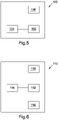
- FIG. 5 is a block diagram of a security data processing device in the form of a Java (RTM) card 100.
- the card 100 is of conventional construction, comprising a secure processor 102, a secure memory 104 and an input/output interface 106.
- the secure memory 104 contains instructions executable by the processor 102 to carry out the steps of determining whether the value of the permitted number of target devices is greater than zero, obtaining a device cryptographic certificate from a target device, generating a licence key from a device identifier included in the device certificate, encrypting the licence key and program code for storage on the target device and decrementing the value of the permitted number of target devices.
- FIG. 6 is a block diagram of a target data processing device in the form of a microcontroller 110.
- the microcontroller is of conventional construction, comprising a secure processor 112, a memory 114, a protected memory 116 and an input/output interface 118.
- the protected memory 116 is shown in Figure 6 as separate from the memory 114. It could however be a portion of the memory 114 to which access is restricted by the processor 112.
- the protected memory 116 contains program code executable by the processor 112 to obtain a device identifier from the memory 114, to derive from the device identifier a test code, to obtain a licence key from the protected memory 116, compare the test code with the licence key and, only if the test code matches the licence key, permit other program code stored in the protected memory 116 to be executed.
Landscapes
- Engineering & Computer Science (AREA)
- Theoretical Computer Science (AREA)
- Software Systems (AREA)
- Computer Security & Cryptography (AREA)
- Physics & Mathematics (AREA)
- Computer Hardware Design (AREA)
- General Physics & Mathematics (AREA)
- General Engineering & Computer Science (AREA)
- Technology Law (AREA)
- Multimedia (AREA)
- Radar, Positioning & Navigation (AREA)
- Remote Sensing (AREA)
- Health & Medical Sciences (AREA)
- Bioethics (AREA)
- General Health & Medical Sciences (AREA)
- Mathematical Physics (AREA)
- Storage Device Security (AREA)
Description
- The present disclosure relates to enabling program code on target data processing devices using a security data processing device.
- Modern software often checks that the user is in possession of a licence key before allowing itself to run, or enabling certain features of itself. In the case of software embedded into a data processing device (for example a washing machine), the licence key is generally also embedded into the data processing device so that possession of the data processing device implicitly authorises the use of the software that is embedded into the data processing device.
- In addition, where the data processing device has some unique identity, it is advantageous to somehow integrate this identity into the licence key so that the embedded software can check both that there is a valid licence, and that the licence is for the data processing device on which the software is currently executing. This prevents a valid licence key being copied across to another data processing device - for example to enable features that were licenced on the source device, but not on the destination.
- It's clear that these licence keys have a value, because they allow software or optional features of that software to run on a device. However these licence keys normally need to be generated in a third party manufacturing facility, either because of policy, or because the key includes information such as the unique identifier that is only available during the manufacturing process. For example the unique id may come pre-programmed into a reel of devices, where one of these devices is added to the data processing device during manufacture.
- US Patent application
US2002/199110A1 (Kean ) relates to techniques used to protect intellectual property cores on field programmable gate arrays.US2002/199110A1 describes an approach to associate each field programmable gate array, or a limited number of field programmable gate arrays, with a secret key, each field programmable gate array may only be properly configured or programmed by an appropriate encrypted bitstream (which includes one or more intellectual property cores).US2002/199110A1 describes that this encrypted bitstream has been encoded by or for the secret key associated with a particular FPGA. - The inventors have identified that, currently, the original designer of a product has to trust the third party manufacturer not to generate additional licences and hence manufacture additional devices which can be sold on the grey market. Experience has shown that this trust is often misplaced, so some mechanism for preventing this is of value to the original designer.
- The present disclosure relates to a method for secure generation of software licence keys at a third party manufacturing site.
- Embodiments of the present disclosure are directed to the provision in the factory of a mechanism to generate licence keys that the original designer can trust not to generate keys in excess of an authorised count provided by the original manufacturer. This may be achieved by the provision of a security data processing device to the third party manufacturer which the only method of accessing is to optionally provide a device identity, and receive a licence key in return. The security data processing device (e.g. an HSM) keeps a count of the number of devices which licence keys can be generated for, and when this count is expired, refuses to supply any more licence keys.
- When the original designer wants to authorise the manufacture of more devices, they can supply a new count encrypted in one of the standard ways so that the receiving security data processing device can validate that the count was sent by the original designer, and only the target security data processing device (or devices of its class) can decrypt the count.
- As well as the count, it's desirable for the original designer to supply the firmware image for programming into the data processing device. This image may be split into multiple parts where one part is responsible for licence validation, and the other part(s) each implement one or more features of the software.
- It's also possible for the original designer to send instructions for how to generate a licence key (e.g. a script) to the security data processing device so that the original designer can change the means of generating a licence key without obtaining a new version of the security data processing device.
- Alternatively, with some low price security data processing devices (e.g. a smart card) it would be feasible for the original designer to pre-install the count before sending it to the third party manufacturer, and to send out a new security data processing device every time an additional count is required.
- According to a first aspect of the present invention, there is provided a method of enabling program code stored on target data processing devices, according to claim 1.
- According to a second aspect of the present invention, there is provided a security data processing device comprising a processor and a memory, according to claim 15.
- Preferred embodiments are defined in the dependent claims.
- We describe a first method of enabling program code stored on target data processing devices, the method comprising:
- receiving an encrypted value of a permitted number of target data processing devices that are permitted to have program code stored on them enabled, and using a security data processing device to decrypt the encrypted value and store the decrypted value on the security data processing device; and
- Z receiving encrypted instructions for execution by the security data processing device; using the security data processing device to decrypt the encrypted instructions and store the decrypted instructions on the security data processing device, Z
- for each target data processing device, using the security data processing device to: determine whether the value of the permitted number of target data processing devices is greater than zero;
- if so, obtain a device identifier from the target data processing device;
- generate a licence key from the device identifier;
- store the licence key on the target data processing device; and
- decrement the value of the permitted number of target data processing Z devices; wherein using the security data processing device to generate the licence key from the device identifier comprises generating the licence key by execution of the decrypted instructions. Z
- Using the security data processing device to generate the licence key from the device identifier may advantageously comprise generating the licence key by executing instructions stored on the security data processing device by a provider of the security data processing device.
- It is envisaged that the program code stored on the target data processing devices that is enabled by the described methods would typically include a portion executable by the target data processing device to validate the licence key and enable another portion of the program code.
- Alternatively, the further program code stored on the target data processing device could be executable to validate the licence key and enable the program code stored on the target data processing devices that is enabled by the described methods.
- The instructions stored on the security data processing device may advantageously be executable by the security data processing device to generate a licence key, which licence key, when stored on the target data processing device, enables selected portions of the program code stored on the target data processing device, the selected portions being specified by the instructions stored on the security data processing device.
- Using the security data processing device to obtain the device identifier may advantageously comprise using the security data processing device to obtain a device cryptographic certificate including the device identifier.
- In the first described method, receiving the encrypted value comprises receiving a data carrier on which is stored the encrypted value, and using the security data processing device to decrypt the encrypted value and store the decrypted value on the security data processing device comprise using a hardware security module (HSM) to decrypt the encrypted value and store the decrypted value on the HSM.
- Alternatively, receiving the encrypted value may comprise receiving it via an Internet connection on an HSM and using the HSM to decrypt the encrypted value and store it on the HSM.
- A suitable HSM for use in the described methods is a Thales Solo HSM.
- In the second described method, receiving the security data processing device on which are stored the value and the instructions for execution by the security data processing device comprises receiving a Java (RTM) card on which are stored the value and the instructions.
- A suitable Java (RTM) card is a Gemalto IDcore 10 Java (RTM) card.
- Where a Java (RTM) card is used as the security data processing device, it also has stored on it instructions executable by the card to carry out the described methods.
- The licence key may, for example, comprise at least a portion of the device identifier of the target data processing device.
- Preferably, however, to increase the difficulty of identification of the licence key by untrusted entities, the licence key is derived from at least a portion of the device identifier of the target data processing device.
- Because the device identifier is, by design, easy to obtain from the target data processing device, use of a licence key comprising at least a portion of the device identifier could undermine the security of the described methods, because it could aid identification of the licence key when the licence key is stored on the target data processing device.
- It is preferable that the licence key be derived from at least a portion of the device identifier, and more preferably from the entire device identifier, for example by means of a cryptographic hash function, in order to make identification of the licence key more difficult.
- The method preferably includes the step of encrypting the licence key, and the further program code if used, before storing it on the target data processing device.
- Receiving the encrypted value and instructions may advantageously comprise receiving an encrypted cryptographic certificate including the value and the instructions and signed by a trusted entity.
- The trusted entity may, for example, be a provider of the program code stored on the target data processing devices.
- We describe a security data processing device comprising a processor and a memory, the memory having stored on it a value of a permitted number of target data processing devices that are permitted to have program code stored on them enabled, and instructions executable by the processor to cause the security data processing device to:
- receive an encrypted value of a permitted number of target data processing devices that are permitted to have program code stored on them enabled;
- decrypt the encrypted value and store the decrypted value in said memory;
- receive encrypted instructions for execution by the security data processing device;
- decrypt the encrypted instructions and store the decrypted instructions in said memory, and execute the decrypted instructions on said processor to:
determine whether the value of the permitted number of target data processing devices is greater than zero; - if so, obtain a device identifier from a target data processing device;
- generate a licence key from the device identifier;
- store the licence key on the target data processing device; and
- decrement the value of the permitted number of target data processing devices.
- Preferred embodiments of the invention will now be described, by way of example, with reference to the attached drawing figures, in which:
-
Figure 1 is a schematic representation of a first embodiment of the method of the invention; -
Figure 2 is a schematic representation of the second described method; -
Figure 3 is a flow diagram of the method ofFigure 1 ; -
Figure 4 is a flow diagram of the method ofFigure 2 ; -
Figure 5 is a block diagram of a security data processing device; and -
Figure 6 is a block diagram of a target data processing device. - The
method 10 ofFigure 1 comprises receiving asmart card 12 in the form of a Java (RTM) card containing a cryptographic certificate that includes avalue 14 of a permitted number of target data processing devices,further program code 16 for storage on target data processing devices andinstructions 18 for execution by a hardware security module (HSM), the certificate having been signed using a private key of a public key encryption key pair of a developer of thefurther program code 16. - The
smart card 12 establishes a shared key using public key cryptography with anHSM 20 that forms part of adevice programmer 22. The smart card encrypts the cryptographic certificate using the shared key and transmits the encrypted certificate to theHSM 20 via a smart card reader (not shown) of the HSM. The HSM decrypts the encrypted cryptographic certificate and uses a public key of the key pair of the developer of theprogram code 16 to verify that the certificate was in fact signed by the developer. - In order to prevent an untrusted entity from reusing the smart card, the HSM generates a cryptographic certificate including a zero value of the permitted number of target data processing devices, stores the certificate on the
smart card 12 and verifies that the certificate has been correctly stored on the smart card. Unless the verification is successful, the HSM stops the method. - If the smart card is subsequently presented to an HSM, the zero value of the permitted number of target data processing devices will be transmitted to the HSM and the HSM will stop the method when it checks that the value of the permitted number of target data processing devices is greater than zero.
- The
HSM 20 obtains a device cryptographic certificate from a targetdata processing device 24, the certificate including a device identifier and being signed by a trusted entity such as a manufacturer of the targetdata processing device 24 or the developer of thefurther program code 16. TheHSM 20 verifies that the certificate was in fact signed by the trusted entity, using the public key of a key pair of the trusted entity. If the verification is successful, the HSM executes theinstructions 18, which causes the HSM to generate a licence key from the device identifier of the targetdata processing device 24, using a cryptographic hash function. - The HSM establishes a shared key with the target
data processing device 24 using public key cryptography and encrypts the licence key and thefurther program code 16 for storage on the target data processing device using the shared key. The HSM causes thedevice programmer 22 to store the encrypted licence key and further program code on the targetdata processing device 24. The target data processing device decrypts the licence key and further program code using the shared key and stores the decrypted licence key and further program code in the memory of the target data processing device. - It will be appreciated that where the target data processing device includes a protected region of the memory, it would be prudent to store the licence key and further program code in the protected region.
- The further program code stored in the memory is executable by the target
data processing device 24 to obtain the device identifier of the target data processing device, generate a test code from the device identifier using the same cryptographic hash function as was used by the HSM to generate the licence key, to compare the test code with the licence key stored in the protected region of the memory, and to prevent other program code stored in the memory from being executed unless the licence key and the test code match. - Where the target device has a protected region of the memory, the protected region of the memory may be protected in various ways that will be familiar to those skilled in the art, such as being accessible only at boot time, or being accessible only when the target data processing device is operating in a secure mode.
- Embodiments of the invention enable a provider of program code to have a disabled version of program code stored on a large number of target data processing devices, and to control on how many of the target data processing devices the program code is enabled.
- The
method 30 ofFigure 2 comprises receiving a security data processing device in the form of a Java (RTM) card, i.e., asmart card 32, containing avalue 34 of a permitted number of target data processing devices,further program code 36 for storage on target data processing devices andinstructions 38 for execution by thesmart card 32. - The
smart card 32 executes theinstructions 38, which causes the smart card to obtain, via adevice programmer 40, a device cryptographic certificate from a targetdata processing device 42, the certificate including a device identifier and being signed by a trusted entity. - The smart card verifies that the device certificate was in fact signed by the trusted entity, using a public key of a key pair of the trusted entity. If the verification is successful, the smart card establishes a shared key with the target
data processing device 42 using public key cryptography. - Execution of the
instructions 38 causes the smart card to generate a licence key from the device identifier of the targetdata processing device 42, using a cryptographic hash function. - The smart card encrypts the licence key and the
further program code 36 for storage on the target data processing device using the shared key and stores the encrypted licence key and further program code on the target data processing device via thedevice programmer 40. - As in the method of
Figure 1 , the targetdata processing device 42 decrypts the licence key and further program code using the shared key and stores the decrypted licence key and further program code in a protected region of the memory of the target data processing device. - The further program code stored in the protected region of the memory is executable by the target data processing device to carry out the same functions as described above in relation to
Figure 1 , which will therefore not be repeated. - Each time a target data processing device is presented to the device programmer, the
smart card 32 checks whether thevalue 34 stored on the smart card is greater than zero, and, if so, decrements thevalue 34 then carries out the steps set out above. Otherwise the smart card stops the method. It is envisaged that, when the value stored on the smart card reaches zero, the smart card would simply be discarded. - Turning to
Figure 3 , this shows in more detail as a flow diagram the method ofFigure 1 . - At
step 50 the smart card containing the cryptographic certificate including the value of the permitted number of target devices, program code for storage on target data processing devices and instructions for execution by the HSM is received. - At
step 52 the smart card establishes the shared key with the HSM. - At
step 54 the smart card encrypts the certificate using the shared key and transmits it to the HSM. - At
step 56 the HSM decrypts the encrypted certificate using the shared key. - At
step 58 the HSM verifies that the certificate was signed by a trusted entity. If the verification fails, the method stops. - If the verification is successful, at
step 59 the HSM generates a new cryptographic certificate including a zero value of the permitted number of target data processing devices and stores the new certificate on the smart card. - At
step 60 the HSM verifies that the new certificate has been correctly stored on the smart card. If the verification fails, the method stops. - If the verification is successful, at
step 61 the HSM determines whether the value of the permitted number of target data processing devices is greater than zero. If the determination fails, the method stops. - If the determination is successful, at
step 62 the HSM decrements the value and obtains the device certificate from the target data processing device. - At
step 64 the HSM verifies that the device certificate was signed by a trusted entity. If the verification fails, the method stops. - If the verification is successful, at
step 66 the HSM generates the licence key from the device identifier. - At
optional step 68 the HSM establishes the shared key with the target device, atoptional step 70 the HSM encrypts the licence key and program code using the shared key and atstep 72 the HSM stores the (optionally encrypted) licence key and program code on the target device. - At
step 74 the HSM verifies that the licence key and program code have been correctly stored on the target device. If the verification fails, the HSM provides an indication that the verification has failed. - The flow returns to step 61 to await presentation of another target device to the device programmer.
-
Figure 4 shows in more detail as a flow diagram the method ofFigure 2 . - At
step 80 the smart card containing the value of the permitted number of target devices, further program code for storage on target data processing devices and instructions for execution by the smart card is received. - At
step 82 the smart card determines whether the value of the permitted number of devices is greater than zero. If the determination fails, the method stops. - If the determination is successful, at
step 84 the smart card obtains the device certificate from the target device. - At
step 86 the smart card verifies that the device certificate was signed by a trusted entity. If the verification fails, the method stops. - If the verification is successful, at
optional step 88 the smart card establishes a shared key with the target device, atstep 90 the smart card generates the licence key from the device identifier and decrements the value of the permitted number of target devices, atoptional step 92 the smart card encrypts the licence key and further program code for storage on the target device using the shared key, and atstep 94 the smart card stores the (optionally encrypted) licence key and further program code on the target device. - At
step 96 the smart card verifies that the licence key and further program code have been correctly stored on the target device. If the verification fails, the smart card causes an indication that the verification has failed to be generated. - The flow returns to step 82 to await presentation of another target device to the device programmer.
-
Figure 5 is a block diagram of a security data processing device in the form of a Java (RTM)card 100. Thecard 100 is of conventional construction, comprising asecure processor 102, asecure memory 104 and an input/output interface 106. - The
secure memory 104 contains instructions executable by theprocessor 102 to carry out the steps of determining whether the value of the permitted number of target devices is greater than zero, obtaining a device cryptographic certificate from a target device, generating a licence key from a device identifier included in the device certificate, encrypting the licence key and program code for storage on the target device and decrementing the value of the permitted number of target devices. -
Figure 6 is a block diagram of a target data processing device in the form of amicrocontroller 110. The microcontroller is of conventional construction, comprising asecure processor 112, amemory 114, a protectedmemory 116 and an input/output interface 118. - The protected
memory 116 is shown inFigure 6 as separate from thememory 114. It could however be a portion of thememory 114 to which access is restricted by theprocessor 112. The protectedmemory 116 contains program code executable by theprocessor 112 to obtain a device identifier from thememory 114, to derive from the device identifier a test code, to obtain a licence key from the protectedmemory 116, compare the test code with the licence key and, only if the test code matches the licence key, permit other program code stored in the protectedmemory 116 to be executed. - It will be apparent that the above description relates only to selected embodiments of the invention, and that the invention encompasses other embodiments as defined by the claims set out hereafter.
Claims (15)
- A method of enabling program code stored on target data processing devices, the method comprising:receiving an encrypted value of a permitted number of target data processing devices that are permitted to have program code stored on them enabled, and using a security data processing device to decrypt the encrypted value and store the decrypted value on the security data processing device; andreceiving encrypted instructions for execution by the security data processing device;using the security data processing device to decrypt the encrypted instructions and store the decrypted instructions on the security data processing device,for each target data processing device, using the security data processing device to:determine whether the value of the permitted number of target data processing devices is greater than zero;if so, obtain a device identifier from the target data processing device;generate a licence key from the device identifier;store the licence key on the target data processing device; anddecrement the value of the permitted number of target data processing devices.wherein using the security data processing device to generate the licence key from the device identifier comprises generating the licence key by execution of the decrypted instructions.
- The method of claim 1, wherein using the security data processing device to generate the licence key from the device identifier comprises generating the licence key by executing instructions stored on the security data processing device by a provider of the security data processing device.
- The method of any preceding claim, further comprising receiving encrypted further program code for storage on the target data processing devices, using the security data processing device to decrypt the encrypted further program code and store the decrypted further program code on the security data processing device, and using the security data processing device to store the further program code on the target data processing device.
- The method of any preceding claim, wherein the program code includes a portion executable by the target data processing device to validate the licence key and enable another portion of the program code.
- The method of claim 3, wherein the further program code stored on the target data processing device is executable to validate the licence key and enable the program code stored on the target data processing device.
- The method of any preceding claim, wherein using the security data processing device to obtain the device identifier comprises using the security data processing device to obtain a device cryptographic certificate including the device identifier.
- The method of any preceding claim, wherein receiving the encrypted value comprises receiving a data carrier on which is stored the encrypted value, and using the security data processing device to decrypt the encrypted value and store the decrypted value on the security data processing device comprises using a hardware security module to decrypt the encrypted value and store the decrypted value on the hardware security module.
- The method of any of claims 1 to 6, wherein receiving the encrypted value comprises receiving it via an Internet connection on a hardware security module and using the hardware security module to decrypt the encrypted value and store it on the hardware security module.
- The method of any preceding claim, wherein the licence key comprises at least a portion of the device identifier of the target data processing device.
- The method of any of claims 1 to 9, wherein the licence key is derived from at least a portion of the device identifier of the target data processing device.
- The method of claim 10, wherein the licence key is derived from the entire device identifier.
- The method of claim 11, wherein the licence key is derived using a cryptographic hash function.
- The method of claim 1, wherein receiving the encrypted value and the encrypted instructions comprises receiving an encrypted cryptographic certificate including the encrypted value and the encrypted instructions and signed by a trusted entity.
- The method of claim 13, wherein the trusted entity is a provider of the program code stored on the target data processing device.
- A security data processing device comprising a processor and a memory, the security data processing device configured to:receive an encrypted value of a permitted number of target data processing devices that are permitted to have program code stored on them enabled;decrypt the encrypted value and store the decrypted value in said memory;receive encrypted instructions for execution by the security data processing device;decrypt the encrypted instructions and store the decrypted instructions in said memory, andexecute the decrypted instructions on said processor to:determine whether the value of the permitted number of target data processing devices is greater than zero;if so, obtain a device identifier from a target data processing device;generate a licence key from the device identifier;store the licence key on the target data processing device; anddecrement the value of the permitted number of target data processing devices.
Applications Claiming Priority (2)
| Application Number | Priority Date | Filing Date | Title |
|---|---|---|---|
| GBGB1705875.1A GB201705875D0 (en) | 2017-04-11 | 2017-04-11 | Enabling program code on target data processing devices |
| PCT/GB2018/050967 WO2018189539A1 (en) | 2017-04-11 | 2018-04-11 | Enabling program code on target data processing devices |
Publications (2)
| Publication Number | Publication Date |
|---|---|
| EP3610399A1 EP3610399A1 (en) | 2020-02-19 |
| EP3610399B1 true EP3610399B1 (en) | 2022-06-01 |
Family
ID=58744772
Family Applications (1)
| Application Number | Title | Priority Date | Filing Date |
|---|---|---|---|
| EP18719261.2A Active EP3610399B1 (en) | 2017-04-11 | 2018-04-11 | Enabling program code on target data processing devices |
Country Status (4)
| Country | Link |
|---|---|
| US (1) | US11238137B2 (en) |
| EP (1) | EP3610399B1 (en) |
| GB (1) | GB201705875D0 (en) |
| WO (1) | WO2018189539A1 (en) |
Families Citing this family (4)
| Publication number | Priority date | Publication date | Assignee | Title |
|---|---|---|---|---|
| GB201705875D0 (en) | 2017-04-11 | 2017-05-24 | Secure Thingz Ltd | Enabling program code on target data processing devices |
| US11693929B2 (en) * | 2018-02-13 | 2023-07-04 | Sony Corporation | Electronic device, information processing apparatus, information processing method, and information processing system |
| US11444759B2 (en) | 2019-05-29 | 2022-09-13 | Stmicroelectronics, Inc. | Method and apparatus for cryptographically aligning and binding a secure element with a host device |
| US11681784B2 (en) * | 2020-09-03 | 2023-06-20 | Arista Networks, Inc. | Hardware license verification |
Family Cites Families (4)
| Publication number | Priority date | Publication date | Assignee | Title |
|---|---|---|---|---|
| GB0114317D0 (en) * | 2001-06-13 | 2001-08-01 | Kean Thomas A | Method of protecting intellectual property cores on field programmable gate array |
| US20060020556A1 (en) * | 2004-07-01 | 2006-01-26 | Hamnen Jan H | System and method for distributing electronic content utilizing electronic license keys |
| US20060211490A1 (en) | 2005-03-17 | 2006-09-21 | Falvey Grahame M | Security for gaming devices |
| GB201705875D0 (en) | 2017-04-11 | 2017-05-24 | Secure Thingz Ltd | Enabling program code on target data processing devices |
-
2017
- 2017-04-11 GB GBGB1705875.1A patent/GB201705875D0/en not_active Ceased
-
2018
- 2018-04-11 EP EP18719261.2A patent/EP3610399B1/en active Active
- 2018-04-11 US US16/495,328 patent/US11238137B2/en active Active
- 2018-04-11 WO PCT/GB2018/050967 patent/WO2018189539A1/en not_active Ceased
Also Published As
| Publication number | Publication date |
|---|---|
| US11238137B2 (en) | 2022-02-01 |
| WO2018189539A1 (en) | 2018-10-18 |
| GB201705875D0 (en) | 2017-05-24 |
| EP3610399A1 (en) | 2020-02-19 |
| US20200026825A1 (en) | 2020-01-23 |
Similar Documents
| Publication | Publication Date | Title |
|---|---|---|
| US11126754B2 (en) | Personalized and cryptographically secure access control in operating systems | |
| TWI840506B (en) | Security data processing device | |
| EP3776315B1 (en) | Trusted execution environment instances licenses management | |
| EP3458999B1 (en) | Self-contained cryptographic boot policy validation | |
| US10530576B2 (en) | System and method for computing device with improved firmware service security using credential-derived encryption key | |
| US10282549B2 (en) | Modifying service operating system of baseboard management controller | |
| US20130268754A1 (en) | Secure software file transfer systems and methods for vehicle control modules | |
| EP2051181A1 (en) | Information terminal, security device, data protection method, and data protection program | |
| WO2015042981A1 (en) | Encryption and decryption processing method, apparatus and device | |
| US20250217519A1 (en) | A device and a method for controlling use of a cryptographic key | |
| US11238137B2 (en) | Enabling program code on target data processing devices | |
| JP2024503602A (en) | Key revocation for edge devices | |
| WO2019142307A1 (en) | Semiconductor device, update data-providing method, update data-receiving method, and program | |
| EP3776303B1 (en) | Instance handling of a trusted execution environment | |
| JP5118700B2 (en) | Portable mass storage with virtual machine activation | |
| Nyman et al. | Citizen electronic identities using TPM 2.0 | |
| JP6517435B2 (en) | How to manage the application | |
| EP3610401B1 (en) | Storing data on target data processing devices | |
| KR20120104271A (en) | Securing execution of computational resources | |
| KR101630462B1 (en) | Apparatus and Method for Securing a Keyboard | |
| CN115509587B (en) | Firmware upgrading method and device, electronic equipment and computer readable storage medium | |
| US20220050605A1 (en) | Remote enforcement of device memory | |
| US12045377B2 (en) | Method and device for secured deciphering of ciphering data | |
| EP3817276B1 (en) | Apparatus and method for data security | |
| HK40060449A (en) | Personalized and cryptographically secure access control in operating systems |
Legal Events
| Date | Code | Title | Description |
|---|---|---|---|
| STAA | Information on the status of an ep patent application or granted ep patent |
Free format text: STATUS: UNKNOWN |
|
| STAA | Information on the status of an ep patent application or granted ep patent |
Free format text: STATUS: THE INTERNATIONAL PUBLICATION HAS BEEN MADE |
|
| PUAI | Public reference made under article 153(3) epc to a published international application that has entered the european phase |
Free format text: ORIGINAL CODE: 0009012 |
|
| STAA | Information on the status of an ep patent application or granted ep patent |
Free format text: STATUS: REQUEST FOR EXAMINATION WAS MADE |
|
| 17P | Request for examination filed |
Effective date: 20190905 |
|
| AK | Designated contracting states |
Kind code of ref document: A1 Designated state(s): AL AT BE BG CH CY CZ DE DK EE ES FI FR GB GR HR HU IE IS IT LI LT LU LV MC MK MT NL NO PL PT RO RS SE SI SK SM TR |
|
| AX | Request for extension of the european patent |
Extension state: BA ME |
|
| DAV | Request for validation of the european patent (deleted) | ||
| DAX | Request for extension of the european patent (deleted) | ||
| GRAP | Despatch of communication of intention to grant a patent |
Free format text: ORIGINAL CODE: EPIDOSNIGR1 |
|
| STAA | Information on the status of an ep patent application or granted ep patent |
Free format text: STATUS: GRANT OF PATENT IS INTENDED |
|
| INTG | Intention to grant announced |
Effective date: 20220127 |
|
| RIN1 | Information on inventor provided before grant (corrected) |
Inventor name: WOODRUFF, TIMOTHY JOHN Inventor name: MORETON, MIKE Inventor name: PANCOAST, STEVE Inventor name: POVEY, HAYDN |
|
| GRAS | Grant fee paid |
Free format text: ORIGINAL CODE: EPIDOSNIGR3 |
|
| GRAA | (expected) grant |
Free format text: ORIGINAL CODE: 0009210 |
|
| STAA | Information on the status of an ep patent application or granted ep patent |
Free format text: STATUS: THE PATENT HAS BEEN GRANTED |
|
| AK | Designated contracting states |
Kind code of ref document: B1 Designated state(s): AL AT BE BG CH CY CZ DE DK EE ES FI FR GB GR HR HU IE IS IT LI LT LU LV MC MK MT NL NO PL PT RO RS SE SI SK SM TR |
|
| REG | Reference to a national code |
Ref country code: GB Ref legal event code: FG4D |
|
| REG | Reference to a national code |
Ref country code: AT Ref legal event code: REF Ref document number: 1495885 Country of ref document: AT Kind code of ref document: T Effective date: 20220615 Ref country code: CH Ref legal event code: EP |
|
| REG | Reference to a national code |
Ref country code: IE Ref legal event code: FG4D |
|
| REG | Reference to a national code |
Ref country code: DE Ref legal event code: R096 Ref document number: 602018036179 Country of ref document: DE |
|
| REG | Reference to a national code |
Ref country code: NL Ref legal event code: FP |
|
| REG | Reference to a national code |
Ref country code: LT Ref legal event code: MG9D |
|
| PG25 | Lapsed in a contracting state [announced via postgrant information from national office to epo] |
Ref country code: SE Free format text: LAPSE BECAUSE OF FAILURE TO SUBMIT A TRANSLATION OF THE DESCRIPTION OR TO PAY THE FEE WITHIN THE PRESCRIBED TIME-LIMIT Effective date: 20220601 Ref country code: NO Free format text: LAPSE BECAUSE OF FAILURE TO SUBMIT A TRANSLATION OF THE DESCRIPTION OR TO PAY THE FEE WITHIN THE PRESCRIBED TIME-LIMIT Effective date: 20220901 Ref country code: LT Free format text: LAPSE BECAUSE OF FAILURE TO SUBMIT A TRANSLATION OF THE DESCRIPTION OR TO PAY THE FEE WITHIN THE PRESCRIBED TIME-LIMIT Effective date: 20220601 Ref country code: HR Free format text: LAPSE BECAUSE OF FAILURE TO SUBMIT A TRANSLATION OF THE DESCRIPTION OR TO PAY THE FEE WITHIN THE PRESCRIBED TIME-LIMIT Effective date: 20220601 Ref country code: GR Free format text: LAPSE BECAUSE OF FAILURE TO SUBMIT A TRANSLATION OF THE DESCRIPTION OR TO PAY THE FEE WITHIN THE PRESCRIBED TIME-LIMIT Effective date: 20220902 Ref country code: FI Free format text: LAPSE BECAUSE OF FAILURE TO SUBMIT A TRANSLATION OF THE DESCRIPTION OR TO PAY THE FEE WITHIN THE PRESCRIBED TIME-LIMIT Effective date: 20220601 Ref country code: ES Free format text: LAPSE BECAUSE OF FAILURE TO SUBMIT A TRANSLATION OF THE DESCRIPTION OR TO PAY THE FEE WITHIN THE PRESCRIBED TIME-LIMIT Effective date: 20220601 Ref country code: BG Free format text: LAPSE BECAUSE OF FAILURE TO SUBMIT A TRANSLATION OF THE DESCRIPTION OR TO PAY THE FEE WITHIN THE PRESCRIBED TIME-LIMIT Effective date: 20220901 |
|
| REG | Reference to a national code |
Ref country code: AT Ref legal event code: MK05 Ref document number: 1495885 Country of ref document: AT Kind code of ref document: T Effective date: 20220601 |
|
| PG25 | Lapsed in a contracting state [announced via postgrant information from national office to epo] |
Ref country code: RS Free format text: LAPSE BECAUSE OF FAILURE TO SUBMIT A TRANSLATION OF THE DESCRIPTION OR TO PAY THE FEE WITHIN THE PRESCRIBED TIME-LIMIT Effective date: 20220601 Ref country code: PL Free format text: LAPSE BECAUSE OF FAILURE TO SUBMIT A TRANSLATION OF THE DESCRIPTION OR TO PAY THE FEE WITHIN THE PRESCRIBED TIME-LIMIT Effective date: 20220601 Ref country code: LV Free format text: LAPSE BECAUSE OF FAILURE TO SUBMIT A TRANSLATION OF THE DESCRIPTION OR TO PAY THE FEE WITHIN THE PRESCRIBED TIME-LIMIT Effective date: 20220601 |
|
| PG25 | Lapsed in a contracting state [announced via postgrant information from national office to epo] |
Ref country code: SM Free format text: LAPSE BECAUSE OF FAILURE TO SUBMIT A TRANSLATION OF THE DESCRIPTION OR TO PAY THE FEE WITHIN THE PRESCRIBED TIME-LIMIT Effective date: 20220601 Ref country code: SK Free format text: LAPSE BECAUSE OF FAILURE TO SUBMIT A TRANSLATION OF THE DESCRIPTION OR TO PAY THE FEE WITHIN THE PRESCRIBED TIME-LIMIT Effective date: 20220601 Ref country code: RO Free format text: LAPSE BECAUSE OF FAILURE TO SUBMIT A TRANSLATION OF THE DESCRIPTION OR TO PAY THE FEE WITHIN THE PRESCRIBED TIME-LIMIT Effective date: 20220601 Ref country code: PT Free format text: LAPSE BECAUSE OF FAILURE TO SUBMIT A TRANSLATION OF THE DESCRIPTION OR TO PAY THE FEE WITHIN THE PRESCRIBED TIME-LIMIT Effective date: 20221003 Ref country code: EE Free format text: LAPSE BECAUSE OF FAILURE TO SUBMIT A TRANSLATION OF THE DESCRIPTION OR TO PAY THE FEE WITHIN THE PRESCRIBED TIME-LIMIT Effective date: 20220601 Ref country code: CZ Free format text: LAPSE BECAUSE OF FAILURE TO SUBMIT A TRANSLATION OF THE DESCRIPTION OR TO PAY THE FEE WITHIN THE PRESCRIBED TIME-LIMIT Effective date: 20220601 Ref country code: AT Free format text: LAPSE BECAUSE OF FAILURE TO SUBMIT A TRANSLATION OF THE DESCRIPTION OR TO PAY THE FEE WITHIN THE PRESCRIBED TIME-LIMIT Effective date: 20220601 |
|
| PG25 | Lapsed in a contracting state [announced via postgrant information from national office to epo] |
Ref country code: IS Free format text: LAPSE BECAUSE OF FAILURE TO SUBMIT A TRANSLATION OF THE DESCRIPTION OR TO PAY THE FEE WITHIN THE PRESCRIBED TIME-LIMIT Effective date: 20221001 |
|
| REG | Reference to a national code |
Ref country code: DE Ref legal event code: R097 Ref document number: 602018036179 Country of ref document: DE |
|
| PG25 | Lapsed in a contracting state [announced via postgrant information from national office to epo] |
Ref country code: AL Free format text: LAPSE BECAUSE OF FAILURE TO SUBMIT A TRANSLATION OF THE DESCRIPTION OR TO PAY THE FEE WITHIN THE PRESCRIBED TIME-LIMIT Effective date: 20220601 |
|
| PLBE | No opposition filed within time limit |
Free format text: ORIGINAL CODE: 0009261 |
|
| STAA | Information on the status of an ep patent application or granted ep patent |
Free format text: STATUS: NO OPPOSITION FILED WITHIN TIME LIMIT |
|
| PG25 | Lapsed in a contracting state [announced via postgrant information from national office to epo] |
Ref country code: DK Free format text: LAPSE BECAUSE OF FAILURE TO SUBMIT A TRANSLATION OF THE DESCRIPTION OR TO PAY THE FEE WITHIN THE PRESCRIBED TIME-LIMIT Effective date: 20220601 |
|
| 26N | No opposition filed |
Effective date: 20230302 |
|
| PG25 | Lapsed in a contracting state [announced via postgrant information from national office to epo] |
Ref country code: SI Free format text: LAPSE BECAUSE OF FAILURE TO SUBMIT A TRANSLATION OF THE DESCRIPTION OR TO PAY THE FEE WITHIN THE PRESCRIBED TIME-LIMIT Effective date: 20220601 |
|
| P01 | Opt-out of the competence of the unified patent court (upc) registered |
Effective date: 20230517 |
|
| REG | Reference to a national code |
Ref country code: CH Ref legal event code: PL |
|
| PG25 | Lapsed in a contracting state [announced via postgrant information from national office to epo] |
Ref country code: LU Free format text: LAPSE BECAUSE OF NON-PAYMENT OF DUE FEES Effective date: 20230411 |
|
| REG | Reference to a national code |
Ref country code: BE Ref legal event code: MM Effective date: 20230430 |
|
| PG25 | Lapsed in a contracting state [announced via postgrant information from national office to epo] |
Ref country code: MC Free format text: LAPSE BECAUSE OF FAILURE TO SUBMIT A TRANSLATION OF THE DESCRIPTION OR TO PAY THE FEE WITHIN THE PRESCRIBED TIME-LIMIT Effective date: 20220601 |
|
| PG25 | Lapsed in a contracting state [announced via postgrant information from national office to epo] |
Ref country code: MC Free format text: LAPSE BECAUSE OF FAILURE TO SUBMIT A TRANSLATION OF THE DESCRIPTION OR TO PAY THE FEE WITHIN THE PRESCRIBED TIME-LIMIT Effective date: 20220601 Ref country code: LI Free format text: LAPSE BECAUSE OF NON-PAYMENT OF DUE FEES Effective date: 20230430 Ref country code: IT Free format text: LAPSE BECAUSE OF FAILURE TO SUBMIT A TRANSLATION OF THE DESCRIPTION OR TO PAY THE FEE WITHIN THE PRESCRIBED TIME-LIMIT Effective date: 20220601 Ref country code: CH Free format text: LAPSE BECAUSE OF NON-PAYMENT OF DUE FEES Effective date: 20230430 |
|
| REG | Reference to a national code |
Ref country code: IE Ref legal event code: MM4A |
|
| PG25 | Lapsed in a contracting state [announced via postgrant information from national office to epo] |
Ref country code: BE Free format text: LAPSE BECAUSE OF NON-PAYMENT OF DUE FEES Effective date: 20230430 |
|
| PG25 | Lapsed in a contracting state [announced via postgrant information from national office to epo] |
Ref country code: IE Free format text: LAPSE BECAUSE OF NON-PAYMENT OF DUE FEES Effective date: 20230411 |
|
| PG25 | Lapsed in a contracting state [announced via postgrant information from national office to epo] |
Ref country code: IE Free format text: LAPSE BECAUSE OF NON-PAYMENT OF DUE FEES Effective date: 20230411 |
|
| PG25 | Lapsed in a contracting state [announced via postgrant information from national office to epo] |
Ref country code: BG Free format text: LAPSE BECAUSE OF FAILURE TO SUBMIT A TRANSLATION OF THE DESCRIPTION OR TO PAY THE FEE WITHIN THE PRESCRIBED TIME-LIMIT Effective date: 20220601 |
|
| PG25 | Lapsed in a contracting state [announced via postgrant information from national office to epo] |
Ref country code: BG Free format text: LAPSE BECAUSE OF FAILURE TO SUBMIT A TRANSLATION OF THE DESCRIPTION OR TO PAY THE FEE WITHIN THE PRESCRIBED TIME-LIMIT Effective date: 20220601 |
|
| PG25 | Lapsed in a contracting state [announced via postgrant information from national office to epo] |
Ref country code: CY Free format text: LAPSE BECAUSE OF FAILURE TO SUBMIT A TRANSLATION OF THE DESCRIPTION OR TO PAY THE FEE WITHIN THE PRESCRIBED TIME-LIMIT; INVALID AB INITIO Effective date: 20180411 |
|
| PG25 | Lapsed in a contracting state [announced via postgrant information from national office to epo] |
Ref country code: HU Free format text: LAPSE BECAUSE OF FAILURE TO SUBMIT A TRANSLATION OF THE DESCRIPTION OR TO PAY THE FEE WITHIN THE PRESCRIBED TIME-LIMIT; INVALID AB INITIO Effective date: 20180411 |
|
| PG25 | Lapsed in a contracting state [announced via postgrant information from national office to epo] |
Ref country code: TR Free format text: LAPSE BECAUSE OF FAILURE TO SUBMIT A TRANSLATION OF THE DESCRIPTION OR TO PAY THE FEE WITHIN THE PRESCRIBED TIME-LIMIT Effective date: 20220601 |
|
| PGFP | Annual fee paid to national office [announced via postgrant information from national office to epo] |
Ref country code: NL Payment date: 20260416 Year of fee payment: 9 |
|
| PGFP | Annual fee paid to national office [announced via postgrant information from national office to epo] |
Ref country code: GB Payment date: 20260402 Year of fee payment: 9 |
|
| PGFP | Annual fee paid to national office [announced via postgrant information from national office to epo] |
Ref country code: DE Payment date: 20260416 Year of fee payment: 9 |
|
| PGFP | Annual fee paid to national office [announced via postgrant information from national office to epo] |
Ref country code: FR Payment date: 20260402 Year of fee payment: 9 |