EP3608894A1 - Computer-implemented method and system for evaluating uncertainty in trajectory prediction - Google Patents
Computer-implemented method and system for evaluating uncertainty in trajectory prediction Download PDFInfo
- Publication number
- EP3608894A1 EP3608894A1 EP18382606.4A EP18382606A EP3608894A1 EP 3608894 A1 EP3608894 A1 EP 3608894A1 EP 18382606 A EP18382606 A EP 18382606A EP 3608894 A1 EP3608894 A1 EP 3608894A1
- Authority
- EP
- European Patent Office
- Prior art keywords
- uncertainty
- data set
- trajectory
- aircraft
- variable
- Prior art date
- Legal status (The legal status is an assumption and is not a legal conclusion. Google has not performed a legal analysis and makes no representation as to the accuracy of the status listed.)
- Ceased
Links
Images
Classifications
-
- G—PHYSICS
- G08—SIGNALLING
- G08G—TRAFFIC CONTROL SYSTEMS
- G08G5/00—Traffic control systems for aircraft
- G08G5/50—Navigation or guidance aids
- G08G5/56—Navigation or guidance aids for two or more aircraft
-
- G—PHYSICS
- G05—CONTROLLING; REGULATING
- G05D—SYSTEMS FOR CONTROLLING OR REGULATING NON-ELECTRIC VARIABLES
- G05D1/00—Control of position, course, altitude or attitude of land, water, air or space vehicles, e.g. using automatic pilots
- G05D1/10—Simultaneous control of position or course in three dimensions
- G05D1/101—Simultaneous control of position or course in three dimensions specially adapted for aircraft
-
- G—PHYSICS
- G06—COMPUTING OR CALCULATING; COUNTING
- G06F—ELECTRIC DIGITAL DATA PROCESSING
- G06F17/00—Digital computing or data processing equipment or methods, specially adapted for specific functions
- G06F17/10—Complex mathematical operations
- G06F17/11—Complex mathematical operations for solving equations, e.g. nonlinear equations, general mathematical optimization problems
- G06F17/12—Simultaneous equations, e.g. systems of linear equations
-
- G—PHYSICS
- G06—COMPUTING OR CALCULATING; COUNTING
- G06N—COMPUTING ARRANGEMENTS BASED ON SPECIFIC COMPUTATIONAL MODELS
- G06N7/00—Computing arrangements based on specific mathematical models
- G06N7/01—Probabilistic graphical models, e.g. probabilistic networks
-
- G—PHYSICS
- G08—SIGNALLING
- G08G—TRAFFIC CONTROL SYSTEMS
- G08G5/00—Traffic control systems for aircraft
-
- G—PHYSICS
- G08—SIGNALLING
- G08G—TRAFFIC CONTROL SYSTEMS
- G08G5/00—Traffic control systems for aircraft
- G08G5/20—Arrangements for acquiring, generating, sharing or displaying traffic information
-
- G—PHYSICS
- G08—SIGNALLING
- G08G—TRAFFIC CONTROL SYSTEMS
- G08G5/00—Traffic control systems for aircraft
- G08G5/30—Flight plan management
Definitions
- the present disclosure is related to Air Traffic Management (ATM).
- ATM Air Traffic Management
- the present disclosure relates to techniques for analytically quantifying the propagation of the uncertainty associated with aircraft trajectory prediction.
- Trajectory prediction techniques are at the core of some applications and decision support tools (DSTs) in current and future ATM environments.
- DSTs decision support tools
- the prediction techniques are essentially deterministic. That is, the same trajectory prediction is returned based on the same set of inputs.
- trajectory prediction is subject to stochastic processes based on several uncertainty sources that may affect the final trajectory prediction.
- DSTs Decision Support Tools
- CDM Collaborative Decision Making
- a trajectory prediction is considered as a forecast of the aircraft trajectory represented by a chronologically ordered sequence of aircraft states.
- a trajectory can be defined as the time evolution of the aircraft state, represented by the position of the aircraft's center of mass with respect to a known system of reference and other relevant state variables such as airspeed or aircraft mass.
- This model-based approach requires additional information to return a trajectory prediction, including: (a) weather information that includes wind forecast and atmosphere conditions (temperature and pressure); (b) aircraft performance data that provide information regarding the drag, thrust and fuel consumption for the considered aircraft at the specified flight conditions; and (c) aircraft intent information that represents the command and control inputs issued by the pilot or by a Flight Management System (FMS) to steer the aircraft according to a filed Flight Plan (FP).
- FMS Flight Management System
- the actual trajectories denoted as epistemic uncertainty, represent imperfections or lack of knowledge regarding the considered aircraft motion model.
- the predicted trajectories, denoted as variability uncertainty represent the propagation of the inputs randomness into the outputs.
- high fidelity models can be used to constrain the epistemic uncertainty
- the intrinsic stochastic (e.g. random) behavior of the inputs to the model leads to unavoidable prediction uncertainties, represented by the time evolution of the aircraft state variable randomness.
- Trajectory prediction uncertainty can be described as the estimated amount, or percentage, by which a predicted trajectory may potentially differ from the actual trajectory.
- trajectory uncertainty cannot be obtained by comparing predictions with actual trajectories because it represents an a priori estimation of such probable deviations based on the knowledge and quantification of the sources of uncertainty impacting the prediction.
- the present disclosure makes use of uni-variable polynomial chaos expansions, which describe the distributions of each input at a given point in time (e.g., latitude, longitude, altitude, time, bearing, mass, etc).
- uni-variable polynomial expansions describe the distributions of each input at a given point in time (e.g., latitude, longitude, altitude, time, bearing, mass, etc).
- multi-variable polynomial chaos expansions can be constructed representing a mathematical quantification of the trajectory prediction uncertainties.
- a weather forecast is typically a source of uncertainty that greatly influences trajectory predictions.
- Others sources could be the initial aircraft mass and/or the departure time.
- the present disclosure provides the teachings to compute the prediction uncertainty to any deterministic TPI with the benefit of very low extra computational requirements and development costs.
- the present disclosure promotes its application into real-life environments and implies an improvement in contrast with other uncertainty quantification approaches in dynamic models based on Monte Carlo simulations.
- the proposed approach does not require any modification of current ATM implementations, thus the ATM community may use the present teachings in current and future traffic management processes, providing a reliable, accurate and robust method to deal with uncertainty.
- the proposed techniques disclosed herein may enable developing a solution to the quantification of uncertainty with aircraft trajectory prediction.
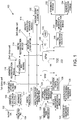
- FIG. 1 shows an example of a system 100 for identifying uncertainty sources and evaluating the propagation of trajectory prediction uncertainty where square blocks represent different devices or functions that may be implemented as software applications and rounded blocks are data.
- a trajectory prediction infrastructure (TPI) 102 computes a predicted trajectory 104 of one or more aircraft.
- the trajectory may be native. Native should be understood as the prediction computed with any Trajectory Prediction Infrastructure, regardless of the implementation and modelling used to obtain such prediction.
- the trajectory prediction infrastructure 102 may provide a predicted trajectory 104 with different degree of detail.
- a first stage of the process aims at performing a generation or collection of variables to characterize the propagation of uncertainties. Basically, four options can be identified according to the information available:
- a trajectory prediction infrastructure 102 only provides the simplest 4-dimensional (e.g. 4D) representation 106 of the predicted trajectory 104.
- the 4D representation 106 includes an initial data set 108 with longitude, latitude, altitude and time of the predicted trajectory comprising a first set of data 108. Subsequent data sets will be generated based on the first set of data.
- a kinematic reconstruction module 110 reconstructs the kinematic state variables and provides a second data set 112 including kinematic information about true airspeed (TAS), calibrated airspeed (CAS), ground speed (VG), Mach number, bearing (e.g. heading (HEAD)) and rate of climb (ROC).
- the kinematic reconstruction module 110 makes use of a weather model (WM) 142.
- This WM 142 includes a forecast of the weather conditions affecting the trajectory (e.g. the wind).
- the kinematic reconstruction module 110 also uses an aircraft performance model (APM) 144 to check if trajectory data are in compliance with the aircraft's kinematic limitations as a procedure to detect and remove data point outliers.
- APM aircraft performance model
- a third data set 116 including kinetic state variables information are maintained in the kinetic reconstruction module 114 with the help of the WM 142 and the aircraft performance model (APM) 144.
- the APM 144 includes performance information of the aircraft whose trajectory is to be predicted (e.g., drag, thrust and fuel consumption data as a function of the flight conditions).
- an aircraft intent description inference module 118 provides an aircraft intent description (AID) 120 that best fits the predicted trajectory 104. Normally, the AID 120 leads to minimum trajectory computation errors with respect to the actual trajectory 104.
- the native TPI 102 provides a native trajectory prediction 104 that includes a 4D representation 106 and additionally a kinematic prediction 122 with an evolution of the kinematic state variables over time.
- the kinematic prediction 122 includes the information present in the second data set 112 (CAS/TAS/FG/HEAD/ROC).
- CAS/TAS/FG/HEAD/ROC the information present in the second data set 112
- the TPI 102 provides a native trajectory prediction 104 that includes the 4D representation 106, the kinematic prediction 122 and further a kinetic prediction 124 with an evolution of kinetic state variables with the time.
- the kinetic prediction 124 includes the information present in the third data set 116 (instantaneous aircraft mass and fuel consumption). Thus, only the AID inference module 118 needs to be executed.
- the TPI 102 provides a comprehensive trajectory prediction 104, which includes not only the 4D representation 106, the kinematic prediction 122 and the kinetic prediction 124 but also an AID 126. Consequently, no additional tasks need to be performed.
- the dataset describing the aircraft trajectory is enhanced and enriched up to providing the most comprehensive dataset including the time evolution of all aircraft state variables (i.e., both kinematic and kinetic variables) and a formal description of the aircraft intent that univocally identify the trajectory.
- the outcomes of the first stage is a representation of the inputs required to compute a deterministic trajectory prediction, i.e., a WM 142, an APM 144 already available and used along that stage, a set of initial conditions 146 and an AID 128.
- a deterministic trajectory prediction i.e., a WM 142, an APM 144 already available and used along that stage, a set of initial conditions 146 and an AID 128.
- One advantage of this approach lies on decoupling different sources of uncertainty, specifically the AID 120.
- the proposed architecture enables a capability of modelling their random variability independently.
- a computation of the uncertainty propagation takes place.
- the computation is performed assuming a set of predictions inputs: WM 142, APM 144, initial conditions 146 (IC) and AID 128 completed in the first stage.
- the second stage leverages previous flight data stored in a recorded data repository 132 to assist in characterizing uncertainty associated to one or more particular sources.
- a selection of the sources of uncertainty module 134 is provided as user-driven process, that is, a list is provided to be considered from then on. Consequently, all remaining potential sources of uncertainty will be discarded.
- DSTs Decision Support Tools
- Inputs of the uncertainty quantification module 136 includes the available data and are used to produce a probabilistic representation of the variability of the considered inputs.
- This uncertainty quantification module 136 collects and structures the information required to compute the individual polynomial expansions and to enable to determine the optimal polynomial truncation.
- PDF probability density function
- This generated PDF function in addition to the data themselves are fed to modules 130 and 138 to obtain the truncated individual expansion that represents the uncertainty of such state variable.
- the computation of polynomial expansions module 130 gathers all the algorithmic to compute the individual polynomial expansion that captures the variability of the selected inputs (i.e., state variable).
- the computation of polynomial expansions module 130 performs the following tasks:
- the next optimal polynomial expansions truncation module 138 provides the order at which the polynomial expansions are to be truncated.
- This optimal polynomial expansions truncation module 138 computes the root mean square error (RMSE) between the inputs uncertainty quantification data and the individual polynomial expansion for every source of uncertainty.
- RMSE root mean square error
- the maximum among all truncation orders is returned as the overall expansion order p .
- both the outputs from the inputs uncertainty quantification module 136 e.g. inputs uncertainty quantification data
- the computation of polynomial expansions module 130 e.g. individual expansions
- the next step identifies a limited list of points at which the dynamic system is to be evaluated (i.e. the Trajectory Computation Engine 140 [TCE] representing the implementation of the Aircraft Motion Model [AMM]).
- TCE Trajectory Computation Engine 140
- AMM Aircraft Motion Model
- the uni-variable polynomial expansion uPE i are computed, and taking advantage of the identification of inputs of the TCE 140 (WM 142, APM 144, IC 146 and AID 128 ), it is possible to compute a set of m predictions that are used to obtain the multi-variable polynomial expansions (mPE j ) that represent the uncertainty of every aircraft state variable (st j ) as a function of the n expansions uPE i that represent the inputs uncertainty
- the trajectory predictions collector 148 implements the combinatory that enables the construction of the multi-variable orthonormal basis of polynomials of order p by means of the n expansions uPE i .
- the orthonormal basis of multi-variable polynomials are required to identify the mPE i .
- the coefficients of the mPE j that instantiate the expansions can be obtained by a fitting process between these expansions and the m computations generated by the TPI 102 previously.
- Suitable fitting processes can include least squares, probability distribution fitting, non-linear least-squares, .etc. This fitting process is run for as many aircraft state variables as present in the predicted trajectory. This process is executed by the output uncertainty quantification module 150.
- This provides a mechanism to analyze the sensitivity of the prediction uncertainty to the inputs variability.
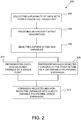
- FIG. 2 is a flow chart of a method 200 for evaluating uncertainty of a trajectory predicted infrastructure according to an illustrative embodiment. The method may be implemented as a computer-implemented method and practiced on the system 100 as described in reference to FIG. 1 .
- the method 200 begins with collecting a plurality of data sets from a predicted trajectory 104 module in step 202. There are three types of data sets 108, 112, 116 as indicated in FIG. 1 .
- the method 200 goes to a step 204 for providing an aircraft intent description 120 based on inferring the predicted trajectory 104.
- a step 206 is performed, selecting both a point in time and one or more variables among the collected data sets 108, 112, 116 as sources of uncertainty 134.
- the method continues with a step 208 by representing each selected variable at the selected point in time as a uni-variable polynomial expansion and in parallel a step 210 for representing each non-selected variable by a single point.
- the method 200 concludes its execution with a step 212 by combining selected and non-selected variables from the previous steps 208 and 210 into a multi-variable polynomial chaos expansion.
- This step 212 provides a formal representation of the prediction uncertainties of the aircraft's trajectory.
- the formal representation is an analytical description that may be useful to develop ATM automation tools.
- polynomial expansions can be easily processed by computer-based CDM processes. This may be applied to exploit actual flight data or surveillance data to characterize more realistically the sources of uncertainty.
Landscapes
- Engineering & Computer Science (AREA)
- Physics & Mathematics (AREA)
- General Physics & Mathematics (AREA)
- Mathematical Physics (AREA)
- Computational Mathematics (AREA)
- Mathematical Analysis (AREA)
- Mathematical Optimization (AREA)
- Pure & Applied Mathematics (AREA)
- Aviation & Aerospace Engineering (AREA)
- Theoretical Computer Science (AREA)
- Data Mining & Analysis (AREA)
- Software Systems (AREA)
- General Engineering & Computer Science (AREA)
- Algebra (AREA)
- Operations Research (AREA)
- Databases & Information Systems (AREA)
- Automation & Control Theory (AREA)
- Remote Sensing (AREA)
- Radar, Positioning & Navigation (AREA)
- Probability & Statistics with Applications (AREA)
- Computing Systems (AREA)
- Evolutionary Computation (AREA)
- Artificial Intelligence (AREA)
- Traffic Control Systems (AREA)
- Computer Networks & Wireless Communication (AREA)
Abstract
A system and a computer-implemented method for evaluating uncertainty of a predicted trajectory infrastructure is disclosed The method comprises collecting (202) a plurality of data sets from a predicted trajectory (104): comprising providing (204) an aircraft intent description (120) based on the predicted trajectory (104); selecting (206) both a point in time and one or more variables among the collected plurality of data sets as sources of uncertainty (134); representing (208) each selected variable at the selected point in time as a uni-variable polynomial expansion; representing (210) each non-selected variable by a single point; and combining (212) selected and non-selected variables into a multivariable polynomial chaos expansion representing a stochastic prediction of the aircraft's trajectory at the selected point in time and a measurement of a sensitivity of the prediction to each of the selected one or more sources of uncertainty.
Description
- The present disclosure is related to Air Traffic Management (ATM). In particular, the present disclosure relates to techniques for analytically quantifying the propagation of the uncertainty associated with aircraft trajectory prediction.
- Trajectory prediction techniques are at the core of some applications and decision support tools (DSTs) in current and future ATM environments.
- Currently, the prediction techniques are essentially deterministic. That is, the same trajectory prediction is returned based on the same set of inputs.
- However, in reality, trajectory prediction is subject to stochastic processes based on several uncertainty sources that may affect the final trajectory prediction.
- At present, the most common approach to deal with quantification of uncertainty sources in the context of aircraft trajectory prediction is based on Monte Carlo simulations. This approach computes thousands of predictions and aggregates the outputs. The probability distribution of the outputs provides a representation of the uncertainty.
- A Monte Carlo simulation is a highly computationally demanding process and provides results slowly. Sensitivity analyses require defining new Monte Carlo simulations in which the uncertainty sources are studied individually by removing the stochastic behavior of all sources but the one source that is under study.
- In real ATM operations, implementing this approach becomes ineffective and even unfeasible. It cannot generate useful outcomes within the typical look-ahead times.
- In addition, the current ATM approach of surveillance-based airspace-driven paradigm is shifting worldwide to a trajectory-based network-centric one, in which advanced
- Decision Support Tools (DSTs) will assist humans along the Collaborative Decision Making (CDM) process.
- Therefore, there is a current need in the state of the art to better characterize how an uncertainty source propagates throughout a predicted trajectory to enable advanced ATM capabilities. A more reliable and efficient characterization of such prediction uncertainties would benefit DSTs and Air Traffic Controllers (ATCs) to provide enhanced and timely information to deal with air traffic.
- According to the identified shortcomings, it would be desirable to develop techniques that address at least some of the issues discussed above. In particular, providing a faster mechanism to quantify how uncertainty spreads into predicted trajectories. Thus, enabling a sensitivity assessment capability in trajectory prediction without substantial extra computational effort. A better understanding of uncertainty may increase the ATM system capacity and efficiency.
- A trajectory prediction is considered as a forecast of the aircraft trajectory represented by a chronologically ordered sequence of aircraft states. A trajectory can be defined as the time evolution of the aircraft state, represented by the position of the aircraft's center of mass with respect to a known system of reference and other relevant state variables such as airspeed or aircraft mass.
- To compute a prediction, it is required to define a mathematical model of the aircraft motion. This model-based approach requires additional information to return a trajectory prediction, including: (a) weather information that includes wind forecast and atmosphere conditions (temperature and pressure); (b) aircraft performance data that provide information regarding the drag, thrust and fuel consumption for the considered aircraft at the specified flight conditions; and (c) aircraft intent information that represents the command and control inputs issued by the pilot or by a Flight Management System (FMS) to steer the aircraft according to a filed Flight Plan (FP).
- The assumptions of such kind of model-based trajectory prediction approaches, and the stochastic nature of the phenomena involved in the prediction process, bring deviations between the actual and predicted trajectories. The actual trajectories, denoted as epistemic uncertainty, represent imperfections or lack of knowledge regarding the considered aircraft motion model. The predicted trajectories, denoted as variability uncertainty, represent the propagation of the inputs randomness into the outputs. Thus, although high fidelity models can be used to constrain the epistemic uncertainty, the intrinsic stochastic (e.g. random) behavior of the inputs to the model leads to unavoidable prediction uncertainties, represented by the time evolution of the aircraft state variable randomness.
- Trajectory prediction uncertainty can be described as the estimated amount, or percentage, by which a predicted trajectory may potentially differ from the actual trajectory.
- It is noted that trajectory uncertainty cannot be obtained by comparing predictions with actual trajectories because it represents an a priori estimation of such probable deviations based on the knowledge and quantification of the sources of uncertainty impacting the prediction.
- The present disclosure makes use of uni-variable polynomial chaos expansions, which describe the distributions of each input at a given point in time (e.g., latitude, longitude, altitude, time, bearing, mass, etc). With these uni-variable polynomial expansions, multi-variable polynomial chaos expansions can be constructed representing a mathematical quantification of the trajectory prediction uncertainties.
- For example, a weather forecast is typically a source of uncertainty that greatly influences trajectory predictions. Others sources could be the initial aircraft mass and/or the departure time. Thus, it may be advantageous to estimate the relative contribution of each source of uncertainty to the overall uncertainty.
- The capability of analytically quantifying the propagation of the uncertainty associated with an aircraft trajectory prediction in the context of ATM operations for any current or future Trajectory Prediction Infrastructure (TPI) without requiring any modification of the native implementation of the prediction capabilities would be a valuable asset.
- The present disclosure provides the teachings to compute the prediction uncertainty to any deterministic TPI with the benefit of very low extra computational requirements and development costs. The present disclosure promotes its application into real-life environments and implies an improvement in contrast with other uncertainty quantification approaches in dynamic models based on Monte Carlo simulations. The proposed approach does not require any modification of current ATM implementations, thus the ATM community may use the present teachings in current and future traffic management processes, providing a reliable, accurate and robust method to deal with uncertainty.
- The features and functions can be achieved independently in various embodiments of the present disclosure or may be combined in yet other embodiments in which further details can be seen with reference to the following description and drawings.
- A series of drawings which aid in better understanding the disclosure and which are presented as non-limiting examples and are very briefly described below.
-
FIG. 1 schematically shows a block diagram of an architecture of a system for evaluating uncertainty in trajectory prediction according to an illustrative embodiment; and -
FIG. 2 is a flow chart of a method according to an illustrative embodiment. - The proposed techniques disclosed herein may enable developing a solution to the quantification of uncertainty with aircraft trajectory prediction.
-
FIG. 1 shows an example of asystem 100 for identifying uncertainty sources and evaluating the propagation of trajectory prediction uncertainty where square blocks represent different devices or functions that may be implemented as software applications and rounded blocks are data. - A trajectory prediction infrastructure (TPI) 102 computes a predicted
trajectory 104 of one or more aircraft. The trajectory may be native. Native should be understood as the prediction computed with any Trajectory Prediction Infrastructure, regardless of the implementation and modelling used to obtain such prediction. - The
trajectory prediction infrastructure 102 may provide a predictedtrajectory 104 with different degree of detail. - A first stage of the process aims at performing a generation or collection of variables to characterize the propagation of uncertainties. Basically, four options can be identified according to the information available:
- A
trajectory prediction infrastructure 102 only provides the simplest 4-dimensional (e.g. 4D)representation 106 of the predictedtrajectory 104. The4D representation 106 includes an initial data set 108 with longitude, latitude, altitude and time of the predicted trajectory comprising a first set ofdata 108. Subsequent data sets will be generated based on the first set of data. - Firstly, a
kinematic reconstruction module 110 reconstructs the kinematic state variables and provides asecond data set 112 including kinematic information about true airspeed (TAS), calibrated airspeed (CAS), ground speed (VG), Mach number, bearing (e.g. heading (HEAD)) and rate of climb (ROC). Thekinematic reconstruction module 110 makes use of a weather model (WM) 142. ThisWM 142 includes a forecast of the weather conditions affecting the trajectory (e.g. the wind). Thekinematic reconstruction module 110 also uses an aircraft performance model (APM) 144 to check if trajectory data are in compliance with the aircraft's kinematic limitations as a procedure to detect and remove data point outliers. - Secondly, a
third data set 116 including kinetic state variables information (i.e., instantaneous aircraft mass and fuel consumption) are maintained in thekinetic reconstruction module 114 with the help of theWM 142 and the aircraft performance model (APM) 144. TheAPM 144 includes performance information of the aircraft whose trajectory is to be predicted (e.g., drag, thrust and fuel consumption data as a function of the flight conditions). - Finally, an aircraft intent
description inference module 118 provides an aircraft intent description (AID) 120 that best fits the predictedtrajectory 104. Normally, theAID 120 leads to minimum trajectory computation errors with respect to theactual trajectory 104. - The
native TPI 102 provides anative trajectory prediction 104 that includes a4D representation 106 and additionally akinematic prediction 122 with an evolution of the kinematic state variables over time. Thekinematic prediction 122 includes the information present in the second data set 112 (CAS/TAS/FG/HEAD/ROC). Thus, according to the first option, only thekinetic reconstruction module 114 andAID inference module 118 needs to be executed. - The
TPI 102 provides anative trajectory prediction 104 that includes the4D representation 106, thekinematic prediction 122 and further akinetic prediction 124 with an evolution of kinetic state variables with the time. Thekinetic prediction 124 includes the information present in the third data set 116 (instantaneous aircraft mass and fuel consumption). Thus, only theAID inference module 118 needs to be executed. - In this case, the
TPI 102 provides acomprehensive trajectory prediction 104, which includes not only the4D representation 106, thekinematic prediction 122 and thekinetic prediction 124 but also anAID 126. Consequently, no additional tasks need to be performed. - At every individual option, the dataset describing the aircraft trajectory is enhanced and enriched up to providing the most comprehensive dataset including the time evolution of all aircraft state variables (i.e., both kinematic and kinetic variables) and a formal description of the aircraft intent that univocally identify the trajectory.
- Regardless of the options available in a scenario, the outcomes of the first stage is a representation of the inputs required to compute a deterministic trajectory prediction, i.e., a
WM 142, anAPM 144 already available and used along that stage, a set ofinitial conditions 146 and anAID 128. These four datasets enable the computation and reconstruction (second stage) of the original trajectory computed by thenative TPI 102. - One advantage of this approach lies on decoupling different sources of uncertainty, specifically the
AID 120. The proposed architecture enables a capability of modelling their random variability independently. - In a second stage, a computation of the uncertainty propagation takes place. The computation is performed assuming a set of predictions inputs:
WM 142,APM 144, initial conditions 146 (IC) andAID 128 completed in the first stage. - The second stage leverages previous flight data stored in a recorded
data repository 132 to assist in characterizing uncertainty associated to one or more particular sources. A selection of the sources ofuncertainty module 134 is provided as user-driven process, that is, a list is provided to be considered from then on. Consequently, all remaining potential sources of uncertainty will be discarded. - Decision Support Tools (DSTs) may benefit from this approach by leveraging an enriched representation of a predicted trajectory that includes uncertainty boundaries around all aircraft state variables of interest.
- It is a common situation that a user may want to reduce the number of sources of uncertainty just to those ones (e.g., identified off-line) that presumably introduce uncertainty to predicted state variables under study.
- For instance, as to Demand and Capacity Balance tools, only the uncertainty of the airspace sectors entry and exit times need to be computed. Thus, the uncertainty of the atmospheric pressure could be neglected.
- Inputs of the
uncertainty quantification module 136 includes the available data and are used to produce a probabilistic representation of the variability of the considered inputs. Thisuncertainty quantification module 136 collects and structures the information required to compute the individual polynomial expansions and to enable to determine the optimal polynomial truncation. For instance, the probability density function (PDF) representing the variability of the initial aircraft mass (uncertainty source defined in the selection ofuncertainty sources 134, which enables the user to select uncertainty sources to be assessed) computed from flight recorded data could be computed in this module by querying the RecordedData Repository 132. This generated PDF function in addition to the data themselves are fed tomodules - The computation of
polynomial expansions module 130 gathers all the algorithmic to compute the individual polynomial expansion that captures the variability of the selected inputs (i.e., state variable). The computation ofpolynomial expansions module 130 performs the following tasks: - Computation of the orthonormal polynomial basis required to represent the variability of the considered sources of uncertainty by polynomial expansions.
- Computation of uni-variable Polynomial Expansions. For each selected source of uncertainty, a uni-variable polynomial expansion (uPEi) is computed based on the data provided in an inputs
uncertainty quantification module 136 and using the orthonormal polynomial basis previously obtained. This results in a statistical characterization (e.g., by PDF) of the selected sources of uncertainty. - The next optimal polynomial
expansions truncation module 138 provides the order at which the polynomial expansions are to be truncated. This optimal polynomialexpansions truncation module 138 computes the root mean square error (RMSE) between the inputs uncertainty quantification data and the individual polynomial expansion for every source of uncertainty. When the RMSE falls below a user-defined threshold for every expansion, the maximum among all truncation orders is returned as the overall expansion order p. To do so, both the outputs from the inputs uncertainty quantification module 136 (e.g. inputs uncertainty quantification data) and the computation of polynomial expansions module 130 (e.g. individual expansions) are required. - The next step identifies a limited list of points at which the dynamic system is to be evaluated (i.e. the Trajectory Computation Engine 140 [TCE] representing the implementation of the Aircraft Motion Model [AMM]). The collocation points
calculator module 156 performs the following sub-processes: - Polynomial Roots Calculation: For each individual expansion of order p, the roots ri z of the polynomial expansion of order p+1 is computed, where i of roots ranges from 1 to p+1, and z from 1 to n (number of individual uni-variable expansions).
- Calculation of Collocation Points: The minimum number of points m at which the TCI is to be evaluated is determined by the following expression: m = (p+n)!/ p!n! However, the Polynomial Roots Calculation returns a set of (p+1)n
- Roots Ranking: Ranking of the roots ri z corresponding to each uni-variable expansions z according to their proximity to the mean of those data representing the uncertainty of each individual input.
- Combinatory process: According to the ranked list of roots ri z, and considering all possible combinations of the roots corresponding to the polynomial expansion of each input, a subset of m combinations of the roots ri z is built to be used afterwards to run the
TCE 140 in such strategically selected points. - Once the uni-variable polynomial expansion uPEi are computed, and taking advantage of the identification of inputs of the TCE 140 (
WM 142,APM 144,IC 146 and AID 128), it is possible to compute a set of m predictions that are used to obtain the multi-variable polynomial expansions (mPEj) that represent the uncertainty of every aircraft state variable (stj) as a function of the n expansions uPEi that represent the inputs uncertainty Thetrajectory predictions collector 148 implements the combinatory that enables the construction of the multi-variable orthonormal basis of polynomials of order p by means of the n expansions uPEi. - The orthonormal basis of multi-variable polynomials are required to identify the mPEi. The coefficients of the mPEj that instantiate the expansions can be obtained by a fitting process between these expansions and the m computations generated by the
TPI 102 previously. Suitable fitting processes can include least squares, probability distribution fitting, non-linear least-squares, .etc. This fitting process is run for as many aircraft state variables as present in the predicted trajectory. This process is executed by the outputuncertainty quantification module 150. - Finally, the outcomes of the global process are generated by independent modules.
-
Stochastic prediction module 152 provides a definition of the multi-variable expansions mPEj for each including the orthonormal basis of multi-variable polynomials. The main statistics associated to each expansion may be computed based on the knowledge of such multi-variable expansions mPEj:- MEANj = a0j (mean value of the considered aircraft state variable stj)
-

-
Sensitivity calculator module 154 provides the multivariate polynomial chaos expansion and enables the capability of computing the total Sobol indices that are used to rank the influence of the n inputs parameters on the outputs variability. It is a measure of importance for each input variable. For more information of Sobol indices, see for instance Fort et al. "Estimation of the Sobol indices in a linearfunctional multidimensional model." Journal of Statistical Planning and Inference 143, no. 9 (2013): 1590-1605. - This provides a mechanism to analyze the sensitivity of the prediction uncertainty to the inputs variability.
-
FIG. 2 is a flow chart of amethod 200 for evaluating uncertainty of a trajectory predicted infrastructure according to an illustrative embodiment. The method may be implemented as a computer-implemented method and practiced on thesystem 100 as described in reference toFIG. 1 . - The
method 200 begins with collecting a plurality of data sets from a predictedtrajectory 104 module instep 202. There are three types ofdata sets FIG. 1 . - Then, the
method 200 goes to astep 204 for providing an aircraftintent description 120 based on inferring the predictedtrajectory 104. - Afterwards, a
step 206 is performed, selecting both a point in time and one or more variables among the collecteddata sets uncertainty 134. - The method continues with a
step 208 by representing each selected variable at the selected point in time as a uni-variable polynomial expansion and in parallel astep 210 for representing each non-selected variable by a single point. - The
method 200 concludes its execution with astep 212 by combining selected and non-selected variables from theprevious steps step 212 provides a formal representation of the prediction uncertainties of the aircraft's trajectory. The formal representation is an analytical description that may be useful to develop ATM automation tools. - Advantageously, polynomial expansions can be easily processed by computer-based CDM processes. This may be applied to exploit actual flight data or surveillance data to characterize more realistically the sources of uncertainty.
- These and other features, functions, and advantages that have been discussed can be achieved independently in various embodiments or may be combined in yet other embodiments.
Claims (15)
- A computer-implemented method (200) for evaluating uncertainty of a predicted trajectory infrastructure, the method comprising:collecting (202) a plurality of data sets from a predicted trajectory (104) comprising:providing (204) an aircraft intent description (120) based on the predicted trajectory (104);selecting (206) both a point in time and one or more variables among the collected plurality of data sets as sources of uncertainty (134);representing (208) each selected variable at the selected point in time as a uni-variable polynomial expansion;representing (210) each non-selected variable by a single point; andcombining (212) selected and non-selected variables into a multi-variable polynomial chaos expansion representing a stochastic prediction of the aircraft's trajectory at the selected point in time and a measurement of a sensitivity of the prediction to each of the selected one or more sources of uncertainty.
- The method of claim 1, wherein the plurality of data sets include:a first data set (108);a second data set (112); anda third data set (116).
- The method of claim 2, wherein the first data set includes latitude, longitude, altitude and time.
- The method of claim 2, wherein the second data set includes comprising rate of climb (ROC), bearing and at least one of the following: mach number, true airspeed (TAS), calibrated airspeed (CAS), and ground speed (VG).
- The method of claim 2, wherein the third data set includes comprising mass and fuel consumption.
- The method of claim 2, wherein the second data set (112) is generated by a kinematic reconstruction module (110) from the first data set (108) using a weather model (142) and an aircraft performance model (144).
- The method of claim 2, wherein the third data set (116) is generated by a kinetic reconstruction module (114) from the second data set (112) using a weather model (142) and an aircraft performance model (144).
- The method of claim 1, wherein non-selected variables are represented by a median or a mean.
- A system (100) for evaluating uncertainty of a predicted trajectory infrastructure, the system comprising:an aircraft intent description inference module (118) configured tocollect a plurality of data sets from a predicted trajectory (104);provide an aircraft intent description (120) based on the predicted trajectory (104);an inputs uncertainty quantification module (134) configured toselect both a point in time and one or more variables among the collected plurality of data sets as sources of uncertainty (134);represent each selected variable at the selected point in time as a uni-variable polynomial expansion;represent each non-selected variable by a single point; andcombine selected and non-selected variables into a multi-variable polynomial chaos expansion representing a stochastic prediction of the aircraft's trajectory at the selected point in time and a measurement of a sensitivity of the prediction to each of the selected one or more sources of uncertainty.
- The system of claim 9, wherein non-selected variables are represented by a median or a mean.
- The system of claim 9 or 10, wherein the plurality of data sets include:a first data set (108);a second data set (112); anda third data set (116).
- The system of claim 11, wherein the first data set includes latitude, longitude, altitude and time.
- The system of claim 11, wherein the second data set includes comprising rate of climb (ROC), bearing and at least one of the following: mach number, true airspeed (TAS), calibrated airspeed (CAS), and ground speed (VG).
- The system of any of claims 11 to 13, wherein the third data set includes comprising mass and fuel consumption.
- A computer program product for evaluating uncertainty of a predicted trajectory infrastructure comprising computer code instructions that, when executed by a processor, causes the processor to perform the method of any of claims 1 to 8.
Priority Applications (2)
| Application Number | Priority Date | Filing Date | Title |
|---|---|---|---|
| EP18382606.4A EP3608894A1 (en) | 2018-08-10 | 2018-08-10 | Computer-implemented method and system for evaluating uncertainty in trajectory prediction |
| US16/537,182 US11416007B2 (en) | 2018-08-10 | 2019-08-09 | Computer-implemented method and system for evaluating uncertainty in trajectory prediction |
Applications Claiming Priority (1)
| Application Number | Priority Date | Filing Date | Title |
|---|---|---|---|
| EP18382606.4A EP3608894A1 (en) | 2018-08-10 | 2018-08-10 | Computer-implemented method and system for evaluating uncertainty in trajectory prediction |
Publications (1)
| Publication Number | Publication Date |
|---|---|
| EP3608894A1 true EP3608894A1 (en) | 2020-02-12 |
Family
ID=63407163
Family Applications (1)
| Application Number | Title | Priority Date | Filing Date |
|---|---|---|---|
| EP18382606.4A Ceased EP3608894A1 (en) | 2018-08-10 | 2018-08-10 | Computer-implemented method and system for evaluating uncertainty in trajectory prediction |
Country Status (2)
| Country | Link |
|---|---|
| US (1) | US11416007B2 (en) |
| EP (1) | EP3608894A1 (en) |
Cited By (4)
| Publication number | Priority date | Publication date | Assignee | Title |
|---|---|---|---|---|
| CN113053171A (en) * | 2021-03-10 | 2021-06-29 | 南京航空航天大学 | Civil aircraft system risk early warning method and system |
| CN114117942A (en) * | 2022-01-25 | 2022-03-01 | 南京航空航天大学 | Time-space change reliability analysis method based on polynomial chaotic expansion |
| CN114330159A (en) * | 2021-12-13 | 2022-04-12 | 南京航空航天大学 | Method for acquiring uncertainty of propeller slipstream effect based on arbitrary polynomial chaotic expansion |
| CN117250855A (en) * | 2023-11-14 | 2023-12-19 | 安徽大学 | A flying robot trajectory planning method based on multi-objective optimization |
Families Citing this family (2)
| Publication number | Priority date | Publication date | Assignee | Title |
|---|---|---|---|---|
| CN113255150B (en) * | 2021-06-03 | 2022-07-01 | 北京理工大学 | Improved multi-flexible body system dynamics prediction method with mixed uncertainty |
| CN114118528B (en) * | 2021-11-03 | 2025-07-18 | 中国舰船研究设计中心 | Ship track real-time forecasting method based on combination of linear filter and nonlinear filter |
Citations (2)
| Publication number | Priority date | Publication date | Assignee | Title |
|---|---|---|---|---|
| US20050004833A1 (en) * | 2003-07-03 | 2005-01-06 | Reaction Design, Llc | Method and system for integrated uncertainty analysis |
| EP2889579A1 (en) * | 2013-12-31 | 2015-07-01 | The Boeing Company | System and method for defining and predicting aircraft trajectories |
Family Cites Families (4)
| Publication number | Priority date | Publication date | Assignee | Title |
|---|---|---|---|---|
| ES2385403T3 (en) | 2007-09-21 | 2012-07-24 | The Boeing Company | Prediction of the trajectory of an aircraft |
| EP2482269B1 (en) | 2011-01-28 | 2017-03-22 | The Boeing Company | Providing data for predicting aircraft trajectory |
| EP2685440B1 (en) | 2012-07-09 | 2015-06-24 | The Boeing Company | Using aircraft trajectory data to infer aircraft intent |
| EP2801963B1 (en) | 2013-05-09 | 2016-01-20 | The Boeing Company | Providing a description of aircraft intent |
-
2018
- 2018-08-10 EP EP18382606.4A patent/EP3608894A1/en not_active Ceased
-
2019
- 2019-08-09 US US16/537,182 patent/US11416007B2/en active Active
Patent Citations (2)
| Publication number | Priority date | Publication date | Assignee | Title |
|---|---|---|---|---|
| US20050004833A1 (en) * | 2003-07-03 | 2005-01-06 | Reaction Design, Llc | Method and system for integrated uncertainty analysis |
| EP2889579A1 (en) * | 2013-12-31 | 2015-07-01 | The Boeing Company | System and method for defining and predicting aircraft trajectories |
Non-Patent Citations (3)
| Title |
|---|
| CASADO E ET AL: "Estimated Time of Arrival Sensitivity to Aircraft Intent Uncertainty", IFAC-PAPERSONLINE, FRANKFURT ; MÜNCHEN [U.A.] : ELSEVIER ; LAXENBURG : IFAC, DE, vol. 51, no. 9, 1 January 2018 (2018-01-01), pages 162 - 167, XP009511310, ISSN: 2405-8963, DOI: 10.1016/J.IFACOL.2018.07.027 * |
| CASADO ENRIQUE ET AL: "Quantification of aircraft trajectory prediction uncertainty using polynomial chaos expansions", 2017 IEEE/AIAA 36TH DIGITAL AVIONICS SYSTEMS CONFERENCE (DASC), IEEE, 17 September 2017 (2017-09-17), pages 1 - 11, XP033248894, DOI: 10.1109/DASC.2017.8102052 * |
| FORT ET AL.: "Estimation of the Sobol indices in a linearfunctional multidimensional model", JOURNAL OF STATISTICAL PLANNING AND INFERENCE, vol. 143, no. 9, 2013, pages 1590 - 1605, XP028573976, DOI: doi:10.1016/j.jspi.2013.04.007 |
Cited By (6)
| Publication number | Priority date | Publication date | Assignee | Title |
|---|---|---|---|---|
| CN113053171A (en) * | 2021-03-10 | 2021-06-29 | 南京航空航天大学 | Civil aircraft system risk early warning method and system |
| CN113053171B (en) * | 2021-03-10 | 2023-03-24 | 南京航空航天大学 | Civil aircraft system risk early warning method and system |
| CN114330159A (en) * | 2021-12-13 | 2022-04-12 | 南京航空航天大学 | Method for acquiring uncertainty of propeller slipstream effect based on arbitrary polynomial chaotic expansion |
| CN114117942A (en) * | 2022-01-25 | 2022-03-01 | 南京航空航天大学 | Time-space change reliability analysis method based on polynomial chaotic expansion |
| CN117250855A (en) * | 2023-11-14 | 2023-12-19 | 安徽大学 | A flying robot trajectory planning method based on multi-objective optimization |
| CN117250855B (en) * | 2023-11-14 | 2024-02-13 | 安徽大学 | Flying robot track planning method based on multi-objective optimization |
Also Published As
| Publication number | Publication date |
|---|---|
| US11416007B2 (en) | 2022-08-16 |
| US20200050218A1 (en) | 2020-02-13 |
Similar Documents
| Publication | Publication Date | Title |
|---|---|---|
| US11416007B2 (en) | Computer-implemented method and system for evaluating uncertainty in trajectory prediction | |
| Oo et al. | Time series prediction based on Facebook prophet: A case study, temperature forecasting in myintkyina | |
| Han et al. | Fengwu-ghr: Learning the kilometer-scale medium-range global weather forecasting | |
| Zhan et al. | Calibrating building simulation models using multi-source datasets and meta-learned Bayesian optimization | |
| CN112242060B (en) | Traffic flow prediction method and apparatus, computer device, and readable storage medium | |
| CN104350471A (en) | Detecting anomalies in real-time in multiple time series data with automated thresholding | |
| EP3923213A1 (en) | Method and computing system for performing a prognostic health analysis for an asset | |
| CN118313985A (en) | Ecological source and ground identification method based on habitat suitability, risk and quality framework | |
| CN111091196A (en) | Passenger flow data determination method and device, computer equipment and storage medium | |
| Vans | A belief network approach to optimization and parameter estimation: application to resource and environmental management | |
| CN117458450B (en) | Electric power data energy consumption prediction and analysis method and system | |
| CN118645017A (en) | A track prediction method in autonomous operation mode based on time-frequency analysis | |
| Cho et al. | A Delphi technology forecasting approach using a semi-Markov concept | |
| Manoj et al. | FWS-DL: forecasting wind speed based on deep learning algorithms | |
| Tsela et al. | An integrated, automated and modular approach for real-time weather monitoring of surface meteorological variables and short-range forecasting using machine learning | |
| Hu et al. | On methods for assessment of the value of observations in convection‐permitting data assimilation and numerical weather forecasting | |
| CN119415964B (en) | Training methods for space debris orbit prediction models and methods for predicting space debris orbits | |
| US10878329B1 (en) | Probabilistic accumulation approach to assess primary uncertainty in catastrophe models | |
| RU2632124C1 (en) | Method of predictive assessment of multi-stage process effectiveness | |
| Baumann | Using machine learning for data-based assessing of the aircraft fuel economy | |
| Gorripaty et al. | Decision support framework to assist air traffic management | |
| Chinforoush et al. | A novel method for forecasting surface wind speed using wind-direction based on hierarchical Markov model | |
| Darvishi Salookolaei et al. | Application of grey system theory in rainfall estimation | |
| Thilakarathne et al. | Predicting floods in North Central Province of Sri Lanka using machine learning and data mining methods | |
| Li et al. | A new perspective on airport delay prediction: A three-channel temporal convolution network with complex network information |
Legal Events
| Date | Code | Title | Description |
|---|---|---|---|
| STAA | Information on the status of an ep patent application or granted ep patent |
Free format text: STATUS: EXAMINATION IS IN PROGRESS |
|
| PUAI | Public reference made under article 153(3) epc to a published international application that has entered the european phase |
Free format text: ORIGINAL CODE: 0009012 |
|
| 17P | Request for examination filed |
Effective date: 20180810 |
|
| AK | Designated contracting states |
Kind code of ref document: A1 Designated state(s): AL AT BE BG CH CY CZ DE DK EE ES FI FR GB GR HR HU IE IS IT LI LT LU LV MC MK MT NL NO PL PT RO RS SE SI SK SM TR |
|
| AX | Request for extension of the european patent |
Extension state: BA ME |
|
| STAA | Information on the status of an ep patent application or granted ep patent |
Free format text: STATUS: THE APPLICATION HAS BEEN REFUSED |
|
| 18R | Application refused |
Effective date: 20211123 |