EP3608800A1 - Index generation program, index generation device, index generation method, search program, search device, and search method - Google Patents
Index generation program, index generation device, index generation method, search program, search device, and search method Download PDFInfo
- Publication number
- EP3608800A1 EP3608800A1 EP17904680.0A EP17904680A EP3608800A1 EP 3608800 A1 EP3608800 A1 EP 3608800A1 EP 17904680 A EP17904680 A EP 17904680A EP 3608800 A1 EP3608800 A1 EP 3608800A1
- Authority
- EP
- European Patent Office
- Prior art keywords
- search
- value
- data
- index
- item
- Prior art date
- Legal status (The legal status is an assumption and is not a legal conclusion. Google has not performed a legal analysis and makes no representation as to the accuracy of the status listed.)
- Withdrawn
Links
Images











Classifications
-
- G—PHYSICS
- G06—COMPUTING OR CALCULATING; COUNTING
- G06F—ELECTRIC DIGITAL DATA PROCESSING
- G06F16/00—Information retrieval; Database structures therefor; File system structures therefor
- G06F16/20—Information retrieval; Database structures therefor; File system structures therefor of structured data, e.g. relational data
- G06F16/22—Indexing; Data structures therefor; Storage structures
- G06F16/2228—Indexing structures
- G06F16/2272—Management thereof
-
- G—PHYSICS
- G06—COMPUTING OR CALCULATING; COUNTING
- G06F—ELECTRIC DIGITAL DATA PROCESSING
- G06F16/00—Information retrieval; Database structures therefor; File system structures therefor
- G06F16/30—Information retrieval; Database structures therefor; File system structures therefor of unstructured textual data
- G06F16/31—Indexing; Data structures therefor; Storage structures
-
- G—PHYSICS
- G06—COMPUTING OR CALCULATING; COUNTING
- G06F—ELECTRIC DIGITAL DATA PROCESSING
- G06F16/00—Information retrieval; Database structures therefor; File system structures therefor
- G06F16/20—Information retrieval; Database structures therefor; File system structures therefor of structured data, e.g. relational data
- G06F16/22—Indexing; Data structures therefor; Storage structures
- G06F16/2228—Indexing structures
- G06F16/2237—Vectors, bitmaps or matrices
-
- G—PHYSICS
- G06—COMPUTING OR CALCULATING; COUNTING
- G06F—ELECTRIC DIGITAL DATA PROCESSING
- G06F16/00—Information retrieval; Database structures therefor; File system structures therefor
- G06F16/20—Information retrieval; Database structures therefor; File system structures therefor of structured data, e.g. relational data
- G06F16/24—Querying
- G06F16/245—Query processing
- G06F16/2458—Special types of queries, e.g. statistical queries, fuzzy queries or distributed queries
- G06F16/2465—Query processing support for facilitating data mining operations in structured databases
-
- G—PHYSICS
- G06—COMPUTING OR CALCULATING; COUNTING
- G06F—ELECTRIC DIGITAL DATA PROCESSING
- G06F40/00—Handling natural language data
- G06F40/20—Natural language analysis
- G06F40/237—Lexical tools
- G06F40/242—Dictionaries
Definitions
- the present invention relates to an index generation program and the like.
- the XBRL is an XML-based language which is standardized to create, distribute, and use information for various financial reports.
- the XBRL document is a structured document described in the XBRL, for example, about for accounting reports.
- a search condition used to search for the data described in the XBRL is defined by, for example, a combination of an item and a value.
- Such a technique includes a unit for storing a positional relationship between the respective elements in the structured document and a unit for storing positional information of a character string that appears in each element, and these two pieces of information is combined or coupled by the positional information regarding the element and is processed as a single piece of index information.
- Patent Document 1 Japanese Laid-open Patent Publication No. 2001-265773
- positions of elements corresponding to the items and element contents corresponding to the values are indexed.
- the search is performed by using the search condition combining a specific element and specific element content
- the following processing is executed. That is, in such a technique, the specific element is searched by using the positional relationship between the respective elements, and the specific element content of the searched specific element is referred by using the positional information of the character string that appears in each element which is individually stored. Therefore, a disadvantage of a case where the search on the structured document is performed by using a search condition combining the element and the element content is an amount of calculation.
- An object of one aspect is to efficiently search on a structured document by using a search condition combining an item and a value.
- a first idea causes a computer to execute processing for inputting data described by a combination of an item and a value and generating index information regarding appearance positions of each of the item and the value for each of the item and the value included in the data.
- Timely Disclosure network searches for financial information in XBRL documents for each company.
- TDnet Timely Disclosure network
- the financial information in the XBRL documents submitted by the companies can be disclosed to investors, and the investor can search for the disclosed financial information.
- FIG. 26 is a diagram illustrating the reference example of the search flow using the TDnet.
- a company submits a Zip file obtained by compressing XBRL data of financial information by Zip by using the TDnet (S901).
- An examiner unpacks (decompress) the Zip file and checks the decompressed XBRL data (S902).
- the examiner stores the Zip file of the approved XBRL data in a DataBase (DB) of the TDnet (S903) and discloses the XBRL data.
- DB DataBase
- the examiner here is, for example, a public supervisory body or a stock exchange.
- An investor inputs a search period of a report date and a company name of a search target in order to search for disclosed XBRL data of the company by using the TDnet (S904).
- the investor determines XBRL data of a search target by using the TDnet (S905).
- the investor saves a Zip file for the determined XBRL data of the search target in a local folder by using the TDnet (S906). Then, the investor unpacks (decompress) the saved Zip file (S907).
- the investor inputs the decompressed XBRL data to a dedicated tool (S908).
- the dedicated tool lexically analyzes the input XBRL data and constructs a data model tree (S909). Then, the dedicated tool displays a list of pairs of elements and values according to a display definition (S910).
- the investor inputs a search word of an element to be searched or a search word of a value to be searched (S911) .
- An example of the search word of the element is "sales and revenues" which is an account title.
- the search word of the value "president” is exemplified.
- the dedicated tool scans the data model tree and notifies a result of collation with the search word (S912). For example, in a case where the search word of the element is the "sales and revenues", a value corresponding to the account title "sales and revenues” is notified. In a case where the search word of the value is the "president", a value of the account title including the "president" is notified.
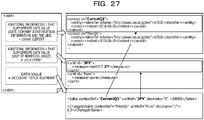
- FIG. 27 is a diagram illustrating an example of the XBRL data.
- a single piece of XBRL data includes a data value and additional information that supplements the data value.
- the additional information is information specified by another independent element associated with the element including the data value.
- the additional information is defined as a plurality of elements having the names of context and unit.
- context names for distinguishing the context "CurrentQ1” and "PriorQ1” are applied.
- unit names for distinguish units "JPY” and “Pure” are applied.
- a context name “CurrentQ1” and a unit name “JPY” are defined as attributes to refer to the additional information.
- the value of the element "Sales” "10000" is defined.
- additional information corresponding to the context name "CurrentQ1” "2016-06-30” is defined as a value of an element “instant” subordinate to an element “period” which means a date of the report date.
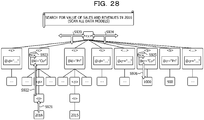
- FIG. 28 is a diagram illustrating a reference example of the search processing.
- a data model tree regarding the XBRL data input to the dedicated tool be constructed.
- "C” in ⁇ c>, "p” in ⁇ p>, and "i” in ⁇ i> in the tree are respectively abbreviations of "context", "period", and "instant”.
- "Cur" and "Pri" in the tree are respectively abbreviations of "CurrentQ1" and “PriorQ1".
- "2016” and “2015” in the tree are respectively abbreviations of "2016-06-30” and “2015-06-30”.
- the dedicated tool which has received the search word "sales and revenues" in "2016” searches for the element including "2016” as a value from the top (root) to an end of the tree (S920). Then, as a result of the search, the dedicated tool confirms that a parent element is "instant" (S921) and searches ancestors for the "context” element (S922). Then, the dedicated tool confirms that an ancestor element is the "context” element and searches for an id attribute (S923). It is assumed that an id attribute value be "CurrentQ1" as a result of the search.
- the dedicated tool searches for a "contextRef” attribute having "CurrentQ1" as a value from the top (root) to the end of the tree (S924). Then, the dedicated tool confirms that "CurrentQ1" is the value of the "contextRef” attribute as a result of the search and confirms that the "contextRef” attribute is an attribute of the "Sales” element indicating "sales and revenues” (S925). Then, the dedicated tool acquires "1000" as a value of the "Sales” element (S926).
- the data value and the additional information are separated according to the XBRL-specific specification. Therefore, since the search word is collated to all the data in the data model tree of the XBRL data at various times while scanning all the data, an increase in the calculation amount is expected, and it is difficult to efficiently search.
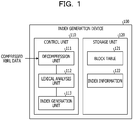
- FIG. 1 is a functional block diagram illustrating a configuration of an index generation device according to a first embodiment.
- the index generation device 100 inputs XBRL data described by a combination of an item and a value and generates index information 122 regarding appearance positions of each of the item and the value for each of the item and the value included in the input XBRL data.
- the XBRL data here is data described in the XBRL data which is decompressed from compressed data.
- the XBRL is an XML-based language which is standardized to create, distribute, and use information for various financial reports.
- data in a Zip format is exemplified.
- financial data is exemplified.
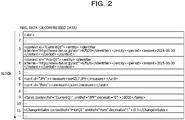
- FIG. 2 is a diagram illustrating an example of the XBRL data according to the first embodiment.
- the XBRL data illustrated in FIG. 2 has the same content as the XBRL data illustrated in FIG. 27 .
- the XBRL data is divided into blocks from the beginning for each element indicating the additional information and the data value.
- elements in the third and fourth blocks correspond to additional information 1 that supplements the data value illustrated in FIG. 27 .
- Elements in the sixth and seventh blocks correspond to additional information 2 that supplements the data value illustrated in FIG. 27 .
- Elements in the ninth and eleventh blocks correspond to the data value illustrated in FIG. 27 .
- a relation between a start tag of each element indicating the additional information and the data value in the XBRL data and a block is defined by a block table 121 to be described later.
- the index generation device 100 includes a control unit 110 and a storage unit 120.
- the storage unit 120 corresponds to a storage device such as a non-volatile semiconductor memory element, for example, a Flash Memory, a Ferroelectric Random Access Memory (FRAM) (registered trademark), and the like.
- the storage unit 120 includes the block table 121 and the index information 122.
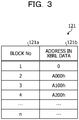
- the block table 121 stores an address of the start tag of each element indicating the additional information and the data value in the XBRL data and a block number in association with each other.
- FIG. 3 is a diagram illustrating an example of a block table according to the first embodiment.
- the block table 121 stores a block number 121a and an address 121b in the XBRL data in association with each other.
- the block number 121a indicates a block number.
- the address 121b in the XBRL data indicates a leading address of a block included in the XBRL data decompressed from the compressed data.
- the block number 121a is "1”
- "0" is stored as the address 121b in the XBRL data.
- "A000h" is stored as the address 121b in the XBRL data.
- the index information 122 includes index information 122 U of an upper index and index information 122 L of a lower index.
- the index information 122 U of the upper index is information indicating a block position of each element indicating the additional information and the data value in the XBRL data. That is, the index information 122 U of the upper index is a bitmap in which presence/absence of the start tag of the additional information and the data value in the XBRL data for each block position is indexed.
- the index information 122 L of the lower index exists for each block.
- the index information 122 L of the lower index of a predetermined block is information indicating appearance positions of each of items (start tag, attribute, and end tag) and a value regarding the elements indicating the additional information and the data value in the XBRL data. That is, the index information 122 L of the lower index is a bitmap in which presence/absence of the item (start tag, attribute, and end tag) and the value in the predetermined block included in the XBRL data for each offset (appearance position) is indexed.
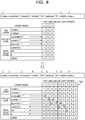
- FIG. 4 is a diagram illustrating an example of index information according to the first embodiment.
- the index information 122 U of the upper index is illustrated.
- the index information 122 L of the lower index is illustrated.
- the index information 122 in the upper diagram in FIG. 4 is the index information 122 U of the upper index with respect to the XBRL data illustrated in FIG. 2 .
- the index information 122 in the lower diagram in FIG. 4 is the index information 122 L of the lower index of the third block in the XBRL data illustrated in FIG. 2 .
- the X axis of the index information 122 U of the upper index indicates a block number
- the Y axis indicates a tag name (element name) of a tag layer.
- the index information 122 U is information including a bundle of indexes regarding the block for each element name.
- each element name in a block number where the element appears, ON, that is, "1" in the binary system is set.
- ⁇ xrbl> "1" is set at a first position of the block number. That is, the ⁇ xrbl> element is located in the first block.
- ⁇ context> "1" is set at a third position of the block number. That is, the ⁇ context> element is located in the third block.
- the X axis of the index information 122 L of the lower index indicates an offset (appearance position) in block units
- the Y axis indicates a tag name included in the tag layer, an attribute name included in an attribute layer, and an element value and an attribute value included in a data value layer.
- the index information 122 L has a region of the tag layer, a region of the attribute layer, and a region of the data value layer.
- the index information in the region of the tag layer is information of a bundle of indexes regarding appearance positions of tag names of each of the start tag and the end tag in the block.
- the index information 122 in the region of the attribute layer is information of a bundle of indexes regarding the appearance position of each attribute name in the block.
- the index information 122 in the region of the data value layer is information of a bundle of indexes regarding the appearance position of each of the element value and the attribute value in the block.
- ON that is, "1" in the binary system is set.
- the tag name of the start tag is " ⁇ context>”
- "1" is set at the first appearance position in the block.
- "1" is set at the second appearance position in the block.
- a value of the identifier element is "67020”
- "1" is set at the eighth appearance position in the block.
- control unit 110 includes an internal memory for storing a program and control data for specifying various processing procedures and executes various processing by using the stored data. Then, the control unit 110 corresponds to an electronic circuit of an integrated circuit, for example, an Application Specific Integrated Circuit (ASIC), a Field Programmable Gate Array (FPGA), and the like. Alternatively, the control unit 110 corresponds to an electronic circuit such as a Central Processing Unit (CPU) and a Micro Processing Unit (MPU).
- the control unit 110 includes a decompression unit 111, a lexical analysis unit 112, and an index generation unit 113.
- the decompression unit 111 is an example of an input unit.
- the lexical analysis unit 112 and the index generation unit 113 are examples of a generation unit.
- the decompression unit 111 receives and decompresses compressed XBRL data.
- the compressed XBRL data here is, for example, data obtained by compressing the XBRL data submitted by a company in the Zip format.
- the lexical analysis unit 112 lexically analyzes XBRL data decompressed by the decompression unit 111.
- the term "lexical analysis” here means that the XBRL data is divided into markups and words.
- the index generation unit 113 generates the index information 122 regarding the appearance positions of each of the items and the values for each of the item and the value included in the XBRL data. For example, the index generation unit 113 sets a bit at the appearance position of the tag name in the block with respect to the tag name of the start tag at the head of each block in the XBRL data. That is, the index generation unit 113 generates the index information 122 U of the upper index. Then, the index generation unit 113 stores the block number 121a and the address 121b in the XBRL data in association with each other in the block table 121 for each block.
- the index generation unit 113 sets a bit at the appearance position of the tag name in the block with respect to the tag names of the start tag and the end tag included in the block, for each block in the XBRL data.
- the index generation unit 113 sets a bit at the appearance position of the attribute name in the block with respect to the attribute name included in the block, for each block in the XBRL data.
- the index generation unit 113 sets a bit at the appearance position of each value in the block with respect to the element value and the attribute value included in the block, for each block in the XBRL data. That is, the index generation unit 113 generates the index information 122 L of the lower index.
- the index generation unit 113 may generate the index information 122 L of the lower index after determining the block in the index information 122 L .
- the tag name of the tag layer and the like is registered when the index generation unit 113 generates the index information 122 will be described.
- FIG. 5A is a diagram illustrating an example of a flow of index generation processing of the upper index according to the first embodiment.
- the index generation unit 113 sets a bit at a block appearance position of the tag name in the block with respect to the tag name of the start tag of each block in the XBRL data.
- the index generation unit 113 selects a block from the XBRL data.
- the index generation unit 113 detects a start tag of the selected block and registers a tag name of the detected start tag to the tag layer.
- the index generation unit 113 sets a bit at the appearance position of the tag name in the block to "1" (ON) with respect to the tag name of the start tag.
- the index generation unit 113 selects the first block, a tag name "xbrl" of a start tag detected in the first block is registered to the tag layer. Then, the index generation unit 113 writes "1" in the bit corresponding to the block number "1" in the index (bitmap) corresponding to the tag name "xbrl".
- the index generation unit 113 selects the third block, a tag name " ⁇ context>" of a start tag detected in the third block is registered to the tag layer. Then, the index generation unit 113 writes "1" in the bit corresponding to the block number "3" in the index (bitmap) corresponding to the tag name " ⁇ context>".
- the index generation unit 113 selects the sixth block, a tag name " ⁇ unit>" of a start tag detected in the sixth block is registered to the tag layer. Then, the index generation unit 113 writes "1" in the bit corresponding to the block number "6" in the index (bitmap) corresponding to the tag name " ⁇ unit>".
- the index generation unit 113 selects the ninth block, a tag name " ⁇ Sales>" of a start tag detected in the ninth block is registered to the tag layer. Then, the index generation unit 113 writes "1" in the bit corresponding to the block number "9" in the index (bitmap) corresponding to the tag name " ⁇ Sales>".
- the index generation unit 113 stores the block number 121a and the address 121b in the XBRL data in association with each other in the block table 121 for each block.
- the index generation unit 113 stores a block number "1" and an address "0" in the XBRL data in association with each other in the block table 121.
- the index generation unit 113 stores a block number "2" and an address "A000h” in the XBRL data in association with each other in the block table 121.
- the index generation unit 113 stores a block number "3" and an address "A100h” in the XBRL data in association with each other in the block table 121.
- the index generation unit 113 stores a block number "4" and an address "A200h” in the XBRL data in association with each other in the block table 121.
- FIG. 5B is a diagram illustrating an example of a flow of index generation processing of the lower index according to the first embodiment.
- processing for generating a lower index in a third block in the XBRL data will be described.
- a lower index of the context element is generated.
- a tag name " ⁇ context>" of the start tag is registered to the tag layer.
- the tag name means an element name.
- the index generation unit 113 writes "1" in a bit corresponding to an appearance position "1" in an index (bitmap) corresponding to the tag name " ⁇ context>” of the start tag. It is preferable that the index generation unit 113 detect the tag name as follows. That is, it is preferable that, when detecting a tag start symbol " ⁇ ", the index generation unit 113 detect a word immediately after the start symbol as a tag name.
- the index generation unit 113 When detecting "67020" as the element value, the index generation unit 113 registers the element value "67020" to the data value layer. Then, the index generation unit 113 writes "1" in a bit corresponding to an appearance position "8" in an index (bitmap) corresponding to the element value "67020". It is sufficient that the index generation unit 113 detect the element value as follows. That is, it is preferable that the index generation unit 113 detect a text between an end symbol ">" of the start tag and the start symbol " ⁇ " of the end tag as the element value.
- the index generation unit 113 sequentially detect the tag name of the start tag, the attribute name, the attribute value, the element value and the tag name of the end tag with respect to the third block and generate the lower index.
- FIG. 6 is a diagram illustrating an example of a flow of index generation processing of another lower index according to the first embodiment.
- processing for generating a lower index in a sixth block in the XBRL data will be described.
- a lower index of a unit element is generated.
- a tag name " ⁇ unit>" of the start tag is registered to the tag layer.
- the tag name means an element name.
- the index generation unit 113 writes "1" in a bit corresponding to an appearance position "1" in an index (bitmap) corresponding to the tag name " ⁇ unit>” of the start tag. It is preferable that a method for detecting the tag name by the index generation unit 113 be the same as the method described in FIG. 5B .
- the index generation unit 113 When detecting "JPY” as the attribute value, the index generation unit 113 registers the attribute value "JPY” to the data value layer. Then, the index generation unit 113 writes "1" in a bit corresponding to an appearance position "3" in an index (bitmap) corresponding to the attribute value "JPY". It is preferable that a method for detecting the attribute value by the index generation unit 113 be the same as the method described in FIG. 5B .
- the index generation unit 113 When detecting the start tag, the index generation unit 113 registers a tag name " ⁇ measure>" of a tag to the tag layer.
- the tag name means an element name. Then, the index generation unit 113 writes "1" in a bit corresponding to an appearance position "4" in an index (bitmap) corresponding to the tag name " ⁇ measure>" of the start tag.
- the index generation unit 113 When detecting "iso4217:JPY” as the element value, the index generation unit 113 registers the element value "iso4217:JPY” to the data value layer. Then, the index generation unit 113 writes "1" in a bit corresponding to an appearance position "5" in an index (bitmap) corresponding to the element value "iso4217:JPY". It is preferable that a method for detecting the element value by the index generation unit 113 be the same as the method described in FIG. 5B .
- the index generation unit 113 sequentially detect the tag name of the start tag, the attribute name, the attribute value, the element value, and the tag name of the end tag with respect to the sixth block and generate the lower index.
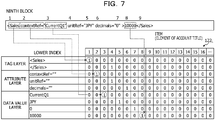
- FIG. 7 is a diagram illustrating an example of a flow of index generation processing of still another lower index according to the first embodiment.
- processing for generating a lower index in a ninth block in the XBRL data will be described.
- a lower index of an account title element is generated.
- a tag name " ⁇ Sales>" of the start tag is registered to the tag layer.
- the tag name means an element name.
- the index generation unit 113 writes "1" in a bit corresponding to an appearance position "1" in an index (bitmap) corresponding to the tag name " ⁇ Sales>".
- the index generation unit 113 When detecting "CurrentQ1" as the attribute value, the index generation unit 113 registers the attribute value "CurrentQ1" to the data value layer. Then, the index generation unit 113 writes "1" in a bit corresponding to an appearance position "3" in an index (bitmap) corresponding to the attribute value "CurrentQ1".
- the index generation unit 113 When detecting "10000" as the element value, the index generation unit 113 registers the element value "10000" to the data value layer. Then, the index generation unit 113 writes "1" in a bit corresponding to an appearance position "8" in an index (bitmap) corresponding to the element value "10000".
- the index generation unit 113 sequentially detect the tag name of the start tag, the attribute name, the attribute value, the element value, and the tag name of the end tag with respect to the ninth block and generate the lower index.
- FIG. 8 is a diagram for explaining how to allocate offsets of the lower index.
- the upper diagram in FIG. 8 illustrates a case where the offsets of the lower index are allocated to a head position of the start tag, a head position of the element value, and a head position of the end tag.
- the head position of the start tag is a position of "S" in “ ⁇ Sales...>”.
- the head position of the element value is a position of "1" in "10000”.
- the head position of the end tag is a position of "S" in " ⁇ /Sales>". Then, at the head position of the start tag, the head position of the element value, and the head position of the end tag, "1", "2", and "3" are respectively allocated as the offsets.
- the lower diagram in FIG. 8 illustrates a case where the offsets of the lower index are allocated to the head position of the start tag, the head position of the attribute name, the head position of the attribute value, the head position of the element value, and the head position of the end tag.
- the head position of the start tag is a position of "S” in " ⁇ Sales”.
- the head positions of the attribute values are a position of "C” in “CurrentQ1", a position of "J” in “JPY”, and a position of "0” in “0", and the head position of the element value is a position of "1" in "10000".
- the head position of the end tag is a position of "S" in " ⁇ /Sales>”. Then, the offsets are each allocated to the head position of the start tag, the head position of the attribute name, the head position of the attribute value, the head position of the element value, and the head position of the end tag.
- the offsets of the lower index be allocated to the start tag, the attribute name, the attribute value, the element value, and the end tag.
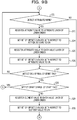
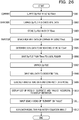
- FIG. 9 is a diagram illustrating an example of a flowchart of the index generation processing according to the first embodiment.
- the compressed XBRL data will be described as a Zip file.
- the decompression unit 111 which has received a Zip file decompresses the Zip file (step S11).
- the lexical analysis unit 112 lexically analyzes the decompressed data (step S12).
- the index generation unit 113 selects a block of the decompressed data (step S13).
- the index generation unit 113 detects a start tag of the selected block (step S14).
- the index generation unit 113 registers a tag name of the detected start tag to the tag layer in the index information 122 U of the upper index (step S15).
- the index generation unit 113 sets a bit of a block number of the selected block with respect to the detected start tag to ON in the index information 122 U of the upper index (step S16).
- the index generation unit 113 sets a start address of the block in the decompressed data to the block table 121 (step S17).
- the index generation unit 113 determines whether the block is an end point of the decompressed data (step S18). In a case where it is determined that the block is not the end point of the decompressed data (No in step S18), the index generation unit 113 proceeds to step S13 so as to select a next block.
- the index generation unit 113 selects the block of the decompressed data (step S19).
- the index generation unit 113 registers the tag name of the start tag to the tag layer of the index information 122 L of the lower index with respect to the selected block (step S20).
- the index generation unit 113 sets a bit of the offset in the block with respect to the tag name of the start tag to ON in the index information 122 L of the lower index with respect to the selected block (step S21).
- the index generation unit 113 determines whether or not the attribute name is detected in the selected block (step S22). In a case where it is determined that the attribute name is detected (Yes in step S22), the index generation unit 113 registers the detected attribute name to the attribute layer of the index information 122 L of the lower index with respect to the selected block (step S23). Then, the index generation unit 113 sets a bit of the offset in the block with respect to the detected attribute name to ON in the index information 122 L of the lower index with respect to the selected block (step S24).
- the index generation unit 113 registers the attribute value to the data value layer of the index information 122 L of the lower index with respect to the selected block (step S25). Then, the index generation unit 113 sets a bit of the offset in the block with respect to the attribute value to ON in the index information 122 L of the lower index with respect to the selected block (step S26). Then, the index generation unit 113 proceeds the procedure to step S27.
- the index generation unit 113 determines whether or not the end symbol of the start tag is detected (step S27). In a case where it is determined that the end symbol of the start tag is not detected (No in step S27), the index generation unit 113 proceeds to step S22 so as to detect a next attribute name.
- step S27 determines whether or not the start symbol of the start tag is detected. In a case where it is determined that the start symbol of the start tag is detected (Yes in step S28), the index generation unit 113 proceeds the procedure to step S20.
- the index generation unit 113 registers the element value to the data value layer of the index information 122 L of the lower index with respect to the selected block (step S29). Then, the index generation unit 113 sets a bit of the offset in the block with respect to the element value to ON in the index information 122 L of the lower index with respect to the selected block (step S30) .
- the index generation unit 113 registers the tag name of the end tag to the tag layer of the index information 122 L of the lower index with respect to the selected block (step S31).
- the index generation unit 113 sets a bit of the offset in the block with respect to the tag name of the end tag to ON in the index information 122 L of the lower index with respect to the selected block (step S32).
- the index generation unit 113 detects the end symbol of the end tag (step S33).
- the index generation unit 113 determines whether or not the start symbol of the start tag is detected (step S34). In a case where it is determined that the start symbol of the start tag is detected (Yes in step S34), the index generation unit 113 proceeds the procedure to step S20.
- step S34 determines whether or not the start symbol of the start tag is detected. In a case where it is determined that the start symbol of the end tag is detected (Yes in step S35), the index generation unit 113 proceeds the procedure to step S31.
- the index generation unit 113 detects an end point of the block (step S36). Then, the index generation unit 113 determines whether the block is an end point of the decompressed data (step S37). In a case where it is determined that the block is not the end point of the decompressed data (No in step S37), the index generation unit 113 proceeds the procedure to step S19 so as to select a next block.
- the index generation unit 113 terminates the index generation processing.
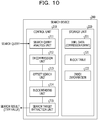
- FIG. 10 is a functional block diagram illustrating a configuration of a search device according to the first embodiment.
- a search device 200 receives a search condition including a specific item and value relative to the XBRL data described by a combination of the item and value, refers to the index information 122, and searches for the received search condition.
- the search device 200 includes a control unit 210 and a storage unit 220.
- the storage unit 220 corresponds to a storage device such as a non-volatile semiconductor memory element, for example, a Flash Memory, a Ferroelectric Random Access Memory (FRAM) (registered trademark), and the like.
- the storage unit 220 includes XBRL data (compression format) 221, the block table 121, and the index information 122.
- the block table 121 and the index information 122 are information generated by the index generation device 100 and, for example, are acquired via a network and stored in the storage unit 220.
- the XBRL data (compression format) 221 is XBRL data in a compression format.
- the XBRL data (compression format) 221 is XBRL data compressed in the Zip format.
- the control unit 210 includes an internal memory for storing a program and control data for specifying various processing procedures and executes various processing by using the stored data. Then, the control unit 210 corresponds to an electronic circuit of an integrated circuit, for example, an Application Specific Integrated Circuit (ASIC), a Field Programmable Gate Array (FPGA), and the like. Alternatively, the control unit 210 corresponds to an electronic circuit such as a Central Processing Unit (CPU) and a Micro Processing Unit (MPU).
- the control unit 210 includes a search query analysis unit 211, a decompression unit 212, an offset search unit 213, a block reading unit 214, and a search target extraction unit 215.
- the search query analysis unit 211 is an example of a reception unit.
- the offset search unit 213, the block reading unit 214, and the search target extraction unit 215 are examples of a search unit.
- the search query analysis unit 211 input a search query and analyzes the input search query. For example, the search query analysis unit 211 analyzes the search query and extracts a search condition and a search target.
- the search condition includes a keyword indicating the element name, the tag name, the attribute name, the attribute value, or the element value.
- the search target includes a keyword indicating the attribute name or the element name of which a value is desired to be searched.
- the decompression unit 212 receives the XBRL data (compression format) 221 and decompresses the received XBRL data (compression format) 221.
- the compressed XBRL data (compression format) 221 here is, for example, data obtained by compressing the XBRL data submitted by a company in the Zip format.
- the offset search unit 213 refers to the index information 122 and searches for a search target that matches the search condition.
- the offset search unit 213 refers to the index information 122 U of the upper index and extracts an index (bitmap) corresponding to the element name of the search condition.
- the offset search unit 213 acquires a block number in which "1" is set to the extracted bitmap.
- the offset search unit 213 extracts the index information 122 L of the lower index corresponding to the detected block number.
- the offset search unit 213 refers to the extracted index information 122 L of the lower index and narrows an offset of the search target which matches the search condition.
- the block reading unit 214 reads a block corresponding to the acquired block number from the decompressed XBRL data. For example, the block reading unit 214 acquires the address 121b in the XBRL data corresponding to the acquired block number from the block table 121. The block reading unit 214 reads the block associated with the acquired address from the XBRL data decompressed by the decompression unit 212.
- the search target extraction unit 215 extracts the search target from a target block. For example, the search target extraction unit 215 extracts the search target of the offset narrowed by the offset search unit 213 from the block read by the block reading unit 214.
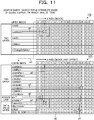
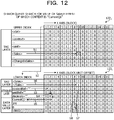
- FIGS. 11 and 12 are diagrams illustrating an example of the flow of the offset search processing according to the first embodiment.
- FIG. 11 illustrates a case where a search query searches for an id attribute value of a context element of which the date is "2016".
- the search query analysis unit 211 analyzes the search query and extracts a search condition and a search target.
- search conditions " ⁇ context>” which is a context element
- ⁇ instant> which is an instant element indicating the date
- “2016” which is an element value of the instant element indicating the date are extracted.
- the offset search unit 213 refers to the index information 122 U of the upper index, extracts an index (bitmap) corresponding to the element name of the search condition, and acquires a block number in which "1" is set to the extracted bitmap.
- the element name of the search condition is " ⁇ context>”.
- the offset search unit 213 refers to the index information 122 U of the upper index and extracts a bitmap corresponding to " ⁇ context>”. Then, the offset search unit 213 acquires "3" as the block number in which "1" is set to the extracted bitmap (a1).
- the offset search unit 213 extracts the index information 122 L of the lower index corresponding to the detected block number "3" (a2).
- the offset search unit 213 refers to the extracted index information 122 L of the lower index and narrows an offset of the search target that matches the search condition.
- the offset search unit 213 acquires an offset at an end position of " ⁇ instant>" which is the instant element indicating the date. That is, the offset search unit 213 extracts a bitmap corresponding to an end tag " ⁇ /instant>” of the instant element and acquires an offset "14" in which "1" is set to the extracted bitmap (a3) .
- the offset search unit 213 acquires a data value in which "1" is set to an offset "13" immediately before the offset of the end tag of the instant element so as to search for a value of the instant element (a4 and a5).
- the acquired data value is "2016-06-30”.
- the offset search unit 213 confirms that the acquired data value "2016-06-30” is the element value "2016” of the instant element indicating the data included in the search condition.
- the offset search unit 213 searches for an offset "3" immediately after the offset of the id attribute so as to search for the offset of the value of the id attribute (a7 and a8).
- the offset search unit 213 can search for "3" as the offset of the id attribute value of the context element of which the date is "2016".
- FIG. 12 illustrates a case where the search query searches for a value of the Sales element of which the context is "CurrentQ1".
- the search query analysis unit 211 analyzes the search query and extracts a search condition and a search target.
- search conditions " ⁇ Sales>” which is the Sales element
- ContextRef which is the attribute of the context
- CurrentQ1 which is the attribute value of the context
- search target " ⁇ Sales>” which is the Sales element name of which a value is desired to be searched is extracted.
- the offset search unit 213 refers to the index information 122 U of the upper index, extracts an index (bitmap) corresponding to the element name of the search condition, and acquires a block number in which "1" is set to the extracted bitmap.
- the element name of the search condition is " ⁇ Sales>”.
- the offset search unit 213 refers to the index information 122 U of the upper index, extracts a bitmap corresponding to " ⁇ Sales>", and acquires "9” as a block number in which "1" is set to the extracted bitmap (b1).
- the offset search unit 213 extracts the index information 122 L of the lower index corresponding to the detected block number "9" (b2).
- the offset search unit 213 refers to the extracted index information 122 L of the lower index and narrows an offset of the search target that matches the search condition.
- the offset search unit 213 acquires a data value in which "1" is set to an offset "3" immediately after the offset of the contextRef attribute so as to search for a value of the contextRef attribute (b4 and b5).
- the acquired data value is "CurrentQ1”.
- the offset search unit 213 confirms that the acquired data value "CurrentQ1" is the attribute value "CurrentQ1" of the context included in the search condition.
- the offset search unit 213 acquires an offset at an end position of " ⁇ Sales>" which is the Sales element extracted as the search target. That is, the offset search unit 213 extracts a bitmap corresponding to an end tag " ⁇ /Sales>” of the Sales element and acquires an offset "9” in which "1" is set to the extracted bitmap (b6).
- the offset search unit 213 searches for an offset "8" immediately before the offset of the end tag of the Sales element so as to search for the value of the Sales element (b7 and b8). In this way, the offset search unit 213 can search for "8" as the offset of the value of the Sales element of which the context is "CurrentQ1".
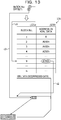
- FIG. 13 is a diagram illustrating an example of the flow of the search target extraction processing according to the first embodiment.
- the offset search unit 213 acquires "9" as a block number and searches for "8" as an offset.
- the block reading unit 214 acquires the address 121b in the XBRL data corresponding to the acquired block number from the block table 121 (c1).
- "A700h” is acquired as the address 121b in the XBRL data corresponding to the acquired block number "9".
- the block reading unit 214 reads a block associated with the acquired address "A700h” from the XBRL data decompressed by the decompression unit 212 (c2).
- the search target extraction unit 215 extracts a search target at a position of the searched offset from the block read by the block reading unit 214 (c3).
- the search target extraction unit 215 extracts "10000" as a search target at the position of "8" searched as the offset from the read block.
- the search target extraction unit 215 outputs the extracted "10000" as a search result.
- FIG. 14 is a diagram illustrating an example of a flowchart of search processing according to the first embodiment.
- the compressed XBRL data will be described as a Zip file.
- the search query analysis unit 211 determines whether or not a search query is received (step S41). In a case where it is determined that the search query is not received (No in step S41), the search query analysis unit 211 repeats determination processing until the search query is received.
- the search query analysis unit 211 analyzes the search query and extracts a search condition and a search target (step S42).
- the decompression unit 212 decompresses the Zip file (step S43).
- the offset search unit 213 refers to the index information 122 U of the upper index and acquires a block number corresponding to the element name of the search condition (step S44). Then, the offset search unit 213 refers to the index information 122 L of the lower index of the acquired block number and narrows an offset of the search target that matches the search condition (step S45).
- the block reading unit 214 reads a block corresponding to the acquired block number from the decompressed data (step S46). Then, the search target extraction unit 215 extracts a value at the position of the narrowed offset from the read block (step S47). Then, the search target extraction unit 215 outputs the extracted value as a search result and terminates the search processing.
- FIG. 15 is a diagram illustrating an example of a search flow according to the first embodiment.
- the TDnet is used so as to compare the search flow with the search flow in the reference example illustrated in FIG. 26 .
- the search flow is not limited to the search flow using the TDnet.
- a company submits a Zip file obtained by compressing XBRL data of financial information by Zip by using the TDnet (S101).
- the examiner On the side of the examiner, the examiner unpacks (decompress) the Zip file and checks the decompressed XBRL data (S102).
- the examiner stores the Zip file of the approved XBRL data in a DB of the TDnet (S103) and discloses the XBRL data.
- the examiner here is, for example, a financial institution or a stock exchange.
- the index generation device 100 lexically analyzes the XBRL data, generates the block table 121 and the index information 122, and stores the generated data to an internal memory of the TDnet (S104). Such processing corresponds to, for example, the lexical analysis unit 112 and the index generation unit 113.
- the investor searches for a company by using the TDnet (S105) and determines a company to be surveyed (S106).
- the investor saves a Zip file for the XBRL data of the determined company, the block table 121, and the index information 122 to a local folder by using the TDnet (S107).
- the investor inputs the Zip file, the block table 121, and the index information 122 to a dedicated client application of the search device 200 (S108).
- the investor inputs a search word of an element to be searched and a search word of a value to be searched to the dedicated client application of the search device 200 (S109). That is, the investor inputs a search query to the search device 200. Then, the dedicated client application analyzes the search query and extracts a search condition and a search target. Such processing corresponds to, for example, the search query analysis unit 211.
- the dedicated client application narrows a position of an offset of the search target that matches the search condition according to the index information 122 and converts the position of the offset narrowed by using the block table 121 to a position of an offset in the XBRL data (S110). Then, the investor unpacks (decompress) the saved Zip file (S111). Then, the dedicated client application extracts and displays a value of the converted position of the offset in the decompressed XBRL data (S112). Such processing corresponds to, for example, the offset search unit 213, the decompression unit 212, and the search target extraction unit 215.
- the index generation device 100 inputs the XBRL data described by the combination of the item and value.
- the index generation device 100 generates the index information 122 regarding the appearance positions of each of the item and the value for each of the item and the value included in the XBRL data.
- the index generation device 100 can efficiently search for the search target in the XBRL data according to the search condition formed by combining the items and values. That is, by using the index information 122, the index generation device 100 can narrow the search target without scanning the XBRL data and efficiently search for the search target.
- the search device 200 receives a search condition including a specific item and value relative to the XBRL data described by the combination of the item and the value.
- the search device 200 refers to the index information 122 regarding the appearance positions of each of the item and the value for each of the item and the value included in the XBRL data and searches for the search condition. With this configuration, by using the index information 122, the search device 200 can perform search as specifying the item and the value without analyzing the XBRL data again.
- the index generation device 100 generates the index information 122 regarding the appearance positions of each of the item and the value for each of the item and the value included in the XBRL data.
- the index generation device 100 is not limited to this, and when encoding the XBRL data, the index generation device 100 may generate index information 122 regarding appearance positions of each of an encoded item and an encoded value for each of the item and the value included in the XBRL data.
- the index generation device 100 generates index information 122A regarding appearance positions of each of the encoded item and the encoded value for each of the item and the value included in the XBRL data when encoding the XBRL data.
- FIG. 16 is a block diagram illustrating a functional configuration of an index generation device according to a second embodiment.
- a component having the same configuration as the index generation device 100 illustrated in FIG. 1 is denoted with the same reference numeral, and the description regarding the overlapped configurations and operations will be omitted.
- a difference between the first embodiment and the second embodiment is that the index generation unit 113 is changed to an index generation unit 113A.
- the difference between the first embodiment and the second embodiment is that an encoding unit 311 is added.
- the difference between the first embodiment and the second embodiment is that the block table 121 and the index information 122 are respectively changed to a block table 121A and index information 122A.
- the difference between the first embodiment and the second embodiment is that a static dictionary 321 and a dynamic dictionary 322 are added.
- the static dictionary 321 specifies an appearance frequency of a word which appears in various documents based on general English dictionaries, Japanese dictionaries, textbooks, and the like and allocates a shorter reference to a word having a higher appearance frequency.
- a static code which is a code corresponding to each word is registered in advance.
- the dynamic dictionary 322 associates a word which is not registered in the static dictionary 321 with a dynamic code (code) which is dynamically added.
- the word which is not registered in the static dictionary 321 includes a word having a lower appearance frequency (low frequency word), a tag, a numerical value, a date, and the like, as an example.
- a word associated with the dynamic code is registered to a buffer in an appearance order of words which are not registered to the static dictionary 321.
- FIG. 17 is a diagram illustrating an example of a dynamic dictionary according to the second embodiment.
- the dynamic dictionary 322 illustrated in FIG. 17 includes a buffer D1 and an address table D2.
- the buffer D1 stores a character string.
- the address table D2 holds the dynamic code, a storage position, and a data length in association with each other.
- the dynamic code is a code having a predetermined fixed length and is, for example, a compression code.
- the dynamic code is allocated in an order in which the character strings of the words are registered.
- the dynamic code is a two-byte code having a fixed length starting with a hexadecimal number "A".
- the storage position indicates a position of the character string stored in the buffer D1.
- the data length indicates a length (byte length) of the character string stored in the buffer D1.
- a dynamic code is allocated to a character string "CurrentQ1" of an attribute value.
- the index generation device 100 stores the character string "CurrentQ1" to the buffer D1.
- the index generation device 100 registers the storage position where the character string is stored and the length of the stored data to the address table D2.
- the index generation device 100 registers "21" as the storage position and "10" as the data length to the address table D2.
- the index generation device 100 allocates "A003 h " to the character string "CurrentQ1" of the attribute value as the dynamic code.
- the block table 121A stores each code for each data included in the XBRL data in association with an address and a block number in an encoded data obtained by encoding the XBRL data.
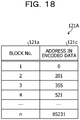
- FIG. 18 is a diagram illustrating an example of a block table according to the second embodiment.
- the block table 121A stores a block number 121a and an address 121c in the encoded data in association with each other.
- the block number 121a indicates a block number.
- the address 121c in the encoded data indicates a head address of a block included in the encoded data obtained by encoding the XBRL data. For example, in a case where the block number 121a is "1", "0" is stored as the address 121c in the encoded data. In a case where the block number 121a is "2", "201" is stored as the address 121c in the encoded data.
- the encoding unit 311 sequentially encodes a tag name, an attribute name, a data value obtained as a result of lexical analysis of the XBRL data as encoding targets based on the static dictionary 321 and the dynamic dictionary 322.
- the encoding unit 311 sequentially selects each encoding target as a result of lexical analysis of the XBRL data.
- the encoding unit 311 determines whether or not the selected encoding target is registered to the static dictionary 321. In a case where the selected encoding target is registered to the static dictionary 321, the encoding unit 311 encodes the encoding target to a static code (encoding code) registered in the static dictionary 321.
- the encoding unit 311 encodes the encoding target based on the dynamic dictionary 322. As an example, the encoding unit 311 determines whether or not the encoding target is stored in the buffer D1 of the dynamic dictionary 322. In a case where the encoding target is not stored in the buffer D1 of the dynamic dictionary 322, the encoding unit 311 stores the encoding target to the buffer D1 and stores the storage position where the encoding target is stored and the data length to the address table D2. The encoding unit 311 encodes the encoding target to a dynamic code (encoding code) of the address table D2 associated with the encoding target. Furthermore, in a case where the encoding target is stored in the buffer D1 of the dynamic dictionary 322, the encoding unit 311 encodes the encoding target to a dynamic code (encoding code) corresponding to the encoding target.
- a dynamic code encoding code
- the encoding unit 311 writes the encoding code to a storage region of the encoded data.
- the index generation unit 113A generates the index information 122A regarding appearance positions of each of the encoded item and the encoded value for each of the item and the value included in the XBRL data. For example, the index generation unit 113A sets a bit at an appearance position of an encoding code for a tag name in the block with respect to the tag name of the start tag at the head of each block in the XBRL data. That is, the index generation unit 113A generates index information 122A U of an upper index. Then, the index generation unit 113A sets a bit at the appearance position of the encoding code for the tag name in the block with respect to the tag names of the start tag and the end tag included in the block, for each block in the XBRL data.
- the index generation unit 113A sets a bit at an appearance position of an encoding code for the attribute name in the block with respect to the attribute name included in the block, for each block in the XBRL data.
- the index generation unit 113A sets a bit at an appearance position of an encoding code for each value for an element value and an attribute value included in the block, for each block in the XBRL data. That is, the index generation unit 113A generates index information 122A L of a lower index. Then, the index generation unit 113A stores a block number and an address in the encoded data in association with each other in the block table 121A for each block.
- An encoding code for a tag name of a tag layer, an encoding code for an attribute name of an attribute layer, and an encoding code for a data value of a data value layer in the index information 122A L of the lower index may be registered in advance.
- the index generation unit 113A when the index generation unit 113A generates indexes each of the tag name, the attribute name, and the data value to be encoded, the indexes may be registered to regions of each of the tag layer, the attribute layer, and the data value layer in the index information 122A L .
- the tag name of the tag layer and the like is registered when the index generation unit 113A generates the index information 122A will be described.
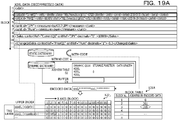
- FIG. 19A is a diagram illustrating an example of a flow of index generation processing of the upper index according to the second embodiment.
- the index generation unit 113A selects a block of the XBRL data.
- the index generation unit 113A select a third block of the XBRL data.
- the index generation unit 113A makes the encoding unit 311 encode a tag name of a start tag of the selected block. For example, in a case where the tag name is registered in the static dictionary 321 (with code), the encoding unit 311 encodes the tag name to a registered static code. In a case where the tag name is not registered in the static dictionary 321 (no code), the encoding unit 311 encodes the tag name based on the dynamic dictionary 322. For example, in a case where the tag name is not stored in the buffer D1 of the dynamic dictionary 322, the encoding unit 311 stores the tag name to the buffer D1 and stores the storage position where the tag name is stored and the data length in the address table D2.
- the encoding unit 311 encodes the stored tag name to a dynamic code in the address table D2 associated with the tag name. In a case where the tag name is stored in the buffer D1 of the dynamic dictionary 322, the encoding unit 311 encodes the tag name to the dynamic code corresponding to the tag name.
- the encoding unit 311 encodes the tag name " ⁇ context>” to a static code "xxx1 h " registered in the static dictionary 321.
- the index generation unit 113A stores the encoded encoding code "xxx1 h " in an area of the encoded data.
- the index generation unit 113A sets a bit at a block appearance position of the encoding code of the tag name for the tag name of the start tag of the block.
- the index generation unit 113A registers the encoding code "xxx1 h " for the tag name " ⁇ context>" of the start tag in the third block to the tag layer.
- the index generation unit 113A sets a bit at the appearance position of the encoding code for the tag name in the block to "1" (ON) with respect to the tag name of the start tag.
- the index generation unit 113A stores a block number and an address in the encoded data in association with each other in the block table 121A for the selected block.
- the index generation unit 113A stores a block number "3" and an address "355" in the encoded data in the block table 121A in association with each other.
- FIGs. 19B and 19C are a diagram illustrating an example of a flow of index generation processing of the lower index according to the second embodiment.
- processing for generating a lower index in a third block in the XBRL data will be described.
- a lower index of the context element is generated.
- the index generation unit 113A when detecting a tag, the index generation unit 113A makes the encoding unit 311 encode a tag name of the tag.
- the index generation unit 113A when detecting the tag, the index generation unit 113A makes the encoding unit 311 encode the tag name " ⁇ context>" of the tag.
- the tag name " ⁇ context>” is encoded to the dynamic code "xxx1 h ".
- the index generation unit 113A stores the encoded encoding code in an area of the encoded data.
- the index generation unit 113A does not execute processing for storing the encoding code for the start tag in the area of the encoded data. This is because the encoding code for the start tag is already stored in the area of the encoded data in the upper index generation processing.
- the index generation unit 113A sets a bit at a block appearance position of the encoding code of the tag name for the tag name of the tag.
- the index generation unit 113A When detecting the attribute name, the index generation unit 113A makes the encoding unit 311 encode the attribute name.
- the index generation unit 113A stores the encoded encoding code in an area of the encoded data.
- the index generation unit 113A sets a bit at a at a block appearance position of the encoding code of the attribute name for the attribute name.
- the index generation unit 113A makes the encoding unit 311 encode the attribute value. It is assumed that the attribute value "CurrentQ1"" be not registered to the static dictionary 321. Then, since the attribute value "CurrentQ1" is not stored in the buffer D1 of the dynamic dictionary 322, the attribute value is registered to the dynamic dictionary 322 and is encoded to a dynamic code corresponding to the registered attribute value based on the address table D2. In a case where the attribute value "CurrentQ1" is registered to the dynamic dictionary 322, the encoding unit 311 encodes the attribute value to the corresponding dynamic code based on the address table D2. Here, the attribute value "CurrentQ1" is encoded to the dynamic code "A000 h ".
- the index generation unit 113A stores the encoded encoding code in an area of the encoded data.
- the index generation unit 113A sets a bit at the block appearance position of the encoding code of the attribute value for the attribute value.
- the index generation unit 113A registers the encoding code "A000 h " for the attribute value "CurrentQ1" to the data value layer.
- the index generation unit 113A sets a bit at the appearance position of the block of the encoding code "A000h” for the attribute value to "1" (ON) with respect to the attribute value "CurrentQ1".
- the index generation unit 113A makes the encoding unit 311 encode the element value. It is assumed that the element value "67020" be not registered to the static dictionary 321. Then, since the element value "67020" is not stored in the buffer D1 of the dynamic dictionary 322, the element value is registered to the dynamic dictionary 322 and is encoded to a dynamic code corresponding to the registered element value based on the address table D2. In a case where the element value "67020" is registered to the dynamic dictionary 322, the encoding unit 311 encodes the element value to the corresponding dynamic code based on the address table D2. Here, the element value "67020” is encoded to a dynamic code "A002 h ".
- the index generation unit 113A stores the encoded encoding code in an area of the encoded data.
- the index generation unit 113A sets a bit at a block appearance position of the encoding code for the element value with respect to the element value.
- the index generation unit 113A registers the encoding code "A002 h " for the element value "67020" to the data value layer.
- the index generation unit 113A sets a bit at the block appearance position of the encoding code "A002h” for the element value to "1" (ON) with respect to the attribute value "67020".
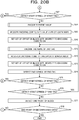
- FIGs. 20A and 20B are a diagram illustrating an example of a flowchart of index generation processing according to the second embodiment.
- the compressed XBRL data will be described as a Zip file.
- a decompression unit 111 which has received a Zip file decompresses the Zip file (step S51).
- a lexical analysis unit 112 lexically analyzes the decompressed data (step S52).
- the index generation unit 113A selects a block of the decompressed data (step S53).
- the index generation unit 113A detects a start tag of the selected block (step S54).
- the index generation unit 113A encodes a tag name of the detected start tag (step S55).
- the index generation unit 113A registers the encoded encoding code to a tag layer of the index information 122A U of the upper index (step S56).
- the index generation unit 113A sets a bit of a block number of the selected block to ON with respect to the encoding code for the tag name of the start tag detected in the index information 122A U of the upper index (step S57).
- the index generation unit 113A sets a start address of the block in the encoded data to the block table 121A (step S58).
- the index generation unit 113A determines whether or not the attribute name is detected in the selected block (step S59). In a case where it is determined that the attribute name is detected (Yes in step S59), the index generation unit 113A encodes the detected attribute name (step S60). A flowchart of the encoding processing will be described later.
- the index generation unit 113A registers the encoded encoding code to the attribute layer of the index information 122A L of the lower index with respect to the selected block (step S61). Then, the index generation unit 113A sets a bit of the offset in the block for the encoding code of the detected attribute name to ON in the index information 122A L of the lower index with respect to the selected block (step S62).
- the index generation unit 113A encodes the attribute value (step S63). A flowchart of the encoding processing will be described later. Then, the index generation unit 113A registers the encoded encoding code to the data value layer of the index information 122A L of the lower index with respect to the selected block (step S64). Then, the index generation unit 113A sets a bit of the offset in the block for the encoding code of the attribute value to ON in the index information 122A L of the lower index with respect to the selected block (step S65). Then, the index generation unit 113A proceeds the procedure to step S66.
- the index generation unit 113A determines whether or not the end symbol of the start tag is detected (step S66). In a case where it is determined that the end symbol of the start tag is not detected (No in step S66), the index generation unit 113A proceeds the procedure to step S59 so as to detect a next attribute name.
- step S66 determines whether or not the start symbol of the start tag is detected. In a case where it is determined that the start symbol of the start tag is detected (Yes in step S67), the index generation unit 113A proceeds the procedure to step S55.
- the index generation unit 113A encodes the element value (step S68). A flowchart of the encoding processing will be described later. Then, the index generation unit 113A registers the encoded encoding code to the data value layer of the index information 122A L of the lower index with respect to the selected block (step S69). Then, the index generation unit 113A sets a bit of the offset in the block for the encoding code of the element value to ON in the index information 122A L of the lower index with respect to the selected block (step S70).
- the index generation unit 113A encodes a tag name of an end tag (step S71). A flowchart of the encoding processing will be described later. Then, the index generation unit 113A registers the encoded encoding code to the tag layer of the index information 122A L of the lower index with respect to the selected block (step S72). The index generation unit 113A sets a bit of the offset in the block for an encoding code of a tag name of an end tag to ON in the index information 122A L of the lower index with respect to the selected block (step S73). Then, the index generation unit 113A detects the end symbol of the end tag (step S74).
- the index generation unit 113A determines whether or not the start symbol of the start tag is detected (step S75). In a case where it is determined that the start symbol of the start tag is detected (Yes in step S75), the index generation unit 113A proceeds the procedure to step S55.
- step S75 the index generation unit 113A determines whether or not the start symbol of the end tag is detected. In a case where it is determined that the start symbol of the end tag is detected (Yes in step S76), the index generation unit 113A proceeds the procedure to step S71.
- the index generation unit 113A detects an end point of the block (step S77). Then, the index generation unit 113A determines whether the block is an end point of the decompressed data (step S78). In a case where it is determined that the block is not the end point of the decompressed data (No in step S78), the index generation unit 113A proceeds the procedure to step S53 so as to select a next block.
- the index generation unit 113A terminates the index generation processing.
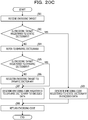
- FIG. 20C is a diagram illustrating an example of a flowchart of the encoding processing according to the second embodiment.
- the encoding unit 311 determines whether or not the encoding target is registered to the static dictionary 321 (step S82). When it is determined that the encoding target is registered to the static dictionary 321 (Yes in step S82), the encoding unit 311 describes an encoding code registered to the static dictionary 321 in the encoded data (step S83). Then, the encoding unit 311 proceeds the procedure to step S88.
- the encoding unit 311 refers to the dynamic dictionary 322 (step S84). Then, the encoding unit 311 determines whether or not the encoding target is registered to the dynamic dictionary 322 (step S85).
- step S85 the encoding unit 311 proceeds the procedure to step S87.
- step S85 the encoding unit 311 registers the encoding target to the dynamic dictionary 322 (step S86). Then, the encoding unit 311 proceeds the procedure to step S87.
- step S87 the encoding unit 311 describes the encoding code registered to the dynamic dictionary 322 to the encoded data (step S87). Then, the encoding unit 311 proceeds the procedure to step S88.
- step S88 the encoding unit 311 returns the encoding code to the index generation processing (step S88). Then, the encoding unit 311 terminates the encoding processing.
- FIG. 21 is a block diagram illustrating a functional configuration of a search device according to the second embodiment.
- a component having the same configuration as the search device 200 illustrated in FIG. 10 is denoted with the same reference numeral, and the description regarding the overlapped configurations and operations will be omitted.
- a difference between the first embodiment and the second embodiment is that the decompression unit 212 is removed.
- the difference between the first embodiment and the second embodiment is that the offset search unit 213, the block reading unit 214, and the search target extraction unit 215 are respectively changed to an offset search unit 213A, a block reading unit 214A, and a search target decompression unit 215A.
- the difference between the first embodiment and the second embodiment is that the block table 121 and the index information 122 are respectively changed to a block table 121A and index information 122A. Then, the difference between the first embodiment and the second embodiment is that a static dictionary 321 and a dynamic dictionary 322 are added.
- the block table 121A, the index information 122A, and the dynamic dictionary 322 are information generated by the index generation device 100 according to the second embodiment and, for example, acquired via a network and stored in a storage unit 220.
- the offset search unit 213A refers to the index information 122A and searches for a search target that matches a search condition.
- the offset search unit 213A refers to the index information 122A U of the upper index and extracts an index (bitmap) corresponding to the encoding code of the element name of the search condition.
- the offset search unit 213A acquires a block number in which "1" is set to the extracted bitmap.
- the offset search unit 213A extracts the index information 122A L of the lower index corresponding to the detected block number.
- the offset search unit 213A refers to the extracted index information 122A L of the lower index and narrows an offset of the search target which matches the search condition.
- the block reading unit 214A reads a block corresponding to the acquired block number from the encoded data.
- the block reading unit 214A refers to the block table 121A and acquires an address 121c in the encoded data corresponding to the acquired block number.
- the block reading unit 214A reads a block associated with the acquired address from the encoded data.
- the search target decompression unit 215A extracts a search target from the target block and decompresses the extracted search target. For example, the search target decompression unit 215A extracts a search target of the offset narrowed by the offset search unit 213A from the block read by the block reading unit 214A. Then, the search target decompression unit 215A decompresses the extracted search target based on the static dictionary 321 and the dynamic dictionary 322.
- the search target decompression unit 215A determines whether or not the extracted search target is a dynamic code. When determining that the extracted search target is a dynamic code, the search target decompression unit 215A decompresses the search target by using the dynamic dictionary 322. That is, the search target decompression unit 215A specifies the dynamic code that matches the search target from the address table D2 of the dynamic dictionary 322 and acquires a storage position and a data length corresponding to the specified dynamic code. Then, the search target decompression unit 215A specifies a character string indicating the acquired storage position and data length from the buffer D1. The specified character string is a search result obtained by decompressing the search target.
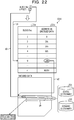
- FIG. 22 is a diagram illustrating an example of the flow of the search target decompression processing according to the second embodiment. A case will be described where the offset search unit 213A acquires "9" as a block number and searches for "8" as an offset.
- the block reading unit 214A acquires an address 121c in the encoded data corresponding to the acquired block number from the block table 121A (d1).
- "1200" is acquired as the address 121c in the encoded data corresponding to the acquired block number "9".
- the block reading unit 214A reads a block associated with the acquired address "1200" from the encoded data (d2).
- the search target decompression unit 215A extracts a search target of the searched offset from the block read by the block reading unit 214A (d3).
- the search target decompression unit 215A extract an encoding code "A083 h " as a search target at the position of "8" which is searched as an offset from the read block. It is assumed that "A083 h " be allocated to "10000" in the dynamic dictionary 222.
- the search target decompression unit 215A decompresses the extracted encoding code "A083 h " based on the static dictionary 321 and the dynamic dictionary 322.
- the search target decompression unit 215A decompresses "A083 h " to "10000" based on the dynamic dictionary 322. Then, the search target decompression unit 215A outputs the decompressed "10000" as a search result (d4) .
- FIG. 23 is a diagram illustrating an example of a flowchart of search processing according to the second embodiment.
- the search query analysis unit 211 determines whether or not a search query is received (step S91). In a case where it is determined that the search query is not received (No in step S91), the search query analysis unit 211 repeats determination processing until the search query is received.
- the search query analysis unit 211 analyzes the search query and extracts a search condition and a search target (step S92).
- the offset search unit 213A refers to the index information 122A U of the upper index and acquires a block number corresponding to an element name of the search condition (step S93). Then, the offset search unit 213A refers to the index information 122A L of the lower index of the acquired block number and narrows an offset of the search target that matches the search condition (step S94).
- the block reading unit 214A reads a block corresponding to the acquired block number from the encoded data (step S95).
- the block reading unit 214A refers to the block table 121A, acquires an address 121c in the encoded data corresponding to the acquired block number, and reads a block corresponding to the acquired address 121c in the encoded data from the encoded data.
- the search target decompression unit 215A extracts an encoding code located at a position of the narrowed offset from the read block (step S96).
- the search target decompression unit 215A decompresses the extracted encoding code based on the static dictionary 321 and the dynamic dictionary 322 (step S97). Then, the search target decompression unit 215A outputs the decompressed value as the search result and terminates the search processing.
- FIG. 24 is a diagram illustrating an example of a search flow according to the second embodiment.
- the TDnet is used so as to compare the search flow with the search flow in the reference example illustrated in FIG. 26 .
- the search flow is not limited to the search flow using the TDnet.
- a company submits a Zip file obtained by compressing XBRL data of financial information by Zip by using the TDnet (S201).
- the examiner On the side of the examiner, the examiner unpacks (decompress) the Zip file and checks the decompressed XBRL data (S202).
- the examiner stores the Zip file of the approved XBRL data in a DB of the TDnet (S203) and discloses the XBRL data.
- the examiner here is, for example, a financial institution or a stock exchange.
- the index generation device 100 lexically analyzes the XBRL data, generates the encoded data, the block table 121A, and the index information 122A, and stores the generated data to the TDnet (S204). Such processing corresponds to, for example, the lexical analysis unit 112, the encoding unit 311, and the index generation unit 113A.
- the investor searches for a company by using the TDnet (S205) and determines a company to be surveyed (S206).
- the investor inputs the encoded data, the block table 121A, and the index information 122A to a dedicated client application of the search device 200 (S207).
- the investor inputs a search word of an element to be searched and a search word of a value to be searched to the dedicated client application of the search device 200 (S208). That is, the investor inputs a search query to the search device 200. Then, the dedicated client application analyzes the search query and extracts a search condition and a search target. Such processing corresponds to, for example, the search query analysis unit 211.
- the dedicated client application narrows a position of an offset of the search target that matches the search condition according to the index information 122A (S209).
- the dedicated client application extracts the value of the narrowed position in the encoded data and decompresses the extracted value (S210). Then, the dedicated client application notifies the client side of the decompressed result (S211).
- Such processing corresponds to, for example, the offset search unit 213A, the block reading unit 214A, and the search target decompression unit 215A.
- the index generation device 100 when encoding the XBRL data, the index generation device 100 generates the index information 122A regarding appearance positions of each of the encoded item and the encoded value for each of the item and the value included in the XBRL data.
- the index generation device 100 can efficiently search for the search target in the XBRL data according to the search condition formed by combining the items and values while encoding the XBRL data. That is, by using the index information 122A, the index generation device 100 can narrow the search target in the encoded format and can narrow the search target without scanning the XBRL data.
- the search device 200 refers to the index information 122A that is generated when the XBRL data is encoded and specifies the appearance positions of the specific item and the specific value included in the search condition. Then, the search device 200 searches for partial data existing at the specified appearance position from the encoded data and partially decompresses the searched partial data. According to the above configuration, the verification device 200 can search for the partial data indicating the search target in the encoded format.
- the index information 122 includes the index information 122 U of the upper index and the index information 122 L of the lower index. Then, the X axis of the index information 122 U of the upper index indicates the block number, and the Y axis indicates the tag name (element name) of the tag layer. The X axis of the index information 122 L of the lower index indicates the offset (appearance position) in block units, and the Y axis indicates the tag name included in the tag layer, the attribute name included in the attribute layer, and the data value included in the data value layer.
- the index information 122 is not limited to this, and may be three-dimensionally expressed.
- the X axis may indicate the block number
- the Y axis may indicate the tag name included in the tag layer, the attribute name included in the attribute layer, and the data value included in the data value layer
- the Z axis may indicate the offset (appearance position) in block units.
- each component of the illustrated device is not necessarily physically configured as illustrated in the drawings. That is, specific aspects of separation and integration of the device are not limited to the illustrated ones, and all or a part of the apparatus can be functionally or physically separated and integrated in an arbitrary unit according to various loads, use states, and the like.
- the index generation unit 113 may separate the processing for generating the index information 122 U of the upper index and the processing for generating the index information 122 L of the lower index.
- the offset search unit 213 may distribute the processing for acquiring the block number from the index information 122 U of the upper index and the processing for narrowing the offset from the index information 122 L of the lower index.
- the storage unit 120 may be connected via a network as an external device of the index generation device 100.
- the storage unit 220 may be connected via a network as an external device of the search device 200.
- FIG. 25 is a diagram illustrating an example of a hardware configuration of the index generation device and the search device.
- a computer 500 including the index generation device 100 and the search device 200 includes a CPU 501 that executes various arithmetic processing, an input device 502 that receives a data input from a user, and a monitor 503.
- the computer 500 further includes a medium reading device 504 that reads a program and the like from a storage medium, an interface device 505 that connects to the other device, and a wireless communication device 506 that wirelessly connects to the other device.
- the computer 500 further includes a Random Access Memory (RAM) 507 that temporarily stores various information and a hard disk device 508.
- RAM Random Access Memory
- the hard disk device 508 stores an index generation program 205b having a similar function to the control unit 110 illustrated in FIG. 1 . In addition, the hard disk device 508 stores various data used to implement the index generation program 205b. The various data includes data in the storage unit 120 illustrated in FIG. 1 . The hard disk device 508 stores a search program 205a having a similar function to the control unit 210 illustrated in FIG. 10 . In addition, the hard disk device 508 stores various data used to implement the search program 205a. The various data includes data in the storage unit 220 illustrated in FIG. 10 .
- the CPU 501 reads each program stored in the hard disk device 508 and develops and executes the program on the RAM 507 to perform various processing. These programs can make the computer 500 function as the respective functional units illustrated in FIGS. 1 and 10 .
- the computer 500 may read and execute a program stored in a storage medium that can be read by the computer 500.
- the storage medium that can be read by the computer 500 corresponds to, for example, a portable recording medium such as a CD-ROM, a DVD disk, a Universal Serial Bus (USB) memory, a semiconductor memory such as a flash memory, a hard disk drive, and the like.
- a portable recording medium such as a CD-ROM, a DVD disk, a Universal Serial Bus (USB) memory
- USB Universal Serial Bus
- semiconductor memory such as a flash memory
- hard disk drive and the like.
- these programs are stored in a device connected to a public line, the Internet, a Local Area Network (LAN), and the like and the computer 500 reads and executes these programs.
Landscapes
- Engineering & Computer Science (AREA)
- Theoretical Computer Science (AREA)
- Physics & Mathematics (AREA)
- Databases & Information Systems (AREA)
- General Engineering & Computer Science (AREA)
- General Physics & Mathematics (AREA)
- Software Systems (AREA)
- Data Mining & Analysis (AREA)
- Computational Linguistics (AREA)
- Fuzzy Systems (AREA)
- Probability & Statistics with Applications (AREA)
- Mathematical Physics (AREA)
- Health & Medical Sciences (AREA)
- Artificial Intelligence (AREA)
- Audiology, Speech & Language Pathology (AREA)
- General Health & Medical Sciences (AREA)
- Information Retrieval, Db Structures And Fs Structures Therefor (AREA)
Abstract
Description
- The present invention relates to an index generation program and the like.
- Financial information is reported in the eXtensible Business Reporting Language (XBRL) documents around the world including Japan. The XBRL is an XML-based language which is standardized to create, distribute, and use information for various financial reports. The XBRL document is a structured document described in the XBRL, for example, about for accounting reports.
- A search condition used to search for the data described in the XBRL is defined by, for example, a combination of an item and a value.
- A technique for performing structured search while specifying an element and character string search in element contents included in the search condition used to search the structured document has been disclosed (for example, refer to Patent Document 1). Such a technique includes a unit for storing a positional relationship between the respective elements in the structured document and a unit for storing positional information of a character string that appears in each element, and these two pieces of information is combined or coupled by the positional information regarding the element and is processed as a single piece of index information.
- Patent Document 1: Japanese Laid-open Patent Publication No.
2001-265773 - However, a disadvantage of a case of the search on the structured document such as the XBRL data by using a search condition combining an item and a value is an amount of calculation.
- For example, in the conventional technology for searching on the structured document, positions of elements corresponding to the items and element contents corresponding to the values are indexed. However, in such a technique, in a case where the search is performed by using the search condition combining a specific element and specific element content, the following processing is executed. That is, in such a technique, the specific element is searched by using the positional relationship between the respective elements, and the specific element content of the searched specific element is referred by using the positional information of the character string that appears in each element which is individually stored. Therefore, a disadvantage of a case where the search on the structured document is performed by using a search condition combining the element and the element content is an amount of calculation.
- An object of one aspect is to efficiently search on a structured document by using a search condition combining an item and a value.
- A first idea causes a computer to execute processing for inputting data described by a combination of an item and a value and generating index information regarding appearance positions of each of the item and the value for each of the item and the value included in the data.
- According to one aspect, it is possible to efficiently search on a structured document by using a search condition combining an item and a value.
-
-
FIG. 1 is a functional block diagram illustrating a configuration of an index generation device according to a first embodiment. -
FIG. 2 is a diagram illustrating an example of XBRL data according to the first embodiment. -
FIG. 3 is a diagram illustrating an example of a block table according to the first embodiment. -
FIG. 4 is a diagram illustrating an example of index information according to the first embodiment. -
FIG. 5A is a diagram illustrating an example of a flow of index generation processing of an upper index according to the first embodiment. -
FIG. 5B is a diagram illustrating an example of a flow of index generation processing of a lower index according to the first embodiment. -
FIG. 6 is a diagram illustrating an example of a flow of index generation processing of another lower index according to the first embodiment. -
FIG. 7 is a diagram illustrating an example of a flow of index generation processing of still another lower index according to the first embodiment. -
FIG. 8 is a diagram for explaining how to allocate offsets of the lower index. -
FIG. 9 is a diagram illustrating an example of a flowchart of the index generation processing according to the first embodiment. -
FIG. 10 is a functional block diagram illustrating a configuration of a search device according to the first embodiment. -
FIG. 11 is a diagram illustrating an example of a flow of offset search processing according to the first embodiment. -
FIG. 12 is a diagram illustrating an example of the flow of the offset search processing according to the first embodiment. -
FIG. 13 is a diagram illustrating an example of a flow of search target extraction processing according to the first embodiment. -
FIG. 14 is a diagram illustrating an example of a flowchart of search processing according to the first embodiment. -
FIG. 15 is a diagram illustrating an example of a search flow according to the first embodiment. -
FIG. 16 is a block diagram illustrating a functional configuration of an index generation device according to a second embodiment. -
FIG. 17 is a diagram illustrating an example of a dynamic dictionary according to the second embodiment. -
FIG. 18 is a diagram illustrating an example of a block table according to the second embodiment. -
FIG. 19A is a diagram illustrating an example of a flow of index generation processing of an upper index according to the second embodiment. -
FIGs. 19B and19C are a diagram illustrating an example of a flow of index generation processing of a lower index according to the second embodiment. -
FIGs. 20A and20B are a diagram illustrating an example of a flowchart of index generation processing according to the second embodiment. -
FIG. 20C is a diagram illustrating an example of a flowchart of encoding processing according to the second embodiment. -
FIG. 21 is a block diagram illustrating a functional configuration of a search device according to the second embodiment. -
FIG. 22 is a diagram illustrating an example of a flow of search target decompression processing according to the second embodiment. -
FIG. 23 is a diagram illustrating an example of a flowchart of search processing according to the second embodiment. -
FIG. 24 is a diagram illustrating an example of a search flow according to the second embodiment. -
FIG. 25 is a diagram illustrating an example of a hardware configuration of the index generation device and the search device. -
FIG. 26 is a diagram illustrating a reference example of a search flow using the TDnet. -
FIG. 27 is a diagram illustrating an example of XBRL data. -
FIG. 28 is a diagram illustrating a reference example of the search processing. - Hereinafter, embodiments of an index generation program, an index generation device, an index generation method, a search program, a search device, and a search method disclosed in the present application will be described in detail based on the drawings. Note that the present invention is not limited to the embodiments.
- First, there is a system called Timely Disclosure network (TDnet) that searches for financial information in XBRL documents for each company. By using the TDnet, the financial information in the XBRL documents submitted by the companies can be disclosed to investors, and the investor can search for the disclosed financial information. Here, a reference example of a search flow using the TDnet will be described with reference to
FIG. 26. FIG. 26 is a diagram illustrating the reference example of the search flow using the TDnet. - As illustrated in
FIG. 26 , a company submits a Zip file obtained by compressing XBRL data of financial information by Zip by using the TDnet (S901). - An examiner unpacks (decompress) the Zip file and checks the decompressed XBRL data (S902). The examiner stores the Zip file of the approved XBRL data in a DataBase (DB) of the TDnet (S903) and discloses the XBRL data. The examiner here is, for example, a public supervisory body or a stock exchange.
- An investor inputs a search period of a report date and a company name of a search target in order to search for disclosed XBRL data of the company by using the TDnet (S904). The investor determines XBRL data of a search target by using the TDnet (S905). The investor saves a Zip file for the determined XBRL data of the search target in a local folder by using the TDnet (S906). Then, the investor unpacks (decompress) the saved Zip file (S907).
- Subsequently, the investor inputs the decompressed XBRL data to a dedicated tool (S908). The dedicated tool lexically analyzes the input XBRL data and constructs a data model tree (S909). Then, the dedicated tool displays a list of pairs of elements and values according to a display definition (S910).
- Then, the investor inputs a search word of an element to be searched or a search word of a value to be searched (S911) . An example of the search word of the element is "sales and revenues" which is an account title. As an example of the search word of the value, "president" is exemplified. Then, the dedicated tool scans the data model tree and notifies a result of collation with the search word (S912). For example, in a case where the search word of the element is the "sales and revenues", a value corresponding to the account title "sales and revenues" is notified. In a case where the search word of the value is the "president", a value of the account title including the "president" is notified.
- Here, an example of the XBRL data will be described with reference to
FIG. 27. FIG. 27 is a diagram illustrating an example of the XBRL data. - As illustrated in
FIG. 27 , a single piece of XBRL data includes a data value and additional information that supplements the data value. The additional information is information specified by another independent element associated with the element including the data value. The additional information is defined as a plurality of elements having the names of context and unit. Here, as context names for distinguishing the context, "CurrentQ1" and "PriorQ1" are applied. As unit names for distinguish units, "JPY" and "Pure" are applied. In the data value, with respect to an element of which the name is Sales, a context name "CurrentQ1" and a unit name "JPY" are defined as attributes to refer to the additional information. Then, as the value of the element "Sales", "10000" is defined. Furthermore, in additional information corresponding to the context name "CurrentQ1", "2016-06-30" is defined as a value of an element "instant" subordinate to an element "period" which means a date of the report date. - Here, a reference example of search processing in a case where the investor inputs "sales and revenues" in "2016" as the search words of the element to be searched will be described with reference to
FIG. 28. FIG. 28 is a diagram illustrating a reference example of the search processing. InFIG. 28 , it is assumed that a data model tree regarding the XBRL data input to the dedicated tool be constructed. "C" in <c>, "p" in <p>, and "i" in <i> in the tree are respectively abbreviations of "context", "period", and "instant". In addition, "S" in <S> and "cr=" in the tree are respectively abbreviations of "Sales" and "contextRef=". Furthermore, "Cur" and "Pri" in the tree are respectively abbreviations of "CurrentQ1" and "PriorQ1". In addition, "2016" and "2015" in the tree are respectively abbreviations of "2016-06-30" and "2015-06-30". - As illustrated in
FIG. 28 , the dedicated tool which has received the search word "sales and revenues" in "2016" searches for the element including "2016" as a value from the top (root) to an end of the tree (S920). Then, as a result of the search, the dedicated tool confirms that a parent element is "instant" (S921) and searches ancestors for the "context" element (S922). Then, the dedicated tool confirms that an ancestor element is the "context" element and searches for an id attribute (S923). It is assumed that an id attribute value be "CurrentQ1" as a result of the search. - Subsequently, the dedicated tool searches for a "contextRef" attribute having "CurrentQ1" as a value from the top (root) to the end of the tree (S924). Then, the dedicated tool confirms that "CurrentQ1" is the value of the "contextRef" attribute as a result of the search and confirms that the "contextRef" attribute is an attribute of the "Sales" element indicating "sales and revenues" (S925). Then, the dedicated tool acquires "1000" as a value of the "Sales" element (S926).
- In this way, in the search processing according to the reference example, the data value and the additional information are separated according to the XBRL-specific specification. Therefore, since the search word is collated to all the data in the data model tree of the XBRL data at various times while scanning all the data, an increase in the calculation amount is expected, and it is difficult to efficiently search.
-
FIG. 1 is a functional block diagram illustrating a configuration of an index generation device according to a first embodiment. Theindex generation device 100 inputs XBRL data described by a combination of an item and a value and generatesindex information 122 regarding appearance positions of each of the item and the value for each of the item and the value included in the input XBRL data. - The XBRL data here is data described in the XBRL data which is decompressed from compressed data. The XBRL is an XML-based language which is standardized to create, distribute, and use information for various financial reports. Then, as an example of the compressed data, data in a Zip format is exemplified. As an example of the XBRL data, financial data is exemplified.
- Here, an example of the XBRL data according to the first embodiment will be described with reference to
FIG. 2. FIG. 2 is a diagram illustrating an example of the XBRL data according to the first embodiment. The XBRL data illustrated inFIG. 2 has the same content as the XBRL data illustrated inFIG. 27 . - As illustrated in
FIG. 2 , the XBRL data is divided into blocks from the beginning for each element indicating the additional information and the data value. Here, elements in the third and fourth blocks correspond toadditional information 1 that supplements the data value illustrated inFIG. 27 . Elements in the sixth and seventh blocks correspond toadditional information 2 that supplements the data value illustrated inFIG. 27 . Elements in the ninth and eleventh blocks correspond to the data value illustrated inFIG. 27 . A relation between a start tag of each element indicating the additional information and the data value in the XBRL data and a block is defined by a block table 121 to be described later. - As illustrated in
FIG. 1 , theindex generation device 100 includes acontrol unit 110 and astorage unit 120. - The
storage unit 120 corresponds to a storage device such as a non-volatile semiconductor memory element, for example, a Flash Memory, a Ferroelectric Random Access Memory (FRAM) (registered trademark), and the like. Thestorage unit 120 includes the block table 121 and theindex information 122. - The block table 121 stores an address of the start tag of each element indicating the additional information and the data value in the XBRL data and a block number in association with each other.
- Here, an example of the block table 121 will be described with reference to
FIG. 3. FIG. 3 is a diagram illustrating an example of a block table according to the first embodiment. As illustrated inFIG. 3 , the block table 121 stores ablock number 121a and anaddress 121b in the XBRL data in association with each other. Theblock number 121a indicates a block number. Theaddress 121b in the XBRL data indicates a leading address of a block included in the XBRL data decompressed from the compressed data. As an example, in a case where theblock number 121a is "1", "0" is stored as theaddress 121b in the XBRL data. In a case where theblock number 121a is "2", "A000h" is stored as theaddress 121b in the XBRL data. - Returning to
FIG. 1 , theindex information 122 includesindex information 122U of an upper index andindex information 122L of a lower index. Theindex information 122U of the upper index is information indicating a block position of each element indicating the additional information and the data value in the XBRL data. That is, theindex information 122U of the upper index is a bitmap in which presence/absence of the start tag of the additional information and the data value in the XBRL data for each block position is indexed. Theindex information 122L of the lower index exists for each block. Theindex information 122L of the lower index of a predetermined block is information indicating appearance positions of each of items (start tag, attribute, and end tag) and a value regarding the elements indicating the additional information and the data value in the XBRL data. That is, theindex information 122L of the lower index is a bitmap in which presence/absence of the item (start tag, attribute, and end tag) and the value in the predetermined block included in the XBRL data for each offset (appearance position) is indexed. - Here, an example of the
index information 122 will be described with reference toFIG. 4. FIG. 4 is a diagram illustrating an example of index information according to the first embodiment. In the upper diagram inFIG. 4 , theindex information 122U of the upper index is illustrated. In the lower diagram inFIG. 4 , theindex information 122L of the lower index is illustrated. Theindex information 122 in the upper diagram inFIG. 4 is theindex information 122U of the upper index with respect to the XBRL data illustrated inFIG. 2 . Theindex information 122 in the lower diagram inFIG. 4 is theindex information 122L of the lower index of the third block in the XBRL data illustrated inFIG. 2 . - As illustrated in the upper diagram in
FIG. 4 , the X axis of theindex information 122U of the upper index indicates a block number, and the Y axis indicates a tag name (element name) of a tag layer. Theindex information 122U is information including a bundle of indexes regarding the block for each element name. Regarding each element name, in a block number where the element appears, ON, that is, "1" in the binary system is set. As an example, regarding <xrbl>, "1" is set at a first position of the block number. That is, the <xrbl> element is located in the first block. Regarding <context>, "1" is set at a third position of the block number. That is, the <context> element is located in the third block. - As illustrated in the lower diagram in
FIG. 4 , the X axis of theindex information 122L of the lower index indicates an offset (appearance position) in block units, and the Y axis indicates a tag name included in the tag layer, an attribute name included in an attribute layer, and an element value and an attribute value included in a data value layer. Furthermore, theindex information 122L has a region of the tag layer, a region of the attribute layer, and a region of the data value layer. The index information in the region of the tag layer is information of a bundle of indexes regarding appearance positions of tag names of each of the start tag and the end tag in the block. Theindex information 122 in the region of the attribute layer is information of a bundle of indexes regarding the appearance position of each attribute name in the block. Theindex information 122 in the region of the data value layer is information of a bundle of indexes regarding the appearance position of each of the element value and the attribute value in the block. At the appearance positions where each tag name, each attribute name, each element value, and each attribute value appear in the block, ON, that is, "1" in the binary system is set. As an example, in a case where the tag name of the start tag is "<context>", "1" is set at the first appearance position in the block. In a case where the attribute name is "id=", "1" is set at the second appearance position in the block. In a case where a value of the identifier element is "67020", "1" is set at the eighth appearance position in the block. - Returning to
FIG. 1 , thecontrol unit 110 includes an internal memory for storing a program and control data for specifying various processing procedures and executes various processing by using the stored data. Then, thecontrol unit 110 corresponds to an electronic circuit of an integrated circuit, for example, an Application Specific Integrated Circuit (ASIC), a Field Programmable Gate Array (FPGA), and the like. Alternatively, thecontrol unit 110 corresponds to an electronic circuit such as a Central Processing Unit (CPU) and a Micro Processing Unit (MPU). Thecontrol unit 110 includes adecompression unit 111, alexical analysis unit 112, and anindex generation unit 113. Thedecompression unit 111 is an example of an input unit. Thelexical analysis unit 112 and theindex generation unit 113 are examples of a generation unit. - The
decompression unit 111 receives and decompresses compressed XBRL data. The compressed XBRL data here is, for example, data obtained by compressing the XBRL data submitted by a company in the Zip format. - The
lexical analysis unit 112 lexically analyzes XBRL data decompressed by thedecompression unit 111. The term "lexical analysis" here means that the XBRL data is divided into markups and words. - The
index generation unit 113 generates theindex information 122 regarding the appearance positions of each of the items and the values for each of the item and the value included in the XBRL data. For example, theindex generation unit 113 sets a bit at the appearance position of the tag name in the block with respect to the tag name of the start tag at the head of each block in the XBRL data. That is, theindex generation unit 113 generates theindex information 122U of the upper index. Then, theindex generation unit 113 stores theblock number 121a and theaddress 121b in the XBRL data in association with each other in the block table 121 for each block. Furthermore, theindex generation unit 113 sets a bit at the appearance position of the tag name in the block with respect to the tag names of the start tag and the end tag included in the block, for each block in the XBRL data. Theindex generation unit 113 sets a bit at the appearance position of the attribute name in the block with respect to the attribute name included in the block, for each block in the XBRL data. Theindex generation unit 113 sets a bit at the appearance position of each value in the block with respect to the element value and the attribute value included in the block, for each block in the XBRL data. That is, theindex generation unit 113 generates theindex information 122L of the lower index. At the time of search, theindex generation unit 113 may generate theindex information 122L of the lower index after determining the block in theindex information 122L. Hereinafter, a case where the tag name of the tag layer and the like is registered when theindex generation unit 113 generates theindex information 122 will be described. - Here, examples of flows of the index generation processing according to the first embodiment will be described with reference to
FIGS. 5A and5B . -
FIG. 5A is a diagram illustrating an example of a flow of index generation processing of the upper index according to the first embodiment. As illustrated inFIG. 5A , theindex generation unit 113 sets a bit at a block appearance position of the tag name in the block with respect to the tag name of the start tag of each block in the XBRL data. Here, theindex generation unit 113 selects a block from the XBRL data. Then, theindex generation unit 113 detects a start tag of the selected block and registers a tag name of the detected start tag to the tag layer. Then, theindex generation unit 113 sets a bit at the appearance position of the tag name in the block to "1" (ON) with respect to the tag name of the start tag. - As an example, in a case where the
index generation unit 113 selects the first block, a tag name "xbrl" of a start tag detected in the first block is registered to the tag layer. Then, theindex generation unit 113 writes "1" in the bit corresponding to the block number "1" in the index (bitmap) corresponding to the tag name "xbrl". - As an example, in a case where the
index generation unit 113 selects the third block, a tag name "<context>" of a start tag detected in the third block is registered to the tag layer. Then, theindex generation unit 113 writes "1" in the bit corresponding to the block number "3" in the index (bitmap) corresponding to the tag name "<context>". - As an example, in a case where the
index generation unit 113 selects the sixth block, a tag name "<unit>" of a start tag detected in the sixth block is registered to the tag layer. Then, theindex generation unit 113 writes "1" in the bit corresponding to the block number "6" in the index (bitmap) corresponding to the tag name "<unit>". - As an example, in a case where the
index generation unit 113 selects the ninth block, a tag name "<Sales>" of a start tag detected in the ninth block is registered to the tag layer. Then, theindex generation unit 113 writes "1" in the bit corresponding to the block number "9" in the index (bitmap) corresponding to the tag name "<Sales>". - Furthermore, the
index generation unit 113 stores theblock number 121a and theaddress 121b in the XBRL data in association with each other in the block table 121 for each block. Here, theindex generation unit 113 stores a block number "1" and an address "0" in the XBRL data in association with each other in the block table 121. Theindex generation unit 113 stores a block number "2" and an address "A000h" in the XBRL data in association with each other in the block table 121. Theindex generation unit 113 stores a block number "3" and an address "A100h" in the XBRL data in association with each other in the block table 121. Theindex generation unit 113 stores a block number "4" and an address "A200h" in the XBRL data in association with each other in the block table 121. -
FIG. 5B is a diagram illustrating an example of a flow of index generation processing of the lower index according to the first embodiment. Here, processing for generating a lower index in a third block in the XBRL data will be described. In the third block, a lower index of the context element is generated. - As illustrated in
FIG. 5B , in a case where theindex generation unit 113 detects the start tag in the third block, a tag name "<context>" of the start tag is registered to the tag layer. The tag name means an element name. Then, theindex generation unit 113 writes "1" in a bit corresponding to an appearance position "1" in an index (bitmap) corresponding to the tag name "<context>" of the start tag. It is preferable that theindex generation unit 113 detect the tag name as follows. That is, it is preferable that, when detecting a tag start symbol "<", theindex generation unit 113 detect a word immediately after the start symbol as a tag name. - In a case where "id=" is detected as an attribute name, the
index generation unit 113 registers the attribute name "id=" to the attribute layer. Then, theindex generation unit 113 writes "1" in a bit corresponding to an appearance position "2" in an index (bitmap) corresponding to the attribute name "id=". It is sufficient that theindex generation unit 113 detect the attribute name as follows. That is, it is preferable that theindex generation unit 113 detect an attribute group subsequent to the tag name, that is, a left-hand side of an attribute having "=" as the attribute name. - When detecting "CurrentQ1" as the attribute value, the
index generation unit 113 registers the attribute value "CurrentQ1" to the data value layer. Then, theindex generation unit 113 writes "1" in a bit corresponding to an appearance position "3" in an index (bitmap) corresponding to the attribute value "CurrentQ1". It is sufficient that theindex generation unit 113 detect the attribute value as follows. That is, it is preferable that theindex generation unit 113 similarly detect a right-hand side of the attribute having "=" as the attribute value. - When detecting "67020" as the element value, the
index generation unit 113 registers the element value "67020" to the data value layer. Then, theindex generation unit 113 writes "1" in a bit corresponding to an appearance position "8" in an index (bitmap) corresponding to the element value "67020". It is sufficient that theindex generation unit 113 detect the element value as follows. That is, it is preferable that theindex generation unit 113 detect a text between an end symbol ">" of the start tag and the start symbol "<" of the end tag as the element value. - In this way, it is preferable that the
index generation unit 113 sequentially detect the tag name of the start tag, the attribute name, the attribute value, the element value and the tag name of the end tag with respect to the third block and generate the lower index. -
FIG. 6 is a diagram illustrating an example of a flow of index generation processing of another lower index according to the first embodiment. Here, processing for generating a lower index in a sixth block in the XBRL data will be described. In the sixth block, a lower index of a unit element is generated. - As illustrated in
FIG. 6 , in a case where theindex generation unit 113 detects the start tag in the sixth block, a tag name "<unit>" of the start tag is registered to the tag layer. The tag name means an element name. Then, theindex generation unit 113 writes "1" in a bit corresponding to an appearance position "1" in an index (bitmap) corresponding to the tag name "<unit>" of the start tag. It is preferable that a method for detecting the tag name by theindex generation unit 113 be the same as the method described inFIG. 5B . - In a case where "id=" is detected as an attribute name, the
index generation unit 113 registers the attribute name "id=" to the attribute layer. Then, theindex generation unit 113 writes "1" in a bit corresponding to an appearance position "2" in an index (bitmap) corresponding to the attribute name "id=". It is preferable that a method for detecting the attribute name by theindex generation unit 113 be the same as the method described inFIG. 5B . - When detecting "JPY" as the attribute value, the
index generation unit 113 registers the attribute value "JPY" to the data value layer. Then, theindex generation unit 113 writes "1" in a bit corresponding to an appearance position "3" in an index (bitmap) corresponding to the attribute value "JPY". It is preferable that a method for detecting the attribute value by theindex generation unit 113 be the same as the method described inFIG. 5B . - When detecting the start tag, the
index generation unit 113 registers a tag name "<measure>" of a tag to the tag layer. The tag name means an element name. Then, theindex generation unit 113 writes "1" in a bit corresponding to an appearance position "4" in an index (bitmap) corresponding to the tag name "<measure>" of the start tag. - When detecting "iso4217:JPY" as the element value, the
index generation unit 113 registers the element value "iso4217:JPY" to the data value layer. Then, theindex generation unit 113 writes "1" in a bit corresponding to an appearance position "5" in an index (bitmap) corresponding to the element value "iso4217:JPY". It is preferable that a method for detecting the element value by theindex generation unit 113 be the same as the method described inFIG. 5B . - In this way, it is preferable that the
index generation unit 113 sequentially detect the tag name of the start tag, the attribute name, the attribute value, the element value, and the tag name of the end tag with respect to the sixth block and generate the lower index. -
FIG. 7 is a diagram illustrating an example of a flow of index generation processing of still another lower index according to the first embodiment. Here, processing for generating a lower index in a ninth block in the XBRL data will be described. In the ninth block, a lower index of an account title element is generated. - As illustrated in
FIG. 7 , in a case where theindex generation unit 113 detects the start tag in the ninth block, a tag name "<Sales>" of the start tag is registered to the tag layer. The tag name means an element name. Then, theindex generation unit 113 writes "1" in a bit corresponding to an appearance position "1" in an index (bitmap) corresponding to the tag name "<Sales>". - When detecting "contextRef=" as the attribute name, the
index generation unit 113 registers the attribute name "contextRef=" to the attribute layer. Then, theindex generation unit 113 writes "1" in a bit corresponding to an appearance position "2" in an index (bitmap) corresponding to the attribute name "contextRef=". - When detecting "CurrentQ1" as the attribute value, the
index generation unit 113 registers the attribute value "CurrentQ1" to the data value layer. Then, theindex generation unit 113 writes "1" in a bit corresponding to an appearance position "3" in an index (bitmap) corresponding to the attribute value "CurrentQ1". - When detecting "10000" as the element value, the
index generation unit 113 registers the element value "10000" to the data value layer. Then, theindex generation unit 113 writes "1" in a bit corresponding to an appearance position "8" in an index (bitmap) corresponding to the element value "10000". - In this way, it is preferable that the
index generation unit 113 sequentially detect the tag name of the start tag, the attribute name, the attribute value, the element value, and the tag name of the end tag with respect to the ninth block and generate the lower index. -
FIG. 8 is a diagram for explaining how to allocate offsets of the lower index. The upper diagram inFIG. 8 illustrates a case where the offsets of the lower index are allocated to a head position of the start tag, a head position of the element value, and a head position of the end tag. The head position of the start tag is a position of "S" in "<Sales...>". The head position of the element value is a position of "1" in "10000". The head position of the end tag is a position of "S" in "</Sales>". Then, at the head position of the start tag, the head position of the element value, and the head position of the end tag, "1", "2", and "3" are respectively allocated as the offsets. - As illustrated in the upper diagram in
FIG. 8 , whether the attribute name is included in the start tag can be specified from the lower index. However, the attribute value corresponding to the attribute name cannot be specified. Here, it can be specified that "contextRef=", "unitRef=", and "decimals=" as the attribute names are in the offset "1". However, it cannot be specified whether the attribute value corresponding to the attribute name "contextRef=" is any one of "CurrentQ1", "JPY", "0", and "10000". Similarly, it cannot be specified whether the attribute value corresponding to the attribute name "unitRef=" is any one of "CurrentQ1", "JPY", "0", and "10000". It cannot be specified whether the attribute value corresponding to the attribute name "decimals=" is any one of "CurrentQ1", "JPY", "0", and "10000". - On the other hand, the lower diagram in
FIG. 8 illustrates a case where the offsets of the lower index are allocated to the head position of the start tag, the head position of the attribute name, the head position of the attribute value, the head position of the element value, and the head position of the end tag. The head position of the start tag is a position of "S" in "<Sales". The head positions of the attribute values are a position of "c" in "contextRef=", a position of "u" in "unitRef=", and a position of "d" in "decimals=". The head positions of the attribute values are a position of "C" in "CurrentQ1", a position of "J" in "JPY", and a position of "0" in "0", and the head position of the element value is a position of "1" in "10000". The head position of the end tag is a position of "S" in "</Sales>". Then, the offsets are each allocated to the head position of the start tag, the head position of the attribute name, the head position of the attribute value, the head position of the element value, and the head position of the end tag. - As illustrated in the lower diagram in
FIG. 8 , not only whether the attribute name is included in the start tag but also the attribute value corresponding to the attribute name can be specified from the lower index. That is, it is found that a data value located at the offset on the right side of the offset where the attribute name is located indicates the attribute value corresponding to the attribute name. Here, an attribute value corresponding to the attribute name "contextRef=" is "CurrentQ1". It is found that an attribute value corresponding to the attribute name "unitRef=" is "JPY". It is found that an attribute value corresponding to the attribute name "decimals=" is "0". Furthermore, a data value located at the offset on the left side of the offset where the end tag is located indicates the element value corresponding to the element name. Here, an element value corresponding to the element name "Sales" is "10000". - In this way, as illustrated in the lower diagram in
FIG. 8 , it is preferable that the offsets of the lower index be allocated to the start tag, the attribute name, the attribute value, the element value, and the end tag. -
FIG. 9 is a diagram illustrating an example of a flowchart of the index generation processing according to the first embodiment. The compressed XBRL data will be described as a Zip file. - The
decompression unit 111 which has received a Zip file decompresses the Zip file (step S11). Thelexical analysis unit 112 lexically analyzes the decompressed data (step S12). - Subsequently, the
index generation unit 113 selects a block of the decompressed data (step S13). Theindex generation unit 113 detects a start tag of the selected block (step S14). Then, theindex generation unit 113 registers a tag name of the detected start tag to the tag layer in theindex information 122U of the upper index (step S15). Theindex generation unit 113 sets a bit of a block number of the selected block with respect to the detected start tag to ON in theindex information 122U of the upper index (step S16). - Then, the
index generation unit 113 sets a start address of the block in the decompressed data to the block table 121 (step S17). - Then, the
index generation unit 113 determines whether the block is an end point of the decompressed data (step S18). In a case where it is determined that the block is not the end point of the decompressed data (No in step S18), theindex generation unit 113 proceeds to step S13 so as to select a next block. - On the other hand, in a case where it is determined that the block is the end point of the decompressed data (Yes in step S18), the
index generation unit 113 selects the block of the decompressed data (step S19). - Then, the
index generation unit 113 registers the tag name of the start tag to the tag layer of theindex information 122L of the lower index with respect to the selected block (step S20). Theindex generation unit 113 sets a bit of the offset in the block with respect to the tag name of the start tag to ON in theindex information 122L of the lower index with respect to the selected block (step S21). - Then, the
index generation unit 113 determines whether or not the attribute name is detected in the selected block (step S22). In a case where it is determined that the attribute name is detected (Yes in step S22), theindex generation unit 113 registers the detected attribute name to the attribute layer of theindex information 122L of the lower index with respect to the selected block (step S23). Then, theindex generation unit 113 sets a bit of the offset in the block with respect to the detected attribute name to ON in theindex information 122L of the lower index with respect to the selected block (step S24). - Then, the
index generation unit 113 registers the attribute value to the data value layer of theindex information 122L of the lower index with respect to the selected block (step S25). Then, theindex generation unit 113 sets a bit of the offset in the block with respect to the attribute value to ON in theindex information 122L of the lower index with respect to the selected block (step S26). Then, theindex generation unit 113 proceeds the procedure to step S27. - On the other hand, in a case where it is determined that the attribute name is not detected (No in step S22), the
index generation unit 113 determines whether or not the end symbol of the start tag is detected (step S27). In a case where it is determined that the end symbol of the start tag is not detected (No in step S27), theindex generation unit 113 proceeds to step S22 so as to detect a next attribute name. - On the other hand, in a case where it is determined that the end symbol of the start tag is detected (Yes in step S27), the
index generation unit 113 determines whether or not the start symbol of the start tag is detected (step S28). In a case where it is determined that the start symbol of the start tag is detected (Yes in step S28), theindex generation unit 113 proceeds the procedure to step S20. - On the other hand, in a case where it is determined that the start symbol of the start tag is not detected (No in step S28), the
index generation unit 113 registers the element value to the data value layer of theindex information 122L of the lower index with respect to the selected block (step S29). Then, theindex generation unit 113 sets a bit of the offset in the block with respect to the element value to ON in theindex information 122L of the lower index with respect to the selected block (step S30) . - Then, the
index generation unit 113 registers the tag name of the end tag to the tag layer of theindex information 122L of the lower index with respect to the selected block (step S31). Theindex generation unit 113 sets a bit of the offset in the block with respect to the tag name of the end tag to ON in theindex information 122L of the lower index with respect to the selected block (step S32). Then, theindex generation unit 113 detects the end symbol of the end tag (step S33). - Then, the
index generation unit 113 determines whether or not the start symbol of the start tag is detected (step S34). In a case where it is determined that the start symbol of the start tag is detected (Yes in step S34), theindex generation unit 113 proceeds the procedure to step S20. - On the other hand, in a case where it is determined that the start symbol of the start tag is not detected (No in step S34), the
index generation unit 113 determines whether or not the start symbol of the end tag is detected (step S35). In a case where it is determined that the start symbol of the end tag is detected (Yes in step S35), theindex generation unit 113 proceeds the procedure to step S31. - On the other hand, in a case where it is determined that the start symbol of the end tag is not detected (No in step S35), the
index generation unit 113 detects an end point of the block (step S36). Then, theindex generation unit 113 determines whether the block is an end point of the decompressed data (step S37). In a case where it is determined that the block is not the end point of the decompressed data (No in step S37), theindex generation unit 113 proceeds the procedure to step S19 so as to select a next block. - On the other hand, in a case where it is determined that the block is the end point of the decompressed data (Yes in step S37), the
index generation unit 113 terminates the index generation processing. -
FIG. 10 is a functional block diagram illustrating a configuration of a search device according to the first embodiment. Asearch device 200 receives a search condition including a specific item and value relative to the XBRL data described by a combination of the item and value, refers to theindex information 122, and searches for the received search condition. - As illustrated in
FIG. 10 , thesearch device 200 includes acontrol unit 210 and astorage unit 220. - The
storage unit 220 corresponds to a storage device such as a non-volatile semiconductor memory element, for example, a Flash Memory, a Ferroelectric Random Access Memory (FRAM) (registered trademark), and the like. Thestorage unit 220 includes XBRL data (compression format) 221, the block table 121, and theindex information 122. The block table 121 and theindex information 122 are information generated by theindex generation device 100 and, for example, are acquired via a network and stored in thestorage unit 220. - The XBRL data (compression format) 221 is XBRL data in a compression format. For example, the XBRL data (compression format) 221 is XBRL data compressed in the Zip format.
- The
control unit 210 includes an internal memory for storing a program and control data for specifying various processing procedures and executes various processing by using the stored data. Then, thecontrol unit 210 corresponds to an electronic circuit of an integrated circuit, for example, an Application Specific Integrated Circuit (ASIC), a Field Programmable Gate Array (FPGA), and the like. Alternatively, thecontrol unit 210 corresponds to an electronic circuit such as a Central Processing Unit (CPU) and a Micro Processing Unit (MPU). Thecontrol unit 210 includes a searchquery analysis unit 211, adecompression unit 212, an offsetsearch unit 213, ablock reading unit 214, and a searchtarget extraction unit 215. The searchquery analysis unit 211 is an example of a reception unit. The offsetsearch unit 213, theblock reading unit 214, and the searchtarget extraction unit 215 are examples of a search unit. - The search
query analysis unit 211 input a search query and analyzes the input search query. For example, the searchquery analysis unit 211 analyzes the search query and extracts a search condition and a search target. The search condition includes a keyword indicating the element name, the tag name, the attribute name, the attribute value, or the element value. The search target includes a keyword indicating the attribute name or the element name of which a value is desired to be searched. - The
decompression unit 212 receives the XBRL data (compression format) 221 and decompresses the received XBRL data (compression format) 221. The compressed XBRL data (compression format) 221 here is, for example, data obtained by compressing the XBRL data submitted by a company in the Zip format. - The offset
search unit 213 refers to theindex information 122 and searches for a search target that matches the search condition. For example, the offsetsearch unit 213 refers to theindex information 122U of the upper index and extracts an index (bitmap) corresponding to the element name of the search condition. The offsetsearch unit 213 acquires a block number in which "1" is set to the extracted bitmap. The offsetsearch unit 213 extracts theindex information 122L of the lower index corresponding to the detected block number. The offsetsearch unit 213 refers to the extractedindex information 122L of the lower index and narrows an offset of the search target which matches the search condition. - The
block reading unit 214 reads a block corresponding to the acquired block number from the decompressed XBRL data. For example, theblock reading unit 214 acquires theaddress 121b in the XBRL data corresponding to the acquired block number from the block table 121. Theblock reading unit 214 reads the block associated with the acquired address from the XBRL data decompressed by thedecompression unit 212. - The search
target extraction unit 215 extracts the search target from a target block. For example, the searchtarget extraction unit 215 extracts the search target of the offset narrowed by the offsetsearch unit 213 from the block read by theblock reading unit 214. - Here, an example of a flow of offset search processing according to the first embodiment will be described with reference to
FIGS. 11 and12 .FIGS. 11 and12 are diagrams illustrating an example of the flow of the offset search processing according to the first embodiment. -
FIG. 11 illustrates a case where a search query searches for an id attribute value of a context element of which the date is "2016". The searchquery analysis unit 211 analyzes the search query and extracts a search condition and a search target. Here, as the search conditions, "<context>" which is a context element, "<instant>" which is an instant element indicating the date, and "2016" which is an element value of the instant element indicating the date are extracted. As the search target, "id=" which is the id attribute name of which a value is desired to be searched is extracted. - Then, the offset
search unit 213 refers to theindex information 122U of the upper index, extracts an index (bitmap) corresponding to the element name of the search condition, and acquires a block number in which "1" is set to the extracted bitmap. Here, the element name of the search condition is "<context>". Then, the offsetsearch unit 213 refers to theindex information 122U of the upper index and extracts a bitmap corresponding to "<context>". Then, the offsetsearch unit 213 acquires "3" as the block number in which "1" is set to the extracted bitmap (a1). - Then, the offset
search unit 213 extracts theindex information 122L of the lower index corresponding to the detected block number "3" (a2). - Then, the offset
search unit 213 refers to the extractedindex information 122L of the lower index and narrows an offset of the search target that matches the search condition. - Here, the offset
search unit 213 acquires an offset at an end position of "<instant>" which is the instant element indicating the date. That is, the offsetsearch unit 213 extracts a bitmap corresponding to an end tag "</instant>" of the instant element and acquires an offset "14" in which "1" is set to the extracted bitmap (a3) . - Then, the offset
search unit 213 acquires a data value in which "1" is set to an offset "13" immediately before the offset of the end tag of the instant element so as to search for a value of the instant element (a4 and a5). The acquired data value is "2016-06-30". Then, the offsetsearch unit 213 confirms that the acquired data value "2016-06-30" is the element value "2016" of the instant element indicating the data included in the search condition. - Subsequently, the offset
search unit 213 acquires an offset at a start position of "id=" which is the id attribute name extracted as the search target. That is, the offsetsearch unit 213 extracts a bitmap corresponding to "id=" and acquires an offset "2" in which "1" is set to the extracted bitmap (a6). - Then, the offset
search unit 213 searches for an offset "3" immediately after the offset of the id attribute so as to search for the offset of the value of the id attribute (a7 and a8). Thus, the offsetsearch unit 213 can search for "3" as the offset of the id attribute value of the context element of which the date is "2016". -
FIG. 12 illustrates a case where the search query searches for a value of the Sales element of which the context is "CurrentQ1". The searchquery analysis unit 211 analyzes the search query and extracts a search condition and a search target. Here, as the search conditions, "<Sales>" which is the Sales element, "contextRef=" which is the attribute of the context, and "CurrentQ1" which is the attribute value of the context are extracted. As the search target, "<Sales>" which is the Sales element name of which a value is desired to be searched is extracted. - Then, the offset
search unit 213 refers to theindex information 122U of the upper index, extracts an index (bitmap) corresponding to the element name of the search condition, and acquires a block number in which "1" is set to the extracted bitmap. Here, the element name of the search condition is "<Sales>". Then, the offsetsearch unit 213 refers to theindex information 122U of the upper index, extracts a bitmap corresponding to "<Sales>", and acquires "9" as a block number in which "1" is set to the extracted bitmap (b1). - Then, the offset
search unit 213 extracts theindex information 122L of the lower index corresponding to the detected block number "9" (b2). - Then, the offset
search unit 213 refers to the extractedindex information 122L of the lower index and narrows an offset of the search target that matches the search condition. - Here, the offset
search unit 213 acquires an offset of "contextRef=" which is the attribute of the context. That is, the offsetsearch unit 213 extracts a bitmap corresponding to "contextRef" and acquires an offset "2" in which "1" is set to the extracted bitmap (b3). - Then, the offset
search unit 213 acquires a data value in which "1" is set to an offset "3" immediately after the offset of the contextRef attribute so as to search for a value of the contextRef attribute (b4 and b5). The acquired data value is "CurrentQ1". Then, the offsetsearch unit 213 confirms that the acquired data value "CurrentQ1" is the attribute value "CurrentQ1" of the context included in the search condition. - Subsequently, the offset
search unit 213 acquires an offset at an end position of "<Sales>" which is the Sales element extracted as the search target. That is, the offsetsearch unit 213 extracts a bitmap corresponding to an end tag "</Sales>" of the Sales element and acquires an offset "9" in which "1" is set to the extracted bitmap (b6). - Then, the offset
search unit 213 searches for an offset "8" immediately before the offset of the end tag of the Sales element so as to search for the value of the Sales element (b7 and b8). In this way, the offsetsearch unit 213 can search for "8" as the offset of the value of the Sales element of which the context is "CurrentQ1". - Here, an example of a flow of search target extraction processing according to the first embodiment will be described with reference to
FIG. 13. FIG. 13 is a diagram illustrating an example of the flow of the search target extraction processing according to the first embodiment. A case will be described where the offsetsearch unit 213 acquires "9" as a block number and searches for "8" as an offset. - The
block reading unit 214 acquires theaddress 121b in the XBRL data corresponding to the acquired block number from the block table 121 (c1). Here, "A700h" is acquired as theaddress 121b in the XBRL data corresponding to the acquired block number "9". - Then, the
block reading unit 214 reads a block associated with the acquired address "A700h" from the XBRL data decompressed by the decompression unit 212 (c2). - Subsequently, the search
target extraction unit 215 extracts a search target at a position of the searched offset from the block read by the block reading unit 214 (c3). Here, the searchtarget extraction unit 215 extracts "10000" as a search target at the position of "8" searched as the offset from the read block. Then, the searchtarget extraction unit 215 outputs the extracted "10000" as a search result. -
FIG. 14 is a diagram illustrating an example of a flowchart of search processing according to the first embodiment. The compressed XBRL data will be described as a Zip file. - The search
query analysis unit 211 determines whether or not a search query is received (step S41). In a case where it is determined that the search query is not received (No in step S41), the searchquery analysis unit 211 repeats determination processing until the search query is received. - On the other hand, in a case where it is determined that the search query is received (Yes in step S41), the search
query analysis unit 211 analyzes the search query and extracts a search condition and a search target (step S42). - Then, the
decompression unit 212 decompresses the Zip file (step S43). - Subsequently, the offset
search unit 213 refers to theindex information 122U of the upper index and acquires a block number corresponding to the element name of the search condition (step S44). Then, the offsetsearch unit 213 refers to theindex information 122L of the lower index of the acquired block number and narrows an offset of the search target that matches the search condition (step S45). - Subsequently, the
block reading unit 214 reads a block corresponding to the acquired block number from the decompressed data (step S46). Then, the searchtarget extraction unit 215 extracts a value at the position of the narrowed offset from the read block (step S47). Then, the searchtarget extraction unit 215 outputs the extracted value as a search result and terminates the search processing. -
FIG. 15 is a diagram illustrating an example of a search flow according to the first embodiment. In addition, inFIG. 15 , a case will be described where the TDnet is used so as to compare the search flow with the search flow in the reference example illustrated inFIG. 26 . However, the search flow is not limited to the search flow using the TDnet. - As illustrated in
FIG. 15 , a company submits a Zip file obtained by compressing XBRL data of financial information by Zip by using the TDnet (S101). - On the side of the examiner, the examiner unpacks (decompress) the Zip file and checks the decompressed XBRL data (S102). The examiner stores the Zip file of the approved XBRL data in a DB of the TDnet (S103) and discloses the XBRL data. The examiner here is, for example, a financial institution or a stock exchange.
- Then, the
index generation device 100 lexically analyzes the XBRL data, generates the block table 121 and theindex information 122, and stores the generated data to an internal memory of the TDnet (S104). Such processing corresponds to, for example, thelexical analysis unit 112 and theindex generation unit 113. - On the side of the client (investor), the investor searches for a company by using the TDnet (S105) and determines a company to be surveyed (S106). The investor saves a Zip file for the XBRL data of the determined company, the block table 121, and the
index information 122 to a local folder by using the TDnet (S107). - Subsequently, the investor inputs the Zip file, the block table 121, and the
index information 122 to a dedicated client application of the search device 200 (S108). - In addition, the investor inputs a search word of an element to be searched and a search word of a value to be searched to the dedicated client application of the search device 200 (S109). That is, the investor inputs a search query to the
search device 200. Then, the dedicated client application analyzes the search query and extracts a search condition and a search target. Such processing corresponds to, for example, the searchquery analysis unit 211. - Then, the dedicated client application narrows a position of an offset of the search target that matches the search condition according to the
index information 122 and converts the position of the offset narrowed by using the block table 121 to a position of an offset in the XBRL data (S110). Then, the investor unpacks (decompress) the saved Zip file (S111). Then, the dedicated client application extracts and displays a value of the converted position of the offset in the decompressed XBRL data (S112). Such processing corresponds to, for example, the offsetsearch unit 213, thedecompression unit 212, and the searchtarget extraction unit 215. - In this way, in the first embodiment, the
index generation device 100 inputs the XBRL data described by the combination of the item and value. Theindex generation device 100 generates theindex information 122 regarding the appearance positions of each of the item and the value for each of the item and the value included in the XBRL data. According to the above configuration, by using theindex information 122, theindex generation device 100 can efficiently search for the search target in the XBRL data according to the search condition formed by combining the items and values. That is, by using theindex information 122, theindex generation device 100 can narrow the search target without scanning the XBRL data and efficiently search for the search target. - In the first embodiment, the
search device 200 receives a search condition including a specific item and value relative to the XBRL data described by the combination of the item and the value. Thesearch device 200 refers to theindex information 122 regarding the appearance positions of each of the item and the value for each of the item and the value included in the XBRL data and searches for the search condition. With this configuration, by using theindex information 122, thesearch device 200 can perform search as specifying the item and the value without analyzing the XBRL data again. - It has been described that the
index generation device 100 according to the first embodiment generates theindex information 122 regarding the appearance positions of each of the item and the value for each of the item and the value included in the XBRL data. However, theindex generation device 100 is not limited to this, and when encoding the XBRL data, theindex generation device 100 may generateindex information 122 regarding appearance positions of each of an encoded item and an encoded value for each of the item and the value included in the XBRL data. - Therefore, a case will be described where the
index generation device 100 according to the second embodiment generatesindex information 122A regarding appearance positions of each of the encoded item and the encoded value for each of the item and the value included in the XBRL data when encoding the XBRL data. -
FIG. 16 is a block diagram illustrating a functional configuration of an index generation device according to a second embodiment. A component having the same configuration as theindex generation device 100 illustrated inFIG. 1 is denoted with the same reference numeral, and the description regarding the overlapped configurations and operations will be omitted. A difference between the first embodiment and the second embodiment is that theindex generation unit 113 is changed to anindex generation unit 113A. Furthermore, the difference between the first embodiment and the second embodiment is that anencoding unit 311 is added. In addition, the difference between the first embodiment and the second embodiment is that the block table 121 and theindex information 122 are respectively changed to a block table 121A andindex information 122A. Moreover, the difference between the first embodiment and the second embodiment is that astatic dictionary 321 and adynamic dictionary 322 are added. - The
static dictionary 321 specifies an appearance frequency of a word which appears in various documents based on general English dictionaries, Japanese dictionaries, textbooks, and the like and allocates a shorter reference to a word having a higher appearance frequency. In thestatic dictionary 321, a static code which is a code corresponding to each word is registered in advance. On the other hand, thedynamic dictionary 322 associates a word which is not registered in thestatic dictionary 321 with a dynamic code (code) which is dynamically added. The word which is not registered in thestatic dictionary 321 includes a word having a lower appearance frequency (low frequency word), a tag, a numerical value, a date, and the like, as an example. In thedynamic dictionary 322, a word associated with the dynamic code is registered to a buffer in an appearance order of words which are not registered to thestatic dictionary 321. - Here, an example of the
dynamic dictionary 322 will be described with reference toFIG. 17. FIG. 17 is a diagram illustrating an example of a dynamic dictionary according to the second embodiment. Thedynamic dictionary 322 illustrated inFIG. 17 includes a buffer D1 and an address table D2. The buffer D1 stores a character string. The address table D2 holds the dynamic code, a storage position, and a data length in association with each other. The dynamic code is a code having a predetermined fixed length and is, for example, a compression code. The dynamic code is allocated in an order in which the character strings of the words are registered. Here, the dynamic code is a two-byte code having a fixed length starting with a hexadecimal number "A". The storage position indicates a position of the character string stored in the buffer D1. The data length indicates a length (byte length) of the character string stored in the buffer D1. - As an example, a case will be described where a dynamic code is allocated to a character string "CurrentQ1" of an attribute value. The
index generation device 100 stores the character string "CurrentQ1" to the buffer D1. Theindex generation device 100 registers the storage position where the character string is stored and the length of the stored data to the address table D2. Here, theindex generation device 100 registers "21" as the storage position and "10" as the data length to the address table D2. Then, theindex generation device 100 allocates "A003h" to the character string "CurrentQ1" of the attribute value as the dynamic code. - The block table 121A stores each code for each data included in the XBRL data in association with an address and a block number in an encoded data obtained by encoding the XBRL data.
- Here, an example of the block table 121A will be described with reference to
FIG. 18. FIG. 18 is a diagram illustrating an example of a block table according to the second embodiment. As illustrated inFIG. 18 , the block table 121A stores ablock number 121a and anaddress 121c in the encoded data in association with each other. Theblock number 121a indicates a block number. Theaddress 121c in the encoded data indicates a head address of a block included in the encoded data obtained by encoding the XBRL data. For example, in a case where theblock number 121a is "1", "0" is stored as theaddress 121c in the encoded data. In a case where theblock number 121a is "2", "201" is stored as theaddress 121c in the encoded data. - Referring to
FIG. 16 , theencoding unit 311 sequentially encodes a tag name, an attribute name, a data value obtained as a result of lexical analysis of the XBRL data as encoding targets based on thestatic dictionary 321 and thedynamic dictionary 322. - For example, the
encoding unit 311 sequentially selects each encoding target as a result of lexical analysis of the XBRL data. Theencoding unit 311 determines whether or not the selected encoding target is registered to thestatic dictionary 321. In a case where the selected encoding target is registered to thestatic dictionary 321, theencoding unit 311 encodes the encoding target to a static code (encoding code) registered in thestatic dictionary 321. - Furthermore, in a case where the selected encoding target is not registered in the
static dictionary 321, theencoding unit 311 encodes the encoding target based on thedynamic dictionary 322. As an example, theencoding unit 311 determines whether or not the encoding target is stored in the buffer D1 of thedynamic dictionary 322. In a case where the encoding target is not stored in the buffer D1 of thedynamic dictionary 322, theencoding unit 311 stores the encoding target to the buffer D1 and stores the storage position where the encoding target is stored and the data length to the address table D2. Theencoding unit 311 encodes the encoding target to a dynamic code (encoding code) of the address table D2 associated with the encoding target. Furthermore, in a case where the encoding target is stored in the buffer D1 of thedynamic dictionary 322, theencoding unit 311 encodes the encoding target to a dynamic code (encoding code) corresponding to the encoding target. - Furthermore, the
encoding unit 311 writes the encoding code to a storage region of the encoded data. - The
index generation unit 113A generates theindex information 122A regarding appearance positions of each of the encoded item and the encoded value for each of the item and the value included in the XBRL data. For example, theindex generation unit 113A sets a bit at an appearance position of an encoding code for a tag name in the block with respect to the tag name of the start tag at the head of each block in the XBRL data. That is, theindex generation unit 113A generatesindex information 122AU of an upper index. Then, theindex generation unit 113A sets a bit at the appearance position of the encoding code for the tag name in the block with respect to the tag names of the start tag and the end tag included in the block, for each block in the XBRL data. Theindex generation unit 113A sets a bit at an appearance position of an encoding code for the attribute name in the block with respect to the attribute name included in the block, for each block in the XBRL data. Theindex generation unit 113A sets a bit at an appearance position of an encoding code for each value for an element value and an attribute value included in the block, for each block in the XBRL data. That is, theindex generation unit 113A generatesindex information 122AL of a lower index. Then, theindex generation unit 113A stores a block number and an address in the encoded data in association with each other in the block table 121A for each block. An encoding code for a tag name of a tag layer, an encoding code for an attribute name of an attribute layer, and an encoding code for a data value of a data value layer in theindex information 122AL of the lower index may be registered in advance. Alternatively, when theindex generation unit 113A generates indexes each of the tag name, the attribute name, and the data value to be encoded, the indexes may be registered to regions of each of the tag layer, the attribute layer, and the data value layer in theindex information 122AL. Hereinafter, a case where the tag name of the tag layer and the like is registered when theindex generation unit 113A generates theindex information 122A will be described. - Here, examples of flows of the index generation processing according to the second embodiment will be described with reference to
FIGS. 19A and19B . -
FIG. 19A is a diagram illustrating an example of a flow of index generation processing of the upper index according to the second embodiment. As illustrated inFIG. 19A , theindex generation unit 113A selects a block of the XBRL data. Here, it is assumed that theindex generation unit 113A select a third block of the XBRL data. - Then, the
index generation unit 113A makes theencoding unit 311 encode a tag name of a start tag of the selected block. For example, in a case where the tag name is registered in the static dictionary 321 (with code), theencoding unit 311 encodes the tag name to a registered static code. In a case where the tag name is not registered in the static dictionary 321 (no code), theencoding unit 311 encodes the tag name based on thedynamic dictionary 322. For example, in a case where the tag name is not stored in the buffer D1 of thedynamic dictionary 322, theencoding unit 311 stores the tag name to the buffer D1 and stores the storage position where the tag name is stored and the data length in the address table D2. Theencoding unit 311 encodes the stored tag name to a dynamic code in the address table D2 associated with the tag name. In a case where the tag name is stored in the buffer D1 of thedynamic dictionary 322, theencoding unit 311 encodes the tag name to the dynamic code corresponding to the tag name. - Here, it is assumed that a tag name "<context>" of a start tag be registered to the
static dictionary 321. Then, theencoding unit 311 encodes the tag name "<context>" to a static code "xxx1h" registered in thestatic dictionary 321. - Then, the
index generation unit 113A stores the encoded encoding code "xxx1h" in an area of the encoded data. - Then, the
index generation unit 113A sets a bit at a block appearance position of the encoding code of the tag name for the tag name of the start tag of the block. Here, theindex generation unit 113A registers the encoding code "xxx1h" for the tag name "<context>" of the start tag in the third block to the tag layer. Then, theindex generation unit 113A sets a bit at the appearance position of the encoding code for the tag name in the block to "1" (ON) with respect to the tag name of the start tag. - Then, the
index generation unit 113A stores a block number and an address in the encoded data in association with each other in the block table 121A for the selected block. Here, theindex generation unit 113A stores a block number "3" and an address "355" in the encoded data in the block table 121A in association with each other. -
FIGs. 19B and19C are a diagram illustrating an example of a flow of index generation processing of the lower index according to the second embodiment. Here, processing for generating a lower index in a third block in the XBRL data will be described. In the third block, a lower index of the context element is generated. - As illustrated in
FIGs. 19B and19C , when detecting a tag, theindex generation unit 113A makes theencoding unit 311 encode a tag name of the tag. Here, when detecting the tag, theindex generation unit 113A makes theencoding unit 311 encode the tag name "<context>" of the tag. The tag name "<context>" is encoded to the dynamic code "xxx1h". - Then, the
index generation unit 113A stores the encoded encoding code in an area of the encoded data. In a case where the tag is the start tag of the block, theindex generation unit 113A does not execute processing for storing the encoding code for the start tag in the area of the encoded data. This is because the encoding code for the start tag is already stored in the area of the encoded data in the upper index generation processing. - Then, the
index generation unit 113A sets a bit at a block appearance position of the encoding code of the tag name for the tag name of the tag. - When detecting the attribute name, the
index generation unit 113A makes theencoding unit 311 encode the attribute name. Here, when detecting "id=" as the attribute name, theindex generation unit 113A makes theencoding unit 311 encode the attribute name "id=". Since the attribute name "id=" is registered to thestatic dictionary 321, the attribute name "id=" is encoded to a static code "xx20h". - Then, the
index generation unit 113A stores the encoded encoding code in an area of the encoded data. - Then, the
index generation unit 113A sets a bit at a at a block appearance position of the encoding code of the attribute name for the attribute name. Here, theindex generation unit 113A registers the encoding code "xx20h" for the attribute name "id=" to the attribute layer. Then, theindex generation unit 113A sets a bit at the appearance position of the block of the encoding code "xx20h" for the attribute name to "1" (ON) with respect to the attribute name "id=". - Furthermore, when detecting the attribute value, the
index generation unit 113A makes theencoding unit 311 encode the attribute value. It is assumed that the attribute value "CurrentQ1"" be not registered to thestatic dictionary 321. Then, since the attribute value "CurrentQ1" is not stored in the buffer D1 of thedynamic dictionary 322, the attribute value is registered to thedynamic dictionary 322 and is encoded to a dynamic code corresponding to the registered attribute value based on the address table D2. In a case where the attribute value "CurrentQ1" is registered to thedynamic dictionary 322, theencoding unit 311 encodes the attribute value to the corresponding dynamic code based on the address table D2. Here, the attribute value "CurrentQ1" is encoded to the dynamic code "A000h". - Then, the
index generation unit 113A stores the encoded encoding code in an area of the encoded data. - Then, the
index generation unit 113A sets a bit at the block appearance position of the encoding code of the attribute value for the attribute value. Here, theindex generation unit 113A registers the encoding code "A000h" for the attribute value "CurrentQ1" to the data value layer. Then, theindex generation unit 113A sets a bit at the appearance position of the block of the encoding code "A000h" for the attribute value to "1" (ON) with respect to the attribute value "CurrentQ1". - In addition, when detecting the element value, the
index generation unit 113A makes theencoding unit 311 encode the element value. It is assumed that the element value "67020" be not registered to thestatic dictionary 321. Then, since the element value "67020" is not stored in the buffer D1 of thedynamic dictionary 322, the element value is registered to thedynamic dictionary 322 and is encoded to a dynamic code corresponding to the registered element value based on the address table D2. In a case where the element value "67020" is registered to thedynamic dictionary 322, theencoding unit 311 encodes the element value to the corresponding dynamic code based on the address table D2. Here, the element value "67020" is encoded to a dynamic code "A002h". - Then, the
index generation unit 113A stores the encoded encoding code in an area of the encoded data. - Then, the
index generation unit 113A sets a bit at a block appearance position of the encoding code for the element value with respect to the element value. Here, theindex generation unit 113A registers the encoding code "A002h" for the element value "67020" to the data value layer. Then, theindex generation unit 113A sets a bit at the block appearance position of the encoding code "A002h" for the element value to "1" (ON) with respect to the attribute value "67020". -
FIGs. 20A and20B are a diagram illustrating an example of a flowchart of index generation processing according to the second embodiment. The compressed XBRL data will be described as a Zip file. - A
decompression unit 111 which has received a Zip file decompresses the Zip file (step S51). Alexical analysis unit 112 lexically analyzes the decompressed data (step S52). - Subsequently, the
index generation unit 113A selects a block of the decompressed data (step S53). Theindex generation unit 113A detects a start tag of the selected block (step S54). Then, theindex generation unit 113A encodes a tag name of the detected start tag (step S55). A flowchart of the encoding processing will be described later. - Then, the
index generation unit 113A registers the encoded encoding code to a tag layer of theindex information 122AU of the upper index (step S56). Theindex generation unit 113A sets a bit of a block number of the selected block to ON with respect to the encoding code for the tag name of the start tag detected in theindex information 122AU of the upper index (step S57). - Then, the
index generation unit 113A sets a start address of the block in the encoded data to the block table 121A (step S58). - Then, the
index generation unit 113A determines whether or not the attribute name is detected in the selected block (step S59). In a case where it is determined that the attribute name is detected (Yes in step S59), theindex generation unit 113A encodes the detected attribute name (step S60). A flowchart of the encoding processing will be described later. - Then, the
index generation unit 113A registers the encoded encoding code to the attribute layer of theindex information 122AL of the lower index with respect to the selected block (step S61). Then, theindex generation unit 113A sets a bit of the offset in the block for the encoding code of the detected attribute name to ON in theindex information 122AL of the lower index with respect to the selected block (step S62). - Then, the
index generation unit 113A encodes the attribute value (step S63). A flowchart of the encoding processing will be described later. Then, theindex generation unit 113A registers the encoded encoding code to the data value layer of theindex information 122AL of the lower index with respect to the selected block (step S64). Then, theindex generation unit 113A sets a bit of the offset in the block for the encoding code of the attribute value to ON in theindex information 122AL of the lower index with respect to the selected block (step S65). Then, theindex generation unit 113A proceeds the procedure to step S66. - On the other hand, in a case where it is determined that the attribute name is not detected (No in step S59), the
index generation unit 113A determines whether or not the end symbol of the start tag is detected (step S66). In a case where it is determined that the end symbol of the start tag is not detected (No in step S66), theindex generation unit 113A proceeds the procedure to step S59 so as to detect a next attribute name. - On the other hand, in a case where it is determined that the end symbol of the start tag is detected (Yes in step S66), the
index generation unit 113A determines whether or not the start symbol of the start tag is detected (step S67). In a case where it is determined that the start symbol of the start tag is detected (Yes in step S67), theindex generation unit 113A proceeds the procedure to step S55. - On the other hand, in a case where it is determined that the start symbol of the start tag is not detected (No in step S67), the
index generation unit 113A encodes the element value (step S68). A flowchart of the encoding processing will be described later. Then, theindex generation unit 113A registers the encoded encoding code to the data value layer of theindex information 122AL of the lower index with respect to the selected block (step S69). Then, theindex generation unit 113A sets a bit of the offset in the block for the encoding code of the element value to ON in theindex information 122AL of the lower index with respect to the selected block (step S70). - Then, the
index generation unit 113A encodes a tag name of an end tag (step S71). A flowchart of the encoding processing will be described later. Then, theindex generation unit 113A registers the encoded encoding code to the tag layer of theindex information 122AL of the lower index with respect to the selected block (step S72). Theindex generation unit 113A sets a bit of the offset in the block for an encoding code of a tag name of an end tag to ON in theindex information 122AL of the lower index with respect to the selected block (step S73). Then, theindex generation unit 113A detects the end symbol of the end tag (step S74). - Then, the
index generation unit 113A determines whether or not the start symbol of the start tag is detected (step S75). In a case where it is determined that the start symbol of the start tag is detected (Yes in step S75), theindex generation unit 113A proceeds the procedure to step S55. - On the other hand, in a case where it is determined that the start symbol of the start tag is not detected (No in step S75), the
index generation unit 113A determines whether or not the start symbol of the end tag is detected (step S76). In a case where it is determined that the start symbol of the end tag is detected (Yes in step S76), theindex generation unit 113A proceeds the procedure to step S71. - On the other hand, in a case where it is determined that the start symbol of the end tag is not detected (No in step S76), the
index generation unit 113A detects an end point of the block (step S77). Then, theindex generation unit 113A determines whether the block is an end point of the decompressed data (step S78). In a case where it is determined that the block is not the end point of the decompressed data (No in step S78), theindex generation unit 113A proceeds the procedure to step S53 so as to select a next block. - On the other hand, in a case where it is determined that the block is the end point of the decompressed data (Yes in step S78), the
index generation unit 113A terminates the index generation processing. -
FIG. 20C is a diagram illustrating an example of a flowchart of the encoding processing according to the second embodiment. - As illustrated in
FIG. 20C , when receiving an encoding target (step S81), theencoding unit 311 determines whether or not the encoding target is registered to the static dictionary 321 (step S82). When it is determined that the encoding target is registered to the static dictionary 321 (Yes in step S82), theencoding unit 311 describes an encoding code registered to thestatic dictionary 321 in the encoded data (step S83). Then, theencoding unit 311 proceeds the procedure to step S88. - On the other hand, when it is determined that the encoding target is not registered to the static dictionary 321 (No in step S82), the
encoding unit 311 refers to the dynamic dictionary 322 (step S84). Then, theencoding unit 311 determines whether or not the encoding target is registered to the dynamic dictionary 322 (step S85). - In a case where it is determined that the encoding target is registered to the dynamic dictionary 322 (Yes in step S85), the
encoding unit 311 proceeds the procedure to step S87. - On the other hand, in a case where it is determined that the encoding target is not registered to the dynamic dictionary 322 (No in step S85), the
encoding unit 311 registers the encoding target to the dynamic dictionary 322 (step S86). Then, theencoding unit 311 proceeds the procedure to step S87. - In step S87, the
encoding unit 311 describes the encoding code registered to thedynamic dictionary 322 to the encoded data (step S87). Then, theencoding unit 311 proceeds the procedure to step S88. - In step S88, the
encoding unit 311 returns the encoding code to the index generation processing (step S88). Then, theencoding unit 311 terminates the encoding processing. -
FIG. 21 is a block diagram illustrating a functional configuration of a search device according to the second embodiment. A component having the same configuration as thesearch device 200 illustrated inFIG. 10 is denoted with the same reference numeral, and the description regarding the overlapped configurations and operations will be omitted. A difference between the first embodiment and the second embodiment is that thedecompression unit 212 is removed. Furthermore, the difference between the first embodiment and the second embodiment is that the offsetsearch unit 213, theblock reading unit 214, and the searchtarget extraction unit 215 are respectively changed to an offsetsearch unit 213A, ablock reading unit 214A, and a searchtarget decompression unit 215A. In addition, the difference between the first embodiment and the second embodiment is that the block table 121 and theindex information 122 are respectively changed to a block table 121A andindex information 122A. Then, the difference between the first embodiment and the second embodiment is that astatic dictionary 321 and adynamic dictionary 322 are added. The block table 121A, theindex information 122A, and thedynamic dictionary 322 are information generated by theindex generation device 100 according to the second embodiment and, for example, acquired via a network and stored in astorage unit 220. - The offset
search unit 213A refers to theindex information 122A and searches for a search target that matches a search condition. For example, the offsetsearch unit 213A refers to theindex information 122AU of the upper index and extracts an index (bitmap) corresponding to the encoding code of the element name of the search condition. The offsetsearch unit 213A acquires a block number in which "1" is set to the extracted bitmap. The offsetsearch unit 213A extracts theindex information 122AL of the lower index corresponding to the detected block number. The offsetsearch unit 213A refers to the extractedindex information 122AL of the lower index and narrows an offset of the search target which matches the search condition. - The
block reading unit 214A reads a block corresponding to the acquired block number from the encoded data. For example, theblock reading unit 214A refers to the block table 121A and acquires anaddress 121c in the encoded data corresponding to the acquired block number. Theblock reading unit 214A reads a block associated with the acquired address from the encoded data. - The search
target decompression unit 215A extracts a search target from the target block and decompresses the extracted search target. For example, the searchtarget decompression unit 215A extracts a search target of the offset narrowed by the offsetsearch unit 213A from the block read by theblock reading unit 214A. Then, the searchtarget decompression unit 215A decompresses the extracted search target based on thestatic dictionary 321 and thedynamic dictionary 322. - As an example of decompression processing, the search
target decompression unit 215A determines whether or not the extracted search target is a dynamic code. When determining that the extracted search target is a dynamic code, the searchtarget decompression unit 215A decompresses the search target by using thedynamic dictionary 322. That is, the searchtarget decompression unit 215A specifies the dynamic code that matches the search target from the address table D2 of thedynamic dictionary 322 and acquires a storage position and a data length corresponding to the specified dynamic code. Then, the searchtarget decompression unit 215A specifies a character string indicating the acquired storage position and data length from the buffer D1. The specified character string is a search result obtained by decompressing the search target. - Here, an example of a flow of search target decompression processing according to the second embodiment will be described with reference to
FIG. 22. FIG. 22 is a diagram illustrating an example of the flow of the search target decompression processing according to the second embodiment. A case will be described where the offsetsearch unit 213A acquires "9" as a block number and searches for "8" as an offset. - The
block reading unit 214A acquires anaddress 121c in the encoded data corresponding to the acquired block number from the block table 121A (d1). Here, "1200" is acquired as theaddress 121c in the encoded data corresponding to the acquired block number "9". - Then, the
block reading unit 214A reads a block associated with the acquired address "1200" from the encoded data (d2). - Subsequently, the search
target decompression unit 215A extracts a search target of the searched offset from the block read by theblock reading unit 214A (d3). Here, it is assumed that the searchtarget decompression unit 215A extract an encoding code "A083h" as a search target at the position of "8" which is searched as an offset from the read block. It is assumed that "A083h" be allocated to "10000" in the dynamic dictionary 222. Then, the searchtarget decompression unit 215A decompresses the extracted encoding code "A083h" based on thestatic dictionary 321 and thedynamic dictionary 322. Here, since the encoding code "A083h" is registered to thedynamic dictionary 322, the searchtarget decompression unit 215A decompresses "A083h" to "10000" based on thedynamic dictionary 322. Then, the searchtarget decompression unit 215A outputs the decompressed "10000" as a search result (d4) . -
FIG. 23 is a diagram illustrating an example of a flowchart of search processing according to the second embodiment. - The search
query analysis unit 211 determines whether or not a search query is received (step S91). In a case where it is determined that the search query is not received (No in step S91), the searchquery analysis unit 211 repeats determination processing until the search query is received. - On the other hand, in a case where it is determined that the search query is received (Yes in step S91), the search
query analysis unit 211 analyzes the search query and extracts a search condition and a search target (step S92). - Subsequently, the offset
search unit 213A refers to theindex information 122AU of the upper index and acquires a block number corresponding to an element name of the search condition (step S93). Then, the offsetsearch unit 213A refers to theindex information 122AL of the lower index of the acquired block number and narrows an offset of the search target that matches the search condition (step S94). - Subsequently, the
block reading unit 214A reads a block corresponding to the acquired block number from the encoded data (step S95). For example, theblock reading unit 214A refers to the block table 121A, acquires anaddress 121c in the encoded data corresponding to the acquired block number, and reads a block corresponding to the acquiredaddress 121c in the encoded data from the encoded data. Then, the searchtarget decompression unit 215A extracts an encoding code located at a position of the narrowed offset from the read block (step S96). - Then, the search
target decompression unit 215A decompresses the extracted encoding code based on thestatic dictionary 321 and the dynamic dictionary 322 (step S97). Then, the searchtarget decompression unit 215A outputs the decompressed value as the search result and terminates the search processing. -
FIG. 24 is a diagram illustrating an example of a search flow according to the second embodiment. In addition, inFIG. 24 , a case will be described where the TDnet is used so as to compare the search flow with the search flow in the reference example illustrated inFIG. 26 . However, the search flow is not limited to the search flow using the TDnet. - As illustrated in
FIG. 24 , a company submits a Zip file obtained by compressing XBRL data of financial information by Zip by using the TDnet (S201). - On the side of the examiner, the examiner unpacks (decompress) the Zip file and checks the decompressed XBRL data (S202). The examiner stores the Zip file of the approved XBRL data in a DB of the TDnet (S203) and discloses the XBRL data. The examiner here is, for example, a financial institution or a stock exchange.
- Then, the
index generation device 100 lexically analyzes the XBRL data, generates the encoded data, the block table 121A, and theindex information 122A, and stores the generated data to the TDnet (S204). Such processing corresponds to, for example, thelexical analysis unit 112, theencoding unit 311, and theindex generation unit 113A. - On a side of a client (investor), the investor searches for a company by using the TDnet (S205) and determines a company to be surveyed (S206).
- Subsequently, the investor inputs the encoded data, the block table 121A, and the
index information 122A to a dedicated client application of the search device 200 (S207). - In addition, the investor inputs a search word of an element to be searched and a search word of a value to be searched to the dedicated client application of the search device 200 (S208). That is, the investor inputs a search query to the
search device 200. Then, the dedicated client application analyzes the search query and extracts a search condition and a search target. Such processing corresponds to, for example, the searchquery analysis unit 211. - Then, the dedicated client application narrows a position of an offset of the search target that matches the search condition according to the
index information 122A (S209). The dedicated client application extracts the value of the narrowed position in the encoded data and decompresses the extracted value (S210). Then, the dedicated client application notifies the client side of the decompressed result (S211). Such processing corresponds to, for example, the offsetsearch unit 213A, theblock reading unit 214A, and the searchtarget decompression unit 215A. - In this way, according to the second embodiment, when encoding the XBRL data, the
index generation device 100 generates theindex information 122A regarding appearance positions of each of the encoded item and the encoded value for each of the item and the value included in the XBRL data. According to the above configuration, by using theindex information 122A, theindex generation device 100 can efficiently search for the search target in the XBRL data according to the search condition formed by combining the items and values while encoding the XBRL data. That is, by using theindex information 122A, theindex generation device 100 can narrow the search target in the encoded format and can narrow the search target without scanning the XBRL data. - Furthermore, in the second embodiment, the
search device 200 refers to theindex information 122A that is generated when the XBRL data is encoded and specifies the appearance positions of the specific item and the specific value included in the search condition. Then, thesearch device 200 searches for partial data existing at the specified appearance position from the encoded data and partially decompresses the searched partial data. According to the above configuration, theverification device 200 can search for the partial data indicating the search target in the encoded format. - In the first and second embodiments, it has been described that the
index information 122 includes theindex information 122U of the upper index and theindex information 122L of the lower index. Then, the X axis of theindex information 122U of the upper index indicates the block number, and the Y axis indicates the tag name (element name) of the tag layer. The X axis of theindex information 122L of the lower index indicates the offset (appearance position) in block units, and the Y axis indicates the tag name included in the tag layer, the attribute name included in the attribute layer, and the data value included in the data value layer. However, theindex information 122 is not limited to this, and may be three-dimensionally expressed. That is, in theindex information 122, the X axis may indicate the block number, the Y axis may indicate the tag name included in the tag layer, the attribute name included in the attribute layer, and the data value included in the data value layer, and the Z axis may indicate the offset (appearance position) in block units. - In addition, each component of the illustrated device is not necessarily physically configured as illustrated in the drawings. That is, specific aspects of separation and integration of the device are not limited to the illustrated ones, and all or a part of the apparatus can be functionally or physically separated and integrated in an arbitrary unit according to various loads, use states, and the like. For example, the
index generation unit 113 may separate the processing for generating theindex information 122U of the upper index and the processing for generating theindex information 122L of the lower index. Furthermore, the offsetsearch unit 213 may distribute the processing for acquiring the block number from theindex information 122U of the upper index and the processing for narrowing the offset from theindex information 122L of the lower index. In addition, thestorage unit 120 may be connected via a network as an external device of theindex generation device 100. Thestorage unit 220 may be connected via a network as an external device of thesearch device 200. -
FIG. 25 is a diagram illustrating an example of a hardware configuration of the index generation device and the search device. As illustrated inFIG. 25 , acomputer 500 including theindex generation device 100 and thesearch device 200 includes aCPU 501 that executes various arithmetic processing, aninput device 502 that receives a data input from a user, and amonitor 503. Thecomputer 500 further includes amedium reading device 504 that reads a program and the like from a storage medium, aninterface device 505 that connects to the other device, and awireless communication device 506 that wirelessly connects to the other device. Thecomputer 500 further includes a Random Access Memory (RAM) 507 that temporarily stores various information and ahard disk device 508. Each of thedevices 501 to 508 is connected to abus 509. - The
hard disk device 508 stores anindex generation program 205b having a similar function to thecontrol unit 110 illustrated inFIG. 1 . In addition, thehard disk device 508 stores various data used to implement theindex generation program 205b. The various data includes data in thestorage unit 120 illustrated inFIG. 1 . Thehard disk device 508 stores a search program 205a having a similar function to thecontrol unit 210 illustrated inFIG. 10 . In addition, thehard disk device 508 stores various data used to implement the search program 205a. The various data includes data in thestorage unit 220 illustrated inFIG. 10 . - The
CPU 501 reads each program stored in thehard disk device 508 and develops and executes the program on theRAM 507 to perform various processing. These programs can make thecomputer 500 function as the respective functional units illustrated inFIGS. 1 and10 . - It is not necessary for the
index generation program 205b and the search program 205a to be necessarily stored in thehard disk device 508. For example, thecomputer 500 may read and execute a program stored in a storage medium that can be read by thecomputer 500. The storage medium that can be read by thecomputer 500 corresponds to, for example, a portable recording medium such as a CD-ROM, a DVD disk, a Universal Serial Bus (USB) memory, a semiconductor memory such as a flash memory, a hard disk drive, and the like. In addition, it is possible that these programs are stored in a device connected to a public line, the Internet, a Local Area Network (LAN), and the like and thecomputer 500 reads and executes these programs. -
- 100
- index generation device
- 110
- control unit
- 111
- decompression unit
- 112
- lexical analysis unit
- 113, 113A
- index generation unit
- 120
- storage unit
- 121, 121A
- block table
- 122, 122A
- index information
- 200
- search device
- 210
- control unit
- 211
- search query analysis unit
- 212
- decompression unit
- 213, 213A
- offset search unit
- 214, 214A
- block reading unit
- 215
- search target extraction unit
- 215A
- search target decompression unit
- 220
- storage unit
- 221
- XBRL data (compression format)
- 311
- encoding unit
- 321
- static dictionary
- 322
- dynamic dictionary
Claims (11)
- An index generation program for causing a computer to execute processing for:inputting data described by a combination of an item and a value; andgenerating index information regarding appearance positions of each of the item and the value for each of the item and the value included in the data.
- The index generation program for causing a computer to execute processing according to claim 1, wherein
the generating processing generates index information regarding appearance positions of each of an item, an attribute, and a value for each of the item, the attribute, and the value included in the data. - The index generation program for causing a computer to execute processing according to claim 2, wherein
the generating processing generates index information including an axis regarding the item, the attribute, and the value, an axis regarding a block included in a file, and an axis regarding the appearance position in the block as axes of indexes. - The index generation program for causing a computer to execute processing according to claim 1, wherein
the generating processing generates index information regarding appearance positions of each of an encoded item and an encoded value for each of the item and the value included in the data when the data is encoded. - An index generation device comprising:an input unit configured to input data described by a combination of an item and a value; anda generation unit configured to generate index information regarding appearance positions of each of the item and the value for each of the item and the value included in the data.
- An index generation method, wherein
a computer execute processing for:inputting data described by a combination of an item and a value; andgenerating index information regarding appearance positions of each of the item and the value for each of the item and the value included in the data. - A search program for causing a computer to execute processing for:receiving a search condition including a specific item and value for data described by a combination of an item and a value; andreferring to index information regarding appearance positions of each of the item and the value for each of the item and the value included in the data and search for the search condition.
- The search program for causing a computer to execute processing according to claim 7, wherein
the searching processing
decompresses the compressed data,
refers to the index information, specifies appearance positions of the specific item and the specific value included in the search condition, and searches for partial data existing at the specified appearance position from the decompressed data. - The search program for causing a computer to execute processing according to claim 7, wherein
the searching processing
refers to the index information generated when the data is encoded, specifies the appearance positions of the specific item and the specific value included in the search condition, searches for partial data existing at the specified appearance positions from the encoded data, and partially decompresses the searched partial data. - A search device comprising:a reception unit configured to receive a search condition including a specific item and value for data described by a combination of an item and a value; anda search unit configured to refer to index information regarding appearance positions of each of the item and the value for each of the item and the value included in the data and search for the search condition.
- A search method wherein
a computer execute each processing:for receiving a search condition including a specific item and value for data described by a combination of an item and a value; andreferring to index information regarding appearance positions of each of the item and the value for each of the item and the value included in the data and searching for the search condition.
Applications Claiming Priority (1)
| Application Number | Priority Date | Filing Date | Title |
|---|---|---|---|
| PCT/JP2017/014426 WO2018185921A1 (en) | 2017-04-06 | 2017-04-06 | Index generation program, index generation device, index generation method, search program, search device, and search method |
Publications (2)
| Publication Number | Publication Date |
|---|---|
| EP3608800A1 true EP3608800A1 (en) | 2020-02-12 |
| EP3608800A4 EP3608800A4 (en) | 2020-04-01 |
Family
ID=63712529
Family Applications (1)
| Application Number | Title | Priority Date | Filing Date |
|---|---|---|---|
| EP17904680.0A Withdrawn EP3608800A4 (en) | 2017-04-06 | 2017-04-06 | INDEX GENERATION PROGRAM, INDEX GENERATION DEVICE, INDEX GENERATION METHOD, SEARCH PROGRAM, SEARCH DEVICE, AND SEARCH METHOD |
Country Status (4)
| Country | Link |
|---|---|
| US (1) | US11520765B2 (en) |
| EP (1) | EP3608800A4 (en) |
| JP (1) | JP6841322B2 (en) |
| WO (1) | WO2018185921A1 (en) |
Family Cites Families (18)
| Publication number | Priority date | Publication date | Assignee | Title |
|---|---|---|---|---|
| JPH10261969A (en) * | 1997-03-19 | 1998-09-29 | Hitachi Ltd | Data compression method and apparatus |
| JP3719089B2 (en) | 2000-03-16 | 2005-11-24 | 松下電器産業株式会社 | Document processing device |
| US20080147601A1 (en) | 2004-09-27 | 2008-06-19 | Ubmatrix, Inc. | Method For Searching Data Elements on the Web Using a Conceptual Metadata and Contextual Metadata Search Engine |
| JP2006185408A (en) | 2004-11-30 | 2006-07-13 | Matsushita Electric Ind Co Ltd | Database construction device, database retrieval device, and database device |
| US7797622B2 (en) * | 2006-11-15 | 2010-09-14 | Xerox Corporation | Versatile page number detector |
| JP4839195B2 (en) * | 2006-12-12 | 2011-12-21 | 日本電信電話株式会社 | Method for calculating conformity of XML document, program thereof, and information processing apparatus |
| JP4445509B2 (en) * | 2007-03-20 | 2010-04-07 | 株式会社東芝 | Structured document retrieval system and program |
| US9454597B2 (en) * | 2007-11-15 | 2016-09-27 | Nec Corporation | Document management and retrieval system and document management and retrieval method |
| JP4688111B2 (en) * | 2008-11-28 | 2011-05-25 | インターナショナル・ビジネス・マシーンズ・コーポレーション | Information processing apparatus, database system, information processing method, and program |
| JP2010267081A (en) * | 2009-05-14 | 2010-11-25 | Nippon Telegr & Teleph Corp <Ntt> | Information retrieval method, apparatus and program |
| US9183288B2 (en) * | 2010-01-27 | 2015-11-10 | Kinetx, Inc. | System and method of structuring data for search using latent semantic analysis techniques |
| CN104380286A (en) * | 2012-05-31 | 2015-02-25 | 富士通株式会社 | Index Generator and Retrieval Program |
| JP2014089646A (en) * | 2012-10-31 | 2014-05-15 | Hitachi Solutions Ltd | Electronic data processor and electronic data processing method |
| WO2015173870A1 (en) * | 2014-05-12 | 2015-11-19 | 楽天株式会社 | Information processing system, information processing method, and program |
| JP6550765B2 (en) * | 2015-01-28 | 2019-07-31 | 富士通株式会社 | Character data conversion program, character data conversion apparatus and character data conversion method |
| US9697194B2 (en) * | 2015-06-08 | 2017-07-04 | International Business Machines Corporation | Contextual auto-correct dictionary |
| JP6536243B2 (en) * | 2015-07-16 | 2019-07-03 | 富士通株式会社 | Encoding program, encoding apparatus, encoding method, verification program, verification apparatus and verification method |
| WO2018096686A1 (en) * | 2016-11-28 | 2018-05-31 | 富士通株式会社 | Verification program, verification device, verification method, index generation program, index generation device, and index generation method |
-
2017
- 2017-04-06 JP JP2019511028A patent/JP6841322B2/en not_active Expired - Fee Related
- 2017-04-06 WO PCT/JP2017/014426 patent/WO2018185921A1/en not_active Ceased
- 2017-04-06 EP EP17904680.0A patent/EP3608800A4/en not_active Withdrawn
-
2019
- 2019-10-03 US US16/591,761 patent/US11520765B2/en active Active
Also Published As
| Publication number | Publication date |
|---|---|
| JPWO2018185921A1 (en) | 2019-12-26 |
| US20200034349A1 (en) | 2020-01-30 |
| US11520765B2 (en) | 2022-12-06 |
| JP6841322B2 (en) | 2021-03-10 |
| WO2018185921A1 (en) | 2018-10-11 |
| EP3608800A4 (en) | 2020-04-01 |
Similar Documents
| Publication | Publication Date | Title |
|---|---|---|
| CN110059320B (en) | Entity relationship extraction method and device, computer equipment and storage medium | |
| US6321191B1 (en) | Related sentence retrieval system having a plurality of cross-lingual retrieving units that pairs similar sentences based on extracted independent words | |
| US9575980B2 (en) | Information management system | |
| US10984344B2 (en) | Document classifying device | |
| US10042880B1 (en) | Automated identification of start-of-reading location for ebooks | |
| JP6621514B1 (en) | Summary creation device, summary creation method, and program | |
| US20170337260A1 (en) | Method and device for storing data | |
| US9465838B2 (en) | Numeric range search device, numeric range search method, and numeric range search program | |
| CN111930805A (en) | Information mining method and computer equipment | |
| CN114328837B (en) | Sequence labeling method, device, computer equipment, and storage medium | |
| CN119002930A (en) | Code processing method, model end and storage medium integrating multiple search modes | |
| US20090049104A1 (en) | Method and system for configuring a variety of medical information | |
| JP2011221894A (en) | Secure document detection method, secure document detection program, and optical character reader | |
| KR20230053361A (en) | Method, apparatus and computer-readable recording medium for generating product images displayed in an internet shopping mall based on an input image | |
| EP3193260A2 (en) | Encoding program, encoding method, encoding device, decoding program, decoding method, and decoding device | |
| JP7685921B2 (en) | Information processing system, information processing method, and information processing program | |
| EP3608800A1 (en) | Index generation program, index generation device, index generation method, search program, search device, and search method | |
| US10198426B2 (en) | Method, system, and computer program product for dividing a term with appropriate granularity | |
| JP2016018279A (en) | Document file search program, document file search device, document file search method, document information output program, document information output device, and document information output method | |
| CN111814473B (en) | Word vector increment method and device for specific field and storage medium | |
| CN116127176A (en) | Text recommendation method, device, equipment and storage medium | |
| JP2020091607A (en) | Search system and search method | |
| CN116484046A (en) | Music recommendation method, music recommendation device, electronic device and storage medium | |
| CN115757700A (en) | Method, device, electronic device and storage medium for identifying text matching | |
| CN109657010B (en) | Document processing method, device and storage medium |
Legal Events
| Date | Code | Title | Description |
|---|---|---|---|
| STAA | Information on the status of an ep patent application or granted ep patent |
Free format text: STATUS: THE INTERNATIONAL PUBLICATION HAS BEEN MADE |
|
| PUAI | Public reference made under article 153(3) epc to a published international application that has entered the european phase |
Free format text: ORIGINAL CODE: 0009012 |
|
| STAA | Information on the status of an ep patent application or granted ep patent |
Free format text: STATUS: REQUEST FOR EXAMINATION WAS MADE |
|
| 17P | Request for examination filed |
Effective date: 20191007 |
|
| AK | Designated contracting states |
Kind code of ref document: A1 Designated state(s): AL AT BE BG CH CY CZ DE DK EE ES FI FR GB GR HR HU IE IS IT LI LT LU LV MC MK MT NL NO PL PT RO RS SE SI SK SM TR |
|
| AX | Request for extension of the european patent |
Extension state: BA ME |
|
| REG | Reference to a national code |
Ref country code: DE Ref legal event code: R079 Free format text: PREVIOUS MAIN CLASS: G06F0017300000 Ipc: G06F0016310000 |
|
| A4 | Supplementary search report drawn up and despatched |
Effective date: 20200227 |
|
| RIC1 | Information provided on ipc code assigned before grant |
Ipc: G06F 16/31 20190101AFI20200222BHEP |
|
| DAV | Request for validation of the european patent (deleted) | ||
| DAX | Request for extension of the european patent (deleted) | ||
| STAA | Information on the status of an ep patent application or granted ep patent |
Free format text: STATUS: EXAMINATION IS IN PROGRESS |
|
| 17Q | First examination report despatched |
Effective date: 20211122 |
|
| STAA | Information on the status of an ep patent application or granted ep patent |
Free format text: STATUS: THE APPLICATION IS DEEMED TO BE WITHDRAWN |
|
| 18D | Application deemed to be withdrawn |
Effective date: 20240806 |