EP3607991A1 - Time reversal technique-based system and method for manipulating particles - Google Patents
Time reversal technique-based system and method for manipulating particles Download PDFInfo
- Publication number
- EP3607991A1 EP3607991A1 EP17903960.7A EP17903960A EP3607991A1 EP 3607991 A1 EP3607991 A1 EP 3607991A1 EP 17903960 A EP17903960 A EP 17903960A EP 3607991 A1 EP3607991 A1 EP 3607991A1
- Authority
- EP
- European Patent Office
- Prior art keywords
- point source
- array transducers
- host
- acoustic
- acoustic signals
- Prior art date
- Legal status (The legal status is an assumption and is not a legal conclusion. Google has not performed a legal analysis and makes no representation as to the accuracy of the status listed.)
- Withdrawn
Links
- 238000000034 method Methods 0.000 title claims abstract description 81
- 239000002245 particle Substances 0.000 title claims abstract description 65
- 230000005540 biological transmission Effects 0.000 claims abstract description 36
- 238000012545 processing Methods 0.000 claims description 22
- 230000033001 locomotion Effects 0.000 claims description 13
- 238000012546 transfer Methods 0.000 claims description 5
- 230000000149 penetrating effect Effects 0.000 claims description 4
- 238000004886 process control Methods 0.000 claims description 2
- 239000003814 drug Substances 0.000 abstract description 8
- 238000005516 engineering process Methods 0.000 abstract description 7
- 238000001727 in vivo Methods 0.000 abstract description 5
- 230000001850 reproductive effect Effects 0.000 abstract description 3
- 238000010586 diagram Methods 0.000 description 12
- 238000003491 array Methods 0.000 description 8
- 239000006260 foam Substances 0.000 description 5
- 238000009826 distribution Methods 0.000 description 3
- 230000008054 signal transmission Effects 0.000 description 3
- XLYOFNOQVPJJNP-UHFFFAOYSA-N water Substances O XLYOFNOQVPJJNP-UHFFFAOYSA-N 0.000 description 3
- 230000003044 adaptive effect Effects 0.000 description 2
- 230000007547 defect Effects 0.000 description 2
- 238000002474 experimental method Methods 0.000 description 2
- 238000007667 floating Methods 0.000 description 2
- 238000012986 modification Methods 0.000 description 2
- 230000004048 modification Effects 0.000 description 2
- 238000004088 simulation Methods 0.000 description 2
- 238000006467 substitution reaction Methods 0.000 description 2
- 238000010521 absorption reaction Methods 0.000 description 1
- 239000007788 liquid Substances 0.000 description 1
- 239000000463 material Substances 0.000 description 1
- 239000011859 microparticle Substances 0.000 description 1
- 238000009828 non-uniform distribution Methods 0.000 description 1
- 230000005855 radiation Effects 0.000 description 1
- 239000000523 sample Substances 0.000 description 1
Images




Classifications
-
- G—PHYSICS
- G10—MUSICAL INSTRUMENTS; ACOUSTICS
- G10K—SOUND-PRODUCING DEVICES; METHODS OR DEVICES FOR PROTECTING AGAINST, OR FOR DAMPING, NOISE OR OTHER ACOUSTIC WAVES IN GENERAL; ACOUSTICS NOT OTHERWISE PROVIDED FOR
- G10K15/00—Acoustics not otherwise provided for
-
- A—HUMAN NECESSITIES
- A61—MEDICAL OR VETERINARY SCIENCE; HYGIENE
- A61M—DEVICES FOR INTRODUCING MEDIA INTO, OR ONTO, THE BODY; DEVICES FOR TRANSDUCING BODY MEDIA OR FOR TAKING MEDIA FROM THE BODY; DEVICES FOR PRODUCING OR ENDING SLEEP OR STUPOR
- A61M31/00—Devices for introducing or retaining media, e.g. remedies, in cavities of the body
-
- A—HUMAN NECESSITIES
- A61—MEDICAL OR VETERINARY SCIENCE; HYGIENE
- A61B—DIAGNOSIS; SURGERY; IDENTIFICATION
- A61B8/00—Diagnosis using ultrasonic, sonic or infrasonic waves
- A61B8/48—Diagnostic techniques
- A61B8/483—Diagnostic techniques involving the acquisition of a 3D volume of data
-
- A—HUMAN NECESSITIES
- A61—MEDICAL OR VETERINARY SCIENCE; HYGIENE
- A61M—DEVICES FOR INTRODUCING MEDIA INTO, OR ONTO, THE BODY; DEVICES FOR TRANSDUCING BODY MEDIA OR FOR TAKING MEDIA FROM THE BODY; DEVICES FOR PRODUCING OR ENDING SLEEP OR STUPOR
- A61M37/00—Other apparatus for introducing media into the body; Percutany, i.e. introducing medicines into the body by diffusion through the skin
- A61M37/0092—Other apparatus for introducing media into the body; Percutany, i.e. introducing medicines into the body by diffusion through the skin using ultrasonic, sonic or infrasonic vibrations, e.g. phonophoresis
-
- G—PHYSICS
- G01—MEASURING; TESTING
- G01S—RADIO DIRECTION-FINDING; RADIO NAVIGATION; DETERMINING DISTANCE OR VELOCITY BY USE OF RADIO WAVES; LOCATING OR PRESENCE-DETECTING BY USE OF THE REFLECTION OR RERADIATION OF RADIO WAVES; ANALOGOUS ARRANGEMENTS USING OTHER WAVES
- G01S15/00—Systems using the reflection or reradiation of acoustic waves, e.g. sonar systems
- G01S15/88—Sonar systems specially adapted for specific applications
- G01S15/89—Sonar systems specially adapted for specific applications for mapping or imaging
- G01S15/8906—Short-range imaging systems; Acoustic microscope systems using pulse-echo techniques
- G01S15/8909—Short-range imaging systems; Acoustic microscope systems using pulse-echo techniques using a static transducer configuration
- G01S15/8915—Short-range imaging systems; Acoustic microscope systems using pulse-echo techniques using a static transducer configuration using a transducer array
- G01S15/8925—Short-range imaging systems; Acoustic microscope systems using pulse-echo techniques using a static transducer configuration using a transducer array the array being a two-dimensional transducer configuration, i.e. matrix or orthogonal linear arrays
-
- G—PHYSICS
- G01—MEASURING; TESTING
- G01S—RADIO DIRECTION-FINDING; RADIO NAVIGATION; DETERMINING DISTANCE OR VELOCITY BY USE OF RADIO WAVES; LOCATING OR PRESENCE-DETECTING BY USE OF THE REFLECTION OR RERADIATION OF RADIO WAVES; ANALOGOUS ARRANGEMENTS USING OTHER WAVES
- G01S7/00—Details of systems according to groups G01S13/00, G01S15/00, G01S17/00
- G01S7/52—Details of systems according to groups G01S13/00, G01S15/00, G01S17/00 of systems according to group G01S15/00
- G01S7/52017—Details of systems according to groups G01S13/00, G01S15/00, G01S17/00 of systems according to group G01S15/00 particularly adapted to short-range imaging
- G01S7/52079—Constructional features
- G01S7/5208—Constructional features with integration of processing functions inside probe or scanhead
Definitions
- the present disclosure generally relates to the acoustic manipulation technology and, in particular, to a system and method for manipulating particles based on a time reversal technique.
- a sound wave can exchange momentum and energy with particles in a sound field to generate an acoustic radiation force to manipulate the movements of the particles.
- the acoustic manipulation technology has been applied into many fields such as physics, chemistry and biology, and has received extensive attention due to the advantages of no contact, no damage and good biocompatibility.
- the current acoustic manipulation technology and devices are mainly used to manipulate objects in the uniform medium (such as water and air) with uniform acoustic parameters such as a density and a sound velocity because the propagation and distribution of the sound waves are precisely controllable in the uniform medium and the necessary sound field profile can be synthesized.
- the non-uniform distribution of the acoustic parameters such as the density and the sound velocity in the complex non-uniform medium results in complex acoustic reflection, scattering, refraction and absorption processes, and it is difficult to accurately model the propagation and energy distribution of the sound waves. Therefore, it is difficult to generate the sound field such as a focusing field, a standing wave field and a vortex field in the non-uniform medium by utilizing the current acoustic manipulation technology and thus it is difficult to manipulate the particles in the non-uniform medium. This greatly limits the applications of the acoustic manipulation devices in the fields such as in vivo site-specific medicament administration and reproductive medicine.
- two-dimensional array transducers have been developed to precisely control phases in the air or water to achieve of manipulating the particles in any preset path (see Courtney, Charles R. P. Demore, Christine E. M., Wu Hongxiao, Grinenko Alon, Wilcox Paul D., Cochran Sandy, Drinkwater Bruce W. Independent trapping and manipulation of microparticles using dexterous acoustic tweezers; Appl Phys Lett. 2014. 104 (15), 154103(1)-154103(4 ). or Marzo Asier, Seah Sue Ann, Drinkwater Bruce W., Sahoo Deepak Ranjan, Long Benjamin, Subramanian Sriram; Nature Communications. 2015.6, 1-6 .
- the present disclosure provides a system and method for manipulating particles based on a time reversal technique to manipulate the particles in any path in a non-uniform medium.
- the present disclosure provides a system for manipulating the particles based on a time reversal technique.
- the system includes array transducers, a point source, a signal reception and transmission control device and a host.
- the array transducers consist of a single element or multiple elements.
- the array transducers are communicatively connected to the signal reception and transmission control device.
- the signal reception and transmission control device is communicatively connected to the host.
- the host is capable of performing time reversal processing on received signals (preferable acoustic signals).
- the present disclosure may further simulate transmission of signals from a virtual point source in a total space (uniform or non-uniform medium) by use of a numerical computation method (such as a finite difference time domain (FDTD) method), perform time reversal processing (perform appropriate signal processing) on the acoustic signals received by virtual probe points (probe positions of the array transducers), and output the processed signals to the array transducers for transmission.
- a numerical computation method such as a finite difference time domain (FDTD) method
- FDTD finite difference time domain
- This method is particularly applied to in vivo site-specific medicament administration with ultrasonic waves in a case where a point source cannot be arranged in a medium.
- the array transducers are configured to receive and transmit signals; the signal reception and transmission control device is configured to process and transfer signals received by the array transducers and signals transmitted by the host; and the host is configured to process signals transmitted from the signal reception and transmission control device and transmit signals.
- the array transducers are configured to receive and transmit the acoustic signals; the signal reception and transmission control device is configured to process and transfer the acoustic signals received by the array transducers and instruction signals transmitted by the host; and the host is configured to process control signals transmitted from the signal reception and transmission control device and transmit the instruction signals.
- the array transducers are a one-dimensional array or a two-dimensional array, and are composed of at least one row. Four rows of transducers are proved and selected here. In addition, each row of transducer arrays should have a larger number of lattices. Here a lattice transducer with a 22 ⁇ 22 array is used.
- the array transducers have a shape of a plane or a circular arc.
- the present disclosure further provides a method for manipulating the particles based on a time reversal technique.
- the method may include the following steps: a point source in a medium moves along any preset path and transmits acoustic signals; array transducers receive the acoustic signals transmitted by the point source and penetrating through a non-uniform medium and sequentially transmit the acoustic signals to a signal reception and transmission control device and a host; the host performs time reversal processing on received acoustic signals; the array transducers are caused to transmit the processed acoustic signals; and the particles move along a preset path (a path which the point source moves through).
- the method for manipulating the particles based on the time reversal technique may include the following steps: a host receives acoustic signals from a point source; the host performs time reversal processing on the received acoustic signals and transmits the acoustic signals subject to the time reversal processing to array transducers; the array transducers are caused to transmit the acoustic signals subject to the time reversal processing into a medium; and the particles at a position of the point source (preferably an initial position of the point source) are caused to move along a motion trajectory of the point source.
- the point source may be a physical point source, and the method may accordingly include the following steps: the physical point source in the medium is caused to move along a path which the particles are to move through and transmit the acoustic signals; the array transducers receive the acoustic signals transmitted by the physical point source in motion and penetrating through a non-uniform medium and sequentially transmit the acoustic signals to a signal reception and transmission control device and the host; the host performs the time reversal processing on the received acoustic signals and transmits the acoustic signals subject to the time reversal processing to the array transducers; the array transducers are caused to transmit the acoustic signals subject to the time reversal processing into the medium; and the particles at a position of the physical point source (preferably an initial position of the physical point source) are caused to move along a motion trajectory of the physical point source.
- the physical point source in the medium is caused to move along a path which the particles are to move through and transmit the a
- the point source may also be a virtual point source, and the method may accordingly include the following steps: by utilizing a numerical computation method, motion of the virtual point source in a total space with the uniform or non-uniform medium is simulated and transmission of the acoustic signals by the virtual point source is simulated; reception of the acoustic signals by the array transducers and input of the acoustic signals into the host by the array transducers are simulated; the host performs the time reversal processing on the received acoustic signals; the array transducers are caused to transmit the processed acoustic signals; and the particles at a position of the virtual point source (preferably an initial position of the virtual point source) are caused to move along a motion trajectory of the virtual point source.
- the time reversal processing refers to that one acoustic signal that is received earlier than another signal is to be transmitted later than the another signal, while one acoustic signal that is received later than another signal is to be transmitted earlier than the another signal.
- the particles are captured and manipulated when the acoustic signals transmitted by the array transducers focus at the position of the point source and generate an acoustic potential well.
- the point source is continuously moving and the medium is a uniform medium or the non-uniform medium.
- the method may further include manipulating the motion path of the particles in the medium or manipulating the particles in any path in the medium.
- a resonance frequency of the array transducers ranges between 1 kHz and 500 MHz, and preferably ranges between 20 kHz and 50 MHz.
- the particles are foam balls and the resonance frequency of the array transducers is 40 kHz.
- An acoustic time reversal technique is an adaptive focusing method with unique advantages. Regardless of conditions of the medium and the array transducers, the adaptive focusing may be implemented without prior knowledge (such as the spatial distribution of medium parameters such as a density, a sound velocity, an attenuation coefficient and a transducer transmission function). The particles will be captured near the acoustic potential well for manipulating the particles generated at the focusing point. Therefore, the acoustic time reversal technique can implement focusing and particle manipulation in the non-uniform medium.
- the present disclosure using the acoustic time reversal technique overcomes the current limitation that an acoustic manipulation device cannot manipulate the particles in any path in the non-uniform medium.
- the particles can be manipulated in any path in any medium (including the uniform medium or the non-uniform medium). Therefore, the acoustic manipulation device can be applied to fields such as in vivo site-specific medicament administration and reproductive medicine and has high practical values.
- FIG. 1 is a schematic diagram illustrating connection between components in a system for manipulating particles based on a time reversal technique.
- Reference numerals 101a-101d denote four rows of array transducers arranged in a square, and each row of array transducers includes 22 ⁇ 22 transducers.
- a reference numeral 102 denotes a signal reception and transmission control device and a reference numeral 103 denotes a host.
- the four rows of array transducers are respectively communicatively connected to the signal reception and transmission control device.
- the signal reception and transmission control device is communicatively connected to the host.
- the array transducers receive and transmit acoustic signals.
- the signal reception and transmission control device processes and transfers electronic signals received by the array transducers and transmitted by the host.
- the host delivers signal instructions and processes control signals transmitted from the signal reception and transmission control device.
- the array transducers are arc-shaped and arranged in a circle.
- FIG. 2 is a flowchart of a method for manipulating particles based on the time reversal technique.
- the method is performed in a non-uniform medium and includes steps 201 to 205.
- a physical point source is arranged in the non-uniform medium to actively transmit the acoustic signals.
- the array transducers receive the acoustic signals transmitted by the physical point source and penetrating through the non-uniform medium, and upload the acoustic signals to a control system and an interface of the host.
- the host performs time reversal processing on the received acoustic signals.
- the array transducers are caused to transmit the acoustic signals subject to the time reversal processing.
- a motion trajectory of the particles at a position of the physical point source is monitored.
- the non-uniform medium is a medium of different densities (which may be understood as the presence of an obstacle, a human body tissue or a gelatinous liquid, etc., in a manipulation space).
- the physical point source is a needle transducer smaller than a wavelength, which transmits a sound field which approximates a point source sound field.
- the medium is a uniform medium such as air.
- the particles may be captured and manipulated. This is because the acoustic signals transmitted by the planer array transducers focus at the position of a sound source and can generate an acoustic potential well.
- the point source is continuously moved in an arbitrary manner, and the array transducers continuously receive the signals and upload all the received signals to the host.
- the host stores and processes the signals in a way in which one acoustic signal that is received earlier than another signal is to be transmitted later than the another signal, while one acoustic signal that is received later than another signal is to be transmitted earlier than the another signal. In this way, the acoustic signals will also move and focus in the non-uniform medium to generate a moving acoustic potential well. Therefore, the particles can be manipulated in any path.
- a virtual point source is used in the method for manipulating particles based on the time reversal technique and the method includes the steps described below.
- FDTD finite difference time domain
- motion of the virtual point source in a total space with the uniform and non-uniform medium is simulated and transmission of the acoustic signals by the virtual point source is simulated.
- Reception of the acoustic signals by the array transducers and input of the acoustic signals into the host by the array transducers are simulated.
- the host performs the time reversal processing on the received acoustic signals.
- the array transducers transmit the processed acoustic signals.
- the acoustic signals at an initial position of the virtual point source are caused to move along the motion trajectory of the virtual point source.
- the method described in the embodiment is particularly effective for in vivo site-specific medicament administration with ultrasonic waves in the case where a point source cannot be arranged in the medium, with strong practicability.
- FIG. 3 is a schematic diagram of signal reception by the system for manipulating particles based on the time reversal technique.
- a reference numeral 301 denotes the point source.
- a reference numeral 302 is a schematic diagram of a portion taken from the ultrasonic array transducers.
- a reference numeral 303 is a schematic diagram of a portion of the non-uniform medium (the uniform medium in another embodiment).
- the acoustic signals are transmitted all around from the point source in directions indicated by arrows, penetrate through the non-uniform medium and arrive at the ultrasonic array transducers.
- the ultrasonic array transducers send the received acoustic signals to the signal reception and transmission control device (not shown in FIG. 3 and referred to 102 in FIG. 1 ).
- the signal reception and transmission control device sends the acoustic signals to the host (not shown in FIG. 3 and referred to 103 in FIG. 1 ).
- FIG. 4 is a schematic diagram of signal transmission by a system for manipulating particles based on the time reversal technique.
- a reference numeral 401 denotes the point source.
- a reference numeral 402 is a schematic diagram of a portion taken from the ultrasonic array transducers.
- a reference numeral 403 is a schematic diagram of a portion of the non-uniform medium. As described with reference to FIG. 3 , the acoustic signals transmitted from the point source pass the non-uniform medium, the ultrasonic array transducers and the signal reception and transmission control device, and arrive at the host.
- the host performs the time reversal processing on the received acoustic signals, which refers to that one acoustic signal that is received earlier than another signal is to be transmitted later than the another signal, while one acoustic signal that is received later than another signal is to be transmitted earlier than the another signal.
- the signals are transmitted from the host to acoustic particles in directions opposite to the directions in which the signals are received, that is, the signals pass the signal reception and transmission control device, the ultrasonic array transducers and the non-uniform medium, and arrive at the point source.
- the particles can be manipulated in any path and any medium (including the non-uniform medium and the uniform medium) by combining the system with an electronic system (not shown).
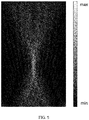
- FIG. 5 is a diagram of an acoustic pressure field at a focus point.
- FIG. 5 shows a focused sound field obtained through numerical computation and simulation by use of the time reversal technique. Simulation results in FIG. 5 are obtained by use of only a single row of array transducers.
- the sound field is incoming upward from the bottom and the sound field is surrounded by absorbing boundary conditions.
- a depth of the color in the figure represents an intensity of the sound field; and the darker the color, the stronger the sound field.
- FIG. 6 illustrates experimental devices based on the time reversal technique.
- FIG. 7 illustrates experimental results for manipulating particles based on the time reversal technique.
- FIG. 6(a) shows an experimental device with two-dimensional array transducers.
- FIG. 6(b) shows a signal reception and transmission control system.
- a point source is arranged in the manipulation space (including the non-uniform medium) to transmit acoustic signals.
- the four two-dimensional arrays of transducers After receiving the acoustic signals, the four two-dimensional arrays of transducers process the acoustic signals, perform the time reversal processing on signals received by each transducer, and transmit the processed signals. That means, one acoustic signal that is received earlier than another signal is to be transmitted later than the another signal, while one acoustic signal that is received later than another signal is to be transmitted earlier than the another signal.
- the acoustic signals will focus at the point source, generate the acoustic potential well, and capture the particles. By adjusting phases, the acoustic signals can focus in any path and generate the acoustic potential well to manipulate the particles in any path.
- the experimental results are as shown in FIG. 7. FIG.
- FIG. 7 (a) shows captured round foam balls floating in the air at an upper portion with respect to the whole space.
- FIG. 7(b) shows the captured round foam balls floating in the air at a lower portion with respect to the whole space. Therefore, the experiments show that the present disclosure can manipulate the particles, such as the round foam balls, in any path in the total space.
- the system for manipulating particles based on the time reversal technique refers to any system capable of controlling the reception and transmission of the acoustic signals.
- a resonant frequency of the transducers used for manipulating the particles is not limited to 40 kHz, and may be any frequency selected for manipulating the particles according to specific conditions and requirements.
- the manipulated particles are not limited to the foam balls, and may be particles of any diameter, material and shape.
- the specific number of array elements in the array transducers is not limited.
- the array transducers may be one-dimensional arrays or two-dimensional arrays. In addition to a plane, the array transducers may have a shape of a circular arc or other appropriate shape.
Landscapes
- Engineering & Computer Science (AREA)
- Health & Medical Sciences (AREA)
- Physics & Mathematics (AREA)
- Life Sciences & Earth Sciences (AREA)
- Radar, Positioning & Navigation (AREA)
- Remote Sensing (AREA)
- Veterinary Medicine (AREA)
- Public Health (AREA)
- General Health & Medical Sciences (AREA)
- Biomedical Technology (AREA)
- Heart & Thoracic Surgery (AREA)
- Animal Behavior & Ethology (AREA)
- Acoustics & Sound (AREA)
- Medical Informatics (AREA)
- Anesthesiology (AREA)
- Hematology (AREA)
- General Physics & Mathematics (AREA)
- Computer Networks & Wireless Communication (AREA)
- Dermatology (AREA)
- Pathology (AREA)
- Nuclear Medicine, Radiotherapy & Molecular Imaging (AREA)
- Biophysics (AREA)
- Radiology & Medical Imaging (AREA)
- Molecular Biology (AREA)
- Surgery (AREA)
- Multimedia (AREA)
- Ultra Sonic Daignosis Equipment (AREA)
- Surgical Instruments (AREA)
- Investigating Or Analyzing Materials By The Use Of Ultrasonic Waves (AREA)
Abstract
Description
- The present disclosure generally relates to the acoustic manipulation technology and, in particular, to a system and method for manipulating particles based on a time reversal technique.
- As a mechanical wave, a sound wave can exchange momentum and energy with particles in a sound field to generate an acoustic radiation force to manipulate the movements of the particles. The acoustic manipulation technology has been applied into many fields such as physics, chemistry and biology, and has received extensive attention due to the advantages of no contact, no damage and good biocompatibility. The current acoustic manipulation technology and devices are mainly used to manipulate objects in the uniform medium (such as water and air) with uniform acoustic parameters such as a density and a sound velocity because the propagation and distribution of the sound waves are precisely controllable in the uniform medium and the necessary sound field profile can be synthesized. The non-uniform distribution of the acoustic parameters such as the density and the sound velocity in the complex non-uniform medium (such as a human body) results in complex acoustic reflection, scattering, refraction and absorption processes, and it is difficult to accurately model the propagation and energy distribution of the sound waves. Therefore, it is difficult to generate the sound field such as a focusing field, a standing wave field and a vortex field in the non-uniform medium by utilizing the current acoustic manipulation technology and thus it is difficult to manipulate the particles in the non-uniform medium. This greatly limits the applications of the acoustic manipulation devices in the fields such as in vivo site-specific medicament administration and reproductive medicine.
- It is known that a pair of ultrasonic transducers has been utilized to generate standing waves (see Wu, J, Acoutiscal tweezers. J. Acoust. Soc. Am. 1991. 89 (5), 2140-2143.) or a single-element high-frequency transducer is utilized to generate the focusing sound field (see Lee J, Teh S, Y Lee, A Kim, H. H Lee, Shung K. K. Single beam acoustic trapping. Appl Phys Lett. 2009. 95 (7), 73701(1)-73707(3).) to manipulate the particles in the water. In addition, two-dimensional array transducers have been developed to precisely control phases in the air or water to achieve of manipulating the particles in any preset path (see Courtney, Charles R. P. Demore, Christine E. M., Wu Hongxiao, Grinenko Alon, Wilcox Paul D., Cochran Sandy, Drinkwater Bruce W. Independent trapping and manipulation of microparticles using dexterous acoustic tweezers; Appl Phys Lett. 2014. 104 (15), 154103(1)-154103(4). or Marzo Asier, Seah Sue Ann, Drinkwater Bruce W., Sahoo Deepak Ranjan, Long Benjamin, Subramanian Sriram; Nature Communications. 2015.6, 1-6. or Yoichi Ochiai, Takayuki Hoshi, Jun Rekimoto. Three-Dimensional Mid-Air Acoustic Manipulation by Ultrasonic Phased Arrays. PLOS one, 9(5), 1-5.). The systems for manipulating the particles involved in the existing art still manipulate the particles in the uniform medium although the systems have some progress compared with those in the previous art. In is still difficult to manipulate the particles in the non-uniform medium. This is because the complex scattering and refraction of the sound waves in the non-uniform medium makes it difficult for a transducer to directly emit the sound field and directly generate the focusing field, the vortex field etc. at a specific site so that it is difficult to generate an acoustic potential well for manipulating the particles. This greatly limits the applications of the acoustic manipulation technology.
- In view of this, a new technology needs to be developed to overcome these defects.
- In view of the defects in the existing art, the present disclosure provides a system and method for manipulating particles based on a time reversal technique to manipulate the particles in any path in a non-uniform medium.
- In an aspect, the present disclosure provides a system for manipulating the particles based on a time reversal technique. The system includes array transducers, a point source, a signal reception and transmission control device and a host. The array transducers consist of a single element or multiple elements. The array transducers are communicatively connected to the signal reception and transmission control device. The signal reception and transmission control device is communicatively connected to the host. The host is capable of performing time reversal processing on received signals (preferable acoustic signals). In one embodiment, the present disclosure may further simulate transmission of signals from a virtual point source in a total space (uniform or non-uniform medium) by use of a numerical computation method (such as a finite difference time domain (FDTD) method), perform time reversal processing (perform appropriate signal processing) on the acoustic signals received by virtual probe points (probe positions of the array transducers), and output the processed signals to the array transducers for transmission. This method is particularly applied to in vivo site-specific medicament administration with ultrasonic waves in a case where a point source cannot be arranged in a medium.
- Preferably, the array transducers are configured to receive and transmit signals; the signal reception and transmission control device is configured to process and transfer signals received by the array transducers and signals transmitted by the host; and the host is configured to process signals transmitted from the signal reception and transmission control device and transmit signals.
- More preferably, the array transducers are configured to receive and transmit the acoustic signals; the signal reception and transmission control device is configured to process and transfer the acoustic signals received by the array transducers and instruction signals transmitted by the host; and the host is configured to process control signals transmitted from the signal reception and transmission control device and transmit the instruction signals.
- Preferably, the array transducers are a one-dimensional array or a two-dimensional array, and are composed of at least one row. Four rows of transducers are proved and selected here. In addition, each row of transducer arrays should have a larger number of lattices. Here a lattice transducer with a 22∗22 array is used. The array transducers have a shape of a plane or a circular arc.
- The present disclosure further provides a method for manipulating the particles based on a time reversal technique. The method may include the following steps: a point source in a medium moves along any preset path and transmits acoustic signals; array transducers receive the acoustic signals transmitted by the point source and penetrating through a non-uniform medium and sequentially transmit the acoustic signals to a signal reception and transmission control device and a host; the host performs time reversal processing on received acoustic signals; the array transducers are caused to transmit the processed acoustic signals; and the particles move along a preset path (a path which the point source moves through).
- Furthermore, the method for manipulating the particles based on the time reversal technique may include the following steps: a host receives acoustic signals from a point source; the host performs time reversal processing on the received acoustic signals and transmits the acoustic signals subject to the time reversal processing to array transducers; the array transducers are caused to transmit the acoustic signals subject to the time reversal processing into a medium; and the particles at a position of the point source (preferably an initial position of the point source) are caused to move along a motion trajectory of the point source. The point source may be a physical point source, and the method may accordingly include the following steps: the physical point source in the medium is caused to move along a path which the particles are to move through and transmit the acoustic signals; the array transducers receive the acoustic signals transmitted by the physical point source in motion and penetrating through a non-uniform medium and sequentially transmit the acoustic signals to a signal reception and transmission control device and the host; the host performs the time reversal processing on the received acoustic signals and transmits the acoustic signals subject to the time reversal processing to the array transducers; the array transducers are caused to transmit the acoustic signals subject to the time reversal processing into the medium; and the particles at a position of the physical point source (preferably an initial position of the physical point source) are caused to move along a motion trajectory of the physical point source. The point source may also be a virtual point source, and the method may accordingly include the following steps: by utilizing a numerical computation method, motion of the virtual point source in a total space with the uniform or non-uniform medium is simulated and transmission of the acoustic signals by the virtual point source is simulated; reception of the acoustic signals by the array transducers and input of the acoustic signals into the host by the array transducers are simulated; the host performs the time reversal processing on the received acoustic signals; the array transducers are caused to transmit the processed acoustic signals; and the particles at a position of the virtual point source (preferably an initial position of the virtual point source) are caused to move along a motion trajectory of the virtual point source.
- Preferably, in the method, the time reversal processing refers to that one acoustic signal that is received earlier than another signal is to be transmitted later than the another signal, while one acoustic signal that is received later than another signal is to be transmitted earlier than the another signal.
- Preferably, in the method, the particles are captured and manipulated when the acoustic signals transmitted by the array transducers focus at the position of the point source and generate an acoustic potential well.
- Preferably, in the method, the point source is continuously moving and the medium is a uniform medium or the non-uniform medium. The method may further include manipulating the motion path of the particles in the medium or manipulating the particles in any path in the medium. Preferably, in the method, a resonance frequency of the array transducers ranges between 1 kHz and 500 MHz, and preferably ranges between 20 kHz and 50 MHz.
- Preferably, in the method, the particles are foam balls and the resonance frequency of the array transducers is 40 kHz.
- An acoustic time reversal technique is an adaptive focusing method with unique advantages. Regardless of conditions of the medium and the array transducers, the adaptive focusing may be implemented without prior knowledge (such as the spatial distribution of medium parameters such as a density, a sound velocity, an attenuation coefficient and a transducer transmission function). The particles will be captured near the acoustic potential well for manipulating the particles generated at the focusing point. Therefore, the acoustic time reversal technique can implement focusing and particle manipulation in the non-uniform medium. The present disclosure using the acoustic time reversal technique overcomes the current limitation that an acoustic manipulation device cannot manipulate the particles in any path in the non-uniform medium. When the acoustic time reversal technique mentioned in the patent is combined with an electronic system, the particles can be manipulated in any path in any medium (including the uniform medium or the non-uniform medium). Therefore, the acoustic manipulation device can be applied to fields such as in vivo site-specific medicament administration and reproductive medicine and has high practical values.
-
-
FIG. 1 is a schematic diagram illustrating connection between components in a system for manipulating particles based on a time reversal technique. -
FIG. 2 is a flowchart of a method for manipulating particles based on the time reversal technique. -
FIG. 3 is a schematic diagram of signal reception by a system for manipulating particles based on the time reversal technique. -
FIG. 4 is a schematic diagram of signal transmission by a system for manipulating particles based on the time reversal technique. -
FIG. 5 is a diagram of an acoustic pressure field at a focus point. -
FIG. 6 illustrates experimental devices based on the time reversal technique. -
FIG. 7 illustrates experimental results for manipulating particles based on the time reversal technique. - Specific embodiments of the present disclosure will be described below in conjunction with the drawings. In the specific embodiments described hereinafter of the present disclosure, some specific features are described for a better understanding of the present disclosure and all the specific features are not essential features for implementing the present disclosure, which is apparent to those skilled in the art. The specific embodiments described hereinafter of the present disclosure are only exemplary specific embodiments of the present disclosure and not intended to limit the present disclosure. In addition, to avoid a difficult understanding of the present disclosure, some well-known techniques are not described herein.
-
FIG. 1 is a schematic diagram illustrating connection between components in a system for manipulating particles based on a time reversal technique.Reference numerals 101a-101d denote four rows of array transducers arranged in a square, and each row of array transducers includes 22∗22 transducers. Areference numeral 102 denotes a signal reception and transmission control device and areference numeral 103 denotes a host. The four rows of array transducers are respectively communicatively connected to the signal reception and transmission control device. The signal reception and transmission control device is communicatively connected to the host. The array transducers receive and transmit acoustic signals. The signal reception and transmission control device processes and transfers electronic signals received by the array transducers and transmitted by the host. The host delivers signal instructions and processes control signals transmitted from the signal reception and transmission control device. In another embodiment, there are six rows of array transducers arranged in a hexagon. In another embodiment, there are eight rows of array transducers arranged in an octagon. In another embodiment, the array transducers are arc-shaped and arranged in a circle. -
FIG. 2 is a flowchart of a method for manipulating particles based on the time reversal technique. In one embodiment, the method is performed in a non-uniform medium and includessteps 201 to 205. Instep 201, a physical point source is arranged in the non-uniform medium to actively transmit the acoustic signals. Instep 202, the array transducers receive the acoustic signals transmitted by the physical point source and penetrating through the non-uniform medium, and upload the acoustic signals to a control system and an interface of the host. Instep 203, the host performs time reversal processing on the received acoustic signals. Instep 204, the array transducers are caused to transmit the acoustic signals subject to the time reversal processing. Instep 205, a motion trajectory of the particles at a position of the physical point source is monitored. The non-uniform medium is a medium of different densities (which may be understood as the presence of an obstacle, a human body tissue or a gelatinous liquid, etc., in a manipulation space). The physical point source is a needle transducer smaller than a wavelength, which transmits a sound field which approximates a point source sound field. In another embodiment, the medium is a uniform medium such as air. - In both the above two embodiments, the particles may be captured and manipulated. This is because the acoustic signals transmitted by the planer array transducers focus at the position of a sound source and can generate an acoustic potential well. In the non-uniform medium, the point source is continuously moved in an arbitrary manner, and the array transducers continuously receive the signals and upload all the received signals to the host. The host stores and processes the signals in a way in which one acoustic signal that is received earlier than another signal is to be transmitted later than the another signal, while one acoustic signal that is received later than another signal is to be transmitted earlier than the another signal. In this way, the acoustic signals will also move and focus in the non-uniform medium to generate a moving acoustic potential well. Therefore, the particles can be manipulated in any path.
- In another embodiment (not shown in drawings), a virtual point source is used in the method for manipulating particles based on the time reversal technique and the method includes the steps described below. (1) By utilizing a finite difference time domain (FDTD) method, motion of the virtual point source in a total space with the uniform and non-uniform medium is simulated and transmission of the acoustic signals by the virtual point source is simulated. (2) Reception of the acoustic signals by the array transducers and input of the acoustic signals into the host by the array transducers are simulated. (3) The host performs the time reversal processing on the received acoustic signals. (4) The array transducers transmit the processed acoustic signals. (5) The acoustic signals at an initial position of the virtual point source are caused to move along the motion trajectory of the virtual point source. The method described in the embodiment is particularly effective for in vivo site-specific medicament administration with ultrasonic waves in the case where a point source cannot be arranged in the medium, with strong practicability.
-
FIG. 3 is a schematic diagram of signal reception by the system for manipulating particles based on the time reversal technique. Areference numeral 301 denotes the point source. Areference numeral 302 is a schematic diagram of a portion taken from the ultrasonic array transducers. Areference numeral 303 is a schematic diagram of a portion of the non-uniform medium (the uniform medium in another embodiment). As shown inFIG. 3 , the acoustic signals are transmitted all around from the point source in directions indicated by arrows, penetrate through the non-uniform medium and arrive at the ultrasonic array transducers. The ultrasonic array transducers send the received acoustic signals to the signal reception and transmission control device (not shown inFIG. 3 and referred to 102 inFIG. 1 ). The signal reception and transmission control device sends the acoustic signals to the host (not shown inFIG. 3 and referred to 103 inFIG. 1 ). -
FIG. 4 is a schematic diagram of signal transmission by a system for manipulating particles based on the time reversal technique. Areference numeral 401 denotes the point source. Areference numeral 402 is a schematic diagram of a portion taken from the ultrasonic array transducers. Areference numeral 403 is a schematic diagram of a portion of the non-uniform medium. As described with reference toFIG. 3 , the acoustic signals transmitted from the point source pass the non-uniform medium, the ultrasonic array transducers and the signal reception and transmission control device, and arrive at the host. The host performs the time reversal processing on the received acoustic signals, which refers to that one acoustic signal that is received earlier than another signal is to be transmitted later than the another signal, while one acoustic signal that is received later than another signal is to be transmitted earlier than the another signal. The signals are transmitted from the host to acoustic particles in directions opposite to the directions in which the signals are received, that is, the signals pass the signal reception and transmission control device, the ultrasonic array transducers and the non-uniform medium, and arrive at the point source. In this process, since the sound waves emitted by the particles will also move and focus in the non-uniform medium (or the uniform medium), the particles can be manipulated in any path and any medium (including the non-uniform medium and the uniform medium) by combining the system with an electronic system (not shown). -
FIG. 5 is a diagram of an acoustic pressure field at a focus point.FIG. 5 shows a focused sound field obtained through numerical computation and simulation by use of the time reversal technique. Simulation results inFIG. 5 are obtained by use of only a single row of array transducers. The sound field is incoming upward from the bottom and the sound field is surrounded by absorbing boundary conditions. A depth of the color in the figure represents an intensity of the sound field; and the darker the color, the stronger the sound field. -
FIG. 6 illustrates experimental devices based on the time reversal technique.FIG. 7 illustrates experimental results for manipulating particles based on the time reversal technique. - Feasibility of the solutions of the present disclosure is proved from theoretical and experimental perspectives in conjunction with the results shown in
FIGs 5 ,6 and7 . In an experiment, an inventor uses four two-dimensional arrays of 22∗22 transducers with a central frequency of 40 kHz to manipulate the particles. Two ones of the four two-dimensional arrays face to each other, and the other two ones of the four two-dimensional arrays face to each other.FIG. 6(a) shows an experimental device with two-dimensional array transducers.FIG. 6(b) shows a signal reception and transmission control system. A point source is arranged in the manipulation space (including the non-uniform medium) to transmit acoustic signals. After receiving the acoustic signals, the four two-dimensional arrays of transducers process the acoustic signals, perform the time reversal processing on signals received by each transducer, and transmit the processed signals. That means, one acoustic signal that is received earlier than another signal is to be transmitted later than the another signal, while one acoustic signal that is received later than another signal is to be transmitted earlier than the another signal. The acoustic signals will focus at the point source, generate the acoustic potential well, and capture the particles. By adjusting phases, the acoustic signals can focus in any path and generate the acoustic potential well to manipulate the particles in any path. The experimental results are as shown inFIG. 7. FIG. 7 (a) shows captured round foam balls floating in the air at an upper portion with respect to the whole space.FIG. 7(b) shows the captured round foam balls floating in the air at a lower portion with respect to the whole space. Therefore, the experiments show that the present disclosure can manipulate the particles, such as the round foam balls, in any path in the total space. - It is to be noted that the system for manipulating particles based on the time reversal technique refers to any system capable of controlling the reception and transmission of the acoustic signals. A resonant frequency of the transducers used for manipulating the particles is not limited to 40 kHz, and may be any frequency selected for manipulating the particles according to specific conditions and requirements. The manipulated particles are not limited to the foam balls, and may be particles of any diameter, material and shape. The specific number of array elements in the array transducers is not limited. The array transducers may be one-dimensional arrays or two-dimensional arrays. In addition to a plane, the array transducers may have a shape of a circular arc or other appropriate shape.
- Although the present disclosure is described through the preferred embodiments, modifications, permutations and various equivalent substitutions are possible within the scope of the present disclosure. It is to be noted that there are many alternative ways of implementing the method and system of the present disclosure. Therefore, it is intended that the appended claims shall be construed to include all the modifications, permutations and various equivalent substitutions within the spirit and scope of the present disclosure.
Claims (10)
- A system for manipulating particles based on a time reversal technique, comprising:array transducers;a point source;a signal reception and transmission control device, anda host for performing time reversal processing on received signals;wherein the array transducers are communicatively connected to the signal reception and transmission control device; and the signal reception and transmission control device is communicatively connected to the host.
- The system of claim 1, wherein
the array transducers are configured to receive and transmit signals;
the signal reception and transmission control device is configured to process and transfer signals received by the array transducers and signals transmitted by the host; and
the host is configured to process signals transmitted from the signal reception and transmission control device and transmit signals. - The system of claim 2, wherein
the array transducers are configured to receive and transmit acoustic signals;
the signal reception and transmission control device is configured to process and transfer the acoustic signals received by the array transducers and instruction signals transmitted by the host; and
the host is configured to process control signals transmitted from the signal reception and transmission control device and transmit the instruction signals. - The system of any one of claims 1 to 3, wherein the array transducers are a one-dimensional array or a two-dimensional array, and comprise at least one row of array elements or more array elements, wherein the array transducers have a shape of a plane or a circular arc.
- A method for manipulating particles based on a time reversal technique, comprising:receiving, by a host, acoustic signals from a point source moving in a medium;performing, by the host, time reversal processing on the received acoustic signals;transmitting, by the host, the acoustic signals subject to the time reversal processing to array transducers; causing the array transducers to transmit the acoustic signals subject to the time reversal processing into the medium; andcausing the particles in a position of the point source to move along a motion trajectory of the point source.
- The method of claim 5, wherein the point source is a physical point source and the method further comprises:causing the physical point source in the medium to move along a path which the particles are to move through and transmit the acoustic signals; andreceiving, by the array transducers, the acoustic signals transmitted from the physical point source in motion and penetrating through a non-uniform medium, and sequentially transmitting the acoustic signals to the signal reception and transmission control device and the host of any one of claims 1 to 4.
- The method of claim 5, wherein the point source is a virtual point source and the method further comprises:simulating, by utilizing a numerical computation method, motion of the virtual point source in a total space with a uniform or non-uniform medium and transmission of the acoustic signals by the virtual point source; andsimulating reception of the acoustic signals by the array transducers and input of the acoustic signals into the host by the array transducers.
- The method of claim 5, 6 or 7, wherein the time reversal processing refers to that one acoustic signal that is received earlier than another signal is to be transmitted later than the another signal, while one acoustic signal that is received later than another signal is to be transmitted earlier than the another signal.
- The method of claim 5, 6 or 7, further comprising: capturing the particles when the acoustic signals transmitted by the array transducers focus at the position of the point source and generate an acoustic potential well.
- The method of claim 5, 6 or 7, wherein the array transducers have a resonance frequency between 1 kHz and 500 MHz, and the position of the point source is an initial position of the point source.
Applications Claiming Priority (2)
| Application Number | Priority Date | Filing Date | Title |
|---|---|---|---|
| CN201710214161.4A CN107050630B (en) | 2017-04-01 | 2017-04-01 | A system and method for manipulating particles based on time reversal technology |
| PCT/CN2017/081071 WO2018176526A1 (en) | 2017-04-01 | 2017-04-19 | Time reversal technique-based system and method for manipulating particles |
Publications (2)
| Publication Number | Publication Date |
|---|---|
| EP3607991A1 true EP3607991A1 (en) | 2020-02-12 |
| EP3607991A4 EP3607991A4 (en) | 2021-01-13 |
Family
ID=59603326
Family Applications (1)
| Application Number | Title | Priority Date | Filing Date |
|---|---|---|---|
| EP17903960.7A Withdrawn EP3607991A4 (en) | 2017-04-01 | 2017-04-19 | SYSTEM AND METHOD FOR MANIPULATING PARTICLES BASED ON TIME REVERSE TECHNOLOGY |
Country Status (4)
| Country | Link |
|---|---|
| US (1) | US20190374764A1 (en) |
| EP (1) | EP3607991A4 (en) |
| CN (1) | CN107050630B (en) |
| WO (1) | WO2018176526A1 (en) |
Cited By (1)
| Publication number | Priority date | Publication date | Assignee | Title |
|---|---|---|---|---|
| CN112349446A (en) * | 2020-11-03 | 2021-02-09 | 深圳先进技术研究院 | Control method and acoustic tweezers device |
Families Citing this family (9)
| Publication number | Priority date | Publication date | Assignee | Title |
|---|---|---|---|---|
| US11109139B2 (en) * | 2019-07-29 | 2021-08-31 | Universal City Studios Llc | Systems and methods to shape a medium |
| CN110730042B (en) * | 2019-07-30 | 2021-02-19 | 深圳先进技术研究院 | A communication method and device |
| CN111013518B (en) * | 2019-12-12 | 2020-12-08 | 深圳先进技术研究院 | Acoustic tweezers device and manipulation method for particles |
| CN111494816A (en) * | 2020-02-28 | 2020-08-07 | 南北兄弟药业投资有限公司 | Ultrasonic precise self-adaptive focusing system and method |
| CN112394323A (en) * | 2020-11-24 | 2021-02-23 | 电子科技大学 | Spatial arbitrary point pulse acoustic focusing system and method based on time reversal method |
| CN112904347B (en) * | 2021-01-19 | 2023-05-26 | 鹏城实验室 | Imaging system and method |
| CN114160070A (en) * | 2021-12-02 | 2022-03-11 | 深圳先进技术研究院 | Control method, acoustic tweezers device and microscopic equipment applying acoustic tweezers device |
| CN114146890B (en) * | 2021-12-03 | 2022-09-13 | 深圳先进技术研究院 | Ultrasonic sound control method and sound tweezers device |
| WO2023102774A1 (en) * | 2021-12-08 | 2023-06-15 | 深圳先进技术研究院 | Acoustic control method and system based on human-machine interaction |
Family Cites Families (13)
| Publication number | Priority date | Publication date | Assignee | Title |
|---|---|---|---|---|
| US5935068A (en) * | 1996-11-01 | 1999-08-10 | The Trustees Of The University Of Pennsylvania | System and method for improving ultrasound image contrast by amplitude compression of ultrasonic wavefront signals |
| AU2001245831A1 (en) * | 2000-03-15 | 2001-09-24 | The Regents Of The University Of California | Method and apparatus for dynamic focusing of ultrasound energy |
| US20080242979A1 (en) * | 2007-03-30 | 2008-10-02 | Rayette Ann Fisher | Combined X-ray detector and ultrasound imager |
| US8545405B2 (en) * | 2008-04-23 | 2013-10-01 | Therataxis, Llc | Device, methods, and control for sonic guidance of molecules and other material utilizing time-reversal acoustics |
| CN102621223B (en) * | 2011-01-31 | 2013-10-16 | 中国科学院声学研究所 | Ultrasonic scanning and detection method based on sonic time reversal method |
| CN202637748U (en) * | 2012-05-07 | 2013-01-02 | 中国科学院声学研究所 | Focusing device |
| CN102657918B (en) * | 2012-05-07 | 2015-09-09 | 中国科学院声学研究所 | A kind of focus method and device |
| CN103203328B (en) * | 2013-03-14 | 2015-08-12 | 深圳先进技术研究院 | The system and method for the manipulation of structure based sound field and screening particle |
| CN104545914B (en) * | 2013-10-21 | 2017-12-08 | 深圳先进技术研究院 | Method for separate imaging of water and fat and system |
| CN104548390B (en) * | 2014-12-26 | 2018-03-23 | 中国科学院深圳先进技术研究院 | It is a kind of to obtain the method and system that the ultrasound emission sequence that cranium focuses on ultrasound is worn for launching |
| CN105535968A (en) * | 2015-12-11 | 2016-05-04 | 中国科学院深圳先进技术研究院 | Nanoparticle targeted delivery method based on sound field control |
| CN105759256B (en) * | 2016-03-17 | 2017-12-01 | 浙江大学 | A kind of underwater sound projector sends response time reversion and focuses on measuring method |
| CN106373706B (en) * | 2016-09-05 | 2018-06-19 | 电子科技大学 | The double focusing field electromagnetism tweezer implementation method of focus mechanism during based on time reversal sky |
-
2017
- 2017-04-01 CN CN201710214161.4A patent/CN107050630B/en active Active
- 2017-04-19 US US16/487,310 patent/US20190374764A1/en not_active Abandoned
- 2017-04-19 EP EP17903960.7A patent/EP3607991A4/en not_active Withdrawn
- 2017-04-19 WO PCT/CN2017/081071 patent/WO2018176526A1/en not_active Ceased
Cited By (1)
| Publication number | Priority date | Publication date | Assignee | Title |
|---|---|---|---|---|
| CN112349446A (en) * | 2020-11-03 | 2021-02-09 | 深圳先进技术研究院 | Control method and acoustic tweezers device |
Also Published As
| Publication number | Publication date |
|---|---|
| US20190374764A1 (en) | 2019-12-12 |
| CN107050630A (en) | 2017-08-18 |
| EP3607991A4 (en) | 2021-01-13 |
| WO2018176526A1 (en) | 2018-10-04 |
| CN107050630B (en) | 2020-12-08 |
Similar Documents
| Publication | Publication Date | Title |
|---|---|---|
| US20190374764A1 (en) | System and method for manipulating particles based on a time reversal technique | |
| CN111013518B (en) | Acoustic tweezers device and manipulation method for particles | |
| CN106730424B (en) | Hundred microsecond pulse ultrasonic tissue of confocal harmonic superposition damages mode control method | |
| US7587291B1 (en) | Focusing of broadband acoustic signals using time-reversed acoustics | |
| CN109689160B (en) | Therapeutic ultrasound with reduced interference from microbubbles | |
| CN109939913B (en) | An acoustic tweezers device | |
| CN112349446B (en) | Control method and acoustic tweezers device | |
| Aubry et al. | Transcostal high-intensity-focused ultrasound: ex vivo adaptive focusing feasibility study | |
| US20190001159A1 (en) | Steerable high-intensity focused ultrasound (hifu) elements | |
| CN105848717A (en) | Method for operating a device for treatment of a tissue and device for treatment of a tissue | |
| RU2662902C1 (en) | Method and device for creation of high-intensity focused ultrasound fields for noninvasive local destruction of biological tissue | |
| CN109564078A (en) | A kind of system and method for cleaning equipment | |
| Khokhlova et al. | Design of HIFU transducers to generate specific nonlinear ultrasound fields | |
| JP2022512032A5 (en) | ||
| CN112023244A (en) | Transdermal drug delivery device with ultrasonic multipoint focusing emission and control method | |
| CN106373706B (en) | The double focusing field electromagnetism tweezer implementation method of focus mechanism during based on time reversal sky | |
| KR102224825B1 (en) | Microrobot Drive system Using Single Direction Ultrasonic Transducer and System Using It | |
| KR102329113B1 (en) | An ultrasonic imaging apparatus and a method for controlling the same | |
| Prego-Borges et al. | Producing acoustic frozen waves: simulated experiments | |
| Zhou et al. | Time-sharing acoustic tweezers for parallel manipulation of multiple particles | |
| JP5937890B2 (en) | Ultrasound therapy system | |
| RU2472545C1 (en) | Method for non-invasive destruction of biological tissues lying behind thoracic bones | |
| Long et al. | Comparison of phase optimization algorithms for particle manipulation via acoustic tweezer | |
| Jeong | Dual concentric-sectored HIFU transducer with phase-shifted ultrasound excitation for expanded necrotic region: A simulation study | |
| CN106934234A (en) | It is a kind of to construct the method that bending standing wave manipulation particle is moved along serpentine track |
Legal Events
| Date | Code | Title | Description |
|---|---|---|---|
| STAA | Information on the status of an ep patent application or granted ep patent |
Free format text: STATUS: THE INTERNATIONAL PUBLICATION HAS BEEN MADE |
|
| PUAI | Public reference made under article 153(3) epc to a published international application that has entered the european phase |
Free format text: ORIGINAL CODE: 0009012 |
|
| STAA | Information on the status of an ep patent application or granted ep patent |
Free format text: STATUS: REQUEST FOR EXAMINATION WAS MADE |
|
| 17P | Request for examination filed |
Effective date: 20190808 |
|
| AK | Designated contracting states |
Kind code of ref document: A1 Designated state(s): AL AT BE BG CH CY CZ DE DK EE ES FI FR GB GR HR HU IE IS IT LI LT LU LV MC MK MT NL NO PL PT RO RS SE SI SK SM TR |
|
| AX | Request for extension of the european patent |
Extension state: BA ME |
|
| DAV | Request for validation of the european patent (deleted) | ||
| DAX | Request for extension of the european patent (deleted) | ||
| REG | Reference to a national code |
Ref country code: DE Ref legal event code: R079 Free format text: PREVIOUS MAIN CLASS: A61M0031000000 Ipc: G10K0015000000 |
|
| A4 | Supplementary search report drawn up and despatched |
Effective date: 20201216 |
|
| RIC1 | Information provided on ipc code assigned before grant |
Ipc: A61M 31/00 20060101ALI20201210BHEP Ipc: A61M 37/00 20060101ALI20201210BHEP Ipc: G10K 15/00 20060101AFI20201210BHEP |
|
| STAA | Information on the status of an ep patent application or granted ep patent |
Free format text: STATUS: EXAMINATION IS IN PROGRESS |
|
| 17Q | First examination report despatched |
Effective date: 20220921 |
|
| STAA | Information on the status of an ep patent application or granted ep patent |
Free format text: STATUS: THE APPLICATION IS DEEMED TO BE WITHDRAWN |
|
| 18D | Application deemed to be withdrawn |
Effective date: 20230202 |