EP3607646B1 - Molecular machine - Google Patents
Molecular machine Download PDFInfo
- Publication number
- EP3607646B1 EP3607646B1 EP18714543.8A EP18714543A EP3607646B1 EP 3607646 B1 EP3607646 B1 EP 3607646B1 EP 18714543 A EP18714543 A EP 18714543A EP 3607646 B1 EP3607646 B1 EP 3607646B1
- Authority
- EP
- European Patent Office
- Prior art keywords
- yes yes
- yes
- basics
- molecular
- arm
- Prior art date
- Legal status (The legal status is an assumption and is not a legal conclusion. Google has not performed a legal analysis and makes no representation as to the accuracy of the status listed.)
- Active
Links
Images







Classifications
-
- B—PERFORMING OPERATIONS; TRANSPORTING
- B82—NANOTECHNOLOGY
- B82B—NANOSTRUCTURES FORMED BY MANIPULATION OF INDIVIDUAL ATOMS, MOLECULES, OR LIMITED COLLECTIONS OF ATOMS OR MOLECULES AS DISCRETE UNITS; MANUFACTURE OR TREATMENT THEREOF
- B82B1/00—Nanostructures formed by manipulation of individual atoms or molecules, or limited collections of atoms or molecules as discrete units
- B82B1/002—Devices comprising flexible or deformable elements
-
- B—PERFORMING OPERATIONS; TRANSPORTING
- B81—MICROSTRUCTURAL TECHNOLOGY
- B81B—MICROSTRUCTURAL DEVICES OR SYSTEMS, e.g. MICROMECHANICAL DEVICES
- B81B5/00—Devices comprising elements which are movable in relation to each other, e.g. comprising slidable or rotatable elements
-
- B—PERFORMING OPERATIONS; TRANSPORTING
- B82—NANOTECHNOLOGY
- B82B—NANOSTRUCTURES FORMED BY MANIPULATION OF INDIVIDUAL ATOMS, MOLECULES, OR LIMITED COLLECTIONS OF ATOMS OR MOLECULES AS DISCRETE UNITS; MANUFACTURE OR TREATMENT THEREOF
- B82B1/00—Nanostructures formed by manipulation of individual atoms or molecules, or limited collections of atoms or molecules as discrete units
- B82B1/003—Devices comprising elements which are movable in relation to each other, e.g. slidable or rotatable
-
- C—CHEMISTRY; METALLURGY
- C12—BIOCHEMISTRY; BEER; SPIRITS; WINE; VINEGAR; MICROBIOLOGY; ENZYMOLOGY; MUTATION OR GENETIC ENGINEERING
- C12Q—MEASURING OR TESTING PROCESSES INVOLVING ENZYMES, NUCLEIC ACIDS OR MICROORGANISMS; COMPOSITIONS OR TEST PAPERS THEREFOR; PROCESSES OF PREPARING SUCH COMPOSITIONS; CONDITION-RESPONSIVE CONTROL IN MICROBIOLOGICAL OR ENZYMOLOGICAL PROCESSES
- C12Q1/00—Measuring or testing processes involving enzymes, nucleic acids or microorganisms; Compositions therefor; Processes of preparing such compositions
- C12Q1/68—Measuring or testing processes involving enzymes, nucleic acids or microorganisms; Compositions therefor; Processes of preparing such compositions involving nucleic acids
-
- B—PERFORMING OPERATIONS; TRANSPORTING
- B81—MICROSTRUCTURAL TECHNOLOGY
- B81B—MICROSTRUCTURAL DEVICES OR SYSTEMS, e.g. MICROMECHANICAL DEVICES
- B81B2201/00—Specific applications of microelectromechanical systems
- B81B2201/03—Microengines and actuators
- B81B2201/034—Electrical rotating micromachines
Definitions
- the linking element is favorably part of the first molecular element or the second molecular element.
- the first molecular element and/or the second molecular element might comprise a functional group which is adapted to link the first molecular element and the second molecular element.
- the linking element can be part of at least one of two or more mechanically interlocked molecules. This is particularly preferred in a case in which the movement part comprises rotaxanes.
- the first molecular element comprises a linear part and the linking element and the second molecular element comprises a ring structure. The ring structure can rotate about the linear part and the linking element avoids the ring structure slipping off the linear part.
Landscapes
- Chemical & Material Sciences (AREA)
- Engineering & Computer Science (AREA)
- Crystallography & Structural Chemistry (AREA)
- Nanotechnology (AREA)
- Life Sciences & Earth Sciences (AREA)
- Organic Chemistry (AREA)
- Zoology (AREA)
- Wood Science & Technology (AREA)
- Proteomics, Peptides & Aminoacids (AREA)
- Health & Medical Sciences (AREA)
- Microbiology (AREA)
- Biochemistry (AREA)
- Biotechnology (AREA)
- Molecular Biology (AREA)
- Biophysics (AREA)
- Analytical Chemistry (AREA)
- Physics & Mathematics (AREA)
- Immunology (AREA)
- Bioinformatics & Cheminformatics (AREA)
- General Engineering & Computer Science (AREA)
- General Health & Medical Sciences (AREA)
- Genetics & Genomics (AREA)
- Computer Hardware Design (AREA)
- Microelectronics & Electronic Packaging (AREA)
- Apparatus Associated With Microorganisms And Enzymes (AREA)
Description
- The invention regards the field of nanotechnology and describes the utilization of electric fields for the manipulation of molecular mechanisms. In this way, a molecular machine is provided, which allows movement in response to said electrical fields.
- In the past decades, several biomolecular mechanisms and machines have been demonstrated for the application in nanotechnology. However, none of them grew past the "proof of principle" phase.
- Among the naturally occurring molecular machines mainly kinesin motors and microtubules were deployed, e.g., for the transport of nanoparticles (cf.
prior art references 1 to 3). In so-called "in vitro motility assays" kinesin motors were fixed on lithographically patterned chip surfaces to transport microtubules through lithographically produced channel systems. Here electric manipulation was also used e.g. for the sorting of microtubules (cf. prior art reference 4). - In the past years, artificial biomolecular nanomachines were mainly produced on the basis of DNA molecules. The production of DNA machines utilizes the characteristic, sequence specific molecular interactions between DNA strands. Adequate choice of DNA sequences allows to "programmably" construct complex molecular structures from single DNA strands. A combination of relatively flexible single stranded DNA components with more rigid double stranded elements allows the construction of molecular mechanisms in which molecular components can be moved relative to each other. These include "DNA tweezers" as well as various "DNA walker" systems. An overview of such systems is given in
prior art reference 5. With the recent development of the so-called "DNA origami method" it has become much easier to construct larger molecular systems (typically on the length scale of 10 - 100 nm). Recently this method was used to construct basic molecular machine elements, including several rotary joint and linear sliding structures (prior art references 6 to 9). - So far, the described molecular mechanisms have been actuated chemically or in some cases photo-chemically. In the case of chemical actuation, e.g., so-called DNA fuel strands were used to drive the movement of a mechanism through DNA strand hybridization reactions. Due to the slow kinetics of these reactions only very slow motion could be realized (
prior art references 10 to 12). The same limitations apply to deoxyribozymes and DNA modifying enzymes (prior art reference 13). - Alternatively, motion of molecular mechanisms was achieved with a change of buffer conditions, e.g. by a change in pH or a change of the solution's ionic conditions. These methods come with the disadvantage that they unspecifically influence all system components and that buffer conditions are often not compatible with the chemistry of potential applications (e.g. enzymes are not functional in the specific conditions, nanoparticles can aggregate, etc.)
- The aforementioned chemical methods typically require the external addition of solutions. In principle, this can be done with the help of microfluidic systems, which could allow a certain degree of automation. However, such an approach requires rather elaborate instruments and causes high material consumption.
- At first glance, an attractive method for external control of nanomachines is based on photoswitchable molecules, typically derivatives of the photoswitchable molecule azobenzene (
prior art references 14 to 16). Incorporation of such photoswitches into DNA double strands makes it possible to destabilize them upon light irradiation (in UV range) and stabilize them by irradiation with light of larger wavelength, and this procedure can be used to drive molecular mechanisms. The downside of this method, apart from the necessary chemical modification of the mechanisms, again is the slow and incomplete switching behavior. -
Prior art reference 22 describes a biosensor including a gold platform. This biosensor allows only binary switching between an adhesive state and a non-adhesive state. No fine adjustment of the movement is possible.Prior art reference 23 describes the movement of molecular mechanisms in response to UV light. - None of the described approaches could ever demonstrate the exertion of a relevant force against an external load.
- It is an object of the present invention to provide a molecular machine which allows quick reaction to control commands, which can generate high forces, and which can provide an exact movement.
- The object is solved by the features of the independent claim. The dependent claims contain advantageous embodiments of the present invention.
- The object is therefore solved by a molecular machine comprising a movement part and a control part. The movement part comprises several machine elements which are adapted to be moved with respect to each other. These machine parts are molecular structures, particularly nanomolecular structures. The movement part includes a first molecular element, a second molecular element and a linking element. The first molecular element and the second molecular element preferably are separate and/or independent elements. The linking element is adapted to constrain a relative movement of the first molecular element and the second molecular element while allowing a relative movement between the first molecular element and the second molecular element in at least one degree of freedom. Preferably, the first molecular element and the second molecular element can not be separated from each other and establish a moving mechanism with the linking element acting as bearing and/or joint.
- In order to control the relative movement of the first molecular element and the second molecular element, the control part is configured to generate an electrical field around the movement part. Preferably, the control part includes an electrical device which applies said electrical field. The first molecular element is fixed relative to the control part such that the first molecular element is fixed relative to the electrical field generating means. Hence, even a change in the electrical field cannot cause a movement of the first molecular element. The first molecular element rather acts as a base for movement of the second molecular element. The second molecular element is therefore the only part which can be moved in response to the electrical field.
- At least the second molecular element is electrically charged. The second molecular element can be an electrically charged molecule, particularly a biomolecule, or can be artificially electrically charged. In particular, an electrically charged functional group can be added to a molecular structure in order to create the electrically charged second molecular element. Due to the electrical charge, the second molecular element aligns to said electrical field. In case the electrical field is changed in orientation, the orientation of the second molecular element is also changed. This means that the control part can control fine adjustment of the second molecular element with respect to the first molecular element. The second molecular element can be transferred to and held in any orientation with respect to the first molecular element that is not prevented by the linking element. Additionally, a continuous movement of the second molecular element can be realized.
- In summary, the movement part sets up the kinematics of the molecular machine, while the control part powers and controls any movement of said kinematics via electric actuation. Electric actuation solves several technical challenges that are currently faced by molecular nanomachines. In particular, electric actuation allows controlling molecular switches and mechanisms faster, with higher precision, and with less complex instrumentation compared to conventional methods. Moreover, the invention offers the solution to a central challenge of nanomanipulation (the "fat fingers" problem) since the externally controlled nanomanipulators are of the same small length scale as the manipulated nanoscale objects and molecules.
- In a preferred embodiment, the control part comprises a fluidic channel. The movement part is provided in the fluidic channel. The control part further comprises an electrical device including electrodes. The electrodes are connected to the fluidic channel. In this way, the electrical field as described above can be created. The electrical device comprises a voltage source and electrical wiring to apply the voltage to the electrodes. Preferably, the electrical device comprises two electrodes for generating the electrical field. Alternatively, the voltage source can be a three-phase voltage source such that the electrical device has three electrodes. This allows providing a rotating electrical field such that the second molecular element can be rotated in a simple way.
- Preferably, the control part comprises at least two electrical devices and fluidic channels with different orientations. In this way, two independent overlaying electrical fields can be created. The fluidic channels are arranged to intersect at an intersection area and the movement part is placed at the intersection area. Therefore, a two-dimensional movement of the second molecular element can be controlled. Alternatively, the above described three-phase voltage and the three electrodes might be used for two-dimensional movement control.
- Favorably, the first molecular element is fixed to the fluidic channel. This means that the first molecular element can not move in response to the electrical field. The molecular element rather is a fixed base for the movement of the second molecular element. In this way, it is ensured that only the second molecular element can be moved. Further the fixation of the first molecular element allows very fine adjustment of the second molecular element, which aligns to the electrical field while the first molecular element does not move and/or align to the electrical field.
- Providing the electrical device including electrodes might cause unwanted electrochemical effects. Particularly in case the movement part is employed for synthesis purposes, electrochemical effects to the synthesized products should be avoided. Therefore, the electrical device preferably includes an isolating element for isolating the electrodes from the movement part. The isolating elements particularly comprise membranes and/or gels and/or salt bridges. This means that only selected molecules can pass through the isolating elements such that the electrodes are separated from the movement part. However, the electrical field generated by the electrical devices is not influenced or at least not significantly influenced by the isolating element. Therefore, the control of movement of the second molecular element is not affected. The isolating element preferably also reduces the volume provided for reactions. This particularly allows holding the components of a desired reaction close to the movement part such that the components can manipulated and/or moved by the molecular machine.
- The linking element is favorably part of the first molecular element or the second molecular element. Particularly, the first molecular element and/or the second molecular element might comprise a functional group which is adapted to link the first molecular element and the second molecular element. In this way, the manufacturing process of the molecular machine is simplified. Additionally, the linking element can be part of at least one of two or more mechanically interlocked molecules. This is particularly preferred in a case in which the movement part comprises rotaxanes. In such structures, the first molecular element comprises a linear part and the linking element and the second molecular element comprises a ring structure. The ring structure can rotate about the linear part and the linking element avoids the ring structure slipping off the linear part.
- The first molecular element and/or the second molecular element and/or the linking element preferably are biomolecules. The biomolecules are particularly electrically charged. In a further preferred embodiment, the first molecular element and/or the second molecular element and/or the linking element are made of DNA (deoxyribonucleic acid), preferably DNA-origami, and/or RNA (ribonucleic acid) and/or protein and/or artificial charged supramolecular structures.
- In a preferred embodiment, the first molecular element is a platform and the second molecular element is a positioning arm. The positioning arm is fixed to the platform via the linking element. The linking element constrains all relative movement of the first molecular element and the second molecular element except of a rotation of the second molecular element within a plane parallel to the first molecular element. Therefore, the positioning arm is preferably moved by aligning to two overlaid electrical fields. This allows adjusting the positioning arm in relation to the platform. Particularly, a full rotation of the positioning arm is possible, wherein the positioning arm can be stopped and hold in any position. Further, high forces are generated which allow manipulation of further molecules.
- The first molecular element and/or the second molecular element are addressable. This means, that functional groups can be provided on the first molecular element and the second molecular element. Preferably, both, the first molecular element and the second molecular element can be addressed. Therefore, the movement part can be adapted to specific needs. This allows employing the molecular machine in various environments and/or for various purposes.
- Preferably, fluctuations of the first molecular element and/or the second molecular element due to diffusion are within a tolerance of at most 10 nm, preferably at most 1 nm, particularly preferable at most 0.5 nm. Hence, a fine adjustment of the second molecular element is facilitated.
- Preferably, any dimension of the first molecular element and the second molecular element is less than 1000 nm. Particularly, the above described platform is preferably made of square shape with a length of 50 to 55 nm. The positioning arm is preferably shorter than said length. Particularly, the positioning arm is adequately addressable within the overlap with the platform. Such dimensions allow manipulation of molecules with the molecular machine. Therefore, the molecular machine is a molecular nanomechanism.
- In a preferred embodiment, the linking element is made from a crossed two-layer scaffold routing. A top layer is preferably rotated with respect to a bottom layer by an angle between 80° and 100°, particularly 90°. Therefore, a stable base plate is generated.
- The second molecular element is particularly made from a DNA six-helix bundle. Therefore, the second molecular element can be provided as positioning arm. This positioning arm might be used as robot arm for several purposes, for example for manipulating molecular mechanisms.
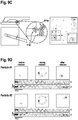
- On the top layer of the first molecular element, the second molecular element forming the positioning arm is preferably connected to the plate via two adjacent scaffold crossovers with 3 and 4 unpaired bases, respectively. These short single-stranded segments create a flexible joint, which allows rotational movement of the second molecular element with respect to the first molecular element. While this joint cannot turn in the same direction indefinitely without winding up, it is still sufficiently flexible to allow the arm to reach any angle on the plate. This design is preferred over other potential designs for two reasons. First, this design allows us to use a one pot folding approach for the first molecular element and second molecular element, particularly the platform with the integrated 6HB arm, which confers the benefit of fast preparation and short experimental iteration periods. Second, a joint created by a double scaffold crossover provides higher resistance against external mechanical strain. For comparison, a single staple crossover would allow rotation around a single covalent bond, but the connection to the arm would always be oriented in a duplex unzipping geometry for one specific orientation of the arm during rotation. In this configuration, the connection to the first molecular element could potentially be unzipped, leading to the dissociation of the arm. By contrast, utilization of the scaffold strand (as in this work) to create the joint ensures a stable covalent connection between base plate and arm. With a circular scaffold strand, this strategy necessarily results in two single-stranded connections between arm and plate. For angles in which one strand is exposed to forces in unzipping geometry, the second strand is oppositely oriented in shear geometry and may therefore act as a strain relief. A linearized scaffold would allow for a covalent connection with only a single connecting strand, but would still be prone to unzipping when exposed to forces antiparallel to the direction of the scaffold strand in the plate next to its crossover to the arm structure. Particularly for experiments in which the length of the lever arm is exploited to create forces on the base plate (e.g. in the 20bp unzipping experiment,
Fig. 9C and 9D ), bearing forces of the same order are expected to act on the joint. In this case, a high mechanical stability of the joint is crucial and was therefore prioritized over the possibility of indefinite unidirectional rotation. - The second molecular element is preferably adapted to transport inorganic nanoparticles. Therefore, fast operations of biohybrid plasmonic systems are enabled.
- A specific embodiment will be described together with the attached drawings:
- Fig. 1
- is a schematic view of a moving part of a molecular machine according to an embodiment of the invention.
- Fig. 2
- is a schematic view of a first alternative of a control part of the molecular machine according to the embodiment of the invention.
- Fig. 3
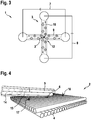
- is a schematic view of a second alternative of a control part of the molecular machine according to the embodiment of the invention.
- Fig. 4
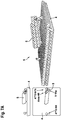
- is a schematic view of the moving part of the molecular machine according to the embodiment of the invention, which is modified for proof of functionality.
- Fig. 5
- is a schematic view of montage of single images from a microscope video showing the movement of the molecular machine according to the embodiment of the invention.
- Fig. 6
- is a schematic view of a diagram showing movement of the molecular machine according to the embodiment of the invention.
- Fig. 7
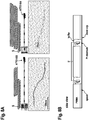
- shows stochastic switching experiments. (A) For single-molecule multi-color FRET experiments, a donor fluorophore (Alexa Fluor 488) is attached to the 6HB arm and two acceptor fluorophores (
ATTO 565 andATTO 647N) to staple strand extensions on opposite sides of the plate. The pictograms on the left show hybridization of an extended staple of the arm to the staple extension of the base plate labelled withATTO 647N. The length of the docking duplex was varied between 8 and 10 bp. A schematic 3D representation is shown on the right. (B) Fluorescence traces obtained from the three fluorophores during donor excitation of the structures containing 9 bp docking duplexes. The change between green and red fluorescence indicates switching of the arm between corresponding docking sites. The zoom-in (bottom panel) reveals short periods of free diffusion between unbinding and rebinding events during which the donor (Alexa Fluor 488 = "blue") fluorescence is dominant. (C) Average dwell times for the bound and unbound states and their dependence on duplex length. Dwell times for the bound states (high acceptor signals-ATTO 647N = "red" orATTO 565 = "green", top panel) correspond to the times spent at the respective docking site. The dwell times for the unbound state (high donor signal-blue, bottom panel) represent the length of the traversal periods of the freely diffusing arm. (D) The average durations of the unbound states for various transitions and their dependence on duplex length. Based on start and end point of the traversal period (docking site or bound state-g or r before and after the unbound state), the unbound states can be classified as g→r and g→g or r→g and r→r traversals. - Fig. 8
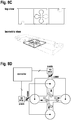
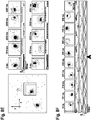
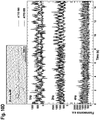
- shows external electric control of the robotic arm. (A) Two pointer extension designs for the robot arm and corresponding TEM images. The linear extension (left) pointer has a length of 411 nm (total length from center of rotation to tip: 436 nm). The pointer on the right has a shape complementary connection that withstands higher torque (total length of 354 nm, pivot point to tip: 332 nm). (B) Cross section and (C) top and isometric view of the cross-shaped electrophoretic sample chamber. (D) A schematic depiction of the experimental setup with four electrodes. (E) Fluorescence microscopic images of three structures that are switched in the electric field. For the highlighted particle, movements are shown as snapshots and kymographs. The two arrows indicate the axes chosen for the kymographs. Top: Switching left and right with 1 Hz. Bottom: Switching up and down with 1 Hz. (F) Top: One clockwise turn of 1 Hz rotation. Bottom: The kymographs show multiple turns of clockwise rotation followed by multiple counter-clockwise turns, separately for x and y axis and as an overlay. Reversal of the voltage and thus of the rotation direction is indicated by a red arrowhead. (G) Kymographs (x- and γ-projection) obtained from a frequency sweep from 0 to 8 Hz and back, shown as an overlay of the kymograph along x-axis and y-axis. (H) High speed 360° clockwise and counter-clockwise rotation with 25 Hz. For each frame, the center of the pointer tip is indicated by a red cross. Reversal of the rotation direction is indicated by red arrowheads. Unlabeled scale bars: 1 µm.
- Fig. 9
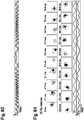
- shows controlled hybridization and force-induced duplex dissociation. (A) Field-controlled switching of the extended robot arm between two 9bp docking positions. Left: Scheme of the setup. Right: Single molecule localization image of pointer positions acquired during electrical rotation at 1 Hz. The number of localizations is increased at angles corresponding to the two docking positions. (B) Angle plotted over time for 1, 2, and 4 Hz rotation with 110V. The arm shows pronounced lagging for two angles (highlighted by grey bands), higher frequencies result in a larger number of missed turns, indicated by the red arrowheads. (C) Unzipping of a 20 bp DNA duplex with the extended robot arm. Extensions from the platform and from the arm feature a short 8 bp strain relief domain that prevents the staple strands from being pulled out of the structure. Experiments with two example particles are shown. Without electric field, the arm is fixed at one of two docking positions on the base plate. (D) Rotation requires unzipping of the duplex, which is shown in the images (before rotation, during rotation and after rotation) and kymographs at the bottom.
Particle # 1 rebinds to the starting position, whereasparticle # 2 rebinds to the position on the opposite side. - Fig. 10
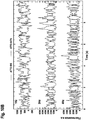
- shows electrically controlled movement of molecules and nanoparticles. (A) Configuration of the robot arm with shape complementary extension for transport of the FRET
donor Alexa Fluor 488 between two 9 nt docking sites with theacceptors ATTO 565 andATTO 647N. (B) Acceptor signals for continuous donor excitation for electrical rotation at 1 Hz (top), 2 Hz (middle) and 4 Hz (bottom). (C) For application of the robot arm in switchable plasmonics, a gold nanorod (AuNR) with 25 nm length is attached to the side of the 6HB arm and 11ATTO 565 andATTO 655 dyes are placed on opposite halves of the platform. (D) TEM micrograph of structure with a 25 nm AuNR and fluorescence traces for continuous excitation of the dyes while the robot arm is rotated at 1 Hz, 2 Hz and 4 Hz. - Fig. 11
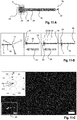
- is a schematic overview of fixing the platform of the molecular machine according to the embodiment of the invention.
-
Figure 1 is a schematic view of amovement part 2 of amolecular machine 1 according to an embodiment of the invention. In the embodiment, themovement part 2 comprises aplatform 4, which corresponds to the first molecular element. On theplatform 4, aposition arm 5 is mounted, which corresponds to the second molecular element. A linkingelement 6 constrains the relative movement betweenplatform 4 andpositioning arm 5 such that the only possible relative movement is a rotation of thepositioning arm 5 in a plane parallel to theplatform 4.Platform 4 andpositioning arm 5 are constructed with the DNA origami method. The DNA origami method is well-known in the art and is for example described in prior art references 17 to 18. Thesquare platform 4 consists of two layers of DNA double helices. In all figures, each double helix is represented by a cylinder. Thepositioning arm 5 is a six helix bundle. The linkingelement 7 comprises two DNA strands and connects thepositioning arm 5 to theplatform 4. Transmission electron microscopy micrographs can show the structure and quality of these objects. - The
platform 4 and thepositioning arm 5 can be built from different molecules e.g. RNA, proteins, artificial charged supramolecular structures. Thepositioning arm 5 might be elongated by coupling to further structures. An example for such elongation is described with respect tofigure 4 . - DNA molecules and thus also DNA origami structures are heavily charged biomolecules that can be electrically or electrophoretically manipulated. This fact can be exploited to achieve control and movement of molecular mechanisms.
- Electric fields can be created in a simple electrophoretic or micro-electrophoretic setup. In the embodiment, a
control part 3 is employed, which is shown infigures 2 and3 .Figure 2 is a schematic view of themolecular machine 1 including acontrol part 3 according to a first alternative, whilefigure 3 is a schematic view of the molecular machine including acontrol part 3 according to a second alternative. - As shown in
figure 2 , afluidic channel 9 is provided which is contacted byplatinum electrodes 11 of anelectrical device 7. Themovement part 2 is placed in the center of thisfluidic channel 7, preferably as far away from the electrodes as possible. Isolatingelements 13 might be provided in order to isolate theelectrodes 13 from themovement part 2. The Isolatingelements 13 preferably comprise membranes, gels or salt bridges. The isolatingelements 13 do not allow transfer of selected molecules such that the electrodes are separated form themovement part 2 such that no unwanted traveling of elements from themovement part 2 to theelectrodes 11 can take place. This avoids unwanted electrochemical influences of theelectrodes 11. - Electric control is achieved by applying voltages to the electrodes. For that purpose, low control voltages as output channels of a DAQ board (data acquisition board) are amplified to adequate voltages by an operational amplifier. In the embodiments, the
electrical device 7 applies voltages of up to 200 V. - Two-dimensional movement of the
positioning arm 5 can be realized with a crossed channel geometry. This is shown infigure 3 . Thecontrol part 3 comprises a firstelectrical device 7 and a secondelectrical device 8, both are identical to the above described electrical device offigure 2 . The firstelectrical device 7 is connected to a firstfluidic channel 9 and the secondelectrical device 9 is connected to a secondfluidic channel 10, wherein the firstfluidic channel 9 and secondfluidic channel 10 are both identical as the above described fluidic channel offigure 2 . The firstfluidic channel 9 and the secondfluidic channel 10 intersect at anintersection area 12 and are orientated perpendicular to each other. Themovement part 2 is placed in theintersection area 12. Due to such a design, the electrical fields of the firstelectrical device 7 and the secondelectrical device 8 are superposed. Superposition of electrical fields in thefluidic channels positioning arm 5 in arbitrary angles or to rotate it in circles relative to theplatform 4. - In order to ensure that only the
positioning arm 5 rotates while theplatform 4 remains still, theplatform 4 is fixed to at least one of thefluidic channels control part 3. In this way, the platform is fixed relative to thecontrol part 3 which means that no movement of theplatform 4 is possible in response to the electrical field. - In an alternative setup, lithographically designed microelectrodes can be used, which require much smaller voltages for manipulation. In principle, this enables the miniaturization of the whole setup and the integration e.g. on a USB-Stick.
- The electrically charged
positioning arm 5 aligns to the electrical fields generated via the firstelectrical device 7 and the secondelectrical device 8. In this way, an exact positioning of thepositioning arm 5 can be reached. Particularly, thepositioning arm 5 can be moved with a tolerance of at most 1 nm. - Evidence for the electro-controlled movement of positioning
arms 5 can be provided in several ways. -
Figure 4 is a sketch of theDNA platform 4 with thepositioning arm 5 that is modified with ablue donor dye 15. Theplatform 4 was labeled at two positions with a greenfirst acceptor dye 16 and redsecond acceptor dye 17, respectively. Thepositioning arm 5 movement can be proven via single molecule FRET (fluorescence resonance energy transfer). Further, for better electric coupling (via the DNA-structures charge) and to enable direct optical observation an additional lever/pointer structure 14 is provided to extend thepositioning arm 5 to a length of several 100 nm (in this example ∼400nm). - The movement of the positioning arm can be characterized by means of single molecule fluorescence resonance energy transfer (smFRET), which demonstrates the system's positioning precision on the nanometer scale. As the
blue donor dye 15,Alexa Fluor 488 is employed, as the greenfirst acceptor dye 16,ATTO 565 is employed, and as the redsecond acceptor dye 17,ATTO 647N is employed. Theblue donor dye 15 can excite thefirst acceptor dye 16 andsecond acceptor dye 17 via FRET if donor and acceptor are in closer proximity than the Foerster radius (∼6 nm). -
Figure 5 illustrates single molecule FRET traces corresponding to the sketch infigure 4 . The rotation of thepositioning arm 5 is externally driven at 1 Hz while thedonor dye 15 on thepositioning arm 5 is being excited. This results in an alternating emission of green by thefirst acceptor dye 16, as shown in the top diagram offigure 5 , and red by thesecond acceptor dye 17, as shown in the middle diagram offigure 5 . An overlay of both traces, which is shown in the bottom diagram offigure 5 , clearly shows the periodic alternating excitation. - As shown in
figure 6 , the invention can provide a periodic movement of thepositioning arm 5 from one position of theplatform 4 to the other. This experiment also demonstrates the potential of the invention to transport and position molecules on theplatform 4, which is of great importance for a wide range of applications. - An alternative way of proof of movement of the
positioning arm 5 is shown inFigure 6. Figure 6 shows a montage of single images from a microscope video, which shows the electrically driven rotation of the positioning arm (exposure per frame: 50 ms, Scale bar: 500 nm). Fluorescent dyes are fixed to the tip ofpositioning arm 5. Theorigami platform 4 is located in the image center and is indicated by a cross. The particle rotates in an external field. Forfigure 6 , fluorescent dyes have been placed on the tip of the extension of thepositioning arm 5, i.e. on the additional lever/pointer structure 14. Thepositioning arm 5 is rotated in circles with a frequency of 1 Hz. As shown on the image series, the particle at the tip of the positioning arm is performing the desired rotational movement. This also shows the controlled movement of a nanoscale object on a length scale of 1 µm. - The key capability to position molecules precisely, fast and electrically controlled as well as the possibility to locally exert directed forces trough molecular mechanisms on the nanoscale enables a wide variety of application opportunities in nanotechnology. Below, three possible areas of application will be briefly discussed.
- Highly specific molecular interactions are responsible for a wide range of biological processes and are also the mechanism of action of pharmacological substances. For this reason, biological research has been focused on the precise biochemical and biophysical characterization of these interactions for quite some time. In biophysical research, the strength of interactions is often analyzed in single molecule experiments. Here special instruments are used to exert forces on the binding partners. This includes experiments with atomic force microscopes, optical tweezers and magnetic tweezers.
- The
movement part 2 ofplatform 4 andpositioning arm 5 according to the described embodiment of the invention make it possible to apply forces to molecules in situ. That is to say, in the case of the invention, the force applying lever itself is a molecular structure. Contrary to the other methods mentioned, it is relatively simple to conjugate the molecules and binding partners that are to be characterized to theplatform 4 and thepositioning arm 5. The experimental setup used to create electric forces is much simpler. This enables highly parallelizable execution of force measurements of molecular interaction partners since a vast number ofmeasuring platforms 4 can be actuated at the same time. The sensor principle can also be used for screening of molecule libraries by "barcoding" (cf. prior art reference 19) ofsingle platforms 4. - In the past 15 years, DNA templated synthesis was established as a novel method to increase the efficiency of chemical reactions and for the sequence based production of molecule libraries. This approach exploits the highly increased local concentration of molecules that were conjugated to a DNA strand and are thereby colocalized by sequence specific base pairing on the template (cf. prior art references 20 and 21).
- This principle can be transferred to reactions with electrically driven molecular mechanisms. Electrically addressable moving molecular mechanisms can bring molecules into close proximity to induce their reaction. In this way for example, the same reaction can be repeated depending on an external clocking signal or sequential reactions can be performed according to a programmable protocol. Contrary to existing "proof of principle" experiments, the possibility of repeated and highly parallelized performance of such reactions enable the production of technologically relevant amounts of substances. The invention, i.e. the development of the electrical switchable
molecular machine 1, is therefore an enabling technology for the realization of genuine molecular robotic systems and molecular assembly lines. - The molecular actuators according to the invention can readily be modified with inorganic particles like e.g. metal or semiconductor particles. For instance, a change in position of the molecular mechanisms can vary the particles' orientation with respect to a polarized external field. Accordingly, the occurrence of plasmonic effects (e.g. field enhancement, energy transfer, heating effects) can be switched via electric control.
- With the described invention, nanoscale objects or molecules can be controllably moved and positioned. As an embodiment and for the demonstration of the general working principle a
molecular positioning arm 5 from DNA molecules was explained. The nanoscalemolecular positioning arm 5 is fixated on a specificallyaddressable platform 4 with a flexible joint that allows rotation around the pivot point. Thepositioning arm 5 movement can be precisely controlled by external electric fields. Thepositioning arm 5 can transport molecules, control chemical processes and exert forces on other molecules "in situ". The method exploits the intrinsic electric charge of biomolecules and can be generally applied to synthetic as well as naturally occurring biomolecular mechanisms. - In the molecular machine, sequence-specific switching is deliberately abandoned and electrical fields are used to move the components of a DNA machine with respect to each other. Thus many orders of magnitude in operation speed, almost perfect switching yield and the capability of computer-controlled nanoscale motion and positioning are gained.
- The actuator unit of our system is comprised of a 55 × 55 nm2 DNA origami plate (platform 4) with an integrated, 25 nm long arm (positioning arm 5) defined by a DNA six-helix bundle (6HB), allowing for a high-yield one-pot folding procedure. For the rigid DNA plate, a crossed two-layer scaffold routing is utilized, in which the top layer is rotated with respect to the bottom layer by 90°. The 6HB functioning as the robot arm is connected to the top-layer of the base plate via a flexible joint (linking element 6) created by three and four unpaired bases, respectively. Successful assembly of the structure with ≈ 90% yield was verified using transmission electron microscopy (TEM) and atomic force microscopy (AFM). Consistent with the design, AFM yields a height of 4 nm for the base plate and an additional 4 nm for the 6HB arm.
- First, the diffusive motion of the arm with respect to the base plate is investigated using single-molecule multi-color Forster Resonance Energy Transfer (FRET) experiments. This is illustrated in
figure 7 . For these experiments, two staple strands on opposite sides of the plate were extended with an identical short docking sequence, while a staple strand on the arm was extended with the complementary sequence. Transient binding of the arm results in stochastic switching between the two docking sites, which we observed with the help of three reporter dyes - a FRET donor at the tip of the arm, and two different acceptor dyes at the docking sites (figure 7A ). A typical trace of stochastically alternating FRET signals is shown infigure 7B . Upon donor excitation, a high donor (blue, solid line) fluorescence indicates a freely diffusing arm, while a high acceptor fluorescence (green, dashed line, or red, dotted line) indicates docking at the respective site. Dwell times for the three states were extracted from fluorescence traces of over 1000 robot arm platforms using a hidden Markov model (HMM) analysis. As expected, the dwell time in the bound states increases with docking duplex length (figure 7C , top panel). Interestingly, the dwell time spent in the unbound state also increases (figure 7C , bottom panel), indicating slower diffusion and/or a reduced hybridization rate for longer docking duplexes. Observed state transitions can be classified into transitions from one binding site to the other (green/red or red/green), or rebinding events to the same docking site (green/green, red/red). When the arm initially unbinds from the green docking site, it binds to either site with roughly the same transition time (figure 7D , top panel). Conversely, arms starting at the red docking site have a higher tendency to return to the same site (figure 7D , bottom panel). This bias is consistent with the expected orientation of the arm on the base plate, which is designed to point towards the red docking site. The corresponding higher effective concentration of the arm in the vicinity of the red docking site results in faster rebinding transitions. Photophysical origins of the observed changes in the FRET signal (such as fluorescent dark states or environmental quenching of the fluorophores) were excluded by performing alternating laser excitation experiments. - To facilitate direct observation of the arm's motion by diffraction-limited fluorescence microscopy, two versions of pointer structures were designed that were multiply labeled with the
fluorophore ATTO 655. Version one extended the arm linearly by 411 nm (Figure 8A left). Version two extended the arm by 308 nm (Figure 8A , right) and was modularly plugged onto the robot arm using a shape-complementary connector structure, creating a more stable connection between pointer and arm to allow for better torque transmission. Both pointers are based on a rigid 6HB with a persistence length > 1 µm (25). The two designs were motivated by the differing requirements for the experiments described below. For rotational diffusion experiments in the absence of docking sites, the linear pointer was found to interact less with the base plate than the shape-complementary pointer. However, when used to exert forces the linear pointer displayed a reduced stability and tended to break at the connection site. In the presence of docking sites, single molecule localization images of both pointers were consistent with the positions of the docks on the platform, proving that the extensions point along the axis of the short arm and that the interactions with the docking sites dominated over unspecific sticking. - In order to realize dynamic external control of the robot arm, electrical fields were applied to the system - a natural choice for the manipulation of charged biomolecules. Electrical fields have been previously used only to stretch or orient substrate-immobilized DNA duplexes but not to dynamically control the conformation of nanomechanical DNA devices. We created a cross-shaped electrophoretic chamber constituted by two perpendicular fluidic channels intersecting at the center of a microscopy cover slip, with two pairs of platinum electrodes inserted into the four buffer reservoirs (
Figure 8B & C). DNA nanostructures immobilized at the center of the cross chamber experience a superposition of the fields generated by the electrode pairs. Hence, a voltage can be applied to arbitrarily control the direction that the arm points (Figure 8D ). - Electrical actuation of the arms results in a movement of the pointers, which were observed with an EMCCD camera using TIRF microscopy. In
Figure 8E , switching of an arm in two perpendicular directions is shown, rotation with a constant frequency of one Hertz (Figure 8F ) and with variable frequency (Figure 8G ), ramping from 0 to 8 Hz and back to 0 Hz. In order to characterize faster arm movements, TIRF microscopy videos with a 2 ms time resolution using a CMOS camera were recorded. An image series taken from a video in which the robot arm was rotated back and forth at f = 25 Hz is shown inFigure 8H . Kymographs displaying the projected motion of the arm's pointer along the x- and γ-axis show the expected sinusoidal characteristics. In high-viscosity buffer solution containing 65% sucrose, motion of the arm was significantly slowed down. - Next, the angular positioning precision of the arm that can be achieved in the absence of docking sites by the electrical field alone is assessed. For large applied voltages (≥ 120 V in our setup) the angular standard deviation is ≈ 0.1 rad, which translates to a positioning precision of ≈ 2.5 nm on the plate.
- In order to investigate the interaction of the arm with binding sites on the platform during electrical manipulation, "latching experiments" were performed with the same arrangement of docks as in
Figure 7 and an identical 9 base pair (bp) docking sequence (Figure 9A ). When rotated at frequencies of f = 1, 2, and 4 Hz temporary stalling of the pointer at the two angle positions that corresponded to the two docking sites were observed (Figure 9B ), indicating that the arm "snaps" into the binding positions during rotation. Whereas the signal followed the external control faithfully for f = 1 Hz, occasional "skips" occurred for f = 2 Hz and 4 Hz. This behavior is caused by the statistical nature of single molecule duplex dissociation, whose frequency increases exponentially with the application of a force and, in dynamic experiments, also depends on the force rate. Apparently, the dissociation rate (∼ 0.4 s-1, cf.Figure 7B ) of the docking duplex is sufficiently enhanced by the electrical force to follow the 1 Hz rotation. For higher frequencies, the duplex does not always dissociate fast enough and the arm cannot follow the rotation of the electrical field. By contrast, at a slower rotation speed of f = 0.1 Hz, dynamic latching can be observed also to four different docking sites. - Next it is tested whether the robotic arm can wrest apart a 20 bp docking duplex, which is a stable structure at room temperature. While the arm is firmly locked in place in the absence of an electrical field, it can be released from the docking site by actuating the arm and rotated as shown in
Figure 9C and 9D . Unzipping is expected to be most effective when the field is applied perpendicularly to the fixed arm. As the base plates are randomly oriented with respect to the sample chamber, the field is slowly rotated at a frequency of 0.2 Hz in order to guarantee each structure has sufficient time to experience a strong enough unzipping force. When switching off the field during rotation at an arbitrary phase, the arm immediately localizes to an available docking site. - At the field strengths generated in the sample chamber, field-induced melting of DNA duplexes is not expected as observed, e.g., for DNA structures immobilized on electrode surfaces. Instead, the arm acts as a lever which mechanically transduces the electrical force acting on its large charge to the docking duplex. Force-induced unzipping of DNA duplexes has been previously achieved using single molecule manipulation techniques such as AFM, optical tweezers or within nanopores. These experiments have shown that DNA unzipping requires forces on the order of 10-20 pN, which is consistent with the typical binding free energy of DNA base-pairs and their sub-nanometer spacing. A rough theoretical treatment suggests that forces that can be generated by the robot arm are on this scale. Importantly, the ability to separate stable duplexes by force facilitates the electrically controlled dissociation of the arm from one docking site and its subsequent placement at a different target position, which is then maintained also at zero field.
- In order to show controlled movement of a cargo molecule attached to the arm, the three-color FRET system already employed in the stochastic switching experiments was utilized (
Figure 10A ). In contrast to the stochastic switching experiments, the donor fluorophore is actively transported between two 9 nucleotides (nt) long docking positions by rotating the arm with the help of the high torque extension at rotation frequencies of f = 1, 2, and 4 Hz, respectively. Alternating FRET traces (Figure 10B ) with the periodicity of the externally applied field are observed. In agreement with the latching experiments (Figure 9B ), higher rotation frequencies come with an increase in the number of "skips". - To demonstrate transport of inorganic nanoparticles by the robot arm, a gold nanorod (AuNR) was attached to one side of the 6HB arm, and its plasmonic interaction was probed with red (dotted line) and green (dashed line) fluorophores immobilized on the platform (
Figure 10C ). As shown inFigure 10D , the AuNR alternatingly modulates the fluorescence of the fluorophores during rotation of the arm at the externally prescribed frequency. Electrical manipulation enables faster operation of switchable biohybrid plasmonic systems than previously achieved with the fuel strand technique. More sophisticated systems involving multiple particles for the creation of switchable field enhancement or circular dichroism appear feasible. - In summary, an electrical actuation was introduced as a viable strategy for fast, computer-controlled operation of biohybrid nanorobotic systems, which can exert forces at the molecular scale. Compared to nanoscale manipulation methods such as scanning probe techniques, optical or magnetic tweezers, electrical control is contact-free and can be implemented with low-cost instrumentation. The robotic movements achieved are at least 5 orders of magnitude faster than previously reported for the fastest DNA motor systems and comparable to ATPase driven biohybrids. The robot arm system may be scaled up and integrated into larger hybrid systems using a combination of lithographic and self-assembly techniques. For instance, the platforms can be easily connected to form long filaments with multiple DNA robot arms or to create extended lattices. Utilization of algorithmic self-assembly will enable the creation of structures with different types of robot platforms with dedicated tasks. Lithographic patterning of the substrate will further allow the fabrication of robot arm arrays with defined platform orientations. Using nanostructured control electrodes, single robot arms could even be addressed individually and their positioning state could act as a molecular mechanical memory. Combined with appropriate pick-up and release mechanisms, it is conceivable that this technology can be also applied to DNA-templated synthesis. Electrically clocked synthesis of molecules with a large number of robot arms in parallel could then be the first step towards the realization of a genuine nanorobotic production factory.
- In the following, the materials and methods used in the above explained embodiments are shortly described.
-
- FB20 -
Origami folding buffer 20 mM MgCl2: 1xTAE + 20 mM MgCl2 - NaB - Origami storage and assembly buffer: 1xTAE + 1 M NaCl
- EB - Electrophoresis buffer: 0.5xTBE + 6 mM MgCl2
- EBPC - Electrophoresis buffer based photo cocktail: EB + 2 mM Trolox (UV activated for about 15 min) + 50
nM Protocatechuate 3,4-Dioxygenase (PCD) + 2.5 mM Protocatechuic acid (PCA) + 10 mM Ascorbic Acid (AA). - StSwB - Stochastic switching buffer: 1xTE + 12.5 mM MgCl2
- StSwBPC - Stochastic switching buffer based photo cocktail: StSwB + 1 mM Trolox (UV activated for about 15 min) + 10% Glycerol + 10%(w/v) Glucose + 10%(v/v) Glucoseoxidase-Catalase solution. Adjusted from protocol in Stein et al.(42).
- The scaffold strand for DNA origami folding was provided as a 100 nM solution in ddH2O. All basic staple strands were added in a 2-fold excess over the scaffold strand. Staple strands with special functions, i.e., staples with additional extended sequences for site-specific binding or chemical modifications (fluorophores/biotin) were supplied in 5-fold excess. The solution was adjusted to contain 1xTAE and 20 mM MgCI2. The structures were annealed in a Thermocycler (Bio-Rad Tetrad, Hercules, California, USA) that controls a temperature ramp from 70 °C to 20 °C over 12 h and successively holds the temperature at 40 °C for at least 3 hours. The unpurified samples were stored at room temperature until further use. A complete list of all oligonucleotide sequences is attached.
- All DNA origami samples were separated from excess strands by PEG precipitation. The detailed protocol can be found in the following paragraph. Fluorescent dyes for smFRET experiments were directly folded into the origami structure as covalent modifications of staple strands. All other dyes were attached by means of an adapter strand that hybridizes to an extended staple sequence. Adapter strands were added in 2-fold excess over each binding site and incubated for 1 h, followed by an additional step of PEG precipitation.
- The sample was mixed thoroughly in a 1:1 ratio with precipitation buffer (1xTAE, 1 M NaCl, 11% w/v PEG8k), and centrifuged at 20°C with 20,000 rcf for 20 minutes. Afterwards the supernatant was carefully removed and the pellet resuspended in assembly buffer (1xTAE + 1 M NaCl). Magnesium was replaced by sodium to avoid potential unspecific binding. This process is repeated a second time followed by determination of the concentration with a nanophotometer (NanoPhotometer Pearl, Implen GmbH, München, Germany).
- Pointer extensions were attached to the short 6HB arm of the robotic platform through incubation of 20 nM platform structure with 25 nM of the extension structure for at least 1 h at 37°C while shaking.
- AFM data was acquired with an Asylum Research Cypher ES (Oxford Instruments, Abingdon, UK) using Olympus BL-AC40TS-C2 (Olympus, Japan) cantilevers in AC mode. Structures were deposited on freshly cleaved mica and imaged in 1xTAE containing 12.5 mM MgCl2.
- TEM images were acquired with a Philips CM100 100 kV TEM and an AMT 4x4 Megapixel CCD camera. For negative staining, 25 µl NaOH was added to a 2% uranyl formate solution. The staining solution was centrifuged for 5 min at 20,000 rcf to avoid stain crystals. 5 µl of Nanostructure samples were incubated on glow discharged formvar coated carbon Cu400 TEM grids provided by Science Services (München, Germany) and incubated for 30 s. Subsequently, the grid was washed with 5 µl of staining solution, incubated for 40 s with 15 µl staining solution and dried with filter paper.
- 25 x 25
mm # - Cleaning:
- 1. Place cover slips in a chemically inert rack inside a staining jar.
- 2. Soak slides in 2 M NaOH for ∼ 20 minutes, rinse with ddH2O.
- 3. Heat 200
ml 2% Hellmanex II (Hellma GmbH & Co. KG, Müllheim, Germany) to ∼ 100 °C and pour in staining jar.Sonicate 5 minutes. - 4. Rinse 3x with ddH2O, fill up with ddH2O. Sonicate 5 minutes.
- 5.
Repeat step 4. - 6. Fill staining jar with ethanol (99%).
Sonicate 5 minutes. - 7. Dry in oven at 70°C, ∼ 1h.
- PEG coating:
- 1. Prepare 0.5% biotin-PEG-silane in ethanol (p.a.) -25 µl solution per slide.
- 2. Add acetic acid (99%) to 1% final concentration.
- 3. Place first slide on clean surface and add 25 µl of biotin-PEG-silane solution.
- 4. Immediately place second slide on top. Repeat process until all slides are stacked.
- 5. Incubate for 30 minutes at 70°C.
- 6. Place stack in staining jar and sonicate in ddH2O for 5 minutes. Rinse twice.
- 7. Separate slides and put back in rack.
- 8.
Repeat step 6. - 9. Blow dry with N2 and store in dark and dry place.
- Flow chambers were assembled from three elements: a biotin-PEG functionalized cover slip, a PMMA chip and a layer of double-sided tape. The double-sided tape acts as a spacer between the coverslip and PMMA chip and defines the channel height (about 50 µm). The double-sided tape 3M 467MP (3M Company, Maplewood, Minnesota, USA) was cut with a laser cutter (Trotec Speedy 100, Trotec Laser, Marchtrenk, Austria) to achieve precise and reproducible channel geometries. The double-sided tape was attached to the center of the PMMA chip and covered with the cover slip. The cover slip was pressed onto the slide with office clamps for at least 30 minutes.
- 5 mm thick PMMA plates were laser-cut into rectangular pieces of 75 x 25 mm with reservoirs that can hold 150-200 µl buffer volume each. Small indentations on the outside edge are used to fix a custom-made plug carrying 4 platinum electrodes. The electrodes are deliberately placed in large buffer reservoirs distant from the sample area to minimize detrimental effects of electrochemical processes occurring at the electrodes on the sample. The fully assembled sample during the experiment is shown in Figure S6D. A 4-pin LEMO plug connects the 4-electrode plug to the power source.
- Cutting of PMMA and tape as well as PEG functionalization was performed in advance at a larger scale (in batches of 20-30 pieces) and the components could then be stored over several weeks. Before each measurement, the fully assembled sample chambers were prepared for the experiment and discarded afterwards. Each chamber was flushed with 400 µl ddH2O, then flushed with 20 µl NeutrAvidin (ThermoFisher Scientific, Waltham, Massachusetts, USA) solution (0.5 mg/ml in ddH2O) and incubated for 30 seconds. Afterwards, the channels were rinsed thoroughly with 600 µl ddH2O followed by 400 µl assembly buffer (1xTAE, 1 M NaCl). 20 µl origami solution (500 pM structure concentration) was supplied to the flow chamber and incubated for 10 seconds. Afterwards, the channels were thoroughly flushed with 600 µl assembly buffer followed by 600 µl electrophoresis buffer (0.5xTBE, 6 mM MgCl2). The remaining buffer was removed from all edges of the reservoirs and 400 µl of the intended imaging buffer for the specific experiment was added. All electrophoretic switching experiments except the smFRET experiments were conducted in electrophoresis buffer. For increased lifetimes in smFRET electric switching experiments, the buffer was amended by an oxygen scavenging system (0.5xTBE, 6 mM MgCI2, 2 mM Trolox UV activated for >15 min, 50
nM Protocatechuate 3,4-Dioxygenase (PCD) + 2.5 mM Protocatechuic acid (PCA) + 10 mM L-Ascorbic acid (AA), adjusted from Aitken et al. (41)). PCD, PCA, AA and Trolox were acquired from Sigma-Aldrich, St. Louis, Missouri, USA. - A custom written LabView program was used to generate control voltages between +3.85 V and -3.85 V on two independent output cannels of a NI PCI-6036E DAQ Board (National Instruments Corporation, Austin, Texas, USA). The control voltages were amplified linearly to ±200 V by a home built DC amplifier containing an Apex PA443 high voltage operational amplifier (Apex Microtechnology, Tucson, Arizona, USA). The current setup controls the direction and strength of the electric field on a millisecond time scale, mainly limited by the loop time of the LabView program. A faster electrical response could be realized when necessary.
- For each measurement, the structures were first rotated clockwise and counter clockwise with 1 Hz and 120 V for several turns and then aligned in one static direction with the target voltage for at least 1000 acquisition frames. The resulting videos were analyzed with the ThunderSTORM ImageJ plugin (45). Each point spread function was localized with a 2D Gaussian fit. The whole dataset was drift corrected and spot localizations with a fit accuracy of 50 nm or worse were discarded. Well-formed particles, which were sufficiently far from any other particle for reliable localization, were picked and the event list was further processed with MATLAB. For each individual particle, the localizations obtained during the first rotations were used to fit a circle. Subsequently the angular distribution of the localizations was measured in the presence of an electric field applied at a fixed angle. For each voltage, 38-150 particles were analyzed and the mean of each dataset was plotted.
- AuNRs were purchased from Sigma-Aldrich (München, Germany). 50 µl thiolated DNA (100 µM) was incubated with 10 mM Tris(carboxyethyl) phosphine hydrochloride (TCEP) for at least 30 min. The DNA, 50 µl sodium dodecyl sulfate (SDS), and 10 x TAE buffer were added to 1 ml AuNRs (1 nM). The pH was adjusted to 3 with HCI and incubated for 1 hour on a shaker. Subsequently, 0.5 M NaCl was added and the solution was again incubated for 3 h. Excess oligonucleotides were removed by centrifugation at 6,000 rcf for 20 min. The supernatant was removed and the pellet was dissolved in 2 ml 0.5 x TAE containing 0.03% SDS. The centrifugation procedure was repeated 4 times. DNA functionalized AuNRs were added in 5-fold excess to the DNA nanostructures and incubated over night. Unbound AuNRs were removed from the origami sample by agarose gel electrophoresis purification.
- Polymerization of base plates was performed using a one-pot folding protocol. Two different scaffold lengths were used, which resulted in a statistical distribution of base plates with integrated robot arms and base plates that did not carry an arm. For baseplates without an arm, a p7249 scaffold was used. For base plates with an arm structure, we used a p7704 scaffold. The two folding solutions were pipetted separately and mixed in a 1:20 ratio of arm-less (p7249) and arm-forming (p7704) solution before folding. Polymerization was achieved by replacing the staples used for passivation of the edges of the bottom layer of the base plate by a set of staples that connects these two edges.
- Single-molecule multi-color FRET experiments were performed on a home built multi-color prism-type TIRF (total internal reflection fluorescence) setup based on an inverted microscope (TE 2000-U, Nikon, Japan) with four continuous-wave diode-pumped solid state lasers (Cobolt, Solna, Sweden) for excitation: 491 nm (Cobolt Calypso, 75 mW), 532 nm (Cobolt Samba, 100 mW), 561 nm (Cobolt Jive, 75 mW) and 647 nm (Cobolt MLD, 120 mW). The laser beams were aligned through an acousto-optical tunable filter (AOTFnC.400-650-PV-TN, Pegasus Optik, Wallenhorst, Germany) and coupled into a single-mode fiber to allow for intensity regulation and switching between the laser lines for alternating laser excitation (ALEX (24), see also below). The sample chambers were formed by sandwiching a nesco film channel cut-out between coverslip and a surface-functionalized quartz prism with holes to insert the sample. The quartz prisms were prepared as described earlier in Schluesche et al. (47). Briefly, the prism surface was silanized (3-aminopropyltriethoxysilane, Sigma-Aldrich, St. Louis, Missouri, USA) and then incubated with a solution of 45% polyethylene glycol (mPEG-SVA, MW 5000) and 3% biotin-PEG (biotin-PEG-SVA,
MW 5000, Laysan Bio Inc., Arab, Alabama, USA) in 100 mM sodium bicarbonate (pH 9.0) to achieve surface passivation. - Fluorescence from the sample was collected by a water immersion objective (CFI Plan Apo IR 60x NA 1.27 WI objective, Nikon) and separated by the dichroic mirrors 630 DCXR and 560 DCXR (AHF Analysentechnik AG, Tübingen, Germany). After selecting the different spectral regions with the respective emission filters HQ 525/50, HQ 595/50 and HQ 715/150, the fluorescence of the donor (Alexa Fluor 488) and two acceptor (
ATTO 565 andATTO 647N) fluorophores was detected on individual EMCCD cameras (Andor iXon 3, Andor Technologies, Belfast, UK). - The prisms were initially incubated with a streptavidin (Sigma-Aldrich, St. Louis, Missouri, USA) solution (0.3 mg/ml in PBS) for 20 minutes and washed with stochastic switching buffer (StSwB: 1xTE + 12.5 mM MgCl2). The samples were diluted to 100 pM in StSwB, added to the sample chamber and immobilize on the prism surface through biotin-streptavidin-biotin linkage. Untethered structures were removed by flushing with StSwB after 2-3 min. The prism was then flushed twice with stochastic switching buffer-based photo-cocktail (StSwBPC). Finally, the prism was filled completely with StSwBPC and the holes were sealed to facilitate oxygen removal. In the case of continuous donor excitation, the videos were recorded with 11 mW 491 nm excitation and simultaneous detection on the three EMCCD cameras at 30 ms exposure for 3000 frames. For the alternating laser excitation (ALEX) experiments, the laser excitation wavelength was synchronized with the camera frame rate using the AOTF and was switched frame by frame in the sequence red-green-blue (647 nm: 3 mW, 561 nm: 5 mW and 491 nm: 11 mW). ALEX videos were recorded for 3000 frames at 30 ms exposure and simultaneous detection. The videos were analyzed with a custom-written MATLAB program (Mathworks, Massachusetts, USA). Each fluorescent spot in a movie is presumed to represent a single structure. Spots belonging to the same structure were identified on the videos of the three fluorescence detection channels and fluorescence intensity traces were extracted from them.
- Intensity traces for each color were individually subjected to a three-state HMM analysis. Two of the states correspond to the arm bound to either of the docking sites and are characterized by low donor fluorescence due to quenching by FRET to the acceptor at the docking site. The third state corresponds to the freely diffusing arm (unbound), characterized by high donor fluorescence in the absence of quenching by FRET.
- Similarly, every trace of each of the two acceptors was individually subjected to a two-state HMM analysis, where one state corresponds to the arm bound to a particular docking site, characterized by high acceptor fluorescence due to FRET from the donor. The other state corresponds to the arm either docked to the other site or diffusing freely and is characterized by low acceptor fluorescence due to the absence of FRET. From the HMM analysis, the Viterbi path - the most likely sequence of states - was obtained for each fluorophore and for each trace. As an example, the trace from
figure 7 in the top panel was replotted, whereas, in the bottom panel, the same trace is shown superimposed with the Viterbi paths of the three fluorophores in their designated colors. The anti-correlated movement of the donor and acceptors is clearly seen with every transition in the donor Viterbi path being mirrored by a transition of either of the acceptors. - Subsequently, the dwell times of the high fluorescence states of the fluorophores were determined from the Viterbi paths. The dwell time for a high acceptor fluorescence state corresponds to the time spent by the arm in the bound state (bound to a particular docking site). The dwell time for a high donor fluorescence signal corresponds to the time spent by the arm in the unbound state, where it can diffuse between the docking sites.
- Control experiments without docking: A control experiment for the stochastic switching experiments was performed by measuring samples where the arm lacks the extended staple strand for docking to the docking site with donor excitation. The resulting traces display an almost constant high donor fluorescence signal with hardly any switching of the fluorescence signals of the acceptors. Only a residual signal is observed in the acceptor channels, which can be accounted for by the direct-excitation of the acceptors upon donor excitation (491 nm) and crosstalk from the donor channel. This shows that, in the absence of the extended staple strand, docking of the arm does not occur. Hence, no stochastic switching of the acceptor signal is observed as the arm's rotational diffusion is much faster than the acquisition rate of the EMCCD cameras used in the setup (-30 fps).
- ALEX experiments with docking: For samples with an extended staple strand on the arm for docking (docking duplex lengths 8-10 bp), videos were recorded with alternating laser excitation (ALEX), where the lasers were alternated every frame (frame time ∼33ms) in the sequence red-green-blue (647 nm laser-561 nm laser-491 nm laser) and with simultaneous detection on all three EMCCD cameras. An exemplary trace of an ALEX experiment with a 9 bp docking duplex arm structure shows that initially all fluorophores were present and active. At t ≈ 275 s, the
donor Alexa Fluor 488 bleaches. This was accompanied by a drop in total intensity (grey) to zero implying that the signal in the acceptor channels was solely due to FRET from the donor. Furthermore, upon 561 nm excitation (direct excitation of ATTO 565), there is clearly no FRET between the two acceptors. This is expected since the distance between the acceptors (∼ 43 nm) is beyond the working range of FRET. The residual signal in theATTO 647N channel after 561 nm excitation is attributed to the spectral crosstalk fromATTO 565 and a small amount of direct excitation ofATTO 647N by the 561 nm laser. Upon excitation with the 647 nm laser, only fluorescence fromATTO 647N is observed. The trace in figure S3B bottom panel shows that theATTO 647N fluorophore is active throughout the experiment and does not bleach for the entire duration of the -300 s long movie. The ALEX experiment thus demonstrates that the stochastic switching of the signals of the three fluorophores is only seen upon donor excitation, with all intensities dropping to zero when the donor bleaches. Since direct excitation of the acceptors shows that they were active for the entire duration of the experiment, a contribution of fluorophore photophysics to the stochastic switching of the signals can be ruled out. - All experiments involving electric field alignment were performed on a home built, objective type TIRF microscope based on an Olympus IX71 (Olympus, Japan). Three laser light sources with
wavelengths 642 nm (Toptica iBeam smart, diode laser, 150 mW, Gräfelfing, Germany), 532 nm (Oxxius 532-50, diode-pumped solid state laser, 50 mW, Lannion, France), and 488 nm (Toptica iPulse, diode laser, 20 mW) are aligned in parallel, widened by a factor of 8.3 and focused on the back focal plane of a 100x oil immersion objective (UAPON 100xO TIRF objective, NA 1.49 oil, Olympus, Japan). The filter cube was configured with a ZT532/640RPC dichroic mirror and a ZET532/640 (Chroma Technology, Olching, Germany) emission filter. Except for the high-speed imaging experiments, the detected image is split into two emission channels, which are projected on two separate halves of the CCD chip of an Andor iXon 897 EMCCD camera (Andor Technologies, Belfast, UK). For this purpose, a Hamamatsu W-viewer (Hamamatsu Photonics, Japan) with the two filters (BrightLine HC 582/75 and ET Bandpass 700/75) and two dichroic mirrors (Beam splitter 630 DCXR and Beam Splitter Q 630 SPXR) was mounted on the left IX71 camera port (all from AHF analysentechnik AG, Tübingen, Germany). Structures with a multiply labeled extension were observed with 642 nm excitation and a laser power of 1-4 mW, depending on the desired observation time and SNR. For electric switching of the FRET signal, 7 mW of 488 nm excitation was used. Structures functionalized with AuNRs were excited with 1 mW at 642 nm and 1.7 mW at 532 nm. High-speed videos were recorded with an Andor Neo sCMOS camera (Andor Technologies, Belfast, UK) mounted to the right camera port of the Olympus IX71 body. In these measurements, the sample was excited with 50 mW at 642nm. - DNA origami structures were designed using cadnano. For the creation of 3D graphics, a set of MATLAB tools was used to convert the JSON file generated in cadnano into a PDB file that can be further used in UCSF Chimera. JSON files are available upon request from the authors.
- In this work, two different approaches were utilized to create pointer extension structures for the central 6HB arm integrated with the platform. These extensions serve two purposes. First, they facilitate the observation of the robot arm's motion with diffraction limited light microscopy methods. Second, they act as highly charged levers that allow the application of larger forces to the central arm unit.
- Stability: The linear pointer extension is attached to the tip of the arm. While this rather straightforward approach allows an extension by over 400 nm using the common p7249 scaffold, the low number of possible staple connections between the two origami structures did not seem to withstand the high bending forces that are associated with the transmission of torque to the arm. By contrast, the shape complementary pointer with its more bulky connector structure has a roughly 100 nm shorter range but connects to the arm with a larger number of staples, which are also spread over a larger area. This design appeared to be more stable against torque induced breakage.
- Interactions with the plate/substrate: The two pointer designs significantly differed in their unspecific interactions with the origami base plate. While the linear extension showed relatively little interactions, the shape complementary pointer displayed two pronounced bias angles during rotational diffusion, or when actuated with low field strength. These undesired bias angles complicate the analysis of the movements.
- Super-resolution imaging and defective devices: To compare the two pointer designs in terms of free rotational diffusion, a combination of localization microscopy and DNA-PAINT super-resolution microscopy was used. Three corners of the base plate were labeled with transient binding sites for DNA PAINT. For each image, videos were recorded with 1-2 mW at 642 nm excitation and 25 ms exposure. About 1000 frames with 25 ms exposure time were analyzed (spot detection, localization via Gaussian fitting, drift correction) with the ThunderSTORM ImageJ plugin. To reduce potential, unspecific sticking effects promoted by divalent ions, assembly buffer for imaging was used (1xTAE, 1 M NaCl). Subsequently, PAINT imaging buffer (1xTAE, 1 M NaCl, 0.05% TWEEN20, 5nM imager strands) was added and a DNA-PAINT video was recorded (7000 frames, 250 ms exposure,
50mW 642 nm excitation). The linear pointer has a slight bias to point in one direction perpendicular to the helix axis of the top layer of the origami plate, whereas the shape complementary pointer has two much stronger bias points on opposite sides of the plate along this direction. - Apart from a large fraction of correctly assembled structures, super-resolution images showed mainly two types of apparently damaged or misassembled structures. For
type 1, the particle shows localizations also within a filled circle, instead of a ring-like pattern. This localization pattern suggests that the tip of the pointer is not restricted to the X-Y plane as designed but moves in the entire hemisphere above the base plate. It is assumed that the entire structure is misfolded or the connection between arm and pointer extension is defective.Type 2 is characterized by a ring without bias angles. Most of these structures also show a circular dot in the DNA-PAINT overlay rather than three distinct points indicating the labeled corners of the DNA base plate. A possible explanation forType 2 defects is structures that are bound with only one biotin anchor, which could rotate along a single biotinylated staple strand. Movement would then still be restricted to the X-Y plane combined with a round, spot-like appearance of the base plate in the DNA-PAINT reconstruction. -
Oligo Sequence Staple Type Figure 1 7 8 9A,B 9C,D 10A,B 10C,D 32[167] 34[168] 
basics yes yes yes yes yes yes yes 38[103] 40[104] 
basics yes yes yes yes yes yes yes 18[135] 20[136] 
basics yes yes yes yes yes yes yes 34[103] 36[104] 
basics yes yes yes yes yes yes yes 36[63] 35[63] 
basics yes yes yes yes yes yes yes 21[120] 19[119] 
basics yes yes yes yes yes yes yes 4[103]6 [104] 
basics yes yes yes yes yes yes yes 30[39] 32[40] 
basics yes yes yes yes yes yes yes 19[56] 17[63] 
basics yes yes yes yes yes yes yes 13[120] 11[119] 
basics yes yes yes yes yes yes yes 28[39] 30[40] 
basics yes yes yes yes yes yes yes 40[135] 42[136] 
basics yes yes yes yes yes yes yes 40[167] 42[168] 
basics yes yes yes yes yes yes yes 8[135] 10[136] 
basics yes yes yes yes yes yes no 33[120] 31[119] 
basics yes yes yes yes yes yes yes 34[135] 36[136] 
basics yes yes yes yes yes yes yes 36[95] 35[87] 
basics yes yes yes yes yes yes yes 40[39] 42[40] 
basics yes yes yes yes yes yes yes 16[71] 18[72] 
dock down 3' yes yes yes yes yes yes no 19[120] 17[127] 
basics yes yes yes yes yes yes yes 2[103]4 [104] 
basics yes yes yes yes yes yes yes 22[135] 24[136] 
basics yes yes yes yes yes yes yes 32[39] 34[40] 
basics yes yes yes yes yes yes yes 18[39] 20[40] 
basics yes yes yes yes yes yes yes 12[167] 14[168] 
dock right 5' yes yes yes yes no yes yes 34[71] 36[72] 
basics yes yes yes yes yes yes yes 4[71]6 [72] 
dock up 5' yes yes yes yes yes yes no 32[71] 34[72] 
basics yes yes yes yes yes yes yes 31[120] 29[119] 
basics yes yes yes yes yes yes yes 22[71] 24[72] 
basics yes yes yes yes yes yes yes 18[71] 20[72] 
dock down 5' yes yes yes yes yes yes yes 21[88] 
basics yes yes yes yes yes yes yes 16[135] 18[136] 
basics yes yes yes yes yes yes no 40[103] 42[104] 
basics yes yes yes yes yes yes yes 20[71] 21[87] 
basics yes yes yes yes yes yes yes 36[127] 35[119] 
basics yes yes yes yes yes yes yes 1[32]2 [40] 
basics yes yes yes yes yes yes yes 2[135]4 [136] 
basics yes yes yes yes yes yes yes 6[167]8 [168] 
basics yes yes yes yes yes yes yes 7[88]5 [95] 
basics yes yes yes yes yes yes yes 2[71]4 [72] 
dock up 3' yes yes yes yes yes yes yes 36[159] 35[159] 
basics yes yes yes yes yes yes yes 26[167] 28[168] 
basics yes yes yes yes yes yes yes 30[167] 32[168] 
basics yes yes yes yes yes yes yes 23[120] 22[104] 
basics yes yes yes yes yes yes yes 28[71] 30[72] 
basics yes yes yes yes yes yes yes 32[135] 34[136] 
basics yes yes yes yes yes yes yes 21[152] 19[151] 
basics yes yes yes yes yes yes yes 26[71] 28[72] 
biotin yes yes yes yes yes yes yes 1[120]2 [136] 
basics yes yes yes yes yes yes yes 24[39] 26[40] 
basics yes yes yes yes yes yes yes 32[103] 34[104] 
basics yes yes yes yes yes yes yes 12[103] 14[104] 
basics yes yes yes yes yes yes yes 38[135] 40[136] 
biotin yes yes yes yes yes yes yes 34[167] 36[168] 
basics yes yes yes yes yes yes yes 38[71] 40[72] 
biotin yes yes yes yes yes yes yes 28[167] 30[168] 
basics yes yes yes yes yes yes yes 6[103]8 [104] 
basics yes yes yes yes yes yes yes 36[71] 38[72] 
basics yes yes yes yes yes yes yes 7[120]5 [127] 
basics yes yes yes yes yes yes yes 38[39] 40[40] 
basics yes yes yes yes yes yes yes 8[71]10 [72] 
basics yes yes yes yes yes yes no 6[135]8 [136] 
basics yes yes yes yes yes yes no 28[63] 27[63] 
basics yes yes yes yes yes yes yes 30[71] 32[72] 
basics yes yes yes yes yes yes yes 18[103] 20[104] 
basics yes yes yes yes yes yes yes 41[88] 39[95] 
basics yes yes yes yes yes yes yes 12[135] 14[136] 
basics yes yes yes yes yes yes no 4[39]6 [40] 
basics yes yes yes yes yes yes yes 42[135] 41[119] 
basics yes yes yes yes yes yes yes 19[152] 17[159] 
basics yes yes yes yes yes yes yes 21[56] 19[55] 
basics yes yes yes yes yes yes yes 14[135] 16[136] 
basics yes yes yes yes yes yes no 42[71] 41[55] 
basics yes yes yes yes yes yes yes 22[175] 24[168] 
basics yes yes yes yes yes yes yes 14[159] 13[159] 
basics yes yes yes yes yes yes no 24[71] 26[72] 
basics yes yes yes yes yes yes yes 10[39] 12[40] 
dock left 3' yes no yes no no no yes 24[135] 26[136] 
basics yes yes yes yes yes yes yes 16[167] 18[168] 
basics yes yes yes yes yes yes yes 10[71] 12[72] 
basics yes yes yes yes yes yes no 2[95]1 [87] 
basics yes yes yes yes yes yes yes 36[103] 38[104] 
basics yes yes yes yes yes yes yes 9[88]7 [87] 
basics yes yes yes yes yes yes no 2[127]1 [119] 
basics yes yes yes yes yes yes yes 18[167] 20[168] 
basics yes yes yes yes yes yes yes 29[88] 27[95] 
basics yes yes yes yes yes yes yes 14[127] 13[119] 
basics yes yes yes yes yes yes no 30[103] 32[104] 
biotin yes yes yes yes yes yes yes 32[63] 31[63] 
basics yes yes yes yes yes yes yes 2[63]1 [55] 
basics yes yes yes yes yes yes yes 35[120] 33[119] 
basics yes yes yes yes yes yes yes 14[71] 16[72] 
basics yes yes yes yes yes yes no 22[103] 24[104] 
basics yes yes yes yes yes yes yes 14[103] 16[104] 
basics yes yes yes yes yes yes yes 24[167] 26[168] 
basics yes yes yes yes yes yes yes 23[56] 22[40] 
basics yes yes yes yes yes yes yes 11[88]9 [87] 
basics yes yes yes yes yes yes yes 8[103] 10[104] 
basics yes yes yes yes yes yes yes 31[88] 29[87] 
basics yes yes yes yes yes yes yes 16[39] 18[40] 
basics yes yes yes yes yes yes yes 41[152] 39[159] 
basics yes yes yes yes yes yes yes 10[103] 12[104] 
basics yes yes yes yes yes yes yes 1[56]2 [72] 
basics yes yes yes yes yes yes yes 6[63]5 [63] 
basics yes yes yes yes yes yes yes 33[88] 31[87] 
basics yes yes yes yes yes yes yes 2[167]4 [168] 
basics yes yes yes yes yes yes yes 6[39]8 [40] 
basics yes yes yes yes yes yes yes 4[135]6 [136] 
basics yes yes yes yes yes yes no 4[167]6 [168] 
basics yes yes yes yes yes yes yes 30[135] 32[136] 
basics yes yes yes yes yes yes yes 38[167] 40[168] 
basics yes yes yes yes yes yes yes 8[39]10[ 40] 
basics yes yes yes yes no yes yes 10[167] 12[168] 
dock right 3' no no yes no no no yes 1[152]2 [168] 
basics yes yes yes yes yes yes yes 2[159]1 [151] 
basics yes yes yes yes yes yes yes 40[71] 42[72] 
basics yes yes yes yes yes yes yes 28[159] 27[159] 
basics yes yes yes yes yes yes yes 9[120]7 [119] 
basics yes yes yes yes yes yes no 20[39] 21[55] 
basics yes yes yes yes yes yes yes 29[120] 27[127] 
basics yes yes yes yes yes yes yes 13[88] 11[87] 
basics yes yes yes yes yes yes yes 23[88] 22[72] 
basics yes yes yes yes yes yes yes 42[103] 41[87] 
basics yes yes yes yes yes yes yes 10[159] 9[159] 
basics yes yes yes yes yes yes no 19[88] 17[95] 
basics yes yes yes yes yes yes yes 24[63] 23[55] 
basics yes yes yes yes yes yes yes 12[71] 14[72] 
basics yes yes yes yes yes yes no 20[103] 21[119] 
basics yes yes yes yes yes yes yes 14[63]1 3[63] 
basics yes yes yes yes yes yes no 32[159] 31[159] 
basics yes yes yes yes yes yes yes 26[135] 28[136] 
biotin yes yes yes yes yes yes yes 6[159]5 [159] 
basics yes yes yes yes yes yes yes 36[39] 38[40] 
basics yes yes yes yes yes yes yes 11[120] 9[119] 
basics yes yes yes yes yes yes yes 28[103] 30[104] 
basics yes yes yes yes yes yes yes 24[127] 23[119] 
basics yes yes yes yes yes yes yes 26[103] 28[104] 
basics yes yes yes yes yes yes yes 6[71]8 [72] 
basics yes yes yes yes yes yes no 26[39] 28[40] 
basics yes yes yes yes yes yes yes 10[63]9 [63] 
basics yes yes yes yes yes yes no 23[152] 22[136] 
basics yes yes yes yes yes yes yes 14[95] 13[87] 
basics yes yes yes yes yes yes no 42[167] 41[151] 
basics yes yes yes yes yes yes yes 24[159] 23[151] 
basics yes yes yes yes yes yes yes 24[95] 23[87] 
basics yes yes yes yes yes yes yes 36[135] 38[136] 
basics yes yes yes yes yes yes yes 14[167] 16[168] 
basics yes yes yes yes yes yes yes 41[120] 39[127] 
basics yes yes yes yes yes yes yes 28[135] 30[136] 
basics yes yes yes yes yes yes yes 36[167] 38[168] 
basics yes yes yes yes yes yes yes 16[103] 18[104] 
basics yes yes yes yes yes yes yes 41[56] 39[63] 
basics yes yes yes yes yes yes yes 20[135] 21[151] 
basics yes yes yes yes yes yes yes 2[39]4 [40] 
basics yes yes yes yes yes yes yes 8[167] 10[168] 
basics yes yes yes yes yes yes yes 24[103] 26[104] 
basics yes yes yes yes yes yes yes 1[88]2 [104] 
basics yes yes yes yes yes yes yes 14[39] 16[40] 
basics yes yes yes yes yes yes yes 22[39] 24[40] 
basics yes yes yes yes yes yes yes 10[135] 12[136] 
basics yes yes yes yes yes yes no 35[88] 33[87] 
basics yes yes yes yes yes yes yes 12[39] 14[40] 
dock left 5' yes yes yes yes no yes yes 34[39] 36[40] 
basics yes yes yes yes yes yes yes 3T38 [95]7 [159] 
crossover top / bottom layer yes yes yes yes yes yes yes 3T26 [127]11 [63] 
crossover top / bottom layer yes yes yes yes yes yes yes 3T34 
crossover yes yes yes yes yes yes yes [63]3 [127] 
top / bottom layer 3T8 [159] 37[95] 
crossover top / bottom layer yes yes yes yes yes yes yes 3T4 [159]37 [63] 
crossover top / bottom layer yes yes yes yes yes yes yes 3T16 [95]29 [159] 
crossover top / bottom layer yes yes yes yes yes yes yes 3T30 [159]15 [95] 
crossover top / bottom layer yes yes yes yes yes yes yes 3T26 [95]7 [63] 
crossover top / bottom layer yes yes yes yes yes yes yes 3T16 [159]37 [159] 
crossover top / bottom layer yes yes yes yes yes yes yes 3T38 [63]3 [159] 
crossover top / bottom layer yes yes yes yes yes yes yes 3T34 [159]15 [127] 
crossover top / bottom layer yes yes yes yes yes yes yes 3T30 [63]3 [95] 
crossover top / bottom layer yes yes yes yes yes yes yes 3T38 [159]15 [159] 
crossover top / bottom layer yes yes yes yes yes yes yes 3T16 [63]25 [159] 
crossover top / bottom layer yes yes yes yes yes yes yes 3T16 [127]33 [159] 
crossover top / bottom layer yes yes yes yes yes yes yes 3T12 [63]25 [127] 
crossover top / bottom layer yes yes yes yes yes yes yes 3T8[63] 25[95] 
crossover top / bottom layer yes yes yes yes yes yes yes 3T4[63] 25[63] 
crossover top / bottom layer yes yes yes yes yes yes yes 3T12 [159]37 [127] 
crossover top / bottom layer yes yes yes yes yes yes yes 3T4[95] 29[63] 
crossover top / bottom layer yes yes yes yes yes yes yes 3T4 [127]33 [63] 
crossover top / bottom layer yes yes yes yes yes yes yes 3T38 [127]11 [159] 
crossover top / bottom layer yes yes yes yes yes yes yes 3T26 [159]15 [63] 
crossover top / bottom layer yes yes yes yes yes yes yes 3T26 [63]3 [63] 
crossover top / bottom layer yes yes yes yes yes yes yes -
Oligo Position Sequence Staple Type Figure 1 7 8 9A,B 9C,D 10A,B 10C,D 1[63]3[76] 
basics yes yes no no no no no 1[13]2[20] 
basics yes yes no no no no no 4[62]3[48] 
basics yes yes no no no no no 2[55]3[62] 
basics yes yes no no no no no 3[20]4[16] 
basics yes yes no no no no no 2[90]0[70] 
basics yes yes no no no no no 
2[48]0[28] 
basics yes yes no no no no no 5[70]3[69] 
basics yes yes no no no no no 5[49]0[63] 
basics yes yes no no no no no 0[85]1[105] 
basics yes yes no no no no no 5[16]0[13] 
basics yes yes no no no no no 3[77]5[88] 
basics yes yes no no no no no 5[28]1[55] 
basics yes yes no no no no no 2[69]0[49] 
basics yes yes no no no no no 4[102]3[90] 
FRET Donor yes no no no no no no -
Oligo Position Sequence Staple Type Figure 1 7 8 9A,B 9C,D 10A,B 10C,D 1[50]3[62] 
basics no no yes no no no no 1[30]3[41] 
basics no no yes no no no no 4[62]3[48] 
basics no no yes no no no no 2[48]0[34] 
basics no no yes no no no no 0[53]1[71] I
basics no no yes no no no no 0[21]1[29] 
basics no no yes no no no no 4[41]0[22] 
basics no no yes no no no no 0[33]1[49] 
basics no no yes no no no no 2[69]0[54] 
basics no no yes no no no no 
4[111]3[90] 
Crossover Arm to 6hb Ext no no yes no no no no 2[114]6[77] 
Crossover Arm to 6hb Ext, Arm Extension to Dock no no yes no no no no 1[71]5[97] 
Crossover Arm to 6hb Ext no no yes no no no no 0[97]3[69] 
Crossover Arm to 6hb Ext no no yes no no no no 2[90]1[114] 
Crossover Arm to 6hb Ext no no yes no no no no -
Oligo Position Sequence Staple Type Figure 1 7 8 9A,B 9C,D 10A,B 10C,D 5[209]3 [223] 
AuNRExt no no no yes yes no no 3[203]2 [189] 
Basics no no no yes yes yes yes 1[176]3 [202] 
Crossover to Extension, AuNRExt no no no yes yes yes no 6[224]4 [231] 
Crossover to Extension, 5PrDockExtensi on no no no yes no yes yes 0[247]1 [256] 
Crossover to Extension, AuNRExt no no no yes yes yes no 3[224]5 [250] 
Crossover to Extension no no no yes yes yes yes 2[253]6 [255] 
Crossover to Extension, 3PrDockExtensi on no no no no no no yes 5[175]0 [175] 
Crossover to Extension no no no yes yes yes yes 2[188]4 [171] 
Crossover to Extension, AuNRExt no no no yes yes yes no 3[154]2 [152] 
Crossover to Extension, AuNRExt no no no yes yes yes no 7[217]3 [216] 
Crossover to Extension, AuNRExt no no no yes yes yes no 3[231]7 [230] 
Crossover to Extension no no no yes yes yes yes 2[216]7 [209] 
Crossover to Extension, AuNRExt no no no yes yes yes no 7[196]5 [208] 
Crossover to Extension no no no yes yes yes yes -
Oligo Position Sequence Staple Type Figure 1 7 8 9A,B 9C,D 10A,B 10C,D 1[176]Short Au8ADist 
8A 3Prime no no no no no no yes 3[154]Short Au8ADist 
8A 3Prime no no no no no no yes 5[209]Short Au8ADist 
8A 3Prime no no no no no no yes 0[247]Short Au8ADist 
8A 3Prime no no no no no no yes 7[217]Short Au8ADist 
8A 3Prime no no no no no no yes 2[188]Short Au8AProx 
8A 5Prime no no no no no no yes 1[195]Short Au8AProx 
8A 5Prime no no no no no no yes 1[217]Short Au8AProx 
8A 5Prime no no no no no no yes 2[209]Short Au8AProx 
8A 5Prime no no no no no no yes 1[238]Short Au8AProx 
8A 5Prime no no no no no no yes 2[168]Short Au8AProx 
8A 5Prime no no no no no no yes -
Oligo Sequence Staple Figure Position Type 1 7 8 9A,B 9C,D 10A,B 10C,D 0[391]3 [384] 
basics no no yes no no no no 0[517]3 [510] 
basics no no yes no no no no 0[223]3 [216] 
basics no no yes no no no no 0[643]3 [636] 
basics no no yes no no no no 1[868]3 [881] 
basics no no yes no no no no 1 [343]3 [356] 
basics no no yes no no no no 1[994]3 [1007] 
basics no no yes no no no no 0[412]3 [405] 
basics no no yes no no no no 0[265]3 [258] 
basics no no yes no no no no 1 [889]3 [902] 
basics no no yes no no no no 0[580]3 [573] 
basics no no yes no no no no 1[1057] 3[1070] 
basics no no yes no no no no 1[931]3 [944] 
basics no no yes no no no no 1 [826]3 [839] 
basics no no yes no no no no 1[1036] 3[1049] 
basics no no yes no no no no 0[475]3 [468] 
basics no no yes no no no no 1[1078] 3[1091] 
basics no no yes no no no no 0[496]4 [483] 
basics no no yes no no no no 0[979]3 [972] 
basics no no yes no no no no 1[910]3 [923] 
basics no no yes no no no no 1[700]3 [713] 
basics no no yes no no no no 0[601]3 [594] 
basics no no yes no no no no 0[202]3 [195] 
basics no no yes no no no no 0[328]3 [321] 
basics no no yes no no no no 1[280]3 [293] 
basics no no yes no no no no 1[322]3 [335] 
basics no no yes no no no no 0[181]3 [174] 
basics no no yes no no no no 1[1162] 3[1175] 
basics no no yes no no no no 1[1120] 3[1133] 
basics no no yes no no no no 1[1183] 3[1196] 
basics no no yes no no no no 0[1000] 3[993] 
basics no no yes no no no no 1 [427]3 [440] 
basics no no yes no no no no 0[1021] 3[1014] 
basics no no yes no no no no 0[1168] 3[1161] 
basics no no yes no no no no 1 [385]3 [398] 
basics no no yes no no no no 0[1042] 3[1035] 
basics no no yes no no no no 1[196]3 [209] 
basics no no yes no no no no 1 [847]3 [860] 
basics no no yes no no no no 1[406]3 [419] 
basics no no yes no no no no 1[805]3 [818] 
basics no no yes no no no no 0[1063] 3[1056] 
basics no no yes no no no no 1[259]3 [272] 
basics no no yes no no no no 0[664]3 [657] 
basics no no yes no no no no 1[763]3 [776] 
basics no no yes no no no no 0[790]3 [783] 
basics no no yes no no no no 0[748]3 [741] 
basics no no yes no no no no 1 [469]3 [503] 
basics no no yes no no no no 0[685]3 [678] 
basics no no yes no no no no 0[160]3 [153] 
basics no no yes no no no no 0[706]3 [699] 
basics no no yes no no no no 0[769]3 [762] 
basics no no yes no no no no 0[349]3 [342] 
basics no no yes no no no no 1[364]3 [377] 
basics no no yes no no no no 0[727]3 [720] 
basics no no yes no no no no 0[433]3 [426] 
basics no no yes no no no no 0[1126] 3[1119] 
basics no no yes no no no no 1[784]3 [797] 
basics no no yes no no no no 1[511]3 [524] 
basics no no yes no no no no 0[286]3 [279] 
basics no no yes no no no no 0[832]3 [825] 
basics no no yes no no no no 0[1084] 3[1077] 
basics no no yes no no no no 1[175]3 [188] 
basics no no yes no no no no 0[1147] 3[1140] 
basics no no yes no no no no 5[98]0[ 98] 
basics no no yes no no no no 1[532]3 [545] 
basics no no yes no no no no 0[811]3 [804] 
basics no no yes no no no no 1[238]3 [251] 
basics no no yes no no no no 0[118]4 [112] AGAGATCATGAACGCGTTCCA basics no no yes no no no no 1[448]3 [461] 
basics no no yes no no no no 0[139]3 [132] 
basics no no yes no no no no 0[853]3 [846] 
basics no no yes no no no no 1[574]3 [587] 
basics no no yes no no no no 0[895]3 [888] 
basics no no yes no no no no 0[1189] 3[1182] 
basics no no yes no no no no 1[301]3 [314] 
basics no no yes no no no no 0[244]3 [237] 
basics no no yes no no no no 0[1210] 3[1203] 
basics no no yes no no no no 1[217]3 [230] 
basics no no yes no no no no 1[553]3 [566] 
basics no no yes no no no no 1[658]3 [671] 
basics no no yes no no no no 1[595]3 [608] 
basics no no yes no no no no 1[1015] 3[1028] 
basics no no yes no no no no 1 [679]3 [692] 
basics no no yes no no no no 1[616]3 [629] 
basics no no yes no no no no 1 [637]3 [650] 
basics no no yes no no no no 1[1141] 3[1154] 
basics no no yes no no no no 0[874]3 [867] 
basics no no yes no no no no 0[1105] 3[1098] 
basics no no yes no no no no 0[916]3 [909] 
basics no no yes no no no no 0[538]3 [531] 
basics no no yes no no no no 0[937]3 [930] 
basics no no yes no no no no 1[133]3 [146] 
basics no no yes no no no no 0[454]3 [447] 
basics no no yes no no no no 0[958]3 [951] 
basics no no yes no no no no 0[622]3 [615] 
basics no no yes no no no no 0[307]3 [300] 
basics no no yes no no no no 1[721]3 [734] 
basics no no yes no no no no 1[154]3 [167] 
basics no no yes no no no no 1[742]3 [755] 
basics no no yes no no no no 1 [1099] 3[1112] 
basics no no yes no no no no 0[370]3 [363] 
basics no no yes no no no no 0[559]3 [552] 
basics no no yes no no no no 1[973]3 [986] 
basics no no yes no no no no 3[100]3 [125] 
basics no no yes no no no no 4[419]1 [426] 
basics no no yes no no no no 4[461]1 [468] 
basics no no yes no no no no 2[1140] 0[1127] 
basics no no yes no no no no 2[405]0 [392] 
basics no no yes no no no no 4[692]1 [699] 
basics no no yes no no no no 4[1070] 1[1077] 
basics no no yes no no no no 4[1259] 1[1266] 
basics no no yes no no no no 2[552]0 [539] 
basics no no yes no no no no 4[167]1 [174] 
basics no no yes no no no no 5[959]0 [959] 
basics no no yes no no no no 2[1245] 0[1232] 
basics no no yes no no no no 2[1077] 0[1064] 
basics no no yes no no no no 2[783]0 [770] 
basics no no yes no no no no 2[195]0 [182] 
basics no no yes no no no no 4[314]1 [321] 
basics no no yes no no no no 4[1238] 1[1245] 
basics no no yes no no no no 4[1028] 1[1035] 
basics no no yes no no no no 4[734]1 [741] 
basics no no yes no no no no 2[846]0 [833] 
basics no no yes no no no no 4[881]1 [888] 
basics no no yes no no no no 4[377]1 [384] 
basics no no yes no no no no 4[482]1 [489] 
basics no no yes no no no no 2[1224] 0[1211] 
basics no no yes no no no no 2[741]0 [728] 
basics no no yes no no no no 2[951]0 [938] 
basics no no yes no no no no 4[230]1 [237] 
basics no no yes no no no no 4[440]1 [447] 
basics no no yes no no no no 4[1175] 1[1182] 
basics no no yes no no no no 4[587]1 [594] 
basics no no yes no no no no 4[209]1 [216] 
basics no no yes no no no no 2[342]0 [329] 
basics no no yes no no no no 4[1007] 1[1014] 
basics no no yes no no no no 4[272]1 [279] 
basics no no yes no no no no 2[1287] 0[1274] 
basics no no yes no no no no 4[1217] 1[1224] 
basics no no yes no no no no 2[510]0 [497] 
basics no no yes no no no no 2[132]2 [115] GCTGAGGCTTGCAGGGAG basics no no yes no no no no 2[1014] 0[1001] 
basics no no yes no no no no 4[503]1 [510] 
basics no no yes no no no no 2[384]0 [371] 
basics no no yes no no no no 4[986]1 [993] 
basics no no yes no no no no 4[125]1 [132] 
basics no no yes no no no no 4[671]1 [678] 
basics no no yes no no no no 2[888]0 [875] 
basics no no yes no no no no 4[566]1 [573] 
basics no no yes no no no no 1[952]1 [972] TTTAGACTGGTGTTTTTATAA basics no no yes no no no no 2[300]0 [287] 
basics no no yes no no no no 2[1182] 0[1169] 
basics no no yes no no no no 2[174]0 [161] 
basics no no yes no no no no 4[1154] 1[1161] 
basics no no yes no no no no 2[1056] 0[1043] 
basics no no yes no no no no 2[930]0 [917] 
basics no no yes no no no no 4[335]1 [342] 
basics no no yes no no no no 4[524]1 [531] 
basics no no yes no no no no 1[490]0 [476] 
basics no no yes no no no no 4[1091] 1[1098] 
basics no no yes no no no no 2[594]0 [581] 
basics no no yes no no no no 2[762]0 [749] 
basics no no yes no no no no 4[629]1 [636] 
basics no no yes no no no no 2[699]0 [686] 
basics no no yes no no no no 4[1133] 1[1140] 
basics no no yes no no no no 2[426]0 [413] 
basics no no yes no no no no 2[363]0 [350] 
basics no no yes no no no no 2[1035] 0[1022] 
basics no no yes no no no no 1[115]0 [119] TCACCCTCAGCATTTTTG basics no no yes no no no no 2[279]0 [266] 
basics no no yes no no no no 4[818]1 [825] 
basics no no yes no no no no 4[776]1 [783] 
basics no no yes no no no no 2[468]0 [455] 
basics no no yes no no no no 4[944]1 [951] 
basics no no yes no no no no 4[839]1 [846] 
basics no no yes no no no no 4[146]1 [153] 
basics no no yes no no no no 4[860]1 [867] 
basics no no yes no no no no 4[755]1 [762] 
basics no no yes no no no no 2[636]0 [623] 
basics no no yes no no no no 2[153]0 [140] 
basics no no yes no no no no 2[657]0 [644] 
basics no no yes no no no no 4[293]1 [300] 
basics no no yes no no no no 4[650]1 [657] 
basics no no yes no no no no 2[321]0 [308] 
basics no no yes no no no no 2[1203] 0[1190] 
basics no no yes no no no no 2[972]4 [959] 
basics no no yes no no no no 2[993]0 [980] 
basics no no yes no no no no 2[825]0 [812] 
basics no no yes no no no no 4[1112] 1[1119] 
basics no no yes no no no no 2[573]0 [560] 
basics no no yes no no no no 4[713]1 [720] 
basics no no yes no no no no 2[258]0 [245] 
basics no no yes no no no no 2[531]0 [518] 
basics no no yes no no no no 4[398]1 [405] 
basics no no yes no no no no 4[1196] 1[1203] 
basics no no yes no no no no 2[678]0 [665] 
basics no no yes no no no no 4[902]1 [909] 
basics no no yes no no no no 2[804]0 [791] 
basics no no yes no no no no 2[216]0 [203] 
basics no no yes no no no no 2[909]0 [896] 
basics no no yes no no no no 4[797]1 [804] 
basics no no yes no no no no 2[720]0 [707] 
basics no no yes no no no no 2[867]0 [854] 
basics no no yes no no no no 2[447]0 [434] 
basics no no yes no no no no 4[251]1 [258] 
basics no no yes no no no no 4[1049] 1[1056] 
basics no no yes no no no no 4[923]1 [930] 
basics no no yes no no no no 4[356]1 [363] 
basics no no yes no no no no 2[1098] 0[1085] 
basics no no yes no no no no 2[237]0 [224] 
basics no no yes no no no no 4[188]1 [195] 
basics no no yes no no no no 2[1119] 0[1106] 
basics no no yes no no no no 2[1266] 0[1253] 
basics no no yes no no no no 2[615]0 [602] 
basics no no yes no no no no 4[545]1 [552] 
basics no no yes no no no no 4[608]1 [615] 
basics no no yes no no no no 2[1161] 0[1148] 
basics no no yes no no no no 2[1315] 1[1315] 
A655 Marker Extensio ns no no yes no no no no 4[1280] 5[1296] 
A655 Marker Extensio ns no no yes no no no no 0[1296] 1[1287] 
A655 Marker Extensio ns no no yes no no no no 4[1310] 3[1287] 
A655 Marker Extensio ns no no yes no no no no 1[1288] 3[1310] 
A655 Marker Extensio ns no no yes no no no no 1[1246] 3[1259] 
A655 Marker Extensio ns no no yes no no no no 1[1204] 3[1217] 
A655 Marker Extensio ns no no yes no no no no 1[1267] 3[1280] 
A655 Marker Extensio ns no no yes no no no no 0[1231] 3[1224] 
A655 Marker Extensio ns no no yes no no no no 1[1225] 3[1238] 
A655 Marker Extensio ns no no yes no no no no 0[1273] 3[1266] 
A655 Marker Extensio ns no no yes no no no no 0[1252] 3[1245] 
A655 Marker Extensio ns no no yes no no no no -
Oligo Sequence Staple Figure Position Type 1 7 8 9A,B 9C,D 10A,B 10C,D 12[447]9 [440] 
basics no no no yes yes yes yes 11[315]9 [328] 
basics no no no yes yes yes yes 11[336]9 [349] 
basics no no no yes yes yes yes 11[672]9 [685] 
basics no no no yes yes yes yes 12[1077] 9[1070] 
basics no no no yes yes yes yes 12[615]9 [608] 
basics no no no yes yes yes yes 12[636]9 [629] 
basics no no no yes yes yes yes 11[609]9 [622] 
basics no no no yes yes yes yes 12[657]9 [650] 
basics no no no yes yes yes yes 12[1035] 9[1028] 
basics no no no yes yes yes yes 11[399]9 [412] 
basics no no no yes yes yes yes 1[315]3[ 328] 
basics no no no yes yes yes yes 12[195]9 [188] 
basics no no no yes yes yes yes 12[804]9 [797] 
basics no no no yes yes yes yes 11[840]9 [853] 
basics no no no yes yes yes yes 11[630]9 [643] 
basics no no no yes yes yes yes 11[966]9 [979] 
basics no no no yes yes yes yes 5[154]1[ 175] 
basics no no no yes yes yes yes 12[1014] 9[1007] 
basics no no no yes yes yes yes 11[882]9 [895] 
basics no no no yes yes yes yes 12[699]9 [692] 
basics no no no yes yes yes yes 12[384]9 [377] 
basics no no no yes yes yes yes 12[909]9 [902] 
basics no no no yes yes yes yes 12[720]9 [713] 
basics no no no yes yes yes yes 3[329]0[ 336] 
basics no no no yes yes yes yes 12[678]9 [671] 
basics no no no yes yes yes yes 11[735]9 [748] 
basics no no no yes yes yes yes 11[819]9 [832] 
basics no no no yes yes yes yes 5[251]0[ 248] CCCCCTTATTTCATCGGCA basics no no no yes yes yes yes 8[349]3[ 342] 
basics no no no yes yes yes yes 7[125]12 [132] 
basics no no no yes yes yes yes 12[888]9 [881] 
basics no no no yes yes yes yes 1[336]3[ 349] 
basics no no no yes yes yes yes 12[741]9 [734] 
basics no no no yes yes yes yes 11[252]9 [265] 
basics no no no yes yes yes yes 12[237]9 [230] 
basics no no no yes yes yes yes 11[273]9 [286] 
basics no no no yes yes yes yes 11[987]9 [1000] 
basics no no no yes yes yes yes 8[142]9[ 139] 
basics no no no yes yes yes yes 0[132]1[ 146] 
basics no no no yes yes yes yes 3[350]0[ 357] 
basics no no no yes yes yes yes 11[546]9 [559] 
basics no no no yes yes yes yes 12[216]9 [209] 
basics no no no yes yes yes yes 11[420]9 [433] 
basics no no no yes yes yes yes 11[924]9 [937] 
basics no no no yes yes yes yes 12[258]9 [251] 
basics no no no yes yes yes yes 11[462]9 [475] 
basics no no no yes yes yes yes 12[174]8 [168] TTTATCCTATAAAATATTTTC basics no no no yes yes yes yes 11[1050] 9[1063] 
basics no no no yes yes yes yes 0[385]5[ 378] 
basics no no no yes yes yes yes 11[861]9 [874] 
basics no no no yes yes yes yes 12[1056] 9[1049] 
basics no no no yes yes yes yes 11[441]9 [454] 
basics no no no yes yes yes yes 11[945]9 [958] 
basics no no no yes yes yes yes 11[378]9 [391] 
basics no no no yes yes yes yes 12[573]9 [566] 
basics no no no yes yes yes yes 11[483]9 [496] 
basics no no no yes yes yes yes 12[594]9 [587] 
basics no no no yes yes yes yes 8[307]3[ 300] 
basics no no no yes yes yes yes 1[257]2[ 254] 
basics no no no yes yes yes yes 11[504]9 [517] 
basics no no no yes yes yes yes 12[762]9 [755] 
basics no no no yes yes yes yes 12[930]9 [923] 
basics no no no yes yes yes yes 0[146]5[ 146] 
basics no no no yes yes yes yes 12[783]9 [776] 
basics no no no yes yes yes yes 7[147]0[ 154] 
basics no no no yes yes yes yes 12[825]9 [818] 
basics no no no yes yes yes yes 12[846]9 [839] 
basics no no no yes yes yes yes 1[294]3[ 307] 
basics no no no yes yes yes yes 12[279]9 [272] 
basics no no no yes yes yes yes 11[525]9 [538] 
basics no no no yes yes yes yes 2[371]0[ 350] 
basics no no no yes yes yes yes 3[287]0[ 294] 
basics no no no yes yes yes yes 11[588]9 [601] 
basics no no no yes yes yes yes 11[903]9 [916] 
basics no no no yes yes yes yes 12[230]1 1[237] 
basics no no no yes yes yes yes 4[146]5[ 132] 
basics no no no yes yes yes yes 12[321]9 [314] 
basics no no no yes yes yes yes 11[168]9 [181] 
basics no no no yes yes yes yes 8[167]8[ 143] 
basics no no no yes yes yes yes 1[273]3[ 286] 
basics no no no yes yes yes yes 11[1008] 9[1021] 
basics no no no yes yes yes yes 11[1029] 9[1042] 
basics no no no yes yes yes yes 5[147]1[ 160] 
basics no no no yes yes yes yes 12[300]9 [293] 
basics no no no yes yes yes yes 11[357]9 [370] 
basics no no no yes yes yes yes 12[468]9 [461] 
basics no no no yes yes yes yes 11[132]1 2[147] 
basics no no no yes yes yes yes 11[693]9 [706] 
basics no no no yes yes yes yes 10[237]7 [244] 
basics no no no yes yes yes yes 9[140]9[ 167] 
basics no no no yes yes yes yes 8[286]3[ 279] 
basics no no no yes yes yes yes 3[114]3[ 146] 
basics no no no yes yes yes yes 12[209]8 [217] 
basics no no no yes yes yes yes 12[510]9 [503] 
basics no no no yes yes yes yes 11[189]8 [196] 
basics no no no yes yes yes yes 11[651]9 [664] 
basics no no no yes yes yes yes 11[714]9 [727] 
basics no no no yes yes yes yes 12[531]9 [524] 
basics no no no yes yes yes yes 12[489]9 [482] 
basics no no no yes yes yes yes 12[552]9 [545] 
basics no no no yes yes yes yes 11[567]9 [580] 
basics no no no yes yes yes yes 12[342]9 [335] 
basics no no no yes yes yes yes 11[294]9 [307] 
basics no no no yes yes yes yes 12[363]9 [356] 
basics no no no yes yes yes yes 4[378]3[ 371] 
basics no no no yes yes yes yes 11[777]9 [790] 
basics no no no yes yes yes yes 12[972]9 [965] 
basics no no no yes yes yes yes 1[357]1[ 385] 
basics no no no yes yes yes yes 11[798]9 [811] 
basics no no no yes yes yes yes 8[328]3[ 321] 
basics no no no yes yes yes yes 12[993]9 [986] 
basics no no no yes yes yes yes 11[756]9 [769] 
basics no no no yes yes yes yes 12[951]9 [944] 
basics no no no yes yes yes yes 12[405]9 [398] 
basics no no no yes yes yes yes 12[867]9 [860] 
basics no no no yes yes yes yes 4[170]3[ 153] 
basics no no no yes yes yes yes 12[426]9 [419] 
basics no no no yes yes yes yes 8[265]0[ 273] 
basics no no no yes yes yes yes 10[167]1 0[128] 
basics no no no yes yes yes yes 2[151]2[ 114] 
basics no no no yes yes yes yes 3[308]0[ 315] 
basics no no no yes yes yes yes 10[293]1 2[280] 
basics no no no yes yes yes yes 8[916]11 [923] 
basics no no no yes yes yes yes 10[965]1 2[952] 
basics no no no yes yes yes yes 8[685]11 [692] 
basics no no no yes yes yes yes 10[1028] 12[1015] 
basics no no no yes yes yes yes 2[321]11 [314] 
basics no no no yes yes yes yes 8[391]11 [398] 
basics no no no yes yes yes yes 10[608]1 2[595] 
basics no no no yes yes yes yes 8[622]11 [629] 
basics no no no yes yes yes yes 10[671]1 2[658] 
basics no no no yes yes yes yes 8[979]11 [986] 
basics no no no yes yes yes yes 8[475]11 [482] 
basics no no no yes yes yes yes 2[300]11 [293] 
basics no no no yes yes yes yes 10[503]1 2[490] 
basics no no no yes yes yes yes 7[350]11 [356] 
basics no no no yes yes yes yes 10[335]1 2[322] 
basics no no no yes yes yes yes 10[1091] 12[1078] 
basics no no no yes yes yes yes 10[692]1 2[679] 
basics no no no yes yes yes yes 10[755]1 2[742] 
basics no no no yes yes yes yes 10[419]1 2[406] 
basics no no no yes yes yes yes 10[398]1 2[385] 
basics no no no yes yes yes yes 10[797]1 2[784] 
basics no no no yes yes yes yes 10[482]1 2[469] 
basics no no no yes yes yes yes 7[245]11 [251] 
basics no no no yes yes yes yes 10[734]1 2[721] 
basics no no no yes yes yes yes 8[496]11 [503] 
basics no no no yes yes yes yes 8[1042]1 1[1049] 
basics no no no yes yes yes yes 10[566]1 2[553] 
basics no no no yes yes yes yes 8[412]11 [419] 
basics no no no yes yes yes yes 8[664]11 [671] 
basics no no no yes yes yes yes 10[839]1 2[826] 
basics no no no yes yes yes yes 8[181]11 [188] 
basics no no no yes yes yes yes 10[188]1 2[175] 
basics no no no yes yes yes yes 10[440]1 2[427] 
basics no no no yes yes yes yes 10[860]1 2[847] 
basics no no no yes yes yes yes 2[279]11 [272] 
basics no no no yes yes yes yes 8[706]11 [713] 
basics no no no yes yes yes yes 8[454]11 [461] 
basics no no no yes yes yes yes 10[314]1 2[301] 
basics no no no yes yes yes yes 8[1000]1 1[1007] 
basics no no no yes yes yes yes 8[790]11 [797] 
basics no no no yes yes yes yes 10[629]1 2[616] 
basics no no no yes yes yes yes 10[251]1 2[238] 
basics no no no yes yes yes yes 10[923]1 2[910] 
basics no no no yes yes yes yes 8[811]11 [818] 
basics no no no yes yes yes yes 8[559]11 [566] 
basics no no no yes yes yes yes 8[580]11 [587] 
basics no no no yes yes yes yes 2[342]11 [335] 
basics no no no yes yes yes yes 10[461]1 2[448] 
basics no no no yes yes yes yes 10[1070] 12[1057] 
basics no no no yes yes yes yes 10[524]1 2[511] 
basics no no no yes yes yes yes 10[818]1 2[805] 
basics no no no yes yes yes yes 10[986]1 2[973] 
basics no no no yes yes yes yes 1[161]11 [167] 
basics no no no yes yes yes yes 8[1063]1 1[1077] 
basics no no no yes yes yes yes 8[601]11 [608] 
basics no no no yes yes yes yes 8[517]11 [524] 
basics no no no yes yes yes yes 8[538]11 [545] 
basics no no no yes yes yes yes 10[356]1 2[343] 
basics no no no yes yes yes yes 8[370]11 [377] 
basics no no no yes yes yes yes 10[902]1 2[889] 
basics no no no yes yes yes yes 8[895]11 [902] 
basics no no no yes yes yes yes 8[832]11 [839] 
basics no no no yes yes yes yes 8[769]11 [776] 
basics no no no yes yes yes yes 10[209]1 2[196] 
basics no no no yes yes yes yes 10[881]1 2[868] 
basics no no no yes yes yes yes 8[748]11 [755] 
basics no no no yes yes yes yes 8[727]11 [734] 
basics no no no yes yes yes yes 8[643]11 [650] 
basics no no no yes yes yes yes 8[1021]1 1[1028] 
basics no no no yes yes yes yes 10[1049] 12[1036] 
basics no no no yes yes yes yes 8[433]11 [440] 
basics no no no yes yes yes yes 10[650]1 2[637] 
basics no no no yes yes yes yes 10[587]1 2[574] 
basics no no no yes yes yes yes 10[1007] 12[994] 
basics no no no yes yes yes yes 8[958]11 [965] 
basics no no no yes yes yes yes 10[944]1 2[931] 
basics no no no yes yes yes yes 8[937]11 [944] 
basics no no no yes yes yes yes 8[874]11 [881] 
basics no no no yes yes yes yes 10[377]1 2[364] 
basics no no no yes yes yes yes 10[776]1 2[763] 
basics no no no yes yes yes yes 10[713]1 2[700] 
basics no no no yes yes yes yes 10[272]1 2[259] 
basics no no no yes yes yes yes 10[545]1 2[532] 
basics no no no yes yes yes yes 8[853]11 [860] 
basics no no no yes yes yes yes 10[230]1 2[217] 
basics no no no yes yes yes yes 7[1099]1 1[1171] 
A655 Marker Extensions no no no yes yes yes yes 7[1078]1 1[1174] 
A655 Marker Extensions no no no yes yes yes yes 10[1133] 12[1169] 
A655 Marker Extensions no no no yes yes yes yes 12[1098] 9[1175] 
A655 Marker Extensions no no no yes yes yes yes 11[1113] 8[1160] 
A655 Marker Extensions no no no yes yes yes yes 8[1159]7 [1158] 
A655 Marker Extensions no no no yes yes yes yes 12[1166] 11[1165] 
A655 Marker Extensions no no no yes yes yes yes 10[1112] 12[1172] 
A655 Marker Extensions no no no yes yes yes yes 10[1162] 12[1167] 
A655 Marker Extensions no no no yes yes yes yes 7[1120]1 1[1168] 
A655 Marker Extensions no no no yes yes yes yes 10[1077] 8[1166] 
A655 Marker Extensions no no no yes yes yes yes 12[1140] 9[1169] 
A655 Marker Extensions no no no yes yes yes yes 12[1119] 9[1172] 
A655 Marker Extensions no no no yes yes yes yes 11[1092] 8[1163] 
A655 Marker Extensions no no no yes yes yes yes 11[1134] 9[1161] 
A655 Marker Extensions no no no yes yes yes yes -
Structure Pos. in Structure Oligo Name Sequence Figure 1 7 8 9A,B 9C,D 10A,B 10C,D Base Plate 10[39]12 [40] Dock Left 3' A565 
no yes no no no yes no Base Plate 10[167] 12[168] Dock Right 3' A647N 
no yes no no no yes no 6hb Arm Lin 4[102]3 [90] A488 Donor 
no yes no no no no no 6hb Arm Lin 2[105]3 [121] Dock arm 8nt 
no yes no no no no no 6hb Arm Lin 2[105]3 [121] Dock arm 9nt 
no yes no no no no no 6hb Arm Lin 2[105]3 [121] Dock arm 10nt 
yes yes no no no no no Base Plate 10[39]12 [40] Dock Left 3' 
no no no yes no no no Base Plate 10[167] 12[168] Dock Right 3' 
no no no yes no no no Base Plate 2[71]4 [72] Dock Up 3' 
no no no no no no no Base Plate 16[71]18 [72] Dock Down 3' 
no no no no no no no Base Plate 12[39]14 [40] Unzip Dock Left 20nt 5' 
no no no no yes no no Base Plate 10[39]12 [40] Unzip Dock Left helper 
no no no no yes no no Base Plate 12[167] 14[168] Unzip Dock Right 20nt 5' 
no no no no yes no no Base Plate 10[167] 12[168] Unzip Dock Right helper 
no no no no yes no no 6hb Arm HT 4[231] A488 Donor HT 
no no no no no yes no 6hb Arm HT 2[253] Dock arm 9nt HT 
no no no yes no yes no 6hb Arm HT 2[253] Unzip Dock Arm 20nt HT 
no no no no yes no no 
6hb Arm HT 4[231] Unzip Dock Arm 20nt helper 
no no no no yes no no CQO _Par king1 6A 10[39] Park12 ntLeft 
no no no no no no no CQO _Par king1 2nt 10[167] Park12 ntRight 
no no no no no no no CQO _Par king1 6A 10[39] Park16 A 10[39] 
no no no no no no no CQO _Par king1 6A 10[167] Park16 A10[16 7] 
no no no no no no no CQO _Par king1 6A 12[39] Park16 A 12[39] 
no no no no no no no CQO _Par king1 6A 12[167] Park16 A12[16 7] 
no no no no no no no CQO _Par king1 6A 20[103] Park16 A20[10 3] 
no no no no no no no CQO _Par king1 6A 18[71] Park16 A 18[71] 
no no no no no no no CQO _Par king1 6A 16[167] Park16 A16[16 7] 
no no no no no no no CQO _Par king1 6A 2[71] Park16 A2[71] 
no no no no no no no CQO _Par king1 6A 6[39] Park16 A6[39] 
no no no no no no no CQO _Par king1 6A 14[39] Park16 A 14[39] 
no no no no no no no CQO _Par king1 6A 16[39] Park16 A16[39] 
no no no no no no no CQO _Par king1 6A 14[167] Park16 A14[16 7] 
no no no no no no no CQO _Par king1 6A 19[56] Park16 A19[56] 
no no no no no no no CQO _Par king1 6A 18[103] Park16 A18[10 3] 
no no no no no no no CQO _Par king1 6A 19[120] Park16 A19[12 0] 
no no no no no no no CQO _Par king1 6A 19[152] Park16 A19[15 2] 
no no no no no no no CQO _Par king1 6A 18[135] Park16 A18[13 5] 
no no no no no no no CQO _Par king1 6A 8[39] Park16 A8[39] 
no no no no no no no CQO _Par king1 6A 6[159] Park16 A6[159] 
no no no no no no no CQO _Par king1 6A 19[88] Park16 A 19[88] 
no no no no no no no CQO _Par king1 6A 4[39] Park16 A4[39] 
no no no no no no no CQO _Par king1 6A 4[103] Park16 A4[103] 
no no no no no no no CQO _Par king1 6A 4[167] Park16 A4[167] 
no no no no no no no CQO _Par king1 4[135] Park16 A4[135] 
no no no no no no no 6A 
CQO _Par king1 6A 4[71] Park16 A4[71] 
no no no no no no no CQO _Par king1 6A 2[103] Park16 A2[103] 
no no no no no no no CQO _Par king1 6A 18[39] Park16 A 18[39] 
no no no no no no no CQO _Par king1 6A 2[135] Park16 A2[135] 
no no no no no no no CQO _Par king1 6A 8[167] Park16 A8[167] 
no no no no no no no 6hb Arm HT 6[224]4 [231] HTD2_ 0T_5Pr 
no no no no no no no 6hb Arm HT 2[253]6 [255] HTD2_ 16T_3P r 
no no no no no no no Base Plate 9[120]7 [119] Plate A655 1 
no no no no no no yes Base Plate 10[135] 12[136] Plate A655 2 
no no no no no no yes Base Plate 8[135]10 [136] Plate A655 3 
no no no no no no yes Base Plate 14[159] 13[159] Plate A655 4 
no no no no no no yes Base Plate 10[159] 9[159] Plate A655 5 
no no no no no no yes Base 14[127] Plate 
no no no no no no yes Plate 13[119] A655 6 
Base Plate 6[135]8 [136] Plate A655 7 
no no no no no no yes Base Plate 12[135] 14[136] Plate A655 8 
no no no no no no yes Base Plate 16[135] 18[136] Plate A655 9 
no no no no no no yes Base Plate 4[135]6 [136] Plate A655 10 
no no no no no no yes Base Plate 14[135] 16[136] Plate A655 11 
no no no no no no yes Base Plate 12[71]14 [72] Plate A565 1 
no no no no no no yes Base Plate 4[71]6 [72] Plate A565 2 
no no no no no no yes Base Plate 10[63]9 [63] Plate A565 3 
no no no no no no yes Base Plate 14[95]13 [87] Plate A565 4 
no no no no no no yes Base Plate 9[88]7 [87] Plate A565 5 
no no no no no no yes Base Plate 14[63]13 [63] Plate A565 6 
no no no no no no yes 
Base Plate 6[71]8 [72] Plate A565 7 
no no no no no no yes Base Plate 10[71]12 [72] Plate A565 8 
no no no no no no yes Base Plate 16[71]18 [72] Plate A565 9 
no no no no no no yes Base Plate 8[71]10 [72] Plate A565 10 
no no no no no no yes Base Plate 14[71]16 [72] Plate A565 11 
no no no no no no yes 6hb Arm HT 11[252] AuNRE xt 1
no no no no no no yes 6hb Arm HT 12[258] AuNRE xt 2
no no no no no no yes 6hb Arm HT 11[273] AuNRE xt 3
no no no no no no yes 6hb Arm HT 11[168] AuNRE xt 4
no no no no no no yes 6hb Arm HT 12[174] AuNRE xt 5
no no no no no no yes 6hb Arm HT 12[195] AuNRE xt 6
no no no no no no yes 6hb Arm HT 11[189] AuNRE xt 7
no no no no no no yes 6hb Arm HT 12[216] AuNRE xt 8
no no no no no no yes 6hb Arm HT 2[279] AuNRE xt 9
no no no no no no yes 6hb 1[161] AuNRE 
no no no no no no yes Arm HT xt 10
6hb Arm HT 8[181] AuNRE xt 11
no no no no no no yes 6hb Arm HT 10[230] AuNRE xt 12
no no no no no no yes 6hb Arm HT 7[245] AuNRE xt 13
no no no no no no yes 6hb Arm HT 10[188] AuNRE xt 14
no no no no no no yes 6hb Arm HT 10[209] AuNRE xt 15
no no no no no no yes 6hb Arm HT 10[251] AuNRE xt 16
no no no no no no yes 6hb Arm HT 10[272] AuNRE xt 17
no no no no no no yes Base Plate 15[12]14 [12] Edge Passiva tion 4C 
no no no no no no yes Base Plate 6[195]5[ 195] Edge Passiva tion 4C 
no no no no no no yes Base Plate 23[17]22 [14] Edge Passiva tion 4C 
no no no no no no yes Base Plate 39[17]38 [17] Edge Passiva tion 4C 
no no no no no no yes Base Plate 8[195]7 [195] Edge Passiva tion 4C 
no no no no no no yes Base Plate 29[17]28 [17] Edge Passiva tion 4C 
no no no no no no yes Base Plate 16[195] 15[195] Edge Passiva tion 4C 
no no no no no no yes Base Plate 40[200] 39[200] Edge Passiva tion 4C 
no no no no no no yes Base Plate 24[200] 23[200] Edge Passiva tion 4C 
no no no no no no yes Base Plate 28[200] 27[200] Edge Passiva tion 4C 
no no no no no no yes 
Base Plate 40[39]42 [17] Edge Passiva tion 4C 
no no no no no no yes Base Plate 33[17]32 [17] Edge Passiva tion 4C 
no no no no no no yes Base Plate 7[12]6 [12] Edge Passiva tion 4C 
no no no no no no yes Base Plate 5[12]4 [12] Edge Passiva tion 4C 
no no no no no no yes Base Plate 42[203] 41[200] Edge Passiva tion 4C 
no no no no no no yes Base Plate 20[167] 21[198] Edge Passiva tion 4C 
no no no no no no yes Base Plate 35[17]34 [17] Edge Passiva tion 4C 
no no no no no no yes Base Plate 20[195] 19[195] Edge Passiva tion 4C 
no no no no no no yes Base Plate 36[200] 35[200] Edge Passiva tion 4C 
no no no no no no yes Base Plate 34[200] 33[200] Edge Passiva tion 4C 
no no no no no no yes Base Plate 1 [8]2[40] Edge Passiva tion 4C 
no no no no no no yes Base Plate 41[17]40 [17] Edge Passiva tion 4C 
no no no no no no yes Base Plate 4[195]3 [195] Edge Passiva tion 4C 
no no no no no no yes Base Plate 11[12]10 [12] Edge Passiva tion 4C 
no no no no no no yes Base Plate 31[17]30 [17] Edge Passiva tion 4C 
no no no no no no yes Base Plate 3[12]2 [12] Edge Passiva tion 4C 
no no no no no no yes Base Plate 13[12]12 [12] Edge Passivation 4C 
no no no no no no yes 
Base Plate 14[195] 13[195] Edge Passiva tion 4C 
no no no no no no yes Base Plate 27[17]26 [17] Edge Passiva tion 4C 
no no no no no no yes Base Plate 22[200] 22[168] Edge Passiva tion 4C 
no no no no no no yes Base Plate 32[200] 31[200] Edge Passiva tion 4C 
no no no no no no yes Base Plate 9[12]8 [12] Edge Passiva tion 4C 
no no no no no no yes Base Plate 37[17]36 [17] Edge Passiva tion 4C 
no no no no no no yes Base Plate 12[195] 11[195] Edge Passiva tion 4C 
no no no no no no yes Base Plate 26[200] 25[200] Edge Passiva tion 4C 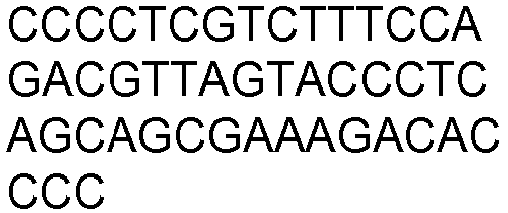
no no no no no no yes Base Plate 2[195]1 [195] Edge Passiva tion 4C 
no no no no no no yes Base Plate 30[200] 29[200] Edge Passiva tion 4C 
no no no no no no yes Base Plate 38[200] 37[200] Edge Passiva tion 4C 
no no no no no no yes Base Plate 21[12]20 [12] Edge Passiva tion 4C 
no no no no no no yes Base Plate 18[195] 17[195] Edge Passiva tion 4C 
no no no no no no yes Base Plate 19[12]18 [12] Edge Passiva tion 4C 
no no no no no no yes Base Plate 10[195]9 [195] Edge Passiva tion 4C 
no no no no no no yes Base Plate 25[17]24 [17] Edge Passiva tion 4C 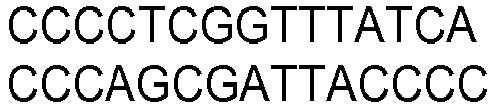
no no no no no no yes Base Plate 17[12]16 [12] Edge Passivation 4C 
no no no no no no yes 
Base Plate 15[12]14 [12] Edge Passiva tion 4T 
yes yes yes yes yes yes no Base Plate 6[195]5 [195] Edge Passiva tion 4T 
yes yes yes yes yes yes no Base Plate 23[17]22 [14] Edge Passiva tion 4T 
yes yes yes yes yes yes no Base Plate 39[17]38 [17] Edge Passiva tion 4T 
yes yes yes yes yes yes no Base Plate 8[195]7 [195] Edge Passiva tion 4T 
yes yes yes yes yes yes no Base Plate 29[17]28 [17] Edge Passiva tion 4T 
yes yes yes yes yes yes no Base Plate 16[195] 15[195] Edge Passiva tion 4T 
yes yes yes yes yes yes no Base Plate 40[200] 39[200] Edge Passiva tion 4T 
yes yes yes yes yes yes no Base Plate 24[200] 23[200] Edge Passiva tion 4T 
yes yes yes yes yes yes no Base Plate 28[200] 27[200] Edge Passiva tion 4T 
yes yes yes yes yes yes no Base Plate 40[39]42 [17] Edge Passiva tion 4T 
yes yes yes yes yes yes no Base Plate 33[17]32 [17] Edge Passiva tion 4T 
yes yes yes yes yes yes no Base Plate 7[12]6 [12] Edge Passiva tion 4T 
yes yes yes yes yes yes no Base Plate 5[12]4 [12] Edge Passiva tion 4T 
yes yes yes yes yes yes no Base Plate 42[203] 41[200] Edge Passiva tion 4T 
yes yes yes yes yes yes no Base Plate 20[167] 21[198] Edge Passiva tion 4T 
yes yes yes yes yes yes no Base Plate 35[17]34 [17] Edge Passivation 4T 
yes yes yes yes yes yes no Base Plate 20[195] 19[195] Edge Passiva tion 4T 
yes yes yes yes yes yes no Base Plate 36[200] 35[200] Edge Passiva tion 4T 
yes yes yes yes yes yes no Base Plate 34[200] 33[200] Edge Passiva tion 4T 
yes yes yes yes yes yes no Base Plate 1 [8]2[40] Edge Passiva tion 4T 
yes yes yes yes yes yes no Base Plate 41[17]40 [17] Edge Passiva tion 4T 
yes yes yes yes yes yes no Base Plate 4[195]3 [195] Edge Passiva tion 4T 
yes yes yes yes yes yes no Base Plate 11[12]10 [12] Edge Passiva tion 4T 
yes yes yes yes yes yes no Base Plate 31[17]30 [17] Edge Passiva tion 4T 
yes yes yes yes yes yes no Base Plate 3[12]2 [12] Edge Passiva tion 4T 
yes yes yes yes yes yes no Base Plate 13[12]12 [12] Edge Passiva tion 4T 
yes yes yes yes yes yes no Base Plate 14[195] 13[195] Edge Passiva tion 4T 
yes yes yes yes yes yes no Base Plate 27[17]26 [17] Edge Passiva tion 4T 
yes yes yes yes yes yes no Base Plate 22[200] 22[168] Edge Passiva tion 4T 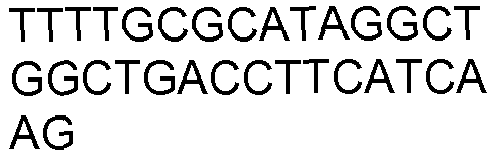
yes yes yes yes yes yes no Base Plate 32[200] 31[200] Edge Passiva tion 4T 
yes yes yes yes yes yes no Base Plate 9[12]8 [12] Edge Passiva tion 4T 
yes yes yes yes yes yes no Base Plate 37[17]36 [17] Edge Passiva tion 4T 
yes yes yes yes yes yes no Base Plate 12[195] 11[195] Edge Passiva tion 4T 
yes yes yes yes yes yes no Base 26[200] Edge 
yes yes yes yes yes yes no Plate 25[200] Passiva tion 4T 
Base Plate 2[195]1 [195] Edge Passiva tion 4T 
yes yes yes yes yes yes no Base Plate 30[200] 29[200] Edge Passiva tion 4T 
yes yes yes yes yes yes no Base Plate 38[200]3 7[200] Edge Passiva tion 4T 
yes yes yes yes yes yes no Base Plate 21[12]20 [12] Edge Passiva tion 4T 
yes yes yes yes yes yes no Base Plate 18[195] 17[195] Edge Passiva tion 4T 
yes yes yes yes yes yes no Base Plate 19[12]18 [12] Edge Passiva tion 4T 
yes yes yes yes yes yes no Base Plate 10[195] 9[195] Edge Passiva tion 4T 
yes yes yes yes yes yes no Base Plate 25[17]24 [17] Edge Passiva tion 4T 
yes yes yes yes yes yes no Base Plate 17[12]16 [12] Edge Passiva tion 4T 
yes yes yes yes yes yes no Base Plate 37[28]36 [190] Bottom Layer Polyme rization 
no no no no no no no Base Plate 33[28]32 [190] Bottom Layer Polyme rization 
no no no no no no no Base Plate 31[28]30 [190] Bottom Layer Polyme rization 
no no no no no no no Base Plate 42[39]42 [21] Bottom Layer Polyme rization 
no no no no no no no Base Plate 41[28]40 [190] Bottom Layer Polyme rization 
no no no no no no no Base Plate 27[28]26 [190] Bottom Layer Polymerization 
no no no no no no no Base Plate 29[28]28 [190] Bottom Layer Polyme rization 
no no no no no no no Base Plate 22[31]22 [176] Bottom Layer Polyme rization 
no no no no no no no Base Plate 25[28]24 [190] Bottom Layer Polyme rization 
no no no no no no no Base Plate 35[28]34 [190] Bottom Layer Polyme rization 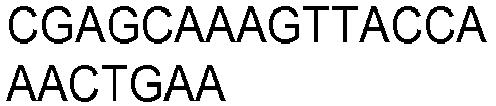
no no no no no no no Base Plate 39[28]38 [190] Bottom Layer Polyme rization 
no no no no no no no Base Plate 28[189] 27[27] Bottom Layer Polyme rization 
no no no no no no no Base Plate 24[189] 23[31] Bottom Layer Polyme rization 
no no no no no no no Base Plate 30[189] 29[27] Bottom Layer Polyme rization 
no no no no no no no Base Plate 36[189] 35[27] Bottom Layer Polyme rization 
no no no no no no no Base Plate 26[189] 25[27] Bottom Layer Polyme rization 
no no no no no no no Base Plate 40[189] 39[27] Bottom Layer Polyme rization 
no no no no no no no Base Plate 38[189] 37[27] Bottom Layer Polyme rization 
no no no no no no no Base Plate 42[196] 41[27] Bottom Layer Polyme rization 
no no no no no no no Base Plate 34[189] 33[27] Bottom Layer 
no no no no no no no Polyme rization 
Base Plate 32[189] 31[27] Bottom Layer Polyme rization 
no no no no no no no -
Oligo Name Sequence Figure 1 7 8 9A,B 9C,D 10A,B 10C,D HybrA655 [Atto655] TT ATATGTACGGGTCTCACTTA no no no no no no yes HybrA565 [Atto565] TT CGGAGGTTAAGTAGGTTG no no no no no no yes Thiol_10T [thiol] TTTTTTTTTT no no no no no no yes - Optional orientation control of the
platform 4 during sample preparation is shown infigure 11. Figure 11-A shows a sketch of the designed structures. Along handle 18 is attached to theplatform 4, which has the shape of a square plate in this embodiment. The protruding end of thehandle 18 is functionalized with asingle biotin molecule 22, which can flexibly anchor the construct to an avidin modified surface and hence functions as aprimary anchor 19. The edges of theplatform 4 can be fixed viasecondary anchors 20. Therefore, theplatform 4 is extended withsecondary anchoring sequences 21. Thesesecondary anchoring sequences 21 allow subsequent fixation upon addition of biotin modifiedcomplimentary strands 23. For superresolution optical microscopy various points on the construct are labelled with DNA-PAINT docking sites 24. The workflow of fixation of theplatform 4 including orientation control is illustrated infigure 11-B . First, theconstruct comprising platform 4 andhandle 18 is flexibly anchored with theprimary anchor 19. Second, thehandle 18 and theplatform 4 are aligned in thedirection 25 of an externally applied electric field. This is performed in the same way as aligning thepositioning arm 5 after fixation of theplatform 4. Third, while aligned, the biotin modified complimentary strands 23 (biotin modified oligonucleotides) are added to facilitate fixation of thesecondary anchoring sequences 21 in order to generate thesecondary anchors 20. As a result, theplatform 4 and thehandle 18 stay fixed in the alignment direction after the external field is switched off. -
Figure 11-C shows a DNA-PAINT localization image of alignedstructures including platform 4 and handle 18 after the external field has been switched off. The DNA-PAINT localization image shows the positions of the DNA-PAINT docking sites 24. The inset shows a histogram of the angular distribution of structures that were measured in a larger field of view that exhibits a strong preference between 150° and 210°. In the histogram, the circumferential dimension denotes the alignment angle and the radial dimension denotes the number ofstructures comprising platform 4 and handle 18. -
- 1. Hess, H.; Bachand, G. D.; Vogel, V., Powering Nanodevices with Biomolecular Motors. .
- 2. van den Heuvel, M. G. L.; Dekker, C., Motor Proteins at Work for Nanotechnology. Science (New York, NY) 2007, 317, 333-336.
- 3. Fischer, T.; Agarwal, A.; Hess, H., A Smart Dust Biosensor Powered by Kinesin Motors. Nature Nanotech. 2009, 4, 162-166.
- 4. van den Heuvel, M. G.; de Graaff, M. P.; Dekker, C., Molecular Sorting by Electrical Steering of Microtubules in Kinesin-Coated Channels. Science (New York, NY) 2006, 312, 910-4.
- 5. Krishnan, Y.; Simmel, F. C., Nucleic Acid Based Molecular Devices. Angew. Chem. Int. Ed. 2011, 50, 3124-3156.
- 6. Kopperger, E.; Pirzer, T.; Simmel, F. C., Diffusive Transport of Molecular Cargo Tethered to a DNA Origami Platform. Nano Lett. 2015, 15, 2693-2699.
- 7. Marras, A. E.; Zhou, L.; Su, H.-J.; Castro, C. E., Programmable Motion of DNA Origami Mechanisms. Proc. Natl. Ac. Sci. 2015, 112, 713-8.
- 8. Ketterer, P.; Willner, E. M.; Dietz, H., Nanoscale Rotary Apparatus Formed from Tight-Fitting 3d DNA Components. Sci .
- 9. List, J.; Falgenhauer, E.; Kopperger, E.; Pardatscher, G.; Simmel, F. C., Long-Range Movement of Large Mechanically Interlocked DNA Nanostructures. Nat Commun 2016, 7, 12414.
- 10. Omabegho, T.; Sha, R.; Seeman, N. C., A Bipedal DNA Brownian Motor with Coordinated Legs. Science 2009, 324, 67-71.
- 11. Green, S.; Bath, J.; Turberfield, A., Coordinated Chemomechanical Cycles: A Mechanism for Autonomous Molecular Motion. Phys. Rev. Lett. 2008, 101, art. no. 238101.
- 12. Liber, M.; Tomov, T. E.; Tsukanov, R.; Berger, Y.; Nir, E., A Bipedal DNA Motor That Travels Back and Forth between Two DNA Origami Tiles. Small 2014, n/a-n/a.
- 13. Wickham, S. F. J.; Endo, M.; Katsuda, Y.; Hidaka, K.; Bath, J.; Sugiyama, H.; Turberfield, A. J., Direct Observation of Stepwise Movement of a Synthetic Molecular Transporter. Nature Nanotech. 2011, 6, 166-169.
- 14. Asanuma, H.; Liang, X.; Yoshida, T.; Komiyama, M., Photocontrol of DNA Duplex Formation by Using Azobenzene-Bearing Oligonucleotides. .
- 15. Kang, H.; Liu, H.; Phillips, J. A.; Cao, Z.; Kim, Y.; Chen, Y.; Yang, Z.; Li, J.; Tan, W., Single-DNA Molecule Nanomotor Regulated by Photons. Nano Lett. 2009, 9, 2690-2696.
- 16. Suzuki, Y.; Endo, M.; Yang, Y.; Sugiyama, H., Dynamic Assembly/Disassembly Processes of Photoresponsive DNA Origami Nanostructures Directly Visualized on a Lipid Membrane Surface. J. Am. Chem. Soc. 2014, 136, 1714-1717.
- 17. Rothemund, P. W. K., Folding DNA to Create Nanoscale Shapes and Patterns. Nature 2006, 440, 297-302.
- 18. Douglas, S. M.; Dietz, H.; Liedl, T.; Högberg, B.; Graf, F.; Shih, W. M., Self-Assembly of DNA into Nanoscale Three-Dimensional Shapes. Nature 2009, 459, 414-8.
- 19. Lin, C.; Jungmann, R.; Leifer, A. M.; Li, C.; Levner, D.; Church, G. M.; Shih, W. M.; Yin, P., Submicrometre Geometrically Encoded Fluorescent Barcodes Self-Assembled from DNA. Nature Chem. 2012, 4, 832-839.
- 20. Li, X.; Liu, D. R., DNA-Templated Organic Synthesis: Nature's Strategy for Controlling Chemical Reactivity Applied to Synthetic Molecules. Angew. Chem. Int. Ed. 2004, 43, 4848-4870.
- 21. He, Y.; Liu, D. R., Autonomous Multistep Organic Synthesis in a Single Isothermal Solution Mediated by a DNA Walker. Nature Nanotech. 2010, 5, 778-782.
- 22. Rant, U.; Pringsheim, E.; Kaiser, W.; Arinaga, K.; Knezevic, J.; Tornow, M.; Fujita, S.; Yokoyama, N.; Abstreiter, G., Detection and Size Analysis of Proteins with Switchable DNA Layers. Nano Letters 2009, Vol. 9, No. 4, 1290-1295.
- 23. Yang, Y.; Tashiro, R.; Suzuki, Y.; Emura, T.; Hidaka, K.; Sugijama, H.; Endo, M., A Photoregulated DNA-Based Rotary System and Direct Observation of Its Rotational Movement. Chemistry, 2007, 23, 1-8.
- 24. Campos, R.; Zhang, S.; Majikes, J. M.; Ferraz, L. C. C.; LaBean, T.H.; Dong, M. D.; Ferapotova, E. E., Electronically addressable nanomechanical switching of i-motif DNA origami assembled on basal plane HOPG. ChemComm, 2015, 51, 14111-14114.
-
- 1
- molecular machine
- 2
- movement part
- 3
- control part
- 4
- platform (first molecular element)
- 5
- positioning arm(second molecular element)
- 6
- linking element
- 7
- first electrical device
- 8
- second electrical device
- 9
- first fluidic channel
- 10
- second fluidic channel
- 11
- electrode
- 12
- intersection area
- 13
- isolating element
- 14
- additional lever/pointer structure
- 15
- donor dye
- 16
- first acceptor dye
- 17
- second acceptor dye
- 18
- handle
- 19
- primary anchor
- 20
- secondary anchor
- 21
- secondary anchoring sequences
- 22
- biotin molecule
- 23
- biotin modified complimentary strand
- 24
- DNA-PAINT docking sites
- 25
- direction of electrical field
-
- <110> Technische Universität München
- <120> Molecular machine
- <130> TUM180801PEP
- <150>
EP17165250.6
<151> 2017-04-06 - <160> 2
- <170> BiSSAP 1.3.6
- <210> 1
<211> 7704
<212> DNA
<213> Artificial Sequence - <220>
<223> p7704 scaffold permutation - <400> 1


- <210> 2
<211> 7249
<212> DNA
<213> Artificial Sequence - <220>
<223> p7249 scaffold permutation - <400> 2


Claims (14)
- Molecular machine (1) comprising• a movement part (2) including∘ a first molecular element (4),∘ a second molecular element (5), and∘ a linking element (6) for constraining a relative movement of the first molecular element (4) and the second molecular element (5), and characterized in that it further comprises• a control part (3) configured to generate an electrical field around the movement part (2),• wherein the first molecular element (4) is fixed relative to the control part (3),• wherein the second molecular element (5) is movable relative to the first molecular element (4) in at least one degree of freedom, and• wherein the second molecular element (5) is electrically charged such that the second molecular element (5) aligns to said electrical field.
- Molecular machine (1) according to claim 1, characterized in that the control part (3) comprises a fluidic channel (9, 10), in which the movement part (2) is provided, wherein the control part (3) has an electrical device (7, 8) including electrodes (11), which are connected to the fluidic channel (9, 10), for creating the electrical field.
- Molecular machine (1) according to claim 2, characterized in that the control part (3) comprises at least two electrical devices (7, 8) and fluidic channels (9, 10) with different orientations in order to create at least two independent overlaying electrical fields, wherein the fluidic channels (9, 10) are arranged to intersect at an intersection area (12) and the movement part (2) is placed at the intersection area (12).
- Molecular machine (1) according to claim 2 or 3, characterized in that the first molecular element (4) is fixed to the fluidic channel (9, 10).
- Molecular machine (1) according to any one of the claims 2 to 4, characterized in that the electrical device (7, 8) includes an isolating element (13) for isolating the electrodes (11) from the movement part (2).
- Molecular machine (1) according to any one of the previous claims, characterized in that the linking element (6) is part of the first molecular element (4) or the second molecular element (5).
- Molecular machine (1) according to any one of the previous claims, characterized in that the first molecular element (4) and/or the second molecular element (5) and/or the linking element (6) are biomolecules, preferably made of DNA, preferably DNA-origami, and/or RNA and/or protein and/or artificial charged supramolecular structures.
- Molecular machine (1) according to any one of the previous claims, characterized in that the first molecular element (4) is a platform and the second molecular element (5) is a positioning arm, wherein the linking element (6) constrains all relative movement of the first molecular element (4) and the second molecular element (5) except of a rotation of the second molecular element (5) within a plane parallel to the first molecular element (4).
- Molecular machine (1) according to any one of the previous claims, characterized in that fluctuations of the first molecular element (4) and/or the second molecular element (5) due to diffusion are within a tolerance of at most 10 nm, preferably at most 1 nm, particularly preferred at most 0.5 nm.
- Molecular machine (1) according to any one of the previous claims, characterized in that any dimension of the first molecular element (4) and the second molecular element (5) is less than 1000 nm.
- Molecular machine (1) according to any one of the previous claims, characterized in that the first molecular element (4) is made from a crossed two-layer scaffold routing, in which a top layer is preferably rotated with respect to a bottom layer by an angle between 80° and 100°, particularly 90°.
- Molecular machine (1) according to any one of the previous claims, characterized in that the second molecular element (5) is made from a DNA six-helix bundle.
- Molecular machine (1) according to any one of the previous claims, characterized in that the linking element (6) is created by two adjacent scaffold crossovers with three and four unpaired bases.
- Molecular machine (1) according to any one of the previous claims, characterized in that the second molecular element (5) is adapted to transport inorganic nanoparticles.
Applications Claiming Priority (3)
| Application Number | Priority Date | Filing Date | Title |
|---|---|---|---|
| EP17165250.6A EP3386090A1 (en) | 2017-04-06 | 2017-04-06 | Molecular machine |
| EP18152321 | 2018-01-18 | ||
| PCT/EP2018/058876 WO2018185295A1 (en) | 2017-04-06 | 2018-04-06 | Molecular machine |
Publications (2)
| Publication Number | Publication Date |
|---|---|
| EP3607646A1 EP3607646A1 (en) | 2020-02-12 |
| EP3607646B1 true EP3607646B1 (en) | 2021-05-26 |
Family
ID=61832530
Family Applications (1)
| Application Number | Title | Priority Date | Filing Date |
|---|---|---|---|
| EP18714543.8A Active EP3607646B1 (en) | 2017-04-06 | 2018-04-06 | Molecular machine |
Country Status (4)
| Country | Link |
|---|---|
| US (1) | US11352254B2 (en) |
| EP (1) | EP3607646B1 (en) |
| DK (1) | DK3607646T3 (en) |
| WO (1) | WO2018185295A1 (en) |
Families Citing this family (4)
| Publication number | Priority date | Publication date | Assignee | Title |
|---|---|---|---|---|
| CN110643604B (en) * | 2019-09-09 | 2021-04-09 | 国家纳米科学中心 | Tweezer-like composite nanoprobe and its preparation method and application |
| WO2022004757A1 (en) * | 2020-06-29 | 2022-01-06 | 国立大学法人北海道大学 | Power generation element |
| EP4148130A1 (en) | 2021-09-09 | 2023-03-15 | Uniwersytet Jagiellonski | Topogami and method for making interlocked single stranded dna rings |
| EP4276058A1 (en) * | 2022-05-09 | 2023-11-15 | Technische Universität München | Ac-field driven macromolecular rotary motor |
Family Cites Families (4)
| Publication number | Priority date | Publication date | Assignee | Title |
|---|---|---|---|---|
| US9044808B2 (en) * | 2009-03-03 | 2015-06-02 | The Johns Hopkins University | System and method for precision transport, positioning, and assembling of longitudinal nano-structures |
| WO2016040443A1 (en) * | 2014-09-09 | 2016-03-17 | Board Of Regents, The University Of Texas System | Electrode design and low-cost fabrication method for assembling and actuation of miniature motors with ultrahigh and uniform speed |
| GB201502866D0 (en) * | 2015-02-20 | 2015-04-08 | Drexler Kim E | Molecular motor |
| WO2016138231A2 (en) * | 2015-02-27 | 2016-09-01 | Sauder Timothy Lee | Molcular barcoded bi-stable switch |
-
2018
- 2018-04-06 US US16/500,602 patent/US11352254B2/en active Active
- 2018-04-06 WO PCT/EP2018/058876 patent/WO2018185295A1/en not_active Ceased
- 2018-04-06 EP EP18714543.8A patent/EP3607646B1/en active Active
- 2018-04-06 DK DK18714543.8T patent/DK3607646T3/en active
Non-Patent Citations (1)
| Title |
|---|
| None * |
Also Published As
| Publication number | Publication date |
|---|---|
| US11352254B2 (en) | 2022-06-07 |
| WO2018185295A1 (en) | 2018-10-11 |
| DK3607646T3 (en) | 2021-07-26 |
| US20200031663A1 (en) | 2020-01-30 |
| EP3607646A1 (en) | 2020-02-12 |
Similar Documents
| Publication | Publication Date | Title |
|---|---|---|
| US11352254B2 (en) | Molecular machine | |
| Sotiropoulou et al. | Biotemplated nanostructured materials | |
| Patolsky et al. | Au‐nanoparticle nanowires based on DNA and polylysine templates | |
| CN101057145B (en) | Methods and compositions for the detection of biological molecules using a two particle complex | |
| Bui et al. | Utilizing the organizational power of DNA scaffolds for new nanophotonic applications | |
| Ma et al. | Biotemplated nanostructures: directed assembly of electronic and optical materials using nanoscale complementarity | |
| Zheng et al. | Powering≈ 50 µm motion by a molecular event in DNA crystals | |
| Bhatia et al. | Self‐assembled, programmable DNA nanodevices for biological and biomedical applications | |
| Hölzel et al. | Oriented and vectorial immobilization of linear M13 dsDNA between interdigitated electrodes—towards single molecule DNA nanostructures | |
| Della Pia et al. | A step closer to membrane protein multiplexed nanoarrays using biotin-doped polypyrrole | |
| Yu et al. | Compliant DNA Origami Nanoactuators as Size‐Selective Nanopores | |
| Jahn et al. | Functional patterning of DNA origami by parallel enzymatic modification | |
| Du et al. | A review on optical imaging of DNA nanostructures and dynamic processes | |
| Cervantes-Salguero et al. | Single molecule DNA origami nanoarrays with controlled protein orientation | |
| EP1663473A2 (en) | Molecule arrays and method for producing the same | |
| EP3386090A1 (en) | Molecular machine | |
| Vogt et al. | Electrokinetic torque generation by DNA nanorobotic arms studied via single-molecule fluctuation analysis | |
| EP1949104B1 (en) | Method of measuring the affinity of biomolecules | |
| WO2004026458A1 (en) | Method for arranging a polymer molecule | |
| Dennany | Electrochemiluminescence fundamentals and analytical applications | |
| Swett et al. | DNA Crystals as a Template for Patterned Functional Materials | |
| Dosev et al. | Application of fluorescent Eu: Gd2O3 nanoparticles to the visualization of protein micropatterns | |
| CN100558629C (en) | DNA molecule nano-cabin and its preparation method and application | |
| Swett | DNA Nanotechnology for Interfacing with Inorganic Materials and Synthetic Biosystems | |
| Alivisatos | Inorganic Nanorods: Synthesis, Alignment, Properties |
Legal Events
| Date | Code | Title | Description |
|---|---|---|---|
| STAA | Information on the status of an ep patent application or granted ep patent |
Free format text: STATUS: UNKNOWN |
|
| STAA | Information on the status of an ep patent application or granted ep patent |
Free format text: STATUS: THE INTERNATIONAL PUBLICATION HAS BEEN MADE |
|
| PUAI | Public reference made under article 153(3) epc to a published international application that has entered the european phase |
Free format text: ORIGINAL CODE: 0009012 |
|
| STAA | Information on the status of an ep patent application or granted ep patent |
Free format text: STATUS: REQUEST FOR EXAMINATION WAS MADE |
|
| 17P | Request for examination filed |
Effective date: 20190930 |
|
| AK | Designated contracting states |
Kind code of ref document: A1 Designated state(s): AL AT BE BG CH CY CZ DE DK EE ES FI FR GB GR HR HU IE IS IT LI LT LU LV MC MK MT NL NO PL PT RO RS SE SI SK SM TR |
|
| AX | Request for extension of the european patent |
Extension state: BA ME |
|
| DAV | Request for validation of the european patent (deleted) | ||
| DAX | Request for extension of the european patent (deleted) | ||
| GRAP | Despatch of communication of intention to grant a patent |
Free format text: ORIGINAL CODE: EPIDOSNIGR1 |
|
| STAA | Information on the status of an ep patent application or granted ep patent |
Free format text: STATUS: GRANT OF PATENT IS INTENDED |
|
| INTG | Intention to grant announced |
Effective date: 20201105 |
|
| RIN1 | Information on inventor provided before grant (corrected) |
Inventor name: LIST, JONATHAN Inventor name: KOPPERGER, ENZO Inventor name: SIMMEL, FRIEDRICH C. |
|
| GRAS | Grant fee paid |
Free format text: ORIGINAL CODE: EPIDOSNIGR3 |
|
| GRAA | (expected) grant |
Free format text: ORIGINAL CODE: 0009210 |
|
| STAA | Information on the status of an ep patent application or granted ep patent |
Free format text: STATUS: THE PATENT HAS BEEN GRANTED |
|
| AK | Designated contracting states |
Kind code of ref document: B1 Designated state(s): AL AT BE BG CH CY CZ DE DK EE ES FI FR GB GR HR HU IE IS IT LI LT LU LV MC MK MT NL NO PL PT RO RS SE SI SK SM TR |
|
| REG | Reference to a national code |
Ref country code: GB Ref legal event code: FG4D |
|
| REG | Reference to a national code |
Ref country code: CH Ref legal event code: EP |
|
| REG | Reference to a national code |
Ref country code: DE Ref legal event code: R096 Ref document number: 602018017675 Country of ref document: DE |
|
| REG | Reference to a national code |
Ref country code: AT Ref legal event code: REF Ref document number: 1397243 Country of ref document: AT Kind code of ref document: T Effective date: 20210615 |
|
| REG | Reference to a national code |
Ref country code: IE Ref legal event code: FG4D |
|
| REG | Reference to a national code |
Ref country code: DK Ref legal event code: T3 Effective date: 20210720 |
|
| REG | Reference to a national code |
Ref country code: LT Ref legal event code: MG9D |
|
| REG | Reference to a national code |
Ref country code: AT Ref legal event code: MK05 Ref document number: 1397243 Country of ref document: AT Kind code of ref document: T Effective date: 20210526 |
|
| PG25 | Lapsed in a contracting state [announced via postgrant information from national office to epo] |
Ref country code: LT Free format text: LAPSE BECAUSE OF FAILURE TO SUBMIT A TRANSLATION OF THE DESCRIPTION OR TO PAY THE FEE WITHIN THE PRESCRIBED TIME-LIMIT Effective date: 20210526 Ref country code: HR Free format text: LAPSE BECAUSE OF FAILURE TO SUBMIT A TRANSLATION OF THE DESCRIPTION OR TO PAY THE FEE WITHIN THE PRESCRIBED TIME-LIMIT Effective date: 20210526 Ref country code: FI Free format text: LAPSE BECAUSE OF FAILURE TO SUBMIT A TRANSLATION OF THE DESCRIPTION OR TO PAY THE FEE WITHIN THE PRESCRIBED TIME-LIMIT Effective date: 20210526 Ref country code: AT Free format text: LAPSE BECAUSE OF FAILURE TO SUBMIT A TRANSLATION OF THE DESCRIPTION OR TO PAY THE FEE WITHIN THE PRESCRIBED TIME-LIMIT Effective date: 20210526 Ref country code: BG Free format text: LAPSE BECAUSE OF FAILURE TO SUBMIT A TRANSLATION OF THE DESCRIPTION OR TO PAY THE FEE WITHIN THE PRESCRIBED TIME-LIMIT Effective date: 20210826 |
|
| REG | Reference to a national code |
Ref country code: NL Ref legal event code: MP Effective date: 20210526 |
|
| PG25 | Lapsed in a contracting state [announced via postgrant information from national office to epo] |
Ref country code: GR Free format text: LAPSE BECAUSE OF FAILURE TO SUBMIT A TRANSLATION OF THE DESCRIPTION OR TO PAY THE FEE WITHIN THE PRESCRIBED TIME-LIMIT Effective date: 20210827 Ref country code: IS Free format text: LAPSE BECAUSE OF FAILURE TO SUBMIT A TRANSLATION OF THE DESCRIPTION OR TO PAY THE FEE WITHIN THE PRESCRIBED TIME-LIMIT Effective date: 20210926 Ref country code: PT Free format text: LAPSE BECAUSE OF FAILURE TO SUBMIT A TRANSLATION OF THE DESCRIPTION OR TO PAY THE FEE WITHIN THE PRESCRIBED TIME-LIMIT Effective date: 20210927 Ref country code: RS Free format text: LAPSE BECAUSE OF FAILURE TO SUBMIT A TRANSLATION OF THE DESCRIPTION OR TO PAY THE FEE WITHIN THE PRESCRIBED TIME-LIMIT Effective date: 20210526 Ref country code: SE Free format text: LAPSE BECAUSE OF FAILURE TO SUBMIT A TRANSLATION OF THE DESCRIPTION OR TO PAY THE FEE WITHIN THE PRESCRIBED TIME-LIMIT Effective date: 20210526 Ref country code: LV Free format text: LAPSE BECAUSE OF FAILURE TO SUBMIT A TRANSLATION OF THE DESCRIPTION OR TO PAY THE FEE WITHIN THE PRESCRIBED TIME-LIMIT Effective date: 20210526 Ref country code: NO Free format text: LAPSE BECAUSE OF FAILURE TO SUBMIT A TRANSLATION OF THE DESCRIPTION OR TO PAY THE FEE WITHIN THE PRESCRIBED TIME-LIMIT Effective date: 20210826 Ref country code: PL Free format text: LAPSE BECAUSE OF FAILURE TO SUBMIT A TRANSLATION OF THE DESCRIPTION OR TO PAY THE FEE WITHIN THE PRESCRIBED TIME-LIMIT Effective date: 20210526 |
|
| PG25 | Lapsed in a contracting state [announced via postgrant information from national office to epo] |
Ref country code: NL Free format text: LAPSE BECAUSE OF FAILURE TO SUBMIT A TRANSLATION OF THE DESCRIPTION OR TO PAY THE FEE WITHIN THE PRESCRIBED TIME-LIMIT Effective date: 20210526 |
|
| PG25 | Lapsed in a contracting state [announced via postgrant information from national office to epo] |
Ref country code: RO Free format text: LAPSE BECAUSE OF FAILURE TO SUBMIT A TRANSLATION OF THE DESCRIPTION OR TO PAY THE FEE WITHIN THE PRESCRIBED TIME-LIMIT Effective date: 20210526 Ref country code: CZ Free format text: LAPSE BECAUSE OF FAILURE TO SUBMIT A TRANSLATION OF THE DESCRIPTION OR TO PAY THE FEE WITHIN THE PRESCRIBED TIME-LIMIT Effective date: 20210526 Ref country code: SK Free format text: LAPSE BECAUSE OF FAILURE TO SUBMIT A TRANSLATION OF THE DESCRIPTION OR TO PAY THE FEE WITHIN THE PRESCRIBED TIME-LIMIT Effective date: 20210526 Ref country code: SM Free format text: LAPSE BECAUSE OF FAILURE TO SUBMIT A TRANSLATION OF THE DESCRIPTION OR TO PAY THE FEE WITHIN THE PRESCRIBED TIME-LIMIT Effective date: 20210526 Ref country code: EE Free format text: LAPSE BECAUSE OF FAILURE TO SUBMIT A TRANSLATION OF THE DESCRIPTION OR TO PAY THE FEE WITHIN THE PRESCRIBED TIME-LIMIT Effective date: 20210526 Ref country code: ES Free format text: LAPSE BECAUSE OF FAILURE TO SUBMIT A TRANSLATION OF THE DESCRIPTION OR TO PAY THE FEE WITHIN THE PRESCRIBED TIME-LIMIT Effective date: 20210526 |
|
| REG | Reference to a national code |
Ref country code: DE Ref legal event code: R097 Ref document number: 602018017675 Country of ref document: DE |
|
| PLBE | No opposition filed within time limit |
Free format text: ORIGINAL CODE: 0009261 |
|
| STAA | Information on the status of an ep patent application or granted ep patent |
Free format text: STATUS: NO OPPOSITION FILED WITHIN TIME LIMIT |
|
| 26N | No opposition filed |
Effective date: 20220301 |
|
| PG25 | Lapsed in a contracting state [announced via postgrant information from national office to epo] |
Ref country code: IS Free format text: LAPSE BECAUSE OF FAILURE TO SUBMIT A TRANSLATION OF THE DESCRIPTION OR TO PAY THE FEE WITHIN THE PRESCRIBED TIME-LIMIT Effective date: 20210926 Ref country code: AL Free format text: LAPSE BECAUSE OF FAILURE TO SUBMIT A TRANSLATION OF THE DESCRIPTION OR TO PAY THE FEE WITHIN THE PRESCRIBED TIME-LIMIT Effective date: 20210526 |
|
| PG25 | Lapsed in a contracting state [announced via postgrant information from national office to epo] |
Ref country code: IT Free format text: LAPSE BECAUSE OF FAILURE TO SUBMIT A TRANSLATION OF THE DESCRIPTION OR TO PAY THE FEE WITHIN THE PRESCRIBED TIME-LIMIT Effective date: 20210526 |
|
| REG | Reference to a national code |
Ref country code: BE Ref legal event code: MM Effective date: 20220430 |
|
| PG25 | Lapsed in a contracting state [announced via postgrant information from national office to epo] |
Ref country code: MC Free format text: LAPSE BECAUSE OF FAILURE TO SUBMIT A TRANSLATION OF THE DESCRIPTION OR TO PAY THE FEE WITHIN THE PRESCRIBED TIME-LIMIT Effective date: 20210526 Ref country code: LU Free format text: LAPSE BECAUSE OF NON-PAYMENT OF DUE FEES Effective date: 20220406 |
|
| PG25 | Lapsed in a contracting state [announced via postgrant information from national office to epo] |
Ref country code: BE Free format text: LAPSE BECAUSE OF NON-PAYMENT OF DUE FEES Effective date: 20220430 |
|
| PG25 | Lapsed in a contracting state [announced via postgrant information from national office to epo] |
Ref country code: IE Free format text: LAPSE BECAUSE OF NON-PAYMENT OF DUE FEES Effective date: 20220406 |
|
| PG25 | Lapsed in a contracting state [announced via postgrant information from national office to epo] |
Ref country code: MK Free format text: LAPSE BECAUSE OF FAILURE TO SUBMIT A TRANSLATION OF THE DESCRIPTION OR TO PAY THE FEE WITHIN THE PRESCRIBED TIME-LIMIT Effective date: 20210526 Ref country code: CY Free format text: LAPSE BECAUSE OF FAILURE TO SUBMIT A TRANSLATION OF THE DESCRIPTION OR TO PAY THE FEE WITHIN THE PRESCRIBED TIME-LIMIT Effective date: 20210526 |
|
| PG25 | Lapsed in a contracting state [announced via postgrant information from national office to epo] |
Ref country code: HU Free format text: LAPSE BECAUSE OF FAILURE TO SUBMIT A TRANSLATION OF THE DESCRIPTION OR TO PAY THE FEE WITHIN THE PRESCRIBED TIME-LIMIT; INVALID AB INITIO Effective date: 20180406 |
|
| PG25 | Lapsed in a contracting state [announced via postgrant information from national office to epo] |
Ref country code: TR Free format text: LAPSE BECAUSE OF FAILURE TO SUBMIT A TRANSLATION OF THE DESCRIPTION OR TO PAY THE FEE WITHIN THE PRESCRIBED TIME-LIMIT Effective date: 20210526 |
|
| PG25 | Lapsed in a contracting state [announced via postgrant information from national office to epo] |
Ref country code: MT Free format text: LAPSE BECAUSE OF FAILURE TO SUBMIT A TRANSLATION OF THE DESCRIPTION OR TO PAY THE FEE WITHIN THE PRESCRIBED TIME-LIMIT Effective date: 20210526 |
|
| PGFP | Annual fee paid to national office [announced via postgrant information from national office to epo] |
Ref country code: GB Payment date: 20260312 Year of fee payment: 9 |
|
| PGFP | Annual fee paid to national office [announced via postgrant information from national office to epo] |
Ref country code: FR Payment date: 20260309 Year of fee payment: 9 |
|
| REG | Reference to a national code |
Ref country code: CH Ref legal event code: U11 Free format text: ST27 STATUS EVENT CODE: U-0-0-U10-U11 (AS PROVIDED BY THE NATIONAL OFFICE) Effective date: 20260501 |
|
| PGFP | Annual fee paid to national office [announced via postgrant information from national office to epo] |
Ref country code: DK Payment date: 20260413 Year of fee payment: 9 |
|
| PGFP | Annual fee paid to national office [announced via postgrant information from national office to epo] |
Ref country code: DE Payment date: 20260305 Year of fee payment: 9 |
|
| PGFP | Annual fee paid to national office [announced via postgrant information from national office to epo] |
Ref country code: CH Payment date: 20260501 Year of fee payment: 9 |