EP3607005B1 - Pigment treated with at least one non-reactive polysiloxane for use in thermoplastics - Google Patents
Pigment treated with at least one non-reactive polysiloxane for use in thermoplastics Download PDFInfo
- Publication number
- EP3607005B1 EP3607005B1 EP18713952.2A EP18713952A EP3607005B1 EP 3607005 B1 EP3607005 B1 EP 3607005B1 EP 18713952 A EP18713952 A EP 18713952A EP 3607005 B1 EP3607005 B1 EP 3607005B1
- Authority
- EP
- European Patent Office
- Prior art keywords
- inorganic pigment
- pigment
- reactive polysiloxane
- range
- coated
- Prior art date
- Legal status (The legal status is an assumption and is not a legal conclusion. Google has not performed a legal analysis and makes no representation as to the accuracy of the status listed.)
- Active
Links
Images


Classifications
-
- C—CHEMISTRY; METALLURGY
- C08—ORGANIC MACROMOLECULAR COMPOUNDS; THEIR PREPARATION OR CHEMICAL WORKING-UP; COMPOSITIONS BASED THEREON
- C08K—Use of inorganic or non-macromolecular organic substances as compounding ingredients
- C08K9/00—Use of pretreated ingredients
- C08K9/04—Ingredients treated with organic substances
- C08K9/06—Ingredients treated with organic substances with silicon-containing compounds
-
- C—CHEMISTRY; METALLURGY
- C09—DYES; PAINTS; POLISHES; NATURAL RESINS; ADHESIVES; COMPOSITIONS NOT OTHERWISE PROVIDED FOR; APPLICATIONS OF MATERIALS NOT OTHERWISE PROVIDED FOR
- C09C—TREATMENT OF INORGANIC MATERIALS, OTHER THAN FIBROUS FILLERS, TO ENHANCE THEIR PIGMENTING OR FILLING PROPERTIES ; PREPARATION OF CARBON BLACK ; PREPARATION OF INORGANIC MATERIALS WHICH ARE NO SINGLE CHEMICAL COMPOUNDS AND WHICH ARE MAINLY USED AS PIGMENTS OR FILLERS
- C09C1/00—Treatment of specific inorganic materials other than fibrous fillers; Preparation of carbon black
- C09C1/02—Compounds of alkaline earth metals or magnesium
- C09C1/027—Barium sulfates
-
- C—CHEMISTRY; METALLURGY
- C08—ORGANIC MACROMOLECULAR COMPOUNDS; THEIR PREPARATION OR CHEMICAL WORKING-UP; COMPOSITIONS BASED THEREON
- C08K—Use of inorganic or non-macromolecular organic substances as compounding ingredients
- C08K3/00—Use of inorganic substances as compounding ingredients
- C08K3/18—Oxygen-containing compounds, e.g. metal carbonyls
- C08K3/20—Oxides; Hydroxides
- C08K3/22—Oxides; Hydroxides of metals
-
- C—CHEMISTRY; METALLURGY
- C08—ORGANIC MACROMOLECULAR COMPOUNDS; THEIR PREPARATION OR CHEMICAL WORKING-UP; COMPOSITIONS BASED THEREON
- C08K—Use of inorganic or non-macromolecular organic substances as compounding ingredients
- C08K9/00—Use of pretreated ingredients
- C08K9/02—Ingredients treated with inorganic substances
-
- C—CHEMISTRY; METALLURGY
- C08—ORGANIC MACROMOLECULAR COMPOUNDS; THEIR PREPARATION OR CHEMICAL WORKING-UP; COMPOSITIONS BASED THEREON
- C08K—Use of inorganic or non-macromolecular organic substances as compounding ingredients
- C08K9/00—Use of pretreated ingredients
- C08K9/08—Ingredients agglomerated by treatment with a binding agent
-
- C—CHEMISTRY; METALLURGY
- C08—ORGANIC MACROMOLECULAR COMPOUNDS; THEIR PREPARATION OR CHEMICAL WORKING-UP; COMPOSITIONS BASED THEREON
- C08L—COMPOSITIONS OF MACROMOLECULAR COMPOUNDS
- C08L69/00—Compositions of polycarbonates; Compositions of derivatives of polycarbonates
-
- C—CHEMISTRY; METALLURGY
- C09—DYES; PAINTS; POLISHES; NATURAL RESINS; ADHESIVES; COMPOSITIONS NOT OTHERWISE PROVIDED FOR; APPLICATIONS OF MATERIALS NOT OTHERWISE PROVIDED FOR
- C09C—TREATMENT OF INORGANIC MATERIALS, OTHER THAN FIBROUS FILLERS, TO ENHANCE THEIR PIGMENTING OR FILLING PROPERTIES ; PREPARATION OF CARBON BLACK ; PREPARATION OF INORGANIC MATERIALS WHICH ARE NO SINGLE CHEMICAL COMPOUNDS AND WHICH ARE MAINLY USED AS PIGMENTS OR FILLERS
- C09C1/00—Treatment of specific inorganic materials other than fibrous fillers; Preparation of carbon black
- C09C1/04—Compounds of zinc
- C09C1/043—Zinc oxide
-
- C—CHEMISTRY; METALLURGY
- C09—DYES; PAINTS; POLISHES; NATURAL RESINS; ADHESIVES; COMPOSITIONS NOT OTHERWISE PROVIDED FOR; APPLICATIONS OF MATERIALS NOT OTHERWISE PROVIDED FOR
- C09C—TREATMENT OF INORGANIC MATERIALS, OTHER THAN FIBROUS FILLERS, TO ENHANCE THEIR PIGMENTING OR FILLING PROPERTIES ; PREPARATION OF CARBON BLACK ; PREPARATION OF INORGANIC MATERIALS WHICH ARE NO SINGLE CHEMICAL COMPOUNDS AND WHICH ARE MAINLY USED AS PIGMENTS OR FILLERS
- C09C1/00—Treatment of specific inorganic materials other than fibrous fillers; Preparation of carbon black
- C09C1/04—Compounds of zinc
- C09C1/06—Lithopone
-
- C—CHEMISTRY; METALLURGY
- C09—DYES; PAINTS; POLISHES; NATURAL RESINS; ADHESIVES; COMPOSITIONS NOT OTHERWISE PROVIDED FOR; APPLICATIONS OF MATERIALS NOT OTHERWISE PROVIDED FOR
- C09C—TREATMENT OF INORGANIC MATERIALS, OTHER THAN FIBROUS FILLERS, TO ENHANCE THEIR PIGMENTING OR FILLING PROPERTIES ; PREPARATION OF CARBON BLACK ; PREPARATION OF INORGANIC MATERIALS WHICH ARE NO SINGLE CHEMICAL COMPOUNDS AND WHICH ARE MAINLY USED AS PIGMENTS OR FILLERS
- C09C1/00—Treatment of specific inorganic materials other than fibrous fillers; Preparation of carbon black
- C09C1/36—Compounds of titanium
- C09C1/3607—Titanium dioxide
- C09C1/3615—Physical treatment, e.g. grinding, treatment with ultrasonic vibrations
- C09C1/3623—Grinding
-
- C—CHEMISTRY; METALLURGY
- C09—DYES; PAINTS; POLISHES; NATURAL RESINS; ADHESIVES; COMPOSITIONS NOT OTHERWISE PROVIDED FOR; APPLICATIONS OF MATERIALS NOT OTHERWISE PROVIDED FOR
- C09C—TREATMENT OF INORGANIC MATERIALS, OTHER THAN FIBROUS FILLERS, TO ENHANCE THEIR PIGMENTING OR FILLING PROPERTIES ; PREPARATION OF CARBON BLACK ; PREPARATION OF INORGANIC MATERIALS WHICH ARE NO SINGLE CHEMICAL COMPOUNDS AND WHICH ARE MAINLY USED AS PIGMENTS OR FILLERS
- C09C1/00—Treatment of specific inorganic materials other than fibrous fillers; Preparation of carbon black
- C09C1/36—Compounds of titanium
- C09C1/3607—Titanium dioxide
- C09C1/3653—Treatment with inorganic compounds
- C09C1/3661—Coating
-
- C—CHEMISTRY; METALLURGY
- C09—DYES; PAINTS; POLISHES; NATURAL RESINS; ADHESIVES; COMPOSITIONS NOT OTHERWISE PROVIDED FOR; APPLICATIONS OF MATERIALS NOT OTHERWISE PROVIDED FOR
- C09C—TREATMENT OF INORGANIC MATERIALS, OTHER THAN FIBROUS FILLERS, TO ENHANCE THEIR PIGMENTING OR FILLING PROPERTIES ; PREPARATION OF CARBON BLACK ; PREPARATION OF INORGANIC MATERIALS WHICH ARE NO SINGLE CHEMICAL COMPOUNDS AND WHICH ARE MAINLY USED AS PIGMENTS OR FILLERS
- C09C1/00—Treatment of specific inorganic materials other than fibrous fillers; Preparation of carbon black
- C09C1/36—Compounds of titanium
- C09C1/3607—Titanium dioxide
- C09C1/3684—Treatment with organo-silicon compounds
-
- C—CHEMISTRY; METALLURGY
- C09—DYES; PAINTS; POLISHES; NATURAL RESINS; ADHESIVES; COMPOSITIONS NOT OTHERWISE PROVIDED FOR; APPLICATIONS OF MATERIALS NOT OTHERWISE PROVIDED FOR
- C09C—TREATMENT OF INORGANIC MATERIALS, OTHER THAN FIBROUS FILLERS, TO ENHANCE THEIR PIGMENTING OR FILLING PROPERTIES ; PREPARATION OF CARBON BLACK ; PREPARATION OF INORGANIC MATERIALS WHICH ARE NO SINGLE CHEMICAL COMPOUNDS AND WHICH ARE MAINLY USED AS PIGMENTS OR FILLERS
- C09C1/00—Treatment of specific inorganic materials other than fibrous fillers; Preparation of carbon black
- C09C1/36—Compounds of titanium
- C09C1/3692—Combinations of treatments provided for in groups C09C1/3615 - C09C1/3684
-
- C—CHEMISTRY; METALLURGY
- C09—DYES; PAINTS; POLISHES; NATURAL RESINS; ADHESIVES; COMPOSITIONS NOT OTHERWISE PROVIDED FOR; APPLICATIONS OF MATERIALS NOT OTHERWISE PROVIDED FOR
- C09C—TREATMENT OF INORGANIC MATERIALS, OTHER THAN FIBROUS FILLERS, TO ENHANCE THEIR PIGMENTING OR FILLING PROPERTIES ; PREPARATION OF CARBON BLACK ; PREPARATION OF INORGANIC MATERIALS WHICH ARE NO SINGLE CHEMICAL COMPOUNDS AND WHICH ARE MAINLY USED AS PIGMENTS OR FILLERS
- C09C3/00—Treatment in general of inorganic materials, other than fibrous fillers, to enhance their pigmenting or filling properties
- C09C3/12—Treatment with organosilicon compounds
-
- C—CHEMISTRY; METALLURGY
- C01—INORGANIC CHEMISTRY
- C01P—INDEXING SCHEME RELATING TO STRUCTURAL AND PHYSICAL ASPECTS OF SOLID INORGANIC COMPOUNDS
- C01P2004/00—Particle morphology
- C01P2004/80—Particles consisting of a mixture of two or more inorganic phases
- C01P2004/82—Particles consisting of a mixture of two or more inorganic phases two phases having the same anion, e.g. both oxidic phases
- C01P2004/84—Particles consisting of a mixture of two or more inorganic phases two phases having the same anion, e.g. both oxidic phases one phase coated with the other
-
- C—CHEMISTRY; METALLURGY
- C01—INORGANIC CHEMISTRY
- C01P—INDEXING SCHEME RELATING TO STRUCTURAL AND PHYSICAL ASPECTS OF SOLID INORGANIC COMPOUNDS
- C01P2006/00—Physical properties of inorganic compounds
- C01P2006/60—Optical properties, e.g. expressed in CIELAB-values
- C01P2006/62—L* (lightness axis)
-
- C—CHEMISTRY; METALLURGY
- C01—INORGANIC CHEMISTRY
- C01P—INDEXING SCHEME RELATING TO STRUCTURAL AND PHYSICAL ASPECTS OF SOLID INORGANIC COMPOUNDS
- C01P2006/00—Physical properties of inorganic compounds
- C01P2006/60—Optical properties, e.g. expressed in CIELAB-values
- C01P2006/64—Optical properties, e.g. expressed in CIELAB-values b* (yellow-blue axis)
-
- C—CHEMISTRY; METALLURGY
- C08—ORGANIC MACROMOLECULAR COMPOUNDS; THEIR PREPARATION OR CHEMICAL WORKING-UP; COMPOSITIONS BASED THEREON
- C08K—Use of inorganic or non-macromolecular organic substances as compounding ingredients
- C08K3/00—Use of inorganic substances as compounding ingredients
- C08K3/18—Oxygen-containing compounds, e.g. metal carbonyls
- C08K3/20—Oxides; Hydroxides
- C08K3/22—Oxides; Hydroxides of metals
- C08K2003/2237—Oxides; Hydroxides of metals of titanium
- C08K2003/2241—Titanium dioxide
-
- C—CHEMISTRY; METALLURGY
- C08—ORGANIC MACROMOLECULAR COMPOUNDS; THEIR PREPARATION OR CHEMICAL WORKING-UP; COMPOSITIONS BASED THEREON
- C08K—Use of inorganic or non-macromolecular organic substances as compounding ingredients
- C08K3/00—Use of inorganic substances as compounding ingredients
- C08K3/18—Oxygen-containing compounds, e.g. metal carbonyls
- C08K3/20—Oxides; Hydroxides
- C08K3/22—Oxides; Hydroxides of metals
- C08K2003/2296—Oxides; Hydroxides of metals of zinc
-
- C—CHEMISTRY; METALLURGY
- C08—ORGANIC MACROMOLECULAR COMPOUNDS; THEIR PREPARATION OR CHEMICAL WORKING-UP; COMPOSITIONS BASED THEREON
- C08K—Use of inorganic or non-macromolecular organic substances as compounding ingredients
- C08K3/00—Use of inorganic substances as compounding ingredients
- C08K3/30—Sulfur-, selenium- or tellurium-containing compounds
- C08K2003/3045—Sulfates
Definitions
- the present invention relates to inorganic pigments treated/coated with at least one non-reactive polysiloxane, methods for producing these coated inorganic pigments, thermoplastics comprising these coated inorganic pigments and methods for the production of these thermoplastics.
- Plastics can be divided into the main groups of thermoplastics and thermosets. Polymers that have a flow transition range above the working temperature are known as thermoplastics. Thermoplastics are linear or branched polymers which in principle are flowable above the glass transition temperature (Tg) in the case of amorphous thermoplastics and above the melting point (Tm) in the case of (partly) crystalline thermoplastics. The chain movability is so large that the polymer molecules slide easily over one another and the material reaches the molten state (flow range, polymer melt).
- the properties of plastics can be controlled by the use of additives.
- additives encompasses pigments, e.g. inorganic pigments that are responsible for the coloring.
- inorganic pigments are usually surface-modified. Hence, they are coated to improve the stability of plastic articles or compounds with regard to polymer degradation.
- the polymer degradation can be e.g. recognized as yellow color of the plastic articles or compounds after applying thermal stress during the extrusion/molding process or thermal stress during the lifetime of the plastic article.
- Inorganic pigments can be surface-modified by inorganic coatings. Silicon dioxide and aluminium oxide are commonly used as an inorganic coating of a titanium dioxide pigment, for example.
- inorganic pigments with or without an inorganic coating can still adversely affect plastics, as these pigments often exhibit active sites on their surfaces.
- organic coatings e.g. antioxidants or octyltriethoxysilanes for inorganic pigments to improve the stability of the plastic materials.
- Inorganic pigments are furthermore hygroscopic and thus contain water strongly bound to the surface with its active sites.
- the high residual moisture content also negatively influences the plastic properties and is regarded to be at least partly responsible for discoloration of the plastic.
- inorganic pigments having organic coatings According to the state of art are that the organic additives used for coating react with the water traces bound to the pigment surface under condensation of reaction products like hydrogen. Other additives lead e.g. to the formation of alcohol after subsequent thermal treatment. A further disadvantage is that the organic substances used for coating regularly do not meet requirements for materials intended to be in contact with food.
- EP1281735A1 discloses a hydrophobic silica with a high whiteness obtained by mixing the silica and the dimethylpolysiloxane (viscosity of 59 mm 2 /s, trimethylsily terminated) and thereby coating said silica. The powder is then conditioned at 100 °C for one hour, followed by a heat treatment at 330-360 °C for one hour.
- the hydrophobic silica has a residual water content of 0.6 wt-%.
- EP1204006A1 discloses a hydrophobized silica having a particle diameter of 40 nm coated with a polydimethyl siloxane having a viscosity of 350 mm 2 ⁇ s -1 .
- the silica is added to a solution of the polydimethylsiloxane in toluene under agitation and irradiating the solution by ultrasonic waves.
- the solution is then decompressed to 10 mm Hg in order to evaporate the toluene followed by drying at 50 °C at reduced pressure until the weight of the residue did not change.
- the silicone coated product is then heat treated at 200 °C for 2 hours in an electric furnace under nitrogen and the agglomerated powder followed by disaggregation of the obtained powder.
- EP1333053A2 discloses a silica coated in a mass ratio of 1:1 with silicone oil (polydimethylsiloxane, 50 mm 2 ⁇ s -1 , e.g., DOW CORNING (R) 200 FLUID 50 CS carbon content approximately 33%) in a Gericke mixer.
- silicone oil polydimethylsiloxane, 50 mm 2 ⁇ s -1 , e.g., DOW CORNING (R) 200 FLUID 50 CS carbon content approximately 33%) in a Gericke mixer.
- the resulting powder was conditioned for at least one hour at a temperature of 105 °C. This produced a material in which, although it was wettable by water, the silica and silicone oil could no longer be separated from one another with water. Mixing of this masterbatch in water produced stable suspension in which the silicone oil could no longer be separated from the silica.
- the suspension was dried using a spray drier.
- the dimethylsiloxane-treated silica is conditioned by aging at room temperature for at least 48 hours until it had attained a methanol wettability of at least 20%.
- the conditioned precipitated silica was heat-treated under oxidizing conditions in a muffle furnace with a bed height of about 1 to 2 cm at a temperature above 330-360 °C. for 1 hour in order to obtain a hydrophobic silica with a moisture (water) content of 0.6 wt.-%.
- WO02/055596A1 discloses a method for treating a mineral filler consisting of a filler selected from the group consisting of marble, calcite, precipitated calcium carbonate, barium sulfate and mixtures thereof to provide a filler with hydrophobic properties suitable for incorporation into a polymer for a breathable film, comprising a two-step surface treatment of the filler, wherein the first step (pretreatment) comprising treating the filler with at least one polydialkylsiloxane, and the second step comprises treating the polydialkylsiloxane treated filler with at least one fatty acid having more than 10 carbon atoms, and the two steps can be carried out simultaneously.
- pretreatment comprising treating the filler with at least one polydialkylsiloxane
- the second step comprises treating the polydialkylsiloxane treated filler with at least one fatty acid having more than 10 carbon atoms
- the polydialkylsiloxane is a polydialkylsiloxane of general formula (R) 3 -Si-O-[(R) 2 -Si-O] n -Si-(R) 3 and the alkyl group R is a C 1 -C 4 alkyl group having a kinematic viscosity at 25 °C of between 50 and 100,000 mm 2 ⁇ s -1 .
- R is a C 1 -C 4 alkyl group having a kinematic viscosity at 25 °C of between 50 and 100,000 mm 2 ⁇ s -1 .
- marble is treated with a polydimethylsiloxane having a viscosity of 1000 mm 2 ⁇ s -1 .
- WO2007/011980A2 discloses a treated powder having improved loose bulk density comprising a silanized inorganic powder treated with a long chain fatty acid or salt thereof, wherein the amount of the long chain fatty acid is about 0.25% to about 2 wt.-%, based on the total weight of the treated powder, and wherein the loose bulk density of the treated powder is greater than the loose bulk density of an untreated silanized inorganic powder.
- the treated powder comprises at least one silane, or a mixture of at least one silane and at least one polydimethylsiloxane.
- the inorganic powder is selected from ZnS, titania, calcium carbonate, barium sulfate, zinc oxide, molybdenum sulfide talc and clay.
- Kataoka et al. (Viscosity-Molecular Weight Relationship for Polydimethylsiloxane, Polymer Letters, vol. 4, no. 5, May 1966 (1966-05), pages 317-322, DOI:10-1002/pol.1966.110040503 ) reported a polydimethylsiloxane having a molecular weight of about 1.03 ⁇ 10 4 and a viscosity of 270 cSt (270 mm 2 s -1 ), a molecular weight of about 2.2 ⁇ 10 4 having a viscosity of about 930 cSt (930 mm 2 s -1 ) or with a molecular weight of about 3.34 ⁇ 10 4 and a viscosity of 2700 cSt (2700 mm 2 s -1 ) at 25 °C.
- the inorganic pigments according to the present invention provide a surface, on which the active sites are mostly covered by the at least one non-reactive polysiloxane accompanied by a low residual moisture content. Due to the treating or coating, the inorganic pigments show reduced hygroscopic properties, which seem to be responsible for an improved storage stability, and the treatment leads to an improved stability of plastic articles containing these coated pigments.
- the low residual moisture content and the coverage of the active sites seem to be responsible for reduced polymer degradation, which is measured as yellow color of the plastics due to thermal stress during the extrusion/molding process or during the lifetime of the plastic article containing the inorganic pigment. Other impacts on the properties of the plastics, which are impaired by polymer degradation like mechanical strength, will also be reduced.
- the inorganic pigment can be coated either with one kind of non-reactive polysiloxanes or with a mixture of different kinds of non-reactive polysiloxanes of the general Formula I as shown above.
- the at least one non-reactive polysiloxane is polydimethylsiloxane, most preferably a FDA-approved polydimethylsiloxane, e.g. M350, which is a polydimethylsiloxane having a viscosity of 350 mm 2 x s -1 at 25°C.
- the at least one polysiloxanes is present in an amount between 0.1 and 10 wt-%, preferably between 1 and 8 wt-%, more preferably between 3 and 6 wt-% of the coated inorganic pigment, calculated on the total weight of the coated pigment according to carbon analysis after drying at 160°C to weight constancy. It has been found that the degradation properties of the coated inorganic pigment according to the present invention rapidly decreases with an increasing amount of the at least one non-reactive polysiloxane. However, amounts of the at least one non-reactive polysiloxane of more than 3 % per weight only slightly decreases the degradation properties further.
- the inorganic pigment according to the present invention can be any inorganic pigment, however, the inorganic pigment is preferably selected from the group consisting of titanium dioxide, barium sulfate, zinc oxide and lithopone or mixtures thereof, more preferably the inorganic pigment is titanium dioxide, most preferably rutile.
- the inorganic pigment according to the present invention can be organically or inorganically surface-modified with further compounds before treating with the at least one non-reactive polysiloxane of the general Formula I.
- the inorganic pigment can also be pretreated with a reactive siloxane like MH-15 having reactive Si-H moieties or other reactive polysiloxanes having Si-OR moieties in order to additionally silanize the surface of the pigment particles.
- the inorganic pigment is a titanium dioxide pigment being treated with hydrated inorganic precursors of silicon dioxide and/or aluminium oxide and then treated with at least one non-reactive polysiloxane of the general Formula I.
- the coated pigment comprises reactive groups selected from -Si-H, or -Si-OR in an amount of less than 0.1 wt.-%, preferably less than 0.01 wt.-% calculated on the total weight of the coated pigment and the added amount of organic additive after drying at 160°C to weight constancy.
- reactive groups selected from -Si-H, or -Si-OR in an amount of less than 0.1 wt.-%, preferably less than 0.01 wt.-% calculated on the total weight of the coated pigment and the added amount of organic additive after drying at 160°C to weight constancy.
- the present invention also provides a method for producing a coated inorganic pigment according to the present invention comprising the step of treating an inorganic pigment with at least one non-reactive polysiloxane of the general Formula I or mixtures thereof, wherein R 1 to R 8 may be the same or different and are selected from the group consisting of
- the treating step is preferably carried out at a temperature in the range of 100°C to 450°C, more preferably at a temperature in the range of 250°C to 400 °C. Due to the elevated temperature, the water is driven out of the inorganic pigment and the surface of the inorganic pigment with its active sites is covered by the at least one non-reactive polysiloxane.
- the treating step can also be carried out as a two-step or multi-step process in which the at least one non-reactive polysiloxane of the general Formula I is added to the pigment in several steps which stages might be interrupted each by a milling or kneading step.
- coated inorganic pigments preferably selected from the group consisting of titanium dioxide, barium sulfate, zinc oxide and lithopone, preferably titanium dioxide, more preferably rutile, or mixtures thereof.
- the inorganic pigment is used in a pre-dried form having a residual moisture content of less than 1 wt-%, preferably less than 0.5 wt-%, more preferably less than 0.4 wt-%, determined by drying at 160°C to weight constancy.
- a pre-dried inorganic pigment an elevated temperature during the treating of the inorganic pigment with at least one non-reactive polysiloxane of the general Formula I is not mandatory.
- the inorganic pigment thermally until a residual moisture content of less than 1.0 wt-%, preferably less than 0.5 wt-%, more preferably less than 0.4 wt-%, determined by drying at 160°C to weight constancy, is achieved, followed by treating the obtained inorganic pigment with the at least one non-reactive polysiloxane of the general Formula I.
- a residual moisture content of less than 1.0 wt-%, preferably less than 0.5 wt-%, more preferably less than 0.4 wt-%, determined by drying at 160°C to weight constancy.
- the step of treating the inorganic pigment with said at least one non-reactive polysiloxane of the general Formula I is carried out for less than 12 h, preferably less than 6 h, more preferably less than 4h, most preferably between 0.25 to 2 h.
- the thermal treatment can also be applied by microwave heating.
- microwaves By using microwaves, the drying-time can significantly be reduced to a few minutes, but may lead to a deterioration of the color value b. Therefore, applying microwave heating should be carried out under conditions with controlled energy impact.
- the treating comprises milling and/or kneading.
- only a partial amount of the at least one non-reactive polysiloxane is added to the inorganic pigment before the milling step and/or kneading step, wherein the remaining amount of the at least one non-reactive polysiloxane is added during the further process.
- Such a partitioning of the at least one non-reactive polysiloxane is particularly preferred if a steam jet mill is used for milling and leads to increased yields of the coated inorganic pigment.
- the inorganic pigment is crushed down to a size of less than 1 mm, preferably to a size of less than 0,8 mm, more preferably to less than 0,6 mm, before being treated with the at least one non-reactive polysiloxane.
- the at least one non-reactive polysiloxane is used in an amount that a coated inorganic pigment comprising between 0.1 and 10 wt-%, preferably between 1 and 8 wt-%, more preferably between 3 and 6 wt-% of the at least one polysiloxane, referred to the total weight of the treated pigment after drying at 160°C to weight constancy and calculated in accordance with a carbon analysis, is obtained.
- the method of the present invention comprises the step of adding at least one additive having reactive groups selected from silane-(Si-H) or C 1 -C 12 -alkoxy-siloxanes.
- at least one additive having reactive groups selected from silane-(Si-H) or C 1 -C 12 -alkoxy-siloxanes Such coated inorganic pigments provide an further improved thermal stability.
- the silane-(Si-H) can be added before, together or after the addition of the non-reactive polysiloxane.
- the present invention further provides a thermoplastic comprising the inorganic pigment of the present invention.
- Thermoplastics which can be used in the process of the invention include thermoplastically workable plastics having pronounced entropy-elastic properties.
- Thermoplastics also include all plastics consisting of linear or thermolabile crosslinked polymer molecules, for example polyolefins, vinyl polymers, polyesters, polyacetals, polycarbonates, also polyurethanes, ionomers, and thermoplastic elastomers such as acrylnitrile-butadiene-styrene (ABS), polyamide (PA), polylactate (PLA), polymethylmethacrylate (PMMA), polycarbonate (PC), polyethylene terephthalate (PET), polyethylene (PE), polypropylene (PP), polystyrene (PS), polyether etherketone (PEEK), polyvinylchloride (PVC), PBT polybutylene terephthalate as well as baking enamels for powder coating.
- ABS acrylnitrile-butadiene-styrene
- the thermoplastic comprises polycarbonate.
- the present invention further provides a method for the production of a thermoplastic comprising adding a pigment according to the present invention to a thermoplastic polymer, mixing the polymer mixture and subjecting the obtained polymer mixture to a plastics forming process, preferably an injection molding process, a compression molding process, a pressing process or an extrusion process.
- the polymer mixture is dried at a temperature in the range of 80°C to 200°C for 1-10 h before the plastics forming process.
- the plastic production process is carried out at a temperature in the range of 200°C to 450°C, preferably in the range of 280°C to 370°C.
- the methods for determining properties of the coated pigments are as follows.
- a mixture of 5% of the coated pigment in Makrolon 3108 powder is dried for 5 hours at 120°C.
- the dried mixture is processed on an Arburg 221 injection moulder at 300°C and 350°C, respectively giving white polycarbonate plates.
- the optical properties Lightness L* and color b* (according to the CIELab color system) of the moulded plates are determined with a Hunterlab UltraScan VIS spectrophotometer applying a light source D 65 using a 10° observer with gloss included.
- the content of the organic coating on a pigment is determined by carbon analysis of the pigment using an ELTRA CS2000 analyzer and calculation of the total organic coating out of it according to the share of carbon in the organic applied.
- the probe is combusted at 1100°C in an oxygen stream and the formed CO 2 is passed through in an infrared cell for detection.
- the water content of the particles can be calculated making use of the Karl-Fischer titration method.
- the content of reactive groups such as -Si-H moieties is measured by alkaline hydrolysis and volumetric determination of the formed hydrogen gas.
- the particle size of the particles is determined by sieving analysis.
- All weight percentages refer to the total weight of the treated pigment after drying to weight constancy at 160°C. Such drying can be carried under air or protective atmosphere.
- the following processes include mixing of polycarbonate powder Macrolon 3108 (PC) and the obtained pigment powder (5 %) of Examples 1. A), B) and C), respectively, drying of the mixture at 120°C for 5h and subsequently subjecting the mixture an injection moulding process at 300 and 350°C.
- Optical properties of polycarbonate (PC) plates containing the pigments according to examples A)-C) were analyzed and shown in Figure 1 .
- PC polycarbonate
- the following processes include the mixing of polycarbonate powder Macrolon 3108 (PC) and the pigment powder (5% referred to the weight of the ) containing M350 and octyltriethoxysilane, respectively, drying of the mixture at 120°C for 5h and subsequently subjecting the mixture an injection moulding process at 300 and 350°C.
- the resulting plates were analyzed regarding optical properties Lightness L* and colour b*.
- M350 compared to octyltriethoxysilane, leads to higher L* and lower b* values at test temperatures 300 and 350°C as and shown in Figure 2 .
- the injection moulding process includes mixing polycarbonate powder Macrolon 3108 (PC) and the pigment powder (5%), drying of the mixture at 120°C for 5h and subsequently subjecting the mixture an injection moulding process at 300 and 350°C, respectively.
- the resulting plates were analyzed regarding optical properties Lightness L* and colour b* and shown in Figure 3 . An increasing amount of organic treatment increases L* and decreases colour b* at test temperatures 300 and 350°C, respectively.
- the injection moulding process includes mixing of polycarbonate powder Macrolon 3108 (PC) and the pigment powder (5%), drying of the mixture at 120°C for 5h and subsequently subjecting the mixture an injection moulding process at 300 and 350°C, respectively.
- the resulting plates were analyzed regarding optical properties Lightness L* and colour b* and shown in Figure 4 . Microwave heating leads to higher L* and higher b* at test temperatures 300 and 350°C, compared to thermal treatment at 350°C.
Landscapes
- Chemical & Material Sciences (AREA)
- Organic Chemistry (AREA)
- Health & Medical Sciences (AREA)
- Chemical Kinetics & Catalysis (AREA)
- Medicinal Chemistry (AREA)
- Polymers & Plastics (AREA)
- Pigments, Carbon Blacks, Or Wood Stains (AREA)
- Paints Or Removers (AREA)
- Compositions Of Macromolecular Compounds (AREA)
Description
- The present invention relates to inorganic pigments treated/coated with at least one non-reactive polysiloxane, methods for producing these coated inorganic pigments, thermoplastics comprising these coated inorganic pigments and methods for the production of these thermoplastics.
- Plastics can be divided into the main groups of thermoplastics and thermosets. Polymers that have a flow transition range above the working temperature are known as thermoplastics. Thermoplastics are linear or branched polymers which in principle are flowable above the glass transition temperature (Tg) in the case of amorphous thermoplastics and above the melting point (Tm) in the case of (partly) crystalline thermoplastics. The chain movability is so large that the polymer molecules slide easily over one another and the material reaches the molten state (flow range, polymer melt).
- The properties of plastics can be controlled by the use of additives. One group of additives encompasses pigments, e.g. inorganic pigments that are responsible for the coloring. For improved compatibility, inorganic pigments are usually surface-modified. Hence, they are coated to improve the stability of plastic articles or compounds with regard to polymer degradation. The polymer degradation can be e.g. recognized as yellow color of the plastic articles or compounds after applying thermal stress during the extrusion/molding process or thermal stress during the lifetime of the plastic article.
- Inorganic pigments can be surface-modified by inorganic coatings. Silicon dioxide and aluminium oxide are commonly used as an inorganic coating of a titanium dioxide pigment, for example.
- However, inorganic pigments with or without an inorganic coating can still adversely affect plastics, as these pigments often exhibit active sites on their surfaces. In the state of art, it is disclosed to use organic coatings, e.g. antioxidants or octyltriethoxysilanes for inorganic pigments to improve the stability of the plastic materials.
- Inorganic pigments are furthermore hygroscopic and thus contain water strongly bound to the surface with its active sites. The high residual moisture content also negatively influences the plastic properties and is regarded to be at least partly responsible for discoloration of the plastic.
- Disadvantages of the inorganic pigments having organic coatings according to the state of art are that the organic additives used for coating react with the water traces bound to the pigment surface under condensation of reaction products like hydrogen. Other additives lead e.g. to the formation of alcohol after subsequent thermal treatment. A further disadvantage is that the organic substances used for coating regularly do not meet requirements for materials intended to be in contact with food.
- Inorganic pigments can also be surface-modified by organic coatings. For example,
EP1281735A1 discloses a hydrophobic silica with a high whiteness obtained by mixing the silica and the dimethylpolysiloxane (viscosity of 59 mm2/s, trimethylsily terminated) and thereby coating said silica. The powder is then conditioned at 100 °C for one hour, followed by a heat treatment at 330-360 °C for one hour. The hydrophobic silica has a residual water content of 0.6 wt-%. -
EP1204006A1 discloses a hydrophobized silica having a particle diameter of 40 nm coated with a polydimethyl siloxane having a viscosity of 350 mm2×s-1. The silica is added to a solution of the polydimethylsiloxane in toluene under agitation and irradiating the solution by ultrasonic waves. The solution is then decompressed to 10 mm Hg in order to evaporate the toluene followed by drying at 50 °C at reduced pressure until the weight of the residue did not change. The silicone coated product is then heat treated at 200 °C for 2 hours in an electric furnace under nitrogen and the agglomerated powder followed by disaggregation of the obtained powder. -
EP1333053A2 discloses a silica coated in a mass ratio of 1:1 with silicone oil (polydimethylsiloxane, 50 mm2×s-1, e.g., DOW CORNING (R) 200 FLUID 50 CS carbon content approximately 33%) in a Gericke mixer. The resulting powder was conditioned for at least one hour at a temperature of 105 °C. This produced a material in which, although it was wettable by water, the silica and silicone oil could no longer be separated from one another with water. Mixing of this masterbatch in water produced stable suspension in which the silicone oil could no longer be separated from the silica. The suspension was dried using a spray drier. The dimethylsiloxane-treated silica is conditioned by aging at room temperature for at least 48 hours until it had attained a methanol wettability of at least 20%. The conditioned precipitated silica was heat-treated under oxidizing conditions in a muffle furnace with a bed height of about 1 to 2 cm at a temperature above 330-360 °C. for 1 hour in order to obtain a hydrophobic silica with a moisture (water) content of 0.6 wt.-%. -
WO02/055596A1 -
WO2007/011980A2 discloses a treated powder having improved loose bulk density comprising a silanized inorganic powder treated with a long chain fatty acid or salt thereof, wherein the amount of the long chain fatty acid is about 0.25% to about 2 wt.-%, based on the total weight of the treated powder, and wherein the loose bulk density of the treated powder is greater than the loose bulk density of an untreated silanized inorganic powder. The treated powder comprises at least one silane, or a mixture of at least one silane and at least one polydimethylsiloxane. The inorganic powder is selected from ZnS, titania, calcium carbonate, barium sulfate, zinc oxide, molybdenum sulfide talc and clay. - Furthermore, Kataoka et al. (Viscosity-Molecular Weight Relationship for Polydimethylsiloxane, Polymer Letters, vol. 4, no. 5, May 1966 (1966-05), pages 317-322, DOI:10-1002/pol.1966.110040503) reported a polydimethylsiloxane having a molecular weight of about 1.03×10⁴ and a viscosity of 270 cSt (270 mm2s-1), a molecular weight of about 2.2×10⁴ having a viscosity of about 930 cSt (930 mm2s-1) or with a molecular weight of about 3.34×10⁴ and a viscosity of 2700 cSt (2700 mm2s-1) at 25 °C.
- It is an object of the present invention therefore to provide an inorganic pigment that improves the stability of plastic articles or compounds with regard to polymer degradation, that avoids or reduces the formation of reaction products like hydrogen or alcohols during production, storage or application and that allows storage stability also under humid conditions and thus does not have the disadvantages of the known inorganic pigments.
- It has now been found that the above-mentioned disadvantages can be dealt with when inorganic pigments are used that are treated with at least one non-reactive polysiloxane of the general Formula I,

- wherein R1 to R8 may be the same or different and are selected from the group consisting of
- CmH2m+1, wherein m is ≤10, preferably <6, more preferably <4, and even more preferably m = 1, 2 or 3, and fluorinated derivatives thereof wherein at least one hydrogen atom is replaced by fluorine, such as CH2CH2CF3,
- C6H5,
- (EO)x, (PO)y and copolymers thereof, wherein EO represents an oxyethylene unit, PO represents an oxypropylene unit and x and y may be the same or different and x + y is in the range of 1 to 50, and
- wherein the at least one non-reactive polysiloxane is having a viscosity in the range of 50-3000 mm2 x s-1 at 25°C, preferably 100-2000 mm2 x s-1 at 25°C, more preferably 150-1000 mm2 x s-1 at 25°C (determined according to DIN 51562), and
- wherein the inorganic pigment coated with at least one non-reactive polysiloxane of the general Formula I has a residual moisture content of less than 1.0 wt-%, preferably less than 0.5 wt-%, more preferably less than 0.4 wt-%, determined by drying at 160°C to weight constancy,
- wherein the at least one polysiloxane is present in an amount between 0.1 and 10 wt-%, preferably between 1 and 8 wt-%, more preferably between 3 and 6 wt-% of the coated inorganic pigment, calculated on the total weight of the coated pigment after drying at 160 °C to weight constancy.
- The inorganic pigments according to the present invention provide a surface, on which the active sites are mostly covered by the at least one non-reactive polysiloxane accompanied by a low residual moisture content. Due to the treating or coating, the inorganic pigments show reduced hygroscopic properties, which seem to be responsible for an improved storage stability, and the treatment leads to an improved stability of plastic articles containing these coated pigments. The low residual moisture content and the coverage of the active sites seem to be responsible for reduced polymer degradation, which is measured as yellow color of the plastics due to thermal stress during the extrusion/molding process or during the lifetime of the plastic article containing the inorganic pigment. Other impacts on the properties of the plastics, which are impaired by polymer degradation like mechanical strength, will also be reduced.
- The inorganic pigment can be coated either with one kind of non-reactive polysiloxanes or with a mixture of different kinds of non-reactive polysiloxanes of the general Formula I as shown above.
- Preferably, R1 to R8, in the at least one non-reactive polysiloxane of the general Formula I, may be the same or different and are selected from the group consisting of CmH2m+1, wherein m is <6, more preferably <4, and even more preferably m = 1 or 2. Even more preferably, the at least one non-reactive polysiloxane is polydimethylsiloxane, most preferably a FDA-approved polydimethylsiloxane, e.g. M350, which is a polydimethylsiloxane having a viscosity of 350 mm2 x s-1 at 25°C. These polydimethylsiloxanes meet the regulations for materials intended to have contact with foods which are thus in line with EU No 10/2011.
- The at least one polysiloxanes is present in an amount between 0.1 and 10 wt-%, preferably between 1 and 8 wt-%, more preferably between 3 and 6 wt-% of the coated inorganic pigment, calculated on the total weight of the coated pigment according to carbon analysis after drying at 160°C to weight constancy. It has been found that the degradation properties of the coated inorganic pigment according to the present invention rapidly decreases with an increasing amount of the at least one non-reactive polysiloxane. However, amounts of the at least one non-reactive polysiloxane of more than 3 % per weight only slightly decreases the degradation properties further.
- The inorganic pigment according to the present invention can be any inorganic pigment, however, the inorganic pigment is preferably selected from the group consisting of titanium dioxide, barium sulfate, zinc oxide and lithopone or mixtures thereof, more preferably the inorganic pigment is titanium dioxide, most preferably rutile.
- The inorganic pigment according to the present invention can be organically or inorganically surface-modified with further compounds before treating with the at least one non-reactive polysiloxane of the general Formula I. According to the present invention, the inorganic pigment can also be pretreated with a reactive siloxane like MH-15 having reactive Si-H moieties or other reactive polysiloxanes having Si-OR moieties in order to additionally silanize the surface of the pigment particles.
- In one exemplary embodiment, the inorganic pigment is a titanium dioxide pigment being treated with hydrated inorganic precursors of silicon dioxide and/or aluminium oxide and then treated with at least one non-reactive polysiloxane of the general Formula I.
- In one embodiment, the coated pigment comprises reactive groups selected from -Si-H, or -Si-OR in an amount of less than 0.1 wt.-%, preferably less than 0.01 wt.-% calculated on the total weight of the coated pigment and the added amount of organic additive after drying at 160°C to weight constancy. Thus, almost no reaction products like hydrogen or alcohols during production, storage or application are formed.
- Accordingly, the present invention also provides a method for producing a coated inorganic pigment according to the present invention comprising the step of treating an inorganic pigment with at least one non-reactive polysiloxane of the general Formula I or mixtures thereof,
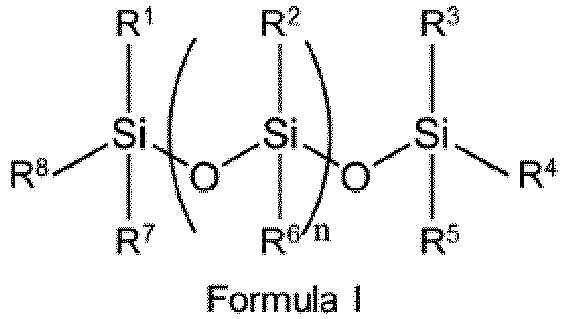
- CmH2m+1, wherein m is ≤10, preferably <6, more preferably <4, and even more preferably m = 1, 2 or 3, and fluorinated derivatives thereof wherein at least one hydrogen atom is replaced by fluorine, such as CH2CH2CF3,
- C6H5,
- (EO)x, (PO)y and copolymers thereof, wherein EO represents an oxyethylene unit, PO represents an oxypropylene unit and x and y may be the same or different and x + y is in the range of 1 to 50, and
- wherein the at least one non-reactive polysiloxane is having a viscosity in the range of 50-3000 mm2 x s-1 at 25°C, preferably 100-2000 mm2 x s-1 at 25°C, more preferably 150-1000 mm2 x s-1 at 25°C (in line with DIN 51562).
- The treating step is preferably carried out at a temperature in the range of 100°C to 450°C, more preferably at a temperature in the range of 250°C to 400 °C. Due to the elevated temperature, the water is driven out of the inorganic pigment and the surface of the inorganic pigment with its active sites is covered by the at least one non-reactive polysiloxane.
- The treating step can also be carried out as a two-step or multi-step process in which the at least one non-reactive polysiloxane of the general Formula I is added to the pigment in several steps which stages might be interrupted each by a milling or kneading step.
- By the method according to the invention, it is possible to produce coated inorganic pigments preferably selected from the group consisting of titanium dioxide, barium sulfate, zinc oxide and lithopone, preferably titanium dioxide, more preferably rutile, or mixtures thereof.
- In one embodiment, the inorganic pigment is used in a pre-dried form having a residual moisture content of less than 1 wt-%, preferably less than 0.5 wt-%, more preferably less than 0.4 wt-%, determined by drying at 160°C to weight constancy. In case of a pre-dried inorganic pigment, an elevated temperature during the treating of the inorganic pigment with at least one non-reactive polysiloxane of the general Formula I is not mandatory. Thus, according to the present invention, it is possible to treat the inorganic pigment thermally until a residual moisture content of less than 1.0 wt-%, preferably less than 0.5 wt-%, more preferably less than 0.4 wt-%, determined by drying at 160°C to weight constancy, is achieved, followed by treating the obtained inorganic pigment with the at least one non-reactive polysiloxane of the general Formula I. However, due to the hygroscopic properties of the inorganic pigment itself, it has to be ensured that, in the period between the thermal treatment and the treating of the inorganic pigment with at least one non-reactive polysiloxane of the general Formula I, the moisture content does not increase over the limit as required.
- Consequently, in case the step of treating an inorganic pigment with at least one non-reactive polysiloxane of the general Formula I is carried out at elevated temperatures, it is possible to use an inorganic pigment as starting material that has a higher moisture content. The elevated temperatures lead to evaporation of the water, which is directly replaced by the at least on non-reactive polysiloxane.
- According to the invention, the step of treating the inorganic pigment with said at least one non-reactive polysiloxane of the general Formula I is carried out for less than 12 h, preferably less than 6 h, more preferably less than 4h, most preferably between 0.25 to 2 h.
- The thermal treatment can also be applied by microwave heating. By using microwaves, the drying-time can significantly be reduced to a few minutes, but may lead to a deterioration of the color value b. Therefore, applying microwave heating should be carried out under conditions with controlled energy impact.
- In a further embodiment, the treating comprises milling and/or kneading. In one embodiment, only a partial amount of the at least one non-reactive polysiloxane is added to the inorganic pigment before the milling step and/or kneading step, wherein the remaining amount of the at least one non-reactive polysiloxane is added during the further process. Such a partitioning of the at least one non-reactive polysiloxane is particularly preferred if a steam jet mill is used for milling and leads to increased yields of the coated inorganic pigment.
- In a further embodiment of the invention, the inorganic pigment is crushed down to a size of less than 1 mm, preferably to a size of less than 0,8 mm, more preferably to less than 0,6 mm, before being treated with the at least one non-reactive polysiloxane.
- According to the invention, the at least one non-reactive polysiloxane is used in an amount that a coated inorganic pigment comprising between 0.1 and 10 wt-%, preferably between 1 and 8 wt-%, more preferably between 3 and 6 wt-% of the at least one polysiloxane, referred to the total weight of the treated pigment after drying at 160°C to weight constancy and calculated in accordance with a carbon analysis, is obtained.
- Preferably, the method of the present invention comprises the step of adding at least one additive having reactive groups selected from silane-(Si-H) or C1-C12-alkoxy-siloxanes. Such coated inorganic pigments provide an further improved thermal stability. The silane-(Si-H) can be added before, together or after the addition of the non-reactive polysiloxane.
- The present invention further provides a thermoplastic comprising the inorganic pigment of the present invention.
- Thermoplastics which can be used in the process of the invention include thermoplastically workable plastics having pronounced entropy-elastic properties. Thermoplastics also include all plastics consisting of linear or thermolabile crosslinked polymer molecules, for example polyolefins, vinyl polymers, polyesters, polyacetals, polycarbonates, also polyurethanes, ionomers, and thermoplastic elastomers such as acrylnitrile-butadiene-styrene (ABS), polyamide (PA), polylactate (PLA), polymethylmethacrylate (PMMA), polycarbonate (PC), polyethylene terephthalate (PET), polyethylene (PE), polypropylene (PP), polystyrene (PS), polyether etherketone (PEEK), polyvinylchloride (PVC), PBT polybutylene terephthalate as well as baking enamels for powder coating.
- Preferably, the thermoplastic comprises polycarbonate.
- The present invention further provides a method for the production of a thermoplastic comprising adding a pigment according to the present invention to a thermoplastic polymer, mixing the polymer mixture and subjecting the obtained polymer mixture to a plastics forming process, preferably an injection molding process, a compression molding process, a pressing process or an extrusion process.
- Preferably, the polymer mixture is dried at a temperature in the range of 80°C to 200°C for 1-10 h before the plastics forming process.
- In a preferred embodiment, the plastic production process is carried out at a temperature in the range of 200°C to 450°C, preferably in the range of 280°C to 370°C.
- The attached
Figures 1 to 4 illustrate the Lightness L* and Color b* values obtained for the samples as prepared in Examples 1 to 4, respectively. - The methods for determining properties of the coated pigments are as follows.
- A mixture of 5% of the coated pigment in Makrolon 3108 powder is dried for 5 hours at 120°C. The dried mixture is processed on an Arburg 221 injection moulder at 300°C and 350°C, respectively giving white polycarbonate plates. The optical properties Lightness L* and color b* (according to the CIELab color system) of the moulded plates are determined with a Hunterlab UltraScan VIS spectrophotometer applying a light source D 65 using a 10° observer with gloss included.
- The content of the organic coating on a pigment is determined by carbon analysis of the pigment using an ELTRA CS2000 analyzer and calculation of the total organic coating out of it according to the share of carbon in the organic applied.
- For this purpose, the probe is combusted at 1100°C in an oxygen stream and the formed CO2 is passed through in an infrared cell for detection.
- The water content of the particles, especially after drying, can be calculated making use of the Karl-Fischer titration method.
- The content of reactive groups such as -Si-H moieties is measured by alkaline hydrolysis and volumetric determination of the formed hydrogen gas.
- The particle size of the particles is determined by sieving analysis.
- All weight percentages refer to the total weight of the treated pigment after drying to weight constancy at 160°C. Such drying can be carried under air or protective atmosphere.
- The invention is further illustrated by the following Examples 1 to 4 which are further illustrated in the attached
Figures 1 to 4 referring to the respective Example of the same number. -
- A) Micronized rutile titanium dioxide pigment treated with alumina (RKB3) was dried at 130°C. The dry residue was crushed to particles having a diameter below 1 mm. These particles were sprayed with 0.5 wt-% M350 (20 g M350/4 kg dry residue) and heated for 1h at 350°C in a rotary kiln. Subsequently, the particles were treated in a steam jet mill (steam/product relation 3.0, 20 kg/h entry-, 40 kg/h mill-steam), whereby just a low dust formation was observed. The milled product (5.14 kg) was homogenized in a Lödige mixer, whereby further 200 g M350 (3.9%) was added. Approximately 5.3 kg of an inorganic pigment coated with a non-reactive polysiloxane and a residual moisture content of 0.6 % according to the present invention was obtained.
- B) Micronized rutile titanium dioxide pigment treated with alumina (RKB3) was dried at 130°C. The dry residue was crushed to particles having a diameter below 1mm. These particles were sprayed with 0.5 wt-% M350 (20 g M350/4 kg dry residue). The particles were treated in a steam jet mill (steam/product relation 3.0, 20kg/h entry-, 40 kg/h mill-steam). The milled product (5.51 kg) was homogenized in a Lödigemischer, whereby further 200 g M350 (3.6%) was added. The product was heated for 1h at 350°C in a rotary kiln. Approximately 5.51 kg of an inorganic pigment coated with a non-reactive polysiloxane and a residual moisture content of 0.3 % according to the present invention was obtained as granulate having an particle diameter of approximately 1-2 mm.
- C) Micronized rutile titanium dioxide pigment treated with alumina (RKB3) was dried at 130°C. The dry residue was crushed to particles having a diameter below 1mm. These particles were sprayed with 3 wt-% M350 (120 g M350/4 kg dry residue) and heated for 1h at 350°C in a rotary kiln. The product (8.02 kg) was milled in a steam jet mill (steam/product relation 3.0, 20 kg/h entry-, 40 kg/h mill-steam) Approximately 6.03 kg of an inorganic pigment coated with a non-reactive polysiloxane and a residual moisture content of 0.4 % according to the present invention was obtained.
- The following processes include mixing of polycarbonate powder Macrolon 3108 (PC) and the obtained pigment powder (5 %) of Examples 1. A), B) and C), respectively, drying of the mixture at 120°C for 5h and subsequently subjecting the mixture an injection moulding process at 300 and 350°C. Optical properties of polycarbonate (PC) plates containing the pigments according to examples A)-C) were analyzed and shown in
Figure 1 . - Optical properties of polycarbonate (PC) plates containing pigments RFK3 with organic treatment M350 (Example 2 A) and octyltriethoxysilane (Example 2 B), respectively, and subsequent thermal treatment at 350°C (0.5h) before injection moulding were analyzed.
- The following processes include the mixing of polycarbonate powder Macrolon 3108 (PC) and the pigment powder (5% referred to the weight of the ) containing M350 and octyltriethoxysilane, respectively, drying of the mixture at 120°C for 5h and subsequently subjecting the mixture an injection moulding process at 300 and 350°C. The resulting plates were analyzed regarding optical properties Lightness L* and colour b*. M350, compared to octyltriethoxysilane, leads to higher L* and lower b* values at test temperatures 300 and 350°C as and shown in
Figure 2 . - Optical properties of PC plates containing pigments RKB3 with increasing amount of organic treatment M350 with 0,0, 2,0, 3,0 and 4% (Examples 3 A) - 3 D), respectively, and subsequent thermal treatment at 350°C followed by an injection moulding process were analyzed.
- The injection moulding process includes mixing polycarbonate powder Macrolon 3108 (PC) and the pigment powder (5%), drying of the mixture at 120°C for 5h and subsequently subjecting the mixture an injection moulding process at 300 and 350°C, respectively. The resulting plates were analyzed regarding optical properties Lightness L* and colour b* and shown in
Figure 3 . An increasing amount of organic treatment increases L* and decreases colour b* at test temperatures 300 and 350°C, respectively. - Optical properties of PC plates containing pigments RKB3 with organic treatment M350 (3%, Example 4 A)) and subsequent thermal treatment at 350°C and microwave (1 min. 800W/50g, Example 4 B)), respectively, followed by an injection moulding process were analyzed.
- The injection moulding process includes mixing of polycarbonate powder Macrolon 3108 (PC) and the pigment powder (5%), drying of the mixture at 120°C for 5h and subsequently subjecting the mixture an injection moulding process at 300 and 350°C, respectively. The resulting plates were analyzed regarding optical properties Lightness L* and colour b* and shown in
Figure 4 . Microwave heating leads to higher L* and higher b* at test temperatures 300 and 350°C, compared to thermal treatment at 350°C.
Claims (13)
- Inorganic pigment treated with at least one non-reactive polysiloxane of the general Formula I,
 wherein R1 to R8 may be the same or different and are selected from the group consisting ofCmH2m+1, wherein m is ≤10, preferably <6, more preferably <4, and even more preferably m = 1, 2 or 3, and fluorinated derivatives thereof wherein at least one hydrogen atom is replaced by fluorine,C6H5,(EO)x, (PO)y and copolymers thereof, wherein EO represents an oxyethylene unit, PO represents an oxypropylene unit and x and y may be the same or different and x + y is in the range of 1 to 50, andwherein the at least one non-reactive polysiloxane is having a viscosity in the range of 50-3000 mm2 x s-1 at 25°C, preferably 100-2000 mm2 x s-1 at 25°C, more preferably 150-1000 mm2 x s-1 at 25°C (DIN 51562), andwherein the inorganic pigment coated with at least one non-reactive polysiloxane of the general Formula I has a residual moisture content of less than 1 wt-%, preferably less than 0.5 wt-%, more preferably less than 0.4 wt-%, after drying at 160°C to weight constancy,wherein the at least one polysiloxane is present in an amount between 0.1 and 10 wt-%, preferably between 1 and 8 wt-%, more preferably between 3 and 6 wt-% of the coated inorganic pigment, calculated on the total weight of the coated pigment after drying at 160°C to weight constancy.
 - Inorganic pigment according to claim 1, wherein, in the at least one non-reactive polysiloxane of the general Formula I, R1 to R8 may be the same or different and are selected from the group consisting of CmH2m+1, wherein m is <6, more preferable <4, and even more preferable m = 1 or 2.
- Inorganic pigment according to claim 1 or 2, wherein the at least one non-reactive polysiloxane is polydimethylsiloxane.
- Inorganic pigment according to anyone of claims 1 to 3 wherein the inorganic pigment is selected from the group consisting of titanium dioxide, preferably rutile, barium sulfate, zinc oxide and lithopone or mixtures thereof.
- Inorganic pigment according to anyone of claims 1 to 4, wherein the pigment comprises reactive groups selected from -Si-H, or -Si-OR in an amount of less than 0,1 wt.-%, preferably less than 0,01 wt.-% calculated on the total weight of the coated pigment after drying at 160°C to weight constancy.
- Inorganic pigment according to anyone of claims 1 to 5 wherein the inorganic pigment is inorganically or organically pretreated.
- Method for producing a coated inorganic pigment according to any of claims 1 to 6 comprising the step of treating an inorganic pigment with at least one non-reactive polysiloxane of the general Formula I,
 wherein R1 to R8 may be the same or different and are selected from the group consisting ofCmH2m+1, wherein m is ≤10, preferably <6, more preferably <4, and even more preferably m = 1, 2 or 3, and fluorinated derivatives thereof wherein at least one hydrogen atom is replaced by fluorine,C6H5,(EO)x, (PO)y and copolymers thereof, wherein EO represents an oxyethylene unit, PO represents an oxypropylene unit and x and y may be the same or different and x + y is in the range of 1 to 50, andwherein the at least one non-reactive polysiloxane is having a viscosity in the range of 50-3000 mm2 x s-1 at 25°C, preferably 100-2000 mm2 x s-1 at 25°C, more preferably 150-1000 mm2 x s-1 at 25°C (DIN 51562),preferably at a temperature in the range of 100°C to 450°C, more preferably at a temperature in the range of 250°C to 400 °C.
 - Method according to claim 7, wherein the step of thermally treating the inorganic pigment with said at least one non-reactive polysiloxane of the general Formula I is carried out for less than 12 h, preferably less than 6 h, more preferably less than 4h, most preferably between 0.25 to 2 h.
- Method according to anyone of claims 7 or 8, wherein treating comprises milling and/or kneading.
- Thermoplastic comprising an inorganic pigment according to anyone of claims 1 to 6.
- Thermoplastic according to claim 10, wherein the thermoplastic comprises polycarbonate.
- Method for the production of a thermoplastic comprising adding a pigment according to one of claims 1 to 6 to a thermoplastic polymer, mixing the obtained polymer-pigment combination and subjecting the obtained mixture to a plastics forming process, preferably an injection molding process, a compression molding process, a pressing process or an extrusion process.
- Method according to claim 12, wherein the thermoplastic production process is carried out at a temperature in the range of 200°C to 450°C, preferably in the range of 280°C to 370°C.
Applications Claiming Priority (2)
| Application Number | Priority Date | Filing Date | Title |
|---|---|---|---|
| EP17165087.2A EP3385337A1 (en) | 2017-04-05 | 2017-04-05 | Pigment treated with at least one non-reactive polysiloxane for use in thermoplastics |
| PCT/EP2018/058127 WO2018184991A1 (en) | 2017-04-05 | 2018-03-29 | Pigment treated with at least one non-reactive polysiloxane for use in thermoplastics |
Publications (2)
| Publication Number | Publication Date |
|---|---|
| EP3607005A1 EP3607005A1 (en) | 2020-02-12 |
| EP3607005B1 true EP3607005B1 (en) | 2021-04-14 |
Family
ID=58544737
Family Applications (2)
| Application Number | Title | Priority Date | Filing Date |
|---|---|---|---|
| EP17165087.2A Withdrawn EP3385337A1 (en) | 2017-04-05 | 2017-04-05 | Pigment treated with at least one non-reactive polysiloxane for use in thermoplastics |
| EP18713952.2A Active EP3607005B1 (en) | 2017-04-05 | 2018-03-29 | Pigment treated with at least one non-reactive polysiloxane for use in thermoplastics |
Family Applications Before (1)
| Application Number | Title | Priority Date | Filing Date |
|---|---|---|---|
| EP17165087.2A Withdrawn EP3385337A1 (en) | 2017-04-05 | 2017-04-05 | Pigment treated with at least one non-reactive polysiloxane for use in thermoplastics |
Country Status (9)
| Country | Link |
|---|---|
| US (1) | US20210284821A1 (en) |
| EP (2) | EP3385337A1 (en) |
| JP (1) | JP2020516720A (en) |
| CN (1) | CN110520482A (en) |
| AU (1) | AU2018248482A1 (en) |
| BR (1) | BR112019021089A2 (en) |
| CA (1) | CA3053873A1 (en) |
| TW (1) | TW201843246A (en) |
| WO (1) | WO2018184991A1 (en) |
Citations (5)
| Publication number | Priority date | Publication date | Assignee | Title |
|---|---|---|---|---|
| EP1561805A1 (en) | 2004-02-03 | 2005-08-10 | The Procter & Gamble Company | A solid particulate laundry detergent composition comprising clay and polydimethysiloxane |
| WO2008071382A2 (en) | 2006-12-15 | 2008-06-19 | Kronos International, Inc. | Method of surface-treating particulate solids, more particularly titanium dioxide pigment particles |
| WO2009067414A1 (en) | 2007-11-19 | 2009-05-28 | E. I. Du Pont De Nemours And Company | Treated plastic surfaces having improved cleaning properties |
| WO2010057628A1 (en) | 2008-11-20 | 2010-05-27 | Kronos International, Inc. | Surface-treated titanium dioxide pigments for plastics and method for production |
| EP2115064B1 (en) | 2006-06-29 | 2016-04-13 | SABIC Global Technologies B.V. | Thermoplastic polycarbonate compositions |
Family Cites Families (18)
| Publication number | Priority date | Publication date | Assignee | Title |
|---|---|---|---|---|
| JPH01182368A (en) * | 1988-01-14 | 1989-07-20 | Shiseido Co Ltd | Hydrophobic powder and cosmetic product containing same |
| JP3274024B2 (en) * | 1994-05-31 | 2002-04-15 | テイカ株式会社 | Manufacturing method of cosmetics |
| US5653794A (en) * | 1995-12-01 | 1997-08-05 | Scm Chemicals, Inc. | Silane treated inorganic pigments |
| JP4093446B2 (en) * | 2000-11-06 | 2008-06-04 | 株式会社リコー | Electrophotographic toner external additive, method for producing the same, electrophotographic toner, and electrophotographic developing apparatus |
| FR2819518B1 (en) * | 2001-01-12 | 2005-03-11 | Omya Ag | PROCESS FOR TREATING A MINERAL FILL BY A POLYDIALKYLSILOXANE AND A FATTY ACID, HYDROPHOBIC CHARGES THUS OBTAINED, AND THEIR APPLICATIONS IN "BREATHABLE" FILM POLYMERS |
| DE10138490A1 (en) * | 2001-08-04 | 2003-02-13 | Degussa | Hydrophobic precipitated silica with a high degree of whiteness and extremely low moisture absorption |
| DE10203500A1 (en) * | 2002-01-30 | 2003-08-07 | Degussa | Room temperature crosslinking one-component silicone rubber formulations with hydrophobic silicas |
| JP4582439B2 (en) * | 2002-06-05 | 2010-11-17 | 昭和電工株式会社 | Silica-coated zinc oxide-containing powder, organic polymer composition containing the same, and molded article thereof |
| US20060167138A1 (en) * | 2002-06-05 | 2006-07-27 | Showa Denko K.K. | Powder comprising silica-coated zinc oxide, organic polymer composition containing the powder and shaped article thereof |
| JP4236529B2 (en) * | 2002-07-16 | 2009-03-11 | 信越化学工業株式会社 | Organopolysiloxane-coated powder and method for producing the same |
| TWI381024B (en) * | 2004-06-24 | 2013-01-01 | Ishihara Sangyo Kaisha | Titanium dioxide pigment and method for producing the same, and resin composition comprising the same |
| US7601780B2 (en) * | 2005-07-18 | 2009-10-13 | E.I. Du Pont De Nemours And Company | Increased bulk density of fatty acid-treated silanized powders and polymers containing the powders |
| JP2007056082A (en) * | 2005-08-23 | 2007-03-08 | Tayca Corp | Mixture of dimethicone and dimethicone / methicone copolymer coated fine particle titanium oxide or fine particle zinc oxide, method for producing the same, silicone oil slurry, and cosmetics containing them |
| WO2008027561A2 (en) * | 2006-09-01 | 2008-03-06 | Cabot Corporation | Surface-treated metal oxide particles |
| DE102006051635A1 (en) * | 2006-11-02 | 2008-05-08 | Evonik Degussa Gmbh | Hydrophobic zinc oxide |
| DE102006051634A1 (en) * | 2006-11-02 | 2008-05-08 | Evonik Degussa Gmbh | Surface modified zinc-silicon oxide particles |
| JP6012983B2 (en) * | 2012-02-28 | 2016-10-25 | 石原産業株式会社 | Coated powder and method for producing the same |
| TWI558774B (en) * | 2014-03-14 | 2016-11-21 | 莎哈利本化學有限公司 | Process for the surface treatment of particles, the so obtained particles and their use |
-
2017
- 2017-04-05 EP EP17165087.2A patent/EP3385337A1/en not_active Withdrawn
-
2018
- 2018-03-29 JP JP2019555224A patent/JP2020516720A/en active Pending
- 2018-03-29 WO PCT/EP2018/058127 patent/WO2018184991A1/en not_active Ceased
- 2018-03-29 AU AU2018248482A patent/AU2018248482A1/en not_active Abandoned
- 2018-03-29 US US16/500,818 patent/US20210284821A1/en not_active Abandoned
- 2018-03-29 CN CN201880018348.XA patent/CN110520482A/en active Pending
- 2018-03-29 CA CA3053873A patent/CA3053873A1/en active Pending
- 2018-03-29 EP EP18713952.2A patent/EP3607005B1/en active Active
- 2018-03-29 BR BR112019021089-0A patent/BR112019021089A2/en not_active Application Discontinuation
- 2018-04-03 TW TW107111766A patent/TW201843246A/en unknown
Patent Citations (5)
| Publication number | Priority date | Publication date | Assignee | Title |
|---|---|---|---|---|
| EP1561805A1 (en) | 2004-02-03 | 2005-08-10 | The Procter & Gamble Company | A solid particulate laundry detergent composition comprising clay and polydimethysiloxane |
| EP2115064B1 (en) | 2006-06-29 | 2016-04-13 | SABIC Global Technologies B.V. | Thermoplastic polycarbonate compositions |
| WO2008071382A2 (en) | 2006-12-15 | 2008-06-19 | Kronos International, Inc. | Method of surface-treating particulate solids, more particularly titanium dioxide pigment particles |
| WO2009067414A1 (en) | 2007-11-19 | 2009-05-28 | E. I. Du Pont De Nemours And Company | Treated plastic surfaces having improved cleaning properties |
| WO2010057628A1 (en) | 2008-11-20 | 2010-05-27 | Kronos International, Inc. | Surface-treated titanium dioxide pigments for plastics and method for production |
Non-Patent Citations (13)
| Title |
|---|
| ANNYMOUS: "Jet® steam jet mill", NETZSCH, 1 October 2020 (2020-10-01), pages 1 - 11, XP055888511, Retrieved from the Internet <URL:https://www.netzsch-grinding.com/en/products-solutions/dry-grinding/s-jet-steam-jet-mill/> |
| ANONYMOUS: " Siliconöle AK", WACKER - BROCHURE, 1 January 2001 (2001-01-01), pages 1 - 11, XP055888004, [retrieved on 20220207] |
| ANONYMOUS: "Bluesil 350 FLD 47V350", ELKEM - SICHERHEITSDATENBLATT, 19 October 2017 (2017-10-19), pages 1 - 10, XP055888504 |
| ANONYMOUS: "BLUESIL ™ FLD 47V100, 47V350 & 47V1 000 Core Intermediates Medium Viscosity Di-Methyl Fluids", BLUESTAR SILICONES, 1 May 2011 (2011-05-01), pages 1 - 2, XP055888005, Retrieved from the Internet <URL:http://www.essemmchem.com/wp-content/uploads/BLUESIL-FLD-47V100-350-1000.pdf> [retrieved on 20220207] |
| ANONYMOUS: "Fluids, Emulsions & Specialties. Materials & Applications", GE SILICONES, 2021, XP055888523 |
| ANONYMOUS: "FTIR analysis of ''K2220'' and ''Wacker AK 350", KRONOS INTERNATIONAL - ANALYTICAL INTELLIGENCE, 7 January 2022 (2022-01-07), XP055889387 |
| ANONYMOUS: "KORASILON ® Öle M", KURT OBERMEIER - PRODUKTMERBLATT, 15 December 2016 (2016-12-15), pages 1 - 10, XP055888014, Retrieved from the Internet <URL:https://www.obermeier.de/fileadmin/content/produkte/Silikone/KORASILON_Oel_M_DE.pdf> [retrieved on 20220207] |
| ANONYMOUS: "KRONOS 2220", KRONOS - PRODUCT STEWARDSHIP, pages 1 - 7, XP055889376 |
| ANONYMOUS: "SF 18-350", MOMENTIVE PERFORMANCE MATERIALS - TECHNICAL DATASHEET, 12 December 2007 (2007-12-12), pages 1 - 3, XP055889351, [retrieved on 20220209] |
| ANONYMOUS: "VERORDNUNG (EU) Nr. 10/2011 DER KOMMISSION vom 14. Januar 2011 über Materialien und Gegenstände aus Kunststoff, die dazu bestimmt sind, mit Lebensmitteln in Berührung zu kommen", AMTSBLATT DER EUROPäISCHEN UNION, 14 January 2011 (2011-01-14), pages 1 - 89, XP055703485, Retrieved from the Internet <URL:https://eur-lex.europa.eu/LexUriServ/LexUriServ.do?uri=OJ:L:2011:012:0001:0089:DE:PDF> [retrieved on 20200610] |
| G.T. HAGER ET AL.: "Effect of the Treatment Chemistry On Titanium Dioxide Pigment Performance", INTERNATIONAL WATERBORNE, HIGH SOLIDS AND POWDER COATINGS SYMPOSIUM, 18 February 2006 (2006-02-18), pages 1 - 8, XP055887999 |
| JOCHEN WINKLER: "Titandioxid", 2013, VINCENTZ NETWORK, article "3.4 Anorganische und organische Oberflächenbehandlung", XP055889370 |
| K.U. MECKENSTOCK: "Titandioxid-Pigmente in dünnen Kunststoffbeschichtungen", KRONOS INFORMATIONEN, vol. 6, no. 4, July 1978 (1978-07-01), pages 7, XP055888019 |
Also Published As
| Publication number | Publication date |
|---|---|
| WO2018184991A1 (en) | 2018-10-11 |
| TW201843246A (en) | 2018-12-16 |
| JP2020516720A (en) | 2020-06-11 |
| AU2018248482A8 (en) | 2019-10-10 |
| EP3385337A1 (en) | 2018-10-10 |
| US20210284821A1 (en) | 2021-09-16 |
| EP3607005A1 (en) | 2020-02-12 |
| CA3053873A1 (en) | 2018-10-11 |
| AU2018248482A1 (en) | 2019-10-03 |
| CN110520482A (en) | 2019-11-29 |
| BR112019021089A2 (en) | 2020-05-12 |
Similar Documents
| Publication | Publication Date | Title |
|---|---|---|
| US6455158B1 (en) | Treatment of minerals with alkylsilanes and alkylsilane copolymers | |
| US7972431B2 (en) | Surface-modified silicas | |
| EP1607452B1 (en) | Coating composition for improving for improving surface properties | |
| US20030027897A1 (en) | Modified silane treated pigments or fillers and compositions containing the same | |
| ATE312868T1 (en) | MIXTURES CONTAINING AMINOALKYL ALKOXYSILOXES, THEIR PRODUCTION AND THEIR USE | |
| KR20060056219A (en) | Process for preparing titanium dioxide particles encapsulated with chemically modified silica treated with organic additives | |
| KR102573560B1 (en) | Silicone coating composition containing a surface gloss modifier | |
| US8338528B2 (en) | RTV two-component silicone rubber | |
| JP4781276B2 (en) | Method for producing kaolin-containing silicone rubber composition | |
| WO2019007598A1 (en) | Treated barium sulfate particles and their use | |
| ES2374718T3 (en) | PROCEDURE FOR THE PREPARATION OF HYDROPHOBIC PIGMENTS OF INORGANIC OXIDES. | |
| EP3607005B1 (en) | Pigment treated with at least one non-reactive polysiloxane for use in thermoplastics | |
| US9598523B2 (en) | Macromonomers improving the thermal stability of (meth)acrylic comb polymers, use of these polymers in loaded plastic compositions | |
| WO2003076524A1 (en) | Process for production of titanium dioxide pigment and resin compositions containing the pigment | |
| CN116194407A (en) | Moisture-curing one-component polymer composition comprising natural ground calcium carbonate (GCC) | |
| JP2005325306A (en) | Method for producing polycarbonate resin composition, and metal oxide fine particle sol for producing polycarbonate resin composition | |
| WO2025018977A1 (en) | Inorganic pigment treated with phms/pdms copolymer | |
| GB2075535A (en) | Organopolysiloxane elastomer- forming compositions |
Legal Events
| Date | Code | Title | Description |
|---|---|---|---|
| STAA | Information on the status of an ep patent application or granted ep patent |
Free format text: STATUS: UNKNOWN |
|
| STAA | Information on the status of an ep patent application or granted ep patent |
Free format text: STATUS: THE INTERNATIONAL PUBLICATION HAS BEEN MADE |
|
| PUAI | Public reference made under article 153(3) epc to a published international application that has entered the european phase |
Free format text: ORIGINAL CODE: 0009012 |
|
| STAA | Information on the status of an ep patent application or granted ep patent |
Free format text: STATUS: REQUEST FOR EXAMINATION WAS MADE |
|
| 17P | Request for examination filed |
Effective date: 20191004 |
|
| AK | Designated contracting states |
Kind code of ref document: A1 Designated state(s): AL AT BE BG CH CY CZ DE DK EE ES FI FR GB GR HR HU IE IS IT LI LT LU LV MC MK MT NL NO PL PT RO RS SE SI SK SM TR |
|
| AX | Request for extension of the european patent |
Extension state: BA ME |
|
| DAV | Request for validation of the european patent (deleted) | ||
| DAX | Request for extension of the european patent (deleted) | ||
| STAA | Information on the status of an ep patent application or granted ep patent |
Free format text: STATUS: EXAMINATION IS IN PROGRESS |
|
| 17Q | First examination report despatched |
Effective date: 20200825 |
|
| GRAP | Despatch of communication of intention to grant a patent |
Free format text: ORIGINAL CODE: EPIDOSNIGR1 |
|
| STAA | Information on the status of an ep patent application or granted ep patent |
Free format text: STATUS: GRANT OF PATENT IS INTENDED |
|
| INTG | Intention to grant announced |
Effective date: 20201105 |
|
| GRAS | Grant fee paid |
Free format text: ORIGINAL CODE: EPIDOSNIGR3 |
|
| GRAA | (expected) grant |
Free format text: ORIGINAL CODE: 0009210 |
|
| STAA | Information on the status of an ep patent application or granted ep patent |
Free format text: STATUS: THE PATENT HAS BEEN GRANTED |
|
| AK | Designated contracting states |
Kind code of ref document: B1 Designated state(s): AL AT BE BG CH CY CZ DE DK EE ES FI FR GB GR HR HU IE IS IT LI LT LU LV MC MK MT NL NO PL PT RO RS SE SI SK SM TR |
|
| REG | Reference to a national code |
Ref country code: GB Ref legal event code: FG4D |
|
| REG | Reference to a national code |
Ref country code: CH Ref legal event code: EP |
|
| REG | Reference to a national code |
Ref country code: DE Ref legal event code: R096 Ref document number: 602018015532 Country of ref document: DE |
|
| REG | Reference to a national code |
Ref country code: IE Ref legal event code: FG4D |
|
| REG | Reference to a national code |
Ref country code: AT Ref legal event code: REF Ref document number: 1382362 Country of ref document: AT Kind code of ref document: T Effective date: 20210515 |
|
| REG | Reference to a national code |
Ref country code: NL Ref legal event code: FP |
|
| REG | Reference to a national code |
Ref country code: LT Ref legal event code: MG9D |
|
| REG | Reference to a national code |
Ref country code: AT Ref legal event code: MK05 Ref document number: 1382362 Country of ref document: AT Kind code of ref document: T Effective date: 20210414 |
|
| PG25 | Lapsed in a contracting state [announced via postgrant information from national office to epo] |
Ref country code: BG Free format text: LAPSE BECAUSE OF FAILURE TO SUBMIT A TRANSLATION OF THE DESCRIPTION OR TO PAY THE FEE WITHIN THE PRESCRIBED TIME-LIMIT Effective date: 20210714 Ref country code: AT Free format text: LAPSE BECAUSE OF FAILURE TO SUBMIT A TRANSLATION OF THE DESCRIPTION OR TO PAY THE FEE WITHIN THE PRESCRIBED TIME-LIMIT Effective date: 20210414 Ref country code: HR Free format text: LAPSE BECAUSE OF FAILURE TO SUBMIT A TRANSLATION OF THE DESCRIPTION OR TO PAY THE FEE WITHIN THE PRESCRIBED TIME-LIMIT Effective date: 20210414 Ref country code: LT Free format text: LAPSE BECAUSE OF FAILURE TO SUBMIT A TRANSLATION OF THE DESCRIPTION OR TO PAY THE FEE WITHIN THE PRESCRIBED TIME-LIMIT Effective date: 20210414 Ref country code: FI Free format text: LAPSE BECAUSE OF FAILURE TO SUBMIT A TRANSLATION OF THE DESCRIPTION OR TO PAY THE FEE WITHIN THE PRESCRIBED TIME-LIMIT Effective date: 20210414 |
|
| PG25 | Lapsed in a contracting state [announced via postgrant information from national office to epo] |
Ref country code: IS Free format text: LAPSE BECAUSE OF FAILURE TO SUBMIT A TRANSLATION OF THE DESCRIPTION OR TO PAY THE FEE WITHIN THE PRESCRIBED TIME-LIMIT Effective date: 20210814 Ref country code: GR Free format text: LAPSE BECAUSE OF FAILURE TO SUBMIT A TRANSLATION OF THE DESCRIPTION OR TO PAY THE FEE WITHIN THE PRESCRIBED TIME-LIMIT Effective date: 20210715 Ref country code: PL Free format text: LAPSE BECAUSE OF FAILURE TO SUBMIT A TRANSLATION OF THE DESCRIPTION OR TO PAY THE FEE WITHIN THE PRESCRIBED TIME-LIMIT Effective date: 20210414 Ref country code: NO Free format text: LAPSE BECAUSE OF FAILURE TO SUBMIT A TRANSLATION OF THE DESCRIPTION OR TO PAY THE FEE WITHIN THE PRESCRIBED TIME-LIMIT Effective date: 20210714 Ref country code: LV Free format text: LAPSE BECAUSE OF FAILURE TO SUBMIT A TRANSLATION OF THE DESCRIPTION OR TO PAY THE FEE WITHIN THE PRESCRIBED TIME-LIMIT Effective date: 20210414 Ref country code: PT Free format text: LAPSE BECAUSE OF FAILURE TO SUBMIT A TRANSLATION OF THE DESCRIPTION OR TO PAY THE FEE WITHIN THE PRESCRIBED TIME-LIMIT Effective date: 20210816 Ref country code: RS Free format text: LAPSE BECAUSE OF FAILURE TO SUBMIT A TRANSLATION OF THE DESCRIPTION OR TO PAY THE FEE WITHIN THE PRESCRIBED TIME-LIMIT Effective date: 20210414 Ref country code: SE Free format text: LAPSE BECAUSE OF FAILURE TO SUBMIT A TRANSLATION OF THE DESCRIPTION OR TO PAY THE FEE WITHIN THE PRESCRIBED TIME-LIMIT Effective date: 20210414 |
|
| REG | Reference to a national code |
Ref country code: DE Ref legal event code: R026 Ref document number: 602018015532 Country of ref document: DE |
|
| PLBI | Opposition filed |
Free format text: ORIGINAL CODE: 0009260 |
|
| PLAX | Notice of opposition and request to file observation + time limit sent |
Free format text: ORIGINAL CODE: EPIDOSNOBS2 |
|
| PG25 | Lapsed in a contracting state [announced via postgrant information from national office to epo] |
Ref country code: RO Free format text: LAPSE BECAUSE OF FAILURE TO SUBMIT A TRANSLATION OF THE DESCRIPTION OR TO PAY THE FEE WITHIN THE PRESCRIBED TIME-LIMIT Effective date: 20210414 Ref country code: CZ Free format text: LAPSE BECAUSE OF FAILURE TO SUBMIT A TRANSLATION OF THE DESCRIPTION OR TO PAY THE FEE WITHIN THE PRESCRIBED TIME-LIMIT Effective date: 20210414 Ref country code: DK Free format text: LAPSE BECAUSE OF FAILURE TO SUBMIT A TRANSLATION OF THE DESCRIPTION OR TO PAY THE FEE WITHIN THE PRESCRIBED TIME-LIMIT Effective date: 20210414 Ref country code: SM Free format text: LAPSE BECAUSE OF FAILURE TO SUBMIT A TRANSLATION OF THE DESCRIPTION OR TO PAY THE FEE WITHIN THE PRESCRIBED TIME-LIMIT Effective date: 20210414 Ref country code: SK Free format text: LAPSE BECAUSE OF FAILURE TO SUBMIT A TRANSLATION OF THE DESCRIPTION OR TO PAY THE FEE WITHIN THE PRESCRIBED TIME-LIMIT Effective date: 20210414 Ref country code: ES Free format text: LAPSE BECAUSE OF FAILURE TO SUBMIT A TRANSLATION OF THE DESCRIPTION OR TO PAY THE FEE WITHIN THE PRESCRIBED TIME-LIMIT Effective date: 20210414 Ref country code: EE Free format text: LAPSE BECAUSE OF FAILURE TO SUBMIT A TRANSLATION OF THE DESCRIPTION OR TO PAY THE FEE WITHIN THE PRESCRIBED TIME-LIMIT Effective date: 20210414 |
|
| 26 | Opposition filed |
Opponent name: KRONOS INTERNATIONAL, INC. Effective date: 20220114 |
|
| PGFP | Annual fee paid to national office [announced via postgrant information from national office to epo] |
Ref country code: DE Payment date: 20220210 Year of fee payment: 5 |
|
| PG25 | Lapsed in a contracting state [announced via postgrant information from national office to epo] |
Ref country code: IS Free format text: LAPSE BECAUSE OF FAILURE TO SUBMIT A TRANSLATION OF THE DESCRIPTION OR TO PAY THE FEE WITHIN THE PRESCRIBED TIME-LIMIT Effective date: 20210814 Ref country code: AL Free format text: LAPSE BECAUSE OF FAILURE TO SUBMIT A TRANSLATION OF THE DESCRIPTION OR TO PAY THE FEE WITHIN THE PRESCRIBED TIME-LIMIT Effective date: 20210414 |
|
| PGFP | Annual fee paid to national office [announced via postgrant information from national office to epo] |
Ref country code: BE Payment date: 20220216 Year of fee payment: 5 Ref country code: NL Payment date: 20220217 Year of fee payment: 5 Ref country code: IT Payment date: 20220311 Year of fee payment: 5 Ref country code: FR Payment date: 20220218 Year of fee payment: 5 |
|
| PG25 | Lapsed in a contracting state [announced via postgrant information from national office to epo] |
Ref country code: MC Free format text: LAPSE BECAUSE OF FAILURE TO SUBMIT A TRANSLATION OF THE DESCRIPTION OR TO PAY THE FEE WITHIN THE PRESCRIBED TIME-LIMIT Effective date: 20210414 |
|
| REG | Reference to a national code |
Ref country code: CH Ref legal event code: PL |
|
| GBPC | Gb: european patent ceased through non-payment of renewal fee |
Effective date: 20220329 |
|
| PG25 | Lapsed in a contracting state [announced via postgrant information from national office to epo] |
Ref country code: LU Free format text: LAPSE BECAUSE OF NON-PAYMENT OF DUE FEES Effective date: 20220329 Ref country code: LI Free format text: LAPSE BECAUSE OF NON-PAYMENT OF DUE FEES Effective date: 20220331 Ref country code: GB Free format text: LAPSE BECAUSE OF NON-PAYMENT OF DUE FEES Effective date: 20220329 Ref country code: CH Free format text: LAPSE BECAUSE OF NON-PAYMENT OF DUE FEES Effective date: 20220331 Ref country code: IE Free format text: LAPSE BECAUSE OF NON-PAYMENT OF DUE FEES Effective date: 20220329 |
|
| REG | Reference to a national code |
Ref country code: DE Ref legal event code: R119 Ref document number: 602018015532 Country of ref document: DE |
|
| REG | Reference to a national code |
Ref country code: NL Ref legal event code: MM Effective date: 20230401 |
|
| REG | Reference to a national code |
Ref country code: BE Ref legal event code: MM Effective date: 20230331 |
|
| PG25 | Lapsed in a contracting state [announced via postgrant information from national office to epo] |
Ref country code: NL Free format text: LAPSE BECAUSE OF NON-PAYMENT OF DUE FEES Effective date: 20230401 |
|
| PG25 | Lapsed in a contracting state [announced via postgrant information from national office to epo] |
Ref country code: FR Free format text: LAPSE BECAUSE OF NON-PAYMENT OF DUE FEES Effective date: 20230331 Ref country code: DE Free format text: LAPSE BECAUSE OF NON-PAYMENT OF DUE FEES Effective date: 20231003 |
|
| PG25 | Lapsed in a contracting state [announced via postgrant information from national office to epo] |
Ref country code: BE Free format text: LAPSE BECAUSE OF NON-PAYMENT OF DUE FEES Effective date: 20230331 |
|
| PG25 | Lapsed in a contracting state [announced via postgrant information from national office to epo] |
Ref country code: MK Free format text: LAPSE BECAUSE OF FAILURE TO SUBMIT A TRANSLATION OF THE DESCRIPTION OR TO PAY THE FEE WITHIN THE PRESCRIBED TIME-LIMIT Effective date: 20210414 Ref country code: IT Free format text: LAPSE BECAUSE OF NON-PAYMENT OF DUE FEES Effective date: 20230329 Ref country code: CY Free format text: LAPSE BECAUSE OF FAILURE TO SUBMIT A TRANSLATION OF THE DESCRIPTION OR TO PAY THE FEE WITHIN THE PRESCRIBED TIME-LIMIT Effective date: 20210414 |
|
| PG25 | Lapsed in a contracting state [announced via postgrant information from national office to epo] |
Ref country code: HU Free format text: LAPSE BECAUSE OF FAILURE TO SUBMIT A TRANSLATION OF THE DESCRIPTION OR TO PAY THE FEE WITHIN THE PRESCRIBED TIME-LIMIT; INVALID AB INITIO Effective date: 20180329 |
|
| PG25 | Lapsed in a contracting state [announced via postgrant information from national office to epo] |
Ref country code: TR Free format text: LAPSE BECAUSE OF FAILURE TO SUBMIT A TRANSLATION OF THE DESCRIPTION OR TO PAY THE FEE WITHIN THE PRESCRIBED TIME-LIMIT Effective date: 20210414 |
|
| PG25 | Lapsed in a contracting state [announced via postgrant information from national office to epo] |
Ref country code: MT Free format text: LAPSE BECAUSE OF FAILURE TO SUBMIT A TRANSLATION OF THE DESCRIPTION OR TO PAY THE FEE WITHIN THE PRESCRIBED TIME-LIMIT Effective date: 20210414 |
|
| PLBD | Termination of opposition procedure: decision despatched |
Free format text: ORIGINAL CODE: EPIDOSNOPC1 |
|
| REG | Reference to a national code |
Ref country code: DE Ref legal event code: R100 Ref document number: 602018015532 Country of ref document: DE |
|
| PLBM | Termination of opposition procedure: date of legal effect published |
Free format text: ORIGINAL CODE: 0009276 |
|
| 27C | Opposition proceedings terminated |
Effective date: 20250207 |