EP3606176A1 - Signal period configuration method and device - Google Patents
Signal period configuration method and device Download PDFInfo
- Publication number
- EP3606176A1 EP3606176A1 EP17903079.6A EP17903079A EP3606176A1 EP 3606176 A1 EP3606176 A1 EP 3606176A1 EP 17903079 A EP17903079 A EP 17903079A EP 3606176 A1 EP3606176 A1 EP 3606176A1
- Authority
- EP
- European Patent Office
- Prior art keywords
- base station
- period
- target
- target base
- signal
- Prior art date
- Legal status (The legal status is an assumption and is not a legal conclusion. Google has not performed a legal analysis and makes no representation as to the accuracy of the status listed.)
- Granted
Links
Images






Classifications
-
- H—ELECTRICITY
- H04—ELECTRIC COMMUNICATION TECHNIQUE
- H04W—WIRELESS COMMUNICATION NETWORKS
- H04W48/00—Access restriction; Network selection; Access point selection
- H04W48/08—Access restriction or access information delivery, e.g. discovery data delivery
- H04W48/12—Access restriction or access information delivery, e.g. discovery data delivery using downlink control channel
-
- H—ELECTRICITY
- H04—ELECTRIC COMMUNICATION TECHNIQUE
- H04W—WIRELESS COMMUNICATION NETWORKS
- H04W48/00—Access restriction; Network selection; Access point selection
- H04W48/08—Access restriction or access information delivery, e.g. discovery data delivery
- H04W48/10—Access restriction or access information delivery, e.g. discovery data delivery using broadcasted information
-
- H—ELECTRICITY
- H04—ELECTRIC COMMUNICATION TECHNIQUE
- H04W—WIRELESS COMMUNICATION NETWORKS
- H04W52/00—Power management, e.g. Transmission Power Control [TPC] or power classes
- H04W52/02—Power saving arrangements
- H04W52/0203—Power saving arrangements in the radio access network or backbone network of wireless communication networks
- H04W52/0206—Power saving arrangements in the radio access network or backbone network of wireless communication networks in access points, e.g. base stations
-
- H—ELECTRICITY
- H04—ELECTRIC COMMUNICATION TECHNIQUE
- H04W—WIRELESS COMMUNICATION NETWORKS
- H04W72/00—Local resource management
- H04W72/50—Allocation or scheduling criteria for wireless resources
- H04W72/52—Allocation or scheduling criteria for wireless resources based on load
-
- H—ELECTRICITY
- H04—ELECTRIC COMMUNICATION TECHNIQUE
- H04W—WIRELESS COMMUNICATION NETWORKS
- H04W36/00—Hand-off or reselection arrangements
- H04W36/04—Reselecting a cell layer in multi-layered cells
-
- Y—GENERAL TAGGING OF NEW TECHNOLOGICAL DEVELOPMENTS; GENERAL TAGGING OF CROSS-SECTIONAL TECHNOLOGIES SPANNING OVER SEVERAL SECTIONS OF THE IPC; TECHNICAL SUBJECTS COVERED BY FORMER USPC CROSS-REFERENCE ART COLLECTIONS [XRACs] AND DIGESTS
- Y02—TECHNOLOGIES OR APPLICATIONS FOR MITIGATION OR ADAPTATION AGAINST CLIMATE CHANGE
- Y02D—CLIMATE CHANGE MITIGATION TECHNOLOGIES IN INFORMATION AND COMMUNICATION TECHNOLOGIES [ICT], I.E. INFORMATION AND COMMUNICATION TECHNOLOGIES AIMING AT THE REDUCTION OF THEIR OWN ENERGY USE
- Y02D30/00—Reducing energy consumption in communication networks
- Y02D30/70—Reducing energy consumption in communication networks in wireless communication networks
Definitions
- the present disclosure relates to the field of communications, and in particular to a method and an apparatus for configuring a signal period.
- Standardization relating to a 5G, i.e., New Radio (NR) network is being carried out in the 3rd Generation Partnership Project (3GPP).
- 3GPP 3rd Generation Partnership Project
- a macro base station with a lower signal transmission frequency may be firstly used for coverage, and a small base station with a higher signal transmission frequency may be further used for hotspot coverage.
- a macro base station in Long Term Evolution (LTE) may be used for coverage, and a non-independent 5G small base station managed by the macro base station may be further used for hotspot coverage.
- LTE Long Term Evolution
- the 5G small base station broadcasts a signal for controlling terminals to access the 5G small base station itself in a fixed period. In this case, resource wastes are caused, which is not conducive energy saving of the 5G system and increases interference of the entire 5G system.
- examples of the present disclosure provide a method and an apparatus for configuring a signal period.
- a method of configuring a signal period is provided, and he method is applied to a macro base station.
- the method includes:
- configuring the first period for the target base station broadcasting the target signal according to the number of terminals currently accessing the target base station includes:
- the method further includes: sending a notification message carrying effective time information to the terminal, where the effective time information is used to indicate that the target base station will start broadcasting the target signal in the first period after a first preset time period is passed.
- the method further includes:
- the method further includes:
- configuring the third period for the target base station broadcasting the target signal according to the number of terminals currently accessing the target base station includes:
- a method of configuring a signal period is provided, and the method is applied to a target base station that is used for hotspot coverage and managed by a macro base station.
- the method includes:
- broadcasting the target signal in the first period indicated by the first period configuration information includes: after a first preset time period is passed, broadcasting the target signal in the first period indicated by the first period configuration information.
- the method further includes:
- the method further includes:
- broadcasting the target signal in the third period indicated by the third period configuration information includes: after a second preset time period is passed, broadcasting the target signal in the third period indicated by the third period configuration information.
- an apparatus for configuring a signal period is provided, and the apparatus is applied to a macro base station.
- the apparatus includes:
- the first period determining module includes:
- the apparatus further includes: a second sending module, configured to send a notification message carrying effective time information to the terminal, where the effective time information is used to indicate that the target base station will start broadcasting the target signal in the first period after a first preset time period is passed.
- a second sending module configured to send a notification message carrying effective time information to the terminal, where the effective time information is used to indicate that the target base station will start broadcasting the target signal in the first period after a first preset time period is passed.
- the apparatus further includes:
- the apparatus further includes:
- the third period determining module includes:
- an apparatus for configuring a signal period is provided, and the apparatus is applied to a target base station that is used for hotspot coverage and managed by a macro base station.
- the apparatus includes:
- the first broadcasting module includes: a first broadcasting sub-module, configured to broadcast the target signal in the first period indicated by the first period configuration information after a first preset time period is passed.
- the apparatus further includes:
- the apparatus further includes:
- the third broadcasting module includes: a second broadcasting sub-module, configured to broadcast the target signal in the third period indicated by the third period configuration information after a second preset time period is passed.
- an apparatus for configuring a signal period including:
- an apparatus for configuring a signal period including:
- the macro base station may configure a first period for the target base station broadcasting a target signal according to a number of terminals currently accessing the target base station.
- the target base station is a base station that is used for hotspot coverage and managed by the macro base station, and the target signal is used to control the terminal to access the target base station.
- the macro base station may send first period configuration information to the target base station and the terminal. The target base station will broadcast the target signal in the first period indicated by the first period configuration information, and the terminal will access the target base station by receiving the target signal broadcasted by the target base station in the first period.
- the macro base station may flexibly configure the first period for the target base station broadcasting the target signal according to the number of terminals accessing the target base station, thereby avoiding wasting resources of the target base station, facilitating energy saving of a 5G system, and reducing interference of the entire 5G system.
- the macro base station when the macro base station configures the first period for the target base station broadcasting the target signal based on the number of terminals accessing the target base station, if the number of terminals currently accessing the target base station is zero, the macro base station may configure the first period for the target base station broadcasting the target signal within the preset period range; if the number of terminals currently accessing the target base station is not zero, the macro base station may directly take the current period configured for the target base station broadcasting the target signal as the first period.
- the implementation is simple and has high availability. The problem of resource wastes caused by the target base station broadcasting the target signal with a fixed period in a case of no terminal accessing the target base station is avoided, and the interference of the 5G system is effectively reduced.
- the macro base station may determine whether the period for the target base station broadcasting the target signal is to be re-configured. If the re-configuration is necessary, the macro base station obtains the re-configured second period and sends the second period configuration information to the target base station and the terminal. The target base station will broadcast the target signal in the second period, and the terminal will store the second period configuration information, thereby ensuring synchronization between the period for the terminal receiving the target signal and the period for the target base station broadcasting the target signal.
- the macro base station may take the period previously configured for the target base station broadcasting the target signal as the third period, or configure the third period for the target base station broadcasting the target signal according to the number of terminals currently accessing the target base station. Further, the macro base station sends the third period configuration information to the target base station. The target base station still broadcasts the target signal in the third period based on the configuration of the macro base station.
- the third period for the target base station broadcasting the target signal may be configured after the terminal accessing the target base station leaves the geographical range covered by the target base station, thereby avoiding wasting resources of the target base station, facilitating the energy saving of the 5G system, and reducing the interference of the entire 5G system.
- the macro base station may also send the notification message carrying effective time information to the terminal.
- the effective time information is used to indicate the target base station will start broadcasting the target signal in the first period after the first preset time period is passed.
- the terminal may determine a time point from which the target base station starts broadcasting the target signal in the first period configured by the macro base station, thereby ensuring the synchronization between the period for the terminal receiving the target signal and the period for the target base station broadcasting the target signal.
- the target base station may broadcast the target signal in the first period indicated by the first period configuration information sent by the macro base station.
- the first period configuration information is determined by the macro base station according to the number of terminals currently accessing the target base station.
- the target base station may broadcast the target signal in the first period determined based on the number of terminals accessing the target base station, thereby avoiding wasting resources of the target base station and reducing the interference of the 5G system.
- the target base station may broadcast the target signal in the third period after the second preset time period is passed, thereby ensuring smooth switching of the periods for broadcasting the target signal after the terminal leaves the geographical range covered by the target base station.
- first, second, third, and the like may be used herein to describe various information, the information should not be limited by these terms. These terms are only used to distinguish one category of information from another. For example, without departing from the scope of the present disclosure, first information may be referred as second information; and similarly, second information may also be referred as first information. As used herein, the term “if' may be interpreted as “when” or “upon” or “in response to determining” depending on the context.
- a macro base station 11 is used for coverage, and a non-independent 5G small base station 12 managed by the macro base station is further used for hotspot coverage.
- the hotspot coverage is a hotspot that is set in a particular region and provided for users to surf Internet wirelessly.
- the small base station 12 always broadcasts a target signal according to the related art, resource wastes of the small base station 12 are caused, unfavorable impact onto the system energy saving is caused, and the interference of the entire 5G system is increased.
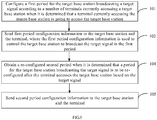
- FIG. 2 is a flowchart illustrating a method of configuring a signal period according to an example. The method may include the following blocks.
- a first period is configured for the target base station broadcasting a target signal according to a number of terminals currently accessing the target base station, where the target base station is a base station that is used for hotspot coverage and managed by the macro base station, and the target signal is used to control the terminal to access the target base station.
- first period configuration information is sent to the target base station and the terminal, where the first period configuration information is used to control the target base station to broadcast the target signal in the first period.
- the macro base station may flexibly configure the first period for the target base station broadcasting the target signal according to the number of terminals currently accessing the target base station, thereby avoiding wasting resources of the target base station, facilitating the energy saving of the 5G system, and reducing the interference of the entire 5G system.
- the target base station is a base station that is used for hotspot coverage and is managed by the macro base station, e.g., the small base station 12 shown in FIG. 1 .
- the target signal is used to control the terminal to access the target base station.
- the target signal includes: a synchronization signal and key system information.
- the synchronization signal may include a Primary Synchronization Signal (PPS) and a Secondary Synchronization Signal (SSS).
- PPS Primary Synchronization Signal
- SSS Secondary Synchronization Signal
- the key system information is the minimum system information required for a terminal to access a base station.
- the key system information may be a Master Information Block (MIB).
- MIB Master Information Block
- the macro base station determines that the terminal needs to access the target base station. At this time, the macro base station may configure the first period for the target base station broadcasting the target signal according to the number of terminals currently accessing the target base station.
- Manners in which the macro base station configures the relatively reasonable period of the target base station broadcasting the target signal according to the number of terminals currently accessing the target base station include but not limited to the following manners.
- a smaller period value within a preset period range may be selected for the target base station, so that the target base station may broadcast the target signal to the outside more frequently.
- a large period value within the above preset period range may be selected for the target base station, so that the target base station may broadcast the target signal less frequently.
- a maximum value of the preset period range may be infinity, and a minimum value may be determined according to an ability of the target base station itself.
- the macro base station may directly send the first period configuration information to the target base station through an interface with the target base station according to the related art. Further, the target base station broadcasts the target signal in the first period indicated by the first period configuration information.
- the macro base station may send the first period configuration information to the terminal through an air interface with the terminal.
- the macro base station may also send a re-direction instruction to the terminal. Based on the re-direction instruction, the terminal accesses the target base station after receiving the target signal broadcast by the target base station in the first period indicated by the first period configuration information.
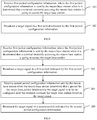
- FIG. 3 is a flowchart illustrating another method of configuring a signal period based on the example shown in FIG. 2 .
- Block 101 may include: At block 101-1, when the number of terminals currently accessing the target base station is zero, the first period for the target base station broadcasting the target signal is configured within a preset period range.
- the target base station has previously reported the number of terminals currently accessing the target base station to the macro base station. If the number of terminals is zero, it indicates that no other terminal accesses the target base station yet.
- the macro base station may select a value within the preset period range and configure the value as a period value of the first period.
- the minimum value of the preset period range is T 1 and the maximum value of the preset period range is T 2 .
- the macro station may select a commonly used value within the period value range of [T 1 , T 2 ], and the commonly used value is assumed to be T 3 .
- T 3 is the first period for the target base station broadcasting the target signal configured by the macro base station.
- the same or different values of the first periods may be configured for the synchronization signal and the key system information in the target signal. That is, different periods may be configured for the synchronization signal and the key system information respectively, so that the target base station broadcasts the synchronization signal and the key system information in the corresponding configured periods.
- a current period configured by the macro base station for the target base station broadcasting the target signal is taken as the first period.
- the macro base station already configures the period for the target base station broadcasting the target signal based on the number of terminals currently accessing the target base station.
- the current period configured by the macro base station for the target base station broadcasting the target signal may be directly taken as the first period.
- the macro base station may configure the first period for the target base station broadcasting the target signal within the preset period range; and if the number of terminals currently accessing the target base station is not zero, the macro base station may directly take the current period configured for the target base station broadcasting the target signal as the first period.
- FIG. 4 is a flowchart illustrating another method of configuring a signal period based on the example shown in FIG. 2 .
- the above method of configuring a signal period may further include: at block 103, a notification message carrying effective time information is sent to the terminal.
- the effective time information is used to indicate that the target base station will start broadcasting the target signal in the first period after a first preset time period is passed.
- the target base station to ensure synchronization between the period for the target base station broadcasting the target signal and the period for the terminal receiving the target signal, the target base station starts timing when receiving the first period configuration information, and starts broadcasting the target signal in the first period after the first preset time period is passed.
- the macro base station may send the notification message to the terminal, so that the terminal determines a time from which the target base station starts broadcasting the target signal in the first period, thereby ensuring the period synchronization.
- FIG. 5 is a flowchart illustrating another method of configuring a signal period based on the example shown in FIG. 2 .
- the above method of configuring a signal period may further include: at block 104, after the terminal accesses the target base station based on the target signal, a re-configured second period is obtained when it is determined that a period for the target base station broadcasting the target signal is to be re-configured.
- the macro base station may monitor in real time whether the period configured for the target base station broadcasting the target signal is changed.
- the macro base station may re-configure the period for the target base station broadcasting the target signal.
- the macro base station may obtain the re-configured second period according to the number of terminals currently accessing the target base station.
- the configuration is performed in the same manner as the macro base station configures the first period or the third period of the target signal when the terminal accesses the target base station or the terminal leaves the geographical range covered by the target base station, which is not described here.
- second period configuration information is sent to the target base station and the terminal.
- the macro base station may also send the second period configuration information to the target base station through the interface with the target base station, and may send the second period configuration information to the terminal based on a flow and a method of updating system information.
- the target base station will broadcast the target signal in the second period, and the terminal will store the second period configuration information.
- the macro base station will also notify other terminals currently accessing the target base station that the period for the target base station broadcasting the target signal is changed to the second period.
- FIG. 6 is a flowchart illustrating another method of configuring a signal period based on the example shown in FIG. 2 .
- the above method of configuring a signal period may further include:
- a third period for the target base station broadcasting the target signal is configured according to the number of terminals currently accessing the target base station.
- the macro base station may detect a position of the terminal according to the related art. If the terminal leaves the geographical range covered by the target base station, e.g., the terminal accesses a base station other than the target base station, the macro base station may configure the third period for the target base station broadcasting the target signal according to the number of terminals currently accessing the target base station.
- third period configuration information is sent to the target base station.
- the macro base station may send the third period configuration information to the target base station according to the related art.
- the target base station may start timing when receiving the third period configuration information, and start broadcasting the target signal in the third period after the timing reaches a second preset time period.
- a time length of the second time period and a time length of the first time period may be identical or different.
- the third period for the target base station broadcasting the target signal may be configured after the terminal leaves the geographical range covered by the target base station, thereby avoiding wasting resources of the target base station, facilitating the energy saving of the 5G system, and reducing the interference of the entire 5G system.
- FIG. 7 is a flowchart illustrating another method of configuring a signal period based on the example shown in FIG. 6 .
- the block 106 may include the following blocks.
- a maximum value within the preset period range is taken as the third period for the target base station broadcasting the target signal.
- the macro base station may take the maximum value within the previously preset period range as the third period for the target base station broadcasting the target signal.
- the maximum value may be infinity, and the target base station no longer broadcasts a downlink signal at this time. That is, when the terminal leaves the geographical range covered by the target base station and no other terminal accesses the target base station, the target base station may stop broadcasting the downlink signal, thereby achieving the purpose of energy saving of the base station.
- a current period configured by the macro base station for the target base station broadcasting the target signal is taken as the third period, or the third period for the target base station broadcasting the target signal is configured within the preset period range.
- the macro base station may still take the current period configured for the target base station broadcasting the target signal as the third period, that is, the previously configured period remains unchanged.
- the macro base station may also configure, within the preset period range, the third period for the target base station broadcasting the target signal, that is, re-configure the period for the target base station broadcasting the target signal.
- the configuration is performed in the same manner as the above signal period is configured , which will not be described here.
- the present disclosure further provides another method of configuring a signal period, which may be applied to a target base station that is used for hotspot coverage and managed by a macro base station, that is, the small base station 12 shown in FIG. 1 .
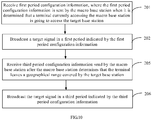
- FIG. 8 is a flowchart illustrating another method of configuring a signal period according to an example. The method may include the following blocks.
- first period configuration information is received.
- the first period configuration information is sent by the macro base station when the macro base station determines that a terminal currently accessing the macro base station is going to access the target base station.
- a target signal is broadcasted in a first period indicated by the first period configuration information.
- the target base station may broadcast the target signal in the first period configured by the macro base station for the target base station according to a number of terminals currently accessing the target base station, thereby avoiding wasting resources of the target base station and reducing the interference of the 5G system.
- the macro base station when determining that the terminal enters a range covered by the target base station, determines that the terminal is going to access the target base station.
- the macro base station may determine an appropriate first period for the target base station broadcasting the target signal according to the number of terminals currently accessing the target base station.
- the target signal is used to control the terminal to access the target base station, and the target signal includes a synchronization signal and key system information.
- the macro base station may send the first period configuration information to the target base station through an interface between the macro base station and the target base station according to the related art, and the target base station may directly receive the information.
- the target base station broadcasts the target signal in the first period after receiving the first period configuration information.
- a previous period for the target base station broadcasting the target signal may be infinity, that is, the target base station does not send any downlink signal before a terminal accesses the target base station. And when the terminal needs to access the target base station, the target base station may be caused to broadcast the target signal in the first period configured by the macro base station.
- the periods of the synchronization signal and the key system information may be same or different.
- the target base station broadcasts the synchronization signal in a particular period, and broadcasts the key system information in another period.
- the periods of broadcasting the synchronization signal and the key system information are both configured by the macro base station for the target base station.
- the above block 202 may include: broadcasting the target signal in the first period indicated by the first period configuration information after a first preset time period is passed.
- the target base station does not immediately broadcast the target signal in the first period when receiving the first period configuration information, but starts broadcasting the target signal in the first period after the first preset time period is passed.
- the macro base station already sends the notification message carrying effective time information to the terminal, where the effective time information is used to indicate that the target base station will start broadcasting the target signal in the first period after the first preset time period is passed.
- the synchronization between a period for the terminal receiving the target signal and the period for the target base station broadcasting the target signal may be ensured.
- FIG. 9 is a flowchart illustrating another method of configuring a signal period based on the example shown in FIG. 8 .
- the above method may further include: at block 203, second period configuration information is received.
- the second period configuration information is sent by the macro base station when the terminal accesses the target base station based on the target signal and then it determines that the period for the target base station broadcasting the target signal is to be re-configured.
- the macro base station when determining that the period for the target base station broadcasting the target signal is to be re-configured, the macro base station sends the second period configuration information to the target base station.
- the target base station may directly receive the information.
- the target signal is broadcast in a second period indicated by the second period configuration information.
- the target base station may adjust the period for broadcasting the target signal by itself to the second period.
- the target base station may start broadcasting the target signal in the second period only after a particular preset time period is passed from reception of the second period configuration information, and the macro base station may also notify, by a notification message, the terminal that the target base station will start broadcasting the target signal in the second period after the preset time period is passed, thereby ensuring the synchronization between the period for the terminal receiving the target signal and the period for the target base station broadcasting the target signal.
- the target base station adjusts the period for broadcasting the target signal according to period configuration information sent by the macro base station, thereby avoiding wasting resources of the target base station, facilitating the energy saving of the 5G system, and reducing the interference of the entire 5G system.
- FIG. 10 is a flowchart illustrating another method of configuring a signal period based on the example shown in FIG. 8 .
- the above method of configuring a signal period may further include: at block 205, third period configuration information sent by the macro base station after the macro base station determines that the terminal leaves a geographical range covered by the target base station is received.
- the macro base station will send the third period configuration information to the target base station when determining that the terminal leaves the geographical range covered by the target base station, and the target base station may directly receive the information.
- the target signal is broadcast in a third period indicated by the third period configuration information.
- the target base station may adjust the period for broadcasting the target signal broadcast by itself to the third period.
- the target base station adjusts the period for broadcasting the target signal according to the period configuration information sent by the macro base station, thereby avoiding wasting resources of the target base station, facilitating the energy saving of the 5G system, and reducing the interference of the entire 5G system.
- the above block 206 may include: broadcasting the target signal in the third period indicated by the third period configuration information after a second preset time period is passed.
- the target base station may start broadcasting the target signal in the third period after the second preset time period is passed.
- the target base station broadcasts the target signal in a period indicated by the last received period configuration information.
- the target base station currently broadcasts the target signal in a period T 4 .
- the target base station receives the period configuration information instructing the target base station to broadcast the target signal in a period T 5 sent by the macro base station.
- the target base station starts broadcasting the target signal in the period T 5 after a time period t is passed.
- the target base station may start broadcasting the target signal in the period T 6 after the time period t is passed.
- the base station broadcasts the target signal in the period indicated by the latest received period configuration information sent by the macro base station, thereby avoiding wasting resources of the target base station, facilitating the energy saving of the 5G system, and reducing the interference of the entire 5G system.
- FIG. 11 is a flowchart illustrating another method of configuring a signal period according to an example. The method may include the following blocks.
- a macro base station determines whether a terminal currently accessing the macro base station is going to access a target base station.
- block 302 is continued.
- the macro base station configures a first period of broadcasting a target signal for the target base station according to a number of terminals currently accessing the target base station.
- the macro base station configures the first period for the target base station broadcasting the target signal within a preset period range.
- the macro base station takes a current period configured for the target base station broadcasting the target signal as the first period.
- the macro base station sends first period configuration information to the target base station and the terminal.
- the target base station broadcasts the target signal in the first period indicated by the first period configuration information after a first preset time period is passed.
- the terminal receives the target signal broadcasted by the target base station according to the first period configuration information, thereby accessing the target base station.
- the macro base station determines whether a period for the target base station broadcasting the target signal is to be re-configured.
- block 306 is performed. Otherwise, block 309 is performed.
- the macro base station obtains a re-configured second period.
- the macro base station sends second period configuration information to the target base station and the terminal.
- the target base station broadcasts the target signal in the second period.
- the macro base station configures a third period for the target base station broadcasting the target signal according to the number of terminals currently accessing the target base station.
- the macro base station sends third period configuration information to the target base station.
- the target base station broadcasts the target signal in the third period after a second preset time period is passed.
- the macro base station configures the period for the target base station broadcasting the target signal based on the number of terminals currently accessing the target base station, thereby avoiding wasting resources of the target base station, facilitating the energy saving of the 5G system, and reducing the interference of the entire 5G system.
- the present disclosure further provides examples of apparatuses and corresponding terminals for implementing with applied functions.
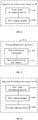
- FIG. 12 is a block diagram illustrating an apparatus for configuring a signal period according to an example.
- the apparatus includes:
- FIG. 13 is a block diagram illustrating another apparatus for configuring a signal period on the basis of the example shown in FIG. 12 .
- the first period determining module 410 includes:
- FIG. 14 is a block diagram illustrating another apparatus for configuring a signal period on the basis of the example shown in FIG. 12 .
- the apparatus further includes: a second sending module 430, configured to send a notification message carrying effective time information to the terminal, where the effective time information is used to indicate that the target base station will start broadcasting the target signal in the first period after a first preset time period is passed.
- FIG. 15 is a block diagram illustrating another apparatus for configuring a signal period on the basis of the example shown in FIG. 12 .
- the apparatus further includes:
- FIG. 16 is a block diagram illustrating another apparatus for configuring a signal period on the basis of the example shown in FIG. 12 .
- the apparatus further includes:
- FIG. 17 is a block diagram illustrating another apparatus for configuring a signal period on the basis of the example shown in FIG. 16 .
- the third period determining module 460 includes:
- FIG. 18 is a block diagram illustrating another apparatus for configuring a signal period according to an example.
- the apparatus includes:
- FIG. 19 is a block diagram illustrating another apparatus for configuring a signal period on the basis of the example shown in FIG. 18 .
- the first broadcasting module 520 includes: a first broadcasting sub-module 521, configured to broadcast the target signal in the first period indicated by the first period configuration information after a first preset time period is passed.
- FIG. 20 is a block diagram illustrating another apparatus for configuring a signal period on the basis of the example shown in FIG. 18 .
- the apparatus further includes:
- FIG. 21 is a block diagram illustrating another apparatus for configuring a signal period on the basis of the example shown in FIG. 18 .
- the apparatus further includes:
- FIG. 22 is a block diagram illustrating another apparatus for configuring a signal period on the basis of the example shown in FIG. 21 .
- the third broadcasting module 560 includes: a second broadcasting sub-module 561, configured to broadcast the target signal in the third period indicated by the third period configuration information after a second preset time period is passed.
- the apparatus examples substantially correspond to the method examples, reference may be made to the partial description of the method examples.
- the apparatus examples described above are merely illustrative, where the units described as separate components may or may not be physically separated, and the components displayed as units may or may not be physical units, e.g., may be located in one place, or may be distributed to a plurality of network elements. Part or all of the modules may be selected according to actual requirements to achieve the objectives of the solutions in the present disclosure. Those of ordinary skill in the art may understand and implement them without creative work.
- an example of the present disclosure further provides an apparatus for configuring a signal period, including:
- FIG. 23 is a schematic diagram illustrating a structure of an apparatus 2300 for configuring a signal period according to an example.
- the apparatus 2300 may be a macro base station.
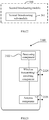
- the apparatus 2300 includes a processing component 2322, a wireless transmitting/receiving component 2324, an antenna component 2326, and a signal processing part unique to a wireless interface.
- the processing component 2322 may further include one or more processors.
- One processor in the processing components 2322 may be configured to:
- an example of the present disclosure further provides an apparatus for configuring a signal period, including:
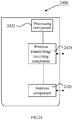
- FIG. 24 is a schematic diagram illustrating a structure of an apparatus 2400 for configuring a signal period according to an example.
- the apparatus 2400 may be a target base station, and the target base station is used for hotspot coverage and managed by a macro base station.
- the apparatus 2400 includes a processing component 2422, a wireless transmitting/receiving component 2424, an antenna component 2426, and a signal processing part unique to a wireless interface.
- the processing component 2422 may further include one or more processors.
- One processor in the processing components 2422 may be configured to:
Landscapes
- Engineering & Computer Science (AREA)
- Computer Networks & Wireless Communication (AREA)
- Signal Processing (AREA)
- Computer Security & Cryptography (AREA)
- Mobile Radio Communication Systems (AREA)
Abstract
Description
- The present disclosure relates to the field of communications, and in particular to a method and an apparatus for configuring a signal period.
- Standardization relating to a 5G, i.e., New Radio (NR) network is being carried out in the 3rd Generation Partnership Project (3GPP). In a 5G system, a macro base station with a lower signal transmission frequency may be firstly used for coverage, and a small base station with a higher signal transmission frequency may be further used for hotspot coverage. Optionally, a macro base station in Long Term Evolution (LTE) may be used for coverage, and a non-independent 5G small base station managed by the macro base station may be further used for hotspot coverage.
- However, in the current system, whether there is a terminal that needs to access a 5G small base station for performing hotspot coverage, the 5G small base station broadcasts a signal for controlling terminals to access the 5G small base station itself in a fixed period. In this case, resource wastes are caused, which is not conducive energy saving of the 5G system and increases interference of the entire 5G system.
- To overcome the problems in the related art, examples of the present disclosure provide a method and an apparatus for configuring a signal period.
- According to a first aspect of an example of the present disclosure, a method of configuring a signal period is provided, and he method is applied to a macro base station. The method includes:
- when it is determined that a terminal currently accessing the macro base station is going to access a target base station, configuring a first period for the target base station broadcasting a target signal according to a number of terminals currently accessing the target base station, where the target base station is a base station that is used for hotspot coverage and managed by the macro base station, and the target signal is used to control the terminal to access the target base station; and
- sending first period configuration information to the target base station and the terminal, where the first period configuration information is used to control the target base station to broadcast the target signal in the first period.
- Optionally, configuring the first period for the target base station broadcasting the target signal according to the number of terminals currently accessing the target base station includes:
- when the number of terminals currently accessing the target base station is zero, configuring the first period for the target base station broadcasting the target signal within a preset period range; and
- when the number of terminals currently accessing the target base station is not zero, taking a current period configured by the macro base station for the target base station broadcasting the target signal as the first period.
- Optionally, the method further includes:
sending a notification message carrying effective time information to the terminal, where the effective time information is used to indicate that the target base station will start broadcasting the target signal in the first period after a first preset time period is passed. - Optionally, the method further includes:
- after the terminal accesses the target base station based on the target signal, obtaining a re-configured second period when it is determined that a period for the target base station broadcasting the target signal is to be re-configured; and
- sending second period configuration information to the target base station and the terminal, where the second period configuration information is used to control the target base station to broadcast the target signal in the second period.
- Optionally, the method further includes:
- after it is determined that the terminal leaves a geographical range covered by the target base station, configuring a third period for the target base station broadcasting the target signal according to the number of terminals currently accessing the target base station; and
- sending third period configuration information to the target base station, where the third period configuration information is used to control the target base station to broadcast the target signal in the third period.
- Optionally, configuring the third period for the target base station broadcasting the target signal according to the number of terminals currently accessing the target base station includes:
- when the number of terminals currently accessing the target base station is zero, taking a maximum value within a preset period range as the third period for the target base station broadcasting the target signal; and
- when the number of terminals currently accessing the target base station is not zero, taking a current period configured by the macro base station for the target base station broadcasting the target signal as the third period, or configuring the third period for the target base station broadcasting the target signal within the preset period range.
- According to a second aspect of an example of the present disclosure, a method of configuring a signal period is provided, and the method is applied to a target base station that is used for hotspot coverage and managed by a macro base station. The method includes:
- receiving first period configuration information, where the first period configuration information is sent by the macro base station when it is determined that a terminal currently accessing the macro base station is going to access the target base station; and
- broadcasting a target signal in a first period indicated by the first period configuration information, where the target signal is used to control the terminal to access the target base station.
- Optionally, broadcasting the target signal in the first period indicated by the first period configuration information includes:
after a first preset time period is passed, broadcasting the target signal in the first period indicated by the first period configuration information. - Optionally, the method further includes:
- receiving second period configuration information sent by the macro base station when the macro base station determines that a period for the target base station broadcasting the target signal is to be re-configured after the terminal accesses the target base station based on the target signal; and
- broadcasting the target signal in a second period indicated by the second period configuration information.
- Optionally, the method further includes:
- receiving third period configuration information send by the macro base station after the macro base station determines that the terminal leaves a geographical range covered by the target base station; and
- broadcasting the target signal in a third period indicated by the third period configuration information.
- Optionally, broadcasting the target signal in the third period indicated by the third period configuration information includes:
after a second preset time period is passed, broadcasting the target signal in the third period indicated by the third period configuration information. - According to a third aspect of an example of the present disclosure, an apparatus for configuring a signal period is provided, and the apparatus is applied to a macro base station. The apparatus includes:
- a first period determining module, configured to set a first period for a target base station broadcasting a target signal according to a number of terminals currently accessing the target base station when it is determined that a terminal currently accessing the macro base station is going to access the target base station, where the target base station is a base station that is used for hotspot coverage and managed by the macro base station, and the target signal is used to control the terminal to access the target base station; and
- a first sending module, configured to send first period configuration information to the target base station and the terminal, where the first period configuration information is used to control the target base station to broadcast the target signal in the first period.
- Optionally, the first period determining module includes:
- a first determining sub-module, configured to set the first period for the target base station broadcasting the target signal within a preset period range when the number of terminals currently accessing the target base station is zero; and
- a second determining sub-module, configured to take a current period configured by the macro base station for the target base station broadcasting the target signal as the first period when the number of terminals currently accessing the target base station is not zero.
- Optionally, the apparatus further includes:
a second sending module, configured to send a notification message carrying effective time information to the terminal, where the effective time information is used to indicate that the target base station will start broadcasting the target signal in the first period after a first preset time period is passed. - Optionally, the apparatus further includes:
- a second period determining module, configured to obtain a re-configured second period when it is determined that a period for the target base station broadcasting the target signal is to be re-configured after the terminal accesses the target base station based on the target signal; and
- a third sending module, configured to send second period configuration information to the target base station and the terminal, where the second period configuration information is used to control the target base station to broadcast the target signal in the second period.
- Optionally, the apparatus further includes:
- a third period determining module, configured to set a third period for the target base station broadcasting the target signal according to the number of terminals currently accessing the target base station after it is determined that the terminal leaves a geographical range covered by the target base station; and
- a fourth sending module, configured to send third period configuration information to the target base station, where the third period configuration information is used to control the target base station to broadcast the target signal in the third period.
- Optionally, the third period determining module includes:
- a third determining sub-module, configured to take a maximum value within a preset period range as the third period for the target base station broadcasting the target signal when the number of terminals currently accessing the target base station is zero; and
- a fourth determining sub-module, configured to, when the number of terminals currently accessing the target base station is not zero, take a current period configured by the macro base station for the target base station broadcasting the target signal as the third period as the third period or set the third period for the target base station broadcasting the target signal within the preset period range.
- According to a fourth aspect of an example of the present disclosure, an apparatus for configuring a signal period is provided, and the apparatus is applied to a target base station that is used for hotspot coverage and managed by a macro base station. The apparatus includes:
- a first receiving module, configured to receive first period configuration information, where the first period configuration information is sent by the macro base station when it is determined that a terminal currently accessing the macro base station is going to access the target base station; and
- a first broadcasting module, configured to broadcast a target signal in a first period indicated by the first period configuration information, where the target signal is used to control the terminal to access the target base station.
- Optionally, the first broadcasting module includes:
a first broadcasting sub-module, configured to broadcast the target signal in the first period indicated by the first period configuration information after a first preset time period is passed. - Optionally, the apparatus further includes:
- a second receiving module, configured to receive second period configuration information sent by the macro base station when the macro base station determines that a period for the target base station broadcasting the target signal is to be re-configured after the terminal accesses the target base station based on the target signal; and
- a second broadcasting module, configured to broadcast the target signal in a second period indicated by the second period configuration information.
- Optionally, the apparatus further includes:
- a third receiving module, configured to receive third period configuration information send by the macro base station after the macro base station determines that the terminal leaves a geographical range covered by the target base station; and
- a third broadcasting module, configured to broadcast the target signal in a third period indicated by the third period configuration information.
- Optionally, the third broadcasting module includes:
a second broadcasting sub-module, configured to broadcast the target signal in the third period indicated by the third period configuration information after a second preset time period is passed. - According to a fifth aspect of an example of the present disclosure, an apparatus for configuring a signal period is provided, including:
- a processor; and
- a memory for storing processor-executable instructions;
- where the processor is configured to:
- set a first period for the target base station broadcasting a target signal according to a number of terminals currently accessing a target base station when it is determined that a terminal currently accessing the macro base station is going to access the target base station, where the target base station is a base station that is used for hotspot coverage and managed by the macro base station, and the target signal is used to control the terminal to access the target base station; and
- send first period configuration information to the target base station and the terminal, where the first period configuration information is used to control the target base station to broadcast the target signal in the first period.
- According to a sixth aspect of an example of the present disclosure, an apparatus for configuring a signal period is provided, including:
- a processor; and
- a memory for storing processor-executable instructions;
- where the processor is configured to:
- receive first period configuration information, where the first period configuration information is sent by the macro base station when it is determined that a terminal currently accessing the macro base station is going to access the target base station; and
- broadcast a target signal in a first period indicated by the first period configuration information, where the target signal is used to control the terminal to access the target base station.
- Technical solutions according to the examples of the present disclosure may include the following beneficial effects.
- In an example of the present disclosure, when determining that a terminal currently accessing the macro base station is going to access a target base station, the macro base station may configure a first period for the target base station broadcasting a target signal according to a number of terminals currently accessing the target base station. The target base station is a base station that is used for hotspot coverage and managed by the macro base station, and the target signal is used to control the terminal to access the target base station. Further, the macro base station may send first period configuration information to the target base station and the terminal. The target base station will broadcast the target signal in the first period indicated by the first period configuration information, and the terminal will access the target base station by receiving the target signal broadcasted by the target base station in the first period. Through the above process, the macro base station may flexibly configure the first period for the target base station broadcasting the target signal according to the number of terminals accessing the target base station, thereby avoiding wasting resources of the target base station, facilitating energy saving of a 5G system, and reducing interference of the entire 5G system.
- In an example of the present disclosure, when the macro base station configures the first period for the target base station broadcasting the target signal based on the number of terminals accessing the target base station, if the number of terminals currently accessing the target base station is zero, the macro base station may configure the first period for the target base station broadcasting the target signal within the preset period range; if the number of terminals currently accessing the target base station is not zero, the macro base station may directly take the current period configured for the target base station broadcasting the target signal as the first period. Through this process, the implementation is simple and has high availability. The problem of resource wastes caused by the target base station broadcasting the target signal with a fixed period in a case of no terminal accessing the target base station is avoided, and the interference of the 5G system is effectively reduced.
- In an example of the present disclosure, after determining that the terminal accesses the target base station, the macro base station may determine whether the period for the target base station broadcasting the target signal is to be re-configured. If the re-configuration is necessary, the macro base station obtains the re-configured second period and sends the second period configuration information to the target base station and the terminal. The target base station will broadcast the target signal in the second period, and the terminal will store the second period configuration information, thereby ensuring synchronization between the period for the terminal receiving the target signal and the period for the target base station broadcasting the target signal.
- In an example of the present disclosure, after determining that the terminal leaves the geographical range covered by the target base station, the macro base station may take the period previously configured for the target base station broadcasting the target signal as the third period, or configure the third period for the target base station broadcasting the target signal according to the number of terminals currently accessing the target base station. Further, the macro base station sends the third period configuration information to the target base station. The target base station still broadcasts the target signal in the third period based on the configuration of the macro base station. Through the above process, the third period for the target base station broadcasting the target signal may be configured after the terminal accessing the target base station leaves the geographical range covered by the target base station, thereby avoiding wasting resources of the target base station, facilitating the energy saving of the 5G system, and reducing the interference of the entire 5G system.
- In an example of the present disclosure, the macro base station may also send the notification message carrying effective time information to the terminal. The effective time information is used to indicate the target base station will start broadcasting the target signal in the first period after the first preset time period is passed. Through the above process, the terminal may determine a time point from which the target base station starts broadcasting the target signal in the first period configured by the macro base station, thereby ensuring the synchronization between the period for the terminal receiving the target signal and the period for the target base station broadcasting the target signal.
- In an example of the present disclosure, the target base station may broadcast the target signal in the first period indicated by the first period configuration information sent by the macro base station. The first period configuration information is determined by the macro base station according to the number of terminals currently accessing the target base station. Through the above process, the target base station may broadcast the target signal in the first period determined based on the number of terminals accessing the target base station, thereby avoiding wasting resources of the target base station and reducing the interference of the 5G system.
- In an example of the present disclosure, the target base station may broadcast the target signal in the third period after the second preset time period is passed, thereby ensuring smooth switching of the periods for broadcasting the target signal after the terminal leaves the geographical range covered by the target base station.
- It is to be understood that the above general descriptions and the below detailed descriptions are merely exemplary and explanatory, and are not intended to limit the present disclosure.
- The accompanying drawings, which are incorporated in and constitute a part of this specification, illustrate examples consistent with the present disclosure and, together with the description, serve to explain the principles of the disclosure.
-
FIG. 1 is a schematic diagram illustrating a scenario of configuring a signal period according to an example. -
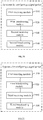
FIG. 2 is a flowchart illustrating a method of configuring a signal period according to an example. -
FIG. 3 is a flowchart illustrating another method of configuring a signal period according to an example. -
FIG. 4 is a flowchart illustrating another method of configuring a signal period according to an example. -
FIG. 5 is a flowchart illustrating another method of configuring a signal period according to an example. -
FIG. 6 is a flowchart illustrating another method of configuring a signal period according to an example. -
FIG. 7 is a flowchart illustrating another method of configuring a signal period according to an example. -
FIG. 8 is a flowchart illustrating another method of configuring a signal period according to an example. -
FIG. 9 is a flowchart illustrating another method of configuring a signal period according to an example. -
FIG. 10 is a flowchart illustrating another method of configuring a signal period according to an example. -
FIG. 11 is a flowchart illustrating another method of configuring a signal period according to an example. -
FIG. 12 is a block diagram illustrating an apparatus for configuring a signal period according to an example. -
FIG. 13 is a block diagram illustrating another apparatus for configuring a signal period according to an example. -
FIG. 14 is a block diagram illustrating another apparatus for configuring a signal period according to an example. -
FIG. 15 is a block diagram illustrating another apparatus for configuring a signal period according to an example. -
FIG. 16 is a block diagram illustrating another apparatus for configuring a signal period according to an example. -
FIG. 17 is a block diagram illustrating another apparatus for configuring a signal period according to an example. -
FIG. 18 is a block diagram illustrating another apparatus for configuring a signal period according to an example. -
FIG. 19 is a block diagram illustrating another apparatus for configuring a signal period according to an example. -
FIG. 20 is a block diagram illustrating another apparatus for configuring a signal period according to an example. -
FIG. 21 is a block diagram illustrating another apparatus for configuring a signal period according to an example. -
FIG. 22 is a block diagram illustrating another apparatus for configuring a signal period according to an example. -
FIG. 23 is a schematic structural diagram illustrating an apparatus for configuring a signal period according to an example of the present disclosure. -
FIG. 24 is a schematic structural diagram illustrating another apparatus for configuring a signal period according to an example of the present disclosure. - Examples will be described in detail here with the examples thereof expressed in the drawings. Where the following descriptions involve the drawings, like numerals in different drawings refer to like or similar elements unless otherwise indicated. The embodiments described in the following examples do not represent all embodiments consistent with the present disclosure. Rather, they are merely examples of apparatuses and methods consistent with some aspects of the present disclosure as detailed in the appended claims.
- The term used in the present disclosure is for the purpose of describing particular examples only and is not intended to limit the present disclosure. As used in this disclosure and the appended claims, the singular forms "a" , "an" and "the" are intended to include the plural forms as well, unless the context clearly indicates otherwise. It should also be understood that the term "and/or" as used herein refers to and includes any and all possible combinations of one or more of the associated listed items.
- It shall be understood that, although the terms "first," "second," "third," and the like may be used herein to describe various information, the information should not be limited by these terms. These terms are only used to distinguish one category of information from another. For example, without departing from the scope of the present disclosure, first information may be referred as second information; and similarly, second information may also be referred as first information. As used herein, the term "if' may be interpreted as "when" or "upon" or "in response to determining" depending on the context.
- As shown in
FIG. 1 , amacro base station 11 is used for coverage, and a non-independent 5Gsmall base station 12 managed by the macro base station is further used for hotspot coverage. The hotspot coverage is a hotspot that is set in a particular region and provided for users to surf Internet wirelessly. However, if no terminal accesses thesmall base station 12 used for the hotspot coverage, and thesmall base station 12 always broadcasts a target signal according to the related art, resource wastes of thesmall base station 12 are caused, unfavorable impact onto the system energy saving is caused, and the interference of the entire 5G system is increased. - To solve the above problem, the present disclosure provides a method of configuring a signal period, which may be applied to a
macro base station 11 shown inFIG. 1. FIG. 2 is a flowchart illustrating a method of configuring a signal period according to an example. The method may include the following blocks. - At
block 101, when it is determined that a terminal currently accessing the macro base station is going to access a target base station, a first period is configured for the target base station broadcasting a target signal according to a number of terminals currently accessing the target base station, where the target base station is a base station that is used for hotspot coverage and managed by the macro base station, and the target signal is used to control the terminal to access the target base station. - At
block 102, first period configuration information is sent to the target base station and the terminal, where the first period configuration information is used to control the target base station to broadcast the target signal in the first period. - In the example, the macro base station may flexibly configure the first period for the target base station broadcasting the target signal according to the number of terminals currently accessing the target base station, thereby avoiding wasting resources of the target base station, facilitating the energy saving of the 5G system, and reducing the interference of the entire 5G system.
- For the
above block 101, the target base station is a base station that is used for hotspot coverage and is managed by the macro base station, e.g., thesmall base station 12 shown inFIG. 1 . The target signal is used to control the terminal to access the target base station. Optionally, the target signal includes: a synchronization signal and key system information. The synchronization signal may include a Primary Synchronization Signal (PPS) and a Secondary Synchronization Signal (SSS). The key system information is the minimum system information required for a terminal to access a base station. Optionally, the key system information may be a Master Information Block (MIB). - At this block, if it is determined that a terminal currently accessing the macro base station is located in the area covered by the target base station, the macro base station determines that the terminal needs to access the target base station. At this time, the macro base station may configure the first period for the target base station broadcasting the target signal according to the number of terminals currently accessing the target base station.
- Manners in which the macro base station configures the relatively reasonable period of the target base station broadcasting the target signal according to the number of terminals currently accessing the target base station include but not limited to the following manners.
- When the number of terminals currently accessing the target base station is relative large, a smaller period value within a preset period range may be selected for the target base station, so that the target base station may broadcast the target signal to the outside more frequently. When the number of terminals currently accessing the target base station is relative small, a large period value within the above preset period range may be selected for the target base station, so that the target base station may broadcast the target signal less frequently. A maximum value of the preset period range may be infinity, and a minimum value may be determined according to an ability of the target base station itself.
- For the
above block 102, the macro base station may directly send the first period configuration information to the target base station through an interface with the target base station according to the related art. Further, the target base station broadcasts the target signal in the first period indicated by the first period configuration information. - In addition, the macro base station may send the first period configuration information to the terminal through an air interface with the terminal. In an example of the present disclosure, to enable the terminal to access the target base station, the macro base station may also send a re-direction instruction to the terminal. Based on the re-direction instruction, the terminal accesses the target base station after receiving the target signal broadcast by the target base station in the first period indicated by the first period configuration information.
- In an example,
FIG. 3 is a flowchart illustrating another method of configuring a signal period based on the example shown inFIG. 2 .Block 101 may include:
At block 101-1, when the number of terminals currently accessing the target base station is zero, the first period for the target base station broadcasting the target signal is configured within a preset period range. - At this block, the target base station has previously reported the number of terminals currently accessing the target base station to the macro base station. If the number of terminals is zero, it indicates that no other terminal accesses the target base station yet. When configuring the first period, the macro base station may select a value within the preset period range and configure the value as a period value of the first period.
- For example, the minimum value of the preset period range is T1 and the maximum value of the preset period range is T2. In this case, when the number of terminals currently accessing the target base station is zero, the macro station may select a commonly used value within the period value range of [T1, T2], and the commonly used value is assumed to be T3. Thus, T3 is the first period for the target base station broadcasting the target signal configured by the macro base station.
- It is to be noted that the same or different values of the first periods may be configured for the synchronization signal and the key system information in the target signal. That is, different periods may be configured for the synchronization signal and the key system information respectively, so that the target base station broadcasts the synchronization signal and the key system information in the corresponding configured periods.
- At block 101-2, when the number of terminals currently accessing the target base station is not zero, a current period configured by the macro base station for the target base station broadcasting the target signal is taken as the first period.
- In an example of the present disclosure, when the number of terminals is not zero, it indicates that other terminals already accesses the target base station. Thus, the macro base station already configures the period for the target base station broadcasting the target signal based on the number of terminals currently accessing the target base station.
- At this block, the current period configured by the macro base station for the target base station broadcasting the target signal may be directly taken as the first period.
- In the example, during process of the macro base station configuring the first period for the target base station broadcasting the target signal based on the number of terminals currently accessing the target base station, if the number of terminals currently accessing the target base station is zero, the macro base station may configure the first period for the target base station broadcasting the target signal within the preset period range; and if the number of terminals currently accessing the target base station is not zero, the macro base station may directly take the current period configured for the target base station broadcasting the target signal as the first period. Through this process, the implementation is simple and has high availability. The problem of resource wastes caused by the target base station broadcasting the target signal with a fixed period in a case of no terminal accessing the target base station is avoided, and the interference of the 5G system is effectively reduced.
- In an example,
FIG. 4 is a flowchart illustrating another method of configuring a signal period based on the example shown inFIG. 2 . The above method of configuring a signal period may further include:
atblock 103, a notification message carrying effective time information is sent to the terminal. - The effective time information is used to indicate that the target base station will start broadcasting the target signal in the first period after a first preset time period is passed.
- In an example of the present disclosure, to ensure synchronization between the period for the target base station broadcasting the target signal and the period for the terminal receiving the target signal, the target base station starts timing when receiving the first period configuration information, and starts broadcasting the target signal in the first period after the first preset time period is passed.
- At this block, the macro base station may send the notification message to the terminal, so that the terminal determines a time from which the target base station starts broadcasting the target signal in the first period, thereby ensuring the period synchronization.
- In an example,
FIG. 5 is a flowchart illustrating another method of configuring a signal period based on the example shown inFIG. 2 . The above method of configuring a signal period may further include:
atblock 104, after the terminal accesses the target base station based on the target signal, a re-configured second period is obtained when it is determined that a period for the target base station broadcasting the target signal is to be re-configured. - At this block, after determining that the terminal accesses the target base station based on the target signal, the macro base station may monitor in real time whether the period configured for the target base station broadcasting the target signal is changed.
- In an example of the present disclosure, when a new terminal accesses the target base station or a terminal previously accessed the target base station leaves the geographical range covered by the target base station, the macro base station may re-configure the period for the target base station broadcasting the target signal.
- At this block, the macro base station may obtain the re-configured second period according to the number of terminals currently accessing the target base station. The configuration is performed in the same manner as the macro base station configures the first period or the third period of the target signal when the terminal accesses the target base station or the terminal leaves the geographical range covered by the target base station, which is not described here.
- At
block 105, second period configuration information is sent to the target base station and the terminal. - At this block, the macro base station may also send the second period configuration information to the target base station through the interface with the target base station, and may send the second period configuration information to the terminal based on a flow and a method of updating system information.
- Further, the target base station will broadcast the target signal in the second period, and the terminal will store the second period configuration information.
- The macro base station will also notify other terminals currently accessing the target base station that the period for the target base station broadcasting the target signal is changed to the second period.
- Through the above process, the synchronization between the period for the terminal receiving the target signal and the period for the target base station broadcasting the target signal is ensured.
- In an example,
FIG. 6 is a flowchart illustrating another method of configuring a signal period based on the example shown inFIG. 2 . The above method of configuring a signal period may further include: - at
block 106, after it is determined that the terminal leaves the geographical range covered by the target base station, a third period for the target base station broadcasting the target signal is configured according to the number of terminals currently accessing the target base station. - At this block, the macro base station may detect a position of the terminal according to the related art. If the terminal leaves the geographical range covered by the target base station, e.g., the terminal accesses a base station other than the target base station, the macro base station may configure the third period for the target base station broadcasting the target signal according to the number of terminals currently accessing the target base station.
- At
block 107, third period configuration information is sent to the target base station. - At this block, the macro base station may send the third period configuration information to the target base station according to the related art.
- Optionally, the target base station may start timing when receiving the third period configuration information, and start broadcasting the target signal in the third period after the timing reaches a second preset time period. A time length of the second time period and a time length of the first time period may be identical or different.
- In the above example, the third period for the target base station broadcasting the target signal may be configured after the terminal leaves the geographical range covered by the target base station, thereby avoiding wasting resources of the target base station, facilitating the energy saving of the 5G system, and reducing the interference of the entire 5G system.
- In an example,
FIG. 7 is a flowchart illustrating another method of configuring a signal period based on the example shown inFIG. 6 . Theblock 106 may include the following blocks. - At block 106-1, when the number of terminals currently accessing the target base station is zero, a maximum value within the preset period range is taken as the third period for the target base station broadcasting the target signal.
- At this block, if the number of terminals currently accessing the target base station is zero, it indicates that no other terminal accesses the target base station. At this time, the macro base station may take the maximum value within the previously preset period range as the third period for the target base station broadcasting the target signal.
- Optionally, the maximum value may be infinity, and the target base station no longer broadcasts a downlink signal at this time. That is, when the terminal leaves the geographical range covered by the target base station and no other terminal accesses the target base station, the target base station may stop broadcasting the downlink signal, thereby achieving the purpose of energy saving of the base station.
- At block 106-2, when the number of terminals currently accessing the target base station is not zero, a current period configured by the macro base station for the target base station broadcasting the target signal is taken as the third period, or the third period for the target base station broadcasting the target signal is configured within the preset period range.
- At this block, if the number of terminals currently accessing the target base station is not zero, it indicates that there are other terminals still accessing the target base station after the terminal accesses another base station. At this time, the macro base station may still take the current period configured for the target base station broadcasting the target signal as the third period, that is, the previously configured period remains unchanged.
- Alternatively, the macro base station may also configure, within the preset period range, the third period for the target base station broadcasting the target signal, that is, re-configure the period for the target base station broadcasting the target signal. The configuration is performed in the same manner as the above signal period is configured , which will not be described here.
- The present disclosure further provides another method of configuring a signal period, which may be applied to a target base station that is used for hotspot coverage and managed by a macro base station, that is, the
small base station 12 shown inFIG. 1 .FIG. 8 is a flowchart illustrating another method of configuring a signal period according to an example. The method may include the following blocks. - At
block 201, first period configuration information is received. Where, the first period configuration information is sent by the macro base station when the macro base station determines that a terminal currently accessing the macro base station is going to access the target base station. - At
block 202, a target signal is broadcasted in a first period indicated by the first period configuration information. - Through the above process, the target base station may broadcast the target signal in the first period configured by the macro base station for the target base station according to a number of terminals currently accessing the target base station, thereby avoiding wasting resources of the target base station and reducing the interference of the 5G system.
- For the
block 201, in an example of the present disclosure, when determining that the terminal enters a range covered by the target base station, the macro base station determines that the terminal is going to access the target base station. - At this time, the macro base station may determine an appropriate first period for the target base station broadcasting the target signal according to the number of terminals currently accessing the target base station. In an example of the present disclosure, the target signal is used to control the terminal to access the target base station, and the target signal includes a synchronization signal and key system information.
- At this block, the macro base station may send the first period configuration information to the target base station through an interface between the macro base station and the target base station according to the related art, and the target base station may directly receive the information.
- For the
block 202, the target base station broadcasts the target signal in the first period after receiving the first period configuration information. - For example, a previous period for the target base station broadcasting the target signal may be infinity, that is, the target base station does not send any downlink signal before a terminal accesses the target base station. And when the terminal needs to access the target base station, the target base station may be caused to broadcast the target signal in the first period configured by the macro base station.
- In addition, in an example of the present disclosure, the periods of the synchronization signal and the key system information may be same or different. For example, the target base station broadcasts the synchronization signal in a particular period, and broadcasts the key system information in another period. The periods of broadcasting the synchronization signal and the key system information are both configured by the macro base station for the target base station.
- In an example, the
above block 202 may include:
broadcasting the target signal in the first period indicated by the first period configuration information after a first preset time period is passed. - In an example of the present disclosure, the target base station does not immediately broadcast the target signal in the first period when receiving the first period configuration information, but starts broadcasting the target signal in the first period after the first preset time period is passed. Meanwhile, the macro base station already sends the notification message carrying effective time information to the terminal, where the effective time information is used to indicate that the target base station will start broadcasting the target signal in the first period after the first preset time period is passed.
- Through the above process, the synchronization between a period for the terminal receiving the target signal and the period for the target base station broadcasting the target signal may be ensured.
- In an example,
FIG. 9 is a flowchart illustrating another method of configuring a signal period based on the example shown inFIG. 8 . The above method may further include:
atblock 203, second period configuration information is received. Where, the second period configuration information is sent by the macro base station when the terminal accesses the target base station based on the target signal and then it determines that the period for the target base station broadcasting the target signal is to be re-configured. - At this block, after the terminal accesses the target base station based on the target signal, when determining that the period for the target base station broadcasting the target signal is to be re-configured, the macro base station sends the second period configuration information to the target base station. The target base station may directly receive the information.
- At
block 204, the target signal is broadcast in a second period indicated by the second period configuration information. - At this block, the target base station may adjust the period for broadcasting the target signal by itself to the second period.
- Optionally, the target base station may start broadcasting the target signal in the second period only after a particular preset time period is passed from reception of the second period configuration information, and the macro base station may also notify, by a notification message, the terminal that the target base station will start broadcasting the target signal in the second period after the preset time period is passed, thereby ensuring the synchronization between the period for the terminal receiving the target signal and the period for the target base station broadcasting the target signal.
- In the example, the target base station adjusts the period for broadcasting the target signal according to period configuration information sent by the macro base station, thereby avoiding wasting resources of the target base station, facilitating the energy saving of the 5G system, and reducing the interference of the entire 5G system.
- In an example,
FIG. 10 is a flowchart illustrating another method of configuring a signal period based on the example shown inFIG. 8 . The above method of configuring a signal period may further include:
atblock 205, third period configuration information sent by the macro base station after the macro base station determines that the terminal leaves a geographical range covered by the target base station is received. - At this block, the macro base station will send the third period configuration information to the target base station when determining that the terminal leaves the geographical range covered by the target base station, and the target base station may directly receive the information.
- At
block 206, the target signal is broadcast in a third period indicated by the third period configuration information. - At this block, the target base station may adjust the period for broadcasting the target signal broadcast by itself to the third period.
- In the example, the target base station adjusts the period for broadcasting the target signal according to the period configuration information sent by the macro base station, thereby avoiding wasting resources of the target base station, facilitating the energy saving of the 5G system, and reducing the interference of the entire 5G system.
- In an example, the
above block 206 may include:
broadcasting the target signal in the third period indicated by the third period configuration information after a second preset time period is passed. - In an example of the present disclosure, to ensure smooth switching of the periods for broadcasting the target signal after the terminal leaves the geographical range covered by the target base station, the target base station may start broadcasting the target signal in the third period after the second preset time period is passed.
- It is to be noted that before a period indicated by any piece of the above period configuration information previously received by the target base station becomes effective, if the target base station receives another piece of period configuration information, the target base station broadcasts the target signal in a period indicated by the last received period configuration information.
- For example, the target base station currently broadcasts the target signal in a period T4. At this time, the target base station receives the period configuration information instructing the target base station to broadcast the target signal in a period T5 sent by the macro base station. Normally, the target base station starts broadcasting the target signal in the period T5 after a time period t is passed. However, if the target base station receives another piece of period configuration information sent by the macro base station before the time period t is passed, where the another period configuration information instructs the target base station to broadcast the target signal in a period T6, the target base station may start broadcasting the target signal in the period T6 after the time period t is passed.
- In the example, the base station broadcasts the target signal in the period indicated by the latest received period configuration information sent by the macro base station, thereby avoiding wasting resources of the target base station, facilitating the energy saving of the 5G system, and reducing the interference of the entire 5G system.
- The present disclosure further provides another method of configuring a signal period.
FIG. 11 is a flowchart illustrating another method of configuring a signal period according to an example. The method may include the following blocks. - At
block 301, a macro base station determines whether a terminal currently accessing the macro base station is going to access a target base station. - If the terminal is going to access the target base station, block 302 is continued.
- At block 302, the macro base station configures a first period of broadcasting a target signal for the target base station according to a number of terminals currently accessing the target base station.
- When the number of terminals is zero, the macro base station configures the first period for the target base station broadcasting the target signal within a preset period range. When the number of terminals is not zero, the macro base station takes a current period configured for the target base station broadcasting the target signal as the first period.
- At block 303, the macro base station sends first period configuration information to the target base station and the terminal.
- At block 304, the target base station broadcasts the target signal in the first period indicated by the first period configuration information after a first preset time period is passed.
- Correspondingly, based on a re-direction instruction sent by the macro base station, the terminal receives the target signal broadcasted by the target base station according to the first period configuration information, thereby accessing the target base station.
- At block 305, the macro base station determines whether a period for the target base station broadcasting the target signal is to be re-configured.
- If it is determined that the period for the target base station broadcasting the target signal is to be re-configured, block 306 is performed. Otherwise, block 309 is performed.
- At block 306, the macro base station obtains a re-configured second period.
- At
block 307, the macro base station sends second period configuration information to the target base station and the terminal. - At
block 308, the target base station broadcasts the target signal in the second period. - At block 309, after determining that the terminal leaves a geographical range covered by the target base station, the macro base station configures a third period for the target base station broadcasting the target signal according to the number of terminals currently accessing the target base station.
- At block 310, the macro base station sends third period configuration information to the target base station.
- At
block 311, the target base station broadcasts the target signal in the third period after a second preset time period is passed. - In the above example, the macro base station configures the period for the target base station broadcasting the target signal based on the number of terminals currently accessing the target base station, thereby avoiding wasting resources of the target base station, facilitating the energy saving of the 5G system, and reducing the interference of the entire 5G system.
- For the foregoing method examples, for the sake of brevity, they are all described as a series of combinations of actions, but those skilled in the art should understand that the present disclosure is not limited by the described order of actions, because according to the present disclosure, some steps may be performed in other orders or at the same time.
- Next, those skilled in the art should also understand that the examples described in the specification are optional examples, and the actions and modules involved are not necessarily required by the present disclosure.
- Corresponding to the foregoing examples of methods of implementing with applied functions, the present disclosure further provides examples of apparatuses and corresponding terminals for implementing with applied functions.
-
FIG. 12 is a block diagram illustrating an apparatus for configuring a signal period according to an example. The apparatus includes: - a first
period determining module 410, configured to configured to set a first period for a target base station broadcasting a target signal according to a number of terminals currently accessing the target base station when it is determined that a terminal currently accessing the macro base station is going to access the target base station, where the target base station is a base station that is used for hotspot coverage and managed by the macro base station, and the target signal is used to control the terminal to access the target base station; and - a
first sending module 420, configured to send first period configuration information to the target base station and the terminal, where the first period configuration information is used to control the target base station to broadcast the target signal in the first period. -
FIG. 13 is a block diagram illustrating another apparatus for configuring a signal period on the basis of the example shown inFIG. 12 . The firstperiod determining module 410 includes: - a first determining
sub-module 411, configured to set the first period for the target base station broadcasting the target signal within a preset period range when the number of terminals currently accessing the target base station is zero; and - a second determining sub-module 412, configured to take a current period configured by the macro base station for the target base station broadcasting the target signal as the first period when the number of terminals currently accessing the target base station is not zero.
-
FIG. 14 is a block diagram illustrating another apparatus for configuring a signal period on the basis of the example shown inFIG. 12 . The apparatus further includes:
asecond sending module 430, configured to send a notification message carrying effective time information to the terminal, where the effective time information is used to indicate that the target base station will start broadcasting the target signal in the first period after a first preset time period is passed. -
FIG. 15 is a block diagram illustrating another apparatus for configuring a signal period on the basis of the example shown inFIG. 12 . The apparatus further includes: - a second
period determining module 440, configured to obtain a re-configured second period when it is determined that a period for the target base station broadcasting the target signal is to be re-configured after the terminal accesses the target base station based on the target signal; and - a
third sending module 450, configured to send second period configuration information to the target base station and the terminal, where the second period configuration information is used to control the target base station to broadcast the target signal in the second period. -
FIG. 16 is a block diagram illustrating another apparatus for configuring a signal period on the basis of the example shown inFIG. 12 . The apparatus further includes: - a third
period determining module 460, configured to set a third period for the target base station broadcasting the target signal according to the number of terminals currently accessing the target base station after it is determined that the terminal leaves a geographical range covered by the target base station; and - a
fourth sending module 470, configured to send third period configuration information to the target base station, where the third period configuration information is used to control the target base station to broadcast the target signal in the third period. -
FIG. 17 is a block diagram illustrating another apparatus for configuring a signal period on the basis of the example shown inFIG. 16 . The thirdperiod determining module 460 includes: - a third determining sub-module 461, configured to take a maximum value within a preset period range as the third period for the target base station broadcasting the target signal when the number of terminals currently accessing the target base station is zero; and
- a fourth determining sub-module 462, configured to, when the number of terminals currently accessing the target base station is not zero, take a current period configured by the macro base station for the target base station broadcasting the target signal as the third period as the third period or set the third period for the target base station broadcasting the target signal within the preset period range.
-
FIG. 18 is a block diagram illustrating another apparatus for configuring a signal period according to an example. The apparatus includes: - a
first receiving module 510, configured to receive first period configuration information, where the first period configuration information is sent by the macro base station when it is determined that a terminal currently accessing the macro base station is going to access the target base station; and - a
first broadcasting module 520, configured to broadcast a target signal in a first period indicated by the first period configuration information, where the target signal is used to control the terminal to access the target base station. -
FIG. 19 is a block diagram illustrating another apparatus for configuring a signal period on the basis of the example shown inFIG. 18 . Thefirst broadcasting module 520 includes:
afirst broadcasting sub-module 521, configured to broadcast the target signal in the first period indicated by the first period configuration information after a first preset time period is passed. -
FIG. 20 is a block diagram illustrating another apparatus for configuring a signal period on the basis of the example shown inFIG. 18 . The apparatus further includes: - a
second receiving module 530, configured to receive second period configuration information sent by the macro base station when the macro base station determines that a period for the target base station broadcasting the target signal is to be re-configured after the terminal accesses the target base station based on the target signal; and - a
second broadcasting module 540, configured to broadcast the target signal in a second period indicated by the second period configuration information. -
FIG. 21 is a block diagram illustrating another apparatus for configuring a signal period on the basis of the example shown inFIG. 18 . The apparatus further includes: - a
third receiving module 550, configured to receive third period configuration information send by the macro base station after the macro base station determines that the terminal leaves a geographical range covered by the target base station; and - a
third broadcasting module 560, configured to broadcast the target signal in a third period indicated by the third period configuration information. -
FIG. 22 is a block diagram illustrating another apparatus for configuring a signal period on the basis of the example shown inFIG. 21 . Thethird broadcasting module 560 includes:
asecond broadcasting sub-module 561, configured to broadcast the target signal in the third period indicated by the third period configuration information after a second preset time period is passed. - For apparatus examples, since the apparatus examples substantially correspond to the method examples, reference may be made to the partial description of the method examples. The apparatus examples described above are merely illustrative, where the units described as separate components may or may not be physically separated, and the components displayed as units may or may not be physical units, e.g., may be located in one place, or may be distributed to a plurality of network elements. Part or all of the modules may be selected according to actual requirements to achieve the objectives of the solutions in the present disclosure. Those of ordinary skill in the art may understand and implement them without creative work.
- Correspondingly, an example of the present disclosure further provides an apparatus for configuring a signal period, including:
- a processor; and
- a memory for storing processor-executable instructions;
- where the processor is configured to:
- set a first period for the target base station broadcasting a target signal according to a number of terminals currently accessing a target base station when it is determined that a terminal currently accessing the macro base station is going to access the target base station, where the target base station is a base station that is used for hotspot coverage and managed by the macro base station, and the target signal is used to control the terminal to access the target base station; and
- send first period configuration information to the target base station and the terminal, where the first period configuration information is used to control the target base station to broadcast the target signal in the first period.
-
FIG. 23 is a schematic diagram illustrating a structure of anapparatus 2300 for configuring a signal period according to an example. Theapparatus 2300 may be a macro base station. As shown inFIG. 23 , theapparatus 2300 includes aprocessing component 2322, a wireless transmitting/receiving component 2324, anantenna component 2326, and a signal processing part unique to a wireless interface. Theprocessing component 2322 may further include one or more processors. - One processor in the
processing components 2322 may be configured to: - set a first period for the target base station broadcasting a target signal according to a number of terminals currently accessing a target base station when it is determined that a terminal currently accessing the macro base station is going to access the target base station, where the target base station is a base station that is used for hotspot coverage and managed by the macro base station, and the target signal is used to control the terminal to access the target base station; and
- send first period configuration information to the target base station and the terminal, where the first period configuration information is used to control the target base station to broadcast the target signal in the first period.
- Correspondingly, an example of the present disclosure further provides an apparatus for configuring a signal period, including:
- a processor; and
- a memory for storing processor-executable instructions;
- where the processor is configured to:
- receive first period configuration information, where the first period configuration information is sent by the macro base station when it is determined that a terminal currently accessing the macro base station is going to access the target base station; and
- broadcast a target signal in a first period indicated by the first period configuration information, where the target signal is used to control the terminal to access the target base station.
-
FIG. 24 is a schematic diagram illustrating a structure of anapparatus 2400 for configuring a signal period according to an example. Theapparatus 2400 may be a target base station, and the target base station is used for hotspot coverage and managed by a macro base station. As shown inFIG. 24 , theapparatus 2400 includes aprocessing component 2422, a wireless transmitting/receiving component 2424, anantenna component 2426, and a signal processing part unique to a wireless interface. Theprocessing component 2422 may further include one or more processors. - One processor in the
processing components 2422 may be configured to: - receive first period configuration information, where the first period configuration information is sent by the macro base station when it is determined that a terminal currently accessing the macro base station is going to access the target base station; and
- broadcast a target signal in a first period indicated by the first period configuration information, where the target signal is used to control the terminal to access the target base station.
- Other implementations of the present disclosure will be apparent to those skilled in the art from consideration of the specification and practice of the present disclosure herein. The present disclosure is intended to cover any variations, uses, modification or adaptations of the present disclosure that follow the general principles thereof and include common knowledge or conventional technical means in the related art that are not disclosed in the present disclosure. The specification and examples are considered as exemplary only, with a true scope and spirit of the present disclosure being indicated by the following claims.
- It is to be understood that the present disclosure is not limited to the precise structure described above and shown in the accompanying drawings, and that various modifications and changes may be made without departing from the scope thereof. The scope of the present disclosure is limited only by the appended claims.
Claims (24)
- A method of configuring a signal period, the method being applied to a macro base station, and comprising:when it is determined that a terminal currently accessing the macro base station is going to access a target base station, configuring a first period for the target base station broadcasting a target signal according to a number of terminals currently accessing the target base station, wherein the target base station is a base station that is used for hotspot coverage and managed by the macro base station, and the target signal is used to control the terminal to access the target base station; andsending first period configuration information to the target base station and the terminal, wherein the first period configuration information is used to control the target base station to broadcast the target signal in the first period.
- The method according to claim 1, wherein configuring the first period for the target base station broadcasting the target signal according to the number of terminals currently accessing the target base station comprises:when the number of terminals currently accessing the target base station is zero, configuring the first period for the target base station broadcasting the target signal within a preset period range; andwhen the number of terminals currently accessing the target base station is not zero, taking a current period configured by the macro base station for the target base station broadcasting the target signal as the first period.
- The method according to claim 1, further comprising:
sending a notification message carrying effective time information to the terminal, wherein the effective time information is used to indicate that the target base station will start broadcasting the target signal in the first period after a first preset time period is passed. - The method according to claim 1, further comprising:after the terminal accesses the target base station based on the target signal, obtaining a re-configured second period when it is determined that a period for the target base station broadcasting the target signal is to be re-configured; andsending second period configuration information to the target base station and the terminal, wherein the second period configuration information is used to control the target base station to broadcast the target signal in the second period.
- The method according to claim 1, further comprising:after it is determined that the terminal leaves a geographical range covered by the target base station, configuring a third period for the target base station broadcasting the target signal according to the number of terminals currently accessing the target base station; andsending third period configuration information to the target base station, wherein the third period configuration information is used to control the target base station to broadcast the target signal in the third period.
- The method according to claim 5, wherein configuring the third period for the target base station broadcasting the target signal according to the number of terminals currently accessing the target base station comprises:when the number of terminals currently accessing the target base station is zero, taking a maximum value within a preset period range as the third period for the target base station broadcasting the target signal; andwhen the number of terminals currently accessing the target base station is not zero,taking a current period configured by the macro base station for the target base station broadcasting the target signal as the third period, orconfiguring the third period for the target base station broadcasting the target signal within the preset period range.
- A method of configuring a signal period, the method being applied to a target base station that is used for hotspot coverage and managed by a macro base station, and comprising:receiving first period configuration information, wherein the first period configuration information is sent by the macro base station when it is determined that a terminal currently accessing the macro base station is going to access the target base station; andbroadcasting a target signal in a first period indicated by the first period configuration information, wherein the target signal is used to control the terminal to access the target base station.
- The method according to claim 7, wherein broadcasting the target signal in the first period indicated by the first period configuration information comprises:
after a first preset time period is passed, broadcasting the target signal in the first period indicated by the first period configuration information. - The method according to claim 7, further comprising:receiving second period configuration information sent by the macro base station when the macro base station determines that a period for the target base station broadcasting the target signal is to be re-configured after the terminal accesses the target base station based on the target signal; andbroadcasting the target signal in a second period indicated by the second period configuration information.
- The method according to claim 7, further comprising:receiving third period configuration information send by the macro base station after the macro base station determines that the terminal leaves a geographical range covered by the target base station; andbroadcasting the target signal in a third period indicated by the third period configuration information.
- The method according to claim 10, wherein broadcasting the target signal in the third period indicated by the third period configuration information comprises:
after a second preset time period is passed, broadcasting the target signal in the third period indicated by the third period configuration information. - An apparatus for configuring a signal period, the apparatus being applied to a macro base station, and comprising:a first period determining module, configured to set a first period for a target base station broadcasting a target signal according to a number of terminals currently accessing the target base station when it is determined that a terminal currently accessing the macro base station is going to access the target base station, wherein the target base station is a base station that is used for hotspot coverage and managed by the macro base station, and the target signal is used to control the terminal to access the target base station; anda first sending module, configured to send first period configuration information to the target base station and the terminal, wherein the first period configuration information is used to control the target base station to broadcast the target signal in the first period.
- The apparatus according to claim 12, wherein the first period determining module comprises:a first determining sub-module, configured to set the first period for the target base station broadcasting the target signal within a preset period range when the number of terminals currently accessing the target base station is zero; anda second determining sub-module, configured to take a current period configured by the macro base station for the target base station broadcasting the target signal as the first period when the number of terminals currently accessing the target base station is not zero.
- The apparatus according to claim 12, further comprising:
a second sending module, configured to send a notification message carrying effective time information to the terminal, wherein the effective time information is used to indicate that the target base station will start broadcasting the target signal in the first period after a first preset time period is passed. - The apparatus according to claim 12, further comprising:a second period determining module, configured to obtain a re-configured second period when it is determined that a period for the target base station broadcasting the target signal is to be re-configured after the terminal accesses the target base station based on the target signal; anda third sending module, configured to send second period configuration information to the target base station and the terminal, wherein the second period configuration information is used to control the target base station to broadcast the target signal in the second period.
- The apparatus according to claim 12, further comprising:a third period determining module, configured to set a third period for the target base station broadcasting the target signal according to the number of terminals currently accessing the target base station after it is determined that the terminal leaves a geographical range covered by the target base station; anda fourth sending module, configured to send third period configuration information to the target base station, wherein the third period configuration information is used to control the target base station to broadcast the target signal in the third period.
- The apparatus according to claim 16, wherein the third period determining module comprises:a third determining sub-module, configured to take a maximum value within a preset period range as the third period for the target base station broadcasting the target signal when the number of terminals currently accessing the target base station is zero; anda fourth determining sub-module, configured to, when the number of terminals currently accessing the target base station is not zero,take a current period configured by the macro base station for the target base station broadcasting the target signal as the third period as the third period orset the third period for the target base station broadcasting the target signal within the preset period range.
- An apparatus for configuring a signal period, the apparatus being applied to a target base station that is used for hotspot coverage and managed by a macro base station, and comprising:a first receiving module, configured to receive first period configuration information, wherein the first period configuration information is sent by the macro base station when it is determined that a terminal currently accessing the macro base station is going to access the target base station; anda first broadcasting module, configured to broadcast a target signal in a first period indicated by the first period configuration information, wherein the target signal is used to control the terminal to access the target base station.
- The apparatus according to claim 18, wherein the first broadcasting module comprises:
a first broadcasting sub-module, configured to broadcast the target signal in the first period indicated by the first period configuration information after a first preset time period is passed. - The apparatus according to claim 18, further comprising:a second receiving module, configured to receive second period configuration information sent by the macro base station when the macro base station determines that a period for the target base station broadcasting the target signal is to be re-configured after the terminal accesses the target base station based on the target signal; anda second broadcasting module, configured to broadcast the target signal in a second period indicated by the second period configuration information.
- The apparatus according to claim 18, further comprising:a third receiving module, configured to receive third period configuration information send by the macro base station after the macro base station determines that the terminal leaves a geographical range covered by the target base station; anda third broadcasting module, configured to broadcast the target signal in a third period indicated by the third period configuration information.
- The apparatus according to claim 21, wherein the third broadcasting module comprises:
a second broadcasting sub-module, configured to broadcast the target signal in the third period indicated by the third period configuration information after a second preset time period is passed. - An apparatus for configuring a signal period, comprising:a processor; anda memory for storing processor-executable instructions,wherein the processor is configured to:set a first period for the target base station broadcasting a target signal according to a number of terminals currently accessing a target base station when it is determined that a terminal currently accessing the macro base station is going to access the target base station, wherein the target base station is a base station that is used for hotspot coverage and managed by the macro base station, and the target signal is used to control the terminal to access the target base station; andsend first period configuration information to the target base station and the terminal, wherein the first period configuration information is used to control the target base station to broadcast the target signal in the first period.
- An apparatus for configuring a signal period, comprising:a processor; anda memory for storing processor-executable instructions,wherein the processor is configured to:receive first period configuration information, wherein the first period configuration information is sent by the macro base station when it is determined that a terminal currently accessing the macro base station is going to access the target base station; andbroadcast a target signal in a first period indicated by the first period configuration information, wherein the target signal is used to control the terminal to access the target base station.
Applications Claiming Priority (1)
| Application Number | Priority Date | Filing Date | Title |
|---|---|---|---|
| PCT/CN2017/078430 WO2018176218A1 (en) | 2017-03-28 | 2017-03-28 | Signal period configuration method and device |
Publications (3)
| Publication Number | Publication Date |
|---|---|
| EP3606176A4 EP3606176A4 (en) | 2020-02-05 |
| EP3606176A1 true EP3606176A1 (en) | 2020-02-05 |
| EP3606176B1 EP3606176B1 (en) | 2021-09-08 |
Family
ID=59664271
Family Applications (1)
| Application Number | Title | Priority Date | Filing Date |
|---|---|---|---|
| EP17903079.6A Active EP3606176B1 (en) | 2017-03-28 | 2017-03-28 | Method and apparatus for configuring signal period |
Country Status (5)
| Country | Link |
|---|---|
| US (1) | US11129176B2 (en) |
| EP (1) | EP3606176B1 (en) |
| CN (1) | CN107113697B (en) |
| ES (1) | ES2895060T3 (en) |
| WO (1) | WO2018176218A1 (en) |
Family Cites Families (13)
| Publication number | Priority date | Publication date | Assignee | Title |
|---|---|---|---|---|
| US7222175B2 (en) * | 2002-02-28 | 2007-05-22 | Intel Corporation | Dynamically configurable beacon intervals for wireless LAN access points |
| US8818372B2 (en) * | 2008-06-16 | 2014-08-26 | Nec Corporation | Base station control module, wireless base station, base station control device, and base station control method |
| KR101336878B1 (en) * | 2009-03-02 | 2013-12-04 | 한국전자통신연구원 | Method and apparatus for supporting discontinuing operating of base-station in a wireless communication system |
| US20110053617A1 (en) * | 2009-08-26 | 2011-03-03 | Electronics And Telecommunications Research Institute | Paging method in communication system |
| JP5473866B2 (en) * | 2010-11-08 | 2014-04-16 | 株式会社Nttドコモ | Notification method, user terminal and radio base station |
| WO2012066676A1 (en) | 2010-11-19 | 2012-05-24 | 富士通株式会社 | Wireless base station device, terminal device, wireless communication system, and wireless communication method in wireless base station device |
| CN104025616A (en) | 2011-12-27 | 2014-09-03 | 索尼公司 | Information processing device, information processing method, program, application information table supply device and application information table supply method |
| CN102740237B (en) | 2012-06-28 | 2015-07-29 | 华为技术有限公司 | The method of little base station information configuration and little base station |
| CN104038983B (en) | 2013-03-07 | 2018-02-06 | 华为技术有限公司 | The cut-in method and device of terminal device |
| WO2014193003A1 (en) * | 2013-05-30 | 2014-12-04 | 엘지전자 주식회사 | Method and apparatus for receiving control information in wireless connection system |
| WO2015044976A1 (en) * | 2013-09-25 | 2015-04-02 | Nec Corporation | Discovery period configuration for small cell on/off |
| CN105764142B (en) | 2014-12-19 | 2019-11-26 | 联想(北京)有限公司 | Information processing method and terminal, base station |
| CN106211342B (en) | 2015-04-30 | 2019-06-14 | 中国移动通信集团公司 | A small cell access method, terminal and base station |
-
2017
- 2017-03-28 ES ES17903079T patent/ES2895060T3/en active Active
- 2017-03-28 WO PCT/CN2017/078430 patent/WO2018176218A1/en not_active Ceased
- 2017-03-28 EP EP17903079.6A patent/EP3606176B1/en active Active
- 2017-03-28 US US16/496,343 patent/US11129176B2/en active Active
- 2017-03-28 CN CN201780000182.4A patent/CN107113697B/en active Active
Also Published As
| Publication number | Publication date |
|---|---|
| CN107113697A (en) | 2017-08-29 |
| WO2018176218A1 (en) | 2018-10-04 |
| US20200196328A1 (en) | 2020-06-18 |
| EP3606176B1 (en) | 2021-09-08 |
| ES2895060T3 (en) | 2022-02-17 |
| EP3606176A4 (en) | 2020-02-05 |
| CN107113697B (en) | 2020-08-14 |
| US11129176B2 (en) | 2021-09-21 |
Similar Documents
| Publication | Publication Date | Title |
|---|---|---|
| EP4009563B1 (en) | Wireless resource configuration method and apparatus, and storage medium | |
| US12531683B2 (en) | Method and apparatus for transmitting downlink positioning reference signal, and storage medium | |
| US11006270B2 (en) | Method and device for use in reporting terminal capability | |
| US11363666B2 (en) | Data transmission method and related device | |
| KR102890125B1 (en) | Methods, devices, apparatus and media for determining timing advance | |
| CN108029110A (en) | Method and device for broadcasting system information on demand | |
| WO2017210888A1 (en) | Paging method, apparatus, and system | |
| CN105407532B (en) | D2D communication method and device | |
| EP4023034A1 (en) | Relation indication for multi-sim devices | |
| US11172432B2 (en) | Cell bar method and apparatus | |
| CN111587600B (en) | Method, apparatus, and computer-readable storage medium for communicating over multiple bandwidth segments | |
| US10609630B2 (en) | Discovery message processing method and apparatus | |
| US10009898B2 (en) | Methods and apparatuses for enabling cell activation in a network | |
| US12342397B2 (en) | Direct connection communication method and apparatus | |
| US10681702B2 (en) | Communication method and device | |
| CN105246160A (en) | Data uploading method, apparatus, system and communication device in private network communication | |
| CN113924808B (en) | Synchronous signal transmission method, device, equipment and readable storage medium | |
| WO2019030576A1 (en) | Method, device and computer-readable medium for device-to-device (d2d) communication | |
| US11129176B2 (en) | Method and apparatus for configuring signal period | |
| US9900130B2 (en) | Method and device for sending signal, and storage medium | |
| WO2024065193A1 (en) | Wireless communication methods for network-controlled repeater access control, apparatus, and computer-readable medium | |
| WO2023015507A1 (en) | Power saving method and apparatus, device, and readable storage medium | |
| EP4021121A1 (en) | Link reconfiguration processing method and related products | |
| US12513776B2 (en) | Method for frequency adjustment, terminal, and storage medium | |
| CN117955536A (en) | Information transmission method, switching method, device and storage medium |
Legal Events
| Date | Code | Title | Description |
|---|---|---|---|
| STAA | Information on the status of an ep patent application or granted ep patent |
Free format text: STATUS: THE INTERNATIONAL PUBLICATION HAS BEEN MADE |
|
| PUAI | Public reference made under article 153(3) epc to a published international application that has entered the european phase |
Free format text: ORIGINAL CODE: 0009012 |
|
| STAA | Information on the status of an ep patent application or granted ep patent |
Free format text: STATUS: REQUEST FOR EXAMINATION WAS MADE |
|
| 17P | Request for examination filed |
Effective date: 20191018 |
|
| A4 | Supplementary search report drawn up and despatched |
Effective date: 20200107 |
|
| AK | Designated contracting states |
Kind code of ref document: A1 Designated state(s): AL AT BE BG CH CY CZ DE DK EE ES FI FR GB GR HR HU IE IS IT LI LT LU LV MC MK MT NL NO PL PT RO RS SE SI SK SM TR |
|
| AX | Request for extension of the european patent |
Extension state: BA ME |
|
| DAV | Request for validation of the european patent (deleted) | ||
| DAX | Request for extension of the european patent (deleted) | ||
| GRAP | Despatch of communication of intention to grant a patent |
Free format text: ORIGINAL CODE: EPIDOSNIGR1 |
|
| STAA | Information on the status of an ep patent application or granted ep patent |
Free format text: STATUS: GRANT OF PATENT IS INTENDED |
|
| RIC1 | Information provided on ipc code assigned before grant |
Ipc: H04W 36/04 20090101ALN20210310BHEP Ipc: H04W 52/02 20090101ALI20210310BHEP Ipc: H04W 48/12 20090101AFI20210310BHEP |
|
| INTG | Intention to grant announced |
Effective date: 20210326 |
|
| RIC1 | Information provided on ipc code assigned before grant |
Ipc: H04W 36/04 20090101ALN20210312BHEP Ipc: H04W 52/02 20090101ALI20210312BHEP Ipc: H04W 48/12 20090101AFI20210312BHEP |
|
| GRAS | Grant fee paid |
Free format text: ORIGINAL CODE: EPIDOSNIGR3 |
|
| GRAA | (expected) grant |
Free format text: ORIGINAL CODE: 0009210 |
|
| STAA | Information on the status of an ep patent application or granted ep patent |
Free format text: STATUS: THE PATENT HAS BEEN GRANTED |
|
| AK | Designated contracting states |
Kind code of ref document: B1 Designated state(s): AL AT BE BG CH CY CZ DE DK EE ES FI FR GB GR HR HU IE IS IT LI LT LU LV MC MK MT NL NO PL PT RO RS SE SI SK SM TR |
|
| REG | Reference to a national code |
Ref country code: GB Ref legal event code: FG4D |
|
| REG | Reference to a national code |
Ref country code: AT Ref legal event code: REF Ref document number: 1429703 Country of ref document: AT Kind code of ref document: T Effective date: 20210915 Ref country code: CH Ref legal event code: EP |
|
| REG | Reference to a national code |
Ref country code: IE Ref legal event code: FG4D |
|
| REG | Reference to a national code |
Ref country code: DE Ref legal event code: R096 Ref document number: 602017045886 Country of ref document: DE |
|
| REG | Reference to a national code |
Ref country code: NL Ref legal event code: FP |
|
| REG | Reference to a national code |
Ref country code: LT Ref legal event code: MG9D |
|
| PG25 | Lapsed in a contracting state [announced via postgrant information from national office to epo] |
Ref country code: LT Free format text: LAPSE BECAUSE OF FAILURE TO SUBMIT A TRANSLATION OF THE DESCRIPTION OR TO PAY THE FEE WITHIN THE PRESCRIBED TIME-LIMIT Effective date: 20210908 Ref country code: BG Free format text: LAPSE BECAUSE OF FAILURE TO SUBMIT A TRANSLATION OF THE DESCRIPTION OR TO PAY THE FEE WITHIN THE PRESCRIBED TIME-LIMIT Effective date: 20211208 Ref country code: NO Free format text: LAPSE BECAUSE OF FAILURE TO SUBMIT A TRANSLATION OF THE DESCRIPTION OR TO PAY THE FEE WITHIN THE PRESCRIBED TIME-LIMIT Effective date: 20211208 Ref country code: SE Free format text: LAPSE BECAUSE OF FAILURE TO SUBMIT A TRANSLATION OF THE DESCRIPTION OR TO PAY THE FEE WITHIN THE PRESCRIBED TIME-LIMIT Effective date: 20210908 Ref country code: RS Free format text: LAPSE BECAUSE OF FAILURE TO SUBMIT A TRANSLATION OF THE DESCRIPTION OR TO PAY THE FEE WITHIN THE PRESCRIBED TIME-LIMIT Effective date: 20210908 Ref country code: HR Free format text: LAPSE BECAUSE OF FAILURE TO SUBMIT A TRANSLATION OF THE DESCRIPTION OR TO PAY THE FEE WITHIN THE PRESCRIBED TIME-LIMIT Effective date: 20210908 Ref country code: FI Free format text: LAPSE BECAUSE OF FAILURE TO SUBMIT A TRANSLATION OF THE DESCRIPTION OR TO PAY THE FEE WITHIN THE PRESCRIBED TIME-LIMIT Effective date: 20210908 |
|
| REG | Reference to a national code |
Ref country code: AT Ref legal event code: MK05 Ref document number: 1429703 Country of ref document: AT Kind code of ref document: T Effective date: 20210908 |
|
| REG | Reference to a national code |
Ref country code: ES Ref legal event code: FG2A Ref document number: 2895060 Country of ref document: ES Kind code of ref document: T3 Effective date: 20220217 |
|
| PG25 | Lapsed in a contracting state [announced via postgrant information from national office to epo] |
Ref country code: LV Free format text: LAPSE BECAUSE OF FAILURE TO SUBMIT A TRANSLATION OF THE DESCRIPTION OR TO PAY THE FEE WITHIN THE PRESCRIBED TIME-LIMIT Effective date: 20210908 Ref country code: GR Free format text: LAPSE BECAUSE OF FAILURE TO SUBMIT A TRANSLATION OF THE DESCRIPTION OR TO PAY THE FEE WITHIN THE PRESCRIBED TIME-LIMIT Effective date: 20211209 |
|
| PG25 | Lapsed in a contracting state [announced via postgrant information from national office to epo] |
Ref country code: AT Free format text: LAPSE BECAUSE OF FAILURE TO SUBMIT A TRANSLATION OF THE DESCRIPTION OR TO PAY THE FEE WITHIN THE PRESCRIBED TIME-LIMIT Effective date: 20210908 |
|
| PG25 | Lapsed in a contracting state [announced via postgrant information from national office to epo] |
Ref country code: IS Free format text: LAPSE BECAUSE OF FAILURE TO SUBMIT A TRANSLATION OF THE DESCRIPTION OR TO PAY THE FEE WITHIN THE PRESCRIBED TIME-LIMIT Effective date: 20220108 Ref country code: SM Free format text: LAPSE BECAUSE OF FAILURE TO SUBMIT A TRANSLATION OF THE DESCRIPTION OR TO PAY THE FEE WITHIN THE PRESCRIBED TIME-LIMIT Effective date: 20210908 Ref country code: SK Free format text: LAPSE BECAUSE OF FAILURE TO SUBMIT A TRANSLATION OF THE DESCRIPTION OR TO PAY THE FEE WITHIN THE PRESCRIBED TIME-LIMIT Effective date: 20210908 Ref country code: RO Free format text: LAPSE BECAUSE OF FAILURE TO SUBMIT A TRANSLATION OF THE DESCRIPTION OR TO PAY THE FEE WITHIN THE PRESCRIBED TIME-LIMIT Effective date: 20210908 Ref country code: PT Free format text: LAPSE BECAUSE OF FAILURE TO SUBMIT A TRANSLATION OF THE DESCRIPTION OR TO PAY THE FEE WITHIN THE PRESCRIBED TIME-LIMIT Effective date: 20220110 Ref country code: PL Free format text: LAPSE BECAUSE OF FAILURE TO SUBMIT A TRANSLATION OF THE DESCRIPTION OR TO PAY THE FEE WITHIN THE PRESCRIBED TIME-LIMIT Effective date: 20210908 Ref country code: EE Free format text: LAPSE BECAUSE OF FAILURE TO SUBMIT A TRANSLATION OF THE DESCRIPTION OR TO PAY THE FEE WITHIN THE PRESCRIBED TIME-LIMIT Effective date: 20210908 Ref country code: CZ Free format text: LAPSE BECAUSE OF FAILURE TO SUBMIT A TRANSLATION OF THE DESCRIPTION OR TO PAY THE FEE WITHIN THE PRESCRIBED TIME-LIMIT Effective date: 20210908 Ref country code: AL Free format text: LAPSE BECAUSE OF FAILURE TO SUBMIT A TRANSLATION OF THE DESCRIPTION OR TO PAY THE FEE WITHIN THE PRESCRIBED TIME-LIMIT Effective date: 20210908 |
|
| REG | Reference to a national code |
Ref country code: DE Ref legal event code: R097 Ref document number: 602017045886 Country of ref document: DE |
|
| PLBE | No opposition filed within time limit |
Free format text: ORIGINAL CODE: 0009261 |
|
| STAA | Information on the status of an ep patent application or granted ep patent |
Free format text: STATUS: NO OPPOSITION FILED WITHIN TIME LIMIT |
|
| PG25 | Lapsed in a contracting state [announced via postgrant information from national office to epo] |
Ref country code: DK Free format text: LAPSE BECAUSE OF FAILURE TO SUBMIT A TRANSLATION OF THE DESCRIPTION OR TO PAY THE FEE WITHIN THE PRESCRIBED TIME-LIMIT Effective date: 20210908 |
|
| 26N | No opposition filed |
Effective date: 20220609 |
|
| PG25 | Lapsed in a contracting state [announced via postgrant information from national office to epo] |
Ref country code: SI Free format text: LAPSE BECAUSE OF FAILURE TO SUBMIT A TRANSLATION OF THE DESCRIPTION OR TO PAY THE FEE WITHIN THE PRESCRIBED TIME-LIMIT Effective date: 20210908 |
|
| PG25 | Lapsed in a contracting state [announced via postgrant information from national office to epo] |
Ref country code: MC Free format text: LAPSE BECAUSE OF FAILURE TO SUBMIT A TRANSLATION OF THE DESCRIPTION OR TO PAY THE FEE WITHIN THE PRESCRIBED TIME-LIMIT Effective date: 20210908 |
|
| REG | Reference to a national code |
Ref country code: CH Ref legal event code: PL |
|
| REG | Reference to a national code |
Ref country code: BE Ref legal event code: MM Effective date: 20220331 |
|
| PG25 | Lapsed in a contracting state [announced via postgrant information from national office to epo] |
Ref country code: LU Free format text: LAPSE BECAUSE OF NON-PAYMENT OF DUE FEES Effective date: 20220328 Ref country code: LI Free format text: LAPSE BECAUSE OF NON-PAYMENT OF DUE FEES Effective date: 20220331 Ref country code: IT Free format text: LAPSE BECAUSE OF FAILURE TO SUBMIT A TRANSLATION OF THE DESCRIPTION OR TO PAY THE FEE WITHIN THE PRESCRIBED TIME-LIMIT Effective date: 20210908 Ref country code: IE Free format text: LAPSE BECAUSE OF NON-PAYMENT OF DUE FEES Effective date: 20220328 Ref country code: CH Free format text: LAPSE BECAUSE OF NON-PAYMENT OF DUE FEES Effective date: 20220331 |
|
| PG25 | Lapsed in a contracting state [announced via postgrant information from national office to epo] |
Ref country code: BE Free format text: LAPSE BECAUSE OF NON-PAYMENT OF DUE FEES Effective date: 20220331 |
|
| PG25 | Lapsed in a contracting state [announced via postgrant information from national office to epo] |
Ref country code: MK Free format text: LAPSE BECAUSE OF FAILURE TO SUBMIT A TRANSLATION OF THE DESCRIPTION OR TO PAY THE FEE WITHIN THE PRESCRIBED TIME-LIMIT Effective date: 20210908 Ref country code: CY Free format text: LAPSE BECAUSE OF FAILURE TO SUBMIT A TRANSLATION OF THE DESCRIPTION OR TO PAY THE FEE WITHIN THE PRESCRIBED TIME-LIMIT Effective date: 20210908 |
|
| PG25 | Lapsed in a contracting state [announced via postgrant information from national office to epo] |
Ref country code: HU Free format text: LAPSE BECAUSE OF FAILURE TO SUBMIT A TRANSLATION OF THE DESCRIPTION OR TO PAY THE FEE WITHIN THE PRESCRIBED TIME-LIMIT; INVALID AB INITIO Effective date: 20170328 |
|
| PG25 | Lapsed in a contracting state [announced via postgrant information from national office to epo] |
Ref country code: MT Free format text: LAPSE BECAUSE OF FAILURE TO SUBMIT A TRANSLATION OF THE DESCRIPTION OR TO PAY THE FEE WITHIN THE PRESCRIBED TIME-LIMIT Effective date: 20210908 |
|
| PGFP | Annual fee paid to national office [announced via postgrant information from national office to epo] |
Ref country code: ES Payment date: 20250429 Year of fee payment: 9 |
|
| PG25 | Lapsed in a contracting state [announced via postgrant information from national office to epo] |
Ref country code: TR Free format text: LAPSE BECAUSE OF FAILURE TO SUBMIT A TRANSLATION OF THE DESCRIPTION OR TO PAY THE FEE WITHIN THE PRESCRIBED TIME-LIMIT Effective date: 20210908 |
|
| PGFP | Annual fee paid to national office [announced via postgrant information from national office to epo] |
Ref country code: NL Payment date: 20260213 Year of fee payment: 10 |
|
| PGFP | Annual fee paid to national office [announced via postgrant information from national office to epo] |
Ref country code: GB Payment date: 20260209 Year of fee payment: 10 |
|
| PGFP | Annual fee paid to national office [announced via postgrant information from national office to epo] |
Ref country code: DE Payment date: 20260204 Year of fee payment: 10 |
|
| PGFP | Annual fee paid to national office [announced via postgrant information from national office to epo] |
Ref country code: FR Payment date: 20260209 Year of fee payment: 10 |