EP3605422A1 - Transaction control device, transaction control method - Google Patents
Transaction control device, transaction control method Download PDFInfo
- Publication number
- EP3605422A1 EP3605422A1 EP19188053.3A EP19188053A EP3605422A1 EP 3605422 A1 EP3605422 A1 EP 3605422A1 EP 19188053 A EP19188053 A EP 19188053A EP 3605422 A1 EP3605422 A1 EP 3605422A1
- Authority
- EP
- European Patent Office
- Prior art keywords
- time
- transaction
- block
- blockchain
- size
- Prior art date
- Legal status (The legal status is an assumption and is not a legal conclusion. Google has not performed a legal analysis and makes no representation as to the accuracy of the status listed.)
- Ceased
Links
Images




Classifications
-
- G—PHYSICS
- G06—COMPUTING OR CALCULATING; COUNTING
- G06Q—INFORMATION AND COMMUNICATION TECHNOLOGY [ICT] SPECIALLY ADAPTED FOR ADMINISTRATIVE, COMMERCIAL, FINANCIAL, MANAGERIAL OR SUPERVISORY PURPOSES; SYSTEMS OR METHODS SPECIALLY ADAPTED FOR ADMINISTRATIVE, COMMERCIAL, FINANCIAL, MANAGERIAL OR SUPERVISORY PURPOSES, NOT OTHERWISE PROVIDED FOR
- G06Q20/00—Payment architectures, schemes or protocols
- G06Q20/04—Payment circuits
- G06Q20/06—Private payment circuits, e.g. involving electronic currency used among participants of a common payment scheme
- G06Q20/065—Private payment circuits, e.g. involving electronic currency used among participants of a common payment scheme using e-cash
-
- G—PHYSICS
- G06—COMPUTING OR CALCULATING; COUNTING
- G06F—ELECTRIC DIGITAL DATA PROCESSING
- G06F16/00—Information retrieval; Database structures therefor; File system structures therefor
- G06F16/20—Information retrieval; Database structures therefor; File system structures therefor of structured data, e.g. relational data
- G06F16/23—Updating
- G06F16/2379—Updates performed during online database operations; commit processing
-
- G—PHYSICS
- G06—COMPUTING OR CALCULATING; COUNTING
- G06F—ELECTRIC DIGITAL DATA PROCESSING
- G06F16/00—Information retrieval; Database structures therefor; File system structures therefor
- G06F16/20—Information retrieval; Database structures therefor; File system structures therefor of structured data, e.g. relational data
- G06F16/27—Replication, distribution or synchronisation of data between databases or within a distributed database system; Distributed database system architectures therefor
-
- G—PHYSICS
- G06—COMPUTING OR CALCULATING; COUNTING
- G06Q—INFORMATION AND COMMUNICATION TECHNOLOGY [ICT] SPECIALLY ADAPTED FOR ADMINISTRATIVE, COMMERCIAL, FINANCIAL, MANAGERIAL OR SUPERVISORY PURPOSES; SYSTEMS OR METHODS SPECIALLY ADAPTED FOR ADMINISTRATIVE, COMMERCIAL, FINANCIAL, MANAGERIAL OR SUPERVISORY PURPOSES, NOT OTHERWISE PROVIDED FOR
- G06Q2220/00—Business processing using cryptography
-
- H—ELECTRICITY
- H04—ELECTRIC COMMUNICATION TECHNIQUE
- H04L—TRANSMISSION OF DIGITAL INFORMATION, e.g. TELEGRAPHIC COMMUNICATION
- H04L9/00—Cryptographic mechanisms or cryptographic arrangements for secret or secure communications; Network security protocols
- H04L9/50—Cryptographic mechanisms or cryptographic arrangements for secret or secure communications; Network security protocols using hash chains, e.g. blockchains or hash trees
Definitions
- the blockchain used for digital virtual currency transactions is being applied to various business systems, and used for respective business systems. For this reason, when developing a system in which a plurality of business systems are linked, it is desirable to use a plurality of existing blockchains to form one system. At this time, there are cases in which it is desired to execute the same transaction among the plurality of blockchains and match the data recorded in the blockchains. For example, there are cases in which for a hospital, the same transaction is executed between a blockchain of the hospital and a blockchain of a pharmacy to match data such as prescriptions.
- the confirmation of transactions in the blockchain is not performed each time a transaction is executed, but is performed at fixed time intervals or for each number of transactions. Each blockchain has a different time interval and a different number of transactions until the transaction is confirmed.
- users of the system want to receive feedback on the success and failure of the determination for the transaction as soon as possible.
- the system executes the transaction on one blockchain, and if successful, executes the transaction on the other blockchain, but there is no configuration to feedback on the success and failure of the confirmation for the transaction as soon as possible.
- a transaction control device includes a library unit configured to perform prediction of a first confirmation time at which first one or more transactions are confirmed in a first blockchain, and prediction of a second confirmation time at which second one or more transactions are confirmed in a second blockchain, perform, based on the predicted first confirmation time and the predicted second confirmation time, determination of an execution order of a plurality of transactions to be executed in the first blockchain and the second blockchain, and execute, based on the determined execution order, the plurality of transactions in the first blockchain and the second blockchain.
- FIG. 1 is a diagram illustrating a functional configuration of a transaction control device according to the embodiment.
- a transaction control device 1 predicts a confirmation time of the next transaction for each of the plurality of BCs, and first executes the next transaction in BC with an earlier prediction time.
- the blockchain is abbreviated as "BC”.
- the transaction may be abbreviated as "TX”.
- FIG. 2 is a diagram illustrating an example of processing of the transaction control device according to the embodiment. It is assumed that one BC represented by BC-A, confirms a transaction every 60 seconds, with a block generation interval of 60 seconds. It is assumed that one BC represented by BC-B, confirms a transaction every 20 seconds, with a block generation interval of 20 seconds. For example, when a plurality of un- confirmation transactions (TX) are accumulated in a queue (referred to as "TX queue”), each BC batches the plurality of transactions accumulated in the TX queue to generate a block, and confirms the transaction in block units.
- TX queue un- confirmation transactions
- the transaction control device 1 predicts a next TX confirmation time for each BC targeted of the transaction.
- the transaction control device 1 executes the registration of the next TX from BC with an earlier prediction time. For example, in FIG. 2 , the predicted confirmation time is earlier in BC-B than in BC-A. Therefore, the transaction control device 1 executes the registration of the next TX from BC-B with an earlier prediction time.
- the transaction control device 1 executes the registration of TX for BC-A first. Then, after the time (t11) of receiving the request of registering TX, BC-A confirms TX at the next confirmation time (t12). When receiving the confirmation success of TX, the transaction control device 1 executes the registration of TX for BC-B. Then, after the time (t13) of receiving the request of registering TX, BC-B confirms TX at the next confirmation time (t14). Then, the time from the execution of TX to confirmation is calculated as (t14 - t11).
- the transaction control device 1 executes the registration of TX for BC-B first. Then, after the time (t1) of receiving the request of registering TX, BC-B confirms TX at the next confirmation time (t2). When receiving the confirmation success of TX, the transaction control device 1 executes the registration of TX for BC-A. Then, after the time (t3) of receiving the request of registering TX, BC-A confirms TX at a next confirmation time (t4). Then, the time from the execution of TX to the confirmation is calculated as (t4 - t1).
- the transaction control device 1 may return feedback of the completion of the registration of TX early to the application 10 as the registration of TX from BC-B with an earlier prediction time is executed. For example, the transaction control device 1 may shorten the time of TX confirmation among a plurality of BCs.
- the timing of TX confirmation of BC is a time point when a block generation interval determined for each BC is elapsed.
- the timing of TX confirmation of BC may be the timing that satisfies any of the following conditions.
- the first condition is when the size of TX not included in the block (an amount of TX waiting for incorporation into the block) does not exceed the block size, and the block generation interval is elapsed from the preceding block generation time. Since the load is estimated to be small, this is to wait for the elapse of the block generation interval and confirm TX.
- the second condition when the size of TX not included in the block (the amount of TX waiting for incorporation into the block) exceeds the block size. Since the load is estimated to be large, this is to confirm TX when the amount of TX waiting for incorporation into the block exceeds the block size without waiting for the elapse of the block generation interval.
- FIG. 3 is a diagram illustrating an example of a timing of TX confirmation of BC.
- FIG. 3 is a graph indicating the timing of TX confirmation of BC in which X-axis is time and Y-axis is block size.
- the first condition is the timing indicated by a symbol a1.
- the timing of TX confirmation of BC is (a1), when the amount of TX waiting for incorporation into the block does not exceed the block size, but the block generation interval is elapsed from the time (a0) of the preceding block generation.
- the second condition is a timing indicated by a symbol a3.
- the timing of TX confirmation of BC is (a3) when the amount of TX waiting for incorporation into the block exceeds the block size.
- the transaction control device 1 predicts the TX confirmation time for each BC as the timing of TX confirmation of BC as the timing satisfying the first condition and the timing satisfying the second condition.
- the transaction control device 1 includes an application 10, a library unit 20, and a communication unit 30.
- the application 10 is software used when the user executes a predetermined transaction, for example.
- the application 10 includes a request transmission unit 11.
- the request transmission unit 11 transmits the request of registering a transaction (transaction) to a library unit 20.
- a communication unit 30 is a processing unit that communicates with other external devices through a network.
- the communication unit 30 corresponds to a communication device.
- the communication unit 30 requests an execution of a transaction (TX) for a plurality of BCs that are targets of the same transaction.
- TX a transaction
- the library unit 20 includes a request reception unit 21, a BC information acquisition unit 22, a BC order determination unit 23, a TX execution unit 24, a statistical information generation unit 25, and a storage unit 26.
- the storage unit 26 is a semiconductor memory device such as a random access memory (RAM) or a flash memory, or a storage device such as a hard disk or an optical disk, for example.
- the storage unit 26 includes a BC information table 261, a requisite time table 262, and a statistical information table 263.
- the BC information table 261 stores, for each BC, BC information on a block held by each BC.
- the data structure of the BC information table 261 will be described below.
- the requisite time table 262 accumulates, for each BC, an actual result of the requisite time for generating a block from a plurality of transactions (TX) accumulated in the TX queue. For example, it may be said that the requisite time table 262 stores, for each BC, the actual result of requisite times confirmed by the plurality of TXs accumulated in the TX queue.
- TX transactions
- the statistical information table 263 stores statistical information for each BC.
- the statistical information table 263 stores, as statistical information, an average of requisite time for block generation with respect to sizes (TX queue sizes) of a plurality of transactions (TX) accumulated in the TX queue.
- the statistical information table 263 stores, for each BC, the average of the requisite time for TX confirmation with respect to the sizes of a plurality of transactions (TX) accumulated in the TX queue, as statistical information.
- TX queue size is the size of TX that is not yet included in a block, and refers to the size of TX accumulated in the TX queue.
- the request reception unit 21 receives a request of registering the transaction (TX) from the application 10.
- the BC information acquisition unit 22 acquires BC information for each BC targeted of the transaction.
- the BC information acquisition unit 22 holds the BC information acquired for each BC targeted of the transaction in the BC information table 261.
- the BC information acquisition unit 22 may periodically acquire BC information from a plurality of BCs targeted of the transaction, respectively.
- FIG. 4 is a diagram illustrating an example of the data structure of the BC information table according to the embodiment.
- the BC information table 261 stores a BC connection destination identifier 261a, a TX queue size 261b, a block size 261c, and a block generation interval 261d in association with each other.
- the BC information table 261 stores a latest block generation time 261e and a next block generation prediction time 261f in association with each other.
- the BC connection destination identifier 261a is an identifier for uniquely identifying the connection destination of BC.
- the BC connection destination identifier 261a includes an internet protocol (IP) address, for example.
- IP internet protocol
- the TX queue size 261b is the size of transactions that is not yet included in the block, and is the size of transactions accumulated in the TX queue.
- the TX queue size 261b may be the number of queues (the number of transactions) included in the TX queue, or may be the total amount of transactions included in the TX queue. In the embodiment, the TX queue size 261b is described as the number of queues (the number of transactions) included in the TX queue.
- the block size 261c is the size of one block.
- the block size 261c is a size for confirming transactions included in the TX queue as a block.
- the block size 261c may be the number of transactions that may be included in one block, or the total amount of transactions that may be included in one block. In the embodiment, the block size 261c is described as the number of transactions that may be included in one block.
- the latest block generation time 261e is the time when the block is most recently generated. For example, it may be said that the latest block generation time 261e is the time when the transaction included in the TX queue is most recently confirmed as the block.
- the next block generation prediction time 261f is a prediction time of generating a block next time.
- the next block generation prediction time 261f is calculated by the BC order determination unit 23 described below.
- the BC connection destination identifier 261a when the BC connection destination identifier 261a is "Host-a”, it is stored that the TX queue size 261b is "0.2 MB”, the block size 261c is “1 MB”, and the block generation interval 261d is "60 seconds”. In addition, when the BC connection destination identifier 261a is "Host-a”, it is stored that the latest block generation time 261e is “10:40:35”, and the next block generation prediction time 261f is "10:41:35".
- the BC information acquisition unit 22 holds these pieces of information in the BC information table 261 in association with each other.
- the block size 261c and the block generation interval 261d are values set in advance during operation, and are the same every time BC information is acquired unless the set value is changed during operation.
- the TX queue size 261b and the latest block generation time 261e are different at each BC information acquisition time.
- the BC order determination unit 23 predicts the time of confirmation of the next transaction for each of a plurality of BCs targeted of the same transaction.
- the BC order determination unit 23 is an example of a prediction unit or a determination unit.
- the BC order determination unit 23 acquires, from the BC information table 261, the TX queue size 261b, the block size 261c, the block generation interval 261d, and the latest block generation time 261e for each BC targeted of the transaction.
- the BC order determination unit 23 determines, for each BC, whether or not the TX queue size 261b is smaller than the block size 261c.
- the BC order determination unit 23 adds the block generation interval 261d to the latest block generation time 261e.
- the BC order determination unit 23 sets the added time in the column of the next block generation prediction time 261f. It is estimated that, when the TX queue size 261b is smaller than the block size 261c, the load is small and TX of the TX queue size 261b is included in the next block. Therefore, the BC order determination unit 23 estimates the time point when the block generation interval 261d is elapsed as the next block generation prediction time 261f.
- the next block generation prediction time 261f may be the past time. For example, there may be no transaction that generates a block at the previous block generation time. In such a case, the BC order determination unit 23 may repeatedly add the block generation interval 261d to the next block generation prediction time 261f until the current time is exceeded.
- the BC order determination unit 23 adds the average block generation requisite time corresponding to the TX queue size 261b to the latest block generation time 261e.
- the BC order determination unit 23 sets the added time in the column of the next block generation prediction time 261f. This is estimated that when the TX queue size 261b is equal to or larger than the block size 261c, the load is large and TX executed at the time point of the TX queue size 261b is not included in the next block. Therefore, the BC order determination unit 23 estimates the time point when the total amount of TX (TX queue size) exceeds the block size 261c as the next block generation prediction time 261f.
- the average block generation requisite time may be acquired from the statistical information table 263 described below.
- the BC order determination unit 23 determines the execution order of the next transaction of each of the plurality of BCs targeted of the transaction in ascending order of the predicted time. For example, the BC order determination unit 23 refers to the BC information table 261 and acquires the next block generation prediction time 261f for each BC targeted of the transaction. The BC order determination unit 23 determines the execution order of respective next transactions in an earlier order of the next block generation prediction time 261f acquired for each of the BCs targeted of the transaction.
- the TX execution unit 24 executes the next transaction for each of the plurality of BCs targeted of the transaction based on the execution order determined by the BC order determination unit 23.
- the TX execution unit 24 is an example of an execution unit. For example, the TX execution unit 24 executes the next transaction for BC with an earlier execution order.
- the TX execution unit 24 calculates the requisite time from the start of execution of the transaction to the confirmation, associates the calculated requisite time with the TX queue size 261b and the BC connection destination identifier 261a, and holds the requisite time table 262.
- the TX execution unit 24 executes the next transaction for BC with a next earliest execution order. When there is no BC with a next earliest execution order, the TX execution unit 24 ends the TX execution processing.
- FIG. 5 is a diagram illustrating an example of the data structure of the requisite time table according to the embodiment.
- the requisite time table 262 stores a BC connection destination identifier 262a, a TX queue size 262b, and a block generation requisite time (actual result) 262c in association with each other.
- the BC connection destination identifier 262a is an identifier that uniquely identifies a connection destination for BC.
- the BC connection destination identifier 262a corresponds to the BC connection destination identifier 261a of the BC information table 261.
- the TX queue size 262b is the size of transactions that is not yet included in the block, and is the size of transactions accumulated in the TX queue. Since the TX queue size 262b corresponds to the TX queue size 261b of the BC information table 261, the description thereof will not be repeated.
- the block generation requisite time (actual result) 262c is an actual result of the requisite time to generate a block.
- the block generation requisite time (actual result) 262c is an actual result of the requisite time from the start of execution of the transaction to its confirmation.
- the BC connection destination identifier 262a is "Host-a"
- the TX queue size 262b is "2 MB”
- the block generation requisite time (actual result) 262c is "32 seconds”. It is stored that the TX queue size 262b is "2 MB”, and the block generation requisite time (actual result) 262c is "28 seconds”. It is stored that the TX queue size 262b is "5 MB”, and the block generation requisite time (actual result) 262c is "12 seconds”.
- the statistical information generation unit 25 generates, for each BC, the average of the block generation requisite time (actual result) 262c corresponding to the TX queue size as statistical information by using the requisite time table 262.
- the statistical information generation unit 25 refers to the requisite time table 262, and acquires, for each BC connection destination identifier 262a indicated by BC, the block generation requisite time (actual result) 262c corresponding to the TX queue size 262b.
- the statistical information generation unit 25 calculates the average of the block generation requisite time (actual result) by using the acquired block generation requisite time (actual result) 262c, and applies it as an average block generation requisite time (prediction).
- the statistical information generation unit 25 holds, in the statistical information table 263, an average block generation requisite time (prediction) 263c corresponding to the TX queue size 262b for each BC connection destination identifier 262a indicated by BC.
- the statistical information generation unit 25 may be executed at a predetermined time point.
- FIG. 6 is a diagram illustrating an example of a data structure of a statistical information table according to the embodiment.
- the statistical information table 263 stores a BC connection destination identifier 263a, a TX queue size 263b, and an average block generation requisite time (prediction) 263c in association with each other.
- the BC connection destination identifier 263a is an identifier that uniquely identifies a connection destination for BC.
- the BC connection destination identifier 263a corresponds to the BC connection destination identifier 261a of the BC information table 261.
- the TX queue size 263b is the size of transactions that is not yet included in the block, and is the size of transactions accumulated in the TX queue. Since the TX queue size 263b corresponds to the TX queue size 261b of the BC information table 261, the description thereof will not be repeated.
- Average block generation requisite time (prediction) 263c is an average of the requisite time for generating a block.
- the BC connection destination identifier 263a is "Host-a"
- the TX queue size 263b is "2 MB”
- the average block generation requisite time (prediction) 263c is "30 seconds”. It is stored that the TX queue size 263b is "5 MB”, and the average block generation requisite time (prediction) 263c is "12 seconds”.
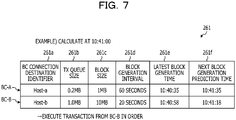
- FIG. 7 is a diagram illustrating an example of BC order determination according to the embodiment.
- a plurality BCs targeted of the transaction that is, BC-A and BC-B
- respective BC information is stored in the BC information table 261.
- the TX queue size 261b is 0.2 MB.
- the block size 261c is 1 MB.
- the TX queue size 261b is 1.0 MB.
- the block size 261c is 10 MB.
- the BC order determination unit 23 determines, for each BC, whether or not the TX queue size 261b is smaller than the block size 261c. For BC-A, since the TX queue size 261b is 0.2 MB and the block size 261c is 1 MB, it is determined that the TX queue size 261b is smaller than the block size 261c. For BC-B, since the TX queue size 261b is 1.0 MB and the block size 261c is 10 MB, it is determined that the TX queue size 261b is smaller than the block size 261c.
- the BC order determination unit 23 adds the block generation interval 261d to the latest block generation time 261e, and sets the added time in the column of the next block generation prediction time 261f. This is estimated that when the TX queue size 261b is smaller than the block size 261c, the load is small and TX of the TX queue size 261b is included in the next block. Therefore, the BC order determination unit 23 estimates the time point when the block generation interval 261d is elapsed as the next block generation prediction time 261f.
- the time “10:41:35” obtained by adding “60 seconds” which is the block generation interval 261d to “10:40:35” which is the latest block generation time 261e is set in the column of the next block generation prediction time 261f.
- the time “10:41:18” obtained by adding "20 seconds” which is the block generation interval 261d to "10:40:58" which is the latest block generation time 261e is set in the column of the next block generation prediction time 261f.
- the BC order determination unit 23 refers to the BC information table 261, and determines the execution order of each next transaction in the earlier order of the next block generation prediction time 261f corresponding to the plurality of BC-A and BC-B targeted of the transaction, respectively.
- the next block generation prediction time 261f corresponding to BC-A is "10:41:35”.
- the next block generation prediction time 261f corresponding to BC-B is "10:41:18”. Therefore, the BC order determination unit 23 determines the execution order of the next transactions in the earlier order of the next block generation prediction time 261f, for example, in the order of BC-B and BC-A.
- FIG. 8 is a diagram illustrating another example of BC order determination according to the embodiment.
- BC-A for a plurality of BCs targeted of the transaction, that is, BC-A and BC-B, respective BC information is stored in the BC information table 261.
- the TX queue size 261b is 2 MB.
- the block size 261c is 1 MB.
- BC-B the TX queue size 261b is 50 MB.
- the block size 261c is 10 MB.
- the BC order determination unit 23 determines, for each BC, whether or not the TX queue size 261b is smaller than the block size 261c. For BC-A, since the TX queue size 261b is 2 MB and the block size 261c is 1 MB, it is determined that the TX queue size 261b is larger than the block size 261c. For BC-B, since the TX queue size 261b is 50 MB and the block size 261c is 10 MB, it is determined that the TX queue size 261b is larger than the block size 261c.
- the BC order determination unit 23 adds the average block generation requisite time (prediction) corresponding to the TX queue size 261b to the latest block generation time 261e, and sets the added time in the column of the next block generation prediction time 261f. This is estimated that when the TX queue size 261b is larger than the block size 261c, the load is large and TX of the TX queue size 261b is not included in the next block. Therefore, the BC order determination unit 23 estimates the time point when the total amount of TX (TX queue size) exceeds the block size 261c as the next block generation prediction time 261f.
- the average block generation requisite time (prediction) 263c corresponding to the TX queue size 261b "2 MB” is acquired from the statistical information table 263 as "30 seconds".
- the time “10:41:05” obtained by adding average block generation requisite time (prediction) 263c "30 seconds” corresponding to the TX queue size 261b "2 MB” to "10:40:35" which is the latest block generation time 261e is set in the column of the next block generation prediction time 261f.
- the average block generation requisite time (prediction) 263c corresponding to the TX queue size 261b "10 MB" is acquired as "10 seconds" from the statistical information table 263.
- the time “10:41:08” obtained by adding average block generation requisite time (prediction) 263c "10 seconds” corresponding to the TX queue size 261b "10 MB” to "10:40:58" which is the latest block generation time 261e is set in the column of the next block generation prediction time 261f.
- the BC order determination unit 23 refers to the BC information table 261, and determines the execution order of each next transaction in the earlier order of the next block generation prediction time 261f respectively corresponding to the plurality of BC-A and BC-B targeted of the transaction.
- the next block generation prediction time 261f corresponding to BC-A is "10:41:05".
- the next block generation prediction time 261f corresponding to BC-B is "10: 41: 08". Therefore, the BC order determination unit 23 determines the execution order of the next transactions in the earlier order of the next block generation prediction time 261f, for example, in the order of BC-A and BC-B.
- the BC order determination unit 23 may shorten the time for confirming the transaction of data among a plurality of BCs.
- FIG. 9 is a diagram illustrating an example of a flowchart of transaction control processing according to the embodiment.
- the request reception unit 21 receives the request of registering the transaction (TX) transmitted from the application 10 (step S11).
- the BC order determination unit 23 determines the execution order of TX for each BC targeted of the transaction (step S12).
- the flowchart of the processing of determining the execution order of TX for BC will be described below as the BC order determination processing.
- the TX execution unit 24 executes TX in accordance with the determined execution order of TX (step S13).
- the flowchart of the TX execution processing will be described below.
- the transaction control processing is ended.
- FIG. 10 is a diagram illustrating an example of a flowchart of BC order determination processing according to the embodiment. It is assumed that "i" in the flowchart of FIG. 10 is an index that indicates the BC information held in the BC information table 261. In the flowchart of FIG. 10 , xx(i) indicates the item xx corresponding to the i-th BC information. Steps S21 to S24 are executed asynchronously for a plurality of BCs.
- the BC order determination unit 23 acquires the BC information of the i-th BC from the BC information table 261 (step S21). The BC order determination unit 23 determines, for the i-th BC, whether or not the TX queue size 261b is smaller than the block size 261c (step S22).
- the BC order determination unit 23 adds the block generation interval 261d to the latest block generation time 261e.
- the BC order determination unit 23 sets the added time as the next block generation prediction time 261f (step S23).
- the next block generation prediction time 261f may be the past time. For example, this is a case in which there is no transaction that generates a block at the previous block generation time. In such a case, in step S23, the block generation interval 261d may be repeatedly added to the next block generation prediction time 261f until the current time is exceeded.
- the BC order determination unit 23 proceeds to step S25.
- the BC order determination unit 23 adds the average block generation requisite time (prediction) corresponding to the TX queue size 261b to the latest block generation time 261e.
- the BC order determination unit 23 sets the added time as the next block generation prediction time 261f (step S24).
- the BC order determination unit 23 may acquire the average block generation requisite time (prediction) by using the statistical information table 263 or calculate the average block generation requisite time (prediction).
- the BC order determination unit 23 may acquire the average block generation requisite time (prediction) 263c corresponding to the TX queue size 263b.
- the BC order determination unit 23 may generate a linear function using TX queue sizes 263b before and after the TX queue size 261b and an average block generation requisite time (prediction) 263c corresponding to the size, and calculate the TX queue size corresponding to the TX queue size 261b using the generated linear function.
- the BC order determination unit 23 proceeds to step S25.
- step S25 the BC order determination unit 23 waits for the completion of asynchronous execution (step S25).
- the BC order determination unit 23 determines the execution order of TX in ascending order of the next block generation prediction time (step S26).
- the BC order determination unit 23 ends the BC order determination processing.
- FIG. 11 is a diagram illustrating an example of a flowchart of TX execution processing according to the embodiment. It is assumed that "i" in the flowchart of FIG. 11 is an index that indicates the BC information held in the BC information table 261. It is assumed that "i" has the initial value of "1".
- the TX execution unit 24 executes TX for BC of the i-th BC information (step S31).
- the TX execution unit 24 sets the current time at which TX is executed as start.
- the start is a temporary area of the storage unit 26.
- the TX execution unit 24 determines whether or not TX is confirmed (step S32). When it is determined that TX is not confirmed (step S32; No), the TX execution unit 24 sleeps to wait for TX to be confirmed (step S33). The TX execution unit 24 proceeds to step S32.
- the TX execution unit 24 sets a difference obtained by subtracting the time set as start from the current time as the requisite time (step S34).
- the TX execution unit 24 holds the requisite time in the requisite time table 262 in association with the TX queue size 261b corresponding to the i-th BC information (step S35).
- the TX execution unit 24 adds 1 to the value set in i (step S36).
- the TX execution unit 24 determines whether or not the number of BCs targeted of the transaction is smaller than i (step S37). When it is determined that the number of BCs targeted of the transaction is equal to or larger than i (step S37; No), the TX execution unit 24 proceeds to step S31 to execute TX on the next i-th BC.
- step S37 when it is determined that the number of BCs targeted of the transaction is smaller than i (step S37; Yes), the TX execution unit 24 ends the TX execution processing.
- FIG. 12 is a diagram illustrating an example of a flowchart of BC information acquisition processing according to the embodiment.
- the BC information acquisition unit 22 determines whether or not it is the acquisition timing of BC information (step S41). When it is determined that it is not the acquisition timing of BC information (step S41; No), the BC information acquisition unit 22 sleeps and repeats the determination processing until it is the acquisition timing of BC information (step S41A).
- the BC information acquisition unit 22 acquires various set values from the BC targeted of the transaction, respectively (step S42). For example, the BC information acquisition unit 22 acquires the TX queue size, the block size, the block generation interval, and the latest block generation time from the middleware of each BC targeted of the transaction.
- the BC information acquisition unit 22 holds the acquired various set values as BC information in the BC information table 261 in association with the BC connection destination identifier 261a of BC (step S43).
- the BC information acquisition unit 22 ends the BC information acquisition processing.
- FIG. 13 is a diagram illustrating an example of a flowchart of statistical information generation processing according to the embodiment.
- the statistical information generation unit 25 determines whether or not it is a generation timing of statistical information (step S51). When it is determined that it is not the generation timing of the statistical information (step S51; No), the statistical information generation unit 25 sleeps and repeats the determination processing until it is the generation timing of the statistical information (step S51A).
- the statistical information generation unit 25 acquires, from the requisite time table 262, the TX queue size 262b corresponding to BC and the block generation requisite time (actual result) 262c in combination for each BC targeted of the transaction (step S52).
- the statistical information generation unit 25 uses the combination of the TX queue size 262b acquired and the block generation requisite time (actual result) 262c for each BC targeted of the transaction to calculate an average value the block generation requisite time corresponding to the TX queue size for each BC targeted of the transaction (step S53).
- the statistical information generation unit 25 associates the BC targeted of the transaction, the TX queue size, and the calculated average value of the block generation requisite time, and holds them in the statistical information table 263 (step S54). The statistical information generation unit 25 ends the statistical information generation processing.
- the transaction control device 1 includes the application 10 together with the library unit 20.
- the application 10 may be provided in an external device of the transaction control device 1, and the application 10 may be connected to the transaction control device 1 through the network.
- FIG. 14 is a functional block diagram illustrating another configuration of the transaction control device according to the embodiment.
- the same components as those of the transaction control device 1 illustrated in FIG. 1 of the embodiment are denoted by the same reference numerals, and the description of the same components and operations will not be repeated.
- the difference between FIG. 1 and FIG. 14 is that the application 10 is changed to an application 10A.
- the application 10A is connected to the transaction control device 1 through the network.
- the request reception unit 21 receives the request of registering the transaction (TX) from the application 10A.
- the BC order determination unit 23 predicts the time of confirmation of the next TX for each of a plurality of BCs targeted of the transaction, and determines the execution order of the next TX in the ascending order of the predicted times.
- the TX execution unit 24 executes the next TX for each of the plurality of BCs targeted of the transaction based on the determined execution order ....
- the BC order determination unit 23 may shorten the time of TX confirmation among a plurality of BCs.
- the transaction control device 1 predicts the time of confirmation of the next transaction for each of a plurality of BCs targeted of the same transaction, and executes the transaction first from BC with the earliest prediction time. As a result, the transaction control device 1 may shorten the time for confirming the transaction among a plurality of BCs targeted of the transaction.
- the transaction control device 1 is not limited thereto, and this configuration may be applied. The transaction control device 1 may shorten a time in which the data consistency is not achieved among a plurality of BCs targeted of the transaction.
- the transaction control device 1 predicts a period in which there is a data inconsistency, among BCs when the next transaction is executed for each of a plurality of BCs targeted of the transaction, and executes a transaction first from BC having a shorter predicted period of inconsistency.
- the transaction control device 1 may predict the time of confirmation of the next transaction for each of a plurality of BCs of the transaction, and execute the transaction first from BC with a later prediction time. The case of shortening the time in which the data consistency is not achieved will be described with reference to FIG. 15 .
- FIG. 15 is a diagram illustrating an application example of processing of the transaction control device according to the embodiment. It is assumed that one BC represented by BC-A, confirms a transaction (TX) every 60 seconds, with a block generation interval of 60 seconds. It is assumed that one BC represented by BC-B confirms TX every 20 seconds, with the block generation interval of 20 seconds.
- the transaction control device 1 predicts, for each BC, the period in which the data consistency is not achieved when the next TX is executed. For example, when BC-A executes the registration of the next TX, after the time point (t21) of receiving the request of registering TX, TX is confirmed at the next confirmation time point (t22). Subsequently, after the time point (t23) of receiving the request of registering TX, BC-B confirms TX at the next confirmation time point (t24). Therefore, the transaction control device 1 predicts, for BC-A, the period in which the data consistency is not achieved as a period of (t24 - t23).
- TX is confirmed at the next confirmation time point (t32) after the time point (t31) of receiving the request of registering TX. Subsequently, after the time point (t33) of receiving the request of registering TX, BC-A confirms TX at the next confirmation time point (t34). Therefore, the transaction control device 1 predicts, for BC-B, the period in which the data consistency is not achieved as a period of (t34 - t32).
- the transaction control device 1 executes the registration of TX from BC having the shorter period in which the predicted consistency is not achieved.
- the period in which the predicted consistency is not achieved is shorter in BC-A than in BC-B. Therefore, it is preferable that the transaction control device 1 executes the registration of TX from BC-A having the short predicted period. As a result, the transaction control device 1 may shorten the time in which the data consistency is not achieved among the plurality of BCs.
- the transaction control device 1 predicts the time of confirmation of the next transaction for each of a plurality of BCs targeted of the transaction.
- the transaction control device 1 determines the execution order of the next transaction for each of the plurality of BCs based on the predicted time.
- the transaction control device 1 executes the next transaction of each of the plurality of BCs based on the determined execution order.
- the transaction control device 1 may shorten the time for confirming the transaction among BCs by executing the next transaction based on the predicted confirmation time of the next transactions of each of the plurality of BCs.
- the transaction control device 1 may early return feedback of the transaction to the user at the time of executing the transaction in a plurality of BCs.
- the transaction control device 1 determines the execution order of the next transactions of each of the plurality of BCs in an earlier order of the predicted time. According to this configuration, it is possible to shorten the time for confirming the transaction among BCs by executing the next transaction in an earlier order of the predicted confirmation time of the next transaction for each of the plurality of BCs.
- the transaction control device 1 predicts a period in which there is a data inconsistency among a plurality of BCs when the next transaction is executed based on the time of confirmation of the predicted next transaction.
- the transaction control device 1 determines the execution order of the next transactions of each of the plurality of BCs based on the period having the predicted inconsistency. According to this configuration, the transaction control device 1 may shorten a time in which the data consistency is not achieved among the plurality of BCs.
- the transaction control device 1 determines, for each of the plurality of BCs, whether or not the transaction queue size indicating the size of the transaction not yet included in the block is smaller than the block size. When it is determined that the transaction queue size is smaller than the block size, for each of a plurality of BCs, the transaction control device 1 adds the block generation interval determined for each BC to the time when the preceding block is generated and predicts the confirmation time of the next transaction. When it is determined that the transaction queue size is equal to or greater than the block size, for each of a plurality of BC, the transaction control device 1 adds the predicted block generation requisite time corresponding to the transaction queue size to the time when the preceding block is generated and predicts the confirmation time of the next transaction. According to this configuration, the transaction control device 1 may determine the execution order of the next transaction of each of the plurality of BCs in ascending order by predicting the confirmation time of the next transaction of the plurality of BCs.
- the transaction control device 1 further holds, for each of a plurality of BCs, the requisite time for actually executing a transaction in association with the transaction queue size.
- the transaction control device 1 calculates the predicted block generation requisite time corresponding to the transaction queue size for each of a plurality of BCs using the held information, and holds the calculated time as statistical information.
- the transaction control device 1 may use the statistical information to calculate the predicted block generation requisite time corresponding to the transaction queue size.
- the transaction control device 1 may be realized by mounting the functions of the library unit 20 and the like described above on the information processing device such as a known personal computer and a workstation.
- Each component of the illustrated device is not necessarily physically configured as illustrated.
- the specific aspect of the distribution and integration of the devices is not limited to the illustrated one, and all or a part thereof may be configured to be functionally or physically distributed or integrated in any unit in accordance with various loads, usage conditions, and the like.
- the request reception unit 21 and the BC order determination unit 23 may be integrated as one unit.
- the BC order determination unit 23 may be distributed into an estimation unit that estimates the next block generation prediction time for each BC, and a determination unit that determines the order of BCs for TX execution using the estimated information.
- the storage unit 26 may be connected through a network as an external device of the transaction control device 1.
- FIG. 16 is a diagram illustrating an example of a computer that executes a transaction control program.
- a computer 200 includes a CPU 203 that executes various arithmetic processing, an input device 215 that receives input of data from a user, and a display control unit 207 that controls the display device 209.
- the computer 200 further includes a drive device 213 that reads a program or the like from a storage medium, and a communication control unit 217 that transmits and receives data with other computers through a network.
- the computer 200 also includes a memory 201 for temporarily storing various information, and a hard disk drive (HDD) 205.
- the memory 201, the CPU 203, a HDD 205, the display control unit 207, the drive device 213, the input device 215, and the communication control unit 217 are connected by a bus 219.
- the drive device 213 is a device for a removable disk 211, for example.
- the HDD 205 stores a transaction control program 205a and transaction related information 205b.
- the CPU 203 reads the transaction control program 205a, loads it into the memory 201, and executes it as a processing. Such a processing corresponds to each functional unit of the transaction control device 1.
- the transaction related information 205b corresponds to the BC information table 261, the requisite time table 262 and the statistical information table 263.
- the removable disk 211 stores each information such as the transaction control program 205a.
- the transaction control program 205a may not necessarily be stored in the HDD 205 from the beginning.
- the program is stored in a "portable physical media" such as a flexible disk (FD) inserted in the computer 200, a compact disk read only memory (CD-ROM), a digital versatile disk (DVD), a magnetooptical disk, an integrated circuit (IC) card.
- FD flexible disk
- CD-ROM compact disk read only memory
- DVD digital versatile disk
- IC integrated circuit
Landscapes
- Engineering & Computer Science (AREA)
- Theoretical Computer Science (AREA)
- Databases & Information Systems (AREA)
- General Physics & Mathematics (AREA)
- Physics & Mathematics (AREA)
- Business, Economics & Management (AREA)
- Data Mining & Analysis (AREA)
- General Engineering & Computer Science (AREA)
- Accounting & Taxation (AREA)
- Computing Systems (AREA)
- Finance (AREA)
- Strategic Management (AREA)
- General Business, Economics & Management (AREA)
- Debugging And Monitoring (AREA)
- Information Retrieval, Db Structures And Fs Structures Therefor (AREA)
Abstract
Description
- The embodiments discussed herein are related to transaction control technology.
- In recent years, digital virtual currency such as bitcoin (registered trademark) is becoming widespread. In virtual currencies such as bitcoins, a technique called blockchain is used. The blockchain batches transaction information (transactions) of virtual currency between participants into units called blocks.
- The blockchain used for digital virtual currency transactions is being applied to various business systems, and used for respective business systems. For this reason, when developing a system in which a plurality of business systems are linked, it is desirable to use a plurality of existing blockchains to form one system. At this time, there are cases in which it is desired to execute the same transaction among the plurality of blockchains and match the data recorded in the blockchains. For example, there are cases in which for a hospital, the same transaction is executed between a blockchain of the hospital and a blockchain of a pharmacy to match data such as prescriptions.
- In such a case, it is also conceivable for the system to write transactions in a plurality of blockchains simultaneously. However, transactions may not be canceled in the blockchain. For this reason, it is reasonable that the system executes the transaction on one blockchain, and if successful, executes the transaction on another blockchain instead of writing transactions to a plurality of blockchains simultaneously.
- The confirmation of transactions in the blockchain is not performed each time a transaction is executed, but is performed at fixed time intervals or for each number of transactions. Each blockchain has a different time interval and a different number of transactions until the transaction is confirmed.
- For example, related techniques are disclosed in Japanese Laid-open Patent Publication No.
2017-50763 2017-91149 - In the related art, there is a problem that when executing the same transaction among a plurality of blockchains, it is not possible to shorten the time to confirm the transaction.
- For example, users of the system want to receive feedback on the success and failure of the determination for the transaction as soon as possible. However, in the related art, the system executes the transaction on one blockchain, and if successful, executes the transaction on the other blockchain, but there is no configuration to feedback on the success and failure of the confirmation for the transaction as soon as possible.
- In one aspect, it is an object of the invention to shorten the time for confirming the transaction among a plurality of blockchains.
- In order to achieve the object mentioned above, a transaction control device includes a library unit configured to perform prediction of a first confirmation time at which first one or more transactions are confirmed in a first blockchain, and prediction of a second confirmation time at which second one or more transactions are confirmed in a second blockchain, perform, based on the predicted first confirmation time and the predicted second confirmation time, determination of an execution order of a plurality of transactions to be executed in the first blockchain and the second blockchain, and execute, based on the determined execution order, the plurality of transactions in the first blockchain and the second blockchain.
- It is to be understood that both the foregoing general description and the following detailed description are exemplary, and are intended to provide further explanation of the invention as claimed. Other advantages and features of the invention will be apparent from the following description, drawings and claims.
-
-
FIG. 1 is a functional block diagram illustrating a configuration of a transaction control device according to an embodiment. -
FIG. 2 is a diagram illustrating an example of processing of the transaction control device according to the embodiment. -
FIG. 3 is a diagram illustrating an example of a timing of TX confirmation of BC. -
FIG. 4 is a diagram illustrating an example of a data structure of a BC information table according to the embodiment. -
FIG. 5 is a diagram illustrating an example of a data structure of a requisite time table according to the embodiment. -
FIG. 6 is a diagram illustrating an example of a data structure of a statistical information table according to the embodiment. -
FIG. 7 is a diagram illustrating an example of BC order determination according to the embodiment. -
FIG. 8 is a diagram illustrating another example of the BC order determination according to the embodiment. -
FIG. 9 is a diagram illustrating an example of a flowchart of transaction control processing according to the embodiment. -
FIG. 10 is a diagram illustrating an example of a flowchart of BC order determination processing according to the embodiment. -
FIG. 11 is a diagram illustrating an example of a flowchart of TX execution processing according to the embodiment. -
FIG. 12 is a diagram illustrating an example of a flowchart of BC information acquisition processing according to the embodiment. -
FIG. 13 is a diagram illustrating an example of a flowchart of statistical information generation processing according to the embodiment. -
FIG. 14 is a functional block diagram illustrating another configuration of the transaction control device according to the embodiment. -
FIG. 15 is a diagram illustrating an application example of processing of the transaction control device according to the embodiment. -
FIG. 16 is a diagram illustrating an example of a computer that executes a transaction control program. - Hereinafter, embodiments of a transaction control device, a transaction control program, and a transaction control method disclosed in the specification will be described in detail based on drawings. The present disclosure is not limited by the embodiments.
-
FIG. 1 is a diagram illustrating a functional configuration of a transaction control device according to the embodiment. As depicted inFIG. 1 , when the same transaction is confirmed in a plurality of blockchains (BC), atransaction control device 1 predicts a confirmation time of the next transaction for each of the plurality of BCs, and first executes the next transaction in BC with an earlier prediction time. In the embodiment, the blockchain is abbreviated as "BC". The transaction may be abbreviated as "TX". - An example of processing of the
transaction control device 1 according to the embodiment will be described with reference toFIG. 2. FIG. 2 is a diagram illustrating an example of processing of the transaction control device according to the embodiment. It is assumed that one BC represented by BC-A, confirms a transaction every 60 seconds, with a block generation interval of 60 seconds. It is assumed that one BC represented by BC-B, confirms a transaction every 20 seconds, with a block generation interval of 20 seconds. For example, when a plurality of un- confirmation transactions (TX) are accumulated in a queue (referred to as "TX queue"), each BC batches the plurality of transactions accumulated in the TX queue to generate a block, and confirms the transaction in block units. - As illustrated in
FIG. 2 , when receiving a request of registering the transaction (TX) from anapplication 10, thetransaction control device 1 predicts a next TX confirmation time for each BC targeted of the transaction. - For example, in
FIG. 2 , when BC-B executes a TX registration, after a time point (t1) of receiving the request of registering TX, BC-B confirms the next TX at the next confirmation time (t2). Therefore, thetransaction control device 1 predicts a next TX confirmation time as t2 for BC-B. When BC-A executes the registration of TX, after the time (t11) of receiving the request of registering TX, BC-A confirms the next TX at the next confirmation time (t12). Therefore, thetransaction control device 1 predicts the next TX confirmation time as t12 for BC-A. - The
transaction control device 1 executes the registration of the next TX from BC with an earlier prediction time. For example, inFIG. 2 , the predicted confirmation time is earlier in BC-B than in BC-A. Therefore, thetransaction control device 1 executes the registration of the next TX from BC-B with an earlier prediction time. - The reason for executing the registration of TX from BC with an earlier prediction time is as follows.
- It is assumed that the
transaction control device 1 executes the registration of TX for BC-A first. Then, after the time (t11) of receiving the request of registering TX, BC-A confirms TX at the next confirmation time (t12). When receiving the confirmation success of TX, thetransaction control device 1 executes the registration of TX for BC-B. Then, after the time (t13) of receiving the request of registering TX, BC-B confirms TX at the next confirmation time (t14). Then, the time from the execution of TX to confirmation is calculated as (t14 - t11). - On the other hand, it is assumed that the
transaction control device 1 executes the registration of TX for BC-B first. Then, after the time (t1) of receiving the request of registering TX, BC-B confirms TX at the next confirmation time (t2). When receiving the confirmation success of TX, thetransaction control device 1 executes the registration of TX for BC-A. Then, after the time (t3) of receiving the request of registering TX, BC-A confirms TX at a next confirmation time (t4). Then, the time from the execution of TX to the confirmation is calculated as (t4 - t1). - Therefore, the
transaction control device 1 may return feedback of the completion of the registration of TX early to theapplication 10 as the registration of TX from BC-B with an earlier prediction time is executed. For example, thetransaction control device 1 may shorten the time of TX confirmation among a plurality of BCs. - In
FIG. 2 , it is assumed that the timing of TX confirmation of BC is a time point when a block generation interval determined for each BC is elapsed. However, the timing of TX confirmation of BC may be the timing that satisfies any of the following conditions. The first condition is when the size of TX not included in the block (an amount of TX waiting for incorporation into the block) does not exceed the block size, and the block generation interval is elapsed from the preceding block generation time. Since the load is estimated to be small, this is to wait for the elapse of the block generation interval and confirm TX. The second condition when the size of TX not included in the block (the amount of TX waiting for incorporation into the block) exceeds the block size. Since the load is estimated to be large, this is to confirm TX when the amount of TX waiting for incorporation into the block exceeds the block size without waiting for the elapse of the block generation interval. -
FIG. 3 is a diagram illustrating an example of a timing of TX confirmation of BC.FIG. 3 is a graph indicating the timing of TX confirmation of BC in which X-axis is time and Y-axis is block size. The first condition is the timing indicated by a symbol a1. For example, the timing of TX confirmation of BC is (a1), when the amount of TX waiting for incorporation into the block does not exceed the block size, but the block generation interval is elapsed from the time (a0) of the preceding block generation. The second condition is a timing indicated by a symbol a3. For example, the timing of TX confirmation of BC is (a3) when the amount of TX waiting for incorporation into the block exceeds the block size. - Therefore, hereinafter, the
transaction control device 1 predicts the TX confirmation time for each BC as the timing of TX confirmation of BC as the timing satisfying the first condition and the timing satisfying the second condition. - Returning to
FIG. 1 , thetransaction control device 1 includes anapplication 10, alibrary unit 20, and acommunication unit 30. - The
application 10 is software used when the user executes a predetermined transaction, for example. Theapplication 10 includes arequest transmission unit 11. Therequest transmission unit 11 transmits the request of registering a transaction (transaction) to alibrary unit 20. - A
communication unit 30 is a processing unit that communicates with other external devices through a network. Thecommunication unit 30 corresponds to a communication device. For example, thecommunication unit 30 requests an execution of a transaction (TX) for a plurality of BCs that are targets of the same transaction. - The
library unit 20 includes arequest reception unit 21, a BCinformation acquisition unit 22, a BCorder determination unit 23, aTX execution unit 24, a statisticalinformation generation unit 25, and astorage unit 26. - The
storage unit 26 is a semiconductor memory device such as a random access memory (RAM) or a flash memory, or a storage device such as a hard disk or an optical disk, for example. Thestorage unit 26 includes a BC information table 261, a requisite time table 262, and a statistical information table 263. - The BC information table 261 stores, for each BC, BC information on a block held by each BC. The data structure of the BC information table 261 will be described below.
- The requisite time table 262 accumulates, for each BC, an actual result of the requisite time for generating a block from a plurality of transactions (TX) accumulated in the TX queue. For example, it may be said that the requisite time table 262 stores, for each BC, the actual result of requisite times confirmed by the plurality of TXs accumulated in the TX queue. The data structure of the requisite time table 262 will be described below.
- The statistical information table 263 stores statistical information for each BC. For example, the statistical information table 263 stores, as statistical information, an average of requisite time for block generation with respect to sizes (TX queue sizes) of a plurality of transactions (TX) accumulated in the TX queue. For example, it may be said that the statistical information table 263 stores, for each BC, the average of the requisite time for TX confirmation with respect to the sizes of a plurality of transactions (TX) accumulated in the TX queue, as statistical information. "TX queue size" is the size of TX that is not yet included in a block, and refers to the size of TX accumulated in the TX queue. The data structure of the statistical information table 263 will be described below.
- The
request reception unit 21 receives a request of registering the transaction (TX) from theapplication 10. - The BC
information acquisition unit 22 acquires BC information for each BC targeted of the transaction. The BCinformation acquisition unit 22 holds the BC information acquired for each BC targeted of the transaction in the BC information table 261. The BCinformation acquisition unit 22 may periodically acquire BC information from a plurality of BCs targeted of the transaction, respectively. - An example of the data structure of the BC information table 261 will be described with reference to
FIG. 4. FIG. 4 is a diagram illustrating an example of the data structure of the BC information table according to the embodiment. As depicted inFIG. 4 , the BC information table 261 stores a BCconnection destination identifier 261a, aTX queue size 261b, ablock size 261c, and ablock generation interval 261d in association with each other. In addition, the BC information table 261 stores a latestblock generation time 261e and a next blockgeneration prediction time 261f in association with each other. - The BC
connection destination identifier 261a is an identifier for uniquely identifying the connection destination of BC. The BCconnection destination identifier 261a includes an internet protocol (IP) address, for example. - The
TX queue size 261b is the size of transactions that is not yet included in the block, and is the size of transactions accumulated in the TX queue. TheTX queue size 261b may be the number of queues (the number of transactions) included in the TX queue, or may be the total amount of transactions included in the TX queue. In the embodiment, theTX queue size 261b is described as the number of queues (the number of transactions) included in the TX queue. - The
block size 261c is the size of one block. For example, theblock size 261c is a size for confirming transactions included in the TX queue as a block. Theblock size 261c may be the number of transactions that may be included in one block, or the total amount of transactions that may be included in one block. In the embodiment, theblock size 261c is described as the number of transactions that may be included in one block. - The
block generation interval 261d is a time interval for generating a block. For example, it may be said that theblock generation interval 261d is a time interval for confirming transactions included in the TX queue as the block. - The latest
block generation time 261e is the time when the block is most recently generated. For example, it may be said that the latestblock generation time 261e is the time when the transaction included in the TX queue is most recently confirmed as the block. - The next block
generation prediction time 261f is a prediction time of generating a block next time. The next blockgeneration prediction time 261f is calculated by the BCorder determination unit 23 described below. - As an example, when the BC
connection destination identifier 261a is "Host-a", it is stored that theTX queue size 261b is "0.2 MB", theblock size 261c is "1 MB", and theblock generation interval 261d is "60 seconds". In addition, when the BCconnection destination identifier 261a is "Host-a", it is stored that the latestblock generation time 261e is "10:40:35", and the next blockgeneration prediction time 261f is "10:41:35". - Returning to
FIG. 1 , for example, when acquiring the TX queue size, the block size, the block generation interval, and the latest block generation time from the middleware of "Host-a" as the BCconnection destination identifier 261a, the BCinformation acquisition unit 22 holds these pieces of information in the BC information table 261 in association with each other. Theblock size 261c and theblock generation interval 261d are values set in advance during operation, and are the same every time BC information is acquired unless the set value is changed during operation. TheTX queue size 261b and the latestblock generation time 261e are different at each BC information acquisition time. - The BC
order determination unit 23 predicts the time of confirmation of the next transaction for each of a plurality of BCs targeted of the same transaction. The BCorder determination unit 23 is an example of a prediction unit or a determination unit. - For example, the BC
order determination unit 23 acquires, from the BC information table 261, theTX queue size 261b, theblock size 261c, theblock generation interval 261d, and the latestblock generation time 261e for each BC targeted of the transaction. The BCorder determination unit 23 determines, for each BC, whether or not theTX queue size 261b is smaller than theblock size 261c. - As an example, when the
TX queue size 261b is smaller than theblock size 261c, the BCorder determination unit 23 adds theblock generation interval 261d to the latestblock generation time 261e. The BCorder determination unit 23 sets the added time in the column of the next blockgeneration prediction time 261f. It is estimated that, when theTX queue size 261b is smaller than theblock size 261c, the load is small and TX of theTX queue size 261b is included in the next block. Therefore, the BCorder determination unit 23 estimates the time point when theblock generation interval 261d is elapsed as the next blockgeneration prediction time 261f. The next blockgeneration prediction time 261f may be the past time. For example, there may be no transaction that generates a block at the previous block generation time. In such a case, the BCorder determination unit 23 may repeatedly add theblock generation interval 261d to the next blockgeneration prediction time 261f until the current time is exceeded. - As an example, when the
TX queue size 261b is equal to or larger than theblock size 261c, the BCorder determination unit 23 adds the average block generation requisite time corresponding to theTX queue size 261b to the latestblock generation time 261e. The BCorder determination unit 23 sets the added time in the column of the next blockgeneration prediction time 261f. This is estimated that when theTX queue size 261b is equal to or larger than theblock size 261c, the load is large and TX executed at the time point of theTX queue size 261b is not included in the next block. Therefore, the BCorder determination unit 23 estimates the time point when the total amount of TX (TX queue size) exceeds theblock size 261c as the next blockgeneration prediction time 261f. The average block generation requisite time may be acquired from the statistical information table 263 described below. - The BC
order determination unit 23 determines the execution order of the next transaction of each of the plurality of BCs targeted of the transaction in ascending order of the predicted time. For example, the BCorder determination unit 23 refers to the BC information table 261 and acquires the next blockgeneration prediction time 261f for each BC targeted of the transaction. The BCorder determination unit 23 determines the execution order of respective next transactions in an earlier order of the next blockgeneration prediction time 261f acquired for each of the BCs targeted of the transaction. - The
TX execution unit 24 executes the next transaction for each of the plurality of BCs targeted of the transaction based on the execution order determined by the BCorder determination unit 23. TheTX execution unit 24 is an example of an execution unit. For example, theTX execution unit 24 executes the next transaction for BC with an earlier execution order. When receiving the confirmation of the transaction, theTX execution unit 24 calculates the requisite time from the start of execution of the transaction to the confirmation, associates the calculated requisite time with theTX queue size 261b and the BCconnection destination identifier 261a, and holds the requisite time table 262. TheTX execution unit 24 executes the next transaction for BC with a next earliest execution order. When there is no BC with a next earliest execution order, theTX execution unit 24 ends the TX execution processing. - An example of the data structure of the requisite time table 262 according to the embodiment will be described with reference to
FIG. 5. FIG. 5 is a diagram illustrating an example of the data structure of the requisite time table according to the embodiment. As depicted inFIG. 5 , the requisite time table 262 stores a BCconnection destination identifier 262a, aTX queue size 262b, and a block generation requisite time (actual result) 262c in association with each other. - The BC
connection destination identifier 262a is an identifier that uniquely identifies a connection destination for BC. The BCconnection destination identifier 262a corresponds to the BCconnection destination identifier 261a of the BC information table 261. - The
TX queue size 262b is the size of transactions that is not yet included in the block, and is the size of transactions accumulated in the TX queue. Since theTX queue size 262b corresponds to theTX queue size 261b of the BC information table 261, the description thereof will not be repeated. - The block generation requisite time (actual result) 262c is an actual result of the requisite time to generate a block. As an example, the block generation requisite time (actual result) 262c is an actual result of the requisite time from the start of execution of the transaction to its confirmation.
- As an example, when the BC
connection destination identifier 262a is "Host-a", it is stored that theTX queue size 262b is "2 MB", and the block generation requisite time (actual result) 262c is "32 seconds". It is stored that theTX queue size 262b is "2 MB", and the block generation requisite time (actual result) 262c is "28 seconds". It is stored that theTX queue size 262b is "5 MB", and the block generation requisite time (actual result) 262c is "12 seconds". - Returning to
FIG. 1 , the statisticalinformation generation unit 25 generates, for each BC, the average of the block generation requisite time (actual result) 262c corresponding to the TX queue size as statistical information by using the requisite time table 262. For example, the statisticalinformation generation unit 25 refers to the requisite time table 262, and acquires, for each BCconnection destination identifier 262a indicated by BC, the block generation requisite time (actual result) 262c corresponding to theTX queue size 262b. The statisticalinformation generation unit 25 calculates the average of the block generation requisite time (actual result) by using the acquired block generation requisite time (actual result) 262c, and applies it as an average block generation requisite time (prediction). The statisticalinformation generation unit 25 holds, in the statistical information table 263, an average block generation requisite time (prediction) 263c corresponding to theTX queue size 262b for each BCconnection destination identifier 262a indicated by BC. The statisticalinformation generation unit 25 may be executed at a predetermined time point. - An example of the data structure of the statistical information table 263 according to the embodiment will be described with reference to
FIG. 6. FIG. 6 is a diagram illustrating an example of a data structure of a statistical information table according to the embodiment. As depicted inFIG. 6 , the statistical information table 263 stores a BCconnection destination identifier 263a, aTX queue size 263b, and an average block generation requisite time (prediction) 263c in association with each other. - The BC
connection destination identifier 263a is an identifier that uniquely identifies a connection destination for BC. The BCconnection destination identifier 263a corresponds to the BCconnection destination identifier 261a of the BC information table 261. - The
TX queue size 263b is the size of transactions that is not yet included in the block, and is the size of transactions accumulated in the TX queue. Since theTX queue size 263b corresponds to theTX queue size 261b of the BC information table 261, the description thereof will not be repeated. - Average block generation requisite time (prediction) 263c is an average of the requisite time for generating a block.
- As an example, when the BC
connection destination identifier 263a is "Host-a", it is stored that theTX queue size 263b is "2 MB", and the average block generation requisite time (prediction) 263c is "30 seconds". It is stored that theTX queue size 263b is "5 MB", and the average block generation requisite time (prediction) 263c is "12 seconds". -
FIG. 7 is a diagram illustrating an example of BC order determination according to the embodiment. As depicted inFIG. 7 , for a plurality BCs targeted of the transaction, that is, BC-A and BC-B, respective BC information is stored in the BC information table 261. For BC-A, theTX queue size 261b is 0.2 MB. Theblock size 261c is 1 MB. For BC-B, theTX queue size 261b is 1.0 MB. Theblock size 261c is 10 MB. - Under such circumstances, the BC
order determination unit 23 determines, for each BC, whether or not theTX queue size 261b is smaller than theblock size 261c. For BC-A, since theTX queue size 261b is 0.2 MB and theblock size 261c is 1 MB, it is determined that theTX queue size 261b is smaller than theblock size 261c. For BC-B, since theTX queue size 261b is 1.0 MB and theblock size 261c is 10 MB, it is determined that theTX queue size 261b is smaller than theblock size 261c. - When the
TX queue size 261b is smaller than theblock size 261c, the BCorder determination unit 23 adds theblock generation interval 261d to the latestblock generation time 261e, and sets the added time in the column of the next blockgeneration prediction time 261f. This is estimated that when theTX queue size 261b is smaller than theblock size 261c, the load is small and TX of theTX queue size 261b is included in the next block. Therefore, the BCorder determination unit 23 estimates the time point when theblock generation interval 261d is elapsed as the next blockgeneration prediction time 261f. - For BC-A, the time "10:41:35" obtained by adding "60 seconds" which is the
block generation interval 261d to "10:40:35" which is the latestblock generation time 261e is set in the column of the next blockgeneration prediction time 261f. For BC-B, the time "10:41:18" obtained by adding "20 seconds" which is theblock generation interval 261d to "10:40:58" which is the latestblock generation time 261e is set in the column of the next blockgeneration prediction time 261f. - The BC
order determination unit 23 refers to the BC information table 261, and determines the execution order of each next transaction in the earlier order of the next blockgeneration prediction time 261f corresponding to the plurality of BC-A and BC-B targeted of the transaction, respectively. The next blockgeneration prediction time 261f corresponding to BC-A is "10:41:35". The next blockgeneration prediction time 261f corresponding to BC-B is "10:41:18". Therefore, the BCorder determination unit 23 determines the execution order of the next transactions in the earlier order of the next blockgeneration prediction time 261f, for example, in the order of BC-B and BC-A. -
FIG. 8 is a diagram illustrating another example of BC order determination according to the embodiment. As depicted inFIG. 8 , for a plurality of BCs targeted of the transaction, that is, BC-A and BC-B, respective BC information is stored in the BC information table 261. For BC-A, theTX queue size 261b is 2 MB. Theblock size 261c is 1 MB. For BC-B, theTX queue size 261b is 50 MB. Theblock size 261c is 10 MB. - Under such circumstances, the BC
order determination unit 23 determines, for each BC, whether or not theTX queue size 261b is smaller than theblock size 261c. For BC-A, since theTX queue size 261b is 2 MB and theblock size 261c is 1 MB, it is determined that theTX queue size 261b is larger than theblock size 261c. For BC-B, since theTX queue size 261b is 50 MB and theblock size 261c is 10 MB, it is determined that theTX queue size 261b is larger than theblock size 261c. - When the
TX queue size 261b is larger than theblock size 261c, the BCorder determination unit 23 adds the average block generation requisite time (prediction) corresponding to theTX queue size 261b to the latestblock generation time 261e, and sets the added time in the column of the next blockgeneration prediction time 261f. This is estimated that when theTX queue size 261b is larger than theblock size 261c, the load is large and TX of theTX queue size 261b is not included in the next block. Therefore, the BCorder determination unit 23 estimates the time point when the total amount of TX (TX queue size) exceeds theblock size 261c as the next blockgeneration prediction time 261f. - For BC-A, the average block generation requisite time (prediction) 263c corresponding to the
TX queue size 261b "2 MB" is acquired from the statistical information table 263 as "30 seconds". The time "10:41:05" obtained by adding average block generation requisite time (prediction) 263c "30 seconds" corresponding to theTX queue size 261b "2 MB" to "10:40:35" which is the latestblock generation time 261e is set in the column of the next blockgeneration prediction time 261f. For BC-B, the average block generation requisite time (prediction) 263c corresponding to theTX queue size 261b "10 MB" is acquired as "10 seconds" from the statistical information table 263. The time "10:41:08" obtained by adding average block generation requisite time (prediction) 263c "10 seconds" corresponding to theTX queue size 261b "10 MB" to "10:40:58" which is the latestblock generation time 261e is set in the column of the next blockgeneration prediction time 261f. - The BC
order determination unit 23 refers to the BC information table 261, and determines the execution order of each next transaction in the earlier order of the next blockgeneration prediction time 261f respectively corresponding to the plurality of BC-A and BC-B targeted of the transaction. The next blockgeneration prediction time 261f corresponding to BC-A is "10:41:05". The next blockgeneration prediction time 261f corresponding to BC-B is "10: 41: 08". Therefore, the BCorder determination unit 23 determines the execution order of the next transactions in the earlier order of the next blockgeneration prediction time 261f, for example, in the order of BC-A and BC-B. - As a result, the BC
order determination unit 23 may shorten the time for confirming the transaction of data among a plurality of BCs. -
FIG. 9 is a diagram illustrating an example of a flowchart of transaction control processing according to the embodiment. As depicted inFIG. 9 , therequest reception unit 21 receives the request of registering the transaction (TX) transmitted from the application 10 (step S11). - Then, the BC
order determination unit 23 determines the execution order of TX for each BC targeted of the transaction (step S12). The flowchart of the processing of determining the execution order of TX for BC will be described below as the BC order determination processing. - The
TX execution unit 24 executes TX in accordance with the determined execution order of TX (step S13). The flowchart of the TX execution processing will be described below. The transaction control processing is ended. -
FIG. 10 is a diagram illustrating an example of a flowchart of BC order determination processing according to the embodiment. It is assumed that "i" in the flowchart ofFIG. 10 is an index that indicates the BC information held in the BC information table 261. In the flowchart ofFIG. 10 , xx(i) indicates the item xx corresponding to the i-th BC information. Steps S21 to S24 are executed asynchronously for a plurality of BCs. - As depicted in
FIG. 10 , the BCorder determination unit 23 acquires the BC information of the i-th BC from the BC information table 261 (step S21). The BCorder determination unit 23 determines, for the i-th BC, whether or not theTX queue size 261b is smaller than theblock size 261c (step S22). - When it is determined that the
TX queue size 261b is smaller than theblock size 261c (step S22; Yes), the BCorder determination unit 23 adds theblock generation interval 261d to the latestblock generation time 261e. The BCorder determination unit 23 sets the added time as the next blockgeneration prediction time 261f (step S23). The next blockgeneration prediction time 261f may be the past time. For example, this is a case in which there is no transaction that generates a block at the previous block generation time. In such a case, in step S23, theblock generation interval 261d may be repeatedly added to the next blockgeneration prediction time 261f until the current time is exceeded. The BCorder determination unit 23 proceeds to step S25. - On the other hand, when it is determined that the
TX queue size 261b is equal to or larger than theblock size 261c (step S22; No), the BCorder determination unit 23 adds the average block generation requisite time (prediction) corresponding to theTX queue size 261b to the latestblock generation time 261e. The BCorder determination unit 23 sets the added time as the next blockgeneration prediction time 261f (step S24). The BCorder determination unit 23 may acquire the average block generation requisite time (prediction) by using the statistical information table 263 or calculate the average block generation requisite time (prediction). For example, when there is theTX queue size 263b that matches theTX queue size 261b in the statistical information table 263, the BCorder determination unit 23 may acquire the average block generation requisite time (prediction) 263c corresponding to theTX queue size 263b. When there is noTX queue size 263b that matches theTX queue size 261b in the statistical information table 263, the BCorder determination unit 23 may generate a linear function usingTX queue sizes 263b before and after theTX queue size 261b and an average block generation requisite time (prediction) 263c corresponding to the size, and calculate the TX queue size corresponding to theTX queue size 261b using the generated linear function. The BCorder determination unit 23 proceeds to step S25. - In step S25, the BC
order determination unit 23 waits for the completion of asynchronous execution (step S25). The BCorder determination unit 23 determines the execution order of TX in ascending order of the next block generation prediction time (step S26). The BCorder determination unit 23 ends the BC order determination processing. -
FIG. 11 is a diagram illustrating an example of a flowchart of TX execution processing according to the embodiment. It is assumed that "i" in the flowchart ofFIG. 11 is an index that indicates the BC information held in the BC information table 261. It is assumed that "i" has the initial value of "1". - As depicted in
FIG. 11 , theTX execution unit 24 executes TX for BC of the i-th BC information (step S31). TheTX execution unit 24 sets the current time at which TX is executed as start. The start is a temporary area of thestorage unit 26. - The
TX execution unit 24 determines whether or not TX is confirmed (step S32). When it is determined that TX is not confirmed (step S32; No), theTX execution unit 24 sleeps to wait for TX to be confirmed (step S33). TheTX execution unit 24 proceeds to step S32. - When it is determined that TX is confirmed (step S32; Yes), the
TX execution unit 24 sets a difference obtained by subtracting the time set as start from the current time as the requisite time (step S34). TheTX execution unit 24 holds the requisite time in the requisite time table 262 in association with theTX queue size 261b corresponding to the i-th BC information (step S35). - The
TX execution unit 24 adds 1 to the value set in i (step S36). TheTX execution unit 24 determines whether or not the number of BCs targeted of the transaction is smaller than i (step S37). When it is determined that the number of BCs targeted of the transaction is equal to or larger than i (step S37; No), theTX execution unit 24 proceeds to step S31 to execute TX on the next i-th BC. - On the other hand, when it is determined that the number of BCs targeted of the transaction is smaller than i (step S37; Yes), the
TX execution unit 24 ends the TX execution processing. -
FIG. 12 is a diagram illustrating an example of a flowchart of BC information acquisition processing according to the embodiment. As depicted inFIG. 12 , the BCinformation acquisition unit 22 determines whether or not it is the acquisition timing of BC information (step S41). When it is determined that it is not the acquisition timing of BC information (step S41; No), the BCinformation acquisition unit 22 sleeps and repeats the determination processing until it is the acquisition timing of BC information (step S41A). - On the other hand, when it is determined that it is the acquisition timing of the BC information (step S41; Yes), the BC
information acquisition unit 22 acquires various set values from the BC targeted of the transaction, respectively (step S42). For example, the BCinformation acquisition unit 22 acquires the TX queue size, the block size, the block generation interval, and the latest block generation time from the middleware of each BC targeted of the transaction. - The BC
information acquisition unit 22 holds the acquired various set values as BC information in the BC information table 261 in association with the BCconnection destination identifier 261a of BC (step S43). The BCinformation acquisition unit 22 ends the BC information acquisition processing. -
FIG. 13 is a diagram illustrating an example of a flowchart of statistical information generation processing according to the embodiment. As depicted inFIG. 13 , the statisticalinformation generation unit 25 determines whether or not it is a generation timing of statistical information (step S51). When it is determined that it is not the generation timing of the statistical information (step S51; No), the statisticalinformation generation unit 25 sleeps and repeats the determination processing until it is the generation timing of the statistical information (step S51A). - On the other hand, when it is determined that it is the generation timing of the statistical information (step S51; Yes), the statistical
information generation unit 25 acquires, from the requisite time table 262, theTX queue size 262b corresponding to BC and the block generation requisite time (actual result) 262c in combination for each BC targeted of the transaction (step S52). - The statistical
information generation unit 25 uses the combination of theTX queue size 262b acquired and the block generation requisite time (actual result) 262c for each BC targeted of the transaction to calculate an average value the block generation requisite time corresponding to the TX queue size for each BC targeted of the transaction (step S53). - The statistical
information generation unit 25 associates the BC targeted of the transaction, the TX queue size, and the calculated average value of the block generation requisite time, and holds them in the statistical information table 263 (step S54). The statisticalinformation generation unit 25 ends the statistical information generation processing. - According to the embodiment, it is described that the
transaction control device 1 includes theapplication 10 together with thelibrary unit 20. However, theapplication 10 may be provided in an external device of thetransaction control device 1, and theapplication 10 may be connected to thetransaction control device 1 through the network. -
FIG. 14 is a functional block diagram illustrating another configuration of the transaction control device according to the embodiment. The same components as those of thetransaction control device 1 illustrated inFIG. 1 of the embodiment are denoted by the same reference numerals, and the description of the same components and operations will not be repeated. - The difference between
FIG. 1 andFIG. 14 is that theapplication 10 is changed to anapplication 10A. Theapplication 10A is connected to thetransaction control device 1 through the network. Therequest reception unit 21 receives the request of registering the transaction (TX) from theapplication 10A. The BCorder determination unit 23 predicts the time of confirmation of the next TX for each of a plurality of BCs targeted of the transaction, and determines the execution order of the next TX in the ascending order of the predicted times. TheTX execution unit 24 executes the next TX for each of the plurality of BCs targeted of the transaction based on the determined execution order .... As a result, the BCorder determination unit 23 may shorten the time of TX confirmation among a plurality of BCs. - In the embodiment, it is explained that the
transaction control device 1 predicts the time of confirmation of the next transaction for each of a plurality of BCs targeted of the same transaction, and executes the transaction first from BC with the earliest prediction time. As a result, thetransaction control device 1 may shorten the time for confirming the transaction among a plurality of BCs targeted of the transaction. However, thetransaction control device 1 is not limited thereto, and this configuration may be applied. Thetransaction control device 1 may shorten a time in which the data consistency is not achieved among a plurality of BCs targeted of the transaction. For example, thetransaction control device 1 predicts a period in which there is a data inconsistency, among BCs when the next transaction is executed for each of a plurality of BCs targeted of the transaction, and executes a transaction first from BC having a shorter predicted period of inconsistency. In order to realize such a case, as an example, thetransaction control device 1 may predict the time of confirmation of the next transaction for each of a plurality of BCs of the transaction, and execute the transaction first from BC with a later prediction time. The case of shortening the time in which the data consistency is not achieved will be described with reference toFIG. 15 . -
FIG. 15 is a diagram illustrating an application example of processing of the transaction control device according to the embodiment. It is assumed that one BC represented by BC-A, confirms a transaction (TX) every 60 seconds, with a block generation interval of 60 seconds. It is assumed that one BC represented by BC-B confirms TX every 20 seconds, with the block generation interval of 20 seconds. - As depicted in
FIG. 15 , thetransaction control device 1 predicts, for each BC, the period in which the data consistency is not achieved when the next TX is executed. For example, when BC-A executes the registration of the next TX, after the time point (t21) of receiving the request of registering TX, TX is confirmed at the next confirmation time point (t22). Subsequently, after the time point (t23) of receiving the request of registering TX, BC-B confirms TX at the next confirmation time point (t24). Therefore, thetransaction control device 1 predicts, for BC-A, the period in which the data consistency is not achieved as a period of (t24 - t23). - When BC-B executes the registration of the next TX, TX is confirmed at the next confirmation time point (t32) after the time point (t31) of receiving the request of registering TX. Subsequently, after the time point (t33) of receiving the request of registering TX, BC-A confirms TX at the next confirmation time point (t34). Therefore, the
transaction control device 1 predicts, for BC-B, the period in which the data consistency is not achieved as a period of (t34 - t32). - The
transaction control device 1 executes the registration of TX from BC having the shorter period in which the predicted consistency is not achieved. InFIG. 15 , the period in which the predicted consistency is not achieved is shorter in BC-A than in BC-B. Therefore, it is preferable that thetransaction control device 1 executes the registration of TX from BC-A having the short predicted period. As a result, thetransaction control device 1 may shorten the time in which the data consistency is not achieved among the plurality of BCs. - According to the above embodiment, the
transaction control device 1 predicts the time of confirmation of the next transaction for each of a plurality of BCs targeted of the transaction. Thetransaction control device 1 determines the execution order of the next transaction for each of the plurality of BCs based on the predicted time. Thetransaction control device 1 executes the next transaction of each of the plurality of BCs based on the determined execution order. According to this configuration, thetransaction control device 1 may shorten the time for confirming the transaction among BCs by executing the next transaction based on the predicted confirmation time of the next transactions of each of the plurality of BCs. As a result, thetransaction control device 1 may early return feedback of the transaction to the user at the time of executing the transaction in a plurality of BCs. - According to the above embodiment, the
transaction control device 1 determines the execution order of the next transactions of each of the plurality of BCs in an earlier order of the predicted time. According to this configuration, it is possible to shorten the time for confirming the transaction among BCs by executing the next transaction in an earlier order of the predicted confirmation time of the next transaction for each of the plurality of BCs. - According to the above embodiment, the
transaction control device 1 predicts a period in which there is a data inconsistency among a plurality of BCs when the next transaction is executed based on the time of confirmation of the predicted next transaction. Thetransaction control device 1 determines the execution order of the next transactions of each of the plurality of BCs based on the period having the predicted inconsistency. According to this configuration, thetransaction control device 1 may shorten a time in which the data consistency is not achieved among the plurality of BCs. - According to the above embodiment, the
transaction control device 1 determines, for each of the plurality of BCs, whether or not the transaction queue size indicating the size of the transaction not yet included in the block is smaller than the block size. When it is determined that the transaction queue size is smaller than the block size, for each of a plurality of BCs, thetransaction control device 1 adds the block generation interval determined for each BC to the time when the preceding block is generated and predicts the confirmation time of the next transaction. When it is determined that the transaction queue size is equal to or greater than the block size, for each of a plurality of BC, thetransaction control device 1 adds the predicted block generation requisite time corresponding to the transaction queue size to the time when the preceding block is generated and predicts the confirmation time of the next transaction. According to this configuration, thetransaction control device 1 may determine the execution order of the next transaction of each of the plurality of BCs in ascending order by predicting the confirmation time of the next transaction of the plurality of BCs. - According to the above embodiment, the
transaction control device 1 further holds, for each of a plurality of BCs, the requisite time for actually executing a transaction in association with the transaction queue size. Thetransaction control device 1 calculates the predicted block generation requisite time corresponding to the transaction queue size for each of a plurality of BCs using the held information, and holds the calculated time as statistical information. According to this configuration, thetransaction control device 1 may use the statistical information to calculate the predicted block generation requisite time corresponding to the transaction queue size. - The
transaction control device 1 may be realized by mounting the functions of thelibrary unit 20 and the like described above on the information processing device such as a known personal computer and a workstation. - Each component of the illustrated device is not necessarily physically configured as illustrated. For example, the specific aspect of the distribution and integration of the devices is not limited to the illustrated one, and all or a part thereof may be configured to be functionally or physically distributed or integrated in any unit in accordance with various loads, usage conditions, and the like. For example, the
request reception unit 21 and the BCorder determination unit 23 may be integrated as one unit. On the other hand, the BCorder determination unit 23 may be distributed into an estimation unit that estimates the next block generation prediction time for each BC, and a determination unit that determines the order of BCs for TX execution using the estimated information. Thestorage unit 26 may be connected through a network as an external device of thetransaction control device 1. - The various processes described in the above embodiments may be realized by executing a program prepared in advance on a computer such as a personal computer or a workstation. Therefore, hereinafter, an example of a computer that executes a transaction control program for realizing the same function as the
transaction control device 1 illustrated inFIG. 1 will be described.FIG. 16 is a diagram illustrating an example of a computer that executes a transaction control program. - As depicted in
FIG. 16 , acomputer 200 includes aCPU 203 that executes various arithmetic processing, aninput device 215 that receives input of data from a user, and adisplay control unit 207 that controls thedisplay device 209. Thecomputer 200 further includes adrive device 213 that reads a program or the like from a storage medium, and acommunication control unit 217 that transmits and receives data with other computers through a network. Thecomputer 200 also includes amemory 201 for temporarily storing various information, and a hard disk drive (HDD) 205. Thememory 201, theCPU 203, aHDD 205, thedisplay control unit 207, thedrive device 213, theinput device 215, and thecommunication control unit 217 are connected by abus 219. - The
drive device 213 is a device for aremovable disk 211, for example. TheHDD 205 stores atransaction control program 205a and transactionrelated information 205b. - The
CPU 203 reads thetransaction control program 205a, loads it into thememory 201, and executes it as a processing. Such a processing corresponds to each functional unit of thetransaction control device 1. The transaction relatedinformation 205b corresponds to the BC information table 261, the requisite time table 262 and the statistical information table 263. For example, theremovable disk 211 stores each information such as thetransaction control program 205a. - The
transaction control program 205a may not necessarily be stored in theHDD 205 from the beginning. For example, the program is stored in a "portable physical media" such as a flexible disk (FD) inserted in thecomputer 200, a compact disk read only memory (CD-ROM), a digital versatile disk (DVD), a magnetooptical disk, an integrated circuit (IC) card. Thecomputer 200 may read out thetransaction control program 205a from these and execute the same.
Claims (13)
- A transaction control device comprising:
a library unit configured to:perform prediction of a first confirmation time at which first one or more transactions are confirmed in a first blockchain, and prediction of a second confirmation time at which second one or more transactions are confirmed in a second blockchain,perform, based on the predicted first confirmation time and the predicted second confirmation time, determination of an execution order of a plurality of transactions to be executed in the first blockchain and the second blockchain, andexecute, based on the determined execution order, the plurality of transactions in the first blockchain and the second blockchain. - The transaction control device according to claim 1,
wherein the first one or more transactions are one or more transactions executed in the first blockchain between the first confirmation time and a previous confirmation time. - The transaction control device according to claim 1,
wherein the execution order is determined based on an order of the first confirmation time and the second confirmation time. - The transaction control device according to claim 1,
wherein the determination of the execution order includespredicting, based on the first confirmation time and the second confirmation time, a period in which there is data inconsistency between the first blockchain and the second blockchain when the plurality of transactions are executed, anddetermining the execution order based on the period. - The transaction control device according to claim 1,
wherein the prediction of the first confirmation time includesdetermining whether a transaction queue size indicating a size of a transaction not yet included in a block for the first blockchain is smaller than a size of the block,when it is determined that the transaction queue size is smaller than the size of the block, predicting the first confirmation time by adding a generation interval of a specific block of the first blockchain to a time when a preceding block is generated in the first blockchain, andwhen it is determined that the transaction queue size is not smaller than the size of the block, predicting the first confirmation time by adding a block generation time predicted according to the transaction queue size to the time when the preceding block is generated in the first blockchain. - The transaction control device according to claim 5,
wherein the memory is configured to store time information in which a requisite time for executing a transaction is associated with the transaction queue size, and
the block generation time is determined based on the time information. - A computer-implemented transaction control method comprising:predicting a first confirmation time at which first one or more transactions are confirmed in a first blockchain, and a second confirmation time at which second one or more transactions are confirmed in a second blockchain;determining, based on the predicted first confirmation time and the predicted second confirmation time, an execution order of a plurality of transactions to be executed in the first blockchain and the second blockchain; andexecuting, based on the determined execution order, the plurality of transactions in the first blockchain and the second blockchain.
- The transaction control method according to claim 7,
wherein the first one or more transactions are one or more transactions executed in the first blockchain between the first confirmation time and a previous confirmation time. - The transaction control method according to claim 7,
wherein the execution order is determined based on an order of the first confirmation time and the second confirmation time. - The transaction control method according to claim 7,
wherein the determining includespredicting, based on the first confirmation time and the second confirmation time, a period in which there is data inconsistency between the first blockchain and the second blockchain when the plurality of transactions are executed, anddetermining the execution order based on the period. - The transaction control method according to claim 7,
wherein the predicting of the first confirmation time includesdetermining whether a transaction queue size indicating a size of a transaction not yet included in a block for the first blockchain is smaller than a size of the block,when it is determined that the transaction queue size is smaller than the size of the block, predicting the first confirmation time by adding a generation interval of a specific block of the first blockchain to a time when a preceding block is generated in the first blockchain, andwhen it is determined that the transaction queue size is not smaller than the size of the block, predicting the first confirmation time by adding a block generation time predicted according to the transaction queue size to the time when the preceding block is generated in the first blockchain. - The transaction control method according to claim 11,
wherein the memory is configured to store time information in which a requisite time for executing a transaction is associated with the transaction queue size, and
the block generation time is determined based on the time information. - A transaction control program which, when executed by one or more computers, causes the one or more computers to execute the transaction control method according to any of claims 7 to 12.
Applications Claiming Priority (1)
| Application Number | Priority Date | Filing Date | Title |
|---|---|---|---|
| JP2018143081A JP2020021186A (en) | 2018-07-31 | 2018-07-31 | Transaction control device, transaction control program, and transaction control method |
Publications (1)
| Publication Number | Publication Date |
|---|---|
| EP3605422A1 true EP3605422A1 (en) | 2020-02-05 |
Family
ID=67438693
Family Applications (1)
| Application Number | Title | Priority Date | Filing Date |
|---|---|---|---|
| EP19188053.3A Ceased EP3605422A1 (en) | 2018-07-31 | 2019-07-24 | Transaction control device, transaction control method |
Country Status (3)
| Country | Link |
|---|---|
| US (1) | US20200042513A1 (en) |
| EP (1) | EP3605422A1 (en) |
| JP (1) | JP2020021186A (en) |
Cited By (2)
| Publication number | Priority date | Publication date | Assignee | Title |
|---|---|---|---|---|
| CN114202116A (en) * | 2021-12-02 | 2022-03-18 | 清华大学深圳国际研究生院 | Method for predicting future transaction behavior of Ether house and computer readable storage medium |
| WO2023177998A1 (en) * | 2022-03-14 | 2023-09-21 | Fidelity Information Services, Llc | Systems and methods for executing real-time electronic transactions by a dynamically determined transfer execution date |
Families Citing this family (6)
| Publication number | Priority date | Publication date | Assignee | Title |
|---|---|---|---|---|
| US11768701B2 (en) * | 2019-09-17 | 2023-09-26 | Western Digital Technologies, Inc. | Exception analysis for data storage devices |
| CN110830260B (en) * | 2019-09-27 | 2021-09-24 | 电子科技大学 | A time stamp generation method for digital signature based on blockchain |
| US11068384B2 (en) * | 2019-12-10 | 2021-07-20 | Paypal, Inc. | Systems and methods for testing software applications |
| KR102869069B1 (en) * | 2019-12-13 | 2025-10-10 | 현대자동차 주식회사 | Blockchain generation system and its operation method |
| CN112087502B (en) * | 2020-08-28 | 2022-10-21 | 成都质数斯达克科技有限公司 | Method, device and equipment for processing request and storage medium |
| CN116542668A (en) * | 2022-01-25 | 2023-08-04 | 腾讯科技(深圳)有限公司 | Block chain-based data processing method, equipment and readable storage medium |
Citations (7)
| Publication number | Priority date | Publication date | Assignee | Title |
|---|---|---|---|---|
| US6704409B1 (en) * | 1997-12-31 | 2004-03-09 | Aspect Communications Corporation | Method and apparatus for processing real-time transactions and non-real-time transactions |
| WO2007077539A1 (en) * | 2006-01-04 | 2007-07-12 | Nxp B.V. | Methods and system for interrupt distribution in a multiprocessor system |
| EP2352081A1 (en) * | 2008-09-29 | 2011-08-03 | International Business Machines Corporation | Apparatus, method and program for deciding data recall order |
| JP2017050763A (en) | 2015-09-03 | 2017-03-09 | 日本電信電話株式会社 | License information management system, user terminal, rights holder terminal, license information management method, and license information management program |
| JP2017091149A (en) | 2015-11-09 | 2017-05-25 | 日本電信電話株式会社 | Block chain generation device, block chain generation method, block chain verification device, block chain verification method and program |
| WO2018005717A1 (en) * | 2016-06-29 | 2018-01-04 | Square, Inc. | Expedited processing of electronic payment transactions |
| US20180130034A1 (en) * | 2016-11-07 | 2018-05-10 | LedgerDomain, LLC | Extended blockchains for event tracking and management |
Family Cites Families (3)
| Publication number | Priority date | Publication date | Assignee | Title |
|---|---|---|---|---|
| JPH04171538A (en) * | 1990-11-06 | 1992-06-18 | Nec Corp | Repetitive data processing scheduling system |
| WO2014196140A1 (en) * | 2013-06-03 | 2014-12-11 | パナソニック株式会社 | Graphics display processing device, graphics display processing method, and vehicle equipped with graphics display processing device |
| JP6971019B2 (en) * | 2016-09-26 | 2021-11-24 | Gmoインターネット株式会社 | Data management system, information processing device, program, and data management method |
-
2018
- 2018-07-31 JP JP2018143081A patent/JP2020021186A/en not_active Withdrawn
-
2019
- 2019-07-22 US US16/518,305 patent/US20200042513A1/en not_active Abandoned
- 2019-07-24 EP EP19188053.3A patent/EP3605422A1/en not_active Ceased
Patent Citations (7)
| Publication number | Priority date | Publication date | Assignee | Title |
|---|---|---|---|---|
| US6704409B1 (en) * | 1997-12-31 | 2004-03-09 | Aspect Communications Corporation | Method and apparatus for processing real-time transactions and non-real-time transactions |
| WO2007077539A1 (en) * | 2006-01-04 | 2007-07-12 | Nxp B.V. | Methods and system for interrupt distribution in a multiprocessor system |
| EP2352081A1 (en) * | 2008-09-29 | 2011-08-03 | International Business Machines Corporation | Apparatus, method and program for deciding data recall order |
| JP2017050763A (en) | 2015-09-03 | 2017-03-09 | 日本電信電話株式会社 | License information management system, user terminal, rights holder terminal, license information management method, and license information management program |
| JP2017091149A (en) | 2015-11-09 | 2017-05-25 | 日本電信電話株式会社 | Block chain generation device, block chain generation method, block chain verification device, block chain verification method and program |
| WO2018005717A1 (en) * | 2016-06-29 | 2018-01-04 | Square, Inc. | Expedited processing of electronic payment transactions |
| US20180130034A1 (en) * | 2016-11-07 | 2018-05-10 | LedgerDomain, LLC | Extended blockchains for event tracking and management |
Non-Patent Citations (1)
| Title |
|---|
| KAWASE YOSHIAKI ET AL: "Transaction-Confirmation Time for Bitcoin: A Queueing Analytical Approach to Blockchain Mechanism", 23 November 2017, INTELLIGENT VIRTUAL AGENT. IVA 2015. LNCS; [LECTURE NOTES IN COMPUTER SCIENCE; LECT.NOTES COMPUTER], SPRINGER, BERLIN, HEIDELBERG, PAGE(S) 75 - 88, ISBN: 978-3-642-17318-9, XP047455372 * |
Cited By (3)
| Publication number | Priority date | Publication date | Assignee | Title |
|---|---|---|---|---|
| CN114202116A (en) * | 2021-12-02 | 2022-03-18 | 清华大学深圳国际研究生院 | Method for predicting future transaction behavior of Ether house and computer readable storage medium |
| WO2023177998A1 (en) * | 2022-03-14 | 2023-09-21 | Fidelity Information Services, Llc | Systems and methods for executing real-time electronic transactions by a dynamically determined transfer execution date |
| US12586046B2 (en) | 2022-03-14 | 2026-03-24 | Worldpay, Llc | Systems and methods for executing real-time electronic transactions by a dynamically determined transfer execution date |
Also Published As
| Publication number | Publication date |
|---|---|
| US20200042513A1 (en) | 2020-02-06 |
| JP2020021186A (en) | 2020-02-06 |
Similar Documents
| Publication | Publication Date | Title |
|---|---|---|
| EP3605422A1 (en) | Transaction control device, transaction control method | |
| JP5862359B2 (en) | Thin client system, connection management server, connection management method, and connection management program | |
| JP6885193B2 (en) | Parallel processing device, job management method, and job management program | |
| TWI291102B (en) | Sender to receiver request retry method and apparatus | |
| US20130232375A1 (en) | Transitional replacement of operations performed by a central hub | |
| EP1990700A1 (en) | Method for managing and controlling time of computer system and computer system | |
| CN103026340B (en) | Multi-core processor system, allocation program, control program, allocation method, and control method | |
| WO2018188959A1 (en) | Method and apparatus for managing events in a network that adopts event-driven programming framework | |
| US9298517B2 (en) | Exclusive control request allocation method and system | |
| JP3998686B2 (en) | CPU usage time counting method and job control apparatus using this CPU usage time | |
| CN114490074A (en) | Arbitration system, method, electronic device, storage medium and chip | |
| JP4888713B2 (en) | Computer system activation method, information processing apparatus, and program | |
| CN112559568A (en) | Virtual article determination method and device and computer readable storage medium | |
| JP5911395B2 (en) | Order quantity calculation apparatus, order quantity calculation method, and order quantity calculation program | |
| US20220083533A1 (en) | Performing Operations based on Distributedly Stored Data | |
| TW202447416A (en) | Systems and methods for moving data between system components | |
| JP2020034990A (en) | Information processing device and setting program | |
| US7555612B2 (en) | Adaptive control of loading a program in a disk-based operating system | |
| JP2021093069A (en) | Information processor, synchronous control method, and synchronous control program | |
| JP2024047188A (en) | JOB MANAGEMENT DEVICE, JOB MANAGEMENT METHOD, AND JOB MANAGEMENT PROGRAM | |
| JP2024129866A (en) | Data synchronization system, data synchronization method, and data synchronization program | |
| JP2005339287A (en) | Program execution system, central apparatus, program execution method, and computer program | |
| CN120567933A (en) | Method, device, system, equipment, medium and product for processing request | |
| JP2024008514A (en) | Vehicle control device | |
| CN116720960A (en) | Service serial number processing method and device, electronic equipment and storage medium |
Legal Events
| Date | Code | Title | Description |
|---|---|---|---|
| PUAI | Public reference made under article 153(3) epc to a published international application that has entered the european phase |
Free format text: ORIGINAL CODE: 0009012 |
|
| STAA | Information on the status of an ep patent application or granted ep patent |
Free format text: STATUS: THE APPLICATION HAS BEEN PUBLISHED |
|
| AK | Designated contracting states |
Kind code of ref document: A1 Designated state(s): AL AT BE BG CH CY CZ DE DK EE ES FI FR GB GR HR HU IE IS IT LI LT LU LV MC MK MT NL NO PL PT RO RS SE SI SK SM TR |
|
| AX | Request for extension of the european patent |
Extension state: BA ME |
|
| STAA | Information on the status of an ep patent application or granted ep patent |
Free format text: STATUS: REQUEST FOR EXAMINATION WAS MADE |
|
| 17P | Request for examination filed |
Effective date: 20200602 |
|
| RBV | Designated contracting states (corrected) |
Designated state(s): AL AT BE BG CH CY CZ DE DK EE ES FI FR GB GR HR HU IE IS IT LI LT LU LV MC MK MT NL NO PL PT RO RS SE SI SK SM TR |
|
| STAA | Information on the status of an ep patent application or granted ep patent |
Free format text: STATUS: EXAMINATION IS IN PROGRESS |
|
| 17Q | First examination report despatched |
Effective date: 20201215 |
|
| STAA | Information on the status of an ep patent application or granted ep patent |
Free format text: STATUS: THE APPLICATION HAS BEEN REFUSED |
|
| 18R | Application refused |
Effective date: 20220409 |