EP3605167A1 - Liquid crystal composition, liquid crystal cured film, and method for manufacturing same - Google Patents
Liquid crystal composition, liquid crystal cured film, and method for manufacturing same Download PDFInfo
- Publication number
- EP3605167A1 EP3605167A1 EP18771435.7A EP18771435A EP3605167A1 EP 3605167 A1 EP3605167 A1 EP 3605167A1 EP 18771435 A EP18771435 A EP 18771435A EP 3605167 A1 EP3605167 A1 EP 3605167A1
- Authority
- EP
- European Patent Office
- Prior art keywords
- liquid crystal
- group
- layer
- compound
- carbon atoms
- Prior art date
- Legal status (The legal status is an assumption and is not a legal conclusion. Google has not performed a legal analysis and makes no representation as to the accuracy of the status listed.)
- Withdrawn
Links
- 239000004973 liquid crystal related substance Substances 0.000 title claims abstract description 500
- 239000000203 mixture Substances 0.000 title claims abstract description 97
- 238000004519 manufacturing process Methods 0.000 title claims description 18
- 238000000034 method Methods 0.000 title description 31
- 150000001875 compounds Chemical class 0.000 claims abstract description 374
- 238000009826 distribution Methods 0.000 claims abstract description 125
- CERQOIWHTDAKMF-UHFFFAOYSA-N Methacrylic acid Chemical compound CC(=C)C(O)=O CERQOIWHTDAKMF-UHFFFAOYSA-N 0.000 claims abstract description 72
- 229910052731 fluorine Inorganic materials 0.000 claims abstract description 39
- 239000004094 surface-active agent Substances 0.000 claims abstract description 34
- 125000001153 fluoro group Chemical group F* 0.000 claims abstract description 16
- 238000005259 measurement Methods 0.000 claims description 14
- 239000010410 layer Substances 0.000 description 366
- 125000004432 carbon atom Chemical group C* 0.000 description 252
- -1 methacryloyl group Chemical group 0.000 description 161
- 125000001424 substituent group Chemical group 0.000 description 125
- 239000010408 film Substances 0.000 description 93
- 125000000217 alkyl group Chemical group 0.000 description 66
- 239000002904 solvent Substances 0.000 description 50
- 238000006243 chemical reaction Methods 0.000 description 47
- 150000004945 aromatic hydrocarbons Chemical group 0.000 description 45
- 125000003118 aryl group Chemical group 0.000 description 41
- 125000003342 alkenyl group Chemical group 0.000 description 35
- 125000003545 alkoxy group Chemical group 0.000 description 34
- 125000005843 halogen group Chemical group 0.000 description 29
- 239000000758 substrate Substances 0.000 description 27
- 125000006615 aromatic heterocyclic group Chemical group 0.000 description 25
- YCKRFDGAMUMZLT-UHFFFAOYSA-N Fluorine atom Chemical compound [F] YCKRFDGAMUMZLT-UHFFFAOYSA-N 0.000 description 23
- 125000000753 cycloalkyl group Chemical group 0.000 description 23
- 230000007547 defect Effects 0.000 description 23
- 239000011737 fluorine Substances 0.000 description 23
- 125000004093 cyano group Chemical group *C#N 0.000 description 20
- OAKJQQAXSVQMHS-UHFFFAOYSA-N hydrazine Substances NN OAKJQQAXSVQMHS-UHFFFAOYSA-N 0.000 description 20
- 125000001997 phenyl group Chemical group [H]C1=C([H])C([H])=C(*)C([H])=C1[H] 0.000 description 19
- RTZKZFJDLAIYFH-UHFFFAOYSA-N Diethyl ether Chemical compound CCOCC RTZKZFJDLAIYFH-UHFFFAOYSA-N 0.000 description 18
- 125000004435 hydrogen atom Chemical group [H]* 0.000 description 18
- 125000002496 methyl group Chemical group [H]C([H])([H])* 0.000 description 18
- 229920005989 resin Polymers 0.000 description 16
- 239000011347 resin Substances 0.000 description 16
- 125000001931 aliphatic group Chemical group 0.000 description 14
- 150000001728 carbonyl compounds Chemical class 0.000 description 13
- 125000000623 heterocyclic group Chemical group 0.000 description 13
- 125000000962 organic group Chemical group 0.000 description 13
- HEMHJVSKTPXQMS-UHFFFAOYSA-M Sodium hydroxide Chemical compound [OH-].[Na+] HEMHJVSKTPXQMS-UHFFFAOYSA-M 0.000 description 12
- YXFVVABEGXRONW-UHFFFAOYSA-N Toluene Chemical compound CC1=CC=CC=C1 YXFVVABEGXRONW-UHFFFAOYSA-N 0.000 description 12
- ZMANZCXQSJIPKH-UHFFFAOYSA-N Triethylamine Chemical compound CCN(CC)CC ZMANZCXQSJIPKH-UHFFFAOYSA-N 0.000 description 12
- 125000000304 alkynyl group Chemical group 0.000 description 12
- 125000001495 ethyl group Chemical group [H]C([H])([H])C([H])([H])* 0.000 description 12
- 125000002887 hydroxy group Chemical group [H]O* 0.000 description 12
- 230000003287 optical effect Effects 0.000 description 12
- 230000010287 polarization Effects 0.000 description 12
- 229910052717 sulfur Inorganic materials 0.000 description 12
- 125000002723 alicyclic group Chemical group 0.000 description 11
- SNVLJLYUUXKWOJ-UHFFFAOYSA-N methylidenecarbene Chemical compound C=[C] SNVLJLYUUXKWOJ-UHFFFAOYSA-N 0.000 description 10
- UHOVQNZJYSORNB-UHFFFAOYSA-N Benzene Chemical compound C1=CC=CC=C1 UHOVQNZJYSORNB-UHFFFAOYSA-N 0.000 description 9
- ZMXDDKWLCZADIW-UHFFFAOYSA-N N,N-Dimethylformamide Chemical compound CN(C)C=O ZMXDDKWLCZADIW-UHFFFAOYSA-N 0.000 description 9
- KWYUFKZDYYNOTN-UHFFFAOYSA-M Potassium hydroxide Chemical compound [OH-].[K+] KWYUFKZDYYNOTN-UHFFFAOYSA-M 0.000 description 9
- WYURNTSHIVDZCO-UHFFFAOYSA-N Tetrahydrofuran Chemical compound C1CCOC1 WYURNTSHIVDZCO-UHFFFAOYSA-N 0.000 description 8
- 238000001035 drying Methods 0.000 description 8
- 230000000694 effects Effects 0.000 description 8
- 239000003822 epoxy resin Substances 0.000 description 8
- 238000011156 evaluation Methods 0.000 description 8
- 125000004430 oxygen atom Chemical group O* 0.000 description 8
- 229920000647 polyepoxide Polymers 0.000 description 8
- 238000006116 polymerization reaction Methods 0.000 description 8
- 125000004434 sulfur atom Chemical group 0.000 description 8
- YLQBMQCUIZJEEH-UHFFFAOYSA-N Furan Chemical compound C=1C=COC=1 YLQBMQCUIZJEEH-UHFFFAOYSA-N 0.000 description 7
- 239000003377 acid catalyst Substances 0.000 description 7
- 239000003795 chemical substances by application Substances 0.000 description 7
- 229910052801 chlorine Inorganic materials 0.000 description 7
- 125000001309 chloro group Chemical group Cl* 0.000 description 7
- 125000000113 cyclohexyl group Chemical group [H]C1([H])C([H])([H])C([H])([H])C([H])(*)C([H])([H])C1([H])[H] 0.000 description 7
- 239000004210 ether based solvent Substances 0.000 description 7
- 125000001301 ethoxy group Chemical group [H]C([H])([H])C([H])([H])O* 0.000 description 7
- 125000000956 methoxy group Chemical group [H]C([H])([H])O* 0.000 description 7
- 125000001624 naphthyl group Chemical group 0.000 description 7
- 239000003505 polymerization initiator Substances 0.000 description 7
- 125000001436 propyl group Chemical group [H]C([*])([H])C([H])([H])C([H])([H])[H] 0.000 description 7
- 239000000126 substance Substances 0.000 description 7
- MEKOFIRRDATTAG-UHFFFAOYSA-N 2,2,5,8-tetramethyl-3,4-dihydrochromen-6-ol Chemical compound C1CC(C)(C)OC2=C1C(C)=C(O)C=C2C MEKOFIRRDATTAG-UHFFFAOYSA-N 0.000 description 6
- YMWUJEATGCHHMB-UHFFFAOYSA-N Dichloromethane Chemical compound ClCCl YMWUJEATGCHHMB-UHFFFAOYSA-N 0.000 description 6
- XTHFKEDIFFGKHM-UHFFFAOYSA-N Dimethoxyethane Chemical compound COCCOC XTHFKEDIFFGKHM-UHFFFAOYSA-N 0.000 description 6
- IAZDPXIOMUYVGZ-UHFFFAOYSA-N Dimethylsulphoxide Chemical compound CS(C)=O IAZDPXIOMUYVGZ-UHFFFAOYSA-N 0.000 description 6
- KFZMGEQAYNKOFK-UHFFFAOYSA-N Isopropanol Chemical compound CC(C)O KFZMGEQAYNKOFK-UHFFFAOYSA-N 0.000 description 6
- OKKJLVBELUTLKV-UHFFFAOYSA-N Methanol Chemical compound OC OKKJLVBELUTLKV-UHFFFAOYSA-N 0.000 description 6
- LRHPLDYGYMQRHN-UHFFFAOYSA-N N-Butanol Chemical compound CCCCO LRHPLDYGYMQRHN-UHFFFAOYSA-N 0.000 description 6
- IMNFDUFMRHMDMM-UHFFFAOYSA-N N-Heptane Chemical compound CCCCCCC IMNFDUFMRHMDMM-UHFFFAOYSA-N 0.000 description 6
- OFBQJSOFQDEBGM-UHFFFAOYSA-N Pentane Chemical compound CCCCC OFBQJSOFQDEBGM-UHFFFAOYSA-N 0.000 description 6
- 125000003647 acryloyl group Chemical group O=C([*])C([H])=C([H])[H] 0.000 description 6
- 239000005456 alcohol based solvent Substances 0.000 description 6
- 150000001408 amides Chemical class 0.000 description 6
- 230000000052 comparative effect Effects 0.000 description 6
- 229910052751 metal Inorganic materials 0.000 description 6
- 239000002184 metal Substances 0.000 description 6
- VLKZOEOYAKHREP-UHFFFAOYSA-N n-Hexane Chemical compound CCCCCC VLKZOEOYAKHREP-UHFFFAOYSA-N 0.000 description 6
- 229920000642 polymer Polymers 0.000 description 6
- 125000000590 4-methylphenyl group Chemical group [H]C1=C([H])C(=C([H])C([H])=C1*)C([H])([H])[H] 0.000 description 5
- JUJWROOIHBZHMG-UHFFFAOYSA-N Pyridine Chemical group C1=CC=NC=C1 JUJWROOIHBZHMG-UHFFFAOYSA-N 0.000 description 5
- 125000004104 aryloxy group Chemical group 0.000 description 5
- 238000009833 condensation Methods 0.000 description 5
- 230000005494 condensation Effects 0.000 description 5
- 150000004292 cyclic ethers Chemical group 0.000 description 5
- 230000018044 dehydration Effects 0.000 description 5
- 238000006297 dehydration reaction Methods 0.000 description 5
- 150000002148 esters Chemical class 0.000 description 5
- 239000012046 mixed solvent Substances 0.000 description 5
- 125000000449 nitro group Chemical group [O-][N+](*)=O 0.000 description 5
- DYLIWHYUXAJDOJ-OWOJBTEDSA-N (e)-4-(6-aminopurin-9-yl)but-2-en-1-ol Chemical compound NC1=NC=NC2=C1N=CN2C\C=C\CO DYLIWHYUXAJDOJ-OWOJBTEDSA-N 0.000 description 4
- RYHBNJHYFVUHQT-UHFFFAOYSA-N 1,4-Dioxane Chemical compound C1COCCO1 RYHBNJHYFVUHQT-UHFFFAOYSA-N 0.000 description 4
- HEDRZPFGACZZDS-UHFFFAOYSA-N Chloroform Chemical compound ClC(Cl)Cl HEDRZPFGACZZDS-UHFFFAOYSA-N 0.000 description 4
- LFQSCWFLJHTTHZ-UHFFFAOYSA-N Ethanol Chemical compound CCO LFQSCWFLJHTTHZ-UHFFFAOYSA-N 0.000 description 4
- CTQNGGLPUBDAKN-UHFFFAOYSA-N O-Xylene Chemical compound CC1=CC=CC=C1C CTQNGGLPUBDAKN-UHFFFAOYSA-N 0.000 description 4
- NINIDFKCEFEMDL-UHFFFAOYSA-N Sulfur Chemical compound [S] NINIDFKCEFEMDL-UHFFFAOYSA-N 0.000 description 4
- DKGAVHZHDRPRBM-UHFFFAOYSA-N Tert-Butanol Chemical compound CC(C)(C)O DKGAVHZHDRPRBM-UHFFFAOYSA-N 0.000 description 4
- 150000008065 acid anhydrides Chemical class 0.000 description 4
- 125000003277 amino group Chemical group 0.000 description 4
- 125000003236 benzoyl group Chemical group [H]C1=C([H])C([H])=C(C([H])=C1[H])C(*)=O 0.000 description 4
- BTANRVKWQNVYAZ-UHFFFAOYSA-N butan-2-ol Chemical compound CCC(C)O BTANRVKWQNVYAZ-UHFFFAOYSA-N 0.000 description 4
- 125000003178 carboxy group Chemical group [H]OC(*)=O 0.000 description 4
- 239000003638 chemical reducing agent Substances 0.000 description 4
- BGTOWKSIORTVQH-UHFFFAOYSA-N cyclopentanone Chemical compound O=C1CCCC1 BGTOWKSIORTVQH-UHFFFAOYSA-N 0.000 description 4
- 150000001989 diazonium salts Chemical class 0.000 description 4
- 125000002147 dimethylamino group Chemical group [H]C([H])([H])N(*)C([H])([H])[H] 0.000 description 4
- 230000002349 favourable effect Effects 0.000 description 4
- 150000002500 ions Chemical class 0.000 description 4
- ZXEKIIBDNHEJCQ-UHFFFAOYSA-N isobutanol Chemical compound CC(C)CO ZXEKIIBDNHEJCQ-UHFFFAOYSA-N 0.000 description 4
- 125000003253 isopropoxy group Chemical group [H]C([H])([H])C([H])(O*)C([H])([H])[H] 0.000 description 4
- SKTCDJAMAYNROS-UHFFFAOYSA-N methoxycyclopentane Chemical compound COC1CCCC1 SKTCDJAMAYNROS-UHFFFAOYSA-N 0.000 description 4
- 125000003170 phenylsulfonyl group Chemical group C1(=CC=CC=C1)S(=O)(=O)* 0.000 description 4
- BDERNNFJNOPAEC-UHFFFAOYSA-N propan-1-ol Chemical compound CCCO BDERNNFJNOPAEC-UHFFFAOYSA-N 0.000 description 4
- 230000035484 reaction time Effects 0.000 description 4
- 239000011593 sulfur Substances 0.000 description 4
- 239000008096 xylene Substances 0.000 description 4
- 0 *C1=C*CC=C1 Chemical compound *C1=C*CC=C1 0.000 description 3
- WNXJIVFYUVYPPR-UHFFFAOYSA-N 1,3-dioxolane Chemical compound C1COCO1 WNXJIVFYUVYPPR-UHFFFAOYSA-N 0.000 description 3
- ZWEHNKRNPOVVGH-UHFFFAOYSA-N 2-Butanone Chemical compound CCC(C)=O ZWEHNKRNPOVVGH-UHFFFAOYSA-N 0.000 description 3
- VHYFNPMBLIVWCW-UHFFFAOYSA-N 4-Dimethylaminopyridine Chemical compound CN(C)C1=CC=NC=C1 VHYFNPMBLIVWCW-UHFFFAOYSA-N 0.000 description 3
- CSCPPACGZOOCGX-UHFFFAOYSA-N Acetone Chemical compound CC(C)=O CSCPPACGZOOCGX-UHFFFAOYSA-N 0.000 description 3
- OKTJSMMVPCPJKN-UHFFFAOYSA-N Carbon Chemical group [C] OKTJSMMVPCPJKN-UHFFFAOYSA-N 0.000 description 3
- BVKZGUZCCUSVTD-UHFFFAOYSA-L Carbonate Chemical compound [O-]C([O-])=O BVKZGUZCCUSVTD-UHFFFAOYSA-L 0.000 description 3
- XEKOWRVHYACXOJ-UHFFFAOYSA-N Ethyl acetate Chemical compound CCOC(C)=O XEKOWRVHYACXOJ-UHFFFAOYSA-N 0.000 description 3
- SECXISVLQFMRJM-UHFFFAOYSA-N N-Methylpyrrolidone Chemical compound CN1CCCC1=O SECXISVLQFMRJM-UHFFFAOYSA-N 0.000 description 3
- YTPLMLYBLZKORZ-UHFFFAOYSA-N Thiophene Chemical compound C=1C=CSC=1 YTPLMLYBLZKORZ-UHFFFAOYSA-N 0.000 description 3
- 239000012790 adhesive layer Substances 0.000 description 3
- 150000001338 aliphatic hydrocarbons Chemical class 0.000 description 3
- 125000002947 alkylene group Chemical group 0.000 description 3
- 238000004458 analytical method Methods 0.000 description 3
- IOJUPLGTWVMSFF-UHFFFAOYSA-N benzothiazole Chemical compound C1=CC=C2SC=NC2=C1 IOJUPLGTWVMSFF-UHFFFAOYSA-N 0.000 description 3
- 238000009835 boiling Methods 0.000 description 3
- 239000000460 chlorine Substances 0.000 description 3
- 238000000576 coating method Methods 0.000 description 3
- 125000004122 cyclic group Chemical group 0.000 description 3
- 125000001511 cyclopentyl group Chemical group [H]C1([H])C([H])([H])C([H])([H])C([H])(*)C1([H])[H] 0.000 description 3
- 125000001559 cyclopropyl group Chemical group [H]C1([H])C([H])([H])C1([H])* 0.000 description 3
- 239000012954 diazonium Substances 0.000 description 3
- 239000012530 fluid Substances 0.000 description 3
- 239000011521 glass Substances 0.000 description 3
- GNOIPBMMFNIUFM-UHFFFAOYSA-N hexamethylphosphoric triamide Chemical compound CN(C)P(=O)(N(C)C)N(C)C GNOIPBMMFNIUFM-UHFFFAOYSA-N 0.000 description 3
- 125000001449 isopropyl group Chemical group [H]C([H])([H])C([H])(*)C([H])([H])[H] 0.000 description 3
- 230000000873 masking effect Effects 0.000 description 3
- 239000000463 material Substances 0.000 description 3
- 239000012788 optical film Substances 0.000 description 3
- 238000000746 purification Methods 0.000 description 3
- 150000003839 salts Chemical class 0.000 description 3
- HXJUTPCZVOIRIF-UHFFFAOYSA-N sulfolane Chemical compound O=S1(=O)CCCC1 HXJUTPCZVOIRIF-UHFFFAOYSA-N 0.000 description 3
- 125000002023 trifluoromethyl group Chemical group FC(F)(F)* 0.000 description 3
- 125000000391 vinyl group Chemical group [H]C([*])=C([H])[H] 0.000 description 3
- 125000003903 2-propenyl group Chemical group [H]C([*])([H])C([H])=C([H])[H] 0.000 description 2
- 125000001494 2-propynyl group Chemical group [H]C#CC([H])([H])* 0.000 description 2
- YYROPELSRYBVMQ-UHFFFAOYSA-N 4-toluenesulfonyl chloride Chemical compound CC1=CC=C(S(Cl)(=O)=O)C=C1 YYROPELSRYBVMQ-UHFFFAOYSA-N 0.000 description 2
- PAYRUJLWNCNPSJ-UHFFFAOYSA-N Aniline Chemical compound NC1=CC=CC=C1 PAYRUJLWNCNPSJ-UHFFFAOYSA-N 0.000 description 2
- IJGRMHOSHXDMSA-UHFFFAOYSA-N Atomic nitrogen Chemical compound N#N IJGRMHOSHXDMSA-UHFFFAOYSA-N 0.000 description 2
- WKBOTKDWSSQWDR-UHFFFAOYSA-N Bromine atom Chemical group [Br] WKBOTKDWSSQWDR-UHFFFAOYSA-N 0.000 description 2
- RGSFGYAAUTVSQA-UHFFFAOYSA-N Cyclopentane Chemical compound C1CCCC1 RGSFGYAAUTVSQA-UHFFFAOYSA-N 0.000 description 2
- QOSSAOTZNIDXMA-UHFFFAOYSA-N Dicylcohexylcarbodiimide Chemical compound C1CCCCC1N=C=NC1CCCCC1 QOSSAOTZNIDXMA-UHFFFAOYSA-N 0.000 description 2
- VEXZGXHMUGYJMC-UHFFFAOYSA-N Hydrochloric acid Chemical compound Cl VEXZGXHMUGYJMC-UHFFFAOYSA-N 0.000 description 2
- QIGBRXMKCJKVMJ-UHFFFAOYSA-N Hydroquinone Chemical compound OC1=CC=C(O)C=C1 QIGBRXMKCJKVMJ-UHFFFAOYSA-N 0.000 description 2
- JGFZNNIVVJXRND-UHFFFAOYSA-N N,N-Diisopropylethylamine (DIPEA) Chemical compound CCN(C(C)C)C(C)C JGFZNNIVVJXRND-UHFFFAOYSA-N 0.000 description 2
- CDBYLPFSWZWCQE-UHFFFAOYSA-L Sodium Carbonate Chemical compound [Na+].[Na+].[O-]C([O-])=O CDBYLPFSWZWCQE-UHFFFAOYSA-L 0.000 description 2
- UIIMBOGNXHQVGW-UHFFFAOYSA-M Sodium bicarbonate Chemical compound [Na+].OC([O-])=O UIIMBOGNXHQVGW-UHFFFAOYSA-M 0.000 description 2
- QAOWNCQODCNURD-UHFFFAOYSA-N Sulfuric acid Chemical compound OS(O)(=O)=O QAOWNCQODCNURD-UHFFFAOYSA-N 0.000 description 2
- DHXVGJBLRPWPCS-UHFFFAOYSA-N Tetrahydropyran Chemical compound C1CCOCC1 DHXVGJBLRPWPCS-UHFFFAOYSA-N 0.000 description 2
- 101100020289 Xenopus laevis koza gene Proteins 0.000 description 2
- 239000000853 adhesive Substances 0.000 description 2
- 125000004450 alkenylene group Chemical group 0.000 description 2
- 230000008033 biological extinction Effects 0.000 description 2
- 230000015572 biosynthetic process Effects 0.000 description 2
- 239000011203 carbon fibre reinforced carbon Substances 0.000 description 2
- 150000001732 carboxylic acid derivatives Chemical class 0.000 description 2
- JHIVVAPYMSGYDF-UHFFFAOYSA-N cyclohexanone Chemical compound O=C1CCCCC1 JHIVVAPYMSGYDF-UHFFFAOYSA-N 0.000 description 2
- 238000011161 development Methods 0.000 description 2
- 238000005516 engineering process Methods 0.000 description 2
- 125000003700 epoxy group Chemical group 0.000 description 2
- 235000019441 ethanol Nutrition 0.000 description 2
- 230000001747 exhibiting effect Effects 0.000 description 2
- 238000002474 experimental method Methods 0.000 description 2
- 125000003709 fluoroalkyl group Chemical group 0.000 description 2
- 230000009477 glass transition Effects 0.000 description 2
- 125000004836 hexamethylene group Chemical group [H]C([H])([*:2])C([H])([H])C([H])([H])C([H])([H])C([H])([H])C([H])([H])[*:1] 0.000 description 2
- IKDUDTNKRLTJSI-UHFFFAOYSA-N hydrazine hydrate Chemical compound O.NN IKDUDTNKRLTJSI-UHFFFAOYSA-N 0.000 description 2
- 150000002440 hydroxy compounds Chemical class 0.000 description 2
- 229940035429 isobutyl alcohol Drugs 0.000 description 2
- 125000000959 isobutyl group Chemical group [H]C([H])([H])C([H])(C([H])([H])[H])C([H])([H])* 0.000 description 2
- 125000000654 isopropylidene group Chemical group C(C)(C)=* 0.000 description 2
- 238000000691 measurement method Methods 0.000 description 2
- 125000005948 methanesulfonyloxy group Chemical group 0.000 description 2
- 125000004108 n-butyl group Chemical group [H]C([H])([H])C([H])([H])C([H])([H])C([H])([H])* 0.000 description 2
- 125000001280 n-hexyl group Chemical group C(CCCCC)* 0.000 description 2
- 125000000740 n-pentyl group Chemical group [H]C([H])([H])C([H])([H])C([H])([H])C([H])([H])C([H])([H])* 0.000 description 2
- 125000004123 n-propyl group Chemical group [H]C([H])([H])C([H])([H])C([H])([H])* 0.000 description 2
- 239000002736 nonionic surfactant Substances 0.000 description 2
- JFNLZVQOOSMTJK-KNVOCYPGSA-N norbornene Chemical compound C1[C@@H]2CC[C@H]1C=C2 JFNLZVQOOSMTJK-KNVOCYPGSA-N 0.000 description 2
- TVMXDCGIABBOFY-UHFFFAOYSA-N octane Chemical compound CCCCCCCC TVMXDCGIABBOFY-UHFFFAOYSA-N 0.000 description 2
- 239000003960 organic solvent Substances 0.000 description 2
- 125000000636 p-nitrophenyl group Chemical group [H]C1=C([H])C(=C([H])C([H])=C1*)[N+]([O-])=O 0.000 description 2
- 238000002360 preparation method Methods 0.000 description 2
- UMJSCPRVCHMLSP-UHFFFAOYSA-N pyridine Natural products COC1=CC=CN=C1 UMJSCPRVCHMLSP-UHFFFAOYSA-N 0.000 description 2
- 125000002914 sec-butyl group Chemical group [H]C([H])([H])C([H])([H])C([H])(*)C([H])([H])[H] 0.000 description 2
- 150000003461 sulfonyl halides Chemical class 0.000 description 2
- YBBRCQOCSYXUOC-UHFFFAOYSA-N sulfuryl dichloride Chemical compound ClS(Cl)(=O)=O YBBRCQOCSYXUOC-UHFFFAOYSA-N 0.000 description 2
- 238000003786 synthesis reaction Methods 0.000 description 2
- 125000000999 tert-butyl group Chemical group [H]C([H])([H])C(*)(C([H])([H])[H])C([H])([H])[H] 0.000 description 2
- 125000000383 tetramethylene group Chemical group [H]C([H])([*:1])C([H])([H])C([H])([H])C([H])([H])[*:2] 0.000 description 2
- JOXIMZWYDAKGHI-UHFFFAOYSA-N toluene-4-sulfonic acid Chemical compound CC1=CC=C(S(O)(=O)=O)C=C1 JOXIMZWYDAKGHI-UHFFFAOYSA-N 0.000 description 2
- NAWXUBYGYWOOIX-SFHVURJKSA-N (2s)-2-[[4-[2-(2,4-diaminoquinazolin-6-yl)ethyl]benzoyl]amino]-4-methylidenepentanedioic acid Chemical compound C1=CC2=NC(N)=NC(N)=C2C=C1CCC1=CC=C(C(=O)N[C@@H](CC(=C)C(O)=O)C(O)=O)C=C1 NAWXUBYGYWOOIX-SFHVURJKSA-N 0.000 description 1
- SCYULBFZEHDVBN-UHFFFAOYSA-N 1,1-Dichloroethane Chemical compound CC(Cl)Cl SCYULBFZEHDVBN-UHFFFAOYSA-N 0.000 description 1
- NWUYHJFMYQTDRP-UHFFFAOYSA-N 1,2-bis(ethenyl)benzene;1-ethenyl-2-ethylbenzene;styrene Chemical compound C=CC1=CC=CC=C1.CCC1=CC=CC=C1C=C.C=CC1=CC=CC=C1C=C NWUYHJFMYQTDRP-UHFFFAOYSA-N 0.000 description 1
- 125000000355 1,3-benzoxazolyl group Chemical group O1C(=NC2=C1C=CC=C2)* 0.000 description 1
- LMDZBCPBFSXMTL-UHFFFAOYSA-N 1-Ethyl-3-(3-dimethylaminopropyl)carbodiimide Substances CCN=C=NCCCN(C)C LMDZBCPBFSXMTL-UHFFFAOYSA-N 0.000 description 1
- IANQTJSKSUMEQM-UHFFFAOYSA-N 1-benzofuran Chemical group C1=CC=C2OC=CC2=C1 IANQTJSKSUMEQM-UHFFFAOYSA-N 0.000 description 1
- FCEHBMOGCRZNNI-UHFFFAOYSA-N 1-benzothiophene Chemical group C1=CC=C2SC=CC2=C1 FCEHBMOGCRZNNI-UHFFFAOYSA-N 0.000 description 1
- 125000006219 1-ethylpentyl group Chemical group [H]C([H])([H])C([H])([H])C([H])([H])C([H])([H])C([H])(*)C([H])([H])C([H])([H])[H] 0.000 description 1
- NAYIXKXYHOLMRC-UHFFFAOYSA-N 1-phenyl-4-propylbenzene Chemical group C1=CC(CCC)=CC=C1C1=CC=CC=C1 NAYIXKXYHOLMRC-UHFFFAOYSA-N 0.000 description 1
- SMZOUWXMTYCWNB-UHFFFAOYSA-N 2-(2-methoxy-5-methylphenyl)ethanamine Chemical compound COC1=CC=C(C)C=C1CCN SMZOUWXMTYCWNB-UHFFFAOYSA-N 0.000 description 1
- NIXOWILDQLNWCW-UHFFFAOYSA-N 2-Propenoic acid Natural products OC(=O)C=C NIXOWILDQLNWCW-UHFFFAOYSA-N 0.000 description 1
- 125000000069 2-butynyl group Chemical group [H]C([H])([H])C#CC([H])([H])* 0.000 description 1
- 125000002941 2-furyl group Chemical group O1C([*])=C([H])C([H])=C1[H] 0.000 description 1
- 125000000175 2-thienyl group Chemical group S1C([*])=C([H])C([H])=C1[H] 0.000 description 1
- FPQQSJJWHUJYPU-UHFFFAOYSA-N 3-(dimethylamino)propyliminomethylidene-ethylazanium;chloride Chemical compound Cl.CCN=C=NCCCN(C)C FPQQSJJWHUJYPU-UHFFFAOYSA-N 0.000 description 1
- 125000000474 3-butynyl group Chemical group [H]C#CC([H])([H])C([H])([H])* 0.000 description 1
- 125000001541 3-thienyl group Chemical group S1C([H])=C([*])C([H])=C1[H] 0.000 description 1
- 125000004801 4-cyanophenyl group Chemical group [H]C1=C([H])C(C#N)=C([H])C([H])=C1* 0.000 description 1
- 125000001255 4-fluorophenyl group Chemical group [H]C1=C([H])C(*)=C([H])C([H])=C1F 0.000 description 1
- 125000006418 4-methylphenylsulfonyl group Chemical group 0.000 description 1
- 125000000339 4-pyridyl group Chemical group N1=C([H])C([H])=C([*])C([H])=C1[H] 0.000 description 1
- 125000004199 4-trifluoromethylphenyl group Chemical group [H]C1=C([H])C(=C([H])C([H])=C1*)C(F)(F)F 0.000 description 1
- ZCYVEMRRCGMTRW-UHFFFAOYSA-N 7553-56-2 Chemical group [I] ZCYVEMRRCGMTRW-UHFFFAOYSA-N 0.000 description 1
- 101100064324 Arabidopsis thaliana DTX48 gene Proteins 0.000 description 1
- DKPFZGUDAPQIHT-UHFFFAOYSA-N Butyl acetate Natural products CCCCOC(C)=O DKPFZGUDAPQIHT-UHFFFAOYSA-N 0.000 description 1
- 239000004215 Carbon black (E152) Substances 0.000 description 1
- VEXZGXHMUGYJMC-UHFFFAOYSA-M Chloride anion Chemical compound [Cl-] VEXZGXHMUGYJMC-UHFFFAOYSA-M 0.000 description 1
- 229910021554 Chromium(II) chloride Inorganic materials 0.000 description 1
- RYGMFSIKBFXOCR-UHFFFAOYSA-N Copper Chemical compound [Cu] RYGMFSIKBFXOCR-UHFFFAOYSA-N 0.000 description 1
- 229910021591 Copper(I) chloride Inorganic materials 0.000 description 1
- XDTMQSROBMDMFD-UHFFFAOYSA-N Cyclohexane Chemical compound C1CCCCC1 XDTMQSROBMDMFD-UHFFFAOYSA-N 0.000 description 1
- 238000004566 IR spectroscopy Methods 0.000 description 1
- DGAQECJNVWCQMB-PUAWFVPOSA-M Ilexoside XXIX Chemical compound C[C@@H]1CC[C@@]2(CC[C@@]3(C(=CC[C@H]4[C@]3(CC[C@@H]5[C@@]4(CC[C@@H](C5(C)C)OS(=O)(=O)[O-])C)C)[C@@H]2[C@]1(C)O)C)C(=O)O[C@H]6[C@@H]([C@H]([C@@H]([C@H](O6)CO)O)O)O.[Na+] DGAQECJNVWCQMB-PUAWFVPOSA-M 0.000 description 1
- 229910010084 LiAlH4 Inorganic materials 0.000 description 1
- 239000012448 Lithium borohydride Substances 0.000 description 1
- OFOBLEOULBTSOW-UHFFFAOYSA-N Malonic acid Chemical compound OC(=O)CC(O)=O OFOBLEOULBTSOW-UHFFFAOYSA-N 0.000 description 1
- 239000012359 Methanesulfonyl chloride Substances 0.000 description 1
- NTIZESTWPVYFNL-UHFFFAOYSA-N Methyl isobutyl ketone Chemical compound CC(C)CC(C)=O NTIZESTWPVYFNL-UHFFFAOYSA-N 0.000 description 1
- UIHCLUNTQKBZGK-UHFFFAOYSA-N Methyl isobutyl ketone Natural products CCC(C)C(C)=O UIHCLUNTQKBZGK-UHFFFAOYSA-N 0.000 description 1
- RJUFJBKOKNCXHH-UHFFFAOYSA-N Methyl propionate Chemical compound CCC(=O)OC RJUFJBKOKNCXHH-UHFFFAOYSA-N 0.000 description 1
- FXHOOIRPVKKKFG-UHFFFAOYSA-N N,N-Dimethylacetamide Chemical compound CN(C)C(C)=O FXHOOIRPVKKKFG-UHFFFAOYSA-N 0.000 description 1
- 238000005481 NMR spectroscopy Methods 0.000 description 1
- 229910020828 NaAlH4 Inorganic materials 0.000 description 1
- QAOWNCQODCNURD-UHFFFAOYSA-L Sulfate Chemical compound [O-]S([O-])(=O)=O QAOWNCQODCNURD-UHFFFAOYSA-L 0.000 description 1
- FZWLAAWBMGSTSO-UHFFFAOYSA-N Thiazole Chemical group C1=CSC=N1 FZWLAAWBMGSTSO-UHFFFAOYSA-N 0.000 description 1
- 229910010062 TiCl3 Inorganic materials 0.000 description 1
- 229910021626 Tin(II) chloride Inorganic materials 0.000 description 1
- GWEVSGVZZGPLCZ-UHFFFAOYSA-N Titan oxide Chemical compound O=[Ti]=O GWEVSGVZZGPLCZ-UHFFFAOYSA-N 0.000 description 1
- 238000010751 Ullmann type reaction Methods 0.000 description 1
- 238000006959 Williamson synthesis reaction Methods 0.000 description 1
- PUZFXDRHCPIYCB-UHFFFAOYSA-N [1,3]oxazolo[4,5-b]pyrazine Chemical group C1=CN=C2OC=NC2=N1 PUZFXDRHCPIYCB-UHFFFAOYSA-N 0.000 description 1
- BFPLMTPHDFFMTG-UHFFFAOYSA-N [1,3]oxazolo[5,4-b]pyridine Chemical group C1=CN=C2OC=NC2=C1 BFPLMTPHDFFMTG-UHFFFAOYSA-N 0.000 description 1
- FVFBQHPTVOZLNI-UHFFFAOYSA-N [1,3]oxazolo[5,4-c]pyridazine Chemical group C1=NN=C2OC=NC2=C1 FVFBQHPTVOZLNI-UHFFFAOYSA-N 0.000 description 1
- BRIOKNPDCPJCOD-UHFFFAOYSA-N [1,3]oxazolo[5,4-d]pyrimidine Chemical group N1=CN=C2OC=NC2=C1 BRIOKNPDCPJCOD-UHFFFAOYSA-N 0.000 description 1
- WFIHKLWVLPBMIQ-UHFFFAOYSA-N [1,3]thiazolo[5,4-b]pyridine Chemical group C1=CN=C2SC=NC2=C1 WFIHKLWVLPBMIQ-UHFFFAOYSA-N 0.000 description 1
- WJRZTBNFQGTLRC-UHFFFAOYSA-N [1,3]thiazolo[5,4-c]pyridazine Chemical group C1=NN=C2SC=NC2=C1 WJRZTBNFQGTLRC-UHFFFAOYSA-N 0.000 description 1
- 239000006096 absorbing agent Substances 0.000 description 1
- 239000002253 acid Substances 0.000 description 1
- 238000007259 addition reaction Methods 0.000 description 1
- 238000007605 air drying Methods 0.000 description 1
- 125000004183 alkoxy alkyl group Chemical group 0.000 description 1
- 229940072049 amyl acetate Drugs 0.000 description 1
- PGMYKACGEOXYJE-UHFFFAOYSA-N anhydrous amyl acetate Natural products CCCCCOC(C)=O PGMYKACGEOXYJE-UHFFFAOYSA-N 0.000 description 1
- 238000010539 anionic addition polymerization reaction Methods 0.000 description 1
- 150000001449 anionic compounds Chemical class 0.000 description 1
- 150000001450 anions Chemical class 0.000 description 1
- 125000005577 anthracene group Chemical group 0.000 description 1
- 230000003373 anti-fouling effect Effects 0.000 description 1
- 230000003667 anti-reflective effect Effects 0.000 description 1
- 239000003963 antioxidant agent Substances 0.000 description 1
- 230000003078 antioxidant effect Effects 0.000 description 1
- QVGXLLKOCUKJST-UHFFFAOYSA-N atomic oxygen Chemical compound [O] QVGXLLKOCUKJST-UHFFFAOYSA-N 0.000 description 1
- 238000007611 bar coating method Methods 0.000 description 1
- 125000003785 benzimidazolyl group Chemical group N1=C(NC2=C1C=CC=C2)* 0.000 description 1
- 125000002047 benzodioxolyl group Chemical group O1OC(C2=C1C=CC=C2)* 0.000 description 1
- 125000004618 benzofuryl group Chemical group O1C(=CC2=C1C=CC=C2)* 0.000 description 1
- 125000004619 benzopyranyl group Chemical group O1C(C=CC2=C1C=CC=C2)* 0.000 description 1
- 125000000319 biphenyl-4-yl group Chemical group [H]C1=C([H])C([H])=C([H])C([H])=C1C1=C([H])C([H])=C([*])C([H])=C1[H] 0.000 description 1
- AZWXAPCAJCYGIA-UHFFFAOYSA-N bis(2-methylpropyl)alumane Chemical compound CC(C)C[AlH]CC(C)C AZWXAPCAJCYGIA-UHFFFAOYSA-N 0.000 description 1
- 125000004369 butenyl group Chemical group C(=CCC)* 0.000 description 1
- 125000004106 butoxy group Chemical group [*]OC([H])([H])C([H])([H])C(C([H])([H])[H])([H])[H] 0.000 description 1
- 125000000480 butynyl group Chemical group [*]C#CC([H])([H])C([H])([H])[H] 0.000 description 1
- MIOPJNTWMNEORI-UHFFFAOYSA-N camphorsulfonic acid Chemical compound C1CC2(CS(O)(=O)=O)C(=O)CC1C2(C)C MIOPJNTWMNEORI-UHFFFAOYSA-N 0.000 description 1
- 239000003054 catalyst Substances 0.000 description 1
- 238000010538 cationic polymerization reaction Methods 0.000 description 1
- XBWRJSSJWDOUSJ-UHFFFAOYSA-L chromium(ii) chloride Chemical compound Cl[Cr]Cl XBWRJSSJWDOUSJ-UHFFFAOYSA-L 0.000 description 1
- 239000011248 coating agent Substances 0.000 description 1
- 239000003086 colorant Substances 0.000 description 1
- 238000004440 column chromatography Methods 0.000 description 1
- 229940125904 compound 1 Drugs 0.000 description 1
- 229940125782 compound 2 Drugs 0.000 description 1
- 229940126214 compound 3 Drugs 0.000 description 1
- 150000004696 coordination complex Chemical class 0.000 description 1
- 229910052802 copper Inorganic materials 0.000 description 1
- 239000010949 copper Substances 0.000 description 1
- OXBLHERUFWYNTN-UHFFFAOYSA-M copper(I) chloride Chemical compound [Cu]Cl OXBLHERUFWYNTN-UHFFFAOYSA-M 0.000 description 1
- 238000003851 corona treatment Methods 0.000 description 1
- 239000013078 crystal Substances 0.000 description 1
- 238000002425 crystallisation Methods 0.000 description 1
- 230000008025 crystallization Effects 0.000 description 1
- 229940045803 cuprous chloride Drugs 0.000 description 1
- 238000007766 curtain coating Methods 0.000 description 1
- 125000000000 cycloalkoxy group Chemical group 0.000 description 1
- 125000001995 cyclobutyl group Chemical group [H]C1([H])C([H])([H])C([H])(*)C1([H])[H] 0.000 description 1
- 125000002933 cyclohexyloxy group Chemical group C1(CCCCC1)O* 0.000 description 1
- 125000000640 cyclooctyl group Chemical group [H]C1([H])C([H])([H])C([H])([H])C([H])([H])C([H])(*)C([H])([H])C([H])([H])C1([H])[H] 0.000 description 1
- 125000001887 cyclopentyloxy group Chemical group C1(CCCC1)O* 0.000 description 1
- 230000020335 dealkylation Effects 0.000 description 1
- 238000006900 dealkylation reaction Methods 0.000 description 1
- 125000003493 decenyl group Chemical group [H]C([*])=C([H])C([H])([H])C([H])([H])C([H])([H])C([H])([H])C([H])([H])C([H])([H])C([H])([H])C([H])([H])[H] 0.000 description 1
- 230000003247 decreasing effect Effects 0.000 description 1
- 125000002704 decyl group Chemical group [H]C([H])([H])C([H])([H])C([H])([H])C([H])([H])C([H])([H])C([H])([H])C([H])([H])C([H])([H])C([H])([H])C([H])([H])* 0.000 description 1
- 238000010511 deprotection reaction Methods 0.000 description 1
- IJGRMHOSHXDMSA-UHFFFAOYSA-O diazynium Chemical compound [NH+]#N IJGRMHOSHXDMSA-UHFFFAOYSA-O 0.000 description 1
- 238000007607 die coating method Methods 0.000 description 1
- 125000000532 dioxanyl group Chemical group 0.000 description 1
- 125000005879 dioxolanyl group Chemical group 0.000 description 1
- 238000003618 dip coating Methods 0.000 description 1
- 238000007598 dipping method Methods 0.000 description 1
- 238000004821 distillation Methods 0.000 description 1
- 125000005066 dodecenyl group Chemical group C(=CCCCCCCCCCC)* 0.000 description 1
- 238000010894 electron beam technology Methods 0.000 description 1
- 238000000921 elemental analysis Methods 0.000 description 1
- 230000002708 enhancing effect Effects 0.000 description 1
- 239000003759 ester based solvent Substances 0.000 description 1
- 150000002168 ethanoic acid esters Chemical class 0.000 description 1
- 229940093499 ethyl acetate Drugs 0.000 description 1
- 125000000816 ethylene group Chemical group [H]C([H])([*:1])C([H])([H])[*:2] 0.000 description 1
- 125000002534 ethynyl group Chemical group [H]C#C* 0.000 description 1
- 238000007765 extrusion coating Methods 0.000 description 1
- 125000004428 fluoroalkoxy group Chemical group 0.000 description 1
- 238000007755 gap coating Methods 0.000 description 1
- 150000004676 glycans Chemical class 0.000 description 1
- 238000007756 gravure coating Methods 0.000 description 1
- 150000004820 halides Chemical class 0.000 description 1
- 150000008282 halocarbons Chemical class 0.000 description 1
- 230000002140 halogenating effect Effects 0.000 description 1
- 238000010438 heat treatment Methods 0.000 description 1
- DMEGYFMYUHOHGS-UHFFFAOYSA-N heptamethylene Natural products C1CCCCCC1 DMEGYFMYUHOHGS-UHFFFAOYSA-N 0.000 description 1
- MNWFXJYAOYHMED-UHFFFAOYSA-M heptanoate Chemical compound CCCCCCC([O-])=O MNWFXJYAOYHMED-UHFFFAOYSA-M 0.000 description 1
- 125000005842 heteroatom Chemical group 0.000 description 1
- FUZZWVXGSFPDMH-UHFFFAOYSA-M hexanoate Chemical compound CCCCCC([O-])=O FUZZWVXGSFPDMH-UHFFFAOYSA-M 0.000 description 1
- 125000006038 hexenyl group Chemical group 0.000 description 1
- 125000005980 hexynyl group Chemical group 0.000 description 1
- 150000004678 hydrides Chemical class 0.000 description 1
- 229930195733 hydrocarbon Natural products 0.000 description 1
- 125000002883 imidazolyl group Chemical group 0.000 description 1
- 125000003453 indazolyl group Chemical group N1N=C(C2=C1C=CC=C2)* 0.000 description 1
- 239000003999 initiator Substances 0.000 description 1
- 229910001412 inorganic anion Inorganic materials 0.000 description 1
- 150000007529 inorganic bases Chemical class 0.000 description 1
- 229910052740 iodine Inorganic materials 0.000 description 1
- 239000003456 ion exchange resin Substances 0.000 description 1
- 238000010884 ion-beam technique Methods 0.000 description 1
- 229920003303 ion-exchange polymer Polymers 0.000 description 1
- 125000003010 ionic group Chemical group 0.000 description 1
- 230000001678 irradiating effect Effects 0.000 description 1
- 125000004491 isohexyl group Chemical group C(CCC(C)C)* 0.000 description 1
- 125000001972 isopentyl group Chemical group [H]C([H])([H])C([H])(C([H])([H])[H])C([H])([H])C([H])([H])* 0.000 description 1
- 125000000555 isopropenyl group Chemical group [H]\C([H])=C(\*)C([H])([H])[H] 0.000 description 1
- 150000002576 ketones Chemical class 0.000 description 1
- 239000007788 liquid Substances 0.000 description 1
- 239000012280 lithium aluminium hydride Substances 0.000 description 1
- 238000004949 mass spectrometry Methods 0.000 description 1
- AUHZEENZYGFFBQ-UHFFFAOYSA-N mesitylene Substances CC1=CC(C)=CC(C)=C1 AUHZEENZYGFFBQ-UHFFFAOYSA-N 0.000 description 1
- 125000001827 mesitylenyl group Chemical group [H]C1=C(C(*)=C(C([H])=C1C([H])([H])[H])C([H])([H])[H])C([H])([H])[H] 0.000 description 1
- 229910021645 metal ion Inorganic materials 0.000 description 1
- 229910044991 metal oxide Inorganic materials 0.000 description 1
- 150000004706 metal oxides Chemical class 0.000 description 1
- QARBMVPHQWIHKH-UHFFFAOYSA-N methanesulfonyl chloride Chemical compound CS(Cl)(=O)=O QARBMVPHQWIHKH-UHFFFAOYSA-N 0.000 description 1
- 125000004184 methoxymethyl group Chemical group [H]C([H])([H])OC([H])([H])* 0.000 description 1
- 229940017219 methyl propionate Drugs 0.000 description 1
- 125000001570 methylene group Chemical group [H]C([H])([*:1])[*:2] 0.000 description 1
- 150000007522 mineralic acids Chemical class 0.000 description 1
- 125000002950 monocyclic group Chemical group 0.000 description 1
- YKYONYBAUNKHLG-UHFFFAOYSA-N n-Propyl acetate Natural products CCCOC(C)=O YKYONYBAUNKHLG-UHFFFAOYSA-N 0.000 description 1
- 125000006606 n-butoxy group Chemical group 0.000 description 1
- 125000003136 n-heptyl group Chemical group [H]C([H])([H])C([H])([H])C([H])([H])C([H])([H])C([H])([H])C([H])([H])C([H])([H])* 0.000 description 1
- 125000001298 n-hexoxy group Chemical group [H]C([H])([H])C([H])([H])C([H])([H])C([H])([H])C([H])([H])C([H])([H])O* 0.000 description 1
- 125000003935 n-pentoxy group Chemical group [H]C([H])([H])C([H])([H])C([H])([H])C([H])([H])C([H])([H])O* 0.000 description 1
- 125000003506 n-propoxy group Chemical group [H]C([H])([H])C([H])([H])C([H])([H])O* 0.000 description 1
- PCILLCXFKWDRMK-UHFFFAOYSA-N naphthalene-1,4-diol Chemical compound C1=CC=C2C(O)=CC=C(O)C2=C1 PCILLCXFKWDRMK-UHFFFAOYSA-N 0.000 description 1
- 125000001971 neopentyl group Chemical group [H]C([*])([H])C(C([H])([H])[H])(C([H])([H])[H])C([H])([H])[H] 0.000 description 1
- 229910052757 nitrogen Inorganic materials 0.000 description 1
- 239000012299 nitrogen atmosphere Substances 0.000 description 1
- 125000005064 octadecenyl group Chemical group C(=CCCCCCCCCCCCCCCCC)* 0.000 description 1
- 125000004365 octenyl group Chemical group C(=CCCCCCC)* 0.000 description 1
- 125000005069 octynyl group Chemical group [H]C([H])([H])C([H])([H])C([H])([H])C([H])([H])C([H])([H])C([H])([H])C#C* 0.000 description 1
- 150000007524 organic acids Chemical class 0.000 description 1
- 150000002891 organic anions Chemical class 0.000 description 1
- 150000007530 organic bases Chemical class 0.000 description 1
- AICOOMRHRUFYCM-ZRRPKQBOSA-N oxazine, 1 Chemical compound C([C@@H]1[C@H](C(C[C@]2(C)[C@@H]([C@H](C)N(C)C)[C@H](O)C[C@]21C)=O)CC1=CC2)C[C@H]1[C@@]1(C)[C@H]2N=C(C(C)C)OC1 AICOOMRHRUFYCM-ZRRPKQBOSA-N 0.000 description 1
- 125000002971 oxazolyl group Chemical group 0.000 description 1
- 229910052760 oxygen Inorganic materials 0.000 description 1
- 239000001301 oxygen Substances 0.000 description 1
- 125000006340 pentafluoro ethyl group Chemical group FC(F)(F)C(F)(F)* 0.000 description 1
- 125000004817 pentamethylene group Chemical group [H]C([H])([*:2])C([H])([H])C([H])([H])C([H])([H])C([H])([H])[*:1] 0.000 description 1
- 125000002255 pentenyl group Chemical group C(=CCCC)* 0.000 description 1
- 125000005981 pentynyl group Chemical group 0.000 description 1
- 125000005010 perfluoroalkyl group Chemical group 0.000 description 1
- 125000000951 phenoxy group Chemical group [H]C1=C([H])C([H])=C(O*)C([H])=C1[H] 0.000 description 1
- 125000000843 phenylene group Chemical group C1(=C(C=CC=C1)*)* 0.000 description 1
- LFSXCDWNBUNEEM-UHFFFAOYSA-N phthalazine Chemical group C1=NN=CC2=CC=CC=C21 LFSXCDWNBUNEEM-UHFFFAOYSA-N 0.000 description 1
- 239000000049 pigment Substances 0.000 description 1
- 125000003367 polycyclic group Chemical group 0.000 description 1
- 230000000379 polymerizing effect Effects 0.000 description 1
- 229920000193 polymethacrylate Polymers 0.000 description 1
- 229920001282 polysaccharide Polymers 0.000 description 1
- 239000005017 polysaccharide Substances 0.000 description 1
- 238000007639 printing Methods 0.000 description 1
- 125000004368 propenyl group Chemical group C(=CC)* 0.000 description 1
- 229940090181 propyl acetate Drugs 0.000 description 1
- 125000004805 propylene group Chemical group [H]C([H])([H])C([H])([*:1])C([H])([H])[*:2] 0.000 description 1
- 125000002568 propynyl group Chemical group [*]C#CC([H])([H])[H] 0.000 description 1
- 125000006239 protecting group Chemical group 0.000 description 1
- 125000003373 pyrazinyl group Chemical group 0.000 description 1
- 125000003226 pyrazolyl group Chemical group 0.000 description 1
- PBMFSQRYOILNGV-UHFFFAOYSA-N pyridazine Chemical group C1=CC=NN=C1 PBMFSQRYOILNGV-UHFFFAOYSA-N 0.000 description 1
- 125000000714 pyrimidinyl group Chemical group 0.000 description 1
- 125000000168 pyrrolyl group Chemical group 0.000 description 1
- 125000002943 quinolinyl group Chemical group N1=C(C=CC2=CC=CC=C12)* 0.000 description 1
- 239000007870 radical polymerization initiator Substances 0.000 description 1
- 239000011541 reaction mixture Substances 0.000 description 1
- 238000001953 recrystallisation Methods 0.000 description 1
- 238000006722 reduction reaction Methods 0.000 description 1
- 230000001105 regulatory effect Effects 0.000 description 1
- 238000009877 rendering Methods 0.000 description 1
- 238000011160 research Methods 0.000 description 1
- 229920006395 saturated elastomer Polymers 0.000 description 1
- 125000005920 sec-butoxy group Chemical group 0.000 description 1
- 238000000926 separation method Methods 0.000 description 1
- 238000007767 slide coating Methods 0.000 description 1
- 239000011734 sodium Substances 0.000 description 1
- 229910052708 sodium Inorganic materials 0.000 description 1
- 229910000030 sodium bicarbonate Inorganic materials 0.000 description 1
- 235000017557 sodium bicarbonate Nutrition 0.000 description 1
- 239000012279 sodium borohydride Substances 0.000 description 1
- 229910000033 sodium borohydride Inorganic materials 0.000 description 1
- 229910000029 sodium carbonate Inorganic materials 0.000 description 1
- 239000007787 solid Substances 0.000 description 1
- 238000004528 spin coating Methods 0.000 description 1
- 238000005507 spraying Methods 0.000 description 1
- 125000005063 tetradecenyl group Chemical group C(=CCCCCCCCCCCCC)* 0.000 description 1
- 125000003718 tetrahydrofuranyl group Chemical group 0.000 description 1
- 125000001412 tetrahydropyranyl group Chemical group 0.000 description 1
- 229920001169 thermoplastic Polymers 0.000 description 1
- 229920005992 thermoplastic resin Polymers 0.000 description 1
- 239000004416 thermosoftening plastic Substances 0.000 description 1
- 150000008634 thiazolopyrimidines Chemical group 0.000 description 1
- 229930192474 thiophene Natural products 0.000 description 1
- AXZWODMDQAVCJE-UHFFFAOYSA-L tin(II) chloride (anhydrous) Chemical compound [Cl-].[Cl-].[Sn+2] AXZWODMDQAVCJE-UHFFFAOYSA-L 0.000 description 1
- OGIDPMRJRNCKJF-UHFFFAOYSA-N titanium oxide Inorganic materials [Ti]=O OGIDPMRJRNCKJF-UHFFFAOYSA-N 0.000 description 1
- YONPGGFAJWQGJC-UHFFFAOYSA-K titanium(iii) chloride Chemical compound Cl[Ti](Cl)Cl YONPGGFAJWQGJC-UHFFFAOYSA-K 0.000 description 1
- 238000012546 transfer Methods 0.000 description 1
- 125000005040 tridecenyl group Chemical group C(=CCCCCCCCCCCC)* 0.000 description 1
- 125000003258 trimethylene group Chemical group [H]C([H])([*:2])C([H])([H])C([H])([H])[*:1] 0.000 description 1
- 239000006097 ultraviolet radiation absorber Substances 0.000 description 1
- 125000005065 undecenyl group Chemical group C(=CCCCCCCCCC)* 0.000 description 1
- 238000001291 vacuum drying Methods 0.000 description 1
- NQPDZGIKBAWPEJ-UHFFFAOYSA-N valeric acid Chemical compound CCCCC(O)=O NQPDZGIKBAWPEJ-UHFFFAOYSA-N 0.000 description 1
Images

Classifications
-
- C—CHEMISTRY; METALLURGY
- C09—DYES; PAINTS; POLISHES; NATURAL RESINS; ADHESIVES; COMPOSITIONS NOT OTHERWISE PROVIDED FOR; APPLICATIONS OF MATERIALS NOT OTHERWISE PROVIDED FOR
- C09K—MATERIALS FOR MISCELLANEOUS APPLICATIONS, NOT PROVIDED FOR ELSEWHERE
- C09K19/00—Liquid crystal materials
- C09K19/52—Liquid crystal materials characterised by components which are not liquid crystals, e.g. additives with special physical aspect: solvents, solid particles
-
- C—CHEMISTRY; METALLURGY
- C09—DYES; PAINTS; POLISHES; NATURAL RESINS; ADHESIVES; COMPOSITIONS NOT OTHERWISE PROVIDED FOR; APPLICATIONS OF MATERIALS NOT OTHERWISE PROVIDED FOR
- C09K—MATERIALS FOR MISCELLANEOUS APPLICATIONS, NOT PROVIDED FOR ELSEWHERE
- C09K19/00—Liquid crystal materials
- C09K19/04—Liquid crystal materials characterised by the chemical structure of the liquid crystal components, e.g. by a specific unit
- C09K19/38—Polymers
- C09K19/3833—Polymers with mesogenic groups in the side chain
- C09K19/3842—Polyvinyl derivatives
- C09K19/3852—Poly(meth)acrylate derivatives
- C09K19/3861—Poly(meth)acrylate derivatives containing condensed ring systems
-
- B—PERFORMING OPERATIONS; TRANSPORTING
- B29—WORKING OF PLASTICS; WORKING OF SUBSTANCES IN A PLASTIC STATE IN GENERAL
- B29D—PRODUCING PARTICULAR ARTICLES FROM PLASTICS OR FROM SUBSTANCES IN A PLASTIC STATE
- B29D11/00—Producing optical elements, e.g. lenses or prisms
- B29D11/0074—Production of other optical elements not provided for in B29D11/00009- B29D11/0073
- B29D11/00788—Producing optical films
-
- C—CHEMISTRY; METALLURGY
- C08—ORGANIC MACROMOLECULAR COMPOUNDS; THEIR PREPARATION OR CHEMICAL WORKING-UP; COMPOSITIONS BASED THEREON
- C08F—MACROMOLECULAR COMPOUNDS OBTAINED BY REACTIONS ONLY INVOLVING CARBON-TO-CARBON UNSATURATED BONDS
- C08F220/00—Copolymers of compounds having one or more unsaturated aliphatic radicals, each having only one carbon-to-carbon double bond, and only one being terminated by only one carboxyl radical or a salt, anhydride ester, amide, imide or nitrile thereof
- C08F220/02—Monocarboxylic acids having less than ten carbon atoms; Derivatives thereof
- C08F220/10—Esters
- C08F220/12—Esters of monohydric alcohols or phenols
- C08F220/16—Esters of monohydric alcohols or phenols of phenols or of alcohols containing two or more carbon atoms
- C08F220/18—Esters of monohydric alcohols or phenols of phenols or of alcohols containing two or more carbon atoms with acrylic or methacrylic acids
-
- C—CHEMISTRY; METALLURGY
- C09—DYES; PAINTS; POLISHES; NATURAL RESINS; ADHESIVES; COMPOSITIONS NOT OTHERWISE PROVIDED FOR; APPLICATIONS OF MATERIALS NOT OTHERWISE PROVIDED FOR
- C09K—MATERIALS FOR MISCELLANEOUS APPLICATIONS, NOT PROVIDED FOR ELSEWHERE
- C09K19/00—Liquid crystal materials
- C09K19/04—Liquid crystal materials characterised by the chemical structure of the liquid crystal components, e.g. by a specific unit
- C09K19/06—Non-steroidal liquid crystal compounds
- C09K19/34—Non-steroidal liquid crystal compounds containing at least one heterocyclic ring
- C09K19/3491—Non-steroidal liquid crystal compounds containing at least one heterocyclic ring having sulfur as hetero atom
- C09K19/3497—Non-steroidal liquid crystal compounds containing at least one heterocyclic ring having sulfur as hetero atom the heterocyclic ring containing sulfur and nitrogen atoms
-
- C—CHEMISTRY; METALLURGY
- C09—DYES; PAINTS; POLISHES; NATURAL RESINS; ADHESIVES; COMPOSITIONS NOT OTHERWISE PROVIDED FOR; APPLICATIONS OF MATERIALS NOT OTHERWISE PROVIDED FOR
- C09K—MATERIALS FOR MISCELLANEOUS APPLICATIONS, NOT PROVIDED FOR ELSEWHERE
- C09K19/00—Liquid crystal materials
- C09K19/52—Liquid crystal materials characterised by components which are not liquid crystals, e.g. additives with special physical aspect: solvents, solid particles
- C09K19/54—Additives having no specific mesophase characterised by their chemical composition
-
- G—PHYSICS
- G02—OPTICS
- G02B—OPTICAL ELEMENTS, SYSTEMS OR APPARATUS
- G02B5/00—Optical elements other than lenses
- G02B5/30—Polarising elements
- G02B5/3016—Polarising elements involving passive liquid crystal elements
-
- G—PHYSICS
- G02—OPTICS
- G02B—OPTICAL ELEMENTS, SYSTEMS OR APPARATUS
- G02B5/00—Optical elements other than lenses
- G02B5/30—Polarising elements
- G02B5/3025—Polarisers, i.e. arrangements capable of producing a definite output polarisation state from an unpolarised input state
- G02B5/3033—Polarisers, i.e. arrangements capable of producing a definite output polarisation state from an unpolarised input state in the form of a thin sheet or foil, e.g. Polaroid
- G02B5/3041—Polarisers, i.e. arrangements capable of producing a definite output polarisation state from an unpolarised input state in the form of a thin sheet or foil, e.g. Polaroid comprising multiple thin layers, e.g. multilayer stacks
- G02B5/305—Polarisers, i.e. arrangements capable of producing a definite output polarisation state from an unpolarised input state in the form of a thin sheet or foil, e.g. Polaroid comprising multiple thin layers, e.g. multilayer stacks including organic materials, e.g. polymeric layers
-
- G—PHYSICS
- G02—OPTICS
- G02B—OPTICAL ELEMENTS, SYSTEMS OR APPARATUS
- G02B5/00—Optical elements other than lenses
- G02B5/30—Polarising elements
- G02B5/3083—Birefringent or phase retarding elements
-
- G—PHYSICS
- G02—OPTICS
- G02F—OPTICAL DEVICES OR ARRANGEMENTS FOR THE CONTROL OF LIGHT BY MODIFICATION OF THE OPTICAL PROPERTIES OF THE MEDIA OF THE ELEMENTS INVOLVED THEREIN; NON-LINEAR OPTICS; FREQUENCY-CHANGING OF LIGHT; OPTICAL LOGIC ELEMENTS; OPTICAL ANALOGUE/DIGITAL CONVERTERS
- G02F1/00—Devices or arrangements for the control of the intensity, colour, phase, polarisation or direction of light arriving from an independent light source, e.g. switching, gating or modulating; Non-linear optics
- G02F1/01—Devices or arrangements for the control of the intensity, colour, phase, polarisation or direction of light arriving from an independent light source, e.g. switching, gating or modulating; Non-linear optics for the control of the intensity, phase, polarisation or colour
- G02F1/13—Devices or arrangements for the control of the intensity, colour, phase, polarisation or direction of light arriving from an independent light source, e.g. switching, gating or modulating; Non-linear optics for the control of the intensity, phase, polarisation or colour based on liquid crystals, e.g. single liquid crystal display cells
- G02F1/133—Constructional arrangements; Operation of liquid crystal cells; Circuit arrangements
- G02F1/1333—Constructional arrangements; Manufacturing methods
- G02F1/1335—Structural association of cells with optical devices, e.g. polarisers or reflectors
- G02F1/133528—Polarisers
-
- C—CHEMISTRY; METALLURGY
- C09—DYES; PAINTS; POLISHES; NATURAL RESINS; ADHESIVES; COMPOSITIONS NOT OTHERWISE PROVIDED FOR; APPLICATIONS OF MATERIALS NOT OTHERWISE PROVIDED FOR
- C09K—MATERIALS FOR MISCELLANEOUS APPLICATIONS, NOT PROVIDED FOR ELSEWHERE
- C09K19/00—Liquid crystal materials
- C09K19/04—Liquid crystal materials characterised by the chemical structure of the liquid crystal components, e.g. by a specific unit
- C09K2019/0444—Liquid crystal materials characterised by the chemical structure of the liquid crystal components, e.g. by a specific unit characterized by a linking chain between rings or ring systems, a bridging chain between extensive mesogenic moieties or an end chain group
- C09K2019/0448—Liquid crystal materials characterised by the chemical structure of the liquid crystal components, e.g. by a specific unit characterized by a linking chain between rings or ring systems, a bridging chain between extensive mesogenic moieties or an end chain group the end chain group being a polymerizable end group, e.g. -Sp-P or acrylate
-
- C—CHEMISTRY; METALLURGY
- C09—DYES; PAINTS; POLISHES; NATURAL RESINS; ADHESIVES; COMPOSITIONS NOT OTHERWISE PROVIDED FOR; APPLICATIONS OF MATERIALS NOT OTHERWISE PROVIDED FOR
- C09K—MATERIALS FOR MISCELLANEOUS APPLICATIONS, NOT PROVIDED FOR ELSEWHERE
- C09K19/00—Liquid crystal materials
- C09K19/52—Liquid crystal materials characterised by components which are not liquid crystals, e.g. additives with special physical aspect: solvents, solid particles
- C09K2019/528—Surfactants
-
- C—CHEMISTRY; METALLURGY
- C09—DYES; PAINTS; POLISHES; NATURAL RESINS; ADHESIVES; COMPOSITIONS NOT OTHERWISE PROVIDED FOR; APPLICATIONS OF MATERIALS NOT OTHERWISE PROVIDED FOR
- C09K—MATERIALS FOR MISCELLANEOUS APPLICATIONS, NOT PROVIDED FOR ELSEWHERE
- C09K2323/00—Functional layers of liquid crystal optical display excluding electroactive liquid crystal layer characterised by chemical composition
-
- C—CHEMISTRY; METALLURGY
- C09—DYES; PAINTS; POLISHES; NATURAL RESINS; ADHESIVES; COMPOSITIONS NOT OTHERWISE PROVIDED FOR; APPLICATIONS OF MATERIALS NOT OTHERWISE PROVIDED FOR
- C09K—MATERIALS FOR MISCELLANEOUS APPLICATIONS, NOT PROVIDED FOR ELSEWHERE
- C09K2323/00—Functional layers of liquid crystal optical display excluding electroactive liquid crystal layer characterised by chemical composition
- C09K2323/03—Viewing layer characterised by chemical composition
-
- C—CHEMISTRY; METALLURGY
- C09—DYES; PAINTS; POLISHES; NATURAL RESINS; ADHESIVES; COMPOSITIONS NOT OTHERWISE PROVIDED FOR; APPLICATIONS OF MATERIALS NOT OTHERWISE PROVIDED FOR
- C09K—MATERIALS FOR MISCELLANEOUS APPLICATIONS, NOT PROVIDED FOR ELSEWHERE
- C09K2323/00—Functional layers of liquid crystal optical display excluding electroactive liquid crystal layer characterised by chemical composition
- C09K2323/03—Viewing layer characterised by chemical composition
- C09K2323/035—Ester polymer, e.g. polycarbonate, polyacrylate or polyester
-
- G—PHYSICS
- G02—OPTICS
- G02B—OPTICAL ELEMENTS, SYSTEMS OR APPARATUS
- G02B5/00—Optical elements other than lenses
- G02B5/30—Polarising elements
- G02B5/3025—Polarisers, i.e. arrangements capable of producing a definite output polarisation state from an unpolarised input state
- G02B5/3033—Polarisers, i.e. arrangements capable of producing a definite output polarisation state from an unpolarised input state in the form of a thin sheet or foil, e.g. Polaroid
- G02B5/3041—Polarisers, i.e. arrangements capable of producing a definite output polarisation state from an unpolarised input state in the form of a thin sheet or foil, e.g. Polaroid comprising multiple thin layers, e.g. multilayer stacks
-
- G—PHYSICS
- G02—OPTICS
- G02F—OPTICAL DEVICES OR ARRANGEMENTS FOR THE CONTROL OF LIGHT BY MODIFICATION OF THE OPTICAL PROPERTIES OF THE MEDIA OF THE ELEMENTS INVOLVED THEREIN; NON-LINEAR OPTICS; FREQUENCY-CHANGING OF LIGHT; OPTICAL LOGIC ELEMENTS; OPTICAL ANALOGUE/DIGITAL CONVERTERS
- G02F2413/00—Indexing scheme related to G02F1/13363, i.e. to birefringent elements, e.g. for optical compensation, characterised by the number, position, orientation or value of the compensation plates
- G02F2413/10—Indexing scheme related to G02F1/13363, i.e. to birefringent elements, e.g. for optical compensation, characterised by the number, position, orientation or value of the compensation plates with refractive index ellipsoid inclined, or tilted, relative to the LC-layer surface O plate
- G02F2413/105—Indexing scheme related to G02F1/13363, i.e. to birefringent elements, e.g. for optical compensation, characterised by the number, position, orientation or value of the compensation plates with refractive index ellipsoid inclined, or tilted, relative to the LC-layer surface O plate with varying inclination in thickness direction, e.g. hybrid oriented discotic LC
Definitions
- the present invention relates to a liquid crystal composition, as well as a liquid crystal cured film and a method for producing the same.
- Patent Literatures 1 to 3 are examples of Patent Literatures 1 to 3).
- the tilt angles of the molecules of the liquid crystal compound have been, in general, continuously different in the thickness direction of the liquid crystal cured layer.
- the tilt angle has been usually smaller as it is closer to one side of the liquid crystal cured layer, and larger as it is closer to the other side. Therefore, there has not been known in prior art a liquid crystal cured layer in which the tilt angles of the molecules of the liquid crystal compound are discontinuously different in the thickness direction.
- Liquid crystal cured layers are expected to be used in optical applications such as a viewing angle compensation film for liquid crystal display devices.
- optical applications there is a demand for the development of a liquid crystal cured layer having a different structure from the prior-art structures in order to enable a large variety of optical designs.
- An object of the present invention is to provide: a liquid crystal composition which can provide a liquid crystal cured layer in which tilt angles of molecules of a liquid crystal compound are discontinuously different in a thickness direction, and orientation defects are suppressed; a liquid crystal cured film including a liquid crystal cured layer in which tilt angles of molecules of a liquid crystal compound are discontinuously different in a thickness direction, and orientation defects are suppressed; and a method for producing a liquid crystal cured film including a liquid crystal cured layer in which tilt angles of molecules of a liquid crystal compound are discontinuously different in a thickness direction, and orientation defects are suppressed.
- the present inventors extensively conducted research for solving the aforementioned problem.
- the present inventors have found that the aforementioned problem can be solved by a liquid crystal composition including a combination of a liquid crystal compound capable of expressing a birefringence with reverse wavelength distribution, a (meth)acrylic acid ester compound in which the molecular weight and the number of ⁇ electrons satisfy a specific relationship, and a specific amount of a surfactant containing a fluorine atom. Based on such findings, the present inventors accomplished the present invention.
- the present invention includes the following:
- a liquid crystal composition which can provide a liquid crystal cured layer in which tilt angles of molecules of a liquid crystal compound are discontinuously different in a thickness direction, and orientation defects are suppressed; a liquid crystal cured film including a liquid crystal cured layer in which tilt angles of molecules of a liquid crystal compound are discontinuously different in a thickness direction, and orientation defects are suppressed; and a method for producing a liquid crystal cured film including a liquid crystal cured layer in which tilt angles of molecules of a liquid crystal compound are discontinuously different in a thickness direction, and orientation defects are suppressed.
- polarizing plate and “wave plate” encompass a film and sheet having flexibility such as a resin film, unless otherwise specified.
- a resin having a positive intrinsic birefringence value means a resin in which the refractive index in a stretched direction is larger than the refractive index in a direction orthogonal to the stretched direction.
- a resin having a negative intrinsic birefringence value means a resin in which the refractive index in a stretched direction is smaller than the refractive index in a direction orthogonal to the stretched direction.
- the intrinsic birefringence value may be calculated from a permittivity distribution.
- a retardation of a certain layer represents an in-plane retardation Re, unless otherwise specified.
- nx represents a refractive index in a direction in which the maximum refractive index is given among directions perpendicular to the thickness direction of the layer (in-plane directions)
- ny represents a refractive index in a direction, among the above-mentioned in-plane directions of the layer, perpendicular to the direction giving nx
- d represents the thickness of the layer.
- the measurement wavelength of a retardation is 590 nm, unless otherwise specified.
- a slow axis direction of a certain layer indicates a direction of the slow axis in an in-plane direction, unless otherwise specified.
- a direction of an element being "parallel” or “perpendicular” may allow an error within the range of not impairing the advantageous effects of the present invention unless otherwise specified, for example, within a range of ⁇ 5°, preferably ⁇ 3°, and more preferably ⁇ 1°.
- (meth)acrylic acid encompasses “acrylic acid”, “methacrylic acid”, and a combination thereof
- (meth)acryloyl group encompasses “acryloyl group”, “methacryloyl group”, and a combination thereof, unless otherwise specified.
- a tilt angle of a molecule of a liquid crystal compound contained in a certain layer represents an angle formed by the molecule of the liquid crystal compound relative to the layer plane, unless otherwise specified. This tilt angle corresponds to the largest angle among angles formed by the directions of the largest refractive indices in the refractive index ellipsoid of the molecule of the liquid crystal compound relative to the layer plane.
- the liquid crystal composition according to the present invention includes a liquid crystal compound capable of expressing a birefringence with reverse wavelength distribution, a (meth)acrylic acid ester compound other than the liquid crystal compound, and a surfactant containing a fluorine atom in its molecule.
- the liquid crystal compound capable of expressing a birefringence with reverse wavelength distribution is sometimes appropriately referred to as a "reverse distribution liquid crystal compound”.
- the surfactant containing a fluorine atom in its molecule is sometimes appropriately referred to as a "fluorine-based surfactant”.
- the reverse distribution liquid crystal compound is a compound having liquid crystal properties, and is usually a compound which is capable of exhibiting a liquid crystal phase when the reverse distribution liquid crystal compound is oriented.
- the reverse distribution liquid crystal compound is a liquid crystal compound capable of expressing a birefringence with reverse wavelength distribution.
- the liquid crystal compound capable of expressing a birefringence with reverse wavelength distribution refers to a liquid crystal compound that expresses a birefringence with reverse wavelength distribution when a layer of the liquid crystal compound is formed and the liquid crystal compound is oriented therein. Whether or not the liquid crystal compound expresses a birefringence with reverse wavelength distribution can usually be confirmed by checking whether or not the layer of the liquid crystal compound exhibits a birefringence with reverse wavelength distribution when the liquid crystal compound is homogeneously oriented.
- the liquid crystal compound is homogeneously oriented refers to that a layer containing the liquid crystal compound is formed, and the major axis directions of the mesogen skeletons of the molecules of the liquid crystal compound in the layer are oriented in a certain direction which is parallel to the plane of the layer.
- the orientation direction of the longest type of mesogen is regarded as the aforementioned orientation direction.
- the birefringence with reverse wavelength distribution refers to a birefringence in which a birefringence ⁇ n(450) at a wavelength of 450 nm and a birefringence ⁇ n(550) at a wavelength of 550 nm satisfy the following formula (N1).
- N1 the birefringence ⁇ n(450) at a wavelength of 450 nm
- the birefringence ⁇ n(550) at a wavelength of 550 nm satisfy the following formula (N1).
- N1 the liquid crystal compound capable of expressing a birefringence with reverse wavelength distribution
- the reverse distribution liquid crystal compound may be a compound containing, in a molecule of the reverse distribution liquid crystal compound, a main chain mesogen and a side chain mesogen bound to the main chain mesogen.
- the side chain mesogen can be oriented in a direction different from the main chain mesogen in a state in which the reverse distribution liquid crystal compound is oriented. Therefore, in a layer of the reverse distribution liquid crystal compound oriented in this manner, the main chain mesogen and the side chain mesogen can be oriented in different directions.
- the birefringence of the layer is expressed as a difference between the refractive index corresponding to a main chain mesogen and the refractive index corresponding to a side chain mesogen, with the result that a birefringence with reverse wavelength distribution can be expressed.
- the stereostructural shape of the aforementioned compound containing a main chain mesogen and a side chain mesogen is a specific shape which is different from the stereostructural shape of a common forward distribution liquid crystal compound. Since the reverse distribution liquid crystal compound has such a specific stereostructural shape, a liquid crystal composition containing a reverse distribution liquid crystal compound may generally exhibit properties that are different from a liquid crystal composition containing only a forward distribution liquid crystal compound.
- the liquid crystal cured layer having the aforementioned specific structure can be achieved by the liquid crystal composition of the present invention even with a reverse distribution liquid crystal compound which can provide only a liquid crystal cured layer having constant tilt angle by itself. It is inferred, according to the studies by the present inventors, that this is partly because, for example, the reverse distribution liquid crystal compound has the aforementioned specific stereostructural shape.
- the technical scope of the present invention is not limited by the aforementioned inference.
- the reverse distribution liquid crystal compound has a polymerizability. Therefore, it is preferable that the molecules of the reverse distribution liquid crystal compound contain a polymerizable group such as an acryloyl group, a methacryloyl group, and an epoxy group.
- the reverse distribution liquid crystal compound having a polymerizability can be polymerized in a state of exhibiting a liquid crystal phase, and can become a polymer while maintaining the orientation state of the molecules in the liquid crystal phase. Therefore, the orientation state of the reverse distribution liquid crystal compound can be fixed in the liquid crystal cured layer, and the polymerization degree of the liquid crystal compound can be increased for enhancing the mechanical strength of the liquid crystal cured layer.
- the molecular weight of the reverse distribution liquid crystal compound is preferably 300 or more, more preferably 500 or more, and particularly preferably 800 or more, and is preferably 2000 or less, more preferably 1700 or less, and particularly preferably 1500 or less.
- a coating property of the liquid crystal composition can be particularly made favorable.
- the refractive index anisotropy ⁇ n of the reverse distribution liquid crystal compound at a measurement wavelength of 590 nm is preferably 0.01 or more, and more preferably 0.03 or more, and is preferably 0.15 or less, and more preferably 0.10 or less.
- the reverse distribution liquid crystal compound having a refractive index anisotropy ⁇ n falling within such a range is used, there can be easily obtained a liquid crystal cured layer in which the tilt angles of the molecules of the liquid crystal compound are discontinuously different in the thickness direction, and orientation defects are reduced.
- a liquid crystal cured layer having a high reverse wavelength distribution property can be easily obtained.
- the refractive index anisotropy of the liquid crystal compound may be measured by, for example, the following method.
- a film of the liquid crystal compound is produced, and the liquid crystal compound contained in the film is homogeneously oriented. After that, the retardation of the film is measured. Then, the refractive index anisotropy of the liquid crystal compound may be calculated by "(film in-plane retardation)/(film thickness)". For facilitating the measurement of the retardation and optical thickness, the film of the homogeneously oriented liquid crystal compound may be cured.
- reverse distribution liquid crystal compound one type thereof may be solely used, and two or more types thereof may also be used in combination at any ratio.
- Examples of the reverse distribution liquid crystal compound may include a compound represented by the following formula (Ia).
- the compound represented by the formula (Ia) is sometimes appropriately referred to as a "compound (Ia)".
- a 1a represents an aromatic hydrocarbon ring group having as a substituent an organic group of 1 to 67 carbon atoms that has at least one aromatic ring selected from the group consisting of an aromatic hydrocarbon ring and an aromatic heterocycle; or an aromatic heterocycle group having as a substituent an organic group of 1 to 67 carbon atoms that has at least one aromatic ring selected from the group consisting of an aromatic hydrocarbon ring and an aromatic heterocycle.
- R 1 represents a hydrogen atom or an alkyl group of 1 to 6 carbon atoms.
- G 1a and G 2a each independently represent a divalent aliphatic group of 1 to 20 carbon atoms optionally having a substituent.
- R 2 represents a hydrogen atom or an alkyl group of 1 to 6 carbon atoms.
- Z 1a and Z 2a each independently represent an alkenyl group of 2 to 20 carbon atoms optionally substituted with a halogen atom.
- a 2a and A 3a each independently represent a divalent alicyclic hydrocarbon group of 3 to 30 carbon atoms optionally having a substituent.
- a 4a and A 5a each independently represent a divalent aromatic group of 6 to 30 carbon atoms optionally having a substituent.
- k and 1 each independently represent 0 or 1.
- the main chain mesogen 1a and the side chain mesogen 1b cross each other.
- the aforementioned main chain mesogen 1a and side chain mesogen 1b may be collectively regarded as one mesogen, in the present invention these are described as two separate mesogens.
- the refractive index of the main chain mesogen 1a in the long-axis direction is denoted by n1
- the refractive index of the side chain mesogen 1b in the long-axis direction is denoted by n2.
- the absolute value and wavelength distribution of the refractive index n1 usually depend on the molecular structure of the main chain mesogen 1a.
- the absolute value and wavelength distribution of the refractive index n2 usually depend on the molecular structure of the side chain mesogen 1b.
- the molecule of the liquid crystal compound is subjected to rotational motion around the long-axis direction of the main chain mesogen 1a as a rotational axis in the liquid crystal phase. Therefore, the refractive indices n1 and n2 herein represent the refractive index of a rotating body.
- the absolute value of the refractive index n1 is larger than the absolute value of the refractive index n2. Further, the refractive indices n1 and n2 usually exhibit forward wavelength distribution.
- a refractive index with forward wavelength distribution herein means a refractive index of which the absolute value becomes smaller as the measurement wavelength is longer.
- the refractive index n1 of the main chain mesogen 1a exhibits small forward wavelength distribution. Therefore, although the refractive index n1 measured at a long wavelength is smaller than the refractive index n1 measured at a short wavelength, the difference thereof is small.
- the refractive index n2 of the side chain mesogen 1b exhibits large forward wavelength distribution. Therefore, the refractive index n2 measured at a long wavelength is smaller than the refractive index n2 measured at a short wavelength, and the difference thereof is large. Consequently, the difference ⁇ n between the refractive index n1 and the refractive index n2 is small at the short measurement wavelength, and the difference ⁇ n between the refractive index n1 and the refractive index n2 is large at the long measurement wavelength. Accordingly, the birefringence with reverse wavelength distribution can be expressed on the basis of the main chain mesogen 1a and the side chain mesogen 1b.
- R 1 is a hydrogen atom or an alkyl group of 1 to 6 carbon atoms.
- Examples of the alkyl group of 1 to 6 carbon atoms of R 1 may include a methyl group, an ethyl group, a n-propyl group, an isopropyl group, a n-butyl group, a sec-butyl group, a t-butyl group, a n-pentyl group, and a n-hexyl group.
- R 1 is a hydrogen atom or an alkyl group of 1 to 4 carbon atoms.
- G 1 and G 2 are each independently a divalent aliphatic group of 1 to 20 carbon atoms optionally having a substituent.
- Examples of the divalent aliphatic group of 1 to 20 carbon atoms may include a divalent aliphatic group having a linear structure, such as an alkylene group of 1 to 20 carbon atoms and an alkenylene group of 2 to 20 carbon atoms; and a divalent aliphatic group, such as a cycloalkanediyl group of 3 to 20 carbon atoms, a cycloalkenediyl group of 4 to 20 carbon atoms, and a divalent alicyclic fused ring group of 10 to 30 carbon atoms.
- a divalent aliphatic group having a linear structure such as an alkylene group of 1 to 20 carbon atoms and an alkenylene group of 2 to 20 carbon atoms
- a divalent aliphatic group such as a cycloalkanediyl group of 3 to 20 carbon atoms, a cycloalkenediyl group of 4 to 20 carbon atoms, and a divalent ali
- Examples of the substituent in the divalent aliphatic group of G 1 and G 2 may include a halogen atom, such as a fluorine atom, a chlorine atom, a bromine atom, and an iodine atom; and an alkoxy group of 1 to 6 carbon atoms, such as a methoxy group, an ethoxy group, a n-propoxy group, an isopropoxy group, a n-butoxy group, a sec-butoxy group, a t-butoxy group, a n-pentyloxy group, and a n-hexyloxy group.
- a fluorine atom, a methoxy group, and an ethoxy group are preferable.
- R 2 is a hydrogen atom or an alkyl group of 1 to 6 carbon atoms. It is preferable that R 2 is a hydrogen atom or a methyl group.
- G 1 and G 2 are each independently preferably a divalent aliphatic group having a linear structure, such as an alkylene group of 1 to 20 carbon atoms and an alkenylene group of 2 to 20 carbon atoms, more preferably an alkylene group of 1 to 12 carbon atoms, such as a methylene group, an ethylene group, a trimethylene group, a propylene group, a tetramethylene group, a pentamethylene group, a hexamethylene group, an octamethylene group, and a decamethylene group [-(CH 2 ) 10 -], and particularly preferably a tetramethylene group [-(CH 2 ) 4 -], a hexamethylene group [-(CH 2 ) 6 -], an octamethylene group [-(CH 2 ) 8 -], or a decamethylene group [-(CH 2 ) 10 -].
- a divalent aliphatic group having a linear structure such as an al
- Z 1 and Z 2 are each independently an alkenyl group of 2 to 10 carbon atoms that may be substituted by a halogen atom.
- the number of carbon atoms in the alkenyl group is 2 to 6.
- the halogen atom that is a substituent in the alkenyl group of Z 1 and Z 2 may include a fluorine atom, a chlorine atom, and a bromine atom. A chlorine atom is preferable.
- a x is an organic group of 2 to 30 carbon atoms having at least one aromatic ring selected from the group consisting of an aromatic hydrocarbon ring and an aromatic heterocyclic ring.
- aromatic ring means a cyclic structure having aromaticity in the broad sense based on Huckel rule, that is, a cyclic conjugated structure having (4n+2) ⁇ electrons, and a cyclic structure that exhibits aromaticity by involving a lone pair of electrons of a heteroatom, such as sulfur, oxygen, and nitrogen, in a ⁇ electron system, typified by thiophene, furan, and benzothiazole.
- the organic group of 2 to 30 carbon atoms having at least one aromatic ring selected from the group consisting of an aromatic hydrocarbon ring and an aromatic heterocyclic ring, of A x may have a plurality of aromatic rings, or have both an aromatic hydrocarbon ring and an aromatic heterocyclic ring.
- Examples of the aromatic hydrocarbon ring may include a benzene ring, a naphthalene ring, and an anthracene ring.
- Examples of the aromatic heterocyclic ring may include a monocyclic aromatic heterocyclic ring, such as a pyrrole ring, a furan ring, a thiophene ring, a pyridine ring, a pyridazine ring, a pyrimidine ring, a pyrazine ring, a pyrazole ring, an imidazole ring, an oxazole ring, and a thiazole ring; and a fused aromatic heterocyclic ring, such as a benzothiazole ring, a benzoxazole ring, a quinoline ring, a phthalazine ring, a benzimidazole ring, a benzopyrazole ring, a benzofuran ring, a benzo
- the aromatic ring of A x may have a substituent.
- R 5 is an alkyl group of 1 to 20 carbon atoms, an alkenyl group of 2 to 20 carbon atoms, or a cycloalkyl group of 3 to 12 carbon atoms.
- R 6 is an alkyl group of 1 to 20 carbon atoms, an alkenyl group of 2 to 20 carbon atoms, a phenyl group, or a 4-methylphenyl group, which are the same as those for R 4 which will be described later.
- the aromatic ring of A x may have a plurality of substituents that may be the same or different, and two adjacent substituents may be bonded together to form a ring.
- the formed ring may be a monocycle or a fused polycycle, and may be an unsaturated ring or a saturated ring.
- the "number of carbon atoms" in the organic group of 2 to 30 carbon atoms of A x means the total number of carbon atoms in the entire organic group which excludes carbon atoms in the substituents (the same applies to A y which will be described later).
- Examples of the organic group of 2 to 30 carbon atoms having at least one aromatic ring selected from the group consisting of an aromatic hydrocarbon ring and an aromatic heterocyclic ring, of A x may include an aromatic hydrocarbon ring group; an aromatic heterocyclic group; a group having a combination of an aromatic hydrocarbon ring and a heterocyclic ring; an alkyl group of 3 to 30 carbon atoms having at least one aromatic ring selected from the group consisting of an aromatic hydrocarbon ring and an aromatic heterocyclic ring; an alkenyl group of 4 to 30 carbon atoms having at least one aromatic ring selected from the group consisting of an aromatic hydrocarbon ring and an aromatic heterocyclic ring; and an alkynyl group of 4 to 30 carbon atoms having at least one aromatic ring selected from the group consisting of an aromatic hydrocarbon ring and an aromatic heterocyclic ring.
- a x is not limited to the following examples.
- "-" represents an atomic bonding at any position of the ring (the same applies to the following).
- E is NR 6a , an oxygen atom, or a sulfur atom.
- R 6a is a hydrogen atom; or an alkyl group of 1 to 6 carbon atoms, such as a methyl group, an ethyl group, and a propyl group.
- X and Y are each independently NR 7 , an oxygen atom, a sulfur atom, -SO-, or -SO 2 - (with a proviso that cases where an oxygen atom, a sulfur atom, -SO-, and -SO 2 - are each adjacent are excluded).
- R 7 is a hydrogen atom, or an alkyl group of 1 to 6 carbon atoms, such as a methyl group, an ethyl group, and a propyl group, which are the same as those for R 6a described above.
- X 1 is -CH 2 -, - NR c -, an oxygen atom, a sulfur atom, -SO-, or -SO 2 -
- E1 is -NR C -, an oxygen atom or a sulfur atom.
- R c is a hydrogen atom, or an alkyl group of 1 to 6 carbon atoms such as a methyl group, an ethyl group, and a propyl group. (provided that, in each formula, each of the oxygen atom, the sulfur atom, -SO-, and -SO 2 - is not adjacent.)
- X, and Y each independently have the same meanings as described above.
- Z is NR 7 , an oxygen atom, a sulfur atom, -SO-, or -SO 2 - (with a proviso that cases where an oxygen atom, a sulfur atom, -SO-, and -SO 2 - are each adjacent are excluded).
- an aromatic hydrocarbon ring group of 6 to 30 carbon atoms, an aromatic heterocyclic group of 4 to 30 carbon atoms, and a group of 4 to 30 carbon atoms having a combination of an aromatic hydrocarbon ring and a heterocyclic ring are preferable, and any of the groups shown below are more preferable.
- a x is any of the following groups.
- the ring that A x has may have a substituent.
- R 8 is an alkyl group of 1 to 6 carbon atoms, such as a methyl group and an ethyl group; or an aryl group of 6 to 14 carbon atoms, such as a phenyl group.
- the substituent is a halogen atom, a cyano group, an alkyl group of 1 to 6 carbon atoms, or an alkoxy group of 1 to 6 carbon atoms.
- the ring that A x has may have a plurality of substituents that may be the same or different, and two adjacent substituents may be bonded together to form a ring.
- the formed ring may be a monocycle or a fused polycycle.
- the "number of carbon atoms" in the organic group of 2 to 30 carbon atoms of A x means the total number of carbon atoms in the entire organic group which excludes carbon atoms in the substituents (the same applies to A y which will be described later).
- R 3 is an alkyl group of 1 to 20 carbon atoms optionally having a substituent, an alkenyl group of 2 to 20 carbon atoms optionally having a substituent, a cycloalkyl group of 3 to 12 carbon atoms optionally having a substituent, or an aromatic hydrocarbon ring group of 5 to 12 carbon atoms.
- R 4 is an alkyl group of 1 to 20 carbon atoms, an alkenyl group of 2 to 20 carbon atoms, a phenyl group, or a 4-methylphenyl group.
- R 9 is an alkyl group of 1 to 20 carbon atoms optionally having a substituent, an alkenyl group of 2 to 20 carbon atoms optionally having a substituent, a cycloalkyl group of 3 to 12 carbon atoms optionally having a substituent, or an aromatic group of 5 to 20 carbon atoms optionally having a substituent.
- Examples of the alkyl group of 1 to 20 carbon atoms in the alkyl group of 1 to 20 carbon atoms optionally having a substituent, of A y may include a methyl group, an ethyl group, a n-propyl group, an isopropyl group, a n-butyl group, an isobutyl group, a 1-methylpentyl group, a 1-ethylpentyl group, a sec-butyl group, a t-butyl group, a n-pentyl group, an isopentyl group, a neopentyl group, a n-hexyl group, an isohexyl group, a n-heptyl group, a n-octyl group, a n-nonyl group, a n-decyl group, a n-undecyl group, a n-dodecyl
- Examples of the alkenyl group of 2 to 20 carbon atoms in the alkenyl group of 2 to 20 carbon atoms optionally having a substituent, of A y may include a vinyl group, a propenyl group, an isopropenyl group, a butenyl group, an isobutenyl group, a pentenyl group, a hexenyl group, a heptenyl group, an octenyl group, a decenyl group, an undecenyl group, a dodecenyl group, a tridecenyl group, a tetradecenyl group, a pentadecenyl group, a hexadecenyl group, a heptadecenyl group, an octadecenyl group, a nonadecenyl group, and an icocenyl group.
- Examples of the cycloalkyl group of 3 to 12 carbon atoms in the cycloalkyl group of 3 to 12 carbon atoms optionally having a substituent, of A y may include a cyclopropyl group, a cyclobutyl group, a cyclopentyl group, a cyclohexyl group, and a cyclooctyl group.
- Examples of the alkynyl group of 2 to 20 carbon atoms in the alkynyl group of 2 to 20 carbon atoms optionally having a substituent, of A y may include an ethynyl group, a propynyl group, a 2-propynyl group (propargyl group), a butynyl group, a 2-butynyl group, a 3-butynyl group, a pentynyl group, a 2-pentynyl group, a hexynyl group, a 5-hexynyl group, a heptynyl group, an octynyl group, a 2-octynyl group, a nonanyl group, a decanyl group, and a 7-decanyl group.
- Examples of the substituents in the alkyl group of 1 to 20 carbon atoms optionally having a substituent and the alkenyl group of 2 to 20 carbon atoms optionally having a substituent, of A y may include a halogen atom, such as a fluorine atom and a chlorine atom; a cyano group; a substituted amino group, such as a dimethylamino group; an alkoxy group of 1 to 20 carbon atoms, such as a methoxy group, an ethoxy group, an isopropyl group, and a butoxy group; an alkoxy group of 1 to 12 carbon atoms that is substituted by an alkoxy group of 1 to 12 carbon atoms, such as a methoxymethoxy group and a methoxyethoxy group; a nitro group; an aryl group, such as a phenyl group and a naphthyl group; a cycloalkyl group of 3 to 8 carbon atoms,
- R 7a and R 10 are each independently an alkyl group of 1 to 20 carbon atoms, an alkenyl group of 2 to 20 carbon atoms, a cycloalkyl group of 3 to 12 carbon atoms, or an aromatic hydrocarbon ring group of 6 to 12 carbon atoms.
- R 8a is an alkyl group of 1 to 20 carbon atoms, an alkenyl group of 2 to 20 carbon atoms, a phenyl group, or a 4-methylphenyl group, which are the same as those for R 4 described above.
- Examples of the substituent in the alkynyl group of 2 to 20 carbon atoms optionally having a substituent, of A y may include substituents that are the same as the substituents in the alkyl group of 1 to 20 carbon atoms optionally having a substituent and the alkenyl group of 2 to 20 carbon atoms optionally having a substituent.
- R 3 is an alkyl group of 1 to 20 carbon atoms optionally having a substituent, an alkenyl group of 2 to 20 carbon atoms optionally having a substituent, a cycloalkyl group of 3 to 12 carbon atoms optionally having a substituent, or an aromatic hydrocarbon ring group of 5 to 12 carbon atoms.
- Specific examples thereof may include those exemplified as the examples of the alkyl group of 1 to 20 carbon atoms optionally having a substituent, the alkenyl group of 2 to 20 carbon atoms optionally having a substituent, and the cycloalkyl group of 3 to 12 carbon atoms optionally having a substituent, of A y ; and the aromatic hydrocarbon ring group of 5 to 12 carbon atoms, among the aromatic hydrocarbon ring groups described in A x described above.
- R 4 is an alkyl group of 1 to 20 carbon atoms, an alkenyl group of 2 to 20 carbon atoms, a phenyl group, or a 4-methylphenyl group.
- Specific examples of the alkyl group of 1 to 20 carbon atoms and the alkenyl group of 2 to 20 carbon atoms, of R 4 may include those exemplified as the examples of the alkyl group of 1 to 20 carbon atoms, and the alkenyl group of 2 to 20 carbon atoms, of A y described above.
- R 9 is an alkyl group of 1 to 20 carbon atoms optionally having a substituent, an alkenyl group of 2 to 20 carbon atoms optionally having a substituent, a cycloalkyl group of 3 to 12 carbon atoms optionally having a substituent, or an aromatic group of 5 to 20 carbon atoms optionally having a substituent.
- Specific examples thereof may include those exemplified as the examples of the alkyl group of 1 to 20 carbon atoms optionally having a substituent, the alkenyl group of 2 to 20 carbon atoms optionally having a substituent, and the cycloalkyl group of 3 to 12 carbon atoms optionally having a substituent, of A y described above; and those of 5 to 20 carbon atoms among the aromatic groups such as the aromatic hydrocarbon ring groups and aromatic heteroaromatic ring groups described in A x described above.
- Examples of the organic group of 2 to 30 carbon atoms having at least one aromatic ring selected from the group consisting of an aromatic hydrocarbon ring and an aromatic heterocyclic ring of A y may include those exemplified as the examples of A x described above.
- substituents in the alkyl group of 1 to 20 carbon atoms optionally having a substituent, the alkenyl group of 2 to 20 carbon atoms optionally having a substituent, and the alkynyl group of 2 to 20 carbon atoms optionally having a substituent, of A y are a halogen atom, a cyano group, an alkoxy group of 1 to 20 carbon atoms, an alkoxy group of 1 to 12 carbon atoms that is substituted by an alkoxy group of 1 to 12 carbon atoms, a phenyl group, a cyclohexyl group, a cyclic ether group of 2 to 12 carbon atoms, an aryloxy group of 6 to 14 carbon atoms, a hydroxyl group, a benzodioxanyl group, a phenylsulfonyl group, a 4-methylphenylsulfonyl group, a benzoyl group, or -SR
- substituents in the cycloalkyl group of 3 to 12 carbon atoms optionally having a substituent, the aromatic hydrocarbon ring group of 6 to 12 carbon atoms optionally having a substituent, the aromatic heterocyclic group of 3 to 9 carbon atoms optionally having a substituent, and the group of 3 to 9 carbon atoms having a combination of an aromatic hydrocarbon ring and a heterocyclic ring that may optionally have a substituent, of A y are a fluorine atom, an alkyl group of 1 to 6 carbon atoms, an alkoxy group of 1 to 6 carbon atoms, or a cyano group.
- a x and A y may form a ring together.
- the ring may include an unsaturated heterocyclic ring of 4 to 30 carbon atoms optionally having a substituent and an unsaturated carbon ring of 6 to 30 carbon atoms optionally having a substituent.
- the aforementioned unsaturated heterocyclic ring of 4 to 30 carbon atoms and the aforementioned unsaturated carbon ring of 6 to 30 carbon atoms are not particularly restricted, and may or may not have aromaticity.
- Examples of the ring formed by A x and A y together may include rings shown below.
- the rings shown below are a moiety of:
- the rings may have a substituent.
- substituent may include those described as the substituent in the aromatic ring of A x .
- the total number of ⁇ electrons contained in A x and A y is preferably 4 or more and more preferably 6 or more, and preferably 24 or less, more preferably 20 or less and particularly preferably 18 or less from the viewpoint of favorably expressing the desired effect of the present invention.
- Examples of preferred combination of A x and A y may include the following combinations ( ⁇ ) and ( ⁇ ).
- a x is an aromatic hydrocarbon ring group of 4 to 30 carbon atoms, an aromatic heterocyclic group of 4 to 30 carbon atoms or a group of 4 to 30 carbon atoms having a combination of an aromatic hydrocarbon ring and a heterocyclic ring
- a y is a hydrogen atom, a cycloalkyl group of 3 to 8 carbon atoms, an aromatic hydrocarbon ring group of 6 to 12 carbon atoms optionally having a substituent (a halogen atom, a cyano group, an alkyl group of 1 to 6 carbon atoms, an alkoxy group of 1 to 6 carbon atoms, or a cycloalkyl group of 3 to 8 carbon atoms), an aromatic heterocyclic group of 3 to 9 carbon atoms optionally having a substituent (a halogen atom, an alkyl group of 1 to 6 carbon atoms, an alkoxy group of 1 to 6 carbon atoms, or a
- R 10 has the same meanings as described above.
- Examples of more preferred combination of A x and A y may include the following combination ( ⁇ ).
- a x is any of groups having the following structures
- a y is a hydrogen atom, a cycloalkyl group of 3 to 8 carbon atoms, an aromatic hydrocarbon ring group of 6 to 12 carbon atoms optionally having a substituent (a halogen atom, a cyano group, an alkyl group of 1 to 6 carbon atoms, an alkoxy group of 1 to 6 carbon atoms, or a cycloalkyl group of 3 to 8 carbon atoms), an aromatic heterocyclic group of 3 to 9 carbon atoms optionally having a substituent (a halogen atom, an alkyl group of 1 to 6 carbon atoms, an alkoxy group of 1 to 6 carbon atoms, or a cyano group), a group of 3 to 9 carbon atoms having a combination of an aromatic hydrocarbon ring and a heterocyclic ring that may optionally have a substituent (a halogen atom, an alky
- Examples of particularly preferred combination of A x and A y may include the following combination ( ⁇ ).
- a x is any of groups having the following structures
- a y is a hydrogen atom, a cycloalkyl group of 3 to 8 carbon atoms, an aromatic hydrocarbon ring group of 6 to 12 carbon atoms optionally having a substituent (a halogen atom, a cyano group, an alkyl group of 1 to 6 carbon atoms, an alkoxy group of 1 to 6 carbon atoms, or a cycloalkyl group of 3 to 8 carbon atoms), an aromatic heterocyclic group of 3 to 9 carbon atoms optionally having a substituent (a halogen atom, an alkyl group of 1 to 6 carbon atoms, an alkoxy group of 1 to 6 carbon atoms, or a cyano group), a group of 3 to 9 carbon atoms having a combination of an aromatic hydrocarbon ring and a heterocyclic ring that may optionally have a substituent (a halogen atom, an alky
- a 1 is a trivalent aromatic group optionally having a substituent.
- the trivalent aromatic group may be a trivalent carbocyclic aromatic group or a trivalent heterocyclic aromatic group.
- the trivalent aromatic group is preferably the trivalent carbocyclic aromatic group, more preferably a trivalent benzene ring group or a trivalent naphthalene ring group, and further preferably a trivalent benzene ring group or a trivalent naphthalene ring group that is represented by the following formula.
- substituents Y 1 and Y 2 are described for the sake of convenience to clearly show a bonding state (Y 1 and Y 2 have the same meanings as described above, and the same applies to the following).
- a 1 is more preferably a group represented by each of the following formulae (A11) to (A25), further preferably a group represented by the formula (A11), (A13), (A15), (A19), or (A23), and particularly preferably a group represented by the formula (A11) or (A23).
- Examples of the substituent that may be included in the trivalent aromatic group of A 1 may include those described as the substituent in the aromatic ring of A x described above. It is preferable that A 1 is a trivalent aromatic group having no substituent.
- a 2 and A 3 are each independently a divalent alicyclic hydrocarbon group of 3 to 30 carbon atoms optionally having a substituent.
- Examples of the divalent alicyclic hydrocarbon group of 3 to 30 carbon atoms may include a cycloalkanediyl group of 3 to 30 carbon atoms, and a divalent alicyclic fused ring group of 10 to 30 carbon atoms.
- Examples of the cycloalkanediyl group of 3 to 30 carbon atoms may include a cyclopropanediyl group; a cyclobutanediyl group, such as a cyclobutane-1,2-diyl group and a cyclobutane-1,3-diyl group; a cyclopentanediyl group, such as a cyclopentane-1,2-diyl group and a cyclopentane-1,3-diyl group; a cyclohexanediyl group, such as a cyclohexane-1,2-diyl group, a cyclohexane-1,3-diyl group, and a cyclohexane-1,4-diyl group; a cycloheptanediyl group, such as a cycloheptane-1,2-diyl group, a cyclo
- Examples of the divalent alicyclic fused ring group of 10 to 30 carbon atoms may include a decalindiyl group, such as a decalin-2,5-diyl group and a decalin-2,7-diyl group; an adamantanediyl group, such as an adamantane-1,2-diyl group and an adamantane-1,3-diyl group; and a bicyclo[2.2.1]heptanediyl group, such as a bicyclo[2.2.1]heptane-2,3-diyl group, a bicyclo[2.2.1]heptane-2,5-diyl group, and a bicyclo[2.2.1]heptane-2,6-diyl group.
- a decalindiyl group such as a decalin-2,5-diyl group and a decalin-2,7-diyl group
- the divalent alicyclic hydrocarbon groups may further have a substituent at any position.
- substituent may include those described as the substituent in the aromatic ring of A x described above.
- a 2 and A 3 are preferably a divalent alicyclic hydrocarbon group of 3 to 12 carbon atoms, more preferably a cycloalkanediyl group of 3 to 12 carbon atoms, further preferably a group represented by each of the following formulae (A31) to (A34), and particularly preferably the group represented by the following formula (A32) .
- the divalent alicyclic hydrocarbon group of 3 to 30 carbon atoms may exist in forms of cis- and trans-stereoisomers that are on the basis of difference of stereoconfiguration of carbon atoms bonded to Y 1 and Y 3 (or Y 2 and Y 4 ).
- the group is a cyclohexane-1,4-diyl group
- a cis-isomer (A32a) and a trans-isomer (A32b) may exist, as described below.
- the aforementioned divalent alicyclic hydrocarbon group of 3 to 30 carbon atoms may be a cis-isomer, a trans-isomer, or an isomeric mixture of cis- and trans-isomers. Since the orientation quality is favorable, the group is preferably the trans-isomer or the cis-isomer, and more preferably the trans-isomer.
- a 4 and A 5 are each independently a divalent aromatic group of 6 to 30 carbon atoms optionally having a substituent.
- the aromatic group of A 4 and A 5 may be monocyclic or polycyclic. Specific preferable examples of A 4 and A 5 are as follows.
- the divalent aromatic groups of A 4 and A 5 described above may have a substituent at any position.
- R 8b is an alkyl group of 1 to 6 carbon atoms.
- the substituent is a halogen atom, an alkyl group of 1 to 6 carbon atoms, or an alkoxy group.
- halogen atoms a fluorine atom is more preferable, of the alkyl groups of 1 to 6 carbon atoms, a methyl group, an ethyl group, and a propyl group are more preferable, and of the alkoxy groups, a methoxy group and an ethoxy group are more preferable.
- a 4 and A 5 are each independently preferably a group represented by the following formula (A41), (A42), or (A43) and optionally having a substituent, and particularly preferably the group represented by the formula (A41) and optionally having a substituent.
- Q 1 is a hydrogen atom or an alkyl group of 1 to 6 carbon atoms optionally having a substituent.
- the alkyl group of 1 to 6 carbon atoms optionally having a substituent may include the alkyl group of 1 to 6 carbon atoms among the alkyl groups of 1 to 20 carbon atoms optionally having a substituent that are described as A y described above.
- Q 1 is preferably a hydrogen atom or an alkyl group of 1 to 6 carbon atoms, and more preferably a hydrogen atom or a methyl group.
- n and n are each independently 0 or 1.
- m is preferably 1, and n is preferably 1.
- the compound (I) may be produced, for example, by the following reaction. (In the formula, Y 1 to Y 8 , G 1 , G 2 , Z 1 , Z 2 , A x , A y , A 1 to A 5 , Q 1 , m, and n have the same meanings as described above.)
- the compound (I) may be produced by a reaction of a hydrazine compound represented by a formula (3) with a carbonyl compound represented by a formula (4).
- the hydrazine compound represented by the formula (3) may be appropriately referred to as "hydrazine compound (3)”.
- the carbonyl compound represented by the formula (4) may be appropriately referred to as "carbonyl compound (4)".
- the molar ratio of "the hydrazine compound (3) : the carbonyl compound (4)" is preferably 1:2 to 2:1, and more preferably 1:1.5 to 1.5:1.
- the compound (I) as a target can be highly selectively produced in high yield.
- the reaction system may include an acid catalyst including an organic acid, such as ( ⁇ )-10-camphorsulfonic acid and p-toluene sulfonic acid; and an inorganic acid, such as hydrochloric acid and sulfuric acid.
- an acid catalyst including an organic acid, such as ( ⁇ )-10-camphorsulfonic acid and p-toluene sulfonic acid; and an inorganic acid, such as hydrochloric acid and sulfuric acid.
- the amount of the acid catalyst is usually 0.001 mol to 1 mol relative to 1 mol of the carbonyl compound (4).
- the acid catalyst as it is may be mixed in the reaction system.
- the acid catalyst to be mixed may be in a solution form in which the acid catalyst is dissolved in an appropriate solution.
- a solvent inert to the reaction may be used.
- the solvent may include an alcohol-based solvent, such as methyl alcohol, ethyl alcohol, n-propyl alcohol, isopropyl alcohol, n-butyl alcohol, isobutyl alcohol, sec-butyl alcohol, and t-butyl alcohol; an ether-based solvent, such as diethyl ether, tetrahydrofuran, 1,2-dimethoxyethane, 1,4-dioxane, and cyclopentyl methyl ether; an ester-based solvent, such as ethyl acetate, propyl acetate, and methyl propionate; an aromatic hydrocarbon-based solvent, such as benzene, toluene, and xylene; an aliphatic hydrocarbon-based solvent, such as n-pentane, n-hexane, and n-heptane; an amide-based solvent, such as
- the amount of the solvent used is not particularly limited, and may be determined in consideration of type of compound to be used, reaction scale, and the like.
- the specific amount of the solvent used is usually 1 g to 100 g relative to 1 g of the hydrazine compound (3).
- the reaction can smoothly proceed in a temperature range that is usually -10°C or higher and equal to or lower than the boiling point of the solvent used.
- the reaction time of each reaction may vary depending on the reaction scale, and is usually several minutes to several hours.
- the hydrazine compound (3) may be produced as follows. (wherein, A x and A y have the same meanings as described above, and X a is a leaving group, such as a halogen atom, a methanesulfonyloxy group, and a p-toluenesulfonyloxy group.)
- a corresponding hydrazine compound (3a) can be obtained by a reaction of a compound represented by a formula (2a) with hydrazine (1) in an appropriate solvent.
- the molar ratio of "the compound (2a) : the hydrazine (1)" is preferably 1:1 to 1:20, and more preferably 1:2 to 1:10.
- the hydrazine compound (3a) can be reacted with a compound represented by a formula (2b) to obtain the hydrazine compound (3).
- hydrazine (1) hydrazine monohydrate may be usually used.
- hydrazine (1) a commercially available product as it is may be used.
- a solvent inert to the reaction may be used.
- the solvent may include an alcohol-based solvent, such as methyl alcohol, ethyl alcohol, n-propyl alcohol, isopropyl alcohol, n-butyl alcohol, isobutyl alcohol, sec-butyl alcohol, and t-butyl alcohol; an ether-based solvent, such as diethyl ether, tetrahydrofuran, 1,2-dimethoxyethane, 1,4-dioxane, and cyclopentyl methyl ether; an aromatic hydrocarbon-based solvent, such as benzene, toluene, and xylene; an aliphatic hydrocarbon-based solvent, such as n-pentane, n-hexane, and n-heptane; an amide-based solvent, such as N,N-dimethylformamide, N-methylpyrrolidone, and hexamethylphosphoric triamide;
- the amount of the solvent used is not particularly limited, and may be determined in consideration of type of compound to be used, reaction scale, and the like.
- the specific amount of the solvent used is usually 1 g to 100 g relative to 1 g of hydrazine.
- the reaction can smoothly proceed in a temperature range that is usually -10°C or higher and equal to or lower than the boiling point of the solvent used.
- the reaction time of each reaction may vary depending on the reaction scale, and is usually several minutes to several hours.
- the hydrazine compound (3) may also be produced by reducing a diazonium salt (5) through a publicly known method, as described below.
- a x and A y have the same meanings as described above, and X b- is an anion that is a counter ion of diazonium.
- X b- may include an inorganic anion, such as a hexafluorophosphate ion, a fluoroborate ion, a chloride ion, and a sulfate ion; and an organic anion, such as a polyfluoroalkylcarbonate ion, a polyfluoroalkylsulfonate ion, a tetraphenylborate ion, an aromatic carboxylate ion, and an aromatic sulfonate ion.
- Examples of the reducing agent used in the aforementioned reaction may include a metal salt reducing agent.
- the metal salt reducing agent is generally a compound containing low-valent metal or a compound composed of a metal ion and a hydride source (see “Yuki Gosei Jikkenhou Handbook (Organic synthesis experimental method handbook)", 1990, edited by The Society of Synthetic Organic Chemistry, Japan, published by Maruzen Co., Ltd., p. 810).
- iBu represents an isobutyl group.
- reaction In the reduction reaction, a publicly known reaction condition may be adopted.
- the reaction may be performed under conditions described in documents including Japanese Patent Application Laid-Open No. 2005-336103 A , Shin Jikken Kagaku Koza (New course of experimental chemistry), 1978, published by Maruzen Co., Ltd., vol. 14, and Jikken Kagaku Koza (Course of experimental chemistry), 1992, published by Maruzen Co., Ltd., vol. 20.
- the diazonium salt (5) may be produced from a compound such as aniline by an ordinary method.
- An ether linkage may be formed as follows.
- An ester linkage and an amide linkage may be formed as follows.
- the carbonyl compound (4) may be produced through a process shown in the following reaction formula.
- L 1 and L 2 are each independently a leaving group, such as a hydroxyl group, a halogen atom, a methanesulfonyloxy group, and a p-toluenesulfonyloxy group;
- -Y lb is a group that is capable of being reacted with -L 1 to be -Y 1 -;
- -Y 2b is a group that is capable of being reacted with -L 2 to be -Y 2 -.
- Y 3 , Y 5 , Y 7 , G 1 , Z 1 , A 1 , A 2 , A 4 , Q 1 , n, and L 1 have the same meanings as described above;
- Y 1 has the same meanings as described above.
- the compound (4') may be produced by a reaction of a dihydroxy compound represented by a formula (6) (compound (6)) with a compound represented by a formula (7) (compound (7)).
- the molar ratio of "the compound (6) : the compound (7)" is preferably 1:2 to 1:4, and more preferably 1:2 to 1:3.
- the compound (4') as a target can be highly selectively produced in high yield.
- the reaction may be performed in the presence of a dehydration condensation agent such as 1-ethyl-3-(3-dimethylaminopropyl)carbodiimide hydrochloride and dicyclohexyl carbodiimide, to obtain a target compound.
- a dehydration condensation agent such as 1-ethyl-3-(3-dimethylaminopropyl)carbodiimide hydrochloride and dicyclohexyl carbodiimide.
- the amount of the dehydration condensation agent used is usually 1 mol to 3 mol relative to 1 mol of the compound (7).
- the reaction may be performed in the presence of sulfonyl halide such as methanesulfonyl chloride and p-toluenesulfonyl chloride, and a base such as triethylamine, diisopropylethylamine, pyridine, and 4-(dimethylamino)pyridine, to obtain a target compound.
- sulfonyl halide such as methanesulfonyl chloride and p-toluenesulfonyl chloride
- a base such as triethylamine, diisopropylethylamine, pyridine, and 4-(dimethylamino)pyridine
- the amount of the sulfonyl halide used is usually 1 mol to 3 mol relative to 1 mol of the compound (7).
- the amount of base used is usually 1 mol to 3 mol relative to 1 mol of the compound (7).
- the reaction may be performed in the presence of a base to obtain a target compound.
- a base may include an organic base such as triethylamine and pyridine; and an inorganic base such as sodium hydroxide, sodium carbonate, and sodium hydrogen carbonate.
- the amount of base used is usually 1 mol to 3 mol relative to 1 mol of the compound (7).
- Examples of a solvent for use in the reaction may include a chlorinated solvent, such as chloroform, and methylene chloride; an amide-based solvent, such as N-methylpyrrolidone, N,N-dimethylformamide, N,N-dimethylacetamide, and hexamethylphosphoric triamide; an ether-based solvent, such as 1,4-dioxane, cyclopentyl methyl ether, tetrahydrofuran, tetrahydropyran, and 1,3-dioxolane; a sulfur-containing solvent, such as dimethylsulfoxide, and sulfolane; an aromatic hydrocarbon-based solvent, such as benzene, toluene, and xylene; an aliphatic hydrocarbon-based solvent, such as n-pentane, n-hexane, and n-octane; an alicyclic hydrocarbon-based solvent, such as cyclopentane, and cycl
- the amount of the solvent used is not particularly limited, and may be determined in consideration of type of compound to be used, reaction scale, and the like.
- the specific amount of the solvent used is usually 1 g to 50 g relative to 1 g of the hydroxy compound (6).
- compounds (6) are publicly known substances, and may be produced by publicly known methods.
- the compound (6) may be produced by a process shown in the following reaction formula (see International publication WO2009/042544 and The Journal of Organic Chemistry, 2011, 76, 8082-8087 ).
- a product commercially available as the compound (6) may be used with, if desired, purification.
- a 1 and Q 1 have the same meanings as described above;
- a 1b is a divalent aromatic group that is capable of being formylated or acylated to form A 1 ; and
- R' is a protecting group of a hydroxyl group, such as an alkyl group of 1 to 6 carbon atoms such as a methyl group and an ethyl group and an alkoxyalkyl group of 2 to 6 carbon atoms such as a methoxymethyl group.
- a hydroxyl group of a dihydroxy compound represented by a formula (6a) (1,4-dihydroxybenzene, 1,4-dihydroxynaphthalene, etc.) is alkylated to obtain a compound represented by a formula (6b).
- an ortho position of an OR' group is formylated or acylated by a publicly known method, to obtain a compound represented by a formula (6c).
- the obtained compound may be subjected to deprotection (dealkylation), to produce the compound (6) as a target.
- the product commercially available as the compound (6) as it is may be used or with, if desired, purification.
- the compound (7') when the compound (7) is a compound represented by the following formula (7') (compound (7')), the compound (7') may be produced as follows, using a dicarboxylic acid represented by a formula (9') (compound (9')).
- a dicarboxylic acid represented by a formula (9') (compound (9')).
- Y 5 , Y 7 , G 1 , Z 1 , A 2 , A 4 , and Y 11 have the same meanings as described above;
- R is an alkyl group, such as a methyl group and an ethyl group, or an aryl group optionally having a substituent, such as a phenyl group and a p-methylphenyl group.
- the compound (9') is first reacted with sulfonyl chloride represented by a formula (10) in the presence of a base such as triethylamine or 4-(dimethylamino)pyridine. Subsequently, to the reaction mixture, a compound (8) and a base such as triethylamine or 4-(dimethylamino)pyridine are added to perform a reaction.
- a base such as triethylamine or 4-(dimethylamino)pyridine.
- the amount of sulfonyl chloride used is usually 0.5 equivalents to 0.7 equivalents relative to 1 equivalent of the compound (9').
- the amount of compound (8) used is usually 0.5 equivalents to 0.6 equivalents relative to 1 equivalent of the compound (9').
- the amount of base used is usually 0.5 equivalents to 0.7 equivalents relative to 1 equivalent of the compound (9').
- the reaction temperature is 20°C to 30°C, and the reaction time may vary depending on the reaction scale, and the like, and is several minutes to several hours.
- Examples of the solvent for use in the aforementioned reaction may include those exemplified as the examples of the solvent that may be used for producing the compound (4'). Among these, an ether solvent is preferable.
- the amount of the solvent used is not particularly limited, and may be determined in consideration of type of compound to be used, reaction scale, and the like.
- the specific amount of the solvent used is usually 1 g to 50 g relative to 1 g of the hydroxy compound (9').
- a usual post-treatment operation in organic synthesis chemistry may be performed after completion of the reactions.
- a publicly known separation and purification method such as column chromatography, recrystallization, and distillation may be performed to isolate a target compound.
- the structure of the target compound may be identified by measurement such as NMR spectrometry, IR spectrometry, and mass spectrometry, and elemental analysis.
- the (meth)acrylic acid ester compound is an ester of (meth)acrylic acid.
- the liquid crystal composition includes a compound in which the ratio Mw/Np of the molecular weight Mw of the (meth)acrylic acid ester compound relative to the number of ⁇ electrons Np per molecule of the (meth)acrylic acid ester compound falls within a specific range.
- the aforementioned ratio Mw/Np is usually 17 or more, and preferably 23 or more, and is usually 70 or less, and preferably 50 or less.
- the ratio Mw/Np of the (meth)acrylic acid ester compound falls within the aforementioned range, and such a (meth)acrylic acid ester compound is combined with the reverse distribution liquid crystal compound and the fluorine-based surfactant, there can be obtained a liquid crystal cured layer in which the tilt angles of the molecules of the liquid crystal compound are discontinuously different in the thickness direction, and orientation defects are suppressed.
- the molecular weight Mw of the (meth)acrylic acid ester compound is preferably 900 or less, and more preferably 850 or less. When the molecular weight Mw of the (meth)acrylic acid ester compound is low as previously described, a desired liquid crystal cured layer can be stably obtained.
- the lower limit of the molecular weight Mw is not particularly limited, and is preferably 100 or more, and more preferably 300 or more.
- the (meth)acrylic acid ester compound contains a (meth)acryloyl group as a polymerizable group, it has a polymerizability. Since such a (meth)acrylic acid ester compound having a polymerizability can be polymerized in the process of curing the layer of the liquid crystal composition, the compound is usually contained as a part of the molecule of the polymer in the liquid crystal cured layer.
- the number of (meth) acryloyl groups per molecule of the (meth)acrylic acid ester compound is preferably 2 or more.
- the polymerization degree when the liquid crystal composition is cured can be enhanced, and the mechanical strength of the liquid crystal cured layer can be enhanced.
- the (meth)acrylic acid ester compound may be a non-liquid crystal compound which does not have liquid crystal properties, or may be a liquid crystal compound other than a reverse distribution liquid crystal compound.
- the (meth)acrylic acid ester compound may be a forward distribution liquid crystal compound.
- the aforementioned forward distribution liquid crystal compound refers to a liquid crystal compound capable of expressing a birefringence with forward wavelength distribution.
- the liquid crystal compound capable of expressing a birefringence with forward wavelength distribution refers to a liquid crystal compound that expresses a birefringence with forward wavelength distribution when a layer of the liquid crystal compound is formed and the liquid crystal compound is oriented therein.
- Whether or not the liquid crystal compound expresses a birefringence with forward wavelength distribution can usually be confirmed by checking whether or not the layer of the liquid crystal compound exhibits a birefringence with forward wavelength distribution when the liquid crystal compound is homogeneously oriented.
- the birefringence with forward wavelength distribution refers to a birefringence in which a birefringence ⁇ n (450) at a wavelength of 450 nm and a birefringence ⁇ n (550) at a wavelength of 550 nm satisfy the following formula (N2).
- N2 the birefringence ⁇ n 450 > ⁇ ⁇ n 550
- the (meth)acrylic acid ester compound in a case wherein the (meth)acrylic acid ester compound is a liquid crystal compound, the (meth)acrylic acid ester compound can express a liquid crystal phase when the compound is oriented.
- the (meth)acrylic acid ester compound as the liquid crystal compound usually has a refractive index anisotropy ⁇ n.
- the refractive index anisotropy ⁇ n at a measurement wavelength of 550 nm of the (meth)acrylic acid ester compound as a liquid crystal compound is preferably 0.11 or more, and more preferably 0.14 or more, and is preferably 0.4 or less, and more preferably 0.3 or less.
- liquid crystal compound having a refractive index anisotropy ⁇ n falling within such a range is used as the (meth)acrylic acid ester compound, there can be easily obtained a liquid crystal cured layer in which the tilt angles of the molecules of the liquid crystal compound are discontinuously different in the thickness direction, and orientation defects are reduced.
- the (meth)acrylic acid ester compound one type thereof may be solely used, and two or more types thereof may also be used in combination at any ratio.
- Examples of the (meth)acrylic acid ester compound may include the following.
- the amount of the (meth)acrylic acid ester compound relative to 100 parts by weight of the total of the reverse distribution liquid crystal compound and the (meth)acrylic acid ester compound is preferably 1 part by weight or more, and more preferably 5 parts by weight or more, and is preferably 30 parts by weight or less, and more preferably 20 parts by weight or less.
- the amount of the (meth)acrylic acid ester compound falls within the aforementioned range, there can be easily obtained a liquid crystal cured layer in which the tilt angles of the molecules of the liquid crystal compound are discontinuously different in the thickness direction, and orientation defects are reduced.
- the liquid crystal composition includes a specific amount of a fluorine-based surfactant.
- the amount of the fluorine-based surfactant relative to 100 parts by weight of the total of the reverse distribution liquid crystal compound and the (meth)acrylic acid ester compound is usually 0.11 part by weight or more, and preferably 0.12 part by weight or more, and is usually 0.29 part by weight or less, preferably 0.25 part by weight or less, and more preferably 0.20 part by weight or less.
- the amount of the fluorine-based surfactant is within the aforementioned range, there can be achieved a liquid crystal cured layer in which the tilt angles of the molecules of the liquid crystal compound are discontinuously different in the thickness direction, and orientation defects are reduced.
- the fluorine-based surfactant may contain a fluoroalkyl group.
- the fluoroalkyl group is preferably a perfluoroalkyl group, particularly preferably a -C 6 F 13 group, from the viewpoint of significantly obtaining desired effects of the present invention.
- the fluorine-based surfactant is preferably a nonionic surfactant.
- the fluorine-based surfactant is a nonionic surfactant which does not contain an ionic group, the surface state and orientation properties of the liquid crystal cured layer can be particularly made favorable.
- the fluorine-based surfactant may or may not have a polymerizability. Since the fluorine-based surfactant having a polymerizability can be polymerized in the process of curing the layer of the liquid crystal composition, the surfactant is usually contained as a part of the molecule of the polymer in the liquid crystal cured layer.
- fluorine-based surfactant may include fluorine-based surfactants such as Surflon series (such as S420) manufactured by AGC Seimi Chemical Co., Ltd. and Ftergent series (such as 251 and FTX209) manufactured by Neos Company limited.
- fluorine-based surfactant one type thereof may be solely used, and two or more types thereof may also be used in combination.
- the liquid crystal composition may further include an optional component in combination with the reverse distribution liquid crystal compound, the (meth)acrylic acid ester compound, and the fluorine-based surfactant.
- an optional component one type thereof may be solely used, and two or more types thereof may also be used in combination at any ratio.
- the liquid crystal composition may contain a solvent.
- a solvent capable of dissolving the reverse distribution liquid crystal compound, the (meth)acrylic acid ester compound, and the fluorine-based surfactant is preferable.
- an organic solvent is usually used.
- the organic solvent may include a ketone solvent, such as cyclopentanone, cyclohexanone, methyl ethyl ketone, acetone, and methyl isobutyl ketone; an acetic acid ester solvent, such as butyl acetate, and amyl acetate; a halogenated hydrocarbon solvent, such as chloroform, dichloromethane, and dichloroethane; an ether solvent, such as 1,4-dioxane, cyclopentyl methyl ether, tetrahydrofuran, tetrahydropyran, 1,3-dioxolane, and 1,2-dimethoxyethane; and an aromatic hydrocarbon-based solvent, such as toluene, xylene, and mesitylene.
- a ketone solvent such as cyclopentanone, cyclohexanone, methyl ethyl ketone, acetone, and methyl isobuty
- the boiling point of the solvent is preferably 60°C to 250°C, and more preferably 60°C to 150°C from the viewpoint of excellent handleability.
- the amount of the solvent is preferably 200 parts by weight or more, more preferably 250 parts by weight or more, and particularly preferably 300 parts by weight or more, and is preferably 650 parts by weight or less, more preferably 550 part by weight or less, and particularly preferably 450 parts by weight or less, relative to 100 parts by weight of the total amount of the reverse distribution liquid crystal compound and the (meth)acrylic acid ester compound.
- amount of the solvent is equal to or more than the lower limit value of the aforementioned range, generation of undesirable substance can be suppressed.
- it is equal to or less than the upper limit value of the aforementioned range drying load can be decreased.
- the liquid crystal composition may contain a polymerization initiator.
- the type of the polymerization initiator may be selected depending on the type of the polymerizable compound contained in the liquid crystal composition. For example, when the polymerizable compound is radically polymerizable, a radical polymerization initiator may be used. Further, when the polymerizable compound is anionically polymerizable, an anionic polymerization initiator may be used. When the polymerizable compound is cationically polymerizable, a cationic polymerization initiator may be used. As the polymerization initiator, one type thereof may be solely used, and two or more types thereof may also be used in combination at any ratio.
- the amount of the polymerization initiator is preferably 0.1 part by weight or more, and more preferably 0.5 part by weight or more, and is preferably 30 parts by weight or less, and more preferably 10 parts by weight or less, relative to 100 parts by weight of the total of the reverse distribution liquid crystal compound and the (meth)acrylic acid ester compound.
- amount of the polymerization initiator falls within the aforementioned range, efficient proceeding of the polymerization can be achieved.
- the optional component may include: metal; a metal complex; a metal oxide such as a titanium oxide; a coloring agent such as a dye and a pigment; a light-emitting material such as a fluorescent material and a phosphorescent material; a leveling agent; a thixo agent; a gelator; polysaccharides; an ultraviolet absorber; an infrared absorber; an antioxidant; and an ion exchange resin.
- the amount of each of these components may be 0.1 to 20 parts by weight relative to 100 parts by weight of the total of the reverse distribution liquid crystal compound and the (meth)acrylic acid ester compound.
- the liquid crystal composition may be fluid or solid.
- the state of the liquid crystal composition may be adjusted depending on the manner of use of the liquid crystal composition. For example, when the liquid crystal composition is applied on a support surface to form a layer of the liquid crystal composition, the liquid crystal composition is preferably fluid. Also, for example, in the cases wherein the liquid crystal compound contained in the layer of the liquid crystal composition is oriented, the liquid crystal composition is preferably fluid.
- FIG. 1 is a cross-sectional view schematically illustrating a cross section of a liquid crystal cured film 10 according to an embodiment of the present invention, cut along a plane parallel to the thickness direction thereof.
- the liquid crystal cured film 10 is a film including a liquid crystal cured layer 100.
- FIG. 1 illustrates the liquid crystal cured film 10 which includes only the liquid crystal cured layer 100, the liquid crystal cured film 10 may include an optional layer (not illustrated) in combination with the liquid crystal cured layer 100.
- the liquid crystal cured layer 100 is a layer formed of a cured product of the liquid crystal composition containing the liquid crystal compound, and includes a first layer 110, a second layer 120, and a third layer 130 in this order in the thickness direction. Since the liquid crystal cured layer 100 as well as the first layer 110, the second layer 120, and the third layer 130 included in the liquid crystal cured layer 100 are formed of a cured product of the liquid crystal composition, they contain the liquid crystal compound.
- a part or the entirety of the liquid crystal compound included in the liquid crystal cured layer 100 may be in a fixed orientation state.
- the liquid crystal compound can be usually polymerized to become a polymer while maintaining the orientation state of the liquid crystal compound. Therefore, an example of the liquid crystal compound in a fixed orientation state may be a polymerized liquid crystal compound. Consequently, the term "liquid crystal compound in a fixed orientation state" encompasses a polymer of the liquid crystal compound.
- the first layer 110 and the second layer 120 are usually in direct contact with each other without an optional layer interposed therebetween. Also, the second layer 120 and the third layer 130 are usually in direct contact with each other without an optional layer interposed therebetween. Therefore, the liquid crystal cured layer 100 is usually a layer having a three-layer structure which includes only the first layer 110, the second layer 120, and the third layer 130, as illustrated in FIG. 1 .
- First tilt angle formed by the molecules of the liquid crystal compound contained in the first layer 110 relative to the layer plane is usually constant in the first layer 110.
- second tilt angle formed by the molecules of the liquid crystal compound contained in the second layer 120 relative to the layer plane is usually constant in the second layer 120. Furthermore, the second tilt angle is discontinuously different from the first tilt angle.
- third tilt angle formed by the molecules of the liquid crystal compound contained in the third layer 130 relative to the layer plane is usually constant in the third layer 130. Furthermore, the third tilt angle is discontinuously different from the first tilt angle and the second tilt angle.
- the liquid crystal cured layer 100 including these layers can have a specific structure in which the tilt angles of the molecules of the liquid crystal compound are discontinuously different in the thickness direction.
- the tilt angles (the first tilt angle, the second tilt angle, and the third tilt angle) of the molecules of the liquid crystal compound in the respective layers included in the liquid crystal cured layer 100, such as the first layer 110, the second layer 120, and the third layer 130, may be measured by the following measurement method.
- the liquid crystal cured layer 100 is embedded in an epoxy resin to prepare a sample piece.
- This sample piece is sliced in parallel to the thickness direction of the liquid crystal cured layer 100 using a microtome to obtain an observation sample.
- the slicing is performed such that the in-plane slow axis direction of the liquid crystal cured layer 100 and the cross section become parallel.
- the observation sample is placed on a stage of a polarization microscope, and a cross section having appeared by the slicing is observed while the stage is rotated.
- the tilt angles of the molecules of the liquid crystal compound contained in the first layer 110, the second layer 120, and the third layer 130 can be measured.
- tilt angles of the molecules of the liquid crystal compound in each of the first layer 110, the second layer 120, and the third layer 130 are constant may be determined by the following determination method.
- the liquid crystal cured layer 100 is embedded in an epoxy resin to prepare a sample piece.
- This sample piece is sliced in parallel to the thickness direction of the liquid crystal cured layer 100 using a microtome to obtain an observation sample.
- the slicing is performed such that the in-plane slow axis direction of the liquid crystal cured layer 100 and the cross section become parallel.
- a cross section having appeared by slicing is observed through a polarization microscope. This observation is performed by inserting a wave plate between the observation sample and the objective lens of the polarization microscope to observe an image which exhibits a color corresponding to the retardation of the observation sample.
- each portion of the liquid crystal cured layer 100 exhibits a color corresponding to the tilt angle of the molecules of the liquid crystal compound in that portion.
- the tilt angle (first tilt angle) of the molecules of the liquid crystal compound contained in the first layer 110 is constant.
- the observed color of the second layer 120 is identical at every position in the second layer 120, it can be determined that the tilt angle (second tilt angle) of the molecules of the liquid crystal compound contained in the second layer 120 is constant.
- the observed color of the third layer 130 is identical at every position in the third layer 130, it can be determined that the tilt angle (third tilt angle) of the molecules of the liquid crystal compound contained in the third layer 130 is constant.
- the present inventors have observed in an experiment that the first layer 110 uniformly exhibited yellow, the second layer 120 uniformly exhibited reddish purple, and the third layer 130 uniformly exhibited blue, and accordingly confirmed that the tilt angle of the molecules of the liquid crystal compound in each of the first layer 110, the second layer 120, and the third layer 130 was constant.
- the degree of each of the first tilt angle, the second tilt angle, and the third tilt angle may be appropriately set in accordance with required optical properties of the liquid crystal cured layer 100 depending on the use applications of the liquid crystal cured film 10. Specific suitable ranges thereof may be as follows.
- the first tilt angle is preferably 0° or more, and is preferably 20° or less, and more preferably 10° or less.
- the first layer 110 having the first tilt angle within such a range may be usually obtained in a later-described method for producing the liquid crystal cured film 10 as a layer on the support surface side.
- the second tilt angle is preferably 20° or more, and is preferably 70° or less, and more preferably 60° or less.
- the difference between the first tilt angle and the second tilt angle is preferably 10° or more, more preferably 15° or more, and particularly preferably 20° or more, and is preferably 70° or less, and more preferably 60° or less.
- the third tilt angle is preferably 70° or more, and more preferably 80° or more, and is preferably 90° or less.
- the third layer 130 having the third tilt angle within such a range may be usually obtained in a later-described method for producing the liquid crystal cured film 10 as a layer on the interface side that is opposite to the support surface.
- the difference between the second tilt angle and the third tilt angle is preferably 10° or more, more preferably 15° or more, and particularly preferably 20° or more, and is preferably 70° or less, and more preferably 60° or less.
- each of the first layer 110, the second layer 120, and the third layer 130 may be appropriately set in accordance with the required optical properties of the liquid crystal cured layer 100 depending on the use applications of the liquid crystal cured film 10. Specific suitable ranges thereof may be as follows.
- the ratio of thickness of the first layer 110 relative to the total thickness 100% of the first layer 110, the second layer 120, and the third layer 130 is preferably 14% or more, and more preferably 18% or more, and is preferably 66% or less.
- the ratio of thickness of the second layer 120 relative to the total thickness 100% of the first layer 110, the second layer 120, and the third layer 130 is preferably 1% or more, and is preferably 80% or less, and more preferably 64% or less.
- the ratio of thickness of the third layer 130 relative to the total thickness 100% of the first layer 110, the second layer 120, and the third layer 130 is preferably 6% or more, and more preferably 18% or more, and is preferably 33% or less.
- the thickness of each of the layers included in the liquid crystal cured layer 100 may be measured by the following measurement method.
- the liquid crystal cured layer 100 is embedded in an epoxy resin to prepare a sample piece.
- This sample piece is sliced in parallel to the thickness direction of the liquid crystal cured layer 100 using a microtome to obtain an observation sample.
- the slicing is performed such that the in-plane slow axis direction of the liquid crystal cured layer 100 and the cross section become parallel. After that, a cross section having appeared by the slicing may be observed through a polarization microscope to measure the thickness of each of the first layer 110, the second layer 120, and the third layer 130.
- the number of orientation defects in the liquid crystal cured layer 100 is small. Specifically, the number of orientation defects per mm 2 can be reduced to preferably less than 10 streaks, more preferably less than 1 streak. Since the liquid crystal cured film 10 including such a liquid crystal cured layer 100 is excellent in the uniformity of in-plane optical properties, it can be used as a high-quality optical film.
- the number of orientation defects of the liquid crystal cured layer 100 may be measured by transmissively observing the liquid crystal cured layer 100 under crossed Nicols through a polarization microscope.
- the orientation direction of the molecules of the liquid crystal compound contained in the first layer 110, the orientation direction of the molecules of the liquid crystal compound contained in the second layer 120, and the orientation direction of the molecules of the liquid crystal compound contained in the third layer 130 are non-parallel in the three dimensional view.
- the orientation direction of the molecules of the liquid crystal compound contained in the first layer 110, the orientation direction of the molecules of the liquid crystal compound contained in the second layer 120, and the orientation direction of the molecules of the liquid crystal compound contained in the third layer 130 are usually parallel. Therefore, usually the liquid crystal cured layer 100 may be an optically anisotropic layer in which, when the liquid crystal cured layer 100 is viewed from the thickness direction, the in-plane slow axis is parallel to the orientation directions of the molecules of the liquid crystal compound.
- the liquid crystal cured layer 100 may be an optically anisotropic layer having a retardation with reverse wavelength distribution.
- the retardation with reverse wavelength distribution refers to a retardation in which a retardation Re(450) at a wavelength of 450 nm and a retardation Re(550) at a retardation wavelength of 550 nm satisfy the following formula (N3).
- N3 the following formula (N3).
- the specific range of the retardation of the liquid crystal cured layer 100 may be optionally set depending on the use applications of the liquid crystal cured layer.
- the retardation Re(590) of the liquid crystal cured layer 100 at a measurement wavelength of 590 nm is preferably 80 nm or more, more preferably 100 nm or more, and particularly preferably 120 nm or more, and is preferably 190 nm or less, more preferably 170 nm or less, and particularly preferably 160 nm or less.
- the retardation Re(590) of the liquid crystal cured layer 100 at a measurement wavelength of 590 nm is preferably 245 nm or more, more preferably 265 nm or more, and particularly preferably 270 nm or more, and is preferably 320 nm or less, more preferably 300 nm or less, and particularly preferably 295 nm or less.
- the thickness of the liquid crystal cured layer 100 may be appropriately set such that properties such as a retardation fall within a desired range.
- the thickness of the liquid crystal cured layer 100 is preferably 0.5 ⁇ m or more, and more preferably 1.0 ⁇ m or more, and is preferably 10 ⁇ m or less, and more preferably 7 ⁇ m or less.
- Examples of an optional layer which may be included in the liquid crystal cured film 10 in combination with the liquid crystal cured layer 100 may include: a substrate used in the production of the liquid crystal cured layer 100; a phase difference film; a polarizing film as a liner polarizer; an adhesive layer for bonding with another member; a mat layer for improving the sliding properties of a film; a hardcoat layer such as an impact resistant polymethacrylate resin layer; an antireflective layer; and an antifouling layer.
- the liquid crystal cured layer 100 included in the liquid crystal cured film 10 has a specific structure in which the tilt angles of the molecules of the liquid crystal compound are discontinuously different in the thickness direction, it can have optical properties corresponding to the specific structure. Therefore, the use of the liquid crystal cured film 10 enables a variety of optical designs, and flexibility of optical designs can thereby be enhanced. Furthermore, since the liquid crystal cured film 10 does not need to include an adhesive layer, which is different from an optical film obtained by bonding separately produced liquid crystal cured layers, it can be thinner than the prior art films.
- the aforementioned liquid crystal cured film may be produced with the aforementioned liquid crystal composition which includes the reverse distribution liquid crystal compound, the (meth)acrylic acid ester compound, and the fluorine-based surfactant.
- the liquid crystal cured film may be produced by a production method including:
- any surface that is capable of supporting the layer of the liquid crystal composition may be used.
- a flat surface without no recess and no protrusion is usually used as the support surface.
- a surface of a long-length substrate is preferably used as the support surface.
- the "long-length" herein refers to a shape having a length that is 5 or more times longer than the width, and preferably 10 or more times longer than the width, and specifically refers to a film shape long enough to be wound up into a rolled form and stored or transported.
- a resin film is usually used.
- a thermoplastic resin is usually used.
- a resin having a positive intrinsic birefringence value is preferably used as the resin.
- a resin containing an alicyclic structure-containing polymer such as a norbornene-based resin, is used since it has excellent transparency, low hygroscopicity, size stability, and light-weight properties.
- Suitable examples of the product names of the resin to be contained in the substrate may include "ZEONOR" manufactured by ZEON Corporation.
- the surface of the substrate serving as the support surface has been subjected to a treatment of imparting an orientation-regulating force.
- the "orientation-regulating force" means properties of a support surface that is capable of causing orientation of a liquid crystal compound in a liquid crystal composition.
- the treatment for imparting the orientation-regulating force to the support surface may include a light orientation treatment, a rubbing treatment, an orientation film formation treatment, an ion beam orientation treatment, and a stretching treatment.
- the step of forming a layer of the liquid crystal composition on the support surface is formed usually by applying the liquid crystal composition onto a support surface.
- the method for applying the liquid crystal composition may include a curtain coating method, an extrusion coating method, a roll coating method, a spin coating method, a dip coating method, a bar coating method, a spray coating method, a slide coating method, a printing coating method, a gravure coating method, a die coating method, a gap coating method, and a dipping method.
- the step of giving orientation to the reverse distribution liquid crystal compound contained in the layer of the liquid crystal composition is performed.
- the layer of the liquid crystal composition is subjected to an orientation treatment for giving orientation to the reverse distribution liquid crystal compound in a direction corresponding to the orientation regulating force of the support surface.
- the orientation treatment is performed by adjusting the temperature of the layer of the liquid crystal composition to a specific orientation temperature.
- the orientation temperature may be a temperature that is not lower than the liquid crystallization temperature of the liquid crystal composition.
- the orientation temperature herein is preferably a temperature that is lower than the glass transition temperature of the resin contained in the substrate.
- condition for the orientation treatment may be a condition of treating at a temperature of 50°C to 160°C for 30 seconds to 5 minutes.
- the orientation of the reverse distribution liquid crystal compound may be immediately achieved by applying the liquid crystal composition in some cases. Therefore, the orientation treatment for giving orientation to the reverse distribution liquid crystal compound is not necessarily performed to the layer of the liquid crystal composition.
- the aforementioned orientation causes the orientation state of the molecules of the reverse distribution liquid crystal compound that is uniform in the in-plane direction, although that is discontinuously different in the thickness direction.
- the molecules of the reverse distribution liquid crystal compound are usually uniformly oriented in a direction parallel to or almost parallel to the support surface.
- the molecules of the reverse distribution liquid crystal compound are usually uniformly oriented in a direction perpendicular to or almost perpendicular to the support surface. Furthermore, in the middle portion between the aforementioned two portions among the portions of the layer of the liquid crystal composition, the molecules of the reverse distribution liquid crystal compound are usually uniformly oriented in a direction that is neither parallel nor perpendicular to the support surface. Since the orientation states of the aforementioned portions are discontinuously different in this manner, there can be obtained a layer of the liquid crystal composition in which the tilt angles of the molecules of the liquid crystal compound are discontinuously different in the thickness direction.
- the step of curing the layer of the liquid crystal composition to obtain a liquid crystal cured layer After the reverse distribution liquid crystal compound has been oriented, the step of curing the layer of the liquid crystal composition to obtain a liquid crystal cured layer.
- the reverse distribution liquid crystal compound and the (meth)acrylic acid ester compound are polymerized to thereby achieve curing of the layer of the liquid crystal composition.
- the reverse distribution liquid crystal compound is usually polymerized while maintaining its molecular orientation. Therefore, since the polymerization can fix the orientation state of the reverse distribution liquid crystal compound having been included in the liquid crystal composition before polymerization, a desired liquid crystal cured layer can be obtained.
- the polymerization method may include a method of performing irradiation with active energy rays and a thermopolymerization method.
- a method of performing irratiation with active energy rays is preferable, because heating is not required, and a polymerization reaction can proceed at room temperature.
- the active energy rays for irradiation may include light such as visible light, ultraviolet rays, and infrared rays as well as any energy rays such as electron beams.
- the temperature during the irradiation with ultraviolet rays is preferably not higher than the glass transition temperature of the substrate, and preferably 150°C or lower, more preferably 100°C or lower, and particularly preferably 80°C or lower.
- the lower limit of the temperature during the irradiation with ultraviolet rays may be 15°C or higher.
- the irradiation intensity of ultraviolet rays is preferably 0.1 mW/cm 2 or more, and more preferably 0.5 mW/cm 2 or more, and is preferably 10000 mW/cm 2 or less, and more preferably 5000 mW/cm 2 or less.
- the irradiation amount of ultraviolet rays is preferably 0.1 mJ/cm 2 or more, and more preferably 0.5 mJ/cm 2 or more, and is preferably 5000 mJ/cm 2 or less, and more preferably 4000 mJ/cm 2 or less.
- a liquid crystal cured layer formed on a support surface This liquid crystal cured layer usually includes the first layer, the second layer, and the third layer in this order from the support surface side.
- the liquid crystal cured layer obtained in this manner may be peeled from the support surface, to be used as a liquid crystal cured film.
- Such a liquid crystal cured film may be produced by a production method including a step of peeling the liquid crystal cured layer from the support surface.
- a multilayer film including a substrate and a liquid crystal cured layer may be used as a liquid crystal cured film.
- a liquid crystal cured layer formed on a substrate may be transferred onto an optional film layer to obtain a liquid crystal cured film.
- a liquid crystal cured layer formed on a substrate and an optional film layer may be bonded, and after that the substrate is peeled if necessary, to thereby obtain a liquid crystal cured film including the liquid crystal cured layer and the optional film layer.
- an appropriate tackiness agent or adhesive agent may be used.
- the method for producing the liquid crystal cured film may further include an optional step in combination with the aforementioned steps.
- the method for producing the liquid crystal cured film may include a step of drying the layer of the liquid crystal composition, prior to the step of curing the layer of the liquid crystal composition. Such drying may be achieved by a drying method such as air drying, heat drying, vacuum drying, and vacuum heat drying. By such drying, a solvent can be removed from the layer of the liquid crystal composition.
- the liquid crystal cured film may be obtained.
- a long-length liquid crystal cured film can be obtained by the use of a long-length substrate.
- Such a long-length liquid crystal cured film can be continuously produced, and is excellent in productivity.
- bonding with another member such as a film can be performed by roll-to-roll, productivity is also excellent in this regard.
- the long-length liquid crystal cured film is wound up to be stored and transported in a roll state.
- the liquid crystal cured film may be suitably used as, for example, an optical film such as a phase difference film, an optical compensation film, a linear polarizing plate, and a circular polarizing plate.
- an optical film such as a phase difference film, an optical compensation film, a linear polarizing plate, and a circular polarizing plate.
- the liquid crystal cured film including a liquid crystal cured layer and a substrate film was embedded in an epoxy resin to prepare a sample piece.
- This sample piece was sliced in parallel to the thickness direction of the liquid crystal cured layer using a microtome to obtain an observation sample.
- the slicing was performed such that the in-plane slow axis direction of the liquid crystal cured layer and the cross section became parallel.
- the observation sample was placed on a stage of a polarization microscope, and a cross section having appeared by slicing was observed while the stage was rotated.
- the liquid crystal cured film including a liquid crystal cured layer and a substrate film was embedded in an epoxy resin to prepare a sample piece.
- This sample piece was sliced in parallel to the thickness direction of the liquid crystal cured layer using a microtome to obtain an observation sample.
- the slicing was performed such that the in-plane slow axis direction of the liquid crystal cured layer and the cross section became parallel. After that, a cross section having appeared by slicing was observed through a polarization microscope to measure the thickness of each of the first layer, the second layer, and the third layer.
- the liquid crystal cured film including a liquid crystal cured layer and a substrate film was embedded in an epoxy resin to prepare a sample piece.
- This sample piece was sliced in parallel to the thickness direction of the liquid crystal cured layer using a microtome to obtain an observation sample.
- the slicing was performed such that the in-plane slow axis direction of the liquid crystal cured layer and the cross section became parallel. After that, a cross section having appeared by slicing was observed through a polarization microscope. This observation was performed by inserting a wave plate between the observation sample and the objective lens of the polarization microscope to observe an image which exhibits a color corresponding to the retardation of the observation sample.
- the liquid crystal cured layer of the evaluation multilayer body was transmissively observed under crossed Nicols through a polarization microscope.
- the objective lens was set to a magnification of 20 times. From the observation result, the orientation defects of the liquid crystal cured layer were evaluated in accordance with the following criteria.
- phase difference meter (“AxoScan” manufactured by Axometrics Inc.)
- the retardation of the liquid crystal cured layer of the evaluation multilayer body was measured within the incidence angle range of -50° to 50°. From the measured retardations, the average tilt angle for the molecules of the liquid crystal compound contained in the liquid crystal cured layer was analyzed by an analysis software (analysis software "Multi-Layer Analysis” manufactured by AxoMetrics Inc., analysis conditions: analysis wavelength 590 nm, number of divided layers 20 (divided at about every 0.1 ⁇ m)) attached to the phase difference meter.
- analysis software Analysis software "Multi-Layer Analysis” manufactured by AxoMetrics Inc., analysis conditions: analysis wavelength 590 nm, number of divided layers 20 (divided at about every 0.1 ⁇ m)
- the average tilt angle represents the maximum value of the tilt angles of the molecules of the liquid crystal compound on the basis of the assumption that the tilt angles of the molecules on a surface at the side of the first layer of the liquid crystal cured layer is 0°, and the tilt angles of the molecules change at a constant ratio in the thickness direction.
- This average tilt angle is a representative value that represents the size of an angle formed by the entirety of the molecules of the liquid crystal compound contained in the liquid crystal cured layer relative to the layer plane. In general, when this average tilt angle is larger, it can be evaluated that the entirety of the molecules of the liquid crystal compound contained in the liquid crystal cured layer forms a larger tilt angle relative to the layer plane.
- the tilt orientation properties of the liquid crystal cured layer were evaluated in accordance with the following criteria.
- a resin film ("ZEONOR Film ZF14" manufactured by ZEON Corporation; thickness 100 ⁇ m) formed of a thermoplastic norbornene resin, to one surface of which a masking film was bonded.
- the masking film was peeled from this substrate film, and the masking peeled surface was subjected to a corona treatment. Subsequently, the corona treated surface of the substrate film was subjected to a rubbing treatment.
- the rubbing treated surface of the substrate film was coated with the liquid crystal composition using a #5 wire bar to form a layer of the liquid crystal composition.
- the layer of the liquid crystal composition was heated at 110°C for 4 minutes to perform a drying treatment and an orientation treatment. Accordingly, the liquid crystal compound contained in the layer of the liquid crystal composition was oriented.
- the orientation treated layer of the liquid crystal composition was irradiated with ultraviolet rays at 500 mJ/cm 2 under nitrogen atmosphere to cure the layer of the liquid crystal composition. Accordingly, a liquid crystal cured layer having a thickness of about 2 ⁇ m was formed. Thus, a liquid crystal cured film having the layer structure of liquid crystal cured layer / substrate film was obtained.
- the liquid crystal cured film was bonded at its surface on the liquid crystal cured layer side. After that, the substrate film was peeled. Accordingly, an evaluation multilayer body having the layer structure of liquid crystal cured layer / adhesive layer / glass slide was obtained.
- the obtained multilayer body was used to evaluate the reverse wavelength distribution property, orientation defects, and tilt orientation properties of the liquid crystal cured layer.
- the types of the liquid crystal compound and the (meth)acrylic acid ester compound were changed as shown in the following Table 1. Except for the aforementioned changes, the same operation as that of Example 1 was performed to produce the liquid crystal cured film and the evaluation multilayer body as well as to evaluate the liquid crystal cured film.
- Example 8 the liquid crystal cured film was used to evaluate the tilt angles of the molecules of the liquid crystal compound contained in the first layer, the second layer, and the third layer included in the liquid crystal cured layer and the thicknesses thereof.
- Example 1 The combination of the type of the liquid crystal compound, the type of the (meth)acrylic acid ester compound, and the amount of the fluorine-based surfactant was changed as shown in the following Table 1. Except for the aforementioned changes, the same operation as of Example 1 was performed to produce the liquid crystal cured film and the evaluation multilayer body as well as to evaluate the liquid crystal cured film.
- Table 1 shows the combination of the liquid crystal compound, the (meth)acrylic acid ester compound, and the fluorine-based surfactant for each of Examples and Comparative Examples.
- Table 2 shows the evaluation results of the reverse wavelength distribution property, orientation defects, and tilt orientation properties of the liquid crystal cured layer.
- Table 3 shows the results of the tilt angles of the molecules of the liquid crystal compound contained in the first layer, the second layer, and the third layer, and the thicknesses thereof measured in Example 8.
- the tilt angle in each of the first layer, the second layer, and the third layer contained in the liquid crystal cured layer was constant, and the first tilt angle, the second tilt angle, and the third tilt angle were discontinuously different.
- FIG. 2 shows a photograph of the cross section of the liquid crystal cured layer observed through a polarization microscope, especially in Example 8.
- FIG. 3 shows an illustrative drawing for explaining each portion in FIG. 2 .
- reference numeral "210" indicates a substrate film, "220" a liquid crystal cured layer, "221” a first layer, "222” a second layer, "223” a third layer, and 230 an epoxy resin.
- a white portion indicated by reference numeral 240 is considered as showing a bright point caused by the orientation when the epoxy resin is molded.
Landscapes
- Chemical & Material Sciences (AREA)
- Physics & Mathematics (AREA)
- Crystallography & Structural Chemistry (AREA)
- Engineering & Computer Science (AREA)
- Organic Chemistry (AREA)
- Materials Engineering (AREA)
- General Physics & Mathematics (AREA)
- Optics & Photonics (AREA)
- Health & Medical Sciences (AREA)
- Nonlinear Science (AREA)
- Chemical Kinetics & Catalysis (AREA)
- Medicinal Chemistry (AREA)
- Polymers & Plastics (AREA)
- Manufacturing & Machinery (AREA)
- Ophthalmology & Optometry (AREA)
- Mechanical Engineering (AREA)
- Mathematical Physics (AREA)
- Polarising Elements (AREA)
- Liquid Crystal Substances (AREA)
- Addition Polymer Or Copolymer, Post-Treatments, Or Chemical Modifications (AREA)
Abstract
Description
- The present invention relates to a liquid crystal composition, as well as a liquid crystal cured film and a method for producing the same.
- There has been known in prior art a film which includes a liquid crystal cured layer obtained by curing a film of a liquid crystal composition containing a liquid crystal compound. In such a film, the molecules of the liquid crystal compound have been usually uniformly oriented, and the tilt angles formed between the molecules of the liquid crystal compound and the layer plane have been constant in the thickness direction.
- However, in recent years, development is underway on a technology which utilizes a specific liquid crystal composition for rendering the tilt angles of the molecules of the liquid crystal compound in the liquid crystal cured layer being non-uniform in the thickness direction (see
-
- Patent Literature 1: Japanese Patent Publication No.
5363022 B - Patent Literature 2: Japanese Patent Application Laid-Open No.
2015-161714 A - Patent Literature 3: Japanese Patent Application Laid-Open No.
2016-110153 A - Summary
- In the liquid crystal cured layer obtained by the technologies according to Patent Literatures 1 to 3, the tilt angles of the molecules of the liquid crystal compound have been, in general, continuously different in the thickness direction of the liquid crystal cured layer. Specifically, in the prior-art liquid crystal cured layers, the tilt angle has been usually smaller as it is closer to one side of the liquid crystal cured layer, and larger as it is closer to the other side. Therefore, there has not been known in prior art a liquid crystal cured layer in which the tilt angles of the molecules of the liquid crystal compound are discontinuously different in the thickness direction.
- Liquid crystal cured layers are expected to be used in optical applications such as a viewing angle compensation film for liquid crystal display devices. However, in optical applications, there is a demand for the development of a liquid crystal cured layer having a different structure from the prior-art structures in order to enable a large variety of optical designs.
- The present invention has been devised in view of the aforementioned problem. An object of the present invention is to provide: a liquid crystal composition which can provide a liquid crystal cured layer in which tilt angles of molecules of a liquid crystal compound are discontinuously different in a thickness direction, and orientation defects are suppressed; a liquid crystal cured film including a liquid crystal cured layer in which tilt angles of molecules of a liquid crystal compound are discontinuously different in a thickness direction, and orientation defects are suppressed; and a method for producing a liquid crystal cured film including a liquid crystal cured layer in which tilt angles of molecules of a liquid crystal compound are discontinuously different in a thickness direction, and orientation defects are suppressed.
- The present inventors extensively conducted research for solving the aforementioned problem. As a result, the present inventors have found that the aforementioned problem can be solved by a liquid crystal composition including a combination of a liquid crystal compound capable of expressing a birefringence with reverse wavelength distribution, a (meth)acrylic acid ester compound in which the molecular weight and the number of π electrons satisfy a specific relationship, and a specific amount of a surfactant containing a fluorine atom. Based on such findings, the present inventors accomplished the present invention.
- That is, the present invention includes the following:
- <1> A liquid crystal composition comprising a liquid crystal compound capable of expressing a birefringence with reverse wavelength distribution, a (meth)acrylic acid ester compound other than the liquid crystal compound, and a surfactant containing a fluorine atom, wherein
a ratio Mw/Np of a molecular weight Mw of the (meth)acrylic acid ester compound relative to a number of π electrons Np of the (meth)acrylic acid ester compound is 17 or more and 70 or less, and
an amount of the surfactant relative to 100 parts by weight of a total of the liquid crystal compound and the (meth)acrylic acid ester compound is 0.11 part by weight or more and 0.29 part by weight or less. - <2> The liquid crystal composition according to <1>, wherein the molecular weight Mw of the (meth)acrylic acid ester compound is 900 or less.
- <3> The liquid crystal composition according to <1> or <2>, wherein a refractive index anisotropy Δn at a measurement wavelength of 550 nm of the (meth)acrylic acid ester compound is 0.11 or more.
- <4> The liquid crystal composition according to any one of <1> to <3>, wherein an amount of the (meth)acrylic acid ester compound relative to 100 parts by weight of the total of the liquid crystal compound and the (meth)acrylic acid ester compound is 1 part by weight or more and 30 parts by weight or less.
- <5> A liquid crystal cured film comprising a liquid crystal cured layer formed of a cured product of a liquid crystal composition containing a liquid crystal compound, wherein
the liquid crystal cured layer includes a first layer, a second layer, and a third layer which are disposed in this order and contain the liquid crystal compound which may be in a fixed orientation state,
first tilt angle formed by molecules of the liquid crystal compound contained in the first layer relative to a layer plane is constant in the first layer,
second tilt angle formed by molecules of the liquid crystal compound contained in the second layer relative to a layer plane is constant in the second layer,
the second tilt angle is discontinuously different from the first tilt angle,
third tilt angle formed by molecules of the liquid crystal compound contained in the third layer relative to a layer plane is constant in the third layer, and
the third tilt angle is discontinuously different from the first tilt angle and the second tilt angle. - <6> The liquid crystal cured film according to <5>, wherein the liquid crystal composition is the liquid crystal composition according to any one of <1> to <4>.
- <7> The liquid crystal cured film according to <5> or <6>, wherein
a ratio in thickness of the first layer relative to atotal thickness 100% of the first layer, the second layer, and the third layer is 14% or more and 66% or less,
a ratio in thickness of the second layer relative to thetotal thickness 100% of the first layer, the second layer, and the third layer is 1% or more and 80% or less, and
a ratio in thickness of the third layer relative to thetotal thickness 100% of the first layer, the second layer, and the third layer is 6% or more and 33% or less. - <8> The liquid crystal cured film according to any one of <5> to <7>, wherein
the first tilt angle is 0° or more and 20° or less,
the second tilt angle is 20° or more and 70° or less, and
the third tilt angle is 70° or more and 90° or less. - <9> A method for producing a liquid crystal cured film comprising:
- a step of forming a layer of the liquid crystal composition according to any one of <1> to <4>;
- a step of giving orientation to the liquid crystal compound contained in the layer of the liquid crystal composition; and
- a step of curing the layer of the liquid crystal composition.
- According to the present invention, there can be provided a liquid crystal composition which can provide a liquid crystal cured layer in which tilt angles of molecules of a liquid crystal compound are discontinuously different in a thickness direction, and orientation defects are suppressed; a liquid crystal cured film including a liquid crystal cured layer in which tilt angles of molecules of a liquid crystal compound are discontinuously different in a thickness direction, and orientation defects are suppressed; and a method for producing a liquid crystal cured film including a liquid crystal cured layer in which tilt angles of molecules of a liquid crystal compound are discontinuously different in a thickness direction, and orientation defects are suppressed.
-
-
FIG. 1 is a cross-sectional view schematically illustrating a cross section of a liquid crystal cured film according to an embodiment of the present invention, cut along a plane parallel to the thickness direction thereof. -
FIG. 2 is a photograph of the cross section of the liquid crystal cured layer observed through a polarization microscope in Example 8 of the present invention. -
FIG. 3 is an illustrative view explaining each portion inFIG. 2 . - Hereinafter, the present invention will be described in detail with reference to examples and embodiments. However, the present invention is not limited to the following examples and embodiments and may be freely modified for implementation without departing from the scope of claims of the present invention and the scope of their equivalents.
- In the following description, the terms "polarizing plate" and "wave plate" encompass a film and sheet having flexibility such as a resin film, unless otherwise specified.
- In the following description, a resin having a positive intrinsic birefringence value means a resin in which the refractive index in a stretched direction is larger than the refractive index in a direction orthogonal to the stretched direction. A resin having a negative intrinsic birefringence value means a resin in which the refractive index in a stretched direction is smaller than the refractive index in a direction orthogonal to the stretched direction. The intrinsic birefringence value may be calculated from a permittivity distribution.
- In the following description, a retardation of a certain layer represents an in-plane retardation Re, unless otherwise specified. This in-plane retardation Re is a value represented by Re = (nx - ny) × d, unless otherwise specified. Herein, nx represents a refractive index in a direction in which the maximum refractive index is given among directions perpendicular to the thickness direction of the layer (in-plane directions), ny represents a refractive index in a direction, among the above-mentioned in-plane directions of the layer, perpendicular to the direction giving nx, and d represents the thickness of the layer. The measurement wavelength of a retardation is 590 nm, unless otherwise specified.
- In the following description, a slow axis direction of a certain layer indicates a direction of the slow axis in an in-plane direction, unless otherwise specified.
- In the following description, a direction of an element being "parallel" or "perpendicular" may allow an error within the range of not impairing the advantageous effects of the present invention unless otherwise specified, for example, within a range of ±5°, preferably ±3°, and more preferably ±1°.
- In the following description, the term "(meth)acrylic acid encompasses "acrylic acid", "methacrylic acid", and a combination thereof, and the term "(meth)acryloyl group" encompasses "acryloyl group", "methacryloyl group", and a combination thereof, unless otherwise specified.
- In the following description, a "tilt angle" of a molecule of a liquid crystal compound contained in a certain layer represents an angle formed by the molecule of the liquid crystal compound relative to the layer plane, unless otherwise specified. This tilt angle corresponds to the largest angle among angles formed by the directions of the largest refractive indices in the refractive index ellipsoid of the molecule of the liquid crystal compound relative to the layer plane.
- The liquid crystal composition according to the present invention includes a liquid crystal compound capable of expressing a birefringence with reverse wavelength distribution, a (meth)acrylic acid ester compound other than the liquid crystal compound, and a surfactant containing a fluorine atom in its molecule. In the following description, the liquid crystal compound capable of expressing a birefringence with reverse wavelength distribution is sometimes appropriately referred to as a "reverse distribution liquid crystal compound". Also, in the following description, the surfactant containing a fluorine atom in its molecule is sometimes appropriately referred to as a "fluorine-based surfactant".
- The reverse distribution liquid crystal compound is a compound having liquid crystal properties, and is usually a compound which is capable of exhibiting a liquid crystal phase when the reverse distribution liquid crystal compound is oriented.
- Also, as previously described, the reverse distribution liquid crystal compound is a liquid crystal compound capable of expressing a birefringence with reverse wavelength distribution. Herein, the liquid crystal compound capable of expressing a birefringence with reverse wavelength distribution refers to a liquid crystal compound that expresses a birefringence with reverse wavelength distribution when a layer of the liquid crystal compound is formed and the liquid crystal compound is oriented therein. Whether or not the liquid crystal compound expresses a birefringence with reverse wavelength distribution can usually be confirmed by checking whether or not the layer of the liquid crystal compound exhibits a birefringence with reverse wavelength distribution when the liquid crystal compound is homogeneously oriented. Herein, that the liquid crystal compound is homogeneously oriented refers to that a layer containing the liquid crystal compound is formed, and the major axis directions of the mesogen skeletons of the molecules of the liquid crystal compound in the layer are oriented in a certain direction which is parallel to the plane of the layer. When the liquid crystal compound contains multiple types of mesogen skeletons having different orientation directions, the orientation direction of the longest type of mesogen is regarded as the aforementioned orientation direction.
- The birefringence with reverse wavelength distribution refers to a birefringence in which a birefringence Δn(450) at a wavelength of 450 nm and a birefringence Δn(550) at a wavelength of 550 nm satisfy the following formula (N1). As to the liquid crystal compound capable of expressing a birefringence with reverse wavelength distribution, the longer the measurement wavelength, the larger the birefringence the compound can usually express.

- The reverse distribution liquid crystal compound may be a compound containing, in a molecule of the reverse distribution liquid crystal compound, a main chain mesogen and a side chain mesogen bound to the main chain mesogen. In the aforementioned reverse distribution liquid crystal compound containing a main chain mesogen and a side chain mesogen, the side chain mesogen can be oriented in a direction different from the main chain mesogen in a state in which the reverse distribution liquid crystal compound is oriented. Therefore, in a layer of the reverse distribution liquid crystal compound oriented in this manner, the main chain mesogen and the side chain mesogen can be oriented in different directions. In such a case, the birefringence of the layer is expressed as a difference between the refractive index corresponding to a main chain mesogen and the refractive index corresponding to a side chain mesogen, with the result that a birefringence with reverse wavelength distribution can be expressed.
- The stereostructural shape of the aforementioned compound containing a main chain mesogen and a side chain mesogen is a specific shape which is different from the stereostructural shape of a common forward distribution liquid crystal compound. Since the reverse distribution liquid crystal compound has such a specific stereostructural shape, a liquid crystal composition containing a reverse distribution liquid crystal compound may generally exhibit properties that are different from a liquid crystal composition containing only a forward distribution liquid crystal compound. For example, even when a certain reverse distribution liquid crystal compound that alone can only provide a liquid crystal cured layer having a constant tilt angle, a combination of such a reverse distribution crystal compound with a (meth)acrylic acid ester compound and a fluorine-based surfactant as previously described can achieve a liquid crystal cured layer having a specific structure in which the tilt angles of the molecules of the liquid crystal compound are discontinuously different in the thickness direction. Thus, the liquid crystal cured layer having the aforementioned specific structure can be achieved by the liquid crystal composition of the present invention even with a reverse distribution liquid crystal compound which can provide only a liquid crystal cured layer having constant tilt angle by itself. It is inferred, according to the studies by the present inventors, that this is partly because, for example, the reverse distribution liquid crystal compound has the aforementioned specific stereostructural shape. However, the technical scope of the present invention is not limited by the aforementioned inference.
- It is preferable that the reverse distribution liquid crystal compound has a polymerizability. Therefore, it is preferable that the molecules of the reverse distribution liquid crystal compound contain a polymerizable group such as an acryloyl group, a methacryloyl group, and an epoxy group. The reverse distribution liquid crystal compound having a polymerizability can be polymerized in a state of exhibiting a liquid crystal phase, and can become a polymer while maintaining the orientation state of the molecules in the liquid crystal phase. Therefore, the orientation state of the reverse distribution liquid crystal compound can be fixed in the liquid crystal cured layer, and the polymerization degree of the liquid crystal compound can be increased for enhancing the mechanical strength of the liquid crystal cured layer.
- The molecular weight of the reverse distribution liquid crystal compound is preferably 300 or more, more preferably 500 or more, and particularly preferably 800 or more, and is preferably 2000 or less, more preferably 1700 or less, and particularly preferably 1500 or less. When the reverse distribution liquid crystal compound having a molecular weight falling within such a range is used, a coating property of the liquid crystal composition can be particularly made favorable.
- The refractive index anisotropy Δn of the reverse distribution liquid crystal compound at a measurement wavelength of 590 nm is preferably 0.01 or more, and more preferably 0.03 or more, and is preferably 0.15 or less, and more preferably 0.10 or less. When the reverse distribution liquid crystal compound having a refractive index anisotropy Δn falling within such a range is used, there can be easily obtained a liquid crystal cured layer in which the tilt angles of the molecules of the liquid crystal compound are discontinuously different in the thickness direction, and orientation defects are reduced. Usually, when the reverse distribution liquid crystal compound having a refractive index anisotropy Δn falling within such a range is used, a liquid crystal cured layer having a high reverse wavelength distribution property can be easily obtained.
- The refractive index anisotropy of the liquid crystal compound may be measured by, for example, the following method.
- A film of the liquid crystal compound is produced, and the liquid crystal compound contained in the film is homogeneously oriented. After that, the retardation of the film is measured. Then, the refractive index anisotropy of the liquid crystal compound may be calculated by "(film in-plane retardation)/(film thickness)". For facilitating the measurement of the retardation and optical thickness, the film of the homogeneously oriented liquid crystal compound may be cured.
- As the reverse distribution liquid crystal compound, one type thereof may be solely used, and two or more types thereof may also be used in combination at any ratio.
- Examples of the reverse distribution liquid crystal compound may include a compound represented by the following formula (Ia). In the following description, the compound represented by the formula (Ia) is sometimes appropriately referred to as a "compound (Ia)".

- In the formula (Ia) described above, A1a represents an aromatic hydrocarbon ring group having as a substituent an organic group of 1 to 67 carbon atoms that has at least one aromatic ring selected from the group consisting of an aromatic hydrocarbon ring and an aromatic heterocycle; or an aromatic heterocycle group having as a substituent an organic group of 1 to 67 carbon atoms that has at least one aromatic ring selected from the group consisting of an aromatic hydrocarbon ring and an aromatic heterocycle.
- Specific examples of A1a may include a phenylene group substituted with a group represented by a formula: - C(Rf)=N-N(Rg)Rh or a formula: -C(Rf)=N-N=C(Rf1)Rh; a benzothiazol-4,7-diyl group substituted with a 1-benzofuran-2-yl group; a benzothiazol-4,7-diyl group substituted with a 5-(2-butyl)-1-benzofuran-2-yl group; a benzothiazol-4,7-diyl group substituted with a 4,6-dimethyl-1-benzofuran-2-yl group; a benzothiazol-4,7-diyl group substituted with a 6-methyl-1-benzofuran-2-yl group; a benzothiazol-4,7-diyl group substituted with a 4,6,7-trimethyl-1-benzofuran-2-yl group; a benzothiazol-4,7-diyl group substituted with a 4,5,6-trimethyl-1-benzofuran-2-yl group; a benzothiazol-4,7-diyl group substituted with a 5-methyl-1-benzofuran-2-yl group; a benzothiazol-4,7-diyl group substituted with a 5-propyl-1-benzofuran-2-yl group; a benzothiazol-4,7-diyl group substituted with a 7-propyl-1-benzofuran-2-yl group; a benzothiazol-4,7-diyl group substituted with a 5-fluoro-1-benzofuran-2-yl group; a benzothiazol-4,7-diyl group substituted with a phenyl group; a benzothiazol-4,7-diyl group substituted with a 4-fluorophenyl group; a benzothiazol-4,7-diyl group substituted with a 4-nitrophenyl group; a benzothiazol-4,7-diyl group substituted with a 4-trifluoromethylphenyl group; a benzothiazol-4,7-diyl group substituted with a 4-cyanophenyl group; a benzothiazol-4,7-diyl group substituted with a 4-methansulfonylphenyl group; a benzothiazol-4,7-diyl group substituted with a thiophen-2-yl group; a benzothiazol-4,7-diyl group substituted with a thiophen-3-yl group; a benzothiazol-4,7-diyl group substituted with a 5-methlthiophen-2-yl group; a benzothiazol-4,7-diyl group substituted with a 5-chlorothiophen-2-yl group; a benzothiazol-4,7-diyl group substituted with a thieno[3,2-b]thiophen-2-yl group; a benzothiazol-4,7-diyl group substituted with a 2-benzothiazoryl group; a benzothiazol-4,7-diyl group substituted with a 4-biphenyl group; a benzothiazol-4,7-diyl group substituted with a 4-propylbiphenyl group; a benzothiazol-4,7-diyl group substituted with a 4-thiazolyl group; a benzothiazol-4,7-diyl group substituted with a 1-phenylethylen-2-yl group; a benzothiazol-4,7-diyl group substituted with a 4-pyridyl group; a benzothiazol-4,7-diyl group substituted with a 2-furyl group; a benzothiazol-4,7-diyl group substituted with a naphtho[1,2-b]furan-2-yl group; a 1H-isoindole-1,3(2H)-dione-4,7-diyl group substituted with a 5-methoxy-2-benzothiazolyl group; a 1H-isoindole-1,3(2H)-dione-4,7-diyl group substituted with a phenyl group; a 1H-isoindole-1,3(2H)-dione-4,7-diyl group substituted with a 4-nitrophenyl group; and a 1H-isoindole-1,3(2H)-dione-4,7-diyl group substituted with a 2-thiazolyl group. Herein, Rf and Rf1 are each independently represent the same meaning as that of Q1 described later. Rg represents the same meaning as that of Ay described later. Rh represents the same meaning as that of Ax described later.
- In the aforementioned formula (Ia), Y1a to Y8a each independently represent a chemical single bond, -O-, - S-, -O-C(=O)-, -C(=O)-O-, -O-C(=O)-O-, NR1-C(=O)-, -C(=O)-NR1-, -O-C(=O)-NR-, -NR1-C(=O)-O-, -NR1-C(=O)-NR1-, -O-NR1-, or -NR1-O-. Herein, R1 represents a hydrogen atom or an alkyl group of 1 to 6 carbon atoms.
- In the aforementioned formula (Ia), G1a and G2a each independently represent a divalent aliphatic group of 1 to 20 carbon atoms optionally having a substituent. In the aliphatic group, one or more of -O-, -S-, -O-C(=O)-, - C(=O)-O-, -O-C(=O)-O-, -NR2-C(=O)-, -C(=O)-NR2-, -NR2-, or - C(=O)- may be interposed per one aliphatic group, with a proviso that cases where 2 or more of -O- or -S- are adjacently interposed therein are excluded. Herein, R2 represents a hydrogen atom or an alkyl group of 1 to 6 carbon atoms.
- In the aforementioned formula (Ia), Z1a and Z2a each independently represent an alkenyl group of 2 to 20 carbon atoms optionally substituted with a halogen atom.
- In the aforementioned formula (Ia), A2a and A3a each independently represent a divalent alicyclic hydrocarbon group of 3 to 30 carbon atoms optionally having a substituent.
- In the aforementioned formula (Ia), A4a and A5a each independently represent a divalent aromatic group of 6 to 30 carbon atoms optionally having a substituent.
- In the aforementioned formula (Ia), k and 1 each independently represent 0 or 1.
- Among them, preferable examples thereof may include a compound represented by the following formula (I). In the following description, the compound represented by the formula (I) may be appropriately referred to as "compound (I)".

- As shown in the following formula, the compound (I) usually includes two mesogen skeletons that are a main chain mesogen 1a composed of a group -Y5-A4-(Y3-A2)n-Y1-A1-Y2-(A3-Y4)m-A5-Y6- and a side chain mesogen 1b composed of a group >A1-C(Q1)=N-N(Ax)Ay. The main chain mesogen 1a and the side chain mesogen 1b cross each other. Although the aforementioned main chain mesogen 1a and side chain mesogen 1b may be collectively regarded as one mesogen, in the present invention these are described as two separate mesogens.

- The refractive index of the main chain mesogen 1a in the long-axis direction is denoted by n1, and the refractive index of the side chain mesogen 1b in the long-axis direction is denoted by n2. In this case, the absolute value and wavelength distribution of the refractive index n1 usually depend on the molecular structure of the main chain mesogen 1a. The absolute value and wavelength distribution of the refractive index n2 usually depend on the molecular structure of the side chain mesogen 1b. Herein, the molecule of the liquid crystal compound is subjected to rotational motion around the long-axis direction of the main chain mesogen 1a as a rotational axis in the liquid crystal phase. Therefore, the refractive indices n1 and n2 herein represent the refractive index of a rotating body.
- Due to the molecular structures of the main chain mesogen 1a and the side chain mesogen 1b, the absolute value of the refractive index n1 is larger than the absolute value of the refractive index n2. Further, the refractive indices n1 and n2 usually exhibit forward wavelength distribution. A refractive index with forward wavelength distribution herein means a refractive index of which the absolute value becomes smaller as the measurement wavelength is longer. The refractive index n1 of the main chain mesogen 1a exhibits small forward wavelength distribution. Therefore, although the refractive index n1 measured at a long wavelength is smaller than the refractive index n1 measured at a short wavelength, the difference thereof is small. In contrast, the refractive index n2 of the side chain mesogen 1b exhibits large forward wavelength distribution. Therefore, the refractive index n2 measured at a long wavelength is smaller than the refractive index n2 measured at a short wavelength, and the difference thereof is large. Consequently, the difference Δn between the refractive index n1 and the refractive index n2 is small at the short measurement wavelength, and the difference Δn between the refractive index n1 and the refractive index n2 is large at the long measurement wavelength. Accordingly, the birefringence with reverse wavelength distribution can be expressed on the basis of the main chain mesogen 1a and the side chain mesogen 1b.
- In the formula (I) mentioned above, Y1 to Y8 are each independently a chemical single bond, -O-, -S-, -O-C(=O)-, -C(=O)-O-, -O-C(=O)-O-, -NR1-C(=O)-, -C(=O)-NR1-, - O-C(=O)-NR1-, -NR1-C(=O)-O-, -NR1-C(=O)-NR1-, -O-NR1-, or - NR1-O- .
- Herein, R1 is a hydrogen atom or an alkyl group of 1 to 6 carbon atoms.
- Examples of the alkyl group of 1 to 6 carbon atoms of R1 may include a methyl group, an ethyl group, a n-propyl group, an isopropyl group, a n-butyl group, a sec-butyl group, a t-butyl group, a n-pentyl group, and a n-hexyl group.
- It is preferable that R1 is a hydrogen atom or an alkyl group of 1 to 4 carbon atoms.
- In the compound (I), it is preferable that Y1 to Y8 are each independently a chemical single bond, -O-, -O-C(=O)-, -C(=O)-O-, or -O-C(=O)-O-.
- In the formula (I) mentioned above, G1 and G2 are each independently a divalent aliphatic group of 1 to 20 carbon atoms optionally having a substituent.
- Examples of the divalent aliphatic group of 1 to 20 carbon atoms may include a divalent aliphatic group having a linear structure, such as an alkylene group of 1 to 20 carbon atoms and an alkenylene group of 2 to 20 carbon atoms; and a divalent aliphatic group, such as a cycloalkanediyl group of 3 to 20 carbon atoms, a cycloalkenediyl group of 4 to 20 carbon atoms, and a divalent alicyclic fused ring group of 10 to 30 carbon atoms.
- Examples of the substituent in the divalent aliphatic group of G1 and G2 may include a halogen atom, such as a fluorine atom, a chlorine atom, a bromine atom, and an iodine atom; and an alkoxy group of 1 to 6 carbon atoms, such as a methoxy group, an ethoxy group, a n-propoxy group, an isopropoxy group, a n-butoxy group, a sec-butoxy group, a t-butoxy group, a n-pentyloxy group, and a n-hexyloxy group. Among these, a fluorine atom, a methoxy group, and an ethoxy group are preferable.
- The aforementioned aliphatic groups may have one or more per one aliphatic group of -O-, -S-, -O-C(=O)-, - C(=O)-O-, -O-C(=O)-O-, -NR2-C(=O)-, -C(=O)-NR2-, -NR2-, or - C(=O)- inserted therein. However, cases where two or more -O- or -S- are adjacently inserted are excluded. Herein, R2 is a hydrogen atom or an alkyl group of 1 to 6 carbon atoms. It is preferable that R2 is a hydrogen atom or a methyl group.
- It is preferable that the group inserted into the aliphatic groups is -O-, -O-C(=O)-, -C(=O)-O-, or -C(=O)-.
- Specific examples of the aliphatic groups into which the group is inserted may include -CH2-CH2-O-CH2-CH2-, -CH2-CH2-S-CH2-CH2-, -CH2-CH2-O-C(=O)-CH2-CH2-, -CH2-CH2-C(=O)-O-CH2-CH2-, -CH2-CH2-C(=O)-O-CH2-, -CH2-O-C(=O)-O-CH2-CH2-, -CH2-CH2-NR2-C(=O)-CH2-CH2-, -CH2-CH2-C(=O)-NR2-CH2-, - CH2-NR2-CH2-CH2-, and -CH2-C(=O)-CH2-.
- Among these, from the viewpoint of more favorably expressing the desired effect of the present invention, G1 and G2 are each independently preferably a divalent aliphatic group having a linear structure, such as an alkylene group of 1 to 20 carbon atoms and an alkenylene group of 2 to 20 carbon atoms, more preferably an alkylene group of 1 to 12 carbon atoms, such as a methylene group, an ethylene group, a trimethylene group, a propylene group, a tetramethylene group, a pentamethylene group, a hexamethylene group, an octamethylene group, and a decamethylene group [-(CH2)10-], and particularly preferably a tetramethylene group [-(CH2)4-], a hexamethylene group [-(CH2)6-], an octamethylene group [-(CH2)8-], or a decamethylene group [-(CH2)10-].
- In the formula (I) mentioned above, Z1 and Z2 are each independently an alkenyl group of 2 to 10 carbon atoms that may be substituted by a halogen atom.
- It is preferable that the number of carbon atoms in the alkenyl group is 2 to 6. Examples of the halogen atom that is a substituent in the alkenyl group of Z1 and Z2 may include a fluorine atom, a chlorine atom, and a bromine atom. A chlorine atom is preferable.
- Specific examples of the alkenyl group of 2 to 10 carbon atoms of Z1 and Z2 may include CH2=CH-, CH2=C(CH3)-, CH2=CH-CH2-, CH3-CH=CH-, CH2=CH-CH2-CH2-, CH2=C(CH3)-CH2-CH2-, (CH3)2C=CH-CH2-, (CH3)2C=CH-CH2-CH2-, CH2=C(Cl)-, CH2=C(CH3)-CH2-, and CH3-CH=CH-CH2-.
- Among these, from the viewpoint of favorably expressing the desired effect of the present invention, Z1 and Z2 are each independently preferably CH2=CH-, CH2=C(CH3)-, CH2=C(Cl)-, CH2=CH-CH2-, CH2=C(CH3)-CH2-, or CH2=C(CH3)-CH2-CH2-, more preferably CH2=CH-, CH2=C(CH3)- or CH2=C(Cl)-, and particularly preferably CH2=CH-.
- In the formula (I) mentioned above, Ax is an organic group of 2 to 30 carbon atoms having at least one aromatic ring selected from the group consisting of an aromatic hydrocarbon ring and an aromatic heterocyclic ring. The "aromatic ring" means a cyclic structure having aromaticity in the broad sense based on Huckel rule, that is, a cyclic conjugated structure having (4n+2) π electrons, and a cyclic structure that exhibits aromaticity by involving a lone pair of electrons of a heteroatom, such as sulfur, oxygen, and nitrogen, in a π electron system, typified by thiophene, furan, and benzothiazole.
- The organic group of 2 to 30 carbon atoms having at least one aromatic ring selected from the group consisting of an aromatic hydrocarbon ring and an aromatic heterocyclic ring, of Ax, may have a plurality of aromatic rings, or have both an aromatic hydrocarbon ring and an aromatic heterocyclic ring.
- Examples of the aromatic hydrocarbon ring may include a benzene ring, a naphthalene ring, and an anthracene ring. Examples of the aromatic heterocyclic ring may include a monocyclic aromatic heterocyclic ring, such as a pyrrole ring, a furan ring, a thiophene ring, a pyridine ring, a pyridazine ring, a pyrimidine ring, a pyrazine ring, a pyrazole ring, an imidazole ring, an oxazole ring, and a thiazole ring; and a fused aromatic heterocyclic ring, such as a benzothiazole ring, a benzoxazole ring, a quinoline ring, a phthalazine ring, a benzimidazole ring, a benzopyrazole ring, a benzofuran ring, a benzothiophene ring, a thiazolopyridine ring, an oxazolopyridine ring, a thiazolopyrazine ring, an oxazolopyrazine ring, a thiazolopyridazine ring, an oxazolopyridazine ring, a thiazolopyrimidine ring, and an oxazolopyrimidine ring.
- The aromatic ring of Ax may have a substituent. Examples of the substituent may include a halogen atom, such as a fluorine atom and a chlorine atom; a cyano group; an alkyl group of 1 to 6 carbon atoms, such as a methyl group, an ethyl group, and a propyl group; an alkenyl group of 2 to 6 carbon atoms, such as a vinyl group and an allyl group; a halogenated alkyl group of 1 to 6 carbon atoms, such as a trifluoromethyl group; a substituted amino group, such as a dimethylamino group; an alkoxy group of 1 to 6 carbon atoms, such as a methoxy group, an ethoxy group, and an isopropoxy group; a nitro group; an aryl group, such as a phenyl group and a naphthyl group; -C(=O)-R5; -C(=O)-OR5; and -SO2R6. Herein, R5 is an alkyl group of 1 to 20 carbon atoms, an alkenyl group of 2 to 20 carbon atoms, or a cycloalkyl group of 3 to 12 carbon atoms. R6 is an alkyl group of 1 to 20 carbon atoms, an alkenyl group of 2 to 20 carbon atoms, a phenyl group, or a 4-methylphenyl group, which are the same as those for R4 which will be described later.
- The aromatic ring of Ax may have a plurality of substituents that may be the same or different, and two adjacent substituents may be bonded together to form a ring. The formed ring may be a monocycle or a fused polycycle, and may be an unsaturated ring or a saturated ring.
- The "number of carbon atoms" in the organic group of 2 to 30 carbon atoms of Ax means the total number of carbon atoms in the entire organic group which excludes carbon atoms in the substituents (the same applies to Ay which will be described later).
- Examples of the organic group of 2 to 30 carbon atoms having at least one aromatic ring selected from the group consisting of an aromatic hydrocarbon ring and an aromatic heterocyclic ring, of Ax, may include an aromatic hydrocarbon ring group; an aromatic heterocyclic group; a group having a combination of an aromatic hydrocarbon ring and a heterocyclic ring; an alkyl group of 3 to 30 carbon atoms having at least one aromatic ring selected from the group consisting of an aromatic hydrocarbon ring and an aromatic heterocyclic ring; an alkenyl group of 4 to 30 carbon atoms having at least one aromatic ring selected from the group consisting of an aromatic hydrocarbon ring and an aromatic heterocyclic ring; and an alkynyl group of 4 to 30 carbon atoms having at least one aromatic ring selected from the group consisting of an aromatic hydrocarbon ring and an aromatic heterocyclic ring.
- Preferable specific examples of Ax are as follows. However, Ax is not limited to the following examples. In the following formulae, "-" represents an atomic bonding at any position of the ring (the same applies to the following).
-



-


- In the aforementioned formulae, E is NR6a, an oxygen atom, or a sulfur atom. Herein, R6a is a hydrogen atom; or an alkyl group of 1 to 6 carbon atoms, such as a methyl group, an ethyl group, and a propyl group.

- In the aforementioned formulae, X and Y are each independently NR7, an oxygen atom, a sulfur atom, -SO-, or -SO2- (with a proviso that cases where an oxygen atom, a sulfur atom, -SO-, and -SO2- are each adjacent are excluded). R7 is a hydrogen atom, or an alkyl group of 1 to 6 carbon atoms, such as a methyl group, an ethyl group, and a propyl group, which are the same as those for R6a described above.


- (In the aforementioned formulae, X has the same meanings as described above.)

- (In the aforementioned formulae, X1 is -CH2-, - NRc-, an oxygen atom, a sulfur atom, -SO-, or -SO2-, and E1 is -NRC-, an oxygen atom or a sulfur atom. Herein, Rc is a hydrogen atom, or an alkyl group of 1 to 6 carbon atoms such as a methyl group, an ethyl group, and a propyl group. (provided that, in each formula, each of the oxygen atom, the sulfur atom, -SO-, and -SO2- is not adjacent.))
-


- Herein, X, and Y each independently have the same meanings as described above. Z is NR7, an oxygen atom, a sulfur atom, -SO-, or -SO2- (with a proviso that cases where an oxygen atom, a sulfur atom, -SO-, and -SO2- are each adjacent are excluded).
-


-


-

- Of Ax described above, an aromatic hydrocarbon ring group of 6 to 30 carbon atoms, an aromatic heterocyclic group of 4 to 30 carbon atoms, and a group of 4 to 30 carbon atoms having a combination of an aromatic hydrocarbon ring and a heterocyclic ring are preferable, and any of the groups shown below are more preferable.


- It is further preferable that Ax is any of the following groups.


- The ring that Ax has may have a substituent. Examples of such a substituent may include a halogen atom, such as a fluorine atom and a chlorine atom; a cyano group; an alkyl group of 1 to 6 carbon atoms, such as a methyl group, an ethyl group, and a propyl group; an alkenyl group of 2 to 6 carbon atoms, such as a vinyl group and an allyl group; a halogenated alkyl group of 1 to 6 carbon atoms, such as a trifluoromethyl group; a substituted amino group, such as a dimethylamino group; an alkoxy group of 1 to 6 carbon atoms, such as a methoxy group, an ethoxy group, and an isopropoxy group; a nitro group; an aryl group, such as a phenyl group and a naphthyl group; -C(=O)-R8; -C(=O)-OR8; and -SO2R6. Herein, R8 is an alkyl group of 1 to 6 carbon atoms, such as a methyl group and an ethyl group; or an aryl group of 6 to 14 carbon atoms, such as a phenyl group. In particular, it is preferable that the substituent is a halogen atom, a cyano group, an alkyl group of 1 to 6 carbon atoms, or an alkoxy group of 1 to 6 carbon atoms.
- The ring that Ax has may have a plurality of substituents that may be the same or different, and two adjacent substituents may be bonded together to form a ring. The formed ring may be a monocycle or a fused polycycle.
- The "number of carbon atoms" in the organic group of 2 to 30 carbon atoms of Ax means the total number of carbon atoms in the entire organic group which excludes carbon atoms in the substituents (the same applies to Ay which will be described later).
- In the aforementioned formula (I), Ay is a hydrogen atom, an alkyl group of 1 to 20 carbon atoms optionally having a substituent, an alkenyl group of 2 to 20 carbon atoms optionally having a substituent, a cycloalkyl group of 3 to 12 carbon atoms optionally having a substituent, an alkynyl group of 2 to 20 carbon atoms optionally having a substituent, -C(=O)-R3, -SO2-R4, - C(=S)NH-R9, or an organic group of 2 to 30 carbon atoms having at least one aromatic ring selected from the group consisting of an aromatic hydrocarbon ring and an aromatic heterocyclic ring. Herein, R3 is an alkyl group of 1 to 20 carbon atoms optionally having a substituent, an alkenyl group of 2 to 20 carbon atoms optionally having a substituent, a cycloalkyl group of 3 to 12 carbon atoms optionally having a substituent, or an aromatic hydrocarbon ring group of 5 to 12 carbon atoms. R4 is an alkyl group of 1 to 20 carbon atoms, an alkenyl group of 2 to 20 carbon atoms, a phenyl group, or a 4-methylphenyl group. R9 is an alkyl group of 1 to 20 carbon atoms optionally having a substituent, an alkenyl group of 2 to 20 carbon atoms optionally having a substituent, a cycloalkyl group of 3 to 12 carbon atoms optionally having a substituent, or an aromatic group of 5 to 20 carbon atoms optionally having a substituent.
- Examples of the alkyl group of 1 to 20 carbon atoms in the alkyl group of 1 to 20 carbon atoms optionally having a substituent, of Ay, may include a methyl group, an ethyl group, a n-propyl group, an isopropyl group, a n-butyl group, an isobutyl group, a 1-methylpentyl group, a 1-ethylpentyl group, a sec-butyl group, a t-butyl group, a n-pentyl group, an isopentyl group, a neopentyl group, a n-hexyl group, an isohexyl group, a n-heptyl group, a n-octyl group, a n-nonyl group, a n-decyl group, a n-undecyl group, a n-dodecyl group, a n-tridecyl group, a n-tetradecyl group, a n-pentadecyl group, a n-hexadecyl group, a n-heptadecyl group, a n-octadecyl group, a n-nonadecyl group, and a n-icosyl group. The number of carbon atoms in the alkyl group of 1 to 20 carbon atoms optionally having a substituent is preferably 1 to 12, and further preferably 4 to 10.
- Examples of the alkenyl group of 2 to 20 carbon atoms in the alkenyl group of 2 to 20 carbon atoms optionally having a substituent, of Ay, may include a vinyl group, a propenyl group, an isopropenyl group, a butenyl group, an isobutenyl group, a pentenyl group, a hexenyl group, a heptenyl group, an octenyl group, a decenyl group, an undecenyl group, a dodecenyl group, a tridecenyl group, a tetradecenyl group, a pentadecenyl group, a hexadecenyl group, a heptadecenyl group, an octadecenyl group, a nonadecenyl group, and an icocenyl group. The number of carbon atoms in the alkenyl group of 2 to 20 carbon atoms optionally having a substituent is preferably 2 to 12.
- Examples of the cycloalkyl group of 3 to 12 carbon atoms in the cycloalkyl group of 3 to 12 carbon atoms optionally having a substituent, of Ay, may include a cyclopropyl group, a cyclobutyl group, a cyclopentyl group, a cyclohexyl group, and a cyclooctyl group.
- Examples of the alkynyl group of 2 to 20 carbon atoms in the alkynyl group of 2 to 20 carbon atoms optionally having a substituent, of Ay, may include an ethynyl group, a propynyl group, a 2-propynyl group (propargyl group), a butynyl group, a 2-butynyl group, a 3-butynyl group, a pentynyl group, a 2-pentynyl group, a hexynyl group, a 5-hexynyl group, a heptynyl group, an octynyl group, a 2-octynyl group, a nonanyl group, a decanyl group, and a 7-decanyl group.
- Examples of the substituents in the alkyl group of 1 to 20 carbon atoms optionally having a substituent and the alkenyl group of 2 to 20 carbon atoms optionally having a substituent, of Ay, may include a halogen atom, such as a fluorine atom and a chlorine atom; a cyano group; a substituted amino group, such as a dimethylamino group; an alkoxy group of 1 to 20 carbon atoms, such as a methoxy group, an ethoxy group, an isopropyl group, and a butoxy group; an alkoxy group of 1 to 12 carbon atoms that is substituted by an alkoxy group of 1 to 12 carbon atoms, such as a methoxymethoxy group and a methoxyethoxy group; a nitro group; an aryl group, such as a phenyl group and a naphthyl group; a cycloalkyl group of 3 to 8 carbon atoms, such as a cyclopropyl group, a cyclopentyl group, and a cyclohexyl group; a cycloalkyloxy group of 3 to 8 carbon atoms, such as a cyclopentyloxy group, and a cyclohexyloxy group; a cyclic ether group of 2 to 12 carbon atoms, such as a tetrahydrofuranyl group, a tetrahydropyranyl group, a dioxolanyl group, and a dioxanyl group; an aryloxy group of 6 to 14 carbon atoms, such as a phenoxy group, and a naphthoxy group; a fluoroalkoxy group of 1 to 12 carbon atoms in which at least one is substituted by a fluorine atom, such as a trifluoromethyl group, a pentafluoroethyl group, and -CH2CF3; a benzofuryl group; a benzopyranyl group; a benzodioxolyl group; a benzodioxanyl group; - C (=O)-R7a; -C (=O)-OR7a; -SO2R8a; -SR10; an alkoxy group of 1 to 12 carbon atoms substituted by -SR10; and a hydroxyl group. Herein, R7a and R10 are each independently an alkyl group of 1 to 20 carbon atoms, an alkenyl group of 2 to 20 carbon atoms, a cycloalkyl group of 3 to 12 carbon atoms, or an aromatic hydrocarbon ring group of 6 to 12 carbon atoms. R8a is an alkyl group of 1 to 20 carbon atoms, an alkenyl group of 2 to 20 carbon atoms, a phenyl group, or a 4-methylphenyl group, which are the same as those for R4 described above.
- Examples of the substituent in the cycloalkyl group of 3 to 12 carbon atoms optionally having a substituent, of Ay, may include a halogen atom, such as a fluorine atom and a chlorine atom; a cyano group; a substituted amino group, such as a dimethylamino group; an alkyl group of 1 to 6 carbon atoms, such as a methyl group, an ethyl group, and a propyl group; an alkoxy group of 1 to 6 carbon atoms, such as a methoxy group, an ethoxy group, and an isopropoxy group; a nitro group; an aryl group, such as a phenyl group and a naphthyl group; a cycloalkyl group of 3 to 8 carbon atoms, such as a cyclopropyl group, a cyclopentyl group, and a cyclohexyl group; -C(=O)-R7a; - C(=O)-OR7a; -SO2R8a; and a hydroxyl group. Herein, R7a and R8a have the same meanings as described above.
- Examples of the substituent in the alkynyl group of 2 to 20 carbon atoms optionally having a substituent, of Ay, may include substituents that are the same as the substituents in the alkyl group of 1 to 20 carbon atoms optionally having a substituent and the alkenyl group of 2 to 20 carbon atoms optionally having a substituent.
- In the group represented by -C(=O)-R3 of Ay, R3 is an alkyl group of 1 to 20 carbon atoms optionally having a substituent, an alkenyl group of 2 to 20 carbon atoms optionally having a substituent, a cycloalkyl group of 3 to 12 carbon atoms optionally having a substituent, or an aromatic hydrocarbon ring group of 5 to 12 carbon atoms. Specific examples thereof may include those exemplified as the examples of the alkyl group of 1 to 20 carbon atoms optionally having a substituent, the alkenyl group of 2 to 20 carbon atoms optionally having a substituent, and the cycloalkyl group of 3 to 12 carbon atoms optionally having a substituent, of Ay; and the aromatic hydrocarbon ring group of 5 to 12 carbon atoms, among the aromatic hydrocarbon ring groups described in Ax described above.
- In the group represented by -SO2-R4 of Ay, R4 is an alkyl group of 1 to 20 carbon atoms, an alkenyl group of 2 to 20 carbon atoms, a phenyl group, or a 4-methylphenyl group. Specific examples of the alkyl group of 1 to 20 carbon atoms and the alkenyl group of 2 to 20 carbon atoms, of R4, may include those exemplified as the examples of the alkyl group of 1 to 20 carbon atoms, and the alkenyl group of 2 to 20 carbon atoms, of Ay described above.
- In the group represented by -C(=S)NH-R9 of Ay, R9 is an alkyl group of 1 to 20 carbon atoms optionally having a substituent, an alkenyl group of 2 to 20 carbon atoms optionally having a substituent, a cycloalkyl group of 3 to 12 carbon atoms optionally having a substituent, or an aromatic group of 5 to 20 carbon atoms optionally having a substituent. Specific examples thereof may include those exemplified as the examples of the alkyl group of 1 to 20 carbon atoms optionally having a substituent, the alkenyl group of 2 to 20 carbon atoms optionally having a substituent, and the cycloalkyl group of 3 to 12 carbon atoms optionally having a substituent, of Ay described above; and those of 5 to 20 carbon atoms among the aromatic groups such as the aromatic hydrocarbon ring groups and aromatic heteroaromatic ring groups described in Ax described above.
- Examples of the organic group of 2 to 30 carbon atoms having at least one aromatic ring selected from the group consisting of an aromatic hydrocarbon ring and an aromatic heterocyclic ring of Ay may include those exemplified as the examples of Ax described above.
- Among these, Ay is preferably a hydrogen atom, an alkyl group of 1 to 20 carbon atoms optionally having a substituent, an alkenyl group of 2 to 20 carbon atoms optionally having a substituent, a cycloalkyl group of 3 to 12 carbon atoms optionally having a substituent, an alkynyl group of 2 to 20 carbon atoms optionally having a substituent, -C(=O)-R3, -SO2-R4, or an organic group of 2 to 30 carbon atoms having at least one aromatic ring selected from the group consisting of an aromatic hydrocarbon ring and an aromatic heterocyclic ring, and further preferably a hydrogen atom, an alkyl group of 1 to 20 carbon atoms optionally having a substituent, an alkenyl group of 2 to 20 carbon atoms optionally having a substituent, a cycloalkyl group of 3 to 12 carbon atoms optionally having a substituent, an alkynyl group of 2 to 20 carbon atoms optionally having a substituent, an aromatic hydrocarbon ring group of 6 to 12 carbon atoms optionally having a substituent, an aromatic heterocyclic group of 3 to 9 carbon atoms optionally having a substituent, a group of 3 to 9 carbon atoms having a combination of an aromatic hydrocarbon ring and a heterocyclic ring that may optionally have a substituent, -C(=O)-R3, or a group represented by -SO2-R4. Herein, R3 and R4 have the same meanings as described above.
- It is preferable that substituents in the alkyl group of 1 to 20 carbon atoms optionally having a substituent, the alkenyl group of 2 to 20 carbon atoms optionally having a substituent, and the alkynyl group of 2 to 20 carbon atoms optionally having a substituent, of Ay, are a halogen atom, a cyano group, an alkoxy group of 1 to 20 carbon atoms, an alkoxy group of 1 to 12 carbon atoms that is substituted by an alkoxy group of 1 to 12 carbon atoms, a phenyl group, a cyclohexyl group, a cyclic ether group of 2 to 12 carbon atoms, an aryloxy group of 6 to 14 carbon atoms, a hydroxyl group, a benzodioxanyl group, a phenylsulfonyl group, a 4-methylphenylsulfonyl group, a benzoyl group, or -SR10. Herein, R10 has the same meanings as described above.
- It is preferable that substituents in the cycloalkyl group of 3 to 12 carbon atoms optionally having a substituent, the aromatic hydrocarbon ring group of 6 to 12 carbon atoms optionally having a substituent, the aromatic heterocyclic group of 3 to 9 carbon atoms optionally having a substituent, and the group of 3 to 9 carbon atoms having a combination of an aromatic hydrocarbon ring and a heterocyclic ring that may optionally have a substituent, of Ay, are a fluorine atom, an alkyl group of 1 to 6 carbon atoms, an alkoxy group of 1 to 6 carbon atoms, or a cyano group.
- Ax and Ay may form a ring together. Examples of the ring may include an unsaturated heterocyclic ring of 4 to 30 carbon atoms optionally having a substituent and an unsaturated carbon ring of 6 to 30 carbon atoms optionally having a substituent.
- The aforementioned unsaturated heterocyclic ring of 4 to 30 carbon atoms and the aforementioned unsaturated carbon ring of 6 to 30 carbon atoms are not particularly restricted, and may or may not have aromaticity.
- Examples of the ring formed by Ax and Ay together may include rings shown below. The rings shown below are a moiety of:

- in the formula (I).


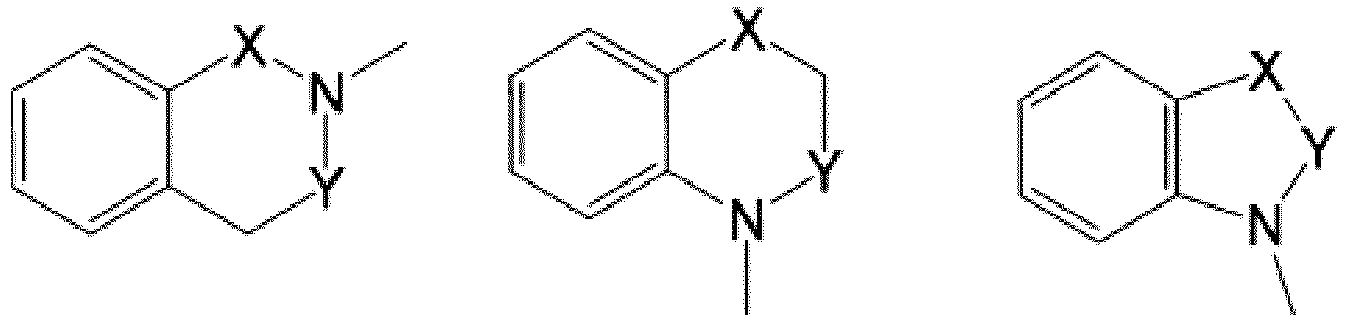


- The rings may have a substituent. Examples of the substituent may include those described as the substituent in the aromatic ring of Ax.
- The total number of π electrons contained in Ax and Ay is preferably 4 or more and more preferably 6 or more, and preferably 24 or less, more preferably 20 or less and particularly preferably 18 or less from the viewpoint of favorably expressing the desired effect of the present invention.
- Examples of preferred combination of Ax and Ay may include the following combinations (α) and (β).
- (α) a combination of Ax and Ay in which Ax is an aromatic hydrocarbon ring group of 4 to 30 carbon atoms, an aromatic heterocyclic group of 4 to 30 carbon atoms or a group of 4 to 30 carbon atoms having a combination of an aromatic hydrocarbon ring and a heterocyclic ring, Ay is a hydrogen atom, a cycloalkyl group of 3 to 8 carbon atoms, an aromatic hydrocarbon ring group of 6 to 12 carbon atoms optionally having a substituent (a halogen atom, a cyano group, an alkyl group of 1 to 6 carbon atoms, an alkoxy group of 1 to 6 carbon atoms, or a cycloalkyl group of 3 to 8 carbon atoms), an aromatic heterocyclic group of 3 to 9 carbon atoms optionally having a substituent (a halogen atom, an alkyl group of 1 to 6 carbon atoms, an alkoxy group of 1 to 6 carbon atoms, or a cyano group), a group of 3 to 9 carbon atoms having a combination of an aromatic hydrocarbon ring and a heterocyclic ring that may optionally have a substituent (a halogen atom, an alkyl group of 1 to 6 carbon atoms, an alkoxy group of 1 to 6 carbon atoms, or a cyano group), an alkyl group of 1 to 20 carbon atoms optionally having a substituent, an alkenyl group of 1 to 20 carbon atoms optionally having a substituent, or an alkynyl group of 2 to 20 carbon atoms optionally having a substituent, and the substituent is any of a halogen atom, a cyano group, an alkoxy group of 1 to 20 carbon atoms, an alkoxy group of 1 to 12 carbon atoms that is substituted by an alkoxy group of 1 to 12 carbon atoms, a phenyl group, a cyclohexyl group, a cyclic ether group of 2 to 12 carbon atoms, an aryloxy group of 6 to 14 carbon atoms, a hydroxyl group, a benzodioxanyl group, a benzenesulfonyl group, a benzoyl group, and -SR10.
- (β) a combination of Ax and Ay in which Ax and Ay together form an unsaturated heterocyclic ring or an unsaturated carbon ring.
- Herein, R10 has the same meanings as described above.
- Examples of more preferred combination of Ax and Ay may include the following combination (γ).
- (γ) a combination of Ax and Ay in which Ax is any of groups having the following structures, Ay is a hydrogen atom, a cycloalkyl group of 3 to 8 carbon atoms, an aromatic hydrocarbon ring group of 6 to 12 carbon atoms optionally having a substituent (a halogen atom, a cyano group, an alkyl group of 1 to 6 carbon atoms, an alkoxy group of 1 to 6 carbon atoms, or a cycloalkyl group of 3 to 8 carbon atoms), an aromatic heterocyclic group of 3 to 9 carbon atoms optionally having a substituent (a halogen atom, an alkyl group of 1 to 6 carbon atoms, an alkoxy group of 1 to 6 carbon atoms, or a cyano group), a group of 3 to 9 carbon atoms having a combination of an aromatic hydrocarbon ring and a heterocyclic ring that may optionally have a substituent (a halogen atom, an alkyl group of 1 to 6 carbon atoms, an alkoxy group of 1 to 6 carbon atoms, or a cyano group), an alkyl group of 1 to 20 carbon atoms optionally having a substituent, an alkenyl group of 1 to 20 carbon atoms optionally having a substituent, or an alkynyl group of 2 to 20 carbon atoms optionally having a substituent, and the substituent is any of a halogen atom, a cyano group, an alkoxy group of 1 to 20 carbon atoms, an alkoxy group of 1 to 12 carbon atoms that is substituted by an alkoxy group of 1 to 12 carbon atoms, a phenyl group, a cyclohexyl group, a cyclic ether group of 2 to 12 carbon atoms, an aryloxy group of 6 to 14 carbon atoms, a hydroxyl group, a benzodioxanyl group, a benzenesulfonyl group, a benzoyl group, and -SR10. Herein, R10 has the same meanings as described above.


- Examples of particularly preferred combination of Ax and Ay may include the following combination (δ).
- (δ) a combination of Ax and Ay in which Ax is any of groups having the following structures, Ay is a hydrogen atom, a cycloalkyl group of 3 to 8 carbon atoms, an aromatic hydrocarbon ring group of 6 to 12 carbon atoms optionally having a substituent (a halogen atom, a cyano group, an alkyl group of 1 to 6 carbon atoms, an alkoxy group of 1 to 6 carbon atoms, or a cycloalkyl group of 3 to 8 carbon atoms), an aromatic heterocyclic group of 3 to 9 carbon atoms optionally having a substituent (a halogen atom, an alkyl group of 1 to 6 carbon atoms, an alkoxy group of 1 to 6 carbon atoms, or a cyano group), a group of 3 to 9 carbon atoms having a combination of an aromatic hydrocarbon ring and a heterocyclic ring that may optionally have a substituent (a halogen atom, an alkyl group of 1 to 6 carbon atoms, an alkoxy group of 1 to 6 carbon atoms, or a cyano group), an alkyl group of 1 to 20 carbon atoms optionally having a substituent, an alkenyl group of 1 to 20 carbon atoms optionally having a substituent, or an alkynyl group of 2 to 20 carbon atoms optionally having a substituent, and the substituent is any of a halogen atom, a cyano group, an alkoxy group of 1 to 20 carbon atoms, an alkoxy group of 1 to 12 carbon atoms that is substituted by an alkoxy group of 1 to 12 carbon atoms, a phenyl group, a cyclohexyl group, a cyclic ether group of 2 to 12 carbon atoms, an aryloxy group of 6 to 14 carbon atoms, a hydroxyl group, a benzodioxanyl group, a benzenesulfonyl group, a benzoyl group, and -SR10. In the following formulae, X has the same meanings as described above. Herein, R10 has the same meanings as described above.


- In the formula (I) mentioned above, A1 is a trivalent aromatic group optionally having a substituent. The trivalent aromatic group may be a trivalent carbocyclic aromatic group or a trivalent heterocyclic aromatic group. From the viewpoint of favorably expressing the desired effect of the present invention, the trivalent aromatic group is preferably the trivalent carbocyclic aromatic group, more preferably a trivalent benzene ring group or a trivalent naphthalene ring group, and further preferably a trivalent benzene ring group or a trivalent naphthalene ring group that is represented by the following formula. In the following formulae, substituents Y1 and Y2 are described for the sake of convenience to clearly show a bonding state (Y1 and Y2 have the same meanings as described above, and the same applies to the following).


- Among these, A1 is more preferably a group represented by each of the following formulae (A11) to (A25), further preferably a group represented by the formula (A11), (A13), (A15), (A19), or (A23), and particularly preferably a group represented by the formula (A11) or (A23).


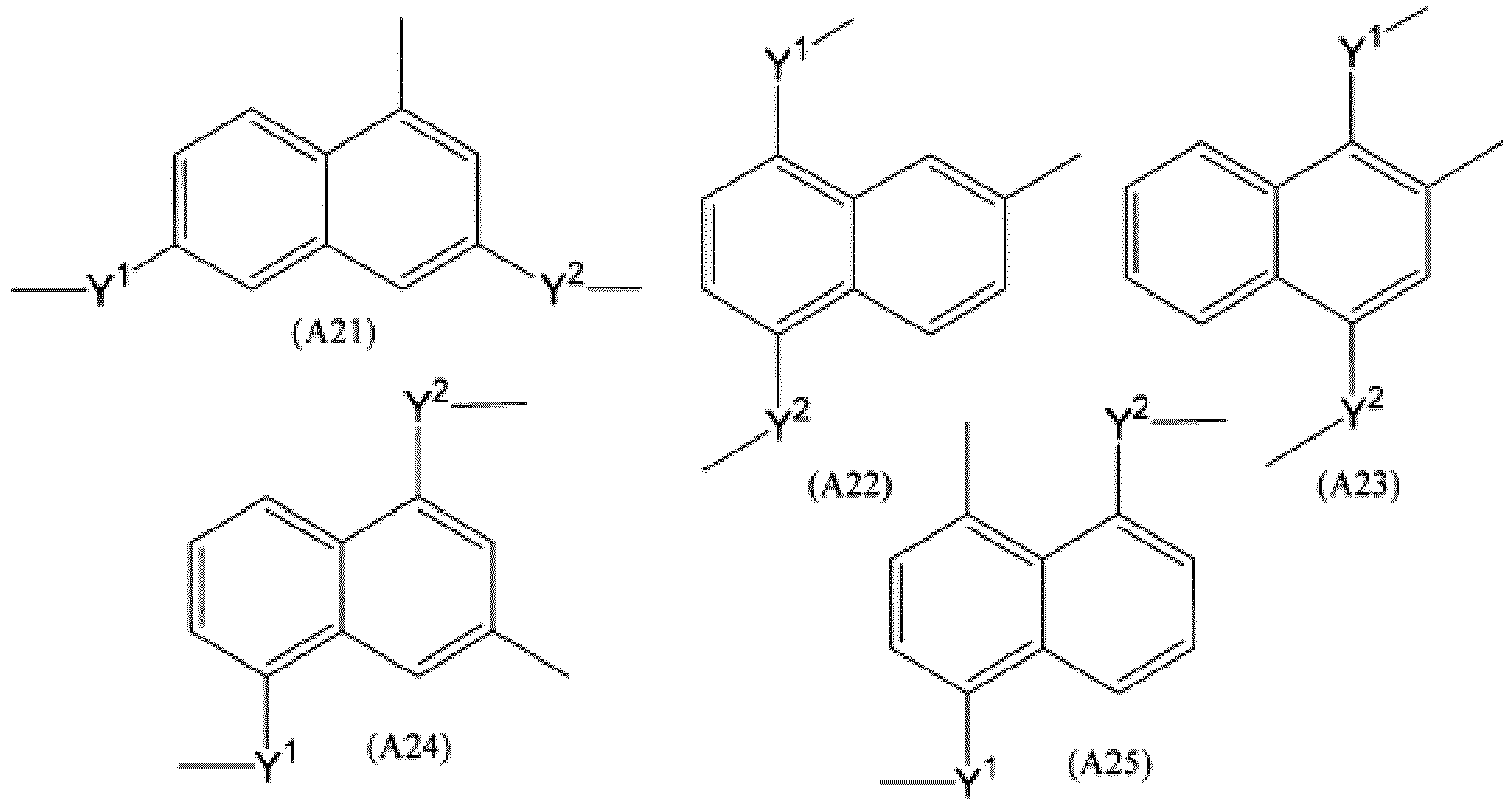
- Examples of the substituent that may be included in the trivalent aromatic group of A1 may include those described as the substituent in the aromatic ring of Ax described above. It is preferable that A1 is a trivalent aromatic group having no substituent.
- In the formula (I) mentioned above, A2 and A3 are each independently a divalent alicyclic hydrocarbon group of 3 to 30 carbon atoms optionally having a substituent. Examples of the divalent alicyclic hydrocarbon group of 3 to 30 carbon atoms may include a cycloalkanediyl group of 3 to 30 carbon atoms, and a divalent alicyclic fused ring group of 10 to 30 carbon atoms.
- Examples of the cycloalkanediyl group of 3 to 30 carbon atoms may include a cyclopropanediyl group; a cyclobutanediyl group, such as a cyclobutane-1,2-diyl group and a cyclobutane-1,3-diyl group; a cyclopentanediyl group, such as a cyclopentane-1,2-diyl group and a cyclopentane-1,3-diyl group; a cyclohexanediyl group, such as a cyclohexane-1,2-diyl group, a cyclohexane-1,3-diyl group, and a cyclohexane-1,4-diyl group; a cycloheptanediyl group, such as a cycloheptane-1,2-diyl group, a cycloheptane-1,3-diyl group, and a cycloheptane-1,4-diyl group; a cyclooctanediyl group, such as a cyclooctane-1,2-diyl group, a cyclooctane-1,3-diyl group, a cyclooctane-1,4-diyl group, and a cyclooctane-1,5-diyl group; a cyclodecanediyl group, such as a cyclodecane-1,2-diyl group, a cyclodecane-1,3-diyl group, a cyclodecane-1,4-diyl group, and a cyclodecane-1,5-diyl group; a cyclododecanediyl group, such as a cyclododecane-1,2-diyl group, a cyclododecane-1,3-diyl group, a cyclododecane-1,4-diyl group, and a cyclododecane-1,5-diyl group; a cyclotetradecanediyl group, such as a cyclotetradecane-1,2-diyl group, a cyclotetradecane-1,3-diyl group, a cyclotetradecane-1,4-diyl group, a cyclotetradecane-1,5-diyl group, and a cyclotetradecane-1,7-diyl group; and a cycloeicosanediyl group, such as a cycloeicosane-1,2-diyl group and a cycloeicosane-1,10-diyl group.
- Examples of the divalent alicyclic fused ring group of 10 to 30 carbon atoms may include a decalindiyl group, such as a decalin-2,5-diyl group and a decalin-2,7-diyl group; an adamantanediyl group, such as an adamantane-1,2-diyl group and an adamantane-1,3-diyl group; and a bicyclo[2.2.1]heptanediyl group, such as a bicyclo[2.2.1]heptane-2,3-diyl group, a bicyclo[2.2.1]heptane-2,5-diyl group, and a bicyclo[2.2.1]heptane-2,6-diyl group.
- The divalent alicyclic hydrocarbon groups may further have a substituent at any position. Examples of the substituent may include those described as the substituent in the aromatic ring of Ax described above.
- Among these, A2 and A3 are preferably a divalent alicyclic hydrocarbon group of 3 to 12 carbon atoms, more preferably a cycloalkanediyl group of 3 to 12 carbon atoms, further preferably a group represented by each of the following formulae (A31) to (A34), and particularly preferably the group represented by the following formula (A32) .

- The divalent alicyclic hydrocarbon group of 3 to 30 carbon atoms may exist in forms of cis- and trans-stereoisomers that are on the basis of difference of stereoconfiguration of carbon atoms bonded to Y1 and Y3 (or Y2 and Y4). For example, when the group is a cyclohexane-1,4-diyl group, a cis-isomer (A32a) and a trans-isomer (A32b) may exist, as described below.

- The aforementioned divalent alicyclic hydrocarbon group of 3 to 30 carbon atoms may be a cis-isomer, a trans-isomer, or an isomeric mixture of cis- and trans-isomers. Since the orientation quality is favorable, the group is preferably the trans-isomer or the cis-isomer, and more preferably the trans-isomer.
- In the formula (I) mentioned above, A4 and A5 are each independently a divalent aromatic group of 6 to 30 carbon atoms optionally having a substituent. The aromatic group of A4 and A5 may be monocyclic or polycyclic. Specific preferable examples of A4 and A5 are as follows.


- The divalent aromatic groups of A4 and A5 described above may have a substituent at any position. Examples of the substituent may include a halogen atom, a cyano group, a hydroxyl group, an alkyl group of 1 to 6 carbon atoms, an alkoxy group of 1 to 6 carbon atoms, a nitro group, and a -C(=O)-OR8b group. Herein, R8b is an alkyl group of 1 to 6 carbon atoms. In particular, it is preferable that the substituent is a halogen atom, an alkyl group of 1 to 6 carbon atoms, or an alkoxy group. Of the halogen atoms, a fluorine atom is more preferable, of the alkyl groups of 1 to 6 carbon atoms, a methyl group, an ethyl group, and a propyl group are more preferable, and of the alkoxy groups, a methoxy group and an ethoxy group are more preferable.
- Among these, from the viewpoint of favorably expressing the desired effect of the present invention, A4 and A5 are each independently preferably a group represented by the following formula (A41), (A42), or (A43) and optionally having a substituent, and particularly preferably the group represented by the formula (A41) and optionally having a substituent.


- In the formula (I) mentioned above, Q1 is a hydrogen atom or an alkyl group of 1 to 6 carbon atoms optionally having a substituent. Examples of the alkyl group of 1 to 6 carbon atoms optionally having a substituent may include the alkyl group of 1 to 6 carbon atoms among the alkyl groups of 1 to 20 carbon atoms optionally having a substituent that are described as Ay described above. Among these, Q1 is preferably a hydrogen atom or an alkyl group of 1 to 6 carbon atoms, and more preferably a hydrogen atom or a methyl group.
- In the formula (I) mentioned above, m and n are each independently 0 or 1. Among these, m is preferably 1, and n is preferably 1.
- The compound (I) may be produced, for example, by the following reaction.

- As shown in the aforementioned reaction formula, the compound (I) may be produced by a reaction of a hydrazine compound represented by a formula (3) with a carbonyl compound represented by a formula (4). Hereinafter, the hydrazine compound represented by the formula (3) may be appropriately referred to as "hydrazine compound (3)". The carbonyl compound represented by the formula (4) may be appropriately referred to as "carbonyl compound (4)".
- In the aforementioned reaction, the molar ratio of "the hydrazine compound (3) : the carbonyl compound (4)" is preferably 1:2 to 2:1, and more preferably 1:1.5 to 1.5:1. When the compounds are reacted at such a molar ratio, the compound (I) as a target can be highly selectively produced in high yield.
- In this case, the reaction system may include an acid catalyst including an organic acid, such as (±)-10-camphorsulfonic acid and p-toluene sulfonic acid; and an inorganic acid, such as hydrochloric acid and sulfuric acid. When the acid catalyst is used, the reaction time may be shortened, and the yield may be improved. The amount of the acid catalyst is usually 0.001 mol to 1 mol relative to 1 mol of the carbonyl compound (4). The acid catalyst as it is may be mixed in the reaction system. Alternatively, the acid catalyst to be mixed may be in a solution form in which the acid catalyst is dissolved in an appropriate solution.
- As the solvent for use in the reaction, a solvent inert to the reaction may be used. Examples of the solvent may include an alcohol-based solvent, such as methyl alcohol, ethyl alcohol, n-propyl alcohol, isopropyl alcohol, n-butyl alcohol, isobutyl alcohol, sec-butyl alcohol, and t-butyl alcohol; an ether-based solvent, such as diethyl ether, tetrahydrofuran, 1,2-dimethoxyethane, 1,4-dioxane, and cyclopentyl methyl ether; an ester-based solvent, such as ethyl acetate, propyl acetate, and methyl propionate; an aromatic hydrocarbon-based solvent, such as benzene, toluene, and xylene; an aliphatic hydrocarbon-based solvent, such as n-pentane, n-hexane, and n-heptane; an amide-based solvent, such as N,N-dimethylformamide, N-methylpyrrolidone, and hexamethylphosphoric triamide; a sulfur-containing solvent, such as dimethylsulfoxide, and sulfolane; and a mixed solvent of two or more types thereof. Among these, the alcohol-based solvent, the ether-based solvent, and a mixed solvent of the alcohol-based solvent and the ether-based solvent are preferable.
- The amount of the solvent used is not particularly limited, and may be determined in consideration of type of compound to be used, reaction scale, and the like. The specific amount of the solvent used is usually 1 g to 100 g relative to 1 g of the hydrazine compound (3).
- The reaction can smoothly proceed in a temperature range that is usually -10°C or higher and equal to or lower than the boiling point of the solvent used. The reaction time of each reaction may vary depending on the reaction scale, and is usually several minutes to several hours.
- The hydrazine compound (3) may be produced as follows.


- As shown in the aforementioned reaction formula, a corresponding hydrazine compound (3a) can be obtained by a reaction of a compound represented by a formula (2a) with hydrazine (1) in an appropriate solvent. In this reaction, the molar ratio of "the compound (2a) : the hydrazine (1)" is preferably 1:1 to 1:20, and more preferably 1:2 to 1:10. Further, the hydrazine compound (3a) can be reacted with a compound represented by a formula (2b) to obtain the hydrazine compound (3).
- As hydrazine (1), hydrazine monohydrate may be usually used. As hydrazine (1), a commercially available product as it is may be used.
- As the solvent for use in this reaction, a solvent inert to the reaction may be used. Examples of the solvent may include an alcohol-based solvent, such as methyl alcohol, ethyl alcohol, n-propyl alcohol, isopropyl alcohol, n-butyl alcohol, isobutyl alcohol, sec-butyl alcohol, and t-butyl alcohol; an ether-based solvent, such as diethyl ether, tetrahydrofuran, 1,2-dimethoxyethane, 1,4-dioxane, and cyclopentyl methyl ether; an aromatic hydrocarbon-based solvent, such as benzene, toluene, and xylene; an aliphatic hydrocarbon-based solvent, such as n-pentane, n-hexane, and n-heptane; an amide-based solvent, such as N,N-dimethylformamide, N-methylpyrrolidone, and hexamethylphosphoric triamide; a sulfur-containing solvent, such as dimethylsulfoxide, and sulfolane; and a mixed solvent of two or more types thereof. Among these, the alcohol-based solvent, the ether-based solvent, and a mixed solvent of the alcohol-based solvent and the ether-based solvent are preferable.
- The amount of the solvent used is not particularly limited, and may be determined in consideration of type of compound to be used, reaction scale, and the like. For example, the specific amount of the solvent used is usually 1 g to 100 g relative to 1 g of hydrazine.
- The reaction can smoothly proceed in a temperature range that is usually -10°C or higher and equal to or lower than the boiling point of the solvent used. The reaction time of each reaction may vary depending on the reaction scale, and is usually several minutes to several hours.
- The hydrazine compound (3) may also be produced by reducing a diazonium salt (5) through a publicly known method, as described below.

- In the formula (5), Ax and Ay have the same meanings as described above, and Xb- is an anion that is a counter ion of diazonium. Examples of Xb- may include an inorganic anion, such as a hexafluorophosphate ion, a fluoroborate ion, a chloride ion, and a sulfate ion; and an organic anion, such as a polyfluoroalkylcarbonate ion, a polyfluoroalkylsulfonate ion, a tetraphenylborate ion, an aromatic carboxylate ion, and an aromatic sulfonate ion.
- Examples of the reducing agent used in the aforementioned reaction may include a metal salt reducing agent. The metal salt reducing agent is generally a compound containing low-valent metal or a compound composed of a metal ion and a hydride source (see "Yuki Gosei Jikkenhou Handbook (Organic synthesis experimental method handbook)", 1990, edited by The Society of Synthetic Organic Chemistry, Japan, published by Maruzen Co., Ltd., p. 810).
- Examples of the metal salt reducing agent may include NaAlH4, NaAlHp(Or)q (wherein p and q are each independently an integer of 1 to 3, p + q = 4, and r is an alkyl group of 1 to 6 carbon atoms), LiAlH4, iBu2AlH, LiBH4, NaBH4, SnCl2, CrCl2, and TiCl3. Herein, "iBu" represents an isobutyl group.
- In the reduction reaction, a publicly known reaction condition may be adopted. For example, the reaction may be performed under conditions described in documents including Japanese Patent Application Laid-Open No.
2005-336103 A - The diazonium salt (5) may be produced from a compound such as aniline by an ordinary method.
- The carbonyl compound (4) may be produced, for example, by appropriately bonding and modifying a plurality of publicly known compounds having a desired structure through any combination of reactions of forming an ether linkage (-O-), an ester linkage (-C(=O)-O- and -O-C(=O)-), a carbonate linkage (-O-C(=O)-O-), and an amide linkage (-C(=O)NH- and -NH-C(=O)-).
- An ether linkage may be formed as follows.
- (i) A compound represented by a formula: D1-hal (hal is a halogen atom, and the same applies to the following) and a compound represented by a formula: D2-OMet (Met is an alkaline metal (mainly sodium), and the same applies to the following) are mixed and condensed (Williamson synthesis). In the formulae, D1 and D2 are an optional organic group (the same applies to the following).
- (ii) A compound represented by a formula: D1-hal and a compound represented by a formula: D2-OH are mixed in the presence of a base, such as sodium hydroxide and potassium hydroxide and condensed.
- (iii) A compound represented by a formula: D1-J (J is an epoxy group) and a compound represented by a formula: D2-OH are mixed in the presence of a base, such as sodium hydroxide and potassium hydroxide and condensed.
- (iv) A compound represented by a formula: D1-OFN (OFN is a group having an unsaturated bond) and a compound represented by a formula: D2-OMet are mixed in the presence of a base, such as sodium hydroxide and potassium hydroxide and subjected to an addition reaction.
- (v) A compound represented by a formula: D1-hal and a compound represented by a formula: D2-OMet are mixed in the presence of copper or cuprous chloride and condensed (Ullmann condensation).
- An ester linkage and an amide linkage may be formed as follows.
- (vi) A compound represented by a formula: D1-COOH and a compound represented by a formula: D2-OH or D2-NH2 are subjected to dehydration condensation in the presence of a dehydration condensation agent (N,N-dicyclohexylcarbodiimide, etc.).
- (vii) A compound represented by a formula: D1-COOH is reacted with a halogenating agent to obtain a compound represented by a formula: D1-CO-hal, and the compound is reacted with a compound represented by a formula: D2-OH or D2-NH2 in the presence of a base.
- (viii) A compound represented by a formula: D1-COOH is reacted with an acid anhydride to obtain a mixed acid anhydride, and the mixed acid anhydride is reacted with a compound represented by a formula: D2-OH or D2-NH2.
- (ix) A compound represented by a formula: D1-COOH and a compound represented by a formula: D2-OH or D2-NH2 are subjected to dehydration condensation in the presence of an acid catalyst or a base catalyst.
- More specifically, the carbonyl compound (4) may be produced through a process shown in the following reaction formula.

- (In the formula, Y1 to Y8, G1, G2, Z1, Z2, A1 to A5, Q1, m, and n have the same meanings as described above; L1 and L2 are each independently a leaving group, such as a hydroxyl group, a halogen atom, a methanesulfonyloxy group, and a p-toluenesulfonyloxy group; -Ylb is a group that is capable of being reacted with -L1 to be -Y1-; and -Y2b is a group that is capable of being reacted with -L2 to be -Y2-.)
- As shown in the aforementioned reaction formula, the carbonyl compound (4) may be produced by reacting a compound represented by a formula (6d) with a compound represented by a formula (7a) followed by a compound represented by a formula (7b) by using a reaction of forming an ether linkage (-O-), an ester linkage (-C(=O)-O- and -O-C(=O)-), or a carbonate linkage (-O-C(=O)-O-).
- Specifically, a method for producing a compound (4') in which Y1 is a group represented by a formula: Y11-C(=O)-O- and a group represented by a formula: Z2-Y8-G2-Y6-A5-(Y4-A3)m-Y2- is the same as a group represented by a formula: Z1-Y7-G1-Y5-A4-(Y3-A2)n-Y1- is as follows.

- As shown in the aforementioned reaction formula, the compound (4') may be produced by a reaction of a dihydroxy compound represented by a formula (6) (compound (6)) with a compound represented by a formula (7) (compound (7)). In the aforementioned reaction, the molar ratio of "the compound (6) : the compound (7)" is preferably 1:2 to 1:4, and more preferably 1:2 to 1:3. When the compounds are reacted at such a molar ratio, the compound (4') as a target can be highly selectively produced in high yield.
- When the compound (7) is a compound in which L1 is a hydroxyl group (carboxylic acid), the reaction may be performed in the presence of a dehydration condensation agent such as 1-ethyl-3-(3-dimethylaminopropyl)carbodiimide hydrochloride and dicyclohexyl carbodiimide, to obtain a target compound. The amount of the dehydration condensation agent used is usually 1 mol to 3 mol relative to 1 mol of the compound (7).
- When the compound (7) is a compound in which L1 is a hydroxyl group (carboxylic acid), the reaction may be performed in the presence of sulfonyl halide such as methanesulfonyl chloride and p-toluenesulfonyl chloride, and a base such as triethylamine, diisopropylethylamine, pyridine, and 4-(dimethylamino)pyridine, to obtain a target compound. The amount of the sulfonyl halide used is usually 1 mol to 3 mol relative to 1 mol of the compound (7). The amount of base used is usually 1 mol to 3 mol relative to 1 mol of the compound (7). In this case, a compound in which L1 in the formula (7) is a sulfonyloxy group (mixed acid anhydride) may be isolated, before performing the subsequent reaction.
- When the compound (7) is a compound in which L1 is a halogen atom (acid halide), the reaction may be performed in the presence of a base to obtain a target compound. Examples of the base may include an organic base such as triethylamine and pyridine; and an inorganic base such as sodium hydroxide, sodium carbonate, and sodium hydrogen carbonate. The amount of base used is usually 1 mol to 3 mol relative to 1 mol of the compound (7).
- Examples of a solvent for use in the reaction may include a chlorinated solvent, such as chloroform, and methylene chloride; an amide-based solvent, such as N-methylpyrrolidone, N,N-dimethylformamide, N,N-dimethylacetamide, and hexamethylphosphoric triamide; an ether-based solvent, such as 1,4-dioxane, cyclopentyl methyl ether, tetrahydrofuran, tetrahydropyran, and 1,3-dioxolane; a sulfur-containing solvent, such as dimethylsulfoxide, and sulfolane; an aromatic hydrocarbon-based solvent, such as benzene, toluene, and xylene; an aliphatic hydrocarbon-based solvent, such as n-pentane, n-hexane, and n-octane; an alicyclic hydrocarbon-based solvent, such as cyclopentane, and cyclohexane; and a mixed solvent of two or more types thereof.
- The amount of the solvent used is not particularly limited, and may be determined in consideration of type of compound to be used, reaction scale, and the like. The specific amount of the solvent used is usually 1 g to 50 g relative to 1 g of the hydroxy compound (6).
- Most of compounds (6) are publicly known substances, and may be produced by publicly known methods. For example, the compound (6) may be produced by a process shown in the following reaction formula (see International publication
WO2009/042544 and The Journal of Organic Chemistry, 2011, 76, 8082-8087). A product commercially available as the compound (6) may be used with, if desired, purification.
- As shown in the aforementioned reaction formula, a hydroxyl group of a dihydroxy compound represented by a formula (6a) (1,4-dihydroxybenzene, 1,4-dihydroxynaphthalene, etc.) is alkylated to obtain a compound represented by a formula (6b). Subsequently, an ortho position of an OR' group is formylated or acylated by a publicly known method, to obtain a compound represented by a formula (6c). The obtained compound may be subjected to deprotection (dealkylation), to produce the compound (6) as a target.
- The product commercially available as the compound (6) as it is may be used or with, if desired, purification.
- Most of compounds (7) are publicly known compounds, and may be produced, for example, by appropriately bonding and modifying a plurality of publicly known compounds having a desired structure through any combination of reactions of forming an ether linkage (-O-), an ester linkage (-C(=O)-O- and -O-C(=O)-), a carbonate linkage (-O-C(=O)-O-), and an amide linkage (-C(=O)NH- and -NH-C(=O)-) .
- For example, when the compound (7) is a compound represented by the following formula (7') (compound (7')), the compound (7') may be produced as follows, using a dicarboxylic acid represented by a formula (9') (compound (9')).

- The compound (9') is first reacted with sulfonyl chloride represented by a formula (10) in the presence of a base such as triethylamine or 4-(dimethylamino)pyridine. Subsequently, to the reaction mixture, a compound (8) and a base such as triethylamine or 4-(dimethylamino)pyridine are added to perform a reaction.
- The amount of sulfonyl chloride used is usually 0.5 equivalents to 0.7 equivalents relative to 1 equivalent of the compound (9').
- The amount of compound (8) used is usually 0.5 equivalents to 0.6 equivalents relative to 1 equivalent of the compound (9').
- The amount of base used is usually 0.5 equivalents to 0.7 equivalents relative to 1 equivalent of the compound (9').
- The reaction temperature is 20°C to 30°C, and the reaction time may vary depending on the reaction scale, and the like, and is several minutes to several hours.
- Examples of the solvent for use in the aforementioned reaction may include those exemplified as the examples of the solvent that may be used for producing the compound (4'). Among these, an ether solvent is preferable.
- The amount of the solvent used is not particularly limited, and may be determined in consideration of type of compound to be used, reaction scale, and the like. For example, the specific amount of the solvent used is usually 1 g to 50 g relative to 1 g of the hydroxy compound (9').
- In any of the reactions, a usual post-treatment operation in organic synthesis chemistry may be performed after completion of the reactions. If desired, a publicly known separation and purification method such as column chromatography, recrystallization, and distillation may be performed to isolate a target compound.
- The structure of the target compound may be identified by measurement such as NMR spectrometry, IR spectrometry, and mass spectrometry, and elemental analysis.
- The (meth)acrylic acid ester compound is an ester of (meth)acrylic acid. As the (meth)acrylic acid ester compound, the liquid crystal composition includes a compound in which the ratio Mw/Np of the molecular weight Mw of the (meth)acrylic acid ester compound relative to the number of π electrons Np per molecule of the (meth)acrylic acid ester compound falls within a specific range.
- Specifically, the aforementioned ratio Mw/Np is usually 17 or more, and preferably 23 or more, and is usually 70 or less, and preferably 50 or less. When the ratio Mw/Np of the (meth)acrylic acid ester compound falls within the aforementioned range, and such a (meth)acrylic acid ester compound is combined with the reverse distribution liquid crystal compound and the fluorine-based surfactant, there can be obtained a liquid crystal cured layer in which the tilt angles of the molecules of the liquid crystal compound are discontinuously different in the thickness direction, and orientation defects are suppressed.
- The number of π electrons per molecule of the compound is calculated on the basis of the type and number of the unsaturated bonds contained in the compound. Exemplifying the number of π electrons contained each unsaturated bond, an aliphatic or aromatic carbon-carbon double bond (C=C) includes 2 π electrons, a carbon-carbon triple bond (C≡C) includes 4 π electrons, a carbon-nitrogen double bond (C=N) includes 2 π electrons, a carbon-nitrogen triple bond (C≡N) includes 4 π electrons, and a nitrogen-nitrogen double bond (N=N) includes 2 π electrons.
- The molecular weight Mw of the (meth)acrylic acid ester compound is preferably 900 or less, and more preferably 850 or less. When the molecular weight Mw of the (meth)acrylic acid ester compound is low as previously described, a desired liquid crystal cured layer can be stably obtained. The lower limit of the molecular weight Mw is not particularly limited, and is preferably 100 or more, and more preferably 300 or more.
- Since the (meth)acrylic acid ester compound contains a (meth)acryloyl group as a polymerizable group, it has a polymerizability. Since such a (meth)acrylic acid ester compound having a polymerizability can be polymerized in the process of curing the layer of the liquid crystal composition, the compound is usually contained as a part of the molecule of the polymer in the liquid crystal cured layer.
- The number of (meth) acryloyl groups per molecule of the (meth)acrylic acid ester compound is preferably 2 or more. When 2 or more (meth) acryloyl groups are contained per molecule, the polymerization degree when the liquid crystal composition is cured can be enhanced, and the mechanical strength of the liquid crystal cured layer can be enhanced.
- The (meth)acrylic acid ester compound may be a non-liquid crystal compound which does not have liquid crystal properties, or may be a liquid crystal compound other than a reverse distribution liquid crystal compound. For example, the (meth)acrylic acid ester compound may be a forward distribution liquid crystal compound. Herein, the aforementioned forward distribution liquid crystal compound refers to a liquid crystal compound capable of expressing a birefringence with forward wavelength distribution. The liquid crystal compound capable of expressing a birefringence with forward wavelength distribution refers to a liquid crystal compound that expresses a birefringence with forward wavelength distribution when a layer of the liquid crystal compound is formed and the liquid crystal compound is oriented therein. Whether or not the liquid crystal compound expresses a birefringence with forward wavelength distribution can usually be confirmed by checking whether or not the layer of the liquid crystal compound exhibits a birefringence with forward wavelength distribution when the liquid crystal compound is homogeneously oriented.
- The birefringence with forward wavelength distribution refers to a birefringence in which a birefringence Δn (450) at a wavelength of 450 nm and a birefringence Δn (550) at a wavelength of 550 nm satisfy the following formula (N2). As to the liquid crystal compound capable of expressing such a birefringence with forward wavelength distribution, the longer the measurement wavelength, the smaller the birefringence the compound can usually express.

- In a case wherein the (meth)acrylic acid ester compound is a liquid crystal compound, the (meth)acrylic acid ester compound can express a liquid crystal phase when the compound is oriented. The (meth)acrylic acid ester compound as the liquid crystal compound usually has a refractive index anisotropy Δn. The refractive index anisotropy Δn at a measurement wavelength of 550 nm of the (meth)acrylic acid ester compound as a liquid crystal compound is preferably 0.11 or more, and more preferably 0.14 or more, and is preferably 0.4 or less, and more preferably 0.3 or less. When the liquid crystal compound having a refractive index anisotropy Δn falling within such a range is used as the (meth)acrylic acid ester compound, there can be easily obtained a liquid crystal cured layer in which the tilt angles of the molecules of the liquid crystal compound are discontinuously different in the thickness direction, and orientation defects are reduced.
- As the (meth)acrylic acid ester compound, one type thereof may be solely used, and two or more types thereof may also be used in combination at any ratio.
- Examples of the (meth)acrylic acid ester compound may include the following.


- The amount of the (meth)acrylic acid ester compound relative to 100 parts by weight of the total of the reverse distribution liquid crystal compound and the (meth)acrylic acid ester compound is preferably 1 part by weight or more, and more preferably 5 parts by weight or more, and is preferably 30 parts by weight or less, and more preferably 20 parts by weight or less. When the amount of the (meth)acrylic acid ester compound falls within the aforementioned range, there can be easily obtained a liquid crystal cured layer in which the tilt angles of the molecules of the liquid crystal compound are discontinuously different in the thickness direction, and orientation defects are reduced.
- The liquid crystal composition includes a specific amount of a fluorine-based surfactant. Specifically, the amount of the fluorine-based surfactant relative to 100 parts by weight of the total of the reverse distribution liquid crystal compound and the (meth)acrylic acid ester compound is usually 0.11 part by weight or more, and preferably 0.12 part by weight or more, and is usually 0.29 part by weight or less, preferably 0.25 part by weight or less, and more preferably 0.20 part by weight or less. When the amount of the fluorine-based surfactant is within the aforementioned range, there can be achieved a liquid crystal cured layer in which the tilt angles of the molecules of the liquid crystal compound are discontinuously different in the thickness direction, and orientation defects are reduced.
- The fluorine-based surfactant may contain a fluoroalkyl group. The fluoroalkyl group is preferably a perfluoroalkyl group, particularly preferably a -C6F13 group, from the viewpoint of significantly obtaining desired effects of the present invention.
- The fluorine-based surfactant is preferably a nonionic surfactant. When the fluorine-based surfactant is a nonionic surfactant which does not contain an ionic group, the surface state and orientation properties of the liquid crystal cured layer can be particularly made favorable.
- The fluorine-based surfactant may or may not have a polymerizability. Since the fluorine-based surfactant having a polymerizability can be polymerized in the process of curing the layer of the liquid crystal composition, the surfactant is usually contained as a part of the molecule of the polymer in the liquid crystal cured layer.
- Examples of the fluorine-based surfactant may include fluorine-based surfactants such as Surflon series (such as S420) manufactured by AGC Seimi Chemical Co., Ltd. and Ftergent series (such as 251 and FTX209) manufactured by Neos Company limited. As the fluorine-based surfactant, one type thereof may be solely used, and two or more types thereof may also be used in combination.
- The liquid crystal composition may further include an optional component in combination with the reverse distribution liquid crystal compound, the (meth)acrylic acid ester compound, and the fluorine-based surfactant. As the optional component, one type thereof may be solely used, and two or more types thereof may also be used in combination at any ratio.
- For example, the liquid crystal composition may contain a solvent. As the solvent, a solvent capable of dissolving the reverse distribution liquid crystal compound, the (meth)acrylic acid ester compound, and the fluorine-based surfactant is preferable. As such a solvent, an organic solvent is usually used. Examples of the organic solvent may include a ketone solvent, such as cyclopentanone, cyclohexanone, methyl ethyl ketone, acetone, and methyl isobutyl ketone; an acetic acid ester solvent, such as butyl acetate, and amyl acetate; a halogenated hydrocarbon solvent, such as chloroform, dichloromethane, and dichloroethane; an ether solvent, such as 1,4-dioxane, cyclopentyl methyl ether, tetrahydrofuran, tetrahydropyran, 1,3-dioxolane, and 1,2-dimethoxyethane; and an aromatic hydrocarbon-based solvent, such as toluene, xylene, and mesitylene.
- The boiling point of the solvent is preferably 60°C to 250°C, and more preferably 60°C to 150°C from the viewpoint of excellent handleability.
- The amount of the solvent is preferably 200 parts by weight or more, more preferably 250 parts by weight or more, and particularly preferably 300 parts by weight or more, and is preferably 650 parts by weight or less, more preferably 550 part by weight or less, and particularly preferably 450 parts by weight or less, relative to 100 parts by weight of the total amount of the reverse distribution liquid crystal compound and the (meth)acrylic acid ester compound. When the amount of the solvent is equal to or more than the lower limit value of the aforementioned range, generation of undesirable substance can be suppressed. When it is equal to or less than the upper limit value of the aforementioned range, drying load can be decreased.
- For example, the liquid crystal composition may contain a polymerization initiator. The type of the polymerization initiator may be selected depending on the type of the polymerizable compound contained in the liquid crystal composition. For example, when the polymerizable compound is radically polymerizable, a radical polymerization initiator may be used. Further, when the polymerizable compound is anionically polymerizable, an anionic polymerization initiator may be used. When the polymerizable compound is cationically polymerizable, a cationic polymerization initiator may be used. As the polymerization initiator, one type thereof may be solely used, and two or more types thereof may also be used in combination at any ratio.
- The amount of the polymerization initiator is preferably 0.1 part by weight or more, and more preferably 0.5 part by weight or more, and is preferably 30 parts by weight or less, and more preferably 10 parts by weight or less, relative to 100 parts by weight of the total of the reverse distribution liquid crystal compound and the (meth)acrylic acid ester compound. When the amount of the polymerization initiator falls within the aforementioned range, efficient proceeding of the polymerization can be achieved.
- Further examples of the optional component may include: metal; a metal complex; a metal oxide such as a titanium oxide; a coloring agent such as a dye and a pigment; a light-emitting material such as a fluorescent material and a phosphorescent material; a leveling agent; a thixo agent; a gelator; polysaccharides; an ultraviolet absorber; an infrared absorber; an antioxidant; and an ion exchange resin. The amount of each of these components may be 0.1 to 20 parts by weight relative to 100 parts by weight of the total of the reverse distribution liquid crystal compound and the (meth)acrylic acid ester compound.
- The liquid crystal composition may be fluid or solid. The state of the liquid crystal composition may be adjusted depending on the manner of use of the liquid crystal composition. For example, when the liquid crystal composition is applied on a support surface to form a layer of the liquid crystal composition, the liquid crystal composition is preferably fluid. Also, for example, in the cases wherein the liquid crystal compound contained in the layer of the liquid crystal composition is oriented, the liquid crystal composition is preferably fluid.
-
FIG. 1 is a cross-sectional view schematically illustrating a cross section of a liquid crystal curedfilm 10 according to an embodiment of the present invention, cut along a plane parallel to the thickness direction thereof. - As illustrated in
FIG. 1 , the liquid crystal curedfilm 10 is a film including a liquid crystal curedlayer 100. AlthoughFIG. 1 illustrates the liquid crystal curedfilm 10 which includes only the liquid crystal curedlayer 100, the liquid crystal curedfilm 10 may include an optional layer (not illustrated) in combination with the liquid crystal curedlayer 100. - The liquid crystal cured
layer 100 is a layer formed of a cured product of the liquid crystal composition containing the liquid crystal compound, and includes afirst layer 110, asecond layer 120, and athird layer 130 in this order in the thickness direction. Since the liquid crystal curedlayer 100 as well as thefirst layer 110, thesecond layer 120, and thethird layer 130 included in the liquid crystal curedlayer 100 are formed of a cured product of the liquid crystal composition, they contain the liquid crystal compound. - A part or the entirety of the liquid crystal compound included in the liquid crystal cured
layer 100 may be in a fixed orientation state. The liquid crystal compound can be usually polymerized to become a polymer while maintaining the orientation state of the liquid crystal compound. Therefore, an example of the liquid crystal compound in a fixed orientation state may be a polymerized liquid crystal compound. Consequently, the term "liquid crystal compound in a fixed orientation state" encompasses a polymer of the liquid crystal compound. When the aforementioned liquid crystal composition including the reverse distribution liquid crystal compound is used to produce a liquid crystal curedlayer 100, the liquid crystal curedlayer 100 as well as thefirst layer 110, thesecond layer 120, and thethird layer 130 included in the liquid crystal curedlayer 100 contain the reverse distribution liquid crystal compound which may be in a fixed orientation state. - The
first layer 110 and thesecond layer 120 are usually in direct contact with each other without an optional layer interposed therebetween. Also, thesecond layer 120 and thethird layer 130 are usually in direct contact with each other without an optional layer interposed therebetween. Therefore, the liquid crystal curedlayer 100 is usually a layer having a three-layer structure which includes only thefirst layer 110, thesecond layer 120, and thethird layer 130, as illustrated inFIG. 1 . - First tilt angle formed by the molecules of the liquid crystal compound contained in the
first layer 110 relative to the layer plane is usually constant in thefirst layer 110. - Also, second tilt angle formed by the molecules of the liquid crystal compound contained in the
second layer 120 relative to the layer plane is usually constant in thesecond layer 120. Furthermore, the second tilt angle is discontinuously different from the first tilt angle. - Also, third tilt angle formed by the molecules of the liquid crystal compound contained in the
third layer 130 relative to the layer plane is usually constant in thethird layer 130. Furthermore, the third tilt angle is discontinuously different from the first tilt angle and the second tilt angle. - Since the tilt angles of the molecules of the liquid crystal compound are discontinuously different among the
first layer 110, thesecond layer 120, and thethird layer 130 in this manner, the liquid crystal curedlayer 100 including these layers can have a specific structure in which the tilt angles of the molecules of the liquid crystal compound are discontinuously different in the thickness direction. - Herein, when a certain tilt angle and another tilt angle are discontinuously different, it indicates that a difference in a tilt angle between those tilt angles is 10° or more.
- The tilt angles (the first tilt angle, the second tilt angle, and the third tilt angle) of the molecules of the liquid crystal compound in the respective layers included in the liquid crystal cured
layer 100, such as thefirst layer 110, thesecond layer 120, and thethird layer 130, may be measured by the following measurement method. - The liquid crystal cured
layer 100 is embedded in an epoxy resin to prepare a sample piece. This sample piece is sliced in parallel to the thickness direction of the liquid crystal curedlayer 100 using a microtome to obtain an observation sample. The slicing is performed such that the in-plane slow axis direction of the liquid crystal curedlayer 100 and the cross section become parallel. After that, the observation sample is placed on a stage of a polarization microscope, and a cross section having appeared by the slicing is observed while the stage is rotated. From the rotation angles of the stage at extinction positions for thefirst layer 110, thesecond layer 120, and thethird layer 130 of the liquid crystal curedlayer 100 having appeared on the cross section, the tilt angles of the molecules of the liquid crystal compound contained in thefirst layer 110, thesecond layer 120, and thethird layer 130 can be measured. - Also, whether or not the tilt angles of the molecules of the liquid crystal compound in each of the
first layer 110, thesecond layer 120, and thethird layer 130 are constant may be determined by the following determination method. - The liquid crystal cured
layer 100 is embedded in an epoxy resin to prepare a sample piece. This sample piece is sliced in parallel to the thickness direction of the liquid crystal curedlayer 100 using a microtome to obtain an observation sample. The slicing is performed such that the in-plane slow axis direction of the liquid crystal curedlayer 100 and the cross section become parallel. After that, a cross section having appeared by slicing is observed through a polarization microscope. This observation is performed by inserting a wave plate between the observation sample and the objective lens of the polarization microscope to observe an image which exhibits a color corresponding to the retardation of the observation sample. In the observed image, each portion of the liquid crystal curedlayer 100 exhibits a color corresponding to the tilt angle of the molecules of the liquid crystal compound in that portion. When the observed color of thefirst layer 110 is identical at every position in thefirst layer 110, it can be determined that the tilt angle (first tilt angle) of the molecules of the liquid crystal compound contained in thefirst layer 110 is constant. When the observed color of thesecond layer 120 is identical at every position in thesecond layer 120, it can be determined that the tilt angle (second tilt angle) of the molecules of the liquid crystal compound contained in thesecond layer 120 is constant. Furthermore, when the observed color of thethird layer 130 is identical at every position in thethird layer 130, it can be determined that the tilt angle (third tilt angle) of the molecules of the liquid crystal compound contained in thethird layer 130 is constant. - As a specific example, the present inventors have observed in an experiment that the
first layer 110 uniformly exhibited yellow, thesecond layer 120 uniformly exhibited reddish purple, and thethird layer 130 uniformly exhibited blue, and accordingly confirmed that the tilt angle of the molecules of the liquid crystal compound in each of thefirst layer 110, thesecond layer 120, and thethird layer 130 was constant. - The degree of each of the first tilt angle, the second tilt angle, and the third tilt angle may be appropriately set in accordance with required optical properties of the liquid crystal cured
layer 100 depending on the use applications of the liquid crystal curedfilm 10. Specific suitable ranges thereof may be as follows. - The first tilt angle is preferably 0° or more, and is preferably 20° or less, and more preferably 10° or less. The
first layer 110 having the first tilt angle within such a range may be usually obtained in a later-described method for producing the liquid crystal curedfilm 10 as a layer on the support surface side. - The second tilt angle is preferably 20° or more, and is preferably 70° or less, and more preferably 60° or less.
- The difference between the first tilt angle and the second tilt angle is preferably 10° or more, more preferably 15° or more, and particularly preferably 20° or more, and is preferably 70° or less, and more preferably 60° or less.
- The third tilt angle is preferably 70° or more, and more preferably 80° or more, and is preferably 90° or less. The
third layer 130 having the third tilt angle within such a range may be usually obtained in a later-described method for producing the liquid crystal curedfilm 10 as a layer on the interface side that is opposite to the support surface. - The difference between the second tilt angle and the third tilt angle is preferably 10° or more, more preferably 15° or more, and particularly preferably 20° or more, and is preferably 70° or less, and more preferably 60° or less.
- The thickness of each of the
first layer 110, thesecond layer 120, and thethird layer 130 may be appropriately set in accordance with the required optical properties of the liquid crystal curedlayer 100 depending on the use applications of the liquid crystal curedfilm 10. Specific suitable ranges thereof may be as follows. - The ratio of thickness of the
first layer 110 relative to thetotal thickness 100% of thefirst layer 110, thesecond layer 120, and thethird layer 130 is preferably 14% or more, and more preferably 18% or more, and is preferably 66% or less. - The ratio of thickness of the
second layer 120 relative to thetotal thickness 100% of thefirst layer 110, thesecond layer 120, and thethird layer 130 is preferably 1% or more, and is preferably 80% or less, and more preferably 64% or less. - The ratio of thickness of the
third layer 130 relative to thetotal thickness 100% of thefirst layer 110, thesecond layer 120, and thethird layer 130 is preferably 6% or more, and more preferably 18% or more, and is preferably 33% or less. - The thickness of each of the layers included in the liquid crystal cured
layer 100, such as thefirst layer 110, thesecond layer 120, and thethird layer 130, may be measured by the following measurement method. - The liquid crystal cured
layer 100 is embedded in an epoxy resin to prepare a sample piece. This sample piece is sliced in parallel to the thickness direction of the liquid crystal curedlayer 100 using a microtome to obtain an observation sample. The slicing is performed such that the in-plane slow axis direction of the liquid crystal curedlayer 100 and the cross section become parallel. After that, a cross section having appeared by the slicing may be observed through a polarization microscope to measure the thickness of each of thefirst layer 110, thesecond layer 120, and thethird layer 130. - In the liquid crystal cured
layer 100, occurrence of orientation defects is usually suppressed. Therefore, the number of orientation defects in the liquid crystal curedlayer 100 is small. Specifically, the number of orientation defects per mm2 can be reduced to preferably less than 10 streaks, more preferably less than 1 streak. Since the liquid crystal curedfilm 10 including such a liquid crystal curedlayer 100 is excellent in the uniformity of in-plane optical properties, it can be used as a high-quality optical film. - The number of orientation defects of the liquid crystal cured
layer 100 may be measured by transmissively observing the liquid crystal curedlayer 100 under crossed Nicols through a polarization microscope. - Since the first tilt angle, the second tilt angle, and the third tilt angle are different, the orientation direction of the molecules of the liquid crystal compound contained in the
first layer 110, the orientation direction of the molecules of the liquid crystal compound contained in thesecond layer 120, and the orientation direction of the molecules of the liquid crystal compound contained in thethird layer 130 are non-parallel in the three dimensional view. However, in the in-plane direction of the liquid crystal curedlayer 100, the orientation direction of the molecules of the liquid crystal compound contained in thefirst layer 110, the orientation direction of the molecules of the liquid crystal compound contained in thesecond layer 120, and the orientation direction of the molecules of the liquid crystal compound contained in thethird layer 130 are usually parallel. Therefore, usually the liquid crystal curedlayer 100 may be an optically anisotropic layer in which, when the liquid crystal curedlayer 100 is viewed from the thickness direction, the in-plane slow axis is parallel to the orientation directions of the molecules of the liquid crystal compound. - The liquid crystal cured
layer 100 may be an optically anisotropic layer having a retardation with reverse wavelength distribution. Herein, usually the retardation with reverse wavelength distribution refers to a retardation in which a retardation Re(450) at a wavelength of 450 nm and a retardation Re(550) at a retardation wavelength of 550 nm satisfy the following formula (N3). When the liquid crystal curedlayer 100 has a retardation with reverse wavelength distribution, it can uniformly exert its function in a wide wavelength range in optical applications such as a 1/4 wave plate and a 1/2 wave plate.
- The specific range of the retardation of the liquid crystal cured
layer 100 may be optionally set depending on the use applications of the liquid crystal cured layer. For example, when the liquid crystal curedlayer 100 is desired to function as a 1/4 wave plate, the retardation Re(590) of the liquid crystal curedlayer 100 at a measurement wavelength of 590 nm is preferably 80 nm or more, more preferably 100 nm or more, and particularly preferably 120 nm or more, and is preferably 190 nm or less, more preferably 170 nm or less, and particularly preferably 160 nm or less. For example, when the liquid crystal curedlayer 100 is desired to function as a 1/2 wave plate, the retardation Re(590) of the liquid crystal curedlayer 100 at a measurement wavelength of 590 nm is preferably 245 nm or more, more preferably 265 nm or more, and particularly preferably 270 nm or more, and is preferably 320 nm or less, more preferably 300 nm or less, and particularly preferably 295 nm or less. - The thickness of the liquid crystal cured
layer 100 may be appropriately set such that properties such as a retardation fall within a desired range. Specifically, the thickness of the liquid crystal curedlayer 100 is preferably 0.5 µm or more, and more preferably 1.0 µm or more, and is preferably 10 µm or less, and more preferably 7 µm or less. - Examples of an optional layer which may be included in the liquid crystal cured
film 10 in combination with the liquid crystal curedlayer 100 may include: a substrate used in the production of the liquid crystal curedlayer 100; a phase difference film; a polarizing film as a liner polarizer; an adhesive layer for bonding with another member; a mat layer for improving the sliding properties of a film; a hardcoat layer such as an impact resistant polymethacrylate resin layer; an antireflective layer; and an antifouling layer. - Since the liquid crystal cured
layer 100 included in the liquid crystal curedfilm 10 has a specific structure in which the tilt angles of the molecules of the liquid crystal compound are discontinuously different in the thickness direction, it can have optical properties corresponding to the specific structure. Therefore, the use of the liquid crystal curedfilm 10 enables a variety of optical designs, and flexibility of optical designs can thereby be enhanced. Furthermore, since the liquid crystal curedfilm 10 does not need to include an adhesive layer, which is different from an optical film obtained by bonding separately produced liquid crystal cured layers, it can be thinner than the prior art films. - The aforementioned liquid crystal cured film may be produced with the aforementioned liquid crystal composition which includes the reverse distribution liquid crystal compound, the (meth)acrylic acid ester compound, and the fluorine-based surfactant. For example, the liquid crystal cured film may be produced by a production method including:
- (i) a step of forming a layer of the liquid crystal composition on a support surface;
- (ii) a step of giving orientation to a reverse distribution liquid crystal compound contained in the layer of the liquid crystal composition; and
- (iii) a step of curing the layer of the liquid crystal composition.
- As the support surface, any surface that is capable of supporting the layer of the liquid crystal composition may be used. From the viewpoint of achieving favorable surface state of the liquid crystal cured layer, a flat surface without no recess and no protrusion is usually used as the support surface. From the viewpoint of the productivity of the liquid crystal cured layer, a surface of a long-length substrate is preferably used as the support surface. The "long-length" herein refers to a shape having a length that is 5 or more times longer than the width, and preferably 10 or more times longer than the width, and specifically refers to a film shape long enough to be wound up into a rolled form and stored or transported.
- As the substrate, a resin film is usually used. As the resin, a thermoplastic resin is usually used. In particular, from the viewpoint of high orientation-regulating force, high mechanical strength, and low cost, a resin having a positive intrinsic birefringence value is preferably used as the resin. Further, it is preferable that a resin containing an alicyclic structure-containing polymer, such as a norbornene-based resin, is used since it has excellent transparency, low hygroscopicity, size stability, and light-weight properties. Suitable examples of the product names of the resin to be contained in the substrate may include "ZEONOR" manufactured by ZEON Corporation.
- In order to promote orientation of the reverse distribution liquid crystal compound in the layer of the liquid crystal composition, it is preferable that the surface of the substrate serving as the support surface has been subjected to a treatment of imparting an orientation-regulating force. The "orientation-regulating force" means properties of a support surface that is capable of causing orientation of a liquid crystal compound in a liquid crystal composition. Examples of the treatment for imparting the orientation-regulating force to the support surface may include a light orientation treatment, a rubbing treatment, an orientation film formation treatment, an ion beam orientation treatment, and a stretching treatment.
- After the substrate is prepared if necessary, the step of forming a layer of the liquid crystal composition on the support surface, such as the surface of the substrate. The layer of the liquid crystal composition is formed usually by applying the liquid crystal composition onto a support surface. Examples of the method for applying the liquid crystal composition may include a curtain coating method, an extrusion coating method, a roll coating method, a spin coating method, a dip coating method, a bar coating method, a spray coating method, a slide coating method, a printing coating method, a gravure coating method, a die coating method, a gap coating method, and a dipping method.
- After the layer of the liquid crystal composition has been formed, the step of giving orientation to the reverse distribution liquid crystal compound contained in the layer of the liquid crystal composition is performed. In this step, usually the layer of the liquid crystal composition is subjected to an orientation treatment for giving orientation to the reverse distribution liquid crystal compound in a direction corresponding to the orientation regulating force of the support surface.
- Usually the orientation treatment is performed by adjusting the temperature of the layer of the liquid crystal composition to a specific orientation temperature. The orientation temperature may be a temperature that is not lower than the liquid crystallization temperature of the liquid crystal composition. The orientation temperature herein is preferably a temperature that is lower than the glass transition temperature of the resin contained in the substrate. By setting the temperature in this manner, the occurrence of distortion of the substrate due to the orientation treatment can be suppressed.
- A specific example of the condition for the orientation treatment may be a condition of treating at a temperature of 50°C to 160°C for 30 seconds to 5 minutes.
- However, the orientation of the reverse distribution liquid crystal compound may be immediately achieved by applying the liquid crystal composition in some cases. Therefore, the orientation treatment for giving orientation to the reverse distribution liquid crystal compound is not necessarily performed to the layer of the liquid crystal composition.
- With the liquid crystal composition according to the present invention which includes the reverse distribution liquid crystal compound, the (meth)acrylic acid ester compound, and the fluorine-based surfactant, the aforementioned orientation causes the orientation state of the molecules of the reverse distribution liquid crystal compound that is uniform in the in-plane direction, although that is discontinuously different in the thickness direction. Specifically, in a portion close to the support surface among the portions of the layer of the liquid crystal composition, the molecules of the reverse distribution liquid crystal compound are usually uniformly oriented in a direction parallel to or almost parallel to the support surface. In a portion close to the interface opposite the support surface (usually, the air interface of the layer of the liquid crystal composition) among the portions of the layer of the liquid crystal composition, the molecules of the reverse distribution liquid crystal compound are usually uniformly oriented in a direction perpendicular to or almost perpendicular to the support surface. Furthermore, in the middle portion between the aforementioned two portions among the portions of the layer of the liquid crystal composition, the molecules of the reverse distribution liquid crystal compound are usually uniformly oriented in a direction that is neither parallel nor perpendicular to the support surface. Since the orientation states of the aforementioned portions are discontinuously different in this manner, there can be obtained a layer of the liquid crystal composition in which the tilt angles of the molecules of the liquid crystal compound are discontinuously different in the thickness direction.
- After the reverse distribution liquid crystal compound has been oriented, the step of curing the layer of the liquid crystal composition to obtain a liquid crystal cured layer. In this step, usually the reverse distribution liquid crystal compound and the (meth)acrylic acid ester compound are polymerized to thereby achieve curing of the layer of the liquid crystal composition. During the polymerization, the reverse distribution liquid crystal compound is usually polymerized while maintaining its molecular orientation. Therefore, since the polymerization can fix the orientation state of the reverse distribution liquid crystal compound having been included in the liquid crystal composition before polymerization, a desired liquid crystal cured layer can be obtained.
- As a method for polymerizing the liquid crystal compound, a method that fits the properties of the components contained in the liquid crystal composition may be selected. Examples of the polymerization method may include a method of performing irradiation with active energy rays and a thermopolymerization method. Of these, a method of performing irratiation with active energy rays is preferable, because heating is not required, and a polymerization reaction can proceed at room temperature. Herein, the active energy rays for irradiation may include light such as visible light, ultraviolet rays, and infrared rays as well as any energy rays such as electron beams.
- Of these, a method of irradiating with light such as ultraviolet rays is preferable, because the operation is simple. The temperature during the irradiation with ultraviolet rays is preferably not higher than the glass transition temperature of the substrate, and preferably 150°C or lower, more preferably 100°C or lower, and particularly preferably 80°C or lower. The lower limit of the temperature during the irradiation with ultraviolet rays may be 15°C or higher. The irradiation intensity of ultraviolet rays is preferably 0.1 mW/cm2 or more, and more preferably 0.5 mW/cm2 or more, and is preferably 10000 mW/cm2 or less, and more preferably 5000 mW/cm2 or less. The irradiation amount of ultraviolet rays is preferably 0.1 mJ/cm2 or more, and more preferably 0.5 mJ/cm2 or more, and is preferably 5000 mJ/cm2 or less, and more preferably 4000 mJ/cm2 or less.
- By the aforementioned production method, there may be obtained a liquid crystal cured layer formed on a support surface. This liquid crystal cured layer usually includes the first layer, the second layer, and the third layer in this order from the support surface side. The liquid crystal cured layer obtained in this manner may be peeled from the support surface, to be used as a liquid crystal cured film. Such a liquid crystal cured film may be produced by a production method including a step of peeling the liquid crystal cured layer from the support surface.
- Alternatively, for example, when a liquid crystal cured layer formed on a substrate is obtained, a multilayer film including a substrate and a liquid crystal cured layer may be used as a liquid crystal cured film.
- Furthermore, for example, a liquid crystal cured layer formed on a substrate may be transferred onto an optional film layer to obtain a liquid crystal cured film. In such a case, usually a liquid crystal cured layer formed on a substrate and an optional film layer may be bonded, and after that the substrate is peeled if necessary, to thereby obtain a liquid crystal cured film including the liquid crystal cured layer and the optional film layer. For this bonding, an appropriate tackiness agent or adhesive agent may be used.
- The method for producing the liquid crystal cured film may further include an optional step in combination with the aforementioned steps. For example, the method for producing the liquid crystal cured film may include a step of drying the layer of the liquid crystal composition, prior to the step of curing the layer of the liquid crystal composition. Such drying may be achieved by a drying method such as air drying, heat drying, vacuum drying, and vacuum heat drying. By such drying, a solvent can be removed from the layer of the liquid crystal composition.
- By the aforementioned production method, the liquid crystal cured film may be obtained. According to the aforementioned production method, a long-length liquid crystal cured film can be obtained by the use of a long-length substrate. Such a long-length liquid crystal cured film can be continuously produced, and is excellent in productivity. In addition, since bonding with another member such as a film can be performed by roll-to-roll, productivity is also excellent in this regard. Usually, the long-length liquid crystal cured film is wound up to be stored and transported in a roll state.
- The liquid crystal cured film may be suitably used as, for example, an optical film such as a phase difference film, an optical compensation film, a linear polarizing plate, and a circular polarizing plate.
- Hereinafter, the present invention will be specifically described with reference to Examples. However, the present invention is not limited to Examples described below. The present invention may be freely modified and practiced without departing from the scope of claims of the present invention and the scope of their equivalents. Unless otherwise specified, "%" and "part(s)" that represent an amount in the following description are on the basis of weight. Unless otherwise specified, operations described below were performed under conditions of normal temperature and normal pressure in atmospheric air.
- The structures of the liquid crystal compounds used in Examples and Comparative Examples described later are as follows.


- The structures of the (meth)acrylic acid ester compounds used in Examples and Comparative Examples described later are as follows. Among these, LC242, LC1057, K35, and MLC3011 fall under the category of the forward distribution liquid crystal compound.


- The liquid crystal cured film including a liquid crystal cured layer and a substrate film was embedded in an epoxy resin to prepare a sample piece. This sample piece was sliced in parallel to the thickness direction of the liquid crystal cured layer using a microtome to obtain an observation sample. The slicing was performed such that the in-plane slow axis direction of the liquid crystal cured layer and the cross section became parallel. After that, the observation sample was placed on a stage of a polarization microscope, and a cross section having appeared by slicing was observed while the stage was rotated. From the rotation angles of the stage at extinction positions for the first layer, the second layer, and the third layer of the liquid crystal cured layer having appeared on the cross section, the tilt angles of the molecules of the liquid crystal compound contained in the first layer, the second layer, and the third layer were measured, respectively.
- The liquid crystal cured film including a liquid crystal cured layer and a substrate film was embedded in an epoxy resin to prepare a sample piece. This sample piece was sliced in parallel to the thickness direction of the liquid crystal cured layer using a microtome to obtain an observation sample. The slicing was performed such that the in-plane slow axis direction of the liquid crystal cured layer and the cross section became parallel. After that, a cross section having appeared by slicing was observed through a polarization microscope to measure the thickness of each of the first layer, the second layer, and the third layer.
- The liquid crystal cured film including a liquid crystal cured layer and a substrate film was embedded in an epoxy resin to prepare a sample piece. This sample piece was sliced in parallel to the thickness direction of the liquid crystal cured layer using a microtome to obtain an observation sample. The slicing was performed such that the in-plane slow axis direction of the liquid crystal cured layer and the cross section became parallel. After that, a cross section having appeared by slicing was observed through a polarization microscope. This observation was performed by inserting a wave plate between the observation sample and the objective lens of the polarization microscope to observe an image which exhibits a color corresponding to the retardation of the observation sample. When the observed color of the first layer was identical at every position in the first layer, it was determined that the tilt angle of the molecules of the liquid crystal compound contained in the first layer was constant. When the observed color of the second layer was identical at every position in the second layer, it was determined that the tilt angle of the molecules of the liquid crystal compound contained in the second layer was constant. Furthermore, when the observed color of the third layer was identical at every position in the third layer, it was determined that the tilt angle of the molecules of the liquid crystal compound contained in the third layer was constant.
- Using a phase difference meter ("AxoScan" manufactured by Axometrics Inc.), retardations Re(450) and Re(550) on the front (incident angle 0°) at a wavelength of 450 nm and 550 nm were measured for the liquid crystal cured layer of the evaluation multilayer body. From the measured values of the retardations Re(450) and Re(550), the reverse wavelength distribution property of the liquid crystal cured layer was evaluated in accordance with the following criteria.
- A: Re(450)/Re(550) < 0.9
- B: 0.9 ≤ Re(450)/Re(550) ≤ 1.0
- C: Re(450)/Re(550) > 1.0
- The liquid crystal cured layer of the evaluation multilayer body was transmissively observed under crossed Nicols through a polarization microscope. In this observation, the objective lens was set to a magnification of 20 times. From the observation result, the orientation defects of the liquid crystal cured layer were evaluated in accordance with the following criteria.
- A: The number of orientation defects is less than 1 streak/mm2.
- B: The number of orientation defects is not less than 1 streak/mm2 to less than 10 streaks/mm2.
- C: The number of orientation defects is not less than 10 streaks/mm2.
- Using a phase difference meter ("AxoScan" manufactured by Axometrics Inc.), the retardation of the liquid crystal cured layer of the evaluation multilayer body was measured within the incidence angle range of -50° to 50°. From the measured retardations, the average tilt angle for the molecules of the liquid crystal compound contained in the liquid crystal cured layer was analyzed by an analysis software (analysis software "Multi-Layer Analysis" manufactured by AxoMetrics Inc., analysis conditions: analysis wavelength 590 nm, number of divided layers 20 (divided at about every 0.1 µm)) attached to the phase difference meter. The average tilt angle represents the maximum value of the tilt angles of the molecules of the liquid crystal compound on the basis of the assumption that the tilt angles of the molecules on a surface at the side of the first layer of the liquid crystal cured layer is 0°, and the tilt angles of the molecules change at a constant ratio in the thickness direction. This average tilt angle is a representative value that represents the size of an angle formed by the entirety of the molecules of the liquid crystal compound contained in the liquid crystal cured layer relative to the layer plane. In general, when this average tilt angle is larger, it can be evaluated that the entirety of the molecules of the liquid crystal compound contained in the liquid crystal cured layer forms a larger tilt angle relative to the layer plane. On the basis of the measured average tilt angle, the tilt orientation properties of the liquid crystal cured layer were evaluated in accordance with the following criteria.
- A: Average tilt angle is not less than 20°.
- B: Average tilt angle is not less than 5° and less than 20°.
- C: Average tilt angle is less than 5°.
- There were mixed 90 parts by weight of a reverse distribution liquid crystal compound 1 (molecular weight 1170; Δn = 0.07) having a polymerizability, 10 parts by weight of a (meth)acrylic acid ester compound ("LC242" manufactured by BASF; molecular weight 705; the number of π electrons 22), 0.15 part by weight of a fluorine-based surfactant ("S420" manufactured by AGC Seimi Chemical Co., Ltd.), 4.3 parts by weight of a photopolymerization initiator ("Irgacure OXE04" manufactured by BASF), 162.3 parts by weight of cyclopentanone as a solvent, and 243.5 parts by weight of 1,3-dioxolane as a solvent. Thus, a liquid crystal composition was obtained.
- As a substrate film, there was prepared a resin film ("ZEONOR Film ZF14" manufactured by ZEON Corporation;
thickness 100 µm) formed of a thermoplastic norbornene resin, to one surface of which a masking film was bonded. The masking film was peeled from this substrate film, and the masking peeled surface was subjected to a corona treatment. Subsequently, the corona treated surface of the substrate film was subjected to a rubbing treatment. - The rubbing treated surface of the substrate film was coated with the liquid crystal composition using a #5 wire bar to form a layer of the liquid crystal composition.
- After that, the layer of the liquid crystal composition was heated at 110°C for 4 minutes to perform a drying treatment and an orientation treatment. Accordingly, the liquid crystal compound contained in the layer of the liquid crystal composition was oriented.
- The orientation treated layer of the liquid crystal composition was irradiated with ultraviolet rays at 500 mJ/cm2 under nitrogen atmosphere to cure the layer of the liquid crystal composition. Accordingly, a liquid crystal cured layer having a thickness of about 2 µm was formed. Thus, a liquid crystal cured film having the layer structure of liquid crystal cured layer / substrate film was obtained.
- To a glass slide onto which an adhesive agent had been applied, the liquid crystal cured film was bonded at its surface on the liquid crystal cured layer side. After that, the substrate film was peeled. Accordingly, an evaluation multilayer body having the layer structure of liquid crystal cured layer / adhesive layer / glass slide was obtained.
- The obtained multilayer body was used to evaluate the reverse wavelength distribution property, orientation defects, and tilt orientation properties of the liquid crystal cured layer.
- The types of the liquid crystal compound and the (meth)acrylic acid ester compound were changed as shown in the following Table 1. Except for the aforementioned changes, the same operation as that of Example 1 was performed to produce the liquid crystal cured film and the evaluation multilayer body as well as to evaluate the liquid crystal cured film.
- Especially in Example 8, the liquid crystal cured film was used to evaluate the tilt angles of the molecules of the liquid crystal compound contained in the first layer, the second layer, and the third layer included in the liquid crystal cured layer and the thicknesses thereof.
- The combination of the type of the liquid crystal compound, the type of the (meth)acrylic acid ester compound, and the amount of the fluorine-based surfactant was changed as shown in the following Table 1. Except for the aforementioned changes, the same operation as of Example 1 was performed to produce the liquid crystal cured film and the evaluation multilayer body as well as to evaluate the liquid crystal cured film.
- Table 1 shows the combination of the liquid crystal compound, the (meth)acrylic acid ester compound, and the fluorine-based surfactant for each of Examples and Comparative Examples. Table 2 shows the evaluation results of the reverse wavelength distribution property, orientation defects, and tilt orientation properties of the liquid crystal cured layer. Table 3 shows the results of the tilt angles of the molecules of the liquid crystal compound contained in the first layer, the second layer, and the third layer, and the thicknesses thereof measured in Example 8. Herein, in all of Examples, the tilt angle in each of the first layer, the second layer, and the third layer contained in the liquid crystal cured layer was constant, and the first tilt angle, the second tilt angle, and the third tilt angle were discontinuously different.
-
FIG. 2 shows a photograph of the cross section of the liquid crystal cured layer observed through a polarization microscope, especially in Example 8. Furthermore,FIG. 3 shows an illustrative drawing for explaining each portion inFIG. 2 . InFIG. 3 , reference numeral "210" indicates a substrate film, "220" a liquid crystal cured layer, "221" a first layer, "222" a second layer, "223" a third layer, and 230 an epoxy resin. A white portion indicated byreference numeral 240 is considered as showing a bright point caused by the orientation when the epoxy resin is molded. - In the following Tables, meanings of the abbreviations are as follows.
- Reverse wavelength 1: reverse distribution liquid crystal compound 1.
- Reverse wavelength 2: reverse distribution liquid crystal compound 2.
- Reverse wavelength 3: reverse distribution liquid crystal compound 3.
- Reverse wavelength 4: reverse distribution liquid crystal compound 4.
- LC242: forward distribution liquid crystal compound "LC242" manufactured by BASF.
- V#260: (meth)acrylic acid ester compound "V#260" manufactured by Osaka Organic Chemical Industry Ltd.
- V#295: (meth)acrylic acid ester compound "V#295" manufactured by Osaka Organic Chemical Industry Ltd.
- LC1057: forward distribution liquid crystal compound "LC1057" manufactured by BASF.
- K35: forward distribution liquid crystal compound "K35".
- MLC3011: forward distribution liquid crystal compound "MLC3011" manufactured by ADEKA Corporation.
- A-BPEF: (meth)acrylic acid ester compound "A-BPEF" manufactured by Shin Nakamura Chemical Co., Ltd.
- R-604: (meth)acrylic acid ester compound "R-604" manufactured by Nippon Kayaku Co., Ltd.
- APG-200: (meth)acrylic acid ester compound "APG-200" manufactured by Shin Nakamura Chemical Co., Ltd.
- PLC7228: (meth)acrylic acid ester compound "PLC7228" manufactured by ADEKA Corporation.
- S420: fluorine-based surfactant "S420" manufactured by AGC Seimi Chemical Co., Ltd.
-
- 10
- liquid crystal cured film
- 100
- liquid crystal cured layer
- 110
- first layer
- 120
- second layer
- 130
- third layer
| Liquid crystal compound | (Meth)acrylic acid ester compound | Surfactant | |||||||
| Type | Wavelength distribution | Type | Mw | Np | Mw/Np | Δn | Type | Amount (parts) | |
| Ex. | |||||||||
| 1 | Reverse wavelength 1 | Reverse distribution | LC242 | 705 | 22 | 32 | 0.14 | S420 | 0.15 |
| 2 | Reverse wavelength 2 | Reverse distribution | LC242 | 705 | 22 | 32 | 0.14 | S420 | 0.15 |
| 3 | Reverse wavelength 3 | Reverse distribution | LC242 | 705 | 22 | 32 | 0.14 | S420 | 0.15 |
| 4 | Reverse wavelength 4 | Reverse distribution | LC242 | 705 | 22 | 32 | 0.14 | S420 | 0.15 |
| 5 | Reverse wavelength 1 | Reverse distribution | V#260 | 268 | 4 | 67 | - | S420 | 0.15 |
| 6 | Reverse wavelength 1 | Reverse distribution | V#295 | 280 | 6 | 47 | - | S420 | 0.15 |
| 7 | Reverse wavelength 1 | Reverse distribution | LC105 7 | 849 | 30 | 28 | 0.19 | S420 | 0.15 |
| 8 | Reverse wavelength 1 | Reverse distribution | K35 | 847 | 32 | 26 | 0.22 | S420 | 0.15 |
| 9 | Reverse wavelength 1 | Reverse distribution | MLC30 11 | 701 | 30 | 23 | 0.23 | S420 | 0.15 |
| 10 | Reverse wavelength 1 | Reverse distribution | A-BPEF | 547 | 28 | 20 | - | S420 | 0.15 |
| Comp. Ex. | |||||||||
| 1 | LC1057 | Forward distribution | V#260 | 268 | 4 | 67 | - | S420 | 0.15 |
| 2 | LC1057 | Forward distribution | LC242 | 705 | 22 | 32 | 0.14 | S420 | 0.15 |
| 3 | LC1057 | Forward distribution | A-BPEF | 547 | 28 | 20 | - | S420 | 0.15 |
| 4 | Reverse wavelength 1 | Reverse distribution | R-604 | 326 | 4 | 82 | - | S420 | 0.15 |
| 5 | Reverse wavelength 1 | Reverse distribution | APG-200 | 300 | 4 | 75 | - | S420 | 0.15 |
| 6 | Reverse wavelength 1 | Reverse distribution | PLC72 28 | 293 | 18 | 16 | - | S420 | 0.15 |
| 7 | Reverse wavelength 1 | Reverse distribution | LC242 | 705 | 22 | 32 | 0.14 | S420 | 0.10 |
| 8 | Reverse wavelength 1 | Reverse distribution | LC242 | 705 | 22 | 32 | 0.14 | S420 | 0.30 |
| Reverse distribution property | Orientation defects | Tilt orientation | |
| Ex. | |||
| 1 | A | A | A |
| 2 | A | B | A |
| 3 | A | A | B |
| 4 | A | A | B |
| 5 | A | A | A |
| 6 | A | A | A |
| 7 | A | A | A |
| 8 | A | A | A |
| 9 | A | A | A |
| 10 | A | A | A |
| Comp. Ex. | |||
| 1 | C | C | C |
| 2 | C | C | C |
| 3 | C | C | C |
| 4 | A | A | C |
| 5 | A | A | C |
| 6 | A | A | C |
| 7 | A | C | A |
| 8 | A | A | C |
| First layer | Second layer | Third layer | ||||
| Tilt angle (°) | Thickness (µm) | Tilt angle (°) | Thickness (µm) | Tilt angle (°) | Thickness (µm) | |
| Ex. 8 | 0 | 0.4 | 25 | 1.3 | 90 | 0.4 |
Claims (9)
- A liquid crystal composition comprising a liquid crystal compound capable of expressing a birefringence with reverse wavelength distribution, a (meth)acrylic acid ester compound other than the liquid crystal compound, and a surfactant containing a fluorine atom, wherein
a ratio Mw/Np of a molecular weight Mw of the (meth)acrylic acid ester compound relative to a number of π electrons Np of the (meth)acrylic acid ester compound is 17 or more and 70 or less, and
an amount of the surfactant relative to 100 parts by weight of a total of the liquid crystal compound and the (meth)acrylic acid ester compound is 0.11 part by weight or more and 0.29 part by weight or less. - The liquid crystal composition according to claim 1, wherein the molecular weight Mw of the (meth)acrylic acid ester compound is 900 or less.
- The liquid crystal composition according to claim 1 or 2, wherein a refractive index anisotropy Δn at a measurement wavelength of 550 nm of the (meth)acrylic acid ester compound is 0.11 or more.
- The liquid crystal composition according to any one of claims 1 to 3, wherein an amount of the (meth)acrylic acid ester compound relative to 100 parts by weight of the total of the liquid crystal compound and the (meth)acrylic acid ester compound is 1 part by weight or more and 30 parts by weight or less.
- A liquid crystal cured film comprising a liquid crystal cured layer formed of a cured product of a liquid crystal composition containing a liquid crystal compound, wherein
the liquid crystal cured layer includes a first layer, a second layer, and a third layer which are disposed in this order and contain the liquid crystal compound which may be in a fixed orientation state,
first tilt angle formed by molecules of the liquid crystal compound contained in the first layer relative to a layer plane is constant in the first layer,
second tilt angle formed by molecules of the liquid crystal compound contained in the second layer relative to a layer plane is constant in the second layer,
the second tilt angle is discontinuously different from the first tilt angle,
third tilt angle formed by molecules of the liquid crystal compound contained in the third layer relative to a layer plane is constant in the third layer, and
the third tilt angle is discontinuously different from the first tilt angle and the second tilt angle. - The liquid crystal cured film according to claim 5, wherein the liquid crystal composition is the liquid crystal composition according to any one of claims 1 to 4.
- The liquid crystal cured film according to claim 5 or 6, wherein
a ratio in thickness of the first layer relative to a total thickness 100% of the first layer, the second layer, and the third layer is 14% or more and 66% or less,
a ratio in thickness of the second layer relative to the total thickness 100% of the first layer, the second layer, and the third layer is 1% or more and 80% or less, and
a ratio in thickness of the third layer relative to the total thickness 100% of the first layer, the second layer, and the third layer is 6% or more and 33% or less. - The liquid crystal cured film according to any one of claims 5 to 7, wherein
the first tilt angle is 0° or more and 20° or less,
the second tilt angle is 20° or more and 70° or less, and
the third tilt angle is 70° or more and 90° or less. - A method for producing a liquid crystal cured film comprising:a step of forming a layer of the liquid crystal composition according to any one of claims 1 to 4;a step of giving orientation to the liquid crystal compound contained in the layer of the liquid crystal composition; anda step of curing the layer of the liquid crystal composition.
Applications Claiming Priority (2)
| Application Number | Priority Date | Filing Date | Title |
|---|---|---|---|
| JP2017060122 | 2017-03-24 | ||
| PCT/JP2018/009023 WO2018173778A1 (en) | 2017-03-24 | 2018-03-08 | Liquid crystal composition, liquid crystal cured film, and method for manufacturing same |
Publications (2)
| Publication Number | Publication Date |
|---|---|
| EP3605167A1 true EP3605167A1 (en) | 2020-02-05 |
| EP3605167A4 EP3605167A4 (en) | 2020-12-09 |
Family
ID=63586413
Family Applications (1)
| Application Number | Title | Priority Date | Filing Date |
|---|---|---|---|
| EP18771435.7A Withdrawn EP3605167A4 (en) | 2017-03-24 | 2018-03-08 | Liquid crystal composition, liquid crystal cured film, and method for manufacturing same |
Country Status (7)
| Country | Link |
|---|---|
| US (1) | US20200024520A1 (en) |
| EP (1) | EP3605167A4 (en) |
| JP (1) | JPWO2018173778A1 (en) |
| KR (1) | KR20190133001A (en) |
| CN (1) | CN110462465A (en) |
| TW (1) | TW201835203A (en) |
| WO (1) | WO2018173778A1 (en) |
Cited By (1)
| Publication number | Priority date | Publication date | Assignee | Title |
|---|---|---|---|---|
| EP3875518A4 (en) * | 2018-11-02 | 2021-12-29 | LG Chem, Ltd. | Laminated film |
Families Citing this family (5)
| Publication number | Priority date | Publication date | Assignee | Title |
|---|---|---|---|---|
| US11314007B2 (en) | 2017-07-10 | 2022-04-26 | Lg Chem, Ltd. | Circularly polarizing plate |
| US11411206B2 (en) | 2017-07-10 | 2022-08-09 | Lg Chem, Ltd. | Circularly polarizing plate |
| JP7147766B2 (en) * | 2017-08-14 | 2022-10-05 | 大日本印刷株式会社 | Optical film and image display device |
| KR102466771B1 (en) * | 2018-11-02 | 2022-11-14 | 주식회사 엘지화학 | Polarizing Plate |
| CN116057431B (en) * | 2020-08-04 | 2026-04-17 | 富士胶片株式会社 | Optical anisotropic layer |
Family Cites Families (15)
| Publication number | Priority date | Publication date | Assignee | Title |
|---|---|---|---|---|
| JPS5363022A (en) | 1976-11-18 | 1978-06-06 | Ricoh Co Ltd | Developing method by magnetic brush |
| JP4084490B2 (en) * | 1999-03-03 | 2008-04-30 | 富士フイルム株式会社 | Liquid crystal display |
| KR101067228B1 (en) * | 2003-12-30 | 2011-09-26 | 엘지디스플레이 주식회사 | Compensation film, manufacturing method of compensation film and liquid crystal display device using same |
| JP2005336103A (en) | 2004-05-27 | 2005-12-08 | Fuji Photo Film Co Ltd | Method for producing phenylhydrazine compound |
| CN101256248A (en) * | 2007-02-28 | 2008-09-03 | 群康科技(深圳)有限公司 | Compensation membrana as well as manufacturing method, liquid crystal display panel using the same |
| JP5363022B2 (en) | 2007-04-11 | 2013-12-11 | 富士フイルム株式会社 | Optically anisotropic film and liquid crystal display device |
| AU2008304619C1 (en) | 2007-09-26 | 2020-06-04 | Indiana University Research And Technology Corporation | Benzoquinone derivative E3330 in combination with chemotherapeutic agents for the treatment of cancer and angiogenesis |
| JP5899607B2 (en) * | 2009-03-16 | 2016-04-06 | 住友化学株式会社 | Compound, optical film and method for producing optical film |
| CN103492363B (en) * | 2011-04-27 | 2016-08-24 | 日本瑞翁株式会社 | Polymerizable compounds, polymerizable compositions, polymers, and optically anisotropic substances |
| JP2013104002A (en) * | 2011-11-15 | 2013-05-30 | Sumitomo Chemical Co Ltd | Colored curable resin composition |
| CN103343014B (en) * | 2013-06-21 | 2014-12-03 | 惠州市华阳光学技术有限公司 | Liquid crystal composition |
| JP2015161714A (en) | 2014-02-26 | 2015-09-07 | Jx日鉱日石エネルギー株式会社 | Retardation plate, elliptical polarization plate, and display device using the same |
| KR101623086B1 (en) | 2014-12-08 | 2016-05-20 | 삼성전자 주식회사 | Antireflection film and organic light emitting device provided with the same |
| JP6255632B2 (en) * | 2015-01-16 | 2018-01-10 | Dic株式会社 | Polymerizable composition and optical anisotropic body using the same |
| JP6497241B2 (en) * | 2015-06-30 | 2019-04-10 | Jnc株式会社 | Polymerizable liquid crystal compound, composition and polymer thereof |
-
2018
- 2018-03-08 EP EP18771435.7A patent/EP3605167A4/en not_active Withdrawn
- 2018-03-08 CN CN201880019725.1A patent/CN110462465A/en active Pending
- 2018-03-08 JP JP2019507529A patent/JPWO2018173778A1/en active Pending
- 2018-03-08 US US16/495,235 patent/US20200024520A1/en not_active Abandoned
- 2018-03-08 WO PCT/JP2018/009023 patent/WO2018173778A1/en not_active Ceased
- 2018-03-08 KR KR1020197027654A patent/KR20190133001A/en not_active Ceased
- 2018-03-13 TW TW107108458A patent/TW201835203A/en unknown
Cited By (1)
| Publication number | Priority date | Publication date | Assignee | Title |
|---|---|---|---|---|
| EP3875518A4 (en) * | 2018-11-02 | 2021-12-29 | LG Chem, Ltd. | Laminated film |
Also Published As
| Publication number | Publication date |
|---|---|
| CN110462465A (en) | 2019-11-15 |
| TW201835203A (en) | 2018-10-01 |
| KR20190133001A (en) | 2019-11-29 |
| US20200024520A1 (en) | 2020-01-23 |
| WO2018173778A1 (en) | 2018-09-27 |
| JPWO2018173778A1 (en) | 2020-01-30 |
| EP3605167A4 (en) | 2020-12-09 |
Similar Documents
| Publication | Publication Date | Title |
|---|---|---|
| EP3272836B1 (en) | Liquid crystal composition, method for producing retardation layer, and circularly polarizing plate | |
| EP3605167A1 (en) | Liquid crystal composition, liquid crystal cured film, and method for manufacturing same | |
| EP3287819A1 (en) | Multilayer film manufacturing method and multilayer film | |
| US10647920B2 (en) | Liquid crystalline composition, liquid crystal cured layer, method for producing same, and optical film | |
| US20180275329A1 (en) | Optical film and method for producing same | |
| TWI705127B (en) | Liquid crystal composition, liquid crystal hardened layer and method for manufacturing liquid crystal hardened layer | |
| EP2857424A1 (en) | Polymerizable compound, polymerizable composition, polymer, and optically anisotropic material | |
| TWI709486B (en) | Liquid crystal cured film and manufacturing method thereof | |
| EP3605168A1 (en) | Liquid crystal cured film and method for manufacturing same | |
| JP2018162379A (en) | Liquid crystal composition, liquid crystal cured film and method for producing the same | |
| JP2018163218A (en) | Liquid crystal hardened film and method for manufacturing the same |
Legal Events
| Date | Code | Title | Description |
|---|---|---|---|
| STAA | Information on the status of an ep patent application or granted ep patent |
Free format text: STATUS: THE INTERNATIONAL PUBLICATION HAS BEEN MADE |
|
| PUAI | Public reference made under article 153(3) epc to a published international application that has entered the european phase |
Free format text: ORIGINAL CODE: 0009012 |
|
| STAA | Information on the status of an ep patent application or granted ep patent |
Free format text: STATUS: REQUEST FOR EXAMINATION WAS MADE |
|
| 17P | Request for examination filed |
Effective date: 20190918 |
|
| AK | Designated contracting states |
Kind code of ref document: A1 Designated state(s): AL AT BE BG CH CY CZ DE DK EE ES FI FR GB GR HR HU IE IS IT LI LT LU LV MC MK MT NL NO PL PT RO RS SE SI SK SM TR |
|
| A4 | Supplementary search report drawn up and despatched |
Effective date: 20201111 |
|
| RIC1 | Information provided on ipc code assigned before grant |
Ipc: C09K 19/38 20060101ALI20201105BHEP Ipc: G02B 5/30 20060101AFI20201105BHEP Ipc: C08F 220/38 20060101ALI20201105BHEP Ipc: C09K 19/54 20060101ALI20201105BHEP |
|
| STAA | Information on the status of an ep patent application or granted ep patent |
Free format text: STATUS: THE APPLICATION IS DEEMED TO BE WITHDRAWN |
|
| 18D | Application deemed to be withdrawn |
Effective date: 20210612 |