EP3604480B1 - Composition of polyethylene glycol maleimide derivative and polymerization inhibitor - Google Patents
Composition of polyethylene glycol maleimide derivative and polymerization inhibitor Download PDFInfo
- Publication number
- EP3604480B1 EP3604480B1 EP18774544.3A EP18774544A EP3604480B1 EP 3604480 B1 EP3604480 B1 EP 3604480B1 EP 18774544 A EP18774544 A EP 18774544A EP 3604480 B1 EP3604480 B1 EP 3604480B1
- Authority
- EP
- European Patent Office
- Prior art keywords
- group
- polymerization inhibitor
- polyethylene glycol
- peg
- copper
- Prior art date
- Legal status (The legal status is an assumption and is not a legal conclusion. Google has not performed a legal analysis and makes no representation as to the accuracy of the status listed.)
- Active
Links
- AASBXERNXVFUEJ-UHFFFAOYSA-N CCC(ON(C(CC1)=O)C1=O)=O Chemical compound CCC(ON(C(CC1)=O)C1=O)=O AASBXERNXVFUEJ-UHFFFAOYSA-N 0.000 description 1
- 0 CN(C)*(***)=O Chemical compound CN(C)*(***)=O 0.000 description 1
Images


Classifications
-
- C—CHEMISTRY; METALLURGY
- C08—ORGANIC MACROMOLECULAR COMPOUNDS; THEIR PREPARATION OR CHEMICAL WORKING-UP; COMPOSITIONS BASED THEREON
- C08G—MACROMOLECULAR COMPOUNDS OBTAINED OTHERWISE THAN BY REACTIONS ONLY INVOLVING UNSATURATED CARBON-TO-CARBON BONDS
- C08G65/00—Macromolecular compounds obtained by reactions forming an ether link in the main chain of the macromolecule
- C08G65/02—Macromolecular compounds obtained by reactions forming an ether link in the main chain of the macromolecule from cyclic ethers by opening of the heterocyclic ring
- C08G65/32—Polymers modified by chemical after-treatment
- C08G65/329—Polymers modified by chemical after-treatment with organic compounds
- C08G65/333—Polymers modified by chemical after-treatment with organic compounds containing nitrogen
- C08G65/33331—Polymers modified by chemical after-treatment with organic compounds containing nitrogen containing imide group
- C08G65/33337—Polymers modified by chemical after-treatment with organic compounds containing nitrogen containing imide group cyclic
-
- C—CHEMISTRY; METALLURGY
- C08—ORGANIC MACROMOLECULAR COMPOUNDS; THEIR PREPARATION OR CHEMICAL WORKING-UP; COMPOSITIONS BASED THEREON
- C08F—MACROMOLECULAR COMPOUNDS OBTAINED BY REACTIONS ONLY INVOLVING CARBON-TO-CARBON UNSATURATED BONDS
- C08F2/00—Processes of polymerisation
- C08F2/38—Polymerisation using regulators, e.g. chain terminating agents, e.g. telomerisation
- C08F2/40—Polymerisation using regulators, e.g. chain terminating agents, e.g. telomerisation using retarding agents
-
- A—HUMAN NECESSITIES
- A61—MEDICAL OR VETERINARY SCIENCE; HYGIENE
- A61K—PREPARATIONS FOR MEDICAL, DENTAL OR TOILETRY PURPOSES
- A61K47/00—Medicinal preparations characterised by the non-active ingredients used, e.g. carriers or inert additives; Targeting or modifying agents chemically bound to the active ingredient
- A61K47/06—Organic compounds, e.g. natural or synthetic hydrocarbons, polyolefins, mineral oil, petrolatum or ozokerite
- A61K47/08—Organic compounds, e.g. natural or synthetic hydrocarbons, polyolefins, mineral oil, petrolatum or ozokerite containing oxygen, e.g. ethers, acetals, ketones, quinones, aldehydes, peroxides
- A61K47/10—Alcohols; Phenols; Salts thereof, e.g. glycerol; Polyethylene glycols [PEG]; Poloxamers; PEG/POE alkyl ethers
-
- A—HUMAN NECESSITIES
- A61—MEDICAL OR VETERINARY SCIENCE; HYGIENE
- A61K—PREPARATIONS FOR MEDICAL, DENTAL OR TOILETRY PURPOSES
- A61K47/00—Medicinal preparations characterised by the non-active ingredients used, e.g. carriers or inert additives; Targeting or modifying agents chemically bound to the active ingredient
- A61K47/30—Macromolecular organic or inorganic compounds, e.g. inorganic polyphosphates
- A61K47/34—Macromolecular compounds obtained otherwise than by reactions only involving carbon-to-carbon unsaturated bonds, e.g. polyesters, polyamino acids, polysiloxanes, polyphosphazines, copolymers of polyalkylene glycol or poloxamers
-
- C—CHEMISTRY; METALLURGY
- C08—ORGANIC MACROMOLECULAR COMPOUNDS; THEIR PREPARATION OR CHEMICAL WORKING-UP; COMPOSITIONS BASED THEREON
- C08F—MACROMOLECULAR COMPOUNDS OBTAINED BY REACTIONS ONLY INVOLVING CARBON-TO-CARBON UNSATURATED BONDS
- C08F16/00—Homopolymers and copolymers of compounds having one or more unsaturated aliphatic radicals, each having only one carbon-to-carbon double bond, and at least one being terminated by an alcohol, ether, aldehydo, ketonic, acetal or ketal radical
- C08F16/12—Homopolymers and copolymers of compounds having one or more unsaturated aliphatic radicals, each having only one carbon-to-carbon double bond, and at least one being terminated by an alcohol, ether, aldehydo, ketonic, acetal or ketal radical by an ether radical
- C08F16/14—Monomers containing only one unsaturated aliphatic radical
- C08F16/28—Monomers containing nitrogen
-
- C—CHEMISTRY; METALLURGY
- C08—ORGANIC MACROMOLECULAR COMPOUNDS; THEIR PREPARATION OR CHEMICAL WORKING-UP; COMPOSITIONS BASED THEREON
- C08G—MACROMOLECULAR COMPOUNDS OBTAINED OTHERWISE THAN BY REACTIONS ONLY INVOLVING UNSATURATED CARBON-TO-CARBON BONDS
- C08G65/00—Macromolecular compounds obtained by reactions forming an ether link in the main chain of the macromolecule
- C08G65/02—Macromolecular compounds obtained by reactions forming an ether link in the main chain of the macromolecule from cyclic ethers by opening of the heterocyclic ring
- C08G65/32—Polymers modified by chemical after-treatment
- C08G65/329—Polymers modified by chemical after-treatment with organic compounds
- C08G65/333—Polymers modified by chemical after-treatment with organic compounds containing nitrogen
-
- C—CHEMISTRY; METALLURGY
- C08—ORGANIC MACROMOLECULAR COMPOUNDS; THEIR PREPARATION OR CHEMICAL WORKING-UP; COMPOSITIONS BASED THEREON
- C08K—Use of inorganic or non-macromolecular organic substances as compounding ingredients
- C08K3/00—Use of inorganic substances as compounding ingredients
- C08K3/16—Halogen-containing compounds
-
- C—CHEMISTRY; METALLURGY
- C08—ORGANIC MACROMOLECULAR COMPOUNDS; THEIR PREPARATION OR CHEMICAL WORKING-UP; COMPOSITIONS BASED THEREON
- C08K—Use of inorganic or non-macromolecular organic substances as compounding ingredients
- C08K5/00—Use of organic ingredients
- C08K5/04—Oxygen-containing compounds
- C08K5/07—Aldehydes; Ketones
- C08K5/08—Quinones
-
- C—CHEMISTRY; METALLURGY
- C08—ORGANIC MACROMOLECULAR COMPOUNDS; THEIR PREPARATION OR CHEMICAL WORKING-UP; COMPOSITIONS BASED THEREON
- C08K—Use of inorganic or non-macromolecular organic substances as compounding ingredients
- C08K5/00—Use of organic ingredients
- C08K5/04—Oxygen-containing compounds
- C08K5/09—Carboxylic acids; Metal salts thereof; Anhydrides thereof
- C08K5/098—Metal salts of carboxylic acids
-
- C—CHEMISTRY; METALLURGY
- C08—ORGANIC MACROMOLECULAR COMPOUNDS; THEIR PREPARATION OR CHEMICAL WORKING-UP; COMPOSITIONS BASED THEREON
- C08K—Use of inorganic or non-macromolecular organic substances as compounding ingredients
- C08K5/00—Use of organic ingredients
- C08K5/04—Oxygen-containing compounds
- C08K5/13—Phenols; Phenolates
-
- C—CHEMISTRY; METALLURGY
- C08—ORGANIC MACROMOLECULAR COMPOUNDS; THEIR PREPARATION OR CHEMICAL WORKING-UP; COMPOSITIONS BASED THEREON
- C08K—Use of inorganic or non-macromolecular organic substances as compounding ingredients
- C08K5/00—Use of organic ingredients
- C08K5/16—Nitrogen-containing compounds
- C08K5/22—Compounds containing nitrogen bound to another nitrogen atom
- C08K5/24—Derivatives of hydrazine
-
- C—CHEMISTRY; METALLURGY
- C08—ORGANIC MACROMOLECULAR COMPOUNDS; THEIR PREPARATION OR CHEMICAL WORKING-UP; COMPOSITIONS BASED THEREON
- C08K—Use of inorganic or non-macromolecular organic substances as compounding ingredients
- C08K5/00—Use of organic ingredients
- C08K5/16—Nitrogen-containing compounds
- C08K5/29—Compounds containing one or more carbon-to-nitrogen double bonds
-
- C—CHEMISTRY; METALLURGY
- C08—ORGANIC MACROMOLECULAR COMPOUNDS; THEIR PREPARATION OR CHEMICAL WORKING-UP; COMPOSITIONS BASED THEREON
- C08K—Use of inorganic or non-macromolecular organic substances as compounding ingredients
- C08K5/00—Use of organic ingredients
- C08K5/16—Nitrogen-containing compounds
- C08K5/32—Compounds containing nitrogen bound to oxygen
-
- C—CHEMISTRY; METALLURGY
- C08—ORGANIC MACROMOLECULAR COMPOUNDS; THEIR PREPARATION OR CHEMICAL WORKING-UP; COMPOSITIONS BASED THEREON
- C08L—COMPOSITIONS OF MACROMOLECULAR COMPOUNDS
- C08L71/00—Compositions of polyethers obtained by reactions forming an ether link in the main chain; Compositions of derivatives of such polymers
- C08L71/02—Polyalkylene oxides
-
- C—CHEMISTRY; METALLURGY
- C08—ORGANIC MACROMOLECULAR COMPOUNDS; THEIR PREPARATION OR CHEMICAL WORKING-UP; COMPOSITIONS BASED THEREON
- C08K—Use of inorganic or non-macromolecular organic substances as compounding ingredients
- C08K3/00—Use of inorganic substances as compounding ingredients
- C08K3/01—Use of inorganic substances as compounding ingredients characterized by their specific function
- C08K3/014—Stabilisers against oxidation, heat, light or ozone
-
- C—CHEMISTRY; METALLURGY
- C08—ORGANIC MACROMOLECULAR COMPOUNDS; THEIR PREPARATION OR CHEMICAL WORKING-UP; COMPOSITIONS BASED THEREON
- C08K—Use of inorganic or non-macromolecular organic substances as compounding ingredients
- C08K5/00—Use of organic ingredients
- C08K5/0008—Organic ingredients according to more than one of the "one dot" groups of C08K5/01 - C08K5/59
- C08K5/005—Stabilisers against oxidation, heat, light, ozone
Definitions
- the invention relates to a composition of a polyethylene glycol maleimide derivative and a polymerization inhibitor, and use of the composition for the preparation of a drug conjugate, a pharmaceutical conjugate, and a pharmaceutical composition comprising a polymerization inhibitor and a conjugate of a polyethylene glycol maleimide derivative and a drug, use of a polymerization inhibitor in the preparation of the composition.
- Polyethylene glycol is a non-toxic, amphiphilic macromolecular compound formed by polymerization of ethylene glycol monomers.
- PEG modification is a technology developed from the late 1970s. To solve many problems in the clinical application of some drugs such as peptides and protein drugs, some PEG modified products have achieved good results when used in a drug.
- the hydroxyl group at the end of the polyethylene glycol is a functional group for its chemical reaction, but the reactivity is poor, and a derivative of polyethylene glycol which is activated in an appropriate way is often used as a modifier.
- the activated terminal groups such as amino, carboxyl, aldehyde, maleimide and the like play a decisive role in the application of polyethylene glycol.
- PEG-MAL polyethylene glycol maleimide derivative
- PEG-MAL polyethylene glycol maleimide derivative
- Sulfhydryl group(s) can be introduced into specific sites of a peptide and a protein by genetically engineering, and PEG-MAL can be further used for site-specific modification.
- PEG-MAL plays a key role in the linkage between proteins or peptides and liposomes. PEG-MAL is of great significance for targeting liposomes and for expanding the application of peptide compounds in medicine and biotechnology. Therefore, PEG-MAL is a polyethylene glycol derivative with a very high application value.
- PEG-MAL has been widely used and studied.
- thermosensitive properties of hybrid collagen peptide-polymer hydrogels Chemical communications, 5 June 2014, pages 8174-8176
- LEO L.WANG et al. injectable, Guest-Host Assembled Polyethylenimine Hydrogel for siRNA Delivery", BIOMACROMOLECULES, vol. 18.no. 1, 20 December 2016, pages 77-86
- CN101724144A disclosed a novel multi-arm polyethylene glycol, preparation method and application thereof.
- the maleimide derivative of polyethylene glycol contains an unsaturated double bond which has a high reaction activity, resulting in poor stability of the derivative, and polymerization at room temperature often occurs at room temperature to form a gel-like insoluble matter. This would cause the content of the derivative to be low, and the shelf life is short, leading to great inconvenience to its preservation and transportation, thereby limiting its application.
- US5045233A disclosed a method for inhibiting polymerization of meleimides, but the inhibitors it provided are limited in number and variety, and there are no specific inhibitors and inhibiting methods for PEG-MAL.
- the inventors of the present application have found through extensive experiments and studies that a polyethylene glycol maleimide derivative (especially an eight-arm polyethylene glycol maleimide derivative) and some polymerization inhibitors are combined to enhance its stability or reduce its photosensitivity, extending product pot life and shelf life.
- a polyethylene glycol maleimide derivative especially an eight-arm polyethylene glycol maleimide derivative
- some polymerization inhibitors are combined to enhance its stability or reduce its photosensitivity, extending product pot life and shelf life.
- the invention provides a composition of a polyethylene glycol maleimide derivative and a polymerization inhibitor.
- the mass ratio of the polymerization inhibitor to the polyethylene glycol maleimide derivative is 300 ⁇ g to 10 mg : 1 g.
- the mass ratio of the polymerization inhibitor to the polyethylene glycol maleimide derivative is from 300 ⁇ g to 10 mg: 1 g, such as 300 ⁇ g: 1 g, 400 ⁇ g: 1 g, 500 ⁇ g: 1 g, 600 ⁇ g: 1 g, 700 ⁇ g: 1 g, 800 ⁇ g: 1 g, 900 ⁇ g: 1 g or 1 mg: 1 g), 1-10 mg: 1 g (eg, 1 mg: 1 g, 2 mg: 1 g, 3 mg: 1 g, 4 mg: 1 g, 5 mg: 1 g, 6 mg: 1 g, 7 mg: 1 g, 8 mg: 1 g, 9 mg: 1 g or 10 mg : 1 g).
- 1 g such as 300 ⁇ g: 1 g, 400 ⁇ g: 1 g, 500 ⁇ g: 1 g, 600 ⁇ g: 1 g, 700 ⁇ g: 1 g, 800 ⁇ g: 1 g, 900 ⁇ g
- the polyethylene glycol maleimide derivative contains at least one terminal maleimide group.
- the polyethylene glycol maleimide derivative has the following structure: PEG-X-MAL (I)
- PEG is a polyethylene glycol residue
- said R 1 and R 2 are independently selected from the group consisting of: -H, -CH 3 , -CH 2 CH 3 , -CH 2 CH 3 , -CH 2 CH 2 CH 3 , -OCH 3 , -OCH 2 CH 3 and -OCH 2 CH 2 CH 3 , more preferably from: -H, -CH 3 , -OCH 3 and -OCH 2 CH 3 ;
- R 1 is H
- R 2 is -CH 3 , -OCH 3 or -OCH 2 CH 3
- R 1 is H and R 2 is -CH 3 .
- the X is selected from the group consisting of: one or a combination of two or more of a single bond, -CH 2 -, -CH 2 CH 2 -, - CH 2 CH 2 CH 2 -, -CH 2 CH 2 CH 2 CH 2 -, -CH 2 CH 2 CH 2 CH 2 -, -CH(CH 3 )-,-CH 2 CH(CH 3 )-, -CH 2 CH 2 CH(CH 3 )-, -CH 2 CH 2 CH 2 CH(CH 3 )-, -CH 2 CH 2 CH 2 CH(CH 3 )-, -CH 2 CH 2 CH 2 CH(CH 3 )-, -CH 2 CH 2 CH 2 CH 2 CH(CH 3 )-, -(CH 2 ) r O-, -(CH 2 ) r CO-, -(CH 2 ) r NH-, -(CH 2 ) r CONH-, -(CH 2 ) r NHCO-, -(CH 2 ) r
- the X is selected from the group consisting of: one or a combination of two or more of a single bond, -CH 2 -, -CH 2 CH 2 -, - CH 2 CH 2 CH 2 -, -CH(CH 3 )-,-CH 2 CH(CH 3 )-, -CH 2 CH 2 CH(CH 3 )-, -(CH 2 ) r O-, - (CH 2 ) r CO-, -(CH 2 ) r NH-, -(CH 2 ) r CONH- and -(CH 2 ) r NHCO-.
- r is an integer from 0 to 5, such as 0, 1, 2, 3, 4 or 5.
- the X is -CH 2 CH 2 NHCOCH 2 CH 2 -.
- the PEG is a linear, Y- or multi-branched polyethylene glycol residue, for example, including a linear polyethylene glycol, a Y-or U-shape PEG, and a 4-arm branched PEG, 6-arm branched PEG or 8-arm branched PEG, and the like.
- the PEG is a linear polyethylene glycol residue having the structure shown in Formula II or III: wherein Y is a terminal group selected from the group consisting of: C1-C6 alkoxy group, hydroxyl, carboxyl group, succinimide carbonate group, succinimide acetate group, succinimide propionate group, and a succinyl group.
- Imine succinate group succinimide group, dithiopyridyl group, propionic acid group, aldehyde group, thiol ester group, acryloxy, acrylic acid group, azido group, glutaric acid group, alkynyl, p-nitrogen one of a phenyl carbonate group, silane, and carboxymethyl; p and q are independently selected from an integer of from 1 to 1400, preferably from 1 to 1200, more preferably from 200 to 1200.
- said Y is methoxy
- the PEG is a Y- or U-shape polyethylene glycol residue having the structure shown in Formula IV or V:
- Y is a terminal group having the above definition of the present invention
- i and k are independently selected from an integer from 1 to 1200, preferably from an integer from 1 to 600, more preferably from 100 to 600.
- said Y is methoxy
- the PEG is a multi-branched polyethylene glycol residue having the structure shown in Formula VI:
- Y is an terminal group having the above definition of the present invention
- said Y is methoxy
- the 1 is zero.
- the PEG is a multi-branched polyethylene glycol residue
- the polyethylene glycol maleimide derivative has the following structure:
- the polyethylene glycol maleimide derivative has the following structure:
- the PEG is an eight-arm polyethylene glycol residue
- the polyethylene glycol maleimide derivative is an eight-arm polyethylene glycol maleimide derivative.
- R has the structure represented by formula IX or X:
- the polyethylene glycol maleimide derivative has the following structure:
- the PEG may have a molecular weight of 1-80 KDa, such as 1-10 KDa (specifically 1, 2, 3, 4, 5, 6, 7, 8, 9, or 10 KDa), 10-80 KDa (specifically 10, 15, 20, 25, 30, 35, 40, 45, 50, 60, 70 or 80 KDa); preferably 10-50 KDa.
- 1-10 KDa specifically 1, 2, 3, 4, 5, 6, 7, 8, 9, or 10 KDa
- 10-80 KDa specifically 10, 15, 20, 25, 30, 35, 40, 45, 50, 60, 70 or 80 KDa
- 10-50 KDa preferably 10-50 KDa.
- the PEG has a molecular weight of 10 KDa, 20 KDa or 40 KDa.
- the polymerization inhibitor is a substance which converts a primary radical or a chain radical into a stable molecule or to form a stable radical which is low in activity and which is insufficient for the polymerization to proceed.
- the polymerization inhibitor can be classified into the following categories based on the substituent(s): free radicals, phenols, quinones, aromatic amines, nitro compounds, a nitroso compound, sulfur-containing compounds, inorganic compounds, or organometallic compounds, oxygens, etc. (see: Xiao Weidong, He Benqiao, He Peixin. Chemical additives for polymer materials. Beijing: Chemical Industry Press, 2003: 331-341 ").
- the polymerization inhibitor is selected from one or a combination of two or more of a radical polymerization inhibitor, a phenolic polymerization inhibitor, an inorganic compound polymerization inhibitor, and an organometallic compound polymerization inhibitor.
- the radical polymerization inhibitor includes one or more of 1,1-diphenyl-2-picrylyl radical (1,1-Diphenyl-2-picrylhydrazyl, DPPH), nitroxide radicals such as 4,4'-dimethoxydiphenylnitroxyl radical (4,4'-dimethoxydiphenyl oxynitride, DMDPN), 4, 4'-dinitrodiphenylnitroxyl radical (4,4'-dinitrodiphenyl oxynitride), di-tert-butyl nitroxyl radical (di-tert-butyl oxynitride, DTBNO), 2,2,6,6-tetramethyl-4-hydroxypiperidine nitroxyl radical (2,2,6,6-tetramethyl-4-hydroxypiperidine oxynitride, TEMPO),benzoyl peroxide (BPO).
- 1,1-diphenyl-2-picrylyl radical (1,1-Diphenyl-2-picryl
- the radical polymerization inhibitor is DPPH.
- the phenolic polymerization inhibitor includes one or more of hydroquinone, 4,4'-dihydroxybiphenyl, pyrogallol and bisphenol A.
- the phenolic polymerization inhibitor is hydroquinone.
- the inorganic compound polymerization inhibitor includes one or more of ferric chloride, cuprous chloride, copper chloride, copper sulfate, titanium trichloride, titanium chloride, sodium sulfate, sodium sulfide and ammonium thiocyanate.
- the inorganic compound inhibitor is copper chloride.
- the organometallic compound polymerization inhibitor includes one or more of copper naphthenate, chromium acetate, nickel acetate, copper dimethyl dithiocarbamate, and copper dit-butyl dithiocarbamate.
- the organometallic compound polymerization inhibitor is nickel acetate.
- the inventors of the present invention have experimentally found that the combination of phenolic polymerization inhibitors (such as hydroquinone) and polyethylene glycol maleimide derivatives (especially eight-arm polyethylene glycol maleimide derivatives) can significantly enhance the stability, reduce the photosensitivity, and extend the shelf life and storage period of the derivatives, and the effect is better than other combinations of polyethylene glycol maleimide derivatives with other polymerization inhibitors.
- phenolic polymerization inhibitors such as hydroquinone
- polyethylene glycol maleimide derivatives especially eight-arm polyethylene glycol maleimide derivatives
- the polymerization inhibitor in the composition, is a phenolic polymerization inhibitor.
- the polymerization inhibitor is selected from: one or a combination of two or more of hydroquinone, 4,4'-dihydroxybiphenyl, pyrogallol and bisphenol A.
- the polymerization inhibitor is hydroquinone.
- the polymerization inhibitor is hydroquinone.
- the mass ratio of the phenolic polymerization inhibitor and the polyethylene glycol maleimide derivative is from 300 ⁇ g to 10 mg: 1 g, such as from 300 ⁇ g: 1 g, 400 ⁇ g: 1 g, 500 ⁇ g: 1 g, 600 ⁇ g: 1 g, 700 ⁇ g: 1 g, 800 ⁇ g: 1 g, 900 ⁇ g: 1 g, 1 mg: 1 g), 1-10 mg: 1 g (eg, 1 mg: 1 g, 2 mg: 1 g, 3 mg: 1 g, 4 mg: 1 g, 5 mg: 1 g, 6 mg: 1 g, 7 mg: 1 g, 8 mg: 1 g, 9 mg: 1 g, 10 mg: 1 g).
- the polymerization inhibitor is a phenolic polymerization inhibitor, which is hydroquinone
- the polyethylene glycol maleimide derivative has the structure of the
- Another aspect of the invention also provides the use of a composition as described above for the preparation of a pharmaceutical conjugate.
- Another aspect of the present invention also provides a pharmaceutical composition
- a pharmaceutical composition comprising a polymerization inhibitor and a conjugate of a polyethylene glycol maleimide derivative of the present invention and a drug.
- the polymerization inhibitor is a phenolic polymerization inhibitor, which is selected from: one or more of hydroquinone, 4,4'-dihydroxybiphenyl, pyrogallol and bisphenol A, the polymerization inhibitor is hydroquinone.
- the drug is selected from one or more of amino acids, polypeptides, proteins, sugars, organic acids, alkaloids, flavonoids, terpenoids, terpenoids, phenylpropanoid phenols, steroids, and quinones.
- the drug is a polypeptide or protein drug.
- the polypeptide or protein drug contains a free sulfhydryl group.
- a sulfhydryl group is introduced at a specific site in the polypeptide or protein drug.
- the polypeptide or protein drug include a polypeptide hormone, a polypeptide cell growth regulator, other biochemical drugs containing a polypeptide component, a protein hormone, a plasma protein, and a protein cell growth regulators, mucins, lectins, antibodies and enzymes such as a urea oxidase.
- the polypeptide hormones include pituitary polypeptide hormones (such as corticotropin, melatonin, lipolysis hormone, oxytocin, etc.), hypothalamic hormones (such as thyrotropin releasing hormone), auxin inhibitory hormone, gonadotropin-releasing hormone, etc.), thyroid hormone (such as parathyroid hormone, calcitonin, pancreas hormone: glucagon, pancreatic spasmolytic polypeptide, etc.), gastrointestinal hormones (such as gastrin, cholecystokinin-trypsin, vasoactive intestinal peptide, etc.) and thymus hormones (such as thymosin, thymus serum factor, etc.).
- pituitary polypeptide hormones such as corticotropin, melatonin, lipolysis hormone, oxytocin, etc.
- hypothalamic hormones such as thyrotropin releasing hormone
- auxin inhibitory hormone such as thy
- the polypeptide cell growth regulators include epidermal growth factor, transfer factor, and atrial natriuretic peptide.
- the other biochemical drugs containing a polypeptide component include Ossotide, Ocustrilla Extracti Oculi, soleosery, Antaisu, Fuxuening, brain aminopeptide, bee venom, snake venom, embryonic hormone, cofactor, neurotrophic factor, placental extract, pollen extract, spleen hydrolysate, liver hydrolysate and cardiac hormone.
- the protein hormone includes pituitary protein hormones (such as auxin, prolactin, thyrotropin, luteinizing hormone, follicle stimulating hormone, etc.), gonadotropin (such as human chorionic gonadotropin, serotonin, etc.) and insulin and other protein hormones such as relaxin.
- pituitary protein hormones such as auxin, prolactin, thyrotropin, luteinizing hormone, follicle stimulating hormone, etc.
- gonadotropin such as human chorionic gonadotropin, serotonin, etc.
- insulin and other protein hormones such as relaxin.
- the plasma protein includes albumin, plasminogen, plasma fibronectin, immunoglobulin, fibrinogen, and coagulation factors.
- the proteinaceous cell growth regulators include interleukin (IL-1 to IL-38), colony stimulating factor (eg, granulocyte colony stimulating factor (G-CSF) ), macrophage colony-stimulating factor (M-CSF), granulocyte and macrophage colony-stimulating factor (GM-CSF), multi-colony stimulator (Multi-CSF), stem cell factor (SCF), erythropoietin (EPO) ), interferon ( ⁇ , ⁇ , ⁇ ), growth factors (such as epidermal growth factor, platelet-derived growth factor, fibroblast growth factor, hepatocyte growth factor, insulin-like growth factor, nerve growth factor, platelet-derived) Endothelial growth factor, vascular endothelial growth factor, transforming growth factor-a, etc, tumor necrosis factor, tissue plasminogen activator and erythropoietin.
- IL-1 to IL-38 interleukin
- colony stimulating factor eg, granul
- the mucin comprises gastric factor, collagen, a basic protein, and a protease inhibitor such as a trypsin inhibitor.
- the lectin includes concanavalin, wheat germ, peanut agglutinin, soybean lectin, and the like.
- the antibodies include anti-CD20 antibodies, antibodies against the EGFR family (eg, anti-EGFR antibodies, anti-HER-2 antibodies), and anti-VEGF/VEGFR antibodies, and the like.
- the enzyme includes L-asparaginase, glutaminase, urokinase, neuraminidase, superoxide dismutase, and the like
- Another aspect of the invention also provides a pharmaceutical conjugate prepared as described above.
- Another aspect of the invention also provides the use of the polymerization inhibitor in the preparation of the above compositions, pharmaceutical conjugations and pharmaceutical compositions.
- the polymerization inhibitor is a phenolic polymerization inhibitor, and the polymerization inhibitor is selected from: one or more of hydroquinone, 4,4'-dihydroxybiphenyl, pyrogallol and bisphenol A.
- the polymerization inhibitor is hydroquinone.
- the invention provides a composition of a polyethylene glycol maleimide derivative and a polymerization inhibitor, in particular a combination of an eight-arm polyethylene glycol maleimide derivative and a phenolic polymerization inhibitor (such as hydroquinone), wherein the structure and content of the polymerization inhibitor could be selected reasonably, and the stability of the polyethylene glycol maleimide derivative can be greatly enhanced, thereby effectively avoide adverse effect of gelation during the periods of transportation and storage, prolong the pot life and storage period of the product, and is effective for preparing drug conjugates, especially polypeptide (polypeptidic) and protein (proteinaceous) drug conjugates.
- a polymerization inhibitor in particular a combination of an eight-arm polyethylene glycol maleimide derivative and a phenolic polymerization inhibitor (such as hydroquinone)
- Alkyl refers to a hydrocarbon chain radical that is linear or branched and free of unsaturated bonds.
- the C 1 -C 6 alkyl means an alkyl having 1 to 6 carbon atoms, such as methyl, ethyl, n-propyl, isopropyl, n-butyl, isobutyl, t-butyl, n-pentyl, isopentyl, neopentyl, tert-amyl, n-hexyl, isohexyl and the like.
- Alkoxy means a substituent formed by substituting the hydrogen in hydroxy group with an alkyl group
- C1-C6 alkoxy group means an alkoxy group having 1 to 6 carbon atoms, such as methoxy or ethoxy, propoxy, butoxy, and the like.
- Cycloalkyl means an alicyclic hydrocarbon, such as those containing 1 to 4 monocyclic and/or fused rings. It may contain 3 to 18 carbon atoms, preferably 3 to 10 carbon atoms, such as cyclopropyl, cyclohexyl or adamantyl and the like.
- C3-C6 cycloalkyl in the present invention means a cycloalkyl having 3 to 6 carbon atoms, such as cyclopropyl, cyclobutyl, cyclopentyl and cyclohexyl.
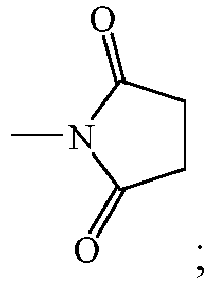
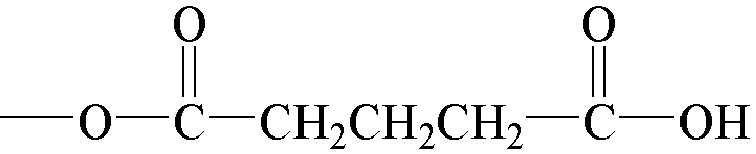
- some specific groups and their chemical structures involved in the present invention correspond to the following: hydroxyl group, -OH; carboxyl group, ; succinimide carbonate group, ; succinimide acetate group, ; succinimide propionate group, succinimide succinate group, ; succinimidyl, dithiopyridyl, or propionate, ; aldehyde group, -CHO; thiol ester group (wherein Q 1 may be an alkyl group or a heterocyclic group such as methyl, ethyl, n-propyl, tert-butyl, pyridyl (such as etc); acrylate, acrylate (acryloyloxy), ; azide, ; glutarate, such as ; alkynyl, ⁇ C ⁇ CH; p-nitrophenyl carbonate, ; silyl group, (wherein Q 2 may be the same or different alkyl or alkoxy group, such as methyl,
- the "combination” means a group formed by linking two or more of the listed linking groups by a chemical bond.
- the combination of -(CH 2 ) r - and - (CH 2 ) r NHCO- may be - (CH 2 ) r NHCO(CH 2 ) r - and specifically, the combination of -CH 2 - and -CH 2 CH 2 NHCO-may be -CH 2 CH 2 NHCOCH 2 -, -CH 2 CH 2 CH 2 NHCO-.
- the "combination” is used to define the chemical structure of the linking group, and does not involve the preparation steps, the order of linking groups in the combination, etc.
- the polyethylene glycol maleimide derivative described in the present invention is a polyethylene glycol to which a maleimide group is attached, as shown in formula I of the present invention, specifically as shown in formula XI; the linkage can be achieved by a covalent bond or by a linking group, and the reaction for achieving the linkage is well known to those skilled in the art, which is not specifically defined in the present invention.
- composition of a polyethylene glycol maleimide derivative and a polymerization inhibitor may further contain other components, such as ultraviolet absorbers (UV-P) to improve product quality or function.
- UV-P ultraviolet absorbers
- Those skilled in the art can add other components according to actual needs. Moisture, impurities and the like are inevitably involved in the process of production, transportation or storage of the polyethylene glycol maleimide derivatives and the compositions thereof and these substances are not specifically defined in the present invention.
- the polyethylene glycol derivative used in the examples was supplied by JENKEM Technology Co., Ltd.(Beijing). All others are commercially available reagents.
- composition powders were separately placed in a watch glass and placed in a light box at a constant temperature (2750 Lux, 18.5 ° C) for two days, and the GPC results are shown in Fig. 1 .
- Fig. 1 the GPC concentration or content comparison results after 2 days of irradiation of 8ARM(TP)-PEG-MAL-40K (to which a polymerization inhibitor was added) are shown in Table 1.
- Table 1 GPC concentration or content after 2 days irradiation of 8ARM(TP)-PEG-MAL-40K with polymerization inhibitor added
- 8ARM(TP)-PEG-MAL-40K had the lowest degree of purity reduction, with the best inhibiting effect.
- composition powders hydroquinone, p-tert-butyl-phenol (not within the scope of the present invention) , a mixture of hydroquinone and UV absorber (hydroquinone & UV-P, the mass ratio is 1: 1), DPPH, nickel acetate, copper chloride, wherein the concentrations or content of each additive were at 1, 20, 100, 400 and 1000 ppm.
- composition powders were separately placed in a watch glass and placed in a light box at a constant temperature (2750 Lux, 18.5 ° C) to record the time required before complete deterioration (i.e, when a gel insoluble in methanol occurred), and the result was as shown in Figure 2 (Note: If no additives were added, 8ARM(TP)-PEG-MAL-40K were completely deteriorated after two days of irradiation).
- composition powders were separately placed in a watch glass and placed in a light box at a constant temperature (2750 Lux, 18.5 ° C) to record the time required before complete deterioration (i. e, when a gel insoluble in methanol occurred), and the result was as shown in Figure 3 (Note: If no inhibitor is added, 8ARM(TP)-PEG-MAL-20K would completely deteriorate after two days of irradiation).
- composition powder containing different concentrations or content of hydroquinone, DPPH, nickel acetate, copper chloride and 8ARM(TP)-PEG-MAL-10K was separately taken, wherein the concentration or content of each polymerization inhibitor was at 1, 20 , 100, 400, 1000ppm.
- composition powders were separately placed in a watch glass and placed in a light box at a constant temperature (2750 Lux, 18.5 ° C) to record the time required before complete deterioration (i.e, a gel insoluble in methanol occurred), and the result was as Shown in Figure 4 (Note: If no inhibitor is added, 8ARM(TP)-PEG-MAL-10K would completely deteriorate after one day of irradiation).
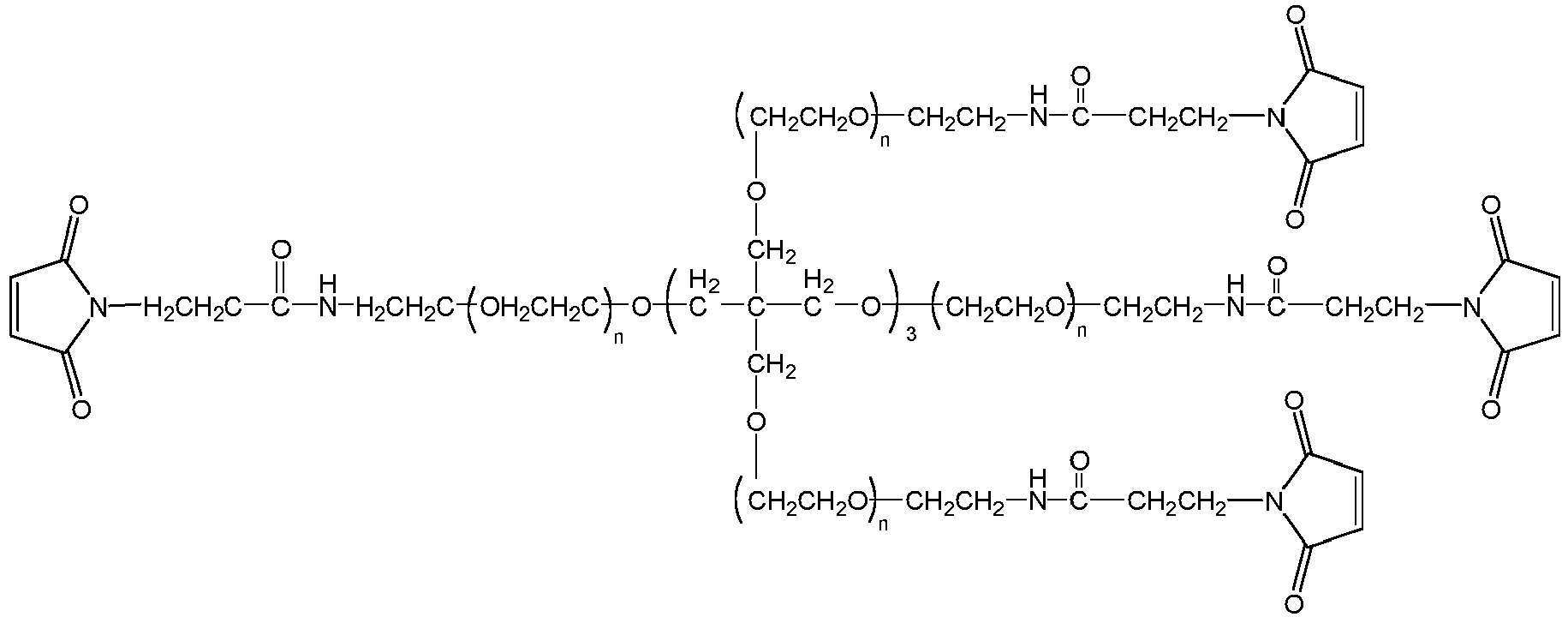
- the 8ARM(TP)-PEG-MAL used in the embodiment of the present invention has the following structure:
Landscapes
- Chemical & Material Sciences (AREA)
- Health & Medical Sciences (AREA)
- Medicinal Chemistry (AREA)
- Chemical Kinetics & Catalysis (AREA)
- Polymers & Plastics (AREA)
- Organic Chemistry (AREA)
- Life Sciences & Earth Sciences (AREA)
- Pharmacology & Pharmacy (AREA)
- Epidemiology (AREA)
- Animal Behavior & Ethology (AREA)
- General Health & Medical Sciences (AREA)
- Public Health (AREA)
- Veterinary Medicine (AREA)
- General Chemical & Material Sciences (AREA)
- Proteomics, Peptides & Aminoacids (AREA)
- Inorganic Chemistry (AREA)
- Engineering & Computer Science (AREA)
- Oil, Petroleum & Natural Gas (AREA)
- Medicinal Preparation (AREA)
- Macromolecular Compounds Obtained By Forming Nitrogen-Containing Linkages In General (AREA)
Description
- The invention relates to a composition of a polyethylene glycol maleimide derivative and a polymerization inhibitor, and use of the composition for the preparation of a drug conjugate, a pharmaceutical conjugate, and a pharmaceutical composition comprising a polymerization inhibitor and a conjugate of a polyethylene glycol maleimide derivative and a drug, use of a polymerization inhibitor in the preparation of the composition.
- Polyethylene glycol (PEG) is a non-toxic, amphiphilic macromolecular compound formed by polymerization of ethylene glycol monomers. PEG modification is a technology developed from the late 1970s. To solve many problems in the clinical application of some drugs such as peptides and protein drugs, some PEG modified products have achieved good results when used in a drug. The hydroxyl group at the end of the polyethylene glycol is a functional group for its chemical reaction, but the reactivity is poor, and a derivative of polyethylene glycol which is activated in an appropriate way is often used as a modifier. The activated terminal groups such as amino, carboxyl, aldehyde, maleimide and the like play a decisive role in the application of polyethylene glycol. Different terminal groups have different uses, and the introduction of these reactive groups expands the application range of PEG. For polyethylene glycol maleimide derivative (PEG-MAL), a maleimide group is introduced into PEG, and the coupling of maleimide and sulfhydryl group is one of useful reactions to couple protein and polypeptide. PEG-MAL can be used as a polymer reagent to selectively trap thiol-containing peptides. Sulfhydryl group(s) can be introduced into specific sites of a peptide and a protein by genetically engineering, and PEG-MAL can be further used for site-specific modification. The selectivity of the modification is high, and the loss of biological activity of the protein could be avoided, and in the meanwhile the immunogenicity could be lowered. In recent years, it has been found that PEG-MAL plays a key role in the linkage between proteins or peptides and liposomes. PEG-MAL is of great significance for targeting liposomes and for expanding the application of peptide compounds in medicine and biotechnology. Therefore, PEG-MAL is a polyethylene glycol derivative with a very high application value.
- Therefore, PEG-MAL has been widely used and studied. For example, Creative PEGWorks is a known manufacturer or supplier of "8-Arm PEG" (Retrieved from the Internet: URL. https://web.archive.org/web/20170112091416 or http://www. creativepegworks.com/product_list.php?cid=8&pid=2&sid=14) and "8-Arm PEG-MAL" (Retrieved from the Internet: URL: http://www.creativepegworks.com/product _view.php?cid=8&pid=2&sid=14&id=861); Charles M Rubert Perez et al. ("Tuning the thermosensitive properties of hybrid collagen peptide-polymer hydrogels", Chemical communications, 5 June 2014, pages 8174-8176) and LEO L.WANG et al. ("Injectable, Guest-Host Assembled Polyethylenimine Hydrogel for siRNA Delivery", BIOMACROMOLECULES, vol. 18.no. 1, 20 December 2016, pages 77-86) both have bought PEG-MALs from Creative PEGWorks to prepare PEG-MAL hydrogels;
CN101724144A disclosed a novel multi-arm polyethylene glycol, preparation method and application thereof. - However, the maleimide derivative of polyethylene glycol contains an unsaturated double bond which has a high reaction activity, resulting in poor stability of the derivative, and polymerization at room temperature often occurs at room temperature to form a gel-like insoluble matter. This would cause the content of the derivative to be low, and the shelf life is short, leading to great inconvenience to its preservation and transportation, thereby limiting its application.
US5045233A disclosed a method for inhibiting polymerization of meleimides, but the inhibitors it provided are limited in number and variety, and there are no specific inhibitors and inhibiting methods for PEG-MAL. - The invention is set out in the appended set of claims.
- The inventors of the present application have found through extensive experiments and studies that a polyethylene glycol maleimide derivative (especially an eight-arm polyethylene glycol maleimide derivative) and some polymerization inhibitors are combined to enhance its stability or reduce its photosensitivity, extending product pot life and shelf life.
- In one aspect, the invention provides a composition of a polyethylene glycol maleimide derivative and a polymerization inhibitor.
- In the composition, the mass ratio of the polymerization inhibitor to the polyethylene glycol maleimide derivative is 300 µg to 10 mg : 1 g.
- In one embodiment of the present invention, the mass ratio of the polymerization inhibitor to the polyethylene glycol maleimide derivative is from 300 µg to 10 mg: 1 g, such as 300 µg: 1 g, 400 µg: 1 g, 500 µg: 1 g, 600 µg: 1 g, 700 µg: 1 g, 800 µg: 1 g, 900 µg: 1 g or 1 mg: 1 g), 1-10 mg: 1 g (eg, 1 mg: 1 g, 2 mg: 1 g, 3 mg: 1 g, 4 mg: 1 g, 5 mg: 1 g, 6 mg: 1 g, 7 mg: 1 g, 8 mg: 1 g, 9 mg: 1 g or 10 mg : 1 g).
- In the composition, the polyethylene glycol maleimide derivative contains at least one terminal maleimide group.
- In one embodiment of the invention, the polyethylene glycol maleimide derivative has the following structure:
PEG-X-MAL (I)
- Wherein PEG is a polyethylene glycol residue,
- X is a linking group of PEG and MAL, and is selected from: one or a combination of two or more of -(CH2)r-,


- R1 and R2 are independently selected from the group consisting of: -H, a C1-6 alkyl group, a C1-6 alkoxy group, a C3-6 cycloalkyl group, and a C4-10 alkylene cycloalkyl group.
- Preferably, said R1 and R2 are independently selected from the group consisting of: -H, -CH3, -CH2CH3, -CH2CH3, -CH2CH2CH3, -OCH3, -OCH2CH3 and -OCH2CH2CH3, more preferably from: -H, -CH3, -OCH3 and -OCH2CH3; In a preferred embodiment of the invention, R1 is H, R2 is -CH3, -OCH3 or -OCH2CH3; in a more preferred embodiment of the invention, R1 is H and R2 is -CH3.
- In a specific embodiment of the invention, the X is selected from the group consisting of: one or a combination of two or more of a single bond, -CH2-, -CH2CH2-, - CH2CH2CH2-, -CH2CH2CH2CH2-, -CH2CH2CH2CH2CH2-, -CH(CH3)-,-CH2CH(CH3)-, -CH2CH2CH(CH3)-, -CH2CH2CH2CH(CH3)-, - CH2CH2CH2CH2CH(CH3)-, -CH2CH2CH2CH2CH2CH(CH3)-, -(CH2)rO-, -(CH2)rCO-, -(CH2)rNH-, -(CH2)rCONH-, -(CH2)rNHCO-, -(CH2)rS-, -(CH2)rCOO- and-(CH2)rOCO-.
- In a preferred embodiment of the invention, the X is selected from the group consisting of: one or a combination of two or more of a single bond, -CH2-, -CH2CH2-, - CH2CH2CH2-, -CH(CH3)-,-CH2CH(CH3)-, -CH2CH2CH(CH3)-, -(CH2)rO-, - (CH2)rCO-, -(CH2)rNH-, -(CH2)rCONH- and -(CH2)rNHCO-.
- In one embodiment of the invention, r is an integer from 0 to 5, such as 0, 1, 2, 3, 4 or 5.
- In a more preferred embodiment of the invention, the X is -CH2CH2NHCOCH2CH2-.
- In the composition of the present invention, the PEG is a linear, Y- or multi-branched polyethylene glycol residue, for example, including a linear polyethylene glycol, a Y-or U-shape PEG, and a 4-arm branched PEG, 6-arm branched PEG or 8-arm branched PEG, and the like.
- In one embodiment of the invention, the PEG is a linear polyethylene glycol residue having the structure shown in Formula II or III:


p and q are independently selected from an integer of from 1 to 1400, preferably from 1 to 1200, more preferably from 200 to 1200. - In one embodiment of the invention, in Formula II, said Y is methoxy.
- In one embodiment of the invention, the PEG is a Y- or U-shape polyethylene glycol residue having the structure shown in Formula IV or V:


- Wherein Y is a terminal group having the above definition of the present invention,
i and k are independently selected from an integer from 1 to 1200, preferably from an integer from 1 to 600, more preferably from 100 to 600. - In one embodiment of the invention, in Formula IV and/or V, said Y is methoxy.
- In one embodiment of the invention, the PEG is a multi-branched polyethylene glycol residue having the structure shown in Formula VI:

- Wherein Y is an terminal group having the above definition of the present invention,
- n is an integer from 1 to 800, preferably an integer from 1 to 400, more preferably an integer from 60 to 400,
- 1 is an integer from 0 to 7, and j is an integer from 1 to 8; preferably, 3 ≤j +1 ≤ 8,
- R is a core molecule of a multi-branched polyethylene glycol, and R is selected from the group consisting of: pentaerythritol, oligo-pentaerythritol, methyl glucoside, sucrose, diethylene glycol, propylene glycol, glycerin, and polyglycerol residues.
- In one embodiment of the invention, in Formula VI, said Y is methoxy.
- In one embodiment of the invention, the 1 is zero.
- In a preferred embodiment of the invention, the PEG is a multi-branched polyethylene glycol residue, and the polyethylene glycol maleimide derivative has the following structure:

- In one embodiment of the invention, the polyethylene glycol maleimide derivative has the following structure:

- Preferably, in formula VIII, j=8, the PEG is an eight-arm polyethylene glycol residue, and the polyethylene glycol maleimide derivative is an eight-arm polyethylene glycol maleimide derivative.
- In a specific embodiment of the present invention, in formula VIII, j=8, the R has the structure represented by formula IX or X:

- In a preferred embodiment of the invention, the polyethylene glycol maleimide derivative has the following structure:

- In one embodiment of the present invention, the PEG may have a molecular weight of 1-80 KDa, such as 1-10 KDa (specifically 1, 2, 3, 4, 5, 6, 7, 8, 9, or 10 KDa), 10-80 KDa (specifically 10, 15, 20, 25, 30, 35, 40, 45, 50, 60, 70 or 80 KDa); preferably 10-50 KDa.
- In a preferred embodiment of the invention, the PEG has a molecular weight of 10 KDa, 20 KDa or 40 KDa.
- In the present invention, the polymerization inhibitor is a substance which converts a primary radical or a chain radical into a stable molecule or to form a stable radical which is low in activity and which is insufficient for the polymerization to proceed. It will be understood by those skilled in the art that the polymerization inhibitor can be classified into the following categories based on the substituent(s): free radicals, phenols, quinones, aromatic amines, nitro compounds, a nitroso compound, sulfur-containing compounds, inorganic compounds, or organometallic compounds, oxygens, etc. (see: Xiao Weidong, He Benqiao, He Peixin. Chemical additives for polymer materials. Beijing: Chemical Industry Press, 2003: 331-341").
- In one embodiment of the present invention, the polymerization inhibitor is selected from one or a combination of two or more of a radical polymerization inhibitor, a phenolic polymerization inhibitor, an inorganic compound polymerization inhibitor, and an organometallic compound polymerization inhibitor.
- In one embodiment of the present invention, the radical polymerization inhibitor includes one or more of 1,1-diphenyl-2-picrylyl radical (1,1-Diphenyl-2-picrylhydrazyl, DPPH), nitroxide radicals such as 4,4'-dimethoxydiphenylnitroxyl radical (4,4'-dimethoxydiphenyl oxynitride, DMDPN), 4, 4'-dinitrodiphenylnitroxyl radical (4,4'-dinitrodiphenyl oxynitride), di-tert-butyl nitroxyl radical (di-tert-butyl oxynitride, DTBNO), 2,2,6,6-tetramethyl-4-hydroxypiperidine nitroxyl radical (2,2,6,6-tetramethyl-4-hydroxypiperidine oxynitride, TEMPO),benzoyl peroxide (BPO).
- In a specific embodiment of the invention, the radical polymerization inhibitor is DPPH.
- In one embodiment of the present invention, the phenolic polymerization inhibitor includes one or more of hydroquinone, 4,4'-dihydroxybiphenyl, pyrogallol and bisphenol A.
- In a preferred embodiment of the invention, the phenolic polymerization inhibitor is hydroquinone.
- In one embodiment of the present invention, the inorganic compound polymerization inhibitor includes one or more of ferric chloride, cuprous chloride, copper chloride, copper sulfate, titanium trichloride, titanium chloride, sodium sulfate, sodium sulfide and ammonium thiocyanate.
- In a specific embodiment of the invention, the inorganic compound inhibitor is copper chloride.
- In one embodiment of the invention, the organometallic compound polymerization inhibitor includes one or more of copper naphthenate, chromium acetate, nickel acetate, copper dimethyl dithiocarbamate, and copper dit-butyl dithiocarbamate.
- In a specific embodiment of the invention, the organometallic compound polymerization inhibitor is nickel acetate.
- The inventors of the present invention have experimentally found that the combination of phenolic polymerization inhibitors (such as hydroquinone) and polyethylene glycol maleimide derivatives (especially eight-arm polyethylene glycol maleimide derivatives) can significantly enhance the stability, reduce the photosensitivity, and extend the shelf life and storage period of the derivatives, and the effect is better than other combinations of polyethylene glycol maleimide derivatives with other polymerization inhibitors.
- In a embodiment of the present invention, in the composition, the polymerization inhibitor is a phenolic polymerization inhibitor. The polymerization inhibitor is selected from: one or a combination of two or more of hydroquinone, 4,4'-dihydroxybiphenyl, pyrogallol and bisphenol A. The polymerization inhibitor is hydroquinone.
- In a embodiment of the invention, in the composition, the polyethylene glycol maleimide derivative has the structure of the above formula VIII, wherein, preferably, j = 8, more preferably, the R has the structure of the above formula IX or X, and most preferably, the polyethylene glycol maleimide derivative has the structure of the above formula XI; preferably, the molecular weight of the PEG is 1-80 KDa, 1- 10KDa (specifically 1, 2, 3, 4, 5, 6, 7, 8, 9 or 10KDa), 10-80KDa (specifically 10, 15, 20, 25, 30, 35, 40, 45, 50 60, 70 or 80 KDa), more preferably 10-50 KDa, most preferably 10 KDa, 20 KDa and 40 KDa; in the composition, the polymerization inhibitor is a phenolic polymerization inhibitor, and the polymerization inhibitor is selected from: one or more of hydroquinone, 4,4'-dihydroxybiphenyl, pyrogallol and bisphenol A. The polymerization inhibitor is hydroquinone. In the composition, the mass ratio of the phenolic polymerization inhibitor and the polyethylene glycol maleimide derivative is from 300 µg to 10 mg: 1 g, such as from 300 µg: 1 g, 400 µg: 1 g, 500 µg: 1 g, 600 µg: 1 g, 700 µg: 1 g, 800 µg: 1 g, 900 µg: 1 g, 1 mg: 1 g), 1-10 mg: 1 g (eg, 1 mg: 1 g, 2 mg: 1 g, 3 mg: 1 g, 4 mg: 1 g, 5 mg: 1 g, 6 mg: 1 g, 7 mg: 1 g, 8 mg: 1 g, 9 mg: 1 g, 10 mg: 1 g).In a embodiment of the invention, in the composition, the polymerization inhibitor is a phenolic polymerization inhibitor, which is hydroquinone, the polyethylene glycol maleimide derivative has the structure of the above formula VIII of the present invention, and the mass ratio of the phenolic polymerization inhibitor to the polyethylene glycol maleimide derivative is from 300 µg to 1 mg: 1 g.
- Another aspect of the invention also provides the use of a composition as described above for the preparation of a pharmaceutical conjugate.
- Another aspect of the present invention also provides a pharmaceutical composition comprising a polymerization inhibitor and a conjugate of a polyethylene glycol maleimide derivative of the present invention and a drug.
- The polymerization inhibitor is a phenolic polymerization inhibitor, which is selected from: one or more of hydroquinone, 4,4'-dihydroxybiphenyl, pyrogallol and bisphenol A, the polymerization inhibitor is hydroquinone.
- In one embodiment of the invention, the drug is selected from one or more of amino acids, polypeptides, proteins, sugars, organic acids, alkaloids, flavonoids, terpenoids, terpenoids, phenylpropanoid phenols, steroids, and quinones.
- In a specific embodiment of the invention, the drug is a polypeptide or protein drug.
- In a specific embodiment of the invention, the polypeptide or protein drug contains a free sulfhydryl group.
- In another embodiment of the invention, a sulfhydryl group is introduced at a specific site in the polypeptide or protein drug.
- In a specific embodiment of the present invention, the polypeptide or protein drug include a polypeptide hormone, a polypeptide cell growth regulator, other biochemical drugs containing a polypeptide component, a protein hormone, a plasma protein, and a protein cell growth regulators, mucins, lectins, antibodies and enzymes such as a urea oxidase.
- In one embodiment of the invention, the polypeptide hormones include pituitary polypeptide hormones (such as corticotropin, melatonin, lipolysis hormone, oxytocin, etc.), hypothalamic hormones (such as thyrotropin releasing hormone), auxin inhibitory hormone, gonadotropin-releasing hormone, etc.), thyroid hormone (such as parathyroid hormone, calcitonin, pancreas hormone: glucagon, pancreatic spasmolytic polypeptide, etc.), gastrointestinal hormones (such as gastrin, cholecystokinin-trypsin, vasoactive intestinal peptide, etc.) and thymus hormones (such as thymosin, thymus serum factor, etc.).
- In one embodiment of the invention, the polypeptide cell growth regulators include epidermal growth factor, transfer factor, and atrial natriuretic peptide.
- In one embodiment of the present invention, the other biochemical drugs containing a polypeptide component include Ossotide, Ocustrilla Extracti Oculi, soleosery, Antaisu, Fuxuening, brain aminopeptide, bee venom, snake venom, embryonic hormone, cofactor, neurotrophic factor, placental extract, pollen extract, spleen hydrolysate, liver hydrolysate and cardiac hormone.
- In one embodiment of the present invention, the protein hormone includes pituitary protein hormones (such as auxin, prolactin, thyrotropin, luteinizing hormone, follicle stimulating hormone, etc.), gonadotropin (such as human chorionic gonadotropin, serotonin, etc.) and insulin and other protein hormones such as relaxin.
- In one embodiment of the invention, the plasma protein includes albumin, plasminogen, plasma fibronectin, immunoglobulin, fibrinogen, and coagulation factors.
- In one embodiment of the invention, the proteinaceous cell growth regulators include interleukin (IL-1 to IL-38), colony stimulating factor (eg, granulocyte colony stimulating factor (G-CSF) ), macrophage colony-stimulating factor (M-CSF), granulocyte and macrophage colony-stimulating factor (GM-CSF), multi-colony stimulator (Multi-CSF), stem cell factor (SCF), erythropoietin (EPO) ), interferon (α, β, γ), growth factors (such as epidermal growth factor, platelet-derived growth factor, fibroblast growth factor, hepatocyte growth factor, insulin-like growth factor, nerve growth factor, platelet-derived) Endothelial growth factor, vascular endothelial growth factor, transforming growth factor-a, etc, tumor necrosis factor, tissue plasminogen activator and erythropoietin.
- In one embodiment of the invention, the mucin comprises gastric factor, collagen, a basic protein, and a protease inhibitor such as a trypsin inhibitor.
- In one embodiment of the invention, the lectin includes concanavalin, wheat germ, peanut agglutinin, soybean lectin, and the like.
- In one embodiment of the invention, the antibodies include anti-CD20 antibodies, antibodies against the EGFR family (eg, anti-EGFR antibodies, anti-HER-2 antibodies), and anti-VEGF/VEGFR antibodies, and the like.
- In one embodiment of the invention, the enzyme includes L-asparaginase, glutaminase, urokinase, neuraminidase, superoxide dismutase, and the like
- Another aspect of the invention also provides a pharmaceutical conjugate prepared as described above.
- Another aspect of the invention also provides the use of the polymerization inhibitor in the preparation of the above compositions, pharmaceutical conjugations and pharmaceutical compositions.
- In the above application, the polymerization inhibitor is a phenolic polymerization inhibitor, and the polymerization inhibitor is selected from: one or more of hydroquinone, 4,4'-dihydroxybiphenyl, pyrogallol and bisphenol A. The polymerization inhibitor is hydroquinone.
- The invention provides a composition of a polyethylene glycol maleimide derivative and a polymerization inhibitor, in particular a combination of an eight-arm polyethylene glycol maleimide derivative and a phenolic polymerization inhibitor (such as hydroquinone), wherein the structure and content of the polymerization inhibitor could be selected reasonably, and the stability of the polyethylene glycol maleimide derivative can be greatly enhanced, thereby effectively avoide adverse effect of gelation during the periods of transportation and storage, prolong the pot life and storage period of the product, and is effective for preparing drug conjugates, especially polypeptide (polypeptidic) and protein (proteinaceous) drug conjugates.
-
-
Figure 1 shows the GPC pattern of 8ARM(TP)-PEG-MAL-40K with a polymerization inhibitor added after 2 days irradiation. -
Figure 2 shows the effect of the type and concentration or content of the polymerization inhibitor on the time of 8ARM(TP)-PEG-MAL-40K before the complete deterioration. -
Figure 3 shows the effect of the type and concentration or content of the polymerization inhibitor on the time of 8ARM(TP)-PEG-MAL-20K before the complete deterioration. -
Figure 4 shows the effect of the type and concentration or content of the polymerization inhibitor on the time of 8ARM(TP)-PEG-MAL-10K before the complete deterioration. - Unless defined otherwise, all technical and scientific terms used in the present invention have the same meaning as commonly understood by one of ordinary skill in the art to which this invention pertains.
- "Alkyl" refers to a hydrocarbon chain radical that is linear or branched and free of unsaturated bonds. The C1-C6 alkyl means an alkyl having 1 to 6 carbon atoms, such as methyl, ethyl, n-propyl, isopropyl, n-butyl, isobutyl, t-butyl, n-pentyl, isopentyl, neopentyl, tert-amyl, n-hexyl, isohexyl and the like.
- "Alkoxy" means a substituent formed by substituting the hydrogen in hydroxy group with an alkyl group, and C1-C6 alkoxy group means an alkoxy group having 1 to 6 carbon atoms, such as methoxy or ethoxy, propoxy, butoxy, and the like.
- "Cycloalkyl" means an alicyclic hydrocarbon, such as those containing 1 to 4 monocyclic and/or fused rings. It may contain 3 to 18 carbon atoms, preferably 3 to 10 carbon atoms, such as cyclopropyl, cyclohexyl or adamantyl and the like. C3-C6 cycloalkyl in the present invention means a cycloalkyl having 3 to 6 carbon atoms, such as cyclopropyl, cyclobutyl, cyclopentyl and cyclohexyl.
- In addition, some specific groups and their chemical structures involved in the present invention correspond to the following: hydroxyl group, -OH; carboxyl group,






- In the definition of a linking group in the present invention, the "combination" means a group formed by linking two or more of the listed linking groups by a chemical bond. For example, the combination of -(CH2)r- and - (CH2)rNHCO- may be - (CH2)rNHCO(CH2)r- and specifically, the combination of -CH2- and -CH2CH2NHCO-may be -CH2CH2NHCOCH2-, -CH2CH2CH2NHCO-. The "combination" is used to define the chemical structure of the linking group, and does not involve the preparation steps, the order of linking groups in the combination, etc.
- The polyethylene glycol maleimide derivative described in the present invention is a polyethylene glycol to which a maleimide group is attached, as shown in formula I of the present invention, specifically as shown in formula XI; the linkage can be achieved by a covalent bond or by a linking group, and the reaction for achieving the linkage is well known to those skilled in the art, which is not specifically defined in the present invention.
- The "composition of a polyethylene glycol maleimide derivative and a polymerization inhibitor" described in the present invention may further contain other components, such as ultraviolet absorbers (UV-P) to improve product quality or function. Those skilled in the art can add other components according to actual needs. Moisture, impurities and the like are inevitably involved in the process of production, transportation or storage of the polyethylene glycol maleimide derivatives and the compositions thereof and these substances are not specifically defined in the present invention.
- The technical solutions of the present invention will be described clearly and completely with reference to the embodiments of the present invention. It is obvious that these embodiments are only a part of the possible embodiments of the present invention, and not all of the embodiments.
- The polyethylene glycol derivative used in the examples was supplied by JENKEM Technology Co., Ltd.(Beijing). All others are commercially available reagents.
- Hydroquinone, DPPH, nickel acetate, copper chloride and was respectively obtained and mixed with 8ARM(TP)-PEG-MAL-40K (250 mg) to form composition powders, wherein hydroquinone, DPPH, nickel acetate and copper chloride were all at 100ppm.
- The above composition powders were separately placed in a watch glass and placed in a light box at a constant temperature (2750 Lux, 18.5 ° C) for two days, and the GPC results are shown in
Fig. 1 . - According to
Fig. 1 , the GPC concentration or content comparison results after 2 days of irradiation of 8ARM(TP)-PEG-MAL-40K (to which a polymerization inhibitor was added) are shown in Table 1.Table 1 GPC concentration or content after 2 days irradiation of 8ARM(TP)-PEG-MAL-40K with polymerization inhibitor added Addition of a polymerizatio n inhibitor hydroquinone DPPH nickel acetate copper chloride 8ARM(TP)-PEG-MAL-40Kpurity(%) 83.9 77.3 67.9 54.3 - As shown in Table 1, among the above four polymerization inhibitors, with the addition of hydroquinone, 8ARM(TP)-PEG-MAL-40K had the lowest degree of purity reduction, with the best inhibiting effect.
- Different types and concentrations or content of additives were obtained and mixed with 8ARM(TP)-PEG-MAL-40K (250 mg) to form composition powders: hydroquinone, p-tert-butyl-phenol (not within the scope of the present invention) , a mixture of hydroquinone and UV absorber (hydroquinone & UV-P, the mass ratio is 1: 1), DPPH, nickel acetate, copper chloride, wherein the concentrations or content of each additive were at 1, 20, 100, 400 and 1000 ppm.
- The above composition powders were separately placed in a watch glass and placed in a light box at a constant temperature (2750 Lux, 18.5 ° C) to record the time required before complete deterioration (i.e, when a gel insoluble in methanol occurred), and the result was as shown in
Figure 2 (Note: If no additives were added, 8ARM(TP)-PEG-MAL-40K were completely deteriorated after two days of irradiation). - It can be seen from
Fig. 2 that the effect of phenolic polymerization inhibitors such as hydroquinone is better than the other polymerization inhibitors, and the mixture of hydroquinone and UV-P has the similar effect as that of hydroquinone alone. - Composition powders containing different concentrations or content of hydroquinone, DPPH, nickel acetate, copper chloride and 8ARM(TP)-PEG-MAL-20K (250 mg), were separately taken, wherein the concentration or content of each polymerization inhibitor were at 1, 20 , 100, 400, 1000ppm.
- The above composition powders were separately placed in a watch glass and placed in a light box at a constant temperature (2750 Lux, 18.5 ° C) to record the time required before complete deterioration (i. e, when a gel insoluble in methanol occurred), and the result was as shown in
Figure 3 (Note: If no inhibitor is added, 8ARM(TP)-PEG-MAL-20K would completely deteriorate after two days of irradiation). - A composition powder containing different concentrations or content of hydroquinone, DPPH, nickel acetate, copper chloride and 8ARM(TP)-PEG-MAL-10K (250 mg) was separately taken, wherein the concentration or content of each polymerization inhibitor was at 1, 20 , 100, 400, 1000ppm.
- The above composition powders were separately placed in a watch glass and placed in a light box at a constant temperature (2750 Lux, 18.5 ° C) to record the time required before complete deterioration (i.e, a gel insoluble in methanol occurred), and the result was as Shown in
Figure 4 (Note: If no inhibitor is added, 8ARM(TP)-PEG-MAL-10K would completely deteriorate after one day of irradiation). - It can be seen from Examples 2-4 that the above polymerization inhibitors, particularly hydroquinone, have a good stabilizing effect on polyethylene glycol maleimide derivatives of different molecular weights.
- The experiments with polymerization inhibitor concentration (or content) of 1, 20 and 100 ppm in example 2-4 are taken as comparative examples, which are not within the scope of the present invention.
- The 8ARM(TP)-PEG-MAL used in the embodiment of the present invention has the following structure:
- Enhanced stability, prolonged pot life and storage period could be achieved all the same for the maleimide derivative of polyethylene glycol of other configurations and molecular weights, when mixed with the polymerization inhibitor in the examples of the present invention. Those experimental data are not shown herein.
Claims (11)
- A composition of a polyethylene glycol maleimide derivative and a polymerization inhibitor, wherein the mass ratio of the polymerization inhibitor to the polyethylene glycol maleimide derivative is 300 µg to 10 mg: 1 g, the polyethylene glycol maleimide derivative contains at least one terminal maleimide group;wherein said polymerization inhibitor is selected from one or a combination of two or more of a radical polymerization inhibitor, a phenolic polymerization inhibitor, an inorganic compound polymerization inhibitor, and an organometallic compound polymerization inhibitor;and wherein said radical polymerization inhibitor is selected from one or more of 1,1-diphenyl-2-trinitrophenylhydrazine, 4,4' -dimethoxydiphenyl oxynitride, 4,4'-dinitrodiphenyl oxynitride, di-tert-butyl oxynitride, 2,2,6,6-tetramethyl-4-hydroxylpiperidine oxynitride and benzoyl peroxide;and/or said phenolic polymerization inhibitor is selected from one or more of: hydroquinone, 4,4 '-dihydroxybiphenyl, pyrogallol and bisphenol A;and/or said inorganic compound polymerization inhibitor is selected from one or more of: ferric chloride, cuprous chloride, copper chloride, copper sulfate, titanium trichloride, titanium chloride, sodium sulfate, sodium sulfide and ammonium thiocyanate;and/or said organometallic compound polymerization inhibitor is selected from one or more of: naphthenic acid copper, chromium acetate, nickel acetate, copper dimethyldithioformate, and copper dit-butyldithiocarbamate.
- The composition according to claim 1, wherein the polyethylene glycol maleimide derivative has the following structure: PEG-X-MAL (I), wherein PEG is polyethylene glycol residue, X is a linking group of PEG and MAL, and is selected from: one or a combination of two or more of-(CH2)r-,


- The composition according to claim 2, wherein said X is selected from the group consisting of: a single bond,-CH2-,-CH2CH2-,-CH2CH2CH2-,-CH(CH3)-,-CH2CH(CH3)-,-CH2CH2CH(CH3)-,-(CH2)rO-,-(CH2)rCO-,-(CH2)rNH-,-(CH2)rCONH-and-(CH2)rNHCO-; and/or, the r is an integer from 0 to 5.
- The composition according to claim 2, wherein said PEG is a linear polyethylene glycol residue having a structure shown in formula II or III:


 wherein n is an integer from 1 to 800,1 is an integer from 0 to 7, and j is an integer from 1 to 8, R is a core molecule of a multi-branched polyethylene glycol, and R is selected from the group consisting of: pentaerythritol, oligo-pentaerythritol, methyl glucoside, sucrose, diethylene glycol, propylene glycol, glycerol, and polyglycerol residues;wherein Y is a terminal group selected from the group consisting of: C1-C6 alkoxy group, hydroxyl, carboxyl group, succinimide carbonate group, succinimide acetate group, succinimide propionate group, and succinimide succinate group, succinimide group, dithiopyridyl group, propionic acid group, aldehyde group, thiol ester group, acryloxy group, acrylic acid group, azido group, glutaric acid group, alkynyl, 4-nitrophenyl carbonate, silane, and carboxymethyl,preferably wherein PEG has a molecular weight of from 1 to 80 kDa.
 - The composition according to claim 4, wherein said polyethylene glycol maleimide derivative has the following structure:

- The composition of claim 5 wherein R has the structure of formula IX or X:


- The composition according to any one of claims 1 to 6, wherein the radical polymerization inhibitor is 1,1-diphenyl-2-trinitrophenylhydrazine; and/or, The phenolic polymerization inhibitor is hydroquinone; and/or the inorganic compound polymerization inhibitor is copper chloride; and/or the organometallic compound polymerization inhibitor is nickel acetate.
- Use of a composition according to any one of claims 1 to 7 for the preparation of a drug conjugate; preferably, the drug is selected from the group consisting of amino acids, polypeptides, proteins, sugars, organic acids, alkaloids, flavonoids, terpenoids, terpenoids, phenylpropanoid phenols, steroids and quinones; more preferably the drug is a polypeptide or protein drug; further preferably, the polypeptide or protein drug contains free sulfhydryl groups; and/or, a sulfhydryl group is introduced at a specific site in the polypeptide or protein drug.
- A pharmaceutical conjugate prepared by the use of claim 8.
- A pharmaceutical composition comprising a polymerization inhibitor and a conjugate of a polyethylene glycol maleimide derivative and a drug; wherein the mass ratio of the polymerization inhibitor to the polyethylene glycol maleimide derivative is 300 µg to 10 mg: 1 g;wherein said polymerization inhibitor is selected from one or a combination of two or more of a radical polymerization inhibitor, a phenolic polymerization inhibitor, an inorganic compound polymerization inhibitor, and an organometallic compound polymerization inhibitor;and wherein said radical polymerization inhibitor is selected from one or more of 1,1-diphenyl-2-trinitrophenylhydrazine, 4,4' -dimethoxydiphenyl oxynitride, 4,4'-dinitrodiphenyl oxynitride, di-tert-butyl oxynitride, 2,2,6,6-tetramethyl-4-hydroxylpiperidine oxynitride and benzoyl peroxide;and/or said phenolic polymerization inhibitor is selected from one or more of: hydroquinone, 4,4 '-dihydroxybiphenyl, pyrogallol and bisphenol A;and/or said inorganic compound polymerization inhibitor is selected from one or more of: ferric chloride, cuprous chloride, copper chloride, copper sulfate, titanium trichloride, titanium chloride, sodium sulfate, sodium sulfide and ammonium thiocyanate;and/or said organometallic compound polymerization inhibitor is selected from one ormore of: naphthenic acid copper, chromium acetate, nickel acetate, copper dimethyldithioformate, and copper dit-butyldithiocarbamate;preferably, the drug is selected from the group consisting of amino acids, polypeptides, proteins, sugars, organic acids , alkaloids, flavonoids, terpenoids, terpenoids, phenylpropanoid phenols, steroids and quinones; more preferably the drug is apolypeptide or protein drug; further preferably, the polypeptide or protein drug contains free a sulfhydryl group; and/or a sulfhydryl group is introduced at a specific site in the polypeptide or protein drug.
- Use of a polymerization inhibitor in the preparation of the composition according to any one of claims 1 to 7, the pharmaceutical conjugate according to claim 9 or the pharmaceutical composition according to claim 10.
Applications Claiming Priority (3)
| Application Number | Priority Date | Filing Date | Title |
|---|---|---|---|
| CN201710209106 | 2017-03-31 | ||
| CN201710530958.5A CN108659498A (en) | 2017-03-31 | 2017-06-30 | A kind of composition of polyethylene glycol maleimide derivatives and polymerization inhibitor |
| PCT/CN2018/077231 WO2018177056A1 (en) | 2017-03-31 | 2018-02-26 | Composition of polyethylene glycol maleimide derivative and polymerization inhibitor |
Publications (3)
| Publication Number | Publication Date |
|---|---|
| EP3604480A1 EP3604480A1 (en) | 2020-02-05 |
| EP3604480A4 EP3604480A4 (en) | 2020-05-06 |
| EP3604480B1 true EP3604480B1 (en) | 2022-01-26 |
Family
ID=63675176
Family Applications (1)
| Application Number | Title | Priority Date | Filing Date |
|---|---|---|---|
| EP18774544.3A Active EP3604480B1 (en) | 2017-03-31 | 2018-02-26 | Composition of polyethylene glycol maleimide derivative and polymerization inhibitor |
Country Status (3)
| Country | Link |
|---|---|
| US (1) | US11220559B2 (en) |
| EP (1) | EP3604480B1 (en) |
| WO (1) | WO2018177056A1 (en) |
Families Citing this family (2)
| Publication number | Priority date | Publication date | Assignee | Title |
|---|---|---|---|---|
| CN114350021B (en) * | 2022-01-12 | 2023-04-18 | 中华人民共和国泰州海关 | Asphalt smoke inhibitor, environment-friendly low-smoke asphalt containing asphalt smoke inhibitor and preparation method of environment-friendly low-smoke asphalt |
| CN114632629B (en) * | 2022-01-28 | 2024-01-30 | 长春黄金研究院有限公司 | Copper sulfide inhibitor and preparation method thereof |
Family Cites Families (4)
| Publication number | Priority date | Publication date | Assignee | Title |
|---|---|---|---|---|
| DE3684774D1 (en) * | 1985-12-19 | 1992-05-14 | Nippon Catalytic Chem Ind | METHOD FOR INHIBITING THE POLYMERIZATION OF MALEIMIDES. |
| CA2723118C (en) * | 2008-05-02 | 2016-05-17 | University Of Tsukuba | Polymerized cyclic nitroxide radical compound and use thereof |
| CN101724144A (en) * | 2008-11-03 | 2010-06-09 | 北京键凯科技有限公司 | Novel multi-arm polyethylene glycol, preparation method and application thereof |
| CN102108119A (en) * | 2009-12-25 | 2011-06-29 | 天津键凯科技有限公司 | Multi-arm polyethylene glycol derivatives and their conjugates and gels with drugs |
-
2018
- 2018-02-26 EP EP18774544.3A patent/EP3604480B1/en active Active
- 2018-02-26 WO PCT/CN2018/077231 patent/WO2018177056A1/en not_active Ceased
-
2019
- 2019-09-30 US US16/588,246 patent/US11220559B2/en active Active
Also Published As
| Publication number | Publication date |
|---|---|
| US20200024374A1 (en) | 2020-01-23 |
| EP3604480A1 (en) | 2020-02-05 |
| US11220559B2 (en) | 2022-01-11 |
| EP3604480A4 (en) | 2020-05-06 |
| WO2018177056A1 (en) | 2018-10-04 |
Similar Documents
| Publication | Publication Date | Title |
|---|---|---|
| EP1564236B1 (en) | Polyalkylen glycol derivative | |
| KR102454638B1 (en) | Method for preparing antibody drug conjugate intermediate | |
| EP0400472B1 (en) | Process for preparing polyethylene glycol derivatives and modified protein. | |
| US7547765B2 (en) | Branched polyalkylene glycols | |
| EP1646661B1 (en) | Living radical polymerization initiator comprising a functional group capable of reacting with polypeptides or the like, comb polymer obtained therewith, polypeptide conjugates and drung obtained therefrom | |
| JP3173794B2 (en) | Proteins or polypeptides, their production and intermediate compounds | |
| SK23294A3 (en) | Modified protein lyophilized by polyalkylenoxide and polypeptide complexes with cyclodextrine | |
| US11208530B2 (en) | Multi-arm polyethylene glycol, preparation method and uses thereof | |
| US11220559B2 (en) | Composition of polyethylene glycol maleimide derivative and polymerization inhibitor | |
| EP1479711A1 (en) | Multidrop tree branching functional polyethylene glycol, the preparation method and the use of it | |
| US20050033058A1 (en) | Multidrop tree branching functional polyethylene glycol, methods of preparing and using same | |
| US11844842B2 (en) | Composition of polyethylene glycol maleimide derivative and polymerization inhibitor | |
| CN101580585A (en) | Histidine selective water soluble polymer derivative | |
| RU2423133C2 (en) | Conjugate of polyethylene glycol- g-csf | |
| KR100508358B1 (en) | Preparation of G-CSF stoichiometrically conjugated with biocompatible polymers at cystein residue | |
| CN1995094A (en) | Multiple-arm polyethylene glycol with functional group at long chain end, its preparation method and uses | |
| CN108659498A (en) | A kind of composition of polyethylene glycol maleimide derivatives and polymerization inhibitor | |
| Choi et al. | PEGylation of G-CSF using cleavable oligo-lactic acid linkage | |
| US10882954B2 (en) | Tertiary alkoxy polyethylene glycol and derivatives thereof | |
| JP4142569B2 (en) | Ointment | |
| KR100480423B1 (en) | Conjugates of erythropoietin and polyethylene glycol derivatives | |
| KR100360946B1 (en) | Polymer conjugate of recombinant human superoxide dismutase(rhsod) and preparation method thereof | |
| KR20220074813A (en) | Physiological active materials conjugate with biotin moiety, fatty acid moiety or a combination thereof | |
| HK1138799B (en) | Polyethylene glycol-g-csf conjugate |
Legal Events
| Date | Code | Title | Description |
|---|---|---|---|
| STAA | Information on the status of an ep patent application or granted ep patent |
Free format text: STATUS: THE INTERNATIONAL PUBLICATION HAS BEEN MADE |
|
| PUAI | Public reference made under article 153(3) epc to a published international application that has entered the european phase |
Free format text: ORIGINAL CODE: 0009012 |
|
| STAA | Information on the status of an ep patent application or granted ep patent |
Free format text: STATUS: REQUEST FOR EXAMINATION WAS MADE |
|
| 17P | Request for examination filed |
Effective date: 20191030 |
|
| AK | Designated contracting states |
Kind code of ref document: A1 Designated state(s): AL AT BE BG CH CY CZ DE DK EE ES FI FR GB GR HR HU IE IS IT LI LT LU LV MC MK MT NL NO PL PT RO RS SE SI SK SM TR |
|
| AX | Request for extension of the european patent |
Extension state: BA ME |
|
| A4 | Supplementary search report drawn up and despatched |
Effective date: 20200403 |
|
| RIC1 | Information provided on ipc code assigned before grant |
Ipc: C08K 5/098 20060101ALI20200330BHEP Ipc: C08L 71/02 20060101ALI20200330BHEP Ipc: A61K 47/34 20170101ALI20200330BHEP Ipc: C09K 15/02 20060101AFI20200330BHEP Ipc: C09K 15/04 20060101ALI20200330BHEP Ipc: C08K 3/014 20180101ALI20200330BHEP Ipc: C08K 5/24 20060101ALI20200330BHEP Ipc: C08K 3/16 20060101ALI20200330BHEP Ipc: C08K 5/00 20060101ALI20200330BHEP Ipc: C08K 5/13 20060101ALI20200330BHEP Ipc: C08G 65/333 20060101ALI20200330BHEP Ipc: C08L 71/00 20060101ALI20200330BHEP |
|
| DAV | Request for validation of the european patent (deleted) | ||
| DAX | Request for extension of the european patent (deleted) | ||
| STAA | Information on the status of an ep patent application or granted ep patent |
Free format text: STATUS: EXAMINATION IS IN PROGRESS |
|
| 17Q | First examination report despatched |
Effective date: 20210201 |
|
| GRAP | Despatch of communication of intention to grant a patent |
Free format text: ORIGINAL CODE: EPIDOSNIGR1 |
|
| STAA | Information on the status of an ep patent application or granted ep patent |
Free format text: STATUS: GRANT OF PATENT IS INTENDED |
|
| RIC1 | Information provided on ipc code assigned before grant |
Ipc: C09K 15/02 20060101AFI20210708BHEP Ipc: C09K 15/04 20060101ALI20210708BHEP Ipc: C08G 65/333 20060101ALI20210708BHEP Ipc: C08L 71/00 20060101ALI20210708BHEP Ipc: A61K 47/34 20170101ALI20210708BHEP Ipc: C08K 3/014 20180101ALI20210708BHEP Ipc: C08K 3/16 20060101ALI20210708BHEP Ipc: C08K 5/00 20060101ALI20210708BHEP Ipc: C08K 5/098 20060101ALI20210708BHEP Ipc: C08K 5/13 20060101ALI20210708BHEP Ipc: C08K 5/24 20060101ALI20210708BHEP Ipc: C08L 71/02 20060101ALI20210708BHEP Ipc: C08K 5/08 20060101ALI20210708BHEP Ipc: C08K 5/29 20060101ALI20210708BHEP |
|
| INTG | Intention to grant announced |
Effective date: 20210730 |
|
| GRAJ | Information related to disapproval of communication of intention to grant by the applicant or resumption of examination proceedings by the epo deleted |
Free format text: ORIGINAL CODE: EPIDOSDIGR1 |
|
| STAA | Information on the status of an ep patent application or granted ep patent |
Free format text: STATUS: EXAMINATION IS IN PROGRESS |
|
| GRAP | Despatch of communication of intention to grant a patent |
Free format text: ORIGINAL CODE: EPIDOSNIGR1 |
|
| STAA | Information on the status of an ep patent application or granted ep patent |
Free format text: STATUS: GRANT OF PATENT IS INTENDED |
|
| INTC | Intention to grant announced (deleted) | ||
| INTG | Intention to grant announced |
Effective date: 20211110 |
|
| GRAS | Grant fee paid |
Free format text: ORIGINAL CODE: EPIDOSNIGR3 |
|
| GRAA | (expected) grant |
Free format text: ORIGINAL CODE: 0009210 |
|
| STAA | Information on the status of an ep patent application or granted ep patent |
Free format text: STATUS: THE PATENT HAS BEEN GRANTED |
|
| AK | Designated contracting states |
Kind code of ref document: B1 Designated state(s): AL AT BE BG CH CY CZ DE DK EE ES FI FR GB GR HR HU IE IS IT LI LT LU LV MC MK MT NL NO PL PT RO RS SE SI SK SM TR |
|
| REG | Reference to a national code |
Ref country code: GB Ref legal event code: FG4D |
|
| REG | Reference to a national code |
Ref country code: CH Ref legal event code: EP |
|
| REG | Reference to a national code |
Ref country code: AT Ref legal event code: REF Ref document number: 1465309 Country of ref document: AT Kind code of ref document: T Effective date: 20220215 |
|
| REG | Reference to a national code |
Ref country code: IE Ref legal event code: FG4D |
|
| REG | Reference to a national code |
Ref country code: DE Ref legal event code: R096 Ref document number: 602018030130 Country of ref document: DE |
|
| REG | Reference to a national code |
Ref country code: LT Ref legal event code: MG9D |
|
| REG | Reference to a national code |
Ref country code: NL Ref legal event code: MP Effective date: 20220126 |
|
| REG | Reference to a national code |
Ref country code: AT Ref legal event code: MK05 Ref document number: 1465309 Country of ref document: AT Kind code of ref document: T Effective date: 20220126 |
|
| PG25 | Lapsed in a contracting state [announced via postgrant information from national office to epo] |
Ref country code: NL Free format text: LAPSE BECAUSE OF FAILURE TO SUBMIT A TRANSLATION OF THE DESCRIPTION OR TO PAY THE FEE WITHIN THE PRESCRIBED TIME-LIMIT Effective date: 20220126 |
|
| PG25 | Lapsed in a contracting state [announced via postgrant information from national office to epo] |
Ref country code: SE Free format text: LAPSE BECAUSE OF FAILURE TO SUBMIT A TRANSLATION OF THE DESCRIPTION OR TO PAY THE FEE WITHIN THE PRESCRIBED TIME-LIMIT Effective date: 20220126 Ref country code: RS Free format text: LAPSE BECAUSE OF FAILURE TO SUBMIT A TRANSLATION OF THE DESCRIPTION OR TO PAY THE FEE WITHIN THE PRESCRIBED TIME-LIMIT Effective date: 20220126 Ref country code: PT Free format text: LAPSE BECAUSE OF FAILURE TO SUBMIT A TRANSLATION OF THE DESCRIPTION OR TO PAY THE FEE WITHIN THE PRESCRIBED TIME-LIMIT Effective date: 20220526 Ref country code: NO Free format text: LAPSE BECAUSE OF FAILURE TO SUBMIT A TRANSLATION OF THE DESCRIPTION OR TO PAY THE FEE WITHIN THE PRESCRIBED TIME-LIMIT Effective date: 20220426 Ref country code: LT Free format text: LAPSE BECAUSE OF FAILURE TO SUBMIT A TRANSLATION OF THE DESCRIPTION OR TO PAY THE FEE WITHIN THE PRESCRIBED TIME-LIMIT Effective date: 20220126 Ref country code: HR Free format text: LAPSE BECAUSE OF FAILURE TO SUBMIT A TRANSLATION OF THE DESCRIPTION OR TO PAY THE FEE WITHIN THE PRESCRIBED TIME-LIMIT Effective date: 20220126 Ref country code: ES Free format text: LAPSE BECAUSE OF FAILURE TO SUBMIT A TRANSLATION OF THE DESCRIPTION OR TO PAY THE FEE WITHIN THE PRESCRIBED TIME-LIMIT Effective date: 20220126 Ref country code: BG Free format text: LAPSE BECAUSE OF FAILURE TO SUBMIT A TRANSLATION OF THE DESCRIPTION OR TO PAY THE FEE WITHIN THE PRESCRIBED TIME-LIMIT Effective date: 20220426 |
|
| PG25 | Lapsed in a contracting state [announced via postgrant information from national office to epo] |
Ref country code: PL Free format text: LAPSE BECAUSE OF FAILURE TO SUBMIT A TRANSLATION OF THE DESCRIPTION OR TO PAY THE FEE WITHIN THE PRESCRIBED TIME-LIMIT Effective date: 20220126 Ref country code: LV Free format text: LAPSE BECAUSE OF FAILURE TO SUBMIT A TRANSLATION OF THE DESCRIPTION OR TO PAY THE FEE WITHIN THE PRESCRIBED TIME-LIMIT Effective date: 20220126 Ref country code: GR Free format text: LAPSE BECAUSE OF FAILURE TO SUBMIT A TRANSLATION OF THE DESCRIPTION OR TO PAY THE FEE WITHIN THE PRESCRIBED TIME-LIMIT Effective date: 20220427 Ref country code: FI Free format text: LAPSE BECAUSE OF FAILURE TO SUBMIT A TRANSLATION OF THE DESCRIPTION OR TO PAY THE FEE WITHIN THE PRESCRIBED TIME-LIMIT Effective date: 20220126 Ref country code: AT Free format text: LAPSE BECAUSE OF FAILURE TO SUBMIT A TRANSLATION OF THE DESCRIPTION OR TO PAY THE FEE WITHIN THE PRESCRIBED TIME-LIMIT Effective date: 20220126 |
|
| PG25 | Lapsed in a contracting state [announced via postgrant information from national office to epo] |
Ref country code: IS Free format text: LAPSE BECAUSE OF FAILURE TO SUBMIT A TRANSLATION OF THE DESCRIPTION OR TO PAY THE FEE WITHIN THE PRESCRIBED TIME-LIMIT Effective date: 20220526 |
|
| REG | Reference to a national code |
Ref country code: CH Ref legal event code: PL |
|
| REG | Reference to a national code |
Ref country code: BE Ref legal event code: MM Effective date: 20220228 |
|
| REG | Reference to a national code |
Ref country code: DE Ref legal event code: R097 Ref document number: 602018030130 Country of ref document: DE |
|
| PG25 | Lapsed in a contracting state [announced via postgrant information from national office to epo] |
Ref country code: SM Free format text: LAPSE BECAUSE OF FAILURE TO SUBMIT A TRANSLATION OF THE DESCRIPTION OR TO PAY THE FEE WITHIN THE PRESCRIBED TIME-LIMIT Effective date: 20220126 Ref country code: SK Free format text: LAPSE BECAUSE OF FAILURE TO SUBMIT A TRANSLATION OF THE DESCRIPTION OR TO PAY THE FEE WITHIN THE PRESCRIBED TIME-LIMIT Effective date: 20220126 Ref country code: RO Free format text: LAPSE BECAUSE OF FAILURE TO SUBMIT A TRANSLATION OF THE DESCRIPTION OR TO PAY THE FEE WITHIN THE PRESCRIBED TIME-LIMIT Effective date: 20220126 Ref country code: MC Free format text: LAPSE BECAUSE OF FAILURE TO SUBMIT A TRANSLATION OF THE DESCRIPTION OR TO PAY THE FEE WITHIN THE PRESCRIBED TIME-LIMIT Effective date: 20220126 Ref country code: LU Free format text: LAPSE BECAUSE OF NON-PAYMENT OF DUE FEES Effective date: 20220226 Ref country code: EE Free format text: LAPSE BECAUSE OF FAILURE TO SUBMIT A TRANSLATION OF THE DESCRIPTION OR TO PAY THE FEE WITHIN THE PRESCRIBED TIME-LIMIT Effective date: 20220126 Ref country code: DK Free format text: LAPSE BECAUSE OF FAILURE TO SUBMIT A TRANSLATION OF THE DESCRIPTION OR TO PAY THE FEE WITHIN THE PRESCRIBED TIME-LIMIT Effective date: 20220126 Ref country code: CZ Free format text: LAPSE BECAUSE OF FAILURE TO SUBMIT A TRANSLATION OF THE DESCRIPTION OR TO PAY THE FEE WITHIN THE PRESCRIBED TIME-LIMIT Effective date: 20220126 |
|
| PG25 | Lapsed in a contracting state [announced via postgrant information from national office to epo] |
Ref country code: AL Free format text: LAPSE BECAUSE OF FAILURE TO SUBMIT A TRANSLATION OF THE DESCRIPTION OR TO PAY THE FEE WITHIN THE PRESCRIBED TIME-LIMIT Effective date: 20220126 |
|
| PLBE | No opposition filed within time limit |
Free format text: ORIGINAL CODE: 0009261 |
|
| STAA | Information on the status of an ep patent application or granted ep patent |
Free format text: STATUS: NO OPPOSITION FILED WITHIN TIME LIMIT |
|
| 26N | No opposition filed |
Effective date: 20221027 |
|
| PG25 | Lapsed in a contracting state [announced via postgrant information from national office to epo] |
Ref country code: LI Free format text: LAPSE BECAUSE OF NON-PAYMENT OF DUE FEES Effective date: 20220228 Ref country code: IE Free format text: LAPSE BECAUSE OF NON-PAYMENT OF DUE FEES Effective date: 20220226 Ref country code: CH Free format text: LAPSE BECAUSE OF NON-PAYMENT OF DUE FEES Effective date: 20220228 |
|
| PG25 | Lapsed in a contracting state [announced via postgrant information from national office to epo] |
Ref country code: SI Free format text: LAPSE BECAUSE OF FAILURE TO SUBMIT A TRANSLATION OF THE DESCRIPTION OR TO PAY THE FEE WITHIN THE PRESCRIBED TIME-LIMIT Effective date: 20220126 Ref country code: BE Free format text: LAPSE BECAUSE OF NON-PAYMENT OF DUE FEES Effective date: 20220228 |
|
| PG25 | Lapsed in a contracting state [announced via postgrant information from national office to epo] |
Ref country code: IT Free format text: LAPSE BECAUSE OF FAILURE TO SUBMIT A TRANSLATION OF THE DESCRIPTION OR TO PAY THE FEE WITHIN THE PRESCRIBED TIME-LIMIT Effective date: 20220126 |
|
| PG25 | Lapsed in a contracting state [announced via postgrant information from national office to epo] |
Ref country code: MK Free format text: LAPSE BECAUSE OF FAILURE TO SUBMIT A TRANSLATION OF THE DESCRIPTION OR TO PAY THE FEE WITHIN THE PRESCRIBED TIME-LIMIT Effective date: 20220126 Ref country code: CY Free format text: LAPSE BECAUSE OF FAILURE TO SUBMIT A TRANSLATION OF THE DESCRIPTION OR TO PAY THE FEE WITHIN THE PRESCRIBED TIME-LIMIT Effective date: 20220126 |
|
| PG25 | Lapsed in a contracting state [announced via postgrant information from national office to epo] |
Ref country code: HU Free format text: LAPSE BECAUSE OF FAILURE TO SUBMIT A TRANSLATION OF THE DESCRIPTION OR TO PAY THE FEE WITHIN THE PRESCRIBED TIME-LIMIT; INVALID AB INITIO Effective date: 20180226 |
|
| PG25 | Lapsed in a contracting state [announced via postgrant information from national office to epo] |
Ref country code: MT Free format text: LAPSE BECAUSE OF FAILURE TO SUBMIT A TRANSLATION OF THE DESCRIPTION OR TO PAY THE FEE WITHIN THE PRESCRIBED TIME-LIMIT Effective date: 20220126 |
|
| PG25 | Lapsed in a contracting state [announced via postgrant information from national office to epo] |
Ref country code: TR Free format text: LAPSE BECAUSE OF FAILURE TO SUBMIT A TRANSLATION OF THE DESCRIPTION OR TO PAY THE FEE WITHIN THE PRESCRIBED TIME-LIMIT Effective date: 20220126 |
|
| PGFP | Annual fee paid to national office [announced via postgrant information from national office to epo] |
Ref country code: GB Payment date: 20260219 Year of fee payment: 9 |
|
| PGFP | Annual fee paid to national office [announced via postgrant information from national office to epo] |
Ref country code: DE Payment date: 20260206 Year of fee payment: 9 |
|
| PGFP | Annual fee paid to national office [announced via postgrant information from national office to epo] |
Ref country code: FR Payment date: 20260227 Year of fee payment: 9 |