EP3604304A1 - Pyrrolo-pyridine derivative compound, method for preparing same, and pharmaceutical composition containing same as active ingredient for prevention or treatment of protein kinase-related diseases - Google Patents
Pyrrolo-pyridine derivative compound, method for preparing same, and pharmaceutical composition containing same as active ingredient for prevention or treatment of protein kinase-related diseases Download PDFInfo
- Publication number
- EP3604304A1 EP3604304A1 EP18770572.8A EP18770572A EP3604304A1 EP 3604304 A1 EP3604304 A1 EP 3604304A1 EP 18770572 A EP18770572 A EP 18770572A EP 3604304 A1 EP3604304 A1 EP 3604304A1
- Authority
- EP
- European Patent Office
- Prior art keywords
- pyrrolo
- amino
- pyridine
- methoxy
- carbonitrile
- Prior art date
- Legal status (The legal status is an assumption and is not a legal conclusion. Google has not performed a legal analysis and makes no representation as to the accuracy of the status listed.)
- Granted
Links
- 0 CCC*c1cc(Nc(ccc(C(N(CC2)CCC2[N+]2ICOCC2)=O)c2)c2OC)nc2c1c(C#N)c[n]2 Chemical compound CCC*c1cc(Nc(ccc(C(N(CC2)CCC2[N+]2ICOCC2)=O)c2)c2OC)nc2c1c(C#N)c[n]2 0.000 description 9
- INOCJFRXSUYCSQ-UHFFFAOYSA-N CC(C)(c1nc(C)c(C)[s]1)C#N Chemical compound CC(C)(c1nc(C)c(C)[s]1)C#N INOCJFRXSUYCSQ-UHFFFAOYSA-N 0.000 description 1
- HVNFKCINRBCPBH-UHFFFAOYSA-N CC(CN(C)CC1)N1C(c(cc(c(C)c1)OC)c1F)=O Chemical compound CC(CN(C)CC1)N1C(c(cc(c(C)c1)OC)c1F)=O HVNFKCINRBCPBH-UHFFFAOYSA-N 0.000 description 1
- JFCQCEDSKUALRS-UHFFFAOYSA-N CC1(C)Oc(cc(C)c(OC)c2)c2N(C)C1=O Chemical compound CC1(C)Oc(cc(C)c(OC)c2)c2N(C)C1=O JFCQCEDSKUALRS-UHFFFAOYSA-N 0.000 description 1
- MGTURIOAPPOXON-UHFFFAOYSA-N CN(c(c(OC)c1)ccc1C(N(CC1)CCC1N1CCN(C)CC1)=O)c1nc([nH]cc2C(F)(F)F)c2c(NI)c1 Chemical compound CN(c(c(OC)c1)ccc1C(N(CC1)CCC1N1CCN(C)CC1)=O)c1nc([nH]cc2C(F)(F)F)c2c(NI)c1 MGTURIOAPPOXON-UHFFFAOYSA-N 0.000 description 1
- NTPPEBGOEZMIBC-UHFFFAOYSA-N Cc(cc(c(CN1C)c2)C1=O)c2OC Chemical compound Cc(cc(c(CN1C)c2)C1=O)c2OC NTPPEBGOEZMIBC-UHFFFAOYSA-N 0.000 description 1
- NYLPQLBVTPDTTP-UHFFFAOYSA-N Cc1n[n](C)cc1Nc1nc([nH]cc2C#N)c2c(NC)c1 Chemical compound Cc1n[n](C)cc1Nc1nc([nH]cc2C#N)c2c(NC)c1 NYLPQLBVTPDTTP-UHFFFAOYSA-N 0.000 description 1
Images


Classifications
-
- C—CHEMISTRY; METALLURGY
- C07—ORGANIC CHEMISTRY
- C07D—HETEROCYCLIC COMPOUNDS
- C07D471/00—Heterocyclic compounds containing nitrogen atoms as the only ring hetero atoms in the condensed system, at least one ring being a six-membered ring with one nitrogen atom, not provided for by groups C07D451/00 - C07D463/00
- C07D471/02—Heterocyclic compounds containing nitrogen atoms as the only ring hetero atoms in the condensed system, at least one ring being a six-membered ring with one nitrogen atom, not provided for by groups C07D451/00 - C07D463/00 in which the condensed system contains two hetero rings
- C07D471/04—Ortho-condensed systems
-
- A—HUMAN NECESSITIES
- A23—FOODS OR FOODSTUFFS; TREATMENT THEREOF, NOT COVERED BY OTHER CLASSES
- A23L—FOODS, FOODSTUFFS OR NON-ALCOHOLIC BEVERAGES, NOT OTHERWISE PROVIDED FOR; PREPARATION OR TREATMENT THEREOF
- A23L33/00—Modifying nutritive qualities of foods; Dietetic products; Preparation or treatment thereof
- A23L33/10—Modifying nutritive qualities of foods; Dietetic products; Preparation or treatment thereof using additives
-
- A—HUMAN NECESSITIES
- A61—MEDICAL OR VETERINARY SCIENCE; HYGIENE
- A61K—PREPARATIONS FOR MEDICAL, DENTAL OR TOILETRY PURPOSES
- A61K31/00—Medicinal preparations containing organic active ingredients
- A61K31/33—Heterocyclic compounds
- A61K31/395—Heterocyclic compounds having nitrogen as a ring hetero atom, e.g. guanethidine or rifamycins
- A61K31/435—Heterocyclic compounds having nitrogen as a ring hetero atom, e.g. guanethidine or rifamycins having six-membered rings with one nitrogen as the only ring hetero atom
- A61K31/4353—Heterocyclic compounds having nitrogen as a ring hetero atom, e.g. guanethidine or rifamycins having six-membered rings with one nitrogen as the only ring hetero atom ortho- or peri-condensed with heterocyclic ring systems
- A61K31/437—Heterocyclic compounds having nitrogen as a ring hetero atom, e.g. guanethidine or rifamycins having six-membered rings with one nitrogen as the only ring hetero atom ortho- or peri-condensed with heterocyclic ring systems the heterocyclic ring system containing a five-membered ring having nitrogen as a ring hetero atom, e.g. indolizine, beta-carboline
-
- A—HUMAN NECESSITIES
- A61—MEDICAL OR VETERINARY SCIENCE; HYGIENE
- A61K—PREPARATIONS FOR MEDICAL, DENTAL OR TOILETRY PURPOSES
- A61K31/00—Medicinal preparations containing organic active ingredients
- A61K31/33—Heterocyclic compounds
- A61K31/395—Heterocyclic compounds having nitrogen as a ring hetero atom, e.g. guanethidine or rifamycins
- A61K31/435—Heterocyclic compounds having nitrogen as a ring hetero atom, e.g. guanethidine or rifamycins having six-membered rings with one nitrogen as the only ring hetero atom
- A61K31/44—Non condensed pyridines; Hydrogenated derivatives thereof
- A61K31/4427—Non condensed pyridines; Hydrogenated derivatives thereof containing further heterocyclic ring systems
- A61K31/444—Non condensed pyridines; Hydrogenated derivatives thereof containing further heterocyclic ring systems containing a six-membered ring with nitrogen as a ring heteroatom, e.g. amrinone
-
- A—HUMAN NECESSITIES
- A61—MEDICAL OR VETERINARY SCIENCE; HYGIENE
- A61K—PREPARATIONS FOR MEDICAL, DENTAL OR TOILETRY PURPOSES
- A61K31/00—Medicinal preparations containing organic active ingredients
- A61K31/33—Heterocyclic compounds
- A61K31/395—Heterocyclic compounds having nitrogen as a ring hetero atom, e.g. guanethidine or rifamycins
- A61K31/435—Heterocyclic compounds having nitrogen as a ring hetero atom, e.g. guanethidine or rifamycins having six-membered rings with one nitrogen as the only ring hetero atom
- A61K31/44—Non condensed pyridines; Hydrogenated derivatives thereof
- A61K31/445—Non condensed piperidines, e.g. piperocaine
- A61K31/4523—Non condensed piperidines, e.g. piperocaine containing further heterocyclic ring systems
- A61K31/4545—Non condensed piperidines, e.g. piperocaine containing further heterocyclic ring systems containing a six-membered ring with nitrogen as a ring hetero atom, e.g. pipamperone, anabasine
-
- A—HUMAN NECESSITIES
- A61—MEDICAL OR VETERINARY SCIENCE; HYGIENE
- A61K—PREPARATIONS FOR MEDICAL, DENTAL OR TOILETRY PURPOSES
- A61K31/00—Medicinal preparations containing organic active ingredients
- A61K31/33—Heterocyclic compounds
- A61K31/395—Heterocyclic compounds having nitrogen as a ring hetero atom, e.g. guanethidine or rifamycins
- A61K31/495—Heterocyclic compounds having nitrogen as a ring hetero atom, e.g. guanethidine or rifamycins having six-membered rings with two or more nitrogen atoms as the only ring heteroatoms, e.g. piperazine or tetrazines
- A61K31/496—Non-condensed piperazines containing further heterocyclic rings, e.g. rifampin, thiothixene or sparfloxacin
-
- A—HUMAN NECESSITIES
- A61—MEDICAL OR VETERINARY SCIENCE; HYGIENE
- A61K—PREPARATIONS FOR MEDICAL, DENTAL OR TOILETRY PURPOSES
- A61K31/00—Medicinal preparations containing organic active ingredients
- A61K31/33—Heterocyclic compounds
- A61K31/395—Heterocyclic compounds having nitrogen as a ring hetero atom, e.g. guanethidine or rifamycins
- A61K31/535—Heterocyclic compounds having nitrogen as a ring hetero atom, e.g. guanethidine or rifamycins having six-membered rings with at least one nitrogen and one oxygen as the ring hetero atoms, e.g. 1,2-oxazines
- A61K31/5375—1,4-Oxazines, e.g. morpholine
- A61K31/5377—1,4-Oxazines, e.g. morpholine not condensed and containing further heterocyclic rings, e.g. timolol
-
- A—HUMAN NECESSITIES
- A61—MEDICAL OR VETERINARY SCIENCE; HYGIENE
- A61K—PREPARATIONS FOR MEDICAL, DENTAL OR TOILETRY PURPOSES
- A61K31/00—Medicinal preparations containing organic active ingredients
- A61K31/33—Heterocyclic compounds
- A61K31/395—Heterocyclic compounds having nitrogen as a ring hetero atom, e.g. guanethidine or rifamycins
- A61K31/535—Heterocyclic compounds having nitrogen as a ring hetero atom, e.g. guanethidine or rifamycins having six-membered rings with at least one nitrogen and one oxygen as the ring hetero atoms, e.g. 1,2-oxazines
- A61K31/5375—1,4-Oxazines, e.g. morpholine
- A61K31/538—1,4-Oxazines, e.g. morpholine ortho- or peri-condensed with carbocyclic ring systems
-
- A—HUMAN NECESSITIES
- A61—MEDICAL OR VETERINARY SCIENCE; HYGIENE
- A61K—PREPARATIONS FOR MEDICAL, DENTAL OR TOILETRY PURPOSES
- A61K45/00—Medicinal preparations containing active ingredients not provided for in groups A61K31/00 - A61K41/00
- A61K45/06—Mixtures of active ingredients without chemical characterisation, e.g. antiphlogistics and cardiaca
-
- A—HUMAN NECESSITIES
- A61—MEDICAL OR VETERINARY SCIENCE; HYGIENE
- A61P—SPECIFIC THERAPEUTIC ACTIVITY OF CHEMICAL COMPOUNDS OR MEDICINAL PREPARATIONS
- A61P25/00—Drugs for disorders of the nervous system
- A61P25/28—Drugs for disorders of the nervous system for treating neurodegenerative disorders of the central nervous system, e.g. nootropic agents, cognition enhancers, drugs for treating Alzheimer's disease or other forms of dementia
-
- A—HUMAN NECESSITIES
- A23—FOODS OR FOODSTUFFS; TREATMENT THEREOF, NOT COVERED BY OTHER CLASSES
- A23V—INDEXING SCHEME RELATING TO FOODS, FOODSTUFFS OR NON-ALCOHOLIC BEVERAGES AND LACTIC OR PROPIONIC ACID BACTERIA USED IN FOODSTUFFS OR FOOD PREPARATION
- A23V2002/00—Food compositions, function of food ingredients or processes for food or foodstuffs
-
- A—HUMAN NECESSITIES
- A23—FOODS OR FOODSTUFFS; TREATMENT THEREOF, NOT COVERED BY OTHER CLASSES
- A23V—INDEXING SCHEME RELATING TO FOODS, FOODSTUFFS OR NON-ALCOHOLIC BEVERAGES AND LACTIC OR PROPIONIC ACID BACTERIA USED IN FOODSTUFFS OR FOOD PREPARATION
- A23V2200/00—Function of food ingredients
- A23V2200/30—Foods, ingredients or supplements having a functional effect on health
- A23V2200/308—Foods, ingredients or supplements having a functional effect on health having an effect on cancer prevention
-
- A—HUMAN NECESSITIES
- A23—FOODS OR FOODSTUFFS; TREATMENT THEREOF, NOT COVERED BY OTHER CLASSES
- A23V—INDEXING SCHEME RELATING TO FOODS, FOODSTUFFS OR NON-ALCOHOLIC BEVERAGES AND LACTIC OR PROPIONIC ACID BACTERIA USED IN FOODSTUFFS OR FOOD PREPARATION
- A23V2200/00—Function of food ingredients
- A23V2200/30—Foods, ingredients or supplements having a functional effect on health
- A23V2200/322—Foods, ingredients or supplements having a functional effect on health having an effect on the health of the nervous system or on mental function
Definitions
- the present invention relates to a pyrrolo-pyridine derivative compound, a preparation method thereof, and a pharmaceutical composition for use in preventing or treating protein kinase related disease as an active ingredient.
- Protein kinase is an enzyme that catalyses the reaction to transfer the terminal phosphate group of adenosine triphosphate (ATP) to a specific residue of protein (tyrosine, serine, threonine), and is involved in signals that regulate cell activation, growth, and differentiation according to extracellular mediators and environmental changes.
- ATP adenosine triphosphate
- Inappropriately high protein kinase activity is directly or indirectly involved in various diseases resulting from abnormal cellular functions. For example, mutation, over-expression or failure of appropriate regulatory mechanism of kinases involved in inappropriate enzyme activity, or over-synthesis or deficiency of factors involved in upstream or downstream signal transduction of cytokines or kinases can cause disease. Therefore, selective inhibition of kinase activity can be a beneficial target for the development of new drugs for the treatment of disease.
- Brain cancer is a general term for primary brain cancer that occurs in the brain tissue and the cerebral meninges surrounding the brain and secondary brain cancer that has metastasized from the skull or other parts of the body.
- Such brain cancer is distinguished from other cancers developed in other organs in many aspects.
- cancers developed in lung, stomach and breast are limited in one or two types of cancer for each organ and their properties are the same or similar.
- many different types of cancers can be developed in the brain. For example, polymorphic glioblastoma, malignant glioma, lymphoma, blastoma, and metastatic tumor can be developed in the brain.
- Down syndrome is a disease caused by chromosome aberration, precisely caused by trisomy of human chromosome 21, which is characterized by such symptoms as mental retardation, learning disorder and memory loss, early onset of Alzheimer's disease and cranial facial disorder.
- DYRK1A dual specificity tyrosine-phosphorylation-regulated kinase 1A
- DYRK1A is a gene playing an important role in the development and function of the nerve center, and is also involved in phosphorylation of various proteins.
- This gene is particularly related to the symptoms like learning disorder, memory loss, synaptic flexibility change, abnormal cell cycle and neuropathological symptoms similar to Alzheimer's dementia. So, it is necessary to understand biochemical, functional and molecular biological effects of this protein for disclosing the pathogenesis of Down syndrome related diseases and for developing therapeutic agents for Down syndrome related neurodefective.
- Down syndrome is the most frequent chromosome abnormality syndrome, which is diagnosed one out of 700 new born babies. Down syndrome occurs regardless of racial, environmental and socioeconomic differences. The incidence is higher when the mother is over 35 years old. If the mother is over 40 years old, the frequency is 1 per 100 newborns. There is no way to prevent such genetic abnormality in modern medicine. It is only possible to determine whether the fetus has Down syndrome through genetic testing before birth.
- Down syndrome patients display the following common physical features. Symptoms appear in all the body, which causes behavioral development delay due to decreased brain function in children with Down syndrome. 30 ⁇ 40% of down syndrome patients are born with congenital heart disease such as heart valve abnormalities and have a high incidence of pneumonia, leukemia, bowel obstruction and enteritis due to decreased immunity. Most of symptoms can be treated or prevented due to the advancement of medical technology so that the average life span of Down syndrome patients is increasing to 50 years.
- AD Alzheimer's disease
- This disease can be divided into late onset developed in aged people (over 65 years old) and early onset developed in people who are at the age between 35 and 60.
- the pathological aspect is equal between these two types of disease above, but when the disease is early onset, the symptoms are more severe and more prevalent.
- acetylcholine esterase inhibitors AchEI
- NMDA N-methyl-D-aspartate receptor antagonist
- Tacrine is the first generation acetylcholine esterase inhibitor (AchEl), which was first approved for its antidementia action. It is known that tacrine can delay the loss of cognitive function in about 30% of Alzheimer's disease patients in the early and intermediate stages by inhibiting the decomposition of acetylcholine generated in the brain. Even though tacrine has been known to delay the loss of cognitive function by inhibiting the decomposition of acetylcholine, the duration of action is short so that it has to be administered at least 4 times a day. In addition, it cannot prevent the degenerative changes of brain cells, which are the fundamental problems of Alzheimer's disease, and even worse it causes many liver related side effects, so that it is hardly used these days.
- Donepezil as the second generation cholinesterase inhibitor (ChEl) attracting our attention these days, was developed by Eisai Co., Japan and approved by FDA, USA, in the late 1996, and thus has been sold in over 30 countries since 1997. Donepezil can be taken once a day, and is able to inhibit selectively to reduce peripheral side effects.
- Rivastigmine is the drug developed by Novartis Co., USA and approved in December, 1997 in Switzerland and used in EU and South American countries. This drug is being prepared for approval in USA and Canada, and was introduced in Korea in September, 1997. Rivastigmine can be taken twice a day and has significantly reduced peripheral side effects due to its high specificity to the central nervous system.
- Rivastigmine is reported to have little hepatotoxicity since it is metabolized in the kidney. Metrifonate is undergoing a phase 3 clinical trial in dementia patients and has been reported to have a long duration of action as an irreversible AChEI.
- amyloid plaque generated by the deposition of amyloid-beta peptide (A ⁇ ) and neurofibrillary tangle formed by the hyper-phosphorylation of tau protein which is functioning to stabilize microtubule.
- a ⁇ amyloid-beta peptide
- neurofibrillary tangle formed by the hyper-phosphorylation of tau protein which is functioning to stabilize microtubule.
- Plaques are produced by the excessive accumulation of beta amyloid due to the overproduction or metabolic abnormalities in Alzheimer's disease patients.
- the loss of neurons can be caused by toxicity of beta amyloid and plaque, resulting in cognitive impairment and memory impairment.
- DYRK1A which is a cause of various diseases including cancer, Down syndrome, diabetes, Alzheimer's disease and dementia
- the present inventors confirmed that the pyrrolo-pyridine derivative compound of the present invention was able to inhibit the DYRK1A expression efficiently, leading to the completion of the present invention.
- the present invention provides a compound represented by chemical formula 1 below, an optical isomer thereof or a pharmaceutically acceptable salt thereof:
- R 1 , X and Z are as defined in this specification.
- the present invention also provides a preparation method of a compound represented by chemical formula 1 comprising the following steps, as shown in reaction formula 1 below:
- the present invention also provides a pharmaceutical composition
- a pharmaceutical composition comprising a compound represented by chemical formula 1, an optical isomer thereof or a pharmaceutically acceptable salt thereof as an active ingredient for the prevention or treatment of protein kinase related disease.
- the present invention also provides a pharmaceutical composition
- a pharmaceutical composition comprising a compound represented by chemical formula 1, an optical isomer thereof or a pharmaceutically acceptable salt thereof as an active ingredient for preventing or treating a disease selected from the group consisting of cancer, degenerative brain disease and metabolic disease.
- the present invention also provides a health functional food composition
- a health functional food composition comprising a compound represented by chemical formula 1, an optical isomer thereof or a pharmaceutically acceptable salt thereof as an active ingredient for preventing or ameliorating a disease selected from the group consisting of cancer, degenerative brain disease and metabolic disease.
- the present invention also provides a method for preventing or treating a disease selected from the group consisting of cancer, degenerative brain disease and metabolic disease, which comprises the step of administering a pharmaceutical composition or a health functional food composition comprising a compound represented by chemical formula 1 or a pharmaceutically acceptable salt thereof as an active ingredient to a subject in need.
- the present invention provides a use of the pharmaceutical composition or the health functional food composition above comprising a compound represented by chemical formula 1 or a pharmaceutically acceptable salt thereof as an active ingredient for preventing or treating a disease selected from the group consisting of cancer, degenerative brain disease and metabolic disease.
- the compound represented by chemical formula 1, the optical isomer thereof or the pharmaceutically acceptable salt thereof according to the present invention has an excellent activity of inhibiting various protein kinases including DYRK1A, so that a pharmaceutical composition comprising the same as an active ingredient can be effectively used for the prevention or treatment of protein kinase related disease. In particular, it can be effectively used for the prevention, treatment or amelioration of Alzheimer's disease, dementia or Alzheimer's dementia.
- the present invention provides a compound represented by chemical formula 1 below, an optical isomer thereof or a pharmaceutically acceptable salt thereof:
- chemical formula 1 an optical isomer thereof or a pharmaceutically acceptable salt thereof:
- Z is -CN or methyl substituted with one or more halogens
- X is -NR a - or -O-, wherein R a is hydrogen or straight or branched C 1 -C 6 alkyl, wherein, the alkyl can be substituted with one or more substituents selected from the group consisting of -OH and C 1 -C 3 alkoxy; R 1 is straight or branched C 1 -C 6 alkyl, C 3 -C 8 cycloalkyl or C 6-10 aryl, wherein, the alkyl can be substituted with one or more substituents selected from the group consisting of -OH, methyl and methoxy, and the aryl can be substituted with one or more substituents selected from the group consisting of methyl and methoxy, nonsubstituted or substituted with one or more halogens; or, R a can form nonsubstituted or substituted 5-6 membered heterocycloalkyl containing one or more hetero
- Z is -CN or -CF 3 ;
- X is -NR a - or -O-, wherein R a is hydrogen or methyl; R 1 is methyl, ethyl, n-propyl, isopropyl, cyclopropyl, 1-methylcyclopropyl, tetrahydropyranyl, tetrahydrofuranyl, or, phenyl substituted with one or more CF 3 ; or, R a can form morpholinyl along with R 1 and nitrogen atom to which they are attached; and or wherein, R 2 , R 4 , R 6 , R 8 , R 11 , R 17 , R 23 and R 24 are independently one or more substituents selected from the group consisting of hydrogen, chloro, fluoro, methyl and methoxy; R 3 and R 7 are independently methoxy, R 5 and R 9 are independently methyl, isopropyl, R 10 is -CR 28 R 29 -CN, wherein R 28 and
- Z is -CN or -CF 3 ;
- X is -NR a - or -O-, wherein R a is hydrogen or methyl;
- R 1 is methyl, ethyl, n-propyl, isopropyl, cyclopropyl, 1-methylcyclopropyl, tetrahydropyran-4-yl or tetrahydrofuran-3-yl, or, or, R a can form morpholinyl along with R 1 and nitrogen atom to which they are attached;
- the compound represented by chemical formula 1 above can be any one selected from the group consisting of the following compounds.
- the compound represented by chemical formula 1 of the present invention can be used as a form of a pharmaceutically acceptable salt, in which the salt is preferably acid addition salt formed by pharmaceutically acceptable free acids.
- the acid addition salt herein can be obtained from inorganic acids such as hydrochloric acid, nitric acid, phosphoric acid, sulfuric acid, hydrobromic acid, hydroiodic acid, nitrous acid, and phosphorous acid; non-toxic organic acids such as aliphatic mono/dicarboxylate, phenyl-substituted alkanoate, hydroxy alkanoate, alkandioate, aromatic acids, and aliphatic/aromatic sulfonic acids; or organic acids such as acetic acid, benzoic acid, citric acid, lactic acid, maleic acid, gluconic acid, methanesulfonic acid, 4-toluenesulfonic acid, tartaric acid, and fumaric acid.
- inorganic acids such as hydrochloric acid, ni
- the pharmaceutically non-toxic salts are exemplified by sulfate, pyrosulfate, bisulfate, sulphite, bisulphite, nitrate, phosphate, monohydrogen phosphate, dihydrogen phosphate, metaphosphate, pyrophosphate, chloride, bromide, iodide, fluoride, acetate, propionate, decanoate, caprylate, acrylate, formate, isobutylate, caprate, heptanoate, propiolate, oxalate, malonate, succinate, suberate, cabacate, fumarate, maliate, butyne-1,4-dioate, hexane-1,6-dioate, benzoate, chlorobenzoate, methylbenzoate, dinitrobenzoate, hydroxybenzoate, methoxybenzoate, phthalate, terephthalate, benzenesulfonate, tolu
- the acid addition salt in this invention can be prepared by the conventional method known to those in the art.
- the derivative represented by chemical formula 1 is dissolved in an organic solvent such as methanol, ethanol, acetone, dichloromethane, and acetonitrile, to which organic acid or inorganic acid is added to induce precipitation.
- the precipitate is filtered and dried to give the salt.
- the solvent and the excessive acid are distillated under reduced pressure, and dried to give the salt.
- the precipitate is crystallized in an organic solvent to give the same.
- a pharmaceutically acceptable metal salt can be prepared by using a base.
- Alkali metal or alkali earth metal salt is obtained by the following processes: dissolving the compound in excessive alkali metal hydroxide or alkali earth metal hydroxide solution; filtering non-soluble compound salt; evaporating the remaining solution and drying thereof.
- the metal salt is preferably prepared in the pharmaceutically suitable form of sodium, potassium, or calcium salt.
- the corresponding silver salt is prepared by the reaction of alkali metal or alkali earth metal salt with proper silver salt (ex; silver nitrate).
- the compound represented by chemical formula 1 according to the present invention, an optical isomer thereof or a pharmaceutically acceptable salt thereof is excellent in inhibiting DYRK1A kinase activity and has also been confirmed to have excellent DYRK1A kinase inhibitory activity at the cellular level through DYRK1A high dependent calcienurin/NFAT signaling experiment.
- the compound of the present invention is excellent in inhibiting phosphorylation of Tau, known as an important factor of Down syndrome, and in inhibiting DYRK1A in vivo, confirmed by in vivo experiments. Therefore, the compound represented by chemical formula 1 according to the present invention, an optical isomer thereof or a pharmaceutically acceptable salt thereof can be effectively used for the treatment or prevention of DYRK1A related disease (see Experimental Examples 1 ⁇ 5) .
- an optical isomer thereof or a pharmaceutically acceptable salt thereof has the activity of inhibiting not only DYRK1A kinase but also other kinases such as ALK, ALK (C1156Y), ALK (L1196M), CAMK1B, CAMK1D, CHEK2, CLK1, CLK2, CLK3, CLK4, CSNK1A1, CSNK1A1L, CSNK1D, CSNK1E, CSNK1G2, CSNK1G3, DAPK1, DAPK2, DAPK3, DRAK2, DYRK1A, DYRK1B, DYRK2, ERK5, ERN1, GAK, HASPIN, INSRR, JNK1, JNK2, JNK3, KIT (V559D), LATS2, LRRK2, LRRK2 (G2019S), LTK, MAPKAPK2, MEK1, MEK2, MEK3, MEK4, MYLK, NIK,
- the compound represented by chemical formula 1 of the present invention displays an effect of alleviating Alzheimer's disease, so that it can be effectively used for the treatment of Alzheimer's dementia (see Experimental Examples 7 ⁇ 9).
- the compound represented by chemical formula 1 of the present invention can improve the short term cognitive decline caused by Alzheimer's disease, so that it can be effectively used for the treatment of Alzheimer's dementia (see Experimental Example 10).
- the compound represented by chemical formula 1 of the present invention can also improve the long term cognitive decline caused by Alzheimer's disease, so that it can be effectively used for the treatment of Alzheimer's dementia (see Experimental Example 11).
- reaction formula 1 a preparation method of a compound represented by chemical formula 1 comprising the following steps, as shown in reaction formula 1 below:
- step 1 is to prepare a compound represented by chemical formula 4 by reacting a compound represented by formula 2 with a compound represented by chemical formula 3.
- step 1 a compound represented by chemical formula 2 and a compound represented by chemical formula 3 are dissolved in a solvent in the presence of a base and then gas is eliminated by ultrasonic treatment. A palladium catalyst and Xphos are added to the prepared reaction mixture at 100°C, followed by reaction for 2 hours.
- the base herein can be selected from the group consisting of such inorganic bases as cesium carbonate, sodium t-butoxide, potassium t-butoxide, sodium hydroxide, sodium carbonate, potassium carbonate and sodium hydride; and such organic bases as N,N-diaisopropylethylamine (DIPEA), 1,8-diazabicyclo[5.4.0]-7-undecene (DBU), pyridine and triethylamine.
- DIPEA N,N-diaisopropylethylamine
- DBU 1,8-diazabicyclo[5.4.0]-7-undecene
- pyridine 1,8-diazabicyclo[5.4.0]-7-undecene
- the palladium catalyst can be exemplified by tris(dibenzylideneacetone)palladium (Pd 2 (dba) 3 ), tetrakis(triphenylphosphine)palladium (Pd(Ph 3 P) 4 ), palladium charcoal (Pd-C), bis(triphenylphosphine)palladium dichloride (PdCl 2 (PPh 3 ) 2 ), [1,1-bis(diphenylphosphino)ferrocene]dichloropalladium (PdCl 2 (dppf)), allylpalladium chloride dimer ([PdCl(allyl)] 2 ), palladium acetate (Pd(OAc) 2 ) and palladium chloride(PdCl 2 ), among which tris(dibenzylideneacetone)palladium (Pd 2 (dba) 3 ) is preferred.
- reaction solvent usable herein is exemplified by toluene, dimethylacetamide (DMA), dimethylformamide (DMF), dimethylsulfoxide (DMSO), methylenechloride, dichloroethane, water, ethylacetate, acetonitrile; lower alcohols including isopropanol, methanol, ethanol, propanol and butanol; and ether solvents including tetrahydrofuran (THF), dioxane, ethylether and 1,2-dimethoxyethane, which can be used independently or together, and sec-butanol is more preferred herein.
- DMA dimethylacetamide
- DMF dimethylformamide
- DMSO dimethylsulfoxide
- methylenechloride dichloroethane
- dichloroethane dichloroethane
- water ethylacetate
- acetonitrile lower alcohols including isopropanol, methanol,
- reaction mixture After the reaction, the reaction mixture can be filtered with a filtration membrane and washed with an organic solvent.
- the solid compound 4 obtained after the concentration of the filtrate can be used in the next step without further purification.
- reaction solvent is exemplified by toluene, dimethylacetamide (DMA), dimethylformamide (DMF), dimethylsulfoxide (DMSO), methylenechloride, dichloroethane, water, ethylacetate, acetonitrile; lower alcohols including isopropanol, methanol, ethanol, propanol and butanol; and ether solvents including tetrahydrofuran (THF), dioxane, ethylether and 1,2-dimethoxyethane, which can be used independently or together, and EtOAc (ethyl acetate) and MeOH (methanol) are more preferred herein.
- DMA dimethylacetamide
- DMF dimethylformamide
- DMSO dimethylsulfoxide
- methylenechloride dichloroethane
- dichloroethane methylenechloride
- dichloroethane methylenechloride
- dichloroethane water
- Next step (step 2) is to prepare a compound represented by chemical formula 1 by reacting the compound represented by chemical formula 4 prepared in step 1 above in the presence of an acid.
- step 2 a compound represented by chemical formula 3 was dissolved in dichloromethane, to which TFA (trifluoroacetic acid) was added at room temperature. After 4 hours of the reaction, the solvent was removed. Then, the concentrated mixture was dissolved in an organic solvent again. A base was added thereto at room temperature, followed by reaction for 14 hours.
- TFA trifluoroacetic acid
- the base herein can be selected from the group consisting of such inorganic bases as cesium carbonate, sodium t-butoxide, potassium t-butoxide, sodium hydroxide, sodium carbonate, potassium carbonate and sodium hydride; and such organic bases as N,N-diaisopropylethylamine (DIPEA), 1,8-diazabicyclo[5.4.0]-7-undecene (DBU), pyridine and triethylamine.
- DIPEA N,N-diaisopropylethylamine
- DBU 1,8-diazabicyclo[5.4.0]-7-undecene
- pyridine 1,8-diazabicyclo[5.4.0]-7-undecene
- reaction product was diluted in EtOAc (ethyl acetate), followed by washing with water and brine stepwise.
- the organic layer was dried over MgSO 4 (magnesium sulfate). Then, the reaction mixture was purified by prep-HPLC and as a result a solid compound 1 was obtained.
- the present invention also provides a pharmaceutical composition
- a pharmaceutical composition comprising a compound represented by chemical formula 1, an optical isomer thereof or a pharmaceutically acceptable salt thereof as an active ingredient for preventing or treating a disease selected from the group consisting of cancer, degenerative brain disease and metabolic disease.
- the compound represented by chemical formula 1 above can inhibit the protein kinase activity.
- the protein kinase can be ALK, ALK (C1156Y), ALK (L1196M), CAMK1B, CAMK1D, CHEK2, CLK1, CLK2, CLK3, CLK4, CSNK1A1, CSNK1A1L, CSNK1D, CSNK1E, CSNK1G2, CSNK1G3, DAPK1, DAPK2, DAPK3, DRAK2, DYRK1A, DYRK1B, DYRK2, ERK5, ERN1, GAK, HASPIN, INSRR, JNK1, JNK2, JNK3, KIT (V559D), LATS2, LRRK2, LRRK2 (G2019S), LTK, MAPKAPK2, MEK1, MEK2, MEK3, MEK4, MYLK, NIK, PHKG1, PHKG2, PIP5K2C, PRKD1, PRKD2, PRKD3, RIPK5, ROCK1, ROCK2, RPS6KA4 (
- the degenerative brain disease herein can be Alzheimer's disease, Down syndrome, Parkinson's disease, Lou Gehrig's disease, dementia, Huntington's disease, multiple sclerosis, proximal lateral sclerosis, apoplexy, stroke or mild cognitive impairment.
- the said dementia can be Alzheimer's dementia, cerebrovascular dementia, dementia caused by head injury, multi-infarct dementia, Alzheimer's/multi-infarction dementia or alcoholic dementia.
- the metabolic disease herein can be diabetes, hypoglycemia, hypercholesterolemia, hyperlipidemia, hemochromatosis, amyloidosis or porphyria.
- the cancer can be brain cancer, brain tumor, benign astrocytoma, malignant astrocytoma, pituitary adenoma, meningioma, brain lymphoma, oligodendroglioma, intracranial carcinoma, ependymoma, brainstem tumor, head and neck tumor, larynx cancer, oropharyngeal cancer, nasal cavity/paranasal sinus cancer, nasopharyngeal cancer, salivary gland cancer, hypopharyngeal cancer, thyroid cancer, oral cancer, thoracic tumor, small cell lung cancer, non-small cell lung cancer, thymus cancer, mediastinal tumor, esophageal cancer, breast cancer, male breast cancer, abdominal tumor, stomach cancer, liver cancer, gallbladder cancer, biliary cancer, pancreatic cancer, small bowel cancer, colon cancer, rectal cancer, anal cancer, bladder cancer, kidney cancer, male genital tumor, penile cancer, prostate cancer, female genital tumor, cervical cancer
- the degenerative brain disease can be Alzheimer's disease, Down syndrome, Parkinson's disease, Lou Gehrig's disease, dementia, Huntington's disease, multiple sclerosis, proximal lateral sclerosis, apoplexy, stroke or mild cognitive impairment.
- the metabolic disease herein can be diabetes, hypoglycemia, hypercholesterolemia, hyperlipidemia, hemochromatosis, amyloidosis or porphyria.
- the compound represented by chemical formula 1 or the pharmaceutically acceptable salt thereof included in the pharmaceutical composition of the present invention can be administered orally or parenterally and be used in general forms of pharmaceutical formulation. That is, the composition of the present invention can be prepared for oral or parenteral administration by mixing with generally used diluents or excipients such as fillers, extenders, binders, wetting agents, disintegrating agents and surfactants.
- the formulations for oral administration are exemplified by tablets, pills, hard/soft capsules, solutions, suspensions, emulsions, syrups, granules, elixirs, and troches, etc.
- These formulations can include diluents (for example, lactose, dextrose, sucrose, mannitol, sorbitol, cellulose, and/or glycine) and lubricants (for example, silica, talc, stearate and its magnesium or calcium salt, and/or polyethylene glycol) in addition to the active ingredient.
- Tablets can include binding agents such as magnesium aluminum silicate, starch paste, gelatin, methylcellulose, sodium carboxymethylcellulose and/or polyvinylpyrolidone, and if necessary disintegrating agents such as starch, agarose, alginic acid or its sodium salt or azeotropic mixtures and/or absorbents, coloring agents, flavours, and sweeteners can be additionally included thereto.
- binding agents such as magnesium aluminum silicate, starch paste, gelatin, methylcellulose, sodium carboxymethylcellulose and/or polyvinylpyrolidone
- disintegrating agents such as starch, agarose, alginic acid or its sodium salt or azeotropic mixtures and/or absorbents, coloring agents, flavours, and sweeteners can be additionally included thereto.
- the pharmaceutical composition comprising the compound represented by chemical formula 1 or the pharmaceutically acceptable salt thereof as an active ingredient can be administered by parenterally and the parenteral administration includes subcutaneous injection, intravenous injection, intramuscular injection, or intrathoracic injection.
- the compound represented by chemical formula 1 or the pharmaceutically acceptable salt thereof is mixed with a stabilizer or a buffering agent in water to produce a solution or suspension, which is then formulated as ampoules or vials.
- the composition herein can be sterilized and additionally contains preservatives, stabilizers, wettable powders or emulsifiers, salts and/or buffers for the regulation of osmotic pressure, and other therapeutically useful materials, and the composition can be formulated by the conventional mixing, granulating or coating method.
- the effective dosage of the pharmaceutical composition comprising the compound represented by chemical formula 1 or the pharmaceutically acceptable salt thereof as an active ingredient can be determined according to age, weight, gender, administration method, health condition, and severity of disease.
- the dosage is generally 0.1 ⁇ 1000 mg/day, and preferably 1 ⁇ 500 mg/day based on an adult patient weighing 70 kg, which can be administered once or several times a day at intervals of a certain time depending on the judgment of a doctor or a pharmacist.
- the pharmaceutical composition comprising the compound represented by chemical formula 1 or the pharmaceutically acceptable salt thereof as an active ingredient can be administered alone or together with surgical operation, hormone therapy, chemo-therapy and biological regulators to prevent and treat DYRK1A related disease.
- the compound represented by chemical formula 1 of the present invention, the optical isomer thereof or the pharmaceutically acceptable salt thereof was confirmed to have excellent activity to inhibit DYRK1A kinase in Experimental Examples 1 and 2.
- the compound represented by chemical formula 1 of the present invention, the optical isomer thereof or the pharmaceutically acceptable salt thereof was confirmed to have excellent activity to inhibit DYRK1A phosphorylation at the cellular level in Experimental Example 3.
- Experimental Example 4 that the compound represented by chemical formula 1 of the present invention, the optical isomer thereof or the pharmaceutically acceptable salt thereof was excellent in inhibiting phosphorylation of Tau, an important factor of Down syndrome.
- Experimental Example 5 that the compound represented by chemical formula 1 of the present invention, the optical isomer thereof or the pharmaceutically acceptable salt thereof had DYRK1A kinase activity inhibiting effect in vivo.
- the compound represented by chemical formula 1 of the present invention, the optical isomer thereof or the pharmaceutically acceptable salt thereof was confirmed to have excellent activity to inhibit Tau phosphorylation in the Alzheimer's disease animal model in Experimental Example 7. It was also confirmed in Experimental Example 8 that the compound represented by chemical formula 1 of the present invention, the optical isomer thereof or the pharmaceutically acceptable salt thereof was excellent in inhibiting DYRK1A protein activity. In Experimental Example 9, the compound represented by chemical formula 1 of the present invention, the optical isomer thereof or the pharmaceutically acceptable salt thereof was confirmed to reduce amyloid plaque, one of causes of Alzheimer's disease.
- a pharmaceutical composition and a health functional food composition comprising the compound represented by chemical formula 1 of the present invention, the optical isomer thereof or the pharmaceutically acceptable salt thereof can be effectively used for the treatment or prevention of DYRK1A related disease.
- they can be effectively used for the prevention, treatment or amelioration of Alzheimer's disease, dementia or Alzheimer's dementia.
- the present invention also provides a health functional food composition
- a health functional food composition comprising a compound represented by chemical formula 1, an optical isomer thereof or a pharmaceutically acceptable salt thereof as an active ingredient for preventing or ameliorating a disease selected from the group consisting of cancer, degenerative brain disease and metabolic disease.
- the compound represented by chemical formula 1 above can inhibit the protein kinase activity.
- the protein kinase can be ALK, ALK (C1156Y), ALK (L1196M), CAMK1B, CAMK1D, CHEK2, CLK1, CLK2, CLK3, CLK4, CSNK1A1, CSNK1A1L, CSNK1D, CSNK1E, CSNK1G2, CSNK1G3, DAPK1, DAPK2, DAPK3, DRAK2, DYRK1A, DYRK1B, DYRK2, ERK5, ERN1, GAK, HASPIN, INSRR, JNK1, JNK2, JNK3, KIT (V559D), LATS2, LRRK2, LRRK2 (G2019S), LTK, MAPKAPK2, MEK1, MEK2, MEK3, MEK4, MYLK, NIK, PHKG1, PHKG2, PIP5K2C, PRKD1, PRKD2, PRKD3, RIPK5, ROCK1, ROCK2, RPS6KA4 (
- the degenerative brain disease herein can be Alzheimer's disease, Down syndrome, Parkinson's disease, Lou Gehrig's disease, dementia, Huntington's disease, multiple sclerosis, proximal lateral sclerosis, apoplexy, stroke or mild cognitive impairment.
- the said dementia can be Alzheimer's dementia, cerebrovascular dementia, dementia caused by head injury, multi-infarct dementia, Alzheimer's/multi-infarction dementia or alcoholic dementia.
- the metabolic disease herein can be diabetes, hypoglycemia, hypercholesterolemia, hyperlipidemia, hemochromatosis, amyloidosis or porphyria.
- the cancer can be brain cancer, brain tumor, benign astrocytoma, malignant astrocytoma, pituitary adenoma, meningioma, brain lymphoma, oligodendroglioma, intracranial carcinoma, ependymoma, brainstem tumor, head and neck tumor, larynx cancer, oropharyngeal cancer, nasal cavity/paranasal sinus cancer, nasopharyngeal cancer, salivary gland cancer, hypopharyngeal cancer, thyroid cancer, oral cancer, thoracic tumor, small cell lung cancer, non-small cell lung cancer, thymus cancer, mediastinal tumor, esophageal cancer, breast cancer, male breast cancer, abdominal tumor, stomach cancer, liver cancer, gallbladder cancer, biliary cancer, pancreatic cancer, small bowel cancer, colon cancer, rectal cancer, anal cancer, bladder cancer, kidney cancer, male genital tumor, penile cancer, prostate cancer, female genital tumor, cervical cancer
- the degenerative brain disease can be Alzheimer's disease, Down syndrome, Parkinson's disease, Lou Gehrig's disease, dementia, Huntington's disease, multiple sclerosis, proximal lateral sclerosis, apoplexy, stroke or mild cognitive impairment.
- the metabolic disease herein can be diabetes, hypoglycemia, hypercholesterolemia, hyperlipidemia, hemochromatosis, amyloidosis or porphyria.
- the compound represented by chemical formula 1 of the present invention can be used as a food additive.
- the compound represented by chemical formula 1 of the present invention can be added as it is or as mixed with other food components according to the conventional method.
- the mixing ratio of active ingredients can be regulated according to the purpose of use (prevention or amelioration).
- the compound of the present invention is preferably added to food or beverages by 0.1 ⁇ 90 weight part for the total weight of the food or beverages.
- the content can be lower than the above but higher content can be accepted as well since the compound of the present invention has been proved to be very safe.
- the health beverage composition of the present invention can additionally include various flavors or natural carbohydrates, etc, like other beverages.
- the natural carbohydrates above can be one of monosaccharides such as glucose and fructose; disaccharides such as maltose and sucrose; polysaccharides such as dextrin and cyclodextrin, and sugar alcohols such as xilytole, sorbitol and erythritol.
- natural sweetening agents thaumatin, stevia extract, for example rebaudioside A, glycyrrhizin, etc.
- synthetic sweetening agents sacharin, aspartame, etc.
- the content of the natural carbohydrate is preferably 1 ⁇ 20 g and more preferably 5 ⁇ 12 g in 100 g of the composition of the invention.
- the compound represented by chemical formula 1 of the present invention can include in variety of nutrients, vitamins, minerals (electrolytes), flavors including natural flavors and synthetic flavors, coloring agents and extenders (cheese, chocolate, etc.), pectic acid and its salts, alginic acid and its salts, organic acid, protective colloidal viscosifiers, pH regulators, stabilizers, antiseptics, glycerin, alcohols, carbonators which used to be added to soda, etc.
- the compound represented by chemical formula 1 of the present invention can also include natural fruit juice, fruit beverages and fruit flesh addable to vegetable beverages.
- the present invention also provides a method for preventing or treating a disease selected from the group consisting of cancer, degenerative brain disease and metabolic disease, which comprises the step of administering a pharmaceutical composition or a health functional food composition comprising a compound represented by chemical formula 1 or a pharmaceutically acceptable salt thereof as an active ingredient to a subject in need.
- the present invention provides a use of the pharmaceutical composition or the health functional food composition above comprising a compound represented by chemical formula 1 or a pharmaceutically acceptable salt thereof as an active ingredient for preventing or treating a disease selected from the group consisting of cancer, degenerative brain disease and metabolic disease.
- the pyrrolo-pyridine derivative compound according to the present invention was prepared by the method shown in reaction formula 5 below.
- the pyrrolo-pyridine derivatives of the present invention were prepared by the similar manner to the method described in Example 1 using the compounds of ⁇ Preparative Example 1-1> ⁇ ⁇ Preparative Example 1-5>, ⁇ Preparative Example 2-1> ⁇ ⁇ Preparative Example 2-3> and ⁇ Preparative Example 3-1> ⁇ ⁇ Preparative Example 3-3>.
- Chemical structural formulas of the compounds of Examples 1 ⁇ 105 are shown in Tables 1 ⁇ 3 below. Compound names, H 1 NMR data, yields and HPLC results are summarized in Table 4 below.
- a substrate was added to a basic reaction buffer (20 mM Hepes (pH 7.5), 10 mM MgCl 2 , 1 mM EGTA, 0.02% Brij35, 0.02 mg/ml BSA, 0.1 mM Na 3 VO 4 , 2 mM DTT, 1% DMSO), to which cofactors necessary for the reaction were added. Then, DYRK1A kinase was added thereto, followed by mixing well. Each compound of Examples was added thereto by using acoustic technology (Echo550; nanoliter range). The mixture was left at room temperature for 20 minutes and then 33p-ATP (specific activity 10 mCi/ml) was added to initiate the reaction. After reacting at room temperature for 2 hours, spotting was performed on P81 exchange paper. Upon completion of the reaction, kinase activity was detected using a filter-binding method.
- a basic reaction buffer 20 mM Hepes (pH 7.5), 10 mM MgCl 2
- the concentration of DYRK1A was significantly reduced to 0.01 ⁇ M or less. Therefore, since the compounds of the present invention were excellent in inhibiting DYRK1A expression, they can be effectively used for the treatment or prevention of DYRK1A related disease.
- DYRK1A kinase binding assay was performed using LanthaSceenTM Eu as follows.
- LanthaScreenTM Eu-anti-GST Antibody (Invitrogen, PV5594) and DYRK1A (Invitrogen, PV3785) were diluted to make the final concentrations of 6 nM and 15 nM respectively in 1X kinase buffer A, resulting in the preparation of antibody/kinase mixed solution.
- This antibody/kinase mixed solution was added to the assay plate where the diluted compound was loaded at the concentration of 5 ⁇ l/well. At this time, the final concentrations of the antibody and the DYRK1A were 2 nM and 5 nM respectively.
- kinase tracer 236 solution (Invitrogen, PV5592) was diluted in 1X kinase buffer A to make the concentration of 45 nM. This diluted solution was added to the assay plate at the concentration of 5 ⁇ l /well. At this time, the final concentration of kinase tracer 236 was 15 nM and K d value of Kinase tracer 236 was determined through tracer titration assay.
- IC 50 values of each compound of Examples 52, 54, 55, 69, 70, 71, 64, 66, 72, 73, 74, 75, 77, 78, 79, 87, 88, 89, 90, 91, 92, 93, 94 and 95 were summarized in Table 6 below.
- IC 50 values of the compounds of the present invention for DYRK1A were 0.1 ⁇ M or less, indicating that the compounds of the present invention had excellent activity to inhibit DYRK1A expression.
- the compounds of the present invention were excellent in inhibiting DYRK1A expression, they can be effectively used for the treatment or prevention of DYRK1A related disease.
- NFATc transcription factors usually exist as phosphorylated proteins in the cytoplasm. At this time, as the Ca 2+ concentration increases, NFATc is dephosphorylated by Ca 2+ dependent protein phosphatase calcienurin, and NFATc moves into the nucleus.
- NFATc in the nucleus can form a transcription complex with the partner protein NFATn and can bind to the target gene promoter to induce the expression of the target gene.
- DYRK1A reversely phosphorylates NFATc to inhibit migration of NFATc to the nucleus, resulting in suppression of the target gene expression.
- NFAT-RE NFAT responsive element
- NFAT-RE-luciferase reporter and DYRK1A were overexpressed in 293T cells. 24 hours later, the cells were treated with IM and PMA (phorbol 12-myristate 13-acetate). 12 hours after the treatment of candidate compounds, luciferase activity was measured using One-Glo reagent (Promega).
- Figure 1a is a graph illustrating the luciferase activity of DYRK1A affected by the compounds of Examples 53, 54, 55, 56 and 57.
- Figure 1b is a graph illustrating the luciferase activity of DYRK1A affected by the compounds of Examples 58, 59, 60, 61, 62, 63, 64, 65, 66, 67 and 68 .
- DYRK1A inhibitory activity of the compounds according to the present invention phosphorylation of Tau, which is a representative substrate protein of DYRK1A and at the same time a key factor of Alzheimer's disease and Down syndrome, was confirmed through K1.
- Tau is a microtubule related protein.
- DYRK1A phosphorylates mainly Thr212 of Tau protein, and this phosphorylation has been clearly observed in hippocampal tissue of Down syndrome mouse model showing overexpression of DYRK1A.
- 293T cells were cultured in a 6-well plate at the density of 5x10 5 cells for 12 hours, followed by co-transfection with 1 ⁇ g of each Tau and DYRK1A expressing DNA. After 24 hours of incubation, the compound of Example 53 was treated thereto at the concentrations of 0.001, 0.01, 0.1 and 1 ⁇ M, respectively, followed by culture for 6 hours. Then, the cells were recovered and disrupted to obtain a cell extract containing the total protein of 293T cells.
- the total protein was developed on SDS-PAGE and transferred to a 0.45 ⁇ m polyvinylidene fluoride transfer membrane; (GE Healthcare, USA), followed by blocking with 5% skim milk.
- the primary antibodies, anti-Tau antibody (Thermo), anti-pTau (T212) antibody (Invitrogen) and anti-DYRK1A antibody (Santa Cruz) were diluted in tris buffered saline tween-20 (TBST) containing 5% skim milk at the ratio of 1:1000, and treated to the transfer membrane, followed by reaction for overnight.
- the membrane was washed with TBST 4 times for 10 minutes, followed by reaction with secondary antibodies. Upon completion of the reaction, the membrane was washed with TBST 4 times for 10 minutes.
- the phosphorylation level of the protein on the transfer membrane was detected using WEST-ZOL plus western blotting detection system (iNtRON Biotechnology, USA) and LAS-4000 image analyzer (Fuji Film, Japan).
- Figure 2a is a photograph illustrating the results of Tau, hnRNPA1 and GAPDH inhibition experiments for each concentration of the compound of Example 57 in cells.
- Figure 2b is a graph illustrating the Tau inhibition rate at each concentration of the compound of Example 57 in cells.
- Minibrain is a homologous gene of DYRK1A. Mutant Drosophilas lacking the minibrain gene are known to exhibit neurodevelopmental disorder, resulting in a smaller brain phenotype.
- minibrain (mnb) gene the Drosophila homologous gene of DYRK1A
- tissue specific overexpression was induced using UAS/Gal4 system.
- Drosophilas transformed with UAS-Minibrain expression vector were prepared through P-element-mediated germ line transformation. These transformed Drosophilas were used to perform mating with various tissue specific promoter lines.
- minibrain was over-expressed in the nervous system using the Drosophila nervous system-specific elav-Gal4 promoter line by using UAS/Gal4 system.
- F1 generation embryos within 24 hours prior to waking into 1 st instar larvae were collected and fixed with 4% formalin.
- synaptobrevin-GFP a fluorescent protein that can confirm the structure of the nervous system
- Figure 3a is a fluorescent confocal photomicrograph of the wild type Drosophila embryo
- Figure 3b is a fluorescent confocal photomicrograph of the Drosophila embryo with minibrain overexpressing neurodevelopmental abnormality
- Figure 3c is a fluorescent confocal photomicrograph of the Drosophila embryo with minibrain overexpressing neurodevelopmental abnormality which was born by the parents that had been treated with the compound of Example 57 for 7 days before mating.
- the compound according to the present invention had an excellent inhibitory effect on DYRK1A in vivo.
- the compound of the present invention can be effectively used for the prevention or treatment of DYRK1A related disease.
- the UAS-Minibrain transformed Drosophila was mated with the wing specific promoter MS1096-Gal4 transformed Drosophila, resulting in the production of F1 generation.
- Figure 4a is a photograph of wings of the control group and the Drosophila over-expressing minibrain specifically in the wings, and
- Figure 4b is a graph illustrating the inhibitory effect of the compounds of Examples 58, 59, 60, 61, 62, 63, 64, 65, 66 and 67 of the present invention on the wing vein developmental abnormality.
- the compounds according to the present invention showed excellent inhibitory effect on the wing vein developmental abnormality.
- the compounds of Examples 58 (47.9%), 62 (47.7%) and 63 (43.8%) were confirmed to inhibit the wing vein developmental abnormality significantly.
- pancreatic Langerhans islet tissues were extracted from the mouse at 8 weeks old, followed by culture in RPMI1640 medium supplemented with 10% FCS (fetal calves serum), 5.5 mM glucose and 1% penicillin-streptomycin for 24 hours.
- FCS fetal calves serum
- penicillin-streptomycin for 24 hours.
- the single cells were loaded on the laminin-coated cover glass and stabilized for 24 hours.
- the cells were cultured in the medium containing the compound of the present invention for 72 hours.
- Immunofluorescence staining was performed using Ki-67 antibody which is useful for confirming cell division and insulin antibody which is useful for confirming ⁇ -cells.
- the cells double-stained with Ki-67/insulin were counted under Olympus F-1000 confocal fluorescence microscope to investigate cell proliferation.
- Figure 5a is an immunofluorescent staining confocal fluorescence photomicrograph of the control group
- Figure 5b is an immunofluorescent staining confocal fluorescence photomicrograph of the mouse treated with harmine
- Figure 5c is an immunofluorescent staining confocal fluorescence photomicrograph of the mouse treated with the compound of Example 57.
- Figure 5d is a graph illustrating the cell number of each mouse model.
- the compound of the present invention was able to inhibit the expression of DYRK1A efficiently. Therefore, since the compound of the present invention inhibited the expression of DYRK1A efficiently, it can be effectively used for the treatment and prevention of DYRK1A related disease.
- the compounds of Examples 18 and 57 were selected among all of those compounds of the present invention.
- DiscoverX Co. was asked to measure the enzyme (kinase) selectivity, and the experiment was performed using scanMAXTM Kinase assay panel.
- the positive control indicates the compound showing the % control of 0%
- the negative control indicates DMSO showing the % control of 100%.
- the enzyme selectivity in the present invention is defined as follows: When the % control for each enzyme is less than 35% ( ⁇ 35%), it is judged that the compound has the activity to the corresponding enzyme.
- Example 18 Example 57 Example 18 Example 57 AAK1 69 54 MAK 92 95 ABL1(E255K) - phosphorylated 77 84 MAP3K1 90 79 ABL1 (F317I) - nonphosphorylated 89 96 MAP3K15 53 100 ABL1(F317I) - phosphorylated 80 100 MAP3K2 79 100 ABL1(F317L) - nonphosphorylated 95 86 MAP3K3 70 75 ABL1 (F317L) - phosphorylated 100 100 MAP3K4 96 79 ABL1 (H396P) - nonphosphorylated 89 68 MAP4K2 61 100 ABL1(H396P) - phosphorylated 85 100 MAP4K3 93 91 ABL1(M351T) - phosphorylated 100 98 MAP4K4 100 100 ABL1 (Q252H) - nonphosphorylated 95 54 MAP4K5 99 100 100
- the compounds of the present invention demonstrated smaller % control than 35% for such kinases as ALK, ALK (C1156Y), ALK (L1196M), CAMK1B, CAMK1D, CHEK2, CLK1, CLK2, CLK3, CLK4, CSNK1A1, CSNK1A1L, CSNK1D, CSNK1E, CSNK1G2, CSNK1G3, DAPK1, DAPK2, DAPK3, DRAK2, DYRK1A, DYRK1B, DYRK2, ERK5, ERN1, GAK, HASPIN, INSRR, JNK1, JNK2, JNK3, KIT (V559D), LATS2, LRRK2, LRRK2 (G2019S), LTK, MAPKAPK2, MEK1, MEK2, MEK3, MEK4, MYLK, NIK, PHKG1, PHKG2, PIP5K2C, PRKD1, PRKD2, PRKD3, RIPK
- the pyrrolo-pyridine derivative compounds of the present invention can be effectively used as a pharmaceutical composition for the treatment or prevention of ALK, ALK (C1156Y), ALK (L1196M), CAMK1B, CAMK1D, CHEK2, CLK1, CLK2, CLK3, CLK4, CSNK1A1, CSNK1A1L, CSNK1D, CSNK1E, CSNK1G2, CSNK1G3, DAPK1, DAPK2, DAPK3, DRAK2, DYRK1A, DYRK1B, DYRK2, ERK5, ERN1, GAK, HASPIN, INSRR, JNK1, JNK2, JNK3, KIT (V559D), LATS2, LRRK2, LRRK2 (G2019S), LTK, MAPKAPK2, MEK1, MEK2, MEK3, MEK4, MYLK, NIK, PHKG1, PHKG2, PIP5K2C, PRKD1, PRKD2, PRK
- FIG. 6a immunofluorescent staining confocal fluorescence photomicrograph of the cerebral cortex of the Alzheimer's disease animal model treated with vehicle (untreated group) or the compound of Example 57
- DAPI immunofluorescence image staining with DAPI (4',6-diamidino-2-phenylindol)
- AT180 image obtained by immunohistochemistry using AT180 antibody
- Merge image obtained by overlapping DAPI and AT180 images
- Enlarge image obtained by enlarging AT180 image
- FIG. 6b graph illustrating the immunoreactivity of AT180 in the cerebral cortex of the Alzheimer's disease animal model treated with vehicle (untreated group) or the compound of Example 57
- FIG. 6b graph illustrating the immunoreactivity of AT180 in the cerebral cortex of the Alzheimer's disease animal model treated with vehicle (untreated group) or the compound of Example 57
- FIG. 6b graph illustrating the immunoreactivity of AT180 in the cerebral cortex of the Alzheimer's disease animal model treated with vehicle (untreated group) or the compound
- FIG. 6d graph illustrating the immunoreactivity of AT180 in the CA1 (cornus aminus) of the Alzheimer's disease animal model treated with vehicle (untreated group) or the compound of Example 57
- FIG. 6e graph illustrating the immunoreactivity of AT180 in the DG (dentate gyrus) of the Alzheimer's disease animal model treated with vehicle (untreated group) or the compound of Example 57
- the immunoreactivity of AT180 was significantly reduced in the hippocampus of the mice intraperitoneally administered with 20 mg/kg of the compound of Example 57 of the present invention (vehicle vs # 57 (20 mg/kg): *p ⁇ 0.05, **p ⁇ 0.001).
- there was no significant change in the immunoreactivity of AT180 in the cerebral cortex region compared with the group treated with vehicle (non-treated group).
- FIG. 7a immunofluorescent staining confocal fluorescence photomicrograph of the cerebral cortex of the Alzheimer's disease animal model treated with vehicle (untreated group) or the compound of Example 57 (DAPI: immunofluorescence image staining with DAPI (4',6-diamidino-2-phenylindol), DYRK1A: image obtained by immunohistochemistry using DYRK1A protein, Merge: image obtained by overlapping DAPI and DYRK1A images, Enlarge: image obtained by enlarging DYRK1A image), FIG.
- DAPI immunofluorescence image staining with DAPI (4',6-diamidino-2-phenylindol
- DYRK1A image obtained by immunohistochemistry using DYRK1A protein
- Merge image obtained by overlapping DAPI and DYRK1A images
- Enlarge image obtained by enlarging DYRK1A image
- FIG. 7b graph illustrating the immunoreactivity of DYRK1A in the cerebral cortex of the Alzheimer's disease animal model treated with vehicle (untreated group) or the compound of Example 57
- FIG. 7c immunofluorescent staining confocal fluorescence photomicrograph of the cerebral cortex of the Alzheimer's disease animal model treated with vehicle (untreated group) or the compound of Example 57
- DAPI immunofluorescence image staining with DAPI (4',6-diamidino-2-phenylindol
- DYRK1A image obtained by immunohistochemistry using DYRK1A protein
- Enlarge(CA1) enlarged image of CA1 (cornus aminus, the region where the hippocampus begins and long-term memory is formed) of the hippocampus of DYRK1A image
- Enlarge(DG) enlarged image of DG (dentate gyrus, the region where the hippocampus ends and new memory is formed) of the hippocampus of DYRK1A image
- FIG. 7d graph illustrating the immunoreactivity of DYRK1A in the CA1 (cornus aminus) of the Alzheimer's disease animal model treated with vehicle (untreated group) or the compound of Example 57
- FIG. 7e graph illustrating the immunoreactivity of DYRK1A in the DG (dentate gyrus) of the Alzheimer's disease animal model treated with vehicle (untreated group) or the compound of Example 57
- 5x FAD mice were administered with the compound of Example 57 of the present invention (20 mg/kg) or vehicle (non-treated group) via i.p. injection every day for 2 weeks. 2 weeks later, immunohistochemistry was performed using 4G8 antibody capable of detecting amyloid plaque, and as a result confocal microscope images were obtained. Quantitative analysis with the images was performed using image j software. The results are shown in Figure 8 .
- FIG. 8a immunofluorescent staining confocal fluorescence photomicrograph of the cerebral cortex and the hippocampus of the Alzheimer's disease animal model treated with vehicle (untreated group) or the compound of Example 57 (DAPI: immunofluorescence image staining with DAPI (4',6-diamidino-2-phenylindol), 4G8: image obtained by immunohistochemistry using 4G8 antibody, Merge: image obtained by overlapping DAPI and 4G8 images), FIG.
- DAPI immunofluorescence image staining with DAPI (4',6-diamidino-2-phenylindol)
- 4G8 image obtained by immunohistochemistry using 4G8 antibody
- Merge image obtained by overlapping DAPI and 4G8 images
- FIG. 8b graph illustrating the changes in the number of amyloid plaque of 4G8 in the cerebral cortex of the Alzheimer's disease animal model treated with vehicle (untreated group) or the compound of Example 57
- FIG. 8c graph illustrating the changes in the number of amyloid plaque of 4G8 in the CA1 (cornus aminus) of the Alzheimer's disease animal model treated with vehicle (untreated group) or the compound of Example 57
- FIG. 8d graph illustrating the changes in the number of amyloid plaque of 4G8 in the DG (dentate gyrus) of the Alzheimer's disease animal model treated with vehicle (untreated group) or the compound of Example 57
- Example 57 of the present invention was able to improve short term cognitive function in the Alzheimer's disease animal model.
- mice were administered with the compound of Example 57 of the present invention (20 mg/kg) or vehicle (non-treated group) via i.p. injection every day for 2 weeks. Then, the mice were placed in Y-maze composed of three arms abutting 120°, and each arm was lifted sequentially for five minutes to calculate the number of alternation triplets to see how well the mice remembered where they visited.
- FIG. 9 presents the results of evaluating short term cognitive improvement effect through behavioral tests.
- FIG. 9a schematic diagram of Y-maze to measure the short term memory of the brain
- FIG. 9b graph illustrating the behavioral changes of the mouse tested with Y-maze
- Novel object recognition test is an experiment to test the memory of perception of an object. Mice were let to see two identical objects. After a certain period of time had passed (several hours ⁇ a week), the mice were let to see a novel object together with the object previously presented. Then, how much those mice were interested in the novel object and studied it was evaluated, leading to the evaluation of long term memory of the previous object.
- 5x FAD mice were administered with the compound of Example 57 of the present invention (20 mg/kg) or vehicle (non-treated group) via i.p. injection every day for 2 weeks.
- Two objects which were the same in the shape and in the size (F, F) were placed in a specific corner of the open field box (42 x 42 x 42 cm) made that the outside is not invisible from the inside, and a test mouse was started from the center of the box. Then, the number and time of the test mouse touching those two objects were recorded for 5 minutes (Acquisition). 24 hours later, one of those two objects was replaced with a new one (F, N).
- FIG. 10 presents the results of evaluating long term cognitive improvement effect through behavioral tests.
- FIG. 10a schematic diagram of novel object recognition test to measure the long term memory of the brain and equation to calculate novel object preference
- FIG. 10b graph illustrating the object preference of the test mouse evaluated by novel object recognition test
- FIG. 10c graph illustrating the novel object preference of the test mouse evaluated by novel object recognition test
- the compound represented by chemical formula 1 of the present invention, the optical isomer thereof or the pharmaceutically acceptable salt thereof was confirmed to have excellent activity to inhibit DYRK1A kinase in Experimental Examples 1 and 2.
- the compound represented by chemical formula 1 of the present invention, the optical isomer thereof or the pharmaceutically acceptable salt thereof was confirmed to have excellent activity to inhibit DYRK1A phosphorylation at the cellular level in Experimental Example 3.
- Experimental Example 4 that the compound represented by chemical formula 1 of the present invention, the optical isomer thereof or the pharmaceutically acceptable salt thereof was excellent in inhibiting phosphorylation of Tau, an important factor of Down syndrome.
- Experimental Example 5 that the compound represented by chemical formula 1 of the present invention, the optical isomer thereof or the pharmaceutically acceptable salt thereof had DYRK1A kinase activity inhibiting effect in vivo.
- the compound represented by chemical formula 1 of the present invention, the optical isomer thereof or the pharmaceutically acceptable salt thereof was confirmed to have excellent activity to inhibit Tau phosphorylation in the Alzheimer's disease animal model in Experimental Example 7. It was also confirmed in Experimental Example 8 that the compound represented by chemical formula 1 of the present invention, the optical isomer thereof or the pharmaceutically acceptable salt thereof was excellent in inhibiting DYRK1A protein activity. In Experimental Example 9, the compound represented by chemical formula 1 of the present invention, the optical isomer thereof or the pharmaceutically acceptable salt thereof was confirmed to reduce amyloid plaque, one of causes of Alzheimer's disease.
- a pharmaceutical composition and a health functional food composition comprising the compound represented by chemical formula 1 of the present invention, the optical isomer thereof or the pharmaceutically acceptable salt thereof can be effectively used for the treatment or prevention of DYRK1A related disease.
- they can be effectively used for the prevention, treatment or amelioration of Alzheimer's disease, dementia or Alzheimer's dementia.
- the compound represented by chemical formula 1 of the present invention, the optical isomer thereof or the pharmaceutically acceptable salt thereof can be effectively used for the treatment or prevention of protein kinase related disease.
- it can be effectively used for the prevention, treatment or amelioration of Alzheimer's disease, dementia or Alzheimer's dementia.
Landscapes
- Health & Medical Sciences (AREA)
- Chemical & Material Sciences (AREA)
- Life Sciences & Earth Sciences (AREA)
- Medicinal Chemistry (AREA)
- Pharmacology & Pharmacy (AREA)
- Animal Behavior & Ethology (AREA)
- General Health & Medical Sciences (AREA)
- Public Health (AREA)
- Veterinary Medicine (AREA)
- Organic Chemistry (AREA)
- Epidemiology (AREA)
- Engineering & Computer Science (AREA)
- Nutrition Science (AREA)
- Mycology (AREA)
- Food Science & Technology (AREA)
- Polymers & Plastics (AREA)
- Neurology (AREA)
- Biomedical Technology (AREA)
- Bioinformatics & Cheminformatics (AREA)
- Neurosurgery (AREA)
- Hospice & Palliative Care (AREA)
- Psychiatry (AREA)
- Chemical Kinetics & Catalysis (AREA)
- General Chemical & Material Sciences (AREA)
- Nuclear Medicine, Radiotherapy & Molecular Imaging (AREA)
- Pharmaceuticals Containing Other Organic And Inorganic Compounds (AREA)
- Nitrogen Condensed Heterocyclic Rings (AREA)
Abstract
Description
- The present invention relates to a pyrrolo-pyridine derivative compound, a preparation method thereof, and a pharmaceutical composition for use in preventing or treating protein kinase related disease as an active ingredient.
- Protein kinase is an enzyme that catalyses the reaction to transfer the terminal phosphate group of adenosine triphosphate (ATP) to a specific residue of protein (tyrosine, serine, threonine), and is involved in signals that regulate cell activation, growth, and differentiation according to extracellular mediators and environmental changes.
- Inappropriately high protein kinase activity is directly or indirectly involved in various diseases resulting from abnormal cellular functions. For example, mutation, over-expression or failure of appropriate regulatory mechanism of kinases involved in inappropriate enzyme activity, or over-synthesis or deficiency of factors involved in upstream or downstream signal transduction of cytokines or kinases can cause disease. Therefore, selective inhibition of kinase activity can be a beneficial target for the development of new drugs for the treatment of disease.
- Brain cancer is a general term for primary brain cancer that occurs in the brain tissue and the cerebral meninges surrounding the brain and secondary brain cancer that has metastasized from the skull or other parts of the body. Such brain cancer is distinguished from other cancers developed in other organs in many aspects. First, cancers developed in lung, stomach and breast are limited in one or two types of cancer for each organ and their properties are the same or similar. However, many different types of cancers can be developed in the brain. For example, polymorphic glioblastoma, malignant glioma, lymphoma, blastoma, and metastatic tumor can be developed in the brain.
- Down syndrome is a disease caused by chromosome aberration, precisely caused by trisomy of human chromosome 21, which is characterized by such symptoms as mental retardation, learning disorder and memory loss, early onset of Alzheimer's disease and cranial facial disorder. In particular, it is believed that the changes in the expression levels of such genes that exist in a certain region called 'Down syndrome critical region DSCR)' of human chromosome 21 cause Down syndrome. DYRK1A (dual specificity tyrosine-phosphorylation-regulated kinase 1A) is a gene playing an important role in the development and function of the nerve center, and is also involved in phosphorylation of various proteins. This gene is particularly related to the symptoms like learning disorder, memory loss, synaptic flexibility change, abnormal cell cycle and neuropathological symptoms similar to Alzheimer's dementia. So, it is necessary to understand biochemical, functional and molecular biological effects of this protein for disclosing the pathogenesis of Down syndrome related diseases and for developing therapeutic agents for Down syndrome related neurodefective.
- Down syndrome is the most frequent chromosome abnormality syndrome, which is diagnosed one out of 700 new born babies. Down syndrome occurs regardless of racial, environmental and socioeconomic differences. The incidence is higher when the mother is over 35 years old. If the mother is over 40 years old, the frequency is 1 per 100 newborns. There is no way to prevent such genetic abnormality in modern medicine. It is only possible to determine whether the fetus has Down syndrome through genetic testing before birth.
- Down syndrome patients display the following common physical features. Symptoms appear in all the body, which causes behavioral development delay due to decreased brain function in children with Down syndrome. 30 ∼ 40% of down syndrome patients are born with congenital heart disease such as heart valve abnormalities and have a high incidence of pneumonia, leukemia, bowel obstruction and enteritis due to decreased immunity. Most of symptoms can be treated or prevented due to the advancement of medical technology so that the average life span of Down syndrome patients is increasing to 50 years.
- However, there have been no promising results produced so far regarding the development of a therapeutic agent for cerebral nervous system depression and neurodegenerative symptoms, and Piracetam known to improve cognitive ability has not been shown to be effective in children with Down syndrome (Lobaugh, N. J. et al. (2001). "Piracetam therapy does not enhance cognitive functioning in children with Down syndrome." Arch Pediatr Adolesc Med 155: 442-448). Therefore, it is an urgent request to develop a novel therapeutic agent based on the disclosure of the fundamental cause mechanism of cerebral nervous system abnormalities in patients with Down syndrome.
- On the other hand, Alzheimer's disease (AD) is a progressive disease that progresses to senile dementia. This disease can be divided into late onset developed in aged people (over 65 years old) and early onset developed in people who are at the age between 35 and 60. The pathological aspect is equal between these two types of disease above, but when the disease is early onset, the symptoms are more severe and more prevalent.
- All the developed medicinal products including those in the course of study and development can delay the progress of Alzheimer's disease or are focused on the alleviation of the symptoms of Alzheimer's disease. In the recent two decades, drugs that can improve cognitive ability especially in patients in the early and intermediate stages of the disease have been developed, and these drugs have been currently used as the primary drugs to treat patients with Alzheimer's disease.
- Particularly, acetylcholine esterase inhibitors (AchEI) and N-methyl-D-aspartate (NMDA) receptor antagonist are the examples of those drugs to treat AD, which are still aiming to alleviate the symptoms of the disease, rather than targeting the disease pathway.
- Tacrine is the first generation acetylcholine esterase inhibitor (AchEl), which was first approved for its antidementia action. It is known that tacrine can delay the loss of cognitive function in about 30% of Alzheimer's disease patients in the early and intermediate stages by inhibiting the decomposition of acetylcholine generated in the brain. Even though tacrine has been known to delay the loss of cognitive function by inhibiting the decomposition of acetylcholine, the duration of action is short so that it has to be administered at least 4 times a day. In addition, it cannot prevent the degenerative changes of brain cells, which are the fundamental problems of Alzheimer's disease, and even worse it causes many liver related side effects, so that it is hardly used these days.
- Donepezil, as the second generation cholinesterase inhibitor (ChEl) attracting our attention these days, was developed by Eisai Co., Japan and approved by FDA, USA, in the late 1996, and thus has been sold in over 30 countries since 1997. Donepezil can be taken once a day, and is able to inhibit selectively to reduce peripheral side effects. Rivastigmine is the drug developed by Novartis Co., USA and approved in December, 1997 in Switzerland and used in EU and South American countries. This drug is being prepared for approval in USA and Canada, and was introduced in Korea in September, 1997. Rivastigmine can be taken twice a day and has significantly reduced peripheral side effects due to its high specificity to the central nervous system. Rivastigmine is reported to have little hepatotoxicity since it is metabolized in the kidney. Metrifonate is undergoing a
phase 3 clinical trial in dementia patients and has been reported to have a long duration of action as an irreversible AChEI. - The pathological characteristics of Alzheimer's disease include amyloid plaque generated by the deposition of amyloid-beta peptide (Aβ) and neurofibrillary tangle formed by the hyper-phosphorylation of tau protein which is functioning to stabilize microtubule.
- Plaques are produced by the excessive accumulation of beta amyloid due to the overproduction or metabolic abnormalities in Alzheimer's disease patients. The loss of neurons can be caused by toxicity of beta amyloid and plaque, resulting in cognitive impairment and memory impairment.
- In the course of developing an inhibitor of the expression of DYRK1A, which is a cause of various diseases including cancer, Down syndrome, diabetes, Alzheimer's disease and dementia, the present inventors confirmed that the pyrrolo-pyridine derivative compound of the present invention was able to inhibit the DYRK1A expression efficiently, leading to the completion of the present invention.
- It is an object of the present invention to provide a novel pyrrolo-pyridine derivative compound.
- It is another object of the present invention to provide a preparation method of the pyrrolo-pyridine derivative compound.
- It is another object of the present invention to provide a pharmaceutical composition for preventing or treating a disease selected from the group consisting of cancer, degenerative brain disease and metabolic disease.
- It is also an object of the present invention to provide a health functional food composition for preventing or ameliorating a disease selected from the group consisting of cancer, degenerative brain disease and metabolic disease.
- To achieve the above objects, the present invention provides a compound represented by
chemical formula 1 below, an optical isomer thereof or a pharmaceutically acceptable salt thereof:
chemical formula 1,
- The present invention also provides a preparation method of a compound represented by
chemical formula 1 comprising the following steps, as shown inreaction formula 1 below: - preparing a compound represented by
chemical formula 4 by reacting a compound represented bychemical formula 2 with a compound represented by chemical formula 3 (step 1); and - preparing a compound represented by
chemical formula 1 by reacting the compound represented bychemical formula 4 prepared instep 1 above in the presence of an acid (step 2):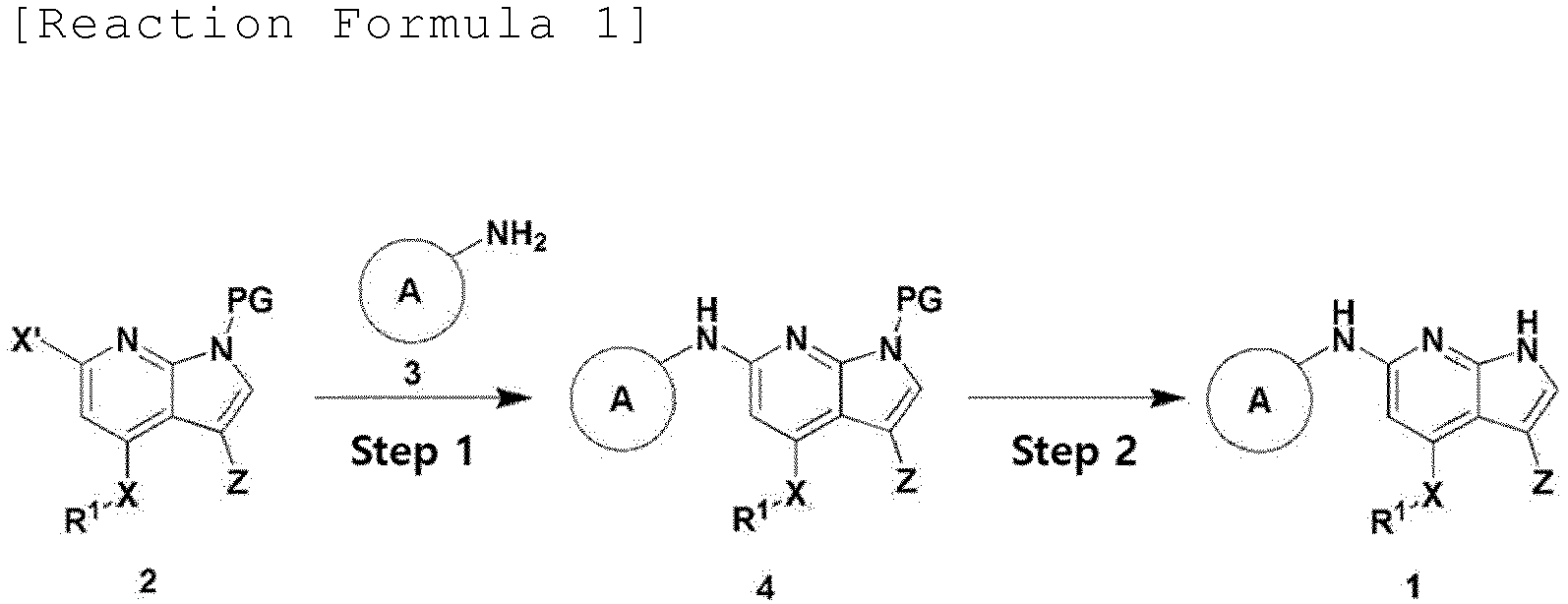
- The present invention also provides a pharmaceutical composition comprising a compound represented by
chemical formula 1, an optical isomer thereof or a pharmaceutically acceptable salt thereof as an active ingredient for the prevention or treatment of protein kinase related disease. - The present invention also provides a pharmaceutical composition comprising a compound represented by
chemical formula 1, an optical isomer thereof or a pharmaceutically acceptable salt thereof as an active ingredient for preventing or treating a disease selected from the group consisting of cancer, degenerative brain disease and metabolic disease. - The present invention also provides a health functional food composition comprising a compound represented by
chemical formula 1, an optical isomer thereof or a pharmaceutically acceptable salt thereof as an active ingredient for preventing or ameliorating a disease selected from the group consisting of cancer, degenerative brain disease and metabolic disease. - The present invention also provides a method for preventing or treating a disease selected from the group consisting of cancer, degenerative brain disease and metabolic disease, which comprises the step of administering a pharmaceutical composition or a health functional food composition comprising a compound represented by
chemical formula 1 or a pharmaceutically acceptable salt thereof as an active ingredient to a subject in need. - In addition, the present invention provides a use of the pharmaceutical composition or the health functional food composition above comprising a compound represented by
chemical formula 1 or a pharmaceutically acceptable salt thereof as an active ingredient for preventing or treating a disease selected from the group consisting of cancer, degenerative brain disease and metabolic disease. - The compound represented by
chemical formula 1, the optical isomer thereof or the pharmaceutically acceptable salt thereof according to the present invention has an excellent activity of inhibiting various protein kinases including DYRK1A, so that a pharmaceutical composition comprising the same as an active ingredient can be effectively used for the prevention or treatment of protein kinase related disease. In particular, it can be effectively used for the prevention, treatment or amelioration of Alzheimer's disease, dementia or Alzheimer's dementia. -
-
Figure 1a is a graph illustrating the luciferase activity of DYRK1A affected by the compounds of Examples 53, 54, 55, 56 and 57. -
Figure 1b is a graph illustrating the luciferase activity of DYRK1A affected by the compounds of Examples 58, 59, 60, 61, 62, 63, 64, 65, 66, 67 and 68. -
Figure 2a is a photograph illustrating the results of Tau, hnRNPA1 and GAPDH inhibition experiments for each concentration of the compound of Example 57 in cells. -
Figure 2b is a graph illustrating the Tau inhibition rate at each concentration of the compound of Example 57 in cells. -
Figure 3a is a fluorescent confocal photomicrograph of the wild type Drosophila embryo. -
Figure 3b is a fluorescent confocal photomicrograph of the Drosophila embryo with minibrain overexpressing neurodevelopmental abnormality. -
Figure 3c is a fluorescent confocal photomicrograph of the Drosophila embryo with minibrain overexpressing neurodevelopmental abnormality which was born by the parents that had been treated with the compound of Example 57 for 7 days before mating. -
Figure 4a is a photograph of wings of the control group and the Drosophila over-expressing minibrain specifically in the wings. -
Figure 4b is a graph illustrating the inhibitory effect of the compounds of Examples 58, 59, 60, 61, 62, 63, 64, 65, 66 and 67 of the present invention on the wing vein developmental abnormality. -
Figure 5a is an immunofluorescent staining confocal fluorescence photomicrograph of the control group. -
Figure 5b is an immunofluorescent staining confocal fluorescence photomicrograph of the mouse treated with harmine. -
Figure 5c is an immunofluorescent staining confocal fluorescence photomicrograph of the mouse treated with the compound of Example 57. -
Figure 5d is a graph illustrating the cell number of each mouse model. -
Figure 6 presents the results of the evaluation of Tau phosphorylation inhibitory activity of the compound in the Alzheimer's disease animal model.FIG. 6a : immunofluorescent staining confocal fluorescence photomicrograph of the cerebral cortex of the Alzheimer's disease animal model treated with vehicle (untreated group) or the compound of Example 57 (DAPI: immunofluorescence image staining with DAPI (4',6-diamidino-2-phenylindol), AT180: image obtained by immunohistochemistry using AT180 antibody, Merge: image obtained by overlapping DAPI and AT180 images, Enlarge: image obtained by enlarging AT180 image),FIG. 6b : graph illustrating the immunoreactivity of AT180 in the cerebral cortex of the Alzheimer's disease animal model treated with vehicle (untreated group) or the compound of Example 57,FIG. 6c : immunofluorescent staining confocal fluorescence photomicrograph of the cerebral cortex of the Alzheimer's disease animal model treated with vehicle (untreated group) or the compound of Example 57 (DAPI: immunofluorescence image staining with DAPI (4',6-diamidino-2-phenylindol), AT180: image obtained by immunohistochemistry using AT180 antibody, Enlarge(CA1): enlarged image of CA1 (cornus aminus, the region where the hippocampus begins and long-term memory is formed) of the hippocampus of AT180 image, Enlarge(DG): enlarged image of DG (dentate gyrus, the region where the hippocampus ends and new memory is formed) of the hippocampus of AT180 image,FIG. 6d : graph illustrating the immunoreactivity of AT180 in the CA1 (cornus aminus) of the Alzheimer's disease animal model treated with vehicle (untreated group) or the compound of Example 57,FIG. 6e : graph illustrating the immunoreactivity of AT180 in the DG (dentate gyrus) of the Alzheimer's disease animal model treated with vehicle (untreated group) or the compound of Example 57 -
Figure 7 presents the changes of DYRK1A protein by the compound of the present invention in the Alzheimer's disease animal model.FIG. 7a : immunofluorescent staining confocal fluorescence photomicrograph of the cerebral cortex of the Alzheimer's disease animal model treated with vehicle (untreated group) or the compound of Example 57 (DAPI: immunofluorescence image staining with DAPI (4',6-diamidino-2-phenylindol), DYRK1A: image obtained by immunohistochemistry using DYRK1A protein, Merge: image obtained by overlapping DAPI and DYRK1A images, Enlarge: image obtained by enlarging DYRK1A image),FIG. 7b : graph illustrating the immunoreactivity of DYRK1A in the cerebral cortex of the Alzheimer's disease animal model treated with vehicle (untreated group) or the compound of Example 57,FIG. 7c : immunofluorescent staining confocal fluorescence photomicrograph of the cerebral cortex of the Alzheimer's disease animal model treated with vehicle (untreated group) or the compound of Example 57 (DAPI: immunofluorescence image staining with DAPI (4',6-diamidino-2-phenylindol), DYRK1A: image obtained by immunohistochemistry using DYRK1A protein, Enlarge(CA1): enlarged image of CA1 (cornus aminus, the region where the hippocampus begins and long-term memory is formed) of the hippocampus of DYRK1A image, Enlarge(DG): enlarged image of DG (dentate gyrus, the region where the hippocampus ends and new memory is formed) of the hippocampus of DYRK1A image,FIG. 7d : graph illustrating the immunoreactivity of DYRK1A in the CA1 (cornus aminus) of the Alzheimer's disease animal model treated with vehicle (untreated group) or the compound of Example 57,FIG. 7e : graph illustrating the immunoreactivity of DYRK1A in the DG (dentate gyrus) of the Alzheimer's disease animal model treated with vehicle (untreated group) or the compound of Example 57 -
Figure 8 presents the changes of amyloid plaque by the compound of Example 57 in the Alzheimer's disease animal model.FIG. 8a : immunofluorescent staining confocal fluorescence photomicrograph of the cerebral cortex and the hippocampus of the Alzheimer's disease animal model treated with vehicle (untreated group) or the compound of Example 57 (DAPI: immunofluorescence image staining with DAPI (4',6-diamidino-2-phenylindol), 4G8: image obtained by immunohistochemistry using 4G8 antibody, Merge: image obtained by overlapping DAPI and 4G8 images),FIG. 8b : graph illustrating the changes in the number of amyloid plaque of 4G8 in the cerebral cortex of the Alzheimer's disease animal model treated with vehicle (untreated group) or the compound of Example 57,FIG. 8c : graph illustrating the changes in the number of amyloid plaque of 4G8 in the CA1 (cornus aminus) of the Alzheimer's disease animal model treated with vehicle (untreated group) or the compound of Example 57,FIG. 8d : graph illustrating the changes in the number of amyloid plaque of 4G8 in the DG (dentate gyrus) of the Alzheimer's disease animal model treated with vehicle (untreated group) or the compound of Example 57 -
Figure 9 presents the results of evaluating short term cognitive improvement effect through behavioral tests.FIG. 9a : schematic diagram of Y-maze to measure the short term memory of the brain,FIG. 9b : graph illustrating the behavioral changes of the mouse tested with Y-maze -
Figure 10 presents the results of evaluating long term cognitive improvement effect through behavioral tests.FIG. 10a : schematic diagram of novel object recognition test to measure the long term memory of the brain and equation to calculate novel object preference,FIG. 10b : graph illustrating the object preference of the test mouse evaluated by novel object recognition test,FIG. 10c : graph illustrating the novel object preference of the test mouse evaluated by novel object recognition test - Hereinafter, the present invention is described in detail.
- The present invention provides a compound represented by
chemical formula 1 below, an optical isomer thereof or a pharmaceutically acceptable salt thereof:
chemical formula 1, - Z is cyano (-CN); or straight or branched C1-C3 alkyl substituted with one or more halogens;
- X is -NRa-, -O- or -S-, wherein Ra is hydrogen or straight or branched C1-C10 alkyl, wherein, the alkyl can be substituted with one or more substituents selected from the group consisting of -OH and C1-C3 alkoxy;
- R1 is straight or branched C1-C10 alkyl, C3-C8 cycloalkyl or C6-14 aryl, wherein, the alkyl or cycloalkyl can be substituted with one or more substituents selected from the group consisting of - OH, and, straight or branched C1-C3 alkyl and C1-C3 alkoxy, and the aryl can be substituted with one or more substituents selected from the group consisting of straight or branched C1-C3 alkyl and straight or branched C1-C3 alkoxy, nonsubstituted or substituted with one or more halogens;
- or, Ra can form nonsubstituted or substituted 5-8 membered heterocycloalkyl containing one or more heteroatoms selected from the group consisting of N, O and S along with R1 and nitrogen atom to which they are attached, and the substituted heterocycloalkyl can be substituted with one or more substituents selected from the group consisting of straight or branched C1-C6 alkyl and straight or branched C1-C6 alkoxy; and


- wherein, each R2, R4, R6, R8, R11, R17, R23 and R24 are independently one or more substituents selected from the group consisting of hydrogen, halogen, straight or branched C1-C6 alkyl and straight or branched C1-C6 alkoxy;
- R3, R5, R7 and R9 are independently hydrogen; straight or branched C1-C6 alkyl or alkoxy; 3-8 membered heterocycloalkyl containing one or more heteroatoms selected from the group consisting of N and O; or -(C=O)NR26R27, wherein R26 and R27 are independently hydrogen, straight or branched C1-C3 alkyl or 3-8 membered heterocycloalkyl containing one or more heteroatoms selected from the group consisting of N and O substituted with 3-5 membered heterocycloalkyl containing one or more oxygen atoms, or R26 and R27 form 3-8 membered heterocycloalkyl containing one or more heteroatoms selected from the group consisting of N and O along with nitrogen atom to which they are attached, whrerein, the alkyl or heterocycloalkyl is substituted with one or more substituents selected from the group consisting of - CN, halogen, straight or branched C1-C3 alkyl, and, 3-6 membered heterocycloalkyl containing one or more heteroatoms selected from the group consisting of N and O nonsubstituted or substituted with one or more straight or branched C1-C3 alkyl,
- R10 is -CR28R29-CN, wherein R28 and R29 are independently hydrogen or straight or branched C1-C3 alkyl,
- R12, R13, R14, R15, R18, R19, R20 and R21 are independently hydrogen or straight or branched C1-C3 alkyl, or, two of R12, R13, R14, R15, R18, R19, R20 and R21 bonded to the same carbon can form carbonyl along with the carbon to which they are attached, and
- R16, R22 and R25 are independently hydrogen or straight or branched C1-C3 alkyl, wherein the alkyl can be substituted with one or more halogens.
- In addition, Z is -CN or methyl substituted with one or more halogens;
X is -NRa- or -O-, wherein Ra is hydrogen or straight or branched C1-C6 alkyl, wherein, the alkyl can be substituted with one or more substituents selected from the group consisting of -OH and C1-C3 alkoxy;
R1 is straight or branched C1-C6 alkyl, C3-C8 cycloalkyl or C6-10 aryl, wherein, the alkyl can be substituted with one or more substituents selected from the group consisting of -OH, methyl and methoxy, and the aryl can be substituted with one or more substituents selected from the group consisting of methyl and methoxy, nonsubstituted or substituted with one or more halogens;
or, Ra can form nonsubstituted or substituted 5-6 membered heterocycloalkyl containing one or more heteroatoms selected from the group consisting of N, O and S along with R1 and nitrogen atom to which they are attached, and the substituted heterocycloalkyl can be substituted with one or more substituents selected from the group consisting of straight or branched C1-C3 alkyl and straight or branched C1-C3 alkoxy; and

R3, R5, R7 and R9 are independently hydrogen, straight or branched C1-C3 alkyl or alkoxy; morpholinyl, piperazinyl, piperidinyl or -(C=O)NR26R27,
wherein R26 and R27 are independently hydrogen, methyl, morpholinyl, piperazinyl or piperidinyl, or R26 and R27 form morpholinyl, piperazinyl or piperidinyl along with nitrogen atom to which they are attached, wherein, the C1-C3 alkyl, morpholinyl, piperazinyl or piperidinyl can be substituted with one or more substituents selected from the group consisting of -CN, fluoro, oxetanyl, morpholinyl, piperazinyl, and, nonsubstituted or substituted with methyl piperidinyl,
R10 is -CR28R29-CN, wherein R28 and R29 are independently hydrogen, methyl or ethyl,
R12, R13, R14, R15, R18, R19, R20 and R21 are independently hydrogen, methyl or ethyl, or, two of R12, R13, R14, R15, R18, R19, R20 and R21 bonded to the same carbon can form carbonyl along with the carbon to which they are attached, and
R16, R22 and R25 are independently hydrogen or, methyl nonsubstituted or substituted with one or more halogens or ethyl nonsubstituted or substituted with one or more halogens. - Further, Z is -CN or -CF3;
X is -NRa- or -O-, wherein Ra is hydrogen or methyl;
R1 is methyl, ethyl, n-propyl, isopropyl, cyclopropyl,
or, Ra can form morpholinyl along with R1 and nitrogen atom to which they are attached; and


R3 and R7 are independently methoxy,


R12, R13, R14, R15, R18, R19, R20 and R21 are independently hydrogen or methyl, or, two of R12, R13, R14, R15, R18, R19, R20 and R21 bonded to the same carbon can form carbonyl along with the carbon to which they are attached, and
R16, R22 and R25 are independently hydrogen, or, methyl nonsubstituted or substituted with one or more halogens. - Furthermore, Z is -CN or -CF3;
X is -NRa- or -O-, wherein Ra is hydrogen or methyl;
R1 is methyl, ethyl, n-propyl, isopropyl, cyclopropyl,


- Further, the compound represented by
chemical formula 1 above can be any one selected from the group consisting of the following compounds.
(1) 6-((2-methoxy-4-(morpholine-4-carbonyl)phenyl)amino)-4-(methylamino)-1H-pyrrolo[2,3-b]pyridine-3-carbonitrile; (2) 4-(ethylamino)-6-((2-methoxy-4-(morpholine-4-carbonyl)phenyl)amino)-1H-pyrrolo[2,3-b]pyridine-3-carbonitrile; (3) 6-((2-methoxy-4-(4-morpholinopiperidine-1-carbonyl)phenyl)amino)-4-((2-methoxyethyl)amino)-1H-pyrrolo[2,3-b]pyridine-3-carbonitrile; (4) 6-((2-methoxy-4-(morpholine-4-carbonyl)phenyl)amino)-4-((2-methoxyethyl)amino)-1H-pyrrolo[2,3-b]pyridine-3-carbonitrile; (5) 4-((2-methoxyethyl)amino)-6-((3,4,5-trimethoxyphenyl)amino)-1H-pyrrolo[2,3-b]pyridine-3-carbonitrile; (6) 4-((2-methoxyethyl)amino)-6-((1-methyl-1H-pyrazol-4-yl)amino)-1H-pyrrolo[2,3-b]pyridine-3-carbonitrile; (7) 4-((2-methoxyethyl)amino)-6-((1-methyl-1H-pyrazol-3-yl)amino)-1H-pyrrolo[2,3-b]pyridine-3-carbonitrile; (8) 4-(ethylamino)-6-((3,4,5-trimethoxyphenyl)amino)-1H-pyrrolo[2,3-b]pyridine-3-carbonitrile; (9) 6-((2-methoxy-4-(4-morpholinopiperidine-1-carbonyl)phenyl)amino)-4-(propylamino)-1H-pyrrolo[2,3-b]pyridine-3-carbonitrile; (10) 6-((2-methoxy-4-(morpholine-4-carbonyl)phenyl)amino)-4-(propylamino)-1H-pyrrolo[2,3-b]pyridine-3-carbonitrile; (11) 4-(propylamino)-6-((3,4,5-trimethoxyphenyl)amino)-1H-pyrrolo[2,3-b]pyridine-3-carbonitrile; (12) 6-((1-methyl-1H-pyrazol-4-yl)amino)-4-(propylamino)-1H-pyrrolo[2,3-b]pyridine-3-carbonitrile; (13) 6-((1-methyl-1H-pyrazol-3-yl)amino)-4-(propylamino)-1H-pyrrolo[2,3-b]pyridine-3-carbonitrile; (14) 4-(ethylamino)-6-((1-methyl-1H-pyrazol-4-yl)amino)-1H-pyrrolo[2,3-b]pyridine-3-carbonitrile; (15) 4-(ethylamino)-6-((1-methyl-1H-pyrazol-3-yl)amino)-1H-pyrrolo[2,3-b]pyridine-3-carbonitrile; (16) 6-((2-methoxy-4-(4-morpholinopiperidine-1-carbonyl)phenyl)amino)-4-(methylamino)-1H-pyrrolo[2,3-b]pyridine-3-carbonitrile; (17) 6-((5-fluoro-2-methoxy-4-(4-morpholinopiperidine-1-carbonyl)phenyl)amino)-4-(methylamino)-1H-pyrrolo[2,3-b]pyridine-3-carbonitrile; (18) 4-(ethylamino)-6-((2-methoxy-4-(4-morpholinopiperidine-1-carbonyl)phenyl)amino)-1H-pyrrolo[2,3-b]pyridine-3-carbonitrile; (19) 6-((5-fluoro-2-methoxy-4-(morpholine-4-carbonyl)phenyl)amino)-4-(methylamino)-1H-pyrrolo[2,3-b]pyridine-3-carbonitrile; (20) 6-((2-methoxy-4-(morpholine-4-carbonyl)phenyl)amino)-4-((2-methoxyethyl)(methyl)amino)-1H-pyrrolo[2,3-b]pyridine-3-carbonitrile; (21) 6-((5-fluoro-2-methoxy-4-(morpholine-4-carbonyl)phenyl)amino)-4-((2-methoxyethyl)(methyl)amino)-1H-pyrrolo[2,3-b]pyridine-3-carbonitrile; (22) (R)-6-((2-methoxy-4-(2-methylmorpholine-4-carbonyl)phenyl)amino)-4-(methylamino)-1H-pyrrolo[2,3-b]pyridine-3-carbonitrile; (23) (S)-6-((2-methoxy-4-(2-methylmorpholine-4-carbonyl)phenyl)amino)-4-(methylamino)-1H-pyrrolo[2,3-b]pyridine-3-carbonitrile; (24) 6-((4-((2R,6S)-2,6-dimethylmorpholine-4-carbonyl)-2-methoxyphenyl)amino)-4-(methylamino)-1H-pyrrolo[2,3-b]pyridine-3-carbonitrile; (25) 6-((4-(4,4-difluoropiperidine-1-carbonyl)-2-methoxyphenyl)amino)-4-(methylamino)-1H-pyrrolo[2,3-b]pyridine-3-carbonitrile; (26) (R)-4-(ethylamino)-6-((2-methoxy-4-(2-methylmorpholine-4-carbonyl)phenyl)amino)-1H-pyrrolo[2,3-b]pyridine-3-carbonitrile; (27) (S)-4-(ethylamino)-6-((2-methoxy-4-(2-methylmorpholine-4-carbonyl)phenyl)amino)-1H-pyrrolo[2,3-b]pyridine-3-carbonitrile; (28) 6-((4-((2R,6S)-2,6-dimethylmorpholine-4-carbonyl)-2-methoxyphenyl)amino)-4-(ethylamino)-1H-pyrrolo[2,3-b]pyridine-3-carbonitrile; (29) 6-((4-(4,4-difluoropiperidine-1-carbonyl)-2-methoxyphenyl)amino)-4-(ethylamino)-1H-pyrrolo[2,3-b]pyridine-3-carbonitrile; (30) 6-((1,3-dimethyl-1H-pyrazol-4-yl)amino)-4-(ethylamino)-1H-pyrrolo[2,3-b]pyridine-3-carbonitrile; (31) 6-((1,5-dimethyl-1H-pyrazol-4-yl)amino)-4-(ethylamino)-1H-pyrrolo[2,3-b]pyridine-3-carbonitrile; (32) 4-(ethylamino)-6-((1-isopropyl-3-methyl-1H-pyrazol-4-yl)amino)-1H-pyrrolo[2,3-b]pyridine-3-carbonitrile; (33) 4-(ethylamino)-6-((1-isopropyl-5-methyl-1H-pyrazol-4-yl)amino)-1H-pyrrolo[2,3-b]pyridine-3-carbonitrile; (34) 6-((1,5-dimethyl-1H-pyrazol-4-yl)amino)-4-(methylamino)-1H-pyrrolo[2,3-b]pyridine-3-carbonitrile; (35) 6-((1,3-dimethyl-1H-pyrazol-4-yl)amino)-4-(methylamino)-1H-pyrrolo[2,3-b]pyridine-3-carbonitrile; (36) 6-((1-isopropyl-3-methyl-1H-pyrazol-4-yl)amino)-4-(methylamino)-1H-pyrrolo[2,3-b]pyridine-3-carbonitrile; (37) 6-((1-isopropyl-5-methyl-1H-pyrazol-4-yl)amino)-4-(methylamino)-1H-pyrrolo[2,3-b]pyridine-3-carbonitrile; (38) 6-((1-(2-cyanopropan-2-yl)-3-methyl-1H-pyrazol-4-yl)amino)-4-(methylamino)-1H-pyrrolo[2,3-b]pyridine-3-carbonitrile; (39) 6-((3-methoxy-5-(morpholine-4-carbonyl)pyridin-2-yl)amino)-4-(methylamino)-1H-pyrrolo[2,3-b]pyridine-3-carbonitrile; (40) 4-(ethylamino)-6-((3-methoxy-5-(morpholine-4-carbonyl)pyridin-2-yl)amino)-1H-pyrrolo[2,3-b]pyridine-3-carbonitrile; (41) 6-((5-chloro-1-((3S,4S)-3-fluoro-1-(oxetan-3-yl)piperidin-4-yl)-1H-pyrazol-4-yl)amino)(methylamino)-1H-pyrrolo[2,3-b]pyridine-3-carbonitrile; (42) 6-((5-chloro-1-((3S,4S)-3-fluoro-1-(oxetan-3-yl)piperidin-4-yl)-1H-pyrazol-4-yl)amino)(ethylamino)-1H-pyrrolo[2,3-b]pyridine-3-carbonitrile; (43) (R)-4-(ethylamino)-6-((3-methoxy-5-(2-methylmorpholine-4-carbonyl)pyridin-2-yl)amino)-1H-pyrrolo[2,3-b]pyridine-3-carbonitrile; (44) (R)-6-((3-methoxy-5-(2-methylmorpholine-4-carbonyl)pyridin-2-yl)amino)-4-(methylamino)-1H-pyrrolo[2,3-b]pyridine-3-carbonitrile; (45) 3-methoxy-4-((4-morpholino-3-(trifluoromethyl)-1H-pyrrolo[2,3-b]pyridin-6-yl)amino)phenyl)(4-methylpiperazin-1-yl)methanone; (46) (3-methoxy-4-((4-morpholino-3-(trifluoromethyl)-1H-pyrrolo[2,3-b]pyridin-6-yl)amino)phenyl)(4-(4-methylpiperazin-1-yl)piperidin-1-yl)methanone; (47) 4-methoxy-6-((2-methoxy-4-(4-morpholinopiperidine-1-carbonyl)phenyl)amino)-1H-pyrrolo[2,3-b]pyridine-3-carbonitrile; (48) 4-methoxy-6-((2-methoxy-4-(morpholine-4-carbonyl)phenyl)amino)-1H-pyrrolo[2,3-b]pyridine-3-carbonitrile; (49) 4-ethoxy-6-((2-methoxy-4-(4-morpholinopiperidine-1-carbonyl)phenyl)amino)-1H-pyrrolo[2,3-b]pyridine-3-carbonitrile; (50) 4-ethoxy-6-((2-methoxy-4-(morpholine-4-carbonyl)phenyl)amino)-1H-pyrrolo[2,3-b]pyridine-3-carbonitrile; (51) (R)-6-((3-methoxy-5-(2-methylmorpholine-4-carbonyl)pyridin-2-yl)amino)-4-(1-methylcyclopropoxy)-1H-pyrrolo[2,3-b]pyridine-3-carbonitrile; (52) 6-((3-methoxy-5-(morpholine-4-carbonyl)pyridin-2-yl)amino)-4-(1-methylcyclopropoxy)-1H-pyrrolo[2,3-b]pyridine-3-carbonitrile; (53) N4-ethyl-3-(trifluoromethyl)-N6-(3,4,5-trimethoxyphenyl)-1H-pyrrolo[2,3-b]pyridine-4,6-diamine; (54) N4-ethyl-N6-(1-methyl-1H-pyrazol-3-yl)-3-(trifluoromethyl)-1H-pyrrolo[2,3-b]pyridine-4,6-diamine; (55) N4-ethyl-N6-(1-methyl-1H-pyrazol-4-yl)-3-(trifluoromethyl)-1H-pyrrolo[2,3-b]pyridine-4,6-diamine; (56) (4-((4-(ethylamino)-3-(trifluoromethyl)-1H-pyrrolo[2,3-b]pyridin-6-yl)amino)-3-methoxyphenyl)(morpholino)methanone; (57) (4-((4-(ethylamino)-3-(trifluoromethyl)-1H-pyrrolo[2,3-b]pyridin-6-yl)amino)-3-methoxyphenyl)(4-morpholinopiperidin-1-yl)methanone; (58) (3-methoxy-4-((4-(methylamino)-3-(trifluoromethyl)-1H-pyrrolo[2,3-b]pyridin-6-yl)amino)phenyl)(morpholino)methanone; (59) (3-methoxy-4-((4-(methylamino)-3-(trifluoromethyl)-1H-pyrrolo[2,3-b]pyridin-6-yl)amino)phenyl)(4-morpholinopiperidin-1-yl)methanone; (60) (2-fluoro-5-methoxy-4-((4-(methylamino)-3-(trifluoromethyl)-1H-pyrrolo[2,3-b]pyridin-6-yl)amino)phenyl) (4-methylpiperazin-1-yl)methanone; (61) (3-methoxy-4-((4-(methylamino)-3-(trifluoromethyl)-1H-pyrrolo[2,3-b]pyridin-6-yl)amino)phenyl) (4-(4-methylpiperazin-1-yl)piperidin-1-yl)methanone; (62) N6-(2-methoxy-4-(4-methylpiperazin-1-yl)phenyl)-N4-methyl-3-(trifluoromethyl)-1H-pyrrolo[2,3-b]pyridine-4,6-diamine; (63) (3-methoxy-4-((4-(methylamino)-3-(trifluoromethyl)-1H-pyrrolo[2,3-b]pyridin-6-yl)amino)phenyl)(4-methylpiperazin-1-yl)methanone; (64) (3-methoxy-4-((4-((2-methoxyethyl)amino)-3-(trifluoromethyl)-1H-pyrrolo[2,3-b]pyridine-6yl)amino)phenyl)(morpholino)methanone; (65) (3-methoxy-4-((4-((2-methoxyethyl)amino)-3-(trifluoromethyl)-1H-pyrrolo[2,3-b]pyridin-6-yl)amino)phenyl)(4-morpholinopiperidin-1-yl)methanone; (66) (3-methoxy-4-((4-((2-methoxyethyl)amino)-3-(trifluoromethyl)-1H-pyrrolo[2,3-b]pyridin-6-yl)amino)phenyl)(4-methylpiperazin-1-yl)-methanone; (67) (3-methoxy-4-((4-((2-methoxyethyl)amino)-3-(trifluoromethyl)-1H-pyrrolo[2,3-b]pyridin-6-yl)amino)phenyl)(4-methylpiperazin-1-yl)piperidin-1-yl)methanone; (68) N6-(2-methoxy-4-(4-methylpiperazin-1-yl)phenyl)-N4-(2-methoxyethyl)-3-(trifluoromethyl)-1H-pyrrolo[2,3-b]pyridine-4,6-diamine; (69) N6-(5-chloro-1-((3S,4S)-3-fluoro-1-(oxetan-3-yl)piperidin-4-yl)-1H-pyrazol-4-yl)-N4-ethyl-3-(trifluoromethyl)-1H-pyrrolo[2,3-b]pyridine-4,6-diamine; (70) (4-(ethylamino)-3-(trifluoromethyl)-1H-pyrrolo[2,3-b]pyridin-6-yl)amino)-3-methoxyphenyl)(4-(4-methylpiperazin-1-yl)piperidin-1-yl)methanone; (71) 4-((4-(ethylamino)-3-(trifluoromethyl)-1H-pyrrolo[2,3-b]pyridin-6-yl)amino)-2-fluoro-5methoxy-N-(1-(oxetanepiperidin-4-yl)benzamide; (72) 4-((4-(ethylamino)-3-(trifluoromethyl)-1H-pyrrolo[2,3-b]pyridin-6-yl)amino)-2-fluoro-5-methoxy-N-(1-methylpiperidin-4-yl)benzylamide; (73) 2-fluoro-5-methoxy-4-((4-((2-methoxyethyl)amino)-3-(trifluoromethyl)-1H-pyrrolo[2,3-b]pyridin-6-yl)amino)(1-methylpiperidin-4-yl)benzamide; (74) 4-((4-(ethylamino-3-(trifluoromethyl)-1H-pyrrolo[2,3-b]pyridin-6-yl)amino)-2-fluoro-N-(1-isopropylpiperidin-4-yl)-5-methoxybenzamide; (75) (R) -(2,4-dimethylpiperazin-1-yl)(2-fluoro-5-methoxy-4-((4-(methylamino)-3-(trifluoromethyl)-1H-pyrrolo[2,3-b]pyridin-6-yl) amino) phenyl) methanone; (76) (3-methoxy-4-((4-morpholino-3-(trifluoromethyl)-1H-pyrrolo[2,3-b]pyridin-6-yl)amino)phenyl) (morpholino) methanone; (77) N-(5-chloro-1-((3S,4S)-3-fluoro-1-(oxetan-3-yl)piperidin-4-yl)-1H-pyrazol-4-yl)-4-morpholino-3-(trifluoromethyl)-1H-pyrrolo[2,3-b]pyridine-6-amine; (78) N6-(5-chloro-1-((3S,4S)-3-fluoro-1-(oxetan-3-yl)piperidin-4-yl)-1H-pyrazol-4-yl)-N4-methyl-3-(trifluoromethyl)-1H-pyrrolo[2,3-b] pyridine-4,6-diamine; (79) N6-(5-chloro-1-((3S,4S)-3-fluoro-1-(oxetan-3-yl)piperidin-4-yl)-1H-pyrazol-4-yl)-3-methoxyethyl)-3-(trifluoromethyl)-1H-pyrrolo [2,3-b]pyridine-4,6-diamine; (80) 1-(6-((4-(ethylamino)-3-(trifluoromethyl)-1H-pyrrolo[2,3-b]pyridin-6-yl)amino)-7-methoxy-3,4-dihydroisoquinolin-2(1H)-yl)-2,2,2-trifluoroethan-1-one; (81) N4-ethyl-N6-(7-methoxy-1,2,3,4-tetrahydroisoquinolin-6-yl)-3-(trifluoromethyl)-1H-pyrrolo[2,3-b]pyridine-4,6-diamine; (82) (3-methoxy-4-((4-morpholino-3-(trifluoromethyl)-1H-pyrrolo[2,3-b]pyridin-6-yl)amino)phenyl)(4-methylpiperazin-1-yl)methanone; (83) (3-methoxy-4-((4-morpholino-3-(trifluoromethyl)-1H-pyrrolo[2,3-b]pyridin-6-yl) amino)phenyl)(4-(4-methylpiperazin-1-yl)piperidin-1-yl)methanone; (84) (3-methoxy-4-(3-(trifluoromethyl)-4-(3-(trifluoromethyl)phenylamino)-1H-pyrrolo[2,3-b]pyridin-6-ylamino)phenyl) (morpholino)methanone; (85) (3-methoxy-4-(3-(trifluoromethyl)-4-(3-(trifluoromethyl) phenylamino)-1H-pyrrolo[2,3-b]pyridin-6-ylamino)phenyl)(4-morpholinopiperidin-1-yl)methanone; (86) N6-(5-chloro-1-((3S,4S)-3-fluoro-1-(oxetan-3-yl)piperidin-4-yl)-1H-pyrazol-4-yl)-3-(trifluoromethyl)-N4-(3-(trifluoromethyl)phenyl)-1H-pyrrolo[2,3-b]pyridine-4,6-diamine; (87) (3-methoxy-4-((4-methoxyethyl) (methyl)amino)-3-(trifluoromethyl)-1H-pyrrolo[2,3-b]pyridin-6-yl)amino)phenyl)(morpholino)methanone; (88) (3-methoxy-4-((4-methoxyethyl)(methyl)amino)-3-(trifluoromethyl)-1H-pyrrolo[2,3-b]pyridin-6-yl) amino)phenyl)((4-morpholinopiperidin-1-yl) methanone; (89) N6-(5-chloro-1-((3S,4S)-3-fluoro-1-(oxetan-3-yl)piperidin-4-yl)-1H-pyrazol-4-yl) methoxyethyl)-N4-methyl-3-(trifluoromethyl)-1H-pyrrolo[2,3-b]pyridine-4,6-diamine; (90) (4-(4-(isopropylamino)-3-(trifluoromethyl)-1H-pyrrolo[2,3-b]pyridin-6-ylamino)-3-methoxyphenyl)(4-morpholinopiperidin-1-yl)methanone; (91) (R)-(4-((4-((1-hydroxy-3-methylbutan-2-yl)amino)-3-(trifluoromethyl)-1H-pyrrolo[2,3-b]amino)-3-methoxyphenyl)(4-morpholinopiperidin-1-yl)methanone; (92) (R)-(4-((4-((1-hydroxy-3-methylbutan-2-yl) amino)-3-(trifluoromethyl)-1H-pyrrolo[2,3-b]amino)-3-methoxyphenyl)(morpholino)methanone; (93) (S)-(4-((4-(2-butylamino)-3-(trifluoromethyl)-1H-pyrrolo[2,3-b]pyridin-6-yl)amino)-3-methoxyphenyl)(4-morpholinopiperidin-1-yl)-methanone; (94) (4-((4-(cyclopropylamino)-3-(trifluoromethyl)-1-((2-(trimethylsilyl)ethoxy)methyl)-1H-pyrrolo[2,3-b]pyridin-6-yl)-3-methoxyphenyl)(4-morpholinopiperidin-1-yl)methanone; (95) (4-((4-(cyclopropylamino)-3-(trifluoromethyl)-1H-pyrrolo[2,3-b]pyridin-6-yl)amino)-3-methoxyphenyl)(morpholino) methanone; (96) 5-((4-(ethylamino)-3-(trifluoromethyl)-1H-pyrrolo[2,3-b]pyridin-6-yl) amino)-6-methoxy-2-methylisoindolin-1-one; (97) 7-((4-(ethylamino)-3-(trifluoromethyl)-1H-pyrrolo[2,3-b]pyridin-6-yl)amino)-6-methoxy-2,2,4-trimethyl-2H-benzo[1,4]oxazin-3(4H)-1-one; (98) 6-((4-(ethylamino)-3-(trifluoromethyl)-1H-pyrrolo[2,3-b]pyridin-6-yl) amino)-5-methoxy-2-methylisoindolin-1-one; (99) 4-(ethylamino)-6-((6-methoxy-2-methyl-3-oxoisoindol-5-yl)amino)-1H-pyrrolo[2,3-b]pyridine-3-carbonitrile; (100) 6-((2(2-cyanopropan-2-yl)-4-methylthiazol-5-yl) amino)-4-(ethylamino)-1H-pyrrolo[2,3-b]pyridine-3-carbonitrile; (101) (6-chloro-5-((4-(ethylamino)-3-(trifluoromethyl)-1H-pyrrolo[2,3-b]pyridin-6-yl) amino)-2-methylisoindolin-1-one; (102) 5-((4-(ethylamino)-3-(trifluoromethyl)-1H-pyrrolo[2,3-b]pyridin-6-yl)amino)-2-methylisoindolin-1-one; (103) 4-(ethylamino)-6-((2-methyl-1-oxoisoindol-5-yl)amino) -1H-pyrrolo[2,3-b]pyridine-3-carbonitrile; (104) 6-((6-chloro-2-methyl-1-oxoisoindolin-5-yl)amino)-4-(ethylamino)-1H-pyrrolo[2,3-b]pyridine-3-carbonitrile; and (105) 4-(ethylamino)-6-((6-methoxy-2,2,4-trimethyl-3-oxo-3,4-dihydro-2H-benzo[b][1,4]oxazin-7-yl)amino)-1H-pyrrolo[2,3-b]pyridine-3-carbonitrile. - The compound represented by
chemical formula 1 of the present invention can be used as a form of a pharmaceutically acceptable salt, in which the salt is preferably acid addition salt formed by pharmaceutically acceptable free acids. The acid addition salt herein can be obtained from inorganic acids such as hydrochloric acid, nitric acid, phosphoric acid, sulfuric acid, hydrobromic acid, hydroiodic acid, nitrous acid, and phosphorous acid; non-toxic organic acids such as aliphatic mono/dicarboxylate, phenyl-substituted alkanoate, hydroxy alkanoate, alkandioate, aromatic acids, and aliphatic/aromatic sulfonic acids; or organic acids such as acetic acid, benzoic acid, citric acid, lactic acid, maleic acid, gluconic acid, methanesulfonic acid, 4-toluenesulfonic acid, tartaric acid, and fumaric acid. The pharmaceutically non-toxic salts are exemplified by sulfate, pyrosulfate, bisulfate, sulphite, bisulphite, nitrate, phosphate, monohydrogen phosphate, dihydrogen phosphate, metaphosphate, pyrophosphate, chloride, bromide, iodide, fluoride, acetate, propionate, decanoate, caprylate, acrylate, formate, isobutylate, caprate, heptanoate, propiolate, oxalate, malonate, succinate, suberate, cabacate, fumarate, maliate, butyne-1,4-dioate, hexane-1,6-dioate, benzoate, chlorobenzoate, methylbenzoate, dinitrobenzoate, hydroxybenzoate, methoxybenzoate, phthalate, terephthalate, benzenesulfonate, toluenesulfonate, chlorobenzenesulfonate, xylenesulfonate, phenylacetate, phenylpropionate, phenylbutylate, citrate, lactate, hydroxybutylate, glycolate, malate, tartrate, methanesulfonate, propanesulfonate, naphthalene-1-sulfonate, naphthalene-2-sulfonate, and mandelate. - The acid addition salt in this invention can be prepared by the conventional method known to those in the art. For example, the derivative represented by
chemical formula 1 is dissolved in an organic solvent such as methanol, ethanol, acetone, dichloromethane, and acetonitrile, to which organic acid or inorganic acid is added to induce precipitation. Then, the precipitate is filtered and dried to give the salt. Or the solvent and the excessive acid are distillated under reduced pressure, and dried to give the salt. Or the precipitate is crystallized in an organic solvent to give the same. - A pharmaceutically acceptable metal salt can be prepared by using a base. Alkali metal or alkali earth metal salt is obtained by the following processes: dissolving the compound in excessive alkali metal hydroxide or alkali earth metal hydroxide solution; filtering non-soluble compound salt; evaporating the remaining solution and drying thereof. At this time, the metal salt is preferably prepared in the pharmaceutically suitable form of sodium, potassium, or calcium salt. And the corresponding silver salt is prepared by the reaction of alkali metal or alkali earth metal salt with proper silver salt (ex; silver nitrate).
- The compound represented by
chemical formula 1 according to the present invention, an optical isomer thereof or a pharmaceutically acceptable salt thereof is excellent in inhibiting DYRK1A kinase activity and has also been confirmed to have excellent DYRK1A kinase inhibitory activity at the cellular level through DYRK1A high dependent calcienurin/NFAT signaling experiment. In addition, the compound of the present invention is excellent in inhibiting phosphorylation of Tau, known as an important factor of Down syndrome, and in inhibiting DYRK1A in vivo, confirmed by in vivo experiments. Therefore, the compound represented bychemical formula 1 according to the present invention, an optical isomer thereof or a pharmaceutically acceptable salt thereof can be effectively used for the treatment or prevention of DYRK1A related disease (see Experimental Examples 1 ∼ 5) . - The compound represented by chemical formula 1 according to the present invention, an optical isomer thereof or a pharmaceutically acceptable salt thereof has the activity of inhibiting not only DYRK1A kinase but also other kinases such as ALK, ALK (C1156Y), ALK (L1196M), CAMK1B, CAMK1D, CHEK2, CLK1, CLK2, CLK3, CLK4, CSNK1A1, CSNK1A1L, CSNK1D, CSNK1E, CSNK1G2, CSNK1G3, DAPK1, DAPK2, DAPK3, DRAK2, DYRK1A, DYRK1B, DYRK2, ERK5, ERN1, GAK, HASPIN, INSRR, JNK1, JNK2, JNK3, KIT (V559D), LATS2, LRRK2, LRRK2 (G2019S), LTK, MAPKAPK2, MEK1, MEK2, MEK3, MEK4, MYLK, NIK, PHKG1, PHKG2, PIP5K2C, PRKD1, PRKD2, PRKD3, RIPK5, ROCK1, ROCK2, RPS6KA4 (Kin.Dom.2-C-terminal), RPS6KA5 (Kin.Dom.2-C-terminal), RSK3 (Kin.Dom.2-C-terminal), STK33, STK39, TSSK1B, TSSK3, TTK or YSK4, so that it can be effectively used for the treatment of ALK, ALK (C1156Y), ALK (L1196M), CAMK1B, CAMK1D, CHEK2, CLK1, CLK2, CLK3, CLK4, CSNK1A1, CSNK1A1L, CSNK1D, CSNK1E, CSNK1G2, CSNK1G3, DAPK1, DAPK2, DAPK3, DRAK2, DYRK1A, DYRK1B, DYRK2, ERK5, ERN1, GAK, HASPIN, INSRR, JNK1, JNK2, JNK3, KIT (V559D), LATS2, LRRK2, LRRK2 (G2019S), LTK, MAPKAPK2, MEK1, MEK2, MEK3, MEK4, MYLK, NIK, PHKG1, PHKG2, PIP5K2C, PRKD1, PRKD2, PRKD3, RIPK5, ROCK1, ROCK2, RPS6KA4 (Kin.Dom.2-C-terminal), RPS6KA5 (Kin.Dom.2-C-terminal), RSK3 (Kin.Dom.2-C-terminal), STK33, STK39, TSSK1B, TSSK3, TTK or YSK4 related disease as well (see Experimental Example 6).
- The compound represented by
chemical formula 1 of the present invention displays an effect of alleviating Alzheimer's disease, so that it can be effectively used for the treatment of Alzheimer's dementia (see Experimental Examples 7 ∼ 9). - The compound represented by
chemical formula 1 of the present invention can improve the short term cognitive decline caused by Alzheimer's disease, so that it can be effectively used for the treatment of Alzheimer's dementia (see Experimental Example 10). - The compound represented by
chemical formula 1 of the present invention can also improve the long term cognitive decline caused by Alzheimer's disease, so that it can be effectively used for the treatment of Alzheimer's dementia (see Experimental Example 11). - In addition, the present invention provides a preparation method of a compound represented by
chemical formula 1 comprising the following steps, as shown inreaction formula 1 below: - preparing a compound represented by
chemical formula 4 by reacting a compound represented bychemical formula 2 with a compound represented by chemical formula 3 (step 1); and - preparing a compound represented by
chemical formula 1 by reacting the compound represented bychemical formula 4 prepared instep 1 above in the presence of an acid (step 2):
- In
reaction formula 1, X, Z, R1 and
chemical formula 1 above; - X' is halogen; and
- PG is (2-(trimethylsilyl)methoxy)methyl (SEM), t-butyloxycarbonyl (BOC), carbobenzyloxy (Cbz), 9-fluorenylmethyloxycarbonyl (Fmoc), acetyl (Ac), benzoyl (Bz), benzyl (Bn), 3,4-dimethoxybenzyl (DMPM), p-methoxyphenyl (PMP), tosyl (Ts), 2,2,2-trichloroethoxycarbonyl (Troc), 2-trimethylsilylethoxycarbonyl (Teoc), aryloxycarbonyl (Alloc) or p-methoxybenzyl (PMB).
- In
- Hereinafter, the preparation method according to the present invention is described in more detail.
- In the preparation method of the present invention,
step 1 is to prepare a compound represented bychemical formula 4 by reacting a compound represented byformula 2 with a compound represented bychemical formula 3. - As a preferable example of
step 1, a compound represented bychemical formula 2 and a compound represented bychemical formula 3 are dissolved in a solvent in the presence of a base and then gas is eliminated by ultrasonic treatment. A palladium catalyst and Xphos are added to the prepared reaction mixture at 100°C, followed by reaction for 2 hours. - At this time, the base herein can be selected from the group consisting of such inorganic bases as cesium carbonate, sodium t-butoxide, potassium t-butoxide, sodium hydroxide, sodium carbonate, potassium carbonate and sodium hydride; and such organic bases as N,N-diaisopropylethylamine (DIPEA), 1,8-diazabicyclo[5.4.0]-7-undecene (DBU), pyridine and triethylamine. The selected base can be used in an equivalent amount or excess amount, alone or in combination. Herein, it is preferable to use potassium carbonate.
- The palladium catalyst can be exemplified by tris(dibenzylideneacetone)palladium (Pd2(dba)3), tetrakis(triphenylphosphine)palladium (Pd(Ph3P)4), palladium charcoal (Pd-C), bis(triphenylphosphine)palladium dichloride (PdCl2(PPh3)2), [1,1-bis(diphenylphosphino)ferrocene]dichloropalladium (PdCl2(dppf)), allylpalladium chloride dimer ([PdCl(allyl)]2), palladium acetate (Pd(OAc)2) and palladium chloride(PdCl2), among which tris(dibenzylideneacetone)palladium (Pd2(dba)3) is preferred.
- The reaction solvent usable herein is exemplified by toluene, dimethylacetamide (DMA), dimethylformamide (DMF), dimethylsulfoxide (DMSO), methylenechloride, dichloroethane, water, ethylacetate, acetonitrile; lower alcohols including isopropanol, methanol, ethanol, propanol and butanol; and ether solvents including tetrahydrofuran (THF), dioxane, ethylether and 1,2-dimethoxyethane, which can be used independently or together, and sec-butanol is more preferred herein.
- After the reaction, the reaction mixture can be filtered with a filtration membrane and washed with an organic solvent. The
solid compound 4 obtained after the concentration of the filtrate can be used in the next step without further purification. - At this time, the reaction solvent is exemplified by toluene, dimethylacetamide (DMA), dimethylformamide (DMF), dimethylsulfoxide (DMSO), methylenechloride, dichloroethane, water, ethylacetate, acetonitrile; lower alcohols including isopropanol, methanol, ethanol, propanol and butanol; and ether solvents including tetrahydrofuran (THF), dioxane, ethylether and 1,2-dimethoxyethane, which can be used independently or together, and EtOAc (ethyl acetate) and MeOH (methanol) are more preferred herein.
- Next step (step 2) is to prepare a compound represented by
chemical formula 1 by reacting the compound represented bychemical formula 4 prepared instep 1 above in the presence of an acid. - As a preferable example of
step 2, a compound represented bychemical formula 3 was dissolved in dichloromethane, to which TFA (trifluoroacetic acid) was added at room temperature. After 4 hours of the reaction, the solvent was removed. Then, the concentrated mixture was dissolved in an organic solvent again. A base was added thereto at room temperature, followed by reaction for 14 hours. - At this time, the base herein can be selected from the group consisting of such inorganic bases as cesium carbonate, sodium t-butoxide, potassium t-butoxide, sodium hydroxide, sodium carbonate, potassium carbonate and sodium hydride; and such organic bases as N,N-diaisopropylethylamine (DIPEA), 1,8-diazabicyclo[5.4.0]-7-undecene (DBU), pyridine and triethylamine. The selected base can be used in an equivalent amount or excess amount, alone or in combination. Herein, it is preferable to use saturated potassium carbonate.
- Upon completion of the reaction, the reaction product was diluted in EtOAc (ethyl acetate), followed by washing with water and brine stepwise. The organic layer was dried over MgSO4 (magnesium sulfate). Then, the reaction mixture was purified by prep-HPLC and as a result a
solid compound 1 was obtained. - The present invention also provides a pharmaceutical composition comprising a compound represented by
chemical formula 1, an optical isomer thereof or a pharmaceutically acceptable salt thereof as an active ingredient for preventing or treating a disease selected from the group consisting of cancer, degenerative brain disease and metabolic disease. - The compound represented by
chemical formula 1 above can inhibit the protein kinase activity. - At this time, the protein kinase can be ALK, ALK (C1156Y), ALK (L1196M), CAMK1B, CAMK1D, CHEK2, CLK1, CLK2, CLK3, CLK4, CSNK1A1, CSNK1A1L, CSNK1D, CSNK1E, CSNK1G2, CSNK1G3, DAPK1, DAPK2, DAPK3, DRAK2, DYRK1A, DYRK1B, DYRK2, ERK5, ERN1, GAK, HASPIN, INSRR, JNK1, JNK2, JNK3, KIT (V559D), LATS2, LRRK2, LRRK2 (G2019S), LTK, MAPKAPK2, MEK1, MEK2, MEK3, MEK4, MYLK, NIK, PHKG1, PHKG2, PIP5K2C, PRKD1, PRKD2, PRKD3, RIPK5, ROCK1, ROCK2, RPS6KA4 (Kin.Dom.2-C-terminal), RPS6KA5 (Kin.Dom.2-C-terminal), RSK3 (Kin.Dom.2-C-terminal), STK33, STK39, TSSK1B, TSSK3, TTK or YSK4.
- The degenerative brain disease herein can be Alzheimer's disease, Down syndrome, Parkinson's disease, Lou Gehrig's disease, dementia, Huntington's disease, multiple sclerosis, proximal lateral sclerosis, apoplexy, stroke or mild cognitive impairment.
- The said dementia can be Alzheimer's dementia, cerebrovascular dementia, dementia caused by head injury, multi-infarct dementia, Alzheimer's/multi-infarction dementia or alcoholic dementia.
- The metabolic disease herein can be diabetes, hypoglycemia, hypercholesterolemia, hyperlipidemia, hemochromatosis, amyloidosis or porphyria.
- The cancer can be brain cancer, brain tumor, benign astrocytoma, malignant astrocytoma, pituitary adenoma, meningioma, brain lymphoma, oligodendroglioma, intracranial carcinoma, ependymoma, brainstem tumor, head and neck tumor, larynx cancer, oropharyngeal cancer, nasal cavity/paranasal sinus cancer, nasopharyngeal cancer, salivary gland cancer, hypopharyngeal cancer, thyroid cancer, oral cancer, thoracic tumor, small cell lung cancer, non-small cell lung cancer, thymus cancer, mediastinal tumor, esophageal cancer, breast cancer, male breast cancer, abdominal tumor, stomach cancer, liver cancer, gallbladder cancer, biliary cancer, pancreatic cancer, small bowel cancer, colon cancer, rectal cancer, anal cancer, bladder cancer, kidney cancer, male genital tumor, penile cancer, prostate cancer, female genital tumor, cervical cancer, endometrial cancer, ovarian cancer, uterine sarcoma, vaginal cancer, female external genital cell cancer, female urethral cancer or skin cancer. The degenerative brain disease can be Alzheimer's disease, Down syndrome, Parkinson's disease, Lou Gehrig's disease, dementia, Huntington's disease, multiple sclerosis, proximal lateral sclerosis, apoplexy, stroke or mild cognitive impairment. In addition, the metabolic disease herein can be diabetes, hypoglycemia, hypercholesterolemia, hyperlipidemia, hemochromatosis, amyloidosis or porphyria.
- The compound represented by
chemical formula 1 or the pharmaceutically acceptable salt thereof included in the pharmaceutical composition of the present invention can be administered orally or parenterally and be used in general forms of pharmaceutical formulation. That is, the composition of the present invention can be prepared for oral or parenteral administration by mixing with generally used diluents or excipients such as fillers, extenders, binders, wetting agents, disintegrating agents and surfactants. - The formulations for oral administration are exemplified by tablets, pills, hard/soft capsules, solutions, suspensions, emulsions, syrups, granules, elixirs, and troches, etc. These formulations can include diluents (for example, lactose, dextrose, sucrose, mannitol, sorbitol, cellulose, and/or glycine) and lubricants (for example, silica, talc, stearate and its magnesium or calcium salt, and/or polyethylene glycol) in addition to the active ingredient. Tablets can include binding agents such as magnesium aluminum silicate, starch paste, gelatin, methylcellulose, sodium carboxymethylcellulose and/or polyvinylpyrolidone, and if necessary disintegrating agents such as starch, agarose, alginic acid or its sodium salt or azeotropic mixtures and/or absorbents, coloring agents, flavours, and sweeteners can be additionally included thereto.
- The pharmaceutical composition comprising the compound represented by
chemical formula 1 or the pharmaceutically acceptable salt thereof as an active ingredient can be administered by parenterally and the parenteral administration includes subcutaneous injection, intravenous injection, intramuscular injection, or intrathoracic injection. - To prepare the compound represented by
chemical formula 1 or the pharmaceutically acceptable salt thereof as a formulation for parenteral administration, the compound represented bychemical formula 1 or the pharmaceutically acceptable salt thereof is mixed with a stabilizer or a buffering agent in water to produce a solution or suspension, which is then formulated as ampoules or vials. The composition herein can be sterilized and additionally contains preservatives, stabilizers, wettable powders or emulsifiers, salts and/or buffers for the regulation of osmotic pressure, and other therapeutically useful materials, and the composition can be formulated by the conventional mixing, granulating or coating method. - The effective dosage of the pharmaceutical composition comprising the compound represented by
chemical formula 1 or the pharmaceutically acceptable salt thereof as an active ingredient can be determined according to age, weight, gender, administration method, health condition, and severity of disease. The dosage is generally 0.1 ∼ 1000 mg/day, and preferably 1 ∼ 500 mg/day based on an adult patient weighing 70 kg, which can be administered once or several times a day at intervals of a certain time depending on the judgment of a doctor or a pharmacist. - The pharmaceutical composition comprising the compound represented by
chemical formula 1 or the pharmaceutically acceptable salt thereof as an active ingredient can be administered alone or together with surgical operation, hormone therapy, chemo-therapy and biological regulators to prevent and treat DYRK1A related disease. - The compound represented by
chemical formula 1 of the present invention, the optical isomer thereof or the pharmaceutically acceptable salt thereof was confirmed to have excellent activity to inhibit DYRK1A kinase in Experimental Examples 1 and 2. In addition, the compound represented bychemical formula 1 of the present invention, the optical isomer thereof or the pharmaceutically acceptable salt thereof was confirmed to have excellent activity to inhibit DYRK1A phosphorylation at the cellular level in Experimental Example 3. It was also confirmed in Experimental Example 4 that the compound represented bychemical formula 1 of the present invention, the optical isomer thereof or the pharmaceutically acceptable salt thereof was excellent in inhibiting phosphorylation of Tau, an important factor of Down syndrome. Further, it was also confirmed in Experimental Example 5 that the compound represented bychemical formula 1 of the present invention, the optical isomer thereof or the pharmaceutically acceptable salt thereof had DYRK1A kinase activity inhibiting effect in vivo. - The compound represented by
chemical formula 1 of the present invention, the optical isomer thereof or the pharmaceutically acceptable salt thereof was confirmed to have excellent activity to inhibit Tau phosphorylation in the Alzheimer's disease animal model in Experimental Example 7. It was also confirmed in Experimental Example 8 that the compound represented bychemical formula 1 of the present invention, the optical isomer thereof or the pharmaceutically acceptable salt thereof was excellent in inhibiting DYRK1A protein activity. In Experimental Example 9, the compound represented bychemical formula 1 of the present invention, the optical isomer thereof or the pharmaceutically acceptable salt thereof was confirmed to reduce amyloid plaque, one of causes of Alzheimer's disease. In Experimental Example 10, the compound represented bychemical formula 1 of the present invention, the optical isomer thereof or the pharmaceutically acceptable salt thereof was confirmed to improve the short term cognitive decline caused by Alzheimer's disease, and also confirmed to improve the long term cognitive decline caused by Alzheimer's disease in Experimental Example 11. - Therefore, a pharmaceutical composition and a health functional food composition comprising the compound represented by
chemical formula 1 of the present invention, the optical isomer thereof or the pharmaceutically acceptable salt thereof can be effectively used for the treatment or prevention of DYRK1A related disease. In particular, they can be effectively used for the prevention, treatment or amelioration of Alzheimer's disease, dementia or Alzheimer's dementia. - The present invention also provides a health functional food composition comprising a compound represented by
chemical formula 1, an optical isomer thereof or a pharmaceutically acceptable salt thereof as an active ingredient for preventing or ameliorating a disease selected from the group consisting of cancer, degenerative brain disease and metabolic disease. - The compound represented by
chemical formula 1 above can inhibit the protein kinase activity. - At this time, the protein kinase can be ALK, ALK (C1156Y), ALK (L1196M), CAMK1B, CAMK1D, CHEK2, CLK1, CLK2, CLK3, CLK4, CSNK1A1, CSNK1A1L, CSNK1D, CSNK1E, CSNK1G2, CSNK1G3, DAPK1, DAPK2, DAPK3, DRAK2, DYRK1A, DYRK1B, DYRK2, ERK5, ERN1, GAK, HASPIN, INSRR, JNK1, JNK2, JNK3, KIT (V559D), LATS2, LRRK2, LRRK2 (G2019S), LTK, MAPKAPK2, MEK1, MEK2, MEK3, MEK4, MYLK, NIK, PHKG1, PHKG2, PIP5K2C, PRKD1, PRKD2, PRKD3, RIPK5, ROCK1, ROCK2, RPS6KA4 (Kin.Dom.2-C-terminal), RPS6KA5 (Kin.Dom.2-C-terminal), RSK3 (Kin.Dom.2-C-terminal), STK33, STK39, TSSK1B, TSSK3, TTK or YSK4.
- The degenerative brain disease herein can be Alzheimer's disease, Down syndrome, Parkinson's disease, Lou Gehrig's disease, dementia, Huntington's disease, multiple sclerosis, proximal lateral sclerosis, apoplexy, stroke or mild cognitive impairment.
- The said dementia can be Alzheimer's dementia, cerebrovascular dementia, dementia caused by head injury, multi-infarct dementia, Alzheimer's/multi-infarction dementia or alcoholic dementia.
- The metabolic disease herein can be diabetes, hypoglycemia, hypercholesterolemia, hyperlipidemia, hemochromatosis, amyloidosis or porphyria.
- The cancer can be brain cancer, brain tumor, benign astrocytoma, malignant astrocytoma, pituitary adenoma, meningioma, brain lymphoma, oligodendroglioma, intracranial carcinoma, ependymoma, brainstem tumor, head and neck tumor, larynx cancer, oropharyngeal cancer, nasal cavity/paranasal sinus cancer, nasopharyngeal cancer, salivary gland cancer, hypopharyngeal cancer, thyroid cancer, oral cancer, thoracic tumor, small cell lung cancer, non-small cell lung cancer, thymus cancer, mediastinal tumor, esophageal cancer, breast cancer, male breast cancer, abdominal tumor, stomach cancer, liver cancer, gallbladder cancer, biliary cancer, pancreatic cancer, small bowel cancer, colon cancer, rectal cancer, anal cancer, bladder cancer, kidney cancer, male genital tumor, penile cancer, prostate cancer, female genital tumor, cervical cancer, endometrial cancer, ovarian cancer, uterine sarcoma, vaginal cancer, female external genital cell cancer, female urethral cancer or skin cancer. The degenerative brain disease can be Alzheimer's disease, Down syndrome, Parkinson's disease, Lou Gehrig's disease, dementia, Huntington's disease, multiple sclerosis, proximal lateral sclerosis, apoplexy, stroke or mild cognitive impairment. In addition, the metabolic disease herein can be diabetes, hypoglycemia, hypercholesterolemia, hyperlipidemia, hemochromatosis, amyloidosis or porphyria.
- The compound represented by
chemical formula 1 of the present invention can be used as a food additive. In that case, the compound represented bychemical formula 1 of the present invention can be added as it is or as mixed with other food components according to the conventional method. The mixing ratio of active ingredients can be regulated according to the purpose of use (prevention or amelioration). In general, the compound of the present invention is preferably added to food or beverages by 0.1 ∼ 90 weight part for the total weight of the food or beverages. However, if long term administration is required for health and hygiene or regulating health condition, the content can be lower than the above but higher content can be accepted as well since the compound of the present invention has been proved to be very safe. - The health beverage composition of the present invention can additionally include various flavors or natural carbohydrates, etc, like other beverages. The natural carbohydrates above can be one of monosaccharides such as glucose and fructose; disaccharides such as maltose and sucrose; polysaccharides such as dextrin and cyclodextrin, and sugar alcohols such as xilytole, sorbitol and erythritol. Besides, natural sweetening agents (thaumatin, stevia extract, for example rebaudioside A, glycyrrhizin, etc.) and synthetic sweetening agents (saccharin, aspartame, etc.) can be included as a sweetening agent. The content of the natural carbohydrate is preferably 1 ∼ 20 g and more preferably 5 ∼ 12 g in 100 g of the composition of the invention.
- In addition to the ingredients mentioned above, the compound represented by
chemical formula 1 of the present invention can include in variety of nutrients, vitamins, minerals (electrolytes), flavors including natural flavors and synthetic flavors, coloring agents and extenders (cheese, chocolate, etc.), pectic acid and its salts, alginic acid and its salts, organic acid, protective colloidal viscosifiers, pH regulators, stabilizers, antiseptics, glycerin, alcohols, carbonators which used to be added to soda, etc. The compound represented bychemical formula 1 of the present invention can also include natural fruit juice, fruit beverages and fruit flesh addable to vegetable beverages. - The present invention also provides a method for preventing or treating a disease selected from the group consisting of cancer, degenerative brain disease and metabolic disease, which comprises the step of administering a pharmaceutical composition or a health functional food composition comprising a compound represented by
chemical formula 1 or a pharmaceutically acceptable salt thereof as an active ingredient to a subject in need. - In addition, the present invention provides a use of the pharmaceutical composition or the health functional food composition above comprising a compound represented by
chemical formula 1 or a pharmaceutically acceptable salt thereof as an active ingredient for preventing or treating a disease selected from the group consisting of cancer, degenerative brain disease and metabolic disease. - Practical and presently preferred embodiments of the present invention are illustrative as shown in the following Examples.
- However, it will be appreciated that those skilled in the art, on consideration of this disclosure, may make modifications and improvements within the spirit and scope of the present invention.
- 6-Chloro-4-(methylamino)-1-((2-(trimethylsilyl)ethoxy)methyl)-1H-pyrrolo[2,3-b]pyridine-3-carbonitrile was prepared by the method shown in
reaction formula 2 below.
- Step 1: 4,6-Dichloro-1H-pyrrolo[2,3-b]pyridine (1.0 e.q.) was dissolved in DMF, followed by lowering the temperature to -10°C. N-iodosuccinimide (1.1 e.q.) was added to the mixture, followed by raising the temperature to room temperature. The mixture was stirred for 1 hour. Upon completion of the reaction, iced water was added thereto to induce precipitation. The formed precipitate was filtered and as a result a white target compound was obtained (yield: 100%).
- Step 2: 4,6-Dichloro-3-iodo-1H-pyrrolo[2,3-b]pyridine (1.0 e.q.) was dissolved in DMF (0.5 M), followed by lowering the temperature to -78 °C. NaH (1.5 e.q.) was added to the mixture above, followed by stirring for 5 minutes. Upon completion of the reaction, SEM-Cl (1.2 e.q.) was added thereto at - 78 °C. Then, the temperature of the reaction mixture was raised to room temperature, followed by stirring for 1 hour. Iced water was added to the reaction mixture above, followed by extracting organic materials with EtOAc (x3). The collected organic layer was washed with brine and the remaining water was dried over MgSO4. The mixture was purified by MPCL (EtOAc:Hex) and as a result a white solid target compound was obtained (yield: 100%).
- Step 3: 4,6-Dichloro-3-iodo-1-((2-(trimethylsilyl)ethoxy)methyl)-1H-pyrrolo[2,3-b]pyridine (1.0 e.q.) was dissolved in EtOH, to which methylamine (5.0 e.q., 35wt% in ethanol) was added at room temperature, followed by stirring at 100 °C for 14 hours. Upon completion of the reaction, water was added thereto to induce precipitation. The formed precipitate was filtered and as a result a target compound was obtained (yield: 86%).
- Step 4: 6-Chloro-3-iodo-N-methyl-1-((2-(trimethylsilyl)ethoxy)methyl)-1H-pyrrolo[2,3-b]pyridine-4-amine (1.0 e.q.) was dissolved in DMF (0.2 M), to which Pd(PPh3)4 (0.15 e.q.) and Zn(CN)2 (2.0 e.q.) were added stepwise under nitrogen atmosphere, followed by raising the temperature to 80 °C. After reacting for 14 hours, the reaction mixture was cooled to room temperature and diluted with EtOAc. The organic layer was washed with sat. NaHCO3 and brine stepwise and the remaining water was dried over MgSO4. The mixture was purified by MPCL (EtOAc:Hex) and as a result a yellow solid target compound (6-chloro-4-(methylamino)-1-((2-(trimethylsilyl)ethoxy)methyl)-1H-pyrrolo[2,3-b]pyridine-3-carbonitrile) was obtained (yield: 57%).
- 6-Chloro-4-(ethylamino)-1-((2-(trimethylsilyl)ethoxy)methyl)-1H-pyrrolo[2,3-b]pyridine-3-carbonitrile was prepared by the similar manner to the method described in <Preparative Example 1-1> (yield: 56%).

- 6-Chloro-4-(propylamino)-1-((2-(trimethylsilyl)ethoxy)methyl)-1H-pyrrolo[2,3-b]pyridine-3-carbonitrile was prepared by the similar manner to the method described in <Preparative Example 1-1> (yield: 67%).

- 6-Chloro-4-(2-methoxyethylamino)-1-((2-(trimethylsilyl)ethoxy)methyl)-1H-pyrrolo[2,3-b]pyridine-3-carbonitrile was prepared by the similar manner to the method described in <Preparative Example 1-1> (yield: 67%).

- 6-Chloro-4-((2-methoxyethyl) (methyl)amino)-1-((2-(trimethylsilyl)ethoxy)methyl)-1H-pyrrolo[2,3-b]pyridine-3-carbonitrile was prepared by the similar manner to the method described in <Preparative Example 1-1> (yield: 67%).
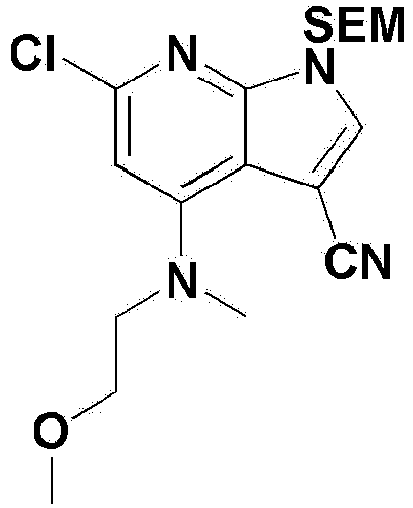
- 6-Chloro-4-methoxy-1-((2-(trimethylsilyl)ethoxy)methyl)-1H-pyrrolo[2,3-b]pyridine-3-carbonitrile was prepared by the method shown in
reaction formula 3 below.
- Step 1: 4,6-Dichloro-1H-pyrrolo[2,3-b]pyridine (1.0 e.q.) was dissolved in DMF, followed by lowering the temperature to -10°C. N-iodosuccinimide (1.1 e.q.) was added to the mixture, followed by raising the temperature to room temperature. The mixture was stirred for 1 hour. Upon completion of the reaction, iced water was added thereto to induce precipitation. The formed precipitate was filtered and as a result a white target compound was obtained (yield: 100%).
- Step 2: 4,6-Dichloro-3-iodo-1H-pyrrolo[2,3-b]pyridine (1.0 e.q.) was dissolved in DMF (0.5 M), followed by lowering the temperature to -78 °C. NaH (1.5 e.q.) was added to the mixture above, followed by stirring for 5 minutes. Upon completion of the reaction, SEM-Cl (1.2 e.q.) was added thereto at - 78 °C. Then, the temperature of the reaction mixture was raised to room temperature, followed by stirring for 1 hour. Iced water was added to the reaction mixture above, followed by extracting organic materials with EtOAc (x3). The collected organic layer was washed with brine and the remaining water was dried over MgSO4. The mixture was purified by MPCL (EtOAc:Hex) and as a result a white solid target compound was obtained (yield: 100%).
- Step 3: 4,6-Dichloro-1H-pyrrolo[2,3-b]pyridine (1.0 e.q.) was dissolved in methanol (0.1 M), to which Na fragments were added at room temperature. The temperature of the mixture was raised to 90°C, and then refluxed for 14 hours. Upon completion of the reaction, the temperature of the reaction mixture was lowered to room temperature and water was added thereto to induce precipitation. The formed precipitate was filtered and as a result a white target compound was obtained (yield: 80%).
- Step 4: 6-Chloro-3-iodo-4-methoxy-1-((2-(trimethylsilyl)ethoxy)methyl)-1H-pyrrolo[2,3-b]pyridine (1.0 e.q.) was dissolved in DMF (0.2 M) at room temperature, to which Pd(PPh3)4 (0.15 e.q.) and Zn(CN)2 (2.0 e.q.) were added stepwise under nitrogen atmosphere, followed by raising the temperature to 80 °C. After reacting for 14 hours, the reaction mixture was cooled to room temperature and diluted with EtOAc. The organic layer was washed with sat. NaHCO3 and brine stepwise and the remaining water was dried over MgSO4. The mixture was purified by MPCL (EtOAc:Hex) and as a result a yellow solid target compound (6-chloro-4-(methylamino)-1-((2-(trimethylsilyl)ethoxy)methyl)-1H-pyrrolo[2,3-b]pyridine-3-carbonitrile) was obtained (yield: 57%).
- 6-Chloro-4-ethoxy-1-((2-(trimethylsilyl)ethoxy)methyl)-1H-pyrrolo[2,3-b]pyridine-3-carbonitrile was prepared by the similar manner to the method described in <Preparative Example 2-1> (yield: 67%).

- 6-Chloro-4-(1-methylcyclopropoxy)-1-((2-(trimethylsilyl)ethoxy)methyl)-1H-pyrrolo[2,3-b]pyridine-3-carbonitrile was prepared by the similar manner to the method described in <Preparative Example 2-1> (yield: 67%).

- 6-Chloro-4-methoxy-1-((2-(trimethylsilyl)ethoxy)methyl)-1H-pyrrolo[2,3-b]pyridine-3-carbonitrile was prepared by the method shown in
reaction formula 4 below.
- Step 1: 4,6-Dichloro-1H-pyrrolo[2,3-b]pyridine (1.0 e.q.) was dissolved in DMF, followed by lowering the temperature to -10°C. N-iodosuccinimide (1.1 e.q.) was added to the mixture, followed by raising the temperature to room temperature. The mixture was stirred for 1 hour. Upon completion of the reaction, iced water was added thereto to induce precipitation. The formed precipitate was filtered and as a result a white target compound was obtained (yield: 100%).
- Step 2: 4,6-Dichloro-3-iodo-1H-pyrrolo[2,3-b]pyridine (1.0 e.q.) was dissolved in DMF (0.5 M), followed by lowering the temperature to -78 °C. NaH (1.5 e.q.) was added to the mixture above, followed by stirring for 5 minutes. Upon completion of the reaction, SEM-Cl (1.2 e.q.) was added thereto at - 78 °C. Then, the temperature of the reaction mixture was raised to room temperature, followed by stirring for 1 hour. Iced water was added to the reaction mixture above, followed by extracting organic materials with EtOAc (x3). The collected organic layer was washed with brine and the remaining water was dried over MgSO4. The mixture was purified by MPCL (EtOAc:Hex) and as a result a white solid target compound was obtained (yield: 100%).
- Step 3: 4,6-Dichloro-3-iodo-1-((2-(trimethylsilyl)ethoxy)methyl)-1H-pyrrolo[2,3-b]pyridine (1.0 e.q.) was dissolved in EtOH, to which methyl amine (5.0 e.q., 35wt% in ethanol) was added at room temperature. The mixture was stirred at 100 °C for 14 hours. Upon completion of the reaction, water was added thereto to induce precipitation. The formed precipitate was filtered and as a result a target compound was obtained (yield: 86%).
- Step 4: A two-necked round-bottom flask was filled with nitrogen gas, to which CuI (5.0 e.q.) and KF (5.0 e.q.) were added. The temperature of the mixture was raised to 150°C, followed by stirring under reduced pressure for 2 hours. Upon completion of the reaction, the temperature was lowered to room temperature. Trimethyl(trifluoromethyl)silane (5.0 e.q.) dissolved in DMF/NMP (1:1) was added thereto using a syringe in the presence of nitrogen. After reacting for 30 minutes, 6-chloro-3-iodo-N-methyl-1-((2-(trimethylsilyl)ethoxy)methyl)-1H-pyrrolo[2,3-b]pyridine-4-amine (1.0 e.q.) dissolved in DMF/NMP (1:1) was added thereto using a syringe, followed by reaction at 45 °C for 48 hours. Upon completion of the reaction, water was added to the reactant to induce precipitation, and the formed precipitate was removed by filtration. Organic materials were extracted from the collected filtrate with EtOAc (x3). The collected organic layer was washed with brine and the remaining water was dried over Na2SO4. The mixture was purified by MPCL (EtOAc:Hex) and as a result a white solid target compound was obtained (yield: 58%).
- 6-Chloro-N-ethyl-3-(trifluoromethyl)-1-((2-(trimethylsilyl)ethoxy)methyl)-1H-pyrrolo[2,3-b]pyridine-4-amine was prepared by the similar manner to the method described in <Preparative Example 3-1> (yield: 67%).

- 6-Chloro-N-(2-methoxyethyl)-3-(trifluoromethyl)-1-((2-(trimethylsilyl)ethoxy)methyl)-1H-pyrrolo[2,3-b]pyridine-4-amine was prepared by the similar manner to the method described in <Preparative Example 3-1>.

- The pyrrolo-pyridine derivative compound according to the present invention was prepared by the method shown in
reaction formula 5 below.

- Step 1: The 6-chloro-4-(methylamino)-1-((2-(trimethylsilyl)ethoxy)methyl)-1H-pyrrolo[2,3-b]pyridine-3-carbonitrile (1.0 e.q.) prepared in <Preparative Example 1-1>, (4-amino-3-methoxyphenyl)(morpholino)methanone (1.0 e.q.) and K2CO3 (5.0 e.q.) were dissolved in sec-BuOH (0.1 M), followed by ultrasonication for 1 minute to eliminate gas. Pd2(dba)3 (0.1 e.q.) and Xphos (0.1 e.q.) were added to the reaction mixture at 100 °C, followed by reaction for 2 hours. Upon completion of the reaction, the reaction mixture was filtered with celite and then washed with EtOAc and MeOH. The obtained filtrate was concentrated and as a result a yellow solid target compound (6-(2-methoxy-4-(morpholine-4-carbonyl)phenylamino)-4-(methylamino)-1-((2 - (trimethylsilyl)ethoxy)methyl)-1H-pyrrolo[2,3-b]pyridine-3-carbonitrile) was obtained.
- Step 2: The 6-(2-methoxy-4-(morpholine-4-carbonyl)phenylamino)-4-(methylamino)-1-((2-(trimethylsilyl)ethoxy)methyl)-1H-pyrrolo[2,3-b]pyridine-3-carbonitrile (1.0 e.q.) prepared in
step 1 above was dissolved in CH2Cl2 (0.05 M), to which TFA (100 e.q.) was added at room temperature. After reacting 4 hours, the solvent was eliminated. The concentrated reaction mixture was dissolved in THF (0.03 M) again, to which sat. Na2CO3 (0.03 M) was added at room temperature, followed by reaction for 14 hours. Upon completion of the reaction, the resulting product was diluted in EtOAc, and then washed with water and brine stepwise. The organic layer was dried over MgSO4. The mixture was purified by prep-HPLC and as a result a yellow solid target compound (6-(2-methoxy-4-(morpholine-4-carbonyl)phenylamino)-4-(methylamino)-1H-pyrrolo[2,3-b]pyridine-3-carbonitrile) was obtained (yield: 67%). - The pyrrolo-pyridine derivatives of the present invention were prepared by the similar manner to the method described in Example 1 using the compounds of <Preparative Example 1-1> ∼ <Preparative Example 1-5>, <Preparative Example 2-1> ∼ <Preparative Example 2-3> and <Preparative Example 3-1> ∼ <Preparative Example 3-3>. Chemical structural formulas of the compounds of Examples 1 ∼ 105 are shown in Tables 1 ∼ 3 below. Compound names, H1 NMR data, yields and HPLC results are summarized in Table 4 below.
[Table 1] Example Chemical Structure Example Chemical Structure 1 
2 
3 
4 
5 
6 
7 
8 
9 
10 
11 
12 
13 
14 
15 
16 
17 
18 
19 
20 
21 
22 
23 
24 
25 
26 
27 
28 
29 
30 
31 
32 
33 
34 
35 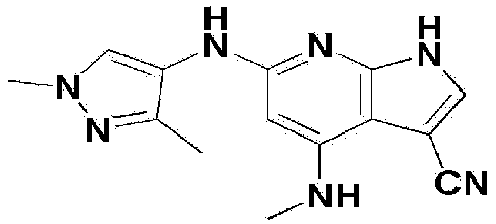
36 
[Table 2] Example Chemical Structure Example Chemical Structure 37 
38 
39 
40 
41 
42 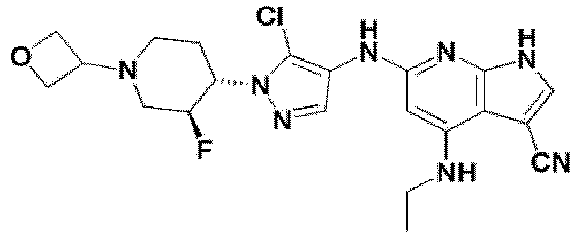
43 
44 
45 
46 
47 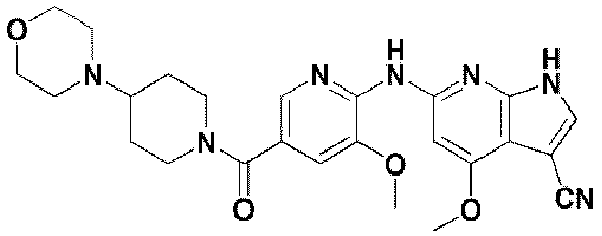
48 
49 
50 
51 
52 
53 
54 
55 
56 
57 
58 
59 
60 
61 
62 
63 
64 
65 
66 
67 
68 
69 
70 
71 
72 
[Table 3] Example Chemical Structure Example Chemical Structure 73 
74 
75 
76 
77 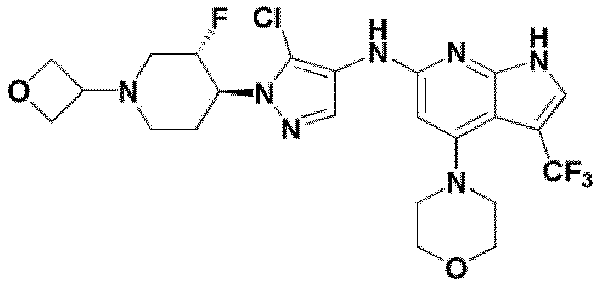
78 
79 
80 
81 
82 
83 
84 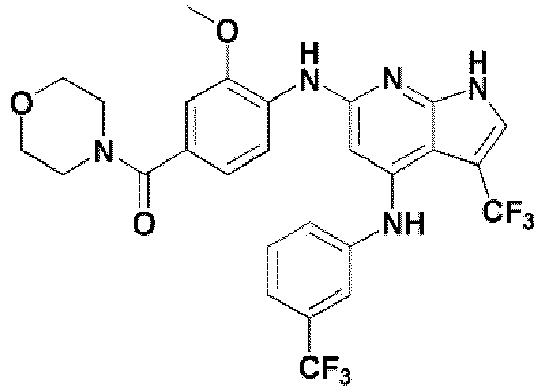
85 
86 
87 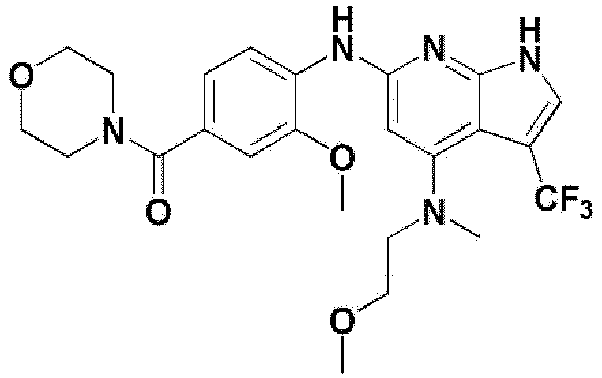
88 
89 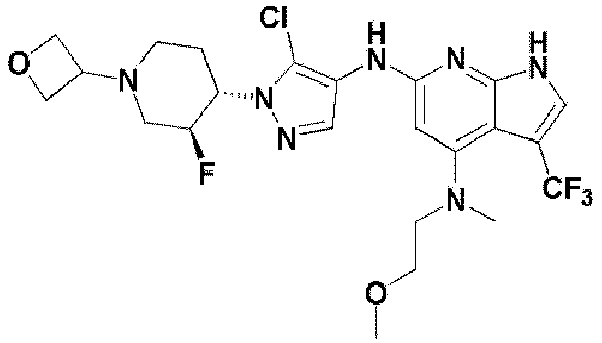
90 
91 
92 
93 
94 
95 
96 
97 
98 
99 
100 
101 
102 
103 
104 
105 
- [Table 4] Example Name 1H NMR; MS (ESI) m/z Yield (%) HPLC r.t. (min) (method) 1 6-((2-methoxy-4-(morpholine-4-carbonyl)phenyl)amino)-4-(methylamino)-1H-pyrrolo[2,3-b]pyridine-3-carbonitrile 1H NMR (400 MHz, TFA salt, DMSO-d 6) δ 12.15 s, 1H), 8.49 (br s, 1H), 8.31 (br s, 1H), (d, J = 2.1 Hz, 1H), 7.07 (s, 1H), 6.99 (dd, J = 1.5, 8.2 Hz, 1H), 6.14 (s, 1H), 3.89 (s, 3H), 3.62 (br s, 4H), 3.54 (br s, 4H), 2.89 (S, 3H); 407 [M+H]+ 67 1.762( B) 2 4-(ethylamino)-6-((2-methoxy-4-(morpholine-4-carbonyl)phenyl)amino)-1H-pyrrolo[2,3-b]pyridine-3-carbonitrile 1H NMR (400 MHz, TFA salt, DMSO-d6) δ 12.10(s, 1H), 8.47 (br s, 1H), 8.34 (br s, 1H), 7.85 (s, 1H), 7.04 (s, 1H), 6.96 (d, J = 8.2 Hz, 1H), 6.24 (s, 1H), 5.51 (br s, 1H), 3.89 (s, 3H), 3.67-3.44 (m, 8H), 3.27 (m, 2H), 1.24 (t, J = 7.1 Hz, 3H); 421 [M+H]+ 82 4.75 3 6-((2-methoxy-4-(4-morpholinopiperid ine-1-carbonyl)phenyl)amino)-4-((2-methoxyethyl)amin o)-1H-pyrrolo[2,3-b]pyridine-3-carbonitrile 534 [M+H]+ 48 3.984 4 6-((2-methoxy-4-(morpholine-4-carbonyl)phenyl)amino) -4-((2-methoxyethyl)amin o)-1H-pyrrolo[2,3-b]pyridine-3-carbonitrile 1H NMR (400 MHz, DMSO-d6) δ 12.11(s, 1H), (d, J = 8.6 Hz, 1H), 8.07 (s, 1H), 7.84 1H), 7.02 (s, 1H), 6.95 (d, J = 8.3 Hz, 1H), 6.33 (s, 1H), 5.38 (t, J = 5.4 Hz, 1H), 3.90 (s, 3H), 3.62-3.59 (m, 12H), 3.32 (s, 3H); 451 [M+H]+ CH2Cl2/Hexrecrystalliza tion 81 4.768 5 4-((2-methoxyethyl)amin o)-6-((3,4,5-trimethoxyphenyl)amino)-1H-pyrrolo[2,3-b]pyridine-3-carbonitrile 1H NMR (400 MHz, DMSO-δ 11.99 (s, 1H), 8.76 (s, 1H), 7.83 (s, 7.14 (s, 2H), 5.84 (s, 1H), 5.35 (m, 1H), 3.76 (s, 6H), 3.59 (m, 7H), 3.31 (s, 3H); 398 [M+H]+ CH2Cl2/Hexrecrystallization 66 5.071 6 4-((2-methoxyethyl)amino)-6-((1-methyl-1H-pyrazol-4-yl)amino)-1H-pyrrolo[2,3-b]pyridine-3-carbonitrile 312 [M+H]+ 36 4.271 7 4-((2-methoxyethyl)amino)-6-((1-methyl-1H-pyrazol-3-yl)amino)-1H-pyrrolo[2,3-b]pyridine-3-carbonitrile 1H NMR (400 MHz, TFA DMSO-d6) δ 12.04 (s, 1H), 9.04 (s, 1H), 7.92 (s, 1H), 7.83 (s, 1H), 5.96 (br s, 1H), 5.76 (s, 2H), 3.82 (s, 3H), 3.59 (br s, 2H), 3.40 (br s, 2H), 3.31 (s, 3H); 312 [M+H]+ 57 4.071 8 4-(ethylamino)-6-((3,4,5-trimethoxyphenyl)amino)-1H-pyrrolo[2,3-b]pyridine-3-carbonitrile 1H NMR (400 MHz, DMSO-d6) δ 11.97 (S, 1H), 8.75 (s, 1H), 7.82 (s, 1H), 7.14 (s, 2H), 5.82 (s, 1H), 5.26 (br t, J = 5.3 Hz, 1H), 3.76 (s, 6H), 3.59 (s, 3H), 3.22 (m, 2H), 1.24 (t, J = 7.1 Hz, 3H); 398 [M+H]+ CH2Cl2/Hexrecrystallization 68 5.148 9 6-((2-methoxy-4-(4-morpholinopiperidine-1-carbonyl)phenyl)amino)-4-(propylamino)-1H-pyrrolo[2,3-b]pyridine-3-carbonitrile 1H NMR (400 MHz, TFA salt, DMSO-d6) δ 12.09 (s, 1H), 9.90 (s, 1H), 8.55 (d, J = 8.0 Hz, 1H), 8.21 (br s, 1H), 7.84 (s, 1H), 7.01 (s, 1H), 6.96 (d, J = 8.2 Hz, 1H), 6.27 (s, 1H), 5.42 (br s, 1H), 4.02 (br d, J = 11.6 Hz, 2H), 3.89 (s, 3H), 3.60-3.42 (m, 7H), 3.19 (br t, J = 6.8 Hz, 2H), 3.13 (m, 2H), 2.96 (m, 2H), 3.09 (m, 2H), 1.67 (m, 2H), 1.58 (m, 2H), 0.98 (t, J = 7.3 Hz, 3H); 518 [M+H]+ 50 4.336 10 6-((2-methoxy-4-(morpholine-4-carbonyl)phenyl)amino)-4-(propylamino)-1H-pyrrolo[2,3-b]pyridine-3-carbonitrile 1H NMR (400 MHz, TFA salt, DMSO-d6) δ 12.11 1H), 8.44 (br s, 1H), 8.37 (br s, 1H), (s, 1H), 7.04 (s, 1H), 6.96 (d, J = 8.2 Hz, 1H), 6.24 (s, 1H), 5.53 (br s, 1H), 3.60 (m, 4H), 3.52 (m, 4H), 3.19 (t, J = 7.0 Hz, 2H), 1.65 (m, 2H), 0.97 (t, J = 7.3 Hz, 3H): 435 [M+H]+ 36 5.134 11 4-(propylamino) - 6-((3,4,5-trimethoxyphenyl) amino)-1H-pyrrolo[2,3-b]pyridine-3-carbonitrile 1H NMR (400 MHz, TFA salt, DMSO-d6) δ 11.99 (s, 1H), 8.85 (br s, 1H), 7.84 (s, 1H), 7.09 (s, 2H), 5.83 (s, 1H), 5.45 (br s, 1H), 3.77 (s, 6H), 3.60 (s, 3H), 3.16 (br t, J = 6.5 Hz, 2H), 1.66 (m, 2H), 0.97 (t, J = 7.3 Hz, 3H): 382 [M+H]+ 35 5.307 12 6-((1-methyl-1H-pyrazol-4-yl)amino)-4-(propylamino)-1H-pyrrolo[2,3-b]pyridine-3-carbonitrile 1H NMR (400 MHz, TFA salt, DMSO-d6) δ 11.92 (s, 1H), 8.90 (br s, 1H), 7.92 (s, 1H), 7.80 (s, 1H), 7.48 (s, 1H), 5.74 (s, 1H), 3.81 (s, 3H), 3.18 (t, J = 7.0 Hz, 2H), 1.66 (m, 2H), 0.95 (t, J = 7.3 Hz, 3H): 296 [M+H]+ 51 4.697 13 6-((1-methyl-1H-pyrazol-3-yl)amino)-4-(propylamino)-1H-pyrrolo[2,3-b]pyridine-3-carbonitrile 1H NMR (400 MHz, TFA salt, DMSO-d6) δ 12.76 (br s, 1H), 10.35 (s, 7.95 (s, 1H), 7.69 (d, J = 1.8 Hz, 1H), 6.35 (br s, 1H), 6.14 (d, J = 1.8 Hz, 1H), 6.13 (s, 1H), 3.82 (s, 3H), 3.24 (br s, 2H), 1.67 (m, 2H), 0.97 (t, J = 7.2 Hz, 3H): 296 [M+H]+ 52 4.973 14 4-(ethylamino)-6-((1-methyl-1H-pyrazol-4-yl)amino)-1H-pyrrolo[2,3-b]pyridine-3-carbonitrile 1H NMR (400 MHz, TFA salt, DMSO-d6) δ 11.85 (s, 1H), 8.89 (s, 1H), 7.75 (s, 1H), 7.47 (s, 1H), 6.50 (s, 1H), 6.16 (s, 1H), 5.18 (t, J = 5.2 Hz, 1H), 3.71 (s, 3H), 3.20 (m, 2H), 1.24 (t, J = 7.1 Hz, 3H): 282 [M+H]+ 34 4.696 15 4-(ethylamino)-6-((1-methyl-1H-pyrazol-3-yl)amino)-1H-pyrrolo[2,3-b]pyridine-3-carbonitrile 1H NMR (400 MHz, TFA salt, DMSO-d6) δ 11.85 (s, 1H), 8.54 (s, 1H), 7.90 (s, 1H), 7.72 (s, 1H), 7.42 (s, 1H), 5.67 (s, 1H), 5.15 (t, J = 5.3 Hz, 1H), 3.77 (s, 3H), 3.19 (m, 2H), 1.23 (t, J = 7.1 Hz, 3H): 282 [M+H]+ 46 4.415 16 6-((2-methoxy-4-(4-morpholinopiperidine-1-carbonyl)phenyl)amino)-4-(methylamino)-1H-pyrrolo[2,3-b]pyridine-3-carbonitrile 1H NMR (400 MHz, TFA salt, DMSO-d6) δ 12.15 (br s, 1H), 9.98 (br s, 1H), 8.39 (br s, 2H), 7.85 (d, J = 2.6 Hz, 1H), 7.02 (s, 1H), 6.96 (dd, J =1.6, 8.2 Hz, 1H), 6.15 (s, 1H), 4.01 (d, J = 11.6 Hz, 4H), 3.88 (s, 3H), 3.66 (t, J = 11.9 Hz, 3H), 3.49-3.41 (m, 4H), 3.12 (br s, 2H), 2.09-2.07 (m, 2H), 1.62-1.54 (m, 2H); 490 [M+H]+ 50 4.128 17 6-((5-fluoro-2-methoxy-4-(4-morpholinopiperid ine-1-carbonyl)phenyl)amino)-4-(methylamino)-1H-pyrrolo[2,3-b]pyridine-3-carbonitrile 1H NMR (400 MHz, TFA salt, DMSO-d6) δ 12.16 (br s, 1H), 9.95 (br s, 1H), 8.64 (d, J = 12.9 Hz, 1H), 8.35 (br s, 1H), 7.86 (d, J = 2.9 Hz, 1H), 6.90 (d, J = 6.4 Hz, 1H), 6.30 (s, 1H), 4.62 (d, J = 12.0 Hz, 1H), 4.01 (d, J = 12.0 Hz, 2H), 3.87 (s, 3H), 3.68-3.62 (m, 3H), 3.44 (br s, 3H), 3.10 (br s, 3H), 2.85 (s, 3H), 2.78-2.72 (m, 1H), 2.16-2.05 (m, 2H), 1.56-1.54 (m, 2H); 508 [M+H]+ 50 4.273 18 4-(ethylamino)-6-((2-methoxy-4-(4-morpholinopiperidine-1-carbonyl)phenyl)amino)-1H-pyrrolo[2,3-b]pyridine-3-carbonitrile 504 [M+H]+ 69 4.112 19 6-((5-fluoro-2-methoxy-4-(morpholine-4-carbonyl)phenyl)amino)-4-(methylamino)-1H-pyrrolo[2,3-b]pyridine-3-carbonitrile 1H NMR (400 MHz, TFA salt, DMSO-d6) δ 12.18 (br s, 1H), 8.58 (d, J = 12.8 Hz, 1H), 8.40 (br s, 1H), 7.86 (d, J = 2.9 Hz, 1H), 6.94 (d, J = 6.4 Hz, 1H), 6.28 (s, 1H), 3.88 (s, 3H), 3.63 (br s, 4H), 3.55 (br s, 2H), 3.31 (br s, 2H), 2.86 (s, 3H); 425 [M+H]+ 82 1.839( B) 20 6-((2-methoxy-4-(morpholine-4-carbonyl)phenyl)a mino) -4-((2-methoxyethyl)(methyl)amino)-1H-pyrrolo[2,3-b]pyridine-3-carbonitrile 1H NMR (400 MHz, TFA salt, DMSO-d6)δ 12.4 1H), 8.59 (d, J = 8.28 Hz, 1H), 8.29 (s, 7.96 (s, 1H), 7.03 (s, 1H), 6.96 (d, J = 8.28 Hz, 1H), 6.57 (s, 1H), 3.90 (s, 3H), 3.61-3.53 (m, 12H), 3.21 (s, 3H), 2.98 (s, 3H) ; 465 [M+H]+ 3 5.013 21 6-((5-fluoro-2-methoxy-4-(morpholine-4-carbonyl)phenyl)amino) -4-((2-methoxyethyl)(methyl)amino)-1H-pyrrolo[2,3-b]pyridine-3-carbonitrile 1H NMR (400 MHz, TFA salt, DMSO-d6)δ 12.32 (s, 1H), 8.68 (d, J = Hz, 1H), 8.46 (s, 1H), 8.00 (s. 1H), 6.94 J = 6.4 Hz, 1H), 6.66 (s, 1H), 3.89 (s, 3H), 3.63-3.57 (m, 10H), 3.32 (s, 2H), 3.20 (s, 3H), 2.98 (s, 3H) ; 483 [M+H]+ 2 5.655 22 (R)-6-((2-methoxy-4-(2-methylmorpholine-4-carbonyl)phenyl)amino)-4-(methylamino)-1H-pyrrolo[2,3-b] pyridine-3-carbonitrile 1H NMR (400 MHz, TFA salt, DMSO-d 6) δ 12.07 1H), 8.55 (br, 1H), 8.13 (s, 1H), 7.83 (d, = 2.8 Hz, 1H), 7.02 (s, 1H), 6.96-6.94 (m, 6.20 (s, 1H), 3.89 (s, 3H), 3.85-3.78 (m, 2H), 2.86 (s, 3H), 2.67-2.66 (m, 1H), 2.33-2.32 (m, 4H), 1.08 (d, J = 4.4 Hz, 3H); 421 [M+H]+ 17 4.724 23 (S)-6-((2-methoxy-4-(2-methylmorpholine-4-carbonyl) phenyl)amino)-4-(methylamino)-1H-pyrrolo[2,3-b]pyridine-3-carbonitrile 1H NMR (400 MHz, TFA salt, DMSO-d 6) δ 12.07 1H), 8.48 (br, 1H), 8.28 (s, 1H), 7.83 (d, J = 2.6 Hz, 1H), 7.03 1H), 6.97-6.94 (m, 1H), 6.18 (s, 1H), 3.89 (s, 3H), 3.85-3.78 (m, 2H), 2.87 (s, 3H), 2.73-2.32 (m, 4H), 2.34-2.30 (m, 3H); 421 [M+H]+ 19 5.033 24 6-((4-((2R, 6S)-2, 6-dimethylmorpholine-4-carbonyl)-2-methoxyphenyl)amino)-4-(methylamino)-1H-pyrrolo[2,3-b]pyridine-3-carbonitrile 1H NMR (400 MHz, TFA salt, DMSO-d 6)δ 12.07 1H), 8.54 (br, 1H), 8.18 (s, 1H), 7.83 (d, = 2.9 Hz, 1H), 7.02 (d, J = 1.6 Hz, 1H), (m, 1H), 6.19 (s, 1H), 3.89 (s, 3H), 3.57-3.52 (m, 2H), 2.86 (s, 3H), 2.70-2.32 (m, 4H), 1.19-0.97 (m, 6H) ; 435 [M+H]+ 18 5.234 25 6-((4-(4,4-difluoropiperidine-1-carbonyl)-2-methoxyphenyl)amino)-4-(methylamino)-1H-pyrrolo[2,3-b]pyridine-3-carbonitrile 1H NMR (400 MHz, TFA DMSO-d 6)δ 12.07 (s, 1H), 8.60 (br, 1H), (s, 1H), 7.82 (d, J = 2.9 Hz, 1H), 7.06 J = 1.4 Hz, 1H), 7.00-6.97 (m, 1H), 6.21 (s, 1H), 3.90 (s, 3H), 3.66-3.57 (m, 4H), 2.90 (s, 3H), 2.08-2.00 (m, 4H); 441 [M+H]+ 19 5.478 26 (R)-4-(ethylamino)-6-((2-methoxy-4-(2-methylmorpholine-4-carbonyl)phenyl)amino)-1H-pyrrolo[2,3-b]pyridine-3-carbonitrile 1H NMR (400 MHz, TFA salt, DMSO-d 6) δ 12.12 (s, 1H), 8.38 (NH, 2H), 7.85 (s, 1H), 7.05 (s, 1H), 6.98 (d, J = 8.2 Hz, 1H), 6.22 (s, 1H), 5.33-4.52 (m, 4H), 3.89 (s, 3H), 3.86-3.77 (m, 1H), 3.56-3.43 (m, 2H), 3.32-3.23 (m, 2H), 1.27 (t, J = 7.1 Hz, 3H), 1.08 (s, 3H); 435 [M+H]+ 48 4.986 27 (S)-4-(ethylamino)-6-((2-methoxy-4-(2-methylmorpholine-4-carbonyl)phenyl)amino)-1H-pyrrolo[2,3-b]pyridine-3-carbonitrile 1H NMR (400 MHz, TFA salt, DMSO-d 6)δ 12.14 (s, 1H), 8.38 (NH, 2H), (s, 1H), 7.07 (s, 1H), 6.99 (d, J = 8.2 Hz, 1H), 6.22 (s, 1H), 5.33-4.52 (m, 4H), 3.90 (s, 3H), 3.86-3.78 (m, 1H), 3.56-3.43 (m, 2H), 3.32-3.23 (m, 2H), 1.28 (t, J = 7.1 Hz, 3H), 1.10 (s, 3H); 435 [M+H]+ 47 4.992 28 6-((4-((2R, 6S)-2,6-dimethylmorpholine-4-carbonyl)-2-methoxyphenyl)amino)-4-(ethylamino)-1H-pyrrolo[2,3-b]pyridine-3-carbonitrile 1H NMR (400 MHz, TFA salt, DMSO-d 6)δ 12.14 1H), 8.36 (NH, 2H), 7.84 (s, 1H), 7.04 (s, 6.97 (d, J = 8.2 Hz, 1H), 6.20 (s, 1H), 5.33-4.52 (m, 4H), 3.90 (s, 3H), 3.59-3.48 (m, 2H), 3.31-3.22 (m, 2H), 1.25 (t, J = 7.1 Hz, 3H), 1.07 (s, 6H) ; 449 [M+H]+ 27 5.158 29 6-((4-(4,4-difluoropiperidine-1-carbonyl)-2-methoxyphenyl)amino)-4-(ethylamino)-1H-pyrrolo[2,3-b]pyridine-3-carbonitrile 1H NMR (400 MHz, TFA DMSO-d 6)δ 12.18 (s, 1H), 8.46 (NH, 2H), (s, 1H), 7.11 (s, 1H), 7.04 (d, J = 8.2 Hz, 1H), 6.21 (s, 1H), 3.90 (s, 3H), 3.70-3.55 (m, 4H), 3.32-3.26 (m, 2H), 2.09-2.01 (m, 4H), 1.28 (t, J = 7.1 Hz, 3H); 455 [M+H]+ 34 5.356 30 6-((1,3-dimethyl-1H-pyrazol-4-yl)amino)-4-(ethylamino)-1H-pyrrolo[2,3-b]pyridine-3-carbonitrile 1H NMR (400 MHz, TFA salt, Methanol-d 4) δ 7.63 (s, 1H), 7.56 (s, 1H), 5.67 (s, 1H), 3.79 (s, 3H), 3.36-3.30 (m, 2H), 2.07 (s, 3H), 1.28 (t, J = 7.2 Hz, 3H); 296 [M+H]+ 37 4.559 31 6-((1,5-dimethyl-1H-pyrazol-4-yl)amino)-4-(ethylamino)-1H-pyrrolo[2,3-b]pyridine-3-carbonitrile 1H NMR (400 MHz, TFA salt, Methanol-d 4) δ 7.56 (s, 1H), 7.40 (s, 1H), 5.67 (s, 1H), 3.77 (s, 3H), 3.36-3.30 (m, 2H), 2.14 (s, 3H), 1.28 (t, J = 7.2 Hz, 3H); 296 [M+H]+ 38 4.546 32 4-(ethylamino)-6 -((1-isopropyl-3-methyl-1H-pyrazol-4-yl)amino)-1H-pyrrolo[2,3-b]pyridine-3-carbonitrile 1H NMR (400 MHz, TFA Methanol-d 4)δ 7.71 (s, 1H), 7.58 (s, 1H), 5.64 (s, 1H), 4.43-4.36 (m, 1H), 3.35-3.29 (m, 2H), 2.07 (s, 3H), 1.44 (d, J = 6.7 Hz, 6H), 1.28 (t, J = 7.2 Hz, 3H); 324 [M+H]+ 36 4.892 33 4-(ethylamino)-6-((1-isopropyl-5-methyl-1H-pyrazol-4-yl)amino)-1H-pyrrolo[2,3-b]pyridine-3-carbonitrile 1H NMR (400 MHz, TFA salt, Methanol-d 4) δ 7.56 (s, 1H), 7.45 (s, 1H), 5.64 (s, 1H), 4.55-4.48 (m, 1H), 3.34-3.29 (m, 2H), 2.15 (s, 3H), 1.41 (d, J = 6.6 Hz, 6H), 1.27 (t, J = 7.2 Hz, 3H); 324 [M+H]+ 33 4.862 34 6-((1,5-dimethyl-1H-pyrazol-4-yl)amino)-4-(methylamino)-1H-pyrrolo[2,3-b]pyridine-3-carbonitrile 1H NMR (400 MHz, TFA salt, Methanol-d 4) δ 7.64 (s, 1H), 7.49 (s, 1H), 5.73 (s, 1H), 3.85 (s, 3H), 3.03 (s, 3H), 2.23 (s, 3H); 282 [M+H]+ 5 4.302 35 6-((1,3-dimethyl-1H-pyrazol-4-yl)amino)-4-(methylamino)-1H-pyrrolo[2,3-b]pyridine-3-carbonitrile 1H NMR (400 MHz, TFA salt, Methanol-d 4) δ 7.72 (s, 1H), 7.65 (s, 1H), 5.72 (s, 1H), 3.87 (s, 3H), 3.03 (s, 3H), 2.14 (s, 3H); 282 [M+H]+ 15 4.242 36 6-((1-isopropyl-3-methyl-1H-pyrazol-4-yl)amino)-4-(methylamino)-1H-pyrrolo[2,3-b]pyridine-3-carbonitrile 1H NMR (400 MHz, TFA salt, Methanol-d 4)δ 7.79 (s, 1H), 7.66 (s, 1H), 5.70 (s, 1H), (m, 1H), 3.02 (s, 3H), 2.16 (s, 3H), 1.52 (d, J = 6.7 Hz, 6 H); 310 [M+H]+ 12 4.612 37 6-((1-isopropyl-5-methyl -1H-pyrazol-4-yl) amino) -4-(methylamino)-1H-pyrrolo[2,3-b]pyridine-3-carbonitrile 1H NMR (400 MHz, TFA salt, Methanol-d 4) δ 7.65 (s, 1H), 7.54 (s, 1H), 5.70 (s, 1H), (m, 1H), 3.02 (s, 3H), 2.24 (s, 3H), 1.50 (d, J = 6.7 Hz, 6 H); 310 [M+H]+ 8 4.644 38 6-((1-(2-cyanopropan-2-yl)-3-methyl-1H-pyrazol-4-yl)amino)-4-(methylamino)-1H-pyrrolo[2,3-b]pyridine-3-carbonitrile 1H NMR (400 MHz, TFA salt, Methanol-d 4) δ 8.08 (s, 1H), 7.69 (s, 1H), 5.75 (s, 1H), 3.05 (s, 3H), 2.22 (s, 3H), (s, 6H); 335 [M+H]+ 22 4.671 39 6-((3-methoxy-5-(morpholine-4-carbonyl)pyridin-2-yl)amino)-4-(methylamino)-1H-pyrrolo[2,3-b]pyridine-3-carbonitrile 1H NMR (400 MHz, TFA salt, Methanol-d 4) δ 7.90 1H), 7.75 (s, 1H), 7.47 (s, 1H), 6.44 (s, 3.97 (s, 3H), 3.76-3.41 (m, 8H), 2.99 (s, 3H); 408 [M+H]+ 13 4.562 40 4-(ethylamino)-6-((3-methoxy-5-(morpholine-4-carbonyl)pyridin-2-yl)amino)-1H-pyrrolo[2,3-b]pyridine-3-carbonitrile 1H NMR (400 MHz, TFA salt, Methanol-d 4) δ 7.90 (s, 1H), 7.74 (s, 1H), 7.47 (s, 1H), 6.48 (s, 1H), 3.97 (s, 3H), 3.71-3.47 (m, 8H), 3.40-3.35 (m, 2H), 1.29 (t, J = 7.2 Hz, 3H); 422 [M+H]+ 20 4.810 41 6-((5-chloro-1-((3S, 4S)-3-fluoro-1-(oxetan-3-yl)piperidin-4-yl)-1H-pyrazol-4-yl)amino) (methylamino)-1H-pyrrolo[2,3-b]pyridine-3-carbonitrile 1H NMR (400 MHz, TFA salt, Methanol-d 4) δ 83 (s, 1H), 7.70 (s, 5.71 (s, 1H), (m, 1H), 4.88-4.82 (m, 2H), (m, 2H), 4.22-4.19 (m, 1H), 3.71-3.64 (m, 1H), 3.35-3.32 (m, 2H), 3.01 (s, 3H), 2.94-2.80 (m, 2H), 2.49-2.32 (m, 2H); 445 [M+H]+ 12 4.177 42 6-((5-chloro-1-((3S, 4S)-3-fluoro-1-(oxetan-3-yl)piperidin-4-yl)-1H-pyrazol-4-yl) amino) (ethylamino)-1H-pyrrolo[2,3-b]pyridine-3-carbonitrile 1H NMR (400 MHz, TFA salt, Methanol-d 4) δ 7.69 (s, 1H), 7.56 (s, 1H), 5.59 (s, 1H), 5.10-4.95 (m, 1H), 4.74-4.61 (m, 4H), 4.12-4.05 (m, 1H), 3.59-3.52 (m, 1H), 3.29-3.21 (m, 3H), 2.85-2.79 (m, 1H), 2.74-2.69 (m, 1H), 2.39-2.29 (m, 1H), 2.24-2.19 (m, 1H), 1.21 (t, J = 7.2 Hz, 3H); 459 [M+H]+ 29 4.406 43 (R)-4-(ethylamino)-6-((3-methoxy-5-(2-methylmorpholine-4-carbonyl)pyridin-2-yl)amino)-1H-pyrrolo[2,3-b]pyridine-3-carbonitrile 1H NMR (400 MHz, TFA salt, Methanol-d 4) δ (s, 1H), 7.75 (s, 7.47 (s, 1H), 6.50 (s, 1H), 4.51-4.20 (m, 3.98 (s, 3H), 3.93-3.70 (m, 1H), 3.68-3.44 (m, 3H), 3.41-3.36 (m, 2H), 3.07-2.81 (m, 1H), 2.78-2.51 (m, 1H), 1.30 (t, J = 7.2 Hz, 3H), 1.07 (s, 3H); 436 [M+H]+ 34 4.938 44 (R)-6-((3-methoxy-5-(2-methylmorpholine-4-carbonyl)pyridin-2-yl)amino)-4-(methylamino)-1H-pyrrolo[2,3-b]pyridine-3-carbonitrile 1H NMR (400 MHz, TFA salt, Methanol-d 4) δ (s, 1H), 7.71 (s, 1H), 7.44 (s, 1H), 6.39 (s, 1H), 4.47-4.16 (m, 1H), 3.94 (s, 3H), 3.88-3.67 (m, 1H), 3.65-3.37 (m, 3H), 3.32-3.08 (m, 1H), 2.96 (s, 3H), 2.83-2.48 (m, 1H), 1.05 (s, 3H); 422 [M+H]+ 26 4.727 45 3-methoxy-4-((4-morpholino-3-(trifluoromethyl) -1H-pyrrolo[2,3-b]pyridin-6-yl)amino)phenyl)( 4-methylpiperazin-1-yl)methanone 1H NMR (400 MHz, TFA salt, Methanol-d 4) δ 8.51 (d, J = 8.24 Hz, 1H), 7.55 (s, 1H), 7.18 (d, J = 1.68 Hz, 1H), 7.15 (dd, J = 8.24, 1.76 Hz, 1H), 6.57 (s, 1H), 4.49 (br s, 2H), 4.00 (s, 3H), 3.90 (t, J = 4.32 Hz, 4H), 3.57 (br s, 2H), 3.44 (br s, 2H), 3.22 (br s, 2H), 3.18 (t, J = 4.32, 4H), 2.99 (s, 3H); 519 [M+H]+ 35 4.128 46 (3-methoxy-4-((4-morpholino-3-(trifluoromethyl) -1H-pyrrolo[2,3-b]pyridin-6-yl)amino)phenyl)( 4-(4-methylpiperazin-1-yl)piperidin-1-yl)methanone 602 [M+H]+ 41 4.795 47 4-methoxy-6-((2-methoxy-4-(4-morpholinopiperidine-1-carbonyl)phenyl)amino)-1H-pyrrolo[2,3-b]pyridine-3-carbonitrile 1H NMR (400 MHz, TFA salt, DMSO-d 6) δ 12.26 (br s, 1H), 8.64 (d, J = 8.3 Hz, 1H), 8.40 (s, 1H), 7.91 (d, J = 2.9 Hz, 1H), 7.02 (d, J = 1.6 Hz, 1H), 6.97 (dd, J =1.6, 8.3 Hz, 1H), 6.79 (s, 1H), 4.02 (d, J = 11.6 Hz, 2H), 3.93 (s, 3H), 3.91 (s, 3H), 3.43 (d, J = 12.1 Hz, 4H), 3.15-3.11 (m, 2H), 2.09 (d, J = 9.0 Hz, 2H), 1.62-1.53 (m, 2H); 491 [M+H]+ 33 2.219 (B) 48 4-methoxy-6-((2-methoxy-4-(morpholine-4-carbonyl)phenyl)amino)-1H-pyrrolo[2,3-b]pyridine-3-carbonitrile 1H NMR (400 MHz, TFA salt, DMSO-d 6) δ 12.28 (br s, 1H), 8.63 (d, J 8.3 Hz, 1H), 8.38 (s, 1H), 7.90 (d, J = 2.9 Hz, 1H), 7.04 (d, J = 1.8 Hz, 1H), 6.97 (dd, J =1.8, 8.3 Hz, 1H), 6.79 (s, 1H), 3.92 (s, 3H), 3.90 (s, 3H), 3.60 (br s, 4H), 3.52 (br s, 4H); 408 [M+H]+ 17 2.442 (B) 49 4-ethoxy-6-((2-methoxy-4-(4-morpholinopiperidine-1-carbonyl)phenyl)amino)-1H-pyrrolo[2,3-b]pyridine-3-carbonitrile 1H NMR (400 MHz, TFA salt, DMSO-d 6) δ 12.24 (br s, 1H), 8.65 (d, J = 8.3 Hz, 1H), 8.39 (s, 1H), 7.91 (d, J = 2.9 Hz, 1H), 7.03 (d, J = 1.8 Hz, 1H), 6.98 (dd, J = 1.7, 8.3 Hz, 1H), 6.78 (s, 1H), 4.21 (q, J = 14.0 Hz, 2H), 4.03 (d, J = 11.8 Hz, 4H), 3.92 (s, 3H), 3.73-3.64 (m, 4H), 3.51-3.39 (m, 3H), 3.17-3.12 (m, 2H), 2.10 (d, J =8.6 Hz, 2H), 1.64-1.54 (m, 2H), 1.43 (t, J = 7.0 Hz, 3H); 505 [M+H]+ 51 2.282 (B) 50 4-ethoxy-6-((2-methoxy-4-(morpholine-4-carbonyl)phenyl)amino)-1H-pyrrolo[2,3-b]pyridine-3-carbonitrile 1H NMR (400 MHz, TFA salt, DMSO-d 6) δ 12.26 (br s, 1H), 8.64 (d, J 8.3 Hz, 1H), 8.36 (s, 1H), 7.90 (d, J = 2.9 Hz, 1H), 6.98 (dd, J = 1.8, 8.3 Hz, 1H), 6.77 (s, 1H), 4.21 (q, J = 14.0 Hz, 2H), 3.91 (s, 3H), 3.61 (br s, 4H), 3.54 (br s, 4H), 1.43 (t, J = 7.0 Hz, 3H); 422 [M+H]+ 51 2.525 ( B) 51 (R)-6-((3-methoxy-5-(2-methylmorpholine-8.40 4-carbonyl) pyridin-2-yl)amino)-4-(1-methylcyclopropoxy)-1H-pyrrolo[2,3-b]pyridine-3-carbonitrile 1H NMR (400 MHz, TFA salt, Methanol-d 4) δ (s, 1H), 7.85 (s, 1H), 7.62 (s, 1H), 7.19 (s, 1H), 3.90 (s, 3H), 3.85-3.74 (m, 1H), 3.55 - 3.44 (m, 2H), 2.12-2.02 (m, 1H), 1.97-1.88 (m, 1H), 1.62 (s, 3H), 1.55-0.44 (m, 1H), 1.17 (s, 3H), 1.10-0.98 (m, 5H); 463 [M+H]+ 30 5.055 52 6-((3-methoxy-5-(morpholine -4-carbonyl)pyridin-2-yl)amino)-4-(1-methylcyclopropoxy)-1H-pyrrolo [2,3-b]pyridine-3-carbonitrile 1H NMR (400 MHz, TFA salt, Methanol-d 4) δ (s, 1H), 7.95 (s, 1H), 7.77 (s, 1H), 7.48 (s, 1H), 4.18 (s, 3H), (m, 8H), 1.73 (s, 3H), 1.23-1.11 (m, 2H), 1.02-0.87 (m, 2H); 449 [M+H]+ 5 5.202 53 N4-ethyl-3-(trifluoromethyl) -N6-(3,4,5-trimethoxyphenyl)-1H-pyrrolo[2,3-b]pyridine-4,6-diamine 1H NMR (400 MHz, TFA DMSO-d6) δ 11.76 (s, 1H), 8.99 (br s, 7.55 (s, 1H), 7.09 (br s, 2H), 5.85 (s, 1H), 5.01 (br s, 1H), 3.77 (s, 6H), 3.61 (s, 3H), 3.27 (m, 2H), 1.24 (t, J = 7.1 Hz, 3H): 411 [M+H]+ 25 5.552 54 N4-ethyl-N6-(1-methyl-1H-pyrazol-3-yl)-3-(trifluoromethyl) -1H-pyrrolo[2,3-b]pyridine-4,6-diamine 325 [M+H]+ - - 55 N4-ethyl-N6-(1-methyl-1H-pyrazol-4-yl)-3-(trifluoromethyl)-1H-pyrrolo[2,3-b]pyridine-4,6-diamine 1H NMR (400 MHz, TFA salt, DMSO-d6) δ 11.64 (s, 1H), 8.86 (br s, 7.93 (s, 1H), 7.49 (s, 2H), 5.71 (s, 1H), 5.21 (br s, 1H), 3.82 (s, 3H), 3.27 (m, 2H), 1.22 (t, J = 7.1 Hz, 3H): 325 [M+H]+ 41 4.986 56 (4-((4-(ethylamino)-3-(trifluoromethyl)-1H-pyrrolo[2,3-b]pyridin-6-yl)amino)-3-methoxyphenyl)(morpholino)methanone 1H NMR (400 MHz, TFA salt, DMSO-d6) δ 11.85 (s, 1H), 8.38 (br s, 1H), 7.55 (s, 1H), 7.06 (s, 1H), 6.98 (d, J = 8.2 Hz, 1H), 6.20 (s, 5.06 (br s, 1H), (s, 3H), 3.61 (m, 4H), 3.52 (m, 4H), 3.30 (m, 2H), 1.23 (t, J = 7.1 Hz, 3H): 464 [M+H]+ 25 5.228 57 (4-((4-(ethylamino)-3-(trifluoromethyl)-1H-pyrrolo[2,3-b]pyridin-6-yl)amino)-3-methoxyphenyl)(4-morpholinopiperidin-1-yl)methanone 1H NMR (400 MHz, HCl salt, DMSO) δ 11.99 (s, 1H), 11.29 (s, 1H), 9.01 (br s, 1H), 8.20 (br s, 1H), 7.59 (s, 1H), 7.11 (s, 1H), 7.02 (d, J= 8.1 Hz, 1H), 6.12 (s, 1H), 5.41 (br s, 1H), 4.59-3.91 (m, 4H), 3.89 (s, 3H), 3.87-3.80 (m, 2H), 3.38-3.19 (m, 5H), 3.15-2.79 (m, 4H), 2.25-2.12 (m, 2H), 1.76-1.66 (m, 2H), 1.25 (d, J= 7.1 Hz, 3H);547 [M+H]+ 24 4.595 58 (3-methoxy-4-((4-(methylamino)-3-(trifluoromethyl)-1H-pyrrolo[2,3-b]pyridin-6-yl)amino)phenyl)morpholino)methanone 1H NMR (400 MHz, TFA salt, Methanol-d 4) δ 7.52 7.47 (m, 2H), 7.24 (d, J = 1.4 Hz, 1H), 7.12 (dd, J = 8.0, 1.6 Hz, 1H), 5.94 (s, 1H), (s, 3H), 3.85 3.64 (m, 6H), 3.64 3.45 (m, 2H), 3.05 (s, 3H); 450 [M+H]+ 45 1.93 (B) 59 (3-methoxy-4-((4-(methylamino)-3-(trifluoromethyl)-1H-pyrrolo[2,3-b]pyridin-6-yl)amino)phenyl)(4-morpholinopiperidin-1-yl)methanone 1H NMR (400 MHz, TFA salt, Methanol-d 4) δ 7.55 7.46 (m, 2H), 7.23 (d, J = 1.4 Hz, 1H), 7.13 (dd, J = 8.0, 1.5 Hz, 1H), 5.94 (s, 1H), 4.17 4.00 (m, 2H), 3.93 (s, 3H), 3.87 3.75 (m, 2H), 3.63 3.44 (m, 4H), 3.30 3.15 (m, 4H), 3.04 (s, 3H), 3.02 2.85 (m, 1H), 2.36 2.13 (m, 2H), 1.85 1.70 (m, 2H); 533 [M+H]+ 48 1.710(B) 60 (2-fluoro-5-methoxy-4-((4-(methylamino)-3-(trifluoromethyl)-1H-pyrrolo[2,3-b]pyridin-6-yl)amino)phenyl)(4-methylpiperazin-1-yl)methanone 1H NMR (400 MHz, TFA salt, Methanol-d 4) δ 7.70 (t, J = 9.5 Hz, 2H), 7.51 (s, 2H), 7.15 (d, J = 5.9 Hz, 2H), 6.06 (s, 1H), 3.93 (s, 3H), 3.70 3.45 (m, 4H), 3.28 3.15 (m, 4H), 3.06 (s, 3H), 2.98 (s, 3H) ; 481 [M+H]+ 50 1.71 (B) 61 (3-methoxy-4-((4-(methylamino)-3-(trifluoromethyl)-1H-pyrrolo[2,3-b]pyridin-6-yl)amino)phenyl)(4- (4-methylpiperazin-1-yl)piperidin-1-yl)methanone 1H NMR (400 MHz, TFA salt, Methanol-d 4) δ 7.52 7.47 (m, 2H), 7.22 (d, J = 1.2 Hz, 1H), 7.12 (dd, J = 8.0, 1.4 Hz, 1H), 5.94 (s, 1H), 4.82 4.65 (m, 1H), 4.05 3.95 (m, 1H), 3.92 (s, 3H), 3.50 3.42 (m, 4H), 3.25 3.11 (m, 4H), 3.05 (s, 3H), 3.02 2.93 (m, 1H) 2.92 (s, 3H), 2.20 1.95 (m, 2H), 1.75 1.62 (m, 2H); 546 [M+H]+ 56 1.63 (B) 62 N6-(2-methoxy-4-(4-methylpiperazin-1-yl) phenyl)-N4-methyl-3-(trifluoromethyl)-1H-pyrrolo[2,3-b]pyridine-4,6-diamine 1H NMR (400 MHz, TFA salt, Methanol-d 4) δ 7.42 (d, J = 1.2 Hz, 1H), 7.25 (d, J = 8.6 Hz, 1H), 6.81 (d, J = Hz, 1H), 6.70 (dd, J = 8.6, 2.5 Hz, 1H), 5.73 (s, 1H), 3.95 (m, 2H), 3.86 (s, 3H), 3.64 (m, 2H), 3.54 3.47 (m, 1H), 3.43 3.38 (m, 1H), 3.28 (m, 2H), 3.19 3.05 (m, 2H), 3.00 (s, 3H), 2.99 (s, 3H); 435 [M+H]+ 57 1.740 (B) 63 (3-methoxy-4-((4-(methylamino)-3-(trifluoromethyl)-1H-pyrrolo[2,3-b]pyridin-6-yl)amino)phenyl) 4-methylpiperazin-1-yl)methanone 1H NMR (400 MHz, TFA salt, Methanol-d 4) δ 7.53 (d, J = 8.0 Hz, 1H), 7.51 7.49 (m, 1H), 7.28 (d, J = 1.5 Hz, 1H), 7.17 (dd, J = 8.0, 1.6 Hz, 1H), 5.96 (s, 1H), 3.94 (s, 3H), 3.75 3.40 (m, 4H), 3.40 3.11 (m, 4H), 3.05 (s, 3H), 2.97 (s, 3H); 463 [M+H]+ 27 1.670 (B) 64 (3-methoxy-4-((4-((2-methoxyethyl)amino)-3-(trifluoromethyl)-1H-pyrrolo[2,3-b]pyridine-6yl)amino)phenyl) (morpholino)methanone 1H NMR (400 MHz, TFA salt, Methanol-d 4) δ 7.51 7.47 (m, 2H), 7.23 (d, J = 1.2 Hz, 1H), 7.11 (dd, J = 8.0, 1.4 Hz, 1H), 5.99 (s, 1H), 3.92 (s, 3H), 3.83 3.76 (m, 4H), 3.68 (t, J = 5.0 Hz, 2H), 3.63 3.47 (m, 4H), 3.52 (t, J = 5.1 Hz, 2H), 3.42 (s, 3H); 494 [M+H]+ 42 2.03 (B) 65 (3-methoxy-4-((4-((2-methoxyethyl)amino)-3-(trifluoromethyl)-1H-pyrrolo[2,3-b]pyridin-6-yl)amino)phenyl)(4-morpholinopiperidin-1-yl)methanone 1H NMR (400 MHz, TFA salt, Methanol-d 4) δ 7.55 7.48 (m, 2H), 7.22 (d, J = 1.4 Hz, 1H), 7.12 (dd, J = 8.0, 1.6 Hz, 1H), 6.00 (s, 1H), 4.15 4.00 (m, 5H), 3.92 (s, 3H), 3.87 3.75 (m, 4H), 3.68 (t, J = 5.2 Hz, 2H), 3.60 3.52 (m, 2H), 3.68 (t, J = 5.2 Hz, 2H), 3.42 (s, 3H), 3.27 3.15 (m, 4H), 3.02 2.85 (m, 1H), 2.35 2.10 (m, 2H), 1.85 1.70 (m, 2H)); 577 [M+H]+ 64 1.81 (B) 66 (3-methoxy-4-((4-((2-methoxyethyl)amino)-3-(trifluoromethyl)-1H-pyrrolo[2,3-b]pyridin-6-yl)amino)phenyl)(4-methylpiperazin-1-yl)-methanone 1H NMR (400 MHz, TFA salt, Methanol-d 4) δ 7.58 (t, J = 7.9 Hz, 1H), 7.51 (d, J = 1.1 Hz, 1H), 7.27 (d, J = 1.6 Hz, 1H), 7.16 (dd, J = 8.0, 1.7 Hz, 1H), 6.01 (s, 1H), 4.38 (m, 1H), 3.94 (s, 3H), 3.68 (t, J = 5.2 Hz, 2H), 3.60 (m, 4H), 3.52 (t, J = 5.2 Hz, 2H), 3.48 (m, 4H), 3.42 (s, 3H), 3.35 (m, 2H), 3.25 (m, 2H), 2.96 (s, 3H); 507 [M+H]+ 57 1.76 (B) 67 (3-methoxy-4-((4-((2-methoxyethyl)amino)-3-(trifluoromethyl)-1H-pyrrolo[2,3-b]pyridin-6-yl)amino)phenyl)(4-methylpiperazin-1-yl)piperidin-1-yl)methanone 1H NMR (400 MHz, TFA salt, Methanol-d 4) δ 7.54 7.48 (m, 2H), 7.22 (d, J = 1.3 Hz, 1H), 7.11 (dd, J = 8.0, 1.6 Hz, 1H), 6.00 (s, 1H), 4.70 (br s, 1H), 3.92 (s, 3H), 3.69 (t, J = 5.2 Hz, 2H), 3.52 (t, J = 5.2 Hz, 2H), 3.43 (s, 3H), 3.41 3.32 (m, 4H), 3.27 3.12 (m, 4H), 3.11 2.95 (m, 4H), 2.90 (s, 3H), 2.00 (m, 2H), 1.63 (m, 2H); 590 [M+H]+ 8 4.399 68 N6-(2-methoxy-4-(4-methylpiperazin-1-yl)phenyl)-N4-(2-methoxyethyl)-3-(trifluoromethyl)-1H-pyrrolo[2,3-b]pyridine-4,6-diamine 1H NMR (400 MHz, TFA salt, Methanol-d 4) δ 7.44 (d, J = 1.1 Hz, 1H), 7.26 (d, J = 8.6 Hz, 1H), 6.81 (d, J = 2.2 Hz, 1H), 6.70 (dd, J = 8.6, 2.4 Hz, 1H), 5.77 (s, 1H), 4.02 3.87 (m, 2H), 3.86 (s, 3H), 3.67 (t, J = 5.1 Hz, 2H), 3.65 3.55 (m, 1H), 3.52 3.48 (m, 1H), 3.46 (t, J = 5.1 Hz, 2H), 3.44 3.38 (m, 5H), 3.22 3.05 (m, 2H), 2.99 (s, 3H); 479 [M+H]+ 56 4.686 69 N6-(5-chloro-1-((3S, 4S)-3-fluoro-1-(oxetan-3-yl)piperidin-4-yl)-1H-pyrazol-4-yl)-N4-ethyl-3-(trifluoromethyl)-1H-pyrrolo[2,3-b]pyridine-4,6-diamine 1H NMR (400 MHz, TFA salt, Methanol-d 4) δ 84 (s, 1H), 7.51 (s, 5.74 (s, 1H), (m, 1H), 4.88 (m, 5H), 4.28 (m, 1H), (m, 1H), 3.43 (m, 3H), 3.00 (m, 1H), 2.92 (m, 1H), 2.55 (m, 1H), 2.39 (m, 1H), 1.34 (t, J = 6.9 Hz, 3H); 502 [M+H]+ 82 4.877 70 (4-(ethylamino)-3-(trifluoromethyl)-1H-pyrrolo[2,3-b]pyridin-6-yl)amino)-3-methoxyphenyl) (4-(4-methylpiperazin-1-yl)piperidin-1-yl)methanone 560 [M+H]+ 14 4.501 71 4-((4-(ethylamino)-3-(trifluoromethyl)-1H-pyrrolo[2,3-b]pyridin-6-yl)amino)-2-fluoro-5methoxy-N-(1-(oxetanepiperidin-4-yl)benzamide 1H NMR (400 MHz, TFA salt, Methanol-d 4) δ (d, J = 12.0 Hz, 1H), 7.54 (s, 1H), 7.41 (d, J = 6.5 Hz, 1H), 6.01 (s, 1H), 4.88 (m, 2H), 4.45 (br s, 1H), 4.24 (br s, 1H), 3.96 (s, 3H), 3.58 (br s, 2 H), 3.46 (q, J = 7.2 Hz, 2H), 3.08 (br s, 2H), 2.33 (m, 2H), 2.05 (br s, 2H), 1.37 (t, J = 7.2 Hz, 3H); 551 [M+H]+ 68 4.991 72 4-((4-(ethylamino)-3-(trifluoromethyl)-1H-pyrrolo[2,3-b]pyridin-6-yl)amino)-2-fluoro-5-methoxy-N-(1-methylpiperidin-4-yl)benzylamide 1H NMR (400 MHz, TFA salt, DMSO-d 6) δ 11.90 (s, 1H), 9.49 (d, J = 71.8 Hz, 1H), 8.75 8.65 (m, 1H), 8.34 (s, 1H), 8.17 7.95 (m, 1H), 7.57 (br s, 1H), 7.16 (dd, J = 12.6, 6.9 Hz, 1H), 6.38 (s, 1H), 4.82 (br s, 1H), 3.91 (s, 3H), 3.52 3.42 (m, 2H), 3.32 3.23 (m, 2H), 3.16 3.02 (m, 2H), 2.80 2.76 (m, 3H), 2.10 2.00 (m, 2H), 1.82 1.69 (m, 2H), 1.25 (t, J = 7.1 Hz, 3H); 509 [M+H]+ 59 4.994 73 2-fluoro-5-methoxy-4-((4-((2-methoxyethyl)amino)-3-(trifluoromethyl)-1H-pyrrolo[2,3-b]pyridin-6-yl)amino)(1-methylpiperidin-4-yl)benzamide 1H NMR (400 MHz, TFA salt, DMSO-d 6) δ 11.93 (d, J = 2.3 Hz, 1H), (d, J = 70.3 Hz, 1H), 8.77 8.67 (m, 1H), 8.29 (m, 1H), 8.09 7.98 (m, 1H), 7.59 (s, 1H), 7.15 (dd, J = 12.8, 6.9 Hz, 1H), 6.41 (s, 1H), 5.09 (br s, 1H), 4.20 3.94 (m, 2H), 3.91 (d, J = 3.3 Hz, 3H), 3.61 (t, J = 5.3 Hz, 2H), 3.40 3.36 (m, 2H), 3.32 (s, 3H), 3.21 3.03 (m, 2H), 2.80 2.75 (m, 3H), 2.08 2.00 (m, 2H), 1.81 1.67 (m, 2H); 539 [M+H]+ 50 4.910 74 4-((4-(ethylamino-3-(trifluoromethyl)-1H-pyrrolo[2,3-b]pyridin-6-yl)amino)-2-fluoro-N-(1-isopropylpiperidin-4-yl)-5-methoxybenzamide 1H NMR (400 MHz, TFA salt, DMSO-d 6) δ 11.91 11.87 (m, 1H), 9.07 (d, J = 42.5 Hz, 1H), 8.77 8.67 (m, 1H), 8.34 (s, 1H), 8.22 8.00 (m, 1H), 7.57 (s, 1H), 7.15 7.10 (m, 1H), 6.38 (s, 1H), 4.81 (br s, 1H), 4.11 3.98 (m, 1H), 3.91 (s, 3H), 3.51 3.45 (m, 1H), 3.45 3.36 (m, 2H), 3.32 3.25 (m, 2H), 3.17 3.05 (m, 2H), 2.15 2.05 (m, 2H), 1.85 1.73 (m, 2H), 1.33 1.17 (m, 9H); 537 [M+H]+ 49 5.085 75 (R)-(2,4-dimethylpiperazin-1-yl) (2-fluoro-5-methoxy-4-((4-(methylamino)-3-(trifluoromethyl)-1H-pyrrolo[2,3-b]pyridin-6-yl)amino)phenyl)methanone 1H NMR (400 MHz, TFA salt, DMSO) δ 11.86 (s, 1H), 9.60 (br s, 1H), 8.76 (br s, 1H), 8.33 (s, 1H), 7.55 (s, 1H), 6.92 (br s, 1H), 6.31 (s, 1H), 5.12 (br s, 1H), 4.96 (br s, 1H), 4.18-4.11 (m, 1H), 3.90 (s, 3H), 3.22-3.17 (m, 2H), 3.16-2.92 (m, 2H), 2.89 (s, 3H), 2.84 (s, 3H), 1.47-1.23 (m, 3H); 495[M+H]+ 47 1.762 (B) 76 (3-methoxy-4-((4-morpholino-3-(trifluoromethyl)-1H-pyrrolo[2,3-b]pyridin-6-yl)amino)phenyl)morpholino)methanone 1H NMR (400 MHz, TFA salt, DMSO) δ 8.24 (d, J = 8.16 Hz, 1H), 7.55 (s, 1H), 7.16 (s, 1H), 7.29 (d, J = 6.48 Hz, (1H), 3.97 (s, 3H), 3.89 (m, 4H), 3.73 (brs, 8H), 3.20 (m ,4H); 506[M+H]+ 60 6.108 77 N-(5-chloro-1-((3S,4S)-3-fluoro-1-(oxetane -3-yl)piperidin-4-yl)-1H-pyrazol-4-yl)-4-morpholino-3-(trifluoromethyl)-1H-pyrrolo[2,3-b]pyridine-6-amine 1H NMR (400 MHz, TFA salt, DMSO) δ 8.02 (s, 1H), 7.54 (s, 1H), 6.23 (s, 1H), 5.29-5.12 (m, 1H), 4.89-4.86 (m, 2H), 4.86-4.81 (m, 2H), 4.34-4.29 (m, 1H), 3.88-3.86 (m, 4H), 3.79-3.72 (m, 1H), 3.48-3.33 (m, 2H), 3.22-3.20 (m, 4H), 3.09-2.94 (m, 2H), 2.49-2.37 (m, 2H) ; 544 [M+H]+ 44 5.121 78 N6-(5-chloro-1-((3S, 4S)-3-fluoro-1-(oxetan-3-yl)piperidin-4-yl) -1H-pyrazol-4-yl)-N4-methyl-3-(trifluoromethyl)-1H-pyrrolo[2,3-b]pyridine-4,6-diamine 1H NMR (400 MHz, TFA salt, DMSO) δ 7.86 (s, 1H), 7.50 (s, 1H), 5.73 (s, 1H), 5.27-5.10 (m, 1H), 4.75-4.83 (m, 2H), 4.81-4.77 (m, 2H), 4.22-4.19 (m, 2H), 3.71-3.65 (m, 1H), 3.39-3.33 (m, 2H), 3.04 (s, 3H), 2.95-2.79 (m, 2H) 2.54-2.33 (m, 2H);488[M+H]+ 48 4.593 79 N6-(5-chloro-1-((3S, 4S)-3-fluoro-1-(oxetan-3-yl)piperidin-4-yl)-1H-pyrazol-4-yl)-3-methoxyethyl)-3-(trifluoromethyl)-1H-pyrrolo [2,3-b]pyridine-4,6-diamine 1H NMR (400 MHz, TFA salt, DMSO) δ 7.86 (s, 1H), 7.51 (s, 1H), 5.80 (s, 1H), 5.29-5.17 (m, 1H), 4.89-4.86 (m, 2H), 4.85-4.81 (m, 2H), 4.35-4.32 (m, 1H), 3.82-3.75 (m, 1H), 3.70-3.67 (m, 2H), 3.53-3.50 (m, 4H), 3.43 (s, 3H), 3.13-2.97 (m, 2H), 2.55-2.39 (m, 2H) ; 532[M+H]+ 48 4.777 80 1-(6-((4-(ethylamino)-3-(trifluoromethyl) -1H-pyrrolo[2,3-b]pyridin-6-yl)amino)-7-methoxy-3,4-dihydroisoquinolin-2(1H)-yl)-2,2,2-trifluoroethan-1-one 1H NMR (400 MHz, TFA salt, DMSO) δ 7.51 (s, 1H), 7.28 (s, 1H), 7.09 (s, 1H), 5.90 (s, 1H), 4.90 (s, 2H), 3.96 (t, J = 5.6 Hz, 2H), 3.91 (s, 3H), 3.15 (q, J = 7.12 Hz, 2H), 3.01-3.00 (m, 2H), 1.38 (t, J = 7.16 Hz, 3H); 502[M+H]+ 88 5.920 81 N4-ethyl-N6-(7-methoxy-1,2,3,4-tetrahydroisoquinolin-6-yl)-3-(trifluoromethyl)-1H-pyrrolo[2,3-b]pyridine-4,6-diamine 1H NMR (400 MHz, TFA salt, DMSO) δ 7.50 (s, 7.37 (s, 1H), 7.03 (s, 1H), 5.87 (s, 1H), 4.42 (s, 2H), 3.89 (s, 3H), 3.53 (t, J = 6.32 Hz, 2H), 3.39 (q, J = 7.14 Hz, 2H), 3.10 (t, J = 6.16 Hz, 2H), 1.34 (t, J = 7.16 Hz, 2H) ; 406[M+H]+ 41 4.632 82 (3-methoxy-4-((4-morpholino-3-(trifluoromethyl)-1H-pyrrolo[2,3-b]pyridin-6-yl)amino)phenyl)(4-methylpiperazin-1-yl)methanone 1H NMR (400 MHz, TFA salt, MeOD-d 4) δ 8.50 (d, J=8.24 Hz, 1H), 7.55 (s, 1H), 7.18 (s, 1H), 7.14 (d, J=8.24 Hz, 1H), 6.57 (s, 1H), 4.49 (brs, 2H), 4.00 (s, 3H), 4.00-3.88 (m, 4H), 3.57 (brs, 2H), 3.49 (brs, 2H), 3.22 (brs, 2H), 3.19-3.15 (m, 4H), 2.99 (s, 3H); 519[M+H]+ 43 5.080 83 (3-methoxy-4-((4-morpholino-3-(trifluoromethyl)-1H-pyrrolo[2,3-b]pyridin-6-yl)amino)phenyl)(4- (4-methylpiperazin-1-yl)piperidin-1-yl)methanone 1H NMR (400 MHz, TFA salt, MeOD-d 4) δ 8.30 (d, J=8.2 Hz, 1H), 7.55 (s, 1H), 7.14 (s, 1H), 7.08 (d, J=8.2 Hz, 1H), 6.52 (s, 1H), 3.97 (s, 3H), 3.90-3.88 (m, 4H), 3.45-3.33 (m, 7H), 3.21-3.14 (m, 4H), 3.13-3.10 (m, 3H), 2.93 (s, 3H), 2.17-1,99 (m, 2H), 1.70-1.61 (m, 2H); 602[M+H]+ 49 4.795 84 (3-methoxy-4-(3-(trifluoromethyl)-4-(3-(trifluoromethyl)phenylamino)-1H-pyrrolo[2,3-b]pyridin-6-ylamino)phenyl)(morpholino)methano ne 1H NMR (400 MHz, TFA salt, DMSO) δ 7.71-7.59 (m, 6H), 7.17 (s, 1H), 7.05 (d, J = 7.92 Hz, 1H), 6.17 (s, 1H), 3.90 (s, 3H), 3.72 (br, 8H); 579[M+H]+ 36 6.647 85 (3-methoxy-4-(3-(trifluoromethyl)-4-(3-(trifluoromethyl)phenylamino)-1H-pyrrolo[2,3-b]pyridin-6-ylamino)phenyl)(4-morpholinopiperidin-1-yl)methanone 1H NMR (400 MHz, TFA salt, DMSO) δ 8.11-8.09 (m, 2H), 7.79-7.76 (m, 2H), 7.68-7.57 (m, 2H), 7.15 (s, 1H), 7.06 (d, J = 9.8 Hz, 1H), 6.28 (s, 1H), 4.10 (br, 2H), 3.92 (s, 3H), 3.82 (br, 2H), 3.56-3.53 (m, 3H), 3.25 (br, 2H), 3.10 (br, 4H), 2.24 (br, 2H), 1.79-1.74 (m, 2H); 662[M+H]+ 47 5.540 86 N6-(5-chloro-1-((3S, 4S)-3-fluoro-1-(oxetan-3-yl)piperidin-4-yl)-1H-pyrazol-4-yl)-3-(trifluoromethyl) -N4-(3-(trifluoromethyl) phenyl)-1H-pyrrolo[2,3-b]pyridine-4,6-diamine 1H NMR (400 MHz, TFA salt, DMSO) δ 7.81 (s, 7.68-7.60 (m, 5H), (s, 1H), 5.20-5.02 1H), 4.89-4.83 (m, 2H), 4.79-4.74 (m, 2H), (m, 1H), 3.66-3.60 (m, 1H), (m, 1H), 2.85-2.68 (m, 2H), 2.45-2.22 (m, 2H) ; 618[M+H]+ 39 5.789 87 (3-methoxy-4-((4-methoxyethyl)(methyl)amino)-3-(trifluoromethyl)-1H-pyrrolo [2,3-b]pyridin-6-yl)amino)phenyl)(morpholino)methanone 1H NMR (400 MHz, TFA salt, MeOD) δ 7.66 (d, J = 8.0 Hz, 1H), 7.59 (s, 1H), 7.23 (s, 1H), 7.14 (d, J = 8.0 Hz, 1H), 6.28 (s, 1H), 3.95 (s, 3H), 3.88-3.52 (m, 12H), 3.28 (s, 3H), 3.12 (s, 3H); 508[M+H]+ 64 5.670 88 (3-methoxy-4-((4-methoxyethyl)(methyl)amino)-3-(trifluoromethyl)-1H-pyrrolo[2,3-b]pyridin-6-yl) amino)phenyl)((4-morpholinopiperidin-1-yl)methanone 1H NMR (400 MHz, TFA salt, MeOD) δ 7.78 (d, J = 8.1 Hz, 1H), 7.58 (s, 1H), 7.22 (s, 1H), 7.14 (d, J = 8.1 Hz, 1H), 6.32 (s, 1H), 4.20-4.02 (m, 2H), 3.96 (s, 3H), 3.89-3.70 (m, 2H), 3.65 (s, 4H), 3.61-3.50 (m, 2H), 3.25-3.15 (m, 5H), 3.10 (s, 3H), 2.40-2.15 (m, 2H), 1.81-1.69 (m, 2H); 590[M+H]+ 45 4.848 89 N6-(5-chloro-1-((3S,4S)-3-fluoro-1-(oxetan-3-yl)piperidin-4-yl)-1H-pyrazol-4-yl)methoxyethyl)-N4-methyl-3-(trifluoromethyl) -1H-pyrrolo[2,3-b]pyridine-4,6-diamine 1H NMR (400 MHz, TFA salt, DMSO) δ 7.88 (s, 1H), 7.58 (s, 1H), 6.04 (s, 1H), 5.27-5.10 (m, 1H), 4.86 (m, 2H), 4.381-4.78 (m, 2H), 4.26-4.21 (m, 1H), 3.68-3.67 (m, 3H), 3.65-3.64 (m, 2H), 3.42-3.35 (m, 1H), 3.27 (s, 3H), 3.12 (s, 3H), 2.96-2.83 (m, 2H), 2.54-2.33 (m ,2H) ; 546[M+H]+ 54 4.959 90 (4-(4-(isopropylamino)-3-(trifluoromethyl)-1H-pyrrolo[2,3-b]pyridin-6-ylamino)-3-methoxyphenyl)(4-morpholinopiperidin-1-yl)methanone 1H NMR (400 MHz, TFA salt, MeOD-d 4) δ 7.54-7.52 (m, 2H), 7.23 (s, 1H), 7.14 (d, J=8.04 Hz, 1H), 5.98 (s, 1H), 4.09-3.98 (m, 3H), 3.93 (s, 3H), 3.89-3.84 (m, 3H), 3.55-3.40 (m, 4H), 3.33-3.13 (m, 4H), 2.24-2.15 (m, 2H), 1.77-1.74 (m, 2H), 1.35 (d, J= 6.28 Hz, 6H); 561[M+H]+ 13 4.845 91 (R)-(4-((4-((1-hydroxy-3-methylbutan-2-yl) amino)-3-(trifluoromethyl)-1H-pyrrolo[2,3-b]amino)-3-methoxyphenyl)(4-morpholinopiperidin-1-yl)methanone 1H NMR (400 MHz, TFA salt, MeOD) δ 7.41 (s, 1H), 7.37 (d, J = 8.0 Hz, 1H), 7.11 (s, 1H), 7.02 (d, J = 8.0 Hz, 1H), 5,93 (s, 1H), 4.05-3.91 (m, 2H), 3.81 (s, 3H), 3.75-3.60 (m, 4H), 3.50-3.46 (m, 4H), 3.23-2.70 (m, 5H), 2.24-1.96 (m, 3 H), 1.73-1.59 (m, 2H), 0.97-0.90 (m, 7H); 605[M+H]+ 37 4.724 92 (R)-(4-((4-((1-hydroxy-3-methylbutan-2-yl) amino)-3-(trifluoromethyl)-1H-pyrrolo[2,3-b]amino)-3-methoxyphenyl)(mo rpholino)methanone 1H NMR (400 MHz, TFA salt, MeOD) δ 7.42 (s, 1H), 7,39 (d, J = 8.0 Hz, 1H), 7.14 (s, 1H), 7.04 (d, J = 8.0 Hz, 1H), 5.95 (s, 1H), 3.83 (s, 3H), 3.70-3.40 (m, 9H), 2.06-1.99 (m, 1H), 0.96 (t, J = 7.2 Hz, 6H); 522[M+H]+ 54 5.316 93 (S)-(4-((4-(2-butylamino)-3-(trifluoromethyl)-1H-pyrrolo[2,3-b]pyridin-6-yl)amino)-3-methoxyphenyl)(4-morpholinopiperidin-1-yl)-methanone 1H NMR (400 MHz, TFA salt, MeOD) δ 7.41 (s, 1H), 7.40 (d, J = 8.0 Hz, 1H), 7.12 (s, 1H), 6.75 (d, J = 8.0 Hz, 1H), 5.86 (s, 1H), 4.08-3.96 (m, 2H), 3.82 (s, 3H), 3.79-3.51 (m, 3H), 3,49-3.35 (m, 3H), 3.29-3.04 (m, 4H), 2.25-2.04 (m, 2H), 1.84-1.63 (m, 4H), 1.27-1.18 (m, 4H), 0.96-0.84 (m, 4H); 575[M+H]+ 45 5.034 94 (4-((4-(cyclopropylamino )-3-(trifluoromethyl)-1-((2-(trimethylsilyl)ethoxy)methyl)-1H-pyrrolo[2,3-b]pyridin-6-yl)3-methoxyphenyl)(4-morpholinopiperidine -1-yl)methanone 1H NMR (400 MHz, TFA salt, MeOD-d 4) δ 7.62 (d, J = 8.18 Hz, 1H), 7.50 (s, 1H), 7.24 (s, 1H), 7.15 (d, J = 7.72 Hz, 1H), 6.42 (s, 1H), 4.10-3.99 (m, 2H), 3.98-3.94 (m, 1H), 3.94 (s, 3H), 3.93-3.79 (m, 2H), 3.72-3.49 (m, 3H), 3.34-3.13 (m, 5H), 2.70-2.65 (m, 1H), 2.40-2.14 (m, 2H), 1.85-1.60 (m, 2H), 1.00-0.94 (m, 2H), 0.76-0.68 (m, 2H); 559[M+H]+ 33 4.712 95 (4-((4-(cyclopropylamino )-3-(trifluoromethyl)-1H-pyrrolo[2,3-b]pyridin-6-yl)amino)-3-methoxyphenyl)(morpholino)methanone 1H NMR (400 MHz, TFA salt, MeOD) δ 7.61 (J = 8.0 Hz, 1H), 7.49 (s, 1H), 7.23 (s, 1H), 7.14 (J = 8.0 Hz, 1H), 6.41 (s, 1H), 3.94 (s, 1H), 3.86-3.45 (m, 8H), 2.72-2.66 (m, 1H), 0.98-0.90 (m, 2H), 0.85-0.50 (m, 2H); 476[M+H]+ 16 5.431 96 5-((4-(ethylamino)-3-(trifluoromethyl)-1H-pyrrolo[2,3-b]pyridin-6-yl)amino)-6-methoxy-2-methylisoindolin-1-one 1H NMR (400 MHz, TFA salt, DMSO) δ 11.88 (br s, 1H), 8.67 (br s, 1H), 8.33 (br s, 1H), 7.56 (br s, 1H), 7.20 (s, 1H), 6.27 (s, 1H), 4.93 (br s, 1H), 4.35 (s, 2H), 3.94 (s, 3H), 3.32-3.26 (m, 2H), 3.05 (s, 3H), 1.23 (t, J = 7.1 Hz, 3H); 420[M+H]+ 42 2.05 (B) 97 7-((4-(ethylamino)-3-(trifluoromethyl)-1H-pyrrolo[2,3-b]pyridin-6-yl)amino)-6-methoxy-2,2,4-trimethyl-2H-benzo[1,4]oxazin-3(4H)-1-one 1H NMR (400 MHz, TFA salt, MeOD-d 4) δ 7.46 (d, J=1.16 Hz, 1H), 7.00 (s, 1H), 6.90 (s, 1H), 5.81 (s, 1H), 3.98 (s, 3H), 3.40 (s, 3H), 3.89-3.35 (m, 2H), 1.47 (s, 6H), 1.34-1.30 (m, 3H); 464[M+H]+ 57 5.77 98 6-((4-(ethylamino)-3-(trifluoromethyl)-1H-pyrrolo[2,3-b]pyridin-6-yl) amino)-5-methoxy-2-methylisoindolin-1-one 1H NMR (400 MHz, TFA salt, MeOD-d 4) δ 7.75 (s, 1H), 7.48 (d, J=1.32 Hz, 1H), 7.40 (s, 1H), 5.92 (s, 1H), 4.54 (s, 2H), 3.98 (s, 3H), 3.44-3.39 (m, 2H), 3.20 (s, 3H), 1.35-1.31 (m, 3H); 420[M+H]+ 8 5.19 99 4-(ethylamino)-6-((6-methoxy-2-methyl-3-oxoisoindol-5-yl)amino)-1H-pyrrolo[2,3-b]pyridine-3-carbonitrile 1H NMR (400 MHz, TFA salt, MeOD-d 4) δ 7.84 (s, 1H), 7.68 (s, 1H), 7.38 (s, 1H), 5.92 (s, 1H), 4.53 (s, 2H), 3.98 (s, 3H), 3.42-3.39 (m, 2H), 3.20 (s, 3H), 1.37-1.33 (m, 3H); 377[M+H]+ 3 4.76 100 6-((2(2-cyanopropan-2-yl)-4-methylthiazol-5-yl)amino)-4-(ethylamino)-1H-pyrrolo[2,3-b]pyridine-3-carbonitrile 1H NMR (400 MHz, Methanol-d 4) δ7.45 (s, 1H), 5.86 (s, 1H), 3.24-3.20 (m, 2H), 2.29 (s, 3H), 1.73 (s, 6H), 1.25 (t, J = 7.2 Hz, 3H); 366[M+H]+ 60 5.25 101 (6-chloro-5-((4-(ethylamino)-3-(trifluoromethyl)-1H-pyrrolo[2,3-b]pyridin-6-yl)amino)-2-methylisoindolin-1-one 1H NMR (400 MHz, TFA salt, DMSO) δ 11.90 (br s, 1H), 8.61 (s, 1H), 8.30 (br s, 1H), 7.65 (s, 1H), 7.57 (br s, 1H), 6.35 (s, 1H), 4.88 (br s, 1H), 4.39 (s, 2H), 3.30-3.28 (m, 2H), 3.04 (s, 3H), 1.24 (t, J = 7.1 Hz, 3H); 424 [M+H]+ 8 2.07 (B) 102 5-((4-(ethylamino)-3-(trifluoromethyl)-1H-pyrrolo[2,3-b]pyridin-6-yl)amino)-2-methylisoindolin-1-one 1H NMR (400 MHz, TFA salt, DMSO) δ 11.86 (br s, 1H), 9.25 (br s, 1H), 8.10 (br s, 1H), 7.66-7.64 (m, 1H), 7.53-7.48 (m, 2H), 5.95 (s, 1H), 4.84 (br s, 1H), 4.39 (s, 2H), 3.29-3.24 (m, 2H), 3.03 (s, 3H), 1.25 (t, J = 7.1 Hz, 3H); 390 [M+H]+ 22 1.99 (B) 103 4-(ethylamino)-6-((2-methyl-1-oxoisoindol-5-yl)amino)-1H-pyrrolo[2,3-b]pyridine-3-carbonitrile 1H NMR (400 MHz, TFA salt, MeOD-d 4) δ 7.78 (d, J=8.24 Hz, 1H), 7.72 (s, 1H), 7.68 (s, 1H), 7.49-7.47 (m, 1H), 6.01 (s, 1H), 4.51 (s, 2H), 3.45-3.40 (m, 2H), 3.20 (s, 3H), 1.38-1.34 (m, 3H); 347[M+H]+ 4.711 104 6-((6-chloro-2-methyl-1-oxoisoindolin-5-yl)amino)-4-(ethylamino)-1H-pyrrolo[2,3-b]pyridine-3-carbonitrile 1H NMR (400 MHz, TFA salt, CDCl3-d 1) δ 8.11 (d, J=1.52 Hz, 1H), 7.98 (s, 1H), 7.92 (s, 1H), 5.88 (b, 1H), 5.51 (s, 1H), 4.39 (s, 2H), 3.28-3.25 (m, 2H), 3.22 (s, 3H), 1.36-1.32 (m, 3H); 381[M+H]+ 5.058 105 4-(ethylamino)-6-((6-methoxy-2,2,4-trimethyl-3-oxo-3,4-dihydro-2H-benzo[b] [1,4]oxazin-7-yl)amino)-1H-pyrrolo[2,3-b]pyridine-3-carbonitrile 1H NMR (400 MHz, Methanol-d 4) δ8.08 (s, 1H), 7.44 (s, 1H), 6.64 (s, 1H), 5.87 (s, 1H), 3.83 (s, 3H), 3.27 (s, 3H), 3.27-3.21 (m, 2H), 3.21 (s, 3H), 1.33 (s, 6H), 1.24 (t, J = 7.1 Hz, 3H); 421[M+H]+ 63 5.16 - The following experiment was performed to evaluate inhibitory activity of the compound of the present invention against DYRK1A kinase.
- Particularly, a substrate was added to a basic reaction buffer (20 mM Hepes (pH 7.5), 10 mM MgCl2, 1 mM EGTA, 0.02% Brij35, 0.02 mg/ml BSA, 0.1 mM Na3VO4, 2 mM DTT, 1% DMSO), to which cofactors necessary for the reaction were added. Then, DYRK1A kinase was added thereto, followed by mixing well. Each compound of Examples was added thereto by using acoustic technology (Echo550; nanoliter range). The mixture was left at room temperature for 20 minutes and then 33p-ATP (
specific activity 10 mCi/ml) was added to initiate the reaction. After reacting at room temperature for 2 hours, spotting was performed on P81 exchange paper. Upon completion of the reaction, kinase activity was detected using a filter-binding method. - The inhibitory activity of the compounds of Examples 1, 2, 4, 5, 10, 23, 27, 53, 56, 57, 59, 60, 61, 63, 65 and 67 against DYRK1A was summarized in Table 5 below.
- The calculated IC50 values of kinase were sorted as follows and presented in Table 5 below:
- Grade A: less than 10 nM,
- Grade B: 10 ∼ 100 nM, and
- Grade C: more than 100 nM.
- As shown in Table 5, when the compounds of the present invention were treated, the concentration of DYRK1A was significantly reduced to 0.01 µM or less. Therefore, since the compounds of the present invention were excellent in inhibiting DYRK1A expression, they can be effectively used for the treatment or prevention of DYRK1A related disease.
- To evaluate inhibitory activity of the compounds of Examples 2, 54, 55, 69, 70, 71, 64, 66, 72, 73, 74, 75, 77, 78, 79, 87, 88, 89, 90, 91, 92, 93, 94 and 95 of the present invention against DYRK1A kinase, DYRK1A kinase binding assay was performed using LanthaSceen™ Eu as follows.
- First, 10 concentrations (9 concentrations diluted serially by 3X and DMSO) of each compounds were diluted in 1X kinase buffer A (Invitrogen, PV6135) three times the final concentration. The diluted compounds were added to a 384-well white assay plate (Corning, 4513) (5 µℓ/well).
- Then, LanthaScreen™ Eu-anti-GST Antibody (Invitrogen, PV5594) and DYRK1A (Invitrogen, PV3785) were diluted to make the final concentrations of 6 nM and 15 nM respectively in 1X kinase buffer A, resulting in the preparation of antibody/kinase mixed solution. This antibody/kinase mixed solution was added to the assay plate where the diluted compound was loaded at the concentration of 5 µℓ/well. At this time, the final concentrations of the antibody and the DYRK1A were 2 nM and 5 nM respectively.
- Next, kinase tracer 236 solution (Invitrogen, PV5592) was diluted in 1X kinase buffer A to make the concentration of 45 nM. This diluted solution was added to the assay plate at the concentration of 5 µℓ /well. At this time, the final concentration of kinase tracer 236 was 15 nM and Kd value of Kinase tracer 236 was determined through tracer titration assay.
- Finally, after reacting at room temperature for 1 hour, fluorescence was measured (Excitation 340 nm, Kinase Tracer Emission 665 nm, LanthaScreen™ Eu-anti-GST Antibody Emission 620 nm) using Synergy neo (BioTek). Emission ratio (Kinase Tracer Emission ÷ Antibody Emission) was calculated based on the measured values, which was presented as a dose-response curve. Then, IC50 was calculated.
- IC50 values of each compound of Examples 52, 54, 55, 69, 70, 71, 64, 66, 72, 73, 74, 75, 77, 78, 79, 87, 88, 89, 90, 91, 92, 93, 94 and 95 were summarized in Table 6 below.
- The calculated IC50 values of kinase were sorted as follows and presented in Table 6 below:
- Grade A: less than 10 nM,
- Grade B: 10 ∼ 100 nM, and
- Grade C: more than 100 nM.
- As shown in Table 6, IC50 values of the compounds of the present invention for DYRK1A were 0.1 µM or less, indicating that the compounds of the present invention had excellent activity to inhibit DYRK1A expression.
- Therefore, since the compounds of the present invention were excellent in inhibiting DYRK1A expression, they can be effectively used for the treatment or prevention of DYRK1A related disease.
- To investigate the intracellular DYRK1A inhibitory effect of the compounds according to the present invention, DYRK1A high dependent calcienurin/NFAT signaling experiment was performed.
- NFATc transcription factors usually exist as phosphorylated proteins in the cytoplasm. At this time, as the Ca2+ concentration increases, NFATc is dephosphorylated by Ca2+ dependent protein phosphatase calcienurin, and NFATc moves into the nucleus.
- NFATc in the nucleus can form a transcription complex with the partner protein NFATn and can bind to the target gene promoter to induce the expression of the target gene. At this time, DYRK1A reversely phosphorylates NFATc to inhibit migration of NFATc to the nucleus, resulting in suppression of the target gene expression.
- Based on the facts above, the inhibitory effect of candidate compounds on DYRK1A was measured quantitatively using a luciferase reporter containing NFAT responsive element (NFAT-RE) in the promoter which is useful for measuring NFATc transcriptional activity.
- Particularly, NFAT-RE-luciferase reporter and DYRK1A were overexpressed in 293T cells. 24 hours later, the cells were treated with IM and PMA (phorbol 12-myristate 13-acetate). 12 hours after the treatment of candidate compounds, luciferase activity was measured using One-Glo reagent (Promega).
-
Figure 1a is a graph illustrating the luciferase activity of DYRK1A affected by the compounds of Examples 53, 54, 55, 56 and 57. -
Figure 1b is a graph illustrating the luciferase activity of DYRK1A affected by the compounds of Examples 58, 59, 60, 61, 62, 63, 64, 65, 66, 67 and 68 . - As shown in
Figure 1a and Figure 1b , when the compounds of the present invention were treated, luciferase activity of DYRK1A was significantly increased, compared with when DMSO alone was treated. Therefore, it was confirmed that the compounds of the present invention were able to inhibit calcienurin/NFAT signaling efficiently, suggesting that they can be effectively used for the treatment or prevention of DYRK1A related disease. - To investigate DYRK1A inhibitory activity of the compounds according to the present invention, phosphorylation of Tau, which is a representative substrate protein of DYRK1A and at the same time a key factor of Alzheimer's disease and Down syndrome, was confirmed through K1.
- Tau is a microtubule related protein. DYRK1A phosphorylates mainly Thr212 of Tau protein, and this phosphorylation has been clearly observed in hippocampal tissue of Down syndrome mouse model showing overexpression of DYRK1A.
- Particularly, 293T cells were cultured in a 6-well plate at the density of 5x10⁵ cells for 12 hours, followed by co-transfection with 1 µg of each Tau and DYRK1A expressing DNA. After 24 hours of incubation, the compound of Example 53 was treated thereto at the concentrations of 0.001, 0.01, 0.1 and 1 µM, respectively, followed by culture for 6 hours. Then, the cells were recovered and disrupted to obtain a cell extract containing the total protein of 293T cells.
- The total protein was developed on SDS-PAGE and transferred to a 0.45 µm polyvinylidene fluoride transfer membrane; (GE Healthcare, USA), followed by blocking with 5% skim milk. The primary antibodies, anti-Tau antibody (Thermo), anti-pTau (T212) antibody (Invitrogen) and anti-DYRK1A antibody (Santa Cruz) were diluted in tris buffered saline tween-20 (TBST) containing 5% skim milk at the ratio of 1:1000, and treated to the transfer membrane, followed by reaction for overnight.
- Then, the membrane was washed with
TBST 4 times for 10 minutes, followed by reaction with secondary antibodies. Upon completion of the reaction, the membrane was washed withTBST 4 times for 10 minutes. The phosphorylation level of the protein on the transfer membrane was detected using WEST-ZOL plus western blotting detection system (iNtRON Biotechnology, USA) and LAS-4000 image analyzer (Fuji Film, Japan). - As for the control, the same experiment was performed using other DYRK1A inhibitors harmine and CX-4945. As a control for comparing the expression level, the expressions of hnRNPA1 and GAPDH were confirmed by the same manner as described above using anti-hnRNP A1 antibody (Gideon Dreyfuss, University of Pennsylvania, USA) and anti-GAPDH antibody as the primary antibodies.
-
Figure 2a is a photograph illustrating the results of Tau, hnRNPA1 and GAPDH inhibition experiments for each concentration of the compound of Example 57 in cells. -
Figure 2b is a graph illustrating the Tau inhibition rate at each concentration of the compound of Example 57 in cells. - As shown in
Figure 2a and Figure 2b , when the compound of the present invention was treated to the cells, Tau phosphorylation was efficiently inhibited. Therefore, it was confirmed that the compound of the present invention was able to inhibit Tau phosphorylation efficiently, suggesting that it can be effectively used for the treatment or prevention of DYRK1A related disease. - To investigate DYRK1A inhibitory effect of the compound of the present invention in vivo, embryonic nervous system structure analysis was performed using a Drosophila melanogaster model over-expressing minibrain gene. Minibrain is a homologous gene of DYRK1A. Mutant Drosophilas lacking the minibrain gene are known to exhibit neurodevelopmental disorder, resulting in a smaller brain phenotype.
- To confirm DYRK1A inhibitory effect of the compound of the present invention using the Drosophila in vivo model, minibrain (mnb) gene, the Drosophila homologous gene of DYRK1A, was first cloned, and then tissue specific overexpression was induced using UAS/Gal4 system.
- Particularly, Drosophilas transformed with UAS-Minibrain expression vector were prepared through P-element-mediated germ line transformation. These transformed Drosophilas were used to perform mating with various tissue specific promoter lines.
- First, minibrain was over-expressed in the nervous system using the Drosophila nervous system-specific elav-Gal4 promoter line by using UAS/Gal4 system. F1 generation embryos within 24 hours prior to waking into 1st instar larvae were collected and fixed with 4% formalin. Then, synaptobrevin-GFP, a fluorescent protein that can confirm the structure of the nervous system, was co-expressed and observed with a fluorescence confocal microscope to analyze the structure and morphology of the nervous system.
-
Figure 3a is a fluorescent confocal photomicrograph of the wild type Drosophila embryo, -
Figure 3b is a fluorescent confocal photomicrograph of the Drosophila embryo with minibrain overexpressing neurodevelopmental abnormality, and -
Figure 3c is a fluorescent confocal photomicrograph of the Drosophila embryo with minibrain overexpressing neurodevelopmental abnormality which was born by the parents that had been treated with the compound of Example 57 for 7 days before mating. - Compared with the normal wild type Drosophila embryo shown in
Figure 3a , dysgenesis of the central and peripheral nervous system was caused by the overexpression of minibrain, as confirmed inFigure 3b . - On the other hand, compared with the Drosophila embryo shown in
Figure 3b , when the compound of the present invention was co-treated, dysgenesis of the peripheral nervous system was significantly reduced, as confirmed inFigure 3c . - Therefore, it was confirmed that the compound according to the present invention had an excellent inhibitory effect on DYRK1A in vivo. Thus, the compound of the present invention can be effectively used for the prevention or treatment of DYRK1A related disease.
- To confirm the DYRK1A inhibitory effect of the compound according to the present invention in vivo, wings of the Drosophila model over-expressing minibrain gene specifically in wings were observed.
- First, in order to produce Drosophila over-expressing minibrain specifically in wings, the UAS-Minibrain transformed Drosophila was mated with the wing specific promoter MS1096-Gal4 transformed Drosophila, resulting in the production of F1 generation.
- Next, the effect of improving wing defects was confirmed to verify the DYRK1A inhibitory effect of the compound according to the present invention using the Drosophila DYRK1A/minibrain inhibitor discovery model. A medium supplemented with the compound at the concentration of 10 µM was prepared, in which embryos of Drosophila over-expressing minibrain specifically in wings were raised, followed by investigation of wing phenotype.
-
Figure 4a is a photograph of wings of the control group and the Drosophila over-expressing minibrain specifically in the wings, and -
Figure 4b is a graph illustrating the inhibitory effect of the compounds of Examples 58, 59, 60, 61, 62, 63, 64, 65, 66 and 67 of the present invention on the wing vein developmental abnormality. - As shown in
Figure 4a , at least 90% of F1 generation (MS1096>2xmnb) displayed developmental abnormality in L5 vein (short wing vein phenotype). - As shown in
Figure 4b , it was confirmed that the compounds according to the present invention showed excellent inhibitory effect on the wing vein developmental abnormality. In particular, the compounds of Examples 58 (47.9%), 62 (47.7%) and 63 (43.8%) were confirmed to inhibit the wing vein developmental abnormality significantly. - It is known that when human β-cells are treated with harmine that inhibits DYRK1A, the proliferation of β-cells is promoted by increasing the transcription factor activity by inhibiting the phosphorylation of NFAT known as a phosphorylation substrate of DYRK1A. In order to confirm the DYRK1A inhibitory effect of the compound of the present invention in vivo, an experiment was performed to examine the mouse pancreatic β-cell cell proliferation.
- Particularly, pancreatic Langerhans islet tissues were extracted from the mouse at 8 weeks old, followed by culture in RPMI1640 medium supplemented with 10% FCS (fetal calves serum), 5.5 mM glucose and 1% penicillin-streptomycin for 24 hours.
- Next, in order to separate β-cells as single cells from the Langerhans islet, cells were washed twice with PBS, followed by centrifugation. The collected cells were left in the medium supplemented with 1 mg/ml of trypsin for 10 minutes at 37°C. The cells were shaken using a pipette every 10 seconds for 5 minutes. Trypsin reaction was terminated by adding RPMI1640 containing 10% FCS (fetal calves serum), 5.5 mM glucose and 1% penicillin-streptomycin, followed by centrifugation to collect single cells.
- Then, the single cells were loaded on the laminin-coated cover glass and stabilized for 24 hours. The cells were cultured in the medium containing the compound of the present invention for 72 hours. Immunofluorescence staining was performed using Ki-67 antibody which is useful for confirming cell division and insulin antibody which is useful for confirming β-cells. The cells double-stained with Ki-67/insulin were counted under Olympus F-1000 confocal fluorescence microscope to investigate cell proliferation.
-
Figure 5a is an immunofluorescent staining confocal fluorescence photomicrograph of the control group, -
Figure 5b is an immunofluorescent staining confocal fluorescence photomicrograph of the mouse treated with harmine, -
Figure 5c is an immunofluorescent staining confocal fluorescence photomicrograph of the mouse treated with the compound of Example 57, and -
Figure 5d is a graph illustrating the cell number of each mouse model. - As shown in
Figure 5a andFigure 5b , when harmine was treated, cell proliferation was active. - As shown in
Figure 5c , when the compound of Example 57 was treated, cell proliferation was also active. - Further, as shown in
Figure 5d , it was confirmed by quantitative measurement of cells that the treatment of the compound of Example 57 increased the cell number as much as 5 times. - It was confirmed by each in vivo experiment above that the compound of the present invention was able to inhibit the expression of DYRK1A efficiently. Therefore, since the compound of the present invention inhibited the expression of DYRK1A efficiently, it can be effectively used for the treatment and prevention of DYRK1A related disease.
- The following experiment was performed to evaluate the activity of the compounds of the present invention to inhibit many enzymes.
- Particularly, the compounds of Examples 18 and 57 were selected among all of those compounds of the present invention. DiscoverX Co. was asked to measure the enzyme (kinase) selectivity, and the experiment was performed using scanMAX™ Kinase assay panel.
- At this time, the concentration of the drug treated to each enzyme was 1 uM in DMSO and the control percentage (% control) was determined by the following
Equation 1. The results are shown in Table 7 below.
- Herein, the positive control indicates the compound showing the % control of 0%, and the negative control indicates DMSO showing the % control of 100%. The enzyme selectivity in the present invention is defined as follows: When the % control for each enzyme is less than 35% (<35%), it is judged that the compound has the activity to the corresponding enzyme.
[Table 7] Example 18 Example 57 Example 18 Example 57 AAK1 69 54 MAK 92 95 ABL1(E255K) - phosphorylated 77 84 MAP3K1 90 79 ABL1 (F317I) - nonphosphorylated 89 96 MAP3K15 53 100 ABL1(F317I) - phosphorylated 80 100 MAP3K2 79 100 ABL1(F317L) - nonphosphorylated 95 86 MAP3K3 70 75 ABL1 (F317L) - phosphorylated 100 100 MAP3K4 96 79 ABL1 (H396P) - nonphosphorylated 89 68 MAP4K2 61 100 ABL1(H396P) - phosphorylated 85 100 MAP4K3 93 91 ABL1(M351T) - phosphorylated 100 98 MAP4K4 100 100 ABL1 (Q252H) - nonphosphorylated 95 54 MAP4K5 99 100 ABL1(Q252H) - phosphorylated 100 100 MAPKAPK2 21 51 ABL1(T315I) - nonphosphorylated 96 100 MAPKAPK5 43 100 ABL1 (T315I) - phosphorylated 100 96 MARK1 84 82 ABL1(Y253F) - phosphorylated 89 100 MARK2 89 93 ABL1-nonphosphorylated 97 51 MARK3 100 92 ABL1-phosphorylated 87 61 MARK4 80 76 ABL2 93 98 MAST1 93 66 ACVR1 92 88 MEK1 19 100 ACVR1B 88 82 MEK2 26 100 ACVR2A 100 99 MEK3 4.3 81 ACVR2B 100 98 MEK4 0 98 ACVRL1 80 89 MEK5 77 99 ADCK3 86 89 MEK6 53 72 ADCK4 100 75 MELK 62 69 AKT1 100 97 MERTK 100 91 AKT2 87 90 MET 100 100 AKT3 96 96 MET(M1250T) 100 100 ALK 2.7 2.5 MET(Y1235D) 100 85 ALK (C1156Y) 2.4 3.5 MINK 55 100 ALK(L1196M) 13 14 MKK7 89 93 AMPK-alpha1 92 75 MKNK1 93 100 AMPK-alpha2 100 98 MKNK2 60 95 ANKK1 78 100 MLCK 87 78 ARK5 94 94 MLK1 100 100 ASK1 79 77 MLK2 72 77 ASK2 82 92 MLK3 99 80 AURKA 94 83 MRCKA 100 95 AURKB 73 81 MRCKB 92 100 AURKC 92 95 MST1 99 76 AXL 98 100 MST1R 81 70 BIKE 90 85 MST2 95 100 BLK 99 73 MST3 88 84 BMPR1A 74 80 MST4 81 100 BMPR1B 85 100 MTOR 86 88 BMPR2 44 84 MUSK 97 100 BMX 75 89 MYLK 6 7.8 BRAF 83 98 MYLK2 72 85 BRAF (V600E) 87 94 MYLK4 88 83 BRK 95 94 MYO3A 71 70 BRSK1 94 94 MYO3B 73 83 BRSK2 96 79 NDR1 69 89 BTK 99 100 NDR2 95 80 BUB1 76 99 NEK1 100 81 CAMK1 62 78 NEK10 73 100 CAMK1B 34 81 NEK11 100 100 CAMK1D 31 73 NEK2 100 94 CAMK1G 71 63 NEK3 87 93 CAMK2A 72 72 NEK4 86 99 CAMK2B 73 80 NEK5 92 91 CAMK2D 82 47 NEK6 97 84 CAMK2G 77 72 NEK7 89 85 CAMK4 76 88 NEK9 91 89 CAMKK1 70 59 NIK 25 82 CAMKK2 52 49 NIM1 81 100 CASK 76 88 NLK 84 84 CDC2L1 100 90 OSR1 41 82 CDC2L2 86 88 p38-alpha 100 83 CDC2L5 100 92 p38-beta 77 76 CDK11 98 67 p38-delta 99 85 CDK2 100 100 p38-gamma 77 77 CDK3 97 94 PAK1 92 73 CDK4 100 100 PAK2 82 40 CDK4-cyclinD1 100 95 PAK3 93 83 CDK4-cyclinD3 100 100 PAK4 88 93 CDK5 100 86 PAK6 98 78 CDK7 55 53 PAK7 80 100 CDK8 100 90 PCTK1 98 83 CDK9 100 85 PCTK2 100 98 CDKL1 89 63 PCTK3 86 86 CDKL2 100 90 PDGFRA 77 100 CDKL3 100 61 PDGFRB 76 92 CDKL5 100 91 PDPK1 99 86 CHEK1 100 91 PFCDPK1(P.f alciparum) 72 98 CHEK2 4.1 47 PFPK5(P.fal ciparum) 98 98 CIT 71 66 PFTAIRE2 79 94 CLK1 1.9 1.1 PFTK1 89 95 CLK2 8.5 3.3 PHKG1 16 26 CLK3 73 35 PHKG2 12 23 CLK4 4 23 PIK3C2B 100 78 CSF1R 73 72 PIK3C2G 92 100 CSF1R-auto inhibited 51 83 PIK3CA 100 87 CSK 93 76 PIK3CA(C420 R) 87 100 CSNK1A1 8.2 51 PIK3CA(E542 K) 96 100 CSNK1A1L 3.1 71 PIK3CA(E545 A) 100 77 CSNK1D 5.3 30 PIK3CA(E545 K) 92 73 CSNK1E 0.6 51 PIK3CA(H104 7L) 85 100 CSNK1G1 43 88 PIK3CA(H104 7Y) 71 73 CSNK1G2 27 86 PIK3CA(I800 L) 100 69 CSNK1G3 7.1 89 PIK3CA(M104 3I) 100 99 CSNK2A1 83 100 PIK3CA(Q546 K) 100 100 CSNK2A2 97 80 PIK3CB 89 100 CTK 100 84 PIK3CD 100 100 DAPK1 16 70 PIK3CG 100 87 DAPK2 16 71 PIK4CB 80 100 DAPK3 14 86 PIKFYVE 99 77 DCAMKL1 85 86 PIM1 59 94 DCAMKL2 77 79 PIM2 96 98 DCAMKL3 84 88 PIM3 78 78 DDR1 98 98 PIP5K1A 100 88 DDR2 98 91 PIP5K1C 67 69 DLK 79 100 PIP5K2B 87 100 DMPK 81 100 PIP5K2C 16 71 DMPK2 85 96 PKAC-alpha 70 100 DRAK1 56 67 PKAC-beta 66 92 DRAK2 27 69 PKMYT1 90 96 DYRK1A 2 0.4 PKN1 85 71 DYRK1B 4 1.8 PKN2 92 92 DYRK2 14 27 PKNB(M.tuberculosis) 82 100 EGFR 100 59 PLK1 41 100 EGFR(E746-A750del) 83 98 PLK2 81 90 EGFR (G719C) 95 91 PLK3 79 98 EGFR (G719S) 80 92 PLK4 40 47 EGFR(L747-E749del, A750P) 100 94 PRKCD 75 87 EGFR(L747-S752del, P753S) 92 97 PRKCE 77 64 EGFR (L747-T751del,Sins) 100 97 PRKCH 95 99 EGFR (L858R) 100 100 PRKCI 76 63 EGFR (L858R, T790M) 81 73 PRKCQ 94 96 EGFR (L861Q) 85 94 PRKD1 14 73 EGFR(S752-1759del) 99 75 PRKD2 2 83 EGFR (T790M) 100 88 PRKD3 9.6 78 EIF2AK1 92 99 PRKG1 64 98 EPHA1 91 78 PRKG2 58 85 EPHA2 97 83 PRKR 95 93 EPHA3 93 100 PRKX 92 80 EPHA4 98 94 PRP4 100 91 EPHA5 99 85 PYK2 60 76 EPHA6 98 87 QSK 92 87 EPHA7 94 100 RAF1 97 72 EPHA8 85 100 RET 100 100 EPHB1 95 94 RET(M918T) 99 100 EPHB2 87 100 RET(V804L) 97 91 EPHB3 93 85 RET(V804M) 99 95 EPHB4 100 88 RIOK1 94 94 EPHB6 78 99 RIOK2 63 100 ERBB2 99 73 RIOK3 98 96 ERBB3 97 100 RIPK1 94 92 ERBB4 85 82 RIPK2 86 94 ERK1 100 98 RIPK4 69 95 ERK2 94 74 RIPK5 18 79 ERK3 85 94 ROCK1 9.1 100 ERK4 98 93 ROCK2 7.8 100 ERK5 20 50 ROS1 83 69 ERK8 99 93 RPS6KA4(Kin .Dom.1-N-terminal) 100 100 ERN1 24 61 RPS6KA4(Kin .Dom.2-C-terminal) 0.3 100 FAK 78 77 RPS6KA5 (Kin .Dom.1-N-terminal) 100 100 FER 62 67 RPS6KA5 (Kin .Dom.2-C-terminal) 10 83 FES 89 87 RSK1 (Kin.Do m.1-N-terminal) 73 76 FGFR1 87 87 RSK1 (Kin.Do m.2-C-terminal) 64 77 FGFR2 85 72 RSK2 (Kin.Do m.1-N-terminal) 78 96 FGFR3 93 94 RSK2 (Kin.Do m.2-C-terminal) 100 100 FGFR3 (G697C) 88 78 RSK3 (Kin.Do m.1-N-terminal) 92 75 FGFR4 80 92 RSK3 (Kin.Do m.2-C-terminal) 12 82 FGR 100 78 RSK4 (Kin.Do m.1-N-terminal) 81 100 FLT1 46 94 RSK4 (Kin.Do m.2-C-terminal) 71 80 FLT3 83 100 S6K1 70 100 FLT3 (D835H) 89 100 SBK1 86 90 FLT3 (D835V) 74 92 SGK 64 100 FLT3 (D835Y) 82 88 SgK110 100 96 FLT3 (ITD) 92 79 SGK2 64 100 FLT3 (ITD, D8 35V) 100 100 SGK3 79 100 FLT3 (ITD, F6 91L) 46 84 SIK 100 90 FLT3 (K663Q) 84 94 SIK2 87 95 FLT3 (N841I) 89 85 SLK 95 80 FLT3 (R834Q) 92 100 SNARK 57 100 FLT3-autoinhibited 82 92 SNRK 100 100 FLT4 100 99 SRC 100 100 FRK 94 92 SRMS 80 96 FYN 78 87 SRPK1 89 85 GAK 15 41 SRPK2 100 100 GCN2 (Kin.Do m.2,S808G) 97 91 SRPK3 96 100 GRK1 81 94 STK16 60 64 GRK2 71 95 STK33 17 16 GRK3 58 100 STK35 85 98 GRK4 100 100 STK36 98 98 GRK7 96 84 STK39 26 43 GSK3A 100 90 SYK 66 68 GSK3B 97 74 TAK1 59 79 HASPIN 7.6 70 TAOK1 82 100 HCK 85 88 TAOK2 77 85 HIPK1 63 54 TAOK3 94 100 HIPK2 68 100 TBK1 76 85 HIPK3 74 71 TEC 100 92 HIPK4 100 86 TESK1 90 79 HPK1 76 91 TGFBR1 100 69 HUNK 57 51 TGFBR2 100 97 ICK 84 100 TIE1 88 100 IGF1R 74 71 TIE2 82 89 IKK-alpha 44 100 TLK1 100 73 IKK-beta 77 100 TLK2 98 88 IKK-epsilon 96 96 TNIK 89 94 INSR 36 48 TNK1 81 100 INSRR 24 60 TNK2 92 86 IRAK1 79 100 TNNI3K 91 100 IRAK3 84 79 TRKA 86 100 IRAK4 99 100 TRKB 100 100 ITK 87 97 TRKC 93 100 JAK1 (JH1dom ain-catalytic) 100 97 TRPM6 87 97 JAK1(JH2dom ain-pseudokinase) 82 45 TSSK1B 34 53 JAK2 (JH1domain-catalytic) 70 100 TSSK3 30 91 JAK3 (JH1domain-catalytic) 54 100 TTK 8.9 67 JNK1 0 40 TXK 99 85 JNK2 0.1 52 TYK2 (JH1domain-catalytic) 59 100 JNK3 0 52 TYK2(JH2domain-pseudokinase) 67 100 KIT 49 91 TYRO3 80 96 KIT (A829P) 99 100 ULK1 78 94 KIT (D816H) 80 96 ULK2 67 93 KIT (D816V) 82 83 ULK3 95 83 KIT (L576P) 77 100 VEGFR2 63 95 KIT (V559D) 33 77 VPS34 96 79 KIT (V559D,T 670I) 48 78 VRK2 87 100 KIT(V559D,V 654A) 97 84 WEE1 100 100 KIT-autoinhibited 66 100 WEE2 91 96 LATS1 97 94 WNK1 93 100 LATS2 26 100 WNK2 91 100 LCK 96 90 WNK3 82 100 LIMK1 92 99 WNK4 79 100 LIMK2 90 99 YANK1 100 100 LKB1 62 92 YANK2 100 94 LOK 91 84 YANK3 96 71 LRRK2 1.1 48 YES 90 83 LRRK2(G2019S) 0.6 27 YSK1 99 73 LTK 6.2 20 YSK4 6.7 100 LYN 90 100 ZAK 96 87 LZK 100 100 ZAP70 38 100 - As shown in Table 7, the compounds of the present invention demonstrated smaller % control than 35% for such kinases as ALK, ALK (C1156Y), ALK (L1196M), CAMK1B, CAMK1D, CHEK2, CLK1, CLK2, CLK3, CLK4, CSNK1A1, CSNK1A1L, CSNK1D, CSNK1E, CSNK1G2, CSNK1G3, DAPK1, DAPK2, DAPK3, DRAK2, DYRK1A, DYRK1B, DYRK2, ERK5, ERN1, GAK, HASPIN, INSRR, JNK1, JNK2, JNK3, KIT (V559D), LATS2, LRRK2, LRRK2 (G2019S), LTK, MAPKAPK2, MEK1, MEK2, MEK3, MEK4, MYLK, NIK, PHKG1, PHKG2, PIP5K2C, PRKD1, PRKD2, PRKD3, RIPK5, ROCK1, ROCK2, RPS6KA4 (Kin.Dom.2-C-terminal), RPS6KA5 (Kin.Dom.2-C-terminal), RSK3 (Kin.Dom.2-C-terminal), STK33, STK39, TSSK1B, TSSK3, TTK and YSK4. The result above indicates that the compounds of the present invention have the activity of inhibiting the listed enzymes above, confirming the usability of the compounds of the invention for the disease relating to the enzymes listed above.
- Therefore, the pyrrolo-pyridine derivative compounds of the present invention can be effectively used as a pharmaceutical composition for the treatment or prevention of ALK, ALK (C1156Y), ALK (L1196M), CAMK1B, CAMK1D, CHEK2, CLK1, CLK2, CLK3, CLK4, CSNK1A1, CSNK1A1L, CSNK1D, CSNK1E, CSNK1G2, CSNK1G3, DAPK1, DAPK2, DAPK3, DRAK2, DYRK1A, DYRK1B, DYRK2, ERK5, ERN1, GAK, HASPIN, INSRR, JNK1, JNK2, JNK3, KIT (V559D), LATS2, LRRK2, LRRK2 (G2019S), LTK, MAPKAPK2, MEK1, MEK2, MEK3, MEK4, MYLK, NIK, PHKG1, PHKG2, PIP5K2C, PRKD1, PRKD2, PRKD3, RIPK5, ROCK1, ROCK2, RPS6KA4 (Kin.Dom.2-C-terminal), RPS6KA5 (Kin.Dom.2-C-terminal), RSK3 (Kin.Dom.2-C-terminal), STK33, STK39, TSSK1B, TSSK3, TTK or YSK4 related disease.
- The following experiment was performed to investigate the effect of the compound of Example 57 of the present invention on tau phosphorylation in the Alzheimer's disease animal model.
- Particularly, 5x FAD mice were administered with the compound of Example 57 of the present invention (20 mg/kg) or vehicle (non-treated group) via i.p. injection every day for 2 weeks. 2 weeks later, immunohistochemistry was performed using AT180, one of Tau phosphorylation antibodies, and as a result confocal microscope images were obtained. Quantitative analysis with the images was performed using image j software. The results are shown in
Figure 6 .
Figure 6 presents the results of the evaluation of Tau phosphorylation inhibitory activity of the compound in the Alzheimer's disease animal model.FIG. 6a : immunofluorescent staining confocal fluorescence photomicrograph of the cerebral cortex of the Alzheimer's disease animal model treated with vehicle (untreated group) or the compound of Example 57 (DAPI: immunofluorescence image staining with DAPI (4',6-diamidino-2-phenylindol), AT180: image obtained by immunohistochemistry using AT180 antibody, Merge: image obtained by overlapping DAPI and AT180 images, Enlarge: image obtained by enlarging AT180 image),FIG. 6b : graph illustrating the immunoreactivity of AT180 in the cerebral cortex of the Alzheimer's disease animal model treated with vehicle (untreated group) or the compound of Example 57,FIG. 6c : immunofluorescent staining confocal fluorescence photomicrograph of the cerebral cortex of the Alzheimer's disease animal model treated with vehicle (untreated group) or the compound of Example 57 (DAPI: immunofluorescence image staining with DAPI (4',6-diamidino-2-phenylindol), AT180: image obtained by immunohistochemistry using AT180 antibody, Enlarge(CA1): enlarged image of CA1 (cornus aminus, the region where the hippocampus begins and long-term memory is formed) of the hippocampus of AT180 image, Enlarge(DG): enlarged image of DG (dentate gyrus, the region where the hippocampus ends and new memory is formed) of the hippocampus of AT180 image,FIG. 6d : graph illustrating the immunoreactivity of AT180 in the CA1 (cornus aminus) of the Alzheimer's disease animal model treated with vehicle (untreated group) or the compound of Example 57,FIG. 6e : graph illustrating the immunoreactivity of AT180 in the DG (dentate gyrus) of the Alzheimer's disease animal model treated with vehicle (untreated group) or the compound of Example 57
As shown inFigure 6 , it was confirmed that the immunoreactivity of AT180 was significantly reduced in the hippocampus of the mice intraperitoneally administered with 20 mg/kg of the compound of Example 57 of the present invention (vehicle vs # 57 (20 mg/kg): *p<0.05, **p<0.001). However, there was no significant change in the immunoreactivity of AT180 in the cerebral cortex region, compared with the group treated with vehicle (non-treated group). - From the above results, it was confirmed that the compound represented by
chemical formula 1 of the present invention was able to alleviate the symptoms of Alzheimer's disease. - The following experiment was performed to investigate the effect of the compound of Example 57 of the present invention on the target gene DYRK1A protein in the Alzheimer's disease animal model.
- Particularly, 5x FAD mice were administered with the compound of Example 57 of the present invention (20 mg/kg) or vehicle (non-treated group) via i.p. injection every day for 2 weeks. 2 weeks later, immunohistochemistry was performed using DYRK1A, and as a result confocal microscope images were obtained. Quantitative analysis with the images was performed using image j software. The results are shown in
Figure 7 .
Figure 7 presents the changes of DYRK1A protein by the compound of the present invention in the Alzheimer's disease animal model.FIG. 7a : immunofluorescent staining confocal fluorescence photomicrograph of the cerebral cortex of the Alzheimer's disease animal model treated with vehicle (untreated group) or the compound of Example 57 (DAPI: immunofluorescence image staining with DAPI (4',6-diamidino-2-phenylindol), DYRK1A: image obtained by immunohistochemistry using DYRK1A protein, Merge: image obtained by overlapping DAPI and DYRK1A images, Enlarge: image obtained by enlarging DYRK1A image),FIG. 7b : graph illustrating the immunoreactivity of DYRK1A in the cerebral cortex of the Alzheimer's disease animal model treated with vehicle (untreated group) or the compound of Example 57,FIG. 7c : immunofluorescent staining confocal fluorescence photomicrograph of the cerebral cortex of the Alzheimer's disease animal model treated with vehicle (untreated group) or the compound of Example 57 (DAPI: immunofluorescence image staining with DAPI (4',6-diamidino-2-phenylindol), DYRK1A: image obtained by immunohistochemistry using DYRK1A protein, Enlarge(CA1): enlarged image of CA1 (cornus aminus, the region where the hippocampus begins and long-term memory is formed) of the hippocampus of DYRK1A image, Enlarge(DG): enlarged image of DG (dentate gyrus, the region where the hippocampus ends and new memory is formed) of the hippocampus of DYRK1A image,FIG. 7d : graph illustrating the immunoreactivity of DYRK1A in the CA1 (cornus aminus) of the Alzheimer's disease animal model treated with vehicle (untreated group) or the compound of Example 57,FIG. 7e : graph illustrating the immunoreactivity of DYRK1A in the DG (dentate gyrus) of the Alzheimer's disease animal model treated with vehicle (untreated group) or the compound of Example 57 - As shown in
Figure 7 , it was confirmed that the immunoreactivity of DYRK1A was significantly reduced not only in the cerebral cortex but also in the CA1 and DG regions of the hippocampus in the mice intraperitoneally administered with 20 mg/kg of the compound of Example 57 of the present invention (vehicle vs # 57(20 mg/kg): ***p<0.0001). - From the above results, it was confirmed that the compound represented by
chemical formula 1 of the present invention was able to alleviate the symptoms of Alzheimer's disease. - The following experiment was performed to investigate the effect of the compound of Example 57 of the present invention on amyloid plaque, one of key factors causing Alzheimer's disease, in the Alzheimer's disease animal model.
- Particularly, 5x FAD mice were administered with the compound of Example 57 of the present invention (20 mg/kg) or vehicle (non-treated group) via i.p. injection every day for 2 weeks. 2 weeks later, immunohistochemistry was performed using 4G8 antibody capable of detecting amyloid plaque, and as a result confocal microscope images were obtained. Quantitative analysis with the images was performed using image j software. The results are shown in
Figure 8 . -
Figure 8 presents the changes of amyloid plaque by the compound of Example 57 in the Alzheimer's disease animal model.FIG. 8a : immunofluorescent staining confocal fluorescence photomicrograph of the cerebral cortex and the hippocampus of the Alzheimer's disease animal model treated with vehicle (untreated group) or the compound of Example 57 (DAPI: immunofluorescence image staining with DAPI (4',6-diamidino-2-phenylindol), 4G8: image obtained by immunohistochemistry using 4G8 antibody, Merge: image obtained by overlapping DAPI and 4G8 images),FIG. 8b : graph illustrating the changes in the number of amyloid plaque of 4G8 in the cerebral cortex of the Alzheimer's disease animal model treated with vehicle (untreated group) or the compound of Example 57,FIG. 8c : graph illustrating the changes in the number of amyloid plaque of 4G8 in the CA1 (cornus aminus) of the Alzheimer's disease animal model treated with vehicle (untreated group) or the compound of Example 57,FIG. 8d : graph illustrating the changes in the number of amyloid plaque of 4G8 in the DG (dentate gyrus) of the Alzheimer's disease animal model treated with vehicle (untreated group) or the compound of Example 57 - As shown in
Figure 8 , it was confirmed that the number of amyloid plaque was significantly reduced not only in the cerebral cortex but also in the DG region of the hippocampus in the mice intraperitoneally administered with 20 mg/kg of the compound of Example 57 of the present invention (vehicle vs 20 mg/kg: ***p<0.0001). However, in the CA region of the hippocampus, the number of amyloid plaque was not much reduced, compared with the non-treated group. - From the above results, it was confirmed that the compound represented by
chemical formula 1 of the present invention was able to alleviate the symptoms of Alzheimer's disease. - The following experiment was performed to investigate whether the compound of Example 57 of the present invention was able to improve short term cognitive function in the Alzheimer's disease animal model.
- Particularly, 5x FAD mice were administered with the compound of Example 57 of the present invention (20 mg/kg) or vehicle (non-treated group) via i.p. injection every day for 2 weeks. Then, the mice were placed in Y-maze composed of three arms abutting 120°, and each arm was lifted sequentially for five minutes to calculate the number of alternation triplets to see how well the mice remembered where they visited.
- The equipment used for Y-maze test is composed of three arms. The length of each arm was 42 cm, the width thereof was 3 cm and the height was 12 cm. The angle of contact between the three arms is 120°. All experimental devices were made of black polyvinyl plastic. Each arm was assigned with A, B and C. A test mouse was carefully located in one arm and let move freely for 8 minutes. Then, the arm which the test mouse entered was recorded. At this time, the 'enter' means the case when the mouse tail was completely in. If the mouse entered an arm where it had already visited, the case was also recorded. If the mouse entered three different arms one by one (actual alternation), one point was given. Alternation behavior was defined by that the mouse entered three different arms stepwise, which was calculated by the following equation.
Figure 9a shows the schematic diagram of Y-maze, andFigure 9b presents the calculation results.
-
Figure 9 presents the results of evaluating short term cognitive improvement effect through behavioral tests.FIG. 9a : schematic diagram of Y-maze to measure the short term memory of the brain,FIG. 9b : graph illustrating the behavioral changes of the mouse tested with Y-maze - As shown in
Figure 9 , short term memory was declined in the non-treated group (5x FAD mice were administered with vehicle through i.p. injection), compared with the wild type group (wild type mice were administered with vehicle through i.p. injection), confirmed by alteration behavior test above. On the other hand, the experimental group (5x FAD mice were administered with the compound of Example 57 of the present invention at the concentration of 20 mg/kg through i.p. injection) showed improved short term memory, compared with the non-treated group (5x FAD: vehicle vs 20 mg/kg: **p<0.01). - From the above results, it was confirmed that the compound represented by
chemical formula 1 of the present invention was able to improve short term cognitive decline caused by Alzheimer's disease. - The following experiment was performed to investigate whether the compound of Example 57 of the present invention was able to improve long term cognitive function in the Alzheimer's disease animal model. Novel object recognition test is an experiment to test the memory of perception of an object. Mice were let to see two identical objects. After a certain period of time had passed (several hours ∼ a week), the mice were let to see a novel object together with the object previously presented. Then, how much those mice were interested in the novel object and studied it was evaluated, leading to the evaluation of long term memory of the previous object.
- Particularly, 5x FAD mice were administered with the compound of Example 57 of the present invention (20 mg/kg) or vehicle (non-treated group) via i.p. injection every day for 2 weeks. Two objects which were the same in the shape and in the size (F, F) were placed in a specific corner of the open field box (42 x 42 x 42 cm) made that the outside is not invisible from the inside, and a test mouse was started from the center of the box. Then, the number and time of the test mouse touching those two objects were recorded for 5 minutes (Acquisition). 24 hours later, one of those two objects was replaced with a new one (F, N). The number and time of access to the original object (F) and the new object (N) were recorded and digitized (Discrimination). Preference for the object (p) was calculated by (time to approach to a certain object) / (total time to approach to two objects) .
Figure 10 (a) presents the schematic diagram of novel object recognition test, andFigure 10(b) presents the calculation results. -
Figure 10 presents the results of evaluating long term cognitive improvement effect through behavioral tests.FIG. 10a : schematic diagram of novel object recognition test to measure the long term memory of the brain and equation to calculate novel object preference,FIG. 10b : graph illustrating the object preference of the test mouse evaluated by novel object recognition test,FIG. 10c : graph illustrating the novel object preference of the test mouse evaluated by novel object recognition test - As shown in
Figure 10 , in the stage of discrimination, long term memory measured by preference for the new object was declined in the non-treated group (5x FAD mice were administered with vehicle through i.p. injection), compared with the wild type group (wild type mice were administered with vehicle through i.p. injection). On the other hand, the experimental group (5x FAD mice were administered with the compound of Example 57 of the present invention at the concentration of 20 mg/kg through i.p. injection) showed improved long term memory, compared with the non-treated group (5x FAD: vehicle vs 20 mg/kg: **p<0.01). - From the above results, it was confirmed that the compound represented by
chemical formula 1 of the present invention was able to improve long term cognitive decline caused by Alzheimer's disease. - The compound represented by
chemical formula 1 of the present invention, the optical isomer thereof or the pharmaceutically acceptable salt thereof was confirmed to have excellent activity to inhibit DYRK1A kinase in Experimental Examples 1 and 2. In addition, the compound represented bychemical formula 1 of the present invention, the optical isomer thereof or the pharmaceutically acceptable salt thereof was confirmed to have excellent activity to inhibit DYRK1A phosphorylation at the cellular level in Experimental Example 3. It was also confirmed in Experimental Example 4 that the compound represented bychemical formula 1 of the present invention, the optical isomer thereof or the pharmaceutically acceptable salt thereof was excellent in inhibiting phosphorylation of Tau, an important factor of Down syndrome. Further, it was also confirmed in Experimental Example 5 that the compound represented bychemical formula 1 of the present invention, the optical isomer thereof or the pharmaceutically acceptable salt thereof had DYRK1A kinase activity inhibiting effect in vivo. - The compound represented by
chemical formula 1 of the present invention, the optical isomer thereof or the pharmaceutically acceptable salt thereof was confirmed to have excellent activity to inhibit Tau phosphorylation in the Alzheimer's disease animal model in Experimental Example 7. It was also confirmed in Experimental Example 8 that the compound represented bychemical formula 1 of the present invention, the optical isomer thereof or the pharmaceutically acceptable salt thereof was excellent in inhibiting DYRK1A protein activity. In Experimental Example 9, the compound represented bychemical formula 1 of the present invention, the optical isomer thereof or the pharmaceutically acceptable salt thereof was confirmed to reduce amyloid plaque, one of causes of Alzheimer's disease. In Experimental Example 10, the compound represented bychemical formula 1 of the present invention, the optical isomer thereof or the pharmaceutically acceptable salt thereof was confirmed to improve the short term cognitive decline caused by Alzheimer's disease, and also confirmed to improve the long term cognitive decline caused by Alzheimer's disease in Experimental Example 11. - Therefore, a pharmaceutical composition and a health functional food composition comprising the compound represented by
chemical formula 1 of the present invention, the optical isomer thereof or the pharmaceutically acceptable salt thereof can be effectively used for the treatment or prevention of DYRK1A related disease. In particular, they can be effectively used for the prevention, treatment or amelioration of Alzheimer's disease, dementia or Alzheimer's dementia. - The compound represented by
chemical formula 1 of the present invention, the optical isomer thereof or the pharmaceutically acceptable salt thereof can be effectively used for the treatment or prevention of protein kinase related disease. In particular, it can be effectively used for the prevention, treatment or amelioration of Alzheimer's disease, dementia or Alzheimer's dementia.
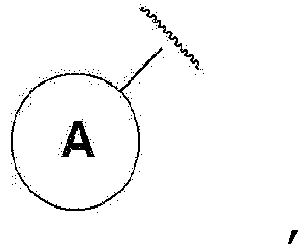
| Example | DYRK1A (µM) |
| 1 | C |
| 2 | A |
| 4 | C |
| 5 | B |
| 10 | A |
| 23 | C |
| 27 | C |
| 53 | B |
| 56 | A |
| 57 | A |
| 59 | A |
| 60 | B |
| 61 | A |
| 63 | A |
| 65 | A |
| 67 | A |
| Example | IC50 (µM) |
| 2 | A |
| 54 | C |
| 55 | C |
| 69 | B |
| 70 | B |
| 71 | C |
| 64 | B |
| 66 | B |
| 72 | C |
| 73 | B |
| 74 | B |
| 75 | C |
| 77 | C |
| 78 | B |
| 79 | B |
| 87 | B |
| 88 | B |
| 89 | B |
| 90 | B |
| 91 | B |
| 92 | C |
| 93 | C |
| 94 | B |
| 95 | B |
Claims (12)
- A compound represented by chemical formula 1 below, an optical isomer thereof or a pharmaceutically acceptable salt thereof:
 Z is cyano (-CN); or straight or branched C1-C3 alkyl substituted with one or more halogens;X is -NRa-, -O- or -S-, wherein Ra is hydrogen or straight or branched C1-C10 alkyl, wherein, the alkyl can be substituted with one or more substituents selected from the group consisting of -OH and C1-C3 alkoxy;R1 is straight or branched C1-C10 alkyl, C3-C8 cycloalkyl or C6-14 aryl, wherein, the alkyl or cycloalkyl can be substituted with one or more substituents selected from the group consisting of-OH, and, straight or branched C1-C3 alkyl and C1-C3 alkoxy, and the aryl can be substituted with one or more substituents selected from the group consisting of straight or branched C1-C3 alkyl and straight or branched C1-C3 alkoxy, nonsubstituted or substituted with one or more halogens;or, Ra can form nonsubstituted or substituted 5-8 membered heterocycloalkyl containing one or more heteroatoms selected from the group consisting of N, O and S along with R1 and nitrogen atom to which they are attached, and the substituted heterocycloalkyl can be substituted with one or more substituents selected from the group consisting of straight or branched C1-C6 alkyl and straight or branched C1-C6 alkoxy; and

 wherein, each R2, R4, R6, R8, R11, R17, R23 and R24 are independently one or more substituents selected from the group consisting of hydrogen, halogen, straight or branched C1-C6 alkyl and straight or branched C1-C6 alkoxy;R3, R5, R7 and R9 are independently hydrogen; straight or branched C1-C6 alkyl or alkoxy; 3-8 membered heterocycloalkyl containing one or more heteroatoms selected from the group consisting of N and O; or -(C=O)NR26R27, wherein R26 and R27 are independently hydrogen, straight or branched C1-C3 alkyl or 3-8 membered heterocycloalkyl containing one or more heteroatoms selected from the group consisting of N and O substituted with 3-5 membered heterocycloalkyl containing one or more oxygen atoms, or, R26 and R27 form 3-8 membered heterocycloalkyl containing one or more heteroatoms selected from the group consisting of N and O along with nitrogen atom to which they are attached, wherein, the alkyl or heterocycloalkyl is substituted with one or more substituents selected from the group consisting of-CN, halogen, straight or branched C1-C3 alkyl, and, 3-6 membered heterocycloalkyl containing one or more heteroatoms selected from the group consisting of N and O nonsubstituted or substituted with one or more straight or branched C1-C3 alkylR10 is -CR28R29-CN, wherein R28 and R29 are independently hydrogen or straight or branched C1-C3 alkyl,R12, R13, R14, R15, R18, R19, R20 and R21 are independently hydrogen or straight or branched C1-C3 alkyl, or, two of R12, R13, R14, R15, R18, R19, R20 and R21 bonded to the same carbon can form carbonyl along with the carbon to which they are attached, andR16, R22 and R25 are independently hydrogen or straight or branched C1-C3 alkyl, wherein the alkyl can be substituted with one or more halogens).
 - The compound, the optical isomer thereof or the pharmaceutically acceptable salt thereof according to claim 1, wherein:Z is -CN or methyl substituted with one or more halogens;X is -NRa- or -O-, wherein Ra is hydrogen or straight or branched C1-C6 alkyl, wherein, the alkyl can be substituted with one or more substituents selected from the group consisting of -OH and C1-C3 alkoxy;R1 is straight or branched C1-C6 alkyl, C3-C8 cycloalkyl or C6-10 aryl, wherein, the alkyl can be substituted with one or more substituents selected from the group consisting of -OH, methyl and methoxy, and the aryl can be substituted with one or more substituents selected from the group consisting of methyl and methoxy, nonsubstituted or substituted with one or more halogens;or, Ra can form nonsubstituted or substituted 5-6 membered heterocycloalkyl containing one or more heteroatoms selected from the group consisting of N, O and S along with R1 and nitrogen atom to which they are attached, and the substituted heterocycloalkyl can be substituted with one or more substituents selected from the group consisting of straight or branched C1-C3 alkyl and straight or branched C1-C3 alkoxy; and

 wherein, R2, R4, R6, R8, R11, R17, R23 and R24 are independently one or more substituents selected from the group consisting of hydrogen, halogen, straight or branched C1-C3 alkyl and straight or branched C1-C3 alkoxy;R3, R5, R7 and R9 are independently hydrogen, straight or branched C1-C3 alkyl or alkoxy, morpholinyl, piperazinyl, piperidinyl or -(C=O)NR26R27,wherein R26 and R27 are independently hydrogen, methyl, morpholinyl, piperazinyl or piperidinyl, or, R26 and R27 form morpholinyl, piperazinyl or piperidinyl along with nitrogen atom to which they are attached, wherein, the C1-C3 alkyl, morpholinyl, piperazinyl or piperidinyl can be substituted with one or more substituents selected from the group consisting of -CN, fluoro, oxetanyl, morpholinyl, piperazinyl, and, nonsubstituted or substituted with methyl piperidinyl,R10 is -CR28R29-CN, wherein R28 and R29 are independently hydrogen, methyl or ethyl,R12, R13, R14, R15, R18, R19, R20 and R21 are independently hydrogen, methyl or ethyl, or, two of R12, R13, R14, R15, R18, R19, R20 and R21 bonded to the same carbon can form carbonyl along with the carbon to which they are attached, andR16, R22 and R25 are independently hydrogen, methyl nonsubstituted or substituted with one or more halogens or ethyl nonsubstituted or substituted with one or more halogens.
 - The compound, the optical isomer thereof or the pharmaceutically acceptable salt thereof according to claim 1, wherein:Z is -CN or -CF3;X is -NRa- or -O-, wherein Ra is hydrogen or methyl;R1 is methyl, ethyl, n-propyl, isopropyl, cyclopropyl,
 or, Ra can form morpholinyl along with R1 and nitrogen atom to which they are attached; and
 wherein, R2, R4, R6, R8, R11, R17, R23 and R24 are independently one or more substituents selected from the group consisting of hydrogen, chloro, fluoro, methyl and methoxy;R3 and R7 are independently methoxy,

 R5 and R9 are independently methyl, isopropyl,
 R10 is -CR28R29-CN, wherein R28 and R29 are independently hydrogen or methyl,R12, R13, R14, R15, R18, R19, R20 and R21 are independently hydrogen or methyl, or, two of R12, R13, R14, R15, R18, R19, R20 and R21 bonded to the same carbon can form carbonyl along with the carbon to which they are attached, andR16, R22 and R25 are independently hydrogen, or, methyl nonsubstituted or substituted with one or more halogens.
 - The compound, the optical isomer thereof or the pharmaceutically acceptable salt thereof according to claim 1, wherein:Z is -CN or -CF3;X is -NRa- or -O-, wherein Ra is hydrogen or methyl;R1 is methyl, ethyl, n-propyl, isopropyl, cyclopropyl,

 or, Ra can form morpholinyl along with R1 and nitrogen atom to which they are attached; and


- The compound, the optical isomer thereof or the pharmaceutically acceptable salt thereof according to claim 1, wherein the compound represented by chemical formula 1 is selected from the group consisting of the following compounds:
(1) 6-((2-methoxy-4-(morpholine-4-carbonyl)phenyl)amino)-4-(methylamino)-1H-pyrrolo[2,3-b]pyridine-3-carbonitrile; (2) 4-(ethylamino)-6-((2-methoxy-4-(morpholine-4-carbonyl)phenyl)amino)-1H-pyrrolo[2,3-b]pyridine-3-carbonitrile; (3) 6-((2-methoxy-4-(4-morpholinopiperidine-1-carbonyl)phenyl)amino)-4-((2-methoxyethyl)amino)-1H-pyrrolo[2,3-b]pyridine-3-carbonitrile; (4) 6-((2-methoxy-4-(morpholine-4-carbonyl)phenyl)amino)-4-((2-methoxyethyl)amino)-1H-pyrrolo[2,3-b]pyridine-3-carbonitrile; (5) 4-((2-methoxyethyl)amino)-6-((3,4,5-trimethoxyphenyl)amino)-1H-pyrrolo[2,3-b]pyridine-3-carbonitrile; (6) 4-((2-methoxyethyl)amino)-6-((1-methyl-1H-pyrazol-4-yl)amino)-1H-pyrrolo[2,3-b]pyridine-3-carbonitrile; (7) 4-((2-methoxyethyl)amino)-6-((1-methyl-1H-pyrazol-3-yl)amino)-1H-pyrrolo[2,3-b]pyridine-3-carbonitrile; (8) 4-(ethylamino)-6-((3,4,5-trimethoxyphenyl)amino)-1H-pyrrolo[2,3-blpyridine-3-carbonitrile; (9) 6-((2-methoxy-4-(4-morpholinopiperidine-1-carbonyl)phenyl)amino)-4-(propylamino)-1H-pyrrolo[2,3-b]pyridine-3-carbonitrile; (10) 6-((2-methoxy-4-(morpholine-4-carbonyl)phenyl)amino)-4-(propylamino)-1H-pyrrolo[2,3-b]pyridine-3-carbonitrile; (11) 4-(propylamino)-6-((3,4,5-trimethoxyphenyl)amino)-1H-pyrrolo[2,3-b]pyridine-3-carbonitrile; (12) 6-((1-methyl-1H-pyrazol-4-yl)amino)-4-(propylamino)-1H-pyrrolo[2,3-b]pyridine-3-carbonitrile; (13) 6-((1-methyl-1H-pyrazol-3-yl)amino)-4-(propylamino)-1H-pyrrolo[2,3-b]pyridine-3-carbonitrile; (14) 4-(ethylamino)-6-((1-methyl-1H-pyrazol-4-yl)amino)-1H-pyrrolo[2,3-b]pyridine-3-carbonitrile; (15) 4-(ethylamino)-6-((1-methyl-1H-pyrazol-3-yl)amino)-1H-pyrrolo[2,3-b]pyridine-3-carbonitrile; (16) 6-((2-methoxy-4-(4-morpholinopiperidine-1-carbonyl)phenyl)amino)-4-(methylamino)-1H-pyrrolo[2,3-b]pyridine-3-carbonitrile; (17) 6-((5-fluoro-2-methoxy-4-(4-morpholinopiperidine-1-carbonyl)phenyl)amino)-4-(methylamino)-1H-pyrrolo[2,3-b]pyridine-3-carbonitrile; (18) 4-(ethylamino)-6-((2-methoxy-4-(4-morpholinopiperidine-1-carbonyl)phenyl)amino)-1H-pyrrolo[2,3-b]pyridine-3-carbonitrile; (19) 6-((5-fluoro-2-methoxy-4-(morpholine-4-carbonyl)phenyl)amino)-4-(methylamino)-1H-pyrrolo[2,3-b]pyridine-3-carbonitrile; (20) 6-((2-methoxy-4-(morpholine-4-carbonyl)phenyl)amino)-4-((2-methoxyethyl)(methyl)amino)-1H-pyrrolo[2,3-b]pyridine-3-carbonitrile; (21) 6-((5-fluoro-2-methoxy-4-(morpholine-4-carbonyl)phenyl)amino)-4-((2-methoxyethyl)(methyl)amino)-1H-pyrrolo[2,3-b]pyridine-3-carbonitrile; (22) (R)-6-((2-methoxy-4-(2-methylmorpholine-4-carbonyl)phenyl)amino)-4-(methylamino)-1H-pyrrolo[2,3-b]pyridine-3-carbonitrile; (23) (S)-6-((2-methoxy-4-(2-methylmorpholine-4-carbonyl)phenyl)amino)-4-(methylamino)-1H-pyrrolo[2,3-b]pyridine-3-carbonitrile; (24) 6-((4-((2R,6S)-2,6-dimethylmorpholine-4-carbonyl)-2-methoxyphenyl)amino)-4-(methylamino)-1H-pyrrolo[2,3-b]pyridine-3-carbonitrile; (25) 6-((4-(4,4-difluoropiperidine-1-carbonyl)-2-methoxyphenyl)amino)-4-(methylamino)-1H-pyrrolo[2,3-b]pyridine-3-carbonitrile; (26) (R)-4-(ethylamino)-6-((2-methoxy-4-(2-methylmorpholine-4-carbonyl)phenyl)amino)-1H-pyrrolo[2,3-b]pyridine-3-carbonitrile; (27) (S)-4-(ethylamino)-6-((2-methoxy-4-(2-methylmorpholine-4-carbonyl)phenyl)amino)-1H-pyrrolo[2,3-b]pyridine-3-carbonitrile; (28) 6-((4-((2R,6S)-2,6-dimethylmorpholine-4-carbonyl)-2-methoxyphenyl)amino)-4-(ethylamino)-1H-pyrrolo[2,3-b]pyridine-3-carbonitrile; (29) 6-((4-(4,4-difluoropiperidine-1-carbonyl)-2-methoxyphenyl)amino)-4-(ethylamino)-1H-pyrrolo[2,3-b]pyridine-3-carbonitrile; (30) 6-((1,3-dimethyl-1H-pyrazol-4-yl)amino)-4-(ethylamino)-1H-pyrrolo[2,3-b]pyridine-3-carbonitrile; (31) 6-((1,5-dimethyl-1H-pyrazol-4-yl)amino)-4-(ethylamino)-1H-pyrrolo[2,3-b]pyridine-3-carbonitrile; (32) 4-(ethylamino)-6-((1-isopropyl-3-methyl-1H-pyrazol-4-yl)amino)-1H-pyrrolo[2,3-b]pyridine-3-carbonitrile; (33) 4-(ethylamino)-6-((1-isopropyl-5-methyl-1H-pyrazol-4-yl)amino)-1H-pyrrolo[2,3-b]pyridine-3-carbonitrile; (34) 6-((1,5-dimethyl-1H-pyrazol-4-yl)amino)-4-(methylamino)-1H-pyrrolo[2,3-b]pyridine-3-carbonitrile; (35) 6-((1,3-dimethyl-1H-pyrazol-4-yl)amino)-4-(methylamino)-1H-pyrrolo[2,3-b]pyridine-3-carbonitrile; (36) 6-((1-isopropyl-3-methyl-1H-pyrazol-4-yl)amino)-4-(methylamino)-1H-pyrrolo[2,3-b]pyridine-3-carbonitrile; (37) 6-((1-isopropyl-5-methyl-1H-pyrazol-4-yl)amino)-4-(methylamino)-1H-pyrrolo[2,3-b]pyridine-3-carbonitrile; (38) 6-((1-(2-cyanopropan-2-yl)-3-methyl-1H-pyrazol-4-yl)amino)-4-(methylamino)-1H-pyrrolo[2,3-b]pyridine-3-carbonitrile; (39) 6-((3-methoxy-5-(morpholine-4-carbonyl)pyridin-2-yl)amino)-4-(methylamino)-1H-pyrrolo[2,3-b]pyridine-3-carbonitrile; (40) 4-(ethylamino)-6-((3-methoxy-5-(morpholine-4-carbonyl)pyridin-2-yl)amino)-1H-pyrrolo[2,3-b]pyridine-3-carbonitrile; (41) 6-((5-chloro-1-((3S,4S)-3-fluoro-1-(oxetan-3-yl)piperidin-4-yl)-1H-pyrazol-4-yl)amino)(methylamino)-1H-pyrrolo[2,3-b]pyridine-3-carbonitrile; (42) 6-((5-chloro-1-((3S,4S)-3-fluoro-1-(oxetan-3-yl)piperidin-4-yl)-1H-pyrazol-4-yl)amino)(ethylamino)-1H-pyrrolo[2,3-b]pyridine-3-carbonitrile; (43) (R)-4-(ethylamino)-6-((3-methoxy-5-(2-methylmorpholine-4-carbonyl)pyridin-2-yl)amino)-1H-pyrrolo[2,3-b]pyridine-3-carbonitrile; (44) (R)-6-((3-methoxy-5-(2-methylmorpholine-4-carbonyl)pyridin-2-yl)amino)-4-(methylamino)-1H-pyrrolo[2,3-b]pyridine-3-carbonitrile; (45) 3-methoxy-4-((4-morpholino-3-(trifluoromethyl)-1H-pyrrolo[2,3-b]pyridin-6-yl)amino)phenyl)(4-methylpiperazin-1-yl)methanone; (46) (3-methoxy-4-((4-morpholino-3-(trifluoromethyl)-1H-pyrrolo[2,3-b]pyridin-6-yl)amino)phenyl)(4-(4-methylpiperazin-1-yl)piperidin-1-yl)methanone; (47) 4-methoxy-6-((2-methoxy-4-(4-morpholinopiperidine-1-carbonyl)phenyl)amino)-1H-pyrrolo[2,3-b]pyridine-3-carbonitrile; (48) 4-methoxy-6-((2-methoxy-4-(morpholine-4-carbonyl)phenyl)amino)-1H-pyrrolo[2,3-b]pyridine-3-carbonitrile; (49) 4-ethoxy-6-((2-methoxy-4-(4-morpholinopiperidine-1-carbonyl)phenyl)amino)-1H-pyrrolo[2,3-b]pyridine-3-carbonitrile; (50) 4-ethoxy-6-((2-methoxy-4-(morpholine-4-carbonyl)phenyl)amino)-1H-pyrrolo[2,3-b]pyridine-3-carbonitrile; (51) (R)-6-((3-methoxy-5-(2-methylmorpholine-4-carbonyl)pyridin-2-yl)amino)-4-(1-methylcyclopropoxy)-1H-pyrrolo[2,3-b]pyridine-3-carbonitrile; (52) 6-((3-methoxy-5-(morpholine-4-carbonyl)pyridin-2-yl)amino)-4-(1-methylcyclopropoxy)-1H-pyrrolo[2,3-b]pyridine-3-carbonitrile; (53) N4-ethyl-3-(trifluoromethyl)-N6-(3,4,5-trimethoxyphenyl)-1H-pyrrolo[2,3-b]pyridine-4,6-diamine; (54) N4-ethyl-N6-(1-methyl-1H-pyrazol-3-yl)-3-(trifluoromethyl)-1H-pyrrolo[2,3-b]pyridine-4,6-diamine; (55) N4-ethyl-N6-(1-methyl-1H-pyrazol-4-yl)-3-(trifluoromethyl)-1H-pyrrolo[2,3-b]pyridine-4,6-diamine; (56) (4-((4-(ethylamino)-3-(trifluoromethyl)-1H-pyrrolo[2,3-b]pyridin-6-yl)amino)-3-methoxyphenyl)(morpholino)methanone; (57) (4-((4-(ethylamino)-3-(trifluoromethyl)-1H-pyrrolo[2,3-b]pyridin-6-yl)amino)-3-methoxyphenyl)(4-morpholinopiperidin-1-yl)methanone; (58) (3-methoxy-4-((4-(methylamino)-3-(trifluoromethyl)-1H-pyrrolo[2,3-b]pyridin-6-yl)amino)phenyl)(morpholino)methanone; (59) (3-methoxy-4-((4-(methylamino)-3-(trifluoromethyl)-1H-pyrrolo[2,3-b]pyridin-6-yl)amino)phenyl)(4-morpholinopiperidin-1-yl)methanone; (60) (2-fluoro-5-methoxy-4-((4-(methylamino)-3-(trifluoromethyl)-1H-pyrrolo[2,3-b]pyridin-6-yl)amino)phenyl)(4-methylpiperazin-1-yl)methanone; (61) (3-methoxy-4-((4-(methylamino)-3-(trifluoromethyl)-1H-pyrrolo[2,3-b]pyridin-6-yl)amino)phenyl)(4-(4-methylpiperazin-1-yl)piperidin-1-yl)methanone; (62) N6-(2-methoxy-4-(4-methylpiperazin-1-yl)phenyl)-N4-methyl-3-(trifluoromethyl)-1H-pyrrolo[2,3-b]pyridine-4,6-diamine; (63) (3-methoxy-4-((4-(methylamino)-3-(trifluoromethyl)-1H-pyrrolo[2,3-b]pyridin-6-yl)amino)phenyl)(4-methylpiperazin-1-yl)methanone; (64) (3-methoxy-4-((4-((2-methoxyethyl)amino)-3-(trifluoromethyl)-1H-pyrrolo[2,3-b]pyridine-6yl)amino)phenyl)(morpholino)methanone; (65) (3-methoxy-4-((4-((2-methoxyethyl)amino)-3-(trifluoromethyl)-1H-pyrrolo[2,3-b]pyridin-6-yl)amino)phenyl)(4-morpholinopiperidin-1-yl)methanone; (66) (3-methoxy-4-((4-((2-methoxyethyl)amino)-3-(trifluoromethyl)-1H-pyrrolo[2,3-b]pyridin-6-yl)amino)phenyl)(4-methylpiperazin-1-yl)-methanone; (67) (3-methoxy-4-((4-((2-methoxyethyl)amino)-3-(trifluoromethyl)-1H-pyrrolo[2,3-b]pyridin-6-yl)amino)phenyl)(4-methylpiperazin-1-yl)piperidin-1-yl)methanone; (68) N6-(2-methoxy-4-(4-methylpiperazin-1-yl)phenyl)-N4-(2-methoxyethyl)-3-(trifluoromethyl)-1H-pyrrolo[2,3-b]pyridine-4,6-diamine; (69) N6-(5-chloro-1-((3S,4S)-3-fluoro-1-(oxetan-3-yl)piperidin-4-yl)-1H-pyrazol-4-yl)-N4-ethyl-3-(trifluoromethyl)-1H-pyrrolo[2,3-b]pyridine-4,6-diamine; (70) (4-(ethylamino)-3-(trifluoromethyl)-1H-pyrrolo[2,3-b]pyridin-6-yl)amino)-3-methoxyphenyl)(4-(4-methylpiperazin-1-yl)piperidin-1-yl)methanone; (71) 4-((4-(ethylamino)-3-(trifluoromethyl)-1H-pyrrolo[2,3-b]pyridin-6-yl)amino)-2-fluoro-5methoxy-N-(1-(oxetanepiperidin-4-yl)benzamide; (72) 4-((4-(ethylamino)-3-(trifluoromethyl)-1H-pyrrolo[2,3-b]pyridin-6-yl)amino)-2-fluoro-5-methoxy-N-(1-methylpiperidin-4-yl)benzylamide; (73) 2-fluoro-5-methoxy-4-((4-((2-methoxyethyl)amino)-3-(trifluoromethyl)-1H-pyrrolo[2,3-b]pyridin-6-yl)amino)(1-methylpiperidin-4-yl)benzamide; (74) 4-((4-(ethylamino-3-(trifluoromethyl)-1H-pyrrolo[2,3-b]pyridin-6-yl)amino)-2-fluoro-N-(1-isopropylpiperidin-4-yl)-5-methoxybenzamide; (75) (R)-(2,4-dimethylpiperazin-1-yl)(2-fluoro-5-methoxy-4-((4-(methylamino)-3-(trifluoromethyl)-1H-pyrrolo[2,3-b]pyridin-6-yl)amino)phenyl)methanone; (76) (3-methoxy-4-((4-morpholino-3-(trifluoromethyl)-1H-pyrrolo[2,3-b]pyridin-6-yl)amino)phenyl)(morpholino)methanone; (77) N-(5-chloro-1-((3S,4S)-3-fluoro-1-(oxetan-3-yl)piperidin-4-yl)-1H-pyrazol-4-yl)-4-morpholino-3-(trifluoromethyl)-1H-pyrrolo[2,3-b]pyridine-6-amine; (78) N6-(5-chloro-1-((3S, 4S)-3-fluoro-1-(oxetan-3-yl)piperidin-4-yl)-1H-pyrazol-4-yl)-N4-methyl-3-(trifluoromethyl)-1H-pyrrolo[2,3-b]pyridine-4,6-diamine; (79) N6-(5-chloro-1-((3S, 4S)-3-fluoro-1-(oxetan-3-yl)piperidin-4-yl)-1H-pyrazol-4-yl)-3-methoxyethyl)-3-(trifluoromethyl)-1H-pyrrolo[2,3-b]pyridine-4,6-diamine; (80) 1-(6-((4-(ethylamino)-3-(trifluoromethyl)-1H-pyrrolo[2,3-b]pyridin-6-yl)amino)-7-methoxy-3,4-dihydroisoquinolin-2(1H)-yl)-2,2,2-trifluoroethan-1-one; (81) N4-ethyl-N6-(7-methoxy-1,2,3,4-tetrahydroisoquinolin-6-yl)-3-(trifluoromethyl)-1H-pyrrolo[2,3-b]pyridine-4,6-diamine; (82) (3-methoxy-4-((4-morpholino-3-(trifluoromethyl)-1H-pyrrolo[2,3-b]pyridin-6-yl)amino)phenyl)(4-methylpiperazin-1-yl)methanone; (83) (3-methoxy-4-((4-morpholino-3-(trifluoromethyl)-1H-pyrrolo[2,3-b]pyridin-6-yl)amino)phenyl)(4-(4-methylpiperazin-1-yl)piperidin-1-yl)methanone; (84) (3-methoxy-4-(3-(trifluoromethyl)-4-(3-(trifluoromethyl)phenylamino)-1H-pyrrolo[2,3-b]pyridin-6-ylamino)phenyl)(morpholino)methanone; (85) (3-methoxy-4-(3-(trifluoromethyl)-4-(3-(trifluoromethyl)phenylamino)-1H-pyrrolo[2,3-b]pyridin-6-ylamino)phenyl)(4-morpholinopiperidin-1-yl)methanone; (86) N6-(5-chloro-1-((3S, 4S)-3-fluoro-1-(oxetan-3-yl)piperidin-4-yl)-1H-pyrazol-4-yl)-3-(trifluoromethyl)-N4-(3-(trifluoromethyl)phenyl)-1H-pyrrolo[2,3-b]pyridine-4,6-diamine; (87) (3-methoxy-4-((4-methoxyethyl)(methyl)amino)-3-(trifluoromethyl)-1H-pyrrolo[2,3-b]pyridin-6-yl)amino)phenyl)(morpholino)methanone; (88) (3-methoxy-4-((4-methoxyethyl)(methyl)amino)-3-(trifluoromethyl)-1H-pyrrolo[2,3-b]pyridin-6-yl)amino)phenyl)((4-morpholinopiperidin-1-yl)methanone; (89) N6-(5-chloro-1-((3S,4S)-3-fluoro-1-(oxetan-3-yl)piperidin-4-yl)-1H-pyrazol-4-yl)methoxyethyl)-N4-methyl-3-(trifluoromethyl)-1H-pyrrolo[2,3-b]pyridine-4,6-diamine; (90) (4-(4-(isopropylamino)-3-(trifluoromethyl)-1H-pyrrolo[2,3-b]pyridin-6-ylamino)-3-methoxyphenyl)(4-morpholinopiperidin-1-yl)methanone; (91) (R)-(4-((4-((1-hydroxy-3-methylbutan-2-yl)amino)-3-(trifluoromethyl)-1H-pyrrolo[2,3-b]amino)-3-methoxyphenyl)(4-morpholinopiperidin-1-yl)methanone; (92) (R)-(4-((4-((1-hydroxy-3-methylbutan-2-yl)amino)-3-(trifluoromethyl)-1H-pyrrolo[2,3-b]amino)-3-methoxyphenyl)(morpholino)methanone; (93) (S)-(4-((4-(2-butylamino)-3-(trifluoromethyl)-1H-pyrrolo[2,3-b]pyridin-6-yl)amino)-3-methoxyphenyl)(4-morpholinopiperidin-1-yl)-methanone; (94) (4-((4-(cyclopropylamino)-3-(trifluoromethyl)-1-((2-(trimethylsilyl)ethoxy)methyl)-1H-pyrrolo[2,3-b]pyridin-6-yl)-3-methoxyphenyl)(4-morpholinopiperidin-1-yl)methanone; (95) (4-((4-(cyclopropylamino)-3-(trifluoromethyl)-1H-pyrrolo[2,3-b]pyridin-6-yl)amino)-3-methoxyphenyl)(morpholino)methanone; (96) 5-((4-(ethylamino)-3-(trifluoromethyl)-1H-pyrrolo[2,3-b]pyridin-6-yl)amino)-6-methoxy-2-methylisoindolin-1-one; (97) 7-((4-(ethylamino)-3-(trifluoromethyl)-1H-pyrrolo[2,3-b]pyridin-6-yl)amino)-6-methoxy-2,2,4-trimethyl-2H-benzo[1,4]oxazin-3(4H)-1-one; (98) 6-((4-(ethylamino)-3-(trifluoromethyl)-1H-pyrrolo[2,3-b]pyridin-6-yl)amino)-5-methoxy-2-methylisoindolin-1-one; (99) 4-(ethylamino)-6-((6-methoxy-2-methyl-3-oxoisoindol-5-yl)amino)-1H-pyrrolo[2,3-b]pyridine-3-carbonitrile; (100) 6-((2(2-cyanopropan-2-yl)-4-methylthiazol-5-yl)amino)-4-(ethylamino)-1H-pyrrolo[2,3-b]pyridine-3-carbonitrile; (101) (6-chloro-5-((4-(ethylamino)-3-(trifluoromethyl)-1H-pyrrolo[2,3-b]pyridin-6-yl)amino)-2-methylisoindolin-1-one; (102) 5-((4-(ethylamino)-3-(trifluoromethyl)-1H-pyrrolo[2,3-b]pyridin-6-yl)amino)-2-methylisoindolin-1-one; (103) 4-(ethylamino)-6-((2-methyl-1-oxoisoindol-5-yl)amino)-1H-pyrrolo[2, 3-b]pyridine-3-carbonitrile; (104) 6-((6-chloro-2-methyl-1-oxoisoindolin-5-yl)amino)-4-(ethylamino)-1H-pyrrolo[2,3-b]pyridine-3-carbonitrile; and, (105) 4-(ethylamino)-6-((6-methoxy-2,2,4-trimethyl-3-oxo-3,4-dihydro-2H-benzo[b][1,4]oxazin-7-yl)amino)-1H-pyrrolo[2,3-b]pyridine-3-carbonitrile. - A preparation method of a compound represented by chemical formula 1 comprising the following steps, as shown in reaction formula 1 below:preparing a compound represented by chemical formula 4 by reacting a compound represented by chemical formula 2 with a compound represented by chemical formula 3 (step 1); andpreparing a compound represented by chemical formula 1 by reacting the compound represented by chemical formula 4 prepared in step 1 above in the presence of an acid (step 2):
 (In reaction formula 1, X, Z, R1 and
 X' is halogen; andPG is (2-(trimethylsilyl)methoxy)methyl (SEM), t-butyloxycarbonyl (BOC), carbobenzyloxy (Cbz), 9-fluorenylmethyloxycarbonyl (Fmoc), acetyl (Ac), benzoyl (Bz), benzyl (Bn), 3,4-dimethoxybenzyl (DMPM), p-methoxyphenyl (PMP), tosyl (Ts), 2,2,2-trichloroethoxycarbonyl (Troc), 2-trimethylsilylethoxycarbonyl (Teoc), aryloxycarbonyl (Alloc) or p-methoxybenzyl (PMB)).
 - A pharmaceutical composition comprising the compound represented by chemical formula 1 of claim 1, the optical isomer thereof or the pharmaceutically acceptable salt thereof as an active ingredient for preventing or treating a disease selected from the group consisting of cancer, degenerative brain disease and metabolic disease.
- The pharmaceutical composition according to claim 7, wherein the compound inhibits protein kinase activity.
- The pharmaceutical composition according to claim 8, wherein the protein kinase is one or more enzymes selected from the group consisting of ALK, ALK (C1156Y), ALK (L1196M), CAMK1B, CAMK1D, CHEK2, CLK1, CLK2, CLK3, CLK4, CSNK1A1, CSNK1A1L, CSNK1D, CSNK1E, CSNK1G2, CSNK1G3, DAPK1, DAPK2, DAPK3, DRAK2, DYRK1A, DYRK1B, DYRK2, ERK5, ERN1, GAK, HASPIN, INSRR, JNK1, JNK2, JNK3, KIT (V559D), LATS2, LRRK2, LRRK2 (G2019S), LTK, MAPKAPK2, MEK1, MEK2, MEK3, MEK4, MYLK, NIK, PHKG1, PHKG2, PIP5K2C, PRKD1, PRKD2, PRKD3, RIPK5, ROCK1, ROCK2, RPS6KA4 (Kin.Dom.2-C-terminal), RPS6KA5 (Kin.Dom.2-C-terminal), RSK3 (Kin.Dom.2-C-terminal), STK33, STK39, TSSK1B, TSSK3, TTK and YSK4.
- The pharmaceutical composition according to claim 7, wherein the degenerative brain disease is one or more diseases selected from the group consisting of Alzheimer's disease, Down syndrome, Parkinson's disease, Lou Gehrig's disease, dementia, Huntington's disease, multiple sclerosis, proximal lateral sclerosis, apoplexy, stroke or mild cognitive impairment.
- The pharmaceutical composition according to claim 10, wherein the dementia is one or more diseases selected from the group consisting of Alzheimer's dementia, cerebrovascular dementia, dementia caused by head injury, multi-infarct dementia, Alzheimer's/multi-infarction dementia and alcoholic dementia.
- The pharmaceutical composition according to claim 7, wherein the metabolic disease is one or more diseases selected from the group consisting of diabetes, hypoglycemia, hypercholesterolemia, hyperlipidemia, hemochromatosis, amyloidosis and porphyria.
Applications Claiming Priority (2)
| Application Number | Priority Date | Filing Date | Title |
|---|---|---|---|
| KR20170036845 | 2017-03-23 | ||
| PCT/KR2018/003459 WO2018174650A1 (en) | 2017-03-23 | 2018-03-23 | Pyrrolo-pyridine derivative compound, method for preparing same, and pharmaceutical composition containing same as active ingredient for prevention or treatment of protein kinase-related diseases |
Publications (3)
| Publication Number | Publication Date |
|---|---|
| EP3604304A1 true EP3604304A1 (en) | 2020-02-05 |
| EP3604304A4 EP3604304A4 (en) | 2020-12-16 |
| EP3604304B1 EP3604304B1 (en) | 2022-09-07 |
Family
ID=63586436
Family Applications (1)
| Application Number | Title | Priority Date | Filing Date |
|---|---|---|---|
| EP18770572.8A Active EP3604304B1 (en) | 2017-03-23 | 2018-03-23 | Pyrrolo-pyridine derivative compound, method for preparing same, and pharmaceutical composition containing same as active ingredient for prevention or treatment of protein kinase-related diseases |
Country Status (14)
| Country | Link |
|---|---|
| US (2) | US11117892B2 (en) |
| EP (1) | EP3604304B1 (en) |
| JP (1) | JP6708849B1 (en) |
| KR (1) | KR101896568B1 (en) |
| CN (1) | CN110662745B (en) |
| AU (1) | AU2018239798B2 (en) |
| CA (1) | CA3057591C (en) |
| DK (1) | DK3604304T3 (en) |
| ES (1) | ES2930106T3 (en) |
| FI (1) | FI3604304T3 (en) |
| MX (1) | MX384072B (en) |
| PT (1) | PT3604304T (en) |
| RU (1) | RU2730849C1 (en) |
| WO (1) | WO2018174650A1 (en) |
Cited By (1)
| Publication number | Priority date | Publication date | Assignee | Title |
|---|---|---|---|---|
| EP3915986A4 (en) * | 2019-03-13 | 2023-01-25 | Voronoi Inc. | Heteroaryl derivatives and pharmaceutical composition comprising same as active ingredient |
Families Citing this family (6)
| Publication number | Priority date | Publication date | Assignee | Title |
|---|---|---|---|---|
| EP3915985A4 (en) | 2019-01-18 | 2022-09-28 | Voronoi Co., Ltd. | PYRROLOPYRIDINE DERIVATIVE AND ITS USE IN THE PREVENTION AND TREATMENT OF PROTEIN KINASE RELATED DISEASE |
| WO2020235973A1 (en) * | 2019-05-22 | 2020-11-26 | 주식회사 보로노이 | Novel use of pyrrolo-pyridine derivative compound for prevention and/or treatment of cancer |
| CN116113828A (en) * | 2020-07-10 | 2023-05-12 | 韩国生命工学研究院 | Reagent composition for detection of illegal drugs and sheet-type kit for detection of illegal drugs including same |
| AU2021371697B2 (en) * | 2020-10-29 | 2024-10-24 | Suzhou Yabao Pharmaceutical R&D Co., Ltd. | Substituted diarylamine compound, pharmaceutical composition thereof, preparation method therefor, and use thereof |
| KR20220081631A (en) * | 2020-12-09 | 2022-06-16 | 보로노이 주식회사 | Novel use of pyrolo-pyridine derivatives for preventing or treating inflammatory diseases |
| US20250339442A1 (en) * | 2022-05-13 | 2025-11-06 | Fresh Tracks Therapeutics, Inc. | Methods of treatment using a dual specificity tyrosine-phosphorylation-regulated kinase 1a (dyrk1a) inhibitor |
Family Cites Families (14)
| Publication number | Priority date | Publication date | Assignee | Title |
|---|---|---|---|---|
| JP2008545660A (en) * | 2005-05-20 | 2008-12-18 | バーテックス ファーマシューティカルズ インコーポレイテッド | Pyrropyridine compounds useful as protein kinase inhibitors |
| CN102127078A (en) | 2005-07-14 | 2011-07-20 | 安斯泰来制药株式会社 | Heterocyclic janus kinase 3 inhibitors |
| FR2912744B1 (en) * | 2007-02-16 | 2012-09-07 | Centre Nat Rech Scient | PYRROLO-2,3-B-PYRIDINE COMPOUNDS, AZAIN-DOLES COMPOUNDS USEFUL IN THE SYNTHESIS OF THESE PYRROLO-2,3-B-PYRIDINE COMPOUNDS, METHODS OF MAKING THEM AND USES THEREOF. |
| WO2009032703A1 (en) * | 2007-08-28 | 2009-03-12 | Irm Llc | 2- (het) arylamino-6-aminopyridine derivatives and fused forms thereof as anaplastic lymphoma kinase inhibitors |
| US9273077B2 (en) | 2008-05-21 | 2016-03-01 | Ariad Pharmaceuticals, Inc. | Phosphorus derivatives as kinase inhibitors |
| EP2937345B1 (en) | 2009-12-29 | 2018-03-21 | Dana-Farber Cancer Institute, Inc. | Type ii raf kinase inhibitors |
| WO2012135631A1 (en) | 2011-03-30 | 2012-10-04 | Arrien Pharmaeuticals Llc | Substituted 5-(pyrazin-2-yl)-1h-pyrazolo [3, 4-b] pyridine and pyrazolo [3, 4-b] pyridine derivatives as protein kinase inhibitors |
| FR2999575A1 (en) * | 2012-12-18 | 2014-06-20 | Centre Nat Rech Scient | 3,5-DIARYL-AZAINDOLES AS INHIBITORS OF DYRK1A PROTEIN FOR THE TREATMENT OF COGNITIVE DEFICIENCIES RELATED TO DOWN SYNDROME AND ALZHEIMER'S DISEASE |
| TW201533043A (en) * | 2013-04-18 | 2015-09-01 | Lundbeck & Co As H | Arylpyrrolopyridine derived compounds as LRRK2 inhibitors |
| RU2016134751A (en) * | 2014-01-29 | 2018-03-02 | Глэксосмитклайн Интеллекчуал Проперти Дивелопмент Лимитед | COMPOUNDS |
| SG11201605342UA (en) | 2014-01-29 | 2016-08-30 | Glaxosmithkline Ip Dev Ltd | Compounds |
| KR20160106623A (en) * | 2014-01-29 | 2016-09-12 | 글락소스미스클라인 인털렉츄얼 프로퍼티 디벨로프먼트 리미티드 | Compounds |
| TWI703150B (en) * | 2015-06-04 | 2020-09-01 | 美商庫拉腫瘤技術股份有限公司 | Methods and compositions for inhibiting the interaction of menin and mll proteins |
| EP3587422A4 (en) * | 2017-02-22 | 2020-05-06 | Daegu-Gyeongbuk Medical Innovation Foundation | PYRROLO-PYRIMIDINE DERIVATIVE, PREPARATION METHOD THEREOF, AND PHARMACEUTICAL COMPOSITION COMPRISING SAME AS ACTIVE INGREDIENT FOR THE PREVENTION OR TREATMENT OF A PROTEIN KINASE-RELATED DISEASE |
-
2018
- 2018-03-23 FI FIEP18770572.8T patent/FI3604304T3/en active
- 2018-03-23 CA CA3057591A patent/CA3057591C/en active Active
- 2018-03-23 US US16/495,455 patent/US11117892B2/en active Active
- 2018-03-23 PT PT187705728T patent/PT3604304T/en unknown
- 2018-03-23 AU AU2018239798A patent/AU2018239798B2/en active Active
- 2018-03-23 EP EP18770572.8A patent/EP3604304B1/en active Active
- 2018-03-23 KR KR1020180034009A patent/KR101896568B1/en active Active
- 2018-03-23 ES ES18770572T patent/ES2930106T3/en active Active
- 2018-03-23 RU RU2019132955A patent/RU2730849C1/en active
- 2018-03-23 MX MX2019011305A patent/MX384072B/en unknown
- 2018-03-23 DK DK18770572.8T patent/DK3604304T3/en active
- 2018-03-23 WO PCT/KR2018/003459 patent/WO2018174650A1/en not_active Ceased
- 2018-03-23 JP JP2020500769A patent/JP6708849B1/en active Active
- 2018-03-23 CN CN201880034193.9A patent/CN110662745B/en active Active
-
2021
- 2021-08-10 US US17/398,478 patent/US20220106307A1/en not_active Abandoned
Cited By (1)
| Publication number | Priority date | Publication date | Assignee | Title |
|---|---|---|---|---|
| EP3915986A4 (en) * | 2019-03-13 | 2023-01-25 | Voronoi Inc. | Heteroaryl derivatives and pharmaceutical composition comprising same as active ingredient |
Also Published As
| Publication number | Publication date |
|---|---|
| CN110662745B (en) | 2021-08-03 |
| CA3057591A1 (en) | 2018-09-27 |
| FI3604304T3 (en) | 2022-12-15 |
| DK3604304T3 (en) | 2022-10-31 |
| AU2018239798A1 (en) | 2019-10-31 |
| PT3604304T (en) | 2022-11-30 |
| JP6708849B1 (en) | 2020-06-17 |
| RU2730849C1 (en) | 2020-08-26 |
| MX384072B (en) | 2025-03-04 |
| BR112019019872A2 (en) | 2020-04-22 |
| KR101896568B1 (en) | 2018-09-10 |
| JP2020520381A (en) | 2020-07-09 |
| WO2018174650A1 (en) | 2018-09-27 |
| US20220106307A1 (en) | 2022-04-07 |
| EP3604304A4 (en) | 2020-12-16 |
| WO2018174650A9 (en) | 2020-01-02 |
| US11117892B2 (en) | 2021-09-14 |
| CN110662745A (en) | 2020-01-07 |
| EP3604304B1 (en) | 2022-09-07 |
| AU2018239798B2 (en) | 2020-08-27 |
| US20200207756A1 (en) | 2020-07-02 |
| CA3057591C (en) | 2021-01-05 |
| ES2930106T3 (en) | 2022-12-05 |
Similar Documents
| Publication | Publication Date | Title |
|---|---|---|
| EP3604304B1 (en) | Pyrrolo-pyridine derivative compound, method for preparing same, and pharmaceutical composition containing same as active ingredient for prevention or treatment of protein kinase-related diseases | |
| KR102092812B1 (en) | Pyrolo-pyrimidine derivatives, preparation method thereof, and pharmaceutical composition for use in preventing or treating protein kinase related disease as an active ingredient | |
| KR102297587B1 (en) | A substituted heteroaryl derivatives, preparation method thereof, and pharmaceutical composition for use in preventing or treating protein kinase related disease as an active ingredient | |
| KR102782739B1 (en) | 2,4,5-substituted pyrimidine derivatives, preparation method thereof, and pharmaceutical composition for use in preventing or treating cancer containing the same as an active ingredient | |
| KR102901976B1 (en) | 2,4,5-substituted pyrimidine derivatives, preparation method thereof, and pharmaceutical composition for use in preventing or treating cancer or inflammatory disease in containing the same as an active ingredient | |
| KR101931435B1 (en) | Novel imidazopyridine derivatives, preparation method thereof, and pharmaceutical composition for use in preventing or treating cancer containing the same as an active ingredient | |
| EP3778604B1 (en) | Lrrk2 inhibitors and methods of making and using the same | |
| RU2551274C2 (en) | Quinoline-like compound substituted by phosphorus-containing group, method for preparing it, therapeutic composition containing this compound and using it | |
| EP3965803B1 (en) | Small-molecule focal adhesion kinase (fak) inhibitors | |
| KR20200020622A (en) | A substituted heteroaryl derivatives, preparation method thereof, and pharmaceutical composition for use in preventing or treating protein kinase related disease as an active ingredient | |
| KR102328435B1 (en) | Novel pyrido-pyrimidine derivatives, preparation method thereof, and pharmaceutical composition for use in preventing or treating protein kinase related disease containing the same as an active ingredient | |
| US20110112091A1 (en) | Derivatives of tetrabromobenzimidazole, a process for the preparation thereof, a pharmaceutical composition comprising the same, a methof of using the same, a method for modulating or regulating serine/threonine kinases, and serine/threonine kinases modulating agent | |
| KR20200006495A (en) | N-(3-(imidazo[1,2-b]pyridazin-3-ylethynyl)-4-methylphenyl)-5-phenyl-4,5-dihydro-1H-pyrazol-1-carboxamide derivatives and pharmaceutical composition for use in preventing or treating kinase-related disease | |
| KR102328423B1 (en) | Novel triazolo-pyrimidine derivatives, preparation method thereof, and pharmaceutical composition for use in preventing or treating protein kinase related disease containg the same as an active ingredient | |
| KR20200088945A (en) | benzo[b][1,4]oxazepin derivatives and pharmaceutical composition for use in preventing or treating kinase-related disease | |
| KR102286701B1 (en) | Pyrido[2,3-d]pyrimidine derivatives, preparation method thereof, and pharmaceutical composition for use in preventing or treating protein kinase related disease as an active ingredient | |
| EP4722212A1 (en) | Novel compound for inhibiting protein kinases and pharmaceutical composition comprising same |
Legal Events
| Date | Code | Title | Description |
|---|---|---|---|
| STAA | Information on the status of an ep patent application or granted ep patent |
Free format text: STATUS: THE INTERNATIONAL PUBLICATION HAS BEEN MADE |
|
| PUAI | Public reference made under article 153(3) epc to a published international application that has entered the european phase |
Free format text: ORIGINAL CODE: 0009012 |
|
| STAA | Information on the status of an ep patent application or granted ep patent |
Free format text: STATUS: REQUEST FOR EXAMINATION WAS MADE |
|
| 17P | Request for examination filed |
Effective date: 20191004 |
|
| AK | Designated contracting states |
Kind code of ref document: A1 Designated state(s): AL AT BE BG CH CY CZ DE DK EE ES FI FR GB GR HR HU IE IS IT LI LT LU LV MC MK MT NL NO PL PT RO RS SE SI SK SM TR |
|
| AX | Request for extension of the european patent |
Extension state: BA ME |
|
| DAV | Request for validation of the european patent (deleted) | ||
| DAX | Request for extension of the european patent (deleted) | ||
| A4 | Supplementary search report drawn up and despatched |
Effective date: 20201117 |
|
| RIC1 | Information provided on ipc code assigned before grant |
Ipc: A23L 33/10 20160101ALI20201111BHEP Ipc: A61K 31/5377 20060101ALI20201111BHEP Ipc: C07D 471/04 20060101AFI20201111BHEP Ipc: A61K 31/437 20060101ALI20201111BHEP |
|
| STAA | Information on the status of an ep patent application or granted ep patent |
Free format text: STATUS: EXAMINATION IS IN PROGRESS |
|
| 17Q | First examination report despatched |
Effective date: 20210730 |
|
| GRAP | Despatch of communication of intention to grant a patent |
Free format text: ORIGINAL CODE: EPIDOSNIGR1 |
|
| STAA | Information on the status of an ep patent application or granted ep patent |
Free format text: STATUS: GRANT OF PATENT IS INTENDED |
|
| INTG | Intention to grant announced |
Effective date: 20220329 |
|
| GRAS | Grant fee paid |
Free format text: ORIGINAL CODE: EPIDOSNIGR3 |
|
| GRAA | (expected) grant |
Free format text: ORIGINAL CODE: 0009210 |
|
| STAA | Information on the status of an ep patent application or granted ep patent |
Free format text: STATUS: THE PATENT HAS BEEN GRANTED |
|
| AK | Designated contracting states |
Kind code of ref document: B1 Designated state(s): AL AT BE BG CH CY CZ DE DK EE ES FI FR GB GR HR HU IE IS IT LI LT LU LV MC MK MT NL NO PL PT RO RS SE SI SK SM TR |
|
| REG | Reference to a national code |
Ref country code: GB Ref legal event code: FG4D |
|
| REG | Reference to a national code |
Ref country code: CH Ref legal event code: EP Ref country code: AT Ref legal event code: REF Ref document number: 1516972 Country of ref document: AT Kind code of ref document: T Effective date: 20220915 |
|
| REG | Reference to a national code |
Ref country code: DE Ref legal event code: R096 Ref document number: 602018040394 Country of ref document: DE |
|
| REG | Reference to a national code |
Ref country code: IE Ref legal event code: FG4D |
|
| REG | Reference to a national code |
Ref country code: DK Ref legal event code: T3 Effective date: 20221028 |
|
| REG | Reference to a national code |
Ref country code: SE Ref legal event code: TRGR |
|
| REG | Reference to a national code |
Ref country code: PT Ref legal event code: SC4A Ref document number: 3604304 Country of ref document: PT Date of ref document: 20221130 Kind code of ref document: T Free format text: AVAILABILITY OF NATIONAL TRANSLATION Effective date: 20221124 Ref country code: NL Ref legal event code: FP |
|
| REG | Reference to a national code |
Ref country code: ES Ref legal event code: FG2A Ref document number: 2930106 Country of ref document: ES Kind code of ref document: T3 Effective date: 20221205 |
|
| REG | Reference to a national code |
Ref country code: LT Ref legal event code: MG9D |
|
| REG | Reference to a national code |
Ref country code: NO Ref legal event code: T2 Effective date: 20220907 |
|
| PG25 | Lapsed in a contracting state [announced via postgrant information from national office to epo] |
Ref country code: RS Free format text: LAPSE BECAUSE OF FAILURE TO SUBMIT A TRANSLATION OF THE DESCRIPTION OR TO PAY THE FEE WITHIN THE PRESCRIBED TIME-LIMIT Effective date: 20220907 Ref country code: LV Free format text: LAPSE BECAUSE OF FAILURE TO SUBMIT A TRANSLATION OF THE DESCRIPTION OR TO PAY THE FEE WITHIN THE PRESCRIBED TIME-LIMIT Effective date: 20220907 Ref country code: LT Free format text: LAPSE BECAUSE OF FAILURE TO SUBMIT A TRANSLATION OF THE DESCRIPTION OR TO PAY THE FEE WITHIN THE PRESCRIBED TIME-LIMIT Effective date: 20220907 |
|
| PG25 | Lapsed in a contracting state [announced via postgrant information from national office to epo] |
Ref country code: HR Free format text: LAPSE BECAUSE OF FAILURE TO SUBMIT A TRANSLATION OF THE DESCRIPTION OR TO PAY THE FEE WITHIN THE PRESCRIBED TIME-LIMIT Effective date: 20220907 Ref country code: GR Free format text: LAPSE BECAUSE OF FAILURE TO SUBMIT A TRANSLATION OF THE DESCRIPTION OR TO PAY THE FEE WITHIN THE PRESCRIBED TIME-LIMIT Effective date: 20221208 |
|
| PG25 | Lapsed in a contracting state [announced via postgrant information from national office to epo] |
Ref country code: SM Free format text: LAPSE BECAUSE OF FAILURE TO SUBMIT A TRANSLATION OF THE DESCRIPTION OR TO PAY THE FEE WITHIN THE PRESCRIBED TIME-LIMIT Effective date: 20220907 Ref country code: RO Free format text: LAPSE BECAUSE OF FAILURE TO SUBMIT A TRANSLATION OF THE DESCRIPTION OR TO PAY THE FEE WITHIN THE PRESCRIBED TIME-LIMIT Effective date: 20220907 Ref country code: CZ Free format text: LAPSE BECAUSE OF FAILURE TO SUBMIT A TRANSLATION OF THE DESCRIPTION OR TO PAY THE FEE WITHIN THE PRESCRIBED TIME-LIMIT Effective date: 20220907 |
|
| PG25 | Lapsed in a contracting state [announced via postgrant information from national office to epo] |
Ref country code: SK Free format text: LAPSE BECAUSE OF FAILURE TO SUBMIT A TRANSLATION OF THE DESCRIPTION OR TO PAY THE FEE WITHIN THE PRESCRIBED TIME-LIMIT Effective date: 20220907 Ref country code: PL Free format text: LAPSE BECAUSE OF FAILURE TO SUBMIT A TRANSLATION OF THE DESCRIPTION OR TO PAY THE FEE WITHIN THE PRESCRIBED TIME-LIMIT Effective date: 20220907 Ref country code: IS Free format text: LAPSE BECAUSE OF FAILURE TO SUBMIT A TRANSLATION OF THE DESCRIPTION OR TO PAY THE FEE WITHIN THE PRESCRIBED TIME-LIMIT Effective date: 20230107 Ref country code: EE Free format text: LAPSE BECAUSE OF FAILURE TO SUBMIT A TRANSLATION OF THE DESCRIPTION OR TO PAY THE FEE WITHIN THE PRESCRIBED TIME-LIMIT Effective date: 20220907 |
|
| REG | Reference to a national code |
Ref country code: DE Ref legal event code: R097 Ref document number: 602018040394 Country of ref document: DE |
|
| PG25 | Lapsed in a contracting state [announced via postgrant information from national office to epo] |
Ref country code: AL Free format text: LAPSE BECAUSE OF FAILURE TO SUBMIT A TRANSLATION OF THE DESCRIPTION OR TO PAY THE FEE WITHIN THE PRESCRIBED TIME-LIMIT Effective date: 20220907 |
|
| P01 | Opt-out of the competence of the unified patent court (upc) registered |
Effective date: 20230530 |
|
| PLBE | No opposition filed within time limit |
Free format text: ORIGINAL CODE: 0009261 |
|
| STAA | Information on the status of an ep patent application or granted ep patent |
Free format text: STATUS: NO OPPOSITION FILED WITHIN TIME LIMIT |
|
| 26N | No opposition filed |
Effective date: 20230608 |
|
| PG25 | Lapsed in a contracting state [announced via postgrant information from national office to epo] |
Ref country code: SI Free format text: LAPSE BECAUSE OF FAILURE TO SUBMIT A TRANSLATION OF THE DESCRIPTION OR TO PAY THE FEE WITHIN THE PRESCRIBED TIME-LIMIT Effective date: 20220907 |
|
| PG25 | Lapsed in a contracting state [announced via postgrant information from national office to epo] |
Ref country code: MC Free format text: LAPSE BECAUSE OF FAILURE TO SUBMIT A TRANSLATION OF THE DESCRIPTION OR TO PAY THE FEE WITHIN THE PRESCRIBED TIME-LIMIT Effective date: 20220907 |
|
| REG | Reference to a national code |
Ref country code: AT Ref legal event code: UEP Ref document number: 1516972 Country of ref document: AT Kind code of ref document: T Effective date: 20220907 |
|
| PG25 | Lapsed in a contracting state [announced via postgrant information from national office to epo] |
Ref country code: LU Free format text: LAPSE BECAUSE OF NON-PAYMENT OF DUE FEES Effective date: 20230323 |
|
| PG25 | Lapsed in a contracting state [announced via postgrant information from national office to epo] |
Ref country code: BG Free format text: LAPSE BECAUSE OF FAILURE TO SUBMIT A TRANSLATION OF THE DESCRIPTION OR TO PAY THE FEE WITHIN THE PRESCRIBED TIME-LIMIT Effective date: 20220907 |
|
| PG25 | Lapsed in a contracting state [announced via postgrant information from national office to epo] |
Ref country code: BG Free format text: LAPSE BECAUSE OF FAILURE TO SUBMIT A TRANSLATION OF THE DESCRIPTION OR TO PAY THE FEE WITHIN THE PRESCRIBED TIME-LIMIT Effective date: 20220907 |
|
| PGFP | Annual fee paid to national office [announced via postgrant information from national office to epo] |
Ref country code: IE Payment date: 20241231 Year of fee payment: 8 |
|
| PGFP | Annual fee paid to national office [announced via postgrant information from national office to epo] |
Ref country code: NL Payment date: 20250106 Year of fee payment: 8 |
|
| PGFP | Annual fee paid to national office [announced via postgrant information from national office to epo] |
Ref country code: PT Payment date: 20250324 Year of fee payment: 8 Ref country code: DE Payment date: 20241231 Year of fee payment: 8 |
|
| PGFP | Annual fee paid to national office [announced via postgrant information from national office to epo] |
Ref country code: DK Payment date: 20250317 Year of fee payment: 8 Ref country code: FI Payment date: 20250314 Year of fee payment: 8 |
|
| PGFP | Annual fee paid to national office [announced via postgrant information from national office to epo] |
Ref country code: SE Payment date: 20250211 Year of fee payment: 8 |
|
| PGFP | Annual fee paid to national office [announced via postgrant information from national office to epo] |
Ref country code: NO Payment date: 20250312 Year of fee payment: 8 |
|
| PGFP | Annual fee paid to national office [announced via postgrant information from national office to epo] |
Ref country code: BE Payment date: 20250107 Year of fee payment: 8 Ref country code: AT Payment date: 20250225 Year of fee payment: 8 |
|
| PGFP | Annual fee paid to national office [announced via postgrant information from national office to epo] |
Ref country code: FR Payment date: 20250210 Year of fee payment: 8 |
|
| PGFP | Annual fee paid to national office [announced via postgrant information from national office to epo] |
Ref country code: IT Payment date: 20250211 Year of fee payment: 8 Ref country code: GB Payment date: 20250102 Year of fee payment: 8 |
|
| PGFP | Annual fee paid to national office [announced via postgrant information from national office to epo] |
Ref country code: TR Payment date: 20250312 Year of fee payment: 8 |
|
| PGFP | Annual fee paid to national office [announced via postgrant information from national office to epo] |
Ref country code: ES Payment date: 20250410 Year of fee payment: 8 |
|
| PGFP | Annual fee paid to national office [announced via postgrant information from national office to epo] |
Ref country code: CH Payment date: 20250401 Year of fee payment: 8 |
|
| PG25 | Lapsed in a contracting state [announced via postgrant information from national office to epo] |
Ref country code: CY Free format text: LAPSE BECAUSE OF FAILURE TO SUBMIT A TRANSLATION OF THE DESCRIPTION OR TO PAY THE FEE WITHIN THE PRESCRIBED TIME-LIMIT; INVALID AB INITIO Effective date: 20180323 |
|
| PG25 | Lapsed in a contracting state [announced via postgrant information from national office to epo] |
Ref country code: HU Free format text: LAPSE BECAUSE OF FAILURE TO SUBMIT A TRANSLATION OF THE DESCRIPTION OR TO PAY THE FEE WITHIN THE PRESCRIBED TIME-LIMIT; INVALID AB INITIO Effective date: 20180323 |