EP3604301A1 - 4-pyridone compound or salt thereof, and pharmaceutical composition and formulation including same - Google Patents
4-pyridone compound or salt thereof, and pharmaceutical composition and formulation including same Download PDFInfo
- Publication number
- EP3604301A1 EP3604301A1 EP18775249.8A EP18775249A EP3604301A1 EP 3604301 A1 EP3604301 A1 EP 3604301A1 EP 18775249 A EP18775249 A EP 18775249A EP 3604301 A1 EP3604301 A1 EP 3604301A1
- Authority
- EP
- European Patent Office
- Prior art keywords
- group
- substituted
- substituents selected
- substituent
- alkyl
- Prior art date
- Legal status (The legal status is an assumption and is not a legal conclusion. Google has not performed a legal analysis and makes no representation as to the accuracy of the status listed.)
- Granted
Links
- 0 C*CCO[C@](CC1)CN1C(OC(C)(C)C)=O Chemical compound C*CCO[C@](CC1)CN1C(OC(C)(C)C)=O 0.000 description 6
- PWQLFIKTGRINFF-UHFFFAOYSA-N CC(C)(C)OC(N(CC1)CCC1O)=O Chemical compound CC(C)(C)OC(N(CC1)CCC1O)=O PWQLFIKTGRINFF-UHFFFAOYSA-N 0.000 description 1
- APCBTRDHCDOPNY-SSDOTTSWSA-N CC(C)(C)OC(N(CC1)C[C@@H]1O)=O Chemical compound CC(C)(C)OC(N(CC1)C[C@@H]1O)=O APCBTRDHCDOPNY-SSDOTTSWSA-N 0.000 description 1
- YYYGXSQOGHJOKU-CQSZACIVSA-N CC(C)(C)OC(N1C[C@H](COCc(cc2)ccc2F)CC1)=O Chemical compound CC(C)(C)OC(N1C[C@H](COCc(cc2)ccc2F)CC1)=O YYYGXSQOGHJOKU-CQSZACIVSA-N 0.000 description 1
- IKXTXEGDOCCBHE-UHFFFAOYSA-N CC(C)(C1CCC2O)C12N Chemical compound CC(C)(C1CCC2O)C12N IKXTXEGDOCCBHE-UHFFFAOYSA-N 0.000 description 1
- JHIONTMURQHWAN-UHFFFAOYSA-N CC(C1)C(C(OC=C2C(O)=O)=CC2=O)=CC2=C1N(CCC1)C1CO2 Chemical compound CC(C1)C(C(OC=C2C(O)=O)=CC2=O)=CC2=C1N(CCC1)C1CO2 JHIONTMURQHWAN-UHFFFAOYSA-N 0.000 description 1
- IUCVEPJVGGMMLK-SSDOTTSWSA-N COCCO[C@H]1CNCC1 Chemical compound COCCO[C@H]1CNCC1 IUCVEPJVGGMMLK-SSDOTTSWSA-N 0.000 description 1
- FGNIOBMURNNLMR-SECBINFHSA-N CO[C@H](CC1)CN1c(ccc(C(O)=O)c1)c1F Chemical compound CO[C@H](CC1)CN1c(ccc(C(O)=O)c1)c1F FGNIOBMURNNLMR-SECBINFHSA-N 0.000 description 1
Classifications
-
- C—CHEMISTRY; METALLURGY
- C07—ORGANIC CHEMISTRY
- C07D—HETEROCYCLIC COMPOUNDS
- C07D309/00—Heterocyclic compounds containing six-membered rings having one oxygen atom as the only ring hetero atom, not condensed with other rings
- C07D309/34—Heterocyclic compounds containing six-membered rings having one oxygen atom as the only ring hetero atom, not condensed with other rings having three or more double bonds between ring members or between ring members and non-ring members
- C07D309/36—Heterocyclic compounds containing six-membered rings having one oxygen atom as the only ring hetero atom, not condensed with other rings having three or more double bonds between ring members or between ring members and non-ring members with oxygen atoms directly attached to ring carbon atoms
- C07D309/38—Heterocyclic compounds containing six-membered rings having one oxygen atom as the only ring hetero atom, not condensed with other rings having three or more double bonds between ring members or between ring members and non-ring members with oxygen atoms directly attached to ring carbon atoms one oxygen atom in position 2 or 4, e.g. pyrones
-
- A—HUMAN NECESSITIES
- A61—MEDICAL OR VETERINARY SCIENCE; HYGIENE
- A61K—PREPARATIONS FOR MEDICAL, DENTAL OR TOILETRY PURPOSES
- A61K31/00—Medicinal preparations containing organic active ingredients
- A61K31/33—Heterocyclic compounds
- A61K31/395—Heterocyclic compounds having nitrogen as a ring hetero atom, e.g. guanethidine or rifamycins
- A61K31/435—Heterocyclic compounds having nitrogen as a ring hetero atom, e.g. guanethidine or rifamycins having six-membered rings with one nitrogen as the only ring hetero atom
- A61K31/44—Non condensed pyridines; Hydrogenated derivatives thereof
- A61K31/4427—Non condensed pyridines; Hydrogenated derivatives thereof containing further heterocyclic ring systems
- A61K31/4439—Non condensed pyridines; Hydrogenated derivatives thereof containing further heterocyclic ring systems containing a five-membered ring with nitrogen as a ring hetero atom, e.g. omeprazole
-
- A—HUMAN NECESSITIES
- A61—MEDICAL OR VETERINARY SCIENCE; HYGIENE
- A61K—PREPARATIONS FOR MEDICAL, DENTAL OR TOILETRY PURPOSES
- A61K31/00—Medicinal preparations containing organic active ingredients
- A61K31/33—Heterocyclic compounds
- A61K31/395—Heterocyclic compounds having nitrogen as a ring hetero atom, e.g. guanethidine or rifamycins
- A61K31/495—Heterocyclic compounds having nitrogen as a ring hetero atom, e.g. guanethidine or rifamycins having six-membered rings with two or more nitrogen atoms as the only ring heteroatoms, e.g. piperazine or tetrazines
- A61K31/496—Non-condensed piperazines containing further heterocyclic rings, e.g. rifampin, thiothixene or sparfloxacin
-
- A—HUMAN NECESSITIES
- A61—MEDICAL OR VETERINARY SCIENCE; HYGIENE
- A61K—PREPARATIONS FOR MEDICAL, DENTAL OR TOILETRY PURPOSES
- A61K31/00—Medicinal preparations containing organic active ingredients
- A61K31/33—Heterocyclic compounds
- A61K31/395—Heterocyclic compounds having nitrogen as a ring hetero atom, e.g. guanethidine or rifamycins
- A61K31/495—Heterocyclic compounds having nitrogen as a ring hetero atom, e.g. guanethidine or rifamycins having six-membered rings with two or more nitrogen atoms as the only ring heteroatoms, e.g. piperazine or tetrazines
- A61K31/505—Pyrimidines; Hydrogenated pyrimidines, e.g. trimethoprim
- A61K31/506—Pyrimidines; Hydrogenated pyrimidines, e.g. trimethoprim not condensed and containing further heterocyclic rings
-
- A—HUMAN NECESSITIES
- A61—MEDICAL OR VETERINARY SCIENCE; HYGIENE
- A61K—PREPARATIONS FOR MEDICAL, DENTAL OR TOILETRY PURPOSES
- A61K31/00—Medicinal preparations containing organic active ingredients
- A61K31/33—Heterocyclic compounds
- A61K31/395—Heterocyclic compounds having nitrogen as a ring hetero atom, e.g. guanethidine or rifamycins
- A61K31/535—Heterocyclic compounds having nitrogen as a ring hetero atom, e.g. guanethidine or rifamycins having six-membered rings with at least one nitrogen and one oxygen as the ring hetero atoms, e.g. 1,2-oxazines
- A61K31/5375—1,4-Oxazines, e.g. morpholine
- A61K31/5377—1,4-Oxazines, e.g. morpholine not condensed and containing further heterocyclic rings, e.g. timolol
-
- A—HUMAN NECESSITIES
- A61—MEDICAL OR VETERINARY SCIENCE; HYGIENE
- A61K—PREPARATIONS FOR MEDICAL, DENTAL OR TOILETRY PURPOSES
- A61K31/00—Medicinal preparations containing organic active ingredients
- A61K31/33—Heterocyclic compounds
- A61K31/395—Heterocyclic compounds having nitrogen as a ring hetero atom, e.g. guanethidine or rifamycins
- A61K31/535—Heterocyclic compounds having nitrogen as a ring hetero atom, e.g. guanethidine or rifamycins having six-membered rings with at least one nitrogen and one oxygen as the ring hetero atoms, e.g. 1,2-oxazines
- A61K31/5375—1,4-Oxazines, e.g. morpholine
- A61K31/5383—1,4-Oxazines, e.g. morpholine ortho- or peri-condensed with heterocyclic ring systems
-
- A—HUMAN NECESSITIES
- A61—MEDICAL OR VETERINARY SCIENCE; HYGIENE
- A61K—PREPARATIONS FOR MEDICAL, DENTAL OR TOILETRY PURPOSES
- A61K31/00—Medicinal preparations containing organic active ingredients
- A61K31/33—Heterocyclic compounds
- A61K31/395—Heterocyclic compounds having nitrogen as a ring hetero atom, e.g. guanethidine or rifamycins
- A61K31/55—Heterocyclic compounds having nitrogen as a ring hetero atom, e.g. guanethidine or rifamycins having seven-membered rings, e.g. azelastine, pentylenetetrazole
- A61K31/551—Heterocyclic compounds having nitrogen as a ring hetero atom, e.g. guanethidine or rifamycins having seven-membered rings, e.g. azelastine, pentylenetetrazole having two nitrogen atoms, e.g. dilazep
-
- A—HUMAN NECESSITIES
- A61—MEDICAL OR VETERINARY SCIENCE; HYGIENE
- A61P—SPECIFIC THERAPEUTIC ACTIVITY OF CHEMICAL COMPOUNDS OR MEDICINAL PREPARATIONS
- A61P31/00—Antiinfectives, i.e. antibiotics, antiseptics, chemotherapeutics
- A61P31/12—Antivirals
- A61P31/20—Antivirals for DNA viruses
-
- A—HUMAN NECESSITIES
- A61—MEDICAL OR VETERINARY SCIENCE; HYGIENE
- A61P—SPECIFIC THERAPEUTIC ACTIVITY OF CHEMICAL COMPOUNDS OR MEDICINAL PREPARATIONS
- A61P43/00—Drugs for specific purposes, not provided for in groups A61P1/00-A61P41/00
-
- C—CHEMISTRY; METALLURGY
- C07—ORGANIC CHEMISTRY
- C07D—HETEROCYCLIC COMPOUNDS
- C07D207/00—Heterocyclic compounds containing five-membered rings not condensed with other rings, with one nitrogen atom as the only ring hetero atom
- C07D207/02—Heterocyclic compounds containing five-membered rings not condensed with other rings, with one nitrogen atom as the only ring hetero atom with only hydrogen or carbon atoms directly attached to the ring nitrogen atom
- C07D207/04—Heterocyclic compounds containing five-membered rings not condensed with other rings, with one nitrogen atom as the only ring hetero atom with only hydrogen or carbon atoms directly attached to the ring nitrogen atom having no double bonds between ring members or between ring members and non-ring members
- C07D207/08—Heterocyclic compounds containing five-membered rings not condensed with other rings, with one nitrogen atom as the only ring hetero atom with only hydrogen or carbon atoms directly attached to the ring nitrogen atom having no double bonds between ring members or between ring members and non-ring members with hydrocarbon radicals, substituted by hetero atoms, attached to ring carbon atoms
-
- C—CHEMISTRY; METALLURGY
- C07—ORGANIC CHEMISTRY
- C07D—HETEROCYCLIC COMPOUNDS
- C07D207/00—Heterocyclic compounds containing five-membered rings not condensed with other rings, with one nitrogen atom as the only ring hetero atom
- C07D207/02—Heterocyclic compounds containing five-membered rings not condensed with other rings, with one nitrogen atom as the only ring hetero atom with only hydrogen or carbon atoms directly attached to the ring nitrogen atom
- C07D207/04—Heterocyclic compounds containing five-membered rings not condensed with other rings, with one nitrogen atom as the only ring hetero atom with only hydrogen or carbon atoms directly attached to the ring nitrogen atom having no double bonds between ring members or between ring members and non-ring members
- C07D207/10—Heterocyclic compounds containing five-membered rings not condensed with other rings, with one nitrogen atom as the only ring hetero atom with only hydrogen or carbon atoms directly attached to the ring nitrogen atom having no double bonds between ring members or between ring members and non-ring members with hetero atoms or with carbon atoms having three bonds to hetero atoms with at the most one bond to halogen, e.g. ester or nitrile radicals, directly attached to ring carbon atoms
- C07D207/12—Oxygen or sulfur atoms
-
- C—CHEMISTRY; METALLURGY
- C07—ORGANIC CHEMISTRY
- C07D—HETEROCYCLIC COMPOUNDS
- C07D277/00—Heterocyclic compounds containing 1,3-thiazole or hydrogenated 1,3-thiazole rings
- C07D277/60—Heterocyclic compounds containing 1,3-thiazole or hydrogenated 1,3-thiazole rings condensed with carbocyclic rings or ring systems
- C07D277/62—Benzothiazoles
- C07D277/68—Benzothiazoles with hetero atoms or with carbon atoms having three bonds to hetero atoms with at the most one bond to halogen, e.g. ester or nitrile radicals, directly attached in position 2
- C07D277/82—Nitrogen atoms
-
- C—CHEMISTRY; METALLURGY
- C07—ORGANIC CHEMISTRY
- C07D—HETEROCYCLIC COMPOUNDS
- C07D405/00—Heterocyclic compounds containing both one or more hetero rings having oxygen atoms as the only ring hetero atoms, and one or more rings having nitrogen as the only ring hetero atom
- C07D405/02—Heterocyclic compounds containing both one or more hetero rings having oxygen atoms as the only ring hetero atoms, and one or more rings having nitrogen as the only ring hetero atom containing two hetero rings
- C07D405/10—Heterocyclic compounds containing both one or more hetero rings having oxygen atoms as the only ring hetero atoms, and one or more rings having nitrogen as the only ring hetero atom containing two hetero rings linked by a carbon chain containing aromatic rings
-
- C—CHEMISTRY; METALLURGY
- C07—ORGANIC CHEMISTRY
- C07D—HETEROCYCLIC COMPOUNDS
- C07D409/00—Heterocyclic compounds containing two or more hetero rings, at least one ring having sulfur atoms as the only ring hetero atoms
- C07D409/02—Heterocyclic compounds containing two or more hetero rings, at least one ring having sulfur atoms as the only ring hetero atoms containing two hetero rings
- C07D409/04—Heterocyclic compounds containing two or more hetero rings, at least one ring having sulfur atoms as the only ring hetero atoms containing two hetero rings directly linked by a ring-member-to-ring-member bond
-
- C—CHEMISTRY; METALLURGY
- C07—ORGANIC CHEMISTRY
- C07D—HETEROCYCLIC COMPOUNDS
- C07D417/00—Heterocyclic compounds containing two or more hetero rings, at least one ring having nitrogen and sulfur atoms as the only ring hetero atoms, not provided for by group C07D415/00
- C07D417/02—Heterocyclic compounds containing two or more hetero rings, at least one ring having nitrogen and sulfur atoms as the only ring hetero atoms, not provided for by group C07D415/00 containing two hetero rings
- C07D417/04—Heterocyclic compounds containing two or more hetero rings, at least one ring having nitrogen and sulfur atoms as the only ring hetero atoms, not provided for by group C07D415/00 containing two hetero rings directly linked by a ring-member-to-ring-member bond
-
- C—CHEMISTRY; METALLURGY
- C07—ORGANIC CHEMISTRY
- C07D—HETEROCYCLIC COMPOUNDS
- C07D417/00—Heterocyclic compounds containing two or more hetero rings, at least one ring having nitrogen and sulfur atoms as the only ring hetero atoms, not provided for by group C07D415/00
- C07D417/02—Heterocyclic compounds containing two or more hetero rings, at least one ring having nitrogen and sulfur atoms as the only ring hetero atoms, not provided for by group C07D415/00 containing two hetero rings
- C07D417/12—Heterocyclic compounds containing two or more hetero rings, at least one ring having nitrogen and sulfur atoms as the only ring hetero atoms, not provided for by group C07D415/00 containing two hetero rings linked by a chain containing hetero atoms as chain links
-
- C—CHEMISTRY; METALLURGY
- C07—ORGANIC CHEMISTRY
- C07D—HETEROCYCLIC COMPOUNDS
- C07D417/00—Heterocyclic compounds containing two or more hetero rings, at least one ring having nitrogen and sulfur atoms as the only ring hetero atoms, not provided for by group C07D415/00
- C07D417/14—Heterocyclic compounds containing two or more hetero rings, at least one ring having nitrogen and sulfur atoms as the only ring hetero atoms, not provided for by group C07D415/00 containing three or more hetero rings
-
- C—CHEMISTRY; METALLURGY
- C07—ORGANIC CHEMISTRY
- C07D—HETEROCYCLIC COMPOUNDS
- C07D498/00—Heterocyclic compounds containing in the condensed system at least one hetero ring having nitrogen and oxygen atoms as the only ring hetero atoms
- C07D498/02—Heterocyclic compounds containing in the condensed system at least one hetero ring having nitrogen and oxygen atoms as the only ring hetero atoms in which the condensed system contains two hetero rings
- C07D498/04—Ortho-condensed systems
-
- Y—GENERAL TAGGING OF NEW TECHNOLOGICAL DEVELOPMENTS; GENERAL TAGGING OF CROSS-SECTIONAL TECHNOLOGIES SPANNING OVER SEVERAL SECTIONS OF THE IPC; TECHNICAL SUBJECTS COVERED BY FORMER USPC CROSS-REFERENCE ART COLLECTIONS [XRACs] AND DIGESTS
- Y02—TECHNOLOGIES OR APPLICATIONS FOR MITIGATION OR ADAPTATION AGAINST CLIMATE CHANGE
- Y02P—CLIMATE CHANGE MITIGATION TECHNOLOGIES IN THE PRODUCTION OR PROCESSING OF GOODS
- Y02P20/00—Technologies relating to chemical industry
- Y02P20/50—Improvements relating to the production of bulk chemicals
- Y02P20/55—Design of synthesis routes, e.g. reducing the use of auxiliary or protecting groups
Definitions
- the present invention relates to a 4-pyridone compound or a salt thereof having anti-hepatitis B virus activity, a pharmaceutical composition, an anti-hepatitis B virus agent, a production inhibitor of DNA of a hepatitis B virus, and a production or secretion inhibitor of a hepatitis B surface antigen.
- a hepatitis B virus is a virus belonging to a Hepadnavirus genus and is a spherical DNA virus having a diameter of about 42 nm.
- the virus itself is a DNA virus including a core with a diameter of 27 nm, which includes an envelope, an incomplete double-stranded DNA, a DNA polymerase, a reverse transcriptase, and the like, and is called a Dane particle.
- the virus forms a double structure, and has an external side including an HBs antigen (hepatitis B surface antigen, HBsAg) and an inner side including an HBc antigen (hepatitis B core antigen, HBcAg) and gene DNA (Non-Patent Document 1).
- the HBs antigen is present as a hollow particle, a small spherical particle, or a rod particle, in addition to Dane particle.
- the DNA includes four types of transcriptional open reading frames (ORF) of a pre-S/S gene region, a P gene region, an X gene region, and a pre-C/C gene region.
- ORF transcriptional open reading frames
- the core promoter of the X gene region and the precore region of the C gene region are involved in the production of constitutive protein for an HBe antigen (hepatitis B envelope antigen, HBeAg), and an HBe antigen-constituting protein is not produced due to point mutation of the region, whereby it becomes the HBe antigen negative.
- cccDNA covalently closed circular DNA
- cccDNA covalently closed circular DNA
- mRNAs are transcribed from cccDNA in the nucleus of the hepatocyte, from which an HBs antigen that is a structural protein, an HBc antigen, an HBe antigen, a polymerase that includes a reverse transcriptase, and an X protein are translated.
- One of the mRNAs is incorporated as a pregenomic RNA into a core particle, a minus-strand DNA is synthesized by the function of a reverse transcriptase, and then a plus-strand DNA is synthesized, and thus, becomes an incomplete circular double-stranded DNA. Further, the DNA is covered with an envelope formed with the HBs antigen to become a virus particle (Dane particle), which is discharged into the blood.
- a virus particle virus particle
- a hollow particle including the HBs antigen, the HBc antigen, and the p22cr antigen that are each translated by mRNA, the HBe antigen that passes through the hepatocyte membrane, and the like are discharged and secreted into the blood in large amounts in a route different from that of the discharge of the Dane particle into the blood.
- This action is considered an action for an escape from an attack of a host immune mechanism in HBV infection.
- the HBe antigen, the HBc antigen, and the p22cr antigen can be measured as an HBcr antigen (hepatitis B core-related antigen, HBcrAg), and has been used as a marker of viral replication.
- HBcrAg hepatitis B core-related antigen
- Hepatitis B is one type of viral hepatitis which develops by the infection with a hepatitis B virus, and it is thought that about 350 million people worldwide are infected with hepatitis B.
- Patent Documents 1 and 2 a pyridone-carboxylic acid derivative having antibacterial activity is known (for example, Patent Documents 1 and 2). However, it is not known that the pyridone-carboxylic acid derivatives described in Patent Documents 1 and 2 have antiviral activity.
- Non- Patent Document 1 Tanaka et al., Modern Media Vol. 54, No. 12, pp. 347 to 352
- An object of the present invention is to provide a compound or a salt thereof having anti-HBV activity, a pharmaceutical composition, an anti-hepatitis B virus agent, a production inhibitor of DNA of a hepatitis B virus, and a production or secretion inhibitor of a hepatitis B surface antigen.
- the present invention provides the following aspects.
- the present invention further provides the following aspects.
- the compound represented by General Formula [1] or a salt thereof of an embodiment of the present invention has excellent anti-HBV activity and is useful as an anti-hepatitis B virus agent.
- % is % by mass unless otherwise specified.
- a halogen atom means a fluorine atom, a chlorine atom, a bromine atom, or an iodine atom.
- a C 1-3 alkyl group means a methyl, ethyl, propyl, or isopropyl group.
- a C 1-6 alkyl group means a linear or branched C 1-6 alkyl group such as methyl, ethyl, propyl, isopropyl, butyl, sec-butyl, isobutyl, tert-butyl, pentyl, isopentyl, and hexyl groups.
- a C 2-6 alkenyl group means a linear or branched C 2-6 alkenyl group such as vinyl, allyl, propenyl, isopropenyl, butenyl, isobutenyl, 1,3-butadienyl, pentenyl, and hexenyl groups.
- a C 2-6 alkynyl group means a linear or branched C 2-6 alkynyl group such as ethynyl, propynyl, butynyl, pentynyl, and hexynyl groups.
- a C 3-8 cycloalkyl group means a C 3-8 cycloalkyl group such as cyclopropyl, cyclobutyl, cyclopentyl, and cyclohexyl groups.
- An aryl group means a C 6-18 aryl group such as phenyl, tolyl, and naphthyl groups.
- An aryl C 1-6 alkyl group means an aryl C 1-6 alkyl group such as benzyl, diphenylmethyl, trytyl, phenethyl, and naphthylmethyl groups.
- a C 1-3 alkoxy group means a methoxy, ethoxy, propoxy, or isopropoxy group.
- a C 1-6 alkoxy group means a linear or branched C 1-6 alkoxy group such as methoxy, ethoxy, propoxy, isopropoxy, butoxy, isobutoxy, sec-butoxy, tert-butoxy, pentyloxy, and hexyloxy groups.
- a C 1-6 alkoxy C 1-6 alkyl group means a C 1-6 alkoxy C 1-6 alkyl group such as methoxymethyl, 2-methoxyethyl, and 1-ethoxyethyl groups.
- An aryl C 1-6 alkoxy C 1-6 alkyl group means an aryl C 1-6 alkoxy C 1-6 alkyl group such as benzyloxymethyl and phenethyloxymethyl groups.
- a C 2-6 alkanoyl group means a linear, branched, or cyclic C 2-6 alkanoyl group such as acetyl, propionyl, valeryl, isovaleryl, pivaloyl, cyclopropylcarbonyl, cyclobutylcarbonyl, and cyclopentylcarbonyl groups.
- An aroyl group means a C 6-18 arylcarbonyl group such as benzoyl, toluoyl, and naphthoyl groups.
- a heterocyclic carbonyl group means a nicotinoyl, thenoyl, pyrrolidinocarbonyl, or furoyl group, or the like.
- An acyl group means a formyl group, a C 2-6 alkanoyl group, an aroyl group, a heterocyclic carbonyl group, or the like.
- a C 1-6 alkylsulfonyl group means a C 1-6 alkylsulfonyl group such as methylsulfonyl, ethylsulfonyl, and propylsulfonyl groups.
- An arylsulfonyl group means a C 6-18 arylsulfonyl group such as benzenesulfonyl, p-toluenesulfonyl, and naphthalenesulfonyl groups.
- a C 1-6 alkylsulfonyloxy group means a C 1-6 alkylsulfonyloxy group such as methylsulfonyloxy, ethylsulfonyloxy, and propylsulfonyloxy groups.
- An arylsulfonyloxy group means a C 6-18 arylsulfonyloxy group such as benzenesulfonyloxy, p-toluenesulfonyloxy, and naphthalenesulfonyloxy groups.
- a C 1-3 alkylamino group means a methylamino, ethylamino, propylamine, or isopropylamino group.
- a C 1-6 alkylamino group means a linear or branched C 1-6 alkylamino group such as methylamino, ethylamino, propylamino, isopropylamino, butylamino, sec-butylamino, tert-butylamino, pentylamine, and hexylamino groups.
- a di(C 1-3 alkyl)amino group means a linear or branched di(C 1-3 alkyl)amino group such as dimethylamino, diethylamino, dipropylamino, diisopropylamino, N-ethyl-N-methylamino, and N-methyl-N-propylamino groups.
- a di(C 1-6 alkyl)amino group means a linear or branched di(C 1-6 alkyl)amino group such as dimethylamino, diethylamino, dipropylamino, diisopropylamino, dibutylamino, di(tert-butyl)amino, dipentylamino, dihexylamino, N-ethyl-N-methylamino, and N-methyl-N-propylamino groups.
- An arylamino group means a C 6-18 arylamino group such as phenylamino, p-tolylamino, and 2-naphthylamino groups.
- An acylamino group means an acyl group-substituted amino, C 1-6 alkylamino, or arylamino group such as formylamino, acetylamino, propionylamino, cyclopropylcarbonylamino, pivalolyamino, benzoylamino, toluylamino, naphthoylamino, proylamino, thenoylamino, pyrrolindinylcarbonylamino, piperidinylcarbonylamino, piperazinylcarbonylamino, morpholinylcarbonylamino, pyridinylcarbonylamino, pyrimidinylcarbonylamino, N-formyl-N-methylamino, N-acetyl-N-methylamino, N-acetyl-N-ethylamino, N-benzoyl-N-methylamino, N-methyl-N-pyridiny
- a monocyclic nitrogen-containing heterocyclic group means a monocyclic nitrogen-containing heterocyclic group that includes only a nitrogen atom as a heteroatom forming a ring, such as azepanyl, 1,4-diazepanyl, azetidinyl, pyrrolindinyl, pyrrolinyl, pyrrolyl, piperidyl, tetrahydropyridyl, pyridyl, homopiperidinyl, octahydroazocinyl, imidazolindinyl, imidazolinyl, imidazolyl, pyrazolindinyl, pyrazolinyl, pyrazolyl, piperazinyl, pyrazinyl, pyridazinyl, pyrimidinyl, homopiperazinyl, triazolyl and tetrazolyl groups.
- a monocyclic oxygen-containing heterocyclic group means a tetrahydrofuranyl, furanyl, tetrahydropyranyl, dihydropyranyl, or pyranyl group.
- a monocyclic sulfur-containing heterocyclic group means a thienyl group.
- a monocyclic nitrogen ⁇ oxygen-containing heterocyclic group means a monocyclic nitrogen ⁇ oxygen-containing heterocyclic group that includes only a nitrogen atom and an oxygen atom as a heteroatom forming a ring, such as oxazolyl, isoxazolyl, oxadiazolyl, and morpholinyl groups.
- a monocyclic nitrogen ⁇ sulfur-containing heterocyclic group means a monocyclic nitrogen ⁇ sulfur-containing heterocyclic group that includes only a nitrogen atom and a sulfur atom as a heteroatom forming a ring, such as thiazolyl, isothiazolyl, thiadiazolyl, thiomorpholinyl, 1-oxidethiomorpholinyl, and 1,1-dioxidethiomorpholinyl.
- a monocyclic heterocyclic group means a monocyclic nitrogen-containing heterocyclic group, a monocyclic oxygen-containing heterocyclic group, a monocyclic sulfur-containing heterocyclic group, a monocyclic nitrogen ⁇ oxygen-containing heterocyclic group, or a monocyclic nitrogen ⁇ sulfur-containing heterocyclic group.
- a bicyclic nitrogen-containing heterocyclic group means a bicyclic nitrogen-containing heterocyclic group that includes only a nitrogen atom as a heteroatom forming a ring, such as indolinyl, indolyl, isoindolinyl, isoindolyl, pyrrolopyridinyl, indazolyl, benzimidazolyl, benzotriazolyl, tetrahydroquinolinyl, dihydroquinolinyl, quinolinyl, tetrahydroisoquinolinyl, decahydroisoquinolinyl, isoquinolinyl, dihydroquinazolinyl, cinnolinyl, phthalazinyl, quinazolinyl, dihydroquinoxalinyl, quinoxalinyl, naphthylidinyl, purinyl, pteridinyl, and quinuclidinyl groups.
- a bicyclic oxygen-containing heterocyclic group means a bicyclic oxygen-containing heterocyclic group that includes only an oxygen atom as a heteroatom forming a ring, such as a 2,3-dihydrobenzofuranyl, benzofuranyl, isobenzofuranyl, chromanyl, chromenyl, isochromanyl, 1,3-benzodioxolyl, 1,3-benzodioxanyl, and 1,4-benzodioxanyl groups.
- a bicyclic sulfur-containing heterocyclic group means a bicyclic sulfur-containing heterocyclic group that includes only a sulfur atom as a heteroatom forming a ring, such as 2,3-dihydrobenzothienyl and benzothienyl groups.
- a bicyclic nitrogen ⁇ oxygen-containing heterocyclic group means a bicyclic nitrogen-oxygen-containing heterocyclic group that includes only a nitrogen atom and an oxygen atom as a heteroatom forming a ring, such as benzoxazolyl, benzisoxazolyl, benzoxadiazolyl, benzomorpholinyl, dihydropyranopyridyl, dihydrodioxinopyridyl, and dihydropyridooxazinyl groups.
- a bicyclic nitrogen ⁇ sulfur-containing heterocyclic group means a bicyclic nitrogen ⁇ sulfur-containing heterocyclic group that includes a nitrogen atom and a sulfur atom as a heteroatom forming a ring, such as dihydrobenzothiazolyl, benzothiazolyl, benzoisothiazolyl, and benzothiadiazolyl.
- a bicyclic heterocyclic group means a bicyclic nitrogen-containing heterocyclic group, a bicyclic oxygen-containing heterocyclic group, a bicyclic sulfur-containing heterocyclic group, a bicyclic nitrogen ⁇ oxygen-containing heterocyclic group, or a bicyclic nitrogen ⁇ sulfur-containing heterocyclic group.
- a spirocyclic heterocyclic group means a spirocyclic heterocyclic group that includes one or more nitrogen atoms, oxygen atoms, or sulfur atoms, such as 2,6-diazaspiro[3.3]heptyl, 2,7-diazaspiro[3.5]nonyl, 2-oxa-6-azaspiro[3.3]heptyl, 1,4-dioxaspiro[4.5]decyl, 1-oxa-8-azaspiro[4.5]decyl, 1-thia-8-azaspiro[4.5]decyl, 6-oxa-6-azaspiro[3.3]heptyl, and 2-oxa-5-azaspiro[3.4]octyl groups.
- a heterocyclic group means a monocyclic heterocyclic group, a bicyclic heterocyclic group, a spirocyclic heterocyclic group, or the like.
- Substituent group ⁇ a halogen atom, a nitro group, a cyano group, a C 1-6 alkyl group which may be substituted with one or more groups selected from the substituent group ⁇ , an aryl group which may be substituted with one or more groups selected from the substituent group ⁇ , a C 1-6 alkoxy group which may be substituted with one or more groups selected from the substituent group ⁇ , a C 1-6 alkylamino group which may be substituted with one or more groups selected from the substituent group ⁇ , a di(C 1-6 alkyl)amino group which may be substituted with one or more groups selected from the substituent group ⁇ , a heterocyclic group which may be substituted with one or more groups selected from the substituent group ⁇ , and an oxo group which may be substituted with one or more groups selected from the substituent group ⁇ .
- Substituent group ⁇ a halogen atom, a nitro group, a cyano group, a C 1-6 alkyl group, aryl group, a C 1-6 alkoxy group, a C 1-6 alkylamino group, a di(C 1-6 alkyl)amino group, a heterocyclic group, and an oxo group.
- a carboxy protective group includes all of the groups that can be used as general protective groups for a carboxyl group, and examples thereof include the groups described in Greene's Protective Groups in Organic Synthesis, 5th edition, pp, 686 to 836, 2014, John Wiley & Sons, INC . Specific examples thereof include a C 1-6 alkyl group, an aryl C 1-6 alkyl group, a C 1-6 alkoxy C 1-6 alkyl group, and an aryl C 1-6 alkoxy C 1-6 alkyl group. These groups may be substituted with one or more groups selected from the substituent group ⁇ .
- Examples of the leaving group include a halogen atom, a C 1-6 alkylsulfonyloxy group, and an arylsulfonyloxy group.
- the C 1-6 alkylsulfonyloxy group and the arylsulfonyloxy group may be substituted with one or more groups selected from the substituent group ⁇ .
- alcohols examples include methanol, ethanol, propanol, 2-propanol, butanol, and 2-methyl-2-propanol.
- ethers examples include diethyl ether, diisopropyl ether, dioxane, tetrahydrofuran, anisole, ethylene glycol dimethyl ether, diethylene glycol dimethyl ether, and diethylene glycol diethyl ether.
- aromatic hydrocarbons examples include benzene, toluene, and xylene.
- R 1 is a benzothiazolyl group which may be substituted.
- a carbon atom constituting the 6-membered ring of the benzothiazolyl group of R 1 is bonded to the nitrogen atom of the pyridone ring.
- the benzothiazolyl group of R 1 may be substituted with one or more groups selected from substituent group A 1 .
- the compound represented by General Formula [1] is preferably a compound represented by General Formula [1-1]: (in the formula, R a1 , R b1 , R 2 , R 3 , and m have the same definitions.)
- m R a1 's are each independently the same as or different from each other, and are each a halogen atom, a cyano group, a nitro group, a C 1-6 alkyl group which may be substituted, a C 1-6 alkoxy group which may be substituted, a C 1-6 alkylamino group which may be substituted, a di(C 1-6 alkyl)amino group which may be substituted, a carbamoyl group which may be substituted, a sulfamoyl group which may be substituted, or a carboxyl group which may be protected.
- the C 1-6 alkyl group, the C 1-6 alkoxy group, the C 1-6 alkylamino group, the di(C 1-6 alkyl)amino group, the carbamoyl group, and the sulfamoyl group of R a1 may be substituted with one or more groups selected from substituent group A 1 .
- R a1 is a halogen atom, a C 1-6 alkyl group which may be substituted, or a C 1-6 alkoxy group which may be substituted is preferable.
- R a1 is a fluorine atom, a chlorine atom, a C 1-3 alkyl group which may be substituted, or a C 1-3 alkoxy group which may be substituted is more preferable, and the compound in which R a1 is a methyl group is still more preferable.
- R b1 is a hydrogen atom, a halogen atom, a cyano group, a nitro group, a C 1-6 alkyl group which may be substituted, a C 1-6 alkoxy group which may be substituted, a C 1-6 alkylamino group which may be substituted, a di(C 1-6 alkyl)amino group which may be substituted, an acylamino group which may be substituted, a carbamoyl group which may be substituted, a sulfamoyl group which may be substituted, a heterocyclic group which may be substituted, or a carboxyl group which may be protected.
- Each of the C 1-6 alkyl group, the C 1-6 alkoxy group, the C 1-6 alkylamino group, the di(C 1-6 alkyl)amino group, the acylamino group, the carbamoyl group, the sulfamoyl group, and the heterocyclic group of R b1 may be substituted with one or more groups selected from substituent group A 1 .
- a C 1-3 alkyl group which may be substituted with one or more groups selected from the substituent group A 2
- a C 1-3 alkoxy group which may be substituted with one or more groups selected from the substituent group A 2
- a heterocyclic group which may be substituted with one or more groups selected from the substituent group A 2 is preferable.
- R b1 is a hydrogen atom, a halogen atom, a C 1-6 alkyl group which may be substituted, a C 1-6 alkoxy group which may be substituted, a C 1-6 alkylamino group which may be substituted, a di(C 1-6 alkyl)amino group which may be substituted, or a heterocyclic group which may be substituted is preferable.
- R b1 is a hydrogen atom, a fluorine atom, a chlorine atom, a C 1-3 alkyl group which may be substituted, a C 1-3 alkoxy group which may be substituted, a C 1-3 alkylamino group which may be substituted, a di(C 1-3 alkyl)amino group which may be substituted, or a heterocyclic group which may be substituted is more preferable.
- R b1 is a hydrogen atom, a methyl group, a methoxy group, a C 1-3 alkylamino group which may be substituted, a di(C 1-3 alkyl)amino group which may be substituted, or a heterocyclic group which may be substituted is still more preferable.
- R b1 is a C 1-3 alkylamino group which may be substituted
- the compound in which R b1 is a C 1-3 alkylamino group substituted with a heterocyclic group having one or more substituents selected from a pyridyl group and a pyrimidyl group is particularly preferable.
- R b1 is a di(C 1-3 alkyl)amino group which may be substituted
- the compound in which R b1 is a di(C 1-3 alkyl)amino group substituted with a C 1-3 alkoxy group is even more preferable.
- R b1 is a heterocyclic group which may be substituted, it is even more preferably a monocyclic nitrogen-containing heterocyclic group which may be substituted or a monocyclic nitrogen ⁇ oxygen-containing heterocyclic group which may be substituted.
- R b1 is a heterocyclic group which may be substituted, it is particularly preferably a heterocyclic group having one or more substituents selected from a C 1-3 alkyl group, a C 1-3 alkoxy group, a C 1-6 alkoxy C 1-6 alkyl group, and a di(C 1-3 alkyl)amino group.
- the monocyclic nitrogen-containing heterocyclic group as R b1 , a pyrrolindinyl, piperidinyl, piperazinyl, azetidinyl, or 1,4-diazepanyl group is particularly preferable.
- the monocyclic nitrogen ⁇ oxygen-containing heterocyclic group as R b1 is particularly preferably a morpholinyl group.
- n is an integer of 0 to 3.
- the compound in which m is 0 or 1 is preferable, and the compound in which m is 0 is more preferable.
- R 2 is a C 2-6 alkenyl group which may be substituted, a C 2-6 alkynyl group which may be substituted, a C 3-8 cycloalkyl group which may be substituted, an aryl group which may be substituted, or a heterocyclic group which may be substituted.
- Each of the C 2-6 alkenyl group, the C 2-6 alkynyl group, the C 3-8 cycloalkyl group, the aryl group, and the heterocyclic group of R 2 may be substituted with one or more groups selected from substituent group A 1 .
- R 2 is an aryl group which may be substituted, or a heterocyclic group which may be substituted
- the compound in which R 2 is a phenyl group which may be substituted, a thienyl group which may be substituted, a thiazolyl group which may be substituted, or a benzoxazinyl group which may be substituted is more preferable
- the compound in which R 2 is a phenyl group which may have one or more substituents selected from the substituent group A 1 , a thienyl group which may have one or more substituents selected from the substituent group A 1 , a thiazolyl group which may have one or more substituents selected from the substituent group A 1 , or a benzoxazinyl group represented by General Formula [2] is still more preferable: (in the formula, R a2 , R b2 , and * have the same definitions as above.).
- the number of the substituents of R 2 is preferably 1 or 2.
- R a2 is a hydrogen atom, a C 1-6 alkyl group which may be substituted, an acyl group which may be substituted, a C 1-6 alkylsulfonyl group which may be substituted, or an arylsulfonyl group which may be substituted.
- Each of the C 1-6 alkyl group, the acyl group, the C 1-6 alkylsulfonyl group, and the arylsulfonyl group of R a2 may be substituted with one or more groups selected from substituent group A 1 .
- R a2 is a hydrogen atom or a C 1-6 alkyl group which may be substituted
- the compound in which R a2 is a hydrogen atom or a C 1-3 alkyl group which may be substituted is more preferable.
- R b2 is a hydrogen atom, a C 1-6 alkyl group which may be substituted, an aryl group which may be substituted, an acyl group which may be substituted, a carbamoyl group which may be substituted, a sulfamoyl group which may be substituted, a heterocyclic group which may be substituted, or a carboxyl group which may be protected.
- the C 1-6 alkyl group, the aryl group, the acyl group, the carbamoyl group, the sulfamoyl group, and the heterocyclic group of R b2 may be substituted with one or more groups selected from substituent group A 1 .
- R b2 is a hydrogen atom
- R a2 and R b2 may be combined with an atom to which they are bonded to form a 5-membered heterocycle which may be substituted or a 6-membered heterocycle which may be substituted.
- the 5-membered heterocycle or 6-membered heterocycle formed by combination of R a2 , R b2 , and an atom to which R a2 and R b2 are bonded may be substituted with one or more groups selected from substituent group A 1 .
- Examples of the 5-membered heterocycle formed by combination of R a2 , R b2 , and an atom to which R a2 and R b2 are bonded include pyrrolidine, imidazolidine, and pyrazolidine.
- Preferred examples of the 5-membered heterocycle include pyrrolidine.
- Examples of the 6-membered heterocycle formed by combination of R a2 , R b2 , and an atom to which R a2 and R b2 are bonded include piperidine, tetrahydropyridine, piperazine, and morpholine.
- R a2 , R b2 , and an atom to which R a2 and R b2 are bonded are combined to form a 5-membered heterocycle which may be substituted.
- R a2 is a hydrogen atom or a C 1-6 alkyl group which may be substituted and R b2 is a hydrogen atom; or the compound in which R a2 , R b2 , and an atom to which R a2 and R b2 are bonded are combined to form a 5-membered heterocycle which may be substituted is more preferable.
- Substituent group A 1 a halogen atom, a cyano group, a nitro group, a C 1-6 alkyl group which may have one or more substituents selected from the substituent group A 2 , an aryl group which may have one or more substituents selected from the substituent group A 2 , a C 1-6 alkoxy group which may have one or more substituents selected from the substituent group A 2 , a C 1-6 alkylamino group which may have one or more substituents selected from the substituent group A 2 , a di(C 1-6 alkyl)amino group which may have one or more substituents selected from the substituent group A 2 , a carbamoyl group which may have one or more substituents selected from the substituent group A 2 , a sulfamoyl group which may have one or more substituents selected from the substituent group A 2 , a heterocyclic group which may have one or more substituents selected from the substituent group A 2
- Substituent group A 2 a halogen atom, a cyano group, a nitro group, a C 1-6 alkyl group which may have one or more substituents selected from the substituent group A 3 , an aryl group which may have one or more substituents selected from the substituent group A 3 , a C 1-6 alkoxy group which may have one or more substituents selected from the substituent group A 3 , a C 1-6 alkylamino group which may have one or more substituents selected from the substituent group A 3 , a di(C 1-6 alkyl)amino group which may have one or more substituents selected from the substituent group A 3 , an acylamino group which may have one or more substituents selected from the substituent group A 3 , a carbamoyl group which may have one or more substituents selected from the substituent group A 3 , a sulfamoyl group which may have one or more substituents selected from the substituent group A
- Substituent group A 3 a halogen atom, a cyano group, a nitro group, a C 1-6 alkyl group which may have one or more substituents selected from the substituent group A 4 , an aryl group which may have one or more substituents selected from the substituent group A 4 , a C 1-6 alkoxy group which may have one or more substituents selected from the substituent group A 4 , a C 1-6 alkylamino group which may have one or more substituents selected from the substituent group A 4 , a di(C 1-6 alkyl)amino group which may have one or more substituents selected from the substituent group A 4 , a carbamoyl group which may have one or more substituents selected from the substituent group A 4 , a sulfamoyl group which may have one or more substituents selected from the substituent group A 4 , a heterocyclic group which may have one or more substituents selected from the substituent group A 4
- Substituent group A 4 a halogen atom, a cyano group, a nitro group, a C 1-6 alkyl group, aryl group, a C 1-6 alkoxy group, a C 1-6 alkylamino group, a di(C 1-6 alkyl)amino group, a carbamoyl group, a sulfamoyl group, heterocyclic group, and a carboxyl group.
- R 2 is a phenyl group which may have one or more substituents selected from the substituent group A 1 , it is preferable that the substituent group A 1 is:
- R 2 is a thienyl group which may have one or more substituents selected from the substituent group A 1 , it is preferable that the substituent group A 1 is:
- R 2 is a thiazolyl group which may have one or more substituents selected from the substituent group A 1 , it is preferable that the substituent group A 1 is:
- the substituent group A 1 is a heterocyclic group, and it is still more preferable that the substituent group A 1 is a pyrrolindinyl group.
- R 3 is a hydrogen atom or a carboxy-protecting group.
- R 3 is preferably a hydrogen atom.
- the 4-pyridone compound or a salt thereof of an embodiment of the present invention is preferably at least one compound selected from the group consisting of 6-(3-chloro-4-(pyrrolidin-1-yl)phenyl)-1-(2-(4-(2-methoxyethyl)piperazin-1-yl)benzo[d]thiazol-6-yl)-4-oxo-1,4-dihydropyridine-3-carboxylic acid, 1-(2-((R)-2-(methoxymethyl)pyrrolidin-1-yl)benzo[d]thiazol-6-yl)-6-(4-((R)-3-methoxypyrrolidin-1-yl)phenyl)-4-oxo-1,4-dihydropyridine-3-carboxylic acid, (S)-1-(2-(3-(dimethylamino)pyrrolidin-1-yl)benzo[d]thiazol-6-yl)-4-oxo-6-(4-
- Example of the salt of the compound represented by General Formula [1] include a generally known salt of a basic group such as an amino group or of an acidic group such as a hydroxyl group and a carboxyl group.
- Examples of the salt of the basic group include a salt with a mineral acid such as hydrochloric acid, hydrobromic acid, nitric acid, and sulfuric acid; a salt with an organic carboxylic acid such as formic acid, acetic acid, citric acid, oxalic acid, fumaric acid, maleic acid succinic acid, malic acid, tartaric acid, aspartic acid, trichloroacetic acid, and trifluoroacetic acid; and a salt with a sulfonic acid such as methanesulfonic acid, benzenesulfonic acid, p-toluenesulfonic acid, mesitylenesulfonic acid, and naphthalenesulfonic acid.
- a mineral acid such as hydrochloric acid, hydrobromic acid, nitric acid, and sulfuric acid
- an organic carboxylic acid such as formic acid, acetic acid, citric acid, oxalic acid, fumaric acid, male
- Examples of the salt of the acidic group include a salt with an alkali metal such as sodium and potassium; a salt with an alkali earth metal such as calcium and magnesium; an ammonium salt; and a salt with a nitrogen-containing organic base such as trimethylamine, triethylamine, tributylamine, pyridine, N,N-dimethylaniline, N-methylpiperidine, 4-methylmorpholine, diethylamine, dicyclohexylamine, procaine, dibenzylamine, N-benzyl- ⁇ -phenethylamine, 1-ephenamine and N,N'-dibenzylethylenediamine.
- an alkali metal such as sodium and potassium
- a salt with an alkali earth metal such as calcium and magnesium
- an ammonium salt and a salt with a nitrogen-containing organic base
- a nitrogen-containing organic base such as trimethylamine, triethylamine, tributylamine, pyridine, N,N-dimethyl
- salts include a pharmacologically acceptable salt.
- the present invention encompasses the isomers and also encompasses a solvate, a hydrate, and crystals in various shapes.
- the present invention further encompasses a prodrug of the compound represented by General Formula [1].
- the compound represented by General Formula [1] is produced by combination of per se known methods, but can be produced by, for example, a production method shown below.
- X 1 is halogen atom
- R 4 is a C 1-6 alkyl group
- R 1 , R 2 , and R 3 have the same definitions as above.
- the halogen atom represented by X 1 is preferably a chlorine atom.
- R 4 is preferably a methyl group.
- the compound represented by General Formula [S4] can be produced by reacting an acid halide [S2] derived from a compound represented by General Formula [S1] and a compound represented by General Formula [S3], and then subjecting the product to an acidic condition.
- the solvent used for this reaction is not particularly limited as long as it does not affect the reaction, but as a preferred solvent, ethers are preferable.
- the amount of the solvent to be used is not particularly limited, but is preferably 1 to 500 times (v/w), and more preferably 1 to 100 times (v/w), with respect to the compound represented by General Formula [S3].
- an organic base such as lithium bis(trimethylsilyl)amide is preferable.
- An amount of the base to be used is preferably 1 to 10 times by mole, more preferably 1 to 5 times by mole, and still more preferably 0.1 to 3 times by mole, with respect to the compound represented by General Formula [S3].
- This reaction may be carried out, preferably at -78°C to 0°C for 1 minute to 1 week in an inert gas (for example, nitrogen, argon) atmosphere.
- an inert gas for example, nitrogen, argon
- the compound represented by General Formula [1] can be produced by reacting the compound represented by General Formula [S4] with a compound represented by General Formula [S5] in the presence of an acid.
- the solvent used for this reaction is not particularly limited as long as it does not affect the reaction, but as a preferred solvent, alcohols and aromatic hydrocarbons are preferable.
- the amount of the solvent to be used is not particularly limited, but is preferably 1 to 500 times (v/w), and more preferably 1 to 100 times (v/w), with respect to the compound represented by General Formula [S4].
- an acid such as acetic acid and p-toluene sulfonic acid is preferable.
- An amount of the acid to be used is preferably 1 to 100 times by mole with respect to the compound represented by General Formula [S4].
- This reaction may be preferably carried out at 0°C to 150°C for 1 minute to 1 week.
- This reaction may be performed under irradiation of microwaves.
- a compound represented by General Formula [1a] can be produced by subjecting the compound represented by General Formula [1] to a deprotection reaction.
- the deprotection may be performed by a method described in W. Greene et al., Protective Groups in Organic Synthesis, 5th edition, pp. 686 to 836, 2014, John Wiley & Sons, INC. , or a method equivalent thereto.
- sodium hydroxide is preferable.
- This reaction may be preferably carried out at 0°C to 150°C for 1 minute to 1 week.
- an isomer for example, an optical isomer, a geometric isomer, and a tautomer
- these isomers can also be used.
- a solvate, a hydrate, and crystals in various shapes are present, the solvate, the hydrate, and the crystals in various shapes can also be used.
- a compound having a substituent for example, an amino group, a hydroxyl group, and a carboxyl group
- the protective group can leave by a per se known method.
- a compound obtained by the above-mentioned production method can be derived into another compound or a salt thereof by subjecting the compound to a per se known reaction such as condensation, addition, oxidation, reduction, rearrangement, substitution, halogenation, dehydration, and hydrolysis, or to an appropriate combination of these reactions.
- the "pharmaceutical”, the “agent”, or the “pharmaceutical composition” of the embodiment of the present invention can be formed into a composition in appropriate mixture of preparation adjuvants such as an excipient, a carrier, and a diluent which are used in preparation, in addition to the compound or a salt thereof of the embodiment of the present invention, which is an active ingredient.
- the "pharmaceutical”, the “agent”, or the “pharmaceutical composition” may include other active ingredients or used n combination of a pharmaceutical including other active ingredients.
- the compound represented by General Formula [1] or a salt thereof of the embodiment of the present invention is used as the pharmaceutical, the agent, or the pharmaceutical composition, it can be usually appropriately mixed with a pharmacologically acceptable additive.
- the additive examples include an excipient, a disintegrating agent, a binder, a lubricant, a corrigent, a coloring agent, a flavoring agent, a surfactant, a coating agent, and a plasticizer.
- excipient examples include sugar alcohols such as erythritol, mannitol, xylitol, and sorbitol; saccharides such as saccharose, powder sugar, lactose, and glucose; cyclodextrins such as ⁇ -cyclodextrin, ⁇ -cyclodextrin, ⁇ -cyclodextrin, hydroxypropyl ⁇ -cyclodextrin, and sodium sulfobutyl ether ⁇ -cyclodextrin; celluloses such as crystalline cellulose and microcrystalline cellulose; and starches such as corn starch, potato starch, and pregelatinized starch.
- sugar alcohols such as erythritol, mannitol, xylitol, and sorbitol
- saccharides such as saccharose, powder sugar, lactose, and glucose
- cyclodextrins such as ⁇ -cyclodextrin, ⁇ -cyclod
- disintegrating agent examples include carmellose, carmellose calcium, croscarmellose sodium, sodium carboxymethyl starch, crospovidone, low-substituted hydroxypropyl cellulose, and partially pregelatinized starch.
- binder examples include hydroxypropyl cellulose, carmellose sodium, and methyl cellulose.
- lubricant examples include stearic acid, magnesium stearate, calcium stearate, talc, hydrated silicon dioxide, light anhydrous silicic acid, and sucrose fatty acid esters.
- corrigent examples include aspartame, saccharin, stevia, thaumatin, and acesulfame potassium.
- coloring agent examples include titanium dioxide, iron sesquioxide, yellow iron sesquioxide, black iron oxide, edible red 102, edible yellow 4, and edible yellow 5.
- the flavoring agent examples include essential oils such as an orange oil, a lemon oil, a mentha oil, and a pine oil; essences such as an orange essence and a peppermint essence; flavors such as a cherry flavor, a vanilla flavor, and a fruit flavor; powdered flavors such as an apple micron, a banana micron, a peach micron, a strawberry micron, and an orange micron; vanillin; and ethylvanillin.
- surfactant examples include sodium lauryl sulfate, dioctyl sodium sulfosuccinate, polysorbate, and polyoxyethylene hydrogenated castor oils.
- the coating agent examples include hydroxypropylmethyl cellulose, aminoalkyl methacrylate copolymer E, aminoalkyl methacrylate copolymer RS, ethyl cellulose, cellulose acetate phthalate, hydroxypropylmethyl cellulose phthalate, methacrylic acid copolymer L, methacrylic acid copolymer LD, and methacrylic acid copolymer S.
- plasticizer examples include triethyl citrate, macrogol, triacetin, and propylene glycol.
- additives may be used alone or in combination of two or more kinds thereof.
- the blending amount thereof is not particularly limited, and the additives may be appropriately blended so that an effect thereof is sufficiently exerted depending on each of the purposes.
- a tablet can be administered orally or parenterally in the form of a tablet, a capsule, a powder, a syrup, a granule, a pill, a suspension, an emulsion, a liquid, a powder formulation, a suppository, an eye drop, a nasal drop, an ear drop, a patch, an ointment, an injection, or the like according to an ordinary method.
- a method for administration, a dosage, and the number of doses can be appropriately selected in accordance with ages, weights, and symptoms of patients.
- an adult may be administered a dose of 0.01 to 1,000 mg/kg at a time or in several portions a day orally or parenterally (for example, administration by injection, by drip, and to a rectal region).
- Prevention means inhibition of an onset, reduction in an onset risk, retardation of an onset, or the like.
- Treatment means improvement of a targeted disease or condition, suppression of aggravation of the disease or condition, or the like.
- a therapeutic treatment means prevention or treatment of any of various diseases, or the like.
- a therapeutic agent means a substance provided for the purpose of prevention or treatment of any of various diseases, or the like.
- the anti-hepatitis B virus agent of the present invention is useful for prevention or treatment of HBV infection.
- the compound represented by General Formula [1] or a salt thereof of the embodiment of the present invention can inhibit the production or secretion of HBsAg and also inhibit expression of HBV gene (production of HBV DNA). Accordingly, the compound represented by General Formula [1] or a salt thereof of the embodiment of the present invention is useful for prevention or treatment of HBV infection.
- the present invention relates to use of the compound represented by General Formula [1] or a salt thereof for inhibiting the production or secretion of HBsAg.
- the present invention relates to use of the compound represented by General Formula [1] or a salt thereof for inhibiting the production of DNA of HBV.
- the present invention relates to use of the compound represented by General Formula [1] or a salt thereof for inhibiting the gene expression of HBV.
- the present invention relates to use of the compound represented by General Formula [1] or a salt thereof for prevention or treatment of HBV infection.
- diseases associated with HBV infection include progressive liver fibrosis, inflammation, necrosis, and the diseases progress to necrosis, cirrhosis, end-stage liver diseases, and hepatocellular carcinoma.
- the present invention particularly relates to use of the compound represented by General Formula [1] or a salt thereof for production of a pharmaceutical which is useful for treatment or prevention of diseases associated with HBV infection.
- the present invention includes a method for preventing or treating HBV infection, the method including administering an effective amount of the compound represented by General Formula [1], or a stereoisomer, a tautomer, a prodrug, a complex, or a pharmaceutically acceptable salt thereof.
- the effective amount means a therapeutically or prophylactically effective amount.
- the therapeutically effective amount is an amount that is sufficient for stabilization of HBV infection, reduction in HBV infection, or eradication of HBV infection in an infected subject.
- the prophylactically effective amount is an amount that is sufficient for the prevention of HBV infection in a subject at risk of infection.
- An automatic purification apparatus ISOLERA Biotage AB
- a medium-pressure liquid chromatograph YFLC W-prep 2XY (Yamazen Corporation) was used for purification by means of column chromatography unless otherwise specified.
- a SNAP KP-Sil Cartridge (Biotage AB), CHROMATOREX Q-PACK SI50 (Fuji Silysia Chemical Ltd.), or Hi-Flash Column W001, W002, W003, W004, or W005 (Yamazen Corporation) was used as a carrier in silica gel column chromatography unless otherwise specified.
- a SNAP KP-Sil Cartridge (Biotage AB) or Hi-Flash Column W001, W002, W003, W004, or W005 (Yamazen Corporation) was used as a carrier in silica gel column chromatography unless otherwise specified.
- a SNAP KP-NH Cartridge (Biotage AB) was used as NH silica.
- the mixing ratio regarding an eluent is a volume ratio.
- 100%-0% hexane/ethyl acetate ⁇ 100%-80% ethyl acetate/methanol means that "an eluent with 100% hexane/0% ethyl acetate was first changed to an eluent with 0% hexane/100% ethyl acetate, and then the eluent with 100% ethyl acetate/0% methanol was changed to an eluent with 80% ethyl acetate/20% methanol.”
- the MS spectra were measured by an ionization method in which an ACQUITY SQD LC/MS System (Waters, ionization method: an ElectroSpray Ionization (ESI)) method or an LCMS-2010 EV (Shimadzu Corporation, ionization method: ESI and Atmospheric Pressure Chemical Ionization (APCI)) is simultaneously performed.
- an ACQUITY SQD LC/MS System Waters, ionization method: an ElectroSpray Ionization (ESI)) method or an LCMS-2010 EV (Shimadzu Corporation, ionization method: ESI and Atmospheric Pressure Chemical Ionization (APCI)
- An initiator TM (Biotage AB) was used as a microwave reaction device.
- NMR spectra were measured using tetramethylsilane as an internal standard and Bruker AV300 (manufactured by Bruker), and all ⁇ values are expressed in ppm.
- the mixture was warmed to room temperature and stirred for 30 minutes.
- the reaction mixture was cooled to -60°C, then 3 mol/L hydrochloric acid (90 mL) and ethyl acetate (20 mL) were added thereto, and the precipitate was collected by filtration.
- the organic layer of the filtrate was collected by separation, washed with a saturated aqueous sodium chloride solution, and dried over anhydrous sodium sulfate, and the solvent was evaporated under reduced pressure.
- the organic layer was washed with water and saturated saline, and the aqueous layer was extracted with toluene.
- the organic layer and the extracted layer were combined, the combination was dried over anhydrous sodium sulfate, and then the solvent was evaporated under reduced pressure.
- the organic layer was collected by separation and then washed with a saturated aqueous sodium hydrogen carbonate solution and saturated saline.
- the aqueous layer was extracted with toluene.
- the organic layer and the extract were combined and dried by the addition of anhydrous sodium sulfate, and then the solvent was evaporated under reduced pressure.
- HepG2.2.15 cells Proc. Natl. Acad. Sci. USA, 84, 1005-1009, 1987 ) which have an HBV genome introduced into a hepatoblastoma cell line, HepG2, and persistently produce a virus
- the anti-HBV activity of the representative compounds was evaluated in the following procedure.
- DMEM/F-12 DMEM/F-12, GlutaMAX (manufactured by Invitrogen)+5 ⁇ g/mL insulin (manufactured by Wako)+1% penicillin/streptomycin (manufactured by Sigma)+10 mmol/L HEPES (manufactured by Sigma)+50 ⁇ mol/L hydrocortisone (manufactured by Sigma)+10% FBS
- test solutions containing the test compound at various concentrations were prepared.
- a test solution obtained by adding DMSO alone to the medium to obtain a final concentration of 0.25% (v/v) was prepared as a control without addition of a drug.
- the IC 50 of HBV-DNA was defined as a concentration (or a logarithm dilution of the culture supernatant) of the compound, in which the amount of HBV-DNA is reduced by 50% as compared a control without the compound added.
- the IC 50 of HBsAg was defined as a concentration (or a logarithm dilution of the culture supernatant) of the compound, in which the amount of HBsAg is reduced by 50% as compared a control without the compound added.
- Example No. IC 50 ( ⁇ mol/L) HBV-DNA HBsAg Example No. IC 50 ( ⁇ mol/L) HBV-DNA HBsAg 1 0.12 0.12 4-1 0.018 0.018 3-1 0.027 0.021 4-2 0.0109 0.0053 3-2 0.0090 0.0031 5-1 0.0037 0.0064 3-3 0.0020 0.0050 5-2 0.0012 0.0016 3-4 0.0055 0.0059 6-1 0.010 0.0038 3-5 0.0040 0.0080 7 0.0014 0.0031 3-6 0.0039 0.0030 8 0.020 0.019 3-9 0.0035 0.0060 9 0.055 0.024 3-10 0.0028 0.0013 10-2 0.0052 0.0027 3-12 0.0029 0.0024 11 0.013 0.0049 3-13 0.0039 0.0051 14 0.10 0.091 16 0.018 0.015
- Test Example 1-1 The test was performed by the same method as in Test Example 1-1 except that the amounts of the test solutions of (3) and (4) of Test Example 1-1 was changed to 100 ⁇ L/well.
- DMEM manufactured by Sigma
- insulin manufactured by Wako
- penicillin/streptomycin (manufactured by Sigma)+20 mmol/L HEPES (manufactured by Sigma)+15 ⁇ g/mL L-proline (manufactured by Sigma)+50 nmol/L dexamethasone (manufactured by Sigma)+5 ng/mL EGF (manufactured by Peprotech)+0.1 mmol/L ascorbic acid 2-phosphate (manufactured by Wako)+10% FBS+2% DMSO
- test compounds were further added to the medium to prepare a test solution containing each of the test compounds at various concentrations.
- Example No. IC 50 ( ⁇ mol/L) Example No. IC 50 ( ⁇ mol/L) HBV-DNA HBsAg HBV-DNA HBsAg 3-1 0.23 0.54 6-3 0.030 0.057 3-2 0.47 0.15 6-5 ⁇ 0.008 0.016 3-3 0.052 0.077 7 0.012 0.041 3-4 0.022 0.014 9 0.58 0.33 3-10 0.015 0.039 10-2 0.018 0.022 3-13 ⁇ 0.008 0.039 10-3 0.047 0.056 3-14 0.024 0.089 10-4 0.061 0.078 5-1 0.20 0.15 11 0.028 0.082 5-3 0.025 0.052 12-1 ⁇ 0.008 0.011 5-6 0.041 0.062 12-2 0.028 0.042 6-2 0.025 0.081 16 0.47 0.19
- the representative compounds of the present invention (for example, the IC 50 in each of Examples 3-4, 17-1, 17-2, 17-3, 18-1, 18-2, 19-1, 19-2, 20-1, and 20-2) was less than 0.5 ⁇ mol/L for both of the amount of HBV-DNA, and HBsAg.
- IC 50 (HBV-DNA/HBsAg) of Example 6-5, 19-2 and 20-2 was each 0.076/0.061 ⁇ mol/L, 0.072/0.072 ⁇ mol/L, and 0.068/0.050 ⁇ mol/L.
- the compounds of Examples 6-5 and 10-2 were each orally administered at 100 mg/kg twice a day for 14 days.
- the other group was taken as a control group for which administration was not carried out.
- a first administration day was taken as day 0, and before administration on day 0, day 3, Day 7, and day 10, and on day 14, the blood was collected from the orbital venous plexus under anesthesia with isoflurane.
- the serum was separated from the collected blood and purified with a QIAamp (registered trademark) DNA Blood Mini Kit (manufactured by QIAGEN).
- the amount of HBV-DNA in the obtained solution was absolutely quantified by a real-time PCR method.
- the amount of HBsAg and the amount of HBcrAg in the serum were each absolutely quantified by chemiluminescent enzyme immunoassay using Lumipulse (registered trademark) HBsAg-HQ (manufactured by Fujirebio Inc.) and Lumipulse (registered trademark) HBcrAg (manufactured by Fujirebio Inc.).
- the amounts of HBV-DNA, HBsAg, and HBcrAg in the serum decreased, and thus, the efficacy was confirmed even in the chimeric mouse with human hepatocytes.
- the first administration day in the first study was taken as day 0, and the compound of Example 6-5 was orally administered at 1 mg/kg, 3 mg/kg, 10 mg/kg, and 30 mg/kg twice a day, or 0.5% methylcellulose (vehicle) was orally administered once a day for 14 days.
- the blood was collected from the orbital venous plexus under anesthesia with isoflurane.
- the first administration day in the second study was taken as day 35, and the compounds of Examples 19-2 and 20-2 were each orally administered at 3 mg/kg twice a day, or 0.5% methylcellulose (vehicle) was orally administered once a day for 14 days.
- the blood was collected from the orbital venous plexus under anesthesia with isoflurane.
- the blood was collected from the heart under anesthesia with isoflurane.
- the serum was separated from the collected blood and purified with a QIAamp (registered trademark) DNA Blood Mini Kit (manufactured by QIAGEN).
- the amount of HBV-DNA in the obtained solution was absolutely quantified by a real-time PCR method.
- the amount of HBsAg in the serum was absolutely quantified by chemiluminescent enzyme immunoassay using Lumipulse (registered trademark) HBsAg-HQ (manufactured by Fujirebio Inc.).
- mice having body weights of 15 g or more after the elapse of 8 weeks from the infection with HBV genotype C were allocated into the respective groups and used.
- the compounds of Example 20-2 was orally administered at 2 mg/kg, 6 mg/kg, and 20 mg/kg once a day, and at 1 mg/kg, 3 mg/kg, and 10 mg/kg twice a day, or 0.5% methylcellulose (vehicle) was orally administered once a day for 14 days.
- a first administration day was taken as day 0, and before administration on day 0, day 3, Day 7, and day 10, and on day 14, the blood was collected from the orbital venous plexus under anesthesia with isoflurane.
- the serum was separated from the collected blood and purified with a QIAamp (registered trademark) DNA Blood Mini Kit (manufactured by QIAGEN).
- the amount of HBV-DNA in the obtained solution was absolutely quantified by a real-time PCR method.
- the amount of HBsAg in the serum was absolutely quantified by chemiluminescent enzyme immunoassay using Lumipulse (registered trademark) HBsAg-HQ (manufactured by Fujirebio Inc.).
- the group to which the compound was administered at 3 mg/kg twice a day exhibited stronger anti-HBV activity than the group to which the compound was administered at 6 mg/kg once a day, it was considered that it is important to maintain a concentration of the compound in the blood for a long time for the efficacy of the present compound.
- the compounds represented by General Formula [1] or a salt thereof exhibit excellent anti-HBV activity and are useful as an anti-hepatitis B virus agent.
Landscapes
- Chemical & Material Sciences (AREA)
- Organic Chemistry (AREA)
- Health & Medical Sciences (AREA)
- Life Sciences & Earth Sciences (AREA)
- Veterinary Medicine (AREA)
- Medicinal Chemistry (AREA)
- Public Health (AREA)
- General Health & Medical Sciences (AREA)
- Animal Behavior & Ethology (AREA)
- Pharmacology & Pharmacy (AREA)
- Epidemiology (AREA)
- Virology (AREA)
- Nuclear Medicine, Radiotherapy & Molecular Imaging (AREA)
- General Chemical & Material Sciences (AREA)
- Chemical Kinetics & Catalysis (AREA)
- Engineering & Computer Science (AREA)
- Biotechnology (AREA)
- Oncology (AREA)
- Communicable Diseases (AREA)
- Molecular Biology (AREA)
- Bioinformatics & Cheminformatics (AREA)
- Pharmaceuticals Containing Other Organic And Inorganic Compounds (AREA)
- Plural Heterocyclic Compounds (AREA)
- Nitrogen And Oxygen Or Sulfur-Condensed Heterocyclic Ring Systems (AREA)
Abstract
Description
- The present invention relates to a 4-pyridone compound or a salt thereof having anti-hepatitis B virus activity, a pharmaceutical composition, an anti-hepatitis B virus agent, a production inhibitor of DNA of a hepatitis B virus, and a production or secretion inhibitor of a hepatitis B surface antigen.
- A hepatitis B virus (HBV) is a virus belonging to a Hepadnavirus genus and is a spherical DNA virus having a diameter of about 42 nm. The virus itself is a DNA virus including a core with a diameter of 27 nm, which includes an envelope, an incomplete double-stranded DNA, a DNA polymerase, a reverse transcriptase, and the like, and is called a Dane particle. The virus forms a double structure, and has an external side including an HBs antigen (hepatitis B surface antigen, HBsAg) and an inner side including an HBc antigen (hepatitis B core antigen, HBcAg) and gene DNA (Non-Patent Document 1).
- The HBs antigen is present as a hollow particle, a small spherical particle, or a rod particle, in addition to Dane particle. The DNA includes four types of transcriptional open reading frames (ORF) of a pre-S/S gene region, a P gene region, an X gene region, and a pre-C/C gene region. The core promoter of the X gene region and the precore region of the C gene region are involved in the production of constitutive protein for an HBe antigen (hepatitis B envelope antigen, HBeAg), and an HBe antigen-constituting protein is not produced due to point mutation of the region, whereby it becomes the HBe antigen negative.
- In a case where HBV invades a hepatocyte, a viral gene moves into the nucleus of the hepatocyte, and the incomplete circular double-stranded DNA is converted to a covalently closed circular DNA (cccDNA). In a chronic infection state with HBV, 5 to 50 replicative intermediate cccDNAs exist in one hepatocyte as a minichromosome. Four kinds of mRNAs are transcribed from cccDNA in the nucleus of the hepatocyte, from which an HBs antigen that is a structural protein, an HBc antigen, an HBe antigen, a polymerase that includes a reverse transcriptase, and an X protein are translated. One of the mRNAs is incorporated as a pregenomic RNA into a core particle, a minus-strand DNA is synthesized by the function of a reverse transcriptase, and then a plus-strand DNA is synthesized, and thus, becomes an incomplete circular double-stranded DNA. Further, the DNA is covered with an envelope formed with the HBs antigen to become a virus particle (Dane particle), which is discharged into the blood. In a proliferation route other than the discharge of the Dane particle into the blood, a hollow particle (particle having no nucleus of DNA) including the HBs antigen, the HBc antigen, and the p22cr antigen that are each translated by mRNA, the HBe antigen that passes through the hepatocyte membrane, and the like are discharged and secreted into the blood in large amounts in a route different from that of the discharge of the Dane particle into the blood. This action is considered an action for an escape from an attack of a host immune mechanism in HBV infection. The HBe antigen, the HBc antigen, and the p22cr antigen can be measured as an HBcr antigen (hepatitis B core-related antigen, HBcrAg), and has been used as a marker of viral replication.
- Hepatitis B is one type of viral hepatitis which develops by the infection with a hepatitis B virus, and it is thought that about 350 million people worldwide are infected with hepatitis B.
- For the treatment of Hepatitis B, interferon, nucleic acid analogs, and the like are used, but their effects are not sufficient.
- On the other hand, a pyridone-carboxylic acid derivative having antibacterial activity is known (for example, Patent Documents 1 and 2). However, it is not known that the pyridone-carboxylic acid derivatives described in Patent Documents 1 and 2 have antiviral activity.
-
- Patent Document 1:
JP1990-061947B JP-H02-061947B - Patent Document 2:
JP1986-246163A JP-S61-246163A - Non- Patent Document 1: Tanaka et al., Modern Media Vol. 54, No. 12, pp. 347 to 352
- An object of the present invention is to provide a compound or a salt thereof having anti-HBV activity, a pharmaceutical composition, an anti-hepatitis B virus agent, a production inhibitor of DNA of a hepatitis B virus, and a production or secretion inhibitor of a hepatitis B surface antigen.
- The present inventors have conducted extensive studies on the objects, and as a result, a compound represented by General Formula [1] or a salt thereof has excellent anti-HBV activity, thereby leading to completion of the present invention.
- That is, the present invention provides the following aspects.
- <1> A compound represented by General Formula [1] or a salt thereof:

- in the formula, R1 represents a benzothiazolyl group which may be substituted (in which a carbon atom constituting the 6-membered ring of the benzothiazolyl group of R1 is bonded to the nitrogen atom of the pyridone ring);
- R2 represents a C2-6 alkenyl group which may be substituted, a C2-6 alkynyl group which may be substituted, a C3-8 cycloalkyl group which may be substituted, an aryl group which may be substituted, or a heterocyclic group which may be substituted; and
- R3 represents a hydrogen atom or a carboxy-protecting group.
- <2> The compound or a salt thereof as described in <1>,
in which the compound is a compound represented by General Formula [1-1]:
- in the formula, m Ra1's are each independently the same as or different from each other, and represent a halogen atom, a cyano group, a nitro group, a C1-6 alkyl group which may be substituted, a C1-6 alkoxy group which may be substituted, a C1-6 alkylamino group which may be substituted, a di(C1-6 alkyl)amino group which may be substituted, a carbamoyl group which may be substituted, a sulfamoyl group which may be substituted, or a carboxyl group which may be protected;
- Rb1 represents a hydrogen atom, a halogen atom, a cyano group, a nitro group, a C1-6 alkyl group which may be substituted, a C1-6 alkoxy group which may be substituted, a C1-6 alkylamino group which may be substituted, a di(C1-6 alkyl)amino group which may be substituted, an acylamino group which may be substituted, a carbamoyl group which may be substituted, a sulfamoyl group which may be substituted, a heterocyclic group which may be substituted, or a carboxyl group which may be protected;
- R2 represents a C2-6 alkenyl group which may be substituted, a C2-6 alkynyl group which may be substituted, a C3-8 cycloalkyl group which may be substituted, an aryl group which may be substituted, or a heterocyclic group which may be substituted;
- R3 represents a hydrogen atom or a carboxy-protecting group; and
- m represents an integer of 0 to 3.
- <3> The compound or a salt thereof as described in <2>,
in which m Ra1's are each independently the same as or different from each other, and are each a halogen atom, a C1-6 alkyl group which may be substituted, or a C1-6 alkoxy group which may be substituted; and
m is an integer of 0 or 1. - <4> The compound or a salt thereof as described in <2> or <3>,
in which Rb1 is a hydrogen atom, a halogen atom, a C1-6 alkyl group which may be substituted, a C1-6 alkoxy group which may be substituted, a C1-6 alkylamino group which may be substituted, a di(C1-6 alkyl)amino group which may be substituted, or a heterocyclic group which may be substituted. - <5> The compound or a salt thereof as described in any one of <1> to <4>,
in which R2 is a phenyl group which may be substituted, a thienyl group which may be substituted, a thiazolyl group which may be substituted, or a benzoxazinyl group which may be substituted. - <6> The compound or a salt thereof as described in any one of <1> to <4>,
in which R2 is a phenyl group which may have one or more substituents selected from a substituent group A1, a thienyl group which may have one or more substituents selected from the substituent group A1, a thiazolyl group which may have one or more substituents selected from the substituent group A1, or a benzoxazinyl group represented by General Formula [2]:
- in the formula, Ra2 represents a hydrogen atom, a C1-6 alkyl group which may be substituted, an acyl group which may be substituted, a C1-6 alkylsulfonyl group which may be substituted, or an arylsulfonyl group which may be substituted;
- Rb2 represents a hydrogen atom, a C1-6 alkyl group which may be substituted, an aryl group which may be substituted, an acyl group which may be substituted, a carbamoyl group which may be substituted, a sulfamoyl group which may be substituted, a heterocyclic group which may be substituted, or a carboxyl group which may be protected; or
- Ra2 and Rb2 may be combined with an atom to which they are bonded to form a 5-membered heterocycle which may be substituted or a 6-membered heterocycle which may be substituted; and * represents a bonding position,
- in which the substituent group A1 consists of groups represented by:
- a halogen atom,
- a cyano group,
- a nitro group,
- a C1-6 alkyl group which may have one or more substituents selected from the substituent group A2,
- an aryl group which may have one or more substituents selected from the substituent group A2,
- a C1-6 alkoxy group which may have one or more substituents selected from the substituent group A2,
- a C1-6 alkylamino group which may have one or more substituents selected from the substituent group A2,
- a di(C1-6 alkyl)amino group which may have one or more substituents selected from the substituent group A2,
- a carbamoyl group which may have one or more substituents selected from the substituent group A2,
- a sulfamoyl group which may have one or more substituents selected from the substituent group A2,
- a heterocyclic group which may have one or more substituents selected from the substituent group A2, and
- a carboxyl group which may be protected;
- the substituent group A2 consists of groups represented by:
- a halogen atom,
- a cyano group,
- a nitro group,
- a C1-6 alkyl group which may have one or more substituents selected from the substituent group A3,
- an aryl group which may have one or more substituents selected from the substituent group A3,
- a C1-6 alkoxy group which may have one or more substituents selected from the substituent group A3,
- a C1-6 alkylamino group which may have one or more substituents selected from the substituent group A3,
- a di(C1-6 alkyl)amino group which may have one or more substituents selected from the substituent group A3,
- an acylamino group which may have one or more substituents selected from the substituent group A3,
- a carbamoyl group which may have one or more substituents selected from the substituent group A3,
- a sulfamoyl group which may have one or more substituents selected from the substituent group A3,
- a heterocyclic group which may have one or more substituents selected from the substituent group A3, and
- a carboxyl group which may be protected;
- the substituent group A3 consists of groups represented by:
- a halogen atom,
- a cyano group,
- a nitro group,
- a C1-6 alkyl group which may have one or more substituents selected from the substituent group A4,
- an aryl group which may have one or more substituents selected from the substituent group A4,
- a C1-6 alkoxy group which may have one or more substituents selected from the substituent group A4,
- a C1-6 alkylamino group which may have one or more substituents selected from the substituent group A4,
- a di(C1-6 alkyl)amino group which may have one or more substituents selected from the substituent group A4,
- a carbamoyl group which may have one or more substituents selected from the substituent group A4,
- a sulfamoyl group which may have one or more substituents selected from the substituent group A4,
- a heterocyclic group which may have one or more substituents selected from the substituent group A4, and
- a carboxyl group which may be protected; and
- the substituent group A4 consists of groups represented by:
- a halogen atom,
- a cyano group,
- a nitro group,
- a C1-6 alkyl group,
- an aryl group,
- a C1-6 alkoxy group,
- a C1-6 alkylamino group,
- a di(C1-6 alkyl)amino group,
- a carbamoyl group,
- a sulfamoyl group,
- a heterocyclic group, and
- a carboxyl group.
- <7> The compound or a salt thereof as described in <6>,
in which the substituent group A1 is:- a halogen atom,
- a cyano group,
- a C1-6 alkyl group which may have one or more substituents selected from the substituent group A2,
- a C1-6 alkoxy group which may have one or more substituents selected from the substituent group A2,
- a C1-6 alkylamino group which may have one or more substituents selected from the substituent group A2,
- a di(C1-6 alkyl)amino group which may have one or more substituents selected from the substituent group A2, or
- a heterocyclic group which may have one or more substituents selected from the substituent group A2;
- the substituent group A2 is:
- a C1-6 alkoxy group which may have one or more substituents selected from the substituent group A3,
- an acylamino group which may have one or more substituents selected from the substituent group A3, or
- a carbamoyl group which may have one or more substituents selected from the substituent group A3;
- the substituent group A3 is:
- a C1-6 alkyl group which may have one or more substituents selected from the substituent group A4,
- an aryl group which may have one or more substituents selected from the substituent group A4, or
- a C1-6 alkoxy group which may have one or more substituents selected from the substituent group A4; and
- the substituent group A4 is:
- a halogen atom,
- a cyano group, or
- a C1-6 alkyl group.
- <8> The compound or a salt thereof as described in <6>,
in which the substituent group A1 is:- a halogen atom,
- a cyano group,
- a nitro group,
- a C1-6 alkyl group which may have one or more substituents selected from the substituent group A2,
- an aryl group which may have one or more substituents selected from the substituent group A2,
- a C1-6 alkoxy group which may have one or more substituents selected from the substituent group A2,
- a C1-6 alkylamino group which may have one or more substituents selected from the substituent group A2,
- a di(C1-6 alkyl)amino group which may have one or more substituents selected from the substituent group A2,
- a carbamoyl group which may have one or more substituents selected from the substituent group A2,
- a sulfamoyl group which may have one or more substituents selected from the substituent group A2,
- a heterocyclic group which may have one or more substituents selected from the substituent group A2, or
- a carboxyl group which may be protected; and
- the substituent group A2 is:
- a halogen atom,
- a cyano group,
- a nitro group,
- a C1-6 alkyl group,
- an aryl group,
- a C1-6 alkoxy group,
- a C1-6 alkyl amino group,
- a di(C1-6 alkyl)amino group,
- a carbamoyl group,
- a sulfamoyl group,
- a heterocyclic group, or
- a carboxyl group.
- <9> The compound or a salt thereof as described in <6>,
in which the substituent group A1 is:- a halogen atom,
- a cyano group,
- a nitro group,
- a C1-6 alkyl group,
- an aryl group,
- a C1-6 alkoxy group,
- a C1-6 alkylamino group,
- a di(C1-6 alkyl)amino group,
- a carbamoyl group,
- a sulfamoyl group,
- a heterocyclic group, or
- a carboxyl group.
- <10> The compound or a salt thereof as described in <6>,
in which Ra2 is a hydrogen atom or a C1-6 alkyl group which may be substituted;
Rb2 is a hydrogen atom; or
Ra2 and Rb2 may be combined with an atom to which they are bonded to form a 5-membered heterocycle which may be substituted. - <11> A pharmaceutical composition comprising:
the compound or a salt thereof as described in any one of <1> to <10>. - <12> An anti-hepatitis B virus agent comprising:
the compound or a salt thereof as described in any one of <1> to <10>. - <13> A production inhibitor of DNA of a hepatitis B virus (also described as HBV) comprising:
the compound or a salt thereof as described in any one of <1> to <10>. - <14> A production or secretion inhibitor of a hepatitis B surface antigen (also described as an HBs antigen or HBsAg) comprising:
the compound or a salt thereof as described in any one of <1> to <10>. - The present invention further provides the following aspects.
- <a> The compound or a salt thereof as described in any one of <1> to <10> for use in treatment or prevention of HBV infection.
- <b> Use of the compound or a salt thereof as described in any one of <1> to <10> for treatment or prevention of HBV infection.
- <c> Use of the compound or a salt thereof as described in any one of <1> to <10> in production of a pharmaceutical for treatment or prevention of HBV infection.
- <d> A method for treating or preventing HBV infection, comprising:
an effective amount of the compound or a salt thereof as described in any one of <1> to <10> to a subject. - <e> The compound or a salt thereof as described in any one of <1> to <10> for inhibiting the production or secretion of HBsAg.
- <f> The compound or a salt thereof as described in any one of <1> to <10> for inhibiting the production of DNA of HBV.
- <g> An therapeutic agent for a disease involving HBV infection, comprising the compound or a salt thereof as described in any one of <1> to <10>.
- <h> A method for treating or preventing HBV infection, comprising:
administering the compound or a salt thereof as described in any one of <1> to <10> to a subject. - <i> A therapeutic method for a disease involving HBV infection, comprising:
administering the compound or a salt thereof as described in any one of <1> to <10> to a subject. - <j> A method for inhibiting the production or secretion of HBsAg, comprising:
administering the compound or a salt thereof as described in any one of <1> to <10> to a subject. - <k> A method for inhibiting the production of DNA of HBV, comprising:
administering the compound or a salt thereof as described in any one of <1> to <10> to a subject. - The compound represented by General Formula [1] or a salt thereof of an embodiment of the present invention has excellent anti-HBV activity and is useful as an anti-hepatitis B virus agent.
- The present invention will be described in detail.
- In the present invention, % is % by mass unless otherwise specified.
- In the present invention, the terms have the following definitions, respectively, unless otherwise specified.
- A halogen atom means a fluorine atom, a chlorine atom, a bromine atom, or an iodine atom.
- A C1-3 alkyl group means a methyl, ethyl, propyl, or isopropyl group.
- A C1-6 alkyl group means a linear or branched C1-6 alkyl group such as methyl, ethyl, propyl, isopropyl, butyl, sec-butyl, isobutyl, tert-butyl, pentyl, isopentyl, and hexyl groups.
- A C2-6 alkenyl group means a linear or branched C2-6 alkenyl group such as vinyl, allyl, propenyl, isopropenyl, butenyl, isobutenyl, 1,3-butadienyl, pentenyl, and hexenyl groups.
- A C2-6 alkynyl group means a linear or branched C2-6 alkynyl group such as ethynyl, propynyl, butynyl, pentynyl, and hexynyl groups.
- A C3-8 cycloalkyl group means a C3-8 cycloalkyl group such as cyclopropyl, cyclobutyl, cyclopentyl, and cyclohexyl groups.
- An aryl group means a C6-18 aryl group such as phenyl, tolyl, and naphthyl groups.
- An aryl C1-6 alkyl group means an aryl C1-6 alkyl group such as benzyl, diphenylmethyl, trytyl, phenethyl, and naphthylmethyl groups.
- A C1-3 alkoxy group means a methoxy, ethoxy, propoxy, or isopropoxy group.
- A C1-6 alkoxy group means a linear or branched C1-6 alkoxy group such as methoxy, ethoxy, propoxy, isopropoxy, butoxy, isobutoxy, sec-butoxy, tert-butoxy, pentyloxy, and hexyloxy groups.
- A C1-6 alkoxy C1-6 alkyl group means a C1-6 alkoxy C1-6 alkyl group such as methoxymethyl, 2-methoxyethyl, and 1-ethoxyethyl groups.
- An aryl C1-6 alkoxy C1-6 alkyl group means an aryl C1-6 alkoxy C1-6 alkyl group such as benzyloxymethyl and phenethyloxymethyl groups.
- A C2-6 alkanoyl group means a linear, branched, or cyclic C2-6 alkanoyl group such as acetyl, propionyl, valeryl, isovaleryl, pivaloyl, cyclopropylcarbonyl, cyclobutylcarbonyl, and cyclopentylcarbonyl groups.
- An aroyl group means a C6-18 arylcarbonyl group such as benzoyl, toluoyl, and naphthoyl groups.
- A heterocyclic carbonyl group means a nicotinoyl, thenoyl, pyrrolidinocarbonyl, or furoyl group, or the like.
- An acyl group means a formyl group, a C2-6 alkanoyl group, an aroyl group, a heterocyclic carbonyl group, or the like.
- A C1-6 alkylsulfonyl group means a C1-6 alkylsulfonyl group such as methylsulfonyl, ethylsulfonyl, and propylsulfonyl groups.
- An arylsulfonyl group means a C6-18 arylsulfonyl group such as benzenesulfonyl, p-toluenesulfonyl, and naphthalenesulfonyl groups.
- A C1-6 alkylsulfonyloxy group means a C1-6 alkylsulfonyloxy group such as methylsulfonyloxy, ethylsulfonyloxy, and propylsulfonyloxy groups.
- An arylsulfonyloxy group means a C6-18 arylsulfonyloxy group such as benzenesulfonyloxy, p-toluenesulfonyloxy, and naphthalenesulfonyloxy groups.
- A C1-3 alkylamino group means a methylamino, ethylamino, propylamine, or isopropylamino group.
- A C1-6 alkylamino group means a linear or branched C1-6 alkylamino group such as methylamino, ethylamino, propylamino, isopropylamino, butylamino, sec-butylamino, tert-butylamino, pentylamine, and hexylamino groups.
- A di(C1-3 alkyl)amino group means a linear or branched di(C1-3 alkyl)amino group such as dimethylamino, diethylamino, dipropylamino, diisopropylamino, N-ethyl-N-methylamino, and N-methyl-N-propylamino groups.
- A di(C1-6 alkyl)amino group means a linear or branched di(C1-6 alkyl)amino group such as dimethylamino, diethylamino, dipropylamino, diisopropylamino, dibutylamino, di(tert-butyl)amino, dipentylamino, dihexylamino, N-ethyl-N-methylamino, and N-methyl-N-propylamino groups.
- An arylamino group means a C6-18 arylamino group such as phenylamino, p-tolylamino, and 2-naphthylamino groups.
- An acylamino group means an acyl group-substituted amino, C1-6 alkylamino, or arylamino group such as formylamino, acetylamino, propionylamino, cyclopropylcarbonylamino, pivalolyamino, benzoylamino, toluylamino, naphthoylamino, proylamino, thenoylamino, pyrrolindinylcarbonylamino, piperidinylcarbonylamino, piperazinylcarbonylamino, morpholinylcarbonylamino, pyridinylcarbonylamino, pyrimidinylcarbonylamino, N-formyl-N-methylamino, N-acetyl-N-methylamino, N-acetyl-N-ethylamino, N-benzoyl-N-methylamino, N-methyl-N-pyridinylcarbonylamino, N-methyl-N-pyrimidinylcarbonylamino, N-formyl-N-phenylamino, and N-acetyl-N-phenylamino groups.
- A monocyclic nitrogen-containing heterocyclic group means a monocyclic nitrogen-containing heterocyclic group that includes only a nitrogen atom as a heteroatom forming a ring, such as azepanyl, 1,4-diazepanyl, azetidinyl, pyrrolindinyl, pyrrolinyl, pyrrolyl, piperidyl, tetrahydropyridyl, pyridyl, homopiperidinyl, octahydroazocinyl, imidazolindinyl, imidazolinyl, imidazolyl, pyrazolindinyl, pyrazolinyl, pyrazolyl, piperazinyl, pyrazinyl, pyridazinyl, pyrimidinyl, homopiperazinyl, triazolyl and tetrazolyl groups.
- A monocyclic oxygen-containing heterocyclic group means a tetrahydrofuranyl, furanyl, tetrahydropyranyl, dihydropyranyl, or pyranyl group.
- A monocyclic sulfur-containing heterocyclic group means a thienyl group.
- A monocyclic nitrogen·oxygen-containing heterocyclic group means a monocyclic nitrogen·oxygen-containing heterocyclic group that includes only a nitrogen atom and an oxygen atom as a heteroatom forming a ring, such as oxazolyl, isoxazolyl, oxadiazolyl, and morpholinyl groups.
- A monocyclic nitrogen·sulfur-containing heterocyclic group means a monocyclic nitrogen·sulfur-containing heterocyclic group that includes only a nitrogen atom and a sulfur atom as a heteroatom forming a ring, such as thiazolyl, isothiazolyl, thiadiazolyl, thiomorpholinyl, 1-oxidethiomorpholinyl, and 1,1-dioxidethiomorpholinyl.
- A monocyclic heterocyclic group means a monocyclic nitrogen-containing heterocyclic group, a monocyclic oxygen-containing heterocyclic group, a monocyclic sulfur-containing heterocyclic group, a monocyclic nitrogen·oxygen-containing heterocyclic group, or a monocyclic nitrogen·sulfur-containing heterocyclic group.
- A bicyclic nitrogen-containing heterocyclic group means a bicyclic nitrogen-containing heterocyclic group that includes only a nitrogen atom as a heteroatom forming a ring, such as indolinyl, indolyl, isoindolinyl, isoindolyl, pyrrolopyridinyl, indazolyl, benzimidazolyl, benzotriazolyl, tetrahydroquinolinyl, dihydroquinolinyl, quinolinyl, tetrahydroisoquinolinyl, decahydroisoquinolinyl, isoquinolinyl, dihydroquinazolinyl, cinnolinyl, phthalazinyl, quinazolinyl, dihydroquinoxalinyl, quinoxalinyl, naphthylidinyl, purinyl, pteridinyl, and quinuclidinyl groups.
- A bicyclic oxygen-containing heterocyclic group means a bicyclic oxygen-containing heterocyclic group that includes only an oxygen atom as a heteroatom forming a ring, such as a 2,3-dihydrobenzofuranyl, benzofuranyl, isobenzofuranyl, chromanyl, chromenyl, isochromanyl, 1,3-benzodioxolyl, 1,3-benzodioxanyl, and 1,4-benzodioxanyl groups.
- A bicyclic sulfur-containing heterocyclic group means a bicyclic sulfur-containing heterocyclic group that includes only a sulfur atom as a heteroatom forming a ring, such as 2,3-dihydrobenzothienyl and benzothienyl groups.
- A bicyclic nitrogen·oxygen-containing heterocyclic group means a bicyclic nitrogen-oxygen-containing heterocyclic group that includes only a nitrogen atom and an oxygen atom as a heteroatom forming a ring, such as benzoxazolyl, benzisoxazolyl, benzoxadiazolyl, benzomorpholinyl, dihydropyranopyridyl, dihydrodioxinopyridyl, and dihydropyridooxazinyl groups.
- A bicyclic nitrogen·sulfur-containing heterocyclic group means a bicyclic nitrogen·sulfur-containing heterocyclic group that includes a nitrogen atom and a sulfur atom as a heteroatom forming a ring, such as dihydrobenzothiazolyl, benzothiazolyl, benzoisothiazolyl, and benzothiadiazolyl.
- A bicyclic heterocyclic group means a bicyclic nitrogen-containing heterocyclic group, a bicyclic oxygen-containing heterocyclic group, a bicyclic sulfur-containing heterocyclic group, a bicyclic nitrogen·oxygen-containing heterocyclic group, or a bicyclic nitrogen·sulfur-containing heterocyclic group.
- A spirocyclic heterocyclic group means a spirocyclic heterocyclic group that includes one or more nitrogen atoms, oxygen atoms, or sulfur atoms, such as 2,6-diazaspiro[3.3]heptyl, 2,7-diazaspiro[3.5]nonyl, 2-oxa-6-azaspiro[3.3]heptyl, 1,4-dioxaspiro[4.5]decyl, 1-oxa-8-azaspiro[4.5]decyl, 1-thia-8-azaspiro[4.5]decyl, 6-oxa-6-azaspiro[3.3]heptyl, and 2-oxa-5-azaspiro[3.4]octyl groups.
- A heterocyclic group means a monocyclic heterocyclic group, a bicyclic heterocyclic group, a spirocyclic heterocyclic group, or the like.
- Substituent group α: a halogen atom, a nitro group, a cyano group, a C1-6 alkyl group which may be substituted with one or more groups selected from the substituent group β, an aryl group which may be substituted with one or more groups selected from the substituent group β, a C1-6 alkoxy group which may be substituted with one or more groups selected from the substituent group β, a C1-6 alkylamino group which may be substituted with one or more groups selected from the substituent group β, a di(C1-6 alkyl)amino group which may be substituted with one or more groups selected from the substituent group β, a heterocyclic group which may be substituted with one or more groups selected from the substituent group β, and an oxo group which may be substituted with one or more groups selected from the substituent group β.
- Substituent group β: a halogen atom, a nitro group, a cyano group, a C1-6 alkyl group, aryl group, a C1-6 alkoxy group, a C1-6 alkylamino group, a di(C1-6 alkyl)amino group, a heterocyclic group, and an oxo group.
- A carboxy protective group includes all of the groups that can be used as general protective groups for a carboxyl group, and examples thereof include the groups described in Greene's Protective Groups in Organic Synthesis, 5th edition, pp, 686 to 836, 2014, John Wiley & Sons, INC. Specific examples thereof include a C1-6 alkyl group, an aryl C1-6 alkyl group, a C1-6 alkoxy C1-6 alkyl group, and an aryl C1-6 alkoxy C1-6 alkyl group. These groups may be substituted with one or more groups selected from the substituent group α.
- Examples of the leaving group include a halogen atom, a C1-6 alkylsulfonyloxy group, and an arylsulfonyloxy group. The C1-6 alkylsulfonyloxy group and the arylsulfonyloxy group may be substituted with one or more groups selected from the substituent group α.
- Examples of the alcohols include methanol, ethanol, propanol, 2-propanol, butanol, and 2-methyl-2-propanol.
- Examples of the ethers include diethyl ether, diisopropyl ether, dioxane, tetrahydrofuran, anisole, ethylene glycol dimethyl ether, diethylene glycol dimethyl ether, and diethylene glycol diethyl ether.
- Examples of the aromatic hydrocarbons include benzene, toluene, and xylene.
- In the compound represented by General Formula [1] for use in the present invention, preferred examples of the compound include the following compounds.
- R1 is a benzothiazolyl group which may be substituted. Here, a carbon atom constituting the 6-membered ring of the benzothiazolyl group of R1 is bonded to the nitrogen atom of the pyridone ring.
- The benzothiazolyl group of R1 may be substituted with one or more groups selected from substituent group A1.
- The compound represented by General Formula [1] is preferably a compound represented by General Formula [1-1]:

- m Ra1's are each independently the same as or different from each other, and are each a halogen atom, a cyano group, a nitro group, a C1-6 alkyl group which may be substituted, a C1-6 alkoxy group which may be substituted, a C1-6 alkylamino group which may be substituted, a di(C1-6 alkyl)amino group which may be substituted, a carbamoyl group which may be substituted, a sulfamoyl group which may be substituted, or a carboxyl group which may be protected.
- The C1-6 alkyl group, the C1-6 alkoxy group, the C1-6 alkylamino group, the di(C1-6 alkyl)amino group, the carbamoyl group, and the sulfamoyl group of Ra1 may be substituted with one or more groups selected from substituent group A1.
- The compound in which Ra1 is a halogen atom, a C1-6 alkyl group which may be substituted, or a C1-6 alkoxy group which may be substituted is preferable.
- The compound in which Ra1 is a fluorine atom, a chlorine atom, a C1-3 alkyl group which may be substituted, or a C1-3 alkoxy group which may be substituted is more preferable, and the compound in which Ra1 is a methyl group is still more preferable.
- Rb1 is a hydrogen atom, a halogen atom, a cyano group, a nitro group, a C1-6 alkyl group which may be substituted, a C1-6 alkoxy group which may be substituted, a C1-6 alkylamino group which may be substituted, a di(C1-6 alkyl)amino group which may be substituted, an acylamino group which may be substituted, a carbamoyl group which may be substituted, a sulfamoyl group which may be substituted, a heterocyclic group which may be substituted, or a carboxyl group which may be protected.
- Each of the C1-6 alkyl group, the C1-6 alkoxy group, the C1-6 alkylamino group, the di(C1-6 alkyl)amino group, the acylamino group, the carbamoyl group, the sulfamoyl group, and the heterocyclic group of Rb1 may be substituted with one or more groups selected from substituent group A1.
- As the substituent group A1 that substitutes Rb1, a C1-3 alkyl group which may be substituted with one or more groups selected from the substituent group A2, a C1-3 alkoxy group which may be substituted with one or more groups selected from the substituent group A2, or a heterocyclic group which may be substituted with one or more groups selected from the substituent group A2 is preferable.
- The compound in which Rb1 is a hydrogen atom, a halogen atom, a C1-6 alkyl group which may be substituted, a C1-6 alkoxy group which may be substituted, a C1-6 alkylamino group which may be substituted, a di(C1-6 alkyl)amino group which may be substituted, or a heterocyclic group which may be substituted is preferable.
- The compound in which Rb1 is a hydrogen atom, a fluorine atom, a chlorine atom, a C1-3 alkyl group which may be substituted, a C1-3 alkoxy group which may be substituted, a C1-3 alkylamino group which may be substituted, a di(C1-3 alkyl)amino group which may be substituted, or a heterocyclic group which may be substituted is more preferable.
- The compound in which Rb1 is a hydrogen atom, a methyl group, a methoxy group, a C1-3 alkylamino group which may be substituted, a di(C1-3 alkyl)amino group which may be substituted, or a heterocyclic group which may be substituted is still more preferable.
- In a case where Rb1 is a C1-3 alkylamino group which may be substituted, the compound in which Rb1 is a C1-3 alkylamino group substituted with a heterocyclic group having one or more substituents selected from a pyridyl group and a pyrimidyl group is particularly preferable.
- In a case where Rb1 is a di(C1-3 alkyl)amino group which may be substituted, the compound in which Rb1 is a di(C1-3 alkyl)amino group substituted with a C1-3 alkoxy group is even more preferable.
- In a case where Rb1 is a heterocyclic group which may be substituted, it is even more preferably a monocyclic nitrogen-containing heterocyclic group which may be substituted or a monocyclic nitrogen·oxygen-containing heterocyclic group which may be substituted.
- In a case where Rb1 is a heterocyclic group which may be substituted, it is particularly preferably a heterocyclic group having one or more substituents selected from a C1-3 alkyl group, a C1-3 alkoxy group, a C1-6 alkoxy C1-6 alkyl group, and a di(C1-3 alkyl)amino group.
- The monocyclic nitrogen-containing heterocyclic group as Rb1, a pyrrolindinyl, piperidinyl, piperazinyl, azetidinyl, or 1,4-diazepanyl group is particularly preferable.
- The monocyclic nitrogen·oxygen-containing heterocyclic group as Rb1 is particularly preferably a morpholinyl group.
- m is an integer of 0 to 3.
- The compound in which m is 0 or 1 is preferable, and the compound in which m is 0 is more preferable.
- R2 is a C2-6 alkenyl group which may be substituted, a C2-6 alkynyl group which may be substituted, a C3-8 cycloalkyl group which may be substituted, an aryl group which may be substituted, or a heterocyclic group which may be substituted.
- Each of the C2-6 alkenyl group, the C2-6 alkynyl group, the C3-8 cycloalkyl group, the aryl group, and the heterocyclic group of R2 may be substituted with one or more groups selected from substituent group A1.
- The compound in which R2 is an aryl group which may be substituted, or a heterocyclic group which may be substituted is preferable, the compound in which R2 is a phenyl group which may be substituted, a thienyl group which may be substituted, a thiazolyl group which may be substituted, or a benzoxazinyl group which may be substituted is more preferable, and the compound in which R2 is a phenyl group which may have one or more substituents selected from the substituent group A1, a thienyl group which may have one or more substituents selected from the substituent group A1, a thiazolyl group which may have one or more substituents selected from the substituent group A1, or a benzoxazinyl group represented by General Formula [2] is still more preferable:

- The number of the substituents of R2 is preferably 1 or 2.
- Ra2 is a hydrogen atom, a C1-6 alkyl group which may be substituted, an acyl group which may be substituted, a C1-6 alkylsulfonyl group which may be substituted, or an arylsulfonyl group which may be substituted.
- Each of the C1-6 alkyl group, the acyl group, the C1-6 alkylsulfonyl group, and the arylsulfonyl group of Ra2 may be substituted with one or more groups selected from substituent group A1.
- The compound in which Ra2 is a hydrogen atom or a C1-6 alkyl group which may be substituted is preferable, and the compound in which Ra2 is a hydrogen atom or a C1-3 alkyl group which may be substituted is more preferable.
- Rb2 is a hydrogen atom, a C1-6 alkyl group which may be substituted, an aryl group which may be substituted, an acyl group which may be substituted, a carbamoyl group which may be substituted, a sulfamoyl group which may be substituted, a heterocyclic group which may be substituted, or a carboxyl group which may be protected.
- The C1-6 alkyl group, the aryl group, the acyl group, the carbamoyl group, the sulfamoyl group, and the heterocyclic group of Rb2 may be substituted with one or more groups selected from substituent group A1.
- The compound in which Rb2 is a hydrogen atom is preferable.
- In another aspect, Ra2 and Rb2 may be combined with an atom to which they are bonded to form a 5-membered heterocycle which may be substituted or a 6-membered heterocycle which may be substituted.
- The 5-membered heterocycle or 6-membered heterocycle formed by combination of Ra2, Rb2, and an atom to which Ra2 and Rb2 are bonded may be substituted with one or more groups selected from substituent group A1.
- Examples of the 5-membered heterocycle formed by combination of Ra2, Rb2, and an atom to which Ra2 and Rb2 are bonded include pyrrolidine, imidazolidine, and pyrazolidine. Preferred examples of the 5-membered heterocycle include pyrrolidine.
- Examples of the 6-membered heterocycle formed by combination of Ra2, Rb2, and an atom to which Ra2 and Rb2 are bonded include piperidine, tetrahydropyridine, piperazine, and morpholine.
- It is preferable that Ra2, Rb2, and an atom to which Ra2 and Rb2 are bonded are combined to form a 5-membered heterocycle which may be substituted.
- The compound in which Ra2 is a hydrogen atom or a C1-6 alkyl group which may be substituted and Rb2 is a hydrogen atom; or the compound in which Ra2, Rb2, and an atom to which Ra2 and Rb2 are bonded are combined to form a 5-membered heterocycle which may be substituted is more preferable.
- The compound in which Ra2, Rb2, and an atom to which Ra2 and Rb2 are bonded are combined to form a 5-membered heterocycle which may be substituted is still more preferable.
- Substituent group A1:
a halogen atom, a cyano group, a nitro group, a C1-6 alkyl group which may have one or more substituents selected from the substituent group A2, an aryl group which may have one or more substituents selected from the substituent group A2, a C1-6 alkoxy group which may have one or more substituents selected from the substituent group A2, a C1-6 alkylamino group which may have one or more substituents selected from the substituent group A2, a di(C1-6 alkyl)amino group which may have one or more substituents selected from the substituent group A2, a carbamoyl group which may have one or more substituents selected from the substituent group A2, a sulfamoyl group which may have one or more substituents selected from the substituent group A2, a heterocyclic group which may have one or more substituents selected from the substituent group A2, and a carboxyl group which may be protected. - Substituent group A2:
a halogen atom, a cyano group, a nitro group, a C1-6 alkyl group which may have one or more substituents selected from the substituent group A3, an aryl group which may have one or more substituents selected from the substituent group A3, a C1-6 alkoxy group which may have one or more substituents selected from the substituent group A3, a C1-6 alkylamino group which may have one or more substituents selected from the substituent group A3, a di(C1-6 alkyl)amino group which may have one or more substituents selected from the substituent group A3, an acylamino group which may have one or more substituents selected from the substituent group A3, a carbamoyl group which may have one or more substituents selected from the substituent group A3, a sulfamoyl group which may have one or more substituents selected from the substituent group A3, a heterocyclic group which may have one or more substituents selected from the substituent group A3, and a carboxyl group which may be protected. - Substituent group A3:
a halogen atom, a cyano group, a nitro group, a C1-6 alkyl group which may have one or more substituents selected from the substituent group A4, an aryl group which may have one or more substituents selected from the substituent group A4, a C1-6 alkoxy group which may have one or more substituents selected from the substituent group A4, a C1-6 alkylamino group which may have one or more substituents selected from the substituent group A4, a di(C1-6 alkyl)amino group which may have one or more substituents selected from the substituent group A4, a carbamoyl group which may have one or more substituents selected from the substituent group A4, a sulfamoyl group which may have one or more substituents selected from the substituent group A4, a heterocyclic group which may have one or more substituents selected from the substituent group A4, and a carboxyl group. - Substituent group A4:
a halogen atom, a cyano group, a nitro group, a C1-6 alkyl group, aryl group, a C1-6 alkoxy group, a C1-6 alkylamino group, a di(C1-6 alkyl)amino group, a carbamoyl group, a sulfamoyl group, heterocyclic group, and a carboxyl group. - In a case where R2 is a phenyl group which may have one or more substituents selected from the substituent group A1, it is preferable that the substituent group A1 is:
- a halogen atom,
- a cyano group,
- a C1-6 alkyl group which may have one or more substituents selected from the substituent group A2,
- a C1-6 alkoxy group which may have one or more substituents selected from the substituent group A2,
- a C1-6 alkylamino group which may have one or more substituents selected from the substituent group A2,
- a di(C1-6 alkyl)amino group which may have one or more substituents selected from the substituent group A2, or
- a heterocyclic group which may have one or more substituents selected from the substituent group A2;
- the substituent group A2 is:
- a C1-6 alkoxy group which may have one or more substituents selected from the substituent group A3,
- an acylamino group which may have one or more substituents selected from the substituent group A3, or
- a carbamoyl group which may have one or more substituents selected from the substituent group A3;
- the substituent group A3 is:
- a C1-6 alkyl group which may have one or more substituents selected from the substituent group A4,
- an aryl group which may have one or more substituents selected from the substituent group A4, or
- a C1-6 alkoxy group which may have one or more substituents selected from the substituent group A4; and
- the substituent group A4 is:
- a halogen atom,
- a cyano group, or
- a C1-6 alkyl group.
- It is more preferable that the substituent group A1 is:
- a halogen atom,
- a cyano group,
- a C1-3 alkoxy group,
- a di(C1-3 alkyl)amino group, or
- a pyrrolindinyl group which may have one or more substituents selected from the substituent group A2;
- the substituent group A2 is:
a C1-3 alkoxy group which may have one or more substituents selected from the substituent group A3; - the substituent group A3 is:
- a phenyl group which may have one or more substituents selected from the substituent group A4 or
- a C1-3 alkoxy group; and
- the substituent group A4 is:
a halogen atom. - In another aspect, in a case where R2 is a thienyl group which may have one or more substituents selected from the substituent group A1, it is preferable that the substituent group A1 is:
- a halogen atom,
- a cyano group,
- a nitro group,
- a C1-6 alkyl group which may have one or more substituents selected from the substituent group A2,
- an aryl group which may have one or more substituents selected from the substituent group A2,
- a C1-6 alkoxy group which may have one or more substituents selected from the substituent group A2,
- a C1-6 alkylamino group which may have one or more substituents selected from the substituent group A2,
- a di(C1-6 alkyl)amino group which may have one or more substituents selected from the substituent group A2,
- a carbamoyl group which may have one or more substituents selected from the substituent group A2,
- a sulfamoyl group which may have one or more substituents selected from the substituent group A2,
- a heterocyclic group which may have one or more substituents selected from the substituent group A2, or
- a carboxyl group which may be protected; and
- the substituent group A2 is:
- a halogen atom,
- a cyano group,
- a nitro group,
- a C1-6 alkyl group,
- an aryl group,
- a C1-6 alkoxy group,
- a C1-6 alkylamino group,
- a di(C1-6 alkyl)amino group,
- a carbamoyl group,
- a sulfamoyl group,
- a heterocyclic group, or
- a carboxyl group.
- It is more preferable that the substituent group A1 is:
- an aryl group which may have one or more substituents selected from the substituent group A2; and
- the substituent group A2 is a halogen atom or a cyano group.
- Furthermore, in another aspect, in a case where R2 is a thiazolyl group which may have one or more substituents selected from the substituent group A1, it is preferable that the substituent group A1 is:
- a halogen atom,
- a cyano group,
- a nitro group,
- a C1-6 alkyl group,
- an aryl group,
- a C1-6 alkoxy group,
- a C1-6 alkylamino group,
- a di(C1-6 alkyl)amino group,
- a carbamoyl group,
- a sulfamoyl group,
- a heterocyclic group, or
- a carboxyl group.
- It is more preferable that the substituent group A1 is a heterocyclic group, and it is still more preferable that the substituent group A1 is a pyrrolindinyl group.
- R3 is a hydrogen atom or a carboxy-protecting group.
- The compound in which R3 is preferably a hydrogen atom is preferable.
- The 4-pyridone compound or a salt thereof of an embodiment of the present invention is preferably at least one compound selected from the group consisting of 6-(3-chloro-4-(pyrrolidin-1-yl)phenyl)-1-(2-(4-(2-methoxyethyl)piperazin-1-yl)benzo[d]thiazol-6-yl)-4-oxo-1,4-dihydropyridine-3-carboxylic acid, 1-(2-((R)-2-(methoxymethyl)pyrrolidin-1-yl)benzo[d]thiazol-6-yl)-6-(4-((R)-3-methoxypyrrolidin-1-yl)phenyl)-4-oxo-1,4-dihydropyridine-3-carboxylic acid, (S)-1-(2-(3-(dimethylamino)pyrrolidin-1-yl)benzo[d]thiazol-6-yl)-4-oxo-6-(4-(pyrrolidin-1-yl)phenyl)-1,4-dihydropyridine-3-carboxylic acid, (R)-1-(2-(3-(dimethylamino)pyrrolidin-1-yl)benzo[d]thiazol-6-yl)-4-oxo-6-(4-(pyrrolidin-1-yl)phenyl)-1,4-dihydropyridine-3 -carboxylic acid, (S)-1-(2-(3-methoxypyrrolidin-1-yl)benzo[d]thiazol-6-yl)-4-oxo-6-(4-(pyrrolidin-1-yl)phenyl)-1,4-dihydropyridine-3-carboxylic acid, (R)-1-(2-(3-methoxypyrrolidin-1-yl)benzo[d]thiazol-6-yl)-4-oxo-6-(4-(pyrrolidin-1-yl)phenyl)-1,4-dihydropyridine-3-carboxylic acid, 1-(2-((3R,4R)-3,4-dimethoxypyrrolidin-1-yl)benzo[d]thiazol-6-yl)-4-oxo-6-((S)-2,3,3a,benzo[b]pyrrolo[1,2-d][1,4]oxazin-7-yl)-1,4-dihydropyridine-3-carboxylic acid, (S)-1-(2-(3-methoxyazetidin-1-yl)benzo[d]thiazol-6-yl)-4-oxo-6-(2,3,3a,4-tetrahydro-1H-benzo[b]pyrrolo[1,2-d][1,4]oxazin-7-yl)-1,4-dihydropyridine-3-carboxylic acid, (R)-6-(4-(3-(2-methoxyethoxy)pyrrolidin-1-yl)phenyl)-1-(2-morpholinobenzo[d]thiazol-6-yl)-4-oxo-1,4-dihydropyridine-3-carboxylic acid, 6-(4-((R)-3-(2-methoxyethoxy)pyrrolidin-1-yl)phenyl)-1-(2-((R)-2-(methoxymethyl)pyrrolidin-1-yl)benzo[d]thiazol-6-yl)-4-oxo-1,4-dihydropyridine-3-carboxylic acid, (R)-6-(3-fluoro-4-(3-methoxypyrrolidin-1-yl)phenyl)-1-(2-morpholinobenzo[d]thiazol-6-yl)-4-oxo-1,4-dihydropyridine-3-carboxylic acid, (R)-6-(3-fluoro-4-(3-methoxypyrrolidin-1-yl)phenyl)-1-(2-(3-methoxyazetidin-1-yl)benzo[d]thiazol-6-yl)-4-oxo-1,4-dihydropyridine-3-carboxylic acid, 6-(3-fluoro-4-((R)-3-methoxypyrrolidin-1-yl)phenyl)-1-(2-((S)-3-morpholinopyrrolidin-1-yl)benzo[d]thiazol-6-yl)-4-oxo-1,4-dihydropyridine-3-carboxylic acid, (R)-1-(2-(3-(difluoromethoxy)azetidin-1-yl)benzo[d]thiazol-6-yl)-6-(3-fluoro-4-(3-methoxypyrrolidin-1-yl)phenyl)-4-oxo-1,4-dihydropyridine-3-carboxylic acid, 6-(3-fluoro-4-((R)-3-methoxypyrrolidin-1-yl)phenyl)-4-oxo-1-(2-(3-((tetrahydrofuran-2-yl)methoxy)azetidin-1-yl)benzo[d]thiazol-6-yl)-1,4-dihydropyridine-3-carboxylic acid, (R)-6-(3-fluoro-4-(3-methoxypyrrolidin-1-yl)phenyl)-1-(2-(3-fluoroethoxy)azetidin-1-yl)benzo[d]pyridin-6-yl)-4-oxo-1,4-dihydropyridine-3-carboxylic acid, (R)-6-(3-fluoro-4-(3-methoxypyrrolidin-1-yl)phenyl)-1-(2-(3-methoxypropoxy)azetidin-1-yl)benzo[d]pyridin-6-yl)-4-oxo-1,4-dihydropyridine-3-carboxylic acid, (R)-1-(2-(3-ethoxyazetidin-1-yl)benzo[d]thiazol-6-yl)-6-(3-fluoro-4-(3-methoxypyrrolidin-1-yl)phenyl)-4-oxo-1,4-dihydropyridine-3-carboxylic acid, (R)-6-(3-fluoro-4-(3-methoxypyrrolidin-1-yl)phenyl)-1-(2-(3-isopropoxyazetidin-1-yl)benzo[d]thiazol-6-yl)-4-oxo-1,4-dihydropyridine-3-carboxylic acid, (R)-6-(3-fluoro-4-(3-methoxypyrrolidin-1-yl)phenyl)-1-(2-(3-methoxy-3-methylazetidin-1-yl)benzo[d]thiazol-6-yl)-4-oxo-1,4-dihydropyridine-3-carboxylic acid and (R)-6-(3-fluoro-4-(3-methoxypyrrolidin-1-yl)phenyl)-1-(2-(3-(2-methoxyethoxy)azetidin-1-yl)benzo[d]pyridin-6-yl)-4-oxo-1,4-dihydropyridine-3-carboxylic acid, or a salt thereof.
- Example of the salt of the compound represented by General Formula [1] include a generally known salt of a basic group such as an amino group or of an acidic group such as a hydroxyl group and a carboxyl group.
- Examples of the salt of the basic group include a salt with a mineral acid such as hydrochloric acid, hydrobromic acid, nitric acid, and sulfuric acid; a salt with an organic carboxylic acid such as formic acid, acetic acid, citric acid, oxalic acid, fumaric acid, maleic acid succinic acid, malic acid, tartaric acid, aspartic acid, trichloroacetic acid, and trifluoroacetic acid; and a salt with a sulfonic acid such as methanesulfonic acid, benzenesulfonic acid, p-toluenesulfonic acid, mesitylenesulfonic acid, and naphthalenesulfonic acid.
- Examples of the salt of the acidic group include a salt with an alkali metal such as sodium and potassium; a salt with an alkali earth metal such as calcium and magnesium; an ammonium salt; and a salt with a nitrogen-containing organic base such as trimethylamine, triethylamine, tributylamine, pyridine, N,N-dimethylaniline, N-methylpiperidine, 4-methylmorpholine, diethylamine, dicyclohexylamine, procaine, dibenzylamine, N-benzyl-β-phenethylamine, 1-ephenamine and N,N'-dibenzylethylenediamine.
- Among the above-mentioned salts, preferred examples of the salts include a pharmacologically acceptable salt.
- In a case where the compound represented by General Formula [1] has an isomer (for example, an optical isomer, a geometric isomer, and a tautomer), the present invention encompasses the isomers and also encompasses a solvate, a hydrate, and crystals in various shapes.
- In addition, the present invention further encompasses a prodrug of the compound represented by General Formula [1].
- Next, a method for producing the compound represented by General Formula [1] will be described.
- The compound represented by General Formula [1] is produced by combination of per se known methods, but can be produced by, for example, a production method shown below.
-

- The halogen atom represented by X1 is preferably a chlorine atom.
- R4 is preferably a methyl group.
- The compound represented by General Formula [S4] can be produced by reacting an acid halide [S2] derived from a compound represented by General Formula [S1] and a compound represented by General Formula [S3], and then subjecting the product to an acidic condition.
- The reaction of the compound represented by General Formula [S2] with the compound represented by General Formula [S3] is performed in a solvent in the presence of a base.
- The solvent used for this reaction is not particularly limited as long as it does not affect the reaction, but as a preferred solvent, ethers are preferable.
- The amount of the solvent to be used is not particularly limited, but is preferably 1 to 500 times (v/w), and more preferably 1 to 100 times (v/w), with respect to the compound represented by General Formula [S3].
- As a base used depending on the reaction, an organic base such as lithium bis(trimethylsilyl)amide is preferable.
- An amount of the base to be used is preferably 1 to 10 times by mole, more preferably 1 to 5 times by mole, and still more preferably 0.1 to 3 times by mole, with respect to the compound represented by General Formula [S3].
- This reaction may be carried out, preferably at -78°C to 0°C for 1 minute to 1 week in an inert gas (for example, nitrogen, argon) atmosphere.
- The compound represented by General Formula [1] can be produced by reacting the compound represented by General Formula [S4] with a compound represented by General Formula [S5] in the presence of an acid.
- The solvent used for this reaction is not particularly limited as long as it does not affect the reaction, but as a preferred solvent, alcohols and aromatic hydrocarbons are preferable.
- The amount of the solvent to be used is not particularly limited, but is preferably 1 to 500 times (v/w), and more preferably 1 to 100 times (v/w), with respect to the compound represented by General Formula [S4].
- As an acid used depending on the reaction, an acid such as acetic acid and p-toluene sulfonic acid is preferable.
- An amount of the acid to be used is preferably 1 to 100 times by mole with respect to the compound represented by General Formula [S4].
- This reaction may be preferably carried out at 0°C to 150°C for 1 minute to 1 week.
- This reaction may be performed under irradiation of microwaves.
- A compound represented by General Formula [1a] can be produced by subjecting the compound represented by General Formula [1] to a deprotection reaction.
- The deprotection may be performed by a method described in W. Greene et al., Protective Groups in Organic Synthesis, 5th edition, pp. 686 to 836, 2014, John Wiley & Sons, INC., or a method equivalent thereto.
- As a base to be used for the deprotection, sodium hydroxide is preferable.
- This reaction may be preferably carried out at 0°C to 150°C for 1 minute to 1 week.
- In a case where an isomer (for example, an optical isomer, a geometric isomer, and a tautomer) of the compound used in the above-mentioned production method is present, these isomers can also be used. Further, a solvate, a hydrate, and crystals in various shapes are present, the solvate, the hydrate, and the crystals in various shapes can also be used.
- As the compounds used in the above-mentioned preparation methods and intermediates thereof, a compound having a substituent (for example, an amino group, a hydroxyl group, and a carboxyl group) whose group can be protected with a usual protective groups beforehand, and after a reaction, the protective group can leave by a per se known method.
- A compound obtained by the above-mentioned production method can be derived into another compound or a salt thereof by subjecting the compound to a per se known reaction such as condensation, addition, oxidation, reduction, rearrangement, substitution, halogenation, dehydration, and hydrolysis, or to an appropriate combination of these reactions.
- The "pharmaceutical", the "agent", or the "pharmaceutical composition" of the embodiment of the present invention can be formed into a composition in appropriate mixture of preparation adjuvants such as an excipient, a carrier, and a diluent which are used in preparation, in addition to the compound or a salt thereof of the embodiment of the present invention, which is an active ingredient. The "pharmaceutical", the "agent", or the "pharmaceutical composition" may include other active ingredients or used n combination of a pharmaceutical including other active ingredients.
- In a case where the compound represented by General Formula [1] or a salt thereof of the embodiment of the present invention is used as the pharmaceutical, the agent, or the pharmaceutical composition, it can be usually appropriately mixed with a pharmacologically acceptable additive.
- Examples of the additive include an excipient, a disintegrating agent, a binder, a lubricant, a corrigent, a coloring agent, a flavoring agent, a surfactant, a coating agent, and a plasticizer.
- Examples of the excipient include sugar alcohols such as erythritol, mannitol, xylitol, and sorbitol; saccharides such as saccharose, powder sugar, lactose, and glucose; cyclodextrins such as α-cyclodextrin, β-cyclodextrin, γ-cyclodextrin, hydroxypropyl β-cyclodextrin, and sodium sulfobutyl ether β-cyclodextrin; celluloses such as crystalline cellulose and microcrystalline cellulose; and starches such as corn starch, potato starch, and pregelatinized starch.
- Examples of the disintegrating agent include carmellose, carmellose calcium, croscarmellose sodium, sodium carboxymethyl starch, crospovidone, low-substituted hydroxypropyl cellulose, and partially pregelatinized starch.
- Examples of the binder include hydroxypropyl cellulose, carmellose sodium, and methyl cellulose.
- Examples of the lubricant include stearic acid, magnesium stearate, calcium stearate, talc, hydrated silicon dioxide, light anhydrous silicic acid, and sucrose fatty acid esters.
- Examples of the corrigent include aspartame, saccharin, stevia, thaumatin, and acesulfame potassium.
- Examples of the coloring agent include titanium dioxide, iron sesquioxide, yellow iron sesquioxide, black iron oxide, edible red 102, edible yellow 4, and edible yellow 5.
- Examples of the flavoring agent include essential oils such as an orange oil, a lemon oil, a mentha oil, and a pine oil; essences such as an orange essence and a peppermint essence; flavors such as a cherry flavor, a vanilla flavor, and a fruit flavor; powdered flavors such as an apple micron, a banana micron, a peach micron, a strawberry micron, and an orange micron; vanillin; and ethylvanillin.
- Examples of the surfactant include sodium lauryl sulfate, dioctyl sodium sulfosuccinate, polysorbate, and polyoxyethylene hydrogenated castor oils.
- Examples of the coating agent include hydroxypropylmethyl cellulose, aminoalkyl methacrylate copolymer E, aminoalkyl methacrylate copolymer RS, ethyl cellulose, cellulose acetate phthalate, hydroxypropylmethyl cellulose phthalate, methacrylic acid copolymer L, methacrylic acid copolymer LD, and methacrylic acid copolymer S.
- Examples of the plasticizer include triethyl citrate, macrogol, triacetin, and propylene glycol.
- These additives may be used alone or in combination of two or more kinds thereof.
- The blending amount thereof is not particularly limited, and the additives may be appropriately blended so that an effect thereof is sufficiently exerted depending on each of the purposes.
- These can be administered orally or parenterally in the form of a tablet, a capsule, a powder, a syrup, a granule, a pill, a suspension, an emulsion, a liquid, a powder formulation, a suppository, an eye drop, a nasal drop, an ear drop, a patch, an ointment, an injection, or the like according to an ordinary method. In addition, a method for administration, a dosage, and the number of doses can be appropriately selected in accordance with ages, weights, and symptoms of patients. Usually, an adult may be administered a dose of 0.01 to 1,000 mg/kg at a time or in several portions a day orally or parenterally (for example, administration by injection, by drip, and to a rectal region).
- Prevention means inhibition of an onset, reduction in an onset risk, retardation of an onset, or the like.
- Treatment means improvement of a targeted disease or condition, suppression of aggravation of the disease or condition, or the like.
- A therapeutic treatment means prevention or treatment of any of various diseases, or the like.
- A therapeutic agent means a substance provided for the purpose of prevention or treatment of any of various diseases, or the like.
- The anti-hepatitis B virus agent of the present invention is useful for prevention or treatment of HBV infection.
- The compound represented by General Formula [1] or a salt thereof of the embodiment of the present invention can inhibit the production or secretion of HBsAg and also inhibit expression of HBV gene (production of HBV DNA). Accordingly, the compound represented by General Formula [1] or a salt thereof of the embodiment of the present invention is useful for prevention or treatment of HBV infection.
- The present invention relates to use of the compound represented by General Formula [1] or a salt thereof for inhibiting the production or secretion of HBsAg.
- The present invention relates to use of the compound represented by General Formula [1] or a salt thereof for inhibiting the production of DNA of HBV.
- The present invention relates to use of the compound represented by General Formula [1] or a salt thereof for inhibiting the gene expression of HBV.
- The present invention relates to use of the compound represented by General Formula [1] or a salt thereof for prevention or treatment of HBV infection.
- It is an object of the present invention to use the compound represented by General Formula [1] or a salt thereof for production of a pharmaceutical which is useful for treatment or prevention of diseases associated with HBV infection.
- Examples of the diseases associated with HBV infection include progressive liver fibrosis, inflammation, necrosis, and the diseases progress to necrosis, cirrhosis, end-stage liver diseases, and hepatocellular carcinoma.
- The present invention particularly relates to use of the compound represented by General Formula [1] or a salt thereof for production of a pharmaceutical which is useful for treatment or prevention of diseases associated with HBV infection.
- In another aspect, the present invention includes a method for preventing or treating HBV infection, the method including administering an effective amount of the compound represented by General Formula [1], or a stereoisomer, a tautomer, a prodrug, a complex, or a pharmaceutically acceptable salt thereof.
- The effective amount means a therapeutically or prophylactically effective amount. The therapeutically effective amount is an amount that is sufficient for stabilization of HBV infection, reduction in HBV infection, or eradication of HBV infection in an infected subject. The prophylactically effective amount is an amount that is sufficient for the prevention of HBV infection in a subject at risk of infection.
- Next, the present invention will be described with reference to Reference Examples and Examples, but the present invention is not limited thereto.
- An automatic purification apparatus ISOLERA (Biotage AB) or a medium-pressure liquid chromatograph YFLC W-prep 2XY (Yamazen Corporation) was used for purification by means of column chromatography unless otherwise specified.
- A SNAP KP-Sil Cartridge (Biotage AB), CHROMATOREX Q-PACK SI50 (Fuji Silysia Chemical Ltd.), or Hi-Flash Column W001, W002, W003, W004, or W005 (Yamazen Corporation) was used as a carrier in silica gel column chromatography unless otherwise specified.
- A SNAP KP-NH Cartridge (Biotage AB) or CHROMATOREX NH60 (Fuji Silysia Chemical Ltd.)) was used as NH silica.
- A SNAP KP-Sil Cartridge (Biotage AB) or Hi-Flash Column W001, W002, W003, W004, or W005 (Yamazen Corporation) was used as a carrier in silica gel column chromatography unless otherwise specified.
- A SNAP KP-NH Cartridge (Biotage AB) was used as NH silica.
- The mixing ratio regarding an eluent is a volume ratio.
- For example, "100%-0% hexane/ethyl acetate→100%-80% ethyl acetate/methanol" means that "an eluent with 100% hexane/0% ethyl acetate was first changed to an eluent with 0% hexane/100% ethyl acetate, and then the eluent with 100% ethyl acetate/0% methanol was changed to an eluent with 80% ethyl acetate/20% methanol."
- The MS spectra were measured by an ionization method in which an ACQUITY SQD LC/MS System (Waters, ionization method: an ElectroSpray Ionization (ESI)) method or an LCMS-2010 EV (Shimadzu Corporation, ionization method: ESI and Atmospheric Pressure Chemical Ionization (APCI)) is simultaneously performed.
- MS in tables means MS (ESI m/z): (M+H) unless otherwise specified.
- An initiator TM (Biotage AB) was used as a microwave reaction device.
- NMR spectra were measured using tetramethylsilane as an internal standard and Bruker AV300 (manufactured by Bruker), and all δ values are expressed in ppm.
- The abbreviations in the NMR measurement have the following definitions.
s: Singlet
brs: Broad singlet
d: Doublet
dd: Double doublet
t: Triplet
q: Quartet
m: Multiplet
DMSO-D6: Deuterated dimethylsulfoxide
MeOD: Deuterated methanol (MD3OD) - A retention time (RT) was measured using SQD (Waters) and expressed in minutes (min).
Column: BEHC 18 manufactured by Waters, 1.7 µm, 2.1×30 mm
Solvents: - A liquid: 0.1% Formic acid-water
- B liquid: 0.1% Formic acid-acetonitrile
- Gradient cycle: 0.00 min (A liquid/B liquid=95/5), 2.00 min (A liquid/B liquid=5/95), 3.00 min (A liquid/B liquid=5/95)
- Flow rate: 0.5 mL/min
- Column temperature: Room temperature
- Detection wavelength: 254 nm
- The respective abbreviations in each of Reference Examples and Examples have the following definitions.
Boc: tert-Butoxycarbonyl
DIEA: N,N-Diisopropylethylamine
DMF: N,N-Dimethylformamide
Et: Ethyl
Me: Methyl
NMP: N-Methyl-2-pyrrolidone
RT, rt: Retention time
THF: Tetrahydrofuran -

- A 1.3 mol/L lithium bis(trimethylsilyl)amide-THF solution (23 mL) was cooled to - 60°C, and then a THF solution (40 mL) of 4-(dimethylamino)benzoyl chloride (2.73 g) and ethyl=2-((dimethylamino)methylene)-3-oxobutanoate (2.50 g) was added dropwise thereto. The mixture was warmed to room temperature and stirred for 1 hour. The reaction mixture was cooled to -60°C, and 3 mol/L hydrochloric acid, ethyl acetate, and water were added thereto. The organic layer was collected by separation, washed with a saturated aqueous sodium chloride solution, and then dried over anhydrous sodium sulfate, and the solvent was evaporated under reduced pressure. The obtained residue was suspended in a mixed solvent of ethanol and hexane, and the precipitate was collected by filtration to ethyl 6-(4-(dimethylamino)phenyl)-4-oxo-4H-pyran-3-carboxylate (0.89 g) as a brown solid.
MS (ESI m/z): 288 (M+H)
RT (min): 1.29 -
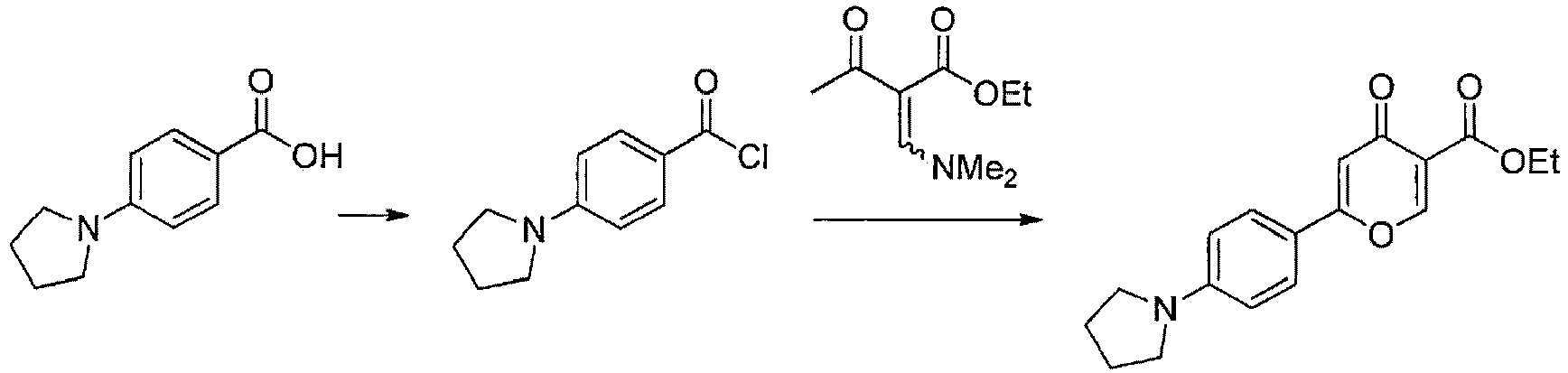
- To a suspension of 4-(pyrrolidin-1-yl)benzoic acid (4.88 g) in toluene (60 mL) were added 2 droplets of DMF and oxalyl dichloride (5.47 mL), and the mixture was stirred at room temperature for 1 hour. The solvent was evaporated from the reaction mixture under reduced pressure to obtain a residue. 1.3 mol/L lithium bis(trimethylsilyl)amide/THF (43.1 mL) was cooled to -60°C, and then the residue and a THF solution (40 mL) of ethyl=2-((dimethylamino)methylene)-3-oxobutanoate (4.73 g) were added dropwise thereto. The mixture was warmed to room temperature and stirred for 30 minutes. The reaction mixture was cooled to -60°C, then 3 mol/L hydrochloric acid (90 mL) and ethyl acetate (20 mL) were added thereto, and the precipitate was collected by filtration. The organic layer of the filtrate was collected by separation, washed with a saturated aqueous sodium chloride solution, and dried over anhydrous sodium sulfate, and the solvent was evaporated under reduced pressure. The obtained residue and the precipitate collected by filtration were combined, the combination was suspended in a mixed solvent of ethanol and hexane, and the precipitate was collected by filtration to obtain ethyl 4-oxo-6-(4-(pyrrolidin-1-yl)phenyl)-4H-pyran-3-carboxylate (5.69 g) as a pale brown solid.
MS (ESI m/z): 314 (M+H)
RT (min): 1.49 -

- To an NMP solution (15 mL) of methyl 4-amino-3-methoxybenzoate (5.42 g) were added DIEA (7.6 g) and 1,4-diiodobutane (9.44 g), and the mixture was stirred at 90°C for 5.5 hours. DIEA (1.52 g) and 1,4-diiodobutane (1.89 g) were added thereto, and the mixture was stirred at 90°C for 4 hours. The reaction mixture was cooled to room temperature, then saturated saline was added thereto, and the mixture was extracted with a mixed solution of toluene and ethyl acetate. The organic layer was washed with water and saturated saline, and the aqueous layer was extracted with toluene. The organic layer and the extracted layer were combined, the combination was dried over anhydrous sodium sulfate, and then the solvent was evaporated under reduced pressure.
- To a methanol solution (50 mL) of the obtained residue was added a 25% aqueous sodium hydroxide solution, and the mixture was stirred overnight at room temperature. To the reaction mixture was added 3 mol/L hydrochloric acid (15.2 mL) under ice-cooling, and the solvent was evaporated. The precipitate was collected by filtration, and the obtained solid was washed with water and azeotroped with acetonitrile to obtain 3-methoxy-4-(pyrrolidin-1-yl)benzoic acid (2 g) as a brown solid.
MS (ESI m/z): 222 (M+H)
RT (min): 0.95 -
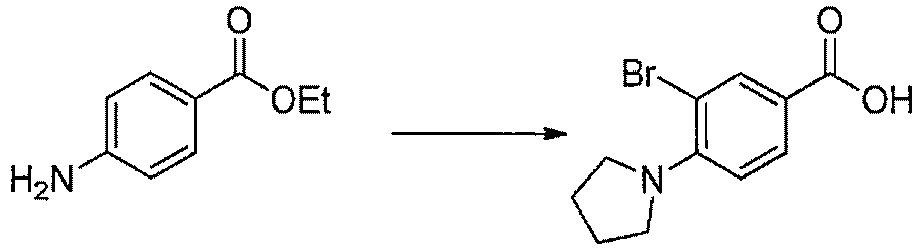
- To an NMP solution (25 mL) of ethyl 4-aminobenzoate (3.0 g) were added DIEA (7.4 g) and 1,4-diiodobutane (9.4 g), and the mixture was stirred at 100°C for 11 hours. DIEA (5.6 g) and 1,4-diiodobutane (7.1 g) were added thereto, and the mixture was stirred at 100°C for 6 hours. The reaction mixture was cooled to room temperature, then water and saturated saline were added thereto, and the mixture was extracted with a mixed solution of toluene and ethyl acetate. The organic layer was washed with water and saturated saline, and dried over anhydrous sodium sulfate, and then the solvent was evaporated under reduced pressure.
- To an acetonitrile solution (100 mL) of the obtained residue was added N-bromosuccinimide (2.7 g), and the mixture was stirred at room temperature for 2 hours. N-bromosuccinimide (2.4 g) was added thereto and the mixture was stirred at room temperature for 2 hours. To the reaction mixture was added a 5% aqueous sodium thiosulfate solution (20 mL), and then the solvent was evaporated. To the obtained mixture was added water, and the mixture was extracted with a mixed solution of toluene and ethyl acetate. The organic layer was washed with water, a saturated aqueous sodium hydrogen carbonate solution, and saturated saline, and dried over anhydrous sodium sulfate, and then the solvent was evaporated under reduced pressure.
- To a methanol solution (100 mL) of the obtained residue was added a 5.0 mol/L aqueous sodium hydroxide solution (12 mL), and the mixture was stirred overnight at room temperature. A 5.0 mol/L aqueous sodium hydroxide solution (12 mL) was added thereto, and the mixture was stirred for 4 hours under ice-cooling. To the reaction mixture was added aqueous hydrochloric acid, and the solvent was evaporated. The precipitate was collected by filtration and the obtained solid was washed with water and tert-butylmethyl ether to obtain 3-bromo-4-(pyrrolidin-1-yl)benzoic acid (6.00 g) as a pale brown solid.
MS (ESI m/z): 270 (M+H)
RT (min): 1.46 -

- In the same manner as in Reference Example 3, the following compound was obtained. 3-Chloro-4-(pyrrolidin-1-yl)benzoic acid
MS (ESI m/z): 226 (M+H)
RT (min): 1.43 -

- In the same manner as in Reference Example 3, the following compound was obtained. 3-Fluoro-4-(pyrrolidin-1-yl)benzoic acid
MS (ESI m/z): 210 (M+H)
RT (min): 1.35 -

- (1) A mixture of ethyl 4-bromobenzoate (1.0 g), chloro(2-dicyclohexylphosphino-2',6'-diisopropoxy-1,1'-biphenyl)[2-(2'-amino-1,1'-biphenyl)]palladium (II) (173 mg), cesium carbonate (4.27 g), (R)-pyrrolidin-3-ol (1.14 g), and 1,2-dimethoxyethane (15 mL) was irradiated with microwaves (InitiatorTM, 120°C, 30 minutes, 2.45 GHz, 0-240W). The same reaction was repeated three times and cooled to room temperature, then the obtained reaction mixture was combined, and the solvent was evaporated under reduced pressure. The obtained residue was purified by silica gel column chromatography [eluent; 80%-30% n-hexane/ethyl acetate] to obtain ethyl (R)-4-(3-hydroxypyrrolidin-1-yl)benzoate (3.80 g) as a yellow solid.
MS (ESI m/z): 236 (M+H)
RT (min): 1.17 - (2) To a mixture of ethyl (R)-4-(3-hydroxypyrrolidin-1-yl)benzoate obtained in (1) (4.06 g), methyl p-toluenesulfonate (6.43 g), DMF (20 mL), and THF (40 mL) was added sodium hydride (1.38 g, 60%, dispersed in fluidized paraffin) under ice-cooling. The mixture was warmed to room temperature and stirred for 1 hour, and then 1 mol/L hydrochloric acid (15 mL) and ethyl acetate were added thereto. The organic layer was collected by separation, and washed with water and a saturated aqueous sodium chloride solution, and then the solvent was evaporated under reduced pressure. The obtained residue was purified by silica gel column chromatography [eluent; 100%-60% n-hexane/ethyl acetate] to obtain ethyl (R)-4-(3-methoxypyrrolidin-1-yl)benzoate as a yellow oily substance.
MS (ESI m/z): 250 (M+H)
RT (min): 1.48 - (3) To a mixed solution of the obtained ethyl (R)-4-(3-methoxypyrrolidin-1-yl)benzoate in methanol (30 mL) was added a 1 mol/L aqueous sodium hydroxide solution (15 mL), and the mixture was stirred at 80°C for 2 hours. To the reaction mixture were added methanol (10 mL) and a 1 mol/L aqueous sodium hydroxide solution (15 mL), and the mixture was stirred at 80°C for 5 hours. The reaction mixture was cooled to room temperature, then 3 mol/L hydrochloric acid was added thereto, and the solvent was evaporated under reduced pressure. The obtained residue was suspended in water and the precipitate was collected by filtration to obtain (R)-4-(3-methoxypyrrolidin-1-yl)benzoic acid (3.42 g) as a white solid.
MS (ESI m/z): 222 (M+H)
RT (min): 1.04 -

- (1) A mixture of ethyl 4-bromo-3-chlorobenzoate (4.78 g), tris(dibenzylideneacetone)dipalladium (0) (342 mg), (R)-(+)-2,2'-bis(diphenylphosphino)-1,1'-binaphthyl (699 mg), sodium tert-butoxide (2.52 g), (R)-pyrrolidin-3-ol (3.16 g), and toluene (150 mL) was stirred under heating and refluxing for 1 hour. The reaction mixture was cooled to room temperature, the insoluble matters were removed by filtration, and the solvent was evaporated under reduced pressure. To the obtained residue were added ethyl acetate and a saturated aqueous sodium hydrogen carbonate solution. The organic layer was collected by separation and washed with a saturated aqueous sodium hydrogen carbonate solution and saturated saline, and then the solvent was evaporated under reduced pressure. The obtained residue was purified by silica gel column chromatography [eluent; 50%-0% n-hexane/ethyl acetate] to obtain ethyl (R)-3-chloro-4-(3-methoxypyrrolidin-1-yl)benzoate (982 mg) as a brown oily substance.
MS (ESI m/z): 270 (M+H)
RT (min): 1.35 - (2) In the same manner as in Reference Examples 7-(2) and 7-(3), the following compound was obtained.
(R)-3-Chloro-4-(3-methoxypyrrolidin-1-yl)benzoic acid
MS (ESI m/z): 256 (M+H)
RT (min): 1.22 -

- To a mixture of methyl 4-fluoro-3-hydroxybenzoate (3.25 g), tert-butyl (R)-2-(hydroxymethyl)pyrrolidine-1-carboxylate (5.0 g), triphenylphosphine (6.52 g), and THF (60 mL) was added a 2.2 mol/L diethyl azodicarboxylate-toluene solution (11.3 mL) under ice-cooling. The mixture was warmed to room temperature and stirred overnight, and then the solvent was evaporated under reduced pressure. To the obtained residue were added water (20 mL) and ethyl acetate (70 mL). The organic layer was collected by separation, washed with a saturated aqueous sodium chloride solution, and then dried over anhydrous sodium sulfate. To the obtained organic layer was added magnesium chloride (6.4 g) at room temperature, and the mixture was warmed to 50°C and stirred for 1 hour. The reaction mixture was cooled to room temperature, then the insoluble matters were removed by filtration, and the solvent was evaporated under reduced pressure.
- To the obtained residue was added 5 to 10 w/w% hydrochloric acid-methanol (30 mL) at room temperature, and the mixture was stirred for 5 days. The solvent was evaporated under reduced pressure, and then ethyl acetate (80 mL), a saturated aqueous sodium hydrogen carbonate solution (20 mL), and sodium carbonate were added thereto. The organic layer was collected by separation and then the aqueous layer was extracted with ethyl acetate. The organic layer and the extract were combined, and the solvent was evaporated under reduced pressure.
- A mixture of the obtained residue, dimethyl sulfoxide (33 mL), and potassium carbonate (2.64 g) was stirred at 80°C for 5 hours. The reaction mixture was cooled to room temperature, then saturated saline (75 mL) was added thereto, and the solid was collected by filtration and washed with water. The filtrate and the washing liquid were combined, and the combination was extracted with toluene. The obtained solid and the extract were combined, and the solvent was evaporated under reduced pressure.
- To the obtained residue were added methanol (60 mL) and a 5 mol/L aqueous sodium hydroxide solution (20 mL), and the mixture was stirred at room temperature for 5 days. The reaction mixture was warmed and stirred at 50°C for 2 hours, and then further stirred under heating and refluxing for 6 hours. The reaction mixture was cooled under ice-cooling, and then concentrated hydrochloric acid (12.1 mL) was added thereto. The precipitate was collected by filtration and washed with water. The obtained precipitate was washed with ethyl acetate to obtain (R)-2,3,3a,4-tetrahydro-1H-benzo[b]pyrrolo[1,2-d][1,4]oxazine-7-carboxylic acid (3.34 g) as a yellow solid.
MS (ESI m/z): 220 (M+H)
RT (min): 1.15 -

- A mixture of 2-bromothiazole-5-carboxylic acid (0.5 g), pyrrolidine (2 mL), potassium carbonate (1.66 g), and 1,2-dimethoxyethane (15 mL) was irradiated with microwaves (InitiatorTM, 130°C, 1 hour, 2.45 GHz, 0-240W). The reaction mixture was cooled to room temperature and then the solid was collected by filtration. The obtained solid was dissolved in water, and 3 mol/L hydrochloric acid was added thereto. The precipitate was collected by filtration to obtain 2-(pyrrolidin-1-yl)thiazole-5-carboxylic acid (229 mg) as a yellow solid.
MS (ESI m/z): 199 (M+H)
RT (min): 0.59 -

- (1) To a mixture of tert-butyl (R)-3-hydroxypyrrolidine-1-carboxylate (250 mg), 1-(bromomethyl)-4-fluorobenzene (1.08 g), DMF (0.5 mL), and THF (2.5 mL) was added sodium hydride (230 mg, 60%, dispersed in fluidized paraffin) at room temperature. The mixture was stirred at room temperature for 1 hour, and then a saturated aqueous sodium hydrogen carbonate solution and ethyl acetate were added thereto. The organic layer was collected by separation, and washed with water and a saturated aqueous sodium chloride solution, and then the solvent was evaporated under reduced pressure. The obtained residue was purified by silica gel column chromatography [eluent; 100%-60% n-hexane/ethyl acetate] to obtain tert-butyl (R)-3-((4-fluorobenzyl)oxy)pyrrolidine-1-carboxylate (381 mg).
MS (ESI m/z): 296 (M+H)
RT (min): 1.68 - (2) To a mixture of tert-butyl (R)-3-((4-fluorobenzyl)oxypyrrolidine-1-carboxylate obtained in (1) (381 mg) and cyclopentylmethyl ether (4 mL) was added 4.0 mol/L hydrogen chloride/cyclopentylmethyl ether (4 mL) at room temperature, and the mixture was stirred for 30 minutes. The mixture was warmed and stirred at 50°C for 1 hour, and then the solvent was evaporated under reduced pressure. To the obtained residue was added a saturated aqueous sodium hydrogen carbonate solution, and the mixture was extracted with chloroform. The organic layer was collected by separation and the solvent was evaporated under reduced pressure. The obtained residue was purified by silica gel column chromatography [eluent; 99%-80% ethyl acetate/methanol NH silica] to obtain (R)-3-((4-fluorobenzyl)oxy)pyrrolidine (314 mg) as a yellow oily substance.
MS (ESI m/z): 196 (M+H)
RT (min): 0.74 -

- In the same manner as in Reference Examples 11-(1) and 11-(2), the following compound was obtained.
(R)-3-(2-Methoxyethoxy)pyrrolidine -

- (1) In the same manner as in Reference Example 7-(2), the following compound was obtained.
tert-Butyl (R)-3-methoxypyrrolidine-1-carboxylate - (2) To a mixture of tert-butyl (R)-3-methoxypyrrolidine-1-carboxylate obtained in (1) (487 mg) and cyclopentylmethyl ether (5 mL) was added 4.0 mol/L hydrogen chloride/cyclopentyl methyl ether (5 mL) at room temperature. The mixture was warmed and stirred at 50°C for 30 minutes, and the separated solvent was removed to obtain an oily substance (370 mg). To a mixture of the obtained oily substance and 1,2-dimethoxyethane (10 mL) were added DOWEX (registered trademark) and MONOSPHERE (registered trademark) 550A (1 g), and the mixture was neutralized. The reaction mixture was dried by the addition of anhydrous sodium sulfate, the insoluble matters were removed by filtration and filtered, and the residue was washed with 1,2-dimethoxyethane (5 mL). The filtrate and the washing liquid were combined to obtain a 1,2-dimethoxyethane solution of (R)-3-methoxypyrrolidine.
- In the same manner as in Reference Example 2, the following compounds were obtained.
[Table 1] Reference Example No. MS (ESI m/z) (M+H) RT(min) 14-1 
Ethyl 6-(3-methoxy-4-(pyrrolidin-1 -yl)phenyl)-4-oxo-4H-pyran-3-carboxylate 344 1.03 14-2 
Ethyl 6-(3-bromo-4-(pyrrolidin-1-yl)phenyl)-4-oxo-4H-pyran-3-carboxylate 394 1.68 14-3 
Ethyl 6-(3-chloro-4-(pyrrolidin-1 yl)phenyl)-4-oxo-4H-pyran-3-carboxylate - 348 1.66 14-4 
Ethyl 6-(3-fluoro-4-(pyrrolidin-1-yl)phenyl)-4-oxo-4H-pyran-3-carboxylate 332 1.58 14-5 
Ethyl (R)-6-(4-(3-methoxypyrrolidin-1-yl)phenyl)-4-oxo-4H-pyran-3-carboxylate 344 1.31 14-6 
Ethyl 6-(4-bromo-3-chlorophenyl)-4-oxo-4H-pyran-3-carboxylate 359 1.50 14-7 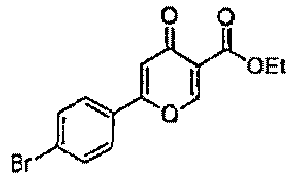
Ethyl 6-(4-bromophenyl)-4-oxo-4H-pyran-3-carboxylate 325 1.38 14-8 
Ethyl (R)-6-(3-chloro-4-(3-methoxypyrrolidin-1-yl)phenyl)-4-oxo-4H-pyran-3-carboxylate 378 1.44 [Table 2] Reference Example No. MS (ESI m/z) (M+H) RT(min) 14-9 
Ethyl (R)-4-oxo-6-(2,3,3a,4-tetrahydro-1H-benzo[b]pyrrolo[1,2-d][1,4]oxazin-7-yl)-4H-pyran-3-carboxylate 342 1.41 14-10 
Ethyl 6-(5-bromothiophen-2-yl)-4-oxo-4H-pyran-3-carboxylate 331 1.36 14-11 
Ethyl 4-oxo-6-(2-(pyrrolidin-1-yl)thiazol-5-yl)-4H-pyran-3-carboxylate 321 1.10 -

- (1) To a mixture of bis(2-methoxyethyl)amine (190 mg), triethylamine (142 mg), and dichloromethane (2 mL) was added a solution of 2-chloro-6-nitrobenzo[d]thiazole (100 mg) in DMF (1 mL) under ice-cooling. The mixture was warmed to room temperature and stirred for 1 hour, and then the solvent was evaporated under reduced pressure. To the obtained residue were added a saturated aqueous sodium chloride solution, and the mixture was extracted with ethyl acetate. The organic layer was collected by separation and the solvent was evaporated under reduced pressure to obtain N,N-bis(2-methoxyethyl)-6-nitrobenzo[d]thiazol-2-amine as a brown oily substance.
MS (ESI m/z): 312 (M+H)
RT (min): 1.46 - (2) To a mixture of N,N-bis(2-methoxyethyl)-6-nitrobenzo[d]thiazol-2-amine obtained in (1), powder zinc (244 mg), and ethanol (3 mL) was added acetic acid (1 mL), and the mixture was heated and refluxed for 30 minutes. The reaction mixture was cooled to room temperature and the insoluble matters were removed by filtration using Celite (registered trademark). The solvent was evaporated under reduced pressure and the obtained residue was purified by silica gel column chromatography [eluent; 100%-0% hexane/ethyl acetate→100%-80% ethyl acetate/methanol NH silica] to obtain N2,N2-bis(2-methoxyethyl)benzo[d]thiazole-2,6-diamine (127 mg).
MS (ESI m/z): 282 (M+H)
RT (min): 0.67 - In the same manner as in Reference Example 15, the following compounds were obtained.
[Table 3] Reference Example No. MS (ESI m/z) (M+H) RT(min) 16-1 
N2-Ethyl-N2-(2-methoxyethyl)benzo[d]thiazole -2,6-diamine 252 0.66 16-2 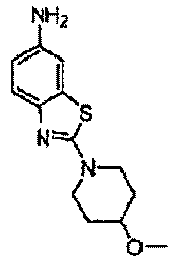
2-(4-Methoxypiperidin-1-yl)benzo[d]thiazol-6-amine 264 0.65 16-3 
2-(4-Ethylpiperazin-1-yl)benzo[d]thiazol-6-amine 263 0.23 16-4 
(R)-2-(2-(Methoxymethyl)pyrrolidin-1-yl)benzo[d]thiazol-6-amine 264 0.65 16-5 
2-(4-Methyl-1,4-diazepan-1-yl)benzo[d]thiazol-6-amine 263 0.22 16-6 
N2-(Pyridin-2-ylmethyl)benzo[d]thiazole-2,6-diamine 257 0.24 16-7 
N2-(Pyrimidin-2-ylmethyl)benzo[d]thiazole-2,6-diamine 258 0.23 16-8 
2-(4-(2-Methoxyethyl)piperazin-1-yl)benzo[d]thiazol-6-amine 293 0.24 16-9 
N2-Methyl-N2-((tetrahydro-2H-pyran-4-yl)methyl)benzo[d]thiazole-2,6-diamine 278 0.64 -

- (1) To a solution of 2-amino-5-nitrobenzenethiol (500 mg) in NMP (2 mL) was added methoxyacetyl chloride (381 mg), and the mixture was stirred at room temperature for 20 minutes. The mixture was stirred at 100°C for 20 minutes. The reaction mixture was cooled to room temperature, and then water was added thereto. The precipitate was collected by filtration to obtain 2-(methoxymethyl)-6-nitrobenzo[d]thiazole (583 mg).
MS (ESI m/z): 225 (M+H)
RT (min): 1.27 - (2) In the same manner as in Reference Example 15-(2), the following compound was obtained.
2-(Methoxymethyl)benzo[d]thiazol-6-amine
MS (ESI m/z): 195 (M+H)
RT (min): 0.62 -

- In the same manner as in Reference Example 9, the following compound was obtained. (S)-2,3,3a,4-Tetrahydro-1H-benzo[b]pyrrolo[1,2-d][1,4]oxazine-7-carboxylic acid
MS (ESI m/z): 220 (M+H)
RT (min): 1.13 -

- In the same manner as in Reference Examples 7-(2) and 7-(3), the following compound was obtained.
(R)-4-(3-(2-Methoxyethoxy)pyrrolidin-1-yl)benzoic acid
MS (ESI m/z): 266 (M+H)
RT (min): 1.04 -

- (1) A mixture of ethyl 4-bromo-3-fluorobenzoate (500 mg), tris(dibenzylideneacetone)dipalladium (0) (94 mg), (R)-(+)-(1,1'-binaphthalene-2,2'-diyl)bis(diphenylphosphine) (189 mg), cesium carbonate (1.98 g), (R)-pyrrolidin-3-ol (353 mg), and toluene (5 mL) was stirred for 1 hour under heating and refluxing. The reaction mixture was cooled to room temperature and then the solvent was evaporated under reduced pressure. The obtained residue was purified by silica gel column chromatography [eluent; 70%-30% n-hexane/ethyl acetate] to obtain ethyl (R)-3-fluoro-4-(3-hydroxypyrrolidin-1-yl)benzoate (390 mg) as a brown oily substance.
MS (ESI m/z): 254 (M+H)
RT (min): 1.41 - (2) In the same manner as in Reference Examples 7-(2) and 7-(3), the following compound was obtained.
(R)-3-Fluoro-4-(3-methoxypyrrolidin-1-yl)benzoic acid
MS (ESI m/z): 240 (M+H)
RT (min): 1.14 - In the same manner as in Reference Example 2, the following compounds were obtained.
[Table 4] Reference Example No. MS (ESI m/z) (M+H) RT(min) 21-1 
Ethyl (S)-4-oxo-6-(2,3,3a,4-tetrahydro-1H-benzo[b]pyrrolo[1,2-d][1,4]oxadin-7-yl)-4H-pyran-3-carboxylate 342 1.56 21-2 
Ethyl (R)-6-(4-(3-(2-methoxyethoxy)pyrrolidin-1-yl)phenyl)-4-oxo-4H-pyran-3-carboxylate 388 1.28 21-3 
Ethyl (R)-6-(3-fluoro-4-(3-methoxypyrrolidin-1-yl)phenyl)-4-oxo-4H-pyran-3-carboxylate 362 1.38 - In the same manner as in Reference Example 15, the following compounds were obtained.
[Table 5] Reference Example No. MS (ESI m/z) (M+H) RT(min) 22-1 
(S)-2-(3-(Dimethylamine)pyrrolidin-1-yl)benzo[d]thiazol-6-amine 263 0.24 22-2 
(R)-2-(3-(Dimethylamine)pyrrolidin-1-yl)benzo[d]thiazol-6-amine 263 0.24 22-3 
2-((3R,4R)-3,4-Dimethoxypyrrolidin-1-yl)benzo[d]thiazol-6-amine 280 0.53 22-4 
(S)-2-(3-Methoxypyrrolidin-1-yl)benzo[d]thiazol-6-amine 250 0.55 22-5 
(R)-2-(3-Methoxypyrrolidin-1-yl)benzo[d]thiazol-6-amine 250 0.55 22-6 
2-(3-Methoxyazetidin-1-yl)benzo[d]thiazol-6-amine 236 0.62 - In the same manner as in Reference Example 15, the following compounds were obtained.
[Table 6] Reference Example No. MS (ESI m/z) (M+H) RT(min) 23-1 
2-(3-(Difluoromethoxy)azetidin-1-yl)benzo[d]thiazol-6-amine 272 0.70 23-2 
2-(3-((Tetrahydrofuran- 2-yl)methoxy)azetidin-1-yl)benzo[d]thiazol-6-amine 306 0.69 23-3 
2-(3-(2-Fluoroethoxy)azetidin-1-yl)benzo[d]thiazol-6-amine 268 0.58 23-4 
2-(3-(3-Methoxypropoxy)azetidin-1-yl)benzo[d]thiazol-6-amine 294 0.69 23-5 
2-(3-Ethoxyazetidin-1-yl)benzo[d]thiazol-6-amine 250 0.64 23-6 
2-(3-Isopropoxyazetidin-1-yl)benzo[d]thiazol-6-amine 264 0.74 23-7 
2-(3-Methoxy-3-methylazetidin-1-yl)benzo[d]thiazol-6-amine 250 0.62 23-8 
2-(3-(2-Methoxyethoxy)azetidin-1-yl)benzo[d]thiazol-6-amine 280 0.59 -

- To a mixture of (R)-pyrrolidin-3-ol (1.08 g), triethylamine (2.41 g), and NMP (10 mL) was added 2-chloro-6-nitrobenzo[d]thiazole (2.02 g) under ice-cooling. The mixture was warmed to room temperature and stirred for 1 hour, a saturated aqueous sodium chloride solution was added thereto and the mixture was extracted with ethyl acetate. The organic layer was collected by separation and then the aqueous layer was extracted with chloroform. The organic layer and the extract were combined and the solvent was evaporated under reduced pressure.
- To the obtained residue was added pyridine (10 mL), the mixture was cooled to be under ice-cooling, and chloromethylsulfonyl chloride (1.25 mL) was added thereto. The reaction mixture was warmed and stirred at room temperature for 1 hour, and then chloromethylsulfonyl chloride (0.2 mL) was added thereto under ice-cooling. The reaction mixture was warmed, the mixture was stirred at room temperature for 1 hour stirred, and then water was added thereto. The solvent was evaporated under reduced pressure, and then ethyl acetate and a saturated aqueous sodium hydrogen carbonate solution were added thereto. The organic layer was collected by separation and then washed with a saturated aqueous sodium hydrogen carbonate solution and saturated saline. The aqueous layer was extracted with toluene. The organic layer and the extract were combined and dried by the addition of anhydrous sodium sulfate, and then the solvent was evaporated under reduced pressure.
- A mixture of the obtained residue, DMF (6 mL), morpholine (2.5 mL), and potassium carbonate (1.93 g) was stirred at 110°C for 1.5 hours. The reaction mixture was cooled to room temperature, and water and ethyl acetate were added thereto. The precipitate was collected by filtration, the organic layer of the filtrate was collected by separation, and the aqueous layer was extracted with ethyl acetate. The precipitate collected by filtration, the organic layer, and the extract were combined, and the solvent was evaporated under reduced pressure.
- To a mixture of the obtained residue, ethanol (12 mL), and acetic acid (4 mL) was added powder zinc (3.05 g) under ice-cooling, and the mixture was stirred for 1 hour. The insoluble matters of the reaction mixture were removed by filtration using Celite (registered trademark) and the solvent was evaporated under reduced pressure. The obtained residue was purified by silica gel column chromatography [eluent; 100%-0% hexane/ethyl acetate→100%-90% ethyl acetate/methanol NH silica] to obtain (S)-2-(3-morpholinopyrrolidin-1-yl)benzo[d]thiazol-6-amine (1.02 g) as a brown solid.
MS (ESI m/z): 305 (M+H)
RT (min): 0.20 -

- In the same manner as in Reference Example 7 and Reference Example 2, the following compound was obtained.
Ethyl (S)-6-(4-(3-(2-methoxyethoxy)pyrrolidin-1-yl)phenyl)-4-oxo-4H-pyran-3-carboxylate
MS (ESI m/z): 388 (M+H)
RT (min): 1.29 -

- (1) A mixture of ethyl 6-(4-(dimethylamino)phenyl)-4-oxo-4H-pyran-3-carboxylate obtained in Reference Example 1 (40 mg), 6-amino-2-methylbenzothiazole (46 mg), ethanol (3 mL) and acetic acid (1 mL) was irradiated with microwaves (InitiatorTM, 150°C, 30 minutes, 2.45 GHz, 0-240W). The reaction mixture was cooled to room temperature and then the solvent was evaporated under reduced pressure. The obtained residue was purified by silica gel column chromatography [eluent; 50%-0% hexane/ethyl acetate→1O0%-75% ethyl acetate/methanol] to obtain ethyl 6-(4-(dimethylamino)phenyl)-1-(2-methylbenzo[d]thiazol-6-yl)-4-oxo-1,4-dihydropyridine-3-carboxylate (14 mg) as a brown oily substance.
MS (ESI m/z): 434 (M+H)
RT (min): 1.24 - (2) To ethyl 6-(4-(dimethylamino)phenyl)-4-oxo-4H-pyran-3-carboxylate obtained in (1) were added methanol (1 mL) and a 1 mol/L aqueous sodium hydroxide solution (1 mL), and the mixture was stirred at room temperature for 1 hour. To the reaction mixture was added 1 mol/L hydrochloric acid, and the precipitate was collected by filtration to obtain 6-(4-(dimethylamino)phenyl)-1-(2-methylbenzo[d]thiazol-6-yl)-4-oxo-1,4-dihydropyridine-3-carboxylic acid (8.9 mg) as a pale yellow solid.
1H-NMR (CDCl3) δ: 8.69 (1H, s), 7.87 (1H, d, J = 8.6 Hz), 7.72 (1H, d, J = 2.0 Hz), 7.15 (1H, dd, J = 8.6, 2.0 Hz), 6.95 (2H, d, J = 9.2 Hz), 6.82 (1H, s), 6.46 (2H, d, J = 9.2 Hz), 2.93 (6H, s), 2.87 (3H, s).
MS (ESI m/z): 406 (M+H)
RT (min): 1.28 -

- In the same manner as in Examples 1-(1) and 1-(2), the following compound was obtained.
6-(4-(Dimethylamino)phenyl)-1-(2-morpholinobenzo[d]thiazol-6-yl)-4-oxo-1,4-dihydropyridine-3-carboxylic acid
MS (ESI m/z): 477 (M+H)
RT (min): 1.31 - In the same manner as in Examples 1-(1) and 1-(2), the following compounds were obtained.
[Table 7] 
Example No. 
MS (ESI m/z) (M+H) RT(min) 1H-NMR(300MHz) 3-1 
1 -(Benzo[d]thiazol-6-yl)-4-oxo-6 (4-(pyrrolidin-1-yl)phenyl)-1,4-dihydropyridine-3-carboxylic acid 418 1.39 (OMSO-D6) δ: 9.50 (1H, s), 8.55 (1H, s), 8.41 (1H, d J = 2.0 Hz). 8.05 (1H, d, J = 8.6 Hz), 7.46 (1H, dd, J = 8.9, 2.3 Hz), 7.04 (2H, d, J = 8.6 Hz), 6.68 (1H, s), 6.35 (2H, d, J = 8.6 Hz), 3.19-3.08 (4H, m), 1.96-1.8D (4H. m). 3-2 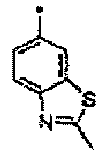
1-(2-Methylbenzo[d]thiazol-6-yl)-4-oxo-6-(4-(pyrrolidin-1-yl)phenyl)-1,4-dihydropyridine-3-carboxylic acid 432 1.47 (DMSO-D6) δ: 8.57 (1H, s), 8.27 (1H, d. J = 2.0 Hz), 7.87 (1H, d, J = 8.6 Hz), 7.41 (1H, dd, J = 8.6, 2.0 Hz), 7.04 (2H, d, J = 8.6 Hz), 6.73 (1H, s), 6.35 (2H, d, J = 8.6 Hz), 3.20-3.08 (4H, m), 2.81 (3H, s). 1.94-1.83 (4H, m). 3-3 
4-Oxo-1-(2-(pyrrolidin-1-yl)benzo[d]thiazol-6-yl)-6-(4-(pyrrolidin-1-yl)phenyl)-1,4-dihydropyridine-3-carboxylic acid 487 1.54 (DMSO-D6) δ: 8.50 (1H, s), 7.92 (1H, d, J = 2.0 Hz), 7.37 (1H, d, J = 8.6 Hz), 7.22 (1H, dd, J = 8.6, 2.0 Hz), 7.04 (2H, d, J = 8.6 Hz), 6.72 (1H, s), 6.36 (2H, d. J = 8.6 Hz), 3.59-3.43 (4H, m), 3.21-3.09 (4H, m), 2.06-1.95 (4H, m), 1.94-1.84 (4H, m). 3-4 
1-(2-Morpholinobenzo[d]thiazol-6-yl)-4-oxo-6-(4-(pyrrolidin-1-yl)phenyl)-1,4-dihydropyridine-3 carboxylic acid 503 1.48 (DMSO-D6) δ: 8.52 (1H, s), 7.97 (1H, d, J = 2.0 Hz). 7.40 (1H, d, J = 8.6 Hz), 7.26 (1H, dd, J = 8.8, 2.0 Hz), 7.04 (2H, d J = 8.6 Hz), 6.74 (1H, s), 6.37 (2H, d. J = 8.6 Hz), 3.78-3.68 (4H, n), 3.61-3.50 (4H, m), 3.21-3.11 (4H, m), 1.95-1.83 (4H, m). 3-5 
1-(2-Methoxybenzo[d]thiazol-6-yl)-4-oxo-6-(4-(pyrrolidin-1-yl)phenyl)-1,4-dihydropyridine-3-carboxylic acid 448 1.58 (DMSO-D6) δ: 8.57 (1H, s), 8.10 (1H, d, J = 2.0 Hz), 7.66 (1H, d. J = 8.6 Hz), 7.38 (1H, dd, J = 8.6, 2.0 Hz), 7.05 (2H, c, J = 8.6 Hz), 6.77 (1H, s), 6.37 (2H, d, J = 8.6 Hz), 4.17 (3H, s). 3.21-3.11 (4H, m). 1.95-1.83 (4H, m). 3-6 
1-(2-(Bis(2-methoxyethyl)amino)benzo[d]thia; 1-6-yl)-4-oxo-6-(4-(pyrrolidin-1-yl)phenyl)-1,4-dihydropyridine-3-carboxylic acid 549 1.59 (DMSO-D6) δ: 8.09 (1H, s), 7.81 (1H, d, J = 2.0 Hz), 7.31 (1H, d, J = 8.6 Hz). 7.05 (1H, dd, J = 8.6, 2.0 Hz). 6.99 (2H, d, J = 8.6 Hz), 6.36 (2H, d. J = 8.6 Hz), 6.18 (1H, s), 3.74-3.23 (14H, m), 3.19-3.12 (4H. m), 1.92-1.85 (4H, m). 3-7 
1-(2-(Ethyl(2-methoxyethyl)amino)benzo[d]thiazo 1-6-yl)-4-oxo-6-(4-(pyrrolidin-1-yl)phenyl)-1,4-dihydropyridine-3-carboxylic acid 519 1.63 (DMSO-D6) δ: 8.13 (1H, s), 7.81 (1H, d, J = 2.3 Hz), 7.31 (1H, d. J = 8.6 Hz). 7.05 (1H, dd, J = 8.6, 2.3 Hz), 6.99 (2H, d, J = 8.6 Hz), 6.36 (2H, d, J = 8.6 Hz), 6.17 (1H, s), 3.71-3.50 (6H, m), 3.27 (3H. s), 3.18-3.12 (4H, m), 1.91-1.85 (4H, m), 1.19 (3H, t, J = 7.1 Hz), 3-8 
1-(2-(4-Methoxypiperidin-1-yl)benzo[d]thiazol-6-yl)-4-oxo-6-(4-(pyrrolidin-1-yl)phenyl)-1,4-dihydropyridine-3-carboxylic acid 531 1.59 (DMSO-D6) δ: 8.13 (1H, s), 7.81 (1H, d, J = 2.2 Hz), 7.32 (1H, d. J = 8.6 Hz), 7.07 (1H, dd, J = 8.6, 2.2 Hz), 6.98 (2H, d J = 8.6 Hz), 6.35 (2H, d, J = 8.6 Hz), 6.17 (1H, s), 3.82-3.70 (2H, m), 3.52-3.30 (3H, m), 3.28 (3H, s), 3.18-3.10 (4H, m), 1.99-1.84 (6H, m). 1.61-1.47 (2H, m). 3-9 
1-(2-(4-Ethylpiperazin-1-yl)benzo[d]thiazol-6-yl)-4-oxo-6-(4-(pyrrolidin-1-yl)phenyl)-1,4-dihydropyridine-3-carboxylic acid 530 1.11 (DMSO-D6) δ: 8.15 (1H, s). 7.83 (1H, d. J = 2.2 Hz), 7.34 (1H, d. J = 8.6 Hz), 7.09 (1H, dd, J = 8.6, 2.2 Hz), 6.98 (2H, c, J = 8.6 Hz), 6.34 (2H. d. J = 8.6 Hz), 6.18 (1H, s), 3.60-3.48 (4H, m), 3.43-3.24 (4H, m), 3.19-3.10 (4H. m), 2.38 (2H, d, J = 7.2 Hz), 1.93-1.82 (4H, m), 1.02 (3H, t, J = 7.2 Hz), 3-10 
(R)-1-(2-(2-(Methoxymethyl)pyrrolidin-1-yl)benzo[d]thiazol-6-yl)-4-oxo-6-(4-(pyrrolidin-1-yl)phenyl)-1,4-dihydropyridine-3-carboxylic acid 531 1.54 (DMSO-D6) δ: 8.11 (1H, s), 7.83 (1H, d, J = 2.3 Hz), 7.36 (1H, d, J = 8.6 Hz). 7 07 (1H, dd. J = 8.6, 23 Hz), 6.98 (2H, d, J = 8.6 Hz), 6.35 (2H, d, J = 8.6 Hz), 6.16 (1H, s), 4.15-4.03(1H, m), 3.56-3.32 (4H, m), 3.28 (3H, s), 3.20-3.10 (4H, m). 2.12-1.83 (8H, m). [Table 8] 
Example No. 
MS (ESI m/z) (M+H) RT(min) 1H-NMR(300MHz) 3-11 
1-(2-(4-Methyl-1,4-diazepan-1-yl)benzo[d]thiazol-6-yl)-4-oxo-6-(4-(pyrrolidin-1-yl)phenyl)-1,4-dihydropyridine-3-carboxylic acid 530 1.09 (DMSO-D6) δ: 8.11 (1H, s). 7,81 (1H, d. J = 2.3 Hz). 7.31 (1H, d. J = 8.6 Hz). 7.06 (1H, dd. J = 8.6, 2.3 Hz), 6.99 (2H, d, J = 8.6 Hz), 6.35 (2H, d, J = 8.6 Hz). 6.16 (1H, s), 3.79-3.56 (4H, m), 3.38-3.25 (2H, m), 3.20-3.08 (4H, m). 2.70-2.61 (2H, m). 2.26 (3H, s), 2.00-1.82 (6H, m). 3-12 
4-Oxo-)-(2-((pyridin-2-ylmethyl)amino)benzo[d]thiazol-6-yl)-6-(4-(pyrrolidin-1-yl)phenyl)-1,4-dihydropyridine-3-carboxylic acid 524 1.24 3-13 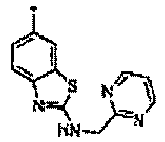
4-Oxo-1-(2-((pyrimidin-2-ylmethyl)amino)benzo[d]thiazol-6-yl)-6-(4-(pyrrolidin-1-yl)phenyl)-1,4-dihydropyridine-3-carboxylic acid 525 1.30 3-14 
1-(2-(4-(2-Methoxyethyl)piperazin-1-yl)benzo[d]thiazol-6-yl)-4-oxo-6-(4-(pyrrolidin-1-yl)phenyl)-1,4-dihydropyridine-3-carboxylic acid 560 1.11 3-15 
1-(2-(Methyl((tetrahydro-2H-pyran-4-yl)methyl)amino)benzo[d]thiazol-6-yl)-4-oxo-6-(4-(pyrrolidin-1-yl)phenyl)-1,4-dihydropyridine-3-carboxylic acid 545 1.53 3-16 
1-(2-(Methoxymethyl)benzo[d]thiazol-6-yl)-4-oxo-6-(4-(pyrrolidin-1-yl)phenyl)-1,4-dihydropyridine-3-carboxylic acid 462 1.50 (CDCl3) δ: 8.69 (1H, s), 7.93 (1H, d. J = 8.6 Hz), 7.79 (1H, d, J = 2.0 Hz), 7.20 (1H, dd, J = 8.8,2.0 Hz), 6.93 (2H, d, J = 8.6 Hz). 6.82 (1H, s), 6.31 (2H, d, J = 8.6 Hz), 4.86 (2H, s), 3.58 (3H, s), 3.27-3.16 (4H, m), 2.02-1.93 (4H. m). 3-17 
1-(2,5-Dimethylbenzo[d]thiazol-6-yl)-4-oxo-6-(4-(pyrrolidin-1-yl)phenyl)-1,4-dihydropyridine-3-carboxylic acid 446 1.52 (DMSO-D6) δ: 8.53 (1H, s), 8.42 (1H, s). 7.76 (1H, s). 7.09 (2H. d. J = 8.6 Hz), 6.79 (1H, s), 6.33 (2H, d, J = 8.6 Hz). 3.19-3.08 (4H. m), 2.82 (3H. s), 1.98 (3H, s), 1.93-1.82 (4H, m). 3-18 
1-(Benzo[d]thiazole-4-yl)-4-oxo-6-(4-(pyrrolidin-1-yl)phenyl)-1,4-dihydropyridine-3-carboxylic acid 418 1.42 (DMSO-D6) δ: 9.39 (1H, s), 8,65 (1H, s), 8.17 (1H, d, J = 7.9 Hz), 7.89 (1H, d, J = 7.9Hz), 7.69 (1H, dd, J = 7.9, 7.9 Hz), 7.07 (2H, d. J = 9.2 Hz), 6.83 (1H, s), 6.27 (2H, d, J = 9.2 Hz). 3.14-3.07 (4H, m), 1.90-1.82 (4H, m). 3-19 
1 -(Benzo[d]thiazol-7-yl)-4-oxo-6 (4-(pyrrolidin-1-yl)phenyl)-1,4-dihydropyridine-3-carboxylic acid 418 1.42 (DMSO-D6) δ: 9.39 (1H, s), 8,65 (1H, s), 8.17 (1H, d. J = 7.9 Hz), 7.89 (1H, d, J = 7.9 Hz), 7.69 (1H, dd, J = 7.9. 7.9 Hz), 7.07 (2H. d. J = 8.6 Hz). 6.83 (1H, s), 6.27 (2H, d. J = 8.6 Hz), 3.13-3.06 (4H, m). 1.91-1.82 (4H, m). 3-20 
1-(2-Methylbenzo[d]thiazol-5-yl)-4-oxo-6-(4-(pyrrolidin-1-yl)phenyl)-1,4-dihydropyridine-3-carboxylic acid 432 1.49 (DMSO-D6) δ: 8.57 (1H, s), 8.09 (1H, s). 8.06 (1H, d, J = 8.6 Hz), 7.41 (1 H. d, J = 8.6 Kz), 7.05 (2H, d. J = 6.6 Hz), 6.75 (1H, s), 8.35 (2H, d, J = 8.6 Hz), 3.20-3.08 (4H, m), 2.80 (3H, s), 1.95-1.81 (4H, m). - In the same manner as in Examples 1-(1) and 1-(2), the following compounds were obtained.
[Table 9] 
Example No. 
MS (ESI m/z) (M+H) RT(min) 1H-NMR(300MHz) 4-1 
6-(3-Methoxy-4-(pyrrolidin-1-yl)phenyl-1)-(2-methylbenzo[d]thiazol-6-yl)-4-oxo-1,4-dihydropyridine-3-carboxylic acid 462 1.27 (DMSO-D6) δ: 8.63 (1H, s), 8.28 (1H, d, J = 2.3 Hz), 7.89 (1H, d, J = 8.6 Hz), 7.45 (1H, dd, J = 8.6. 2.3 Hz), 6.86 (1H, s). 6.78 (1H, dd, J = 8.6, 2.3 Hz), 6.66-6.65 (1H, m), 6.44 (1H, d. J = 8.6 Hz), 3.51-3.18 (7H, m), 2.81 (3H, s), 1.80-1.74 (4H, m), 4-2 
6-(3-Methoxy-4-(pyrrolidin-1-yl)phenyl)-1-(2-morpholinobenzo[d]thiazol-6-yl)-4-oxo-1,4-dihydropyridine-3-carboxylic acid 533 1-24 (DMSO-D6) δ: 8.57 (1H, s), 7.99 (1H, d. J = 2.3 Hz), 7.42 (1H, d, J = 8.6 Hz), 7.30 (1H, dd, J = 8.6, 2.3 Hz), 6.85 (1H, s), 6.78 (1H, dd, J = 8.6, 2.0 Hz), 6.67 (1H, d, J = 2.0 Hz), 6.46 (1H, d. J = 8.6 Hz), 3.75-3.68 (4H, m), 3.58-3.53 (4H, m). 3.48-3.21 (7H, m). 1.82-1.75 (4H, m). 4-3 
1-(2-(Bis(2-methoxyethyl)amino)benzo[d]thiaz ol-6-yl)-6-(3-metlioxy-4-(pyrrolidin-1-yl)phenyl)-4-oxo-1,4-dihydropyridine-3-carboxylic acid 579 1.39 (OMSO-D6) δ: 8.55 (1H, s), 7.95 (1H, d, J = 2.0 Hz), 7.36 (1H, d, J = 8.6 Hz), 7.24 (1H, dd, J = 8.6, 10 Hz). 6.84 (1H, s), 6.77 (1H, dd, J = 8.3, 2.0 Hz) 6.71 (1H, d, J = 2.0 Hz), 6.46 (1H, d. J = 8.3 Hz), 3.78-3.05 (21H, m), 1.81-1.75 (4H, m). 4-4 
6-(3-Methoxy-4-(pyrrolidin-1-yl)phenyl)-1-(2-(4-(2-methoxyethyl)piperazin-1-yl)benzo[d]thiazol-6-yl)-4-oxo-1,4-dihydropyridine-3-carboxylic acid 590 0.95 (DMSO-D6) δ: 8.54(1H, s), 8.09 (1H, br s), 7.85 (1H, s), 7.35 (1H, d, J = 8.6 Hz), 7.20-7.08 (1H, m), 6.72 (1H, dd. J = 8.6, 2.0 Hz), 6.62 (1H, d, J = 2.0 Hz), 6.45 (1H, d. J = 8.6 Hz), 3.51-3.20 (20H, m), 2.59-2.47 (2H, m), 1.82-1.75 (4H, m). 4-5 
(R)-6-(3-Methoxy-4-(pyrrolidin-1-yl)phenyl)-1-(2-(2-(methoxymethyl)pyrrolidin-1-yl)benzo[d]thiazol-6-yl)-4-oxo-1,4-dihydropyridine-3-carboxylic acid 561 1.47 (CDCl3) δ: 8.68 (1H, s), 7.46 (1H, d, J = 8.6 Hz), 7.39 (1H, d. J = 2.0 Hz), 7.03 (1H, dd, J = 8.6, 2.0 Hz), 6.84 (1H, s), 6.70 (1H, dd, J = 7.9, 2.0 Hz), 6.48 (1H, d. J = 7.9 Hz), 6.46 (1H, d, J = 2.0 Hz), 4.27-4.10 (1H, m). 3.70-3.44 (7H, m). 3.39 (3H, s), 3.36-3.28 (4H, m), 2.26-1.99 (4H. m), 1.95-1.84 (4H. m). - In the same manner as in Examples 1-(1) and 1-(2), the following compounds were obtained.
[Table 10] 
Example No. 
MS (ESI m/z) (M+H) RT(min) 1H-NMR(300MHz) 5-1 
6-(3-Bromo-4-(pyrrolidin-1-yl)phenyl)-1-(2-methylbenzo[d]thiazol-6-yl)-4-oxo-1,4-dihydropyridine-3-carboxylic acid 512 1.57 (DMSO-D6) δ: 8.62 (1H, s), 8.28 (1H, d, J = 2.0 Hz), 7.90 (1H, d. J = 8.9 Hz), 7.47 (1H, dd, J = 8.8, 2.2 Hz), 7.41 (1H, d. J = 2.2 Hz), 7.07 (1H, dd, J = 8.8. 2.2 Hz), 6.84 (1H, s), 6.70 (1H, d, J = 8.9 Hz), 3.54-3.22 (4H, m), 2,81 (3H, s), 1.84-1.78 (4H, m). 5-2 
6-(3-Bromo-4-(pyrrolidin-1-yl)phenyl)-1-(2-morpholinobenzo[d]thiazol-6-yl)-4-oxo-1,4-dihydropyridine-3-carboxylic acid 583 1.59 (ODCl3) δ: 8.67 (1H, s), 7.46 (1H, d, J = 8.6 Hz). 7.45 (1H, d. J = 2.3 Hz), 7.34 (1H, d, J = 2.3 Hz), 7.01 (1H, dd, J = 8.6, 2.3 Hz), 6.81 (1H, dd, J = 8.6, 2.3 Hz). 6.79 (1H, s), 6.53 (1H, d, J = 8.6 Hz), 3.87-3.82 (4H, m), 3.67-3.63 (4H, m), 3.44-3.38 (4H, m), 1.94-1.89 (4H, m). 5-3 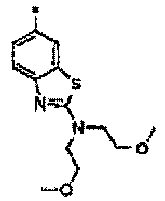
1-(2-(Bis(2-methoxyethyl)amino)benzo[d]thiazol-6-yl)-6-(3-bromo-4-(pyrrolidin-1-yl)phenyl)-4-oxo-1,4-dihydropyridine-3-carboxylic acid 629 1.69 (DMSO-D6) δ: 8.04 (1H, br s). 7.85 (1H, d, J = 2.0 Hz), 7.39 (1H, d, J = 2.0 Hz), 7.34 (1H, d, J = 8.6 Hz), 7.16-7.10 (1H, m), 7.01 (1H, dd. J = 8.6, 2.0 Hz), 6.73 (1H, d, J = 8.6 Hz), 6.20 (1H, br s), 3.75-3.67 (4H, m), 3.62-3.55 (4H, m), 3.41-3.21 (10H, m), 1.85-1.76 (4H, m). 5-4 
6-(3-Bromo-4-(pyrrolidin-1-yl)phenyl)-1-(2-(4-ethylpiperazin-1-yl)benzo[d]thiazol-6-yl)-4-oxo-1,4-dihydropyridine-3-carboxylic acid 610 1.19 (DMS0-D6) δ: 8.55 (1H, s), 8.02 (1H, s), 7.50-7,30 (3H, m), 7.09 (1H, dd, J = 8.6, 2.0 Hz), 6.85 (1H, s), 6.72 (1H, d, J = 8.6 Hz). 4.30-4.05 (2H, br m), 3.78-3.00 (12H, m). 1.82 (3H, t, J = 6.3 Hz), 1.30-1.08 (4H, m), 5-5 
6-(3-Bromo-4-(pyrrolidin-1-yl)phenyl)-1-(2-(4-(2-methoxyethyl)piperazine-1-yl)benzo[d]thiazol-6-yl)-4-oxo-1,4-dihydropyridine-3-carboxylic acid 640 1.21 (MeOD) δ: 8.22 (1H, s), 7.67 (1H, s), 7.41-7.36 (2H, br m), 7.15 (1H, d, J = 9.2 Hz), 6.99 (1H, d, J = 9.2 Hz), 6.71 (1H, d, J = 8.6 Hz), 6.50 (1H, s), 3.65 (4H, br s), 3.57 (4H, br s), 3.35 (5H, br s), 2.69-2.62 (6H, br m), 1.92-1.86 (4H. br m). 5-6 
(R)-6-(3-Bromo-4-(pyrro)idin-1-yl)phenyl)-1-(2-(2-(methoxymethyl)pyrrolidin-1-yl)benzo[d]thiazol-6-yl)-4-oxo-1,4-dihydropyridine-3-carboxylic acid 611 1.74 (CDCl3) δ: 8.66 (1H, s), 7.46 (1H, d, J = 8.6 Hz), 7.41 (1H, d, J = 2.6 Hz), 7.37 (1H, d, J = 2.0 Hz), 6.99 (1H, dd. J = 8.6, 2.0 Hz), 6,80 (1H, dd, J = 9.2, 2.6 Hz), 6.79 (1H, s), 6.53 (1H, d, J = 9.2 Hz), 3.65-3.49 (5H. m). 3.43-3.39 (4H, m). 3.39 (3H, s), 2.20-2.08 (4H. m), 1.94-1.89 (4H, m). - In the same manner as in Examples 1-(1) and 1-(2), the following compounds were obtained.
[Table 11] 
Example No. 
MS (ESI m/z) (M+H) RT(min) 1H-NMR(300MHz) 6-1 
6-(3-Chloro-4-(pyrrolidin-1-yl)phenyl)-1-(2-morpholinobenzo[d]thiazol-6-yl)-4-oxo-1,4-dihydropyridine-3-carboxylic acid 537 1.57 (CDCl3) δ: 8.67 (1H, s), 7.47-7.44 (2H. m). 7.11 (1H, d, J = 2.0 Hz), 7.01 (1H, dd, J = 8.6. 2.6 Hz), 6.79 (1H, s), 6.77 (1H, dd, J = 8.6, 2.0 Hz), 6.52 (1H, d, d = 8.6 Hz), 3.87-3.83 (4H. m), 3.67-3.63 (4H, m), 3.46-3.42 (4H, m). 1.94-1.89 (4H, m), 6-2 
1-2-(Bis(2-methoxyethyl)amino)benzo[d]thiazol-6-yl)-6-(3-chloro-4-(pyrrolidin-1-yl)phenyl)-4-oxo-1,4-dihydropyridine-3-carboxylic acid 583 1.67 (CDCl3) δ: 8.65 (1H, s), 7.43-7.37 (2H, m), 7.15 (1H, d. J = 2.3 Hz), 6.98 (1H, dd, J = 8.6, 2.3 Hz), 6.78-6.73 (2H, m), 6.53 (1H, d, J = 9.2 Hz). 3.83-3.78 (4H, m), 3.70-3.65 (4H, m), 3.46-3.41 (4H, m), 3.37 (6H, s), 1.94-1.89 (4H, m), 6-3 
(R)-6-(3-Chloro-4-(pyrrolidin-1-yl)phenyl)-1-(2-(2-(methoxymethyl)pyrrolidin-1-yl)benzo[d]thiazol-6-yl)-4-oxo-1,4-dihydropyridine-3-carboxylic acid 565 1.73 (CDCl3) δ: 8.66 (1H, s), 7.46-7.40 (2H, m), 7.13 (1H, d, J = 2.6 Hz), 6.99 (1H, dd, J = 8.6, 2.6 Hz), 6.79-6.74 (2H, m), 6.52 (1H, d, J = 8.6 Hz), 3.65-3.50 (5H, m), 3.45-3.41 (4H, m), 3.39 (3H, s), 2.19-2.05 (4H, m), 1.94-1.89 (4H, m), 6-4 
6-(3-Chloro-4-(pyrrolidin-1-yl)phenyl)-1-(2-(4-ethylpiperazin-1-yl)benzo[d]thiazol-6-yl)-4-oxo-1,4-dihydropyridine-3-carboxylic acid 564 1.18 (MeOD) δ: 8.71 (1H, br s), 7.77 (1H, br s), 7.50-7.43 (1H, br m), 7.28-7.17 (2H, br m). 7.02-6.94 (1H, br m), 6.83 (1H, br s), 6.71-6.64 (1H, br m), 3.81 (4H, br s), 3.63-3.51 (2H, br m), 3.38 (4H, br s), 3.04 (4H, br s), 1.90 (4H, br s), 1.28 (3H, br s). 6-5 
6-(3-Chloro-4-(pyrrolidin-1-yl)phenyl)-1-(2-(4-(2-methoxyethyl)piperazin-1-yl)benzo[d]thiazol-6-yl)-4-oxo-1,4-dihydropyridine-3-carboxylic acid 594 1.11 (MeOD) δ: 8.72 (1H, br s), 7.75 (1H, br s), 7.47-7.40 (1H, br m), 7.26-7.18 (2H, br m), 7.00-8.94 (1H, br m), 6.83 (1H, br s), 6.71-6.65 (1H, br m), 3.73 (4H, br s). 3.61 (2H, br s), 3.37 (7H, br s), 2.85 (6H, br s), 1.90 (4H, br s). -

- In the same manner as in Examples 1-(1) and 1-(2), the following compound was obtained.
6-(3-Fluoro-4-(pyrrolidin-1-yl)phenyl)-1-(2-morpholinobenzo[d]thiazol-6-yl)-4-oxo-1,4-dihydropyridine-3-carboxylic acid
1H-NMR (CDCl3) δ: 8.66 (1H, s), 7.46 (1H, d, J = 2.0 Hz), 7.45 (1H, d, J = 8.6 Hz), 7.00 (1H, dd, J = 8.6, 2.0 Hz), 6.78 (1H, s), 6.76-6.69 (2H, m), 6.39 (1H, t, J = 8.6 Hz), 3.90-3.79 (4H, m), 3.71-3.60 (4H, m), 3.44-3.32 (4H, m), 1.98-1.86 (4H, m).
MS (ESI m/z): 521 (M+H)
RT (min): 1.53 -

- (1) In the same manner as in Example 1-(1), the following compound was obtained.
Ethyl 6-(4-bromophenyl)-1-(2-methylbenzo[d]thiazol-6-yl)-4-oxo-1,4-dihydropyridine-3-carboxylate
MS (ESI m/z): 471 (M+H)
RT (min): 1.32 - (2) In the same manner as in Reference Example 7-(1), the following compound was obtained.
Ethyl(R)-6-(4-(3-((4-fluorobenzyl)oxy)pyrrolidin-1-yl)phenyl)-1-(2-methylbenzo[d]thiazol-6-yl)-4-oxo-1,4-dihydropyridine-3-carboxylate
MS (ESI m/z): 584 (M+H)
RT (min): 1.61 - (3) In the same manner as in Example 1-(2), the following compound was obtained.
(R)-6-(4-(3-((4-Fluorobenzyl)oxy)pyrrolidin-1-yl)phenyl)-1-(2-methylbenzo[d]thiazol-6-yl)-4-oxo-1,4-dihydropyridine-3-carboxylic acid
1H-NMR (CDCl3) δ: 8.68 (1H, s), 7.88 (1H, d, J = 8.6 Hz), 7.70 (1H, d, J = 2.0 Hz), 7.31-7.24 (2H, m), 7.16 (1H, dd, J = 8.6, 2.0 Hz), 7.05-6.97 (2H,m), 6.94 (2H, d, J = 8.6 Hz), 6.81 (1H, s), 6.31 (2H, d, J = 8.6 Hz), 4.52 (1H, d, J = 11.2 Hz), 4.47 (1H, d, J = 11.2 Hz), 4.32-4.20 (1H, m), 3.48-3.23 (4H, m), 2.87 (3H, s), 2.28-2.00 (2H, m).
MS (ESI m/z): 556 (M+H)
RT (min): 1.65 -

- In the same manner as in Examples 8-(1), 8-(2), and 8-(3), the following compound was obtained.
(R)-6-(4-(3-(2-Methoxyethoxy)pyrrolidin-1-yl)phenyl)-1-(2-methylbenzo[d]thiazol-6-yl)-4-oxo-1,4-dihydropyridine-3-carboxylic acid
1H-NMR (CDCl3) δ: 8.68 (1H, s), 7.88 (1H, d, J = 8.6 Hz), 7.70 (1H, d, J = 2.0 Hz), 7.16 (1H, dd, J = 8.6, 2.0 Hz), 6.93 (2H, d, J = 8.6 Hz), 6.81 (1H, s), 6.30 (2H, d, J = 8.6 Hz), 4.26-4.16 (1H, m), 3.69-3.47 (4H, m), 3.47-3.33 (5H, m), 3.33-3.21 (2H, m), 2.87 (3H, s), 2.26-1.97 (2H, m).
MS (ESI m/z): 506 (M+H)
RT (min): 1.28 - In the same manner as in Examples 1-(1) and 1-(2), the following compounds were obtained.
[Table 12] 
Example No. 
MS (ESI m/z) (M+H) RT(min) 1H-NMR(300MHz) 10-1 
(R)-1-(2-(4-(2-Methoxyethyl)piperazin-1-yl)benzo[d]thiazol-6-yl)-6-(4-(3-methoxypyrrolidin-1-yl)phenyl)-4-oxo-1,4-dihydropyridine-3-carboxylic acid 590 1.02 (DMSO-D6) δ: 8.14-8.10 (1H, m), 7.83 (1H, s), 7.34 (1H, d, J = 8.6 Hz), 7.14-7.04 (1H, m), 6.99 (2H, d, J = 8.6 Hz), 6.35 (2H, d, J = 8.6 Hz), 6.18 (1H, br s), 4.06-3.98 (1H, m), 3.57-3.12 (20H, m), 2.60-2.45 (2H. m), 2.05-1.95 (2H, m). 10-2 
1-(2-((R)-2-(Methoxymethyl)pyrrolidin-1-yl)benzo[d]thiazol-6-yl)-6-(4-((R)-3-methoxypyrrolidin-1-yl)phenyl)-4-oxo-1,4-dihydropyridine-3-carboxylic acid 561 1.47 CCDCl3) δ: 8.66 (1H, s), 7.44 (1H, d, J = 8.6 Hz), 7.41 (1H, d. J = 2.0 Hz), 6.98 (1H, cd, J = 8.6, 2.0 Hz), 6.96 (2H, d, J = 8.6 Hz), 6.79 (1H, s), 6.34 (2H, d. J = 8.6 Hz), 4.25-4.13 (1H,m), 4.11-4.03 (1H, m), 3.71-3.22 (14H, m). 2.25-1.96 (6H, m). 10-3 
(R)-1-(2-(Bis(2-methoxyethyl)amino)benzo[d]thiazol -6-yl)-6-(4-(3-methoxypyrrolidin-1-yl)phenyl)-4-oxo-1,4-dihydropyridine-3-carboxylic acid 579 1.41 (CDCl3) δ: 8.65 (1H, s), 7.39 (1H, d, J = 8.6 Hz), 7.38 (1H, d, J = 2.0 Hz), 6.97 (1H, dd. J = 8.6. 2.0 Hz), 6.96 (2H. d, J = 8.6 Hz), 6.79 (1H, s), 6.35 (2H, d. J = 8.6 Hz), 4.12-4.03 (1H, m), 3.80 (4H, t, J = 5.3 Hz), 3.67 (4H, t, J = 5.3 Hz). 3.45-3.25 (13H, m), 2.22-1.95 (2H, m). 10-4 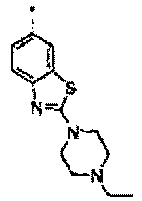
(R)-1-(2-(4-Ethylpiperazin-1-yl)benzo[d]thiazol-6-yl)-6-(4-(3-methoxypyrrolidin-1-yl)phenyl)4-oxo-1,4-dihydropyridine-3-carboxylic acid 560 0.95 (CDCl3) δ: 8.66 (1H, s). 7.42 (1H, d, J = 8.6 Hz), 7.40 (1H, d, J = 2.0 Hz), 6.99 (1H, dd, J = 8.6, 2.0 Hz). 6.95 (2H, d, J = 9.2 Hz). 6.79 (1H, s), 6.33 (2H, d, J = 9.2 Hz), 4.11-4.02 (1H, m), 3.76-3.58 (4H. m), 3.44-3.22 (7H, m). 2.65-2.55 (4H, m). 2.50 (2H, d, J = 7.3 Hz), 2.23-1.95 (2H, m), 1.13 (3H. t. J = 7.3 Hz), -

- (1) In the same manner as in Example 1-(1), the following compound was obtained.
Ethyl 6-(4-bromo-3-chlorophenyl)-1-(2-morpholinobenzo[d]thiazol-6-yl)-4-oxo-1,4-dihydropyridine-3-carboxylate
MS (ESI m/z): 576 (M+H)
RT (min): 1.39 - (2) A mixture of ethyl 6-(4-bromo-3-chlorophenyl)-1-(2-morpholinobenzo[d]thiazol-6-yl)-4-oxo-1,4-dihydropyridine-3-carboxylate obtained in (1) (50 mg), chloro(2-dicyclohexylphosphino-2',6'-diisopropoxy-1,1'-biphenyl)[2-(2'-amino-1,1'-biphenyl)]palladium (II) (7 mg), cesium carbonate (113 mg), a 1,2-dimethoxyethane solution (2 mL) of (R)-3-methoxypyrrolidine obtained in Reference Example 13, and 1,2-dimethoxyethane (2 mL) was irradiated with microwaves (InitiatorTM, 120°C, 1 hour, 2.45 GHz, 0-240W). The reaction mixture was cooled to room temperature and then the solvent was evaporated under reduced pressure. The obtained residue was purified by silica gel column chromatography [eluent; 50%-0% hexane/ethyl acetate→100%-75% ethyl acetate/methanol] to obtain ethyl (R)-6-(3-chloro-4-(3-methoxypyrrolidin-1-yl)phenyl)-1-(2-morpholinobenzo[d]thiazol-6-yl)-4-oxo-1,4-dihydropyridine-3-carboxylate (16.4 mg).
MS (ESI m/z): 595 (M+H)
RT (min): 1.35 - (3) In the same manner as in Example 1-(2), the following compound was obtained.
(R)-6-(3-Chloro-4-(3-methoxypyrrolidin-1-yl)phenyl)-1-(2-morpholinobenzo[d]thiazol-6-yl)-4-oxo-1,4-dihydropyridine-3-carboxylic acid
1H-NMR (CDCl3) δ: 8.67 (1H, s), 7.46 (1H, d, J = 8.6 Hz), 7.43 (1H, d, J = 2.0 Hz), 7.12 (1H, d, J = 2.0 Hz), 7.02 (1H, dd, J = 8.6, 2.0 Hz), 6.79 (1H, dd, J = 8.6, 2.0 Hz), 6.78 (1H, s), 6.53 (1H, d, J = 8.6 Hz), 4.05-3.97 (1H, m), 3.90-3.80 (4H, m), 3.75 (1H, dd, J = 10.9, 5.0 Hz), 3.71-3.60 (4H, m), 3.59-3.48 (1H, m), 3.46-3.27 (5H, m), 2.15-1.91 (2H, m).
MS (ESI m/z): 567 (M+H)
RT (min): 1.42 - In the same manner as in Examples 1-(1) and 1-(2), the following compounds were obtained.
[Table 13] 
Example No. 
MS (ESI m/z) (M+H) RT(min) 1H-NMR(300MHz) 12-1 
(R)-1-(2-(Bis(2-methoxyethyl)amino)benzo[d]thiazol -6-yl)-6-(3-chloro-4-(3-methoxypyrrolidin-1-yl)phenyl)-4-oxo-1,4-dihydropyridine-3-carboxylic acid 613 1.52 (CDCl3) δ: 8.65 (1H, s). 7.41 (1H, d, J = 8.6 Hz), 7.38 (1H, d, J = 2.0 Hz), 7.15 (1H, d, J = 2.0 Hz), 6.98 (1H, dd, J = 8.6, 2.0 Hz), 6.80-6-75 (2H, m), 6.54 (1H, d. J = 8.6 Hz), 4.03-3.99 (1H, m), 3.83-3.78 (4H, m), 3.77-3.72 (1H, m), 3.70-3.65 (4H, -n), 3.60-3.51 (1H, m), 3.45-3.37 (2H, m), 3.36 (6H, s), 3.33 (3H, s), 2.10-1.96 (2H, m). 12-2 
(R)-6-(3-Chloro-4-(3-methoxypyrrolidin-1-yl)phenyl)-1-(2-(4-(2-methoxyethyl)piperazin-1-yl)benzo[d]thiazol-6-yl)-4-oxo-1,4-dihydropyridine-3-carboxylic acid 624 1.09 (MeOD) δ: 8.70 (1H, br s), 7.77 (1H, br s), 7.51-7.44 (1H, br m), 7.29-7.18 (2H, br m), 7.03-5.97 (1H br m), 6.83 (1H, br s), 6.71-6.65 (1H, br m), 4.02 (1H, br s), 3.86 (4H, br s), 3.73-3.66 (4H, br m), 3.55-3.48 (2H, br m), 3.41 (3H, br s). 3.26-3.15 (6H, br m), 2.01 (3H, br s), 1.29-1.21 (2H, br m). 12-3 
(R)-6-(3-Chloro-4-(3-methoxypyrrolidin-1-yl)phenyl)-1-(2-(4-ethylpiperazin-1-yl)benzo[d]thiazol-6-yl)-4-oxo-1,4-dihydropyridine-3-carboxylic acid 594 1.08 (DMSO-D6) δ : 8.05 (1H, s), 7.85 (1H, d, J = 2.3 Hz), 7.36 (1H, d, J = 8.6 Hz), 7.20-7.11 (2H. m), 6.96 (1H, dd. J = 8.6, 2.0 Hz), 6.70 (1H, d, J = 8.9 Hz), 6.18 (1H, s), 4.00-3.93 (1H, m), 3.62-3.17 (15H, m), 2.38 (2H, q, J = 7.2 Hz), 1.99-1.87 (2H, m). 1.02 (3H, t, J = 7.2Hz). 12-4 
6-(3-Chloro-4-((R)-3-methoxypyrrolidin-1-yl)phenyl)-1-(2-((R)-(2-methoxymethyl)pyrrolidin-1-yl)benzo[d]thiazol-6-yl)-4-oxo-1,4-dihydropyridine-3-carboxylic acid 595 1.55 (CDCl3) δ: 8.67 (1H, s), 7.46 (1H, d, J = 8.6 Hz), 7.40 (1H, d, J = 2.0 Hz), 7.14 (1H, d. J = 2.0 Hz). 6.99 (1H, dd, J = 8.6, 2.0 Hz), 6.79 (1H, dd, J = 8.6, 2.0 Hz), 6.78 (1H, s), 6.54 (1H, d, J = 8.6 Hz), 4.26-4.12 (1H, m). 4.05 3.96 (1H, m), 3.75 (1H, dd, J = 10.9, 5.0 Hz), 3.68-3.29 (13H, m), 2.25-1.92 (6H, m). -

- In the same manner as in Examples 1-(1) and 1-(2), the following compound was obtained.
(R)-1-(2-Morpholinobenzo[d]thiazol-6-yl)-4-oxo-6-(2,3,3a,4-tetrahydro-1H-benzo[b]pyrrolo[1,2-d][1,4]oxazin-7-yl)-1,4-dihydropyridine-3-carboxylic acid
1H-NMR (DMSO-D6) δ: 8.26 (1H, s), 7.90 (1H, s), 7.38 (1H, d, J = 8.6 Hz), 7.21-7.10 (1H, br m), 6.69-6.60 (2H, m), 6.37 (2H, d, J = 7.9 Hz), 4.42-4.35 (1H, m), 3.78-3.00 (12H, m), 2.10-1.80 (4H, m).
MS (ESI m/z): 531 (M+H)
RT (min): 1.39 -
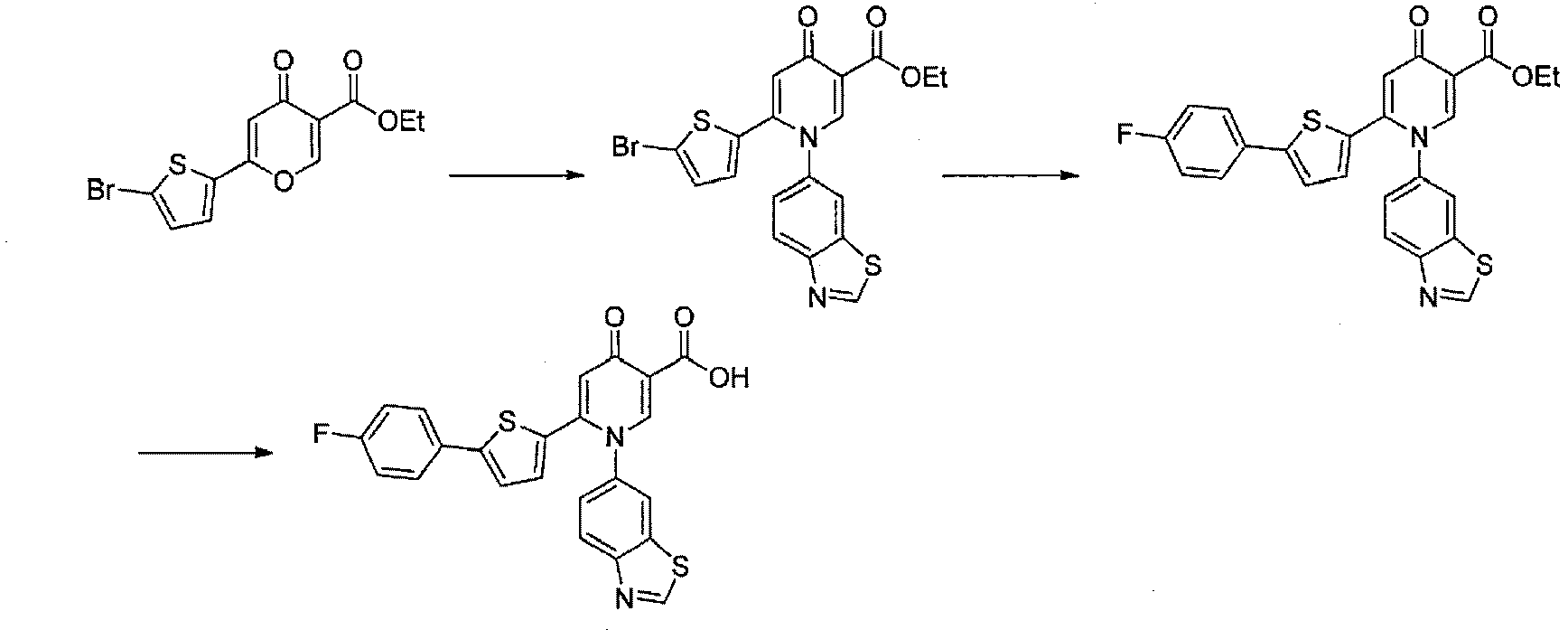
- (1) In the same manner as in Example 1-(1), the following compound was obtained.
Ethyl 1-(benzo[d]thiazol-6-yl)-6-(5-bromothiophen-2-yl)-4-oxo-1,4-dihydropyridine-3-carboxylate
MS (ESI m/z): 461 (M+H)
RT (min): 1.21 - (2) A mixture of ethyl 1-(benzo[d]thiazol-6-yl)-6-(5-bromothiophen-2-yl)-4-oxo-1,4-dihydropyridine-3-carboxylate obtained in (1) (20 mg), (4-fluorophenyl)boronic acid (9.1 mg), tetrakis(triphenylphosphine)palladium (0) (5.0 mg), a 2 mol/L aqueous sodium carbonate solution (54.2 µL), and 1,2-dimethoxyethane (4 mL) was irradiated with microwaves (InitiatorTM, 120°C, 30 minutes, 2.45 GHz, 0-240W). The reaction mixture was cooled to room temperature and then the solvent was evaporated under reduced pressure. The obtained residue was purified by silica gel column chromatography [eluent; 50%-0% hexane/ethyl acetate→100%-80% ethyl acetate/methanol] to obtain as a brown solid ethyl 1-(benzo[d]thiazol-6-yl)-6-(5-(4-fluorophenyl)thiophen-2-yl)-4-oxo-1,4-dihydropyridine-3-carboxylate (9.4 mg).
MS (ESI m/z): 477 (M+H)
RT (min): 1.37 - (3) In the same manner as in Example 1-(2), the following compound was obtained.
1-(Benzo[d]thiazol-6-yl)-6-(5-(4-fluorophenyl)thiophen-2-yl)-4-oxo-1,4-dihydropyridine-3-carboxylic acid
1H-NMR (CDCl3) δ: 9.19 (1H, s), 8.69 (1H, s), 8.22 (1H, d, J = 8.6 Hz), 8.00 (1H, d, J = 2.0 Hz), 7.46-7.33 (3H, m), 7.09-6.96 (4H, m), 6.79 (1H, d, J = 4.0 Hz).
MS (ESI m/z): 449 (M+H)
RT (min): 1.44 -

- In the same manner as in Examples 1-(1) and 1-(2), the following compound was obtained.
1-(2-Methylbenzo[d]thiazol-6-yl)-4-oxo-6-(2-(pyrrolidin-1-yl)thiazol-5-yl)-1,4-dihydropyridine-3-carboxylic acid
1H-NMR (CDCl3) δ: 8.56 (1H, s), 8.04 (1H, d, J = 8.6 Hz), 7.84 (1H, d, J = 2.0 Hz), 7.37 (1H, dd, J = 8.6, 2.0 Hz), 6.87 (2H, s), 3.40-3.26 (4H, m), 2.91 (3H, s), 2.07-1.97 (4H, m).
MS (ESI m/z): 439 (M+H)
RT (min): 1.10 -
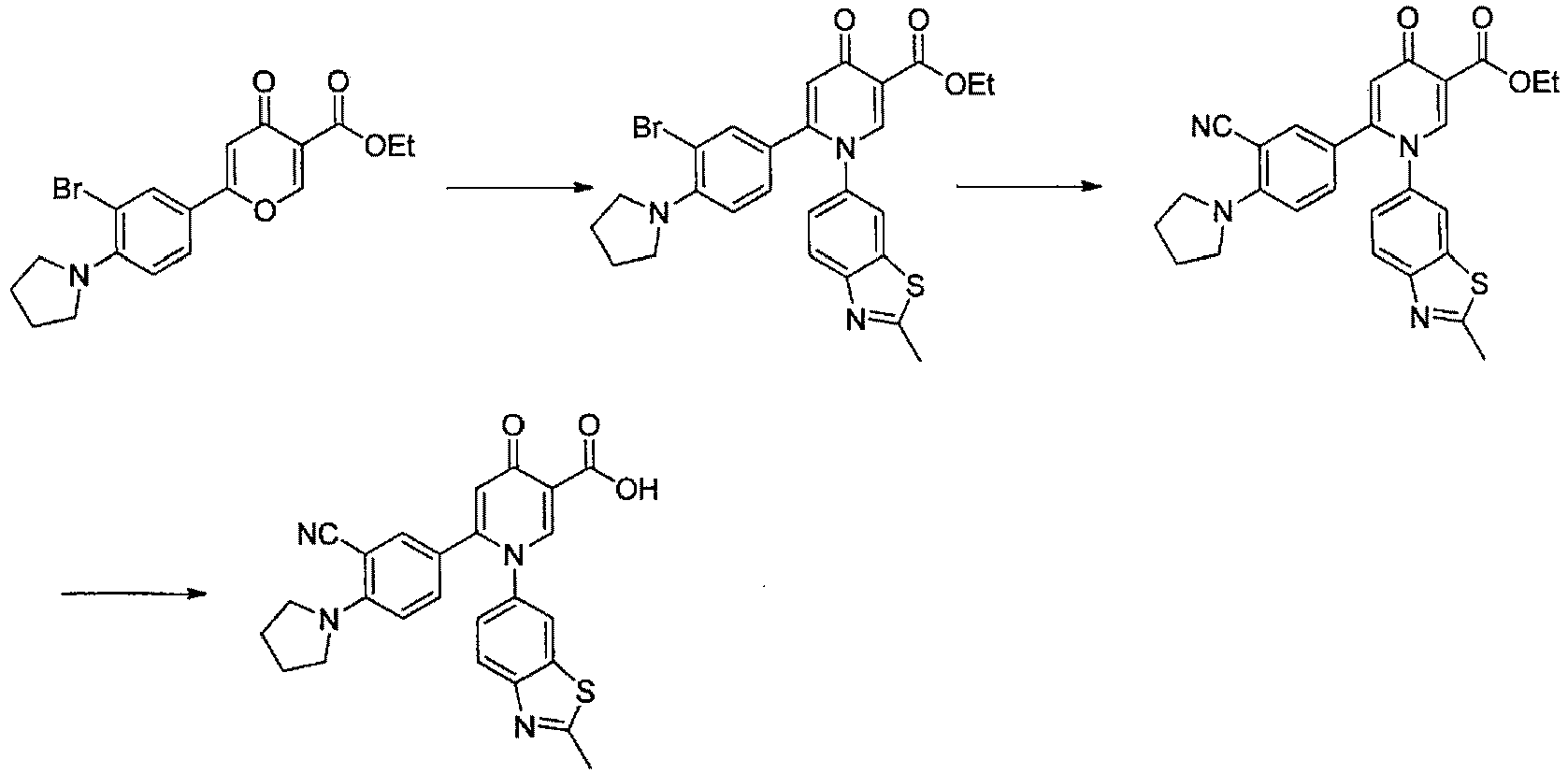
- (1) In the same manner as in Example 1-(1), the following compound was obtained.
Ethyl 6-(3-bromo-4-(pyrrolidin-1-yl)phenyl)-1-(2-methylbenzo[d]thiazol-6-yl)-4-oxo-1,4-dihydropyridine-3-carboxylate
MS (ESI m/z): 540(M+H)
RT (min): 1.50 - (2) Ethyl 6-(3-bromo-4-(pyrrolidin-1-yl)phenyl)-1-(2-methylbenzo[d]thiazol-6-yl)-4-oxo-1,4-dihydropyridine-3-carboxylate obtained in (1) (200 mg), copper cyanide (I) (128 mg), and DMF (3 mL) were put into an Ace high pressure-resistant glass tube and stirred at 150°C for 12 hours. The reaction mixture was cooled to room temperature, a saturated aqueous sodium hydrogen carbonate solution (9 mL) was added thereto, and the solid was collected by filtration. The obtained solid was purified by silica gel column chromatography [eluent; 100%-50% ethyl acetate/methanol] to obtain ethyl 6-(3-cyano-4-(pyrrolidin-1-yl)phenyl)-1-(2-methylbenzo[d]thiazol-6-yl)-4-oxo-1,4-dihydropyridine-3-carboxylate (150 mg) as a yellow solid.
MS (ESI m/z): 485 (M+H)
RT (min): 1.32 - (3) In the same manner as in Example 1-(2), the following compound was obtained.
6-(3-Cyano-4-(pyrrolidin-1-yl)phenyl)-1-(2-methylbenzo[d]thiazol-6-yl)-4-oxo-1,4-dihydropyridine-3-carboxylic acid
MS (ESI m/z): 457 (M+H)
RT (min): 1.34 - In the same manner as in Examples 1-(1) and 1-(2), the following compounds were obtained.
[Table 14] 
Example No. 
MS (ESI m/z) (M+H) RT(min) 1H-NMR(300MHz) 17-1 
(S)-1-(2-(3-(Dimethylamino)pyrrolidin-1-yl)benzo[d]thiazol-6-yl)-4-oxo-6-(4-(pyrrolidin-1-yl)phenyl)-1,4-dihydropyridine-3-carboxylic acid 530 1.05 (CDCl3) δ: 8.66 (1H, s), 7.49-7.44 (2H, m), 7.00 (1H, dd, J = 8.6, 2.3 Hz). 6.94 (2H, d, J = 8.9 Hz), 6.80 (1H, s), 6.33 (2H, d, J = 8.9 Hz), 4.05-3.70 (3H, m), 3.66-3.55 (1H, m), 3.41-315 (5H, m), 2.70-2.38 (8H, m), 2.07-1.96 (4H, m). 17-2 
(R)-1-(2-(3-(Dimethylamino)pyrrolidin-1-yl)benzo[d]thiazol-6-yl)-4-oxo-6-(4-(pyrrotidin-1-yl)phenyl)-1,4-dihydropyridine-3-carboxylic acid 530 1.04 (CDCl3) δ : 8.66 (1H, s), 7.49-7.44 (2H, m), 7.01 (1H dd, J = 8.6, 2.3 Hz), 6.94 (2H, d, J = 8.9 Hz), 6.80 (1H, s), 6.33 (2H, d, J = 8.9 Hz), 4.05-3.70 (3H, m), 3.66-3.55 (1H, m), 3.37 (1H, s), 3.27-3.18 (4H, m), 2.63 (6H, br s), 2.46-2.35 (2H, m), 2.01-1.95 (4H, m). 17-3 
(S)-1-(2-(3-Methoxypyrrolidin-1-yl)benzo[d]thiazol-6-yl)-4-oxo-6-(4-(pyrrolidin-1-yl)phenyl)-1,4-dihydropyridine-3-carboxylic acid 517 1.47 (CDCl3) δ : 8.66 (1H. s), 7.45 (1H, d, J = 8.7 Hz), 7.42(1H, d, J = 2.3 Hz), 7.01-6.90 (3H, m), 6.79 (1H, s), 6.32 (2H, d, J = 8.7 Hz), 4.18-4.10 (1H, m), 3.75-3.58 (4H, m), 3.38 (3H, s), 3.26-3.18 (4H. m), 2.31-1.92 (6H, m). 17-4 
(R)-1-(2-(3-Methoxypyrrolidin-1-yl)benzo[d]thiazol-6-yl)-4-oxo-6-(4-(pyrrolidin-1-yl)phenyl)-1,4-dihydropyridine-3-carboxylic acid 517 1.47 (CDCl3) δ: 8.68 (1H, s), 7.44 (1H, d, J = 8.7 Hz), 7.42 (1H, d, J = 2.3 Hz), 7.01-6.90 (3H. m), 6.79 (1H, s), 6.32 (2H, d, J = 8.7 Hz), 4.17-4.10 (1H, m), 3.75-3.58 (4H, m), 3.37 (3H, s), 3.26-3.18 (4H, m), 2.31-1.92 (6H, m), 17-5 
1-(2-((3R,4R)-3,4-Dimethoxypyrrolidin-1-yl)benzo[d]thiazol-6-yl)-4-oxo-6-(4-(pyrrolidin-1-yl)phenyl-1,4-dihydropyridine-3-carboxylic acid 547 1.42 (CDCl3) δ: 8.66 (1H, s), 7.46 (1H, d, J = 8.6 Hz), 7.43 (1H, d, J = 2.6 Hz), 7.00 (1H, dd, J = 8.6, 2.6 Hz), 6.94 (2H, d, J = 8.6 Hz). 0.79 (1H, s), 6.32 (2H, d, J - 8.8 Hz), 4.11-4.06 (2H, m), 3.79-3.65 (4H, m), 3.50 (6H, s), 3.26-3.19 (4H, m), 2.01-1.94 (4H, m). - In the same manner as in Examples 1-(1) and 1-(2), the following compounds were obtained.
[Table 15] 
Example No. 
MS (ESI m/z) (M+H) RT(min) 1H-NMR(300MHz) 18-1 
1-(2-((3R,4R)-3,4-Dimethoxypyrrolidin-1-yl)benzo[d]thiazol-6-yl)-4-oxo-6-((S)-2,3,3a,benzo[b]pyrrolo[1,2-d][1,4]oxazin-7-yl)-1,4-dihydropyridine-3-carboxylic acid 575 1.33 (CDCl3) δ: 8.65 (1H, s), 7.46-7.38 (1H, m), 7.46 (1H, d. J = 8.6 Hz), 7.05-6.97 (1H, m), 6.78 (1H, s), 6.65 (1H, d, J = 2.0 Hz). 6.56 (1H, dd, J = 8.3, 2.0 Hz), 6.27 (1H, d, J = 8.3 Hz), 4.39 (1H, dd, J = 10.2, 3.3 Hz), 4.12-4.05 (2H, m). 3.80-3.10 (8H, m), 3.50 (6H, s), 2.14-1.88 (3H. m), 1.55-1.25 (1H, m). 18-2 
(S)-1-(2-(3-Methoxyazetidin-1-yl)benzo[d]thiazol-6-yl)-4-oxo-6-(2,3,3a,4-tetrahydro-1H-benzo[b]pyrrolo[1,2-d][1,4]oxazin-7-yl)-1,4-dihydropyridine-3-carboxylic acid 531 1.37 (ODCl3) δ: 8.64 (1H, s), 7.45 (1H, d, J = 8.8 Hz), 7.45-7.40 (1H, m), 7.00 (1H, dd, J = 8.8, 2.2 Hz), 6.78 (1H, s), 6.64 (1H, d, J = 2.1 Hz). 6.56 (1H, dd, J = 8.3, 2.1 Hz). 6.28 (1H, d, J = 8.3 Hz), 4.47-4.34 (4H, m), 4.11 (2H, dd, J - 9.1. 3.5 Hz), 3.60-3.10 (4H. m), 3.37 (3H, s), 2.17-1.89 (3H, m), 1.50-1.33 (1H, m). - In the same manner as in Examples 1-(1) and 1-(2), the following compounds were obtained.
[Table 16] 
Example No. 
MS (ESI m/z) (M+H) RT(min) 1H-NMR(300MHz) 19-1 
(R)-6-(4-(3-(2-Methoxyethoxy)pyrrolidin-1-yl)phenyl)-1-(2-morpho)mobenzo[d]thiazol-6-yl)-4-oxo-1,4-dihydropyridine-3-carboxylic acid 577 1.30 (CDCl3) δ: 8.67 (1H, s), 7.47-7.41 (2H, m), 7.02 (1H, dd, J = 8.6, 2.0 Hz), 6.94 (2H, d, J = 8.6 Hz), 6.79 (1H, s), 6.31 (2H, d, J = 8.6 Hz), 4.26-4.20 (1H, br m), 3.87-3.82 (4H, m), 3.68-3.58 (6H, m), 3.53 (2H, q, J = 4.6 Hz), 3.45-3.35 (5H, m), 3.34-3.26 (2H, m), 2.20-2.02 (2H, m). 19-2 
6-(4-((R)-3-(2-Methoxyethoxy)pyrrolidin-1-yl)phenyl)-1-(2-((R)-2-(methoxymethyl)pyrrolidin-1-yl)benzo[d]thiazol-6-yl)-4-oxo-1,4-dihydropyridine-3-carboxylic acid 605 1.44 (CDCl3) δ: 8.66 (1H, s), 7.45 (1H, d, J = 8.6 Hz), 7.40 (1H, d, J = 2.0 Hz), 7.01-6.93 (3H, m), 6.79 (1H, s), 6.32 (2H, d, J = 8.6 Hz), 4.26-4.16 (2H, br m), 3.67-3.50 (9H, m), 3.46-3.40 (1H, m), 3.39 (3H, s), 3.37 (3H, s), 3.33-3.27 (2H, m), 2.20-2.03 (6H, m). - In the same manner as in Examples 1-(1) and 1-(2), the following compounds were obtained.
[Table 17] 
Example No. 
MS (ESI m/z) (M+H) RT(min) 1H-NMR(300MHz) 20-1 
(R)-6-(3-Fluoro-4-(3-methoxypyrrolidin-1-yl)phenyl)-1-(2-morpholinobenzo[d]thiazol-6-yl)-4-axo-1,4-dihydropyridine-3-carboxylic acid 551 1.37 (CDCl3) δ: 8.66 (1H, c), 7.46 (1H, d, J = 8.6 Hz), 7.43 (1M, d, J = 2.6 Hz), 7.02 (1H, dd, J = 8.6, 2.6 Hz), 6.78 (1H, s), 6.77-6.70 (2H, m), 6.40 (1H, t, J = 8.9 Hz), 4.05-3.97 (1H, m), 3.92-3.78 (4H, m), 3.73-3.30 (11H, m), 2.21-1.89 (2H. m). 20-2 
(R)-6-(3-Fluoro-4-(3-methoxypyrrolidin-1-yl)phenyl)-1-(2-(3-methoxyazetidin-1-yl)benzo[d]thiazol-6-yl)-4-oxo-1,4-dihydropyridine-3-carboxylic acid 551 1.36 (CDCl3) δ: 8.65 (1H, s). 7.49 (1H, d, J = 8.6 Hz), 7.41 (1H, d, J = 2.6 Hz). 7.01 (1H, dd, J = 8.6, 2.6 Hz), 6.79-6.67 (3H, m). 6.39 (1H. t, J = 8.9 Hz), 4.51-4.33 (3H, m), 4.20-4.08 (2H, m), 4.05-3.96 (1H, m), 3.65-3.30 (10H, m), 2.19-1.88 (2H, m). -

- In the same manner as in Examples 1-(1) and 1-(2), the following compound was obtained.
6-(4-((R)-3-(2-Methoxyethoxy)pyrrolidin-1-yl)phenyl)-1-(2-((S)-3-methoxypyrrolidin-1-yl)benzo[d]thiazol-6-yl)-4-oxo-1,4-dihydropyridine-3-carboxylic acid
1H-NMR (CDCl3) δ: 8.67 (1H, s), 7.46 (1H, d, J = 8.6 Hz), 7.40 (1H, d, J = 2.6 Hz), 6.99 (1H, dd, J = 8.6, 2.6 Hz), 6.95 (2H, d, J = 9.2 Hz), 6.79 (1H, s), 6.31 (2H, d, J = 9.2 Hz), 4.25-4.18 (1H, m), 4.17-4.10 (1H, m), 3.73-3.25 (18H, m), 2.28-2.00 (4H, m).
MS (ESI m/z): 591(M+H)
RT (min): 1.31 - In the same manner as in Examples 1-(1) and 1-(2), the following compounds were obtained.
[Table 18] 
Example No. 
MS (ESI m/z) (M+H) RT(min) 1H-NMR(300MHz) 22-1 
(S)-6-(4-(3-(2-Methoxyethoxy)pyrrolidin-1-yl)phenyl)-1-(2-morpholinobenzo[d]thiazol-6-yl)4-oxo-1,4-dihydropyridine-3-carboxylic acid 577 1.30 (CDCl3) δ: 8.67 (1H, s), 7.47-7.41 (2H, m), 7.02 (1 H, dd, J = 8.6, 2.0 Hz), 6.94 (2H, d. J = 9.2 Hz), 6.79 (1H, s). 6.31 (2H, d, J = 9.2 Hz), 4.25-4.19 (1H, m), 3.84 (4H, t, J = 4.6 Hz), 3.67-3.59 (6H, m), 3.56-3.50 (2H, m), 3.45-3.28 (7H, m), 2.20-2.03 (2H, m). 22-2 
6-(4-((S)-3-(2-Methoxyethoxy)pyrrolidin-1-yl)phenyl)-1-(2-((R)-2-(methoxymethyl)pyrrolidin-1-yl)benzo[d]thiazol-6-yl)-4-oxo-1,4-dihydropyridine-3-carboxylic acid 605 1.44 (CDCl3) δ : 8.66 (1H, s), 7.47-7.39 (2H, m), 7.00-6.91 (3H, m), 6.79 (1H, s), 6.32 (2H, d, J = 9.2 Hz), 4.26-4.15 (2H, m), 3.66-3.48 (8H, m), 3.45-3.24 (10H, m). 2.19-2.02 (6H, m). - In the same manner as in Examples 1-(1) and 1-(2), the following compounds were obtained.
[Table 19] 
Example No. 
MS (ESI m/z) (M+H) RT(min) 1H-NMR(300MHz) 23-1 
6-(3-Fluoro-4-((R)-3-methoxypyrrolidin-1-yl)phenyl)-1-(2-((S)-3-morpholinopyrrolidin-1-yl)benzo[d]thiazol-6-yl)-4-oxo-1,4-dihydropyridine-3-carboxylic acid 620 1.03 (CDCl3) δ: 8.66 (1H. s). 7.46 (1H, t, J = 8.6 Hz). 7.41 (1H, d, J = 20 Hz), 7.00 (1H, dd, J = 8.6.2.0 Hz), 6.79-6.70 (3H, m),6.39 (1H, t. J = 8.9 Hz), 4.07-3.30 (13H, m), 3.15-3.03 (1H, m), 2.63-2.51 (5H, m). 2.35-2.30 (1H, m). 218-1.92 (5H, m). 23-2 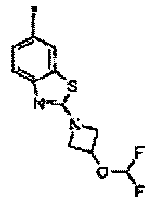
(R)-1-(2-(3-(Difluoromethoxy)azetidin-1-yl)benzo[d]thiazol-6-yl)-6-(3-fluoro-4-(3-methoxypyrrolidin-1-yl)phenyl)-4-oxo-1,4-dihydropyridine-3-carboxylic acid 567 1.47 (CDCl3) δ: 8.65 (1H, s), 7.51 (1H, t, J = 5.0 Hz), 7.43 (1H, d, J = 22 Hz), 7.03 (1H, dd, J = 8.7, 2.2 Hz), 6.79-6.69 (3H, m),6.40 (1H, t J = 8.7 Hz), 6.30 (1H, t, J = 72.5 Hz), 5.26-5.17 (1H, m), 4.55-448 (2H. m), 4.29 (2H, dd, J = 10.1, 4.3 Hz), 4.04-3.98 (1H, m), 362-3.34 (4H. m), 3.34 (3H, s), 2.15-2-06 (1H, m), 2.02-1.92 (1H, 23-3 
6-(3-Fluoro-4-((R)-3-methoxypyrrolidin-1-yl)phenyl)-4-oxo-1-(2-(3-((tetrahydrofuran-2-yl)methoxy)azetidin-1-yl)benzo[d]thiazol-6-yl)-1,4-dihydropyridine-3-carboxylic acid 621 1.42 (CDCl3) δ: 8.65 (1H, s), 7.47(1H, d, J = 8.5 Hz), 7.40 (1H. d, J = 2.3 Hz), 7.00 (1H, dd. J = 8.5, 2.3 Hz), 6.78-6.69 (3H, m), 6.39 (1H, t, J = 9.0 Hz), 4.62-4.55 (1H, m), 4.42-4.35 (2H, m), 4.20-4.13 (2H, m), 4.09-3.98 (2H, m), 3.92-3.85 (1H, m), 3.83-3.75 (1H, m), 3.62-3.35 (6H, m), 3.33 (3H, s). 2.14-2.06 (1H, m), 2.04-1.85 (4H. m), 1.65-1.57 (1H, m). 23-4 
(R)-6-(3-Fluoro-4-(3-methoxypyrrolidin-1-yl)phenyl)-1-(2-(3-fluoroethoxy)azetidin-1-yl)benzo[d]pyridin-6-yl)-4-oxo-1,4-dihydropyridine-3-carboxylic acid 583 1.38 (CDCl3) δ: 8.65 (1H, s), 7.49 (1H, d, J = 8.7 Hz), 7.41 (1H, d. J = 2.2 Hz), 7.01 (1H, dd. J = 8.7, 2.2 Hz), 6.78-6.69 (3H, m). 6.39 (1H, t, J = 8.9 Hz), 4.67-4.57 (2H, m). 4.55-4.51 (1H, m), 4.45-4.38 (2H, m). 4.17 (2H, dd. J = 9.6.4.2 Hz), 4.03-3.98 (1H, m), 3.80-3.75 (1H, m), 3.72-3,67 (1H, m). 3.62-3.34 (4H. m), 3.33 (3H, s). 2.14-2.06 (1H, m), 2.02-1.92 (1H, m). 23-5 
(R)-6-(3-Fluoro-4-(3-methoxypyrrolidin-1-yl)phenyl)-1-(2-(3-methoxypropoxy)azetidin-1-yl)benzo[d]pyridin-6-yl)-4-oxo-1,4-dihydropyridine-3-carboxylic acid 609 1.43 (CDCl3) δ : 8.65 (1H, s). 7.48 (1H, d, J = 8.7 Hz), 7.41 (1H, d, J = 22 Hz), 7.00 (1H, dd, J = 8.7. 2.2 Hz), 6.78-6.69 (3H. m), 6.39 (1H, t, J = 9.0 Hz), 4.55-4.48 (1H, m), 4.42-4.35 (2H, m). 4.12 (2H. dd. J = 9.7, 4.1 Hz), 4.02-4.00 (1H, m), 3.62-3.35 (8H, m), 3.34 (3H, s), 3.33 (3H, s), 2.15-2.06 (1H, m), 2.03-1.92 (1H, m). 1.91-1.83 (2H. m). 23-6 
(R)-1-(2-(3-Ethoxyazetidin-1-yl)benzo[d]thiazol-6-yl)-6-(3-fluoro-4-(3-methoxypyrrolidin-1-yl)phenyl)-4-oxo-1,4-dihydropyridine-3-carboxylic acid 565 1.45 (CDCl3) δ: 8.65 (1H, s), 7.47 (1H, d, J = 8.7 Hz), 7.41 (1H, d, J = 22 Hz), 7.00 (1H, dd, J = 8.7, 2.2 Hz), 6.78-6.69 (3H, m), 6.39 (1H, t, J = 8.9 Hz), 4.55-4.48 (1H, m), 4.42-4.35 (2H, m), 4.13 (2H, dd. J = 9.6, 4.2 Hz), 4.03-3.98 (1H, m). 3.62-3.56 (1H, m), 3.54-3.34 (5H, m), 3.33 (3H, s), 2.14-2.06 (1H, m). 2.02-1.92 (1H, m), 1.25 (3H, t, J = 7.0 Hz). 23-7 
(R)-6-(3-Fluoro-4-(3-methoxypyrrolidin-1-yl)phenyl)-1-(2-(3-isopropoxyazetidin-1-yl)benzo[d]thiazol-6-yl)-4-oxo-1,4-dihydropyridine-3-carboxylic acid 579 1.54 (CDCl3) δ: 8.65 (1H, s). 7.47(1H, d. J = 8.7 Hz), 7.40 (1H, d, J = 22 Hz), 7.00 (1H, dd. J = 8.6, 2.3 Hz), 6.79-6.69 (3H, m), 6.39 (1 H, t, J = 9.0 Hz). 4.62-4.55 (1H, m), 4.44-4.36 (2H, m), 4.11 (2H, dd, J = 9.2, 4.6 Hz), 4.03-3.98 (1H, m). 3.72-3.34 (5H, m). 3.53 (3H, s), 2.14-2.06 (1H, m), 2.02-1.92 (1H, m). 1.19 (7H, d, J = 6.0 Hz), 23-8 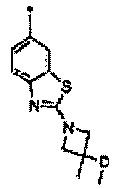
(R)-6-(3-Fluoro-4-(3-methoxypyrrolidin-1-yl)phenyl)-1-(2-(3-methoxy-3-methylazetidin-1-y))benzo[d]thiazo)-6-yl)-4-oxo-1,4-dihydropyridine-3-carboxylic acid 565 1.42 (CDCl3) δ : 8.65 (1H, s). 7.48(1H, d. J = 8.7 Hz). 7.41 (1H, d. J = 2.2 Hz), 7.01 (1H, dd. J = 8.7, 2.2 Hz). 0.78-0.69 (3H. m), 0.39 (1H, t, J = 9.0 Hz), 4.20 (2H, d. J = 8.7 Hz). 4.03-3.96 (3H, m), 3.62-3.34 (3H, m), 3.33 (3H, s), 3.33 (3H. s). 2.14-2.07 (1H, m), 2.02-1.92 (2H. m), 1.59 (3H, s). 23-9 
(R)-6-(3-Fluoro-4-(3-methoxypyrrolidin-1-yl)phenyl)-1-(2-(3-(2-methoxyethoxy)azetidin-1-yl)benzo[d]pyridin-6-yl)-4-oxo-1,4-dihydropyridine-3-carboxylic acid 595 1.35 (CDCl3) δ: 8.65 (1 H, s), 7.47 (1H, d, J = 8.7 Hz), 7.40 (1H, d, J = 2.2 Hz), 7.00 (1H, dd, J = 8.7, 2.2 Hz). 6.78-6.69 (3H, m), 6.39 (1H, t, J = 9.0 Hz), 4.61-4.54 (1H, m). 4.42-4.35 (2H, m), 4.17 (2H, dd. J = 9.7, 4.3 Hz), 4.03-3.98 (1H, m). 3.65-3.34 (11H, m), 3.33 (3H, s), 2.15-2.06 (1H, m), 202-1.92 (1H, m). - Next, the usefulness of the representative compounds of the present invention will be described with reference to Test Examples.
- Using HepG2.2.15 cells (Proc. Natl. Acad. Sci. USA, 84, 1005-1009, 1987) which have an HBV genome introduced into a hepatoblastoma cell line, HepG2, and persistently produce a virus, the anti-HBV activity of the representative compounds was evaluated in the following procedure.
- The following was used as a medium:
DMEM/F-12, GlutaMAX (manufactured by Invitrogen)+5 µg/mL insulin (manufactured by Wako)+1% penicillin/streptomycin (manufactured by Sigma)+10 mmol/L HEPES (manufactured by Sigma)+50 µmol/L hydrocortisone (manufactured by Sigma)+10% FBS - A mixture of a test compound with dimethyl sulfoxide (DMSO) was further added to the medium to obtain a final concentration of DMSO of 0.25% (v/v), and thus, test solutions containing the test compound at various concentrations were prepared. In addition, a test solution obtained by adding DMSO alone to the medium to obtain a final concentration of 0.25% (v/v) was prepared as a control without addition of a drug.
-
- (1) The HepG2.2.15 cells were suspended in the medium to prepare a HepG2.2.15 cell suspension at 4×10⁵ cells/mL. The suspension was seeded in a 96-well microtiter plate (100 µL/well) and the plate was incubated in a 5% CO2 incubator at 37°C for 2 days.
- (2) The culture supernatant was removed and the cells were washed twice with PBS (-) (100 µL/well).
- (3) The test solution (200 µL/well) was added to the plate of (2) and the plate was incubated in a 5% CO2 incubator at 37°C for 4 days.
- (4) The culture supernatant was removed, the test solution (200 µL/well) was added again to the plate, and the plate was incubated in a 5% CO2 incubator at 37°C for 3 days.
- (5) The culture supernatant was collected and treated with a mixture of Buffer AL (manufactured by QIAGEN) and Proteinase K (manufactured by Invitrogen). The amount of DNA of HBV (HBV-DNA) in the obtained solution was absolutely quantified by a real-time PCR method. In addition, HBsAg (hepatitis B surface antigen) in the culture supernatant was absolutely quantified by chemiluminescent enzyme immunoassay using Lumipulse (registered trademark) HBsAg-HQ (manufactured by Fujirebio Inc.). The relative viral load (%) of a well with the compound added to a well without the compound added was calculated. An IC50 of the compound was calculated using a FORECAST function (linear regression method) of Microsoft Office Excel 2007 by plotting the logarithm of the concentration against the relative viral load as a real number.
- The IC50 of HBV-DNA was defined as a concentration (or a logarithm dilution of the culture supernatant) of the compound, in which the amount of HBV-DNA is reduced by 50% as compared a control without the compound added.
- In addition, the IC50 of HBsAg was defined as a concentration (or a logarithm dilution of the culture supernatant) of the compound, in which the amount of HBsAg is reduced by 50% as compared a control without the compound added.
- The results are shown in Table 20.
[Table 20] Example No. IC50 (µmol/L) HBV-DNA HBsAg Example No. IC50 (µmol/L) HBV-DNA HBsAg 1 0.12 0.12 4-1 0.018 0.018 3-1 0.027 0.021 4-2 0.0109 0.0053 3-2 0.0090 0.0031 5-1 0.0037 0.0064 3-3 0.0020 0.0050 5-2 0.0012 0.0016 3-4 0.0055 0.0059 6-1 0.010 0.0038 3-5 0.0040 0.0080 7 0.0014 0.0031 3-6 0.0039 0.0030 8 0.020 0.019 3-9 0.0035 0.0060 9 0.055 0.024 3-10 0.0028 0.0013 10-2 0.0052 0.0027 3-12 0.0029 0.0024 11 0.013 0.0049 3-13 0.0039 0.0051 14 0.10 0.091 16 0.018 0.015 - The test was performed by the same method as in Test Example 1-1 except that the amounts of the test solutions of (3) and (4) of Test Example 1-1 was changed to 100 µL/well.
- The results are shown in Table 21.
[Table 21] Example No. IC50 (µmοl/L) HBV-DNA HBsAg 21 0.0083 0.017 22-1 0.044 0.089 22-2 0.010 0.022 23-1 0.0017 0.0043 23-2 0.00096 0.0028 23-3 0.00061 0.0017 23-4 0.00088 0.0038 23-5 0.00050 0.0027 23-6 0.00045 0.0011 23-7 0.00065 0.0011 23-8 0.00089 0.0014 23-9 0.00068 0.0018 - It was found that the representative compounds of the present invention reduce the amount of DNA of HBV. In addition, it was also found that the representative compounds inhibit HBsAg.
- Using fresh human hepatocytes (PXB-cells, manufactured by PhenixBio Co., Ltd.) collected from a PXB mouse (a chimeric mouse with human hepatocytes), the anti-HBV activity of the representative compounds was evaluated in the following procedure.
- The following was used as a medium:
DMEM (manufactured by Sigma)+0.25 µg/mL insulin (manufactured by Wako)+1% penicillin/streptomycin. (manufactured by Sigma)+20 mmol/L HEPES (manufactured by Sigma)+15 µg/mL L-proline (manufactured by Sigma)+50 nmol/L dexamethasone (manufactured by Sigma)+5 ng/mL EGF (manufactured by Peprotech)+0.1 mmol/L ascorbic acid 2-phosphate (manufactured by Wako)+10% FBS+2% DMSO - Each of the test compounds) was further added to the medium to prepare a test solution containing each of the test compounds at various concentrations.
-
- (1) PXB-cells seeded at a seeding density of 2.1×10⁵ cells/cm2 in a 96-well microliter plate were incubated in a 5% CO2 incubator at 37°C until a day on which the cells were infected.
- (2) HBV (genotype AeUS) derived from a PXB mouse serum was suspended in the medium containing 4% PEG-8000, and added to the plate of (1) at about 10 copies/cell such that the PXB cells were infected (100 µL/well), and the plate was incubated in a 5% CO2 incubator at 37°C for 1 day.
- (3) The culture supernatant on day 1 post infection was removed and the cells were washed three times with DMEM containing 10% FBS and 1% penicillin/streptomycin. Then, the medium was added to the plate (100 µL/well) and the plate was incubated in a 5% CO2 incubator at 37°C for 1 day.
- (4) The culture supernatant on day 2 post infection was removed and the cells were washed three times with DMEM containing 10% FBS and 1% penicillin/streptomycin. Then, the medium was added to the plate (100 µL/well) and the plate was incubated in a 5% CO2 incubator at 37°C for 5 days.
- (5) The culture supernatant on day 7 post infection was removed, the medium was added to the plate (100 µL/well), and the plate was incubated in a 5% CO2 incubator at 37°C for 5 days.
- (6) The culture supernatant on day 12 post infection was removed, the medium was added to the plate (100 µL/well), and the plate was incubated in a 5% CO2 incubator at 37°C for 5 days.
- (7) The culture supernatant on day 17 post infection was removed, the test solution was added to the plate (100 µL/well), and the plate was incubated in a 5% CO2 incubator at 37°C for 5 days. As a control without the compound added, the medium was added to the plate (100 µL/well) and the plate was incubated in a 5% CO2 incubator at 37°C for 5 days.
- (8) The culture supernatant on day 22 post infection was removed, the test solution was added to the plate (100 µL/well), and the plate was incubated in a 5% CO2 incubator at 37°C for 5 days. As a control without the compound added, the medium was added to the plate (100 µL/well) and the plate was incubated in a 5% CO2 incubator at 37°C for 5 days.
- (9) The culture supernatant on day 27 post infection was removed, the test solution was added to the plate (100 µL/well), and the plate was incubated in a 5% CO2 incubator at 37°C for 5 days. As a control without the compound added, the medium was added to the plate (100 µL/well) and the plate was incubated in a 5% CO2 incubator at 37°C for 5 days.
- (10) The culture supernatant on day 32 post infection was collected.
- (11) The collected culture supernatant on day 32 post infection was purified with a QIAamp (registered trademark) DNA Blood Mini Kit (manufactured by QIAGEN). The amount of HBV-DNA in the obtained solution was absolutely quantified by a real-time PCR method. In addition, the amount of HBsAg in the culture supernatant was absolutely quantified by chemiluminescent enzyme immunoassay using Lumipulse (registered trademark) HBsAg-HQ (manufactured by Fujirebio Inc.). A relative viral load (%) with respect to a control without the compound added was each calculated. An IC50 of the compound was calculated using a FORECAST function (linear regression method) of Microsoft Office Excel 2007 by plotting the logarithm of the concentration against the relative viral load as a real number.
- The results are shown in Table 22.
[Table 22] Example No. IC50 (µmol/L) Example No. IC50 (µmol/L) HBV-DNA HBsAg HBV-DNA HBsAg 3-1 0.23 0.54 6-3 0.030 0.057 3-2 0.47 0.15 6-5 <0.008 0.016 3-3 0.052 0.077 7 0.012 0.041 3-4 0.022 0.014 9 0.58 0.33 3-10 0.015 0.039 10-2 0.018 0.022 3-13 <0.008 0.039 10-3 0.047 0.056 3-14 0.024 0.089 10-4 0.061 0.078 5-1 0.20 0.15 11 0.028 0.082 5-3 0.025 0.052 12-1 <0.008 0.011 5-6 0.041 0.062 12-2 0.028 0.042 6-2 0.025 0.081 16 0.47 0.19 -
- (1) PXB-cells seeded at a seeding density of 2.1×10⁵ cells/cm2 in a 96-well microliter plate were incubated in a 5% CO2 incubator at 37°C until a day on which the cells were infected.
- (2) A HBV (genotype CAT) prepared by transfecting an HBV plasmid into an HepG2 cell was suspended in the medium containing 4% PEG-8000, and added to the plate of (1) at about 30 copies/cell such that the PXB cells were infected (100 µL/well), and the plate was incubated in a 5% CO2 incubator at 37°C for 1 day.
- (3) The culture supernatant on day 1 post infection was removed and the cells were washed three times with DMEM containing 10% FBS and 1% penicillin/streptomycin. Then, the medium was added to the plate (100 µL/well) and the plate was incubated in a 5% CO2 incubator at 37°C for 1 day.
- (4) The culture supernatant on day 2 post infection was removed and the cells were washed three times with DMEM containing 10% FBS and 1% penicillin/streptomycin. Then, the medium was added to the plate (100 µL/well) and the plate was incubated in a 5% CO2 incubator at 37°C for 5 days.
- (5) The culture supernatant on day 7 post infection was removed, the medium was added to the plate (100 µL/well), and the plate was incubated in a 5% CO2 incubator at 37°C for 5 days.
- (6) The culture supernatant on day 12 post infection was removed, the medium was added to the plate (100 µL/well), and the plate was incubated in a 5% CO2 incubator at 37°C for 5 days.
- (7) The culture supernatant on day 17 post infection was removed, the test solution was added to the plate (100 µL/well), and the plate was incubated in a 5% CO2 incubator at 37°C for 5 days. As a control without the compound added, the medium was added to the plate (100 µL/well) and the plate was incubated in a 5% CO2 incubator at 37°C for 5 days.
- (8) The culture supernatant on day 22 post infection was removed, the test solution was added to the plate (100 µL/well), and the plate was incubated in a 5% CO2 incubator at 37°C for 5 days. As a control without the compound added, the medium was added to the plate (100 µL/well) and the plate was incubated in a 5% CO2 incubator at 37°C for 5 days.
- (9) The culture supernatant on day 27 post infection was removed, the test solution was added to the plate (100 µL/well), and the plate was incubated in a 5% CO2 incubator at 37°C for 5 days. As a control without the compound added, the medium was added to the plate (100 µL/well) and the plate was incubated in a 5% CO2 incubator at 37°C for 5 days.
- (10) The culture supernatant on day 32 post infection was collected.
- (11) The collected culture supernatant on day 32 post infection was treated with a mixture of Buffer AL (manufactured by QIAGEN) and Proteinase K (manufactured by Invitrogen). The amount of HBV-DNA in the obtained solution was absolutely quantified by a real-time PCR method. In addition, the amount of HBsAg in the culture supernatant was absolutely quantified by chemiluminescent enzyme immunoassay using Lumipulse (registered trademark) HBsAg-HQ (manufactured by Fujirebio Inc.). A relative viral load (%) with respect to a control without the compound added was each calculated. An IC50 of the compound was calculated using a FORECAST function (linear regression method) of Microsoft Office Excel 2007 by plotting the logarithm of the concentration against the relative viral load as a real number.
- The representative compounds of the present invention (for example, the IC50 in each of Examples 3-4, 17-1, 17-2, 17-3, 18-1, 18-2, 19-1, 19-2, 20-1, and 20-2) was less than 0.5 µmol/L for both of the amount of HBV-DNA, and HBsAg.
- In addition, the IC50 (HBV-DNA/HBsAg) of Example 6-5, 19-2 and 20-2 was each 0.076/0.061 µmol/L, 0.072/0.072 µmol/L, and 0.068/0.050 µmol/L.
- (In Vivo Efficacy Study in Chimeric Mouse with Human Hepatocytes)
- An in vivo efficacy study with a PXB mouse (a chimeric mouse with human hepatocytes) was carried out in PhenixBio Co., Ltd. 27-Week-or-more-old male mice having body weights of 15 g or more after the elapse of 12 weeks from the infection with HBV genotype C were allocated into three groups (2 mice per group) and used.
- The compounds of Examples 6-5 and 10-2 were each orally administered at 100 mg/kg twice a day for 14 days. The other group was taken as a control group for which administration was not carried out. A first administration day was taken as day 0, and before administration on day 0, day 3, Day 7, and day 10, and on day 14, the blood was collected from the orbital venous plexus under anesthesia with isoflurane. The serum was separated from the collected blood and purified with a QIAamp (registered trademark) DNA Blood Mini Kit (manufactured by QIAGEN). The amount of HBV-DNA in the obtained solution was absolutely quantified by a real-time PCR method. In addition, the amount of HBsAg and the amount of HBcrAg in the serum were each absolutely quantified by chemiluminescent enzyme immunoassay using Lumipulse (registered trademark) HBsAg-HQ (manufactured by Fujirebio Inc.) and Lumipulse (registered trademark) HBcrAg (manufactured by Fujirebio Inc.).
- The results are shown in Table 23.
[Table 23] HBV-DNA in serum (copies/mL) Group Day 0 Day 3 Day 7 Day 10 Day 14 6-5 2.3E+09 8.7E+08 2.7E+08 3.4E+08 3.3E+08 2.1E+09 7.1E+08 2.9E+08 6.3E+08 8.4E+08 10-2 1.5E+09 1.0E+09 6.9E+08 8.4E+08 9.6E+08 3.2E+09 1.4E+09 4.7E+08 6.4E+08 1.3E+09 Control 3.7E+09 3.7E+09 4.3E+09 3.4E+09 2.7E+09 3.2E+09 3.0E+09 2.6E+09 3.6E+09 2.4E+09 HBsAg in serum (IU/mL) Group Day 0 Day 3 Day 7 Day 10 Day 14 6-5 3,578 781 570 588 540 2,370 357 345 355 349 10-2 2,930 638 450 476 522 2,629 564 429 407 477 Control 2,692 2,616 3,198 3,212 3,202 2,731 2,639 2,563 3,008 2,909 HBcrAg in serum (U/mL) Group Day 0 Day 3 Day 7 Day 14 6-5 4.5E+08 1.5E+08 8.7E+07 7.5E+07 2.9E+08 9.7E+07 7.7E+07 9.1E+07 10-2 2.7E+08 8.8E+07 7.5E+07 7.8E+07 4.1E+08 1.4E+08 7.3E+07 9.8E+07 Control 3.7E+08 4.8E+08 4.1E+08 3.7E+08 4.5E+08 4.3E+08 3.6E+08 4.3E+08 - By administering the compound, the amounts of HBV-DNA, HBsAg, and HBcrAg in the serum decreased, and thus, the efficacy was confirmed even in the chimeric mouse with human hepatocytes.
- An in vivo efficacy study with a PXB mouse (a chimeric mouse with human hepatocytes) was carried out in PhenixBio Co., Ltd. 19-Week-or-more-old male mice having body weights of 10.5 g or more after the elapse of 13 weeks or more from the infection with HBV genotype C were allocated into the respective groups and used. The studies were carried out twice, and a 21-day administration withdrawal period was provided between the first study and the second study.
- The first administration day in the first study was taken as day 0, and the compound of Example 6-5 was orally administered at 1 mg/kg, 3 mg/kg, 10 mg/kg, and 30 mg/kg twice a day, or 0.5% methylcellulose (vehicle) was orally administered once a day for 14 days. Before administration on day 0, day 3, Day 7, and day 10, and on day 14, the blood was collected from the orbital venous plexus under anesthesia with isoflurane.
- The first administration day in the second study was taken as day 35, and the compounds of Examples 19-2 and 20-2 were each orally administered at 3 mg/kg twice a day, or 0.5% methylcellulose (vehicle) was orally administered once a day for 14 days. Before administration on day 35, day 38, day 42, and day 45, the blood was collected from the orbital venous plexus under anesthesia with isoflurane. On day 49, the blood was collected from the heart under anesthesia with isoflurane.
- The serum was separated from the collected blood and purified with a QIAamp (registered trademark) DNA Blood Mini Kit (manufactured by QIAGEN). The amount of HBV-DNA in the obtained solution was absolutely quantified by a real-time PCR method. In addition, the amount of HBsAg in the serum was absolutely quantified by chemiluminescent enzyme immunoassay using Lumipulse (registered trademark) HBsAg-HQ (manufactured by Fujirebio Inc.).
- The results are shown in Tables 24 and 25.
[Table 24] Results of first study HBV-DNA in blood (copies/mL) Group Day 0 Day 3 Day 7 Day 10 Day 14 30 mg/kg 1.6E+09 8.3E+08 7.5E+08 8.0E+08 6.1E+08 1.2E+09 4.4E+08 3.7E+08 4.9E+08 2.6E+08 10 mg/kg 1.1E+09 8.0E+08 3.3E+08 7.3E+08 4.9E+08 1.2E+09 4.5E+08 4.0E+08 3.9E+08 3.6E+08 3 mg/kg 1.8E+09 5.7E+08 4.9E+08 5.7E+08 6.1E+08 9.8E+08 5.6E+08 4.0E+08 6.2E+08 5.2E+08 1 mg/kg 8.4E+08 1.6E+09 1.4E+09 1.2E+09 6.8E+08 1.1E+09 7.7E+08 1.1E+09 1.2E+09 6.4E+08 Vehicle 1.3E+09 1.1E+09 1.3E+09 8.5E+08 1.2E+09 7.1E+08 7.6E+08 9.5E+08 1.1E+09 9.0E+08 HBsAg in serum (IU/mL) Group Day 0 Day 3 Day 7 Day 10 Day 14 30 mg/kg 2,291 673 458 359 408 2,328 592 370 392 268 10 mg/kg 2,500 595 445 394 368 2,409 421 366 329 398 3 mg/kg 2,722 972 859 959 1,012 2,314 1,059 876 1,025 837 1 mg/kg 1,910 2,288 2,444 1,947 1,777 2,498 2,694 2,663 2,431 2,344 Vehicle 2,833 2,564 2,724 2,629 2,628 2,152 2,738 2,233 2,441 2,316 [Table 25] Results of second study HBV-DNA in blood (copies/mL) Group Day 35 Day 38 Day 42 Day 45 Day 49 19-2 6.1E+08 2.1E+08 3.3E+08 4.2E+08 1.4E+08 3.7E+08 6.2E+08 2.5E+08 3.0E+08 1.8E+08 20-2 8.2E+08 4.6E+08 2.6E+08 3.5E+08 2.3E+08 8.3E+08 4.0E+08 5.0E+08 3.1E+08 2.7E+08 Medium 4.2E+08 7.5E+08 6.8E+08 5.5E+08 5.4E+08 1.7E+08 4.3E+08 4.4E+08 3.3E+08 3.1E+08 HBsAg in serum (IU/mL) Group Day 35 Day 38 Day 42 Day 45 Day 49 19-2 1,872 968 992 1,548 1,509 2,473 2,558 1,238 1,644 1,348 20-2 2,556 948 832 859 1,444 3,408 1,061 1,478 1,185 924 Medium 2,505 2,664 2,233 2,838 2,546 2,003 2,298 2,033 1,980 2,130 - In the group of the compounds, a decrease in HBV-DNA and HBsAg in the serum was observed at 3 mg/kg twice a day.
- An in vivo efficacy study with a PXB mouse (a chimeric mouse with human hepatocytes) was carried out in PhenixBio Co., Ltd. Male mice having body weights of 15 g or more after the elapse of 8 weeks from the infection with HBV genotype C were allocated into the respective groups and used.
- The compounds of Example 20-2 was orally administered at 2 mg/kg, 6 mg/kg, and 20 mg/kg once a day, and at 1 mg/kg, 3 mg/kg, and 10 mg/kg twice a day, or 0.5% methylcellulose (vehicle) was orally administered once a day for 14 days. A first administration day was taken as day 0, and before administration on day 0, day 3, Day 7, and day 10, and on day 14, the blood was collected from the orbital venous plexus under anesthesia with isoflurane.
- The serum was separated from the collected blood and purified with a QIAamp (registered trademark) DNA Blood Mini Kit (manufactured by QIAGEN). The amount of HBV-DNA in the obtained solution was absolutely quantified by a real-time PCR method. In addition, the amount of HBsAg in the serum was absolutely quantified by chemiluminescent enzyme immunoassay using Lumipulse (registered trademark) HBsAg-HQ (manufactured by Fujirebio Inc.).
- The results are shown in Table 26.
[Table 26] HBV-DNA in blood (copies/mL) Group Day 0 Day 3 Day 7 Day 10 Day 14 20 mg/kg Once a day 2.3E+08 2.1E+08 1.6E+08 3.3E+08 2.1E+08 4.6E+08 2.0E+08 1.4E+08 2.5E+08 2.9E+08 2.8E+08 9.7E+07 8.2E+07 1.5E+08 1.6E+08 10 mg/kg Twice a day 3.8E+08 1.7E+08 1.6E+08 1.7E+08 2.0E+08 4.0E+08 2.5E+08 1.1E+08 2.7E+08 2.3E+08 4.2E+08 2.7E+08 2.1E+08 1.5E+08 2.6E+08 6 mg/kg Once a day 6.7E+08 3.8E+08 3.5E+08 3.8E+08 2.2E+08 1.6E+08 2.0E+08 1.5E+08 2.2E+08 1.5E+08 4.3E+08 1.7E+08 3.3E+08 1.5E+08 7.7E+08 3 mg/kg Twice a day 3.4E+08 2.2E+08 2.8E+08 3.1E+08 3.7E+08 3.8E+08 1.8E+08 1.2E+08 4.3E+08 3.4E+08 4.6E+08 2.1E+08 1.8E+08 3.5E+08 3.6E+08 2 mg/kg Once a day 4.5E+08 2.6E+08 1.7E+08 4.2E+08 2.7E+08 4.7E+08 3.3E+08 3.1E+08 4.3E+08 4.3E+08 4.4E+08 2.7E+08 5.3E+08 3.9E+08 3.5E+08 1 mg/kg Twice a day 2.8E+08 1.7E+08 2.7E+08 2.6E+08 2.5E+08 1.4E+08 1.2E+08 1.4E+08 1.4E+08 1.3E+08 4.6E+08 3.7E+08 2.3E+08 3.7E+08 6.9E+08 Medium 4.5E+08 8.6E+08 8.0E+08 7.9E+08 6.7E+08 6.7E+08 6.4E+08 7.8E+08 1.3E+09 8.4E+08 5.1E+08 5.9E+08 5.9E+08 6.6E+08 4.2E+08 HBsAg in serum (IU/mL) Group Day 0 Day 3 Day 7 Day 10 Day 14 20 mg/kg Once a day 3,225 1,239 1,003 1,200 1,037 3,886 1,019 877 1,104 1,159 2,106 517 385 493 497 10 mg/kg Twice a day 3,678 994 707 861 931 2,545 735 547 593 620 3,727 901 708 676 738 6 mg/kg Once a day 3,883 3,331 3,453 2,920 2,569 1,905 1,529 1,321 1,342 1,312 3,703 2,004 2,025 1,100 1,879 3 mg/kg Twice a day 2,582 1,034 1,275 1,017 1,051 2,395 1,048 785 900 910 3,879 1,801 1,286 1,379 1,375 2 mg/kg Once a day 2,534 2,393 1,612 1,946 1,526 2,701 1,918 2,211 1,609 2,321 3,776 3,502 3,236 3,623 3,366 1 mg/kg Twice a day 3,352 3,056 3,033 2,356 2,833 2,640 2,193 1,691 1,694 2,077 4,436 4,655 3,774 3,775 4,276 Medium 4,808 4,625 5,792 5,827 5,708 4,882 5,147 5,172 6,104 5,756 5,019 5,084 5,491 5,629 5,650 - Because the group to which the compound was administered at 3 mg/kg twice a day exhibited stronger anti-HBV activity than the group to which the compound was administered at 6 mg/kg once a day, it was considered that it is important to maintain a concentration of the compound in the blood for a long time for the efficacy of the present compound.
- It was shown that the compounds of the present invention have excellent anti-HBV activity.
- The compounds represented by General Formula [1] or a salt thereof exhibit excellent anti-HBV activity and are useful as an anti-hepatitis B virus agent.
Claims (14)
- A compound represented by General Formula [1] or a salt thereof:
 in the formula, R1 represents a benzothiazolyl group which may be substituted (in which a carbon atom constituting the 6-membered ring of the benzothiazolyl group of R1 is bonded to the nitrogen atom of the pyridone ring);R2 represents a C2-6 alkenyl group which may be substituted, a C2-6 alkynyl group which may be substituted, a C3-8 cycloalkyl group which may be substituted, an aryl group which may be substituted, or a heterocyclic group which may be substituted; andR3 represents a hydrogen atom or a carboxy-protecting group.
 - The compound or a salt thereof according to claim 1,
wherein the compound is a compound represented by General Formula [1-1]: in the formula, m Ra1's are each independently the same as or different from each other, and represent a halogen atom, a cyano group, a nitro group, a C1-6 alkyl group which may be substituted, a C1-6 alkoxy group which may be substituted, a C1-6 alkylamino group which may be substituted, a di(C1-6 alkyl)amino group which may be substituted, a carbamoyl group which may be substituted, a sulfamoyl group which may be substituted, or a carboxyl group which may be protected;Rb1 represents a hydrogen atom, a halogen atom, a cyano group, a nitro group, a C1-6 alkyl group which may be substituted, a C1-6 alkoxy group which may be substituted, a C1-6 alkylamino group which may be substituted, a di(C1-6 alkyl)amino group which may be substituted, an acylamino group which may be substituted, a carbamoyl group which may be substituted, a sulfamoyl group which may be substituted, a heterocyclic group which may be substituted, or a carboxyl group which may be protected;R2 represents a C2-6 alkenyl group which may be substituted, a C2-6 alkynyl group which may be substituted, a C3-8 cycloalkyl group which may be substituted, an aryl group which may be substituted, or a heterocyclic group which may be substituted;R3 represents a hydrogen atom or a carboxy-protecting group; andm represents an integer of 0 to 3.
 - The compound or a salt thereof according to claim 2,wherein m Ra1's are each independently the same as or different from each other, and are each a halogen atom, a C1-6 alkyl group which may be substituted, or a C1-6 alkoxy group which may be substituted; andm is an integer of 0 or 1.
- The compound or a salt thereof according to claim 2 or 3,
wherein Rb1 is a hydrogen atom, a halogen atom, a C1-6 alkyl group which may be substituted, a C1-6 alkoxy group which may be substituted, a C1-6 alkylamino group which may be substituted, a di(C1-6 alkyl)amino group which may be substituted, or a heterocyclic group which may be substituted. - The compound or a salt thereof according to any one of claims 1 to 4,
wherein R2 is a phenyl group which may be substituted, a thienyl group which may be substituted, a thiazolyl group which may be substituted, or a benzoxazinyl group which may be substituted. - The compound or a salt thereof according to any one of claims 1 to 4,
wherein R2 is a phenyl group which may have one or more substituents selected from the substituent group A1, a thienyl group which may have one or more substituents selected from the substituent group A1, a thiazolyl group which may have one or more substituents selected from the substituent group A1, or a benzoxazinyl group represented by General Formula [2]: in the formula, Ra2 represents a hydrogen atom, a C1-6 alkyl group which may be substituted, an acyl group which may be substituted, a C1-6 alkylsulfonyl group which may be substituted, or an arylsulfonyl group which may be substituted;Rb2 represents a hydrogen atom, a C1-6 alkyl group which may be substituted, an aryl group which may be substituted, an acyl group which may be substituted, a carbamoyl group which may be substituted, a sulfamoyl group which may be substituted, a heterocyclic group which may be substituted, or a carboxyl group which may be protected; orRa2 and Rb2 may be combined with an atom to which they are bonded to form a 5-membered heterocycle which may be substituted or a 6-membered heterocycle which may be substituted; and * represents a bonding position,in which the substituent group A1 consists of groups represented by:a halogen atom,a cyano group,a nitro group,a C1-6 alkyl group which may have one or more substituents selected from the substituent group A2,an aryl group which may have one or more substituents selected from the substituent group A2,a C1-6 alkoxy group which may have one or more substituents selected from the substituent group A2,a C1-6 alkylamino group which may have one or more substituents selected from the substituent group A2,a di(C1-6 alkyl)amino group which may have one or more substituents selected from the substituent group A2,a carbamoyl group which may have one or more substituents selected from the substituent group A2,a sulfamoyl group which may have one or more substituents selected from the substituent group A2,a heterocyclic group which may have one or more substituents selected from the substituent group A2, anda carboxyl group which may be protected;the substituent group A2 consists of groups represented by:a halogen atom,a cyano group,a nitro group,a C1-6 alkyl group which may have one or more substituents selected from the substituent group A3,an aryl group which may have one or more substituents selected from the substituent group A3,a C1-6 alkoxy group which may have one or more substituents selected from the substituent group A3,a C1-6 alkylamino group which may have one or more substituents selected from the substituent group A3,a di(C1-6 alkyl)amino group which may have one or more substituents selected from the substituent group A3,an acylamino group which may have one or more substituents selected from the substituent group A3,a carbamoyl group which may have one or more substituents selected from the substituent group A3,a sulfamoyl group which may have one or more substituents selected from the substituent group A3,a heterocyclic group which may have one or more substituents selected from the substituent group A3, anda carboxyl group which may be protected;the substituent group A3 consists of groups represented by:a halogen atom,a cyano group,a nitro group,a C1-6 alkyl group which may have one or more substituents selected from the substituent group A4,an aryl group which may have one or more substituents selected from the substituent group A4,a C1-6 alkoxy group which may have one or more substituents selected from the substituent group A4,a C1-6 alkylamino group which may have one or more substituents selected from the substituent group A4,a di(C1-6 alkyl)amino group which may have one or more substituents selected from the substituent group A4,a carbamoyl group which may have one or more substituents selected from the substituent group A4,a sulfamoyl group which may have one or more substituents selected from the substituent group A4,a heterocyclic group which may have one or more substituents selected from the substituent group A4, anda carboxyl group which may be protected; andthe substituent group A4 consists of groups represented by:a halogen atom,a cyano group,a nitro group,a C1-6 alkyl group,an aryl group,a C1-6 alkoxy group,a C1-6 alkylamino group,a di(C1-6 alkyl)amino group,a carbamoyl group,a sulfamoyl group,a heterocyclic group, anda carboxyl group.
 - The compound or a salt thereof according to claim 6,
wherein the substituent group A1 is:a halogen atom,a cyano group,a C1-6 alkyl group which may have one or more substituents selected from the substituent group A2,a C1-6 alkoxy group which may have one or more substituents selected from the substituent group A2,a C1-6 alkylamino group which may have one or more substituents selected from the substituent group A2,a di(C1-6 alkyl)amino group which may have one or more substituents selected from the substituent group A2, ora heterocyclic group which may have one or more substituents selected from the substituent group A2;the substituent group A2 is:a C1-6 alkoxy group which may have one or more substituents selected from the substituent group A3,an acylamino group which may have one or more substituents selected from the substituent group A3, ora carbamoyl group which may have one or more substituents selected from the substituent group A3;the substituent group A3 is:a C1-6 alkyl group which may have one or more substituents selected from the substituent group A4,an aryl group which may have one or more substituents selected from the substituent group A4, ora C1-6 alkoxy group which may have one or more substituents selected from the substituent group A4; andthe substituent group A4 is:a halogen atom,a cyano group, ora C1-6 alkyl group. - The compound or a salt thereof according to claim 6,
wherein the substituent group A1 is:a halogen atom,a cyano group,a nitro group,a C1-6 alkyl group which may have one or more substituents selected from the substituent group A2,an aryl group which may have one or more substituents selected from the substituent group A2,a C1-6 alkoxy group which may have one or more substituents selected from the substituent group A2,a C1-6 alkylamino group which may have one or more substituents selected from the substituent group A2,a di(C1-6 alkyl)amino group which may have one or more substituents selected from the substituent group A2,a carbamoyl group which may have one or more substituents selected from the substituent group A2,a sulfamoyl group which may have one or more substituents selected from the substituent group A2,a heterocyclic group which may have one or more substituents selected from the substituent group A2, ora carboxyl group which may be protected; andthe substituent group A2 is:a halogen atom,a cyano group,a nitro group,a C1-6 alkyl group,an aryl group,a C1-6 alkoxy group,a C1-6 alkylamino group,a di(C1-6 alkyl)amino group,a carbamoyl group,a sulfamoyl group,a heterocyclic group, ora carboxyl group. - The compound or a salt thereof according to claim 6,
wherein the substituent group A1 is:a halogen atom,a cyano group,a nitro group,a C1-6 alkyl group,an aryl group,a C1-6 alkoxy group,a C1-6 alkylamino group,a di(C1-6 alkyl)amino group,a carbamoyl group,a sulfamoyl group,a heterocyclic group, ora carboxyl group. - The compound or a salt thereof according to claim 6,wherein R32 is a hydrogen atom or a C1-6 alkyl group which may be substituted;Rb2 is a hydrogen atom; orRa2 and Rb2 may be combined with an atom to which they are bonded to form a 5-membered heterocycle which may be substituted.
- A pharmaceutical composition comprising:
the compound or a salt thereof according to any one of claims 1 to 10. - An anti-hepatitis B virus agent comprising:
the compound or a salt thereof according to any one of claims 1 to 10. - A production inhibitor of DNA of a hepatitis B virus comprising:
the compound or a salt thereof according to any one of claims 1 to 10. - A production or secretion inhibitor of a hepatitis B surface antigen comprising:
the compound or a salt thereof according to any one of claims 1 to 10.
Applications Claiming Priority (3)
| Application Number | Priority Date | Filing Date | Title |
|---|---|---|---|
| JP2017069837 | 2017-03-31 | ||
| JP2017166413 | 2017-08-31 | ||
| PCT/JP2018/013580 WO2018181883A1 (en) | 2017-03-31 | 2018-03-30 | 4-pyridone compound or salt thereof, and pharmaceutical composition and formulation including same |
Publications (3)
| Publication Number | Publication Date |
|---|---|
| EP3604301A1 true EP3604301A1 (en) | 2020-02-05 |
| EP3604301A4 EP3604301A4 (en) | 2020-02-05 |
| EP3604301B1 EP3604301B1 (en) | 2021-09-22 |
Family
ID=63676176
Family Applications (1)
| Application Number | Title | Priority Date | Filing Date |
|---|---|---|---|
| EP18775249.8A Active EP3604301B1 (en) | 2017-03-31 | 2018-03-30 | 4-pyridone compound or salt thereof, and pharmaceutical composition and formulation including same |
Country Status (15)
| Country | Link |
|---|---|
| US (1) | US11161830B2 (en) |
| EP (1) | EP3604301B1 (en) |
| JP (1) | JP6813665B2 (en) |
| KR (1) | KR20190122762A (en) |
| CN (1) | CN110475775B (en) |
| AU (1) | AU2018246563B2 (en) |
| BR (1) | BR112019020401A2 (en) |
| CA (1) | CA3058111A1 (en) |
| ES (1) | ES2895023T3 (en) |
| MX (1) | MX2019011762A (en) |
| RU (1) | RU2019130519A (en) |
| SG (1) | SG11201909094VA (en) |
| TW (1) | TW201841911A (en) |
| WO (1) | WO2018181883A1 (en) |
| ZA (1) | ZA201906451B (en) |
Families Citing this family (14)
| Publication number | Priority date | Publication date | Assignee | Title |
|---|---|---|---|---|
| WO2016183266A1 (en) | 2015-05-13 | 2016-11-17 | Enanta Pharmaceuticals, Inc. | Ehpatitis b antiviral agents |
| KR102398439B1 (en) | 2016-03-07 | 2022-05-16 | 이난타 파마슈티칼스, 인코포레이티드 | Hepatitis B antiviral drugs |
| SG11202001685TA (en) | 2017-08-28 | 2020-03-30 | Enanta Pharm Inc | Hepatitis b antiviral agents |
| US11058678B2 (en) | 2018-01-22 | 2021-07-13 | Enanta Pharmaceuticals, Inc. | Substituted heterocycles as antiviral agents |
| WO2019191166A1 (en) | 2018-03-29 | 2019-10-03 | Enanta Pharmaceuticals, Inc. | Hepatitis b antiviral agents |
| JP2022500466A (en) | 2018-09-21 | 2022-01-04 | エナンタ ファーマシューティカルズ インコーポレイテッド | Functionalized heterocycle as an antiviral agent |
| IL283190B2 (en) | 2018-11-21 | 2025-08-01 | Enanta Pharm Inc | Heterocyclics that function as antibiotic agents |
| WO2020247444A1 (en) | 2019-06-03 | 2020-12-10 | Enanta Pharmaceuticals, Inc, | Hepatitis b antiviral agents |
| WO2020247561A1 (en) | 2019-06-04 | 2020-12-10 | Enanta Pharmaceuticals, Inc, | Hepatitis b antiviral agents |
| WO2020247575A1 (en) | 2019-06-04 | 2020-12-10 | Enanta Pharmaceuticals, Inc. | Hepatitis b antiviral agents |
| US11738019B2 (en) | 2019-07-11 | 2023-08-29 | Enanta Pharmaceuticals, Inc. | Substituted heterocycles as antiviral agents |
| US11236108B2 (en) | 2019-09-17 | 2022-02-01 | Enanta Pharmaceuticals, Inc. | Functionalized heterocycles as antiviral agents |
| WO2021188414A1 (en) | 2020-03-16 | 2021-09-23 | Enanta Pharmaceuticals, Inc. | Functionalized heterocyclic compounds as antiviral agents |
| CN117136187A (en) * | 2021-06-24 | 2023-11-28 | 上海齐鲁制药研究中心有限公司 | Novel anti-hepatitis B compounds |
Family Cites Families (16)
| Publication number | Priority date | Publication date | Assignee | Title |
|---|---|---|---|---|
| JPS5980665A (en) | 1982-10-29 | 1984-05-10 | Toyama Chem Co Ltd | 4-oxo-1,4-dihydronicotinic acid derivative |
| DE3338846A1 (en) * | 1982-10-29 | 1984-05-03 | Toyama Chemical Co. Ltd., Tokyo | NEW 4-OXO-1,4-DIHYDRONICOTINE ACID DERIVATIVES AND SALTS THEREOF, METHOD FOR THEIR PREPARATION AND ANTIBACTERIAL AGENTS WITH A CONTENT THEREOF |
| GB8509086D0 (en) | 1985-04-09 | 1985-05-15 | Fujisawa Pharmaceutical Co | Dihydronicotinic acid derivatives |
| JPH0261947A (en) | 1988-08-26 | 1990-03-01 | Matsushita Electric Ind Co Ltd | Image display device |
| DE3934082A1 (en) | 1989-10-12 | 1991-04-18 | Bayer Ag | CHINOLON CARBONIC ACID DERIVATIVES, METHOD FOR THE PRODUCTION THEREOF AND THEIR USE AS AN ANTIVIRAL AGENT |
| DE19817265A1 (en) * | 1998-04-18 | 1999-10-21 | Bayer Ag | Treating hepatitis B using new or known dihydropyrimidine derivative antiviral agents |
| US6777420B2 (en) * | 2001-06-15 | 2004-08-17 | Microbiotix, Inc. | Heterocyclic antibacterial compounds |
| CN1465567A (en) | 2002-06-21 | 2004-01-07 | 陈依军 | Dihydropyridone derivative and use thereof |
| AU2008265397C1 (en) | 2007-06-18 | 2013-08-29 | Sunshine Lake Pharma Co., Ltd. | Bromo-phenyl substituted thiazolyl dihydropyrimidines |
| PL3766876T3 (en) | 2008-09-24 | 2024-04-02 | Melinta Subsidiary Corp. | Pharmaceutical formulation containing a quinolone derivative |
| EP2412708A4 (en) | 2009-03-26 | 2014-07-23 | Shionogi & Co | Substituted 3-hydroxy-4-pyridone derivative |
| EP2542076B1 (en) * | 2010-03-04 | 2021-01-13 | Merck Sharp & Dohme Corp. | Inhibitors of catechol o-methyl transferase and their use in the treatment of psychotic disorders |
| CN103992290B (en) | 2013-05-14 | 2016-07-06 | 中国医学科学院医药生物技术研究所 | Diarylethene structurally similar compounds and its preparation method and application |
| HK1244281B (en) * | 2015-02-11 | 2020-02-07 | F. Hoffmann-La Roche Ag | 2-oxo-6,7-dihydrobenzo[a]quinolizine-3-carboxylic acid derivatives for the treatment and prophylaxis of hepatitis b virus infection |
| CN107849037B (en) | 2015-07-21 | 2020-04-17 | 豪夫迈·罗氏有限公司 | Tricyclic 4-pyridone-3-carboxylic acid derivatives for the treatment and prevention of hepatitis B virus infection |
| EP3360554B1 (en) | 2015-10-05 | 2021-07-28 | FUJIFILM Toyama Chemical Co., Ltd. | Anti-hepatitis b virus agent |
-
2018
- 2018-03-30 BR BR112019020401A patent/BR112019020401A2/en not_active IP Right Cessation
- 2018-03-30 EP EP18775249.8A patent/EP3604301B1/en active Active
- 2018-03-30 JP JP2019510237A patent/JP6813665B2/en active Active
- 2018-03-30 SG SG11201909094V patent/SG11201909094VA/en unknown
- 2018-03-30 CA CA3058111A patent/CA3058111A1/en not_active Abandoned
- 2018-03-30 TW TW107111143A patent/TW201841911A/en unknown
- 2018-03-30 KR KR1020197028352A patent/KR20190122762A/en not_active Ceased
- 2018-03-30 ES ES18775249T patent/ES2895023T3/en active Active
- 2018-03-30 WO PCT/JP2018/013580 patent/WO2018181883A1/en not_active Ceased
- 2018-03-30 MX MX2019011762A patent/MX2019011762A/en unknown
- 2018-03-30 AU AU2018246563A patent/AU2018246563B2/en not_active Ceased
- 2018-03-30 CN CN201880022663.XA patent/CN110475775B/en active Active
- 2018-03-30 RU RU2019130519A patent/RU2019130519A/en not_active Application Discontinuation
-
2019
- 2019-09-26 US US16/583,916 patent/US11161830B2/en active Active
- 2019-09-30 ZA ZA2019/06451A patent/ZA201906451B/en unknown
Also Published As
| Publication number | Publication date |
|---|---|
| BR112019020401A2 (en) | 2020-04-22 |
| TW201841911A (en) | 2018-12-01 |
| MX2019011762A (en) | 2019-12-02 |
| ES2895023T3 (en) | 2022-02-17 |
| WO2018181883A1 (en) | 2018-10-04 |
| CN110475775B (en) | 2023-05-09 |
| SG11201909094VA (en) | 2019-11-28 |
| US11161830B2 (en) | 2021-11-02 |
| ZA201906451B (en) | 2021-01-27 |
| JPWO2018181883A1 (en) | 2020-01-16 |
| AU2018246563B2 (en) | 2020-07-30 |
| CN110475775A (en) | 2019-11-19 |
| KR20190122762A (en) | 2019-10-30 |
| EP3604301B1 (en) | 2021-09-22 |
| AU2018246563A1 (en) | 2019-10-17 |
| RU2019130519A3 (en) | 2021-04-30 |
| EP3604301A4 (en) | 2020-02-05 |
| CA3058111A1 (en) | 2018-10-04 |
| RU2019130519A (en) | 2021-04-30 |
| US20200017459A1 (en) | 2020-01-16 |
| JP6813665B2 (en) | 2021-01-13 |
Similar Documents
| Publication | Publication Date | Title |
|---|---|---|
| US11161830B2 (en) | 4-pyridone compound or salt thereof, and pharmaceutical composition and formulation including same | |
| AU2024200566B2 (en) | Pyridazinones as PARP7 inhibitors | |
| US11993585B2 (en) | Poly-ADP ribose polymerase (PARP) inhibitors | |
| EP3535261B1 (en) | Novel tetrahydropyridopyrimidines for the treatment and prophylaxis of hepatitis b virus infection | |
| US20250346564A1 (en) | Inhibitors of parg | |
| US20170355701A1 (en) | Hepatitis b antiviral agents | |
| EP3976617B1 (en) | Fused heterocyclic derivatives | |
| WO2017071516A1 (en) | Kinase inhibitor, and preparing method and pharmaceutical use thereof | |
| ES2659043T3 (en) | Cyclic thienouracil-carboxamides and their use | |
| CN115785074B (en) | PARP7 inhibitors and uses thereof | |
| KR20210111807A (en) | Dihydroisoquinoline compounds | |
| CN112778299B (en) | Piperazine ureido derivatives, preparation method thereof and application thereof in medicines | |
| US20220348592A1 (en) | Fused heterocyclic derivatives | |
| HK40010596A (en) | 4-pyridone compound or salt thereof, and pharmaceutical composition and formulation including the same | |
| US20240368096A1 (en) | Fused Heterobicyclic Antiviral Agents | |
| HK40083035A (en) | Parp7 inhibitor and use thereof |
Legal Events
| Date | Code | Title | Description |
|---|---|---|---|
| STAA | Information on the status of an ep patent application or granted ep patent |
Free format text: STATUS: THE INTERNATIONAL PUBLICATION HAS BEEN MADE |
|
| PUAI | Public reference made under article 153(3) epc to a published international application that has entered the european phase |
Free format text: ORIGINAL CODE: 0009012 |
|
| STAA | Information on the status of an ep patent application or granted ep patent |
Free format text: STATUS: REQUEST FOR EXAMINATION WAS MADE |
|
| 17P | Request for examination filed |
Effective date: 20190930 |
|
| A4 | Supplementary search report drawn up and despatched |
Effective date: 20200103 |
|
| AK | Designated contracting states |
Kind code of ref document: A1 Designated state(s): AL AT BE BG CH CY CZ DE DK EE ES FI FR GB GR HR HU IE IS IT LI LT LU LV MC MK MT NL NO PL PT RO RS SE SI SK SM TR |
|
| AX | Request for extension of the european patent |
Extension state: BA ME |
|
| RIN1 | Information on inventor provided before grant (corrected) |
Inventor name: FUKUNAGA HIROFUMI Inventor name: KAWAI HYOEI Inventor name: MASHIKO TOMOYUKI Inventor name: OOKUBO MEGUMI Inventor name: SEKINE SHINICHIRO |
|
| DAV | Request for validation of the european patent (deleted) | ||
| DAX | Request for extension of the european patent (deleted) | ||
| STAA | Information on the status of an ep patent application or granted ep patent |
Free format text: STATUS: EXAMINATION IS IN PROGRESS |
|
| 17Q | First examination report despatched |
Effective date: 20201123 |
|
| GRAP | Despatch of communication of intention to grant a patent |
Free format text: ORIGINAL CODE: EPIDOSNIGR1 |
|
| RAP3 | Party data changed (applicant data changed or rights of an application transferred) |
Owner name: FUJIFILM CORPORATION |
|
| STAA | Information on the status of an ep patent application or granted ep patent |
Free format text: STATUS: GRANT OF PATENT IS INTENDED |
|
| INTG | Intention to grant announced |
Effective date: 20210415 |
|
| GRAS | Grant fee paid |
Free format text: ORIGINAL CODE: EPIDOSNIGR3 |
|
| GRAA | (expected) grant |
Free format text: ORIGINAL CODE: 0009210 |
|
| STAA | Information on the status of an ep patent application or granted ep patent |
Free format text: STATUS: THE PATENT HAS BEEN GRANTED |
|
| AK | Designated contracting states |
Kind code of ref document: B1 Designated state(s): AL AT BE BG CH CY CZ DE DK EE ES FI FR GB GR HR HU IE IS IT LI LT LU LV MC MK MT NL NO PL PT RO RS SE SI SK SM TR |
|
| REG | Reference to a national code |
Ref country code: GB Ref legal event code: FG4D |
|
| REG | Reference to a national code |
Ref country code: DE Ref legal event code: R096 Ref document number: 602018023999 Country of ref document: DE |
|
| REG | Reference to a national code |
Ref country code: IE Ref legal event code: FG4D |
|
| REG | Reference to a national code |
Ref country code: CH Ref legal event code: EP Ref country code: AT Ref legal event code: REF Ref document number: 1432261 Country of ref document: AT Kind code of ref document: T Effective date: 20211015 |
|
| REG | Reference to a national code |
Ref country code: LT Ref legal event code: MG9D |
|
| REG | Reference to a national code |
Ref country code: NL Ref legal event code: MP Effective date: 20210922 |
|
| PG25 | Lapsed in a contracting state [announced via postgrant information from national office to epo] |
Ref country code: HR Free format text: LAPSE BECAUSE OF FAILURE TO SUBMIT A TRANSLATION OF THE DESCRIPTION OR TO PAY THE FEE WITHIN THE PRESCRIBED TIME-LIMIT Effective date: 20210922 Ref country code: FI Free format text: LAPSE BECAUSE OF FAILURE TO SUBMIT A TRANSLATION OF THE DESCRIPTION OR TO PAY THE FEE WITHIN THE PRESCRIBED TIME-LIMIT Effective date: 20210922 Ref country code: SE Free format text: LAPSE BECAUSE OF FAILURE TO SUBMIT A TRANSLATION OF THE DESCRIPTION OR TO PAY THE FEE WITHIN THE PRESCRIBED TIME-LIMIT Effective date: 20210922 Ref country code: RS Free format text: LAPSE BECAUSE OF FAILURE TO SUBMIT A TRANSLATION OF THE DESCRIPTION OR TO PAY THE FEE WITHIN THE PRESCRIBED TIME-LIMIT Effective date: 20210922 Ref country code: LT Free format text: LAPSE BECAUSE OF FAILURE TO SUBMIT A TRANSLATION OF THE DESCRIPTION OR TO PAY THE FEE WITHIN THE PRESCRIBED TIME-LIMIT Effective date: 20210922 Ref country code: BG Free format text: LAPSE BECAUSE OF FAILURE TO SUBMIT A TRANSLATION OF THE DESCRIPTION OR TO PAY THE FEE WITHIN THE PRESCRIBED TIME-LIMIT Effective date: 20211222 Ref country code: NO Free format text: LAPSE BECAUSE OF FAILURE TO SUBMIT A TRANSLATION OF THE DESCRIPTION OR TO PAY THE FEE WITHIN THE PRESCRIBED TIME-LIMIT Effective date: 20211222 |
|
| REG | Reference to a national code |
Ref country code: AT Ref legal event code: MK05 Ref document number: 1432261 Country of ref document: AT Kind code of ref document: T Effective date: 20210922 |
|
| REG | Reference to a national code |
Ref country code: ES Ref legal event code: FG2A Ref document number: 2895023 Country of ref document: ES Kind code of ref document: T3 Effective date: 20220217 |
|
| PG25 | Lapsed in a contracting state [announced via postgrant information from national office to epo] |
Ref country code: LV Free format text: LAPSE BECAUSE OF FAILURE TO SUBMIT A TRANSLATION OF THE DESCRIPTION OR TO PAY THE FEE WITHIN THE PRESCRIBED TIME-LIMIT Effective date: 20210922 Ref country code: GR Free format text: LAPSE BECAUSE OF FAILURE TO SUBMIT A TRANSLATION OF THE DESCRIPTION OR TO PAY THE FEE WITHIN THE PRESCRIBED TIME-LIMIT Effective date: 20211223 |
|
| PG25 | Lapsed in a contracting state [announced via postgrant information from national office to epo] |
Ref country code: AT Free format text: LAPSE BECAUSE OF FAILURE TO SUBMIT A TRANSLATION OF THE DESCRIPTION OR TO PAY THE FEE WITHIN THE PRESCRIBED TIME-LIMIT Effective date: 20210922 |
|
| PG25 | Lapsed in a contracting state [announced via postgrant information from national office to epo] |
Ref country code: IS Free format text: LAPSE BECAUSE OF FAILURE TO SUBMIT A TRANSLATION OF THE DESCRIPTION OR TO PAY THE FEE WITHIN THE PRESCRIBED TIME-LIMIT Effective date: 20220122 Ref country code: SK Free format text: LAPSE BECAUSE OF FAILURE TO SUBMIT A TRANSLATION OF THE DESCRIPTION OR TO PAY THE FEE WITHIN THE PRESCRIBED TIME-LIMIT Effective date: 20210922 Ref country code: RO Free format text: LAPSE BECAUSE OF FAILURE TO SUBMIT A TRANSLATION OF THE DESCRIPTION OR TO PAY THE FEE WITHIN THE PRESCRIBED TIME-LIMIT Effective date: 20210922 Ref country code: PT Free format text: LAPSE BECAUSE OF FAILURE TO SUBMIT A TRANSLATION OF THE DESCRIPTION OR TO PAY THE FEE WITHIN THE PRESCRIBED TIME-LIMIT Effective date: 20220124 Ref country code: PL Free format text: LAPSE BECAUSE OF FAILURE TO SUBMIT A TRANSLATION OF THE DESCRIPTION OR TO PAY THE FEE WITHIN THE PRESCRIBED TIME-LIMIT Effective date: 20210922 Ref country code: NL Free format text: LAPSE BECAUSE OF FAILURE TO SUBMIT A TRANSLATION OF THE DESCRIPTION OR TO PAY THE FEE WITHIN THE PRESCRIBED TIME-LIMIT Effective date: 20210922 Ref country code: EE Free format text: LAPSE BECAUSE OF FAILURE TO SUBMIT A TRANSLATION OF THE DESCRIPTION OR TO PAY THE FEE WITHIN THE PRESCRIBED TIME-LIMIT Effective date: 20210922 Ref country code: CZ Free format text: LAPSE BECAUSE OF FAILURE TO SUBMIT A TRANSLATION OF THE DESCRIPTION OR TO PAY THE FEE WITHIN THE PRESCRIBED TIME-LIMIT Effective date: 20210922 Ref country code: AL Free format text: LAPSE BECAUSE OF FAILURE TO SUBMIT A TRANSLATION OF THE DESCRIPTION OR TO PAY THE FEE WITHIN THE PRESCRIBED TIME-LIMIT Effective date: 20210922 |
|
| REG | Reference to a national code |
Ref country code: DE Ref legal event code: R097 Ref document number: 602018023999 Country of ref document: DE |
|
| PG25 | Lapsed in a contracting state [announced via postgrant information from national office to epo] |
Ref country code: DK Free format text: LAPSE BECAUSE OF FAILURE TO SUBMIT A TRANSLATION OF THE DESCRIPTION OR TO PAY THE FEE WITHIN THE PRESCRIBED TIME-LIMIT Effective date: 20210922 |
|
| PLBE | No opposition filed within time limit |
Free format text: ORIGINAL CODE: 0009261 |
|
| STAA | Information on the status of an ep patent application or granted ep patent |
Free format text: STATUS: NO OPPOSITION FILED WITHIN TIME LIMIT |
|
| 26N | No opposition filed |
Effective date: 20220623 |
|
| PG25 | Lapsed in a contracting state [announced via postgrant information from national office to epo] |
Ref country code: MC Free format text: LAPSE BECAUSE OF FAILURE TO SUBMIT A TRANSLATION OF THE DESCRIPTION OR TO PAY THE FEE WITHIN THE PRESCRIBED TIME-LIMIT Effective date: 20210922 |
|
| REG | Reference to a national code |
Ref country code: CH Ref legal event code: PL |
|
| PG25 | Lapsed in a contracting state [announced via postgrant information from national office to epo] |
Ref country code: SI Free format text: LAPSE BECAUSE OF FAILURE TO SUBMIT A TRANSLATION OF THE DESCRIPTION OR TO PAY THE FEE WITHIN THE PRESCRIBED TIME-LIMIT Effective date: 20210922 |
|
| REG | Reference to a national code |
Ref country code: BE Ref legal event code: MM Effective date: 20220331 |
|
| PG25 | Lapsed in a contracting state [announced via postgrant information from national office to epo] |
Ref country code: LU Free format text: LAPSE BECAUSE OF NON-PAYMENT OF DUE FEES Effective date: 20220330 Ref country code: LI Free format text: LAPSE BECAUSE OF NON-PAYMENT OF DUE FEES Effective date: 20220331 Ref country code: IE Free format text: LAPSE BECAUSE OF NON-PAYMENT OF DUE FEES Effective date: 20220330 Ref country code: CH Free format text: LAPSE BECAUSE OF NON-PAYMENT OF DUE FEES Effective date: 20220331 |
|
| PG25 | Lapsed in a contracting state [announced via postgrant information from national office to epo] |
Ref country code: BE Free format text: LAPSE BECAUSE OF NON-PAYMENT OF DUE FEES Effective date: 20220331 |
|
| PG25 | Lapsed in a contracting state [announced via postgrant information from national office to epo] |
Ref country code: SM Free format text: LAPSE BECAUSE OF FAILURE TO SUBMIT A TRANSLATION OF THE DESCRIPTION OR TO PAY THE FEE WITHIN THE PRESCRIBED TIME-LIMIT Effective date: 20210922 Ref country code: MK Free format text: LAPSE BECAUSE OF FAILURE TO SUBMIT A TRANSLATION OF THE DESCRIPTION OR TO PAY THE FEE WITHIN THE PRESCRIBED TIME-LIMIT Effective date: 20210922 Ref country code: CY Free format text: LAPSE BECAUSE OF FAILURE TO SUBMIT A TRANSLATION OF THE DESCRIPTION OR TO PAY THE FEE WITHIN THE PRESCRIBED TIME-LIMIT Effective date: 20210922 |
|
| PG25 | Lapsed in a contracting state [announced via postgrant information from national office to epo] |
Ref country code: HU Free format text: LAPSE BECAUSE OF FAILURE TO SUBMIT A TRANSLATION OF THE DESCRIPTION OR TO PAY THE FEE WITHIN THE PRESCRIBED TIME-LIMIT; INVALID AB INITIO Effective date: 20180330 |
|
| PG25 | Lapsed in a contracting state [announced via postgrant information from national office to epo] |
Ref country code: MT Free format text: LAPSE BECAUSE OF FAILURE TO SUBMIT A TRANSLATION OF THE DESCRIPTION OR TO PAY THE FEE WITHIN THE PRESCRIBED TIME-LIMIT Effective date: 20210922 |
|
| PGFP | Annual fee paid to national office [announced via postgrant information from national office to epo] |
Ref country code: ES Payment date: 20250429 Year of fee payment: 8 |
|
| PG25 | Lapsed in a contracting state [announced via postgrant information from national office to epo] |
Ref country code: TR Free format text: LAPSE BECAUSE OF FAILURE TO SUBMIT A TRANSLATION OF THE DESCRIPTION OR TO PAY THE FEE WITHIN THE PRESCRIBED TIME-LIMIT Effective date: 20210922 |
|
| PGFP | Annual fee paid to national office [announced via postgrant information from national office to epo] |
Ref country code: GB Payment date: 20260324 Year of fee payment: 9 |
|
| PGFP | Annual fee paid to national office [announced via postgrant information from national office to epo] |
Ref country code: DE Payment date: 20260319 Year of fee payment: 9 |
|
| PGFP | Annual fee paid to national office [announced via postgrant information from national office to epo] |
Ref country code: IT Payment date: 20260324 Year of fee payment: 9 |
|
| PGFP | Annual fee paid to national office [announced via postgrant information from national office to epo] |
Ref country code: FR Payment date: 20260320 Year of fee payment: 9 |