EP3604136A1 - Hybrid energy storage system control for an aircraft engine - Google Patents
Hybrid energy storage system control for an aircraft engine Download PDFInfo
- Publication number
- EP3604136A1 EP3604136A1 EP19189124.1A EP19189124A EP3604136A1 EP 3604136 A1 EP3604136 A1 EP 3604136A1 EP 19189124 A EP19189124 A EP 19189124A EP 3604136 A1 EP3604136 A1 EP 3604136A1
- Authority
- EP
- European Patent Office
- Prior art keywords
- energy storage
- power
- capacitor
- ultra
- super
- Prior art date
- Legal status (The legal status is an assumption and is not a legal conclusion. Google has not performed a legal analysis and makes no representation as to the accuracy of the status listed.)
- Granted
Links
Images


Classifications
-
- B—PERFORMING OPERATIONS; TRANSPORTING
- B60—VEHICLES IN GENERAL
- B60L—PROPULSION OF ELECTRICALLY-PROPELLED VEHICLES; SUPPLYING ELECTRIC POWER FOR AUXILIARY EQUIPMENT OF ELECTRICALLY-PROPELLED VEHICLES; ELECTRODYNAMIC BRAKE SYSTEMS FOR VEHICLES IN GENERAL; MAGNETIC SUSPENSION OR LEVITATION FOR VEHICLES; MONITORING OPERATING VARIABLES OF ELECTRICALLY-PROPELLED VEHICLES; ELECTRIC SAFETY DEVICES FOR ELECTRICALLY-PROPELLED VEHICLES
- B60L1/00—Supplying electric power to auxiliary equipment of vehicles
- B60L1/003—Supplying electric power to auxiliary equipment of vehicles to auxiliary motors, e.g. for pumps, compressors
-
- B—PERFORMING OPERATIONS; TRANSPORTING
- B60—VEHICLES IN GENERAL
- B60L—PROPULSION OF ELECTRICALLY-PROPELLED VEHICLES; SUPPLYING ELECTRIC POWER FOR AUXILIARY EQUIPMENT OF ELECTRICALLY-PROPELLED VEHICLES; ELECTRODYNAMIC BRAKE SYSTEMS FOR VEHICLES IN GENERAL; MAGNETIC SUSPENSION OR LEVITATION FOR VEHICLES; MONITORING OPERATING VARIABLES OF ELECTRICALLY-PROPELLED VEHICLES; ELECTRIC SAFETY DEVICES FOR ELECTRICALLY-PROPELLED VEHICLES
- B60L15/00—Methods, circuits, or devices for controlling the traction-motor speed of electrically-propelled vehicles
- B60L15/20—Methods, circuits, or devices for controlling the traction-motor speed of electrically-propelled vehicles for control of the vehicle or its driving motor to achieve a desired performance, e.g. speed, torque, programmed variation of speed
-
- B—PERFORMING OPERATIONS; TRANSPORTING
- B60—VEHICLES IN GENERAL
- B60L—PROPULSION OF ELECTRICALLY-PROPELLED VEHICLES; SUPPLYING ELECTRIC POWER FOR AUXILIARY EQUIPMENT OF ELECTRICALLY-PROPELLED VEHICLES; ELECTRODYNAMIC BRAKE SYSTEMS FOR VEHICLES IN GENERAL; MAGNETIC SUSPENSION OR LEVITATION FOR VEHICLES; MONITORING OPERATING VARIABLES OF ELECTRICALLY-PROPELLED VEHICLES; ELECTRIC SAFETY DEVICES FOR ELECTRICALLY-PROPELLED VEHICLES
- B60L50/00—Electric propulsion with power supplied within the vehicle
- B60L50/10—Electric propulsion with power supplied within the vehicle using propulsion power supplied by engine-driven generators, e.g. generators driven by combustion engines
-
- B—PERFORMING OPERATIONS; TRANSPORTING
- B60—VEHICLES IN GENERAL
- B60L—PROPULSION OF ELECTRICALLY-PROPELLED VEHICLES; SUPPLYING ELECTRIC POWER FOR AUXILIARY EQUIPMENT OF ELECTRICALLY-PROPELLED VEHICLES; ELECTRODYNAMIC BRAKE SYSTEMS FOR VEHICLES IN GENERAL; MAGNETIC SUSPENSION OR LEVITATION FOR VEHICLES; MONITORING OPERATING VARIABLES OF ELECTRICALLY-PROPELLED VEHICLES; ELECTRIC SAFETY DEVICES FOR ELECTRICALLY-PROPELLED VEHICLES
- B60L50/00—Electric propulsion with power supplied within the vehicle
- B60L50/50—Electric propulsion with power supplied within the vehicle using propulsion power supplied by batteries or fuel cells
- B60L50/60—Electric propulsion with power supplied within the vehicle using propulsion power supplied by batteries or fuel cells using power supplied by batteries
- B60L50/61—Electric propulsion with power supplied within the vehicle using propulsion power supplied by batteries or fuel cells using power supplied by batteries by batteries charged by engine-driven generators, e.g. series hybrid electric vehicles
-
- B—PERFORMING OPERATIONS; TRANSPORTING
- B60—VEHICLES IN GENERAL
- B60L—PROPULSION OF ELECTRICALLY-PROPELLED VEHICLES; SUPPLYING ELECTRIC POWER FOR AUXILIARY EQUIPMENT OF ELECTRICALLY-PROPELLED VEHICLES; ELECTRODYNAMIC BRAKE SYSTEMS FOR VEHICLES IN GENERAL; MAGNETIC SUSPENSION OR LEVITATION FOR VEHICLES; MONITORING OPERATING VARIABLES OF ELECTRICALLY-PROPELLED VEHICLES; ELECTRIC SAFETY DEVICES FOR ELECTRICALLY-PROPELLED VEHICLES
- B60L58/00—Methods or circuit arrangements for monitoring or controlling batteries or fuel cells, specially adapted for electric vehicles
- B60L58/10—Methods or circuit arrangements for monitoring or controlling batteries or fuel cells, specially adapted for electric vehicles for monitoring or controlling batteries
- B60L58/18—Methods or circuit arrangements for monitoring or controlling batteries or fuel cells, specially adapted for electric vehicles for monitoring or controlling batteries of two or more battery modules
- B60L58/20—Methods or circuit arrangements for monitoring or controlling batteries or fuel cells, specially adapted for electric vehicles for monitoring or controlling batteries of two or more battery modules having different nominal voltages
-
- B—PERFORMING OPERATIONS; TRANSPORTING
- B64—AIRCRAFT; AVIATION; COSMONAUTICS
- B64D—EQUIPMENT FOR FITTING IN OR TO AIRCRAFT; FLIGHT SUITS; PARACHUTES; ARRANGEMENT OR MOUNTING OF POWER PLANTS OR PROPULSION TRANSMISSIONS IN AIRCRAFT
- B64D27/00—Arrangement or mounting of power plants in aircraft; Aircraft characterised by the type or position of power plants
- B64D27/02—Aircraft characterised by the type or position of power plants
- B64D27/30—Aircraft characterised by electric power plants
- B64D27/33—Hybrid electric aircraft
-
- B—PERFORMING OPERATIONS; TRANSPORTING
- B64—AIRCRAFT; AVIATION; COSMONAUTICS
- B64D—EQUIPMENT FOR FITTING IN OR TO AIRCRAFT; FLIGHT SUITS; PARACHUTES; ARRANGEMENT OR MOUNTING OF POWER PLANTS OR PROPULSION TRANSMISSIONS IN AIRCRAFT
- B64D27/00—Arrangement or mounting of power plants in aircraft; Aircraft characterised by the type or position of power plants
- B64D27/02—Aircraft characterised by the type or position of power plants
- B64D27/30—Aircraft characterised by electric power plants
- B64D27/35—Arrangements for on-board electric energy production, distribution, recovery or storage
- B64D27/357—Arrangements for on-board electric energy production, distribution, recovery or storage using batteries
-
- B—PERFORMING OPERATIONS; TRANSPORTING
- B64—AIRCRAFT; AVIATION; COSMONAUTICS
- B64D—EQUIPMENT FOR FITTING IN OR TO AIRCRAFT; FLIGHT SUITS; PARACHUTES; ARRANGEMENT OR MOUNTING OF POWER PLANTS OR PROPULSION TRANSMISSIONS IN AIRCRAFT
- B64D27/00—Arrangement or mounting of power plants in aircraft; Aircraft characterised by the type or position of power plants
- B64D27/02—Aircraft characterised by the type or position of power plants
- B64D27/30—Aircraft characterised by electric power plants
- B64D27/35—Arrangements for on-board electric energy production, distribution, recovery or storage
- B64D27/359—Arrangements for on-board electric energy production, distribution, recovery or storage using capacitors
-
- B—PERFORMING OPERATIONS; TRANSPORTING
- B64—AIRCRAFT; AVIATION; COSMONAUTICS
- B64D—EQUIPMENT FOR FITTING IN OR TO AIRCRAFT; FLIGHT SUITS; PARACHUTES; ARRANGEMENT OR MOUNTING OF POWER PLANTS OR PROPULSION TRANSMISSIONS IN AIRCRAFT
- B64D31/00—Power plant control systems; Arrangement of power plant control systems in aircraft
- B64D31/16—Power plant control systems; Arrangement of power plant control systems in aircraft for electric power plants
- B64D31/18—Power plant control systems; Arrangement of power plant control systems in aircraft for electric power plants for hybrid-electric power plants
-
- F—MECHANICAL ENGINEERING; LIGHTING; HEATING; WEAPONS; BLASTING
- F02—COMBUSTION ENGINES; HOT-GAS OR COMBUSTION-PRODUCT ENGINE PLANTS
- F02C—GAS-TURBINE PLANTS; AIR INTAKES FOR JET-PROPULSION PLANTS; CONTROLLING FUEL SUPPLY IN AIR-BREATHING JET-PROPULSION PLANTS
- F02C7/00—Features, components parts, details or accessories, not provided for in, or of interest apart form groups F02C1/00 - F02C6/00; Air intakes for jet-propulsion plants
- F02C7/32—Arrangement, mounting, or driving, of auxiliaries
-
- H—ELECTRICITY
- H02—GENERATION; CONVERSION OR DISTRIBUTION OF ELECTRIC POWER
- H02J—ELECTRIC POWER NETWORKS; CIRCUIT ARRANGEMENTS OR SYSTEMS FOR SUPPLYING OR DISTRIBUTING ELECTRIC POWER; SYSTEMS FOR STORING ELECTRIC ENERGY
- H02J7/00—Circuit arrangements for charging or discharging batteries or for supplying loads from batteries
- H02J7/14—Circuit arrangements for charging or discharging batteries or for supplying loads from batteries for charging batteries from dynamo-electric generators driven at varying speed, e.g. on vehicle
- H02J7/1423—Circuit arrangements for charging or discharging batteries or for supplying loads from batteries for charging batteries from dynamo-electric generators driven at varying speed, e.g. on vehicle with multiple batteries
-
- B—PERFORMING OPERATIONS; TRANSPORTING
- B60—VEHICLES IN GENERAL
- B60L—PROPULSION OF ELECTRICALLY-PROPELLED VEHICLES; SUPPLYING ELECTRIC POWER FOR AUXILIARY EQUIPMENT OF ELECTRICALLY-PROPELLED VEHICLES; ELECTRODYNAMIC BRAKE SYSTEMS FOR VEHICLES IN GENERAL; MAGNETIC SUSPENSION OR LEVITATION FOR VEHICLES; MONITORING OPERATING VARIABLES OF ELECTRICALLY-PROPELLED VEHICLES; ELECTRIC SAFETY DEVICES FOR ELECTRICALLY-PROPELLED VEHICLES
- B60L2200/00—Type of vehicles
- B60L2200/10—Air crafts
-
- B—PERFORMING OPERATIONS; TRANSPORTING
- B60—VEHICLES IN GENERAL
- B60L—PROPULSION OF ELECTRICALLY-PROPELLED VEHICLES; SUPPLYING ELECTRIC POWER FOR AUXILIARY EQUIPMENT OF ELECTRICALLY-PROPELLED VEHICLES; ELECTRODYNAMIC BRAKE SYSTEMS FOR VEHICLES IN GENERAL; MAGNETIC SUSPENSION OR LEVITATION FOR VEHICLES; MONITORING OPERATING VARIABLES OF ELECTRICALLY-PROPELLED VEHICLES; ELECTRIC SAFETY DEVICES FOR ELECTRICALLY-PROPELLED VEHICLES
- B60L2260/00—Operating Modes
- B60L2260/40—Control modes
- B60L2260/50—Control modes by future state prediction
-
- B—PERFORMING OPERATIONS; TRANSPORTING
- B64—AIRCRAFT; AVIATION; COSMONAUTICS
- B64D—EQUIPMENT FOR FITTING IN OR TO AIRCRAFT; FLIGHT SUITS; PARACHUTES; ARRANGEMENT OR MOUNTING OF POWER PLANTS OR PROPULSION TRANSMISSIONS IN AIRCRAFT
- B64D2221/00—Electric power distribution systems onboard aircraft
-
- B—PERFORMING OPERATIONS; TRANSPORTING
- B64—AIRCRAFT; AVIATION; COSMONAUTICS
- B64D—EQUIPMENT FOR FITTING IN OR TO AIRCRAFT; FLIGHT SUITS; PARACHUTES; ARRANGEMENT OR MOUNTING OF POWER PLANTS OR PROPULSION TRANSMISSIONS IN AIRCRAFT
- B64D27/00—Arrangement or mounting of power plants in aircraft; Aircraft characterised by the type or position of power plants
- B64D27/02—Aircraft characterised by the type or position of power plants
- B64D27/026—Aircraft characterised by the type or position of power plants comprising different types of power plants, e.g. combination of a piston engine and a gas-turbine
-
- F—MECHANICAL ENGINEERING; LIGHTING; HEATING; WEAPONS; BLASTING
- F05—INDEXING SCHEMES RELATING TO ENGINES OR PUMPS IN VARIOUS SUBCLASSES OF CLASSES F01-F04
- F05D—INDEXING SCHEME FOR ASPECTS RELATING TO NON-POSITIVE-DISPLACEMENT MACHINES OR ENGINES, GAS-TURBINES OR JET-PROPULSION PLANTS
- F05D2260/00—Function
- F05D2260/42—Storage of energy
-
- H—ELECTRICITY
- H02—GENERATION; CONVERSION OR DISTRIBUTION OF ELECTRIC POWER
- H02J—ELECTRIC POWER NETWORKS; CIRCUIT ARRANGEMENTS OR SYSTEMS FOR SUPPLYING OR DISTRIBUTING ELECTRIC POWER; SYSTEMS FOR STORING ELECTRIC ENERGY
- H02J7/00—Circuit arrangements for charging or discharging batteries or for supplying loads from batteries
- H02J7/14—Circuit arrangements for charging or discharging batteries or for supplying loads from batteries for charging batteries from dynamo-electric generators driven at varying speed, e.g. on vehicle
- H02J7/143—Circuit arrangements for charging or discharging batteries or for supplying loads from batteries for charging batteries from dynamo-electric generators driven at varying speed, e.g. on vehicle with multiple generators
-
- H—ELECTRICITY
- H02—GENERATION; CONVERSION OR DISTRIBUTION OF ELECTRIC POWER
- H02J—ELECTRIC POWER NETWORKS; CIRCUIT ARRANGEMENTS OR SYSTEMS FOR SUPPLYING OR DISTRIBUTING ELECTRIC POWER; SYSTEMS FOR STORING ELECTRIC ENERGY
- H02J7/00—Circuit arrangements for charging or discharging batteries or for supplying loads from batteries
- H02J7/34—Parallel operation in networks using both storage and other DC sources, e.g. providing buffering
- H02J7/345—Parallel operation in networks using both storage and other DC sources, e.g. providing buffering using capacitors as storage or buffering devices
-
- Y—GENERAL TAGGING OF NEW TECHNOLOGICAL DEVELOPMENTS; GENERAL TAGGING OF CROSS-SECTIONAL TECHNOLOGIES SPANNING OVER SEVERAL SECTIONS OF THE IPC; TECHNICAL SUBJECTS COVERED BY FORMER USPC CROSS-REFERENCE ART COLLECTIONS [XRACs] AND DIGESTS
- Y02—TECHNOLOGIES OR APPLICATIONS FOR MITIGATION OR ADAPTATION AGAINST CLIMATE CHANGE
- Y02T—CLIMATE CHANGE MITIGATION TECHNOLOGIES RELATED TO TRANSPORTATION
- Y02T10/00—Road transport of goods or passengers
- Y02T10/60—Other road transportation technologies with climate change mitigation effect
- Y02T10/62—Hybrid vehicles
-
- Y—GENERAL TAGGING OF NEW TECHNOLOGICAL DEVELOPMENTS; GENERAL TAGGING OF CROSS-SECTIONAL TECHNOLOGIES SPANNING OVER SEVERAL SECTIONS OF THE IPC; TECHNICAL SUBJECTS COVERED BY FORMER USPC CROSS-REFERENCE ART COLLECTIONS [XRACs] AND DIGESTS
- Y02—TECHNOLOGIES OR APPLICATIONS FOR MITIGATION OR ADAPTATION AGAINST CLIMATE CHANGE
- Y02T—CLIMATE CHANGE MITIGATION TECHNOLOGIES RELATED TO TRANSPORTATION
- Y02T10/00—Road transport of goods or passengers
- Y02T10/60—Other road transportation technologies with climate change mitigation effect
- Y02T10/64—Electric machine technologies in electromobility
-
- Y—GENERAL TAGGING OF NEW TECHNOLOGICAL DEVELOPMENTS; GENERAL TAGGING OF CROSS-SECTIONAL TECHNOLOGIES SPANNING OVER SEVERAL SECTIONS OF THE IPC; TECHNICAL SUBJECTS COVERED BY FORMER USPC CROSS-REFERENCE ART COLLECTIONS [XRACs] AND DIGESTS
- Y02—TECHNOLOGIES OR APPLICATIONS FOR MITIGATION OR ADAPTATION AGAINST CLIMATE CHANGE
- Y02T—CLIMATE CHANGE MITIGATION TECHNOLOGIES RELATED TO TRANSPORTATION
- Y02T10/00—Road transport of goods or passengers
- Y02T10/60—Other road transportation technologies with climate change mitigation effect
- Y02T10/70—Energy storage systems for electromobility, e.g. batteries
-
- Y—GENERAL TAGGING OF NEW TECHNOLOGICAL DEVELOPMENTS; GENERAL TAGGING OF CROSS-SECTIONAL TECHNOLOGIES SPANNING OVER SEVERAL SECTIONS OF THE IPC; TECHNICAL SUBJECTS COVERED BY FORMER USPC CROSS-REFERENCE ART COLLECTIONS [XRACs] AND DIGESTS
- Y02—TECHNOLOGIES OR APPLICATIONS FOR MITIGATION OR ADAPTATION AGAINST CLIMATE CHANGE
- Y02T—CLIMATE CHANGE MITIGATION TECHNOLOGIES RELATED TO TRANSPORTATION
- Y02T10/00—Road transport of goods or passengers
- Y02T10/60—Other road transportation technologies with climate change mitigation effect
- Y02T10/7072—Electromobility specific charging systems or methods for batteries, ultracapacitors, supercapacitors or double-layer capacitors
-
- Y—GENERAL TAGGING OF NEW TECHNOLOGICAL DEVELOPMENTS; GENERAL TAGGING OF CROSS-SECTIONAL TECHNOLOGIES SPANNING OVER SEVERAL SECTIONS OF THE IPC; TECHNICAL SUBJECTS COVERED BY FORMER USPC CROSS-REFERENCE ART COLLECTIONS [XRACs] AND DIGESTS
- Y02—TECHNOLOGIES OR APPLICATIONS FOR MITIGATION OR ADAPTATION AGAINST CLIMATE CHANGE
- Y02T—CLIMATE CHANGE MITIGATION TECHNOLOGIES RELATED TO TRANSPORTATION
- Y02T10/00—Road transport of goods or passengers
- Y02T10/60—Other road transportation technologies with climate change mitigation effect
- Y02T10/72—Electric energy management in electromobility
-
- Y—GENERAL TAGGING OF NEW TECHNOLOGICAL DEVELOPMENTS; GENERAL TAGGING OF CROSS-SECTIONAL TECHNOLOGIES SPANNING OVER SEVERAL SECTIONS OF THE IPC; TECHNICAL SUBJECTS COVERED BY FORMER USPC CROSS-REFERENCE ART COLLECTIONS [XRACs] AND DIGESTS
- Y02—TECHNOLOGIES OR APPLICATIONS FOR MITIGATION OR ADAPTATION AGAINST CLIMATE CHANGE
- Y02T—CLIMATE CHANGE MITIGATION TECHNOLOGIES RELATED TO TRANSPORTATION
- Y02T50/00—Aeronautics or air transport
- Y02T50/60—Efficient propulsion technologies, e.g. for aircraft
Definitions
- Exemplary embodiments pertain to aircraft systems, and more particularly to systems and methods of controlling a hybrid energy storage system for an aircraft engine.
- Aircraft such as those utilized by commercial airlines, typically include two or more gas turbine engines mounted in or under the wings of the aircraft. The engines generate thrust, propelling the aircraft forward and allowing operation of the aircraft.
- a typical engine utilized in this configuration includes a fan forward of a turbine engine core, with the turbine engine core driving the rotation of the fan either via a direct drive system or a geared connection.
- Some aircraft propulsion systems also include one or more electric motors and/or generators to provide a supplemental power source under certain aircraft operating conditions.
- a power system of an aircraft where the power system includes a hybrid energy storage system with at least two energy storage subsystems each having a different power-energy density.
- the power system also includes one or more electric motors operably coupled to the hybrid energy storage system and to an aircraft engine.
- the power system further includes a means for controlling one or more electric power flows of the hybrid energy storage system to/from the one or more electric motors based on a modeled electric power demand associated with an engine load of one or more spools of the aircraft engine.
- further embodiments may include where the means for controlling the one or more electric power flows of the hybrid energy storage system includes a power management controller operable to detect one or more conditions of the at least two energy storage subsystems and configure the one or more electric power flows between the hybrid energy storage system and the one or more electric motors.
- a power management controller operable to detect one or more conditions of the at least two energy storage subsystems and configure the one or more electric power flows between the hybrid energy storage system and the one or more electric motors.
- further embodiments may include where the power management controller is operable to configure at least one of the one or more electric power flows from a first energy storage subsystem of the at least two energy storage subsystems to charge a second energy storage subsystem of the at least two energy storage subsystems.
- further embodiments may include where the first energy storage subsystem includes a battery system and the second energy storage subsystem includes a super/ultra-capacitor, and further including a bidirectional converter operably coupled to the super/ultra-capacitor and power conditioning electronics operably coupled to the one or more electric motors.
- further embodiments may include where the power management controller is operable to configure at least one of the one or more electric power flows from the super/ultra-capacitor through the bidirectional converter and the power conditioning electronics to power the one or more electric motors.
- further embodiments may include where the bidirectional converter is operably coupled to the battery system, and the power management controller is operable to configure at least one of the one or more electric power flows from the battery system through the bidirectional converter and the power conditioning electronics to power the one or more electric motors and/or engine subsystem loads.
- further embodiments may include where the power management controller is operable to select between powering the one or more electric motors by the super/ultra-capacitor and/or the battery system based on a power level of the modeled electric power demand and the one or more conditions of the super/ultra-capacitor and the battery system, and further where the power management controller is operable to control the one or more electric motors in a generator mode and charge the super/ultra-capacitor.
- further embodiments may include where the power management controller is operable to select between powering the one or more electric motors by the super/ultra-capacitor and/or the battery system based on an expected duration of the modeled electric power demand and the one or more conditions of the super/ultra-capacitor and the battery system.
- further embodiments may include where the power management controller is operable to predictively switch to source power from the hybrid energy storage system instead of the aircraft engine when the one or more electric motors are being operated.
- the controller determines a modeled electric power demand based on the engine load.
- One or more electric power flows of a hybrid energy storage system are configured based on the modeled electric power demand, where the hybrid energy storage system includes at least two energy storage subsystems each having a different power-energy density.
- further embodiments may include detecting one or more conditions of the at least two energy storage subsystems, and configuring the one or more electric power flows between the hybrid energy storage system and one or more electric motors based on the one or more conditions of the at least two energy storage subsystems.
- further embodiments may include configuring at least one of the one or more electric power flows from a first energy storage subsystem of the at least two energy storage subsystems to charge a second energy storage subsystem of the at least two energy storage subsystems.
- further embodiments may include where the first energy storage subsystem includes a battery system and the second energy storage subsystem including a super/ultra-capacitor, and the method may include configuring at least one of the one or more electric power flows from the super/ultra-capacitor through a bidirectional converter and power conditioning electronics to power the one or more electric motors.
- further embodiments may include configuring at least one of the one or more electric power flows from the battery system through the bidirectional converter and the power conditioning electronics to power the one or more electric motors and/or engine subsystem loads.
- further embodiments may include selecting between powering the one or more electric motors by the super/ultra-capacitor and/or the battery system based on a power level of the modeled electric power demand and the one or more conditions of the super/ultra-capacitor and the battery system, and controlling the one or more electric motors in a generator mode to charge the super/ultra-capacitor.
- further embodiments may include selecting between powering the one or more electric motors by the super/ultra-capacitor and/or the battery system based on an expected duration of the modeled electric power demand and the one or more conditions of the super/ultra-capacitor and the battery system.
- further embodiments may include predictively switching to source power from the hybrid energy storage system instead of the aircraft engine when the one or more electric motors are being operated.
- a system for an aircraft where the system includes a gas turbine engine with at least one shaft and a hybrid energy storage system including a super/ultra-capacitor and a battery system.
- the system also includes one or more electric motors operably coupled to the hybrid energy storage system and to the at least one shaft, and a means for controlling one or more electric power flows of the hybrid energy storage system to/from the one or more electric motors based on a modeled electric power demand associated with an engine load of the gas turbine engine.
- further embodiments may include where the means for controlling the one or more electric power flows of the hybrid energy storage system includes a power management controller operable to detect one or more conditions of the super/ultra-capacitor and the battery system and configure the one or more electric power flows from the hybrid energy storage system to the one or more electric motors based on the one or more conditions and the engine load of the at least one shaft.
- a power management controller operable to detect one or more conditions of the super/ultra-capacitor and the battery system and configure the one or more electric power flows from the hybrid energy storage system to the one or more electric motors based on the one or more conditions and the engine load of the at least one shaft.
- further embodiments may include where the power management controller is operable to predictively switch to source power from the hybrid energy storage system instead of the gas turbine engine when the one or more electric motors are being operated.
- a technical effect of systems and methods is achieved by providing hybrid energy storage system control for an aircraft engine as described herein.
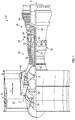
- FIG. 1 schematically illustrates a gas turbine engine 20.
- the gas turbine engine 20 is disclosed herein as a two-spool turbofan that generally incorporates a fan section 22, a compressor section 24, a combustor section 26 and a turbine section 28.
- the fan section 22 drives air along a bypass flow path B in a bypass duct, while the compressor section 24 drives air along a core flow path C for compression and communication into the combustor section 26 then expansion through the turbine section 28.
- FIG. 1 schematically illustrates a gas turbine engine 20.
- the gas turbine engine 20 is disclosed herein as a two-spool turbofan that generally incorporates a fan section 22, a compressor section 24, a combustor section 26 and a turbine section 28.
- the fan section 22 drives air along a bypass flow path B in a bypass duct
- the compressor section 24 drives air along a core flow path C for compression and communication into the combustor section 26 then expansion through the turbine section 28.
- the exemplary engine 20 generally includes a low speed spool 30 and a high speed spool 32 mounted for rotation about an engine central longitudinal axis A relative to an engine static structure 36 via several bearing systems 38. It should be understood that various bearing systems 38 at various locations may alternatively or additionally be provided, and the location of bearing systems 38 may be varied as appropriate to the application.
- the low speed spool 30 generally includes an inner shaft 40 that interconnects a fan 42, a low pressure compressor 44 and a low pressure turbine 46.
- the inner shaft 40 is connected to the fan 42 through a speed change mechanism, which in exemplary gas turbine engine 20 is illustrated as a geared architecture 48 to drive the fan 42 at a lower speed than the low speed spool 30.
- the high speed spool 32 includes an outer shaft 50 that interconnects a high pressure compressor 52 and high pressure turbine 54.
- a combustor 56 is arranged in exemplary gas turbine 20 between the high pressure compressor 52 and the high pressure turbine 54.
- An engine static structure 36 is arranged generally between the high pressure turbine 54 and the low pressure turbine 46.
- the engine static structure 36 further supports bearing systems 38 in the turbine section 28.
- the inner shaft 40 and the outer shaft 50 are concentric and rotate via bearing systems 38 about the engine central longitudinal axis A which is collinear with their longitudinal axes.
- each of the positions of the fan section 22, compressor section 24, combustor section 26, turbine section 28, and fan drive gear system 48 may be varied.
- gear system 48 may be located aft of combustor section 26 or even aft of turbine section 28, and fan section 22 may be positioned forward or aft of the location of gear system 48.
- the engine 20 in one example is a high-bypass geared aircraft engine.
- the engine 20 bypass ratio is greater than about six (6), with an example embodiment being greater than about ten (10)
- the geared architecture 48 is an epicyclic gear train, such as a planetary gear system or other gear system, with a gear reduction ratio of greater than about 2.3
- the low pressure turbine 46 has a pressure ratio that is greater than about five.
- the engine 20 bypass ratio is greater than about ten (10:1)
- the fan diameter is significantly larger than that of the low pressure compressor 44
- the low pressure turbine 46 has a pressure ratio that is greater than about five 5:1.
- Low pressure turbine 46 pressure ratio is pressure measured prior to inlet of low pressure turbine 46 as related to the pressure at the outlet of the low pressure turbine 46 prior to an exhaust nozzle.
- the geared architecture 48 may be an epicycle gear train, such as a planetary gear system or other gear system, with a gear reduction ratio of greater than about 2.3:1. It should be understood, however, that the above parameters are only exemplary of one embodiment of a geared architecture engine and that the present disclosure is applicable to other gas turbine engines including direct drive turbofans.
- the fan section 22 of the engine 20 is designed for a particular flight condition--typically cruise at about 0.8Mach and about 35,000 feet (10,668 meters).
- 'TSFC' Thrust Specific Fuel Consumption
- Low fan pressure ratio is the pressure ratio across the fan blade alone, without a Fan Exit Guide Vane (“FEGV”) system.
- the low fan pressure ratio as disclosed herein according to one non-limiting embodiment is less than about 1.45.
- Low corrected fan tip speed is the actual fan tip speed in ft/sec divided by an industry standard temperature correction of [(Tram °R)/(518.7 °R)] 0.5 .
- the "Low corrected fan tip speed” as disclosed herein according to one non-limiting embodiment is less than about 1150 ft/second (350.5 m/sec).
- FIG. 2 depicts a power system 100 of the gas turbine engine 20 of FIG. 1 (also referred to generally as an aircraft engine) according to an embodiment.
- the power system 100 can include a hybrid energy storage system 102 with at least two energy storage subsystems 103 each having a different power-energy density.
- the at least two energy storage subsystems 103 include a super/ultra-capacitor 104 and a battery system 106.
- the hybrid energy storage system 102 may be sized to store energy to support transient bursts of the gas turbine engine 20 for a power assist during a snap acceleration or power shedding during a snap deceleration.
- the super/ultra-capacitor 104 provides a lower storage capacity than the battery system 106 but has a higher charge/discharge rate as compared to the battery system 106.
- the super/ultra-capacitor 104 can be comprised of one or more electrochemical double layer capacitors (EDLCs) or electrochemical capacitors that have a high energy density when compared to common capacitors, e.g., several orders of magnitude greater than a high-capacity electrolytic capacitor.
- EDLCs electrochemical double layer capacitors
- the super/ultra-capacitor 104 can have higher energy efficiency due to a lower internal resistance than the battery system 106.
- the super/ultra-capacitor 104 can be operatively coupled to the battery system 106 through a direct current (DC)-to-DC converter 108.
- the DC-to-DC converter 108 can convert a voltage level of the battery system 106 to match a voltage level of the super/ultra-capacitor 104 to support charging of the super/ultra-capacitor 104 by the battery system 106.
- the DC-to-DC converter 108 can be omitted where regulation between the super/ultra-capacitor 104 and the battery system 106 is not needed.
- one or more electric motors 110 are operably coupled to the hybrid energy storage system 102 and to at least one shaft 112 of an aircraft engine, such as the inner shaft 40 of low speed spool 30 or the outer shaft 50 of high speed spool 32 of the gas turbine engine 20 of FIG. 1 .
- the hybrid energy storage system 102 is operably coupled to a bidirectional DC-to-DC converter 114 which is operably coupled to power conditioning electronics 116 that interface with the one or more electric motors 110.
- the bidirectional DC-to-DC converter 114 can perform any voltage conversions needed between the hybrid energy storage system 102 and the power conditioning electronics 116 depending on whether the one or more electric motors 110 are operating in a motor mode or a generator mode.
- the power conditioning electronics 116 can include inverter/motor drive circuitry that applies known motor control techniques to control the speed and/or torque produced by the one or more electric motors 110. For example, during a snap acceleration, electric power from the hybrid energy storage system 102 is provided through the bidirectional DC-to-DC converter 114 and the power conditioning electronics 116 to drive the one or more electric motors 110 in a motor mode to supplement rotation of the engine shaft 112 as opposed by an engine load.
- the engine load on the engine shaft 112 can vary depending upon a flight regime and accessory loading from generators, environmental control systems, engine bleeds, and other known loading factors.
- the one or more electric motors 110 can operate in a generator mode to increase the engine load on the engine shaft 112, with resulting current passed through the bidirectional DC-to-DC converter 114 for storage in the hybrid energy storage system 102.
- the bidirectional DC-to-DC converter 114 can be operably coupled to the super/ultra-capacitor 104 and/or the battery system 106. In some embodiments, the bidirectional DC-to-DC converter 114 is electrically coupled to the DC-to-DC converter 108.
- the power system 100 also includes a means for controlling one or more electric power flows of the hybrid energy storage system 102 to/from the one or more electric motors 110 based on a modeled electric power demand of an engine load of the aircraft engine that may be at a current time step or predicted at one or more future time steps.
- the means for controlling the one or more electric power flows of the hybrid energy storage system 102 can be a power management controller 190 (also referred to as controller 190) operable to detect one or more conditions of the super/ultra-capacitor 104 and the battery system 106 and configure the one or more electric power flows between the hybrid energy storage system 102 and the one or more electric motors 110.
- Detectable conditions can include a current charge level, a remaining storage capacity, health/fault status, and other such information. Further, the conditions may be derived based on environmental factors or aging effects. For example, if a temperature of the battery system 106 impacts the storage capacity and/or charge/discharge rate, then such information can be determined in assessing the condition of the battery system 106.
- the power management controller 190 can interface with and control multiple elements of the power system 100 and the gas turbine engine 20, such as switches, current sensors, voltage sensors, temperature sensors, communication buses, and the like.
- the controller 190 includes a memory system 192 to store instructions that are executed by a processing system 194 of the controller 190.
- the executable instructions may be stored or organized in any manner and at any level of abstraction, such as in connection with a controlling and/or monitoring operation of the power system 100 and/or the gas turbine engine 20.
- the processing system 194 can include one or more processors that can be any type of central processing unit (CPU), including a microprocessor, a digital signal processor (DSP), a microcontroller, an application specific integrated circuit (ASIC), a field programmable gate array (FPGA), or the like.
- the memory system 192 may include random access memory (RAM), read only memory (ROM), or other electronic, optical, magnetic, or any other computer readable medium onto which is stored data and control algorithms in a non-transitory form.
- An example of electric power flows of the hybrid energy storage system 102 can include a first electric power flow 120 from the battery system 106 through the DC-to-DC converter 108 to charge the super/ultra-capacitor 104.
- Another example of electric power flows of the hybrid energy storage system 102 can include a second electric power flow 122 from the super/ultra-capacitor 104 through the bidirectional DC-to-DC converter 114 and the power conditioning electronics 116 to power the one or more electric motors 110.
- a further example of electric power flows of the hybrid energy storage system 102 can include a third electric power flow 124 from the battery system 106 through the bidirectional DC-to-DC converter 114 and the power conditioning electronics 116 to power the one or more electric motors 110.
- the power management controller 190 may be implemented as a predictive controller or other model-based control as further described in reference to FIG. 3 .
- the power management controller 190 includes a model-based control 202, such as a model predictive control, operable to output one or more electric power flow control signals 204 based on a super/ultra-capacitor model 206, a battery system model 208, and an engine system model 210.
- the models 206, 208, 210 can comprise maps, equations, and the like that relate voltage, current, electrical power, and state-of-charge, for example.
- the system-level control algorithm integrates the models associated with each subsystem and includes their respective constraints.
- T motor F motor (I phase , V, N shaft )
- the function can be an equation, a look-up table, a map that relates the currents in all the motor phases, the voltage, and the shaft rotational speed to generated motor torque.
- constraints are defined and included in the overall control problem definition. These are related to motor torque, T motor, min ⁇ T motor ⁇ T motor, max , shaft angular speed, N shaft, min ⁇ N shaft ⁇ N shaft , max.
- a model F generator (I phase , V, N shaft ) and constraints T generator , min ⁇ T generator ⁇ T generator, max are defined for the generator(s).
- the direct current, I DC depends upon to the current provided by the ultra-capacitor or supercapacitor I DC, UC and/or the current supplied by the batteries, I DC , Bat , and needs to be bounded I DC , min ⁇ I DC ⁇ I DC, max (with the positive upper bound active during discharging, and the negative, lower bound active during charging).
- the state-of-charge and state-of-health are dynamical states that are interrelated and depend on the current supplied by each storage subsystem. Because they have different dynamics depending on whether they are charging or discharging the functions that relate current, SOC, SOH are specific to each mode of operation.
- the objective in controlling the hybrid energy storage system is to meet the requested shaft torque; a cost function that penalizes the errors between the motor torque T Motor and the requested shaft torque T Shaft,Req can be used ⁇ [T Motor (t)- T Shaft,Req (t)]dt, where the integral is calculated at each time step over a receding horizon [0, Dt], assuming that the requested motor torque is known over this time interval.
- the motor torque request can be set based on various external conditions such as: shaft speed and acceleration; overall system operating condition.
- the optimization problem including the defined cost function, system dynamics and constraints has as control inputs the current supplied by the battery system and modes of operation (charging, discharging) for each subsystem, and it is therefore a mixed-integer programming problem which can be solved numerically by using customized solvers.
- the super/ultra-capacitor model 206 can model performance of the super/ultra-capacitor 104 of FIG. 2 using observed conditions and a physics-based model that incorporates sizing parameters, for example, to determine predicted charge time, discharge time, capacity, available charge, and other such information.
- the battery system model 208 can model performance of the battery system 106 of FIG. 2 using observed conditions and a physics-based model that incorporates sizing parameters, for example, to determine predicted charge time, discharge time, capacity, available charge, and other such information.
- the engine system model 210 may model an engine load on the engine shaft 112 presently and at one or more future time steps.
- the engine system model 210 may receive engine parameters from an engine control or flight computer system (not depicted) that assist with load predictions.
- the load predictions can include flight regime (e.g., idle, takeoff, climb, cruise, decent, thrust reverse, etc.) along with demands due to known loads and operating status of other propulsion system elements (e.g., operational status of other engines on the aircraft).
- the power flow control signals 204 can control switching states and times of elements within the DC-to-DC converter 108, the bidirectional DC-to-DC converter 114, the power conditioning electronics 116, and/or other circuitry (not depicted).
- the model-based control 202 receives information about current engine loading and an engine load over one or more future time steps from the engine system model 210.
- the model-based control 202 can access the super/ultra-capacitor model 206 and the battery system model 208 with corresponding power constraints to determine power profiles for the super/ultra-capacitor 104 and the battery system 106 such that a power demand is met.
- Constraints can include healthy values, rates, and/or ranges for associated parameters. For instance, if a power demand exceeds the modeled capability of the battery system 106, then electric power can be provided by the super/ultra-capacitor 104 via the second electric power flow 122.
- the power management controller 190 can perform recharging from the battery system 106 using the first electric power flow 120.
- the power demand can be initially met by the battery system 106 via the third electric power flow 124, but upon exceeding the power demand provided by battery system 106, additional power can be provided by the super/ultra-capacitor 104 via the second electric power flow 122.
- time-based analysis selects either or both of the super/ultra-capacitor 104 and the battery system 106, for instance, by determining current demand and charge/discharge rates and capacity.
- FIG. 4 is a flow chart illustrating a method 300 of controlling a hybrid energy storage system 102 of a gas turbine engine 20 in accordance with an embodiment.
- the method 300 of FIG. 4 is described in reference to FIGS. 1-4 and may be performed with an alternate order and include additional steps.
- the method 300 can be performed, for example, by the power system 100 of FIG. 2 or an alternate configuration.
- controller 190 can determine an engine load of one or more spools of an aircraft engine, such as loads on the engine shaft 112 operably coupled to the one or more electric motors 110.
- controller 190 can determine a modeled electric power demand based on the engine load. Modeled values can be determined using the model-based control 202 of FIG. 3 .
- the controller 190 can configure one or more electric power flows 120-124 of the hybrid energy storage system 102 based on the modeled electric power demand.
- the controller 190 can detect one or more conditions of the at least two energy storage subsystems 103, such as the super/ultra-capacitor 104 and the battery system 106 and configure the one or more electric power flows 120-124 between the hybrid energy storage system 102 and the one or more electric motors 110 based on the one or more conditions of the super/ultra-capacitor 104 and the battery system 106.
- the controller 190 can configure at least one of the one or more electric power flows 120-124 from a first energy storage subsystem of the at least two energy storage subsystems 103 to charge a second energy storage subsystem of the at least two energy storage subsystem 103, such as from the battery system 106 through a DC-to-DC converter 108 to charge the super/ultra-capacitor 104.
- the controller 190 can configure at least one of the one or more electric power flows 120-124 from the super/ultra-capacitor 104 through a bidirectional DC-to-DC converter 114 and power conditioning electronics 116 to power the one or more electric motors 110.
- the controller 190 can configure at least one of the one or more electric power flows 120-124 from the battery system 106 through the bidirectional DC-to-DC converter 114 and the power conditioning electronics 116 to power the one or more electric motors 110 and/or engine subsystem loads.
- the controller 190 may select between powering the one or more electric motors 110 by the super/ultra-capacitor 104 and/or the battery system 106 based on a power level of the modeled electric power demand and the one or more conditions of the super/ultra-capacitor 104 and the battery system 106.
- the controller 190 may select between powering the one or more electric motors 110 by the super/ultra-capacitor 104 and/or the battery system 106 based on an expected duration of the modeled electric power demand and the one or more conditions of the super/ultra-capacitor 104 and the battery system 106. Further, the controller 190 can control the one or more electric motors 110 in a generator mode to charge the super/ultra-capacitor 104.
- the power management controller 190 is operable to predictively switch horsepower extractions from the gas turbine engine 20 to source power from the hybrid energy storage system 102 instead of the gas turbine engine 20 when the one or more electric motors 110 are being operated. Power transfers may be achieved by one or more automatic bus transfers (ABT). Further, if additional bus power is needed, an uninterruptable power supply (UPS) may be used to enhance electric bus stiffness.
- ABT automatic bus transfers
- UPS uninterruptable power supply
Landscapes
- Engineering & Computer Science (AREA)
- Power Engineering (AREA)
- Mechanical Engineering (AREA)
- Transportation (AREA)
- Aviation & Aerospace Engineering (AREA)
- Sustainable Energy (AREA)
- Life Sciences & Earth Sciences (AREA)
- Sustainable Development (AREA)
- Combustion & Propulsion (AREA)
- Chemical & Material Sciences (AREA)
- General Engineering & Computer Science (AREA)
- Charge And Discharge Circuits For Batteries Or The Like (AREA)
- Electric Propulsion And Braking For Vehicles (AREA)
Abstract
Description
- Exemplary embodiments pertain to aircraft systems, and more particularly to systems and methods of controlling a hybrid energy storage system for an aircraft engine.
- Aircraft, such as those utilized by commercial airlines, typically include two or more gas turbine engines mounted in or under the wings of the aircraft. The engines generate thrust, propelling the aircraft forward and allowing operation of the aircraft. A typical engine utilized in this configuration includes a fan forward of a turbine engine core, with the turbine engine core driving the rotation of the fan either via a direct drive system or a geared connection. Some aircraft propulsion systems also include one or more electric motors and/or generators to provide a supplemental power source under certain aircraft operating conditions.
- Disclosed is a power system of an aircraft, where the power system includes a hybrid energy storage system with at least two energy storage subsystems each having a different power-energy density. The power system also includes one or more electric motors operably coupled to the hybrid energy storage system and to an aircraft engine. The power system further includes a means for controlling one or more electric power flows of the hybrid energy storage system to/from the one or more electric motors based on a modeled electric power demand associated with an engine load of one or more spools of the aircraft engine.
- In addition to one or more of the features described above or below, or as an alternative, further embodiments may include where the means for controlling the one or more electric power flows of the hybrid energy storage system includes a power management controller operable to detect one or more conditions of the at least two energy storage subsystems and configure the one or more electric power flows between the hybrid energy storage system and the one or more electric motors.
- In addition to one or more of the features described above or below, or as an alternative, further embodiments may include where the power management controller is operable to configure at least one of the one or more electric power flows from a first energy storage subsystem of the at least two energy storage subsystems to charge a second energy storage subsystem of the at least two energy storage subsystems.
- In addition to one or more of the features described above or below, or as an alternative, further embodiments may include where the first energy storage subsystem includes a battery system and the second energy storage subsystem includes a super/ultra-capacitor, and further including a bidirectional converter operably coupled to the super/ultra-capacitor and power conditioning electronics operably coupled to the one or more electric motors.
- In addition to one or more of the features described above or below, or as an alternative, further embodiments may include where the power management controller is operable to configure at least one of the one or more electric power flows from the super/ultra-capacitor through the bidirectional converter and the power conditioning electronics to power the one or more electric motors.
- In addition to one or more of the features described above or below, or as an alternative, further embodiments may include where the bidirectional converter is operably coupled to the battery system, and the power management controller is operable to configure at least one of the one or more electric power flows from the battery system through the bidirectional converter and the power conditioning electronics to power the one or more electric motors and/or engine subsystem loads.
- In addition to one or more of the features described above or below, or as an alternative, further embodiments may include where the power management controller is operable to select between powering the one or more electric motors by the super/ultra-capacitor and/or the battery system based on a power level of the modeled electric power demand and the one or more conditions of the super/ultra-capacitor and the battery system, and further where the power management controller is operable to control the one or more electric motors in a generator mode and charge the super/ultra-capacitor.
- In addition to one or more of the features described above or below, or as an alternative, further embodiments may include where the power management controller is operable to select between powering the one or more electric motors by the super/ultra-capacitor and/or the battery system based on an expected duration of the modeled electric power demand and the one or more conditions of the super/ultra-capacitor and the battery system.
- In addition to one or more of the features described above or below, or as an alternative, further embodiments may include where the power management controller is operable to predictively switch to source power from the hybrid energy storage system instead of the aircraft engine when the one or more electric motors are being operated.
- Also disclosed is a method that includes determining, by a controller, an engine load of one or more spools of an aircraft engine. The controller determines a modeled electric power demand based on the engine load. One or more electric power flows of a hybrid energy storage system are configured based on the modeled electric power demand, where the hybrid energy storage system includes at least two energy storage subsystems each having a different power-energy density.
- In addition to one or more of the features described above or below, or as an alternative, further embodiments may include detecting one or more conditions of the at least two energy storage subsystems, and configuring the one or more electric power flows between the hybrid energy storage system and one or more electric motors based on the one or more conditions of the at least two energy storage subsystems.
- In addition to one or more of the features described above or below, or as an alternative, further embodiments may include configuring at least one of the one or more electric power flows from a first energy storage subsystem of the at least two energy storage subsystems to charge a second energy storage subsystem of the at least two energy storage subsystems.
- In addition to one or more of the features described above or below, or as an alternative, further embodiments may include where the first energy storage subsystem includes a battery system and the second energy storage subsystem including a super/ultra-capacitor, and the method may include configuring at least one of the one or more electric power flows from the super/ultra-capacitor through a bidirectional converter and power conditioning electronics to power the one or more electric motors.
- In addition to one or more of the features described above or below, or as an alternative, further embodiments may include configuring at least one of the one or more electric power flows from the battery system through the bidirectional converter and the power conditioning electronics to power the one or more electric motors and/or engine subsystem loads.
- In addition to one or more of the features described above or below, or as an alternative, further embodiments may include selecting between powering the one or more electric motors by the super/ultra-capacitor and/or the battery system based on a power level of the modeled electric power demand and the one or more conditions of the super/ultra-capacitor and the battery system, and controlling the one or more electric motors in a generator mode to charge the super/ultra-capacitor.
- In addition to one or more of the features described above or below, or as an alternative, further embodiments may include selecting between powering the one or more electric motors by the super/ultra-capacitor and/or the battery system based on an expected duration of the modeled electric power demand and the one or more conditions of the super/ultra-capacitor and the battery system.
- In addition to one or more of the features described above or below, or as an alternative, further embodiments may include predictively switching to source power from the hybrid energy storage system instead of the aircraft engine when the one or more electric motors are being operated.
- Also disclosed is a system for an aircraft, where the system includes a gas turbine engine with at least one shaft and a hybrid energy storage system including a super/ultra-capacitor and a battery system. The system also includes one or more electric motors operably coupled to the hybrid energy storage system and to the at least one shaft, and a means for controlling one or more electric power flows of the hybrid energy storage system to/from the one or more electric motors based on a modeled electric power demand associated with an engine load of the gas turbine engine.
- In addition to one or more of the features described above or below, or as an alternative, further embodiments may include where the means for controlling the one or more electric power flows of the hybrid energy storage system includes a power management controller operable to detect one or more conditions of the super/ultra-capacitor and the battery system and configure the one or more electric power flows from the hybrid energy storage system to the one or more electric motors based on the one or more conditions and the engine load of the at least one shaft.
- In addition to one or more of the features described above or below, or as an alternative, further embodiments may include where the power management controller is operable to predictively switch to source power from the hybrid energy storage system instead of the gas turbine engine when the one or more electric motors are being operated.
- A technical effect of systems and methods is achieved by providing hybrid energy storage system control for an aircraft engine as described herein.
- The following descriptions should not be considered limiting in any way. With reference to the accompanying drawings, like elements are numbered alike:
-
FIG. 1 is a schematic illustration of a gas turbine engine in accordance with an embodiment of the disclosure; -
FIG. 2 is a schematic illustration of a power system in accordance with an embodiment of the disclosure; -
FIG. 3 is a schematic illustration of a control system in accordance with an embodiment of the disclosure; and -
FIG. 4 is a flow chart illustrating a method in accordance with an embodiment of the disclosure. - A detailed description of one or more embodiments of the disclosed apparatus and method are presented herein by way of exemplification and not limitation with reference to the Figures.
-
FIG. 1 schematically illustrates agas turbine engine 20. Thegas turbine engine 20 is disclosed herein as a two-spool turbofan that generally incorporates afan section 22, acompressor section 24, acombustor section 26 and aturbine section 28. Thefan section 22 drives air along a bypass flow path B in a bypass duct, while thecompressor section 24 drives air along a core flow path C for compression and communication into thecombustor section 26 then expansion through theturbine section 28. Although depicted as a two-spool turbofan gas turbine engine in the disclosed non-limiting embodiment, it should be understood that the concepts described herein are not limited to use with two-spool turbofans as the teachings may be applied to other types of turbine engines including three-spool architectures. - The
exemplary engine 20 generally includes alow speed spool 30 and ahigh speed spool 32 mounted for rotation about an engine central longitudinal axis A relative to an enginestatic structure 36 viaseveral bearing systems 38. It should be understood thatvarious bearing systems 38 at various locations may alternatively or additionally be provided, and the location ofbearing systems 38 may be varied as appropriate to the application. - The
low speed spool 30 generally includes aninner shaft 40 that interconnects afan 42, alow pressure compressor 44 and alow pressure turbine 46. Theinner shaft 40 is connected to thefan 42 through a speed change mechanism, which in exemplarygas turbine engine 20 is illustrated as a gearedarchitecture 48 to drive thefan 42 at a lower speed than thelow speed spool 30. Thehigh speed spool 32 includes anouter shaft 50 that interconnects ahigh pressure compressor 52 andhigh pressure turbine 54. Acombustor 56 is arranged inexemplary gas turbine 20 between thehigh pressure compressor 52 and thehigh pressure turbine 54. An enginestatic structure 36 is arranged generally between thehigh pressure turbine 54 and thelow pressure turbine 46. The enginestatic structure 36 further supports bearingsystems 38 in theturbine section 28. Theinner shaft 40 and theouter shaft 50 are concentric and rotate viabearing systems 38 about the engine central longitudinal axis A which is collinear with their longitudinal axes. - The core airflow is compressed by the
low pressure compressor 44 then thehigh pressure compressor 52, mixed and burned with fuel in thecombustor 56, then expanded over thehigh pressure turbine 54 andlow pressure turbine 46. Theturbines low speed spool 30 andhigh speed spool 32 in response to the expansion. It will be appreciated that each of the positions of thefan section 22,compressor section 24,combustor section 26,turbine section 28, and fandrive gear system 48 may be varied. For example,gear system 48 may be located aft ofcombustor section 26 or even aft ofturbine section 28, andfan section 22 may be positioned forward or aft of the location ofgear system 48. - The
engine 20 in one example is a high-bypass geared aircraft engine. In a further example, theengine 20 bypass ratio is greater than about six (6), with an example embodiment being greater than about ten (10), the gearedarchitecture 48 is an epicyclic gear train, such as a planetary gear system or other gear system, with a gear reduction ratio of greater than about 2.3 and thelow pressure turbine 46 has a pressure ratio that is greater than about five. In one disclosed embodiment, theengine 20 bypass ratio is greater than about ten (10:1), the fan diameter is significantly larger than that of thelow pressure compressor 44, and thelow pressure turbine 46 has a pressure ratio that is greater than about five 5:1.Low pressure turbine 46 pressure ratio is pressure measured prior to inlet oflow pressure turbine 46 as related to the pressure at the outlet of thelow pressure turbine 46 prior to an exhaust nozzle. The gearedarchitecture 48 may be an epicycle gear train, such as a planetary gear system or other gear system, with a gear reduction ratio of greater than about 2.3:1. It should be understood, however, that the above parameters are only exemplary of one embodiment of a geared architecture engine and that the present disclosure is applicable to other gas turbine engines including direct drive turbofans. - A significant amount of thrust is provided by the bypass flow B due to the high bypass ratio. The
fan section 22 of theengine 20 is designed for a particular flight condition--typically cruise at about 0.8Mach and about 35,000 feet (10,668 meters). The flight condition of 0.8 Mach and 35,000 ft (10,668 meters), with the engine at its best fuel consumption--also known as "bucket cruise Thrust Specific Fuel Consumption ('TSFC')"--is the industry standard parameter of lbm of fuel being burned divided by lbf of thrust the engine produces at that minimum point. "Low fan pressure ratio" is the pressure ratio across the fan blade alone, without a Fan Exit Guide Vane ("FEGV") system. The low fan pressure ratio as disclosed herein according to one non-limiting embodiment is less than about 1.45. "Low corrected fan tip speed" is the actual fan tip speed in ft/sec divided by an industry standard temperature correction of [(Tram °R)/(518.7 °R)]0.5. The "Low corrected fan tip speed" as disclosed herein according to one non-limiting embodiment is less than about 1150 ft/second (350.5 m/sec). -
FIG. 2 depicts apower system 100 of thegas turbine engine 20 ofFIG. 1 (also referred to generally as an aircraft engine) according to an embodiment. Thepower system 100 can include a hybridenergy storage system 102 with at least twoenergy storage subsystems 103 each having a different power-energy density. In the example ofFIG. 2 , the at least twoenergy storage subsystems 103 include a super/ultra-capacitor 104 and abattery system 106. The hybridenergy storage system 102 may be sized to store energy to support transient bursts of thegas turbine engine 20 for a power assist during a snap acceleration or power shedding during a snap deceleration. Using only thebattery system 106 for a wide range of acceleration and deceleration conditions may result in oversizing battery capacity with corresponding additional weight carried to meet potential transient demands. The super/ultra-capacitor 104 provides a lower storage capacity than thebattery system 106 but has a higher charge/discharge rate as compared to thebattery system 106. The super/ultra-capacitor 104 can be comprised of one or more electrochemical double layer capacitors (EDLCs) or electrochemical capacitors that have a high energy density when compared to common capacitors, e.g., several orders of magnitude greater than a high-capacity electrolytic capacitor. The super/ultra-capacitor 104 can have higher energy efficiency due to a lower internal resistance than thebattery system 106. The super/ultra-capacitor 104 can be operatively coupled to thebattery system 106 through a direct current (DC)-to-DC converter 108. The DC-to-DC converter 108 can convert a voltage level of thebattery system 106 to match a voltage level of the super/ultra-capacitor 104 to support charging of the super/ultra-capacitor 104 by thebattery system 106. In alternate embodiments, the DC-to-DC converter 108 can be omitted where regulation between the super/ultra-capacitor 104 and thebattery system 106 is not needed. - In embodiments, one or more
electric motors 110 are operably coupled to the hybridenergy storage system 102 and to at least oneshaft 112 of an aircraft engine, such as theinner shaft 40 oflow speed spool 30 or theouter shaft 50 ofhigh speed spool 32 of thegas turbine engine 20 ofFIG. 1 . In the example ofFIG. 1 , the hybridenergy storage system 102 is operably coupled to a bidirectional DC-to-DC converter 114 which is operably coupled topower conditioning electronics 116 that interface with the one or moreelectric motors 110. The bidirectional DC-to-DC converter 114 can perform any voltage conversions needed between the hybridenergy storage system 102 and thepower conditioning electronics 116 depending on whether the one or moreelectric motors 110 are operating in a motor mode or a generator mode. Thepower conditioning electronics 116 can include inverter/motor drive circuitry that applies known motor control techniques to control the speed and/or torque produced by the one or moreelectric motors 110. For example, during a snap acceleration, electric power from the hybridenergy storage system 102 is provided through the bidirectional DC-to-DC converter 114 and thepower conditioning electronics 116 to drive the one or moreelectric motors 110 in a motor mode to supplement rotation of theengine shaft 112 as opposed by an engine load. The engine load on theengine shaft 112 can vary depending upon a flight regime and accessory loading from generators, environmental control systems, engine bleeds, and other known loading factors. During a snap deceleration, the one or moreelectric motors 110 can operate in a generator mode to increase the engine load on theengine shaft 112, with resulting current passed through the bidirectional DC-to-DC converter 114 for storage in the hybridenergy storage system 102. The bidirectional DC-to-DC converter 114 can be operably coupled to the super/ultra-capacitor 104 and/or thebattery system 106. In some embodiments, the bidirectional DC-to-DC converter 114 is electrically coupled to the DC-to-DC converter 108. - In embodiments, the
power system 100 also includes a means for controlling one or more electric power flows of the hybridenergy storage system 102 to/from the one or moreelectric motors 110 based on a modeled electric power demand of an engine load of the aircraft engine that may be at a current time step or predicted at one or more future time steps. The means for controlling the one or more electric power flows of the hybridenergy storage system 102 can be a power management controller 190 (also referred to as controller 190) operable to detect one or more conditions of the super/ultra-capacitor 104 and thebattery system 106 and configure the one or more electric power flows between the hybridenergy storage system 102 and the one or moreelectric motors 110. Detectable conditions can include a current charge level, a remaining storage capacity, health/fault status, and other such information. Further, the conditions may be derived based on environmental factors or aging effects. For example, if a temperature of thebattery system 106 impacts the storage capacity and/or charge/discharge rate, then such information can be determined in assessing the condition of thebattery system 106. - The
power management controller 190 can interface with and control multiple elements of thepower system 100 and thegas turbine engine 20, such as switches, current sensors, voltage sensors, temperature sensors, communication buses, and the like. In an embodiment, thecontroller 190 includes amemory system 192 to store instructions that are executed by aprocessing system 194 of thecontroller 190. The executable instructions may be stored or organized in any manner and at any level of abstraction, such as in connection with a controlling and/or monitoring operation of thepower system 100 and/or thegas turbine engine 20. Theprocessing system 194 can include one or more processors that can be any type of central processing unit (CPU), including a microprocessor, a digital signal processor (DSP), a microcontroller, an application specific integrated circuit (ASIC), a field programmable gate array (FPGA), or the like. Also, in embodiments, thememory system 192 may include random access memory (RAM), read only memory (ROM), or other electronic, optical, magnetic, or any other computer readable medium onto which is stored data and control algorithms in a non-transitory form. - An example of electric power flows of the hybrid
energy storage system 102 can include a firstelectric power flow 120 from thebattery system 106 through the DC-to-DC converter 108 to charge the super/ultra-capacitor 104. Another example of electric power flows of the hybridenergy storage system 102 can include a secondelectric power flow 122 from the super/ultra-capacitor 104 through the bidirectional DC-to-DC converter 114 and thepower conditioning electronics 116 to power the one or moreelectric motors 110. A further example of electric power flows of the hybridenergy storage system 102 can include a thirdelectric power flow 124 from thebattery system 106 through the bidirectional DC-to-DC converter 114 and thepower conditioning electronics 116 to power the one or moreelectric motors 110. Other electric power flow variations are contemplated, such as reverse flows of the electric power flows 122, 124 during generator mode of the one or moreelectric motors 110. Selection and timing for engaging the various electric power flows 120-124 can be controlled by thepower management controller 190. As one example, thepower management controller 190 may be implemented as a predictive controller or other model-based control as further described in reference toFIG. 3 . - In the example of
FIG. 3 with continued reference toFIGS. 1 and2 , thepower management controller 190 includes a model-basedcontrol 202, such as a model predictive control, operable to output one or more electric power flow control signals 204 based on a super/ultra-capacitor model 206, abattery system model 208, and anengine system model 210. Themodels - The super/
ultra-capacitor model 206 can model performance of the super/ultra-capacitor 104 ofFIG. 2 using observed conditions and a physics-based model that incorporates sizing parameters, for example, to determine predicted charge time, discharge time, capacity, available charge, and other such information. Similarly, thebattery system model 208 can model performance of thebattery system 106 ofFIG. 2 using observed conditions and a physics-based model that incorporates sizing parameters, for example, to determine predicted charge time, discharge time, capacity, available charge, and other such information. Theengine system model 210 may model an engine load on theengine shaft 112 presently and at one or more future time steps. Theengine system model 210 may receive engine parameters from an engine control or flight computer system (not depicted) that assist with load predictions. The load predictions can include flight regime (e.g., idle, takeoff, climb, cruise, decent, thrust reverse, etc.) along with demands due to known loads and operating status of other propulsion system elements (e.g., operational status of other engines on the aircraft). The power flow control signals 204 can control switching states and times of elements within the DC-to-DC converter 108, the bidirectional DC-to-DC converter 114, thepower conditioning electronics 116, and/or other circuitry (not depicted). - As one example, at each computational time step, the model-based
control 202 receives information about current engine loading and an engine load over one or more future time steps from theengine system model 210. The model-basedcontrol 202 can access the super/ultra-capacitor model 206 and thebattery system model 208 with corresponding power constraints to determine power profiles for the super/ultra-capacitor 104 and thebattery system 106 such that a power demand is met. Constraints can include healthy values, rates, and/or ranges for associated parameters. For instance, if a power demand exceeds the modeled capability of thebattery system 106, then electric power can be provided by the super/ultra-capacitor 104 via the secondelectric power flow 122. After the super/ultra-capacitor 104 is discharged, thepower management controller 190 can perform recharging from thebattery system 106 using the firstelectric power flow 120. As another example, the power demand can be initially met by thebattery system 106 via the thirdelectric power flow 124, but upon exceeding the power demand provided bybattery system 106, additional power can be provided by the super/ultra-capacitor 104 via the secondelectric power flow 122. In some embodiments, time-based analysis selects either or both of the super/ultra-capacitor 104 and thebattery system 106, for instance, by determining current demand and charge/discharge rates and capacity. -
FIG. 4 is a flow chart illustrating amethod 300 of controlling a hybridenergy storage system 102 of agas turbine engine 20 in accordance with an embodiment. Themethod 300 ofFIG. 4 is described in reference toFIGS. 1-4 and may be performed with an alternate order and include additional steps. Themethod 300 can be performed, for example, by thepower system 100 ofFIG. 2 or an alternate configuration. - At
block 302,controller 190 can determine an engine load of one or more spools of an aircraft engine, such as loads on theengine shaft 112 operably coupled to the one or moreelectric motors 110. Atblock 304,controller 190 can determine a modeled electric power demand based on the engine load. Modeled values can be determined using the model-basedcontrol 202 ofFIG. 3 . Atblock 306, thecontroller 190 can configure one or more electric power flows 120-124 of the hybridenergy storage system 102 based on the modeled electric power demand. - In embodiments, the
controller 190 can detect one or more conditions of the at least twoenergy storage subsystems 103, such as the super/ultra-capacitor 104 and thebattery system 106 and configure the one or more electric power flows 120-124 between the hybridenergy storage system 102 and the one or moreelectric motors 110 based on the one or more conditions of the super/ultra-capacitor 104 and thebattery system 106. For example, thecontroller 190 can configure at least one of the one or more electric power flows 120-124 from a first energy storage subsystem of the at least twoenergy storage subsystems 103 to charge a second energy storage subsystem of the at least twoenergy storage subsystem 103, such as from thebattery system 106 through a DC-to-DC converter 108 to charge the super/ultra-capacitor 104. Thecontroller 190 can configure at least one of the one or more electric power flows 120-124 from the super/ultra-capacitor 104 through a bidirectional DC-to-DC converter 114 andpower conditioning electronics 116 to power the one or moreelectric motors 110. Alternatively, thecontroller 190 can configure at least one of the one or more electric power flows 120-124 from thebattery system 106 through the bidirectional DC-to-DC converter 114 and thepower conditioning electronics 116 to power the one or moreelectric motors 110 and/or engine subsystem loads. Thecontroller 190 may select between powering the one or moreelectric motors 110 by the super/ultra-capacitor 104 and/or thebattery system 106 based on a power level of the modeled electric power demand and the one or more conditions of the super/ultra-capacitor 104 and thebattery system 106. Further, thecontroller 190 may select between powering the one or moreelectric motors 110 by the super/ultra-capacitor 104 and/or thebattery system 106 based on an expected duration of the modeled electric power demand and the one or more conditions of the super/ultra-capacitor 104 and thebattery system 106. Further, thecontroller 190 can control the one or moreelectric motors 110 in a generator mode to charge the super/ultra-capacitor 104. - In some embodiments, the
power management controller 190 is operable to predictively switch horsepower extractions from thegas turbine engine 20 to source power from the hybridenergy storage system 102 instead of thegas turbine engine 20 when the one or moreelectric motors 110 are being operated. Power transfers may be achieved by one or more automatic bus transfers (ABT). Further, if additional bus power is needed, an uninterruptable power supply (UPS) may be used to enhance electric bus stiffness. - The term "about" is intended to include the degree of error associated with measurement of the particular quantity based upon the equipment available at the time of filing the application.
- The terminology used herein is for the purpose of describing particular embodiments only and is not intended to be limiting of the present disclosure. As used herein, the singular forms "a", "an" and "the" are intended to include the plural forms as well, unless the context clearly indicates otherwise. It will be further understood that the terms "comprises" and/or "comprising," when used in this specification, specify the presence of stated features, integers, steps, operations, elements, and/or components, but do not preclude the presence or addition of one or more other features, integers, steps, operations, element components, and/or groups thereof.
- While the present disclosure has been described with reference to an exemplary embodiment or embodiments, it will be understood by those skilled in the art that various changes may be made and equivalents may be substituted for elements thereof without departing from the scope of the present disclosure. In addition, many modifications may be made to adapt a particular situation or material to the teachings of the present disclosure without departing from the essential scope thereof. Therefore, it is intended that the present disclosure not be limited to the particular embodiment disclosed as the best mode contemplated for carrying out this present disclosure, but that the present disclosure will include all embodiments falling within the scope of the claims.
Claims (15)
- A power system (100) of an aircraft, the power system comprising:a hybrid energy storage system (102) comprising at least two energy storage subsystems (103) each having a different power-energy density;one or more electric motors (110) operably coupled to the hybrid energy storage system and to an aircraft engine (20); anda means for controlling (190) one or more electric power flows (120, 122, 124) of the hybrid energy storage system to/from the one or more electric motors (110) based on a modeled electric power demand associated with an engine load of one or more spools (30, 32) of the aircraft engine.
- The power system of claim 1, wherein the means for controlling the one or more electric power flows (120, 122, 124) of the hybrid energy storage system (102) comprises a power management controller (190) operable to detect one or more conditions of the at least two energy storage subsystems (103) and configure the one or more electric power flows between the hybrid energy storage system and the one or more electric motors (110).
- The power system of claim 2, wherein the power management controller (190) is operable to configure at least one of the one or more electric power flows (120, 122, 124) from a first energy storage subsystem of the at least two energy storage subsystems (103) to charge a second energy storage subsystem of the at least two energy storage subsystems.
- The power system of claim 3, wherein the first energy storage subsystem comprises a battery system (106) and the second energy storage subsystem comprises a super/ultra-capacitor (104), and further comprising a bidirectional converter (114) operably coupled to the super/ultra-capacitor and power conditioning electronics (116) operably coupled to the one or more electric motors (110).
- The power system of claim 4, wherein the power management controller (190) is operable to configure at least one of the one or more electric power flows (120, 122, 124) from the super/ultra-capacitor (104) through the bidirectional converter (114) and the power conditioning electronics (116) to power the one or more electric motors (110).
- The power system of claim 5, wherein the bidirectional converter is operably coupled to the battery system (106), and the power management controller (190) is operable to configure at least one of the one or more electric power flows (120, 122, 124) from the battery system through the bidirectional converter (114) and the power conditioning electronics (116) to power the one or more electric motors (110) and/or engine subsystem loads.
- The power system of claim 6, wherein:the power management controller (190) is operable to select between powering the one or more electric motors (110) by the super/ultra-capacitor (104) and/or the battery system (106) based on a power level of the modeled electric power demand and the one or more conditions of the super/ultra-capacitor and the battery system, and further wherein the power management controller is operable to control the one or more electric motors in a generator mode and charge the super/ultra-capacitor; and/orthe power management controller (190) is operable to select between powering the one or more electric motors (110) by the super/ultra-capacitor (104) and/or the battery system (106) based on an expected duration of the modeled electric power demand and the one or more conditions of the super/ultra-capacitor and the battery system.
- The power system of any of claims 1 to 7, wherein the power management controller (190) is operable to predictively switch to source power from the hybrid energy storage system (102) instead of the aircraft engine when the one or more electric motors (110) are being operated.
- A method comprising:determining (302), by a controller, an engine load of one or more spools (30, 32) of an aircraft engine (20);determining (304), by the controller, a modeled electric power demand based on the engine load; andconfiguring (306) one or more electric power flows (120, 122, 124) of a hybrid energy storage system (102) based on the modeled electric power demand, wherein the hybrid energy storage system comprises at least two energy storage subsystems (103) each having a different power-energy density.
- The method of claim 9, further comprising:detecting one or more conditions of the at least two energy storage subsystems (103); andconfiguring the one or more electric power flows (120, 122, 124) between the hybrid energy storage system (102) and one or more electric motors (110) based on the one or more conditions of the at least two energy storage subsystems.
- The method of claim 10, further comprising:
configuring at least one of the one or more electric power flows (120, 122, 124) from a first energy storage subsystem of the at least two energy storage subsystems (103) to charge a second energy storage subsystem of the at least two energy storage subsystems. - The method of claim 11, wherein the first energy storage subsystem comprises a battery system (106) and the second energy storage subsystem comprises a super/ultra-capacitor (104), and further comprising:
configuring at least one of the one or more electric power flows (120, 122, 124) from the super/ultra-capacitor (104) through a bidirectional converter and power conditioning electronics (116) to power the one or more electric motors (110). - The method of claim 12, further comprising:
configuring at least one of the one or more electric power flows (120, 122, 124) from the battery system (106) through the bidirectional converter (114) and the power conditioning electronics (116) to power the one or more electric motors (110) and/or engine subsystem loads; optionally further comprising:selecting between powering the one or more electric motors (110) by the super/ultra-capacitor (104) and/or the battery system (106) based on a power level of the modeled electric power demand and the one or more conditions of the super/ultra-capacitor and the battery system; andcontrolling the one or more electric motors (110) in a generator mode to charge the super/ultra-capacitor; and/orselecting between powering the one or more electric motors (110) by the super/ultra-capacitor (104) and/or the battery system (106) based on an expected duration of the modeled electric power demand and the one or more conditions of the super/ultra-capacitor and the battery system. - The method of any of claims 9 to 13, further comprising:
predictively switching to source power from the hybrid energy storage system (102) instead of the aircraft engine (20) when the one or more electric motors (110) are being operated. - A system for an aircraft, the system comprising:a gas turbine engine (20) comprising at least one shaft (112); anda power system (100) of an aircraft as claimed in any of claims 1 to 8;wherein the at least two energy storage subsystems (103) of the hybrid energy storage system (102) comprise a super/ultra-capacitor (104) and a battery system (106);the one or more electric motors (110) being operably coupled to the hybrid energy storage system (102) and to the at least one shaft (112) of the gas turbine engine; optionallywherein the power management controller (109) is operable to detect one or more conditions of the super/ultra-capacitor (104) and the battery system (106) and configure the one or more electric power flows (120, 122, 124) from the hybrid energy storage system (102) to the one or more electric motors (110) based on the one or more conditions and the engine load of the at least one shaft (112).
Applications Claiming Priority (1)
| Application Number | Priority Date | Filing Date | Title |
|---|---|---|---|
| US201862711855P | 2018-07-30 | 2018-07-30 |
Publications (2)
| Publication Number | Publication Date |
|---|---|
| EP3604136A1 true EP3604136A1 (en) | 2020-02-05 |
| EP3604136B1 EP3604136B1 (en) | 2025-01-15 |
Family
ID=67513395
Family Applications (1)
| Application Number | Title | Priority Date | Filing Date |
|---|---|---|---|
| EP19189124.1A Active EP3604136B1 (en) | 2018-07-30 | 2019-07-30 | Hybrid energy storage system control for an aircraft engine |
Country Status (2)
| Country | Link |
|---|---|
| US (1) | US11565821B2 (en) |
| EP (1) | EP3604136B1 (en) |
Families Citing this family (17)
| Publication number | Priority date | Publication date | Assignee | Title |
|---|---|---|---|---|
| US10352189B2 (en) * | 2017-05-10 | 2019-07-16 | Pratt & Whitney Canada Corp. | Method and system for setting an acceleration schedule for engine start |
| CA3075179C (en) * | 2017-09-07 | 2025-05-20 | Green Cubes Technology, Llc | Power systems and methods of using the same to deliver power |
| US11401041B2 (en) * | 2018-07-30 | 2022-08-02 | Raytheon Technologies Corporation | Hybrid electric power distribution and control for an aircraft |
| EP3751117B1 (en) * | 2019-06-12 | 2024-05-29 | Rolls-Royce plc | Increasing compression efficiency via shaft power transfer |
| US12404030B2 (en) * | 2020-08-31 | 2025-09-02 | General Electric Company | Propulsion system for an aircraft |
| US12060834B2 (en) * | 2021-05-07 | 2024-08-13 | Rtx Corporation | Hybrid electric idle and braking for an aircraft |
| US11867069B2 (en) * | 2021-06-28 | 2024-01-09 | Rtx Corporation | Hybrid electric variable area turbine |
| EP4173957A1 (en) * | 2021-10-29 | 2023-05-03 | Raytheon Technologies Corporation | Power management in a hybrid-electric propulsion system during single engine failure at descent |
| JP2023129938A (en) * | 2022-03-07 | 2023-09-20 | 本田技研工業株式会社 | Power unit control system, power unit control method and power unit control program |
| CN115056989B (en) * | 2022-04-26 | 2025-07-01 | 西北工业大学 | A hybrid energy management method for more-electric aircraft based on stochastic model prediction |
| EP4310309B1 (en) | 2022-07-19 | 2026-04-22 | General Electric Company | Hybrid-electric propulsion system equipped with a coupler for switching between modes of operation |
| IT202200016215A1 (en) | 2022-07-29 | 2024-01-29 | Gen Electric | CONTROL OF FULLY ELECTRIC OR HYBRID-ELECTRIC PROPULSION AND TRANSMISSION SYSTEMS |
| CN117485572A (en) * | 2022-07-29 | 2024-02-02 | 通用电气公司 | Control hybrid or all-electric powertrains and propulsion systems |
| US12263953B2 (en) * | 2023-05-02 | 2025-04-01 | Pratt & Whitney Canada Corp. | System and method for operating a hybrid aircraft power plant |
| US12583605B2 (en) * | 2024-03-22 | 2026-03-24 | Rtx Corporation | Fast thrust response using optimal power splitting in hybrid electric aircraft |
| US12503243B2 (en) * | 2024-04-12 | 2025-12-23 | Pratt & Whitney Canada Corp. | Method and system for operating a hybrid aircraft engine |
| US20260081420A1 (en) * | 2024-09-17 | 2026-03-19 | Ge Aviation Systems Llc | Power distribution system and method of operating |
Citations (4)
| Publication number | Priority date | Publication date | Assignee | Title |
|---|---|---|---|---|
| US20140260306A1 (en) * | 2013-03-14 | 2014-09-18 | Pratt & Whitney Canada Corp. | Engine starting system using stored energy |
| WO2014158240A2 (en) * | 2013-03-14 | 2014-10-02 | Rolls-Royce Corporation | Hybrid turbo electric aero-propulsion system control |
| US20160204615A1 (en) * | 2013-09-09 | 2016-07-14 | Ge Aviation Systems Llc | Power system for an aircraft with dual hybrid energy sources |
| US20180003109A1 (en) * | 2016-07-01 | 2018-01-04 | United Technologies Corporation | Power system for aircraft parallel hybrid gas turbine electric propulsion system |
Family Cites Families (20)
| Publication number | Priority date | Publication date | Assignee | Title |
|---|---|---|---|---|
| US7786620B2 (en) | 2008-02-15 | 2010-08-31 | Honeywell International Inc. | Battery supplementing super capacitor energy storage charge and discharge converter |
| US7872368B2 (en) | 2008-10-24 | 2011-01-18 | The Boeing Company | Intelligent energy management architecture |
| US8296036B2 (en) | 2009-09-23 | 2012-10-23 | Aerovironment, Inc. | Aircraft power management |
| US8384343B2 (en) | 2010-04-27 | 2013-02-26 | Honeywell International Inc. | Electric accumulators having self regulated battery with integrated bi-directional power management and protection |
| US20140084817A1 (en) | 2010-07-20 | 2014-03-27 | Vijay Bhavaraju | Method of energy and power management in dynamic power systems with ultra-capacitors (super capacitors) |
| US8963365B2 (en) | 2011-08-12 | 2015-02-24 | General Electric Company | System and method for optimizing energy storage device cycle life |
| US9296288B2 (en) * | 2012-05-07 | 2016-03-29 | Separation Design Group Llc | Hybrid radiant energy aircraft engine |
| US10060982B2 (en) | 2013-04-04 | 2018-08-28 | Hamilton Sundstrand Corporation | Detecting faults in motors and drives |
| FR3023989B1 (en) | 2014-07-17 | 2016-08-26 | Airbus Helicopters | ELECTRIC ARCHITECTURE OF AN AIRCRAFT, AIRCRAFT AND METHOD USED |
| US9783185B2 (en) | 2014-08-19 | 2017-10-10 | General Electric Company | Vehicle propulsion system having an energy storage system and optimized method of controlling operation thereof |
| CA2996844A1 (en) * | 2014-08-29 | 2016-06-16 | Tzunum, Inc. | Power train for a hybrid-electric aircraft |
| US10272788B2 (en) | 2015-08-28 | 2019-04-30 | General Electric Company | Hybrid system with multiple energy storage devices |
| US10260425B2 (en) | 2016-05-05 | 2019-04-16 | United Technologies Corporation | Leak detection, isolation and accommodation assembly for gas turbine engines |
| US10423473B2 (en) | 2017-04-18 | 2019-09-24 | United Technologies Corporation | Fault-accommodating, constrained model-based control using on-board methods for detection of and adaption to actuation subsystem faults |
| US20190005826A1 (en) | 2017-06-28 | 2019-01-03 | Ge Aviation Systems, Llc | Engine load model systems and methods |
| US10378455B2 (en) | 2017-08-28 | 2019-08-13 | United Technologies Corporation | Method for selection of optimal engine operating conditions for generating linearized models for on-board control and estimation |
| US11401041B2 (en) | 2018-07-30 | 2022-08-02 | Raytheon Technologies Corporation | Hybrid electric power distribution and control for an aircraft |
| US10655494B2 (en) | 2018-10-17 | 2020-05-19 | United Technologies Corporation | Model predictive control sub-system power management |
| US12180892B2 (en) | 2019-02-01 | 2024-12-31 | Rtx Corporation | Machine learned aero-thermodynamic engine inlet condition synthesis |
| EP3693268B1 (en) | 2019-02-07 | 2023-05-17 | Raytheon Technologies Corporation | Adaptive model predictive control for hybrid electric propulsion |
-
2019
- 2019-07-29 US US16/524,752 patent/US11565821B2/en active Active
- 2019-07-30 EP EP19189124.1A patent/EP3604136B1/en active Active
Patent Citations (4)
| Publication number | Priority date | Publication date | Assignee | Title |
|---|---|---|---|---|
| US20140260306A1 (en) * | 2013-03-14 | 2014-09-18 | Pratt & Whitney Canada Corp. | Engine starting system using stored energy |
| WO2014158240A2 (en) * | 2013-03-14 | 2014-10-02 | Rolls-Royce Corporation | Hybrid turbo electric aero-propulsion system control |
| US20160204615A1 (en) * | 2013-09-09 | 2016-07-14 | Ge Aviation Systems Llc | Power system for an aircraft with dual hybrid energy sources |
| US20180003109A1 (en) * | 2016-07-01 | 2018-01-04 | United Technologies Corporation | Power system for aircraft parallel hybrid gas turbine electric propulsion system |
Also Published As
| Publication number | Publication date |
|---|---|
| US20200031480A1 (en) | 2020-01-30 |
| US11565821B2 (en) | 2023-01-31 |
| EP3604136B1 (en) | 2025-01-15 |
Similar Documents
| Publication | Publication Date | Title |
|---|---|---|
| EP3604136B1 (en) | Hybrid energy storage system control for an aircraft engine | |
| US11401041B2 (en) | Hybrid electric power distribution and control for an aircraft | |
| EP3772148A1 (en) | Hybrid electric power distribution and control for an aircraft | |
| US8154252B2 (en) | System and method for monitoring the state of charge of a battery | |
| US10403942B2 (en) | Cooling system for vehicle-mounted secondary battery | |
| RU2655183C2 (en) | Device for cutting-off of power to the alternators of a turbine engine during acceleration | |
| EP2555372B1 (en) | Power source device for vehicle | |
| US12140083B2 (en) | Adaptive model predictive control for hybrid electric propulsion | |
| CN110970885B (en) | System and method for maintaining power supply | |
| EP4428038A1 (en) | Aircraft hybrid electric propulsion architecture enabling modes of operation | |
| EP4446233A1 (en) | Overall aircraft system data collector for prognostics and health management | |
| US12387610B2 (en) | Hybrid electric engine power distribution | |
| CN108845254A (en) | A kind of IBSG starting motor integrating system rack and test method and device | |
| US12168519B2 (en) | Hybrid-electric single engine descent failure management | |
| US12370909B2 (en) | Hybrid propulsion control system update module | |
| EP4424983B1 (en) | Aircraft hybrid electric propulsion architecture with generator-motor fail mode | |
| US11557995B2 (en) | Aircraft engine power-assist start stability control | |
| JP2023095266A (en) | Flight vehicle controller | |
| CN119475603A (en) | A method and device for optimizing the design of aircraft hybrid power system | |
| EP4497688A2 (en) | Aircraft hybrid electric propulsion and attitude controller | |
| JP2015120463A (en) | Charge control device and charge control method | |
| CN116280142B (en) | Ship control devices, control methods and control procedures | |
| US20240322583A1 (en) | Power supply system and moving object | |
| Boulos et al. | Validation of battery-alternator model against experimental data-A first step towards developing a future power supply system |
Legal Events
| Date | Code | Title | Description |
|---|---|---|---|
| PUAI | Public reference made under article 153(3) epc to a published international application that has entered the european phase |
Free format text: ORIGINAL CODE: 0009012 |
|
| STAA | Information on the status of an ep patent application or granted ep patent |
Free format text: STATUS: THE APPLICATION HAS BEEN PUBLISHED |
|
| AK | Designated contracting states |
Kind code of ref document: A1 Designated state(s): AL AT BE BG CH CY CZ DE DK EE ES FI FR GB GR HR HU IE IS IT LI LT LU LV MC MK MT NL NO PL PT RO RS SE SI SK SM TR |
|
| AX | Request for extension of the european patent |
Extension state: BA ME |
|
| STAA | Information on the status of an ep patent application or granted ep patent |
Free format text: STATUS: REQUEST FOR EXAMINATION WAS MADE |
|
| 17P | Request for examination filed |
Effective date: 20200805 |
|
| RBV | Designated contracting states (corrected) |
Designated state(s): AL AT BE BG CH CY CZ DE DK EE ES FI FR GB GR HR HU IE IS IT LI LT LU LV MC MK MT NL NO PL PT RO RS SE SI SK SM TR |
|
| RAP1 | Party data changed (applicant data changed or rights of an application transferred) |
Owner name: RAYTHEON TECHNOLOGIES CORPORATION |
|
| STAA | Information on the status of an ep patent application or granted ep patent |
Free format text: STATUS: EXAMINATION IS IN PROGRESS |
|
| 17Q | First examination report despatched |
Effective date: 20210622 |
|
| RAP3 | Party data changed (applicant data changed or rights of an application transferred) |
Owner name: RTX CORPORATION |
|
| GRAP | Despatch of communication of intention to grant a patent |
Free format text: ORIGINAL CODE: EPIDOSNIGR1 |
|
| STAA | Information on the status of an ep patent application or granted ep patent |
Free format text: STATUS: GRANT OF PATENT IS INTENDED |
|
| INTG | Intention to grant announced |
Effective date: 20240809 |
|
| GRAS | Grant fee paid |
Free format text: ORIGINAL CODE: EPIDOSNIGR3 |
|
| GRAA | (expected) grant |
Free format text: ORIGINAL CODE: 0009210 |
|
| STAA | Information on the status of an ep patent application or granted ep patent |
Free format text: STATUS: THE PATENT HAS BEEN GRANTED |
|
| AK | Designated contracting states |
Kind code of ref document: B1 Designated state(s): AL AT BE BG CH CY CZ DE DK EE ES FI FR GB GR HR HU IE IS IT LI LT LU LV MC MK MT NL NO PL PT RO RS SE SI SK SM TR |
|
| REG | Reference to a national code |
Ref country code: CH Ref legal event code: EP Ref country code: GB Ref legal event code: FG4D |
|
| REG | Reference to a national code |
Ref country code: DE Ref legal event code: R096 Ref document number: 602019064815 Country of ref document: DE |
|
| REG | Reference to a national code |
Ref country code: IE Ref legal event code: FG4D |
|
| REG | Reference to a national code |
Ref country code: NL Ref legal event code: MP Effective date: 20250115 |
|
| PG25 | Lapsed in a contracting state [announced via postgrant information from national office to epo] |
Ref country code: NL Free format text: LAPSE BECAUSE OF FAILURE TO SUBMIT A TRANSLATION OF THE DESCRIPTION OR TO PAY THE FEE WITHIN THE PRESCRIBED TIME-LIMIT Effective date: 20250115 |
|
| PG25 | Lapsed in a contracting state [announced via postgrant information from national office to epo] |
Ref country code: RS Free format text: LAPSE BECAUSE OF FAILURE TO SUBMIT A TRANSLATION OF THE DESCRIPTION OR TO PAY THE FEE WITHIN THE PRESCRIBED TIME-LIMIT Effective date: 20250415 |
|
| PG25 | Lapsed in a contracting state [announced via postgrant information from national office to epo] |
Ref country code: FI Free format text: LAPSE BECAUSE OF FAILURE TO SUBMIT A TRANSLATION OF THE DESCRIPTION OR TO PAY THE FEE WITHIN THE PRESCRIBED TIME-LIMIT Effective date: 20250115 |
|
| PG25 | Lapsed in a contracting state [announced via postgrant information from national office to epo] |
Ref country code: PL Free format text: LAPSE BECAUSE OF FAILURE TO SUBMIT A TRANSLATION OF THE DESCRIPTION OR TO PAY THE FEE WITHIN THE PRESCRIBED TIME-LIMIT Effective date: 20250115 |
|
| PG25 | Lapsed in a contracting state [announced via postgrant information from national office to epo] |
Ref country code: ES Free format text: LAPSE BECAUSE OF FAILURE TO SUBMIT A TRANSLATION OF THE DESCRIPTION OR TO PAY THE FEE WITHIN THE PRESCRIBED TIME-LIMIT Effective date: 20250115 |
|
| PGFP | Annual fee paid to national office [announced via postgrant information from national office to epo] |
Ref country code: GB Payment date: 20250619 Year of fee payment: 7 |
|
| REG | Reference to a national code |
Ref country code: LT Ref legal event code: MG9D |
|
| PG25 | Lapsed in a contracting state [announced via postgrant information from national office to epo] |
Ref country code: NO Free format text: LAPSE BECAUSE OF FAILURE TO SUBMIT A TRANSLATION OF THE DESCRIPTION OR TO PAY THE FEE WITHIN THE PRESCRIBED TIME-LIMIT Effective date: 20250415 Ref country code: IS Free format text: LAPSE BECAUSE OF FAILURE TO SUBMIT A TRANSLATION OF THE DESCRIPTION OR TO PAY THE FEE WITHIN THE PRESCRIBED TIME-LIMIT Effective date: 20250515 |
|
| REG | Reference to a national code |
Ref country code: AT Ref legal event code: MK05 Ref document number: 1759724 Country of ref document: AT Kind code of ref document: T Effective date: 20250115 |
|
| PG25 | Lapsed in a contracting state [announced via postgrant information from national office to epo] |
Ref country code: HR Free format text: LAPSE BECAUSE OF FAILURE TO SUBMIT A TRANSLATION OF THE DESCRIPTION OR TO PAY THE FEE WITHIN THE PRESCRIBED TIME-LIMIT Effective date: 20250115 |
|
| PG25 | Lapsed in a contracting state [announced via postgrant information from national office to epo] |
Ref country code: LV Free format text: LAPSE BECAUSE OF FAILURE TO SUBMIT A TRANSLATION OF THE DESCRIPTION OR TO PAY THE FEE WITHIN THE PRESCRIBED TIME-LIMIT Effective date: 20250115 Ref country code: PT Free format text: LAPSE BECAUSE OF FAILURE TO SUBMIT A TRANSLATION OF THE DESCRIPTION OR TO PAY THE FEE WITHIN THE PRESCRIBED TIME-LIMIT Effective date: 20250515 |
|
| PGFP | Annual fee paid to national office [announced via postgrant information from national office to epo] |
Ref country code: FR Payment date: 20250620 Year of fee payment: 7 |
|
| PG25 | Lapsed in a contracting state [announced via postgrant information from national office to epo] |
Ref country code: BG Free format text: LAPSE BECAUSE OF FAILURE TO SUBMIT A TRANSLATION OF THE DESCRIPTION OR TO PAY THE FEE WITHIN THE PRESCRIBED TIME-LIMIT Effective date: 20250115 Ref country code: GR Free format text: LAPSE BECAUSE OF FAILURE TO SUBMIT A TRANSLATION OF THE DESCRIPTION OR TO PAY THE FEE WITHIN THE PRESCRIBED TIME-LIMIT Effective date: 20250416 |
|
| PG25 | Lapsed in a contracting state [announced via postgrant information from national office to epo] |
Ref country code: AT Free format text: LAPSE BECAUSE OF FAILURE TO SUBMIT A TRANSLATION OF THE DESCRIPTION OR TO PAY THE FEE WITHIN THE PRESCRIBED TIME-LIMIT Effective date: 20250115 |
|
| PG25 | Lapsed in a contracting state [announced via postgrant information from national office to epo] |
Ref country code: SE Free format text: LAPSE BECAUSE OF FAILURE TO SUBMIT A TRANSLATION OF THE DESCRIPTION OR TO PAY THE FEE WITHIN THE PRESCRIBED TIME-LIMIT Effective date: 20250115 |
|
| PG25 | Lapsed in a contracting state [announced via postgrant information from national office to epo] |
Ref country code: SM Free format text: LAPSE BECAUSE OF FAILURE TO SUBMIT A TRANSLATION OF THE DESCRIPTION OR TO PAY THE FEE WITHIN THE PRESCRIBED TIME-LIMIT Effective date: 20250115 |
|
| PG25 | Lapsed in a contracting state [announced via postgrant information from national office to epo] |
Ref country code: DK Free format text: LAPSE BECAUSE OF FAILURE TO SUBMIT A TRANSLATION OF THE DESCRIPTION OR TO PAY THE FEE WITHIN THE PRESCRIBED TIME-LIMIT Effective date: 20250115 |
|
| PGFP | Annual fee paid to national office [announced via postgrant information from national office to epo] |
Ref country code: DE Payment date: 20250620 Year of fee payment: 7 |
|
| PG25 | Lapsed in a contracting state [announced via postgrant information from national office to epo] |
Ref country code: IT Free format text: LAPSE BECAUSE OF FAILURE TO SUBMIT A TRANSLATION OF THE DESCRIPTION OR TO PAY THE FEE WITHIN THE PRESCRIBED TIME-LIMIT Effective date: 20250115 |
|
| REG | Reference to a national code |
Ref country code: DE Ref legal event code: R097 Ref document number: 602019064815 Country of ref document: DE |
|
| PG25 | Lapsed in a contracting state [announced via postgrant information from national office to epo] |
Ref country code: EE Free format text: LAPSE BECAUSE OF FAILURE TO SUBMIT A TRANSLATION OF THE DESCRIPTION OR TO PAY THE FEE WITHIN THE PRESCRIBED TIME-LIMIT Effective date: 20250115 Ref country code: CZ Free format text: LAPSE BECAUSE OF FAILURE TO SUBMIT A TRANSLATION OF THE DESCRIPTION OR TO PAY THE FEE WITHIN THE PRESCRIBED TIME-LIMIT Effective date: 20250115 |
|
| PG25 | Lapsed in a contracting state [announced via postgrant information from national office to epo] |
Ref country code: RO Free format text: LAPSE BECAUSE OF FAILURE TO SUBMIT A TRANSLATION OF THE DESCRIPTION OR TO PAY THE FEE WITHIN THE PRESCRIBED TIME-LIMIT Effective date: 20250115 |
|
| PG25 | Lapsed in a contracting state [announced via postgrant information from national office to epo] |
Ref country code: SK Free format text: LAPSE BECAUSE OF FAILURE TO SUBMIT A TRANSLATION OF THE DESCRIPTION OR TO PAY THE FEE WITHIN THE PRESCRIBED TIME-LIMIT Effective date: 20250115 |
|
| PLBE | No opposition filed within time limit |
Free format text: ORIGINAL CODE: 0009261 |
|
| STAA | Information on the status of an ep patent application or granted ep patent |
Free format text: STATUS: NO OPPOSITION FILED WITHIN TIME LIMIT |
|
| REG | Reference to a national code |
Ref country code: CH Ref legal event code: L10 Free format text: ST27 STATUS EVENT CODE: U-0-0-L10-L00 (AS PROVIDED BY THE NATIONAL OFFICE) Effective date: 20251126 |
|
| 26N | No opposition filed |
Effective date: 20251016 |
|
| REG | Reference to a national code |
Ref country code: CH Ref legal event code: H13 Free format text: ST27 STATUS EVENT CODE: U-0-0-H10-H13 (AS PROVIDED BY THE NATIONAL OFFICE) Effective date: 20260224 |
|
| PG25 | Lapsed in a contracting state [announced via postgrant information from national office to epo] |
Ref country code: LU Free format text: LAPSE BECAUSE OF NON-PAYMENT OF DUE FEES Effective date: 20250730 |
|
| REG | Reference to a national code |
Ref country code: BE Ref legal event code: MM Effective date: 20250731 |
|
| PG25 | Lapsed in a contracting state [announced via postgrant information from national office to epo] |
Ref country code: BE Free format text: LAPSE BECAUSE OF NON-PAYMENT OF DUE FEES Effective date: 20250731 |
|
| PG25 | Lapsed in a contracting state [announced via postgrant information from national office to epo] |
Ref country code: CH Free format text: LAPSE BECAUSE OF NON-PAYMENT OF DUE FEES Effective date: 20250731 |