EP3604134A1 - Vane assembly for distribution of a stratified fluid in an aircraft - Google Patents
Vane assembly for distribution of a stratified fluid in an aircraft Download PDFInfo
- Publication number
- EP3604134A1 EP3604134A1 EP19185128.6A EP19185128A EP3604134A1 EP 3604134 A1 EP3604134 A1 EP 3604134A1 EP 19185128 A EP19185128 A EP 19185128A EP 3604134 A1 EP3604134 A1 EP 3604134A1
- Authority
- EP
- European Patent Office
- Prior art keywords
- housing
- duct
- vane
- outlet
- stratified
- Prior art date
- Legal status (The legal status is an assumption and is not a legal conclusion. Google has not performed a legal analysis and makes no representation as to the accuracy of the status listed.)
- Granted
Links
Images



Classifications
-
- B—PERFORMING OPERATIONS; TRANSPORTING
- B64—AIRCRAFT; AVIATION; COSMONAUTICS
- B64D—EQUIPMENT FOR FITTING IN OR TO AIRCRAFT; FLIGHT SUITS; PARACHUTES; ARRANGEMENT OR MOUNTING OF POWER PLANTS OR PROPULSION TRANSMISSIONS IN AIRCRAFT
- B64D13/00—Arrangements or adaptations of air-treatment apparatus for aircraft crew or passengers, or freight space
- B64D13/06—Arrangements or adaptations of air-treatment apparatus for aircraft crew or passengers, or freight space the air being conditioned
-
- B—PERFORMING OPERATIONS; TRANSPORTING
- B64—AIRCRAFT; AVIATION; COSMONAUTICS
- B64D—EQUIPMENT FOR FITTING IN OR TO AIRCRAFT; FLIGHT SUITS; PARACHUTES; ARRANGEMENT OR MOUNTING OF POWER PLANTS OR PROPULSION TRANSMISSIONS IN AIRCRAFT
- B64D13/00—Arrangements or adaptations of air-treatment apparatus for aircraft crew or passengers, or freight space
-
- B—PERFORMING OPERATIONS; TRANSPORTING
- B64—AIRCRAFT; AVIATION; COSMONAUTICS
- B64D—EQUIPMENT FOR FITTING IN OR TO AIRCRAFT; FLIGHT SUITS; PARACHUTES; ARRANGEMENT OR MOUNTING OF POWER PLANTS OR PROPULSION TRANSMISSIONS IN AIRCRAFT
- B64D15/00—De-icing or preventing icing on exterior surfaces of aircraft
- B64D15/02—De-icing or preventing icing on exterior surfaces of aircraft by ducted hot gas or liquid
-
- B—PERFORMING OPERATIONS; TRANSPORTING
- B64—AIRCRAFT; AVIATION; COSMONAUTICS
- B64D—EQUIPMENT FOR FITTING IN OR TO AIRCRAFT; FLIGHT SUITS; PARACHUTES; ARRANGEMENT OR MOUNTING OF POWER PLANTS OR PROPULSION TRANSMISSIONS IN AIRCRAFT
- B64D13/00—Arrangements or adaptations of air-treatment apparatus for aircraft crew or passengers, or freight space
- B64D13/06—Arrangements or adaptations of air-treatment apparatus for aircraft crew or passengers, or freight space the air being conditioned
- B64D13/08—Arrangements or adaptations of air-treatment apparatus for aircraft crew or passengers, or freight space the air being conditioned the air being heated or cooled
-
- B—PERFORMING OPERATIONS; TRANSPORTING
- B64—AIRCRAFT; AVIATION; COSMONAUTICS
- B64D—EQUIPMENT FOR FITTING IN OR TO AIRCRAFT; FLIGHT SUITS; PARACHUTES; ARRANGEMENT OR MOUNTING OF POWER PLANTS OR PROPULSION TRANSMISSIONS IN AIRCRAFT
- B64D15/00—De-icing or preventing icing on exterior surfaces of aircraft
- B64D15/02—De-icing or preventing icing on exterior surfaces of aircraft by ducted hot gas or liquid
- B64D15/04—Hot gas application
-
- B—PERFORMING OPERATIONS; TRANSPORTING
- B64—AIRCRAFT; AVIATION; COSMONAUTICS
- B64D—EQUIPMENT FOR FITTING IN OR TO AIRCRAFT; FLIGHT SUITS; PARACHUTES; ARRANGEMENT OR MOUNTING OF POWER PLANTS OR PROPULSION TRANSMISSIONS IN AIRCRAFT
- B64D33/00—Arrangement in aircraft of power plant parts or auxiliaries not otherwise provided for
- B64D33/02—Arrangement in aircraft of power plant parts or auxiliaries not otherwise provided for of combustion air intakes
-
- F—MECHANICAL ENGINEERING; LIGHTING; HEATING; WEAPONS; BLASTING
- F02—COMBUSTION ENGINES; HOT-GAS OR COMBUSTION-PRODUCT ENGINE PLANTS
- F02C—GAS-TURBINE PLANTS; AIR INTAKES FOR JET-PROPULSION PLANTS; CONTROLLING FUEL SUPPLY IN AIR-BREATHING JET-PROPULSION PLANTS
- F02C6/00—Plural gas-turbine plants; Combinations of gas-turbine plants with other apparatus; Adaptations of gas-turbine plants for special use
- F02C6/04—Gas-turbine plants providing heated or pressurised working fluid for other apparatus, e.g. without mechanical power output
- F02C6/06—Gas-turbine plants providing heated or pressurised working fluid for other apparatus, e.g. without mechanical power output providing compressed gas
- F02C6/08—Gas-turbine plants providing heated or pressurised working fluid for other apparatus, e.g. without mechanical power output providing compressed gas the gas being bled from the gas-turbine compressor
-
- F—MECHANICAL ENGINEERING; LIGHTING; HEATING; WEAPONS; BLASTING
- F02—COMBUSTION ENGINES; HOT-GAS OR COMBUSTION-PRODUCT ENGINE PLANTS
- F02C—GAS-TURBINE PLANTS; AIR INTAKES FOR JET-PROPULSION PLANTS; CONTROLLING FUEL SUPPLY IN AIR-BREATHING JET-PROPULSION PLANTS
- F02C9/00—Controlling gas-turbine plants; Controlling fuel supply in air- breathing jet-propulsion plants
- F02C9/16—Control of working fluid flow
- F02C9/18—Control of working fluid flow by bleeding, bypassing or acting on variable working fluid interconnections between turbines or compressors or their stages
-
- B—PERFORMING OPERATIONS; TRANSPORTING
- B64—AIRCRAFT; AVIATION; COSMONAUTICS
- B64D—EQUIPMENT FOR FITTING IN OR TO AIRCRAFT; FLIGHT SUITS; PARACHUTES; ARRANGEMENT OR MOUNTING OF POWER PLANTS OR PROPULSION TRANSMISSIONS IN AIRCRAFT
- B64D13/00—Arrangements or adaptations of air-treatment apparatus for aircraft crew or passengers, or freight space
- B64D13/06—Arrangements or adaptations of air-treatment apparatus for aircraft crew or passengers, or freight space the air being conditioned
- B64D2013/0603—Environmental Control Systems
- B64D2013/0607—Environmental Control Systems providing hot air or liquid for deicing aircraft parts, e.g. aerodynamic surfaces or windows
-
- B—PERFORMING OPERATIONS; TRANSPORTING
- B64—AIRCRAFT; AVIATION; COSMONAUTICS
- B64D—EQUIPMENT FOR FITTING IN OR TO AIRCRAFT; FLIGHT SUITS; PARACHUTES; ARRANGEMENT OR MOUNTING OF POWER PLANTS OR PROPULSION TRANSMISSIONS IN AIRCRAFT
- B64D13/00—Arrangements or adaptations of air-treatment apparatus for aircraft crew or passengers, or freight space
- B64D13/06—Arrangements or adaptations of air-treatment apparatus for aircraft crew or passengers, or freight space the air being conditioned
- B64D2013/0603—Environmental Control Systems
- B64D2013/0618—Environmental Control Systems with arrangements for reducing or managing bleed air, using another air source, e.g. ram air
Definitions
- the present disclosure generally relates to vehicles and more particularly relates to distribution of stratified fluids in aircraft.
- Aircraft typically employ an environmental control system (ECS) to pressurize a passenger cabin of the aircraft and/or thermal anti-icing systems to provide a heated air for anti-icing applications, such as wing anti-icing (WAI) systems.
- ECS environmental control system
- WAI wing anti-icing
- Air supply to these systems is typically provided by bleed air extracted from or provided by a compressor and engine bypass of an aircraft engine.
- hot bleed air is often extracted from a high stage or a low stage of the aircraft engine, while cold air is bled from the aircraft engine bypass.
- Both low and high stage bleed air streams are mixed to a desired set point temperature leading to a heat exchanger known as the precooler; the mixed stream is at an elevated temperature.
- the precooler the hot mixed bleed air stream is cooled down by the fan air consumed from the engine bypass duct.
- the resulting bleed air stream which has been cooled down is then channeled through a single duct from the precooler for distribution to the WAI system and ECS.
- the bleed air stream leaving the precooler frequently suffers from a large temperature stratification (i.e., large cold/hot temperature variation) which if not managed can lead to a significant impact to both WAI system and ECS performance. For example, if a higher temperature portion of the bleed air stream from the precooler is directed to the ECS and a lower temperature portion of the bleed air stream from the precooler is directed to the WAI system, these systems will not operate efficiently.
- a vane assembly for distribution of a stratified fluid in an aircraft a duct for distribution of a stratified fluid in an aircraft, and an aircraft including a duct for distribution of a stratified fluid, are disclosed herein.
- the vane assembly includes, but is not limited to, a housing.
- the housing includes, but is not limited to, a housing inlet and a housing outlet.
- the housing inlet is configured to receive the stratified fluid.
- the stratified fluid includes, but is not limited to, a first portion and a second portion.
- the housing outlet is spaced from the housing inlet.
- the housing outlet is configured to exhaust the stratified fluid.
- the housing defines an interior housing volume between the housing inlet and the housing outlet.
- the vane assembly further includes, but is not limited to, a vane disposed within the interior housing volume and bisecting the interior housing volume.
- the vane includes, but is not limited to, a leading edge adjacent the housing inlet and a trailing edge adjacent the housing outlet.
- the vane has a first side and a second side opposite the first side.
- the first side and the second side extend between the leading edge and the trailing edge.
- the trailing edge is angularly offset from the leading edge relative to the first side and the second side.
- the first side is configured to direct the first portion between the housing inlet and the housing outlet and the second side is configured to direct the second portion between the housing inlet and the housing outlet.
- the duct includes, but is not limited to, an upstream portion configured to receive the stratified fluid.
- the stratified fluid includes a first portion and a second portion.
- the duct further includes, but is not limited to, a downstream portion spaced from the upstream portion and configured to exhaust the stratified fluid.
- the duct further includes, but is not limited to, an interior surface disposed between the upstream portion and the downstream portion.
- the interior surface defines an interior duct volume between the upstream portion and the downstream portion.
- the duct further includes, but is not limited to, a vane disposed within and bisecting the interior duct volume. The vane includes a leading edge adjacent the upstream portion and a trailing edge adjacent the downstream portion.
- the vane has a first side and a second side opposite the first side.
- the first side and the second side extend between the leading edge and the trailing edge.
- the trailing edge is angularly offset from the leading edge relative to the first side and the second side.
- the first side is configured to direct the first portion between the upstream portion and the downstream portion and the second side is configured to direct the second portion between the upstream portion and the downstream portion.
- the duct includes, but is not limited to, an upstream portion configured to receive the stratified fluid.
- the stratified fluid includes a first portion and a second portion.
- the duct further includes, but is not limited to, a downstream portion spaced from the upstream portion and configured to exhaust the stratified fluid.
- the duct further includes, but is not limited to, an interior surface disposed between the upstream portion and the downstream portion. The interior surface defines an interior duct volume between the upstream portion and the downstream portion.
- the duct further includes, but is not limited to, a vane assembly disposed within the interior duct volume.
- the vane assembly includes, but is not limited to, a housing including a housing inlet and a housing outlet. The housing inlet is configured to receive the stratified fluid.
- the housing outlet is spaced from the housing inlet and configured to exhaust the stratified fluid.
- the housing defines an interior housing volume between the housing inlet and the housing outlet.
- the vane assembly further includes, but is not limited to, a vane disposed within the interior housing volume and bisecting the interior housing volume.
- the vane includes, but is not limited to, a leading edge adjacent the housing inlet and a trailing edge adjacent the housing outlet.
- the vane has a first side and a second side opposite the first side. The first side and the second side extend between the leading edge and the trailing edge. The trailing edge is angularly offset from the leading edge relative to the first side and the second side.
- the first side is configured to direct the first portion between the housing inlet and the housing outlet and the second side is configured to direct the second portion between the housing inlet and the housing outlet.
- a duct for distribution of a stratified fluid in an aircraft includes an upstream portion configured to receive the stratified fluid from a precooler.
- the stratified fluid includes a first portion and a second portion different from the first portion.
- the first portion of the stratified fluid and the second portion of the stratified fluid have a temperature differential in an amount of at least about 5 °C.
- the duct further includes a downstream portion spaced from the upstream portion and configured to exhaust the stratified fluid through a first duct outlet to a wing anti-icing (WAI) system and through a second duct outlet to an environmental control system (ECS).
- WAI wing anti-icing
- ECS environmental control system
- the duct further includes a vane assembly disposed within the duct.
- the vane assembly includes a housing.
- the housing includes a housing inlet and a housing outlet.
- the vane assembly further includes a vane.
- the vane is disposed within the housing.
- the vane bisects the interior housing volume.
- the vane includes a leading edge adjacent the housing inlet and a trailing edge adjacent the housing outlet.
- the vane has a first side and a second side opposite the first side extending between the leading edge and the trailing edge.
- the trailing edge is angularly offset from the leading edge relative to the first side and the second side in an amount of at least about +/- 135 degrees such that the vane may have a substantially helicoid configuration extending from the leading edge to the trailing edge.
- the first side of the vane is configured to direct the first portion of the stratified fluid between the housing inlet and the housing outlet.
- the second side of the vane is configured to direct the second portion
- the first portion of the stratified fluid generated by the precooler has a lower temperature and the second portion of the stratified fluid generated by the precooler has a higher temperature.
- the first side of the vane may be configured to receive the first portion of the stratified fluid and exhaust the first portion to the second duct outlet.
- the ECS may then receive the first portion from the second duct outlet.
- the second side of the vane is configured to receive the second portion of the stratified fluid and exhaust the second portion to the first duct outlet.
- the WAI system may then receive the second portion from the first duct outlet.
- the vane assembly improves distribution of the stratified fluid to components of the aircraft, namely the WAI system and the ECS thereby improving efficiency of the ECS and the WAI system.
- the second portion (higher temperature) would be exhausted through the second duct outlet to the ECS and the first portion (lower temperature) would be exhausted through the first duct outlet to the WAI system thereby potentially adversely affecting efficiency of the ECS and the WAI system.
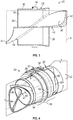
- FIGS. 1 and 2 are perspective views illustrating a non-limiting embodiment of a vane assembly 20 for distribution of a stratified fluid in an aircraft 22 (see FIG. 8 ).
- stratified fluid as utilized herein means the fluid includes multiple generally definable portions or zones with each portion or zone exhibiting a composition or property (such as temperature) different from the other portion(s) or zone(s).
- the stratified fluid includes a first portion 24 and a second portion 26 (see FIG. 7 ). It is to be appreciated that the stratified fluid may include greater than two zones.
- the stratified fluid includes a stratified air stream.
- the stratified air stream includes the first portion 24 and the second portion 26 with the first portion 24 and the second portion 26 generally definable along the flow of the stratified air stream.
- one side of the stratified air stream along its flow may be different than the other side of the stratified air stream.
- the stratified air stream may be defined by a gradient relative to the first portion 24 and the second portion 26 (e.g., a temperature profile extending from the first portion 24 and the second portion 26).
- the first portion 24 of the stratified air stream and the second portion 26 of the stratified air stream have a temperature differential in an amount of at least about 5 °C, alternatively at least about 30 °C, or alternatively at least about 100 °C. It is to be appreciated that the temperature differential is dependent on operating conditions of the components generating the stratified air stream. In certain embodiments, the temperature differential is calculated by taking the difference between the minimum and maximum temperatures of the first portion 24 and the second portion 26 (at the precooler outlet).
- the first portion 24 of the stratified air stream and the second portion 26 of the stratified air stream may have a temperature differential in an amount of from about 5 to about 150 °C, alternatively from about 20 to about 140 °C, or alternatively from about 30 to about 130 °C.
- the temperature of the second portion 26 may differ from the temperature of the first portion 24 in an amount of at least about 5 °C, alternatively at least about 30 °C, or alternatively at least about 100 °C.
- the vane assembly 20 includes a housing 28.
- the housing 28 includes a housing inlet 30 and a housing outlet 32.
- the housing inlet 30 is in fluid communication with the housing outlet 32.
- the housing inlet 30 is configured to receive the stratified fluid.
- the housing outlet 32 is spaced from the housing inlet 30 and configured to exhaust the stratified fluid.
- the housing 28 defines an interior housing volume 34 between the housing inlet 30 and the housing outlet 32.
- the housing 28 may have a substantially cylindrical configuration.
- the terminology "substantially" as utilized herein with reference to cylindrical means that a cross section of the housing 28 has a generally elliptical configuration.
- the housing 28 has an exterior surface 36 opposite the interior housing volume 34 and includes a shoulder 38 extending about the exterior surface 36.
- the housing 28 comprises a material configured to withstand the temperature differential without substantial deformation.
- FIG. 3 is a cut-away perspective view illustrating the vane assembly 20 of FIG. 1 .
- the vane assembly 20 further includes a vane 40.
- the vane 40 is disposed within the interior housing volume 34. It is to be appreciated that the vane 40 may extend beyond the interior housing volume 34 so long as a portion of the vane 40 is disposed within the interior housing volume 34. In certain embodiments, the vane 40 extends beyond the interior housing volume 34.
- the vane 40 bisects the interior housing volume 34. It is to be appreciated that the vane 40 may only partially bisect the interior housing volume 34 while still being considered to bisect the interior housing volume 34. In certain embodiments, the vane 40 completely bisects the interior housing volume 34 between the housing inlet 30 and the housing outlet 32. In a non-limiting embodiment, the vane inhibits the first portion and the second potion from mixing.
- the vane 40 includes a leading edge 42 adjacent the housing inlet 30 and a trailing edge 44 adjacent the housing outlet 32.
- the vane 40 has a first side 46 and a second side 48 opposite the first side 46 extending between the leading edge 42 and the trailing edge 44.
- the leading edge 42 may have a substantially linear configuration.
- the trailing edge 44 may have a generally U-shaped configuration defining a recess extending through the first side 46 and the second side 48. The trailing edge 44 is angularly offset from the leading edge 42 relative to the first side 46 and the second side 48.
- the leading edge 42 and the trailing edge 44 are defined by the first side 46 and the second side 48 such that even if the trailing edge 44 is angularly offset from the leading edge 42 by 180 degrees, thus appearing in line to each other, the trailing edge 44 is still angularly offset from the leading edge 42 because the angular offset is relative to the first side 46 and the second side 48.
- the leading edge 42 of the vane 40 defines a plane A extending from the leading edge 42 to the trailing edge 44.
- the trailing edge 44 may be angularly offset from the leading edge 42 in an amount of at least about +/- 10 degrees, at least about +/- 90 degrees, or at least about +/- 135 degrees, relative to the plane A.
- the vane 40 has a substantially helicoid configuration extending from the leading edge 42 to the trailing edge 44 with the trailing edge 44 angularly offset from the leading edge 42 in an amount of at least about +/- 135 degrees.
- the first side 46 and the second side 48 change orientation relative to the plane A as the first side 46 and the second side 48 extend from the leading edge 42 to the trailing edge 44. It is to be appreciated that the angular offsets described immediately above are relevant to certain designs and may vary depending on duct configuration (described below), duct outlet placement (described below), stratification orientation of the fluid, etc.
- the first side 46 of the vane 40 is configured to direct the first portion 24 of the stratified fluid between the housing inlet 30 and the housing outlet 32.
- the second side 48 of the vane 40 is configured to direct the second portion 26 of the stratified fluid between the housing inlet 30 and the housing outlet 32.
- the first portion 24 of the stratified fluid is directed by the first side 46 to change orientation relative to the plane A as the first portion 24 moves from the leading edge 42 to the trailing edge 44.
- the second portion 26 of the stratified fluid is directed by the second side 48 to change orientation relative to the plane A as the second portion 26 moves from the leading edge 42 to the trailing edge 44.
- Such a change in orientation of the stratified fluid by the vane 40 may be desirable to optimize distribution of the first portion 24 and the second portion 26 of the stratified fluid.
- FIG. 4 is a fragmentary, transparent perspective view illustrating a duct 50 for distribution of the stratified fluid in the aircraft 22.
- the duct 50 includes an upstream portion 52 configured to receive the stratified fluid and, as described above, the stratified fluid includes the first portion 24 and the second portion 26.
- the duct 50 further includes a downstream portion 54 spaced from the upstream portion 52 and configured to exhaust the stratified fluid.
- the duct 50 further includes an interior surface 56 disposed between the upstream portion 52 and the downstream portion 54, and the interior surface 56 defining an interior duct volume 58 between the upstream portion 52 and the downstream portion 54.
- the duct 50 comprises a material configured to withstand the temperature differential without substantial deformation.
- the vane 40 as described above, is disposed within, and bisects, the interior duct volume 58.
- the vane 40 includes the leading edge 42 adjacent the upstream portion 52 and the trailing edge 44 adjacent the downstream portion 54.
- the vane 40 has the first side 46 and the second side 48 opposite the first side 46.
- the first side 46 and the second side 48 extend between the leading edge 42 and the trailing edge 44.
- the trailing edge 44 is angularly offset from the leading edge 42 relative to the first side 46 and the second side 48.
- the first side 46 is configured to direct the first portion 24 of the stratified fluid between the upstream portion 52 and the downstream portion 54 and the second side 48 is configured to direct the second portion 26 of the stratified fluid between the upstream portion 52 and the downstream portion 54.
- the duct 50 includes the vane assembly 20 as described above rather than merely only including the vane 40.
- the vane assembly 20 may be disposed within the interior duct volume 58.
- the vane assembly 20 may include the housing 28 and the vane 40.
- the housing 28 may include the housing inlet 30 and the housing outlet 32.
- the housing inlet 30 may be configured to receive the stratified fluid.
- the housing outlet 32 may be spaced from the housing inlet 30 and configured to exhaust the stratified fluid.
- the housing 28 may define the interior housing volume 34 between the housing inlet 30 and the housing outlet 32.
- the vane 40 may be disposed within the interior housing volume 34 and may bisect the interior housing volume 34.
- the duct 50 includes a sleeve 60 configured to support the vane assembly 20.
- the sleeve 60 may be disposed between and coupled to the upstream portion 52 of the duct 50 and the downstream portion 54 of the duct 50 for coupling the upstream portion 52 and the downstream portion 54 together.
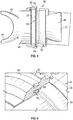
- FIG. 5 is a cut-away perspective view illustrating the duct 50 including a locking ring 62 and the vane assembly 20 of FIG. 1 .
- the duct 50 may further include a locking ring 62 configured to abut the shoulder 38 of the housing 28.
- the interior surface 56 of the duct 50 defines a groove 64 adjacent the shoulder 38.
- the sleeve 60 may define the groove 64.
- the groove 64 is configured to receive the locking ring 62 to minimize lateral movement of the vane assembly 20 within the duct 50.
- FIG. 6 is a cut-away perspective view illustrating the duct 50 including a pin 66 and the vane assembly 20 of FIG. 1 .
- the duct 50 may further include the pin 66 extending into the interior housing volume 34.
- the sleeve 60 may include the pin 66.
- the shoulder 38 of the housing 28 may define a notch 68.
- the notch 68 may be configured to receive the pin 66 to minimize rotational movement of the vane assembly 20 within the duct 50.
- FIG. 7 is an exploded view illustrating the duct 50 of FIG. 4 including the vane assembly 20 of FIG. 1 .
- the duct 50 further includes a first duct outlet 70 and a second duct outlet 72.
- the first duct outlet 70 and the second duct outlet 72 are in fluid communication with the downstream portion 54 of the duct 50.
- the second side 48 of the vane 40 adjacent the trailing edge 44 may face the first duct outlet 70.
- the first side 46 of the vane 40 adjacent the trailing edge 44 may face the second duct outlet 72.
- the first side 46 of the vane 40 is configured to receive the first portion 24 of the stratified fluid and exhaust the first portion 24 to the second duct outlet 72.
- the second side 48 of the vane 40 is configured to receive the second portion 26 of the stratified fluid and exhaust the second portion 26 to the first duct outlet 70.
- FIG. 8 is a fragmentary, transparent perspective view illustrating the aircraft 22 including the duct 50 of FIG. 4 for distribution of the stratified fluid.
- the duct 50 as described above, includes the vane assembly 20 (not shown).
- the upstream portion 52 (not shown) of the duct 50 may receive the stratified fluid from the various components of the aircraft 22 including, but not limited to, a second duct outlet 72 (see FIG. 9 ). It is to be appreciated that other components of the aircraft 22 can generate the stratified fluid, such as where compact cross-flow heat exchangers are utilized (for instance, in the ram air circuit).
- the downstream portion 54 (not shown) of the duct 50 may exhaust the stratified fluid to various components of the aircraft 22 including, but not limited to, an environmental control system (ECS) 76 and a wing anti-icing (WAI) system 78 (see FIG. 9 ). It is to be appreciated that other components of the aircraft 22 can utilize the stratified fluid.
- ECS environmental control system
- WAI wing anti-icing
- FIG. 9 is a schematic view illustrating the aircraft 22 of FIG. 8 .
- the aircraft 22 includes the precooler 74 with the precooler 74 in fluid communication with the upstream portion 52 of the duct 50.
- the precooler 74 may be configured to generate the stratified fluid.
- the aircraft 22 may further include the WAI system 78 and the ECS 76 with the WAI system 78 in fluid communication with the first duct outlet 70 and the ECS 76 in fluid communication with the second duct outlet 72.
- the first portion 24 of the stratified fluid generated by the precooler 74 has a lower temperature and the second portion 26 of the stratified fluid generated by the precooler 74 has a higher temperature.
- the first side 46 of the vane 40 may be configured to receive the first portion 24 of the stratified fluid and exhaust the first portion 24 to the second duct outlet 72.
- the ECS 76 may then receive the first portion 24 from the second duct outlet 72.
- the second side 48 of the vane 40 is configured to receive the second portion 26 of the stratified fluid and exhaust the second portion 26 to the first duct outlet 70.
- the WAI system 78 may then receive the second portion 26 from the first duct outlet 70.
- the vane assembly 20 improves distribution of the stratified fluid to components of the aircraft 22, namely the WAI system 78 and the ECS 76 thereby improving efficiency of the ECS 76 and the WAI system 78.
- the second portion 26 higher temperature
- the first portion 24 lower temperature
- the aircraft 22 includes an aircraft engine 80 including a compressor 82, a bypass 92, a combustor 84, and a turbine 86.
- the compressor 82 and the bypass 92 may receive air 94 from the environment.
- the compressor 82 may include a high stage and a low stage and may generate a higher temperature air stream 88 from the high stage, the low stage, or a combination thereof.
- the air stream from the high stage and the air stream from the low stage may be combined and mixed to form the higher temperature air stream 88.
- the bypass 92 may generate a lower temperature air stream 90. Both of the higher temperature air stream 88 and the lower temperature air stream 90 are independently channeled to the precooler 74 thereby resulting in the generation of the stratified fluid by the precooler 74.
- FIGS. 10A , 10B, and 10C are schematic views illustrating the duct 50 of FIG. 4 including the vane assembly 20 of FIG. 1 with the vane assembly 20 arranged in three different orientations.
- the vane assembly 20 may be rotated relative to the duct 50 to adjust distribution of the stratified fluid.
- the vane assembly 20 may be aligned at a reference position (0°) wherein the second side 48 of the vane 40 adjacent the trailing edge 44 of the vane 40 faces the first duct outlet 70 and the first side 46 of the vane 40 adjacent the trailing edge 44 of the vane 40 faces the second duct outlet 72.
- the fluid flow may be generally equal between the first duct outlet 70 and the second duct outlet 72 and the fluid may remain stratified between the first duct outlet 70 and the second duct outlet 72.
- rotation of the vane assembly 20 by 30° relative to the reference position may result in a fluid flow that is biased towards the first duct outlet 70 and the fluid may remain stratified between the first duct outlet 70 and the second duct outlet 72.
- rotation of the vane assembly 20 by 60° relative to the reference position may result in a fluid flow that is generally equal between the first duct outlet 70 and the second duct outlet 72, but the fluid may no longer be stratified between the first duct outlet 70 and the second duct outlet 72 (i.e. the fluid is mixed).
- the angles of rotation described immediately above are relevant to certain designs and may vary depending on duct configuration, duct outlet placement, stratification orientation of the fluid, angular offset of vane, etc.
Landscapes
- Engineering & Computer Science (AREA)
- Aviation & Aerospace Engineering (AREA)
- Chemical & Material Sciences (AREA)
- Combustion & Propulsion (AREA)
- Health & Medical Sciences (AREA)
- General Health & Medical Sciences (AREA)
- Pulmonology (AREA)
- Mechanical Engineering (AREA)
- General Engineering & Computer Science (AREA)
- Physics & Mathematics (AREA)
- Fluid Mechanics (AREA)
- Structures Of Non-Positive Displacement Pumps (AREA)
Abstract
Description
- The present disclosure generally relates to vehicles and more particularly relates to distribution of stratified fluids in aircraft.
- Aircraft typically employ an environmental control system (ECS) to pressurize a passenger cabin of the aircraft and/or thermal anti-icing systems to provide a heated air for anti-icing applications, such as wing anti-icing (WAI) systems. Air supply to these systems is typically provided by bleed air extracted from or provided by a compressor and engine bypass of an aircraft engine. To meet pressure and/or temperature demands of the various aircraft systems, hot bleed air is often extracted from a high stage or a low stage of the aircraft engine, while cold air is bled from the aircraft engine bypass.
- Both low and high stage bleed air streams are mixed to a desired set point temperature leading to a heat exchanger known as the precooler; the mixed stream is at an elevated temperature. At the precooler, the hot mixed bleed air stream is cooled down by the fan air consumed from the engine bypass duct. The resulting bleed air stream which has been cooled down is then channeled through a single duct from the precooler for distribution to the WAI system and ECS. The bleed air stream leaving the precooler frequently suffers from a large temperature stratification (i.e., large cold/hot temperature variation) which if not managed can lead to a significant impact to both WAI system and ECS performance. For example, if a higher temperature portion of the bleed air stream from the precooler is directed to the ECS and a lower temperature portion of the bleed air stream from the precooler is directed to the WAI system, these systems will not operate efficiently.
- Accordingly, it is desirable to provide improved distribution of a stratified fluid, such as a stratified air stream. Furthermore, other desirable features and characteristics will become apparent from the subsequent summary and detailed description and the appended claims, taken in conjunction with the accompanying drawings and the foregoing technical field and background.
- Various non-limiting embodiments of a vane assembly for distribution of a stratified fluid in an aircraft, a duct for distribution of a stratified fluid in an aircraft, and an aircraft including a duct for distribution of a stratified fluid, are disclosed herein.
- In one non-limiting embodiment, the vane assembly includes, but is not limited to, a housing. The housing includes, but is not limited to, a housing inlet and a housing outlet. The housing inlet is configured to receive the stratified fluid. The stratified fluid includes, but is not limited to, a first portion and a second portion. The housing outlet is spaced from the housing inlet. The housing outlet is configured to exhaust the stratified fluid. The housing defines an interior housing volume between the housing inlet and the housing outlet. The vane assembly further includes, but is not limited to, a vane disposed within the interior housing volume and bisecting the interior housing volume. The vane includes, but is not limited to, a leading edge adjacent the housing inlet and a trailing edge adjacent the housing outlet. The vane has a first side and a second side opposite the first side. The first side and the second side extend between the leading edge and the trailing edge. The trailing edge is angularly offset from the leading edge relative to the first side and the second side. The first side is configured to direct the first portion between the housing inlet and the housing outlet and the second side is configured to direct the second portion between the housing inlet and the housing outlet.
- In another non-limiting embodiment, the duct includes, but is not limited to, an upstream portion configured to receive the stratified fluid. The stratified fluid includes a first portion and a second portion. The duct further includes, but is not limited to, a downstream portion spaced from the upstream portion and configured to exhaust the stratified fluid. The duct further includes, but is not limited to, an interior surface disposed between the upstream portion and the downstream portion. The interior surface defines an interior duct volume between the upstream portion and the downstream portion. The duct further includes, but is not limited to, a vane disposed within and bisecting the interior duct volume. The vane includes a leading edge adjacent the upstream portion and a trailing edge adjacent the downstream portion. The vane has a first side and a second side opposite the first side. The first side and the second side extend between the leading edge and the trailing edge. The trailing edge is angularly offset from the leading edge relative to the first side and the second side. The first side is configured to direct the first portion between the upstream portion and the downstream portion and the second side is configured to direct the second portion between the upstream portion and the downstream portion.
- In another non-limiting embodiment, the duct includes, but is not limited to, an upstream portion configured to receive the stratified fluid. The stratified fluid includes a first portion and a second portion. The duct further includes, but is not limited to, a downstream portion spaced from the upstream portion and configured to exhaust the stratified fluid. The duct further includes, but is not limited to, an interior surface disposed between the upstream portion and the downstream portion. The interior surface defines an interior duct volume between the upstream portion and the downstream portion. The duct further includes, but is not limited to, a vane assembly disposed within the interior duct volume. The vane assembly includes, but is not limited to, a housing including a housing inlet and a housing outlet. The housing inlet is configured to receive the stratified fluid. The housing outlet is spaced from the housing inlet and configured to exhaust the stratified fluid. The housing defines an interior housing volume between the housing inlet and the housing outlet. The vane assembly further includes, but is not limited to, a vane disposed within the interior housing volume and bisecting the interior housing volume. The vane includes, but is not limited to, a leading edge adjacent the housing inlet and a trailing edge adjacent the housing outlet. The vane has a first side and a second side opposite the first side. The first side and the second side extend between the leading edge and the trailing edge. The trailing edge is angularly offset from the leading edge relative to the first side and the second side. The first side is configured to direct the first portion between the housing inlet and the housing outlet and the second side is configured to direct the second portion between the housing inlet and the housing outlet.
- The present invention will hereinafter be described in conjunction with the following drawing figures, wherein like numerals denote like elements, and
-
FIG. 1 is a perspective view illustrating a non-limiting embodiment of a vane assembly for distribution of a stratified fluid in an aircraft; -
FIG. 2 is another perspective view illustrating the vane assembly ofFIG. 1 ; -
FIG. 3 is a cut-away perspective view illustrating the vane assembly ofFIG. 1 ; -
FIG. 4 is a fragmentary, transparent perspective view illustrating a duct for distribution of a stratified fluid in an aircraft; -
FIG. 5 is a cut-away perspective view illustrating a duct including a locking ring and the vane assembly ofFIG. 1 ; -
FIG. 6 is a cut-away perspective view illustrating a duct including a pin and the vane assembly ofFIG. 1 ; -
FIG. 7 is an exploded view illustrating the duct ofFIG. 4 including the vane assembly ofFIG. 1 ; -
FIG. 8 is a fragmentary, transparent perspective view illustrating an aircraft including the duct ofFIG. 4 for distribution of the stratified fluid; -
FIG. 9 is a schematic view illustrating the aircraft ofFIG. 8 ; and -
FIGS. 10A ,10B, and 10C are schematic views illustrating the duct ofFIG. 4 including the vane assembly ofFIG. 1 with the vane assembly arranged in three different orientations. - The following detailed description is merely exemplary in nature and is not intended to limit the systems and methods as described herein. Furthermore, there is no intention to be bound by any theory presented in the preceding background or the following detailed description.
- In exemplary embodiments, a duct for distribution of a stratified fluid in an aircraft is taught herein. The duct includes an upstream portion configured to receive the stratified fluid from a precooler. The stratified fluid includes a first portion and a second portion different from the first portion. The first portion of the stratified fluid and the second portion of the stratified fluid have a temperature differential in an amount of at least about 5 °C. The duct further includes a downstream portion spaced from the upstream portion and configured to exhaust the stratified fluid through a first duct outlet to a wing anti-icing (WAI) system and through a second duct outlet to an environmental control system (ECS).
- The duct further includes a vane assembly disposed within the duct. The vane assembly includes a housing. The housing includes a housing inlet and a housing outlet. The vane assembly further includes a vane. The vane is disposed within the housing. The vane bisects the interior housing volume. The vane includes a leading edge adjacent the housing inlet and a trailing edge adjacent the housing outlet. The vane has a first side and a second side opposite the first side extending between the leading edge and the trailing edge. The trailing edge is angularly offset from the leading edge relative to the first side and the second side in an amount of at least about +/- 135 degrees such that the vane may have a substantially helicoid configuration extending from the leading edge to the trailing edge. The first side of the vane is configured to direct the first portion of the stratified fluid between the housing inlet and the housing outlet. Further, the second side of the vane is configured to direct the second portion of the stratified fluid between the housing inlet and the housing outlet.
- The first portion of the stratified fluid generated by the precooler has a lower temperature and the second portion of the stratified fluid generated by the precooler has a higher temperature. The first side of the vane may be configured to receive the first portion of the stratified fluid and exhaust the first portion to the second duct outlet. The ECS may then receive the first portion from the second duct outlet. Likewise, the second side of the vane is configured to receive the second portion of the stratified fluid and exhaust the second portion to the first duct outlet. The WAI system may then receive the second portion from the first duct outlet. To this end, the vane assembly improves distribution of the stratified fluid to components of the aircraft, namely the WAI system and the ECS thereby improving efficiency of the ECS and the WAI system. Without the vane assembly, the second portion (higher temperature) would be exhausted through the second duct outlet to the ECS and the first portion (lower temperature) would be exhausted through the first duct outlet to the WAI system thereby potentially adversely affecting efficiency of the ECS and the WAI system.
- A greater understanding of the system described above may be obtained through a review of the illustrations accompanying this application together with a review of the detailed description that follows.
-
FIGS. 1 and 2 are perspective views illustrating a non-limiting embodiment of avane assembly 20 for distribution of a stratified fluid in an aircraft 22 (seeFIG. 8 ). The terminology "stratified fluid" as utilized herein means the fluid includes multiple generally definable portions or zones with each portion or zone exhibiting a composition or property (such as temperature) different from the other portion(s) or zone(s). The stratified fluid includes afirst portion 24 and a second portion 26 (seeFIG. 7 ). It is to be appreciated that the stratified fluid may include greater than two zones. - With reference to
FIG. 7 and continuing reference toFIGS. 1 and 2 , in various embodiments, the stratified fluid includes a stratified air stream. In these embodiments, the stratified air stream includes thefirst portion 24 and thesecond portion 26 with thefirst portion 24 and thesecond portion 26 generally definable along the flow of the stratified air stream. Said differently, one side of the stratified air stream along its flow may be different than the other side of the stratified air stream. It is to be appreciated that the stratified air stream may be defined by a gradient relative to thefirst portion 24 and the second portion 26 (e.g., a temperature profile extending from thefirst portion 24 and the second portion 26). In certain embodiments, thefirst portion 24 of the stratified air stream and thesecond portion 26 of the stratified air stream have a temperature differential in an amount of at least about 5 °C, alternatively at least about 30 °C, or alternatively at least about 100 °C. It is to be appreciated that the temperature differential is dependent on operating conditions of the components generating the stratified air stream. In certain embodiments, the temperature differential is calculated by taking the difference between the minimum and maximum temperatures of thefirst portion 24 and the second portion 26 (at the precooler outlet). Alternatively, thefirst portion 24 of the stratified air stream and thesecond portion 26 of the stratified air stream may have a temperature differential in an amount of from about 5 to about 150 °C, alternatively from about 20 to about 140 °C, or alternatively from about 30 to about 130 °C. Alternatively, the temperature of thesecond portion 26 may differ from the temperature of thefirst portion 24 in an amount of at least about 5 °C, alternatively at least about 30 °C, or alternatively at least about 100 °C. - With continuing reference to
FIGS. 1 and 2 , thevane assembly 20 includes ahousing 28. Thehousing 28 includes ahousing inlet 30 and ahousing outlet 32. Thehousing inlet 30 is in fluid communication with thehousing outlet 32. Thehousing inlet 30 is configured to receive the stratified fluid. Thehousing outlet 32 is spaced from thehousing inlet 30 and configured to exhaust the stratified fluid. Thehousing 28 defines aninterior housing volume 34 between thehousing inlet 30 and thehousing outlet 32. Thehousing 28 may have a substantially cylindrical configuration. The terminology "substantially" as utilized herein with reference to cylindrical means that a cross section of thehousing 28 has a generally elliptical configuration. In certain embodiments, thehousing 28 has anexterior surface 36 opposite theinterior housing volume 34 and includes ashoulder 38 extending about theexterior surface 36. In various non-limiting embodiments, thehousing 28 comprises a material configured to withstand the temperature differential without substantial deformation. -
FIG. 3 is a cut-away perspective view illustrating thevane assembly 20 ofFIG. 1 . Thevane assembly 20 further includes avane 40. Thevane 40 is disposed within theinterior housing volume 34. It is to be appreciated that thevane 40 may extend beyond theinterior housing volume 34 so long as a portion of thevane 40 is disposed within theinterior housing volume 34. In certain embodiments, thevane 40 extends beyond theinterior housing volume 34. Thevane 40 bisects theinterior housing volume 34. It is to be appreciated that thevane 40 may only partially bisect theinterior housing volume 34 while still being considered to bisect theinterior housing volume 34. In certain embodiments, thevane 40 completely bisects theinterior housing volume 34 between thehousing inlet 30 and thehousing outlet 32. In a non-limiting embodiment, the vane inhibits the first portion and the second potion from mixing. - With continuing reference to
FIGS. 1, 2 , and3 , thevane 40 includes aleading edge 42 adjacent thehousing inlet 30 and a trailingedge 44 adjacent thehousing outlet 32. Thevane 40 has afirst side 46 and asecond side 48 opposite thefirst side 46 extending between theleading edge 42 and the trailingedge 44. The leadingedge 42 may have a substantially linear configuration. The trailingedge 44 may have a generally U-shaped configuration defining a recess extending through thefirst side 46 and thesecond side 48. The trailingedge 44 is angularly offset from the leadingedge 42 relative to thefirst side 46 and thesecond side 48. The phrase "relative to thefirst side 46 and thesecond side 48" means that the leadingedge 42 and the trailingedge 44 are defined by thefirst side 46 and thesecond side 48 such that even if the trailingedge 44 is angularly offset from the leadingedge 42 by 180 degrees, thus appearing in line to each other, the trailingedge 44 is still angularly offset from the leadingedge 42 because the angular offset is relative to thefirst side 46 and thesecond side 48. In certain embodiments, the leadingedge 42 of thevane 40 defines a plane A extending from the leadingedge 42 to the trailingedge 44. In these embodiments, the trailingedge 44 may be angularly offset from the leadingedge 42 in an amount of at least about +/- 10 degrees, at least about +/- 90 degrees, or at least about +/- 135 degrees, relative to the plane A. In exemplary embodiments, thevane 40 has a substantially helicoid configuration extending from the leadingedge 42 to the trailingedge 44 with the trailingedge 44 angularly offset from the leadingedge 42 in an amount of at least about +/- 135 degrees. In these embodiments, thefirst side 46 and thesecond side 48 change orientation relative to the plane A as thefirst side 46 and thesecond side 48 extend from the leadingedge 42 to the trailingedge 44. It is to be appreciated that the angular offsets described immediately above are relevant to certain designs and may vary depending on duct configuration (described below), duct outlet placement (described below), stratification orientation of the fluid, etc. - With continuing reference to
FIGS. 1, 2 ,3 , and7 , thefirst side 46 of thevane 40 is configured to direct thefirst portion 24 of the stratified fluid between thehousing inlet 30 and thehousing outlet 32. Further, thesecond side 48 of thevane 40 is configured to direct thesecond portion 26 of the stratified fluid between thehousing inlet 30 and thehousing outlet 32. In certain embodiments when thevane 40 has the substantially helicoid configuration, thefirst portion 24 of the stratified fluid is directed by thefirst side 46 to change orientation relative to the plane A as thefirst portion 24 moves from the leadingedge 42 to the trailingedge 44. Likewise, in certain embodiments when thevane 40 has the substantially helicoid configuration, thesecond portion 26 of the stratified fluid is directed by thesecond side 48 to change orientation relative to the plane A as thesecond portion 26 moves from the leadingedge 42 to the trailingedge 44. Such a change in orientation of the stratified fluid by thevane 40 may be desirable to optimize distribution of thefirst portion 24 and thesecond portion 26 of the stratified fluid. -
FIG. 4 is a fragmentary, transparent perspective view illustrating aduct 50 for distribution of the stratified fluid in theaircraft 22. Theduct 50 includes anupstream portion 52 configured to receive the stratified fluid and, as described above, the stratified fluid includes thefirst portion 24 and thesecond portion 26. Theduct 50 further includes adownstream portion 54 spaced from theupstream portion 52 and configured to exhaust the stratified fluid. Theduct 50 further includes aninterior surface 56 disposed between theupstream portion 52 and thedownstream portion 54, and theinterior surface 56 defining aninterior duct volume 58 between theupstream portion 52 and thedownstream portion 54. In various non-limiting embodiments, theduct 50 comprises a material configured to withstand the temperature differential without substantial deformation. - The
vane 40, as described above, is disposed within, and bisects, theinterior duct volume 58. Thevane 40 includes the leadingedge 42 adjacent theupstream portion 52 and the trailingedge 44 adjacent thedownstream portion 54. Thevane 40 has thefirst side 46 and thesecond side 48 opposite thefirst side 46. Thefirst side 46 and thesecond side 48 extend between theleading edge 42 and the trailingedge 44. The trailingedge 44 is angularly offset from the leadingedge 42 relative to thefirst side 46 and thesecond side 48. Thefirst side 46 is configured to direct thefirst portion 24 of the stratified fluid between theupstream portion 52 and thedownstream portion 54 and thesecond side 48 is configured to direct thesecond portion 26 of the stratified fluid between theupstream portion 52 and thedownstream portion 54. - In certain embodiments, the
duct 50 includes thevane assembly 20 as described above rather than merely only including thevane 40. Thevane assembly 20 may be disposed within theinterior duct volume 58. Thevane assembly 20 may include thehousing 28 and thevane 40. Thehousing 28 may include thehousing inlet 30 and thehousing outlet 32. Thehousing inlet 30 may be configured to receive the stratified fluid. Thehousing outlet 32 may be spaced from thehousing inlet 30 and configured to exhaust the stratified fluid. Thehousing 28 may define theinterior housing volume 34 between thehousing inlet 30 and thehousing outlet 32. Thevane 40 may be disposed within theinterior housing volume 34 and may bisect theinterior housing volume 34. - In various embodiments, the
duct 50 includes asleeve 60 configured to support thevane assembly 20. Thesleeve 60 may be disposed between and coupled to theupstream portion 52 of theduct 50 and thedownstream portion 54 of theduct 50 for coupling theupstream portion 52 and thedownstream portion 54 together. -
FIG. 5 is a cut-away perspective view illustrating theduct 50 including alocking ring 62 and thevane assembly 20 ofFIG. 1 . Theduct 50 may further include a lockingring 62 configured to abut theshoulder 38 of thehousing 28. Theinterior surface 56 of theduct 50 defines agroove 64 adjacent theshoulder 38. In embodiments when theduct 50 includes thesleeve 60, thesleeve 60 may define thegroove 64. Thegroove 64 is configured to receive the lockingring 62 to minimize lateral movement of thevane assembly 20 within theduct 50. -
FIG. 6 is a cut-away perspective view illustrating theduct 50 including apin 66 and thevane assembly 20 ofFIG. 1 . Theduct 50 may further include thepin 66 extending into theinterior housing volume 34. In embodiments when theduct 50 includes thesleeve 60, thesleeve 60 may include thepin 66. Theshoulder 38 of thehousing 28 may define anotch 68. Thenotch 68 may be configured to receive thepin 66 to minimize rotational movement of thevane assembly 20 within theduct 50. -
FIG. 7 is an exploded view illustrating theduct 50 ofFIG. 4 including thevane assembly 20 ofFIG. 1 . Theduct 50 further includes afirst duct outlet 70 and asecond duct outlet 72. Thefirst duct outlet 70 and thesecond duct outlet 72 are in fluid communication with thedownstream portion 54 of theduct 50. Thesecond side 48 of thevane 40 adjacent the trailingedge 44 may face thefirst duct outlet 70. Thefirst side 46 of thevane 40 adjacent the trailingedge 44 may face thesecond duct outlet 72. In certain embodiments, thefirst side 46 of thevane 40 is configured to receive thefirst portion 24 of the stratified fluid and exhaust thefirst portion 24 to thesecond duct outlet 72. Likewise, in certain embodiments, thesecond side 48 of thevane 40 is configured to receive thesecond portion 26 of the stratified fluid and exhaust thesecond portion 26 to thefirst duct outlet 70. -
FIG. 8 is a fragmentary, transparent perspective view illustrating theaircraft 22 including theduct 50 ofFIG. 4 for distribution of the stratified fluid. Theduct 50, as described above, includes the vane assembly 20 (not shown). The upstream portion 52 (not shown) of theduct 50 may receive the stratified fluid from the various components of theaircraft 22 including, but not limited to, a second duct outlet 72 (seeFIG. 9 ). It is to be appreciated that other components of theaircraft 22 can generate the stratified fluid, such as where compact cross-flow heat exchangers are utilized (for instance, in the ram air circuit). The downstream portion 54 (not shown) of theduct 50 may exhaust the stratified fluid to various components of theaircraft 22 including, but not limited to, an environmental control system (ECS) 76 and a wing anti-icing (WAI) system 78 (seeFIG. 9 ). It is to be appreciated that other components of theaircraft 22 can utilize the stratified fluid. -
FIG. 9 is a schematic view illustrating theaircraft 22 ofFIG. 8 . With reference toFIG. 9 and continuing reference toFIG. 7 , in certain embodiments, theaircraft 22 includes theprecooler 74 with theprecooler 74 in fluid communication with theupstream portion 52 of theduct 50. Theprecooler 74 may be configured to generate the stratified fluid. Theaircraft 22 may further include theWAI system 78 and theECS 76 with theWAI system 78 in fluid communication with thefirst duct outlet 70 and theECS 76 in fluid communication with thesecond duct outlet 72. - In exemplary embodiments, the
first portion 24 of the stratified fluid generated by theprecooler 74 has a lower temperature and thesecond portion 26 of the stratified fluid generated by theprecooler 74 has a higher temperature. Thefirst side 46 of thevane 40 may be configured to receive thefirst portion 24 of the stratified fluid and exhaust thefirst portion 24 to thesecond duct outlet 72. TheECS 76 may then receive thefirst portion 24 from thesecond duct outlet 72. Likewise, thesecond side 48 of thevane 40 is configured to receive thesecond portion 26 of the stratified fluid and exhaust thesecond portion 26 to thefirst duct outlet 70. TheWAI system 78 may then receive thesecond portion 26 from thefirst duct outlet 70. To this end, thevane assembly 20 improves distribution of the stratified fluid to components of theaircraft 22, namely theWAI system 78 and theECS 76 thereby improving efficiency of theECS 76 and theWAI system 78. Without thevane assembly 20, the second portion 26 (higher temperature) would be exhausted through thesecond duct outlet 72 to theECS 76 and the first portion 24 (lower temperature) would be exhausted through thefirst duct outlet 70 to theWAI system 78 thereby potentially adversely affecting efficiency of theECS 76 and theWAI system 78. - In various embodiments, the
aircraft 22 includes anaircraft engine 80 including acompressor 82, abypass 92, acombustor 84, and aturbine 86. Thecompressor 82 and thebypass 92 may receive air 94 from the environment. Thecompressor 82 may include a high stage and a low stage and may generate a highertemperature air stream 88 from the high stage, the low stage, or a combination thereof. In embodiments including the highertemperature air stream 88 from both the high stage and the low stage, the air stream from the high stage and the air stream from the low stage may be combined and mixed to form the highertemperature air stream 88. Thebypass 92 may generate a lowertemperature air stream 90. Both of the highertemperature air stream 88 and the lowertemperature air stream 90 are independently channeled to theprecooler 74 thereby resulting in the generation of the stratified fluid by theprecooler 74. -
FIGS. 10A ,10B, and 10C are schematic views illustrating theduct 50 ofFIG. 4 including thevane assembly 20 ofFIG. 1 with thevane assembly 20 arranged in three different orientations. With continuing reference toFIG. 4 , thevane assembly 20 may be rotated relative to theduct 50 to adjust distribution of the stratified fluid. For example, as shown inFIG. 10A , thevane assembly 20 may be aligned at a reference position (0°) wherein thesecond side 48 of thevane 40 adjacent the trailingedge 44 of thevane 40 faces thefirst duct outlet 70 and thefirst side 46 of thevane 40 adjacent the trailingedge 44 of thevane 40 faces thesecond duct outlet 72. In this reference position (0°), the fluid flow may be generally equal between thefirst duct outlet 70 and thesecond duct outlet 72 and the fluid may remain stratified between thefirst duct outlet 70 and thesecond duct outlet 72. As shown inFIG. 10B , rotation of thevane assembly 20 by 30° relative to the reference position may result in a fluid flow that is biased towards thefirst duct outlet 70 and the fluid may remain stratified between thefirst duct outlet 70 and thesecond duct outlet 72. As shown inFIG. 10C , rotation of thevane assembly 20 by 60° relative to the reference position may result in a fluid flow that is generally equal between thefirst duct outlet 70 and thesecond duct outlet 72, but the fluid may no longer be stratified between thefirst duct outlet 70 and the second duct outlet 72 (i.e. the fluid is mixed). It is to be appreciated that the angles of rotation described immediately above are relevant to certain designs and may vary depending on duct configuration, duct outlet placement, stratification orientation of the fluid, angular offset of vane, etc. - While at least one exemplary embodiment has been presented in the foregoing detailed description of the disclosure, it should be appreciated that a vast number of variations exist. It should also be appreciated that the exemplary embodiment or exemplary embodiments are only examples, and are not intended to limit the scope, applicability, or configuration of the invention in any way. Rather, the foregoing detailed description will provide those skilled in the art with a convenient road map for implementing an exemplary embodiment of the invention. It being understood that various changes may be made in the function and arrangement of elements described in an exemplary embodiment without departing from the scope of the disclosure as set forth in the appended claims.
- The present disclosure may be further described by the following Aspects.
- Aspect 1. A vane assembly for distribution of a stratified fluid in an aircraft, the stratified fluid comprising a first portion and a second portion, the vane assembly comprising:
- a housing comprising a housing inlet and a housing outlet, the housing inlet configured to receive the stratified fluid, the housing outlet spaced from the housing inlet and configured to exhaust the stratified fluid, and the housing defining an interior housing volume between the housing inlet and the housing outlet; and
- a vane disposed within the interior housing volume and bisecting the interior housing volume, the vane comprising a leading edge adjacent the housing inlet and a trailing edge adjacent the housing outlet, the vane having a first side and a second side opposite the first side, the first side and the second side extending between the leading edge and the trailing edge, and the trailing edge angularly offset from the leading edge relative to the first side and the second side;
- wherein the first side is configured to direct the first portion between the housing inlet and the housing outlet and the second side is configured to direct the second portion between the housing inlet and the housing outlet.
-
Aspect 2. The vane assembly of claim 1, wherein the leading edge of the vane defines a plane extending from the leading edge to the trailing edge, and the trailing edge is angularly offset from the leading edge in an amount of at least about +/-10 degrees relative to the plane. - Aspect 3. The vane assembly of Aspect 1, wherein the vane has a substantially helicoid configuration extending from the leading edge of the vane to the trailing edge of the vane.
- Aspect 4.The vane assembly of Aspect 1, wherein the leading edge has a substantially linear configuration.
- Aspect 5. The vane assembly of Aspect 1, wherein the trailing edge has a generally U-shaped configuration defining a recess.
- Aspect 6. The vane assembly of Aspect 1, wherein the housing has a substantially cylindrical configuration.
- Aspect 7. The vane assembly of Aspect 1, wherein the stratified fluid comprises a stratified air stream and the first portion of the stratified air stream and the second portion of the stratified air stream have a temperature differential in an amount of at least 5 °C.
- Aspect 8. A duct for distribution of a stratified fluid in an aircraft, the stratified fluid comprising a first portion and a second portion, the duct comprising:
- an upstream portion configured to receive the stratified fluid;
- a downstream portion spaced from the upstream portion and configured to exhaust the stratified fluid;
- an interior surface disposed between the upstream portion and the downstream portion, and the interior surface defining an interior duct volume between the upstream portion and the downstream portion; and
- a vane disposed within and bisecting the interior duct volume, the vane comprising a leading edge adjacent the upstream portion and a trailing edge adjacent the downstream portion, the vane having a first side and a second side opposite the first side, the first side and the second side extending between the leading edge and the trailing edge, and the trailing edge angularly offset from the leading edge relative to the first side and the second side;
- wherein the first side is configured to direct the first portion between the upstream portion and the downstream portion and the second side is configured to direct the second portion between the upstream portion and the downstream portion.
- Aspect 9. The duct of Aspect 8, wherein the duct further comprises a first duct outlet and a second duct outlet, the first duct outlet and the second duct outlet are in fluid communication with the downstream portion of the duct, the second side of the vane adjacent the trailing edge faces the first duct outlet, and the first side of the vane adjacent the trailing edge faces the second duct outlet.
- Aspect 10. The duct of Aspect 9, wherein the first side of the vane is configured to receive the first portion of the stratified fluid and exhaust the first portion to the second duct outlet, and the second side of the vane is configured to receive the second portion of the stratified fluid and exhaust the second portion to the first duct outlet.
- Aspect 11. The duct of Aspect 8, wherein the duct further comprises a vane assembly disposed within the interior duct volume, the vane assembly comprises a housing and the vane, the housing comprises a housing inlet and a housing outlet, the housing inlet is configured to receive the stratified fluid, the housing outlet is spaced from the housing inlet and configured to exhaust the stratified fluid, the housing defines an interior housing volume between the housing inlet and the housing outlet, and wherein the vane is disposed within the interior housing volume and bisecting the interior housing volume.
- Aspect 12. The duct of Aspect 11, wherein the housing has an exterior surface opposite the interior housing volume and comprises a shoulder extending about the exterior surface.
- Aspect 13. The duct of Aspect 12, wherein the duct further comprises a locking ring configured to abut the shoulder of the housing, the interior surface of the duct defines a groove adjacent the shoulder, and the groove is configured to receive the locking ring to minimize lateral movement of the vane assembly within the duct.
- Aspect 14. The duct of Aspect 12, wherein the duct further comprises a pin extending into the interior housing volume, the shoulder of the housing defines a notch, and the notch is configured to receive the pin to minimize rotational movement of the vane assembly within the duct.
- Aspect 15. The duct of Aspect 8, wherein the duct comprises a sleeve configured to support the vane assembly, the sleeve disposed between and coupled to the upstream portion of the duct and the downstream portion of the duct for coupling the upstream portion and the downstream portion together.
- Aspect 16. An aircraft comprising:
a duct for distribution of a stratified fluid, the stratified fluid comprising a first portion and a second portion, the duct comprising:- an upstream portion configured to receive the stratified fluid;
- a downstream portion spaced from the upstream portion and configured to exhaust the stratified fluid;
- an interior surface disposed between the upstream portion and the downstream portion, and the interior surface defining an interior duct volume between the upstream portion and the downstream portion; and
- a vane assembly disposed within the interior duct volume, the vane assembly comprising;
- a housing comprising a housing inlet and a housing outlet, the housing inlet configured to receive the stratified fluid, the housing outlet spaced from the housing inlet and configured to exhaust the stratified fluid, and the housing defining an interior housing volume between the housing inlet and the housing outlet, and
- a vane disposed within the interior housing volume and bisecting the interior housing volume, the vane comprising a leading edge adjacent the housing inlet and a trailing edge adjacent the housing outlet, the vane having a first side and a second side opposite the first side, the first side and the second side extending between the leading edge and the trailing edge, and the trailing edge angularly offset from the leading edge relative to the first side and the second side,
- wherein the first side is configured to direct the first portion between the housing inlet and the housing outlet and the second side is configured to direct the second portion between the housing inlet and the housing outlet.
- Aspect 17. The aircraft of Aspect 16, wherein the duct further comprises a first duct outlet and a second duct outlet, the first duct outlet and the second duct outlet are in fluid communication with the downstream portion of the duct, the second side of the vane adjacent the trailing edge faces the first duct outlet, and the first side of the vane adjacent the trailing edge faces the second duct outlet.
- Aspect 18. The aircraft of Aspect 17 further comprising a precooler, wherein the precooler is in fluid communication with the upstream portion of the duct and is configured to generate the stratified fluid, the first side of the vane is configured to receive the first portion of the stratified fluid and exhaust the first portion to the second duct outlet, and the second side of the vane is configured to receive the second portion of the stratified fluid and exhaust the second portion to the first duct outlet.
- Aspect 19. The aircraft of Aspect 17 further comprising wing anti-icing system in fluid communication with the first duct outlet and an environmental control system in fluid communication with the second duct outlet.
-
Aspect 20. The aircraft of Aspect 16, wherein the stratified fluid comprises a stratified air stream and the first portion of the stratified air stream and the second portion of the stratified air stream have a temperature differential in an amount of at least 5 °C, and wherein the duct and the housing comprise a material configured to withstand the temperature differential without substantial deformation.
Claims (15)
- A vane assembly for distribution of a stratified fluid in an aircraft, the stratified fluid comprising a first portion and a second portion, the vane assembly comprising:a housing, wherein the housing optionally has a substantially cylindrical configuration, comprising a housing inlet and a housing outlet, the housing inlet configured to receive the stratified fluid, the housing outlet spaced from the housing inlet and configured to exhaust the stratified fluid, and the housing defining an interior housing volume between the housing inlet and the housing outlet; anda vane disposed within the interior housing volume and bisecting the interior housing volume, the vane comprising a leading edge adjacent the housing inlet and a trailing edge adjacent the housing outlet, the vane having a first side and a second side opposite the first side, the first side and the second side extending between the leading edge and the trailing edge, and the trailing edge angularly offset from the leading edge relative to the first side and the second side;wherein the first side is configured to direct the first portion between the housing inlet and the housing outlet and the second side is configured to direct the second portion between the housing inlet and the housing outlet.
- The vane assembly of claim 1, wherein the leading edge of the vane defines a plane extending from the leading edge to the trailing edge, and the trailing edge is angularly offset from the leading edge in an amount of at least about +/-10 degrees relative to the plane.
- The vane assembly of claims 1 or 2, wherein the vane has a substantially helicoid configuration extending from the leading edge of the vane to the trailing edge of the vane.
- The vane assembly of any one of claims 1 to 3, wherein the leading edge has a substantially linear configuration.
- The vane assembly of any one of claims 1 to 4, wherein the trailing edge has a generally U-shaped configuration defining a recess.
- The vane assembly of any one of claims 1 to 5, wherein the stratified fluid comprises a stratified air stream and the first portion of the stratified air stream and the second portion of the stratified air stream have a temperature differential in an amount of at least 5 °C.
- A duct for distribution of a stratified fluid in an aircraft, the stratified fluid comprising a first portion and a second portion, the duct comprising:an upstream portion configured to receive the stratified fluid;a downstream portion spaced from the upstream portion and configured to exhaust the stratified fluid;an interior surface disposed between the upstream portion and the downstream portion, and the interior surface defining an interior duct volume between the upstream portion and the downstream portion; anda vane disposed within and bisecting the interior duct volume, the vane comprising a leading edge adjacent the upstream portion and a trailing edge adjacent the downstream portion, the vane having a first side and a second side opposite the first side, the first side and the second side extending between the leading edge and the trailing edge, and the trailing edge angularly offset from the leading edge relative to the first side and the second side;wherein the first side is configured to direct the first portion between the upstream portion and the downstream portion and the second side is configured to direct the second portion between the upstream portion and the downstream portion.
- The duct of claim 7, wherein the duct further comprises a first duct outlet and a second duct outlet, the first duct outlet and the second duct outlet are in fluid communication with the downstream portion of the duct, the second side of the vane adjacent the trailing edge faces the first duct outlet, and the first side of the vane adjacent the trailing edge faces the second duct outlet, wherein the first side of the vane is optionally configured to receive the first portion of the stratified fluid and exhaust the first portion to the second duct outlet, and the second side of the vane is optionally configured to receive the second portion of the stratified fluid and exhaust the second portion to the first duct outlet.
- The duct of claim 7 or 8, wherein the duct further comprises a vane assembly disposed within the interior duct volume, the vane assembly comprises a housing and the vane, the housing comprises a housing inlet and a housing outlet, the housing inlet is configured to receive the stratified fluid, the housing outlet is spaced from the housing inlet and configured to exhaust the stratified fluid, the housing defines an interior housing volume between the housing inlet and the housing outlet, and wherein the vane is disposed within the interior housing volume and bisecting the interior housing volume.
- The duct of claim 9, wherein the housing has an exterior surface opposite the interior housing volume and comprises a shoulder extending about the exterior surface,
wherein the duct optionally further comprises a locking ring configured to abut the shoulder of the housing, the interior surface of the duct defines a groove adjacent the shoulder, and the groove is configured to receive the locking ring to minimize lateral movement of the vane assembly within the duct, and/or
wherein the duct optionally further comprises a pin extending into the interior housing volume, the shoulder of the housing defines a notch, and the notch is configured to receive the pin to minimize rotational movement of the vane assembly within the duct.. - The duct of any one of claims 7 to 10, wherein the duct comprises a sleeve configured to support the vane assembly, the sleeve disposed between and coupled to the upstream portion of the duct and the downstream portion of the duct for coupling the upstream portion and the downstream portion together.
- An aircraft comprising:
a duct for distribution of a stratified fluid, the stratified fluid comprising a first portion and a second portion, the duct comprising:an upstream portion configured to receive the stratified fluid;a downstream portion spaced from the upstream portion and configured to exhaust the stratified fluid;an interior surface disposed between the upstream portion and the downstream portion, and the interior surface defining an interior duct volume between the upstream portion and the downstream portion; anda vane assembly disposed within the interior duct volume, the vane assembly comprising;a housing comprising a housing inlet and a housing outlet, the housing inlet configured to receive the stratified fluid, the housing outlet spaced from the housing inlet and configured to exhaust the stratified fluid, and the housing defining an interior housing volume between the housing inlet and the housing outlet, anda vane disposed within the interior housing volume and bisecting the interior housing volume, the vane comprising a leading edge adjacent the housing inlet and a trailing edge adjacent the housing outlet, the vane having a first side and a second side opposite the first side, the first side and the second side extending between the leading edge and the trailing edge, and the trailing edge angularly offset from the leading edge relative to the first side and the second side,wherein the first side is configured to direct the first portion between the housing inlet and the housing outlet and the second side is configured to direct the second portion between the housing inlet and the housing outlet. - The aircraft of claim 12, wherein the duct further comprises a first duct outlet and a second duct outlet, the first duct outlet and the second duct outlet are in fluid communication with the downstream portion of the duct, the second side of the vane adjacent the trailing edge faces the first duct outlet, and the first side of the vane adjacent the trailing edge faces the second duct outlet.
- The aircraft of claim 13, further comprising a precooler, wherein the precooler is in fluid communication with the upstream portion of the duct and is configured to generate the stratified fluid, the first side of the vane is configured to receive the first portion of the stratified fluid and exhaust the first portion to the second duct outlet, and the second side of the vane is configured to receive the second portion of the stratified fluid and exhaust the second portion to the first duct outlet, and/or further comprising a wing anti-icing system in fluid communication with the first duct outlet and an environmental control system in fluid communication with the second duct outlet.
- The aircraft of any one of claims 12 to 14, wherein the stratified fluid comprises a stratified air stream and the first portion of the stratified air stream and the second portion of the stratified air stream have a temperature differential in an amount of at least 5 °C, and wherein the duct and the housing comprise a material configured to withstand the temperature differential without substantial deformation.
Applications Claiming Priority (1)
| Application Number | Priority Date | Filing Date | Title |
|---|---|---|---|
| US16/048,959 US11117669B2 (en) | 2018-07-30 | 2018-07-30 | Vane assembly for distribution of a stratified fluid in an aircraft |
Publications (2)
| Publication Number | Publication Date |
|---|---|
| EP3604134A1 true EP3604134A1 (en) | 2020-02-05 |
| EP3604134B1 EP3604134B1 (en) | 2021-12-08 |
Family
ID=67220685
Family Applications (1)
| Application Number | Title | Priority Date | Filing Date |
|---|---|---|---|
| EP19185128.6A Active EP3604134B1 (en) | 2018-07-30 | 2019-07-09 | Vane assembly for distribution of a stratified fluid in an aircraft |
Country Status (3)
| Country | Link |
|---|---|
| US (1) | US11117669B2 (en) |
| EP (1) | EP3604134B1 (en) |
| CN (1) | CN110775283B (en) |
Families Citing this family (5)
| Publication number | Priority date | Publication date | Assignee | Title |
|---|---|---|---|---|
| US11465758B2 (en) * | 2019-04-30 | 2022-10-11 | Rohr, Inc. | Method and apparatus for aircraft anti-icing |
| US11279491B2 (en) | 2019-04-30 | 2022-03-22 | Rohr, Inc. | Method and apparatus for aircraft anti-icing |
| US11572829B2 (en) * | 2020-05-16 | 2023-02-07 | General Electric Company | System and method for combining compressor bleed flow and ventilation flow of gas turbine engine |
| US11828223B2 (en) * | 2021-05-28 | 2023-11-28 | Honeywell International Inc. | Variable jet pump |
| US12234840B2 (en) | 2022-06-07 | 2025-02-25 | Honeywell International Inc. | Jet pump system |
Citations (4)
| Publication number | Priority date | Publication date | Assignee | Title |
|---|---|---|---|---|
| US20120087787A1 (en) * | 2010-10-06 | 2012-04-12 | Dewain Ray Brown | Turbofan jet engine |
| US20160311541A1 (en) * | 2015-04-27 | 2016-10-27 | Mitsubishi Aircraft Corporation | Duct structure which discharges air through air pressure regulating valve and aircraft |
| US20170122209A1 (en) * | 2015-11-04 | 2017-05-04 | General Electric Company | Gas turbine engine having a flow control surface with a cooling conduit |
| CA2954449A1 (en) * | 2016-01-14 | 2017-07-14 | Hamilton Sundstrand Corporation | Low pressure pack |
Family Cites Families (6)
| Publication number | Priority date | Publication date | Assignee | Title |
|---|---|---|---|---|
| US5378265A (en) * | 1993-08-31 | 1995-01-03 | Pearl; Robert L. | Apparatus for removing foreign particles for air |
| US9046039B2 (en) * | 2008-05-06 | 2015-06-02 | Rolls-Royce Plc | Staged pilots in pure airblast injectors for gas turbine engines |
| US9109514B2 (en) * | 2012-01-10 | 2015-08-18 | Hamilton Sundstrand Corporation | Air recovery system for precooler heat-exchanger |
| DE202014002795U1 (en) * | 2014-03-31 | 2015-04-02 | Reinz-Dichtungs-Gmbh | liquid separation |
| US20170159563A1 (en) * | 2015-12-07 | 2017-06-08 | General Electric Company | Method and system for pre-cooler exhaust energy recovery |
| JP6654483B2 (en) * | 2016-03-24 | 2020-02-26 | 三菱航空機株式会社 | Anti-icing system for aircraft, aircraft including the same, anti-icing system control program, and controlling method for anti-icing system |
-
2018
- 2018-07-30 US US16/048,959 patent/US11117669B2/en active Active
-
2019
- 2019-07-09 EP EP19185128.6A patent/EP3604134B1/en active Active
- 2019-07-30 CN CN201910695992.7A patent/CN110775283B/en active Active
Patent Citations (4)
| Publication number | Priority date | Publication date | Assignee | Title |
|---|---|---|---|---|
| US20120087787A1 (en) * | 2010-10-06 | 2012-04-12 | Dewain Ray Brown | Turbofan jet engine |
| US20160311541A1 (en) * | 2015-04-27 | 2016-10-27 | Mitsubishi Aircraft Corporation | Duct structure which discharges air through air pressure regulating valve and aircraft |
| US20170122209A1 (en) * | 2015-11-04 | 2017-05-04 | General Electric Company | Gas turbine engine having a flow control surface with a cooling conduit |
| CA2954449A1 (en) * | 2016-01-14 | 2017-07-14 | Hamilton Sundstrand Corporation | Low pressure pack |
Also Published As
| Publication number | Publication date |
|---|---|
| US11117669B2 (en) | 2021-09-14 |
| US20200031476A1 (en) | 2020-01-30 |
| CN110775283A (en) | 2020-02-11 |
| EP3604134B1 (en) | 2021-12-08 |
| CN110775283B (en) | 2022-10-14 |
Similar Documents
| Publication | Publication Date | Title |
|---|---|---|
| EP3604134B1 (en) | Vane assembly for distribution of a stratified fluid in an aircraft | |
| US8056345B2 (en) | Hybrid cooling of a gas turbine engine | |
| US8516791B2 (en) | Methods and apparatus for mixing fluid in turbine engines | |
| EP2944767B1 (en) | Fluid system | |
| US10100733B2 (en) | Turbine engine with anti-ice valve assembly, bleed air valve, and method of operating | |
| CN106988887B (en) | Gas turbine engine fluid cooling system and method of assembling the same | |
| US8438835B2 (en) | Methods and apparatus for mixing fluid in turbine engines | |
| CN107444653B (en) | Mixing ram air and exhaust in a dual-inlet turbine system | |
| US10823067B2 (en) | System for a surface cooler with OGV oriented fin angles | |
| US20170268810A1 (en) | Heat Exchanger with Integral Bypass Valve | |
| US20160123186A1 (en) | Shroud assembly for a turbine engine | |
| US11359498B2 (en) | Turbine engine airfoil assembly | |
| EP3358138A1 (en) | Pre-swirler for gas turbine | |
| CN104975885B (en) | Thrust plate sub-assembly | |
| US10801724B2 (en) | Method and apparatus for minimizing cross-flow across an engine cooling hole | |
| EP4382845B1 (en) | Compact radial condenser | |
| US11111856B2 (en) | Turbofan engine and core link therefore | |
| EP3225554B1 (en) | Aircraft air conditioning system including a thermoelectric device | |
| EP3222958B1 (en) | Heat exchanger with integral bypass valve | |
| CN121844126A (en) | Annular wall for an aircraft turbine engine and aircraft turbine engine comprising such a wall | |
| CN111795216A (en) | Mixed flow duct for exhaust system |
Legal Events
| Date | Code | Title | Description |
|---|---|---|---|
| PUAI | Public reference made under article 153(3) epc to a published international application that has entered the european phase |
Free format text: ORIGINAL CODE: 0009012 |
|
| STAA | Information on the status of an ep patent application or granted ep patent |
Free format text: STATUS: REQUEST FOR EXAMINATION WAS MADE |
|
| 17P | Request for examination filed |
Effective date: 20190709 |
|
| AK | Designated contracting states |
Kind code of ref document: A1 Designated state(s): AL AT BE BG CH CY CZ DE DK EE ES FI FR GB GR HR HU IE IS IT LI LT LU LV MC MK MT NL NO PL PT RO RS SE SI SK SM TR |
|
| AX | Request for extension of the european patent |
Extension state: BA ME |
|
| STAA | Information on the status of an ep patent application or granted ep patent |
Free format text: STATUS: EXAMINATION IS IN PROGRESS |
|
| 17Q | First examination report despatched |
Effective date: 20201103 |
|
| RIC1 | Information provided on ipc code assigned before grant |
Ipc: B64D 13/00 20060101AFI20210519BHEP Ipc: B64D 15/02 20060101ALI20210519BHEP Ipc: F02C 6/08 20060101ALI20210519BHEP Ipc: F02C 9/18 20060101ALI20210519BHEP Ipc: B64D 33/02 20060101ALN20210519BHEP |
|
| RIC1 | Information provided on ipc code assigned before grant |
Ipc: B64D 13/00 20060101AFI20210607BHEP Ipc: B64D 15/02 20060101ALI20210607BHEP Ipc: F02C 6/08 20060101ALI20210607BHEP Ipc: F02C 9/18 20060101ALI20210607BHEP Ipc: B64D 33/02 20060101ALN20210607BHEP |
|
| GRAP | Despatch of communication of intention to grant a patent |
Free format text: ORIGINAL CODE: EPIDOSNIGR1 |
|
| STAA | Information on the status of an ep patent application or granted ep patent |
Free format text: STATUS: GRANT OF PATENT IS INTENDED |
|
| INTG | Intention to grant announced |
Effective date: 20210716 |
|
| GRAS | Grant fee paid |
Free format text: ORIGINAL CODE: EPIDOSNIGR3 |
|
| GRAA | (expected) grant |
Free format text: ORIGINAL CODE: 0009210 |
|
| STAA | Information on the status of an ep patent application or granted ep patent |
Free format text: STATUS: THE PATENT HAS BEEN GRANTED |
|
| AK | Designated contracting states |
Kind code of ref document: B1 Designated state(s): AL AT BE BG CH CY CZ DE DK EE ES FI FR GB GR HR HU IE IS IT LI LT LU LV MC MK MT NL NO PL PT RO RS SE SI SK SM TR |
|
| REG | Reference to a national code |
Ref country code: GB Ref legal event code: FG4D |
|
| REG | Reference to a national code |
Ref country code: AT Ref legal event code: REF Ref document number: 1453600 Country of ref document: AT Kind code of ref document: T Effective date: 20211215 Ref country code: CH Ref legal event code: EP |
|
| REG | Reference to a national code |
Ref country code: DE Ref legal event code: R096 Ref document number: 602019009836 Country of ref document: DE |
|
| REG | Reference to a national code |
Ref country code: IE Ref legal event code: FG4D |
|
| REG | Reference to a national code |
Ref country code: LT Ref legal event code: MG9D |
|
| REG | Reference to a national code |
Ref country code: NL Ref legal event code: MP Effective date: 20211208 |
|
| PG25 | Lapsed in a contracting state [announced via postgrant information from national office to epo] |
Ref country code: RS Free format text: LAPSE BECAUSE OF FAILURE TO SUBMIT A TRANSLATION OF THE DESCRIPTION OR TO PAY THE FEE WITHIN THE PRESCRIBED TIME-LIMIT Effective date: 20211208 Ref country code: LT Free format text: LAPSE BECAUSE OF FAILURE TO SUBMIT A TRANSLATION OF THE DESCRIPTION OR TO PAY THE FEE WITHIN THE PRESCRIBED TIME-LIMIT Effective date: 20211208 Ref country code: FI Free format text: LAPSE BECAUSE OF FAILURE TO SUBMIT A TRANSLATION OF THE DESCRIPTION OR TO PAY THE FEE WITHIN THE PRESCRIBED TIME-LIMIT Effective date: 20211208 Ref country code: BG Free format text: LAPSE BECAUSE OF FAILURE TO SUBMIT A TRANSLATION OF THE DESCRIPTION OR TO PAY THE FEE WITHIN THE PRESCRIBED TIME-LIMIT Effective date: 20220308 |
|
| REG | Reference to a national code |
Ref country code: AT Ref legal event code: MK05 Ref document number: 1453600 Country of ref document: AT Kind code of ref document: T Effective date: 20211208 |
|
| PG25 | Lapsed in a contracting state [announced via postgrant information from national office to epo] |
Ref country code: SE Free format text: LAPSE BECAUSE OF FAILURE TO SUBMIT A TRANSLATION OF THE DESCRIPTION OR TO PAY THE FEE WITHIN THE PRESCRIBED TIME-LIMIT Effective date: 20211208 Ref country code: NO Free format text: LAPSE BECAUSE OF FAILURE TO SUBMIT A TRANSLATION OF THE DESCRIPTION OR TO PAY THE FEE WITHIN THE PRESCRIBED TIME-LIMIT Effective date: 20220308 Ref country code: LV Free format text: LAPSE BECAUSE OF FAILURE TO SUBMIT A TRANSLATION OF THE DESCRIPTION OR TO PAY THE FEE WITHIN THE PRESCRIBED TIME-LIMIT Effective date: 20211208 Ref country code: HR Free format text: LAPSE BECAUSE OF FAILURE TO SUBMIT A TRANSLATION OF THE DESCRIPTION OR TO PAY THE FEE WITHIN THE PRESCRIBED TIME-LIMIT Effective date: 20211208 Ref country code: GR Free format text: LAPSE BECAUSE OF FAILURE TO SUBMIT A TRANSLATION OF THE DESCRIPTION OR TO PAY THE FEE WITHIN THE PRESCRIBED TIME-LIMIT Effective date: 20220309 Ref country code: ES Free format text: LAPSE BECAUSE OF FAILURE TO SUBMIT A TRANSLATION OF THE DESCRIPTION OR TO PAY THE FEE WITHIN THE PRESCRIBED TIME-LIMIT Effective date: 20211208 |
|
| PG25 | Lapsed in a contracting state [announced via postgrant information from national office to epo] |
Ref country code: NL Free format text: LAPSE BECAUSE OF FAILURE TO SUBMIT A TRANSLATION OF THE DESCRIPTION OR TO PAY THE FEE WITHIN THE PRESCRIBED TIME-LIMIT Effective date: 20211208 |
|
| PG25 | Lapsed in a contracting state [announced via postgrant information from national office to epo] |
Ref country code: SM Free format text: LAPSE BECAUSE OF FAILURE TO SUBMIT A TRANSLATION OF THE DESCRIPTION OR TO PAY THE FEE WITHIN THE PRESCRIBED TIME-LIMIT Effective date: 20211208 Ref country code: SK Free format text: LAPSE BECAUSE OF FAILURE TO SUBMIT A TRANSLATION OF THE DESCRIPTION OR TO PAY THE FEE WITHIN THE PRESCRIBED TIME-LIMIT Effective date: 20211208 Ref country code: RO Free format text: LAPSE BECAUSE OF FAILURE TO SUBMIT A TRANSLATION OF THE DESCRIPTION OR TO PAY THE FEE WITHIN THE PRESCRIBED TIME-LIMIT Effective date: 20211208 Ref country code: PT Free format text: LAPSE BECAUSE OF FAILURE TO SUBMIT A TRANSLATION OF THE DESCRIPTION OR TO PAY THE FEE WITHIN THE PRESCRIBED TIME-LIMIT Effective date: 20220408 Ref country code: EE Free format text: LAPSE BECAUSE OF FAILURE TO SUBMIT A TRANSLATION OF THE DESCRIPTION OR TO PAY THE FEE WITHIN THE PRESCRIBED TIME-LIMIT Effective date: 20211208 Ref country code: CZ Free format text: LAPSE BECAUSE OF FAILURE TO SUBMIT A TRANSLATION OF THE DESCRIPTION OR TO PAY THE FEE WITHIN THE PRESCRIBED TIME-LIMIT Effective date: 20211208 |
|
| PG25 | Lapsed in a contracting state [announced via postgrant information from national office to epo] |
Ref country code: PL Free format text: LAPSE BECAUSE OF FAILURE TO SUBMIT A TRANSLATION OF THE DESCRIPTION OR TO PAY THE FEE WITHIN THE PRESCRIBED TIME-LIMIT Effective date: 20211208 Ref country code: AT Free format text: LAPSE BECAUSE OF FAILURE TO SUBMIT A TRANSLATION OF THE DESCRIPTION OR TO PAY THE FEE WITHIN THE PRESCRIBED TIME-LIMIT Effective date: 20211208 |
|
| REG | Reference to a national code |
Ref country code: DE Ref legal event code: R097 Ref document number: 602019009836 Country of ref document: DE |
|
| PG25 | Lapsed in a contracting state [announced via postgrant information from national office to epo] |
Ref country code: IS Free format text: LAPSE BECAUSE OF FAILURE TO SUBMIT A TRANSLATION OF THE DESCRIPTION OR TO PAY THE FEE WITHIN THE PRESCRIBED TIME-LIMIT Effective date: 20220408 |
|
| PLBE | No opposition filed within time limit |
Free format text: ORIGINAL CODE: 0009261 |
|
| STAA | Information on the status of an ep patent application or granted ep patent |
Free format text: STATUS: NO OPPOSITION FILED WITHIN TIME LIMIT |
|
| PG25 | Lapsed in a contracting state [announced via postgrant information from national office to epo] |
Ref country code: DK Free format text: LAPSE BECAUSE OF FAILURE TO SUBMIT A TRANSLATION OF THE DESCRIPTION OR TO PAY THE FEE WITHIN THE PRESCRIBED TIME-LIMIT Effective date: 20211208 Ref country code: AL Free format text: LAPSE BECAUSE OF FAILURE TO SUBMIT A TRANSLATION OF THE DESCRIPTION OR TO PAY THE FEE WITHIN THE PRESCRIBED TIME-LIMIT Effective date: 20211208 |
|
| 26N | No opposition filed |
Effective date: 20220909 |
|
| PG25 | Lapsed in a contracting state [announced via postgrant information from national office to epo] |
Ref country code: SI Free format text: LAPSE BECAUSE OF FAILURE TO SUBMIT A TRANSLATION OF THE DESCRIPTION OR TO PAY THE FEE WITHIN THE PRESCRIBED TIME-LIMIT Effective date: 20211208 |
|
| PG25 | Lapsed in a contracting state [announced via postgrant information from national office to epo] |
Ref country code: MC Free format text: LAPSE BECAUSE OF FAILURE TO SUBMIT A TRANSLATION OF THE DESCRIPTION OR TO PAY THE FEE WITHIN THE PRESCRIBED TIME-LIMIT Effective date: 20211208 |
|
| REG | Reference to a national code |
Ref country code: CH Ref legal event code: PL |
|
| REG | Reference to a national code |
Ref country code: BE Ref legal event code: MM Effective date: 20220731 |
|
| PG25 | Lapsed in a contracting state [announced via postgrant information from national office to epo] |
Ref country code: LU Free format text: LAPSE BECAUSE OF NON-PAYMENT OF DUE FEES Effective date: 20220709 Ref country code: LI Free format text: LAPSE BECAUSE OF NON-PAYMENT OF DUE FEES Effective date: 20220731 Ref country code: CH Free format text: LAPSE BECAUSE OF NON-PAYMENT OF DUE FEES Effective date: 20220731 |
|
| PG25 | Lapsed in a contracting state [announced via postgrant information from national office to epo] |
Ref country code: IT Free format text: LAPSE BECAUSE OF FAILURE TO SUBMIT A TRANSLATION OF THE DESCRIPTION OR TO PAY THE FEE WITHIN THE PRESCRIBED TIME-LIMIT Effective date: 20211208 Ref country code: BE Free format text: LAPSE BECAUSE OF NON-PAYMENT OF DUE FEES Effective date: 20220731 |
|
| P01 | Opt-out of the competence of the unified patent court (upc) registered |
Effective date: 20230519 |
|
| PG25 | Lapsed in a contracting state [announced via postgrant information from national office to epo] |
Ref country code: IE Free format text: LAPSE BECAUSE OF NON-PAYMENT OF DUE FEES Effective date: 20220709 |
|
| PG25 | Lapsed in a contracting state [announced via postgrant information from national office to epo] |
Ref country code: HU Free format text: LAPSE BECAUSE OF FAILURE TO SUBMIT A TRANSLATION OF THE DESCRIPTION OR TO PAY THE FEE WITHIN THE PRESCRIBED TIME-LIMIT; INVALID AB INITIO Effective date: 20190709 |
|
| PG25 | Lapsed in a contracting state [announced via postgrant information from national office to epo] |
Ref country code: MK Free format text: LAPSE BECAUSE OF FAILURE TO SUBMIT A TRANSLATION OF THE DESCRIPTION OR TO PAY THE FEE WITHIN THE PRESCRIBED TIME-LIMIT Effective date: 20211208 Ref country code: CY Free format text: LAPSE BECAUSE OF FAILURE TO SUBMIT A TRANSLATION OF THE DESCRIPTION OR TO PAY THE FEE WITHIN THE PRESCRIBED TIME-LIMIT Effective date: 20211208 |
|
| PG25 | Lapsed in a contracting state [announced via postgrant information from national office to epo] |
Ref country code: MT Free format text: LAPSE BECAUSE OF FAILURE TO SUBMIT A TRANSLATION OF THE DESCRIPTION OR TO PAY THE FEE WITHIN THE PRESCRIBED TIME-LIMIT Effective date: 20211208 |
|
| PGFP | Annual fee paid to national office [announced via postgrant information from national office to epo] |
Ref country code: GB Payment date: 20250602 Year of fee payment: 7 |
|
| PGFP | Annual fee paid to national office [announced via postgrant information from national office to epo] |
Ref country code: FR Payment date: 20250609 Year of fee payment: 7 |
|
| PGFP | Annual fee paid to national office [announced via postgrant information from national office to epo] |
Ref country code: DE Payment date: 20250530 Year of fee payment: 7 |
|
| PG25 | Lapsed in a contracting state [announced via postgrant information from national office to epo] |
Ref country code: TR Free format text: LAPSE BECAUSE OF FAILURE TO SUBMIT A TRANSLATION OF THE DESCRIPTION OR TO PAY THE FEE WITHIN THE PRESCRIBED TIME-LIMIT Effective date: 20211208 |