EP3598534A1 - Positive electrode and lithium secondary battery comprising same - Google Patents
Positive electrode and lithium secondary battery comprising same Download PDFInfo
- Publication number
- EP3598534A1 EP3598534A1 EP18881270.5A EP18881270A EP3598534A1 EP 3598534 A1 EP3598534 A1 EP 3598534A1 EP 18881270 A EP18881270 A EP 18881270A EP 3598534 A1 EP3598534 A1 EP 3598534A1
- Authority
- EP
- European Patent Office
- Prior art keywords
- positive electrode
- layer
- lithium
- weight
- electrode active
- Prior art date
- Legal status (The legal status is an assumption and is not a legal conclusion. Google has not performed a legal analysis and makes no representation as to the accuracy of the status listed.)
- Granted
Links
Images
Classifications
-
- H—ELECTRICITY
- H01—ELECTRIC ELEMENTS
- H01M—PROCESSES OR MEANS, e.g. BATTERIES, FOR THE DIRECT CONVERSION OF CHEMICAL ENERGY INTO ELECTRICAL ENERGY
- H01M4/00—Electrodes
- H01M4/02—Electrodes composed of, or comprising, active material
- H01M4/36—Selection of substances as active materials, active masses, active liquids
- H01M4/362—Composites
- H01M4/366—Composites as layered products
-
- H—ELECTRICITY
- H01—ELECTRIC ELEMENTS
- H01M—PROCESSES OR MEANS, e.g. BATTERIES, FOR THE DIRECT CONVERSION OF CHEMICAL ENERGY INTO ELECTRICAL ENERGY
- H01M4/00—Electrodes
- H01M4/02—Electrodes composed of, or comprising, active material
- H01M4/13—Electrodes for accumulators with non-aqueous electrolyte, e.g. for lithium-accumulators; Processes of manufacture thereof
- H01M4/131—Electrodes based on mixed oxides or hydroxides, or on mixtures of oxides or hydroxides, e.g. LiCoOx
-
- H—ELECTRICITY
- H01—ELECTRIC ELEMENTS
- H01M—PROCESSES OR MEANS, e.g. BATTERIES, FOR THE DIRECT CONVERSION OF CHEMICAL ENERGY INTO ELECTRICAL ENERGY
- H01M4/00—Electrodes
- H01M4/02—Electrodes composed of, or comprising, active material
- H01M4/13—Electrodes for accumulators with non-aqueous electrolyte, e.g. for lithium-accumulators; Processes of manufacture thereof
-
- H—ELECTRICITY
- H01—ELECTRIC ELEMENTS
- H01M—PROCESSES OR MEANS, e.g. BATTERIES, FOR THE DIRECT CONVERSION OF CHEMICAL ENERGY INTO ELECTRICAL ENERGY
- H01M10/00—Secondary cells; Manufacture thereof
- H01M10/05—Accumulators with non-aqueous electrolyte
- H01M10/052—Li-accumulators
-
- H—ELECTRICITY
- H01—ELECTRIC ELEMENTS
- H01M—PROCESSES OR MEANS, e.g. BATTERIES, FOR THE DIRECT CONVERSION OF CHEMICAL ENERGY INTO ELECTRICAL ENERGY
- H01M10/00—Secondary cells; Manufacture thereof
- H01M10/05—Accumulators with non-aqueous electrolyte
- H01M10/052—Li-accumulators
- H01M10/0525—Rocking-chair batteries, i.e. batteries with lithium insertion or intercalation in both electrodes; Lithium-ion batteries
-
- H—ELECTRICITY
- H01—ELECTRIC ELEMENTS
- H01M—PROCESSES OR MEANS, e.g. BATTERIES, FOR THE DIRECT CONVERSION OF CHEMICAL ENERGY INTO ELECTRICAL ENERGY
- H01M4/00—Electrodes
- H01M4/02—Electrodes composed of, or comprising, active material
- H01M4/04—Processes of manufacture in general
- H01M4/0402—Methods of deposition of the material
- H01M4/0404—Methods of deposition of the material by coating on electrode collectors
-
- H—ELECTRICITY
- H01—ELECTRIC ELEMENTS
- H01M—PROCESSES OR MEANS, e.g. BATTERIES, FOR THE DIRECT CONVERSION OF CHEMICAL ENERGY INTO ELECTRICAL ENERGY
- H01M4/00—Electrodes
- H01M4/02—Electrodes composed of, or comprising, active material
- H01M4/13—Electrodes for accumulators with non-aqueous electrolyte, e.g. for lithium-accumulators; Processes of manufacture thereof
- H01M4/139—Processes of manufacture
- H01M4/1391—Processes of manufacture of electrodes based on mixed oxides or hydroxides, or on mixtures of oxides or hydroxides, e.g. LiCoOx
-
- H—ELECTRICITY
- H01—ELECTRIC ELEMENTS
- H01M—PROCESSES OR MEANS, e.g. BATTERIES, FOR THE DIRECT CONVERSION OF CHEMICAL ENERGY INTO ELECTRICAL ENERGY
- H01M4/00—Electrodes
- H01M4/02—Electrodes composed of, or comprising, active material
- H01M4/36—Selection of substances as active materials, active masses, active liquids
- H01M4/48—Selection of substances as active materials, active masses, active liquids of inorganic oxides or hydroxides
- H01M4/50—Selection of substances as active materials, active masses, active liquids of inorganic oxides or hydroxides of manganese
- H01M4/505—Selection of substances as active materials, active masses, active liquids of inorganic oxides or hydroxides of manganese of mixed oxides or hydroxides containing manganese for inserting or intercalating light metals, e.g. LiMn2O4 or LiMn2OxFy
-
- H—ELECTRICITY
- H01—ELECTRIC ELEMENTS
- H01M—PROCESSES OR MEANS, e.g. BATTERIES, FOR THE DIRECT CONVERSION OF CHEMICAL ENERGY INTO ELECTRICAL ENERGY
- H01M4/00—Electrodes
- H01M4/02—Electrodes composed of, or comprising, active material
- H01M4/36—Selection of substances as active materials, active masses, active liquids
- H01M4/48—Selection of substances as active materials, active masses, active liquids of inorganic oxides or hydroxides
- H01M4/52—Selection of substances as active materials, active masses, active liquids of inorganic oxides or hydroxides of nickel, cobalt or iron
- H01M4/525—Selection of substances as active materials, active masses, active liquids of inorganic oxides or hydroxides of nickel, cobalt or iron of mixed oxides or hydroxides containing iron, cobalt or nickel for inserting or intercalating light metals, e.g. LiNiO2, LiCoO2 or LiCoOxFy
-
- H—ELECTRICITY
- H01—ELECTRIC ELEMENTS
- H01M—PROCESSES OR MEANS, e.g. BATTERIES, FOR THE DIRECT CONVERSION OF CHEMICAL ENERGY INTO ELECTRICAL ENERGY
- H01M4/00—Electrodes
- H01M4/02—Electrodes composed of, or comprising, active material
- H01M4/62—Selection of inactive substances as ingredients for active masses, e.g. binders, fillers
-
- H—ELECTRICITY
- H01—ELECTRIC ELEMENTS
- H01M—PROCESSES OR MEANS, e.g. BATTERIES, FOR THE DIRECT CONVERSION OF CHEMICAL ENERGY INTO ELECTRICAL ENERGY
- H01M4/00—Electrodes
- H01M4/02—Electrodes composed of, or comprising, active material
- H01M4/62—Selection of inactive substances as ingredients for active masses, e.g. binders, fillers
- H01M4/624—Electric conductive fillers
- H01M4/625—Carbon or graphite
-
- H—ELECTRICITY
- H01—ELECTRIC ELEMENTS
- H01M—PROCESSES OR MEANS, e.g. BATTERIES, FOR THE DIRECT CONVERSION OF CHEMICAL ENERGY INTO ELECTRICAL ENERGY
- H01M4/00—Electrodes
- H01M4/86—Inert electrodes with catalytic activity, e.g. for fuel cells
- H01M4/90—Selection of catalytic material
- H01M4/92—Metals of platinum group
-
- H—ELECTRICITY
- H01—ELECTRIC ELEMENTS
- H01M—PROCESSES OR MEANS, e.g. BATTERIES, FOR THE DIRECT CONVERSION OF CHEMICAL ENERGY INTO ELECTRICAL ENERGY
- H01M4/00—Electrodes
- H01M4/02—Electrodes composed of, or comprising, active material
- H01M2004/026—Electrodes composed of, or comprising, active material characterised by the polarity
- H01M2004/028—Positive electrodes
-
- Y—GENERAL TAGGING OF NEW TECHNOLOGICAL DEVELOPMENTS; GENERAL TAGGING OF CROSS-SECTIONAL TECHNOLOGIES SPANNING OVER SEVERAL SECTIONS OF THE IPC; TECHNICAL SUBJECTS COVERED BY FORMER USPC CROSS-REFERENCE ART COLLECTIONS [XRACs] AND DIGESTS
- Y02—TECHNOLOGIES OR APPLICATIONS FOR MITIGATION OR ADAPTATION AGAINST CLIMATE CHANGE
- Y02E—REDUCTION OF GREENHOUSE GAS [GHG] EMISSIONS, RELATED TO ENERGY GENERATION, TRANSMISSION OR DISTRIBUTION
- Y02E60/00—Enabling technologies; Technologies with a potential or indirect contribution to GHG emissions mitigation
- Y02E60/10—Energy storage using batteries
-
- Y—GENERAL TAGGING OF NEW TECHNOLOGICAL DEVELOPMENTS; GENERAL TAGGING OF CROSS-SECTIONAL TECHNOLOGIES SPANNING OVER SEVERAL SECTIONS OF THE IPC; TECHNICAL SUBJECTS COVERED BY FORMER USPC CROSS-REFERENCE ART COLLECTIONS [XRACs] AND DIGESTS
- Y02—TECHNOLOGIES OR APPLICATIONS FOR MITIGATION OR ADAPTATION AGAINST CLIMATE CHANGE
- Y02E—REDUCTION OF GREENHOUSE GAS [GHG] EMISSIONS, RELATED TO ENERGY GENERATION, TRANSMISSION OR DISTRIBUTION
- Y02E60/00—Enabling technologies; Technologies with a potential or indirect contribution to GHG emissions mitigation
- Y02E60/30—Hydrogen technology
- Y02E60/50—Fuel cells
Definitions
- a positive electrode of one embodiment may include: a positive electrode collector; a first layer which is disposed on the positive electrode collector and includes a positive electrode active material; and a second layer which is disposed on the first layer and includes a lithium oxide-based compound represented by the following Chemical Formula 1, wherein the positive electrode may be applied to a lithium secondary battery: [Chemical Formula 1] Li 2+a-x M x O b-y A 2y wherein, in Chemical Formula 1, M is one or more of alkali metal elements, and A is one or more of halogen atoms, -0.005 ⁇ a ⁇ 0.005, 0 ⁇ x ⁇ 0.01, 0.995 ⁇ b ⁇ 2.005, and 0 ⁇ y ⁇ 0.005.
- One embodiment provides a positive electrode including a positive electrode collector; a first layer which is disposed on the positive electrode collector and includes a positive electrode active material, a conductive material, and a binder; and a second layer which is disposed on the first layer and includes a lithium oxide-based compound represented by the following Chemical Formula 1: [Chemical Formula 1] Li 2+a-x M x O b-y A 2y wherein, in Chemical Formula 1, M is one or more of alkali metal elements, A is one or more of halogen atoms, -0.005 ⁇ a ⁇ 0.005, 0 ⁇ x ⁇ 0.01, 0.995 ⁇ b ⁇ 2.005, and 0 ⁇ y ⁇ 0.005.
- A is Ni, Co, Mn, or a combination thereof;
- R is Al, Ni, Co, Mn, Cr, Fe, Mg, Sr, V, a rare-earth element, or a combination thereof;
- D is O, F, S, P, or a combination thereof;
- E is Co, Mn, or a combination thereof;
- Z is F, S, P, or a combination thereof;
- G is Al, Cr, Mn, Fe, Mg, La, Ce, Sr, V, or a combination thereof;
- Q is Ti, Mo, Mn, or a combination thereof;
- the binder assists in improving adhesion between the positive electrode active material and the conductive material, and adhesion of the active material to the collector.
- the binder may be generally added in an amount of 1 to 50 % by weight, 1 to 30 % by weight, for example, 1 to 20 % by weight, with respect to the total weight (100 % by weight) of the first layer.
Landscapes
- Chemical & Material Sciences (AREA)
- Chemical Kinetics & Catalysis (AREA)
- Electrochemistry (AREA)
- General Chemical & Material Sciences (AREA)
- Engineering & Computer Science (AREA)
- Materials Engineering (AREA)
- Manufacturing & Machinery (AREA)
- Inorganic Chemistry (AREA)
- Composite Materials (AREA)
- Battery Electrode And Active Subsutance (AREA)
- Secondary Cells (AREA)
Abstract
Description
- The present application is based on, and claims priority from, Korean Patent Application Nos.
10-2017-0159734 10-2018-0148008 - The present invention relates to a positive electrode and a lithium secondary battery including the same.
- A lithium secondary battery creates electrical energy via oxidation/reduction reactions of electrodes by employing electrode active materials capable of reversible intercalation/deintercalation of lithium ions as a negative electrode and a positive electrode, and by allowing movement of lithium ions via an electrolyte.
- However, during initial charge/discharge (1ST cycle charge-discharge) of a lithium secondary battery, lithium ions which are deintercalated (battery discharge) after being intercalated (battery charge) into a negative electrode and lithium ions which are not reintercalated (battery discharge) after being deintercalated (battery charge) from a positive electrode are inevitably generated, respectively. This is associated with irreversible capacities of both electrodes.
- When a difference between the irreversible capacities of both electrodes is larger, the initial efficiency of the positive electrode may be decreased, and the energy density during operation of the battery may be gradually decreased, leading to reduction in lifetime of the battery.
- One embodiment of the present invention provides a positive electrode capable of effectively counterbalancing an irreversible capacity imbalance between two electrodes and further increasing the initial charge capacity of the positive electrode by double-coating a positive electrode collector with a positive electrode active material and a lithium oxide-based compound.
- Specifically, a positive electrode of one embodiment may include: a positive electrode collector; a first layer which is disposed on the positive electrode collector and includes a positive electrode active material; and a second layer which is disposed on the first layer and includes a lithium oxide-based compound represented by the following Chemical Formula 1, wherein the positive electrode may be applied to a lithium secondary battery:
[Chemical Formula 1] Li2+a-xMxOb-yA2y
wherein, in Chemical Formula 1, M is one or more of alkali metal elements, and A is one or more of halogen atoms, -0.005≤a≤0.005, 0≤x≤0.01, 0.995≤b≤2.005, and 0≤y≤0.005. - In a lithium secondary battery to which a positive electrode of one embodiment is applied, an irreversible capacity imbalance between two electrodes may be effectively counterbalanced, the initial charge capacity of the positive electrode may be increased, and loss of energy density during operation of the battery may be decreased, leading to excellent lifetime characteristics.
-
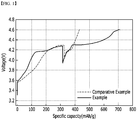
FIG. 1 shows evaluation of initial charge/discharge characteristics of batteries of an examples and a comparative example. - Advantages and features of embodiments of the present invention and methods for achieving them will be made clear from embodiments described below in detail. The present invention may, however, be embodied in many different forms, and should not be construed as being limited to the embodiments set forth herein. Rather, these embodiments are provided so that this disclosure will be thorough and complete, and will fully convey the scope of the invention to those skilled in the art to which the present invention pertains. The present invention is merely defined by the scope of the claims.
- Unless otherwise defmed, technical and scientific terms used herein have the same meaning as commonly understood by those skilled in the art to which this invention pertains. Additionally, repeated explanations of the technical constitutions and actions equivalent to those of the conventional ones will be omitted.
- Throughout the specification, when an element is referred to as being "connected" to another element, the element is "directly connected" to the other element or "electrically connected" to the other element with one or more intervening elements interposed therebetween.
- Throughout the specification, when one member is referred to as being "on" another member, one member may be adjacent to another member or intervening members may exist therebetween.
- Throughout the specification, when an element "includes" other elements, it means that other elements may be further included rather than other elements being excluded, unless content to the contrary is specially described.
- Throughout the specification, the term "about" or "substantially" is intended to have a meaning of close to numerical values or ranges specified with an allowable error, and is intended to prevent accurate or absolute numerical values disclosed for understanding of the present disclosure from being illegally or unfairly used by any unconscionable third party.
- Throughout the specification, the term "step of' does not mean "step for".
- Throughout the specification, the term "combination(s) of' included in a Markush type of description means a mixture or a combination of one or more components selected from a group consisting of components described in the Markush type, and means that the disclosure includes one or more selected from the group consisting of the components.
- Throughout the specification, a phrase in the form "A and/or B" means "A or B", or "A and B".
- One embodiment provides a positive electrode including a positive electrode collector; a first layer which is disposed on the positive electrode collector and includes a positive electrode active material, a conductive material, and a binder; and a second layer which is disposed on the first layer and includes a lithium oxide-based compound represented by the following Chemical Formula 1:
[Chemical Formula 1] Li2+a-xMxOb-yA2y
wherein, in Chemical Formula 1, M is one or more of alkali metal elements, A is one or more of halogen atoms, -0.005≤a≤0.005, 0≤x≤0.01, 0.995≤b≤2.005, and 0≤y≤0.005. - In the positive electrode of one embodiment, 1) the lithium oxide-based compound represented by Chemical Formula 1 may compensate for irreversible additive capacity of a negative electrode, and 2) the positive electrode collector may be double-coated with the positive electrode active material and the lithium oxide-based compound represented by Chemical Formula 1, and thus blending of them may solve problems of single layer coating.
- 1) Specifically, in the positive electrode of one embodiment, the lithium oxide-based compound represented by Chemical Formula 1 is a material capable of counterbalancing an irreversible capacity imbalance between two electrodes and increasing the initial efficiency of the positive electrode.
For example, lithium peroxide (Li2O2) may irreversibly release lithium ions and oxygen. The reaction is an oxygen evolution reaction (OER) of the following Reaction Scheme 1, whereby 1 mole of oxygen and 2 moles of lithium ions may be irreversibly released from 1 mole of lithium peroxide (Li2O2).
[Reaction Scheme 1] Li2O2 → 2Li+ + O2
Herein, lithium peroxide (Li2O2) is exemplified, but the lithium oxide-based compound represented by Chemical Formula 1 may be a compound including a large amount of lithium, as compared with a common positive electrode active material including about 1 mole of lithium, thereby releasing a large amount of lithium, as in Reaction Scheme 1.
Therefore, when the lithium oxide-based compound is applied to the positive electrode, irreversible capacity of the negative electrode may be reduced during initial charge/discharge of a battery, thereby counterbalancing an irreversible capacity imbalance between the negative electrode and the positive electrode and increasing initial efficiency of the positive electrode. - 2) In the positive electrode of one embodiment, the lithium oxide-based compound may be applied not in a blended state with the positive electrode active material, but independently of the positive electrode active material.
- Specifically, when the lithium oxide-based compound is blended with the positive electrode active material, and the blend is applied onto the positive electrode collector, the following problems may be generated.
- i) During initial charge of a battery, oxygen (O2) gas generated from the lithium oxide-based compound may produce pores in the coating layer (single layer). Due to the pores thus produced in the coating layer (single layer), ii) the positive electrode density after initial charge of the battery and the entire energy density of the battery may be reduced.
- Accordingly, in one embodiment, the positive electrode collector is double-coated with the positive electrode active material and the lithium oxide-based compound, thereby solving the problems of the coating layer (single layer) which is formed by blending the lithium oxide-based compound with the positive electrode active material.
- Specifically, in the positive electrode of one embodiment, a reduction decomposition reaction of the lithium oxide-based compound may occur on the surface where the second layer contacts an electrolyte, and thus the reaction is terminated by disappearance of the second layer i) without affecting the first layer (that is, without forming pores inside the first layer). Therefore, ii) loss of the electrode density of the first layer and iii) reduction of the entire energy density of the battery may not occur or may be very low.
- Consequently, in the lithium secondary battery to which the positive electrode of one embodiment is applied, the irreversible capacity imbalance between the two electrodes may be effectively counterbalanced, the initial charge capacity of the positive electrode may be increased, and loss of the energy density of the positive electrode may be decreased, leading to excellent lifetime characteristics.
- Hereinafter, components of the positive electrode of one embodiment will be described in more detail.
- The lithium oxide-based compound included in the second layer is not particularly limited, as long as it is a material which may be represented by Chemical Formula 1 and may release lithium ions, as in Reaction Scheme 1. For example, the lithium oxide-based compound may be lithium peroxide (L2O2) as in Reaction Scheme 1, lithium oxide (L2O), or a mixture thereof.
- Meanwhile, the second layer may include platinum (Pt) in addition to the lithium oxide-based compound. The platinum (Pt) serves as a catalyst in the oxygen evolution reaction (OER) of Reaction Scheme 1 proceeded by the lithium oxide-based compound to contribute to improvement of the reaction efficiency of Reaction Scheme 1. For example, the content of the platinum in the second layer may satisfy 1 % by weight to 5 % by weight with respect to the total 100 % by weight of the second layer. In this range, the functions of the platinum as a catalyst may be effectively exhibited, but the present invention is not limited thereto.
- Further, the second layer may include materials generally applied to a positive electrode mix layer in the art, for example, a conductive material, a binder, or a mixture thereof. Specific kinds of the conductive material and the binder will be described below.
- Independently of the second layer, the first layer may further include materials generally applied to a positive electrode mix layer in the art, for example, a conductive material, a binder, or a mixture thereof. Specific kinds of the conductive material and the binder will be described below.
- In the first layer and the second layer, the kind of the conductive material is not particularly limited. For example, the conductive material is used to form an electron conductive network in the first layer, and is not particularly limited, as long as it has electrical conductivity without causing chemical changes in the battery. Examples thereof may include natural graphite, artificial graphite, carbon black, acetylene black, Ketjen black, carbon fibers, metallic powders, or metallic fibers of copper, nickel, aluminum, silver, etc., and conductive materials such as polyphenylene derivatives, etc. may be used alone or in a mixture of one or more thereof.
- Regardless of the kind thereof, the conductive material may be used in an amount of 0.1 % by weight to 10 % by weight, for example, 0.5 % by weight to 10 % by weight, or 5 % by weight to 10 % by weight, with respect to the total weight (100 % by weight) of each of the first layer and the second layer. When satisfying the above range, the conductivity of the first layer and the second layer may be improved, but it is not limited thereto.
- Further, in the first layer, the kind of the positive electrode active material is not particularly limited, as long as it includes one or more of composite oxides of cobalt, manganese, nickel, or a combination thereof and lithium, and is capable of reversible intercalation/deintercalation of lithium ions. For example, the positive electrode active material may include one or more of composite oxides of cobalt, manganese, nickel, or a combination thereof and lithium.
- More specifically, as the positive electrode active material, a compound represented by any one of the following Chemical Formulae may be used: LiaA1-bRbD2 (wherein 0.90 ≤ a ≤ 1.8 and 0 ≤ b ≤ 0.5.); LiaE1-bRbCh2-cDc (wherein 0.90 ≤ a ≤ 1.8, 0 ≤ b ≤ 0.5, and 0 ≤ c ≤ 0.05.); LiE2-bRbO4-cDc (wherein 0 ≤ b ≤ 0.5 and 0 ≤ c ≤ 0.05.); LiaNi1-b-cCobRcDα (wherein 0.90 ≤ a ≤ 1.8, 0 ≤ b ≤ 0.5, 0 ≤ c ≤ 0.05, and 0 < α ≤ 2.); LiaNi1-b-cCobRcO2-αZα (wherein 0.90 ≤ a ≤ 1.8, 0 ≤ b ≤ 0.5, 0 ≤ c ≤ 0.05, and 0 < α < 2.); LiaNi1-b-cCobRcO2-αZ2 (wherein 0.90 ≤ a ≤ 1.8, 0 ≤ b ≤ 0.5, 0 ≤ c ≤ 0.05, and 0 < α < 2.); LiaNi1-b-cMnbRcDα (wherein 0.90 ≤ a ≤ 1.8, 0 ≤ b ≤ 0.5, 0 ≤ c ≤ 0.05, and 0 < α ≤ 2.); LiaNi1-b-cMnbRcO2-αZα, (wherein 0.90 ≤ a ≤ 1.8, 0 ≤ b ≤ 0.5, 0 ≤ c ≤ 0.05, and 0 < α < 2.); LiaNi1-b-cMnbRcO2-αZ2 (wherein 0.90 ≤ a ≤ 1.8, 0 ≤ b ≤ 0.5, 0 ≤ c ≤ 0.05, and 0 < α < 2.); LiaNibEcGdO2 (wherein 0.90 ≤ a ≤ 1.8, 0 ≤ b ≤ 0.9, 0 ≤ c ≤ 0.5, and 0.001 ≤ d ≤ 0.1.); LiaNibCocMndGeO2 (wherein 0.90 ≤ a ≤ 1.8, 0 ≤ b ≤ 0.9, 0 ≤ c ≤ 0.5, 0 ≤ d ≤0.5, and 0.001 ≤ e ≤ 0.1.); LiaNiGbO2 (wherein 0.90 ≤ a ≤ 1.8 and 0.001 ≤ b ≤ 0.1.); LiaCoGbO2 (wherein 0.90 ≤ a ≤ 1.8 and 0.001 ≤ b ≤ 0.1.); LiaMnGbO2 (wherein 0.90 ≤ a ≤ 1.8 and 0.001 ≤ b ≤ 0.1.); LiaMn2GbO4 (wherein 0.90 ≤ a ≤ 1.8 and 0.001 ≤ b ≤ 0.1.); QO2; QS2; LiQS2; V2O5; LiV2O5; LiTO2; LiNiVO4; Li(3-f)J2(PO4)3 (wherein 0 ≤ f ≤ 2); Li(3-f)Fe2(PO4)3 (wherein 0 ≤ f ≤ 2); and LiFePO4.
- In the above Chemical Formulae, A is Ni, Co, Mn, or a combination thereof; R is Al, Ni, Co, Mn, Cr, Fe, Mg, Sr, V, a rare-earth element, or a combination thereof; D is O, F, S, P, or a combination thereof; E is Co, Mn, or a combination thereof; Z is F, S, P, or a combination thereof; G is Al, Cr, Mn, Fe, Mg, La, Ce, Sr, V, or a combination thereof; Q is Ti, Mo, Mn, or a combination thereof; T is Cr, V, Fe, Sc, Y, or a combination thereof; and J is V, Cr, Mn, Co, Ni, Cu, or a combination thereof.
- A compound having a coating layer on the surface of the above compound may be used, or a mixture of the above compound and the compound having a coating layer may be used. The coating layer may include an oxide or hydroxide of a coating element, an oxyhydroxide of a coating element, an oxycarbonate of a coating element, or a hydroxycarbonate of a coating element as a coating element compound. The compounds constituting these coating layers may be non-crystalline or crystalline. The coating element included in the coating layer may be Mg, Al, Co, K, Na, Ca, Si, Ti, V, Sn, Ge, Ga, B, As, Zr, or a mixture thereof. A process of forming the coating layer may be any coating method, as long as the method (e.g., a spray coating method, an immersion method, etc.) does not adversely affect physical properties of the positive electrode active material even when the above elements are used in the compound. Since the explanation thereof may be understood by those skilled in the art, it will be omitted.
- Regardless of the kind thereof, the positive electrode active material may be used in an amount of 1 % by weight to 99 % by weight, 1 % by weight to 80 % by weight, for example, 1 % by weight to 70 % by weight with respect to the total weight (100 % by weight) of the first layer. When satisfying the above range, the energy density by the positive electrode active material may be secured, but is not limited thereto.
- In the first layer and the second layer, the binder functions to improve adhesion between the positive electrode active material particles, and adhesion of the positive electrode active material to a current collector. Representative examples thereof may include polyvinyl alcohol, carboxymethyl cellulose, hydroxypropyl cellulose, diacetyl cellulose, polyvinyl chloride, carboxylated polyvinyl chloride, polyvinylfluoride, an ethylene oxide-containing polymer, polyvinylpyrrolidone, polyurethane, polytetrafluoroethylene, polyvinylidene fluoride, polyethylene, polypropylene, a styrene-butadiene rubber, an acrylated styrene-butadiene rubber, an epoxy resin, nylon, etc., but are not limited thereto.
- The positive electrode of one embodiment may be fabricated using a method generally known in the art. For example, a mixture including the positive electrode active material, the conductive material, and/or the binder is applied onto a positive electrode collector, and then dried to form the first layer. The lithium oxide-based compound alone, or a mixture of the lithium oxide-based compound and platinum, is applied onto the first layer and then dried to form the second layer, thereby obtaining the positive electrode of one embodiment.
- The positive electrode collector may be fabricated in a thickness of 3 µm to 500 µm. The positive electrode collector is not particularly limited as long as it has high conductivity without causing chemical changes in a battery. For example, stainless steel, aluminum, nickel, titanium, calcined carbon, and aluminum or stainless steel that is surface-treated with carbon, nickel, titanium, or silver may be used. Adhesion of the positive electrode active material may be increased by forming fine roughness on the surface of the collector, and the collector may be in a variety of forms such as a film, a sheet, a foil, a net, a porous material, a foamed material, a non-woven fabric material, etc.
- The conductive material is used to form an electron conductive network in the first layer, and is not particularly limited as long as it has electrical conductivity without causing chemical changes in the battery. Examples thereof may include natural graphite, artificial graphite, carbon black, acetylene black, Ketjen black, carbon fibers, and metallic powders or metallic fiber of copper, nickel, aluminum, silver, etc., and conductive materials such as polyphenylene derivatives, etc. may be used alone or in a mixture of one or more thereof. The conductive material may be commonly added in an amount of 1 % by weight to 50 % by weight, 1 % by weight to 30 % by weight, for example, 1 % by weight to 20 % by weight, with respect to the total weight (100 % by weight) of the first layer. Meanwhile, graphite-based materials having an elastic property may be used as the conductive material, and may also be used along with the above materials.
- The binder assists in improving adhesion between the positive electrode active material and the conductive material, and adhesion of the active material to the collector. The binder may be generally added in an amount of 1 to 50 % by weight, 1 to 30 % by weight, for example, 1 to 20 % by weight, with respect to the total weight (100 % by weight) of the first layer. Examples of the binder may include polyvinylidene fluoride, polyvinyl alcohol, carboxymethyl cellulose (CMC), starch, hydroxypropyl cellulose, regenerated cellulose, polyvinyl pyrrolidone, tetrafluoroethylene, polyethylene, polypropylene, an ethylene-propylene-diene polymer (EPDM), sulfonated-EPDM, styrene butadiene rubber, fluorine rubber, or various copolymers.
- If necessary, a filler is further added to the mixture to form the first layer. The filler is a component that is optionally used to inhibit expansion of the positive electrode. The filler is not particularly limited, as long as it is a fibrous material without causing chemical changes in the battery. For example, olefinic polymers such as polyethylene, polypropylene, etc., and fibrous materials such as glass fibers, carbon fibers, etc., may be used.
- Another embodiment of the present invention provides a lithium secondary battery including the above-described positive electrode.
- In the lithium secondary battery of one embodiment, the above-described positive electrode is applied, and thus initial irreversible capacity of the negative electrode may be reduced, initial efficiency of the positive electrode may be increased, and reduction of energy density during operation may be inhibited to exhibit excellent lifetime characteristics.
- The lithium secondary battery of another embodiment may be fabricated according to those generally known in the art, except for the above-described positive electrode.
- Hereinafter, those generally known in the art will be simply suggested, but these are for illustrative purposes only, and the present invention is not limited thereto.
- The negative electrode may include a collector and a negative electrode active material layer formed on the collector, wherein the negative electrode active material layer may include a negative electrode active material.
- The negative electrode active material may be one or more negative electrode active materials selected from the group consisting of carbon-based negative electrode active materials, a lithium metal, alloys of a lithium metal, Si, SiOx (0 < x < 2), a Si-C composite, a Si-Q alloy (wherein Q is an alkali metal, an alkaline earth metal, an element of Group 13 to Group 16, a transition metal, a rare earth element, or a combination thereof, excluding Si), Sn, SnO2, a Sn-C composite, and Sn-R (wherein R is an alkali metal, an alkaline earth metal, an element of Group 13 to Group 16, a transition metal, a rare earth element, or a combination thereof, excluding Sn).
- The negative electrode collector may be commonly fabricated in a thickness of 3 µm to 500 µm. The negative electrode collector is not particularly limited as long as it has conductivity without causing chemical changes in the battery. For example, copper, stainless steel, aluminum, nickel, titanium, calcined carbon, or copper or stainless steel that is surface-treated with carbon, nickel, titanium, or silver, or an aluminum-cadmium alloy, may be used. Also, like the positive electrode collector, adhesion of the negative electrode active material may be increased by forming fine roughness on the surface of the collector. The collector may be in a variety of forms such as a film, a sheet, a foil, a net, a porous material, a foamed material, a non-woven fabric material, etc.
- The lithium secondary battery of another embodiment may be a lithium ion battery, a lithium ion polymer battery, or a lithium polymer battery according to the kind of electrolyte and/or the kind of separator.
- When the lithium secondary battery of another embodiment is a lithium ion battery to which a liquid electrolyte is applied, the liquid electrolyte may be applied after immersing a separator therein. The separator is interposed between the positive electrode and the negative electrode. As the separator, an insulating thin film having high ion permeability and mechanical strength is used. The separator generally has a pore diameter of 0.01 µm to 10 µm and a thickness of 5 µm to 300 µm. As the separator, for example, a sheet or non-woven fabric made of an olefin polymer, such as polypropylene having chemical resistance and hydrophobicity, etc.; glass fiber; or polyethylene is used. When a solid electrolyte such as a polymer is employed as the electrolyte, the solid electrolyte may serve as both the separator and the electrolyte.
- The liquid electrolyte may be a non-aqueous electrolyte containing lithium salts. The non-aqueous electrolyte containing lithium salts is composed of a non-aqueous electrolyte and lithium. A non-aqueous organic solvent, an organic solid electrolyte, or an inorganic solid electrolyte may be used as the non-aqueous electrolyte. However, the non-aqueous electrolyte is not limited thereto.
- The non-aqueous organic solvent may be, for example, a non-protic organic solvent such as N-methyl-2-pyrrolidone, propylene carbonate, ethylene carbonate, butylene carbonate, dimethyl carbonate, diethyl carbonate, gamma butyrolactone, 1,2-dimethoxy ethane, tetrahydroxy franc, 2-methyl tetrahydrofuran, dimethylsulfoxide, 1,3-dioxolane, formamide, dimethylformamide, dioxolane, acetonitrile, nitromethane, methyl formate, methyl acetate, phosphoric acid triester, trimethoxy methane, dioxolane derivatives, sulfolane, methyl sulfolane, 1,3-dimethyl-2-imidazolidinone, propylene carbonate derivatives, tetrahydrofuran derivatives, ether, methyl propionate, ethyl propionate, etc.
- The organic solid electrolyte may include, for example, polyethylene derivatives, polyethylene oxide derivatives, polypropylene oxide derivatives, a phosphoric acid ester polymer, polyagitation lysine, polyester sulfide, polyvinyl alcohol, polyvinylidene fluoride, a polymer containing ionic dissociation groups, etc.
- The inorganic solid electrolyte may include, for example, Li-based nitrides, halides, or sulfates such Li3N, LiI, Li5NI2, Li3N-LiI-LiOH, LiSiO4, LiSiO4-LiI-LiOH, Li2SiS3, Li4SiO4, Li4SiO4-LiI-LiOH, Li3PO4-Li2S-SiS2, etc.
- The lithium salts are readily dissolved in the non-aqueous electrolyte, and may include, for example, LiCl, LiBr, LiI, LiClO4, LiBF4, LiB10Cl10, LiPF6, LiCF3SO3, LiCF3CO2, LiAsF6, LiSbF6, LiAlCl4, CH3SO3Li, (CF3SO2)2NLi, chloroboran lithium, lower aliphatic carboxylic acid lithium, lithium tetraphenyl borate, imides, etc.
- In order to improve charge/discharge characteristics and flame retardancy in the lithium salt-containing non-aqueous electrolyte, for example, pyridine, triethyl phosphite, triethanolamine, cyclic ether, ethylene diamine, n-glyme, hexaphosphoric triamide, nitrobenzene derivatives, sulfur, quinoneimine dyes, N-substituted oxazolidinone, N,N-substituted imidazolidine, ethylene glycol dialkylether, ammonium salts, pyrrole, 2-methoxy ethanol, aluminum trichloride, etc. may be added. Optionally, halogen-containing solvents such as carbon tetrachloride or ethylene trifluoride may be further added in order to provide flame resistance, or carbon dioxide gas may be further added in order to enhance high-temperature retention properties, and FEC (fluoroethylene carbonate), PRS (propene sultone), etc. may be further added.
- In a specific embodiment, lithium salts such as LiPF6, LiClO4, LiBF4, LiN(SO2CF3)2, etc. may be added to a mixed solvent of a cyclic carbonate of EC or PC, which is a highly dielectric solvent, and a linear carbonate of DEC, DMC, or EMC, which is a low viscosity solvent, thereby preparing the lithium salt-containing non-aqueous electrolyte.
- The lithium secondary battery of another embodiment may be embodied into a battery module including the lithium secondary battery as a unit cell, a battery pack including the battery module, and a device including the battery pack as a power source.
- In this regard, specific examples of the device may include electric vehicles, hybrid electric vehicles, plug-in hybrid electric vehicles, electric storage systems, etc., but are not limited thereto.
- A positive electrode active material (LiNi0.8Co0.1Mn0.1O2): conductive material (carbon black, commercial name: Super C65, Timcal Ltd.): binder (PVDF, commercial name KF1100, Kureha Corp.) = 88.0:5.0:7.0 were blended at this weight ratio, ground using a mortar, and dry-mixed to prepare a positive electrode mix of Example 1.
- An organic solvent (NMP) was added to the positive electrode mix of Example 1 to prepare a slurry phase, which was then applied onto an aluminum collector, and vacuum-dried in a vacuum oven at 120 °C for 12 hours.
- Thereafter, lithium peroxide (Li2O2): platinum (Pt): conductive material (carbon black, commercial name Super C65, Timcal Ltd.): binder (PVDF, commercial name KF1100, Kureha Corp.) = 75.5:1.9:5.7:17.0 were blended at this weight ratio, ground using a mortar, dry-mixed, and applied onto the dried positive electrode mix layer, and vacuum-dried in a vacuum oven at 120 °C for 12 hours.
- As a result, a positive electrode of Example 1 was obtained.
- Graphite: conductive material (carbon black, commercial name: Super C65, Timcal Ltd.): binder (SBR, commercial name: A544, ZEON Corp.): thickener (CMC. Daicell 2200, Daicell Corp.) = 94.2:2:2.5:1.3 were blended at this weight ratio and dry-mixed to prepare a negative electrode mix.
- An organic solvent (NMP) was added to the negative electrode mix to prepare a slurry phase, which was then applied onto a copper collector, and vacuum-dried in a vacuum oven at 120 °C for 12 hours to obtain a negative electrode.
- A separator having a thickness of 9 µm and porosity of 42 vol and being made of PP/PE was interposed between the prepared negative electrode and the positive electrode of Example 1 in a battery container, and an electrolyte was injected thereto to fabricate a 2032 full cell-type lithium secondary battery according to a common fabrication method.
- As the electrolyte, 1 M (LiPF6) dissolved in a mixed solvent of EC:DMC:DEC at a volume ratio of 1:2:1 (1M LiPF6 in EC:DMC:DEC = 1:2:1 (v:v:v)) was used.
- A positive electrode active material (LiNi0.8Co0.1Mn0.1O2) and lithium peroxide (Li2O2): conductive material (carbon black, commercial name: Super C65, Timcal Ltd.): binder (PVDF, commercial name KF1100, Kureha Corp.) = 85:1:8:6 were blended at this weight ratio, while satisfying the positive electrode active material (LiNi0.8Co0.1Mn0.1O2) and the lithium peroxide (Li2O2) at a weight ratio of 80:20, ground using a mortar, and dry-mixed to prepare a positive electrode mix of Comparative Example 1.
- An organic solvent (NMP) was added to the positive electrode mix of Comparative Example 1 to prepare a slurry phase, which was then applied onto an aluminum collector, and vacuum-dried in a vacuum oven at 120 °C for 12 hours. As a result, a positive electrode of Comparative Example 1 was obtained.
- A lithium secondary battery of Comparative Example 2 was fabricated in the same manner as in Example 1, except that the positive electrode of Comparative Example 1 was used instead of the positive electrode of Example 1.
- For each of the batteries of the examples and comparative examples, initial charge/discharge characteristics were evaluated at room temperature under the following conditions. The evaluation results are recorded in
FIG. 1 . - Charge: 0.01C, CC/CV, 4.6V, 5 % cut-off
- Discharge: 0.01C, CC, 2.5 V, cut-off
- In the examples and comparative examples, lithium peroxide (Li2O2) was commonly applied to the positive electrode to compensate for the irreversible additive capacity of the negative electrode.
- As described above, the lithium peroxide (Li2O2) is a compound capable of theoretically releasing irreversibly 1 mole of oxygen and 2 moles of lithium ions per 1 mole thereof according to the following Reaction Scheme 1.
[Reaction Scheme 1] Li2O2 → 2Li+ + O2
- However, according to
FIG. 1 , in the high voltage region of 4.3 V or more, the battery of the example in which lithium peroxide (Li2O2) was coated on the positive electrode mix layer (i.e., first layer) showed high positive electrode charge capacity, as compared with that of the comparative example in which blending of the lithium peroxide (Li2O2) and the positive electrode active material was applied. - In the example, a reduction decomposition reaction of the lithium peroxide (Li2O2) occurs on the surface where the lithium peroxide (Li2O2) layer (i.e., second layer) contacts an electrolyte, and thus the reaction is terminated by disappearance of the second layer i) without affecting the first layer (that is, without forming pores inside the first layer). Therefore, ii) loss of the electrode density of the first layer and iii) reduction of the entire energy density of the battery may not occur or may be very low.
- Consequently, the example showed that irreversible capacity imbalance between two electrodes may be effectively counterbalanced, the initial charge capacity of the positive electrode may be increased, and loss of the energy density of the positive electrode may be decreased, leading to excellent lifetime characteristics, as compared with the comparative example.
Claims (10)
- A positive electrode comprising:a positive electrode collector;a first layer which is disposed on the positive electrode collector and includes a positive electrode active material; anda second layer which is disposed on the first layer and includes a lithium oxide-based compound represented by the following Chemical Formula 1:
[Chemical Formula 1] Li2+a-xMxOb-yA2y
wherein, in Chemical Formula 1, M is one or more of alkali metal elements,
A is one or more of halogen atoms,
-0.005≤a≤0.005, 0≤x≤0.01, 0.995≤b≤2.005, and 0≤y≤0.005. - The positive electrode of claim 1, wherein the lithium oxide-based compound is lithium peroxide (L2O2), lithium oxide (L2O), or a mixture thereof.
- The positive electrode of claim 1, wherein the first layer further includes a conductive material, a binder, or a mixture thereof.
- The positive electrode of claim 3, wherein the second layer further includes platinum (Pt), a conductive material, a binder, or a mixture thereof.
- The positive electrode of claim 4, wherein a content of the platinum in the second layer is 1 % by weight to 5 % by weight with respect to the total 100 % by weight of the second layer.
- The positive electrode of claim 4, wherein a content of the conductive material in the second layer is 5 % by weight to 10 % by weight with respect to the total 100 % by weight of the second layer.
- The positive electrode of claim 4, wherein the conductive material includes one or more selected from the group consisting of natural graphite, artificial graphite, carbon black, acetylene black, Ketjen black, carbon fibers, metallic powders, metallic fibers, and polyphenylene derivatives.
- The positive electrode of claim 1, wherein the positive electrode active material includes one or more of composite oxides of a metal of cobalt, manganese, nickel, or a combination thereof, and lithium.
- A lithium secondary battery comprising the positive electrode of claim 1, a negative electrode, and an electrolyte.
- The lithium secondary battery of claim 9, wherein the negative electrode includes one or more negative electrode active materials selected from the group consisting of carbon-based negative electrode active materials, a lithium metal, alloys of a lithium metal, Si, SiOx (0 < x < 2), a Si-C composite, a Si-Q alloy (wherein Q is an alkali metal, an alkaline earth metal, an element of Group 13 to Group 16, a transition metal, a rare earth element, or a combination thereof, excluding Si), Sn, SnO2, a Sn-C composite, and Sn-R (wherein R is an alkali metal, an alkaline earth metal, an element of Group 13 to Group 16, a transition metal, a rare earth element, or a combination thereof, excluding Sn).
Applications Claiming Priority (2)
| Application Number | Priority Date | Filing Date | Title |
|---|---|---|---|
| KR20170159734 | 2017-11-27 | ||
| PCT/KR2018/014722 WO2019103573A1 (en) | 2017-11-27 | 2018-11-27 | Positive electrode and lithium secondary battery comprising same |
Publications (3)
| Publication Number | Publication Date |
|---|---|
| EP3598534A1 true EP3598534A1 (en) | 2020-01-22 |
| EP3598534A4 EP3598534A4 (en) | 2020-07-29 |
| EP3598534B1 EP3598534B1 (en) | 2023-03-08 |
Family
ID=66844997
Family Applications (1)
| Application Number | Title | Priority Date | Filing Date |
|---|---|---|---|
| EP18881270.5A Active EP3598534B1 (en) | 2017-11-27 | 2018-11-27 | Positive electrode and lithium secondary battery comprising same |
Country Status (5)
| Country | Link |
|---|---|
| US (1) | US11404689B2 (en) |
| EP (1) | EP3598534B1 (en) |
| JP (1) | JP7086407B2 (en) |
| KR (1) | KR102434255B1 (en) |
| CN (1) | CN110447128B (en) |
Families Citing this family (5)
| Publication number | Priority date | Publication date | Assignee | Title |
|---|---|---|---|---|
| US11949117B2 (en) * | 2020-04-09 | 2024-04-02 | City University Of Hong Kong | Battery and method of manufacturing thereof |
| WO2022092883A1 (en) * | 2020-10-29 | 2022-05-05 | 주식회사 엘지에너지솔루션 | Bipolar solid-state battery comprising porous support layer |
| CN114520320B (en) * | 2022-01-27 | 2023-11-24 | 北京工业大学 | Lithium oxide composite positive electrode material based on alkali metal reduction method |
| CN116231080A (en) * | 2023-02-21 | 2023-06-06 | 北京工业大学 | A redox medium reduces the voltage polarization method of lithium oxide composite cathode material |
| CN116565292B (en) * | 2023-07-06 | 2023-10-13 | 宁德新能源科技有限公司 | Electrochemical device and electronic device |
Family Cites Families (16)
| Publication number | Priority date | Publication date | Assignee | Title |
|---|---|---|---|---|
| JP5106732B2 (en) | 1999-11-23 | 2012-12-26 | シオン・パワー・コーポレーション | Lithium negative electrode for electrochemical cells |
| JP4196398B2 (en) * | 2002-08-26 | 2008-12-17 | 日本電気株式会社 | Non-aqueous electrolyte secondary battery |
| JP2010225291A (en) * | 2009-03-19 | 2010-10-07 | Toyota Motor Corp | Lithium ion secondary battery and manufacturing method thereof |
| JP5382445B2 (en) | 2009-11-18 | 2014-01-08 | トヨタ自動車株式会社 | Lithium ion secondary battery |
| JP5541502B2 (en) * | 2010-03-30 | 2014-07-09 | 株式会社デンソー | Lithium secondary battery and manufacturing method thereof |
| KR101338142B1 (en) | 2010-04-27 | 2013-12-06 | 한양대학교 산학협력단 | Lithium air battery |
| JP6129993B2 (en) * | 2013-02-14 | 2017-05-17 | エルジー・ケム・リミテッド | Positive electrode active material for lithium secondary battery and lithium secondary battery including the same |
| US20150364795A1 (en) | 2014-06-12 | 2015-12-17 | Amprius, Inc. | Prelithiation solutions for lithium-ion batteries |
| DE102014219421A1 (en) * | 2014-09-25 | 2016-03-31 | Bayerische Motoren Werke Aktiengesellschaft | Cathode (positive electrode) and this comprehensive lithium ion battery in the state before the first charging, method for forming a lithium-ion battery and lithium ion battery after formation |
| JP6233335B2 (en) | 2015-03-04 | 2017-11-22 | 株式会社豊田中央研究所 | Non-aqueous electrolyte air battery and method of using the same |
| KR101858729B1 (en) | 2015-04-28 | 2018-05-16 | 주식회사 엘지화학 | Positive Electrode Mix Comprising Lithium Metal Sulfur Compound and Positive Electrode Prepared from the Same |
| JP6335211B2 (en) | 2015-05-05 | 2018-05-30 | アイメック・ヴェーゼットウェーImec Vzw | Method for manufacturing thin film solid state battery |
| JP6530640B2 (en) * | 2015-05-29 | 2019-06-12 | 日本化学産業株式会社 | Method of treating positive electrode active material for lithium secondary battery |
| KR102679976B1 (en) * | 2015-07-13 | 2024-07-02 | 삼성전자주식회사 | Composite cathode active material for lithium battery, cathode for lithium battery including the same, and lithium battery including the cathode |
| US11011746B2 (en) | 2015-07-13 | 2021-05-18 | Samsung Electronics Co., Ltd. | Composite cathode active material for lithium battery, cathode for lithium battery including the same, and lithium battery including the cathode |
| US20170309914A1 (en) * | 2016-04-20 | 2017-10-26 | Ford Global Technologies, Llc | Pre-lithiated lithium ion battery cell |
-
2018
- 2018-11-27 US US16/607,297 patent/US11404689B2/en active Active
- 2018-11-27 CN CN201880019051.5A patent/CN110447128B/en active Active
- 2018-11-27 JP JP2019548383A patent/JP7086407B2/en active Active
- 2018-11-27 EP EP18881270.5A patent/EP3598534B1/en active Active
- 2018-11-27 KR KR1020180148008A patent/KR102434255B1/en active Active
Also Published As
| Publication number | Publication date |
|---|---|
| US11404689B2 (en) | 2022-08-02 |
| EP3598534A4 (en) | 2020-07-29 |
| CN110447128A (en) | 2019-11-12 |
| JP2020509561A (en) | 2020-03-26 |
| CN110447128B (en) | 2022-10-18 |
| EP3598534B1 (en) | 2023-03-08 |
| JP7086407B2 (en) | 2022-06-20 |
| KR20190062259A (en) | 2019-06-05 |
| US20200052291A1 (en) | 2020-02-13 |
| KR102434255B1 (en) | 2022-08-19 |
Similar Documents
| Publication | Publication Date | Title |
|---|---|---|
| US9899682B2 (en) | Electrode including coating layer for preventing reaction with electrolyte solution | |
| KR101451196B1 (en) | Cathode Active Material and Lithium Secondary Battery Employed with the Same | |
| EP3041077B1 (en) | Secondary battery comprising silicon-based compound | |
| KR101625822B1 (en) | Mixture for Cathode for Secondary Battery having irreversible Additives | |
| EP2811562B1 (en) | Method of manufacturing electrode for lithium secondary cell | |
| EP3598534B1 (en) | Positive electrode and lithium secondary battery comprising same | |
| KR101617415B1 (en) | The Method for Preparing Lithium Secondary Battery and the Lithium Secondary Battery Prepared by Using the Same | |
| US20140011098A1 (en) | Lithium secondary battery of improved rate capability | |
| KR20190062209A (en) | Additives for cathode, manufacturing method of the same, cathode including the same, lithium recharegable battery including the same | |
| US10008720B2 (en) | Method of preparing positive electrode active material for lithium secondary batteries | |
| KR101499588B1 (en) | Electrode for Secondary Battery and Manufacturing Method thereof | |
| KR20130002750A (en) | Secondary battery for high voltage | |
| US11316149B2 (en) | Positive electrode mix, positive electrode including the same, and lithium secondary battery | |
| KR20130117392A (en) | Cathode active material having higher performance and lithium secondary battery comprising the same | |
| EP3567657B1 (en) | Cathode for lithium secondary battery and lithium secondary battery comprising same | |
| KR101751007B1 (en) | High-Voltage Lithium Secondary Battery of Improved Cycle Characteristics |
Legal Events
| Date | Code | Title | Description |
|---|---|---|---|
| STAA | Information on the status of an ep patent application or granted ep patent |
Free format text: STATUS: THE INTERNATIONAL PUBLICATION HAS BEEN MADE |
|
| PUAI | Public reference made under article 153(3) epc to a published international application that has entered the european phase |
Free format text: ORIGINAL CODE: 0009012 |
|
| STAA | Information on the status of an ep patent application or granted ep patent |
Free format text: STATUS: REQUEST FOR EXAMINATION WAS MADE |
|
| 17P | Request for examination filed |
Effective date: 20191015 |
|
| AK | Designated contracting states |
Kind code of ref document: A1 Designated state(s): AL AT BE BG CH CY CZ DE DK EE ES FI FR GB GR HR HU IE IS IT LI LT LU LV MC MK MT NL NO PL PT RO RS SE SI SK SM TR |
|
| AX | Request for extension of the european patent |
Extension state: BA ME |
|
| A4 | Supplementary search report drawn up and despatched |
Effective date: 20200630 |
|
| RIC1 | Information provided on ipc code assigned before grant |
Ipc: H01M 4/13 20100101AFI20200624BHEP Ipc: H01M 4/62 20060101ALI20200624BHEP Ipc: H01M 4/525 20100101ALI20200624BHEP Ipc: H01M 10/0525 20100101ALI20200624BHEP Ipc: H01M 4/505 20100101ALI20200624BHEP |
|
| DAV | Request for validation of the european patent (deleted) | ||
| DAX | Request for extension of the european patent (deleted) | ||
| RAP1 | Party data changed (applicant data changed or rights of an application transferred) |
Owner name: LG ENERGY SOLUTION LTD. |
|
| RAP3 | Party data changed (applicant data changed or rights of an application transferred) |
Owner name: LG ENERGY SOLUTION, LTD. |
|
| REG | Reference to a national code |
Ref country code: DE Ref legal event code: R079 Ref document number: 602018047107 Country of ref document: DE Free format text: PREVIOUS MAIN CLASS: H01M0004130000 Ipc: H01M0004131000 |
|
| GRAP | Despatch of communication of intention to grant a patent |
Free format text: ORIGINAL CODE: EPIDOSNIGR1 |
|
| STAA | Information on the status of an ep patent application or granted ep patent |
Free format text: STATUS: GRANT OF PATENT IS INTENDED |
|
| INTG | Intention to grant announced |
Effective date: 20221208 |
|
| RIC1 | Information provided on ipc code assigned before grant |
Ipc: H01M 4/92 20060101ALI20221125BHEP Ipc: H01M 4/62 20060101ALI20221125BHEP Ipc: H01M 10/0525 20100101ALI20221125BHEP Ipc: H01M 4/36 20060101ALI20221125BHEP Ipc: H01M 4/1391 20100101ALI20221125BHEP Ipc: H01M 4/131 20100101AFI20221125BHEP |
|
| GRAS | Grant fee paid |
Free format text: ORIGINAL CODE: EPIDOSNIGR3 |
|
| GRAA | (expected) grant |
Free format text: ORIGINAL CODE: 0009210 |
|
| STAA | Information on the status of an ep patent application or granted ep patent |
Free format text: STATUS: THE PATENT HAS BEEN GRANTED |
|
| AK | Designated contracting states |
Kind code of ref document: B1 Designated state(s): AL AT BE BG CH CY CZ DE DK EE ES FI FR GB GR HR HU IE IS IT LI LT LU LV MC MK MT NL NO PL PT RO RS SE SI SK SM TR |
|
| REG | Reference to a national code |
Ref country code: CH Ref legal event code: EP Ref country code: AT Ref legal event code: REF Ref document number: 1553189 Country of ref document: AT Kind code of ref document: T Effective date: 20230315 |
|
| REG | Reference to a national code |
Ref country code: DE Ref legal event code: R096 Ref document number: 602018047107 Country of ref document: DE |
|
| REG | Reference to a national code |
Ref country code: IE Ref legal event code: FG4D |
|
| P01 | Opt-out of the competence of the unified patent court (upc) registered |
Effective date: 20230408 |
|
| REG | Reference to a national code |
Ref country code: LT Ref legal event code: MG9D |
|
| REG | Reference to a national code |
Ref country code: NL Ref legal event code: MP Effective date: 20230308 |
|
| PG25 | Lapsed in a contracting state [announced via postgrant information from national office to epo] |
Ref country code: RS Free format text: LAPSE BECAUSE OF FAILURE TO SUBMIT A TRANSLATION OF THE DESCRIPTION OR TO PAY THE FEE WITHIN THE PRESCRIBED TIME-LIMIT Effective date: 20230308 Ref country code: NO Free format text: LAPSE BECAUSE OF FAILURE TO SUBMIT A TRANSLATION OF THE DESCRIPTION OR TO PAY THE FEE WITHIN THE PRESCRIBED TIME-LIMIT Effective date: 20230608 Ref country code: LV Free format text: LAPSE BECAUSE OF FAILURE TO SUBMIT A TRANSLATION OF THE DESCRIPTION OR TO PAY THE FEE WITHIN THE PRESCRIBED TIME-LIMIT Effective date: 20230308 Ref country code: LT Free format text: LAPSE BECAUSE OF FAILURE TO SUBMIT A TRANSLATION OF THE DESCRIPTION OR TO PAY THE FEE WITHIN THE PRESCRIBED TIME-LIMIT Effective date: 20230308 Ref country code: HR Free format text: LAPSE BECAUSE OF FAILURE TO SUBMIT A TRANSLATION OF THE DESCRIPTION OR TO PAY THE FEE WITHIN THE PRESCRIBED TIME-LIMIT Effective date: 20230308 Ref country code: ES Free format text: LAPSE BECAUSE OF FAILURE TO SUBMIT A TRANSLATION OF THE DESCRIPTION OR TO PAY THE FEE WITHIN THE PRESCRIBED TIME-LIMIT Effective date: 20230308 |
|
| REG | Reference to a national code |
Ref country code: AT Ref legal event code: MK05 Ref document number: 1553189 Country of ref document: AT Kind code of ref document: T Effective date: 20230308 |
|
| PG25 | Lapsed in a contracting state [announced via postgrant information from national office to epo] |
Ref country code: SE Free format text: LAPSE BECAUSE OF FAILURE TO SUBMIT A TRANSLATION OF THE DESCRIPTION OR TO PAY THE FEE WITHIN THE PRESCRIBED TIME-LIMIT Effective date: 20230308 Ref country code: NL Free format text: LAPSE BECAUSE OF FAILURE TO SUBMIT A TRANSLATION OF THE DESCRIPTION OR TO PAY THE FEE WITHIN THE PRESCRIBED TIME-LIMIT Effective date: 20230308 Ref country code: GR Free format text: LAPSE BECAUSE OF FAILURE TO SUBMIT A TRANSLATION OF THE DESCRIPTION OR TO PAY THE FEE WITHIN THE PRESCRIBED TIME-LIMIT Effective date: 20230609 Ref country code: FI Free format text: LAPSE BECAUSE OF FAILURE TO SUBMIT A TRANSLATION OF THE DESCRIPTION OR TO PAY THE FEE WITHIN THE PRESCRIBED TIME-LIMIT Effective date: 20230308 |
|
| PG25 | Lapsed in a contracting state [announced via postgrant information from national office to epo] |
Ref country code: SM Free format text: LAPSE BECAUSE OF FAILURE TO SUBMIT A TRANSLATION OF THE DESCRIPTION OR TO PAY THE FEE WITHIN THE PRESCRIBED TIME-LIMIT Effective date: 20230308 Ref country code: RO Free format text: LAPSE BECAUSE OF FAILURE TO SUBMIT A TRANSLATION OF THE DESCRIPTION OR TO PAY THE FEE WITHIN THE PRESCRIBED TIME-LIMIT Effective date: 20230308 Ref country code: PT Free format text: LAPSE BECAUSE OF FAILURE TO SUBMIT A TRANSLATION OF THE DESCRIPTION OR TO PAY THE FEE WITHIN THE PRESCRIBED TIME-LIMIT Effective date: 20230710 Ref country code: EE Free format text: LAPSE BECAUSE OF FAILURE TO SUBMIT A TRANSLATION OF THE DESCRIPTION OR TO PAY THE FEE WITHIN THE PRESCRIBED TIME-LIMIT Effective date: 20230308 Ref country code: CZ Free format text: LAPSE BECAUSE OF FAILURE TO SUBMIT A TRANSLATION OF THE DESCRIPTION OR TO PAY THE FEE WITHIN THE PRESCRIBED TIME-LIMIT Effective date: 20230308 Ref country code: AT Free format text: LAPSE BECAUSE OF FAILURE TO SUBMIT A TRANSLATION OF THE DESCRIPTION OR TO PAY THE FEE WITHIN THE PRESCRIBED TIME-LIMIT Effective date: 20230308 |
|
| PG25 | Lapsed in a contracting state [announced via postgrant information from national office to epo] |
Ref country code: SK Free format text: LAPSE BECAUSE OF FAILURE TO SUBMIT A TRANSLATION OF THE DESCRIPTION OR TO PAY THE FEE WITHIN THE PRESCRIBED TIME-LIMIT Effective date: 20230308 Ref country code: PL Free format text: LAPSE BECAUSE OF FAILURE TO SUBMIT A TRANSLATION OF THE DESCRIPTION OR TO PAY THE FEE WITHIN THE PRESCRIBED TIME-LIMIT Effective date: 20230308 Ref country code: IS Free format text: LAPSE BECAUSE OF FAILURE TO SUBMIT A TRANSLATION OF THE DESCRIPTION OR TO PAY THE FEE WITHIN THE PRESCRIBED TIME-LIMIT Effective date: 20230708 |
|
| REG | Reference to a national code |
Ref country code: DE Ref legal event code: R097 Ref document number: 602018047107 Country of ref document: DE |
|
| PLBE | No opposition filed within time limit |
Free format text: ORIGINAL CODE: 0009261 |
|
| STAA | Information on the status of an ep patent application or granted ep patent |
Free format text: STATUS: NO OPPOSITION FILED WITHIN TIME LIMIT |
|
| PG25 | Lapsed in a contracting state [announced via postgrant information from national office to epo] |
Ref country code: SI Free format text: LAPSE BECAUSE OF FAILURE TO SUBMIT A TRANSLATION OF THE DESCRIPTION OR TO PAY THE FEE WITHIN THE PRESCRIBED TIME-LIMIT Effective date: 20230308 Ref country code: DK Free format text: LAPSE BECAUSE OF FAILURE TO SUBMIT A TRANSLATION OF THE DESCRIPTION OR TO PAY THE FEE WITHIN THE PRESCRIBED TIME-LIMIT Effective date: 20230308 |
|
| 26N | No opposition filed |
Effective date: 20231211 |
|
| PG25 | Lapsed in a contracting state [announced via postgrant information from national office to epo] |
Ref country code: IT Free format text: LAPSE BECAUSE OF FAILURE TO SUBMIT A TRANSLATION OF THE DESCRIPTION OR TO PAY THE FEE WITHIN THE PRESCRIBED TIME-LIMIT Effective date: 20230308 |
|
| REG | Reference to a national code |
Ref country code: CH Ref legal event code: PL |
|
| PG25 | Lapsed in a contracting state [announced via postgrant information from national office to epo] |
Ref country code: MC Free format text: LAPSE BECAUSE OF FAILURE TO SUBMIT A TRANSLATION OF THE DESCRIPTION OR TO PAY THE FEE WITHIN THE PRESCRIBED TIME-LIMIT Effective date: 20230308 |
|
| PG25 | Lapsed in a contracting state [announced via postgrant information from national office to epo] |
Ref country code: LU Free format text: LAPSE BECAUSE OF NON-PAYMENT OF DUE FEES Effective date: 20231127 |
|
| PG25 | Lapsed in a contracting state [announced via postgrant information from national office to epo] |
Ref country code: CH Free format text: LAPSE BECAUSE OF NON-PAYMENT OF DUE FEES Effective date: 20231130 |
|
| PG25 | Lapsed in a contracting state [announced via postgrant information from national office to epo] |
Ref country code: MC Free format text: LAPSE BECAUSE OF FAILURE TO SUBMIT A TRANSLATION OF THE DESCRIPTION OR TO PAY THE FEE WITHIN THE PRESCRIBED TIME-LIMIT Effective date: 20230308 Ref country code: LU Free format text: LAPSE BECAUSE OF NON-PAYMENT OF DUE FEES Effective date: 20231127 Ref country code: CH Free format text: LAPSE BECAUSE OF NON-PAYMENT OF DUE FEES Effective date: 20231130 |
|
| REG | Reference to a national code |
Ref country code: BE Ref legal event code: MM Effective date: 20231130 |
|
| REG | Reference to a national code |
Ref country code: IE Ref legal event code: MM4A |
|
| PG25 | Lapsed in a contracting state [announced via postgrant information from national office to epo] |
Ref country code: IE Free format text: LAPSE BECAUSE OF NON-PAYMENT OF DUE FEES Effective date: 20231127 |
|
| PG25 | Lapsed in a contracting state [announced via postgrant information from national office to epo] |
Ref country code: BE Free format text: LAPSE BECAUSE OF NON-PAYMENT OF DUE FEES Effective date: 20231130 |
|
| PG25 | Lapsed in a contracting state [announced via postgrant information from national office to epo] |
Ref country code: IE Free format text: LAPSE BECAUSE OF NON-PAYMENT OF DUE FEES Effective date: 20231127 Ref country code: BE Free format text: LAPSE BECAUSE OF NON-PAYMENT OF DUE FEES Effective date: 20231130 |
|
| PG25 | Lapsed in a contracting state [announced via postgrant information from national office to epo] |
Ref country code: BG Free format text: LAPSE BECAUSE OF FAILURE TO SUBMIT A TRANSLATION OF THE DESCRIPTION OR TO PAY THE FEE WITHIN THE PRESCRIBED TIME-LIMIT Effective date: 20230308 |
|
| PG25 | Lapsed in a contracting state [announced via postgrant information from national office to epo] |
Ref country code: BG Free format text: LAPSE BECAUSE OF FAILURE TO SUBMIT A TRANSLATION OF THE DESCRIPTION OR TO PAY THE FEE WITHIN THE PRESCRIBED TIME-LIMIT Effective date: 20230308 |
|
| PG25 | Lapsed in a contracting state [announced via postgrant information from national office to epo] |
Ref country code: CY Free format text: LAPSE BECAUSE OF FAILURE TO SUBMIT A TRANSLATION OF THE DESCRIPTION OR TO PAY THE FEE WITHIN THE PRESCRIBED TIME-LIMIT; INVALID AB INITIO Effective date: 20181127 |
|
| PG25 | Lapsed in a contracting state [announced via postgrant information from national office to epo] |
Ref country code: HU Free format text: LAPSE BECAUSE OF FAILURE TO SUBMIT A TRANSLATION OF THE DESCRIPTION OR TO PAY THE FEE WITHIN THE PRESCRIBED TIME-LIMIT; INVALID AB INITIO Effective date: 20181127 |
|
| PG25 | Lapsed in a contracting state [announced via postgrant information from national office to epo] |
Ref country code: TR Free format text: LAPSE BECAUSE OF FAILURE TO SUBMIT A TRANSLATION OF THE DESCRIPTION OR TO PAY THE FEE WITHIN THE PRESCRIBED TIME-LIMIT Effective date: 20230308 |
|
| PGFP | Annual fee paid to national office [announced via postgrant information from national office to epo] |
Ref country code: DE Payment date: 20251020 Year of fee payment: 8 |
|
| PGFP | Annual fee paid to national office [announced via postgrant information from national office to epo] |
Ref country code: GB Payment date: 20251023 Year of fee payment: 8 |
|
| PGFP | Annual fee paid to national office [announced via postgrant information from national office to epo] |
Ref country code: FR Payment date: 20251021 Year of fee payment: 8 |