EP3598218B1 - Metal oxide, metal bronze and polyoxometalate as charge storage materials in electrochromic device - Google Patents
Metal oxide, metal bronze and polyoxometalate as charge storage materials in electrochromic device Download PDFInfo
- Publication number
- EP3598218B1 EP3598218B1 EP19185954.5A EP19185954A EP3598218B1 EP 3598218 B1 EP3598218 B1 EP 3598218B1 EP 19185954 A EP19185954 A EP 19185954A EP 3598218 B1 EP3598218 B1 EP 3598218B1
- Authority
- EP
- European Patent Office
- Prior art keywords
- metal
- charge storage
- metal oxide
- polyoxometalate
- storage material
- Prior art date
- Legal status (The legal status is an assumption and is not a legal conclusion. Google has not performed a legal analysis and makes no representation as to the accuracy of the status listed.)
- Active
Links
Images


Classifications
-
- C—CHEMISTRY; METALLURGY
- C01—INORGANIC CHEMISTRY
- C01G—COMPOUNDS CONTAINING METALS NOT COVERED BY SUBCLASSES C01D OR C01F
- C01G23/00—Compounds of titanium
- C01G23/04—Oxides; Hydroxides
- C01G23/047—Titanium dioxide
- C01G23/053—Producing by wet processes, e.g. hydrolysing titanium salts
-
- G—PHYSICS
- G02—OPTICS
- G02F—OPTICAL DEVICES OR ARRANGEMENTS FOR THE CONTROL OF LIGHT BY MODIFICATION OF THE OPTICAL PROPERTIES OF THE MEDIA OF THE ELEMENTS INVOLVED THEREIN; NON-LINEAR OPTICS; FREQUENCY-CHANGING OF LIGHT; OPTICAL LOGIC ELEMENTS; OPTICAL ANALOGUE/DIGITAL CONVERTERS
- G02F1/00—Devices or arrangements for the control of the intensity, colour, phase, polarisation or direction of light arriving from an independent light source, e.g. switching, gating or modulating; Non-linear optics
- G02F1/01—Devices or arrangements for the control of the intensity, colour, phase, polarisation or direction of light arriving from an independent light source, e.g. switching, gating or modulating; Non-linear optics for the control of the intensity, phase, polarisation or colour
- G02F1/15—Devices or arrangements for the control of the intensity, colour, phase, polarisation or direction of light arriving from an independent light source, e.g. switching, gating or modulating; Non-linear optics for the control of the intensity, phase, polarisation or colour based on an electrochromic effect
- G02F1/1514—Devices or arrangements for the control of the intensity, colour, phase, polarisation or direction of light arriving from an independent light source, e.g. switching, gating or modulating; Non-linear optics for the control of the intensity, phase, polarisation or colour based on an electrochromic effect characterised by the electrochromic material, e.g. by the electrodeposited material
-
- C—CHEMISTRY; METALLURGY
- C09—DYES; PAINTS; POLISHES; NATURAL RESINS; ADHESIVES; COMPOSITIONS NOT OTHERWISE PROVIDED FOR; APPLICATIONS OF MATERIALS NOT OTHERWISE PROVIDED FOR
- C09K—MATERIALS FOR MISCELLANEOUS APPLICATIONS, NOT PROVIDED FOR ELSEWHERE
- C09K9/00—Tenebrescent materials, i.e. materials for which the range of wavelengths for energy absorption is changed as a result of excitation by some form of energy
-
- C—CHEMISTRY; METALLURGY
- C01—INORGANIC CHEMISTRY
- C01G—COMPOUNDS CONTAINING METALS NOT COVERED BY SUBCLASSES C01D OR C01F
- C01G39/00—Compounds of molybdenum
-
- C—CHEMISTRY; METALLURGY
- C01—INORGANIC CHEMISTRY
- C01G—COMPOUNDS CONTAINING METALS NOT COVERED BY SUBCLASSES C01D OR C01F
- C01G39/00—Compounds of molybdenum
- C01G39/02—Oxides; Hydroxides
-
- G—PHYSICS
- G02—OPTICS
- G02F—OPTICAL DEVICES OR ARRANGEMENTS FOR THE CONTROL OF LIGHT BY MODIFICATION OF THE OPTICAL PROPERTIES OF THE MEDIA OF THE ELEMENTS INVOLVED THEREIN; NON-LINEAR OPTICS; FREQUENCY-CHANGING OF LIGHT; OPTICAL LOGIC ELEMENTS; OPTICAL ANALOGUE/DIGITAL CONVERTERS
- G02F1/00—Devices or arrangements for the control of the intensity, colour, phase, polarisation or direction of light arriving from an independent light source, e.g. switching, gating or modulating; Non-linear optics
- G02F1/01—Devices or arrangements for the control of the intensity, colour, phase, polarisation or direction of light arriving from an independent light source, e.g. switching, gating or modulating; Non-linear optics for the control of the intensity, phase, polarisation or colour
- G02F1/15—Devices or arrangements for the control of the intensity, colour, phase, polarisation or direction of light arriving from an independent light source, e.g. switching, gating or modulating; Non-linear optics for the control of the intensity, phase, polarisation or colour based on an electrochromic effect
- G02F1/1514—Devices or arrangements for the control of the intensity, colour, phase, polarisation or direction of light arriving from an independent light source, e.g. switching, gating or modulating; Non-linear optics for the control of the intensity, phase, polarisation or colour based on an electrochromic effect characterised by the electrochromic material, e.g. by the electrodeposited material
- G02F1/1523—Devices or arrangements for the control of the intensity, colour, phase, polarisation or direction of light arriving from an independent light source, e.g. switching, gating or modulating; Non-linear optics for the control of the intensity, phase, polarisation or colour based on an electrochromic effect characterised by the electrochromic material, e.g. by the electrodeposited material comprising inorganic material
- G02F1/1524—Transition metal compounds
-
- G—PHYSICS
- G02—OPTICS
- G02F—OPTICAL DEVICES OR ARRANGEMENTS FOR THE CONTROL OF LIGHT BY MODIFICATION OF THE OPTICAL PROPERTIES OF THE MEDIA OF THE ELEMENTS INVOLVED THEREIN; NON-LINEAR OPTICS; FREQUENCY-CHANGING OF LIGHT; OPTICAL LOGIC ELEMENTS; OPTICAL ANALOGUE/DIGITAL CONVERTERS
- G02F1/00—Devices or arrangements for the control of the intensity, colour, phase, polarisation or direction of light arriving from an independent light source, e.g. switching, gating or modulating; Non-linear optics
- G02F1/01—Devices or arrangements for the control of the intensity, colour, phase, polarisation or direction of light arriving from an independent light source, e.g. switching, gating or modulating; Non-linear optics for the control of the intensity, phase, polarisation or colour
- G02F1/15—Devices or arrangements for the control of the intensity, colour, phase, polarisation or direction of light arriving from an independent light source, e.g. switching, gating or modulating; Non-linear optics for the control of the intensity, phase, polarisation or colour based on an electrochromic effect
- G02F1/153—Constructional details
- G02F1/155—Electrodes
-
- C—CHEMISTRY; METALLURGY
- C01—INORGANIC CHEMISTRY
- C01P—INDEXING SCHEME RELATING TO STRUCTURAL AND PHYSICAL ASPECTS OF SOLID INORGANIC COMPOUNDS
- C01P2006/00—Physical properties of inorganic compounds
- C01P2006/40—Electric properties
-
- G—PHYSICS
- G02—OPTICS
- G02F—OPTICAL DEVICES OR ARRANGEMENTS FOR THE CONTROL OF LIGHT BY MODIFICATION OF THE OPTICAL PROPERTIES OF THE MEDIA OF THE ELEMENTS INVOLVED THEREIN; NON-LINEAR OPTICS; FREQUENCY-CHANGING OF LIGHT; OPTICAL LOGIC ELEMENTS; OPTICAL ANALOGUE/DIGITAL CONVERTERS
- G02F1/00—Devices or arrangements for the control of the intensity, colour, phase, polarisation or direction of light arriving from an independent light source, e.g. switching, gating or modulating; Non-linear optics
- G02F1/01—Devices or arrangements for the control of the intensity, colour, phase, polarisation or direction of light arriving from an independent light source, e.g. switching, gating or modulating; Non-linear optics for the control of the intensity, phase, polarisation or colour
- G02F1/15—Devices or arrangements for the control of the intensity, colour, phase, polarisation or direction of light arriving from an independent light source, e.g. switching, gating or modulating; Non-linear optics for the control of the intensity, phase, polarisation or colour based on an electrochromic effect
- G02F1/153—Constructional details
- G02F1/155—Electrodes
- G02F2001/1555—Counter electrode
-
- G—PHYSICS
- G02—OPTICS
- G02F—OPTICAL DEVICES OR ARRANGEMENTS FOR THE CONTROL OF LIGHT BY MODIFICATION OF THE OPTICAL PROPERTIES OF THE MEDIA OF THE ELEMENTS INVOLVED THEREIN; NON-LINEAR OPTICS; FREQUENCY-CHANGING OF LIGHT; OPTICAL LOGIC ELEMENTS; OPTICAL ANALOGUE/DIGITAL CONVERTERS
- G02F2202/00—Materials and properties
- G02F2202/36—Micro- or nanomaterials
Definitions
- the disclosure relates generally to materials useful for charge storage (or described as counter electrode material) used in electrochromic devices, charge storage and electrochromic devices comprising the materials and methods of making and using the same.
- Electrochromic materials can change the transmittance, reflectance, absorptance or emittance under the action of electrical charge injection and extraction.
- the electrochromic films based on flexible substrates have advantages over the traditional electrochromic glasses in terms of weight, ease of transportation, ability to apply on curved surface, etc.
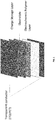
- In typical electrochromic devices there are three layer of active material and two electrodes. Electrochromic layer, electrolyte layer and charge storage layer are sandwiched in between to transparent electrodes as illustrated in FIG. 1 .
- US5442478 discloses an electrochromic cell which comprises an electrochromic layer and a composite ion counter electrode for transporting ions.
- US6266177 discloses electrochromic devices which incorporate reversible oxidizers to improve device kinetics, incorporate counterelectrodes composed of an alkali metal oxide and vanadium oxide to improve stability and doped tungsten or molybdenum oxide in the electrochromic layer to improve UV durability.
- US2018/164650 discloses an electrochromic device which may include a working electrode that includes a high temperature stable material and nanoparticles of an active core material, a counter electrode, and an electrolyte deposited between the working electrode and the counter electrode.
- US2002/165405 is generally directed to a process for preparing polyoxometalates having amine-derived substituents attached thereto.
- US2017/031224 discloses electrochromic films produced by low temperature condensation of polyoxometalates and applications thereof.
- the present invention is directed to the use of a charge storage material comprising a solution-processed low-temperature polyoxometalate, wherein the polyoxometalate is selected from [PW 12 O 40 ] 3- , [PMo 12 O 40 ] 3- , [P 2 W 18 O 62 ] 6- , [P 2 Mo 18 O 62 ] 6- , [Si 2 Nb 6 W 18 O 77 ] 8- , and [SiNb 3 W 9 O 40 ] 7- , or a mixture thereof, or wherein the polyoxometalate is selected from H 3 PW 12 O 40 , H 3 PMo 12 O 40 , K 6 P 2 W 18 O 62 , (NH 4 ) 6 P 2 W 18 O 62 , (NH 4 ) 6 P 2 Mo 18 O 62 , and H 3 PMo 12 O 40 , or a mixture thereof, as well as one or more of a solution-processed low-temperature metal oxide, a
- the present disclosure is also directed to an electrochromic device comprising such a charge storage material, as recited in appended claim 9, and to methods of preparing such a charge storage material, as recited in appended claims 10, 12, and 13.
- the metal oxide comprises an oxide of titanium (Ti), vanadium (V), niobium (Nb), zirconium (Zr), molybdenum (Mo), nickel (Ni), copper (Cu) and chromium (Cr), or a mixture thereof.
- metal oxide comprises an oxide of aluminum (Al) or silicon (Si), or a combination thereof.
- the metal bronze is a hydrogen metal oxide wherein the metal is one or more of titanium (Ti), vanadium (V), niobium (Nb), zirconium (Zr), and molybdenum (Mo).
- the polyoxometalate is an inorganic anion comprising oxygen and a metal such as one or more of titanium (Ti), vanadium (V), niobium (Nb), zirconium (Zr), and molybdenum (Mo).
- a metal such as one or more of titanium (Ti), vanadium (V), niobium (Nb), zirconium (Zr), and molybdenum (Mo).
- the metal oxide, metal bronze or polyoxometalate is a hydrate.
- the metal oxide, metal bronze or polyoxometalate is in an amorphous form.
- the metal oxide, metal bronze or polyoxometalate is in nanoparticle form.
- the metal oxide is one or more of V y1 Ti y2 O x ⁇ nH 2 O wherein the ratio of y1 to y2 is from about 1:1 to about 50:1, y1+y2 is 1, V y1 Si y2 O x ⁇ nH 2 O wherein the ratio of y1 to y2 is from about 1:1 to about 50:1, y1+y2 is 1, V yi Al y2 O x ⁇ nH 2 O wherein the ratio of y1 to y2 is from about 1:1 to about 50:1, yl+y2 is 1, V y1 Mo y2 O x ⁇ nH 2 O wherein the ratio of y1 to y2 is from about 1:1 to about 50:1, y1+y2 is 1, V y1 Nb y2 O x ⁇ nH 2 O wherein the ratio of y1 to y2 is from about 1:1 to about 50:1, y1+y2 is 1, V y1 Zr y2 O
- the metal oxide is one or more of V y1 Ti y2 O x ⁇ nH 2 O wherein the ratio of y1 to y2 is from about 1:10 to about 50:1, y1+y2 is 1, V y1 Si y2 O x ⁇ nH 2 O wherein the ratio of y1 to y2 is from about 1:10 to about 50:1, y1+y2 is 1, V y1 Al y2 O x ⁇ nH 2 O wherein the ratio of y1 to y2 is from about 1:10 to about 50:1, y1+y2 is 1, V y1 M Oy2 O x ⁇ nH 2 O wherein the ratio of y1 to y2 is from about 1:10 to about 50:1, y1+y2 is 1, V y1 Nb y2 O x ⁇ nH 2 O wherein the ratio of y1 to y2 is from about 1:10 to about 50:1, y1+y2 is 1, V y1 Z
- the metal oxide is one or more of V y1 Ti y2 O x ⁇ nH 2 O wherein the ratio of y1 to y2 is about 1:2, y1+y2 is 1, V y1 Si y2 O x ⁇ nH 2 O wherein the ratio of y1 to y2 is about 1:2, y1+y2 is 1, V y1 Al y2 O x ⁇ nH 2 O wherein the ratio of y1 to y2 is about 1:2, y1+y2 is 1, V y1 Mo y2 O x ⁇ nH 2 O wherein the ratio of y1 to y2 is about 1:2, y1+y2 is 1, V y1 Nb y2 O x ⁇ nH 2 O wherein the ratio of y1 to y2 is about 1:2, y1+y2 is 1, V y1 Zr y2 O x ⁇ nH 2 O wherein the ratio of y1 to y2 is about 1:2,
- the metal oxide, metal bronze or polyoxometalate is prepared from a metal alkoxide.
- the method comprises mixing a metal alkoxide in a solvent such as an alcohol solvent.
- the method further comprises coating the solution on a substrate to form a wet layer, and letting the wet layer dry under ambient conditions to form a dried metal oxide layer.
- the method further comprises drying the dried metal oxide layer at a temperature of below about 150 °C, to form a high performance charge storage material.
- FIG. 1 is a simplified schematic illustration of an electrochromic device having an electrochromic layer, electrolyte layer and charge storage layer.
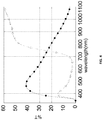
- FIG. 2 shows absorption spectra of fully bleached (clear) and reversibly colorized (opaque) states of an electrochromic device with TiO 2 nanoparticles described in Example 1 as the charge storage material, according to some embodiments of the present specification.
- Filled circle and empty circle represent absorption spectra of the device in clear state and opaque state, respectively.
- FIG. 3 shows absorption spectra of clear state and opaque state of an electrochromic device comprising a MoO 3 charge storage layer described in Example 2 as the charge storage material, according to some embodiments of the present specification. Filled circle and empty circle represent absorption spectra of the device in clear state and opaque state, respectively.
- FIG. 4 shows absorption spectra of clear state and opaque state of an electrochromic device comprising a H z MoO x (z is about 2 and x is about 2 to 4) charge storage layer described in Example 3 as the charge storage material, according to some embodiments of the present specification. Filled circle and empty circle represent absorption spectra of the device in clear state and opaque state, respectively.
- compositions and methods include the recited elements, but not excluding others.
- Consisting essentially of' when used to define compositions and methods shall mean excluding other elements of any essential significance to the combination. For example, a composition consisting essentially of the elements as defined herein would not exclude other elements that do not materially affect the basic and novel characteristic(s) of the claimed invention.
- Consisting of' shall mean excluding more than trace amount of other ingredients and substantial method steps recited. Embodiments defined by each of these transition terms are within the scope of this invention.
- Alkyl refers to a straight or branched hydrocarbon chain radical consisting solely of carbon (C) and hydrogen (H) atoms, which is saturated or unsaturated (i.e., contains one or more double and/or triple bonds), having from 1 to 30 carbon atoms (C 1 -C 30 alkyl), and which is attached to the rest of the molecule by a single bond, e.g., methyl, ethyl, n -propyl, 1-methylethyl ( iso -propyl), n -butyl, n -pentyl, 1,1-dimethylethyl ( t -butyl), 3-methylhexyl, 2-methylhexyl, ethenyl, prop-1-enyl, but-1-enyl, pent-1-enyl, penta-1,4-dienyl, ethynyl, propynyl, butynyl, pentynyl, pent
- alkyl is a straight or branched hydrocarbon chain radical having 1 to 20 carbon atoms (C 1 -C 20 alkyl), 1 to 10 carbon atoms (C 1 -C 10 alkyl), 1 to 6 carbon atoms (C 1 -C 6 alkyl), or 1 to 4 carbon atoms (C 1 -C 4 alkyl).
- Hydrophilrate refers to a complex formed by combining water molecules with molecules of a compound, such as a metal oxide, metal bronze or polyoxometalate.
- Optional or “optionally” means that the subsequently described event of circumstances may or may not occur, and that the description includes instances where said event or circumstance occurs and instances in which it does not.
- optionally substituted alkyl means that the alkyl radical may or may not be substituted and that the description includes both substituted alkyl radicals and alkyl radicals having no substitution.
- metal oxides, metal bronzes or polyoxometalates prepared under low temperature that are useful as charge storage materials in electrochromic devices.
- the low temperature metal oxides, metal bronzes or polyoxometalates are prepared at a temperature below 150 °C.
- processing temperature of all three layers (electrochromic layer, electrolyte layer and charge storage layer) cannot exceed the glass transition temperature of the plastic substrate materials.
- the processing temperature is below 150 °C. Providing low temperature solution processable materials is crucially important in order to achieve low cost flexible electrochromic films.
- the materials are transparent in the visible range and do not exhibit major color changes when changing from clear state to opaque state and vice versa, and therefore they do not interfere significantly with the electrochromic layer.
- the charge storage materials described herein are at least about 70 % transparent in visible light range. The transparency measurement may be taken by a minolta photospectrometer such as CM-5. In some embodiments, the charge storage materials described herein are about 70 % to 90 % transparent. Preparation of such materials avoids use of high temperature or vacuum and therefore could also reduce the overall cost of the flexible electrochromic product.
- the metal oxide is one or more of TiO 2 , NiO, Nb 2 O 5 , WO 3 , NiO, V 2 O 5 , MoO 3 , CoO, MoO 2 , Ni 2 O 3 , Co 2 O 3 , VO x , and MoO y , etc., wherein x is from about 2 to about 2.5, and y is from about 2 to about 3, and any mixture from such metal oxide complexes or procurers, or polyoxometalates.
- the metal oxides is of the formula M 1 y1 M 2 y2 M 3 y3 O x , wherein each M 1 , M 2 and M 3 is independently a metal, such as Ti, Ni, Nb, W, V, Mo, Si, Zr, Al or Co, each y1, y2 and y3 is independently from 0 to 100, provided that at least one of y1, y2 and y3 is not 0, and x is from 1 to 100. In some embodiments, each y1, y2 and y3 is independently from 0 to 50, or 0 to 20, or 0 to 10, provided that at least one of y1, y2 and y3 is not 0. In some embodiments, x is from 1.5 to 3, each y1, y2, y3 is independently 0 to 1, provided that y1+y2+y3 is 1.
- the metal oxide is a hydrate.
- the metal oxide is one or more of V y1 Ti y2 O x ⁇ nH 2 O wherein the ratio of y1 to y2 is from about 1:1 to about 50:1, V y1 Si y2 O x ⁇ nH 2 O wherein the ratio of y1 to y2 is from about 1:1 to about 50:1, V y1 Al y2 O x ⁇ nH 2 O wherein the ratio of y1 to y2 is from about 1:1 to about 50:1, V y1 Mo y2 O x ⁇ nH 2 O wherein the ratio of y1 to y2 is from about 1:1 to about 50:1, V y1 Nb y2 O x ⁇ nH 2 O wherein the ratio of y1 to y2 is from about 1:1 to about 50:1, V y1 Zr y2 O x ⁇ nH 2 O wherein the ratio of y1 to y2 is from about 1:1 to about 50:1, and V y1 Ti y2 Al y
- the ratio of y1 to y2 is from about 1:1 to about 40:1, or from about 1:1 to about 30:1, or from about 1:1 to about 20:1, or from about 1:1 to about 10:1, or from about 1:1 to about 5:1, or from about 1:10 to about 50:1, or from about 10:1 to about 50:1, or from about 10:1 to about 40:1, or from about 10:1 to about 30:1, or from about 10:1 to about 20:1, or from about 20:1 to about 50:1, or from about 20:1 to about 40:1, or from about 20:1 to about 30:1, or from about 30:1 to about 50:1, or from about 30:1 to about 40:1. In some other embodiments, the ratio of y1 to y2 is about 1:2.
- the ratio of y1 to y3 is from about 1:1 to about 40:1, or from about 1:1 to about 30:1, or from about 1:1 to about 20:1, or from about 1:1 to about 10:1, or from about 1:1 to about 5:1, or from about 1:10 to about 50:1, or from about 10:1 to about 50:1, or from about 10:1 to about 40:1, or from about 10:1 to about 30:1, or from about 10:1 to about 20:1, or from about 20:1 to about 50:1, or from about 20:1 to about 40:1, or from about 20:1 to about 30:1, or from about 30:1 to about 50:1, or from about 30:1 to about 40:1. In some other embodiments, the ratio of y1 to y3 is about 1:2.
- the ratio of y2 to y3 is from about 40:1 to about 1:50, or from about 40:1 to about 1:40, or from about 40:1 to about 1:30, or from about 40:1 to about 1:20, or from about 40:1 to about 1:10, or from about 40:1 to about 1:1, or from about 40:1 to about 10:1, or from about 40:1 to about 20:1, or from about 40:1 to about 30:1, or from about 30:1 to about 1:50, or from about 30:1 to about 1:40, or from about 30:1 to about 1:30, or from about 30:1 to about 1:20, or from about 30:1 to about 1:10, or from about 30:1 to about 1:1, or from about 30:1 to about 10:1, or from about 30:1 to about 20:1, or from about 20:1 to about 1:50, or from about 20:1 to about 1:40, or from about 20:1 to about 1:30, or from about 20:1 to about 1:20, or from about 40:1
- the metal bronze (or hydrogen metal oxide bronze) is of the formula H z M 1 y1 M 2 y2 M 3 y3 O x , wherein each M 1 , M 2 and M 3 is independently a metal, such as Ti, Ni, Nb, W, V, Mo, Si, Zr, Al or Co, each y1, y2 and y3 is independently from 0 to 100, provided that at least one of y1, y2 and y3 is not 0, and each x and z is independently from 1 to 100. In some embodiments, each y1, y2 and y3 is independently from 0 to 50, or 0 to 20, or 0 to 10, provided that at least one of y1, y2 and y3 is not 0.
- x is from 1 to 10, each y1, y2, y3 is independently 0 to 5, provided that y1+y2+y3 is 1 to 5, and z is 1 to 5. In some embodiments, x is from 1.5 to 6, each y1, y2, y3 is independently 0 to 2, provided that y1+y2+y3 is 1 to 3, and z is 1. In some embodiments, the metal bronze is HMoO 2.4 , HMoO 2.75 , HMoO 2.93 , HMoO 3 , HV 2 O 5 , or HVO 2.46 .
- Polyoxometalates are polyatomic ions, usually anions.
- the polyoxometalate comprises two or more transition metal oxyanions linked together by shared oxygen atoms to form a closed 3-dimensional framework.
- the polyoxometalate comprises three or more transition metal oxyanions linked together by shared oxygen atoms to form closed 3-dimensional frameworks.
- each metal atom is independently a group 6 (e.g., Mo or W) or group 5 (e.g., V, Nb, or Ta) transition metal.
- each metal atom is in its high oxidation state.
- the polyoxometalate is an isopolymetalate, comprising only one kind of metal and oxide.
- the polyoxometalate is a heteropolymetalate, comprising one metal, oxide, and a main group oxyanion (phosphate, silicate, etc.). In some embodiments, the polyoxometalate is a water-soluble fully inorganic early-transition metal-oxygen-anion clusters.
- the polyoxometalate comprises an anion of the formula [A s M 1 y1 M 2 y2 M 3 y3 O x] m- , wherein A is P or Si, each M 1 , M 2 and M 3 is independently a metal, such as Ti, Ni, Nb, W, V, Mo, Si, Zr, Al or Co, each y1, y2 and y3 is independently from 0 to 100, provided that at least one of y1, y2 and y3 is not 0, each s and x is independently from 1 to 100, and m is an integer of from 1 to 10.
- each y1, y2 and y3 is independently from 0 to 50, or 0 to 20, or 0 to 10, provided that at least one of y1, y2 and y3 is not 0.
- one, two or three of y1, y2 and y3 are integers.
- A is P.
- A is Si.
- s is an integer.
- s is 1, 2, 3, 4 or 5.
- x is from 1 to 70.
- x is an integer.
- x is 40 or 62.
- m is 1, 2, 3, 4, 5, 6, 7 or 8.
- the polyoxometalate comprises [PW 12 O 40 ] 3- , [PMo 12 O 40 ] 3- , [P 2 W 18 O 62 ] 6- , [P 2 Mo 18 O 62 ] 6- , [Si 2 Nb 6 W 18 O 77 ] 8- , or [SiNb 3 W 9 O 40 ] 7- .
- the polyoxometalate further comprises a cation, such as H + , Li + , Na + , K + , or NH4 + .
- polyoxometalates include H 3 PW 12 O 40 , H 3 PMo 12 O 40 , K 6 P 2 W 18 O 62 , (NH 4 ) 6 P 2 W 18 O 62 , (NH 4 ) 6 P 2 Mo 18 O 62 , and H 3 PMo 12 O 40 .
- the metal oxide, metal bronze or polyoxometalate is in an amorphous form.
- the charge storage material described herein provide high performance.
- the charge storage material is in the form of a layer of a thin film (charge storage layer) comprising the claimed charge storage material and their nanoparticle form described herein.
- the thickness of the film is from about 10 nm to about 1000 nm, such as from about 20 nm to about 500 nm, from about 20 nm to about 200 nm, or about 20 nm, about 50 nm, about 100 nm, about 150 nm, or about 200 nm, or any range between any two of the numbers, end points inclusive.
- the charge storage material is in the form of nanoparticles.
- the sizes of the nanoparticles are from about 1 nm to about 1000 nm, such as from about 10 nm to about 500 nm, from about 20 nm to about 200 nm, or about 10 nm, about 20 nm, about 50 nm, about 100 nm, about 150 nm, or about 200 nm, about 250 nm, about 500 nm, or any range between any two of the numbers, end points inclusive.
- the present disclosure is also directed to an electrochromic device comprising a charge storage material described herein.
- Other components of electrochromic devices are generally known in the art.
- an electrochromic device there are two set of materials, anode which is oxidized while apply positive voltage while driving the device, and cathode which is reducing.
- the polyoxometalate and one or more of the metal oxide and the metal bronze described herein can serve as either the anode or the cathode charge storage materials.
- the solution-processed low-temperature polyoxometalate and one or more of the metal oxide and the metal bronze described herein can serve as either the anode or the cathode charge storage materials.
- the electrochromic device further comprises an electrochromic polymer as described in US Patent No. 9,975,989 .
- the electrochromic device comprising an electrochromic layer, electrolyte layer and charge storage layer as illustrated by FIG. 1 , wherein the charge storage layer comprises the polyoxometalate and one or more of the metal oxide and the metal bronze described herein.
- the solution-processed low-temperature polyoxometalate and one or more of the metal oxide and the metal bronze can be used as a charge storage material in an electrochromic device.
- the precursor of the polyoxometalate and one or more of the metal oxide and the metal bronze is one or more metal alkoxide.
- the metal alkoxide is of the structure M(OR) p , wherein M is a metal, such as Ti, V, Nb, Zr, Mo, Ni, Cu, or Cr, or a mixture thereof, R is an alkyl group, and p is 1, 2, 3, 4, 5, or 6.
- the R is C 1 -C 4 alkyl, such as methyl, ethyl or isopropyl.
- the method comprises mixing a metal alkoxide in a solvent such as methanol, ethanol, iso-propanol, butanol, methoxyethanol to form a solution or suspension.
- the method further comprises coating the solution or suspension on a substrate to form a wet layer.
- the metal alkoxide hydrolyzes to related metal oxide after being left under ambient conditions.
- the method further comprises letting the wet layer dry under ambient conditions to form a dried metal oxide layer.
- the method further comprises drying the dried metal oxide layer at a temperature of below about 150 °C, to form a charge storage material.
- the substrate is a flexible substrate and does not tolerate high temperatures.
- the method comprises forming a solution or suspension of nanoparticles of a metal oxide in a solvent, such as methanol, ethanol or isopropanol or water, forming a thin layer of the solution or suspension and then forming a solid film of the metal oxide by drying the thin layer of the solution or suspension.
- a solvent such as methanol, ethanol or isopropanol or water
- the method comprises oxidizing a metal in a solvent, such as methanol, ethanol or isopropanol, with an oxidation reagent, such as H 2 O 2 , to form a solution or suspension comprising the polyoxometalate and one or more of the metal oxide and the metal bronze.
- a solvent such as methanol, ethanol or isopropanol
- an oxidation reagent such as H 2 O 2
- the method further comprises forming a thin layer of the solution or suspension and then forming a solid film of the polyoxometalate and one or more of the metal oxide and the metal bronze by drying a thin layer of the solution or suspension.
- the methods described herein do not comprise a temperature that is higher than 150 °C. In some embodiments, the methods described herein are conducted at an ambient temperature.
- metal oxides, metal bronzes or polyoxometalates prepared by methods described herein which are useful as charge storage materials of electrochromic devices.
- Such oxide material could be pre-synthesized, like TiO 2 nano-crystals, and dissolved or dispersed in a proper solvent.
- a proper solvent for example, 5 nm to 15 nm anatase TiO 2 nano-crystal dispersion in water was diluted into 10 mg/mL concentration. The solution was dispersed with a slot die coater to form a thin uniform film with 20 micrometer thick liquid layer. The resulted dried TiO 2 solid layer is about 200 nm thick.
- Such thin layer could be served as charge storage layer in cathode with an electrochromic polymer material as the anode.
- the electrolyte was described in US2017/0299932 .
- the electrochromic polymer could be fully bleached at 2.1 V, and reversibly colorized at -1.0V.
- the absorption spectra of the two states are shown in FIG. 2 .
- Metal oxide complex could be also formed during the film formation via reaction such as hydrolysis process.
- Mo(OC 2 H 5 ) 5 with 1 % weight ratio in ethanol was applied by a slot die coater, and form a solid film.
- the film was baked and assembled with an electrochromic polymer and electrolyte (e.g., those described in US2017/0299932 ) to form an active electrochromic device.
- Such device could be switched between opaque and clear with 1.5 V and -1 V.
- the absorption spectra are shown in FIG. 3 .
- Metal oxide or polyoxometalate could be synthesized as the metal bronze or solution. 1 g of Mo was added to 100 mL ethanol and then 3 mL of 30% H 2 O 2 was added. The mixture was stirred overnight in room temperature to result a dark blue metal bronze solution. The solution was applied via a slot die coater to form a 100 nm solid film, the composition of such metal bronze material is suggested to be H y MoO x . Such film was assembled with electrochromic polymer and electrolyte to form an active device. Such device could be switched reversibly with 1.2V to -IV. The absorption spectra were shown in FIG. 4 .
- Embodiments of the charge storage materials comprising the polyoxometalate and one or more of the metal oxide and the metal bronze disclosed herein may be used in various applications, devices, industries etc.
- the charge storage materials may be configured for use in smart window and display technology, e.g., anti-glare car mirrors, smart windows configured to modulate the transmission or reflected solar radiation for use in cars, aircrafts, buildings, and the like; protective eyewear; camouflage and/or chameleonic materials; and other electrochromic devices.
Landscapes
- Chemical & Material Sciences (AREA)
- Physics & Mathematics (AREA)
- Organic Chemistry (AREA)
- Nonlinear Science (AREA)
- Inorganic Chemistry (AREA)
- General Physics & Mathematics (AREA)
- Optics & Photonics (AREA)
- Materials Engineering (AREA)
- Engineering & Computer Science (AREA)
- Life Sciences & Earth Sciences (AREA)
- Environmental & Geological Engineering (AREA)
- General Life Sciences & Earth Sciences (AREA)
- Geology (AREA)
- Crystallography & Structural Chemistry (AREA)
- Electrochromic Elements, Electrophoresis, Or Variable Reflection Or Absorption Elements (AREA)
Description
- This application claims priority to the
U.S. provisional patent application No. 62/699,382 filed on July 17, 2018 - The disclosure relates generally to materials useful for charge storage (or described as counter electrode material) used in electrochromic devices, charge storage and electrochromic devices comprising the materials and methods of making and using the same.
- Electrochromic materials can change the transmittance, reflectance, absorptance or emittance under the action of electrical charge injection and extraction. The electrochromic films based on flexible substrates have advantages over the traditional electrochromic glasses in terms of weight, ease of transportation, ability to apply on curved surface, etc. In typical electrochromic devices, there are three layer of active material and two electrodes. Electrochromic layer, electrolyte layer and charge storage layer are sandwiched in between to transparent electrodes as illustrated in
FIG. 1 . - A need exists to develop new and/or improved materials for the charge storage layers, in particular those used in electrochromic films based on flexible substrates.
-
US5442478 discloses an electrochromic cell which comprises an electrochromic layer and a composite ion counter electrode for transporting ions. -
US6266177 discloses electrochromic devices which incorporate reversible oxidizers to improve device kinetics, incorporate counterelectrodes composed of an alkali metal oxide and vanadium oxide to improve stability and doped tungsten or molybdenum oxide in the electrochromic layer to improve UV durability. -
US2018/164650 discloses an electrochromic device which may include a working electrode that includes a high temperature stable material and nanoparticles of an active core material, a counter electrode, and an electrolyte deposited between the working electrode and the counter electrode. -
US2002/165405 is generally directed to a process for preparing polyoxometalates having amine-derived substituents attached thereto. -
US2017/031224 discloses electrochromic films produced by low temperature condensation of polyoxometalates and applications thereof. - As recited in appended claim 1, the present invention is directed to the use of a charge storage material comprising a solution-processed low-temperature polyoxometalate, wherein the polyoxometalate is selected from [PW12O40]3-, [PMo12O40]3-, [P2W18O62]6-, [P2Mo18O62]6-, [Si2Nb6W18O77]8-, and [SiNb3W9O40]7-, or a mixture thereof, or wherein the polyoxometalate is selected from H3PW12O40, H3PMo12O40, K6P2W18O62, (NH4)6P2W18O62, (NH4)6P2Mo18O62, and H3PMo12O40, or a mixture thereof, as well as one or more of a solution-processed low-temperature metal oxide, a solution-processed low-temperature metal bronze, and a hydrate thereof, the charge storage material of an electrochromic device. The form of the materials may include nanoparticles and films.
- The present disclosure is also directed to an electrochromic device comprising such a charge storage material, as recited in appended claim 9, and to methods of preparing such a charge storage material, as recited in appended
claims 10, 12, and 13. - In some embodiments, the metal oxide comprises an oxide of titanium (Ti), vanadium (V), niobium (Nb), zirconium (Zr), molybdenum (Mo), nickel (Ni), copper (Cu) and chromium (Cr), or a mixture thereof. In some embodiments, metal oxide comprises an oxide of aluminum (Al) or silicon (Si), or a combination thereof. In some embodiments, the metal bronze is a hydrogen metal oxide wherein the metal is one or more of titanium (Ti), vanadium (V), niobium (Nb), zirconium (Zr), and molybdenum (Mo). In some embodiments, the polyoxometalate is an inorganic anion comprising oxygen and a metal such as one or more of titanium (Ti), vanadium (V), niobium (Nb), zirconium (Zr), and molybdenum (Mo).
- In some embodiments, the metal oxide, metal bronze or polyoxometalate is a hydrate.
- In some embodiments, the metal oxide, metal bronze or polyoxometalate is in an amorphous form.
- In some embodiments, the metal oxide, metal bronze or polyoxometalate is in nanoparticle form.
- In some embodiments, the metal oxide is one or more of
Vy1Tiy2Ox·nH2O wherein the ratio of y1 to y2 is from about 1:1 to about 50:1, y1+y2 is 1,
Vy1Siy2Ox·nH2O wherein the ratio of y1 to y2 is from about 1:1 to about 50:1, y1+y2 is 1,
VyiAly2Ox·nH2O wherein the ratio of y1 to y2 is from about 1:1 to about 50:1, yl+y2 is 1,
Vy1Moy2Ox·nH2O wherein the ratio of y1 to y2 is from about 1:1 to about 50:1, y1+y2 is 1,
Vy1Nby2Ox·nH2O wherein the ratio of y1 to y2 is from about 1:1 to about 50:1, y1+y2 is 1,
Vy1Zry2Ox·nH2O wherein the ratio of y1 to y2 is from about 1:1 to about 50:1, y1+y2 is 1,
and Vy1Tiy2Aly3Ox·nH2O, wherein the ratio of y1 to y2 is from about 1:1 to about 50:1, the ratio of y2 to y3 is from about 50:1 to about 1:50, and the ratio of y1 to y3 is from about 1:1 to about 50:1, y1+y2+y3 = 1,
and a tri, tetra metal oxide mixture, and its pure form of oxide,
wherein x is from about 2 to about 2.75, and n is from about 0 to about 2. - In some other embodiments, the metal oxide is one or more of Vy1Tiy2Ox·nH2O wherein the ratio of y1 to y2 is from about 1:10 to about 50:1, y1+y2 is 1,
Vy1Siy2Ox·nH2O wherein the ratio of y1 to y2 is from about 1:10 to about 50:1, y1+y2 is 1,
Vy1Aly2Ox·nH2O wherein the ratio of y1 to y2 is from about 1:10 to about 50:1, y1+y2 is 1,
Vy1MOy2Ox·nH2O wherein the ratio of y1 to y2 is from about 1:10 to about 50:1, y1+y2 is 1,
Vy1Nby2Ox·nH2O wherein the ratio of y1 to y2 is from about 1:10 to about 50:1, y1+y2 is 1,
Vy1Zry2Ox·nH2O wherein the ratio of y1 to y2 is from about 1:10 to about 50:1, y1+y2 is 1,
and Vy1Tiy2Aly3Ox·nH2O, wherein the ratio of y1 to y2 is from about 1:10 to about 50:1, the ratio of y2 to y3 is from about 50:1 to about 1:50, and the ratio of y1 to y3 is from about 1:10 to about 50:1, y1+y2+y3 = 1,
and a tri, tetra metal oxide mixture, and its pure form of oxide,
wherein x is from about 2 to about 2.75, and n is from about 0 to about 2. - In still some other embodiments, the metal oxide is one or more of
Vy1Tiy2Ox·nH2O wherein the ratio of y1 to y2 is about 1:2, y1+y2 is 1,
Vy1Siy2Ox·nH2O wherein the ratio of y1 to y2 is about 1:2, y1+y2 is 1,
Vy1Aly2Ox·nH2O wherein the ratio of y1 to y2 is about 1:2, y1+y2 is 1,
Vy1Moy2Ox·nH2O wherein the ratio of y1 to y2 is about 1:2, y1+y2 is 1,
Vy1Nby2Ox·nH2O wherein the ratio of y1 to y2 is about 1:2, y1+y2 is 1,
Vy1Zry2Ox·nH2O wherein the ratio of y1 to y2 is about 1:2, y1+y2 is 1,
and Vy1Tiy2Aly3Ox·nH2O, wherein the ratio of y1 to y2 is about 1:2, the ratio of y2 to y3 is from about 50:1 to about 1:50, and the ratio of y1 to y3 is about 1:2, y1+y2+y3 = 1,
and a tri, tetra metal oxide mixture, and its pure form of oxide,
wherein x is from about 2 to about 2.75, and n is from about 0 to about 2. - In some embodiments, the metal oxide, metal bronze or polyoxometalate is prepared from a metal alkoxide. In some embodiments, the method comprises mixing a metal alkoxide in a solvent such as an alcohol solvent. In some embodiments, the method further comprises coating the solution on a substrate to form a wet layer, and letting the wet layer dry under ambient conditions to form a dried metal oxide layer. In some embodiments, the method further comprises drying the dried metal oxide layer at a temperature of below about 150 °C, to form a high performance charge storage material.
- Other objects, features and advantages of the described preferred embodiments will become apparent to those skilled in the art from the following detailed description. It is to be understood, however, that the detailed description and specific examples, while indicating preferred embodiments of the present invention, are given by way of illustration and not limitation. Many changes and modifications within the scope of the present invention may be made and the invention includes all such modifications.
-
FIG. 1 is a simplified schematic illustration of an electrochromic device having an electrochromic layer, electrolyte layer and charge storage layer. -
FIG. 2 shows absorption spectra of fully bleached (clear) and reversibly colorized (opaque) states of an electrochromic device with TiO2 nanoparticles described in Example 1 as the charge storage material, according to some embodiments of the present specification. Filled circle and empty circle represent absorption spectra of the device in clear state and opaque state, respectively. -
FIG. 3 shows absorption spectra of clear state and opaque state of an electrochromic device comprising a MoO3 charge storage layer described in Example 2 as the charge storage material, according to some embodiments of the present specification. Filled circle and empty circle represent absorption spectra of the device in clear state and opaque state, respectively. -
FIG. 4 shows absorption spectra of clear state and opaque state of an electrochromic device comprising a HzMoOx (z is about 2 and x is about 2 to 4) charge storage layer described in Example 3 as the charge storage material, according to some embodiments of the present specification. Filled circle and empty circle represent absorption spectra of the device in clear state and opaque state, respectively. - In the following description, certain specific details are set forth in order to provide a thorough understanding of various embodiments of the invention. However, one skilled in the art will understand that the invention may be practiced without these details. Moreover, while various embodiments of the invention are disclosed herein, many adaptations and modifications may be made within the scope of the invention in accordance with the common general knowledge of those skilled in this art.
- Unless defined otherwise, all technical and scientific terms used herein have the same meaning as is commonly understood by one of skill in the art to which this invention belongs.
- As used herein, the term "comprising" is intended to mean that the compositions and methods include the recited elements, but not excluding others. "Consisting essentially of' when used to define compositions and methods, shall mean excluding other elements of any essential significance to the combination. For example, a composition consisting essentially of the elements as defined herein would not exclude other elements that do not materially affect the basic and novel characteristic(s) of the claimed invention. "Consisting of' shall mean excluding more than trace amount of other ingredients and substantial method steps recited. Embodiments defined by each of these transition terms are within the scope of this invention.
- Numeric ranges are also inclusive of the numbers defining the range. Additionally, the singular forms "a", "an" and "the" include plural referents unless the context clearly dictates otherwise.
- Reference throughout this specification to "one embodiment," "an embodiment" or "some embodiments" means that a particular feature, structure or characteristic described in connection with the embodiment is included in at least one embodiment of the present invention. Thus, the appearances of the phrases "in one embodiment," "in an embodiment" or "in some embodiments" in various places throughout this specification are not necessarily all referring to the same embodiment or embodiments, but may be in some instances. Furthermore, the particular features, structures, or characteristics may be combined in any suitable manner in one or more embodiments.
- The term "about" when used before a numerical value indicates that the value may vary within reasonable range, such as ± 10%, ± 5%, and ± 1%.
- "Alkyl" refers to a straight or branched hydrocarbon chain radical consisting solely of carbon (C) and hydrogen (H) atoms, which is saturated or unsaturated (i.e., contains one or more double and/or triple bonds), having from 1 to 30 carbon atoms (C1-C30 alkyl), and which is attached to the rest of the molecule by a single bond, e.g., methyl, ethyl, n-propyl, 1-methylethyl (iso-propyl), n-butyl, n-pentyl, 1,1-dimethylethyl (t-butyl), 3-methylhexyl, 2-methylhexyl, ethenyl, prop-1-enyl, but-1-enyl, pent-1-enyl, penta-1,4-dienyl, ethynyl, propynyl, butynyl, pentynyl, hexynyl, and the like. Unless stated otherwise specifically in the specification, an alkyl group may be optionally substituted. In some embodiments, alkyl is a straight or branched hydrocarbon chain radical having 1 to 20 carbon atoms (C1-C20 alkyl), 1 to 10 carbon atoms (C1-C10 alkyl), 1 to 6 carbon atoms (C1-C6 alkyl), or 1 to 4 carbon atoms (C1-C4 alkyl).
- "Hydrate" refers to a complex formed by combining water molecules with molecules of a compound, such as a metal oxide, metal bronze or polyoxometalate.
- "Optional" or "optionally" means that the subsequently described event of circumstances may or may not occur, and that the description includes instances where said event or circumstance occurs and instances in which it does not. For example, "optionally substituted alkyl" means that the alkyl radical may or may not be substituted and that the description includes both substituted alkyl radicals and alkyl radicals having no substitution.
- In some embodiments, provided herein are metal oxides, metal bronzes or polyoxometalates prepared under low temperature that are useful as charge storage materials in electrochromic devices. In some embodiments, the low temperature metal oxides, metal bronzes or polyoxometalates are prepared at a temperature below 150 °C. In a flexible electrochromic device, processing temperature of all three layers (electrochromic layer, electrolyte layer and charge storage layer) cannot exceed the glass transition temperature of the plastic substrate materials. In some embodiment, the processing temperature is below 150 °C. Providing low temperature solution processable materials is crucially important in order to achieve low cost flexible electrochromic films. Low temperature processable metal oxide, polyoxometalate, or metal bronze as the efficient charge storage materials could significant reduce the processing difficulty of a flexible electrochromic device. Further, the materials are transparent in the visible range and do not exhibit major color changes when changing from clear state to opaque state and vice versa, and therefore they do not interfere significantly with the electrochromic layer. In some embodiments, the charge storage materials described herein are at least about 70 % transparent in visible light range. The transparency measurement may be taken by a minolta photospectrometer such as CM-5. In some embodiments, the charge storage materials described herein are about 70 % to 90 % transparent. Preparation of such materials avoids use of high temperature or vacuum and therefore could also reduce the overall cost of the flexible electrochromic product.
- In some embodiments, the metal oxide is one or more of TiO2, NiO, Nb2O5, WO3, NiO, V2O5, MoO3, CoO, MoO2, Ni2O3, Co2O3, VOx, and MoOy, etc., wherein x is from about 2 to about 2.5, and y is from about 2 to about 3, and any mixture from such metal oxide complexes or procurers, or polyoxometalates. In some embodiments, the metal oxides is of the formula M1 y1M2 y2M3 y3Ox, wherein each M1, M2 and M3 is independently a metal, such as Ti, Ni, Nb, W, V, Mo, Si, Zr, Al or Co, each y1, y2 and y3 is independently from 0 to 100, provided that at least one of y1, y2 and y3 is not 0, and x is from 1 to 100. In some embodiments, each y1, y2 and y3 is independently from 0 to 50, or 0 to 20, or 0 to 10, provided that at least one of y1, y2 and y3 is not 0. In some embodiments, x is from 1.5 to 3, each y1, y2, y3 is independently 0 to 1, provided that y1+y2+y3 is 1.
- In some embodiments, the metal oxide is a hydrate. In some embodiments, the metal oxides is of the formula M1 y1M2 y2M3 y3Ox·nH2O, wherein each M1, M2 and M3 is independently a metal, such as Ti, Ni, Nb, W, V, Mo, Si, Zr, Al or Co, x is from 1.5 to 3, each y1, y2 and y3 is independently from 0 to 1, provided that y1+y2+y3 =1, and n is from 0.001 to 3.
- In some embodiments, the metal oxide is one or more of
Vy1Tiy2Ox·nH2O wherein the ratio of y1 to y2 is from about 1:1 to about 50:1,
Vy1Siy2Ox·nH2O wherein the ratio of y1 to y2 is from about 1:1 to about 50:1,
Vy1Aly2Ox·nH2O wherein the ratio of y1 to y2 is from about 1:1 to about 50:1,
Vy1Moy2Ox·nH2O wherein the ratio of y1 to y2 is from about 1:1 to about 50:1,
Vy1Nby2Ox·nH2O wherein the ratio of y1 to y2 is from about 1:1 to about 50:1,
Vy1Zry2Ox·nH2O wherein the ratio of y1 to y2 is from about 1:1 to about 50:1, and Vy1Tiy2Aly3Ox·nH2O, or other tri, tetra metal oxide mixture, or its pure form of oxide, wherein the ratio of y1 to y2 is from about 1:1 to about 50:1, the ratio of y2 to y3 is from about 50:1 to about 1:50, the ratio of y1 to y3 is from about 1:1 to about 50:1,
wherein x is from about 2 to about 2.75, y1+y2 is about 1 or y1+y2+y3 is about 1, and n is from about 0 to about 3. In some embodiments, the ratio of y1 to y2 is from about 1:1 to about 40:1, or from about 1:1 to about 30:1, or from about 1:1 to about 20:1, or from about 1:1 to about 10:1, or from about 1:1 to about 5:1, or from about 1:10 to about 50:1, or from about 10:1 to about 50:1, or from about 10:1 to about 40:1, or from about 10:1 to about 30:1, or from about 10:1 to about 20:1, or from about 20:1 to about 50:1, or from about 20:1 to about 40:1, or from about 20:1 to about 30:1, or from about 30:1 to about 50:1, or from about 30:1 to about 40:1. In some other embodiments, the ratio of y1 to y2 is about 1:2. In some embodiments, the ratio of y1 to y3 is from about 1:1 to about 40:1, or from about 1:1 to about 30:1, or from about 1:1 to about 20:1, or from about 1:1 to about 10:1, or from about 1:1 to about 5:1, or from about 1:10 to about 50:1, or from about 10:1 to about 50:1, or from about 10:1 to about 40:1, or from about 10:1 to about 30:1, or from about 10:1 to about 20:1, or from about 20:1 to about 50:1, or from about 20:1 to about 40:1, or from about 20:1 to about 30:1, or from about 30:1 to about 50:1, or from about 30:1 to about 40:1. In some other embodiments, the ratio of y1 to y3 is about 1:2. In some embodiments, the ratio of y2 to y3 is from about 40:1 to about 1:50, or from about 40:1 to about 1:40, or from about 40:1 to about 1:30, or from about 40:1 to about 1:20, or from about 40:1 to about 1:10, or from about 40:1 to about 1:1, or from about 40:1 to about 10:1, or from about 40:1 to about 20:1, or from about 40:1 to about 30:1, or from about 30:1 to about 1:50, or from about 30:1 to about 1:40, or from about 30:1 to about 1:30, or from about 30:1 to about 1:20, or from about 30:1 to about 1:10, or from about 30:1 to about 1:1, or from about 30:1 to about 10:1, or from about 30:1 to about 20:1, or from about 20:1 to about 1:50, or from about 20:1 to about 1:40, or from about 20:1 to about 1:30, or from about 20:1 to about 1:20, or from about 20:1 to about 1:10, or from about 20:1 to about 1:1, or from about 20:1 to about 10:1, or from about 10:1 to about 1:50, or from about 10:1 to about 1:40, or from about 10:1 to about 1:30, or from about 10:1 to about 1:20, or from about 10:1 to about 1:10, or from about 10:1 to about 1:1, or from about 1:1 to about 1:50, or from about 1:1 to about 1:40, or from about 1:1 to about 1:30, or from about 1:1 to about 1:20, or from about 1:1 to about 1:10, or from about 1:10 to about 1:50, or from about 1:10 to about 1:40, or from about 1:10 to about 1:30, or from about 1:10 to about 1:20, or from about 1:20 to about 1:50, or from about 1:20 to about 1:40, or from about 1:20 to about 1:30, or from about 1:30 to about 1:50, or from about 1:30 to about 1:40. - In some embodiments, the metal bronze (or hydrogen metal oxide bronze) is of the formula HzM1 y1M2 y2M3 y3Ox, wherein each M1, M2 and M3 is independently a metal, such as Ti, Ni, Nb, W, V, Mo, Si, Zr, Al or Co, each y1, y2 and y3 is independently from 0 to 100, provided that at least one of y1, y2 and y3 is not 0, and each x and z is independently from 1 to 100. In some embodiments, each y1, y2 and y3 is independently from 0 to 50, or 0 to 20, or 0 to 10, provided that at least one of y1, y2 and y3 is not 0. In some embodiments, x is from 1 to 10, each y1, y2, y3 is independently 0 to 5, provided that y1+y2+y3 is 1 to 5, and z is 1 to 5. In some embodiments, x is from 1.5 to 6, each y1, y2, y3 is independently 0 to 2, provided that y1+y2+y3 is 1 to 3, and z is 1. In some embodiments, the metal bronze is HMoO2.4, HMoO2.75, HMoO2.93, HMoO3, HV2O5, or HVO2.46.
- Polyoxometalates are polyatomic ions, usually anions. In some embodiments, the polyoxometalate comprises two or more transition metal oxyanions linked together by shared oxygen atoms to form a closed 3-dimensional framework. In some embodiments, the polyoxometalate comprises three or more transition metal oxyanions linked together by shared oxygen atoms to form closed 3-dimensional frameworks. In some embodiments, each metal atom is independently a group 6 (e.g., Mo or W) or group 5 (e.g., V, Nb, or Ta) transition metal. In some embodiments, each metal atom is in its high oxidation state. In some embodiments, the polyoxometalate is an isopolymetalate, comprising only one kind of metal and oxide. In some embodiments, the polyoxometalate is a heteropolymetalate, comprising one metal, oxide, and a main group oxyanion (phosphate, silicate, etc.). In some embodiments, the polyoxometalate is a water-soluble fully inorganic early-transition metal-oxygen-anion clusters. In some embodiments, the polyoxometalate comprises an anion of the formula [AsM1 y1M2 y2M3 y3Ox] m-, wherein A is P or Si, each M1, M2 and M3 is independently a metal, such as Ti, Ni, Nb, W, V, Mo, Si, Zr, Al or Co, each y1, y2 and y3 is independently from 0 to 100, provided that at least one of y1, y2 and y3 is not 0, each s and x is independently from 1 to 100, and m is an integer of from 1 to 10. In some embodiments, each y1, y2 and y3 is independently from 0 to 50, or 0 to 20, or 0 to 10, provided that at least one of y1, y2 and y3 is not 0. In some embodiments, one, two or three of y1, y2 and y3 are integers. In some embodiments, A is P. In some embodiments, A is Si. In some embodiments, s is an integer. In some embodiments, s is 1, 2, 3, 4 or 5. In some embodiments, x is from 1 to 70. In some embodiments, x is an integer. In some embodiments, x is 40 or 62. In some embodiments, m is 1, 2, 3, 4, 5, 6, 7 or 8.
- In the present invention, the polyoxometalate comprises [PW12O40]3-, [PMo12O40]3-, [P2W18O62]6-, [P2Mo18O62]6-, [Si2Nb6W18O77]8-, or [SiNb3W9O40]7-. In some embodiments, the polyoxometalate further comprises a cation, such as H+, Li+, Na+, K+, or NH4+. In the present invention, polyoxometalates include H3PW12O40, H3PMo12O40, K6P2W18O62, (NH4)6P2W18O62, (NH4)6P2Mo18O62, and H3PMo12O40.
- In some embodiments, the metal oxide, metal bronze or polyoxometalate is in an amorphous form.
- The charge storage material described herein provide high performance.
- In some embodiments, the charge storage material is in the form of a layer of a thin film (charge storage layer) comprising the claimed charge storage material and their nanoparticle form described herein. In some embodiments, the thickness of the film is from about 10 nm to about 1000 nm, such as from about 20 nm to about 500 nm, from about 20 nm to about 200 nm, or about 20 nm, about 50 nm, about 100 nm, about 150 nm, or about 200 nm, or any range between any two of the numbers, end points inclusive.
- In some embodiments, the charge storage material is in the form of nanoparticles. In some embodiments, the sizes of the nanoparticles are from about 1 nm to about 1000 nm, such as from about 10 nm to about 500 nm, from about 20 nm to about 200 nm, or about 10 nm, about 20 nm, about 50 nm, about 100 nm, about 150 nm, or about 200 nm, about 250 nm, about 500 nm, or any range between any two of the numbers, end points inclusive.
- The present disclosure is also directed to an electrochromic device comprising a charge storage material described herein. Other components of electrochromic devices are generally known in the art.
- In an electrochromic device, there are two set of materials, anode which is oxidized while apply positive voltage while driving the device, and cathode which is reducing. The polyoxometalate and one or more of the metal oxide and the metal bronze described herein can serve as either the anode or the cathode charge storage materials. In some embodiments, the solution-processed low-temperature polyoxometalate and one or more of the metal oxide and the metal bronze described herein can serve as either the anode or the cathode charge storage materials. In some embodiments, the electrochromic device further comprises an electrochromic polymer as described in
US Patent No. 9,975,989 - In some embodiments, the electrochromic device comprising an electrochromic layer, electrolyte layer and charge storage layer as illustrated by
FIG. 1 , wherein the charge storage layer comprises the polyoxometalate and one or more of the metal oxide and the metal bronze described herein. - In some embodiments, provided is a method of preparing the polyoxometalate and one or more of the metal oxide and the metal bronze useful as a charge storage material in an electrochromic device. In some embodiments, the solution-processed low-temperature polyoxometalate and one or more of the metal oxide and the metal bronze can be used as a charge storage material in an electrochromic device.
- Metal oxides could be synthesized prior coating or during the coating process. In some embodiments, the precursor of the polyoxometalate and one or more of the metal oxide and the metal bronze is one or more metal alkoxide. In some embodiments, the metal alkoxide is of the structure M(OR)p, wherein M is a metal, such as Ti, V, Nb, Zr, Mo, Ni, Cu, or Cr, or a mixture thereof, R is an alkyl group, and p is 1, 2, 3, 4, 5, or 6. In some embodiments, the R is C1-C4 alkyl, such as methyl, ethyl or isopropyl.
- In some embodiments, the method comprises mixing a metal alkoxide in a solvent such as methanol, ethanol, iso-propanol, butanol, methoxyethanol to form a solution or suspension. In some embodiments, the method further comprises coating the solution or suspension on a substrate to form a wet layer. The metal alkoxide hydrolyzes to related metal oxide after being left under ambient conditions. In some embodiments, the method further comprises letting the wet layer dry under ambient conditions to form a dried metal oxide layer. In some embodiments, the method further comprises drying the dried metal oxide layer at a temperature of below about 150 °C, to form a charge storage material. In some embodiments, the substrate is a flexible substrate and does not tolerate high temperatures.
- In some embodiments, the method comprises forming a solution or suspension of nanoparticles of a metal oxide in a solvent, such as methanol, ethanol or isopropanol or water, forming a thin layer of the solution or suspension and then forming a solid film of the metal oxide by drying the thin layer of the solution or suspension.
- In some embodiments, the method comprises oxidizing a metal in a solvent, such as methanol, ethanol or isopropanol, with an oxidation reagent, such as H2O2, to form a solution or suspension comprising the polyoxometalate and one or more of the metal oxide and the metal bronze. In some embodiments, the method further comprises forming a thin layer of the solution or suspension and then forming a solid film of the polyoxometalate and one or more of the metal oxide and the metal bronze by drying a thin layer of the solution or suspension.
- In some embodiments, the methods described herein do not comprise a temperature that is higher than 150 °C. In some embodiments, the methods described herein are conducted at an ambient temperature.
- In some embodiments, provided are metal oxides, metal bronzes or polyoxometalates prepared by methods described herein which are useful as charge storage materials of electrochromic devices.
- The present technology is further defined by reference to the following examples. It will be apparent to those skilled in the art that many modifications, both to compositions and methods, may be practiced without departing from the scope of the current disclosure.
- Such oxide material could be pre-synthesized, like TiO2 nano-crystals, and dissolved or dispersed in a proper solvent. For example, 5 nm to 15 nm anatase TiO2 nano-crystal dispersion in water was diluted into 10 mg/mL concentration. The solution was dispersed with a slot die coater to form a thin uniform film with 20 micrometer thick liquid layer. The resulted dried TiO2 solid layer is about 200 nm thick. Such thin layer could be served as charge storage layer in cathode with an electrochromic polymer material as the anode. The electrolyte was described in
US2017/0299932 . - The electrochromic polymer could be fully bleached at 2.1 V, and reversibly colorized at -1.0V. The absorption spectra of the two states are shown in
FIG. 2 . - Metal oxide complex could be also formed during the film formation via reaction such as hydrolysis process. Mo(OC2H5)5 with 1 % weight ratio in ethanol was applied by a slot die coater, and form a solid film. The film was baked and assembled with an electrochromic polymer and electrolyte (e.g., those described in
US2017/0299932 ) to form an active electrochromic device. Such device could be switched between opaque and clear with 1.5 V and -1 V. The absorption spectra are shown inFIG. 3 . - Metal oxide or polyoxometalate could be synthesized as the metal bronze or solution. 1 g of Mo was added to 100 mL ethanol and then 3 mL of 30% H2O2 was added. The mixture was stirred overnight in room temperature to result a dark blue metal bronze solution. The solution was applied via a slot die coater to form a 100 nm solid film, the composition of such metal bronze material is suggested to be HyMoOx . Such film was assembled with electrochromic polymer and electrolyte to form an active device. Such device could be switched reversibly with 1.2V to -IV. The absorption spectra were shown in
FIG. 4 . - Embodiments of the charge storage materials comprising the polyoxometalate and one or more of the metal oxide and the metal bronze disclosed herein may be used in various applications, devices, industries etc. For example, the charge storage materials may be configured for use in smart window and display technology, e.g., anti-glare car mirrors, smart windows configured to modulate the transmission or reflected solar radiation for use in cars, aircrafts, buildings, and the like; protective eyewear; camouflage and/or chameleonic materials; and other electrochromic devices.
- The invention described and claimed herein is not to be limited in scope by the specific preferred embodiments disclosed herein, as these embodiments are intended as illustrations of several aspects of the invention. Indeed, various modifications of the invention in addition to those shown and described herein will become apparent to those skilled in the art from the foregoing description.
Claims (13)
- A charge storage material suitable for use in
an electrochromic device comprising:a solution-processed low-temperature polyoxometalate, wherein the polyoxometalate is selected from [PW12O40]3-, [PMo12O40]3-, [P2W18O62]6-, [P2Mo18O62]6-, [Si2Nb6W18O77]8-, and [SiNb3W9O40]7-, or a mixture thereof, or wherein the polyoxometalate is selected from H3PW12O40, H3PMo12O40, K6P2W18O62, (NH4)6P2W18O62, (NH4)6P2Mo18O62, and H3PMo12O40, or a mixture thereof; andfurther comprising one or more of a solution-processed low-temperature metal oxide, a solution-processed low-temperature metal bronze, and a hydrate thereof. - The charge storage material of claim 1, comprising the metal oxide or a hydrate thereof, and wherein, optionally, the metal oxide is of formula M1 y1M2 y2M3 y3Ox, or a hydrate thereof, wherein each M1, M2 and M3 is independently a metal, x is from 1.5 to 3, each y1, y2 and y3 is independently from 0 to 1, provided that y1+y2+y3 is 1.
- The charge storage material of claim 2, comprising hydrate of the metal oxide of formula M1 y1M2 y2M3 y3Ox·nH2O, wherein n is independently from 0 to 3.
- The charge storage material of claim 3, wherein the metal oxide hydrate is selected from
Vy1Tiy2Ox·nH2O wherein the ratio of y1 to y2 is from about 1:10 to about 50:1,
Vy1Siy2Ox·nH2O wherein the ratio of y1 to y2 is from about 1:10 to about 50:1,
Vy1Aly2Ox·nH2O wherein the ratio of y1 to y2 is from about 1:10 to about 50:1,
vy1MOy2Ox-nH2O wherein the ratio of y1 to y2 is from about 1:10 to about 50:1,
vy1Nby2Ox·nH2O wherein the ratio of y1 to y2 is from about 1:10 to about 50:1,
Vy1Zry2Ox·nH2O wherein the ratio of y1 to y2 is from about 1:10 to about 50:1,
and Vy1Tiy2Aly3Ox·nH2O, wherein the ratio of y1 to y2 is from about 1:1 to about 50:1, the ratio of y2 to y3 is from about 50:1 to about 1:50, and the ratio of y1 to y3 is from about 1:10 to about 50:1,
or mixture thereof,
and wherein, optionally, y1+y2 is 1. - The charge storage material of claim 1, comprising the metal bronze wherein, optionally, the metal bronze is of formula HzM1 y1M2 y2M3 y3Ox, or a hydrate thereof,
wherein each M1, M2 and M3 is independently a metal, each y1, y2 and y3 is independently from 0 to 100, provided that at least one of y1, y2 and y3 is not 0, and each of x and z is from 1 to 100; or
wherein the metal bronze is selected from HMoO2.4, HMoO2.75, HMoO2.93, HMoO3, HV2O5, and HVO2.46, or a mixture thereof. - The charge storage material of claim 1, wherein the polyoxometalate and one or more of the metal oxide and the metal bronze is in an amorphous form.
- The charge storage material of claim 1, wherein the charge storage material is in the form of a layer of a thin film with a thickness from about 10 nm to about 200 nm.
- The charge storage material of claim 1, wherein the charge storage material is in the form of nanoparticles.
- An electrochromic device comprising the charge storage material of claim 1.
- A method of preparing the charge storage material of claim 1, comprising mixing a metal alkoxide in a solvent to form a solution or suspension comprising the polyoxometalate and one or more of the metal oxide and metal bronze, coating the solution or suspension on a substrate to form a wet layer, and letting the wet layer dry under ambient conditions to form a dried metal oxide layer.
- The method of claim 10, further comprising drying the dried metal oxide layer at a temperature of below about 150 °C to form a charge storage material.
- A method of preparing the charge storage material of claim 1, comprising forming a solution or suspension of nanoparticles of a metal oxide in a solvent, coating the solution or suspension comprising the polyoxometalate and one or more of the metal oxide and metal bronze on a substrate to form a wet layer, and letting the wet layer dry under ambient conditions to form a dried metal oxide layer.
- A method of preparing the charge storage material of claim 1, comprising oxidizing a metal in a solvent with an oxidation reagent to form a solution or suspension comprising the polyoxometalate and one or more of the metal oxide and metal bronze, forming a wet layer of the solution or suspension on a substrate, and then forming a solid film of the polyoxometalate and one or more of the metal oxide and metal bronze drying the wet layer of the solution or suspension.
Applications Claiming Priority (1)
| Application Number | Priority Date | Filing Date | Title |
|---|---|---|---|
| US201862699382P | 2018-07-17 | 2018-07-17 |
Publications (2)
| Publication Number | Publication Date |
|---|---|
| EP3598218A1 EP3598218A1 (en) | 2020-01-22 |
| EP3598218B1 true EP3598218B1 (en) | 2021-04-14 |
Family
ID=67262133
Family Applications (1)
| Application Number | Title | Priority Date | Filing Date |
|---|---|---|---|
| EP19185954.5A Active EP3598218B1 (en) | 2018-07-17 | 2019-07-12 | Metal oxide, metal bronze and polyoxometalate as charge storage materials in electrochromic device |
Country Status (3)
| Country | Link |
|---|---|
| US (4) | US11142682B2 (en) |
| EP (1) | EP3598218B1 (en) |
| CN (1) | CN110723748B (en) |
Families Citing this family (3)
| Publication number | Priority date | Publication date | Assignee | Title |
|---|---|---|---|---|
| WO2022046050A1 (en) | 2020-08-26 | 2022-03-03 | Ambilight Inc. | VANADIUM OXIDE WITH A FORMULA OF VOx AS CHARGE BALANCING MATERIAL FOR ELECTROCHROMIC DEVICES |
| CN113189811A (en) * | 2021-04-22 | 2021-07-30 | 维沃移动通信(杭州)有限公司 | Display panel and electronic device |
| CN114351482B (en) * | 2021-12-14 | 2022-10-25 | 华南理工大学 | Electrochromic artistic garment fabric and preparation method and application thereof |
Family Cites Families (17)
| Publication number | Priority date | Publication date | Assignee | Title |
|---|---|---|---|---|
| US4630176A (en) * | 1985-11-22 | 1986-12-16 | The Standard Oil Company | Polyoxometalate-modified carbon electrodes and uses therefor |
| US5442478A (en) | 1990-10-30 | 1995-08-15 | The Regents, University Of California | Electrochromic device using mercaptans and organothiolate compounds |
| CN1077999A (en) * | 1992-02-28 | 1993-11-03 | 埃塞克斯大学 | Electrochromics and electrocatalysis material |
| US5671082A (en) * | 1994-08-25 | 1997-09-23 | The Dow Chemical Company | Single compartment self-erasing electrochromic device |
| US5471337A (en) * | 1994-08-25 | 1995-11-28 | The Dow Chemical Company | Photostable self-erasing electrochromic device |
| US6188505B1 (en) * | 1999-08-19 | 2001-02-13 | Gentex Corporation | Color-stabilized electrochromic devices |
| US6266177B1 (en) | 1999-11-18 | 2001-07-24 | Donnelly Corporation | Electrochromic devices |
| US6664408B2 (en) | 2001-03-29 | 2003-12-16 | The Curators Of The University Of Missouri | Process for preparing organically-substituted polyoxometalates |
| CN103186004A (en) * | 2011-12-28 | 2013-07-03 | 亚树科技股份有限公司 | Electrochromic device with nano-electrochromic material structure |
| GB201308178D0 (en) * | 2013-05-07 | 2013-06-12 | Acal Energy Ltd | Redox systems |
| US10585322B2 (en) | 2014-04-15 | 2020-03-10 | The Regents Of The University Of California | Methods for producing electrochromic films by low temperature condensation of polyoxometalates |
| US9864250B2 (en) | 2014-11-14 | 2018-01-09 | Heliotrope Technologies, Inc. | Post-temperable nanocrystal electrochromic devices |
| WO2017007607A1 (en) * | 2015-07-08 | 2017-01-12 | 3M Innovative Properties Company | Photochromic articles containing a polyoxometalate and methods of making and using same |
| US10597518B2 (en) | 2016-04-15 | 2020-03-24 | Furcifer Inc. | Solid polymer electrolyte for electrochromic devices |
| US9975989B2 (en) | 2016-05-04 | 2018-05-22 | Furcifer Inc. | Multicolored electrochromic polymer compositions and methods of making and using the same |
| KR20180035344A (en) * | 2016-09-29 | 2018-04-06 | 주식회사 엘지화학 | Electrochromic module and Driving method for Electrochromic device |
| CN108279540B (en) * | 2018-02-01 | 2022-07-15 | 深圳市光羿科技有限公司 | A kind of inorganic metal oxide ion storage layer, its low temperature solution processing method and use |
-
2019
- 2019-07-08 US US16/505,316 patent/US11142682B2/en active Active
- 2019-07-12 EP EP19185954.5A patent/EP3598218B1/en active Active
- 2019-07-17 CN CN201910644845.7A patent/CN110723748B/en active Active
-
2021
- 2021-09-07 US US17/467,791 patent/US11859130B2/en active Active
-
2023
- 2023-11-06 US US18/502,385 patent/US12454642B2/en active Active
-
2025
- 2025-09-30 US US19/345,754 patent/US20260028526A1/en active Pending
Non-Patent Citations (1)
| Title |
|---|
| None * |
Also Published As
| Publication number | Publication date |
|---|---|
| US20240084193A1 (en) | 2024-03-14 |
| US20200024510A1 (en) | 2020-01-23 |
| CN110723748A (en) | 2020-01-24 |
| EP3598218A1 (en) | 2020-01-22 |
| US20210403802A1 (en) | 2021-12-30 |
| US11859130B2 (en) | 2024-01-02 |
| US12454642B2 (en) | 2025-10-28 |
| CN110723748B (en) | 2022-07-08 |
| US11142682B2 (en) | 2021-10-12 |
| US20260028526A1 (en) | 2026-01-29 |
Similar Documents
| Publication | Publication Date | Title |
|---|---|---|
| US12454642B2 (en) | Metal oxide, metal bronze and polyoxometalate as charge storage materials in electrochromic device | |
| EP3655496B1 (en) | Photodeposition of metal oxides for electrochromic devices | |
| Agrawal et al. | Review of solid state electrochromic coatings produced using sol-gel techniques | |
| EP3274417B1 (en) | Electrochromic element with improved electrolyte layer | |
| Aegerter et al. | Electrochromism in materials prepared by the sol-gel process | |
| Aegerter | Sol–gel niobium pentoxide: a promising material for electrochromic coatings, batteries, nanocrystalline solar cells and catalysis | |
| EP1681370B1 (en) | Process for producing photocatalytically active TiO2 particles and substrates with photocatalytic TiO2 layer | |
| Nguyen et al. | New ultra-violet and near-infrared blocking filters for energy saving applications: fabrication of tantalum metal atom cluster-based nanocomposite thin films by electrophoretic deposition | |
| EP2737530B1 (en) | Electrochromic nanocomposite films | |
| US11914260B2 (en) | Vanadium oxide with a formula of VOx as charge balancing material for electrochromic devices | |
| US20170269449A1 (en) | Electrochromic nickel oxide simultaneously doped with lithium and a metal dopant | |
| DE19831611A1 (en) | Hydrophilic article used as window pane or mirror | |
| EP1991636A1 (en) | Preparation of prussian blue coating film for electrochromic device | |
| Renaud et al. | Transparent tantalum cluster-based UV and IR blocking electrochromic devices | |
| KR20120131396A (en) | Method of manufacturing Electrochromic layer containing Prussian blue for Electrochromic device and Method of manufacturing Thin film electrode comprising the same | |
| JP6171733B2 (en) | Heat ray shielding dispersion forming coating solution and heat ray shielding body | |
| Reddy et al. | Synthesis, characterizations, and electrochromic studies of WO3 coated CeO2 nanorod thin films for smart window applications | |
| Wang et al. | Colloidal synthesis tantalum oxide nanowires as the minimally color-changing counter electrode for multicolor electrochromic devices | |
| WO2005103329A2 (en) | Manufacturing method | |
| Zhang et al. | A pH and voltage dual-adjustment of electrochromic material achieves multicolor change based on alizarin red and Dawson-type polyoxometalate | |
| US20260104615A1 (en) | Polymetallic carbon oxide ion storage layer material for electrochromic devices and method of preparation | |
| Işık | Sol-gel derived tungsten oxide based electrochromic coatings | |
| GV et al. | Structural, optical and Electrochromic properties of rare earth material (CeO 2)/Transitional metal oxide (WO 3) thin film composite structure for Electrochromic applications | |
| Kongsong et al. | The effect of Ag3PO4/graphene co-doped WO3 electrochromic film | |
| Choi | Low temperature processing of CeO2-TiO2 sol-gel and nanocomposite counter electrodes for electrochromic devices |
Legal Events
| Date | Code | Title | Description |
|---|---|---|---|
| PUAI | Public reference made under article 153(3) epc to a published international application that has entered the european phase |
Free format text: ORIGINAL CODE: 0009012 |
|
| STAA | Information on the status of an ep patent application or granted ep patent |
Free format text: STATUS: REQUEST FOR EXAMINATION WAS MADE |
|
| 17P | Request for examination filed |
Effective date: 20190712 |
|
| AK | Designated contracting states |
Kind code of ref document: A1 Designated state(s): AL AT BE BG CH CY CZ DE DK EE ES FI FR GB GR HR HU IE IS IT LI LT LU LV MC MK MT NL NO PL PT RO RS SE SI SK SM TR |
|
| AX | Request for extension of the european patent |
Extension state: BA ME |
|
| GRAJ | Information related to disapproval of communication of intention to grant by the applicant or resumption of examination proceedings by the epo deleted |
Free format text: ORIGINAL CODE: EPIDOSDIGR1 |
|
| STAA | Information on the status of an ep patent application or granted ep patent |
Free format text: STATUS: GRANT OF PATENT IS INTENDED |
|
| GRAP | Despatch of communication of intention to grant a patent |
Free format text: ORIGINAL CODE: EPIDOSNIGR1 |
|
| INTG | Intention to grant announced |
Effective date: 20201102 |
|
| GRAS | Grant fee paid |
Free format text: ORIGINAL CODE: EPIDOSNIGR3 |
|
| GRAA | (expected) grant |
Free format text: ORIGINAL CODE: 0009210 |
|
| STAA | Information on the status of an ep patent application or granted ep patent |
Free format text: STATUS: THE PATENT HAS BEEN GRANTED |
|
| AK | Designated contracting states |
Kind code of ref document: B1 Designated state(s): AL AT BE BG CH CY CZ DE DK EE ES FI FR GB GR HR HU IE IS IT LI LT LU LV MC MK MT NL NO PL PT RO RS SE SI SK SM TR |
|
| REG | Reference to a national code |
Ref country code: GB Ref legal event code: FG4D |
|
| REG | Reference to a national code |
Ref country code: CH Ref legal event code: EP |
|
| REG | Reference to a national code |
Ref country code: DE Ref legal event code: R096 Ref document number: 602019003868 Country of ref document: DE |
|
| REG | Reference to a national code |
Ref country code: IE Ref legal event code: FG4D |
|
| REG | Reference to a national code |
Ref country code: AT Ref legal event code: REF Ref document number: 1382964 Country of ref document: AT Kind code of ref document: T Effective date: 20210515 |
|
| REG | Reference to a national code |
Ref country code: LT Ref legal event code: MG9D |
|
| REG | Reference to a national code |
Ref country code: AT Ref legal event code: MK05 Ref document number: 1382964 Country of ref document: AT Kind code of ref document: T Effective date: 20210414 |
|
| REG | Reference to a national code |
Ref country code: NL Ref legal event code: MP Effective date: 20210414 |
|
| PG25 | Lapsed in a contracting state [announced via postgrant information from national office to epo] |
Ref country code: NL Free format text: LAPSE BECAUSE OF FAILURE TO SUBMIT A TRANSLATION OF THE DESCRIPTION OR TO PAY THE FEE WITHIN THE PRESCRIBED TIME-LIMIT Effective date: 20210414 Ref country code: BG Free format text: LAPSE BECAUSE OF FAILURE TO SUBMIT A TRANSLATION OF THE DESCRIPTION OR TO PAY THE FEE WITHIN THE PRESCRIBED TIME-LIMIT Effective date: 20210714 Ref country code: AT Free format text: LAPSE BECAUSE OF FAILURE TO SUBMIT A TRANSLATION OF THE DESCRIPTION OR TO PAY THE FEE WITHIN THE PRESCRIBED TIME-LIMIT Effective date: 20210414 Ref country code: LT Free format text: LAPSE BECAUSE OF FAILURE TO SUBMIT A TRANSLATION OF THE DESCRIPTION OR TO PAY THE FEE WITHIN THE PRESCRIBED TIME-LIMIT Effective date: 20210414 Ref country code: HR Free format text: LAPSE BECAUSE OF FAILURE TO SUBMIT A TRANSLATION OF THE DESCRIPTION OR TO PAY THE FEE WITHIN THE PRESCRIBED TIME-LIMIT Effective date: 20210414 Ref country code: FI Free format text: LAPSE BECAUSE OF FAILURE TO SUBMIT A TRANSLATION OF THE DESCRIPTION OR TO PAY THE FEE WITHIN THE PRESCRIBED TIME-LIMIT Effective date: 20210414 |
|
| PG25 | Lapsed in a contracting state [announced via postgrant information from national office to epo] |
Ref country code: GR Free format text: LAPSE BECAUSE OF FAILURE TO SUBMIT A TRANSLATION OF THE DESCRIPTION OR TO PAY THE FEE WITHIN THE PRESCRIBED TIME-LIMIT Effective date: 20210715 Ref country code: IS Free format text: LAPSE BECAUSE OF FAILURE TO SUBMIT A TRANSLATION OF THE DESCRIPTION OR TO PAY THE FEE WITHIN THE PRESCRIBED TIME-LIMIT Effective date: 20210814 Ref country code: NO Free format text: LAPSE BECAUSE OF FAILURE TO SUBMIT A TRANSLATION OF THE DESCRIPTION OR TO PAY THE FEE WITHIN THE PRESCRIBED TIME-LIMIT Effective date: 20210714 Ref country code: LV Free format text: LAPSE BECAUSE OF FAILURE TO SUBMIT A TRANSLATION OF THE DESCRIPTION OR TO PAY THE FEE WITHIN THE PRESCRIBED TIME-LIMIT Effective date: 20210414 Ref country code: PL Free format text: LAPSE BECAUSE OF FAILURE TO SUBMIT A TRANSLATION OF THE DESCRIPTION OR TO PAY THE FEE WITHIN THE PRESCRIBED TIME-LIMIT Effective date: 20210414 Ref country code: RS Free format text: LAPSE BECAUSE OF FAILURE TO SUBMIT A TRANSLATION OF THE DESCRIPTION OR TO PAY THE FEE WITHIN THE PRESCRIBED TIME-LIMIT Effective date: 20210414 Ref country code: PT Free format text: LAPSE BECAUSE OF FAILURE TO SUBMIT A TRANSLATION OF THE DESCRIPTION OR TO PAY THE FEE WITHIN THE PRESCRIBED TIME-LIMIT Effective date: 20210816 Ref country code: SE Free format text: LAPSE BECAUSE OF FAILURE TO SUBMIT A TRANSLATION OF THE DESCRIPTION OR TO PAY THE FEE WITHIN THE PRESCRIBED TIME-LIMIT Effective date: 20210414 |
|
| REG | Reference to a national code |
Ref country code: DE Ref legal event code: R097 Ref document number: 602019003868 Country of ref document: DE |
|
| PG25 | Lapsed in a contracting state [announced via postgrant information from national office to epo] |
Ref country code: CZ Free format text: LAPSE BECAUSE OF FAILURE TO SUBMIT A TRANSLATION OF THE DESCRIPTION OR TO PAY THE FEE WITHIN THE PRESCRIBED TIME-LIMIT Effective date: 20210414 Ref country code: DK Free format text: LAPSE BECAUSE OF FAILURE TO SUBMIT A TRANSLATION OF THE DESCRIPTION OR TO PAY THE FEE WITHIN THE PRESCRIBED TIME-LIMIT Effective date: 20210414 Ref country code: SM Free format text: LAPSE BECAUSE OF FAILURE TO SUBMIT A TRANSLATION OF THE DESCRIPTION OR TO PAY THE FEE WITHIN THE PRESCRIBED TIME-LIMIT Effective date: 20210414 Ref country code: RO Free format text: LAPSE BECAUSE OF FAILURE TO SUBMIT A TRANSLATION OF THE DESCRIPTION OR TO PAY THE FEE WITHIN THE PRESCRIBED TIME-LIMIT Effective date: 20210414 Ref country code: SK Free format text: LAPSE BECAUSE OF FAILURE TO SUBMIT A TRANSLATION OF THE DESCRIPTION OR TO PAY THE FEE WITHIN THE PRESCRIBED TIME-LIMIT Effective date: 20210414 Ref country code: EE Free format text: LAPSE BECAUSE OF FAILURE TO SUBMIT A TRANSLATION OF THE DESCRIPTION OR TO PAY THE FEE WITHIN THE PRESCRIBED TIME-LIMIT Effective date: 20210414 Ref country code: ES Free format text: LAPSE BECAUSE OF FAILURE TO SUBMIT A TRANSLATION OF THE DESCRIPTION OR TO PAY THE FEE WITHIN THE PRESCRIBED TIME-LIMIT Effective date: 20210414 |
|
| PLBE | No opposition filed within time limit |
Free format text: ORIGINAL CODE: 0009261 |
|
| STAA | Information on the status of an ep patent application or granted ep patent |
Free format text: STATUS: NO OPPOSITION FILED WITHIN TIME LIMIT |
|
| 26N | No opposition filed |
Effective date: 20220117 |
|
| PG25 | Lapsed in a contracting state [announced via postgrant information from national office to epo] |
Ref country code: MC Free format text: LAPSE BECAUSE OF FAILURE TO SUBMIT A TRANSLATION OF THE DESCRIPTION OR TO PAY THE FEE WITHIN THE PRESCRIBED TIME-LIMIT Effective date: 20210414 |
|
| REG | Reference to a national code |
Ref country code: BE Ref legal event code: MM Effective date: 20210731 |
|
| PG25 | Lapsed in a contracting state [announced via postgrant information from national office to epo] |
Ref country code: IS Free format text: LAPSE BECAUSE OF FAILURE TO SUBMIT A TRANSLATION OF THE DESCRIPTION OR TO PAY THE FEE WITHIN THE PRESCRIBED TIME-LIMIT Effective date: 20210814 Ref country code: LU Free format text: LAPSE BECAUSE OF NON-PAYMENT OF DUE FEES Effective date: 20210712 Ref country code: AL Free format text: LAPSE BECAUSE OF FAILURE TO SUBMIT A TRANSLATION OF THE DESCRIPTION OR TO PAY THE FEE WITHIN THE PRESCRIBED TIME-LIMIT Effective date: 20210414 |
|
| PG25 | Lapsed in a contracting state [announced via postgrant information from national office to epo] |
Ref country code: IT Free format text: LAPSE BECAUSE OF FAILURE TO SUBMIT A TRANSLATION OF THE DESCRIPTION OR TO PAY THE FEE WITHIN THE PRESCRIBED TIME-LIMIT Effective date: 20210414 Ref country code: IE Free format text: LAPSE BECAUSE OF NON-PAYMENT OF DUE FEES Effective date: 20210712 Ref country code: BE Free format text: LAPSE BECAUSE OF NON-PAYMENT OF DUE FEES Effective date: 20210731 |
|
| REG | Reference to a national code |
Ref country code: CH Ref legal event code: PL |
|
| PG25 | Lapsed in a contracting state [announced via postgrant information from national office to epo] |
Ref country code: LI Free format text: LAPSE BECAUSE OF NON-PAYMENT OF DUE FEES Effective date: 20220731 Ref country code: CH Free format text: LAPSE BECAUSE OF NON-PAYMENT OF DUE FEES Effective date: 20220731 |
|
| P01 | Opt-out of the competence of the unified patent court (upc) registered |
Effective date: 20230512 |
|
| PG25 | Lapsed in a contracting state [announced via postgrant information from national office to epo] |
Ref country code: CY Free format text: LAPSE BECAUSE OF FAILURE TO SUBMIT A TRANSLATION OF THE DESCRIPTION OR TO PAY THE FEE WITHIN THE PRESCRIBED TIME-LIMIT Effective date: 20210414 |
|
| PG25 | Lapsed in a contracting state [announced via postgrant information from national office to epo] |
Ref country code: HU Free format text: LAPSE BECAUSE OF FAILURE TO SUBMIT A TRANSLATION OF THE DESCRIPTION OR TO PAY THE FEE WITHIN THE PRESCRIBED TIME-LIMIT; INVALID AB INITIO Effective date: 20190712 |
|
| PG25 | Lapsed in a contracting state [announced via postgrant information from national office to epo] |
Ref country code: MK Free format text: LAPSE BECAUSE OF FAILURE TO SUBMIT A TRANSLATION OF THE DESCRIPTION OR TO PAY THE FEE WITHIN THE PRESCRIBED TIME-LIMIT Effective date: 20210414 |
|
| PG25 | Lapsed in a contracting state [announced via postgrant information from national office to epo] |
Ref country code: TR Free format text: LAPSE BECAUSE OF FAILURE TO SUBMIT A TRANSLATION OF THE DESCRIPTION OR TO PAY THE FEE WITHIN THE PRESCRIBED TIME-LIMIT Effective date: 20210414 |
|
| PG25 | Lapsed in a contracting state [announced via postgrant information from national office to epo] |
Ref country code: MT Free format text: LAPSE BECAUSE OF FAILURE TO SUBMIT A TRANSLATION OF THE DESCRIPTION OR TO PAY THE FEE WITHIN THE PRESCRIBED TIME-LIMIT Effective date: 20210414 |
|
| PGFP | Annual fee paid to national office [announced via postgrant information from national office to epo] |
Ref country code: DE Payment date: 20250729 Year of fee payment: 7 |
|
| PGFP | Annual fee paid to national office [announced via postgrant information from national office to epo] |
Ref country code: GB Payment date: 20260608 Year of fee payment: 8 |
|
| PGFP | Annual fee paid to national office [announced via postgrant information from national office to epo] |
Ref country code: FR Payment date: 20260608 Year of fee payment: 8 |