EP3597958A1 - Rotary damper - Google Patents
Rotary damper Download PDFInfo
- Publication number
- EP3597958A1 EP3597958A1 EP18766835.5A EP18766835A EP3597958A1 EP 3597958 A1 EP3597958 A1 EP 3597958A1 EP 18766835 A EP18766835 A EP 18766835A EP 3597958 A1 EP3597958 A1 EP 3597958A1
- Authority
- EP
- European Patent Office
- Prior art keywords
- circular cylindrical
- cylindrical chamber
- rotor
- vane
- bypass passage
- Prior art date
- Legal status (The legal status is an assumption and is not a legal conclusion. Google has not performed a legal analysis and makes no representation as to the accuracy of the status listed.)
- Pending
Links
- 239000012530 fluid Substances 0.000 claims abstract description 44
- 238000013016 damping Methods 0.000 claims abstract description 26
- 238000005192 partition Methods 0.000 claims description 77
- 230000002093 peripheral effect Effects 0.000 claims description 60
- 238000011144 upstream manufacturing Methods 0.000 claims description 19
- 238000003780 insertion Methods 0.000 claims description 14
- 230000037431 insertion Effects 0.000 claims description 14
- 238000007789 sealing Methods 0.000 claims description 13
- 238000004891 communication Methods 0.000 claims description 6
- 238000000638 solvent extraction Methods 0.000 claims description 3
- 238000010586 diagram Methods 0.000 description 4
- 230000004048 modification Effects 0.000 description 4
- 238000012986 modification Methods 0.000 description 4
- 238000009434 installation Methods 0.000 description 3
- 230000015556 catabolic process Effects 0.000 description 2
- 239000000853 adhesive Substances 0.000 description 1
- 230000001070 adhesive effect Effects 0.000 description 1
- 230000008859 change Effects 0.000 description 1
- 230000000694 effects Effects 0.000 description 1
- 239000013013 elastic material Substances 0.000 description 1
- 230000006872 improvement Effects 0.000 description 1
- 239000000463 material Substances 0.000 description 1
- 229920006122 polyamide resin Polymers 0.000 description 1
- 229920001296 polysiloxane Polymers 0.000 description 1
- 239000011347 resin Substances 0.000 description 1
- 229920005989 resin Polymers 0.000 description 1
- 230000004044 response Effects 0.000 description 1
Images






Classifications
-
- F—MECHANICAL ENGINEERING; LIGHTING; HEATING; WEAPONS; BLASTING
- F16—ENGINEERING ELEMENTS AND UNITS; GENERAL MEASURES FOR PRODUCING AND MAINTAINING EFFECTIVE FUNCTIONING OF MACHINES OR INSTALLATIONS; THERMAL INSULATION IN GENERAL
- F16F—SPRINGS; SHOCK-ABSORBERS; MEANS FOR DAMPING VIBRATION
- F16F9/00—Springs, vibration-dampers, shock-absorbers, or similarly-constructed movement-dampers using a fluid or the equivalent as damping medium
- F16F9/10—Springs, vibration-dampers, shock-absorbers, or similarly-constructed movement-dampers using a fluid or the equivalent as damping medium using liquid only; using a fluid of which the nature is immaterial
- F16F9/14—Devices with one or more members, e.g. pistons, vanes, moving to and fro in chambers and using throttling effect
- F16F9/145—Devices with one or more members, e.g. pistons, vanes, moving to and fro in chambers and using throttling effect involving only rotary movement of the effective parts
-
- F—MECHANICAL ENGINEERING; LIGHTING; HEATING; WEAPONS; BLASTING
- F16—ENGINEERING ELEMENTS AND UNITS; GENERAL MEASURES FOR PRODUCING AND MAINTAINING EFFECTIVE FUNCTIONING OF MACHINES OR INSTALLATIONS; THERMAL INSULATION IN GENERAL
- F16F—SPRINGS; SHOCK-ABSORBERS; MEANS FOR DAMPING VIBRATION
- F16F9/00—Springs, vibration-dampers, shock-absorbers, or similarly-constructed movement-dampers using a fluid or the equivalent as damping medium
- F16F9/10—Springs, vibration-dampers, shock-absorbers, or similarly-constructed movement-dampers using a fluid or the equivalent as damping medium using liquid only; using a fluid of which the nature is immaterial
- F16F9/14—Devices with one or more members, e.g. pistons, vanes, moving to and fro in chambers and using throttling effect
-
- F—MECHANICAL ENGINEERING; LIGHTING; HEATING; WEAPONS; BLASTING
- F16—ENGINEERING ELEMENTS AND UNITS; GENERAL MEASURES FOR PRODUCING AND MAINTAINING EFFECTIVE FUNCTIONING OF MACHINES OR INSTALLATIONS; THERMAL INSULATION IN GENERAL
- F16F—SPRINGS; SHOCK-ABSORBERS; MEANS FOR DAMPING VIBRATION
- F16F9/00—Springs, vibration-dampers, shock-absorbers, or similarly-constructed movement-dampers using a fluid or the equivalent as damping medium
- F16F9/32—Details
- F16F9/34—Special valve constructions; Shape or construction of throttling passages
-
- F—MECHANICAL ENGINEERING; LIGHTING; HEATING; WEAPONS; BLASTING
- F16—ENGINEERING ELEMENTS AND UNITS; GENERAL MEASURES FOR PRODUCING AND MAINTAINING EFFECTIVE FUNCTIONING OF MACHINES OR INSTALLATIONS; THERMAL INSULATION IN GENERAL
- F16F—SPRINGS; SHOCK-ABSORBERS; MEANS FOR DAMPING VIBRATION
- F16F9/00—Springs, vibration-dampers, shock-absorbers, or similarly-constructed movement-dampers using a fluid or the equivalent as damping medium
- F16F9/32—Details
- F16F9/34—Special valve constructions; Shape or construction of throttling passages
- F16F9/346—Throttling passages in the form of slots arranged in cylinder walls
-
- B—PERFORMING OPERATIONS; TRANSPORTING
- B60—VEHICLES IN GENERAL
- B60G—VEHICLE SUSPENSION ARRANGEMENTS
- B60G2202/00—Indexing codes relating to the type of spring, damper or actuator
- B60G2202/20—Type of damper
- B60G2202/22—Rotary Damper
-
- E—FIXED CONSTRUCTIONS
- E05—LOCKS; KEYS; WINDOW OR DOOR FITTINGS; SAFES
- E05Y—INDEXING SCHEME ASSOCIATED WITH SUBCLASSES E05D AND E05F, RELATING TO CONSTRUCTION ELEMENTS, ELECTRIC CONTROL, POWER SUPPLY, POWER SIGNAL OR TRANSMISSION, USER INTERFACES, MOUNTING OR COUPLING, DETAILS, ACCESSORIES, AUXILIARY OPERATIONS NOT OTHERWISE PROVIDED FOR, APPLICATION THEREOF
- E05Y2201/00—Constructional elements; Accessories therefor
- E05Y2201/20—Brakes; Disengaging means; Holders; Stops; Valves; Accessories therefor
- E05Y2201/252—Type of friction
- E05Y2201/254—Fluid or viscous friction
- E05Y2201/256—Fluid or viscous friction with pistons or vanes
-
- F—MECHANICAL ENGINEERING; LIGHTING; HEATING; WEAPONS; BLASTING
- F16—ENGINEERING ELEMENTS AND UNITS; GENERAL MEASURES FOR PRODUCING AND MAINTAINING EFFECTIVE FUNCTIONING OF MACHINES OR INSTALLATIONS; THERMAL INSULATION IN GENERAL
- F16F—SPRINGS; SHOCK-ABSORBERS; MEANS FOR DAMPING VIBRATION
- F16F9/00—Springs, vibration-dampers, shock-absorbers, or similarly-constructed movement-dampers using a fluid or the equivalent as damping medium
- F16F9/32—Details
- F16F9/44—Means on or in the damper for manual or non-automatic adjustment; such means combined with temperature correction
-
- F—MECHANICAL ENGINEERING; LIGHTING; HEATING; WEAPONS; BLASTING
- F16—ENGINEERING ELEMENTS AND UNITS; GENERAL MEASURES FOR PRODUCING AND MAINTAINING EFFECTIVE FUNCTIONING OF MACHINES OR INSTALLATIONS; THERMAL INSULATION IN GENERAL
- F16F—SPRINGS; SHOCK-ABSORBERS; MEANS FOR DAMPING VIBRATION
- F16F9/00—Springs, vibration-dampers, shock-absorbers, or similarly-constructed movement-dampers using a fluid or the equivalent as damping medium
- F16F9/32—Details
- F16F9/48—Arrangements for providing different damping effects at different parts of the stroke
Definitions
- the present invention relates to a rotary damper, and in particular relates to a rotary damper with settable timing for generation of a damping torque.
- a known damper generates a damping torque in reaction to applied rotating force.
- the Patent Literature 1 discloses so-called uni-directional rotary damper capable of generating a large damping torque in relation to a rotation in a forward direction, whereas a small damping torque in relation to a rotation in a backward direction.
- the rotary damper described in the Patent Literature 1 includes a casing having a circular cylindrical chamber, a rotor rotatably contained in the circular cylindrical chamber, viscous fluid filled in the circular cylindrical chamber, and a lid attached to an opening end of the casing for sealing the rotor along with the viscous fluid in the circular cylindrical chamber.
- the rotor includes a rotor body of a substantial cylindrical shape, and vanes each formed projecting radially outward from an outer peripheral surface of the rotor body and generating a narrow gap between an inner peripheral surface of the circular cylindrical chamber and the vane itself.
- a flow path is formed on each of the vanes so as to pass through surfaces, at both ends in a rotational direction of the rotor, of the corresponding vane.
- a sealing member is attached to a surface, at an end in a radial direction of the rotor, of each vane (i.e. a surface facing the inner peripheral surface of the circular cylindrical chamber) to fill the narrow gap between the surface and the inner peripheral surface of the circular cylindrical chamber.
- Each of these sealing members has a check valve made of elastic material for opening and closing the flow path formed on the corresponding vane.
- the inner peripheral surface of the circular cylindrical chamber is provided with partitions protruding radially inwardly such that a narrow gap is generated between each partition and the outer peripheral surface of the rotor body.
- Patent Literature 1 Japanese Unexamined Patent Application Laid-Open No. H07-301272
- the present invention has been made in view of the above situation, and an object of the present invention is to provide a rotary damper with settable timing for generation of a damping torque.
- a bypass passage is formed on one or both of a bottom side or an inner peripheral surface side of circular cylindrical chamber and/or on a lower side of a lid, and includes a groove longer than a thickness of a vane in a rotational direction of a rotor.
- the present invention provides a rotary damper for limiting a movement of a viscous fluid to generate a damping torque in reaction to a rotating force applied.
- the rotary damper includes the followings:
- the bypass passage including the groove longer than the thickness of the vane in the rotational direction of the rotor is located on one or both of the bottom side or the inner peripheral surface side of the circular cylindrical chamber and/or on the lower side of the lid; while the surfaces at both end of the vane in the rotational direction of the rotor are located inside the bypass passage, the area upstream and the area downstream from the vane against the rotational direction of the rotor are communicated to each other through the bypass passage and the viscous fluid in these area upstream and the area downstream become movable through the bypass passage, resulting in generation of no large damping torque in relation to a rotating force on the rotor.
- the bypass passage provides no communication between the areas upstream and downstream from the vane against the rotational direction of the rotor and the viscous fluid in these areas becomes immovable through the bypass passage, resulting in generation of a large damping torque in relation to a rotating force on the rotor. Consequently, changing a length and a position of the groove included in the bypass passage allows for optional setting a timing when a damping torque generates in relation to a rotating force on the rotor.
- Fig. 1(A) and Fig. 1(B) are respectively an external view and a partial cross sectional view, each illustrating a schematic configuration of a rotary damper 1 according to the present embodiment.
- Fig. 2 is an illustrated parts breakdown of the rotary damper 1 according to the present embodiment.
- the rotary damper 1 includes a casing 2; a pair of partitions 3; a pair of check valves 4; a rotor 5; viscous fluid 6 filled in the casing 2, such as oil and silicone; a lid 7; and a torque regulation plate 8.
- the casing 2 contains the pair of the partitions 3 to each of which the check valve 4 is attached, the rotor 5, and the torque regulation plate 8, along with the viscous fluid 6.
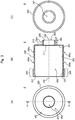
- Fig. 3(A) is a front view of the casing 2
- Fig. 3(B) is an A-A cross sectional view of the casing 2 illustrated in Fig. 3(A)
- Fig. 3(C) is a back view of the casing 2.
- a circular cylindrical chamber 200 with one end opened i.e. a space having a circular cylinder shape with a bottom
- insertion holes 208a, 208b passing through an inner peripheral surface 203 and an outer peripheral surface 205 are formed on this circular cylindrical chamber 200 for each partition 3 to be contained in the circular cylindrical chamber 200.
- Fixation bolts 90 inserted into the respective insertion holes 208a, 208b fixate the partitions 3 to the inside of the circular cylindrical chamber 200.
- An opening part 202 of a hollow cylindrical shape is formed on a bottom part 201 of the circular cylindrical chamber 200 axially outwardly from this bottom part 201.
- the torque regulation plate 8 is contained in the circular cylindrical chamber 200 (See Fig. 1 and Fig. 2 ) such that a center line 830 of the torque regulation plate 8 aligns with a center line 220 of the circular cylindrical chamber 200 and such that torque regulation plate 8 is capable of rotating relative to the casing 2.
- a pair of threaded holes 204 is formed on the opening part 202 so as to pass through an inner peripheral surface 209 and an outer peripheral surface 210.
- a limit screws 91 held fixed to the respective threaded holes 204 restrict rotation of the torque regulation plate 8 relative to the casing 2.
- An installation part 211 for installation of a sealing member, including an O-ring, is formed at a joint part between the bottom part 201 of the circular cylindrical chamber 200 and the opening part 202 (i.e. at an inner axial-end part of the opening part 202), and the sealing member is to fill a gap between the inner peripheral surface 209 of the opening part 202 and the operation part 802 of the torque regulation plate 8 so as to prevent the viscous fluid 6 in the circular cylindrical chamber 200 from leaking out.
- An internal threaded section 207 is formed in an opening side 206 of the inner peripheral surface 203 of the circular cylindrical chamber 200 so as to be screwed onto a described-below external threaded section 702 (See Fig. 7 ) of the lid 7.
- the partitions 3 each are a member in a shape of substantial open fan an outer peripheral surface 300 of which is brought into contact with the inner peripheral surface 203 of the circular cylindrical chamber 200 of the casing 2 and an inner peripheral surface 301 of which is brought into proximity to an outer peripheral surface 504 (See Fig. 6 ) of a described-below rotor body 500 of the rotor 5 contained in the circular cylindrical chamber 200 of the casing 2.
- Fig. 4(A) is a front view of the partition 3
- Fig. 4(B) is a B-B cross sectional view of the partition 3 illustrated in Fig. 4(A)
- Fig. 4(C) is a back view of the partition 3
- Fig. 4(D) is a C-C cross sectional view of the partition 3 (a top view of a partition block 30a) illustrated in Fig. 4(A) .
- each two partition blocks 30a, 30b are stacked one on top of another along the center line 220 of the circular cylindrical chamber 200 of the casing 2, thereby forming the partition 3.
- Bolt holes 304a, 304b for screwing the respective fixation bolts 90 thereinto are formed on the outer peripheral surfaces 300 of the partition blocks 30a, 30b.
- a flow path 303 is formed on each of the partitions 3 and passing through both of circumferential end-faces 305, 306 to communicate between the areas 216a, 216b into which the partitions 3 partitions the circular cylindrical chamber 200 of the casing 2 (See Fig. 9 and Fig. 10 ).
- a stopper 307 for preventing drop of the check valves 4 is formed on the upstream side of each flow path 303 (i.e. on the end face 306 side of the partition 3) against a first rotational direction R1 (See Fig. 9 and Fig. 10 ).
- the partition blocks 30a, 30b are stacked one on top of another such as a groove formed on an upper surface of the partition block 30a faces a groove formed on a lower surface of the partition block 30b, thus forming the flow path 303.
- each partition 3 having the above structure is contained in the circular cylindrical chamber 200 of the casing 2 in the following manner, with the check valves 4 attached thereto.
- the partition block 30a is put on the bottom part 201 of the circular cylindrical chamber 200 of the casing 2.
- the fixation bolt 90 is, through the insertion hole 208a of the casing 2, screwed into the bolt hole 304a formed on the outer peripheral surface 300 of the partition block 30a, thus fixating the partition block 30a to the circular cylindrical chamber 200 of the casing 2.
- the check valve 4 is placed on the end face 306 side of the partition 3 while being engaged with the stopper 307 of the flow path 303.
- the partition block 30b is put on the partition block 30a placed in the circular cylindrical chamber 200 of the casing 2.
- the fixation bolt 90 is, through the insertion hole 208b of the casing 2, screwed into the bolt hole 304b formed on the outer peripheral surface 300 of the partition block 30b, thus fixating the partition block 30b to the circular cylindrical chamber 200 of the casing 2.
- the partition 3 provided with the check valve 4 is brought into placement in the circular cylindrical chamber 200.
- Each of the check valves 4 opens and closes the flow path 303 in end face 306 side of the corresponding partition 3.
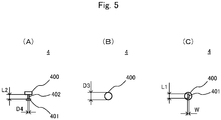
- Fig. 5(A) - Fig. 5(C) are respectively a front view, top view, and a bottom view, of the check valves 4.
- the check valves 4 each include a valving part 400 in a disk shape, an interlocking part 401, and a joint part 402 in a substantial cylindrical shape jointing the valving part 400 and the interlocking part 401.
- the valving part 400 has a diameter D3 larger than a diameter D1 (See Fig. 4(D) ) of an opening of the flow path 303 (an opening of the flow path 303, upstream side against the first rotational direction R1) on the end face 306 of the corresponding partition 3, and movement of the check valve 4 allows the opening of the flow path 303 on the end face 306 of the corresponding partition 3 to open and close.
- the interlocking part 401 is a plate-like member having a length L1 longer than the diameter D1 of the opening of the flow path 303 on the end face 306 of the corresponding partition 3 and shorter than a diameter D2 of the flow path 303, and having a width W narrower than the diameter D1 of the opening of the flow path 303 on the end face 306 of the corresponding partition 3.
- the joint part 402 is a cylindrical member having a diameter D4 smaller than the diameter D1 of the opening of the flow path 303 on the end face 306 of the corresponding partition 3.
- a length L2 of the joint part 402 of the check valve 4 is set long enough for the valving part 400 to open the flow path 303 while the interlocking part 401 engages with the stopper 307 of the flow path 303 and short such that the interlocking part 401 is allowed to move freely without contact with a side wall of the flow path 303 while the valving part 400 closes the flow path 303.
- the check valve 4 having the above structure is attached so as to position the valving part 400 outside on the end face 306 side of the corresponding partitions 3 and so as to position the interlocking part 401 behind the stopper 307 within the flow path 303.
- the rotor 5 is to be contained in the circular cylindrical chamber 200 so as to become rotatable relative to the circular cylindrical chamber 200 of the casing 2.
- Fig. 6(A) and Fig. 6(B) are respectively a front view and a side view, of the rotor 5, and Fig. 6(C) is a D-D cross sectional view of the rotor 5 illustrated in Fig. 6 (A) .
- the rotor 5 includes a rotor body 500 in substantial cylindrical shape, and a pair of vanes (rotating blades) 501 formed axisymmetrically with respect to a rotating axis 520 of the rotor body 500.
- the vanes 501 are formed along the rotating axis 520 of the rotor 5 so as to project radially outward from the outer peripheral surface 504 of the rotor body 500, and place respective front end faces 505 close to the inner peripheral surface 203 of the circular cylindrical chamber 200 of the casing 2 to partition the circular cylindrical chamber 200.
- a sliding member 508 is attached to each vane 501 as necessary and acts as a sealing member for filling gaps between the front end face 505 of the corresponding vane 501 and the inner peripheral surface 203 of the circular cylindrical chamber 200, between an upper surface 507 of the corresponding vane 501 and a lower surface 704 of the lid 7 (See Fig.
- a through hole 509 for insertion of a hexagonal shaft (not illustrated) for transmitting an external rotating-force to the rotor 5 is formed on the rotor body 500, with the rotating axis 520 as a center.
- An upper end part 502 of the rotor body 500 is to be rotatably inserted into an opening section 700 (See Fig. 7 ) of the lid 7, and a lower end part 503 of the rotor body 500 is to be rotatably inserted into an opening section 800 (See Fig. 8 ) of the torque regulation plate 8 placed on the bottom part 201 of the circular cylindrical chamber 200 of the casing 2(See Fig. 2 ).
- a sealing member (not illustrated), such as O-ring, may be interposed between the lower end part 503 of the rotor body 500 and the opening section 800 of the torque regulation plate 8 so that no external-leakage of the viscous fluid 6 occurs through the opening section 800 of the torque regulation plate 8.
- the lid 7 seals the pair of the partitions 3 each having the check valve 4 attached thereto, the rotor 5, and the torque regulation plate 8 along with the viscous fluid 6, in the casing 2.
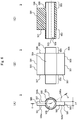
- Fig. 7(A) to Fig. 7(C) are respectively a front view, a side view, and a back view, of the lid 7, and Fig. 7(D) is an E-E cross sectional view of the lid 7 illustrated in Fig. 7(A)
- the lid 7 includes the opening section 700 formed to pass through an upper surface 703 and the lower surface 704 of the lid 7, at a position facing the opening part 202 formed on the bottom part 201 of the circular cylindrical chamber 200 of the casing 2.
- the upper end part 502 of the rotor body 500 of the rotor 5 is inserted into this opening section 700.
- An external threaded section 702 is formed on an outer peripheral surface 701 of the lid 7 to be screwed into the internal threaded section 207 formed on the opening side 206 of the inner peripheral surface 203 of the circular cylindrical chamber 200 of the casing 2.
- a sealing member(not illustrated), such as O-ring, may be interposed between the upper end part 502 of the rotor body 500 of the rotor 5 and the opening section 700 of the lid 7 so that no external-leakage of the viscous fluid 6 occurs through the opening section 700 of the lid 7.
- a sealing member (not illustrated), such as O-ring, may be interposed between the outer peripheral surface 701 of the lid 7 and the inner peripheral surface 203 of the circular cylindrical chamber 200 of the casing 2 so that no external-leakage of the viscous fluid 6 occurs through a screw-meshing part between the external threaded section 702 of the lid 7 and the internal threaded section 207 of the circular cylindrical chamber 200 of the casing 2.
- the torque regulation plate 8 is placed on the bottom part 201 of the circular cylindrical chamber 200 of the casing 2 to fill a gap between the bottom part 201 of the circular cylindrical chamber 200 and the vanes 501 of the rotor 5.
- Fig. 8(A) to Fig. 8(C) are respectively a front view, a side view, and a back view, of the torque regulation plate 8
- Fig. 8(D) is an F-F cross sectional view of the torque regulation plate 8 illustrated in Fig. 8(A) .
- the torque regulation plate 8 includes the followings: a torque regulation plate body 801 in a substantial disk shape, having at center the opening section 800 for insertion of the lower end part 503 of the rotor body 500 of the rotor 5; and the operation part 802 in a substantial hollow cylindrical shape connecting to the opening section 800 on a lower surface (i.e. a surface facing the bottom part 201 of the circular cylindrical chamber 200 of the casing 2) 804 of the torque regulation plate body 801.
- the torque regulation plate body 801 has an outer diameter slightly smaller than an inner diameter of the circular cylindrical chamber 200 of the casing 2; and on its upper surface 803, a pair of bypass passages 805, each in a substantial groove shape having a length L3 in a circumferential direction longer than a vane 501 thickness L4 in a rotational direction of the rotor 5, is formed so that the bypass passages 805 are arranged axisymmetrically with respect to the center line 830 of the torque regulation plate 8.
- the operation part 802 has a length L5 longer than a length L6 of the opening part 202 of the casing 2 and is inserted into the opening part 202 of the casing 2, so that its top part 806 become exposed by the opening part 202 of the casing 2 (See Fig. 1 ). Operator can turn the torque regulation plate body 801 relative to the casing 2 by operation of this exposed top part 806, and thereby arrange the bypass passage 805 at any position.
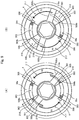
- Fig. 9(A) and Fig. 9(B) are explanatory diagrams of an operating principle on the occurrence of rotation of the rotor 5 in the first rotational direction R1 relative to the casing 2.
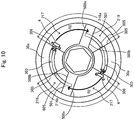
- Fig. 10 is an explanatory diagram of an operating principle on the occurrence of rotation of the rotor 5 in a second rotational direction R2 relative to the casing 2.
- the viscous fluid 6 in these area 218 flows into the respective flow paths 303.
- Force applied by the viscous fluid 6 flowing into these flow path 303 causes the check valves 4 to open the respective flow path 303, and the viscous fluid 6 flowing from the areas 218 into the respective flow path 303 discharges into the respective area 217. Consequently, pressure on the viscous fluid 6 in the areas 218 doesn't rise so high, and therefore generates a small damping torque in relation to a rotating force in the second rotational direction R2 of this rotor 5.
- the torque regulation plate 8 is placed on the bottom part 201 of the circular cylindrical chamber 200 of the casing 2 to fill the gap between the bottom part 201 of the circular cylindrical chamber 200 and the vanes 501 of the rotor 5, and the bypass passages 805, each in a substantial groove shape having the length L3 larger in circumferential direction than the vane 501 thickness L4 in the rotational direction of the rotor 5, are formed on the upper surface 803 of the torque regulation plate body 801 of this torque regulation plate 8.
- change of lengths and arrangement positions of the grooves forming each bypass passage 805 allows for optional setting a timing for generation of a large damping torque in relation to a rotating force on the rotor 5.
- the torque regulation plate 8 is provided with the operation part 802 having the length L5 longer than the length L6 of the opening part 202 of the casing 2 and being inserted into the opening part 202 of the casing 2 to expose its top part 806 out of the opening part 202 of the casing 2. Therefore, operator can turn the torque regulation plate body 801 relative to the casing 2 by operating this exposed top part 806, and thereby arrange each bypass passage 805 at any position.
- each sliding member 508 is attached to the corresponding vane 501 of the rotor 5 so that the sliding member 508 can act as the sealing member for filling between the front end face 505 of the vane 501 and the inner peripheral surface 203 of the circular cylindrical chamber 200, between the lower surface 506 of the vane 501 and the bottom part 201 of the circular cylindrical chamber 200, and between the upper surface 507 of the vane 501 and the lower surface 704 of the lid 7, thereby closing the gaps therebetween whereas achieving improvement of sliding properties.
- the present invention can include, but is not limited to, the above embodiment : it will be obvious to those skilled in the art that various changes may be made without departing from the scope of the invention.
- the present invention can include, but is not limited to, the above embodiment in which placement of the torque regulation plate 8 on the bottom part 201 of the circular cylindrical chamber 200 of the casing 2 forms the bypass passages 805 on the bottom part 201 side of the circular cylindrical chamber 200.
- the bypass passages may be formed on the lower surface 704 side of the lid 7 or be formed on the inner peripheral surface 203 side of the circular cylindrical chamber 200.
- Fig. 11(A) is a schematic cross-sectional view of a first modification 1A of the rotary damper 1 according to one embodiment of the present invention.
- the rotary damper 1A illustrated in Fig. 11(A) differs from the rotary damper 1 according to the embodiment of the present invention in the following respects: the torque regulation plate 8, with the operation part 802 inserted in the opening section 700 of the lid 7 and with the surface of the torque regulation plate body 801 where the bypass passages 805 are formed toward the circular cylindrical chamber 200, is placed onto the lower surface 704 of the lid 7 to fill in the gap between the lower surface 704 of the lid 7 and the vanes 501 of the rotor 5; an annular protrusion 705 shorter in a total length including a thickness of the lid 7 than the length of the operation part 802 of the torque regulation plate 8 is formed on the upper surface 703 of the lid 7 to surround the opening section 700, and the top part 806 of the operation part 802 of the torque regulation plate 8 is exposed out of the annular protrusion 705; and a pair of threaded holes for screwing the limit screws 91 is formed in this annular protrusion 705.
- Other components are similar to those of the
- operator can turn the torque regulation plate body 801 relative to the casing 2 by operating the top part 806 of the operation part 802 of the torque regulation plate 8 exposed out of the annular protrusion 705 formed on the upper surface 703 of the lid 7, thereby placing each bypass passage 805 at any position.
- the limit screws 91 are screwed into the respective threaded holes of this annular protrusion 705 to force tips of the limit screws 91 against the operation part 802, and this results in limiting rotation of the torque regulation plate body 801 relative to the casing 2, thereby allowing for fixing each bypass passage 805 at any position.
- Other advantages are similar to those of the rotary damper 1 according to the embodiment of the present invention.
- Fig. 11(B) is a schematic cross-sectional view of a second modification 1B of the rotary damper 1 according to one embodiment of the present invention
- the rotary damper 1B illustrated in Fig. 11(B) differs from the rotary damper 1 according to the embodiment of the present invention in the following respects: the partitions 3, with the check valves 4 attached, are contained in the circular cylindrical chamber 200 so as to form gaps between the outer peripheral surface 300 of the partitions 3 and the inner peripheral surface 203 of the circular cylindrical chamber 200 of the casing 2 in a manner such that the partition block 30a, 30b are stacked one on top of another on the bottom part 201 of the circular cylindrical chamber 200 and are fixed by fixation bolts 92 through respective through holes located on the bottom part 201 of the circular cylindrical chamber 200; a torque regulation cylinder 82 is provided instead of the torque regulation plate 8; the annular protrusion 705 is formed on the upper surface 703 of the lid 7 to surround the opening section 700; and a pair of threaded holes for screwing the limit screws 91 is formed in this annular protrusion 705.
- Other components are similar to those of the rotary damper 1 according to the embodiment of the present invention.
- the torque regulation cylinder 82 includes the follows: a torque regulation cylinder body 821 having a lower end opened and upper end on which an end face 822 is formed to include an opening section 820 to insert the upper end part 502 of the rotor body 500 of the rotor 5 into; and an operation part 823 in a substantial hollow cylindrical shape connected to the opening section 820 on a face 824 opposite to the end face 822 of the torque regulation cylinder body 821.
- the torque regulation cylinder body 821 has an outer diameter slightly smaller than the inner diameter of the circular cylindrical chamber 200 of the casing 2 and an inner diameter slightly larger than a diameter of a circle including the outer peripheral surfaces 300 of the partitions 3 and the front end faces 505 of the vanes 501 of the rotor, and is attached to the circular cylindrical chamber 200 so as to fill individual gap between the inner peripheral surface 203 of the circular cylindrical chamber 200 and the outer peripheral surface 300 of each partition 3 or the front end face 505 of each vane 501.
- a pair of slit-like bypass passages 825 larger in circumferential length than the vane 501 thickness L4 in the rotational direction of the rotor 5 so as to be axisymmetrically arranged with respect to a center line 840 of the torque regulation cylinder 82.
- the operation part 823 is larger in length than total of a thickness of the lid 7 and a length of the annular protrusion 705, and is inserted into the opening section 700 of the lid 7 to expose its top part 826 out of the annular protrusion 705 of the lid 7
- operator can turn the torque regulation cylinder body 821 relative to the casing 2 by operating the top part 826 of the operation part 823 of the torque regulation cylinder 82, exposed out of the annular protrusion 705 formed on the upper surface 703 of the lid 7, and thereby arrange each bypass passage 825 at any position. Then, the limit screws 91 are screwed into the respective threaded holes of this annular protrusion 705 to force the tips of the limit screws 91 against the operation part 823, and this results in limiting rotation of the torque regulation cylinder body 821 relative to the casing 2, thereby allowing for fixing each bypass passage 805 at any position.
- Other advantages are similar to those of the rotary damper 1 according to the embodiment of the present invention.
- the present invention can include, but not limited to, the above embodiment in which the limit screws 91 limit rotation of the torque regulation plate 8 relative to the casing 2. After turn of the torque regulation plate 8 relative to the casing 2 has arranged each bypass passage 805 at any position, other manner, such as adhesive, may fixate the torque regulation plate 8 to the casing 2, thereby limiting rotation of the torque regulation plate 8 relative to the casing 2.
- each bypass passage 805 is formed using the torque regulation plate 8; however, the present invention is not limited to this example.
- a pair of the bypass passages, each in a substantial groove shape being longer in circumferential length than the vane 501 thickness L4 in the rotational direction of the rotor 5, may be directly formed on at least one of the followings: the bottom part 201, the inner peripheral surface 203, of the circular cylindrical chamber 200 of the casing 2, and the lower surface 704 of the lid 7.
- each flow path 303 is formed on the corresponding partition 3; however, the present invention is not limited to this example.
- a flow path may be formed on the vane 501 of the rotor 5 so as to communicate between the area 217 and the area 218.
- the present invention is not limited to this example.
- the partition (s) 3 and the vane(s) 501 are the same in number, the number of the partition(s) 3 and the number of the vane(s) 501, to be formed, each may be one, or three or more. In this case, the number of the bypass passage(s) 805 to be formed is the same as these.
- the above embodiments each have been described with, as an example, the so-called uni-directional rotary damper that is capable of generating a large damping torque during relative rotation of the rotor 5 to the casing 2 in the first rotational direction R1 and of generating a small damping torque during relative rotation in the second rotational direction R2, namely in the direction opposite to the first rotational direction R1.
- the present invention may also be applied to a so-called bi-directional rotary damper capable of generating a large damping torque during relative rotation of the rotor 5 to the casing 2 in any of the first rotational direction R1 and the second rotational direction R2.
- the rotary damper according to the present invention is widely applicable to seats with reclining function as used in, for example, automobiles, railroad vehicles, aircrafts, and vessels.
Landscapes
- Engineering & Computer Science (AREA)
- General Engineering & Computer Science (AREA)
- Mechanical Engineering (AREA)
- Fluid-Damping Devices (AREA)
Abstract
Description
- The present invention relates to a rotary damper, and in particular relates to a rotary damper with settable timing for generation of a damping torque.
- A known damper generates a damping torque in reaction to applied rotating force. For example, the
Patent Literature 1 discloses so-called uni-directional rotary damper capable of generating a large damping torque in relation to a rotation in a forward direction, whereas a small damping torque in relation to a rotation in a backward direction. - The rotary damper described in the
Patent Literature 1 includes a casing having a circular cylindrical chamber, a rotor rotatably contained in the circular cylindrical chamber, viscous fluid filled in the circular cylindrical chamber, and a lid attached to an opening end of the casing for sealing the rotor along with the viscous fluid in the circular cylindrical chamber. - The rotor includes a rotor body of a substantial cylindrical shape, and vanes each formed projecting radially outward from an outer peripheral surface of the rotor body and generating a narrow gap between an inner peripheral surface of the circular cylindrical chamber and the vane itself. A flow path is formed on each of the vanes so as to pass through surfaces, at both ends in a rotational direction of the rotor, of the corresponding vane. A sealing member is attached to a surface, at an end in a radial direction of the rotor, of each vane (i.e. a surface facing the inner peripheral surface of the circular cylindrical chamber) to fill the narrow gap between the surface and the inner peripheral surface of the circular cylindrical chamber. Each of these sealing members has a check valve made of elastic material for opening and closing the flow path formed on the corresponding vane. The inner peripheral surface of the circular cylindrical chamber is provided with partitions protruding radially inwardly such that a narrow gap is generated between each partition and the outer peripheral surface of the rotor body.
- For the structure as described above, in the rotary damper described in the
Patent Literature 1, when a force is applied to the rotor to cause the rotor to rotate in a direction from one surface (hereinafter referred to as "first end surface") toward another surface (hereinafter referred to as "second end surface") out of the surfaces, at both ends in the rotational direction of the rotor, of each vane, namely in the forward direction, the viscous fluid in the circular cylindrical chamber presses each check valve against the second end surface of the corresponding vane to close and thus the check valve closes the corresponding flow path. This restricts movement of the viscous fluid to way only through the gap between each partition of the circular cylindrical chamber and the outer peripheral surface of the rotor body and a gap between a closed end surface (i.e. a bottom surface) of the casing and a lower surface of each vane (i.e. a surface facing the closed end surface of the casing), thereby increasing a pressure on the viscous fluid on the second end surface side of the vane. This results in generating a large damping torque with the start of rotating the rotor in the forward direction. When a force, conversely, is applied to the rotor to cause the rotor to rotate in a direction from the second end surface toward the first end surface of each vane (i.e. the backward direction), the viscous fluid on the first end surface side of each vane flows into the corresponding flow path to push up the corresponding check valve and to open the flow path. This allows the viscous fluid to move also through the flow path formed in each vane, thus not increasing the pressure on the viscous fluid on the first end surface side of the vane. This results in generating a small damping torque with the start of rotating the rotor in the backward direction. - Patent Literature 1: Japanese Unexamined Patent Application Laid-Open No.
H07-301272 - For the rotary damper described in the
Patent Literature 1, application of the rotating force in the forward direction to the rotor causes each check valve to block the corresponding flow path immediately, thereby generating the large damping torque. However, some uses of the rotary damper may intend not to generate the large damping torque immediately after application of the rotating force in the forward direction to the rotor, but to delay timing of generating the large damping torque. - The present invention has been made in view of the above situation, and an object of the present invention is to provide a rotary damper with settable timing for generation of a damping torque.
- In response to the above issue, according to the present invention, a bypass passage is formed on one or both of a bottom side or an inner peripheral surface side of circular cylindrical chamber and/or on a lower side of a lid, and includes a groove longer than a thickness of a vane in a rotational direction of a rotor. When surfaces, at both ends in the rotational direction of the rotor, of the vane are located inside of a range of the bypass passage, areas upstream and downstream from the vane against the rotational direction of the rotor are communicated with each other through the bypass passage, and therefore this results in the viscous fluid in these areas becoming movable through the bypass passage; conversely, when at least one of the surfaces, at both ends in the rotational direction of the rotor, of the vane is located outside of the range of the bypass passage, the bypass passage provides no communication between the areas upstream and downstream from the vane against the rotational direction of the rotor, and therefore this results in the viscous fluid in these areas becoming immovable through the bypass passage.
- For example, the present invention provides a rotary damper for limiting a movement of a viscous fluid to generate a damping torque in reaction to a rotating force applied. The rotary damper includes the followings:
- a casing having a circular cylindrical chamber filled by the viscous fluid;
- a partition in a shape of substantial open fan, placed in the circular cylindrical chamber and partitioning an inside of the circular cylindrical chamber;
- a rotor having a rotor body and a vane, the rotor body contained in the circular cylindrical chamber rotatably relative to the circular cylindrical chamber and placing an outer peripheral surface close to an inner peripheral surface of the partition, the vane formed along a center line of the circular cylindrical chamber and radially outwardly from the outer peripheral surface of the rotor body to place a front end face close to an inner peripheral surface of the circular cylindrical chamber;
- a lid attached to an opening section of the circular cylindrical chamber and sealing the rotor along with the viscous fluid within the circular cylindrical chamber; and
- a bypass passage having a groove longer than a thickness of the vane in a rotational direction of the rotor, the groove being located on one or both of a bottom side or an inner peripheral surface side of the circular cylindrical chamber and/or on a lower side of the lid;
- upon faces that form both ends of the vane in the rotational direction of the rotor being located inside of a range of the bypass passage, an area upstream and an area downstream from the vane against the rotational direction of the rotor being communicated with each other through the bypass passage, out of the areas in the circular cylindrical chamber partitioned by the vane and the partition, and the viscous fluid in the area upstream and in the area downstream becoming movable through the bypass passage; and
- upon at least one of the faces that form the both ends of the vane in the rotational direction of the rotor being located outside of the range of the bypass passage, the bypass passage providing no communication between the area upstream and the area downstream from the vane and the viscous fluid in the area upstream and in the area downstream becoming immovable through the bypass passage.
- In the present invention, the bypass passage including the groove longer than the thickness of the vane in the rotational direction of the rotor, is located on one or both of the bottom side or the inner peripheral surface side of the circular cylindrical chamber and/or on the lower side of the lid; while the surfaces at both end of the vane in the rotational direction of the rotor are located inside the bypass passage, the area upstream and the area downstream from the vane against the rotational direction of the rotor are communicated to each other through the bypass passage and the viscous fluid in these area upstream and the area downstream become movable through the bypass passage, resulting in generation of no large damping torque in relation to a rotating force on the rotor. Conversely, while at least one of the surfaces forming both ends of the vane in the rotational direction of the rotor are located outside the bypass passage, the bypass passage provides no communication between the areas upstream and downstream from the vane against the rotational direction of the rotor and the viscous fluid in these areas becomes immovable through the bypass passage, resulting in generation of a large damping torque in relation to a rotating force on the rotor. Consequently, changing a length and a position of the groove included in the bypass passage allows for optional setting a timing when a damping torque generates in relation to a rotating force on the rotor.
-
- [
Fig. 1] Fig. 1(A) and Fig. 1(B) are respectively an external view and a partial cross sectional view, each illustrating a schematic configuration of arotary damper 1 according to one embodiment of the present invention. - [
Fig. 2] Fig. 2 is an illustrated parts breakdown of therotary damper 1 according to the embodiment of the present invention. - [
Fig. 3] Fig. 3(A) is a front view of acasing 2,Fig. 3(B) is an A-A cross sectional view of thecasing 2 illustrated inFig. 3(A), and Fig. 3(C) is a back view of thecasing 2. - [
Fig. 4] Fig. 4(A) is a front view of apartition 3,Fig. 4(B) is a B-B cross sectional view of thepartition 3 illustrated inFig. 4(A), Fig. 4(C) is a back view of thepartition 3, andFig. 4(D) is a C-C cross sectional view of the partition 3 (a top view of apartition block 30a) illustrated inFig. 4(A) . - [
Fig. 5] Fig. 5(A) to Fig. 5(C) are respectively a front view, a top view, and a bottom view, of acheck valve 4. - [
Fig. 6] Fig. 6(A) and Fig. 6(B) are respectively a front view and a side view, of arotor 5, andFig. 6(C) is a D-D cross sectional view of therotor 5 illustrated inFig. 6 (A) . - [
Fig. 7] Fig. 7(A) to Fig. 7(C) are respectively a front view, a side view, and a back view, of alid 7, andFig. 7(D) is an E-E cross sectional view of thelid 7 illustrated inFig. 7(A) . - [
Fig. 8] Fig. 8(A) to Fig. 8(C) are respectively a front view, a side view, and a back view, of atorque regulation plate 8, andFig. 8(D) is an F-F cross sectional view of thetorque regulation plate 8 illustrated inFig. 8(A) . - [
Fig. 9] Fig. 9(A) and Fig. 9(B) are explanatory diagrams of an operating principle on the occurrence of rotation of therotor 5 in a first rotational direction R1 relative to thecasing 2. - [
Fig. 10] Fig. 10 is an explanatory diagram of an operating principle on the occurrence of rotation of therotor 5 in a second rotational direction R2 relative to thecasing 2. - [
Fig. 11] Fig. 11(A) is a schematic cross-sectional view of afirst modification 1A of therotary damper 1 according to the embodiment of the present invention, andFig. 11(B) is a schematic cross-sectional view of asecond modification 1B of therotary damper 1 according to the embodiment of the present invention. - In the following, one embodiment of the present invention will be described with reference to the drawings.
-
Fig. 1(A) and Fig. 1(B) are respectively an external view and a partial cross sectional view, each illustrating a schematic configuration of arotary damper 1 according to the present embodiment.Fig. 2 is an illustrated parts breakdown of therotary damper 1 according to the present embodiment. - As illustrated in the figures, the
rotary damper 1 according to the present embodiment includes acasing 2; a pair ofpartitions 3; a pair ofcheck valves 4; arotor 5;viscous fluid 6 filled in thecasing 2, such as oil and silicone; alid 7; and atorque regulation plate 8. - The
casing 2 contains the pair of thepartitions 3 to each of which thecheck valve 4 is attached, therotor 5, and thetorque regulation plate 8, along with theviscous fluid 6. -
Fig. 3(A) is a front view of thecasing 2,Fig. 3(B) is an A-A cross sectional view of thecasing 2 illustrated inFig. 3(A), and Fig. 3(C) is a back view of thecasing 2. - As illustrated in the figures, a circular
cylindrical chamber 200 with one end opened (i.e. a space having a circular cylinder shape with a bottom) is formed inside of thecasing 2, andinsertion holes peripheral surface 203 and an outerperipheral surface 205 are formed on this circularcylindrical chamber 200 for eachpartition 3 to be contained in the circularcylindrical chamber 200.Fixation bolts 90 inserted into therespective insertion holes partitions 3 to the inside of the circularcylindrical chamber 200. - An
opening part 202 of a hollow cylindrical shape is formed on abottom part 201 of the circularcylindrical chamber 200 axially outwardly from thisbottom part 201. When a insertion of anoperation part 802 as described below (SeeFig. 8 ) into thisopening part 202, thetorque regulation plate 8 is contained in the circular cylindrical chamber 200 (SeeFig. 1 andFig. 2 ) such that acenter line 830 of thetorque regulation plate 8 aligns with acenter line 220 of the circularcylindrical chamber 200 and such thattorque regulation plate 8 is capable of rotating relative to thecasing 2. A pair of threadedholes 204 is formed on theopening part 202 so as to pass through an innerperipheral surface 209 and an outerperipheral surface 210. Alimit screws 91 held fixed to the respective threadedholes 204 restrict rotation of thetorque regulation plate 8 relative to thecasing 2. - An
installation part 211 for installation of a sealing member, including an O-ring, is formed at a joint part between thebottom part 201 of the circularcylindrical chamber 200 and the opening part 202 (i.e. at an inner axial-end part of the opening part 202), and the sealing member is to fill a gap between the innerperipheral surface 209 of theopening part 202 and theoperation part 802 of thetorque regulation plate 8 so as to prevent theviscous fluid 6 in the circularcylindrical chamber 200 from leaking out. - An internal threaded
section 207 is formed in anopening side 206 of the innerperipheral surface 203 of the circularcylindrical chamber 200 so as to be screwed onto a described-below external threaded section 702 (SeeFig. 7 ) of thelid 7. - The
partitions 3 each are a member in a shape of substantial open fan an outerperipheral surface 300 of which is brought into contact with the innerperipheral surface 203 of the circularcylindrical chamber 200 of thecasing 2 and an innerperipheral surface 301 of which is brought into proximity to an outer peripheral surface 504 (SeeFig. 6 ) of a described-below rotor body 500 of therotor 5 contained in the circularcylindrical chamber 200 of thecasing 2. The pair of thepartitions 3, along thecenter line 220 of the circularcylindrical chamber 200 of thecasing 2 and axisymmetrically with respect to thiscenter axis 220, is arranged with the innerperipheral surface 301 of eachpartition 3 facing inward in a radial direction of the circularcylindrical chamber 200, thus partitioning an inside of the circularcylindrical chamber 200 into twoareas Fig. 9 andFig. 10 ). -
Fig. 4(A) is a front view of thepartition 3,Fig. 4(B) is a B-B cross sectional view of thepartition 3 illustrated inFig. 4(A), Fig. 4(C) is a back view of thepartition 3, andFig. 4(D) is a C-C cross sectional view of the partition 3 (a top view of apartition block 30a) illustrated inFig. 4(A) . - As illustrated in the figures, each two
partition blocks center line 220 of the circularcylindrical chamber 200 of thecasing 2, thereby forming thepartition 3.Bolt holes respective fixation bolts 90 thereinto are formed on the outerperipheral surfaces 300 of thepartition blocks - A
flow path 303 is formed on each of thepartitions 3 and passing through both of circumferential end-faces 305, 306 to communicate between theareas partitions 3 partitions the circularcylindrical chamber 200 of the casing 2 (SeeFig. 9 andFig. 10 ). Astopper 307 for preventing drop of thecheck valves 4 is formed on the upstream side of each flow path 303 (i.e. on theend face 306 side of the partition 3) against a first rotational direction R1 (SeeFig. 9 andFig. 10 ). - The partition blocks 30a, 30b are stacked one on top of another such as a groove formed on an upper surface of the
partition block 30a faces a groove formed on a lower surface of thepartition block 30b, thus forming theflow path 303. - For example, each
partition 3 having the above structure is contained in the circularcylindrical chamber 200 of thecasing 2 in the following manner, with thecheck valves 4 attached thereto. First, thepartition block 30a is put on thebottom part 201 of the circularcylindrical chamber 200 of thecasing 2. Then, thefixation bolt 90 is, through theinsertion hole 208a of thecasing 2, screwed into thebolt hole 304a formed on the outerperipheral surface 300 of thepartition block 30a, thus fixating thepartition block 30a to the circularcylindrical chamber 200 of thecasing 2. After then, thecheck valve 4 is placed on theend face 306 side of thepartition 3 while being engaged with thestopper 307 of theflow path 303. - Next, the
partition block 30b is put on thepartition block 30a placed in the circularcylindrical chamber 200 of thecasing 2. Then, thefixation bolt 90 is, through theinsertion hole 208b of thecasing 2, screwed into thebolt hole 304b formed on the outerperipheral surface 300 of thepartition block 30b, thus fixating thepartition block 30b to the circularcylindrical chamber 200 of thecasing 2. In the manner as described above, thepartition 3 provided with thecheck valve 4 is brought into placement in the circularcylindrical chamber 200. - Each of the
check valves 4 opens and closes theflow path 303 inend face 306 side of thecorresponding partition 3. -
Fig. 5(A) - Fig. 5(C) are respectively a front view, top view, and a bottom view, of thecheck valves 4. - As illustrated in the figures, the
check valves 4 each include avalving part 400 in a disk shape, an interlockingpart 401, and ajoint part 402 in a substantial cylindrical shape jointing thevalving part 400 and the interlockingpart 401. - The
valving part 400 has a diameter D3 larger than a diameter D1 (SeeFig. 4(D) ) of an opening of the flow path 303 (an opening of theflow path 303, upstream side against the first rotational direction R1) on theend face 306 of thecorresponding partition 3, and movement of thecheck valve 4 allows the opening of theflow path 303 on theend face 306 of thecorresponding partition 3 to open and close. - The interlocking
part 401 is a plate-like member having a length L1 longer than the diameter D1 of the opening of theflow path 303 on theend face 306 of thecorresponding partition 3 and shorter than a diameter D2 of theflow path 303, and having a width W narrower than the diameter D1 of the opening of theflow path 303 on theend face 306 of thecorresponding partition 3. When thevalving part 400 moves in a direction of opening the opening of theflow path 303 on theend face 306 of thecorresponding partition 3, the interlockingpart 401 engages with thestopper 307 of theflow path 303 to prevent drop of thecheck valve 4 from theflow path 303. - The
joint part 402 is a cylindrical member having a diameter D4 smaller than the diameter D1 of the opening of theflow path 303 on theend face 306 of thecorresponding partition 3. A length L2 of thejoint part 402 of thecheck valve 4 is set long enough for thevalving part 400 to open theflow path 303 while the interlockingpart 401 engages with thestopper 307 of theflow path 303 and short such that the interlockingpart 401 is allowed to move freely without contact with a side wall of theflow path 303 while thevalving part 400 closes theflow path 303. - The
check valve 4 having the above structure is attached so as to position thevalving part 400 outside on theend face 306 side of thecorresponding partitions 3 and so as to position the interlockingpart 401 behind thestopper 307 within theflow path 303. - The
rotor 5 is to be contained in the circularcylindrical chamber 200 so as to become rotatable relative to the circularcylindrical chamber 200 of thecasing 2. -
Fig. 6(A) and Fig. 6(B) are respectively a front view and a side view, of therotor 5, andFig. 6(C) is a D-D cross sectional view of therotor 5 illustrated inFig. 6 (A) . - As illustrated in the figures, the
rotor 5 includes arotor body 500 in substantial cylindrical shape, and a pair of vanes (rotating blades) 501 formed axisymmetrically with respect to arotating axis 520 of therotor body 500. - The
vanes 501 are formed along therotating axis 520 of therotor 5 so as to project radially outward from the outerperipheral surface 504 of therotor body 500, and place respective front end faces 505 close to the innerperipheral surface 203 of the circularcylindrical chamber 200 of thecasing 2 to partition the circularcylindrical chamber 200. A slidingmember 508 is attached to eachvane 501 as necessary and acts as a sealing member for filling gaps between thefront end face 505 of thecorresponding vane 501 and the innerperipheral surface 203 of the circularcylindrical chamber 200, between anupper surface 507 of thecorresponding vane 501 and alower surface 704 of the lid 7 (SeeFig. 7 ), and between anlower surface 506 of thecorresponding vane 501 and an upper surface 803 (SeeFig. 8 ) of the torque regulation plate 8 (SeeFig. 1 andFig. 2 ). Resin excellent in sliding properties, such as polyamide resin, is used as a material of the slidingmembers 508. - A through
hole 509 for insertion of a hexagonal shaft (not illustrated) for transmitting an external rotating-force to therotor 5 is formed on therotor body 500, with therotating axis 520 as a center. Anupper end part 502 of therotor body 500 is to be rotatably inserted into an opening section 700 (SeeFig. 7 ) of thelid 7, and alower end part 503 of therotor body 500 is to be rotatably inserted into an opening section 800 (SeeFig. 8 ) of thetorque regulation plate 8 placed on thebottom part 201 of the circularcylindrical chamber 200 of the casing 2(SeeFig. 2 ). A sealing member (not illustrated), such as O-ring, may be interposed between thelower end part 503 of therotor body 500 and theopening section 800 of thetorque regulation plate 8 so that no external-leakage of theviscous fluid 6 occurs through theopening section 800 of thetorque regulation plate 8. - The
lid 7 seals the pair of thepartitions 3 each having thecheck valve 4 attached thereto, therotor 5, and thetorque regulation plate 8 along with theviscous fluid 6, in thecasing 2. -
Fig. 7(A) to Fig. 7(C) are respectively a front view, a side view, and a back view, of thelid 7, andFig. 7(D) is an E-E cross sectional view of thelid 7 illustrated inFig. 7(A) - As illustrated in the figures, the
lid 7 includes theopening section 700 formed to pass through anupper surface 703 and thelower surface 704 of thelid 7, at a position facing theopening part 202 formed on thebottom part 201 of the circularcylindrical chamber 200 of thecasing 2. Theupper end part 502 of therotor body 500 of therotor 5 is inserted into thisopening section 700. An external threadedsection 702 is formed on an outerperipheral surface 701 of thelid 7 to be screwed into the internal threadedsection 207 formed on theopening side 206 of the innerperipheral surface 203 of the circularcylindrical chamber 200 of thecasing 2. A sealing member(not illustrated), such as O-ring, may be interposed between theupper end part 502 of therotor body 500 of therotor 5 and theopening section 700 of thelid 7 so that no external-leakage of theviscous fluid 6 occurs through theopening section 700 of thelid 7. Similarly, a sealing member (not illustrated), such as O-ring, may be interposed between the outerperipheral surface 701 of thelid 7 and the innerperipheral surface 203 of the circularcylindrical chamber 200 of thecasing 2 so that no external-leakage of theviscous fluid 6 occurs through a screw-meshing part between the external threadedsection 702 of thelid 7 and the internal threadedsection 207 of the circularcylindrical chamber 200 of thecasing 2. - The
torque regulation plate 8 is placed on thebottom part 201 of the circularcylindrical chamber 200 of thecasing 2 to fill a gap between thebottom part 201 of the circularcylindrical chamber 200 and thevanes 501 of therotor 5. -
Fig. 8(A) to Fig. 8(C) are respectively a front view, a side view, and a back view, of thetorque regulation plate 8, andFig. 8(D) is an F-F cross sectional view of thetorque regulation plate 8 illustrated inFig. 8(A) . - As illustrated in the figures, the
torque regulation plate 8 includes the followings: a torqueregulation plate body 801 in a substantial disk shape, having at center theopening section 800 for insertion of thelower end part 503 of therotor body 500 of therotor 5; and theoperation part 802 in a substantial hollow cylindrical shape connecting to theopening section 800 on a lower surface (i.e. a surface facing thebottom part 201 of the circularcylindrical chamber 200 of the casing 2) 804 of the torqueregulation plate body 801. - The torque
regulation plate body 801 has an outer diameter slightly smaller than an inner diameter of the circularcylindrical chamber 200 of thecasing 2; and on itsupper surface 803, a pair ofbypass passages 805, each in a substantial groove shape having a length L3 in a circumferential direction longer than avane 501 thickness L4 in a rotational direction of therotor 5, is formed so that thebypass passages 805 are arranged axisymmetrically with respect to thecenter line 830 of thetorque regulation plate 8. - The
operation part 802 has a length L5 longer than a length L6 of theopening part 202 of thecasing 2 and is inserted into theopening part 202 of thecasing 2, so that itstop part 806 become exposed by theopening part 202 of the casing 2 (SeeFig. 1 ). Operator can turn the torqueregulation plate body 801 relative to thecasing 2 by operation of this exposedtop part 806, and thereby arrange thebypass passage 805 at any position. Then, the limit screws 91 are screwed into the respective threadedholes 204 of theopening part 202 of thecasing 2 to force the tips of the limit screws 91 against theoperation part 802, and this results in limiting rotation of the torqueregulation plate body 801 relative to thecasing 2, thereby allowing for fixing eachbypass passage 805 at any position. - Secondary, operating principles of the
rotary damper 1 will be described. -
Fig. 9(A) and Fig. 9(B) are explanatory diagrams of an operating principle on the occurrence of rotation of therotor 5 in the first rotational direction R1 relative to thecasing 2.Fig. 10 is an explanatory diagram of an operating principle on the occurrence of rotation of therotor 5 in a second rotational direction R2 relative to thecasing 2. - As illustrated in
Fig. 9(A) and Fig. 9(B) , when therotor 5 is first rotated in the first rotational direction R1 relative to thecasing 2,areas 217 between thevanes 501 of therotor 5 and the end faces 306 on the upstream side of therespective partitions 3 with respect to the first rotational direction R1, become compressed. - As a result, the
check valves 4 close therespective flow paths 303 under pressure on theviscous fluid 6 in theareas 217, therefore causing no movement of theviscous fluid 6 through therespective flow paths 303 from theareas 217 intoareas 218 between thevanes 501 of therotor 5 and theend face 305 on downstream side of thepartitions 3 with respect to the first rotational direction R1. As illustrated inFig. 9(A) , when faces 508a, 508b at both ends of eachvane 501 in the rotational direction of therotor 5, however, are located in circumferential range of thecorresponding bypass passage 805, eacharea 217 and thecorresponding area 218 communicate through thecorresponding bypass passage 805 and movement from thearea 217 to thearea 218 is caused though thisbypass passage 805. Consequently, pressure on theviscous fluid 6 in thearea 217 doesn't rise so high and therefore generates a small damping torque in relation to rotating force in the first rotational direction R1 of thisrotor 5. - When the
rotor 5 then rotates further in the first rotational direction R1 relative to thecasing 2 to locate at least one of thefaces vane 501 in the rotational direction of therotor 5 outside the circumferential range of thecorresponding bypass passage 805 as illustrated inFig. 9(B) , communication between eacharea 217 and thecorresponding area 218 through thecorresponding bypass passage 805 gets closed off, and therefore no movement of theviscous fluid 6 from eacharea 217 to thecorresponding area 218 is caused through thecorresponding bypass passage 805. This allows movement of theviscous fluid 6 only through a gap between the innerperipheral surface 301 of eachpartition 3 and the outerperipheral surface 504 of therotor body 500 of therotor 5, through the gap between theupper surface 803 of thetorque regulation plate 8 and thelower surface 506 of eachvane 501 of therotor 5, and through the gap between thelower surface 704 of thelid 7 and theupper surface 507 of eachvane 501 of therotor 5, resulting in increase of pressure on theviscous fluid 6 in eacharea 217. Consequently, a large damping torque generates in relation to a rotating force in the first rotational direction R1 of thisrotor 5. - As illustrated in
Fig. 10 , when therotor 5 rotates in a second rotational direction R2, namely in the direction opposite to the first rotational direction R1, relative to thecasing 2, conversely, eacharea 218 between thecorresponding vane 501 of therotor 5 and theend face 305 on upstream side of thecorresponding partition 3 with respect to the second rotational direction R2, is compressed. - As a result, the
viscous fluid 6 in thesearea 218 flows into therespective flow paths 303. Force applied by theviscous fluid 6 flowing into theseflow path 303 causes thecheck valves 4 to open therespective flow path 303, and theviscous fluid 6 flowing from theareas 218 into therespective flow path 303 discharges into therespective area 217. Consequently, pressure on theviscous fluid 6 in theareas 218 doesn't rise so high, and therefore generates a small damping torque in relation to a rotating force in the second rotational direction R2 of thisrotor 5. - Hereinabove, one embodiment of the present invention has been described.
- In the present embodiment, the
torque regulation plate 8 is placed on thebottom part 201 of the circularcylindrical chamber 200 of thecasing 2 to fill the gap between thebottom part 201 of the circularcylindrical chamber 200 and thevanes 501 of therotor 5, and thebypass passages 805, each in a substantial groove shape having the length L3 larger in circumferential direction than thevane 501 thickness L4 in the rotational direction of therotor 5, are formed on theupper surface 803 of the torqueregulation plate body 801 of thistorque regulation plate 8. When therotor 5 rotates in the first rotational direction R1 relative to thecasing 2 and thefaces vane 501 in the rotational direction of therotor 5 are located inside the range of thecorresponding bypass passage 805, theareas 218 upstream and theareas 217 downstream from thevanes 501 against the first rotational direction of therotor 5 are communicated to each other through therespective bypass passage 805, and theviscous fluid 6 becomes movable from theareas 217 to therespective areas 218 through therespective bypass passages 805. This results in occurring no large damping torque in relation to the rotating force on therotor 5 in the first rotational direction R1. - When the
rotor 5 then rotates further in the first rotational direction R1 relative to thecasing 2 to locate at least one of thefaces vane 501 in the rotational direction of therotor 5 outside the range of thebypass passage 805, the bypass passage provides no communication between thearea 218 upstream and thearea 217 downstream from the correspondingvane 501 against the first rotational direction R1 of therotor 5, and therefore this results in theviscous fluid 6 immovable from thearea 217 to thearea 218 through thebypass passage 805. Accordingly, a large damping torque generates in relation to a rotating force on therotor 5 in the first rotational direction R1. - Consequently, according to the present embodiment, change of lengths and arrangement positions of the grooves forming each
bypass passage 805 allows for optional setting a timing for generation of a large damping torque in relation to a rotating force on therotor 5. - In the present embodiment, the
torque regulation plate 8 is provided with theoperation part 802 having the length L5 longer than the length L6 of theopening part 202 of thecasing 2 and being inserted into theopening part 202 of thecasing 2 to expose itstop part 806 out of theopening part 202 of thecasing 2. Therefore, operator can turn the torqueregulation plate body 801 relative to thecasing 2 by operating this exposedtop part 806, and thereby arrange eachbypass passage 805 at any position. Then, the limit screws 91 are screwing into the respective threadedholes 204 of theopening part 202 of thecasing 2 to force the tips of the limit screws 91 against theoperation part 802, and this results in limiting rotation of the torqueregulation plate body 801 relative to thecasing 2, thereby allowing for fixing eachbypass passage 805 at any position. - In the present embodiment, each sliding
member 508 is attached to thecorresponding vane 501 of therotor 5 so that the slidingmember 508 can act as the sealing member for filling between thefront end face 505 of thevane 501 and the innerperipheral surface 203 of the circularcylindrical chamber 200, between thelower surface 506 of thevane 501 and thebottom part 201 of the circularcylindrical chamber 200, and between theupper surface 507 of thevane 501 and thelower surface 704 of thelid 7, thereby closing the gaps therebetween whereas achieving improvement of sliding properties. This results in achieving a larger damping torque in relation to a rotating force on therotor 5 and in allowing for smooth rotation of the hexagonal shaft for transmitting an external rotating-force to therotor 5. - The present invention can include, but is not limited to, the above embodiment : it will be obvious to those skilled in the art that various changes may be made without departing from the scope of the invention.
- For example, the present invention can include, but is not limited to, the above embodiment in which placement of the
torque regulation plate 8 on thebottom part 201 of the circularcylindrical chamber 200 of thecasing 2 forms thebypass passages 805 on thebottom part 201 side of the circularcylindrical chamber 200. The bypass passages may be formed on thelower surface 704 side of thelid 7 or be formed on the innerperipheral surface 203 side of the circularcylindrical chamber 200. -
Fig. 11(A) is a schematic cross-sectional view of afirst modification 1A of therotary damper 1 according to one embodiment of the present invention. - The
rotary damper 1A illustrated inFig. 11(A) differs from therotary damper 1 according to the embodiment of the present invention in the following respects: thetorque regulation plate 8, with theoperation part 802 inserted in theopening section 700 of thelid 7 and with the surface of the torqueregulation plate body 801 where thebypass passages 805 are formed toward the circularcylindrical chamber 200, is placed onto thelower surface 704 of thelid 7 to fill in the gap between thelower surface 704 of thelid 7 and thevanes 501 of therotor 5; anannular protrusion 705 shorter in a total length including a thickness of thelid 7 than the length of theoperation part 802 of thetorque regulation plate 8 is formed on theupper surface 703 of thelid 7 to surround theopening section 700, and thetop part 806 of theoperation part 802 of thetorque regulation plate 8 is exposed out of theannular protrusion 705; and a pair of threaded holes for screwing the limit screws 91 is formed in thisannular protrusion 705. Other components are similar to those of therotary damper 1 according to the embodiment of the present invention. - Also for the present embodiment, operator can turn the torque
regulation plate body 801 relative to thecasing 2 by operating thetop part 806 of theoperation part 802 of thetorque regulation plate 8 exposed out of theannular protrusion 705 formed on theupper surface 703 of thelid 7, thereby placing eachbypass passage 805 at any position. The limit screws 91 are screwed into the respective threaded holes of thisannular protrusion 705 to force tips of the limit screws 91 against theoperation part 802, and this results in limiting rotation of the torqueregulation plate body 801 relative to thecasing 2, thereby allowing for fixing eachbypass passage 805 at any position. Other advantages are similar to those of therotary damper 1 according to the embodiment of the present invention. -
Fig. 11(B) is a schematic cross-sectional view of asecond modification 1B of therotary damper 1 according to one embodiment of the present invention - The
rotary damper 1B illustrated inFig. 11(B) differs from therotary damper 1 according to the embodiment of the present invention in the following respects: thepartitions 3, with thecheck valves 4 attached, are contained in the circularcylindrical chamber 200 so as to form gaps between the outerperipheral surface 300 of thepartitions 3 and the innerperipheral surface 203 of the circularcylindrical chamber 200 of thecasing 2 in a manner such that thepartition block bottom part 201 of the circularcylindrical chamber 200 and are fixed byfixation bolts 92 through respective through holes located on thebottom part 201 of the circularcylindrical chamber 200; atorque regulation cylinder 82 is provided instead of thetorque regulation plate 8; theannular protrusion 705 is formed on theupper surface 703 of thelid 7 to surround theopening section 700; and a pair of threaded holes for screwing the limit screws 91 is formed in thisannular protrusion 705. Other components are similar to those of therotary damper 1 according to the embodiment of the present invention. - The
torque regulation cylinder 82 includes the follows: a torqueregulation cylinder body 821 having a lower end opened and upper end on which anend face 822 is formed to include anopening section 820 to insert theupper end part 502 of therotor body 500 of therotor 5 into; and anoperation part 823 in a substantial hollow cylindrical shape connected to theopening section 820 on aface 824 opposite to theend face 822 of the torqueregulation cylinder body 821. - The torque
regulation cylinder body 821 has an outer diameter slightly smaller than the inner diameter of the circularcylindrical chamber 200 of thecasing 2 and an inner diameter slightly larger than a diameter of a circle including the outerperipheral surfaces 300 of thepartitions 3 and the front end faces 505 of thevanes 501 of the rotor, and is attached to the circularcylindrical chamber 200 so as to fill individual gap between the innerperipheral surface 203 of the circularcylindrical chamber 200 and the outerperipheral surface 300 of eachpartition 3 or thefront end face 505 of eachvane 501. On aside surface 827 of the torqueregulation cylinder body 821 is formed a pair of slit-like bypass passages 825 larger in circumferential length than thevane 501 thickness L4 in the rotational direction of therotor 5 so as to be axisymmetrically arranged with respect to acenter line 840 of thetorque regulation cylinder 82. - The
operation part 823 is larger in length than total of a thickness of thelid 7 and a length of theannular protrusion 705, and is inserted into theopening section 700 of thelid 7 to expose itstop part 826 out of theannular protrusion 705 of thelid 7 - Also for the present embodiment, operator can turn the torque
regulation cylinder body 821 relative to thecasing 2 by operating thetop part 826 of theoperation part 823 of thetorque regulation cylinder 82, exposed out of theannular protrusion 705 formed on theupper surface 703 of thelid 7, and thereby arrange eachbypass passage 825 at any position. Then, the limit screws 91 are screwed into the respective threaded holes of thisannular protrusion 705 to force the tips of the limit screws 91 against theoperation part 823, and this results in limiting rotation of the torqueregulation cylinder body 821 relative to thecasing 2, thereby allowing for fixing eachbypass passage 805 at any position. Other advantages are similar to those of therotary damper 1 according to the embodiment of the present invention. - The present invention can include, but not limited to, the above embodiment in which the limit screws 91 limit rotation of the
torque regulation plate 8 relative to thecasing 2. After turn of thetorque regulation plate 8 relative to thecasing 2 has arranged eachbypass passage 805 at any position, other manner, such as adhesive, may fixate thetorque regulation plate 8 to thecasing 2, thereby limiting rotation of thetorque regulation plate 8 relative to thecasing 2. - The above embodiment has been described, including the example in which each
bypass passage 805 is formed using thetorque regulation plate 8; however, the present invention is not limited to this example. A pair of the bypass passages, each in a substantial groove shape being longer in circumferential length than thevane 501 thickness L4 in the rotational direction of therotor 5, may be directly formed on at least one of the followings: thebottom part 201, the innerperipheral surface 203, of the circularcylindrical chamber 200 of thecasing 2, and thelower surface 704 of thelid 7. - The above embodiment has been described, including the example in which each
flow path 303 is formed on thecorresponding partition 3; however, the present invention is not limited to this example. A flow path may be formed on thevane 501 of therotor 5 so as to communicate between thearea 217 and thearea 218. - The above embodiment has been described, including the example in which the circular
cylindrical chamber 200 of thecasing 2 is provided with the pair of thepartitions 3 and therotor 3 is provided with the pair of thevanes 501; however, the present invention is not limited to this example. As far as the partition (s) 3 and the vane(s) 501 are the same in number, the number of the partition(s) 3 and the number of the vane(s) 501, to be formed, each may be one, or three or more. In this case, the number of the bypass passage(s) 805 to be formed is the same as these. - The above embodiments each have been described with, as an example, the so-called uni-directional rotary damper that is capable of generating a large damping torque during relative rotation of the
rotor 5 to thecasing 2 in the first rotational direction R1 and of generating a small damping torque during relative rotation in the second rotational direction R2, namely in the direction opposite to the first rotational direction R1. However, the present invention may also be applied to a so-called bi-directional rotary damper capable of generating a large damping torque during relative rotation of therotor 5 to thecasing 2 in any of the first rotational direction R1 and the second rotational direction R2. - The rotary damper according to the present invention is widely applicable to seats with reclining function as used in, for example, automobiles, railroad vehicles, aircrafts, and vessels.
- 1, 1A, 1B: rotary damper, 2 : casing, 3 : partitions , 4 : check valve, 5 : rotor, 6 : viscous fluid , 7 : lid, 8 : torque regulation plate, 30a, 30b : partition block, 82 : torque regulation cylinder, 200 : circular cylindrical chamber, 201: bottom part of the circular cylindrical chamber 200, 202 : opening part of the circular cylindrical chamber 200, 203 : inner peripheral surface of the circular cylindrical chamber, 200, 204 : threaded hole, 205 : outer peripheral surface of the circular cylindrical chamber, 200, 206: opening side of the circular cylindrical chamber 200, 207: internal threaded section of the circular cylindrical chamber 200, 208a, 208b : insertion hole, 209 : inner peripheral surface of the opening part 202, 210: outer peripheral surface of the opening part 202, 211: installation part, 220 : center line of the circular cylindrical chamber 200, 300 : outer peripheral surface of the partition 3, 301 : inner peripheral surface of the partition 3, 303 : flow path, 304a, 304b : bolt hole, 305, 306 : end face of the partition 3, 307 : stopper, 400 : valving part, 401 : interlocking part, 402 : joint part, 500 : rotor body, 501 : vane, 502 : upper end part of the rotor body 500, 503 : lower end part of the rotor body 500, 504 : outer peripheral surface of the rotor body 500, 505 : front end face of the vane 501, 506 : lower surface of the vane 501, 507 : upper surface of the vane 501, 508: sealing member, 509 : through hole on the rotor body 500, 520 : rotating axis of the rotor 5, 700 : opening section of the lid 7, 701 : outer peripheral surface of the lid 7, 702 : external threaded section of the lid 7, 703 : upper surface of the lid 7, 704 : lower surface of the lid 7, 705 : annular protrusion, 800 : opening section of the torque regulation plate 8, 801 : torque regulation plate body, 802 : operation part of the torque regulation plate 8, 803 : upper surface of the torque regulation plate body 801, 804 : lower surface of the torque regulation plate body 801, 805 : bypass passage, 806 : top part of the operation part 802, 820 : opening section of the torque regulation cylinder 82, 821 : torque regulation cylinder body, 822 : end face of the torque regulation cylinder 82, 823 : operation part of the torque regulation cylinder 82, 824 : opposite face to the end face 822, of the torque regulation cylinder body 821, 825 : bypass passage, 826: top part of the operation part 823, 827 : side surface of the torque regulation cylinder body 821
Claims (9)
- A rotary damper for limiting a movement of a viscous fluid to generate a damping torque in reaction to a rotating force applied, the rotary damper comprising:a casing having a circular cylindrical chamber filled by the viscous fluid;a partition in a shape of substantial open fan, placed in the circular cylindrical chamber and partitioning an inside of the circular cylindrical chamber;a rotor configured to rotate due to the rotating force applied and comprising a rotor body and a vane, the rotor body contained in the circular cylindrical chamber rotatably relative to the circular cylindrical chamber and placing an outer peripheral surface close to an inner peripheral surface of the partition, the vane formed along a center line of the circular cylindrical chamber and radially outwardly from the outer peripheral surface of the rotor body to place a front end face close to an inner peripheral surface of the circular cylindrical chamber;a lid attached to an opening section of the circular cylindrical chamber and sealing the rotor along with the viscous fluid within the circular cylindrical chamber; anda bypass passage having a groove longer than a thickness of the vane in a rotational direction of the rotor, the groove being located on one or both of a bottom side or an inner peripheral surface side of the circular cylindrical chamber and/or on a lower side of the lid;upon faces that form both ends of the vane in the rotational direction of the rotor being located inside of a range of the bypass passage, an area upstream and an area downstream from the vane against the rotational direction of the rotor being communicated with each other through the bypass passage, out of the areas in the circular cylindrical chamber partitioned by the vane and the partition, and the viscous fluid in the area upstream and in the area downstream becoming movable through the bypass passage; andupon at least one of the faces that form the both ends of the vane in the rotational direction of the rotor being located outside of the range of the bypass passage, the bypass passage providing no communication between the area upstream and the area downstream from the vane, and the viscous fluid in the area upstream and in the area downstream becoming immovable through the bypass passage.
- A rotary damper according to claim 1, further comprising:a disk plate placed in a bottom of the circular cylindrical chamber and filling a gap between the bottom of the circular cylindrical chamber and the vane; andthe groove of the bypass passage being formed on the disk plate.
- A rotary damper according to claim 2, wherein
the casing further comprises an insertion hole formed on the bottom of the circular cylindrical chamber, and
the disk plate comprises an operation part inserted in the insertion hole of the casing and having a top part exposed outside the casing, the disk plate configured to rotate by an operation of the operation part. - A rotary damper according to claim 1, further comprising;
a disk plate arranged on a lower surface of the lid and filling a gap between the lower surface of the lid and the vane; and
the groove of the bypass passage being formed on the disk plate. - A rotary damper according to claim 4, wherein
the lid further comprises an insertion hole formed on the lower surface of the lid, and
the disk plate has an operation part inserted in the insertion hole of the lid and having a top part exposed outside the lid, the disk plate configured to rotate by an operation of the operation part. - A rotary damper according to claim 1, further comprising:a hollow cylinder inserted in the circular cylindrical chamber and filling gaps between the inner peripheral surface of the circular cylindrical chamber and the vane and between the inner peripheral surface of the circular cylindrical chamber and the partition; andthe groove of the bypass passage is formed on the cylinder.
- A rotary damper according to claim 6, further comprising:an insertion hole formed on a lower surface on the lid; anda cylinder comprising an operation part inserted in the insertion hole and having a top part exposed on an outside of the casing or the lid, and the cylinder configured to rotate by an operation of the operation part.
- A rotary damper according to any one of claims 1 - 7, further comprising:
a flow path provided in the partition and/or in the vane of the rotor and communicating between areas in the circular cylindrical chamber partitioned by the partition and the vane. - A rotary damper according to claim 8, further comprising:
a check valve being to close the flow path upon rotating the rotor in a first rotational direction relative to the circular cylindrical chamber, and being to open the flow path upon rotating the rotor in a second rotational direction being the direction opposite to the first rotational direction relative to the circular cylindrical chamber.
Applications Claiming Priority (2)
| Application Number | Priority Date | Filing Date | Title |
|---|---|---|---|
| JP2017050362A JP6817118B2 (en) | 2017-03-15 | 2017-03-15 | Rotary damper |
| PCT/JP2018/009557 WO2018168788A1 (en) | 2017-03-15 | 2018-03-12 | Rotary damper |
Publications (2)
| Publication Number | Publication Date |
|---|---|
| EP3597958A1 true EP3597958A1 (en) | 2020-01-22 |
| EP3597958A4 EP3597958A4 (en) | 2020-11-25 |
Family
ID=63523036
Family Applications (1)
| Application Number | Title | Priority Date | Filing Date |
|---|---|---|---|
| EP18766835.5A Pending EP3597958A4 (en) | 2017-03-15 | 2018-03-12 | Rotary damper |
Country Status (5)
| Country | Link |
|---|---|
| US (1) | US11143262B2 (en) |
| EP (1) | EP3597958A4 (en) |
| JP (1) | JP6817118B2 (en) |
| CN (1) | CN110382904B (en) |
| WO (1) | WO2018168788A1 (en) |
Families Citing this family (7)
| Publication number | Priority date | Publication date | Assignee | Title |
|---|---|---|---|---|
| JP6764690B2 (en) * | 2016-05-23 | 2020-10-07 | オイレス工業株式会社 | Rotary damper |
| DE102017215830A1 (en) * | 2017-09-07 | 2019-03-07 | Stabilus Gmbh | Rotary damper and seat arrangement |
| US20190077211A1 (en) * | 2017-09-14 | 2019-03-14 | Illinois Tool Works Inc. | Variable motion-controlling damper assembly |
| JP7445952B2 (en) * | 2019-11-21 | 2024-03-08 | 株式会社ソミックマネージメントホールディングス | rotary damper |
| CN111877839A (en) * | 2020-09-02 | 2020-11-03 | 马鞍山辰慕芸智能科技发展有限公司 | Transmission tower capable of being maintained in self-resetting mode and preventing main tower torsion by utilizing hydraulic damping |
| KR102733650B1 (en) * | 2022-05-11 | 2024-11-26 | 현대트랜시스 주식회사 | Rotary damper |
| CN115045944B (en) * | 2022-07-19 | 2024-01-16 | 北京微动时空科技有限公司 | Adjustable viscous damper for spacecraft |
Family Cites Families (17)
| Publication number | Priority date | Publication date | Assignee | Title |
|---|---|---|---|---|
| US1932770A (en) * | 1932-03-05 | 1933-10-31 | John M Crowe | Shock absorber |
| GB1148384A (en) * | 1965-05-01 | 1969-04-10 | Armstrong Patents Co Ltd | Improvements in and relating to vane-type hydraulic dampers |
| US4926984A (en) * | 1989-06-12 | 1990-05-22 | Pollitt Gary M | Hydraulic shock absorber with nonlinear properties |
| JPH0526277A (en) | 1991-07-22 | 1993-02-02 | Toyoda Mach Works Ltd | Rotary type shock absorber |
| JPH07119781A (en) | 1993-10-27 | 1995-05-09 | Fuji Seiki Co Ltd | Rotary damper |
| JP3053156B2 (en) | 1994-04-28 | 2000-06-19 | 日立粉末冶金株式会社 | Fluid pressure damper |
| JP3808122B2 (en) * | 1995-12-27 | 2006-08-09 | 不二ラテックス株式会社 | Rotating damper |
| KR100202260B1 (en) * | 1997-03-04 | 1999-06-15 | 우생윤 | Automatic Door Closer Unit |
| JPH11210802A (en) * | 1998-01-21 | 1999-08-03 | Kayaba Ind Co Ltd | Rotary damper |
| JP2000120748A (en) * | 1998-10-16 | 2000-04-25 | Fuji Seiki Co Ltd | Rotary damper |
| US7789207B2 (en) * | 2002-06-10 | 2010-09-07 | Norman Ralph S | Stabilizer |
| US7828127B2 (en) * | 2005-10-14 | 2010-11-09 | Austin Hardware & Supply, Inc. | Rotary damper |
| JP5762170B2 (en) | 2011-06-23 | 2015-08-12 | 株式会社ニフコ | Rotating damper |
| CN203693466U (en) | 2014-01-24 | 2014-07-09 | 厦门瑞尔特卫浴科技股份有限公司 | Toilet bowl cover plate rotating damper |
| JP6764690B2 (en) * | 2016-05-23 | 2020-10-07 | オイレス工業株式会社 | Rotary damper |
| JP6774786B2 (en) * | 2016-05-25 | 2020-10-28 | オイレス工業株式会社 | Rotary damper |
| DE102017215830A1 (en) * | 2017-09-07 | 2019-03-07 | Stabilus Gmbh | Rotary damper and seat arrangement |
-
2017
- 2017-03-15 JP JP2017050362A patent/JP6817118B2/en active Active
-
2018
- 2018-03-12 US US16/491,040 patent/US11143262B2/en active Active
- 2018-03-12 CN CN201880015531.4A patent/CN110382904B/en active Active
- 2018-03-12 EP EP18766835.5A patent/EP3597958A4/en active Pending
- 2018-03-12 WO PCT/JP2018/009557 patent/WO2018168788A1/en not_active Ceased
Also Published As
| Publication number | Publication date |
|---|---|
| US20200018374A1 (en) | 2020-01-16 |
| EP3597958A4 (en) | 2020-11-25 |
| CN110382904B (en) | 2021-09-10 |
| JP6817118B2 (en) | 2021-01-20 |
| CN110382904A (en) | 2019-10-25 |
| US11143262B2 (en) | 2021-10-12 |
| JP2018155269A (en) | 2018-10-04 |
| WO2018168788A1 (en) | 2018-09-20 |
Similar Documents
| Publication | Publication Date | Title |
|---|---|---|
| US11143262B2 (en) | Rotary damper | |
| EP3467336B1 (en) | Rotary damper | |
| US10400846B2 (en) | Rotary damper | |
| JP6774786B2 (en) | Rotary damper | |
| JP7076025B2 (en) | damper | |
| JP6100056B2 (en) | Rotary damper | |
| JP5650042B2 (en) | Rotary damper | |
| JP7391823B2 (en) | rotary damper |
Legal Events
| Date | Code | Title | Description |
|---|---|---|---|
| STAA | Information on the status of an ep patent application or granted ep patent |
Free format text: STATUS: THE INTERNATIONAL PUBLICATION HAS BEEN MADE |
|
| PUAI | Public reference made under article 153(3) epc to a published international application that has entered the european phase |
Free format text: ORIGINAL CODE: 0009012 |
|
| STAA | Information on the status of an ep patent application or granted ep patent |
Free format text: STATUS: REQUEST FOR EXAMINATION WAS MADE |
|
| 17P | Request for examination filed |
Effective date: 20190814 |
|
| AK | Designated contracting states |
Kind code of ref document: A1 Designated state(s): AL AT BE BG CH CY CZ DE DK EE ES FI FR GB GR HR HU IE IS IT LI LT LU LV MC MK MT NL NO PL PT RO RS SE SI SK SM TR |
|
| AX | Request for extension of the european patent |
Extension state: BA ME |
|
| DAV | Request for validation of the european patent (deleted) | ||
| DAX | Request for extension of the european patent (deleted) | ||
| A4 | Supplementary search report drawn up and despatched |
Effective date: 20201028 |
|
| RIC1 | Information provided on ipc code assigned before grant |
Ipc: F16F 9/346 20060101ALI20201022BHEP Ipc: F16F 9/44 20060101ALI20201022BHEP Ipc: F16F 9/48 20060101AFI20201022BHEP Ipc: F16F 9/14 20060101ALI20201022BHEP |
|
| STAA | Information on the status of an ep patent application or granted ep patent |
Free format text: STATUS: EXAMINATION IS IN PROGRESS |
|
| 17Q | First examination report despatched |
Effective date: 20220216 |
|
| RAP3 | Party data changed (applicant data changed or rights of an application transferred) |
Owner name: OILES CORPORATION |