EP3597563A1 - Small capacity container for viscous substance - Google Patents
Small capacity container for viscous substance Download PDFInfo
- Publication number
- EP3597563A1 EP3597563A1 EP18766628.4A EP18766628A EP3597563A1 EP 3597563 A1 EP3597563 A1 EP 3597563A1 EP 18766628 A EP18766628 A EP 18766628A EP 3597563 A1 EP3597563 A1 EP 3597563A1
- Authority
- EP
- European Patent Office
- Prior art keywords
- container
- content
- region
- lubricant
- small capacity
- Prior art date
- Legal status (The legal status is an assumption and is not a legal conclusion. Google has not performed a legal analysis and makes no representation as to the accuracy of the status listed.)
- Withdrawn
Links
- 239000011345 viscous material Substances 0.000 title claims abstract description 37
- 238000007599 discharging Methods 0.000 claims abstract description 47
- 239000000314 lubricant Substances 0.000 claims description 65
- 239000007788 liquid Substances 0.000 claims description 61
- 229920005989 resin Polymers 0.000 claims description 43
- 239000011347 resin Substances 0.000 claims description 43
- 230000001050 lubricating effect Effects 0.000 claims description 13
- 239000000203 mixture Substances 0.000 claims description 7
- 235000013305 food Nutrition 0.000 claims description 3
- 239000000825 pharmaceutical preparation Substances 0.000 claims description 3
- 229940127557 pharmaceutical product Drugs 0.000 claims description 3
- 239000000606 toothpaste Substances 0.000 claims description 3
- 229940034610 toothpaste Drugs 0.000 claims description 3
- 239000010410 layer Substances 0.000 description 37
- 230000000740 bleeding effect Effects 0.000 description 14
- 230000015572 biosynthetic process Effects 0.000 description 6
- 239000004033 plastic Substances 0.000 description 5
- 229920003023 plastic Polymers 0.000 description 5
- 230000003247 decreasing effect Effects 0.000 description 4
- 235000014113 dietary fatty acids Nutrition 0.000 description 4
- 238000001125 extrusion Methods 0.000 description 4
- 229930195729 fatty acid Natural products 0.000 description 4
- 239000000194 fatty acid Substances 0.000 description 4
- 238000000034 method Methods 0.000 description 4
- -1 polyethylene Polymers 0.000 description 4
- PEDCQBHIVMGVHV-UHFFFAOYSA-N Glycerol Natural products OCC(O)CO PEDCQBHIVMGVHV-UHFFFAOYSA-N 0.000 description 3
- 230000007423 decrease Effects 0.000 description 3
- 239000000463 material Substances 0.000 description 3
- 239000006072 paste Substances 0.000 description 3
- 229920005672 polyolefin resin Polymers 0.000 description 3
- 239000011342 resin composition Substances 0.000 description 3
- 238000005507 spraying Methods 0.000 description 3
- 230000004888 barrier function Effects 0.000 description 2
- POULHZVOKOAJMA-UHFFFAOYSA-N dodecanoic acid Chemical compound CCCCCCCCCCCC(O)=O POULHZVOKOAJMA-UHFFFAOYSA-N 0.000 description 2
- 230000000694 effects Effects 0.000 description 2
- 150000004665 fatty acids Chemical class 0.000 description 2
- 239000012530 fluid Substances 0.000 description 2
- 239000011521 glass Substances 0.000 description 2
- 235000011187 glycerol Nutrition 0.000 description 2
- BXWNKGSJHAJOGX-UHFFFAOYSA-N hexadecan-1-ol Chemical compound CCCCCCCCCCCCCCCCO BXWNKGSJHAJOGX-UHFFFAOYSA-N 0.000 description 2
- 238000009533 lab test Methods 0.000 description 2
- 238000004519 manufacturing process Methods 0.000 description 2
- 229910052751 metal Inorganic materials 0.000 description 2
- 239000002184 metal Substances 0.000 description 2
- GLDOVTGHNKAZLK-UHFFFAOYSA-N octadecan-1-ol Chemical compound CCCCCCCCCCCCCCCCCCO GLDOVTGHNKAZLK-UHFFFAOYSA-N 0.000 description 2
- 239000003921 oil Substances 0.000 description 2
- 235000019198 oils Nutrition 0.000 description 2
- 239000012188 paraffin wax Substances 0.000 description 2
- 229920000728 polyester Polymers 0.000 description 2
- 229920005992 thermoplastic resin Polymers 0.000 description 2
- UFTFJSFQGQCHQW-UHFFFAOYSA-N triformin Chemical compound O=COCC(OC=O)COC=O UFTFJSFQGQCHQW-UHFFFAOYSA-N 0.000 description 2
- 239000001993 wax Substances 0.000 description 2
- MXJJJAKXVVAHKI-WRBBJXAJSA-N (9z,29z)-octatriaconta-9,29-dienediamide Chemical compound NC(=O)CCCCCCC\C=C/CCCCCCCCCCCCCCCCCC\C=C/CCCCCCCC(N)=O MXJJJAKXVVAHKI-WRBBJXAJSA-N 0.000 description 1
- QMMJWQMCMRUYTG-UHFFFAOYSA-N 1,2,4,5-tetrachloro-3-(trifluoromethyl)benzene Chemical compound FC(F)(F)C1=C(Cl)C(Cl)=CC(Cl)=C1Cl QMMJWQMCMRUYTG-UHFFFAOYSA-N 0.000 description 1
- RFVNOJDQRGSOEL-UHFFFAOYSA-N 2-hydroxyethyl octadecanoate Chemical compound CCCCCCCCCCCCCCCCCC(=O)OCCO RFVNOJDQRGSOEL-UHFFFAOYSA-N 0.000 description 1
- 239000004215 Carbon black (E152) Substances 0.000 description 1
- 239000004709 Chlorinated polyethylene Substances 0.000 description 1
- 229920000219 Ethylene vinyl alcohol Polymers 0.000 description 1
- 239000005639 Lauric acid Substances 0.000 description 1
- 239000004698 Polyethylene Substances 0.000 description 1
- 235000021355 Stearic acid Nutrition 0.000 description 1
- 150000001298 alcohols Chemical class 0.000 description 1
- 238000009835 boiling Methods 0.000 description 1
- CJZGTCYPCWQAJB-UHFFFAOYSA-L calcium stearate Chemical compound [Ca+2].CCCCCCCCCCCCCCCCCC([O-])=O.CCCCCCCCCCCCCCCCCC([O-])=O CJZGTCYPCWQAJB-UHFFFAOYSA-L 0.000 description 1
- 239000008116 calcium stearate Substances 0.000 description 1
- 235000013539 calcium stearate Nutrition 0.000 description 1
- 239000004359 castor oil Substances 0.000 description 1
- 235000019438 castor oil Nutrition 0.000 description 1
- 229960000541 cetyl alcohol Drugs 0.000 description 1
- 239000003795 chemical substances by application Substances 0.000 description 1
- 239000008157 edible vegetable oil Substances 0.000 description 1
- UAUDZVJPLUQNMU-KTKRTIGZSA-N erucamide Chemical compound CCCCCCCC\C=C/CCCCCCCCCCCC(N)=O UAUDZVJPLUQNMU-KTKRTIGZSA-N 0.000 description 1
- 239000003925 fat Substances 0.000 description 1
- 150000002193 fatty amides Chemical class 0.000 description 1
- ZEMPKEQAKRGZGQ-XOQCFJPHSA-N glycerol triricinoleate Natural products CCCCCC[C@@H](O)CC=CCCCCCCCC(=O)OC[C@@H](COC(=O)CCCCCCCC=CC[C@@H](O)CCCCCC)OC(=O)CCCCCCCC=CC[C@H](O)CCCCCC ZEMPKEQAKRGZGQ-XOQCFJPHSA-N 0.000 description 1
- FEEPBTVZSYQUDP-UHFFFAOYSA-N heptatriacontanediamide Chemical compound NC(=O)CCCCCCCCCCCCCCCCCCCCCCCCCCCCCCCCCCCC(N)=O FEEPBTVZSYQUDP-UHFFFAOYSA-N 0.000 description 1
- HSEMFIZWXHQJAE-UHFFFAOYSA-N hexadecanamide Chemical compound CCCCCCCCCCCCCCCC(N)=O HSEMFIZWXHQJAE-UHFFFAOYSA-N 0.000 description 1
- BHIXMQGGBKDGTH-UHFFFAOYSA-N hexatetracontanediamide Chemical compound NC(=O)CCCCCCCCCCCCCCCCCCCCCCCCCCCCCCCCCCCCCCCCCCCCC(N)=O BHIXMQGGBKDGTH-UHFFFAOYSA-N 0.000 description 1
- 229930195733 hydrocarbon Natural products 0.000 description 1
- 150000002430 hydrocarbons Chemical class 0.000 description 1
- 235000008960 ketchup Nutrition 0.000 description 1
- 229940057995 liquid paraffin Drugs 0.000 description 1
- 239000010687 lubricating oil Substances 0.000 description 1
- 235000010746 mayonnaise Nutrition 0.000 description 1
- 239000008268 mayonnaise Substances 0.000 description 1
- 150000004667 medium chain fatty acids Chemical class 0.000 description 1
- 239000004200 microcrystalline wax Substances 0.000 description 1
- GOQYKNQRPGWPLP-UHFFFAOYSA-N n-heptadecyl alcohol Natural products CCCCCCCCCCCCCCCCCO GOQYKNQRPGWPLP-UHFFFAOYSA-N 0.000 description 1
- LYRFLYHAGKPMFH-UHFFFAOYSA-N octadecanamide Chemical compound CCCCCCCCCCCCCCCCCC(N)=O LYRFLYHAGKPMFH-UHFFFAOYSA-N 0.000 description 1
- QIQXTHQIDYTFRH-UHFFFAOYSA-N octadecanoic acid Chemical compound CCCCCCCCCCCCCCCCCC(O)=O QIQXTHQIDYTFRH-UHFFFAOYSA-N 0.000 description 1
- OQCDKBAXFALNLD-UHFFFAOYSA-N octadecanoic acid Natural products CCCCCCCC(C)CCCCCCCCC(O)=O OQCDKBAXFALNLD-UHFFFAOYSA-N 0.000 description 1
- WGOROJDSDNILMB-UHFFFAOYSA-N octatriacontanediamide Chemical compound NC(=O)CCCCCCCCCCCCCCCCCCCCCCCCCCCCCCCCCCCCC(N)=O WGOROJDSDNILMB-UHFFFAOYSA-N 0.000 description 1
- FATBGEAMYMYZAF-KTKRTIGZSA-N oleamide Chemical compound CCCCCCCC\C=C/CCCCCCCC(N)=O FATBGEAMYMYZAF-KTKRTIGZSA-N 0.000 description 1
- 229940049964 oleate Drugs 0.000 description 1
- ZQPPMHVWECSIRJ-KTKRTIGZSA-N oleic acid Chemical compound CCCCCCCC\C=C/CCCCCCCC(O)=O ZQPPMHVWECSIRJ-KTKRTIGZSA-N 0.000 description 1
- 238000012856 packing Methods 0.000 description 1
- 229920000573 polyethylene Polymers 0.000 description 1
- 229920002545 silicone oil Polymers 0.000 description 1
- 239000002356 single layer Substances 0.000 description 1
- 239000000344 soap Substances 0.000 description 1
- 239000007787 solid Substances 0.000 description 1
- 239000007921 spray Substances 0.000 description 1
- 239000008117 stearic acid Substances 0.000 description 1
- 239000000126 substance Substances 0.000 description 1
- 239000004094 surface-active agent Substances 0.000 description 1
- PHYFQTYBJUILEZ-IUPFWZBJSA-N triolein Chemical compound CCCCCCCC\C=C/CCCCCCCC(=O)OCC(OC(=O)CCCCCCC\C=C/CCCCCCCC)COC(=O)CCCCCCC\C=C/CCCCCCCC PHYFQTYBJUILEZ-IUPFWZBJSA-N 0.000 description 1
- 235000015112 vegetable and seed oil Nutrition 0.000 description 1
- 239000008158 vegetable oil Substances 0.000 description 1
- XLYOFNOQVPJJNP-UHFFFAOYSA-N water Substances O XLYOFNOQVPJJNP-UHFFFAOYSA-N 0.000 description 1
- XOOUIPVCVHRTMJ-UHFFFAOYSA-L zinc stearate Chemical compound [Zn+2].CCCCCCCCCCCCCCCCCC([O-])=O.CCCCCCCCCCCCCCCCCC([O-])=O XOOUIPVCVHRTMJ-UHFFFAOYSA-L 0.000 description 1
Images

Classifications
-
- B—PERFORMING OPERATIONS; TRANSPORTING
- B65—CONVEYING; PACKING; STORING; HANDLING THIN OR FILAMENTARY MATERIAL
- B65D—CONTAINERS FOR STORAGE OR TRANSPORT OF ARTICLES OR MATERIALS, e.g. BAGS, BARRELS, BOTTLES, BOXES, CANS, CARTONS, CRATES, DRUMS, JARS, TANKS, HOPPERS, FORWARDING CONTAINERS; ACCESSORIES, CLOSURES, OR FITTINGS THEREFOR; PACKAGING ELEMENTS; PACKAGES
- B65D23/00—Details of bottles or jars not otherwise provided for
- B65D23/02—Linings or internal coatings
-
- B—PERFORMING OPERATIONS; TRANSPORTING
- B65—CONVEYING; PACKING; STORING; HANDLING THIN OR FILAMENTARY MATERIAL
- B65D—CONTAINERS FOR STORAGE OR TRANSPORT OF ARTICLES OR MATERIALS, e.g. BAGS, BARRELS, BOTTLES, BOXES, CANS, CARTONS, CRATES, DRUMS, JARS, TANKS, HOPPERS, FORWARDING CONTAINERS; ACCESSORIES, CLOSURES, OR FITTINGS THEREFOR; PACKAGING ELEMENTS; PACKAGES
- B65D1/00—Rigid or semi-rigid containers having bodies formed in one piece, e.g. by casting metallic material, by moulding plastics, by blowing vitreous material, by throwing ceramic material, by moulding pulped fibrous material or by deep-drawing operations performed on sheet material
- B65D1/02—Bottles or similar containers with necks or like restricted apertures, designed for pouring contents
- B65D1/0207—Bottles or similar containers with necks or like restricted apertures, designed for pouring contents characterised by material, e.g. composition, physical features
- B65D1/0215—Bottles or similar containers with necks or like restricted apertures, designed for pouring contents characterised by material, e.g. composition, physical features multilayered
-
- B—PERFORMING OPERATIONS; TRANSPORTING
- B65—CONVEYING; PACKING; STORING; HANDLING THIN OR FILAMENTARY MATERIAL
- B65D—CONTAINERS FOR STORAGE OR TRANSPORT OF ARTICLES OR MATERIALS, e.g. BAGS, BARRELS, BOTTLES, BOXES, CANS, CARTONS, CRATES, DRUMS, JARS, TANKS, HOPPERS, FORWARDING CONTAINERS; ACCESSORIES, CLOSURES, OR FITTINGS THEREFOR; PACKAGING ELEMENTS; PACKAGES
- B65D1/00—Rigid or semi-rigid containers having bodies formed in one piece, e.g. by casting metallic material, by moulding plastics, by blowing vitreous material, by throwing ceramic material, by moulding pulped fibrous material or by deep-drawing operations performed on sheet material
- B65D1/02—Bottles or similar containers with necks or like restricted apertures, designed for pouring contents
- B65D1/0223—Bottles or similar containers with necks or like restricted apertures, designed for pouring contents characterised by shape
-
- B—PERFORMING OPERATIONS; TRANSPORTING
- B65—CONVEYING; PACKING; STORING; HANDLING THIN OR FILAMENTARY MATERIAL
- B65D—CONTAINERS FOR STORAGE OR TRANSPORT OF ARTICLES OR MATERIALS, e.g. BAGS, BARRELS, BOTTLES, BOXES, CANS, CARTONS, CRATES, DRUMS, JARS, TANKS, HOPPERS, FORWARDING CONTAINERS; ACCESSORIES, CLOSURES, OR FITTINGS THEREFOR; PACKAGING ELEMENTS; PACKAGES
- B65D23/00—Details of bottles or jars not otherwise provided for
- B65D23/04—Means for mixing or for promoting flow of contents
-
- B—PERFORMING OPERATIONS; TRANSPORTING
- B65—CONVEYING; PACKING; STORING; HANDLING THIN OR FILAMENTARY MATERIAL
- B65D—CONTAINERS FOR STORAGE OR TRANSPORT OF ARTICLES OR MATERIALS, e.g. BAGS, BARRELS, BOTTLES, BOXES, CANS, CARTONS, CRATES, DRUMS, JARS, TANKS, HOPPERS, FORWARDING CONTAINERS; ACCESSORIES, CLOSURES, OR FITTINGS THEREFOR; PACKAGING ELEMENTS; PACKAGES
- B65D35/00—Pliable tubular containers adapted to be permanently or temporarily deformed to expel contents, e.g. collapsible tubes for toothpaste or other plastic or semi-liquid material; Holders therefor
- B65D35/14—Pliable tubular containers adapted to be permanently or temporarily deformed to expel contents, e.g. collapsible tubes for toothpaste or other plastic or semi-liquid material; Holders therefor with linings or inserts
-
- B—PERFORMING OPERATIONS; TRANSPORTING
- B65—CONVEYING; PACKING; STORING; HANDLING THIN OR FILAMENTARY MATERIAL
- B65D—CONTAINERS FOR STORAGE OR TRANSPORT OF ARTICLES OR MATERIALS, e.g. BAGS, BARRELS, BOTTLES, BOXES, CANS, CARTONS, CRATES, DRUMS, JARS, TANKS, HOPPERS, FORWARDING CONTAINERS; ACCESSORIES, CLOSURES, OR FITTINGS THEREFOR; PACKAGING ELEMENTS; PACKAGES
- B65D65/00—Wrappers or flexible covers; Packaging materials of special type or form
- B65D65/38—Packaging materials of special type or form
- B65D65/42—Applications of coated or impregnated materials
-
- B—PERFORMING OPERATIONS; TRANSPORTING
- B65—CONVEYING; PACKING; STORING; HANDLING THIN OR FILAMENTARY MATERIAL
- B65D—CONTAINERS FOR STORAGE OR TRANSPORT OF ARTICLES OR MATERIALS, e.g. BAGS, BARRELS, BOTTLES, BOXES, CANS, CARTONS, CRATES, DRUMS, JARS, TANKS, HOPPERS, FORWARDING CONTAINERS; ACCESSORIES, CLOSURES, OR FITTINGS THEREFOR; PACKAGING ELEMENTS; PACKAGES
- B65D83/00—Containers or packages with special means for dispensing contents
-
- B—PERFORMING OPERATIONS; TRANSPORTING
- B65—CONVEYING; PACKING; STORING; HANDLING THIN OR FILAMENTARY MATERIAL
- B65D—CONTAINERS FOR STORAGE OR TRANSPORT OF ARTICLES OR MATERIALS, e.g. BAGS, BARRELS, BOTTLES, BOXES, CANS, CARTONS, CRATES, DRUMS, JARS, TANKS, HOPPERS, FORWARDING CONTAINERS; ACCESSORIES, CLOSURES, OR FITTINGS THEREFOR; PACKAGING ELEMENTS; PACKAGES
- B65D85/00—Containers, packaging elements or packages, specially adapted for particular articles or materials
- B65D85/70—Containers, packaging elements or packages, specially adapted for particular articles or materials for materials not otherwise provided for
- B65D85/72—Containers, packaging elements or packages, specially adapted for particular articles or materials for materials not otherwise provided for for edible or potable liquids, semiliquids, or plastic or pasty materials
-
- B—PERFORMING OPERATIONS; TRANSPORTING
- B65—CONVEYING; PACKING; STORING; HANDLING THIN OR FILAMENTARY MATERIAL
- B65D—CONTAINERS FOR STORAGE OR TRANSPORT OF ARTICLES OR MATERIALS, e.g. BAGS, BARRELS, BOTTLES, BOXES, CANS, CARTONS, CRATES, DRUMS, JARS, TANKS, HOPPERS, FORWARDING CONTAINERS; ACCESSORIES, CLOSURES, OR FITTINGS THEREFOR; PACKAGING ELEMENTS; PACKAGES
- B65D2231/00—Means for facilitating the complete expelling of the contents
- B65D2231/005—Means for facilitating the complete expelling of the contents the container being rigid
- B65D2231/007—Funnels or the like
- B65D2231/008—Funnels or the like integral with the container wall
-
- B—PERFORMING OPERATIONS; TRANSPORTING
- B65—CONVEYING; PACKING; STORING; HANDLING THIN OR FILAMENTARY MATERIAL
- B65D—CONTAINERS FOR STORAGE OR TRANSPORT OF ARTICLES OR MATERIALS, e.g. BAGS, BARRELS, BOTTLES, BOXES, CANS, CARTONS, CRATES, DRUMS, JARS, TANKS, HOPPERS, FORWARDING CONTAINERS; ACCESSORIES, CLOSURES, OR FITTINGS THEREFOR; PACKAGING ELEMENTS; PACKAGES
- B65D2501/00—Containers having bodies formed in one piece
- B65D2501/0009—Bottles or similar containers with necks or like restricted apertures designed for pouring contents
- B65D2501/0081—Bottles of non-circular cross-section
Definitions
- the present invention relates to a small capacity container for viscous substance, having a capacity of not more than 300 ml. Specifically, the present invention relates to a small capacity container for viscous substance to contain a highly viscous fluid.
- Containers to contain liquid contents are required to have a content discharge ability, irrespective of the material of the container.
- a content discharge ability In a case of containing a less viscous liquid like water, there is substantially no need to take the discharge ability into consideration.
- the content is a viscous material like mayonnaise or ketchup, there is a demand that the contents be discharged quickly and used up without remaining in the container, whenever the container is made from plastics or glass.
- the small capacity container when a particularly viscous content is contained in the small capacity container, there may be difficulty in discharging the content. Specifically, when the container is held upside down for discharging the content, the content may be confined in the container before it reaches an outlet of the container.
- Patent Documents
- an object of the present invention is to provide a small capacity container for viscous substance, which is capable of discharging quickly a viscous content at any time during the container is held upside down or almost upside down.
- the present invention provides a small capacity container for containing viscous substance, having a capacity of not more than 300 ml.
- the container comprises a barrel portion having an inner surface provided with a region for quickly discharging a content and a region for slowly discharging the content in the container being held upside down.
- the small capacity containers for viscous substance of the present invention can be classified into an odd-shaped cross section type, a liquid film formation type and a bleeding type, depending on the measure to form, on the inner surface of the barrel portion, the region for quickly discharging the content and the region for slowly discharging the content.
- the small capacity container for viscous substance of the present invention has two regions: a region for quickly discharging content (region with a higher slide-down velocity) and a region for slowly discharging content (region with a lower slide-down velocity) in the container being held upside down. That is, the lubricity of the inner surface of the barrel portion of the container is uneven when viewed in the circumferential direction. In the container for viscous substance where the lubricity is varied in the circumferential direction on the inner surface of the barrel portion, the content is discharged quickly from a part of the barrel portion and slowly from another part when the container is turned upside down to discharge the content.
- the difference in the slide-down velocity facilitates discharge of the air confined on the bottom of the container by the content, whereby the content can be discharged easily at any time without remaining inside the container irrespective of the type of the content, i.e., even if the content is a viscous paste like one having a viscosity of not less than 8 Pa ⁇ s at 25°C.
- the small capacity container for viscous substance according to the present invention can be classified into an odd-shaped cross section type, a liquid film formation type and a bleeding type, according to the measure for forming on the inner surface of a barrel portion a region for quickly discharging a content and a region for slowly discharging a content.
- Fig. 1 shows an embodiment of an odd-shaped cross section type small capacity container for viscous substance of the present invention in an upside-down state.
- the container comprises a hollow-cylindrical barrel portion 1 with one end of a neck portion 3 as an outlet for discharging the content, while the other end is closed with a bottom portion 5.
- a screw thread 7 may be formed to seal the container with a cap, though this depends on the embodiment of the container.
- the small capacity container for viscous substance has a content of 300 ml or less, in particular, 150 ml or less. Since the small capacity container is light-weighted, it may be held upside down or almost upside down to discharge the content as shown in Fig. 1 . This may often make the discharge of content difficult. On the other hand, a large capacity container is heavy and often attached with a handle, it may not be held upside down or almost upside down, and substantially no problem may be found in the content discharge ability. For this reason, the capacity for the liquid film type or bleeding type container mentioned below is here set to 300 ml or less, in particular 150 ml or less.
- the inner surface of the barrel portion 1 has an asymmetric lubricity as shown in Fig. 1(a) .
- the inner surface having an uneven lubricity differentiates the falling velocity of the content.
- the inner surface 1a at one side of the barrel portion 1 has a larger lubricity
- the inner surface 1b on the opposite side has a smaller lubricity.
- the content 10 falls faster on the inner surface 1a and slower on the inner surface 1b.
- a conventionally known small capacity container usually has an even lubricity on the container inner surface in the circumferential direction.
- the slide-down property is imparted asymmetrically as shown in Fig. 1(a) , thereby forming on the inner surface of the barrel portion 1 a site to differentiate the falling velocity of the content.
- This results in differences of the falling velocity of the content 10 and thus, the air layer 13 between the content 10 and the bottom portion 5 can escape easily along the side where the thickness of the content 10 is decreased (i.e., the 1b side with less falling velocity). This can effectively avoid a disadvantage of difficulty in discharging the content 10 confined in the container.
- the aforementioned embodiment with an asymmetric slide-down property is not limited particularly as long as the falling velocity of the content 10 is differentiated. That is, there is no particular limitation as long as a region on which the content 10 falls quickly (a region for quickly discharging the content 10) and a region on which the content 10 falls slowly (a region for slowly discharging the content 10) are formed on the inner surface of the barrel portion 1.
- the region 1a on which the content 10 falls quickly and the region 1b on which the content 10 falls slowly are located opposite to each other.
- the present invention is not limited to this embodiment, but the regions 1a and 1b may be located close to each other.
- the aforementioned odd-shaped cross section type small capacity container for viscous substance may be formed of any suitable material such as plastics, glass and a metal as long as it satisfies a requirement in principle that its inner surface has a variation in the lubricity. From the viewpoint of convenience of formation, it is preferred to be made of plastics.
- the container is formed to have a hollow shape. It is most preferable that the container has a shape of a bottle or a tube provided with an opening for discharging the content, and the opening has a smaller diameter than that of the cross section of the barrel portion in which the content is contained. Meanwhile, concerning a wide-open container or a cup, the opening for discharging the content has a larger cross section than that of its barrel portion. There is substantially no necessity of considering the ability for discharging the content 10 in this type of container.
- blow-formed container shown in Fig. 1 may be replaced by a tube container.
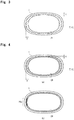
- Fig. 3 shows a schematic transverse cross sectional view of a barrel portion 1 of a liquid film type small capacity container.
- this container in Fig. 3 has a liquid film 21 formed on the inner surface of the barrel portion 1.
- This liquid film 21 imparts a slide-down property with respect to the viscous content 10 (not shown in Fig. 3 ).
- the liquid that forms the liquid film 21 functions as a lubricating liquid to improve the slide-down property with respect to the content 10.
- the liquid film 21 formed on the inner surface of the barrel portion 1 of the container in the present invention has a thickness uneven in the circumferential direction.
- the liquid film 21 has a region with more thickness T and a region with less thickness t.
- the region with more thickness T and the region with thickness t each extend like a band in the axial direction of the container.
- the slide-down velocity is decreased on the region with thickness t, so that the discharge speed has a variation as shown in Fig. 1(a) .
- the viscous content 10 flows into the region that increases the slide-down velocity, and it decreases its thickness on the region that decreases the slide-down velocity.
- This allows the air layer 13 between the content 10 and the bottom portion 5 to easily escape from the region where the content 10 is thin (the side where the liquid film 21 has less thickness t), thereby avoiding effectively the disadvantage of difficulty in discharging the viscous content 10 confined in the container.
- the liquid for forming the aforementioned liquid film 21 is selected, depending on the type of the content 10 to be contained in the container, from liquids that are immiscible with the content 10 and that are non-volatile (for instance, having a boiling point of 200°C or more). And the liquid is required to exhibit repellency to the content 10.
- Representative examples thereof include edible oils (animal fats or vegetable oils), fatty acid triglyceride, fluorinated surfactant, liquid paraffin, and silicone oil.
- a lubricating liquid can be selected from these in accordance with the type of the content 10.
- the aforementioned liquid film type small capacity container is usually used as a plastic container having an inner surface of resin.
- a thermoplastic resin such as an olefin resin and polyester (in particular, an olefin resin)
- the liquid film 21 of the lubricating liquid can be held stably.
- the container is a bottle or a tube having an opening for discharging a content whose diameter is smaller, similarly to the odd-shaped cross section type container as shown in Fig. 1 .
- the liquid film 21 having the aforementioned thickness distribution can be formed by spraying, for instance. Specifically, after forming a container, the lubricating liquid is sprayed on the inner surface of the container so as to form the liquid film 21. At this time, the spray nozzle is directed to the region where the thickness of the liquid film 21 to be increased. In this manner, a liquid film 21 having a thickness distribution can be formed easily.
- liquid film 21 having the thickness distribution it is also possible to form the liquid film 21 having the thickness distribution by using the method of forming a lubricant-containing resin layer.
- Figs. 4(a) and 4(b) show a schematic transverse cross sectional view of the barrel portion 1 of the bleeding type small capacity container.
- the container in Fig. 4 has a structure that the inner surface of the barrel portion 1 is formed of the lubricant-containing resin layer 23.
- This lubricant is bled on the inner surface to get contact with the viscous content 10 (not shown in Fig. 4 ), thereby imparting a slide-down property with respect to the viscous content 10.
- the lubricant in the lubricant-containing resin layer 23 forming the container inner surface functions as a lubricating agent to improve the slide-down property with respect to the content 10.
- the lubricant-containing resin layer 23 has a thickness distribution as shown in Fig. 4 (a) just like that of the liquid film type small capacity container as shown in Fig. 3 . That is, the lubricant-containing resin layer 23 has a region with more thickness T and a region with less thickness t. The region with more thickness T and the region with less thickness t each extend like a band in the axial direction of the container. In the region with more thickness T, a larger amount of lubricant is bled onto the surface of the resin layer, which increases the slide-down velocity with respect to the content 10.
- the lubricant-containing resin layer 23 has an even thickness, but the amount of the lubricant blended in the resin layer 23 has a concentration distribution. For instance, a larger amount of lubricant is blended in the region 23a. This region 23a blended with a larger amount of lubricant extends like a band in the axial direction of the container. Similarly in this embodiment, the slide-down velocity with respect to the content 10 is increased on the region 23a where a larger amount of lubricant is blended, and thus, when the container is turned upside down, there occurs the discharge speed distribution as shown in Fig. 1(a) .
- the air present on the bottom of the container escapes easily from the region where a less amount of lubricant is blended (the region other than the region 23a). This can effectively prevent the disadvantage of difficulty in discharging the viscous content 10 confined in the container.
- the concentration distribution of the lubricant may be formed in the lubricant-containing resin layer 23 so as to form a slide-down velocity distribution for allowing the air to escape from the container being held upside down. That is, the lubricant may be blended only in the region 23a but not in the other region.
- the lubricant is selected depending on the type of the content, so that it can exhibit an effect in improving the slide-down property with respect to the viscous content as a result of bleeding from the resin layer 23. Representative examples of the lubricant are described below.
- the aforementioned lubricants are normally solid. Among them, a liquid substance that can be used for forming the liquid film 21, e.g., fluid paraffin, is included. When this type of liquid lubricant is blended in a massive amount to increase the bleeding, it forms a liquid film 21 (i.e., continuous film) to make a liquid film type container. On the other hand, when the blend amount is decreased and the lubricant molecules are distributed like islands, the container is provided as a bleeding type container.
- the aforementioned bleeding type small capacity container is typically used as a plastic container having an inner surface of resin.
- a thermoplastic resin that can be formed into the container is used.
- olefin resins, polyester and the like that can be widely used in particular in the field of packing container, are used preferably.
- this type of container is preferably a container having an opening with a small diameter to discharge the content, such as a bottle or a tube.
- the shape of a circular die for forming the inner layer of the container may be set to make the resin channel width uneven during formation of the container by extrusion, for instance.
- This method further can be applied to production of a liquid film type small capacity container.
- the lubricant may be blended in a resin to form the inner surface of the container and then, the extrusion is conducted as described above, so that the liquid film 21 formed by bleeding can have the thickness distribution.
- a composition blended with a larger amount of lubricant and a resin composition blended with a smaller amount of lubricant (or no lubricant is blended) are prepared for the resin to form the container inner surface, with which the concentration distribution of the lubricant can be formed on the lubricant-containing resin layer 23 by a so-called stripe extrusion.
- This method can be applied also to production of a liquid film type small capacity container. Namely, for the resin to be formed on the inner surface of the container, a composition blended with a larger amount of lubricant and a composition blended with a smaller amount of lubricant (or blended with no lubricant) are prepared to conduct a stripe extrusion. As a result, the liquid film 21 becomes thicker on the region formed with the resin composition blended with a larger amount of lubricating liquid, and the liquid film 21 becomes thinner (or the liquid film 21 is not formed) on the region formed with the resin composition blended with a smaller amount of lubricating liquid (or no lubricating liquid).
- Some values such as the thickness distribution or the concentration distribution of the lubricant-containing resin layer 23, and further the thickness of the lubricant-containing resin layer 23, can be determined by a laboratory test conducted in advance to prevent clogging or the like of the content 10 to be used.
- the barrel portion wall of the container is preferably formed to have a multilayered structure having an intermediate layer of a gas barrier resin such as an ethylene vinyl alcohol copolymer.
- a gas barrier resin such as an ethylene vinyl alcohol copolymer.
- the lubricating liquid forming the liquid film 21 on the inner surface of the container or the lubricant in the lubricant-containing resin layer 23 on the inner surface of the container may sometimes pass through the barrel portion wall so as to be bled on the outer surface of the container.
- the immigration of the lubricating liquid or the lubricant to the container outer surface can be blocked by providing an intermediate layer of the gas barrier resin.
- the content 10 to be contained in the container is a viscous paste-like material having a high viscosity, more specifically, a viscous paste having a viscosity of not less than 8 Pa ⁇ s at 25°C.
- a paste content often may be provided as a gel, and it is not limited to food but it can be a pharmaceutical product, toothpaste or the like.
- the aforementioned small capacity container of the present invention preferably has a capacity of more than 70 ml.
- the capacity is too small, the inner diameter of its mouth portion from which the content is discharged may be also decreased considerably.
- its cross section is required to have a relatively complicated shape to differentiate the speed for discharging the content thereby avoiding the content from clogging in the container.
- this may make it difficult to form the thickness distribution of the liquid film of the lubricating liquid, the thickness distribution of the lubricant-containing resin layer, and the distribution of the blend amount of the lubricant.
- the small capacity container for viscous substance of the present invention is excellent in the ability of discharging the content in the container turned upside down, and thus, the container is widely applied to various fields.
Landscapes
- Engineering & Computer Science (AREA)
- Mechanical Engineering (AREA)
- Ceramic Engineering (AREA)
- Packages (AREA)
- Wrappers (AREA)
- Containers Having Bodies Formed In One Piece (AREA)
- Tubes (AREA)
- Containers And Packaging Bodies Having A Special Means To Remove Contents (AREA)
Abstract
Description
- The present invention relates to a small capacity container for viscous substance, having a capacity of not more than 300 ml. Specifically, the present invention relates to a small capacity container for viscous substance to contain a highly viscous fluid.
- Containers to contain liquid contents are required to have a content discharge ability, irrespective of the material of the container. In a case of containing a less viscous liquid like water, there is substantially no need to take the discharge ability into consideration. However, when the content is a viscous material like mayonnaise or ketchup, there is a demand that the contents be discharged quickly and used up without remaining in the container, whenever the container is made from plastics or glass.
- Regarding the discharge ability, various measures to form an oil film on the surface of a molded body like a container have been proposed (see for example,
Patent documents 1, 2). Formation of the oil film will enhance the lubricity to viscous substance and improve the discharge ability. - However, when a particularly viscous content is contained in the small capacity container, there may be difficulty in discharging the content. Specifically, when the container is held upside down for discharging the content, the content may be confined in the container before it reaches an outlet of the container.
-
- [Patent Document 1]
WO2012/100099 - [Patent Document 2]
WO2013/022467 - Therefore, an object of the present invention is to provide a small capacity container for viscous substance, which is capable of discharging quickly a viscous content at any time during the container is held upside down or almost upside down.
- The present invention provides a small capacity container for containing viscous substance, having a capacity of not more than 300 ml. The container comprises a barrel portion having an inner surface provided with a region for quickly discharging a content and a region for slowly discharging the content in the container being held upside down.
- The small capacity containers for viscous substance of the present invention can be classified into an odd-shaped cross section type, a liquid film formation type and a bleeding type, depending on the measure to form, on the inner surface of the barrel portion, the region for quickly discharging the content and the region for slowly discharging the content.
- (1) The odd-shaped cross section type small capacity container for viscous substance has a barrel portion, and the inner surface of the barrel portion has an odd-shaped longitudinal cross section having an asymmetrical shape to form the region for quickly discharging the content and the region for slowly discharging the content.
- (2) The liquid film type small capacity container for viscous substance has a barrel portion, and the inner surface of the barrel portion has a liquid film of a lubricating liquid to improve a slide-down property with respect to the viscous substance. The liquid film has an uneven thickness in the circumferential direction when viewed on the transverse cross section of the barrel portion of the container, and the uneven thickness of the liquid film forms the region for quickly discharging the content and the region for slowly discharging the content.
- (3) The bleeding type small capacity container for viscous substance has a multilayered structure including a lubricant-containing resin layer that forms the inner surface of the container, the lubricant-containing resin layer has an uneven thickness in the circumferential direction when viewed on the transverse cross section of the barrel portion of the container, and the uneven thickness of the lubricant-containing resin layer forms the region for quickly discharging the content and the region for slowly discharging the content.
- (4) Alternatively, the container has a multilayered structure including a lubricant-containing resin layer that forms the inner surface of the container. The amount of the lubricant blended in the lubricant-containing resin layer is uneven in the circumferential direction when viewed on the transverse cross section of the barrel portion of the container, and the uneven blend amount of the lubricant in the lubricant-containing resin layer forms the region for quickly discharging the content and the region for slowly discharging the content.
It is preferable in the present invention that - (5) the viscous substance has a viscosity of not less than 8 Pa·s at 25°C;
- (6) the container has a capacity of more than 70 ml;
- (7) the content is food, a pharmaceutical product, or toothpaste; and
- (8) the container is a hollow-molded container.
- The small capacity container for viscous substance of the present invention has two regions: a region for quickly discharging content (region with a higher slide-down velocity) and a region for slowly discharging content (region with a lower slide-down velocity) in the container being held upside down. That is, the lubricity of the inner surface of the barrel portion of the container is uneven when viewed in the circumferential direction. In the container for viscous substance where the lubricity is varied in the circumferential direction on the inner surface of the barrel portion, the content is discharged quickly from a part of the barrel portion and slowly from another part when the container is turned upside down to discharge the content. The difference in the slide-down velocity facilitates discharge of the air confined on the bottom of the container by the content, whereby the content can be discharged easily at any time without remaining inside the container irrespective of the type of the content, i.e., even if the content is a viscous paste like one having a viscosity of not less than 8 Pa·s at 25°C.
-
- [
Fig. 1 ]: a set of views showing a schematic structure of an example of an odd-shaped cross section type small capacity container for viscous substance and a content therein, whereFig. 1(a) is a schematic longitudinal cross sectional view andFig. 1(b) is a transverse cross sectional view taken along a line X; - [
Fig. 2 ]: a set of views showing a schematic structure of a conventionally known small capacity container, whereFig. 2(a) is a schematic longitudinal cross sectional view andFig. 2(b) is a transverse cross sectional view taken along a line X; - [
Fig. 3 ]: a view showing a schematic transverse cross sectional view of a barrel portion for an example of a liquid film type small capacity container for viscous substance of the present invention; and - [
Fig. 4 ]: a set of schematic transverse cross sectional views showing barrel portions for examples of a bleeding type small capacity container for viscous substance of the present invention, whereFig. 4 (a) shows an example where the thickness of a lubricant-containing resin layer is adjusted to form regions different in the ability for discharging a content, andFig. 4(b) shows an example where the amount of lubricant to be blended in a lubricant-containing resin layer is adjusted to form regions different in the ability for discharging a content. - As described above, the small capacity container for viscous substance according to the present invention can be classified into an odd-shaped cross section type, a liquid film formation type and a bleeding type, according to the measure for forming on the inner surface of a barrel portion a region for quickly discharging a content and a region for slowly discharging a content.
-
Fig. 1 shows an embodiment of an odd-shaped cross section type small capacity container for viscous substance of the present invention in an upside-down state. The container comprises a hollow-cylindrical barrel portion 1 with one end of aneck portion 3 as an outlet for discharging the content, while the other end is closed with abottom portion 5. - On the outer surface of the
neck portion 3, a screw thread 7 may be formed to seal the container with a cap, though this depends on the embodiment of the container. - The small capacity container for viscous substance has a content of 300 ml or less, in particular, 150 ml or less. Since the small capacity container is light-weighted, it may be held upside down or almost upside down to discharge the content as shown in
Fig. 1 . This may often make the discharge of content difficult. On the other hand, a large capacity container is heavy and often attached with a handle, it may not be held upside down or almost upside down, and substantially no problem may be found in the content discharge ability. For this reason, the capacity for the liquid film type or bleeding type container mentioned below is here set to 300 ml or less, in particular 150 ml or less. - In the present invention, it is particularly important that the inner surface of the
barrel portion 1 has an asymmetric lubricity as shown inFig. 1(a) . Namely, the inner surface having an uneven lubricity differentiates the falling velocity of the content. For instance, in the example shown inFig. 1(a) , theinner surface 1a at one side of thebarrel portion 1 has a larger lubricity, while theinner surface 1b on the opposite side has a smaller lubricity. As a result, thecontent 10 falls faster on theinner surface 1a and slower on theinner surface 1b. - On the other hand, a conventionally known small capacity container usually has an even lubricity on the container inner surface in the circumferential direction.
- Namely, when this container is held upside down as shown in
Fig. 2 to discharge thecontent 10, thecontent 10 falls evenly along the inner surface of thebarrel portion 1, and it may be confined inside the container before reaching the opening of theneck portion 3. In this state,air layer 13 is trapped between thecontent 10 and thebottom portion 5. Since the atmospheric pressure is greater than the pressure applied by theair layer 13, thecontent 10 is confined in the container and discharge thereof will be difficult. - In contrast, in the present invention, the slide-down property is imparted asymmetrically as shown in
Fig. 1(a) , thereby forming on the inner surface of thebarrel portion 1 a site to differentiate the falling velocity of the content. This results in differences of the falling velocity of thecontent 10, and thus, theair layer 13 between thecontent 10 and thebottom portion 5 can escape easily along the side where the thickness of thecontent 10 is decreased (i.e., the 1b side with less falling velocity). This can effectively avoid a disadvantage of difficulty in discharging thecontent 10 confined in the container. - In the present invention, the aforementioned embodiment with an asymmetric slide-down property is not limited particularly as long as the falling velocity of the
content 10 is differentiated. That is, there is no particular limitation as long as a region on which thecontent 10 falls quickly (a region for quickly discharging the content 10) and a region on which thecontent 10 falls slowly (a region for slowly discharging the content 10) are formed on the inner surface of thebarrel portion 1. - In the embodiment shown in
Fig. 1(a) , theregion 1a on which thecontent 10 falls quickly and theregion 1b on which thecontent 10 falls slowly are located opposite to each other. The present invention is not limited to this embodiment, but theregions - The aforementioned odd-shaped cross section type small capacity container for viscous substance may be formed of any suitable material such as plastics, glass and a metal as long as it satisfies a requirement in principle that its inner surface has a variation in the lubricity. From the viewpoint of convenience of formation, it is preferred to be made of plastics.
- Though there is no particular limitation on the shape of the container, preferably the container is formed to have a hollow shape. It is most preferable that the container has a shape of a bottle or a tube provided with an opening for discharging the content, and the opening has a smaller diameter than that of the cross section of the barrel portion in which the content is contained. Meanwhile, concerning a wide-open container or a cup, the opening for discharging the content has a larger cross section than that of its barrel portion. There is substantially no necessity of considering the ability for discharging the
content 10 in this type of container. - For instance, the blow-formed container shown in
Fig. 1 may be replaced by a tube container. -
Fig. 3 shows a schematic transverse cross sectional view of abarrel portion 1 of a liquid film type small capacity container. - Unlike the container as shown in
Fig. 1 , this container inFig. 3 has aliquid film 21 formed on the inner surface of thebarrel portion 1. Thisliquid film 21 imparts a slide-down property with respect to the viscous content 10 (not shown inFig. 3 ). Namely, the liquid that forms theliquid film 21 functions as a lubricating liquid to improve the slide-down property with respect to thecontent 10. - As indicated in
Fig. 3 , theliquid film 21 formed on the inner surface of thebarrel portion 1 of the container in the present invention has a thickness uneven in the circumferential direction. Specifically, theliquid film 21 has a region with more thickness T and a region with less thickness t. The region with more thickness T and the region with thickness t each extend like a band in the axial direction of the container. As a result, in the region with thickness T, thecontent 10 is discharged quickly at a high slide-down velocity. On the other hand, the slide-down velocity is decreased on the region with thickness t, so that the discharge speed has a variation as shown inFig. 1(a) . And thus, theviscous content 10 flows into the region that increases the slide-down velocity, and it decreases its thickness on the region that decreases the slide-down velocity. This allows theair layer 13 between the content 10 and thebottom portion 5 to easily escape from the region where thecontent 10 is thin (the side where theliquid film 21 has less thickness t), thereby avoiding effectively the disadvantage of difficulty in discharging theviscous content 10 confined in the container. - The liquid for forming the aforementioned liquid film 21 (lubricating liquid) is selected, depending on the type of the
content 10 to be contained in the container, from liquids that are immiscible with thecontent 10 and that are non-volatile (for instance, having a boiling point of 200°C or more). And the liquid is required to exhibit repellency to thecontent 10. Representative examples thereof include edible oils (animal fats or vegetable oils), fatty acid triglyceride, fluorinated surfactant, liquid paraffin, and silicone oil. A lubricating liquid can be selected from these in accordance with the type of thecontent 10. - The aforementioned liquid film type small capacity container is usually used as a plastic container having an inner surface of resin. By forming the container inner surface with a thermoplastic resin such as an olefin resin and polyester (in particular, an olefin resin), the
liquid film 21 of the lubricating liquid can be held stably. - Preferably, the container is a bottle or a tube having an opening for discharging a content whose diameter is smaller, similarly to the odd-shaped cross section type container as shown in
Fig. 1 . - The
liquid film 21 having the aforementioned thickness distribution can be formed by spraying, for instance. Specifically, after forming a container, the lubricating liquid is sprayed on the inner surface of the container so as to form theliquid film 21. At this time, the spray nozzle is directed to the region where the thickness of theliquid film 21 to be increased. In this manner, aliquid film 21 having a thickness distribution can be formed easily. - In this case, it is possible to conduct a laboratory test in advance to determine the conditions for spraying (spraying pressure and amount) in order to set the thickness distribution of the
liquid film 21 and to prevent the content 10 from clogging or the like. - For the bleeding type small capacity container as described below, it is also possible to form the
liquid film 21 having the thickness distribution by using the method of forming a lubricant-containing resin layer. -
Figs. 4(a) and 4(b) show a schematic transverse cross sectional view of thebarrel portion 1 of the bleeding type small capacity container. - Unlike the containers as shown in
Figs. 1 and3 , the container inFig. 4 has a structure that the inner surface of thebarrel portion 1 is formed of the lubricant-containingresin layer 23. This lubricant is bled on the inner surface to get contact with the viscous content 10 (not shown inFig. 4 ), thereby imparting a slide-down property with respect to theviscous content 10. In other words, the lubricant in the lubricant-containingresin layer 23 forming the container inner surface functions as a lubricating agent to improve the slide-down property with respect to thecontent 10. - In this bleeding type small capacity container, the lubricant-containing
resin layer 23 has a thickness distribution as shown inFig. 4 (a) just like that of the liquid film type small capacity container as shown inFig. 3 . That is, the lubricant-containingresin layer 23 has a region with more thickness T and a region with less thickness t. The region with more thickness T and the region with less thickness t each extend like a band in the axial direction of the container. In the region with more thickness T, a larger amount of lubricant is bled onto the surface of the resin layer, which increases the slide-down velocity with respect to thecontent 10. In the region with less thickness t, a smaller amount of lubricant is bled onto the surface of the resin layer, which decreases the slide-down velocity with respect to thecontent 10. When this container is turned upside down, the discharge speed distribution as shown inFig. 1(a) is formed. That is, the air present on the bottom of the container escapes easily from the region where the lubricant-containingresin layer 23 has a less thickness t. This can effectively prevent the disadvantage of difficulty in discharging theviscous content 10 confined in the container. - In
Fig. 4 (b) , the lubricant-containingresin layer 23 has an even thickness, but the amount of the lubricant blended in theresin layer 23 has a concentration distribution. For instance, a larger amount of lubricant is blended in theregion 23a. Thisregion 23a blended with a larger amount of lubricant extends like a band in the axial direction of the container. Similarly in this embodiment, the slide-down velocity with respect to thecontent 10 is increased on theregion 23a where a larger amount of lubricant is blended, and thus, when the container is turned upside down, there occurs the discharge speed distribution as shown inFig. 1(a) . That is, the air present on the bottom of the container escapes easily from the region where a less amount of lubricant is blended (the region other than theregion 23a). This can effectively prevent the disadvantage of difficulty in discharging theviscous content 10 confined in the container. - In the embodiment as shown in
Fig. 4(b) , the concentration distribution of the lubricant may be formed in the lubricant-containingresin layer 23 so as to form a slide-down velocity distribution for allowing the air to escape from the container being held upside down. That is, the lubricant may be blended only in theregion 23a but not in the other region. - In the present invention, the lubricant is selected depending on the type of the content, so that it can exhibit an effect in improving the slide-down property with respect to the viscous content as a result of bleeding from the
resin layer 23. Representative examples of the lubricant are described below. -
- (a) Hydrocarbon-based agents such as fluid- natural- or synthetic paraffin, micro wax, polyethylene wax, and chlorinated polyethylene wax;
- (b) fatty acids such as stearic acid and lauric acid;
- (c) fatty amides such as stearic acid amide, palmitic acid amide, oleic acid amide, erucic acid amide, methylenebisstearic acid amide, ethylenebisstearic acid amide, ethylenebisbehenic acid amide, and ethylenebisoleic acid amide;
- (d) fatty acid esters such as butyl stearate, hydrogenated castor oil, and ethylene glycol monostearate;
- (e) alcohols such as cetyl alcohol and stearyl alcohol;
- (f) metal soaps such as zinc stearate and calcium stearate;
- (g) polyorganosiloxane; and
- (h) glycerin fatty acid esters such as medium-chain fatty acid triglyceride, glycerin diacetomonooleate, glycerin trioleate, and decaglycerin oleate.
- The aforementioned lubricants are normally solid. Among them, a liquid substance that can be used for forming the
liquid film 21, e.g., fluid paraffin, is included. When this type of liquid lubricant is blended in a massive amount to increase the bleeding, it forms a liquid film 21 (i.e., continuous film) to make a liquid film type container. On the other hand, when the blend amount is decreased and the lubricant molecules are distributed like islands, the container is provided as a bleeding type container. - The aforementioned bleeding type small capacity container is typically used as a plastic container having an inner surface of resin. For formation of the lubricant-containing
resin layer 23, a thermoplastic resin that can be formed into the container is used. For the purpose, olefin resins, polyester and the like that can be widely used in particular in the field of packing container, are used preferably. - Since the
content 10 is a viscous substance and the container is turned upside down or inclined to discharge thecontent 10, this type of container is preferably a container having an opening with a small diameter to discharge the content, such as a bottle or a tube. - Representative examples of the method for forming the aforementioned thickness distribution of the lubricant-containing
resin layer 23 or the concentration distribution of the lubricant are described below, though the present invention is not limited to these examples. - Specifically, for imparting a thickness distribution to the lubricant-containing
resin layer 23, the shape of a circular die for forming the inner layer of the container may be set to make the resin channel width uneven during formation of the container by extrusion, for instance. - This method further can be applied to production of a liquid film type small capacity container. Specifically, the lubricant may be blended in a resin to form the inner surface of the container and then, the extrusion is conduced as described above, so that the
liquid film 21 formed by bleeding can have the thickness distribution. - For providing the concentration distribution of the lubricant, a composition blended with a larger amount of lubricant and a resin composition blended with a smaller amount of lubricant (or no lubricant is blended) are prepared for the resin to form the container inner surface, with which the concentration distribution of the lubricant can be formed on the lubricant-containing
resin layer 23 by a so-called stripe extrusion. - This method can be applied also to production of a liquid film type small capacity container. Namely, for the resin to be formed on the inner surface of the container, a composition blended with a larger amount of lubricant and a composition blended with a smaller amount of lubricant (or blended with no lubricant) are prepared to conduct a stripe extrusion. As a result, the
liquid film 21 becomes thicker on the region formed with the resin composition blended with a larger amount of lubricating liquid, and theliquid film 21 becomes thinner (or theliquid film 21 is not formed) on the region formed with the resin composition blended with a smaller amount of lubricating liquid (or no lubricating liquid). - Some values such as the thickness distribution or the concentration distribution of the lubricant-containing
resin layer 23, and further the thickness of the lubricant-containingresin layer 23, can be determined by a laboratory test conducted in advance to prevent clogging or the like of thecontent 10 to be used. - In the aforementioned liquid film type or a bleeding type small capacity container, the barrel portion wall of the container is preferably formed to have a multilayered structure having an intermediate layer of a gas barrier resin such as an ethylene vinyl alcohol copolymer. In a case of a monolayer structure, the lubricating liquid forming the
liquid film 21 on the inner surface of the container or the lubricant in the lubricant-containingresin layer 23 on the inner surface of the container may sometimes pass through the barrel portion wall so as to be bled on the outer surface of the container. The immigration of the lubricating liquid or the lubricant to the container outer surface can be blocked by providing an intermediate layer of the gas barrier resin. - In the present invention, the
content 10 to be contained in the container is a viscous paste-like material having a high viscosity, more specifically, a viscous paste having a viscosity of not less than 8 Pa·s at 25°C. Such a paste content often may be provided as a gel, and it is not limited to food but it can be a pharmaceutical product, toothpaste or the like. - Further, the aforementioned small capacity container of the present invention preferably has a capacity of more than 70 ml. When the capacity is too small, the inner diameter of its mouth portion from which the content is discharged may be also decreased considerably. In that case, its cross section is required to have a relatively complicated shape to differentiate the speed for discharging the content thereby avoiding the content from clogging in the container. Furthermore, this may make it difficult to form the thickness distribution of the liquid film of the lubricating liquid, the thickness distribution of the lubricant-containing resin layer, and the distribution of the blend amount of the lubricant.
- The small capacity container for viscous substance of the present invention is excellent in the ability of discharging the content in the container turned upside down, and thus, the container is widely applied to various fields.
-
- 1:
- barrel portion
- 3:
- neck portion
- 5:
- bottom portion
- 10:
- content
- 13:
- air layer
- 21:
- liquid film
- 23:
- lubricant-containing resin layer
Claims (9)
- A small capacity container for containing viscous substance, having a capacity of not more than 300 ml, the container includes a barrel portion having an inner surface provided with a region for quickly discharging a content and a region for slowly discharging the content in the container being held upside down.
- The small capacity container for viscous substance according to claim 1, wherein the inner surface of the barrel portion of the container has an odd-shaped longitudinal cross section having an asymmetrical shape to form the region for quickly discharging the content and the region for slowly discharging the content.
- The small capacity container for viscous substance according to claim 1, wherein a liquid film of a lubricating liquid to improve a slide-down property with respect to the viscous substance is formed on the inner surface of the barrel portion of the container, the liquid film has an uneven thickness in a circumferential direction when viewed on a transverse cross section of the barrel portion of the container, and the uneven thickness of the liquid film forms the region for quickly discharging the content and the region for slowly discharging the content.
- The small capacity container for viscous substance according to claim 1, wherein the container has a multilayered structure including a lubricant-containing resin layer that forms the inner surface of the container, the lubricant-containing resin layer has the uneven thickness in the circumferential direction when viewed on the transverse cross section of the barrel portion of the container, and the uneven thickness of the lubricant-containing resin layer forms the region for quickly discharging the content and the region for slowly discharging the content.
- The small capacity container for viscous substance according to claim 1, wherein the container has the multilayered structure with the inner surface formed of the lubricant-containing resin layer, an amount of the lubricant blended in the lubricant-containing resin layer is uneven in the circumferential direction when viewed on the transverse cross section of the barrel portion of the container, and the uneven blend amount of the lubricant in the lubricant-containing resin layer forms the region for quickly discharging the content and the region for slowly discharging the content.
- The small capacity container for viscous substance according to claim 1, wherein a viscous substance has a viscosity of not less than 8 Pa·s at 25°C.
- The small capacity container for viscous substance according to claim 6, having a capacity of more than 70 ml.
- The small capacity container for viscous substance according to claim 6, wherein the content is food, a pharmaceutical product or toothpaste.
- The small capacity container for viscous substance according to claim 1, which is a hollow molded container.
Applications Claiming Priority (2)
| Application Number | Priority Date | Filing Date | Title |
|---|---|---|---|
| JP2017052617A JP2018154364A (en) | 2017-03-17 | 2017-03-17 | Small capacity container for viscous substance |
| PCT/JP2018/009813 WO2018168877A1 (en) | 2017-03-17 | 2018-03-13 | Small capacity container for viscous substance |
Publications (1)
| Publication Number | Publication Date |
|---|---|
| EP3597563A1 true EP3597563A1 (en) | 2020-01-22 |
Family
ID=63522213
Family Applications (1)
| Application Number | Title | Priority Date | Filing Date |
|---|---|---|---|
| EP18766628.4A Withdrawn EP3597563A1 (en) | 2017-03-17 | 2018-03-13 | Small capacity container for viscous substance |
Country Status (9)
| Country | Link |
|---|---|
| US (1) | US20200071023A1 (en) |
| EP (1) | EP3597563A1 (en) |
| JP (1) | JP2018154364A (en) |
| KR (1) | KR20190121344A (en) |
| CN (1) | CN110431089A (en) |
| AU (1) | AU2018234035A1 (en) |
| CA (1) | CA3054538A1 (en) |
| RU (1) | RU2725867C1 (en) |
| WO (1) | WO2018168877A1 (en) |
Families Citing this family (3)
| Publication number | Priority date | Publication date | Assignee | Title |
|---|---|---|---|---|
| KR101660886B1 (en) * | 2012-07-13 | 2016-09-28 | 도요세이칸 그룹 홀딩스 가부시키가이샤 | Packaging container with excellent content slipperiness |
| US12090711B2 (en) * | 2021-08-09 | 2024-09-17 | Ilc Dover Lp | Controlling a fluid flow |
| CN119325366A (en) | 2022-06-30 | 2025-01-17 | 宝洁公司 | Absorbent article with frangible path having tear zone |
Family Cites Families (19)
| Publication number | Priority date | Publication date | Assignee | Title |
|---|---|---|---|---|
| JPH0840488A (en) * | 1994-05-25 | 1996-02-13 | Kureha Chem Ind Co Ltd | Plastic container and manufacturing method thereof |
| JP3463854B2 (en) * | 1997-12-16 | 2003-11-05 | 花王株式会社 | Injection blow molding |
| GB9909440D0 (en) * | 1999-04-23 | 1999-06-23 | Unilever Plc | Package for dispensing a flowable cosmetic composition and product |
| JP3854996B2 (en) * | 2002-12-16 | 2006-12-06 | 道彰 永井 | Liquid storage products and replacement liquid storage products |
| DE10337062A1 (en) * | 2003-08-12 | 2005-03-03 | Trisa Holding Ag | Toothbrush with toothbrush body and toothpaste container |
| JP2005096839A (en) * | 2003-09-26 | 2005-04-14 | Lion Corp | Liquid detergent product in squeeze container |
| ES1057328Y (en) * | 2004-04-06 | 2004-11-01 | Negrin Pedro Ramon Mora | FLEXIBLE VACUUM CONTAINER WITH EASY OPENING FOR MONODOSIS OF PASTRY FLUIDS |
| JP2007091341A (en) * | 2005-08-30 | 2007-04-12 | Kao Corp | Flexible container |
| CN201140872Y (en) * | 2007-12-05 | 2008-10-29 | 蒋平 | Beverage box |
| JP5125635B2 (en) * | 2008-03-11 | 2013-01-23 | 東洋製罐株式会社 | Multi-layer plastic container for non-oil content |
| TWI403818B (en) * | 2009-07-07 | 2013-08-01 | Univ Nat Taiwan | Method of automated focus |
| AU2012207205C1 (en) | 2011-01-19 | 2016-09-08 | President And Fellows Of Harvard College | Slippery surfaces with high pressure stability, optical transparency, and self-healing characteristics |
| JP2014531989A (en) | 2011-08-05 | 2014-12-04 | マサチューセッツ インスティテュート オブ テクノロジー | Liquid-impregnated surface, fabrication method, and device incorporating them |
| RU2619005C2 (en) * | 2012-01-13 | 2017-05-11 | Нестек С.А. | Packaging for food products and methods of its use |
| KR101660886B1 (en) * | 2012-07-13 | 2016-09-28 | 도요세이칸 그룹 홀딩스 가부시키가이샤 | Packaging container with excellent content slipperiness |
| WO2014123217A1 (en) * | 2013-02-08 | 2014-08-14 | 東洋製罐株式会社 | Container having superior slide properties for fluid content |
| WO2015159643A1 (en) * | 2014-04-18 | 2015-10-22 | 東洋製罐株式会社 | Method for filling viscous contents |
| KR101909978B1 (en) * | 2014-06-20 | 2018-10-19 | 토요 세이칸 가부시키가이샤 | Structure provided with liquid film formed on surface thereof and coating solution for forming liquid film |
| CN105416743A (en) * | 2015-12-10 | 2016-03-23 | 重庆福悦安科技有限公司 | Environment-friendly material barrel enabling materials to be easily poured |
-
2017
- 2017-03-17 JP JP2017052617A patent/JP2018154364A/en active Pending
-
2018
- 2018-03-13 WO PCT/JP2018/009813 patent/WO2018168877A1/en not_active Ceased
- 2018-03-13 RU RU2019130628A patent/RU2725867C1/en active
- 2018-03-13 KR KR1020197027675A patent/KR20190121344A/en not_active Withdrawn
- 2018-03-13 EP EP18766628.4A patent/EP3597563A1/en not_active Withdrawn
- 2018-03-13 US US16/493,158 patent/US20200071023A1/en not_active Abandoned
- 2018-03-13 AU AU2018234035A patent/AU2018234035A1/en not_active Abandoned
- 2018-03-13 CA CA3054538A patent/CA3054538A1/en not_active Abandoned
- 2018-03-13 CN CN201880018789.XA patent/CN110431089A/en not_active Withdrawn
Also Published As
| Publication number | Publication date |
|---|---|
| KR20190121344A (en) | 2019-10-25 |
| CN110431089A (en) | 2019-11-08 |
| JP2018154364A (en) | 2018-10-04 |
| US20200071023A1 (en) | 2020-03-05 |
| WO2018168877A1 (en) | 2018-09-20 |
| AU2018234035A1 (en) | 2019-09-12 |
| CA3054538A1 (en) | 2018-09-20 |
| RU2725867C1 (en) | 2020-07-06 |
Similar Documents
| Publication | Publication Date | Title |
|---|---|---|
| AU2014326988B2 (en) | Vented container for viscous liquids | |
| EP2990176B1 (en) | A process for producing a blow-molded container with excellent slipperiness in relation to flowable contents | |
| US10556741B2 (en) | Container having excellent slipping property for fluid contents | |
| KR101753676B1 (en) | Pouring tool exhibiting excellent slip properties for fluid substance | |
| US20200071023A1 (en) | Small capacity container for viscous substance | |
| JP6651319B2 (en) | Packaging container | |
| US10870505B2 (en) | Articles and methods for forming liquid films on surfaces, in devices incorporating the same | |
| EP3666675A1 (en) | Blow-moulded container used with oil film formed on inner surface | |
| JP7149084B2 (en) | container for viscous substances | |
| RU2716198C1 (en) | Container containing a fluid | |
| JP2011105339A (en) | Liquid container with nozzle rendered water-repellent | |
| JP7456755B2 (en) | A packaging container containing a viscous substance | |
| JP6677274B2 (en) | How to use the package |
Legal Events
| Date | Code | Title | Description |
|---|---|---|---|
| STAA | Information on the status of an ep patent application or granted ep patent |
Free format text: STATUS: THE INTERNATIONAL PUBLICATION HAS BEEN MADE |
|
| PUAI | Public reference made under article 153(3) epc to a published international application that has entered the european phase |
Free format text: ORIGINAL CODE: 0009012 |
|
| STAA | Information on the status of an ep patent application or granted ep patent |
Free format text: STATUS: REQUEST FOR EXAMINATION WAS MADE |
|
| 17P | Request for examination filed |
Effective date: 20190815 |
|
| AK | Designated contracting states |
Kind code of ref document: A1 Designated state(s): AL AT BE BG CH CY CZ DE DK EE ES FI FR GB GR HR HU IE IS IT LI LT LU LV MC MK MT NL NO PL PT RO RS SE SI SK SM TR |
|
| AX | Request for extension of the european patent |
Extension state: BA ME |
|
| DAV | Request for validation of the european patent (deleted) | ||
| DAX | Request for extension of the european patent (deleted) | ||
| STAA | Information on the status of an ep patent application or granted ep patent |
Free format text: STATUS: THE APPLICATION HAS BEEN WITHDRAWN |
|
| 18W | Application withdrawn |
Effective date: 20201022 |