EP3596080B1 - Pharmacologically active alicyclic-substituted pyrazolo[1,5-a]pyrimidine derivatives - Google Patents
Pharmacologically active alicyclic-substituted pyrazolo[1,5-a]pyrimidine derivatives Download PDFInfo
- Publication number
- EP3596080B1 EP3596080B1 EP18713016.6A EP18713016A EP3596080B1 EP 3596080 B1 EP3596080 B1 EP 3596080B1 EP 18713016 A EP18713016 A EP 18713016A EP 3596080 B1 EP3596080 B1 EP 3596080B1
- Authority
- EP
- European Patent Office
- Prior art keywords
- methyl
- carboxylic acid
- formula
- pyrazolo
- trans
- Prior art date
- Legal status (The legal status is an assumption and is not a legal conclusion. Google has not performed a legal analysis and makes no representation as to the accuracy of the status listed.)
- Active
Links
- 0 CC1C(*C(C)=CC([C@](CC2)ICC2C(F)(F)F)=*C)CCCC1 Chemical compound CC1C(*C(C)=CC([C@](CC2)ICC2C(F)(F)F)=*C)CCCC1 0.000 description 5
- NHMKMLLZNINTKQ-UHFFFAOYSA-N [IH-][NH+]1CCCCC1 Chemical compound [IH-][NH+]1CCCCC1 NHMKMLLZNINTKQ-UHFFFAOYSA-N 0.000 description 1
Classifications
-
- C—CHEMISTRY; METALLURGY
- C07—ORGANIC CHEMISTRY
- C07D—HETEROCYCLIC COMPOUNDS
- C07D239/00—Heterocyclic compounds containing 1,3-diazine or hydrogenated 1,3-diazine rings
-
- C—CHEMISTRY; METALLURGY
- C07—ORGANIC CHEMISTRY
- C07D—HETEROCYCLIC COMPOUNDS
- C07D487/00—Heterocyclic compounds containing nitrogen atoms as the only ring hetero atoms in the condensed system, not provided for by groups C07D451/00 - C07D477/00
- C07D487/02—Heterocyclic compounds containing nitrogen atoms as the only ring hetero atoms in the condensed system, not provided for by groups C07D451/00 - C07D477/00 in which the condensed system contains two hetero rings
- C07D487/04—Ortho-condensed systems
-
- A—HUMAN NECESSITIES
- A61—MEDICAL OR VETERINARY SCIENCE; HYGIENE
- A61K—PREPARATIONS FOR MEDICAL, DENTAL OR TOILETRY PURPOSES
- A61K31/00—Medicinal preparations containing organic active ingredients
- A61K31/33—Heterocyclic compounds
- A61K31/395—Heterocyclic compounds having nitrogen as a ring hetero atom, e.g. guanethidine or rifamycins
- A61K31/495—Heterocyclic compounds having nitrogen as a ring hetero atom, e.g. guanethidine or rifamycins having six-membered rings with two or more nitrogen atoms as the only ring heteroatoms, e.g. piperazine or tetrazines
- A61K31/505—Pyrimidines; Hydrogenated pyrimidines, e.g. trimethoprim
- A61K31/519—Pyrimidines; Hydrogenated pyrimidines, e.g. trimethoprim ortho- or peri-condensed with heterocyclic rings
-
- A—HUMAN NECESSITIES
- A61—MEDICAL OR VETERINARY SCIENCE; HYGIENE
- A61K—PREPARATIONS FOR MEDICAL, DENTAL OR TOILETRY PURPOSES
- A61K45/00—Medicinal preparations containing active ingredients not provided for in groups A61K31/00 - A61K41/00
- A61K45/06—Mixtures of active ingredients without chemical characterisation, e.g. antiphlogistics and cardiaca
-
- A—HUMAN NECESSITIES
- A61—MEDICAL OR VETERINARY SCIENCE; HYGIENE
- A61P—SPECIFIC THERAPEUTIC ACTIVITY OF CHEMICAL COMPOUNDS OR MEDICINAL PREPARATIONS
- A61P19/00—Drugs for skeletal disorders
-
- A—HUMAN NECESSITIES
- A61—MEDICAL OR VETERINARY SCIENCE; HYGIENE
- A61P—SPECIFIC THERAPEUTIC ACTIVITY OF CHEMICAL COMPOUNDS OR MEDICINAL PREPARATIONS
- A61P25/00—Drugs for disorders of the nervous system
-
- A—HUMAN NECESSITIES
- A61—MEDICAL OR VETERINARY SCIENCE; HYGIENE
- A61P—SPECIFIC THERAPEUTIC ACTIVITY OF CHEMICAL COMPOUNDS OR MEDICINAL PREPARATIONS
- A61P25/00—Drugs for disorders of the nervous system
- A61P25/28—Drugs for disorders of the nervous system for treating neurodegenerative disorders of the central nervous system, e.g. nootropic agents, cognition enhancers, drugs for treating Alzheimer's disease or other forms of dementia
-
- C—CHEMISTRY; METALLURGY
- C07—ORGANIC CHEMISTRY
- C07D—HETEROCYCLIC COMPOUNDS
- C07D491/00—Heterocyclic compounds containing in the condensed ring system both one or more rings having oxygen atoms as the only ring hetero atoms and one or more rings having nitrogen atoms as the only ring hetero atoms, not provided for by groups C07D451/00 - C07D459/00, C07D463/00, C07D477/00 or C07D489/00
- C07D491/12—Heterocyclic compounds containing in the condensed ring system both one or more rings having oxygen atoms as the only ring hetero atoms and one or more rings having nitrogen atoms as the only ring hetero atoms, not provided for by groups C07D451/00 - C07D459/00, C07D463/00, C07D477/00 or C07D489/00 in which the condensed system contains three hetero rings
- C07D491/14—Ortho-condensed systems
- C07D491/147—Ortho-condensed systems the condensed system containing one ring with oxygen as ring hetero atom and two rings with nitrogen as ring hetero atom
Definitions
- the present invention relates to new pyrazolo[1,5-a]pyrimidine derivatives of formula (I) or pharmaceutically acceptable salts, racemates, enantiomers, diastereomers, solvates and hydrates thereof that serve as GABA B receptor positive allosteric modulators.
- the invention also relates to the process for producing such compounds.
- the invention further relates to pharmaceutical compositions comprising such compounds optionally in combination with two or more different therapeutic agents and the use of such compounds in methods for treating diseases and conditions mediated and modulated by the GABA B receptor positive allosteric mechanism.
- the invention also provides a method for manufacture of medicaments useful in the treatment of such disorders.
- GABA Gamma-aminobutyric acid
- GABA is the main inhibitory neurotransmitter in the central nervous system and plays a key role in modulating neuronal activity. It exerts its action via three receptor systems, the related ionotropic GABA A and GABA C receptors, and the distinct metabotropic GABA B receptors ( Hill and Bowery, Nature 1981, 290, 149-152 ).
- the latter GABA B receptors are widespreadly distributed within the mammalian central nervous system with various expression levels in different brain regions ( Bovery et al, Neuroscience 1987, 20, 365-385 ). GABA B receptors can be found both pre- and postsynaptically and play an important role in the fine-tuning of neurotransmission.
- GABA B receptors cluster around excitatory synapses, either at the edge of the presynaptic terminal or on dendritic spines opposite to glutamatergic boutons ( Ulrich and Bettler, Curr. Opin. Neurobiol. 2007, 17, 298-303 ).
- GABA B receptors belong to the Family 3 (C) of G-protein coupled receptors (GPCRs) together with metabotropic glutamate receptors (mGluRs), calcium-sensing receptors, taste receptors and a number of orphan receptors, showing highest, approximately 30% homology to mGluRs ( Bettler et al, Physiol. Rev. 2004, 84, 835-867 ).
- GABA B receptors are heterodimers consisting of two similar, yet different subunits, B1 and B2.
- the B1 subunit has multiple splice variants with only two (B1a and B1b) having clear physiological significance.
- the B1 subunit binds the endogenous neurotransmitter ligand GABA as well as other orthosteric agonists (such as baclofen, SKF97541) and antagonists (such as phaclofen, saclofen).
- the B2 subunit is responsible for G-protein activation-mediated intracellular signal transduction and is believed to bind allosteric modulators ( Binet et al, J. Biol. Chem.
- the site of action for the Novartis GABA B positive allosteric modulator compounds CGP7930 and GS39783 is the heptahelical transmembrane domain of the B2 subunit; the exact binding site for other, unrelated positive allosteric modulator chemotypes is not known.
- GABA B receptors The main synaptic effects of GABA B receptors are the presynaptic blockade of neurotransmitter release (GABA as well as glutamate) and postsynaptic hyperpolarization ( Gassmann and Bettler, in Handbook of Contemporary Neuropharmacology 2007 ). These effects are the result of inhibition of presynaptic calcium influx and stimulation of postsynaptic inwardly rectifying potassium (GIRK) channels, respectively. Ion channel functions are mediated in a membrane-delimited manner through the activation of ⁇ subunits of G i /G o proteins.
- GABA B receptors also signal via the ⁇ subunit of the same G-proteins that inhibits adenylate cyclase and retards the recruitment of synaptic vesicles ( Chalifoux and Carter, Curr. Opin. Neurobiol. 2011, 21, 339-442 ). Beside these fast cellular events, GABA B receptors also regulate cytoplasmic kinases including mitogen-acivated protein kinase and thereby influence synaptic plasticity on the longer-term.
- mice have been generated with mutations selectively in the B1, B1a, B1b and the B2 subunits.
- Mice without B1 subunits displayed increased anxiety in explorative-like situations (light-dark box, staircase assays), increased panic, spontaneous seizures, hyperalgesia, hyperlocomotion, and memory impairment ( Schuler et al, Neuron 2001, 31, 47-58 ).
- Mice that do not express GABA B2 subunits behave similarly to B1 subunit knockouts; these animals are overanxious, show spontaneous seizure activity, hyperalgesia, hyperlocomotion, and memory impairment ( Mombereau et al, Eur. J. Pharmacol.
- baclofen may have potential therapeutic benefits in treating conditions including asthma, pain, obesity, binge eating, drug and alcohol abuse, anxiety, posttraumatic stress disorder, cough, inflammation, gastroeasophageal reflux and urinary incontinence (eg., Breslow et al, Am. J. Psychiatry 1989, 146, 353-356 ; Drake et al, Ann. Pharmacother. 2003, 37, 1177-1181 ; Leggio et al, CNS Neurol.
- baclofen has beneficial potential in a number of therapeutic indications, unfortunately it also has a range of unwanted properties including poor blood-brain-barrier penetration, narrow therapeutic window, receptor desensitization, development of tolerance against the main effects, and withdrawal upon termination of use ( Vacher and Bettler, Curr. Drug Targets CNS Neurol. Disord. 2003, 2, 248-259 ; Ross et al, Neurocrit. Care 2011, 14, 103-108 ; Keegan et al, Neuropharmacology 2015, 95, 492-502 ).
- Allosteric modulation is an alternative way to selectively stimulate GPCRs without the unwanted properties of orthosteric ligands ( Conn et al, Nat Rev 2009, 8, 41-54 ; Wang et al, J. Pharmacol. Exp. Ther. 2009, 331, 340-348 ). Allosteric modulators bind to the receptors at sites that are different from the binding site of the endogenous (orthosteric) ligands and are effective predominantly if an agonist is also bound to the receptor. This has consequences on the temporal and spacial pattern of efficacy which in turn affects the behavioral and adaptive responses the organism gives to allosteric stimulation.
- nipecotic acid derivatives with a cyclohexyl-pyrazolo-pyrimidine scaffold. We found that these compounds show mostly nanomolar potency, in certain cases reaching even the subnanomolar potency range. These compounds despite of possessing acidic nipecotic acid moiety are metabolically stable and unexpectedly penetrate into the brain (principles of brain penetration of drug molecules are summarized in: Kerns et al. Drug-like Properties: Concepts, Structure Design and Methods Chapter: Blood-Brain Barrier pages 122-136 ). These compounds without having a carbon linker between the pyrazolo-pyrimidine core and the appended cyclohexyl ring show nanomolar potency.
- the present invention relates to compounds being GABA B receptor positive allosteric modulators and the synthesis thereof.
- Compounds of the present invention are useful for the treatment of psychiatric, neurodevelopmental, neurological and other central nervous system disorders as well as peripheral conditions where stimulation of the GABA B receptor may offer therapeutic benefit.
- references to methods of treatment in the subsequent pages of this description are to be interpreted as references to the compounds, pharmaceutical compositions and medicaments of the present invention for use in a method of treatment of the human (or animal) body by therapy (or by diagnosis).
- R 1 and R 2 are independently selected from hydrogen, halogen atom, C 1-6 alkyl, haloC 1-6 alkyl;
- R 3 is hydrogen, halogen atom, C 1-6 alkyl, cyano group;
- R 4 is C 1-6 alkyl;
- R 5 is C 1-6 alkyl optionally substituted by a halogen atom or halogen atoms, C 3-5 cycloalkyl; C 3-5 cycloalkylC 1-6 alkyl, dialkylamino, C 1-6 alkoxy., C 1-6 alkoxyC 1-6 alkyl l , C 1-6 alkylthio group, tetrahydrofuranyl, tetrahydrofuranylC 1-6 alkyl, tetrahydropyranyl, tetrahydropyranylC 1-6 alkyl; or R 4 and R 5 together form an unsubstit
- the invention also relates to the pharmaceutical compositions containing the compounds of formula (I) or pharmaceutically acceptable salts, racemates, enantiomers, diastereomers, solvates and hydrates thereof.
- the present invention relates to the synthesis of the compounds of formula (I) and optical antipodes or racemates and/or salts thereof, the pharmaceutical compositions comprising thereof and the chemical and pharmaceutical manufacture of medicaments containing these compounds, as well as the methods of treatment with these compounds, which means administering to a mammal to be treated - including human - suffering from psychiatric, neurodevelopmental, neurological and other central nervous system disorders as well as peripheral conditions where stimulation of the GABA B receptor may offer therapeutic benefit, effective amount of compounds of formula (I) and optical antipodes or racemates and/or salts thereof of the present invention as such or as medicament.
- R 1 and R 2 are independently selected from hydrogen, halogen atom, C 1-6 alkyl, haloC 1-6 alkyl;
- R 3 is hydrogen, halogen atom, C 1-6 alkyl, cyano group;
- R 4 is C 1-6 alkyl;
- R 5 is C 1-6 alkyl optionally substituted by a halogen atom or halogen atoms, C 3-5 cycloalkyl; C 3-5 cycloalkylC 1-6 alkyl, dialkylamino, C 1-6 alkoxy, C 1-6 alkoxyC 1-6 alkyl, C 1-6 alkylthio group, tetrahydrofuranyl, tetrahydrofuranylC 1-6 alkyl, tetrahydropyranyl, tetrahydropyranylC 1-6 alkyl; or R 4 and R 5 together form an unsubstituted or substitute
- C 1 -C 6 alkyl refers to branched or straight chain alkyl groups comprising one to six carbon atoms, including but not limited to methyl, ethyl, propyl, normal- and isopropyl and different butyl groups.
- C 3 -C 5 cycloalkyl refers to carbocyclic groups of 3 to 5 carbons, respectively; for example, cyclopropyl, cyclobutyl, and cyclopentyl.
- C 1 -C 6 alkoxy refers to branched or straight chain alkyl groups comprising one to four carbon atoms bonded through an oxygen atom, including but not limited to, methoxy, ethoxy, n-propoxy, i-propoxy, and t-butoxy.
- C 1-6 alkylthio refers to branched or straight chain alkyl groups comprising one to six carbon atoms bonded through a sulphur atom, including but not limited to, methylthio, ethylthio, n-propylthio, i-propylthio, and t-butylthio.
- mammal refers to any members of the class “Mammalia” including, but not limited to human.
- salt means nontoxic base addition salts of the compounds of the invention which are generally prepared by reacting the acid with a suitable organic or inorganic base.
- pharmaceutically acceptable describes an ingredient that is useful in preparing a pharmaceutical composition and is generally safe, non-toxic and neither biologically nor otherwise undesirable, and includes those acceptable for veterinary use as well as human pharmaceutical use.
- pharmaceutical composition refers to a mixture of a compound of the invention with other chemical components, such as pharmaceutically acceptable auxiliary materials, e.g. diluents or carriers.
- auxiliary materials e.g. diluents or carriers.
- the pharmaceutical composition facilitates administration of the compound to the subject.
- excipient defines a chemical compound that facilitates the incorporation of a compound into cells or tissues.
- treatment means using an effective therapy to reduce, alleviate or eliminate the symptoms associated with diseases and conditions mediated and modulated by the GABA B receptor positive allosteric mechanism.
- acylacetonitrile derivative (V) can be carried out by different routes:
- the cyclocondensation reaction of the acyl nitrile derivatives of formula (V) with hydrazine hydrate to pyrazole derivatives of formula (VI) is preferably carried out in a suitable solvent, e.g. ethanol.
- the reaction is preferably carried out at boiling point of the solvent.
- the necessary reaction time is 1-6 h.
- the reactions are followed by thin layer chromatography.
- the work-up of the reaction mixture can be carried out by the following routes:
- the reaction of a carboxylic acid chloride derivative of formula (III) with malononitrile is preferably carried out in a suitable solvent, e.g. tetrahydrofuran, preferably in the presence of a base e.g. triethylamin.
- a suitable solvent e.g. tetrahydrofuran
- a base e.g. triethylamin.
- the reaction carried out at a temperature in the range of 0 °C to room temperature.
- the necessary reaction time is 1-16 h.
- the reactions are followed by thin layer chromatography.
- the reaction is quenched by addition of water.
- the product (V) is isolated by extraction with a suitable organic solvent.
- the O-methylation of the acyl malononitrile derivative of formula (V) with trimethyl orthoformate is preferably carried out at boiling point.
- the necessary reaction time is 1-16 h.
- the reactions are followed by thin layer chromatography.
- the product (XIV) is purified by column chromatography.
- the cyclocondensation reaction of the O-methylated acyl nitrile derivatives of formula (XIV) with hydrazine hydrate to pyrazole derivatives of formula (VI) is preferably carried out in a suitable solvent, e.g. ethanol.
- the reaction is preferably carried out at room temperature.
- the necessary reaction time is 1-6 h.
- the reactions are followed by thin layer chromatography.
- the reaction mixture is diluted with water and the product is isolated by extraction with a suitable organic solvent.
- the cyclocondensation reaction of the 1 H -pyrazol-5-amine derivative of formula (VI) with an acylacetic ester derivative of formula (VII) is preferably carried out in a suitable solvent, e.g. toluene, by the addition of catalytic amount of p-toluenesulfonic acid, using a Dean- Stark water separator.
- the reaction is preferably carried out at boiling point of the solvent.
- the necessary reaction time is 1-16 h.
- the reactions are followed by thin layer chromatography.
- the product (VIII) is isolated by filtration.
- Chlorination of the pyrazolo[1,5- a ]pyrimidine derivative of formula (VIII) can be carried out in a suitable solvent, e.g. toluene using a suitable chlorinating agent, e.g. phosphorus oxychloride by the addition of triethylamine or N,N-diisopropylethylamine.
- a suitable chlorinating agent e.g. phosphorus oxychloride
- the reaction is preferably carried out at boiling point of the solvent.
- the necessary reaction time is 24-48 h.
- the reactions are followed by thin layer chromatography.
- the reaction mixture is poured into sodium hydrogen carbonate solution and chrushed ice.
- the decomposed reaction mixture is filtered and the product is isolated from the filtrate by extraction with a suitable organic solvent and in given case purified by crystallization or column chromatography.
- the column chromatography is carried out on normal phase using Kieselgel 60 as adsorbent and different solvent systems, e.g. n-hexane/ethyl acetate, toluene/methanol, chloroform/methanol or toluene/acetone, as eluents.
- a suitable solvent e.g. dimethylformamide, dimethylsulfoxide, N-methyl-pyrrolidone.
- the reaction is preferably carried out between 80°C and 140 °C.
- a suitable amine of formula (X) or (XII) is added as base or as a salt formed with inorganic acid to the so obtained solution in the presence of a base, for example cesium carbonate or N,N-diisopropylethylamine, needed for the liberation of the amine or formed with inorganic base for example potassium salt of formula (XI).
- the reactions are followed by thin layer chromatography.
- the necessary reaction time is 3-20 h.
- the work-up of the reaction mixture can be
- the N-arylated product is an acid derivative of formula (I) and the reaction mixture is a suspension
- the inorganic salt is filtered off, the filtrate is diluted with water and acidified with acetic acid.
- the product is isolated by filtration or extraction with a suitable organic solvent and in given case purified by crystallization or column chromatography. If the reaction mixture is a solution, it is diluted with water and acidified with acetic acid.
- the product is isolated by filtration or extraction with a suitable organic solvent and in given case purified by crystallization or column chromatography.
- the reaction mixture is evaporated in vacuo.
- the product is isolated by crystallization or extraction with a suitable organic solvent and in given case purified by recrystallization or column chromatography.
- the hydrolysis of the carboxylic acid ester derivative of formula (XIII) into the carboxylic acid derivative of formula (I) can be carried out with an appropriate strong inorganic base, e.g. lithium hydroxide, sodium hydroxide or with an appropriate strong inorganic acid, e.g. hydrochloric acid.
- the reaction is preferably carried out between room temperature and 100 °C.
- the reactions are followed by thin layer chromatography.
- the necessary reaction time is 1-20 h.
- the reaction mixture is diluted with water and acidified with acetic acid.
- the product is isolated by filtration or extraction with a suitable organic solvent and in given case purified by crystallization or column chromatography.
- the structures of the products are determined by NMR and mass spectrometry.
- nipecotic acid derivatives of formula (X) and (XII) are either commercially available or can be synthesized by different known methods.
- the syntheses of some new nipecotic acid derivatives of formula (XII) are described in the Intermediates section.
- the compounds of the present invention and optical antipodes or racemates and/or salts thereof can be used as such or suitably in the form of pharmaceutical compositions.
- the invention also relates to the pharmaceutical compositions containing the compounds of formula (I) or optical antipodes or racemates and/or salts thereof as active ingredient for the treatment of certain disorders associated with GABA B receptor positive allosteric modulator activity.
- the present compounds may be coadminstered to a subject in combination with two or more different therapeutic agents (eg. most preferably antipsychotics and psychostimulants; and preferably antidepressants, anxiolytics, antihypertensives, anticonvulsants, sedatives, and narcotics).
- two or more different therapeutic agents eg. most preferably antipsychotics and psychostimulants; and preferably antidepressants, anxiolytics, antihypertensives, anticonvulsants, sedatives, and narcotics.
- Suitable routes of administration may, for example, include oral, rectal, transmucosal, transdermal or intestinal administration; parenteral delivery, including intramuscular, subcutaneous, intravenous, intramedullary injections, as well as intraarticular, intrathecal, direct intraventricular, intraperitoneal, intranasal, or intraocular injections and eye drops.
- compositions can be administered through via a variety of routes and dosages forms.
- the compound of the invention may be administered either alone or in combination with pharmaceutically acceptable carriers, in either single or multiple doses.
- the dosage required to exert the therapeutical effect can vary within wide limits and will be fitted to the individual requirements in each of the particular case, depending on the stage of the disease, the condition and the bodyweight of the patient to be treated, as well as the sensitivity of the patient against the active ingredient, route of administration and number of daily treatments.
- the pharmaceutical compositions comprise dosage units containing the amount of the active ingredient to be administered once, or a few multiples or a half, third or fourth part thereof.
- dosage units are e.g. tablets, which can be powdered with grooves promoting the halving or quartering of the tablet in order to exactly administer the required amount of the active ingredient.
- compositions containing the active ingredient according to the present invention usually contain 0.01 to 500 mg of active ingredient in a single dosage unit. It is, of course possible that the amount of the active ingredient in some compositions exceeds the upper or lower limits defined above.
- compositions of the present invention may be formulated as different pharmaceutical dosage forms, such as but not limited to, solid oral dosage forms like tablets (e.g. buccal, sublingual, effervescents, chewable, orodispersible, freeze dried), capsules, lozenges, pastilles, pills, orodispersible films, granules, powders; liquid oral dosage forms like solutions, emulsions, suspensions, syrups, elixires, oral drops; parenteral dosage forms like intravenous injections, intramuscular injections, subcutaneous injections; other dosage forms like eye drops, semi-solid eye preparations, transdermal dosage forms, suppositories, rectal capsules, rectal solutions, emulsions and suspensions, etc.
- solid oral dosage forms like tablets (e.g. buccal, sublingual, effervescents, chewable, orodispersible, freeze dried), capsules, lozenges, pastilles, pills, orodispersible films, granules, powders
- the invention relates to pharmaceutical dosage forms specifically intended for pediatric use, such as but not limited to, solutions, syrups, elixirs, suspensions, powders for reconstitution as suspension, dispersible or effervescent tablets, chewable tablets, orally disintegrating tablets, tablets or coated tablets, sprinkle oral powder or granules, capsules.
- compositions of the present invention may be manufactured in a manner that is itself known, e.g., by means of conventional mixing, dissolving, emulsifying, suspending, entrapping, freeze-drying, extrusion, laminating, film-casting, granulating, grinding, encapsulating, dragee-making or tabletting processes.
- compositions for use in accordance with the present invention thus may be formulated in conventional manner using one or more physiologically acceptable carriers comprising excipients and auxiliaries which facilitate processing of the active compounds into preparations which can be used pharmaceutically. Proper formulation is dependent upon the route of administration chosen. Any of the well-known techniques, carriers, and excipients may be used as suitable and as understood in the art.
- Suitable excipients for the preparation of the dosage forms may be selected from the following categories, such as but not limited to, tablet and capsule fillers, tablet and capsule binders, modified-release agents, disintegrants, glidants, lubricants, sweetening agents, taste-masking agents, flavoring agents, coating agents, surfactants, antioxidants, buffering agents, complexing agents, emulsifying agents, lyophilization aids, microencapsulating agents, ointment bases, penetration enhancers, solubilizing agents, solvents, suppository bases, suspending agents.
- tablet and capsule fillers tablet and capsule binders
- modified-release agents such as but not limited to, tablet and capsule fillers, tablet and capsule binders, modified-release agents, disintegrants, glidants, lubricants, sweetening agents, taste-masking agents, flavoring agents, coating agents, surfactants, antioxidants, buffering agents, complexing agents, emulsifying agents, lyophilization aids, microencapsulating agents
- the invention relates to the using of specific excipients which are able to improve the solubility, dissolution, penetration, adsorption or bioavailability of the active ingredient(s), such as but not limited to, hydrophilic polymers, hot melt extrusion excipients, surfactants, buffering agents, complexing agents, emulsifying agents, lyophilization aids, superdisintegrants, microencapsulating agents, penetration enhancers, solubilizing agents, co-solvents, suspending agents.
- specific excipients which are able to improve the solubility, dissolution, penetration, adsorption or bioavailability of the active ingredient(s), such as but not limited to, hydrophilic polymers, hot melt extrusion excipients, surfactants, buffering agents, complexing agents, emulsifying agents, lyophilization aids, superdisintegrants, microencapsulating agents, penetration enhancers, solubilizing agents, co-solvents, suspending agents.
- the compounds are effective in the treatment of psychiatric, neurodevelopmental, neurological and other central nervous system disorders as well as peripheral conditions where stimulation of the GABA B receptor may offer therapeutic benefit
- Each assay tube contained 150 ⁇ L GDP (in a final concentration of 50 ⁇ M), 100 ⁇ L ligand and 125 ⁇ L of the membrane suspension (250 ⁇ g tissue/tube).
- the assay tubes were preincubated for 10 min at 30°C to assure equilibrium. Nonspecific binding was determined in the presence of 10 ⁇ M GTP ⁇ S; basal binding was determined in the presence of buffer only.
- membranes were incubated for an additional 60 min at 30°C. The assay was terminated by rapid filtration through Packard UniFilter GF/B using a Packard harvester and washed four times with 1 ml ice-cold buffer.
- Rats were housed in groups of four in plastic cages with a wire grid top in a temperature and light-controlled laboratory animal care unit (22 ⁇ 2 oC, 12-h light/dark cycle, lights on at 6:00 AM) with ad libitum access to commercial pellet rat food and tap water. Investigations were approved by the Local Ethical Committee of Gedeon Richter Plc. and were carried out in strict compliance with the European Directive 2010/63/EU regarding the care and use of laboratory animals for experimental procedures and all efforts were made to minimize the number of animals as well as their suffering.
- mice were footshocked after a habituation period of 30 s (6 shocks, 1 s, 0.8 mA each, inter-shock interval 10 s) in a sound attenuated shocking chamber (Experimetria, 40x40x80 cm).
- Investigational compounds were administered at the dose of 1 mg/kg in a solid dispersion formulation in distilled water 1 h before shocking per os.
- Vocalizations were measured right after the last footshock for 10 min with a Metris Sonotrack system and the total time of vocalizations was registered. Vocalization of parallel vehicle treated animals was considered as control value and inhibition percent was calculated for each compound.
- blood and brain samples were harvested in order to determine exposures associated with in vivo activity.
- Table 2 compounds of this invention measured in the USV assay are listed.
- Table 3 plasma and brain levels of compounds of this invention are listed.
- Table 2 Number of example USV inhibition at 1 mg/kg (%) 2 85 3 100 11 71 12 59 13 97 15 89 16 100 17 79 18 75 33 63 35 57
- Table 3 Number of example plasma exposure at 1 mg/kg (ng/mL) brain exposure at 1 mg/kg (ng/g) 2 188 74 3 58 18 11 146 68 12 121 62 13 124 31 15 170 53 16 131 36 17 135 74 18 175 30 33 172 34 35 207 35
- the prenatal valproate model has excellent construct and face validity, therefore it is a widely accepted disease model of ASD ( Christensen et al, JAMA 2013, 309, 1696-1703 ; Roullet et al, Neurotox. Teratol. 2013, 36, 45-56 ).
- ASD a widely accepted disease model of ASD
- time-mated female Wistar rats (Harlan UK) were administered a single dose of valproic acid (VPA, 600 mg/kg, i.p.) on gestational day 12.5.
- Male offspring were housed according to standard laboratory conditions until time of testing at postnatal day 59.
- the social preference test is a highly accepted assay to assess autistic behavior in rodents ( Nadler et al, Genes Brain Behav. 2007, 3, 303-314 ; Bambini-Junior et al, Brain Res. 2011, 1408, 8-16 ). Briefly, in this assay a test animal is allowed to investigate a conspecific separated by a dividing perforated wall or a similar area however, without a target conspecific. An autistic animal (such as a prenatally valproate-exposed rat) spends little time with social investigation during a test session.
- the inventors unexpectedly found that selected compounds of the invention in the oral dose range of 0.01 - 3 mg/kg were of great behavioral benefit in the present preclinical disease model that recapitulates the core symptoms of ASD. The inventors therefore showed that these compounds may be of therapeutic potential for the treatment of core symptoms of ASD in humans.
- the invention is further defined in the following Examples.
- the compounds of formula (I) can be prepared according to the general knowledge of one skilled in the art and/or using methods set forth in the Example and/or Intermediate sections that follow. Solvents, temperatures, pressures, and other reaction conditions can readily be selected by one of ordinary skill in the art. Starting materials are commercially available and/or readily prepared by one skilled in the art.
- reaction was quenched by addition of 200 mL of saturated ammonium chloride solution (pH ⁇ 8) and 300 mL of water.
- the reaction mixture was extracted with ethyl acetate, the combined organic layer was washed with water, dried over anhydrous sodium sulfate, filtered and concentrated in vacuo.
- the residue was chromatographed on silica gel eluting with ethylacetate and cyclohexane (1:4) to yield 24.2 g (95%) of the title compound as oil.
- the title compound is prepared from 1- tert -butyl 3-ethyl piperidine-1,3-dicarboxylate and iodo ethane according to the method described in Intermediate 1a.
- the title compound is prepared from 1- tert -butyl 3-ethyl 3-ethylpiperidine-1,3-dicarboxylate according to the method described in Intermediate 1b.
- the title compound is prepared from 1- tert -butyl 3-ethyl piperidine-1,3-dicarboxylate and 2-iodo propane according to the method described in Intermediate 1a.
- the reaction was quenched by addition of 200 mL of saturated ammonium chloride solution (pH ⁇ 8) and 300 mL of water.
- the reaction mixture was extracted with ethyl acetate, the combined organic layer was washed with water, dried over anhydrous sodium sulfate, filtered and concentrated in vacuo.
- the residue was chromatographed on silica gel eluting with ethylacetate and cyclohexane (1:4) to obtain the title compound as oil.
- the crude product is used in the next step.
- the title compound is prepared from 1- tert -butyl 3-ethyl piperidine-1,3-dicarboxylate and paraformaldehyde according to the method described in Intermediate 1a.
- the title compound is prepared from 1- tert -butyl 3-ethyl piperidine-1,3-dicarboxylate and chloromethyl methyl ether according to the method described in Intermediate 1a.
- the reaction was quenched by addition of 150 mL of saturated ammonium chloride solution.
- the tetrahydrofuran was evaporated and the mixture was extracted with ethyl acetate.
- the combined organic layer was washed with water, dried over anhydrous sodium sulfate, filtered and concentrated in vacuo. The crude product is used in the next step.
- the reaction was quenched by addition of 150 mL of saturated ammonium chloride solution and and the mixture was extracted with ethyl acetate. The combined organic layer was washed with water, dried over anhydrous sodium sulfate, filtered and concentrated in vacuo. The crude product is used in the next step.
- racemic form of the title compounds were prepared from 7-chloro-5-methyl-6-(propan-2-yl)-2-[trans-4-(trifluoromethyl)cyclohexyl]pyrazolo[1,5-a]pyrimidine (Intermediate 12), and racem ethyl 3-propyipiperidine-3-carboxylate hydrochloride (Intermediate 4b) according to the methods described in Example 2a and 2b.
- racemic form of the title compounds were prepared from 7-chloro-5-methyl-6-(propan-2-yl)-2-[trans-4-(trifluoromethyl)cyclohexyl]pyrazolo[1,5-a]pyrimidine (Intermediate 12), and racem Ethyl 3-(fluoromethyl)piperidine-3-carboxylate hydrochloride (Intermediate 5) according to the methods described in Example 2a and 2b.
- racemic form of the title compounds were prepared from racem 9-chloro-8-methyl-2-[trans-4-(trifluoromethyl)cyclohexyl]-5H,6H,7H,8H-pyrazolo[3,2-b]quinazoline (Intermediate 24), and ethyl (3R)-3-methylpiperidine-3-carboxylate hydrochloride according to the methods described in Example 2a.
- Examples 10 - 42 were prepared using analogues methods to those Examples described above and are exemplified below in Table 5.
- Table 5 Example Structure LC-MS (ESI) m/z [MH + ] Intermediate Route 10 453.2 12 c 11 467.3 12 e 12 481.4 12 e 13 481.4 12 e 14 4.95.3 12 d 15 485.3 13 e 16 485.3 13 e 17 499.3 13 e 18 499.3 13 e 19 455.2 14 d 20 455.2 14 d 21 469.2 14 d 22 469.2 14 d 23 473.2 15 e 24 473.2 15 e 25 487.2 15 d 26 487.2 15 e 27 453.2 16 d 28 467.3 16 d 29 435.2 18 e 30 435.2 18 e 31 449.3 18 e 32 449.3 18 e 33 467.3 17 e 34 465.2 20 e 35 479.2 21 e 36 467.2 22 e 37 467.2 23 e 38 492.3 25 e 39 492.3 25 e 40 453.2 18
- Active ingredient(s) 0.01 - 90% Filler 1 - 99.9% Binder 0 - 20% Disintegrant 0 - 20% Lubricant 0 - 10% Other specific excipient(s) 0 - 50%
- Active ingredient(s) 0.01 - 50% Liquid vehicle 10 - 99.9% Wetting agent 0 - 50% Thickener 0 - 50% Buffering agent q.s. Osmotic agent 0 - 50% Preservatives q.s.
- Active ingredient(s) 0.01 - 50% Solvent 10 - 99.9% Sugar component 1 - 20% Flavouring agents 0 - 10%
- Active ingredient(s) 0.01 - 50% Solvent 10 - 99.9% Co-solvent 0 - 99.9% Osmotic agent 0 - 50% Buffering agent q.s.
- Active ingredient(s) 0.01 - 50% Suppository base 1 - 99.9% Surface-active agents 0 - 20% Lubricants 0 - 20% Preservatives q.s.
- Active ingredient(s) 0.01 - 50% Water 0 - 99.9% Solvent 0 - 99.9% Osmotic agent 0 - 20% Viscosity enhancer 0 - 20% Buffering agent q.s. Preservatives q.s.
Landscapes
- Health & Medical Sciences (AREA)
- Chemical & Material Sciences (AREA)
- Organic Chemistry (AREA)
- Veterinary Medicine (AREA)
- Medicinal Chemistry (AREA)
- Pharmacology & Pharmacy (AREA)
- Life Sciences & Earth Sciences (AREA)
- Animal Behavior & Ethology (AREA)
- General Health & Medical Sciences (AREA)
- Public Health (AREA)
- Bioinformatics & Cheminformatics (AREA)
- Engineering & Computer Science (AREA)
- Epidemiology (AREA)
- Chemical Kinetics & Catalysis (AREA)
- Nuclear Medicine, Radiotherapy & Molecular Imaging (AREA)
- General Chemical & Material Sciences (AREA)
- Neurology (AREA)
- Neurosurgery (AREA)
- Biomedical Technology (AREA)
- Physical Education & Sports Medicine (AREA)
- Hospice & Palliative Care (AREA)
- Psychiatry (AREA)
- Pharmaceuticals Containing Other Organic And Inorganic Compounds (AREA)
- Nitrogen Condensed Heterocyclic Rings (AREA)
Description
- The present invention relates to new pyrazolo[1,5-a]pyrimidine derivatives of formula (I) or pharmaceutically acceptable salts, racemates, enantiomers, diastereomers, solvates and hydrates thereof that serve as GABAB receptor positive allosteric modulators. The invention also relates to the process for producing such compounds. The invention further relates to pharmaceutical compositions comprising such compounds optionally in combination with two or more different therapeutic agents and the use of such compounds in methods for treating diseases and conditions mediated and modulated by the GABAB receptor positive allosteric mechanism. The invention also provides a method for manufacture of medicaments useful in the treatment of such disorders.
- Gamma-aminobutyric acid (GABA) is the main inhibitory neurotransmitter in the central nervous system and plays a key role in modulating neuronal activity. It exerts its action via three receptor systems, the related ionotropic GABAA and GABAC receptors, and the distinct metabotropic GABAB receptors (Hill and Bowery, Nature 1981, 290, 149-152). The latter GABAB receptors are widespreadly distributed within the mammalian central nervous system with various expression levels in different brain regions (Bovery et al, Neuroscience 1987, 20, 365-385). GABAB receptors can be found both pre- and postsynaptically and play an important role in the fine-tuning of neurotransmission. Most GABAB receptors cluster around excitatory synapses, either at the edge of the presynaptic terminal or on dendritic spines opposite to glutamatergic boutons (Ulrich and Bettler, Curr. Opin. Neurobiol. 2007, 17, 298-303).
- GABAB receptors belong to the Family 3 (C) of G-protein coupled receptors (GPCRs) together with metabotropic glutamate receptors (mGluRs), calcium-sensing receptors, taste receptors and a number of orphan receptors, showing highest, approximately 30% homology to mGluRs (Bettler et al, Physiol. Rev. 2004, 84, 835-867). GABAB receptors are heterodimers consisting of two similar, yet different subunits, B1 and B2. The B1 subunit has multiple splice variants with only two (B1a and B1b) having clear physiological significance. These isoforms differ only in their extracellular domain containing two Sushi motifs that regulate the subcellular localization of the receptor (Vigot et al, Neuron 2006, 50, 589-601; Biermann et al, J. Neurosci. 2010, 30, 1385-1394). The B1 subunit binds the endogenous neurotransmitter ligand GABA as well as other orthosteric agonists (such as baclofen, SKF97541) and antagonists (such as phaclofen, saclofen). The B2 subunit is responsible for G-protein activation-mediated intracellular signal transduction and is believed to bind allosteric modulators (Binet et al, J. Biol. Chem. 2004, 279, 29085-29091; Dupuis et al, Mol. Pharmacol. 2006, 70, 2027-2036). The site of action for the Novartis GABAB positive allosteric modulator compounds CGP7930 and GS39783 is the heptahelical transmembrane domain of the B2 subunit; the exact binding site for other, unrelated positive allosteric modulator chemotypes is not known.
- The main synaptic effects of GABAB receptors are the presynaptic blockade of neurotransmitter release (GABA as well as glutamate) and postsynaptic hyperpolarization (Gassmann and Bettler, in Handbook of Contemporary Neuropharmacology 2007). These effects are the result of inhibition of presynaptic calcium influx and stimulation of postsynaptic inwardly rectifying potassium (GIRK) channels, respectively. Ion channel functions are mediated in a membrane-delimited manner through the activation of βγ subunits of Gi/Go proteins. In addition to these, GABAB receptors also signal via the α subunit of the same G-proteins that inhibits adenylate cyclase and retards the recruitment of synaptic vesicles (Chalifoux and Carter, Curr. Opin. Neurobiol. 2011, 21, 339-442). Beside these fast cellular events, GABAB receptors also regulate cytoplasmic kinases including mitogen-acivated protein kinase and thereby influence synaptic plasticity on the longer-term.
- In order to better understand the physiological significance of GABAB receptors at the behavioral level, knockout mice have been generated with mutations selectively in the B1, B1a, B1b and the B2 subunits. Mice without B1 subunits displayed increased anxiety in explorative-like situations (light-dark box, staircase assays), increased panic, spontaneous seizures, hyperalgesia, hyperlocomotion, and memory impairment (Schuler et al, Neuron 2001, 31, 47-58). Mice that do not express GABAB2 subunits behave similarly to B1 subunit knockouts; these animals are overanxious, show spontaneous seizure activity, hyperalgesia, hyperlocomotion, and memory impairment (Mombereau et al, Eur. J. Pharmacol. 2004, 497, 119-120; Mombereau et al, Neuroreport 2005, 16, 307-310; Gassmann et al, J. Neurosci. 2004, 24, 6086-6097). Based on the above, the GABAB receptor system seems to play a general role in the regulation of neuronal excitability with consequences on various aspects of overt behavior.
- The only approved and commercialized selective GABAB receptor ligand is the orthosteric agonist racemic baclofen. Baclofen was approved as a centrally acting muscle relaxant used to reduce spasticity associated with cerebral palsy, multiple sclerosis, and spinal cord injuries. Beside these applications, baclofen may have potential therapeutic benefits in treating conditions including asthma, pain, obesity, binge eating, drug and alcohol abuse, anxiety, posttraumatic stress disorder, cough, inflammation, gastroeasophageal reflux and urinary incontinence (eg., Breslow et al, Am. J. Psychiatry 1989, 146, 353-356; Drake et al, Ann. Pharmacother. 2003, 37, 1177-1181; Leggio et al, CNS Neurol. Disord. Drug Targets 2010, 9, 33-44). Although baclofen has beneficial potential in a number of therapeutic indications, unfortunately it also has a range of unwanted properties including poor blood-brain-barrier penetration, narrow therapeutic window, receptor desensitization, development of tolerance against the main effects, and withdrawal upon termination of use (Vacher and Bettler, Curr. Drug Targets CNS Neurol. Disord. 2003, 2, 248-259; Ross et al, Neurocrit. Care 2011, 14, 103-108; Keegan et al, Neuropharmacology 2015, 95, 492-502).
- Allosteric modulation is an alternative way to selectively stimulate GPCRs without the unwanted properties of orthosteric ligands (Conn et al, Nat Rev 2009, 8, 41-54; Wang et al, J. Pharmacol. Exp. Ther. 2009, 331, 340-348). Allosteric modulators bind to the receptors at sites that are different from the binding site of the endogenous (orthosteric) ligands and are effective predominantly if an agonist is also bound to the receptor. This has consequences on the temporal and spacial pattern of efficacy which in turn affects the behavioral and adaptive responses the organism gives to allosteric stimulation. In contrast to orthosteric agonism, allosteric modulation of targets is expected to show less side effects, desensitization and development of tolerance. Indeed, it has been shown for the GABAB receptor positive allosteric modulator GS39783 in preclinical models, that this compound can have a favourable side effect profile (Cryan et al, J. Pharmacol. Exp. Ther. 2004, 310, 952-963), desensitization of the receptor can be prevented (Gjoni and Urwyler, Neuropharmacology 2008, 55:1293-1299) and tolerance may not develop upon chronic administration (Mombereau et al, Neuropsychopharmacology 2004, 29, 1050-1062). These results suggest that positive allosteric modulators of the GABAB receptor may be useful novel chemical entities without the unwanted properties of the orthosteric ligands such as baclofen.
- Several patents and patent applications describe positive allosteric GABAB modulators which have different chemical structures. Pyrimidine derivatives as positive allosteric modulators of the GABAB receptor have been disclosed in
WO 2005/094828 andWO 2006/136442 . Thieno[3,2-b]pyrimidine and [1,3]thiazolo[5,4-d]pyrimidine derivatives as positive allosteric modulators of the GABAB receptor have been disclosed inWO 2015/056771 (US 2015/0111876 ). - A recent patent application by
Faghih et al. (US 2016/0304527 A1 ) describes pyrazolo-pyrimidines with in vitro positive allosteric activity at the GABAB receptors measured by [35S]GTPγS binding.
- In Faghih et al. only one alicyclic-substituted compound with high micromolar binding potency has been demonstrated (Example 7-1), other examplified compounds are aryl-substituted and show only micro or submicromolar binding potency. Unexpectedly, we found in the present invention that compounds with cyclohexyl moieties show nano or subnanomolar potency measured in a similar assay paradigm.

- The invention of Faghih et al. describes that the incorporation of linkers comprising three or four carbon atoms (L1) increases in vitro potency. Most of the examplified aryl-substituted compounds with linkers comprising one or two carbon atoms show only micro or submicromolar binding potency (Example 1-1). However, only the examplified compounds which contain a linker comprising three or four carbon atoms (Example 3-1; Example 5-1) reach nanomolar potency. Unexpectedly, we found in the present invention that compounds without any linker show nano or subnanomolar potency.


Example 3-1 Example 5-1 EC50: 8 nM EC50: 3 nM - Examplified compounds containing azetidine carboxylic acid (Example 8-10) or nipecotic acid amide (Example 1-19) moieties in Faghih et al. show only high micromolar potency. Unexpectedly, we found in the present invention that compounds bearing simple nipecotic acid moiety show nano or subnanomolar potency. These compounds despite of possessing acidic nipecotic acid moiety are metabolically stable and unexpectedly penetrate into the brain (principles of brain penetration of drug molecules are summarized in: Kerns et al. Drug-like Properties: Concepts, Structure Design and Methods Chapter: Blood-Brain Barrier pages 122-136 "Figure 10.12: Acids poorly penetrate the BBB (Blood Brain Barrier) (CNS-)").
- The above described in vitro advantages are further strengthened by the unexpected finding that selected compounds of the invention were of great behavioral benefit in the prenatal valproate disease model that recapitulates the core symptoms of autism spectrum disorder. The inventors therefore showed that this compound has therapeutic potential for the treatment of core symptoms of autism spectrum disorder in humans.
- Our invention discloses nipecotic acid derivatives with a cyclohexyl-pyrazolo-pyrimidine scaffold. We found that these compounds show mostly nanomolar potency, in certain cases reaching even the subnanomolar potency range. These compounds despite of possessing acidic nipecotic acid moiety are metabolically stable and unexpectedly penetrate into the brain (principles of brain penetration of drug molecules are summarized in: Kerns et al. Drug-like Properties: Concepts, Structure Design and Methods Chapter: Blood-Brain Barrier pages 122-136). These compounds without having a carbon linker between the pyrazolo-pyrimidine core and the appended cyclohexyl ring show nanomolar potency. It was identified unexpectedly that an alkyl substituent at position 6 of the pyrazolo-pyrimydine scaffold (R3 in
US20160304527 ) increased in vitro potency at least two order of magnitude. Our compounds show large effect sizes (reaching 80-100%) at low oral dosing (1 mg/kg) in an in vivo assay. - We have identified a class of pyrazolo[1,5-a]pyrimidine derivatives which have high affinity for GABAB receptors providing unique role in the treatment of psychiatric, neurodevelopmental, neurological and other central nervous system disorders as well as peripheral conditions where stimulation of the GABAB receptor may offer therapeutic benefit.
- We identified new compounds that are brain penetrant. The present invention relates to compounds being GABAB receptor positive allosteric modulators and the synthesis thereof. Compounds of the present invention are useful for the treatment of psychiatric, neurodevelopmental, neurological and other central nervous system disorders as well as peripheral conditions where stimulation of the GABAB receptor may offer therapeutic benefit.
- The references to methods of treatment in the subsequent pages of this description are to be interpreted as references to the compounds, pharmaceutical compositions and medicaments of the present invention for use in a method of treatment of the human (or animal) body by therapy (or by diagnosis).
- The present invention relates to the pyrazolo[1,5-a]pyrimidine derivatives of formula (I)

R4 is C1-6alkyl;
R5 is C1-6alkyl optionally substituted by a halogen atom or halogen atoms, C3-5 cycloalkyl;
C3-5 cycloalkylC1-6alkyl, dialkylamino, C1-6alkoxy., C1-6alkoxyC1-6alkyll, C1-6alkylthio group, tetrahydrofuranyl, tetrahydrofuranylC1-6alkyl, tetrahydropyranyl, tetrahydropyranylC1-6alkyl; or R4 and R5 together form an unsubstituted or substituted by one or more C1-3alkyl, C1-3alkoxy, haloC1-3alkyl, C1-3alkylcarbonyl 3 to 7-membered saturated ring, wherein the members of the ring are selected from the group consisting of carbon, nitrogen, oxygen, and sulphur;
R6 is hydrogen, halogen atom or C1-6alkyl, hydroxyl, C1-6alkoxy, C1-6alkoxyC1-6alkyl, haloC1-6alkyl or amino group; or pharmaceutically acceptable salts, racemates, enantiomers, diastereomers, solvates and hydrates thereof. - The invention also relates to the pharmaceutical compositions containing the compounds of formula (I) or pharmaceutically acceptable salts, racemates, enantiomers, diastereomers, solvates and hydrates thereof.
- Furthermore, the present invention relates to the synthesis of the compounds of formula (I) and optical antipodes or racemates and/or salts thereof, the pharmaceutical compositions comprising thereof and the chemical and pharmaceutical manufacture of medicaments containing these compounds, as well as the methods of treatment with these compounds, which means administering to a mammal to be treated - including human - suffering from psychiatric, neurodevelopmental, neurological and other central nervous system disorders as well as peripheral conditions where stimulation of the GABAB receptor may offer therapeutic benefit, effective amount of compounds of formula (I) and optical antipodes or racemates and/or salts thereof of the present invention as such or as medicament.
- The present invention relates to the pyrazolo[1,5-a]pyrimidine derivatives of formula (I)

R4 is C1-6alkyl;
R5 is C1-6alkyl optionally substituted by a halogen atom or halogen atoms, C3-5 cycloalkyl; C3-5 cycloalkylC1-6alkyl, dialkylamino, C1-6alkoxy, C1-6alkoxyC1-6alkyl, C1-6alkylthio group, tetrahydrofuranyl, tetrahydrofuranylC1-6alkyl, tetrahydropyranyl, tetrahydropyranylC1-6alkyl; or R4 and R5 together form an unsubstituted or substituted by one or more C1-3alkyl, C1-3alkoxy, haloC1-3alkyl, C1-3alkylcarbonyl 3 to 7-membered saturated ring, wherein the members of the ring are selected from the group consisting of carbon, nitrogen, oxygen, and sulphur;
R6 is hydrogen, halogen atom or C1-6alkyl, hydroxyl, C1-6alkoxy, C1-6alkoxyC1-6alkyl, haloC1-6alkyl, amino group;
or pharmaceutically acceptable salts, racemates, enantiomers, diastereomers, solvates and hydrates thereof. The term "halogen" or "halo" as used herein alone or as a part of another group refers to chlorine, bromine, fluorine and iodine. - The term "C1-C6 alkyl" as used herein refers to branched or straight chain alkyl groups comprising one to six carbon atoms, including but not limited to methyl, ethyl, propyl, normal- and isopropyl and different butyl groups.
- The term "C3-C5 cycloalkyl" as used herein refers to carbocyclic groups of 3 to 5 carbons, respectively; for example, cyclopropyl, cyclobutyl, and cyclopentyl.
- The term "C1-C6 alkoxy" as used herein refers to branched or straight chain alkyl groups comprising one to four carbon atoms bonded through an oxygen atom, including but not limited to, methoxy, ethoxy, n-propoxy, i-propoxy, and t-butoxy.
- The term "C1-6alkylthio" as used herein refers to branched or straight chain alkyl groups comprising one to six carbon atoms bonded through a sulphur atom, including but not limited to, methylthio, ethylthio, n-propylthio, i-propylthio, and t-butylthio.
- The term "mammal" as used herein refers to any members of the class "Mammalia" including, but not limited to human.
- The term "salt" means nontoxic base addition salts of the compounds of the invention which are generally prepared by reacting the acid with a suitable organic or inorganic base.
- Included within the scope of the present invention are all stereoisomers, geometric isomers and tautomeric forms of the compounds of formula (I), including compounds exhibiting more than one type of isomerism and mixtures of one or more thereof.
- Conventional techniques for the preparation/isolaton of individual enantiomers include chiral synthesis from the suitable optically pure precursor or resolution of the racemate (or racemate of a salt or derivative) using, for example chiral high pressure liquid chromatography (HPLC).
- The term "pharmaceutically acceptable" describes an ingredient that is useful in preparing a pharmaceutical composition and is generally safe, non-toxic and neither biologically nor otherwise undesirable, and includes those acceptable for veterinary use as well as human pharmaceutical use.
- The term "pharmaceutical composition" refers to a mixture of a compound of the invention with other chemical components, such as pharmaceutically acceptable auxiliary materials, e.g. diluents or carriers. The pharmaceutical composition facilitates administration of the compound to the subject.
- The term "excipient" defines a chemical compound that facilitates the incorporation of a compound into cells or tissues.
- As used herein, the term "treatment" means using an effective therapy to reduce, alleviate or eliminate the symptoms associated with diseases and conditions mediated and modulated by the GABAB receptor positive allosteric mechanism.
- As a further aspect of the present invention there is provided the synthesis of compounds of formula (I).
- Compounds according to the present invention were synthesized in line with the synthetic routes and schemes described below.
- Accordingly, the compounds of formula (I) of the invention can be synthesized by one of the following routes:

- Route a):

- Route b):


- Route c):

- Route d):

- Route e):

- Step 1) Reacting a carboxylic acid ester derivative of formula (II) or carboxylic acid chloride derivative of formula (III)

- wherein the meaning of R1 and R2 is described above for compound of formula (I) - with an acetonitrile derivative of formula (IV)

- wherein the meaning of R3 is described above for compound of formula (I), then
- wherein the meaning of R1 and R2 is described above for compound of formula (I) - with an acetonitrile derivative of formula (IV)
- step 2) the so obtained acylacetonitrile derivative of formula (V) is reacted with
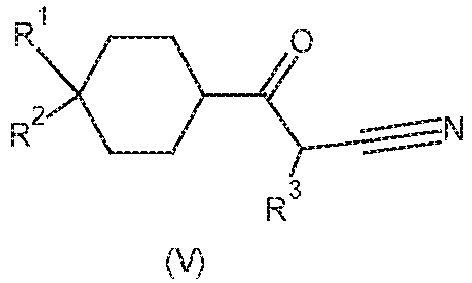
- 2a) hydrazine hydrate to provide a compound of formula (VI)

- wherein the meaning of R1, R2 is as described above and R3 is hydrogen, halogen atom, C1-6alkyl group or
- 2b) trimethyl orthoformate to provide the malononitrile derivative of formula (XIV)

- wherein the meaning of R1, R2 is as described above and R3 is cyano group which is reacted with hydrazine hydrate to provide a compound of formula (VI)

- wherein the meaning of R1, R2 is as described above and R3 is cyano group which is reacted with hydrazine hydrate to provide a compound of formula (VI)
- 2a) hydrazine hydrate to provide a compound of formula (VI)
- step 3) the compound of formula (VI) wherein the meaning of R1, R2, R3 is as described above for the formula (I) - obtained according to the steps described in 2a) or 2b) is reacted with acylacetic ester derivative of formula (VII)

- wherein the meaning of R4 and R5 is as described above for the formula (I), then step 4) the so obtained compound of formula (VIII)

- wherein the meaning of R1, R2, R3, R4, and R5 is as described above for the formula (I) -is chlorinated to furnish a chloro derivative of formula (IX)

- wherein the meaning of R1, R2, R3, R4, and R5 is as described above for the formula (I) - and
- wherein the meaning of R4 and R5 is as described above for the formula (I), then step 4) the so obtained compound of formula (VIII)
- step 5) the latter is reacted with either
- 5c) a nipecotic acid derivative of formula (X)

- wherein the meaning of R6 is as described above for the formula (I) - and the obtained derivative of formula (I) and optical antipodes or racemates and/or salts thereof in given case can be transformed into an other compound of formula (I) and optical antipodes or racemates and/or salts thereof by introducing new substituents and/or modifying or removing the existing ones, or
- 5d) its alkali salt of formula (XI)

- wherein the meaning of R6 is as described above for the formula (I) - and the obtained compound of formula (I) and optical antipodes or racemates and/or salts thereof in given case can be transformed into an other compound of formula (I) and optical antipodes or racemates and/or salts thereof by introducing new substituents and/or modifying or removing the existing ones, or
- 5e) a nipecotic acid ester derivative of formula (XII)

- wherein the meaning of R6 is as described above for the formula (I) - to provide the ester derivative of formula (XIII)

- wherein the meaning of R1, R2, R3, R4, R5 and R6 is as described above for the formula (I) finally the latter is saponified with a strong base or acid - and the obtained derivative of formula (I) and optical antipodes or racemates and/or salts thereof optionally can be transformed into an other compound of formula (I) and optical antipodes or racemates and/or salts thereof by introducing new substituents and/or modifying or removing the existing ones.
- wherein the meaning of R6 is as described above for the formula (I) - to provide the ester derivative of formula (XIII)
- 5c) a nipecotic acid derivative of formula (X)
- The synthesis of acylacetonitrile derivative (V) can be carried out by different routes:
-
- a) The reaction of a carboxylic acid ester derivative of formula (II) with an acetonitrile derivative of formula (IV) is preferably carried out in a proper solvent, e.g. tetrahydrofuran, preferably in the presence of a strong base e.g. n-butyllithium, lithium bis(trimethylsilyl)amide. The reaction carried out at a temperature in the range of -78 °C to room temperature. The necessary reaction time is 1-16 h. The reactions are followed by thin layer chromatography. The reaction is quenched by addition of water and hydrochloric acid (∼pH 2-3) or saturated ammonium chloride solution. The product (V) is isolated by extraction with a proper organic solvent or by filtration, after removing the organic solvent.
- b) The reaction of an carboxylic acid chloride derivative of formula (III) with an acetonitrile derivative of formula (IV) is preferably carried out in a proper solvent, e.g. tetrahydrofuran, preferably in the presence of a strong base e.g. n-butyllithium, lithium bis(trimethylsilyl)amide. The reaction carried out at a temperature in the range of -78 °C to room temperature. The necessary reaction time is 1-16 h. The reactions are followed by thin layer chromatography. The reaction is quenched by addition of water and hydrochloric acid (∼pH 2-3) or saturated ammonium chloride solution. The product (V) is isolated by extraction with a suitable organic solvent or by filtration, after removing the organic solvent.
- The cyclocondensation reaction of the acyl nitrile derivatives of formula (V) with hydrazine hydrate to pyrazole derivatives of formula (VI) is preferably carried out in a suitable solvent, e.g. ethanol. The reaction is preferably carried out at boiling point of the solvent. The necessary reaction time is 1-6 h. The reactions are followed by thin layer chromatography. The work-up of the reaction mixture can be carried out by the following routes:
- a) The reaction mixture is diluted with water and the product is isolated by filtration or extraction with a suitable organic solvent and in given case purified by crystallization or column chromatography.
- b) The reaction mixture is evaporated in vacuo and the crude product is used in the next step without further purification.
- The reaction of a carboxylic acid chloride derivative of formula (III) with malononitrile is preferably carried out in a suitable solvent, e.g. tetrahydrofuran, preferably in the presence of a base e.g. triethylamin. The reaction carried out at a temperature in the range of 0 °C to room temperature. The necessary reaction time is 1-16 h. The reactions are followed by thin layer chromatography. The reaction is quenched by addition of water. The product (V) is isolated by extraction with a suitable organic solvent.
- The O-methylation of the acyl malononitrile derivative of formula (V) with trimethyl orthoformate is preferably carried out at boiling point. The necessary reaction time is 1-16 h. The reactions are followed by thin layer chromatography. The product (XIV) is purified by column chromatography.
- The cyclocondensation reaction of the O-methylated acyl nitrile derivatives of formula (XIV) with hydrazine hydrate to pyrazole derivatives of formula (VI) is preferably carried out in a suitable solvent, e.g. ethanol. The reaction is preferably carried out at room temperature. The necessary reaction time is 1-6 h. The reactions are followed by thin layer chromatography. The reaction mixture is diluted with water and the product is isolated by extraction with a suitable organic solvent.
- The cyclocondensation reaction of the 1H-pyrazol-5-amine derivative of formula (VI) with an acylacetic ester derivative of formula (VII) is preferably carried out in a suitable solvent, e.g. toluene, by the addition of catalytic amount of p-toluenesulfonic acid, using a Dean- Stark water separator. The reaction is preferably carried out at boiling point of the solvent. The necessary reaction time is 1-16 h. The reactions are followed by thin layer chromatography. The product (VIII) is isolated by filtration.
- Chlorination of the pyrazolo[1,5-a]pyrimidine derivative of formula (VIII) can be carried out in a suitable solvent, e.g. toluene using a suitable chlorinating agent, e.g. phosphorus oxychloride by the addition of triethylamine or N,N-diisopropylethylamine. The reaction is preferably carried out at boiling point of the solvent. The necessary reaction time is 24-48 h. The reactions are followed by thin layer chromatography. The reaction mixture is poured into sodium hydrogen carbonate solution and chrushed ice. The decomposed reaction mixture is filtered and the product is isolated from the filtrate by extraction with a suitable organic solvent and in given case purified by crystallization or column chromatography. The column chromatography is carried out on normal phase using Kieselgel 60 as adsorbent and different solvent systems, e.g. n-hexane/ethyl acetate, toluene/methanol, chloroform/methanol or toluene/acetone, as eluents.
- N-arylation reaction of the nipecotic acid derivative of formula (X) or (XII) with the chloro derivative of formula (IX) carried out in a suitable solvent, e.g. dimethylformamide, dimethylsulfoxide, N-methyl-pyrrolidone. The reaction is preferably carried out between 80°C and 140 °C. A suitable amine of formula (X) or (XII) is added as base or as a salt formed with inorganic acid to the so obtained solution in the presence of a base, for example cesium carbonate or N,N-diisopropylethylamine, needed for the liberation of the amine or formed with inorganic base for example potassium salt of formula (XI). The reactions are followed by thin layer chromatography. The necessary reaction time is 3-20 h. The work-up of the reaction mixture can be carried out by different methods.
- When the N-arylated product is an acid derivative of formula (I) and the reaction mixture is a suspension, the inorganic salt is filtered off, the filtrate is diluted with water and acidified with acetic acid. The product is isolated by filtration or extraction with a suitable organic solvent and in given case purified by crystallization or column chromatography. If the reaction mixture is a solution, it is diluted with water and acidified with acetic acid. The product is isolated by filtration or extraction with a suitable organic solvent and in given case purified by crystallization or column chromatography.
- When the N-arylated product is an ester derivative of formula (XIII), the reaction mixture is evaporated in vacuo. The product is isolated by crystallization or extraction with a suitable organic solvent and in given case purified by recrystallization or column chromatography.
- The hydrolysis of the carboxylic acid ester derivative of formula (XIII) into the carboxylic acid derivative of formula (I) can be carried out with an appropriate strong inorganic base, e.g. lithium hydroxide, sodium hydroxide or with an appropriate strong inorganic acid, e.g. hydrochloric acid. The reaction is preferably carried out between room temperature and 100 °C. The reactions are followed by thin layer chromatography. The necessary reaction time is 1-20 h. The reaction mixture is diluted with water and acidified with acetic acid. The product is isolated by filtration or extraction with a suitable organic solvent and in given case purified by crystallization or column chromatography. The structures of the products are determined by NMR and mass spectrometry.
- Most of the nipecotic acid derivatives of formula (X) and (XII) are either commercially available or can be synthesized by different known methods. The syntheses of some new nipecotic acid derivatives of formula (XII) are described in the Intermediates section.
- The compounds of the present invention and optical antipodes or racemates and/or salts thereof can be used as such or suitably in the form of pharmaceutical compositions.
- The invention also relates to the pharmaceutical compositions containing the compounds of formula (I) or optical antipodes or racemates and/or salts thereof as active ingredient for the treatment of certain disorders associated with GABAB receptor positive allosteric modulator activity.
- The present compounds may be coadminstered to a subject in combination with two or more different therapeutic agents (eg. most preferably antipsychotics and psychostimulants; and preferably antidepressants, anxiolytics, antihypertensives, anticonvulsants, sedatives, and narcotics).
- Suitable routes of administration may, for example, include oral, rectal, transmucosal, transdermal or intestinal administration; parenteral delivery, including intramuscular, subcutaneous, intravenous, intramedullary injections, as well as intraarticular, intrathecal, direct intraventricular, intraperitoneal, intranasal, or intraocular injections and eye drops.
- Alternatively, one may administer the compound in a local rather than systemic manner, for example, via injection of the compound directly in the renal or cardiac area, often in a depot or sustained release formulation. Furthermore, one may administer the drug in a targeted drug delivery system, for example, in a liposome coated with a tissue-specific antibody. The liposomes will be targeted to and taken up selectively by the organ.
- The pharmaceutical compositions can be administered through via a variety of routes and dosages forms. The compound of the invention may be administered either alone or in combination with pharmaceutically acceptable carriers, in either single or multiple doses. The dosage required to exert the therapeutical effect can vary within wide limits and will be fitted to the individual requirements in each of the particular case, depending on the stage of the disease, the condition and the bodyweight of the patient to be treated, as well as the sensitivity of the patient against the active ingredient, route of administration and number of daily treatments.
- For the sake of a simple administration it is suitable if the pharmaceutical compositions comprise dosage units containing the amount of the active ingredient to be administered once, or a few multiples or a half, third or fourth part thereof. Such dosage units are e.g. tablets, which can be powdered with grooves promoting the halving or quartering of the tablet in order to exactly administer the required amount of the active ingredient.
- The pharmaceutical compositions containing the active ingredient according to the present invention usually contain 0.01 to 500 mg of active ingredient in a single dosage unit. It is, of course possible that the amount of the active ingredient in some compositions exceeds the upper or lower limits defined above.
- As a further aspect of the invention there is provided the pharmaceutical manufacture of medicaments containing the compounds of formula (I) or optical antipodes or racemates and/or salts thereof.
- The pharmaceutical compositions of the present invention may be formulated as different pharmaceutical dosage forms, such as but not limited to, solid oral dosage forms like tablets (e.g. buccal, sublingual, effervescents, chewable, orodispersible, freeze dried), capsules, lozenges, pastilles, pills, orodispersible films, granules, powders; liquid oral dosage forms like solutions, emulsions, suspensions, syrups, elixires, oral drops; parenteral dosage forms like intravenous injections, intramuscular injections, subcutaneous injections; other dosage forms like eye drops, semi-solid eye preparations, transdermal dosage forms, suppositories, rectal capsules, rectal solutions, emulsions and suspensions, etc.
- In one embodiment the invention relates to pharmaceutical dosage forms specifically intended for pediatric use, such as but not limited to, solutions, syrups, elixirs, suspensions, powders for reconstitution as suspension, dispersible or effervescent tablets, chewable tablets, orally disintegrating tablets, tablets or coated tablets, sprinkle oral powder or granules, capsules.
- The pharmaceutical compositions of the present invention may be manufactured in a manner that is itself known, e.g., by means of conventional mixing, dissolving, emulsifying, suspending, entrapping, freeze-drying, extrusion, laminating, film-casting, granulating, grinding, encapsulating, dragee-making or tabletting processes.
- Pharmaceutical compositions for use in accordance with the present invention thus may be formulated in conventional manner using one or more physiologically acceptable carriers comprising excipients and auxiliaries which facilitate processing of the active compounds into preparations which can be used pharmaceutically. Proper formulation is dependent upon the route of administration chosen. Any of the well-known techniques, carriers, and excipients may be used as suitable and as understood in the art.
- Suitable excipients for the preparation of the dosage forms may be selected from the following categories, such as but not limited to, tablet and capsule fillers, tablet and capsule binders, modified-release agents, disintegrants, glidants, lubricants, sweetening agents, taste-masking agents, flavoring agents, coating agents, surfactants, antioxidants, buffering agents, complexing agents, emulsifying agents, lyophilization aids, microencapsulating agents, ointment bases, penetration enhancers, solubilizing agents, solvents, suppository bases, suspending agents.
- In one embodiment the invention relates to the using of specific excipients which are able to improve the solubility, dissolution, penetration, adsorption or bioavailability of the active ingredient(s), such as but not limited to, hydrophilic polymers, hot melt extrusion excipients, surfactants, buffering agents, complexing agents, emulsifying agents, lyophilization aids, superdisintegrants, microencapsulating agents, penetration enhancers, solubilizing agents, co-solvents, suspending agents.
- The above described ingredients and different routes of manufacture are merely representative. Other materials as well as processing techniques and the like well known in the art can also be used.
- The compounds are effective in the treatment of psychiatric, neurodevelopmental, neurological and other central nervous system disorders as well as peripheral conditions where stimulation of the GABAB receptor may offer therapeutic benefit
- Cortices of freshly harvested rat brains were dissected on an ice-cold surface and homogenized by a glass Dounce homogeniser immediately in ice-cold buffer containing 50 mM Tris, 5 mM MgCl2 and 1 mM EDTA (pH=7.6). Tissue homogenates were centrifuged at 40000 g for 15 min at 4°C. Membane pellets were resuspended in the same buffer and membranes were incubated for 10 min at 30°C in a shaking water bath to eliminate endogenous GABA. Homogenates were centrifuged again under the same conditions. The final pellets were resuspended in ice-cold buffer (pH=7.6) containing 50 mM Tris, 100 mM NaCl, 7 mM MgCl2, 1 mM EDTA and 1 mM dithiotreithol (DTT) to yield a concentration of 20 mg tissue weight/ml and frozen at -70°C until use. The assay was done in a buffer containing 50 mM Tris (pH=7.4), 100 mM NaCl, 7 mM MgCl2, 1 mM EDTA and 1 mM DTT. Each assay tube contained 150 µL GDP (in a final concentration of 50 µM), 100 µL ligand and 125 µL of the membrane suspension (250 µg tissue/tube). The assay tubes were preincubated for 10 min at 30°C to assure equilibrium. Nonspecific binding was determined in the presence of 10 µM GTPγS; basal binding was determined in the presence of buffer only. After addition of 50 pM [35S]GTPγS in a volume of 25 µL to the tubes, membranes were incubated for an additional 60 min at 30°C. The assay was terminated by rapid filtration through Packard UniFilter GF/B using a Packard harvester and washed four times with 1 ml ice-cold buffer. After drying the filters at 40°C for 1 h, 40 µL Microscint (Packard) was added to the filters and radioactivity of the filters was determined by a TopCount NXT (PerkinElmer, Waltham, MA; Alper and Nelson, Eur. J. Pharmacol. 1998, 343, 303-312; Rinken et al, Biochem. Pharmacol. 1999, 57, 155-162). Data thus gathered were used to determine PAM EC50 values for each compound as primary in vitro activity end point.
- In Table 1 compounds of this invention measured in the [35S]GTPγS binding assay are listed.
Table 1 Number of example In vitro PAM potency 1 ++ 2 ++ 3 + 4 ++ 5 ++ 6 ++ 7 + 10 ++ 11 ++ 12 ++ 13 + 14 ++ 15 ++ 16 + 17 ++ 18 + 19 +++ 20 ++++ 21 +++ 22 ++++ 23 ++ 24 +++ 25 +++ 26 +++ 27 ++ 28 +++ 29 +++ 30 ++ 31 +++ 32 +++ 34 ++ 35 ++ 36 ++++ 37 ++++ 40 ++ 42 ++++ + PAM EC50 < 1 nM
++ 1 nM ≤ PAM EC50 < 10 nM
+++ 10 ≤ PAM EC50 < 100 nM
++++ 100 ≤ PAM EC50 < 1000 nM - Under stressful conditions, adult rats emit 22 kHz ultrasounds that can be reduced by various pharmacological treatments (De Vry et al, Eur. J. Pharmacol 1993, 249, 331-339; Sanchez, Eur. J. Pharmacol. 2003, 463, 133-143). Previous unpublished experiments indicated that GABAB receptor ligands can also inhibit vocalizatons that are induced by electric footshocks as stressor. Therefore, a foot shock-induced vocalization paradigm in adult rats was used to assess efficacy of centrally acting GABAB receptor ligands. Behavioral measurements were carried out on male Wistar rats (200-250 g, Toxicoop, Hungary). Rats were housed in groups of four in plastic cages with a wire grid top in a temperature and light-controlled laboratory animal care unit (22 ± 2 oC, 12-h light/dark cycle, lights on at 6:00 AM) with ad libitum access to commercial pellet rat food and tap water. Investigations were approved by the Local Ethical Committee of Gedeon Richter Plc. and were carried out in strict compliance with the European Directive 2010/63/EU regarding the care and use of laboratory animals for experimental procedures and all efforts were made to minimize the number of animals as well as their suffering. In order to evoke emission of ultrasounds, animals were footshocked after a habituation period of 30 s (6 shocks, 1 s, 0.8 mA each, inter-shock interval 10 s) in a sound attenuated shocking chamber (Experimetria, 40x40x80 cm). Investigational compounds were administered at the dose of 1 mg/kg in a solid dispersion formulation in distilled water 1 h before shocking per os. Vocalizations were measured right after the last footshock for 10 min with a Metris Sonotrack system and the total time of vocalizations was registered. Vocalization of parallel vehicle treated animals was considered as control value and inhibition percent was calculated for each compound. At approximately 75 min after treatment and behavioral measurements, blood and brain samples were harvested in order to determine exposures associated with in vivo activity.
- In Table 2 compounds of this invention measured in the USV assay are listed. In Table 3 plasma and brain levels of compounds of this invention are listed.
Table 2 Number of example USV inhibition at 1 mg/kg (%) 2 85 3 100 11 71 12 59 13 97 15 89 16 100 17 79 18 75 33 63 35 57 Table 3 Number of example plasma exposure at 1 mg/kg (ng/mL) brain exposure at 1 mg/kg (ng/g) 2 188 74 3 58 18 11 146 68 12 121 62 13 124 31 15 170 53 16 131 36 17 135 74 18 175 30 33 172 34 35 207 35 - The prenatal valproate model has excellent construct and face validity, therefore it is a widely accepted disease model of ASD (Christensen et al, JAMA 2013, 309, 1696-1703; Roullet et al, Neurotox. Teratol. 2013, 36, 45-56). In this method, time-mated female Wistar rats (Harlan UK) were administered a single dose of valproic acid (VPA, 600 mg/kg, i.p.) on gestational day 12.5. Male offspring were housed according to standard laboratory conditions until time of testing at postnatal day 59. Animals were housed in groups of 4 in conventional cages and maintained at 22-24°C on a standard 12 hour light/dark cycle (07.30-19.30), with food and water available ad libitum. After investigational drug treatment, offspring were examined behaviorally in the social preference assay at postnatal day 59. The social preference test is a highly accepted assay to assess autistic behavior in rodents (Nadler et al, Genes Brain Behav. 2007, 3, 303-314; Bambini-Junior et al, Brain Res. 2011, 1408, 8-16). Briefly, in this assay a test animal is allowed to investigate a conspecific separated by a dividing perforated wall or a similar area however, without a target conspecific. An autistic animal (such as a prenatally valproate-exposed rat) spends little time with social investigation during a test session.
- The inventors unexpectedly found that selected compounds of the invention in the oral dose range of 0.01 - 3 mg/kg were of great behavioral benefit in the present preclinical disease model that recapitulates the core symptoms of ASD. The inventors therefore showed that these compounds may be of therapeutic potential for the treatment of core symptoms of ASD in humans.
- The invention is further defined in the following Examples.
- In general, the compounds of formula (I) can be prepared according to the general knowledge of one skilled in the art and/or using methods set forth in the Example and/or Intermediate sections that follow. Solvents, temperatures, pressures, and other reaction conditions can readily be selected by one of ordinary skill in the art. Starting materials are commercially available and/or readily prepared by one skilled in the art.
- Our patent application filed concurrently herewith titled "Process for the separation of optical isomers of racemic 3-alkylpiperidine-carboxylic acid ethyl esters" discloses the preparation of certain starting materials.
- The present invention will be now illustrated by the following not limiting examples.
-

- Under nitrogen to a solution of 22.96 g (89 mmol) of 1-tert-butyl 3-ethyl piperidine-1,3-dicarboxylate in 300 mL of dry tetrahydrofuran 100 mL of 1M lithium bis(trimethylsilyl)amide in tetrahydrofuran solution (100 mmol) was added dropwise at (-78) °C - (-65) °C. After addition the mixture was stirred at -78°C for 20 min, 6.6 mL (106 mmol) of iodomethane was added dropwise. The so obtained mixture was allowed to warm to room temperature and stirred at this temperature for 18 h. The reaction was quenched by addition of 200 mL of saturated ammonium chloride solution (pH ∼8) and 300 mL of water. The reaction mixture was extracted with ethyl acetate, the combined organic layer was washed with water, dried over anhydrous sodium sulfate, filtered and concentrated in vacuo. The residue was chromatographed on silica gel eluting with ethylacetate and cyclohexane (1:4) to yield 24.2 g (95%) of the title compound as oil.
- To a solution of 50 ml of 2.5 M hydrochloric acid in ethyl acetate 24.2 g (84.8 mmol) of 1-tert-butyl 3-ethyl 3-methylpiperidine-1,3-dicarboxylate was added. The reaction mixture was stirred for 3 h at 20 °C, then 100 mL of diethyl ether was added. The precipitated crystals were filtered off, washed with diethyl ether to yield 16.28 g (97 %) of the title compound.
-

- The title compound is prepared from 1-tert-butyl 3-ethyl piperidine-1,3-dicarboxylate and iodo ethane according to the method described in Intermediate 1a.
- The title compound is prepared from 1-tert-butyl 3-ethyl 3-ethylpiperidine-1,3-dicarboxylate according to the method described in Intermediate 1b.
-

- The title compound is prepared from 1-tert-butyl 3-ethyl piperidine-1,3-dicarboxylate and 2-iodo propane according to the method described in Intermediate 1a.
- The title compound is prepared from 1-tert-butyl 3-ethyl 3-(propan-2-yl)piperidine-1,3-dicarboxylate according to the method described in Intermediate 1b.
-

- Under nitrogen to a solution of 10 g (38.86 mmol) of 1-tert-butyl 3-ethyl piperidine-1,3-dicarboxylate in 120 mL of dry tetrahydrofuran 42 mL of 1 M lithium bis(trimethylsilyl)amide in tetrahydrofuran solution (42 mmol) was added dropwise at (-78) °C - (-65) °C. After addition the mixture was stirred at -78°C for 20 min, 3.9 mL (39.7 mmol) of 1-iodopropane was added dropwise. The so obtained mixture was allowed to warm to room temperature and stirred at this temperature for 18 h. The reaction was quenched by addition of 200 mL of saturated ammonium chloride solution (pH ~8) and 300 mL of water. The reaction mixture was extracted with ethyl acetate, the combined organic layer was washed with water, dried over anhydrous sodium sulfate, filtered and concentrated in vacuo. The residue was chromatographed on silica gel eluting with ethylacetate and cyclohexane (1:4) to obtain the title compound as oil. The crude product is used in the next step.
- To the above obtained 1-tert-butyl 3-ethyl 3-propylpiperidine-1,3-dicarboxylate 20 ml of 2.5 M hydrochloric acid in ethyl acetate was added. The reaction mixture was stirred for 3 h at 20 °C, then concentrated in vacuo to yield 11.85 g of the title compound as oil.
-

- The title compound is prepared from 1-tert-butyl 3-ethyl piperidine-1,3-dicarboxylate and paraformaldehyde according to the method described in Intermediate 1a.
- Under nitrogen, to a stirred solution of 0.296 g (1.03 mmol) of ethyl 3-(hydroxymethyl) piperidine-3-carboxylate and 0.120 ml (1.48 mmol) of pyridine in 5 ml of dichloromethane 0.230 ml (1.48 mmol) of trifluoromethanesulfonic anhydride was added dropwise at (-78) °C - (-65) °C. After addition the mixture was stirred at -78°C for 5 min and allowed to warm to room temperature and stirred at this temperature for 18 h. The reaction was quenched by addition of 1M hydrochloric acid solution. The reaction mixture was extracted with dichloromethane, the combined organic layer was washed with water, dried over anhydrous sodium sulfate, filtered and concentrated in vacuo to obtain the title compound as oil. The crude product is used in the next step.
- The above obtained 1-tert-butyl 3-ethyl 3-([(1,1,2-trifluoroethanesulfonyl)oxy] methyl}piperidine-1,3-dicarboxylate was solved in 4 ml of tetrahydrofuran and 1.25 ml (1.25 mmol) of 1M tetrabutylammonium fluoride in tetrahydrofuran was added. The reaction mixture was stirred for 1 h at room temperature, diluted with water and extracted with ethylacetate. The combined organic layer was washed with water, dried over anhydrous sodium sulfate, filtered and concentrated in vacuo. The residue was chromatographed on silica gel eluting with ethylacetate and cyclohexane (1:2) to yield 0.121 g (40%) of the title compound.
- The title compound is prepared from 1-tert-Butyl 3-ethyl 3-(fluoromethyl)piperidine-1,3-dicarboxylate according to the method described in Intermediate 1b.
-

- The title compound is prepared from 1-tert-butyl 3-ethyl piperidine-1,3-dicarboxylate and chloromethyl methyl ether according to the method described in Intermediate 1a.
- The title compound is prepared from 1-tert-butyl 3-ethyl 3-(methoxymethyl)piperidine-1,3-dicarboxylate according to the method described in Intermediate 1b.
-

- To a solution of 10 g (51 mmol) of trans 4-(trifluoromethyl)cyclohexane-1-carboxylic acid in 150 ml of methanol 10 ml (137 mmol) of thionyl chloride was added dropwise at -10 °C. After addition the mixture was allowed to warm to room temperature and stirred at this temperature for 16 h, then concentrated in vacuo. The residue was partitioned between ethyl acetate and water. The combined organic layer was washed with sodium hydrogene carbonate solution and water, dried over anhydrous sodium sulfate, filtered and concentrated in vacuo. Dry cyclohexane was evaporated from the residue several times to yield 8.96 g of the title compound as colourless oil.
- Under nitrogen to a mixture of 9.1 ml (174 mmol) of acetonitrile in 260 ml of dry tetrahydrofuran 51 ml of 2.5 M n-butyllithium in n-hexane solution (127 mmol) was added dropwise at (-78) °C - (-65) °C. After addition the mixture was stirred at -78°C for 1 h, 8.96 g (42.6 mmol) of methyl trans-4-(trifluoromethyl)cyclohexane-1-carboxylate was added dropwise. The so obtained mixture was allowed to warm to room temperature and stirred at this temperature for 1 h. The reaction was quenched by addition of 150 mL of saturated ammonium chloride solution. The tetrahydrofuran was evaporated and the mixture was extracted with ethyl acetate. The combined organic layer was washed with water, dried over anhydrous sodium sulfate, filtered and concentrated in vacuo. The crude product is used in the next step.
- The above obtained 3-oxo-3-[trans-4-(trifluoromethyl)cyclohexyl]propanenitrile was solved in 187 ml of ethanol and 4.4 ml (167 mmol) of hydrazine monohydrate was added. Under inert gas atmosphere, the reaction mixture was refluxed for 16 h. The solvent was removed in vacuo and dry toluene was evaporated from the residue several times to yield 11.15 g of the title compound as yellow oil. LC-MS (ESI) m/z 234.2 [MH+]
-

- Under nitrogen to a mixture of 5 mL (95.7 mmol) of acetonitrile in 150 ml of dry tetrahydrofuran 29 ml of 2.5 M n-butyllithium in n-hexane solution (72.5 mmol) was added dropwise at (-78) °C - (-65) °C. After addition the mixture was stirred at -78°C for 1 h, 4.2 ml (24 mmol) of ethyl 4,4-difluorocyclohexane-1-carboxylate was added dropwise. The so obtained mixture was allowed to warm to room temperature and stirred at this temperature for 2 h. The reaction was quenched by addition of 150 mL of saturated ammonium chloride solution and and the mixture was extracted with ethyl acetate. The combined organic layer was washed with water, dried over anhydrous sodium sulfate, filtered and concentrated in vacuo. The crude product is used in the next step.
- The above obtained 3-oxo-3-[trans-4-(trifluoromethyl)cyclohexyl]propanenitrile was solved in 100 ml of ethanol and 4 ml (128.4 mmol) of hydrazine monohydrate was added. Under inert gas atmosphere, the reaction mixture was refluxed for 16 h. The solvent was removed in vacuo. The residue was partitioned between ethyl acetate and water. The combined organic layer was washed with water, dried over anhydrous sodium sulfate, filtered and concentrated in vacuo to yield 6.43 g of the title compound as yellow oil. LC-MS (ESI) m/z 202.2 [MH+]
-

- The title compound was prepared from 4,4-difluorocyclohexane-1-carboxylic acid and fluoroacetonitrile according to the method described in Intermediate 7.
-

- A mixture of 5 g (25.5 mmol) of trans 4-(trifluoromethyl)cyclohexane-1-carboxylic acid, 100 ml of dichloromethane, 5 ml (68.5 mmol) of thionyl chloride and 0.1 ml of dimethyformamide was refluxed for 6 h. The reaction mixture was concentrated in vacuo and dry tetrahydrofuran was evaporated from the residue several times. The crude product is used in the next step.
- Under inert gas atmosphere, to a solution of the above obtained trans-4-(trifluoromethyl) cyclohexane-1-carbonyl chloride and 1.5 ml (26.96 mmol) of fluoroacetonitrile in 50 mL of abs. tetrahydrofuran 50 mL (50 mmol) of 1M lithium bis(trimethylsilyl)amide was added dropwise at - 78 °C After addition the mixture was stirred at -78°C for 1 h, then the mixture was allowed to warm to room temperature and poured into 200 mL of water. The pH of the mixture was adjusted to 2 by the addition of 1M hydrochloric acid. The mixture was extracted with ethyl acetate, the combined organic layer was washed with water, dried over anhydrous sodium sulfate, filtered and concentrated in vacuo. The crude product is used in the next step.
- The above obtained 2-fluoro-3-oxo-3-[trans-4-(trifluoromethyl)cyclohexyl]propanenitrile was dissolved in 65 ml of ethanol and 4.4 ml (77 mmol) of hydrazine monohydrate was added. Under inert gas atmosphere, the reaction mixture was refluxed for 16 h. The solvent was removed in vacuo to obtain the title compound as oil. LC-MS (ESI) m/z 252.2 [MH+]
-

- To a mixture of 2. 7g (12.58 mmol) trans-4-(trifluoromethyl) cyclohexane-1-carbonyl chloride (Intermediate 10a) and 1.26 g (19.0 mmol) of malononitrile in 15 mL of abs. tetrahydrofuran 1.77 mL (50 mmol) of triethylamin was added dropwise at 0 °C. After addition the mixture was stirred at 0 °C for 1 h, then the mixture was allowed to warm to room temperature and poured into 200 mL of water. The mixture was extracted with ethyl acetate, the combined organic layer was washed with water, dried over anhydrous sodium sulfate, filtered and concentrated in vacuo. The crude product is used in the next step.
- To the above obtained 2-[trans-4-(trifluoromethyl)cyclohexanecarbonyl]propanedinitrile 10 ml of trimethyl orthoformate was added. The reaction mixture was refluxed for 16 h. The reaction mixture was concentrated in vacuo and the residue was chromatographed on silica gel eluting with ethylacetate and cyclohexane (1:1) to yield 1.495 g (46.0 %) of the title compound as oil. LC-MS (ESI) m/z 259.1 [MH+]
- The above obtained 2-{methoxy[trans-4-(trifluoromethyl)cyclohexyl]methylidene} propanedinitrile was dissolved in 17 ml of ethanol and 1.4 ml (24.5 mmol) of hydrazine monohydrate was added. The reaction mixture was stirred for 0.5 h at room temperature, diluted with water and extracted with ethylacetate. The combined organic layer was washed with water, dried over anhydrous sodium sulfate, filtered and concentrated in vacuo to yield 1.04 g (69.5%) of the title compound. LC-MS (ESI) m/z 259.2 [MH+]
-

- A mixture of 11.156 g (47.8 mmol) of 3-[trans-4-(trifluoromethyl)cyclohexyl]-1H-pyrazol-5-amine (Intermediate 7), 8 ml (44.6 mmol) of ethyl 2-acetyl-3-methylbutanoate and 0.32 g (1.6 mmol) of p-toluenesulfonic acid monohydrate in 340 mL of toluene was refluxed for 20 h, then cooled to room temperature. The reaction mixture was concentrated in vacuo and the residue was chromatographed on silica gel eluting with dichloromethane and methanol (20:1) to yield 12.4 g (76%) of the title compound. LC-MS (ESI) m/z 342.2 [MH+]
- A mixture of 12.4 g (36.35 mmol) of 5-methyl-6-(propan-2-yl)-2-[trans-4-(trifluoromethyl)cyclohexyl]pyrazolo[1,5-a]pyrimidin-7-ol, 16.7 ml (179 mmol) of phosphorus oxychloride, 12.7 ml (72.9 mmol) of N,N-diisopropylethylamine and 733 ml of toluene was refluxed for 20 h. The reaction mixture was cooled to 20 °C, poured into a mixture of sodium hydrogen carbonate solution and ice, then stirred for 2 h. The reaction mixture was filtered, the filtrate was extracted with ethyl acetate, the combined organic layer was washed with water, dried over anhydrous sodium sulfate, filtered and concentrated in vacuo to yield 12.05 g (92%) of the title compound. LC-MS (ESI) m/z 360.2 [MH+]
- Compounds of Table 4 were prepared from the appropriate acetoacetic ester and 1H-pyrazol-5-amine according to the method described in Intermediate 12.
Table 4 Intermediate Structure Intermediate (starting material) LC-MS (ESI) m/z [MH+] 13 
10 360.2 14 
7 348.1 15 
10 366.2 16 
7 346.1 17 
7 360.2 18 
8 328.2 19 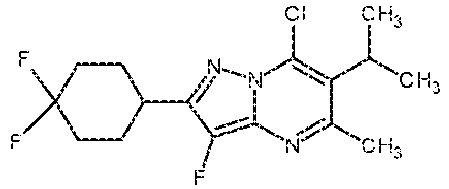
9 346.2 20 
7 358.2 21 
7 372.2 22 
7 360.2 23 
7 360.1 24 
7 372.2 25 
11 385.2 26 
7 376.2 -

- A mixture of 0.8 g (2.22 mmol) of 7-chloro-5-methyl-6-(propan-2-yl)-2-[trans-4-(trifluoromethyl)cyclohexyl]pyrazolo[1,5-a]pyrimidine (Intermediate 12), 0.5 g (3.87 mmol) of S-nipecotic acid and 0.7 ml (4 mmol) of N,N-diisopropylethylamine in 20 mL of N-methyl-pyrrolidone was heated at 130 °C for 20 h, then cooled and diluted with water. The reaction mixture was extracted with ethylacetate, the combined organic layer was washed with water, dried over anhydrous sodium sulphate, filtered and concentrated in vacuo. The residue was chromatographed on silica gel eluting with ethylacetate and cyclohexane (1:2) to yield 0.422 g (42.0 %) of the title compound. LC-MS (ESI) m/z 453.2 [MH+]
-

- A mixture of 0.66 g (2.79 mmol) of ethyl (3S)-3-(propan-2-yl)piperidine-3-carboxylate hydrochloride, 0.66 g (5.88 mmol) of potassium tert-butoxide in 15 mL of dimethyl sulfoxide was heated at 100 °C for 16 h. Then 1.0 g (2.77 mmol) 7-chloro-5-methyl-6-(propan-2-yl)-2-[trans-4-(trifluoromethyl)cyclohexyl]pyrazolo[1,5-a]pyrimidine (Intermediate 12) was added to the mixture and heated at 120 °C for 16 h. The reaction mixture was cooled and acidified with acetic acid. The precipitated crystals were filtered off, washed with water. The crude product was chromatographed on silica gel eluting with ethylacetate and cyclohexane (1:2) to yield 0.506 g (36.8 %) of the title compound. LC-MS (ESI) m/z 495.3 [MH+]
-

- A mixture of 1.0 g (3.06 mmol) of 7-chloro-5-methyl-6-(propan-2-yl)-2-[trans-4-(trifluoromethyl)cyclohexyl]pyrazolo[1,5-a]pyrimidine (Intermediate 12), 0.76 g (4.43 mmol) of ethyl (3R)-3-methylpiperidine-3-carboxylate and 0.8 mL (4.592 mmol) of N,N-diisopropylethylamine in 20 mL of N-methyl-pyrrolidone was heated at 130 °C for 20 h, then cooled and diluted with water. The reaction mixture was extracted with ethylacetate, the combined organic layer was washed with water, dried over anhydrous sodium sulphate, filtered and concentrated in vacuo. The residue was chromatographed on silica gel eluting with toluene and aceton (10:1) to yield 1.44 g (95.3 %) of the title compound. LC-MS (ESI) m/z 495.3 [MH+]
- A mixture of 1.443 g (2.91mmol) of ethyl (3R)-3-methyl-1-[5-methyl-6-(propan-2-yl)-2-[trans-4-(trifluoromethyl)cyclohexyl]pyrazolo[1,5-a]pyrimidin-7-yl]piperidine-3-carboxylate and 5 mL of 20% sodium hydroxide solution in 40 mL of ethanol was refluxed for 5 h, then cooled and acidified with acetic acid. The reaction mixture was extracted with dichloromethane, the combined organic layer was washed with water, dried over anhydrous sodium sulphate, filtered and concentrated in vacuo. The residue was chromatographed on silica gel eluting with ethylacetate and cyclohexane (1:2) to yield 0.934 g (68.6 %) of the title compound. LC-MS (ESI) m/z 467.3 [MH+]
-

- The racemic form of the title compounds were prepared from 7-chloro-5-methyl-6-(propan-2-yl)-2-[trans-4-(trifluoromethyl)cyclohexyl]pyrazolo[1,5-a]pyrimidine (Intermediate 12), and racem ethyl 3-propyipiperidine-3-carboxylate hydrochloride (Intermediate 4b) according to the methods described in Example 2a and 2b. LC-MS (ESI) m/z 495.3 [MH+]. The A and B enantiomers were separated using chiral preparative HPLC (Kromasil Cellucoat RP 5µm 150x4.6mm; F=1ml/min; eluents:A: H2O+30mM AmAc B:80ACN+30mM AmAc; isocratic70%B t=25°C) obtaining enantiomer A (Tr 10.464, Example 4), and enantiomer B (Tr 11.584, Example 5). Their absolute configuration is not determined.
-

- The racemic form of the title compounds were prepared from 7-chloro-5-methyl-6-(propan-2-yl)-2-[trans-4-(trifluoromethyl)cyclohexyl]pyrazolo[1,5-a]pyrimidine (Intermediate 12), and racem Ethyl 3-(fluoromethyl)piperidine-3-carboxylate hydrochloride (Intermediate 5) according to the methods described in Example 2a and 2b. LC-MS (ESI) m/z 485.3 [MH+]. The A and B enantiomers were separated using chiral preparative HPLC (Lux Amylose-1 5µm 250×21.1 mm ; F=21ml/min; eluents: n-Heptane : EtOH 80 : 20 + 0,1% TFA t= 40°C) obtaining enantiomer A(Tr 5.9, Example 6), and enantiomer B (Tr 6.7, Example 7). Their absolute configuration is not determined.
-
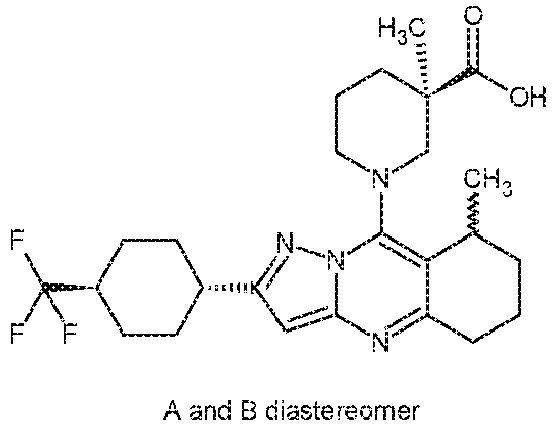
- The racemic form of the title compounds were prepared from racem 9-chloro-8-methyl-2-[trans-4-(trifluoromethyl)cyclohexyl]-5H,6H,7H,8H-pyrazolo[3,2-b]quinazoline (Intermediate 24), and ethyl (3R)-3-methylpiperidine-3-carboxylate hydrochloride according to the methods described in Example 2a. The A and B diastereomer esters were separated using column chromatography on silica gel eluting with dichloromethane-diisopropyl ether 10-1, obtaining diastereomer A ester (TLC in the same system rf = 0.5) and diastereomer B ester (TLC in the same system rf = 0.45).
- The title compounds were prepared from above diastereomer A ester (Example 8, LC-MS (ESI) m/z 479.2 [MH+]) and diastereomer B ester (Example 9, LC-MS (ESI) m/z 479.2 [MH+]) according to the methods described in Example 2b. Their absolute configuration is not determined.
- Examples 10 - 42 were prepared using analogues methods to those Examples described above and are exemplified below in Table 5.
Table 5 Example Structure LC-MS (ESI) m/z [MH+] Intermediate Route 10 
453.2 12 c 11 
467.3 12 e 12 
481.4 12 e 13 
481.4 12 e 14 
4.95.3 12 d 15 
485.3 13 e 16 
485.3 13 e 17 
499.3 13 e 18 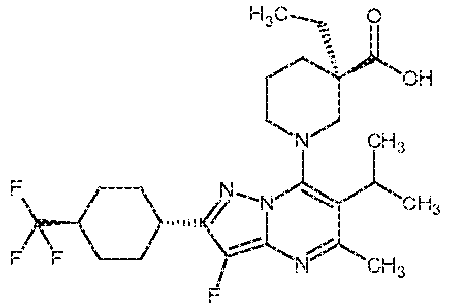
499.3 13 e 19 
455.2 14 d 20 
455.2 14 d 21 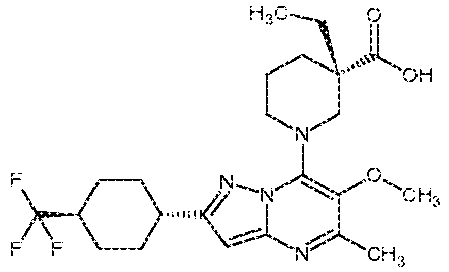
469.2 14 d 22 
469.2 14 d 23 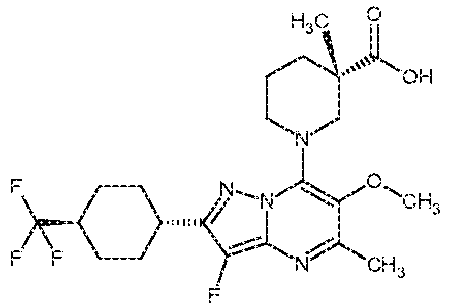
473.2 15 e 24 
473.2 15 e 25 
487.2 15 d 26 
487.2 15 e 27 
453.2 16 d 28 
467.3 16 d 29 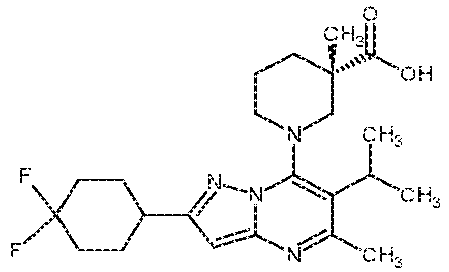
435.2 18 e 30 
435.2 18 e 31 
449.3 18 e 32 
449.3 18 e 33 
467.3 17 e 34 
465.2 20 e 35 
479.2 21 e 36 
467.2 22 e 37 
467.2 23 e 38 
492.3 25 e 39 
492.3 25 e 40 
453.2 18 e 41 
497.2 12 e 42 
467.2 23 e 43 
483.3 26 e - The following formulation examples illustrate representative pharmaceutical compositions of this invention. The present invention however is not limited to the following pharmaceutical compositions.
-
Active ingredient(s) 0.01 - 90% Filler 1 - 99.9% Binder 0 - 20% Disintegrant 0 - 20% Lubricant 0 - 10% Other specific excipient(s) 0 - 50% -
Active ingredient(s) 0.01 - 90% Film forming agent 1 - 99.9% Plasticizer 0 - 40% Other specific excipient(s) 0 - 50% -
Active ingredient(s) 0.01 - 50% Liquid vehicle 10 - 99.9% Wetting agent 0 - 50% Thickener 0 - 50% Buffering agent q.s. Osmotic agent 0 - 50% Preservatives q.s. -
Active ingredient(s) 0.01 - 50% Solvent 10 - 99.9% Sugar component 1 - 20% Flavouring agents 0 - 10% -
Active ingredient(s) 0.01 - 50% Solvent 10 - 99.9% Co-solvent 0 - 99.9% Osmotic agent 0 - 50% Buffering agent q.s. -
Active ingredient(s) 0.01 - 50% Suppository base 1 - 99.9% Surface-active agents 0 - 20% Lubricants 0 - 20% Preservatives q.s. -
Active ingredient(s) 0.01 - 50% Water 0 - 99.9% Solvent 0 - 99.9% Osmotic agent 0 - 20% Viscosity enhancer 0 - 20% Buffering agent q.s. Preservatives q.s.
Claims (9)
- A compound of formula (I) wherein:

R4 is C1-6alkyl;
R5 is C1-6alkyl optionally substituted by a halogen atom or halogen atoms, C3-5 cycloalkyl; C3-5 cycloalkylC1-6alkyl, dialkylamino, C1-6alkoxy, C1-6alkoxyC1-6alkyl, C1-6alkylthio group, tetrahydrofuranyl, tetrahydrofuranylC1-6alkyl, tetrahydropyranyl, tetrahydropyranylC1-6alkyl; or R4 and R5 together form an unsubstituted or substituted by one or more C1-3alkyl, C1-3alkoxy, haloC1-3alkyl, C1-3alkylcarbonyl 3 to 7-membered saturated ring, wherein the members of the ring are selected from the group consisting of carbon, nitrogen, oxygen, and sulphur;
R6 is hydrogen, halogen atom or C1-6alkyl, hydroxyl, C1-6alkoxy, C1-6alkoxyC1-6alkyl, haloC1-6alkyl, amino group; or pharmaceutically acceptable salts, enantiomers, diastereomers, solvates and hydrates thereof. - A compound according to claim 1 wherein
R1 and R2 are independently selected from hydrogen, halogen atom, C1-6alkyl, haloC1-6alkyl; R3 is hydrogen, halogen atom, C1-6alkyl, cyano group;
R4 is C1-6alkyl;
R5 is C1-6alkyl optionally substituted by a halogen atom or halogen atoms, C3-5 cycloalkyl; C3-5 cycloalkylC1-6alkyl, dialkylamino, C1-6alkoxy, C1-6alkoxyC1-6alkyl, C1-6alkylthio group, tetrahydrofuranyl, tetrahydrofuranylC1-6alkyl, tetrahydropyranyl, tetrahydropyranylC1-6alkyl; R6 is hydrogen, halogen atom or C1-6alkyl, hydroxyl, C1-6alkoxy, C1-6alkoxyC1-6alkyl, haloC1-6alkyl, amino group; or pharmaceutically acceptable salts, racemates, enantiomers, diastereomers, solvates and hydrates thereof. - A compound according to claim 1 wherein
R1 and R2 are independently selected from hydrogen, halogen atom, C1-6alkyl, haloC1-6alkyl; R3 is hydrogen, halogen atom, C1-6alkyl, cyano group;
R4 and R5 together form an unsubstituted or substituted by one or more C1-3alkyl, C1-3alkoxy, haloC1-3alkyl, C1-3alkylcarbonyl 3 to 7-membered saturated ring, wherein the members of the ring are selected from the group consisting of carbon, nitrogen, oxygen, and sulphur;
R6 is hydrogen, halogen atom or C1-6alkyl, hydroxyl, C1-6alkoxy, C1-6alkoxyC1-6alkyl, haloC1-6alkyl, amino group or pharmaceutically acceptable salts, enantiomers, diastereomers, solvates and hydrates thereof. - A compound according to claim 1 wherein R4 is methyl; and R5 is isopropyl or C1-6alkoxyC1-6alkyl.
- A compound according to claim 1 selected from the group of
(3S)-1-[5-Methyl-6-(propan-2-yl)-2-[trans-4-(trifluoromethyl)cyclohexyl]pyrazolo[1,5-a]pyrimidin-7-yl]piperidine-3-carboxylic acid
(3S)-1-[5-Methyl-6-(propan-2-yl)-2-[trans-4-(trifluoromethyl)cyclohexyl]pyrazolo[1,5-a]pyrimidin-7-yl]-3-(propan-2-yl)plperidine-3-carboxylic acid
(3R)-3-Methyl-1-[5-methyl-6-(propan-2-yl)-2-[trans-4-(trifluoromethyl)cyclohexyl]pyrazolo [1,5-a]pyrimidin-7-yl]piperidine-3-carboxylic acid
(3R)-1-[5-Methyl-6-(propan-2-yl)-2-[trans-4-(trifluoromethyl)cyclohexyl]pyrazolo[1,5-a]pyrimidin-7-yl]-3-propylpiperidine-3-carboxylic acid
(3S)-1-[5-Methyl-6-(propan-2-yl)-2-[trans-4-(trifluoromethyl)cyclohexyl]pyrazolo[1,5-a]pyrimidin-7-yl]-3-propylpiperidine-3-carboxylic acid
(3R)-3-(Fluoromethyl)-1-[5-methyl-6-(propan-2-yl)-2-[trans-4-(trifluoromethyl)cyclohexyl]pyrazolo[1,5-a]pyrimidin-7-yl]piperidine-3-carboxylic acid
(3S)-3-(Fluoromethyl)-1-[5-methyl-6-(propan-2-yl)-2-[trans-4-(trifluoromethyl)cyclohexyl]pyrazolo[1,5-a]pyrimidin-7-yl]piperidine-3-carboxylic acid
(3R)-3-Methyl-1-[(8S)-8-methyl-2-[trans-4-(trifluoromethyl)cyclohexyl]-5H,6H,7H,8H-pyrazolo[3,2-b]quinazolin-9-yl]piperidine-3-carboxylic acid
(3R)-3-Methyl-1-[(8R)-8-methyl-2-[trans-4-(trifluoromethyl)cyclohexyl]-5H,6H,7H,8H-pyrazolo[3,2-b]quinazolin-9-yl]piperidine-3-carboxylic acid
(3R)-1-[5-Methyl-6-(propan-2-yl)-2-[trans-4-(trifluoromethyl)cyclohexyl]pyrazolo[1,5-a]pyrimidin-7-yl]piperidine-3-carboxylic acid
(3S)-3-Methyl-1-[5-methyl-6-(propan-2-yl)-2-[trans-4-(trifluoromethyl)cyclohexyl]pyrazolo [1,5-a]pyrimidin-7-yl]piperidine-3-carboxylic acid
(3S)-3-Ethyl-1-[5-methyl-6-(propan-2-yl)-2-[trans-4-(trifluoromethyl)cyclohexyl]pyrazolo [1,5-a]pyrimidin-7-yl]piperidine-3-carboxylic acid
(3R)-3-Ethyl-1-[5-methyl-6-(propan-2-yl)-2-[trans-4-(trifluoromethyl)cyclohexyl]pyrazolo [1,5-a]pyrimidin-7-yl]piperidine-3-carboxylic acid
(3R)-1-[5-Methyl-6-(propan-2-yl)-2-[trans-4-(trifluoromethyl)cyclohexyl]pyrazolo[1,5-a]pyrimidin-7-yl]-3-(propan-2-yl)piperidine-3-carboxylic acid
(3S)-1-[3-Fluoro-5-methyl-6-(propan-2-yl)-2-[trans-4-(trifluoromethyl)cyclohexyl]pyrazolo [1,5-a]pyrimidin-7-yl]-3-methylpiperidine-3-carboxylic acid
(3R)-1-[3-Fluoro-5-methyl-6-(propan-2-yl)-2-[trans-4-(trifluoromethyl)cyclohexyl]pyrazolo [1,5-a]pyrimidin-7-yl]-3-methylpiperidine-3-carboxylic acid
(3S)-3-Ethyl-1-[3-fluoro-5-methyl-6-(propan-2-yl)-2-[trans-4-(trifluoromethyl)cyclohexyl] pyrazolo[1,5-a]pyrimidin-7-yl]piperidine-3-carboxylic acid
(3R)-3-Ethyl-1-[3-fluoro-5-methyl-6-(propan-2-yl)-2-[trans-4-(trifluoromethyl)cyclohexyl] pyrazolo[1,5-a]pyrimidin-7-yl]piperidine-3-carboxylic acid
(3S)-1-{3-Fiuoro-6-methoxy-5-methyl-2-[trans-4-(trifluoromethyl)cyclohexyl]pyrazolo[1,5-a]pyrimidin-7-yl}-3-methylpiperidine-3-carboxylic acid
(3R)-1-{3-Fluoro-6-methoxy-5-methyl-2-[trans-(trifluoromethyl)cyclohexyl]pyrazolo[1,5-a]pyrimidin-7-yl}-3-methylpiperidine-3-carboxylic acid
(3S)-3-Ethyl-1-{6-methoxy-5-methyl-2-[trans-4-(trifluoromethyl)cyclohexyl]pyrazolo[1,5-a]pyrimidin-7-yl}piperidine-3-carboxylic acid
(3R)-3-Ethyl-1-{6-methoxy-5-methyl-2-[trans-4-(trifluoromethyl)cyclohexyl]pyrazolo[1,5-a]pyrimidin-7-yl}piperidine-3-carboxylic acid
(3S)-1-{3-Fluoro-6-methoxy-5-methyl-2-[trans-4-(trifluoromethyl)cyclohexyl]pyrazolo[1,5-a]pyrimidin-7-yl}-3-methylpiperidine-3-carboxylic acid
(3R)-1-{3-Fluoro-6-methoxy-5-methyl-2-[trans-4-(trifluoromethyl)cyclohexyl]pyrazolo[1,5-ajpyrimidin-7-yl}-3-methylpiperidine-3-carboxylic acid
(3S)-3-Ethyl-1-{3-fluoro-6-methoxy-5-methyl-2-[trans-4-(trifluoromethyl)cyclohexyl] pyrazolo[1,5-a]pyrimidin-7-yl}piperidine-3-carboxylic acid
(3R)-3-Ethyl-1-{3-fluoro-6-methoxy-5-methyl-2-[trans-4-(trifluoromethyl)cyclohexyl] pyrazolo[1,5-a]pyrimidin-7-yl}piperidine-3-carboxylic acid
(3R)-1-{6-Ethyl-5-methyl-2-[trans-4-(trifluoromethyl)cyclohexyl]pyrazolo[1,5-a]pyrimidin-7-yl}-3-methylpiperidine-3-carboxylic acid
(3R)-3-Ethyl-1-{6-ethyl-5-methyl-2-[trans-4-(trifluoromethyl)cyclohexyl]pyrazolo[1,5-a]pyrimidin-7}piperidine-3-carboxylic acid
(3S)-1-[2-(4,4-Difluorocyclohexyl)-5-methyl-6-(propan-2-yl)pyrazolo[1,5-a]pyrimidin-7-yl]-3-methylpiperidine-3-carboxylic acid
(3R)-1-[2-(4,4-Difluorocyclohexyl)-5-methyl-6-(propan-2-yl)pyrazolo[1,5-a]pyrimidin-7-yl]-3-methylpiperidine-3-carboxylic acid
(3S)-1-[2-(4,4-Difluorocyclohexyl)-5-methyl-6-(propan-2-yl)pyrazolo[1,5-a]pyrimidin-7-yl]-3-ethylpiperidine-3-carboxylic acid
(3R)-1-[2-(4,4-Difluorocyclohexyl)-5-methyl-6-(propan-2-yl)pyrazolo[1,5-a]pyrimidin-7-yl]-3-ethylpiperidine-3-carboxylic acid
(3R)-1-[2-(4,4-Difluorocyclohexyl)-5,6-diethylpyrazolo[1,5-a]pyrimidin-7-yl]-3-methylpiperidine-3-carboxylic acid
(3R)-3-Methyl-1-{2-[trans-4-(triauoromethyl)cyclohexyl]-5H,6H,7H,8H-pyrazolo[3,2-b]quinazolin-9-yl}piperidine-3-carboxylic acid
(3R)-3-Methyl-1-{5-[trans-4-(trifluoromethyl)cyclohexyl]-2,6,7-triazatricyclo [7.5.0.03,7]tetradeca-1,3,5,8-tetraen-8-yl}piperidine-3-carboxylic acid
(3R)-3-Methyl-1-{5-[trans)-4-(trifluoromethyl)cyclohexyl]-11-oxa-2,6,7-triazatricyclo [7.4.0.03,7]trideca-1,3,5,8-tetraen-8-yl}piperidine-3-carboxylic acid
(3S)-3-Methyl-1-{5-[trans-4-(trifluoromethyl)cyclohexyl]-12-oxa-2,6,7-triazatricyclo [7.4.0.03,7]trideca-1,3,5,8-tetraen-8-yl}piperidine-3-carboxylic acid
(3S)-1-[3-Cyano-5-methyl-6-(propan-2-yl)-2-[trans-4-(trifluoromethyl)cyclohexyl]pyrazolo [1,5-a]pyrimidin-7-yl]-3-methylpiperidine-3-carboxylic acid
(3R)-1-[3-Cyano-5-methyl-6-(propan-2-yl)-2-[trans-4-(trifluoromethyl)cyclohexyl]pyrazolo [1,5-a]pyrimidin-7-yl]-3-methylpiperidine-3-carboxylic acid
(3R)-1-[2-(4,4-Difluorocyclohexyl)-3-fluoro-5-methyl-6-(propan-2-yl)pyrazolo[1,5-a]pyrimidin-7-yl]-3-methylpiperidine-3-carboxylic acid
(3R)-1-[6-(2-methoxyethyl)-5-methyl-2-[trans-4-(trifluoromethyl)cyclohexyl]pyrazolo[1,5-a]pyrimidin-7-yl]-3-methylpiperidine-3-carboxylicacid - Process for preparing the compounds of formula (I) according to claim 1 characterized bystep 1) reacting an carboxylic acid ester derivative of formula (II) or carboxylic acid chloride derivative of formula (III)
 - wherein the meaning of R1 and R2 is described above for compound of formula (I) with an acetonitrile derivative of formula (IV)
 - wherein the meaning of R3 is described above for compound of formula (I), thenstep 2) the so obtained acylacetonitrile derivative of formula (V) is reacted
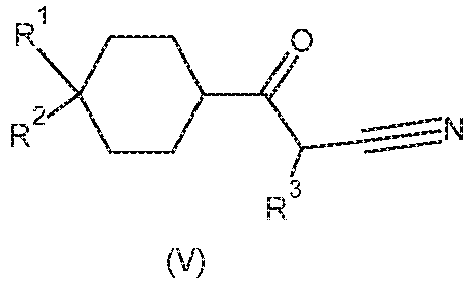 2a) with hydrazine hydrate to provide a compound of formula (VI)
 - wherein the meaning of R1, R2 is as described above and R3 is hydrogen, halogen atom, C1-6alkyl group or2b) with trimethyl orthoformate to provide the malononitrile derivative of formula (XIV)
 - wherein the meaning of R1, R2 is as described above and R3 is cyano group which is reacted with hydrazine hydrate to provide a compound of formula (VI)
 step 3) the compound of formula (VI) wherein the meaning of R1, R2, R3 is as described above for the formula (I) - obtained according to the steps described in 2a) or 2b) is reacted with acylacetic ester derivative of formula (VII)
 - wherein the meaning of R4 and R5 is as described above for the formula (I), thenstep 4) the so obtained compound of formula (VIII)
 - wherein the meaning of R1, R2, R3, R4,and R5 is as described above for the formula (I) -is chlorinated to furnish a chloro derivative of formula (IX)
 - wherein the meaning of R1, R2, R3, R4,and R5 is as described above for the formula (I) - andstep 5) the latter is reacted with either5c) a nipecotic acid derivative of formula (X)
 - wherein the meaning of R6 is as described above for the formula (I) - and the obtained derivative of formula (I) and optical antipodes or racemates and/or salts thereof in given case can be transformed into an other compound of formula (I) and optical antipodes or racemates and/or salts thereof by introducing new substituents and/or modifying or removing the existing ones, or5d) its alkali salt of formula (XI)
 - wherein the meaning of R6 is as described above for the formula (I) - and the obtained compound of formula (I) and optical antipodes or racemates and/or salts thereof optionally can be transformed into an other compound of formula (I) and optical antipodes or racemates and/or salts thereof by introducing new substituents and/or modifying or removing the existing ones, or5e) a nipecotic acid ester derivative of formula (XII)
 - wherein the meaning of R6 is as described above for the formula (I) - to provide the ester derivative of formula (XIII)
- A pharmaceutical composition comprising a therapeutically effective amount of a compound of formula (I) or pharmaceutically acceptable salts, racemates, enantiomers, diastereomers, solvates and hydrates thereof according to claim 1 as active ingredient and pharmaceutically acceptable carrier.
- A combination comprising a therapeutically effective amount of a compound of formula (I) or pharmaceutically acceptable salts, racemates, enantiomers, diastereomers, solvates and hydrates thereof according to claim 1 and one or more therapeutically active co-agents.
- A compound of formula (I) or pharmaceutically acceptable salts, racemates, enantiomers, diastereomers, solvates and hydrates thereof according to claim 1 for use in the treatment or prevention of a disorder selected from the group of psychiatric disorders (such as anxiety, panic disorder, posttraumatic disorder, depression, schizophrenia), neurodevelopmental disorders (such as autism spectrum disorder, obsessive-compulsive disorder, Fragile X syndrome), cognitive disorders, epilepsy, spasticity, sceletal muscle rigidity, spinal cord injury, multiple sclerosis, amyotrophic lateral sclerosis, cerebral palsy, essential tremor, pain (neuropathic, visceral, osteoarthritic), substance abuse (cocaine, nicotine, alcohol), obesity, binge eating, asthma, cough, urinary incontinence, gastroesophageal reflux disease, transient lower esophageal sphincter relaxation, irritable bowel syndrome.
Priority Applications (4)
| Application Number | Priority Date | Filing Date | Title |
|---|---|---|---|
| HRP20211850TT HRP20211850T1 (en) | 2017-03-13 | 2018-03-12 | Pharmacologically active alicyclic-substituted pyrazolo[1,5-a]pyrimidine derivatives |
| SI201830495T SI3596080T1 (en) | 2017-03-13 | 2018-03-12 | Pharmacologically active alicyclic-substituted pyrazolo(1,5-a)pyrimidine derivatives |
| RS20211334A RS62533B1 (en) | 2017-03-13 | 2018-03-12 | Pharmacologically active alicyclic-substituted pyrazolo[1,5-a]pyrimidine derivatives |
| PL18713016T PL3596080T3 (en) | 2017-03-13 | 2018-03-12 | Pharmacologically active alicyclic-substituted pyrazolo[1,5-a]pyrimidine derivatives |
Applications Claiming Priority (2)
| Application Number | Priority Date | Filing Date | Title |
|---|---|---|---|
| HU1700108A HU231058B1 (en) | 2017-03-13 | 2017-03-13 | Pharmacologically active alicyclic-substituted pyrazolo[1,5-a]pyrimidine derivatives |
| PCT/IB2018/051599 WO2018167630A1 (en) | 2017-03-13 | 2018-03-12 | PHARMACOLOGICALLY ACTIVE ALICYCLIC-SUBSTITUTED PYRAZOLO[1,5-a]PYRIMIDINE DERIVATIVES |
Publications (2)
| Publication Number | Publication Date |
|---|---|
| EP3596080A1 EP3596080A1 (en) | 2020-01-22 |
| EP3596080B1 true EP3596080B1 (en) | 2021-09-01 |
Family
ID=89992389
Family Applications (1)
| Application Number | Title | Priority Date | Filing Date |
|---|---|---|---|
| EP18713016.6A Active EP3596080B1 (en) | 2017-03-13 | 2018-03-12 | Pharmacologically active alicyclic-substituted pyrazolo[1,5-a]pyrimidine derivatives |
Country Status (32)
| Country | Link |
|---|---|
| US (1) | US11026946B2 (en) |
| EP (1) | EP3596080B1 (en) |
| JP (1) | JP7153662B2 (en) |
| KR (1) | KR20190127779A (en) |
| CN (1) | CN110431142A (en) |
| AR (1) | AR111176A1 (en) |
| AU (1) | AU2018235266B2 (en) |
| BR (1) | BR112019018843A2 (en) |
| CA (1) | CA3056185A1 (en) |
| CL (1) | CL2019002601A1 (en) |
| CO (1) | CO2019010120A2 (en) |
| CY (1) | CY1124708T1 (en) |
| DK (1) | DK3596080T3 (en) |
| EA (1) | EA038756B1 (en) |
| EC (1) | ECSP19072975A (en) |
| ES (1) | ES2893824T3 (en) |
| GE (1) | GEP20217256B (en) |
| HR (1) | HRP20211850T1 (en) |
| HU (2) | HU231058B1 (en) |
| IL (1) | IL268923A (en) |
| LT (1) | LT3596080T (en) |
| MX (1) | MX2019011000A (en) |
| MY (1) | MY195262A (en) |
| PE (1) | PE20191646A1 (en) |
| PH (1) | PH12019501968A1 (en) |
| PL (1) | PL3596080T3 (en) |
| PT (1) | PT3596080T (en) |
| RS (1) | RS62533B1 (en) |
| SG (1) | SG11201907864YA (en) |
| SI (1) | SI3596080T1 (en) |
| UA (1) | UA124783C2 (en) |
| WO (1) | WO2018167630A1 (en) |
Families Citing this family (7)
| Publication number | Priority date | Publication date | Assignee | Title |
|---|---|---|---|---|
| HU231057B1 (en) | 2017-03-13 | 2020-04-28 | Richter Gedeon Nyrt | Pharmacologically active aryl-substituted pyrazolo[1,5-a]pyrimidine derivatives |
| CN110709084A (en) | 2017-03-13 | 2020-01-17 | 阿比德治疗公司 | Dual MAGL and FAAH inhibitors |
| TWI901650B (en) | 2020-03-26 | 2025-10-21 | 匈牙利商羅特格登公司 | NAPHTHYRIDINE AND PYRIDO〔3,4-c〕PYRIDAZINE DERIVATIVES AS GAMMA-AMINOBUTYRIC ACID A RECEPTOR SUBUNIT ALPHA 5 RECEPTOR MODULATORS |
| US12617797B2 (en) | 2020-05-27 | 2026-05-05 | Esteve Pharmaceuticals, S.A. | Substituted pyrazolo [1,5-a]pyrimidines having multimodal activity against pain |
| TWI907472B (en) | 2020-08-05 | 2025-12-11 | 匈牙利商羅特格登公司 | Pharmacologically active heterocyclic-substituted pyrazolo〔1 ,5-a〕 pyrimidine derivatives |
| HU231691B1 (en) | 2021-09-29 | 2025-10-28 | Richter Gedeon Nyrt | GABAA ALPHA5 receptor modulatory bicyclic amine derivatives |
| CN115872095A (en) * | 2022-11-28 | 2023-03-31 | 南通三鑫车灯配件有限公司 | Production line circulation device of automobile lamp reflector |
Family Cites Families (8)
| Publication number | Priority date | Publication date | Assignee | Title |
|---|---|---|---|---|
| BRPI0508310A (en) | 2004-03-02 | 2007-07-24 | Hoffmann La Roche | 4- (sulfanyl-pyrimidin-4-ylmethyl) -morpholine derivatives and related compounds as gaba receptor ligands, for the treatment of anxiety, depression and epilepsy |
| GB0512844D0 (en) | 2005-06-23 | 2005-08-03 | Novartis Ag | Organic compounds |
| KR100753017B1 (en) | 2006-05-25 | 2007-08-30 | 한국화학연구원 | For the treatment of brain diseases such as arthritis, atopic dermatitis, cancers including leukemia and Alzheimer's, depression or memory loss, including 7- (3,4-diakoxyphenyl) -pyrazolo [1,5-a] pyrimidine compounds, and Pharmaceutical Compositions for Prevention |
| EP2271646A1 (en) | 2008-03-31 | 2011-01-12 | Takeda Pharmaceutical Company Limited | Apoptosis signal-regulating kinase 1 inhibitors |
| TWI648281B (en) | 2013-10-17 | 2019-01-21 | 日商安斯泰來製藥股份有限公司 | Sulfur-containing bicyclic compound |
| WO2016169995A1 (en) | 2015-04-20 | 2016-10-27 | AbbVie Deutschland GmbH & Co. KG | Substituted pyrazolopyrimidines and method of use |
| JP2018199623A (en) * | 2015-10-22 | 2018-12-20 | 大正製薬株式会社 | Nitrogen-containing fused heterocyclic compounds |
| HU231057B1 (en) | 2017-03-13 | 2020-04-28 | Richter Gedeon Nyrt | Pharmacologically active aryl-substituted pyrazolo[1,5-a]pyrimidine derivatives |
-
2017
- 2017-03-13 HU HU1700108A patent/HU231058B1/en not_active IP Right Cessation
-
2018
- 2018-03-12 ES ES18713016T patent/ES2893824T3/en active Active
- 2018-03-12 UA UAA201910328A patent/UA124783C2/en unknown
- 2018-03-12 LT LTEPPCT/IB2018/051599T patent/LT3596080T/en unknown
- 2018-03-12 HR HRP20211850TT patent/HRP20211850T1/en unknown
- 2018-03-12 SG SG11201907864YA patent/SG11201907864YA/en unknown
- 2018-03-12 AU AU2018235266A patent/AU2018235266B2/en not_active Ceased
- 2018-03-12 EA EA201992127A patent/EA038756B1/en unknown
- 2018-03-12 HU HUE18713016A patent/HUE056562T2/en unknown
- 2018-03-12 WO PCT/IB2018/051599 patent/WO2018167630A1/en not_active Ceased
- 2018-03-12 GE GEAP201815192A patent/GEP20217256B/en unknown
- 2018-03-12 MX MX2019011000A patent/MX2019011000A/en unknown
- 2018-03-12 US US16/493,453 patent/US11026946B2/en active Active
- 2018-03-12 CA CA3056185A patent/CA3056185A1/en active Pending
- 2018-03-12 SI SI201830495T patent/SI3596080T1/en unknown
- 2018-03-12 PE PE2019001773A patent/PE20191646A1/en unknown
- 2018-03-12 EP EP18713016.6A patent/EP3596080B1/en active Active
- 2018-03-12 MY MYPI2019004947A patent/MY195262A/en unknown
- 2018-03-12 PL PL18713016T patent/PL3596080T3/en unknown
- 2018-03-12 JP JP2019549366A patent/JP7153662B2/en active Active
- 2018-03-12 PT PT18713016T patent/PT3596080T/en unknown
- 2018-03-12 RS RS20211334A patent/RS62533B1/en unknown
- 2018-03-12 KR KR1020197028833A patent/KR20190127779A/en not_active Ceased
- 2018-03-12 CN CN201880017859.XA patent/CN110431142A/en active Pending
- 2018-03-12 DK DK18713016.6T patent/DK3596080T3/en active
- 2018-03-12 BR BR112019018843A patent/BR112019018843A2/en not_active Application Discontinuation
- 2018-03-13 AR ARP180100580A patent/AR111176A1/en unknown
-
2019
- 2019-08-26 IL IL26892319A patent/IL268923A/en unknown
- 2019-08-27 PH PH12019501968A patent/PH12019501968A1/en unknown
- 2019-09-12 CL CL2019002601A patent/CL2019002601A1/en unknown
- 2019-09-18 CO CONC2019/0010120A patent/CO2019010120A2/en unknown
- 2019-10-10 EC ECSENADI201972975A patent/ECSP19072975A/en unknown
-
2021
- 2021-11-08 CY CY20211100964T patent/CY1124708T1/en unknown
Also Published As
Similar Documents
| Publication | Publication Date | Title |
|---|---|---|
| US11026946B2 (en) | Pharmacologically active alicyclic-substituted pyrazolo[1,5-a]pyrimidine derivatives | |
| EP3596079B1 (en) | Pharmacologically active aryl-substituted pyrazolo[1,5-a]pyrimidine derivatives | |
| WO2017026516A1 (en) | Isothiazole derivative | |
| TWI907472B (en) | Pharmacologically active heterocyclic-substituted pyrazolo〔1 ,5-a〕 pyrimidine derivatives | |
| KR20240036571A (en) | Therapeutic Compounds and Methods | |
| TW201000447A (en) | New compounds useful in pain therapy | |
| JP2001512124A (en) | Novel 2,3-benzodiazepine derivatives | |
| EA049144B1 (en) | PHARMACOLOGICALLY ACTIVE HETEROCYCLIC SUBSTITUTED PYRAZOLO[1,5-a]PYRIMIDINE DERIVATIVES | |
| OA19480A (en) | Pharmacologically active alicyclicsubstituted pyrazolo [1,5-a] pyrimidine derivatives. | |
| WO2026068771A1 (en) | Novel modulators of gabab receptor | |
| WO2026068766A1 (en) | New gabab modulators | |
| WO2026068748A1 (en) | Novel pyrimidinedione derivatives as gaba b positive allosteric modulators |
Legal Events
| Date | Code | Title | Description |
|---|---|---|---|
| REG | Reference to a national code |
Ref country code: HR Ref legal event code: TUEP Ref document number: P20211850 Country of ref document: HR |
|
| STAA | Information on the status of an ep patent application or granted ep patent |
Free format text: STATUS: UNKNOWN |
|
| STAA | Information on the status of an ep patent application or granted ep patent |
Free format text: STATUS: THE INTERNATIONAL PUBLICATION HAS BEEN MADE |
|
| PUAI | Public reference made under article 153(3) epc to a published international application that has entered the european phase |
Free format text: ORIGINAL CODE: 0009012 |
|
| STAA | Information on the status of an ep patent application or granted ep patent |
Free format text: STATUS: REQUEST FOR EXAMINATION WAS MADE |
|
| 17P | Request for examination filed |
Effective date: 20191010 |
|
| AK | Designated contracting states |
Kind code of ref document: A1 Designated state(s): AL AT BE BG CH CY CZ DE DK EE ES FI FR GB GR HR HU IE IS IT LI LT LU LV MC MK MT NL NO PL PT RO RS SE SI SK SM TR |
|
| AX | Request for extension of the european patent |
Extension state: BA ME |
|
| DAV | Request for validation of the european patent (deleted) | ||
| STAA | Information on the status of an ep patent application or granted ep patent |
Free format text: STATUS: EXAMINATION IS IN PROGRESS |
|
| 17Q | First examination report despatched |
Effective date: 20201125 |
|
| GRAP | Despatch of communication of intention to grant a patent |
Free format text: ORIGINAL CODE: EPIDOSNIGR1 |
|
| STAA | Information on the status of an ep patent application or granted ep patent |
Free format text: STATUS: GRANT OF PATENT IS INTENDED |
|
| INTG | Intention to grant announced |
Effective date: 20210520 |
|
| RAP3 | Party data changed (applicant data changed or rights of an application transferred) |
Owner name: RICHTER GEDEON NYRT. |
|
| GRAS | Grant fee paid |
Free format text: ORIGINAL CODE: EPIDOSNIGR3 |
|
| GRAA | (expected) grant |
Free format text: ORIGINAL CODE: 0009210 |
|
| STAA | Information on the status of an ep patent application or granted ep patent |
Free format text: STATUS: THE PATENT HAS BEEN GRANTED |
|
| AK | Designated contracting states |
Kind code of ref document: B1 Designated state(s): AL AT BE BG CH CY CZ DE DK EE ES FI FR GB GR HR HU IE IS IT LI LT LU LV MC MK MT NL NO PL PT RO RS SE SI SK SM TR |
|
| REG | Reference to a national code |
Ref country code: GB Ref legal event code: FG4D |
|
| REG | Reference to a national code |
Ref country code: CH Ref legal event code: EP Ref country code: AT Ref legal event code: REF Ref document number: 1426164 Country of ref document: AT Kind code of ref document: T Effective date: 20210915 |
|
| REG | Reference to a national code |
Ref country code: DE Ref legal event code: R096 Ref document number: 602018022803 Country of ref document: DE |
|
| REG | Reference to a national code |
Ref country code: IE Ref legal event code: FG4D |
|
| REG | Reference to a national code |
Ref country code: PT Ref legal event code: SC4A Ref document number: 3596080 Country of ref document: PT Date of ref document: 20211022 Kind code of ref document: T Free format text: AVAILABILITY OF NATIONAL TRANSLATION Effective date: 20211015 |
|
| REG | Reference to a national code |
Ref country code: DK Ref legal event code: T3 Effective date: 20211108 |
|
| REG | Reference to a national code |
Ref country code: FI Ref legal event code: FGE |
|
| REG | Reference to a national code |
Ref country code: NL Ref legal event code: FP |
|
| REG | Reference to a national code |
Ref country code: NO Ref legal event code: T2 Effective date: 20210901 |
|
| REG | Reference to a national code |
Ref country code: SE Ref legal event code: TRGR |
|
| REG | Reference to a national code |
Ref country code: GR Ref legal event code: EP Ref document number: 20210402769 Country of ref document: GR Effective date: 20211111 |
|
| REG | Reference to a national code |
Ref country code: EE Ref legal event code: FG4A Ref document number: E021535 Country of ref document: EE Effective date: 20211014 |
|
| REG | Reference to a national code |
Ref country code: SK Ref legal event code: T3 Ref document number: E 38601 Country of ref document: SK |
|
| REG | Reference to a national code |
Ref country code: ES Ref legal event code: FG2A Ref document number: 2893824 Country of ref document: ES Kind code of ref document: T3 Effective date: 20220210 |
|
| REG | Reference to a national code |
Ref country code: HU Ref legal event code: AG4A Ref document number: E056562 Country of ref document: HU |
|
| REG | Reference to a national code |
Ref country code: HR Ref legal event code: T1PR Ref document number: P20211850 Country of ref document: HR |
|
| REG | Reference to a national code |
Ref country code: HR Ref legal event code: ODRP Ref document number: P20211850 Country of ref document: HR Payment date: 20220307 Year of fee payment: 5 |
|
| PGFP | Annual fee paid to national office [announced via postgrant information from national office to epo] |
Ref country code: RS Payment date: 20220304 Year of fee payment: 5 Ref country code: LT Payment date: 20220218 Year of fee payment: 5 Ref country code: IE Payment date: 20220323 Year of fee payment: 5 Ref country code: FI Payment date: 20220322 Year of fee payment: 5 Ref country code: DK Payment date: 20220323 Year of fee payment: 5 Ref country code: CH Payment date: 20220321 Year of fee payment: 5 Ref country code: BG Payment date: 20220322 Year of fee payment: 5 |
|
| PG25 | Lapsed in a contracting state [announced via postgrant information from national office to epo] |
Ref country code: SM Free format text: LAPSE BECAUSE OF FAILURE TO SUBMIT A TRANSLATION OF THE DESCRIPTION OR TO PAY THE FEE WITHIN THE PRESCRIBED TIME-LIMIT Effective date: 20210901 |
|
| PGFP | Annual fee paid to national office [announced via postgrant information from national office to epo] |
Ref country code: IS Payment date: 20220311 Year of fee payment: 5 Ref country code: TR Payment date: 20220311 Year of fee payment: 5 Ref country code: SK Payment date: 20220310 Year of fee payment: 5 Ref country code: SE Payment date: 20220321 Year of fee payment: 5 Ref country code: RO Payment date: 20220304 Year of fee payment: 5 Ref country code: PT Payment date: 20220303 Year of fee payment: 5 Ref country code: PL Payment date: 20220303 Year of fee payment: 5 Ref country code: NO Payment date: 20220323 Year of fee payment: 5 Ref country code: NL Payment date: 20220321 Year of fee payment: 5 Ref country code: MT Payment date: 20220225 Year of fee payment: 5 Ref country code: MK Payment date: 20220218 Year of fee payment: 5 Ref country code: MC Payment date: 20220322 Year of fee payment: 5 Ref country code: LV Payment date: 20220310 Year of fee payment: 5 Ref country code: LU Payment date: 20220323 Year of fee payment: 5 Ref country code: HR Payment date: 20220307 Year of fee payment: 5 Ref country code: GR Payment date: 20220323 Year of fee payment: 5 Ref country code: EE Payment date: 20220316 Year of fee payment: 5 Ref country code: CZ Payment date: 20220311 Year of fee payment: 5 Ref country code: BE Payment date: 20220321 Year of fee payment: 5 |
|
| REG | Reference to a national code |
Ref country code: DE Ref legal event code: R097 Ref document number: 602018022803 Country of ref document: DE |
|
| PGFP | Annual fee paid to national office [announced via postgrant information from national office to epo] |
Ref country code: SI Payment date: 20220309 Year of fee payment: 5 |
|
| PLBE | No opposition filed within time limit |
Free format text: ORIGINAL CODE: 0009261 |
|
| STAA | Information on the status of an ep patent application or granted ep patent |
Free format text: STATUS: NO OPPOSITION FILED WITHIN TIME LIMIT |
|
| PGFP | Annual fee paid to national office [announced via postgrant information from national office to epo] |
Ref country code: CY Payment date: 20220309 Year of fee payment: 5 |
|
| 26N | No opposition filed |
Effective date: 20220602 |
|
| REG | Reference to a national code |
Ref country code: AT Ref legal event code: UEP Ref document number: 1426164 Country of ref document: AT Kind code of ref document: T Effective date: 20210901 |
|
| PGFP | Annual fee paid to national office [announced via postgrant information from national office to epo] |
Ref country code: AL Payment date: 20220914 Year of fee payment: 5 |
|
| P01 | Opt-out of the competence of the unified patent court (upc) registered |
Effective date: 20230608 |
|
| REG | Reference to a national code |
Ref country code: HR Ref legal event code: PBON Ref document number: P20211850 Country of ref document: HR Effective date: 20230312 |
|
| REG | Reference to a national code |
Ref country code: LT Ref legal event code: MM4D Effective date: 20230312 |
|
| REG | Reference to a national code |
Ref country code: EE Ref legal event code: MM4A Ref document number: E021535 Country of ref document: EE Effective date: 20230331 |
|
| REG | Reference to a national code |
Ref country code: NO Ref legal event code: MMEP |
|
| REG | Reference to a national code |
Ref country code: SK Ref legal event code: MM4A Ref document number: E 38601 Country of ref document: SK Effective date: 20230312 |
|
| PG25 | Lapsed in a contracting state [announced via postgrant information from national office to epo] |
Ref country code: RO Free format text: LAPSE BECAUSE OF NON-PAYMENT OF DUE FEES Effective date: 20230312 Ref country code: PT Free format text: LAPSE BECAUSE OF NON-PAYMENT OF DUE FEES Effective date: 20230912 Ref country code: MC Free format text: LAPSE BECAUSE OF NON-PAYMENT OF DUE FEES Effective date: 20230331 Ref country code: FI Free format text: LAPSE BECAUSE OF NON-PAYMENT OF DUE FEES Effective date: 20230312 Ref country code: CZ Free format text: LAPSE BECAUSE OF NON-PAYMENT OF DUE FEES Effective date: 20230312 Ref country code: CY Free format text: LAPSE BECAUSE OF NON-PAYMENT OF DUE FEES Effective date: 20230312 |
|
| REG | Reference to a national code |
Ref country code: CH Ref legal event code: PL Ref country code: SE Ref legal event code: EUG |
|
| REG | Reference to a national code |
Ref country code: DK Ref legal event code: EBP Effective date: 20230331 |
|
| REG | Reference to a national code |
Ref country code: NL Ref legal event code: MM Effective date: 20230401 |
|
| PG25 | Lapsed in a contracting state [announced via postgrant information from national office to epo] |
Ref country code: RS Free format text: LAPSE BECAUSE OF NON-PAYMENT OF DUE FEES Effective date: 20230914 Ref country code: LV Free format text: LAPSE BECAUSE OF NON-PAYMENT OF DUE FEES Effective date: 20230312 |
|
| REG | Reference to a national code |
Ref country code: BE Ref legal event code: MM Effective date: 20230331 |
|
| PG25 | Lapsed in a contracting state [announced via postgrant information from national office to epo] |
Ref country code: NL Free format text: LAPSE BECAUSE OF NON-PAYMENT OF DUE FEES Effective date: 20230401 Ref country code: LU Free format text: LAPSE BECAUSE OF NON-PAYMENT OF DUE FEES Effective date: 20230312 |
|
| REG | Reference to a national code |
Ref country code: SI Ref legal event code: KO00 Effective date: 20231123 |
|
| PG25 | Lapsed in a contracting state [announced via postgrant information from national office to epo] |
Ref country code: SK Free format text: LAPSE BECAUSE OF NON-PAYMENT OF DUE FEES Effective date: 20230312 |
|
| REG | Reference to a national code |
Ref country code: IE Ref legal event code: MM4A |
|
| PG25 | Lapsed in a contracting state [announced via postgrant information from national office to epo] |
Ref country code: GR Free format text: LAPSE BECAUSE OF NON-PAYMENT OF DUE FEES Effective date: 20231009 |
|
| PG25 | Lapsed in a contracting state [announced via postgrant information from national office to epo] |
Ref country code: SK Free format text: LAPSE BECAUSE OF NON-PAYMENT OF DUE FEES Effective date: 20230312 Ref country code: SI Free format text: LAPSE BECAUSE OF NON-PAYMENT OF DUE FEES Effective date: 20230313 Ref country code: SE Free format text: LAPSE BECAUSE OF NON-PAYMENT OF DUE FEES Effective date: 20230313 Ref country code: NO Free format text: LAPSE BECAUSE OF NON-PAYMENT OF DUE FEES Effective date: 20230331 Ref country code: LT Free format text: LAPSE BECAUSE OF NON-PAYMENT OF DUE FEES Effective date: 20230312 Ref country code: LI Free format text: LAPSE BECAUSE OF NON-PAYMENT OF DUE FEES Effective date: 20230331 Ref country code: IE Free format text: LAPSE BECAUSE OF NON-PAYMENT OF DUE FEES Effective date: 20230312 Ref country code: HR Free format text: LAPSE BECAUSE OF NON-PAYMENT OF DUE FEES Effective date: 20230312 Ref country code: GR Free format text: LAPSE BECAUSE OF NON-PAYMENT OF DUE FEES Effective date: 20231009 Ref country code: EE Free format text: LAPSE BECAUSE OF NON-PAYMENT OF DUE FEES Effective date: 20230331 Ref country code: CH Free format text: LAPSE BECAUSE OF NON-PAYMENT OF DUE FEES Effective date: 20230331 |
|
| PG25 | Lapsed in a contracting state [announced via postgrant information from national office to epo] |
Ref country code: BE Free format text: LAPSE BECAUSE OF NON-PAYMENT OF DUE FEES Effective date: 20230331 |
|
| PG25 | Lapsed in a contracting state [announced via postgrant information from national office to epo] |
Ref country code: DK Free format text: LAPSE BECAUSE OF NON-PAYMENT OF DUE FEES Effective date: 20230331 |
|
| REG | Reference to a national code |
Ref country code: AT Ref legal event code: MM01 Ref document number: 1426164 Country of ref document: AT Kind code of ref document: T Effective date: 20230312 |
|
| PG25 | Lapsed in a contracting state [announced via postgrant information from national office to epo] |
Ref country code: AT Free format text: LAPSE BECAUSE OF NON-PAYMENT OF DUE FEES Effective date: 20230312 |
|
| PG25 | Lapsed in a contracting state [announced via postgrant information from national office to epo] |
Ref country code: AT Free format text: LAPSE BECAUSE OF NON-PAYMENT OF DUE FEES Effective date: 20230312 |
|
| PG25 | Lapsed in a contracting state [announced via postgrant information from national office to epo] |
Ref country code: BG Free format text: LAPSE BECAUSE OF NON-PAYMENT OF DUE FEES Effective date: 20230312 |
|
| PG25 | Lapsed in a contracting state [announced via postgrant information from national office to epo] |
Ref country code: BG Free format text: LAPSE BECAUSE OF NON-PAYMENT OF DUE FEES Effective date: 20230312 |
|
| PG25 | Lapsed in a contracting state [announced via postgrant information from national office to epo] |
Ref country code: PL Free format text: LAPSE BECAUSE OF NON-PAYMENT OF DUE FEES Effective date: 20230312 |
|
| PG25 | Lapsed in a contracting state [announced via postgrant information from national office to epo] |
Ref country code: PL Free format text: LAPSE BECAUSE OF NON-PAYMENT OF DUE FEES Effective date: 20230312 |
|
| PGFP | Annual fee paid to national office [announced via postgrant information from national office to epo] |
Ref country code: ES Payment date: 20250429 Year of fee payment: 8 |
|
| PG25 | Lapsed in a contracting state [announced via postgrant information from national office to epo] |
Ref country code: IS Free format text: LAPSE BECAUSE OF NON-PAYMENT OF DUE FEES Effective date: 20231002 |
|
| PGFP | Annual fee paid to national office [announced via postgrant information from national office to epo] |
Ref country code: GB Payment date: 20260324 Year of fee payment: 9 |
|
| PGFP | Annual fee paid to national office [announced via postgrant information from national office to epo] |
Ref country code: DE Payment date: 20260319 Year of fee payment: 9 |
|
| PGFP | Annual fee paid to national office [announced via postgrant information from national office to epo] |
Ref country code: AT Payment date: 20260410 Year of fee payment: 5 |
|
| PGFP | Annual fee paid to national office [announced via postgrant information from national office to epo] |
Ref country code: IT Payment date: 20260324 Year of fee payment: 9 |
|
| PGFP | Annual fee paid to national office [announced via postgrant information from national office to epo] |
Ref country code: HU Payment date: 20260302 Year of fee payment: 9 |
|
| PGFP | Annual fee paid to national office [announced via postgrant information from national office to epo] |
Ref country code: FR Payment date: 20260320 Year of fee payment: 9 |