EP3596059B1 - Heterocyclic compounds useful as dual atx/ca inhibitors - Google Patents
Heterocyclic compounds useful as dual atx/ca inhibitors Download PDFInfo
- Publication number
- EP3596059B1 EP3596059B1 EP18710471.6A EP18710471A EP3596059B1 EP 3596059 B1 EP3596059 B1 EP 3596059B1 EP 18710471 A EP18710471 A EP 18710471A EP 3596059 B1 EP3596059 B1 EP 3596059B1
- Authority
- EP
- European Patent Office
- Prior art keywords
- methyl
- phenyl
- methyltetrazol
- trifluoromethyl
- propanoyl
- Prior art date
- Legal status (The legal status is an assumption and is not a legal conclusion. Google has not performed a legal analysis and makes no representation as to the accuracy of the status listed.)
- Active
Links
Classifications
-
- C—CHEMISTRY; METALLURGY
- C07—ORGANIC CHEMISTRY
- C07D—HETEROCYCLIC COMPOUNDS
- C07D403/00—Heterocyclic compounds containing two or more hetero rings, having nitrogen atoms as the only ring hetero atoms, not provided for by group C07D401/00
- C07D403/02—Heterocyclic compounds containing two or more hetero rings, having nitrogen atoms as the only ring hetero atoms, not provided for by group C07D401/00 containing two hetero rings
- C07D403/10—Heterocyclic compounds containing two or more hetero rings, having nitrogen atoms as the only ring hetero atoms, not provided for by group C07D401/00 containing two hetero rings linked by a carbon chain containing aromatic rings
-
- C—CHEMISTRY; METALLURGY
- C07—ORGANIC CHEMISTRY
- C07D—HETEROCYCLIC COMPOUNDS
- C07D257/00—Heterocyclic compounds containing rings having four nitrogen atoms as the only ring hetero atoms
- C07D257/02—Heterocyclic compounds containing rings having four nitrogen atoms as the only ring hetero atoms not condensed with other rings
- C07D257/04—Five-membered rings
-
- C—CHEMISTRY; METALLURGY
- C07—ORGANIC CHEMISTRY
- C07D—HETEROCYCLIC COMPOUNDS
- C07D401/00—Heterocyclic compounds containing two or more hetero rings, having nitrogen atoms as the only ring hetero atoms, at least one ring being a six-membered ring with only one nitrogen atom
- C07D401/02—Heterocyclic compounds containing two or more hetero rings, having nitrogen atoms as the only ring hetero atoms, at least one ring being a six-membered ring with only one nitrogen atom containing two hetero rings
- C07D401/10—Heterocyclic compounds containing two or more hetero rings, having nitrogen atoms as the only ring hetero atoms, at least one ring being a six-membered ring with only one nitrogen atom containing two hetero rings linked by a carbon chain containing aromatic rings
-
- A—HUMAN NECESSITIES
- A61—MEDICAL OR VETERINARY SCIENCE; HYGIENE
- A61K—PREPARATIONS FOR MEDICAL, DENTAL OR TOILETRY PURPOSES
- A61K31/00—Medicinal preparations containing organic active ingredients
- A61K31/33—Heterocyclic compounds
- A61K31/395—Heterocyclic compounds having nitrogen as a ring hetero atom, e.g. guanethidine or rifamycins
- A61K31/397—Heterocyclic compounds having nitrogen as a ring hetero atom, e.g. guanethidine or rifamycins having four-membered rings, e.g. azetidine
-
- A—HUMAN NECESSITIES
- A61—MEDICAL OR VETERINARY SCIENCE; HYGIENE
- A61K—PREPARATIONS FOR MEDICAL, DENTAL OR TOILETRY PURPOSES
- A61K31/00—Medicinal preparations containing organic active ingredients
- A61K31/33—Heterocyclic compounds
- A61K31/395—Heterocyclic compounds having nitrogen as a ring hetero atom, e.g. guanethidine or rifamycins
- A61K31/40—Heterocyclic compounds having nitrogen as a ring hetero atom, e.g. guanethidine or rifamycins having five-membered rings with one nitrogen as the only ring hetero atom, e.g. sulpiride, succinimide, tolmetin, buflomedil
- A61K31/4025—Heterocyclic compounds having nitrogen as a ring hetero atom, e.g. guanethidine or rifamycins having five-membered rings with one nitrogen as the only ring hetero atom, e.g. sulpiride, succinimide, tolmetin, buflomedil not condensed and containing further heterocyclic rings, e.g. cromakalim
-
- A—HUMAN NECESSITIES
- A61—MEDICAL OR VETERINARY SCIENCE; HYGIENE
- A61K—PREPARATIONS FOR MEDICAL, DENTAL OR TOILETRY PURPOSES
- A61K31/00—Medicinal preparations containing organic active ingredients
- A61K31/33—Heterocyclic compounds
- A61K31/395—Heterocyclic compounds having nitrogen as a ring hetero atom, e.g. guanethidine or rifamycins
- A61K31/495—Heterocyclic compounds having nitrogen as a ring hetero atom, e.g. guanethidine or rifamycins having six-membered rings with two or more nitrogen atoms as the only ring heteroatoms, e.g. piperazine or tetrazines
- A61K31/496—Non-condensed piperazines containing further heterocyclic rings, e.g. rifampin, thiothixene or sparfloxacin
-
- A—HUMAN NECESSITIES
- A61—MEDICAL OR VETERINARY SCIENCE; HYGIENE
- A61P—SPECIFIC THERAPEUTIC ACTIVITY OF CHEMICAL COMPOUNDS OR MEDICINAL PREPARATIONS
- A61P27/00—Drugs for disorders of the senses
-
- A—HUMAN NECESSITIES
- A61—MEDICAL OR VETERINARY SCIENCE; HYGIENE
- A61P—SPECIFIC THERAPEUTIC ACTIVITY OF CHEMICAL COMPOUNDS OR MEDICINAL PREPARATIONS
- A61P27/00—Drugs for disorders of the senses
- A61P27/02—Ophthalmic agents
-
- C—CHEMISTRY; METALLURGY
- C07—ORGANIC CHEMISTRY
- C07D—HETEROCYCLIC COMPOUNDS
- C07D401/00—Heterocyclic compounds containing two or more hetero rings, having nitrogen atoms as the only ring hetero atoms, at least one ring being a six-membered ring with only one nitrogen atom
- C07D401/02—Heterocyclic compounds containing two or more hetero rings, having nitrogen atoms as the only ring hetero atoms, at least one ring being a six-membered ring with only one nitrogen atom containing two hetero rings
- C07D401/06—Heterocyclic compounds containing two or more hetero rings, having nitrogen atoms as the only ring hetero atoms, at least one ring being a six-membered ring with only one nitrogen atom containing two hetero rings linked by a carbon chain containing only aliphatic carbon atoms
-
- C—CHEMISTRY; METALLURGY
- C07—ORGANIC CHEMISTRY
- C07D—HETEROCYCLIC COMPOUNDS
- C07D401/00—Heterocyclic compounds containing two or more hetero rings, having nitrogen atoms as the only ring hetero atoms, at least one ring being a six-membered ring with only one nitrogen atom
- C07D401/02—Heterocyclic compounds containing two or more hetero rings, having nitrogen atoms as the only ring hetero atoms, at least one ring being a six-membered ring with only one nitrogen atom containing two hetero rings
- C07D401/12—Heterocyclic compounds containing two or more hetero rings, having nitrogen atoms as the only ring hetero atoms, at least one ring being a six-membered ring with only one nitrogen atom containing two hetero rings linked by a chain containing hetero atoms as chain links
-
- C—CHEMISTRY; METALLURGY
- C07—ORGANIC CHEMISTRY
- C07D—HETEROCYCLIC COMPOUNDS
- C07D401/00—Heterocyclic compounds containing two or more hetero rings, having nitrogen atoms as the only ring hetero atoms, at least one ring being a six-membered ring with only one nitrogen atom
- C07D401/14—Heterocyclic compounds containing two or more hetero rings, having nitrogen atoms as the only ring hetero atoms, at least one ring being a six-membered ring with only one nitrogen atom containing three or more hetero rings
-
- C—CHEMISTRY; METALLURGY
- C07—ORGANIC CHEMISTRY
- C07D—HETEROCYCLIC COMPOUNDS
- C07D405/00—Heterocyclic compounds containing both one or more hetero rings having oxygen atoms as the only ring hetero atoms, and one or more rings having nitrogen as the only ring hetero atom
- C07D405/02—Heterocyclic compounds containing both one or more hetero rings having oxygen atoms as the only ring hetero atoms, and one or more rings having nitrogen as the only ring hetero atom containing two hetero rings
- C07D405/12—Heterocyclic compounds containing both one or more hetero rings having oxygen atoms as the only ring hetero atoms, and one or more rings having nitrogen as the only ring hetero atom containing two hetero rings linked by a chain containing hetero atoms as chain links
-
- C—CHEMISTRY; METALLURGY
- C07—ORGANIC CHEMISTRY
- C07D—HETEROCYCLIC COMPOUNDS
- C07D405/00—Heterocyclic compounds containing both one or more hetero rings having oxygen atoms as the only ring hetero atoms, and one or more rings having nitrogen as the only ring hetero atom
- C07D405/14—Heterocyclic compounds containing both one or more hetero rings having oxygen atoms as the only ring hetero atoms, and one or more rings having nitrogen as the only ring hetero atom containing three or more hetero rings
-
- C—CHEMISTRY; METALLURGY
- C07—ORGANIC CHEMISTRY
- C07D—HETEROCYCLIC COMPOUNDS
- C07D409/00—Heterocyclic compounds containing two or more hetero rings, at least one ring having sulfur atoms as the only ring hetero atoms
- C07D409/14—Heterocyclic compounds containing two or more hetero rings, at least one ring having sulfur atoms as the only ring hetero atoms containing three or more hetero rings
-
- C—CHEMISTRY; METALLURGY
- C07—ORGANIC CHEMISTRY
- C07D—HETEROCYCLIC COMPOUNDS
- C07D417/00—Heterocyclic compounds containing two or more hetero rings, at least one ring having nitrogen and sulfur atoms as the only ring hetero atoms, not provided for by group C07D415/00
- C07D417/14—Heterocyclic compounds containing two or more hetero rings, at least one ring having nitrogen and sulfur atoms as the only ring hetero atoms, not provided for by group C07D415/00 containing three or more hetero rings
Definitions
- the present invention relates to organic compounds useful for therapy or prophylaxis in a mammal, and in particular to dual autotaxin (ATX) / carbonic anhydrase inhibitors which are inhibitors of lysophosphatidic acid (LPA) production and thus modulators of LPA levels and associated signaling, for the treatment or prophylaxis of inflammatory conditions, conditions of the nervous system, vascular and cardiovascular conditions, cancer, and ocular conditions.
- ATX dual autotaxin
- LPA lysophosphatidic acid
- the present invention provides novel compounds of formula (I) wherein
- ATX Autotaxin
- LPC lysophosphatidyl choline
- LPA bioactive signaling molecule lysophosphatidic acid
- LPA can elicit a wide range of cellular responses; including smooth muscle cell contraction, platelet activation, cell proliferation, chemotaxis and others.
- LPA mediates its effects via signaling to several G protein coupled receptors (GPCRs); the first members were originally denoted Edg (endothelial cell differentiation gene) receptors or ventricular zone gene-1(vzg-1) but are now called LPA receptors.
- GPCRs G protein coupled receptors
- Edg endothelial cell differentiation gene
- ventricular zone gene-1(vzg-1) ventricular zone gene-1(vzg-1) but are now called LPA receptors.
- the prototypic group now consists of LPA1/Edg-2/VZG-1, LPA2/Edg-4, and LPA3/Edg-7.
- the ATX-LPA signaling axis is involved in a large range of physiological and pathophysiological functions, including, for example, nervous system function, vascular development, cardiovascular physiology, reproduction, immune system function, chronic inflammation, tumor metastasis and progression, organ fibrosis as well as obesity and/or other metabolic diseases such as diabetes mellitus. Therefore, increased activity of ATX and/or increased levels of LPA, altered LPA receptor expression and altered responses to LPA may contribute to the initiation, progression and/or outcome of a number of different pathophysiological conditions related to the ATX/LPA axis.
- Carbonic anhydrases are a family of zinc-dependent enzymes, which catalyze the equilibration between carbon dioxide and water and hydrogencarbonate and a proton.
- the CA reaction is involved in many physiological and pathological processes.
- Carbonic anhydrase inhibition is useful for the treatment of ocular conditions, conditions of reduced blood flow, cancer, edema and inflammatory conditions including bacterial infections.
- Dual acting ATX/CA inhibitors are expected to lower intraocular pressure by facilitating two independent pathways, such as inhibition of aqueous humor (AH) production through CA inhibition at the ciliary body and facilitation of AH outflow by ATX inhibition within the AH drainage system.
- AH aqueous humor
- CA levels have been shown or are expected to increase in the eye and facilitate an increase in pH. This is expected to activate many hydrolytic enzymes that can contribute to disease progression including ATX suggesting additional ATX inhibition by shifting the pH optimum.
- WO2015/144605 WO2014/139978 , WO2015/144609 , WO2013/186159 all disclose compounds with bicyclic central ring systems useful as autotaxin (ATX) inhibitors.
- ATX autotaxin
- the compounds of formula (I) or their pharmaceutically acceptable salts and esters can be used for the treatment or prophylaxis of diseases, disorders or conditions that are associated with the activity of autotaxin and/or the biological activity of lysophosphatidic acid (LPA).
- LPA lysophosphatidic acid
- the compounds of formula (I) or their pharmaceutically acceptable salts and esters herein inhibit autotaxin activity and carbonic anhydrase activity therefore inhibit LPA production and modulate LPA levels and associated signaling.
- Dual ATX/CA-II inhibitors described herein are useful as agents for the treatment or prevention of diseases or conditions in which ATX activity and/or LPA signaling participates, is involved in the etiology or pathology of the disease, or is otherwise associated with at least one symptom of the disease.
- the ATX-LPA axis has been implicated for example in angiogenesis, chronic inflammation, autoimmune diseases, fibrotic diseases, cancer and tumor metastasis and progression, ocular conditions, metabolic conditions such as obesity and/or diabetes mellitus, conditions such as cholestatic or other forms of chronic pruritus as well as acute and chronic organ transplant rejection.
- Objects of the present invention are the compounds of formula (I) and their aforementioned salts and esters and their use as therapeutically active substances, a process for the manufacture of the said compounds, intermediates, pharmaceutical compositions, medicaments containing the said compounds, their pharmaceutically acceptable salts or esters, the use of the said compounds, salts or esters for the treatment or prophylaxis of disorders or conditions that are associated with the activity of ATX and/or the biological activity of lysophosphatidic acid (LPA), particularly in the treatment or prophylaxis of inflammatory conditions, conditions of the nervous system, conditions of the respiratory system, vascular and cardiovascular conditions, fibrotic diseases, cancer, ocular conditions, metabolic conditions, cholestatic and other forms of chronic pruritus and acute and- chronic organ transplant rejection, and the use of the said compounds, salts or esters for the production of medicaments for the treatment or prophylaxis of inflammatory conditions, conditions of the nervous system, conditions of the respiratory system, vascular and cardiovascular conditions, fibrotic diseases, cancer, ocular
- the compounds of formula (I) and their aforementioned salts and esters and their use as therapeutically active substances a process for the manufacture of the said compounds, intermediates, pharmaceutical compositions, medicaments containing the said compounds, their pharmaceutically acceptable salts or esters, the use of the said compounds, salts or esters for the treatment or prophylaxis of ocular conditions, furthermore particularly glaucoma.
- C 1 -C 6 -alkoxy denotes a group of the formula -O-R', wherein R' is a C 1 -C 6 -alkyl group.
- Examples of C 1 -C 6 -alkoxy group include methoxy, ethoxy, n-propoxy, isopropoxy, n-butoxy, isobutoxy and tert-butoxy.
- C 1 -C 6 -alkoxy-C 1-6 -alkyl denotes a C 1 -C 6 -alkyl group wherein at least one of the hydrogen atoms of the C 1 -C 6 -alkyl group is replaced by a C 1 -C 6 -alkoxy group.
- Particular examples are methoxymethyl, methoxyethyl, ethoxymethyl, ethoxyethyl, iso-propoxymethyl and iso-propoxyethyl.
- C 1 -C 6 -alkyl denotes a monovalent linear or branched saturated hydrocarbon group of 1 to 6 carbon atoms.
- Examples of C 1 -C 6 -alkyl include methyl, ethyl, propyl, isopropyl, n-butyl, iso-butyl, sec-butyl, tert-butyl and pentyl.
- Particular alkyl groups include methyl, isopropyl and tert-butyl.
- C 1 -C 6 -alkylcarbonyl denotes a group of the formula -C(O)-R', wherein R' is a C 1 -C 6 -alkyl group.
- Examples of C 1 -C 6 -alkylcarbonyl group include groups wherein R' is methoxy, ethoxy, n-propoxy, isopropoxy, n-butoxy, isobutoxy and tert-butoxy.
- C 1 -C 6 -alkylcarbonylamino denotes an amino group wherein the nitrogen atom is substituted by one H atom and by a C 1 -C 6 -alkylcarbonyl group. Particular example is an amino group wherein the nitrogen atom is substituted by Hand tertbutylcarbonyl.
- C 1 -C 6 -alkylpyrazolyl denotes a pyrazolyl group wherein one of the nitrogen atoms is substituted by a C 1 -C 6 -alkyl group.
- Particular example is a pyrazolyl group wherein one of the nitrogen atoms is substituted by methyl.
- C 1 -C 6 -alkylpyrazolyl-C 1 -C 6 -alkyl denotes an C 1 -C 6 -alkyl group wherein one of the H atom is replaced by an C 1 -C 6 -alkylpyrazolyl group.
- Particular example is a methyl or a ethyl group wherein one of the hydrogen atoms is substituted by methylpyrazolyl.
- C 1 -C 6 -alkyltetrazolyl denotes a tetrazolyl group wherein one of the nitrogen atoms is substituted by a C 1 -C 6 -alkyl group. Particular example is a tetrazolyl group wherein one of the nitrogen atoms is substituted by methyl.
- C 1 -C 6 -alkyltetrazolyl-C 1 -C 6 -alkyl denotes an C 1 -C 6 -alkyl group wherein one of the H atom is replaced by an C 1 -C 6 -alkyltetrazolyl group.
- Particular example is a methyl or a ethyl group wherein one of the hydrogen atoms is substituted by methyltetrazolyl.
- C 1 -C 6 -alkyltriazolyl denotes a triazolyl group wherein one of the nitrogen atoms is substituted by a C 1 -C 6 -alkyl group.
- Particular example is a triazolyl group wherein one of the nitrogen atoms is substituted by methyl.
- C 1 -C 6 -alkyltriazolyl-C 1 -C 6 -alkyl denotes an C 1 -C 6 -alkyl group wherein one of the H atom is replaced by an C 1 -C 6 -alkyltriazolyl group.
- Particular example is a methyl or a ethyl group wherein one of the hydrogen atoms is substituted by methyltriazolyl.
- amino denotes a -NH 2 group.
- C 3 -C 8 -cycloalkoxy denotes a group of the formula -O-R', wherein R' is a C 3 -C 8 -cycloalkyl. Particular example is a group wherein R' is cyclopropyl.
- C 3 -C 8 -cycloalkoxy-C 1 -C 6 -alkyl denotes a C 1 -C 6 -alkyl group wherein at least one of the hydrogen atoms of the C 1 -C 6 -alkyl group is replaced by a C 3 -C 8 -cycloalkoxy group.
- Particluar example is a methyl or ethyl group wherein the C 3 -C 8 -cycloalkoxy group is cyclopropoxy.
- C 3 -C 8 -cycloalkyl denotes a monovalent saturated monocyclic or bicyclic hydrocarbon group of 3 to 8 ring carbon atoms.
- Bicyclic means a ring system consisting of two saturated carbocycles having two carbon atoms in common.
- Examples for monocyclic cycloalkyl are cyclopropyl, cyclobutanyl, cyclopentyl, cyclohexyl or cycloheptyl.
- Examples for bicyclic C 3 -C 8 -cycloalkyl are bicyclo[2.2.1]heptanyl or bicyclo[2.2.2]octanyl.
- Particular C 3-8 -cycloalkyl group is cyclopropyl.
- C 3 -C 8 -cycloalkyl-C 1 -C 6 -alkoxy denotes a C 1 -C 6 -alkoxy group wherein at least one of the hydrogen atoms of the C 1 -C 6 -alkoxy group is replaced by a C 3 -C 8 -cycloalkyl group.
- Particular examples are methoxy or ethoxy goups wherein at least one of the hydrogen atoms of is replaced by a cyclopropyl.
- C 3 -C 8 -cycloalkyl-C 1 -C 6 -alkyl denotes a C 1 -C 6 -alkyl group wherein at least one of the hydrogen atoms of the C 1 -C 6 -alkyl group is replaced by a C 3 -C 8 -cycloalkyl group.
- Particular examples are methyl or ethyl goups wherein at least one of the hydrogen atoms of is replaced by a cyclopropyl.
- C 3 -C 8 -cycloalkylcarbonyl denotes a group of the formula -C(O)-R', wherein R' is a C 3 -C 8 -cycloalkyl group.
- Examples of C 3 -C 8 -cycloalkylcarbonyl are groups wherein R' is cyclopropyl.
- C 3 -C 8 -cycloalkylcarbonylamino denotes an amino group wherein the nitrogen atom is substituted by one H atom and by a C 3 -C 8 -cycloalkylcarbonyl group. Particular example is an amino group wherein the nitrogen atom is substituted by a H and a cyclopropyl.
- halo-C 1 -C 6 -alkoxy denotes a C 1 -C 6 -alkoxy group wherein at least one of the hydrogen atoms of the C 1 -C 6 -alkoxy group has been replaced by the same or different halogen atoms.
- Particular examples are difluoromethoxy, trifluoromethoxy, difluoroethoxy and trifluoroethoxy. More particular example is trifluoromethoxy.
- halogen and "halo" are used interchangeably herein and denote fluoro, chloro, bromo or iodo. Particular halogen is chloro.
- halo-C 1 -C 6 -alkyl denotes a C 1 -C 6 -alkyl group wherein at least one of the hydrogen atoms of the C 1 -C 6 -alkyl group has been replaced by the same or different halogen atoms.
- Particular examples are difluoromethyl, trifluoromethyl, difluoroethyl and trifluoroethyl. More particular example is trifluoromethyl.
- heterocycloalkyl denotes a monovalent saturated or partly unsaturated mono- or bicyclic ring system of 4 to 9 ring atoms, comprising 1, 2, or 3 ring heteroatoms selected from N, O and S, the remaining ring atoms being carbon.
- Bicyclic means consisting of two cycles having two ring atoms in common, i.e. the bridge separating the two rings is either a single bond or a chain of one or two ring atoms.
- Examples for monocyclic saturated heterocycloalkyl are 4,5-dihydro-oxazolyl, oxetanyl, azetidinyl, pyrrolidinyl, 2-oxopyrrolidin-3-yl, tetrahydrofuranyl, tetrahydro-thienyl, pyrazolidinyl, imidazolidinyl, oxazolidinyl, isoxazolidinyl, thiazolidinyl, piperidinyl, tetrahydropyranyl, tetrahydrothiopyranyl, piperazinyl, morpholinyl, thiomorpholinyl, 1,1-dioxo-thiomorpholin-4-yl, azepanyl, diazepanyl, homopiperazinyl, or oxazepanyl.
- bicyclic saturated heterocycloalkyl examples include 8-aza-bicyclo[3.2.1]octyl, quinuclidinyl, 8-oxa-3-aza-bicyclo[3.2.1]octyl, 9-aza-bicyclo[3.3.1]nonyl, 3-oxa-9-aza-bicyclo[3.3.1]nonyl, or 3-thia-9-aza-bicyclo[3.3.1]nonyl.
- Examples for partly unsaturated heterocycloalkyl are dihydrofuryl, imidazolinyl, dihydro-oxazolyl, tetrahydro-pyridinyl, or dihydropyranyl. Particular example is tetrahydropyranyl.
- heterocycloalkyl-C 1 -C 6 -alkoxy denotes a C 1 -C 6 -alkoxy group wherein at least one of the hydrogen atoms of the alkoxy group is replaced by a heterocycloalkyl group.
- Particular examples are tetrahydropyranylmethoxy.
- hydroxy denotes a -OH group.
- hydroxy-C 1 -C 6 -alkoxy denotes a C 1 -C 6 -alkoxy group wherein one of the hydrogen atoms of the C 1 -C 6 -alkoxy is replaced by a hydroxy group.
- Particular examples are hydroxyethoxy and hydroxypropoxy.
- hydroxy-C 1 -C 6 -alkyl denotes a C 1 -C 6 -alkyl group wherein one of the hydrogen atoms of the C 1 -C 6 -alkyl group is replaced by a hydroxy group.
- Particular examples are hydroxymethyl and hydroxyethyl.
- phenyl-C 1 -C 6 -alkyl denotes a C 1 -C 6 -alkyl group wherein one of the hydrogen atoms of the C 1 -C 6 -alkyl group is replaced by a phenyl group.
- Particular example is phenylmethyl.
- pyrazolyl-C 1 -C 6 -alkyl denotes an C 1 -C 6 -alkyl group wherein one of the H atom is replaced by an pyrazolyl group.
- Particular example is a methyl or a ethyl group wherein one of the hydrogen atoms is substituted by pyrazolyl.
- tetrazolyl-C 1 -C 6 -alkyl denotes an C 1 -C 6 -alkyl group wherein one of the H atom is replaced by an tetrazolyl group.
- Particular example is a methyl or a ethyl group wherein one of the hydrogen atoms is substituted by tetrazolyl.
- triazolyl-C 1 -C 6 -alkyl denotes an C 1 -C 6 -alkyl group wherein one of the H atom is replaced by an triazolyl group.
- Particular example is a methyl or a ethyl group wherein one of the hydrogen atoms is substituted by triazolyl.
- salts refers to those salts which retain the biological effectiveness and properties of the free bases or free acids, which are not biologically or otherwise undesirable.
- the salts are formed with inorganic acids such as hydrochloric acid, hydrobromic acid, sulfuric acid, nitric acid, and phosphoric acid, in particular hydrochloric acid, and organic acids such as acetic acid, propionic acid, glycolic acid, pyruvic acid, oxalic acid, maleic acid, malonic acid, succinic acid, fumaric acid, tartaric acid, citric acid, benzoic acid, cinnamic acid, mandelic acid, methanesulfonic acid, ethanesulfonic acid, p-toluenesulfonic acid, salicylic acid, and N-acetylcystein.
- salts derived from an inorganic base include the sodium, potassium, lithium, ammonium, calcium, and magnesium salts.
- Salts derived from organic bases include, salts of primary, secondary, and tertiary amines, substituted amines including naturally occurring substituted amines, cyclic amines and basic ion exchange resins, such as isopropylamine, trimethylamine, diethylamine, triethylamine, tripropylamine, ethanolamine, lysine, arginine, N-ethylpiperidine, piperidine, and polyimine resins.
- Particular pharmaceutically acceptable salts of compounds of formula (I) are the hydrochloride salts, methanesulfonic acid salts and citric acid salts.
- “Pharmaceutically acceptable esters” means that compounds of general formula (I) may be derivatised at functional groups to provide derivatives which are capable of conversion back to the parent compounds in vivo. Examples of such compounds include physiologically acceptable and metabolically labile ester derivatives, such as methoxymethyl esters, methylthiomethyl esters and pivaloyloxymethyl esters. Additionally, any physiologically acceptable equivalents of the compounds of general formula (I), similar to the metabolically labile esters, which are capable of producing the parent compounds of general formula (I) in vivo, are within the scope of this invention.
- protecting group denotes a group which selectively blocks a reactive site in a multifunctional compound such that a chemical reaction can be carried out selectively at another unprotected reactive site in the meaning conventionally associated with it in synthetic chemistry.
- Protecting groups can be removed at the appropriate point.
- Exemplary protecting groups are amino-protecting groups, carboxy-protecting groups or hydroxy-protecting groups.
- Particular protecting groups are the tert-butoxycarbonyl (Boc), benzyloxycarbonyl (Cbz), fluorenylmethoxycarbonyl (Fmoc) and benzyl (Bn) groups.
- Further particular protecting groups are the tert-butoxycarbonyl (Boc) and the fluorenylmethoxycarbonyl (Fmoc) groups. More particular protecting group is the tert-butoxycarbonyl (Boc) group.
- uM means microMolar and is equivalent to the symbol ⁇ M.
- the abbreviation uL means microliter and is equivalent to the symbol ⁇ L.
- the abbreviation ug means microgram and is equivalent to the symbol ⁇ g.
- the compounds of formula (I) can contain several asymmetric centers and can be present in the form of optically pure enantiomers, mixtures of enantiomers such as, for example, racemates, optically pure diastereoisomers, mixtures of diastereoisomers, diastereoisomeric racemates or mixtures of diastereoisomeric racemates.
- the asymmetric carbon atom can be of the "R” or "S” configuration.
- an embodiment of the present invention are compounds according to formula (I) as described herein and pharmaceutically acceptable salts or esters thereof, in particular compounds according to formula (I) as described herein and pharmaceutically acceptable salts thereof, more particularly compounds according to formula (I) as described herein.
- a particular embodiment of the present invention are compounds according to formula (I) as described herein, wherein R 1 is selected from
- a further particular embodiment of the present invention are compounds according to formula (I) as described herein, wherein R 1 is phenyl substituted by R 3 , R 4 and R 5 .
- a particular embodiment of the present invention are compounds according to formula (I) as described herein, wherein Y is selected from
- a particular embodiment of the present invention are compounds according to formula (I) as described herein, wherein Y is -(CH 2 ) q C(O)-.
- a particular embodiment of the present invention are compounds according to formula (I) as described herein, wherein W is selected from
- a further particular embodiment of the present invention are compounds according to formula (I) as described herein, wherein R 2 is selected from
- a particular embodiment of the present invention are compounds according to formula (I) as described herein, wherein R 3 is selected from
- a further particular embodiment of the present invention are compounds according to formula (I) as described herein, wherein R 3 is selected from
- a particular embodiment of the present invention are compounds according to formula (I) as described herein, wherein R 4 is selected from
- a particular embodiment of the present invention are compounds according to formula (I) as described herein, wherein R 4 is selected from
- a further particular embodiment of the present invention are compounds according to formula (I) as described herein, wherein R 5 is H.
- a further particular embodiment of the present invention are compounds according to formula (I) as described herein, wherein R 7 and R 8 are independently selected from
- a particular embodiment of the present invention are compounds according to formula (I) as described herein, wherein R 7 is halogen.
- a particular embodiment of the present invention are compounds according to formula (I) as described herein, wherein R 8 is selected from
- a more particular embodiment of the present invention are compounds according to formula (I) as described herein, wherein R 9 and R 10 are both H.
- a particular embodiment of the present invention are compounds according to formula I(a) as described herein, wherein m is selected from zero, 1 and 2 and n is selected from 1, 2 and 3, with the proviso that the sum of m and n is 2, 3, 4 or 5.
- a particular embodiment of the present invention are compounds according to formula I(a) as described herein, wherein p is selected from zero and 1.
- a particular embodiment of the present invention are compounds according to formula I(a) as described herein, wherein p is zero.
- a particular embodiment of the present invention are compounds according to formula I(a) as described herein, wherein q is 2.
- a particular embodiment of the present invention are compounds according to formula I(a) as described herein, wherein
- the preparation of compounds of formula (I) of the present invention may be carried out in sequential or convergent synthetic routes. Syntheses of the invention are shown in the following general schemes. The skills required for carrying out the reactions and purifications of the resulting products are known to those persons skilled in the art. In case a mixture of enantiomers or diastereoisomers is produced during a reaction, these enantiomers or diastereoisomers can be separated by methods described herein or known to the man skilled in the art such as e.g. (chiral) chromatography or crystallization. The substituents and indices used in the following description of the processes have the significance given herein.
- the reaction is performed in the presence of a coupling agent such as 1,1'-carbonyldiimidazole, N,N'-dicyclohexylcarbodiimide, 1-(3-dimethylaminopropyl)-3-ethylcarbodiimide hydrochloride, O-(benzotriazol-1-yl)-N,N,N',N'-tetramethyluronium hexafluoro-phosphate, O-(7-azabenzotriazol-1-yl)-N,N,N',N'-tetramethyluronium hexafluoro-phosphate or bromo-tris-pyrrolidino-phosphonium hexafluorophosphate, in aprotic solvents such as dichloromethane, tetrahydrofuran, N,N-dimethylformamide, N-methylpyrrolidinone and mixtures thereof at temperatures between -40°C and 80°C in the presence or absence of
- the reaction is performed in a solvent such as dichloromethane, tetrahydrofuran, or N,N-dimethylformamide, in the presence of a base such as triethylamine
- amine 1 is reacted with a suitable chloroformate ester of formula R 1 -CH 2 -O-C(O)-Cl ( 4 ), or with an imidazole-1-carboxylate ester of formula ( 5 ), leading to a compound of formula (I) wherein Y is -CH 2 -OC(O)-.
- the reaction is performed in a suitable solvent such as dichloromethane, tetrahydrofuran, N,N-dimethylformamide, acetonitrile, acetone, water, or mixtures thereof, in the presence of a base, e. g., triethylamine, diisopropylethylamine, pyridine, potassium hydrogencarbonate, potassium carbonate, at temperatures between 0°C and the boiling point of the solvent or solvent mixture.
- a suitable solvent such as dichloromethane, tetrahydrofuran, N,N-dimethylformamide, acetonitrile, acetone, water, or mixtures thereof
- a base e. g., triethylamine, diisopropylethylamine, pyridine, potassium hydrogencarbonate, potassium carbonate, at temperatures between 0°C and the boiling point of the solvent or solvent mixture.
- Chloroformate esters 4 are commercially available or can be synthesised from the corresponding alcohol of formula R 1 -CH 2 -OH ( 6 ), by reaction with phosgene or a phosgene equivalent (e. g., diphosgene, triphosgene), as described in the literature.
- phosgene or a phosgene equivalent e. g., diphosgene, triphosgene
- Imidazole-1-carboxylate esters 5 are synthesised from the corresponding alcohols of formula R 1 - CH 2 -OH ( 6 ), by reaction with 1,1'-carbonyldiimidazole. The reaction is performed at room temperature, in a solvent such as dichloromethane, tetrahydrofuran or acetonitrile. The imidazole-1-carboxylate esters 5 are typically not isolated but directly reacted with amines 1 as described above.
- Alcohols of formula R 1 -CH 2 -OH ( 6 ), are commercially available or can be produced by methods described herein or known in the art.
- Carboxylic acids ( 2 ) and acyl halides ( 3 ) are commercially available or can be prepared as described herein or in the literature.
- Amines of general formula 1 are synthesised from suitably protected precursors 7.
- Suitable protective groups are tert-butoxycarbonyl, benzyloxycarbonyl, or acetyl.
- the deprotection of intermediates 7 can be performed using methods and reagents known in the art.
- the deprotection may be performed by hydrogenation at pressures between 1 bar and 100 bar, in the presence of a suitable catalyst such as palladium on activated charcoal, at temperatures between 20°C and 150°C in solvents such as methanol or ethanol.
- a suitable catalyst such as palladium on activated charcoal
- the deprotection may be performed in the presence of a suitable acid, e. g, hydrochloric acid or trifluoroacetic acid, in a solvent such as water, 2-propanol, dichloromethane, or 1,4-dioxane at temperatures between 0°C and 30°C.
- a suitable acid e. g, hydrochloric acid or trifluoroacetic acid
- a solvent such as water, 2-propanol, dichloromethane, or 1,4-dioxane at temperatures between 0°C and 30°C.
- the deprotection may be performed in the presence of a suitable acid, e. g, aqueous hydrochloric acid in at temperatures between 0°C and 100°C.
- a suitable acid e. g, aqueous hydrochloric acid in at temperatures between 0°C and 100°C.
- Intermediates 7 wherein X is N, W is -(CR 9 R 10 ) p -C(O)- and p is zero can be represented by general structure 7A.
- PG is a suitable protective group, e. g., tert-butoxycarbonyl, benzyloxycarbonyl, or acetyl, R 2 , m and n are as defined above.
- Amides 7A can be produced from amine precursors of general formula 8 by reaction with appropriate reagents, using methods known in the art.
- amine 8 is reacted with a suitable carboxylic acid of formula R 2 -COOH ( 9 ), leading to compounds of formula 8A.
- the reaction is performed in the presence of a coupling agent such as 1,1'-carbonyldiimidazole, N,N'-dicyclohexylcarbodiimide, 1-(3-dimethylaminopropyl)-3-ethyl-carbodiimide hydrochloride, O-(benzotriazol-1-yl)-N,N,N',N'-tetramethyluronium hexafluoro-phosphate, O-(7-azabenzotriazol-1-yl)-N,N,N',N'-tetramethyluronium hexafluoro-phosphate or bromo-tris-pyrrolidino-phosphonium hexafluorophosphate, in aprotic solvents such as dichloromethane, tetrahydrofuran, N,
- Intermediates 7 wherein X is N, W is -(CR 9 R 10 ) p -S(O) 2 - and p is zero can be represented by general structure 7B.
- PG is a suitable protective group, e. g., tert-butoxycarbonyl, benzyloxycarbonyl, or acetyl, R 2 , m and n are as defined above.
- Sulfonamides 7B can be produced from amine precursors of general formula 8 by reaction with appropriate reagents, using methods known in the art. For instance, amine 8 is reacted with a suitable sulfonyl chloride of formula R 2 -SO 2 Cl ( 10 ), leading to compounds of formula 7B.
- the reaction is performed in a suitable solvent such as dichloromethane, tetrahydrofuran, N,N-dimethylformamide, acetonitrile, acetone, water, or mixtures thereof, in the presence of a base, e. g. triethylamine, diisopropylethylamine, pyridine, potassium hydrogencarbonate, potassium carbonate, at temperatures between 0°C and the boiling point of the solvent or solvent mixture.
- a base e. g. triethylamine, diisopropylethylamine, pyridine, potassium hydrogencarbonate, potassium carbonate, at temperatures between 0°C and the boiling point of the
- Amines 8, carboxylic acids 9, and sulfonyl chlorides 10 are commercially available or can be synthesised as described herein or in the literature.
- Intermediates 7C are commercially available or can be produced as described herein or using methods known in the art.
- PG is a suitable protective group, e. g., tert-butoxycarbonyl, benzyloxycarbonyl, or acetyl, R 2 , R 9 , R 10 , m, n and p are as defined above.
- Intermediates 7C wherein R 2 is substituted phenyl can be represented by general structure 7CA. and can be represented by general structure 7CA.
- PG is a suitable protective group, e. g., tert-butoxycarbonyl, benzyloxycarbonyl, or acetyl, R 2 , R 7 , R 8 , R 9 , R 10 , m, n and p are as defined above.
- reaction can be performed with an appropriate reagent, e. g., chlorosulfonic acid, without solvent or in a suitable solvent, e. g., dichloromethane, at temperatures between 0°C and 100°C.
- an appropriate reagent e. g., chlorosulfonic acid
- a suitable solvent e. g., dichloromethane
- reaction of sulfonyl chloride 12 with ammonia leads to 7CA.
- This reaction can be performed in a suitable solvent, e. g., water, ethanol, tetrahydrofuran, or mixtures thereof, at temperatures between 0°C and the 50°C.
- Intermediates 7 wherein X is CH and W is -(C R 9 R 10 ) p -S- or -(C R 9 R 10 ) p -O- can be represented by general structure 7D.
- Vis oxygen or sulfur, R 2 , R 9 , R 10 , m, n and p are as described above, PG is a protective group, e. g., benzyloxycarbonyl, tert-butoxycarbonyl, or acetyl.
- alcohol or thiol 13 is reacted with a suitable halide, R 2 -Hal ( 14 ).
- Hal is F (preferred), Cl, Br, or I.
- the reaction is performed in the presence of a base, e. g., sodium hydride, cesium carbonate, or potassium carbonate, in a suitable solvent, e. g., tetrahydrofuran or N,N-dimethylacetamide, at temperatures between -78°C and +100°C. It may be necessary to protect the the aminosulfonyl group in halide 14.
- a suitable sulfonamide protective group is the sulfonylformamidine group, which can be obtained by reaction of the primary sulfonamide with dimethylamide dimethyl acetal, as described herein or in the literature.
- compounds of formula 7D can be synthesised from alcohol 13A and phenol R 2 -OH ( 15 ) or thiophenol R 2 -SH ( 16 ), using reagents and methods known in the art.
- This reaction can be performed using a phosphine, e. g., triphenylphosphine, an azodicarboxylate, e.g., diethyl azodicarboxylate or diisopropyl azodicarboxylate, in a solvent such as dichloromethane, toluene or tetrahydrofuran and at temperatures between 0°C and 40°C. It may be necessary to protect the the aminosulfonyl group in phenol 15 or thiophenol 16.
- a suitable sulfonamide protective group is the sulfonylformamidine group, which can be obtained by reaction of the primary sulfonamide with N,N-dimethylamide dimethyl acetal, as described herein or in the literature.
- Alcohols and thiols 13 are commercially available can be produced as described herein or using methods known in the art.
- Intermediates 7D wherein V is sulfur can be represented by general structure 7DA.
- R 2 , R 9 , R 10 , m and n are as described above,
- PG is a protective group, e. g., benzyloxycarbonyl, tert-butoxycarbonyl, or acetyl.
- Intermediates 7 wherein X is CH and W is -(C R 9 R 10 ) p -S(O)- can be represented by general structure 7E.
- R 2 , R 9 , R 10 , m, n and p are as described above
- PG is a protective group, e. g., benzyloxycarbonyl, tert-butoxycarbonyl, or acetyl.
- Sulfoxides 7E can be produced from sulfides 7DA using methods and reagents known in the art.
- the reaction can be performed in the presence of a peroxide reagent, e. g., hydrogen peroxide or 3-chloroperbenzoic acid, in a solvent, e. g., dichloromethane, acetic acid or formic acid, at temperatures between 0°C and +50°C-
- a peroxide reagent e. g., hydrogen peroxide or 3-chloroperbenzoic acid
- a solvent e. g., dichloromethane, acetic acid or formic acid
- Intermediates 7 wherein X is CH and W is -(C R 9 R 10 ) p -S(O) 2 - can be represented by general structure 7F.
- R 2 , R 9 , R 10 , m, n and p are as described above
- PG is a protective group, e. g., benzyloxycarbonyl, tert-butoxycarbonyl, or acetyl.
- Sulfones 7F can be produced from intermediates sulfides 7DA or sulfoxides 7D using a suitable peroxide reagent, e. g., hydrogen peroxide or 3-chloroperbenzoic acid in a solvent, e. g., dichloromethane, acetic acid or formic acid, at temperatures between 0°C and +50°C.
- a suitable peroxide reagent e. g., hydrogen peroxide or 3-chloroperbenzoic acid in a solvent, e. g., dichloromethane, acetic acid or formic acid
- Compounds of formula 17 wherein Z is C(O) can be represented by general structure 17A.
- R 1 , R 2 , m and n are as described above.
- Amides 17A can be produced from amine precursors of general formula 8 by reaction with appropriate reagents, using methods known in the art.
- amine 18 is reacted with a suitable carboxylic acid of formula R 2 -COOH ( 9 ), leading to compounds of formula 17A.
- the reaction is performed in the presence of a coupling agent such as 1,1'-carbonyldiimidazole, N,N'-dicyclohexylcarbodiimide, 1-(3-dimethylaminopropyl)-3-ethyl-carbodiimide hydrochloride, O-(benzotriazol-1-yl)-N,N,N',N'-tetramethyluronium hexafluoro-phosphate, O-(7-azabenzotriazol-1-yl)-N,N,N',N'-tetramethyluronium hexafluoro-phosphate or bromo-tris-pyrrolidino-phosphonium hexafluorophosphate, in aprotic solvents such as dichloromethane, tetrahydrofuran, N,
- Compounds of formula 17 wherein Z is S(O) 2 can be represented by general structure 17B.
- R 1 , R 2 , m and n are as described above.
- Sulfonamides 17B can be produced from amine precursors of general formula 18 by reaction with appropriate reagents, using methods known in the art. For instance, amine 18 is reacted with a suitable sulfonyl chloride of formula R 2 -SO 2 Cl ( 10 ), leading to compounds of formula 17B.
- the reaction is performed in a suitable solvent such as dichloromethane, tetrahydrofuran, N,N-dimethylformamide, acetonitrile, acetone, water, or mixtures thereof, in the presence of a base, e. g. triethylamine, diisopropylethylamine, pyridine, potassium hydrogencarbonate, potassium carbonate, at temperatures between 0°C and the boiling point of the solvent or solvent mixture.
- a base e. g. triethylamine, diisopropylethylamine, pyridine, potassium hydrogencarbonate, potassium carbonate, at temperatures between 0°C and the boiling point of the
- Compounds of formula 17C can be produced from amine precursors 18 by reaction with appropriate reagents, using methods known in the art.
- amine 18 is reacted with aldehyde or ketone, R 2 -C(O)-R 9 ( 21 ) in the presence of a suitable reducing agent, e. g., sodium triacetoxyborohydride, sodium borohydride, or sodium cyanoborohydride.
- a suitable reducing agent e. g., sodium triacetoxyborohydride, sodium borohydride, or sodium cyanoborohydride.
- the reaction is performed in a suitable solvent, e. g., dichloromethane, 1,2-dichloroethane, acetic acid, methanol, or mixtures thereof, at temperatures between 0°C and the boiling point of the solvent.
- amine 18 is reacted with halide, R 2 -CH(R 9 )-Hal ( 22 ) (Hal is Cl, Br, or I) in the presence of a suitable base, e. g., potassium carbonate, cesium carbonate, or triethylamine.
- a suitable base e. g., potassium carbonate, cesium carbonate, or triethylamine.
- the reaction is performed in a suitable solvent, e. g., methanol, acetone, acetonitrile, or N,N,dimethylfomamide, at temperatures between 0°C and the boiling point of the solvent.
- Aldehydes or ketones ( 21 ) and halides ( 22 ) are commercially available or can be produced as described herein or in the literature.
- Amines of formula 18 can be prepared from the suitably protected precursors 19.
- Suitable protective groups are tert-butoxycarbonyl or benzyloxycarbonyl.
- the deprotection of intermediates 19 can be performed using methods and reagents known in the art.
- the deprotection may be performed by hydrogenation at pressures between 1 bar and 100 bar, in the presence of a suitable catalyst such as palladium on activated charcoal, at temperatures between 20°C and 150°C in solvents such as methanol or ethanol.
- a suitable catalyst such as palladium on activated charcoal
- the deprotection may be performed in the presence of a suitable acid, e. g, hydrochloric acid or trifluoroacetic acid, in a solvent such as water, 2-propanol, dichloromethane, or 1,4-dioxane at temperatures between 0°C and 30°C.
- a suitable acid e. g, hydrochloric acid or trifluoroacetic acid
- a solvent such as water, 2-propanol, dichloromethane, or 1,4-dioxane at temperatures between 0°C and 30°C.
- Compounds of formula 19 can be synthesised from amine precursors 20 and appropriate reagents, using methods well known in the art.
- the reaction is performed in the presence of a coupling agent such as 1,1'-carbonyldiimidazole, N,N'-dicyclohexylcarbodiimide, 1-(3-dimethylaminopropyl)-3-ethylcarbodiimide hydrochloride, O-(benzotriazol-1-yl)-N,N,N',N'-tetramethyluronium hexafluoro-phosphate, O-(7-azabenzotriazol-1-yl)-N,N,N',N'-tetramethyluronium hexafluoro-phosphate or bromo-tris-pyrrolidino-phosphonium hexafluorophosphate, in aprotic solvents such as dichloromethane, tetrahydrofuran, N,N-dimethylformamide, N-methylpyrrolidinone and mixtures thereof at temperatures between -40°C and 80°C in the presence or absence of
- the reaction is performed in a solvent such as dichloromethane, tetrahydrofuran, or N,N-dimethylformamide, in the presence of a base such as triethylamine
- amine 20 is reacted with a suitable chloroformate ester of formula R 1 -CH 2 -O-C(O)-Cl ( 4 ), or with an imidazole-1-carboxylate ester of formula ( 5 ), leading to a compound of formula (I) wherein Y is -CH 2 -OC(O)-.
- a suitable solvent such as dichloromethane, tetrahydrofuran, N,N-dimethylformamide, acetonitrile, acetone, water, or mixtures thereof, in the presence of a base, e. g., triethylamine, diisopropylethylamine, pyridine, potassium hydrogencarbonate, potassium carbonate, at temperatures between 0°C and the boiling point of the solvent or solvent mixture.
- Amines 20 are commercially available or can be prepared as described herein or in the literature.
- an object of the present invention is a compound according to formula (I) as described herein for use as a therapeutically active substance.
- an object of the present invention is a pharmaceutical composition
- a pharmaceutical composition comprising a compound according to formula (I) as described herein and a therapeutically inert carrier.
- a particular embodiment of the present invention is a compound according to formula (I) as described herein for the treatment or prophylaxis of ocular conditions, particularly glaucoma.
- Inflammatory conditions include arthritis, osteoarthritis, multiple sclerosis, systemic lupus erythematodes, inflammatory bowel disease, and abnormal evacuation disorder as well as inflammatory airways diseases such as idiopathic pulmonary fibrosis (IPF), chronic obstructive pulmonary disease (COPD) or chronic asthma bronchiale.
- IPF idiopathic pulmonary fibrosis
- COPD chronic obstructive pulmonary disease
- Further conditions of the respiratory system include other diffuse parenchymal lung diseases of different etiologies including iatrogenic drug-induced fibrosis, occupational and/or environmental induced fibrosis, systemic diseases and vasculitides, granulomatous diseases (sarcoidosis, hypersensitivity pneumonia), collagen vascular disease, alveolar proteinosis, Langerhans cell granulomatosis, lymphangioleiomyomatosis, inherited diseases (Hermansky-Pudlak Syndrome, tuberous sclerosis, neurofibromatosis, metabolic storage disorders, familial interstitial lung disease), radiation induced fibrosis, silicosis, asbestos induced pulmonary fibrosis or acute respiratory distress syndrome (ARDS).
- iatrogenic drug-induced fibrosis etiologies including iatrogenic drug-induced fibrosis, occupational and/or environmental induced fibrosis, systemic diseases and vasculitides, granulomatous diseases (sarcoidosis, hypersensitivity
- Conditions of the nervous system include neuropathic pain, schizophrenia, neuro-inflammation (e.g. astrogliosis), and peripheral and/or autonomic (diabetic) neuropathies.
- Vascular conditions include atherosclerosis, thrombotic vascular disease as well as thrombotic microangiopathies, proliferative arteriopathy (such as swollen myointimal cells surrounded by mucinous extracellular matrix and nodular thickening), atherosclerosis, decreased vascular compliance (such as stiffness, reduced ventricular compliance and reduced vascular compliance), and endothelial dysfunction.
- Cardiovascular conditions include acute coronary syndrome, coronary heart disease, myocardial infarction, arterial and pulmonary hypertension, cardiac arrhythmia such as atrial fibrillation, stroke and other vascular damage.
- Fibrotic diseases include myocardial and vascular fibrosis, pulmonary fibrosis, skin fibrosis, scleroderma and encapsulating peritonitis.
- Cancer and cancer metastasis include breast cancer, ovarian cancer, lung cancer, prostate cancer, mesothelioma, glioma, gastrointestinal cancers and progression and metastatic aggressiveness thereof.
- Ocular conditions include proliferative and non-proliferative (diabetic) retinopathy, dry and wet age-related macular degeneration (AMD), macular edema, central arterial /venous occlusion, traumatic injury, and glaucoma. Particularly, the ocular condition is glaucoma.
- Metabolic conditions include obesity and diabetes.
- Autotaxin (ATX - ENPP2) cloning cDNA was prepared from commercial human hematopoietic cells total RNA and used as template in overlapping PCR to generate a full length human ENPP2 ORF with or without a 3'-6xHis tag. These full length inserts were cloned into the pcDNA3.1V5-His TOPO (Invitrogen) vector. The DNA sequences of several single clones were verified. The DNA from a correct full length clone was used to transfect Hek293 cells for verification of protein expression. The sequence of the encoded ENPP2 conforms to Swissprot entry Q13822, with or without the additional C-terminal 6xHis tag.
- ATX Fermentation Recombinant protein was produced by large-scale transient transfection in 20 L controlled stirred tank bioreactors (Sartorius). During cell growth and transfection, temperature, stirrer speed, pH and dissolved oxygen concentration were maintained at 37°C, 120 rpm, 7.1 and 30% DO, respectively.
- FreeStyle 293-F cells (Invitrogen) were cultivated in suspension in FreeStyle 293 medium (Invitrogen) and transfected at ca. 1-1.5 x 10E6 cells/mL with above plasmid DNAs using X-tremeGENE Ro-1539 (commercial product, Roche Diagnostics) as complexing agent.
- ATX Purification 20 liter of culture supernatant were conditioned for ultrafiltration by adding Brij 35 to a final concentration of 0.02% and by adjusting the pH to 7.0 using 1 M HCl. Then the supernatant was first microfiltred through a 0.2 ⁇ m Ultran-Pilot Open Channel PES filter (Whatman) and afterwards concentrated to 1 liter through an Ultran-Pilot Screen Channel PES filter with 30 kDa MWCO (Whatman). Prior to IMAC chromatography, NiSO 4 was added to a final concentration of 1 mM.
- the cleared supernatant was then applied to a HisTrap column (GE Healthcare) previously equilibrated in 50 mM Na 2 HPO 4 pH 7.0, 0.5 M NaCl, 10% glycerol, 0.3% CHAPS, 0.02% NaN 3 .
- the column was washed stepwise with the same buffer containing 20 mM, 40 mM and 50 mM imidazole, respectively.
- the protein was subsequently eluted using a linear gradient to 0.5 M imidazole in 15 column volumes.
- ATX containing fractions were pooled and concentrated using an Amicon cell equipped with a 30 kDa PES filter membrane.
- the protein was further purified by size exclusion chromatography on Superdex S-200 prep grade (XK 26/100) (GE Healthcare) in 20 mM BICINE pH 8.5, 0.15 M NaCl, 10% glycerol, 0.3% CHAPS, 0.02% NaN 3 . Final yield of protein after purification was 5-10 mg ATX per liter of culture supernatant. The protein was stored at -80°C.
- ATX inhibition was measured by a fluorescence quenching assay using a specifically labeled substrate analogue (MR121 substrate).
- MR121 substrate a specifically labeled substrate analogue
- BOC and TBS protected 6-amino-hexanoic acid (R)-3-( ⁇ 2-[3-(2- ⁇ 2-[2-(2-amino-ethoxy)-ethoxy]-ethoxy ⁇ -ethoxy)-propionylamino]-ethoxy ⁇ -hydroxy-phosphoryloxy)-2-hydroxy-propyl ester ( Ferguson et al., Org Lett 2006, 8 (10), 2023 ) was labeled with MR121 fluorophore ( CAS 185308-24-1 , 1-(3-carboxypropyl)-11-ethyl-1,2,3,4, 8,9,10,11-octahydro-dipyrido[3,2-b :2',3'-i]phenoxazin-13 -ium) on the free amine of the
- Test compounds (10 mM stock in DMSO, 8 ⁇ L) were obtained in 384 well sample plates (Corning Costar #3655) and diluted with 8 ⁇ L DMSO. Row-wise serial dilutions were made by transferring 8 ⁇ L cpd solution to the next row up to row O. The compound and control solutions were mixed five times and 2 ⁇ L were transferred to 384 well assay plates (Corning Costar # 3702). Then, 15 ⁇ L of 41.7 nM ATX solution was added (30 nM final concentration), mixed five times and then incubated for 15 minutes at 30°C. 10 ⁇ L of MR121 substrate solution was added (1 ⁇ M final concentration), mixed 30 times and then incubated for 15 minutes at 30 °C.
- hCA-II inhibition Human carbonic anhydrase II (hCA-II) inhibition was measured by an absorbance method using 4-nitrophenyl acetate (4-NPA) as its substrate.
- 4-NPA can be catalyzed by active hCA II via a zinc-hydroxide mechanism.
- the nitrophenolate in the products can be ionized to generate a bright yellow anion with high absorbance at 348 to 400 nm, as reported in the literature ( Armstrong et al., J. Biol. Chem. 1966, 241, 5137-5149 ).
- OD340 nm was chosen for detecting hCA II substrate conversion.
- Test compounds (10 mM stock in DMSO, 100 ⁇ L) were obtained in 96-well sample plates (Corning Costar #3655) and diluted to 0.5 mM. Column-wise serial dilutions were made by transferring 20 ⁇ L compound solutions to the next column, from column 3 up to 22. After this, 1.2 ⁇ L were transferred to 384 well assay plates (Corning Costar # 3701). Then 30 ⁇ L of 16 nM hCA II solution was added (8 nM final concentration), mixed five times. 30 ⁇ L of 4-NPA substrate solution was added (2.5 mM final concentration), mixed five times. Absorbance at 340 nm was then measured immediately as time zero.
- the assay plates were incubated at room temperature for 1 hour and then measured as time 1 hour (Perkin Elmer EnVision 2103; Filter: Photometric 340; Light intensity 60%; Number of flashes: 10). IC 50 values and K i values were calculated from these readouts.
- the compounds of formula (I) and their pharmaceutically acceptable salts can be used as medicaments (e.g. in the form of pharmaceutical preparations).
- the pharmaceutical preparations can be administered internally, such as orally (e.g. in the form of tablets, coated tablets, dragées, hard and soft gelatin capsules, solutions, emulsions or suspensions), nasally (e.g. in the form of nasal sprays), rectally (e.g. in the form of suppositories) or topical ocularly (e.g. in the form of solutions, ointments, gels or water soluble polymeric inserts).
- the administration can also be effected parenterally, such as intramuscularly, intravenously, or intraocularly (e.g. in the form of sterile injection solutions).
- the compounds of formula (I) and their pharmaceutically acceptable salts can be processed with pharmaceutically inert, inorganic or organic adjuvants for the production of tablets, coated tablets, dragées,hard gelatin capsules, injection solutions or topical formulations Lactose, corn starch or derivatives thereof, talc, stearic acid or its salts can be used, for example, as such adjuvants for tablets, dragées and hard gelatin capsules.
- Suitable adjuvants for soft gelatin capsules are, for example, vegetable oils, waxes, fats, semi-solid substances and liquid polyols.
- Suitable adjuvants for the production of solutions and syrups are, for example, water, polyols, saccharose, invert sugar, glucose.
- Suitable adjuvants for injection solutions are, for example, water, alcohols, polyols, glycerol, vegetable oils.
- Suitable adjuvants for suppositories are, for example, natural or hardened oils, waxes, fats, semi-solid or liquid polyols.
- Suitable adjuvants for topical ocular formulations are, for example, cyclodextrins, mannitol or many other carriers and excipients known in the art.
- the pharmaceutical preparations can contain preservatives, solubilizers, viscosity-increasing substances, stabilizers, wetting agents, emulsifiers, sweeteners, colorants, flavorants, salts for varying the osmotic pressure, buffers, masking agents or antioxidants. They can also contain still other therapeutically valuable substances.
- the dosage can vary in wide limits and will, of course, be fitted to the individual requirements in each particular case.
- the formulation can contain 0.001% to 15% by weight of medicament and the required dose, which can be between 0.1 and 25 mg in can be administered either by single dose per day or per week, or by multiple doses (2 to 4) per day, or by multiple doses per week It will, however, be clear that the upper or lower limit given herein can be exceeded when this is shown to be indicated.
- the pure enantiomers can be obtained by methods described herein or by methods known to those skilled in the art, such as e.g. chiral chromatography or crystallization.
- aq. aqueous
- CAS-RN Chemical Abstracts Service Registry Number
- HPLC high performance liquid chromatography
- MS mass spectrum
- PS-BEMP polystyrene-bound 2-tert-butylimino-2-diethylamino-1,3-dimethylperhydro-1,3,2-diazaphosphorine
- sat. saturated
- reaction mixture was heated to 50°C and stirred for 2 h, then a suspension of 3-fluoro-4-piperazin-1-ylbenzenesulfonamide ( CAS-RN 847971-84-0 ; 28.6 mg, 110 ⁇ mol) and triethylamine (55.8 mg, 551 ⁇ mol) in acetonitrile (2 mL) was added and the reaction mixture was heated to reflux. After 15 h the reaction mixture was partitioned between sat. aq. ammonium chloride solution and ethyl acetate. The organic layer was washed with brine, dried over magnesium sulfate, filtered and evaporated.
- Racemic 3-fluoro-4-[1-[3-[2-[(5-methyltetrazol-2-yl)methyl]-4-(trifluoromethyl)phenyl]propanoyl]piperidin-4-yl]sulfinylbenzenesulfonamide (example 6.13; 40 mg, 66.4 ⁇ mol) was separated by preparative HPLC using a Reprosil Chiral-NR column as the stationary phase and heptane/ethanol 3:2 as the mobile phase.
- Step 1 tert-Butyl 4-[3-[2-[(5-methyltetrazol-2-yl)methyl]-4-(trifluoromethyl)phenyl]propanoyl]piperazine-1-carboxylate
- Step 2 3-[2-[(5-Methyltetrazol-2-yl)methyl]-4-(trifluoromethyl)phenyl]-1-piperazin-1-ylpropan-1-one
- Step 1 N'-(4-Bromo-3-fluoro-phenyl)sulfonyl-N,N-dimethyl-formamidine
- Step 1 N'-(3,4-Difluorophenyl)sulfonyl-N,N-dimethyl-formamidine
- Step 2 tert-Butyl 4-[(2-fluoro-4-sulfamoylphenyl)sulfanylmethyl]piperidine-1-carboxylate
- N'-(3,4-difluorophenyl)sulfonyl-N,N-dimethyl-formamidine (315 mg, 1.27 mmol) was added to a stirring mixture of sodium hydride (50% oil dispersion; 60.9 mg, 1.27 mmol) and N,N-dimethylformamide (2 mL) at room temperature. 5 min later tert-butyl 4-(sulfanylmethyl)piperidine-1-carboxylate ( CAS-RN 581060-27-7 ; 281 mg, 1.27 mmol) was added. A strong gas evolution and exothermic reaction could be observed. The reaction mixture was stirred at room temperature for 1 h and then directly evaporated to remove N,N-dimethylformamide.
- the vial was capped and heated in the microwave at 140 °C for 30 min.
- the reaction mixture was filtered and the mother liquor was evaporated.
- the residue was diluted with 50 % aq. sodium hydrogencarbonate solution and extracted with ethyl acetate.
- the organic layer was washed with water and brine, dried over magnesium sulfate, filtered and evaporated.
- Chromatography (silica gel, gradient dichloromethane to dichloromethane / methanol 50 : 1) produced the title compound (468 mg, 50 %). Yellow solid, MS: 262.2 (M+H) + .
- reaction mixture was degassed and aerated with argon three times and then stirred at 120°C for 16 h.
- the mixture was partitioned between ice and 1 M aq. sodium hydroxide solution and dichloromethane.
- the organic layer was washed with brine, dried over magnesium sulfate, filtered and evaporated. Recrystallization from ethyl acetate produced the title compound (610 mg, 71%). Off-white solid, 234.4 (M+H) + .
- a compound of formula (I) can be used in a manner known per se as the active ingredient for the production of tablets of the following composition:
- a compound of formula (I) can be used in a manner known per se as the active ingredient for the production of capsules of the following composition:
Landscapes
- Chemical & Material Sciences (AREA)
- Organic Chemistry (AREA)
- Health & Medical Sciences (AREA)
- Veterinary Medicine (AREA)
- Animal Behavior & Ethology (AREA)
- Public Health (AREA)
- General Health & Medical Sciences (AREA)
- Life Sciences & Earth Sciences (AREA)
- Medicinal Chemistry (AREA)
- Pharmacology & Pharmacy (AREA)
- Epidemiology (AREA)
- Nuclear Medicine, Radiotherapy & Molecular Imaging (AREA)
- General Chemical & Material Sciences (AREA)
- Engineering & Computer Science (AREA)
- Chemical Kinetics & Catalysis (AREA)
- Bioinformatics & Cheminformatics (AREA)
- Ophthalmology & Optometry (AREA)
- Pharmaceuticals Containing Other Organic And Inorganic Compounds (AREA)
- Plural Heterocyclic Compounds (AREA)
- Medicinal Preparation (AREA)
- Thiazole And Isothizaole Compounds (AREA)
Description
- The present invention relates to organic compounds useful for therapy or prophylaxis in a mammal, and in particular to dual autotaxin (ATX) / carbonic anhydrase inhibitors which are inhibitors of lysophosphatidic acid (LPA) production and thus modulators of LPA levels and associated signaling, for the treatment or prophylaxis of inflammatory conditions, conditions of the nervous system, vascular and cardiovascular conditions, cancer, and ocular conditions.
- The scope of the invention is defined by the claims. Any references in the description to methods of treatment refer to the compounds, pharmaceutical compositions and medicaments of the present invention for use in a method for treatment of the human (or animal) body by therapy (or for diagnosis).
- The present invention provides novel compounds of formula (I)

- R1 is selected from
- i) phenyl substituted by R3, R4 and R5,
- ii) pyridinyl substituted by R3, R4 and R5, and
- iii) thiophenyl substituted by R3, R4 and R5;
- X is selected from
- i) N, and
- ii) CH;
- Y is selected from
- i) -CH2-OC(O)-,
- ii) -(CH2)qC(O)-,
- iii) -(CH=CH)r-C(O)-, and
- iv) -(CH≡CH)r-C(O)-;
- W is selected from
- i) -(CR9R10)p-,
- ii) -(CR9R10)p-C(O)-,
- iii) -(C R9R10)p-O-,
- iv) -(C R9R10)p-S-,
- v) -(C R9R10)p-S(O)-, and
- vi) -(C R9R10)p-S(O)2-;
- R2 is selected from
- i) substituted phenyl, wherein the phenyl ring is substituted by R6, R7 and R8,
- ii) substituted pyridinyl, wherein the pyridinyl ring is substituted by R6, R7 and R8,
- iii) substituted thiophenyl, wherein the thiophenyl ring is substituted by R6, R7 and R8, and
- iv) substituted thiazolyl, wherein the thiazolyl ring is substituted by R6, R7 and R8.,
- R3 is selected from
- i) halo-C1-6-alkoxy,
- ii) C3-8-cycloalkyl,
- iii) C3-8-cycloalkyl-C1-6-alkyl,
- iv) C3-8-cycloalkyl-C1-6-alkoxy,
- v) C3-8-cycloalkoxy,
- vi) C3-8-cycloalkoxy-C1-6-alkyl,
- vii) tetrazolylmethyl,
- viii) triazolylmethyl,
- ix) pyrazolylmethyl,
- x) C1-6-alkyltetrazolylmethyl,
- xi) C1-6-alkyltriazolylmethyl,
- xii) C1-6-alkylpyrazolylmethyl,
- xiii) heterocycloalkyl-C1-6-alkoxy;
- R4 is selected from
- i) halogen,
- ii) hydroxy,
- iii) cyano,
- iv) C1-6-alkyl,
- v) C1-6-alkoxy,
- vi) C1-6-alkoxy-C1-6-alkyl,
- vii) halo-C1-6-alkoxy,
- viii) halo-C1-6-alkyl,
- ix) hydroxy-C1-6-alkyl,
- x) C3-8-cycloalkyl,
- xi) C3-8-cycloalkyl-C1-6-alkyl,
- xii) C3-8-cycloalkyl-C1-6-alkoxy,
- xiii) C3-8-cycloalkoxy,
- xiv) C3-8-cycloalkoxy-C1-6-alkyl,
- xv) C1-6-alkylcarbonylamino,
- xvi) C3-8-cycloalkylcarbonylamino,
- R5 is selected from
- i) H,
- ii) halogen,
- iii) hydroxy,
- iv) cyano,
- v) C1-6-alkyl,
- vi) C1-6-alkoxy,
- vii) C1-6-alkoxy-C1-6-alkyl,
- viii) halo-C1-6-alkoxy,
- ix) halo-C1-6-alkyl,
- x) hydroxy-C1-6-alkyl,
- xi) C3-8-cycloalkyl,
- xii) C3-8-cycloalkyl-C1-6-alkyl,
- xiii) C3-8-cycloalkyl-C1-6-alkoxy,
- xiv) C3-8-cycloalkoxy,
- xv) C3-8-cycloalkoxy-C1-6-alkyl,
- xvi) C1-6-alkylcarbonylamino,
- xvii) C3-8-cycloalkylcarbonylamino,
- R6 is aminosulfonyl;
- R7 and R8 are independently selected from
- i) H,
- ii) halogen,
- iii) hydroxy,
- iv) cyano,
- v) C1-6-alkyl,
- vi) C1-6-alkoxy,
- vii) C1-6-alkoxy-C1-6-alkyl,
- viii) halo-C1-6-alkoxy,
- ix) halo-C1-6-alkyl,
- x) hydroxy-C1-6-alkyl,
- xi) C3-8-cycloalkyl,
- xii) C3-8-cycloalkyl-C1-6-alkyl,
- xiii) C3-8-cycloalkyl-C1-6-alkoxy,
- xiv) C3-8-cycloalkoxy, and
- xv) C3-8-cycloalkoxy-C1-6-alkyl;
- R9 and R10 are independently selected from
- i) H,
- ii) C1-6-alkyl, and
- iii) C3-8-cycloalkyl;
- m and n are independently selected from zero, 1, 2, 3, 4 or 5, with the proviso that the sum of m and n is 2, 3, 4 or 5;
- p is selected from zero, 1 or 2;
- q is selected from zero or 2;
- r is selected from zero and 1;
- or pharmaceutically acceptable salts.
- Autotaxin (ATX) is a secreted enzyme also called ectonucleotide pyrophosphatase / phosphodiesterase 2 or lysophospholipase D that is important for converting lysophosphatidyl choline (LPC) to the bioactive signaling molecule lysophosphatidic acid (LPA). It has been shown that plasma LPA levels are well correlated with ATX activity and hence ATX is believed to be an important source of extracellular LPA. Early experiments with a prototype ATX inhibitor have shown that such a compound is able to inhibit the LPA synthesizing activity in mouse plasma. Work conducted in the 1970s and early 1980s has demonstrated that LPA can elicit a wide range of cellular responses; including smooth muscle cell contraction, platelet activation, cell proliferation, chemotaxis and others. LPA mediates its effects via signaling to several G protein coupled receptors (GPCRs); the first members were originally denoted Edg (endothelial cell differentiation gene) receptors or ventricular zone gene-1(vzg-1) but are now called LPA receptors. The prototypic group now consists of LPA1/Edg-2/VZG-1, LPA2/Edg-4, and LPA3/Edg-7. Recently, three additional LPA receptors LPA4/p2y9/GPR23, LPA5/GPR92 and LPA6/p2Y5 have been described that are more closely related to nucleotide-selective purinergic receptors than to the prototypic LPA1-3 receptors. The ATX-LPA signaling axis is involved in a large range of physiological and pathophysiological functions, including, for example, nervous system function, vascular development, cardiovascular physiology, reproduction, immune system function, chronic inflammation, tumor metastasis and progression, organ fibrosis as well as obesity and/or other metabolic diseases such as diabetes mellitus. Therefore, increased activity of ATX and/or increased levels of LPA, altered LPA receptor expression and altered responses to LPA may contribute to the initiation, progression and/or outcome of a number of different pathophysiological conditions related to the ATX/LPA axis.
- Carbonic anhydrases (CA) are a family of zinc-dependent enzymes, which catalyze the equilibration between carbon dioxide and water and hydrogencarbonate and a proton. The CA reaction is involved in many physiological and pathological processes. Carbonic anhydrase inhibition is useful for the treatment of ocular conditions, conditions of reduced blood flow, cancer, edema and inflammatory conditions including bacterial infections.
Dual acting ATX/CA inhibitors are expected to lower intraocular pressure by facilitating two independent pathways, such as inhibition of aqueous humor (AH) production through CA inhibition at the ciliary body and facilitation of AH outflow by ATX inhibition within the AH drainage system. In conditions of vascular leakage in the eye such as diabetic retinopathy, age related macular disease, or retinal vein occlusion, CA levels have been shown or are expected to increase in the eye and facilitate an increase in pH. This is expected to activate many hydrolytic enzymes that can contribute to disease progression including ATX suggesting additional ATX inhibition by shifting the pH optimum. -
WO2015/144605 ,WO2014/139978 ,WO2015/144609 ,WO2013/186159 all disclose compounds with bicyclic central ring systems useful as autotaxin (ATX) inhibitors. - In accordance with the invention, the compounds of formula (I) or their pharmaceutically acceptable salts and esters can be used for the treatment or prophylaxis of diseases, disorders or conditions that are associated with the activity of autotaxin and/or the biological activity of lysophosphatidic acid (LPA).
- The compounds of formula (I) or their pharmaceutically acceptable salts and esters herein inhibit autotaxin activity and carbonic anhydrase activity therefore inhibit LPA production and modulate LPA levels and associated signaling. Dual ATX/CA-II inhibitors described herein are useful as agents for the treatment or prevention of diseases or conditions in which ATX activity and/or LPA signaling participates, is involved in the etiology or pathology of the disease, or is otherwise associated with at least one symptom of the disease. The ATX-LPA axis has been implicated for example in angiogenesis, chronic inflammation, autoimmune diseases, fibrotic diseases, cancer and tumor metastasis and progression, ocular conditions, metabolic conditions such as obesity and/or diabetes mellitus, conditions such as cholestatic or other forms of chronic pruritus as well as acute and chronic organ transplant rejection.
- Objects of the present invention are the compounds of formula (I) and their aforementioned salts and esters and their use as therapeutically active substances, a process for the manufacture of the said compounds, intermediates, pharmaceutical compositions, medicaments containing the said compounds, their pharmaceutically acceptable salts or esters, the use of the said compounds, salts or esters for the treatment or prophylaxis of disorders or conditions that are associated with the activity of ATX and/or the biological activity of lysophosphatidic acid (LPA), particularly in the treatment or prophylaxis of inflammatory conditions, conditions of the nervous system, conditions of the respiratory system, vascular and cardiovascular conditions, fibrotic diseases, cancer, ocular conditions, metabolic conditions, cholestatic and other forms of chronic pruritus and acute and- chronic organ transplant rejection, and the use of the said compounds, salts or esters for the production of medicaments for the treatment or prophylaxis of inflammatory conditions, conditions of the nervous system, conditions of the respiratory system, vascular and cardiovascular conditions, fibrotic diseases, cancer, ocular conditions, metabolic conditions, cholestatic and other forms of chronic pruritus and acute and chronic organ transplant rejection. More particulary, the compounds of formula (I) and their aforementioned salts and esters and their use as therapeutically active substances, a process for the manufacture of the said compounds, intermediates, pharmaceutical compositions, medicaments containing the said compounds, their pharmaceutically acceptable salts or esters, the use of the said compounds, salts or esters for the treatment or prophylaxis of ocular conditions, furthermore particularly glaucoma.
- The term "C1-C6-alkoxy" denotes a group of the formula -O-R', wherein R' is a C1-C6-alkyl group. Examples of C1-C6-alkoxy group include methoxy, ethoxy, n-propoxy, isopropoxy, n-butoxy, isobutoxy and tert-butoxy.
- The term "C1-C6-alkoxy-C1-6-alkyl" denotes a C1-C6-alkyl group wherein at least one of the hydrogen atoms of the C1-C6-alkyl group is replaced by a C1-C6-alkoxy group. Particular examples are methoxymethyl, methoxyethyl, ethoxymethyl, ethoxyethyl, iso-propoxymethyl and iso-propoxyethyl.
- The term "C1-C6-alkyl" denotes a monovalent linear or branched saturated hydrocarbon group of 1 to 6 carbon atoms. Examples of C1-C6-alkyl include methyl, ethyl, propyl, isopropyl, n-butyl, iso-butyl, sec-butyl, tert-butyl and pentyl. Particular alkyl groups include methyl, isopropyl and tert-butyl.
- The term "C1-C6-alkylcarbonyl" denotes a group of the formula -C(O)-R', wherein R' is a C1-C6-alkyl group. Examples of C1-C6-alkylcarbonyl group include groups wherein R' is methoxy, ethoxy, n-propoxy, isopropoxy, n-butoxy, isobutoxy and tert-butoxy.
- The term "C1-C6-alkylcarbonylamino" denotes an amino group wherein the nitrogen atom is substituted by one H atom and by a C1-C6-alkylcarbonyl group. Particular example is an amino group wherein the nitrogen atom is substituted by Hand tertbutylcarbonyl.
- The term "C1-C6-alkylpyrazolyl" denotes a pyrazolyl group wherein one of the nitrogen atoms is substituted by a C1-C6-alkyl group. Particular example is a pyrazolyl group wherein one of the nitrogen atoms is substituted by methyl.
- The term "C1-C6-alkylpyrazolyl-C1-C6-alkyl" denotes an C1-C6-alkyl group wherein one of the H atom is replaced by an C1-C6-alkylpyrazolyl group. Particular example is a methyl or a ethyl group wherein one of the hydrogen atoms is substituted by methylpyrazolyl.
- The term "C1-C6-alkyltetrazolyl" denotes a tetrazolyl group wherein one of the nitrogen atoms is substituted by a C1-C6-alkyl group. Particular example is a tetrazolyl group wherein one of the nitrogen atoms is substituted by methyl.
- The term "C1-C6-alkyltetrazolyl-C1-C6-alkyl" denotes an C1-C6-alkyl group wherein one of the H atom is replaced by an C1-C6-alkyltetrazolyl group. Particular example is a methyl or a ethyl group wherein one of the hydrogen atoms is substituted by methyltetrazolyl.
- The term "C1-C6-alkyltriazolyl" denotes a triazolyl group wherein one of the nitrogen atoms is substituted by a C1-C6-alkyl group. Particular example is a triazolyl group wherein one of the nitrogen atoms is substituted by methyl.
- The term "C1-C6-alkyltriazolyl-C1-C6-alkyl" denotes an C1-C6-alkyl group wherein one of the H atom is replaced by an C1-C6-alkyltriazolyl group. Particular example is a methyl or a ethyl group wherein one of the hydrogen atoms is substituted by methyltriazolyl.
- The term "amino" denotes a -NH2 group.
- The term "cyano" denotes a -C=N group.
- The term "C3-C8-cycloalkoxy" denotes a group of the formula -O-R', wherein R' is a C3-C8-cycloalkyl. Particular example is a group wherein R' is cyclopropyl.
- The term "C3-C8-cycloalkoxy-C1-C6-alkyl" denotes a C1-C6-alkyl group wherein at least one of the hydrogen atoms of the C1-C6-alkyl group is replaced by a C3-C8-cycloalkoxy group. Particluar example is a methyl or ethyl group wherein the C3-C8-cycloalkoxy group is cyclopropoxy.
- The term "C3-C8-cycloalkyl" denotes a monovalent saturated monocyclic or bicyclic hydrocarbon group of 3 to 8 ring carbon atoms. Bicyclic means a ring system consisting of two saturated carbocycles having two carbon atoms in common. Examples for monocyclic cycloalkyl are cyclopropyl, cyclobutanyl, cyclopentyl, cyclohexyl or cycloheptyl. Examples for bicyclic C3-C8-cycloalkyl are bicyclo[2.2.1]heptanyl or bicyclo[2.2.2]octanyl. Particular C3-8-cycloalkyl group is cyclopropyl.
- The term "C3-C8-cycloalkyl-C1-C6-alkoxy" denotes a C1-C6-alkoxy group wherein at least one of the hydrogen atoms of the C1-C6-alkoxy group is replaced by a C3-C8-cycloalkyl group. Particular examples are methoxy or ethoxy goups wherein at least one of the hydrogen atoms of is replaced by a cyclopropyl.
- The term "C3-C8-cycloalkyl-C1-C6-alkyl" denotes a C1-C6-alkyl group wherein at least one of the hydrogen atoms of the C1-C6-alkyl group is replaced by a C3-C8-cycloalkyl group. Particular examples are methyl or ethyl goups wherein at least one of the hydrogen atoms of is replaced by a cyclopropyl.
- The term "C3-C8-cycloalkylcarbonyl" denotes a group of the formula -C(O)-R', wherein R' is a C3-C8-cycloalkyl group. Examples of C3-C8-cycloalkylcarbonyl are groups wherein R' is cyclopropyl.
- The term "C3-C8-cycloalkylcarbonylamino" denotes an amino group wherein the nitrogen atom is substituted by one H atom and by a C3-C8-cycloalkylcarbonyl group. Particular example is an amino group wherein the nitrogen atom is substituted by a H and a cyclopropyl.
- The term "halo-C1-C6-alkoxy" denotes a C1-C6-alkoxy group wherein at least one of the hydrogen atoms of the C1-C6-alkoxy group has been replaced by the same or different halogen atoms. Particular examples are difluoromethoxy, trifluoromethoxy, difluoroethoxy and trifluoroethoxy. More particular example is trifluoromethoxy.
- The term "halogen" and "halo" are used interchangeably herein and denote fluoro, chloro, bromo or iodo. Particular halogen is chloro.
- The term "halo-C1-C6-alkyl" denotes a C1-C6-alkyl group wherein at least one of the hydrogen atoms of the C1-C6-alkyl group has been replaced by the same or different halogen atoms. Particular examples are difluoromethyl, trifluoromethyl, difluoroethyl and trifluoroethyl. More particular example is trifluoromethyl.
- The term "heterocycloalkyl", alone or in combination, denotes a monovalent saturated or partly unsaturated mono- or bicyclic ring system of 4 to 9 ring atoms, comprising 1, 2, or 3 ring heteroatoms selected from N, O and S, the remaining ring atoms being carbon. Bicyclic means consisting of two cycles having two ring atoms in common, i.e. the bridge separating the two rings is either a single bond or a chain of one or two ring atoms. Examples for monocyclic saturated heterocycloalkyl are 4,5-dihydro-oxazolyl, oxetanyl, azetidinyl, pyrrolidinyl, 2-oxopyrrolidin-3-yl, tetrahydrofuranyl, tetrahydro-thienyl, pyrazolidinyl, imidazolidinyl, oxazolidinyl, isoxazolidinyl, thiazolidinyl, piperidinyl, tetrahydropyranyl, tetrahydrothiopyranyl, piperazinyl, morpholinyl, thiomorpholinyl, 1,1-dioxo-thiomorpholin-4-yl, azepanyl, diazepanyl, homopiperazinyl, or oxazepanyl. Examples for bicyclic saturated heterocycloalkyl are 8-aza-bicyclo[3.2.1]octyl, quinuclidinyl, 8-oxa-3-aza-bicyclo[3.2.1]octyl, 9-aza-bicyclo[3.3.1]nonyl, 3-oxa-9-aza-bicyclo[3.3.1]nonyl, or 3-thia-9-aza-bicyclo[3.3.1]nonyl. Examples for partly unsaturated heterocycloalkyl are dihydrofuryl, imidazolinyl, dihydro-oxazolyl, tetrahydro-pyridinyl, or dihydropyranyl. Particular example is tetrahydropyranyl.
- The term "heterocycloalkyl-C1-C6-alkoxy" denotes a C1-C6-alkoxy group wherein at least one of the hydrogen atoms of the alkoxy group is replaced by a heterocycloalkyl group. Particular examples are tetrahydropyranylmethoxy.
- The term "hydroxy" denotes a -OH group.
- The term "hydroxy-C1-C6-alkoxy" denotes a C1-C6-alkoxy group wherein one of the hydrogen atoms of the C1-C6-alkoxy is replaced by a hydroxy group. Particular examples are hydroxyethoxy and hydroxypropoxy.
- The term "hydroxy-C1-C6-alkyl" denotes a C1-C6-alkyl group wherein one of the hydrogen atoms of the C1-C6-alkyl group is replaced by a hydroxy group. Particular examples are hydroxymethyl and hydroxyethyl.
- The term "phenyl-C1-C6-alkyl" denotes a C1-C6-alkyl group wherein one of the hydrogen atoms of the C1-C6-alkyl group is replaced by a phenyl group. Particular example is phenylmethyl.
- The term "pyrazolyl-C1-C6-alkyl" denotes an C1-C6-alkyl group wherein one of the H atom is replaced by an pyrazolyl group. Particular example is a methyl or a ethyl group wherein one of the hydrogen atoms is substituted by pyrazolyl.
- The term "tetrazolyl-C1-C6-alkyl" denotes an C1-C6-alkyl group wherein one of the H atom is replaced by an tetrazolyl group. Particular example is a methyl or a ethyl group wherein one of the hydrogen atoms is substituted by tetrazolyl.
- The term "triazolyl-C1-C6-alkyl" denotes an C1-C6-alkyl group wherein one of the H atom is replaced by an triazolyl group. Particular example is a methyl or a ethyl group wherein one of the hydrogen atoms is substituted by triazolyl.
- The term "pharmaceutically acceptable salts" refers to those salts which retain the biological effectiveness and properties of the free bases or free acids, which are not biologically or otherwise undesirable. The salts are formed with inorganic acids such as hydrochloric acid, hydrobromic acid, sulfuric acid, nitric acid, and phosphoric acid, in particular hydrochloric acid, and organic acids such as acetic acid, propionic acid, glycolic acid, pyruvic acid, oxalic acid, maleic acid, malonic acid, succinic acid, fumaric acid, tartaric acid, citric acid, benzoic acid, cinnamic acid, mandelic acid, methanesulfonic acid, ethanesulfonic acid, p-toluenesulfonic acid, salicylic acid, and N-acetylcystein. In addition, these salts may be prepared by addition of an inorganic base or an organic base to the free acid. Salts derived from an inorganic base include the sodium, potassium, lithium, ammonium, calcium, and magnesium salts. Salts derived from organic bases include, salts of primary, secondary, and tertiary amines, substituted amines including naturally occurring substituted amines, cyclic amines and basic ion exchange resins, such as isopropylamine, trimethylamine, diethylamine, triethylamine, tripropylamine, ethanolamine, lysine, arginine, N-ethylpiperidine, piperidine, and polyimine resins. Particular pharmaceutically acceptable salts of compounds of formula (I) are the hydrochloride salts, methanesulfonic acid salts and citric acid salts.
- "Pharmaceutically acceptable esters" means that compounds of general formula (I) may be derivatised at functional groups to provide derivatives which are capable of conversion back to the parent compounds in vivo. Examples of such compounds include physiologically acceptable and metabolically labile ester derivatives, such as methoxymethyl esters, methylthiomethyl esters and pivaloyloxymethyl esters. Additionally, any physiologically acceptable equivalents of the compounds of general formula (I), similar to the metabolically labile esters, which are capable of producing the parent compounds of general formula (I) in vivo, are within the scope of this invention.
- The term "protecting group" (PG) denotes a group which selectively blocks a reactive site in a multifunctional compound such that a chemical reaction can be carried out selectively at another unprotected reactive site in the meaning conventionally associated with it in synthetic chemistry. Protecting groups can be removed at the appropriate point. Exemplary protecting groups are amino-protecting groups, carboxy-protecting groups or hydroxy-protecting groups. Particular protecting groups are the tert-butoxycarbonyl (Boc), benzyloxycarbonyl (Cbz), fluorenylmethoxycarbonyl (Fmoc) and benzyl (Bn) groups. Further particular protecting groups are the tert-butoxycarbonyl (Boc) and the fluorenylmethoxycarbonyl (Fmoc) groups. More particular protecting group is the tert-butoxycarbonyl (Boc) group.
- The abbreviation uM means microMolar and is equivalent to the symbol µM.
- The abbreviation uL means microliter and is equivalent to the symbol µL.
- The abbreviation ug means microgram and is equivalent to the symbol µg.
- The compounds of formula (I) can contain several asymmetric centers and can be present in the form of optically pure enantiomers, mixtures of enantiomers such as, for example, racemates, optically pure diastereoisomers, mixtures of diastereoisomers, diastereoisomeric racemates or mixtures of diastereoisomeric racemates.
- According to the Cahn-Ingold-Prelog Convention the asymmetric carbon atom can be of the "R" or "S" configuration.
- Also an embodiment of the present invention are compounds according to formula (I) as described herein and pharmaceutically acceptable salts or esters thereof, in particular compounds according to formula (I) as described herein and pharmaceutically acceptable salts thereof, more particularly compounds according to formula (I) as described herein.
- Another embodiment of the present invention are compounds according to formula (I) as described herein, wherein
- R1 is selected from
- i) phenyl substituted by R3, R4 and R5, and
- ii) pyridinyl substituted by R3, R4 and R5;
- X is selected from
- iii) N, and
- iv) CH;
- Y is selected from
- v) -CH2-OC(O)-, and
- vi) -(CH2)qC(O)-;
- W is selected from
- vii) -(CR9R10)p-,
- viii) -(CR9R10)p-C(O)-,
- ix) -(C R9R10)p-O-,
- x) -(C R9R10)p-S-,
- xi) -(C R9R10)p-S(O)-, and
- xii) -(C R9R10)p-S(O)2-;
- R2 is selected from
- xiii) substituted phenyl, wherein the phenyl ring is substituted by R6, R7 and R8,
- xiv) substituted pyridinyl, wherein the pyridinyl ring is substituted by R6, R7 and R8,
- xv) substituted thiophenyl, wherein the thiophenyl ring is substituted by R6, R7 and R8, and
- xvi) substituted thiazolyl, wherein the thiazolyl ring is substituted by R6, R7 and R8;
- R3 is selected from
- xvii) halo-C1-6-alkoxy,
- xviii) cyano,
- xix) C3-8-cycloalkyl-C1-6-alkoxy,
- xx) C3-8-cycloalkoxy,
- xxi) C1-6-alkyltetrazolylmethyl, and
- xxii) tetrahydropyranyl-C1-6-alkoxy;
- R4 is selected from
- xxiii) halogen,
- xxiv) cyano,
- xxv) halo-C1-6-alkoxy,
- xxvi) halo-C1-6-alkyl,
- xxvii) C3-8-cycloalkyl, and
- xxviii) C1-6-alkylcarbonylamino;
- R5 is H;
- R6 is aminosulfonyl;
- R7 and R8 are independently selected from
- xxix) H, and
- xxx) halogen;
- R9 and R10 are both H;
- m is selected from zero, 1 and 2 and n is selected from 1, 2 and 3, with the proviso that the sum of m and n is 2, 3, 4 or 5;
- p is selected from zero, 1 and 2;
- q is selected from zero and 2;
- or pharmaceutically acceptable salts.
- A particular embodiment of the present invention are compounds according to formula (I) as described herein, wherein R1 is selected from
- xxxi) phenyl substituted by R3, R4 and R5, and
- xxxii) pyridinyl substituted by R3, R4 and R5.
- A further particular embodiment of the present invention are compounds according to formula (I) as described herein, wherein R1 is phenyl substituted by R3, R4 and R5.
- A particular embodiment of the present invention are compounds according to formula (I) as described herein, wherein Y is selected from
- xxxiii) -CH2-OC(O)-, and
- xxxiv) -(CH2)qC(O)-.
- A particular embodiment of the present invention are compounds according to formula (I) as described herein, wherein Y is -(CH2)qC(O)-.
- A particular embodiment of the present invention are compounds according to formula (I) as described herein, wherein W is selected from
- xxxv) -(CR9R10)p-,
- xxxvi) -(C R9R10)p-S-, and
- xxxvii) -(C R9R10)p-S(O)2-.
- A further particular embodiment of the present invention are compounds according to formula (I) as described herein, wherein R2 is selected from
- xxxviii) substituted phenyl, wherein the phenyl ring is substituted by R6, R7 and R8, and
- xxxix) substituted pyridinyl, wherein the pyridinyl ring is substituted by R6, R7 and R8.
- A particular embodiment of the present invention are compounds according to formula (I) as described herein, wherein R3 is selected from
- xl) halo-C1-6-alkoxy,
- xli) cyano,
- xlii) C3-8-cycloalkyl-C1-6-alkoxy,
- xliii) C3-8-cycloalkoxy,
- xliv) C1-6-alkyltetrazolylmethyl, and
- xlv) tetrahydropyranyl-C1-6-alkoxy.
- A further particular embodiment of the present invention are compounds according to formula (I) as described herein, wherein R3 is selected from
- xlvi) C1-6-alkyltetrazolylmethyl, and
- xlvii) tetrahydropyranyl-C1-6-alkoxy.
- A particular embodiment of the present invention are compounds according to formula (I) as described herein, wherein R4 is selected from
- xlviii) halogen,
- xlix) cyano,
- l) halo-C1-6-alkoxy,
- li) halo-C1-6-alkyl,
- lii) C3-8-cycloalkyl, and
- liii) C1-6-alkylcarbonylamino.
- A particular embodiment of the present invention are compounds according to formula (I) as described herein, wherein R4 is selected from
- liv) halo-C1-6-alkyl, and
- lv) C3-8-cycloalkyl.
- A further particular embodiment of the present invention are compounds according to formula (I) as described herein, wherein R5 is H.
- A further particular embodiment of the present invention are compounds according to formula (I) as described herein, wherein R7 and R8 are independently selected from
- lvi) H, and
- lvii) halogen.
- A particular embodiment of the present invention are compounds according to formula (I) as described herein, wherein R7 is halogen.
- A particular embodiment of the present invention are compounds according to formula (I) as described herein, wherein R8 is selected from
- lviii) H, and
- lix) halogen.
- A more particular embodiment of the present invention are compounds according to formula (I) as described herein, wherein R9 and R10 are both H.
- A particular embodiment of the present invention are compounds according to formula I(a) as described herein, wherein m is selected from zero, 1 and 2 and n is selected from 1, 2 and 3, with the proviso that the sum of m and n is 2, 3, 4 or 5.
- A particular embodiment of the present invention are compounds according to formula I(a) as described herein, wherein p is selected from zero and 1.
- A particular embodiment of the present invention are compounds according to formula I(a) as described herein, wherein p is zero.
- A particular embodiment of the present invention are compounds according to formula I(a) as described herein, wherein q is 2.
- A particular embodiment of the present invention are compounds according to formula I(a) as described herein, wherein
- R1 is selected from
- i) phenyl substituted by R3, R4 and R5, and
- ii) pyridinyl substituted by R3, R4 and R5;
- X is selected from
- iii) N, and
- iv) CH;
- Y is selected from
- v) -CH2-OC(O)-, and
- vi) -(CH2)qC(O)-;
- W is selected from
- vii) -(CR9R10)p-,
- viii) -(CR9R10)p-C(O)-,
- ix) -(C R9R10)p-O-,
- x) -(C R9R10)p-S-,
- xi) -(C R9R10)p-S(O)-, and
- xii) -(C R9R10)p-S(O)2-;
- R2 is selected from
- xiii) substituted phenyl, wherein the phenyl ring is substituted by R6, R7 and R8,
- xiv) substituted pyridinyl, wherein the pyridinyl ring is substituted by R6, R7 and R8,
- xv) substituted thiophenyl, wherein the thiophenyl ring is substituted by R6, R7 and R8, and
- xvi) substituted thiazolyl, wherein the thiazolyl ring is substituted by R6, R7 and R8;
- R3 is selected from
- xvii) halo-C1-6-alkoxy,
- xviii) cyano,
- xix) C3-8-cycloalkyl-C1-6-alkoxy,
- xx) C3-8-cycloalkoxy,
- xxi) C1-6-alkyltetrazolylmethyl, and
- xxii) tetrahydropyranyl-C1-6-alkoxy;
- R4 is selected from
- xxiii) halogen,
- xxiv) cyano,
- xxv) halo-C1-6-alkoxy,
- xxvi) halo-C1-6-alkyl,
- xxvii) C3-8-cycloalkyl, and
- xxviii) C1-6-alkylcarbonylamino;
- R5 is H;
- R6 is aminosulfonyl;
- R7 and R8 are independently selected from
- xxix) H, and
- xxx) halogen;
- R9 and R10 are both H;
- m is selected from zero, 1 and 2 and n is selected from 1, 2 and 3, with the proviso that the sum of m and n is 2, 3, 4 or 5;
- p is selected from zero, 1 and 2;
- q is selected from zero and 2;
- or pharmaceutically acceptable salts.
- Particular examples of compounds of formula (I) as described herein are selected from
- 2-((5-methyl-2H-tetrazol-2-yl)methyl)-4-(trifluoromethyl)benzyl 4-(2-fluoro-4-sulfamoylphenyl)piperazine-1-carboxylate;
- [2-cyclopropyl-6-(oxan-4-ylmethoxy)pyridin-4-yl]methyl 4-[(4-sulfamoylphenyl)methyl]piperidine-1-carboxylate;
- [5-cyano-3-(2,2-dimethylpropanoylamino)pyridin-2-yl]methyl 4-[(4-sulfamoylphenyl)methyl]piperidine-1-carboxylate ;
- [5-chloro-3-[(5-methyltetrazol-2-yl)methyl]pyridin-2-yl]methyl 4-(2-fluoro-4-sulfamoylphenyl)sulfonylpiperidine-1-carboxylate ;
- [2-[(5-methyltetrazol-2-yl)methyl]-4-(trifluoromethyl)phenyl]methyl 4-(2-fluoro-4-sulfamoylphenyl)sulfonylpiperidine-1-carboxylate;
- 2-fluoro-4-[[4-[3-[2-[(5-methyltetrazol-2-yl)methyl]-4-(trifluoromethyl)phenyl]propanoyl]piperazin-1-yl]methyl]benzenesulfonamide;
- 3-fluoro-4-[[4-[3-[2-[(5-methyltetrazol-2-yl)methyl]-4-(trifluoromethyl)phenyl]propanoyl]piperazin-1-yl]methyl]benzenesulfonamide;
- 4-[[4-[2-cyclopropyl-6-(oxan-4-ylmethoxy)pyridine-4-carbonyl]piperazin-1-yl]methyl]-3-fluorobenzenesulfonamide;
- 3-fluoro-4-[4-[3-[2-[(5-methyltetrazol-2-yl)methyl]-4-(trifluoromethyl)phenyl]propanoyl]piperazine-1-carbonyl]benzenesulfonamide;
- 2-fluoro-4-[4-[3-[2-[(5-methyltetrazol-2-yl)methyl]-4-(trifluoromethyl)phenyl]propanoyl]piperazine-1-carbonyl]benzenesulfonamide;
- 3,5-difluoro-4-[4-[3-[2-[(5-methyltetrazol-2-yl)methyl]-4-(trifluoromethyl)phenyl]propanoyl]piperazine-1-carbonyl]benzenesulfonamide;
- 3-fluoro-4-[4-[3-[2-[(5-methyltetrazol-2-yl)methyl]-4-(trifluoromethyl)phenyl]propanoyl]piperazine-1-carbonyl]benzenesulfonamide ;
- 4-(4-(3-(2-((5-methyl-2H-tetrazol-2-yl)methyl)-4-(trifluoromethyl)phenyl)propanoyl)piperazine-1-carbonyl)benzenesulfonamide;
- 3-[[1-[2-cyclopropyl-6-(oxan-4-ylmethoxy)pyridine-4-carbonyl]piperidin-4-yl]methyl]-4-fluorobenzenesulfonamide;
- 3-fluoro-4-[1-[3-[2-[(5-methyltetrazol-2-yl)methyl]-4-(trifluoromethyl)phenyl]propanoyl]piperidin-4-yl]sulfanylbenzenesulfonamide;
- 3 -fluoro-4-(4-(3 -(2-((5 -m ethyl-2H-tetraz ol-2-yl)m ethyl)-4-(trifluoromethyl)phenyl)propanoyl)piperazin-1-yl)benzenesulfonamide;
- 4-[[1-[2-cyclopropyl-6-(oxan-4-ylmethoxy)pyridine-4-carbonyl]piperidin-4-yl]methyl]benzenesulfonamide;
- 4-[[1-[3-[2-[(5-methyltetrazol-2-yl)methyl]-4-(trifluoromethyl)phenyl]propanoyl]piperidin-4-yl]methyl]benzenesulfonamide;
- 4-[[1-[3-[2-[(5-methyltetrazol-2-yl)methyl]-4-(trifluoromethyl)phenyl]propanoyl]pyrrolidin-2-yl]methoxy]benzenesulfonamide ;
- 4-[[1-[3-[2-[(5-methyltetrazol-2-yl)methyl]-4-(trifluoromethyl)phenyl]propanoyl]pyrrolidin-3-yl]methoxy]benzenesulfonamide;
- 4-(1-(3-(2-((5-methyl-2H-tetrazol-2-yl)methyl)-4-(trifluoromethyl)phenyl)propanoyl)piperidin-4-yl)benzenesulfonamide;
- 4-(4-(3-(2-((5-methyl-2H-tetrazol-2-yl)methyl)-4-(trifluoromethyl)phenyl)propanoyl)piperazin-1-yl)benzenesulfonamide;
- 4-fluoro-3-[[1-[3-[2-[(5-methyltetrazol-2-yl)methyl]-4-(trifluoromethyl)phenyl]propanoyl]piperidin-4-yl]methyl]benzenesulfonamide;
- 2,3-difluoro-4-[1-[3-[2-[(5-methyltetrazol-2-yl)methyl]-4-(trifluoromethyl)phenyl]propanoyl]piperidin-4-yl]sulfanylbenzenesulfonamide;
- 2,3-difluoro-4-[1-[3-[2-[(5-methyltetrazol-2-yl)methyl]-4-(trifluoromethyl)phenyl]propanoyl]piperidin-4-yl] sulfinylbenzenesulfonamide;
- 2,3-difluoro-4-[1-[3-[2-[(5-methyltetrazol-2-yl)methyl]-4-(trifluoromethyl)phenyl]propanoyl]piperidin-4-yl]sulfonylbenzenesulfonamide;
- 2,3-difluoro-4-[2-[1-[3-[2-[(5-methyltetrazol-2-yl)methyl]-4-(trifluoromethyl)phenyl]propanoyl]piperidin-4-yl]ethylsulfonyl]benzenesulfonamide;
- 2-[1-[3-[2-[(5-methyltetrazol-2-yl)methyl]-4-(trifluoromethyl)phenyl]propanoyl]piperidin-4-yl] sulfanyl-1,3-thiazole-5-sulfonamide;
- 2-[1-[3-[2-[(5-methyltetrazol-2-yl)methyl]-4-(trifluoromethyl)phenyl]propanoyl]piperidin-4-yl]sulfonyl-1,3-thiazole-5-sulfonamide;
- 2-[2-[1-[3-[2-[(5-methyltetrazol-2-yl)methyl]-4-(trifluoromethyl)phenyl]propanoyl]piperidin-4-yl]ethylsulfinyl]-1,3-thiazole-5-sulfonamide;
- 3-fluoro-4-[[1-[3-[2-[(5-methyltetrazol-2-yl)methyl]-4-(trifluoromethyl)phenyl]propanoyl]piperidin-4-yl]methylsulfanyl]benzenesulfonamide;
- 3-fluoro-4-[[1-[3-[2-[(5-methyltetrazol-2-yl)methyl]-4-(trifluoromethyl)phenyl]propanoyl]piperidin-4-yl]methylsulfinyl]benzenesulfonamide;
- 3-fluoro-4-[[1-[3-[2-[(5-methyltetrazol-2-yl)methyl]-4-(trifluoromethyl)phenyl]propanoyl]piperidin-4-yl]methylsulfonyl]benzenesulfonamide;
- 3-fluoro-4-[1-[3-[2-[(5-methyltetrazol-2-yl)methyl]-4-(trifluoromethyl)phenyl]propanoyl] azetidin-3 -yl] sulfanylb enzenesulfonamide;
- 3-fluoro-4-[1-[3-[2-[(5-methyltetrazol-2-yl)methyl]-4-(trifluoromethyl)phenyl]propanoyl] azetidin-3 -yl] sulfinylbenzenesulfonamide;
- 3-fluoro-4-[1-[3-[2-[(5-methyltetrazol-2-yl)methyl]-4-(trifluoromethyl)phenyl]propanoyl] azetidin-3 -yl] sulfonylbenzenesulfonamide; 3-fluoro-4-[1-[3-[2-[(5-methyltetrazol-2-yl)methyl]-4-(trifluoromethyl)phenyl]propanoyl]piperidin-4-yl] sulfinylbenzenesulfonamide;
- 3-fluoro-4-[1-[3-[2-[(5-methyltetrazol-2-yl)methyl]-4-(trifluoromethyl)phenyl]propanoyl]piperidin-4-yl]sulfonylbenzenesulfonamide;
- 3-fluoro-4-[2-[1-[3-[2-[(5-methyltetrazol-2-yl)methyl]-4-(trifluoromethyl)phenyl]propanoyl]piperidin-4-yl]ethylsulfanyl]benzenesulfonamide;
- 3-fluoro-4-[2-[1-[3-[2-[(5-methyltetrazol-2-yl)methyl]-4-(trifluoromethyl)phenyl]propanoyl]piperidin-4-yl]ethylsulfinyl]benzenesulfonamide;
- 3-fluoro-4-[2-[1-[3-[2-[(5-methyltetrazol-2-yl)methyl]-4-(trifluoromethyl)phenyl]propanoyl]piperidin-4-yl]ethylsulfonyl]benzenesulfonamide;
- 3-fluoro-4-[2-[1-[6-(2,2,2-trifluoroethoxy)-5-(trifluoromethyl)pyridine-3-carbonyl]piperidin-4-yl]ethylsulfonyl]benzenesulfonamide;
- 3-fluoro-4-[4-[3-[2-[(5-methyltetrazol-2-yl)methyl]-4-(trifluoromethyl)phenyl]propanoyl]piperazin-1-yl]sulfonylbenzenesulfonamide;
- 4-[[1-[2-cyclopropyl-6-(oxan-4-ylmethoxy)pyridine-4-carbonyl]piperidin-4-yl]methylsulfanyl]-3-fluorobenzenesulfonamide;
- 4-[[1-[2-cyclopropyl-6-(oxan-4-ylmethoxy)pyridine-4-carbonyl]piperidin-4-yl]methylsulfinyl]-3-fluorobenzenesulfonamide;
- 4-[[1-[2-cyclopropyl-6-(oxan-4-ylmethoxy)pyridine-4-carbonyl]piperidin-4-yl]methylsulfonyl]-3-fluorobenzenesulfonamide;
- 4-[1-(6-cyclobutyloxy-5-cyclopropylpyridine-3-carbonyl)piperidin-4-yl]sulfonyl-3-fluorobenzenesulfonamide;
- 4-[1-[2-cyclopropyl-6-(oxan-4-ylmethoxy)pyridine-4-carbonyl]azetidin-3-yl]sulfanyl-3-fluorobenzenesulfonamide;
- 4-[1-[2-cyclopropyl-6-(oxan-4-ylmethoxy)pyridine-4-carbonyl]azetidin-3-yl]sulfinyl-3-fluorobenzenesulfonamide;
- 4-[1-[2-cyclopropyl-6-(oxan-4-ylmethoxy)pyridine-4-carbonyl]azetidin-3-yl]sulfonyl-3-fluorobenzenesulfonamide;
- 4-[1-[2-cyclopropyl-6-(oxan-4-ylmethoxy)pyridine-4-carbonyl]piperidin-4-yl]sulfonyl-2,3-difluorobenzenesulfonamide;
- 4-[1-[2-cyclopropyl-6-(oxan-4-ylmethoxy)pyridine-4-carbonyl]piperidin-4-yl]sulfonyl-3-fluorobenzenesulfonamide;
- 4-[1-[3-[4-chloro-2-[(5-methyltetrazol-2-yl)methyl]phenyl]propanoyl]piperidin-4-yl] sulfonyl-3 -fluorobenzenesulfonamide;
- 4-[1-[3-[4-cyano-2-[(5-methyltetrazol-2-yl)methyl]phenyl]propanoyl]piperidin-4-yl] sulfonyl-3 -fluorobenzenesulfonamide;
- 4-[2-[1-[2-cyclopropyl-6-(oxan-4-ylmethoxy)pyridine-4-carbonyl]piperidin-4-yl]ethylsulfanyl]-3-fluorobenzenesulfonamide;
- 4-[2-[1-[2-cyclopropyl-6-(oxan-4-ylmethoxy)pyridine-4-carbonyl]piperidin-4-yl]ethylsulfinyl]-3-fluorobenzenesulfonamide;
- 4-[2-[1-[2-cyclopropyl-6-(oxan-4-ylmethoxy)pyridine-4-carbonyl]piperidin-4-yl]ethylsulfonyl]-3-fluorobenzenesulfonamide;
- 4-[2-[1-[5-cyclopropyl-6-(cyclopropylmethoxy)pyridine-3-carbonyl]piperidin-4-yl]ethylsulfonyl]-3-fluorobenzenesulfonamide;
- 4-[4-[2-cyclopropyl-6-(oxan-4-ylmethoxy)pyridine-4-carbonyl]piperazin-1-yl] sulfonyl-3-fluorobenzenesulfonamide;
- 4-[4-[3-[2-[(5-methyltetrazol-2-yl)methyl]-4-(trifluoromethyl)phenyl]propanoyl]piperazin-1-yl]sulfonylbenzenesulfonamide ;
- 5-[1-[3-[2-[(5-methyltetrazol-2-yl)methyl]-4-(trifluoromethyl)phenyl]propanoyl]piperidin-4-yl] sulfanylthiophene-2-sulfonamide;
- 5-[2-[1-[3-[2-[(5-methyltetrazol-2-yl)methyl]-4-(trifluoromethyl)phenyl]propanoyl]piperidin-4-yl]ethylsulfonyl]thiophene-2-sulfonamide;
- 5-fluoro-6-[1-[3-[2-[(5-methyltetrazol-2-yl)methyl]-4-(trifluoromethyl)phenyl]propanoyl]piperidin-4-yl]sulfanylpyridine-3-sulfonamide;
- 6-[1-[2-cyclopropyl-6-(oxan-4-ylmethoxy)pyridine-4-carbonyl]piperidin-4-yl]sulfanyl-5-fluoropyridine-3-sulfonamide;
- 4-[1-[3-[4-(difluoromethoxy)-2-[(5-methyltetrazol-2-yl)methyl]phenyl]propanoyl]piperidin-4-yl]sulfonyl-3-fluorobenzenesulfonamide;
- 4-[2-[1-[3-[4-(difluoromethoxy)-2-[(5-methyltetrazol-2-yl)methyl]phenyl]propanoyl]piperidin-4-yl]ethylsulfinyl]-2,3-difluorobenzenesulfonamide;
- 2,3-difluoro-4-[2-[1-[3-[2-[(5-methyltetrazol-2-yl)methyl]-4-(trifluoromethyl)phenyl]propanoyl]piperidin-4-yl]ethylsulfinyl]benzenesulfonamide;
- 2-[2-[1-[3-[4-(difluoromethoxy)-2-[(5-methyltetrazol-2-yl)methyl]phenyl]propanoyl]piperidin-4-yl]ethylsulfinyl]-1,3-thiazole-5-sulfonamide;
- 2-[2-[1-[3-[2-[(5-methyltetrazol-2-yl)methyl]-4-(trifluoromethyl)phenyl]propanoyl]piperidin-4-yl]ethylsulfonyl]-1,3-thiazole-5-sulfonamide;
- (+)-3-fluoro-4-[[1-[3-[2-[(5-methyltetrazol-2-yl)methyl]-4-(trifluoromethyl)phenyl]propanoyl]piperidin-4-yl] sulfinyl]b enzenesulfonamide;
- (+)-4-[[1-[3-[2-[(5-methyltetrazol-2-yl)methyl]-4-(trifluoromethyl)phenyl]propanoyl]pyrrolidin-2-yl]methoxy]benzenesulfonamide;
- (+)-4-[[1-[3-[2-[(5-methyltetrazol-2-yl)methyl]-4-(trifluoromethyl)phenyl]propanoyl]pyrrolidin-3-yl]methoxy]benzenesulfonamide;
- (-)-3-fluoro-4-[[1-[3-[2-[(5-methyltetrazol-2-yl)methyl]-4-(trifluoromethyl)phenyl]propanoyl]piperidin-4-yl]sulfinyl]benzenesulfonamide;
- (-)-4-[[1-[3-[2-[(5-methyltetrazol-2-yl)methyl]-4-(trifluoromethyl)phenyl]propanoyl]pyrrolidin-2-yl]methoxy]benzenesulfonamide;
- (-)-4-[[1-[3-[2-[(5-methyltetrazol-2-yl)methyl]-4-(trifluoromethyl)phenyl]propanoyl]pyrrolidin-3-yl]methoxy]benzenesulfonamide;
- 4-((4-(3-(2-((5-methyl-2H-tetrazol-2-yl)methyl)-4-(trifluoromethyl)phenyl)propanoyl)piperazin-1-yl)methyl)benzenesulfonamide;
- and pharmaceutically acceptable salts thereof.
- Further particular examples of compounds of formula (I) as described herein are selected from
- 3-fluoro-4-[[4-[3-[2-[(5-methyltetrazol-2-yl)methyl]-4-(trifluoromethyl)phenyl]propanoyl]piperazin-1-yl]methyl]benzenesulfonamide;
- 2,3-difluoro-4-[1-[3-[2-[(5-methyltetrazol-2-yl)methyl]-4-(trifluoromethyl)phenyl]propanoyl]piperidin-4-yl]sulfonylbenzenesulfonamide;
- 3-fluoro-4-[1-[3-[2-[(5-methyltetrazol-2-yl)methyl]-4-(trifluoromethyl)phenyl]propanoyl]piperidin-4-yl]sulfonylbenzenesulfonamide;
- 3-fluoro-4-[4-[3-[2-[(5-methyltetrazol-2-yl)methyl]-4-(trifluoromethyl)phenyl]propanoyl]piperazin-1-yl]sulfonylbenzenesulfonamide;
- 4-[1-[2-cyclopropyl-6-(oxan-4-ylmethoxy)pyridine-4-carbonyl]piperidin-4-yl]sulfonyl-2,3-difluorobenzenesulfonamide;
- 4-[1-[2-cyclopropyl-6-(oxan-4-ylmethoxy)pyridine-4-carbonyl]piperidin-4-yl]sulfonyl-3-fluorobenzenesulfonamide;
- 5-fluoro-6-[1-[3-[2-[(5-methyltetrazol-2-yl)methyl]-4-(trifluoromethyl)phenyl]propanoyl]piperidin-4-yl] sulfanylpyridine-3-sulfonamide;
- and pharmaceutically acceptable salts thereof.
- Processes for the manufacture of compounds of formula (I) as described herein are an object of the invention.
- The preparation of compounds of formula (I) of the present invention may be carried out in sequential or convergent synthetic routes. Syntheses of the invention are shown in the following general schemes. The skills required for carrying out the reactions and purifications of the resulting products are known to those persons skilled in the art. In case a mixture of enantiomers or diastereoisomers is produced during a reaction, these enantiomers or diastereoisomers can be separated by methods described herein or known to the man skilled in the art such as e.g. (chiral) chromatography or crystallization. The substituents and indices used in the following description of the processes have the significance given herein.
- Compounds of general formula (I) can be synthesised from amine precursor 1 and appropriate reagents, using methods well known in the art.

- For instance, amine 1 is reacted with a suitable carboxylic acid of formula R1-Y-OH (2) leading to a compound of formula (I), wherein Y is -(CH2)qC(O)-, -(CH=CH)r-C(O) -, or -(CH≡CH)r-C(O)-. The reaction is performed in the presence of a coupling agent such as 1,1'-carbonyldiimidazole, N,N'-dicyclohexylcarbodiimide, 1-(3-dimethylaminopropyl)-3-ethylcarbodiimide hydrochloride, O-(benzotriazol-1-yl)-N,N,N',N'-tetramethyluronium hexafluoro-phosphate, O-(7-azabenzotriazol-1-yl)-N,N,N',N'-tetramethyluronium hexafluoro-phosphate or bromo-tris-pyrrolidino-phosphonium hexafluorophosphate, in aprotic solvents such as dichloromethane, tetrahydrofuran, N,N-dimethylformamide, N-methylpyrrolidinone and mixtures thereof at temperatures between -40°C and 80°C in the presence or absence of a base such as triethylamine, diisopropylethylamine, 4-methylmorpholine and/or 4-(dimethylamino)pyridine.
- Amine 1 can also be reacted with suitable acylating reagents such as acyl chlorides of formula R1-Y-Cl (3) to lead to compounds of formula (I), wherein Y is -(CH2)qC(O)-, -(CH=CH)r-C(O) -, or -(CH≡CH)r-C(O)-. The reaction is performed in a solvent such as dichloromethane, tetrahydrofuran, or N,N-dimethylformamide, in the presence of a base such as triethylamine or 4-methylmorpholine, at temperatures between 0°C and 80°C.
- Alternatively, amine 1 is reacted with a suitable chloroformate ester of formula R1-CH2-O-C(O)-Cl (4), or with an imidazole-1-carboxylate ester of formula (5), leading to a compound of formula (I) wherein Y is -CH2-OC(O)-.

- The reaction is performed in a suitable solvent such as dichloromethane, tetrahydrofuran, N,N-dimethylformamide, acetonitrile, acetone, water, or mixtures thereof, in the presence of a base, e. g., triethylamine, diisopropylethylamine, pyridine, potassium hydrogencarbonate, potassium carbonate, at temperatures between 0°C and the boiling point of the solvent or solvent mixture.
- Chloroformate esters 4 are commercially available or can be synthesised from the corresponding alcohol of formula R1-CH2-OH (6), by reaction with phosgene or a phosgene equivalent (e. g., diphosgene, triphosgene), as described in the literature.
- Imidazole-1-carboxylate esters 5 are synthesised from the corresponding alcohols of formula R1- CH2-OH (6), by reaction with 1,1'-carbonyldiimidazole. The reaction is performed at room temperature, in a solvent such as dichloromethane, tetrahydrofuran or acetonitrile. The imidazole-1-carboxylate esters 5 are typically not isolated but directly reacted with amines 1 as described above.
- Alcohols of formula R1-CH2-OH (6), are commercially available or can be produced by methods described herein or known in the art.
- Carboxylic acids (2) and acyl halides (3) are commercially available or can be prepared as described herein or in the literature.
- Amines of general formula 1 are synthesised from suitably protected precursors 7.

- Suitable protective groups (PG) are tert-butoxycarbonyl, benzyloxycarbonyl, or acetyl. The deprotection of intermediates 7 can be performed using methods and reagents known in the art.
- For instance, in the case where PG is benzyloxycarbonyl, the deprotection may be performed by hydrogenation at pressures between 1 bar and 100 bar, in the presence of a suitable catalyst such as palladium on activated charcoal, at temperatures between 20°C and 150°C in solvents such as methanol or ethanol.
- Alternatively, in the case where PG is tert-butoxycarbonyl, the deprotection may be performed in the presence of a suitable acid, e. g, hydrochloric acid or trifluoroacetic acid, in a solvent such as water, 2-propanol, dichloromethane, or 1,4-dioxane at temperatures between 0°C and 30°C.
- Alternatively, in the case where PG is acetyl, the deprotection may be performed in the presence of a suitable acid, e. g, aqueous hydrochloric acid in at temperatures between 0°C and 100°C.
- Intermediates 7 wherein X is N, W is -(CR9R10)p-C(O)- and p is zero can be represented by general structure 7A. PG is a suitable protective group, e. g., tert-butoxycarbonyl, benzyloxycarbonyl, or acetyl, R2, m and n are as defined above.

- Amides 7A can be produced from amine precursors of general formula 8 by reaction with appropriate reagents, using methods known in the art.

- For instance, amine 8 is reacted with a suitable carboxylic acid of formula R2-COOH (9), leading to compounds of formula 8A. The reaction is performed in the presence of a coupling agent such as 1,1'-carbonyldiimidazole, N,N'-dicyclohexylcarbodiimide, 1-(3-dimethylaminopropyl)-3-ethyl-carbodiimide hydrochloride, O-(benzotriazol-1-yl)-N,N,N',N'-tetramethyluronium hexafluoro-phosphate, O-(7-azabenzotriazol-1-yl)-N,N,N',N'-tetramethyluronium hexafluoro-phosphate or bromo-tris-pyrrolidino-phosphonium hexafluorophosphate, in aprotic solvents such as dichloromethane, tetrahydrofuran, N,N-dimethylformamide, N-methylpyrrolidinone and mixtures thereof at temperatures between -40°C and 80°C in the presence or absence of a base such as triethylamine, diisopropylethylamine, 4-methylmorpholine and/or 4-(dimethylamino)pyridine.
- Intermediates 7 wherein X is N, W is -(CR9R10)p-S(O)2- and p is zero can be represented by general structure 7B. PG is a suitable protective group, e. g., tert-butoxycarbonyl, benzyloxycarbonyl, or acetyl, R2, m and n are as defined above.

- Sulfonamides 7B can be produced from amine precursors of general formula 8 by reaction with appropriate reagents, using methods known in the art. For instance, amine 8 is reacted with a suitable sulfonyl chloride of formula R2-SO2Cl (10), leading to compounds of formula 7B. The reaction is performed in a suitable solvent such as dichloromethane, tetrahydrofuran, N,N-dimethylformamide, acetonitrile, acetone, water, or mixtures thereof, in the presence of a base, e. g. triethylamine, diisopropylethylamine, pyridine, potassium hydrogencarbonate, potassium carbonate, at temperatures between 0°C and the boiling point of the solvent or solvent mixture.
- Amines 8, carboxylic acids 9, and sulfonyl chlorides 10 are commercially available or can be synthesised as described herein or in the literature.
- Intermediates 7 wherein W is -(CR9R10)p-can be represented by general structure 7C. Intermediates 7C are commercially available or can be produced as described herein or using methods known in the art. PG is a suitable protective group, e. g., tert-butoxycarbonyl, benzyloxycarbonyl, or acetyl, R2, R9, R10, m, n and p are as defined above.

- Intermediates 7C wherein R2 is substituted phenyl can be represented by general structure 7CA. and can be represented by general structure 7CA. PG is a suitable protective group, e. g., tert-butoxycarbonyl, benzyloxycarbonyl, or acetyl, R2, R7, R8, R9, R10, m, n and p are as defined above.

- Intermediates 7CA can be produced from compounds 11 using methods known in the art.
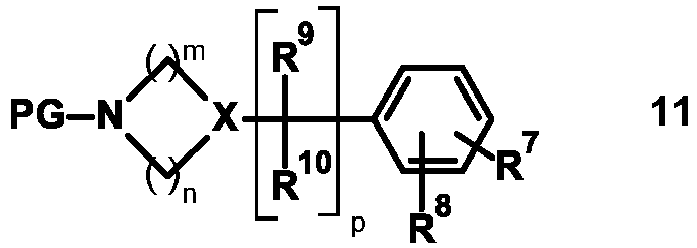
- For instance, compound chlorosulfonation of 11 leads to sulfonyl chloride 12. The reaction can be performed with an appropriate reagent, e. g., chlorosulfonic acid, without solvent or in a suitable solvent, e. g., dichloromethane, at temperatures between 0°C and 100°C.
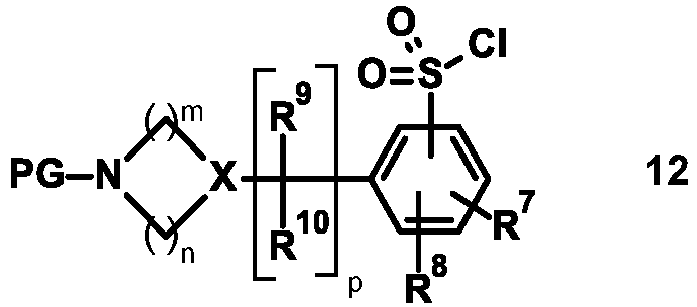
- In a second step, reaction of sulfonyl chloride 12 with ammonia leads to 7CA. This reaction can be performed in a suitable solvent, e. g., water, ethanol, tetrahydrofuran, or mixtures thereof, at temperatures between 0°C and the 50°C.
- Compounds 11 are commercially available or or can be synthesised as described herein or in the literature.
- Intermediates 7 wherein X is CH and W is -(C R9R10)p-S- or -(C R9R10)p-O- can be represented by general structure 7D. Vis oxygen or sulfur, R2, R9, R10, m, n and p are as described above, PG is a protective group, e. g., benzyloxycarbonyl, tert-butoxycarbonyl, or acetyl.

- Compounds of formula 7D can be synthesised from alcohol or thiol 13 using methods and reagents known in the art.

- For instance, alcohol or thiol 13 is reacted with a suitable halide, R2-Hal (14). Hal is F (preferred), Cl, Br, or I. The reaction is performed in the presence of a base, e. g., sodium hydride, cesium carbonate, or potassium carbonate, in a suitable solvent, e. g., tetrahydrofuran or N,N-dimethylacetamide, at temperatures between -78°C and +100°C. It may be necessary to protect the the aminosulfonyl group in halide 14. A suitable sulfonamide protective group is the sulfonylformamidine group, which can be obtained by reaction of the primary sulfonamide with dimethylamide dimethyl acetal, as described herein or in the literature.
- Alternatively, compounds of formula 7D can be synthesised from alcohol 13A and phenol R2-OH (15) or thiophenol R2-SH (16), using reagents and methods known in the art.

- This reaction can be performed using a phosphine, e. g., triphenylphosphine, an azodicarboxylate, e.g., diethyl azodicarboxylate or diisopropyl azodicarboxylate, in a solvent such as dichloromethane, toluene or tetrahydrofuran and at temperatures between 0°C and 40°C. It may be necessary to protect the the aminosulfonyl group in phenol 15 or thiophenol 16. A suitable sulfonamide protective group is the sulfonylformamidine group, which can be obtained by reaction of the primary sulfonamide with N,N-dimethylamide dimethyl acetal, as described herein or in the literature.
- Alcohols and thiols 13 are commercially available can be produced as described herein or using methods known in the art.
- Intermediates 7D wherein V is sulfur can be represented by general structure 7DA. R2, R9, R10, m and n are as described above, PG is a protective group, e. g., benzyloxycarbonyl, tert-butoxycarbonyl, or acetyl.

- Intermediates 7 wherein X is CH and W is -(C R9R10)p-S(O)- can be represented by general structure 7E. R2, R9, R10, m, n and p are as described above, PG is a protective group, e. g., benzyloxycarbonyl, tert-butoxycarbonyl, or acetyl.

- Sulfoxides 7E can be produced from sulfides 7DA using methods and reagents known in the art. For instance, the reaction can be performed in the presence of a peroxide reagent, e. g., hydrogen peroxide or 3-chloroperbenzoic acid, in a solvent, e. g., dichloromethane, acetic acid or formic acid, at temperatures between 0°C and +50°C-
- Intermediates 7 wherein X is CH and W is -(C R9R10)p-S(O)2- can be represented by general structure 7F. R2, R9, R10, m, n and p are as described above, PG is a protective group, e. g., benzyloxycarbonyl, tert-butoxycarbonyl, or acetyl.

- Sulfones 7F can be produced from intermediates sulfides 7DA or sulfoxides 7D using a suitable peroxide reagent, e. g., hydrogen peroxide or 3-chloroperbenzoic acid in a solvent, e. g., dichloromethane, acetic acid or formic acid, at temperatures between 0°C and +50°C.
- Compounds of formula (I) wherein X is N, W is -(CR9R10)p-C(O)- or -(CR9R10)p-S(O)2- and p is zero can be represented by general structure 17. Z is C(O) or S(O)2, R1, R2, m and n are as described above.

- Compounds of formula 17 wherein Z is C(O) can be represented by general structure 17A. R1, R2, m and n are as described above.

- Amides 17A can be produced from amine precursors of general formula 8 by reaction with appropriate reagents, using methods known in the art.

- For instance, amine 18 is reacted with a suitable carboxylic acid of formula R2-COOH (9), leading to compounds of formula 17A. The reaction is performed in the presence of a coupling agent such as 1,1'-carbonyldiimidazole, N,N'-dicyclohexylcarbodiimide, 1-(3-dimethylaminopropyl)-3-ethyl-carbodiimide hydrochloride, O-(benzotriazol-1-yl)-N,N,N',N'-tetramethyluronium hexafluoro-phosphate, O-(7-azabenzotriazol-1-yl)-N,N,N',N'-tetramethyluronium hexafluoro-phosphate or bromo-tris-pyrrolidino-phosphonium hexafluorophosphate, in aprotic solvents such as dichloromethane, tetrahydrofuran, N,N-dimethylformamide, N-methylpyrrolidinone and mixtures thereof at temperatures between -40°C and 80°C in the presence or absence of a base such as triethylamine, diisopropylethylamine, 4-methylmorpholine and/or 4-(dimethylamino)pyridine.
- Compounds of formula 17 wherein Z is S(O)2 can be represented by general structure 17B. R1, R2, m and n are as described above.

- Sulfonamides 17B can be produced from amine precursors of general formula 18 by reaction with appropriate reagents, using methods known in the art. For instance, amine 18 is reacted with a suitable sulfonyl chloride of formula R2-SO2Cl (10), leading to compounds of formula 17B. The reaction is performed in a suitable solvent such as dichloromethane, tetrahydrofuran, N,N-dimethylformamide, acetonitrile, acetone, water, or mixtures thereof, in the presence of a base, e. g. triethylamine, diisopropylethylamine, pyridine, potassium hydrogencarbonate, potassium carbonate, at temperatures between 0°C and the boiling point of the solvent or solvent mixture.
- Compounds of formula (I) wherein X is N, W is -(CR9R10)p-, R10 is H and p is 1 can be represented by general structure 17C. R1, R2, m and n are as described above.

- Compounds of formula 17C can be produced from amine precursors 18 by reaction with appropriate reagents, using methods known in the art.
- For instance, amine 18 is reacted with aldehyde or ketone, R2-C(O)-R9 (21) in the presence of a suitable reducing agent, e. g., sodium triacetoxyborohydride, sodium borohydride, or sodium cyanoborohydride. The reaction is performed in a suitable solvent, e. g., dichloromethane, 1,2-dichloroethane, acetic acid, methanol, or mixtures thereof, at temperatures between 0°C and the boiling point of the solvent.
- Alternatively, amine 18 is reacted with halide, R2-CH(R9)-Hal (22) (Hal is Cl, Br, or I) in the presence of a suitable base, e. g., potassium carbonate, cesium carbonate, or triethylamine. The reaction is performed in a suitable solvent, e. g., methanol, acetone, acetonitrile, or N,N,dimethylfomamide, at temperatures between 0°C and the boiling point of the solvent.
- Aldehydes or ketones (21) and halides (22) are commercially available or can be produced as described herein or in the literature.
- Amines of formula 18 can be prepared from the suitably protected precursors 19.
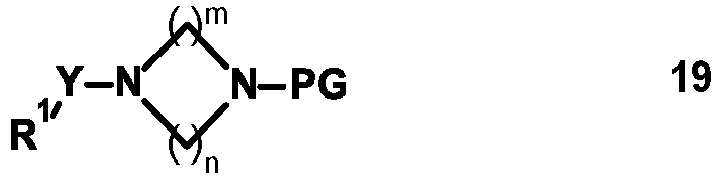
- Suitable protective groups (PG) are tert-butoxycarbonyl or benzyloxycarbonyl. The deprotection of intermediates 19 can be performed using methods and reagents known in the art.
- For instance, in the case where PG is benzyloxycarbonyl, the deprotection may be performed by hydrogenation at pressures between 1 bar and 100 bar, in the presence of a suitable catalyst such as palladium on activated charcoal, at temperatures between 20°C and 150°C in solvents such as methanol or ethanol.
- Alternatively, in the case where PG is tert-butoxycarbonyl, the deprotection may be performed in the presence of a suitable acid, e. g, hydrochloric acid or trifluoroacetic acid, in a solvent such as water, 2-propanol, dichloromethane, or 1,4-dioxane at temperatures between 0°C and 30°C.
- Compounds of formula 19 can be synthesised from amine precursors 20 and appropriate reagents, using methods well known in the art.

- For instance, amine 20 is reacted with a suitable carboxylic acid of formula R1-Y-OH (2) leading to a compound of formula (I), wherein Y is -(CH2)qC(O)-, -(CH=CH)r-C(O) -, or -(CH≡CH)r-C(O)-. The reaction is performed in the presence of a coupling agent such as 1,1'-carbonyldiimidazole, N,N'-dicyclohexylcarbodiimide, 1-(3-dimethylaminopropyl)-3-ethylcarbodiimide hydrochloride, O-(benzotriazol-1-yl)-N,N,N',N'-tetramethyluronium hexafluoro-phosphate, O-(7-azabenzotriazol-1-yl)-N,N,N',N'-tetramethyluronium hexafluoro-phosphate or bromo-tris-pyrrolidino-phosphonium hexafluorophosphate, in aprotic solvents such as dichloromethane, tetrahydrofuran, N,N-dimethylformamide, N-methylpyrrolidinone and mixtures thereof at temperatures between -40°C and 80°C in the presence or absence of a base such as triethylamine, diisopropylethylamine, 4-methylmorpholine and/or 4-(dimethylamino)pyridine.
- Amine 20 can also be reacted with suitable acylating reagents such as acyl chlorides of formula R1-Y-Cl (3) to lead to compounds of formula (I), wherein Y is -(CH2)qC(O)-, -(CH=CH)r-C(O) -, or -(CH≡CH)r-C(O)-. The reaction is performed in a solvent such as dichloromethane, tetrahydrofuran, or N,N-dimethylformamide, in the presence of a base such as triethylamine or 4-methylmorpholine, at temperatures between 0°C and 80°C.
- Alternatively, amine 20 is reacted with a suitable chloroformate ester of formula R1-CH2-O-C(O)-Cl (4), or with an imidazole-1-carboxylate ester of formula (5), leading to a compound of formula (I) wherein Y is -CH2-OC(O)-. The reaction is performed in a suitable solvent such as dichloromethane, tetrahydrofuran, N,N-dimethylformamide, acetonitrile, acetone, water, or mixtures thereof, in the presence of a base, e. g., triethylamine, diisopropylethylamine, pyridine, potassium hydrogencarbonate, potassium carbonate, at temperatures between 0°C and the boiling point of the solvent or solvent mixture.
- Amines 20 are commercially available or can be prepared as described herein or in the literature.
- Also an embodiment of the present invention is a process to prepare a compound of formula (I) as defined above comprising the reaction of a compound of formula (II) in the presence of a compound of formula (III);

- In particular, in the presence of a coupling agent such as 1,1'-carbonyldiimidazole, N,N'-dicyclohexylcarbodiimide, 1-(3-dimethylaminopropyl)-3-ethyl-carbodiimide hydrochloride, O-(benzotriazol-1-yl)-N,N,N',N'-tetramethyluronium hexafluoro-phosphate, O-(7-azabenzotriazol-1-yl)-N,N,N',N'-tetramethyluronium hexafluoro-phosphate or bromo-tris-pyrrolidino-phosphonium hexafluorophosphate , particularly O-(7-azabenzotriazol-1-yl)-N,N,N',N'-tetramethyluronium hexafluoro-phosphate, in an aprotic solvent such as dichloromethane, tetrahydrofuran, N,N-dimethylformamide, N-methylpyrrolidinone and mixtures thereof, particularly N,N-dimethylformamide, in the presence or absence of a base such as triethylamine, diisopropylethylamine, 4-methylmorpholine and/or 4-(dimethylamino)pyridine , particularly in the presence of 4-methylmorpholine and at a temperature comprised between -78°C and reflux, particularly between -10°C and room temperature.
- Also an object of the present invention is a compound according to formula (I) as described herein for use as a therapeutically active substance.
- Likewise an object of the present invention is a pharmaceutical composition comprising a compound according to formula (I) as described herein and a therapeutically inert carrier.
- A particular embodiment of the present invention is a compound according to formula (I) as described herein for the treatment or prophylaxis of ocular conditions, particularly glaucoma.
- Inflammatory conditions include arthritis, osteoarthritis, multiple sclerosis, systemic lupus erythematodes, inflammatory bowel disease, and abnormal evacuation disorder as well as inflammatory airways diseases such as idiopathic pulmonary fibrosis (IPF), chronic obstructive pulmonary disease (COPD) or chronic asthma bronchiale.
- Further conditions of the respiratory system include other diffuse parenchymal lung diseases of different etiologies including iatrogenic drug-induced fibrosis, occupational and/or environmental induced fibrosis, systemic diseases and vasculitides, granulomatous diseases (sarcoidosis, hypersensitivity pneumonia), collagen vascular disease, alveolar proteinosis, Langerhans cell granulomatosis, lymphangioleiomyomatosis, inherited diseases (Hermansky-Pudlak Syndrome, tuberous sclerosis, neurofibromatosis, metabolic storage disorders, familial interstitial lung disease), radiation induced fibrosis, silicosis, asbestos induced pulmonary fibrosis or acute respiratory distress syndrome (ARDS).
- Conditions of the nervous system include neuropathic pain, schizophrenia, neuro-inflammation (e.g. astrogliosis), and peripheral and/or autonomic (diabetic) neuropathies.
- Vascular conditions include atherosclerosis, thrombotic vascular disease as well as thrombotic microangiopathies, proliferative arteriopathy (such as swollen myointimal cells surrounded by mucinous extracellular matrix and nodular thickening), atherosclerosis, decreased vascular compliance (such as stiffness, reduced ventricular compliance and reduced vascular compliance), and endothelial dysfunction.
- Cardiovascular conditions include acute coronary syndrome, coronary heart disease, myocardial infarction, arterial and pulmonary hypertension, cardiac arrhythmia such as atrial fibrillation, stroke and other vascular damage.
- Fibrotic diseases include myocardial and vascular fibrosis, pulmonary fibrosis, skin fibrosis, scleroderma and encapsulating peritonitis.
- Cancer and cancer metastasis include breast cancer, ovarian cancer, lung cancer, prostate cancer, mesothelioma, glioma, gastrointestinal cancers and progression and metastatic aggressiveness thereof.
- Ocular conditions include proliferative and non-proliferative (diabetic) retinopathy, dry and wet age-related macular degeneration (AMD), macular edema, central arterial /venous occlusion, traumatic injury, and glaucoma. Particularly, the ocular condition is glaucoma.
- Metabolic conditions include obesity and diabetes.
- Autotaxin (ATX - ENPP2) cloning: cDNA was prepared from commercial human hematopoietic cells total RNA and used as template in overlapping PCR to generate a full length human ENPP2 ORF with or without a 3'-6xHis tag. These full length inserts were cloned into the pcDNA3.1V5-His TOPO (Invitrogen) vector. The DNA sequences of several single clones were verified. The DNA from a correct full length clone was used to transfect Hek293 cells for verification of protein expression. The sequence of the encoded ENPP2 conforms to Swissprot entry Q13822, with or without the additional C-terminal 6xHis tag.
- ATX Fermentation: Recombinant protein was produced by large-scale transient transfection in 20 L controlled stirred tank bioreactors (Sartorius). During cell growth and transfection, temperature, stirrer speed, pH and dissolved oxygen concentration were maintained at 37°C, 120 rpm, 7.1 and 30% DO, respectively. FreeStyle 293-F cells (Invitrogen) were cultivated in suspension in FreeStyle 293 medium (Invitrogen) and transfected at ca. 1-1.5 x 10E6 cells/mL with above plasmid DNAs using X-tremeGENE Ro-1539 (commercial product, Roche Diagnostics) as complexing agent. Cells were fed a concentrated nutrient solution (J Immunol Methods 194 (1996), 191-199 (page 193)) and induced by sodium butyrate (2 mM) at 72 h post-transfection and harvested at 96 h post-transfection. Expression was analyzed by Western Blot, enzymatic assay and/or analytical IMAC chromatography. After cooling the cell suspension to 4°C in a flow-through heat exchanger, cell separation and sterile filtration of supernatant was performed by filtration through Zeta Plus 60M02 E16 (Cuno) and Sartopore 2 XLG (Sartorius) filter units. The supernatant was stored at 4°C prior to purification.
- ATX Purification: 20 liter of culture supernatant were conditioned for ultrafiltration by adding Brij 35 to a final concentration of 0.02% and by adjusting the pH to 7.0 using 1 M HCl. Then the supernatant was first microfiltred through a 0.2 µm Ultran-Pilot Open Channel PES filter (Whatman) and afterwards concentrated to 1 liter through an Ultran-Pilot Screen Channel PES filter with 30 kDa MWCO (Whatman). Prior to IMAC chromatography, NiSO4 was added to a final concentration of 1 mM. The cleared supernatant was then applied to a HisTrap column (GE Healthcare) previously equilibrated in 50 mM Na2HPO4 pH 7.0, 0.5 M NaCl, 10% glycerol, 0.3% CHAPS, 0.02% NaN3. The column was washed stepwise with the same buffer containing 20 mM, 40 mM and 50 mM imidazole, respectively. The protein was subsequently eluted using a linear gradient to 0.5 M imidazole in 15 column volumes. ATX containing fractions were pooled and concentrated using an Amicon cell equipped with a 30 kDa PES filter membrane. The protein was further purified by size exclusion chromatography on Superdex S-200 prep grade (XK 26/100) (GE Healthcare) in 20 mM BICINE pH 8.5, 0.15 M NaCl, 10% glycerol, 0.3% CHAPS, 0.02% NaN3. Final yield of protein after purification was 5-10 mg ATX per liter of culture supernatant. The protein was stored at -80°C.
- ATX inhibition was measured by a fluorescence quenching assay using a specifically labeled substrate analogue (MR121 substrate). To obtain this MR121 substrate, BOC and TBS protected 6-amino-hexanoic acid (R)-3-({2-[3-(2-{2-[2-(2-amino-ethoxy)-ethoxy]-ethoxy}-ethoxy)-propionylamino]-ethoxy}-hydroxy-phosphoryloxy)-2-hydroxy-propyl ester (Ferguson et al., Org Lett 2006, 8 (10), 2023) was labeled with MR121 fluorophore (CAS 185308-24-1, 1-(3-carboxypropyl)-11-ethyl-1,2,3,4, 8,9,10,11-octahydro-dipyrido[3,2-b :2',3'-i]phenoxazin-13 -ium) on the free amine of the ethanolamine side and then, after deprotection, subsequently with tryptophan on the side of the aminohexanoic acid.
- Assay working solutions were made as follows:
- Assay buffer (50 mM Tris-HCl, 140 mM NaCl, 5 mM KCl, 1 mM CaClz, 1 mM MgClz, 0.01% Triton-X-100, pH 8.0;
- ATX solution: ATX (human His-tagged) stock solution (1.08 mg/mL in 20mM bicine, pH 8.5, 0.15 M NaCl, 10% glycerol, 0.3% CHAPS, 0.02% NaN3), diluted to 1.4 - 2.5x final concentration in assay buffer;
- MR121 substrate solution: MR121 substrate stock solution (800 µM MR121 substrate in DMSO), diluted to 2 - 5x final concentration in assay buffer.
- Test compounds (10 mM stock in DMSO, 8 µL) were obtained in 384 well sample plates (Corning Costar #3655) and diluted with 8 µL DMSO. Row-wise serial dilutions were made by transferring 8 µL cpd solution to the next row up to row O. The compound and control solutions were mixed five times and 2 µL were transferred to 384 well assay plates (Corning Costar # 3702). Then, 15 µL of 41.7 nM ATX solution was added (30 nM final concentration), mixed five times and then incubated for 15 minutes at 30°C. 10 µL of MR121 substrate solution was added (1 µM final concentration), mixed 30 times and then incubated for 15 minutes at 30 °C. Fluorescence was then measured every 2 minutes for 1 hour (Perkin Elmer plate: vision multimode reader); light intensity: 2.5%; exp. time: 1.4 sec, Filter: Fluo_630/690 nm) and IC50 values were calculated from these readouts.
- Human carbonic anhydrase II (hCA-II) inhibition was measured by an absorbance method using 4-nitrophenyl acetate (4-NPA) as its substrate. 4-NPA can be catalyzed by active hCA II via a zinc-hydroxide mechanism. The nitrophenolate in the products can be ionized to generate a bright yellow anion with high absorbance at 348 to 400 nm, as reported in the literature (Armstrong et al., J. Biol. Chem. 1966, 241, 5137-5149). OD340 nm was chosen for detecting hCA II substrate conversion.
- Assay working solutions were made as follows:
- Assay buffer: 50mM MOPS, 33mM Na2SO4, 1mM EDTA, 0.5 mg/mL BSA, pH 7.5;
- Enzyme solution: hCA-II (human, full length) stock solution (1.0 mg/mL in 20mM HEPES, 50 mMNaCl, pH 7.4), diluted to 2133x final concentration in assay buffer;
- 4-NPA substrate solution: 4-NPA substrate stock solution (250 mM in DMSO, stored at -20°C), diluted to 50x final concentration in deionized water.
- Test compounds (10 mM stock in DMSO, 100 µL) were obtained in 96-well sample plates (Corning Costar #3655) and diluted to 0.5 mM. Column-wise serial dilutions were made by transferring 20 µL compound solutions to the next column, from column 3 up to 22. After this, 1.2 µL were transferred to 384 well assay plates (Corning Costar # 3701). Then 30 µL of 16 nM hCA II solution was added (8 nM final concentration), mixed five times. 30 µL of 4-NPA substrate solution was added (2.5 mM final concentration), mixed five times. Absorbance at 340 nm was then measured immediately as time zero. The assay plates were incubated at room temperature for 1 hour and then measured as time 1 hour (Perkin Elmer EnVision 2103; Filter: Photometric 340; Light intensity 60%; Number of flashes: 10). IC50 values and Ki values were calculated from these readouts.
-
Ex ATX IC50 (µM) CA-II IC50 (µM) 1.00 0.023 0.0096 1.01 0.018 0.2925 1.02 0.312 0.072 1.03 0.073 1.04 0.008 2.00 0.008 0.0344 2.01 0.002 0.0013 2.02 0.007 0.0155 3.00 0.002 0.0211 3.00 0.009 0.0094 4.00 0.001 0.0176 4.01 0.002 0.0342 4.02 0.013 0.0343 5.00 0.014 1.0986 5.01 0.004 0.0207 5.02 0.005 0.0271 5.03 0.001 0.1089 5.04 0.005 0.0133 5.05 0.067 5.06 0.027 5.07 0.024 0.1344 5.08 0.014 0.1118 5.09 0.009 0.0685 6.00 0.001 0.0067 6.01 0.004 0.0063 6.02 0.005 0.0018 6.03 0.001 0.007 6.04 0.005 0.0113 6.05 0.006 0.01 6.06 0.004 0.014 6.07 0.003 0.0131 6.08 0.01 0.017 6.09 0.012 0.0172 6.10 0.002 0.0095 6.11 0.01 0.0062 6.12 0.008 0.0013 6.13 0.001 0.0175 6.14 0.005 0.0008 6.15 0.013 0.0079 6.16 0.004 0.0123 6.17 0.002 0.0071 6.18 0.001 0.0129 6.19 0.002 0.0178 6.20 0.019 0.0206 6.21 0.068 0.015 6.22 0.011 0.0072 6.23 0.004 0.0029 6.24 0.009 0.0089 6.25 0.01 0.0062 6.26 0.008 0.0124 6.27 0.001 0.0092 6.28 0.004 0.0102 6.29 0.009 0.0084 6.30 0.015 0.0024 6.31 0.01 0.0178 6.32 0.003 0.0041 6.33 0.003 0.02 6.34 0.012 0.0079 6.35 0.014 0.0198 6.36 0.062 0.0606 6.37 0.006 0.0163 6.38 0.001 0.0073 6.39 0.001 0.008 6.40 0.007 0.009 6.41 0.001 0.0025 6.42 0.003 6.43 0.006 6.44 0.007 6.45 0.001 0.0051 7.00 0.003 7.01 0.072 0.0207 7.02 0.024 0.1174 8.00 0.005 8.01 0.01 0.2393 8.02 0.006 0.1463 9.00 0.027 - Compounds of formula (I) and their pharmaceutically acceptable salts or esters thereof as described herein have IC50 values between 0.00001 µM and 1000 µM, particular compounds have IC50 values between 0.0005 µM and 500 µM, further particular compounds have IC50 values between 0.0005 µM and 50 µM, more particular compounds have IC50 values between 0.0005 µM and 5 µM. These results have been obtained by using the enzymatic assay described above.
- The compounds of formula (I) and their pharmaceutically acceptable salts can be used as medicaments (e.g. in the form of pharmaceutical preparations). The pharmaceutical preparations can be administered internally, such as orally (e.g. in the form of tablets, coated tablets, dragées, hard and soft gelatin capsules, solutions, emulsions or suspensions), nasally (e.g. in the form of nasal sprays), rectally (e.g. in the form of suppositories) or topical ocularly (e.g. in the form of solutions, ointments, gels or water soluble polymeric inserts). However, the administration can also be effected parenterally, such as intramuscularly, intravenously, or intraocularly (e.g. in the form of sterile injection solutions).
- The compounds of formula (I) and their pharmaceutically acceptable salts can be processed with pharmaceutically inert, inorganic or organic adjuvants for the production of tablets, coated tablets, dragées,hard gelatin capsules, injection solutions or topical formulations Lactose, corn starch or derivatives thereof, talc, stearic acid or its salts can be used, for example, as such adjuvants for tablets, dragées and hard gelatin capsules.
- Suitable adjuvants for soft gelatin capsules, are, for example, vegetable oils, waxes, fats, semi-solid substances and liquid polyols.
- Suitable adjuvants for the production of solutions and syrups are, for example, water, polyols, saccharose, invert sugar, glucose.
- Suitable adjuvants for injection solutions are, for example, water, alcohols, polyols, glycerol, vegetable oils.
- Suitable adjuvants for suppositories are, for example, natural or hardened oils, waxes, fats, semi-solid or liquid polyols.
- Suitable adjuvants for topical ocular formulations are, for example, cyclodextrins, mannitol or many other carriers and excipients known in the art.
- Moreover, the pharmaceutical preparations can contain preservatives, solubilizers, viscosity-increasing substances, stabilizers, wetting agents, emulsifiers, sweeteners, colorants, flavorants, salts for varying the osmotic pressure, buffers, masking agents or antioxidants. They can also contain still other therapeutically valuable substances.
- The dosage can vary in wide limits and will, of course, be fitted to the individual requirements in each particular case. In general, in the case of oral administration a daily dosage of about 0.1 mg to 20 mg per kg body weight, preferably about 0.5 mg to 4 mg per kg body weight (e.g. about 300 mg per person), divided into preferably 1-3 individual doses, which can consist, for example, of the same amounts, should it be appropriate. In the case of topical administration, the formulation can contain 0.001% to 15% by weight of medicament and the required dose, which can be between 0.1 and 25 mg in can be administered either by single dose per day or per week, or by multiple doses (2 to 4) per day, or by multiple doses per week It will, however, be clear that the upper or lower limit given herein can be exceeded when this is shown to be indicated.
- The invention is illustrated hereinafter by Examples, which have no limiting character.
- In case the preparative examples are obtained as a mixture of enantiomers, the pure enantiomers can be obtained by methods described herein or by methods known to those skilled in the art, such as e.g. chiral chromatography or crystallization.
- All examples and intermediates were prepared under nitrogen atmosphere if not specified otherwise.
- Abbreviations: aq. = aqueous; CAS-RN = Chemical Abstracts Service Registry Number; HPLC = high performance liquid chromatography; MS = mass spectrum; PS-BEMP = polystyrene-bound 2-tert-butylimino-2-diethylamino-1,3-dimethylperhydro-1,3,2-diazaphosphorine; sat. = saturated
-

- To a solution of [2-[(5-methyltetrazol-2-yl)methyl]-4-(trifluoromethyl)phenyl]methanol (intermediate 1; 30 mg, 110 µmol) in acetonitrile (2 mL) was added 1,1'-carbonyldiimidazole (17.9 mg, 110 µmol) at room temperature. The reaction mixture was heated to 50°C and stirred for 2 h, then a suspension of 3-fluoro-4-piperazin-1-ylbenzenesulfonamide (CAS-RN 847971-84-0; 28.6 mg, 110 µmol) and triethylamine (55.8 mg, 551 µmol) in acetonitrile (2 mL) was added and the reaction mixture was heated to reflux. After 15 h the reaction mixture was partitioned between sat. aq. ammonium chloride solution and ethyl acetate. The organic layer was washed with brine, dried over magnesium sulfate, filtered and evaporated. Chromatography (silica gel, gradient dichloromethane to dichloromethane/methanol/25% aq. ammonia solution 90:10:0.25) produced the title compound (15 mg, 24%). White solid, MS: 558.1 (M+H)+.
- The following examples were prepared according to example 1, replacing 3-fluoro-4-piperazin-1-ylbenzenesulfonamide by the appropriate amine or carbamate and [2-[(5-methyltetrazol-2-yl)methyl]-4-(trifluoromethyl)phenyl]methanol by the appropriate alcohol. In the cases where the tert-butyl carbamate derivatives of the amines are used as starting materials (examples 1.03 and 1.04), the carbamates were first deprotected with trifluoroacetic acid in analogy to example 6.
Ex. Systematic Name Amine or carbamate / Alcohol MS, m/e 1.01 [2-cyclopropyl-6-(oxan-4-ylmethoxy)pyridin-4-yl]methyl 4-[(4-sulfamoylphenyl)methyl]piperidine-1-carboxylate 
4-(piperidin-4-ylmethyl)benzenesulfonamide hydrochloride (CAS-RN 333986-77-9) / [2-cyclopropyl-6-(oxan-4-ylmethoxy)pyridin-4-yl]methanol (intermediate 6) 544.4 (M+H)+ 1.02 [5-cyano-3-(2,2-dimethylpropanoylamino)pyridin-2-yl]methyl 4-[(4-sulfamoylphenyl)methyl]piperidine-1-carboxylate 
4-(piperidin-4-ylmethyl)benzenesulfonamide hydrochloride (CAS-RN 333986-77-9) / (N-[5-cyano-2-(hydroxymethyl)pyridin-3-yl]-2,2-dimethylpropanamide (intermediate 12) 512.4 (M-H)- 1.03 [5-chloro-3-[(5-methyltetrazol-2-yl)methyl]pyridin-2-yl]methyl 4-(2-fluoro-4-sulfamoylphenyl)sulfonylpiperidine-1-carboxylate 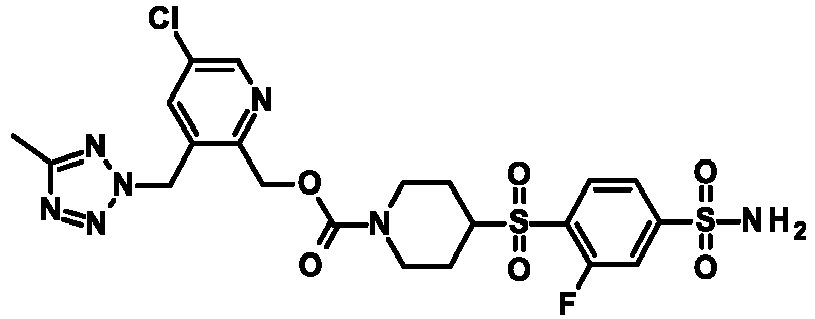
tert-butyl 4-(2-fluoro-4-sulfamoylphenyl)sulfonyl-piperidine-1-carboxylate (intermediate 11) / [5-chloro-3-[(5-methyltetrazol-2-yl)methyl]pyridin-2-yl]methanol (intermediate 14) 588.2 (M+H)+ 1.04 [2-[(5-methyltetrazol-2-yl)methyl]-4-(trifluoromethyl)phenyl]methyl 4-(2-fluoro-4-sulfamoylphenyl)sulfonylpiperidine-1-carboxylate 
(tert-butyl 4-((2-fluoro-4-sulfamoylphenyl)sulfonyl)-piperidine-1-carboxylate / 2-((5-methyl-2H-tetrazol-2-yl)methyl)-4-(trifluoromethyl)phenyl)methanol (intermediate 1) 619.3 (M-H)- -

- To a solution of tert-butyl 4-(3-fluoro-4-sulfamoylbenzoyl)piperazine-1-carboxylate (CAS-RN 1395398-34-1; 150 mg, 387 µmol) in tetrahydrofuran (3 mL) was added borane tetrahydrofuran complex (1 M in tetrahydrofuran; 1.16 mL, 1.16 mmol) at room temperature, then after 14 h the reaction mixture was heated to 60°C for 4 h, then 2 M aq. hydrochloric acid solution (2 mL) and additionally hydrochloric acid (25% in water; 1.0 mL, 8.2 mmol) were added dropwise. The mixture was stirred at 60°C for 45 min, then the mixture was directly evaporated at high vacuum and the residue was combined with N,N-dimethylformamide (3 mL) and N-methylmorpholine (392 mg, 3.87 mmol), 3-[2-[(5-methyltetrazol-2-yl)methyl]-4-(trifluoromethyl)phenyl]propanoic acid (CAS-RN 1646783-83-6; 122 mg, 387 µmol) and O-(7-azabenzotriazol-1-yl)-N,N,N',N'-tetramethyluronium hexafluoro-phosphate (147 mg, 387 µmol), then after 48 h at room temperature the reaction mixture was partitioned between sat. aq. ammonium chloride solution and ethyl acetate. The organic layer was washed with brine, dried over magnesium sulfate, filtered and evaporated. Chromatography (silica gel, gradient dichloromethane to dichloromethane/methanol/25% aq. ammonia solution 90:10:0.25) produced the title compound (87 mg, 40%). Colourless gum, MS: 570.3 (M+H)+.
- The following examples were prepared according to example 2, replacing tert-butyl 4-(3-fluoro-4-sulfamoylbenzoyl)piperazine-1-carboxylate by the appropriate carbamate and 3-[2-[(5-methyltetrazol-2-yl)methyl]-4-(trifluoromethyl)phenyl]propanoic acid by the appropriate carboxylic acid.
Ex. Systematic Name Carbamate / Carboxylic acid MS, m/e 2.01 3-fluoro-4-[[4-[3-[2-[(5-methyltetrazol-2-yl)methyl]-4-(trifluoromethyl)phenyl]-propanoyl]piperazin-1-yl]methyl]benzenesulfonamide 
tert-butyl 4-(2-fluoro-4-sulfamoylbenzoyl)piperazine-1-carboxylate (intermediate 5) / 3-[2-[(5-methyltetrazol-2-yl)methyl]-4-(trifluoromethyl)phenyl]propanoic acid (CAS-RN 1646783-83-6) 570.4 (M+H)+ 2.02 4-[[4-[2-cyclopropyl-6-(oxan-4-ylmethoxy)pyridine-4-carbonyl]piperazin-1-yl]methyl]-3-fluorobenzenesulfonamide 
tert-butyl 4-(2-fluoro-4-sulfamoylbenzoyl)piperazine-1-carboxylate (intermediate 5) / 2-cyclopropyl-6-(oxan-4-ylmethoxy)pyridine-4-carboxylic acid (CAS-RN 1810776-23-8) 533.3 (M+H)+ -

- The title compound was obtained as a side product in the preparation of example 2 (48 mg, 21%). White solid, MS: 584.3 (M+H)+.
-
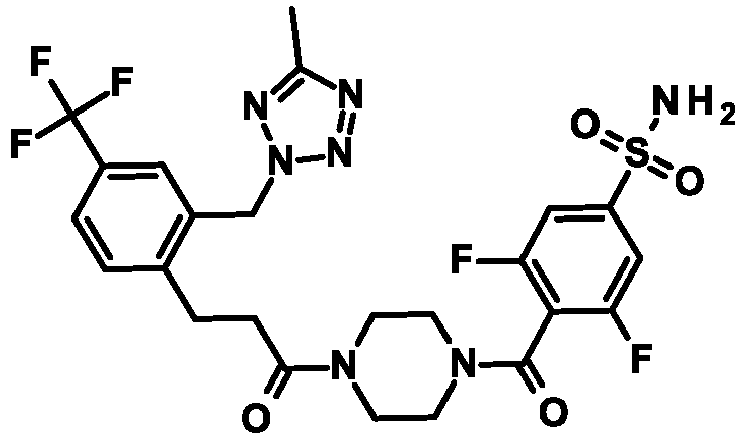
- To a solution of 3-[2-[(5-methyltetrazol-2-yl)methyl]-4-(trifluoromethyl)phenyl]-1-piperazin-1-ylpropan-1-one (intermediate 2; 40 mg, 100 µmol) in N,N-dimethylformamide (3 mL) was added N-methylmorpholine (40.6 mg, 402 µmol), 2,6-difluoro-4-sulfamoylbenzoic acid (intermediate 3; 26.2 mg, 110 µmol) and O-(7-azabenzotriazol-1-yl)-N,N,N',N'-tetramethyluronium hexafluoro-phosphate (42 mg, 110 µmol), then after 18 h at room temperature the reaction mixture was partitioned between sat. aq. ammonium chloride solution and ethyl acetate. The organic layer was washed with brine, dried over magnesium sulfate, filtered and evaporated. Chromatography (silica gel, gradient dichloromethane to dichloromethane/methanol/25% aq. ammonia solution 90:10:0.25) produced the title compound (51 mg, 84%). White solid, MS: 602.3 (M+H)+.
- The following examples were prepared according to example 4, replacing 2,6-difluoro-4-sulfamoylbenzoic acid (intermediate 3) by the appropriate carboxylic acid.
Ex. Systematic Name Carboxylic acid MS, m/e 4.01 3-fluoro-4-[4-[3-[2-[(5-methyltetrazol-2-yl)methyl]-4-(trifluoromethyl)phenyl]-propanoyl]piperazine-1-carbonyl]benzenesulfonamide 
2-fluoro-4-sulfamoylbenzoic acid (CAS-RN 714968-42-0) 584.3 (M+H)+ 4.02 4-[4-[3-[2-[(5-methyltetrazol-2-yl)methyl]-4-(trifluoromethyl)phenyl]-propanoyl]piperazine-1-carbonyl]benzenesulfonamide 
4-sulfamoylbenzoic acid (CAS-RN 138-41-0) 566.2 (M+H)+ -

- To a solution of 4-fluoro-3-(piperidin-4-ylmethyl)benzenesulfonamide hydrochloride (intermediate 7; 51.6 mg, 159 µmol) in N,N-dimethylformamide (3 mL) was added N-methylmorpholine (72.9 mg, 721 µmol), 2-cyclopropyl-6-(oxan-4-ylmethoxy)pyridine-4-carboxylic acid (CAS-RN 1810776-23-8; 40 mg, 144 µmol) and O-(7-azabenzotriazol-1-yl)-N,N,N',N'-tetramethyluronium hexafluoro-phosphate (60.3 mg, 159 µmol), then after 18 h at room temperature the reaction mixture was partitioned between sat. aq. ammonium chloride solution and ethyl acetate. The organic layer was washed with brine, dried over magnesium sulfate, filtered and evaporated. Chromatography (silica gel, gradient dichloromethane to dichloromethane/methanol/25% aq. ammonia solution 90:10:0.25) produced the title compound (75 mg, 98%). White solid, MS: 532.3 (M+H)+.
- The following examples were prepared according to example 5, replacing 4-fluoro-3-(piperidin-4-ylmethyl)benzenesulfonamide hydrochloride by the appropriate amine and 2-cyclopropyl-6-(oxan-4-ylmethoxy)pyridine-4-carboxylic acid by the appropriate carboxylic acid.
Ex. Systematic Name Amine / Carboxylic acid MS, m/e 5.01 3-fluoro-4-[1-[3-[2-[(5-methyltetrazol-2-yl)methyl]-4-(trifluoromethyl)phenyl]propanoyl]piper idin-4-yl]sulfanylbenzenesulfonamide 
3-fluoro-4-piperidin-4-ylsulfanylbenzenesulfonamide hydrochloride(intermediate 8) / 3-[2-[(5-methyltetrazol-2-yl)methyl]-4-(trifluoromethyl)-phenyl]propanoic acid (CAS-RN 1646783-83-6) 587.3 (M+H)+ 5.02 3-fluoro-4-[4-[3-[2-[(5-methyltetrazol-2-yl)methyl]-4-(trifluoromethyl)phenyl]-propanoyl]piperazin-1-yl]benzenesulfonamide 
3-fluoro-4-piperazin-1-ylbenzenesulfonamide(CAS-RN 847971-84-0) / 3-[2-[(5-methyltetrazol-2-yl)methyl]-4-(trifluoromethyl)phenyl]-propanoic acid (CAS-RN 1646783-83-6) 556.2 (M+H)+ 5.03 4-[[1-[2-cyclopropyl-6-(oxan-4-ylmethoxy)pyridine-4-carbonyl]piperidin-4-yl]methyl]benzenesulfonamide 
4-(piperidin-4-ylmethyl)benzenesulfonamide hydrochloride(CAS-RN 333986-77-9) / 2-cyclopropyl-6-(oxan-4-ylmethoxy)pyridine-4-carboxylic acid (CAS-RN 1810776-23-8) 514.4 (M+H)+ 5.04 4-[[1-[3-[2-[(5-methyltetrazol-2-yl)methyl]-4-(trifluoromethyl)phenyl]-propanoyl]piperidin-4-yl]methyl]benzenesulfonamide 
4-(piperidin-4-ylmethyl)benzenesulfonamide hydrochloride (CAS-RN 333986-77-9) / 3-[2-[(5-methyltetrazol-2-yl)methyl]-4-(trifluoromethyl)phenyl]-propanoic acid (CAS-RN 1646783-83-6) 551.3 (M+H)+ 5.05 4-[[1-[3-[2-[(5-methyltetrazol-2-yl)methyl]-4-(trifluoromethyl)phenyl]-propanoyl]pyrrolidin-2-yl]methoxy]benzenesulfonamide 
4-(pyrrolidin-2-ylmethoxy)benzenesulfonamide hydrochloride (CAS-RN 1803591-06-1) / 3-[2-[(5-methyltetrazol-2-yl)methyl]-4-(trifluoromethyl)phenyl]-propanoic acid (CAS-RN 1646783-83-6) 553.2 (M+H)+ 5.06 4-[[1-[3-[2-[(5-methyltetrazol-2-yl)methyl]-4-(trifluoromethyl)phenyl]-propanoyl]pyrrolidin-3-yl]methoxy]benzenesulfonamide 
4-(pyrrolidin-3-ylmethoxy)benzenesulfonamide hydrochloride (CAS-RN 1803590-92-2) / 3-[2-[(5-methyltetrazol-2-yl)methyl]-4-(trifluoromethyl)phenyl]-propanoic acid (CAS-RN 1646783-83-6) 553.2 (M+H)+ 5.07 4-[1-[3-[2-[(5-methyltetrazol-2-yl)methyl]-4-(trifluoromethyl)phenyl]propanoyl]-piperidin-4-yl]benzenesulfonamide 
4-piperidin-4-ylbenzenesulfonamide (CAS-RN 119737-31-4) / 3-[2-[(5-methyltetrazol-2-yl)methyl]-4-(trifluoromethyl)phenyl]-propanoic acid (CAS-RN 1646783-83-6) 537.2 (M+H)+ 5.08 4-[4-[3-[2-[(5-methyltetrazol-2-yl)methyl]-4-(trifluoromethyl)phenyl]-propanoyl]piperazin-1- yl]benzenesulfonamide 
4-piperazin-1-ylbenzenesulfonamide (CAS-RN 170856-87-8) / 3-[2-[(5-methyltetrazol-2-yl)methyl]-4-(trifluoromethyl)phenyl]-propanoic acid (CAS-RN 1646783-83-6) 538.2 (M+H)+ 5.09 4-fluoro-3-[[1-[3-[2-[(5-methyltetrazol-2-yl)methyl]-4-(trifluoromethyl)phenyl]-propanoyl]piperidin-4-yl]methyl]benzenesulfonamide 
4-fluoro-3-(piperidin-4-ylmethyl)benzenesulfonamide hydrochloride (intermediate 7) / 3-[2-[(5-methyltetrazol-2-yl)methyl]-4-(trifluoromethyl)phenyl]-propanoic acid (CAS-RN 1646783-83-6) 569.3 (M+H)+ -

- To a solution of tert-butyl 4-(2,3-difluoro-4-sulfamoylphenyl)sulfanylpiperidine-1-carboxylate (intermediate 9.2; 31 mg, 60 µmol) in dichloromethane (3 mL) was added trifluoroacetic acid (137 mg, 1.2 mmol) at room temperature. The reaction mixture was stirred at 40°C for 80 min, then the mixture was directly evaporated and the residue was taken up in N,N-dimethylformamide (3 mL) and N-methylmorpholine (61.9 mg, 600 µmol), 3-[2-[(5-methyltetrazol-2-yl)methyl]-4-(trifluoromethyl)phenyl]propanoic acid (CAS-RN 1646783-83-6; 20.7 mg, 65.9 µmol) and O-(7-azabenzotriazol-1-yl)-N,N,N',N'-tetramethyluronium hexafluoro-phosphate (25.3 mg, 65.9 µmol) were added. After 18 h at room temperature the reaction mixture was partitioned between sat. aq. ammonium chloride solution and ethyl acetate. The organic layer was washed with brine, dried over magnesium sulfate, filtered and evaporated. Chromatography (silica gel, gradient dichloromethane to dichloromethane/methanol/25% aq. ammonia solution 90:10:0.25) produced the title compound (27 mg, 74%). White solid, MS: 605.2 (M+H)+.
- The following examples were prepared according to example 6, replacing tert-butyl 4-(2,3-difluoro-4-sulfamoylphenyl)sulfanylpiperidine-1-carboxylate (intermediate 9.2) by the appropriate carbamate and 3-[2-[(5-methyltetrazol-2-yl)methyl]-4-(trifluoromethyl)phenyl]propanoic acid (CAS-RN 1646783-83-6) by the appropriate carboxylic acid.
Ex. Systematic Name Carbamate / Carboxylic acid MS, m/e 6.01 2,3-difluoro-4-[1-[3-[2-[(5-methyltetrazol-2-yl)methyl]-4-(trifluoromethyl)phenyl]propanoyl] -piperidin-4-yl] sulfinylbenzenesulfonamide 
tert-butyl 4-(2,3-difluoro-4-sulfamoylphenyl)sulfinyl-piperidine-1-carboxylate (intermediate 10.2) / 3-[2-[(5-methyltetrazol-2-yl)methyl]-4-(trifluoromethyl)phenyl]-propanoic acid (CAS-RN 1646783-83-6) 621.2 (M+H)+ 6.02 2,3-difluoro-4-[1-[3-[2-[(5-methyltetrazol-2-yl)methyl]-4-(trifluoromethyl)-phenyl]propanoyl]piperidin-4-yl]sulfonylbenzenesulfonamide 
tert-butyl 4-(2,3-difluoro-4-sulfamoylphenyl)sulfonyl-piperidine-1-carboxylate (intermediate 15) / 3-[2-[(5-methyltetrazol-2-yl)methyl]-4-(trifluoromethyl)phenyl]-propanoic acid (CAS-RN 1646783-83-6) 637.2 (M+H)+ 6.03 2,3-difluoro-4-[2-[1-[3-[2-[(5-methyltetrazol-2-yl)methyl]-4-(trifluoromethyl)phenyl]propanoyl] -piperidin-4-yl]ethylsulfonyl]benzenesulfonamid e 
tert-butyl 4-[2-(2,3-difluoro-4-sulfamoylphenyl)sulfonylethyl]-piperidine-1-carboxylate (intermediate 15.3) / 2-cyclopropyl-6-(oxan-4-ylmethoxy)pyridine-4-carboxylic acid (CAS-RN 1810776-23-8) 665.2 (M+H)+ 6.04 2-[1-[3-[2-[(5-methyltetrazol-2-yl)methyl]-4-(trifluoromethyl)phenyl]propanoyl] -piperidin-4-yl] sulfanyl-1,3-thiazole-5-sulfonamide tert-butyl 4-[(5-sulfamoyl-1,3-thiazol-2-yl)sulfanyl]piperidine-1-carboxylate (intermediate 9.5) / 3-[2-[(5-methyltetrazol-2-yl)methyl]-4-(trifluoromethyl)phenyl]propanoic acid (CAS-RN 1646783-83-6) 576.1 (M+H)+ 
6.05 2-[1-[3-[2-[(5-methyltetrazol-2-yl)methyl]-4-(trifluoromethyl)phenyl]-propanoyl]piperidin-4-yl]sulfonyl-1,3-thiazole-5-sulfonamide tert-butyl 4-[(5-sulfamoyl-1,3-thiazol-2-yl)sulfonyl]piperidine-1-carboxylate (intermediate 15.2) / 3-[2-[(5-methyltetrazol-2-yl)methyl]-4-(trifluoromethyl)phenyl]propanoic acid (CAS-RN 1646783-83-6) 608.1 (M+H)+ 
6.06 2-[2-[1-[3-[2-[(5-methyltetrazol-2-yl)methyl]-4-(trifluoromethyl)phenyl]propanoyl] -piperidin-4-yl]ethylsulfinyl]-1,3-thiazole-5-sulfonamide tert-butyl 4-[2-[(5-sulfamoyl-1,3-thiazol-2-yl)sulfinyl]ethyl]piperidine-1-carboxylate (intermediate 10.5) / 2-cyclopropyl-6-(oxan-4-ylmethoxy)pyridine-4-carboxylic acid (CAS-RN 1810776-23-8) 620.2 (M+H)+ 
6.07 3-[2-[(5-methyltetrazol-2-yl)methyl]-4-(trifluoromethyl)phenyl]propanoic acid (CAS-RN 1646783-83-6) tert-butyl 4-[(2-fluoro-4-sulfamoylphenyl)sulfanylmethyl]-piperidine-1-carboxylate (intermediate 9) / 3-[2-[(5-methyltetrazol-2-yl)methyl]-4-(trifluoromethyl)phenyl]propanoic acid (CAS-RN 1646783-83-6) 601.3 (M+H)+ 
6.08 3-fluoro-4-[[1-[3-[2-[(5-methyltetrazol-2-yl)methyl]-4-(trifluoromethyl)phenyl]propanoyl] -piperidin-4-yl]methylsulfinyl]-benzenesulfonamide tert-butyl 4-[(2-fluoro-4-sulfamoylphenyl)sulfinylmethyl]-piperidine-1-carboxylate (intermediate 10.1) / 3-[2-[(5-methyltetrazol-2-yl)methyl]-4-(trifluoromethyl)phenyl]propanoic acid (CAS-RN 1646783-83-6) 617.3 (M+H)+ 
6.09 3-fluoro-4-[[1-[3-[2-[(5-methyltetrazol-2-yl)methyl]-4-(trifluoromethyl)phenyl]propanoyl] -piperidin-4-yl]methylsulfonyl]-benzenesulfonamide tert-butyl 4-[(2-fluoro-4-sulfamoylphenyl)sulfonylmethyl]-piperidine-1-carboxylate (intermediate 11.1) / 2-cyclopropyl-6-(oxan-4-ylmethoxy)pyridine-4-carboxylic acid (CAS-RN 1810776-23-8) 633.2 (M+H)+ 
6.10 3-fluoro-4-[1-[3-[2-[(5-methyltetrazol-2-yl)methyl]-4-(trifluoromethyl)phenyl]propanoyl] -azetidin-3-yl]sulfanylbenzenesulfonamide tert-butyl 3-(2-fluoro-4-sulfamoylphenyl)sulfanylazetidine-1-carboxylate (intermediate 9.3) / 3-[2-[(5-methyltetrazol-2-yl)methyl]-4-(trifluoromethyl)phenyl]propanoic acid (CAS-RN 1646783-83-6) 559.2 (M+H)+ 
6.11 3-fluoro-4-[1-[3-[2-[(5-methyltetrazol-2-yl)methyl]-4-(trifluoromethyl)phenyl]propanoyl] -azetidin-3-yl]sulfinylbenzenesulfonamide tert-butyl 3-(2-fluoro-4-sulfamoylphenyl)sulfinylazetidine-1-carboxylate (intermediate 10.3) / 3-[2-[(5-methyltetrazol-2-yl)methyl]-4-(trifluoromethyl)phenyl]propanoic acid (CAS-RN 1646783-83-6) 573.2 (M-H)- 
6.12 3-fluoro-4-[1-[3-[2-[(5-methyltetrazol-2-yl)methyl]-4-(trifluoromethyl)phenyl]propanoyl] -azetidin-3-yl]sulfonylbenzenesulfonamide tert-butyl 3-(2-fluoro-4-sulfamoylphenyl)sulfonylazetidine-1-carboxylate (intermediate 15.1) / 2-cyclopropyl-6-(oxan-4-ylmethoxy)pyridine-4-carboxylic acid (CAS-RN 1810776-23-8) 589.2 (M-H)- 
6.13 3-fluoro-4-[1-[3-[2-[(5-methyltetrazol-2-yl)methyl]-4-(trifluoromethyl)phenyl]propanoyl] -piperidin-4-yl]sulfinylbenzenesulfonamide 
tert-butyl 4-(2-fluoro-4-sulfamoylphenyl)sulfinylpiperidine-1-carboxylate (intermediate 10) / 3-[2-[(5-methyltetrazol-2-yl)methyl]-4-(trifluoromethyl)phenyl]propanoic acid (CAS-RN 1646783-83-6) 603.2 (M+H)+ 6.14 3-fluoro-4-[1-[3-[2-[(5-methyltetrazol-2-yl)methyl]-4-(trifluoromethyl)phenyl]propanoyl] -piperidin-4-yl]sulfonylbenzenesulfonamide 
tert-butyl 4-(2-fluoro-4-sulfamoylphenyl)sulfonylpiperidine -1-carboxylate (intermediate 11) / 3-[2-[(5-methyltetrazol-2-yl)methyl]-4-(trifluoromethyl)phenyl]propanoic acid (CAS-RN 1646783-83-6) 619.2 (M+H)+ 6.15 3-fluoro-4-[2-[1-[3-[2-[(5-methyltetrazol-2-yl)methyl]-4-(trifluoromethyl)phenyl]propanoyl] -piperidin-4-yl]ethylsulfanyl]benzenesulfonamid e 
tert-butyl 4-[2-(2-fluoro-4-sulfamoylphenyl)sulfanylethyl]-piperidine-1-carboxylate (intermediate 9.4) / 2-cyclopropyl-6-(oxan-4-ylmethoxy)pyridine-4-carboxylic acid (CAS-RN 1810776-23-8) 613.3 (M-H)- 6.16 3-fluoro-4-[2-[1-[3-[2-[(5-methyltetrazol-2-yl)methyl]-4-(trifluoromethyl)phenyl]propanoyl] tert-butyl 4-[2-(2-fluoro-4-sulfamoylphenyl)sulfmyl ethylpiperidine-1-carboxylate 631.3 (M+H)+ -piperidin-4-yl]ethylsulfinyl]benzenesulfonamid e 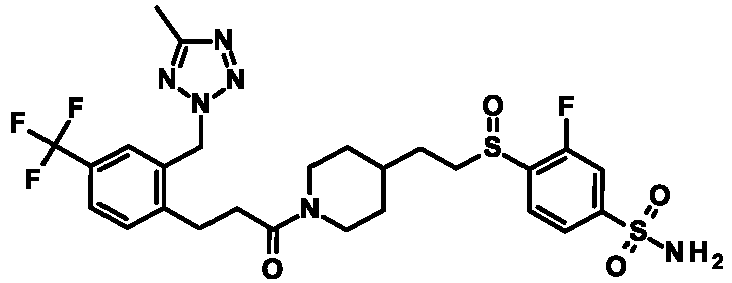
(intermediate 10.4) / 3-[2-[(5-methyltetrazol-2-yl)methyl]-4-(trifluoromethyl)phenyl]propanoic acid (CAS-RN 1646783-83-6) 6.17 3-fluoro-4-[2-[1-[3-[2-[(5-methyltetrazol-2-yl)methyl]-4-(trifluoromethyl)phenyl]propanoyl] -piperidin-4-yl]ethylsulfonyl]benzenesulfonamid e 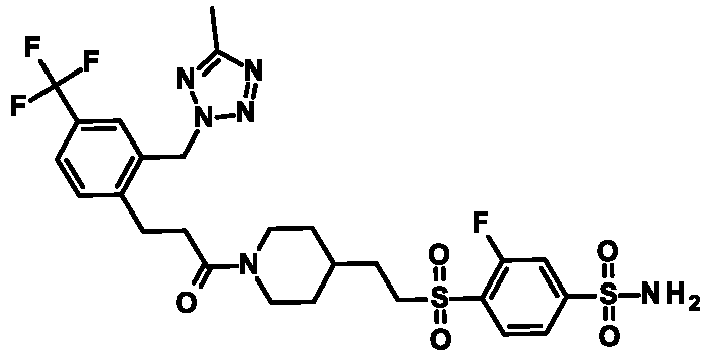
tert-butyl 4-[2-(2-fluoro-4-sulfamoylphenyl)sulfonylethyl]-piperidine-1-carboxylate (intermediate 16) / 3-[2-[(5-methyltetrazol-2-yl)methyl]-4-(trifluoromethyl)phenyl]propanoic acid (CAS-RN 1646783-83-6) 647.2 (M+H)+ 6.18 3-fluoro-4-[2-[1-[6-(2,2,2-trifluoroethoxy)-5-(trifluoromethyl)pyridine-3-carbonyl]piperidin-4-yl]ethylsulfonyl]benzenesulfonamid e 
tert-butyl 4-[2-(2-fluoro-4-sulfamoylphenyl)sulfonylethyl]-piperidine-1-carboxylate (intermediate 16) / 6-(2,2,2-trifluoroethoxy)-5-(trifluoromethyl)pyridine-3-carboxylic acid (CAS-RN 1588507-32-7) 622.1 (M+H)+ 6.19 3-fluoro-4-[4-[3-[2-[(5-methyltetrazol-2-yl)methyl]-4-(trifluoromethyl)phenyl]propanoyl] -piperazin-1-yl] sulfonylbenzenesulfonamide tert-butyl 4-(2-fluoro-4-sulfamoylphenyl)sulfonylpiperazine -1-carboxylate (intermediate 4.1) / 3-[2-[(5-methyltetrazol-2-yl)methyl]-4-(trifluoromethyl)phenyl]propanoic acid (CAS-RN 1646783-83-6) 618.4 (M-H)- 
6.20 4-[[1-[2-cyclopropyl-6-(oxan-4-ylmethoxy)pyridine-4-carbonyl]piperidin-4-yl]methylsulfanyl]-3-fluorobenzenesulfonamide 
tert-butyl 4-[(2-fluoro-4-sulfamoylphenyl)sulfanylmethyl]-piperidine-1-carboxylate (intermediate 9) / 2-cyclopropyl-6-(oxan-4-ylmethoxy)pyridine-4-carboxylic acid (CAS-RN 1810776-23-8) 564.3 (M+H)+ 6.21 4-[[1-[2-cyclopropyl-6-(oxan-4-ylmethoxy)pyridine-4-carbonyl]piperidin-4-yl]methylsulfinyl]-3-fluorobenzenesulfonamide 
tert-butyl 4-[(2-fluoro-4-sulfamoylphenyl)sulfinylmethyl]-piperidine-1-carboxylate (intermediate 10.1) / 2-cyclopropyl-6-(oxan-4-ylmethoxy)pyridine-4-carboxylic acid (CAS-RN 1810776-23-8) 580.3 (M+H)+ 6.22 4-[[1-[2-cyclopropyl-6-(oxan-4-ylmethoxy)pyridine-4-carbonyl]piperidin-4-yl]methylsulfonyl]-3-fluorobenzenesulfonamide tert-butyl 4-[(2-fluoro-4-sulfamoylphenyl)sulfonylmethyl]-piperidine-1-carboxylate (intermediate 11.1) / 2-cyclopropyl-6-(oxan-4-ylmethoxy)pyridine-4-carboxylic acid (CAS-RN 1810776-23-8) 596.3 (M+H)+ 
6.23 4-[1-(6-cyclobutyloxy-5-cyclopropylpyridine-3-carbonyl)piperidin-4-yl]sulfonyl-3-fluorobenzenesulfonamide 
tert-butyl 4-(2-fluoro-4-sulfamoylphenyl)sulfonylpiperidine -1-carboxylate (intermediate 11) / 6-cyclobutyloxy-5-cyclopropylpyridine-3-carboxylic acid (intermediate 17) 536.0 (M-H)- 6.24 4-[1-[2-cyclopropyl-6-(oxan-4-ylmethoxy)pyridine-4-carbonyl]azetidin-3-yl]sulfanyl-3-fluorobenzenesulfonamide 
tert-butyl 3-(2-fluoro-4-sulfamoylphenyl)sulfanylazetidine-1-carboxylate (intermediate 9.3) / 2-cyclopropyl-6-(oxan-4-ylmethoxy)pyridine-4-carboxylic acid (CAS-RN 1810776-23-8 520.5 (M-H)- 6.25 4-[1-[2-cyclopropyl-6-(oxan-4-ylmethoxy)pyridine-4-carbonyl] azetidin-3-yl] sulfinyl-3-fluorobenzenesulfonamide 
tert-butyl 3-(2-fluoro-4-sulfamoylphenyl)sulfinylazetidine-1-carboxylate (intermediate 10.3) / 2-cyclopropyl-6-(oxan-4-ylmethoxy)pyridine-4-carboxylic acid (CAS-RN 1810776-23-8) 536.2 (M-H)- 6.26 4-[1-[2-cyclopropyl-6-(oxan-4-ylmethoxy)pyridine-4-carbonyl] azetidin-3-yl]sulfonyl-3-fluorobenzenesulfonamide 
tert-butyl 3-(2-fluoro-4-sulfamoylphenyl)sulfonylazetidine-1-carboxylate (intermediate 15.1) / 2-cyclopropyl-6-(oxan-4-ylmethoxy)pyridine-4-carboxylic acid (CAS-RN 1810776-23-8) 553.3 (M-H)- 6.27 4-[1-[2-cyclopropyl-6-(oxan-4-ylmethoxy)pyridine-4-carbonyl]piperidin-4-yl]sulfonyl-2,3-difluorobenzenesulfonamide 
tert-butyl 4-(2,3-difluoro-4-sulfamoylphenyl)sulfonylpiperidine -1-carboxylate (intermediate 15) / 2-cyclopropyl-6-(oxan-4-ylmethoxy)pyridine-4-carboxylic acid (CAS-RN 1810776-23-8) 600.2 (M+H)+ 6.28 4-[1-[2-cyclopropyl-6-(oxan-4-ylmethoxy)pyridine-4-carbonyl]piperidin-4-yl]sulfonyl-3-fluorobenzenesulfonamide 
tert-butyl 4-(2-fluoro-4-sulfamoylphenyl)sulfonylpiperidine -1-carboxylate (intermediate 11) / 2-cyclopropyl-6-(oxan-4-ylmethoxy)pyridine-4-carboxylic acid (CAS-RN 1810776-23-8) 582.2 (M+H)+ 6.29 4-[1-[3-[4-chloro-2-[(5-methyltetrazol-2-yl)methyl]phenyl]propanoyl]-piperidin-4-yl]sulfonyl-3-fluorobenzenesulfonamide tert-butyl 4-(2-fluoro-4-sulfamoylphenyl)sulfonylpiperidine -1-carboxylate (intermediate 11) / 3-[4-chloro-2-[(5-methyltetrazol-2-yl)methyl]phenyl]propanoic acid (intermediate 13.1) 585.2 (M+H)+ 
6.30 4-[1-[3-[4-cyano-2-[(5-methyltetrazol-2-yl)methyl]phenyl]propanoyl]piperid in-4-yl] sulfonyl-3-fluorobenzenesulfonamide 
tert-butyl 4-(2-fluoro-4-sulfamoylphenyl)sulfonylpiperidine -1-carboxylate (intermediate 11) / 3-[4-cyano-2-[(5-methyltetrazol-2-yl)methyl]phenyl]propanoic acid (intermediate 13) 576.3 (M+H)+ 6.31 4-[2-[1-[2-cyclopropyl-6-(oxan-4-ylmethoxy)pyridine-4-carbonyl]piperidin-4-yl]ethylsulfanyl]-3-fluorobenzenesulfonamide 
tert-butyl 4-[2-(2-fluoro-4-sulfamoylphenyl)sulfanylethyl]-piperidine-1-carboxylate (intermediate 9.4) / 2-cyclopropyl-6-(oxan-4-ylmethoxy)pyridine-4-carboxylic acid (CAS-RN 1810776-23-8) 576.4 (M-H)- 6.32 4-[2-[1-[2-cyclopropyl-6-(oxan-4-ylmethoxy)pyridine-4-carbonyl]piperidin-4-yl]ethylsulfinyl]-3-fluorobenzenesulfonamide tert-butyl 4-[2-(2-fluoro-4-sulfamoylphenyl)sulfinylethyl]piper idine-1-carboxylate (intermediate 10.4) / 2-cyclopropyl-6-(oxan-4-ylmethoxy)pyridine-4-carboxylic acid (CAS-RN 1810776-23-8) 594.2 (M+H)+ 
6.33 4-[2-[1-[2-cyclopropyl-6-(oxan-4-ylmethoxy)pyridine-4-carbonyl]piperidin-4-yl]ethylsulfonyl]-3-fluorobenzenesulfonamide 
tert-butyl 4-[2-(2-fluoro-4-sulfamoylphenyl)sulfonylethyl]-piperidine-1-carboxylate (intermediate 16) / 2-cyclopropyl-6-(oxan-4-ylmethoxy)pyridine-4-carboxylic acid (CAS-RN 1810776-23-8) 610.3 (M+H)+ 6.34 4-[2-[1-[5-cyclopropyl-6-(cyclopropylmethoxy)pyridine-3-carbonyl]piperidin-4-yl]ethylsulfonyl]-3-fluorobenzenesulfonamide 
tert-butyl 4-[2-(2-fluoro-4-sulfamoylphenyl)sulfonylethyl]-piperidine-1-carboxylate (intermediate 16) / 5-cyclopropyl-6-(cyclopropylmethoxy)pyridine-3-carboxylic acid (CAS-RN 1427064-97-8) 566.2 (M+H)+ 6.35 4-[4-[2-cyclopropyl-6-(oxan-4-ylmethoxy)pyridine-4-carbonyl]piperazin-1-yl]sulfonyl-3-fluorobenzenesulfonamide tert-butyl 4-(2-fluoro-4-sulfamoylphenyl)sulfonylpiperazine -1-carboxylate (intermediate 4.1) / 2-cyclopropyl-6-(oxan-4-ylmethoxy)pyridine-4-carboxylic acid (CAS-RN 1810776-23-8) 583.3 (M+H)+ 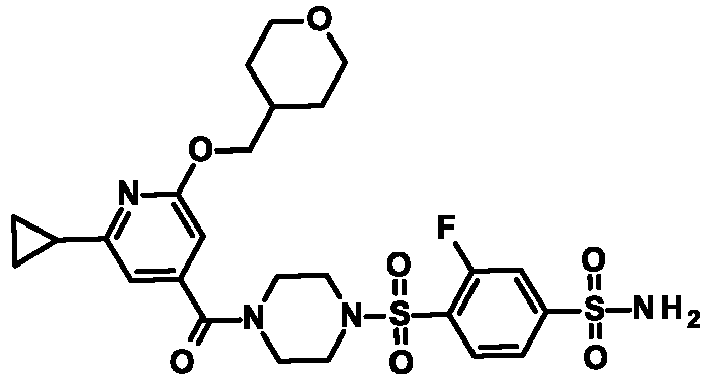
6.36 4-[4-[3-[2-[(5-methyltetrazol-2-yl)methyl]-4-(trifluoromethyl)phenyl]-propanoyl]piperazin-1-yl] sulfonylbenzenesulfonamide 
tert-butyl 4-(4-sulfamoylphenyl)sulfonylpiperazine -1-carboxylate (intermediate 4) / 3-[2-[(5-methyltetrazol-2-yl)methyl]-4-(trifluoromethyl)phenyl]propanoic acid (CAS-RN 1646783-83-6) 602.3 (M+H)+ 6.37 5-[1-[3-[2-[(5-methyltetrazol-2-yl)methyl]-4-(trifluoromethyl)phenyl]propanoyl] -piperidin-4-yl] sulfanylthiophene-2-sulfonamide 
tert-butyl 4-[(5-sulfamoyl-1,3-thiazol-2-yl)sulfanyl]piperidine-1-carboxylate (intermediate 9.5) / 3-[2-[(5-methyltetrazol-2-yl)methyl]-4-(trifluoromethyl)phenyl]propanoic acid (CAS-RN 1646783-83-6) 575.1 (M+H)+ 6.38 5-[2-[1-[3-[2-[(5-methyltetrazol-2-yl)methyl]-4-(trifluoromethyl)phenyl]-propanoyl]piperidin-4-yl]ethylsulfonyl]thiophene-2-sulfonamide tert-butyl 4-[2-(5-sulfamoylthiophen-2-yl)sulfonylethyl]piperidine-1-carboxylate (intermediate 15.4) / 3-[2-[(5-methyltetrazol-2-yl)methyl]-4-(trifluoromethyl)phenyl]propanoic acid (CAS-RN 1646783-83-6) 635.2 (M+H)+ 
6.39 5-fluoro-6-[1-[3-[2-[(5-methyltetrazol-2-yl)methyl]-4-(trifluoromethyl)phenyl]propanoyl] -piperidin-4-yl] sulfanylpyridine-3-sulfonamide 
tert-butyl4-(3-fluoro-5-sulfamoylpyridin-2-yl)sulfanylpiperidine-1-carboxylate (intermediate 9.1) / 3-[2-[(5-methyltetrazol-2-yl)methyl]-4-(trifluoromethyl)phenyl]propanoic acid (CAS-RN 1646783-83-6) 588.2 (M+H)+ 6.40 6-[1-[2-cyclopropyl-6-(oxan-4-ylmethoxy)pyridine-4-carbonyl]piperidin-4-yl]sulfanyl-5-fluoropyridine-3-sulfonamide 
tert-butyl4-(3-fluoro-5-sulfamoylpyridin-2-yl)sulfanylpiperidine-1-carboxylate (intermediate 9.1) / 2-cyclopropyl-6-(oxan-4-ylmethoxy)pyridine-4-carboxylic acid (CAS-RN 1810776-23-8) 551.2 (M+H)+ 6.41 4-[1-[3-[4-(difluoromethoxy)-2-[(5-methyltetrazol-2-yl)methyl]phenyl]propanoyl]piperid in-4-yl]sulfonyl-3-fluorobenzenesulfonamide 
tert-butyl 4-(2-fluoro-4-sulfamoylphenyl)sulfonylpiperidine -1-carboxylate (intermediate 11) / 3-[4-(difluoromethoxy)-2-[(5-methyltetrazol-2-yl)methyl]phenyl]propanoic acid (intermediate 13.2) 617.2 (M+H)+ 6.42 4-[2-[1-[3-[4-(difluoromethoxy)-2-[(5-methyltetrazol-2-yl)methyl]phenyl]propanoyl]piperid in-4-yl]ethylsulfinyl]-2,3-difluorobenzenesulfonamide 
tert-butyl 4-[2-(2,3-difluoro-4-sulfamoylphenyl)sulfinylethyl]-piperidine-1-carboxylate (intermediate 10.6) / 3-[4-(difluoromethoxy)-2-[(5-methyltetrazol-2-yl)methyl]phenyl]propanoic acid (intermediate 13.2) 647.3 (M+H)+ 6.43 2,3-difluoro-4-[2-[1-[3-[2-[(5-methyltetrazol-2-yl)methyl]-4-(trifluoromethyl)phenyl]propanoyl] -piperidin-4-yl]ethylsulfinyl]benzenesulfonamid e 
tert-butyl 4-[2-(2,3-difluoro-4-sulfamoylphenyl)sulfinylethyl]-piperidine-1-carboxylate (intermediate 10.6) / 3-[2-[(5-methyltetrazol-2-yl)methyl]-4-(trifluoromethyl)phenyl]propanoic acid (CAS-RN 1646783-83-6) 649.3 (M+H)+ 6.44 2-[2-[1-[3-[4-(difluoromethoxy)-2-[(5-methyltetrazol-2-yl)methyl]phenyl]-propanoyl]piperidin-4-yl]ethylsulfinyl]-1,3-thiazole-5-sulfonamide 
tert-butyl 4-[2-[(5-sulfamoyl-1,3-thiazol-2-yl)sulfinyl]ethyl]piperidine-1-carboxylate (intermediate 10.5) / 3-[4-(difluoromethoxy)-2-[(5-methyltetrazol-2-yl)methyl]phenyl]propanoic acid (intermediate 13.2) 618.2 (M+H)+ 6.45 2-[2-[1-[3-[2-[(5-methyltetrazol-2-yl)methyl]-4-(trifluoromethyl)phenyl]propanoyl] piperidin-4-yl]ethylsulfonyl]-1,3-thiazole-5-sulfonamide tert-butyl 4-[2-[(5-sulfamoyl-1,3-thiazol-2-yl)sulfonyl]ethyl]piperidine-1-carboxylate (intermediate 11.2) / 3-[2-[(5-methyltetrazol-2-yl)methyl]-4-(trifluoromethyl)phenyl]propanoic acid (CAS-RN 1646783-83-6) 
- Racemic 3-fluoro-4-[1-[3-[2-[(5-methyltetrazol-2-yl)methyl]-4-(trifluoromethyl)phenyl]propanoyl]piperidin-4-yl]sulfinylbenzenesulfonamide (example 6.13; 40 mg, 66.4 µmol) was separated by preparative HPLC using a Reprosil Chiral-NR column as the stationary phase and heptane/ethanol 3:2 as the mobile phase. This produced the faster eluting (+)-enantiomer 1 (example 7; 17 mg, 43%; white gum, MS: 601.3 (M-H)-) and the slower eluting (-)-enantiomer 2 (example 8; 14 mg, 35%; white solid, MS: 601.4 (M-H)-).
- The following examples were produced in analogy to examples 7 and 8 by chiral HPLC separation of their racemates.
Ex. Starting material (racemic) Optical rotation sign Stationary phase; eluent MS, m/e 7.01 4-[[1-[3-[2-[(5-methyltetrazol-2-yl)methyl]-4-(trifluoromethyl)-phenyl]propanoyl]pyrrolidin-2-yl]methoxy]benzenesulfonamide (example 5.05) (+) (faster eluting enantiomer) Reprosil Chiral-NR; heptane/ethanol 3:2 553.3 (M+H)+ 8.01 (-) (slower eluting enantiomer) 553.3 (M+H)+ 7.02 4-[[1-[3-[2-[(5-methyltetrazol-2-yl)methyl]-4-(trifluoromethyl)-phenyl]propanoyl]pyrrolidin-3-yl]methoxy]benzenesulfonamide (example 5.06) (+) Reprosil Chiral-NR; heptane/ethanol 3:2 553.3 (M+H)+ 8.02 (-) 553.4 (M+H)+ -

- To a solution of 3-[2-[(5-methyltetrazol-2-yl)methyl]-4-(trifluoromethyl)phenyl]-1-piperazin-1-ylpropan-1-one (intermediate 2; 40 mg, 105 µmol) in dichloromethane (2 mL) were added 4-formylbenzenesulfonamide (CAS-RN 3240-35-5; 23.2 mg, 126 µmol), sodium triacetoxyborohydride (28.8 mg, 136 µmol) and acetic acid (12.6 mg, 209 µmol) at room temperature. The mixture was stirred at room temperature for 16 h and then at 50°C for 24 h, then the reaction mixture was partitioned between sat. aq. sodium hydrogencarbonate solution and ethyl acetate. The organic layer was washed with brine, dried over magnesium sulfate, filtered and evaporated. Chromatography (silica gel, gradient dichloromethane to dichloromethane/methanol/25% aq. ammonia solution 90:10:0.25) produced the title compound (6 mg, 10%). White solid, MS: 552.2 (M+H)+.
- To a solution of 2-[[2-bromo-5-(trifluoromethyl)phenyl]methyl]-5-methyltetrazole (CAS-RN 1646389-14-1; 209 mg, 651 µmol) in ethanol (3 mL) were added 1,1-bis(diphenylphosphino)ferrocenedichloropalladium(II) (CAS-RN 95464-05-4; 21.3 mg, 26 µmol), triethylamine (98.8 mg, 976 µmol) and put into a carbon monoxide atmosphere. The reaction mixture was stirred for 18 h under a carbon monoxide atmosphere (70 bar) at 110°C. The reaction mixture was filtered and directly evaporated. Chromatography (silica gel, gradient heptane pure to heptane : ethyl acetate = 2 : 1) produced the title compound (186 mg, 91%), Colourless oil, MS: 315.1 (M+H)+.
- To a light yellow solution of ethyl 2-[(5-methyltetrazol-2-yl)methyl]-4-(trifluoromethyl)benzoate (182 mg, 579 µmol) in tetrahydrofuran (5 mL) was added a solution of calcium chloride (129 mg, 1.16 mmol) in ethanol (5 mL). Sodium borohydride (CAS-RN 16940-66-2; 65.7 mg, 1.74 mmol) was added in 3 portions over a period of 30 min to get a white suspension. After 3 h at room temperature the reaction mixture was partitioned between sat. aq. ammonium chloride solution and ethyl acetate. The organic layer was washed with brine, dried over magnesium sulfate, filtered and evaporate to produce the title compound with a purity of 96% (NMR) (164 mg, quant.). Light yellow oil, MS: 273.1 (M+H)+.
- To a colourless solution of 3-[2-[(5-methyltetrazol-2-yl)methyl]-4-(trifluoromethyl)phenyl]propanoic acid (101 mg, 309 µmol), 4-methylmorpholine (156 mg, 1.54 mmol) tert-butyl piperazine-1-carboxylate (57.5 mg, 309 µmol) in N,N-dimethylformamide (3 mL) was added O-(7-azabenzotriazol-1-yl)-N,N,N',N'-tetramethyluronium hexafluorophosphate (117 mg, 309 µmol) at room temperature, then after 18 h the reaction mixture was partitioned between sat. aq. ammonium chloride solution and ethyl acetate. The organic layer was washed with brine, dried over magnesium sulfate, filtered and evaporated. Chromatography (silica gel, gradient dichloromethane to dichloromethane/methanol/25% aq. ammonia solution 90:10:0.25) produced the title compound (149 mg, quant.). Colourless oil, MS: 483.2 (M+H)+.
- To a solution of tert-butyl 4-[3-[2-[(5-methyltetrazol-2-yl)methyl]-4-(trifluoromethyl)phenyl]propanoyl]piperazine-1-carboxylate (140 mg, 290 µmol) in dichloromethane (3 mL) trifluoroacetic acid (496 mg, 4.35 mmol) was added. The reaction mixture was stirred at room temperature for 18 h. The mixture was directly evaporated and the residue was partioned between 2 M aq. sodium hydroxide solution and dichloromethane. The aqueous phase was washed two more times with dichloromethane, then the organic phase was dried over magnesium sulfate, filtered and evaporated to give the title compound (90 mg, 81%). White solid, MS: 383.2 (M+H)+.
- To a stirring suspension of 3,5-difluoro-4-methyl-benzenesulfonamide (CAS-RN 1239964-24-9; 500 mg, 2.41 mmol) in water (25 mL) at reflux was added portionwise potassium permanganate (1.72 g, 10.9 mmol) over 1 h, then the suspension was filtered and washed with water. The mother liquor was extracted twice with ethyl acetate to separate impurities. The aqueous layer was acidified to pH 1 with conc. hydrochloric acid solution and extracted 3 times with ethyl acetate. The combined organic layers were dried over magnesium sulfate and evaporated to dryness to afford the title compound (356 mg, 62 %). Light yellow solid, MS: 235.9 (M-H)-.
- To a yellow solution of tert-butyl piperazine-1-carboxylate (CAS-RN 57260-71-6; 50 mg, 263 µmol) in pyridine (208 mg, 2.63 mmol) and tetrahydrofuran (1 mL) was added a solution of 4-sulfamoylbenzenesulfonyl chloride (CAS-RN 46249-41-6; 80.7 mg, 316 µmol) in tetrahydrofuran (1 mL) at room temperature. The reaction mixture was stirred at room temperature for 18 h and turned into a white suspension, then partitioned between sat. aq. ammonium chloride solution and ethyl acetate. The organic layer was washed with brine, dried over magnesium sulfate, filtered and evaporated. Chromatography (silica gel, gradient dichloromethane to dichloromethane/methanol/25% aq. ammonia solution 90:10:0.25) produced the title compound (64 mg, 60%). White solid, MS: 404.3 (M-H)-.
- The title compound was produced in analogy to intermediate 4, replacing 4-sulfamoylbenzenesulfonyl chloride by 2-fluoro-4-sulfamoylbenzenesulfonyl chloride (CAS-RN 52295-72-4). White solid, MS: 422.3 (M-H)-.
- To a colourless solution of 2-fluoro-4-sulfamoylbenzoic acid (CAS-RN 714968-42-0; 69.4 mg, 301 µmol) in N,N-dimethylformamide (3 mL) was added 4-methylmorpholine (111 mg, 1.09 mmol), tert-butyl piperazine-1-carboxylate (CAS-RN 57260-71-6; 52 mg, 274 µmol) and O-(7-azabenzotriazol-1-yl)-N,N,N',N'-tetramethyluronium hexafluoro-phosphate (114 mg, 301 µmol) at room temperature, then after 18 h the reaction mixture was partitioned between sat. aq. ammonium chloride solution and ethyl acetate. The organic layer was washed with brine, dried over magnesium sulfate, filtered and evaporated. Chromatography (silica gel, gradient dichloromethane to dichloromethane/methanol/25% aq. ammonia solution 90:10:0.25) produced the title compound (107 mg, quant.). White foam, MS: 386.3 (M-H)-.
- To a solution of 2-cyclopropyl-6-(oxan-4-ylmethoxy)pyridine-4-carboxylic acid (CAS-RN 1810776-23-8; 300 mg, 1.08 mmol) in tetrahydrofuran (5 mL) was added slowly borane tetrahydrofuran complex solution (CAS-RN 14044-65-6; 1 M in tetrahydrofuran; 2.7 mL, 2.7 mmol) at room temperature. The rection mixture was stirred at room temperature for 18 h. More borane tetrahydrofuran complex solution (1.62 mL, 1.62 mmol) was added and stirring was continued for 6 h. The reaction was carefully treated with 3 mL methanol, let stir for 10 min at room temperature and then totally evaporated. The residue was partitioned between ethyl acetate and 1 M aq. sodium hydroxide solution. The organic layer was washed with brine, dried over magnesium sulfate, filtered and evaporated to produce the title compound (239 mg, 84%). Colourless oil, MS: 264.3 (M+H)+.
- 4-[(2-fluorophenyl)methyl]piperidine hydrochloride (CAS-RN 193357-26-5; 350 mg, 1.48 mmol) was combined with dichloromethane (5 mL) and N-methylmorpholine (149 mg, 162 µl, 1.48 mmol was added, then acetic anhydride (317 mg, 3.1 mmol) was added dropwise at 0°C under stirring, and the mixture was stirred at room temperature for 1h. The mixture was directly concentrated in vacuo. The residue was partitioned between ethyl acetate and sat. aq. sodium bicarbonate solution. The organic layer was washed with brine, dried over magnesium sulfate, filtered and evaporated to give the title compound with a purity of approximately 90% (NMR) (388 mg, quant.). Light yellow oil, MS: 236.2 (M+H)+.
- A solution of 1-[4-[(2-fluorophenyl)methyl]-1-piperidyl]ethanone (384 mg, 1.47 mmol) in dichloromethane (5 mL) was added dropwise to sulfurochloridic acid (856 mg, 7.34 mmol) at 0°C under stirring, then stirred at 0°C for 30 min and at room temperature for 2 h. The reaction mixture was directly evaporated at high vacuum. The residue was combined with tetrahydrofuran (5 mL) and cooled down to 0°C, then 25% aq.ammonia solution (3 mL) was added dropwise. The reaction mixture was stirred at 0°C for 30 min and then at room temperature for 18 h, then directly evaporated to remove tetrahydrofuran. The aqueous residue was partitioned between ethyl acetate and 1 M aq. hydrochloric acid solution. The organic layer was washed with brine, dried over magnesium sulfate, filtered and evaporated. Chromatography (silica gel, gradient heptane : ethyl acetate = 4 : 1 to 9 : 1 then ethyl acetate pure and finally gradient ethyl acetate pure to methanol pure) produced the title compound (353 mg, 76%). White foam, MS: 315.2 (M+H)+.
- 3-[(1-acetyl-4-piperidyl)methyl]-4-fluoro-benzenesulfonamide (345 mg, 1.1 mmol) was combined with aq. hydrochloric acid (25% in water; 4.8 g, 32.9 mmol) and stirred at reflux for 6 h. The reaction mixture was directly evaporated and dried at high vacuum to give the title compound with a purity of approximately 95% (NMR) (305 mg, 86%). White foam, MS: 273.2 (M+H)+.
- A solution of 1,1-dimethoxy-N,N-dimethyl-methanamine (CAS-RN 4637-24-5; 170 mg, 1.38 mmol) in acetonitrile (1 mL) was added dropwise at room temperature to a stirring solution of 4-bromo-3-fluorobenzenesulfonamide (CAS-RN 263349-73-1; 302 mg, 1.15 mmol) in acetonitrile (3 mL). After 1 h the mixture was directly evaporated at high vaccum to give the title compound (369 mg, quant.). White solid, MS: 309.0 (M+H)+.
- A solution of tert-butyl 4-sulfanylpiperidine-1-carboxylate (CAS-RN 134464-79-2; 244 mg, 1.1 mmol) in N,N-dimethylformamide (2 mL) was added dropwise to a stirring mixture of sodium hydride (50% oil dispersion; 52.9 mg, 1.1 mmol) and N,N-dimethylformamide (2 mL). After 30 min at room temperature gas evolution was complete and another solution of N'-(4-bromo-3-fluoro-phenyl)sulfonyl-N,N-dimethyl-formamidine (351 mg, 1.1 mmol) in N,N-dimethylformamide (2 mL) was added dropwise. The reaction mixture was stirred at 60°C for 3 h and then directly evaporated to remove N,N-dimethylformamide. The residue was combined with methanol (4 mL) and 2.5 M aq. sodium hydroxide solution (4.4 mL, 11 mmol) and then stirred at 100°C for 1 h. The mixture was directly evaporated again to remove methanol, then hydrochloric acid solution (5 M in isopropanol; 4.4 mL, 22 mmol) was added and stirred at 50°C for 1.5 h. The white suspension was filtered off, and the mother liquor was evaporated to give the title compound as a mixture of approximately 1 : 1 (bromide isomer) with a purity of 80% (440 mg, 49%). Off-white foam, MS: 291.1 (M+H)+.
- The title compound was produced in analogy to intermediate 8, step 1 from 3,4-difluorobenzenesulfonamide (CAS-RN 108966-71-8) and 1,1-dimethoxy-N,N-dimethyl-methanamine (CAS-RN 4637-24-5). White solid, MS: 249.1.0 (M+H)+.
- N'-(3,4-difluorophenyl)sulfonyl-N,N-dimethyl-formamidine (315 mg, 1.27 mmol) was added to a stirring mixture of sodium hydride (50% oil dispersion; 60.9 mg, 1.27 mmol) and N,N-dimethylformamide (2 mL) at room temperature. 5 min later tert-butyl 4-(sulfanylmethyl)piperidine-1-carboxylate (CAS-RN 581060-27-7; 281 mg, 1.27 mmol) was added. A strong gas evolution and exothermic reaction could be observed. The reaction mixture was stirred at room temperature for 1 h and then directly evaporated to remove N,N-dimethylformamide. The residue was combined with methanol (4 mL) and 2.5 M aq. sodium hydroxide solution (5.08 mL, 12.7 mmol) and the white suspension was stirred at room temperature for 3 h. The mixture was partitioned between ice and 1 M aq. hydrochloric acid solution and ethyl acetate. The organic layer was washed with brine, dried over magnesium sulfate, filtered and evaporated. Chromatography of the residue (silica gel, gradient dichloromethane to dichloromethane/methanol/25% aq. ammonia solution 90:10:0.25) produced the title compound with a purity of approximately 95% (NMR) (463 mg, 89%). Colourless gum, MS: 389.3 (M-H)-.
- The following intermediates were prepared according to intermediate 9, replacing tert-butyl 4-(sulfanylmethyl)piperidine-1-carboxylate (CAS-RN 581060-27-7) by the appropriate thiol 3,4-difluorobenzenesulfonamide (CAS-RN 108966-71-8) by the appropriate sulfon amide.
No. Systematic Name Thiol / Sulfon amide MS, m/e 9.1 tert-butyl 4-(3-fluoro-5-sulfamoylpyridin-2-yl)sulfanylpiperidine-1 -carboxylate tert-butyl 4-sulfanylpiperidine-1-carboxylate (CAS-RN 134464-79-2) / 6-chloro-5-fluoropyridine-3-sulfonamide (CAS-RN 1803571-80-3) 390.2 (M-H)- 9.2 tert-butyl 4-(2,3-difluoro-4-sulfamoylphenyl)sulfanylpiperidine-1-carboxylate tert-butyl 4-sulfanylpiperidine-1-carboxylate (CAS-RN 134464-79-2) / 2,3,4-trifluorobenzenesulfonamide (CAS-RN 518070-13-8) 407.2 (M-H)- 9.3 tert-butyl 3-(2-fluoro-4-sulfamoylphenyl)sulfanylazetidine-1-carboxylate tert-butyl 3-sulfanylazetidine-1-carboxylate (CAS-RN 941585-25-7) / 3,4-difluorobenzenesulfonamide (CAS-RN 108966-71-8) 361.2 (M-H)- 9.4 tert-butyl 4-[2-(2-fluoro-4-sulfamoylphenyl)sulfanylethyl]piperidi ne-1-carboxylate tert-butyl 4-(2-sulfanylethyl)piperidine-1-carboxylate (CAS-RN 1420841-79-7) / 3,4-difluorobenzenesulfonamide (CAS-RN 108966-71-8) 417.3 (M-H)- 9.5 tert-butyl 4-[(5-sulfamoyl-1,3-thiazol-2-yl)sulfanyl]piperidine-1-carboxylate tert-butyl 4-sulfanylpiperidine-1-carboxylate (CAS-RN 134464-79-2) / 2-chloro-1,3-thiazole-5-sulfonamide (CAS-RN 848362-00-5) 378.2 (M-H)- 9.6 tert-butyl 4-[2-(2,3-difluoro-4-sulfamoylphenyl)sulfanylethyl]piperidi ne-1-carboxylate tert-butyl 4-(2-sulfanylethyl)piperidine-1-carboxylate (CAS-RN 1420841-79-7) / 2,3,4-trifluorobenzenesulfonamide (CAS-RN 518070-13-8) 435.2 (M-H)- 9.7 tert-butyl 4-[2-[(5-sulfamoyl-1,3-thiazol-2-yl)sulfanyl]ethyl]piperidine-1-carboxylate tert-butyl 4-(2-sulfanylethyl)piperidine-1-carboxylate (CAS-RN 1420841-79-7) / 2-chloro-1,3-thiazole-5-sulfonamide (CAS-RN 848362-00-5) 406.2 (M-H)- 9.8 tert-butyl 4-[2-(5-sulfamoylthiophen-2-yl)sulfanylethyl]piperidine-1-carboxylate tert-butyl 4-(2-sulfanylethyl)piperidine-1-carboxylate (CAS-RN 1420841-79-7) / 5-bromothiophene-2-sulfonamide (CAS-RN 53595-65-6) 405.3 (M-H)- 9.9 tert-butyl 4-(2-fluoro-4-sulfamoyl-phenyl)sulfanylpiperidine-1-carboxylate tert-butyl 4-sulfanylpiperidine-1-carboxylate (CAS-RN 134464-79-2) / 3,4-difluorobenzenesulfonamide (CAS-RN 108966-71-8) 389.3 (M-H)- 9.10 tert-butyl 4-(2-((5-sulfamoylthiazol-2-yl)thio)ethyl)piperidine-1-carboxylate tert-butyl 4-(2-sulfanylethyl)piperidine-1 -carboxylate (CAS-RN 1420841-79-7) / 2-chloro-1,3-thiazole-5-sulfonamide (CAS-RN 848362-00-5) 406.2 (M-H)- - To a solution of tert-butyl 4-(2-fluoro-4-sulfamoylphenyl)sulfanylpiperidine-1-carboxylate (intermediate 9.9; 459 mg, 1.12 mmol) in glacial acetic acid (2 mL) was added hydrogen peroxide (35% in water; 369 mg, 3.8 mmol). The resulting solution was stirred at room temperature for 4 h. and then partitioned between ice and ethyl acetate. The organic layer was washed with water and brine, dried over magnesium sulfate, filtered and evaporated at high vacuum to give the title compound (428 mg, 94%). White foam, MS : 405.3 (M-H)-.
- The following intermediates were prepared according to intermediate 10, replacing tert-butyl 4-(2-fluoro-4-sulfamoylphenyl)sulfanylpiperidine-1-carboxylate (intermediate 9.9) by the appropriate thioether.
No. Systematic Name Thioether MS, m/e 10.1 tert-butyl 4-[(2-fluoro-4-sulfamoylphenyl)sulfinylmethyl]piperi dine-1-carboxylate tert-butyl 4-[(2-fluoro-4-sulfamoylphenyl)sulfanylmethyl]piperi dine-1-carboxylate (intermediate 9) 419.3 (M-H)- 10.2 tert-butyl 4-(2,3-difluoro-4-sulfamoylphenyl)sulfinylpiperidine-1-carboxylate tert-butyl 4-(2,3-difluoro-4-sulfamoylphenyl)sulfanylpiperidine-1-carboxylate (intermediate 9.2) 423.2 (M-H)- 10.3 tert-butyl 3-(2-fluoro-4-sulfamoylphenyl)sulfinylazetidine-1-carboxylate tert-butyl 3-(2-fluoro-4-sulfamoylphenyl)sulfanylazetidine-1-carboxylate (intermediate 9.3) 377.3 (M-H)- 10.4 tert-butyl 4-[2-(2-fluoro-4-sulfamoylphenyl)sulfinylethyl]piperidi ne-1-carboxylate tert-butyl 4-[2-(2-fluoro-4-sulfamoylphenyl)sulfanylethyl]piperidi ne-1-carboxylate (intermediate 9.4) 433.3 (M-H)- 10.5 tert-butyl 4-[2-[(5-sulfamoyl-1,3-thiazol-2-yl)sulfinyl]ethyl]piperidine-1-carboxylate tert-butyl 4-[2-[(5-sulfamoyl-1,3-thiazol-2-yl)sulfanyl]ethyl]piperidine-1-carboxylate (intermediate 9.7) 422.2 (M-H)- 10.6 tert-butyl 4-[2-(2,3-difluoro-4-sulfamoylphenyl)sulfinylethyl]piperidi ne-1-carboxylate tert-butyl 4-[2-(2,3-difluoro-4-sulfamoylphenyl)sulfanylethyl]piperidi ne-1-carboxylate (intermediate 9.6) 451.2 (M-H)- 10.7 tert-butyl 4-(2-((5-sulfamoylthiazol-2-yl)sulfinyl)ethyl)piperidine-1-carboxylate tert-butyl 4-(2-((5-sulfamoylthiazol-2-yl)thio)ethyl)piperidine-1-carboxylate 422.2 (M-H)- - To a colourless solution of tert-butyl 4-(2-fluoro-4-sulfamoylphenyl)sulfinylpiperidine-1-carboxylate (intermediate 10; 374 mg, 920 µmol) in dichloromethane (4 mL) was added 3-chlorobenzenecarboperoxoic acid (CAS-RN 937-14-4; 318 mg, 1.84 mmol) at room temperature. The reaction mixture was stirred at room temperature for 18 h and then partitioned between ice and 1 M aq. sodium carbonate solution and ethyl acetate. The organic layer was washed with brine, dried over magnesium sulfate, filtered and evaporated to give the title compound with e purity of approximately 90% (NMR).
- This material was precipitated from 2 mL of dichloromethane (286 mg, 74%). White solid, MS: 421.3 (M-H)-.
- The following intermediates were produced according to intermediate 11, replacing tert-butyl 4-(2-fluoro-4-sulfamoylphenyl)sulfinylpiperidine-1-carboxylate by the appropriate sulfoxide.
No. Systematic Name Sulfoxide MS, m/e 11.1 tert-butyl 4-[(2-fluoro-4-sulfamoylphenyl)-sulfonylmethyl]piperidine-1-carboxylate tert-butyl 4-[(2-fluoro-4-sulfamoylphenyl)-sulfinylmethyl]piperidine-1-carboxylate (intermediate 10.1) 435.3 (M-H)- 11.2 tert-butyl 4-[2-[(5-sulfamoyl-1,3-thiazol-2-yl)sulfonyl]ethyl]piperidine-1-carboxylate tert-butyl 4-(2-((5-sulfamoylthiazol-2-yl)sulfinyl)ethyl)piperidine-1-carboxylate (intermediate 10.7) 438.2 (M-H)- - To a light yellow suspension of methyl 3-amino-5-bromopyridine-2-carboxylate (CAS-RN 1072448-08-8; 900 mg, 3.7 mmol) in pyridine (15 mL) was added 2,2-dimethylpropanoyl chloride (CAS-RN 3282-30-2; 546 mg, 4.44 mmol). The colour turned to light red. More 2,2-dimethylpropanoyl chloride (1.092g, 8.88 mmol) was added and the reaction was stirred at room temperature for 18 h, then partitioned between ice and 1 M aq. hydrochloric acid solution and ethyl acetate. The organic layer was washed with brine, dried over magnesium sulfate, filtered and evaporated. Chromatography (silica gel, gradient dichloromethane / heptane 1 : 1 to dichloromethane) produced the title compound (385 mg, 99 %). White solid, MS: 317.0 (M+H)+.
- To a microwave vial containing a solution of methyl 5-bromo-3-(2,2-dimethylpropanoylamino)pyridine-2-carboxylate (1.13 g, 3.59 mmol) in N,N-dimethylformamide (14.9 mL) and water (119 µl) was added Tris(dibenzylideneacetone)dipalladium (CAS-RN 51364-51-3; 32.8 mg, 35.9 µmol), 1,1'-bis(diphenylphosphino)ferrocene (CAS-RN 12150-46-8; 59.6 mg, 108 µmol), zinc cyanide (CAS-RN 557-21-1; 232 mg, 1.97 mmol), zinc (CAS-RN 7440-66-6; 9.38 mg, 143 µmol) and zinc acetate (CAS-RN 557-34-6; 26.3 mg, 143 µmol). The vial was capped and heated in the microwave at 140 °C for 30 min. The reaction mixture was filtered and the mother liquor was evaporated. The residue was diluted with 50 % aq. sodium hydrogencarbonate solution and extracted with ethyl acetate. The organic layer was washed with water and brine, dried over magnesium sulfate, filtered and evaporated. Chromatography (silica gel, gradient dichloromethane to dichloromethane / methanol 50 : 1) produced the title compound (468 mg, 50 %). Yellow solid, MS: 262.2 (M+H)+.
- To a clear yellow solution of methyl 5-cyano-3-(2,2-dimethylpropanoylamino)pyridine-2-carboxylate (453 mg, 1.73 mmol) in tetrahydrofuran (5 mL) and ethanol (5 mL) was added sodium borohydride (262 mg, 6.94 mmol) in 3 portions over a period of 30 min. The reaction mixture was partitioned between sat. aq. ammonium chloride solution and ethyl acetate. The organic layer was washed with brine, dried over magnesium sulfate, filtered and evaporated. Chromatography (silica gel, gradient dichloromethane to dichloromethane/methanol/25% aq. ammonia solution 90:10:0.25) produced the title compound (378 mg, 94 %). Light yellow viscous oil, MS: 234.2 (M+H)+.
- To a colourless solution of 4-bromo-3-[(5-methyltetrazol-2-yl)methyl]benzonitrile (CAS-RN 1646784-84-0; 450 mg, 1.62 mmol) in N,N-dimethylformamide (6 mL) was added ethyl acrylate (194 mg, 1.94 mmol), triethylamine (491 mg, 4.85 mmol), palladium(II) acetate (7.27 mg, 32.4 µmol) and tri-O-tolylphosphine (39.4 mg, 129 µmol). The reaction was aerated with argon and stirred at 120°C for 18 h, then partitioned between sat. aq. ammonium chloride solution and dichloromethane. The organic layer was washed with brine, dried over magnesium sulfate, filtered and evaporated. Chromatography (silica gel, gradient dichloromethane to dichloromethane/methanol/25% aq. ammonia solution 90:10:0.25) produced the title compound (431 mg, 90%). Light brown solid. MS: 296.2 (M+H)+.
- To a light brown suspension of ethyl (E)-3-[4-cyano-2-[(5-methyltetrazol-2-yl)methyl]phenyl]prop-2-enoate (431 mg, 1.45 mmol) in methanol (6 mL) was added palladium (CAS-RN 7440-05-3; 89.4 mg, 840 µmol) and an atmosphere of hydrogen was introduced. After 17 h at room temperature the reaction was aereted with argon, filtered over diatomaceous filter-aid and rinsed with methanol. The mother liquor was totally evaporated to afforded the crude title product (286 mg, 66%). Grey viscous oil, MS: 300.2 (M+H)+.
- To a colourless solution of ethyl 3-[4-cyano-2-[(5-methyltetrazol-2-yl)methyl]phenyl]propanoate (79.1 mg, 264 µmol) in tetrahydrofuran (1 mL) and ethanol (0.5 mL) was added a 1 M aq. lithium hydroxide monohydrate solution (CAS-RN 1310-66-3; 793 µl, 793 µmol). The reaction was stirred at room temperature for 4 h, then poured onto ice and acidified with 2 M aq. hydrochloric acid solution to pH 1. The aqueous phase was extracted with ethyl acetate, then the organic phase was washed with brine, dried over magnesium sulfate, filtered and evaporated to produce the title compound (66 mg, 92%). White solid. MS: 270.3 (M-H)-.
- The following intermediates were prepared according to intermediate 13, replacing 4-bromo-3-[(5-methyltetrazol-2-yl)methyl]benzonitrile by the appropriate starting material.
No. Systematic Name Starting material MS, m/e 13.1 3-[4-chloro-2-[(5-methyltetrazol-2-yl)methyl]phenyl]propanoic acid 2-[(2-bromo-5-chlorophenyl)methyl]-5-methyltetrazole (CAS-RN 1646389-12-9) 279.2 (M-H)- 13.2 3-[4-(difluoromethoxy)-2-[(5-methyltetrazol-2-yl)methyl]phenyl]propanoic acid 2-[[2-bromo-5-(difluoromethoxy)phenyl]methyl]-5-methyltetrazole (CAS-RN 1646786-22-2) 313.1 (M+H)+ - methyl 3-(bromomethyl)-5-chloropyridine-2-carboxylate (CAS-RN 1260667-62-6; 500 mg, 1.51 mmol) was dissolved in acetone (10 mL) and potassium carbonate (209 mg, 1.51 mmol) and 5-methyl-2H-tetrazole (CAS-RN 4076-36-2; 130 mg, 1.51 mmol) were added at room temperature. The resulting suspension was stirred for 2 h at reflux (60°C) and then partitioned between ice-water and ethyl acetate. The organic layer was washed with brine, dried over magnesium sulfate, filtered and evaporated. Chromatography (silica gel, gradient heptane pure to heptane : ethyl acetate = 2:1) produced the title compound (185 mg, 46%). White solid, MS: 268.1 (M+H)+.
- The title compound was produced in analogy to intermediate 1, step 2 replacing ethyl 2-[(5-methyltetrazol-2-yl)methyl]-4-(trifluoromethyl)benzoate by methyl 5-chloro-3-[(5-methyltetrazol-2-yl)methyl]pyridine-2-carboxylate. Off-white semisolid, MS: 240.1 (M+H)+.
- To a solution of tert-butyl 4-(2,3-difluoro-4-sulfamoylphenyl)sulfanylpiperidine-1-carboxylate (intermediate 9.2; 94 mg, 230 µmol) in glacial acetic acid (3 mL) was added hydrogen peroxide (35% in water; 76 mg, 782 µmol). The resulting solution was stirred at room temperature for 96 h and then partitioned between ice and ethyl acetate. The organic layer was washed with water and brine, dried over magnesium sulfate, filtered and evaporated. Chromatography (silica gel, gradient heptane pure to heptane : ethyl acetate = 1 : 2) produced the title compound (94 mg, 74%). White solid, MS: 439.2 (M-H)-.
- The following intermediates were prepared according to intermediate 15, replacing tert-butyl 4-(2,3-difluoro-4-sulfamoylphenyl)sulfanylpiperidine-1-carboxylate (intermediate 9.2) by the appropriate thioether.
No. Systematic Name Thioether MS, m/e 15.1 tert-butyl 3-(2-fluoro-4-sulfamoylphenyl)sulfonylazetidine-1-carboxylate tert-butyl 3-(2-fluoro-4-sulfamoylphenyl)sulfanylazetidine-1-carboxylate (intermediate 9.3) 393.3 (M-H)- 15.2 tert-butyl 4-[(5-sulfamoyl-1,3-thiazol-2-yl)sulfonyl]piperidine-1-carboxylate tert-butyl 4-[(5-sulfamoyl-1,3-thiazol-2-yl)sulfanyl]piperidine-1-carboxylate (intermediate 9.5) 410.1 (M-H)- 15.3 tert-butyl 4-[2-(2,3-difluoro-4-sulfamoylphenyl)sulfonylethyl]piperidi ne-1-carboxylate tert-butyl 4-[2-(2,3-difluoro-4-sulfamoylphenyl)sulfanylethyl]piperidi ne-1-carboxylate (intermediate 9.6) 467.2 (M-H)- 15.4 tert-butyl 4-[2-(5-sulfamoylthiophen-2-yl)sulfonylethyl]piperidine-1-carboxylate tert-butyl 4-[2-(5-sulfamoylthiophen-2-yl)sulfanylethyl]piperidine-1-carboxylate (intermediate 9.8) 437.1 (M-H)- - The title compound was produced in analogy to intermediate 15, replacing tert-butyl 4-(2,3-difluoro-4-sulfamoylphenyl)sulfanylpiperidine-1-carboxylate (intermediate 9.2) by tert-butyl 4-[2-(2-fluoro-4-sulfamoylphenyl)sulfinylethyl]piperidine-1-carboxylate (intermediate 10.4). White solid, MS: 449.3 (M-H)-.
- To a colourless solution of 5-bromo-6-cyclobutyloxypyridine-3-carboxylic acid (CAS-RN 1364678-46-5; 1 g, 3.68 mmol) in toluene (25 mL) and water (2.8 mL) was added cesium carbonate (3.59 g, 11.0 mmol), palladium(II) acetate (16.5 mg, 73.5 µmol), potassium cyclopropyltrifluoroborate (CAS-RN 1065010-87-8; 598 mg, 4.04 mmol) and butyldi-1-adamantylphosphine (CAS-RN 321921-71-5; 79.1 mg, 221 µmol). The reaction mixture was degassed and aerated with argon three times and then stirred at 120°C for 16 h. The mixture was partitioned between ice and 1 M aq. sodium hydroxide solution and dichloromethane. The organic layer was washed with brine, dried over magnesium sulfate, filtered and evaporated. Recrystallization from ethyl acetate produced the title compound (610 mg, 71%). Off-white solid, 234.4 (M+H)+.
- A compound of formula (I) can be used in a manner known per se as the active ingredient for the production of tablets of the following composition:
-
Active ingredient 200 mg Microcrystalline cellulose 155 mg Corn starch 25 mg Talc 25 mg Hydroxypropylmethylcellulose 20 mg 425 mg - A compound of formula (I) can be used in a manner known per se as the active ingredient for the production of capsules of the following composition:
-
Active ingredient 100.0 mg Corn starch 20.0 mg Lactose 95.0 mg Talc 4.5 mg Magnesium stearate 0.5 mg 220.0 mg
Claims (16)
- Compounds of formula (I)
 R1 is selected fromi) phenyl substituted by R3, R4 and R5,ii) pyridinyl substituted by R3, R4 and R5, andiii) thiophenyl substituted by R3, R4 and R5;X is selected fromi) N, andi) CH;Y is selected fromi) -CH2-OC(O)-,ii) -(CH2)qC(O)-,iii) -(CH=CH)r-C(O)-, andiv) -(CH=CH)r-C(O)-;W is selected fromi) -(CR9R10)p-,ii) -(CR9R10)p-C(O)-,iii) -(C R9R10)p-O-,iv) -(C R9R10)p-S-,v) -(C R9R10)p-S(O)-, andvi) -(C R9R10)p-S(O)2-;R2 is selected fromi) substituted phenyl, wherein the phenyl ring is substituted by R6, R7 and R8,ii) substituted pyridinyl, wherein the pyridinyl ring is substituted by R6, R7 and R8,iii) substituted thiophenyl, wherein the thiophenyl ring is substituted by R6, R7 and R8, andiv) substituted thiazolyl, wherein the thiazolyl ring is substituted by R6, R7 and R8;R3 is selected fromi) halo-C1-6-alkoxy,ii) C3-8-cycloalkyl,iii) C3-8-cycloalkyl-C1-6-alkyl,iv) C3-8-cycloalkyl-C1-6-alkoxy,v) C3-8-cycloalkoxy,vi) C3-8-cycloalkoxy-C1-6-alkyl,vii) tetrazolylmethyl,viii) triazolylmethyl,ix) pyrazolylmethyl,x) C1-6-alkyltetrazolylmethyl,xi) C1-6-alkyltriazolylmethyl,xii) C1-6-alkylpyrazolylmethyl,xiii) heterocycloalkyl-C1-6-alkoxy;R4 is selected fromi) halogen,ii) hydroxy,iii) cyano,iv) C1-6-alkyl,v) C1-6-alkoxy,vi) C1-6-alkoxy-C1-6-alkyl,vii) halo-C1-6-alkoxy,viii) halo-C1-6-alkyl,ix) hydroxy-C1-6-alkyl,x) C3-8-cycloalkyl,xi) C3-8-cycloalkyl-C1-6-alkyl,xii) C3-8-cycloalkyl-C1-6-alkoxy,xiii) C3-8-cycloalkoxy,xiv) C3-8-cycloalkoxy-C1-6-alkyl,xv) C1-6-alkylcarbonylamino,xvi) C3-8-cycloalkylcarbonylamino,R5 is selected fromi) H,ii) halogen,iii) hydroxy,iv) cyano,v) C1-6-alkyl,vi) C1-6-alkoxy,vii) C1-6-alkoxy-C1-6-alkyl,viii) halo-C1-6-alkoxy,ix) halo-C1-6-alkyl,x) hydroxy-C1-6-alkyl,xi) C3-8-cycloalkyl,xii) C3-8-cycloalkyl-C1-6-alkyl,xiii) C3-8-cycloalkyl-C1-6-alkoxy,xiv) C3-8-cycloalkoxy,xv) C3-8-cycloalkoxy-C1-6-alkyl,xvi) C1-6-alkylcarbonylamino,xvii) C3-8-cycloalkylcarbonylamino,R6 is aminosulfonyl;R7 and R8 are independently selected fromi) H,ii) halogen,iii) hydroxy,iv) cyano,v) C1-6-alkyl,vi) C1-6-alkoxy,vii) C1-6-alkoxy-C1-6-alkyl,viii) halo-C1-6-alkoxy,ix) halo-C1-6-alkyl,x) hydroxy-C1-6-alkyl,xi) C3-8-cycloalkyl,xii) C3-8-cycloalkyl-C1-6-alkyl,xiii) C3-8-cycloalkyl-C1-6-alkoxy,xiv) C3-8-cycloalkoxy, andxv) C3-8-cycloalkoxy-C1-6-alkyl;R9 and R10 are independently selected fromi) H,ii) C1-6-alkyl, andiii) C3-8-cycloalkyl;m and n are independently selected from zero, 1, 2, 3, 4 or 5, with the proviso that the sum of m and n is 2, 3, 4 or 5;p is selected from zero, 1 or 2;q is selected from zero or 2;r is selected from zero and 1;or pharmaceutically acceptable salts.
 - A compound according to claim 1, whereinR1 is selected fromi) phenyl substituted by R3, R4 and R5, andii) pyridinyl substituted by R3, R4 and R5;X is selected fromi) N, andii) CH;Y is selected fromi) -CH2-OC(O)-, andii) -(CH2)qC(O)-;W is selected fromi) -(CR9R10)p-,ii) -(CR9R10)p-C(O)-,iii) -(C R9R10)p-O-,iv) -(C R9R10)p-S-,v) -(C R9R10)p-S(O)-, andvi) -(C R9R10)p-S(O)2-;R2 is selected fromi) substituted phenyl, wherein the phenyl ring is substituted by R6, R7 and R8,ii) substituted pyridinyl, wherein the pyridinyl ring is substituted by R6, R7 and R8,iii) substituted thiophenyl, wherein the thiophenyl ring is substituted by R6, R7 and R8, andiv) substituted thiazolyl, wherein the thiazolyl ring is substituted by R6, R7 and R8;R3 is selected fromi) halo-C1-6-alkoxy,ii) cyano,iii) C3-8-cycloalkyl-C1-6-alkoxy,iv) C3-8-cycloalkoxy,v) C1-6-alkyltetrazolylmethyl, andvi) tetrahydropyranyl-C1-6-alkoxy;R4 is selected fromi) halogen,ii) cyano,iii) halo-C1-6-alkoxy,iv) halo-C1-6-alkyl,v) C3-8-cycloalkyl, andvi) C1-6-alkylcarbonylamino;R5 is H;R6 is aminosulfonyl;R7 and R8 are independently selected fromi) H, andii) halogen;R9 and R10 are both H;m is selected from zero, 1 and 2 and n is selected from 1, 2 and 3, with the proviso that the sum of m and n is 2, 3, 4 or 5;p is selected from zero, 1 and 2;q is selected from zero and 2;or pharmaceutically acceptable salts.
- A compound according to claim 1 or 2, wherein Y is -(CH2)qC(O)-.
- A compound according to claim 1 or 2, wherein W is selected fromi) -(CR9R10)p-,ii) -(C R9R10)p-S-, andiii) -(C R9R10)p-S(O)2-.
- A compound according to claim 1 or 2, wherein R2 is selected fromi) substituted phenyl, wherein the phenyl ring is substituted by R6, R7 and R8, andii) substituted pyridinyl, wherein the pyridinyl ring is substituted by R6, R7 and R8.
- A compound according to claim 1 or 2, wherein R3 is selected fromi) C1-6-alkyltetrazolylmethyl, andii) tetrahydropyranyl-C1-6-alkoxy.
- A compound according to claim 1 or 2, wherein R4 is selected fromi) halo-C1-6-alkyl, andii) C3-8-cycloalkyl.
- A compound according to claim 1 or 2, wherein R7 is halogen.
- A compound according to claim 1 or 2, wherein m and n are both 2.
- A compound according to claim 1 or 2, wherein p is selected from zero and 1.
- A compound according to claim 1 or 2, whereinR1 is selected fromi) phenyl substituted by R3, R4 and R5, andii) pyridinyl substituted by R3, R4 and R5;X is selected fromi) N, andii) CH;Y is selected fromi) -CH2-OC(O)-, andii) -(CH2)qC(O)-;W is selected fromi) -(CR9R10)p-,ii) -(CR9R10)p-C(O)-,iii) -(C R9R10)p-O-,iv) -(C R9R10)p-S-,v) -(C R9R10)p-S(O)-, andvi) -(C R9R10)p-S(O)2-;R2 is selected fromi) substituted phenyl, wherein the phenyl ring is substituted by R6, R7 and R8,ii) substituted pyridinyl, wherein the pyridinyl ring is substituted by R6, R7 and R8,iii) substituted thiophenyl, wherein the thiophenyl ring is substituted by R6, R7 and R8, andiv) substituted thiazolyl, wherein the thiazolyl ring is substituted by R6, R7 and R8;R3 is selected fromi) halo-C1-6-alkoxy,ii) cyano,iii) C3-8-cycloalkyl-C1-6-alkoxy,iv) C3-8-cycloalkoxy,v) C1-6-alkyltetrazolylmethyl, andvi) tetrahydropyranyl-C1-6-alkoxy;R4 is selected fromi) halogen,ii) cyano,iii) halo-C1-6-alkoxy,iv) halo-C1-6-alkyl,v) C3-8-cycloalkyl, andvi) C1-6-alkylcarbonylamino;R5 is H;R6 is aminosulfonyl;R7 and R8 are independently selected fromi) H, andii) halogen;R9 and R10 are both H;m is selected from zero, 1 and 2 and n is selected from 1, 2 and 3, with the proviso that the sum of m and n is 2, 3, 4 or 5;p is selected from zero, 1 and 2;q is selected from zero and 2;or pharmaceutically acceptable salts.
- A compound according to any one of claims 1 to 11, selected from2-((5-methyl-2H-tetrazol-2-yl)methyl)-4-(trifluoromethyl)benzyl 4-(2-fluoro-4-sulfamoylphenyl)piperazine-1-carboxylate;[2-cyclopropyl-6-(oxan-4-ylmethoxy)pyridin-4-yl]methyl 4-[(4-sulfamoylphenyl)methyl]piperidine-1-carboxylate;[5-cyano-3-(2,2-dimethylpropanoylamino)pyridin-2-yl]methyl 4-[(4-sulfamoylphenyl)methyl]piperidine-1-carboxylate ;[5-chloro-3-[(5-methyltetrazol-2-yl)methyl]pyridin-2-yl]methyl 4-(2-fluoro-4-sulfamoylphenyl)sulfonylpiperidine-1-carboxylate ;[2-[(5-methyltetrazol-2-yl)methyl]-4-(trifluoromethyl)phenyl]methyl 4-(2-fluoro-4-sulfamoylphenyl)sulfonylpiperidine-1-carboxylate;2-fluoro-4-[[4-[3-[2-[(5-methyltetrazol-2-yl)methyl]-4-(trifluoromethyl)phenyl]propanoyl]piperazin-1-yl]methyl]benzenesulfonamide;3-fluoro-4-[[4-[3-[2-[(5-methyltetrazol-2-yl)methyl]-4-(trifluoromethyl)phenyl]propanoyl]piperazin-1-yl]methyl]benzenesulfonamide;4-[[4-[2-cyclopropyl-6-(oxan-4-ylmethoxy)pyridine-4-carbonyl]piperazin-1-yl]methyl]-3-fluorobenzenesulfonamide;3-fluoro-4-[4-[3-[2-[(5-methyltetrazol-2-yl)methyl]-4-(trifluoromethyl)phenyl]propanoyl]piperazine-1-carbonyl]benzenesulfonamide;2-fluoro-4-[4-[3-[2-[(5-methyltetrazol-2-yl)methyl]-4-(trifluoromethyl)phenyl]propanoyl]piperazine-1-carbonyl]benzenesulfonamide;3,5-difluoro-4-[4-[3-[2-[(5-methyltetrazol-2-yl)methyl]-4-(trifluoromethyl)phenyl]propanoyl]piperazine-1-carbonyl]benzenesulfonamide;3-fluoro-4-[4-[3-[2-[(5-methyltetrazol-2-yl)methyl]-4-(trifluoromethyl)phenyl]propanoyl]piperazine-1-carbonyl]benzenesulfonamide;4-(4-(3-(2-((5-methyl-2H-tetrazol-2-yl)methyl)-4-(trifluoromethyl)phenyl)propanoyl)piperazine-1-carbonyl)benzenesulfonamide;3-[[1-[2-cyclopropyl-6-(oxan-4-ylmethoxy)pyridine-4-carbonyl]piperidin-4-yl]methyl]-4-fluorobenzenesulfonamide;3-fluoro-4-[1-[3-[2-[(5-methyltetrazol-2-yl)methyl]-4-(trifluoromethyl)phenyl]propanoyl]piperidin-4-yl]sulfanylbenzenesulfonamide;3-fluoro-4-(4-(3-(2-((5-methyl-2H-tetrazol-2-yl)methyl)-4-(trifluoromethyl)phenyl)propanoyl)piperazin-1-yl)benzenesulfonamide;4-[[1-[2-cyclopropyl-6-(oxan-4-ylmethoxy)pyridine-4-carbonyl]piperidin-4-yl]methyl]benzenesulfonamide;4-[[1-[3-[2-[(5-methyltetrazol-2-yl)methyl]-4-(trifluoromethyl)phenyl]propanoyl]piperidin-4-yl]methyl]benzenesulfonamide;4-[[1-[3-[2-[(5-methyltetrazol-2-yl)methyl]-4-(trifluoromethyl)phenyl]propanoyl]pyrrolidin-2-yl]methoxy]benzenesulfonamide ;4-[[1-[3-[2-[(5-methyltetrazol-2-yl)methyl]-4-(trifluoromethyl)phenyl]propanoyl]pyrrolidin-3-yl]methoxy]benzenesulfonamide;4-(1-(3-(2-((5-methyl-2H-tetrazol-2-yl)methyl)-4-(trifluoromethyl)phenyl)propanoyl)piperidin-4-yl)benzenesulfonamide;4-(4-(3-(2-((5-methyl-2H-tetrazol-2-yl)methyl)-4-(trifluoromethyl)phenyl)propanoyl)piperazin-1-yl)benzenesulfonamide;4-fluoro-3-[[1-[3-[2-[(5-methyltetrazol-2-yl)methyl]-4-(trifluoromethyl)phenyl]propanoyl]piperidin-4-yl]methyl]benzenesulfonamide;2,3-difluoro-4-[1-[3-[2-[(5-methyltetrazol-2-yl)methyl]-4-(trifluoromethyl)phenyl]propanoyl]piperidin-4-yl]sulfanylbenzenesulfonamide;2,3-difluoro-4-[1-[3-[2-[(5-methyltetrazol-2-yl)methyl]-4-(trifluoromethyl)phenyl]propanoyl]piperidin-4-yl] sulfinylbenzenesulfonamide;2,3-difluoro-4-[1-[3-[2-[(5-methyltetrazol-2-yl)methyl]-4-(trifluoromethyl)phenyl]propanoyl]piperidin-4-yl]sulfonylbenzenesulfonamide;2,3-difluoro-4-[2-[1-[3-[2-[(5-methyltetrazol-2-yl)methyl]-4-(trifluoromethyl)phenyl]propanoyl]piperidin-4-yl]ethylsulfonyl]benzenesulfonamide;2-[1-[3-[2-[(5-methyltetrazol-2-yl)methyl]-4-(trifluoromethyl)phenyl]propanoyl]piperidin-4-yl] sulfanyl-1,3-thiazole-5-sulfonamide;2-[1-[3-[2-[(5-methyltetrazol-2-yl)methyl]-4-(trifluoromethyl)phenyl]propanoyl]piperidin-4-yl]sulfonyl-1,3-thiazole-5-sulfonamide;2-[2-[1-[3-[2-[(5-methyltetrazol-2-yl)methyl]-4-(trifluoromethyl)phenyl]propanoyl]piperidin-4-yl]ethylsulfinyl]-1,3-thiazole-5-sulfonamide;3-fluoro-4-[[1-[3-[2-[(5-methyltetrazol-2-yl)methyl]-4-(trifluoromethyl)phenyl]propanoyl]piperidin-4-yl]methylsulfanyl]benzenesulfonamide;3-fluoro-4-[[1-[3-[2-[(5-methyltetrazol-2-yl)methyl]-4-(trifluoromethyl)phenyl]propanoyl]piperidin-4-yl]methylsulfinyl]benzenesulfonamide;3-fluoro-4-[[1-[3-[2-[(5-methyltetrazol-2-yl)methyl]-4-(trifluoromethyl)phenyl]propanoyl]piperidin-4-yl]methylsulfonyl]benzenesulfonamide;3-fluoro-4-[1-[3-[2-[(5-methyltetrazol-2-yl)methyl]-4-(trifluoromethyl)phenyl]propanoyl]azetidin-3-yl]sulfanylbenzenesulfonamide;3-fluoro-4-[1-[3-[2-[(5-methyltetrazol-2-yl)methyl]-4-(trifluoromethyl)phenyl]propanoyl] azetidin-3 -yl] sulfinylbenzenesulfonamide;3-fluoro-4-[1-[3-[2-[(5-methyltetrazol-2-yl)methyl]-4-(trifluoromethyl)phenyl]propanoyl] azetidin-3 -yl] sulfonylbenzenesulfonamide;3-fluoro-4-[1-[3-[2-[(5-methyltetrazol-2-yl)methyl]-4-(trifluoromethyl)phenyl]propanoyl]piperidin-4-yl] sulfinylbenzenesulfonamide;3-fluoro-4-[1-[3-[2-[(5-methyltetrazol-2-yl)methyl]-4-(trifluoromethyl)phenyl]propanoyl]piperidin-4-yl]sulfonylbenzenesulfonamide;3-fluoro-4-[2-[1-[3-[2-[(5-methyltetrazol-2-yl)methyl]-4-(trifluoromethyl)phenyl]propanoyl]piperidin-4-yl]ethylsulfanyl]benzenesulfonamide;3-fluoro-4-[2-[1-[3-[2-[(5-methyltetrazol-2-yl)methyl]-4-(trifluoromethyl)phenyl]propanoyl]piperidin-4-yl]ethylsulfinyl]benzenesulfonamide;3-fluoro-4-[2-[1-[3-[2-[(5-methyltetrazol-2-yl)methyl]-4-(trifluoromethyl)phenyl]propanoyl]piperidin-4-yl]ethylsulfonyl]benzenesulfonamide;3-fluoro-4-[2-[1-[6-(2,2,2-trifluoroethoxy)-5-(trifluoromethyl)pyridine-3-carbonyl]piperidin-4-yl]ethylsulfonyl]benzenesulfonamide;3-fluoro-4-[4-[3-[2-[(5-methyltetrazol-2-yl)methyl]-4-(trifluoromethyl)phenyl]propanoyl]piperazin-1-yl]sulfonylbenzenesulfonamide;4-[[1-[2-cyclopropyl-6-(oxan-4-ylmethoxy)pyridine-4-carbonyl]piperidin-4-yl]methylsulfanyl]-3-fluorobenzenesulfonamide;4-[[1-[2-cyclopropyl-6-(oxan-4-ylmethoxy)pyridine-4-carbonyl]piperidin-4-yl]methylsulfinyl]-3-fluorobenzenesulfonamide;4-[[1-[2-cyclopropyl-6-(oxan-4-ylmethoxy)pyridine-4-carbonyl]piperidin-4-yl]methylsulfonyl]-3-fluorobenzenesulfonamide;4-[1-(6-cyclobutyloxy-5-cyclopropylpyridine-3-carbonyl)piperidin-4-yl]sulfonyl-3-fluorobenzenesulfonamide;4-[1-[2-cyclopropyl-6-(oxan-4-ylmethoxy)pyridine-4-carbonyl]azetidin-3-yl]sulfanyl-3-fluorobenzenesulfonamide;4-[1-[2-cyclopropyl-6-(oxan-4-ylmethoxy)pyridine-4-carbonyl]azetidin-3-yl]sulfinyl-3-fluorobenzenesulfonamide;4-[1-[2-cyclopropyl-6-(oxan-4-ylmethoxy)pyridine-4-carbonyl]azetidin-3-yl]sulfonyl-3-fluorobenzenesulfonamide;4-[1-[2-cyclopropyl-6-(oxan-4-ylmethoxy)pyridine-4-carbonyl]piperidin-4-yl]sulfonyl-2,3-difluorobenzenesulfonamide;4-[1-[2-cyclopropyl-6-(oxan-4-ylmethoxy)pyridine-4-carbonyl]piperidin-4-yl]sulfonyl-3-fluorobenzenesulfonamide;4-[1-[3-[4-chloro-2-[(5-methyltetrazol-2-yl)methyl]phenyl]propanoyl]piperidin-4-yl] sulfonyl-3 -fluorobenzenesulfonamide;4-[1-[3-[4-cyano-2-[(5-methyltetrazol-2-yl)methyl]phenyl]propanoyl]piperidin-4-yl] sulfonyl-3 -fluorobenzenesulfonamide;4-[2-[1-[2-cyclopropyl-6-(oxan-4-ylmethoxy)pyridine-4-carbonyl]piperidin-4-yl]ethylsulfanyl]-3-fluorobenzenesulfonamide;4-[2-[1-[2-cyclopropyl-6-(oxan-4-ylmethoxy)pyridine-4-carbonyl]piperidin-4-yl]ethylsulfinyl]-3-fluorobenzenesulfonamide;4-[2-[1-[2-cyclopropyl-6-(oxan-4-ylmethoxy)pyridine-4-carbonyl]piperidin-4-yl]ethylsulfonyl]-3-fluorobenzenesulfonamide;4-[2-[1-[5-cyclopropyl-6-(cyclopropylmethoxy)pyridine-3-carbonyl]piperidin-4-yl]ethylsulfonyl]-3-fluorobenzenesulfonamide;4-[4-[2-cyclopropyl-6-(oxan-4-ylmethoxy)pyridine-4-carbonyl]piperazin-1-yl] sulfonyl-3-fluorobenzenesulfonamide;4-[4-[3-[2-[(5-methyltetrazol-2-yl)methyl]-4-(trifluoromethyl)phenyl]propanoyl]piperazin-1-yl]sulfonylbenzenesulfonamide;5-[1-[3-[2-[(5-methyltetrazol-2-yl)methyl]-4-(trifluoromethyl)phenyl]propanoyl]piperidin-4-yl] sulfanylthiophene-2-sulfonamide;5-[2-[1-[3-[2-[(5-methyltetrazol-2-yl)methyl]-4-(trifluoromethyl)phenyl]propanoyl]piperidin-4-yl]ethylsulfonyl]thiophene-2-sulfonamide;5-fluoro-6-[1-[3-[2-[(5-methyltetrazol-2-yl)methyl]-4-(trifluoromethyl)phenyl]propanoyl]piperidin-4-yl]sulfanylpyridine-3-sulfonamide;6-[1-[2-cyclopropyl-6-(oxan-4-ylmethoxy)pyridine-4-carbonyl]piperidin-4-yl]sulfanyl-5-fluoropyridine-3-sulfonamide;4-[1-[3-[4-(difluoromethoxy)-2-[(5-methyltetrazol-2-yl)methyl]phenyl]propanoyl]piperidin-4-yl]sulfonyl-3-fluorobenzenesulfonamide;4-[2-[1-[3-[4-(difluoromethoxy)-2-[(5-methyltetrazol-2-yl)methyl]phenyl]propanoyl]piperidin-4-yl]ethylsulfinyl]-2,3-difluorobenzenesulfonamide;2,3-difluoro-4-[2-[1-[3-[2-[(5-methyltetrazol-2-yl)methyl]-4-(trifluoromethyl)phenyl]propanoyl]piperidin-4-yl]ethylsulfinyl]benzenesulfonamide;2-[2-[1-[3-[4-(difluoromethoxy)-2-[(5-methyltetrazol-2-yl)methyl]phenyl]propanoyl]piperidin-4-yl]ethylsulfinyl]-1,3-thiazole-5-sulfonamide;2-[2-[1-[3-[2-[(5-methyltetrazol-2-yl)methyl]-4-(trifluoromethyl)phenyl]propanoyl]piperidin-4-yl]ethylsulfonyl]-1,3-thiazole-5-sulfonamide;(+)-3-fluoro-4-[[1-[3-[2-[(5-methyltetrazol-2-yl)methyl]-4-(trifluoromethyl)phenyl]propanoyl]piperidin-4-yl] sulfinyl]b enzenesulfonamide;(+)-4-[[1-[3-[2-[(5-methyltetrazol-2-yl)methyl]-4-(trifluoromethyl)phenyl]propanoyl]pyrrolidin-2-yl]methoxy]benzenesulfonamide;(+)-4-[[1-[3-[2-[(5-methyltetrazol-2-yl)methyl]-4-(trifluoromethyl)phenyl]propanoyl]pyrrolidin-3-yl]methoxy]benzenesulfonamide;(-)-3-fluoro-4-[[1-[3-[2-[(5-methyltetrazol-2-yl)methyl]-4-(trifluoromethyl)phenyl]propanoyl]piperidin-4-yl] sulfinyl]b enzenesulfonamide;(-)-4-[[1-[3-[2-[(5-methyltetrazol-2-yl)methyl]-4-(trifluoromethyl)phenyl]propanoyl]pyrrolidin-2-yl]methoxy]benzenesulfonamide;(-)-4-[[1-[3-[2-[(5-methyltetrazol-2-yl)methyl]-4-(trifluoromethyl)phenyl]propanoyl]pyrrolidin-3-yl]methoxy]benzenesulfonamide;4-((4-(3-(2-((5-methyl-2H-tetrazol-2-yl)methyl)-4-(trifluoromethyl)phenyl)propanoyl)piperazin-1-yl)methyl)benzenesulfonamide;and pharmaceutically acceptable salts thereof.
- A compound according to any one of claims 1 to 12, selected from3-fluoro-4-[[4-[3-[2-[(5-methyltetrazol-2-yl)methyl]-4-(trifluoromethyl)phenyl]propanoyl]piperazin-1-yl]methyl]benzenesulfonamide;2,3-difluoro-4-[1-[3-[2-[(5-methyltetrazol-2-yl)methyl]-4-(trifluoromethyl)phenyl]propanoyl]piperidin-4-yl]sulfonylbenzenesulfonamide;3-fluoro-4-[1-[3-[2-[(5-methyltetrazol-2-yl)methyl]-4-(trifluoromethyl)phenyl]propanoyl]piperidin-4-yl]sulfonylbenzenesulfonamide;3-fluoro-4-[4-[3-[2-[(5-methyltetrazol-2-yl)methyl]-4-(trifluoromethyl)phenyl]propanoyl]piperazin-1-yl]sulfonylbenzenesulfonamide;4-[1-[2-cyclopropyl-6-(oxan-4-ylmethoxy)pyridine-4-carbonyl]piperidin-4-yl]sulfonyl-2,3-difluorobenzenesulfonamide;4-[1-[2-cyclopropyl-6-(oxan-4-ylmethoxy)pyridine-4-carbonyl]piperidin-4-yl]sulfonyl-3-fluorobenzenesulfonamide;5-fluoro-6-[1-[3-[2-[(5-methyltetrazol-2-yl)methyl]-4-(trifluoromethyl)phenyl]propanoyl]piperidin-4-yl] sulfanylpyridine-3-sulfonamide;and pharmaceutically acceptable salts thereof.
- A process to prepare a compound according to any one of claims 1 to 13 comprising the reaction of a compound of formula (II) in the presence of a compound of formula (III);

- A compound according to any one of claims 1 to 13 for use as therapeutically active substance.
- A pharmaceutical composition comprising a compound according to any one of claims 1 to 13 and a therapeutically inert carrier.
Applications Claiming Priority (2)
| Application Number | Priority Date | Filing Date | Title |
|---|---|---|---|
| EP17161249 | 2017-03-16 | ||
| PCT/EP2018/056140 WO2018167001A1 (en) | 2017-03-16 | 2018-03-13 | Heterocyclic compounds useful as dual atx/ca inhibitors |
Publications (3)
| Publication Number | Publication Date |
|---|---|
| EP3596059A1 EP3596059A1 (en) | 2020-01-22 |
| EP3596059B1 true EP3596059B1 (en) | 2024-04-24 |
| EP3596059C0 EP3596059C0 (en) | 2024-04-24 |
Family
ID=58347248
Family Applications (1)
| Application Number | Title | Priority Date | Filing Date |
|---|---|---|---|
| EP18710471.6A Active EP3596059B1 (en) | 2017-03-16 | 2018-03-13 | Heterocyclic compounds useful as dual atx/ca inhibitors |
Country Status (21)
| Country | Link |
|---|---|
| US (1) | US11059794B2 (en) |
| EP (1) | EP3596059B1 (en) |
| JP (1) | JP7157755B2 (en) |
| KR (1) | KR20190129924A (en) |
| CN (1) | CN110392679B (en) |
| AR (1) | AR111279A1 (en) |
| AU (1) | AU2018233079B9 (en) |
| BR (1) | BR112019019017A2 (en) |
| CA (1) | CA3053329A1 (en) |
| CL (1) | CL2019002609A1 (en) |
| CO (1) | CO2019009373A2 (en) |
| CR (1) | CR20190423A (en) |
| IL (1) | IL269188B (en) |
| MA (1) | MA49879A (en) |
| MX (1) | MX381728B (en) |
| PE (1) | PE20191757A1 (en) |
| PH (1) | PH12019502118A1 (en) |
| RU (1) | RU2019132254A (en) |
| SG (1) | SG11201908560SA (en) |
| TW (1) | TW201838982A (en) |
| WO (1) | WO2018167001A1 (en) |
Families Citing this family (17)
| Publication number | Priority date | Publication date | Assignee | Title |
|---|---|---|---|---|
| SI2861566T1 (en) | 2012-06-13 | 2017-03-31 | F. Hoffmann-La Roche Ag | New diazaspirocycloalkane and azaspirocycloalkane |
| PL2900669T3 (en) | 2012-09-25 | 2020-01-31 | F. Hoffmann-La Roche Ag | Hexahydropyrrolo[3,4-c]pyrrole derivatives and related compounds as autotaxin (atx) inhibitors and as inhibitors of the lysophosphatidic acid (lpa) production for treating e.g. renal diseases |
| AR095079A1 (en) | 2013-03-12 | 2015-09-16 | Hoffmann La Roche | DERIVATIVES OF OCTAHIDRO-PIRROLO [3,4-C] -PIRROL AND PIRIDINA-FENILO |
| AU2014356583B2 (en) | 2013-11-26 | 2019-02-28 | F. Hoffmann-La Roche Ag | New octahydro-cyclobuta (1,2-c;3,4-c')dipyrrol-2-yl |
| CR20160418A (en) | 2014-03-26 | 2016-11-07 | Hoffmann La Roche | NEW BICYCLE COMPOUNDS OF 7 LINKS |
| MA50635A (en) | 2014-03-26 | 2020-08-12 | Hoffmann La Roche | NEW BICYCLIC COMPOUNDS AS INHIBITORS OF AUTOTAXIN (ATX) AND LYSOPHOSPHATIDIC ACID PRODUCTION |
| MA41898A (en) | 2015-04-10 | 2018-02-13 | Hoffmann La Roche | BICYCLIC QUINAZOLINONE DERIVATIVES |
| EP3344619B1 (en) | 2015-09-04 | 2020-10-28 | H. Hoffnabb-La Roche Ag | Phenoxymethyl derivatives |
| MA42918A (en) | 2015-09-24 | 2018-08-01 | Hoffmann La Roche | BICYCLIC COMPOUNDS USED AS ATX INHIBITORS |
| BR112018006080A2 (en) | 2015-09-24 | 2018-10-09 | F. Hoffmann-La Roche Ag | new bicyclic compounds as dual action inhibitors of atx / ca |
| WO2017050747A1 (en) | 2015-09-24 | 2017-03-30 | F. Hoffmann-La Roche Ag | New bicyclic compounds as dual atx/ca inhibitors |
| AU2016328437A1 (en) | 2015-09-24 | 2018-01-25 | F. Hoffmann-La Roche Ag | Bicyclic compounds as ATX inhibitors |
| RU2019132254A (en) | 2017-03-16 | 2021-04-16 | Ф. Хоффманн-Ля Рош Аг | HETEROCYCLIC COMPOUNDS SUITABLE AS DUAL ATX / CA INHIBITORS |
| EP3596060B1 (en) | 2017-03-16 | 2023-09-20 | F. Hoffmann-La Roche AG | New bicyclic compounds as atx inhibitors |
| WO2020119896A1 (en) * | 2018-12-11 | 2020-06-18 | F. Hoffmann-La Roche Ag | Heterocyclic inhibitors of atx |
| CN113412113B (en) * | 2018-12-11 | 2024-07-26 | 豪夫迈·罗氏有限公司 | Aminoazine amide |
| CN110746450A (en) * | 2019-09-17 | 2020-02-04 | 济南康和医药科技有限公司 | Synthetic method of beraprost sodium key intermediate |
Family Cites Families (141)
| Publication number | Priority date | Publication date | Assignee | Title |
|---|---|---|---|---|
| DE1252898B (en) | 1965-06-12 | 1967-10-26 | Bayer Ag | Process for the preparation of copolymers of trioxane |
| US5240928A (en) | 1989-07-03 | 1993-08-31 | Merck & Co., Inc. | Substituted quinazolinones as angiotensin II antagonists |
| DE3930262A1 (en) | 1989-09-11 | 1991-03-21 | Thomae Gmbh Dr K | CONDENSED DIAZEPINONE, METHOD FOR THE PRODUCTION THEREOF AND MEDICAMENT CONTAINING THESE COMPOUNDS |
| KR910009330B1 (en) | 1989-10-23 | 1991-11-11 | 재단법인 한국화학연구소 | Quinoline compound having antibacterial activity and preparation method thereof |
| CA2037630C (en) | 1990-03-07 | 2001-07-03 | Akira Morimoto | Nitrogen-containing heterocylic compounds, their production and use |
| US5470975A (en) | 1990-10-16 | 1995-11-28 | E.R. Squibb & Sons, Inc. | Dihydropyrimidine derivatives |
| US5290780A (en) | 1991-01-30 | 1994-03-01 | American Cyanamid Co. | Angiotensin II receptor blocking 2,3,6 substituted quinazolinones |
| US5238942A (en) | 1991-05-10 | 1993-08-24 | Merck & Co., Inc. | Substituted quinazolinones bearing acidic functional groups as angiotensin ii antagonists |
| DE4121214A1 (en) | 1991-06-27 | 1993-01-14 | Bayer Ag | 7-AZAISOINDOLINYL CHINOLONE AND NAPHTHYRIDONE CARBONIC ACID DERIVATIVES |
| US5202322A (en) | 1991-09-25 | 1993-04-13 | Merck & Co., Inc. | Quinazolinone and pyridopyrimidine a-II antagonists |
| US5532243A (en) | 1992-02-14 | 1996-07-02 | The Dupont Merck Pharmaceutical Company | Antipsychotic nitrogen-containing bicyclic compounds |
| US5358951A (en) | 1993-04-23 | 1994-10-25 | American Cyanamid Company | Angiotensin II receptor blocking 2, 3, 6 substituted quinazolinones |
| DE4407047A1 (en) | 1994-03-03 | 1995-09-07 | Merck Patent Gmbh | Acetamide |
| US20010016657A1 (en) | 1997-03-18 | 2001-08-23 | Smithkline Beecham P.L.C. | Substituted isoquinoline derivatives and their use as anticonvulsants |
| CN1290251A (en) | 1998-02-04 | 2001-04-04 | 万有制药株式会社 | N-acyl cyclic amine derivatives |
| JP2001039950A (en) | 1999-07-30 | 2001-02-13 | Banyu Pharmaceut Co Ltd | N-acyl cyclic amine derivative |
| WO2001030780A2 (en) | 1999-10-27 | 2001-05-03 | Cor Therapeutics, Inc. | Pyridyl-containing spirocyclic compounds as inhibitors of fibrinogen-dependent platelet aggregation |
| PT1233787E (en) | 1999-11-09 | 2005-04-29 | Conseils Rech S Et D Applic Sc | PRODUCT CONTAINING AN INHIBITOR OF TRANSDUCING THE SIGNS OF GHETEROTRIMERAL PROTEINS IN ASSOCIATION WITH ANOTHER ANTICANCEROSOUS AGENT FOR THERAPEUTIC USE IN CANCER TREATMENT |
| WO2002070523A1 (en) | 2001-03-07 | 2002-09-12 | Pfizer Products Inc. | Modulators of chemokine receptor activity |
| EP1499306A4 (en) | 2002-04-12 | 2007-03-28 | Merck & Co Inc | BICYCLIC AMIDES |
| GB0303852D0 (en) | 2003-02-19 | 2003-03-26 | Pfizer Ltd | Triazole compounds useful in therapy |
| WO2005023762A1 (en) | 2003-09-04 | 2005-03-17 | Abbott Laboratories | Pyrrolidine-2-carbonitrile derivatives and their use as inhibitors of dipeptidyl peptidase-iv (dpp-iv) |
| SE0302811D0 (en) | 2003-10-23 | 2003-10-23 | Astrazeneca Ab | Novel compounds |
| GB0324790D0 (en) | 2003-10-24 | 2003-11-26 | Astrazeneca Ab | Amide derivatives |
| US7226951B2 (en) | 2003-12-17 | 2007-06-05 | Allergan, Inc. | Compounds having selective cytochrome P450RAI-1 or selective cytochrome P450RAI-2 inhibitory activity and methods of obtaining the same |
| KR100610731B1 (en) | 2004-02-24 | 2006-08-09 | 한국과학기술연구원 | 3,4-dihydroquinazolin derivatives useful as T-type calcium channel blockers and methods for their preparation |
| AU2005219438B2 (en) | 2004-03-03 | 2011-02-17 | Chemocentryx, Inc. | Bicyclic and bridged nitrogen heterocycles |
| ATE382623T1 (en) | 2004-06-09 | 2008-01-15 | Hoffmann La Roche | OCTAHYDROPYRROLO(3,4-C)PYRROLE DERIVATIVES AND THEIR USE AS ANTIVIRAL AGENTS |
| AU2005271161B2 (en) | 2004-08-10 | 2011-05-12 | Janssen Pharmaceutica N.V. | HIV inhibiting 1,2,4-triazin-6-one derivatives |
| US7410949B2 (en) | 2005-01-18 | 2008-08-12 | Hoffmann-La Roche Inc. | Neuropeptide-2 receptor (Y-2R) agonists and uses thereof |
| GB0504019D0 (en) | 2005-02-26 | 2005-04-06 | Astrazeneca Ab | Amide derivatives |
| MX2007013469A (en) | 2005-04-28 | 2008-01-22 | Wyeth Corp | Polymorph form ii of tanaproget. |
| US7737279B2 (en) | 2005-05-10 | 2010-06-15 | Bristol-Myers Squibb Company | 1,6-dihydro-1,3,5,6-tetraaza-as-indacene based tricyclic compounds and pharmaceutical compositions comprising same |
| TW200800999A (en) | 2005-09-06 | 2008-01-01 | Astrazeneca Ab | Novel compounds |
| WO2007049771A1 (en) | 2005-10-28 | 2007-05-03 | Ono Pharmaceutical Co., Ltd. | Compound containing basic group and use thereof |
| PT1961744E (en) | 2005-11-18 | 2013-05-15 | Ono Pharmaceutical Co | Basic group-containing compound and use thereof |
| JP2007176809A (en) | 2005-12-27 | 2007-07-12 | Hideaki Natsukari | Heterocyclic ring-substituted amide compound, method for preparing same, and pharmaceutical composition |
| US20070208001A1 (en) | 2006-03-03 | 2007-09-06 | Jincong Zhuo | Modulators of 11- beta hydroxyl steroid dehydrogenase type 1, pharmaceutical compositions thereof, and methods of using the same |
| JP2008031064A (en) | 2006-07-27 | 2008-02-14 | Astellas Pharma Inc | Diacyl piperazine derivatives |
| NZ575426A (en) | 2006-09-11 | 2010-09-30 | Organon Nv | Quinazolinone and isoquinolinone acetamide derivatives useful for the treatment of disorders which are influenced by modulation of the activity of the hpa axis |
| JP2010503675A (en) | 2006-09-15 | 2010-02-04 | シェーリング コーポレイション | Spiro-condensed azetidine derivatives useful for the treatment of pain, diabetes and disorders of lipid metabolism |
| US8735411B2 (en) | 2006-10-02 | 2014-05-27 | Abbvie Inc. | Macrocyclic benzofused pyrimidine derivatives |
| TWI405763B (en) | 2006-11-02 | 2013-08-21 | Targacept Inc | Nicotinic acetylcholine receptor sub-type selective amides of diazabicycloalkanes |
| WO2008059026A1 (en) | 2006-11-15 | 2008-05-22 | High Point Pharmaceuticals, Llc | Novel 2-(2-hydroxyphenyl)benzimidazoles useful for treating obesity and diabetes |
| TW200831085A (en) | 2006-12-13 | 2008-08-01 | Merck & Co Inc | Non-nucleoside reverse transcriptase inhibitors |
| EP1975165A1 (en) | 2007-03-27 | 2008-10-01 | Boehringer Ingelheim Pharma GmbH & Co. KG | Substituted pyrrolidinamides, their production and utilisation as medicine |
| MX2009009920A (en) | 2007-03-29 | 2009-10-19 | Hoffmann La Roche | Non-nucleoside reverse transcriptase inhibitors. |
| CL2008001002A1 (en) | 2007-04-11 | 2008-10-17 | Actelion Pharmaceuticals Ltd | COMPOUNDS DERIVED FROM OXAZOLIDINONA; PHARMACEUTICAL COMPOSITION THAT INCLUDES SUCH COMPOUNDS; AND ITS USE TO PREPARE A MEDICINAL PRODUCT TO TREAT A BACTERIAL INFECTION. |
| JP2010524987A (en) | 2007-04-27 | 2010-07-22 | サノフィ−アベンティス | 2-Heteroaryl-pyrrolo [3,4-C] pyrrole derivatives and their use as SCD inhibitors |
| AU2008285652B2 (en) | 2007-08-07 | 2013-09-05 | AbbVie Deutschland GmbH & Co. KG | Quinoline compounds suitable for treating disorders that respond to modulation of the serotonin 5-HT6 receptor |
| DE102007047737A1 (en) | 2007-10-05 | 2009-04-30 | Merck Patent Gmbh | Piperidine and piperazine derivatives |
| CA2702984C (en) | 2007-10-19 | 2017-04-11 | Sarcode Corporation | Compositions and methods for treatment of diabetic retinopathy |
| PE20091017A1 (en) | 2007-10-31 | 2009-07-16 | Janssen Pharmaceutica Nv | BRIDGED OR FUSED DIAMINES REPLACED WITH ARYL AS LEUKOTRIENE A4 HYDROLASE MODULATORS |
| DE102007054156A1 (en) | 2007-11-12 | 2009-05-14 | Ventech Gmbh | Method for determining the pressure and the tread depth in a vehicle tire |
| JP2009161449A (en) | 2007-12-28 | 2009-07-23 | Lion Corp | PPAR activity promoters, cosmetic foods and drinks, skin external preparations and pharmaceuticals |
| AU2009261248A1 (en) | 2008-06-19 | 2009-12-23 | Banyu Pharmaceutical Co., Ltd. | Spirodiamine-diarylketoxime derivative |
| WO2010028761A1 (en) | 2008-09-09 | 2010-03-18 | Sanofi-Aventis | 2-heteroaryl-pyrrolo [3, 4-c]pyrrole derivatives and the use thereof as scd inhibitors |
| TW201020247A (en) | 2008-11-06 | 2010-06-01 | Gruenenthal Gmbh | Substituierte disulfonamide |
| JP5373104B2 (en) | 2008-11-17 | 2013-12-18 | エフ.ホフマン−ラ ロシュ アーゲー | Naphthyl acetic acid used as CRTH2 antagonist or partial agonist |
| DE102008059578A1 (en) | 2008-11-28 | 2010-06-10 | Merck Patent Gmbh | Benzo-naphthyridine compounds |
| US8530650B2 (en) | 2008-12-01 | 2013-09-10 | Merck Patent Gmbh | 2, 5-diamino-substituted pyrido [4, 3-D] pyrimidines as autotaxin inhibitors against cancer |
| TW201035102A (en) | 2009-03-04 | 2010-10-01 | Gruenethal Gmbh | Sulfonylated tetrahydroazolopyrazines and their use as medicinal products |
| CA2754446A1 (en) | 2009-03-05 | 2010-09-10 | Daiichi Sankyo Company, Limited | Pyridine derivative |
| US20120010186A1 (en) | 2009-03-23 | 2012-01-12 | Merck Frosst Canada Ltd. | Heterocyclic compounds as inhibitors of stearoyl-coenzyme a delta-9 desaturase |
| TW201038572A (en) | 2009-03-25 | 2010-11-01 | Gruenenthal Gmbh | Substituted spiro-amide compounds |
| US8329907B2 (en) | 2009-04-02 | 2012-12-11 | Merck Patent Gmbh | Autotaxin inhibitors |
| AU2010234087B2 (en) | 2009-04-02 | 2016-05-12 | Merck Patent Gmbh | Piperidine and piperazine derivatives as autotaxin inhibitors |
| JP5767205B2 (en) | 2009-04-02 | 2015-08-19 | メルク パテント ゲゼルシャフト ミット ベシュレンクテル ハフツングMerck Patent Gesellschaft mit beschraenkter Haftung | Heterocyclic compounds as autotaxin inhibitors |
| FR2945534B1 (en) | 2009-05-12 | 2012-11-16 | Sanofi Aventis | CYCLOPENTAL [c] PYRROLE-2-CARBOXYLATE DERIVATIVES, THEIR PREPARATION AND THEIR THERAPEUTIC USE |
| WO2010135524A1 (en) | 2009-05-22 | 2010-11-25 | Exelixis, Inc. | Benzoxazepines based p13k/mt0r inhibitors against proliferative diseases |
| US20120083476A1 (en) | 2009-06-05 | 2012-04-05 | Janssen Pharmaceutica Nv | Heteroaryl-substituted spirocyclic diamine urea modulators of fatty acid amide hydrolase |
| DE102009033392A1 (en) | 2009-07-16 | 2011-01-20 | Merck Patent Gmbh | Heterocyclic compounds as autotaxine inhibitors II |
| JP2013501064A (en) | 2009-08-04 | 2013-01-10 | アミラ ファーマシューティカルス,インコーポレーテッド | Compounds as lysophosphatidic acid receptor antagonists |
| UA107360C2 (en) | 2009-08-05 | 2014-12-25 | Biogen Idec Inc | Bicyclic aryl sphingosine 1-phosphate analogs |
| AR079022A1 (en) | 2009-11-02 | 2011-12-21 | Sanofi Aventis | DERIVATIVES OF CYCLIC CARBOXYL ACID SUBSTITUTED WITH ACILAMINE, ITS USE AS PHARMACEUTICAL PRODUCTS, PHARMACEUTICAL COMPOSITION AND PREPARATION METHOD |
| ES2534516T3 (en) | 2010-01-07 | 2015-04-23 | E.I. Du Pont De Nemours And Company | Fungicidal heterocyclic compounds |
| US8815869B2 (en) | 2010-03-18 | 2014-08-26 | Abbvie Inc. | Lactam acetamides as calcium channel blockers |
| ES2557895T3 (en) | 2010-03-19 | 2016-01-29 | Pfizer Inc | Derivatives of 2,3-dihydro-1H-inden-1-yl-2,7-diazaspiro [3.6] nonane and its use as antagonists or inverse agonists of the ghrelin receptor |
| WO2011116867A1 (en) | 2010-03-26 | 2011-09-29 | Merck Patent Gmbh | Benzonaphthyridinamines as autotaxin inhibitors |
| GB201008005D0 (en) | 2010-05-13 | 2010-06-30 | Sentinel Oncology Ltd | Pharmaceutical compounds |
| EP2575794A2 (en) | 2010-06-04 | 2013-04-10 | B.S.R.C. "Alexander Fleming" | Autotaxin pathway modulation and uses thereof |
| AR082590A1 (en) | 2010-08-12 | 2012-12-19 | Hoffmann La Roche | INHIBITORS OF THE TIROSINA-QUINASA DE BRUTON |
| EP2606031B1 (en) | 2010-08-20 | 2017-09-27 | Amira Pharmaceuticals, Inc. | Autotaxin inhibitors and uses thereof |
| JP6039559B2 (en) | 2010-09-02 | 2016-12-07 | メルク パテント ゲゼルシャフト ミット ベシュレンクテル ハフツングMerck Patent Gesellschaft mit beschraenkter Haftung | Pyrazolopyridinone derivatives as LPA receptor antagonists |
| EP2646428B1 (en) | 2010-12-02 | 2016-06-01 | Shanghai De Novo Pharmatech Co Ltd. | Heterocyclic derivatives, preparation processes and medical uses thereof |
| EP2651405A2 (en) | 2010-12-14 | 2013-10-23 | Electrophoretics Limited | Casein kinase 1 (ck1 ) inhibitors |
| US9260416B2 (en) | 2011-05-27 | 2016-02-16 | Amira Pharmaceuticals, Inc. | Heterocyclic autotaxin inhibitors and uses thereof |
| WO2013033059A1 (en) | 2011-08-29 | 2013-03-07 | Bristol-Myers Squibb Company | Spiro bicyclic diamine derivatives as hiv attachment inhibitors |
| WO2013054185A1 (en) | 2011-10-13 | 2013-04-18 | Pfizer, Inc. | Pyrimidine and pyridine derivatives useful in therapy |
| JPWO2013065712A1 (en) | 2011-10-31 | 2015-04-02 | 東レ株式会社 | Diaza spiro urea derivative and its pharmaceutical use |
| US8809552B2 (en) | 2011-11-01 | 2014-08-19 | Hoffmann-La Roche Inc. | Azetidine compounds, compositions and methods of use |
| EP2800745B1 (en) | 2011-12-02 | 2020-02-12 | Phenex Pharmaceuticals AG | Pyrrolo carboxamides as modulators of orphan nuclear receptor rar-related orphan receptor-gamma (rory, nr1f3) activity and for the treatment of chronic inflammatory and autoimmune diseases |
| TWI638802B (en) | 2012-05-24 | 2018-10-21 | 芬蘭商奧利安公司 | Catechol o-methyltransferase activity inhibiting compounds |
| CA2876689C (en) | 2012-06-13 | 2022-04-26 | Incyte Corporation | Substituted tricyclic compounds as fgfr inhibitors |
| SI2861566T1 (en) | 2012-06-13 | 2017-03-31 | F. Hoffmann-La Roche Ag | New diazaspirocycloalkane and azaspirocycloalkane |
| KR20150028999A (en) | 2012-06-27 | 2015-03-17 | 에프. 호프만-라 로슈 아게 | 5-azaindazole compounds and methods of use |
| ES2668694T3 (en) | 2012-07-27 | 2018-05-21 | Biogen Ma Inc. | Derivatives of 1- [7- (cis-4-methyl-cyclohexyloxy) -8-trifluoromethyl-naphthalen-2-ylmethyl] -piperidin-4-carboxylic acid as autotaxin modulators (ATX) to treat inflammation and autoimmune disorders |
| BR112015001613B1 (en) | 2012-07-27 | 2021-02-23 | Biogen Ma Inc | compounds that are s1p modulating agents and / or atx modulating agents, their uses and pharmaceutical composition |
| AR092211A1 (en) | 2012-09-24 | 2015-04-08 | Merck Patent Ges Mit Beschränkter Haftung | HYDROPIRROLOPIRROL DERIVATIVES |
| HRP20181462T1 (en) | 2012-09-25 | 2018-11-02 | Bayer Pharma Aktiengesellschaft | COMBINATION OF REGORAFENIB AND ACETYLSALICYLIC ACID FOR THE TREATMENT OF Colon Cancer |
| PL2900669T3 (en) | 2012-09-25 | 2020-01-31 | F. Hoffmann-La Roche Ag | Hexahydropyrrolo[3,4-c]pyrrole derivatives and related compounds as autotaxin (atx) inhibitors and as inhibitors of the lysophosphatidic acid (lpa) production for treating e.g. renal diseases |
| AR092742A1 (en) | 2012-10-02 | 2015-04-29 | Intermune Inc | ANTIFIBROTIC PYRIDINONES |
| WO2014066659A1 (en) | 2012-10-25 | 2014-05-01 | Tetra Discovery Partners, Llc. | Heteroaryl inhibitors of pde4 |
| MX2015006780A (en) | 2012-12-31 | 2015-08-06 | Cadila Healthcare Ltd | Substituted phthalazin-1 (2h)-one derivatives as selective inhibitors of poly (adp-ribose) polymerase-1. |
| US20160002247A1 (en) | 2013-03-01 | 2016-01-07 | The University Of Tokyo | 8-substituted imidazopyrimidinone derivative having autotaxin inhibitory activity |
| TWI593692B (en) | 2013-03-12 | 2017-08-01 | 美國禮來大藥廠 | Tetrahydropyrrolothiazine compounds |
| AU2014248878A1 (en) | 2013-03-12 | 2015-09-24 | Acucela Inc. | Substituted 3-phenylpropylamine derivatives for the treatment of ophthalmic diseases and disorders |
| BR112015022391B1 (en) | 2013-03-12 | 2021-12-21 | Abbvie Inc | TETRACYCLIC BROMINE DOMAIN INHIBITOR COMPOUNDS, PHARMACEUTICAL COMPOSITION INCLUDING SUCH COMPOUNDS AND THERAPEUTIC USES THEREOF |
| AR095079A1 (en) | 2013-03-12 | 2015-09-16 | Hoffmann La Roche | DERIVATIVES OF OCTAHIDRO-PIRROLO [3,4-C] -PIRROL AND PIRIDINA-FENILO |
| TW201446768A (en) | 2013-03-15 | 2014-12-16 | Biogen Idec Inc | S1P and/or ATX modulating agents |
| EP2991994B1 (en) | 2013-05-01 | 2018-08-15 | Vitae Pharmaceuticals, Inc. | Thiazolopyrrolidine inhibitors of ror-gamma |
| PT3022202T (en) | 2013-07-18 | 2019-09-03 | Novartis Ag | Autotaxin inhibitors comprising a heteroaromatic ring-benzyl-amide-cycle core |
| SI3057959T1 (en) | 2013-10-17 | 2018-07-31 | Vertex Pharmaceuticals Incorporated | Dna-pk inhibitors |
| PE20160654A1 (en) | 2013-11-22 | 2016-07-15 | Pharmakea Inc | AUTOTAXIN INHIBITOR COMPOUNDS |
| AU2014356583B2 (en) | 2013-11-26 | 2019-02-28 | F. Hoffmann-La Roche Ag | New octahydro-cyclobuta (1,2-c;3,4-c')dipyrrol-2-yl |
| AR098475A1 (en) | 2013-11-26 | 2016-06-01 | Bayer Cropscience Ag | PESTICIDE COMPOUNDS AND USES |
| MA50635A (en) | 2014-03-26 | 2020-08-12 | Hoffmann La Roche | NEW BICYCLIC COMPOUNDS AS INHIBITORS OF AUTOTAXIN (ATX) AND LYSOPHOSPHATIDIC ACID PRODUCTION |
| JO3512B1 (en) | 2014-03-26 | 2020-07-05 | Astex Therapeutics Ltd | Quinoxaline derivatives useful as fgfr kinase modulators |
| JP2017515794A (en) | 2014-03-26 | 2017-06-15 | ビーエーエスエフ ソシエタス・ヨーロピアBasf Se | Substituted [1,2,4] triazole and imidazole compounds as fungicides |
| CR20160418A (en) | 2014-03-26 | 2016-11-07 | Hoffmann La Roche | NEW BICYCLE COMPOUNDS OF 7 LINKS |
| KR20160133004A (en) | 2014-04-04 | 2016-11-21 | 엑스-알엑스, 인크. | Substituted spirocyclic inhibitors of autotaxin |
| EP3187492A4 (en) | 2014-08-29 | 2018-05-09 | The University of Tokyo | Pyrimidinone derivative having autotaxin-inhibitory activity |
| SI3207043T1 (en) | 2014-10-14 | 2019-04-30 | Vitae Pharmaceuticals, Inc. | Dihydropyrrolopyridine inhibitors of ror-gamma |
| CA2975196A1 (en) | 2015-02-15 | 2016-08-18 | F. Hoffmann-La Roche Ag | 1-(het)arylsulfonyl-(pyrrolidine or piperidine)-2-carboxamide derivatives and their use as trpa1 antagonists |
| MA41898A (en) | 2015-04-10 | 2018-02-13 | Hoffmann La Roche | BICYCLIC QUINAZOLINONE DERIVATIVES |
| WO2016181408A2 (en) | 2015-05-11 | 2016-11-17 | Cadila Healthcare Limited | NOVEL SHORT-CHAIN PEPTIDES AS KAPPA (κ) OPIOID RECEPTORS (KOR) AGONIST |
| CN104927727B (en) | 2015-07-06 | 2017-01-11 | 香山红叶建设有限公司 | Structural sealant for glass curtain walls and preparation method for structural sealant |
| PL415078A1 (en) | 2015-09-04 | 2017-03-13 | Oncoarendi Therapeutics Spółka Z Ograniczoną Odpowiedzialnością | Substituted amino triazoles, suitable as acidic mammalian chitinase inhibitors |
| EP3344619B1 (en) | 2015-09-04 | 2020-10-28 | H. Hoffnabb-La Roche Ag | Phenoxymethyl derivatives |
| WO2017050747A1 (en) | 2015-09-24 | 2017-03-30 | F. Hoffmann-La Roche Ag | New bicyclic compounds as dual atx/ca inhibitors |
| BR112018006080A2 (en) | 2015-09-24 | 2018-10-09 | F. Hoffmann-La Roche Ag | new bicyclic compounds as dual action inhibitors of atx / ca |
| AU2016328437A1 (en) | 2015-09-24 | 2018-01-25 | F. Hoffmann-La Roche Ag | Bicyclic compounds as ATX inhibitors |
| HK1251624A1 (en) | 2015-09-24 | 2019-02-01 | Ionis Pharmaceuticals, Inc. | Modulators of kras expression |
| MA42918A (en) | 2015-09-24 | 2018-08-01 | Hoffmann La Roche | BICYCLIC COMPOUNDS USED AS ATX INHIBITORS |
| WO2017087858A1 (en) | 2015-11-20 | 2017-05-26 | Abide Therapeutics, Inc. | Pyrazole compounds and methods of making and using same |
| US10323038B2 (en) | 2015-11-20 | 2019-06-18 | Abide Therapeutics, Inc. | Pyrazole compounds and methods of making and using same |
| CR20180336A (en) | 2015-11-25 | 2018-08-06 | Dana Farber Cancer Inst Inc | BIVALENT BROMODOMINIUM INHIBITORS AND USES OF THE SAME |
| WO2017094750A1 (en) | 2015-12-01 | 2017-06-08 | 日本農薬株式会社 | 3h-pyrrolopyridine compound or n-oxide thereof, or salts thereof, agricultural and horticultural insecticide containing compound, and use thereof |
| RU2019132254A (en) | 2017-03-16 | 2021-04-16 | Ф. Хоффманн-Ля Рош Аг | HETEROCYCLIC COMPOUNDS SUITABLE AS DUAL ATX / CA INHIBITORS |
| EP3596060B1 (en) | 2017-03-16 | 2023-09-20 | F. Hoffmann-La Roche AG | New bicyclic compounds as atx inhibitors |
| AR111295A1 (en) | 2017-03-20 | 2019-06-26 | Forma Therapeutics Inc | PIRROLOPIRROL COMPOSITIONS AS PIRUVATO QUINASA ACTIVATORS (PKR) |
-
2018
- 2018-03-13 RU RU2019132254A patent/RU2019132254A/en not_active Application Discontinuation
- 2018-03-13 AU AU2018233079A patent/AU2018233079B9/en not_active Ceased
- 2018-03-13 SG SG11201908560S patent/SG11201908560SA/en unknown
- 2018-03-13 CN CN201880017056.4A patent/CN110392679B/en active Active
- 2018-03-13 JP JP2019550561A patent/JP7157755B2/en active Active
- 2018-03-13 BR BR112019019017A patent/BR112019019017A2/en not_active Application Discontinuation
- 2018-03-13 MA MA049879A patent/MA49879A/en unknown
- 2018-03-13 MX MX2019010772A patent/MX381728B/en unknown
- 2018-03-13 KR KR1020197030084A patent/KR20190129924A/en not_active Ceased
- 2018-03-13 PE PE2019001583A patent/PE20191757A1/en unknown
- 2018-03-13 WO PCT/EP2018/056140 patent/WO2018167001A1/en not_active Ceased
- 2018-03-13 CA CA3053329A patent/CA3053329A1/en active Pending
- 2018-03-13 CR CR20190423A patent/CR20190423A/en unknown
- 2018-03-13 EP EP18710471.6A patent/EP3596059B1/en active Active
- 2018-03-15 TW TW107108748A patent/TW201838982A/en unknown
- 2018-03-15 AR ARP180100599A patent/AR111279A1/en unknown
-
2019
- 2019-08-28 CO CONC2019/0009373A patent/CO2019009373A2/en unknown
- 2019-09-08 IL IL269188A patent/IL269188B/en unknown
- 2019-09-12 US US16/569,475 patent/US11059794B2/en active Active
- 2019-09-12 CL CL2019002609A patent/CL2019002609A1/en unknown
- 2019-09-16 PH PH12019502118A patent/PH12019502118A1/en unknown
Also Published As
| Publication number | Publication date |
|---|---|
| CN110392679A (en) | 2019-10-29 |
| KR20190129924A (en) | 2019-11-20 |
| PH12019502118A1 (en) | 2020-07-06 |
| MX381728B (en) | 2025-03-13 |
| RU2019132254A3 (en) | 2021-06-04 |
| JP2020514355A (en) | 2020-05-21 |
| AU2018233079A1 (en) | 2019-08-29 |
| IL269188B (en) | 2021-12-01 |
| CR20190423A (en) | 2019-11-01 |
| CN110392679B (en) | 2023-04-07 |
| CL2019002609A1 (en) | 2020-02-14 |
| AU2018233079B9 (en) | 2021-07-22 |
| RU2019132254A (en) | 2021-04-16 |
| IL269188A (en) | 2019-11-28 |
| CA3053329A1 (en) | 2018-09-20 |
| EP3596059A1 (en) | 2020-01-22 |
| TW201838982A (en) | 2018-11-01 |
| MA49879A (en) | 2020-06-24 |
| PE20191757A1 (en) | 2019-12-12 |
| CO2019009373A2 (en) | 2019-09-09 |
| SG11201908560SA (en) | 2019-10-30 |
| JP7157755B2 (en) | 2022-10-20 |
| US20200002297A1 (en) | 2020-01-02 |
| EP3596059C0 (en) | 2024-04-24 |
| US11059794B2 (en) | 2021-07-13 |
| AU2018233079B2 (en) | 2021-06-24 |
| MX2019010772A (en) | 2019-12-16 |
| AR111279A1 (en) | 2019-06-26 |
| BR112019019017A2 (en) | 2020-04-14 |
| WO2018167001A1 (en) | 2018-09-20 |
Similar Documents
| Publication | Publication Date | Title |
|---|---|---|
| US11059794B2 (en) | Heterocyclic compounds useful as dual ATX/CA inhibitors | |
| US10889588B2 (en) | Bicyclic compounds as dual ATX/CA inhibitors | |
| CN107922415B (en) | Novel bicyclic compounds as dual ATX/CA inhibitors | |
| US10787459B2 (en) | Bicyclic compounds as ATX inhibitors | |
| EP3596060B1 (en) | New bicyclic compounds as atx inhibitors | |
| HK40015160B (en) | Heterocyclic compounds useful as dual atx/ca inhibitors | |
| HK40015160A (en) | Heterocyclic compounds useful as dual atx/ca inhibitors | |
| HK1246788B (en) | New bicyclic compounds as dual atx/ca inhibitors | |
| HK1252995B (en) | New bicyclic compounds as dual atx/ca inhibitors |
Legal Events
| Date | Code | Title | Description |
|---|---|---|---|
| STAA | Information on the status of an ep patent application or granted ep patent |
Free format text: STATUS: UNKNOWN |
|
| STAA | Information on the status of an ep patent application or granted ep patent |
Free format text: STATUS: THE INTERNATIONAL PUBLICATION HAS BEEN MADE |
|
| PUAI | Public reference made under article 153(3) epc to a published international application that has entered the european phase |
Free format text: ORIGINAL CODE: 0009012 |
|
| STAA | Information on the status of an ep patent application or granted ep patent |
Free format text: STATUS: REQUEST FOR EXAMINATION WAS MADE |
|
| 17P | Request for examination filed |
Effective date: 20191016 |
|
| AK | Designated contracting states |
Kind code of ref document: A1 Designated state(s): AL AT BE BG CH CY CZ DE DK EE ES FI FR GB GR HR HU IE IS IT LI LT LU LV MC MK MT NL NO PL PT RO RS SE SI SK SM TR |
|
| AX | Request for extension of the european patent |
Extension state: BA ME |
|
| DAX | Request for extension of the european patent (deleted) | ||
| RAV | Requested validation state of the european patent: fee paid |
Extension state: MA Effective date: 20191016 |
|
| STAA | Information on the status of an ep patent application or granted ep patent |
Free format text: STATUS: EXAMINATION IS IN PROGRESS |
|
| 17Q | First examination report despatched |
Effective date: 20220329 |
|
| GRAP | Despatch of communication of intention to grant a patent |
Free format text: ORIGINAL CODE: EPIDOSNIGR1 |
|
| STAA | Information on the status of an ep patent application or granted ep patent |
Free format text: STATUS: GRANT OF PATENT IS INTENDED |
|
| INTG | Intention to grant announced |
Effective date: 20231110 |
|
| GRAS | Grant fee paid |
Free format text: ORIGINAL CODE: EPIDOSNIGR3 |
|
| GRAA | (expected) grant |
Free format text: ORIGINAL CODE: 0009210 |
|
| STAA | Information on the status of an ep patent application or granted ep patent |
Free format text: STATUS: THE PATENT HAS BEEN GRANTED |
|
| AK | Designated contracting states |
Kind code of ref document: B1 Designated state(s): AL AT BE BG CH CY CZ DE DK EE ES FI FR GB GR HR HU IE IS IT LI LT LU LV MC MK MT NL NO PL PT RO RS SE SI SK SM TR |
|
| REG | Reference to a national code |
Ref country code: GB Ref legal event code: FG4D |
|
| REG | Reference to a national code |
Ref country code: CH Ref legal event code: EP |
|
| REG | Reference to a national code |
Ref country code: DE Ref legal event code: R096 Ref document number: 602018068497 Country of ref document: DE |
|
| REG | Reference to a national code |
Ref country code: IE Ref legal event code: FG4D |
|
| U01 | Request for unitary effect filed |
Effective date: 20240425 |
|
| U07 | Unitary effect registered |
Designated state(s): AT BE BG DE DK EE FI FR IT LT LU LV MT NL PT SE SI Effective date: 20240503 |
|
| PG25 | Lapsed in a contracting state [announced via postgrant information from national office to epo] |
Ref country code: IS Free format text: LAPSE BECAUSE OF FAILURE TO SUBMIT A TRANSLATION OF THE DESCRIPTION OR TO PAY THE FEE WITHIN THE PRESCRIBED TIME-LIMIT Effective date: 20240824 |
|
| PG25 | Lapsed in a contracting state [announced via postgrant information from national office to epo] |
Ref country code: HR Free format text: LAPSE BECAUSE OF FAILURE TO SUBMIT A TRANSLATION OF THE DESCRIPTION OR TO PAY THE FEE WITHIN THE PRESCRIBED TIME-LIMIT Effective date: 20240424 |
|
| PG25 | Lapsed in a contracting state [announced via postgrant information from national office to epo] |
Ref country code: GR Free format text: LAPSE BECAUSE OF FAILURE TO SUBMIT A TRANSLATION OF THE DESCRIPTION OR TO PAY THE FEE WITHIN THE PRESCRIBED TIME-LIMIT Effective date: 20240725 |
|
| PG25 | Lapsed in a contracting state [announced via postgrant information from national office to epo] |
Ref country code: ES Free format text: LAPSE BECAUSE OF FAILURE TO SUBMIT A TRANSLATION OF THE DESCRIPTION OR TO PAY THE FEE WITHIN THE PRESCRIBED TIME-LIMIT Effective date: 20240424 |
|
| PG25 | Lapsed in a contracting state [announced via postgrant information from national office to epo] |
Ref country code: PL Free format text: LAPSE BECAUSE OF FAILURE TO SUBMIT A TRANSLATION OF THE DESCRIPTION OR TO PAY THE FEE WITHIN THE PRESCRIBED TIME-LIMIT Effective date: 20240424 |
|
| PG25 | Lapsed in a contracting state [announced via postgrant information from national office to epo] |
Ref country code: PL Free format text: LAPSE BECAUSE OF FAILURE TO SUBMIT A TRANSLATION OF THE DESCRIPTION OR TO PAY THE FEE WITHIN THE PRESCRIBED TIME-LIMIT Effective date: 20240424 Ref country code: NO Free format text: LAPSE BECAUSE OF FAILURE TO SUBMIT A TRANSLATION OF THE DESCRIPTION OR TO PAY THE FEE WITHIN THE PRESCRIBED TIME-LIMIT Effective date: 20240724 Ref country code: IS Free format text: LAPSE BECAUSE OF FAILURE TO SUBMIT A TRANSLATION OF THE DESCRIPTION OR TO PAY THE FEE WITHIN THE PRESCRIBED TIME-LIMIT Effective date: 20240824 Ref country code: HR Free format text: LAPSE BECAUSE OF FAILURE TO SUBMIT A TRANSLATION OF THE DESCRIPTION OR TO PAY THE FEE WITHIN THE PRESCRIBED TIME-LIMIT Effective date: 20240424 Ref country code: GR Free format text: LAPSE BECAUSE OF FAILURE TO SUBMIT A TRANSLATION OF THE DESCRIPTION OR TO PAY THE FEE WITHIN THE PRESCRIBED TIME-LIMIT Effective date: 20240725 Ref country code: ES Free format text: LAPSE BECAUSE OF FAILURE TO SUBMIT A TRANSLATION OF THE DESCRIPTION OR TO PAY THE FEE WITHIN THE PRESCRIBED TIME-LIMIT Effective date: 20240424 Ref country code: RS Free format text: LAPSE BECAUSE OF FAILURE TO SUBMIT A TRANSLATION OF THE DESCRIPTION OR TO PAY THE FEE WITHIN THE PRESCRIBED TIME-LIMIT Effective date: 20240724 |
|
| PG25 | Lapsed in a contracting state [announced via postgrant information from national office to epo] |
Ref country code: CZ Free format text: LAPSE BECAUSE OF FAILURE TO SUBMIT A TRANSLATION OF THE DESCRIPTION OR TO PAY THE FEE WITHIN THE PRESCRIBED TIME-LIMIT Effective date: 20240424 |
|
| PG25 | Lapsed in a contracting state [announced via postgrant information from national office to epo] |
Ref country code: RO Free format text: LAPSE BECAUSE OF FAILURE TO SUBMIT A TRANSLATION OF THE DESCRIPTION OR TO PAY THE FEE WITHIN THE PRESCRIBED TIME-LIMIT Effective date: 20240424 Ref country code: SK Free format text: LAPSE BECAUSE OF FAILURE TO SUBMIT A TRANSLATION OF THE DESCRIPTION OR TO PAY THE FEE WITHIN THE PRESCRIBED TIME-LIMIT Effective date: 20240424 |
|
| REG | Reference to a national code |
Ref country code: DE Ref legal event code: R097 Ref document number: 602018068497 Country of ref document: DE |
|
| PG25 | Lapsed in a contracting state [announced via postgrant information from national office to epo] |
Ref country code: SM Free format text: LAPSE BECAUSE OF FAILURE TO SUBMIT A TRANSLATION OF THE DESCRIPTION OR TO PAY THE FEE WITHIN THE PRESCRIBED TIME-LIMIT Effective date: 20240424 |
|
| PG25 | Lapsed in a contracting state [announced via postgrant information from national office to epo] |
Ref country code: SM Free format text: LAPSE BECAUSE OF FAILURE TO SUBMIT A TRANSLATION OF THE DESCRIPTION OR TO PAY THE FEE WITHIN THE PRESCRIBED TIME-LIMIT Effective date: 20240424 Ref country code: SK Free format text: LAPSE BECAUSE OF FAILURE TO SUBMIT A TRANSLATION OF THE DESCRIPTION OR TO PAY THE FEE WITHIN THE PRESCRIBED TIME-LIMIT Effective date: 20240424 Ref country code: RO Free format text: LAPSE BECAUSE OF FAILURE TO SUBMIT A TRANSLATION OF THE DESCRIPTION OR TO PAY THE FEE WITHIN THE PRESCRIBED TIME-LIMIT Effective date: 20240424 Ref country code: CZ Free format text: LAPSE BECAUSE OF FAILURE TO SUBMIT A TRANSLATION OF THE DESCRIPTION OR TO PAY THE FEE WITHIN THE PRESCRIBED TIME-LIMIT Effective date: 20240424 |
|
| PLBE | No opposition filed within time limit |
Free format text: ORIGINAL CODE: 0009261 |
|
| STAA | Information on the status of an ep patent application or granted ep patent |
Free format text: STATUS: NO OPPOSITION FILED WITHIN TIME LIMIT |
|
| U20 | Renewal fee for the european patent with unitary effect paid |
Year of fee payment: 8 Effective date: 20250210 |
|
| 26N | No opposition filed |
Effective date: 20250127 |
|
| PG25 | Lapsed in a contracting state [announced via postgrant information from national office to epo] |
Ref country code: MC Free format text: LAPSE BECAUSE OF FAILURE TO SUBMIT A TRANSLATION OF THE DESCRIPTION OR TO PAY THE FEE WITHIN THE PRESCRIBED TIME-LIMIT Effective date: 20240424 |
|
| PG25 | Lapsed in a contracting state [announced via postgrant information from national office to epo] |
Ref country code: IE Free format text: LAPSE BECAUSE OF NON-PAYMENT OF DUE FEES Effective date: 20250313 |
|
| U20 | Renewal fee for the european patent with unitary effect paid |
Year of fee payment: 9 Effective date: 20260219 |
|
| REG | Reference to a national code |
Ref country code: CH Ref legal event code: U11 Free format text: ST27 STATUS EVENT CODE: U-0-0-U10-U11 (AS PROVIDED BY THE NATIONAL OFFICE) Effective date: 20260401 |
|
| PGFP | Annual fee paid to national office [announced via postgrant information from national office to epo] |
Ref country code: GB Payment date: 20260219 Year of fee payment: 9 |
|
| VS25 | Lapsed in a validation state [announced via postgrant information from nat. office to epo] |
Ref country code: MA Free format text: LAPSE BECAUSE OF FAILURE TO SUBMIT A TRANSLATION OF THE DESCRIPTION OR TO PAY THE FEE WITHIN THE PRESCRIBED TIME-LIMIT; INVALID AB INITIO Effective date: 20180313 |
|
| PG25 | Lapsed in a contracting state [announced via postgrant information from national office to epo] |
Ref country code: CY Free format text: LAPSE BECAUSE OF FAILURE TO SUBMIT A TRANSLATION OF THE DESCRIPTION OR TO PAY THE FEE WITHIN THE PRESCRIBED TIME-LIMIT Effective date: 20240424 |
|
| VS25 | Lapsed in a validation state [announced via postgrant information from nat. office to epo] |
Ref country code: MA Free format text: LAPSE BECAUSE OF FAILURE TO SUBMIT A TRANSLATION OF THE DESCRIPTION OR TO PAY THE FEE WITHIN THE PRESCRIBED TIME-LIMIT Effective date: 20240424 |
|
| PG25 | Lapsed in a contracting state [announced via postgrant information from national office to epo] |
Ref country code: TR Free format text: LAPSE BECAUSE OF FAILURE TO SUBMIT A TRANSLATION OF THE DESCRIPTION OR TO PAY THE FEE WITHIN THE PRESCRIBED TIME-LIMIT Effective date: 20240424 |
|
| PGFP | Annual fee paid to national office [announced via postgrant information from national office to epo] |
Ref country code: CH Payment date: 20260401 Year of fee payment: 9 |