EP3594943A1 - Device and method for execution of huffman coding - Google Patents
Device and method for execution of huffman coding Download PDFInfo
- Publication number
- EP3594943A1 EP3594943A1 EP19194667.2A EP19194667A EP3594943A1 EP 3594943 A1 EP3594943 A1 EP 3594943A1 EP 19194667 A EP19194667 A EP 19194667A EP 3594943 A1 EP3594943 A1 EP 3594943A1
- Authority
- EP
- European Patent Office
- Prior art keywords
- differential
- index
- band
- value
- indices
- Prior art date
- Legal status (The legal status is an assumption and is not a legal conclusion. Google has not performed a legal analysis and makes no representation as to the accuracy of the status listed.)
- Granted
Links
Images





Classifications
-
- G—PHYSICS
- G10—MUSICAL INSTRUMENTS; ACOUSTICS
- G10L—SPEECH ANALYSIS TECHNIQUES OR SPEECH SYNTHESIS; SPEECH RECOGNITION; SPEECH OR VOICE PROCESSING TECHNIQUES; SPEECH OR AUDIO CODING OR DECODING
- G10L19/00—Speech or audio signals analysis-synthesis techniques for redundancy reduction, e.g. in vocoders; Coding or decoding of speech or audio signals, using source filter models or psychoacoustic analysis
- G10L19/02—Speech or audio signals analysis-synthesis techniques for redundancy reduction, e.g. in vocoders; Coding or decoding of speech or audio signals, using source filter models or psychoacoustic analysis using spectral analysis, e.g. transform vocoders or subband vocoders
- G10L19/032—Quantisation or dequantisation of spectral components
-
- G—PHYSICS
- G10—MUSICAL INSTRUMENTS; ACOUSTICS
- G10L—SPEECH ANALYSIS TECHNIQUES OR SPEECH SYNTHESIS; SPEECH RECOGNITION; SPEECH OR VOICE PROCESSING TECHNIQUES; SPEECH OR AUDIO CODING OR DECODING
- G10L19/00—Speech or audio signals analysis-synthesis techniques for redundancy reduction, e.g. in vocoders; Coding or decoding of speech or audio signals, using source filter models or psychoacoustic analysis
- G10L19/02—Speech or audio signals analysis-synthesis techniques for redundancy reduction, e.g. in vocoders; Coding or decoding of speech or audio signals, using source filter models or psychoacoustic analysis using spectral analysis, e.g. transform vocoders or subband vocoders
-
- G—PHYSICS
- G10—MUSICAL INSTRUMENTS; ACOUSTICS
- G10L—SPEECH ANALYSIS TECHNIQUES OR SPEECH SYNTHESIS; SPEECH RECOGNITION; SPEECH OR VOICE PROCESSING TECHNIQUES; SPEECH OR AUDIO CODING OR DECODING
- G10L19/00—Speech or audio signals analysis-synthesis techniques for redundancy reduction, e.g. in vocoders; Coding or decoding of speech or audio signals, using source filter models or psychoacoustic analysis
- G10L19/0017—Lossless audio signal coding; Perfect reconstruction of coded audio signal by transmission of coding error
-
- G—PHYSICS
- G10—MUSICAL INSTRUMENTS; ACOUSTICS
- G10L—SPEECH ANALYSIS TECHNIQUES OR SPEECH SYNTHESIS; SPEECH RECOGNITION; SPEECH OR VOICE PROCESSING TECHNIQUES; SPEECH OR AUDIO CODING OR DECODING
- G10L19/00—Speech or audio signals analysis-synthesis techniques for redundancy reduction, e.g. in vocoders; Coding or decoding of speech or audio signals, using source filter models or psychoacoustic analysis
- G10L19/02—Speech or audio signals analysis-synthesis techniques for redundancy reduction, e.g. in vocoders; Coding or decoding of speech or audio signals, using source filter models or psychoacoustic analysis using spectral analysis, e.g. transform vocoders or subband vocoders
- G10L19/0204—Speech or audio signals analysis-synthesis techniques for redundancy reduction, e.g. in vocoders; Coding or decoding of speech or audio signals, using source filter models or psychoacoustic analysis using spectral analysis, e.g. transform vocoders or subband vocoders using subband decomposition
- G10L19/0208—Subband vocoders
-
- G—PHYSICS
- G10—MUSICAL INSTRUMENTS; ACOUSTICS
- G10L—SPEECH ANALYSIS TECHNIQUES OR SPEECH SYNTHESIS; SPEECH RECOGNITION; SPEECH OR VOICE PROCESSING TECHNIQUES; SPEECH OR AUDIO CODING OR DECODING
- G10L19/00—Speech or audio signals analysis-synthesis techniques for redundancy reduction, e.g. in vocoders; Coding or decoding of speech or audio signals, using source filter models or psychoacoustic analysis
- G10L19/02—Speech or audio signals analysis-synthesis techniques for redundancy reduction, e.g. in vocoders; Coding or decoding of speech or audio signals, using source filter models or psychoacoustic analysis using spectral analysis, e.g. transform vocoders or subband vocoders
- G10L19/0212—Speech or audio signals analysis-synthesis techniques for redundancy reduction, e.g. in vocoders; Coding or decoding of speech or audio signals, using source filter models or psychoacoustic analysis using spectral analysis, e.g. transform vocoders or subband vocoders using orthogonal transformation
-
- H—ELECTRICITY
- H03—ELECTRONIC CIRCUITRY
- H03M—CODING; DECODING; CODE CONVERSION IN GENERAL
- H03M7/00—Conversion of a code where information is represented by a given sequence or number of digits to a code where the same, similar or subset of information is represented by a different sequence or number of digits
- H03M7/30—Compression; Expansion; Suppression of unnecessary data, e.g. redundancy reduction
Definitions
- the present invention relates to an audio/speech encoding apparatus, audio/speech decoding apparatus and audio/speech encoding and decoding methods using Huffman coding.
- Huffman coding is widely used to encode an input signal utilizing a variable-length (VL) code table (Huffman table). Huffman coding is more efficient than fixed-length (FL) coding for the input signal which has a statistical distribution that is not uniform.
- VL variable-length
- FL fixed-length
- the Huffman table is derived in a particular way based on the estimated probability of occurrence for each possible value of the input signal. During encoding, each input signal value is mapped to a particular variable length code in the Huffman table.
- the total number of bits used to encode the input signal can be reduced.
- the signal statistics may vary significantly from one set of audio signal to another set of audio signal. And even within the same set of audio signal.
- the encoding of the signal can not be optimally done. And it happens that, to encode the audio signal which has different statistics, the bits consumption by Huffman coding is much more than the bits consumption by fixed length coding.
- One possible solution is to include both the Huffman coding and fixed length coding in the encoding, and the encoding method which consumes fewer bits are selected.
- One flag signal is transmitted to decoder side to indicate which coding method is selected in encoder. This solution is utilized in a newly standardized ITU-T speech codec G.719.
- the solution solves the problem for some very extreme sequences in which the Huffman coding consumes more bits than the fixed length coding. But for other input signals which have different statistics from the Huffman table but still select the Huffman coding, it is still not optimal.
- Huffman coding is used in encoding of the norm factors' quantization indices.
- the input signal sampled at 48 kHz is processed through a transient detector (101). Depending on the detection of a transient, a high frequency resolution or a low frequency resolution transform (102) is applied on the input signal frame.
- the obtained spectral coefficients are grouped into bands of unequal lengths.
- the norm of each band is estimated (103) and resulting spectral envelope consisting of the norms of all bands is quantized and encoded (104).
- the coefficients are then normalized by the quantized norms (105).
- the quantized norms are further adjusted (106) based on adaptive spectral weighting and used as input for bit allocation (107).
- the normalized spectral coefficients are lattice-vector quantized and encoded (108) based on the allocated bits for each frequency band.
- the level of the non-coded spectral coefficients is estimated, coded (109) and transmitted to the decoder. Huffman encoding is applied to quantization indices for both the coded spectral coefficients as well as the encoded
- the transient flag is first decoded which indicates the frame configuration, i.e., stationary or transient.
- the spectral envelope is decoded and the same, bit-exact, norm adjustments and bit-allocation algorithms are used at the decoder to recompute the bit-allocation which is essential for decoding quantization indices of the normalized transform coefficients.
- de-quantization (112)
- low frequency non-coded spectral coefficients are regenerated by using a spectral-fill codebook built from the received spectral coefficients (spectral coefficients with non-zero bit allocation) (113).
- Noise level adjustment index is used to adjust the level of the regenerated coefficients.
- High frequency non-coded spectral coefficients are regenerated using bandwidth extension.
- the decoded spectral coefficients and regenerated spectral coefficients are mixed and lead to normalized spectrum.
- the decoded spectral envelope is applied leading to the decoded full-band spectrum (114).
- the inverse transform (115) is applied to recover the time-domain decoded signal. This is performed by applying either the inverse modified discrete cosine transform for stationary modes, or the inverse of the higher temporal resolution transform for transient mode.
- the norm factors of the spectral sub bands are scalar quantized with a uniform logarithmic scalar quantizer with 40 steps of 3dB.
- the codebook entries of the logarithmic quantizer are shown in Figure 2 .
- the range of the norm factors is [2 -2.5 ,2 17 ], and the value decreases as the index increases.
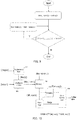
- the encoding of quantization indices for norm factors is illustrated in Figure 3 .
- the norm factor is quantized using the first 32 codebook entries (301), while other norm factors are scalar quantized with the 40 codebook entries (302) shown in Figure 2 .
- the quantization index for the first sub band norm factor is directly encoded with 5 bits (303), while the indices for other sub bands are encoded by differential coding.
- differential indices are encoded by two possible methods, fixed length coding (305) and Huffman coding (306).
- the Huffman table for the differential indices is shown in Figure 4 . In this table, there are in total 32 entries, from 0 to 31, which caters for possibilities of abrupt energy change between neighboring sub bands.
- Auditory masking occurs when the perception of one sound is affected by the presence of another sound.
- the lower-level tone at 1.1kHz will be masked (inaudible) due to existence of the powerful spike at 1kHz.
- the sound pressure level needed to make the sound perceptible in the presence of another sound is defined as masking threshold in audio encoding.
- the masking threshold depends upon the frequency, the sound pressure level of the masker. If the two sounds have similar frequency, the masking effect is large, and the masking threshold is also large. If the masker has large sound pressure level, it has strong masking effect on the other sound, and the masking threshold is also large.
- the degradation on sound component in this sub band is not able to be perceived by the listeners.
- apparatus and methods exploring audio signal properties for generating Huffman tables and for selecting Huffman tables from a set of predefined tables during audio signal encoding are provided.
- the auditory masking properties are explored to narrow down the range of the differential indices, so that a Huffman table which have fewer code words can be designed and used for encoding.
- the Huffman table has fewer code words, it is possible to design the code codes with shorter length (consumes fewer bits). By doing this, the total bits consumption to encode the differential indices can be reduced.
- Figure 5 illustrates the invented codec, which comprises an encoder and a decoder that apply the invented scheme on Huffman coding.
- the energies of the sub bands are processed by the psychoacoustic modelling (501) to derive the masking threshold Mask(n).
- the quantization indices of the norm factors for the sub bands whose quantization errors are below the masking threshold are modified (502) so that the range of the differential indices can be smaller.
- Range Min Diff_index n , Max Diff_index n
- the Huffman table which is designed for the specific range among a set of predefined Huffman table is selected (505) for encoding of the differential indices (506).
- the Huffman table designed for [12,18] are selected as the Huffman table for encoding.
- the set of predefined Huffman tables are designed (detail will be explained in later part) and arranged according to the range of the differential indices.
- the flag signal to indicate the selected Huffman table and the coded indices are transmitted to the decoder side.
- Another method for selection of Huffman table is to calculate all the bits consumption using every Huffman table, then select the Huffman table which consumes fewest bits.
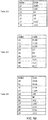
- a set of 4 predefined Huffman tables are shown in Figures 6A and 6B .
- Table 6.1 shows the flag signal and corresponding range for Huffman table.
- Table 6.2 shows the Huffman codes for all the values in the range of [13,17].
- Table 6.3 shows the Huffman codes for all the values in the range of [12,18].
- Table 6.4 shows the Huffman codes for all the values in the range of [11,19].
- Table 6.5 shows the Huffman codes for all the values in the range of [10,20].
- the corresponding Huffman table is selected (507) for decoding of the differential indices (508).
- Figure 7 illustrates the derivation of the masking curve of the input signal. Firstly, the energies of the sub bands are calculated, and with these energies and masking curve of the input signal are derived.
- the masking curve derivation can utilize some prior art existing technologies such as the masking curve derivation method in MPEG AAC codec.
- Figure 8 illustrates how the range of the differential indices is narrowed down.
- the comparison is done between the masking threshold and the sub band quantization error energy.
- their indices are modified to a value which is closer to the neighbouring sub band, but the modification is ensured that the corresponding quantization error energy does not exceed the masking threshold, so that sound quality is not affected.
- the range of the indices can be narrowed down. It is explained as below.
- the modification of the indices can be done as below (using sub band 2 as example). As shown in Figure 2 , large index is corresponding to smaller energy, and then Index(1) is smaller than Index(2). The modification of Index(2) is actually to decrease its value. It can be done as shown in Figure 9 .
- the design of the Huffman table can be done offline with a large input sequence database.
- the process is illustrated in Figure 10 .
- the quantization indices of the norm factors for the sub bands whose quantization errors energy are below the masking threshold are modified (1002) so that the range of the differential indices can be smaller.
- the differential indices for the modified indices are calculated (1003).
- the range of the differential indices for Huffman coding is identified (1004). For each value of range, all the input signal which have the same range will be gathered and the probability distribution of each value of the differential index within the range is calculated.
- Huffman table For each value of range, one Huffman table is designed according to the probability. Some traditional Huffman table design methods can be used here to design the Huffman table.
- the differential indices are calculated between the original quantization indices.
- the original differential indices and new differential indices are compared whether they consume same bits in the selected Huffman table.
- the modified differential indices are restored to the original differential indices. If they don't consume same number of bits, the code words in the Huffman table which is closest to the original differential indices and consumes same number of bits are selected as the restored differential indices.
- the merits of this embodiment are quantization error of the norm factor can be smaller while the bits consumption is the same as the embodiment 1.
- the merit of this embodiment is the very complex and high complexity psychoacoustic modelling can be avoided.
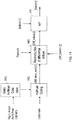
- a module is implemented to modify values of some differential indices (1302).
- the modification is done according to the value of the differential index for the preceding sub band and a threshold.
- the abrupt energy change happens only when some main sound components which have large energy start to show effect in the frequency band or their effect start to diminish.
- the norm factors which represent the energy also have abrupt change from the preceding frequency band, the norm factor quantization indices would also suddenly increase or decrease by a large value. Then it resulted in a very large or very small differential index.
- Equation (11) and Equation (13) whether the modification of a differential index should be done and how much it should be modified is all dependent on the differential index for preceding frequency band. If the differential index for the preceding frequency band can be perfectly reconstructed, then the current differential index can also be perfectly reconstructed.
- the first differential index is not modified at encoder side, it is directly received and can be perfectly reconstructed, then the second differential index can be reconstructed according to the value of the first differential index; then the third differential index, the forth differential index, and so on, by following the same procedure, all the differential indices can be perfectly reconstructed.
- the merit of this embodiment is that the range of the differential indices can be reduced, while the differential indices can still be perfectly reconstructed in decoder side. Therefore, the bits efficiency can be improved while retain the bit exactness of the quantization indices.
- Each function block employed in the description of the aforementioned embodiment may typically be implemented as an LSI constituted by an integrated circuit. These may be individual chips or partially or entirely contained on a single chip. "LSI” is adopted here but this may also be referred to as “IC,” “system LSI,” “super LSI” or “ultra LSI” depending on differing extents of integration.
- circuit integration is not limited to LSI's, and implementation using dedicated circuitry or general purpose processors is also possible.
- FPGA Field Programmable Gate Array
- reconfigurable processor where connections and settings of circuit cells within an LSI can be reconfigured is also possible.
- the encoding apparatus, decoding apparatus and encoding and decoding methods according to the present invention are applicable to a wireless communication terminal apparatus, base station apparatus in a mobile communication system, tele-conference terminal apparatus, video conference terminal apparatus and voice over internet protocol (VOIP) terminal apparatus.
- VOIP voice over internet protocol
- a first example is an audio/speech encoding apparatus comprising a transformation section that transforms the time domain input signal to frequency domain signal, a band splitting section that splits the frequency spectrum of input signal to a plural of sub-bands, a norm factor computation section that derives the norm factor which represents the level of energies for each sub band, a quantization section which quantizes the norm factors, a modification of index section that modifies the quantization indices, a Huffman table selection section that selects the Huffman table among a number of predefined Huffman tables, a Huffman coding section that encodes the indices using the selected Huffman table, and a flag signal transmission session that transmits the flag signal to indicate the selected Huffman table.
- a second example is the audio/speech encoding apparatus according to the first example, wherein said modification of index section comprises an energy computation section that computes the energies for each sub band, a psychoacoustic modelling section that derives the masking threshold for each sub band, a search section that identifies the sub bands whose quantization index section that modifies the indices of the indentified sub bands, the modification would errors are below the derived masking threshold, and a modification of bring its index closer to its neighbouring sub band indices while the quantization errors for the new indices are ensured still below the derived masking threshold.
- said modification of index section comprises an energy computation section that computes the energies for each sub band, a psychoacoustic modelling section that derives the masking threshold for each sub band, a search section that identifies the sub bands whose quantization index section that modifies the indices of the indentified sub bands, the modification would errors are below the derived masking threshold, and a modification of bring its index closer to its neighbouring
- a third example is the audio/speech encoding apparatus accordin to the first example, wherein said modification of index section comprises an energy computation section that computes the energies for each sub band, a search section that identifies the sub bands whose energy below a certain percentage of its neighbouring sub band energies, and a modification of index section that modifies the indices of the indentified sub bands, the modification would bring its index closer to its neighbouring sub band indices.
- a fourth example is the audio/speech encoding apparatus according to the first example, wherein said Huffman table selection comprises a range computation section which computes the range of the indices, and a Huffman table selection section which selects the Huffman table which was predefined for the calculated range.
- a fifth example is the audio/speech encoding apparatus according to the first example, wherein said Huffman table selection comprises a bits consumption computation section which computes the bits consumption for all the predefined Huffman tables, and a Huffman table selection section which selects the Huffman table which consumes the fewest bits.
- a seventh example ihe audio/speech encoding apparatus comprises a differential index calculation section which calculates the differential indices between the current sub band the previous sub band, and a Huffman coding section which encodes the differential indices.
- a ninth example is the audio/speech encoding apparatus according to the eighth example, wherein said modification of differential index section comprises an offset value computation section that calculates the offset value according to the difference between the differential index for the preceding sub band and the corresponding boundary of the defined range, and a modification section that subtracts the offset value from current differential index if the differential index for the preceding sub band goes below the defined range, and adds the offset value to current differential index if the differential index for the preceding sub band goes beyond the defined range.
- said modification of differential index section comprises an offset value computation section that calculates the offset value according to the difference between the differential index for the preceding sub band and the corresponding boundary of the defined range, and a modification section that subtracts the offset value from current differential index if the differential index for the preceding sub band goes below the defined range, and adds the offset value to current differential index if the differential index for the preceding sub band goes beyond the defined range.
- a tenth example is an audio/speech decoding apparatus comprising a flag signal decoding session that decodes the flag signal to indicate the selected Huffman table, a Huffman table selection section that selects the Huffman table according to the flag signal, a Huffman decoding section that decodes the indices using the selected Huffman table, a dequantization section which dequantizes the norm factors, a coefficient reconstruction section which reconstructs the spectral coefficients with the norm factors, and a transformation section that transforms the frequency domain input signal to time domain signal.
- An eleventh example is the audio/speech decoding apparatus according to the tenth example, wherein said Huffman decoding section comprises a Huffman decoding section which decodes the differential indices, and an index calculation section which calculates the quantization indices using the decoded differential indices.
- a twelfth example is the audio/speech decoding apparatus according to the tenth example, wherein said Huffman decoding section comprises a Huffman decoding section which decodes the differential indices, a reconstruction of the differential indices section which reconstructs the value of the different indices.
- the reconstruction is done to a differential index, only when the differential index of the preceding sub band goes beyond or goes below a defined range, and an index calculation section which calculates the quantization indices using the decoded differential indices.
- a thirteenth example is the audio/speech decoding apparatus according to the twelfth example, wherein said reconstruction of the differential indices section comprises an offset value computation section that calculates the offset value according to the difference between the differential index for the preceding sub band and the corresponding boundary of the defined range, and a modification section that subtracts the offset value from current differential index if the differential index for the preceding sub band goes beyond the defined range and adds the offset value to current differential index if the differential index for the preceding sub band goes below the defined range.
- said reconstruction of the differential indices section comprises an offset value computation section that calculates the offset value according to the difference between the differential index for the preceding sub band and the corresponding boundary of the defined range, and a modification section that subtracts the offset value from current differential index if the differential index for the preceding sub band goes beyond the defined range and adds the offset value to current differential index if the differential index for the preceding sub band goes below the defined range.
Landscapes
- Engineering & Computer Science (AREA)
- Physics & Mathematics (AREA)
- Spectroscopy & Molecular Physics (AREA)
- Computational Linguistics (AREA)
- Signal Processing (AREA)
- Health & Medical Sciences (AREA)
- Audiology, Speech & Language Pathology (AREA)
- Human Computer Interaction (AREA)
- Acoustics & Sound (AREA)
- Multimedia (AREA)
- Theoretical Computer Science (AREA)
- Compression, Expansion, Code Conversion, And Decoders (AREA)
Abstract
Description
- The present invention relates to an audio/speech encoding apparatus, audio/speech decoding apparatus and audio/speech encoding and decoding methods using Huffman coding.
- In signal compression, Huffman coding is widely used to encode an input signal utilizing a variable-length (VL) code table (Huffman table). Huffman coding is more efficient than fixed-length (FL) coding for the input signal which has a statistical distribution that is not uniform.
- In Huffman coding, the Huffman table is derived in a particular way based on the estimated probability of occurrence for each possible value of the input signal. During encoding, each input signal value is mapped to a particular variable length code in the Huffman table.
- By encoding signal values that are statistically more likely to occur using relatively short VL codes (using relatively few bits), and conversely encoding signal values that are statistically infrequently to occur using relatively long VL codes (using relatively more bits), the total number of bits used to encode the input signal can be reduced.
- [Non-patent document 1] ITU-T Recommendation G.719 (06/2008) "Low-complexity, full-band audio coding for high-quality, conversational applications"
- However, in some applications, such as audio signal encoding, the signal statistics may vary significantly from one set of audio signal to another set of audio signal. And even within the same set of audio signal.
- If the statistics of the audio signal varies drastically from the statistics of the predefined Huffman table, the encoding of the signal can not be optimally done. And it happens that, to encode the audio signal which has different statistics, the bits consumption by Huffman coding is much more than the bits consumption by fixed length coding.
- One possible solution is to include both the Huffman coding and fixed length coding in the encoding, and the encoding method which consumes fewer bits are selected. One flag signal is transmitted to decoder side to indicate which coding method is selected in encoder. This solution is utilized in a newly standardized ITU-T speech codec G.719.
- The solution solves the problem for some very extreme sequences in which the Huffman coding consumes more bits than the fixed length coding. But for other input signals which have different statistics from the Huffman table but still select the Huffman coding, it is still not optimal.
- In ITU-T standardized speech codec G.719, Huffman coding is used in encoding of the norm factors' quantization indices.
- The structure of G.719 is illustrated in
Figure 1 . - At encoder side, the input signal sampled at 48 kHz is processed through a transient detector (101). Depending on the detection of a transient, a high frequency resolution or a low frequency resolution transform (102) is applied on the input signal frame. The obtained spectral coefficients are grouped into bands of unequal lengths. The norm of each band is estimated (103) and resulting spectral envelope consisting of the norms of all bands is quantized and encoded (104). The coefficients are then normalized by the quantized norms (105). The quantized norms are further adjusted (106) based on adaptive spectral weighting and used as input for bit allocation (107). The normalized spectral coefficients are lattice-vector quantized and encoded (108) based on the allocated bits for each frequency band. The level of the non-coded spectral coefficients is estimated, coded (109) and transmitted to the decoder. Huffman encoding is applied to quantization indices for both the coded spectral coefficients as well as the encoded norms.
- At decoder side, the transient flag is first decoded which indicates the frame configuration, i.e., stationary or transient. The spectral envelope is decoded and the same, bit-exact, norm adjustments and bit-allocation algorithms are used at the decoder to recompute the bit-allocation which is essential for decoding quantization indices of the normalized transform coefficients. After de-quantization (112), low frequency non-coded spectral coefficients (allocated zero bits) are regenerated by using a spectral-fill codebook built from the received spectral coefficients (spectral coefficients with non-zero bit allocation) (113). Noise level adjustment index is used to adjust the level of the regenerated coefficients. High frequency non-coded spectral coefficients are regenerated using bandwidth extension. The decoded spectral coefficients and regenerated spectral coefficients are mixed and lead to normalized spectrum. The decoded spectral envelope is applied leading to the decoded full-band spectrum (114). Finally, the inverse transform (115) is applied to recover the time-domain decoded signal. This is performed by applying either the inverse modified discrete cosine transform for stationary modes, or the inverse of the higher temporal resolution transform for transient mode.
- In encoder (104), the norm factors of the spectral sub bands are scalar quantized with a uniform logarithmic scalar quantizer with 40 steps of 3dB.The codebook entries of the logarithmic quantizer are shown in
Figure 2 . As seen in the codebook, the range of the norm factors is [2-2.5,217], and the value decreases as the index increases. - The encoding of quantization indices for norm factors is illustrated in
Figure 3 . There are in total 44 sub bands and correspondingly, 44 norm factors. For the first sub band, the norm factor is quantized using the first 32 codebook entries (301), while other norm factors are scalar quantized with the 40 codebook entries (302) shown inFigure 2 . The quantization index for the first sub band norm factor is directly encoded with 5 bits (303), while the indices for other sub bands are encoded by differential coding. The differential indices are derived using the formula as following (304):
[1]
- And the differential indices are encoded by two possible methods, fixed length coding (305) and Huffman coding (306). The Huffman table for the differential indices is shown in
Figure 4 . In this table, there are in total 32 entries, from 0 to 31, which caters for possibilities of abrupt energy change between neighboring sub bands. - However, for an audio input signal, there is a physical phenomenon named as auditory masking. Auditory masking occurs when the perception of one sound is affected by the presence of another sound. As example, if there are two signals with similar frequencies existing at the same time: one powerful spike at 1kHz and one lower-level tone at 1.1kHz, the lower-level tone at 1.1kHz will be masked (inaudible) due to existence of the powerful spike at 1kHz.
- The sound pressure level needed to make the sound perceptible in the presence of another sound (masker), is defined as masking threshold in audio encoding. The masking threshold depends upon the frequency, the sound pressure level of the masker. If the two sounds have similar frequency, the masking effect is large, and the masking threshold is also large. If the masker has large sound pressure level, it has strong masking effect on the other sound, and the masking threshold is also large.
- According to the auditory masking theory above, if one sub band has very large energy, it would have large masking effect on other sub bands, especially on its neighboring sub bands. Then the masking threshold for other sub bands, especially the neighboring sub band, is large.
- If the sound component in the neighboring sub band has small quantization errors (less than the masking threshold), the degradation on sound component in this sub band is not able to be perceived by the listeners.
- It is not necessary to encode the normal factor with very high resolution for this sub band as long as the quantization errors below the masked threshold.
- In this invention, apparatus and methods exploring audio signal properties for generating Huffman tables and for selecting Huffman tables from a set of predefined tables during audio signal encoding are provided.
- Briefly, the auditory masking properties are explored to narrow down the range of the differential indices, so that a Huffman table which have fewer code words can be designed and used for encoding. As the Huffman table has fewer code words, it is possible to design the code codes with shorter length (consumes fewer bits). By doing this, the total bits consumption to encode the differential indices can be reduced.
- By adopting Huffman codes which consume fewer bits, the total bits consumption to encode the differential indices can be reduced.
-
-
Figure 1 illustrates the framework of ITU-T G.719; -
Figure 2 shows the codebook for norm factors quantization; -
Figure 3 illustrates the process of norm factors quantization and coding; -
Figure 4 shows the Huffman table used for norm factors indices encoding; -
Figure 5 shows the framework which adopts this invention; -
Figures 6A and6B show examples of predefined Huffman tables; -
Figure 7 illustrates the derivation of the masking curve; -
Figure 8 illustrates how the range of the differential indices be narrowed down; -
Figure 9 shows a flowchart of how the modification of the indices is done; -
Figure 10 illustrates how the Huffman tables can be designed; -
Figure 11 illustrates the framework ofembodiment 2 of this invention; -
Figure 12 illustrates the framework ofembodiment 3 of this invention; -
Figure 13 illustrates the encoder ofembodiment 4 of this invention; -
Figure 14 illustrates the decoder ofembodiment 4 of this invention. - The main principle of the invention is described in this section with the aid of
Figure 5 to Figure 12 . Those who are skilled in the art will be able to modify and adapt this invention without deviating from the spirit of the invention. Illustrations are provided to facilitate explanation. -
Figure 5 illustrates the invented codec, which comprises an encoder and a decoder that apply the invented scheme on Huffman coding. - In the encoder illustrated in
Figure 5 , the energies of the sub bands are processed by the psychoacoustic modelling (501) to derive the masking threshold Mask(n). According to the derived Mask(n), the quantization indices of the norm factors for the sub bands whose quantization errors are below the masking threshold are modified (502) so that the range of the differential indices can be smaller. - The differential indices for the modified indices are calculated according to the equation below:
[2]
- The range of the differential indices for Huffman coding is identified as shown in the equation below (504).
[3]
- According to the value of the range, the Huffman table which is designed for the specific range among a set of predefined Huffman table is selected (505) for encoding of the differential indices (506). As example, if among all the differential indices for the input frame, the minimum value is 12, and the maximum value is 18, then the Range = [12,18]. The Huffman table designed for [12,18] are selected as the Huffman table for encoding.
- The set of predefined Huffman tables are designed (detail will be explained in later part) and arranged according to the range of the differential indices. The flag signal to indicate the selected Huffman table and the coded indices are transmitted to the decoder side.
- Another method for selection of Huffman table is to calculate all the bits consumption using every Huffman table, then select the Huffman table which consumes fewest bits.
- As example, a set of 4 predefined Huffman tables are shown in
Figures 6A and6B . In this example, there are 4 predefined Huffman tables, covered range of [13,17], [12,18],[11,19] and [10,20] correspondingly. Table 6.1 shows the flag signal and corresponding range for Huffman table. Table 6.2 shows the Huffman codes for all the values in the range of [13,17]. Table 6.3 shows the Huffman codes for all the values in the range of [12,18]. Table 6.4 shows the Huffman codes for all the values in the range of [11,19]. Table 6.5 shows the Huffman codes for all the values in the range of [10,20]. - Comparing the Huffman code length in
Figures 6A and6B with the original Huffman table shown inFigure 4 , it can be seen that the Huffman code length for the same values consumes fewer bits. It explains how the bits are saved. - In the decoder illustrated in
Figure 5 , according to the flag signal, the corresponding Huffman table is selected (507) for decoding of the differential indices (508). The differential indices are used to reconstruct the norm factors quantization indices according to the equation below:
[4]
-
Figure 7 illustrates the derivation of the masking curve of the input signal. Firstly, the energies of the sub bands are calculated, and with these energies and masking curve of the input signal are derived. The masking curve derivation can utilize some prior art existing technologies such as the masking curve derivation method in MPEG AAC codec. -
Figure 8 illustrates how the range of the differential indices is narrowed down. Firstly, the comparison is done between the masking threshold and the sub band quantization error energy. For the sub bands whose quantization errors energy are below the masking threshold, their indices are modified to a value which is closer to the neighbouring sub band, but the modification is ensured that the corresponding quantization error energy does not exceed the masking threshold, so that sound quality is not affected. After the modification, the range of the indices can be narrowed down. It is explained as below. - As shown in
figure 8 , forsub bands - The modification of the indices can be done as below (using
sub band 2 as example). As shown inFigure 2 , large index is corresponding to smaller energy, and then Index(1) is smaller than Index(2). The modification of Index(2) is actually to decrease its value. It can be done as shown inFigure 9 . - For
sub bands sub band 1 as example:
[5]


- In this invention, the design of the Huffman table can be done offline with a large input sequence database. The process is illustrated in
Figure 10 . - The energies of the sub bands processed by the psychoacoustic modelling (1001) to derive the masked threshold Mask(n). According to the derived Mask(n), the quantization indices of the norm factors for the sub bands whose quantization errors energy are below the masking threshold are modified (1002) so that the range of the differential indices can be smaller.
- The differential indices for the modified indices are calculated (1003).
- The range of the differential indices for Huffman coding is identified (1004). For each value of range, all the input signal which have the same range will be gathered and the probability distribution of each value of the differential index within the range is calculated.
- For each value of range, one Huffman table is designed according to the probability. Some traditional Huffman table design methods can be used here to design the Huffman table.
- In this embodiment, a method which can maintain the bits saving, but to restore the differential indices to a value closer to the original value is introduced.
- As shown in
figure 11 , after the Huffman table is selected in 1105, the differential indices are calculated between the original quantization indices. The original differential indices and new differential indices are compared whether they consume same bits in the selected Huffman table. - If they consume same number of bits in the selected Huffman table, the modified differential indices are restored to the original differential indices. If they don't consume same number of bits, the code words in the Huffman table which is closest to the original differential indices and consumes same number of bits are selected as the restored differential indices.
- The merits of this embodiment are quantization error of the norm factor can be smaller while the bits consumption is the same as the
embodiment 1. - In this embodiment, a method which avoids using of the psychoacoustic model but only use some energy ratio threshold is introduced.
- As shown in
figure 12 , instead of using the psychoacoustic model to derive the masking threshold. The energies of the sub bands and a predefined energy ratio threshold are used to determine whether to modify the quantization index of the specific sub band (1201). As shown in the equation below, if the energy ratio between current sub band and neighbouring sub band is less than threshold, then current sub band is considered as not so important, then the quantization index of the current sub band can be modified.
[8]
- The modification of the quantization index can be done as shown in the equation below:
[9]
- NFNew_ index(n) means the decoded norm factor for sub band n using modified quantization index
- NF Index(n) means the decoded norm factor for sub band nusing the original quantization index
- Energy(n -1) means the energy for sub band n-1
- Energy(n) means the energy for sub band n
- Energy(n + 1) means the energy for sub band n + 1
- The merit of this embodiment is the very complex and high complexity psychoacoustic modelling can be avoided.
- In this embodiment, a method which narrows down the range of the differential indices while being able to perfectly reconstruct the differential indices is introduced.
- As shown in
figure 13 , the differential indices are derived from the original quantization indices (1301) according to the equation below:
[10]
- Diff_index(n) means differential index for sub band n
- Index(n) means the quantization index for sub band n
- Index(n-1) means the quantization index for sub band n -1
- In order to reduce the range of the differential indices, a module is implemented to modify values of some differential indices (1302).
- The modification is done according to the value of the differential index for the preceding sub band and a threshold.
- One way to modify the differential index (when n ≥ 1) can be done as shown in the equation below, the first differential index would not be modified so as to achieve perfect reconstruction in decoder side:
[11]
- n≥1;
- Diff_index (n) means differential index for sub band n;
- Diff_index (n -1) means differential index for sub band n -1;
- Diff_index_new(n) means the new differential index for sub band n;
- Threshold means the value to examine whether to make the modification of the differential index;
- The reason why this modification can reduce the range of the differential indices is explained as following: for audio/speech signal, it is true that the energy fluctuates from one frequency band to another frequency band. However, it is observed that, there is normally no abrupt change in energy from neighboring frequency bands. The energy gradually increases or decreases from one frequency band to another frequency band. The norm factors which represent the energy also gradually changes. The norm factor quantization indices would also gradually change, and then the differential indices would vary in a small range.
- The abrupt energy change happens only when some main sound components which have large energy start to show effect in the frequency band or their effect start to diminish. The norm factors which represent the energy also have abrupt change from the preceding frequency band, the norm factor quantization indices would also suddenly increase or decrease by a large value. Then it resulted in a very large or very small differential index.
- As an example, assume that there is one main sound component which has large energy in frequency sub band n. While in frequency sub band (n-1) and (n+1), there is no main sound component. Then according to the Huffman table in
Figure 2 , Index (n) will have very small value, while Index (n-1) and Index (n+1) will have very large value. Then according to Equation (10), Diff index(n) is very small (less than (15-Threshold)) and Diff_index(n+1) is very large. If the modification in Equation (11) is conducted, then according to Equation (12) below, the upper boundary of the differential indices can be possibly reduced, therefore the range of the differential indices can be narrowed down.
[12]
- As shown in
Figure 14 , in decoder side, in order to perfectly reconstruct the differential indices, one module named as 'reconstruction of differential indices' (1403) is implemented. The reconstruction is done according to the value of the differential index for the preceding sub band and a threshold. The threshold in decoder is same as the threshold used in encoder. - The way to reconstruct the differential index(when n ≥ 1), which is corresponding to the modification in encoder, can be done as shown in the equation below, the first differential index would be directly received as it is not modified at encoder side:
[13]
- n≥1;
- Diff_index(n) means differential index for sub band n;
- Diff_index(n -1) means differential index for sub band n -1;
- Diff_index_new(n) means the new differential index for sub band n;
- Threshold means the value to examine whether to reconstruct the differential index;
- As shown in the above Equation (11) and Equation (13), whether the modification of a differential index should be done and how much it should be modified is all dependent on the differential index for preceding frequency band. If the differential index for the preceding frequency band can be perfectly reconstructed, then the current differential index can also be perfectly reconstructed.
- As shown in the above Equation (11) and Equation (13), the first differential index is not modified at encoder side, it is directly received and can be perfectly reconstructed, then the second differential index can be reconstructed according to the value of the first differential index; then the third differential index, the forth differential index, and so on, by following the same procedure, all the differential indices can be perfectly reconstructed.
- The merit of this embodiment is that the range of the differential indices can be reduced, while the differential indices can still be perfectly reconstructed in decoder side. Therefore, the bits efficiency can be improved while retain the bit exactness of the quantization indices.
- Further, although cases have been described with the embodiments above where the present invention is configured by hardware, the present invention may be implemented by software in combination with hardware.
- Each function block employed in the description of the aforementioned embodiment may typically be implemented as an LSI constituted by an integrated circuit. These may be individual chips or partially or entirely contained on a single chip. "LSI" is adopted here but this may also be referred to as "IC," "system LSI," "super LSI" or "ultra LSI" depending on differing extents of integration.
- Further, the method of circuit integration is not limited to LSI's, and implementation using dedicated circuitry or general purpose processors is also possible. After LSI manufacture, utilization of an FPGA (Field Programmable Gate Array) or a reconfigurable processor where connections and settings of circuit cells within an LSI can be reconfigured is also possible.
- Further, if integrated circuit technology comes out to replace LSI's as a result of the advancement of semiconductor technology or a derivative other technology, it is naturally also possible to carry out function block integration using this technology. Application of biotechnology is also possible.
- The disclosure of Japanese Patent Applications No.
2011-94295, filed on April 20, 2011 2011-133432, filed on June 15, 2011 - The encoding apparatus, decoding apparatus and encoding and decoding methods according to the present invention are applicable to a wireless communication terminal apparatus, base station apparatus in a mobile communication system, tele-conference terminal apparatus, video conference terminal apparatus and voice over internet protocol (VOIP) terminal apparatus.
-
- 101
- Transient detector
- 102
- Transform
- 103
- Norm estimation
- 104
- Norm quantization and coding
- 105
- Spectrum normalization
- 106
- Norm adjustment
- 107
- Bit allocation
- 108
- Lattice quantization and coding
- 109
- Noise level adjustment
- 110
- Multiplex
- 111
- Demultiplex
- 112
- Lattice decoding
- 113
- Spectral fill generator
- 114
- Envelope shaping
- 115
- Inverse transform
- 301
- Scalar Quantization (32 steps)
- 302
- Scalar Quantization (40 steps)
- 303
- Direct Transmission (5 bits)
- 304
- Difference
- 305
- Fixed length coding
- 306
- Huffman coding
- 501
- Psychoacoustic model
- 502
- Modification of index
- 503
- Difference
- 504
- Check range
- 505
- Select Huffman code table
- 506
- Huffman coding
- 507
- Select Huffman table
- 508
- Huffman decoding
- 509
- Sum
- 1001
- Psychoacoustic model
- 1002
- Modification of index
- 1003
- Difference
- 1004
- Check range
- 1005
- Probability
- 1006
- Derive Huffman code
- 1101
- Psychoacoustic model
- 1102
- Modification of index
- 1103
- Difference
- 1104
- Check range
- 1105
- Select Huffman code table
- 1106
- Difference
- 1107
- Restore differential indices
- 1108
- Huffman coding
- 1201
- Modification of index
- 1202
- Difference
- 1203
- Check range
- 1204
- Select Huffman code table
- 1205
- Huffman coding
- 1301
- Difference
- 1302
- Modification of differential indices
- 1303
- Check range
- 1304
- Select Huffman code table
- 1305
- Huffman coding
- 1401
- Select Huffman code table
- 1402
- Huffman coding
- 1403
- Reconstruction of differential indices
- 1404
- Sum
- A first example is an audio/speech encoding apparatus comprising a transformation section that transforms the time domain input signal to frequency domain signal, a band splitting section that splits the frequency spectrum of input signal to a plural of sub-bands, a norm factor computation section that derives the norm factor which represents the level of energies for each sub band, a quantization section which quantizes the norm factors, a modification of index section that modifies the quantization indices, a Huffman table selection section that selects the Huffman table among a number of predefined Huffman tables, a Huffman coding section that encodes the indices using the selected Huffman table, and a flag signal transmission session that transmits the flag signal to indicate the selected Huffman table.
- A second example is the audio/speech encoding apparatus according to the first example, wherein said modification of index section comprises an energy computation section that computes the energies for each sub band, a psychoacoustic modelling section that derives the masking threshold for each sub band, a search section that identifies the sub bands whose quantization index section that modifies the indices of the indentified sub bands, the modification would errors are below the derived masking threshold, and a modification of bring its index closer to its neighbouring sub band indices while the quantization errors for the new indices are ensured still below the derived masking threshold.
- A third example is the audio/speech encoding apparatus accordin to the first example, wherein said modification of index section comprises an energy computation section that computes the energies for each sub band, a search section that identifies the sub bands whose energy below a certain percentage of its neighbouring sub band energies, and a modification of index section that modifies the indices of the indentified sub bands, the modification would bring its index closer to its neighbouring sub band indices.
- A fourth example is the audio/speech encoding apparatus according to the first example, wherein said Huffman table selection comprises a range computation section which computes the range of the indices, and a Huffman table selection section which selects the Huffman table which was predefined for the calculated range.
- A fifth example is the audio/speech encoding apparatus according to the first example, wherein said Huffman table selection comprises a bits consumption computation section which computes the bits consumption for all the predefined Huffman tables, and a Huffman table selection section which selects the Huffman table which consumes the fewest bits.
- A sixth example is the audio/speech encoding apparatus according to the first example, wherein said Huffman coding section comprises an index restore section which restore the modified index value to a value which consumes same number of bits but closer to the original index, and a Huffman coding section which encodes the restored indices.
- A seventh example ihe audio/speech encoding apparatus according to the first example wherein said Huffman coding section comprises a differential index calculation section which calculates the differential indices between the current sub band the previous sub band, and a Huffman coding section which encodes the differential indices.
- An eighth example is an audio/speech encoding apparatus comprising a transformation section that transforms the time domain input signal to frequency domain signal, a band splitting section that splits the frequency spectrum of input signal to a plural of sub-bands, a norm factor computation section that derives the norm factor which represents the level of energies for each sub band, a quantization section which quantizes the norm factors, a differential index calculation section which calculates the differential indices between the current sub band and the previous sub band, a modification of differential index section that modifies the differential indices so as to reduce the range of the differential indices where the modification is done to a differential index, only when the differential index of the preceding sub band goes beyond or goes below a defined range, a Huffman table selection section that selects the Huffman table among a number of predefined Huffman tables, a Huffman coding section that encodes the differential indices using the selected Huffman table, and a flag signal transmission session that transmits the flag signal to indicate the selected Huffman table.
- A ninth example is the audio/speech encoding apparatus according to the eighth example, wherein said modification of differential index section comprises an offset value computation section that calculates the offset value according to the difference between the differential index for the preceding sub band and the corresponding boundary of the defined range, and a modification section that subtracts the offset value from current differential index if the differential index for the preceding sub band goes below the defined range, and adds the offset value to current differential index if the differential index for the preceding sub band goes beyond the defined range.
- A tenth example is an audio/speech decoding apparatus comprising a flag signal decoding session that decodes the flag signal to indicate the selected Huffman table, a Huffman table selection section that selects the Huffman table according to the flag signal, a Huffman decoding section that decodes the indices using the selected Huffman table, a dequantization section which dequantizes the norm factors, a coefficient reconstruction section which reconstructs the spectral coefficients with the norm factors, and a transformation section that transforms the frequency domain input signal to time domain signal.
- An eleventh example is the audio/speech decoding apparatus according to the tenth example, wherein said Huffman decoding section comprises a Huffman decoding section which decodes the differential indices, and an index calculation section which calculates the quantization indices using the decoded differential indices.
- A twelfth example is the audio/speech decoding apparatus according to the tenth example, wherein said Huffman decoding section comprises a Huffman decoding section which decodes the differential indices, a reconstruction of the differential indices section which reconstructs the value of the different indices. The reconstruction is done to a differential index, only when the differential index of the preceding sub band goes beyond or goes below a defined range, and an index calculation section which calculates the quantization indices using the decoded differential indices.
- A thirteenth example is the audio/speech decoding apparatus according to the twelfth example, wherein said reconstruction of the differential indices section comprises an offset value computation section that calculates the offset value according to the difference between the differential index for the preceding sub band and the corresponding boundary of the defined range, and a modification section that subtracts the offset value from current differential index if the differential index for the preceding sub band goes beyond the defined range and adds the offset value to current differential index if the differential index for the preceding sub band goes below the defined range.
Claims (10)
- An audio/speech encoding apparatus, comprising:a processor;a memory;a transformer adapted to transform a time domain input audio/speech signal to a frequency spectrum;a band divider adapted to divide the frequency spectrum to a plural of bands;an norm factor calculator adapted to calculate a level of norm factors for each band;a quantizer adapted to quantize the norm factors for the each band;a differential index calculator (1301) adapted to calculate differential indices between an Nth band index and an (N-1)th band index, where N is an integer of 1 or more;a differential index modifier (1302) adapted to modify a range of the differential indices for the Nth band when N is an integer of 2 or more, and replace the differential index with the modified differential index and adapted not to modify the range of the differential indices for the Nth band when N is an integer of 1;a Huffman encoder (1304; 1305) adapted to encode the differential indices using a Huffman table selected based on a minimum value and a maximum value of the differential indices; anda transmitter adapted to transmit the encoded differential indices and a flag signal for indicating the selected Huffman table to an audio/speech decoding apparatus,
wherein when the calculated differential index of the (N-1)th band is greater than a first value, the differential index modifier is adapted to modify a differential index for an Nth band by adding a subtracted value determined by subtracting the first value from a differential index for an (N-1)th band,
wherein when the calculated differential index of a (N-1)th band is smaller than a second value, the differential index modifier is adapted to modify a differential index for a Nth band by adding a subtracted value determined by subtracting the second value from a differential index for the (N-1)th band,
wherein the first value is a sum of an offset value and a threshold value, and the second value is a difference of the offset value and the threshold value, and the offset value is 15, and
wherein when the calculated differential index of an (N-1)th band is not greater than the first value and is not smaller than the second value, the differential index modifier is adapted not to modify a differential index for the Nth band. - The audio/speech encoding apparatus according to claim 1, wherein the upper limit and the lower limit are the same as an upper limit and a lower limit stored in a decoding apparatus.
- The audio/speech encoding apparatus according to claim 1 or 2,
wherein when the calculated differential index of an (N-1)th band is not greater than the upper limit and not smaller than the lower limit, the differential indices the differential index for the Nth band is modified. - An audio/speech decoding apparatus, comprising:a receiver for receiving encoded audio/speech signals transmitted from an audio/speech encoding apparatus;a processor;a memory;a Huffman table selector (1401) adapted to select a Huffman table according to a flag signal to indicate the Huffman table selected based on a minimum value and a maximum value of the differential indices by the audio/speech encoding apparatus;a Huffman decoder (1402) adapted to decode differential indices between an Nth band index and an (N-1)th band index, where N is an integer of 1 or more, received by the audio/speech encoding apparatus, using the selected Huffman table;a differential indices reconstructor (1403) adapted to reconstruct an Nth different index decoded using the selected Huffman table when N is an integer of 2 or more, and replaces the differential index with the reconstructed differential index, and adapted not to reconstruct the Nth differential index when N is an integer of 1;an index calculator (1404) adapted to calculate quantization indices using the reconstructed differential indices;a dequantizer adapted to dequantize a level of norm factors for each band; anda transformer adapted to transform a decoded spectrum which is generated using the norm factor for each band in a frequency domain to a time domain signal,
wherein when the decoded differential index of the (N-1)th band is greater than a first value, the differential indices reconstructor is adapted to reconstruct a differential index for an Nth band by subtracting a subtracted valuedetermined by subtracting the first value from a differential index for an (N-1)th band,
wherein when the decoded differential index of an (N-1)th band is smaller than a second value, the differential indices reconstructor is adapted to reconstruct a differential index for an Nth band by subtracting a subtracted value determined by subtracting the second value from a differential index for the (N-1)th band,
wherein the first value is a sum of an offset value and a threshold value, and the second value is a difference of the offset value and the threshold value, and the offset value is 15. - The audio/speech decoding apparatus according to claim 4, wherein the upper limit and the lower limit are the same as an upper limit and a lower limit stored in an encoding apparatus.
- An audio/speech encoding method, comprising:transforming, by a transformer, a time domain input signal to a frequency spectrum;dividing the frequency spectrum to a plural of bands;calculating a level of norm factors for each band;quantizing the norm factors for the each band;calculating differential indices between an Nth band index and an (N-1)th band index, where N is an integer of 1 or more;modifying a range of the differential indices for the Nth band when N is an integer of 2 or more, and replacing the differential index with the modified differential index and not modifying the range of the differential indices for the Nth band when N is an integer of 1;encoding the differential indices using a Huffman table selected based on a minimum value and a maximum value of the differential indices; and
transmitting the encoded differential indices and a flag signal for indicating the selected Huffman table to an audio/speech decoding apparatus,
wherein when the calculated differential index of the (N-1)th band is greater than a first value, a differential index for an Nth band is modified by adding a subtracted value determined by subtracting the first value from a differential index for an (N-1)th band,
wherein when the calculated differential index of an (N-1)th band is smaller than a second value, a differential index for an Nth band is modified by adding a subtracted value determined by subtracting the second value from a differential index for the (N-1)th band,
wherein the first value is a sum of an offset value and a threshold value, and the second value is a difference of the offset value and the threshold value, and the offset value is 15, and
wherein when the calculated differential index of an (N-1)th band is not greater than the first value and is not smaller than the second value, the differential index for the Nth band is not modified. - The audio/speech encoding method according to claim 6, wherein the upper limit and the lower limit are the same as an upper limit and a lower limit stored in a decoding apparatus.
- The audio/speech encoding method according to claim 6 or 7,
wherein when the calculated differential index of an (N-1)th band is not greater than the upper limit and not smaller than the lower limit, the differential indices the differential index for the Nth band is modified. - An audio/speech decoding method, comprising:receiving encoded audio/speech signals transmitted from an audio/speech encoding apparatus;selecting a Huffman table according to a flag signal to indicate the selected Huffman table by the audio/speech encoding apparatus;decoding differential indices between an Nth band index and an (N-1)th band indexm where N is an integer of 1 or more, received by the audio/speech encoding apparatus, using the selected Huffman table;reconstructing an Nth different index decoded using the selected Huffman table when N is an integer of 2 or more, and replacing the differential index with the reconstructed differential index, and not reconstructing the Nth differential index when N is an integer of 1;calculating quantization indices using the reconstructed differential indices;dequantizing, by a dequantizer, a level of norm factors for each band; andtransforming a decoded spectrum which is generated using the norm factors for each band in a frequency domain to a time domain signal,
wherein when the differential index of the (N-1)th band is greater than a first value, a differential index for an Nth band is reconstructed by subtracting a subtracted value determined by subtracting the first value from a differential index for an (N-1)th band,
wherein when the decoded differential index of an (N-1)th band is smaller than a second value, a differential index for an Nth band is reconstructed by subtracting a subtracted value determined by subtracting the second value from a differential index for the (N-1)th band,
wherein the first value is a sum of an offset value and a threshold value, and the second value is a difference of the offset value and the threshold value, and the offset value is 15. - The audio/speech decoding method according to claim 9, wherein the upper limit and the lower limit are the same as an upper limit and a lower limit stored in an encoding apparatus.
Priority Applications (1)
| Application Number | Priority Date | Filing Date | Title |
|---|---|---|---|
| EP23217545.5A EP4322161A3 (en) | 2011-04-20 | 2012-03-12 | Device and method for execution of huffman coding |
Applications Claiming Priority (5)
| Application Number | Priority Date | Filing Date | Title |
|---|---|---|---|
| JP2011094295 | 2011-04-20 | ||
| JP2011133432 | 2011-06-15 | ||
| EP16175414.8A EP3096315B1 (en) | 2011-04-20 | 2012-03-12 | Device and method for execution of huffman coding |
| PCT/JP2012/001701 WO2012144127A1 (en) | 2011-04-20 | 2012-03-12 | Device and method for execution of huffman coding |
| EP12774449.8A EP2701144B1 (en) | 2011-04-20 | 2012-03-12 | Device and method for execution of huffman coding |
Related Parent Applications (3)
| Application Number | Title | Priority Date | Filing Date |
|---|---|---|---|
| EP12774449.8A Division EP2701144B1 (en) | 2011-04-20 | 2012-03-12 | Device and method for execution of huffman coding |
| EP16175414.8A Division-Into EP3096315B1 (en) | 2011-04-20 | 2012-03-12 | Device and method for execution of huffman coding |
| EP16175414.8A Division EP3096315B1 (en) | 2011-04-20 | 2012-03-12 | Device and method for execution of huffman coding |
Related Child Applications (2)
| Application Number | Title | Priority Date | Filing Date |
|---|---|---|---|
| EP23217545.5A Division EP4322161A3 (en) | 2011-04-20 | 2012-03-12 | Device and method for execution of huffman coding |
| EP23217545.5A Division-Into EP4322161A3 (en) | 2011-04-20 | 2012-03-12 | Device and method for execution of huffman coding |
Publications (2)
| Publication Number | Publication Date |
|---|---|
| EP3594943A1 true EP3594943A1 (en) | 2020-01-15 |
| EP3594943B1 EP3594943B1 (en) | 2024-02-21 |
Family
ID=47041264
Family Applications (4)
| Application Number | Title | Priority Date | Filing Date |
|---|---|---|---|
| EP19194667.2A Active EP3594943B1 (en) | 2011-04-20 | 2012-03-12 | Device and method for execution of huffman coding |
| EP23217545.5A Pending EP4322161A3 (en) | 2011-04-20 | 2012-03-12 | Device and method for execution of huffman coding |
| EP12774449.8A Active EP2701144B1 (en) | 2011-04-20 | 2012-03-12 | Device and method for execution of huffman coding |
| EP16175414.8A Active EP3096315B1 (en) | 2011-04-20 | 2012-03-12 | Device and method for execution of huffman coding |
Family Applications After (3)
| Application Number | Title | Priority Date | Filing Date |
|---|---|---|---|
| EP23217545.5A Pending EP4322161A3 (en) | 2011-04-20 | 2012-03-12 | Device and method for execution of huffman coding |
| EP12774449.8A Active EP2701144B1 (en) | 2011-04-20 | 2012-03-12 | Device and method for execution of huffman coding |
| EP16175414.8A Active EP3096315B1 (en) | 2011-04-20 | 2012-03-12 | Device and method for execution of huffman coding |
Country Status (14)
| Country | Link |
|---|---|
| US (3) | US9881625B2 (en) |
| EP (4) | EP3594943B1 (en) |
| JP (3) | JP5937064B2 (en) |
| KR (3) | KR101995694B1 (en) |
| CN (2) | CN104485111B (en) |
| BR (1) | BR112013026850B1 (en) |
| CA (2) | CA2832032C (en) |
| ES (2) | ES2765527T3 (en) |
| MY (2) | MY193565A (en) |
| PL (2) | PL3096315T3 (en) |
| RU (1) | RU2585990C2 (en) |
| TW (2) | TWI598872B (en) |
| WO (1) | WO2012144127A1 (en) |
| ZA (1) | ZA201307316B (en) |
Families Citing this family (19)
| Publication number | Priority date | Publication date | Assignee | Title |
|---|---|---|---|---|
| KR100715450B1 (en) * | 2004-02-02 | 2007-05-07 | (주)경안인더스트리 | Non-asbestos insulation board and its manufacturing method |
| BR112013026850B1 (en) * | 2011-04-20 | 2021-02-23 | Panasonic Intellectual Property Corporation Of America | AUDIO / SPEECH ENCODING AND DECODING APPLIANCES AND AUDIO / SPEECH DECODING AND DECODING METHODS |
| KR102200643B1 (en) * | 2012-12-13 | 2021-01-08 | 프라운호퍼-게젤샤프트 추르 푀르데룽 데어 안제반텐 포르슝 에 파우 | Voice audio encoding device, voice audio decoding device, voice audio encoding method, and voice audio decoding method |
| SG11201509001YA (en) | 2013-05-24 | 2015-12-30 | Dolby Int Ab | Audio encoder and decoder |
| JP6302071B2 (en) | 2013-09-13 | 2018-03-28 | サムスン エレクトロニクス カンパニー リミテッド | Lossless encoding method and lossless decoding method |
| WO2015037961A1 (en) | 2013-09-13 | 2015-03-19 | 삼성전자 주식회사 | Energy lossless coding method and device, signal coding method and device, energy lossless decoding method and device, and signal decoding method and device |
| US20150142345A1 (en) * | 2013-10-18 | 2015-05-21 | Alpha Technologies Inc. | Status Monitoring Systems and Methods for Uninterruptible Power Supplies |
| WO2015130509A1 (en) * | 2014-02-28 | 2015-09-03 | Dolby Laboratories Licensing Corporation | Perceptual continuity using change blindness in conferencing |
| US10553228B2 (en) * | 2015-04-07 | 2020-02-04 | Dolby International Ab | Audio coding with range extension |
| BR112018004887A2 (en) | 2015-09-13 | 2018-10-09 | Alpha Technologies Inc. | power control systems and methods. |
| US10381867B1 (en) | 2015-10-16 | 2019-08-13 | Alpha Technologeis Services, Inc. | Ferroresonant transformer systems and methods with selectable input and output voltages for use in uninterruptible power supplies |
| WO2018121887A1 (en) * | 2017-01-02 | 2018-07-05 | Huawei Technologies Duesseldorf Gmbh | Apparatus and method for shaping the probability distribution of a data sequence |
| KR20190122709A (en) * | 2017-03-14 | 2019-10-30 | 소니 주식회사 | Recording device, recording method, playback device, playback method and recording and playback device |
| US20180288439A1 (en) * | 2017-03-31 | 2018-10-04 | Mediatek Inc. | Multiple Transform Prediction |
| CA3069966A1 (en) | 2017-07-14 | 2019-01-17 | Alpha Technologies Services, Inc. | Voltage regulated ac power supply systems and methods |
| CN109286922B (en) * | 2018-09-27 | 2021-09-17 | 珠海市杰理科技股份有限公司 | Bluetooth prompt tone processing method, system, readable storage medium and Bluetooth device |
| WO2024012666A1 (en) * | 2022-07-12 | 2024-01-18 | Fraunhofer-Gesellschaft zur Förderung der angewandten Forschung e.V. | Apparatus and method for encoding or decoding ar/vr metadata with generic codebooks |
| US12113554B2 (en) | 2022-07-12 | 2024-10-08 | Samsung Display Co., Ltd. | Low complexity optimal parallel Huffman encoder and decoder |
| CN118713680B (en) * | 2024-08-27 | 2024-11-22 | 湖南师范大学 | Trusted metering data storage method based on blockchain technology |
Citations (6)
| Publication number | Priority date | Publication date | Assignee | Title |
|---|---|---|---|---|
| JP2002268693A (en) * | 2001-03-12 | 2002-09-20 | Mitsubishi Electric Corp | Audio coding equipment |
| US20060074693A1 (en) * | 2003-06-30 | 2006-04-06 | Hiroaki Yamashita | Audio coding device with fast algorithm for determining quantization step sizes based on psycho-acoustic model |
| US7668715B1 (en) * | 2004-11-30 | 2010-02-23 | Cirrus Logic, Inc. | Methods for selecting an initial quantization step size in audio encoders and systems using the same |
| US20100106511A1 (en) * | 2007-07-04 | 2010-04-29 | Fujitsu Limited | Encoding apparatus and encoding method |
| JP2011094295A (en) | 2009-10-27 | 2011-05-12 | Yuhshin Co Ltd | Locking and unlocking device for door |
| JP2011133432A (en) | 2009-12-25 | 2011-07-07 | Shizuoka Oil Service:Kk | Oil viscosity checker and oil supply system using the same |
Family Cites Families (30)
| Publication number | Priority date | Publication date | Assignee | Title |
|---|---|---|---|---|
| JP3131542B2 (en) * | 1993-11-25 | 2001-02-05 | シャープ株式会社 | Encoding / decoding device |
| JP3186007B2 (en) | 1994-03-17 | 2001-07-11 | 日本電信電話株式会社 | Transform coding method, decoding method |
| US5956674A (en) * | 1995-12-01 | 1999-09-21 | Digital Theater Systems, Inc. | Multi-channel predictive subband audio coder using psychoacoustic adaptive bit allocation in frequency, time and over the multiple channels |
| US5848195A (en) | 1995-12-06 | 1998-12-08 | Intel Corporation | Selection of huffman tables for signal encoding |
| US6366614B1 (en) * | 1996-10-11 | 2002-04-02 | Qualcomm Inc. | Adaptive rate control for digital video compression |
| JP3784993B2 (en) * | 1998-06-26 | 2006-06-14 | 株式会社リコー | Acoustic signal encoding / quantization method |
| US7016502B2 (en) * | 2000-12-22 | 2006-03-21 | Sony Corporation | Encoder and decoder |
| US6411226B1 (en) * | 2001-01-16 | 2002-06-25 | Motorola, Inc. | Huffman decoder with reduced memory size |
| JP2003233397A (en) * | 2002-02-12 | 2003-08-22 | Victor Co Of Japan Ltd | Device, program, and data transmission device for audio encoding |
| DK1400954T3 (en) * | 2002-09-04 | 2008-03-31 | Microsoft Corp | Entropy coding by adjusting coding between level and run length / level modes |
| US20040120404A1 (en) * | 2002-11-27 | 2004-06-24 | Takayuki Sugahara | Variable length data encoding method, variable length data encoding apparatus, variable length encoded data decoding method, and variable length encoded data decoding apparatus |
| JP4369140B2 (en) * | 2003-02-17 | 2009-11-18 | パナソニック株式会社 | Audio high-efficiency encoding apparatus, audio high-efficiency encoding method, audio high-efficiency encoding program, and recording medium therefor |
| EP1513137A1 (en) * | 2003-08-22 | 2005-03-09 | MicronasNIT LCC, Novi Sad Institute of Information Technologies | Speech processing system and method with multi-pulse excitation |
| US7966424B2 (en) * | 2004-03-15 | 2011-06-21 | Microsoft Corporation | Data compression |
| WO2007037613A1 (en) * | 2005-09-27 | 2007-04-05 | Lg Electronics Inc. | Method and apparatus for encoding/decoding multi-channel audio signal |
| BRPI0708267A2 (en) * | 2006-02-24 | 2011-05-24 | France Telecom | binary coding method of signal envelope quantification indices, decoding method of a signal envelope, and corresponding coding and decoding modules |
| JP5010197B2 (en) * | 2006-07-26 | 2012-08-29 | 株式会社東芝 | Speech encoding device |
| KR101040160B1 (en) * | 2006-08-15 | 2011-06-09 | 브로드콤 코포레이션 | Limited, controlled decoding after packet loss |
| JP4823001B2 (en) * | 2006-09-27 | 2011-11-24 | 富士通セミコンダクター株式会社 | Audio encoding device |
| ES2378734T3 (en) * | 2006-10-16 | 2012-04-17 | Dolby International Ab | Enhanced coding and representation of coding parameters of multichannel downstream mixing objects |
| US7966175B2 (en) * | 2006-10-18 | 2011-06-21 | Polycom, Inc. | Fast lattice vector quantization |
| US7953595B2 (en) * | 2006-10-18 | 2011-05-31 | Polycom, Inc. | Dual-transform coding of audio signals |
| RU2394283C1 (en) * | 2007-02-14 | 2010-07-10 | ЭлДжи ЭЛЕКТРОНИКС ИНК. | Methods and devices for coding and decoding object-based audio signals |
| KR101426788B1 (en) * | 2007-11-20 | 2014-08-06 | 삼성전자주식회사 | Method and apparatus for transmitting channel quality information in a wireless communication system |
| US8630848B2 (en) * | 2008-05-30 | 2014-01-14 | Digital Rise Technology Co., Ltd. | Audio signal transient detection |
| US8463603B2 (en) * | 2008-09-06 | 2013-06-11 | Huawei Technologies Co., Ltd. | Spectral envelope coding of energy attack signal |
| US8194862B2 (en) * | 2009-07-31 | 2012-06-05 | Activevideo Networks, Inc. | Video game system with mixing of independent pre-encoded digital audio bitstreams |
| US9106925B2 (en) * | 2010-01-11 | 2015-08-11 | Ubiquity Holdings, Inc. | WEAV video compression system |
| CN102222505B (en) * | 2010-04-13 | 2012-12-19 | 中兴通讯股份有限公司 | Hierarchical audio coding and decoding methods and systems and transient signal hierarchical coding and decoding methods |
| BR112013026850B1 (en) * | 2011-04-20 | 2021-02-23 | Panasonic Intellectual Property Corporation Of America | AUDIO / SPEECH ENCODING AND DECODING APPLIANCES AND AUDIO / SPEECH DECODING AND DECODING METHODS |
-
2012
- 2012-03-12 BR BR112013026850-6A patent/BR112013026850B1/en active IP Right Grant
- 2012-03-12 KR KR1020197006961A patent/KR101995694B1/en active Active
- 2012-03-12 EP EP19194667.2A patent/EP3594943B1/en active Active
- 2012-03-12 KR KR1020137025124A patent/KR101859246B1/en active Active
- 2012-03-12 WO PCT/JP2012/001701 patent/WO2012144127A1/en not_active Ceased
- 2012-03-12 US US14/008,732 patent/US9881625B2/en active Active
- 2012-03-12 CA CA2832032A patent/CA2832032C/en active Active
- 2012-03-12 RU RU2013146688/08A patent/RU2585990C2/en active
- 2012-03-12 ES ES16175414T patent/ES2765527T3/en active Active
- 2012-03-12 EP EP23217545.5A patent/EP4322161A3/en active Pending
- 2012-03-12 KR KR1020187013479A patent/KR101959698B1/en active Active
- 2012-03-12 CA CA3051552A patent/CA3051552C/en active Active
- 2012-03-12 CN CN201410725584.9A patent/CN104485111B/en active Active
- 2012-03-12 PL PL16175414T patent/PL3096315T3/en unknown
- 2012-03-12 MY MYPI2018000285A patent/MY193565A/en unknown
- 2012-03-12 JP JP2013510855A patent/JP5937064B2/en active Active
- 2012-03-12 EP EP12774449.8A patent/EP2701144B1/en active Active
- 2012-03-12 EP EP16175414.8A patent/EP3096315B1/en active Active
- 2012-03-12 CN CN201280012790.4A patent/CN103415884B/en active Active
- 2012-03-12 ES ES19194667T patent/ES2977133T3/en active Active
- 2012-03-12 MY MYPI2013003592A patent/MY164987A/en unknown
- 2012-03-12 PL PL19194667.2T patent/PL3594943T3/en unknown
- 2012-03-19 TW TW106100427A patent/TWI598872B/en active
- 2012-03-19 TW TW101109432A patent/TWI573132B/en active
-
2013
- 2013-10-01 ZA ZA2013/07316A patent/ZA201307316B/en unknown
-
2016
- 2016-05-10 JP JP2016094584A patent/JP6321072B2/en active Active
-
2017
- 2017-12-12 US US15/839,056 patent/US10204632B2/en active Active
-
2018
- 2018-04-04 JP JP2018072367A patent/JP6518361B2/en active Active
- 2018-12-19 US US16/225,851 patent/US10515648B2/en active Active
Patent Citations (6)
| Publication number | Priority date | Publication date | Assignee | Title |
|---|---|---|---|---|
| JP2002268693A (en) * | 2001-03-12 | 2002-09-20 | Mitsubishi Electric Corp | Audio coding equipment |
| US20060074693A1 (en) * | 2003-06-30 | 2006-04-06 | Hiroaki Yamashita | Audio coding device with fast algorithm for determining quantization step sizes based on psycho-acoustic model |
| US7668715B1 (en) * | 2004-11-30 | 2010-02-23 | Cirrus Logic, Inc. | Methods for selecting an initial quantization step size in audio encoders and systems using the same |
| US20100106511A1 (en) * | 2007-07-04 | 2010-04-29 | Fujitsu Limited | Encoding apparatus and encoding method |
| JP2011094295A (en) | 2009-10-27 | 2011-05-12 | Yuhshin Co Ltd | Locking and unlocking device for door |
| JP2011133432A (en) | 2009-12-25 | 2011-07-07 | Shizuoka Oil Service:Kk | Oil viscosity checker and oil supply system using the same |
Non-Patent Citations (1)
| Title |
|---|
| ITU-T RECOMMENDATION G.719, June 2008 (2008-06-01) |
Also Published As
Similar Documents
| Publication | Publication Date | Title |
|---|---|---|
| US10515648B2 (en) | Audio/speech encoding apparatus and method, and audio/speech decoding apparatus and method | |
| EP3457400B1 (en) | Voice audio encoding device, voice audio decoding device, voice audio encoding method, and voice audio decoding method | |
| US8352249B2 (en) | Encoding device, decoding device, and method thereof | |
| CN103503063A (en) | Filling non-encoded subvectors in a transform-encoded audio signal | |
| US9548057B2 (en) | Adaptive gain-shape rate sharing | |
| HK40002240B (en) | Voice audio encoding device, voice audio decoding device, voice audio encoding method, and voice audio decoding method | |
| HK1242832A1 (en) | Voice audio encoding device, voice audio decoding device, voice audio encoding method, and voice audio decoding method | |
| HK1242832B (en) | Voice audio encoding device, voice audio decoding device, voice audio encoding method, and voice audio decoding method |
Legal Events
| Date | Code | Title | Description |
|---|---|---|---|
| PUAI | Public reference made under article 153(3) epc to a published international application that has entered the european phase |
Free format text: ORIGINAL CODE: 0009012 |
|
| STAA | Information on the status of an ep patent application or granted ep patent |
Free format text: STATUS: REQUEST FOR EXAMINATION WAS MADE |
|
| 17P | Request for examination filed |
Effective date: 20190830 |
|
| AC | Divisional application: reference to earlier application |
Ref document number: 3096315 Country of ref document: EP Kind code of ref document: P Ref document number: 2701144 Country of ref document: EP Kind code of ref document: P |
|
| AK | Designated contracting states |
Kind code of ref document: A1 Designated state(s): AL AT BE BG CH CY CZ DE DK EE ES FI FR GB GR HR HU IE IS IT LI LT LU LV MC MK MT NL NO PL PT RO RS SE SI SK SM TR |
|
| STAA | Information on the status of an ep patent application or granted ep patent |
Free format text: STATUS: EXAMINATION IS IN PROGRESS |
|
| 17Q | First examination report despatched |
Effective date: 20210923 |
|
| RAP3 | Party data changed (applicant data changed or rights of an application transferred) |
Owner name: PANASONIC INTELLECTUAL PROPERTY CORPORATION OF AMERICA |
|
| RAP1 | Party data changed (applicant data changed or rights of an application transferred) |
Owner name: PANASONIC HOLDINGS CORPORATION |
|
| RIC1 | Information provided on ipc code assigned before grant |
Ipc: G10L 19/032 20130101ALI20230721BHEP Ipc: G10L 19/00 20130101ALI20230721BHEP Ipc: G10L 19/02 20130101AFI20230721BHEP |
|
| GRAP | Despatch of communication of intention to grant a patent |
Free format text: ORIGINAL CODE: EPIDOSNIGR1 |
|
| STAA | Information on the status of an ep patent application or granted ep patent |
Free format text: STATUS: GRANT OF PATENT IS INTENDED |
|
| INTG | Intention to grant announced |
Effective date: 20230926 |
|
| GRAS | Grant fee paid |
Free format text: ORIGINAL CODE: EPIDOSNIGR3 |
|
| GRAA | (expected) grant |
Free format text: ORIGINAL CODE: 0009210 |
|
| STAA | Information on the status of an ep patent application or granted ep patent |
Free format text: STATUS: THE PATENT HAS BEEN GRANTED |
|
| AC | Divisional application: reference to earlier application |
Ref document number: 2701144 Country of ref document: EP Kind code of ref document: P Ref document number: 3096315 Country of ref document: EP Kind code of ref document: P |
|
| AK | Designated contracting states |
Kind code of ref document: B1 Designated state(s): AL AT BE BG CH CY CZ DE DK EE ES FI FR GB GR HR HU IE IS IT LI LT LU LV MC MK MT NL NO PL PT RO RS SE SI SK SM TR |
|
| REG | Reference to a national code |
Ref country code: GB Ref legal event code: FG4D |
|
| REG | Reference to a national code |
Ref country code: CH Ref legal event code: EP |
|
| REG | Reference to a national code |
Ref country code: DE Ref legal event code: R096 Ref document number: 602012080569 Country of ref document: DE |
|
| REG | Reference to a national code |
Ref country code: IE Ref legal event code: FG4D |
|
| REG | Reference to a national code |
Ref country code: NL Ref legal event code: FP |
|
| REG | Reference to a national code |
Ref country code: LT Ref legal event code: MG9D |
|
| PG25 | Lapsed in a contracting state [announced via postgrant information from national office to epo] |
Ref country code: IS Free format text: LAPSE BECAUSE OF FAILURE TO SUBMIT A TRANSLATION OF THE DESCRIPTION OR TO PAY THE FEE WITHIN THE PRESCRIBED TIME-LIMIT Effective date: 20240621 |
|
| PG25 | Lapsed in a contracting state [announced via postgrant information from national office to epo] |
Ref country code: LT Free format text: LAPSE BECAUSE OF FAILURE TO SUBMIT A TRANSLATION OF THE DESCRIPTION OR TO PAY THE FEE WITHIN THE PRESCRIBED TIME-LIMIT Effective date: 20240221 |
|
| PG25 | Lapsed in a contracting state [announced via postgrant information from national office to epo] |
Ref country code: GR Free format text: LAPSE BECAUSE OF FAILURE TO SUBMIT A TRANSLATION OF THE DESCRIPTION OR TO PAY THE FEE WITHIN THE PRESCRIBED TIME-LIMIT Effective date: 20240522 |
|
| REG | Reference to a national code |
Ref country code: AT Ref legal event code: MK05 Ref document number: 1659818 Country of ref document: AT Kind code of ref document: T Effective date: 20240221 |
|
| PG25 | Lapsed in a contracting state [announced via postgrant information from national office to epo] |
Ref country code: HR Free format text: LAPSE BECAUSE OF FAILURE TO SUBMIT A TRANSLATION OF THE DESCRIPTION OR TO PAY THE FEE WITHIN THE PRESCRIBED TIME-LIMIT Effective date: 20240221 Ref country code: RS Free format text: LAPSE BECAUSE OF FAILURE TO SUBMIT A TRANSLATION OF THE DESCRIPTION OR TO PAY THE FEE WITHIN THE PRESCRIBED TIME-LIMIT Effective date: 20240521 |
|
| PG25 | Lapsed in a contracting state [announced via postgrant information from national office to epo] |
Ref country code: AT Free format text: LAPSE BECAUSE OF FAILURE TO SUBMIT A TRANSLATION OF THE DESCRIPTION OR TO PAY THE FEE WITHIN THE PRESCRIBED TIME-LIMIT Effective date: 20240221 |
|
| PG25 | Lapsed in a contracting state [announced via postgrant information from national office to epo] |
Ref country code: RS Free format text: LAPSE BECAUSE OF FAILURE TO SUBMIT A TRANSLATION OF THE DESCRIPTION OR TO PAY THE FEE WITHIN THE PRESCRIBED TIME-LIMIT Effective date: 20240521 Ref country code: NO Free format text: LAPSE BECAUSE OF FAILURE TO SUBMIT A TRANSLATION OF THE DESCRIPTION OR TO PAY THE FEE WITHIN THE PRESCRIBED TIME-LIMIT Effective date: 20240521 Ref country code: LT Free format text: LAPSE BECAUSE OF FAILURE TO SUBMIT A TRANSLATION OF THE DESCRIPTION OR TO PAY THE FEE WITHIN THE PRESCRIBED TIME-LIMIT Effective date: 20240221 Ref country code: IS Free format text: LAPSE BECAUSE OF FAILURE TO SUBMIT A TRANSLATION OF THE DESCRIPTION OR TO PAY THE FEE WITHIN THE PRESCRIBED TIME-LIMIT Effective date: 20240621 Ref country code: HR Free format text: LAPSE BECAUSE OF FAILURE TO SUBMIT A TRANSLATION OF THE DESCRIPTION OR TO PAY THE FEE WITHIN THE PRESCRIBED TIME-LIMIT Effective date: 20240221 Ref country code: GR Free format text: LAPSE BECAUSE OF FAILURE TO SUBMIT A TRANSLATION OF THE DESCRIPTION OR TO PAY THE FEE WITHIN THE PRESCRIBED TIME-LIMIT Effective date: 20240522 Ref country code: FI Free format text: LAPSE BECAUSE OF FAILURE TO SUBMIT A TRANSLATION OF THE DESCRIPTION OR TO PAY THE FEE WITHIN THE PRESCRIBED TIME-LIMIT Effective date: 20240221 Ref country code: BG Free format text: LAPSE BECAUSE OF FAILURE TO SUBMIT A TRANSLATION OF THE DESCRIPTION OR TO PAY THE FEE WITHIN THE PRESCRIBED TIME-LIMIT Effective date: 20240221 Ref country code: AT Free format text: LAPSE BECAUSE OF FAILURE TO SUBMIT A TRANSLATION OF THE DESCRIPTION OR TO PAY THE FEE WITHIN THE PRESCRIBED TIME-LIMIT Effective date: 20240221 |
|
| PG25 | Lapsed in a contracting state [announced via postgrant information from national office to epo] |
Ref country code: PT Free format text: LAPSE BECAUSE OF FAILURE TO SUBMIT A TRANSLATION OF THE DESCRIPTION OR TO PAY THE FEE WITHIN THE PRESCRIBED TIME-LIMIT Effective date: 20240621 |
|
| P01 | Opt-out of the competence of the unified patent court (upc) registered |
Free format text: CASE NUMBER: APP_39990/2024 Effective date: 20240704 |
|
| REG | Reference to a national code |
Ref country code: ES Ref legal event code: FG2A Ref document number: 2977133 Country of ref document: ES Kind code of ref document: T3 Effective date: 20240819 |
|
| PG25 | Lapsed in a contracting state [announced via postgrant information from national office to epo] |
Ref country code: SE Free format text: LAPSE BECAUSE OF FAILURE TO SUBMIT A TRANSLATION OF THE DESCRIPTION OR TO PAY THE FEE WITHIN THE PRESCRIBED TIME-LIMIT Effective date: 20240221 Ref country code: PT Free format text: LAPSE BECAUSE OF FAILURE TO SUBMIT A TRANSLATION OF THE DESCRIPTION OR TO PAY THE FEE WITHIN THE PRESCRIBED TIME-LIMIT Effective date: 20240621 Ref country code: LV Free format text: LAPSE BECAUSE OF FAILURE TO SUBMIT A TRANSLATION OF THE DESCRIPTION OR TO PAY THE FEE WITHIN THE PRESCRIBED TIME-LIMIT Effective date: 20240221 |
|
| PG25 | Lapsed in a contracting state [announced via postgrant information from national office to epo] |
Ref country code: DK Free format text: LAPSE BECAUSE OF FAILURE TO SUBMIT A TRANSLATION OF THE DESCRIPTION OR TO PAY THE FEE WITHIN THE PRESCRIBED TIME-LIMIT Effective date: 20240221 |
|
| PG25 | Lapsed in a contracting state [announced via postgrant information from national office to epo] |
Ref country code: SM Free format text: LAPSE BECAUSE OF FAILURE TO SUBMIT A TRANSLATION OF THE DESCRIPTION OR TO PAY THE FEE WITHIN THE PRESCRIBED TIME-LIMIT Effective date: 20240221 |
|
| PG25 | Lapsed in a contracting state [announced via postgrant information from national office to epo] |
Ref country code: CZ Free format text: LAPSE BECAUSE OF FAILURE TO SUBMIT A TRANSLATION OF THE DESCRIPTION OR TO PAY THE FEE WITHIN THE PRESCRIBED TIME-LIMIT Effective date: 20240221 Ref country code: EE Free format text: LAPSE BECAUSE OF FAILURE TO SUBMIT A TRANSLATION OF THE DESCRIPTION OR TO PAY THE FEE WITHIN THE PRESCRIBED TIME-LIMIT Effective date: 20240221 |
|
| PG25 | Lapsed in a contracting state [announced via postgrant information from national office to epo] |
Ref country code: SK Free format text: LAPSE BECAUSE OF FAILURE TO SUBMIT A TRANSLATION OF THE DESCRIPTION OR TO PAY THE FEE WITHIN THE PRESCRIBED TIME-LIMIT Effective date: 20240221 |
|
| PG25 | Lapsed in a contracting state [announced via postgrant information from national office to epo] |
Ref country code: SM Free format text: LAPSE BECAUSE OF FAILURE TO SUBMIT A TRANSLATION OF THE DESCRIPTION OR TO PAY THE FEE WITHIN THE PRESCRIBED TIME-LIMIT Effective date: 20240221 Ref country code: SK Free format text: LAPSE BECAUSE OF FAILURE TO SUBMIT A TRANSLATION OF THE DESCRIPTION OR TO PAY THE FEE WITHIN THE PRESCRIBED TIME-LIMIT Effective date: 20240221 Ref country code: RO Free format text: LAPSE BECAUSE OF FAILURE TO SUBMIT A TRANSLATION OF THE DESCRIPTION OR TO PAY THE FEE WITHIN THE PRESCRIBED TIME-LIMIT Effective date: 20240221 Ref country code: EE Free format text: LAPSE BECAUSE OF FAILURE TO SUBMIT A TRANSLATION OF THE DESCRIPTION OR TO PAY THE FEE WITHIN THE PRESCRIBED TIME-LIMIT Effective date: 20240221 Ref country code: DK Free format text: LAPSE BECAUSE OF FAILURE TO SUBMIT A TRANSLATION OF THE DESCRIPTION OR TO PAY THE FEE WITHIN THE PRESCRIBED TIME-LIMIT Effective date: 20240221 Ref country code: CZ Free format text: LAPSE BECAUSE OF FAILURE TO SUBMIT A TRANSLATION OF THE DESCRIPTION OR TO PAY THE FEE WITHIN THE PRESCRIBED TIME-LIMIT Effective date: 20240221 |
|
| REG | Reference to a national code |
Ref country code: CH Ref legal event code: PL |
|
| PG25 | Lapsed in a contracting state [announced via postgrant information from national office to epo] |
Ref country code: LU Free format text: LAPSE BECAUSE OF NON-PAYMENT OF DUE FEES Effective date: 20240312 |
|
| PG25 | Lapsed in a contracting state [announced via postgrant information from national office to epo] |
Ref country code: MC Free format text: LAPSE BECAUSE OF FAILURE TO SUBMIT A TRANSLATION OF THE DESCRIPTION OR TO PAY THE FEE WITHIN THE PRESCRIBED TIME-LIMIT Effective date: 20240221 |
|
| REG | Reference to a national code |
Ref country code: DE Ref legal event code: R097 Ref document number: 602012080569 Country of ref document: DE |
|
| PG25 | Lapsed in a contracting state [announced via postgrant information from national office to epo] |
Ref country code: MC Free format text: LAPSE BECAUSE OF FAILURE TO SUBMIT A TRANSLATION OF THE DESCRIPTION OR TO PAY THE FEE WITHIN THE PRESCRIBED TIME-LIMIT Effective date: 20240221 Ref country code: LU Free format text: LAPSE BECAUSE OF NON-PAYMENT OF DUE FEES Effective date: 20240312 |
|
| REG | Reference to a national code |
Ref country code: BE Ref legal event code: MM Effective date: 20240331 |
|
| PLBE | No opposition filed within time limit |
Free format text: ORIGINAL CODE: 0009261 |
|
| STAA | Information on the status of an ep patent application or granted ep patent |
Free format text: STATUS: NO OPPOSITION FILED WITHIN TIME LIMIT |
|
| PG25 | Lapsed in a contracting state [announced via postgrant information from national office to epo] |
Ref country code: BE Free format text: LAPSE BECAUSE OF NON-PAYMENT OF DUE FEES Effective date: 20240331 |
|
| PG25 | Lapsed in a contracting state [announced via postgrant information from national office to epo] |
Ref country code: IE Free format text: LAPSE BECAUSE OF NON-PAYMENT OF DUE FEES Effective date: 20240312 |
|
| 26N | No opposition filed |
Effective date: 20241122 |
|
| PG25 | Lapsed in a contracting state [announced via postgrant information from national office to epo] |
Ref country code: IE Free format text: LAPSE BECAUSE OF NON-PAYMENT OF DUE FEES Effective date: 20240312 Ref country code: BE Free format text: LAPSE BECAUSE OF NON-PAYMENT OF DUE FEES Effective date: 20240331 Ref country code: CH Free format text: LAPSE BECAUSE OF NON-PAYMENT OF DUE FEES Effective date: 20240331 |
|
| PG25 | Lapsed in a contracting state [announced via postgrant information from national office to epo] |
Ref country code: SI Free format text: LAPSE BECAUSE OF FAILURE TO SUBMIT A TRANSLATION OF THE DESCRIPTION OR TO PAY THE FEE WITHIN THE PRESCRIBED TIME-LIMIT Effective date: 20240221 |
|
| PGFP | Annual fee paid to national office [announced via postgrant information from national office to epo] |
Ref country code: ES Payment date: 20250429 Year of fee payment: 14 |
|
| PG25 | Lapsed in a contracting state [announced via postgrant information from national office to epo] |
Ref country code: CY Free format text: LAPSE BECAUSE OF FAILURE TO SUBMIT A TRANSLATION OF THE DESCRIPTION OR TO PAY THE FEE WITHIN THE PRESCRIBED TIME-LIMIT; INVALID AB INITIO Effective date: 20120312 |
|
| PG25 | Lapsed in a contracting state [announced via postgrant information from national office to epo] |
Ref country code: HU Free format text: LAPSE BECAUSE OF FAILURE TO SUBMIT A TRANSLATION OF THE DESCRIPTION OR TO PAY THE FEE WITHIN THE PRESCRIBED TIME-LIMIT; INVALID AB INITIO Effective date: 20120312 |
|
| PGFP | Annual fee paid to national office [announced via postgrant information from national office to epo] |
Ref country code: GB Payment date: 20260324 Year of fee payment: 15 |
|
| PGFP | Annual fee paid to national office [announced via postgrant information from national office to epo] |
Ref country code: DE Payment date: 20260319 Year of fee payment: 15 |
|
| PGFP | Annual fee paid to national office [announced via postgrant information from national office to epo] |
Ref country code: IT Payment date: 20260324 Year of fee payment: 15 |
|
| PGFP | Annual fee paid to national office [announced via postgrant information from national office to epo] |
Ref country code: NL Payment date: 20260319 Year of fee payment: 15 |
|
| PGFP | Annual fee paid to national office [announced via postgrant information from national office to epo] |
Ref country code: FR Payment date: 20260320 Year of fee payment: 15 |
|
| PGFP | Annual fee paid to national office [announced via postgrant information from national office to epo] |
Ref country code: TR Payment date: 20260304 Year of fee payment: 15 |
|
| PGFP | Annual fee paid to national office [announced via postgrant information from national office to epo] |
Ref country code: PL Payment date: 20260227 Year of fee payment: 15 |