EP3594860A1 - Sparse neural network based anomaly detection in multi-dimensional time series - Google Patents
Sparse neural network based anomaly detection in multi-dimensional time series Download PDFInfo
- Publication number
- EP3594860A1 EP3594860A1 EP19162235.6A EP19162235A EP3594860A1 EP 3594860 A1 EP3594860 A1 EP 3594860A1 EP 19162235 A EP19162235 A EP 19162235A EP 3594860 A1 EP3594860 A1 EP 3594860A1
- Authority
- EP
- European Patent Office
- Prior art keywords
- time series
- dimensional time
- parameters
- dimensional
- neural network
- Prior art date
- Legal status (The legal status is an assumption and is not a legal conclusion. Google has not performed a legal analysis and makes no representation as to the accuracy of the status listed.)
- Granted
Links
Images




Classifications
-
- G—PHYSICS
- G06—COMPUTING OR CALCULATING; COUNTING
- G06N—COMPUTING ARRANGEMENTS BASED ON SPECIFIC COMPUTATIONAL MODELS
- G06N3/00—Computing arrangements based on biological models
- G06N3/02—Neural networks
- G06N3/08—Learning methods
- G06N3/084—Backpropagation, e.g. using gradient descent
-
- G—PHYSICS
- G06—COMPUTING OR CALCULATING; COUNTING
- G06F—ELECTRIC DIGITAL DATA PROCESSING
- G06F21/00—Security arrangements for protecting computers, components thereof, programs or data against unauthorised activity
- G06F21/50—Monitoring users, programs or devices to maintain the integrity of platforms, e.g. of processors, firmware or operating systems
- G06F21/55—Detecting local intrusion or implementing counter-measures
- G06F21/552—Detecting local intrusion or implementing counter-measures involving long-term monitoring or reporting
-
- G—PHYSICS
- G06—COMPUTING OR CALCULATING; COUNTING
- G06N—COMPUTING ARRANGEMENTS BASED ON SPECIFIC COMPUTATIONAL MODELS
- G06N3/00—Computing arrangements based on biological models
- G06N3/02—Neural networks
- G06N3/04—Architecture, e.g. interconnection topology
-
- G—PHYSICS
- G06—COMPUTING OR CALCULATING; COUNTING
- G06F—ELECTRIC DIGITAL DATA PROCESSING
- G06F18/00—Pattern recognition
- G06F18/20—Analysing
- G06F18/21—Design or setup of recognition systems or techniques; Extraction of features in feature space; Blind source separation
- G06F18/213—Feature extraction, e.g. by transforming the feature space; Summarisation; Mappings, e.g. subspace methods
- G06F18/2136—Feature extraction, e.g. by transforming the feature space; Summarisation; Mappings, e.g. subspace methods based on sparsity criteria, e.g. with an overcomplete basis
-
- G—PHYSICS
- G06—COMPUTING OR CALCULATING; COUNTING
- G06N—COMPUTING ARRANGEMENTS BASED ON SPECIFIC COMPUTATIONAL MODELS
- G06N3/00—Computing arrangements based on biological models
- G06N3/02—Neural networks
- G06N3/04—Architecture, e.g. interconnection topology
- G06N3/044—Recurrent networks, e.g. Hopfield networks
-
- G—PHYSICS
- G06—COMPUTING OR CALCULATING; COUNTING
- G06N—COMPUTING ARRANGEMENTS BASED ON SPECIFIC COMPUTATIONAL MODELS
- G06N3/00—Computing arrangements based on biological models
- G06N3/02—Neural networks
- G06N3/04—Architecture, e.g. interconnection topology
- G06N3/044—Recurrent networks, e.g. Hopfield networks
- G06N3/0442—Recurrent networks, e.g. Hopfield networks characterised by memory or gating, e.g. long short-term memory [LSTM] or gated recurrent units [GRU]
-
- G—PHYSICS
- G06—COMPUTING OR CALCULATING; COUNTING
- G06N—COMPUTING ARRANGEMENTS BASED ON SPECIFIC COMPUTATIONAL MODELS
- G06N3/00—Computing arrangements based on biological models
- G06N3/02—Neural networks
- G06N3/04—Architecture, e.g. interconnection topology
- G06N3/045—Combinations of networks
- G06N3/0455—Auto-encoder networks; Encoder-decoder networks
-
- G—PHYSICS
- G06—COMPUTING OR CALCULATING; COUNTING
- G06N—COMPUTING ARRANGEMENTS BASED ON SPECIFIC COMPUTATIONAL MODELS
- G06N3/00—Computing arrangements based on biological models
- G06N3/02—Neural networks
- G06N3/04—Architecture, e.g. interconnection topology
- G06N3/0495—Quantised networks; Sparse networks; Compressed networks
-
- G—PHYSICS
- G06—COMPUTING OR CALCULATING; COUNTING
- G06N—COMPUTING ARRANGEMENTS BASED ON SPECIFIC COMPUTATIONAL MODELS
- G06N3/00—Computing arrangements based on biological models
- G06N3/02—Neural networks
- G06N3/04—Architecture, e.g. interconnection topology
- G06N3/0499—Feedforward networks
-
- G—PHYSICS
- G06—COMPUTING OR CALCULATING; COUNTING
- G06N—COMPUTING ARRANGEMENTS BASED ON SPECIFIC COMPUTATIONAL MODELS
- G06N3/00—Computing arrangements based on biological models
- G06N3/02—Neural networks
- G06N3/08—Learning methods
-
- G—PHYSICS
- G06—COMPUTING OR CALCULATING; COUNTING
- G06N—COMPUTING ARRANGEMENTS BASED ON SPECIFIC COMPUTATIONAL MODELS
- G06N3/00—Computing arrangements based on biological models
- G06N3/02—Neural networks
- G06N3/08—Learning methods
- G06N3/082—Learning methods modifying the architecture, e.g. adding, deleting or silencing nodes or connections
-
- G—PHYSICS
- G06—COMPUTING OR CALCULATING; COUNTING
- G06N—COMPUTING ARRANGEMENTS BASED ON SPECIFIC COMPUTATIONAL MODELS
- G06N3/00—Computing arrangements based on biological models
- G06N3/02—Neural networks
- G06N3/08—Learning methods
- G06N3/09—Supervised learning
-
- G—PHYSICS
- G05—CONTROLLING; REGULATING
- G05B—CONTROL OR REGULATING SYSTEMS IN GENERAL; FUNCTIONAL ELEMENTS OF SUCH SYSTEMS; MONITORING OR TESTING ARRANGEMENTS FOR SUCH SYSTEMS OR ELEMENTS
- G05B23/00—Testing or monitoring of control systems or parts thereof
- G05B23/02—Electric testing or monitoring
- G05B23/0205—Electric testing or monitoring by means of a monitoring system capable of detecting and responding to faults
- G05B23/0218—Electric testing or monitoring by means of a monitoring system capable of detecting and responding to faults characterised by the fault detection method dealing with either existing or incipient faults
- G05B23/0224—Process history based detection method, e.g. whereby history implies the availability of large amounts of data
- G05B23/024—Quantitative history assessment, e.g. mathematical relationships between available data; Functions therefor; Principal component analysis [PCA]; Partial least square [PLS]; Statistical classifiers, e.g. Bayesian networks, linear regression or correlation analysis; Neural networks
-
- G—PHYSICS
- G06—COMPUTING OR CALCULATING; COUNTING
- G06F—ELECTRIC DIGITAL DATA PROCESSING
- G06F2218/00—Aspects of pattern recognition specially adapted for signal processing
- G06F2218/08—Feature extraction
- G06F2218/10—Feature extraction by analysing the shape of a waveform, e.g. extracting parameters relating to peaks
-
- G—PHYSICS
- G06—COMPUTING OR CALCULATING; COUNTING
- G06F—ELECTRIC DIGITAL DATA PROCESSING
- G06F2218/00—Aspects of pattern recognition specially adapted for signal processing
- G06F2218/12—Classification; Matching
-
- G—PHYSICS
- G06—COMPUTING OR CALCULATING; COUNTING
- G06N—COMPUTING ARRANGEMENTS BASED ON SPECIFIC COMPUTATIONAL MODELS
- G06N3/00—Computing arrangements based on biological models
- G06N3/02—Neural networks
- G06N3/04—Architecture, e.g. interconnection topology
- G06N3/048—Activation functions
Definitions
- the disclosure herein generally relates to time series analysis, and, more particularly, to systems and methods for anomaly detection in multi-dimensional time series based on Sparse neural network.
- streaming data is ubiquitous and growing at a rapid pace, enabling automated monitoring of systems, e.g. using Industrial Internet of Things with large number of sensors capturing the operational behavior of an equipment.
- Complex industrial systems such as engines, turbines, aircrafts, etc., are typically instrumented with a large number (tens or even hundreds) of sensors resulting in multi-dimensional streaming data.
- OEMs original equipment manufacturers
- Anomaly detection from time series is one of the key components in building any health monitoring system. For example, detecting early symptoms of an impending fault in a machine in form of anomalies can help take corrective measures to avoid the fault or reduce maintenance cost and machine downtime.
- RNNs Recurrent Neural Networks
- Embodiments of the present disclosure present technological improvements as solutions to one or more of the above-mentioned technical problems recognized by the inventors in conventional systems. For example, in one aspect, a processor implemented method for detecting anomaly in multi-dimensional time series based on sparse neural network is provided.
- the method comprises receiving, at an input layer, a multi-dimensional time series corresponding to a plurality of parameters of an entity; obtaining, using a dimensionality reduction model, a reduced-dimensional time series from the multi-dimensional time series via an at least one feedforward layer, wherein connections between the input layer and the feedforward layer are sparse to access at least a portion of the plurality of parameters; estimating, by using a recurrent neural network (RNN) encoder-decoder model, the multi-dimensional time series using the reduced-dimensional time series obtained by the dimensionality reduction model; simultaneously learning, by using the estimated multi-dimensional time series, the dimensionality reduction model and the RNN encoder-decoder model to obtain a multi-layered sparse neural network; computing, by using the multi-layered sparse neural network, a plurality of error vectors corresponding to at least one time instance of the multi-dimensional time series by performing a comparison of the multi-dimensional time series and the estimated multi-dimensional time series; and generating at least one anomaly score based on
- each of the plurality of parameters in the reduced-dimensional time series is a non-linear function of a subset of the plurality of parameters of the multi-dimensional time series.
- the dimensionality reduction model includes a plurality of feedforward layers with Least Absolute Shrinkage and Selection Operator (LASSO) sparsity constraint on plurality of parameters of the feedforward layers.
- the method may further comprise classifying at least one time instance in the multi-dimensional time series as anomalous if the anomaly score is greater than a threshold (e.g., a dynamic threshold).
- the method may further comprise classifying at least one time instance in the multi-dimensional time series as normal if the anomaly score is less than or equal to the threshold.
- the threshold may be learned based on a hold-out validation set while maximizing F-score.
- the hold-out validation set comprises at least one normal time instance and at least one anomalous time instance of the multi-dimensional time series.
- a processor implemented system for detecting anomaly in multi-dimensional time series based on sparse neural network.
- the system comprises: a memory storing instructions; one or more communication interfaces; and one or more hardware processors coupled to the memory via the one or more communication interfaces, wherein the one or more hardware processors are configured by the instructions to: receive, at an input layer, a multi-dimensional time series corresponding to a plurality of parameters of an entity; obtain, using a dimensionality reduction model, a reduced-dimensional time series from the multi-dimensional time series via an at least one feedforward layer, wherein connections between the input layer and the feedforward layer are sparse to access at least a portion of the plurality of parameters; estimate, by using a recurrent neural network (RNN) encoder-decoder model, the multi-dimensional time series using the reduced-dimensional time series obtained by the dimensionality reduction model; simultaneously learn, by using the estimated multi-dimensional time series, the dimensionality reduction model and the RNN encoder-decoder model to obtain
- RNN
- each of the plurality of parameters in the reduced-dimensional time series is a non-linear function of a subset of the plurality of parameters of the multi-dimensional time series.
- the dimensionality reduction model includes a plurality of feedforward layers with Least Absolute Shrinkage and Selection Operator (LASSO) sparsity constraint on plurality of parameters of the feedforward layers.
- the one or more hardware processors are further configured to: classify at least one time instance in the multi-dimensional time series as anomalous if the anomaly score is greater than a threshold (e.g., a dynamic threshold) and classify at least one time instance in the multi-dimensional time series as normal if the anomaly score is less than or equal to the threshold.
- the threshold may be learned based on a hold-out validation set while maximizing for F-score.
- the hold-out validation set may comprise at least one normal time instance and at least one anomalous time instance of the multi-dimensional time series.
- one or more non-transitory machine readable information storage mediums comprising one or more instructions which when executed by one or more hardware processors causes receiving, at an input layer, a multi-dimensional time series corresponding to a plurality of parameters of an entity; obtaining, using a dimensionality reduction model, a reduced-dimensional time series from the multi-dimensional time series via an at least one feedforward layer, wherein connections between the input layer and the feedforward layer are sparse to access at least a portion of the plurality of parameters; estimating, by using a recurrent neural network (RNN) encoder-decoder model, the multi-dimensional time series using the reduced-dimensional time series obtained by the dimensionality reduction model; simultaneously learning, by using the estimated multi-dimensional time series, the dimensionality reduction model and the RNN encoder-decoder model to obtain a multi-layered sparse neural network; computing, by using the multi-layered sparse neural network, a plurality of error vectors corresponding to at least one time instance of the multi-
- RNN recurrent
- the instructions when executed by the one or more hardware processors may further cause each of the plurality of parameters in the reduced-dimensional time series to be a non-linear function of a subset of the plurality of parameters of the multi-dimensional time series.
- the dimensionality reduction model includes a plurality of feedforward layers with Least Absolute Shrinkage and Selection Operator (LASSO) sparsity constraint on plurality of parameters of the feedforward layers.
- the method may further comprise classifying at least one time instance in the multi-dimensional time series as anomalous if the anomaly score is greater than a threshold (e.g., a dynamic threshold).
- the method may further comprise classifying at least one time instance in the multi-dimensional time series as normal if the anomaly score is less than or equal to the threshold.
- the threshold (e.g., a dynamic threshold) may be learned based on a hold-out validation set while maximizing for F-score.
- the hold-out validation set may comprise at least one normal time instance and at least one anomalous time instance of the multi-dimensional time series.
- embodiments and systems and methods associated thereof provide an efficient way for extension to such approaches for multi-dimensional time series.
- the present approach combines advantages of non-temporal dimensionality reduction techniques and recurrent autoencoders for time series modeling through an end-to-end learning framework.
- the recurrent encoder gets sparse access to the input dimensions via a feedforward layer while the recurrent decoder is forced to reconstruct all the input dimensions, thereby leading to better regularization and a robust temporal model.
- the autoencoder thus trained on normal time series is likely to give a high reconstruction error, and a corresponding high anomaly score, for any anomalous time series pattern.
- the present disclosure proposes Sparse Neural Network based Anomaly Detection, or (SPREAD): an approach that combines the point-wise (i.e. non-temporal) dimensionality reduction via one or more sparsely connected feedforward layers over the input layer with a recurrent neural encoder-decoder in an end-to-end learning setting to model the normal behavior of a system.
- SPREAD Sparse Neural Network based Anomaly Detection
- FIGS. 1 through FIG. 4A-4C where similar reference characters denote corresponding features consistently throughout the figures, there are shown preferred embodiments and these embodiments are described in the context of the following exemplary system and/or method.
- FIG. 1 illustrates an exemplary block diagram of a system 100 for detecting anomaly in multi-dimensional time series based on sparse neural network in accordance with an embodiment of the present disclosure.
- the system 100 includes one or more processors 104, communication interface device(s) or input/output (I/O) interface(s) 106, and one or more data storage devices or memory 102 operatively coupled to the one or more processors 104.
- the memory 102 comprises a database 108.
- the one or more processors 104 that are hardware processors can be implemented as one or more microprocessors, microcomputers, microcontrollers, digital signal processors, central processing units, state machines, logic circuitries, and/or any devices that manipulate signals based on operational instructions.
- the processor(s) is configured to fetch and execute computer-readable instructions stored in the memory.
- the system 100 can be implemented in a variety of computing systems, such as laptop computers, notebooks, hand-held devices, workstations, mainframe computers, servers, a network cloud and the like.
- the I/O interface device(s) 106 can include a variety of software and hardware interfaces, for example, a web interface, a graphical user interface, and the like and can facilitate multiple communications within a wide variety of networks N/W and protocol types, including wired networks, for example, LAN, cable, etc., and wireless networks, such as WLAN, cellular, or satellite.
- the I/O interface device(s) can include one or more ports for connecting a number of devices to one another or to another server.
- the memory 102 may include any computer-readable medium known in the art including, for example, volatile memory, such as static random access memory (SRAM) and dynamic random access memory (DRAM), and/or non-volatile memory, such as read only memory (ROM), erasable programmable ROM, flash memories, hard disks, optical disks, and magnetic tapes.
- volatile memory such as static random access memory (SRAM) and dynamic random access memory (DRAM)
- DRAM dynamic random access memory
- non-volatile memory such as read only memory (ROM), erasable programmable ROM, flash memories, hard disks, optical disks, and magnetic tapes.
- the database 108 may store information but are not limited to, a plurality of parameters obtained from one or more sensors, wherein the parameters are specific to an entity (e.g., user, machine, and the like).
- one or more sensors may be a temperature sensor, a motion sensor, a pressure sensor, a vibration sensor and the like. Parameters may comprise sensor data captured through the sensors either connected to the user and/or machine.
- the database 108 stores information pertaining to inputs fed to the system 100 and/or outputs generated by the system (e.g., at each stage), specific to the methodology described herein. More specifically, the database 108 stores information being processed at each step of the proposed methodology.
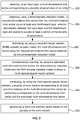
- FIG. 2 illustrates an exemplary flow diagram illustrating a method for detecting anomaly in multi-dimensional time series based on sparse neural network using the system 100 of FIG. 1 according to an embodiment of the present disclosure.
- the system 100 comprises one or more data storage devices or the memory 102 operatively coupled to the one or more hardware processors 104 and is configured to store instructions for execution of steps of the method by the one or more processors 104.
- the flow diagram depicted in FIG. 2 is better understood by way of following explanation/description.
- An RNN based Encoder-decoder anomaly detection (EncDec-AD) as shown in FIG. 3A first trains a recurrent neural network encoder-decoder (RNN-ED) as a temporal autoencoder using reconstruction error as a loss function.
- the autoencoder is trained on normal time series such that the network learns to reconstruct a normal time series well but is likely not to reconstruct an anomalous time series.
- the reconstruction error is then used to obtain an anomaly score.
- RNN-ED Recurrent neural network Encoded-decoder
- T denote a multivariate real-valued time series x 1 , x 2 ,..., x T of length T where each x t ⁇ R d , (d being the input dimension, e.g. number of sensors in our case).
- the overall process can be thought of as a non-linear mapping of the input multivariate time series to a fixed-dimensional vector z T i via an encoder function f E , followed by another non-linear mapping of the fixed-dimensional vector to a multivariate time series via a decoder function f D .
- N is the number of multivariate time series instances in training set
- ⁇ . ⁇ 2 denotes L 2 -norm
- W E and W D represent the parameters of the encoder and decoder RNNs, respectively.
- a t i e t i ⁇ ⁇ T ⁇ ⁇ 1 e t i ⁇ ⁇
- ⁇ and ⁇ are the mean and covariance matrix of the error vectors corresponding to the normal training time series instances.
- This anomaly score can be obtained in an online setting by using a window of length T ending at current time t as the input, making it possible to generate timely alarms related to anomalous behavior.
- a point x t i is classified as anomalous if a t i > ⁇ ; the threshold ⁇ can be learned using a hold-out validation set while optimizing for F-score.
- the one or more hardware processors 104 receive, at an input layer, a multi-dimensional time series corresponding to a plurality of parameters of an entity (e.g., in this case entity can be a user, or a machine, and the like).
- entity e.g., in this case entity can be a user, or a machine, and the like.
- each dimension of the multi-dimensional time series corresponds to at least one parameter from the plurality of parameters of the entity.
- the one or more hardware processors 104 obtain, using a dimensionality reduction model, a reduced-dimensional time series from the multi-dimensional time series via an at least one feedforward layer.
- connections between the input layer and the feedforward layer are sparse to access at least a portion of the plurality of parameters.
- a sparsity constraint is added on the weights of the feedforward layer such that each unit in the feedforward layer has access to a subset of the input parameters (e.g., input dimensions).
- a feedforward layer with sparse connections W R from the input layer is used to map x t i ⁇ R d to y t i ⁇ R r , such that r ⁇ d , through a non-linear transformation via Rectified Linear Units (ReLU).
- the sparse feedforward layer and the RNN-ED are trained in an end-to-end manner via stochastic gradient descent.
- ⁇ ⁇ W R ⁇ ⁇ w i sign ( w i ), w i ⁇ 0, where w i is an element of matrix W R .
- the training means here learning the outputs of each stage/step (202-208) as in FIG. 2 .
- L 1 -norm is not differentiable at 0, the subgradient 0 is used in practice.
- the dimensionality reduction model includes the plurality of feedforward layers with LASSO sparsity constraint.
- each of the parameters in the reduced-dimensional time series is a non-linear function of a subset of the multi-dimensional time series.
- each dimension of y t i is a linear combination of a relatively small number of input dimensions, effectively resulting in unsupervised feature selection.
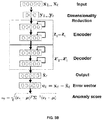
- the one or more hardware processors 104 estimate, via the recurrent neural network (RNN) encoder-decoder model, the multi-dimensional time series using the reduced-dimensional time series obtained by the dimensionality reduction model as illustrated in FIG. 3B .
- FIG. 3B depicts a recurrent neural network encoder-decoder (RNN-ED) model implemented by the system 100 of FIG. 1 in accordance with some embodiments of the present disclosure.
- RNN-ED recurrent neural network encoder-decoder
- the autoencoder is trained to reconstruct the original time series itself.
- the sparse feedforward layer acts as a strong regularizer such that the reduced dimensions in the ReLU layer are forced to capture the information relevant to reconstruct all the original input dimensions.
- the one or more hardware processors 104 simultaneously learn, by using the estimated multi-dimensional time series, the dimensionality reduction model and the RNN encoder-decoder model to obtain a multi-layered sparse neural network.
- the learning encompasses inputs and outputs at each step/stage (202-208) as in FIG. 2 .
- the one or more hardware processors 104 compute, by the multi-layered sparse neural network, a plurality of error vectors corresponding to at least one time instant of the multi-dimensional time series by performing a comparison of the multi-dimensional time series and the estimated multi-dimensional time series.
- the one or more hardware processors 104 generate a one or more anomaly score based on the plurality of the error vectors.
- an anomaly score is computed once the system 100 is trained.
- each of the plurality of parameters in the reduced-dimensional time series is a non-linear function of a subset of the plurality of parameters of the multi-dimensional time series.
- the dimensionality reduction model comprises a plurality of feedforward layers with Least Absolute Shrinkage and Selection Operator (LASSO) sparsity constraint on plurality of parameters of the feedforward layers.
- this approach further includes the step of classifying at least one time instance in the multi-dimensional time series as anomalous if the anomaly score is greater than a threshold.
- this approach further includes the step of classifying at least one time instance in the multi-dimensional time series as normal if the anomaly score is less than or equal to the threshold.
- F-score corresponding to a binary classifier with two classes i.e. a normal class (0) and an anomalous class (1).
- this ensures that the anomaly scores are still interpretable as contribution of each original dimension to the anomaly score can be estimated.
- RNN-ED ensures that the temporal dependencies are well captured in the network while the sparse feedforward layer ensures that the dependencies between various dimensions at any given time are well captured.
- the sparse neural network encoder-decoder may be compared with standard EncDec-AD (i.e. hereinafter referred as AD).
- AD standard EncDec-AD
- the system and method of the present disclosure utilized three multi-sensor time series datasets as summarized in Table 4 for the experiments: i) GHL: a publicly available Gasoil Heating Loop dataset, ii) Turbomachinery: a real-world turbomachinery dataset, and iii) Pulverizer: a real-world pulverizer dataset. Anomalies in GHL dataset correspond to cyber-attacks on the system, while anomalies in Turbomachinery and Pulverizer dataset correspond to faulty behavior of system. Each dataset was divided into train, validation and test sets - whereas the train and validation sets contained only normal time series, the test set contained normal as well as anomalous time series.
- GHL GHL dataset contained data for normal operations of a gasoil plant heating loop, and faulty behavior (due to cyber-attacks) in a plant induced by changing the control logic of the loop. There were 14 main variables and 5 auxiliary variables: considering 14 main variables, utilized fault IDs 25-48, and utilized Danger sensor as ground truth (1: Anomalous, 0: Normal). The original time-series was downsampled by 4 for computational efficiency using 4-point average, and a window of 100 points was taken (or considered) to generate time-series instances.
- Turbomachinery This was a real-world dataset with per minute sensor readings from 56 sensors, recorded for 4 days of operation with faulty signature being present for 1 hour before a forced shutdown.
- the sensors considered include temperature, pressure, control sensors, etc. belonging to different components of the machine. Out of these 56 sensors, the fault first appeared in only 2 sensors. Eventually, few other sensors also started showing anomalous behavior.
- Pulverizer was a real-world dataset obtained from a pulverizer mill with per-minute sensor readings from 35 sensors. This dataset had sensor readings of 45 days of operation, and symptoms of fault start appearing intermittently for 12 hours before forced shutdown. The sensors considered include temperature, differential pressure, load, etc. belonging to different components of the machine. This dataset had 3 relevant sensors sufficient to identify the anomalous behavior.
- Table 4 Details of datasets.
- T window length
- d no. of sensors
- d r no. of relevant sensors for anomaly
- p no. of principal components
- n f no. of faults
- n a no. of anomalous points
- n no. of windows.
- Pulverizer 60 35 3 13 1 443 16,344
- the system and method utilizes Adam optimizer for optimizing the weights of the networks with initial learning rate of 0.0005 for all experiments.
- AD refers to EncDec-AD. With reference to the FIG. 4A-4C, FPR corresponds to false positive rate lies in X- axis and TPR corresponds to True positive rate lies in Y - axis.
- the RNN based autoencoders for anomaly detection may yield sub-optimal performance in practice for multi-dimensional time series.
- the proposed SPREAD of the system 100 explicitly provisions for dimensionality reduction layer trained in an end-to-end manner along with the autoencoder and acts as a strong regularizer for multi-dimensional time series modeling. SPREAD works in an online manner which is desirable for streaming applications.
- the embodiments of present disclosure allows learning a robust non-linear temporal model of multivariate time series.
- the embodiments herein capture relation between the multiple parameters at same time instance, i.e. dependencies and correlations between multiple dimensions or parameters at a given point in time.
- the proposed approach captures temporal relations between multiple parameters over time, i.e. dependencies and correlations between multiple dimensions or variables in a multivariate time series over a period of time.
- the proposed approach allows to learn a single neural network model that can cater to the above two capabilities in an end-to-end learning framework that is trainable via backpropagation.
- the hardware device can be any kind of device which can be programmed including e.g. any kind of computer like a server or a personal computer, or the like, or any combination thereof.
- the device may also include means which could be e.g. hardware means like e.g. an application-specific integrated circuit (ASIC), a field-programmable gate array (FPGA), or a combination of hardware and software means, e.g.
- ASIC application-specific integrated circuit
- FPGA field-programmable gate array
- the means can include both hardware means and software means.
- the method embodiments described herein could be implemented in hardware and software.
- the device may also include software means.
- the embodiments may be implemented on different hardware devices, e.g. using a plurality of CPUs.
- the embodiments herein can comprise hardware and software elements.
- the embodiments that are implemented in software include but are not limited to, firmware, resident software, microcode, etc.
- the functions performed by various modules described herein may be implemented in other modules or combinations of other modules.
- a computer-usable or computer readable medium can be any apparatus that can comprise, store, communicate, propagate, or transport the program for use by or in connection with the instruction execution system, apparatus, or device.
- a computer-readable storage medium refers to any type of physical memory on which information or data readable by a processor may be stored.
- a computer-readable storage medium may store instructions for execution by one or more processors, including instructions for causing the processor(s) to perform steps or stages consistent with the embodiments described herein.
- the term "computer-readable medium” should be understood to include tangible items and exclude carrier waves and transient signals, i.e., be non-transitory. Examples include random access memory (RAM), read-only memory (ROM), volatile memory, nonvolatile memory, hard drives, CD ROMs, DVDs, flash drives, disks, and any other known physical storage media.
Landscapes
- Engineering & Computer Science (AREA)
- Theoretical Computer Science (AREA)
- Physics & Mathematics (AREA)
- Software Systems (AREA)
- General Physics & Mathematics (AREA)
- General Engineering & Computer Science (AREA)
- Data Mining & Analysis (AREA)
- Life Sciences & Earth Sciences (AREA)
- Artificial Intelligence (AREA)
- Evolutionary Computation (AREA)
- Computing Systems (AREA)
- General Health & Medical Sciences (AREA)
- Computational Linguistics (AREA)
- Biophysics (AREA)
- Mathematical Physics (AREA)
- Biomedical Technology (AREA)
- Health & Medical Sciences (AREA)
- Molecular Biology (AREA)
- Computer Vision & Pattern Recognition (AREA)
- Computer Security & Cryptography (AREA)
- Computer Hardware Design (AREA)
- Bioinformatics & Cheminformatics (AREA)
- Bioinformatics & Computational Biology (AREA)
- Evolutionary Biology (AREA)
- Debugging And Monitoring (AREA)
- Testing And Monitoring For Control Systems (AREA)
- Image Analysis (AREA)
Abstract
Description
- The present application claims priority to Indian Patent Application No.
201821025602, filed on July 09th, 2018 - The disclosure herein generally relates to time series analysis, and, more particularly, to systems and methods for anomaly detection in multi-dimensional time series based on Sparse neural network.
- In the current Digital Era, streaming data is ubiquitous and growing at a rapid pace, enabling automated monitoring of systems, e.g. using Industrial Internet of Things with large number of sensors capturing the operational behavior of an equipment. Complex industrial systems such as engines, turbines, aircrafts, etc., are typically instrumented with a large number (tens or even hundreds) of sensors resulting in multi-dimensional streaming data. There is a growing interest among original equipment manufacturers (OEMs) to leverage this data to provide remote health monitoring services and help field engineers take informed decisions.
- Anomaly detection from time series is one of the key components in building any health monitoring system. For example, detecting early symptoms of an impending fault in a machine in form of anomalies can help take corrective measures to avoid the fault or reduce maintenance cost and machine downtime. Recently, Recurrent Neural Networks (RNNs) have found extensive applications for anomaly detection in multivariate time series by building a model of normal behavior of complex systems from multi-sensor data, and then flagging deviations from the learned normal behavior as anomalies. Consequently, the notion of finding meaningful anomalies becomes substantially more complex in multi-dimensional data.
- Domain-driven sensor selection for anomaly detection using RNNs is restricted by the knowledge of important sensors to capture a given set of anomalies, and would therefore miss other types of anomalous signatures in any sensor not included in the set of relevant sensors. Similarly, approaches considering each sensor or a subset of sensors independently to handle such scenarios may not be appropriate given that: a) it leads to loss of useful sensor-dependency information, and b) when the number of sensors is large, building and deploying a separate RNN model for each sensor may be impractical and computationally infeasible. However, existing anomaly detection approaches are not very effective for multi-dimensional time series.
- Embodiments of the present disclosure present technological improvements as solutions to one or more of the above-mentioned technical problems recognized by the inventors in conventional systems. For example, in one aspect, a processor implemented method for detecting anomaly in multi-dimensional time series based on sparse neural network is provided. The method comprises receiving, at an input layer, a multi-dimensional time series corresponding to a plurality of parameters of an entity; obtaining, using a dimensionality reduction model, a reduced-dimensional time series from the multi-dimensional time series via an at least one feedforward layer, wherein connections between the input layer and the feedforward layer are sparse to access at least a portion of the plurality of parameters; estimating, by using a recurrent neural network (RNN) encoder-decoder model, the multi-dimensional time series using the reduced-dimensional time series obtained by the dimensionality reduction model; simultaneously learning, by using the estimated multi-dimensional time series, the dimensionality reduction model and the RNN encoder-decoder model to obtain a multi-layered sparse neural network; computing, by using the multi-layered sparse neural network, a plurality of error vectors corresponding to at least one time instance of the multi-dimensional time series by performing a comparison of the multi-dimensional time series and the estimated multi-dimensional time series; and generating at least one anomaly score based on the plurality of the error vectors.
- In an embodiment, each of the plurality of parameters in the reduced-dimensional time series is a non-linear function of a subset of the plurality of parameters of the multi-dimensional time series. The dimensionality reduction model includes a plurality of feedforward layers with Least Absolute Shrinkage and Selection Operator (LASSO) sparsity constraint on plurality of parameters of the feedforward layers. The method may further comprise classifying at least one time instance in the multi-dimensional time series as anomalous if the anomaly score is greater than a threshold (e.g., a dynamic threshold). The method may further comprise classifying at least one time instance in the multi-dimensional time series as normal if the anomaly score is less than or equal to the threshold. The threshold may be learned based on a hold-out validation set while maximizing F-score. The hold-out validation set comprises at least one normal time instance and at least one anomalous time instance of the multi-dimensional time series.
- In another aspect, there is provided a processor implemented system for detecting anomaly in multi-dimensional time series based on sparse neural network. The system comprises: a memory storing instructions; one or more communication interfaces; and one or more hardware processors coupled to the memory via the one or more communication interfaces, wherein the one or more hardware processors are configured by the instructions to: receive, at an input layer, a multi-dimensional time series corresponding to a plurality of parameters of an entity; obtain, using a dimensionality reduction model, a reduced-dimensional time series from the multi-dimensional time series via an at least one feedforward layer, wherein connections between the input layer and the feedforward layer are sparse to access at least a portion of the plurality of parameters; estimate, by using a recurrent neural network (RNN) encoder-decoder model, the multi-dimensional time series using the reduced-dimensional time series obtained by the dimensionality reduction model; simultaneously learn, by using the estimated multi-dimensional time series, the dimensionality reduction model and the RNN encoder-decoder model to obtain a multi-layered sparse neural network; compute, by using the multi-layered sparse neural network, a plurality of error vectors corresponding to at least one time instance of the multi-dimensional time series by performing a comparison of the multi-dimensional time series and the estimated multi-dimensional time series; and generate at least one anomaly score based on the plurality of the error vectors.
- In an embodiment, each of the plurality of parameters in the reduced-dimensional time series is a non-linear function of a subset of the plurality of parameters of the multi-dimensional time series. In an embodiment, the dimensionality reduction model includes a plurality of feedforward layers with Least Absolute Shrinkage and Selection Operator (LASSO) sparsity constraint on plurality of parameters of the feedforward layers. In an embodiment, the one or more hardware processors are further configured to: classify at least one time instance in the multi-dimensional time series as anomalous if the anomaly score is greater than a threshold (e.g., a dynamic threshold) and classify at least one time instance in the multi-dimensional time series as normal if the anomaly score is less than or equal to the threshold. The threshold may be learned based on a hold-out validation set while maximizing for F-score. The hold-out validation set may comprise at least one normal time instance and at least one anomalous time instance of the multi-dimensional time series.
- In yet another aspect, there are provided one or more non-transitory machine readable information storage mediums comprising one or more instructions which when executed by one or more hardware processors causes receiving, at an input layer, a multi-dimensional time series corresponding to a plurality of parameters of an entity; obtaining, using a dimensionality reduction model, a reduced-dimensional time series from the multi-dimensional time series via an at least one feedforward layer, wherein connections between the input layer and the feedforward layer are sparse to access at least a portion of the plurality of parameters; estimating, by using a recurrent neural network (RNN) encoder-decoder model, the multi-dimensional time series using the reduced-dimensional time series obtained by the dimensionality reduction model; simultaneously learning, by using the estimated multi-dimensional time series, the dimensionality reduction model and the RNN encoder-decoder model to obtain a multi-layered sparse neural network; computing, by using the multi-layered sparse neural network, a plurality of error vectors corresponding to at least one time instance of the multi-dimensional time series by performing a comparison of the multi-dimensional time series and the estimated multi-dimensional time series; and generating at least one anomaly score based on the plurality of the error vectors.
- In an embodiment, the instructions when executed by the one or more hardware processors may further cause each of the plurality of parameters in the reduced-dimensional time series to be a non-linear function of a subset of the plurality of parameters of the multi-dimensional time series. The dimensionality reduction model includes a plurality of feedforward layers with Least Absolute Shrinkage and Selection Operator (LASSO) sparsity constraint on plurality of parameters of the feedforward layers. The method may further comprise classifying at least one time instance in the multi-dimensional time series as anomalous if the anomaly score is greater than a threshold (e.g., a dynamic threshold). The method may further comprise classifying at least one time instance in the multi-dimensional time series as normal if the anomaly score is less than or equal to the threshold. The threshold (e.g., a dynamic threshold) may be learned based on a hold-out validation set while maximizing for F-score. The hold-out validation set may comprise at least one normal time instance and at least one anomalous time instance of the multi-dimensional time series.
- It is to be understood that both the foregoing general description and the following detailed description are exemplary and explanatory only and are not restrictive of the invention, as claimed.
- The accompanying drawings, which are incorporated in and constitute a part of this disclosure, illustrate exemplary embodiments and, together with the description, serve to explain the disclosed principles.
-
FIG. 1 illustrates an exemplary block diagram of a system for detecting anomaly in multi-dimensional time series based on sparse neural network in accordance with an embodiment of the present disclosure. -
FIG. 2 illustrates an exemplary flow diagram illustrating a method for detecting anomaly in multi-dimensional time series based on sparse neural network using the system ofFIG. 1 according to an embodiment of the present disclosure. -
FIG. 3A depicts a Standard Recurrent Neural Network (RNN) Encoder-Decoder. -
FIG. 3B depicts a Sparse Neural Network based anomaly detection as implemented by thesystem 100 ofFIG. 1 in accordance with some embodiments of the present disclosure. -
FIG. 3C depicts a comparison between the Standard RNN Encoder-Decoder and the Sparse Neural Network in accordance with some embodiments of the present disclosure. -
FIG. 4A-4C depicts a graphical representation illustrating Performance Comparison of Anomaly Detection Models in terms of AUROC in accordance with an exemplary embodiment of the present disclosure. - Exemplary embodiments are described with reference to the accompanying drawings. In the figures, the left-most digit(s) of a reference number identifies the figure in which the reference number first appears. Wherever convenient, the same reference numbers are used throughout the drawings to refer to the same or like parts. While examples and features of disclosed principles are described herein, modifications, adaptations, and other implementations are possible without departing from the spirit and scope of the disclosed embodiments. It is intended that the following detailed description be considered as exemplary only, with the true scope and spirit being indicated by the following claims.
- In the present disclosure, embodiments and systems and methods associated thereof provide an efficient way for extension to such approaches for multi-dimensional time series. The present approach combines advantages of non-temporal dimensionality reduction techniques and recurrent autoencoders for time series modeling through an end-to-end learning framework. The recurrent encoder gets sparse access to the input dimensions via a feedforward layer while the recurrent decoder is forced to reconstruct all the input dimensions, thereby leading to better regularization and a robust temporal model. The autoencoder thus trained on normal time series is likely to give a high reconstruction error, and a corresponding high anomaly score, for any anomalous time series pattern.
- The present disclosure proposes Sparse Neural Network based Anomaly Detection, or (SPREAD): an approach that combines the point-wise (i.e. non-temporal) dimensionality reduction via one or more sparsely connected feedforward layers over the input layer with a recurrent neural encoder-decoder in an end-to-end learning setting to model the normal behavior of a system. Once a model for normal behavior is learned, it can be used for detecting behavior deviating from normal by analyzing the reconstruction via a recurrent decoder that attempts to reconstruct the original time series back using output of the recurrent encoder. Having been trained only on normal data, the model is likely to fail in reconstructing an anomalous time series and result in high reconstruction error. This error in reconstruction is used to obtain an anomaly score.
- In the present disclosure, further efficacy with significant improvement is observed by implementation of the proposed approach through experiments on a public dataset and two real-world datasets in anomaly detection performance over several baselines. The proposed approach is able to perform well even without knowledge of relevant dimensions carrying the anomalous signature in a multi-dimensional setting. The present disclosure further proposes an effective way to leverage sparse networks via L1 regularization for anomaly detection in multi-dimensional time series.
- Referring now to the drawings, and more particularly to
FIGS. 1 through FIG. 4A-4C , where similar reference characters denote corresponding features consistently throughout the figures, there are shown preferred embodiments and these embodiments are described in the context of the following exemplary system and/or method. -
FIG. 1 illustrates an exemplary block diagram of asystem 100 for detecting anomaly in multi-dimensional time series based on sparse neural network in accordance with an embodiment of the present disclosure. In an embodiment, thesystem 100 includes one ormore processors 104, communication interface device(s) or input/output (I/O) interface(s) 106, and one or more data storage devices ormemory 102 operatively coupled to the one ormore processors 104. Thememory 102 comprises adatabase 108. The one ormore processors 104 that are hardware processors can be implemented as one or more microprocessors, microcomputers, microcontrollers, digital signal processors, central processing units, state machines, logic circuitries, and/or any devices that manipulate signals based on operational instructions. Among other capabilities, the processor(s) is configured to fetch and execute computer-readable instructions stored in the memory. In an embodiment, thesystem 100 can be implemented in a variety of computing systems, such as laptop computers, notebooks, hand-held devices, workstations, mainframe computers, servers, a network cloud and the like. - The I/O interface device(s) 106 can include a variety of software and hardware interfaces, for example, a web interface, a graphical user interface, and the like and can facilitate multiple communications within a wide variety of networks N/W and protocol types, including wired networks, for example, LAN, cable, etc., and wireless networks, such as WLAN, cellular, or satellite. In an embodiment, the I/O interface device(s) can include one or more ports for connecting a number of devices to one another or to another server.
- The
memory 102 may include any computer-readable medium known in the art including, for example, volatile memory, such as static random access memory (SRAM) and dynamic random access memory (DRAM), and/or non-volatile memory, such as read only memory (ROM), erasable programmable ROM, flash memories, hard disks, optical disks, and magnetic tapes. - The
database 108 may store information but are not limited to, a plurality of parameters obtained from one or more sensors, wherein the parameters are specific to an entity (e.g., user, machine, and the like). In an embodiment, one or more sensors may be a temperature sensor, a motion sensor, a pressure sensor, a vibration sensor and the like. Parameters may comprise sensor data captured through the sensors either connected to the user and/or machine. Further, thedatabase 108 stores information pertaining to inputs fed to thesystem 100 and/or outputs generated by the system (e.g., at each stage), specific to the methodology described herein. More specifically, thedatabase 108 stores information being processed at each step of the proposed methodology. -
FIG. 2 , with reference toFIG. 1 , illustrates an exemplary flow diagram illustrating a method for detecting anomaly in multi-dimensional time series based on sparse neural network using thesystem 100 ofFIG. 1 according to an embodiment of the present disclosure. In an embodiment, thesystem 100 comprises one or more data storage devices or thememory 102 operatively coupled to the one ormore hardware processors 104 and is configured to store instructions for execution of steps of the method by the one ormore processors 104. The flow diagram depicted inFIG. 2 is better understood by way of following explanation/description. - An RNN based Encoder-decoder anomaly detection (EncDec-AD) as shown in
FIG. 3A first trains a recurrent neural network encoder-decoder (RNN-ED) as a temporal autoencoder using reconstruction error as a loss function. The autoencoder is trained on normal time series such that the network learns to reconstruct a normal time series well but is likely not to reconstruct an anomalous time series. The reconstruction error is then used to obtain an anomaly score. - More specifically,
FIG. 3B , with reference toFIGS. 1 through 2 , depict sparse neural network encoder-decoder based anomaly detection as implemented by thesystem 100 ofFIG. 1 in accordance with some embodiments of the present disclosure. More specifically, Recurrent neural network Encoded-decoder (RNN-ED) is trained in such a manner that the target time series


- Given the error vector


- The steps of the method of the present disclosure will now be explained with reference to the components of the
system 100 as depicted inFIG. 1 , and the flow diagram ofFIG. 2 . In an embodiment of the present disclosure, atstep 202, the one ormore hardware processors 104 receive, at an input layer, a multi-dimensional time series corresponding to a plurality of parameters of an entity (e.g., in this case entity can be a user, or a machine, and the like). In an embodiment, each dimension of the multi-dimensional time series corresponds to at least one parameter from the plurality of parameters of the entity. In an embodiment of the present disclosure, atstep 204, the one ormore hardware processors 104 obtain, using a dimensionality reduction model, a reduced-dimensional time series from the multi-dimensional time series via an at least one feedforward layer. In one embodiment, connections between the input layer and the feedforward layer are sparse to access at least a portion of the plurality of parameters. In one embodiment, a provision for mapping each multi-dimensional point in the input time series to a reduced-dimensional point via a feedforward dimensionality reduction layer, and then use the time series in reduced-dimensional space to reconstruct the original multi-dimensional time series via RNN-ED, as in EncDec- AD. - A sparsity constraint is added on the weights of the feedforward layer such that each unit in the feedforward layer has access to a subset of the input parameters (e.g., input dimensions). A feedforward layer with sparse connections WR from the input layer is used to map


FIG. 2 . As L1-norm is not differentiable at 0, thesubgradient 0 is used in practice. In one embodiment, the dimensionality reduction model includes the plurality of feedforward layers with LASSO sparsity constraint. For example, each of the parameters in the reduced-dimensional time series is a non-linear function of a subset of the multi-dimensional time series. - The resulting sparse weight matrix W R ensures that the connections between the input layer and the feedforward layer are sparse such that each unit in the feedforward layer potentially has access to only a few of the input dimensions. Therefore, each dimension of

- In an embodiment of the present disclosure, at
step 206, the one ormore hardware processors 104 estimate, via the recurrent neural network (RNN) encoder-decoder model, the multi-dimensional time series using the reduced-dimensional time series obtained by the dimensionality reduction model as illustrated inFIG. 3B . More specifically,FIG. 3B , with reference toFIGS. 1 through 3A , depicts a recurrent neural network encoder-decoder (RNN-ED) model implemented by thesystem 100 ofFIG. 1 in accordance with some embodiments of the present disclosure. In one embodiment even though the ReLU layer implies dimensionality reduction, the autoencoder is trained to reconstruct the original time series itself. In one embodiment, the sparse feedforward layer acts as a strong regularizer such that the reduced dimensions in the ReLU layer are forced to capture the information relevant to reconstruct all the original input dimensions. - In an embodiment of the present disclosure, at
step 208, the one ormore hardware processors 104 simultaneously learn, by using the estimated multi-dimensional time series, the dimensionality reduction model and the RNN encoder-decoder model to obtain a multi-layered sparse neural network. In an embodiment, the learning encompasses inputs and outputs at each step/stage (202-208) as inFIG. 2 . In an embodiment of the present disclosure, atstep 210, the one ormore hardware processors 104 compute, by the multi-layered sparse neural network, a plurality of error vectors corresponding to at least one time instant of the multi-dimensional time series by performing a comparison of the multi-dimensional time series and the estimated multi-dimensional time series. In an embodiment of the present disclosure, atstep 212, the one ormore hardware processors 104 generate a one or more anomaly score based on the plurality of the error vectors. In an embodiment, an anomaly score is computed once thesystem 100 is trained. In an embodiment, each of the plurality of parameters in the reduced-dimensional time series is a non-linear function of a subset of the plurality of parameters of the multi-dimensional time series. - In another embodiment, the dimensionality reduction model comprises a plurality of feedforward layers with Least Absolute Shrinkage and Selection Operator (LASSO) sparsity constraint on plurality of parameters of the feedforward layers. In an embodiment, this approach further includes the step of classifying at least one time instance in the multi-dimensional time series as anomalous if the anomaly score is greater than a threshold. In an embodiment, this approach further includes the step of classifying at least one time instance in the multi-dimensional time series as normal if the anomaly score is less than or equal to the threshold. In an embodiment, F-score corresponding to a binary classifier with two classes i.e. a normal class (0) and an anomalous class (1).
- In one embodiment, this ensures that the anomaly scores are still interpretable as contribution of each original dimension to the anomaly score can be estimated. In another embodiment, RNN-ED ensures that the temporal dependencies are well captured in the network while the sparse feedforward layer ensures that the dependencies between various dimensions at any given time are well captured.
- In the present disclosure, the sparse neural network encoder-decoder (SPREAD) may be compared with standard EncDec-AD (i.e. hereinafter referred as AD). The other approaches used for comparison are:
- i. A simple non-temporal anomaly detection model, namely MD, based on Mahalanobis Distance in the multi-dimensional input space using µ and ∑ of the original point-wise inputs from the train instances (similar to the equation 2 where x t is used instead of e t to get the anomaly score).
- ii. Relevant-AD where AD model is trained only on the most relevant parameters sufficient to determine the anomalous behavior or fault (as suggested by domain experts). This is used to evaluate the efficacy of SPREAD in being able to detect weak anomaly signatures present in only a small subset of the large number of input sensors.
- iii. To compare implicit dimensionality reduction in SPREAD via end-to-end learning with standard dimensionality reduction techniques, PCA-AD is considered, where Principal Components Analysis (PCA) is first used to reduce the dimension of input being fed to AD (considering top principal components capturing 95% of the variance in data).
- iv. To evaluate the effect of sparse connections in the feedforward layer with LASSO sparsity constraint, FF-AD (feedforward EncDec-AD) model is considered which is effectively SPREAD without the L1 regularization (i.e. λ= 0).
- v. For performance evaluation, each point in a time series is provided ground truth as 0 (normal) or 1 (anomalous). Anomaly score is obtained for each point in an online manner, and Area under Receiver Operating Characteristic curve (AUROC) (obtained by varying the threshold τ) is used as a performance metric.
- The system and method of the present disclosure utilized three multi-sensor time series datasets as summarized in Table 4 for the experiments: i) GHL: a publicly available Gasoil Heating Loop dataset, ii) Turbomachinery: a real-world turbomachinery dataset, and iii) Pulverizer: a real-world pulverizer dataset. Anomalies in GHL dataset correspond to cyber-attacks on the system, while anomalies in Turbomachinery and Pulverizer dataset correspond to faulty behavior of system. Each dataset was divided into train, validation and test sets - whereas the train and validation sets contained only normal time series, the test set contained normal as well as anomalous time series.
- GHL: GHL dataset contained data for normal operations of a gasoil plant heating loop, and faulty behavior (due to cyber-attacks) in a plant induced by changing the control logic of the loop. There were 14 main variables and 5 auxiliary variables: considering 14 main variables, utilized fault IDs 25-48, and utilized Danger sensor as ground truth (1: Anomalous, 0: Normal). The original time-series was downsampled by 4 for computational efficiency using 4-point average, and a window of 100 points was taken (or considered) to generate time-series instances.
- Turbomachinery: This was a real-world dataset with per minute sensor readings from 56 sensors, recorded for 4 days of operation with faulty signature being present for 1 hour before a forced shutdown. The sensors considered include temperature, pressure, control sensors, etc. belonging to different components of the machine. Out of these 56 sensors, the fault first appeared in only 2 sensors. Eventually, few other sensors also started showing anomalous behavior.
- Pulverizer: Pulverizer was a real-world dataset obtained from a pulverizer mill with per-minute sensor readings from 35 sensors. This dataset had sensor readings of 45 days of operation, and symptoms of fault start appearing intermittently for 12 hours before forced shutdown. The sensors considered include temperature, differential pressure, load, etc. belonging to different components of the machine. This dataset had 3 relevant sensors sufficient to identify the anomalous behavior.
-
Table 4: Details of datasets. Here T: window length, d: no. of sensors, dr: no. of relevant sensors for anomaly, p: no. of principal components, nf : no. of faults, na : no. of anomalous points, n: no. of windows. Dataset dr nf na n GHL 100 14 1 9 24 8,564 32,204 Turbomachinery 20 56 2 10 2 57 4353 Pulverizer 60 35 3 13 1 443 16,344 - The system and method utilizes Adam optimizer for optimizing the weights of the networks with initial learning rate of 0.0005 for all experiments. The system and method utilizes architecture as the one with least reconstruction error on the holdout validation set containing only normal time series via grid search on following hyper-parameters: number of recurrent layers in RNN encoder and decoder L = {1, 2, 3}, number of hidden units per layer in the range of 50-250 in steps of 50, and number of units

Table 1: Performance Comparison of Anomaly Detection Models in terms of AUROC. AD refers to EncDec-AD. With reference to the FIG. 4A-4C, FPR corresponds to false positive rate lies in X- axis and TPR corresponds to True positive rate lies in Y - axis. Dataset Relevant -AD (402A-C) MD(404 A-C) PCA-AD (406 A-C) AD (408 A-C) FF-AD (410 A-C) SPREAD (412A-C) GHL 0.944 0.692 0.903 0.974 0.962 0.977 Turbomachinery 0.981 0.903 0.688 0.878 0.879 0.945 Pulverizer 0.882 0.812 0.757 0.953 0.966 0.964 Table 2: Sparsity Factors Approach GHL Turbomachinery Pulverizer FF-AD (λ=0) 0.041 0.045 0.074 SPREAD (λ=0.01) 0.491 0.310 0.581 Table 3: Turbomachinery: Effect of treating sensors independently Sensor R1 R2 R1 & R2 AUROC 0.888 0.922 0.981 - The following key observations from the results in Table 1 and a graphical representation illustrating Performance Comparison of Anomaly Detection Models in terms of AUROC in
Figure 4A-4C : - i. The non-temporal MD approach performs poorly across datasets highlighting the temporal nature of anomalies, and therefore, the applicability of temporal models including AD and SPREAD. It also suggests that Mahalanobis distance as applied in the error space instead of original input space amplifies the effect of weak temporal anomalies.
- ii. PCA-AD does not perform well compared to FF-AD and SPREAD suggesting that explicit dimensionality reduction via PCA leads to loss of information related to anomalous signatures, whereas FF-AD and SPREAD are able to leverage the benefits of internal dimensionality reduction via the feedforward dimensionality reduction layer.
- iii. As expected, Relevant-AD - leveraging the knowledge of relevant sensors - is a strong baseline. This highlights the fact that EncDec-AD performs well in low-dimensional cases such as the Relevant-AD scenario. In other words, poor performance of AD compared to Relevant-AD highlights that detecting anomalous signature is difficult when prior knowledge of relevant dimensions is not available - which is often the case in practice. However, for Pulverizer and GHL datasets, we observe that AD performs better than Relevant-AD because in these cases the effect of anomaly originating in a sensor is also visible in other correlated sensors making it easier to detect anomalies due to amplification of anomalous signature when considering more sensors together.
- iv. SPREAD performs significantly better compared to other methods on most datasets (except Relevant-AD as discussed above). SPREAD performs better than or comparable to FF-AD highlighting the regularizing effect of sparse connections. Sparsity factors (Table 2) indicate sparse nature of connections in SPREAD compared to FF-AD. The sparsity factor is measured as the fraction of weights with absolute value < 0.1 times the average of absolute weights.
- v. Relevant-AD was applied on Turbomachinery dataset with the two relevant sensors R1 and R2 considered independently, and a significant drop in performance compared to model using both the relevant sensors together was observed as shown in Table 3. This suggests that capturing correlation (or dependence) between sensors is important for detecting anomalies.
- The RNN based autoencoders for anomaly detection may yield sub-optimal performance in practice for multi-dimensional time series. To address this, the proposed SPREAD of the
system 100 explicitly provisions for dimensionality reduction layer trained in an end-to-end manner along with the autoencoder and acts as a strong regularizer for multi-dimensional time series modeling. SPREAD works in an online manner which is desirable for streaming applications. - Experiments on a public dataset and two real-world datasets prove the efficacy of the proposed approach. Further, even though SPREAD uses dimensionality reduction internally, anomaly detection happens in the input feature space such that reconstruction error for each input dimension is accessible making the anomaly scores interpretable in practice. This proposed approach shall not be construed as a limiting scope for scenarios and/or examples described in the present disclosure and can be applicable to any multi-dimensional time series anomaly detection.
- The written description describes the subject matter herein to enable any person skilled in the art to make and use the embodiments. The scope of the subject matter embodiments is defined by the claims and may include other modifications that occur to those skilled in the art. Such other modifications are intended to be within the scope of the claims if they have similar elements that do not differ from the literal language of the claims or if they include equivalent elements with insubstantial differences from the literal language of the claims.
- The embodiments of present disclosure, allows learning a robust non-linear temporal model of multivariate time series. Moreover, the embodiments herein capture relation between the multiple parameters at same time instance, i.e. dependencies and correlations between multiple dimensions or parameters at a given point in time. Further, the proposed approach captures temporal relations between multiple parameters over time, i.e. dependencies and correlations between multiple dimensions or variables in a multivariate time series over a period of time. Further, the proposed approach allows to learn a single neural network model that can cater to the above two capabilities in an end-to-end learning framework that is trainable via backpropagation.
- It is to be understood that the scope of the protection is extended to such a program and in addition to a computer-readable means having a message therein; such computer-readable storage means contain program-code means for implementation of one or more steps of the method, when the program runs on a server or mobile device or any suitable programmable device. The hardware device can be any kind of device which can be programmed including e.g. any kind of computer like a server or a personal computer, or the like, or any combination thereof. The device may also include means which could be e.g. hardware means like e.g. an application-specific integrated circuit (ASIC), a field-programmable gate array (FPGA), or a combination of hardware and software means, e.g. an ASIC and an FPGA, or at least one microprocessor and at least one memory with software modules located therein. Thus, the means can include both hardware means and software means. The method embodiments described herein could be implemented in hardware and software. The device may also include software means. Alternatively, the embodiments may be implemented on different hardware devices, e.g. using a plurality of CPUs.
- The embodiments herein can comprise hardware and software elements. The embodiments that are implemented in software include but are not limited to, firmware, resident software, microcode, etc. The functions performed by various modules described herein may be implemented in other modules or combinations of other modules. For the purposes of this description, a computer-usable or computer readable medium can be any apparatus that can comprise, store, communicate, propagate, or transport the program for use by or in connection with the instruction execution system, apparatus, or device.
- The illustrated steps are set out to explain the exemplary embodiments shown, and it should be anticipated that ongoing technological development will change the manner in which particular functions are performed. These examples are presented herein for purposes of illustration, and not limitation. Further, the boundaries of the functional building blocks have been arbitrarily defined herein for the convenience of the description. Alternative boundaries can be defined so long as the specified functions and relationships thereof are appropriately performed. Alternatives (including equivalents, extensions, variations, deviations, etc., of those described herein) will be apparent to persons skilled in the relevant art(s) based on the teachings contained herein. Such alternatives fall within the scope and spirit of the disclosed embodiments. Also, the words "comprising," "having," "containing," and "including," and other similar forms are intended to be equivalent in meaning and be open ended in that an item or items following any one of these words is not meant to be an exhaustive listing of such item or items, or meant to be limited to only the listed item or items. It must also be noted that as used herein and in the appended claims, the singular forms "a," "an," and "the" include plural references unless the context clearly dictates otherwise.
- Furthermore, one or more computer-readable storage media may be utilized in implementing embodiments consistent with the present disclosure. A computer-readable storage medium refers to any type of physical memory on which information or data readable by a processor may be stored. Thus, a computer-readable storage medium may store instructions for execution by one or more processors, including instructions for causing the processor(s) to perform steps or stages consistent with the embodiments described herein. The term "computer-readable medium" should be understood to include tangible items and exclude carrier waves and transient signals, i.e., be non-transitory. Examples include random access memory (RAM), read-only memory (ROM), volatile memory, nonvolatile memory, hard drives, CD ROMs, DVDs, flash drives, disks, and any other known physical storage media.
- It is intended that the disclosure and examples be considered as exemplary only, with a true scope and spirit of disclosed embodiments being indicated by the following claims.
Claims (15)
- A processor implemented method, comprising:receiving, at an input layer, a multi-dimensional time series corresponding to a plurality of parameters of an entity (202);obtaining, using a dimensionality reduction model, a reduced-dimensional time series from the multi-dimensional time series via an at least one feedforward layer, wherein connections between the input layer and the feedforward layer are sparse to access at least a portion of the plurality of parameters (204);estimating, by using a recurrent neural network (RNN) encoder-decoder model, the multi-dimensional time series using the reduced-dimensional time series obtained by the dimensionality reduction model (206);simultaneously learning, by using the estimated multi-dimensional time series, the dimensionality reduction model and the RNN encoder-decoder model to obtain a multi-layered sparse neural network (208);computing, by using the multi-layered sparse neural network, a plurality of error vectors corresponding to at least one time instance of the multi-dimensional time series by performing a comparison of the multi-dimensional time series and the estimated multi-dimensional time series (210); andgenerating at least one anomaly score based on the plurality of the error vectors (212).
- The processor implemented method of claim 1, wherein each of the plurality of parameters in the reduced-dimensional time series is a non-linear function of a subset of the plurality of parameters of the multi-dimensional time series.
- The processor implemented method of claim 1, wherein the dimensionality reduction model comprises a plurality of feedforward layers with Least Absolute Shrinkage and Selection Operator (LASSO) sparsity constraint on plurality of parameters of the feedforward layers.
- The processor implemented method of claim 1, further comprising:(a) classifying at least one time instance in the multi-dimensional time series as anomalous if the anomaly score is greater than a threshold, or(b) classifying at least one time instance in the multi-dimensional time series as normal if the anomaly score is less than or equal to the threshold.
- The processor implemented method of claim 4, wherein the threshold is learned based on a hold-out validation set while maximizing F-score, wherein the hold-out validation set comprises at least one normal time instance and at least one anomalous time instance of the multi-dimensional time series.
- A system comprising:a memory (102) storing instructions;one or more communication interfaces (106); andone or more hardware processors (104) coupled to the memory (102) via the one or more communication interfaces (106), wherein the one or more hardware processors (104) are configured by the instructions to:receive, at an input layer, a multi-dimensional time series corresponding to a plurality of parameters of an entity;obtain, using a dimensionality reduction model, a reduced-dimensional time series from the multi-dimensional time series via an at least one feedforward layer, wherein connections between the input layer and the feedforward layer are sparse to access at least a portion of the plurality of parameters;estimate, by using a recurrent neural network (RNN) encoder-decoder model, the multi-dimensional time series using the reduced-dimensional time series obtained by the dimensionality reduction model;simultaneously learn, by using the estimated multi-dimensional time series, the dimensionality reduction model and the RNN encoder-decoder model to obtain a multi-layered sparse neural network;compute, by using the multi-layered sparse neural network, a plurality of error vectors corresponding to at least one time instance of the multi-dimensional time series by performing a comparison of the multi-dimensional time series and the estimated multi-dimensional time series; andgenerate at least one anomaly score based on the plurality of the error vectors.
- The system of claim 6, wherein each of the plurality of parameters in the reduced-dimensional time series is a non-linear function of a subset of the plurality of parameters of the multi-dimensional time series.
- The system of claim 6, wherein the dimensionality reduction model comprises a plurality of feedforward layers with Least Absolute Shrinkage and Selection Operator (LASSO) sparsity constraint on plurality of parameters of the feedforward layers.
- The system of claim 6, wherein the one or more hardware processors are further configured to:(a) classify at least one time instance in the multi-dimensional time series as anomalous if the anomaly score is greater than a threshold, or(b) classify at least one time instance in the multi-dimensional time series as normal if the anomaly score is less than or equal to the threshold.
- The system of claim 9, wherein the threshold is learned based on a hold-out validation set while maximizing F-score, wherein the hold-out validation set comprises at least one normal time instance and at least one anomalous time instance of the multi-dimensional time series.
- One or more non-transitory machine readable information storage mediums comprising one or more instructions which when executed by one or more hardware processors cause:receiving, at an input layer, a multi-dimensional time series corresponding to a plurality of parameters of an entity;obtaining, using a dimensionality reduction model, a reduced-dimensional time series from the multi-dimensional time series via an at least one feedforward layer, wherein connections between the input layer and the feedforward layer are sparse to access at least a portion of the plurality of parameters;estimating, by using a recurrent neural network (RNN) encoder-decoder model, the multi-dimensional time series using the reduced-dimensional time series obtained by the dimensionality reduction model;simultaneously learning, by using the estimated multi-dimensional time series, the dimensionality reduction model and the RNN encoder-decoder model to obtain a multi-layered sparse neural network;computing, by using the multi-layered sparse neural network, a plurality of error vectors corresponding to at least one time instance of the multi-dimensional time series by performing a comparison of the multi-dimensional time series and the estimated multi-dimensional time series; andgenerating at least one anomaly score based on the plurality of the error vectors.
- The one or more non-transitory machine readable information storage mediums of claim 11, wherein each of the plurality of parameters in the reduced-dimensional time series is a non-linear function of a subset of the plurality of parameters of the multi-dimensional time series.
- The one or more non-transitory machine readable information storage mediums of claim 11, wherein the dimensionality reduction model comprises a plurality of feedforward layers with Least Absolute Shrinkage and Selection Operator (LASSO) sparsity constraint on plurality of parameters of the feedforward layers.
- The one or more non-transitory machine readable information storage mediums of claim 11, further comprising:(a) classifying at least one time instance in the multi-dimensional time series as anomalous if the anomaly score is greater than a threshold, or(b) classifying at least one time instance in the multi-dimensional time series as normal if the anomaly score is less than or equal to the threshold.
- The one or more non-transitory machine readable information storage mediums of claim 14, wherein the threshold is learned based on a hold-out validation set while maximizing F-score, wherein the hold-out validation set comprises at least one normal time instance and at least one anomalous time instance of the multi-dimensional time series.
Applications Claiming Priority (1)
| Application Number | Priority Date | Filing Date | Title |
|---|---|---|---|
| IN201821025602 | 2018-07-09 |
Publications (3)
| Publication Number | Publication Date |
|---|---|
| EP3594860A1 true EP3594860A1 (en) | 2020-01-15 |
| EP3594860C0 EP3594860C0 (en) | 2024-05-08 |
| EP3594860B1 EP3594860B1 (en) | 2024-05-08 |
Family
ID=65817748
Family Applications (1)
| Application Number | Title | Priority Date | Filing Date |
|---|---|---|---|
| EP19162235.6A Active EP3594860B1 (en) | 2018-07-09 | 2019-03-12 | Sparse neural network based anomaly detection in multi-dimensional time series |
Country Status (6)
| Country | Link |
|---|---|
| US (1) | US11429837B2 (en) |
| EP (1) | EP3594860B1 (en) |
| JP (1) | JP6811276B2 (en) |
| AU (1) | AU2019201857B2 (en) |
| CA (1) | CA3037326C (en) |
| MX (1) | MX2019003167A (en) |
Families Citing this family (28)
| Publication number | Priority date | Publication date | Assignee | Title |
|---|---|---|---|---|
| JP7206898B2 (en) * | 2018-12-25 | 2023-01-18 | 富士通株式会社 | LEARNING DEVICE, LEARNING METHOD AND LEARNING PROGRAM |
| US20200285997A1 (en) * | 2019-03-04 | 2020-09-10 | Iocurrents, Inc. | Near real-time detection and classification of machine anomalies using machine learning and artificial intelligence |
| FR3095878B1 (en) * | 2019-05-10 | 2021-10-08 | Univ De Brest | Method of automatic image analysis to automatically recognize at least one rare characteristic |
| US11249861B2 (en) | 2020-02-06 | 2022-02-15 | Bank Of America Corporation | Multi-layered disaster recovery manager |
| US20210350232A1 (en) * | 2020-05-07 | 2021-11-11 | Nec Laboratories America, Inc. | Fault detection in cyber-physical systems |
| WO2022009275A1 (en) * | 2020-07-06 | 2022-01-13 | 日本電信電話株式会社 | Training method, training device, and program |
| CN112051953B (en) * | 2020-09-29 | 2021-09-14 | 中国银行股份有限公司 | Output control method and device for page column and electronic equipment |
| JP7542821B2 (en) * | 2020-10-27 | 2024-09-02 | 日本電信電話株式会社 | Learning method, sequence analysis method, learning device, sequence analysis device, and program |
| US20220138537A1 (en) * | 2020-11-02 | 2022-05-05 | International Business Machines Corporation | Probabilistic nonlinear relationships cross-multi time series and external factors for improved multivariate time series modeling and forecasting |
| JP7651293B2 (en) * | 2020-12-04 | 2025-03-26 | 株式会社東芝 | Learning device, analysis device, learning method, program, and storage medium |
| US12619714B2 (en) * | 2020-12-15 | 2026-05-05 | Oracle International Corporation | Coping with feature error suppression: a mechanism to handle the concept drift |
| US11630717B2 (en) * | 2021-01-06 | 2023-04-18 | Servicenow, Inc. | Machine-learning based similarity engine |
| US12405606B2 (en) * | 2021-01-22 | 2025-09-02 | Tata Consultancy Services Limited | System and method for performance and health monitoring to optimize operation of a pulverizer mill |
| US11831729B2 (en) | 2021-03-19 | 2023-11-28 | Servicenow, Inc. | Determining application security and correctness using machine learning based clustering and similarity |
| CN113011656B (en) * | 2021-03-22 | 2022-08-02 | 内蒙古电力(集团)有限责任公司内蒙古电力科学研究院分公司 | Power station auxiliary machine fault early warning method and system |
| US20220358356A1 (en) * | 2021-04-21 | 2022-11-10 | International Business Machines Corporation | Computerized methods of forecasting a timeseries using encoder-decoder recurrent neural networks augmented with an external memory bank |
| US20220366237A1 (en) * | 2021-05-17 | 2022-11-17 | Humana Inc. | Neural network based prediction of events associated with users |
| KR102653349B1 (en) * | 2021-05-26 | 2024-03-29 | 서울대학교산학협력단 | Anormaly data detection apparatus and method based on auto encoder |
| CN113428167B (en) * | 2021-08-25 | 2021-11-26 | 长沙德壹科技有限公司 | ECU (electronic control Unit) abnormality recognition method |
| WO2023027109A1 (en) * | 2021-08-25 | 2023-03-02 | 富士フイルム株式会社 | Device for generating data merging rule for machine learning model, operation method and program for device for generating data merging rule, learning device for machine learning model, and operation method and program for learning device |
| CN113780387B (en) * | 2021-08-30 | 2024-10-01 | 桂林电子科技大学 | Time series anomaly detection method based on shared autoencoder |
| AU2022347099A1 (en) * | 2021-09-15 | 2024-03-28 | Bae Systems Plc | System and method for training an autoencoder to detect anomalous system behaviour |
| JP7780184B2 (en) * | 2021-12-20 | 2025-12-04 | 国立大学法人 東京大学 | Information processing system, information processing method and program |
| FR3135542B1 (en) * | 2022-05-10 | 2024-08-02 | Safran | METHOD FOR DETECTING AN ANOMALY IN AN AIRCRAFT SYSTEM |
| JP7229496B1 (en) * | 2022-09-12 | 2023-02-28 | 17Live株式会社 | Systems, methods, and computer readable media for anomaly detection |
| US20240282201A1 (en) * | 2023-02-20 | 2024-08-22 | The Boeing Company | Machine learning for predictive in-flight alerts |
| US20240386256A1 (en) * | 2023-05-16 | 2024-11-21 | Google Llc | Sparse Mixer Architecture |
| CN121435079B (en) * | 2025-12-29 | 2026-03-31 | 华侨大学 | Time sequence anomaly detection method, device, equipment and medium for associated difference mining |
Citations (1)
| Publication number | Priority date | Publication date | Assignee | Title |
|---|---|---|---|---|
| US20180165576A1 (en) * | 2016-12-09 | 2018-06-14 | Cisco Technology, Inc. | Scalable Deep Learning Video Analytics |
Family Cites Families (14)
| Publication number | Priority date | Publication date | Assignee | Title |
|---|---|---|---|---|
| US7756678B2 (en) | 2008-05-29 | 2010-07-13 | General Electric Company | System and method for advanced condition monitoring of an asset system |
| JP2011145846A (en) | 2010-01-14 | 2011-07-28 | Hitachi Ltd | Anomaly detection method, anomaly detection system and anomaly detection program |
| US9322667B2 (en) | 2012-04-28 | 2016-04-26 | Hewlett Packard Enterprise Development Lp | Detecting anomalies in power consumption of electrical systems |
| JP6313730B2 (en) * | 2015-04-10 | 2018-04-18 | タタ コンサルタンシー サービシズ リミテッドTATA Consultancy Services Limited | Anomaly detection system and method |
| JP6679086B2 (en) * | 2015-11-11 | 2020-04-15 | 国立研究開発法人情報通信研究機構 | Learning device, prediction device, learning method, prediction method, and program |
| WO2017216647A1 (en) * | 2016-06-17 | 2017-12-21 | Tata Consultancy Services Limited | Health monitoring and prognostics of a system |
| US10333958B2 (en) | 2016-07-19 | 2019-06-25 | Cisco Technology, Inc. | Multi-dimensional system anomaly detection |
| JP6599294B2 (en) * | 2016-09-20 | 2019-10-30 | 株式会社東芝 | Abnormality detection device, learning device, abnormality detection method, learning method, abnormality detection program, and learning program |
| JP6612716B2 (en) * | 2016-11-16 | 2019-11-27 | 株式会社東芝 | PATTERN IDENTIFICATION DEVICE, PATTERN IDENTIFICATION METHOD, AND PROGRAM |
| JP7017861B2 (en) * | 2017-03-23 | 2022-02-09 | 株式会社日立製作所 | Anomaly detection system and anomaly detection method |
| US10733813B2 (en) * | 2017-11-01 | 2020-08-04 | International Business Machines Corporation | Managing anomaly detection models for fleets of industrial equipment |
| US20190228110A1 (en) * | 2018-01-19 | 2019-07-25 | General Electric Company | System and method for abstracting characteristics of cyber-physical systems |
| US10311704B1 (en) * | 2018-03-29 | 2019-06-04 | Futurewei Technologies, Inc. | Passenger-related item loss mitigation |
| US11361197B2 (en) * | 2018-06-29 | 2022-06-14 | EMC IP Holding Company LLC | Anomaly detection in time-series data using state inference and machine learning |
-
2019
- 2019-03-12 EP EP19162235.6A patent/EP3594860B1/en active Active
- 2019-03-14 US US16/353,375 patent/US11429837B2/en active Active
- 2019-03-18 AU AU2019201857A patent/AU2019201857B2/en active Active
- 2019-03-19 JP JP2019050932A patent/JP6811276B2/en active Active
- 2019-03-20 MX MX2019003167A patent/MX2019003167A/en unknown
- 2019-03-20 CA CA3037326A patent/CA3037326C/en active Active
Patent Citations (1)
| Publication number | Priority date | Publication date | Assignee | Title |
|---|---|---|---|---|
| US20180165576A1 (en) * | 2016-12-09 | 2018-06-14 | Cisco Technology, Inc. | Scalable Deep Learning Video Analytics |
Non-Patent Citations (3)
| Title |
|---|
| BUN THEANG ONG ET AL: "Dynamically pre-trained deep recurrent neural networks using environmental monitoring data for predicting PM2.5", NEURAL COMPUTING AND APPLICATIONS, 26 June 2015 (2015-06-26), London, XP055263029, ISSN: 0941-0643, DOI: 10.1007/s00521-015-1955-3 * |
| CHEN ZHAOMIN ET AL: "Evolutionary multi-objective optimization based ensemble autoencoders for image outlier detection", NEUROCOMPUTING, ELSEVIER, AMSTERDAM, NL, vol. 309, 11 May 2018 (2018-05-11), pages 192 - 200, XP085405759, ISSN: 0925-2312, DOI: 10.1016/J.NEUCOM.2018.05.012 * |
| JEAN FENG ET AL: "Sparse-Input Neural Networks for High-dimensional Nonparametric Regression and Classification", ARXIV.ORG, CORNELL UNIVERSITY LIBRARY, 201 OLIN LIBRARY CORNELL UNIVERSITY ITHACA, NY 14853, 21 November 2017 (2017-11-21), XP081380021 * |
Also Published As
| Publication number | Publication date |
|---|---|
| CA3037326A1 (en) | 2020-01-09 |
| CA3037326C (en) | 2021-11-16 |
| JP6811276B2 (en) | 2021-01-13 |
| US20200012918A1 (en) | 2020-01-09 |
| AU2019201857B2 (en) | 2020-10-15 |
| AU2019201857A1 (en) | 2020-01-23 |
| US11429837B2 (en) | 2022-08-30 |
| JP2020009411A (en) | 2020-01-16 |
| BR102019005519A2 (en) | 2020-01-14 |
| EP3594860C0 (en) | 2024-05-08 |
| EP3594860B1 (en) | 2024-05-08 |
| MX2019003167A (en) | 2020-01-10 |
Similar Documents
| Publication | Publication Date | Title |
|---|---|---|
| EP3594860B1 (en) | Sparse neural network based anomaly detection in multi-dimensional time series | |
| US11816578B2 (en) | Novelty detection using deep learning neural network | |
| US12086701B2 (en) | Computer-implemented method, computer program product and system for anomaly detection and/or predictive maintenance | |
| Pagano | A predictive maintenance model using long short-term memory neural networks and Bayesian inference | |
| US20220284301A1 (en) | Machine learned anomaly detection | |
| US10719774B2 (en) | Method and system for health monitoring and fault signature identification | |
| US11727109B2 (en) | Identifying adversarial attacks with advanced subset scanning | |
| CN117313015A (en) | A time series anomaly detection method and system based on time series and multivariables | |
| Lin et al. | Deep learning schemes for event identification and signal reconstruction in nuclear power plants with sensor faults | |
| EP3948438B1 (en) | Method and system for anomaly detection and diagnosis in industrial processes and equipment | |
| Lee et al. | Early failure detection of paper manufacturing machinery using nearest neighbor‐based feature extraction | |
| Maboudou-Tchao | Support tensor data description | |
| US20220222167A1 (en) | Automated feature monitoring for data streams | |
| EP3330974B1 (en) | System and method for physiological monitoring | |
| Qi et al. | Fault detection and localization in distributed systems using recurrent convolutional neural networks | |
| He et al. | Sgfm: Conditional flow matching for time series anomaly detection with state space models | |
| Jang et al. | Multi-instance attention network for anomaly detection from multivariate time series | |
| Behram et al. | Leveraging CNN-TCN for enhanced anomaly detection in energy consumption patterns | |
| Ma et al. | Abnormal behavior analysis of distribution automation system terminal based on multi-modal data fusion | |
| Kalyani et al. | A TimeImageNet sequence learning for remaining useful life estimation of turbofan engine in aircraft systems | |
| Vadrevu et al. | Intelligent Fraud Detection: Leveraging Deep Learning for Real-Time Risk Mitigation | |
| Zhang et al. | Multivariate long sequence time series forecasting based on robust spatiotemporal attention | |
| Ni et al. | Development of an end-to-end deep learning model for acceleration data restoration of a pedestrian bridge | |
| US20250060284A1 (en) | System and method for transform based subspace interpolation for unsupervised domain adaptation for machine inspection | |
| US20250336532A1 (en) | Methods, systems, and computer readable media for identifying biomarkers indicative of neurodegeneration using a covariance neural network |
Legal Events
| Date | Code | Title | Description |
|---|---|---|---|
| PUAI | Public reference made under article 153(3) epc to a published international application that has entered the european phase |
Free format text: ORIGINAL CODE: 0009012 |
|
| STAA | Information on the status of an ep patent application or granted ep patent |
Free format text: STATUS: THE APPLICATION HAS BEEN PUBLISHED |
|
| AK | Designated contracting states |
Kind code of ref document: A1 Designated state(s): AL AT BE BG CH CY CZ DE DK EE ES FI FR GB GR HR HU IE IS IT LI LT LU LV MC MK MT NL NO PL PT RO RS SE SI SK SM TR |
|
| AX | Request for extension of the european patent |
Extension state: BA ME |
|
| STAA | Information on the status of an ep patent application or granted ep patent |
Free format text: STATUS: REQUEST FOR EXAMINATION WAS MADE |
|
| 17P | Request for examination filed |
Effective date: 20200715 |
|
| RBV | Designated contracting states (corrected) |
Designated state(s): AL AT BE BG CH CY CZ DE DK EE ES FI FR GB GR HR HU IE IS IT LI LT LU LV MC MK MT NL NO PL PT RO RS SE SI SK SM TR |
|
| STAA | Information on the status of an ep patent application or granted ep patent |
Free format text: STATUS: EXAMINATION IS IN PROGRESS |
|
| 17Q | First examination report despatched |
Effective date: 20211011 |
|
| 17Q | First examination report despatched |
Effective date: 20211022 |
|
| REG | Reference to a national code |
Ref legal event code: R079 Ref country code: DE Ref document number: 602019051807 Country of ref document: DE Free format text: PREVIOUS MAIN CLASS: G06N0003040000 Ipc: G06N0003045500 |
|
| GRAP | Despatch of communication of intention to grant a patent |
Free format text: ORIGINAL CODE: EPIDOSNIGR1 |
|
| STAA | Information on the status of an ep patent application or granted ep patent |
Free format text: STATUS: GRANT OF PATENT IS INTENDED |
|
| RIC1 | Information provided on ipc code assigned before grant |
Ipc: G05B 23/02 20060101ALN20231107BHEP Ipc: G06N 3/048 20230101ALN20231107BHEP Ipc: G06N 3/082 20230101ALN20231107BHEP Ipc: G06N 3/0495 20230101ALI20231107BHEP Ipc: G06N 3/084 20230101ALI20231107BHEP Ipc: G06N 3/044 20230101ALI20231107BHEP Ipc: G06N 3/0455 20230101AFI20231107BHEP |
|
| RIC1 | Information provided on ipc code assigned before grant |
Ipc: G05B 23/02 20060101ALN20231113BHEP Ipc: G06N 3/048 20230101ALN20231113BHEP Ipc: G06N 3/082 20230101ALN20231113BHEP Ipc: G06N 3/0495 20230101ALI20231113BHEP Ipc: G06N 3/084 20230101ALI20231113BHEP Ipc: G06N 3/044 20230101ALI20231113BHEP Ipc: G06N 3/0455 20230101AFI20231113BHEP |
|
| INTG | Intention to grant announced |
Effective date: 20231127 |
|
| GRAS | Grant fee paid |
Free format text: ORIGINAL CODE: EPIDOSNIGR3 |
|
| GRAA | (expected) grant |
Free format text: ORIGINAL CODE: 0009210 |
|
| STAA | Information on the status of an ep patent application or granted ep patent |
Free format text: STATUS: THE PATENT HAS BEEN GRANTED |
|
| AK | Designated contracting states |
Kind code of ref document: B1 Designated state(s): AL AT BE BG CH CY CZ DE DK EE ES FI FR GB GR HR HU IE IS IT LI LT LU LV MC MK MT NL NO PL PT RO RS SE SI SK SM TR |
|
| REG | Reference to a national code |
Ref country code: GB Ref legal event code: FG4D |
|
| REG | Reference to a national code |
Ref country code: CH Ref legal event code: EP |
|
| REG | Reference to a national code |
Ref country code: DE Ref legal event code: R096 Ref document number: 602019051807 Country of ref document: DE |
|
| REG | Reference to a national code |
Ref country code: IE Ref legal event code: FG4D |
|
| U01 | Request for unitary effect filed |
Effective date: 20240508 |
|
| U07 | Unitary effect registered |
Designated state(s): AT BE BG DE DK EE FI FR IT LT LU LV MT NL PT SE SI Effective date: 20240514 |
|
| PG25 | Lapsed in a contracting state [announced via postgrant information from national office to epo] |
Ref country code: IS Free format text: LAPSE BECAUSE OF FAILURE TO SUBMIT A TRANSLATION OF THE DESCRIPTION OR TO PAY THE FEE WITHIN THE PRESCRIBED TIME-LIMIT Effective date: 20240908 |
|
| PG25 | Lapsed in a contracting state [announced via postgrant information from national office to epo] |
Ref country code: HR Free format text: LAPSE BECAUSE OF FAILURE TO SUBMIT A TRANSLATION OF THE DESCRIPTION OR TO PAY THE FEE WITHIN THE PRESCRIBED TIME-LIMIT Effective date: 20240508 |
|
| PG25 | Lapsed in a contracting state [announced via postgrant information from national office to epo] |
Ref country code: GR Free format text: LAPSE BECAUSE OF FAILURE TO SUBMIT A TRANSLATION OF THE DESCRIPTION OR TO PAY THE FEE WITHIN THE PRESCRIBED TIME-LIMIT Effective date: 20240809 |
|
| PG25 | Lapsed in a contracting state [announced via postgrant information from national office to epo] |
Ref country code: ES Free format text: LAPSE BECAUSE OF FAILURE TO SUBMIT A TRANSLATION OF THE DESCRIPTION OR TO PAY THE FEE WITHIN THE PRESCRIBED TIME-LIMIT Effective date: 20240508 |
|
| PG25 | Lapsed in a contracting state [announced via postgrant information from national office to epo] |
Ref country code: PL Free format text: LAPSE BECAUSE OF FAILURE TO SUBMIT A TRANSLATION OF THE DESCRIPTION OR TO PAY THE FEE WITHIN THE PRESCRIBED TIME-LIMIT Effective date: 20240508 |
|
| PG25 | Lapsed in a contracting state [announced via postgrant information from national office to epo] |
Ref country code: PL Free format text: LAPSE BECAUSE OF FAILURE TO SUBMIT A TRANSLATION OF THE DESCRIPTION OR TO PAY THE FEE WITHIN THE PRESCRIBED TIME-LIMIT Effective date: 20240508 Ref country code: NO Free format text: LAPSE BECAUSE OF FAILURE TO SUBMIT A TRANSLATION OF THE DESCRIPTION OR TO PAY THE FEE WITHIN THE PRESCRIBED TIME-LIMIT Effective date: 20240808 Ref country code: IS Free format text: LAPSE BECAUSE OF FAILURE TO SUBMIT A TRANSLATION OF THE DESCRIPTION OR TO PAY THE FEE WITHIN THE PRESCRIBED TIME-LIMIT Effective date: 20240908 Ref country code: HR Free format text: LAPSE BECAUSE OF FAILURE TO SUBMIT A TRANSLATION OF THE DESCRIPTION OR TO PAY THE FEE WITHIN THE PRESCRIBED TIME-LIMIT Effective date: 20240508 Ref country code: GR Free format text: LAPSE BECAUSE OF FAILURE TO SUBMIT A TRANSLATION OF THE DESCRIPTION OR TO PAY THE FEE WITHIN THE PRESCRIBED TIME-LIMIT Effective date: 20240809 Ref country code: ES Free format text: LAPSE BECAUSE OF FAILURE TO SUBMIT A TRANSLATION OF THE DESCRIPTION OR TO PAY THE FEE WITHIN THE PRESCRIBED TIME-LIMIT Effective date: 20240508 Ref country code: RS Free format text: LAPSE BECAUSE OF FAILURE TO SUBMIT A TRANSLATION OF THE DESCRIPTION OR TO PAY THE FEE WITHIN THE PRESCRIBED TIME-LIMIT Effective date: 20240808 |
|
| PG25 | Lapsed in a contracting state [announced via postgrant information from national office to epo] |
Ref country code: CZ Free format text: LAPSE BECAUSE OF FAILURE TO SUBMIT A TRANSLATION OF THE DESCRIPTION OR TO PAY THE FEE WITHIN THE PRESCRIBED TIME-LIMIT Effective date: 20240508 |
|
| PG25 | Lapsed in a contracting state [announced via postgrant information from national office to epo] |
Ref country code: SK Free format text: LAPSE BECAUSE OF FAILURE TO SUBMIT A TRANSLATION OF THE DESCRIPTION OR TO PAY THE FEE WITHIN THE PRESCRIBED TIME-LIMIT Effective date: 20240508 Ref country code: RO Free format text: LAPSE BECAUSE OF FAILURE TO SUBMIT A TRANSLATION OF THE DESCRIPTION OR TO PAY THE FEE WITHIN THE PRESCRIBED TIME-LIMIT Effective date: 20240508 |
|
| PG25 | Lapsed in a contracting state [announced via postgrant information from national office to epo] |
Ref country code: SM Free format text: LAPSE BECAUSE OF FAILURE TO SUBMIT A TRANSLATION OF THE DESCRIPTION OR TO PAY THE FEE WITHIN THE PRESCRIBED TIME-LIMIT Effective date: 20240508 |
|
| PG25 | Lapsed in a contracting state [announced via postgrant information from national office to epo] |
Ref country code: SM Free format text: LAPSE BECAUSE OF FAILURE TO SUBMIT A TRANSLATION OF THE DESCRIPTION OR TO PAY THE FEE WITHIN THE PRESCRIBED TIME-LIMIT Effective date: 20240508 Ref country code: SK Free format text: LAPSE BECAUSE OF FAILURE TO SUBMIT A TRANSLATION OF THE DESCRIPTION OR TO PAY THE FEE WITHIN THE PRESCRIBED TIME-LIMIT Effective date: 20240508 Ref country code: RO Free format text: LAPSE BECAUSE OF FAILURE TO SUBMIT A TRANSLATION OF THE DESCRIPTION OR TO PAY THE FEE WITHIN THE PRESCRIBED TIME-LIMIT Effective date: 20240508 Ref country code: CZ Free format text: LAPSE BECAUSE OF FAILURE TO SUBMIT A TRANSLATION OF THE DESCRIPTION OR TO PAY THE FEE WITHIN THE PRESCRIBED TIME-LIMIT Effective date: 20240508 |
|
| REG | Reference to a national code |
Ref country code: DE Ref legal event code: R097 Ref document number: 602019051807 Country of ref document: DE |
|
| PLBE | No opposition filed within time limit |
Free format text: ORIGINAL CODE: 0009261 |
|
| STAA | Information on the status of an ep patent application or granted ep patent |
Free format text: STATUS: NO OPPOSITION FILED WITHIN TIME LIMIT |
|
| 26N | No opposition filed |
Effective date: 20250211 |
|
| U20 | Renewal fee for the european patent with unitary effect paid |
Year of fee payment: 7 Effective date: 20250325 |
|
| PGFP | Annual fee paid to national office [announced via postgrant information from national office to epo] |
Ref country code: CH Payment date: 20250401 Year of fee payment: 7 |
|
| PG25 | Lapsed in a contracting state [announced via postgrant information from national office to epo] |
Ref country code: MC Free format text: LAPSE BECAUSE OF FAILURE TO SUBMIT A TRANSLATION OF THE DESCRIPTION OR TO PAY THE FEE WITHIN THE PRESCRIBED TIME-LIMIT Effective date: 20240508 |
|
| PG25 | Lapsed in a contracting state [announced via postgrant information from national office to epo] |
Ref country code: IE Free format text: LAPSE BECAUSE OF NON-PAYMENT OF DUE FEES Effective date: 20250312 |
|
| REG | Reference to a national code |
Ref country code: CH Ref legal event code: U11 Free format text: ST27 STATUS EVENT CODE: U-0-0-U10-U11 (AS PROVIDED BY THE NATIONAL OFFICE) Effective date: 20260401 |
|
| PGFP | Annual fee paid to national office [announced via postgrant information from national office to epo] |
Ref country code: GB Payment date: 20260304 Year of fee payment: 8 |
|
| U20 | Renewal fee for the european patent with unitary effect paid |
Year of fee payment: 8 Effective date: 20260323 |