EP3594623A1 - Graph generating device - Google Patents
Graph generating device Download PDFInfo
- Publication number
- EP3594623A1 EP3594623A1 EP19185148.4A EP19185148A EP3594623A1 EP 3594623 A1 EP3594623 A1 EP 3594623A1 EP 19185148 A EP19185148 A EP 19185148A EP 3594623 A1 EP3594623 A1 EP 3594623A1
- Authority
- EP
- European Patent Office
- Prior art keywords
- graph
- obstacle
- module
- vertexes
- cells
- Prior art date
- Legal status (The legal status is an assumption and is not a legal conclusion. Google has not performed a legal analysis and makes no representation as to the accuracy of the status listed.)
- Granted
Links
Images



Classifications
-
- G—PHYSICS
- G01—MEASURING; TESTING
- G01C—MEASURING DISTANCES, LEVELS OR BEARINGS; SURVEYING; NAVIGATION; GYROSCOPIC INSTRUMENTS; PHOTOGRAMMETRY OR VIDEOGRAMMETRY
- G01C21/00—Navigation; Navigational instruments not provided for in groups G01C1/00 - G01C19/00
- G01C21/26—Navigation; Navigational instruments not provided for in groups G01C1/00 - G01C19/00 specially adapted for navigation in a road network
- G01C21/34—Route searching; Route guidance
- G01C21/3446—Details of route searching algorithms, e.g. Dijkstra, A*, arc-flags or using precalculated routes
-
- G—PHYSICS
- G01—MEASURING; TESTING
- G01C—MEASURING DISTANCES, LEVELS OR BEARINGS; SURVEYING; NAVIGATION; GYROSCOPIC INSTRUMENTS; PHOTOGRAMMETRY OR VIDEOGRAMMETRY
- G01C21/00—Navigation; Navigational instruments not provided for in groups G01C1/00 - G01C19/00
- G01C21/38—Electronic maps specially adapted for navigation; Updating thereof
- G01C21/3863—Structures of map data
- G01C21/387—Organisation of map data, e.g. version management or database structures
- G01C21/3881—Tile-based structures
-
- G—PHYSICS
- G01—MEASURING; TESTING
- G01C—MEASURING DISTANCES, LEVELS OR BEARINGS; SURVEYING; NAVIGATION; GYROSCOPIC INSTRUMENTS; PHOTOGRAMMETRY OR VIDEOGRAMMETRY
- G01C21/00—Navigation; Navigational instruments not provided for in groups G01C1/00 - G01C19/00
- G01C21/26—Navigation; Navigational instruments not provided for in groups G01C1/00 - G01C19/00 specially adapted for navigation in a road network
- G01C21/34—Route searching; Route guidance
- G01C21/3407—Route searching; Route guidance specially adapted for specific applications
- G01C21/343—Calculating itineraries
-
- G—PHYSICS
- G01—MEASURING; TESTING
- G01C—MEASURING DISTANCES, LEVELS OR BEARINGS; SURVEYING; NAVIGATION; GYROSCOPIC INSTRUMENTS; PHOTOGRAMMETRY OR VIDEOGRAMMETRY
- G01C21/00—Navigation; Navigational instruments not provided for in groups G01C1/00 - G01C19/00
- G01C21/26—Navigation; Navigational instruments not provided for in groups G01C1/00 - G01C19/00 specially adapted for navigation in a road network
- G01C21/34—Route searching; Route guidance
- G01C21/3453—Special cost functions, i.e. other than distance or default speed limit of road segments
-
- G—PHYSICS
- G01—MEASURING; TESTING
- G01C—MEASURING DISTANCES, LEVELS OR BEARINGS; SURVEYING; NAVIGATION; GYROSCOPIC INSTRUMENTS; PHOTOGRAMMETRY OR VIDEOGRAMMETRY
- G01C21/00—Navigation; Navigational instruments not provided for in groups G01C1/00 - G01C19/00
- G01C21/26—Navigation; Navigational instruments not provided for in groups G01C1/00 - G01C19/00 specially adapted for navigation in a road network
- G01C21/34—Route searching; Route guidance
- G01C21/36—Input/output arrangements for on-board computers
- G01C21/3667—Display of a road map
- G01C21/3676—Overview of the route on the road map
-
- G—PHYSICS
- G01—MEASURING; TESTING
- G01C—MEASURING DISTANCES, LEVELS OR BEARINGS; SURVEYING; NAVIGATION; GYROSCOPIC INSTRUMENTS; PHOTOGRAMMETRY OR VIDEOGRAMMETRY
- G01C21/00—Navigation; Navigational instruments not provided for in groups G01C1/00 - G01C19/00
- G01C21/38—Electronic maps specially adapted for navigation; Updating thereof
- G01C21/3863—Structures of map data
- G01C21/3867—Geometry of map features, e.g. shape points, polygons or for simplified maps
-
- G—PHYSICS
- G06—COMPUTING OR CALCULATING; COUNTING
- G06T—IMAGE DATA PROCESSING OR GENERATION, IN GENERAL
- G06T11/00—Two-dimensional [2D] image generation
- G06T11/20—Drawing from basic elements
- G06T11/23—Drawing from basic elements using straight lines or curves
Definitions
- the present disclosure relates to a graph generating device.
- JP1995-129238A discloses this kind of route finding method.
- JP1995-129238A discloses a method of searching for the travelable route by expressing environment by a quadtree structure in which the environment is subdivided into four rectangular areas. If an obstacle exists in the subdivided rectangular area, the area is recursively subdivided into four rectangular areas.
- JP1995-129238A cannot search for a route passing through a narrow space, such as between obstacles, when the processing which recursively subdivides into four rectangular areas is performed few times.
- the number of times of subdividing into four rectangular areas is increased in order to search for such a narrow route, since the amount of data of the quadtree structure increases explosively, the calculation load increases. Therefore, the configuration of JP1995-129238A has room for an improvement because a suitable route is unable to be searched for with light calculation load.
- the purpose of the present disclosure is to appropriately generate a graph for route finding.
- the graph generating device may include an obstacle data acquiring module, a first graph generating module, a second graph generating module, and a graph synthesizing module.
- the obstacle data acquiring module may acquire obstacle data including information on an obstacle.
- the first graph generating module may recursively subdivide an area including the obstacle into cells by a quadtree dividing method, set a first vertex in an exclusive cell that is each of the cells without the obstacle, and connect the first vertexes of the adjacent exclusive cells by a first side, to generate a first graph.
- the second graph generating module may set second vertexes by a different method from the quadtree dividing method and connect the second vertexes by a second side, to generate a second graph.
- the graph synthesizing module may generate a synthesized graph by synthesizing the first graph with the second graph.
- the graph for route finding can be generated, which takes both the advantage of the quadtree dividing method, and the advantage of another method.
- the first graph generating module may terminate the subdivision once performed a given upper limit number of times.
- the number of subdividing a space performed by the quadtree dividing method is limited below a given number of times, resulting in achieving the reduction of a calculation load of the route calculation.
- the second graph generating module may determine, in the area, which a surrounding area that is an area surrounding the obstacle an arbitrary point not included in the obstacle belongs by a Voronoi dividing method, sets a plurality of second vertexes along a boundary of the determined surrounding area, and generate the second graph by connecting the second vertexes with the second side.
- the graph can be generated, which takes both the advantage of the quadtree dividing method by which a graph of a detour or longer route is not easily generated, and the advantage of the Voronoi dividing method by which the graph can be generated with a light load processing even in a location where the space between the obstacles is narrow.
- the graph generating device may further include a second graph adjusting module configured to adjust the second graph generated by the second graph generating module, before being synthesized with the first graph by the graph synthesizing module.
- the synthesized graph in which two graphs are naturally connected without giving a user uncomfortableness can be generated.
- the second graph adjusting module may delete the second side only passing through one or more of the exclusive cells.
- the two graphs can be synthesized by giving priority to the first graph generated by the quadtree dividing method.
- the second graph adjusting module may exclude the second side only passing through one or more of the partially inclusive cells from a deleting target.
- the synthesized graph can be generated by using the second side passing the partially inclusive cell where the first side cannot be arranged in the first graph.
- the graph synthesizing module may reconnect the second side to the target second vertex, and to the first vertex of the exclusive cell through which the second side first passes, when the second side originates from the target second vertex, the partially inclusive cell partially including the obstacle.
- the second graph and the first graph can naturally be connected and synthesized.
- a method of generating a graph may include acquiring obstacle data including information on an obstacle, recursively subdividing an area including the obstacle into cells by a quadtree dividing method, setting a first vertex in an exclusive cell that is each of the cells without the obstacle, and connecting the first vertexes of the adjacent exclusive cells by a first side, to generate a first graph, setting second vertexes by a different method from the quadtree dividing method and connecting the second vertexes by a second side, to generate a second graph, and generating a synthesized graph by synthesizing the first graph with the second graph.
- the route graph can be generated, which takes both the advantage of the quadtree dividing method, and the advantage of another method.
- FIG. 1 is a block graph illustrating an electric configuration of a graph generating device 1 according to one embodiment of the present disclosure.
- the graph generating device 1 illustrated in Fig. 1 is capable of generating a graph which expresses one or more route to avoid an obstacle.
- the term "graph” as used herein may refer to a combination of a set of vertexes and a set of sides each of which connects two vertexes.
- the graph generating device 1 may include a map data acquiring module 11 (obstacle data acquiring module), a quadtree graph generating module 21 (first graph generating module), a Voronoi graph generating module 31 (second graph generating module), a Voronoi graph adjusting module 41 (second graph adjusting module), a graph synthesizing module 51, and a route finding module 61.
- the graph generating device 1 may be comprised of a known computer, and include a CPU, a ROM, a RAM, and a HDD.
- a program for implementing a method of generating the graph of the present disclosure may be stored in the HDD.
- the graph generating device 1 may operate as the map data acquiring module 11, the quadtree graph generating module 21, the Voronoi graph generating module 31, the Voronoi graph adjusting module 41, the graph synthesizing module 51, and the route finding module 61.
- the map data acquiring module 11 may acquire map data (obstacle data) used for the generation of the graph.
- the map data acquiring module 11 can acquire the map data, for example, from an external storage device (for example, a map database server) by communication.
- the map data may include information on the position and the shape of the obstacle. As illustrated in Fig. 2 , for example, when obstacles 101 and 102 through which a movable body cannot pass exist in an area 100, the map data may be comprised of vector data which describes the position of each vertex of polygonal lines expressing the contours of the obstacles 101 and 102.
- the map data acquiring module 11 of Fig. 1 may output the acquired map data to the quadtree graph generating module 21 and the Voronoi graph generating module 31.
- the quadtree graph generating module 21 may generate the graph based on the map data, while using a known quadtree dividing method (hierarchical approximate cell dividing method).
- the quadtree graph generating module 21 may vertically and laterally subdivide the area 100 where a user wants to generate a route in the map data to generate four cells having equal size. If the obstacles 101 and 102 are included only in some of the generated cells, the quadtree graph generating module 21 may again subdivide the area of the cell vertically and horizontally to again generate four cells having equal size. The quadtree graph generating module 21 may recursively perform the subdividing processing until the number of subdivision reaches a given value (subdividing depth). As a result, as illustrated by chain lines in Fig. 3 , the area 100 may be subdivided vertically and horizontally into a plurality of rectangular cells.
- first cells filled up with the obstacle 101 or 102
- second cells partially including the obstacle 101 or 102
- third cells not including the obstacle 101 or 102 at all.
- the second cell may be referred to as a "partially inclusive cell”
- the third cell may be referred to as an "exclusive cell.”
- the quadtree graph generating module 21 may set a vertex (first vertex) at each center of the exclusive cells, and connect the vertexes of the adjacent exclusive cells by a straight-line side (first side).
- the quadtree graph generating module 21 may generate the graph which can be used for a route calculation.
- the graph according to the quadtree dividing method may simply be referred to as the "quadtree graph.”
- the quadtree graph may correspond to the first graph.
- Fig. 3 illustrates one example of the quadtree graph. This graph may be comprised of the first vertexes and the first sides. In Fig. 3 , the first vertex is indicated by a thick-line circle, and the first side is indicated by a thick line.
- the number of subdivision (a depth of subdivision) performed by the quadtree graph generating module 21 may be limited below a given number (upper limit). Therefore, if the distance between the obstacle 101 and the obstacle 102 is small (i.e., narrow), in a part between the obstacles, the subdivision may be terminated before being performed finely enough and generating an exclusive cell. As a result, the first side may not be generated.
- Fig. 3 a case where the maximum number (upper limit) of subdivisions is 3 is illustrated.
- the entire graph may be split vertically.
- the exclusive cells may be generated so as to be lined up and connect the upper and lower graphs. Therefore, the first sides can be generated in the narrow space between the obstacle 101 and the obstacle 102.
- the number of vertexes of the graph will increase tremendously.
- the quadtree graph generating module 21 of Fig. 1 may output the generated graphs to the Voronoi graph adjusting module 41 and the graph synthesizing module 51.
- the Voronoi graph generating module 31 may generate a graph based on the map data by using a known Voronoi dividing method.
- a plurality of points may be given in a certain area, and when an arbitrary point in the area belongs to the nearest seed, a plane may be divided at a boundary between the point and the seed to which the point belongs.
- the obstacles 101 and 102 may be not points but spread areas. Therefore, the Voronoi graph generating module 31 may express the contours of the obstacles 101 and 102 as polygons, determine, in the area 100, which area (surrounding area) surrounding each of the obstacles 101 and 102 an arbitrary point not included in the obstacles 101 and 102 belongs, and determine boundaries of the obtained surrounding areas.
- This boundary can be acquired in the form of a polygonal line, as illustrated in Fig. 4 , for example, by obtaining straight lines which bisect an area between the polygonal line of one obstacle 101 and the polygonal line corresponding to the other obstacle 102.
- the Voronoi graph generating module 31 may arrange a second vertex at the same position as each vertex of the bordering polygonal lines, and connect by second sides the second vertexes which are in relation of being connected by the polygonal lines (boundary). Thus, the Voronoi graph generating module 31 may generate the graph (second graph) which can be used for the route calculation.
- the graph generated by the Voronoi dividing method may simply be referred to as a "Voronoi graph.”
- the Voronoi graph may correspond to the second graph.
- the example of the Voronoi graph is illustrated in Fig. 4 . This graph may be comprised of the second vertexes and the second sides. In Fig. 4 , the second vertex is illustrated by a double circle and the second side is illustrated by a double line.
- the Voronoi graph generating module 31 uses the Voronoi dividing method, it can easily generate the graph in the narrow place.
- the graph passing through between the obstacles 101 and 102 is generated also in the narrow part between the obstacles 101 and 102 where the graphs are disconnected in the quadtree graph of Fig. 3 due to the termination of the division.
- the second vertexes and the second sides can be arranged so that the space between the obstacles is equally divided or bisected even when the obstacles are widely separated from each other. Therefore, for example, as illustrated by broken lines in Fig. 4 , since a distance between the second vertex or the second side and the obstacles 101 or 102 becomes unnecessarily large, the route may become a detour or longer.
- the Voronoi graph generating module 31 of Fig. 1 may output the generated graph to the Voronoi graph adjusting module 41.
- the Voronoi graph adjusting module 41 may adjust the Voronoi graph generated by the Voronoi graph generating module 31 using the graph generated by the quadtree graph generating module 21.
- the processing performed by the Voronoi graph adjusting module 41 may include deletion of the second side of the Voronoi graph.
- This side deletion processing may be to delete the second side if this second side passes only through one or more of the exclusive cell.
- the exclusive cell may be a cell which does not include any obstacles, where the thick-line circle (the first vertex of the quadtree graph) is disposed in Fig. 5 . This processing may be performed for each of the second sides which constitute the Voronoi graph.
- Fig. 5 although the second side illustrated by a reference character S2A passes through two cells, since the two cells are both exclusive cells, this second side S2A may be subject to the deletion.
- an X-mark is indicated on the second side to be deleted by this processing.
- the Voronoi graph adjusting module 41 may also delete the second vertex which is disconnected from other second vertexes by deleting the second side.
- an X-mark is also indicated on the second vertex to be deleted.
- the quadtree graph will appear in a synthesized graph which will be described below.
- the disadvantage of the Voronoi graph which tends to be a longer route can be avoided.
- the second side may pass only through one or more partially inclusive cells. Since this second side S2B does not satisfy the condition described above, it may not be deleted by the Voronoi graph adjusting module 41. The second side S2B may remain still in the graph outputted from the Voronoi graph adjusting module 41. Therefore, the advantage of the Voronoi dividing method which can generate the graph in the narrow space between the obstacles 101 and 102 can favorably be utilized.
- the Voronoi graph adjusting module 41 of Fig. 1 can generate the Voronoi graph from which the second sides and the second vertexes are deleted so that the graph does not substantially overlap with the quadtree graph generated by the quadtree graph generating module 21.
- the Voronoi graph adjusting module 41 may output the Voronoi graph after the above adjustment to the graph synthesizing module 51.
- the graph synthesizing module 51 may generate a sole synthesized graph by combining the quadtree graph outputted from the quadtree graph generating module 21, and the Voronoi graph outputted from the Voronoi graph adjusting module 41.
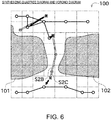
- the graph synthesizing module 51 may reconnect the second side of the Voronoi graph. This reconnection processing may be to reconnect the second side to the first vertex of the exclusive cell and to the second vertex, when this second vertex in question (target second vertex) is located in the partially inclusive cell and the second side passes not only through the partially inclusive cell but also through the exclusive cell. This processing may be performed for all the second side illustrated in Fig. 6 .
- the second side indicated by a reference character S2C in Fig. 6 is considered. If the upper second vertex of the two second vertexes connected with each other through the second side S2C is assumed to be the target second vertex, this target second vertex may be located in the partially inclusive cell. Moreover, this second side S2C may pass not only through the partially inclusive cell but also through the exclusive cell below the partially inclusive cell. Therefore, the graph synthesizing module 51 may reconnect the second side S2C to the upper target second vertex, and to the first vertex of the exclusive cell (in detail, the exclusive cell through which the second side S2C first passes, when the second side S2C originates from the target second vertex).
- the graph synthesizing module 51 may reconnect the second side S2C to the upper target second vertex, and to the first vertex of the exclusive cell (in detail, the exclusive cell through which the second side S2C first passes, when the second side S2C originates from the target second vertex).
- the graph synthesizing module 51 may delete the second vertex which is connected with no vertex.
- an X-mark is indicated on the second vertex to be deleted.
- the Voronoi graph generated by the Voronoi graph generating module 31 may be adjusted beforehand by the Voronoi graph adjusting module 41.
- the graph synthesizing module 51 can generate the graph, as illustrated in Fig. 7 , in which the quadtree graph and the Voronoi graph are naturally connected without giving the user uncomfortableness.
- Each first side which constitutes the quadtree graph, and each second side which constitutes the Voronoi graph may include information related to weights (weighted graph).
- weight includes, but not limited to, a value related to a traveling distance between the vertexes, a time required for the travel.
- the graph as the result of connecting the quadtree graph and the Voronoi graph by the graph synthesizing module 51 may also become the weighted graph.
- the graph synthesizing module 51 may output the generated graph to the route finding module 61.
- the route finding module 61 may search the route for the graph generated by the graph synthesizing module 51 based on a known graph search algorithm. By, for example, giving a departing location and a destination location to the obtained graph, the route finding module 61 can acquire the shortest route from the departing location to the destination location by using the shortest route problem algorithm for the weighted graph. The acquired route can be displayed, for example, on a display unit provided to the graph generating device 1, or an external display unit electrically connected to the graph generating device 1.
- the graph generating device 1 of this embodiment may include the map data acquiring module 11, the quadtree graph generating module 21, the Voronoi graph generating module 31, and the graph synthesizing module 51.
- the map data acquiring module 11 may acquire the obstacle data including the information on the obstacles 101 and 102.
- the quadtree graph generating module 21 may recursively subdivide the area 100 including the obstacles 101 and 102 into the cells by the quadtree dividing method, set the first vertex in the exclusive cells, and connect the first vertexes of the adjacent exclusive cells by the first side, to generate the quadtree graph.
- the Voronoi graph generating module 31 may set the second vertex by a different method (Voronoi dividing method) from the quadtree dividing method, and connect the second vertexes by the second side, to generate the Voronoi graph.
- the graph synthesizing module 51 may synthesize the quadtree graph and the Voronoi graph, to generate the synthesized graph.
- the route graph can be generated, which takes both the advantage of the quadtree dividing method, and the advantage of another method.
- the graph generating device 1 may be provided with a potential graph generating module which generates the graph by using the concept of a known potential approach, instead of the Voronoi graph generating module 31.
- the potential graph generating module (second graph generating module) may generate a potential field of which the potential becomes higher as it is closer to the obstacle 101 or 102, sets a point where the potential becomes a local minimum, as the second vertex, and suitably connects the second vertexes by the second side, to generate the graph.
- the maximum number of subdivisions in the quadtree dividing method may be suitably set, for example, in consideration of the arrangement of the obstacles 101 and 102 in the map data, the physical size of the movable body, etc.
- the Voronoi dividing method may also be configured to divide, not at the boundary where the space between the obstacles 101 and 102 is equally divided but also at a boundary where the space is divided at an eccentric dividing ratio of 1:2. Such a boundary can be obtained by a calculation accompanied by a known weighted processing.
- the boundary acquired by the Voronoi dividing method may not be limited to the polygonal line but may be, for example, a smooth curve.
- the Voronoi graph generating module 31 may set a plurality of second vertexes along the curve, and connect the second vertexes by the second sides to generate the Voronoi graph.
- the route finding module 61 may be provided to a computer (route finding computer) different from the graph generating device 1.
- the graph generating device 1 may store the graph generated in the graph synthesizing module 51 in a suitable storage device (for example, a database server or a removable memory).
- the route finding computer may acquire the graph from the storage device and perform the route finding.
- the graph generating device 1 may be used for generating the graph which is generated for searching the passing route of the movable body, such as a ship, for example.
- the present disclosure may be applied to ships which typically travel on water or sea which are referred to as surface ships, and may also be applied to other types of ships including boats, dinghies, watercrafts, and vessels. Further, the present disclosure may also be applied, if applicable, to submarines, aircrafts, and spaceships, as well as any types of vehicles which travel on the ground, such as automobiles, motorcycles, and ATVs.
Landscapes
- Engineering & Computer Science (AREA)
- Radar, Positioning & Navigation (AREA)
- Remote Sensing (AREA)
- Physics & Mathematics (AREA)
- General Physics & Mathematics (AREA)
- Automation & Control Theory (AREA)
- Geometry (AREA)
- Databases & Information Systems (AREA)
- Theoretical Computer Science (AREA)
- Processing Or Creating Images (AREA)
- Instructional Devices (AREA)
- Navigation (AREA)
- Control Of Position, Course, Altitude, Or Attitude Of Moving Bodies (AREA)
- Management, Administration, Business Operations System, And Electronic Commerce (AREA)
- Design And Manufacture Of Integrated Circuits (AREA)
Abstract
Description
- The present disclosure relates to a graph generating device.
- Conventionally, methods of searching for a route using, for example, map data are known.
JP1995-129238A -
JP1995-129238A - However, the configuration of
JP1995-129238A JP1995-129238A - The purpose of the present disclosure is to appropriately generate a graph for route finding.
- According to a first aspect of the present disclosure, a graph generating device with the following configuration is provided. The graph generating device may include an obstacle data acquiring module, a first graph generating module, a second graph generating module, and a graph synthesizing module. The obstacle data acquiring module may acquire obstacle data including information on an obstacle. The first graph generating module may recursively subdivide an area including the obstacle into cells by a quadtree dividing method, set a first vertex in an exclusive cell that is each of the cells without the obstacle, and connect the first vertexes of the adjacent exclusive cells by a first side, to generate a first graph. The second graph generating module may set second vertexes by a different method from the quadtree dividing method and connect the second vertexes by a second side, to generate a second graph. The graph synthesizing module may generate a synthesized graph by synthesizing the first graph with the second graph.
- Thus, the graph for route finding can be generated, which takes both the advantage of the quadtree dividing method, and the advantage of another method.
- The first graph generating module may terminate the subdivision once performed a given upper limit number of times.
- Thus, the number of subdividing a space performed by the quadtree dividing method is limited below a given number of times, resulting in achieving the reduction of a calculation load of the route calculation.
- The second graph generating module may determine, in the area, which a surrounding area that is an area surrounding the obstacle an arbitrary point not included in the obstacle belongs by a Voronoi dividing method, sets a plurality of second vertexes along a boundary of the determined surrounding area, and generate the second graph by connecting the second vertexes with the second side.
- Thus, the graph can be generated, which takes both the advantage of the quadtree dividing method by which a graph of a detour or longer route is not easily generated, and the advantage of the Voronoi dividing method by which the graph can be generated with a light load processing even in a location where the space between the obstacles is narrow.
- The graph generating device may further include a second graph adjusting module configured to adjust the second graph generated by the second graph generating module, before being synthesized with the first graph by the graph synthesizing module.
- Thus, the synthesized graph in which two graphs are naturally connected without giving a user uncomfortableness, can be generated.
- The second graph adjusting module may delete the second side only passing through one or more of the exclusive cells.
- Thus, for a part where the first graph and the second graph substantially overlap with each other, the two graphs can be synthesized by giving priority to the first graph generated by the quadtree dividing method.
- When the cell partially including the obstacle is referred to as a partially inclusive cell, the second graph adjusting module may exclude the second side only passing through one or more of the partially inclusive cells from a deleting target.
- Thus, the synthesized graph can be generated by using the second side passing the partially inclusive cell where the first side cannot be arranged in the first graph.
- When a target second vertex that is one of two vertexes connected by the second side in the second graph is located in a partially inclusive cell and the second side passes through the exclusive cell as well as the partially inclusive cell, the graph synthesizing module may reconnect the second side to the target second vertex, and to the first vertex of the exclusive cell through which the second side first passes, when the second side originates from the target second vertex, the partially inclusive cell partially including the obstacle.
- Thus, the second graph and the first graph can naturally be connected and synthesized.
- According to a second aspect of the present disclosure, a method of generating a graph is provided. The method may include acquiring obstacle data including information on an obstacle, recursively subdividing an area including the obstacle into cells by a quadtree dividing method, setting a first vertex in an exclusive cell that is each of the cells without the obstacle, and connecting the first vertexes of the adjacent exclusive cells by a first side, to generate a first graph, setting second vertexes by a different method from the quadtree dividing method and connecting the second vertexes by a second side, to generate a second graph, and generating a synthesized graph by synthesizing the first graph with the second graph.
- Thus, the route graph can be generated, which takes both the advantage of the quadtree dividing method, and the advantage of another method.
- The present disclosure is illustrated by way of example and not by way of limitation in the figures of the accompanying drawings, in which like reference numerals indicate like elements and in which:
-
Fig. 1 is a block graph illustrating an electric configuration of a graph generating device according to one embodiment of the present disclosure; -
Fig. 2 is a view illustrating obstacles which exist in an area where a graph is generated; -
Fig. 3 is a view illustrating a generated quadtree graph; -
Fig. 4 is a view illustrating a generated Voronoi graph; -
Fig. 5 is a view illustrating adjustment processing of the Voronoi graph; -
Fig. 6 is a view illustrating synthesis processing of the quadtree graph and the Voronoi graph; and -
Fig. 7 is a view illustrating a graph generated as a result of the synthesis processing of the quadtree graph and the Voronoi graph. - Next, one embodiment of the present disclosure is described with reference to the accompanying drawings.
Fig. 1 is a block graph illustrating an electric configuration of agraph generating device 1 according to one embodiment of the present disclosure. - The
graph generating device 1 illustrated inFig. 1 is capable of generating a graph which expresses one or more route to avoid an obstacle. The term "graph" as used herein may refer to a combination of a set of vertexes and a set of sides each of which connects two vertexes. - The
graph generating device 1 may include a map data acquiring module 11 (obstacle data acquiring module), a quadtree graph generating module 21 (first graph generating module), a Voronoi graph generating module 31 (second graph generating module), a Voronoi graph adjusting module 41 (second graph adjusting module), a graph synthesizingmodule 51, and aroute finding module 61. - Specifically, the
graph generating device 1 may be comprised of a known computer, and include a CPU, a ROM, a RAM, and a HDD. A program for implementing a method of generating the graph of the present disclosure may be stored in the HDD. By collaboration of the hardware and the software described above, thegraph generating device 1 may operate as the mapdata acquiring module 11, the quadtreegraph generating module 21, the Voronoigraph generating module 31, the Voronoigraph adjusting module 41, the graph synthesizingmodule 51, and theroute finding module 61. - The map
data acquiring module 11 may acquire map data (obstacle data) used for the generation of the graph. The mapdata acquiring module 11 can acquire the map data, for example, from an external storage device (for example, a map database server) by communication. - The map data may include information on the position and the shape of the obstacle. As illustrated in
Fig. 2 , for example, whenobstacles area 100, the map data may be comprised of vector data which describes the position of each vertex of polygonal lines expressing the contours of theobstacles data acquiring module 11 ofFig. 1 may output the acquired map data to the quadtreegraph generating module 21 and the Voronoigraph generating module 31. - The quadtree
graph generating module 21 may generate the graph based on the map data, while using a known quadtree dividing method (hierarchical approximate cell dividing method). - In detail, the quadtree
graph generating module 21 may vertically and laterally subdivide thearea 100 where a user wants to generate a route in the map data to generate four cells having equal size. If theobstacles graph generating module 21 may again subdivide the area of the cell vertically and horizontally to again generate four cells having equal size. The quadtreegraph generating module 21 may recursively perform the subdividing processing until the number of subdivision reaches a given value (subdividing depth). As a result, as illustrated by chain lines inFig. 3 , thearea 100 may be subdivided vertically and horizontally into a plurality of rectangular cells. There may be (first) cells filled up with theobstacle obstacle obstacle - When the subdivision of the cells is finished, the quadtree
graph generating module 21 may set a vertex (first vertex) at each center of the exclusive cells, and connect the vertexes of the adjacent exclusive cells by a straight-line side (first side). Thus, the quadtreegraph generating module 21 may generate the graph which can be used for a route calculation. Below, the graph according to the quadtree dividing method may simply be referred to as the "quadtree graph." The quadtree graph may correspond to the first graph.Fig. 3 illustrates one example of the quadtree graph. This graph may be comprised of the first vertexes and the first sides. InFig. 3 , the first vertex is indicated by a thick-line circle, and the first side is indicated by a thick line. - The number of subdivision (a depth of subdivision) performed by the quadtree
graph generating module 21 may be limited below a given number (upper limit). Therefore, if the distance between theobstacle 101 and theobstacle 102 is small (i.e., narrow), in a part between the obstacles, the subdivision may be terminated before being performed finely enough and generating an exclusive cell. As a result, the first side may not be generated. - In
Fig. 3 , a case where the maximum number (upper limit) of subdivisions is 3 is illustrated. InFig. 3 , since there is no exclusive cell between theobstacle 101 and theobstacle 102, no first side which connects the upper and lower graphs may exist at the center of theentire area 100. Therefore, the entire graph may be split vertically. - Although the subdivision is terminated in the state of
Fig. 3 , if the cells are further subdivided, the exclusive cells may be generated so as to be lined up and connect the upper and lower graphs. Therefore, the first sides can be generated in the narrow space between theobstacle 101 and theobstacle 102. However, in this case, the number of vertexes of the graph will increase tremendously. - The quadtree
graph generating module 21 ofFig. 1 may output the generated graphs to the Voronoigraph adjusting module 41 and thegraph synthesizing module 51. - The Voronoi
graph generating module 31 may generate a graph based on the map data by using a known Voronoi dividing method. - In detail, in the general Voronoi dividing method, a plurality of points (seeds) may be given in a certain area, and when an arbitrary point in the area belongs to the nearest seed, a plane may be divided at a boundary between the point and the seed to which the point belongs. In this embodiment, the
obstacles graph generating module 31 may express the contours of theobstacles area 100, which area (surrounding area) surrounding each of theobstacles obstacles - This boundary can be acquired in the form of a polygonal line, as illustrated in
Fig. 4 , for example, by obtaining straight lines which bisect an area between the polygonal line of oneobstacle 101 and the polygonal line corresponding to theother obstacle 102. - The Voronoi
graph generating module 31 may arrange a second vertex at the same position as each vertex of the bordering polygonal lines, and connect by second sides the second vertexes which are in relation of being connected by the polygonal lines (boundary). Thus, the Voronoigraph generating module 31 may generate the graph (second graph) which can be used for the route calculation. Below, the graph generated by the Voronoi dividing method may simply be referred to as a "Voronoi graph." The Voronoi graph may correspond to the second graph. The example of the Voronoi graph is illustrated inFig. 4 . This graph may be comprised of the second vertexes and the second sides. InFig. 4 , the second vertex is illustrated by a double circle and the second side is illustrated by a double line. - Since the Voronoi
graph generating module 31 uses the Voronoi dividing method, it can easily generate the graph in the narrow place. In the example of the Voronoi graph ofFig. 4 , it can be seen that the graph passing through between theobstacles obstacles Fig. 3 due to the termination of the division. - Note that, according to the Voronoi dividing method, the second vertexes and the second sides can be arranged so that the space between the obstacles is equally divided or bisected even when the obstacles are widely separated from each other. Therefore, for example, as illustrated by broken lines in
Fig. 4 , since a distance between the second vertex or the second side and theobstacles - The Voronoi
graph generating module 31 ofFig. 1 may output the generated graph to the Voronoigraph adjusting module 41. - The Voronoi
graph adjusting module 41 may adjust the Voronoi graph generated by the Voronoigraph generating module 31 using the graph generated by the quadtreegraph generating module 21. - The processing performed by the Voronoi
graph adjusting module 41 may include deletion of the second side of the Voronoi graph. This side deletion processing may be to delete the second side if this second side passes only through one or more of the exclusive cell. Note that, as described above, the exclusive cell may be a cell which does not include any obstacles, where the thick-line circle (the first vertex of the quadtree graph) is disposed inFig. 5 . This processing may be performed for each of the second sides which constitute the Voronoi graph. - For example, in
Fig. 5 , although the second side illustrated by a reference character S2A passes through two cells, since the two cells are both exclusive cells, this second side S2A may be subject to the deletion. InFig. 5 , an X-mark is indicated on the second side to be deleted by this processing. The Voronoigraph adjusting module 41 may also delete the second vertex which is disconnected from other second vertexes by deleting the second side. InFig. 5 , an X-mark is also indicated on the second vertex to be deleted. - As a result, for the part where the quadtree graph and the Voronoi graph substantially overlap with each other, the quadtree graph will appear in a synthesized graph which will be described below. Thus, by giving priority to the quadtree graph, the disadvantage of the Voronoi graph which tends to be a longer route can be avoided.
- For example, as illustrated by a reference character S2B in
Fig. 5 , the second side may pass only through one or more partially inclusive cells. Since this second side S2B does not satisfy the condition described above, it may not be deleted by the Voronoigraph adjusting module 41. The second side S2B may remain still in the graph outputted from the Voronoigraph adjusting module 41. Therefore, the advantage of the Voronoi dividing method which can generate the graph in the narrow space between theobstacles - Therefore, the Voronoi
graph adjusting module 41 ofFig. 1 can generate the Voronoi graph from which the second sides and the second vertexes are deleted so that the graph does not substantially overlap with the quadtree graph generated by the quadtreegraph generating module 21. The Voronoigraph adjusting module 41 may output the Voronoi graph after the above adjustment to thegraph synthesizing module 51. - The
graph synthesizing module 51 may generate a sole synthesized graph by combining the quadtree graph outputted from the quadtreegraph generating module 21, and the Voronoi graph outputted from the Voronoigraph adjusting module 41. - Specifically, the
graph synthesizing module 51 may reconnect the second side of the Voronoi graph. This reconnection processing may be to reconnect the second side to the first vertex of the exclusive cell and to the second vertex, when this second vertex in question (target second vertex) is located in the partially inclusive cell and the second side passes not only through the partially inclusive cell but also through the exclusive cell. This processing may be performed for all the second side illustrated inFig. 6 . - For example, the second side indicated by a reference character S2C in
Fig. 6 is considered. If the upper second vertex of the two second vertexes connected with each other through the second side S2C is assumed to be the target second vertex, this target second vertex may be located in the partially inclusive cell. Moreover, this second side S2C may pass not only through the partially inclusive cell but also through the exclusive cell below the partially inclusive cell. Therefore, thegraph synthesizing module 51 may reconnect the second side S2C to the upper target second vertex, and to the first vertex of the exclusive cell (in detail, the exclusive cell through which the second side S2C first passes, when the second side S2C originates from the target second vertex). InFig. 5 , the reconnection of the second side is indicated by a black arrow. Thegraph synthesizing module 51 may delete the second vertex which is connected with no vertex. InFig. 6 , an X-mark is indicated on the second vertex to be deleted. - As described using
Fig. 5 , the Voronoi graph generated by the Voronoigraph generating module 31 may be adjusted beforehand by the Voronoigraph adjusting module 41. By this pre-adjustment processing and the reconnection processing described usingFig. 6 , thegraph synthesizing module 51 can generate the graph, as illustrated inFig. 7 , in which the quadtree graph and the Voronoi graph are naturally connected without giving the user uncomfortableness. - Each first side which constitutes the quadtree graph, and each second side which constitutes the Voronoi graph may include information related to weights (weighted graph). As one example of the weight includes, but not limited to, a value related to a traveling distance between the vertexes, a time required for the travel. In such a case, the graph as the result of connecting the quadtree graph and the Voronoi graph by the
graph synthesizing module 51 may also become the weighted graph. Thegraph synthesizing module 51 may output the generated graph to theroute finding module 61. - The
route finding module 61 may search the route for the graph generated by thegraph synthesizing module 51 based on a known graph search algorithm. By, for example, giving a departing location and a destination location to the obtained graph, theroute finding module 61 can acquire the shortest route from the departing location to the destination location by using the shortest route problem algorithm for the weighted graph. The acquired route can be displayed, for example, on a display unit provided to thegraph generating device 1, or an external display unit electrically connected to thegraph generating device 1. - As described above, the
graph generating device 1 of this embodiment may include the mapdata acquiring module 11, the quadtreegraph generating module 21, the Voronoigraph generating module 31, and thegraph synthesizing module 51. The mapdata acquiring module 11 may acquire the obstacle data including the information on theobstacles graph generating module 21 may recursively subdivide thearea 100 including theobstacles graph generating module 31 may set the second vertex by a different method (Voronoi dividing method) from the quadtree dividing method, and connect the second vertexes by the second side, to generate the Voronoi graph. Thegraph synthesizing module 51 may synthesize the quadtree graph and the Voronoi graph, to generate the synthesized graph. - Therefore, the route graph can be generated, which takes both the advantage of the quadtree dividing method, and the advantage of another method.
- Although the suitable embodiment of the present disclosure is described above, the above configuration may be changed as follows.
- The
graph generating device 1 may be provided with a potential graph generating module which generates the graph by using the concept of a known potential approach, instead of the Voronoigraph generating module 31. For example, the potential graph generating module (second graph generating module) may generate a potential field of which the potential becomes higher as it is closer to theobstacle - The maximum number of subdivisions in the quadtree dividing method may be suitably set, for example, in consideration of the arrangement of the
obstacles - The Voronoi dividing method may also be configured to divide, not at the boundary where the space between the
obstacles - The boundary acquired by the Voronoi dividing method may not be limited to the polygonal line but may be, for example, a smooth curve. In this case, the Voronoi
graph generating module 31 may set a plurality of second vertexes along the curve, and connect the second vertexes by the second sides to generate the Voronoi graph. - The
route finding module 61 may be provided to a computer (route finding computer) different from thegraph generating device 1. In this case, thegraph generating device 1 may store the graph generated in thegraph synthesizing module 51 in a suitable storage device (for example, a database server or a removable memory). The route finding computer may acquire the graph from the storage device and perform the route finding. - The
graph generating device 1 may be used for generating the graph which is generated for searching the passing route of the movable body, such as a ship, for example. Note that the present disclosure may be applied to ships which typically travel on water or sea which are referred to as surface ships, and may also be applied to other types of ships including boats, dinghies, watercrafts, and vessels. Further, the present disclosure may also be applied, if applicable, to submarines, aircrafts, and spaceships, as well as any types of vehicles which travel on the ground, such as automobiles, motorcycles, and ATVs.
Claims (8)
- A graph generating device (1), comprising:an obstacle data acquiring module (11) configured to acquire obstacle data including information on an obstacle (101, 102);a first graph generating module (21) configured to recursively subdivide an area (100) including the obstacle (101, 102) into cells by a quadtree dividing method, set a first vertex in an exclusive cell that is each of the cells without the obstacle (101, 102), and connect the first vertexes of the adjacent exclusive cells by a first side, to generate a first graph;a second graph generating module (31) configured to set second vertexes by a different method from the quadtree dividing method and connect the second vertexes by a second side, to generate a second graph; anda graph synthesizing module (51) configured to generate a synthesized graph by synthesizing the first graph with the second graph.
- The graph generating device (1) of claim 1, wherein the first graph generating module (21) terminates the subdivision once performed a given upper limit number of times.
- The graph generating device (1) of claim 1 or 2, wherein the second graph generating module (31) determines, in the area (100), to which surrounding area that is an area surrounding the obstacle (101, 102) an arbitrary point not included in the obstacle (101, 102) belongs by a Voronoi dividing method, sets a plurality of second vertexes along a boundary of the determined surrounding area, and generates the second graph by connecting the second vertexes with the second side.
- The graph generating device (1) of any one of claims 1 to 3, further comprising a second graph adjusting module (41) configured to adjust the second graph generated by the second graph generating module (31), before being synthesized with the first graph by the graph synthesizing module (51).
- The graph generating device (1) of claim 4, wherein the second graph adjusting module (41) deletes the second side only passing through one or more of the exclusive cells.
- The graph generating device (1) of claim 4 or 5, wherein, when the cell partially including the obstacle (101, 102) is referred to as a partially inclusive cell, the second graph adjusting module (41) excludes the second side only passing through one or more of the partially inclusive cells from a deleting target.
- The graph generating device (1) of any one of claims 4 to 6, wherein, when a target second vertex that is one of two vertexes connected by the second side in the second graph is located in a partially inclusive cell and the second side passes through the exclusive cell as well as the partially inclusive cell, the graph synthesizing module (51) reconnects the second side to the target second vertex, and to the first vertex of the exclusive cell through which the second side first passes, when the second side originates from the target second vertex, the partially inclusive cell partially including the obstacle (101, 102).
- A method of generating a graph, comprising:acquiring obstacle data including information on an obstacle (101, 102);recursively subdividing an area (100) including the obstacle (101, 102) into cells by a quadtree dividing method, setting a first vertex in an exclusive cell that is each of the cells without the obstacle (101, 102), and connecting the first vertexes of the adjacent exclusive cells by a first side, to generate a first graph;setting second vertexes by a different method from the quadtree dividing method and connecting the second vertexes by a second side, to generate a second graph; andgenerating a synthesized graph by synthesizing the first graph with the second graph.
Applications Claiming Priority (1)
| Application Number | Priority Date | Filing Date | Title |
|---|---|---|---|
| JP2018130522A JP7195073B2 (en) | 2018-07-10 | 2018-07-10 | graph generator |
Publications (2)
| Publication Number | Publication Date |
|---|---|
| EP3594623A1 true EP3594623A1 (en) | 2020-01-15 |
| EP3594623B1 EP3594623B1 (en) | 2024-09-25 |
Family
ID=67220699
Family Applications (1)
| Application Number | Title | Priority Date | Filing Date |
|---|---|---|---|
| EP19185148.4A Active EP3594623B1 (en) | 2018-07-10 | 2019-07-09 | Graph generating device |
Country Status (4)
| Country | Link |
|---|---|
| US (1) | US11193787B2 (en) |
| EP (1) | EP3594623B1 (en) |
| JP (1) | JP7195073B2 (en) |
| CN (1) | CN110702126B (en) |
Families Citing this family (9)
| Publication number | Priority date | Publication date | Assignee | Title |
|---|---|---|---|---|
| EP3611694A1 (en) * | 2018-08-15 | 2020-02-19 | Koninklijke Philips N.V. | System for analysis of microscopic data using graphs |
| KR102106748B1 (en) * | 2020-02-04 | 2020-05-04 | (주)코마린 | E-navigation providing system and amethod and e-navigation device in the same |
| CN113536837B (en) * | 2020-04-15 | 2023-08-04 | 杭州萤石软件有限公司 | Area division method and device for indoor scenes |
| CN112525198B (en) * | 2020-11-23 | 2021-12-03 | 广州极飞科技股份有限公司 | Operation route planning method and related device |
| JP7786883B2 (en) * | 2021-03-29 | 2025-12-16 | セコム株式会社 | Route search device, route search method, and route search program |
| CN113029160B (en) * | 2021-05-30 | 2021-09-14 | 浙江华睿科技股份有限公司 | Navigation method, navigation terminal and computer readable storage medium |
| CN114625144B (en) * | 2022-03-18 | 2025-03-07 | 超越科技股份有限公司 | A robot motion path planning method, system, device and storage medium |
| CN115437368B (en) * | 2022-06-02 | 2023-08-29 | 珠海云洲智能科技股份有限公司 | Rescue path determining method and device, rescue equipment and readable storage medium |
| CN120907564B (en) * | 2025-10-13 | 2025-12-23 | 广东海洋大学 | A method for planning vessel routes in coastal waterways |
Citations (3)
| Publication number | Priority date | Publication date | Assignee | Title |
|---|---|---|---|---|
| JPH07129238A (en) | 1993-11-01 | 1995-05-19 | Fujitsu Ltd | Obstacle avoidance route generation method |
| CN106528773A (en) * | 2016-11-07 | 2017-03-22 | 山东首讯信息技术有限公司 | Spark platform supported spatial data management-based diagram calculation system and method |
| CN107228673A (en) * | 2017-05-19 | 2017-10-03 | 北京旋极伏羲大数据技术有限公司 | Route planner and device |
Family Cites Families (35)
| Publication number | Priority date | Publication date | Assignee | Title |
|---|---|---|---|---|
| JPH08147020A (en) * | 1994-11-18 | 1996-06-07 | Toyota Central Res & Dev Lab Inc | Robot automatic path generator |
| JP3659318B2 (en) | 2000-05-09 | 2005-06-15 | インターナショナル・ビジネス・マシーンズ・コーポレーション | Spatial data mining equipment |
| US20050149251A1 (en) * | 2000-07-18 | 2005-07-07 | University Of Minnesota | Real time high accuracy geospatial database for onboard intelligent vehicle applications |
| JP2004521423A (en) * | 2001-03-12 | 2004-07-15 | コーニンクレッカ フィリップス エレクトロニクス エヌ ヴィ | Generation of 3D representation from many images using octree |
| JP4447865B2 (en) * | 2003-08-01 | 2010-04-07 | ソニー株式会社 | Map display system, map data processing device, map display device, and map display method |
| DE102004032118B4 (en) * | 2004-07-01 | 2006-09-21 | Daimlerchrysler Ag | Object recognition method for vehicles |
| US7248952B2 (en) * | 2005-02-17 | 2007-07-24 | Northrop Grumman Corporation | Mixed integer linear programming trajectory generation for autonomous nap-of-the-earth flight in a threat environment |
| US20090088916A1 (en) * | 2007-09-28 | 2009-04-02 | Honeywell International Inc. | Method and system for automatic path planning and obstacle/collision avoidance of autonomous vehicles |
| RS63059B1 (en) * | 2010-04-13 | 2022-04-29 | Ge Video Compression Llc | Video coding using multi-tree sub-divisions of images |
| TWI575887B (en) * | 2010-04-13 | 2017-03-21 | Ge影像壓縮有限公司 | Inheritance in sample array multitree subdivision |
| US8744770B2 (en) * | 2010-08-27 | 2014-06-03 | University Of Maryland, College Park | Path oracles for spatial networks |
| DE102012105332A1 (en) * | 2012-06-19 | 2013-12-19 | Continental Teves Ag & Co. Ohg | Method for displaying a vehicle environment |
| JP2014026516A (en) * | 2012-07-27 | 2014-02-06 | Nissan Motor Co Ltd | Target route generation device and target route generation method |
| CN103900600A (en) * | 2012-12-25 | 2014-07-02 | 中国电信股份有限公司 | Method and system for navigating indoor paths of maps across floors |
| DE102013200387A1 (en) * | 2013-01-14 | 2014-07-17 | Robert Bosch Gmbh | Creation of a obstacle map |
| CN105333883B (en) * | 2014-08-07 | 2018-08-14 | 深圳点石创新科技有限公司 | A kind of guidance path track display method and device for head up display |
| CN104168581B (en) * | 2014-09-05 | 2017-08-11 | 合肥工业大学 | The water surface movable base station path planing method of Wei Nuotu constructions |
| US9524647B2 (en) * | 2015-01-19 | 2016-12-20 | The Aerospace Corporation | Autonomous Nap-Of-the-Earth (ANOE) flight path planning for manned and unmanned rotorcraft |
| JP2016212627A (en) | 2015-05-08 | 2016-12-15 | 富士通株式会社 | Path finding program, information processor, and path finding method |
| JP6630950B2 (en) | 2015-05-25 | 2020-01-15 | 株式会社国際電気通信基礎技術研究所 | Route calculation device, route calculation program, and route calculation method |
| JP6304771B2 (en) * | 2015-08-20 | 2018-04-04 | 株式会社サイバーウォーカー | Route generation program, route generation method and route generation device |
| US10452788B2 (en) * | 2015-08-31 | 2019-10-22 | Autodesk, Inc. | Modeling a three-dimensional object having multiple materials |
| US9796390B2 (en) * | 2016-02-29 | 2017-10-24 | Faraday&Future Inc. | Vehicle sensing grid having dynamic sensing cell size |
| FR3052275A1 (en) * | 2016-06-03 | 2017-12-08 | Commissariat Energie Atomique | METHOD AND SYSTEM FOR DETERMINING CELLS CROSSED BY A MEASURING OR VISUALIZATION AXIS |
| CN106197419B (en) * | 2016-06-23 | 2019-01-15 | 北京建筑大学 | Take the indoor navigation method and system of barrier and subspace subdivision into account |
| US10325169B2 (en) * | 2016-10-09 | 2019-06-18 | Airspace Systems, Inc. | Spatio-temporal awareness engine for priority tree based region selection across multiple input cameras and multimodal sensor empowered awareness engine for target recovery and object path prediction |
| CN106682787A (en) * | 2017-01-09 | 2017-05-17 | 北京航空航天大学 | Method for quickly generating generalized Voronoi diagram based on wavefront algorithm |
| US20200158517A1 (en) * | 2017-01-19 | 2020-05-21 | Mindmaze Holding Sa | System, methods, device and apparatuses for preforming simultaneous localization and mapping |
| US20190086513A1 (en) * | 2017-09-21 | 2019-03-21 | GM Global Technology Operations LLC | Method and apparatus for frame rate boosting in lidar array |
| US20190122073A1 (en) * | 2017-10-23 | 2019-04-25 | The Charles Stark Draper Laboratory, Inc. | System and method for quantifying uncertainty in reasoning about 2d and 3d spatial features with a computer machine learning architecture |
| CN118869984A (en) * | 2017-12-08 | 2024-10-29 | 松下电器(美国)知识产权公司 | Image encoding device, image decoding device, image encoding method, and image decoding method |
| CN108253984A (en) * | 2017-12-19 | 2018-07-06 | 昆明理工大学 | A kind of method for planning path for mobile robot based on improvement A star algorithms |
| US10681388B2 (en) * | 2018-01-30 | 2020-06-09 | Google Llc | Compression of occupancy or indicator grids |
| US10788325B1 (en) * | 2018-04-17 | 2020-09-29 | Rockwell Collins, Inc. | Systems and methods for hybrid graph and grid three-dimensional routing |
| JP7084806B2 (en) * | 2018-07-10 | 2022-06-15 | 古野電気株式会社 | Navigation equipment and route creation method |
-
2018
- 2018-07-10 JP JP2018130522A patent/JP7195073B2/en active Active
-
2019
- 2019-07-09 EP EP19185148.4A patent/EP3594623B1/en active Active
- 2019-07-10 CN CN201910619263.3A patent/CN110702126B/en active Active
- 2019-07-10 US US16/507,550 patent/US11193787B2/en active Active
Patent Citations (3)
| Publication number | Priority date | Publication date | Assignee | Title |
|---|---|---|---|---|
| JPH07129238A (en) | 1993-11-01 | 1995-05-19 | Fujitsu Ltd | Obstacle avoidance route generation method |
| CN106528773A (en) * | 2016-11-07 | 2017-03-22 | 山东首讯信息技术有限公司 | Spark platform supported spatial data management-based diagram calculation system and method |
| CN107228673A (en) * | 2017-05-19 | 2017-10-03 | 北京旋极伏羲大数据技术有限公司 | Route planner and device |
Non-Patent Citations (1)
| Title |
|---|
| SHAHED SHOJAEIPOUR ET AL: "Motion planning for mobile robot navigation using combine Quad-Tree Decomposition and Voronoi Diagrams", COMPUTER AND AUTOMATION ENGINEERING (ICCAE), 2010 THE 2ND INTERNATIONAL CONFERENCE ON, IEEE, PISCATAWAY, NJ, USA, 26 February 2010 (2010-02-26), pages 90 - 93, XP031671732, ISBN: 978-1-4244-5585-0 * |
Also Published As
| Publication number | Publication date |
|---|---|
| JP2020009225A (en) | 2020-01-16 |
| CN110702126B (en) | 2024-10-29 |
| EP3594623B1 (en) | 2024-09-25 |
| JP7195073B2 (en) | 2022-12-23 |
| CN110702126A (en) | 2020-01-17 |
| US11193787B2 (en) | 2021-12-07 |
| US20200018615A1 (en) | 2020-01-16 |
Similar Documents
| Publication | Publication Date | Title |
|---|---|---|
| EP3594623A1 (en) | Graph generating device | |
| US10852749B2 (en) | Learning good features for visual odometry | |
| KR101976403B1 (en) | Safety navigation apparatus for vessel | |
| US10643103B2 (en) | Method and apparatus for representing a map element and method and apparatus for locating a vehicle/robot | |
| TW440688B (en) | A path planning, terrain avoidance and situation awareness system for general aviation | |
| CN111750883B (en) | Method, device, storage medium and electronic device for determining working path | |
| CN104797494B (en) | Maritime navigation device with improved contour lines | |
| US20150149081A1 (en) | Methods for Enhancing the Display of Electronic Nautical Charts with Depths Corrected for Tide | |
| AU2019253884B2 (en) | Systems and associated methods for generating navigation charts and navigable routes in an open environment | |
| JP2021530828A (en) | Systems and methods for controlling ships | |
| US11353333B2 (en) | Dynamic restyling of digital maps | |
| CN112313703A (en) | Incremental segmentation of point clouds | |
| US9646416B2 (en) | Three-dimensional map display system | |
| CN118658057A (en) | Differential quantization terrain perception method and system based on lightweight geographic information engine | |
| US10304242B1 (en) | Transparent display terrain representation systems and methods | |
| Chen | A systematic approach for solving the great circle track problems based on vector algebra | |
| US20210018319A1 (en) | Search support apparatus, search support method, and computer-readable recording medium | |
| CN110770540B (en) | Method and device for building an environment model | |
| US8031193B1 (en) | Dynamic light shading in terrain rendering applications | |
| Bleick et al. | Minimal-time ship routing | |
| JP7485200B2 (en) | Image enhancement device, control method, and program | |
| JP6995912B2 (en) | Topographic map output device, topographic map output method and program | |
| JP2021149059A (en) | Topographic map output device, topographic map output method, and program | |
| US20170311174A1 (en) | Dynamic link-budget monitoring and graphical display | |
| Kazimierski et al. | Cartographic aspects of radar information integration in mobile navigation system for inland waters |
Legal Events
| Date | Code | Title | Description |
|---|---|---|---|
| PUAI | Public reference made under article 153(3) epc to a published international application that has entered the european phase |
Free format text: ORIGINAL CODE: 0009012 |
|
| STAA | Information on the status of an ep patent application or granted ep patent |
Free format text: STATUS: THE APPLICATION HAS BEEN PUBLISHED |
|
| AK | Designated contracting states |
Kind code of ref document: A1 Designated state(s): AL AT BE BG CH CY CZ DE DK EE ES FI FR GB GR HR HU IE IS IT LI LT LU LV MC MK MT NL NO PL PT RO RS SE SI SK SM TR |
|
| AX | Request for extension of the european patent |
Extension state: BA ME |
|
| STAA | Information on the status of an ep patent application or granted ep patent |
Free format text: STATUS: REQUEST FOR EXAMINATION WAS MADE |
|
| 17P | Request for examination filed |
Effective date: 20200710 |
|
| RBV | Designated contracting states (corrected) |
Designated state(s): AL AT BE BG CH CY CZ DE DK EE ES FI FR GB GR HR HU IE IS IT LI LT LU LV MC MK MT NL NO PL PT RO RS SE SI SK SM TR |
|
| REG | Reference to a national code |
Ref country code: DE Ref legal event code: R079 Free format text: PREVIOUS MAIN CLASS: G01C0021320000 Ipc: G01C0021340000 Ref document number: 602019059360 Country of ref document: DE |
|
| GRAP | Despatch of communication of intention to grant a patent |
Free format text: ORIGINAL CODE: EPIDOSNIGR1 |
|
| STAA | Information on the status of an ep patent application or granted ep patent |
Free format text: STATUS: GRANT OF PATENT IS INTENDED |
|
| RIC1 | Information provided on ipc code assigned before grant |
Ipc: G05D 1/43 20240101ALI20240424BHEP Ipc: G01C 21/34 20060101AFI20240424BHEP |
|
| INTG | Intention to grant announced |
Effective date: 20240528 |
|
| GRAS | Grant fee paid |
Free format text: ORIGINAL CODE: EPIDOSNIGR3 |
|
| GRAA | (expected) grant |
Free format text: ORIGINAL CODE: 0009210 |
|
| STAA | Information on the status of an ep patent application or granted ep patent |
Free format text: STATUS: THE PATENT HAS BEEN GRANTED |
|
| AK | Designated contracting states |
Kind code of ref document: B1 Designated state(s): AL AT BE BG CH CY CZ DE DK EE ES FI FR GB GR HR HU IE IS IT LI LT LU LV MC MK MT NL NO PL PT RO RS SE SI SK SM TR |
|
| REG | Reference to a national code |
Ref country code: GB Ref legal event code: FG4D |
|
| REG | Reference to a national code |
Ref country code: CH Ref legal event code: EP |
|
| REG | Reference to a national code |
Ref country code: DE Ref legal event code: R096 Ref document number: 602019059360 Country of ref document: DE |
|
| REG | Reference to a national code |
Ref country code: IE Ref legal event code: FG4D |
|
| REG | Reference to a national code |
Ref country code: LT Ref legal event code: MG9D |
|
| PG25 | Lapsed in a contracting state [announced via postgrant information from national office to epo] |
Ref country code: NO Free format text: LAPSE BECAUSE OF FAILURE TO SUBMIT A TRANSLATION OF THE DESCRIPTION OR TO PAY THE FEE WITHIN THE PRESCRIBED TIME-LIMIT Effective date: 20241225 |
|
| PG25 | Lapsed in a contracting state [announced via postgrant information from national office to epo] |
Ref country code: GR Free format text: LAPSE BECAUSE OF FAILURE TO SUBMIT A TRANSLATION OF THE DESCRIPTION OR TO PAY THE FEE WITHIN THE PRESCRIBED TIME-LIMIT Effective date: 20241226 Ref country code: FI Free format text: LAPSE BECAUSE OF FAILURE TO SUBMIT A TRANSLATION OF THE DESCRIPTION OR TO PAY THE FEE WITHIN THE PRESCRIBED TIME-LIMIT Effective date: 20240925 |
|
| PG25 | Lapsed in a contracting state [announced via postgrant information from national office to epo] |
Ref country code: BG Free format text: LAPSE BECAUSE OF FAILURE TO SUBMIT A TRANSLATION OF THE DESCRIPTION OR TO PAY THE FEE WITHIN THE PRESCRIBED TIME-LIMIT Effective date: 20240925 |
|
| PG25 | Lapsed in a contracting state [announced via postgrant information from national office to epo] |
Ref country code: LV Free format text: LAPSE BECAUSE OF FAILURE TO SUBMIT A TRANSLATION OF THE DESCRIPTION OR TO PAY THE FEE WITHIN THE PRESCRIBED TIME-LIMIT Effective date: 20240925 |
|
| PG25 | Lapsed in a contracting state [announced via postgrant information from national office to epo] |
Ref country code: RS Free format text: LAPSE BECAUSE OF FAILURE TO SUBMIT A TRANSLATION OF THE DESCRIPTION OR TO PAY THE FEE WITHIN THE PRESCRIBED TIME-LIMIT Effective date: 20241225 |
|
| REG | Reference to a national code |
Ref country code: NL Ref legal event code: MP Effective date: 20240925 |
|
| PG25 | Lapsed in a contracting state [announced via postgrant information from national office to epo] |
Ref country code: RS Free format text: LAPSE BECAUSE OF FAILURE TO SUBMIT A TRANSLATION OF THE DESCRIPTION OR TO PAY THE FEE WITHIN THE PRESCRIBED TIME-LIMIT Effective date: 20241225 Ref country code: NO Free format text: LAPSE BECAUSE OF FAILURE TO SUBMIT A TRANSLATION OF THE DESCRIPTION OR TO PAY THE FEE WITHIN THE PRESCRIBED TIME-LIMIT Effective date: 20241225 Ref country code: LV Free format text: LAPSE BECAUSE OF FAILURE TO SUBMIT A TRANSLATION OF THE DESCRIPTION OR TO PAY THE FEE WITHIN THE PRESCRIBED TIME-LIMIT Effective date: 20240925 Ref country code: GR Free format text: LAPSE BECAUSE OF FAILURE TO SUBMIT A TRANSLATION OF THE DESCRIPTION OR TO PAY THE FEE WITHIN THE PRESCRIBED TIME-LIMIT Effective date: 20241226 Ref country code: FI Free format text: LAPSE BECAUSE OF FAILURE TO SUBMIT A TRANSLATION OF THE DESCRIPTION OR TO PAY THE FEE WITHIN THE PRESCRIBED TIME-LIMIT Effective date: 20240925 Ref country code: BG Free format text: LAPSE BECAUSE OF FAILURE TO SUBMIT A TRANSLATION OF THE DESCRIPTION OR TO PAY THE FEE WITHIN THE PRESCRIBED TIME-LIMIT Effective date: 20240925 |
|
| REG | Reference to a national code |
Ref country code: AT Ref legal event code: MK05 Ref document number: 1726959 Country of ref document: AT Kind code of ref document: T Effective date: 20240925 |
|
| PG25 | Lapsed in a contracting state [announced via postgrant information from national office to epo] |
Ref country code: NL Free format text: LAPSE BECAUSE OF FAILURE TO SUBMIT A TRANSLATION OF THE DESCRIPTION OR TO PAY THE FEE WITHIN THE PRESCRIBED TIME-LIMIT Effective date: 20240925 |
|
| PG25 | Lapsed in a contracting state [announced via postgrant information from national office to epo] |
Ref country code: IS Free format text: LAPSE BECAUSE OF FAILURE TO SUBMIT A TRANSLATION OF THE DESCRIPTION OR TO PAY THE FEE WITHIN THE PRESCRIBED TIME-LIMIT Effective date: 20250125 Ref country code: PT Free format text: LAPSE BECAUSE OF FAILURE TO SUBMIT A TRANSLATION OF THE DESCRIPTION OR TO PAY THE FEE WITHIN THE PRESCRIBED TIME-LIMIT Effective date: 20250127 |
|
| PG25 | Lapsed in a contracting state [announced via postgrant information from national office to epo] |
Ref country code: SM Free format text: LAPSE BECAUSE OF FAILURE TO SUBMIT A TRANSLATION OF THE DESCRIPTION OR TO PAY THE FEE WITHIN THE PRESCRIBED TIME-LIMIT Effective date: 20240925 Ref country code: RO Free format text: LAPSE BECAUSE OF FAILURE TO SUBMIT A TRANSLATION OF THE DESCRIPTION OR TO PAY THE FEE WITHIN THE PRESCRIBED TIME-LIMIT Effective date: 20240925 |
|
| PG25 | Lapsed in a contracting state [announced via postgrant information from national office to epo] |
Ref country code: ES Free format text: LAPSE BECAUSE OF FAILURE TO SUBMIT A TRANSLATION OF THE DESCRIPTION OR TO PAY THE FEE WITHIN THE PRESCRIBED TIME-LIMIT Effective date: 20240925 |
|
| PG25 | Lapsed in a contracting state [announced via postgrant information from national office to epo] |
Ref country code: EE Free format text: LAPSE BECAUSE OF FAILURE TO SUBMIT A TRANSLATION OF THE DESCRIPTION OR TO PAY THE FEE WITHIN THE PRESCRIBED TIME-LIMIT Effective date: 20240925 Ref country code: AT Free format text: LAPSE BECAUSE OF FAILURE TO SUBMIT A TRANSLATION OF THE DESCRIPTION OR TO PAY THE FEE WITHIN THE PRESCRIBED TIME-LIMIT Effective date: 20240925 |
|
| PG25 | Lapsed in a contracting state [announced via postgrant information from national office to epo] |
Ref country code: CZ Free format text: LAPSE BECAUSE OF FAILURE TO SUBMIT A TRANSLATION OF THE DESCRIPTION OR TO PAY THE FEE WITHIN THE PRESCRIBED TIME-LIMIT Effective date: 20240925 Ref country code: PL Free format text: LAPSE BECAUSE OF FAILURE TO SUBMIT A TRANSLATION OF THE DESCRIPTION OR TO PAY THE FEE WITHIN THE PRESCRIBED TIME-LIMIT Effective date: 20240925 |
|
| PG25 | Lapsed in a contracting state [announced via postgrant information from national office to epo] |
Ref country code: SK Free format text: LAPSE BECAUSE OF FAILURE TO SUBMIT A TRANSLATION OF THE DESCRIPTION OR TO PAY THE FEE WITHIN THE PRESCRIBED TIME-LIMIT Effective date: 20240925 Ref country code: IT Free format text: LAPSE BECAUSE OF FAILURE TO SUBMIT A TRANSLATION OF THE DESCRIPTION OR TO PAY THE FEE WITHIN THE PRESCRIBED TIME-LIMIT Effective date: 20240925 |
|
| REG | Reference to a national code |
Ref country code: DE Ref legal event code: R097 Ref document number: 602019059360 Country of ref document: DE |
|
| PG25 | Lapsed in a contracting state [announced via postgrant information from national office to epo] |
Ref country code: DK Free format text: LAPSE BECAUSE OF FAILURE TO SUBMIT A TRANSLATION OF THE DESCRIPTION OR TO PAY THE FEE WITHIN THE PRESCRIBED TIME-LIMIT Effective date: 20240925 |
|
| PGFP | Annual fee paid to national office [announced via postgrant information from national office to epo] |
Ref country code: GB Payment date: 20250529 Year of fee payment: 7 |
|
| PGFP | Annual fee paid to national office [announced via postgrant information from national office to epo] |
Ref country code: FR Payment date: 20250610 Year of fee payment: 7 |
|
| PLBE | No opposition filed within time limit |
Free format text: ORIGINAL CODE: 0009261 |
|
| STAA | Information on the status of an ep patent application or granted ep patent |
Free format text: STATUS: NO OPPOSITION FILED WITHIN TIME LIMIT |
|
| 26N | No opposition filed |
Effective date: 20250626 |
|
| PG25 | Lapsed in a contracting state [announced via postgrant information from national office to epo] |
Ref country code: SE Free format text: LAPSE BECAUSE OF FAILURE TO SUBMIT A TRANSLATION OF THE DESCRIPTION OR TO PAY THE FEE WITHIN THE PRESCRIBED TIME-LIMIT Effective date: 20240925 |
|
| PGFP | Annual fee paid to national office [announced via postgrant information from national office to epo] |
Ref country code: DE Payment date: 20250528 Year of fee payment: 7 |
|
| PG25 | Lapsed in a contracting state [announced via postgrant information from national office to epo] |
Ref country code: HR Free format text: LAPSE BECAUSE OF FAILURE TO SUBMIT A TRANSLATION OF THE DESCRIPTION OR TO PAY THE FEE WITHIN THE PRESCRIBED TIME-LIMIT Effective date: 20240925 |
|
| REG | Reference to a national code |
Ref country code: CH Ref legal event code: H13 Free format text: ST27 STATUS EVENT CODE: U-0-0-H10-H13 (AS PROVIDED BY THE NATIONAL OFFICE) Effective date: 20260224 |
|
| PG25 | Lapsed in a contracting state [announced via postgrant information from national office to epo] |
Ref country code: LU Free format text: LAPSE BECAUSE OF NON-PAYMENT OF DUE FEES Effective date: 20250709 |
|
| REG | Reference to a national code |
Ref country code: BE Ref legal event code: MM Effective date: 20250731 |
|
| PG25 | Lapsed in a contracting state [announced via postgrant information from national office to epo] |
Ref country code: BE Free format text: LAPSE BECAUSE OF NON-PAYMENT OF DUE FEES Effective date: 20250731 |
|
| PG25 | Lapsed in a contracting state [announced via postgrant information from national office to epo] |
Ref country code: CH Free format text: LAPSE BECAUSE OF NON-PAYMENT OF DUE FEES Effective date: 20250731 |