EP3594470A1 - Uniflow scavenging type two-cycle engine - Google Patents
Uniflow scavenging type two-cycle engine Download PDFInfo
- Publication number
- EP3594470A1 EP3594470A1 EP17899643.5A EP17899643A EP3594470A1 EP 3594470 A1 EP3594470 A1 EP 3594470A1 EP 17899643 A EP17899643 A EP 17899643A EP 3594470 A1 EP3594470 A1 EP 3594470A1
- Authority
- EP
- European Patent Office
- Prior art keywords
- gas
- valve body
- injector
- exhaust
- cycle engine
- Prior art date
- Legal status (The legal status is an assumption and is not a legal conclusion. Google has not performed a legal analysis and makes no representation as to the accuracy of the status listed.)
- Granted
Links
Images



Classifications
-
- F—MECHANICAL ENGINEERING; LIGHTING; HEATING; WEAPONS; BLASTING
- F02—COMBUSTION ENGINES; HOT-GAS OR COMBUSTION-PRODUCT ENGINE PLANTS
- F02B—INTERNAL-COMBUSTION PISTON ENGINES; COMBUSTION ENGINES IN GENERAL
- F02B25/00—Engines characterised by using fresh charge for scavenging cylinders
- F02B25/20—Means for reducing the mixing of charge and combustion residues or for preventing escape of fresh charge through outlet ports not provided for in, or of interest apart from, subgroups F02B25/02 - F02B25/18
-
- F—MECHANICAL ENGINEERING; LIGHTING; HEATING; WEAPONS; BLASTING
- F01—MACHINES OR ENGINES IN GENERAL; ENGINE PLANTS IN GENERAL; STEAM ENGINES
- F01L—CYCLICALLY OPERATING VALVES FOR MACHINES OR ENGINES
- F01L3/00—Lift-valve, i.e. cut-off apparatus with closure members having at least a component of their opening and closing motion perpendicular to the closing faces; Parts or accessories thereof
- F01L3/06—Valve members or valve-seats with means for guiding or deflecting the medium controlled thereby, e.g. producing a rotary motion of the drawn-in cylinder charge
-
- F—MECHANICAL ENGINEERING; LIGHTING; HEATING; WEAPONS; BLASTING
- F01—MACHINES OR ENGINES IN GENERAL; ENGINE PLANTS IN GENERAL; STEAM ENGINES
- F01L—CYCLICALLY OPERATING VALVES FOR MACHINES OR ENGINES
- F01L3/00—Lift-valve, i.e. cut-off apparatus with closure members having at least a component of their opening and closing motion perpendicular to the closing faces; Parts or accessories thereof
- F01L3/12—Cooling of valves
- F01L3/16—Cooling of valves by means of a fluid flowing through or along valve, e.g. air
-
- F—MECHANICAL ENGINEERING; LIGHTING; HEATING; WEAPONS; BLASTING
- F02—COMBUSTION ENGINES; HOT-GAS OR COMBUSTION-PRODUCT ENGINE PLANTS
- F02B—INTERNAL-COMBUSTION PISTON ENGINES; COMBUSTION ENGINES IN GENERAL
- F02B25/00—Engines characterised by using fresh charge for scavenging cylinders
- F02B25/02—Engines characterised by using fresh charge for scavenging cylinders using unidirectional scavenging
- F02B25/04—Engines having ports both in cylinder head and in cylinder wall near bottom of piston stroke
-
- F—MECHANICAL ENGINEERING; LIGHTING; HEATING; WEAPONS; BLASTING
- F02—COMBUSTION ENGINES; HOT-GAS OR COMBUSTION-PRODUCT ENGINE PLANTS
- F02B—INTERNAL-COMBUSTION PISTON ENGINES; COMBUSTION ENGINES IN GENERAL
- F02B75/00—Other engines
- F02B75/02—Engines characterised by their cycles, e.g. six-stroke
-
- F—MECHANICAL ENGINEERING; LIGHTING; HEATING; WEAPONS; BLASTING
- F02—COMBUSTION ENGINES; HOT-GAS OR COMBUSTION-PRODUCT ENGINE PLANTS
- F02D—CONTROLLING COMBUSTION ENGINES
- F02D13/00—Controlling the engine output power by varying inlet or exhaust valve operating characteristics, e.g. timing
- F02D13/02—Controlling the engine output power by varying inlet or exhaust valve operating characteristics, e.g. timing during engine operation
- F02D13/0242—Variable control of the exhaust valves only
-
- F—MECHANICAL ENGINEERING; LIGHTING; HEATING; WEAPONS; BLASTING
- F02—COMBUSTION ENGINES; HOT-GAS OR COMBUSTION-PRODUCT ENGINE PLANTS
- F02D—CONTROLLING COMBUSTION ENGINES
- F02D13/00—Controlling the engine output power by varying inlet or exhaust valve operating characteristics, e.g. timing
- F02D13/02—Controlling the engine output power by varying inlet or exhaust valve operating characteristics, e.g. timing during engine operation
- F02D13/028—Controlling the engine output power by varying inlet or exhaust valve operating characteristics, e.g. timing during engine operation for two-stroke engines
- F02D13/0284—Variable control of exhaust valves only
-
- F—MECHANICAL ENGINEERING; LIGHTING; HEATING; WEAPONS; BLASTING
- F02—COMBUSTION ENGINES; HOT-GAS OR COMBUSTION-PRODUCT ENGINE PLANTS
- F02B—INTERNAL-COMBUSTION PISTON ENGINES; COMBUSTION ENGINES IN GENERAL
- F02B75/00—Other engines
- F02B75/02—Engines characterised by their cycles, e.g. six-stroke
- F02B2075/022—Engines characterised by their cycles, e.g. six-stroke having less than six strokes per cycle
- F02B2075/025—Engines characterised by their cycles, e.g. six-stroke having less than six strokes per cycle two
-
- F—MECHANICAL ENGINEERING; LIGHTING; HEATING; WEAPONS; BLASTING
- F02—COMBUSTION ENGINES; HOT-GAS OR COMBUSTION-PRODUCT ENGINE PLANTS
- F02B—INTERNAL-COMBUSTION PISTON ENGINES; COMBUSTION ENGINES IN GENERAL
- F02B2275/00—Other engines, components or details, not provided for in other groups of this subclass
- F02B2275/14—Direct injection into combustion chamber
-
- Y—GENERAL TAGGING OF NEW TECHNOLOGICAL DEVELOPMENTS; GENERAL TAGGING OF CROSS-SECTIONAL TECHNOLOGIES SPANNING OVER SEVERAL SECTIONS OF THE IPC; TECHNICAL SUBJECTS COVERED BY FORMER USPC CROSS-REFERENCE ART COLLECTIONS [XRACs] AND DIGESTS
- Y02—TECHNOLOGIES OR APPLICATIONS FOR MITIGATION OR ADAPTATION AGAINST CLIMATE CHANGE
- Y02T—CLIMATE CHANGE MITIGATION TECHNOLOGIES RELATED TO TRANSPORTATION
- Y02T10/00—Road transport of goods or passengers
- Y02T10/10—Internal combustion engine [ICE] based vehicles
- Y02T10/12—Improving ICE efficiencies
Definitions
- the present disclosure relates to a uniflow scavenging type two-cycle engine in which an exhaust valve opens and closes an exhaust port.
- a scavenging port is provided on one end side of a cylinder in a stroke direction of a piston, and an exhaust port is provided on a cylinder cover disposed on the other end side thereof.
- Patent Document 1 describes a configuration in which an auxiliary scavenging hole is provided in a portion of the cylinder close to the bottom dead center of the piston other than a main scavenging hole (the scavenging port), and when the piston descends to the vicinity of the bottom dead center, compressed air is injected into the cylinder from the auxiliary scavenging hole. Accordingly, the exhaust gas (residual gas) stagnating at a central portion of the cylinder is dispersed.
- Patent Document 1 Japanese Unexamined Patent Application, First Publication No. H9-158738
- the exhaust port is provided with an exhaust valve, and the exhaust port is opened and closed by the exhaust valve.
- a valve body of the exhaust valve is separated from the exhaust port at the time of valve opening, in some cases, the valve body may hinder the flow of exhaust gas discharged from the exhaust port. Therefore, there is a possibility that the exhaust gas stagnates in the vicinity of a facing surface of the exhaust valve facing the piston.
- An object of the present disclosure is to provide a uniflow scavenging type two-cycle engine capable of efficiently discharging the exhaust gas from the cylinder in view of such problems.
- a first aspect of the present disclosure is a uniflow scavenging type two-cycle engine in which exhaust gas in a cylinder is pushed out of an exhaust port by scavenging air flowed in from a scavenging port, the uniflow scavenging type two-cycle engine including: a valve body which openably closes the exhaust port; and an injector which is provided on a facing surface of the valve body facing a piston disposed inside the cylinder, and injects an incombustible fluid.
- a second aspect of the present disclosure is that in the uniflow scavenging type two-cycle engine of the first aspect, the facing surface of the valve body faces the piston in a stroke direction of the piston.
- a third aspect of the present disclosure is that in the uniflow scavenging type two-cycle engine of the first or second aspect, the injector includes a plurality of injection ports having different injection directions of the incombustible fluid.
- a fourth aspect of the present disclosure is the uniflow scavenging type two-cycle engine of the third aspect further including: a shaft fixed to a side of the valve body far from the facing surface; a drive unit which applies a load to the shaft to move the valve body to an open position at which the valve body opens the exhaust port; a gas spring mechanism including a gas chamber in which incombustible gas is stored, in which at least part of the shaft is positioned, and a volume of which is reduced when the valve body moves to the open position; and a communication passage which is formed in the valve body and the shaft and allows the gas chamber and the injector to communicate with each other.
- a fifth aspect of the present disclosure is that in the uniflow scavenging type two-cycle engine of the fourth aspect, the communication passage is provided with a check valve which allows a flow of the incombustible gas from the gas chamber to the injector and restricts a flow of the incombustible gas from the injector to the gas chamber.
- exhaust gas can be efficiently discharged from the cylinder.
- FIG. 1 is an explanatory view showing an entire configuration of a uniflow scavenging type two-cycle engine 100.
- the uniflow scavenging type two-cycle engine 100 of the present embodiment is used, for example, for a ship or the like.
- the uniflow scavenging type two-cycle engine 100 is configured to include a cylinder 110, a cylinder cover 112, a piston 114, a piston rod 116, a scavenging port 118, a scavenging reservoir 120, a scavenging chamber 122, a cooler 124, a flow-adjusting plate 126, a drain separator 128, a fuel gas main pipe 130, a fuel injection device 132, an annular pipe 134, a fuel pipe 136, a fuel injection hole 138, a combustion chamber 140, an exhaust port 142, an exhaust valve 144, and an exhaust valve drive device 146.
- the cylinder cover 112-side may be referred to as an upper side, and the scavenging chamber 122-side may be referred to as a lower side.
- the piston 114 slides in the cylinder 110 (a cylinder liner 110a), and exhaust, intake, compression, combustion, and expansion are performed during two strokes of an up-stroke and a down-stroke of the piston 114.
- One end of the piston rod 116 is fixed to the piston 114.
- a cross head (not shown) is connected to the other end of the piston rod 116, and the cross head reciprocates together with the piston 114.
- a crankshaft (not shown) rotates in conjunction with the reciprocation.
- a direction in which the piston 114 reciprocates in the central axis direction of the cylinder 110 may be referred to as a stroke direction of the piston 114.
- the scavenging port 118 is a hole penetrating from an inner peripheral surface to an outer peripheral surface of the cylinder 110, and a plurality of scavenging ports 118 are provided at intervals on the entire circumference of the cylinder 110. Further, the scavenging ports 118 suck active gas into the cylinder 110 in accordance with the sliding movement of the piston 114 in the stroke direction.
- the active gas contains oxygen, an oxidant such as ozone, or a mixture thereof (for example, air).
- the scavenging port 118 of the present embodiment is formed in an oval shape extending in the stroke direction when viewed in the radial direction of the cylinder 110, the scavenging port 118 is not limited to this shape and may have, for example, a circular shape, an elliptical shape, a rectangular shape, a polygonal shape or the like.
- Active gas for example, air
- a supercharger, a blower or the like (not shown) is cooled by the cooler 124 and is sealed in the scavenging reservoir 120.
- the active gas flows in the scavenging reservoir 120 from the cooler 124 to the scavenging chamber 122.
- the compressed and cooled active gas is flow direction-adjusted by the flow-adjusting plates 126 disposed in the scavenging reservoir 120, and then water therein is removed by the drain separator 128.
- the scavenging chamber 122 communicates with the scavenging reservoir 120 and surrounds one end side (a lower side in FIG. 1 ) of the cylinder 110 in the stroke direction of the piston 114 (hereinafter, simply referred to as the stroke direction).
- the active gas subjected to compression, cooling, and removal of water is guided to the scavenging chamber 122 from the scavenging reservoir 120.
- the scavenging ports 118 open in the scavenging chamber 122.
- the piston 114 descends below the scavenging ports 118, the inside of the cylinder 110 and the scavenging chamber 122 communicate with each other through the scavenging ports 118, and the scavenging ports 118 suck the active gas into the cylinder 110 from the scavenging chamber 122 due to a pressure difference between the scavenging chamber 122 and the inside of the cylinder 110.
- the fuel gas main pipe 130 communicates with a fuel tank (not shown) and communicates with the annular pipe 134 via the fuel injection device 132. Fuel gas is guided from the fuel tank to the fuel gas main pipe 130, and when the fuel injection device 132 is driven, the fuel gas in the fuel gas main pipe 130 flows into the annular pipe 134.
- the fuel gas is, for example, a gas generated by gasifying LNG (Liquefied Natural Gas). Further, the fuel gas is not limited to LNG, and, for example, it is possible to use a gas obtained by gasifying LPG (Liquefied Petroleum Gas), light oil, heavy oil or the like therefor.
- LNG Liquified Natural Gas
- LPG Liquefied Petroleum Gas
- the annular pipe 134 is disposed on a radially outer side of the cylinder 110 and above the scavenging ports 118 in FIG. 1 , and extends annularly in the circumferential direction of the cylinder 110 to surround the cylinder 110.
- a plurality of fuel pipes 136 are fixed to the scavenging port 118-side (that is, the lower side in FIG. 1 ) of the annular pipe 134 in the stroke direction.
- One fuel pipe 136 is disposed for each scavenging port 118, and the fuel pipes 136 extend in the stroke direction.
- the radial direction of the cylinder 110 may be referred to simply as the radial direction
- the circumferential direction of the cylinder 110 may be referred to simply as the circumferential direction.
- the fuel pipe 136 faces a wall surface of the cylinder 110 between scavenging ports 118 adjacent to each other in the circumferential direction, and the fuel injection hole 138 is formed on a portion of the fuel pipe 136 facing the wall surface.
- a plurality of scavenging ports 118 are provided on the entire circumference of the cylinder 110, a plurality of fuel pipes 136 (the fuel injection holes 138) are also provided in the circumferential direction of the cylinder 110 in accordance with the scavenging ports 118.
- the fuel injection holes 138 inject the fuel gas flowed into the annular pipe 134 into the active gas that is to be sucked into the scavenging ports 118. As a result, the fuel gas joins the flow of the active gas and is sucked into the cylinder 110 from the scavenging ports 118 together with the active gas.
- the combustion chamber 140 is surrounded by the cylinder cover 112 (a cylinder head) disposed to cover an upper end opening portion of the cylinder 110, the cylinder liner 110a, and the piston 114, and thus is formed inside the cylinder 110.
- the active gas and the fuel gas sucked into the cylinder 110 are guided to the combustion chamber 140 by the piston 114.
- An appropriate amount of fuel oil is injected into the combustion chamber 140 from a pilot injection valve (not shown) provided in the cylinder cover 112 at a desired time point in the engine cycle.
- the fuel oil is vaporized by heat of the combustion chamber 140. Further, the fuel oil is vaporized and spontaneously ignited to burn in a short time, the temperature of the combustion chamber 140 becomes extremely high, and the fuel gas guided to the combustion chamber 140 and compressed is burned.
- the piston 114 reciprocates by the expansion pressure due to the combustion mainly of the fuel gas.
- the exhaust port 142 is formed on the upper side of the combustion chamber 140 in FIG. 1 , and is opened and closed to discharge the exhaust gas generated by combustion of the fuel gas in the cylinder 110 outside of the cylinder 110.
- the exhaust port 142 of the present embodiment is formed in the cylinder cover 112 and an exhaust valve cage 156 to be described later.
- the exhaust valve 144 is slid up and down at a predetermined timing by the exhaust valve drive device 146 to open and close the exhaust port 142. After the combustion of the fuel gas, when the exhaust valve 144 is opened, the exhaust gas in the cylinder 110 is pushed out of the exhaust port 142 by the active gas (scavenging air) flowed in from the scavenging ports 118.
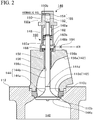
- FIGS. 2 and 3 are extraction enlarged views of a portion surrounded by an alternate long and short dash line of FIG. 1 .
- FIG. 2 shows a state in which the exhaust valve 144 is closed
- FIG. 3 shows a state in which the exhaust valve 144 is opened.
- a through-hole 110b is provided in the cylinder cover 112 to penetrate the cylinder cover 112 in the stroke direction above the combustion chamber 140, and an exhaust valve seat 110c is attached to the inside of the through-hole 110b.
- the exhaust valve seat 110c is an annular member including a valve seat hole 110d penetrating in the same direction as the through-hole 110b.
- the exhaust valve 144 includes a valve body 144a and a shaft 144b.
- the valve body 144a is disposed inside the combustion chamber 140.
- a facing surface 144c (flame contact surface) facing the piston 114 in the stroke direction (an up-down direction in the drawing) is formed in the valve body 144a.
- the facing surface 144c extends in a surface direction substantially perpendicular to the stroke direction.
- the valve body 144a is seated on the exhaust valve seat 110c to openably close the valve seat hole 110d.
- the exhaust valve cage 156 is provided on a side of the cylinder cover 112 far from the combustion chamber 140.
- the shaft 144b is fixed to a back surface portion 144d of the valve body 144a on a far side thereof from the facing surface 144c.
- the shaft 144b extends in the stroke direction and is provided to penetrate the exhaust valve cage 156.
- a tip portion (a lower tip portion) of the exhaust valve cage 156 is inserted into and fixed to a portion of the through-hole 110b of the cylinder cover 112 above the exhaust valve seat 110c.
- An exhaust hole 156a which communicates with the valve seat hole 110d and is curved and extends toward the upper right in the drawing is formed inside the exhaust valve cage 156.
- the exhaust hole 156a opens substantially toward a right area from a right lateral surface of the exhaust valve cage 156 in the drawing.
- connection portions of both inner circumferential surfaces thereof are substantially flush.
- the exhaust port 142 is formed of the valve seat hole 110d of the exhaust valve seat 110c and the exhaust hole 156a of the exhaust valve cage 156.
- the valve body 144a openably closes the exhaust port 142.
- the exhaust valve cage 156 is provided with a shaft hole 156c penetrating from an upper end 156b of the exhaust valve cage 156 to the exhaust port 142 in the stroke direction.
- An annular (substantially cylindrical) guide bush 158 is inserted through the shaft hole 156c, and the shaft 144b is inserted through the guide bush 158.
- the shaft 144b is inserted into the shaft hole 156c via the guide bush 158 and is slidable with respect to the guide bush 158 in the stroke direction. That is, the shaft 144b is movable relative to the exhaust valve cage 156 in the stroke direction. Further, a tip (upper end portion) of the shaft 144b protrudes upward from the exhaust valve cage 156.
- the exhaust valve drive device 146 moves the valve body 144a fixed to the shaft 144b upward and downward in the drawing by driving a portion of the shaft 144b that protrudes upward from the exhaust valve cage 156 to open and close the exhaust port 142.
- the exhaust valve drive device 146 includes a lower casing 148.
- the lower casing 148 is a substantially cylindrical member having a casing hole 148a penetrating therethrough in the stroke direction, and a lower end of the lower casing 148 is fixed to the exhaust valve cage 156, and an upper cover 150 is attached to an upper end of the lower casing 148.
- a cover hole 150a that opens toward the lower casing 148 and communicates with the casing hole 148a is formed in the upper cover 150.
- the cover hole 150a extends in the stroke direction.
- the cover hole 150a is closed by a wall portion (an upper wall portion) of the upper cover 150 on a far side thereof from the lower casing 148, and a bottom of the cover hole 150a is formed on a side (the upper end portion) of the upper cover 150 far from the lower casing 148 and accordingly faces downward. That is, the upper cover 150 is formed in a substantially cylindrical shape with a top.
- An oil hole 150b penetrating from the outer peripheral surface of the upper cover 150 to the cover hole 150a is formed in the vicinity of the bottom of the cover hole 150a of the upper cover 150.
- a hydraulic drive piston 152 is fixed to a tip (the upper end) of the shaft 144b.
- the hydraulic drive piston 152 is inserted into the cover hole 150a to be slidable in the stroke direction, and thus a hydraulic chamber 154 is formed between the hydraulic drive piston 152 and the bottom of the cover hole 150a.
- the oil hole 150b opens to the hydraulic chamber 154, and the hydraulic oil supplied from an oil pump (not shown) is guided from the oil hole 150b to the hydraulic chamber 154.
- the hydraulic drive piston 152 and the hydraulic chamber 154 function as a drive unit 155 that applies a load to the shaft 144b and moves the valve body 144a to an open position at which the valve body 144a opens the exhaust port 142. That is, the drive unit 155 includes the hydraulic drive piston 152 and the hydraulic chamber 154.
- valve body 144a is returned to a closed position for closing the exhaust port 142 by a gas spring mechanism 160 formed in the casing hole 148a of the lower casing 148.
- the gas spring mechanism 160 includes an annular gas spring receiver 160a.
- the gas spring receiver 160a is fixed to the shaft 144b by a cotter 162 and is inserted into the casing hole 148a of the lower casing 148 to be slidable in the stroke direction to divide the inside of the casing hole 148a into two spaces in the stroke direction. That is, the gas spring receiver 160a is movable in conjunction with the movement of the shaft 144b in the stroke direction.
- a gas chamber 160b is a space on the valve body 144a-side of the two spaces obtained by dividing the inside of the casing hole 148a with the gas spring receiver 160a, and part of the shaft 144b (an intermediate portion thereof in the stroke direction) is positioned inside the gas chamber 160b.
- a gas hole 148b penetrating from the outer peripheral surface of the lower casing 148 to the casing hole 148a is formed in the lower casing 148.
- the gas hole 148b opens to the gas chamber 160b, and after the air (incombustible gas, incombustible fluid) compressed by a compressor (not shown) passes through an orifice 164, the air is guided from the gas hole 148b to the gas chamber 160b and stored therein.
- a seal ring is provided on the gas spring receiver 160a positioned above the gas chamber 160b, a seal plate 166 is provided on the lower side (the exhaust valve cage 156-side) of the gas chamber 160b, and accordingly air leakage from the gas chamber 160b to the outside is limited.
- the gas spring receiver 160a When the valve body 144a is moved to the open position by the drive unit 155, as shown in FIG. 3 , the gas spring receiver 160a approaches the seal plate 166, the volume of the gas chamber 160b decreases, and the air stored in the gas chamber 160b is compressed. Therefore, when the load on the valve body 144a (the shaft 144b) by the drive unit 155 is released, the compressed air expands, the gas spring receiver 160a is pushed upward in the drawing, and thus as shown in FIG. 2 , the gas spring mechanism 160 returns the valve body 144a connected to the gas spring receiver 160a via the shaft 144b to the closed position. At this time, the compressed air is supplied from the gas hole 148b to the gas chamber 160b to compensate for a decrease in the amount of air in the gas chamber 160b.
- the valve body 144a of the exhaust valve 144 is positioned in front of the combustion chamber 140-side of the exhaust port 142, and may impede the flow of exhaust gas discharged from the exhaust port 142.
- the exhaust gas flows around the valve body 144a so as to avoid the valve body 144a and is guided to the exhaust port 142, in the present embodiment, a mechanism for limiting the exhaust gas from stagnating in the vicinity of the facing surface 144c facing the piston 114 and for smoothly directing the exhaust gas to the exhaust port 142 is provided.
- FIG. 4 is an explanatory view showing an internal structure of the exhaust valve 144.
- the valve body 144a shown in FIG. 4 is at the open position for opening the exhaust port 142.
- the exhaust valve 144 is provided with a communication passage 144e (a communication hole).
- One end of the communication passage 144e opens at the facing surface 144c of the valve body 144a, and the other end thereof opens at a portion of the outer peripheral surface of the shaft 144b facing the gas chamber 160b at the time the valve body 144a is at the open position.
- the communication passage 144e is continuously formed from the inside of the valve body 144a to the inside of the shaft 144b.
- an injector 168 is attached to a portion of the facing surface 144c of the valve body 144a at which the communication passage 144e opens.
- the injector 168 injects the air guided from the gas chamber 160b through the communication passage 144e into the combustion chamber 140 as shown by the arrows with broken lines in FIG. 4 , and disperses the exhaust gas stagnating in the vicinity of the facing surface 144c. That is, the communication passage 144e allows the gas chamber 160b and the injector 168 to communicate with each other.
- the temperature of the air (incombustible gas, incombustible fluid) injected from the injector 168 into the combustion chamber 140 is lower than the temperature of the exhaust gas in the combustion chamber 140.
- the uniflow scavenging type two-cycle engine 100 of the present embodiment further includes the valve body 144a, the shaft 144b, the drive unit 155, the injector 168, the gas spring mechanism 160, and the communication passage 144e.
- the exhaust gas easily flows around the valve body 144a and is easily discharged from the exhaust port 142, and thus it is possible to limit an increase in the internal temperature of the combustion chamber 140 due to residual high-temperature exhaust gas. As a result, it is possible to expand the operating range in which the engine output can be increased while limiting pre-ignition.
- the facing surface 144c of the valve body 144a faces the piston 114 in the stroke direction, there is a likelihood that the exhaust gas will more readily remain in the vicinity of the facing surface 144c than a case where the valve body 144a is disposed facing in the other direction. Therefore, the discharge performance of the exhaust gas is greatly improved by providing the injector 168.
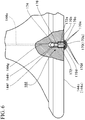
- FIGS. 5 and 6 are enlarged extraction views in the vicinity of the injector 168 of FIG. 4 .
- the injector 168 includes a nozzle unit 170 and a plug unit 172.
- a main body 170a of the nozzle unit 170 is formed in a substantially hemispherical shape, and a flat surface portion 170b of the main body 170a contacts the facing surface 144c, and a curved surface portion 170c (a spherical surface portion) of the main body 170a is positioned on the far side from the facing surface 144c. That is, the curved surface portion 170c and the facing surface 144c both face the combustion chamber 140.
- a substantially hemispherical hollow portion 170d recessed toward the curved surface portion 170c is formed at the center of the flat surface portion 170b, and a plurality of radiation holes 170e penetrating from the hollow portion 170d to the curved surface portion 170c are provided radially.
- a check valve 174 is provided inside one end side (a portion communicating with the injector 168) of the communication passage 144e.
- the check valve 174 allows only the flow of incombustible gas (air) from the gas chamber 160b-side (the upper side in the drawing) to the injector 168-side (the lower side in the drawing). That is, the check valve 174 allows the flow of incombustible gas from the gas chamber 160b to the injector 168, and prevents the flow of incombustible gas from the injector 168 to the gas chamber 160b.
- the check valve 174 of the present embodiment includes a spherical valve body but may be a check valve having another configuration.
- a large inner diameter portion 144f opening at the facing surface 144c is provided at one end (a portion communicating with the injector 168) of the communication passage 144e of the valve body 144a, and a small inner diameter portion 144g having a smaller inner diameter than that of the large inner diameter portion 144f is provided on the other end side of the communication passage 144e (the upper side in the drawing) with respect to the large inner diameter portion 144f.
- a tapered surface 144h is formed at a connection portion between the large inner diameter portion 144f and the small inner diameter portion 144g, and the inner diameter of the tapered surface 144h gradually decreases from the large inner diameter portion 144f toward the small inner diameter portion 144g.
- the check valve 174 is accommodated inside the large inner diameter portion 144f.
- the tapered surface 144h functions as a valve seat of the check valve 174.
- a screw groove is formed on a portion of the inner circumferential surface of the large inner diameter portion 144f close to the facing surface 144c, and the plug unit 172 is inserted from the facing surface 144c-side and is engaged therewith.
- the plug unit 172 is an annular member (a cylindrical member) having a plug hole 172a penetrating in the stroke direction, and one end (a lower end) thereof is fixed to the flat surface portion 170b of the injector 168. Further, the hollow portion 170d and the radiation holes 170e of the injector 168 communicate with the communication passage 144e through the plug hole 172a of the plug unit 172.
- a coil spring 176 contacts the other end (the upper end) of the plug unit 172.
- the coil spring 176 is accommodated in the large inner diameter portion 144f, is held between the check valve 174 and the plug unit 172 in a compressed state, and pushes the check valve 174 toward the tapered surface 144h.
- the check valve 174 is pressed against the tapered surface 144h by the pushing force of the coil spring 176, and the communication passage 144e is closed. That is, the pushing force of the coil spring 176 to the check valve 174 is higher than a force for separating the check valve 174 from the tapered surface 144h due to the pressure of air supplied from the compressor (not shown) to the gas chamber 160b through the orifice 164.
- the shaft 144b connected to the gas spring receiver 160a moves and the exhaust valve 144 is opened, the volume of the gas chamber 160b is reduced by the movement of the gas spring receiver 160a, the air in the gas chamber 160b is compressed, and the pressure of the air in the small inner diameter portion 144g of the communication passage 144e increases.
- the check valve 174 is pushed by the air in the small inner diameter portion 144g and is separated from the tapered surface 144h.
- the air in the gas chamber 160b is injected from the radiation holes 170e of the injector 168 into the combustion chamber 140 through the communication passage 144e.
- each of the openings on the curved surface portion 170c-side of the radiation holes 170e is an injection port 170f for injecting air.
- the communication passage 144e guides the compressed air from the gas chamber 160b to the plurality of injection ports 170f when the volume of the gas chamber 160b decreases.
- the injection ports 170f inject air in directions different from each other. That is, the injection directions of air (incombustible fluid) of the injection ports 170f are different from each other. Therefore, the injector 168 can efficiently diffuse the exhaust gas stagnating in the vicinity of the facing surface 144c, and the exhaust gas can easily flow around the valve body 144a and can be more easily discharged from the exhaust port 142.
- the air supplied to the gas chamber 160b and functioning as an air spring for closing the exhaust valve 144 can be injected from the injection ports 170f into the combustion chamber 140, and it is not necessary to separately supply air to be injected from the injection ports 170f. As a result, the cost reduction can be obtained with a simple configuration.
- the check valve 174 is provided inside the communication passage 144e, when the exhaust valve 144 opens and the pressure of the gas chamber 160b increases, the check valve 174 is automatically opened. Therefore, it is not necessary to provide an electrical mechanism for controlling the injection of air from the injection ports 170f, and it is possible to obtain further reduction in costs with a simple configuration.
- the injector 168 may inject incombustible fluid (which does not burn like fuel), and may inject, for example, water.
- incombustible fluid which does not burn like fuel
- water When water is injected as the incombustible fluid, it is possible to further limit the rise in the internal temperature of the combustion chamber 140.
- a fluid which is an incombustible liquid before injected from the injector 168 and is vaporized to be incombustible gas when injected into the combustion chamber 140 may be used.
- the injector 168 includes the nozzle unit 170, and a plurality of injection ports 170f having different injection directions of air are formed in the nozzle unit 170.
- only one injection port 170f may be formed in the injector 168 (the nozzle unit 170), or part of the facing surface 144c may be used as the injector 168 without providing the nozzle unit 170 or the plug unit 172, and the injection port 170f may be formed on the facing surface 144c.
- the injector 168 uses the gas spring mechanism 160 that causes the air in the gas chamber 160b to function as an air spring
- a coil spring may be used instead of the gas spring mechanism 160.
- other incombustible gas may be used instead of air.
- the check valve 174 may not be provided, and may be replaced by, for example, an electronic control valve or the like.
- a fuel injection port for causing the fuel gas to flow in may be provided in a portion of the cylinder 110 closer to the exhaust port 142 than the scavenging ports 118.
- the facing surface 144c of the valve body 144a faces the piston 114 in the stroke direction, but the facing surface 144c may face the piston 114 in a direction different from the stroke direction.
- the facing surface 144c may be slightly inclined with respect to the direction orthogonal to the stroke direction.
- the injector 168 includes the plurality of injection ports 170f having different injection directions of the incombustible fluid
- a configuration in which the injector includes a plurality of injection ports that are disposed at intervals in a direction parallel to the facing surface 144c and inject incombustible fluid in an equal direction may be provided.
- a branch flow passage is formed in the injector 168 by the hollow portion 170d and the radiation holes 170e
- a configuration in which the communication passages 144e are branched and disposed, for example, inside the valve body 144a, and separately communicate with a plurality of injection ports may be provided.
- the cylinder cover 112-side is referred to as the upper side and the scavenging chamber 122-side is referred to as the lower side in the central axis direction of the cylinder 110, it does not limit the posture of the uniflow scavenging type two-cycle engine 100 at the time of actual use, and the engine may be used in any posture as long as an appropriate operation can be secured.
- the present disclosure can be applied to a uniflow scavenging type two-cycle engine in which an exhaust valve opens and closes an exhaust port.
Landscapes
- Engineering & Computer Science (AREA)
- Mechanical Engineering (AREA)
- General Engineering & Computer Science (AREA)
- Chemical & Material Sciences (AREA)
- Combustion & Propulsion (AREA)
- Physics & Mathematics (AREA)
- Fluid Mechanics (AREA)
- Fuel-Injection Apparatus (AREA)
- Valve-Gear Or Valve Arrangements (AREA)
- Cylinder Crankcases Of Internal Combustion Engines (AREA)
- Output Control And Ontrol Of Special Type Engine (AREA)
Abstract
Description
- The present disclosure relates to a uniflow scavenging type two-cycle engine in which an exhaust valve opens and closes an exhaust port.
- In a uniflow scavenging type two-cycle engine which is also used as an engine of a ship, a scavenging port is provided on one end side of a cylinder in a stroke direction of a piston, and an exhaust port is provided on a cylinder cover disposed on the other end side thereof. When active gas is sucked into a combustion chamber from the scavenging port, exhaust gas after the fuel combustion is pushed out of the exhaust port by the active gas and is discharged.
- Patent Document 1 describes a configuration in which an auxiliary scavenging hole is provided in a portion of the cylinder close to the bottom dead center of the piston other than a main scavenging hole (the scavenging port), and when the piston descends to the vicinity of the bottom dead center, compressed air is injected into the cylinder from the auxiliary scavenging hole. Accordingly, the exhaust gas (residual gas) stagnating at a central portion of the cylinder is dispersed.
- [Patent Document 1] Japanese Unexamined Patent Application, First Publication No.
H9-158738 - The exhaust port is provided with an exhaust valve, and the exhaust port is opened and closed by the exhaust valve. Although a valve body of the exhaust valve is separated from the exhaust port at the time of valve opening, in some cases, the valve body may hinder the flow of exhaust gas discharged from the exhaust port. Therefore, there is a possibility that the exhaust gas stagnates in the vicinity of a facing surface of the exhaust valve facing the piston.
- An object of the present disclosure is to provide a uniflow scavenging type two-cycle engine capable of efficiently discharging the exhaust gas from the cylinder in view of such problems.
- In order to solve the above problems, a first aspect of the present disclosure is a uniflow scavenging type two-cycle engine in which exhaust gas in a cylinder is pushed out of an exhaust port by scavenging air flowed in from a scavenging port, the uniflow scavenging type two-cycle engine including: a valve body which openably closes the exhaust port; and an injector which is provided on a facing surface of the valve body facing a piston disposed inside the cylinder, and injects an incombustible fluid.
- A second aspect of the present disclosure is that in the uniflow scavenging type two-cycle engine of the first aspect, the facing surface of the valve body faces the piston in a stroke direction of the piston.
- A third aspect of the present disclosure is that in the uniflow scavenging type two-cycle engine of the first or second aspect, the injector includes a plurality of injection ports having different injection directions of the incombustible fluid.
- A fourth aspect of the present disclosure is the uniflow scavenging type two-cycle engine of the third aspect further including: a shaft fixed to a side of the valve body far from the facing surface; a drive unit which applies a load to the shaft to move the valve body to an open position at which the valve body opens the exhaust port; a gas spring mechanism including a gas chamber in which incombustible gas is stored, in which at least part of the shaft is positioned, and a volume of which is reduced when the valve body moves to the open position; and a communication passage which is formed in the valve body and the shaft and allows the gas chamber and the injector to communicate with each other.
- A fifth aspect of the present disclosure is that in the uniflow scavenging type two-cycle engine of the fourth aspect, the communication passage is provided with a check valve which allows a flow of the incombustible gas from the gas chamber to the injector and restricts a flow of the incombustible gas from the injector to the gas chamber.
- According to the present disclosure, exhaust gas can be efficiently discharged from the cylinder.
-
-
FIG. 1 is an explanatory view showing an entire configuration of a uniflow scavenging type two-cycle engine. -
FIG. 2 is an extraction enlarged view of a portion surrounded by an alternate long and short dash line ofFIG. 1 , showing a state in which an exhaust valve is closed. -
FIG. 3 is an extraction enlarged view of the portion surrounded by the alternate long and short dash line ofFIG. 1 , showing a state in which the exhaust valve is opened. -
FIG. 4 is an explanatory view showing an internal structure of the exhaust valve. -
FIG. 5 is a first view showing an injector. -
FIG. 6 is a second view showing the injector. - Hereinafter, preferred embodiments of the present disclosure will be described in detail with reference to the attached drawings. Dimensions, materials, specific numerical values and the like of constituent elements shown in the present embodiment are merely examples for facilitating understanding of the invention, and do not limit the present disclosure unless otherwise specified. Further, in the specification and the drawings, by denoting elements having substantially the same functions and configurations by the same reference signs, repeated descriptions will be omitted, and elements not directly related to the present disclosure will not be shown.
-
FIG. 1 is an explanatory view showing an entire configuration of a uniflow scavenging type two-cycle engine 100. The uniflow scavenging type two-cycle engine 100 of the present embodiment is used, for example, for a ship or the like. Specifically, the uniflow scavenging type two-cycle engine 100 is configured to include acylinder 110, acylinder cover 112, apiston 114, apiston rod 116, ascavenging port 118, ascavenging reservoir 120, ascavenging chamber 122, acooler 124, a flow-adjustingplate 126, adrain separator 128, a fuel gasmain pipe 130, afuel injection device 132, anannular pipe 134, afuel pipe 136, afuel injection hole 138, acombustion chamber 140, anexhaust port 142, anexhaust valve 144, and an exhaustvalve drive device 146. Hereinafter, in a central axis direction of the cylinder 110 (an up-down direction in the drawing ofFIG. 1 ), the cylinder cover 112-side may be referred to as an upper side, and the scavenging chamber 122-side may be referred to as a lower side. - In the uniflow scavenging type two-
cycle engine 100, thepiston 114 slides in the cylinder 110 (acylinder liner 110a), and exhaust, intake, compression, combustion, and expansion are performed during two strokes of an up-stroke and a down-stroke of thepiston 114. One end of thepiston rod 116 is fixed to thepiston 114. Further, a cross head (not shown) is connected to the other end of thepiston rod 116, and the cross head reciprocates together with thepiston 114. When the cross head reciprocates together with the reciprocation of thepiston 114, a crankshaft (not shown) rotates in conjunction with the reciprocation. Hereinafter, a direction in which thepiston 114 reciprocates in the central axis direction of thecylinder 110 may be referred to as a stroke direction of thepiston 114. - The
scavenging port 118 is a hole penetrating from an inner peripheral surface to an outer peripheral surface of thecylinder 110, and a plurality ofscavenging ports 118 are provided at intervals on the entire circumference of thecylinder 110. Further, thescavenging ports 118 suck active gas into thecylinder 110 in accordance with the sliding movement of thepiston 114 in the stroke direction. The active gas contains oxygen, an oxidant such as ozone, or a mixture thereof (for example, air). Although thescavenging port 118 of the present embodiment is formed in an oval shape extending in the stroke direction when viewed in the radial direction of thecylinder 110, thescavenging port 118 is not limited to this shape and may have, for example, a circular shape, an elliptical shape, a rectangular shape, a polygonal shape or the like. - Active gas (for example, air) compressed by a supercharger, a blower or the like (not shown) is cooled by the cooler 124 and is sealed in the
scavenging reservoir 120. The active gas flows in thescavenging reservoir 120 from the cooler 124 to thescavenging chamber 122. The compressed and cooled active gas is flow direction-adjusted by the flow-adjustingplates 126 disposed in thescavenging reservoir 120, and then water therein is removed by thedrain separator 128. - The
scavenging chamber 122 communicates with thescavenging reservoir 120 and surrounds one end side (a lower side inFIG. 1 ) of thecylinder 110 in the stroke direction of the piston 114 (hereinafter, simply referred to as the stroke direction). The active gas subjected to compression, cooling, and removal of water is guided to thescavenging chamber 122 from thescavenging reservoir 120. - The
scavenging ports 118 open in thescavenging chamber 122. When thepiston 114 descends below thescavenging ports 118, the inside of thecylinder 110 and thescavenging chamber 122 communicate with each other through thescavenging ports 118, and thescavenging ports 118 suck the active gas into thecylinder 110 from thescavenging chamber 122 due to a pressure difference between thescavenging chamber 122 and the inside of thecylinder 110. - The fuel gas
main pipe 130 communicates with a fuel tank (not shown) and communicates with theannular pipe 134 via thefuel injection device 132. Fuel gas is guided from the fuel tank to the fuel gasmain pipe 130, and when thefuel injection device 132 is driven, the fuel gas in the fuel gasmain pipe 130 flows into theannular pipe 134. - Here, the fuel gas is, for example, a gas generated by gasifying LNG (Liquefied Natural Gas). Further, the fuel gas is not limited to LNG, and, for example, it is possible to use a gas obtained by gasifying LPG (Liquefied Petroleum Gas), light oil, heavy oil or the like therefor.
- The
annular pipe 134 is disposed on a radially outer side of thecylinder 110 and above thescavenging ports 118 inFIG. 1 , and extends annularly in the circumferential direction of thecylinder 110 to surround thecylinder 110. A plurality offuel pipes 136 are fixed to the scavenging port 118-side (that is, the lower side inFIG. 1 ) of theannular pipe 134 in the stroke direction. Onefuel pipe 136 is disposed for eachscavenging port 118, and thefuel pipes 136 extend in the stroke direction. Hereinafter, the radial direction of thecylinder 110 may be referred to simply as the radial direction, and the circumferential direction of thecylinder 110 may be referred to simply as the circumferential direction. - The
fuel pipe 136 faces a wall surface of thecylinder 110 betweenscavenging ports 118 adjacent to each other in the circumferential direction, and thefuel injection hole 138 is formed on a portion of thefuel pipe 136 facing the wall surface. Here, since a plurality ofscavenging ports 118 are provided on the entire circumference of thecylinder 110, a plurality of fuel pipes 136 (the fuel injection holes 138) are also provided in the circumferential direction of thecylinder 110 in accordance with thescavenging ports 118. - The
fuel injection holes 138 inject the fuel gas flowed into theannular pipe 134 into the active gas that is to be sucked into thescavenging ports 118. As a result, the fuel gas joins the flow of the active gas and is sucked into thecylinder 110 from the scavengingports 118 together with the active gas. - When the
piston 114 is on the top dead center-side, thecombustion chamber 140 is surrounded by the cylinder cover 112 (a cylinder head) disposed to cover an upper end opening portion of thecylinder 110, thecylinder liner 110a, and thepiston 114, and thus is formed inside thecylinder 110. The active gas and the fuel gas sucked into thecylinder 110 are guided to thecombustion chamber 140 by thepiston 114. - An appropriate amount of fuel oil is injected into the
combustion chamber 140 from a pilot injection valve (not shown) provided in thecylinder cover 112 at a desired time point in the engine cycle. The fuel oil is vaporized by heat of thecombustion chamber 140. Further, the fuel oil is vaporized and spontaneously ignited to burn in a short time, the temperature of thecombustion chamber 140 becomes extremely high, and the fuel gas guided to thecombustion chamber 140 and compressed is burned. Thepiston 114 reciprocates by the expansion pressure due to the combustion mainly of the fuel gas. - The
exhaust port 142 is formed on the upper side of thecombustion chamber 140 inFIG. 1 , and is opened and closed to discharge the exhaust gas generated by combustion of the fuel gas in thecylinder 110 outside of thecylinder 110. Theexhaust port 142 of the present embodiment is formed in thecylinder cover 112 and anexhaust valve cage 156 to be described later. Theexhaust valve 144 is slid up and down at a predetermined timing by the exhaustvalve drive device 146 to open and close theexhaust port 142. After the combustion of the fuel gas, when theexhaust valve 144 is opened, the exhaust gas in thecylinder 110 is pushed out of theexhaust port 142 by the active gas (scavenging air) flowed in from the scavengingports 118. -
FIGS. 2 and3 are extraction enlarged views of a portion surrounded by an alternate long and short dash line ofFIG. 1 .FIG. 2 shows a state in which theexhaust valve 144 is closed, andFIG. 3 shows a state in which theexhaust valve 144 is opened. As shown inFIGS. 2 and3 , a through-hole 110b is provided in thecylinder cover 112 to penetrate thecylinder cover 112 in the stroke direction above thecombustion chamber 140, and anexhaust valve seat 110c is attached to the inside of the through-hole 110b. Theexhaust valve seat 110c is an annular member including avalve seat hole 110d penetrating in the same direction as the through-hole 110b. - The
exhaust valve 144 includes avalve body 144a and ashaft 144b. Thevalve body 144a is disposed inside thecombustion chamber 140. A facingsurface 144c (flame contact surface) facing thepiston 114 in the stroke direction (an up-down direction in the drawing) is formed in thevalve body 144a. The facingsurface 144c extends in a surface direction substantially perpendicular to the stroke direction. Thevalve body 144a is seated on theexhaust valve seat 110c to openably close thevalve seat hole 110d. Theexhaust valve cage 156 is provided on a side of thecylinder cover 112 far from thecombustion chamber 140. - The
shaft 144b is fixed to aback surface portion 144d of thevalve body 144a on a far side thereof from the facingsurface 144c. Theshaft 144b extends in the stroke direction and is provided to penetrate theexhaust valve cage 156. A tip portion (a lower tip portion) of theexhaust valve cage 156 is inserted into and fixed to a portion of the through-hole 110b of thecylinder cover 112 above theexhaust valve seat 110c. Anexhaust hole 156a which communicates with thevalve seat hole 110d and is curved and extends toward the upper right in the drawing is formed inside theexhaust valve cage 156. Theexhaust hole 156a opens substantially toward a right area from a right lateral surface of theexhaust valve cage 156 in the drawing. - In the
valve seat hole 110d of theexhaust valve seat 110c and theexhaust hole 156a of theexhaust valve cage 156, connection portions of both inner circumferential surfaces thereof are substantially flush. Theexhaust port 142 is formed of thevalve seat hole 110d of theexhaust valve seat 110c and theexhaust hole 156a of theexhaust valve cage 156. Thevalve body 144a openably closes theexhaust port 142. - The
exhaust valve cage 156 is provided with ashaft hole 156c penetrating from anupper end 156b of theexhaust valve cage 156 to theexhaust port 142 in the stroke direction. An annular (substantially cylindrical)guide bush 158 is inserted through theshaft hole 156c, and theshaft 144b is inserted through theguide bush 158. - Thus, the
shaft 144b is inserted into theshaft hole 156c via theguide bush 158 and is slidable with respect to theguide bush 158 in the stroke direction. That is, theshaft 144b is movable relative to theexhaust valve cage 156 in the stroke direction. Further, a tip (upper end portion) of theshaft 144b protrudes upward from theexhaust valve cage 156. - The exhaust
valve drive device 146 moves thevalve body 144a fixed to theshaft 144b upward and downward in the drawing by driving a portion of theshaft 144b that protrudes upward from theexhaust valve cage 156 to open and close theexhaust port 142. - Specifically, the exhaust
valve drive device 146 includes alower casing 148. Thelower casing 148 is a substantially cylindrical member having acasing hole 148a penetrating therethrough in the stroke direction, and a lower end of thelower casing 148 is fixed to theexhaust valve cage 156, and anupper cover 150 is attached to an upper end of thelower casing 148. - A
cover hole 150a that opens toward thelower casing 148 and communicates with thecasing hole 148a is formed in theupper cover 150. Thecover hole 150a extends in the stroke direction. Thecover hole 150a is closed by a wall portion (an upper wall portion) of theupper cover 150 on a far side thereof from thelower casing 148, and a bottom of thecover hole 150a is formed on a side (the upper end portion) of theupper cover 150 far from thelower casing 148 and accordingly faces downward. That is, theupper cover 150 is formed in a substantially cylindrical shape with a top. Anoil hole 150b penetrating from the outer peripheral surface of theupper cover 150 to thecover hole 150a is formed in the vicinity of the bottom of thecover hole 150a of theupper cover 150. - Further, a
hydraulic drive piston 152 is fixed to a tip (the upper end) of theshaft 144b. Thehydraulic drive piston 152 is inserted into thecover hole 150a to be slidable in the stroke direction, and thus ahydraulic chamber 154 is formed between thehydraulic drive piston 152 and the bottom of thecover hole 150a. Theoil hole 150b opens to thehydraulic chamber 154, and the hydraulic oil supplied from an oil pump (not shown) is guided from theoil hole 150b to thehydraulic chamber 154. - When the hydraulic oil is guided to the
hydraulic chamber 154 and a load due to the hydraulic pressure is applied to thehydraulic drive piston 152, that is, when thehydraulic drive piston 152 is pushed by the hydraulic pressure, thevalve body 144a connected to thehydraulic drive piston 152 via theshaft 144b moves downward inFIG. 2 , and theexhaust port 142 opens as shown inFIG. 3 . In this way, thehydraulic drive piston 152 and thehydraulic chamber 154 function as adrive unit 155 that applies a load to theshaft 144b and moves thevalve body 144a to an open position at which thevalve body 144a opens theexhaust port 142. That is, thedrive unit 155 includes thehydraulic drive piston 152 and thehydraulic chamber 154. - Further, when the hydraulic pressure of the hydraulic oil guided to the
hydraulic chamber 154 decreases, thevalve body 144a is returned to a closed position for closing theexhaust port 142 by agas spring mechanism 160 formed in thecasing hole 148a of thelower casing 148. - The
gas spring mechanism 160 will be specifically described. Thegas spring mechanism 160 includes an annulargas spring receiver 160a. Thegas spring receiver 160a is fixed to theshaft 144b by acotter 162 and is inserted into thecasing hole 148a of thelower casing 148 to be slidable in the stroke direction to divide the inside of thecasing hole 148a into two spaces in the stroke direction. That is, thegas spring receiver 160a is movable in conjunction with the movement of theshaft 144b in the stroke direction. - A
gas chamber 160b is a space on thevalve body 144a-side of the two spaces obtained by dividing the inside of thecasing hole 148a with thegas spring receiver 160a, and part of theshaft 144b (an intermediate portion thereof in the stroke direction) is positioned inside thegas chamber 160b. - A
gas hole 148b penetrating from the outer peripheral surface of thelower casing 148 to thecasing hole 148a is formed in thelower casing 148. Thegas hole 148b opens to thegas chamber 160b, and after the air (incombustible gas, incombustible fluid) compressed by a compressor (not shown) passes through anorifice 164, the air is guided from thegas hole 148b to thegas chamber 160b and stored therein. - Further, in the drawing, a seal ring is provided on the
gas spring receiver 160a positioned above thegas chamber 160b, aseal plate 166 is provided on the lower side (the exhaust valve cage 156-side) of thegas chamber 160b, and accordingly air leakage from thegas chamber 160b to the outside is limited. - When the
valve body 144a is moved to the open position by thedrive unit 155, as shown inFIG. 3 , thegas spring receiver 160a approaches theseal plate 166, the volume of thegas chamber 160b decreases, and the air stored in thegas chamber 160b is compressed. Therefore, when the load on thevalve body 144a (theshaft 144b) by thedrive unit 155 is released, the compressed air expands, thegas spring receiver 160a is pushed upward in the drawing, and thus as shown inFIG. 2 , thegas spring mechanism 160 returns thevalve body 144a connected to thegas spring receiver 160a via theshaft 144b to the closed position. At this time, the compressed air is supplied from thegas hole 148b to thegas chamber 160b to compensate for a decrease in the amount of air in thegas chamber 160b. - As shown in
FIG. 3 , when theexhaust valve 144 is opened, in some cases, thevalve body 144a of theexhaust valve 144 is positioned in front of the combustion chamber 140-side of theexhaust port 142, and may impede the flow of exhaust gas discharged from theexhaust port 142. Although the exhaust gas flows around thevalve body 144a so as to avoid thevalve body 144a and is guided to theexhaust port 142, in the present embodiment, a mechanism for limiting the exhaust gas from stagnating in the vicinity of the facingsurface 144c facing thepiston 114 and for smoothly directing the exhaust gas to theexhaust port 142 is provided. -
FIG. 4 is an explanatory view showing an internal structure of theexhaust valve 144. Thevalve body 144a shown inFIG. 4 is at the open position for opening theexhaust port 142. As shown inFIG. 4 , theexhaust valve 144 is provided with acommunication passage 144e (a communication hole). One end of thecommunication passage 144e opens at the facingsurface 144c of thevalve body 144a, and the other end thereof opens at a portion of the outer peripheral surface of theshaft 144b facing thegas chamber 160b at the time thevalve body 144a is at the open position. Thecommunication passage 144e is continuously formed from the inside of thevalve body 144a to the inside of theshaft 144b. - Moreover, an
injector 168 is attached to a portion of the facingsurface 144c of thevalve body 144a at which thecommunication passage 144e opens. Theinjector 168 injects the air guided from thegas chamber 160b through thecommunication passage 144e into thecombustion chamber 140 as shown by the arrows with broken lines inFIG. 4 , and disperses the exhaust gas stagnating in the vicinity of the facingsurface 144c. That is, thecommunication passage 144e allows thegas chamber 160b and theinjector 168 to communicate with each other. Further, the temperature of the air (incombustible gas, incombustible fluid) injected from theinjector 168 into thecombustion chamber 140 is lower than the temperature of the exhaust gas in thecombustion chamber 140. Further, the uniflow scavenging type two-cycle engine 100 of the present embodiment further includes thevalve body 144a, theshaft 144b, thedrive unit 155, theinjector 168, thegas spring mechanism 160, and thecommunication passage 144e. - Therefore, the exhaust gas easily flows around the
valve body 144a and is easily discharged from theexhaust port 142, and thus it is possible to limit an increase in the internal temperature of thecombustion chamber 140 due to residual high-temperature exhaust gas. As a result, it is possible to expand the operating range in which the engine output can be increased while limiting pre-ignition. - Further, in the present embodiment, since the facing
surface 144c of thevalve body 144a faces thepiston 114 in the stroke direction, there is a likelihood that the exhaust gas will more readily remain in the vicinity of the facingsurface 144c than a case where thevalve body 144a is disposed facing in the other direction. Therefore, the discharge performance of the exhaust gas is greatly improved by providing theinjector 168. -
FIGS. 5 and6 are enlarged extraction views in the vicinity of theinjector 168 ofFIG. 4 . As shown inFIG. 5 , theinjector 168 includes anozzle unit 170 and aplug unit 172. Amain body 170a of thenozzle unit 170 is formed in a substantially hemispherical shape, and aflat surface portion 170b of themain body 170a contacts the facingsurface 144c, and acurved surface portion 170c (a spherical surface portion) of themain body 170a is positioned on the far side from the facingsurface 144c. That is, thecurved surface portion 170c and the facingsurface 144c both face thecombustion chamber 140. - Further, in the
nozzle unit 170, a substantially hemisphericalhollow portion 170d recessed toward thecurved surface portion 170c is formed at the center of theflat surface portion 170b, and a plurality ofradiation holes 170e penetrating from thehollow portion 170d to thecurved surface portion 170c are provided radially. - Further, a
check valve 174 is provided inside one end side (a portion communicating with the injector 168) of thecommunication passage 144e. Thecheck valve 174 allows only the flow of incombustible gas (air) from thegas chamber 160b-side (the upper side in the drawing) to the injector 168-side (the lower side in the drawing). That is, thecheck valve 174 allows the flow of incombustible gas from thegas chamber 160b to theinjector 168, and prevents the flow of incombustible gas from theinjector 168 to thegas chamber 160b. Thecheck valve 174 of the present embodiment includes a spherical valve body but may be a check valve having another configuration. - Specifically, a large
inner diameter portion 144f opening at the facingsurface 144c is provided at one end (a portion communicating with the injector 168) of thecommunication passage 144e of thevalve body 144a, and a smallinner diameter portion 144g having a smaller inner diameter than that of the largeinner diameter portion 144f is provided on the other end side of thecommunication passage 144e (the upper side in the drawing) with respect to the largeinner diameter portion 144f. Atapered surface 144h is formed at a connection portion between the largeinner diameter portion 144f and the smallinner diameter portion 144g, and the inner diameter of the taperedsurface 144h gradually decreases from the largeinner diameter portion 144f toward the smallinner diameter portion 144g. Further, thecheck valve 174 is accommodated inside the largeinner diameter portion 144f. Thetapered surface 144h functions as a valve seat of thecheck valve 174. - Further, a screw groove is formed on a portion of the inner circumferential surface of the large
inner diameter portion 144f close to the facingsurface 144c, and theplug unit 172 is inserted from the facingsurface 144c-side and is engaged therewith. Theplug unit 172 is an annular member (a cylindrical member) having aplug hole 172a penetrating in the stroke direction, and one end (a lower end) thereof is fixed to theflat surface portion 170b of theinjector 168. Further, thehollow portion 170d and the radiation holes 170e of theinjector 168 communicate with thecommunication passage 144e through theplug hole 172a of theplug unit 172. - Further, a
coil spring 176 contacts the other end (the upper end) of theplug unit 172. Thecoil spring 176 is accommodated in the largeinner diameter portion 144f, is held between thecheck valve 174 and theplug unit 172 in a compressed state, and pushes thecheck valve 174 toward the taperedsurface 144h. - For example, when the
exhaust valve 144 is closed, as shown inFIG. 5 , thecheck valve 174 is pressed against the taperedsurface 144h by the pushing force of thecoil spring 176, and thecommunication passage 144e is closed. That is, the pushing force of thecoil spring 176 to thecheck valve 174 is higher than a force for separating thecheck valve 174 from the taperedsurface 144h due to the pressure of air supplied from the compressor (not shown) to thegas chamber 160b through theorifice 164. - Further, when the
shaft 144b connected to thegas spring receiver 160a moves and theexhaust valve 144 is opened, the volume of thegas chamber 160b is reduced by the movement of thegas spring receiver 160a, the air in thegas chamber 160b is compressed, and the pressure of the air in the smallinner diameter portion 144g of thecommunication passage 144e increases. When the load acting on thecheck valve 174 due to the pressure of air becomes greater than the pushing force of thecoil spring 176, as shown inFIG. 6 , thecheck valve 174 is pushed by the air in the smallinner diameter portion 144g and is separated from the taperedsurface 144h. As a result, the air in thegas chamber 160b is injected from the radiation holes 170e of theinjector 168 into thecombustion chamber 140 through thecommunication passage 144e. - That is, each of the openings on the
curved surface portion 170c-side of theradiation holes 170e is aninjection port 170f for injecting air. Thecommunication passage 144e guides the compressed air from thegas chamber 160b to the plurality ofinjection ports 170f when the volume of thegas chamber 160b decreases. - Since the directions of the central axes of the openings of the
injection ports 170f (the central axes of the radiation holes 170e) are different from each other, theinjection ports 170f inject air in directions different from each other. That is, the injection directions of air (incombustible fluid) of theinjection ports 170f are different from each other. Therefore, theinjector 168 can efficiently diffuse the exhaust gas stagnating in the vicinity of the facingsurface 144c, and the exhaust gas can easily flow around thevalve body 144a and can be more easily discharged from theexhaust port 142. - Further, the air supplied to the
gas chamber 160b and functioning as an air spring for closing theexhaust valve 144 can be injected from theinjection ports 170f into thecombustion chamber 140, and it is not necessary to separately supply air to be injected from theinjection ports 170f. As a result, the cost reduction can be obtained with a simple configuration. - Further, since the
check valve 174 is provided inside thecommunication passage 144e, when theexhaust valve 144 opens and the pressure of thegas chamber 160b increases, thecheck valve 174 is automatically opened. Therefore, it is not necessary to provide an electrical mechanism for controlling the injection of air from theinjection ports 170f, and it is possible to obtain further reduction in costs with a simple configuration. - Although the embodiment of the present disclosure has been described above with reference to the attached drawings, the present disclosure is not limited to the above-described embodiment. The shapes, combinations, and the like of the constituent members described in the above embodiment are merely examples, and addition, omission, substitution, and other modifications of the configuration can be adopted based on design requirements and the like within the technical scope of the present disclosure.
- For example, although the case in which the
injector 168 injects air has been described in the embodiment described above, theinjector 168 may inject incombustible fluid (which does not burn like fuel), and may inject, for example, water. When water is injected as the incombustible fluid, it is possible to further limit the rise in the internal temperature of thecombustion chamber 140. Moreover, a fluid which is an incombustible liquid before injected from theinjector 168 and is vaporized to be incombustible gas when injected into thecombustion chamber 140 may be used. - Further, in the embodiment described above, the case has been described in which the
injector 168 includes thenozzle unit 170, and a plurality ofinjection ports 170f having different injection directions of air are formed in thenozzle unit 170. However, only oneinjection port 170f may be formed in the injector 168 (the nozzle unit 170), or part of the facingsurface 144c may be used as theinjector 168 without providing thenozzle unit 170 or theplug unit 172, and theinjection port 170f may be formed on the facingsurface 144c. - In the embodiment described above, although the case in which the
injector 168 uses thegas spring mechanism 160 that causes the air in thegas chamber 160b to function as an air spring has been described, a coil spring may be used instead of thegas spring mechanism 160. Also, other incombustible gas may be used instead of air. - Further, in the embodiment described above, the case in which the
check valve 174 is provided in thecommunication passage 144e has been described. However, thecheck valve 174 may not be provided, and may be replaced by, for example, an electronic control valve or the like. - In the embodiment described above, the case in which the
fuel injection hole 138 is provided outside the scavengingports 118 and the fuel gas flows into thecylinder 110 from the scavengingports 118 has been described. However, a fuel injection port for causing the fuel gas to flow in may be provided in a portion of thecylinder 110 closer to theexhaust port 142 than the scavengingports 118. - Further, in the embodiment described above, the facing
surface 144c of thevalve body 144a faces thepiston 114 in the stroke direction, but the facingsurface 144c may face thepiston 114 in a direction different from the stroke direction. For example, the facingsurface 144c may be slightly inclined with respect to the direction orthogonal to the stroke direction. - Further, in the embodiment described above, although the
injector 168 includes the plurality ofinjection ports 170f having different injection directions of the incombustible fluid, a configuration in which the injector includes a plurality of injection ports that are disposed at intervals in a direction parallel to the facingsurface 144c and inject incombustible fluid in an equal direction (for example, the direction toward thepiston 114 in the stroke direction) may be provided. Further, in the embodiment described above, although a branch flow passage is formed in theinjector 168 by thehollow portion 170d and theradiation holes 170e, a configuration in which thecommunication passages 144e are branched and disposed, for example, inside thevalve body 144a, and separately communicate with a plurality of injection ports may be provided. - Further, in the embodiment described above, although the cylinder cover 112-side is referred to as the upper side and the scavenging chamber 122-side is referred to as the lower side in the central axis direction of the
cylinder 110, it does not limit the posture of the uniflow scavenging type two-cycle engine 100 at the time of actual use, and the engine may be used in any posture as long as an appropriate operation can be secured. - The present disclosure can be applied to a uniflow scavenging type two-cycle engine in which an exhaust valve opens and closes an exhaust port.
-
- 100 Uniflow scavenging type two-cycle engine
- 110 Cylinder
- 114 Piston
- 118 Scavenging port
- 142 Exhaust port
- 144 Exhaust valve
- 144a Valve body
- 144b Shaft
- 144c Facing surface
- 144e Communication passage
- 152 Hydraulic drive piston
- 154 Hydraulic chamber
- 155 Drive unit
- 160 Gas spring mechanism
- 160a Gas spring receiver
- 160b Gas chamber
- 168 Injector
- 170f Injection port
- 174 Check valve
Claims (6)
- A uniflow scavenging type two-cycle engine in which exhaust gas in a cylinder is pushed out of an exhaust port by scavenging air flowed in from a scavenging port, the uniflow scavenging type two-cycle engine comprising:a valve body which openably closes the exhaust port; andan injector which is provided on a facing surface of the valve body facing a piston disposed inside the cylinder, and injects an incombustible fluid.
- The uniflow scavenging type two-cycle engine according to claim 1, wherein the facing surface of the valve body faces the piston in a stroke direction of the piston.
- The uniflow scavenging type two-cycle engine according to claim 1, wherein the injector includes a plurality of injection ports having different injection directions of the incombustible fluid.
- The uniflow scavenging type two-cycle engine according to claim 2, wherein the injector includes a plurality of injection ports having different injection directions of the incombustible fluid.
- The uniflow scavenging type two-cycle engine according to any one of claims 1 to 4, further comprising:a shaft fixed to a side of the valve body far from the facing surface;a drive unit which applies a load to the shaft to move the valve body to an open position at which the valve body opens the exhaust port;a gas spring mechanism including a gas chamber in which incombustible gas is stored, in which at least part of the shaft is positioned, and a volume of which is reduced when the valve body moves to the open position; anda communication passage which is formed in the valve body and the shaft and allows the gas chamber and the injector to communicate with each other.
- The uniflow scavenging type two-cycle engine according to claim 5, wherein the communication passage is provided with a check valve which allows a flow of the incombustible gas from the gas chamber to the injector and restricts a flow of the incombustible gas from the injector to the gas chamber.
Applications Claiming Priority (1)
| Application Number | Priority Date | Filing Date | Title |
|---|---|---|---|
| PCT/JP2017/008778 WO2018163245A1 (en) | 2017-03-06 | 2017-03-06 | Uniflow scavenging type two-cycle engine |
Publications (3)
| Publication Number | Publication Date |
|---|---|
| EP3594470A1 true EP3594470A1 (en) | 2020-01-15 |
| EP3594470A4 EP3594470A4 (en) | 2020-08-12 |
| EP3594470B1 EP3594470B1 (en) | 2023-05-03 |
Family
ID=63447555
Family Applications (1)
| Application Number | Title | Priority Date | Filing Date |
|---|---|---|---|
| EP17899643.5A Active EP3594470B1 (en) | 2017-03-06 | 2017-03-06 | Uniflow scavenging type two-cycle engine |
Country Status (6)
| Country | Link |
|---|---|
| EP (1) | EP3594470B1 (en) |
| JP (2) | JPWO2018163245A1 (en) |
| KR (1) | KR102260541B1 (en) |
| CN (1) | CN110352293B (en) |
| DK (1) | DK3594470T3 (en) |
| WO (1) | WO2018163245A1 (en) |
Families Citing this family (2)
| Publication number | Priority date | Publication date | Assignee | Title |
|---|---|---|---|---|
| CN109058212A (en) * | 2018-10-30 | 2018-12-21 | 博纳斯威阀门股份有限公司 | Hydraulic-driven axial flow valve |
| JP7780279B2 (en) * | 2021-09-08 | 2025-12-04 | 株式会社ジャパンエンジンコーポレーション | Seat structure |
Family Cites Families (8)
| Publication number | Priority date | Publication date | Assignee | Title |
|---|---|---|---|---|
| US1873119A (en) * | 1927-07-20 | 1932-08-23 | Doherty Res Co | Air cooled valve and valve seat |
| JPS57153914A (en) * | 1981-03-19 | 1982-09-22 | Mitsubishi Heavy Ind Ltd | Cooler for valve of internal combustion engine |
| SE461111B (en) * | 1981-09-14 | 1990-01-08 | Colgate Thermodynamics Co | DEVICE FOR COMPRESSION OR EXPANSION OF A GAS UNDER FORCED FLOW |
| JPS63118333U (en) * | 1987-01-28 | 1988-07-30 | ||
| JPH01102410U (en) * | 1987-12-28 | 1989-07-11 | ||
| JPH09158738A (en) | 1995-12-13 | 1997-06-17 | Daihatsu Motor Co Ltd | Uniflow type scavenging device |
| GR20080100222A (en) * | 2008-04-02 | 2009-11-19 | Διονυσιος Χαραλαμπους Χοϊδας | Method and devices of cooling of the environment of an outlet value. |
| JP6036128B2 (en) * | 2012-10-03 | 2016-11-30 | 株式会社Ihi | Uniflow scavenging 2-cycle engine |
-
2017
- 2017-03-06 JP JP2019503836A patent/JPWO2018163245A1/en active Pending
- 2017-03-06 WO PCT/JP2017/008778 patent/WO2018163245A1/en not_active Ceased
- 2017-03-06 DK DK17899643.5T patent/DK3594470T3/en active
- 2017-03-06 KR KR1020197025787A patent/KR102260541B1/en active Active
- 2017-03-06 CN CN201780088018.3A patent/CN110352293B/en active Active
- 2017-03-06 EP EP17899643.5A patent/EP3594470B1/en active Active
-
2021
- 2021-04-16 JP JP2021069902A patent/JP7173200B2/en active Active
Also Published As
| Publication number | Publication date |
|---|---|
| WO2018163245A1 (en) | 2018-09-13 |
| JP7173200B2 (en) | 2022-11-16 |
| KR20190108629A (en) | 2019-09-24 |
| JP2021105401A (en) | 2021-07-26 |
| JPWO2018163245A1 (en) | 2019-11-07 |
| EP3594470A4 (en) | 2020-08-12 |
| KR102260541B1 (en) | 2021-06-04 |
| CN110352293A (en) | 2019-10-18 |
| DK3594470T3 (en) | 2023-05-30 |
| CN110352293B (en) | 2021-09-17 |
| EP3594470B1 (en) | 2023-05-03 |
Similar Documents
| Publication | Publication Date | Title |
|---|---|---|
| US10087831B2 (en) | Engine | |
| US9605590B2 (en) | Crosshead engine | |
| EP3296539B1 (en) | Oil pressure generating device and crosshead engine | |
| US20210071550A1 (en) | Variable compression ratio mechanism | |
| US9562497B2 (en) | Engine system having piezo actuated gas injector | |
| JP7173200B2 (en) | Uniflow scavenging 2-cycle engine | |
| EP3296557B1 (en) | Fuel injection device and engine | |
| EP3760852B1 (en) | Compression ratio varying mechanism | |
| US10539107B2 (en) | Fuel injection unit and fuel feeding arrangement | |
| KR20190062343A (en) | Fuel injector valve for dual fuel engine | |
| KR102279170B1 (en) | Variable Compression Units and Engine Systems | |
| KR102274364B1 (en) | Variable Compression Units and Engine Systems | |
| EP4520952A1 (en) | A fuel valve for injecting fuel into the cylinders of a large turbocharged two-stroke uniflow scavenged internal combustion engine and an engine with such fuel valves | |
| JP2019120165A (en) | Variable compression apparatus and engine system |
Legal Events
| Date | Code | Title | Description |
|---|---|---|---|
| STAA | Information on the status of an ep patent application or granted ep patent |
Free format text: STATUS: THE INTERNATIONAL PUBLICATION HAS BEEN MADE |
|
| PUAI | Public reference made under article 153(3) epc to a published international application that has entered the european phase |
Free format text: ORIGINAL CODE: 0009012 |
|
| STAA | Information on the status of an ep patent application or granted ep patent |
Free format text: STATUS: REQUEST FOR EXAMINATION WAS MADE |
|
| 17P | Request for examination filed |
Effective date: 20190925 |
|
| AK | Designated contracting states |
Kind code of ref document: A1 Designated state(s): AL AT BE BG CH CY CZ DE DK EE ES FI FR GB GR HR HU IE IS IT LI LT LU LV MC MK MT NL NO PL PT RO RS SE SI SK SM TR |
|
| AX | Request for extension of the european patent |
Extension state: BA ME |
|
| DAV | Request for validation of the european patent (deleted) | ||
| DAX | Request for extension of the european patent (deleted) | ||
| A4 | Supplementary search report drawn up and despatched |
Effective date: 20200710 |
|
| RIC1 | Information provided on ipc code assigned before grant |
Ipc: F02B 25/20 20060101ALI20200706BHEP Ipc: F01L 3/16 20060101ALI20200706BHEP Ipc: F02D 13/02 20060101ALI20200706BHEP Ipc: F02B 25/04 20060101AFI20200706BHEP Ipc: F01L 3/06 20060101ALI20200706BHEP Ipc: F02B 75/02 20060101ALN20200706BHEP |
|
| RIC1 | Information provided on ipc code assigned before grant |
Ipc: F02B 75/02 20060101ALN20221017BHEP Ipc: F02D 13/02 20060101ALI20221017BHEP Ipc: F02B 25/20 20060101ALI20221017BHEP Ipc: F01L 3/16 20060101ALI20221017BHEP Ipc: F01L 3/06 20060101ALI20221017BHEP Ipc: F02B 25/04 20060101AFI20221017BHEP |
|
| GRAP | Despatch of communication of intention to grant a patent |
Free format text: ORIGINAL CODE: EPIDOSNIGR1 |
|
| STAA | Information on the status of an ep patent application or granted ep patent |
Free format text: STATUS: GRANT OF PATENT IS INTENDED |
|
| INTG | Intention to grant announced |
Effective date: 20221206 |
|
| GRAS | Grant fee paid |
Free format text: ORIGINAL CODE: EPIDOSNIGR3 |
|
| GRAA | (expected) grant |
Free format text: ORIGINAL CODE: 0009210 |
|
| STAA | Information on the status of an ep patent application or granted ep patent |
Free format text: STATUS: THE PATENT HAS BEEN GRANTED |
|
| AK | Designated contracting states |
Kind code of ref document: B1 Designated state(s): AL AT BE BG CH CY CZ DE DK EE ES FI FR GB GR HR HU IE IS IT LI LT LU LV MC MK MT NL NO PL PT RO RS SE SI SK SM TR |
|
| REG | Reference to a national code |
Ref country code: GB Ref legal event code: FG4D |
|
| REG | Reference to a national code |
Ref country code: DE Ref legal event code: R096 Ref document number: 602017068451 Country of ref document: DE |
|
| REG | Reference to a national code |
Ref country code: AT Ref legal event code: REF Ref document number: 1564772 Country of ref document: AT Kind code of ref document: T Effective date: 20230515 Ref country code: CH Ref legal event code: EP |
|
| REG | Reference to a national code |
Ref country code: IE Ref legal event code: FG4D |
|
| REG | Reference to a national code |
Ref country code: DK Ref legal event code: T3 Effective date: 20230525 |
|
| REG | Reference to a national code |
Ref country code: LT Ref legal event code: MG9D |
|
| REG | Reference to a national code |
Ref country code: NL Ref legal event code: MP Effective date: 20230503 |
|
| REG | Reference to a national code |
Ref country code: AT Ref legal event code: MK05 Ref document number: 1564772 Country of ref document: AT Kind code of ref document: T Effective date: 20230503 |
|
| PG25 | Lapsed in a contracting state [announced via postgrant information from national office to epo] |
Ref country code: SE Free format text: LAPSE BECAUSE OF FAILURE TO SUBMIT A TRANSLATION OF THE DESCRIPTION OR TO PAY THE FEE WITHIN THE PRESCRIBED TIME-LIMIT Effective date: 20230503 Ref country code: PT Free format text: LAPSE BECAUSE OF FAILURE TO SUBMIT A TRANSLATION OF THE DESCRIPTION OR TO PAY THE FEE WITHIN THE PRESCRIBED TIME-LIMIT Effective date: 20230904 Ref country code: NO Free format text: LAPSE BECAUSE OF FAILURE TO SUBMIT A TRANSLATION OF THE DESCRIPTION OR TO PAY THE FEE WITHIN THE PRESCRIBED TIME-LIMIT Effective date: 20230803 Ref country code: NL Free format text: LAPSE BECAUSE OF FAILURE TO SUBMIT A TRANSLATION OF THE DESCRIPTION OR TO PAY THE FEE WITHIN THE PRESCRIBED TIME-LIMIT Effective date: 20230503 Ref country code: ES Free format text: LAPSE BECAUSE OF FAILURE TO SUBMIT A TRANSLATION OF THE DESCRIPTION OR TO PAY THE FEE WITHIN THE PRESCRIBED TIME-LIMIT Effective date: 20230503 Ref country code: AT Free format text: LAPSE BECAUSE OF FAILURE TO SUBMIT A TRANSLATION OF THE DESCRIPTION OR TO PAY THE FEE WITHIN THE PRESCRIBED TIME-LIMIT Effective date: 20230503 |
|
| PG25 | Lapsed in a contracting state [announced via postgrant information from national office to epo] |
Ref country code: RS Free format text: LAPSE BECAUSE OF FAILURE TO SUBMIT A TRANSLATION OF THE DESCRIPTION OR TO PAY THE FEE WITHIN THE PRESCRIBED TIME-LIMIT Effective date: 20230503 Ref country code: PL Free format text: LAPSE BECAUSE OF FAILURE TO SUBMIT A TRANSLATION OF THE DESCRIPTION OR TO PAY THE FEE WITHIN THE PRESCRIBED TIME-LIMIT Effective date: 20230503 Ref country code: LV Free format text: LAPSE BECAUSE OF FAILURE TO SUBMIT A TRANSLATION OF THE DESCRIPTION OR TO PAY THE FEE WITHIN THE PRESCRIBED TIME-LIMIT Effective date: 20230503 Ref country code: LT Free format text: LAPSE BECAUSE OF FAILURE TO SUBMIT A TRANSLATION OF THE DESCRIPTION OR TO PAY THE FEE WITHIN THE PRESCRIBED TIME-LIMIT Effective date: 20230503 Ref country code: IS Free format text: LAPSE BECAUSE OF FAILURE TO SUBMIT A TRANSLATION OF THE DESCRIPTION OR TO PAY THE FEE WITHIN THE PRESCRIBED TIME-LIMIT Effective date: 20230903 Ref country code: HR Free format text: LAPSE BECAUSE OF FAILURE TO SUBMIT A TRANSLATION OF THE DESCRIPTION OR TO PAY THE FEE WITHIN THE PRESCRIBED TIME-LIMIT Effective date: 20230503 Ref country code: GR Free format text: LAPSE BECAUSE OF FAILURE TO SUBMIT A TRANSLATION OF THE DESCRIPTION OR TO PAY THE FEE WITHIN THE PRESCRIBED TIME-LIMIT Effective date: 20230804 |
|
| PG25 | Lapsed in a contracting state [announced via postgrant information from national office to epo] |
Ref country code: FI Free format text: LAPSE BECAUSE OF FAILURE TO SUBMIT A TRANSLATION OF THE DESCRIPTION OR TO PAY THE FEE WITHIN THE PRESCRIBED TIME-LIMIT Effective date: 20230503 |
|
| PG25 | Lapsed in a contracting state [announced via postgrant information from national office to epo] |
Ref country code: SK Free format text: LAPSE BECAUSE OF FAILURE TO SUBMIT A TRANSLATION OF THE DESCRIPTION OR TO PAY THE FEE WITHIN THE PRESCRIBED TIME-LIMIT Effective date: 20230503 |
|
| REG | Reference to a national code |
Ref country code: DE Ref legal event code: R081 Ref document number: 602017068451 Country of ref document: DE Owner name: IHI CORPORATION, JP Free format text: FORMER OWNER: IHI CORPORATION, TOKYO, JP Ref country code: DE Ref legal event code: R081 Ref document number: 602017068451 Country of ref document: DE Owner name: MITSUI E&S DU CO., LTD., AIOI-SHI, JP Free format text: FORMER OWNER: IHI CORPORATION, TOKYO, JP |
|
| PG25 | Lapsed in a contracting state [announced via postgrant information from national office to epo] |
Ref country code: SM Free format text: LAPSE BECAUSE OF FAILURE TO SUBMIT A TRANSLATION OF THE DESCRIPTION OR TO PAY THE FEE WITHIN THE PRESCRIBED TIME-LIMIT Effective date: 20230503 Ref country code: SK Free format text: LAPSE BECAUSE OF FAILURE TO SUBMIT A TRANSLATION OF THE DESCRIPTION OR TO PAY THE FEE WITHIN THE PRESCRIBED TIME-LIMIT Effective date: 20230503 Ref country code: RO Free format text: LAPSE BECAUSE OF FAILURE TO SUBMIT A TRANSLATION OF THE DESCRIPTION OR TO PAY THE FEE WITHIN THE PRESCRIBED TIME-LIMIT Effective date: 20230503 Ref country code: EE Free format text: LAPSE BECAUSE OF FAILURE TO SUBMIT A TRANSLATION OF THE DESCRIPTION OR TO PAY THE FEE WITHIN THE PRESCRIBED TIME-LIMIT Effective date: 20230503 Ref country code: CZ Free format text: LAPSE BECAUSE OF FAILURE TO SUBMIT A TRANSLATION OF THE DESCRIPTION OR TO PAY THE FEE WITHIN THE PRESCRIBED TIME-LIMIT Effective date: 20230503 |
|
| REG | Reference to a national code |
Ref country code: DE Ref legal event code: R097 Ref document number: 602017068451 Country of ref document: DE |
|
| REG | Reference to a national code |
Ref country code: DE Ref legal event code: R081 Ref document number: 602017068451 Country of ref document: DE Owner name: IHI CORPORATION, JP Free format text: FORMER OWNER: MITSUI E&S DU CO., LTD., AIOI-SHI, HYOGO-KEN, JP |
|
| PLBE | No opposition filed within time limit |
Free format text: ORIGINAL CODE: 0009261 |
|
| STAA | Information on the status of an ep patent application or granted ep patent |
Free format text: STATUS: NO OPPOSITION FILED WITHIN TIME LIMIT |
|
| 26N | No opposition filed |
Effective date: 20240206 |
|
| PG25 | Lapsed in a contracting state [announced via postgrant information from national office to epo] |
Ref country code: SI Free format text: LAPSE BECAUSE OF FAILURE TO SUBMIT A TRANSLATION OF THE DESCRIPTION OR TO PAY THE FEE WITHIN THE PRESCRIBED TIME-LIMIT Effective date: 20230503 |
|
| PG25 | Lapsed in a contracting state [announced via postgrant information from national office to epo] |
Ref country code: SI Free format text: LAPSE BECAUSE OF FAILURE TO SUBMIT A TRANSLATION OF THE DESCRIPTION OR TO PAY THE FEE WITHIN THE PRESCRIBED TIME-LIMIT Effective date: 20230503 Ref country code: IT Free format text: LAPSE BECAUSE OF FAILURE TO SUBMIT A TRANSLATION OF THE DESCRIPTION OR TO PAY THE FEE WITHIN THE PRESCRIBED TIME-LIMIT Effective date: 20230503 |
|
| REG | Reference to a national code |
Ref country code: DE Ref legal event code: R119 Ref document number: 602017068451 Country of ref document: DE |
|
| PG25 | Lapsed in a contracting state [announced via postgrant information from national office to epo] |
Ref country code: BG Free format text: LAPSE BECAUSE OF FAILURE TO SUBMIT A TRANSLATION OF THE DESCRIPTION OR TO PAY THE FEE WITHIN THE PRESCRIBED TIME-LIMIT Effective date: 20230503 |
|
| PG25 | Lapsed in a contracting state [announced via postgrant information from national office to epo] |
Ref country code: LU Free format text: LAPSE BECAUSE OF NON-PAYMENT OF DUE FEES Effective date: 20240306 |
|
| PG25 | Lapsed in a contracting state [announced via postgrant information from national office to epo] |
Ref country code: MC Free format text: LAPSE BECAUSE OF FAILURE TO SUBMIT A TRANSLATION OF THE DESCRIPTION OR TO PAY THE FEE WITHIN THE PRESCRIBED TIME-LIMIT Effective date: 20230503 |
|
| GBPC | Gb: european patent ceased through non-payment of renewal fee |
Effective date: 20240306 |
|
| PG25 | Lapsed in a contracting state [announced via postgrant information from national office to epo] |
Ref country code: MC Free format text: LAPSE BECAUSE OF FAILURE TO SUBMIT A TRANSLATION OF THE DESCRIPTION OR TO PAY THE FEE WITHIN THE PRESCRIBED TIME-LIMIT Effective date: 20230503 Ref country code: LU Free format text: LAPSE BECAUSE OF NON-PAYMENT OF DUE FEES Effective date: 20240306 Ref country code: BG Free format text: LAPSE BECAUSE OF FAILURE TO SUBMIT A TRANSLATION OF THE DESCRIPTION OR TO PAY THE FEE WITHIN THE PRESCRIBED TIME-LIMIT Effective date: 20230503 |
|
| REG | Reference to a national code |
Ref country code: BE Ref legal event code: MM Effective date: 20240331 |
|
| PG25 | Lapsed in a contracting state [announced via postgrant information from national office to epo] |
Ref country code: DE Free format text: LAPSE BECAUSE OF NON-PAYMENT OF DUE FEES Effective date: 20241001 |
|
| PG25 | Lapsed in a contracting state [announced via postgrant information from national office to epo] |
Ref country code: BE Free format text: LAPSE BECAUSE OF NON-PAYMENT OF DUE FEES Effective date: 20240331 |
|
| PG25 | Lapsed in a contracting state [announced via postgrant information from national office to epo] |
Ref country code: GB Free format text: LAPSE BECAUSE OF NON-PAYMENT OF DUE FEES Effective date: 20240306 |
|
| PG25 | Lapsed in a contracting state [announced via postgrant information from national office to epo] |
Ref country code: FR Free format text: LAPSE BECAUSE OF NON-PAYMENT OF DUE FEES Effective date: 20240331 |
|
| PG25 | Lapsed in a contracting state [announced via postgrant information from national office to epo] |
Ref country code: IE Free format text: LAPSE BECAUSE OF NON-PAYMENT OF DUE FEES Effective date: 20240306 |
|
| PG25 | Lapsed in a contracting state [announced via postgrant information from national office to epo] |
Ref country code: IE Free format text: LAPSE BECAUSE OF NON-PAYMENT OF DUE FEES Effective date: 20240306 Ref country code: GB Free format text: LAPSE BECAUSE OF NON-PAYMENT OF DUE FEES Effective date: 20240306 Ref country code: FR Free format text: LAPSE BECAUSE OF NON-PAYMENT OF DUE FEES Effective date: 20240331 Ref country code: DE Free format text: LAPSE BECAUSE OF NON-PAYMENT OF DUE FEES Effective date: 20241001 Ref country code: BE Free format text: LAPSE BECAUSE OF NON-PAYMENT OF DUE FEES Effective date: 20240331 |
|
| PGFP | Annual fee paid to national office [announced via postgrant information from national office to epo] |
Ref country code: CH Payment date: 20250401 Year of fee payment: 9 |
|
| PG25 | Lapsed in a contracting state [announced via postgrant information from national office to epo] |
Ref country code: CY Free format text: LAPSE BECAUSE OF FAILURE TO SUBMIT A TRANSLATION OF THE DESCRIPTION OR TO PAY THE FEE WITHIN THE PRESCRIBED TIME-LIMIT; INVALID AB INITIO Effective date: 20170306 |
|
| PG25 | Lapsed in a contracting state [announced via postgrant information from national office to epo] |
Ref country code: HU Free format text: LAPSE BECAUSE OF FAILURE TO SUBMIT A TRANSLATION OF THE DESCRIPTION OR TO PAY THE FEE WITHIN THE PRESCRIBED TIME-LIMIT; INVALID AB INITIO Effective date: 20170306 |
|
| PG25 | Lapsed in a contracting state [announced via postgrant information from national office to epo] |
Ref country code: TR Free format text: LAPSE BECAUSE OF FAILURE TO SUBMIT A TRANSLATION OF THE DESCRIPTION OR TO PAY THE FEE WITHIN THE PRESCRIBED TIME-LIMIT Effective date: 20230503 |
|
| REG | Reference to a national code |
Ref country code: CH Ref legal event code: U11 Free format text: ST27 STATUS EVENT CODE: U-0-0-U10-U11 (AS PROVIDED BY THE NATIONAL OFFICE) Effective date: 20260401 |
|
| PGFP | Annual fee paid to national office [announced via postgrant information from national office to epo] |
Ref country code: DK Payment date: 20260323 Year of fee payment: 10 |