EP3592761B1 - New antibacterial products - Google Patents
New antibacterial products Download PDFInfo
- Publication number
- EP3592761B1 EP3592761B1 EP18711656.1A EP18711656A EP3592761B1 EP 3592761 B1 EP3592761 B1 EP 3592761B1 EP 18711656 A EP18711656 A EP 18711656A EP 3592761 B1 EP3592761 B1 EP 3592761B1
- Authority
- EP
- European Patent Office
- Prior art keywords
- compound
- formula
- group
- amino acid
- delivery agent
- Prior art date
- Legal status (The legal status is an assumption and is not a legal conclusion. Google has not performed a legal analysis and makes no representation as to the accuracy of the status listed.)
- Active
Links
Images


Classifications
-
- C—CHEMISTRY; METALLURGY
- C07—ORGANIC CHEMISTRY
- C07K—PEPTIDES
- C07K7/00—Peptides having 5 to 20 amino acids in a fully defined sequence; Derivatives thereof
- C07K7/04—Linear peptides containing only normal peptide links
- C07K7/06—Linear peptides containing only normal peptide links having 5 to 11 amino acids
-
- A—HUMAN NECESSITIES
- A61—MEDICAL OR VETERINARY SCIENCE; HYGIENE
- A61P—SPECIFIC THERAPEUTIC ACTIVITY OF CHEMICAL COMPOUNDS OR MEDICINAL PREPARATIONS
- A61P31/00—Antiinfectives, i.e. antibiotics, antiseptics, chemotherapeutics
- A61P31/04—Antibacterial agents
-
- C—CHEMISTRY; METALLURGY
- C07—ORGANIC CHEMISTRY
- C07K—PEPTIDES
- C07K7/00—Peptides having 5 to 20 amino acids in a fully defined sequence; Derivatives thereof
- C07K7/50—Cyclic peptides containing at least one abnormal peptide link
- C07K7/54—Cyclic peptides containing at least one abnormal peptide link with at least one abnormal peptide link in the ring
- C07K7/56—Cyclic peptides containing at least one abnormal peptide link with at least one abnormal peptide link in the ring the cyclisation not occurring through 2,4-diamino-butanoic acid
-
- A—HUMAN NECESSITIES
- A61—MEDICAL OR VETERINARY SCIENCE; HYGIENE
- A61K—PREPARATIONS FOR MEDICAL, DENTAL OR TOILETRY PURPOSES
- A61K38/00—Medicinal preparations containing peptides
Definitions
- This invention relates to a series of novel compounds with antibacterial activity, and methods of making said compounds.
- the compounds have been developed as readily-accessible synthetic analogues of the naturally-occurring depsipeptide antibacterial Teixobactin.
- the novel compounds display potent antibacterial activity and may be useful in treating and preventing bacterial infections.
- the novel compounds may also be covalently bonded to a delivery agent, which is capable of binding to certain components of bacterial cells, serving to anchor the antibacterial compound and increase its effectiveness.
- Teixobactin is a recently-discovered depsipeptide antibiotic that acts through a novel mechanism of action ( Ling L.L et al., Nature, 2015, 517, 455-459 ). Teixobactin inhibits bacterial cell wall synthesis by binding to precursors of essential cell wall components. As such, it is likely to induce resistance at a considerably slower rate than antibacterials that act at intracellular protein targets.
- Teixobactin's unusual structure comprises D-amino acid residues, and an L- allo -enduracididine residue.
- the manufacture of Teixobactin in a commercial scale is difficult and expensive, in part due to the presence of the L- allo -enduracididine residue.
- the inventors have now found a new range of analogues of Teixobactin that is easily-accessible and displays potent antimicrobial activity, and have developed robust processes for their synthesis.
- salts may be formed by conventional means, for example by reaction of a free acid or a free base form of a compound of the invention with one or more equivalents of an appropriate acid or base, optionally in a solvent, or in a medium in which the salt is insoluble, followed by removal of said solvent, or said medium, using standard techniques (e.g. in vacuo, by freeze-drying or by filtration). Salts may also be prepared by exchanging a counter-ion of a compound of the invention in the form of a salt with another counter-ion, for example using a suitable ion exchange resin.
- Examples of pharmaceutically acceptable addition salts include those derived from mineral acids, such as hydrochloric, hydrobromic, phosphoric, metaphosphoric, nitric and sulphuric acids; from organic acids, such as tartaric, acetic, trifluoroacetic, citric, malic, lactic, fumaric, benzoic, glycolic, gluconic, succinic and arylsulphonic acids; and from metals such as sodium, magnesium, or preferably, potassium and calcium.
- Particularly preferred salts include those derived from acetic, trifluoroacetic, hydrochloric and tartaric acids.
- solvate we mean a solid form wherein the relevant compound (e.g. a compound of formula IA, IB or IC) is associated with one or more solvent molecules.
- the term solvate includes hydrates and other solvates of pharmaceutically-acceptable solvents.
- a preferred solvent for solvate formation is DMSO.
- clathrate we mean a solid form wherein the relevant compound (e.g. a compound of formula IA, IB or IC) forms a lattice that contains a guest molecule (e.g. a pharmaceutically-acceptable solvent) within the lattice structure.
- a guest molecule e.g. a pharmaceutically-acceptable solvent
- amino acid and “residue” (for example D-phenylalanine “residue”) we mean the dehydrated portion of an amino acid present in polypeptide chains and represented by the following formula wherein S. C. represents an amino acid side chain.
- amino acid includes non-proteinogenic amino acids unless otherwise specified.
- amino acid side chain or “side chain of an amino acid” we mean the group attached to the position ⁇ to the carboxyl and amino groups in ⁇ -amino acids, including non-proteinogenic ⁇ -amino acids and particularly proteinogenic amino acids.
- amino acids are known by their trivial names and will be aware of the side chain groups present in these amino acids.
- Proteinogenic amino acids are the 22 amino acids that may be naturally encoded or naturally found in the genetic code of organisms.
- Non-proteinogenic amino acids are those not naturally encoded or found in the genetic code of any organism.
- the set of non-proteinogenic amino acids is generally considered to include all organic compounds with an amine (-NH 2 ) and a carboxylic acid (-COOH) functional group linked via a single additional carbon atom, as well as a side chain and a hydrogen bound to that single additional carbon atom, but excluding selenocysteine, pyrrolysine and the 20 standard amino acids that are incorporated into proteins during translation.
- Non-proteinogenic amino acids include those amino acids that are intermediates in biosynthesis, those that are post-translationally formed in proteins, and those that possess a physiological role (e.g. components of bacterial cell walls, neurotransmitters and toxins).
- References to hydrophobic non-proteinogenic amino acid side chains are references to hydrophobic side chains (particularly those formed primarily of alkyl and/or aryl groups in the absence of polar groups) which are capable of being bound to an amino acid backbone.
- References to polar non-proteinogenic amino acid side chains are references to polar side chains (particularly those comprising a hydroxyl group or an amide functional group (e.g. wherein one or more of said groups is bound to the amino acid via a linear, branched, cyclic or part cyclic C 1-8 alkylene group)) which are capable of being bound to an amino acid backbone
- L 2 and Q represent linking groups which form a bridge between two separate portions of the molecule.
- such linking groups include -OC(O)-.
- the left-hand hyphen in such linking groups represents the point of attachment to L 1
- the right-hand hyphen in such linking groups represents the point of attachment to L 3 .
- the left-hand hyphen in such linking groups represents the point of attachment to the alkylene linker that is bound to the carbon atom at R 2
- the right-hand hyphen in such linking groups represents the point of attachment to the alkylene linker that is bound to the carbon atom at R 3 .
- the delivery agent may be a delivery agent fragment of formula II to X as hereinafter defined, and may be covalently bonded to a compound of formula IA, IB or IC at any position on the molecule.
- a delivery agent may be included in all of the definitions of substituents listed hereinabove and, may also be appended to any other region of the molecule, such as to any one of the amino acid residues AA 1 to AA 7 .
- the optimum point of attachment of the delivery agent may be determined by the skilled person.
- a preferred point of attachment for the delivery agent is to the N-terminus of the peptide sequence.
- R 1 may also be a delivery agent.
- other preferred points of attachment for the delivery agent include the groups represented by R 9a , R 10a , and R 11a .
- other preferred points of attachment for the delivery agent include the groups represented by R 9b , R 10b , and R 11b .
- other preferred points of attachment for the delivery agent include the groups represented by R 9c , R 10c , and R 11 .
- alkyl groups and alkoxy groups as defined herein may be straight-chain or, when there is a sufficient number (i.e. a minimum of three) of carbon atoms, be branched-chain and/or cyclic. Further, when there is a sufficient number (i.e. a minimum of four) of carbon atoms, such alkyl and alkoxy groups may also be part cyclic/acyclic. Such alkyl and alkoxy groups may also be saturated or, when there is a sufficient number (i.e. a minimum of two) of carbon atoms, be unsaturated. Unless otherwise specified, alkyl and alkoxy groups may also be substituted with one or more halo, and especially fluoro, atoms.
- alkylene groups as defined herein may be straight-chain or, when there is a sufficient number (i.e. a minimum of two) of carbon atoms, be branched-chain. Such alkylene chains may also be saturated or, when there is a sufficient number (i.e. a minimum of two) of carbon atoms, be unsaturated. Unless otherwise specified, alkylene groups may also be substituted with one or more halo atoms.
- aryl when used herein, includes C 6-10 aryl groups such as phenyl, naphthyl and the like. When substituted, aryl groups are preferably substituted with between one and three substituents.
- acyl refers to alkyl groups having a carbonyl group attached to the carbon which forms the point of attachment to the rest of the molecule.
- stereocentre may be present in the R- or S-configuration, or a mixture of both configurations.
- Z represents -O-.
- the compound of the invention may be a compound of formula IAA:
- R 10a represents a hydrophobic proteinogenic amino acid side chain, a hydrophobic non-proteinogenic amino acid side chain or hydrogen; optionally wherein R 10a represents hydrogen, C 2-12 alkyl, C 1-12 alkylthiomethyl, phenyl, naphthyl, biphenyl, toluyl, toluylmethyl or the side chain of an amino acid selected from the group consisting of valine, isoleucine, leucine, methionine, phenylalanine, tyrosine and tryptophan.
- R 10a represents a hydrophobic proteinogenic amino acid side chain, a hydrophobic non-proteinogenic amino acid side chain, hydrogen, or C-R 10a may be linked to the adjacent nitrogen atom to form a proline ring (i.e. such that the -N(H)-C(R 10a )- fragment in the compounds of formula IA is modified to represent .
- Suitable amino acid side chains that may be mentioned in the context of R 10a include proteinogenic amino acid hydrophobic side chains (such as those of alanine (i.e.
- valine isoleucine, leucine, methionine, phenylalanine, tyrosine and tryptophan
- non-proteinogenic amino acid hydrophobic side chains such as C 2-12 alkyl (e.g.
- ethyl n-propyl, cyclopropyl, propenyl, n-butyl, tert -butyl, cyclobutyl, butenyl, pentyl, cyclopentyl, hexyl, cyclohexyl, heptyl, or octyl), C 1-12 alkylthiomethyl, phenyl, naphthyl, biphenyl, toluyl, or toluylmethyl), and others (such as glycine and proline).
- R 10a is hydrogen or preferably a hydrophobic side chain (including either a proteinogenic or non-proteinogenic hydrophobic amino acid side chain) have been found to be surprisingly effective in inhibiting or killing bacteria.
- R 10a is a hydrophobic side chain.
- R 10a is a hydrophobic side chain in the L-configuration.
- Particular hydrophobic side chains that may be mentioned include C 1-6 alkyl groups (e.g.
- R 1 represents H, C 1-6 alkyl, benzyl, or a delivery agent (e.g. a fragment of formula II to X, as defined hereinafter).
- R 1 does not represent a delivery agent fragment of formula II to X, i.e. R 1 represents H, C 1-6 alkyl, or benzyl.
- R 1 represents a delivery agent fragment of formula II to X as defined hereinafter or, preferably, H, C 1-4 alkyl, or benzyl.
- R 1 represents a delivery agent fragment of formula II to X as defined hereinafter or, most preferably, H or methyl.
- AA 1 represents a hydrophobic proteinogenic amino acid
- AA 3 and AA 4 each independently represents a proteinogenic amino acid, diaminopropanoic acid, diaminobutanoic acid, or ornithine.
- the compounds of the invention are proposed as analogues of Teixobactin. Consequently, it is preferred that the sequence of amino acids represented by AA 1 to AA 7 is structurally similar to the corresponding amino acid sequence in Teixobactin.
- AA 1 to AA 7 is structurally similar to the corresponding amino acid sequence in Teixobactin.
- AA 2 represents an L-isoleucine residue
- AA 5 represents a D-allo-isoleucine or D-isoleucine residue
- AA 6 represents an L-isoleucine residue
- AA 7 represents an L-serine residue
- AA 1 , AA 3 and AA 4 may be varied as described herein.
- AA 1 , AA 3 and AA 4 preferably represent a D-phenylalanine residue, an L-serine residue and a D-glutamine residue, respectively, i.e. in line with the structure of Teixobactin, other amino acids or similar structures may be substituted at these three positions.
- AA 3 and AA 4 may each independently represent any hydrophobic amino acid (including a proteinogenic amino acid (such as alanine, valine, isoleucine, leucine, methionine, phenylalanine, tyrosine or tryptophan) or a non-proteinogenic amino acid (such as norvaline, cyclohexylglycine, cyclohexylalanine, phenylglycine, biphenylglycine, biphenylalanine, naphthylglycine or naphthylalanine)), any polar non-charged amino acid (including a proteinogenic amino acid (such as serine, threonine, asparagine, or glutamine) or a non-proteinogenic amino acid (such as one with a side chain comprising a hydroxy group or an amide functional group bound to the amino acid via a linear, branched, cyclic or part cyclic C 1-8 alkylene group)), any positively charged amino acid (including
- AA 1 may represent any hydrophobic amino acid as described above in respect of AA 3 and AA 4 .
- AA 3 and AA 4 may represent L-arginine or, preferably, L-alanine at either or both of these positions. It is also preferred that, in embodiments in which a delivery agent is covalently bound to the compound of the invention, it is bound to the amino acid at AA 1 , AA 3 or AA 4 (or at R 11a , R 11b or R 11c as is described hereinafter).
- R 8 preferably represents hydrogen or a methyl group so as to form part of a serine or threonine residue.
- the group at R 3 may be present in either the R- or S- configuration, though it is preferred that it is present in the S-configuration (for example, so as to form part of a D-threonine residue) when R 3 is methyl.
- R 9a , R 9b , and R 9c represent a proteinogenic amino acid side chain, -CH 2 -NH 2 , -(CH 2 ) 2 -NH 2 or -(CH 2 ) 3 -NH 2 .
- R 9a , R 9b and R 9c preferably represent a hydrophobic proteinogenic or non-proteinogenic amino acid side chain (such as that of alanine (i.e. a methyl group), valine, isoleucine, leucine, methionine, phenylalanine, tyrosine, tryptophan, norvaline, cyclohexylglycine, cyclohexylalanine, phenylglycine, biphenylglycine, biphenylalanine, naphthylglycine or naphthylalanine), a side chain of a positively charged amino acid (such as that of histidine, lysine or arginine), a side chain of a polar non-charged proteinogenic or non-proteinogenic amino acid (such as that of serine, threonine, asparagine, or glutamine, or a hydroxy group or an amide
- alanine i.e. a methyl group
- R 9a , R 9b and R 9c represent a hydrophobic amino acid side chain.
- the groups at R 9a , R 9b and R 9c may be present in either the D- or L- configuration, though it is preferred that it is present in the L-configuration.
- R 9a , R 9b or R 9c represent a methyl group (i.e. the side chain of alanine)
- the chiral carbon to which R 9a , R 9b or R 9c is bound is preferably in the S-configuration (thus corresponding to the L-alanine that it present at this position for Teixobactin).
- R 11a represents a proteinogenic amino acid side chain.
- R 11a or R 11c represents a hydrophobic proteinogenic or non-proteinogenic amino acid side chain (such as that of alanine (i.e. a methyl group), valine, isoleucine, leucine, methionine, phenylalanine, tyrosine, tryptophan, norvaline, cyclohexylglycine, cyclohexylalanine, phenylglycine, biphenylglycine, biphenylalanine, naphthylglycine or naphthylalanine).
- alanine i.e. a methyl group
- valine isoleucine, leucine, methionine, phenylalanine, tyrosine, tryptophan, norvaline, cyclohexylglycine, cyclohexylalanine, phenylglycine, biphenylglycine, biphenylalanine, naphthylglycine
- the group at R 11a or R 11c may be present in either the D- or L- configuration, though it is preferred that it is present in the L-configuration.
- R 11a or R 11c represents a butyl group (e.g. the side chain of isoleucine)
- the chiral carbon to which R 11a or R 11c is bound is preferably in the S-configuration (thus corresponding to the L-isoleucine that is present at this position for Teixobactin).
- a delivery agent is covalently bound to the compound of the invention, that delivery agent is bound to the amino acid side chain at R 11a or R 11c or the -C(O)NH 2 group represented by R 11b (or at AA 3 or AA 4 as is described hereinbefore).
- Compounds of formula IB are based on Teixobactin but primarily involve modification, and possibly opening, of the cyclic portion of the macromolecule. Compounds of formula IB have been found to be particularly effective as antibacterial agents.
- References herein to the side chain of enduracididine are references the fragment 2-imino-4-imidazolidinylmethyl.
- X 1 represents either a fragment of formula Q, or a C 1-12 alkyl group substituted by one or more (e.g. 2) X 2 substituents.
- R 10b may represent the side chain of lysine or, preferably, arginine, or a pendant group which contains at least two terminal guanidinyl, urea, thiourea, amino and/or hydroxyl groups (e.g. at least two X 2 groups).
- R 10b may represent -L 1 -N(X 1 ) 2 or -L 1 -L 2 -L 3 -C 1-6 alkyl in which said C 1-6 alkyl is substituted by two X 2 groups.
- R 10b represents - C 1-4 lkylene-N(X 1 ) 2 or -C 1-4 alkylene-L 2 -C 1-6 alkyl in which said C 1-6 alkyl is substituted by two X 2 groups (optionally in which L 2 represents -NH-, -NHC(O)-, or -NHC(O)O).
- X 1 preferably represents a C 1-4 alkyl group optionally substituted by one or more X 2 substituents.
- a 4- to 6- membered heterocyclyl group such as pyridine, piperidine, pyrrole or pyrrolidine
- R 2 may preferably represent the side chain of an amino acid selected from the list consisting of threonine, cysteine, serine, or lysine; more preferably the side chain of threonine or cysteine; and most preferably the side chain of cysteine.
- both R 2 and R 3 represents -CH 2 -SH.
- Preferred groups represented by Q include -OC(O)-, -C(O)O-, -NHC(O)-, -C(O)NH- or -S-S-.
- the alkylene groups in the linking group are linear C 1-4 alkylene groups, which may be the same or different and are optionally substituted with one or more substituents selected from the group consisting of -OH, -SH, -SC 1-4 alkyl, -OC 1-4 alkyl -NH 2 , -COOH, -C(O)-NH 2 , -COOC 1-4 alkyl and a C 1-4 alkyl group, which latter group (i.e.
- the C 1-4 alkyl group is optionally substituted with one or more substituents selected from the list consisting of -OH, -SH, -SC 1-4 alkyl, -NH 2 , -COOH, -C(O)-NH 2 , -COOC 1-4 alkyl and phenyl.
- the alkylene groups in the linking group are optionally substituted by one or more substituents selected from the group consisting of -OH, -SH, -SMe, -OMe, - OEt, -NH 2 , -COOH, -C(O)-NH 2 , -COOMe, COOEt, and a C 1-4 alkyl group, which latter group (i.e. the C 1-4 alkyl group) is optionally substituted with one or more substituents selected from the list consisting of -OH, -SH, -SMe, -NH 2 , -COOH, -C(O)-NH 2 and -COOMe, - COOEt.
- alkylene groups in the linking group are optionally substituted by C 1-4 alkyl groups.
- the alkylene groups in the linking group are C 1-4 alkylene groups, optionally substituted by one or more methyl groups.
- Q represents -S-S-.
- a compound of the invention wherein when R 2 and R 3 are linked, the linking group is selected from the group consisting of: wherein the wavy line at the bottom of each structure indicates the point of attachment to the carbon atom at R 2 and the wavy line at the top of the structure indicates the point of attachment to the carbon atom at R 3 .
- a compound of the invention wherein the cyclic structure comprising the linking group formed by the linkage of R 2 and R 3 is a 14- to 18-membered ring, for example a 14- to 16-membered ring and preferably a 14-membered ring.
- [number]-membered ring (e.g. 16-membered ring), we mean a cyclic structure containing the specified number of ring-constituting atoms, i.e. a ring in which said number represents the number of skeleton atoms forming said ring.
- AA 2 represents an L-isoleucine residue
- AA 5 represents a D- allo -isoleucine or D-isoleucine residue
- AA 6 represents an L-isoleucine residue
- AA 7 represents an L-serine residue
- AA 1 represents a hydrophobic amino acid
- AA 3 and AA 4 each independently represent a hydrophobic amino acid, a polar non-charged amino acid, a positively charged amino acid, diaminopropanoic acid, diaminobutanoic acid or ornithine (optionally wherein AA 3 represents an L-serine residue and/or AA 4 represents a D-glutamine residue), and:
- Z represents -O- and it is most preferred that R 1 , R 8 , R 9a , R 9b and R 9c each represent methyl, and R 11a and R 11c represent the side chain of isoleucine.
- Preferred compounds of formula IC are those in which:
- AA 1 to AA 7 , R 9c and R 11c contains a group represented by R c .
- a compound of the invention is covalently bound to a delivery agent which is a fragment of formula II: wherein D represents a dendrimer fragment to which the X 2 groups shown are attached, X 2 represents -NH 2 , boronic acid or a boronic acid derivative; and n is 2 or more (e.g. from 2 to 20); and wherein the wavy line indicates the point of attachment to the compound of formula IA, IB or IC.
- delivery agent we mean any substance which facilitates the binding of an antibacterial agent to a portion of a bacterial cell (preferably in the region of the bacterial cell wall), and which can thereby anchor the antibacterial agent in the vicinity of the biological target (e.g. an enzyme that is important for cellular activity).
- binding refers to the interaction between molecules or chemical structures which serve to hold those molecules or chemical structures in close proximity to one another.
- binding particularly refers to the binding that occurs as a result of interactions between permanent dipoles or more preferably as a result of hydrogen bonding between the molecular structures involved.
- hydrophilic portion which is capable of binding to one or more structures we include a molecular fragment which is more soluble in water or other polar solvents (e.g. protic solvents such as alcohols) than in oil or other hydrophobic solvents (e.g. hydrocarbons).
- polar solvents e.g. protic solvents such as alcohols
- hydrophobic solvents e.g. hydrocarbons
- the phrase specifically includes any structure which is capable of binding to one or more structures in bacterial cell membranes by way of one or more hydrogen bonds and/or electrostatic interactions (i.e. ionic bonds).
- Particular delivery agents include those which are capable of binding to one or more structures on a bacterial cell membrane via the formation of one or more covalent bonds with said structures, via the formation of one or more hydrogen bonds with said structures, or through electrostatic interactions between oppositely charged regions on the delivery agent and the bacterial cell membrane (i.e. a form of ionic bonding).
- the delivery agents are able to bind to the bacterial cell membrane via one or more such covalent bonds, a plurality of hydrogen bonds and/or a plurality of such electrostatic interactions.
- the delivery agent moiety may be capable of forming 1, 2, 3, 4, 5, 6, 7, 8, 9 or more separate covalent bonds or hydrogen bonds with said structures, thereby greatly enhancing the extent to which the delivery agent is anchored to the cell wall.
- Delivery agents which are capable of forming at least 4, at least 6, or at least 8 of such linkages (particularly hydrogen bonding linkages) are preferred.
- Covalent bonds between the delivery agent and the one or more structures on the bacterial cell membrane may be formed, for example, where the delivery agent comprises a boronic acid component or a pharmaceutically-acceptable salt thereof. Where such boronic acids or boronic acid derivatives are present, covalent bonding may occur between the boron atoms of the delivery agent and 1,2- and 1,3-diol groups within the saccharides on the surface of the bacterial cell.
- Hydrogen bonds between the delivery agent and the one or more structures on the bacterial cell membrane may be formed through interactions of the delivery agent with saccharides on the surface of the bacterial cell, and particularly with other structures such as phosphate groups or sulphate groups in the lipopolysaccharides or phospholipids of the cell membrane.
- Functional groups that are capable of participating in hydrogen bonding are well known to the skilled person. Particular functional groups that may be mentioned in this respect include primary amines, amidines (including guanidines) and amides (including ureas), as well as pharmaceutically-acceptable salts thereof. Still further particular functional groups that should be mentioned include primary amines, amidines, guanidines, amides and ureas (and pharmaceutically-acceptable salts thereof).
- the delivery agent may carry a plurality of positively charged regions.
- Such positively charged regions are able to interact with the negatively charged phosphate groups that are present in the phospholipids and lipopolysaccharides of the cell membranes.
- the positively charged regions on the delivery agent may be present due to the delivery agent molecule being provided in the form of a salt, or the delivery agent may exist as a zwitterion under physiological conditions. Accordingly, positive charges may be present as a result of the reaction of a free base form of the delivery agent with an acid to form an acid addition salt.
- Particular delivery agents that may be mentioned include those which contain a plurality (e.g. at least 4, at least 6, or at least 8 charged regions) of such charged regions.
- Particular delivery agents that may be mentioned therefore include those which comprise one or more functional groups selected from the list consisting of boronic acids, boronic acid derivatives, primary amines, guanidines, and pharmaceutically-acceptable acid addition salts thereof.
- the delivery agent may comprise one or more functional groups selected from the list consisting of boronic acids, boronic acid derivatives, primary amines, guanidines, and pharmaceutically-acceptable acid addition salts thereof, and when the delivery agent is a compound of formula II, X 2 may represent a boronic acid group, a boronic acid derivative, a primary amine, a guanidine, or a pharmaceutically-acceptable acid addition salt of any such groups.
- the delivery agent comprises one or more primary amine groups
- the delivery agent is provided as an acid addition salt (thus containing one or more -NH 3 + groups).
- Particular delivery agents that may be mentioned in this respect include delivery agents which are not covalently bonded to the antibacterial agent, and which comprise a polypeptide or a polypeptide derivative, or a pharmaceutically-acceptable salt thereof.
- the delivery agent comprises a plurality of said functional groups, particularly where the functional groups are intended to interact with the cell membrane via electrostatic or hydrogen bonding interactions.
- the delivery agent may comprise 2, 3, 4, 5, 6, 7, 8, 9 or more of said functional groups. Delivery agents which comprise larger numbers of such functional groups are believed to be capable of binding more strongly to the structures in the bacterial cell wall, and thereby improve the antibacterial properties of a compound of formula IA, IB or IC.
- the functional groups are independently selected from the list consisting of boronic acids, boronic acid derivatives, primary amines, amidines, guanidines, amides, ureas, and acid addition salts thereof.
- the delivery agent comprises a dendrimer-like structure.
- compounds of formula IA, IB or IC contain a delivery agent of formula II comprising a dendrimer fragment at the position denoted as D.
- dendrimer is well known in the art, and refers to structures containing a branching, tree-like architecture.
- such dendrimer structures are generally acyclic (e.g. they do not contain any cyclic structures having more than 6 members (i.e. the largest ring structures that may be present in the dendrimers are 6-membered rings such as phenyl groups)) or the dendrimer structure may be completely acyclic.
- a preferred delivery agent is an organic molecule (or a salt thereof) containing a dendrimer fragment (i.e. a fragment containing multiple, tree-like branches), and each of the branches of that dendrimer fragment may be linked to a relevant functional group.
- a single delivery agent may contain a plurality of functional groups capable of binding to a bacterial cell membrane via covalent bonds, hydrogen bonds and/or electrostatic interactions along the lines described above.
- delivery agents include those which contain a dendrimer fragment.
- delivery agents that may be mentioned include those of formula III: or a pharmaceutically-acceptable salt thereof, wherein D 1 represents a dendrimer fragment to which the NH 2 groups shown above are attached; and n1 is 2 or more (e.g. from 2 to 20), and wherein the wavy line indicates the point of attachment to the compound of formula IA, IB or IC.
- n1 is 2 or more (e.g. from 2 to 20), wherein the wavy line indicates the point of attachment to the compound of formula IA, IB or IC.
- each of D 4 to D 6 represents a dendrimer fragment to which the groups shown in parentheses are attached;
- Y represents O, NH or S;
- each n1 is 2 or more (e.g. from 2 to 20);
- m, p, q and r each independently represent from 1 to 8 (e.g. from 1 to 6);
- R 4 represents a C 1-6 alkyl group, and wherein the wavy line indicates the point of attachment to the compound of formula IA, IB or IC.
- Dendrimer fragments D 1 to D 6 may be polyglycerol-based structures or may be dendron-based structures. Particular dendrimer fragments that D 1 to D 6 (preferably D 4 to D 6 ) may represent include those of formulae A to E:
- the single wavy line on the left-hand side of the structures as shown corresponds to the point of attachment to the compound of formula IA, IB or IC.
- the remaining wavy lines indicate the points of attachment of the plurality of amine-, X- or boronic acid-containing portions of the delivery agent (i.e. the bracketed portions in formulae II to VIII).
- dendrimer fragments that D 1 to D 3 may represent include those of formulae A to E as defined above wherein the dendrimer fragments are linked to the plurality of amine-containing portions of the delivery agent (i.e. the bracketed portions in formulae III to V) by way of direct bonds or, preferably, additional linker groups.
- Additional linker groups that may be mentioned in this respect include ester linkages (i.e. -C(O)-O-), amide linkages (i.e. -C(O)-NH-), sulfonamide linkages (i.e. -S(O) 2 -NH-), ether linkages (i.e. -O-), amine linkages (i.e.
- R x represents hydrogen or a C 1-6 alkyl group
- C 1-12 e.g. C 1-6 alkylene linkage
- the additional linker groups may be the same or different.
- Particular preferred delivery agents include:
- dendrimer structures will be known to the skilled person.
- various dendrimers that are known to the skilled person include those disclosed in J. Mater. Chem. B, 2012, 2, 2153-2167 .
- the disclosures in that document show that such dendrimer compounds may have low toxicities.
- Suitable delivery agents include those of formulae IXa, IXb, and X: wherein L 2 represents an aliphatic linker (e.g. a C 1-6 alkyl chain); D 7 and D 8 independently represent a direct bond or a dendrimer fragment to which the boron-containing groups shown are attached; n2 is 1 or more (e.g. from 2 to 20); and optionally wherein D 7 and D 8 are attached to the boronic acid portions of the compound of formula IXa and X, or boric acid portions of the compound of formula IXb, via a linker group; and wherein the wavy line indicates the point of attachment to the compound of formula IA, IB or IC.
- L 2 represents an aliphatic linker (e.g. a C 1-6 alkyl chain)
- D 7 and D 8 independently represent a direct bond or a dendrimer fragment to which the boron-containing groups shown are attached
- n2 is 1 or more (e.g. from 2 to 20
- the dendrimer fragments that are represented by D 7 and D 8 may be polyglycerol-based structures or dendron-based structures as defined above in respect of dendrimer fragments D 1 to D 6 .
- particular dendrimer fragments that D 7 and D 8 may represent include those of formulae A to E as defined above.
- the linker group that may be present in the delivery agent may comprise one or more groups selected from the list comprising C 1-10 alkyl, -NH-, -O-, -C(O)-O-, and -C(O)-NH- (wherein the amide and ester linkers may each be attached in either of the two possible orientations).
- the linker group may be a -(CH 2 ) 2 -NH-(CH 2 ) 3 -C(O)-NH- group.
- Particular delivery agents that may be mentioned include those which contain a dendrimer fragment. That is, particular delivery agents that may be mentioned include fragments of formulae III, IXa, IXb and X, or pharmaceutically-acceptable salts thereof (e.g. fragments of formulae IV, V, IXa, IXb and X or pharmaceutically-acceptable salts thereof, or most preferably fragments of formulae VI, VII, VIII, IXa, IXb and X or pharmaceutically-acceptable salts thereof).
- fragments of formulae III, IXa, IXb and X include fragments of formulae III, IXa, IXb and X, or pharmaceutically-acceptable salts thereof (e.g. fragments of formulae IV, V, IXa, IXb and X or pharmaceutically-acceptable salts thereof, or most preferably fragments of formulae VI, VII, VIII, IXa, IXb and X or pharmaceutically-acceptable salts thereof).
- the delivery agent may also comprise a polypeptide or a polypeptide derivative, or a pharmaceutically-acceptable salt thereof. It is preferred (though not essential) that, when the delivery agent is a polypeptide or polypeptide derivative, or a pharmaceutically-acceptable salt thereof, then the polypeptide contains at least two residues selected from the group consisting of arginine and lysine.
- the amino acid residues may be provided in their naturally occurring stereochemical configuration (e.g. the L-configuration), or the alternative stereochemical configuration. It is preferred that the amino acid residues are provided in their naturally occurring stereochemical configuration.
- the delivery agent is a polypeptide, a polypeptide derivative or a pharmaceutically-acceptable salt thereof (e.g. a polypeptide, or a pharmaceutically-acceptable salt thereof), preferably the polypeptide contains at most 20 (e.g. no more than 15) amino acid residues.
- Particular polypeptides that may be mentioned include acyclic polypeptides (e.g. acyclic polypeptides containing at most 20 amino acid residues).
- polypeptides of particular interest include those which contain at least four, at least six or at least eight arginine or lysine residues.
- the amino acids that form the polypeptides that may be used in the delivery agents may be in either the D or L forms.
- polypeptides and polypeptide derivatives of particular interest include compounds containing a sequence of at most 20 (e.g. between 5 and 15) amino acid residues.
- Polypeptide derivatives include polypeptide compounds which contain non-peptide moieties at one or both ends of the peptide chain.
- polypeptide derivatives include polypeptide compounds in which one or more of the amino acids is optionally provided in a chemically modified form. Examples of such modifications include replacing one or more -NH 2 groups on side chains on said amino acids (e.g. the side chains of lysine or arginine) with amides and derivatives thereof (e.g. amides, ureas, thioamides or thioureas).
- the polypeptide derivative may consist of from one to six amino acids selected from the group consisting of arginine and lysine, optionally together with a suitable linker to bond the polypeptide derivative to the antibacterial compound of formula IA, IB or IC.
- Polypeptides and polypeptide derivatives which contain higher positive charge have been found to have increased effectiveness in enhancing the antibacterial potential (i.e. reducing the minimum inhibitory concentration) of existing antibacterial agents when the two agents are provided in combination. Therefore, in a preferred embodiment, the polypeptide or polypeptide derivative is a polypeptide-containing compound that bears a positive charge of at least 3 units. Particularly preferred embodiments include those in which the polypeptide or polypeptide derivative is a polypeptide-containing compound that bears a positive charge of at least 5 (e.g. at least 6) units.
- the positive charge may be nominally determined by counting the number of lysine and arginine amino acids that are present in the polypeptide (each such amino acid providing one unit of positive charge). Other amino acids having side chains that are positively charged may also be mentioned in this respect.
- polypeptide delivery agent An example of a polypeptide delivery agent that may be mentioned is:
- R 1 represents a delivery agent of formula II to X as hereinabove defined.
- the compound of the invention is selected from the group consisting of: and
- the compounds of the invention may be prepared in accordance with techniques known to those skilled in the art, for example as described hereinafter.
- a process for the preparation of a compound of formula IA which comprises any one of steps (ii), (iii), (v) and (vi) below. Also disclosed, but not claimed is a process for the preparation of a compound of formula IB or IC, which comprises any one of steps (i) to (viii) below:
- a solid support we mean that the relevant processes are carried out with the peptide sequence covalently bonded to a solid phase resin (for example a polysterene or polyethylene glycol resin (e.g. a ChemMatrix ® resin)).
- a solid phase resin for example a polysterene or polyethylene glycol resin (e.g. a ChemMatrix ® resin)
- the point of attachment to the solid phase resin may be at the N-terminus or, preferably at the C-terminus of the peptide sequence or a precursor thereof.
- the peptide sequence will normally be bound to the resin through either an amide or ester linkage, wherein either the carbonyl portion or amine portion is derived from the C-terminus or N-terminus amino acid residue as appropriate.
- Suitable resins include the commercially available resins Rink amide resin and 2-chlorotrityl resin, both of which may be attached to the C-terminus of a peptide sequence, via an amide or ester linkage respectively.
- Cleavage of the peptide sequence from Rink amide resin and 2-chlorotrityl resin can be achieved under acidic conditions. Cleavage from Rink amide resin results in a primary amide group at the C-terminus of a peptide sequence, and cleavage from 2-chlorotrityl resin results in the carboxylic acid group being restored at the C-terminus.
- the macrocyclic moiety is typically formed by linkage of two amino acid side chains, which allows the solid phase resin to be attached to the C-terminus of one of the ring-forming amino acid residues and thus for macrocyclisation to be performed prior to cleavage from the solid phase resin.
- Rink amide resin for the synthesis of these compounds also allows for the cleavage to be performed under the same acidic conditions as deprotection of many commonly-employed protecting groups.
- any two or more of the deprotections of steps (i), (ii), (iii) may be performed concurrently, and any one or more of these deprotections may also be performed concurrently with the cleavage of step (vii).
- Protecting groups that may be removed concurrently include alcohol and primary amide protecting groups that can be removed under acidic conditions (for example ether protecting groups (e.g. tert -butyl) and trityl amide protecting groups). These groups may also be removed concurrently with the 2,2,4,6,7-pentamethyldihydrobenzofurane (Pbf) group for the protecting of guanidinyl groups (drawn explicitly in inter alia formula XIX), and with cleavage of the peptide sequence, or a precursor thereto, from Rink amide or 2-chlorotrityl resin.
- ether protecting groups e.g. tert -butyl
- trityl amide protecting groups 2,2,4,6,7-pentamethyldihydrobenzofurane (Pbf) group for the protecting of guanidinyl groups (drawn explicitly in inter alia formula XIX), and with cleavage of the peptide sequence, or a precursor thereto, from
- Compounds of the invention may be prepared by methods analogous to those listed above, together with those that are known to those skilled in the art.
- Compounds of formula IA, IB or IC may be prepared using processes involving solid (such as solid-phase peptide synthesis SPPS) or solution phase organic synthesis, as appropriate, using conditions that are known to those skilled in the art.
- removal of protecting groups and cleavage from solid phase resins should be performed towards the end (preferably as the final step) of a synthetic route in order to maximise the efficiency of a synthetic process.
- the compounds of the invention are useful because they possess pharmacological activity. They are therefore indicated as pharmaceuticals.
- a pharmaceutical composition comprising a compound of the invention in combination with a pharmaceutically-acceptable adjuvant diluent or carrier.
- formulations are referred to hereinafter as the "formulations of the invention”.
- compositions of the present invention may also be useful in other fields of industry.
- the compositions may be useful as plant protection products (i.e. in agriculture), in cosmetic products (e.g. in creams, toothpaste, lotions and ointments), and hygiene and sterilisation procedures (e.g. in scientific laboratories).
- fifth, sixth, seventh and eighth aspects of the invention provide, respectively:
- bacteria and derivatives thereof, such as “bacterial infection ”
- compounds of the invention may be used to kill any of the above-mentioned bacterial organisms.
- bacteria that may be mentioned in this respect include:
- the compounds of the present invention are particularly advantageous as, when covalently bonded to a delivery agent, they are capable of inhibiting the growth, survival and reproduction of Gram negative bacteria, something which few existing antibacterial agents are able to do effectively.
- the bacteria are Gram negative bacteria.
- tuberculosis e.g. pulmonary tuberculosis, non-pulmonary tuberculosis (such as tuberculosis lymph glands, genito-urinary tuberculosis, tuberculosis of bone and joints, tuberculosis meningitis) and miliary tuberculosis
- anthrax abscesses, acne vulgaris, actinomycosis, bacilliary dysentry, bacterial conjunctivitis, bacterial keratitis, botulism, Buruli ulcer, bone and joint infections
- bronchitis acute or chronic
- brucellosis burn wounds, cat scratch fever, cellulitis, chancroid, cholangitis, cholecystitis, cutaneous diphtheria, cystic fibrosis, cystitis, diffuse panbronchiolitis, diphtheria, dental caries
- oropharyngeal candidiasis vaginal candidiasis or balanitis
- cryptococcosis favus, histoplasmosis, intertrigo, mucormycosis
- tinea e.g. tinea corporis, tinea capitis, tinea cruris, tinea pedis and tinea unguium
- onychomycosis pityriasis versicolor
- ringworm and sporotrichosis e.g. tinea corporis, tinea capitis, tinea cruris, tinea pedis and tinea unguium
- the compounds and formulations of the invention will normally be administered orally, subcutaneously, intravenously, intraarterially, transdermally, intranasally, by inhalation, or by any other parenteral route, in the form of pharmaceutical preparations comprising the active ingredient either as a free base or a non-toxic organic or inorganic acid addition salt, in a pharmaceutically acceptable dosage form.
- the compounds and formulations may be administered at varying doses.
- Suitable daily doses for the compounds and formulations of the invention in therapeutic treatment of humans are in the range of about 1 to about 2000 mg/m 2 .
- the most effective mode of administration and dosage regimen for the compounds and formulations of the invention depends on several factors, including the particular condition being treated, the extent and localisation of that condition in the patient being treated, as well as the patient's state of health and their reaction to the compound being administered. Accordingly, the dosages of the compounds and formulations of the invention should be adjusted to suit the individual patient. Methods for determining the appropriate dose for an individual patient will be known to those skilled in the art.
- compositions of the invention may have the advantage that they may be more efficacious than, be less toxic than, have a broader range of activity than, be more potent than, produce fewer side effects than, or have other useful pharmacological properties over compositions known in the prior art.
- compositions of the invention may have the advantage that they are less toxic than compositions known in the prior art due to a reduction in the detrimental effects that the delivery agents may have on cell membrane (of the host organisms).
- the subject of the treatment or prevention methods is a mammal, particularly a human.
- Fmoc-D-Ile-OH, Fmoc-D-Thr(Trt)-OH, Fmoc-8-Ahx-OH and oxyma pure were purchased from Merck Millipore. All L Amino acids, 1-[Bis(dimethylamino)methylene]-1H-1,2,3-triazolo[4,5-b]pyridinium 3-oxid hexafluorophosphate (HATU), Fmoc-D-Gln(Trt)-OH, Boc-D-Nmethylphenyl-OH, Fmoc-D-Thr-OH, Boc-Asp(OtBu)-OH, Fmoc-Glu(OAlI)-OH, Fmoc-Lys(Alloc)-OH, Bis-Boc-pyrazolocarboxamidine, Diisoproplycarbodiimide and Triisopropylsilane were purchased from Fluorochem.
- the protecting groups for the amino acids are t Bu for Glu, Boc for Pro, Tyr, Lys, Trp, Pbf for Arg and Trt for Gln unless specified otherwise.
- Diisopropylethylamine supplied as extra dry, redistilled, 99.5% pure, was purchased from Sigma Aldrich.
- Dimethylformamide (DMF) peptide synthesis grade and Trifluoroacetic acid (TFA) was purchased from Rathburn chemicals.
- SPPS Fmoc Solid Phase Peptide Synthesis
- All peptides/conjugates were analysed on a Thermo Scientific Dionex Ultimate 3000 RP-HPLC equipped with a Phenomenex Gemini NX C18 110 ⁇ (150 x 4.6 mm) column using the following buffer systems: A: 0.1% HCOOH in milliQ water. B: MeCN using a flow rate of 1 ml/min. The column was flushed with 100% A for 5 min prior to an injection and was flushed for 5 min with 95% B and 5% A after the run was finished.
- Peptides were analysed using the following gradient: 95% A for 2 min. 5-95% B in 15 min. 95% B for 5 min. 95% A for 4 min.
- Peptides and conjugates were purified using the same gradient as mentioned above, on a Thermo Scientific Dionex Ultimate 3000 RP-HPLC with a flow rate of 5 mL/min using a Phenomenex Gemini NX C18 110 ⁇ (150 x 10 mm) semi-prep column.
- Step b The Allyl protecting group of Glu was removed using 0.2 eq. [Pd(PPh 3 )] 0 and 24 eq. PhSiH 3 in dry DCM under argon for 1 h. This procedure was repeated twice and the resin was washed thoroughly with DCM and DMF to remove any Pd stuck to the resin.
- Step c The resin was swelled in DCM.
- the Trt protecting group of Thr was then removed using 24x30s bursts of 2% TFA + 5% TIS in DCM.
- Step d Esterification was performed using 2.5 eq. DIC + 12 eq. DMAP in DMF by shaking the resin overnight.
- Step e The subsequent amino acids were coupled using the protocols described hereinabove.
- Step f Cleavage, precipitation and HPLC purification were performed using the protocols described hereinabove (10% overall recovery after HPLC purification).
- Step b The Allyl protecting group of Glu and the Alloc protecting group of Lys were removed using 0.4 eq. [Pd(PPh 3 )] 0 and 48 eq. PhSiH 3 in dry DCM under argon for 1 h. This procedure was repeated twice and the resin was washed thoroughly with DCM and DMF to remove any Pd stuck to the resin.
- Step c Amide bond formation was performed using 2 eq. of HATU with 8 eq. of DIPEA in DMF by shaking the resin overnight.
- Step d The subsequent amino acids were coupled using the general protocols described hereinabove.
- Step e Cleavage, precipitation and HPLC purification were performed using the general protocols described hereinabove (50% overall recovery after purification).
- Step b The fmoc protecting group was removed using 20% piperidine in DMF following the general procedure described hereinabove above. AllocHN-D-Thr-OH was then coupled to the resin by adding 3 eq. of the AA, 3 eq. HATU and 6 eq. DIPEA in DMF and shaking for 3h at r.t.
- Step c Esterification was performed using 10 eq. of Fmoc-Ile-OH, 10 eq. DIC and 5 mol% DMAP in DCM and shaking the reaction for 2h. This was followed by capping the unreacted alcohol using 10% Ac 2 O/DIPEA in DMF and shaking for 30 min.
- Step d Fmoc-Arg(Pbf)-OH was coupled using 4 eq. of AA, 4 eq. HATU and 8 eq. DIPEA in DMF and shaking for 1h followed by Fmoc deprotection using 20% piperidine in DMF as described in the general protocols hereinabove.
- Step e The N terminus of Arg was protected using 10 eq. Trt-Cl and 15% Et 3 N in DCM and shaking for 1h. The protection was verified by the Ninhydrin colour test.
- Step f The Alloc protecting group of D-Thr was removed using 0.2 eq. [Pd(PPh 3 )] 0 and 24 eq. PhSiH 3 in dry DCM under argon for 1 h. This procedure was repeated twice and the resin was washed thoroughly with DCM and DMF to remove any Pd stuck to the resin.
- Step g All amino acids were coupled using 4 eq. AA, 4 eq. HATU and 8 eq. DIPEA. Deprotection cycles were performed using the general protocol described hereinabove. Each coupling and deprotection cycle were checked by the Ninhydrin colour test.
- Step i The solvent was evaporated and the peptide was redissolved in DMF to which 1 eq. HATU and 10 eq. DIPEA were added and the reaction was stirred for 1h to perform the cyclization. The reaction was monitored on HPLC till all starting material had been consumed.
- the peptide was precipitated using cold Et 2 O (-20°C) and centrifuging at 7000 rpm to obtain the crude white solid (44% overall yield, 70% purity). HPLC purification yielded the compound also as a white solid (50% recovery, 10% overall yield).
- Teixobactin derivatives in which the amino acid at position 10 (the L- allo -enduracididine amino acid) is replaced with another amino acid is detailed in Example 4, and is described in A. Parmar, et al., Chem. Commun. 2016, 52, 6060-6063 .
- Compounds 7 to 20 (including Reference Compound 7-13 and 20) were prepared by methods analogous to that method.
- Compounds 7 to 12 form a series of alanine derivatives of Teixobactin.
- Table 4A Minimum inhibitory concentrations for various compounds against MRSA are shown in Table 4A.
- Table 4A - MIC values Compound No. Name MIC ( MRSA * ) ( ⁇ g/mL) MIC ( ⁇ g/mL) Mycobacterium smegmatis 7* f1a >128 NT 8* I2A >128 NT 9* S3A 1-2 NT 10* q4a 2-4 NT 11* i5a 64-128 NT 12* I6A >128 NT 13* S7A 16-32 NT 14 R10A 1-2 2 15 R10a 32 NT 16 R10G 2 NT 17 R10V 0.5 NT 18 R10I 0.25 NT 19 R10L 0.25 NT 20* R10S 16 NT * Arg 10 -Teixobactin 2 NT * Teixobactin 0.25 NT Small letters denote D amino acids.
- MIC Minimum Inhibitory Concentration.
- NT Not tested.
- MRSA 1 MRSA ATCC 700699
- MRSA 2 MRSA DR 42412 (sputum)
- MRSA 3 MRSA DM21455 (eye).
- MRSA 2 and MRSA 3 are clinical isolates.
- Staphylococcus aureus ATCC 29213, Enterococcus faecalis (VRE 1: VRE ATCC 700802, VRE 2: VRE ATCC 29212).
- VRE 1 VRE ATCC 700802, VRE 2: VRE ATCC 29212.
- the diamino linker was synthesized for Diamino 10 -Teixobactin using the procedure below.
- 1,3-diaminopropan-2-ol (200mg, 2.22mmols) was dissolved in 20ml methanol and triethylamine (20ml) was added dropwise. Boc anhydride (3eq) was then added and heated at 50°C for 20min and 1hr at room temperature. This was monitored by TLC (9:1) DCM:methanol. After completion saturated solution of NaHCO 3 was added (40ml) and extracted with ethyl acetate. The solvent was evaporated in vacuo and used in the next step without purification.
- Lys 10 -Teixobactin was synthesised using protocols described in A. Parmar, et al., Chem. Commun. 2016, 52, 6060-6063 .
- Lys 10 -Teixobactin (5mg, 0.0041mmols) was dissolved in 100 ⁇ L of DMSO and 75 ⁇ L of Dipea was added.
- Lys 10 -Teixobactin was synthesized using our previously described procedure ( Parmar, A. et al. Chem. Commun. 52, 6060-6063 (2016 )). Lys 10 -Teixobactin (3mg, 0.0025 mmol) was dissolved in 100 ⁇ L of DMSO and 50 ⁇ L of DIPEA was added. 60 ⁇ L of activated thiourea prepared as described above was added to the solution. This was stirred for 15 min and then acetonitrile was added dropwise until the solution was clear. The reaction mixture was analysed on RP-HPLC followed by RP-HPLC purification and freeze dried to yield the thiourea-containing Teixobactin derivatives (Compounds 22 to 24).
- Teixobactin derivatives in which the amino acid at position 10 (the L- allo -enduracididine amino acid) is replaced with another amino acid is detailed in Example 4, and is described in A. Parmar, et al., Chem. Commun. 2016, 52, 6060-6063 .
- Compounds 25 to 53 are variants of Teixobactin in which the amino acid at position 10 is replaced with leucine, isoleucine, cyclohexylglycine, norvaline, phenylalanine or alanine, and from none to three of the amino acids at positions 3, 4 and 9 are replaced with arginine. These compounds were prepared by methods analogous to the method in Example 4. A detailed method for Compound 26 is provided in Example 14.
- Step b The Fmoc protecting group was deprotected using 20% piperidine in DMF by shaking for 3 min, followed by draining and shaking again with 20% piperidine in DMF for 10 min. AlIocHN-D-Thr-OH was then coupled to the resin by adding 3 eq. of the AA, 3 eq. HATU and 6 eq. DIPEA in DMF and shaking for 1.5h at room temperature.
- Step c Esterification was performed using 10 eq. of Fmoc-Ile-OH, 10 eq. DIC and 5 mol% DMAP in DCM and shaking the reaction for 2h. This was followed by capping the unreacted alcohol using 10% Ac 2 O/DIPEA in DMF shaking for 30 min and Fmoc was removed using protocol described earlier in step (b).
- Step d Fmoc-Leu-OH was coupled using 4 eq. of AA, 4 eq. HATU and 8 eq. DIPEA in DMF and shaking for 1h followed by Fmoc deprotection using 20% piperidine in DMF as described earlier.
- Step e The N terminus of Leu was protected using 10 eq. Trt-Cl and 15% Et 3 N in DCM and shaking for 1h. The protection was verified by the Ninhydrin colour test.
- Step f The Alloc protecting group of D-Thr was removed using 0.2 eq. [Pd(PPh 3 )] 0 and 24 eq. PhSiH 3 in dry DCM under argon for 20 min. This procedure was repeated again increasing the time to 45 min and the resin was washed thoroughly with DCM and DMF to remove any Pd stuck to the resin.
- Step g All amino acids were coupled using 4 eq. Amino Acid, 4 eq. DIC/Oxyma using a microwave peptide synthesizer. Coupling time was 10 min. Deprotection cycles were performed as described earlier.
- Step i The solvent was evaporated and the peptide was redissolved in DMF to which 1 eq. HATU and 10 eq. DIPEA were added and the reaction was stirred for 30 min to perform the cyclization.
- the peptide was precipitated using cold Et 2 O (-20°C) and centrifuging at 7000 rpm to obtain a white solid. This solid was further purified by RP-HPLC.
- Minimum inhibitory concentrations for Compounds 25 to 53 against MRSA are shown in Table 10.
- Table 10 - MIC Minimum Inhibitory Concentrations Compound No. Name MIC (MRSA) ( ⁇ g/mL) 25 Arg 3 -Leu 10 -teixobactin 0.125 26 D-Arg 4 -Leu 10 -teixobactin 0.125 27 Arg 9 -Leu 10 -teixobactin 0.125 28 Arg 3 -D-Arg 4 -Leu 10 -teixobactin 0.25 29 Arg 3 -Arg 9 -Leu 10 -teixobactin 1 30 D-Arg 4 -Arg 9 -Leu 10 -teixobactin 1 31 Arg 3 -D-Arg 4 -Arg 9 -Leu 10 -teixobactin 1 32 Arg 3 -Ile 10 -teixobactin 0.25 33 D-Arg 4 -Ile 10 -teixobactin
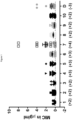
- the antimicrobial potency of teixobactin analogue Compounds 25 to 34 was assessed against MRSA ATCC 33591.
- the Leu 10 -teixobactin and natural teixobactin were included as benchmarks for activity.
- the six analogues 25 to 27 and 32 to 34 with two cationic charges have hydrophobic-hydrophilic balances similar to natural teixobactin (two cationic charges). These analogues showed comparable potency (MIC 0.125 - 0.25 ⁇ g/ ml) to natural teixobactin (MIC 0.25 ⁇ g/ ml).
- Compounds 28 to 30 each possess three cationic charges.
- Compound 28 showed comparable antimicrobial activity (MIC 0.25 ⁇ g/ ml) to natural teixobactin.
- Compounds 29 and 30 showed 4 times reduced antibacterial activity (MIC 1 ⁇ g/ ml) than natural teixobactin or Leu 10 -teixobactin.
- Compound 31 with four cationic charges also showed reduced antibacterial activity (MIC 1 ⁇ g/ ml).
- Lys 3 -D-Lys 4 -Lys 10 -teixobactin has a reported MIC of 8 ⁇ g/ ml against Staphylococcus aureus ATCC 29213; whereas, we observed an MIC of 1 ⁇ g/ ml (8 times improvement) for Arg 3 -D-Arg 4 -Arg 9 -Leu 10 -teixobactin (Compound 31, four cationic charges) against the same bacterial strain.
- the nine analogues 25 to 30 and 32 to 34 showed drug like profiles such as high antibacterial potency with optimal balance of hydrophobicity and hydrophilicity.
- the minimum bactericidal concentrations (MBC) of teixobactin analogues against S. aureus/MRSA strains has been further determined.
- Compound 26 displayed highly potent bactericidal properties, as its MBC values did not increase above 4 times the MIC against the tested strains.
- Compound 26 was found inactive against Pseudomonas aeruginosa (Gram negative bacteria). In view of narrow MIC distribution values and bactericidal properties, attention was focused on Compound 26 and further investigated its biological properties.
- D-Arg 4 -Leu 10 -teixobactin (Compound 26) was evaluated for single step resistance in S. aureus ATCC 29213 and MRSA ATCC 33591. Mutants of S. aureus ATCC 29213 or MRSA ATCC 33591 resistant to teixobactin analogue 26 (5x, 10x, 20x MIC) could not be obtained. The calculated frequency of resistance to Compound 26 was found to be ⁇ 10 -10 which is comparable to teixobactin. A lack of resistance in preliminary studies against 26 is promising in the development of drug like molecules against resistant bacteria. Time-kill kinetics studies of D-Arg 4 -Leu 10 -teixobactin 26 against S.
- aureus ATCC 29213 was investigated to ascertain if the chemical modifications retained the bactericidal properties.
- the exposure of bacterial inoculum to 0.5 ⁇ g/ml or 1 ⁇ g/ml of Compound 26 resulted in ⁇ 2 log 10 decrease in bacterial viability at 8 h, which is comparable with previous reports of teixobactin analogues and teixobactin.
- Both A549 cells (a) and hDFs (b) were treated with increasing concentrations of Compound 26 (ranging from 15.62 ⁇ g/ml to 250 ⁇ g/ml) for 24 h.
- the stock solution of Compound 26 500 ⁇ g/ml was prepared fresh by directly dissolving Compound 26 in cell culture medium and used.
- Cells were treated with dimethyl sulfoxide (DMSO, 0.1% v / v ) or nocodazole (5 ⁇ g/ml dissolved in DMSO) as controls.
- DMSO dimethyl sulfoxide
- nocodazole 5 ⁇ g/ml dissolved in DMSO
- A549 cells (c) and hDFs (d) were fixed, fluorescently stained with rhodamine-phalloidin (red), alexa fluor 488 conjugated anti- ⁇ -tubulin (green) and Hoechst 33342 (blue) and imaged using IN Cell Analyzer 2200 automated microscope. Representative images of cells treated with Compound 26 (62.5 ⁇ g/ml for 24 h) or nocodazole (10 ⁇ g/ml, toxicity control) are shown in Figure 2 c,d .
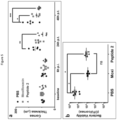
- Figure 3 shows the decrease in fluorescein staining with time for both control wounds and wounds treated with Compound 26. There was no significant difference in wound closure between PBStreated wounds or wounds treated with Compound 26. The lack of any delay in the reepithelialisation and wound closure for the injured cornea treated with Compound 26 suggests good biocompatibility of the peptide.
- Example 20 In vivo antibacterial efficacy of D-Arg 4 -Leu 10 -teixobactin in bacterial keratitis model:
- S. aureus is one of the major etiological agents for bacterial keratitis and the toxic secretions produced by this microorganism have been implicated in corneal melt, leading to significant morbidity and vision loss.
- Scarified cornea of the mice were infected with S. aureus ATCC 29213 inoculum (15 ⁇ l of 6 ⁇ 10 6 CFU/ml) after scratching the corneal epithelium with scalpel blade.
- the infected cornea were treated with vehicle (PBS), Compound 26 (0.3% w/v in PBS) and moxifloxacin (0.3%).
- a total of 8 doses were applied and the progression of the infection was monitored by slit lamp examination, anterior segment optical coherent tomography (AS-OCT) and microbiological enumeration of the bacterial bioburden.
- Mice cornea treated with PBS had severe clinical presentation indicated by chemosis, significant presence of hypopyon like materials and corneal infiltrates ( Figure 4 ).
- Figure 5a Note that the CT values for Compound 26 treated cornea approached the baseline values after 48 h p.t., which was absent in the case of PBS-/Moxifloxacin-treated corneas. Note that a significant decrease in corneal edema was observed for infected cornea treated with Compound 26 compared to untreated cornea (p, 0.01 two-way ANOVA) as early after 3 doses which decreased further after 8 doses (p, 0.001). The results indicated a marked decrease in the severity (due to infections) after treatment with Compound 26 when compared to standard antibiotic treatment.
- Compound 54 (Leu 10 -Teixobactin-3-(S3K-K5R) conjugate, above) was prepared by a method analogous to the method for preparing Compound 26 (see Example 14). Calculated mass: 2038.3507; Found mass: 2039.33.
- Example 22 Activity of Compound 54 against MRSA, E. coli and A. baumannii
Landscapes
- Chemical & Material Sciences (AREA)
- Health & Medical Sciences (AREA)
- Organic Chemistry (AREA)
- Life Sciences & Earth Sciences (AREA)
- Medicinal Chemistry (AREA)
- General Health & Medical Sciences (AREA)
- Proteomics, Peptides & Aminoacids (AREA)
- Biophysics (AREA)
- Biochemistry (AREA)
- Genetics & Genomics (AREA)
- Molecular Biology (AREA)
- Pharmacology & Pharmacy (AREA)
- Animal Behavior & Ethology (AREA)
- Public Health (AREA)
- Veterinary Medicine (AREA)
- Nuclear Medicine, Radiotherapy & Molecular Imaging (AREA)
- Chemical Kinetics & Catalysis (AREA)
- Oncology (AREA)
- Communicable Diseases (AREA)
- General Chemical & Material Sciences (AREA)
- Peptides Or Proteins (AREA)
- Medicines That Contain Protein Lipid Enzymes And Other Medicines (AREA)
- Medicinal Preparation (AREA)
- Engineering & Computer Science (AREA)
- Immunology (AREA)
- Epidemiology (AREA)
- Bioinformatics & Cheminformatics (AREA)
- Micro-Organisms Or Cultivation Processes Thereof (AREA)
- Agricultural Chemicals And Associated Chemicals (AREA)
Description
- This invention relates to a series of novel compounds with antibacterial activity, and methods of making said compounds. The compounds have been developed as readily-accessible synthetic analogues of the naturally-occurring depsipeptide antibacterial Teixobactin. The novel compounds display potent antibacterial activity and may be useful in treating and preventing bacterial infections. The novel compounds may also be covalently bonded to a delivery agent, which is capable of binding to certain components of bacterial cells, serving to anchor the antibacterial compound and increase its effectiveness.
- We are currently facing a worldwide pandemic of multidrug resistant bacteria, arising from the long-term use of antibacterials. Antibacterial overavailability and poor prescribing practices have allowed exposure to sub-optimal concentrations of antibacterials, promoting the evolution of environmental resistance mechanisms in bacteria.
- There is therefore a continuing need to develop new compounds and strategies for combating unwanted bacterial growth, particularly in bacteria that are resistant to existing drugs.
- Teixobactin is a recently-discovered depsipeptide antibiotic that acts through a novel mechanism of action (Ling L.L et al., Nature, 2015, 517, 455-459). Teixobactin inhibits bacterial cell wall synthesis by binding to precursors of essential cell wall components. As such, it is likely to induce resistance at a considerably slower rate than antibacterials that act at intracellular protein targets.
- Teixobactin's unusual structure comprises D-amino acid residues, and an L-allo-enduracididine residue. The manufacture of Teixobactin in a commercial scale is difficult and expensive, in part due to the presence of the L-allo-enduracididine residue.
- Various analogues of Teixobactin have been described in the literature, including in Wu C., etal., RSC Adv., 2017, 7, 1923-1926; Yang H., et al., ACS Chem. Biol. 2016, 11, 1823-1826; Abdel Monaim S. A. H., ACS Omega 2016, 1, 1262-1265; Parmar A., et al., Chem. Commun. 2017,53, 2016-2019; Parmar A., et al., Chem. Commun. 2016, 52, 6060-6063; Jad Y. E., et al., Org. Lett., 2015, 17 (24), pp 6182-6185; and Yang H. Chem. Commun., 2017, DOI: 10.1039/C7CC00783C advanced online publication. Kang J. et al., Bioorganic & Medicinal Chemistry, vol. 25, no. 18, 4990-4995 discusses the synthesis and structure-activity relationship of teixobactin analogues. Shimaa A. H., et al., RSC Advances, vol. 6, no. 77, 73827-73829 describes investigations of N-terminal substitution and D-residues of teixobactin. Gunjal Vidya B. et al., J. Med. Chem., vol. 63, no. 21, 12171-12195 discusses the antibiotic capabilities of teixobactin.
WO 2014/089053 was published on 21 June 2014 and is entitled "Novel depsipeptide and uses thereof".WO 2017/181179 was published on 19 October 2017 and is entitled "Antimicrobial Compositions". - The inventors have now found a new range of analogues of Teixobactin that is easily-accessible and displays potent antimicrobial activity, and have developed robust processes for their synthesis.
- The listing or discussion of an apparently prior published document in this specification should not necessarily be taken as an acknowledgement that the disclosure of the document is part of the state of the art or is common general knowledge.
- According to a first aspect of the invention, there is provided a compound of formula IA,

- R1 represents H, C1-6 alkyl, or benzyl;
- AA1 represents a hydrophobic proteinogenic or hydrophobic non-proteinogenic amino acid, AA2 represents an L-isoleucine residue, AA5 represents a D-isoleucine or D-allo-isoleucine residue, AA6 represents an L-isoleucine residue, and AA7 represents an L-serine residue;
- AA3 and AA4 each independently represents a proteinogenic or non-proteinogenic amino acid (such as diaminopropanoic acid, diaminobutanoic acid, or ornithine);
- R3 represents hydrogen or C1-4 alkyl;
- R9a represents a proteinogenic or non-proteinogenic amino acid side chain (such as -CH2-NH2, -(CH2)2-NH2 or -(CH2)3-NH2);
- R10a represents a hydrophobic proteinogenic amino acid side chain, a hydrophobic non-proteinogenic amino acid side chain, hydrogen, or R10a is linked to the adjacent nitrogen atom to form a proline ring;
- R11a represents a proteinogenic or non-proteinogenic amino acid side chain;
- Z is -O- or -NH-;
- optionally wherein the compound of formula IA is covalently bonded to a delivery agent, which is either capable of covalently bonding to one or more structures on a bacterial cell membrane or comprises a hydrophilic portion capable of otherwise binding to one or more structures on a bacterial cell membrane,
- provided that the compound of formula IA or pharmaceutically-acceptable salt, solvate or clathrate thereof is not selected from the group consisting of:


- Such compounds, salts, solvates and clathrates are referred to hereinafter as the "compounds of the invention".
- We also disclosed compounds of formulae IB and IC, which do not fall within the literal scope of the claims:


- R1 represents H, C1-6 alkyl, C1-6 acyl, benzyl or benzoyl;
- AA1, AA2 and AA5 to AA7 each independently represents an amino acid (including a proteinogenic amino acid or a non-proteinogenic amino acid);
- AA3 and AA4 each independently represents an amino acid (including a proteinogenic amino acid or a non-proteinogenic amino acid), diaminopropanoic acid, diaminobutanoic acid, or ornithine;
- R8 represents hydrogen or C1-4 alkyl;
- R9b, and R9c represent an amino acid side chain (including the side chain of a proteinogenic amino acid or a non-proteinogenic amino acid), -CH2-NH2, -(CH2)2-NH2 or -(CH2)3-NH2;
- R10b represents an amino acid side chain, a -C1-6 alkyl-NH2 group, a -C1-6 alkyl-NH-C(=NH)-NH2 group or a fragment of formula -L1-L2-L3-X1 ;
- Z is -O- or -NH-;
- L1 represents a linear or branched C1-12 alkylene linker;
- L2 is selected from the group consisting of -O-, -N(Xa)-, -[N(Xa)2]+-, -C(O)-, -OC(O)-, -C(O)O-, -NHC(O)-, -C(O)N(Xa)-, -OC(O)N(Xa)-, -NHC(O)O-, or -NHC(O)N(Xa)-;
- Xa represents hydrogen or -L3-X1;
- L3 represents a direct bond or a linear or branched C1-12 alkylene linker;
- each X1 is independently selected from the group consisting of -C(O)-C1-12 alkyl, -C(O)-NH2, -C(S)-NH2, a fragment of formula Q, and a C1-12 alkyl group optionally substituted by one or more X2 substituents;
- wherein the fragment of formula Q is:

- in which Q1 represents either CH or N, and Q2 represents O, S or NH;
- each X2 independently represents -NH2, -OH, -NHC(O)NH2, -NHC(S)NH2, -NHC(=NH)NH2, or a 3- to 12- membered heterocyclyl group;
- or -L2-L3-X1 together represent a fragment of formula Q:
- R11b represents -C(O)NH2;
- R3 represents -CH2-SH, and R2 represents -CH2-NH2, -(CH2)2-NH2, -(CH2)3-NH2 or the side chain of an amino acid selected from the list consisting of threonine, cysteine, serine, lysine, tyrosine, aspartic acid, and glutamic acid;
- R2 and R3 are linked to form a linking group;
- wherein the linking group is a -C1-6 alkylene-Q-C1-6 alkylene- group in which Q represents a functional group selected from the list consisting of -O-, -OC(O)-, -C(O)O-, -C(O)N(R')-, -N(R')C(O)-, -S-, -S-S- and -C(O)-; R' represents H or C1-4 alkyl; and
- the C1-6 alkylene groups in the linking group are linear alkylene groups which may be the same or different and are optionally substituted with one or more substituents selected from the group consisting of -OH, -SH, -SC1-4 alkyl, -OC1-4 alkyl, -NH2, -C(O)OH, -C(O)-NH2, -C(O)OC1-4 alkyl and a C1-4 alkyl group, which latter group (i.e. the C1-4 alkyl group) is
- optionally substituted with one or more substituents selected from the list consisting of -OH, -SH, -SC1-4 alkyl, -NH2, -C(O)OH, -C(O)-NH2, -C(O)OC1-4 alkyl and phenyl;
- R10c represents an amino acid side chain or a L-allo-enduracididine group;
- R11c represents an amino acid side chain;
- wherein, for compounds of formula IC, at least one of AA1 to AA7 is replaced by an amino acid of formula -NH-CH(Rc)-C(O)-, and/or at least one of R9c and R11c alternatively represents Rc, wherein Rc represents a fragment of formula -L1-L2-L3-X1 as defined above;
- optionally wherein the compound of formula IB or IC is covalently bonded to a delivery agent, which is either capable of covalently bonding to one or more structures on a bacterial cell membrane or comprises a hydrophilic portion capable of otherwise binding to one or more structures on a bacterial cell membrane.
- By "pharmaceutically-acceptable salt" we mean an acid addition or base addition salt suitable for use in pharmaceuticals. Such salts may be formed by conventional means, for example by reaction of a free acid or a free base form of a compound of the invention with one or more equivalents of an appropriate acid or base, optionally in a solvent, or in a medium in which the salt is insoluble, followed by removal of said solvent, or said medium, using standard techniques (e.g. in vacuo, by freeze-drying or by filtration). Salts may also be prepared by exchanging a counter-ion of a compound of the invention in the form of a salt with another counter-ion, for example using a suitable ion exchange resin.
- Examples of pharmaceutically acceptable addition salts include those derived from mineral acids, such as hydrochloric, hydrobromic, phosphoric, metaphosphoric, nitric and sulphuric acids; from organic acids, such as tartaric, acetic, trifluoroacetic, citric, malic, lactic, fumaric, benzoic, glycolic, gluconic, succinic and arylsulphonic acids; and from metals such as sodium, magnesium, or preferably, potassium and calcium. Particularly preferred salts include those derived from acetic, trifluoroacetic, hydrochloric and tartaric acids.
- By "solvate" we mean a solid form wherein the relevant compound (e.g. a compound of formula IA, IB or IC) is associated with one or more solvent molecules. The term solvate includes hydrates and other solvates of pharmaceutically-acceptable solvents. A preferred solvent for solvate formation is DMSO.
- By "clathrate" we mean a solid form wherein the relevant compound (e.g. a compound of formula IA, IB or IC) forms a lattice that contains a guest molecule (e.g. a pharmaceutically-acceptable solvent) within the lattice structure.
- By "amino acid" and "residue" (for example D-phenylalanine "residue") we mean the dehydrated portion of an amino acid present in polypeptide chains and represented by the following formula

- By "amino acid side chain" or "side chain of an amino acid" we mean the group attached to the position α to the carboxyl and amino groups in α-amino acids, including non-proteinogenic α-amino acids and particularly proteinogenic amino acids. The skilled person will understand that the most common natural amino acids are known by their trivial names and will be aware of the side chain groups present in these amino acids.
- "Proteinogenic" amino acids are the 22 amino acids that may be naturally encoded or naturally found in the genetic code of organisms. "Non-proteinogenic" amino acids are those not naturally encoded or found in the genetic code of any organism. The set of non-proteinogenic amino acids is generally considered to include all organic compounds with an amine (-NH2) and a carboxylic acid (-COOH) functional group linked via a single additional carbon atom, as well as a side chain and a hydrogen bound to that single additional carbon atom, but excluding selenocysteine, pyrrolysine and the 20 standard amino acids that are incorporated into proteins during translation. Non-proteinogenic amino acids include those amino acids that are intermediates in biosynthesis, those that are post-translationally formed in proteins, and those that possess a physiological role (e.g. components of bacterial cell walls, neurotransmitters and toxins). References to hydrophobic non-proteinogenic amino acid side chains are references to hydrophobic side chains (particularly those formed primarily of alkyl and/or aryl groups in the absence of polar groups) which are capable of being bound to an amino acid backbone. References to polar non-proteinogenic amino acid side chains are references to polar side chains (particularly those comprising a hydroxyl group or an amide functional group (e.g. wherein one or more of said groups is bound to the amino acid via a linear, branched, cyclic or part cyclic C1-8 alkylene group)) which are capable of being bound to an amino acid backbone
- Various structural features, such as L2 and Q represent linking groups which form a bridge between two separate portions of the molecule. In each case, such linking groups include -OC(O)-. For L2, the left-hand hyphen in such linking groups represents the point of attachment to L1, and the right-hand hyphen in such linking groups represents the point of attachment to L3. For Q, the left-hand hyphen in such linking groups represents the point of attachment to the alkylene linker that is bound to the carbon atom at R2, and the right-hand hyphen in such linking groups represents the point of attachment to the alkylene linker that is bound to the carbon atom at R3.
- The delivery agent may be a delivery agent fragment of formula II to X as hereinafter defined, and may be covalently bonded to a compound of formula IA, IB or IC at any position on the molecule. As such, for the avoidance of doubt, a delivery agent may be included in all of the definitions of substituents listed hereinabove and, may also be appended to any other region of the molecule, such as to any one of the amino acid residues AA1 to AA7. The optimum point of attachment of the delivery agent may be determined by the skilled person.
- A preferred point of attachment for the delivery agent is to the N-terminus of the peptide sequence. Thus, in one embodiment, R1 may also be a delivery agent. For compounds of formula IA (and IAA), other preferred points of attachment for the delivery agent include the groups represented by R9a, R10a, and R11a. For compounds of formula IB, other preferred points of attachment for the delivery agent include the groups represented by R9b, R10b, and R11b. For compounds of formula IC, other preferred points of attachment for the delivery agent include the groups represented by R9c, R10c, and R11.
- Unless otherwise specified, alkyl groups and alkoxy groups as defined herein may be straight-chain or, when there is a sufficient number (i.e. a minimum of three) of carbon atoms, be branched-chain and/or cyclic. Further, when there is a sufficient number (i.e. a minimum of four) of carbon atoms, such alkyl and alkoxy groups may also be part cyclic/acyclic. Such alkyl and alkoxy groups may also be saturated or, when there is a sufficient number (i.e. a minimum of two) of carbon atoms, be unsaturated. Unless otherwise specified, alkyl and alkoxy groups may also be substituted with one or more halo, and especially fluoro, atoms.
- Unless otherwise specified, alkylene groups as defined herein may be straight-chain or, when there is a sufficient number (i.e. a minimum of two) of carbon atoms, be branched-chain. Such alkylene chains may also be saturated or, when there is a sufficient number (i.e. a minimum of two) of carbon atoms, be unsaturated. Unless otherwise specified, alkylene groups may also be substituted with one or more halo atoms.
- The term "aryl", when used herein, includes C6-10 aryl groups such as phenyl, naphthyl and the like. When substituted, aryl groups are preferably substituted with between one and three substituents.
- The term "acyl" as used herein refers to alkyl groups having a carbonyl group attached to the carbon which forms the point of attachment to the rest of the molecule.
- When the stereochemistry of a chiral centre is not explicitly defined herein (i.e. by the use of wedged/hashed bonds) it should be understood that the stereocentre may be present in the R- or S-configuration, or a mixture of both configurations.
- The skilled person will realise that all references herein to particular aspects of the invention include references to all embodiments and combinations of one or more embodiments that make up that aspect of the invention. Thus, all embodiments of particular aspects of the inventions may be combined with one or more other embodiments of that aspect of the invention to form further embodiments without departing from the teaching of the invention.
- In one embodiment of the invention, Z represents -O-. For example, the compound of the invention may be a compound of formula IAA:

- In one embodiment of the invention, particularly when the compound of the invention is a compound of formula IA (or IAA), R10a represents a hydrophobic proteinogenic amino acid side chain, a hydrophobic non-proteinogenic amino acid side chain or hydrogen; optionally wherein R10a represents hydrogen, C2-12 alkyl, C1-12 alkylthiomethyl, phenyl, naphthyl, biphenyl, toluyl, toluylmethyl or the side chain of an amino acid selected from the group consisting of valine, isoleucine, leucine, methionine, phenylalanine, tyrosine and tryptophan.
- In the compounds of the invention, R10a represents a hydrophobic proteinogenic amino acid side chain, a hydrophobic non-proteinogenic amino acid side chain, hydrogen, or C-R10a may be linked to the adjacent nitrogen atom to form a proline ring (i.e. such that the -N(H)-C(R10a)- fragment in the compounds of formula IA is modified to represent

- In an embodiment of the invention, R1 represents H, C1-6 alkyl, benzyl, or a delivery agent (e.g. a fragment of formula II to X, as defined hereinafter). Preferably, R1 does not represent a delivery agent fragment of formula II to X, i.e. R1 represents H, C1-6 alkyl, or benzyl.
- In another embodiment, R1 represents a delivery agent fragment of formula II to X as defined hereinafter or, preferably, H, C1-4 alkyl, or benzyl.
- In a further embodiment R1 represents a delivery agent fragment of formula II to X as defined hereinafter or, most preferably, H or methyl.
- In a particular embodiment, AA1 represents a hydrophobic proteinogenic amino acid, and AA3 and AA4 each independently represents a proteinogenic amino acid, diaminopropanoic acid, diaminobutanoic acid, or ornithine.
- The compounds of the invention are proposed as analogues of Teixobactin. Consequently, it is preferred that the sequence of amino acids represented by AA1 to AA7 is structurally similar to the corresponding amino acid sequence in Teixobactin. Thus, in embodiments of the invention:
- AA1 may represent an L- or D-phenylalanine residue;
- AA2 may represent an L-isoleucine residue;
- AA3 may represent an L- or D-serine residue;
- AA4 may represent an L- or D-glutamine residue;
- AA5 may represent an D- or D-allo-isoleucine residue;
- AA6 may represent an L-isoleucine residue; and/or
- AA7 may represent an L-serine residue.
- It has been surprisingly found that structural variation is tolerated to a much greater extent at positions represented by AA1, AA3 and AA4 (as well as R9a, R9b and R9c). Thus, in compounds of the invention, AA2 represents an L-isoleucine residue, AA5 represents a D-allo-isoleucine or D-isoleucine residue, AA6 represents an L-isoleucine residue, and AA7 represents an L-serine residue, whereas AA1, AA3 and AA4 may be varied as described herein.
- Whilst AA1, AA3 and AA4 preferably represent a D-phenylalanine residue, an L-serine residue and a D-glutamine residue, respectively, i.e. in line with the structure of Teixobactin, other amino acids or similar structures may be substituted at these three positions. For example, AA3 and AA4 may each independently represent any hydrophobic amino acid (including a proteinogenic amino acid (such as alanine, valine, isoleucine, leucine, methionine, phenylalanine, tyrosine or tryptophan) or a non-proteinogenic amino acid (such as norvaline, cyclohexylglycine, cyclohexylalanine, phenylglycine, biphenylglycine, biphenylalanine, naphthylglycine or naphthylalanine)), any polar non-charged amino acid (including a proteinogenic amino acid (such as serine, threonine, asparagine, or glutamine) or a non-proteinogenic amino acid (such as one with a side chain comprising a hydroxy group or an amide functional group bound to the amino acid via a linear, branched, cyclic or part cyclic C1-8 alkylene group)), any positively charged amino acid, diaminopropanoic acid, diaminobutanoic acid, or ornithine. AA1 may represent any hydrophobic amino acid as described above in respect of AA3 and AA4. In a particular embodiment, AA3 and AA4 may represent L-arginine or, preferably, L-alanine at either or both of these positions. It is also preferred that, in embodiments in which a delivery agent is covalently bound to the compound of the invention, it is bound to the amino acid at AA1, AA3 or AA4 (or at R11a, R11b or R11c as is described hereinafter).
- In a most preferred embodiment:
- AA1 represents a D-phenylalanine residue;
- AA2 represents an L-isoleucine residue;
- AA3 represents an L-serine residue;
- AA4 represents a D-glutamine residue;
- AA5 represents a D-allo-isoleucine or D-isoleucine residue;
- AA6 represents an L-isoleucine residue; and
- AA7 represents an L-serine residue.
- In one embodiment, R8 preferably represents hydrogen or a methyl group so as to form part of a serine or threonine residue. The group at R3 may be present in either the R- or S- configuration, though it is preferred that it is present in the S-configuration (for example, so as to form part of a D-threonine residue) when R3 is methyl.
- In one embodiment of formula IA and example compounds of formula IB and IC, R9a, R9b, and R9c represent a proteinogenic amino acid side chain, -CH2-NH2, -(CH2)2-NH2 or -(CH2)3-NH2.
- In another embodiment of formula IA and further example compounds of IB and IC, R9a, R9b and R9c preferably represent a hydrophobic proteinogenic or non-proteinogenic amino acid side chain (such as that of alanine (i.e. a methyl group), valine, isoleucine, leucine, methionine, phenylalanine, tyrosine, tryptophan, norvaline, cyclohexylglycine, cyclohexylalanine, phenylglycine, biphenylglycine, biphenylalanine, naphthylglycine or naphthylalanine), a side chain of a positively charged amino acid (such as that of histidine, lysine or arginine), a side chain of a polar non-charged proteinogenic or non-proteinogenic amino acid (such as that of serine, threonine, asparagine, or glutamine, or a hydroxy group or an amide functional group bound to the remainder of the molecule via a linear, branched, cyclic or part cyclic C1-8 alkylene group) or -CH2-NH2, -(CH2)2-NH2 or -(CH2)3-NH2. Most preferably, R9a, R9b and R9c represent a hydrophobic amino acid side chain. The groups at R9a, R9b and R9c may be present in either the D- or L- configuration, though it is preferred that it is present in the L-configuration. Thus, for example, when R9a, R9b or R9c represent a methyl group (i.e. the side chain of alanine), the chiral carbon to which R9a, R9b or R9c is bound is preferably in the S-configuration (thus corresponding to the L-alanine that it present at this position for Teixobactin).
- In one embodiment, R11a represents a proteinogenic amino acid side chain.
- In another embodiment of formula IA or example compounds of formula IC, R11a or R11c represents a hydrophobic proteinogenic or non-proteinogenic amino acid side chain (such as that of alanine (i.e. a methyl group), valine, isoleucine, leucine, methionine, phenylalanine, tyrosine, tryptophan, norvaline, cyclohexylglycine, cyclohexylalanine, phenylglycine, biphenylglycine, biphenylalanine, naphthylglycine or naphthylalanine). The group at R11a or R11c may be present in either the D- or L- configuration, though it is preferred that it is present in the L-configuration. Thus, for example, when R11a or R11c represents a butyl group (e.g. the side chain of isoleucine), the chiral carbon to which R11a or R11c is bound is preferably in the S-configuration (thus corresponding to the L-isoleucine that is present at this position for Teixobactin). It is also preferred that, in embodiments in which a delivery agent is covalently bound to the compound of the invention, that delivery agent is bound to the amino acid side chain at R11a or R11c or the -C(O)NH2 group represented by R11b (or at AA3 or AA4 as is described hereinbefore).
- Compounds of formula IB are based on Teixobactin but primarily involve modification, and possibly opening, of the cyclic portion of the macromolecule. Compounds of formula IB have been found to be particularly effective as antibacterial agents.
- In compounds of formula IB, R10b may represent the side chain of arginine, lysine, histidine or allo-enduracididine, a -C1-6 alkyl-NH2 group, a -C1-6 alkyl-NH-C(=NH)-NH2 group, or any of the preferred groups defined hereinabove in respect of R10a. References herein to the side chain of enduracididine are references the fragment 2-imino-4-imidazolidinylmethyl. The most preferred structure for R10b is the side chain of arginine (i.e. a -C3 alkyl-NH-C(=NH)-NH2 group).
- Thus, in compounds of formula IB, R10b may represent the side chain of arginine, lysine, and histidine or enduracididine, a -C1-6 alkyl-NH2 group, a -C1-6 alkyl-NH-C(=NH)-NH2 group, or a fragment of formula -L1-L2-L3-X1 in which each X1 is independently selected from the group consisting of -C(O)-C1-12 alkyl, -C(O)-NH2, -C(S)-NH2, a fragment of formula Q, and a C1-12 alkyl group substituted by one or more X2 substituents. In a particularly preferred example, X1 represents either a fragment of formula Q, or a C1-12 alkyl group substituted by one or more (e.g. 2) X2 substituents. In a further preferred example of the invention, X1 represents either a fragment of formula Q, or a C1-6 (e.g. C1-3) alkyl group substituted by at least two X2 substituents (optionally wherein each X2 independently represents -NH2, -OH, -NHC(O)NH2, -NHC(S)NH2, -NHC(=NH)NH2).
- In a further compound of formula IB, a preferred embodiment, R10b may represent the side chain of lysine or, preferably, arginine, or a pendant group which contains at least two terminal guanidinyl, urea, thiourea, amino and/or hydroxyl groups (e.g. at least two X2 groups). For example, R10b may represent -L1-N(X1)2 or -L1-L2-L3-C1-6 alkyl in which said C1-6 alkyl is substituted by two X2 groups. In another preferred example, R10b represents - C1-4 lkylene-N(X1)2 or -C1-4 alkylene-L2-C1-6 alkyl in which said C1-6 alkyl is substituted by two X2 groups (optionally in which L2 represents -NH-, -NHC(O)-, or -NHC(O)O). In the above-mentioned examples, X1 preferably represents a C1-4 alkyl group optionally substituted by one or more X2 substituents. Also in such examples (including also those in which X1 represents a C1-4 alkyl group optionally substituted by one or more X2 substituents), X2 preferably represents a 4- to 6- membered heterocyclyl group (such as pyridine, piperidine, pyrrole or pyrrolidine) or, more preferably, represents -NH2, -OH, - NHC(O)NH2, -NHC(S)NH2, or -NHC(=NH)NH2.
- In examples in which R2 and R3 are not linked, R2 may preferably represent the side chain of an amino acid selected from the list consisting of threonine, cysteine, serine, or lysine; more preferably the side chain of threonine or cysteine; and most preferably the side chain of cysteine. In such examples, both R2 and R3 represents -CH2-SH.
- Preferred groups represented by Q include -OC(O)-, -C(O)O-, -NHC(O)-, -C(O)NH- or -S-S-.
- In examples in which R2 and R3 are linked, preferably the alkylene groups in the linking group are linear C1-4 alkylene groups, which may be the same or different and are optionally substituted with one or more substituents selected from the group consisting of -OH, -SH, -SC1-4 alkyl, -OC1-4 alkyl -NH2, -COOH, -C(O)-NH2, -COOC1-4 alkyl and a C1-4 alkyl group, which latter group (i.e. the C1-4 alkyl group) is optionally substituted with one or more substituents selected from the list consisting of -OH, -SH, -SC1-4 alkyl, -NH2, -COOH, -C(O)-NH2, -COOC1-4 alkyl and phenyl.
- In further examples, the alkylene groups in the linking group are optionally substituted by one or more substituents selected from the group consisting of -OH, -SH, -SMe, -OMe, - OEt, -NH2, -COOH, -C(O)-NH2, -COOMe, COOEt, and a C1-4 alkyl group, which latter group (i.e. the C1-4 alkyl group) is optionally substituted with one or more substituents selected from the list consisting of -OH, -SH, -SMe, -NH2, -COOH, -C(O)-NH2 and -COOMe, - COOEt.
- In a further examples, the alkylene groups in the linking group (i.e. the linking group formed when R2 and R3 are linked) are optionally substituted by C1-4 alkyl groups.
- In a particular examples, the alkylene groups in the linking group are C1-4 alkylene groups, optionally substituted by one or more methyl groups.
- In a further disclosure, there is provided a compound of formula IB, wherein the linking group is -CH2-Q-CH2-.
- In a particular examples Q represents -S-S-.
- In a further examples, there is provided a compound of the invention, wherein when R2 and R3 are linked, the linking group is selected from the group consisting of:

- In a further examples there is provided a compound of the invention, wherein the cyclic structure comprising the linking group formed by the linkage of R2 and R3 is a 14- to 18-membered ring, for example a 14- to 16-membered ring and preferably a 14-membered ring.
- By "[number]-membered ring" (e.g. 16-membered ring), we mean a cyclic structure containing the specified number of ring-constituting atoms, i.e. a ring in which said number represents the number of skeleton atoms forming said ring.
- In examples in which the compound is a compound of formula IB,
- AA1 may represent an L- or D-phenylalanine residue;
- AA2 may represent an L- or D-isoleucine residue;
- AA3 may represent an L- or D-serine residue;
- AA4 may represent an L- or D-glutamine residue;
- AA5 may represent an L-, L-allo-, D- or D-allo-isoleucine residue;
- AA6 may represent an L- or D-isoleucine residue; and/or
- AA7 may represent an L- or D-serine residue.
- In a preferred disclosure, there is provided a compound of formula IB, wherein:
- AA1 represents a D-phenylalanine residue;
- AA2 represents an L-isoleucine residue;
- AA3 represents an L-serine residue;
- AA4 represents a D-glutamine residue;
- AA5 represents a D-allo-isoleucine residue;
- AA6 represents an L-isoleucine residue; and
- AA7 represents an L-serine residue.
- In still further preferred examples of compounds of formulae IB and IC, AA2 represents an L-isoleucine residue, AA5 represents a D-allo-isoleucine or D-isoleucine residue, AA6 represents an L-isoleucine residue, AA7 represents an L-serine residue, AA1 represents a hydrophobic amino acid, and AA3 and AA4 each independently represent a hydrophobic amino acid, a polar non-charged amino acid, a positively charged amino acid, diaminopropanoic acid, diaminobutanoic acid or ornithine (optionally wherein AA3 represents an L-serine residue and/or AA4 represents a D-glutamine residue), and:
- (i) R10b represents the side chain of arginine, lysine, histidine or allo-enduracididine, a -C1-6 alkyl-NH2 group, a -C1-6 alkyl-NH-C(=NH)-NH2 group, or a fragment of formula -L1-L2-L3-X1;
- (ii) R10b represents the side chain of arginine or lysine, a -C1-3 alkyl-NH2 group, a -C2-4 alkyl-NH-C(=NH)-NH2 group, or a fragment of formula -L1-L2-L3-X1; or
- (iii) R10b represents the side chain of arginine or either of the structures shown below:
- In these compounds of formula IB and IC and in embodiments of formula IA, it is preferred that Z represents -O- and it is most preferred that R1, R8, R9a, R9b and R9c each represent methyl, and R11a and R11c represent the side chain of isoleucine.
- Preferred compounds of formula IC are those in which:

- R1 represents H, C1-6 alkyl, C1-6 acyl, benzyl or benzoyl;
- AA1 to AA7 each independently represents an amino acid or a -NH-CH(Rc)-C(O)- group; R3 represents hydrogen or C1-4 alkyl;
- R9c represent Rc or an amino acid side chain;
- R10e represents an amino acid side chain (e.g. a side chain of arginine or lysine) or a L-allo-enduracididine group;
- R11c represents Rc or an amino acid side chain; and
- Rc represents a fragment of formula -L1-L2-L3-X1 as defined above;
- provided that at least one of AA1 to AA7, R9c and R11c contains a group represented by Rc.
- Preferably only one of AA1 to AA7, R9c and R11c contains a group represented by Rc.
- It has been found that structural changes can be made at the AA3 and AA4 groups of Teixobactin without significantly reducing the antibacterial efficacy of the resulting compound. Thus, preferred positions at which the mandatory Rc substituent may be located are R9c and R11c, and particularly AA3 and AA4.
- Particular compounds of formula IC that may be mentioned include those in which:
- (i) Rc is a fragment of formula -L1-L2-L3-X1 which contains a fragment of formula Q or at least two terminal guanidinyl, urea, thiourea, amino and/or hydroxyl groups (e.g. at least two X2 groups);
- (ii) Rc is a fragment of formula -L1-L2-L3-X1 in which X1 represents either a fragment of formula Q, or a C1-6 (e.g. C1-3) alkyl group substituted by at least two X2 substituents; or
- (iii) Rc is a fragment of formula -L1-L2-L3-X1 in which X1 represents a C1-6 (e.g. C1-3) alkyl group substituted by at least two substituents selected from the group consisting of -NH2, -OH, -NHC(O)NH2, -NHC(S)NH2 and -NHC(=NH)NH2.
- In compounds (i) to (iii) above, particularly preferred compounds are those in which:
- L1 represents a linear or branched C1-4 alkylene linker;
- L2 is selected from the group consisting of -O-, -N(Xa)-, -[N(Xa)2]+-, -C(O)-, -OC(O)-, -C(O)O-, -NHC(O)-, -C(O)N(Xa)-, -OC(O)N(Xa)-, -NHC(O)O-, or -NHC(O)N(Xa)-;
- Xa represents hydrogen or -L3-X1; and
- L3 represents a direct bond.
- It is most preferred that the compound of formula IA, IB or IC is not covalently bonded to a delivery agent. However, according to an alternative embodiment, a compound of the invention is covalently bound to a delivery agent which is a fragment of formula II:

- By "delivery agent" we mean any substance which facilitates the binding of an antibacterial agent to a portion of a bacterial cell (preferably in the region of the bacterial cell wall), and which can thereby anchor the antibacterial agent in the vicinity of the biological target (e.g. an enzyme that is important for cellular activity).
- Unless otherwise stated, terms such as "binding", "bound", etc., refer to the interaction between molecules or chemical structures which serve to hold those molecules or chemical structures in close proximity to one another. In the context of the present invention, the term "binding", unless otherwise stated, particularly refers to the binding that occurs as a result of interactions between permanent dipoles or more preferably as a result of hydrogen bonding between the molecular structures involved.
- By the phrase "hydrophilic portion which is capable of binding to one or more structures", we include a molecular fragment which is more soluble in water or other polar solvents (e.g. protic solvents such as alcohols) than in oil or other hydrophobic solvents (e.g. hydrocarbons). The phrase specifically includes any structure which is capable of binding to one or more structures in bacterial cell membranes by way of one or more hydrogen bonds and/or electrostatic interactions (i.e. ionic bonds).
- Particular delivery agents that may be mentioned include those which are capable of binding to one or more structures on a bacterial cell membrane via the formation of one or more covalent bonds with said structures, via the formation of one or more hydrogen bonds with said structures, or through electrostatic interactions between oppositely charged regions on the delivery agent and the bacterial cell membrane (i.e. a form of ionic bonding). In particular embodiments, the delivery agents are able to bind to the bacterial cell membrane via one or more such covalent bonds, a plurality of hydrogen bonds and/or a plurality of such electrostatic interactions. For example, the delivery agent moiety may be capable of forming 1, 2, 3, 4, 5, 6, 7, 8, 9 or more separate covalent bonds or hydrogen bonds with said structures, thereby greatly enhancing the extent to which the delivery agent is anchored to the cell wall. Delivery agents which are capable of forming at least 4, at least 6, or at least 8 of such linkages (particularly hydrogen bonding linkages) are preferred.
- Covalent bonds between the delivery agent and the one or more structures on the bacterial cell membrane may be formed, for example, where the delivery agent comprises a boronic acid component or a pharmaceutically-acceptable salt thereof. Where such boronic acids or boronic acid derivatives are present, covalent bonding may occur between the boron atoms of the delivery agent and 1,2- and 1,3-diol groups within the saccharides on the surface of the bacterial cell.
- Hydrogen bonds between the delivery agent and the one or more structures on the bacterial cell membrane may be formed through interactions of the delivery agent with saccharides on the surface of the bacterial cell, and particularly with other structures such as phosphate groups or sulphate groups in the lipopolysaccharides or phospholipids of the cell membrane. Functional groups that are capable of participating in hydrogen bonding are well known to the skilled person. Particular functional groups that may be mentioned in this respect include primary amines, amidines (including guanidines) and amides (including ureas), as well as pharmaceutically-acceptable salts thereof. Still further particular functional groups that should be mentioned include primary amines, amidines, guanidines, amides and ureas (and pharmaceutically-acceptable salts thereof).
- In embodiments in which the delivery agent binds to the bacterial cell wall by way of one or more electrostatic interactions (optionally in combination with one or more hydrogen bonding interactions), the delivery agent may carry a plurality of positively charged regions. Such positively charged regions are able to interact with the negatively charged phosphate groups that are present in the phospholipids and lipopolysaccharides of the cell membranes. The positively charged regions on the delivery agent may be present due to the delivery agent molecule being provided in the form of a salt, or the delivery agent may exist as a zwitterion under physiological conditions. Accordingly, positive charges may be present as a result of the reaction of a free base form of the delivery agent with an acid to form an acid addition salt. Particular delivery agents that may be mentioned include those which contain a plurality (e.g. at least 4, at least 6, or at least 8 charged regions) of such charged regions.
- Particular delivery agents that may be mentioned therefore include those which comprise one or more functional groups selected from the list consisting of boronic acids, boronic acid derivatives, primary amines, guanidines, and pharmaceutically-acceptable acid addition salts thereof. For example, the delivery agent may comprise one or more functional groups selected from the list consisting of boronic acids, boronic acid derivatives, primary amines, guanidines, and pharmaceutically-acceptable acid addition salts thereof, and when the delivery agent is a compound of formula II, X2 may represent a boronic acid group, a boronic acid derivative, a primary amine, a guanidine, or a pharmaceutically-acceptable acid addition salt of any such groups.
- Where the delivery agent comprises one or more primary amine groups, it is preferred that the delivery agent is provided as an acid addition salt (thus containing one or more -NH3 + groups). Particular delivery agents that may be mentioned in this respect include delivery agents which are not covalently bonded to the antibacterial agent, and which comprise a polypeptide or a polypeptide derivative, or a pharmaceutically-acceptable salt thereof.
- In other embodiments of the invention, the delivery agent comprises a plurality of said functional groups, particularly where the functional groups are intended to interact with the cell membrane via electrostatic or hydrogen bonding interactions. For example, the delivery agent may comprise 2, 3, 4, 5, 6, 7, 8, 9 or more of said functional groups. Delivery agents which comprise larger numbers of such functional groups are believed to be capable of binding more strongly to the structures in the bacterial cell wall, and thereby improve the antibacterial properties of a compound of formula IA, IB or IC.
- In a particular embodiment of the invention, the functional groups are independently selected from the list consisting of boronic acids, boronic acid derivatives, primary amines, amidines, guanidines, amides, ureas, and acid addition salts thereof.
- In certain embodiments, the delivery agent comprises a dendrimer-like structure. For example, compounds of formula IA, IB or IC contain a delivery agent of formula II comprising a dendrimer fragment at the position denoted as D. The term "dendrimer" is well known in the art, and refers to structures containing a branching, tree-like architecture. Preferably, such dendrimer structures are generally acyclic (e.g. they do not contain any cyclic structures having more than 6 members (i.e. the largest ring structures that may be present in the dendrimers are 6-membered rings such as phenyl groups)) or the dendrimer structure may be completely acyclic. A preferred delivery agent is an organic molecule (or a salt thereof) containing a dendrimer fragment (i.e. a fragment containing multiple, tree-like branches), and each of the branches of that dendrimer fragment may be linked to a relevant functional group. Thus, a single delivery agent may contain a plurality of functional groups capable of binding to a bacterial cell membrane via covalent bonds, hydrogen bonds and/or electrostatic interactions along the lines described above.
- Particular delivery agents that may be mentioned include those which contain a dendrimer fragment. For example, delivery agents that may be mentioned include those of formula III:

- Other delivery agents that may be mentioned include those of formula IV and V:


- Further delivery agents that may be mentioned include those of formulae VI to VIII:


- Dendrimer fragments D1 to D6 may be polyglycerol-based structures or may be dendron-based structures. Particular dendrimer fragments that D1 to D6 (preferably D4 to D6) may represent include those of formulae A to E:
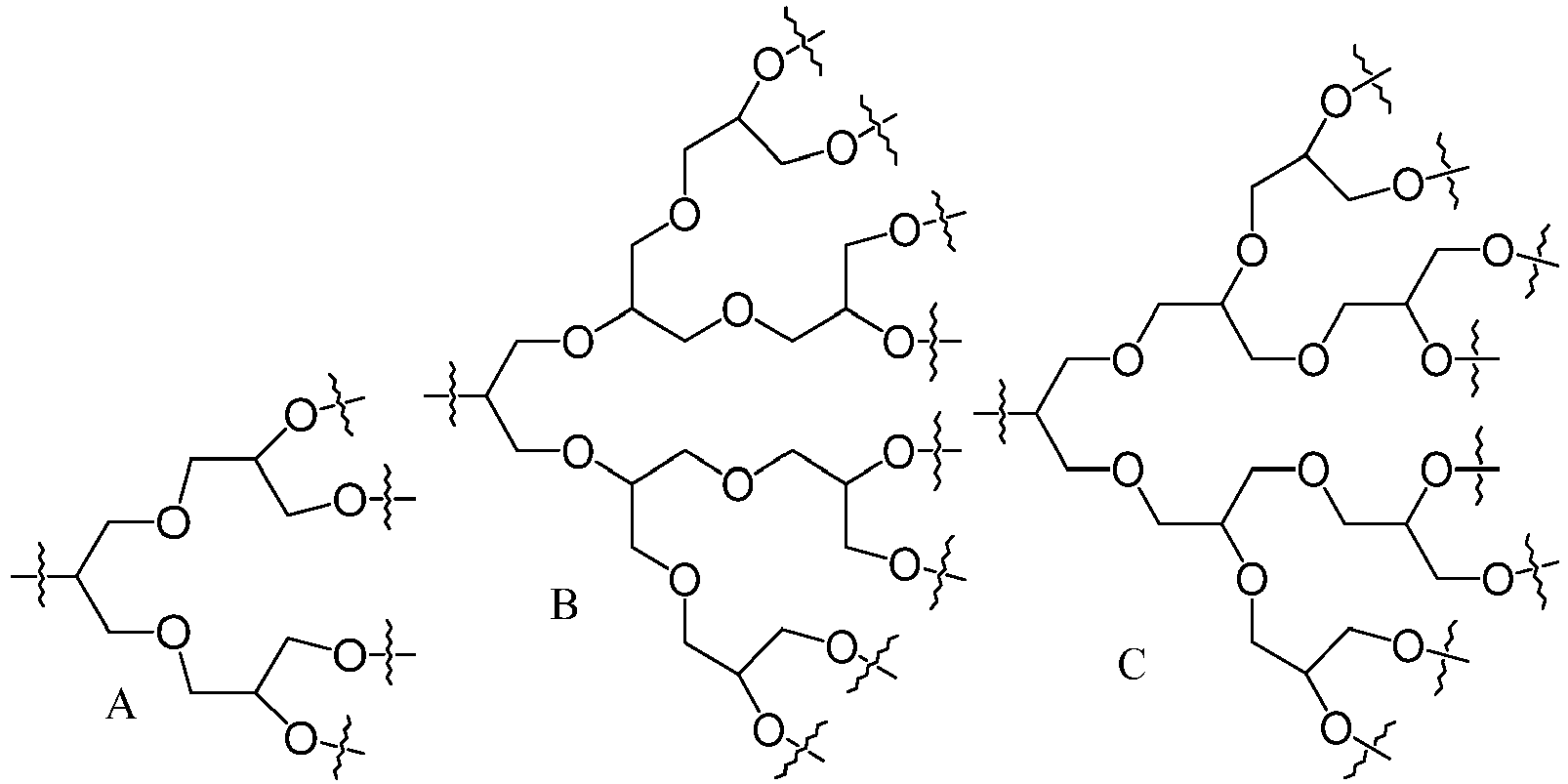

- For each of the dendrimers of formulae A to E, the single wavy line on the left-hand side of the structures as shown corresponds to the point of attachment to the compound of formula IA, IB or IC. The remaining wavy lines indicate the points of attachment of the plurality of amine-, X- or boronic acid-containing portions of the delivery agent (i.e. the bracketed portions in formulae II to VIII).
- In fragments of formulae III to V, particular dendrimer fragments that D1 to D3 may represent include those of formulae A to E as defined above wherein the dendrimer fragments are linked to the plurality of amine-containing portions of the delivery agent (i.e. the bracketed portions in formulae III to V) by way of direct bonds or, preferably, additional linker groups. Additional linker groups that may be mentioned in this respect include ester linkages (i.e. -C(O)-O-), amide linkages (i.e. -C(O)-NH-), sulfonamide linkages (i.e. -S(O)2-NH-), ether linkages (i.e. -O-), amine linkages (i.e. -N(Rx)- in which Rx represents hydrogen or a C1-6 alkyl group), a C1-12 (e.g. C1-6) alkylene linkage, or a plurality of such linkages in combination. In compounds of formulae III to V which contain multiple such additional linker groups, the additional linker groups may be the same or different.
- Particular preferred delivery agents include:
- (i) fragments of formula VI in which D4 represents a dendrimer fragment of any one of formula A to E (particularly formula C);
- (ii) fragments of formula VII in which D5 represents a dendrimer fragment of any one of formula A to E (particularly formula A or B);
- (iii) fragments of formula VIII in which D6 represents a dendrimer fragment of any one of formula A to E (particularly formula D or E).
- Other dendrimer structures will be known to the skilled person. For example, various dendrimers that are known to the skilled person include those disclosed in J. Mater. Chem. B, 2012, 2, 2153-2167. The disclosures in that document show that such dendrimer compounds may have low toxicities.
- Other delivery agents that may be mentioned include those of formulae IXa, IXb, and X:


- In embodiments of compounds of formula IA, and disclosed compounds of formula IB or IC containing delivery agent fragments of formula IXa, IXb or X, the dendrimer fragments that are represented by D7 and D8 may be polyglycerol-based structures or dendron-based structures as defined above in respect of dendrimer fragments D1 to D6. Similarly, particular dendrimer fragments that D7 and D8 may represent include those of formulae A to E as defined above.
- In compounds of formula IA, IB or IC containing delivery agent fragments of formula IXa, IXb or X, the linker group that may be present in the delivery agent may comprise one or more groups selected from the list comprising C1-10 alkyl, -NH-, -O-, -C(O)-O-, and -C(O)-NH- (wherein the amide and ester linkers may each be attached in either of the two possible orientations). For example, the linker group may be a -(CH2)2-NH-(CH2)3-C(O)-NH- group.
- Particular delivery agents that may be mentioned include those which contain a dendrimer fragment. That is, particular delivery agents that may be mentioned include fragments of formulae III, IXa, IXb and X, or pharmaceutically-acceptable salts thereof (e.g. fragments of formulae IV, V, IXa, IXb and X or pharmaceutically-acceptable salts thereof, or most preferably fragments of formulae VI, VII, VIII, IXa, IXb and X or pharmaceutically-acceptable salts thereof).
- The delivery agent may also comprise a polypeptide or a polypeptide derivative, or a pharmaceutically-acceptable salt thereof. It is preferred (though not essential) that, when the delivery agent is a polypeptide or polypeptide derivative, or a pharmaceutically-acceptable salt thereof, then the polypeptide contains at least two residues selected from the group consisting of arginine and lysine. The amino acid residues may be provided in their naturally occurring stereochemical configuration (e.g. the L-configuration), or the alternative stereochemical configuration. It is preferred that the amino acid residues are provided in their naturally occurring stereochemical configuration.
- In embodiments in which the delivery agent is a polypeptide, a polypeptide derivative or a pharmaceutically-acceptable salt thereof (e.g. a polypeptide, or a pharmaceutically-acceptable salt thereof), preferably the polypeptide contains at most 20 (e.g. no more than 15) amino acid residues. Particular polypeptides that may be mentioned include acyclic polypeptides (e.g. acyclic polypeptides containing at most 20 amino acid residues). For example, polypeptides of particular interest include those which contain at least four, at least six or at least eight arginine or lysine residues. In all cases, the amino acids that form the polypeptides that may be used in the delivery agents may be in either the D or L forms.
- Other polypeptides and polypeptide derivatives of particular interest include compounds containing a sequence of at most 20 (e.g. between 5 and 15) amino acid residues. Polypeptide derivatives include polypeptide compounds which contain non-peptide moieties at one or both ends of the peptide chain. Alternatively or additionally, polypeptide derivatives include polypeptide compounds in which one or more of the amino acids is optionally provided in a chemically modified form. Examples of such modifications include replacing one or more -NH2 groups on side chains on said amino acids (e.g. the side chains of lysine or arginine) with amides and derivatives thereof (e.g. amides, ureas, thioamides or thioureas).
- In further examples of the invention , the polypeptide derivative may consist of from one to six amino acids selected from the group consisting of arginine and lysine, optionally together with a suitable linker to bond the polypeptide derivative to the antibacterial compound of formula IA, IB or IC. Polypeptides and polypeptide derivatives which contain higher positive charge have been found to have increased effectiveness in enhancing the antibacterial potential (i.e. reducing the minimum inhibitory concentration) of existing antibacterial agents when the two agents are provided in combination. Therefore, in a preferred embodiment, the polypeptide or polypeptide derivative is a polypeptide-containing compound that bears a positive charge of at least 3 units. Particularly preferred embodiments include those in which the polypeptide or polypeptide derivative is a polypeptide-containing compound that bears a positive charge of at least 5 (e.g. at least 6) units.
- The positive charge may be nominally determined by counting the number of lysine and arginine amino acids that are present in the polypeptide (each such amino acid providing one unit of positive charge). Other amino acids having side chains that are positively charged may also be mentioned in this respect.
- An example of a polypeptide delivery agent that may be mentioned is:

- In a further embodiment, there is provided a compound of the invention, wherein R1 represents a delivery agent of formula II to X as hereinabove defined.
- In a further embodiment, the compound of the invention is selected from the group consisting of:


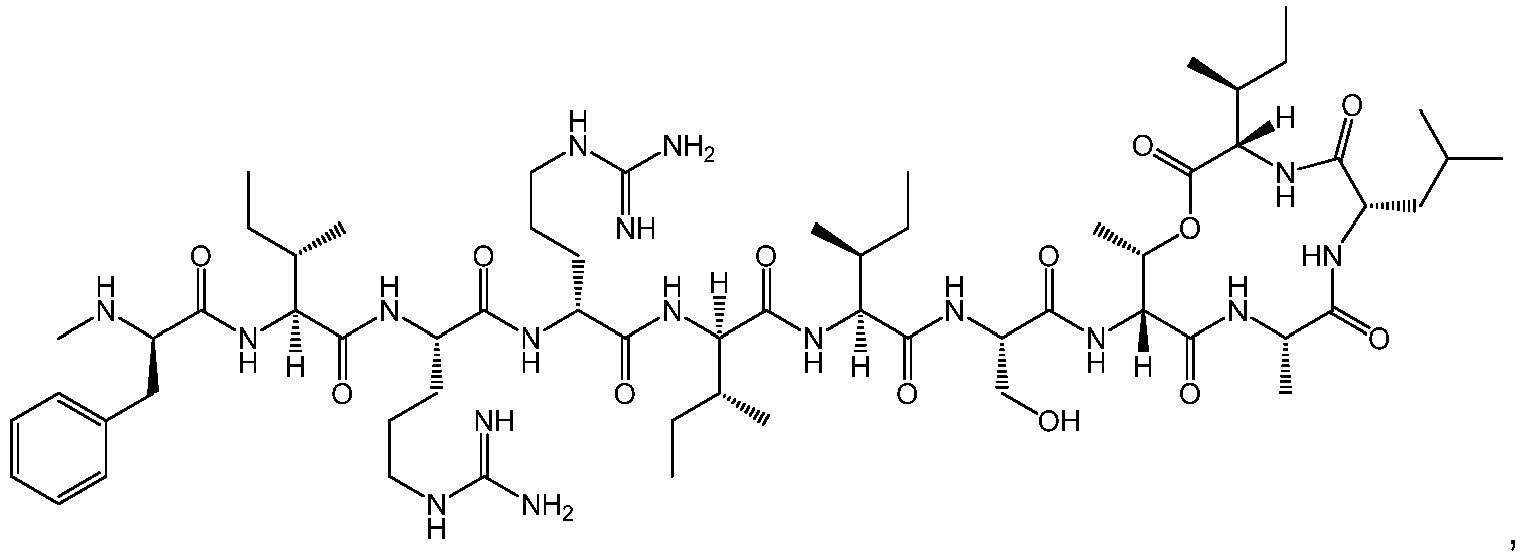


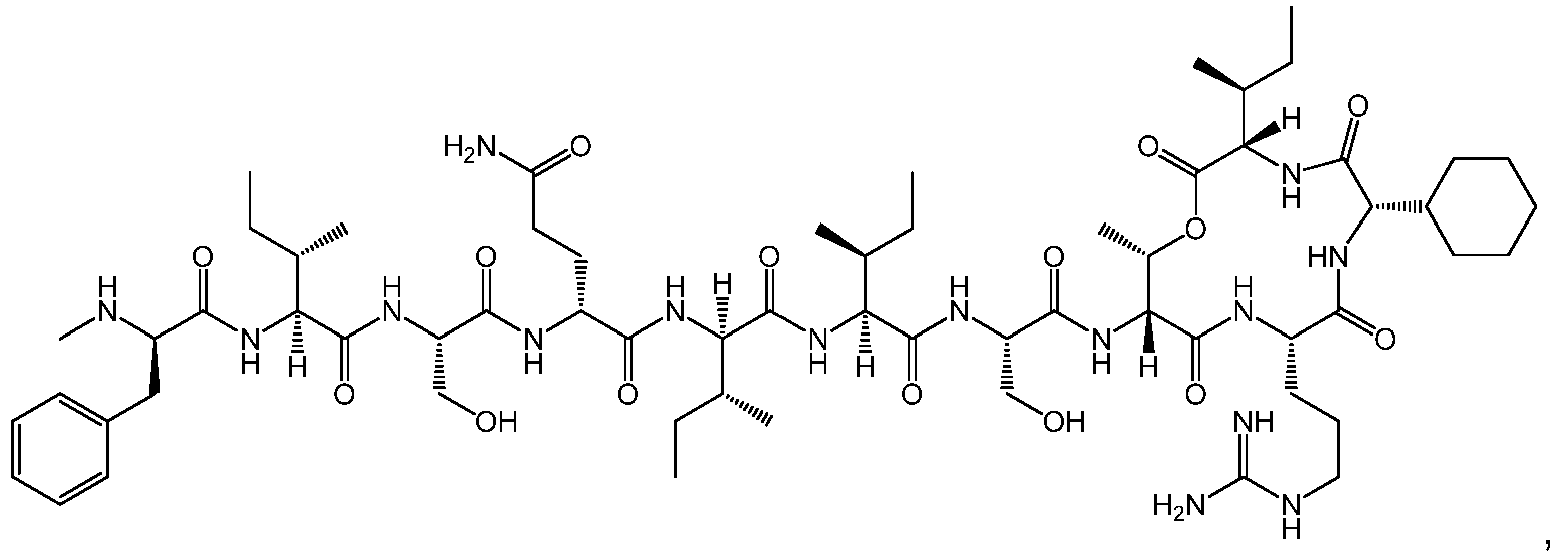


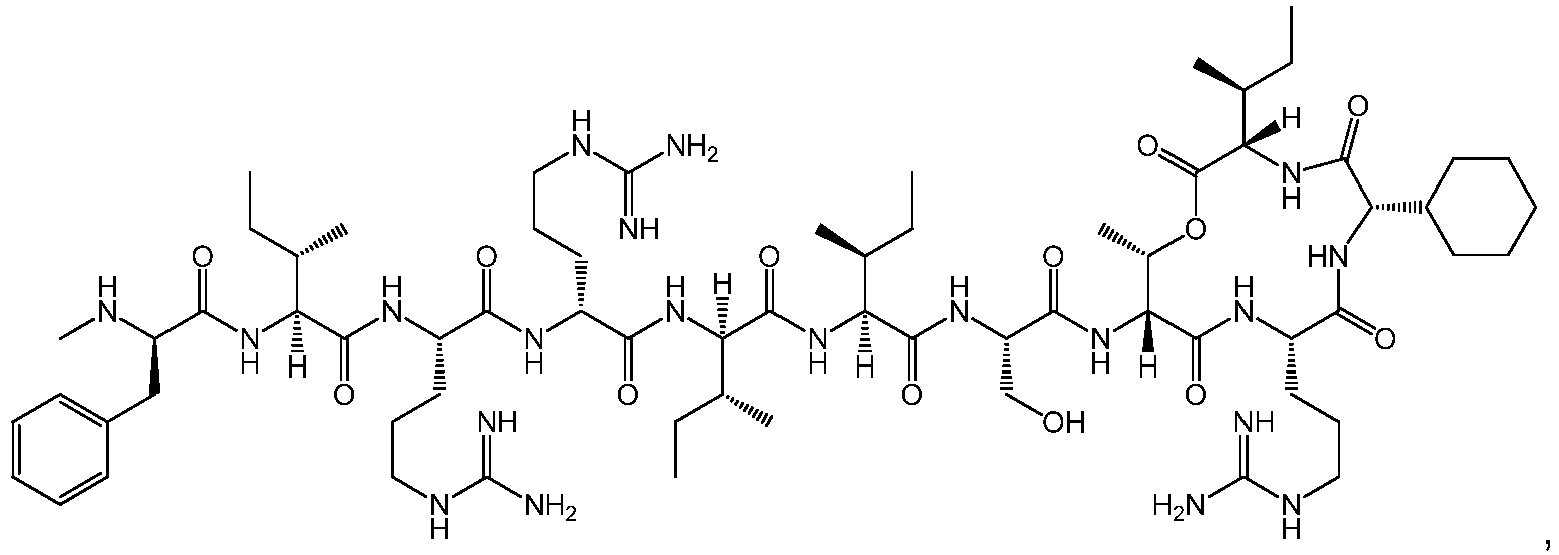


- The compounds of the invention may be prepared in accordance with techniques known to those skilled in the art, for example as described hereinafter.
- Thus, according to a second aspect of the invention there is provided a process for the preparation of a compound of formula IA, which comprises any one of steps (ii), (iii), (v) and (vi) below. Also disclosed, but not claimed is a process for the preparation of a compound of formula IB or IC, which comprises any one of steps (i) to (viii) below:
- (i) for compounds of formula IB in which R10b represents a -C1-6-alkyl-NHC(=NH)NH2 group (e.g. an arginine side chain), deprotection of a compound of formula XI,

- wherein AA1 to AA7, R1 to R3, R9b and R11b are as hereinbefore defined (and AA1 to AA7 are optionally protected); in the presence of an acid (such as trifluroacetic acid, hydrochloric acid or p-toluenesulfonic acid), for example under conditions known to a person skilled in the art (such as in the presence of a suitable organic solvent (e.g. dioxane, THF, MeCN, diethyl ether, EtOAc, DCM or DMF));
- in a particularly preferred embodiment the deprotection of a compound of formula XI is performed in the presence of trifluroacetic acid, triisopropylsilane and water;
- optionally deprotection of a compound of formula XI is performed on a solid support and/or in combination with cleavage of the amino acid sequence from the solid support;
- (ii) deprotection of a compound of formula IA, IB or IC in which one or more hydroxyl groups is protected with an ether protecting group (such as a tert-butyl, benzyl, allyl, or methoxymethyl ether, preferably a tert-butyl ether), which deprotection may be performed in the presence of an acid (such as trifluroacetic acid, hydrochloric acid or p-toluenesulfonic acid), for example under conditions known to a person skilled in the art (such as in the presence of a suitable organic solvent (e.g. dioxane, THF, MeCN, diethyl ether, EtOAc, DCM or DMF));
- (iii) deprotection of a compound of formula IA, IB or IC in which one or more primary amide groups is protected with a trityl-based group (e.g. a dimethoxy trityl group, a monomethoxy trityl group or an unsubstituted trityl group), which deprotection may be performed in the presence of an acid (such as trifluroacetic acid, hydrochloric acid or p-toluenesulfonic acid), for example under conditions known to a person skilled in the art (such as in the presence of a suitable organic solvent (e.g. dioxane, THF, MeCN, diethyl ether, EtOAc, DCM or DMF));
- in a particularly preferred embodiment the deprotections of steps (ii) and (iii) are performed in the presence of trifluroacetic acid, triisopropylsilane and water;
- optionally the deprotections of steps (ii) and (iii) are performed on a solid support and/or in combination with cleavage of the amino acid sequence from the solid support;
- (iv) for compounds of formula IB in which R2 and R3 are linked and Q represents -S-S-, oxidation of a compound of formula XII,

- wherein AA1 to AA7 are as defined hereinabove and are optionally protected, R1, R9b, R10b and R11b are as defined hereinabove, Z1 and Z2 each independently represent a linear C1-6 alkylene group, optionally substituted as defined in hereinabove in respect of the linear C1-6 alkylene groups that form part of the linker group; using a suitable oxidising agent, such as oxygen, hydrogen peroxide or 1,3-dibromo-5,5-dimethylhydantoin (DBDMH), for example under conditions known to a person skilled in the art (such as in the presence of a suitable organic solvent (e.g. dioxane, THF, MeCN, diethyl ether, EtOAc, DCM, DMF, water, DMSO or mixtures thereof));
- optionally the oxidation of a compound of formula XII is performed on a solid support;
- (v) for compounds of formula IA, IB or IC, reaction of a compound of formula XIIIA, XIIIB or XIIIC,


- a) reacting the compound of formula XIIIA, XIIIB or XIIIC with a compound of formula XIV

- b) removal of the protecting group PG1 if present, which may be performed under acidic or basic conditions as appropriate, (e.g. in the presence of piperidine);
- a) reacting the compound of formula XIIIA, XIIIB or XIIIC with a compound of formula XIV
- (vi) for compounds of formula IA or IC, reaction of a compound of formula (XVA) or formula (XVC),

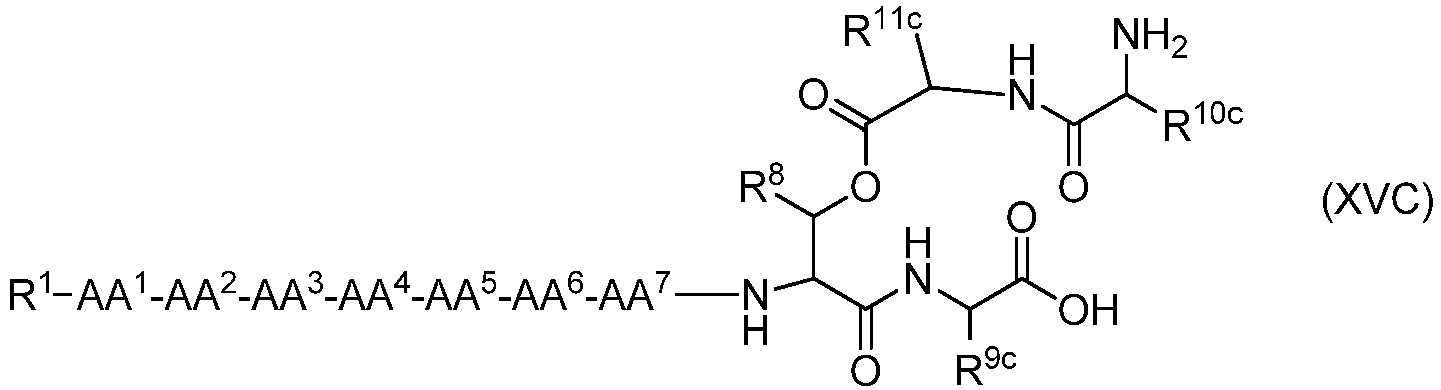
- (vii) for compounds of formula IB in which R11b represents -C(O)NH2, cleavage of a solid phase resin from a compound of formula XVI,

- wherein AA1 to AA7 are as defined hereinabove and are optionally protected; R1, R2, R3, R9b and R10b are as described hereinabove; and

- in a particularly preferred embodiment the removal of the solid phase resin from a compound of formula XVI is performed in the presence of trifluroacetic acid, triisopropylsilane and water;
- wherein AA1 to AA7 are as defined hereinabove and are optionally protected; R1, R2, R3, R9b and R10b are as described hereinabove; and
- (viii) for compounds of formula IA or IB in which R10a or R10b, as appropriate, represents -L1-L2-L3-X1 in which L2 represents -NHC(O)- NHC(O)O- or -NHC(O)NH-, reaction of a compound of formula XVIIA or XVIIB,


- wherein Z, R1, AA1 to AA7, R2, R3, R8, R9a, R9b, R11a, R11b and L1 are as hereinbefore defined, with a compound of formula XVIII,

- wherein X3 represents a direct bond, -O- or -NH-, as necessary, L3 and X1 are as hereinbefore defined (or wherein X1 is in a protected form), and LG1 represents hydrogen or a suitable leaving group, such as an N-hydroxysuccinimide group, under suitable conditions known the person skilled in the art, for example the conditions described above in respect of step (v) or in the presence of a suitable base (e.g. DIPEA, trimethylamine, triisopropylethylamine or pyridine).
- wherein Z, R1, AA1 to AA7, R2, R3, R8, R9a, R9b, R11a, R11b and L1 are as hereinbefore defined, with a compound of formula XVIII,
- The processes described in steps (i) to (viii) are referred to hereinafter as "the processes of the invention".
- By "performed on a solid support" we mean that the relevant processes are carried out with the peptide sequence covalently bonded to a solid phase resin (for example a polysterene or polyethylene glycol resin (e.g. a ChemMatrix ® resin)). The point of attachment to the solid phase resin may be at the N-terminus or, preferably at the C-terminus of the peptide sequence or a precursor thereof. The peptide sequence will normally be bound to the resin through either an amide or ester linkage, wherein either the carbonyl portion or amine portion is derived from the C-terminus or N-terminus amino acid residue as appropriate.
- The skilled person will be able to determine appropriate solid phase resins for use in the processes of the invention and the most appropriate point of attachment of the resin to the peptide sequence for a given process. Suitable resins include the commercially available resins Rink amide resin and 2-chlorotrityl resin, both of which may be attached to the C-terminus of a peptide sequence, via an amide or ester linkage respectively.
- Cleavage of the peptide sequence from Rink amide resin and 2-chlorotrityl resin can be achieved under acidic conditions. Cleavage from Rink amide resin results in a primary amide group at the C-terminus of a peptide sequence, and cleavage from 2-chlorotrityl resin results in the carboxylic acid group being restored at the C-terminus.
- For compounds of formula IB in which R2 and R3 are linked and R11b represents -C(O)NH2, the macrocyclic moiety is typically formed by linkage of two amino acid side chains, which allows the solid phase resin to be attached to the C-terminus of one of the ring-forming amino acid residues and thus for macrocyclisation to be performed prior to cleavage from the solid phase resin. The use of Rink amide resin for the synthesis of these compounds also allows for the cleavage to be performed under the same acidic conditions as deprotection of many commonly-employed protecting groups. Collectively, these factors allow for the highly-efficient synthesis of Teixobactin analogues, which display potent antibacterial activity. The presence of a primary amide group (resulting from the cleavage of the Rink amide resin) on the macrocyclic ring appears to be well-tolerated in terms of biological efficacy, even though such a group is not present in Teixobactin.
- In further embodiments of the processes of the invention, any two or more of the deprotections of steps (i), (ii), (iii) may be performed concurrently, and any one or more of these deprotections may also be performed concurrently with the cleavage of step (vii). For example, the global deprotection and cleavage from the solid support of a compound of formula (XIX),


- Protecting groups that may be removed concurrently include alcohol and primary amide protecting groups that can be removed under acidic conditions (for example ether protecting groups (e.g. tert-butyl) and trityl amide protecting groups). These groups may also be removed concurrently with the 2,2,4,6,7-pentamethyldihydrobenzofurane (Pbf) group for the protecting of guanidinyl groups (drawn explicitly in inter alia formula XIX), and with cleavage of the peptide sequence, or a precursor thereto, from Rink amide or 2-chlorotrityl resin.
- With reference to synthetic processes, by "performed concurrently" we mean that the relevant two or more transformations are achieved under a single set of reaction conditions.
- Other specific transformation steps that may be employed in the synthesis of compounds of formula IA, IB or IC include:
- (a) peptide coupling, which may for example be facilitated by a suitable peptide coupling reagent such as any of the coupling reagents and conditions as described in step (v) as hereinabove;
- (b) ester formation, which may for example be facilitated by suitable carboxylic acid activating agents (e.g. carbodiimides such as DIC, DCC and EDCI and/or DMAP), for example under conditions known to a person skilled in the art (such as in the presence of a suitable organic solvent (e.g. dioxane, THF, MeCN, diethyl ether, EtOAc, DCM or DMF));
- (c) macrocycle formation, including:
- 1. ester formation, for example the preparation of a compound of formula XX,

- wherein R9b, R10b, Z1 and Z2 are as hereinbefore defined (and R10b is optionally a protected amino acid side chain);
- R11c represents H or a solid phase resin (for example, Rink amide or 2-chlorotrityl resin);
- X2 represents H, a suitable protecting group (such as a carbamate protecting group, including Boc, CBz or preferably Fmoc) or a group consisting of one or more of the amino acid residues AA7 to AA1 as defined hereinabove, which are optionally protected, wherein the N-terminus of the group of one or more amino acids is bound to a suitable protecting group (such as a carbamate protecting group, including Boc, CBz or preferably Fmoc); and
- by reacting a compound of formula XXI,

- wherein R9b, R10b, R11c, X2, Z1 and Z2 are as hereinbefore defined for a compound of formula XX;
- in the presence of a suitable carboxylic acid activating agent (e.g. a carbodiimide such as DIC, DCC and EDCI and/or DMAP), for example under conditions known to a person skilled in the art (such as in the presence of a suitable organic solvent (e.g. dioxane, THF, MeCN, diethyl ether, EtOAc, DCM or DMF));
- 2. amide formation, for example the preparation of a compound of formula XXII;

- wherein R9b, R10b, R11c, X2, Z1 and Z2 are as defined in respect of a compound of formula XX;
- by reacting a compound of formula XXIII

- wherein R9b, R10b, R11c, X2, Z1 and Z2 are as defined in respect of a compound of formula XX; for example, under the conditions described for step (v) a) hereinabove;
- 3. disulphide formation, for example the preparation of a compound XXIV;

- wherein R9b, R10b, R11c, X2, Z1 and Z2 are as defined in respect of a compound of formula XX;
- by oxidising a compound of formula XXV

- wherein R9b, R10b, R11c, X2, Z1 and Z2 are as defined for a compound of formula XX; with a suitable oxidising agent, such as oxygen, hydrogen peroxide or 1,3-dibromo-5,5-dimethylhydantoin (DBDMH), for example under conditions known to a person skilled in the art (such as in the presence of a suitable organic solvent (e.g. dioxane, THF, MeCN, diethyl ether, EtOAc, DCM, DMF, water, DMSO or mixtures thereof));
- 1. ester formation, for example the preparation of a compound of formula XX,
- (d) protection of reactive functional groups, for example hydroxyl groups, primary or secondary amines, guanidines, carboxylic acids and primary or secondary amides, with suitable protecting groups, for example carbamate protecting groups (e.g Boc, CBz, Fmoc or Alloc groups), ether protecting groups (e.g. tert-butyl ethers) or trityl amide protecting groups; details of suitable protecting groups and methods for their incorporation can be found in P. G. M. Wuts and T. W. Greene Protective Groups in Organic Synthesis, 4th edition, 2006, Wiley, 2006;
- (e) deprotection of protected hydroxyl groups, primary or secondary amines, carboxylic acids, guanidines and primary or secondary amides; suitable procedures for the removal (i.e. deprotection) of protecting groups can be found in P. G. M. Wuts and T. W. Greene Protective Groups in Organic Synthesis, 4th edition, 2006, Wiley, 2006;
- (f) cleavage of peptide compounds from solid phase resins (such as Rink amide ChemMatrix® resin and 2-chlorotrityl resin), for example in the presence of a suitable acid;
- (g) preparation of delivery agent fragments of formula II to X, which may be prepared according to the procedures described in Tschiche et al. J. Mater. Chem. B, 2014, 2, 2153-2167 and
WO 2016/034894 ; - (h) incorporation of a delivery agent fragment of formula II to X into a compound of formula IA, IB or IC.
- Compounds of the invention may be prepared by methods analogous to those listed above, together with those that are known to those skilled in the art. Compounds of formula IA, IB or IC may be prepared using processes involving solid (such as solid-phase peptide synthesis SPPS) or solution phase organic synthesis, as appropriate, using conditions that are known to those skilled in the art.
- Persons skilled in the art will appreciate that, in order to obtain compounds of formula IA, IB or IC (etc.) in an alternative, and, on some occasions, more convenient, manner, the individual process steps mentioned hereinbefore may be performed in a different order, and/or the individual reactions may be performed at a different stage in the overall route (i.e. substituents may be added to and/or chemical transformations performed upon, different intermediates to those mentioned hereinbefore in conjunction with a particular reaction). This may negate, or render necessary, the need for protecting groups.
- The type of chemistry involved will dictate the need, and type, of protecting groups as well as the sequence for accomplishing the synthesis and whether each step should be performed in solution or on solid phase. A recent review of suitable protecting groups for amino acids is provided by Isidro-Llobet et al. Chem. Rev. 2009, 109, 2455-2504.
- Advantageously, removal of protecting groups and cleavage from solid phase resins should be performed towards the end (preferably as the final step) of a synthetic route in order to maximise the efficiency of a synthetic process.
- The compounds of the invention are useful because they possess pharmacological activity. They are therefore indicated as pharmaceuticals.
- Thus, according to a third aspect of the invention there is provided a pharmaceutical composition comprising a compound of the invention in combination with a pharmaceutically-acceptable adjuvant diluent or carrier. Such formulations are referred to hereinafter as the "formulations of the invention".
- According to a fourth aspect of the invention, there is provided the compounds of the invention or the formulations of the invention for use in medicine.
- The use of compounds or formulations of the invention in medicine includes their use as pharmaceuticals (both for human and veterinary use). The compositions of the present invention may also be useful in other fields of industry. For example, the compositions may be useful as plant protection products (i.e. in agriculture), in cosmetic products (e.g. in creams, toothpaste, lotions and ointments), and hygiene and sterilisation procedures (e.g. in scientific laboratories).
- In this respect, fifth, sixth, seventh and eighth aspects of the invention provide, respectively:
- (a) a compound or formulation of the invention, as hereinbefore defined, for use in treating or preventing a bacterial infection in a subject;
- (b) use of a compound or formulation of the invention, as hereinbefore defined, in the manufacture of a medicament for treating or preventing a bacterial infection in a subject;
- (c) a method of treating or preventing a bacterial infection, which method comprises administration of a therapeutically effective amount of a compound or formulation of the invention as hereinbefore defined to a subject in need thereof;
- (d) use (e.g. ex vivo use) of a compound or formulation of the invention to kill bacteria.
- When used herein, the terms "bacteria" (and derivatives thereof, such as "bacterial infection") includes references to organisms (or infections due to organisms) of the following classes and specific types:
- Gram-positive cocci, such as
- Staphylococci (e.g. Staph. aureus, Staph. epidermidis, Staph. saprophyticus, Staph. auricularis, Staph. capitis capitis, Staph. c. ureolyticus, Staph. caprae, Staph. cohnii cohnii, Staph. c. urealyticus, Staph. equorum, Staph. gallinarum, Staph. haemolyticus, Staph. hominis hominis, Staph. h. novobiosepticius, Staph. hyicus, Staph. intermedius, Staph. lugdunensis, Staph. pasteuri, Staph. saccharolyticus, Staph. schleiferi schleiferi, Staph. s. coagulans, Staph. sciuri, Staph. simulans, Staph. warneri and Staph. xylosus) and
- Streptococci (e.g.
- beta-haemolytic, pyogenic streptococci (such as Strept. agalactiae, Strept. canis, Strept. dysgalactiae dysgalactiae, Strept. dysgalactiae equisimilis, Strept. equi equi, Strept. equi zooepidemicus, Strept. iniae, Strept. porcinus and Strept. pyogenes),
- microaerophilic, pyogenic streptococci (Streptococcus "milleri", such as Strept. anginosus, Strept. constellatus constellatus, Strept. constellatus pharyngidis and Strept. intermedius),
- oral streptococci of the "mitis" (alpha-haemolytic - Streptococcus "viridans", such as Strept. mitis, Strept. oralis, Strept. sanguinis, Strept. cristatus, Strept. gordonii and Strept. parasanguinis), "salivarius" (non-haemolytic, such as Strept. salivarius and Strept. vestibularis) and "mutans" (tooth-surface streptococci, such as Strept. criceti, Strept. mutans, Strept. ratti and Strept. sobrinus) groups,
- Strept. acidominimus, Strept. bovis, Strept. faecalis, Strept. equinus, Strept. pneumoniae and Strept. suis,
- or Streptococci alternatively classified as Group A, B, C, D, E, G, L, P, U or V Streptococcus);
- Gram-negative cocci, such as Neisseria gonorrhoeae, Neisseria meningitidis, Neisseria cinerea, Neisseria elongata, Neisseria flavescens, Neisseria lactamica, Neisseria mucosa, Neisseria sicca, Neisseria subflava and Neisseria weaveri;
- Bacillaceae, such as Bacillus anthracis, Bacillus subtilis, Bacillus thuringiensis, Bacillus stearothermophilus and Bacillus cereus;
- Enterobacteriaceae, such as
- Escherichia coli,
- Enterobacter (e.g. Enterobacter aerogenes, Enterobacter agglomerans and Enterobacter cloacae)
- Citrobacter (such as Citrob. freundii and Citrob. divernis),
- Hafnia (e.g. Hafnia alvei),
- Erwinia (e.g. Erwinia persicinus),
- Morganella morganii,
- Salmonella (Salmonella enterica and Salmonella typhi),
- Shigella (e.g. Shigella dysenteriae, Shigella flexneri, Shigella boydii and Shigella sonnei),
- Klebsiella (e.g. Klebs. pneumoniae, Klebs. oxytoca, Klebs. ornitholytica, Klebs. planticola, Klebs. ozaenae, Klebs. terrigena, Klebs. granulomatis (Calymmatobacterium granulomatis) and Klebs. rhinoscleromatis),
- Proteus (e.g. Pr. mirabilis, Pr. rettgeri and Pr. vulgaris),
- Providencia (e.g. Providencia alcalifaciens, Providencia rettgeri and Providencia stuartii),
- Serratia (e.g. Serratia marcescens and Serratia liquifaciens), and
- Yersinia (e.g. Yersinia enterocolitica, Yersinia pestis and Yersinia pseudotuberculosis);
- Enterococci (e.g. Enterococcus avium, Enterococcus casseliflavus, Enterococcus cecorum, Enterococcus dispar, Enterococcus durans, Enterococcus faecalis, Enterococcus faecium, Enterococcus flavescens, Enterococcus gallinarum, Enterococcus hirae, Enterococcus malodoratus, Enterococcus mundtii, Enterococcus pseudoavium, Enterococcus raffinosus and Enterococcus solitarius);
- Helicobacter (e.g. Helicobacter pylori, Helicobacter cinaedi and Helicobacter fennelliae);
- Acinetobacter (e.g. A. baumanii, A. calcoaceticus, A. haemolyticus, A. johnsonii, A. junii, A. lwoffi and A. radioresistens);
- Pseudomonas (e.g. Ps. aeruginosa, Ps. maltophilia (Stenotrophomonas maltophilia), Ps. alcaligenes, Ps. chlororaphis, Ps. fluorescens, Ps. luteola. Ps. mendocina, Ps. monteilii, Ps. oryzihabitans, Ps. pertocinogena, Ps. pseudalcaligenes, Ps. putida and Ps. stutzeri);
- Bacteriodes fragilis;
- Peptococcus (e.g. Peptococcus niger);
- Peptostreptococcus;
- Clostridium (e.g. C. perfringens, C. difficile, C. botulinum, C. tetani, C. absonum, C. argentinense, C. baratii, C. bifermentans, C. beijerinckii, C. butyricum, C. cadaveris, C. carnis, C. celatum, C. clostridioforme, C. cochlearium, C. cocleatum, C. fallax, C. ghonii, C. glycolicum, C. haemolyticum, C. hastiforme, C. histolyticum, C. indolis, C. innocuum, C. irregulare, C. leptum, C. limosum, C. malenominatum, C. novyi, C. oroticum, C. paraputrificum, C. piliforme, C. putrefasciens, C. ramosum, C. septicum, C. sordelii, C. sphenoides, C. sporogenes, C. subterminale, C. symbiosum and C. tertium);
- Mycoplasma (e.g. M. pneumoniae, M. hominis, M. genitalium and M. urealyticum);
- Mycobacteria (e.g. Mycobacterium tuberculosis, Mycobacterium avium, Mycobacterium fortuitum, Mycobacterium marinum, Mycobacterium kansasii, Mycobacterium chelonae, Mycobacterium abscessus, Mycobacterium leprae, Mycobacterium smegmitis, Mycobacterium africanum, Mycobacterium alvei, Mycobacterium asiaticum, Mycobacterium aurum, Mycobacterium bohemicum, Mycobacterium bovis, Mycobacterium branderi, Mycobacterium brumae, Mycobacterium celatum, Mycobacterium chubense, Mycobacterium confluentis, Mycobacterium conspicuum, Mycobacterium cookii, Mycobacterium flavescens, Mycobacterium gadium, Mycobacterium gastri, Mycobacterium genavense, Mycobacterium gordonae, Mycobacterium goodii, Mycobacterium haemophilum, Mycobacterium hassicum, Mycobacterium intracellulare, Mycobacterium interjectum, Mycobacterium heidelberense, Mycobacterium lentiflavum, Mycobacterium malmoense, Mycobacterium microgenicum, Mycobacterium microti, Mycobacterium mucogenicum, Mycobacterium neoaurum, Mycobacterium nonchromogenicum, Mycobacterium peregrinum, Mycobacterium phlei, Mycobacterium scrofulaceum, Mycobacterium shimoidei, Mycobacterium simiae, Mycobacterium szulgai, Mycobacterium terrae, Mycobacterium thermoresistabile, Mycobacterium triplex, Mycobacterium triviale, Mycobacterium tusciae, Mycobacterium ulcerans, Mycobacterium vaccae, Mycobacterium wolinskyi and Mycobacterium xenopi);
- Haemophilus (e.g. Haemophilus influenzae, Haemophilus ducreyi, Haemophilus aegyptius, Haemophilus parainfluenzae, Haemophilus haemolyticus and Haemophilus parahaemolyticus);
- Actinobacillus (e.g. Actinobacillus actinomycetemcomitans, Actinobacillus equuli, Actinobacillus hominis, Actinobacillus lignieresii, Actinobacillus suis and Actinobacillus ureae);
- Actinomyces (e.g. Actinomyces israelii);
- Brucella (e.g. Brucella abortus, Brucella canis, Brucella melintensis and Brucella suis);
- Campylobacter (e.g. Campylobacter jejuni, Campylobactercoli, Campylobacterlari and Campylobacter fetus);
- Listeria monocytogenes;
- Vibrio (e.g. Vibrio cholerae and Vibrio parahaemolyticus, Vibrio alginolyticus, Vibrio carchariae, Vibrio fluvialis, Vibrio furnissii, Vibrio hollisae, Vibrio metschnikovii, Vibrio mimicus and Vibrio vulnificus);
- Erysipelothrix rhusopathiae;
- Corynebacteriaceae (e.g. Corynebacterium diphtheriae, Corynebacterium jeikeum and Corynebacterium urealyticum);
- Spirochaetaceae, such as Borrelia (e.g. Borrelia recurrentis, Borrelia burgdorferi, Borrelia afzelii, Borrelia andersonii, Borrelia bissettii, Borrelia garinii, Borrelia japonica, Borrelia lusitaniae, Borrelia tanukii, Borrelia turdi, Borrelia valaisiana, Borrelia caucasica, Borrelia crocidurae, Borrelia duttoni, Borrelia graingeri, Borrelia hermsii, Borrelia hispanica, Borrelia latyschewii, Borrelia mazzottii, Borrelia parkeri, Borrelia persica, Borrelia turicatae and Borrelia venezuelensis) and Treponema (Treponema pallidum ssp. pallidum, Treponema pallidum ssp. endemicum, Treponema pallidum ssp. pertenue and Treponema carateum);
- Pasteurella (e.g. Pasteurella aerogenes, Pasteurella bettyae, Pasteurella canis, Pasteurella dagmatis, Pasteurella gallinarum, Pasteurella haemolytica, Pasteurella multocida multocida, Pasteurella multocida gallicida, Pasteurella multocida septica, Pasteurella pneumotropica and Pasteurella stomatis);
- Bordetella (e.g. Bordetella bronchiseptica, Bordetella hinzii, Bordetella holmseii, Bordetella parapertussis, Bordetella pertussis and Bordetella trematum);
- Nocardiaceae, such as Nocardia (e.g. Nocardia asteroides and Nocardia brasiliensis);
- Rickettsia (e.g. Ricksettsii or Coxiella bumetii);
- Legionella (e.g. Legionalla anisa, Legionalla birminghamensis, Legionalla bozemanii, Legionalla cincinnatiensis, Legionalla dumoffii, Legionalla feeleii, Legionalla gormanii, Legionalla hackeliae, Legionalla israelensis, Legionalla jordanis, Legionalla lansingensis, Legionalla longbeachae, Legionalla maceachernii, Legionalla micdadei, Legionalla oakridgensis, Legionalla pneumophila, Legionalla sainthelensi, Legionalla tucsonensis and Legionalla wadsworthii);
- Moraxella catarrhalis;
- Stenotrophomonas maltophilia;
- Burkholderia cepacia;
- Francisella tularensis;
- Gardnerella (e.g. Gardneralla vaginalis and Gardneralla mobiluncus);
- Streptobacillus moniliformis;
- Flavobacteriaceae, such as Capnocytophaga (e.g. Capnocytophaga canimorsus, Capnocytophaga cynodegmi, Capnocytophaga gingivalis, Capnocytophaga granulosa, Capnocytophaga haemolytica, Capnocytophaga ochracea and Capnocytophaga sputigena);
- Bartonella (Bartonella bacilliformis, Bartonella clarridgeiae, Bartonella elizabethae, Bartonella henselae, Bartonella quintana and Bartonella vinsonii arupensis);
- Leptospira (e.g. Leptospira biflexa, Leptospira borgpetersenii, Leptospira inadai, Leptospira interrogans, Leptospira kirschneri, Leptospira noguchii, Leptospira santarosai and Leptospira weilii);
- Spirillium (e.g. Spirillum minus);
- Bacteroides (e.g. Bacteroides caccae, Bacteroides capillosus, Bacteroides coagulans, Bacteroides distasonis, Bacteroides eggerthii, Bacteroides forsythus, Bacteroides fragilis, Bacteroides merdae, Bacteroides ovatus, Bacteroides putredinis, Bacteroides pyogenes, Bacteroides splanchinicus, Bacteroides stercoris, Bacteroides tectus, Bacteroides thetaiotaomicron, Bacteroides uniformis, Bacteroides ureolyticus and Bacteroides vulgatus);
- Prevotella (e.g. Prevotella bivia, Prevotella buccae, Prevotella corporis, Prevotella dentalis (Mitsuokella dentalis), Prevotella denticola, Prevotella disiens, Prevotella enoeca, Prevotella heparinolytica, Prevotella intermedia, Prevotella loeschii, Prevotella melaninogenica, Prevotella nigrescens, Prevotella oralis, Prevotella oris, Prevotella oulora, Prevotella tannerae, Prevotella venoralis and Prevotella zoogleoformans);
- Porphyromonas (e.g. Porphyromonas asaccharolytica, Porphyromonas cangingivalis, Porphyromonas canoris, Porphyromonas cansulci, Porphyromonas catoniae, Porphyromonas circumdentaria, Porphyromonas crevioricanis, Porphyromonas endodontalis, Porphyromonas gingivalis, Porphyromonas gingivicanis, Porphyromonas levii and Porphyromonas macacae);
- Fusobacterium (e.g. F. gonadiaformans, F. mortiferum, F. naviforme, F. necrogenes, F. necrophorum necrophorum, F. necrophorum fundiliforme, F. nucleatum nucleatum, F. nucleatum fusiforme, F. nucleatum polymorphum, F. nucleatum vincentii, F. periodonticum, F. russii, F. ulcerans and F. varium);
- Chlamydia (e.g. Chlamydia trachomatis);
- Chlamydophila (e.g. Chlamydophila abortus (Chlamydia psittaci), Chlamydophila pneumoniae (Chlamydia pneumoniae) and Chlamydophila psittaci (Chlamydia psittaci));
- Leuconostoc (e.g. Leuconostoc citreum, Leuconostoc cremoris, Leuconostoc dextranicum, Leuconostoc lactis, Leuconostoc mesenteroides and Leuconostoc pseudomesenteroides);
- Gemella (e.g. Gemella bergeri, Gemella haemolysans, Gemella morbillorum and Gemella sanguinis); and
- Ureaplasma (e.g. Ureaplasma parvum and Ureaplasma urealyticum).
- Thus, compounds of the invention may be used to kill any of the above-mentioned bacterial organisms.
- Particular bacteria that may be mentioned in this respect include:
- Bacillaceae, such as Bacillus anthracis, Bacillus subtilis, Bacillus thuringiensis, Bacillus stearothermophilus and Bacillus cereus;
- Staphylococci, such as Staph. aureus (either Methicillin-sensitive (i.e. MSSA) or Methicillin-resistant (i.e. MRSA)) and Staph. epidermidis;
- Acinetobacter (e.g. A. baumanii, A. calcoaceticus, A. haemolyticus, A. johnsonii, A. junii, A. lwoffi and A. radioresistens);
- Enterobacteriaceae, such as Escherichia coli, Klebsiella (e.g. Klebs. pneumoniae and Klebs. oxytoca) and Proteus (e.g. Pr. mirabilis, Pr. rettgeri and Pr. vulgaris); or
- Pseudomonas (e.g. Ps. aeruginosa, Ps. maltophilia (Stenotrophomonas maltophilia), Ps. alcaligenes, Ps. chlororaphis, Ps. fluorescens, Ps. luteola. Ps. mendocina, Ps. monteilii, Ps. oryzihabitans, Ps. pertocinogena, Ps. pseudalcaligenes, Ps. putida and Ps. stutzeri).
- Particular bacterial infections that may be mentioned in relation to the fifth to eighth aspects of the invention include infections with:
- Bacillaceae, such as Bacillus anthracis, Bacillus subtilis, Bacillus thuringiensis, Bacillus stearothermophilus and Bacillus cereus;
- Staphylococci, such as Staph. aureus (either Methicillin-sensitive (i.e. MSSA) or Methicillin-resistant (i.e. MRSA)) and Staph. epidermidis;
- Acinetobacter (e.g. A. baumanii, A. calcoaceticus, A. haemolyticus, A. johnsonii, A. junii, A. lwoffi and A. radioresistens);
- Enterobacteriaceae, such as Escherichia coli, Klebsiella (e.g. Klebs. pneumoniae and Klebs. oxytoca) and Proteus (e.g. Pr. mirabilis, Pr. rettgeri and Pr. vulgaris); or
- Pseudomonas (e.g. Ps. aeruginosa, Ps. maltophilia (Stenotrophomonas maltophilia), Ps. alcaligenes, Ps. chlororaphis, Ps. fluorescens, Ps. luteola. Ps. mendocina, Ps. monteilii, Ps. oryzihabitans, Ps. pertocinogena, Ps. pseudalcaligenes, Ps. putida and Ps. stutzen).
- The compounds of the present invention are particularly advantageous as, when covalently bonded to a delivery agent, they are capable of inhibiting the growth, survival and reproduction of Gram negative bacteria, something which few existing antibacterial agents are able to do effectively. Thus, in particular embodiments of all of the methods disclosed herein, the bacteria are Gram negative bacteria.
- In this respect, particular conditions that the compounds and formulations of the invention can be used to treat include tuberculosis (e.g. pulmonary tuberculosis, non-pulmonary tuberculosis (such as tuberculosis lymph glands, genito-urinary tuberculosis, tuberculosis of bone and joints, tuberculosis meningitis) and miliary tuberculosis), anthrax, abscesses, acne vulgaris, actinomycosis, bacilliary dysentry, bacterial conjunctivitis, bacterial keratitis, botulism, Buruli ulcer, bone and joint infections, bronchitis (acute or chronic), brucellosis, burn wounds, cat scratch fever, cellulitis, chancroid, cholangitis, cholecystitis, cutaneous diphtheria, cystic fibrosis, cystitis, diffuse panbronchiolitis, diphtheria, dental caries, diseases of the upper respiratory tract, empymea, endocarditis, endometritis, enteric fever, enteritis, epididymitis, epiglottitis, erysipclas, erysipeloid, erythrasma, eye infections, furuncles, Gardnerella vaginitis, gastrointestinal infections (gastroenteritis), genital infections, gingivitis, gonorrhoea, granuloma inguinale, Haverhill fever, infected burns, infections following dental operations, infections in the oral region, infections associated with prostheses, intraabdominal abscesses, Legionnaire's disease, leprosy, leptospirosis, listeriosis, liver abscesses, Lyme disease, lymphogranuloma venerium, mastitis, mastoiditis, meningitis and infections of the nervous system, mycetoma, nocardiosis (e.g. Madura foot), non-specific urethritis, opthalmia (e.g. opthalmia neonatorum), osteomyelitis, otitis (e.g. otitis externa and otitis media), orchitis, pancreatitis, paronychia, pelveoperitonitis, peritonitis, peritonitis with appendicitis, pharyngitis, phlegmons, pinta, plague, pleural effusion, pneumonia, postoperative wound infections, postoperative gas gangrene, prostatitis, pseudo-membranous colitis, psittacosis, pulmonary emphysema, pyelonephritis, pyoderma (e.g. impetigo), Q fever, rat-bite fever, reticulosis, Ritter's disease, salmonellosis, salpingitis, septic arthritis, septic infections, septicameia, sinusitis, skin infections (e.g. skin granulomas), syphilis, systemic infections, tonsillitis, toxic shock syndrome, trachoma, tularaemia, typhoid, typhus (e.g. epidemic typhus, murine typhus, scrub typhus and spotted fever), urethritis, wound infections, yaws, aspergillosis, candidiasis (e.g. oropharyngeal candidiasis, vaginal candidiasis or balanitis), cryptococcosis, favus, histoplasmosis, intertrigo, mucormycosis, tinea (e.g. tinea corporis, tinea capitis, tinea cruris, tinea pedis and tinea unguium), onychomycosis, pityriasis versicolor, ringworm and sporotrichosis.
- Further conditions that may be mentioned in this respect include infections with MSSA, MRSA, Staph. epidermidis, Strept. agalactiae, Strept. pyogenes, Escherichia coli, Klebs. pneumoniae, Klebs. oxytoca, Pr. mirabilis, Pr. rettgeri, Pr. vulgaris, Haemophilis influenzae, Enterococcus faecalis or Enterococcus faecium.
- The compounds and formulations of the invention will normally be administered orally, subcutaneously, intravenously, intraarterially, transdermally, intranasally, by inhalation, or by any other parenteral route, in the form of pharmaceutical preparations comprising the active ingredient either as a free base or a non-toxic organic or inorganic acid addition salt, in a pharmaceutically acceptable dosage form. Depending upon the disorder and patient to be treated, as well as the route of administration, the compounds and formulations may be administered at varying doses.
- Suitable daily doses for the compounds and formulations of the invention in therapeutic treatment of humans are in the range of about 1 to about 2000 mg/m2.
- The most effective mode of administration and dosage regimen for the compounds and formulations of the invention depends on several factors, including the particular condition being treated, the extent and localisation of that condition in the patient being treated, as well as the patient's state of health and their reaction to the compound being administered. Accordingly, the dosages of the compounds and formulations of the invention should be adjusted to suit the individual patient. Methods for determining the appropriate dose for an individual patient will be known to those skilled in the art.
- Additionally, compositions of the invention may have the advantage that they may be more efficacious than, be less toxic than, have a broader range of activity than, be more potent than, produce fewer side effects than, or have other useful pharmacological properties over compositions known in the prior art. In particular, compositions of the invention may have the advantage that they are less toxic than compositions known in the prior art due to a reduction in the detrimental effects that the delivery agents may have on cell membrane (of the host organisms).
- The use of certain compounds and formulations of the invention in medicine is, to the knowledge of the inventors, novel. In certain embodiments of the invention, the subject of the treatment or prevention methods is a mammal, particularly a human.
- The invention is illustrated by the following examples in which:
-
Figure 1 shows the MIC distribution of Compounds 25 to 34 (denoted bynumbers 1 to 10, respectively in the figure) against 19 different Gram-positive pathogens. The teixobactin analogue daptomycin (labelled as D) was used as the comparator drug. Note the increase in MIC distribution as the overall net charge on the teixobactin analogues was increased. The number in parentheses indicates the overall net charge of the peptides; -
Figure 2 shows the cytotoxicity evaluation of Compound 26 in A549 lung epithelial cell line and human primary dermal fibroblasts (hDFs). Representative images of cells treated with either Compound 26 (62.5 µg/ml for 24 h) or nocodazole (10 µg/ml, toxicity control) are shown; -
Figure 3 shows representative slit lamp fluorescence images showing the time-dependent changes in wound closure of the cornea after application of: (A) PBS (2 eyes) or (B) 0.3% Compound 26 (4 eyes). The images were taken ondays -
Figure 4 shows the slit lamp examination of mice infected with S. aureus ATCC 29213 strains. Mice were treated with: (A) vehicle; (B) Compound 26; or (C) moxifloxacin; and -
Figure 5 shows (a) changes in corneal thickness (CT) of mice before and after infections and treatment with vehicle alone, Compound 26 (denoted as "Peptide 2" in the figure) or moxifloxacin; and (b) bacterial bioburden in the infected corneal after 48 h treatment with the same materials. Values represent colony counts from individual cornea and bars represent mean CFU/tissue ± standard errors of the mean. - The invention will now be described in more detail by reference to the following non-limiting Examples.
- For MIC testing all peptides were dissolved in DMSO (according to the method of L. L. Ling, et al., Nature 2015, 517, 455-459). Bacteria were grown on Mueller Hinton broth (oxoid). All incubations were at 37°C. Dilutions were carried out using Mueller Hinton. 100 µl of autoclaved Mueller Hinton broth was added to wells 2-12 on a 96-well plate. 200 µl of the peptide was added to well one at a concentration of 512 µg/ml. 100µl of peptide in well one was taken up and pipetted into well two. The mixture was then mixed via pipetting before 100µl was taken up and pipetted into well three. This process was repeated up to well 11. Once peptide was added to well 11 100 µl was taken up and then discarded ensuring the well 12 had no peptide present. Each well was then inoculated with 100µl of bacteria that had been diluted to an OD600nm of 0.1. This was repeated three times. The 96-well plates were then incubated for 24 hours. The MIC was determined to be the lowest concentration at which there was no growth visible. Results are tabulated in the Examples.
- Fmoc-D-Ile-OH, Fmoc-D-Thr(Trt)-OH, Fmoc-8-Ahx-OH and oxyma pure were purchased from Merck Millipore. All L Amino acids, 1-[Bis(dimethylamino)methylene]-1H-1,2,3-triazolo[4,5-b]pyridinium 3-oxid hexafluorophosphate (HATU), Fmoc-D-Gln(Trt)-OH, Boc-D-Nmethylphenyl-OH, Fmoc-D-Thr-OH, Boc-Asp(OtBu)-OH, Fmoc-Glu(OAlI)-OH, Fmoc-Lys(Alloc)-OH, Bis-Boc-pyrazolocarboxamidine, Diisoproplycarbodiimide and Triisopropylsilane were purchased from Fluorochem.
- The protecting groups for the amino acids are tBu for Glu, Boc for Pro, Tyr, Lys, Trp, Pbf for Arg and Trt for Gln unless specified otherwise. Diisopropylethylamine, supplied as extra dry, redistilled, 99.5% pure, was purchased from Sigma Aldrich. Dimethylformamide (DMF) peptide synthesis grade and Trifluoroacetic acid (TFA) was purchased from Rathburn chemicals.
- Petroleum ether, Diethyl ether, i-PrOH, MeOH (HPLC grade), and Acetonitrile (HPLC grade) were purchased from Fisher Scientific. Water with the Milli-Q grade standard was obtained in-house from an ELGA Purelab Flex system. 2-Chlorotritylchloride resin (manufacturer's loading: 1.20 mmol/g) was obtained from Fluorochem. Rink amide Chemmatrix resin (manufacturer's loading = 0.49 mmol/g) was obtained from Biotage. All chemicals were used without further purification.
- Peptide syntheses were performed using standard Fmoc Solid Phase Peptide Synthesis (SPPS) protocols on a 2-Chlorotritylchloride resin, loading = 1.20 mmol/g or a Rink Amide Chemmatrix Resin, loading = 0.49 mmol/g using a Biotage Initiator + Alstra fully automated microwave peptide synthesizer. All amino acid couplings were performed using 5 eq. Amino Acid with 5 eq. DIC/Oxyma in DMF as a coupling cocktail by irradiating at 70°C for 5 min. Fmoc deprotection was performed using 20% piperidine in DMF.
- Peptide cleavage was performed using TFA/TIS/H2O = 95:2.5:2.5 (3 mL/100 mg resin) for 1h. Peptides were precipitated using cold Et2O (-20°C) by adding approximately 5x volume of the TFA used for cleavage and centrifuging at 7000 rpm at 0°C.
- All peptides/conjugates were analysed on a Thermo Scientific Dionex Ultimate 3000 RP-HPLC equipped with a Phenomenex Gemini NX C18 110 Å (150 x 4.6 mm) column using the following buffer systems: A: 0.1% HCOOH in milliQ water. B: MeCN using a flow rate of 1 ml/min. The column was flushed with 100% A for 5 min prior to an injection and was flushed for 5 min with 95% B and 5% A after the run was finished.
- Peptides were analysed using the following gradient: 95% A for 2 min. 5-95% B in 15 min. 95% B for 5 min. 95% A for 4 min.
- Peptides and conjugates were purified using the same gradient as mentioned above, on a Thermo Scientific Dionex Ultimate 3000 RP-HPLC with a flow rate of 5 mL/min using a Phenomenex Gemini NX C18 110 Å (150 x 10 mm) semi-prep column.
-
- AA
- amino acid
- Boc
- butyloxycarbonyl
- DCM
- dichloromethane
- DIC
- N,N'-diisopropylcarbodiimide
- DIPEA
- N,N-diisopropylethylamine
- DMAP
- 4-dimethylaminopyridine
- DMF
- dimethyl formamide
- DMSO
- dimethyl sulfoxide
- Eq
- equivalents
- Fmoc
- fluorenylmethyloxycarbonyl
- GABA
- gamma-aminobutyric acid
- H
- hours
- HATU
- 1-[bis(dimethylamino)methylene]-1H-1,2,3-triazolo[4,5-b]pyridinium 3-oxid hexafluorophosphate
- HOSu
- 1-hydroxypyrrolidine-2,5-dione (N-hydroxysuccinimide)
- HPLC
- high performance liquid chromatography
- LC
- liquid chromatography
- MeCN
- acetonitrile
- mQ
- Milli q water (deionised water)
- MS
- mass spectrometry
- Pbf
- 2,2,4,6,7-pentamethyldihydrobenzofurane
- PG
- protecting group
- SPPS
- solid-phase peptide synthesis
- TFA
- trifluoroacetic acid
- TIS
- triisopropylsilane
- UV
- ultraviolet
-

- Synthesis of
Compounds peptide concentration 1 mM) in air, 12h. - Steps a and b. Commercially available Rink amide Chemmatrix resin (manufacturer's loading = 0.49 mmol/g) was swelled in DMF and through automated
standard SPPS Compound 1 was synthesized using the general procedure described hereinabove. - Step c.
Crude Compound 1 was then dissolved in DMSO:mQ water = 1:3 while maintaining a peptide concentration of 1 mM and was stirred for 12h at r.t. in air to yield Compounds 2 (~60%) & 3 (~40%).Compounds -

- Synthesis of Compound 4: a. Fmoc-AA(PG)-OH (AA = amino acid, PG = protecting group), HATU/DIPEA followed by 20% piperidine in DMF. b. [Pd(PPh3)4]0 (0.2 eq.) + 24 eq. PhSiH3 in DCM, 2 × 1 h. c. 24 x 30s TFA:TIS:DCM = 2:5:93. d. 2.5 eq. DIC/12 eq. DMAP in DMF, overnight. e. Fmoc-AA(PG)-OH (AA = amino acid, PG = protecting group), DIC/Oxyma microwave couplings followed by 20% piperidine in DMF. f. TFA:TIS:H2O = 95:2.5:2.5, 1h.
- Step a. Commercially available Rink amide Chemmatrix resin (manufacturer's loading = 0.49 mmol/g) was swelled in DMF and through automated standard SPPS residues Fmoc-Glu(OAlI)-OH, Fmoc-Arg(Pbf)-OH, Fmoc-Ala-OH and Fmoc-D-Thr(Trt)-OH were coupled in succession using the general protocol described hereinabove.
- Step b. The Allyl protecting group of Glu was removed using 0.2 eq. [Pd(PPh3)]0 and 24 eq. PhSiH3 in dry DCM under argon for 1 h. This procedure was repeated twice and the resin was washed thoroughly with DCM and DMF to remove any Pd stuck to the resin.
- Step c. The resin was swelled in DCM. The Trt protecting group of Thr was then removed using 24x30s bursts of 2% TFA + 5% TIS in DCM.
- Step d. Esterification was performed using 2.5 eq. DIC + 12 eq. DMAP in DMF by shaking the resin overnight.
- Step e. The subsequent amino acids were coupled using the protocols described hereinabove.
- Step f. Cleavage, precipitation and HPLC purification were performed using the protocols described hereinabove (10% overall recovery after HPLC purification).
-

- Synthesis of Compound 5: a. Fmoc-AA(PG)-OH (AA = amino acid, PG = protecting group), HATU/DIPEA followed by 20% piperidine in DMF. b. [Pd(PPh3)4]0 (0.4 eq.) + 48 eq. PhSiH3 in DCM, 2 x 1 h. c. 2 eq. HATU/8 eq. DIPEA, overnight. d. Fmoc-AA(PG)-OH (AA = amino acid, PG = protecting group), DIC/Oxyma microwave couplings followed by 20% piperidine in DMF. e. TFA:TIS:H2O = 95:2.5:2.5, 1h.
- Step a. Commercially available Rink amide Chemmatrix resin (manufacturer's loading = 0.49 mmol/g) was swelled in DMF and through automated standard SPPS residues Fmoc-Glu(OAlI)-OH, Fmoc-Arg(Pbf)-OH, Fmoc-Ala-OH and Fmoc-Lys(Alloc)-OH were coupled in succession using the general protocols described hereinabove.
- Step b. The Allyl protecting group of Glu and the Alloc protecting group of Lys were removed using 0.4 eq. [Pd(PPh3)]0 and 48 eq. PhSiH3 in dry DCM under argon for 1 h. This procedure was repeated twice and the resin was washed thoroughly with DCM and DMF to remove any Pd stuck to the resin.
- Step c. Amide bond formation was performed using 2 eq. of HATU with 8 eq. of DIPEA in DMF by shaking the resin overnight.
- Step d. The subsequent amino acids were coupled using the general protocols described hereinabove.
- Step e. Cleavage, precipitation and HPLC purification were performed using the general protocols described hereinabove (50% overall recovery after purification).
-

- Synthesis of Compound 6: a. 4 eq. Fmoc-Ala-OH/8 eq. DIPEA in DCM, 3h. b. 20% piperidine in DMF followed by 3 eq. AllocHN-D-Thr-OH, 3 eq. HATU/6 eq. DIPEA. c. 10 eq. Fmoc-Ile-OH, 10 eq. DIC, 5 mol% DMAP in DMF, 2h followed by capping with Ac2O/
DIPEA 10% in DMF d. 4 eq. Fmoc-Arg(Pbf)-OH, 4 eq. HATU/8 eq. DIPEA in DMF, 1h followed by 20% piperidine in DMF e. 10 eq. Trt-Cl, 15% Et3N in DCM, 1h. f. [Pd(PPh3)4]0 (0.2 eq.) + 24 eq. PhSiH3 in DCM, 2 × 1 h. g. Fmoc-AA(PG)-OH (AA = amino acid, PG = protecting group), HATU/DIPEA followed by 20% piperidine in DMF. h. TFA:TIS:DCM = 2:5:93, 2h. i. 1 eq. HATU/10 eq. DIPEA in DMF, 1h, monitored on HPLC. j. TFA:TIS:H2O = 95:2.5:2.5, 1h. - Step a. Commercially available 2-Chlorotrityl chloride resin (manufacturer's loading = 1.2 mmol/g) was swelled in DCM in a reactor. To this resin was added 4 eq. Fmoc-Ala-OH/8 eq. DIPEA in DCM and the reactor was shaken for 3h. The loading determined by UV absorption of the piperidine-dibenzofulvene adduct was calculated to be 0.68 mmol/g.
- Step b. The fmoc protecting group was removed using 20% piperidine in DMF following the general procedure described hereinabove above. AllocHN-D-Thr-OH was then coupled to the resin by adding 3 eq. of the AA, 3 eq. HATU and 6 eq. DIPEA in DMF and shaking for 3h at r.t.
- Step c. Esterification was performed using 10 eq. of Fmoc-Ile-OH, 10 eq. DIC and 5 mol% DMAP in DCM and shaking the reaction for 2h. This was followed by capping the unreacted alcohol using 10% Ac2O/DIPEA in DMF and shaking for 30 min.
- Step d. Fmoc-Arg(Pbf)-OH was coupled using 4 eq. of AA, 4 eq. HATU and 8 eq. DIPEA in DMF and shaking for 1h followed by Fmoc deprotection using 20% piperidine in DMF as described in the general protocols hereinabove.
- Step e. The N terminus of Arg was protected using 10 eq. Trt-Cl and 15% Et3N in DCM and shaking for 1h. The protection was verified by the Ninhydrin colour test.
- Step f. The Alloc protecting group of D-Thr was removed using 0.2 eq. [Pd(PPh3)]0 and 24 eq. PhSiH3 in dry DCM under argon for 1 h. This procedure was repeated twice and the resin was washed thoroughly with DCM and DMF to remove any Pd stuck to the resin.
- Step g. All amino acids were coupled using 4 eq. AA, 4 eq. HATU and 8 eq. DIPEA. Deprotection cycles were performed using the general protocol described hereinabove. Each coupling and deprotection cycle were checked by the Ninhydrin colour test.
- Step h. The peptide was cleaved off from the resin without cleaving off the protecting groups for the amino acid side chains using TFA:TIS:DCM = 2:5:93 and shaking for 2h.
- Step i. The solvent was evaporated and the peptide was redissolved in DMF to which 1 eq. HATU and 10 eq. DIPEA were added and the reaction was stirred for 1h to perform the cyclization. The reaction was monitored on HPLC till all starting material had been consumed.
- Step j. The side-chain protecting groups were then cleaved off using TFA:TIS:H2O = 95:2.5:2.5 by stirring for 1h. The peptide was precipitated using cold Et2O (-20°C) and centrifuging at 7000 rpm to obtain the crude white solid (44% overall yield, 70% purity). HPLC purification yielded the compound also as a white solid (50% recovery, 10% overall yield).
- LC-MS data for
Compounds 1 to 5 andReference Compound 6 were collected on an Agilent 1100 Series instrument with a Phenomenex Kinetex C18 100Å column (150 x 4.6 mm, 5 µm at 35 °C) connected to an ESMSD type VL mass detector with a flow rate of 1.5 ml/min was used with the following solvent systems: (A): 0.1% HCOOH in H2O and (B) MeCN. The column was flushed with 100% A for 2 min, then a gradient from 0 to 100% B over 6 min was used, followed by 2 min of flushing with 100% B. Results are shown in Table 1.Table 1 - Mass spectrometry data for Compounds 1 to 5 andReference Compound 6Compound No. Chemical formula Mass calculated. Mass observed. 1.* C53H90N16O14S2 1238.63 1239.45 [M + H+] 2.* C53H88N16O14S2 1236.61 1237.35 [M + H+] 3.* C53H88N16o14S2 1236.61 1314.3 [M + DMSO + H+] 4.* C56H92N16O16 1244.69 1322.55 [M + DMSO + H+] 5.* C58H97N17O15 1271.74 636.9 [M/2 + H+] 6.* C59H97N15O16 1271.72 1272.60 [M + H+] *Reference compound. - Minimum inhibitory concentrations for various compounds against S. aureus are shown in Table 2.
Table 2 - MIC values Compound no. MIC (µg/ml) against S. aureus 1* 32 2* 8 3* 4 4* 32 6* 64 *Reference compound. - The general synthesis of Teixobactin derivatives in which the amino acid at position 10 (the L-allo-enduracididine amino acid) is replaced with another amino acid is detailed in Example 4, and is described in A. Parmar, et al., Chem. Commun. 2016, 52, 6060-6063.
-
Compounds 7 to 20 (including Reference Compound 7-13 and 20) were prepared by methods analogous to that method.Compounds 7 to 12 form a series of alanine derivatives of Teixobactin. - The structures of
compounds 7 to 20 (including Reference Compound 7-13 and 20) are, respectively, as follows: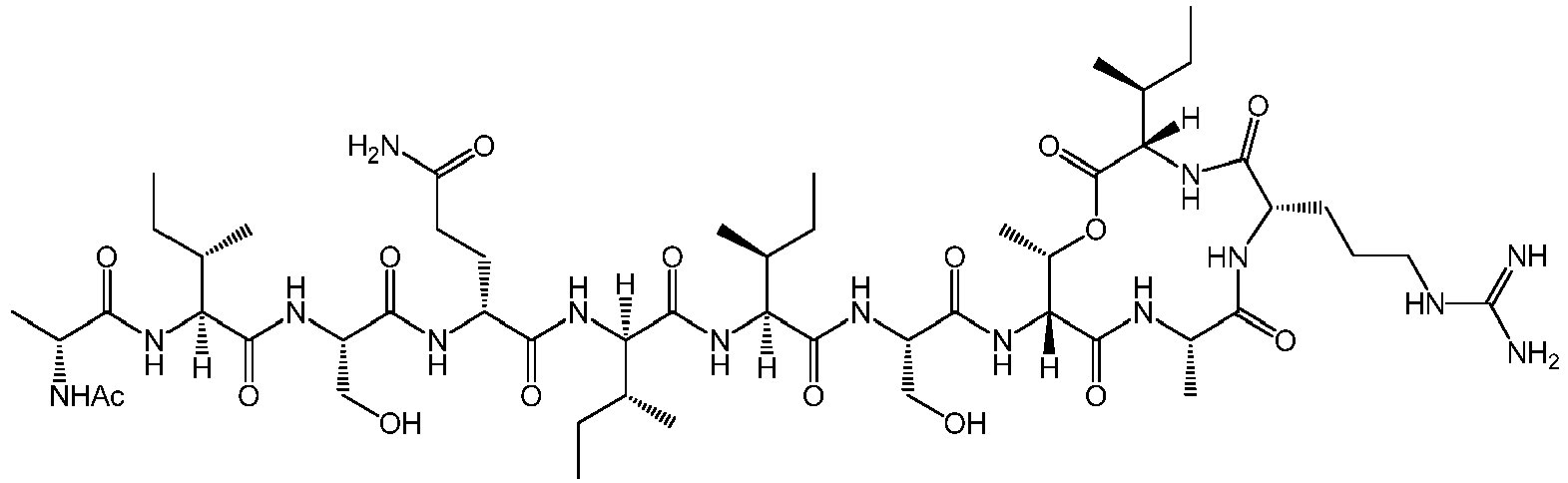

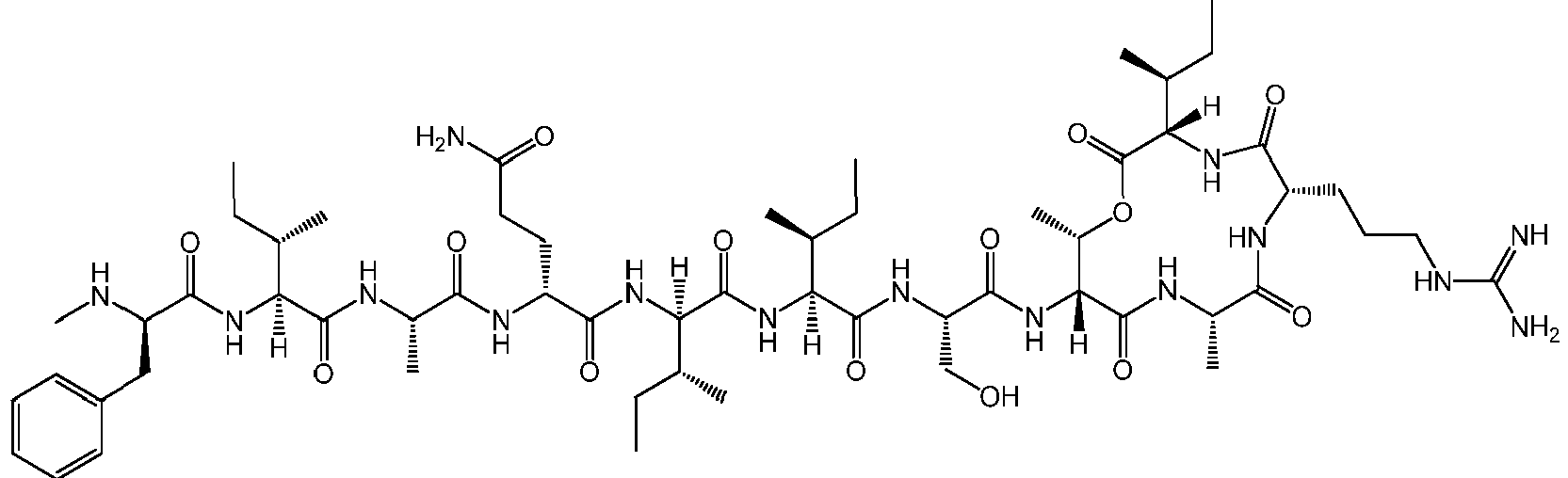


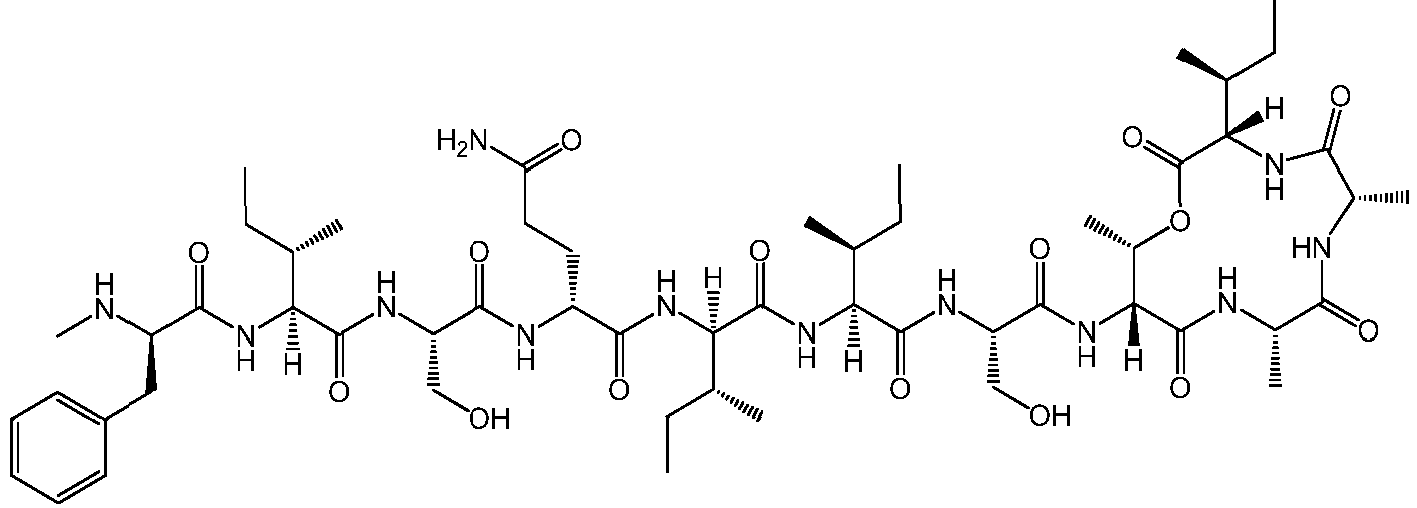


- LC-MS data were collected on an Agilent 1100 Series instrument with a Phenomenex Kinetex C18 100Å column (150 x 4.6 mm, 5 µm at 35 °C) connected to an ESMSD type VL mass detector with a flow rate of 1.5 ml/min was used with the following solvent systems: (A): 0.1% HCOOH in H2O and (B) MeCN. The column was flushed with 100% A for 2 min, then a gradient from 0 to 100% B over 6 min was used, followed by 2 min of flushing with 100% B. Results are shown in Table 3.
Table 3 - Mass spectrometry data for Compounds 7 to 20Compound Number Code Chemical formula Exact Mass Mass found [M + H+] Overall yield [%] 7* f1a C53H93N15O16 1195.69 1196.4 12 8* I2A C55H91N15O15 1201.68 1202.4 10 9* S3A C58H97N15O14 1227.73 1228.5 11 10* q4a C56H94N14O14 1186.71 1187.4 12 11* i5a C55H91N15O15 1201.68 1202.4 11 12* I6A C55H91N15O15 1201.68 1202.4 12 13* S7A C53H97N15O14 1227.73 1228.5 12 14 R10A C55H90N12O15 1158.66 1159.5 13 15 R10a C55H90N12O15 1158.66 1159.5 10 16 R10G C54H88N12O15 1144.65 1145.6 2 17 R10V C57H94N12O15 1186.70 1187.6 24 18 R10I C58H96N12O15 1200.71 1201.5 10 19 R10L C58H96N12O15 1200.71 1201.5 20 20* R10S C55H90N12O15 1174.66 1175.6 21 * Reference compound - Minimum inhibitory concentrations for various compounds against MRSA are shown in Table 4A.
Table 4A - MIC values Compound No. Name MIC (MRSA*) (µg/mL) MIC (µg/mL) Mycobacterium smegmatis 7* f1a >128 NT 8* I2A >128 NT 9* S3A 1-2 NT 10* q4a 2-4 NT 11* i5a 64-128 NT 12* I6A >128 NT 13* S7A 16-32 NT 14 R10A 1-2 2 15 R10a 32 NT 16 R10G 2 NT 17 R10V 0.5 NT 18 R10I 0.25 NT 19 R10L 0.25 NT 20* R10S 16 NT * Arg10- Teixobactin 2 NT * Teixobactin 0.25 NT Small letters denote D amino acids. MIC: Minimum Inhibitory Concentration. NT: Not tested. *MRSA ATCC 33591. * Reference Compound - We have performed an alanine scan of the Arg10-teixobactin analogue via the synthesis of 14 analogues. The studies reveal that replacement of residues D-NMe-Phe1, L-Ile2, D-allo-Ile5, L-Ile6 and L-Ser7 with Alanine (
Compounds Compounds 9 and 10) results in a comparable MIC value as that of the Arg10-teixobactin analogue (Reference Compound 6). Contrary to the current understanding, we further observe that replacing the Arg10 residue with non-polar residues such as Ile and Leu results in analogues which give exceptionally high biological activity, identical to that of Teixobactin against MRSA. Importantly, both Leu10-teixobactin (Compound 19) and Ile10-teixobactin (Compound 18) are made up of commercially available simpler building blocks rather than the synthetically challenging enduracididine. It thus seems that the presence of an amino acid with a cationic side chain such as enduracididine, arginine or lysine is not essential for biological activity. NMR studies have also revealed that the mutants S3A, Q4A and R10A (Compounds position 10 is tolerated provided the configuration of the remaining residues is intact. - Compounds 14, 17, 18 and 19, along with Arg10-teixobactin and vancomycin/daptomycin as controls, were tested against an extended panel of Gram positive bacteria (Table 4B) to provide a more comprehensive overview of the biological activity of these molecules.
Table 4B - MIC and MBC (in µg/mL) of the teixobactin analogues 14, 17, 18 and 19, Arg10-teixobactin and daptomycin control against an extended panel of Gram positive bacteria. Strain Compound → 14 17 18 19 Arg10-teixobactin Vanco- mycin Daptomycin MRSA 1 MIC 4 1 0.25 0.25 1 2 0.5 MBC 16 4 1 2 2 - - MRSA 2MIC 1 0.5 ≤0.0625 ≤0.0625 0.125 2 0.5 MBC 4 4 ≤0.0625 ≤0.0625 0.5 - - MRSA 3MIC 1 0.25 ≤0.0625 ≤0.0625 0.5 2 0.5 MBC 2 2 0.125 ≤0.0625 1 - - Staph. aureus MIC 1 0.25 ≤0.0625 ≤0.0625 0.25 4 0.25 MBC 2 1 0.125 0.125 1 - - VRE 1MIC 4 0.5 ≤0.0625 0.25 2 >4 0.5 VRE 2MIC 4 0.5 ≤0.0625 0.25 2 >4 0.5 M. smegmatis MIC 1-2 1 0.5 1 1-2 >64 - Strain information: MRSA 1: MRSA ATCC 700699, MRSA 2: MRSA DR 42412 (sputum),
MRSA 3: MRSA DM21455 (eye).MRSA 2 andMRSA 3 are clinical isolates.
Staphylococcus aureus ATCC 29213, Enterococcus faecalis (VRE 1: VRE ATCC 700802, VRE 2: VRE ATCC 29212). M. smegmatis ATCC 607. Culture Media: Mueller Hinton Broth. - The diamino linker was synthesized for Diamino10-Teixobactin using the procedure below.
-

- 1,3-diaminopropan-2-ol (200mg, 2.22mmols) was dissolved in 20ml methanol and triethylamine (20ml) was added dropwise. Boc anhydride (3eq) was then added and heated at 50°C for 20min and 1hr at room temperature. This was monitored by TLC (9:1) DCM:methanol. After completion saturated solution of NaHCO3 was added (40ml) and extracted with ethyl acetate. The solvent was evaporated in vacuo and used in the next step without purification.

- Di-tert-butyl (2-hydroxypropane-1,3-diyl)dicarbamate (800mg, 2.76mmols) was dissolved in 30ml acetonitrile. N-succinimidyl carbonate (DSC) (1.4g, 5.52mmols) was added and dropwise addition of trimethylamine (1.1ml, 8.28mmols) was added leaving the reaction to stir overnight. After completion of the reaction, the solvent was evaporated and purified on silica with DCM:methanol (9:1) to achieve di-tert-butyl (2-((((2,5-dioxopyrrolidin-1-yl)oxy)carbonyl)oxy)propane-1,3-diyl)dicarbamate, 76% yield. The compound was characterized by mass spectrometry.
-

- Lys10-Teixobactin was synthesised using protocols described in A. Parmar, et al., Chem. Commun. 2016, 52, 6060-6063. Lys10-Teixobactin (5mg, 0.0041mmols) was dissolved in 100µL of DMSO and 75µL of Dipea was added. Di-tert-butyl (2-((((2,5-dioxopyrrolidin-1-yl)oxy)carbonyl)oxy)propane-1,3-diyl)dicarbamate (2.65mg, 0.00615 mmols) was dissolved in 50µl and added to the Lys10-Teixobactin solution. This was stirred for 10min and then quenched with acetic acid 100µl and monitored by HPLC. This was then purified by reverse phase and freeze dried to yield the BOC protected compound.

- To Boc-diamino10-Teixobactin was added neat formic acid and allowed to stir for 1hr monitoring by HPLC. Water was then added and freeze dried to yield the Teixobactin diamino compound (Compound 21). The compound was characterized by mass spectrometry Exact Mass 1331.78 Mass found [M+H+] 1332.5.

-

- To a mixture of 3.80 g (100 mmol) of thiourea and 7.5 ml of 37% aqueous formaldehyde (93.4 mmol) was added at vigorous stirring 100 mmol of glycine/Gamma amino butyric acid/6-Aminohexanoic acid, and stirring was continued for another 20 min until it dissolved. The reaction was then left standing at room temperature. A day later, the precipitate was filtered off and recrystallized from a mixture of 2-propanol-water (1:1). Yields: 50-75%
- To 1 eq. Thiourea derivative (10 mg) dissolved in 500 µL of DMF 0.98 eq. HOSu (N-hydroxysuccinimide) and 0.98 eq. of DCC was added and stirred for 2 hrs until precipitation of cyclohexyl urea was complete. The precipitate was filtered off and discarded.
Table 5 - List of thiourea derivatives synthesized Compound No. Value of 'm' Name 25* 1 Gly-thiourea 26* 3 GABA-thiourea 27* 5 Ahx-thiourea *Reference compound Table 6 - Mass analysis of analogues 22-24 Compound No. Analogue Chemical Formula Exact Mass Mass found [M+H+] 22* Gly-thiourea-Lys10-teixobactin C63H104N16O16S 1372.75 1373.55 23* GABA-thiourea-Lys10-teixobactin C65H108N16O16S 1400.78 1401.45 24* Ahx-thiourea-Lys10-teixobactin C67H112N16O16S 1428.82 1429.5 *Reference compound -

- Lys10-Teixobactin was synthesized using our previously described procedure (Parmar, A. et al. Chem. Commun. 52, 6060-6063 (2016)). Lys10-Teixobactin (3mg, 0.0025 mmol) was dissolved in 100 µL of DMSO and 50 µL of DIPEA was added. 60 µL of activated thiourea prepared as described above was added to the solution. This was stirred for 15 min and then acetonitrile was added dropwise until the solution was clear. The reaction mixture was analysed on RP-HPLC followed by RP-HPLC purification and freeze dried to yield the thiourea-containing Teixobactin derivatives (Compounds 22 to 24).
-
Table 7 - MIC: Minimum Inhibitory Concentration. *MRSA ATCC 33591 Compound No. Name MIC (MRSA*) (µg/mL) MIC (µg/mL) Mycobacterium smegmatis 21 Diamino Teixobactin 0.25 0.5 Table 8 - MIC: Minimum Inhibitory Concentration. Compound. No. Value of 'm' Name MIC against S. aureus ATCC 25923 (µg/mL) 22 1 Gly-thiourea-Lys10- Teixobactin 2 23 3 GABA-thiourea-Lys10- Teixobactin 2 24 5 Ahx-thiourea-Lys10- Teixobactin 2 - The general synthesis of Teixobactin derivatives in which the amino acid at position 10 (the L-allo-enduracididine amino acid) is replaced with another amino acid is detailed in Example 4, and is described in A. Parmar, et al., Chem. Commun. 2016, 52, 6060-6063.
- Compounds 25 to 53 are variants of Teixobactin in which the amino acid at
position 10 is replaced with leucine, isoleucine, cyclohexylglycine, norvaline, phenylalanine or alanine, and from none to three of the amino acids atpositions - The structures of compounds 25 to 53 are, respectively, as follows:


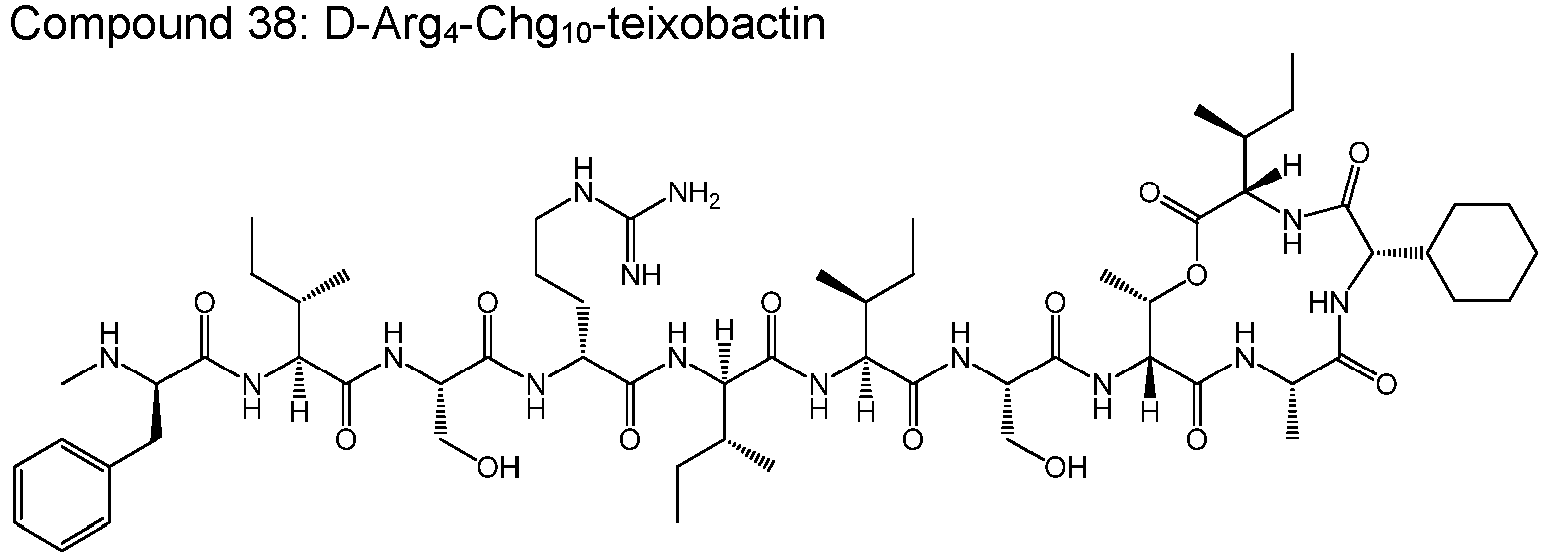


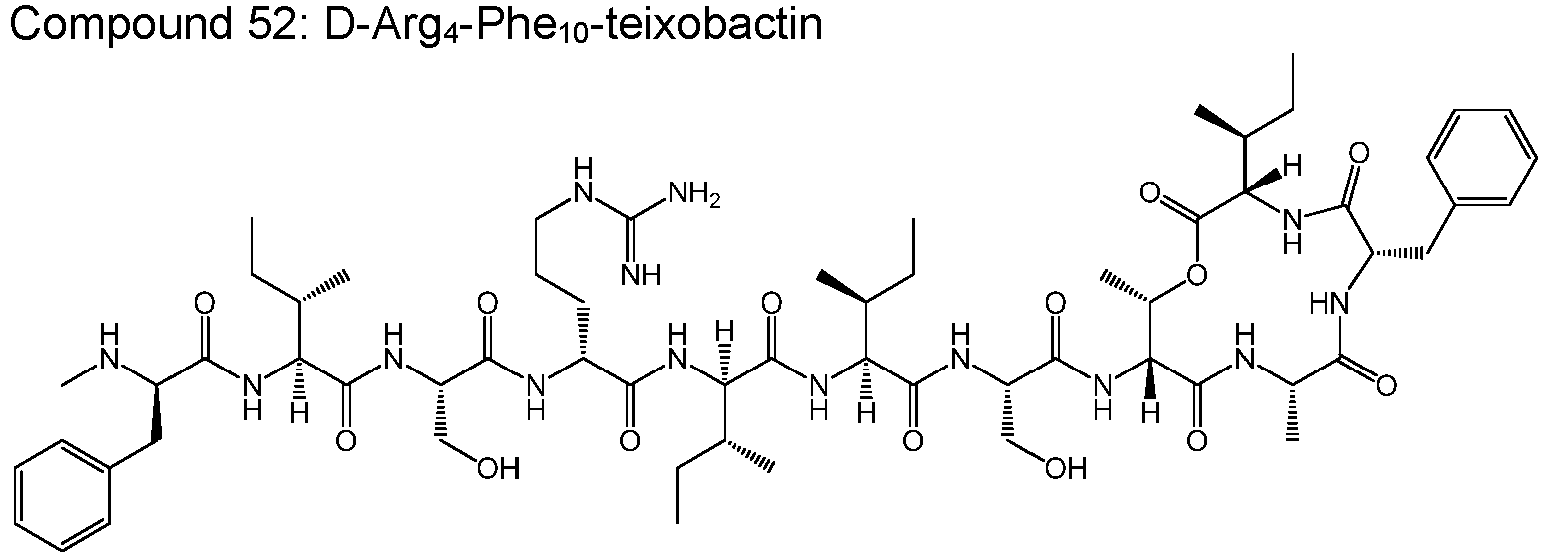

-

- Synthesis of D-Arg4-Leu10-teixobactin (Compound 26) starting from 2-chlorotritylchloride resin: a. 4 eq. Fmoc-Ala-OH/8 eq. DIPEA in DCM, 3h. b. 20% piperidine in DMF followed by 3 eq. AllocHN-D-Thr-OH, 3 eq. HATU/6 eq. DIPEA, 1.5h c. 10 eq. Fmoc-Ile-OH, 10 eq. DIC, 5 mol% DMAP in DCM, 2h followed by capping with Ac2O/
DIPEA 10% in DMF, 20% piperidine in DMF d. 4 eq. Fmoc-Leu-OH, 4 eq. HATU/8 eq. DIPEA in DMF, 1h followed by 20% piperidine in DMF e. 10 eq. Trt-Cl, 15% Et3N in DCM, 1h. f. 0.2 eq. [Pd(PPh3)4]0 + 24 eq. PhSiH3 in dry DCM, 1 x 20 min, 1 x 45 min. g. 4 eq. Fmoc/Boc-AA(PG)-OH (AA = amino acid, PG = protecting group), 4 eq. DIC/Oxyma (µwave, 10 min) followed by 20% piperidine in DMF (3 min, 10 min). h. TFA:TIS:DCM = 2:5:93, 1h. i. 1 eq. HATU/10 eq. DIPEA in DMF, 30 min. j. TFA:TIS:H2O = 95:2.5:2.5, 1h. - Step a. Commercially available 2-chlorotrityl chloride resin (manufacturer's loading = 1.2 mmol/g, 170 mg resin) was swelled in DCM in a reactor. To this resin was added 4 eq. Fmoc-Ala-OH/8 eq. DIPEA in DCM and the reactor was shaken for 3h. The loading determined by UV absorption of the piperidine-dibenzofulvene adduct was calculated to be 0.6 mmol/g, (170mg resin, 0.102 mmol). Any unreacted resin was capped with MeOH:DIPEA:DCM = 1:2:7 by shaking for 1h.
- Step b. The Fmoc protecting group was deprotected using 20% piperidine in DMF by shaking for 3 min, followed by draining and shaking again with 20% piperidine in DMF for 10 min. AlIocHN-D-Thr-OH was then coupled to the resin by adding 3 eq. of the AA, 3 eq. HATU and 6 eq. DIPEA in DMF and shaking for 1.5h at room temperature.
- Step c. Esterification was performed using 10 eq. of Fmoc-Ile-OH, 10 eq. DIC and 5 mol% DMAP in DCM and shaking the reaction for 2h. This was followed by capping the unreacted alcohol using 10% Ac2O/DIPEA in DMF shaking for 30 min and Fmoc was removed using protocol described earlier in step (b).
- Step d. Fmoc-Leu-OH was coupled using 4 eq. of AA, 4 eq. HATU and 8 eq. DIPEA in DMF and shaking for 1h followed by Fmoc deprotection using 20% piperidine in DMF as described earlier.
- Step e. The N terminus of Leu was protected using 10 eq. Trt-Cl and 15% Et3N in DCM and shaking for 1h. The protection was verified by the Ninhydrin colour test.
- Step f. The Alloc protecting group of D-Thr was removed using 0.2 eq. [Pd(PPh3)]0 and 24 eq. PhSiH3 in dry DCM under argon for 20 min. This procedure was repeated again increasing the time to 45 min and the resin was washed thoroughly with DCM and DMF to remove any Pd stuck to the resin.
- Step g. All amino acids were coupled using 4 eq. Amino Acid, 4 eq. DIC/Oxyma using a microwave peptide synthesizer. Coupling time was 10 min. Deprotection cycles were performed as described earlier.
- Step h. The peptide was cleaved from the resin without cleaving off the protecting groups of the amino acid side chains using TFA:TIS:DCM = 2:5:93 and shaking for 1h.
- Step i. The solvent was evaporated and the peptide was redissolved in DMF to which 1 eq. HATU and 10 eq. DIPEA were added and the reaction was stirred for 30 min to perform the cyclization.
- Step j. The side-chain protecting groups were then cleaved off using TFA:TIS:H2O = 95:2.5:2.5 by stirring for 1h. The peptide was precipitated using cold Et2O (-20°C) and centrifuging at 7000 rpm to obtain a white solid. This solid was further purified by RP-HPLC.
- The overall yields for Compounds 25 to 34 after HPLC purifications were typically in the range of 13-22%. All teixobactin analogues 25 to 34 were characterized by HRMS (ESI) in positive mode (see table below). Compound 26 was also characterised by NMR. The homogeneity of HPLC purified fractions were analyzed by mass spectroscopy. All the teixobactin analogues used were purified to >95% purity as indicated by HPLC.
Table 9 - Compound number, name, chemical formula, mass calculated, and mass observed for Compounds 25 to 34. Comp. Name Chemical formula Mass Calc. (Da) Mass obs. (Da) 25 Arg3-Leu10-teixobactin C61H104N15O14 1270.7887 1270.7913 26 D-Arg4-Leu10-teixobactin C59H101N14O14 1229.7622 1229.7650 27 Arg9-Leu10-teixobactin C61H104N15O15 1286.7836 1286.7843 28 Arg3-D-Arg4-Leu10-teixobactin C62H108N17O13 1298.8313 1298.8325 29 Arg3-Arg9-Leu10-teixobactin C64H111N18O14 1355.8527 1355.8606 30 D-Arg4-Arg9-Leu10-teixobactin C62H108N17O14 1314.8262 1314.8263 31 Arg3-D-Arg4-Arg9-Leu10-teixobactin C65H115N20O13 1383.8952 1383.8943 32 Arg3-Ile10-teixobactin C61H104N15O14 1270.7887 1270.7896 33 D-Arg4-Ile10-teixobactin C59H101N14O14 1229.7622 1229.7607 34 Arg9-Ile10-teixobactin C61H104N15O15 1286.7836 1286.7780 - Minimum inhibitory concentrations for Compounds 25 to 53 against MRSA are shown in Table 10.
Table 10 - MIC: Minimum Inhibitory Concentrations Compound No. Name MIC (MRSA) (µg/mL) 25 Arg3-Leu10-teixobactin 0.125 26 D-Arg4-Leu10-teixobactin 0.125 27 Arg9-Leu10-teixobactin 0.125 28 Arg3-D-Arg4-Leu10-teixobactin 0.25 29 Arg3-Arg9-Leu10-teixobactin 1 30 D-Arg4-Arg9-Leu10-teixobactin 1 31 Arg3-D-Arg4-Arg9-Leu10-teixobactin 1 32 Arg3-Ile10-teixobactin 0.25 33 D-Arg4-Ile10-teixobactin 0.125 34 Arg9-Ile10-teixobactin 0.25 35 Arg3-D-Arg4-Ile10-teixobactin 0.5 36 Chg10-teixobactin 0.25 37 Arg3-Chg10-teixobactin 0.5 38 D-Arg4-Chg10-teixobactin 0.5 39 Arg9-Chg10-teixobactin 1 40 Arg3-D-Arg4-Chg10-teixobactin 1 41 Arg3-Arg9-Chg10-teixobactin 0.5 42 D-Arg4-Arg9-Chg10-teixobactin 0.5 43 Arg3-D-Arg4-Arg9-Chg10-teixobactin 64 44 Nva10-teixobactin 0.5 45 Arg3-Nva10-teixobactin 1 46 D-Arg4-Nva10-teixobactin 0.25 47 Arg9-Nva10-teixobactin 0.5 48 Arg3-D-Arg4-Nva10-teixobactin >64 49 Arg3-Arg9-Nva10-teixobactin 0.5 50 D-Arg4-Arg9-Nva10-teixobactin 0.5 51 Arg3-D-Arg4-Arg9-Nva10-teixobactin 64 52 D-Arg4-Phe10-teixobactin 2 53 D-Arg4-Ala10-teixobactin 4 - The antimicrobial potency of teixobactin analogue Compounds 25 to 34 was assessed against MRSA ATCC 33591. The Leu10-teixobactin and natural teixobactin were included as benchmarks for activity. The six analogues 25 to 27 and 32 to 34 with two cationic charges have hydrophobic-hydrophilic balances similar to natural teixobactin (two cationic charges). These analogues showed comparable potency (MIC 0.125 - 0.25µg/ ml) to natural teixobactin (MIC 0.25µg/ ml). Compounds 28 to 30 each possess three cationic charges. Interestingly, Compound 28 showed comparable antimicrobial activity (MIC 0.25µg/ ml) to natural teixobactin. However, Compounds 29 and 30 showed 4 times reduced antibacterial activity (MIC 1µg/ ml) than natural teixobactin or Leu10-teixobactin. Compound 31 with four cationic charges also showed reduced antibacterial activity (MIC 1µg/ ml).
- Compounds 25 to 34 were further assessed against a panel of antibiotic-resistant and antibiotic susceptible Gram-positive pathogens and comparator antibiotics, daptomycin (
Figure 1 ). The MIC results indicate that the synthetic analogues are potent against the various strains tested, but their MIC distribution differs significantly. Interestingly, a wider distribution of MIC values was observed as the overall net charge of the peptide was increased. - Notably, the MIC values for Staphylococcus were not altered whereas a significant increase in Enterococcus was observed with four cationic charges (Compound 31, MIC 2-8µg/ ml). Similar trends have been reported for teixobactin analogues, whereby increases in positive charges give increases in MICs against Staphylococcus aureus ATCC 29213. Herein, for example, Lys3-D-Lys4-Lys10-teixobactin (four cationic charges) has a reported MIC of 8µg/ ml against Staphylococcus aureus ATCC 29213; whereas, we observed an MIC of 1µg/ ml (8 times improvement) for Arg3-D-Arg4-Arg9-Leu10-teixobactin (Compound 31, four cationic charges) against the same bacterial strain.
- The inclusion of 3 arginines in the above case likely perturbs the amphiphilic character of the teixobactin, resulting in a decrease in activity. The six analogues 25 to 27 and 32 to 34 with two cationic charges showed comparable antibacterial potency to Leu10-teixobactin. Importantly, the hydrophobic-hydrophilic balance of these analogues was similar to natural teixobactin (two cationic charges). The analogues 28 to 30 with three cationic charges also showed comparable antibacterial potency to Leu10-teixobactin. All synthesized analogues showed good potency against a broad panel of bacteria. The nine analogues 25 to 30 and 32 to 34 showed drug like profiles such as high antibacterial potency with optimal balance of hydrophobicity and hydrophilicity. The minimum bactericidal concentrations (MBC) of teixobactin analogues against S. aureus/MRSA strains (Table 11) has been further determined. Compound 26 displayed highly potent bactericidal properties, as its MBC values did not increase above 4 times the MIC against the tested strains. Compound 26 was found inactive against Pseudomonas aeruginosa (Gram negative bacteria). In view of narrow MIC distribution values and bactericidal properties, attention was focused on Compound 26 and further investigated its biological properties.
Table 11 - MIC values (µg/ml) of compounds 25 to 34 against a broad panel of bacteria. Enterococcus faecalis, VRE 1001-1002, 1004, 1008 are clinical isolates. MRSA 42412, MRSA 21455 and MRSA 1003 are clinical isolates. Compound No. 25 26 27 28 29 30 Strain 1 Staphylococcus saprophyticus ATCC BAA 750 <0.0625 <0.0625 <0.0625 <0.0625 <0.0625 <0.0625 2 Staphylococcus saprophyticus ATCC 15305 <0.0625 <0.0625 <0.0625 <0.0625 <0.0625 <0.0625 3 Staphylococcus saprophyticus ATCC 49453 <0.0625 <0.0625 <0.0625 <0.0625 <0.0625 <0.0625 4 Staphylococcus saprophyticus ATCC 49907 <0.0625 <0.0625 <0.0625 <0.0625 <0.0625 <0.0625 5 VRE 1001 0.25 0.5 0.5 1 0.5 1 6 VRE 1002 0.5 1 1 1 1 1 7 VRE 1004 <0.0625 0.25 0.25 0.5 0.5 1 8 VRE 1008 0.125 0.5 0.25 0.5 0.5 1 9 VRE ATCC 700802 0.5 0.5 0.5 2 1 1 10 VRE ATCC 29212 0.5 0.5 1 1 1 1 11 MRSA ATCC 700699 0.5 0.25 0.5 0.5 1 1 12 MRSA 42412 <0.0625 0.0313 <0.0625 0.25 0.25 1 13 MRSA 21455 0.03125 0.0313 0.25 0.5 1 1 14 MRSA 1003 <0.0625 0.5 0.25 1 2 0.5 15 SA29213 0.25 <0.0625 0.5 0.25 1 1 16 SA4299 0.125 - 0.25 0.25 0.5 0.5 17 SE12228 <0.0625 <0.0625 <0.0625 <0.0625 <0.0625 <0.0625 18 Bacillus Cereus ATCC 11788 <0.0625 0.5 0.25 1 1 1 19 Bacillus Subtilis ATCC 6633 <0.0625 0.125 <0.0625 <0.0625 <0.0625 <0.0625 Compound No. 31 32 33 34 Daptomycin Strain 1 Staphylococcus saprophyticus ATCC BAA 750 <0.0625 <0.0625 <0.0625 <0.0625 - 2 Staphylococcus saprophyticus ATCC 15305 0.25 <0.0625 <0.0625 <0.0625 - 3 Staphylococcus saprophyticus ATCC 49453 <0.0625 <0.0625 <0.0625 <0.0625 - 4 Staphylococcus saprophyticus ATCC 49907 <0.0625 <0.0625 <0.0625 <0.0625 - 5 VRE 1001 2 1 0.5 1 - 6 VRE 1002 8 1 1 1 - 7 VRE 1004 4 1 0.5 1 - 8 VRE 1008 8 1 0.5 1 - 9 VRE ATCC 700802 4 1 0.25 1 0.25 10 VRE ATCC 29212 4 1 0.25 1 0.25 11 MRSA ATCC 700699 2 1 0.25 1 0.25 12 MRSA 42412 2 0.125 <0.0625 0.125 <0.0625 13 MRSA 21455 2 0.25 0.03125 0.5 <0.0625 14 MRSA 1003 2 0.125 <0.0625 0.5 - 15 SA29213 1 0.5 0.0625 1 - 16 SA4299 1 0.125 <0.0625 1 - 17 SE12228 <0.0625 <0.0625 <0.0625 <0.0625 - 18 Bacillus Cereus ATCC 11788 1 0.125 <0.0625 0.5 - 19 Bacillus Subtilis ATCC 6633 <0.0625 <0.0625 <0.0625 0.125 - - D-Arg4-Leu10-teixobactin (Compound 26) was evaluated for single step resistance in S. aureus ATCC 29213 and MRSA ATCC 33591. Mutants of S. aureus ATCC 29213 or MRSA ATCC 33591 resistant to teixobactin analogue 26 (5x, 10x, 20x MIC) could not be obtained. The calculated frequency of resistance to Compound 26 was found to be <10-10 which is comparable to teixobactin. A lack of resistance in preliminary studies against 26 is promising in the development of drug like molecules against resistant bacteria. Time-kill kinetics studies of D-Arg4-Leu10-teixobactin 26 against S. aureus ATCC 29213 was investigated to ascertain if the chemical modifications retained the bactericidal properties. The exposure of bacterial inoculum to 0.5 µg/ml or 1 µg/ml of Compound 26 resulted in ≥ 2 log10 decrease in bacterial viability at 8 h, which is comparable with previous reports of teixobactin analogues and teixobactin.
- It was important to evaluate the cytotoxicity of Compound 26 on mammalian cells prior to in vivo studies. The cytotoxicity of Compound 26 in human lung epithelial cell line A549 and primary dermal fibroblasts (hDFs) was determined. Both of these cell culture models are already established for evaluation of cytotoxicity of antimicrobial peptides. An MTS assay indicated that both mammalian cell-types exposed to various concentrations of the peptide retained significant metabolic activity (≥ 80% viability,
Figure 2 a,b), even at a concentration that was ~900 times (250 µg/ml) higher than the average MIC (0.27 µg/ml) values, indicating excellent cell selectivity of the teixobactin analogues. High content images indicated the absence of any cytoskeletal and nuclear disruption upon exposure of both epithelial and fibroblasts cells to Compound 26 (Figure 2 c,d ), establishing its non-cytotoxic properties. The morphology of mammalian cells exposed to Compound 26 appeared similar to the untreated cells. However, exposure of cells to an antineoplastic agent (nocodazole, used as a control) resulted in substantial loss of adhered cells, confirming its cytotoxicity. - Both A549 cells (a) and hDFs (b) were treated with increasing concentrations of Compound 26 (ranging from 15.62 µg/ml to 250 µg/ml) for 24 h. The stock solution of Compound 26 (500 µg/ml) was prepared fresh by directly dissolving Compound 26 in cell culture medium and used. Cells were treated with dimethyl sulfoxide (DMSO, 0.1% v/v) or nocodazole (5 µg/ml dissolved in DMSO) as controls. At the end of the treatment period, metabolic activities of cells were quantified by MTS-based cell viability assay. Data represents mean ± SEM of three independent triplicate experiments, *p>0.05. After 24 h treatment with Compound 26, A549 cells (c) and hDFs (d) were fixed, fluorescently stained with rhodamine-phalloidin (red), alexa fluor 488 conjugated anti-α-tubulin (green) and Hoechst 33342 (blue) and imaged using IN Cell Analyzer 2200 automated microscope. Representative images of cells treated with Compound 26 (62.5 µg/ml for 24 h) or nocodazole (10 µg/ml, toxicity control) are shown in
Figure 2 c,d . - The in vivo toxicity of Compound 26 in a rabbit corneal damage model was examined. A 50 µl of 0.3% (w/v) solution was applied topically (4 times/day) to the circularly debrided cornea and reepithelialisation was monitored by fluorescein staining. Vehicle alone served as control.
-
Figure 3 shows the decrease in fluorescein staining with time for both control wounds and wounds treated with Compound 26. There was no significant difference in wound closure between PBStreated wounds or wounds treated with Compound 26. The lack of any delay in the reepithelialisation and wound closure for the injured cornea treated with Compound 26 suggests good biocompatibility of the peptide. - The in vivo efficacy of Compound 26 in the mice-eye model of S.aureus keratitis was examined. S. aureus is one of the major etiological agents for bacterial keratitis and the toxic secretions produced by this microorganism have been implicated in corneal melt, leading to significant morbidity and vision loss. Scarified cornea of the mice were infected with S. aureus ATCC 29213 inoculum (15 µl of 6×10⁶ CFU/ml) after scratching the corneal epithelium with scalpel blade. At 6 h post infections (p.i.), the infected cornea were treated with vehicle (PBS), Compound 26 (0.3% w/v in PBS) and moxifloxacin (0.3%). A total of 8 doses were applied and the progression of the infection was monitored by slit lamp examination, anterior segment optical coherent tomography (AS-OCT) and microbiological enumeration of the bacterial bioburden. Mice cornea treated with PBS had severe clinical presentation indicated by chemosis, significant presence of hypopyon like materials and corneal infiltrates (
Figure 4 ). - Note the significant presence of corneal haze and mucopurulent discharge in PBS treated cornea whereas Compound 26 or moxifloxacin treated cornea remained clear and no signs of corneal defects. Notably, infected cornea treated with Compound 26 or a fluoroquinalone antibiotic, had similar clinical appearance presentation, as indicated by lack of any conjunctival chemosis and corneal infiltrates. These results indicate that Compound 26 halted the progression of S. aureus infections and the activity was comparable to moxifloxacin.
- To determine the effect of treatments on tissue severity, the corneal thickness from various groups was determined (
Figure 5a ). The baseline corneal thickness of mice (93.8±2.9 µm) decreased moderately (79.0±3.4 µm) after de-epithelialization followed by S. aureus infection (6h p.i.). Treatment of the infected cornea with vehicle alone (PBS) resulted in substantial increase in corneal thickness after 24 h (151.7±12.7 µm) and 48 h (186.2±17.5 µm), indicating corneal edema after infection. Infected cornea treated with Compound 26 had a mean corneal thickness of 92.3±12.5 µm and 121.7±3.2 µm after 24 h and 48 h post treatment (p.t.), respectively. For the moxifloxacin-treated cornea the mean corneal thickness was 124.2±9.4 µm after 24 h p.t. and 140.3±10.3 µm after 48 h p.t. These results suggested that Compound 26 treatment resulted in significant decrease in corneal edema after S. aureus infections when compared PBS treated or moxifloxacin-treated groups. -
Figure 5a : Note that the CT values for Compound 26 treated cornea approached the baseline values after 48 h p.t., which was absent in the case of PBS-/Moxifloxacin-treated corneas. Note that a significant decrease in corneal edema was observed for infected cornea treated with Compound 26 compared to untreated cornea (p, 0.01 two-way ANOVA) as early after 3 doses which decreased further after 8 doses (p, 0.001). The results indicated a marked decrease in the severity (due to infections) after treatment with Compound 26 when compared to standard antibiotic treatment. - Bacterial enumeration of the corneal tissues harvested after 8 dosages confirmed the in vivo efficacy of Compound 26 (
Figure 5b ). All the infected cornea that received PBS treatment contained significant presence of bacteria, varying from 4.7×10⁵ - 1.3×10⁷ CFU/tissue. The mean log10 CFU/tissue ± standard error of the mean for PBS treated cornea was 6.51±0.27. Five out of six cornea treated with Compound 26 had detectable bacterial colonies. The mean log10 CFU/tissue for Compound 26 treated cornea was 3.97±0.19. Four infected corneas treated with moxifloxacin contained detectable bacterial colonies with a mean log10 CFU/tissue of 3.7±0.24 was observed. These results confirmed that Compound 26 had a similar antibacterial effect as an established antibiotic in decreasing the bacterial bioburden, thus demonstrating its potential as a safe therapeutic for topical applications. -

- Compound 54 (Leu10-Teixobactin-3-(S3K-K5R) conjugate, above) was prepared by a method analogous to the method for preparing Compound 26 (see Example 14). Calculated mass: 2038.3507; Found mass: 2039.33.
- Minimum inhibitory concentrations for Compound 54 against MRSA, E. coli and A. baumannii are shown in Table 12.
Table 12 - MIC: Minimum Inhibitory Concentrations (µg/ml) MRSA Ecoli A baumannii Compound 54 8 16 2


Claims (16)
- A compound of formula IA,
 R1 represents H, C1-6 alkyl, or benzyl;AA1 represents a hydrophobic proteinogenic or hydrophobic non-proteinogenic amino acid, AA2 represents an L-isoleucine residue, AA5 represents a D-isoleucine or D-allo-isoleucine residue, AA6 represents an L-isoleucine residue, and AA7 represents an L-serine residue;AA3 and AA4 each independently represents a proteinogenic or non-proteinogenic amino acid, such as diaminopropanoic acid, diaminobutanoic acid, or ornithine;R8 represents hydrogen or C1-4 alkyl;R9a represents a proteinogenic or non-proteinogenic amino acid side chain (such as -CH2-NH2, -(CH2)2-NH2 or -(CH2)3-NH2);R10a represents a hydrophobic proteinogenic amino acid side chain, a hydrophobic non-proteinogenic amino acid side chain, hydrogen, or R10a is linked to the adjacent nitrogen atom to form a proline ring;R11a represents a proteinogenic or non-proteinogenic amino acid side chain;Z is -O- or -NH-;optionally wherein the compound of formula IA is covalently bonded to a delivery agent, which is either capable of covalently bonding to one or more structures on a bacterial cell membrane or comprises a hydrophilic portion capable of otherwise binding to one or more structures on a bacterial cell membrane,provided that the compound of formula IA or pharmaceutically-acceptable salt, solvate or clathrate thereof is not selected from the group consisting of:


- The compound according to Claim 1, wherein R10a represents a hydrophobic proteinogenic amino acid side chain, a hydrophobic non-proteinogenic amino acid side chain or hydrogen; optionally wherein R10a represents hydrogen, C2-12 alkyl, C1-12 alkylthiomethyl, phenyl, naphthyl, biphenyl, toluyl, toluylmethyl or the side chain of an amino acid selected from the group consisting of valine, isoleucine, leucine, methionine, phenylalanine, tyrosine and tryptophan.
- The compound according to Claim 1 or Claim 2, wherein AA1 represents a D-phenylalanine residue.
- The compound according to one of the preceding claims, wherein R8 represents hydrogen or a methyl group.
- The compound according to one of the preceding claims, wherein R9a represents -CH2-NH2, -(CH2)2-NH2, -(CH2)3-NH2, a hydroxy group, an amide functional group (which latter two groups are bound to the remainder of the molecule via a linear, branched, cyclic or part cyclic C1-8 alkylene group), or the side chain of histidine, lysine, arginine, alanine, valine, isoleucine, leucine, methionine, phenylalanine, tyrosine, tryptophan, norvaline, cyclohexylglycine, cyclohexylalanine, phenylglycine, biphenylglycine, biphenylalanine, naphthylglycine naphthylalanine, serine, threonine, asparagine, or glutamine.
- The compound according to one of the preceding claims, wherein R11a represent the side chain of alanine, valine, isoleucine, leucine, methionine, phenylalanine, tyrosine, tryptophan, norvaline, cyclohexylglycine, cyclohexylalanine, phenylglycine, biphenylglycine, biphenylalanine, naphthylglycine or naphthylalanine.
- The compound according to any one of the preceding claims, wherein the delivery agent is a fragment of formula II,
 wherein D represents a dendrimer fragment to which the X2 groups shown are attached, X2 represents -NH2, boronic acid or a boronic acid derivative; and n is 2 or more (e.g. from 2 to 20); andwherein the wavy line indicates the point of attachment to the compound of formula IA;or wherein the delivery agent is a polypeptide or polypeptide derivative, or a pharmaceutically-acceptable salt thereof, which polypeptide or polypeptide derivative contains at least two residues selected from the group consisting of arginine and lysine.
 - The compound according to any one of the preceding claims, wherein the delivery agent comprises one or more functional groups, which are independently selected from the list consisting of boronic acids, boronic acid derivatives, primary amines, amidines, guanidines, amides, ureas, and acid addition salts thereof.
- The compound according to any one of the preceding claims, wherein the delivery agent is a fragment of any one of formula III to VIII



 wherein D1 to D6 each represent a dendrimer fragment to which the groups shown in parentheses are attached; Y represents O, NH or S; each n1 is 2 or more (e.g. from 2 to 20); m, p, q and r each independently represent from 1 to 8; and R4 represents a C1-6 alkyl group; orwherein the delivery agent is a fragment of formula IXa, IXb or X;

 wherein each L2 represents an aliphatic linker (e.g. a C1-6 alkyl chain); D7 and D8 independently represent a direct bond or a dendrimer fragment to which the boron-containing groups shown are attached, n2 is 1 or more, and optionally wherein D7 and D8 are attached to the boronic acid or boric acid portions of the compound of formula IXa, IXb and X via a linker group.
 - The compound according to Claim 9, wherein the delivery agent is a fragment of any one of formula III to VIII, IXa, IXb or X, and D1 to D8 independently represent a dendrimer fragment of any one of formula A to E


- A compound according to any one of the preceding claims, wherein:(i) R1 represents H, C1-6 alkyl, benzyl or a delivery agent, wherein the delivery agent is either capable of covalently bonding to one or more structures on a bacterial cell membrane or comprises a hydrophilic portion capable of otherwise binding to one or more structures on a bacterial cell membrane;(ii) R1 represents H, C1-6 alkyl, benzyl or a delivery agent fragment of formula II to X as defined in Claim 10; or(iii) R1 represents H, methyl or a delivery agent fragment of formula II to X as defined in Claim 10.
- A compound according to Claim 1, wherein the compound is selected from the group consisting of:


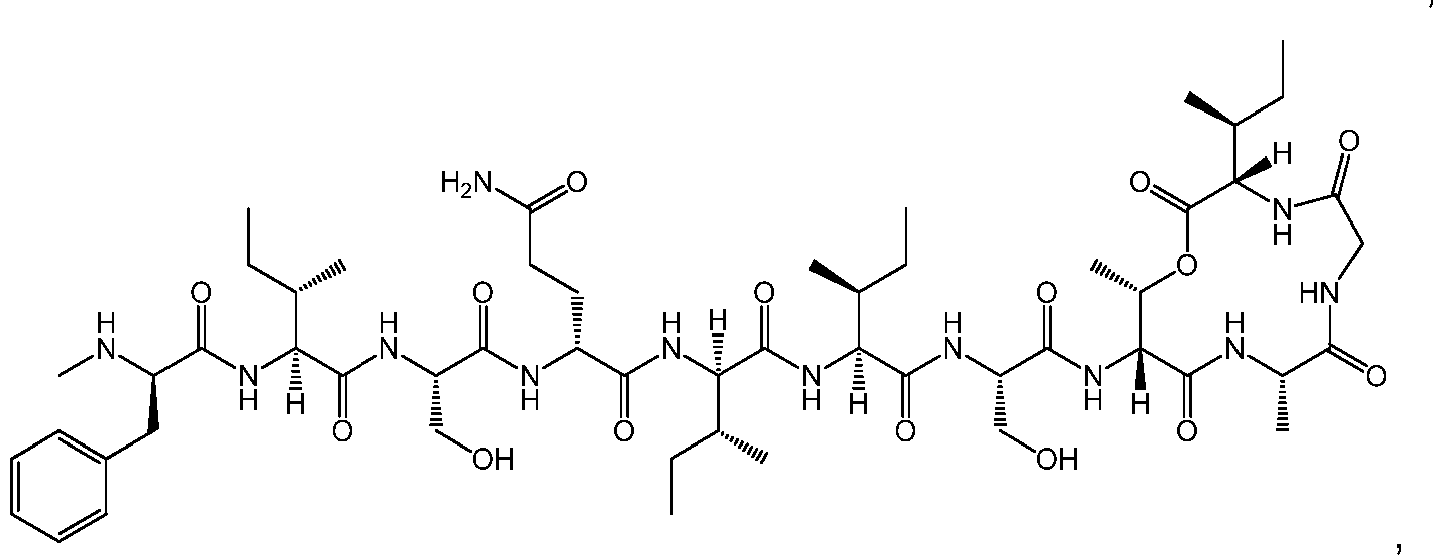


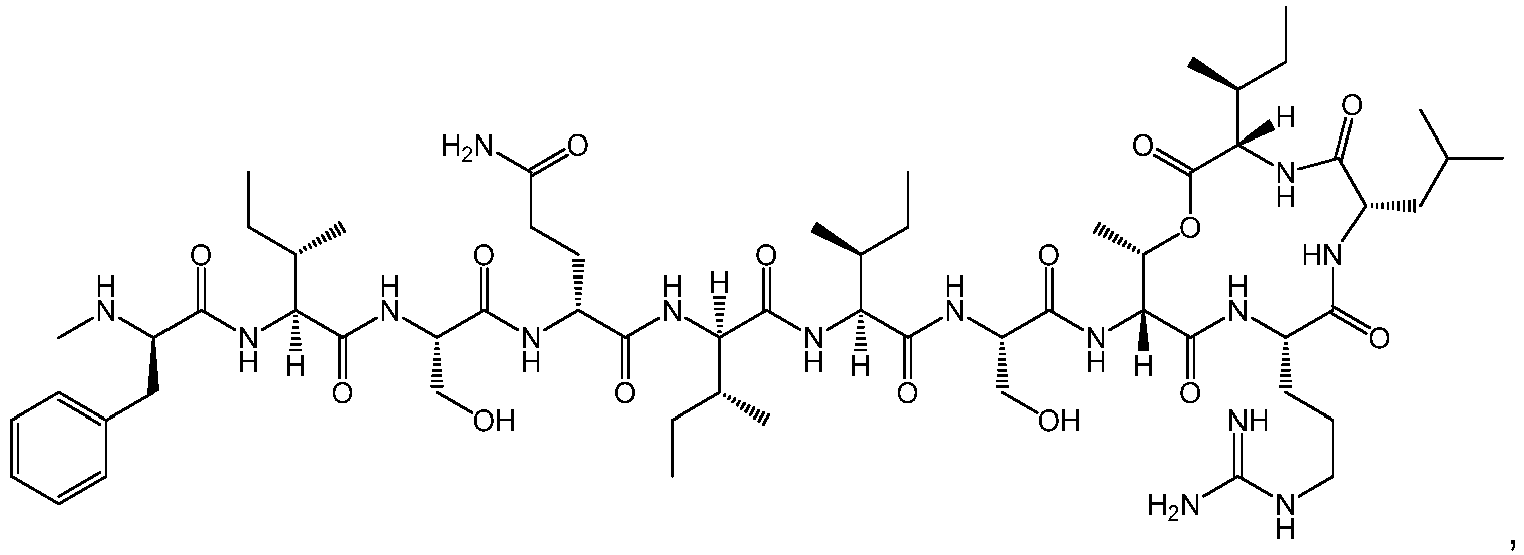


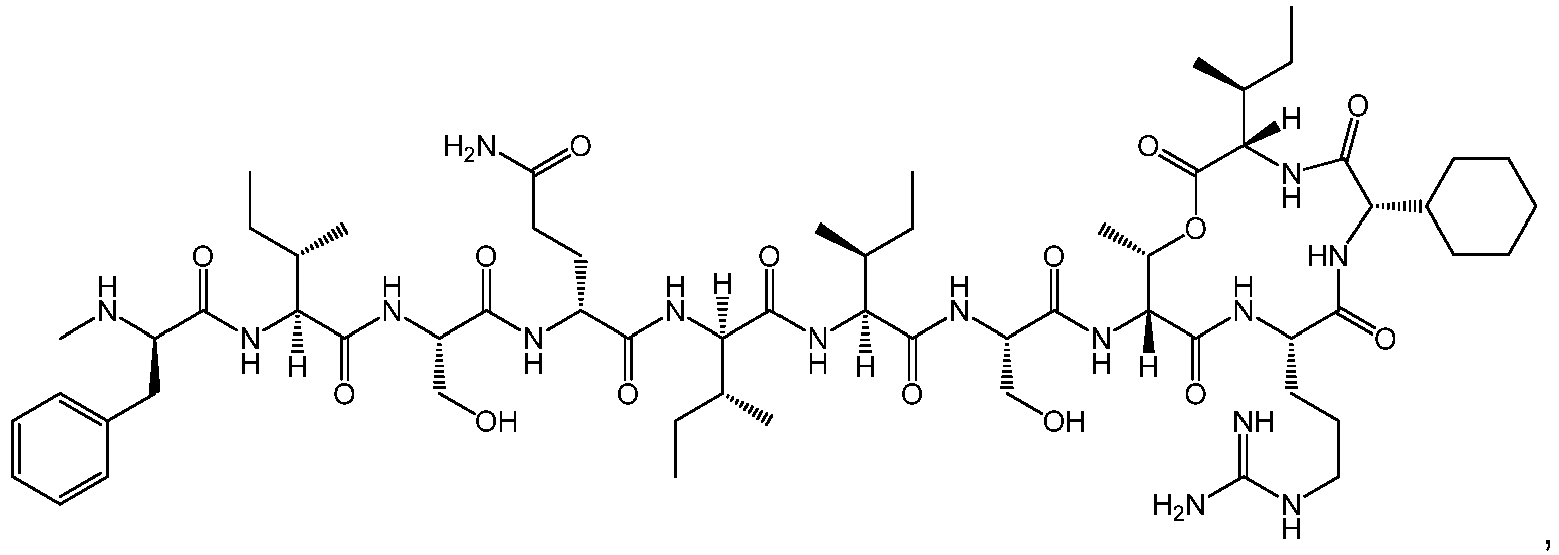


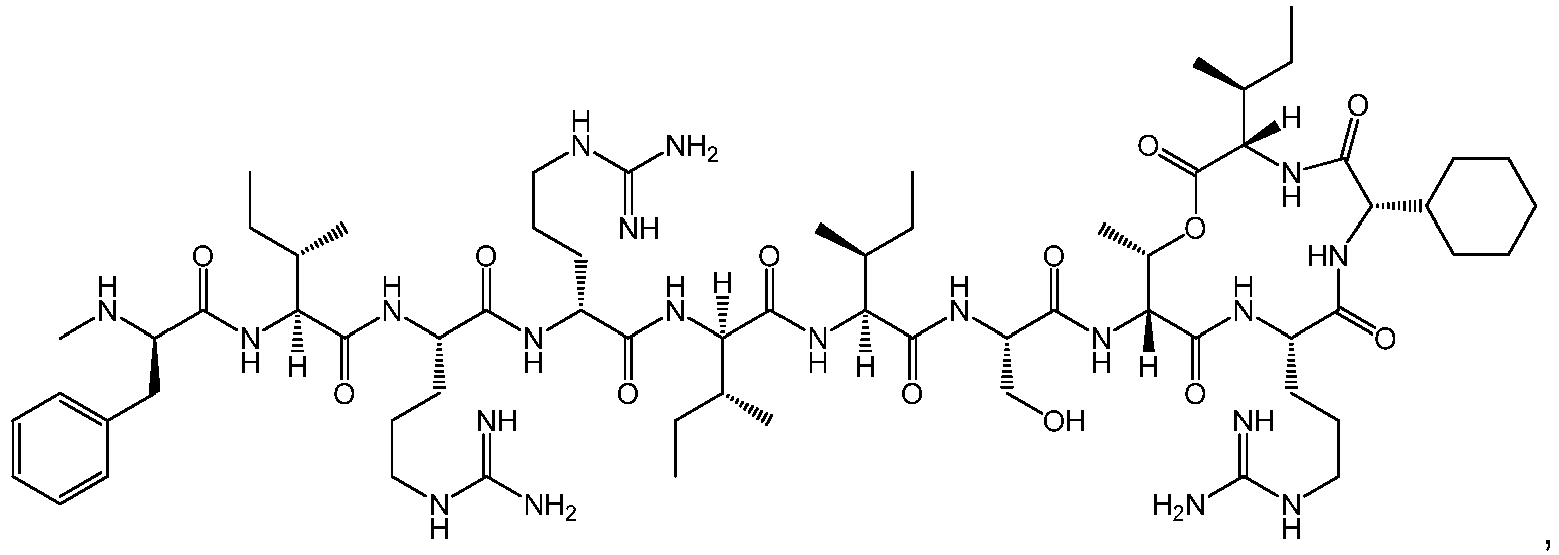


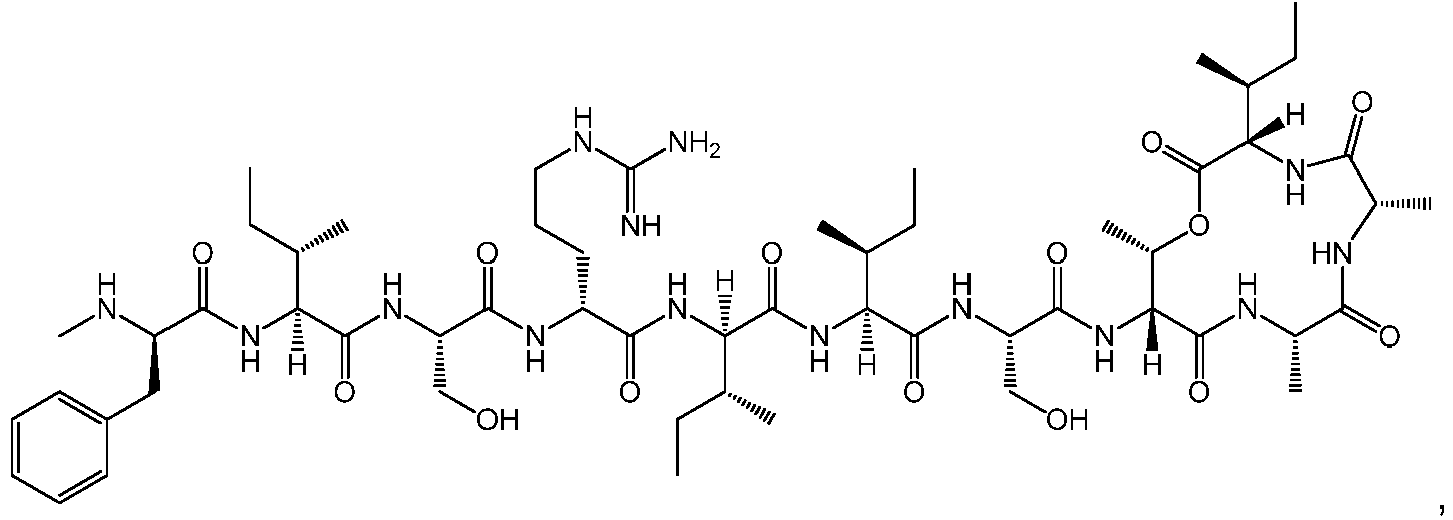

- A pharmaceutical formulation comprising a compound as defined in any one of the preceding claims in combination with a pharmaceutically-acceptable adjuvant, diluent or carrier.
- A compound as defined in any one of Claims 1 to 12, or a pharmaceutical formulation as defined in Claim 13, for use in medicine.
- A compound as defined in any one of Claims 1 to 12, or a pharmaceutical formulation as defined in Claim 13, for use treating or preventing a bacterial infection in a subject, optionally wherein the subject is a human.
- A process for the preparation of a compound of formula IA as defined in Claim 1, which process comprises:(i) deprotection of a compound of formula IA in which one or more hydroxyl groups are protected with an ether protecting group, in the presence of an acid;(ii) deprotection of a compound of formula IA in which one or more primary amide groups are protected with a trityl group, in the presence of an acid;(iii) reaction of a compound of formula XIIIA,
 a) reacting the compound of formula XIIIA with a compound of formula XIV
 b) removal of the protecting group PG1 if present; or(iv) reaction of a compound of formula XVA,
Applications Claiming Priority (3)
| Application Number | Priority Date | Filing Date | Title |
|---|---|---|---|
| GBGB1703753.2A GB201703753D0 (en) | 2017-03-09 | 2017-03-09 | New antibacterial products |
| GBGB1714389.2A GB201714389D0 (en) | 2017-09-07 | 2017-09-07 | New antibacterial products |
| PCT/GB2018/050605 WO2018162922A1 (en) | 2017-03-09 | 2018-03-09 | New antibacterial products |
Publications (2)
| Publication Number | Publication Date |
|---|---|
| EP3592761A1 EP3592761A1 (en) | 2020-01-15 |
| EP3592761B1 true EP3592761B1 (en) | 2025-05-14 |
Family
ID=61683823
Family Applications (1)
| Application Number | Title | Priority Date | Filing Date |
|---|---|---|---|
| EP18711656.1A Active EP3592761B1 (en) | 2017-03-09 | 2018-03-09 | New antibacterial products |
Country Status (7)
| Country | Link |
|---|---|
| US (2) | US11897970B2 (en) |
| EP (1) | EP3592761B1 (en) |
| JP (1) | JP2020510683A (en) |
| KR (1) | KR20190126838A (en) |
| CN (1) | CN110582506A (en) |
| CA (1) | CA3055468A1 (en) |
| WO (1) | WO2018162922A1 (en) |
Families Citing this family (6)
| Publication number | Priority date | Publication date | Assignee | Title |
|---|---|---|---|---|
| EP3735415A4 (en) * | 2018-01-03 | 2022-04-27 | Versitech Limited | NOVEL ANTIBIOTICS AND METHODS OF USING THE SAME |
| US12435108B2 (en) | 2019-07-24 | 2025-10-07 | Sunshine Lake Pharma Co., Ltd. | Teixobactin analogue and use thereof |
| KR102379423B1 (en) * | 2019-11-27 | 2022-03-28 | 연세대학교 산학협력단 | Short-term evaluation of antimicrobial activity and toxicity of inorganic nanoparticle |
| CN114716032B (en) * | 2022-05-21 | 2023-05-16 | 河南大学 | Scale and corrosion inhibitor and preparation method thereof |
| GB202308886D0 (en) | 2023-06-14 | 2023-07-26 | Univ Liverpool | Anti-biofilm treatments |
| CN119639609B (en) * | 2024-12-04 | 2025-08-29 | 昆明理工大学 | A Staphylococcus waltii AACE8 capable of promoting the growth of Armillaria mellea and its application |
Citations (1)
| Publication number | Priority date | Publication date | Assignee | Title |
|---|---|---|---|---|
| WO2017181179A1 (en) * | 2016-04-15 | 2017-10-19 | The Regents Of The University Of California | Antimicrobial compositions |
Family Cites Families (7)
| Publication number | Priority date | Publication date | Assignee | Title |
|---|---|---|---|---|
| CA2425508A1 (en) * | 2000-10-11 | 2002-04-18 | John S. Pease | Targeted therapeutic agents |
| DE102006018080A1 (en) * | 2006-04-13 | 2007-10-18 | Aicuris Gmbh & Co. Kg | Lysobactinamide |
| CA2890933C (en) * | 2012-12-03 | 2021-06-08 | Novobiotic Pharmaceuticals, Llc | Novel depsipeptide and uses thereof |
| GB201415776D0 (en) | 2014-09-05 | 2014-10-22 | Singh Ishwar And Taylor Edward | New antibacterial products |
| US10181771B2 (en) | 2016-04-14 | 2019-01-15 | Valod Menaskanian | Wind turbine panel |
| WO2018009042A1 (en) | 2016-07-08 | 2018-01-11 | 주식회사 엘지화학 | Electrode assembly and method for preparing same |
| CA3047043A1 (en) * | 2016-12-13 | 2018-06-21 | Ferring B.V. | Antimicrobial peptides |
-
2018
- 2018-03-09 WO PCT/GB2018/050605 patent/WO2018162922A1/en not_active Ceased
- 2018-03-09 US US16/491,852 patent/US11897970B2/en active Active
- 2018-03-09 CA CA3055468A patent/CA3055468A1/en active Pending
- 2018-03-09 KR KR1020197029012A patent/KR20190126838A/en not_active Ceased
- 2018-03-09 EP EP18711656.1A patent/EP3592761B1/en active Active
- 2018-03-09 CN CN201880028526.7A patent/CN110582506A/en active Pending
- 2018-03-09 JP JP2019548938A patent/JP2020510683A/en active Pending
-
2023
- 2023-11-07 US US18/503,638 patent/US20240327463A1/en active Pending
Patent Citations (1)
| Publication number | Priority date | Publication date | Assignee | Title |
|---|---|---|---|---|
| WO2017181179A1 (en) * | 2016-04-15 | 2017-10-19 | The Regents Of The University Of California | Antimicrobial compositions |
Non-Patent Citations (7)
| Title |
|---|
| ANISH PARMAR ET AL: "Defining the molecular structure of teixobactin analogues and understanding their role in antibacterial activities", CHEMICAL COMMUNICATIONS, vol. 53, no. 12, 1 January 2017 (2017-01-01), pages 2016 - 2019, XP055467330, ISSN: 1359-7345, DOI: 10.1039/C6CC09490B * |
| GUNJAL VIDYA B. ET AL: "Teixobactin: A Paving Stone toward a New Class of Antibiotics?", JOURNAL OF MEDICINAL CHEMISTRY, vol. 63, no. 21, 12 November 2020 (2020-11-12), US, pages 12171 - 12195, XP055890642, ISSN: 0022-2623, DOI: 10.1021/acs.jmedchem.0c00173 * |
| H. YANG ET AL: "X-ray crystallographic structure of a teixobactin analogue reveals key interactions of the teixobactin pharmacophore", CHEMICAL COMMUNICATIONS, vol. 53, no. 18, 1 January 2017 (2017-01-01), pages 2772 - 2775, XP055467331, ISSN: 1359-7345, DOI: 10.1039/C7CC00783C * |
| HYUNJUN YANG ET AL: "Elucidation of the Teixobactin Pharmacophore", ACS CHEMICAL BIOLOGY, vol. 11, no. 7, 3 June 2016 (2016-06-03), pages 1823 - 1826, XP055459656, ISSN: 1554-8929, DOI: 10.1021/acschembio.6b00295 * |
| KANG JIN ET AL: "Synthesis and structure-activity relationship of teixobactin analogues via convergent Ser ligation", BIOORGANIC & MEDICINAL CHEMISTRY, vol. 25, no. 18, 1 September 2017 (2017-09-01), NL, pages 4990 - 4995, XP055467322, ISSN: 0968-0896, DOI: 10.1016/j.bmc.2017.04.039 * |
| SHIMAA A. H. ABDEL MONAIM ET AL: "Lysine Scanning of Arg 10 -Teixobactin: Deciphering the Role of Hydrophobic and Hydrophilic Residues", ACS OMEGA, vol. 1, no. 6, 31 December 2016 (2016-12-31), pages 1262 - 1265, XP055467324, ISSN: 2470-1343, DOI: 10.1021/acsomega.6b00354 * |
| SHIMAA A. H. ABDEL MONAIM ET AL: "Re-evaluation of the N-terminal substitution and the D-residues of teixobactin", RSC ADVANCES, vol. 6, no. 77, 1 January 2016 (2016-01-01), pages 73827 - 73829, XP055467328, DOI: 10.1039/C6RA17720D * |
Also Published As
| Publication number | Publication date |
|---|---|
| WO2018162922A1 (en) | 2018-09-13 |
| EP3592761A1 (en) | 2020-01-15 |
| US20240327463A1 (en) | 2024-10-03 |
| US20210139539A1 (en) | 2021-05-13 |
| CA3055468A1 (en) | 2018-09-13 |
| JP2020510683A (en) | 2020-04-09 |
| CN110582506A (en) | 2019-12-17 |
| KR20190126838A (en) | 2019-11-12 |
| US11897970B2 (en) | 2024-02-13 |
Similar Documents
| Publication | Publication Date | Title |
|---|---|---|
| US20240327463A1 (en) | Antibacterial products | |
| CA3188410A1 (en) | Conjugated hepcidin mimetics | |
| USRE48335E1 (en) | Polymyxin derivatives as antimicrobial compounds | |
| RU2627065C2 (en) | Prodrug compositions with high degree of penetration based on peptides and related compounds | |
| US20090275520A1 (en) | Mucin hypersecretion inhibitors and methods of use | |
| CA3091993A1 (en) | Compstatin analogues and their medical uses | |
| US20230173082A1 (en) | Antibacterial products | |
| US20210122800A1 (en) | Pro-drug peptide with improved pharmaceutical properties | |
| WO2024100391A2 (en) | New antibacterial products | |
| JP7302887B2 (en) | ANTI-CANCER PEPTIDE AND USES THEREOF | |
| CA2447292A1 (en) | Peptide compounds for counteracting reactive oxygen species and free radicals | |
| WO2024256834A1 (en) | Teixobactins analogues as anti-biofilm agents | |
| US20140256638A1 (en) | Peptoid neutralizing agents | |
| CA2128552A1 (en) | Derivatives of 6,7-dihydroxy-4-thiaheptanoic acid and their use | |
| EP2051991B1 (en) | Cardioprotective compounds | |
| WO1994004140A1 (en) | Antiprotozoan drug |
Legal Events
| Date | Code | Title | Description |
|---|---|---|---|
| STAA | Information on the status of an ep patent application or granted ep patent |
Free format text: STATUS: UNKNOWN |
|
| STAA | Information on the status of an ep patent application or granted ep patent |
Free format text: STATUS: THE INTERNATIONAL PUBLICATION HAS BEEN MADE |
|
| PUAI | Public reference made under article 153(3) epc to a published international application that has entered the european phase |
Free format text: ORIGINAL CODE: 0009012 |
|
| STAA | Information on the status of an ep patent application or granted ep patent |
Free format text: STATUS: REQUEST FOR EXAMINATION WAS MADE |
|
| 17P | Request for examination filed |
Effective date: 20190917 |
|
| AK | Designated contracting states |
Kind code of ref document: A1 Designated state(s): AL AT BE BG CH CY CZ DE DK EE ES FI FR GB GR HR HU IE IS IT LI LT LU LV MC MK MT NL NO PL PT RO RS SE SI SK SM TR |
|
| AX | Request for extension of the european patent |
Extension state: BA ME |
|
| DAV | Request for validation of the european patent (deleted) | ||
| DAX | Request for extension of the european patent (deleted) | ||
| STAA | Information on the status of an ep patent application or granted ep patent |
Free format text: STATUS: EXAMINATION IS IN PROGRESS |
|
| 17Q | First examination report despatched |
Effective date: 20201112 |
|
| GRAP | Despatch of communication of intention to grant a patent |
Free format text: ORIGINAL CODE: EPIDOSNIGR1 |
|
| STAA | Information on the status of an ep patent application or granted ep patent |
Free format text: STATUS: GRANT OF PATENT IS INTENDED |
|
| INTG | Intention to grant announced |
Effective date: 20240910 |
|
| GRAJ | Information related to disapproval of communication of intention to grant by the applicant or resumption of examination proceedings by the epo deleted |
Free format text: ORIGINAL CODE: EPIDOSDIGR1 |
|
| STAA | Information on the status of an ep patent application or granted ep patent |
Free format text: STATUS: EXAMINATION IS IN PROGRESS |
|
| GRAP | Despatch of communication of intention to grant a patent |
Free format text: ORIGINAL CODE: EPIDOSNIGR1 |
|
| STAA | Information on the status of an ep patent application or granted ep patent |
Free format text: STATUS: GRANT OF PATENT IS INTENDED |
|
| GRAJ | Information related to disapproval of communication of intention to grant by the applicant or resumption of examination proceedings by the epo deleted |
Free format text: ORIGINAL CODE: EPIDOSDIGR1 |
|
| STAA | Information on the status of an ep patent application or granted ep patent |
Free format text: STATUS: EXAMINATION IS IN PROGRESS |
|
| GRAP | Despatch of communication of intention to grant a patent |
Free format text: ORIGINAL CODE: EPIDOSNIGR1 |
|
| GRAJ | Information related to disapproval of communication of intention to grant by the applicant or resumption of examination proceedings by the epo deleted |
Free format text: ORIGINAL CODE: EPIDOSDIGR1 |
|
| INTG | Intention to grant announced |
Effective date: 20241203 |
|
| GRAP | Despatch of communication of intention to grant a patent |
Free format text: ORIGINAL CODE: EPIDOSNIGR1 |
|
| STAA | Information on the status of an ep patent application or granted ep patent |
Free format text: STATUS: GRANT OF PATENT IS INTENDED |
|
| INTC | Intention to grant announced (deleted) | ||
| RAP1 | Party data changed (applicant data changed or rights of an application transferred) |
Owner name: THE UNIVERSITY OF LIVERPOOL |
|
| INTG | Intention to grant announced |
Effective date: 20250114 |
|
| GRAS | Grant fee paid |
Free format text: ORIGINAL CODE: EPIDOSNIGR3 |
|
| GRAA | (expected) grant |
Free format text: ORIGINAL CODE: 0009210 |
|
| STAA | Information on the status of an ep patent application or granted ep patent |
Free format text: STATUS: THE PATENT HAS BEEN GRANTED |
|
| P01 | Opt-out of the competence of the unified patent court (upc) registered |
Free format text: CASE NUMBER: APP_12534/2025 Effective date: 20250313 |
|
| AK | Designated contracting states |
Kind code of ref document: B1 Designated state(s): AL AT BE BG CH CY CZ DE DK EE ES FI FR GB GR HR HU IE IS IT LI LT LU LV MC MK MT NL NO PL PT RO RS SE SI SK SM TR |
|
| REG | Reference to a national code |
Ref country code: GB Ref legal event code: FG4D |
|
| REG | Reference to a national code |
Ref country code: CH Ref legal event code: EP |
|
| REG | Reference to a national code |
Ref country code: DE Ref legal event code: R096 Ref document number: 602018081899 Country of ref document: DE |
|
| REG | Reference to a national code |
Ref country code: IE Ref legal event code: FG4D |
|
| REG | Reference to a national code |
Ref country code: NL Ref legal event code: MP Effective date: 20250514 |
|
| PG25 | Lapsed in a contracting state [announced via postgrant information from national office to epo] |
Ref country code: FI Free format text: LAPSE BECAUSE OF FAILURE TO SUBMIT A TRANSLATION OF THE DESCRIPTION OR TO PAY THE FEE WITHIN THE PRESCRIBED TIME-LIMIT Effective date: 20250514 Ref country code: PT Free format text: LAPSE BECAUSE OF FAILURE TO SUBMIT A TRANSLATION OF THE DESCRIPTION OR TO PAY THE FEE WITHIN THE PRESCRIBED TIME-LIMIT Effective date: 20250915 Ref country code: ES Free format text: LAPSE BECAUSE OF FAILURE TO SUBMIT A TRANSLATION OF THE DESCRIPTION OR TO PAY THE FEE WITHIN THE PRESCRIBED TIME-LIMIT Effective date: 20250514 |
|
| REG | Reference to a national code |
Ref country code: LT Ref legal event code: MG9D |
|
| PG25 | Lapsed in a contracting state [announced via postgrant information from national office to epo] |
Ref country code: GR Free format text: LAPSE BECAUSE OF FAILURE TO SUBMIT A TRANSLATION OF THE DESCRIPTION OR TO PAY THE FEE WITHIN THE PRESCRIBED TIME-LIMIT Effective date: 20250815 Ref country code: NO Free format text: LAPSE BECAUSE OF FAILURE TO SUBMIT A TRANSLATION OF THE DESCRIPTION OR TO PAY THE FEE WITHIN THE PRESCRIBED TIME-LIMIT Effective date: 20250814 |
|
| PG25 | Lapsed in a contracting state [announced via postgrant information from national office to epo] |
Ref country code: PL Free format text: LAPSE BECAUSE OF FAILURE TO SUBMIT A TRANSLATION OF THE DESCRIPTION OR TO PAY THE FEE WITHIN THE PRESCRIBED TIME-LIMIT Effective date: 20250514 Ref country code: NL Free format text: LAPSE BECAUSE OF FAILURE TO SUBMIT A TRANSLATION OF THE DESCRIPTION OR TO PAY THE FEE WITHIN THE PRESCRIBED TIME-LIMIT Effective date: 20250514 |
|
| REG | Reference to a national code |
Ref country code: AT Ref legal event code: MK05 Ref document number: 1794742 Country of ref document: AT Kind code of ref document: T Effective date: 20250514 |
|
| PG25 | Lapsed in a contracting state [announced via postgrant information from national office to epo] |
Ref country code: BG Free format text: LAPSE BECAUSE OF FAILURE TO SUBMIT A TRANSLATION OF THE DESCRIPTION OR TO PAY THE FEE WITHIN THE PRESCRIBED TIME-LIMIT Effective date: 20250514 |
|
| PG25 | Lapsed in a contracting state [announced via postgrant information from national office to epo] |
Ref country code: HR Free format text: LAPSE BECAUSE OF FAILURE TO SUBMIT A TRANSLATION OF THE DESCRIPTION OR TO PAY THE FEE WITHIN THE PRESCRIBED TIME-LIMIT Effective date: 20250514 |
|
| PG25 | Lapsed in a contracting state [announced via postgrant information from national office to epo] |
Ref country code: AT Free format text: LAPSE BECAUSE OF FAILURE TO SUBMIT A TRANSLATION OF THE DESCRIPTION OR TO PAY THE FEE WITHIN THE PRESCRIBED TIME-LIMIT Effective date: 20250514 |
|
| PG25 | Lapsed in a contracting state [announced via postgrant information from national office to epo] |
Ref country code: RS Free format text: LAPSE BECAUSE OF FAILURE TO SUBMIT A TRANSLATION OF THE DESCRIPTION OR TO PAY THE FEE WITHIN THE PRESCRIBED TIME-LIMIT Effective date: 20250814 |
|
| PG25 | Lapsed in a contracting state [announced via postgrant information from national office to epo] |
Ref country code: IS Free format text: LAPSE BECAUSE OF FAILURE TO SUBMIT A TRANSLATION OF THE DESCRIPTION OR TO PAY THE FEE WITHIN THE PRESCRIBED TIME-LIMIT Effective date: 20250914 |
|
| PG25 | Lapsed in a contracting state [announced via postgrant information from national office to epo] |
Ref country code: LV Free format text: LAPSE BECAUSE OF FAILURE TO SUBMIT A TRANSLATION OF THE DESCRIPTION OR TO PAY THE FEE WITHIN THE PRESCRIBED TIME-LIMIT Effective date: 20250514 |
|
| PG25 | Lapsed in a contracting state [announced via postgrant information from national office to epo] |
Ref country code: DK Free format text: LAPSE BECAUSE OF FAILURE TO SUBMIT A TRANSLATION OF THE DESCRIPTION OR TO PAY THE FEE WITHIN THE PRESCRIBED TIME-LIMIT Effective date: 20250514 Ref country code: SM Free format text: LAPSE BECAUSE OF FAILURE TO SUBMIT A TRANSLATION OF THE DESCRIPTION OR TO PAY THE FEE WITHIN THE PRESCRIBED TIME-LIMIT Effective date: 20250514 |
|
| PG25 | Lapsed in a contracting state [announced via postgrant information from national office to epo] |
Ref country code: CZ Free format text: LAPSE BECAUSE OF FAILURE TO SUBMIT A TRANSLATION OF THE DESCRIPTION OR TO PAY THE FEE WITHIN THE PRESCRIBED TIME-LIMIT Effective date: 20250514 |
|
| PG25 | Lapsed in a contracting state [announced via postgrant information from national office to epo] |
Ref country code: EE Free format text: LAPSE BECAUSE OF FAILURE TO SUBMIT A TRANSLATION OF THE DESCRIPTION OR TO PAY THE FEE WITHIN THE PRESCRIBED TIME-LIMIT Effective date: 20250514 |
|
| PG25 | Lapsed in a contracting state [announced via postgrant information from national office to epo] |
Ref country code: RO Free format text: LAPSE BECAUSE OF FAILURE TO SUBMIT A TRANSLATION OF THE DESCRIPTION OR TO PAY THE FEE WITHIN THE PRESCRIBED TIME-LIMIT Effective date: 20250514 Ref country code: SK Free format text: LAPSE BECAUSE OF FAILURE TO SUBMIT A TRANSLATION OF THE DESCRIPTION OR TO PAY THE FEE WITHIN THE PRESCRIBED TIME-LIMIT Effective date: 20250514 |
|
| PG25 | Lapsed in a contracting state [announced via postgrant information from national office to epo] |
Ref country code: IT Free format text: LAPSE BECAUSE OF FAILURE TO SUBMIT A TRANSLATION OF THE DESCRIPTION OR TO PAY THE FEE WITHIN THE PRESCRIBED TIME-LIMIT Effective date: 20250514 |
|
| REG | Reference to a national code |
Ref country code: DE Ref legal event code: R097 Ref document number: 602018081899 Country of ref document: DE |
|
| PLBE | No opposition filed within time limit |
Free format text: ORIGINAL CODE: 0009261 |
|
| STAA | Information on the status of an ep patent application or granted ep patent |
Free format text: STATUS: NO OPPOSITION FILED WITHIN TIME LIMIT |
|
| REG | Reference to a national code |
Ref country code: CH Ref legal event code: L10 Free format text: ST27 STATUS EVENT CODE: U-0-0-L10-L00 (AS PROVIDED BY THE NATIONAL OFFICE) Effective date: 20260325 |
|
| PGFP | Annual fee paid to national office [announced via postgrant information from national office to epo] |
Ref country code: GB Payment date: 20260217 Year of fee payment: 9 |
|
| PGFP | Annual fee paid to national office [announced via postgrant information from national office to epo] |
Ref country code: DE Payment date: 20260320 Year of fee payment: 9 |
|
| PGFP | Annual fee paid to national office [announced via postgrant information from national office to epo] |
Ref country code: FR Payment date: 20260325 Year of fee payment: 9 |
|
| 26N | No opposition filed |
Effective date: 20260217 |
|
| PG25 | Lapsed in a contracting state [announced via postgrant information from national office to epo] |
Ref country code: LT Free format text: LAPSE BECAUSE OF FAILURE TO SUBMIT A TRANSLATION OF THE DESCRIPTION OR TO PAY THE FEE WITHIN THE PRESCRIBED TIME-LIMIT Effective date: 20250514 |
|
| PG25 | Lapsed in a contracting state [announced via postgrant information from national office to epo] |
Ref country code: SE Free format text: LAPSE BECAUSE OF FAILURE TO SUBMIT A TRANSLATION OF THE DESCRIPTION OR TO PAY THE FEE WITHIN THE PRESCRIBED TIME-LIMIT Effective date: 20250514 |