EP3592341B1 - Topical compositions containing synthetic esters of sinapinic acid and methods for treating keratin surfaces - Google Patents
Topical compositions containing synthetic esters of sinapinic acid and methods for treating keratin surfaces Download PDFInfo
- Publication number
- EP3592341B1 EP3592341B1 EP18764435.6A EP18764435A EP3592341B1 EP 3592341 B1 EP3592341 B1 EP 3592341B1 EP 18764435 A EP18764435 A EP 18764435A EP 3592341 B1 EP3592341 B1 EP 3592341B1
- Authority
- EP
- European Patent Office
- Prior art keywords
- composition
- acid
- sinapoyl malate
- malate
- protected
- Prior art date
- Legal status (The legal status is an assumption and is not a legal conclusion. Google has not performed a legal analysis and makes no representation as to the accuracy of the status listed.)
- Active
Links
Images



Classifications
-
- A—HUMAN NECESSITIES
- A61—MEDICAL OR VETERINARY SCIENCE; HYGIENE
- A61K—PREPARATIONS FOR MEDICAL, DENTAL OR TOILETRY PURPOSES
- A61K8/00—Cosmetics or similar toiletry preparations
- A61K8/18—Cosmetics or similar toiletry preparations characterised by the composition
- A61K8/30—Cosmetics or similar toiletry preparations characterised by the composition containing organic compounds
- A61K8/33—Cosmetics or similar toiletry preparations characterised by the composition containing organic compounds containing oxygen
- A61K8/37—Esters of carboxylic acids
-
- A—HUMAN NECESSITIES
- A61—MEDICAL OR VETERINARY SCIENCE; HYGIENE
- A61K—PREPARATIONS FOR MEDICAL, DENTAL OR TOILETRY PURPOSES
- A61K31/00—Medicinal preparations containing organic active ingredients
- A61K31/185—Acids; Anhydrides, halides or salts thereof, e.g. sulfur acids, imidic, hydrazonic or hydroximic acids
- A61K31/19—Carboxylic acids, e.g. valproic acid
- A61K31/192—Carboxylic acids, e.g. valproic acid having aromatic groups, e.g. sulindac, 2-aryl-propionic acids, ethacrynic acid
-
- A—HUMAN NECESSITIES
- A61—MEDICAL OR VETERINARY SCIENCE; HYGIENE
- A61K—PREPARATIONS FOR MEDICAL, DENTAL OR TOILETRY PURPOSES
- A61K31/00—Medicinal preparations containing organic active ingredients
- A61K31/21—Esters, e.g. nitroglycerine, selenocyanates
- A61K31/215—Esters, e.g. nitroglycerine, selenocyanates of carboxylic acids
- A61K31/216—Esters, e.g. nitroglycerine, selenocyanates of carboxylic acids of acids having aromatic rings, e.g. benactizyne, clofibrate
-
- A—HUMAN NECESSITIES
- A61—MEDICAL OR VETERINARY SCIENCE; HYGIENE
- A61K—PREPARATIONS FOR MEDICAL, DENTAL OR TOILETRY PURPOSES
- A61K8/00—Cosmetics or similar toiletry preparations
- A61K8/02—Cosmetics or similar toiletry preparations characterised by special physical form
- A61K8/04—Dispersions; Emulsions
- A61K8/06—Emulsions
-
- A—HUMAN NECESSITIES
- A61—MEDICAL OR VETERINARY SCIENCE; HYGIENE
- A61K—PREPARATIONS FOR MEDICAL, DENTAL OR TOILETRY PURPOSES
- A61K8/00—Cosmetics or similar toiletry preparations
- A61K8/02—Cosmetics or similar toiletry preparations characterised by special physical form
- A61K8/04—Dispersions; Emulsions
- A61K8/06—Emulsions
- A61K8/064—Water-in-oil emulsions, e.g. Water-in-silicone emulsions
-
- A—HUMAN NECESSITIES
- A61—MEDICAL OR VETERINARY SCIENCE; HYGIENE
- A61K—PREPARATIONS FOR MEDICAL, DENTAL OR TOILETRY PURPOSES
- A61K8/00—Cosmetics or similar toiletry preparations
- A61K8/18—Cosmetics or similar toiletry preparations characterised by the composition
- A61K8/30—Cosmetics or similar toiletry preparations characterised by the composition containing organic compounds
- A61K8/33—Cosmetics or similar toiletry preparations characterised by the composition containing organic compounds containing oxygen
- A61K8/37—Esters of carboxylic acids
- A61K8/375—Esters of carboxylic acids the alcohol moiety containing more than one hydroxy group
-
- A—HUMAN NECESSITIES
- A61—MEDICAL OR VETERINARY SCIENCE; HYGIENE
- A61K—PREPARATIONS FOR MEDICAL, DENTAL OR TOILETRY PURPOSES
- A61K9/00—Medicinal preparations characterised by special physical form
- A61K9/0012—Galenical forms characterised by the site of application
- A61K9/0014—Skin, i.e. galenical aspects of topical compositions
-
- A—HUMAN NECESSITIES
- A61—MEDICAL OR VETERINARY SCIENCE; HYGIENE
- A61K—PREPARATIONS FOR MEDICAL, DENTAL OR TOILETRY PURPOSES
- A61K9/00—Medicinal preparations characterised by special physical form
- A61K9/10—Dispersions; Emulsions
- A61K9/107—Emulsions ; Emulsion preconcentrates; Micelles
-
- A—HUMAN NECESSITIES
- A61—MEDICAL OR VETERINARY SCIENCE; HYGIENE
- A61P—SPECIFIC THERAPEUTIC ACTIVITY OF CHEMICAL COMPOUNDS OR MEDICINAL PREPARATIONS
- A61P17/00—Drugs for dermatological disorders
-
- A—HUMAN NECESSITIES
- A61—MEDICAL OR VETERINARY SCIENCE; HYGIENE
- A61Q—SPECIFIC USE OF COSMETICS OR SIMILAR TOILETRY PREPARATIONS
- A61Q17/00—Barrier preparations; Preparations brought into direct contact with the skin for affording protection against external influences, e.g. sunlight, X-rays or other harmful rays, corrosive materials, bacteria or insect stings
- A61Q17/04—Topical preparations for affording protection against sunlight or other radiation; Topical sun tanning preparations
-
- A—HUMAN NECESSITIES
- A61—MEDICAL OR VETERINARY SCIENCE; HYGIENE
- A61Q—SPECIFIC USE OF COSMETICS OR SIMILAR TOILETRY PREPARATIONS
- A61Q19/00—Preparations for care of the skin
-
- A—HUMAN NECESSITIES
- A61—MEDICAL OR VETERINARY SCIENCE; HYGIENE
- A61Q—SPECIFIC USE OF COSMETICS OR SIMILAR TOILETRY PREPARATIONS
- A61Q19/00—Preparations for care of the skin
- A61Q19/08—Anti-ageing preparations
-
- A—HUMAN NECESSITIES
- A61—MEDICAL OR VETERINARY SCIENCE; HYGIENE
- A61K—PREPARATIONS FOR MEDICAL, DENTAL OR TOILETRY PURPOSES
- A61K2800/00—Properties of cosmetic compositions or active ingredients thereof or formulation aids used therein and process related aspects
- A61K2800/20—Chemical, physico-chemical or functional or structural properties of the composition as a whole
- A61K2800/30—Characterized by the absence of a particular group of ingredients
- A61K2800/31—Anhydrous
-
- A—HUMAN NECESSITIES
- A61—MEDICAL OR VETERINARY SCIENCE; HYGIENE
- A61K—PREPARATIONS FOR MEDICAL, DENTAL OR TOILETRY PURPOSES
- A61K2800/00—Properties of cosmetic compositions or active ingredients thereof or formulation aids used therein and process related aspects
- A61K2800/40—Chemical, physico-chemical or functional or structural properties of particular ingredients
- A61K2800/52—Stabilizers
- A61K2800/522—Antioxidants; Radical scavengers
Definitions
- the invention is directed to topical compositions containing a synthetic ester of sinapinic acid that is sinapoyl malate, compositions comprising sinapoyl malate for use in a method for treating skin, and a method for making a topical composition comprising sinapoyl malate.
- US2004/0258635 A1 discloses sunscreen compounds produced by derivatizing milkweed oil with a cinnamic acid selected from ferulic, coumaric, sinapic and o-methylsinapic acid to form esters.
- the invention is directed to topical compositions containing a synthetic ester of sinapinic acid that is sinapoyl malate.
- the invention is also directed to a composition for use in a method for treating skin to provide one or more benefits selected from (a) protecting against UV radiation, (b) inhibiting DNA damage in skin cells, (c) inhibiting or reducing skin inflammation, or (d) scavenging free radicals on skin by topically applying the composition, wherein the composition comprises a synthetic ester of sinapinic acid that is sinapoyl malate.
- the invention is also directed to a method for making a topical composition comprising synthesizing sinapoyl malate and then formulating the sinapoyl malate into a topical composition.
- the synthesis of the sinapoyl malate comprises the steps of:
- the synthetic compound used in the topical compositions and made in the methods of the invention is an ester of sinapinic acid that is sinapoyl malate.
- Sinapoyl malate may be synthesized as follows with the designations "S” followed by a numeral defined in Example 1.
- the starting material may be either sinapinic acid or syringaldehyde.
- Sinapinic acid is expensive so it may be more desirable to start with syringaldehyde.
- Acetyl protected sinapinic acid S3 may be synthesized using a PERKIN-type reaction as further described in the Examples.
- Sinapinic acid, S1 may be reacted with acetic acid anhydride in the presence of an appropriate base to form an acetyl protected sinapinic acid.
- syringaldehyde S2 may be reacted with acetic anhydride, sodium acetate, water, and an aliphatic alcohol, preferably methanol to form the acetyl protected sinapinic acid.
- the resulting acetyl protected sinapinic acid S3 can be esterified with an alkyl protected malic acid ester S4, which is preferably a dimethyl or diethyl ester, or more preferably a diisopropyl ester using STEGLICH conditions using a carbodiimide coupling reagent such as diisopropyl carbodiimide, or more preferably dicyclohexyl carbodiimide to yield the fully protected sinapoyl malate S5.
- Complete deprotection may be achieved by hydrolyzing with aqueous acids such as sulfuric acid or hydrochloric acid to yield sinapoyl malate S6.
- compositions of the invention may contain 0.01 to 10%, preferably from about 0.05 to 8%, more preferably from about 0.1 to 5% by weight of the synthetic ester of sinapinic acid, with all percentages set forth herein being percentages by weight unless otherwise indicated.
- the topical composition may be in the form of a solution, gel, cream, lotion, emulsion or anhydrous product. Preferred is where Sinapoyl malate is formulated into an emulsion containing about 10-90% water and 10-90% oil.
- the composition may contain other ingredients including but not limited to those set forth herein.
- the compositions of the invention are in emulsion form, the composition will comprise an oil phase.
- Oily ingredients are desirable for the skin moisturizing and protective properties.
- Suitable oils include silicones, esters, vegetable oils, synthetic oils, including but not limited to those set forth herein.
- the oils may be volatile or nonvolatile, and are preferably in the form of a pourable liquid at room temperature.
- volatile means that the oil has a measurable vapor pressure, or a vapor pressure of at least about 2 mm of mercury (0.27 kPa) at 20° C.
- nonvolatile means that the oil has a vapor pressure of less than about 2 mm of mercury (0.27 kPa) at 20° C. If present, such oils may range from about 0.01 to 85%, preferably from about 0.05 to 80%, more preferably from about 0.1 to 50%.
- Suitable volatile oils generally have a viscosity ranging from about 0.5 to 5 centistokes (0.5 to 5 ⁇ 10 -6 m 2 /s) at 25°C. and include linear silicones, cyclic silicones, paraffinic hydrocarbons, or mixtures thereof.
- Cyclic and linear volatile silicones are available from various commercial sources including Dow Corning Corporation and General Electric.
- the Dow Corning linear volatile silicones are sold under the tradenames Dow Corning 244, 245, 344, and 200 fluids. These fluids include hexamethyldisiloxane (viscosity 0.65 centistokes (abbreviated cst) [0.65 ⁇ 10 -6 m 2 /s]), octamethyltrisiloxane (1.0 cst [1.0 ⁇ 10 -6 m 2 /s]), decamethyltetrasiloxane (1.5 cst [1.5 ⁇ 10 -6 m 2 /s]), dodecamethylpentasiloxane (2 cst [2 ⁇ 10 -6 m 2 /s]) and mixtures thereof, with all viscosity measurements being at 25°C.
- cst centistokes
- Suitable branched volatile silicones include alkyl trimethicones such as methyl trimethicone having the general formula: Methyl trimethicone may be purchased from Shin-Etsu Silicones under the tradename TMF-1.5, having a viscosity of 1.5 centistokes (1.5 ⁇ 10 -6 m 2 /s) at 25°C.
- nonvolatile oils are also suitable for use in the compositions of the invention.
- the nonvolatile oils generally have a viscosity of greater than about 5 to 10 centistokes (greater than 5 to 10 ⁇ 10 -6 m 2 /s) at 25°C., and may range in viscosity up to about 1,000,000 centipoise (1 m 2 /s) at 25°C.
- examples of nonvolatile oils include, but are not limited to mono-, di-, and triesters.
- Monoesters are defined as esters formed by the reaction of a monocarboxylic acid having the formula R-COOH, wherein R is a straight or branched chain saturated or unsaturated alkyl having 2 to 45 carbon atoms, or phenyl; and an alcohol having the formula R-OH wherein R is a straight or branched chain saturated or unsaturated alkyl having 2-30 carbon atoms, or phenyl. Both the alcohol and the acid may be substituted with one or more hydroxyl groups. Either one or both of the acid or alcohol may be a "fatty" acid or alcohol, and may have from about 6 to 30 carbon atoms, more preferably 12, 14, 16, 18, or 22 carbon atoms in straight or branched chain, saturated or unsaturated form.
- monoester oils examples include hexyl laurate, butyl isostearate, hexadecyl isostearate, cetyl palmitate, isostearyl neopentanoate, stearyl heptanoate, isostearyl isononanoate, stearyl lactate, stearyl octanoate, stearyl stearate, isononyl isononanoate, and so on.
- Suitable diesters are the reaction product of a dicarboxylic acid and an aliphatic or aromatic alcohol or an aliphatic or aromatic alcohol having at least two substituted hydroxyl groups and a monocarboxylic acid.
- the dicarboxylic acid may contain from 2 to 30 carbon atoms, and may be in the straight or branched chain, saturated or unsaturated form.
- the dicarboxylic acid may be substituted with one or more hydroxyl groups.
- the aliphatic or aromatic alcohol may also contain 2 to 30 carbon atoms, and may be in the straight or branched chain, saturated, or unsaturated form.
- one or more of the acid or alcohol is a fatty acid or alcohol, i.e. contains 12-22 carbon atoms.
- the dicarboxylic acid may also be an alpha hydroxy acid.
- the ester may be in the dimer or trimer form.
- diester oils that may be used in the compositions of the invention include diisotearyl malate, neopentyl glycol dioctanoate, dibutyl sebacate, dicetearyl dimer dilinoleate, dicetyl adipate, diisocetyl adipate, diisononyl adipate, diisostearyl dimer dilinoleate, diisostearyl fumarate, diisostearyl malate, dioctyl malate, and so on.
- Suitable triesters comprise the reaction product of a tricarboxylic acid and an aliphatic or aromatic alcohol or alternatively the reaction product of an aliphatic or aromatic alcohol having three or more substituted hydroxyl groups with a monocarboxylic acid.
- the acid and alcohol contain 2 to 30 carbon atoms, and may be saturated or unsaturated, straight or branched chain, and may be substituted with one or more hydroxyl groups.
- one or more of the acid or alcohol is a fatty acid or alcohol containing 12 to 22 carbon atoms.
- triesters include esters of arachidonic, citric, or behenic acids, such as triarachidin, tributyl citrate, triisostearyl citrate, tri C 12-13 alkyl citrate, tricaprylin, tricaprylyl citrate, tridecyl behenate, trioctyldodecyl citrate, or tridecyl cocoate, tridecyl isononanoate, and so on.
- esters of arachidonic, citric, or behenic acids such as triarachidin, tributyl citrate, triisostearyl citrate, tri C 12-13 alkyl citrate, tricaprylin, tricaprylyl citrate, tridecyl behenate, trioctyldodecyl citrate, or tridecyl cocoate, tridecyl isononanoate, and so on.
- Esters suitable for use in the composition are further described in the C.T.F.A. Cosmetic Ingredient Dictionary and Handbook, Eleventh Edition, 2006 , under the classification of "Esters”.
- nonvolatile hydrocarbon oils include paraffinic hydrocarbons and olefins, preferably those having greater than about 20 carbon atoms.
- hydrocarbon oils include C 24-28 olefins, C 30-45 olefins, C 20-40 isoparaffins, hydrogenated polyisobutene, polyisobutene, polydecene, hydrogenated polydecene, mineral oil, pentahydrosqualene, squalene, squalane, and mixtures thereof.
- such hydrocarbons have a molecular weight ranging from about 300 to 1000 Daltons.
- Synthetic or naturally occurring glyceryl esters of fatty acids, or triglycerides are also suitable for use in the compositions. Both vegetable and animal sources may be used. Examples of such oils include castor oil, lanolin oil, C 10-18 triglycerides, caprylic/capric/triglycerides, sweet almond oil, apricot kernel oil, sesame oil, camelina sativa oil, tamanu seed oil, coconut oil, corn oil, cottonseed oil, linseed oil, ink oil, olive oil, palm oil, illipe butter, rapeseed oil, soybean oil, grapeseed oil, sunflower seed oil, walnut oil, and the like.
- oils include castor oil, lanolin oil, C 10-18 triglycerides, caprylic/capric/triglycerides, sweet almond oil, apricot kernel oil, sesame oil, camelina sativa oil, tamanu seed oil, coconut oil, corn oil, cottonseed oil, lin
- glyceryl esters such as fatty acid mono-, di-, and triglycerides which are natural fats or oils that have been modified, for example, mono-, di- or triesters of polyols such as glycerin.
- a fatty (C 12-22 ) carboxylic acid is reacted with one or more repeating glyceryl groups.
- glyceryl stearate diglyceryl diiosostearate, polyglyceryl-3 isostearate, polyglyceryl-4 isostearate, polyglyceryl-6 ricinoleate, glyceryl dioleate, glyceryl diisotearate, glyceryl tetraisostearate, glyceryl trioctanoate, diglyceryl distearate, glyceryl linoleate, glyceryl myristate, glyceryl isostearate, PEG castor oils, PEG glyceryl oleates, PEG glyceryl stearates, PEG glyceryl tallowates, and so on.
- Nonvolatile silicone oils both water soluble and water insoluble, are also suitable for use in the composition.
- Such silicones preferably have a viscosity ranging from about greater than 5 to 800,000 cst (5 ⁇ 10 -6 m 2 /s to 0.8 m 2 /s), preferably 20 to 200,000 cst (20 ⁇ 10 -6 m 2 /s to 0.2 m 2 /s) at 25°C.
- Suitable silicones include amine functional silicones such as amodimethicone dimethicone, phenyl dimethicone, diphenyl dimethicone, phenyl trimethicone, or trimethylsiloxyphenyl dimethicone.
- alkyl dimethicones such as cetyl dimethicone, and the like wherein at least one R is a fatty alkyl (C 12 , C 14 , C 16 , C 18 , C 20 , or C 22 ), and the other R is methyl, and A is a trimethylsiloxy endcap unit, provided such alkyl dimethicone is a pourable liquid at room temperature.
- Phenyl trimethicone can be purchased from Dow Corning Corporation under the tradename 556 Fluid.
- Trimethylsiloxyphenyl dimethicone can be purchased from Wacker-Chemie under the tradename PDM-1000.
- Cetyl dimethicone also referred to as a liquid silicone wax, may be purchased from Dow Corning as Fluid 2502, or from DeGussa Care & Surface Specialties under the trade names Abil Wax 9801, or 9814.
- the composition may contain one or more humectants. If present, they may range from about 0.01 to 75%, preferably from about 0.5 to 70%, more preferably from about 0.5 to 40%.
- suitable humectants include glycols, sugars, and the like.
- Suitable glycols are in monomeric or polymeric form and include polyethylene and polypropylene glycols such as PEG 4-10, which are polyethylene glycols having from 4 to 10 repeating ethylene oxide units; as well as C 1-6 alkylene glycols such as propylene glycol, butylene glycol, pentylene glycol, and the like.
- Suitable sugars some of which are also polyhydric alcohols, are also suitable humectants.
- sugars examples include glucose, fructose, honey, hydrogenated honey, inositol, maltose, mannitol, maltitol, sorbitol, sucrose, xylitol, xylose, and so on.
- urea is also suitable.
- the humectants used in the composition of the invention are C 1-6 , preferably C 2-4 alkylene glycols, most particularly butylene glycol.
- the composition may contain one more surfactants, especially if in the emulsion form.
- surfactants may be used if the compositions are solutions, suspensions, or anhydrous also, and will assist in dispersing ingredients that have polarity, for example pigments.
- Such surfactants may be silicone or organic based.
- the surfactants will also aid in the formation of stable emulsions of either the water-in-oil or oil-in-water form. If present, the surfactant may range from about 0.001 to 30%, preferably from about 0.005 to 25%, more preferably from about 0.1 to 20% by weight of the total composition.
- the composition may comprise one or more nonionic organic surfactants.
- Suitable nonionic surfactants include alkoxylated alcohols or ethers, formed by the reaction of an alcohol with an alkylene oxide, usually ethylene or propylene oxide.
- Suitable alcohols include mono-, di-, or polyhydric short chain (C1-6) alcohols; aromatic or aliphatic saturated or unsaturated fatty (C12-40) alcohols, of cholesterol; and so on.
- the alcohol is cholesterol, or an aromatic or aliphatic saturated or unsaturated fatty alcohol which may have from 6 to 40, preferably from about 10 to 30, more preferably from about 12 to 22 carbon atoms.
- examples include oleyl alcohol, cetearyl alcohol, cetyl alcohol, stearyl alcohol, isostearyl alcohol, behenyl alcohol, and the like.
- examples of such ingredients include Oleth 2-100; Steareth 2-100; Beheneth 5-30; Ceteareth 2-100; Ceteth 2-100; Choleth 2-100 wherein the number range means the number of repeating ethylene oxide units, e.g. Ceteth 2-100 means Ceteth where the number of repeating ethylene oxide units ranges from 2 to 100.
- Derivatives of alkoxylated alcohols are also suitable, such as phosphoric acid esters thereof.
- Some preferred organic nonionic surfactants include Oleth-3, Oleth-5, Oleth-3 phosphate, Choleth-24; Ceteth-24; and so on.
- alkoxylated alcohols formed with mono-, di-, or polyhydric short chain alcohols, for example those having from about 1 to 6 carbon atoms.
- alkoxylated alcohols formed with mono-, di-, or polyhydric short chain alcohols, for example those having from about 1 to 6 carbon atoms.
- Examples include glucose, glycerin, or alkylated derivatives thereof.
- Examples include glycereth 2-100; gluceth 2-100; methyl gluceth 2-100 and so on. More preferred are methyl gluceth-20; glycereth-26 and the like.
- alkoxylated alcohols are suitable surfactants, including ethylene oxide polymers having varying numbers of repeating EO groups, generally referred to as PEG 12 to 200. More preferred are PEG-75, which is may be purchased from Dow Chemical under the trade name Carbowax PEG-3350.
- Suitable nonionic surfactants include alkoxylated sorbitan and alkoxylated sorbitan derivatives.
- alkoxylation, in particular ethoxylation of sorbitan provides polyalkoxylated sorbitan derivatives.
- Esterification of polyalkoxylated sorbitan provides sorbitan esters such as the polysorbates.
- the polyalkyoxylated sorbitan can be esterified with C6-30, preferably C12-22 fatty acids. Examples of such ingredients include Polysorbates 20-85, sorbitan oleate, sorbitan sesquioleate, sorbitan palmitate, sorbitan sesquiisostearate, sorbitan stearate, and so on.
- silicone or silane-based surfactants include organosiloxanes substituted with ethylene oxide or propylene oxide groups such as PEG dimethicones which are dimethicones substituted with polyethylene glycols including those having the INCI names PEG-1 dimethicone; PEG-4 dimethicone; PEG-8 dimethicone; PEG-12 dimethicone; PEG-20 dimethicone; and so on.
- organosiloxanes substituted with ethylene oxide or propylene oxide groups such as PEG dimethicones which are dimethicones substituted with polyethylene glycols including those having the INCI names PEG-1 dimethicone; PEG-4 dimethicone; PEG-8 dimethicone; PEG-12 dimethicone; PEG-20 dimethicone; and so on.
- silanes substituted with ethoxy groups or propoxy groups or both such as various types of PEG methyl ether silanes such as bis-PEG-18 methyl ether dimethyl silane; and so on.
- silicone based surfactants include those having the generic names dimethicone copolyol; cetyl dimethicone copolyol; and so on.
- the topical composition may also contain a variety of other ingredients including but not limited to preservatives, pH adjusters, and the like.
- topical compositions examples include:
- the composition may be in the form of a cream, lotion, or serum.
- the composition may also be in the form of a color cosmetic composition such as foundation makeup, concealer, primer, eye shadow, and the like.
- the invention comprises a composition for use in methods for treating skin by topically applying the topical composition comprising a synthetic ester of sinapinic acid that is sinapoyl malate to inhibit UV damage in skin cells, as an anti-oxidant to reduce or inhibit free radicals on skin, to reduce or inhibit DNA damage in skin cells exposed to UV light, and as an anti-inflammatory to reduce skin irritation, inflammation and sensitivity.
- the invention is also directed to a composition of the invention for use in a method for improving cellular health and viability by topically applying a composition comprising an effective amount of sinapoyl malate.
- the invention is also directed to a composition of the invention for use in a method for inhibiting and/or repairing DNA damage in skin cells by topically applying a composition comprising an effective amount of sinapoyl malate.
- the invention is also directed to a composition of the invention for use in a method for reducing skin irritation or inflammation by applying a topical composition comprising an effective amount of sinapoyl malate. More preferred is where the sinapoyl malate inhibits irritation or inflammation by reducing or inhibiting product of IL1- ⁇ and/or IL1- ⁇ in skin cells.
- the invention is also directed to a composition of the invention for use in a method for scavenging free radicals on skin by topically applying a composition comprising an effective amount of sinapoyl malate.
- compositions containing the Sinapoyl malate may be applied in effective amounts to the skin.
- the types of compositions applied may be as set forth herein.
- the compositions may be applied in regimens, or in the morning or evening or at other times of the day.
- the invention is also directed to a method for making a topical composition comprising synthesizing sinapoyl malate and then formulating the sinapoyl malate into a topical composition; wherein the synthesis of the sinapoyl malate comprises the steps of:
- the starting material is syringaldehyde which is reacted with an alkali metal acetate (such as sodium), alkanol (methanol, propanol, butanol), and acetic anhydride.
- the resulting acetyl protected sinapinic acid may then be esterified by reacting with a malic acid ester CO 2 R-CH 2 CH(OH)-CO 2 R where R may be selected from methyl, ethyl, propyl, iso-propyl or butyl, to yield sinapinic acid ester where all hydroxyl groups are protected.
- the protecting groups can be hydrolyzed by reacting with aqueous inorganic acids such as hydrochloric or sulfuric acid and an appropriate organic solvent to yield sinapoyl malate.
- Sinapoyl malate was prepared as follows:
- Step 1 Synthesis of 4-acetoxy-sinapinic acid, S3.
- Step 2 Synthesis of 4-acetoxy-sinapoyl-di-isopropyl malate, S5.
- Step 3 Synthesis of Sinapoyl malate, S6.
- the raw product was dissolved in methyl-tert-butyl ether (350 grams) and extracted with saturated NaHCO3 solution, which was then acidified with H2SO4 and extracted with methyl-tert-butyl ether afterwards yielding the raw product after evaporating the organic layers to dryness.
- the samples were tested for UV absorption across the UV range by measuring with an Agilent 8453 UV visible spectroscopy system at wavelengths ranging across 200 to 450 nm at time 0, week 1, week 2, and week 4.
- the term "NA” means that a previously observed absorbance peak was no longer visible.
- the term “peak” means the two highest absorbance peaks in the UV spectrum.
- the term “valley” means the two lowest point between the absorbance peaks. In the case where there is only one peak or valley it means that the other, previously observed peak or valley was deteriorated at the time and temperature of the stability study. In the case where all peaks and valleys are indicated “NA” it means that the sample deteriorated entirely and no longer absorbed in the UV range at all.
- the difference in chemical structure between the two compounds demonstrates unexpected differences in both UV absorbance peaks and valleys as well as long term stability and show that when the absorbance peaks in the UV range were measured on samples containing sinapoyl malate (“SM") and CAPE dissolved in a 50/50 mixture of water and butylene glycol with final concentration at 1.4 and 14 ppm, SM exhibited different absorbance peaks than CAPE and showed significantly improved overall stability than CAPE over time and temperature. This is unexpected given the similarity in structures between the two compounds.
- the term "NA" means that the previously observed absorbance peak from the pair was no longer visible or measurable.
- the sinapoyl malate prepared in Example 1 was tested for impact on cellular health and viability at concentrations ranging from 0, 0.0025, 0.005, 0.0075, 0.01, 0.025, 0.05, 0.075, 0.1 and 0.25% on normal human epidermal keratinocytes (NHEK) that were not irradiated, and that were irradiated with 20, 40, and 80 mJ/cm 2 UVB using the Almar Blue assay.
- NHEK normal human epidermal keratinocytes
- the cells were placed in concentrations of 150,000 cells per plate for the 48 hour test, and 300,000 cells per plate for the 24 hour test on 96 well plates. The cells were incubated at 37° C., 5% CO 2 , and 95% humidity for 24 hours.
- the test compositions were prepared as follows: Cells were treated for 48 hours by applying the test compositions. The cells were kept in an incubator with conditions as set forth above.
- the cells were washed with DPBS and covered with a thin layer (about 100 ⁇ l) of DPBS.
- the DPBS was removed and then 100 ⁇ l of the test compositions was placed on the cells for 24 hours.
- the cells were kept in the incubator with the conditions as set forth herein.
- Sinapoyl malate was tested in the DNA fragmentation study to ascertain its ability to repair or inhibit DNA fragmentation upon exposure of cells to UV radiation. Keratinocytes were plated in 60mm dishes at 100,000 cells per dish and grown in EpiLife medium (ThermoFisher, cat#M-EPI-500-CA) supplemented with Human Keratinocyte Growth Supplement (ThermoFisher, cat#S-001-5) until they reached 50% confluency. Cells were washed with DPBS and then covered with a thin layer (2 mL) of DPBS containing 0.005% or 0.025% of Sinapoyl malate before being irradiated with 100 mJ/cm 2 UVB in the Dr. Gröbel irradiation chamber.
- SYBR gold (ThermoFisher, cat#S11494) was diluted in TE buffer (10 mM Tris-HCl, ImM EDTA, pH 7.5) 1:30000. 100 ⁇ l of diluted SYBR gold was pipetted on to each spot. Slides were incubated at room temperature for 30 min. Then slides were allowed to dry again after removing excess SYBR gold from the slides. Slides were viewed under the EVOS microscope with the FITC filter with the 20x objective. The tail moments were determined with the Comet Score software from Tri Tek.
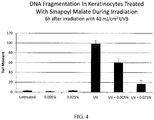
- Fig. 4 The results are set forth in Fig. 4 and show that Sinapoyl malate was a very effective in inhibiting or preventing DNA damage in keratinocytes both in cells treated with a concentration of 0.005% and 0.025% Sinapoyl malate and no irradiation (left side of graph) and cells irradiated with UV and exposed to 0.005% and 0.025% Sinapoyl malate.
- IL1- ⁇ Interleukin-la
- IL1- ⁇ Interleukin-la
- Keratinocytes were treated as described in Example 4.
- the media that the cells were incubated in following irradiation was collected after 6h and analyzed with the Milliplex MAP Human Cytokine Assay (Millipore, cat#HCYTMAG-60K-PX29) according to the manufacturer's protocol.
- Media from the cells were incubated with pre-mixed magnetic beads overnight at 4°C on a shaker at 800 rpm. Beads were washed and then incubated with the detection antibodies for 1h at room temperature on the shaker at 800rpm.
- Streptavidin-Phycoerythrin was added to the beads and incubated for 30 min at room temperature on the shaker at 800rpm. Beads were washed, suspended in sheath fluid and read on the Luminex.
- Sinapoyl malate was tested by first determining acceptable non-cytotoxic concentrations of this material. Based on these results, Normal Human Epidermal Keratinocyte (NHEK) were plated on two 96-well microtiter plates at a titer of 2 ⁇ 10 4 cells per well. In addition to untreated control samples, Sinapoyl malate was added at concentrations that ranged from 0.01% to 0.1% and incubated overnight (ca. 15 h). The following day, cell culture media were aspirated, the cells were rinsed with 100 ul of Dulbecco's Phosphate Buffered Saline, pH 7.4 (D-PBS), aspirated again and then 30 ul D-PBS was added.
- D-PBS Dulbecco's Phosphate Buffered Saline, pH 7.4
- One plate was kept in the cell culture hood, as a sham-irradiated sample, while the other plate was exposed to 50 mJ/cm 2 UVB. After exposure and further aspiration, the Control and the UVB-irradiated plates were treated with 100 ul of 10 uM 2',7'-dichlorodihydrofluorescein diacetate (DCFda) in D-PBS for 6h at 37 C°. In addition, 100 ul of 25 mM NaN 3 was added 20 minutes into the incubation.
- DCFda 10 uM 2',7'-dichlorodihydrofluorescein diacetate
- fluorescence was measured with a SpectraMax Gemini EM fluorescence plate reader set at 485 nm excitation and 538 nm emission with a wavelength cut off set at 530 nm.
- An increase in fluorescence indicates increased reactive oxygen species (ROS), particularly hydrogen peroxide (H 2 O 2 ) because it is the longest lived ROS.
- ROS reactive oxygen species
- H 2 O 2 hydrogen peroxide
- a reduction in fluorescence indicates antioxidant activity. In this way, both endogenous and UVB-induced ROS were determined and the effectiveness of Sinapoyl malate as an antioxidant measured.
Landscapes
- Health & Medical Sciences (AREA)
- Life Sciences & Earth Sciences (AREA)
- Public Health (AREA)
- Animal Behavior & Ethology (AREA)
- General Health & Medical Sciences (AREA)
- Veterinary Medicine (AREA)
- Chemical & Material Sciences (AREA)
- Epidemiology (AREA)
- Dermatology (AREA)
- Medicinal Chemistry (AREA)
- Pharmacology & Pharmacy (AREA)
- Birds (AREA)
- Emergency Medicine (AREA)
- Dispersion Chemistry (AREA)
- Gerontology & Geriatric Medicine (AREA)
- Engineering & Computer Science (AREA)
- Bioinformatics & Cheminformatics (AREA)
- Chemical Kinetics & Catalysis (AREA)
- General Chemical & Material Sciences (AREA)
- Nuclear Medicine, Radiotherapy & Molecular Imaging (AREA)
- Organic Chemistry (AREA)
- Oil, Petroleum & Natural Gas (AREA)
- Cosmetics (AREA)
- Medicinal Preparation (AREA)
- Acyclic And Carbocyclic Compounds In Medicinal Compositions (AREA)
- Organic Low-Molecular-Weight Compounds And Preparation Thereof (AREA)
Description
- The invention is directed to topical compositions containing a synthetic ester of sinapinic acid that is sinapoyl malate, compositions comprising sinapoyl malate for use in a method for treating skin, and a method for making a topical composition comprising sinapoyl malate.
- Plants need sunlight to survive. They have an inherent sunscreen in the form of sinapate esters that protect them from the harmful UVB rays and permit passage of the rays necessary to maintain plant life. Plants genetically engineered so that they are unable to produce sinapate esters suffer crippling damage that leads to stunted growth and withering. Light in the ultraviolet range spans wavelengths ranging from 280 to 400 with UVA light wavelength ranging from 315 to 400 and UVB light ranging from 280 to 315.
- Extraction of plant material to obtain sinapate esters is complicated and provides very low yield. The destruction of large numbers of plants to obtain only a nominal amount of extract is simply not cost effective or practical.
- A cost effective, efficient synthetic process for preparation of sinapate esters has been discovered. In addition, the sinapate esters prepared according to this synthetic process are found to have a variety of beneficial effects on skin.
-
US2004/0258635 A1 discloses sunscreen compounds produced by derivatizing milkweed oil with a cinnamic acid selected from ferulic, coumaric, sinapic and o-methylsinapic acid to form esters. - The invention is directed to topical compositions containing a synthetic ester of sinapinic acid that is sinapoyl malate.
- The invention is also directed to a composition for use in a method for treating skin to provide one or more benefits selected from (a) protecting against UV radiation, (b) inhibiting DNA damage in skin cells, (c) inhibiting or reducing skin inflammation, or (d) scavenging free radicals on skin by topically applying the composition, wherein the composition comprises a synthetic ester of sinapinic acid that is sinapoyl malate.
- The invention is also directed to a method for making a topical composition comprising synthesizing sinapoyl malate and then formulating the sinapoyl malate into a topical composition. The synthesis of the sinapoyl malate comprises the steps of:
- (a) (i) reacting syringaldehyde with acetic acid anhydride and an alkali metal acetate; or (ii) reacting sinapinic acid with acetic acid anhydride,
- (b) cleaving the anhydride of the acetyl protected reaction product of (a) by exposing to water and an aliphatic alcohol to form protected sinapinic acid,
- (c) esterifying the protected sinapinic acid by reacting with an alkyl protected carboxylic acid ester to form protected sinapoyl malate,
- (d) reacting the protected sinapoyl malate with aqueous acid to yield sinapoyl malate.
-
-
Fig. 1 : The measured absorbance peaks and valleys for testing of absorbance within the UV range for Sinapoyl malate (SM) and caftaric acid phenethyl ester (CAPE) at concentrations of 1.4 parts per million (ppm) and 14 ppm over times ranging from 0, 1 week, 2 weeks, 4 weeks and at temperatures of 4°, 25° 40°, and 50° C. are set forth in the Table. Sinapoyl malate and CAPE show different absorbance peaks and valleys in the UV range thus demonstrating that the structural difference results in a difference in UV absorption. -
Fig. 2 : demonstrates the stability of Sinapoyl malate and CAPE absorbance peaks over time and temperature.SM# 1 means Sinapoyl malatepeak # 1,SM# 2peak number 2.CAPE# 1 means first CAPE peak.CAPE# 2 means second CAPE peak. The top graph shows stability at 1.4 ppm concentration. The bottom graph shows stability at 14 ppm concentration. In both cases it is seen that Sinapoyl malate shows more consistent stability over time. In contrast, CAPE stability wavers up and down and absorbance peaks change or are not maintained. -
Fig. 3 : demonstrates the cellular viability of normal human epidermal keratinocytes that are not irradiated, or irradiated with 20, 40, and 60 mJ/cm2 UVB. Results show that Sinapoyl malate at concentrations ranging from 0.0025 to 0.25% improved cellular health and viability after exposure to varying dosages of UVB radiation. -
Fig. 4 : graphically demonstrates the effectiveness of Sinapoyl malate in protecting against UV damage both in non-irradiated cells and cells irradiated with UV at 40 mJ/cm2 at concentrations ranging from 0.025 to 0.05%. -
Fig. 5 : demonstrates the effectiveness of Sinapoyl malate as an anti-inflammatory in its ability to inhibit IL1-α and IL1-β in irradiated and non-irradiated cells. -
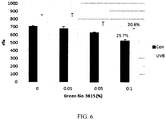
Fig. 6 : graphically demonstrates the effectiveness of Sinapoyl malate as an anti-oxidant over concentration ranges from 0.01 to 0.1%. - The synthetic compound used in the topical compositions and made in the methods of the invention is an ester of sinapinic acid that is sinapoyl malate.
- Sinapoyl malate may be synthesized as follows with the designations "S" followed by a numeral defined in Example 1.
- The starting material may be either sinapinic acid or syringaldehyde. Sinapinic acid is expensive so it may be more desirable to start with syringaldehyde.
- Acetyl protected sinapinic acid S3 may be synthesized using a PERKIN-type reaction as further described in the Examples. Sinapinic acid, S1, may be reacted with acetic acid anhydride in the presence of an appropriate base to form an acetyl protected sinapinic acid. More preferably, syringaldehyde S2 may be reacted with acetic anhydride, sodium acetate, water, and an aliphatic alcohol, preferably methanol to form the acetyl protected sinapinic acid.
- The resulting acetyl protected sinapinic acid S3 can be esterified with an alkyl protected malic acid ester S4, which is preferably a dimethyl or diethyl ester, or more preferably a diisopropyl ester using STEGLICH conditions using a carbodiimide coupling reagent such as diisopropyl carbodiimide, or more preferably dicyclohexyl carbodiimide to yield the fully protected sinapoyl malate S5. Complete deprotection may be achieved by hydrolyzing with aqueous acids such as sulfuric acid or hydrochloric acid to yield sinapoyl malate S6.
- The topical compositions of the invention may contain 0.01 to 10%, preferably from about 0.05 to 8%, more preferably from about 0.1 to 5% by weight of the synthetic ester of sinapinic acid, with all percentages set forth herein being percentages by weight unless otherwise indicated.
- The topical composition may be in the form of a solution, gel, cream, lotion, emulsion or anhydrous product. Preferred is where Sinapoyl malate is formulated into an emulsion containing about 10-90% water and 10-90% oil. The composition may contain other ingredients including but not limited to those set forth herein.
- In the event the compositions of the invention are in emulsion form, the composition will comprise an oil phase. Oily ingredients are desirable for the skin moisturizing and protective properties. Suitable oils include silicones, esters, vegetable oils, synthetic oils, including but not limited to those set forth herein. The oils may be volatile or nonvolatile, and are preferably in the form of a pourable liquid at room temperature. The term "volatile" means that the oil has a measurable vapor pressure, or a vapor pressure of at least about 2 mm of mercury (0.27 kPa) at 20° C. The term "nonvolatile" means that the oil has a vapor pressure of less than about 2 mm of mercury (0.27 kPa) at 20° C. If present, such oils may range from about 0.01 to 85%, preferably from about 0.05 to 80%, more preferably from about 0.1 to 50%.
- Suitable volatile oils generally have a viscosity ranging from about 0.5 to 5 centistokes (0.5 to 5 × 10⁻⁶ m2/s) at 25°C. and include linear silicones, cyclic silicones, paraffinic hydrocarbons, or mixtures thereof.
- Cyclic and linear volatile silicones are available from various commercial sources including Dow Corning Corporation and General Electric. The Dow Corning linear volatile silicones are sold under the tradenames Dow Corning 244, 245, 344, and 200 fluids. These fluids include hexamethyldisiloxane (viscosity 0.65 centistokes (abbreviated cst) [0.65 × 10⁻⁶ m2/s]), octamethyltrisiloxane (1.0 cst [1.0 × 10⁻⁶ m2/s]), decamethyltetrasiloxane (1.5 cst [1.5 × 10⁻⁶ m2/s]), dodecamethylpentasiloxane (2 cst [2 × 10⁻⁶ m2/s]) and mixtures thereof, with all viscosity measurements being at 25°C.
- Suitable branched volatile silicones include alkyl trimethicones such as methyl trimethicone having the general formula:

- A variety of nonvolatile oils are also suitable for use in the compositions of the invention. The nonvolatile oils generally have a viscosity of greater than about 5 to 10 centistokes (greater than 5 to 10 × 10-6 m2/s) at 25°C., and may range in viscosity up to about 1,000,000 centipoise (1 m2/s) at 25°C. Examples of nonvolatile oils include, but are not limited to mono-, di-, and triesters.
- Monoesters are defined as esters formed by the reaction of a monocarboxylic acid having the formula R-COOH, wherein R is a straight or branched chain saturated or unsaturated alkyl having 2 to 45 carbon atoms, or phenyl; and an alcohol having the formula R-OH wherein R is a straight or branched chain saturated or unsaturated alkyl having 2-30 carbon atoms, or phenyl. Both the alcohol and the acid may be substituted with one or more hydroxyl groups. Either one or both of the acid or alcohol may be a "fatty" acid or alcohol, and may have from about 6 to 30 carbon atoms, more preferably 12, 14, 16, 18, or 22 carbon atoms in straight or branched chain, saturated or unsaturated form. Examples of monoester oils that may be used in the compositions of the invention include hexyl laurate, butyl isostearate, hexadecyl isostearate, cetyl palmitate, isostearyl neopentanoate, stearyl heptanoate, isostearyl isononanoate, stearyl lactate, stearyl octanoate, stearyl stearate, isononyl isononanoate, and so on.
- Suitable diesters are the reaction product of a dicarboxylic acid and an aliphatic or aromatic alcohol or an aliphatic or aromatic alcohol having at least two substituted hydroxyl groups and a monocarboxylic acid. The dicarboxylic acid may contain from 2 to 30 carbon atoms, and may be in the straight or branched chain, saturated or unsaturated form. The dicarboxylic acid may be substituted with one or more hydroxyl groups. The aliphatic or aromatic alcohol may also contain 2 to 30 carbon atoms, and may be in the straight or branched chain, saturated, or unsaturated form. Preferably, one or more of the acid or alcohol is a fatty acid or alcohol, i.e. contains 12-22 carbon atoms. The dicarboxylic acid may also be an alpha hydroxy acid. The ester may be in the dimer or trimer form. Examples of diester oils that may be used in the compositions of the invention include diisotearyl malate, neopentyl glycol dioctanoate, dibutyl sebacate, dicetearyl dimer dilinoleate, dicetyl adipate, diisocetyl adipate, diisononyl adipate, diisostearyl dimer dilinoleate, diisostearyl fumarate, diisostearyl malate, dioctyl malate, and so on.
- Suitable triesters comprise the reaction product of a tricarboxylic acid and an aliphatic or aromatic alcohol or alternatively the reaction product of an aliphatic or aromatic alcohol having three or more substituted hydroxyl groups with a monocarboxylic acid. As with the mono- and diesters mentioned above, the acid and alcohol contain 2 to 30 carbon atoms, and may be saturated or unsaturated, straight or branched chain, and may be substituted with one or more hydroxyl groups. Preferably, one or more of the acid or alcohol is a fatty acid or alcohol containing 12 to 22 carbon atoms. Examples of triesters include esters of arachidonic, citric, or behenic acids, such as triarachidin, tributyl citrate, triisostearyl citrate, tri C12-13 alkyl citrate, tricaprylin, tricaprylyl citrate, tridecyl behenate, trioctyldodecyl citrate, or tridecyl cocoate, tridecyl isononanoate, and so on.
- Esters suitable for use in the composition are further described in the C.T.F.A. Cosmetic Ingredient Dictionary and Handbook, Eleventh Edition, 2006, under the classification of "Esters".
- It may be desirable to incorporate one or more nonvolatile hydrocarbon oils into the composition. Suitable nonvolatile hydrocarbon oils include paraffinic hydrocarbons and olefins, preferably those having greater than about 20 carbon atoms. Examples of such hydrocarbon oils include C24-28 olefins, C30-45 olefins, C20-40 isoparaffins, hydrogenated polyisobutene, polyisobutene, polydecene, hydrogenated polydecene, mineral oil, pentahydrosqualene, squalene, squalane, and mixtures thereof. In one preferred embodiment such hydrocarbons have a molecular weight ranging from about 300 to 1000 Daltons.
- Synthetic or naturally occurring glyceryl esters of fatty acids, or triglycerides, are also suitable for use in the compositions. Both vegetable and animal sources may be used. Examples of such oils include castor oil, lanolin oil, C10-18 triglycerides, caprylic/capric/triglycerides, sweet almond oil, apricot kernel oil, sesame oil, camelina sativa oil, tamanu seed oil, coconut oil, corn oil, cottonseed oil, linseed oil, ink oil, olive oil, palm oil, illipe butter, rapeseed oil, soybean oil, grapeseed oil, sunflower seed oil, walnut oil, and the like.
- Also suitable are synthetic or semi-synthetic glyceryl esters, such as fatty acid mono-, di-, and triglycerides which are natural fats or oils that have been modified, for example, mono-, di- or triesters of polyols such as glycerin. In an example, a fatty (C12-22) carboxylic acid is reacted with one or more repeating glyceryl groups. glyceryl stearate, diglyceryl diiosostearate, polyglyceryl-3 isostearate, polyglyceryl-4 isostearate, polyglyceryl-6 ricinoleate, glyceryl dioleate, glyceryl diisotearate, glyceryl tetraisostearate, glyceryl trioctanoate, diglyceryl distearate, glyceryl linoleate, glyceryl myristate, glyceryl isostearate, PEG castor oils, PEG glyceryl oleates, PEG glyceryl stearates, PEG glyceryl tallowates, and so on.
- Nonvolatile silicone oils, both water soluble and water insoluble, are also suitable for use in the composition. Such silicones preferably have a viscosity ranging from about greater than 5 to 800,000 cst (5 × 10⁻⁶ m2/s to 0.8 m2/s), preferably 20 to 200,000 cst (20 × 10-6 m2/s to 0.2 m2/s) at 25°C. Suitable silicones include amine functional silicones such as amodimethicone dimethicone, phenyl dimethicone, diphenyl dimethicone, phenyl trimethicone, or trimethylsiloxyphenyl dimethicone. Other examples include alkyl dimethicones such as cetyl dimethicone, and the like wherein at least one R is a fatty alkyl (C12, C14, C16, C18, C20, or C22), and the other R is methyl, and A is a trimethylsiloxy endcap unit, provided such alkyl dimethicone is a pourable liquid at room temperature. Phenyl trimethicone can be purchased from Dow Corning Corporation under the tradename 556 Fluid. Trimethylsiloxyphenyl dimethicone can be purchased from Wacker-Chemie under the tradename PDM-1000. Cetyl dimethicone, also referred to as a liquid silicone wax, may be purchased from Dow Corning as Fluid 2502, or from DeGussa Care & Surface Specialties under the trade names Abil Wax 9801, or 9814.
- The composition may contain one or more humectants. If present, they may range from about 0.01 to 75%, preferably from about 0.5 to 70%, more preferably from about 0.5 to 40%. Examples of suitable humectants include glycols, sugars, and the like. Suitable glycols are in monomeric or polymeric form and include polyethylene and polypropylene glycols such as PEG 4-10, which are polyethylene glycols having from 4 to 10 repeating ethylene oxide units; as well as C1-6 alkylene glycols such as propylene glycol, butylene glycol, pentylene glycol, and the like. Suitable sugars, some of which are also polyhydric alcohols, are also suitable humectants. Examples of such sugars include glucose, fructose, honey, hydrogenated honey, inositol, maltose, mannitol, maltitol, sorbitol, sucrose, xylitol, xylose, and so on. Also suitable is urea. Preferably, the humectants used in the composition of the invention are C1-6, preferably C2-4 alkylene glycols, most particularly butylene glycol.
- It may be desirable for the composition to contain one more surfactants, especially if in the emulsion form. However, such surfactants may be used if the compositions are solutions, suspensions, or anhydrous also, and will assist in dispersing ingredients that have polarity, for example pigments. Such surfactants may be silicone or organic based. The surfactants will also aid in the formation of stable emulsions of either the water-in-oil or oil-in-water form. If present, the surfactant may range from about 0.001 to 30%, preferably from about 0.005 to 25%, more preferably from about 0.1 to 20% by weight of the total composition.
- The composition may comprise one or more nonionic organic surfactants. Suitable nonionic surfactants include alkoxylated alcohols or ethers, formed by the reaction of an alcohol with an alkylene oxide, usually ethylene or propylene oxide. Suitable alcohols include mono-, di-, or polyhydric short chain (C1-6) alcohols; aromatic or aliphatic saturated or unsaturated fatty (C12-40) alcohols, of cholesterol; and so on.
- In one embodiment the alcohol is cholesterol, or an aromatic or aliphatic saturated or unsaturated fatty alcohol which may have from 6 to 40, preferably from about 10 to 30, more preferably from about 12 to 22 carbon atoms. Examples include oleyl alcohol, cetearyl alcohol, cetyl alcohol, stearyl alcohol, isostearyl alcohol, behenyl alcohol, and the like. Examples of such ingredients include Oleth 2-100; Steareth 2-100; Beheneth 5-30; Ceteareth 2-100; Ceteth 2-100; Choleth 2-100 wherein the number range means the number of repeating ethylene oxide units, e.g. Ceteth 2-100 means Ceteth where the number of repeating ethylene oxide units ranges from 2 to 100. Derivatives of alkoxylated alcohols are also suitable, such as phosphoric acid esters thereof.
- Some preferred organic nonionic surfactants include Oleth-3, Oleth-5, Oleth-3 phosphate, Choleth-24; Ceteth-24; and so on.
- Also suitable are alkoxylated alcohols formed with mono-, di-, or polyhydric short chain alcohols, for example those having from about 1 to 6 carbon atoms. Examples include glucose, glycerin, or alkylated derivatives thereof. Examples include glycereth 2-100; gluceth 2-100; methyl gluceth 2-100 and so on. More preferred are methyl gluceth-20; glycereth-26 and the like.
- Other types of alkoxylated alcohols are suitable surfactants, including ethylene oxide polymers having varying numbers of repeating EO groups, generally referred to as PEG 12 to 200. More preferred are PEG-75, which is may be purchased from Dow Chemical under the trade name Carbowax PEG-3350.
- Other suitable nonionic surfactants include alkoxylated sorbitan and alkoxylated sorbitan derivatives. For example, alkoxylation, in particular ethoxylation of sorbitan provides polyalkoxylated sorbitan derivatives. Esterification of polyalkoxylated sorbitan provides sorbitan esters such as the polysorbates. For example, the polyalkyoxylated sorbitan can be esterified with C6-30, preferably C12-22 fatty acids. Examples of such ingredients include Polysorbates 20-85, sorbitan oleate, sorbitan sesquioleate, sorbitan palmitate, sorbitan sesquiisostearate, sorbitan stearate, and so on.
- Also suitable are various types of silicone or silane-based surfactants. Examples include organosiloxanes substituted with ethylene oxide or propylene oxide groups such as PEG dimethicones which are dimethicones substituted with polyethylene glycols including those having the INCI names PEG-1 dimethicone; PEG-4 dimethicone; PEG-8 dimethicone; PEG-12 dimethicone; PEG-20 dimethicone; and so on.
- Also suitable are silanes substituted with ethoxy groups or propoxy groups or both, such as various types of PEG methyl ether silanes such as bis-PEG-18 methyl ether dimethyl silane; and so on.
- Further examples of silicone based surfactants include those having the generic names dimethicone copolyol; cetyl dimethicone copolyol; and so on.
- The topical composition may also contain a variety of other ingredients including but not limited to preservatives, pH adjusters, and the like.
- A water and oil emulsion containing:
- 0.01 to 10% of the sinapoyl malate,
- 0.1 to 90% water,
- 0.1 to 40% oil, preferably silicone oils or esters,
- 0.1 to 10% surfactant, preferably a non-ionic surfactant.
- The composition may be in the form of a cream, lotion, or serum. The composition may also be in the form of a color cosmetic composition such as foundation makeup, concealer, primer, eye shadow, and the like.
- The invention comprises a composition for use in methods for treating skin by topically applying the topical composition comprising a synthetic ester of sinapinic acid that is sinapoyl malate to inhibit UV damage in skin cells, as an anti-oxidant to reduce or inhibit free radicals on skin, to reduce or inhibit DNA damage in skin cells exposed to UV light, and as an anti-inflammatory to reduce skin irritation, inflammation and sensitivity.
- The invention is also directed to a composition of the invention for use in a method for improving cellular health and viability by topically applying a composition comprising an effective amount of sinapoyl malate.
- The invention is also directed to a composition of the invention for use in a method for inhibiting and/or repairing DNA damage in skin cells by topically applying a composition comprising an effective amount of sinapoyl malate.
- The invention is also directed to a composition of the invention for use in a method for reducing skin irritation or inflammation by applying a topical composition comprising an effective amount of sinapoyl malate. More preferred is where the sinapoyl malate inhibits irritation or inflammation by reducing or inhibiting product of IL1-α and/or IL1-β in skin cells.
- The invention is also directed to a composition of the invention for use in a method for scavenging free radicals on skin by topically applying a composition comprising an effective amount of sinapoyl malate.
- The desired benefits may be obtained by applying topical compositions containing the Sinapoyl malate in effective amounts to the skin. The types of compositions applied may be as set forth herein. The compositions may be applied in regimens, or in the morning or evening or at other times of the day.
- The invention is also directed to a method for making a topical composition comprising synthesizing sinapoyl malate and then formulating the sinapoyl malate into a topical composition; wherein the synthesis of the sinapoyl malate comprises the steps of:
- (a) (i) reacting syringaldehyde with acetic acid anhydride and an alkali metal acetate; or (ii) reacting sinapinic acid with acetic acid anhydride,
- (b) cleaving the intermediate obtained in section (a) by exposing to water and an aliphatic alcohol to form protected sinapinic acid,
- (c) esterifying the protected sinapinic acid by reacting with an alkyl protected carboxylic acid ester to form protected sinapoyl malate,
- (d) reacting the protected sinapoyl malate with aqueous acid to yield sinapoyl malate.
- Preferred is where the starting material is syringaldehyde which is reacted with an alkali metal acetate (such as sodium), alkanol (methanol, propanol, butanol), and acetic anhydride. The resulting acetyl protected sinapinic acid may then be esterified by reacting with a malic acid ester CO2R-CH2CH(OH)-CO2R where R may be selected from methyl, ethyl, propyl, iso-propyl or butyl, to yield sinapinic acid ester where all hydroxyl groups are protected. The protecting groups can be hydrolyzed by reacting with aqueous inorganic acids such as hydrochloric or sulfuric acid and an appropriate organic solvent to yield sinapoyl malate.
- The invention will be further described in connection with the following examples which are set forth for the purposes of illustration only.
- Sinapoyl malate was prepared as follows:
-

- In a 1 liter flask a reaction mixture of syringealdehyde (150 grams, 0.82 mol), acetic acid anhydride (293 grams, 2.87 mol) and sodium acetate (59 grams, 0.72 mol) was preheated to 80° C. for 5 hours before heating to reflux for an additional 8 hours. Afterwards the atmosphere was lowered to 500 mbar (50 kPa) and acetic acid was removed from the mixture. The residue was cooled to 90° C. and methanol (900 grams) was added followed by addition of water (240 grams) at room temperature (25° C.). The reaction mixture was stirred thoroughly for 3 hours at this temperature. Afterwards, the methanol was removed in vacuo. To the obtained residue, toluene (750 grams) was added and the organic and aqueous layers were separated yielding the raw product in toluene. The toluene was removed in vacuo until the product started to precipitate. The reaction mixture was cooled to 0° C. and stirred at this temperature for an additional hour. The precipitate was removed by filtration and washed with cold toluene. Yield of product was 76 grams (35%), and spectroscopic data confirmed the correct compound.
-

- In a 1 liter flask with 4-acetoxy-sinapinic acid S3 (40 grams, 0.15 mol), freshly distilled diisopropyl malate (32.7 grams, 0.15 mol) and acetone (415 grams), a solution of dicyclohexyl carbodiimide (34 grams, 0.165 mol), 4-dimethyl aminopyridine (DMAP, 7.4 grams, 0.06 mol) in acetone (150 grams) was added dropwise at room temperature. The resulting reaction mixture was stirred for 5 hours at this temperature. The precipitate was removed by filtration, washed with acetone and the solvent removed in vacuo. The obrained residue was dissolved in methyl-tert-butyl ether (200 grams), removed in vacuo to yield the desired raw product S5 (83 grams) which was used directly for the next reaction step without further purification. The spectroscopic data confirmed the desired compound.
-

- To a 2 liter flask containing 4-acetoxy sinapoyl-di-isopropyl malate S5 (83 grams) in acetone (750 grams) was added aqueous sulfuric acid (40%, 290 grams). The mixture was heated at reflux conditions for 8 hours until deprotection was completed. Under partial vacuum (700 mbar) acetone was evaporated from the mixture yielding an aqueous residue. Ethyl acetate (600 grams) was added and the layers were separated, the organic layer washed with water and the solvent removed in vacuo to yield a brown residue. The raw product was dissolved in methyl-tert-butyl ether (350 grams) and extracted with saturated NaHCO3 solution, which was then acidified with H2SO4 and extracted with methyl-tert-butyl ether afterwards yielding the raw product after evaporating the organic layers to dryness. Sinapoyl malate was obtained as a light yellow solid (10 grams, 20% two steps) after flash column chromatography (cyclohexane:ethyl acetate, 1:1); melting range 55-65° C., 1H NMR (400 MHz, DMSO-d6): δ 9.00 (s, 1H), 7.59 (d, J=15.8 Hz, 1H), 7.06 (s, 2H), 6.59 (d, J=15.9 Hz), 5.33 (dd, J=8.8, 3.9 Hz, 1H), 3.86-3.77 (m, 6H), 2.89 (dd, J=16.7, 3.9 Hz, 1H), 2.77 (dd, J=16.7, 8.8 Hz, 1H). 13C NMR (101 MHz, DMSO-d6): 170.61, 170.27, 165.71, 147.90, 146.36, 138.40, 124.12, 113.89, 106.29, 68.28, 55.99, 40.02, 39.81, 39.60, 39.39, 39,18, 38.98, 38.77, 35.81; HR-LCMS (ESI) m/z 339.0717 (M-H+), 4.49 min; HPLC 4.67 min.
- All HPLC chromatograms were recorded on an HPLC system using a
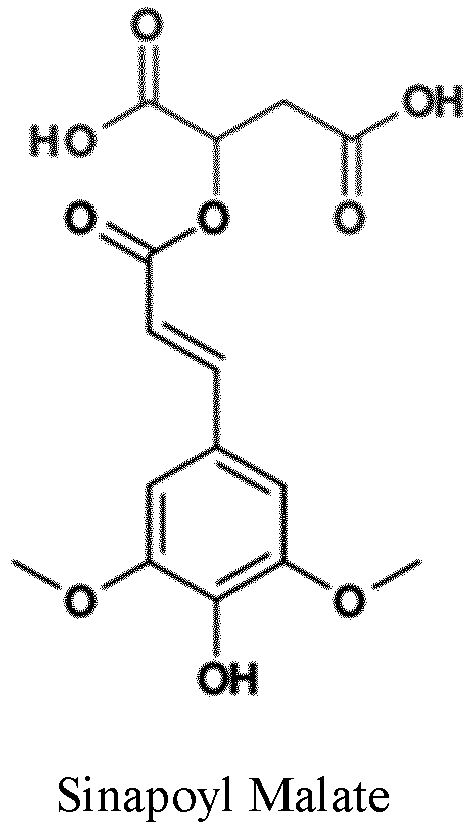
poroshell 120 SB-C18 column (2.7 um, 50.x2.1 mm) with a gradient 5% to 50% (10 min) and 50-100% (2 min) water (0.1% formic acid) and acetonitrile as eluent and a flow of 0.40 ml/min at 40° C. As detector a DAD UV 220-320 nm was used. All LCMS chromatograms were recorded on an HPLC System using a Kinetex RP-C18 column (1.7 um, 100 × 2.1 mm) with a gradient 0-95% (22 min) water (0.1% formic acid) and acetonitrile (0.09% formic acid) as eluent and a flow of 0.55 ml/min at 50o C. As MS detector a Bruker micrOTOF Q-11 was used. - The sinapinic acid ester (sinapoyl malate) prepared in Example 1 having the structure:

- The samples were tested for UV absorption across the UV range by measuring with an Agilent 8453 UV visible spectroscopy system at wavelengths ranging across 200 to 450 nm at
time 0,week 1,week 2, and week 4. The term "NA" means that a previously observed absorbance peak was no longer visible. The term "peak" means the two highest absorbance peaks in the UV spectrum. The term "valley" means the two lowest point between the absorbance peaks. In the case where there is only one peak or valley it means that the other, previously observed peak or valley was deteriorated at the time and temperature of the stability study. In the case where all peaks and valleys are indicated "NA" it means that the sample deteriorated entirely and no longer absorbed in the UV range at all. - The numerical results are set forth in
Fig. 1 and graphically depicted inFig. 2 . It is seen that the absorbance peaks of Sinapoyl malate ("S") are different and distinct from the absorbance peaks of CAPE ("C"). In addition, Sinapoyl malate is more stable over time and temperature at concentrations of 1.4 and 14 ppm. In contrast, CAPE shows much less stability over time and temperature. Accordingly, the difference in chemical structure between the two compounds demonstrates unexpected differences in both UV absorbance peaks and valleys as well as long term stability and show that when the absorbance peaks in the UV range were measured on samples containing sinapoyl malate ("SM") and CAPE dissolved in a 50/50 mixture of water and butylene glycol with final concentration at 1.4 and 14 ppm, SM exhibited different absorbance peaks than CAPE and showed significantly improved overall stability than CAPE over time and temperature. This is unexpected given the similarity in structures between the two compounds. The term "NA" means that the previously observed absorbance peak from the pair was no longer visible or measurable. - The sinapoyl malate prepared in Example 1 was tested for impact on cellular health and viability at concentrations ranging from 0, 0.0025, 0.005, 0.0075, 0.01, 0.025, 0.05, 0.075, 0.1 and 0.25% on normal human epidermal keratinocytes (NHEK) that were not irradiated, and that were irradiated with 20, 40, and 80 mJ/cm2 UVB using the Almar Blue assay.
- More specifically, normal human dermal keratinocytes were harvested and assayed for cellular viability when untreated or treated with sinapoyl malate at the above mentioned concentrations.
- The cells were placed in concentrations of 150,000 cells per plate for the 48 hour test, and 300,000 cells per plate for the 24 hour test on 96 well plates. The cells were incubated at 37° C., 5% CO2, and 95% humidity for 24 hours. The test compositions were prepared as follows:
Cells were treated for 48 hours by applying the test compositions. The cells were kept in an incubator with conditions as set forth above. - After 48 hours the cells were washed with DPBS and covered with a thin layer (about 100 µl) of DPBS. The DPBS was removed and then 100 µl of the test compositions was placed on the cells for 24 hours. The cells were kept in the incubator with the conditions as set forth herein.
- Other batches of cells were irradiated with 20, 40, and 80 mJ/cm2 UVB (Dr. Groebel, UV-Electronik, GmbH). The DPBS was aspirated and the treatment compositions applied once again for 24 hours. The next morning the medium was aspirated and 100 µl of 10% Alamar Blue solution was added. The plate was incubated at 37° C. for 1.5 to 2 hours. The fluorescence was measured at 530/590 nanometers using a Spectra Max Gemini reader. The cell viability was calculated and expressed as the percentage of survival of cells treated with hydrogen peroxide. The results are set forth in
Fig. 3 and demonstrate that Sinapoyl malate was effective in promoting keratinocyte health and viability both before and after UV radiation. - Sinapoyl malate was tested in the DNA fragmentation study to ascertain its ability to repair or inhibit DNA fragmentation upon exposure of cells to UV radiation. Keratinocytes were plated in 60mm dishes at 100,000 cells per dish and grown in EpiLife medium (ThermoFisher, cat#M-EPI-500-CA) supplemented with Human Keratinocyte Growth Supplement (ThermoFisher, cat#S-001-5) until they reached 50% confluency. Cells were washed with DPBS and then covered with a thin layer (2 mL) of DPBS containing 0.005% or 0.025% of Sinapoyl malate before being irradiated with 100 mJ/cm2 UVB in the Dr. Gröbel irradiation chamber. Cells were washed again with DPBS and incubated in medium for 6h. NHEK were trypsinized, washed with PBS and suspended in PBS at 1×10⁵ cells/mL. Cells were then dispersed in melted agarose (Trevigen, cat#4250-050-02) at 37°C at a 1:10 ratio. 75µl of the cell/agarose mixture was pipetted evenly on to each spot of the comet slide (Trevigen, cat#4250-050-03) and then incubated at 4°C for 10 minutes. Slides were immersed in cold lysis solution (Trevigen, cat#4250-050-01) on ice for overnight. Slides were removed from the lysis solution and placed into an alkaline solution (300mM NaOH, ImM EDTA, pH>13) at room temperature for 30 minutes. Then the slides were placed in the Comet Assay ESII Electrophoresis System. Cold alkaline electrophoresis solution (200mM NaOH, ImM EDTA, pH>13) was poured into the apparatus so that it just covered the slides. Electrophoresis ran for 30 minutes at 23V. After electrophoresis the slides were rinsed in H2O and immersed in 70% EtOH for 5 min. Slides were removed from the EtOh solution and placed on a towel to air dry overnight. SYBR gold (ThermoFisher, cat#S11494) was diluted in TE buffer (10 mM Tris-HCl, ImM EDTA, pH 7.5) 1:30000. 100 µl of diluted SYBR gold was pipetted on to each spot. Slides were incubated at room temperature for 30 min. Then slides were allowed to dry again after removing excess SYBR gold from the slides. Slides were viewed under the EVOS microscope with the FITC filter with the 20x objective. The tail moments were determined with the Comet Score software from Tri Tek.
- The results are set forth in
Fig. 4 and show that Sinapoyl malate was a very effective in inhibiting or preventing DNA damage in keratinocytes both in cells treated with a concentration of 0.005% and 0.025% Sinapoyl malate and no irradiation (left side of graph) and cells irradiated with UV and exposed to 0.005% and 0.025% Sinapoyl malate. - The anti-inflammatory activity of Sinapoyl malate was demonstrated by testing its ability to inhibit Interleukin-la (IL1-α) and IL1-β which are both indicators of inflammation. IL1 species are responsible for stimulating inflammation in damaged tissues.
- Keratinocytes were treated as described in Example 4. The media that the cells were incubated in following irradiation was collected after 6h and analyzed with the Milliplex MAP Human Cytokine Assay (Millipore, cat#HCYTMAG-60K-PX29) according to the manufacturer's protocol. Media from the cells were incubated with pre-mixed magnetic beads overnight at 4°C on a shaker at 800 rpm. Beads were washed and then incubated with the detection antibodies for 1h at room temperature on the shaker at 800rpm. Streptavidin-Phycoerythrin was added to the beads and incubated for 30 min at room temperature on the shaker at 800rpm. Beads were washed, suspended in sheath fluid and read on the Luminex.
- The results are set forth in
Fig. 5 with "BIO3815" referring to Sinapoyl malate. The results demonstrate that Sinapoyl malate inhibits both IL1-α and IL1-β in a dose dependent manner thus showing its effectiveness as an anti-inflammatory active. - The anti-oxidant activity of Sinapoyl malate was tested by first determining acceptable non-cytotoxic concentrations of this material. Based on these results, Normal Human Epidermal Keratinocyte (NHEK) were plated on two 96-well microtiter plates at a titer of 2 × 10⁴ cells per well. In addition to untreated control samples, Sinapoyl malate was added at concentrations that ranged from 0.01% to 0.1% and incubated overnight (ca. 15 h). The following day, cell culture media were aspirated, the cells were rinsed with 100 ul of Dulbecco's Phosphate Buffered Saline, pH 7.4 (D-PBS), aspirated again and then 30 ul D-PBS was added. One plate was kept in the cell culture hood, as a sham-irradiated sample, while the other plate was exposed to 50 mJ/cm2 UVB. After exposure and further aspiration, the Control and the UVB-irradiated plates were treated with 100 ul of 10 uM 2',7'-dichlorodihydrofluorescein diacetate (DCFda) in D-PBS for 6h at 37 C°. In addition, 100 ul of 25 mM NaN3 was added 20 minutes into the incubation. At the end of the 6h incubation, fluorescence was measured with a SpectraMax Gemini EM fluorescence plate reader set at 485 nm excitation and 538 nm emission with a wavelength cut off set at 530 nm. An increase in fluorescence indicates increased reactive oxygen species (ROS), particularly hydrogen peroxide (H2O2) because it is the longest lived ROS. Conversely, a reduction in fluorescence indicates antioxidant activity. In this way, both endogenous and UVB-induced ROS were determined and the effectiveness of Sinapoyl malate as an antioxidant measured.
- The results are set forth in
Fig. 6 and show that Sinapoyl malate was a very effective anti-oxidant for both untreated cells and cells irradiated with UV at concentrations of 0.01%, 0.05%, and 0.10%.
Claims (15)
- A topical composition comprising a synthetic ester of sinapinic acid that is sinapoyl malate.
- The composition of claim 1 in the form of a cream, lotion, serum, gel, solution, suspension, or anhydrous composition.
- The composition of claim 2 in the form of a water and oil emulsion.
- A composition for use in a method for treating skin to provide one or more benefits selected from (a) protecting against UV radiation, (b) inhibiting DNA damage in skin cells, (c) inhibiting or reducing skin inflammation, and (d) scavenging free radicals by topically applying the composition; wherein the composition comprises a synthetic ester of sinapinic acid that is sinapoyl malate.
- The composition for use according to claim 4 wherein the skin is protected against UVA and UVB radiation.
- The composition for use according to claim 4 wherein DNA damage in skin cells is inhibited.
- The composition for use according to claim 4 wherein inflammation is inhibited by inhibiting IL1-α or IL1-β or both.
- The composition for use according to claim 7 wherein the sinapoyl malate is at a concentration of 0.001 to 0.05%.
- The composition for use according to claim 4 wherein the sinapoyl malate scavenges free radicals when topically applied to skin.
- The composition for use according to claim 4 wherein the sinapoyl malate reduces or inhibits DNA damage in skin cells when topically applied.
- The composition for use according to claim 4 wherein the sinapoyl malate protects the skin cells against UV radiation when topically applied.
- A method for making a topical composition comprising synthesizing sinapoyl malate and then formulating the sinapoyl malate into a topical composition;
wherein the synthesis of the sinapoyl malate comprises the steps of:(a)(i) reacting syringaldehyde with acetic acid anhydride and an alkali metal acetate;or (ii) reacting sinapinic acid with acetic acid anhydride,(b) cleaving the anhydride of the acetyl protected reaction product of (a) by exposing to water and an aliphatic alcohol to form protected sinapinic acid,(c) esterifying the protected sinapinic acid by reacting with an alkyl protected carboxylic acid ester to form protected sinapoyl malate,(d) reacting the protected sinapoyl malate with aqueous acid to yield sinapoyl malate. - The method of claim 12 wherein step (a) is (a)(i).
- The method of claim 13 wherein the syringaldehyde is reacted with sodium acetate and acetic anhydride, or
wherein the aliphatic alcohol in (b) is methanol; the alkyl protected carboxylic acid ester in (c) is an ester of malic acid, and the aqueous acid in (d) is hydrochloric acid, sulfuric acid or combinations thereof. - The method of any one of claims 12-14, wherein the alkyl protected carboxylic acid ester in (c) is a di-isopropyl ester.
Priority Applications (1)
| Application Number | Priority Date | Filing Date | Title |
|---|---|---|---|
| EP21211157.9A EP4039254A1 (en) | 2017-03-08 | 2018-03-06 | Topical compositions containing synthetic esters of sinapinic acid and methods for treating keratin surfaces |
Applications Claiming Priority (2)
| Application Number | Priority Date | Filing Date | Title |
|---|---|---|---|
| US201762468617P | 2017-03-08 | 2017-03-08 | |
| PCT/US2018/021193 WO2018165189A1 (en) | 2017-03-08 | 2018-03-06 | Topical compositions containing synthetic esters of sinapinic acid and methods for treating keratin surfaces |
Related Child Applications (1)
| Application Number | Title | Priority Date | Filing Date |
|---|---|---|---|
| EP21211157.9A Division EP4039254A1 (en) | 2017-03-08 | 2018-03-06 | Topical compositions containing synthetic esters of sinapinic acid and methods for treating keratin surfaces |
Publications (3)
| Publication Number | Publication Date |
|---|---|
| EP3592341A1 EP3592341A1 (en) | 2020-01-15 |
| EP3592341A4 EP3592341A4 (en) | 2020-03-04 |
| EP3592341B1 true EP3592341B1 (en) | 2021-12-01 |
Family
ID=63448001
Family Applications (2)
| Application Number | Title | Priority Date | Filing Date |
|---|---|---|---|
| EP18764435.6A Active EP3592341B1 (en) | 2017-03-08 | 2018-03-06 | Topical compositions containing synthetic esters of sinapinic acid and methods for treating keratin surfaces |
| EP21211157.9A Withdrawn EP4039254A1 (en) | 2017-03-08 | 2018-03-06 | Topical compositions containing synthetic esters of sinapinic acid and methods for treating keratin surfaces |
Family Applications After (1)
| Application Number | Title | Priority Date | Filing Date |
|---|---|---|---|
| EP21211157.9A Withdrawn EP4039254A1 (en) | 2017-03-08 | 2018-03-06 | Topical compositions containing synthetic esters of sinapinic acid and methods for treating keratin surfaces |
Country Status (9)
| Country | Link |
|---|---|
| US (2) | US20210137805A1 (en) |
| EP (2) | EP3592341B1 (en) |
| JP (1) | JP6878610B6 (en) |
| KR (1) | KR102254506B1 (en) |
| CN (1) | CN110573149A (en) |
| AU (1) | AU2018230712B9 (en) |
| CA (1) | CA3055798C (en) |
| ES (1) | ES2900203T3 (en) |
| WO (1) | WO2018165189A1 (en) |
Families Citing this family (3)
| Publication number | Priority date | Publication date | Assignee | Title |
|---|---|---|---|---|
| CN110615731B (en) * | 2019-09-16 | 2022-10-14 | 中国农业科学院油料作物研究所 | A kind of method for preparing 2,6-dimethoxy-4-vinylphenol |
| FR3107058B1 (en) | 2020-02-07 | 2022-02-11 | Inst Des Sciences Et Industries Du Vivant Et De Lenvironnement Agroparistech | NEW SYNTHETIC PATHWAY FOR SINAPOYL MALATE, SINAPINE AND THEIR ANALOGS, AND THEIR USE AS ANTI-UV MOLECULES |
| FR3152509A1 (en) | 2023-08-30 | 2025-03-07 | Institut national des sciences et industries du vivant et de l'environnement - AgroParisTech | PROCESS FOR THE SYNTHESIS OF LIPOPHILIC DERIVATIVES OF SINAPOYL MALATE AND ITS ANALOGUES AND THEIR USES |
Family Cites Families (8)
| Publication number | Priority date | Publication date | Assignee | Title |
|---|---|---|---|---|
| JP2552297B2 (en) * | 1987-07-03 | 1996-11-06 | ポーラ化成工業株式会社 | Beautiful skin cosmetics |
| US6903134B2 (en) * | 2000-01-28 | 2005-06-07 | Merck Patent Gmbh | Formulation comprising benzofuranone derivatives for protection against oxidative stress |
| US6642036B2 (en) * | 2000-07-07 | 2003-11-04 | E. I. Du Pont De Nemours And Company | Sinapoylglucose:malate sinapoyltransferase form malate conjugates from benozic acid glucosides |
| EP1437117A1 (en) * | 2002-12-19 | 2004-07-14 | Cognis France S.A. | Use of Sinapic acid and/or its derivatives |
| US7163673B2 (en) * | 2003-06-17 | 2007-01-16 | The United States Of America As Represented By The Secretary Of Agriculture | Sunscreen reagents from hydroxy-substituted acylglycerides |
| US7351403B2 (en) | 2003-06-17 | 2008-04-01 | The United States Of America, As Represented By The Secretary Of Agriculture | Sunscreen reagents from unsaturated waxes and triglycerides |
| EP1967175A1 (en) * | 2007-03-06 | 2008-09-10 | Cognis IP Management GmbH | Use of derivatives of sinapinic acid and compositions comprising such derivatives |
| FR3000488B1 (en) * | 2012-12-27 | 2015-10-02 | Basf Beauty Care Solutions F | NOVEL DERIVATIVES OF SINAPIC ACID AND THEIR COSMETIC OR PHARMACEUTICAL USES |
-
2018
- 2018-03-06 EP EP18764435.6A patent/EP3592341B1/en active Active
- 2018-03-06 CA CA3055798A patent/CA3055798C/en active Active
- 2018-03-06 KR KR1020197028972A patent/KR102254506B1/en active Active
- 2018-03-06 JP JP2019548561A patent/JP6878610B6/en active Active
- 2018-03-06 US US16/491,570 patent/US20210137805A1/en not_active Abandoned
- 2018-03-06 WO PCT/US2018/021193 patent/WO2018165189A1/en not_active Ceased
- 2018-03-06 ES ES18764435T patent/ES2900203T3/en active Active
- 2018-03-06 CN CN201880029844.5A patent/CN110573149A/en active Pending
- 2018-03-06 EP EP21211157.9A patent/EP4039254A1/en not_active Withdrawn
- 2018-03-06 AU AU2018230712A patent/AU2018230712B9/en active Active
-
2023
- 2023-12-08 US US18/533,176 patent/US20240108559A1/en active Pending
Non-Patent Citations (1)
| Title |
|---|
| None * |
Also Published As
| Publication number | Publication date |
|---|---|
| CA3055798C (en) | 2021-08-03 |
| CN110573149A (en) | 2019-12-13 |
| BR112019018562A2 (en) | 2020-04-14 |
| JP6878610B2 (en) | 2021-05-26 |
| AU2018230712B9 (en) | 2021-02-25 |
| CA3055798A1 (en) | 2018-09-13 |
| EP4039254A1 (en) | 2022-08-10 |
| KR102254506B1 (en) | 2021-05-24 |
| US20240108559A1 (en) | 2024-04-04 |
| JP2020510019A (en) | 2020-04-02 |
| AU2018230712A1 (en) | 2019-10-17 |
| KR20190118666A (en) | 2019-10-18 |
| EP3592341A4 (en) | 2020-03-04 |
| US20210137805A1 (en) | 2021-05-13 |
| ES2900203T3 (en) | 2022-03-16 |
| AU2018230712B2 (en) | 2021-02-11 |
| EP3592341A1 (en) | 2020-01-15 |
| JP6878610B6 (en) | 2021-06-23 |
| WO2018165189A1 (en) | 2018-09-13 |
Similar Documents
| Publication | Publication Date | Title |
|---|---|---|
| US20240108559A1 (en) | Topical compositions containing synthetic esters of sinapinic acid and methods for treating keratin surfaces | |
| EP1002526B1 (en) | Skin whitening composition containing bearberry extract and a reducing agent | |
| EP1032363B1 (en) | Conjugated linoleic acid delivery system in cosmetic preparations | |
| CN1444470A (en) | Cosmetic or dermatological preparations for the prevention of skin damage caused by peroxides | |
| CN111818900A (en) | Skin condition improving agent | |
| JP2552297B2 (en) | Beautiful skin cosmetics | |
| JP3592918B2 (en) | Cosmetics | |
| KR101151008B1 (en) | Cosmetic composition containing phytantriol and hexamidine diisethionate for improving acnes | |
| KR102780293B1 (en) | Cosmetic composition comprising Actinidia fruit extract, actinidia flower extract and actinidia stem extract, and method for manufacturing the same | |
| US6132737A (en) | Method for reducing sunburn cell formation with cosmetic compositions containing ascorbic acid | |
| KR20090009054A (en) | Cosmetic composition containing nanovegetal vitatox having antioxidant effect and wrinkle improvement | |
| HK40019145A (en) | Topical compositions containing synthetic esters of sinapinic acid and methods for treating keratin surfaces | |
| BR112019018562B1 (en) | TOPICAL COMPOSITION AND ITS METHOD OF PREPARATION | |
| US20040037857A1 (en) | Anti-pollution composition based on anthocyanic pigments | |
| JP2023020034A (en) | External preparation for skin | |
| JPH09175983A (en) | External preparation for skin | |
| EP0629630A1 (en) | Novel phosphoric diesters which absorb UV rays, method of preparing the same, and cosmetic compositions containing the same | |
| KR101832415B1 (en) | Cosmetic composition for skin whitening comprising retinoids derivative as active ingredient | |
| JP5623901B2 (en) | Antioxidant | |
| JP2506388B2 (en) | Topical skin | |
| WO2023131362A1 (en) | Phenylpropanoid derivatives | |
| KR20040087443A (en) | Cosmetic Composition for Improving Skin Condition Comprising Solanum Tuberosum Extract as Active Ingredient | |
| JPH08231366A (en) | Topical skin | |
| CZ294004B6 (en) | Therapeutic and cosmetic compositions for topic application | |
| HK1033270A (en) | Topical cosmetic compositions comprising benzaldoximes |
Legal Events
| Date | Code | Title | Description |
|---|---|---|---|
| STAA | Information on the status of an ep patent application or granted ep patent |
Free format text: STATUS: THE INTERNATIONAL PUBLICATION HAS BEEN MADE |
|
| PUAI | Public reference made under article 153(3) epc to a published international application that has entered the european phase |
Free format text: ORIGINAL CODE: 0009012 |
|
| STAA | Information on the status of an ep patent application or granted ep patent |
Free format text: STATUS: REQUEST FOR EXAMINATION WAS MADE |
|
| 17P | Request for examination filed |
Effective date: 20191004 |
|
| AK | Designated contracting states |
Kind code of ref document: A1 Designated state(s): AL AT BE BG CH CY CZ DE DK EE ES FI FR GB GR HR HU IE IS IT LI LT LU LV MC MK MT NL NO PL PT RO RS SE SI SK SM TR |
|
| AX | Request for extension of the european patent |
Extension state: BA ME |
|
| A4 | Supplementary search report drawn up and despatched |
Effective date: 20200130 |
|
| RIC1 | Information provided on ipc code assigned before grant |
Ipc: A61K 8/06 20060101ALI20200124BHEP Ipc: A61Q 17/04 20060101ALI20200124BHEP Ipc: A61K 8/37 20060101ALI20200124BHEP Ipc: A61Q 19/08 20060101ALI20200124BHEP Ipc: A61K 31/192 20060101AFI20200124BHEP Ipc: A61K 9/00 20060101ALI20200124BHEP Ipc: A61P 17/00 20060101ALI20200124BHEP Ipc: A61K 9/107 20060101ALI20200124BHEP Ipc: A61Q 19/00 20060101ALI20200124BHEP Ipc: A61K 8/02 20060101ALI20200124BHEP Ipc: A61K 31/216 20060101ALI20200124BHEP |
|
| DAV | Request for validation of the european patent (deleted) | ||
| DAX | Request for extension of the european patent (deleted) | ||
| STAA | Information on the status of an ep patent application or granted ep patent |
Free format text: STATUS: EXAMINATION IS IN PROGRESS |
|
| 17Q | First examination report despatched |
Effective date: 20201123 |
|
| GRAP | Despatch of communication of intention to grant a patent |
Free format text: ORIGINAL CODE: EPIDOSNIGR1 |
|
| STAA | Information on the status of an ep patent application or granted ep patent |
Free format text: STATUS: GRANT OF PATENT IS INTENDED |
|
| INTG | Intention to grant announced |
Effective date: 20210622 |
|
| GRAS | Grant fee paid |
Free format text: ORIGINAL CODE: EPIDOSNIGR3 |
|
| GRAA | (expected) grant |
Free format text: ORIGINAL CODE: 0009210 |
|
| STAA | Information on the status of an ep patent application or granted ep patent |
Free format text: STATUS: THE PATENT HAS BEEN GRANTED |
|
| AK | Designated contracting states |
Kind code of ref document: B1 Designated state(s): AL AT BE BG CH CY CZ DE DK EE ES FI FR GB GR HR HU IE IS IT LI LT LU LV MC MK MT NL NO PL PT RO RS SE SI SK SM TR |
|
| REG | Reference to a national code |
Ref country code: GB Ref legal event code: FG4D |
|
| REG | Reference to a national code |
Ref country code: AT Ref legal event code: REF Ref document number: 1451124 Country of ref document: AT Kind code of ref document: T Effective date: 20211215 Ref country code: CH Ref legal event code: EP |
|
| REG | Reference to a national code |
Ref country code: IE Ref legal event code: FG4D |
|
| REG | Reference to a national code |
Ref country code: DE Ref legal event code: R096 Ref document number: 602018027546 Country of ref document: DE |
|
| REG | Reference to a national code |
Ref country code: ES Ref legal event code: FG2A Ref document number: 2900203 Country of ref document: ES Kind code of ref document: T3 Effective date: 20220316 |
|
| REG | Reference to a national code |
Ref country code: LT Ref legal event code: MG9D |
|
| REG | Reference to a national code |
Ref country code: NL Ref legal event code: MP Effective date: 20211201 |
|
| REG | Reference to a national code |
Ref country code: AT Ref legal event code: MK05 Ref document number: 1451124 Country of ref document: AT Kind code of ref document: T Effective date: 20211201 |
|
| PG25 | Lapsed in a contracting state [announced via postgrant information from national office to epo] |
Ref country code: RS Free format text: LAPSE BECAUSE OF FAILURE TO SUBMIT A TRANSLATION OF THE DESCRIPTION OR TO PAY THE FEE WITHIN THE PRESCRIBED TIME-LIMIT Effective date: 20211201 Ref country code: LT Free format text: LAPSE BECAUSE OF FAILURE TO SUBMIT A TRANSLATION OF THE DESCRIPTION OR TO PAY THE FEE WITHIN THE PRESCRIBED TIME-LIMIT Effective date: 20211201 Ref country code: FI Free format text: LAPSE BECAUSE OF FAILURE TO SUBMIT A TRANSLATION OF THE DESCRIPTION OR TO PAY THE FEE WITHIN THE PRESCRIBED TIME-LIMIT Effective date: 20211201 Ref country code: BG Free format text: LAPSE BECAUSE OF FAILURE TO SUBMIT A TRANSLATION OF THE DESCRIPTION OR TO PAY THE FEE WITHIN THE PRESCRIBED TIME-LIMIT Effective date: 20220301 Ref country code: AT Free format text: LAPSE BECAUSE OF FAILURE TO SUBMIT A TRANSLATION OF THE DESCRIPTION OR TO PAY THE FEE WITHIN THE PRESCRIBED TIME-LIMIT Effective date: 20211201 |
|
| PG25 | Lapsed in a contracting state [announced via postgrant information from national office to epo] |
Ref country code: SE Free format text: LAPSE BECAUSE OF FAILURE TO SUBMIT A TRANSLATION OF THE DESCRIPTION OR TO PAY THE FEE WITHIN THE PRESCRIBED TIME-LIMIT Effective date: 20211201 Ref country code: PL Free format text: LAPSE BECAUSE OF FAILURE TO SUBMIT A TRANSLATION OF THE DESCRIPTION OR TO PAY THE FEE WITHIN THE PRESCRIBED TIME-LIMIT Effective date: 20211201 Ref country code: NO Free format text: LAPSE BECAUSE OF FAILURE TO SUBMIT A TRANSLATION OF THE DESCRIPTION OR TO PAY THE FEE WITHIN THE PRESCRIBED TIME-LIMIT Effective date: 20220301 Ref country code: LV Free format text: LAPSE BECAUSE OF FAILURE TO SUBMIT A TRANSLATION OF THE DESCRIPTION OR TO PAY THE FEE WITHIN THE PRESCRIBED TIME-LIMIT Effective date: 20211201 Ref country code: HR Free format text: LAPSE BECAUSE OF FAILURE TO SUBMIT A TRANSLATION OF THE DESCRIPTION OR TO PAY THE FEE WITHIN THE PRESCRIBED TIME-LIMIT Effective date: 20211201 Ref country code: GR Free format text: LAPSE BECAUSE OF FAILURE TO SUBMIT A TRANSLATION OF THE DESCRIPTION OR TO PAY THE FEE WITHIN THE PRESCRIBED TIME-LIMIT Effective date: 20220302 |
|
| PGFP | Annual fee paid to national office [announced via postgrant information from national office to epo] |
Ref country code: IT Payment date: 20220217 Year of fee payment: 5 |
|
| PG25 | Lapsed in a contracting state [announced via postgrant information from national office to epo] |
Ref country code: NL Free format text: LAPSE BECAUSE OF FAILURE TO SUBMIT A TRANSLATION OF THE DESCRIPTION OR TO PAY THE FEE WITHIN THE PRESCRIBED TIME-LIMIT Effective date: 20211201 |
|
| PG25 | Lapsed in a contracting state [announced via postgrant information from national office to epo] |
Ref country code: SM Free format text: LAPSE BECAUSE OF FAILURE TO SUBMIT A TRANSLATION OF THE DESCRIPTION OR TO PAY THE FEE WITHIN THE PRESCRIBED TIME-LIMIT Effective date: 20211201 Ref country code: SK Free format text: LAPSE BECAUSE OF FAILURE TO SUBMIT A TRANSLATION OF THE DESCRIPTION OR TO PAY THE FEE WITHIN THE PRESCRIBED TIME-LIMIT Effective date: 20211201 Ref country code: RO Free format text: LAPSE BECAUSE OF FAILURE TO SUBMIT A TRANSLATION OF THE DESCRIPTION OR TO PAY THE FEE WITHIN THE PRESCRIBED TIME-LIMIT Effective date: 20211201 Ref country code: PT Free format text: LAPSE BECAUSE OF FAILURE TO SUBMIT A TRANSLATION OF THE DESCRIPTION OR TO PAY THE FEE WITHIN THE PRESCRIBED TIME-LIMIT Effective date: 20220401 Ref country code: EE Free format text: LAPSE BECAUSE OF FAILURE TO SUBMIT A TRANSLATION OF THE DESCRIPTION OR TO PAY THE FEE WITHIN THE PRESCRIBED TIME-LIMIT Effective date: 20211201 Ref country code: CZ Free format text: LAPSE BECAUSE OF FAILURE TO SUBMIT A TRANSLATION OF THE DESCRIPTION OR TO PAY THE FEE WITHIN THE PRESCRIBED TIME-LIMIT Effective date: 20211201 |
|
| REG | Reference to a national code |
Ref country code: DE Ref legal event code: R097 Ref document number: 602018027546 Country of ref document: DE |
|
| PG25 | Lapsed in a contracting state [announced via postgrant information from national office to epo] |
Ref country code: IS Free format text: LAPSE BECAUSE OF FAILURE TO SUBMIT A TRANSLATION OF THE DESCRIPTION OR TO PAY THE FEE WITHIN THE PRESCRIBED TIME-LIMIT Effective date: 20220401 |
|
| PLBE | No opposition filed within time limit |
Free format text: ORIGINAL CODE: 0009261 |
|
| STAA | Information on the status of an ep patent application or granted ep patent |
Free format text: STATUS: NO OPPOSITION FILED WITHIN TIME LIMIT |
|
| PG25 | Lapsed in a contracting state [announced via postgrant information from national office to epo] |
Ref country code: MC Free format text: LAPSE BECAUSE OF FAILURE TO SUBMIT A TRANSLATION OF THE DESCRIPTION OR TO PAY THE FEE WITHIN THE PRESCRIBED TIME-LIMIT Effective date: 20211201 Ref country code: DK Free format text: LAPSE BECAUSE OF FAILURE TO SUBMIT A TRANSLATION OF THE DESCRIPTION OR TO PAY THE FEE WITHIN THE PRESCRIBED TIME-LIMIT Effective date: 20211201 Ref country code: AL Free format text: LAPSE BECAUSE OF FAILURE TO SUBMIT A TRANSLATION OF THE DESCRIPTION OR TO PAY THE FEE WITHIN THE PRESCRIBED TIME-LIMIT Effective date: 20211201 |
|
| REG | Reference to a national code |
Ref country code: CH Ref legal event code: PL |
|
| 26N | No opposition filed |
Effective date: 20220902 |
|
| PG25 | Lapsed in a contracting state [announced via postgrant information from national office to epo] |
Ref country code: SI Free format text: LAPSE BECAUSE OF FAILURE TO SUBMIT A TRANSLATION OF THE DESCRIPTION OR TO PAY THE FEE WITHIN THE PRESCRIBED TIME-LIMIT Effective date: 20211201 |
|
| REG | Reference to a national code |
Ref country code: BE Ref legal event code: MM Effective date: 20220331 |
|
| PG25 | Lapsed in a contracting state [announced via postgrant information from national office to epo] |
Ref country code: LU Free format text: LAPSE BECAUSE OF NON-PAYMENT OF DUE FEES Effective date: 20220306 Ref country code: LI Free format text: LAPSE BECAUSE OF NON-PAYMENT OF DUE FEES Effective date: 20220331 Ref country code: IE Free format text: LAPSE BECAUSE OF NON-PAYMENT OF DUE FEES Effective date: 20220306 Ref country code: CH Free format text: LAPSE BECAUSE OF NON-PAYMENT OF DUE FEES Effective date: 20220331 |
|
| PG25 | Lapsed in a contracting state [announced via postgrant information from national office to epo] |
Ref country code: BE Free format text: LAPSE BECAUSE OF NON-PAYMENT OF DUE FEES Effective date: 20220331 |
|
| PG25 | Lapsed in a contracting state [announced via postgrant information from national office to epo] |
Ref country code: IT Free format text: LAPSE BECAUSE OF NON-PAYMENT OF DUE FEES Effective date: 20220306 |
|
| PG25 | Lapsed in a contracting state [announced via postgrant information from national office to epo] |
Ref country code: MK Free format text: LAPSE BECAUSE OF FAILURE TO SUBMIT A TRANSLATION OF THE DESCRIPTION OR TO PAY THE FEE WITHIN THE PRESCRIBED TIME-LIMIT Effective date: 20211201 Ref country code: CY Free format text: LAPSE BECAUSE OF FAILURE TO SUBMIT A TRANSLATION OF THE DESCRIPTION OR TO PAY THE FEE WITHIN THE PRESCRIBED TIME-LIMIT Effective date: 20211201 |
|
| PG25 | Lapsed in a contracting state [announced via postgrant information from national office to epo] |
Ref country code: HU Free format text: LAPSE BECAUSE OF FAILURE TO SUBMIT A TRANSLATION OF THE DESCRIPTION OR TO PAY THE FEE WITHIN THE PRESCRIBED TIME-LIMIT; INVALID AB INITIO Effective date: 20180306 |
|
| PG25 | Lapsed in a contracting state [announced via postgrant information from national office to epo] |
Ref country code: TR Free format text: LAPSE BECAUSE OF FAILURE TO SUBMIT A TRANSLATION OF THE DESCRIPTION OR TO PAY THE FEE WITHIN THE PRESCRIBED TIME-LIMIT Effective date: 20211201 |
|
| PG25 | Lapsed in a contracting state [announced via postgrant information from national office to epo] |
Ref country code: MT Free format text: LAPSE BECAUSE OF FAILURE TO SUBMIT A TRANSLATION OF THE DESCRIPTION OR TO PAY THE FEE WITHIN THE PRESCRIBED TIME-LIMIT Effective date: 20211201 |
|
| PGFP | Annual fee paid to national office [announced via postgrant information from national office to epo] |
Ref country code: ES Payment date: 20250417 Year of fee payment: 8 |
|
| PGFP | Annual fee paid to national office [announced via postgrant information from national office to epo] |
Ref country code: GB Payment date: 20260319 Year of fee payment: 9 |
|
| PGFP | Annual fee paid to national office [announced via postgrant information from national office to epo] |
Ref country code: DE Payment date: 20260320 Year of fee payment: 9 |
|
| PGFP | Annual fee paid to national office [announced via postgrant information from national office to epo] |
Ref country code: FR Payment date: 20260323 Year of fee payment: 9 |