EP3591955A1 - Method of processing data by an iterative application of a same lut - Google Patents
Method of processing data by an iterative application of a same lut Download PDFInfo
- Publication number
- EP3591955A1 EP3591955A1 EP18305894.0A EP18305894A EP3591955A1 EP 3591955 A1 EP3591955 A1 EP 3591955A1 EP 18305894 A EP18305894 A EP 18305894A EP 3591955 A1 EP3591955 A1 EP 3591955A1
- Authority
- EP
- European Patent Office
- Prior art keywords
- lut
- function
- lookup
- iterative
- processing
- Prior art date
- Legal status (The legal status is an assumption and is not a legal conclusion. Google has not performed a legal analysis and makes no representation as to the accuracy of the status listed.)
- Granted
Links
Images


Classifications
-
- H—ELECTRICITY
- H04—ELECTRIC COMMUNICATION TECHNIQUE
- H04N—PICTORIAL COMMUNICATION, e.g. TELEVISION
- H04N1/00—Scanning, transmission or reproduction of documents or the like, e.g. facsimile transmission; Details thereof
- H04N1/46—Colour picture communication systems
- H04N1/56—Processing of colour picture signals
- H04N1/60—Colour correction or control
- H04N1/6016—Conversion to subtractive colour signals
- H04N1/6022—Generating a fourth subtractive colour signal, e.g. under colour removal, black masking
- H04N1/6025—Generating a fourth subtractive colour signal, e.g. under colour removal, black masking using look-up tables
-
- G—PHYSICS
- G06—COMPUTING OR CALCULATING; COUNTING
- G06T—IMAGE DATA PROCESSING OR GENERATION, IN GENERAL
- G06T7/00—Image analysis
- G06T7/90—Determination of colour characteristics
-
- G—PHYSICS
- G06—COMPUTING OR CALCULATING; COUNTING
- G06T—IMAGE DATA PROCESSING OR GENERATION, IN GENERAL
- G06T1/00—General purpose image data processing
-
- G—PHYSICS
- G09—EDUCATION; CRYPTOGRAPHY; DISPLAY; ADVERTISING; SEALS
- G09G—ARRANGEMENTS OR CIRCUITS FOR CONTROL OF INDICATING DEVICES USING STATIC MEANS TO PRESENT VARIABLE INFORMATION
- G09G5/00—Control arrangements or circuits for visual indicators common to cathode-ray tube indicators and other visual indicators
- G09G5/02—Control arrangements or circuits for visual indicators common to cathode-ray tube indicators and other visual indicators characterised by the way in which colour is displayed
- G09G5/06—Control arrangements or circuits for visual indicators common to cathode-ray tube indicators and other visual indicators characterised by the way in which colour is displayed using colour palettes, e.g. look-up tables
-
- H—ELECTRICITY
- H04—ELECTRIC COMMUNICATION TECHNIQUE
- H04N—PICTORIAL COMMUNICATION, e.g. TELEVISION
- H04N1/00—Scanning, transmission or reproduction of documents or the like, e.g. facsimile transmission; Details thereof
- H04N1/46—Colour picture communication systems
- H04N1/56—Processing of colour picture signals
- H04N1/60—Colour correction or control
- H04N1/6016—Conversion to subtractive colour signals
- H04N1/6019—Conversion to subtractive colour signals using look-up tables
-
- G—PHYSICS
- G09—EDUCATION; CRYPTOGRAPHY; DISPLAY; ADVERTISING; SEALS
- G09G—ARRANGEMENTS OR CIRCUITS FOR CONTROL OF INDICATING DEVICES USING STATIC MEANS TO PRESENT VARIABLE INFORMATION
- G09G2320/00—Control of display operating conditions
- G09G2320/06—Adjustment of display parameters
- G09G2320/0673—Adjustment of display parameters for control of gamma adjustment, e.g. selecting another gamma curve
-
- G—PHYSICS
- G09—EDUCATION; CRYPTOGRAPHY; DISPLAY; ADVERTISING; SEALS
- G09G—ARRANGEMENTS OR CIRCUITS FOR CONTROL OF INDICATING DEVICES USING STATIC MEANS TO PRESENT VARIABLE INFORMATION
- G09G2340/00—Aspects of display data processing
- G09G2340/06—Colour space transformation
-
- H—ELECTRICITY
- H04—ELECTRIC COMMUNICATION TECHNIQUE
- H04N—PICTORIAL COMMUNICATION, e.g. TELEVISION
- H04N1/00—Scanning, transmission or reproduction of documents or the like, e.g. facsimile transmission; Details thereof
- H04N1/46—Colour picture communication systems
- H04N1/56—Processing of colour picture signals
- H04N1/60—Colour correction or control
- H04N1/6027—Correction or control of colour gradation or colour contrast
-
- H—ELECTRICITY
- H04—ELECTRIC COMMUNICATION TECHNIQUE
- H04N—PICTORIAL COMMUNICATION, e.g. TELEVISION
- H04N1/00—Scanning, transmission or reproduction of documents or the like, e.g. facsimile transmission; Details thereof
- H04N1/46—Colour picture communication systems
- H04N1/56—Processing of colour picture signals
- H04N1/60—Colour correction or control
- H04N1/6058—Reduction of colour to a range of reproducible colours, e.g. to ink- reproducible colour gamut
Definitions
- the present disclosure relates to the processing of data using lookup tables. It is mainly focuses on the processing of colors of images.
- LUT Lookup-table
- Such a processing method is quite usual notably in the field of color and image processing.
- LUTs are typically used when evaluation of a processing function is difficult to implement (for instance because it involves expensive operations such as divisions, logarithms and the like).
- Look-up tables are commonly used to represent complex processing functions, or processing functions that would otherwise be difficult to implement in hardware. Replacing a processing function with a look-up table involves approximating the function with a number of bins. Each bin of such a LUT maps a sample input value to a sample output value.
- An input/output value is meant to be a scalar value, or a vector of several scalar values. If values are scalar, the LUT is said to be one-dimensional, if values are vectors, the LUT is said to be multi-dimensional.
- An input value different from the sample input values of a LUT is generally mapped to an output value interpolated from the sample output values of this LUT and this means that a table-lookup is always an approximation of the function that it represents.
- the interpolation can be improved upon by means of non-linear interpolation.
- Another way to reduce the error made by this interpolation is to increase the number of bins of the LUT.
- Yet another method for reducing the error is to creates bins of varying size. For example, in intervals of input values in which the function has a high curvature, the bin density of the LUT may be higher.
- methods to make LUTs more accurate include increasing the number of elements (bins) in the LUT, applying linear or higher order interpolation, or having a variable spacing between the bins.
- An object of the invention is to find a more efficient way of modeling a processing function by the application of a LUT which is different from the well-known procedure where a single LUT is applied once to input values of data to process.
- a single, specific LUT is applied multiple times in succession, as illustrated in figure 1 for two times.
- the benefit is that for the same total number of bins, a repeated application of a single, specific, smaller LUT yields a combined error that is smaller than the error produced by a single application of a larger LUT according to the well-known procedure.
- Repeated application of a small LUT also has advantages in terms of hardware design over other techniques such as non-linear interpolation and uneven bin spacings, in that a very simple LUT design is repeated a number of times.
- a subject of the invention is a method of processing input values of data using a lookup-table comprising applying iteratively said lookup-table over at least two iterations.
- the at least two iterations comprise a first iteration in which said lookup-table is applied to said input values resulting in first output values and in which said lookup-table is applied to said first output values resulting in second output values.
- the method comprises interpolating for said iterative application of said lookup table. It means that, for any input values of data that are different from input values of the lookup-table, an interpolation is performed over output values of the at least two iterations based on corresponding input values of the lookup-table. In other words, preferably, said interpolating for an application of the lookup table is performed between input values of said lookup table and between output values of said lookup table.
- this interpolation is linear, reducing then advantageously the required computing resources.
- Said lookup table may be multidimensional.
- said data represent colors.
- these data are R,G,B data representing colors in a RGB color space of a color device.
- the at least two iterations of said lookup table models a processing function which is nonlinear and bijective.
- processing functions may be 1D functions, 2D functions or 3D functions, leading respectively to 1D-lookup tables, 2D-lookup tables or 3D-lookup tables.
- said processing function is chosen in the group composed of a transfer function, a tone mapping and an inverse tone mapping function.
- An object of the invention is also a device comprising at least one processor configured to implement the above method.
- this device is chosen in the group composed of a mobile device, a communication device, a game device, a laptop, a camera, a chip, a server, a TV set and a Set-Top Box.
- the implementation of the above method of processing is notably advantageous on such a device with limited computing resources, because a high accuracy approximation may be obtained although such limited computing resources.
- An object of the invention is also a computable readable storage medium comprising stored instructions that when executed by a processor performs the above method.
- processor should not be construed to refer exclusively to hardware capable of executing software, and may implicitly include, without limitation, digital signal processor ("DSP") hardware, Systems on Chip (SOCs) hardware or Field-Programmable Gate Arrays (FPGAs) hardware, read-only memory (“ROM”) for storing software, random access memory (“RAM”), and non-volatile storage.
- DSP digital signal processor
- SOCs Systems on Chip
- FPGAs Field-Programmable Gate Arrays
- ROM read-only memory
- RAM random access memory
- non-volatile storage non-volatile storage.
- the method of processing input values of data may be implemented in various forms of hardware, software, firmware, special purpose processors, or combinations thereof.
- the invention may be notably implemented as a combination of hardware and software.
- the software may be implemented as an application program tangibly embodied on a program storage unit.
- the application program may be uploaded to, and executed by, a processing machine comprising any suitable architecture.
- the processing machine is implemented on a platform having hardware such as one or more central processing units (“CPU"), a random access memory (“RAM”), and input/output (“I/O") interfaces.
- the platform may also include an operating system and microinstruction code.
- the various processes and functions described herein may be either part of the microinstruction code or part of the application program, or any combination thereof, which may be executed by a CPU.
- various other peripheral units may be connected to the platform such as an additional data storage unit and a display device.
- the platform may be notably a mobile device as a tablet, a communication device as a smartphone, a game device, a laptop, a camera, a chip as an encoding chip or a decoding chip, a server as a broadcast server or web server, a TV set or a Set-Top Box.
- input values of data to be processed by the method can be any kind of data, even if the below embodiment is described in the context of processing input values of color data.
- FIG. 1 illustrates the representation of a processing function h(.) by an iterative application of a LUT over two iterations.
- figure 2 illustrates the representation of a processing function h ( x ) by an iterative application of an iterative function f ( x ) over two iterations ("repeated application f(f(x))").
- Figure 2 shows that the iterative function f ( x ) has a lower curvature compared to that of the processing function h (x).
- the method of representing a processing function h(x) by an iterative application of an LUT or of a function f(x) can also be used similarly over more than two iterations.
- a method to obtain a lookup table LUT to be applied iteratively over two iterations will be first described, in the context of processing color data x through a PQ electro-optical transfer function h PQ ( x ) as specified in ITU-R Recommendation BT2100.
- the variable x corresponds to the variable N in the PQ-EOTF quoted in the background art paragraph above.
- a number k of bins is determined, based notably on memory size available on the processing platform.
- These k input values x 1 , ..., x j , ...., x k are chosen to be distributed uniformly over the range of input values. Therefore, the targeted iterative LUT will have k input values x 1 , ..., x j , ...., x k (and k corresponding output values y 1 , ..., y j , ...., y k ).
- is 1.95 e -5 , showing a high degree of correspondence between a double iteration f PQ ( f PQ ( x )) of the iterative function and the processing function itself h PQ ( x ) .
- the HLG opto-electrical transfer function (ITU-R Recommendation BT.2100) can be approximated with this procedure to within a mean absolute error of 9.01 e -4 .
- the coefficients of the polynomial P f ( x ) can be determined by the equation: argmin m i ⁇ h x ⁇ P f P f x ⁇ 2 2 2
- an iterative polynomial P' f ( x ) is preferably evaluated based only on the k input values x 1 , ..., x j , ...., x k and their corresponding processing function values f ( x 1 ),... ,f ( x j ),..., f ( x k ).
- the k resulting values P' f ( x 1 ), ...,P' f ( x j ), ...,P' f ( x k ) output by this iterative polynomial P ' f (.) then serve once more as input to this iterative polynomial P' f ( x ) .
- this procedure is applied to the above PQ EOTF using a 6-degree polynomial, and a 5-bin target LUT, with results shown in figure 3 .
- This figure illustrates a comparison between approximating the processing function ("function to approximate") using a single application of a 5-bin LUT, or using a single application of a 10-bin LUT, or using a double application of a 5-bin LUT as in the above method.
- This figure shows that the modeling of the processing function by a double application of a 5-bin LUT is as accurate as the modeling of the processing function by a single application of a 10-bin LUT.
- the iterative function f p ( x ) is given by: argmin m i ⁇ h x ⁇ f p °f p ° ... °f p x ) ⁇ 2 2
- the iterative function f p ( x ) is given by: argmin m i ⁇ h x ⁇ f pp ... p ′ x ) ⁇ 2 2 where f pp ... p ′ x is a small LUT created by repeating the evaluation of polynomial f p ( x ) using a LUT of k bins for a total of n times.
- a method of processing input values of data x using a lookup-table comprising applying iteratively this lookup-table over at least two iterations will be briefly described.
- This iterative lookup-table is notably defined as described in the first part of this embodiment, using usual computing means.
- the method is notably implemented on a platform comprising at least one processor configured in a manner known per se to implement it.
- This platform can be for instance a mobile device as a tablet, a communication device as a smartphone, a game device, a laptop, a camera, a chip as an encoding chip, a server as a broadcast server or web server, a TV set or a Set-Top Box.
- This processing method comprises at least two iterations : a first iteration in which the lookup-table is applied to the input values resulting in first output values and a second iteration in which the lookup-table is applied to the first output values resulting in second output values.
- an interpolation is performed between input values of the lookup table to output an output value that is interpolated between the corresponding output values of the lookup table.
- Such an interpolation is performed in an manner known per se in the field of lookup tables.
- this interpolation is linear, saving then advantageously computing resources.
- interpolation is linear, the approximation of a processing function remains accurate due notably to the multiple iterations of the method.
- input values to process represents colors.
- input values to process are R,G,B values representing colors in a RGB color space.
- the at least two iterations of the lookup table models a transfer function such as an Electro-Optical Transfer Function (EOTF), an Optical Electrical Transfer Function (OETF), a gamma function or a Slog / Slog2 / Slog3 function, or models a tone mapping or an inverse tone mapping function.
- EOTF Electro-Optical Transfer Function
- OETF Optical Electrical Transfer Function
- a gamma function or a Slog / Slog2 / Slog3 function or models a tone mapping or an inverse tone mapping function.
- a processing function h ( x ) that can be modeled by iterative application of a given LUT preferably adheres to the following characteristics.
- the processing function h ( x ) is preferably strictly monotonically increasing or strictly monotonically decreasing: dh x dx > 0 ⁇ x ⁇ 0 1 or dh x dx ⁇ 0 ⁇ x ⁇ 0 1
- processing function h ( x ) is preferably bijective, although may have inflection points.
- a given non-linear processing function h ( x ) may have over its range of values a certain (varying) curvature. This curvature, along with the bin spacing and the assumed use of linear interpolation, has direct impact on the accuracy of a LUT. For example, for processing functions that have a smaller curvature (i.e., they are straighter), the accuracy of a corresponding LUT will be higher than for other functions.
- both input and output of a processing function are bounded to a given range.
- a range may be bounded to be between 0 and 1, although any number of other ranges are possible: x ⁇ 0 1 h x ⁇ 0 1
Landscapes
- Engineering & Computer Science (AREA)
- Physics & Mathematics (AREA)
- General Physics & Mathematics (AREA)
- Theoretical Computer Science (AREA)
- Multimedia (AREA)
- Signal Processing (AREA)
- Computer Vision & Pattern Recognition (AREA)
- Computer Hardware Design (AREA)
- Image Processing (AREA)
Abstract
Description
- The present disclosure relates to the processing of data using lookup tables. It is mainly focuses on the processing of colors of images.
- It is known to process data according to a processing function. For instance, the so-called Perceptual Quantizer Electro-Optical Transfer Function (PQ-EOTF) L = h(N) is, according to SMPTE ST-2084 standard, represented by the following function:

- Instead of using an algebraic function h(.) to process data, it is common and efficient to use a Lookup-table (LUT) that models such a function to process these data. Such a processing method is quite usual notably in the field of color and image processing. LUTs are typically used when evaluation of a processing function is difficult to implement (for instance because it involves expensive operations such as divisions, logarithms and the like). Look-up tables are commonly used to represent complex processing functions, or processing functions that would otherwise be difficult to implement in hardware. Replacing a processing function with a look-up table involves approximating the function with a number of bins. Each bin of such a LUT maps a sample input value to a sample output value. An input/output value is meant to be a scalar value, or a vector of several scalar values. If values are scalar, the LUT is said to be one-dimensional, if values are vectors, the LUT is said to be multi-dimensional.
- An input value different from the sample input values of a LUT is generally mapped to an output value interpolated from the sample output values of this LUT and this means that a table-lookup is always an approximation of the function that it represents.
- Globally, it means that the processing of input values by a function is replaced by two operations: 1/ application of a LUT - 2/ application of interpolation between output values of this LUT.
- When the processing function represented by the LUT is nonlinear, the interpolation can be improved upon by means of non-linear interpolation. Another way to reduce the error made by this interpolation is to increase the number of bins of the LUT. Yet another method for reducing the error is to creates bins of varying size. For example, in intervals of input values in which the function has a high curvature, the bin density of the LUT may be higher. In summary, methods to make LUTs more accurate include increasing the number of elements (bins) in the LUT, applying linear or higher order interpolation, or having a variable spacing between the bins.
- It should be noted that each of these well-known methods to decrease the error made by replacing a function by a LUT (+ interpolation) increases the computation time, as well as the complexity of the hardware. As a consequence, it is desirable to use LUTs with regularly sized bins and linear interpolation, even if a larger size of LUT, i.e. a high number of bins, is needed to achieve a given level of precision.
- An object of the invention is to find a more efficient way of modeling a processing function by the application of a LUT which is different from the well-known procedure where a single LUT is applied once to input values of data to process.
- In the new processing method, a single, specific LUT is applied multiple times in succession, as illustrated in
figure 1 for two times. The benefit is that for the same total number of bins, a repeated application of a single, specific, smaller LUT yields a combined error that is smaller than the error produced by a single application of a larger LUT according to the well-known procedure. Repeated application of a small LUT also has advantages in terms of hardware design over other techniques such as non-linear interpolation and uneven bin spacings, in that a very simple LUT design is repeated a number of times. - For this purpose, a subject of the invention is a method of processing input values of data using a lookup-table comprising applying iteratively said lookup-table over at least two iterations.
- Preferably, the at least two iterations comprise a first iteration in which said lookup-table is applied to said input values resulting in first output values and in which said lookup-table is applied to said first output values resulting in second output values.
- Preferably, the method comprises interpolating for said iterative application of said lookup table. It means that, for any input values of data that are different from input values of the lookup-table, an interpolation is performed over output values of the at least two iterations based on corresponding input values of the lookup-table. In other words, preferably, said interpolating for an application of the lookup table is performed between input values of said lookup table and between output values of said lookup table.
- Preferably, this interpolation is linear, reducing then advantageously the required computing resources.
- Said lookup table may be multidimensional.
- Preferably, said data represent colors. For instance, these data are R,G,B data representing colors in a RGB color space of a color device.
- Preferably, the at least two iterations of said lookup table models a processing function which is nonlinear and bijective. By replacing notably these processing functions with multiple iterations of one LUT, a high accuracy approximation may be advantageously obtained at a low computational cost. Such processing functions may be 1D functions, 2D functions or 3D functions, leading respectively to 1D-lookup tables, 2D-lookup tables or 3D-lookup tables. Preferably, said processing function is chosen in the group composed of a transfer function, a tone mapping and an inverse tone mapping function.
- An object of the invention is also a device comprising at least one processor configured to implement the above method. Preferably, this device is chosen in the group composed of a mobile device, a communication device, a game device, a laptop, a camera, a chip, a server, a TV set and a Set-Top Box. The implementation of the above method of processing is notably advantageous on such a device with limited computing resources, because a high accuracy approximation may be obtained although such limited computing resources.
- An object of the invention is also a computable readable storage medium comprising stored instructions that when executed by a processor performs the above method.
- The invention will be more clearly understood on reading the description which follows, given by way of non-limiting examples and with reference to the appended figures in which:
-
Figure 1 illustrates the representation of a processing function h(.) by an iterative application of a LUT over two iterations. -
Figure 2 illustrates the representation of a processing function h(x) by an iterative application of an iterative function f(x) over two iterations. -
Figure 3 illustrates a comparison between approximating a PQ EOTF processing function using a single application of a 5-bin LUT, or using a single application of a 10-bin LUT, or using a double application of a 5-bin LUT as in the method offigure 1 . -
Figure 4 illustrates errors of the approximations offigure 3 . -
Figure 5 illustrates that, by incorporating a small k-bin LUT"p"p" into an iterative function fp (x), the polynomial Pf (x) approximating this iterative function fp (x) is not accurate. -
Figure 6 illustrates a comparison between approximating a Slog3 EOTF processing function using a single application of a 5-bin LUT, or using a single application of a 15-bin LUT, or using a triple application of a 5-bin LUT as in the iterative method disclosed herein. -
Figure 7 illustrates errors of the approximations offigure 6 . - It will be appreciated by those skilled in the art that flow charts presented herein represent conceptual views of illustrative circuitry embodying the invention. They may be substantially represented in computer readable media and so executed by a computer or processor, whether or not such computer or processor is explicitly shown.
- The functions of the various elements shown in the figures may be provided through the use of dedicated hardware as well as hardware capable of executing software in association with appropriate software. Explicit use of the term processor should not be construed to refer exclusively to hardware capable of executing software, and may implicitly include, without limitation, digital signal processor ("DSP") hardware, Systems on Chip (SOCs) hardware or Field-Programmable Gate Arrays (FPGAs) hardware, read-only memory ("ROM") for storing software, random access memory ("RAM"), and non-volatile storage.
- It is to be understood that the method of processing input values of data may be implemented in various forms of hardware, software, firmware, special purpose processors, or combinations thereof. The invention may be notably implemented as a combination of hardware and software. Moreover, the software may be implemented as an application program tangibly embodied on a program storage unit. The application program may be uploaded to, and executed by, a processing machine comprising any suitable architecture. Preferably, the processing machine is implemented on a platform having hardware such as one or more central processing units ("CPU"), a random access memory ("RAM"), and input/output ("I/O") interfaces. The platform may also include an operating system and microinstruction code. The various processes and functions described herein may be either part of the microinstruction code or part of the application program, or any combination thereof, which may be executed by a CPU. In addition, various other peripheral units may be connected to the platform such as an additional data storage unit and a display device. The platform may be notably a mobile device as a tablet, a communication device as a smartphone, a game device, a laptop, a camera, a chip as an encoding chip or a decoding chip, a server as a broadcast server or web server, a TV set or a Set-Top Box.
- It is to be understood that input values of data to be processed by the method can be any kind of data, even if the below embodiment is described in the context of processing input values of color data.
- In a first part of this embodiment, an approximation of a processing function h(x) by applying iteratively at least two times an iterative function f(x), i.e. according (f° ,.. °f° ... °f)(x) is explained. Then, the obtained result is extended to replace the iterative function f(x) with the application of a corresponding iterative LUT resulting to an approximative iterative function f'(x).
Figure 1 illustrates the representation of a processing function h(.) by an iterative application of a LUT over two iterations. Similarly,figure 2 illustrates the representation of a processing function h(x) by an iterative application of an iterative function f(x) over two iterations ("repeated application f(f(x))").Figure 2 shows that the iterative function f(x) has a lower curvature compared to that of the processing function h(x). The method of representing a processing function h(x) by an iterative application of an LUT or of a function f(x) can also be used similarly over more than two iterations. - A method to obtain a lookup table LUT to be applied iteratively over two iterations will be first described, in the context of processing color data x through a PQ electro-optical transfer function hPQ (x) as specified in ITU-R Recommendation BT2100. The variable x corresponds to the variable N in the PQ-EOTF quoted in the background art paragraph above.
- First, a number k of bins is determined, based notably on memory size available on the processing platform. These k input values x1, ..., xj, ...., xk are chosen to be distributed uniformly over the range of input values. Therefore, the targeted iterative LUT will have k input values x1, ..., xj, ...., xk (and k corresponding output values y1, ..., yj, ...., yk).
- Then, an iterative function fPQ (x) is defined such that:

- Such an iterative function fPQ (x) can be for instance approximated in a manner known per se by a 6-degree polynomial Pf
PQ (x) as follows:
- Note that, on a sampled grid of 1000 input values x, the mean absolute error of |hPQ (x)-fPQ (fPQ (x))| is 1.95 e -5, showing a high degree of correspondence between a double iteration fPQ (fPQ (x)) of the iterative function and the processing function itself hPQ (x). Similarly, the HLG opto-electrical transfer function (ITU-R Recommendation BT.2100) can be approximated with this procedure to within a mean absolute error of 9.01 e -4 .
- Generally, for any processing function h(x), the iterative function f(x) cannot be obtained analytically. However, it is generally possible to approximate the iterative function f(x) using a polynomial Pf (x) of a sufficiently high degree:


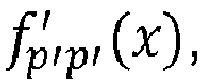
- Here, an iterative polynomial P'f (x) is preferably evaluated based only on the k input values x1, ..., xj, ...., xk and their corresponding processing function values f(x1 ),...,f(xj ),...,f(xk ). The k resulting values P'f (x 1), ...,P'f (xj ), ...,P'f (xk ) output by this iterative polynomial P'f(.) then serve once more as input to this iterative polynomial P'f (x). The resulting coarsely k-discretized P'f (P'f (xj )) (with j in [1,k]) is then turned in a manner known per se into a LUT'p'p' representing P'f (P'f (xj )) and having the k input values x1, ..., xj, ...., xk as entries. This LUT'p'p', which represents a function

- After minimizing the difference

- As an example, this procedure is applied to the above PQ EOTF using a 6-degree polynomial, and a 5-bin target LUT, with results shown in
figure 3 . This figure illustrates a comparison between approximating the processing function ("function to approximate") using a single application of a 5-bin LUT, or using a single application of a 10-bin LUT, or using a double application of a 5-bin LUT as in the above method. This figure shows that the modeling of the processing function by a double application of a 5-bin LUT is as accurate as the modeling of the processing function by a single application of a 10-bin LUT. - The advantage of approximating a function of input values of data by applying iteratively a small size LUT to these input values will now be shown in comparison with approximating the function of input values of data by applying once a bigger LUT to these input values.
- When comparing the above situation of a two-iterative 5-bin LUT"p"p" approximating the PQ EOTF with a situation of a single 10-bit LUT approximating the PQ EOTF, the mean absolute error induced by the double application of the small LUT"p"p" is 0.0046, whereas a single application of a 10-bin bigger LUT induces a higher mean absolute error of 0.0096. The double application of the small LUT"p"p" is therefore a better approximation of the PQ EOTF that a single application of the 10-bin bigger LUT.
- The distribution shown in
figure 4 of the absolute errors over the input range of input values shows that the error made by applying two times the smaller LUT"p"p" is the smallest over the full range of input values. It can also be seen that the error of this iterative method can be both positive and negative, so that the maximum error is small. Comparatively, as shown infigure 4 , conventional single application of a LUT leads to errors that are always positive or always negative. - Finally, note that by incorporating a small k-bin LUT"p"p" into the iterative function fp (x), the approximating polynomial Pf (x) is no longer accurate, as shown in
figure 5 . This demonstrates the interest of evaluating an iterative polynomial based not on a sampled grid of a large number of input values (for instance 1000 as described above), but based only on k input values x1, ..., xj, ...., xk distributed over the range of input values, where k is the number of bin of the targeted iterative LUT . - Still in the first part of this embodiment, a method to obtain a lookup table LUT to apply iteratively over more than two iterations will be described.
- To approximate a function h(x) with n repeated applications of an iterative function f(x), the iterative function fp (x) is given by:

- To approximate a function h(x) with an iterative LUT applied over n iterations, the iterative function fp (x) is given by:


- As an example, using the above method, the so-called Slog3 opto-electrical transfer function (OETF) is approximated with an iterative 5-bin LUT applied over 3 iterations. The accuracy of this approximation is shown in
figure 6 (see curve "3 LUTS, 5 elements" compared to "1 LUT, 5 elements" or compared to "1 LUT, 15 elements"). This figure illustrates that an iterative 5-bin LUT applied over 3 iterations is at least as accurate than a single application of a 15-bin LUT. - The error induced by this approximation is shown in
figure 7 . The mean absolute error of 3-iterated 5-bin LUT is 0.0038. For comparison, a conventional single-applied 15-bin LUT induces a higher mean absolute error of 0.0048. - Still in the first part of this embodiment, it may be noticed that, once a processing function h(x) is given, there is generally no uniquely defined solution to determine a iterative function such that:

- However, under certain circumstances it is possible to approximate an iterative function to an arguably simpler problem, namely to find an approximation to the iterative function f such that when applied twice it approximates the processing function h(x):

- In a second part of this embodiment, a method of processing input values of data x using a lookup-table (LUT) comprising applying iteratively this lookup-table over at least two iterations will be briefly described. This iterative lookup-table is notably defined as described in the first part of this embodiment, using usual computing means.
- The method is notably implemented on a platform comprising at least one processor configured in a manner known per se to implement it. This platform can be for instance a mobile device as a tablet, a communication device as a smartphone, a game device, a laptop, a camera, a chip as an encoding chip, a server as a broadcast server or web server, a TV set or a Set-Top Box.
- This processing method comprises at least two iterations : a first iteration in which the lookup-table is applied to the input values resulting in first output values and a second iteration in which the lookup-table is applied to the first output values resulting in second output values.
- When the input value is different from an input value x1, ..., xj, ...., xk of the lookup table, an interpolation is performed between input values of the lookup table to output an output value that is interpolated between the corresponding output values of the lookup table. Such an interpolation is performed in an manner known per se in the field of lookup tables. Preferably, this interpolation is linear, saving then advantageously computing resources. Although interpolation is linear, the approximation of a processing function remains accurate due notably to the multiple iterations of the method.
- Preferably, input values to process represents colors. For instance, input values to process are R,G,B values representing colors in a RGB color space. Preferably, as described in the first part of the embodiment above, the at least two iterations of the lookup table models a transfer function such as an Electro-Optical Transfer Function (EOTF), an Optical Electrical Transfer Function (OETF), a gamma function or a Slog / Slog2 / Slog3 function, or models a tone mapping or an inverse tone mapping function. By replacing these processing functions with multiple iterations of one LUT, a high accuracy approximation at a low computational cost may be obtained.
- A processing function h(x) that can be modeled by iterative application of a given LUT preferably adheres to the following characteristics.
- First, the processing function h(x) is preferably strictly monotonically increasing or strictly monotonically decreasing:


- This means that the processing function h(x) is preferably bijective, although may have inflection points.
- Further, a given non-linear processing function h(x) may have over its range of values a certain (varying) curvature. This curvature, along with the bin spacing and the assumed use of linear interpolation, has direct impact on the accuracy of a LUT. For example, for processing functions that have a smaller curvature (i.e., they are straighter), the accuracy of a corresponding LUT will be higher than for other functions.
- Still further, when a highly non-linear target function h(x) is decomposed into a double application of a same f(x) such that h(x) = (f°f)(x), then the curvature of f(x) is less than that of h(x) in the range x ∈ [0,1]. Thus, a LUT with a given number of bins approximating f(x) will be of higher accuracy than a LUT with the same number of bins approximating directly h(x). In practice, it is found that applying two k-bin LUTs in succession to approximate (f°f)(x) is twice as accurate as approximating h(x) directly with a single 2k-bin LUT.
- Note that when the processing function h(x) to be approximated is linear, finding a solution f(x) such that h(x) = (f°f)(x) is trivial. Assuming that h(x) = kx, then f(x) can be chosen to be


- When h(x) = xγ (as for very usual so-called gamma functions), the iterative function can be


- Preferably, both input and output of a processing function are bounded to a given range. Such a range may be bounded to be between 0 and 1, although any number of other ranges are possible:


- The method of processing input values of data is notably advantageous, because an approximation of a processing function h(x) by multiple iteration of a given function f(x) has been found generally more accurate than an approximation of this processing function h(x) by different intermediate functions f 1(x),..., fr (x),..,fQ (x) such that h(x) = f 1(...(fr (...(fQ (x))...)) ...).
- Although the illustrative embodiments of the invention have been described herein with reference to the accompanying drawings, it is to be understood that the present invention is not limited to those precise embodiments, and that various changes and modifications may be effected therein by one of ordinary skill in the pertinent art without departing from the invention. All such changes and modifications are intended to be included within the scope of the present invention as set forth in the appended claims.
Claims (12)
- A method of processing input values of data x using a lookup-table LUT comprising applying iteratively said lookup-table over at least two iterations.
- The method of claim 1 wherein the at least two iterations comprise a first iteration in which said lookup-table LUT is applied to said input values resulting in first output values and in which said lookup-table LUT is applied to said first output values resulting in second output values.
- The method of claim 1 or 2 comprising interpolating for said iterative application of said lookup table.
- The method of claim 3 wherein said interpolating for an application of said lookup table is performed between input values of said lookup table and between output values of said lookup table.
- The method of claim 4 wherein said interpolating is linear.
- The method of any one of the previous claims wherein said lookup table is multidimensional.
- The method of any one of the previous claims wherein said data represent colors.
- The method of any one of the previous claims wherein the at least two iterations of said lookup table models a processing function which is nonlinear and bijective.
- The method of claim 8 depending on claim 7, wherein said processing function is chosen in the group composed of a transfer function, a tone mapping and an inverse tone mapping function.
- A device comprising at least one processor configured to implement the method according to any one of claims 1 to 9.
- The device of claim 10 chosen in the group composed of a mobile device, a communication device, a game device, a laptop, a camera, a chip, a server, a TV set and a Set-Top Box.
- A computable readable storage medium comprising stored instructions that when executed by a processor performs the method of any one of claims 1 to 9.
Priority Applications (2)
| Application Number | Priority Date | Filing Date | Title |
|---|---|---|---|
| EP18305894.0A EP3591955B1 (en) | 2018-07-06 | 2018-07-06 | Method of processing data by an iterative application of a same lut |
| US16/503,562 US20200013192A1 (en) | 2018-07-06 | 2019-07-04 | Method of processing data by an iterative application of a same lut |
Applications Claiming Priority (1)
| Application Number | Priority Date | Filing Date | Title |
|---|---|---|---|
| EP18305894.0A EP3591955B1 (en) | 2018-07-06 | 2018-07-06 | Method of processing data by an iterative application of a same lut |
Publications (2)
| Publication Number | Publication Date |
|---|---|
| EP3591955A1 true EP3591955A1 (en) | 2020-01-08 |
| EP3591955B1 EP3591955B1 (en) | 2025-10-01 |
Family
ID=63174162
Family Applications (1)
| Application Number | Title | Priority Date | Filing Date |
|---|---|---|---|
| EP18305894.0A Active EP3591955B1 (en) | 2018-07-06 | 2018-07-06 | Method of processing data by an iterative application of a same lut |
Country Status (2)
| Country | Link |
|---|---|
| US (1) | US20200013192A1 (en) |
| EP (1) | EP3591955B1 (en) |
Families Citing this family (2)
| Publication number | Priority date | Publication date | Assignee | Title |
|---|---|---|---|---|
| US11651719B2 (en) * | 2020-09-25 | 2023-05-16 | Apple Inc. | Enhanced smoothness digital-to-analog converter interpolation systems and methods |
| KR102529602B1 (en) * | 2021-07-19 | 2023-05-08 | 주식회사 사피온코리아 | Method and Apparatus for Function Approximation by Using Multi-level Lookup Table |
Citations (1)
| Publication number | Priority date | Publication date | Assignee | Title |
|---|---|---|---|---|
| US20120188229A1 (en) * | 2011-01-25 | 2012-07-26 | Dolby Laboratories Licensing Corporation | Enhanced Lookup of Display Driving Values |
Family Cites Families (6)
| Publication number | Priority date | Publication date | Assignee | Title |
|---|---|---|---|---|
| US8593708B2 (en) * | 2010-03-15 | 2013-11-26 | Xerox Corporation | Methods, systems and apparatus for jointly optimizing node locations and corresponding output values of a color look-up-table (LUT) |
| WO2016130066A1 (en) * | 2015-02-13 | 2016-08-18 | Telefonaktiebolaget Lm Ericsson (Publ) | Pixel pre-processing and encoding |
| WO2017059043A1 (en) * | 2015-09-30 | 2017-04-06 | Dolby Laboratories Licensing Corporation | 2d lut color transforms with reduced memory footprint |
| US10080005B2 (en) * | 2015-11-09 | 2018-09-18 | Netflix, Inc. | High dynamic range color conversion correction |
| US10223774B2 (en) * | 2016-02-02 | 2019-03-05 | Dolby Laboratories Licensing Corporation | Single-pass and multi-pass-based polynomial approximations for reshaping functions |
| US10930223B2 (en) * | 2016-12-22 | 2021-02-23 | Dolby Laboratories Licensing Corporation | Ambient light-adaptive display management |
-
2018
- 2018-07-06 EP EP18305894.0A patent/EP3591955B1/en active Active
-
2019
- 2019-07-04 US US16/503,562 patent/US20200013192A1/en not_active Abandoned
Patent Citations (1)
| Publication number | Priority date | Publication date | Assignee | Title |
|---|---|---|---|---|
| US20120188229A1 (en) * | 2011-01-25 | 2012-07-26 | Dolby Laboratories Licensing Corporation | Enhanced Lookup of Display Driving Values |
Non-Patent Citations (1)
| Title |
|---|
| SHADROKH SAMAVI ET AL: "Reduction of Look Up Tables for Computation of Reciprocal of Square Roots", 12 October 2017 (2017-10-12), XP055521052, Retrieved from the Internet <URL:https://arxiv.org/ftp/arxiv/papers/1710/1710.04688.pdf> [retrieved on 20181116] * |
Also Published As
| Publication number | Publication date |
|---|---|
| US20200013192A1 (en) | 2020-01-09 |
| EP3591955B1 (en) | 2025-10-01 |
Similar Documents
| Publication | Publication Date | Title |
|---|---|---|
| US10565254B2 (en) | System and method for storing points of polygons related to an image | |
| US9454810B2 (en) | Correcting chrominance values based onTone-mapped luminance values | |
| CN101360178B (en) | Image processing device and image processing method | |
| US8290259B2 (en) | Device adaptively switching color emphasis processing for image | |
| EP2537139B1 (en) | Method and system for generating enhanced images | |
| US9591187B2 (en) | Image processing that includes reducing a number of colors within a cell of an image | |
| US10542186B2 (en) | 2D LUT color transforms with reduced memory footprint | |
| CN110363279A (en) | Image processing method and device based on convolutional neural network model | |
| CN114390157B (en) | Gamma correction method and system | |
| Gong et al. | 3D color homography model for photo-realistic color transfer re-coding | |
| EP3591955B1 (en) | Method of processing data by an iterative application of a same lut | |
| US10540811B2 (en) | Radial gradient module | |
| US8605329B2 (en) | CMYK color conversion using iterative coordinate revision | |
| US8861850B2 (en) | Digital image color correction | |
| GB2566050A (en) | Luminance-normalised colour spaces | |
| US20020085015A1 (en) | Efficient perceptual/physical color space conversion | |
| CN101401415A (en) | System, method and apparatus for table construction and use in image processing | |
| US11405582B2 (en) | Preprocessing of high-dynamic-range video using a hybrid lookup table scheme | |
| WO2026031454A1 (en) | Network model dynamic quantization method and apparatus, terminal device, and readable storage medium | |
| US20040042020A1 (en) | Color space conversion | |
| US7835044B2 (en) | Method for tetrahedral interpolation computations using data-level parallelism | |
| US8630488B2 (en) | Creating a duotone color effect using an ICC profile | |
| US10540788B2 (en) | Radial gradient module | |
| US7283662B1 (en) | Protecting colors from clipping | |
| CN118379949A (en) | Image display method, device, electronic device and storage medium |
Legal Events
| Date | Code | Title | Description |
|---|---|---|---|
| PUAI | Public reference made under article 153(3) epc to a published international application that has entered the european phase |
Free format text: ORIGINAL CODE: 0009012 |
|
| STAA | Information on the status of an ep patent application or granted ep patent |
Free format text: STATUS: THE APPLICATION HAS BEEN PUBLISHED |
|
| AK | Designated contracting states |
Kind code of ref document: A1 Designated state(s): AL AT BE BG CH CY CZ DE DK EE ES FI FR GB GR HR HU IE IS IT LI LT LU LV MC MK MT NL NO PL PT RO RS SE SI SK SM TR |
|
| AX | Request for extension of the european patent |
Extension state: BA ME |
|
| STAA | Information on the status of an ep patent application or granted ep patent |
Free format text: STATUS: REQUEST FOR EXAMINATION WAS MADE |
|
| 17P | Request for examination filed |
Effective date: 20200630 |
|
| RBV | Designated contracting states (corrected) |
Designated state(s): AL AT BE BG CH CY CZ DE DK EE ES FI FR GB GR HR HU IE IS IT LI LT LU LV MC MK MT NL NO PL PT RO RS SE SI SK SM TR |
|
| STAA | Information on the status of an ep patent application or granted ep patent |
Free format text: STATUS: EXAMINATION IS IN PROGRESS |
|
| 17Q | First examination report despatched |
Effective date: 20211013 |
|
| RAP1 | Party data changed (applicant data changed or rights of an application transferred) |
Owner name: INTERDIGITAL MADISON PATENT HOLDINGS, SAS |
|
| RAP3 | Party data changed (applicant data changed or rights of an application transferred) |
Owner name: INTERDIGITAL MADISON PATENT HOLDINGS, SAS |
|
| GRAP | Despatch of communication of intention to grant a patent |
Free format text: ORIGINAL CODE: EPIDOSNIGR1 |
|
| STAA | Information on the status of an ep patent application or granted ep patent |
Free format text: STATUS: GRANT OF PATENT IS INTENDED |
|
| RIC1 | Information provided on ipc code assigned before grant |
Ipc: G09G 5/06 20060101ALN20250411BHEP Ipc: H04N 1/60 20060101AFI20250411BHEP |
|
| INTG | Intention to grant announced |
Effective date: 20250429 |
|
| GRAS | Grant fee paid |
Free format text: ORIGINAL CODE: EPIDOSNIGR3 |
|
| GRAA | (expected) grant |
Free format text: ORIGINAL CODE: 0009210 |
|
| STAA | Information on the status of an ep patent application or granted ep patent |
Free format text: STATUS: THE PATENT HAS BEEN GRANTED |
|
| AK | Designated contracting states |
Kind code of ref document: B1 Designated state(s): AL AT BE BG CH CY CZ DE DK EE ES FI FR GB GR HR HU IE IS IT LI LT LU LV MC MK MT NL NO PL PT RO RS SE SI SK SM TR |
|
| REG | Reference to a national code |
Ref country code: GB Ref legal event code: FG4D Ref country code: CH Ref legal event code: F10 Free format text: ST27 STATUS EVENT CODE: U-0-0-F10-F00 (AS PROVIDED BY THE NATIONAL OFFICE) Effective date: 20251001 |
|
| REG | Reference to a national code |
Ref country code: IE Ref legal event code: FG4D |
|
| REG | Reference to a national code |
Ref country code: DE Ref legal event code: R096 Ref document number: 602018085983 Country of ref document: DE |
|
| REG | Reference to a national code |
Ref country code: NL Ref legal event code: FP |
|
| P01 | Opt-out of the competence of the unified patent court (upc) registered |
Free format text: CASE NUMBER: UPC_APP_9031_3591955/2025 Effective date: 20251006 |
|
| REG | Reference to a national code |
Ref country code: AT Ref legal event code: MK05 Ref document number: 1843801 Country of ref document: AT Kind code of ref document: T Effective date: 20251001 |
|
| PG25 | Lapsed in a contracting state [announced via postgrant information from national office to epo] |
Ref country code: ES Free format text: LAPSE BECAUSE OF FAILURE TO SUBMIT A TRANSLATION OF THE DESCRIPTION OR TO PAY THE FEE WITHIN THE PRESCRIBED TIME-LIMIT Effective date: 20251001 |
|
| REG | Reference to a national code |
Ref country code: LT Ref legal event code: MG9D |
|
| PG25 | Lapsed in a contracting state [announced via postgrant information from national office to epo] |
Ref country code: NO Free format text: LAPSE BECAUSE OF FAILURE TO SUBMIT A TRANSLATION OF THE DESCRIPTION OR TO PAY THE FEE WITHIN THE PRESCRIBED TIME-LIMIT Effective date: 20260101 |
|
| PG25 | Lapsed in a contracting state [announced via postgrant information from national office to epo] |
Ref country code: HR Free format text: LAPSE BECAUSE OF FAILURE TO SUBMIT A TRANSLATION OF THE DESCRIPTION OR TO PAY THE FEE WITHIN THE PRESCRIBED TIME-LIMIT Effective date: 20251001 Ref country code: AT Free format text: LAPSE BECAUSE OF FAILURE TO SUBMIT A TRANSLATION OF THE DESCRIPTION OR TO PAY THE FEE WITHIN THE PRESCRIBED TIME-LIMIT Effective date: 20251001 Ref country code: FI Free format text: LAPSE BECAUSE OF FAILURE TO SUBMIT A TRANSLATION OF THE DESCRIPTION OR TO PAY THE FEE WITHIN THE PRESCRIBED TIME-LIMIT Effective date: 20251001 |
|
| PG25 | Lapsed in a contracting state [announced via postgrant information from national office to epo] |
Ref country code: RS Free format text: LAPSE BECAUSE OF FAILURE TO SUBMIT A TRANSLATION OF THE DESCRIPTION OR TO PAY THE FEE WITHIN THE PRESCRIBED TIME-LIMIT Effective date: 20260101 |
|
| PG25 | Lapsed in a contracting state [announced via postgrant information from national office to epo] |
Ref country code: IS Free format text: LAPSE BECAUSE OF FAILURE TO SUBMIT A TRANSLATION OF THE DESCRIPTION OR TO PAY THE FEE WITHIN THE PRESCRIBED TIME-LIMIT Effective date: 20260201 |
|
| PG25 | Lapsed in a contracting state [announced via postgrant information from national office to epo] |
Ref country code: CZ Free format text: LAPSE BECAUSE OF FAILURE TO SUBMIT A TRANSLATION OF THE DESCRIPTION OR TO PAY THE FEE WITHIN THE PRESCRIBED TIME-LIMIT Effective date: 20251001 Ref country code: PT Free format text: LAPSE BECAUSE OF FAILURE TO SUBMIT A TRANSLATION OF THE DESCRIPTION OR TO PAY THE FEE WITHIN THE PRESCRIBED TIME-LIMIT Effective date: 20260202 |
|
| PG25 | Lapsed in a contracting state [announced via postgrant information from national office to epo] |
Ref country code: PL Free format text: LAPSE BECAUSE OF FAILURE TO SUBMIT A TRANSLATION OF THE DESCRIPTION OR TO PAY THE FEE WITHIN THE PRESCRIBED TIME-LIMIT Effective date: 20251001 |
|
| PG25 | Lapsed in a contracting state [announced via postgrant information from national office to epo] |
Ref country code: LV Free format text: LAPSE BECAUSE OF FAILURE TO SUBMIT A TRANSLATION OF THE DESCRIPTION OR TO PAY THE FEE WITHIN THE PRESCRIBED TIME-LIMIT Effective date: 20251001 |