EP3590921A1 - Alkyl sulfate ester or salt of same - Google Patents
Alkyl sulfate ester or salt of same Download PDFInfo
- Publication number
- EP3590921A1 EP3590921A1 EP18777204.1A EP18777204A EP3590921A1 EP 3590921 A1 EP3590921 A1 EP 3590921A1 EP 18777204 A EP18777204 A EP 18777204A EP 3590921 A1 EP3590921 A1 EP 3590921A1
- Authority
- EP
- European Patent Office
- Prior art keywords
- substituent
- sup
- compound
- group
- optionally containing
- Prior art date
- Legal status (The legal status is an assumption and is not a legal conclusion. Google has not performed a legal analysis and makes no representation as to the accuracy of the status listed.)
- Pending
Links
- -1 Alkyl sulfate ester Chemical class 0.000 title claims abstract description 24
- 150000003839 salts Chemical class 0.000 title abstract description 4
- 150000001875 compounds Chemical class 0.000 claims abstract description 112
- 125000001424 substituent group Chemical group 0.000 claims abstract description 102
- 125000000217 alkyl group Chemical group 0.000 claims abstract description 69
- 125000004432 carbon atom Chemical group C* 0.000 claims abstract description 43
- 125000002915 carbonyl group Chemical group [*:2]C([*:1])=O 0.000 claims abstract description 28
- 125000006165 cyclic alkyl group Chemical group 0.000 claims abstract description 20
- 125000006832 (C1-C10) alkylene group Chemical group 0.000 claims abstract description 10
- 125000000962 organic group Chemical group 0.000 claims abstract description 10
- 125000004429 atom Chemical group 0.000 claims abstract description 9
- 229910052751 metal Inorganic materials 0.000 claims abstract description 8
- 239000002184 metal Substances 0.000 claims abstract description 8
- 125000004178 (C1-C4) alkyl group Chemical group 0.000 claims abstract description 6
- RAXXELZNTBOGNW-UHFFFAOYSA-O Imidazolium Chemical compound C1=C[NH+]=CN1 RAXXELZNTBOGNW-UHFFFAOYSA-O 0.000 claims abstract description 4
- XYFCBTPGUUZFHI-UHFFFAOYSA-O phosphonium Chemical compound [PH4+] XYFCBTPGUUZFHI-UHFFFAOYSA-O 0.000 claims abstract description 4
- JUJWROOIHBZHMG-UHFFFAOYSA-O pyridinium Chemical compound C1=CC=[NH+]C=C1 JUJWROOIHBZHMG-UHFFFAOYSA-O 0.000 claims abstract description 4
- 125000000623 heterocyclic group Chemical group 0.000 claims description 23
- 125000002947 alkylene group Chemical group 0.000 claims description 14
- 238000004519 manufacturing process Methods 0.000 claims description 13
- 230000001590 oxidative effect Effects 0.000 claims description 6
- 239000002270 dispersing agent Substances 0.000 claims description 5
- 229910021653 sulphate ion Inorganic materials 0.000 claims description 4
- RTZKZFJDLAIYFH-UHFFFAOYSA-N Diethyl ether Chemical compound CCOCC RTZKZFJDLAIYFH-UHFFFAOYSA-N 0.000 description 94
- YMWUJEATGCHHMB-UHFFFAOYSA-N Dichloromethane Chemical compound ClCCl YMWUJEATGCHHMB-UHFFFAOYSA-N 0.000 description 72
- UHOVQNZJYSORNB-UHFFFAOYSA-N Benzene Chemical compound C1=CC=CC=C1 UHOVQNZJYSORNB-UHFFFAOYSA-N 0.000 description 66
- YXFVVABEGXRONW-UHFFFAOYSA-N Toluene Chemical compound CC1=CC=CC=C1 YXFVVABEGXRONW-UHFFFAOYSA-N 0.000 description 66
- WYURNTSHIVDZCO-UHFFFAOYSA-N Tetrahydrofuran Chemical compound C1CCOC1 WYURNTSHIVDZCO-UHFFFAOYSA-N 0.000 description 48
- HEDRZPFGACZZDS-UHFFFAOYSA-N Chloroform Chemical compound ClC(Cl)Cl HEDRZPFGACZZDS-UHFFFAOYSA-N 0.000 description 44
- WEVYAHXRMPXWCK-UHFFFAOYSA-N Acetonitrile Chemical compound CC#N WEVYAHXRMPXWCK-UHFFFAOYSA-N 0.000 description 36
- 238000000034 method Methods 0.000 description 32
- ZMXDDKWLCZADIW-UHFFFAOYSA-N N,N-Dimethylformamide Chemical compound CN(C)C=O ZMXDDKWLCZADIW-UHFFFAOYSA-N 0.000 description 30
- 239000002904 solvent Substances 0.000 description 30
- 125000005843 halogen group Chemical group 0.000 description 28
- LFQSCWFLJHTTHZ-UHFFFAOYSA-N Ethanol Chemical compound CCO LFQSCWFLJHTTHZ-UHFFFAOYSA-N 0.000 description 27
- YLQBMQCUIZJEEH-UHFFFAOYSA-N Furan Chemical group C=1C=COC=1 YLQBMQCUIZJEEH-UHFFFAOYSA-N 0.000 description 25
- 238000006243 chemical reaction Methods 0.000 description 25
- 125000002496 methyl group Chemical group [H]C([H])([H])* 0.000 description 25
- OKKJLVBELUTLKV-UHFFFAOYSA-N Methanol Chemical compound OC OKKJLVBELUTLKV-UHFFFAOYSA-N 0.000 description 24
- RFFLAFLAYFXFSW-UHFFFAOYSA-N 1,2-dichlorobenzene Chemical compound ClC1=CC=CC=C1Cl RFFLAFLAYFXFSW-UHFFFAOYSA-N 0.000 description 22
- 150000004945 aromatic hydrocarbons Chemical class 0.000 description 22
- MVPPADPHJFYWMZ-UHFFFAOYSA-N chlorobenzene Chemical compound ClC1=CC=CC=C1 MVPPADPHJFYWMZ-UHFFFAOYSA-N 0.000 description 22
- 150000008282 halocarbons Chemical class 0.000 description 22
- 230000003647 oxidation Effects 0.000 description 22
- 238000007254 oxidation reaction Methods 0.000 description 22
- CSCPPACGZOOCGX-UHFFFAOYSA-N Acetone Chemical compound CC(C)=O CSCPPACGZOOCGX-UHFFFAOYSA-N 0.000 description 18
- JFDZBHWFFUWGJE-UHFFFAOYSA-N benzonitrile Chemical compound N#CC1=CC=CC=C1 JFDZBHWFFUWGJE-UHFFFAOYSA-N 0.000 description 18
- XLYOFNOQVPJJNP-UHFFFAOYSA-N water Substances O XLYOFNOQVPJJNP-UHFFFAOYSA-N 0.000 description 17
- SECXISVLQFMRJM-UHFFFAOYSA-N N-Methylpyrrolidone Chemical compound CN1CCCC1=O SECXISVLQFMRJM-UHFFFAOYSA-N 0.000 description 16
- XEKOWRVHYACXOJ-UHFFFAOYSA-N Ethyl acetate Chemical compound CCOC(C)=O XEKOWRVHYACXOJ-UHFFFAOYSA-N 0.000 description 15
- 239000011734 sodium Substances 0.000 description 14
- 125000003118 aryl group Chemical group 0.000 description 13
- 238000005886 esterification reaction Methods 0.000 description 13
- QTBSBXVTEAMEQO-UHFFFAOYSA-N Acetic acid Chemical compound CC(O)=O QTBSBXVTEAMEQO-UHFFFAOYSA-N 0.000 description 12
- 125000001495 ethyl group Chemical group [H]C([H])([H])C([H])([H])* 0.000 description 12
- 150000002825 nitriles Chemical class 0.000 description 12
- SCYULBFZEHDVBN-UHFFFAOYSA-N 1,1-Dichloroethane Chemical compound CC(Cl)Cl SCYULBFZEHDVBN-UHFFFAOYSA-N 0.000 description 11
- RYHBNJHYFVUHQT-UHFFFAOYSA-N 1,4-Dioxane Chemical compound C1COCCO1 RYHBNJHYFVUHQT-UHFFFAOYSA-N 0.000 description 11
- RRQYJINTUHWNHW-UHFFFAOYSA-N 1-ethoxy-2-(2-ethoxyethoxy)ethane Chemical compound CCOCCOCCOCC RRQYJINTUHWNHW-UHFFFAOYSA-N 0.000 description 11
- CTQNGGLPUBDAKN-UHFFFAOYSA-N O-Xylene Chemical compound CC1=CC=CC=C1C CTQNGGLPUBDAKN-UHFFFAOYSA-N 0.000 description 11
- 125000001931 aliphatic group Chemical group 0.000 description 11
- 229940019778 diethylene glycol diethyl ether Drugs 0.000 description 11
- 239000008096 xylene Substances 0.000 description 11
- HEDRZPFGACZZDS-MICDWDOJSA-N Trichloro(2H)methane Chemical compound [2H]C(Cl)(Cl)Cl HEDRZPFGACZZDS-MICDWDOJSA-N 0.000 description 10
- 239000003960 organic solvent Substances 0.000 description 10
- AKEJUJNQAAGONA-UHFFFAOYSA-N sulfur trioxide Inorganic materials O=S(=O)=O AKEJUJNQAAGONA-UHFFFAOYSA-N 0.000 description 10
- ZWEHNKRNPOVVGH-UHFFFAOYSA-N 2-Butanone Chemical compound CCC(C)=O ZWEHNKRNPOVVGH-UHFFFAOYSA-N 0.000 description 9
- 239000000203 mixture Substances 0.000 description 9
- 150000002894 organic compounds Chemical class 0.000 description 9
- BDERNNFJNOPAEC-UHFFFAOYSA-N propan-1-ol Chemical compound CCCO BDERNNFJNOPAEC-UHFFFAOYSA-N 0.000 description 9
- AZQWKYJCGOJGHM-UHFFFAOYSA-N 1,4-benzoquinone Chemical compound O=C1C=CC(=O)C=C1 AZQWKYJCGOJGHM-UHFFFAOYSA-N 0.000 description 8
- 238000005160 1H NMR spectroscopy Methods 0.000 description 8
- FXHOOIRPVKKKFG-UHFFFAOYSA-N N,N-Dimethylacetamide Chemical compound CN(C)C(C)=O FXHOOIRPVKKKFG-UHFFFAOYSA-N 0.000 description 8
- NKLCNNUWBJBICK-UHFFFAOYSA-N dess–martin periodinane Chemical compound C1=CC=C2I(OC(=O)C)(OC(C)=O)(OC(C)=O)OC(=O)C2=C1 NKLCNNUWBJBICK-UHFFFAOYSA-N 0.000 description 8
- 150000002170 ethers Chemical class 0.000 description 8
- 150000002576 ketones Chemical class 0.000 description 8
- QJGQUHMNIGDVPM-UHFFFAOYSA-N nitrogen group Chemical group [N] QJGQUHMNIGDVPM-UHFFFAOYSA-N 0.000 description 8
- LEHBURLTIWGHEM-UHFFFAOYSA-N pyridinium chlorochromate Chemical compound [O-][Cr](Cl)(=O)=O.C1=CC=[NH+]C=C1 LEHBURLTIWGHEM-UHFFFAOYSA-N 0.000 description 8
- 239000003153 chemical reaction reagent Substances 0.000 description 7
- 125000004435 hydrogen atom Chemical group [H]* 0.000 description 7
- 239000007800 oxidant agent Substances 0.000 description 7
- 239000000243 solution Substances 0.000 description 7
- 230000001180 sulfating effect Effects 0.000 description 7
- QGZKDVFQNNGYKY-UHFFFAOYSA-N Ammonia Chemical compound N QGZKDVFQNNGYKY-UHFFFAOYSA-N 0.000 description 6
- IAZDPXIOMUYVGZ-UHFFFAOYSA-N Dimethylsulphoxide Chemical compound CS(C)=O IAZDPXIOMUYVGZ-UHFFFAOYSA-N 0.000 description 6
- KFZMGEQAYNKOFK-UHFFFAOYSA-N Isopropanol Chemical compound CC(C)O KFZMGEQAYNKOFK-UHFFFAOYSA-N 0.000 description 6
- IMNFDUFMRHMDMM-UHFFFAOYSA-N N-Heptane Chemical compound CCCCCCC IMNFDUFMRHMDMM-UHFFFAOYSA-N 0.000 description 6
- 150000001298 alcohols Chemical class 0.000 description 6
- KVNRLNFWIYMESJ-UHFFFAOYSA-N butyronitrile Chemical compound CCCC#N KVNRLNFWIYMESJ-UHFFFAOYSA-N 0.000 description 6
- 239000003795 chemical substances by application Substances 0.000 description 6
- 125000001309 chloro group Chemical group Cl* 0.000 description 6
- JHIVVAPYMSGYDF-UHFFFAOYSA-N cyclohexanone Chemical compound O=C1CCCCC1 JHIVVAPYMSGYDF-UHFFFAOYSA-N 0.000 description 6
- SWXVUIWOUIDPGS-UHFFFAOYSA-N diacetone alcohol Chemical compound CC(=O)CC(C)(C)O SWXVUIWOUIDPGS-UHFFFAOYSA-N 0.000 description 6
- 125000001153 fluoro group Chemical group F* 0.000 description 6
- LRDFRRGEGBBSRN-UHFFFAOYSA-N isobutyronitrile Chemical compound CC(C)C#N LRDFRRGEGBBSRN-UHFFFAOYSA-N 0.000 description 6
- FVSKHRXBFJPNKK-UHFFFAOYSA-N propionitrile Chemical compound CCC#N FVSKHRXBFJPNKK-UHFFFAOYSA-N 0.000 description 6
- 229910052708 sodium Inorganic materials 0.000 description 6
- 238000001228 spectrum Methods 0.000 description 6
- MHAJPDPJQMAIIY-UHFFFAOYSA-N Hydrogen peroxide Chemical group OO MHAJPDPJQMAIIY-UHFFFAOYSA-N 0.000 description 5
- QVGXLLKOCUKJST-UHFFFAOYSA-N atomic oxygen Chemical compound [O] QVGXLLKOCUKJST-UHFFFAOYSA-N 0.000 description 5
- 238000006735 epoxidation reaction Methods 0.000 description 5
- LYCAIKOWRPUZTN-UHFFFAOYSA-N ethylene glycol Natural products OCCO LYCAIKOWRPUZTN-UHFFFAOYSA-N 0.000 description 5
- 229910052760 oxygen Inorganic materials 0.000 description 5
- 239000001301 oxygen Substances 0.000 description 5
- 238000005949 ozonolysis reaction Methods 0.000 description 5
- CYSGHNMQYZDMIA-UHFFFAOYSA-N 1,3-Dimethyl-2-imidazolidinon Chemical compound CN1CCN(C)C1=O CYSGHNMQYZDMIA-UHFFFAOYSA-N 0.000 description 4
- 229940005561 1,4-benzoquinone Drugs 0.000 description 4
- GIEMHYCMBGELGY-UHFFFAOYSA-N 10-undecen-1-ol Chemical compound OCCCCCCCCCC=C GIEMHYCMBGELGY-UHFFFAOYSA-N 0.000 description 4
- NHQDETIJWKXCTC-UHFFFAOYSA-N 3-chloroperbenzoic acid Chemical compound OOC(=O)C1=CC=CC(Cl)=C1 NHQDETIJWKXCTC-UHFFFAOYSA-N 0.000 description 4
- PCLIMKBDDGJMGD-UHFFFAOYSA-N N-bromosuccinimide Chemical compound BrN1C(=O)CCC1=O PCLIMKBDDGJMGD-UHFFFAOYSA-N 0.000 description 4
- XYFCBTPGUUZFHI-UHFFFAOYSA-N Phosphine Chemical compound P XYFCBTPGUUZFHI-UHFFFAOYSA-N 0.000 description 4
- JUJWROOIHBZHMG-UHFFFAOYSA-N Pyridine Chemical compound C1=CC=NC=C1 JUJWROOIHBZHMG-UHFFFAOYSA-N 0.000 description 4
- WQDUMFSSJAZKTM-UHFFFAOYSA-N Sodium methoxide Chemical compound [Na+].[O-]C WQDUMFSSJAZKTM-UHFFFAOYSA-N 0.000 description 4
- QAOWNCQODCNURD-UHFFFAOYSA-N Sulfuric acid Chemical compound OS(O)(=O)=O QAOWNCQODCNURD-UHFFFAOYSA-N 0.000 description 4
- WGLPBDUCMAPZCE-UHFFFAOYSA-N Trioxochromium Chemical compound O=[Cr](=O)=O WGLPBDUCMAPZCE-UHFFFAOYSA-N 0.000 description 4
- 125000003277 amino group Chemical group 0.000 description 4
- 150000001735 carboxylic acids Chemical class 0.000 description 4
- XBDQKXXYIPTUBI-UHFFFAOYSA-N dimethylselenoniopropionate Natural products CCC(O)=O XBDQKXXYIPTUBI-UHFFFAOYSA-N 0.000 description 4
- 150000002941 palladium compounds Chemical class 0.000 description 4
- HNJBEVLQSNELDL-UHFFFAOYSA-N pyrrolidin-2-one Chemical compound O=C1CCCN1 HNJBEVLQSNELDL-UHFFFAOYSA-N 0.000 description 4
- CIHOLLKRGTVIJN-UHFFFAOYSA-N tert‐butyl hydroperoxide Chemical compound CC(C)(C)OO CIHOLLKRGTVIJN-UHFFFAOYSA-N 0.000 description 4
- RIOQSEWOXXDEQQ-UHFFFAOYSA-N triphenylphosphine Chemical compound C1=CC=CC=C1P(C=1C=CC=CC=1)C1=CC=CC=C1 RIOQSEWOXXDEQQ-UHFFFAOYSA-N 0.000 description 4
- DBNOPTVASMLBHM-UHFFFAOYSA-N 11-(2-hydroxyethoxy)undecan-2-one Chemical compound OCCOCCCCCCCCCC(C)=O DBNOPTVASMLBHM-UHFFFAOYSA-N 0.000 description 3
- YPLVPFUSXYSHJD-UHFFFAOYSA-N 11-bromoundec-1-ene Chemical compound BrCCCCCCCCCC=C YPLVPFUSXYSHJD-UHFFFAOYSA-N 0.000 description 3
- IACCVEKYDYBVMH-UHFFFAOYSA-N 11-hydroxyundecan-2-one Chemical compound CC(=O)CCCCCCCCCO IACCVEKYDYBVMH-UHFFFAOYSA-N 0.000 description 3
- QMMFVYPAHWMCMS-UHFFFAOYSA-N Dimethyl sulfide Chemical compound CSC QMMFVYPAHWMCMS-UHFFFAOYSA-N 0.000 description 3
- DGAQECJNVWCQMB-PUAWFVPOSA-M Ilexoside XXIX Chemical compound C[C@@H]1CC[C@@]2(CC[C@@]3(C(=CC[C@H]4[C@]3(CC[C@@H]5[C@@]4(CC[C@@H](C5(C)C)OS(=O)(=O)[O-])C)C)[C@@H]2[C@]1(C)O)C)C(=O)O[C@H]6[C@@H]([C@H]([C@@H]([C@H](O6)CO)O)O)O.[Na+] DGAQECJNVWCQMB-PUAWFVPOSA-M 0.000 description 3
- NTIZESTWPVYFNL-UHFFFAOYSA-N Methyl isobutyl ketone Chemical compound CC(C)CC(C)=O NTIZESTWPVYFNL-UHFFFAOYSA-N 0.000 description 3
- UIHCLUNTQKBZGK-UHFFFAOYSA-N Methyl isobutyl ketone Natural products CCC(C)C(C)=O UIHCLUNTQKBZGK-UHFFFAOYSA-N 0.000 description 3
- 229910004727 OSO3H Inorganic materials 0.000 description 3
- KWYUFKZDYYNOTN-UHFFFAOYSA-M Potassium hydroxide Chemical compound [OH-].[K+] KWYUFKZDYYNOTN-UHFFFAOYSA-M 0.000 description 3
- HEMHJVSKTPXQMS-UHFFFAOYSA-M Sodium hydroxide Chemical compound [OH-].[Na+] HEMHJVSKTPXQMS-UHFFFAOYSA-M 0.000 description 3
- QAOWNCQODCNURD-UHFFFAOYSA-L Sulfate Chemical compound [O-]S([O-])(=O)=O QAOWNCQODCNURD-UHFFFAOYSA-L 0.000 description 3
- 239000002585 base Substances 0.000 description 3
- 239000003638 chemical reducing agent Substances 0.000 description 3
- 238000004440 column chromatography Methods 0.000 description 3
- 125000002485 formyl group Chemical group [H]C(*)=O 0.000 description 3
- 230000002140 halogenating effect Effects 0.000 description 3
- 229910052739 hydrogen Inorganic materials 0.000 description 3
- 125000002887 hydroxy group Chemical group [H]O* 0.000 description 3
- 229910052744 lithium Inorganic materials 0.000 description 3
- 239000000463 material Substances 0.000 description 3
- 238000005259 measurement Methods 0.000 description 3
- LULAYUGMBFYYEX-UHFFFAOYSA-N metachloroperbenzoic acid Natural products OC(=O)C1=CC=CC(Cl)=C1 LULAYUGMBFYYEX-UHFFFAOYSA-N 0.000 description 3
- 125000001570 methylene group Chemical group [H]C([H])([*:1])[*:2] 0.000 description 3
- YYHPEVZFVMVUNJ-UHFFFAOYSA-N n,n-diethylethanamine;sulfur trioxide Chemical compound O=S(=O)=O.CCN(CC)CC YYHPEVZFVMVUNJ-UHFFFAOYSA-N 0.000 description 3
- VLKZOEOYAKHREP-UHFFFAOYSA-N n-Hexane Chemical compound CCCCCC VLKZOEOYAKHREP-UHFFFAOYSA-N 0.000 description 3
- 125000001820 oxy group Chemical group [*:1]O[*:2] 0.000 description 3
- 125000005740 oxycarbonyl group Chemical group [*:1]OC([*:2])=O 0.000 description 3
- PIBWKRNGBLPSSY-UHFFFAOYSA-L palladium(II) chloride Chemical compound Cl[Pd]Cl PIBWKRNGBLPSSY-UHFFFAOYSA-L 0.000 description 3
- 229910052700 potassium Inorganic materials 0.000 description 3
- LLHKCFNBLRBOGN-UHFFFAOYSA-N propylene glycol methyl ether acetate Chemical compound COCC(C)OC(C)=O LLHKCFNBLRBOGN-UHFFFAOYSA-N 0.000 description 3
- 125000000565 sulfonamide group Chemical group 0.000 description 3
- 125000000472 sulfonyl group Chemical group *S(*)(=O)=O 0.000 description 3
- 239000004094 surface-active agent Substances 0.000 description 3
- HZNVUJQVZSTENZ-UHFFFAOYSA-N 2,3-dichloro-5,6-dicyano-1,4-benzoquinone Chemical compound ClC1=C(Cl)C(=O)C(C#N)=C(C#N)C1=O HZNVUJQVZSTENZ-UHFFFAOYSA-N 0.000 description 2
- YNJSNEKCXVFDKW-UHFFFAOYSA-N 3-(5-amino-1h-indol-3-yl)-2-azaniumylpropanoate Chemical compound C1=C(N)C=C2C(CC(N)C(O)=O)=CNC2=C1 YNJSNEKCXVFDKW-UHFFFAOYSA-N 0.000 description 2
- XDTMQSROBMDMFD-UHFFFAOYSA-N Cyclohexane Chemical compound C1CCCCC1 XDTMQSROBMDMFD-UHFFFAOYSA-N 0.000 description 2
- 238000006646 Dess-Martin oxidation reaction Methods 0.000 description 2
- UFHFLCQGNIYNRP-UHFFFAOYSA-N Hydrogen Chemical compound [H][H] UFHFLCQGNIYNRP-UHFFFAOYSA-N 0.000 description 2
- 238000006809 Jones oxidation reaction Methods 0.000 description 2
- 239000003810 Jones reagent Substances 0.000 description 2
- WHXSMMKQMYFTQS-UHFFFAOYSA-N Lithium Chemical compound [Li] WHXSMMKQMYFTQS-UHFFFAOYSA-N 0.000 description 2
- JRNVZBWKYDBUCA-UHFFFAOYSA-N N-chlorosuccinimide Chemical compound ClN1C(=O)CCC1=O JRNVZBWKYDBUCA-UHFFFAOYSA-N 0.000 description 2
- 229910003202 NH4 Inorganic materials 0.000 description 2
- 238000005481 NMR spectroscopy Methods 0.000 description 2
- 229910019093 NaOCl Inorganic materials 0.000 description 2
- 229910021586 Nickel(II) chloride Inorganic materials 0.000 description 2
- 238000006036 Oppenauer oxidation reaction Methods 0.000 description 2
- CBENFWSGALASAD-UHFFFAOYSA-N Ozone Chemical compound [O-][O+]=O CBENFWSGALASAD-UHFFFAOYSA-N 0.000 description 2
- 229910002666 PdCl2 Inorganic materials 0.000 description 2
- KFSLWBXXFJQRDL-UHFFFAOYSA-N Peracetic acid Chemical compound CC(=O)OO KFSLWBXXFJQRDL-UHFFFAOYSA-N 0.000 description 2
- CDBYLPFSWZWCQE-UHFFFAOYSA-L Sodium Carbonate Chemical compound [Na+].[Na+].[O-]C([O-])=O CDBYLPFSWZWCQE-UHFFFAOYSA-L 0.000 description 2
- 150000001338 aliphatic hydrocarbons Chemical class 0.000 description 2
- 229910052783 alkali metal Inorganic materials 0.000 description 2
- 150000001340 alkali metals Chemical class 0.000 description 2
- 229910052784 alkaline earth metal Inorganic materials 0.000 description 2
- 150000001342 alkaline earth metals Chemical class 0.000 description 2
- 125000003342 alkenyl group Chemical group 0.000 description 2
- 125000000304 alkynyl group Chemical group 0.000 description 2
- 229910052782 aluminium Inorganic materials 0.000 description 2
- XAGFODPZIPBFFR-UHFFFAOYSA-N aluminium Chemical compound [Al] XAGFODPZIPBFFR-UHFFFAOYSA-N 0.000 description 2
- 239000007864 aqueous solution Substances 0.000 description 2
- 125000006615 aromatic heterocyclic group Chemical group 0.000 description 2
- 125000003710 aryl alkyl group Chemical group 0.000 description 2
- 150000004054 benzoquinones Chemical class 0.000 description 2
- 239000007844 bleaching agent Substances 0.000 description 2
- UORVGPXVDQYIDP-UHFFFAOYSA-N borane Chemical compound B UORVGPXVDQYIDP-UHFFFAOYSA-N 0.000 description 2
- 239000003054 catalyst Substances 0.000 description 2
- 230000003197 catalytic effect Effects 0.000 description 2
- 150000001879 copper Chemical class 0.000 description 2
- ORTQZVOHEJQUHG-UHFFFAOYSA-L copper(II) chloride Chemical compound Cl[Cu]Cl ORTQZVOHEJQUHG-UHFFFAOYSA-L 0.000 description 2
- 125000004093 cyano group Chemical group *C#N 0.000 description 2
- 125000004122 cyclic group Chemical group 0.000 description 2
- 125000001485 cycloalkadienyl group Chemical group 0.000 description 2
- 125000000392 cycloalkenyl group Chemical group 0.000 description 2
- 125000000753 cycloalkyl group Chemical group 0.000 description 2
- DIOQZVSQGTUSAI-UHFFFAOYSA-N decane Chemical compound CCCCCCCCCC DIOQZVSQGTUSAI-UHFFFAOYSA-N 0.000 description 2
- SNRUBQQJIBEYMU-UHFFFAOYSA-N dodecane Chemical compound CCCCCCCCCCCC SNRUBQQJIBEYMU-UHFFFAOYSA-N 0.000 description 2
- 150000002148 esters Chemical class 0.000 description 2
- XLLIQLLCWZCATF-UHFFFAOYSA-N ethylene glycol monomethyl ether acetate Natural products COCCOC(C)=O XLLIQLLCWZCATF-UHFFFAOYSA-N 0.000 description 2
- 125000001072 heteroaryl group Chemical group 0.000 description 2
- 239000001257 hydrogen Substances 0.000 description 2
- WGCNASOHLSPBMP-UHFFFAOYSA-N hydroxyacetaldehyde Natural products OCC=O WGCNASOHLSPBMP-UHFFFAOYSA-N 0.000 description 2
- FBAFATDZDUQKNH-UHFFFAOYSA-M iron chloride Chemical compound [Cl-].[Fe] FBAFATDZDUQKNH-UHFFFAOYSA-M 0.000 description 2
- 159000000014 iron salts Chemical class 0.000 description 2
- 239000007788 liquid Substances 0.000 description 2
- NUJOXMJBOLGQSY-UHFFFAOYSA-N manganese dioxide Chemical compound O=[Mn]=O NUJOXMJBOLGQSY-UHFFFAOYSA-N 0.000 description 2
- BDRTVPCFKSUHCJ-UHFFFAOYSA-N molecular hydrogen;potassium Chemical compound [K].[H][H] BDRTVPCFKSUHCJ-UHFFFAOYSA-N 0.000 description 2
- 150000002816 nickel compounds Chemical class 0.000 description 2
- QMMRZOWCJAIUJA-UHFFFAOYSA-L nickel dichloride Chemical compound Cl[Ni]Cl QMMRZOWCJAIUJA-UHFFFAOYSA-L 0.000 description 2
- BKIMMITUMNQMOS-UHFFFAOYSA-N nonane Chemical compound CCCCCCCCC BKIMMITUMNQMOS-UHFFFAOYSA-N 0.000 description 2
- 150000004965 peroxy acids Chemical class 0.000 description 2
- 150000003003 phosphines Chemical class 0.000 description 2
- 229910000073 phosphorus hydride Inorganic materials 0.000 description 2
- UHKHUAHIAZQAED-UHFFFAOYSA-N phthalocyaninatoiron Chemical compound [Fe].N=1C2=NC(C3=CC=CC=C33)=NC3=NC(C3=CC=CC=C33)=NC3=NC(C3=CC=CC=C33)=NC3=NC=1C1=CC=CC=C12 UHKHUAHIAZQAED-UHFFFAOYSA-N 0.000 description 2
- 229910052939 potassium sulfate Inorganic materials 0.000 description 2
- 239000002244 precipitate Substances 0.000 description 2
- 235000019260 propionic acid Nutrition 0.000 description 2
- 125000004805 propylene group Chemical group [H]C([H])([H])C([H])([*:1])C([H])([H])[*:2] 0.000 description 2
- UMJSCPRVCHMLSP-UHFFFAOYSA-N pyridine Natural products COC1=CC=CN=C1 UMJSCPRVCHMLSP-UHFFFAOYSA-N 0.000 description 2
- IUVKMZGDUIUOCP-BTNSXGMBSA-N quinbolone Chemical compound O([C@H]1CC[C@H]2[C@H]3[C@@H]([C@]4(C=CC(=O)C=C4CC3)C)CC[C@@]21C)C1=CCCC1 IUVKMZGDUIUOCP-BTNSXGMBSA-N 0.000 description 2
- 238000000926 separation method Methods 0.000 description 2
- NZNVUELMEFBGGY-UHFFFAOYSA-M sodium 2-(10-oxoundecoxy)ethyl sulfate Chemical compound S(=O)(=O)(OCCOCCCCCCCCCC(C)=O)[O-].[Na+] NZNVUELMEFBGGY-UHFFFAOYSA-M 0.000 description 2
- 239000012279 sodium borohydride Substances 0.000 description 2
- 229910000033 sodium borohydride Inorganic materials 0.000 description 2
- 229910000104 sodium hydride Inorganic materials 0.000 description 2
- SUKJFIGYRHOWBL-UHFFFAOYSA-N sodium hypochlorite Chemical compound [Na+].Cl[O-] SUKJFIGYRHOWBL-UHFFFAOYSA-N 0.000 description 2
- 239000007787 solid Substances 0.000 description 2
- 125000000475 sulfinyl group Chemical group [*:2]S([*:1])=O 0.000 description 2
- 125000000020 sulfo group Chemical group O=S(=O)([*])O[H] 0.000 description 2
- HXJUTPCZVOIRIF-UHFFFAOYSA-N sulfolane Chemical compound O=S1(=O)CCCC1 HXJUTPCZVOIRIF-UHFFFAOYSA-N 0.000 description 2
- XTHPWXDJESJLNJ-UHFFFAOYSA-N sulfurochloridic acid Chemical compound OS(Cl)(=O)=O XTHPWXDJESJLNJ-UHFFFAOYSA-N 0.000 description 2
- CZDYPVPMEAXLPK-UHFFFAOYSA-N tetramethylsilane Chemical compound C[Si](C)(C)C CZDYPVPMEAXLPK-UHFFFAOYSA-N 0.000 description 2
- 125000004149 thio group Chemical group *S* 0.000 description 2
- UMGDCJDMYOKAJW-UHFFFAOYSA-N thiourea Chemical compound NC(N)=S UMGDCJDMYOKAJW-UHFFFAOYSA-N 0.000 description 2
- JLTRXTDYQLMHGR-UHFFFAOYSA-N trimethylaluminium Chemical compound C[Al](C)C JLTRXTDYQLMHGR-UHFFFAOYSA-N 0.000 description 2
- RSJKGSCJYJTIGS-UHFFFAOYSA-N undecane Chemical compound CCCCCCCCCCC RSJKGSCJYJTIGS-UHFFFAOYSA-N 0.000 description 2
- 125000003837 (C1-C20) alkyl group Chemical group 0.000 description 1
- SIJBDWPVNAYVGY-UHFFFAOYSA-N 2,2-dimethyl-1,3-dioxolane Chemical compound CC1(C)OCCO1 SIJBDWPVNAYVGY-UHFFFAOYSA-N 0.000 description 1
- TVWWSVHQWMVJEU-UHFFFAOYSA-N 2-methyl-2-(trifluoromethyl)-1,3-dioxolane Chemical compound FC(F)(F)C1(C)OCCO1 TVWWSVHQWMVJEU-UHFFFAOYSA-N 0.000 description 1
- VRGCYEIGVVTZCC-UHFFFAOYSA-N 3,4,5,6-tetrachlorocyclohexa-3,5-diene-1,2-dione Chemical compound ClC1=C(Cl)C(=O)C(=O)C(Cl)=C1Cl VRGCYEIGVVTZCC-UHFFFAOYSA-N 0.000 description 1
- FRIBMENBGGCKPD-UHFFFAOYSA-N 3-(2,3-dimethoxyphenyl)prop-2-enal Chemical compound COC1=CC=CC(C=CC=O)=C1OC FRIBMENBGGCKPD-UHFFFAOYSA-N 0.000 description 1
- NLXLAEXVIDQMFP-UHFFFAOYSA-N Ammonia chloride Chemical class [NH4+].[Cl-] NLXLAEXVIDQMFP-UHFFFAOYSA-N 0.000 description 1
- DKPFZGUDAPQIHT-UHFFFAOYSA-N Butyl acetate Natural products CCCCOC(C)=O DKPFZGUDAPQIHT-UHFFFAOYSA-N 0.000 description 1
- MYMOFIZGZYHOMD-UHFFFAOYSA-N Dioxygen Chemical compound O=O MYMOFIZGZYHOMD-UHFFFAOYSA-N 0.000 description 1
- 229910006069 SO3H Inorganic materials 0.000 description 1
- 229910006145 SO3Li Inorganic materials 0.000 description 1
- KEAYESYHFKHZAL-UHFFFAOYSA-N Sodium Chemical compound [Na] KEAYESYHFKHZAL-UHFFFAOYSA-N 0.000 description 1
- PMZURENOXWZQFD-UHFFFAOYSA-L Sodium Sulfate Chemical compound [Na+].[Na+].[O-]S([O-])(=O)=O PMZURENOXWZQFD-UHFFFAOYSA-L 0.000 description 1
- DBMJMQXJHONAFJ-UHFFFAOYSA-M Sodium laurylsulphate Chemical class [Na+].CCCCCCCCCCCCOS([O-])(=O)=O DBMJMQXJHONAFJ-UHFFFAOYSA-M 0.000 description 1
- XSQUKJJJFZCRTK-UHFFFAOYSA-N Urea Natural products NC(N)=O XSQUKJJJFZCRTK-UHFFFAOYSA-N 0.000 description 1
- HCHKCACWOHOZIP-UHFFFAOYSA-N Zinc Chemical compound [Zn] HCHKCACWOHOZIP-UHFFFAOYSA-N 0.000 description 1
- 125000002252 acyl group Chemical group 0.000 description 1
- 125000004442 acylamino group Chemical group 0.000 description 1
- 125000004423 acyloxy group Chemical group 0.000 description 1
- 239000000853 adhesive Substances 0.000 description 1
- 230000001070 adhesive effect Effects 0.000 description 1
- 239000003513 alkali Substances 0.000 description 1
- 125000004397 aminosulfonyl group Chemical group NS(=O)(=O)* 0.000 description 1
- 229910021529 ammonia Inorganic materials 0.000 description 1
- 239000012298 atmosphere Substances 0.000 description 1
- 230000004888 barrier function Effects 0.000 description 1
- 229910000085 borane Inorganic materials 0.000 description 1
- 229910052794 bromium Inorganic materials 0.000 description 1
- 125000003917 carbamoyl group Chemical group [H]N([H])C(*)=O 0.000 description 1
- 125000001951 carbamoylamino group Chemical group C(N)(=O)N* 0.000 description 1
- 229910052799 carbon Inorganic materials 0.000 description 1
- 125000003178 carboxy group Chemical group [H]OC(*)=O 0.000 description 1
- 239000000460 chlorine Substances 0.000 description 1
- 229910052801 chlorine Inorganic materials 0.000 description 1
- 239000011248 coating agent Substances 0.000 description 1
- 238000000576 coating method Methods 0.000 description 1
- OEGCNBLSERGFAR-UHFFFAOYSA-M copper trifluoromethanethiolate Chemical compound FC(F)(F)S[Cu+] OEGCNBLSERGFAR-UHFFFAOYSA-M 0.000 description 1
- DOBRDRYODQBAMW-UHFFFAOYSA-N copper(i) cyanide Chemical compound [Cu+].N#[C-] DOBRDRYODQBAMW-UHFFFAOYSA-N 0.000 description 1
- OPQARKPSCNTWTJ-UHFFFAOYSA-L copper(ii) acetate Chemical compound [Cu+2].CC([O-])=O.CC([O-])=O OPQARKPSCNTWTJ-UHFFFAOYSA-L 0.000 description 1
- 229910001882 dioxygen Inorganic materials 0.000 description 1
- 238000004821 distillation Methods 0.000 description 1
- 230000000694 effects Effects 0.000 description 1
- 239000003995 emulsifying agent Substances 0.000 description 1
- 125000000816 ethylene group Chemical group [H]C([H])([*:1])C([H])([H])[*:2] 0.000 description 1
- 238000001704 evaporation Methods 0.000 description 1
- 230000008020 evaporation Effects 0.000 description 1
- 230000001747 exhibiting effect Effects 0.000 description 1
- 229910052731 fluorine Inorganic materials 0.000 description 1
- FUZZWVXGSFPDMH-UHFFFAOYSA-N hexanoic acid Chemical compound CCCCCC(O)=O FUZZWVXGSFPDMH-UHFFFAOYSA-N 0.000 description 1
- 230000000640 hydroxylating effect Effects 0.000 description 1
- 230000033444 hydroxylation Effects 0.000 description 1
- 238000005805 hydroxylation reaction Methods 0.000 description 1
- 238000000338 in vitro Methods 0.000 description 1
- 229910052500 inorganic mineral Inorganic materials 0.000 description 1
- XEEYBQQBJWHFJM-UHFFFAOYSA-N iron Substances [Fe] XEEYBQQBJWHFJM-UHFFFAOYSA-N 0.000 description 1
- PANJMBIFGCKWBY-UHFFFAOYSA-N iron tricyanide Chemical compound N#C[Fe](C#N)C#N PANJMBIFGCKWBY-UHFFFAOYSA-N 0.000 description 1
- LNHKYUMWEZMAMJ-UHFFFAOYSA-L iron(2+) trifluoromethanethiolate Chemical compound FC([S-])(F)F.[Fe+2].FC([S-])(F)F LNHKYUMWEZMAMJ-UHFFFAOYSA-L 0.000 description 1
- PVFSDGKDKFSOTB-UHFFFAOYSA-K iron(3+);triacetate Chemical compound [Fe+3].CC([O-])=O.CC([O-])=O.CC([O-])=O PVFSDGKDKFSOTB-UHFFFAOYSA-K 0.000 description 1
- 239000004922 lacquer Substances 0.000 description 1
- 230000004060 metabolic process Effects 0.000 description 1
- 239000011707 mineral Substances 0.000 description 1
- LNOPIUAQISRISI-UHFFFAOYSA-N n'-hydroxy-2-propan-2-ylsulfonylethanimidamide Chemical compound CC(C)S(=O)(=O)CC(N)=NO LNOPIUAQISRISI-UHFFFAOYSA-N 0.000 description 1
- BPDKPHVMASEXLF-UHFFFAOYSA-N n,n'-dicyclohexylmethanediimine;sulfuric acid Chemical compound OS(O)(=O)=O.C1CCCCC1N=C=NC1CCCCC1 BPDKPHVMASEXLF-UHFFFAOYSA-N 0.000 description 1
- AFDQGRURHDVABZ-UHFFFAOYSA-N n,n-dimethylformamide;sulfur trioxide Chemical compound O=S(=O)=O.CN(C)C=O AFDQGRURHDVABZ-UHFFFAOYSA-N 0.000 description 1
- DXASQZJWWGZNSF-UHFFFAOYSA-N n,n-dimethylmethanamine;sulfur trioxide Chemical compound CN(C)C.O=S(=O)=O DXASQZJWWGZNSF-UHFFFAOYSA-N 0.000 description 1
- ZIRMTJUIIGUQER-UHFFFAOYSA-N nonadec-18-en-1-ol Chemical compound OCCCCCCCCCCCCCCCCCC=C ZIRMTJUIIGUQER-UHFFFAOYSA-N 0.000 description 1
- TVMXDCGIABBOFY-UHFFFAOYSA-N octane Chemical compound CCCCCCCC TVMXDCGIABBOFY-UHFFFAOYSA-N 0.000 description 1
- 239000012286 potassium permanganate Substances 0.000 description 1
- USHAGKDGDHPEEY-UHFFFAOYSA-L potassium persulfate Chemical compound [K+].[K+].[O-]S(=O)(=O)OOS([O-])(=O)=O USHAGKDGDHPEEY-UHFFFAOYSA-L 0.000 description 1
- 238000000746 purification Methods 0.000 description 1
- 238000001953 recrystallisation Methods 0.000 description 1
- 230000015227 regulation of liquid surface tension Effects 0.000 description 1
- 229910001927 ruthenium tetroxide Inorganic materials 0.000 description 1
- 238000010898 silica gel chromatography Methods 0.000 description 1
- RZLGBEHJVMGBOM-UHFFFAOYSA-M sodium 10-oxoundecyl sulfate Chemical compound S(=O)(=O)(OCCCCCCCCCC(C)=O)[O-].[Na+] RZLGBEHJVMGBOM-UHFFFAOYSA-M 0.000 description 1
- DKTNMUJWZZNHNM-UHFFFAOYSA-M sodium 18-oxononadecyl sulfate Chemical compound S(=O)(=O)(OCCCCCCCCCCCCCCCCCC(C)=O)[O-].[Na+] DKTNMUJWZZNHNM-UHFFFAOYSA-M 0.000 description 1
- 229910000029 sodium carbonate Inorganic materials 0.000 description 1
- 239000012312 sodium hydride Substances 0.000 description 1
- 229910052938 sodium sulfate Inorganic materials 0.000 description 1
- 235000011152 sodium sulphate Nutrition 0.000 description 1
- 235000015096 spirit Nutrition 0.000 description 1
- 239000000126 substance Substances 0.000 description 1
- UDYFLDICVHJSOY-UHFFFAOYSA-N sulfur trioxide-pyridine complex Substances O=S(=O)=O.C1=CC=NC=C1 UDYFLDICVHJSOY-UHFFFAOYSA-N 0.000 description 1
- UGNWTBMOAKPKBL-UHFFFAOYSA-N tetrachloro-1,4-benzoquinone Chemical compound ClC1=C(Cl)C(=O)C(Cl)=C(Cl)C1=O UGNWTBMOAKPKBL-UHFFFAOYSA-N 0.000 description 1
- 231100000027 toxicology Toxicity 0.000 description 1
- ZRNHWLKSJQUVEY-UHFFFAOYSA-N tricos-22-en-1-ol Chemical compound OCCCCCCCCCCCCCCCCCCCCCC=C ZRNHWLKSJQUVEY-UHFFFAOYSA-N 0.000 description 1
- 239000011701 zinc Substances 0.000 description 1
- 229910052725 zinc Inorganic materials 0.000 description 1
Classifications
-
- C—CHEMISTRY; METALLURGY
- C07—ORGANIC CHEMISTRY
- C07C—ACYCLIC OR CARBOCYCLIC COMPOUNDS
- C07C305/00—Esters of sulfuric acids
- C07C305/02—Esters of sulfuric acids having oxygen atoms of sulfate groups bound to acyclic carbon atoms of a carbon skeleton
- C07C305/04—Esters of sulfuric acids having oxygen atoms of sulfate groups bound to acyclic carbon atoms of a carbon skeleton being acyclic and saturated
- C07C305/10—Esters of sulfuric acids having oxygen atoms of sulfate groups bound to acyclic carbon atoms of a carbon skeleton being acyclic and saturated being further substituted by singly-bound oxygen atoms
-
- C—CHEMISTRY; METALLURGY
- C11—ANIMAL OR VEGETABLE OILS, FATS, FATTY SUBSTANCES OR WAXES; FATTY ACIDS THEREFROM; DETERGENTS; CANDLES
- C11D—DETERGENT COMPOSITIONS; USE OF SINGLE SUBSTANCES AS DETERGENTS; SOAP OR SOAP-MAKING; RESIN SOAPS; RECOVERY OF GLYCEROL
- C11D1/00—Detergent compositions based essentially on surface-active compounds; Use of these compounds as a detergent
- C11D1/02—Anionic compounds
- C11D1/12—Sulfonic acids or sulfuric acid esters; Salts thereof
- C11D1/14—Sulfonic acids or sulfuric acid esters; Salts thereof derived from aliphatic hydrocarbons or mono-alcohols
- C11D1/146—Sulfuric acid esters
-
- C—CHEMISTRY; METALLURGY
- C07—ORGANIC CHEMISTRY
- C07C—ACYCLIC OR CARBOCYCLIC COMPOUNDS
- C07C303/00—Preparation of esters or amides of sulfuric acids; Preparation of sulfonic acids or of their esters, halides, anhydrides or amides
- C07C303/24—Preparation of esters or amides of sulfuric acids; Preparation of sulfonic acids or of their esters, halides, anhydrides or amides of esters of sulfuric acids
Definitions
- the invention relates to alkyl sulfate esters or salts thereof.
- Non-Patent Literature 1 discloses, as an intermediate metabolite of sodium lauryl sulfate, a compound that is presumed to be 11-keto dodecyl sulphate.
- Non-Patent Literature 1 W. E. Parish, and three others, "AN APPARATUS TO SIMULATE METABOLISM OF INGESTED SUBSTANCES", Toxicology in Vitro, 1990, Vol.4, No.4/5, pp.532-536
- the invention aims to provide a novel alkyl sulfate ester containing a carbonyl group or a salt thereof.
- the invention relates to a compound represented by the following formula: wherein
- the compound preferably contains 3 to 30 carbon atoms in total.
- L is preferably a single bond.
- R 2 and R 4 are each preferably H or a C1-C4 linear or branched alkyl group.
- R 3 is preferably a C1-C4 alkylene group free from a substituent.
- R 1 is a C1-C4 linear or branched alkyl group.
- the compound preferably excludes 11-keto dodecyl sulphate.
- X in the formula is preferably a metal atom or NR 5 4 , wherein R 5 is defined as described above.
- the compound is preferably an aqueous dispersant.
- the invention also relates to a production method including:
- L is preferably a single bond.
- the compound of the invention is a compound exhibiting a surfactant activity, and can suitably be used as an aqueous dispersant.
- the production method of the invention can suitably produce the compound of the invention.
- organic group means a group containing one or more carbon atoms or a group obtainable by removing one hydrogen atom from an organic compound, unless otherwise mentioned.
- Examples of the “organic group” include:
- the organic group is preferably an alkyl group optionally containing one or more substituents.
- substituteduent as used herein means a group which can replace another atom or group, unless otherwise mentioned.
- substituteduent include an aliphatic group, an aromatic group, a heterocyclic group, an acyl group, an acyloxy group, an acylamino group, an aliphatic oxy group, an aromatic oxy group, a heterocyclic oxy group, an aliphatic oxycarbonyl group, an aromatic oxycarbonyl group, a heterocyclic oxycarbonyl group, a carbamoyl group, an aliphatic sulfonyl group, an aromatic sulfonyl group, a heterocyclic sulfonyl group, an aliphatic sulfonyloxy group, an aromatic sulfonyloxy group, a heterocyclic sulfonyloxy group, a sulfamoyl group, an aliphatic sulfonamide group, an aromatic sulfonamide group,
- the invention relates to a compound represented by the following formula.
- R 1 is a linear or branched alkyl group containing one or more carbon atoms and optionally containing a substituent or a cyclic alkyl group containing three or more carbon atoms and optionally containing a substituent.
- R 1 is preferably a C1-C4 linear or branched alkyl group.
- the alkyl group may optionally contain a monovalent or divalent heterocycle, or may optionally form a cycle.
- the heterocycle is preferably an unsaturated heterocycle, more preferably an oxygen-containing unsaturated heterocycle, and may be a furan ring, for example.
- the "number of carbon atoms" in the alkyl group herein includes the number of carbon atoms constituting the heterocycles.
- the compound preferably contains 3 to 30, more preferably 5 to 25, still more preferably 7 to 20 carbon atoms in total.
- the substituent which may be contained in the alkyl group for R 1 is preferably a halogen atom, a C1-C10 linear or branched alkyl group, a C3-C10 cyclic alkyl group, or a hydroxy group, particularly preferably a methyl group or an ethyl group.
- the alkyl group for R 1 is preferably free from a carbonyl group.
- alkyl group 75% or less of the hydrogen atoms binding to any of the carbon atoms may be replaced by halogen atoms, 50% or less thereof may be replaced by halogen atoms, or 25% or less thereof may be replaced by halogen atoms.
- the alkyl group is preferably a non-halogenated alkyl group containing no halogen atoms such as fluorine atoms and chlorine atoms.
- the alkyl group preferably contains no substituent.
- R 1 is preferably a C1-C10 linear or branched alkyl group optionally containing a substituent or a C3-C10 cyclic alkyl group optionally containing a substituent, more preferably a C1-C10 linear or branched alkyl group free from a carbonyl group or a C3-C10 cyclic alkyl group free from a carbonyl group, still more preferably a C1-C10 linear or branched alkyl group free from a substituent, further more preferably a C1-C3 linear or branched alkyl group free from a substituent, particularly preferably a methyl group (-CH 3 ) or an ethyl group (-C 2 H 5 ), most preferably a methyl group (-CH 3 ).
- R 2 and R 4 are each individually H or a substituent; multiple R 2 s may be the same as or different from each other and multiple R 4 s may be the same as or different from each other.
- the substituent for each of R 2 and R 4 is preferably a halogen atom, a C1-C10 linear or branched alkyl group, a C3-C10 cyclic alkyl group, or a hydroxy group, particularly preferably a methyl group or an ethyl group.
- the alkyl group for each of R 2 and R 4 is preferably free from a carbonyl group.
- alkyl group 75% or less of the hydrogen atoms binding to any of the carbon atoms may be replaced by halogen atoms, 50% or less thereof may be replaced by halogen atoms, or 25% or less thereof may be replaced by halogen atoms.
- the alkyl group is preferably a non-halogenated alkyl group containing no halogen atoms such as fluorine atoms and chlorine atoms.
- the alkyl group preferably contains no substituent.
- the alkyl group for each of R 2 and R 4 is preferably a C1-C10 linear or branched alkyl group free from a carbonyl group or a C3-C10 cyclic alkyl group free from a carbonyl group, more preferably a C1-C10 linear or branched alkyl group free from a carbonyl group, still more preferably a C1-C3 linear or branched alkyl group free from a substituent, particularly preferably a methyl group (-CH 3 ) or an ethyl group (-C 2 H 5 ).
- R 2 and R 4 are preferably each individually H or a C1-C10 linear or branched alkyl group free from a carbonyl group, more preferably H or a C1-C4 linear or branched alkyl group, still more preferably H or a C1-C3 linear or branched alkyl group free from a substituent, particularly preferably H, a methyl group (-CH 3 ), or an ethyl group (-C 2 H 5 ), most preferably H.
- R 3 is a C1-C10 alkylene group optionally containing a substituent.
- R 3 is preferably a C1-C4 alkylene group free from a substituent. When multiple R 3 s are present, they may be the same as or different from each other.
- the alkylene group is preferably free from a carbonyl group.
- alkylene group 75% or less of the hydrogen atoms binding to any of the carbon atoms may be replaced by halogen atoms, 50% or less thereof may be replaced by halogen atoms, or 25% or less thereof may be replaced by halogen atoms.
- the alkylene group is preferably a non-halogenated alkyl group containing no halogen atoms such as fluorine atoms and chlorine atoms.
- the alkylene group preferably contains no substituent.
- the alkylene group is preferably a C1-C10 linear or branched alkylene group optionally containing a substituent or a C3-C10 cyclic alkylene group optionally containing a substituent, preferably a C1-C10 linear or branched alkylene group free from a carbonyl group or a C3-C10 cyclic alkylene group free from a carbonyl group, more preferably a C1-C10 linear or branched alkylene group free from a substituent, still more preferably a methylene group (-CH 2 -), an ethylene group (-C 2 H 4 -), an isopropylene group (-CH(CH 3 )CH 2 -), or a propylene group (-C 3 H 6 -).
- R 1 , R 2 , R 3 , and R 4 may bind to each other to form a ring, but they preferably do not form a ring.
- n is an integer of 1 or greater; n is preferably an integer of 1 to 40, more preferably an integer of 1 to 30, still more preferably an integer of 5 to 25, particularly preferably an integer of 5 to 9 and 11 to 25.
- p and q are each individually an integer of 0 or greater; p is preferably an integer of 0 to 10, more preferably 0 or 1, while q is preferably an integer of 0 to 10, more preferably an integer of 0 to 5.
- n, p, and q is preferably an integer of 5 or greater.
- the sum of n, p, and q is more preferably an integer of 8 or greater.
- the sum of n, p, and q is also preferably an integer of 60 or smaller, more preferably an integer of 50 or smaller, still more preferably an integer of 40 or smaller.
- X is H, a metal atom, NR 5 4 , imidazolium optionally containing a substituent, pyridinium optionally containing a substituent, or phosphonium optionally containing a substituent, wherein R 5 is H or an organic group, and the four R 5 s are the same as or different from each other.
- R 5 is preferably H or a C1-C10 organic group, more preferably H or a C1-C4 organic group.
- the metal atom include alkali metals (Group 1) and alkaline earth metals (Group 2), and preferred is Na, K, or Li.
- X is preferably H, a metal atom, or NR 5 4 , more preferably H, an alkali metal (Group 1), an alkaline earth metal (Group 2), or NR 5 4 , still more preferably H, Na, K, Li, or NH 4 , further more preferably Na, K, or NH 4 , particularly preferably Na or NH 4 , most preferably NH 4 .
- L is a single bond, -CO 2 -B-*, -OCO-B-*, -CONR 6 -B-*, -NR 6 CO-B-*, or -CO- other than the carbonyl groups in -CO 2 -B-, -OCO-B-, -CONR 6 -B-, and -NR 6 CO-B-, where B is a single bond or a C1-C10 alkylene group optionally containing a substituent, R 6 is H or a C1-C4 alkyl group optionally containing a substituent.
- the alkylene group more preferably contains 1 to 5 carbon atoms.
- R 6 is more preferably H or a methyl group.
- the symbol * indicates the bond to -OSO 3 X in the formula.
- L is preferably a single bond.
- the compound is preferably a compound represented by the following formula: wherein R 1 , R 2 , L, n, and X are defined as described above.
- the compound is preferably not 11-keto dodecyl sulphate.
- Examples of the compound include CH 3 C(O)CH 2 CH 2 CH 2 CH 2 CH 2 CH 2 CH 2 CH 2 CH 2 CH 2 CH 2 CH 2 OSO 3 Na, CH 3 C(O)CH 2 CH 2 CH 2 CH 2 CH 2 CH 2 CH 2 OSO 3 Na, CH 3 C(O)CH 2 CH 2 CH 2 CH 2 CH 2 CH 2 OSO 3 Na, CH 3 C(O)CH 2 CH 2 CH 2 CH 2 CH 2 OSO 3 Na, CH 3 C(O)CH 2 CH 2 CH 2 CH 2 OSO 3 Na, CH 3 C(O)CH 2 CH 2 CH 2 CH 2 OSO 3 Na, (CH 3 ) 3 CC(O)CH 2 CH 2 CH 2 CH 2 CH 2 CH 2 CH 2 CH 2 OSO 3 Na, (CH 3 ) 2 CHC(O)CH 2 CH 2 CH 2 CH 2 CH 2 CH 2 CH 2 CH 2 OSO 3 Na, (CH 2 ) 5 CHC(O)CH 2 CH 2 CH 2 CH 2 CH 2 CH 2 CH 2 CH 2 OSO 3 Na, CH 3 CH 2
- the alkyl group for R 11 is preferably free from a carbonyl group.
- alkyl group for R 11 75% or less of the hydrogen atoms binding to any of the carbon atoms may be replaced by halogen atoms, 50% or less thereof may be replaced by halogen atoms, or 25% or less thereof may be replaced by halogen atoms.
- the alkyl group is preferably a non-halogenated alkyl group containing no halogen atoms such as fluorine atoms and chlorine atoms.
- the alkyl group preferably contains no substituent.
- R 11 is preferably H, a C1-C9 linear or branched alkyl group optionally containing a substituent, or a C3-C9 cyclic alkyl group optionally containing a substituent, more preferably H, a C1-C9 linear or branched alkyl group free from a carbonyl group, or a C3-C9 cyclic alkyl group free from a carbonyl group, still more preferably H or a C1-C9 linear or branched alkyl group free from a substituent, further more preferably H, a methyl group (-CH 3 ), or an ethyl group (-C 2 H 5 ), particularly preferably H or a methyl group (-CH 3 ), most preferably H.
- the hydroxylation in the step (11) may be performed by a method (1) in which iron(II) phthalocyanine (Fe(Pc)) and sodium borohydride are allowed to act on the compound (10) in an oxygen atmosphere or a method (2) in which isopinocampheylborane (IpcBH 2 ) is allowed to act on the compound (10) and then the resulting intermediate (dialkyl borane) is oxidized.
- a method (1) in which iron(II) phthalocyanine (Fe(Pc)) and sodium borohydride are allowed to act on the compound (10) in an oxygen atmosphere
- IpcBH 2 isopinocampheylborane
- iron(II) phthalocyanine may be used in a catalytic amount, and may be used in an amount of 0.001 to 1.2 mol relative to 1 mol of the compound (10).
- sodium borohydride may be used in an amount of 0.5 to 20 mol relative to 1 mol of the compound (10).
- the reaction in the method (1) may be performed in a solvent.
- the solvent is preferably an organic solvent, such as an ether, a halogenated hydrocarbon, an aromatic hydrocarbon, a nitrile, or a nitrogen-containing polar organic compound.
- ether examples include diethyl ether, tetrahydrofuran, dioxane, and diethylene glycol diethyl ether. Diethyl ether and tetrahydrofuran are preferred.
- halogenated hydrocarbon examples include dichloromethane, dichloroethane, chloroform, chlorobenzene, and o-dichlorobenzene. Dichloromethane and chloroform are preferred.
- aromatic hydrocarbon examples include benzene, toluene, and xylene. Benzene and toluene are preferred.
- nitrile examples include acetonitrile, propionitrile, butyronitrile, isobutyronitrile, and benzonitrile. Acetonitrile is preferred.
- nitrogen-containing polar organic compound examples include N,N-dimethylformamide, N,N-dimethylacetamide, N-methyl-2-pyrrolidone, 2-pyrrolidone, and 1,3-dimethyl-2-imidazolidinone.
- N,N-dimethylformamide, N,N-dimethylacetamide, and N-methyl-2-pyrrolidone are preferred.
- the reaction temperature in the method (1) is preferably -78°C to 200°C, more preferably 0°C to 150°C.
- the reaction pressure in the method (1) is preferably 0 to 5.0 MPa, more preferably 0.1 to 1.0 MPa.
- the reaction duration in the method (1) is preferably 0.1 to 72 hours, more preferably 0.1 to 48 hours.
- isopinocampheylborane may be used in an amount of 1.0 to 10.0 mol relative to 1 mol of the compound (10).
- the reaction of the compound (10) and isopinocampheylborane may be performed in a solvent.
- the solvent is preferably an organic solvent, such as an ether, a halogenated hydrocarbon, or an aromatic hydrocarbon.
- ether examples include diethyl ether, tetrahydrofuran, dioxane, and diethylene glycol diethyl ether. Diethyl ether and tetrahydrofuran are preferred.
- halogenated hydrocarbon examples include dichloromethane, dichloroethane, chloroform, chlorobenzene, and o-dichlorobenzene. Dichloromethane and chloroform are preferred.
- aromatic hydrocarbon examples include benzene, toluene, and xylene. Benzene and toluene are preferred.
- the temperature of the reaction of the compound (10) and isopinocampheylborane is preferably -78°C to 200°C, more preferably 0°C to 150°C.
- the pressure of the reaction of the compound (10) and isopinocampheylborane is preferably 0 to 5.0 MPa, more preferably 0.1 to 1.0 MPa.
- the duration of the reaction of the compound (10) and isopinocampheylborane is preferably 0.1 to 72 hours, more preferably 0.1 to 48 hours.
- the oxidation in the method (2) may be performed by allowing an oxidizing agent to act on the intermediate.
- An example of the oxidizing agent is hydrogen peroxide.
- the oxidizing agent may be used in an amount of 0.7 to 10 mol relative to 1 mol of the intermediate.
- the oxidation in the method (2) may be performed in a solvent.
- the solvent include water, methanol, and ethanol. Water is preferred.
- the oxidation temperature in the method (2) is preferably 0°C to 100°C, more preferably 0°C to 80°C.
- the oxidation pressure in the method (2) is preferably 0 to 5.0 MPa, more preferably 0.1 to 1.0 MPa.
- the oxidation duration in the method (2) is preferably 0.1 to 72 hours, more preferably 0.1 to 48 hours.
- the oxidation of the compound (11) in the step (12) may be performed by, for example, (a) a method using the Jones reagent (CrO 3 /H 2 SO 4 ) (Jones oxidation), (b) a method using Dess-Martin periodinane (DMP) (Dess-Martin oxidation), (c) a method using pyridinium chlorochromate (PCC), (d) a method of allowing a bleaching agent (about 5% to 6% aqueous solution of NaOCl) to act in the presence of a nickel compound such as NiCl 2 , or (e) a method of allowing a hydrogen acceptor such as an aldehyde or a ketone to act in the presence of an aluminum catalyst such as Al(CH 3 ) 3 or Al[OCH(CH 3 ) 2 ] 3 (Oppenauer oxidation).
- a method using the Jones reagent CrO 3 /H 2 SO 4
- DMP Dess-Martin periodin
- the oxidation in the step (12) may be performed in a solvent.
- the solvent is preferably any of water and organic solvents, such as water, ketones, ethers, halogenated hydrocarbons, aromatic hydrocarbons, and nitriles.
- ketones examples include acetone, methyl ethyl ketone, methyl isobutyl ketone, cyclohexanone, and diacetone alcohol. Acetone is preferred.
- ethers examples include diethyl ether, tetrahydrofuran, dioxane, and diethylene glycol diethyl ether. Diethyl ether and tetrahydrofuran are preferred.
- halogenated hydrocarbons examples include dichloromethane, dichloroethane, chloroform, chlorobenzene, and o-dichlorobenzene. Dichloromethane and chloroform are preferred.
- aromatic hydrocarbons examples include benzene, toluene, and xylene. Benzene and toluene are preferred.
- nitriles examples include acetonitrile, propionitrile, butyronitrile, isobutyronitrile, and benzonitrile. Acetonitrile is preferred.
- the oxidation temperature in the step (12) is preferably -78°C to 200°C, and may appropriately be selected in accordance with the method used.
- the oxidation pressure in the step (12) is preferably 0 to 5.0 MPa, and may appropriately be selected in accordance with the method used.
- the oxidation duration in the step (12) is preferably 0.1 to 72 hours, and may appropriately be selected in accordance with the method used.
- the sulfuric-esterification in the step (13) may be performed by reacting the compound (12) and a sulfating reagent.
- the sulfating reagent include sulfur trioxide amine complexes such as a sulfur trioxide pyridine complex, a sulfur trioxide trimethylamine complex, and a sulfur trioxide triethylamine complex, sulfur trioxide amide complexes such as a sulfur trioxide dimethylformamide complex, sulfuric acid-dicyclohexylcarbodiimide, chlorosulfuric acid, concentrated sulfuric acid, and sulfamic acid.
- the amount of the sulfating reagent used is preferably 0.5 to 10 mol, more preferably 0.5 to 5 mol, still more preferably 0.7 to 4 mol, relative to 1 mol of the compound (12).
- the sulfuric-esterification in the step (13) may be performed in a solvent.
- the solvent is preferably an organic solvent, such as an ether, a halogenated hydrocarbon, an aromatic hydrocarbon, pyridine, dimethyl sulfoxide, sulfolane, or a nitrile.
- ether examples include diethyl ether, tetrahydrofuran, dioxane, and diethylene glycol diethyl ether. Diethyl ether and tetrahydrofuran are preferred.
- halogenated hydrocarbon examples include dichloromethane, dichloroethane, chloroform, chlorobenzene, and o-dichlorobenzene. Dichloromethane and chloroform are preferred.
- aromatic hydrocarbon examples include benzene, toluene, and xylene. Benzene and toluene are preferred.
- nitrile examples include acetonitrile, propionitrile, butyronitrile, isobutyronitrile, and benzonitrile. Acetonitrile is preferred.
- the sulfuric-esterification temperature in the step (13) is preferably -78°C to 200°C, more preferably -20°C to 150°C.
- the sulfuric-esterification pressure in the step (13) is preferably 0 to 10 MPa, more preferably 0.1 to 5 MPa.
- the sulfuric-esterification duration in the step (13) is preferably 0.1 to 72 hours, more preferably 0.1 to 48 hours.
- the compound of the invention may also be produced by a production method including:
- R 101 s are each preferably a C1-C20 alkyl group.
- the two R 101 s are the same as or different from each other.
- the ozonolysis in the step (21) may be performed by allowing ozone to act on the compound (20), followed by post-treatment with a reducing agent.
- the ozone may be generated by dielectric barrier discharge in oxygen gas.
- Examples of the reducing agent used in the post-treatment include zinc, dimethyl sulfide, thiourea, and phosphines. Phosphines are preferred.
- the ozonolysis in the step (21) may be performed in a solvent.
- the solvent is preferably any of water and organic solvents, such as water, alcohols, carboxylic acids, ethers, halogenated hydrocarbons, and aromatic hydrocarbons.
- Examples of the alcohols include methanol, ethanol, 1-propanol, and isopropanol. Methanol and ethanol are preferred.
- carboxylic acids examples include acetic acid and propionic acid.
- Acetic acid is preferred.
- ethers examples include diethyl ether, tetrahydrofuran, dioxane, and diethylene glycol diethyl ether. Diethyl ether and tetrahydrofuran are preferred.
- halogenated hydrocarbons examples include dichloromethane, dichloroethane, chloroform, chlorobenzene, and o-dichlorobenzene. Dichloromethane and chloroform are preferred.
- aromatic hydrocarbons examples include benzene, toluene, and xylene. Benzene and toluene are preferred.
- the ozonolysis temperature in the step (21) is preferably -78°C to 200°C, more preferably 0°C to 150°C.
- the ozonolysis pressure in the step (21) is preferably 0 to 5.0 MPa, more preferably 0.1 to 1.0 MPa.
- the ozonolysis duration in the step (21) is preferably 0.1 to 72 hours, more preferably 0.1 to 48 hours.
- the sulfuric-esterification in the step (22) may be performed by reacting the compound (21) and a sulfating reagent under the same conditions as in the sulfuric-esterification in the step (13).
- the compound of the invention may also be produced by a production method including:
- the alkyl group for R 21 is preferably free from a carbonyl group.
- alkyl group for R 21 75% or less of the hydrogen atoms binding to any of the carbon atoms may be replaced by halogen atoms, 50% or less thereof may be replaced by halogen atoms, or 25% or less thereof may be replaced by halogen atoms.
- the alkyl group is preferably a non-halogenated alkyl group containing no halogen atoms such as fluorine atoms and chlorine atoms.
- the alkyl group preferably contains no substituent.
- R 21 is preferably H, a C1-C8 linear or branched alkyl group optionally containing a substituent, or a C3-C8 cyclic alkyl group optionally containing a substituent, more preferably H, a C1-C8 linear or branched alkyl group free from a carbonyl group, or a C3-C8 cyclic alkyl group free from a carbonyl group, still more preferably H or a C1-C8 linear or branched alkyl group free from a substituent, particularly preferably H or a methyl group (-CH 3 ), most preferably H.
- the alkyl group for R 22 is preferably free from a carbonyl group.
- alkyl group for R 22 75% or less of the hydrogen atoms binding to any of the carbon atoms may be replaced by halogen atoms, 50% or less thereof may be replaced by halogen atoms, or 25% or less thereof may be replaced by halogen atoms.
- the alkyl group is preferably a non-halogenated alkyl group containing no halogen atoms such as fluorine atoms and chlorine atoms.
- the alkyl group preferably contains no substituent.
- R 22 is preferably a C1-C9 linear or branched alkyl group optionally containing a substituent or a C3-C9 cyclic alkyl group optionally containing a substituent, more preferably a C1-C9 linear or branched alkyl group free from a carbonyl group or a C3-C9 cyclic alkyl group free from a carbonyl group, still more preferably a C1-C9 linear or branched alkyl group free from a substituent, particularly preferably a methyl group (-CH 3 ) or an ethyl group (-C 2 H 5 ), most preferably a methyl group (-CH 3 ).
- R 21 and R 22 preferably contain 1 to 7 carbon atoms, more preferably 1 or 2 carbon atoms, most preferably 1 carbon atom, in total.
- the epoxidation in the step (31) may be performed by allowing an epoxidizing agent to act on the compound (30).
- epoxidizing agent examples include peroxy acids such as meta-chloroperbenzoic acid (m-CPBA), perbenzoic acid, hydrogen peroxide, and tert-butyl hydroperoxide, dimethyl dioxolane, and methyl trifluoromethyl dioxolane.
- peroxy acids are preferred, and meta-chloroperbenzoic acid is more preferred.
- the epoxidizing agent may be used in an amount of 0.5 to 10.0 mol relative to 1 mol of the compound (30).
- the epoxidation in the step (31) may be performed in a solvent.
- the solvent is preferably an organic solvent, such as a ketone, an ether, a halogenated hydrocarbon, an aromatic hydrocarbon, a nitrile, pyridine, a nitrogen-containing polar organic compound, or dimethyl sulfoxide. Dichloromethane is preferred.
- ketone examples include acetone, methyl ethyl ketone, methyl isobutyl ketone, cyclohexanone, and diacetone alcohol. Acetone is preferred.
- ether examples include diethyl ether, tetrahydrofuran, dioxane, and diethylene glycol diethyl ether. Diethyl ether and tetrahydrofuran are preferred.
- halogenated hydrocarbon examples include dichloromethane, dichloroethane, chloroform, chlorobenzene, and o-dichlorobenzene. Dichloromethane and chloroform are preferred.
- aromatic hydrocarbon examples include benzene, toluene, and xylene. Benzene and toluene are preferred.
- nitrile examples include acetonitrile, propionitrile, butyronitrile, isobutyronitrile, and benzonitrile. Acetonitrile is preferred.
- nitrogen-containing polar organic compounds examples include N,N-dimethylformamide, N,N-dimethylacetamide, N-methyl-2-pyrrolidone, 2-pyrrolidone, and 1,3-dimethyl-2-imidazolidinone.
- N,N-dimethylformamide, N,N-dimethylacetamide, and N-methyl-2-pyrrolidone are preferred.
- the epoxidation temperature in the step (31) is preferably -78°C to 200°C, more preferably -40°C to 150°C.
- the epoxidation pressure in the step (31) is preferably 0 to 5.0 MPa, more preferably 0.1 to 1.0 MPa.
- the epoxidation duration in the step (31) is preferably 0.1 to 72 hours, more preferably 0.1 to 48 hours.
- the dialkylcopper lithium may be used in an amount of 0.5 to 10.0 mol relative to 1 mol of the compound (31).
- the reaction in the step (32) may be performed in a solvent.
- the solvent is preferably an organic solvent, such as an ether, a halogenated hydrocarbon, or an aromatic hydrocarbon.
- ether examples include diethyl ether, tetrahydrofuran, dioxane, and diethylene glycol diethyl ether. Diethyl ether and tetrahydrofuran are preferred.
- halogenated hydrocarbon examples include dichloromethane, dichloroethane, chloroform, chlorobenzene, and o-dichlorobenzene. Dichloromethane and chloroform are preferred.
- aromatic hydrocarbon examples include benzene, toluene, and xylene. Benzene and toluene are preferred.
- the reaction temperature in the step (32) is preferably -78°C to 200°C, more preferably -40°C to 150°C.
- the reaction pressure in the step (32) is preferably 0 to 5.0 MPa, more preferably 0.1 to 1.0 MPa.
- the reaction duration in the step (32) is preferably 0.1 to 72 hours, more preferably 0.1 to 48 hours.
- the oxidation of the compound (32) in the step (33) may be performed by, for example, (a) a method of using the Jones reagent (CrO 3 /H 2 SO 4 ) (Jones oxidation), (b) a method of using Dess-Martin periodinane (DMP) (Dess-Martin oxidation), (c) a method of using pyridinium chlorochromate (PCC), (d) a method of allowing a bleaching agent (about 5% to 6% aqueous solution of NaOCl) to act in the presence of a nickel compound such as NiCl 2 , or (e) a method of allowing a hydrogen acceptor such as an aldehyde or a ketone to act in the presence of an aluminum catalyst such as Al(CH 3 ) 3 or Al[OCH(CH 3 ) 2 ] 3 (Oppenauer oxidation).
- a method of using the Jones reagent CrO 3 /H 2 SO 4
- DMP Dess
- the oxidation in the step (33) may be performed in a solvent.
- the solvent is preferably any of water and organic solvents, such as water, ketones, alcohols, ethers, halogenated hydrocarbons, aromatic hydrocarbons, and nitriles.
- ketones examples include acetone, methyl ethyl ketone, methyl isobutyl ketone, cyclohexanone, and diacetone alcohol. Acetone is preferred.
- Examples of the alcohols include methanol, ethanol, 1-propanol, and isopropanol. Methanol and ethanol are preferred.
- ethers examples include diethyl ether, tetrahydrofuran, dioxane, and diethylene glycol diethyl ether. Diethyl ether and tetrahydrofuran are preferred.
- halogenated hydrocarbons examples include dichloromethane, dichloroethane, chloroform, chlorobenzene, and o-dichlorobenzene. Dichloromethane and chloroform are preferred.
- aromatic hydrocarbons examples include benzene, toluene, and xylene. Benzene and toluene are preferred.
- nitriles examples include acetonitrile, propionitrile, butyronitrile, isobutyronitrile, and benzonitrile. Acetonitrile is preferred.
- the oxidation temperature in the step (33) is preferably -78°C to 200°C, and may appropriately be selected in accordance with the method used.
- the oxidation pressure in the step (33) is preferably 0 to 5.0 MPa, and may appropriately be selected in accordance with the method used.
- the oxidation duration in the step (33) is preferably 0.1 to 72 hours, and may appropriately be selected in accordance with the method used.
- the sulfuric-esterification in the step (34) may be performed by reacting the compound (33) and a sulfating reagent under the same conditions as in the sulfuric-esterification in the step (13).
- the compound of the invention may also be produced by a production method including:
- L is preferably a single bond.
- the oxidation in the step (41) may be performed by allowing an oxidizing agent to act on the compound (10) in the presence of water and a palladium compound.
- the oxidizing agent examples include monovalent or divalent copper salts such as copper chloride, copper acetate, copper cyanide, and copper trifluoromethanethiolate, iron salts such as iron chloride, iron acetate, iron cyanide, iron trifluoromethanethiolate, and hexacyanoferrates, benzoquinones such as 1,4-benzoquinone, 2,3-dichloro-5,6-dicyano-1,4-benzoquinone, tetrachloro-1,2-benzoquinone, and tetrachloro-1,4-benzoquinone, H 2 O 2 , MnO 2 , KMnO 4 , RuO 4 , m-chloroperbenzoic acid, peracetic acid, perbenzoic acid, tert-butyl hydroperoxide, cumene hydroperoxide, potassium persulfate, mixtures of potassium hydrogen persulfate-potassium hydrogen sulfate-pot
- Copper salts, iron salts, benzoquinones, mixtures of potassium hydrogen persulfate-potassium hydrogen sulfate-potassium sulfate, and oxygen-based compounds are preferred, and copper chloride, iron chloride, 1,4-benzoquinone, and oxygen are more preferred.
- the oxidizing agent may be used in an amount of 0.001 to 10 mol relative to 1 mol of the compound (10).
- the water may be used in an amount of 0.5 to 1000 mol relative to 1 mol of the compound (10).
- the palladium compound is palladium dichloride.
- the palladium compound may be used in a catalytic amount, and may be used in an amount of 0.0001 to 1.0 mol relative to 1 mol of the compound (10).
- the oxidation in the step (41) may be performed in a solvent.
- the solvent include water, esters, aliphatic hydrocarbons, aromatic hydrocarbons, alcohols, carboxylic acids, ethers, halogenated hydrocarbons, nitrogen-containing polar organic compounds, nitriles, dimethyl sulfoxide, and sulfolane.
- esters examples include ethyl acetate, butyl acetate, ethylene glycol monomethyl ether acetate, and propylene glycol monomethyl ether acetate (PGMEA, also known as 1-methoxy-2-acetoxypropane). Ethyl acetate is preferred.
- aliphatic hydrocarbons examples include hexane, cyclohexane, heptane, octane, nonane, decane, undecane, dodecane, and mineral spirits. Cyclohexane and heptane are preferred.
- aromatic hydrocarbons examples include benzene, toluene, and xylene. Benzene and toluene are preferred.
- Examples of the alcohols include methanol, ethanol, 1-propanol, and isopropanol.
- carboxylic acids examples include acetic acid and propionic acid.
- Acetic acid is preferred.
- ethers examples include diethyl ether, tetrahydrofuran, dioxane, and diethylene glycol diethyl ether. Diethyl ether and tetrahydrofuran are preferred.
- halogenated hydrocarbons examples include dichloromethane, dichloroethane, chloroform, chlorobenzene, and o-dichlorobenzene. Dichloromethane and chloroform are preferred.
- nitrogen-containing polar organic compounds examples include N,N-dimethylformamide, N,N-dimethylacetamide, N-methyl-2-pyrrolidone, 2-pyrrolidone, and 1,3-dimethyl-2-imidazolidinone.
- N,N-dimethylformamide, N,N-dimethylacetamide, and N-methyl-2-pyrrolidone are preferred.
- nitriles examples include acetonitrile, propionitrile, butyronitrile, isobutyronitrile, and benzonitrile. Acetonitrile is preferred.
- the oxidation temperature in the step (41) is preferably -78°C to 200°C, more preferably -20°C to 150°C.
- the oxidation pressure in the step (41) is preferably 0 to 10 MPa, more preferably 0.1 to 5.0 MPa.
- the oxidation duration in the step (41) is preferably 0.1 to 72 hours, more preferably 0.1 to 48 hours.
- the sulfuric-esterification in the step (42) may be performed by reacting the compound (41) and a sulfating reagent under the same conditions as in the sulfuric-esterification in the step (13).
- the compound of the invention may also be produced by a production method including:
- Z 51 is preferably F, Cl, Br, or I, more preferably Br.
- halogenating agent used in the step (51) examples include N-bromosuccinimide and N-chlorosuccinimide.
- the halogenating agent may be used in an amount of 0.5 to 10.0 mol per 1 mol of the compound (50).
- the reaction in the step (51) may be performed in the presence of a phosphine such as triphenyl phosphine.
- the phosphine may be used in an amount of 0.5 to 10.0 mol per 1 mol of the compound (50).
- the reaction in the step (51) may be performed in a solvent.
- the solvent is preferably an organic solvent, such as an ether, a halogenated hydrocarbon, or an aromatic hydrocarbon.
- ether examples include diethyl ether, tetrahydrofuran, dioxane, and diethylene glycol diethyl ether. Diethyl ether and tetrahydrofuran are preferred.
- halogenated hydrocarbon examples include dichloromethane, dichloroethane, chloroform, chlorobenzene, and o-dichlorobenzene. Dichloromethane and chloroform are preferred.
- aromatic hydrocarbon examples include benzene, toluene, and xylene. Benzene and toluene are preferred.
- the reaction temperature in the step (51) is preferably -78°C to 200°C, more preferably -40°C to 150°C.
- the reaction pressure in the step (51) is preferably 0 to 5.0 MPa, more preferably 0.1 to 1.0 MPa.
- the reaction duration in the step (51) is preferably 0.1 to 72 hours, more preferably 0.1 to 48 hours.
- the alkylene glycol may be used in an amount of 0.5 to 10.0 mol per 1 mol of the compound (51) .
- the reaction in the step (52) may be performed in the presence of a base.
- a base examples include sodium hydride, sodium hydroxide, and potassium hydroxide.
- the base may be used in an amount of 0.5 to 10.0 mol per 1 mol of the compound (51).
- the reaction in the step (52) may be performed in a solvent.
- the solvent is preferably an organic solvent, such as a nitrogen-containing polar organic compound, an ether, a halogenated hydrocarbon, or an aromatic hydrocarbon.
- nitrogen-containing polar organic compounds examples include N,N-dimethylformamide, N,N-dimethylacetamide, N-methyl-2-pyrrolidone, 2-pyrrolidone, and 1,3-dimethyl-2-imidazolidinone.
- N,N-dimethylformamide, N,N-dimethylacetamide, and N-methyl-2-pyrrolidone are preferred.
- ether examples include diethyl ether, tetrahydrofuran, dioxane, and diethylene glycol diethyl ether. Diethyl ether and tetrahydrofuran are preferred.
- halogenated hydrocarbon examples include dichloromethane, dichloroethane, chloroform, chlorobenzene, and o-dichlorobenzene. Dichloromethane and chloroform are preferred.
- aromatic hydrocarbon examples include benzene, toluene, and xylene. Benzene and toluene are preferred.
- the reaction temperature in the step (52) is preferably -78°C to 200°C, more preferably -40°C to 150°C.
- the reaction pressure in the step (52) is preferably 0 to 5.0 MPa, more preferably 0.1 to 1.0 MPa.
- the reaction duration in the step (52) is preferably 0.1 to 72 hours, more preferably 0.1 to 48 hours.
- the oxidation in the step (53) may be performed by allowing an oxidizing agent to act on the compound (52) in the presence of water and a palladium compound under the same conditions as in the oxidation in the step (41).
- the sulfuric-esterification in the step (54) may be performed by reacting the compound (53) and a sulfating reagent under the same conditions as in the sulfuric-esterification in the step (13).
- the resulting compounds may be subjected to any of evaporation of a solvent or operations such as distillation and purification after the respective steps, whereby the purity of each compound may be increased.
- the resulting compound contains a group represented by -OSO 3 H (i.e., when X is H)
- the compound may be brought into contact with an alkali such as sodium carbonate or ammonia so that -OSO 3 H may be converted into a sulfuric acid salt group.
- Preferred among the above production methods is a production method including the steps (41) and (42).
- the production method including the steps (41) and (42) is also one aspect of the invention.
- the 1 H-NMR measurement was performed using a nuclear magnetic resonance device, NMR system 400 available from VARIAN Inc. Tetramethylsilane was added as an internal standard to the sample, and the value of tetramethylsilane was set to 0 ppm in the measurement.
- Example 2 Sodium 22-oxotoricosyl sulfate was synthesized in the same manner as in Example 1, except that the material was changed from 10-undecen-1-ol to 22-tricosen-1-ol.
- Example 2 Sodium 18-oxononadecyl sulfate was synthesized in the same manner as in Example 1, except that the material was changed from 10-undecen-1-ol to 18-nonadecen-1-ol.
- Example 1 Sodium 10-oxoundecyl sulfate obtained in Example 1 was dissolved in water so as to have a concentration as shown in Table 1, and the surface tension was measured. The surface tension was measured by the Wilhelmy method at 20°C. The results are shown in Table 1. [Table 1] Amount of compound relative to water (wt%) 0.01 0.1 1.0 Surface tension (mN/m) Example 1 72.1 63.5 45.6
- the compound of the invention can suitably reduce the surface tension of water.
- the compound of the invention can suitably be used as a surfactant.
- the compound of the invention can suitably be used as a surfactant accelerator (particularly as a surfactant accelerator in coating material, lacquer, adhesive, or the like).
- the compound of the invention can suitably be used as a viscosity reducer, for example.
- the compound of the invention can suitably be used as a dispersant, particularly an aqueous dispersant, for example.
- the compound of the invention can suitably be used as an emulsifier, for example.
Landscapes
- Chemical & Material Sciences (AREA)
- Organic Chemistry (AREA)
- Life Sciences & Earth Sciences (AREA)
- Engineering & Computer Science (AREA)
- Chemical Kinetics & Catalysis (AREA)
- Oil, Petroleum & Natural Gas (AREA)
- Wood Science & Technology (AREA)
- Organic Low-Molecular-Weight Compounds And Preparation Thereof (AREA)
Abstract
Description
- The invention relates to alkyl sulfate esters or salts thereof.
- Non-Patent Literature 1 discloses, as an intermediate metabolite of sodium lauryl sulfate, a compound that is presumed to be 11-keto dodecyl sulphate.
- Non-Patent Literature 1: W. E. Parish, and three others, "AN APPARATUS TO SIMULATE METABOLISM OF INGESTED SUBSTANCES", Toxicology in Vitro, 1990, Vol.4, No.4/5, pp.532-536
- The invention aims to provide a novel alkyl sulfate ester containing a carbonyl group or a salt thereof.
- The invention relates to a compound represented by the following formula:


- R1 is a linear or branched alkyl group containing one or more carbon atoms and optionally containing a substituent or a cyclic alkyl group containing three or more carbon atoms and optionally containing a substituent, and optionally contains a monovalent or divalent heterocycle or optionally forms a ring when containing three or more carbon atoms;
- R2 and R4 are each individually H or a substituent;
- R3 is a C1-C10 alkylene group optionally containing a substituent;
- n is an integer of 1 or greater;
- p and q are each individually an integer of 0 or greater;
- X is H, a metal atom, NR5 4, imidazolium optionally containing a substituent, pyridinium optionally containing a substituent, or phosphonium optionally containing a substituent, where R5s are each H or an organic group and are the same as or different from each other;
- any two of R1, R2, R3, and R4 optionally bind to each other to form a ring; and
- L is a single bond, -CO2-B-*, -OCO-B-*, -CONR6-B-*,-NR6CO-B-*, or -CO- other than the carbonyl groups in -CO2-B-, -OCO-B-, -CONR6-B-, and -NR6CO-B-, where B is a single bond or a C1-C10 alkylene group optionally containing a substituent, R6 is H or a C1-C4 alkyl group optionally containing a substituent, and * indicates the bond to-OSO3X in the formula.
- The compound preferably contains 3 to 30 carbon atoms in total.
- L is preferably a single bond.
- R2 and R4 are each preferably H or a C1-C4 linear or branched alkyl group.
- R3 is preferably a C1-C4 alkylene group free from a substituent.
- R1 is a C1-C4 linear or branched alkyl group.
- The compound preferably excludes 11-keto dodecyl sulphate.
- X in the formula is preferably a metal atom or NR5 4, wherein R5 is defined as described above.
- The compound is preferably an aqueous dispersant.
- The invention also relates to a production method including:
- a step (41) of oxidizing a compound (10) represented by the following formula:
R11-CH=CH-(CR2 2)n-(OR3)p-(CR4 2)q-L-OH
wherein- R2 to R4, n, p, and q are defined as described above;
- R11 is H, a linear or branched alkyl group containing one or more carbon atoms and optionally containing a substituent, or a cyclic alkyl group containing three or more carbon atoms and optionally containing a substituent, and optionally contains a monovalent or divalent heterocycle or optionally forms a ring when containing three or more carbon atoms; and
- L is a single bond, -CO2-B-*, -OCO-B-*, -CONR6-B-*,-NR6CO-B-*, or -CO- other than the carbonyl groups in -CO2-B-, -OCO-B-, -CONR6-B-, and -NR6CO-B-, where B is a single bond or a C1-C10 alkylene group optionally containing a substituent, R6 is H or a C1-C4 alkyl group optionally containing a substituent, and * indicates the bond to -OH in the formula,
to provide a compound (41) represented by the following formula:
- a step (42) of sulfuric-esterifying the compound (41) to provide a compound (42) represented by the following formula:
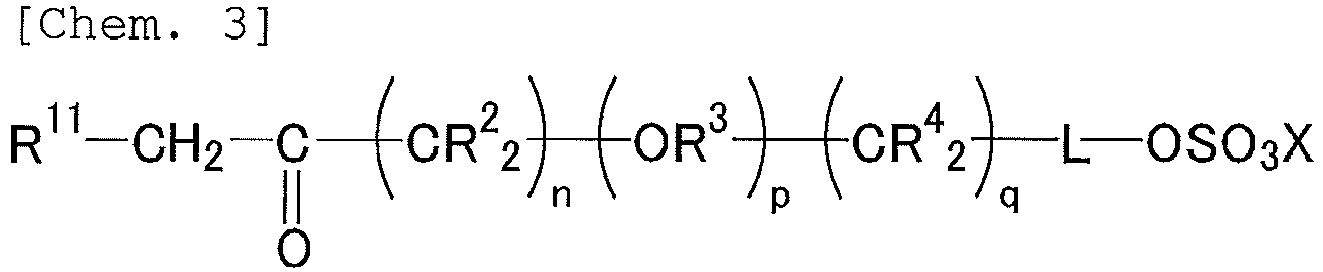
- L is preferably a single bond.
- The compound of the invention is a compound exhibiting a surfactant activity, and can suitably be used as an aqueous dispersant.
- The production method of the invention can suitably produce the compound of the invention.
- The invention is described in detail below.
- The term "organic group" as used herein means a group containing one or more carbon atoms or a group obtainable by removing one hydrogen atom from an organic compound, unless otherwise mentioned.
- Examples of the "organic group" include:
- an alkyl group optionally containing one or more substituents,
- an alkenyl group optionally containing one or more substituents,
- an alkynyl group optionally containing one or more substituents,
- a cycloalkyl group optionally containing one or more substituents,
- a cycloalkenyl group optionally containing one or more substituents,
- a cycloalkadienyl group optionally containing one or more substituents,
- an aryl group optionally containing one or more substituents,
- an aralkyl group optionally containing one or more substituents,
- a non-aromatic heterocyclic group optionally containing one or more substituents,
- a heteroaryl group optionally containing one or more substituents,
- a cyano group,
- a formyl group,
RaO-,
RaCO-,
RaSO2-,
RaCOO-,
RaNRaCO-,
RaCONRa-,
RaOCO-,
and
RaOSO2-,
- an alkyl group optionally containing one or more substituents,
- an alkenyl group optionally containing one or more substituents,
- an alkynyl group optionally containing one or more substituents,
- a cycloalkyl group optionally containing one or more substituents,
- a cycloalkenyl group optionally containing one or more substituents,
- a cycloalkadienyl group optionally containing one or more substituents,
- an aryl group optionally containing one or more substituents,
- an aralkyl group optionally containing one or more substituents,
- a non-aromatic heterocyclic group optionally containing one or more substituents, or
- a heteroaryl group optionally containing one or more substituents.
- The organic group is preferably an alkyl group optionally containing one or more substituents.
- The term "substituent" as used herein means a group which can replace another atom or group, unless otherwise mentioned. Examples of the "substituent" include an aliphatic group, an aromatic group, a heterocyclic group, an acyl group, an acyloxy group, an acylamino group, an aliphatic oxy group, an aromatic oxy group, a heterocyclic oxy group, an aliphatic oxycarbonyl group, an aromatic oxycarbonyl group, a heterocyclic oxycarbonyl group, a carbamoyl group, an aliphatic sulfonyl group, an aromatic sulfonyl group, a heterocyclic sulfonyl group, an aliphatic sulfonyloxy group, an aromatic sulfonyloxy group, a heterocyclic sulfonyloxy group, a sulfamoyl group, an aliphatic sulfonamide group, an aromatic sulfonamide group, a heterocyclic sulfonamide group, an amino group, an aliphatic amino group, an aromatic amino group, a heterocyclic amino group, an aliphatic oxycarbonylamino group, an aromatic oxycarbonylamino group, a heterocyclic oxycarbonylamino group, an aliphatic sulfinyl group, an aromatic sulfinyl group, an aliphatic thio group, an aromatic thio group, a hydroxy group, a cyano group, a sulfo group, a carboxy group, an aliphatic oxyamino group, an aromatic oxyamino group, a carbamoylamino group, a sulfamoyl amino group, a halogen atom, a sulfamoyl carbamoyl group, a carbamoyl sulfamoyl group, a dialiphatic oxyphosphinyl group, and a diaromatic oxyphosphinyl group.
- The invention relates to a compound represented by the following formula.

- In the formula, R1 is a linear or branched alkyl group containing one or more carbon atoms and optionally containing a substituent or a cyclic alkyl group containing three or more carbon atoms and optionally containing a substituent. R1 is preferably a C1-C4 linear or branched alkyl group.
- When containing three or more carbon atoms, the alkyl group may optionally contain a monovalent or divalent heterocycle, or may optionally form a cycle. The heterocycle is preferably an unsaturated heterocycle, more preferably an oxygen-containing unsaturated heterocycle, and may be a furan ring, for example. In R1, a divalent heterocycle may be present between two carbon atoms, or a divalent heterocycle may be present at an end and bind to - C(=O)-, or a monovalent heterocycle may be present at an end of the alkyl group.
- The "number of carbon atoms" in the alkyl group herein includes the number of carbon atoms constituting the heterocycles.
- The compound preferably contains 3 to 30, more preferably 5 to 25, still more preferably 7 to 20 carbon atoms in total.
- The substituent which may be contained in the alkyl group for R1 is preferably a halogen atom, a C1-C10 linear or branched alkyl group, a C3-C10 cyclic alkyl group, or a hydroxy group, particularly preferably a methyl group or an ethyl group.
- The alkyl group for R1 is preferably free from a carbonyl group.
- In the alkyl group, 75% or less of the hydrogen atoms binding to any of the carbon atoms may be replaced by halogen atoms, 50% or less thereof may be replaced by halogen atoms, or 25% or less thereof may be replaced by halogen atoms. The alkyl group is preferably a non-halogenated alkyl group containing no halogen atoms such as fluorine atoms and chlorine atoms.
- The alkyl group preferably contains no substituent.
- R1 is preferably a C1-C10 linear or branched alkyl group optionally containing a substituent or a C3-C10 cyclic alkyl group optionally containing a substituent, more preferably a C1-C10 linear or branched alkyl group free from a carbonyl group or a C3-C10 cyclic alkyl group free from a carbonyl group, still more preferably a C1-C10 linear or branched alkyl group free from a substituent, further more preferably a C1-C3 linear or branched alkyl group free from a substituent, particularly preferably a methyl group (-CH3) or an ethyl group (-C2H5), most preferably a methyl group (-CH3).
- In the formula, R2 and R4 are each individually H or a substituent; multiple R2s may be the same as or different from each other and multiple R4s may be the same as or different from each other.
- The substituent for each of R2 and R4 is preferably a halogen atom, a C1-C10 linear or branched alkyl group, a C3-C10 cyclic alkyl group, or a hydroxy group, particularly preferably a methyl group or an ethyl group.
- The alkyl group for each of R2 and R4 is preferably free from a carbonyl group.
- In the alkyl group, 75% or less of the hydrogen atoms binding to any of the carbon atoms may be replaced by halogen atoms, 50% or less thereof may be replaced by halogen atoms, or 25% or less thereof may be replaced by halogen atoms. The alkyl group is preferably a non-halogenated alkyl group containing no halogen atoms such as fluorine atoms and chlorine atoms.
- The alkyl group preferably contains no substituent.
- The alkyl group for each of R2 and R4 is preferably a C1-C10 linear or branched alkyl group free from a carbonyl group or a C3-C10 cyclic alkyl group free from a carbonyl group, more preferably a C1-C10 linear or branched alkyl group free from a carbonyl group, still more preferably a C1-C3 linear or branched alkyl group free from a substituent, particularly preferably a methyl group (-CH3) or an ethyl group (-C2H5).
- R2 and R4 are preferably each individually H or a C1-C10 linear or branched alkyl group free from a carbonyl group, more preferably H or a C1-C4 linear or branched alkyl group, still more preferably H or a C1-C3 linear or branched alkyl group free from a substituent, particularly preferably H, a methyl group (-CH3), or an ethyl group (-C2H5), most preferably H.
- In the formula, R3 is a C1-C10 alkylene group optionally containing a substituent. R3 is preferably a C1-C4 alkylene group free from a substituent. When multiple R3s are present, they may be the same as or different from each other.
- The alkylene group is preferably free from a carbonyl group.
- In the alkylene group, 75% or less of the hydrogen atoms binding to any of the carbon atoms may be replaced by halogen atoms, 50% or less thereof may be replaced by halogen atoms, or 25% or less thereof may be replaced by halogen atoms. The alkylene group is preferably a non-halogenated alkyl group containing no halogen atoms such as fluorine atoms and chlorine atoms.
- The alkylene group preferably contains no substituent.
- The alkylene group is preferably a C1-C10 linear or branched alkylene group optionally containing a substituent or a C3-C10 cyclic alkylene group optionally containing a substituent, preferably a C1-C10 linear or branched alkylene group free from a carbonyl group or a C3-C10 cyclic alkylene group free from a carbonyl group, more preferably a C1-C10 linear or branched alkylene group free from a substituent, still more preferably a methylene group (-CH2-), an ethylene group (-C2H4-), an isopropylene group (-CH(CH3)CH2-), or a propylene group (-C3H6-).
- Any two of R1, R2, R3, and R4 may bind to each other to form a ring, but they preferably do not form a ring.
- In the formula, n is an integer of 1 or greater; n is preferably an integer of 1 to 40, more preferably an integer of 1 to 30, still more preferably an integer of 5 to 25, particularly preferably an integer of 5 to 9 and 11 to 25.
- In the formula, p and q are each individually an integer of 0 or greater; p is preferably an integer of 0 to 10, more preferably 0 or 1, while q is preferably an integer of 0 to 10, more preferably an integer of 0 to 5.
- The sum of n, p, and q is preferably an integer of 5 or greater. The sum of n, p, and q is more preferably an integer of 8 or greater. The sum of n, p, and q is also preferably an integer of 60 or smaller, more preferably an integer of 50 or smaller, still more preferably an integer of 40 or smaller.
- In the formula, X is H, a metal atom, NR5 4, imidazolium optionally containing a substituent, pyridinium optionally containing a substituent, or phosphonium optionally containing a substituent, wherein R5 is H or an organic group, and the four R5s are the same as or different from each other. R5 is preferably H or a C1-C10 organic group, more preferably H or a C1-C4 organic group. Examples of the metal atom include alkali metals (Group 1) and alkaline earth metals (Group 2), and preferred is Na, K, or Li.
- X is preferably H, a metal atom, or NR5 4, more preferably H, an alkali metal (Group 1), an alkaline earth metal (Group 2), or NR5 4, still more preferably H, Na, K, Li, or NH4, further more preferably Na, K, or NH4, particularly preferably Na or NH4, most preferably NH4.
- In the formula, L is a single bond, -CO2-B-*, -OCO-B-*, -CONR6-B-*, -NR6CO-B-*, or -CO- other than the carbonyl groups in -CO2-B-, -OCO-B-, -CONR6-B-, and -NR6CO-B-, where B is a single bond or a C1-C10 alkylene group optionally containing a substituent, R6 is H or a C1-C4 alkyl group optionally containing a substituent. The alkylene group more preferably contains 1 to 5 carbon atoms. R6 is more preferably H or a methyl group. The symbol * indicates the bond to -OSO3X in the formula.
- L is preferably a single bond.
- The compound is preferably a compound represented by the following formula:

- The compound is preferably not 11-keto dodecyl sulphate.
- Examples of the compound include
CH3C(O)CH2CH2CH2CH2CH2CH2CH2CH2CH2OSO3Na,
CH3C(O)CH2CH2CH2CH2CH2CH2CH2CH2OSO3Na,
CH3C(O)CH2CH2CH2CH2CH2CH2CH2OSO3Na,
CH3C(O)CH2CH2CH2CH2CH2CH2OSO3Na,
CH3C(O)CH2CH2CH2CH2CH2OSO3Na,
CH3C(O)CH2CH2CH2CH2OSO3Na,
(CH3)3CC(O)CH2CH2CH2CH2CH2CH2CH2CH2CH2OSO3Na,
(CH3)2CHC(O)CH2CH2CH2CH2CH2CH2CH2CH2CH2OSO3Na,
(CH2)5CHC(O)CH2CH2CH2CH2CH2CH2CH2CH2CH2OSO3Na,
CH3CH2C(O)CH2CH2CH2CH2CH2CH2CH2CH2OSO3Na,
CH3CH2CH2C(O)CH2CH2CH2CH2CH2CH2CH2OSO3Na,
CH3CH2CH2CH2C(O)CH2CH2CH2CH2CH2CH2OSO3Na,
CH3CH2CH2CH2CH2C(O)CH2CH2CH2CH2CH2OSO3Na,
CH3CH2CH2CH2CH2CH2C(O)CH2CH2CH2CH2OSO3Na,
CH3CH2CH2CH2CH2CH2CH2C(O)CH2CH2CH2OSO3Na,
CH3CH2CH2CH2CH2CH2CH2CH2C(O)CH2CH2OSO3Na,
CH3CH2CH2CH2CH2CH2CH2CH2CH2C(O)CH2OSO3Na,
CH3C(O)CH2CH2CH2CH2CH2CH2CH2CH2CH2OCH2CH2OSO3Na,
CH3C(O)CH2CH2CH2CH2CH2CH2CH2CH2CH2C(O)NHCH2OSO3Na,
CH3C(O)CH2CH2CH2CH2CH2CH2CH2CH2CH2NHC(O)CH2OSO3Na,
CH3C(O)CH2CH2CH2CH2CH2CH2CH2CH2CH2C(O)OSO3Na,
CH3C(O)CH2CH2CH2CH2CH2CH2CH2CH2CH2C(O)OCH2OSO3Na,
CH3C(O)CH2CH2CH2CH2CH2CH2CH2CH2CH2OC(O)CH2OSO3Na,
CH3C(O)CH2CH2CH2CH2CH2CH2CH2CH2CH2OSO3H,
CH3C(O)CH2CH2CH2CH2CH2CH2CH2CH2CH2OSO3Li,
CH3C(O)CH2CH2CH2CH2CH2CH2CH2CH2CH2OSO3K,
CH3C(O)CH2CH2CH2CH2CH2CH2CH2CH2CH2OSO3NH4,
CH3C(O)CH2CH2CH2CH2CH2CH2CH2CH2CH(CH3)2OSO3Na,
CH3C(O)CH2CH2CH2CH2CH2CH2CH2CH2CH2CH2CH2CH2CH2CH2CH2CH2CH2O SO3Na,
CH3C(O)CH2CH2CH2CH2CH2CH2CH2CH2CH2CH2CH2CH2CH2CH2CH2CH2OSO3 Na,
CH3C(O)CH2CH2CH2CH2CH2CH2CH2CH2CH2CH2CH2CH2CH2CH2CH2OSO3Na,
CH3C(O)CH2CH2CH2CH2CH2CH2CH2CH2CH2CH2CH2CH2CH2CH2OSO3Na,
CH3C(O)CH2CH2CH2CH2CH2CH2CH2CH2CH2CH2CH2CH2CH2OSO3Na,
CH3C(O)CH2CH2CH2CH2CH2CH2CH2CH2CH2CH2CH2CH2OSO3Na,
CH3C(O)CH2CH2CH2CH2CH2CH2CH2CH2CH2CH2CH2OSO3Na,
CH3C(O)CH2CH2CH2CH2CH2CH2CH2CH2CH2CH2OSO3Na,
(CH3)3CC(O)CH2CH2CH2CH2CH2CH2CH2CH2CH2CH2CH2CH2CH2CH2CH2CH2 CH2OSO3Na,
(CH3)2CHC(O)CH2CH2CH2CH2CH2CH2CH2CH2CH2CH2CH2CH2CH2CH2CH2C H2CH2OSO3Na,
(CH2)5CHC(O)CH2CH2CH2CH2CH2CH2CH2CH2CH2CH2CH2CH2CH2CH2CH2C H2CH2OSO3Na,
CH3CH2C(O)CH2CH2CH2CH2CH2CH2CH2CH2CH2CH2CH2CH2CH2CH2CH2CH2O SO3Na,
CH3CH2CH2CH2CH2C(O)CH2CH2CH2CH2CH2CH2CH2CH2CH2CH2CH2CH2CH2O SO3Na,
CH3CH2CH2CH2CH2CH2CH2CH2C(O)CH2CH2CH2CH2CH2CH2CH2CH2CH2CH2O SO3Na,
CH3CH2CH2CH2CH2CH2CH2CH2CH2CH2CH2C(O)CH2CH2CH2CH2CH2CH2CH2O SO3Na,
CH3CH2CH2CH2CH2CH2CH2CH2CH2CH2CH2CH2CH2CH2C(O)CH2CH2CH2CH2O SO3Na,
CH3CH2C(O)CH2CH2CH2CH2CH2CH2CH2CH2CH2CH2CH2CH2CH2CH2CH2CH2O CH2CH2OSO3Na,
CH3CH2C(O)CH2CH2CH2CH2CH2CH2CH2CH2CH2CH2CH2CH2CH2CH2CH2CH2C (O)NHCH2CH2OSO3Na,
CH3CH2C(O)CH2CH2CH2CH2CH2CH2CH2CH2CH2CH2CH2CH2CH2CH2CH2CH2N HC(O)CH2CH2OSO3Na,
CH3CH2C(O)CH2CH2CH2CH2CH2CH2CH2CH2CH2CH2CH2CH2CH2CH2CH2CH2C (O)OCH2CH2OSO3Na,
CH3CH2C(O)CH2CH2CH2CH2CH2CH2CH2CH2CH2CH2CH2CH2CH2CH2CH2CH2O C(O)CH2CH2OSO3Na,
CH3CH2C(O)CH2CH2CH2CH2CH2CH2CH2CH2CH2CH2CH2CH2CH2CH2CH2CH2C (O)OSO3Na,
CH3CH2C(O)CH2CH2CH2CH2CH2CH2CH2CH2CH2CH2CH2CH2CH2CH2CH2CH2O SO3H,
CH3CH2C(O)CH2CH2CH2CH2CH2CH2CH2CH2CH2CH2CH2CH2CH2CH2CH2CH2O SO3Li,
CH3CH2C(O)CH2CH2CH2CH2CH2CH2CH2CH2CH2CH2CH2CH2CH2CH2CH2CH2O SO3K,
CH3CH2C(O)CH2CH2CH2CH2CH2CH2CH2CH2CH2CH2CH2CH2CH2CH2CH2CH2O SO3NH4, and
CH3C(O)CH2CH2CH2CH2CH2CH2CH2CH2CH2CH2CH2CH2CH2CH2CH2CH2CH2C H2CH2CH2CH2OSO3Na.
- The compound of the invention may be produced by a production method including:
a step (11) of hydroxylating a compound (10) represented by the following formula:
R11-CH=CH-(CR2 2)n-(OR3)p-(CR4 2)q-L-OH
(wherein R2 to R4, L, n, p, and q are defined as described above; and R11 is H, a linear or branched alkyl group containing one or more carbon atoms and optionally containing a substituent, or a cyclic alkyl group containing three or more carbon atoms and optionally containing a substituent, and optionally contains a monovalent or divalent heterocycle or optionally forms a ring when containing three or more carbon atoms) to provide a compound (11) represented by the following formula:
- a step (12) of oxidizing the compound (11) to provide a compound (12) represented by the following formula:

- a step (13) of sulfuric-esterifying the compound (12) to provide a compound (13) represented by the following formula:


- The alkyl group for R11 is preferably free from a carbonyl group.
- In the alkyl group for R11, 75% or less of the hydrogen atoms binding to any of the carbon atoms may be replaced by halogen atoms, 50% or less thereof may be replaced by halogen atoms, or 25% or less thereof may be replaced by halogen atoms. The alkyl group is preferably a non-halogenated alkyl group containing no halogen atoms such as fluorine atoms and chlorine atoms.
- The alkyl group preferably contains no substituent.
- R11 is preferably H, a C1-C9 linear or branched alkyl group optionally containing a substituent, or a C3-C9 cyclic alkyl group optionally containing a substituent, more preferably H, a C1-C9 linear or branched alkyl group free from a carbonyl group, or a C3-C9 cyclic alkyl group free from a carbonyl group, still more preferably H or a C1-C9 linear or branched alkyl group free from a substituent, further more preferably H, a methyl group (-CH3), or an ethyl group (-C2H5), particularly preferably H or a methyl group (-CH3), most preferably H.
- The hydroxylation in the step (11) may be performed by a method (1) in which iron(II) phthalocyanine (Fe(Pc)) and sodium borohydride are allowed to act on the compound (10) in an oxygen atmosphere or a method (2) in which isopinocampheylborane (IpcBH2) is allowed to act on the compound (10) and then the resulting intermediate (dialkyl borane) is oxidized.
- In the method (1), iron(II) phthalocyanine may be used in a catalytic amount, and may be used in an amount of 0.001 to 1.2 mol relative to 1 mol of the compound (10).
- In the method (1), sodium borohydride may be used in an amount of 0.5 to 20 mol relative to 1 mol of the compound (10).
- The reaction in the method (1) may be performed in a solvent. The solvent is preferably an organic solvent, such as an ether, a halogenated hydrocarbon, an aromatic hydrocarbon, a nitrile, or a nitrogen-containing polar organic compound.
- Examples of the ether include diethyl ether, tetrahydrofuran, dioxane, and diethylene glycol diethyl ether. Diethyl ether and tetrahydrofuran are preferred.
- Examples of the halogenated hydrocarbon include dichloromethane, dichloroethane, chloroform, chlorobenzene, and o-dichlorobenzene. Dichloromethane and chloroform are preferred.
- Examples of the aromatic hydrocarbon include benzene, toluene, and xylene. Benzene and toluene are preferred.
- Examples of the nitrile include acetonitrile, propionitrile, butyronitrile, isobutyronitrile, and benzonitrile. Acetonitrile is preferred.
- Examples of the nitrogen-containing polar organic compound include N,N-dimethylformamide, N,N-dimethylacetamide, N-methyl-2-pyrrolidone, 2-pyrrolidone, and 1,3-dimethyl-2-imidazolidinone. N,N-dimethylformamide, N,N-dimethylacetamide, and N-methyl-2-pyrrolidone are preferred.
- The reaction temperature in the method (1) is preferably -78°C to 200°C, more preferably 0°C to 150°C.
- The reaction pressure in the method (1) is preferably 0 to 5.0 MPa, more preferably 0.1 to 1.0 MPa.
- The reaction duration in the method (1) is preferably 0.1 to 72 hours, more preferably 0.1 to 48 hours.
- In the method (2), isopinocampheylborane may be used in an amount of 1.0 to 10.0 mol relative to 1 mol of the compound (10).
- The reaction of the compound (10) and isopinocampheylborane may be performed in a solvent. The solvent is preferably an organic solvent, such as an ether, a halogenated hydrocarbon, or an aromatic hydrocarbon.
- Examples of the ether include diethyl ether, tetrahydrofuran, dioxane, and diethylene glycol diethyl ether. Diethyl ether and tetrahydrofuran are preferred.
- Examples of the halogenated hydrocarbon include dichloromethane, dichloroethane, chloroform, chlorobenzene, and o-dichlorobenzene. Dichloromethane and chloroform are preferred.
- Examples of the aromatic hydrocarbon include benzene, toluene, and xylene. Benzene and toluene are preferred.
- The temperature of the reaction of the compound (10) and isopinocampheylborane is preferably -78°C to 200°C, more preferably 0°C to 150°C.
- The pressure of the reaction of the compound (10) and isopinocampheylborane is preferably 0 to 5.0 MPa, more preferably 0.1 to 1.0 MPa.
- The duration of the reaction of the compound (10) and isopinocampheylborane is preferably 0.1 to 72 hours, more preferably 0.1 to 48 hours.
- The oxidation in the method (2) may be performed by allowing an oxidizing agent to act on the intermediate. An example of the oxidizing agent is hydrogen peroxide. The oxidizing agent may be used in an amount of 0.7 to 10 mol relative to 1 mol of the intermediate.
- The oxidation in the method (2) may be performed in a solvent. Examples of the solvent include water, methanol, and ethanol. Water is preferred.
- The oxidation temperature in the method (2) is preferably 0°C to 100°C, more preferably 0°C to 80°C.
- The oxidation pressure in the method (2) is preferably 0 to 5.0 MPa, more preferably 0.1 to 1.0 MPa.
- The oxidation duration in the method (2) is preferably 0.1 to 72 hours, more preferably 0.1 to 48 hours.
- The oxidation of the compound (11) in the step (12) may be performed by, for example, (a) a method using the Jones reagent (CrO3/H2SO4) (Jones oxidation), (b) a method using Dess-Martin periodinane (DMP) (Dess-Martin oxidation), (c) a method using pyridinium chlorochromate (PCC), (d) a method of allowing a bleaching agent (about 5% to 6% aqueous solution of NaOCl) to act in the presence of a nickel compound such as NiCl2, or (e) a method of allowing a hydrogen acceptor such as an aldehyde or a ketone to act in the presence of an aluminum catalyst such as Al(CH3)3 or Al[OCH(CH3)2]3 (Oppenauer oxidation).
- The oxidation in the step (12) may be performed in a solvent. The solvent is preferably any of water and organic solvents, such as water, ketones, ethers, halogenated hydrocarbons, aromatic hydrocarbons, and nitriles.
- Examples of the ketones include acetone, methyl ethyl ketone, methyl isobutyl ketone, cyclohexanone, and diacetone alcohol. Acetone is preferred.
- Examples of the ethers include diethyl ether, tetrahydrofuran, dioxane, and diethylene glycol diethyl ether. Diethyl ether and tetrahydrofuran are preferred.
- Examples of the halogenated hydrocarbons include dichloromethane, dichloroethane, chloroform, chlorobenzene, and o-dichlorobenzene. Dichloromethane and chloroform are preferred.
- Examples of the aromatic hydrocarbons include benzene, toluene, and xylene. Benzene and toluene are preferred.
- Examples of the nitriles include acetonitrile, propionitrile, butyronitrile, isobutyronitrile, and benzonitrile. Acetonitrile is preferred.
- The oxidation temperature in the step (12) is preferably -78°C to 200°C, and may appropriately be selected in accordance with the method used.
- The oxidation pressure in the step (12) is preferably 0 to 5.0 MPa, and may appropriately be selected in accordance with the method used.
- The oxidation duration in the step (12) is preferably 0.1 to 72 hours, and may appropriately be selected in accordance with the method used.
- The sulfuric-esterification in the step (13) may be performed by reacting the compound (12) and a sulfating reagent. Examples of the sulfating reagent include sulfur trioxide amine complexes such as a sulfur trioxide pyridine complex, a sulfur trioxide trimethylamine complex, and a sulfur trioxide triethylamine complex, sulfur trioxide amide complexes such as a sulfur trioxide dimethylformamide complex, sulfuric acid-dicyclohexylcarbodiimide, chlorosulfuric acid, concentrated sulfuric acid, and sulfamic acid. The amount of the sulfating reagent used is preferably 0.5 to 10 mol, more preferably 0.5 to 5 mol, still more preferably 0.7 to 4 mol, relative to 1 mol of the compound (12).
- The sulfuric-esterification in the step (13) may be performed in a solvent. The solvent is preferably an organic solvent, such as an ether, a halogenated hydrocarbon, an aromatic hydrocarbon, pyridine, dimethyl sulfoxide, sulfolane, or a nitrile.
- Examples of the ether include diethyl ether, tetrahydrofuran, dioxane, and diethylene glycol diethyl ether. Diethyl ether and tetrahydrofuran are preferred.
- Examples of the halogenated hydrocarbon include dichloromethane, dichloroethane, chloroform, chlorobenzene, and o-dichlorobenzene. Dichloromethane and chloroform are preferred.
- Examples of the aromatic hydrocarbon include benzene, toluene, and xylene. Benzene and toluene are preferred.
- Examples of the nitrile include acetonitrile, propionitrile, butyronitrile, isobutyronitrile, and benzonitrile. Acetonitrile is preferred.
- The sulfuric-esterification temperature in the step (13) is preferably -78°C to 200°C, more preferably -20°C to 150°C.
- The sulfuric-esterification pressure in the step (13) is preferably 0 to 10 MPa, more preferably 0.1 to 5 MPa.
- The sulfuric-esterification duration in the step (13) is preferably 0.1 to 72 hours, more preferably 0.1 to 48 hours.
- The compound of the invention may also be produced by a production method including:
- a step (21) of ozonolyzing a compound (20) represented by the following formula:


- a step (22) of sulfuric-esterifying the compound (21) to provide a compound (22) represented by the following formula:

- R101s are each preferably a C1-C20 alkyl group. The two R101s are the same as or different from each other.
- The ozonolysis in the step (21) may be performed by allowing ozone to act on the compound (20), followed by post-treatment with a reducing agent.
- The ozone may be generated by dielectric barrier discharge in oxygen gas.
- Examples of the reducing agent used in the post-treatment include zinc, dimethyl sulfide, thiourea, and phosphines. Phosphines are preferred.
- The ozonolysis in the step (21) may be performed in a solvent. The solvent is preferably any of water and organic solvents, such as water, alcohols, carboxylic acids, ethers, halogenated hydrocarbons, and aromatic hydrocarbons.
- Examples of the alcohols include methanol, ethanol, 1-propanol, and isopropanol. Methanol and ethanol are preferred.
- Examples of the carboxylic acids include acetic acid and propionic acid. Acetic acid is preferred.
- Examples of the ethers include diethyl ether, tetrahydrofuran, dioxane, and diethylene glycol diethyl ether. Diethyl ether and tetrahydrofuran are preferred.
- Examples of the halogenated hydrocarbons include dichloromethane, dichloroethane, chloroform, chlorobenzene, and o-dichlorobenzene. Dichloromethane and chloroform are preferred.
- Examples of the aromatic hydrocarbons include benzene, toluene, and xylene. Benzene and toluene are preferred.
- The ozonolysis temperature in the step (21) is preferably -78°C to 200°C, more preferably 0°C to 150°C.
- The ozonolysis pressure in the step (21) is preferably 0 to 5.0 MPa, more preferably 0.1 to 1.0 MPa.
- The ozonolysis duration in the step (21) is preferably 0.1 to 72 hours, more preferably 0.1 to 48 hours.
- The sulfuric-esterification in the step (22) may be performed by reacting the compound (21) and a sulfating reagent under the same conditions as in the sulfuric-esterification in the step (13).
- The compound of the invention may also be produced by a production method including:
- a step (31) of epoxidizing a compound (30) represented by the following formula:
R21-CH=CH-(CR2 2)n-(OR3)p-(CR4 2)q-L-OH
(wherein R2 to R4, L, n, p, and q are defined as described above; R21 is H, a linear or branched alkyl group containing one or more carbon atoms and optionally containing a substituent, or a cyclic alkyl group containing three or more carbon atoms and optionally containing a substituent, and optionally contains a monovalent or divalent heterocycle or optionally forms a ring when containing three or more carbon atoms) to provide a compound (31) represented by the following formula:
- a step (32) of reacting the compound (31) with a dialkylcopper lithium represented by R22 2CuLi (wherein R22 is a linear or branched alkyl group containing one or more carbon atoms and optionally containing a substituent or a cyclic alkyl group containing three or more carbon atoms and optionally containing a substituent, and optionally contains a monovalent or divalent heterocycle or optionally forms a ring when containing three or more carbon atoms) to provide a compound (32) represented by the following formula:

- a step (33) of oxidizing the compound (32) to provide a compound (33) represented by the following formula:

- a step (34) of sulfuric-esterifying the compound (33) to provide a compound (34) represented by the following formula:

- The alkyl group for R21 is preferably free from a carbonyl group.
- In the alkyl group for R21, 75% or less of the hydrogen atoms binding to any of the carbon atoms may be replaced by halogen atoms, 50% or less thereof may be replaced by halogen atoms, or 25% or less thereof may be replaced by halogen atoms. The alkyl group is preferably a non-halogenated alkyl group containing no halogen atoms such as fluorine atoms and chlorine atoms.
- The alkyl group preferably contains no substituent.
- R21 is preferably H, a C1-C8 linear or branched alkyl group optionally containing a substituent, or a C3-C8 cyclic alkyl group optionally containing a substituent, more preferably H, a C1-C8 linear or branched alkyl group free from a carbonyl group, or a C3-C8 cyclic alkyl group free from a carbonyl group, still more preferably H or a C1-C8 linear or branched alkyl group free from a substituent, particularly preferably H or a methyl group (-CH3), most preferably H.
- The alkyl group for R22 is preferably free from a carbonyl group.
- In the alkyl group for R22, 75% or less of the hydrogen atoms binding to any of the carbon atoms may be replaced by halogen atoms, 50% or less thereof may be replaced by halogen atoms, or 25% or less thereof may be replaced by halogen atoms. The alkyl group is preferably a non-halogenated alkyl group containing no halogen atoms such as fluorine atoms and chlorine atoms.
- The alkyl group preferably contains no substituent.
- R22 is preferably a C1-C9 linear or branched alkyl group optionally containing a substituent or a C3-C9 cyclic alkyl group optionally containing a substituent, more preferably a C1-C9 linear or branched alkyl group free from a carbonyl group or a C3-C9 cyclic alkyl group free from a carbonyl group, still more preferably a C1-C9 linear or branched alkyl group free from a substituent, particularly preferably a methyl group (-CH3) or an ethyl group (-C2H5), most preferably a methyl group (-CH3).
- Two R22s are the same as or different from each other.
- R21 and R22 preferably contain 1 to 7 carbon atoms, more preferably 1 or 2 carbon atoms, most preferably 1 carbon atom, in total.
- The epoxidation in the step (31) may be performed by allowing an epoxidizing agent to act on the compound (30).
- Examples of the epoxidizing agent include peroxy acids such as meta-chloroperbenzoic acid (m-CPBA), perbenzoic acid, hydrogen peroxide, and tert-butyl hydroperoxide, dimethyl dioxolane, and methyl trifluoromethyl dioxolane. Peroxy acids are preferred, and meta-chloroperbenzoic acid is more preferred.
- The epoxidizing agent may be used in an amount of 0.5 to 10.0 mol relative to 1 mol of the compound (30).
- The epoxidation in the step (31) may be performed in a solvent. The solvent is preferably an organic solvent, such as a ketone, an ether, a halogenated hydrocarbon, an aromatic hydrocarbon, a nitrile, pyridine, a nitrogen-containing polar organic compound, or dimethyl sulfoxide. Dichloromethane is preferred.
- Examples of the ketone include acetone, methyl ethyl ketone, methyl isobutyl ketone, cyclohexanone, and diacetone alcohol. Acetone is preferred.
- Examples of the ether include diethyl ether, tetrahydrofuran, dioxane, and diethylene glycol diethyl ether. Diethyl ether and tetrahydrofuran are preferred.
- Examples of the halogenated hydrocarbon include dichloromethane, dichloroethane, chloroform, chlorobenzene, and o-dichlorobenzene. Dichloromethane and chloroform are preferred.
- Examples of the aromatic hydrocarbon include benzene, toluene, and xylene. Benzene and toluene are preferred.
- Examples of the nitrile include acetonitrile, propionitrile, butyronitrile, isobutyronitrile, and benzonitrile. Acetonitrile is preferred.
- Examples of the nitrogen-containing polar organic compounds include N,N-dimethylformamide, N,N-dimethylacetamide, N-methyl-2-pyrrolidone, 2-pyrrolidone, and 1,3-dimethyl-2-imidazolidinone. N,N-dimethylformamide, N,N-dimethylacetamide, and N-methyl-2-pyrrolidone are preferred.
- The epoxidation temperature in the step (31) is preferably -78°C to 200°C, more preferably -40°C to 150°C.
- The epoxidation pressure in the step (31) is preferably 0 to 5.0 MPa, more preferably 0.1 to 1.0 MPa.
- The epoxidation duration in the step (31) is preferably 0.1 to 72 hours, more preferably 0.1 to 48 hours.
- In the step (32), the dialkylcopper lithium may be used in an amount of 0.5 to 10.0 mol relative to 1 mol of the compound (31).
- The reaction in the step (32) may be performed in a solvent. The solvent is preferably an organic solvent, such as an ether, a halogenated hydrocarbon, or an aromatic hydrocarbon.
- Examples of the ether include diethyl ether, tetrahydrofuran, dioxane, and diethylene glycol diethyl ether. Diethyl ether and tetrahydrofuran are preferred.
- Examples of the halogenated hydrocarbon include dichloromethane, dichloroethane, chloroform, chlorobenzene, and o-dichlorobenzene. Dichloromethane and chloroform are preferred.
- Examples of the aromatic hydrocarbon include benzene, toluene, and xylene. Benzene and toluene are preferred.
- The reaction temperature in the step (32) is preferably -78°C to 200°C, more preferably -40°C to 150°C.
- The reaction pressure in the step (32) is preferably 0 to 5.0 MPa, more preferably 0.1 to 1.0 MPa.
- The reaction duration in the step (32) is preferably 0.1 to 72 hours, more preferably 0.1 to 48 hours.
- The oxidation of the compound (32) in the step (33) may be performed by, for example, (a) a method of using the Jones reagent (CrO3/H2SO4) (Jones oxidation), (b) a method of using Dess-Martin periodinane (DMP) (Dess-Martin oxidation), (c) a method of using pyridinium chlorochromate (PCC), (d) a method of allowing a bleaching agent (about 5% to 6% aqueous solution of NaOCl) to act in the presence of a nickel compound such as NiCl2, or (e) a method of allowing a hydrogen acceptor such as an aldehyde or a ketone to act in the presence of an aluminum catalyst such as Al(CH3)3 or Al[OCH(CH3)2]3 (Oppenauer oxidation).
- The oxidation in the step (33) may be performed in a solvent. The solvent is preferably any of water and organic solvents, such as water, ketones, alcohols, ethers, halogenated hydrocarbons, aromatic hydrocarbons, and nitriles.
- Examples of the ketones include acetone, methyl ethyl ketone, methyl isobutyl ketone, cyclohexanone, and diacetone alcohol. Acetone is preferred.
- Examples of the alcohols include methanol, ethanol, 1-propanol, and isopropanol. Methanol and ethanol are preferred.
- Examples of the ethers include diethyl ether, tetrahydrofuran, dioxane, and diethylene glycol diethyl ether. Diethyl ether and tetrahydrofuran are preferred.
- Examples of the halogenated hydrocarbons include dichloromethane, dichloroethane, chloroform, chlorobenzene, and o-dichlorobenzene. Dichloromethane and chloroform are preferred.
- Examples of the aromatic hydrocarbons include benzene, toluene, and xylene. Benzene and toluene are preferred.
- Examples of the nitriles include acetonitrile, propionitrile, butyronitrile, isobutyronitrile, and benzonitrile. Acetonitrile is preferred.
- The oxidation temperature in the step (33) is preferably -78°C to 200°C, and may appropriately be selected in accordance with the method used.
- The oxidation pressure in the step (33) is preferably 0 to 5.0 MPa, and may appropriately be selected in accordance with the method used.
- The oxidation duration in the step (33) is preferably 0.1 to 72 hours, and may appropriately be selected in accordance with the method used.
- The sulfuric-esterification in the step (34) may be performed by reacting the compound (33) and a sulfating reagent under the same conditions as in the sulfuric-esterification in the step (13).
- The compound of the invention may also be produced by a production method including:
- a step (41) of oxidizing a compound (10) represented by the following formula:
R11-CH=CH-(CR2 2)n-(OR3)p-(CR4 2)q-L-OH
(wherein R2 to R4, R11, L, n, p, and q are defined as described above) to provide a compound (41) represented by the following formula:
- a step (42) of sulfuric-esterifying the compound (41) to provide a compound (42) represented by the following formula:

- L is preferably a single bond.
- The oxidation in the step (41) may be performed by allowing an oxidizing agent to act on the compound (10) in the presence of water and a palladium compound.
- Examples of the oxidizing agent include monovalent or divalent copper salts such as copper chloride, copper acetate, copper cyanide, and copper trifluoromethanethiolate, iron salts such as iron chloride, iron acetate, iron cyanide, iron trifluoromethanethiolate, and hexacyanoferrates, benzoquinones such as 1,4-benzoquinone, 2,3-dichloro-5,6-dicyano-1,4-benzoquinone, tetrachloro-1,2-benzoquinone, and tetrachloro-1,4-benzoquinone, H2O2, MnO2, KMnO4, RuO4, m-chloroperbenzoic acid, peracetic acid, perbenzoic acid, tert-butyl hydroperoxide, cumene hydroperoxide, potassium persulfate, mixtures of potassium hydrogen persulfate-potassium hydrogen sulfate-potassium sulfate, and oxygen. Copper salts, iron salts, benzoquinones, mixtures of potassium hydrogen persulfate-potassium hydrogen sulfate-potassium sulfate, and oxygen-based compounds are preferred, and copper chloride, iron chloride, 1,4-benzoquinone, and oxygen are more preferred.
- The oxidizing agent may be used in an amount of 0.001 to 10 mol relative to 1 mol of the compound (10).
- The water may be used in an amount of 0.5 to 1000 mol relative to 1 mol of the compound (10).
- An example of the palladium compound is palladium dichloride. The palladium compound may be used in a catalytic amount, and may be used in an amount of 0.0001 to 1.0 mol relative to 1 mol of the compound (10).
- The oxidation in the step (41) may be performed in a solvent. Examples of the solvent include water, esters, aliphatic hydrocarbons, aromatic hydrocarbons, alcohols, carboxylic acids, ethers, halogenated hydrocarbons, nitrogen-containing polar organic compounds, nitriles, dimethyl sulfoxide, and sulfolane.
- Examples of the esters include ethyl acetate, butyl acetate, ethylene glycol monomethyl ether acetate, and propylene glycol monomethyl ether acetate (PGMEA, also known as 1-methoxy-2-acetoxypropane). Ethyl acetate is preferred.
- Examples of the aliphatic hydrocarbons include hexane, cyclohexane, heptane, octane, nonane, decane, undecane, dodecane, and mineral spirits. Cyclohexane and heptane are preferred.
- Examples of the aromatic hydrocarbons include benzene, toluene, and xylene. Benzene and toluene are preferred.
- Examples of the alcohols include methanol, ethanol, 1-propanol, and isopropanol.
- Examples of the carboxylic acids include acetic acid and propionic acid. Acetic acid is preferred.
- Examples of the ethers include diethyl ether, tetrahydrofuran, dioxane, and diethylene glycol diethyl ether. Diethyl ether and tetrahydrofuran are preferred.
- Examples of the halogenated hydrocarbons include dichloromethane, dichloroethane, chloroform, chlorobenzene, and o-dichlorobenzene. Dichloromethane and chloroform are preferred.
- Examples of the nitrogen-containing polar organic compounds include N,N-dimethylformamide, N,N-dimethylacetamide, N-methyl-2-pyrrolidone, 2-pyrrolidone, and 1,3-dimethyl-2-imidazolidinone. N,N-dimethylformamide, N,N-dimethylacetamide, and N-methyl-2-pyrrolidone are preferred.
- Examples of the nitriles include acetonitrile, propionitrile, butyronitrile, isobutyronitrile, and benzonitrile. Acetonitrile is preferred.
- The oxidation temperature in the step (41) is preferably -78°C to 200°C, more preferably -20°C to 150°C.
- The oxidation pressure in the step (41) is preferably 0 to 10 MPa, more preferably 0.1 to 5.0 MPa.
- The oxidation duration in the step (41) is preferably 0.1 to 72 hours, more preferably 0.1 to 48 hours.
- The sulfuric-esterification in the step (42) may be performed by reacting the compound (41) and a sulfating reagent under the same conditions as in the sulfuric-esterification in the step (13).
- The compound of the invention may also be produced by a production method including:
- a step (51) of reacting a compound (50) represented by the following formula:
R11-CH=CH-(CR2 2)n-OH
(wherein R2, R11, and n are defined as described above) with a halogenating agent to provide a compound (51) represented by the following formula:
R11-CH=CH-(CR2 2)n-Z51
(wherein R2, R11, and n are defined as described above; and Z51 is a halogen atom); - a step (52) of reacting the compound (51) with an alkylene glycol represented by HO-R3-L-OH (where L and R3 are defined as described above) to provide a compound (52) represented by the following formula:
R11-CH=CH-(CR2 2)n-O-R3-L-OH
(wherein R2, R3, R11, L, and n are defined as described above); - a step (53) of oxidizing the compound (52) to provide a compound (53) represented by the following formula:

- a step (54) of sulfuric-esterifying the compound (53) to provide a compound (54) represented by the following formula:

- Z51 is preferably F, Cl, Br, or I, more preferably Br.
- Examples of the halogenating agent used in the step (51) include N-bromosuccinimide and N-chlorosuccinimide.
- The halogenating agent may be used in an amount of 0.5 to 10.0 mol per 1 mol of the compound (50).
- The reaction in the step (51) may be performed in the presence of a phosphine such as triphenyl phosphine.
- The phosphine may be used in an amount of 0.5 to 10.0 mol per 1 mol of the compound (50).
- The reaction in the step (51) may be performed in a solvent. The solvent is preferably an organic solvent, such as an ether, a halogenated hydrocarbon, or an aromatic hydrocarbon.
- Examples of the ether include diethyl ether, tetrahydrofuran, dioxane, and diethylene glycol diethyl ether. Diethyl ether and tetrahydrofuran are preferred.
- Examples of the halogenated hydrocarbon include dichloromethane, dichloroethane, chloroform, chlorobenzene, and o-dichlorobenzene. Dichloromethane and chloroform are preferred.
- Examples of the aromatic hydrocarbon include benzene, toluene, and xylene. Benzene and toluene are preferred.
- The reaction temperature in the step (51) is preferably -78°C to 200°C, more preferably -40°C to 150°C.
- The reaction pressure in the step (51) is preferably 0 to 5.0 MPa, more preferably 0.1 to 1.0 MPa.
- The reaction duration in the step (51) is preferably 0.1 to 72 hours, more preferably 0.1 to 48 hours.
- In the step (52), the alkylene glycol may be used in an amount of 0.5 to 10.0 mol per 1 mol of the compound (51) .
- The reaction in the step (52) may be performed in the presence of a base. Examples of the base include sodium hydride, sodium hydroxide, and potassium hydroxide.
- The base may be used in an amount of 0.5 to 10.0 mol per 1 mol of the compound (51).
- The reaction in the step (52) may be performed in a solvent. The solvent is preferably an organic solvent, such as a nitrogen-containing polar organic compound, an ether, a halogenated hydrocarbon, or an aromatic hydrocarbon.
- Examples of the nitrogen-containing polar organic compounds include N,N-dimethylformamide, N,N-dimethylacetamide, N-methyl-2-pyrrolidone, 2-pyrrolidone, and 1,3-dimethyl-2-imidazolidinone. N,N-dimethylformamide, N,N-dimethylacetamide, and N-methyl-2-pyrrolidone are preferred.
- Examples of the ether include diethyl ether, tetrahydrofuran, dioxane, and diethylene glycol diethyl ether. Diethyl ether and tetrahydrofuran are preferred.
- Examples of the halogenated hydrocarbon include dichloromethane, dichloroethane, chloroform, chlorobenzene, and o-dichlorobenzene. Dichloromethane and chloroform are preferred.
- Examples of the aromatic hydrocarbon include benzene, toluene, and xylene. Benzene and toluene are preferred.
- The reaction temperature in the step (52) is preferably -78°C to 200°C, more preferably -40°C to 150°C.
- The reaction pressure in the step (52) is preferably 0 to 5.0 MPa, more preferably 0.1 to 1.0 MPa.
- The reaction duration in the step (52) is preferably 0.1 to 72 hours, more preferably 0.1 to 48 hours.
- The oxidation in the step (53) may be performed by allowing an oxidizing agent to act on the compound (52) in the presence of water and a palladium compound under the same conditions as in the oxidation in the step (41).
- The sulfuric-esterification in the step (54) may be performed by reacting the compound (53) and a sulfating reagent under the same conditions as in the sulfuric-esterification in the step (13).
- In any of the production methods described above, the resulting compounds may be subjected to any of evaporation of a solvent or operations such as distillation and purification after the respective steps, whereby the purity of each compound may be increased. When the resulting compound contains a group represented by -OSO3H (i.e., when X is H), the compound may be brought into contact with an alkali such as sodium carbonate or ammonia so that -OSO3H may be converted into a sulfuric acid salt group.
- Preferred among the above production methods is a production method including the steps (41) and (42). The production method including the steps (41) and (42) is also one aspect of the invention.
- The invention is described with reference to examples, but the invention is not intended to be limited by these examples.
- The parameters in the examples were determined by the following method.
1H-NMR measurement - The 1H-NMR measurement was performed using a nuclear magnetic resonance device, NMR system 400 available from VARIAN Inc. Tetramethylsilane was added as an internal standard to the sample, and the value of tetramethylsilane was set to 0 ppm in the measurement.
- A mixture of 10-undecen-1-ol (16 g), 1,4-benzoquinone (10.2 g), DMF (160 mL), water (16 mL), and PdCl2 (0.34 g) was heated and stirred at 90°C for 12 hours.
- The solvent was then evaporated under reduced pressure. The resulting residue was subjected to liquid separation and purified by column chromatography, whereby 11-hydroxyundecan-2-one (15.4 g) was obtained.
- The spectrum data of the resulting 11-hydroxyundecan-2-one are the following.
1H-NMR (CDCl3) δppm: 1.29-1.49 (m, 14H), 2.08 (s, 3H), 2.45 (J = 7.6, t, 2H), 3.51 (J = 6.5, t, 2H) - A mixture of 11-hydroxyundecan-2-one (13 g), a sulfur trioxide triethylamine complex (13.9 g), and tetrahydrofuran (140 mL) was stirred at 50°C for 12 hours. A solution of sodium methoxide (3.8 g) in methanol (12 mL) was dropwise added to the reaction solution.
- The solid precipitate was filtered under reduced pressure and the residue was washed with ethyl acetate, whereby sodium 10-oxounedecyl sulfate (15.5 g) was obtained. The spectrum data of the resulting sodium 10-oxounedecyl sulfate are the following.
1H-NMR (CDCl3) δppm: 1.08 (J = 6.8, m, 10H), 1.32 (m, 2H), 1.45 (m, 2H), 1.98 (s, 3H), 2.33 (J = 7.6, t, 2H), 3.83 (J = 6.5, t, 2H) - Sodium 22-oxotoricosyl sulfate was synthesized in the same manner as in Example 1, except that the material was changed from 10-undecen-1-ol to 22-tricosen-1-ol.
- A mixture of 10-undecen-1-ol (35 g), triphenylphosphine (59 g), dichloromethane (350 mL), and N-bromosuccinimide (40 g) was heated and stirred at 0°C for 24 hours.
- The solvent was then evaporated under reduced pressure. The resulting residue was mixed with heptane and extracted, and the solvent was evaporated under reduced pressure. The residue was purified by column chromatography, whereby 11-bromo-1-undecene (45 g) was obtained.
- The spectrum data of the resulting 11-bromo-1-undecene are the following.
1H-NMR (CDCl3) δppm: 1.29-1.39 (m, 12H), 1.80-1.90 (m, 2H), 2.00-2.08 (m, 2H), 3.38-3.43 (t, J = 6.8, 2H), 4.91-5.03 (m, 2H), 5.74-5.89 (m, 1H) - A mixture of 11-bromo-1-undecene (21 g), NaH (4.3 g), ethylene glycol (11 g), and DMF (100 mL) was stirred at 80°C for 4 hours. The reaction solution was mixed with a saturated ammonium chloride solution (300 mL), and the mixture was extracted with ethyl acetate. The extract was dried over sodium sulfate, and the solvent was evaporated under reduced pressure. The residue was purified by silica gel column chromatography, whereby 2-(10-undecenyl-1-oxy)ethanol (11 g) was obtained.
- The spectrum data of the resulting 2-(10-undecenyl-1-oxy)ethanol are the following.
1H-NMR (CDCl3) δppm: 1.28-1.34 (m, 12H), 1.50-1.61 (m, 2H), 1.94-2.12 (m, 2H), 3.44-3.55 (m, 4H), 3.70-3.75 (m, 2H), 4.91-5.02 (m, 2H), 5.73-5.88 (m, 1H) - A mixture of 2-(10-undecenyl-1-oxy)ethanol (3.0 g), 1,4-benzoquinone (1.5 g), DMF (30 mL), water (3 mL), and PdCl2 (0.050 g) was heated and stirred at 90°C for 24 hours.
- The solvent was then evaporated under reduced pressure. The resulting residue was purified by liquid separation, column chromatography, and recrystallization, whereby 11-(2-hydroxyethoxy)undecan-2-one (2.1 g) was obtained.
- The spectrum data of the resulting 11-(2-hydroxyethoxy)undecan-2-one are the following.
1H-NMR (CDCl3) δppm: 1.27-1.42 (m, 10H), 1.43-1.57 (m, 4H), 2.12 (s, 3H), 2.38-2.43 (t, J = 7.6, 2H), 3.45-3.55 (m, 4H), 3.69-3.74 (m, 2H) - A mixture of 11-(2-hydroxyethoxy)undecan-2-one (1.4 g), a sulfur trioxide triethylamine complex (1.3 g), and tetrahydrofuran (15 mL) was stirred at 50°C for 3 hours. A sodium methoxide (0.34 g)/methanol (1 mL) solution was dropwise added to the reaction solution.
- The solid precipitate was filtered under reduced pressure and the residue was washed with ethyl acetate, whereby sodium 2-((10-oxoundecyl)oxy)ethyl sulfate (0.92 g) was obtained. The spectrum data of the resulting sodium 2-((10-oxoundecyl)oxy)ethyl sulfate are the following.
1H-NMR (D2O) δppm: 1.03-1.20 (m, 10H), 1.21-1.45 (m, 4H), 1.98 (s, 3H), 2.31-2.36 (t, J = 7.3, 2H), 3.34-3.39 (t, J = 6.8, 2H), 3.52-3.55 (t, J = 4.6, 2H), 3.94-3.97 (t, J = 4.6, 2H) - Sodium 18-oxononadecyl sulfate was synthesized in the same manner as in Example 1, except that the material was changed from 10-undecen-1-ol to 18-nonadecen-1-ol.
- Sodium 10-oxoundecyl sulfate obtained in Example 1 was dissolved in water so as to have a concentration as shown in Table 1, and the surface tension was measured. The surface tension was measured by the Wilhelmy method at 20°C. The results are shown in Table 1.
[Table 1] Amount of compound relative to water (wt%) 0.01 0.1 1.0 Surface tension (mN/m) Example 1 72.1 63.5 45.6 - The compound of the invention can suitably reduce the surface tension of water.
- The compound of the invention can suitably be used as a surfactant.
- The compound of the invention can suitably be used as a surfactant accelerator (particularly as a surfactant accelerator in coating material, lacquer, adhesive, or the like).
- The compound of the invention can suitably be used as a viscosity reducer, for example.
- The compound of the invention can suitably be used as a dispersant, particularly an aqueous dispersant, for example.
- The compound of the invention can suitably be used as an emulsifier, for example.
Claims (11)
- A compound represented by the following formula:
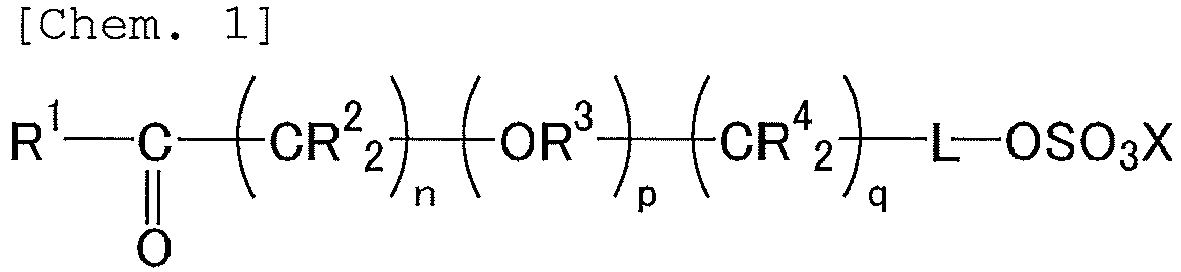 R1 is a linear or branched alkyl group containing one or more carbon atoms and optionally containing a substituent or a cyclic alkyl group containing three or more carbon atoms and optionally containing a substituent, and optionally contains a monovalent or divalent heterocycle or optionally forms a ring when containing three or more carbon atoms;R2 and R4 are each individually H or a substituent;R3 is a C1-C10 alkylene group optionally containing a substituent;n is an integer of 1 or greater;p and q are each individually an integer of 0 or greater;X is H, a metal atom, NR5 4, imidazolium optionally containing a substituent, pyridinium optionally containing a substituent, or phosphonium optionally containing a substituent, where R5s are each H or an organic group and are the same as or different from each other;any two of R1, R2, R3, and R4 optionally bind to each other to form a ring; andL is a single bond, -CO2-B-*, -OCO-B-*, -CONR6-B-*,-NR6CO-B-*, or -CO- other than the carbonyl groups in -CO2-B-, -OCO-B-, -CONR6-B-, and -NR6CO-B-, where B is a single bond or a C1-C10 alkylene group optionally containing a substituent, R6 is H or a C1-C4 alkyl group optionally containing a substituent, and * indicates the bond to-OSO3X in the formula.
 - The compound according to claim 1,
wherein the compound contains 3 to 30 carbon atoms in total. - The compound according to claim 1 or 2,
wherein L is a single bond. - The compound according to claim 1, 2, or 3,
wherein R2 and R4 are each H or a C1-C4 linear or branched alkyl group. - The compound according to claim 1, 2, 3, or 4,
wherein R3 is a C1-C4 alkylene group free from a substituent. - The compound according to claim 1, 2, 3, 4, or 5,
wherein R1 is a C1-C4 linear or branched alkyl group. - The compound according to claim 1, 2, 3, 4, 5, or 6,
wherein the compound excludes 11-keto dodecyl sulphate. - The compound according to claim 1, 2, 3, 4, 5, 6, or 7,
wherein X in the formula is a metal atom or NR5 4, wherein R5 is defined as described above. - The compound according to claim 1, 2, 3, 4, 5, 6, 7, or 8,
wherein the compound is an aqueous dispersant. - A production method comprising:a step (41) of oxidizing a compound (10) represented by the following formula:
R11-CH=CH-(CR2 2)n-(OR3)p-(CR4 2)q-L-OH
whereinR2 to R4, n, p, and q are defined as described above;R11 is H, a linear or branched alkyl group containing one or more carbon atoms and optionally containing a substituent, or a cyclic alkyl group containing three or more carbon atoms and optionally containing a substituent, and optionally contains a monovalent or divalent heterocycle or optionally forms a ring when containing three or more carbon atoms; andL is a single bond, -CO2-B-*, -OCO-B-*, -CONR6-B-*,-NR6CO-B-*, or -CO- other than the carbonyl groups in -CO2-B-, -OCO-B-, -CONR6-B-, and -NR6CO-B-, where B is a single bond or a C1-C10 alkylene group optionally containing a substituent, R6 is H or a C1-C4 alkyl group optionally containing a substituent, and * indicates the bond to -OH in the formula,
to provide a compound (41) represented by the following formula: a step (42) of sulfuric-esterifying the compound (41) to provide a compound (42) represented by the following formula:

- The production method according to claim 10,
wherein L is a single bond.
Applications Claiming Priority (2)
| Application Number | Priority Date | Filing Date | Title |
|---|---|---|---|
| JP2017073085 | 2017-03-31 | ||
| PCT/JP2018/013625 WO2018181906A1 (en) | 2017-03-31 | 2018-03-30 | Alkyl sulfate ester or salt of same |
Publications (2)
| Publication Number | Publication Date |
|---|---|
| EP3590921A1 true EP3590921A1 (en) | 2020-01-08 |
| EP3590921A4 EP3590921A4 (en) | 2021-01-13 |
Family
ID=63676245
Family Applications (1)
| Application Number | Title | Priority Date | Filing Date |
|---|---|---|---|
| EP18777204.1A Pending EP3590921A4 (en) | 2017-03-31 | 2018-03-30 | ALKYL SULFATE TER OR SALT THEREOF |
Country Status (5)
| Country | Link |
|---|---|
| US (1) | US11999681B2 (en) |
| EP (1) | EP3590921A4 (en) |
| JP (2) | JP6888669B2 (en) |
| CN (1) | CN110446695A (en) |
| WO (1) | WO2018181906A1 (en) |
Cited By (1)
| Publication number | Priority date | Publication date | Assignee | Title |
|---|---|---|---|---|
| CN110446695A (en) * | 2017-03-31 | 2019-11-12 | 大金工业株式会社 | Alkyl sulfate or its salt |
Families Citing this family (3)
| Publication number | Priority date | Publication date | Assignee | Title |
|---|---|---|---|---|
| EP3858871A1 (en) | 2017-03-31 | 2021-08-04 | Daikin Industries, Ltd. | Composition comprising a fluoropolymer |
| WO2022196804A1 (en) | 2021-03-18 | 2022-09-22 | ダイキン工業株式会社 | Method for producing fluororesin, fluororesin, and aqueous dispersion liquid |
| CN115974730B (en) * | 2023-01-06 | 2026-03-10 | 湖南大学 | Methods for synthesizing organic sulfates from persulfate |
Family Cites Families (39)
| Publication number | Priority date | Publication date | Assignee | Title |
|---|---|---|---|---|
| FR2046949B1 (en) | 1969-06-20 | 1973-01-12 | Colgate Palmolive Co | |
| JPS5522098B2 (en) * | 1971-08-23 | 1980-06-14 | ||
| JPS4929294A (en) * | 1972-07-14 | 1974-03-15 | ||
| JPS49133677A (en) * | 1973-04-26 | 1974-12-23 | ||
| CS187012B1 (en) * | 1976-05-21 | 1979-01-31 | Josef Kohout | Agent for stabilizing rheological properties of liquid paints |
| CS185793B1 (en) * | 1977-05-03 | 1978-10-31 | Zdenek Vostracky | Pneumatic logical multiplier of the pressure for the electric apparatus |
| WO1995008529A1 (en) | 1993-09-20 | 1995-03-30 | Waters Corporation | Chiral surfactants and methods for their use in chiral separations |
| JPH07264461A (en) | 1994-03-18 | 1995-10-13 | Fuji Photo Optical Co Ltd | Device for diagnosing state of lens for television camera |
| JP3406700B2 (en) * | 1994-09-12 | 2003-05-12 | 花王株式会社 | Body cleansing composition |
| PH11997056158B1 (en) | 1996-04-16 | 2001-10-15 | Procter & Gamble | Mid-chain branched primary alkyl sulphates as surfactants |
| JPH10338617A (en) | 1997-06-06 | 1998-12-22 | Kanebo Ltd | Anionic surfactant and cosmetic containing the same |
| JPH1129788A (en) | 1997-07-09 | 1999-02-02 | Nof Corp | Detergent composition |
| DE19751952A1 (en) * | 1997-11-24 | 1999-05-27 | Henkel Kgaa | C¶8¶-C¶2¶¶2¶-Carboxamididersulfate in mild surfactant combinations |
| JP2000001467A (en) * | 1998-06-11 | 2000-01-07 | Lion Corp | (Poly) glyceryl ether sulfate and method for producing the same |
| WO2002046507A2 (en) | 2000-12-04 | 2002-06-13 | Ciba Specialty Chemicals Holding Inc. | Onium salts and the use therof as latent acids |
| JP2004161630A (en) * | 2002-11-11 | 2004-06-10 | Kawaken Fine Chem Co Ltd | Shampoo composition for dyed hair |
| JP4042724B2 (en) | 2003-07-03 | 2008-02-06 | ダイキン工業株式会社 | Fluoropolymer aggregate and method for producing the same |
| JP4497297B2 (en) * | 2004-06-21 | 2010-07-07 | ダイキン工業株式会社 | Branched surfactant having fluoroalkyl group and hydrocarbon group |
| WO2005113488A1 (en) | 2004-05-20 | 2005-12-01 | Daikin Industries, Ltd. | Branched surfactant having fluoroalkyl group and hydrocarbon group |
| EP1894970B1 (en) | 2005-06-10 | 2010-11-17 | Daikin Industries, Ltd. | Aqueous fluoropolymer dispersion and process for producing the same |
| US7521513B2 (en) | 2006-11-29 | 2009-04-21 | Dupont Performance Elastomers Llc | Semi-batch process for producing fluoroelastomers |
| JP2008189583A (en) * | 2007-02-02 | 2008-08-21 | Shiseido Co Ltd | Cleaning composition |
| WO2009091813A1 (en) | 2008-01-14 | 2009-07-23 | Wyeth | Compounds useful as alpha7 nicotinic acetylcholine receptor agonists |
| CN102822213B (en) | 2009-12-18 | 2016-06-15 | 索尔维特殊聚合物意大利有限公司 | Manufacture the method for vinylidene fluoride polymer dispersion |
| CN106188353B (en) | 2010-11-09 | 2018-08-31 | 科慕埃弗西有限公司 | Use the aqueous polymerization of the fluorochemical monomer of hydrocarbon surfactants |
| US20140039031A1 (en) | 2011-02-23 | 2014-02-06 | Dispersol Technologies. LLC | Pharmaceutical formulations of acetyl-11-keto-b-boswellic acid, diindolylmethane, and curcumin for pharmaceutical applications |
| ES2617214T3 (en) | 2011-04-25 | 2017-06-15 | Teijin Frontier Co., Ltd. | Fabrics and textile product |
| US9447256B2 (en) | 2011-07-28 | 2016-09-20 | Arkema Inc. | Method of producing fluoropolymers using alkyl sulfate surfactants |
| CN102382323A (en) | 2011-08-11 | 2012-03-21 | 南京工业大学 | A method for improving the alkali corrosion resistance of polyvinylidene fluoride |
| CN105377903B (en) | 2013-07-18 | 2017-03-29 | 旭硝子株式会社 | The manufacture method of aqueous fluorine-containing polymer dispersion, aqueous fluorine-containing polymer dispersion and fluoropolymer |
| GB2517481A (en) | 2013-08-22 | 2015-02-25 | 3M Innovative Properties Co | Method of making peroxide fluoropolymers using non-fluorindated emulsifiers |
| CN105367692B (en) | 2015-12-07 | 2017-11-24 | 上海三爱富新材料股份有限公司 | The preparation method of low molecular weight tetrafluoro ethylene resin |
| US11072580B2 (en) | 2016-09-30 | 2021-07-27 | Daikin Industries, Ltd. | Sulfuric acid ester or salt thereof, and surfactant |
| CN109790100B (en) | 2016-09-30 | 2023-02-17 | 大金工业株式会社 | Carboxylate or Sulfonate and Surfactants |
| EP3858871A1 (en) * | 2017-03-31 | 2021-08-04 | Daikin Industries, Ltd. | Composition comprising a fluoropolymer |
| WO2018181906A1 (en) * | 2017-03-31 | 2018-10-04 | ダイキン工業株式会社 | Alkyl sulfate ester or salt of same |
| RU2766151C2 (en) * | 2017-08-10 | 2022-02-08 | Дайкин Индастриз, Лтд. | Method for producing an aqueous liquid dispersion of purified polytetrafluoroethylene, method for producing modified powdered polytetrafluoroethylene, method for producing a moulded body from polytetrafluoroethylene and composition |
| SG11202000862YA (en) * | 2017-08-10 | 2020-02-27 | Daikin Ind Ltd | Method for producing purified polytetrafluoroethylene aqueous dispersion liquid, method for producing modified polytetrafluoroethylene powder, method for producing polytetrafluoroethylene molded body, and composition |
| WO2019131633A1 (en) * | 2017-12-25 | 2019-07-04 | ダイキン工業株式会社 | Method for producing polytetrafluoroethylene powder |
-
2018
- 2018-03-30 WO PCT/JP2018/013625 patent/WO2018181906A1/en not_active Ceased
- 2018-03-30 EP EP18777204.1A patent/EP3590921A4/en active Pending
- 2018-03-30 US US16/498,576 patent/US11999681B2/en active Active
- 2018-03-30 CN CN201880020264.XA patent/CN110446695A/en active Pending
- 2018-03-30 JP JP2019510252A patent/JP6888669B2/en active Active
-
2021
- 2021-05-13 JP JP2021081338A patent/JP2021113235A/en active Pending
Cited By (1)
| Publication number | Priority date | Publication date | Assignee | Title |
|---|---|---|---|---|
| CN110446695A (en) * | 2017-03-31 | 2019-11-12 | 大金工业株式会社 | Alkyl sulfate or its salt |
Also Published As
| Publication number | Publication date |
|---|---|
| EP3590921A4 (en) | 2021-01-13 |
| CN110446695A (en) | 2019-11-12 |
| JP6888669B2 (en) | 2021-06-16 |
| JPWO2018181906A1 (en) | 2019-07-25 |
| JP2021113235A (en) | 2021-08-05 |
| US11999681B2 (en) | 2024-06-04 |
| US20200399211A1 (en) | 2020-12-24 |
| WO2018181906A1 (en) | 2018-10-04 |
Similar Documents
| Publication | Publication Date | Title |
|---|---|---|
| US11999681B2 (en) | Alkyl sulfate ester or salt of same | |
| Tiecco et al. | Ring-closure reactions initiated by the peroxydisulfate ion oxidation of diphenyl diselenide | |
| US11198670B2 (en) | Hydrocarbon-containing carboxylic acid, hydrocarbon-containing sulfonic acid, hydrocarbon-containing sulfuric acid ester or salt thereof, and surfactant | |
| EP3514142B1 (en) | Sulfuric acid ester or salt thereof, and surfactant | |
| CN109790100A (en) | Carboxylate or sulfonate and surfactant | |
| JP7121307B2 (en) | sulfonic acid, carboxylic acid or their salts | |
| Crotti et al. | Regiochemical control of the ring opening of aziridines by means of chelating processes. synthesis and ring-opening reactions of cis-and trans-aziridines derived from 4-(benzyloxy) cyclohexene | |
| JP2023511345A (en) | Chemical process for preparing herbicidal pyridazine compounds | |
| Lee et al. | Efficient synthesis of β-substituted α-haloenones by rhodium (ii)-catalyzed and thermal reactions of iodonium ylides | |
| CN109206385A (en) | A kind of preparation method of dezocine impurity A and its homologue | |
| AU2013306012B2 (en) | Process for the synthesis of substituted gamma lactams | |
| ZA200200938B (en) | Process for the preparation of 2-cyanopyridines. | |
| JP6047830B2 (en) | Bleach composition comprising a homopiperazine derivative | |
| JPWO2010123115A1 (en) | Method for producing 2-azaadamantane compound from bicyclocarbamate compound | |
| JP2017081843A (en) | Method for producing alcohol derivative | |
| Abaev et al. | Radical alkylation in the synthesis of phenacylfurans | |
| Salah et al. | Synthesis and cytotoxic activity of a novel dihydroisoquinoline-derive hydroxamic acid | |
| Eichinger et al. | A novel base promoted reaction of methyl 2-isoxazoline-5-acetates to 5-(2-oxoethyl)-3-isoxazolidinones | |
| JP2025055844A (en) | New pyridinium compounds | |
| Horn | Novel Methods toward the Formation of Functionalized Cyclic Ethers and New Applications for Click Chemistry with Organic Peroxides | |
| WO2018207735A1 (en) | Method for producing epoxy compound | |
| WO2018097149A1 (en) | Sulfide compound production method | |
| JP2018002691A (en) | Production method of polyvalent glycidyl compound | |
| JP2018035089A (en) | Method for producing acrylic ester derivative | |
| WO2011040131A1 (en) | Process for producing 3-mercapto-1-propanol |
Legal Events
| Date | Code | Title | Description |
|---|---|---|---|
| STAA | Information on the status of an ep patent application or granted ep patent |
Free format text: STATUS: THE INTERNATIONAL PUBLICATION HAS BEEN MADE |
|
| PUAI | Public reference made under article 153(3) epc to a published international application that has entered the european phase |
Free format text: ORIGINAL CODE: 0009012 |
|
| STAA | Information on the status of an ep patent application or granted ep patent |
Free format text: STATUS: REQUEST FOR EXAMINATION WAS MADE |
|
| 17P | Request for examination filed |
Effective date: 20191002 |
|
| AK | Designated contracting states |
Kind code of ref document: A1 Designated state(s): AL AT BE BG CH CY CZ DE DK EE ES FI FR GB GR HR HU IE IS IT LI LT LU LV MC MK MT NL NO PL PT RO RS SE SI SK SM TR |
|
| AX | Request for extension of the european patent |
Extension state: BA ME |
|
| DAV | Request for validation of the european patent (deleted) | ||
| DAX | Request for extension of the european patent (deleted) | ||
| A4 | Supplementary search report drawn up and despatched |
Effective date: 20201216 |
|
| RIC1 | Information provided on ipc code assigned before grant |
Ipc: C07C 305/04 20060101AFI20201210BHEP Ipc: C11D 1/14 20060101ALI20201210BHEP |
|
| RAP3 | Party data changed (applicant data changed or rights of an application transferred) |
Owner name: DAIKIN INDUSTRIES, LTD. |
|
| P01 | Opt-out of the competence of the unified patent court (upc) registered |
Effective date: 20230525 |
|
| STAA | Information on the status of an ep patent application or granted ep patent |
Free format text: STATUS: EXAMINATION IS IN PROGRESS |
|
| 17Q | First examination report despatched |
Effective date: 20231002 |