EP3587511A1 - Improvement of uv ink adhesion - Google Patents
Improvement of uv ink adhesion Download PDFInfo
- Publication number
- EP3587511A1 EP3587511A1 EP18179594.9A EP18179594A EP3587511A1 EP 3587511 A1 EP3587511 A1 EP 3587511A1 EP 18179594 A EP18179594 A EP 18179594A EP 3587511 A1 EP3587511 A1 EP 3587511A1
- Authority
- EP
- European Patent Office
- Prior art keywords
- radiation
- curable
- primer composition
- ink
- composition
- Prior art date
- Legal status (The legal status is an assumption and is not a legal conclusion. Google has not performed a legal analysis and makes no representation as to the accuracy of the status listed.)
- Granted
Links
- WFKDPJRCBCBQNT-UHFFFAOYSA-N CC(C(NC)=O)=C Chemical compound CC(C(NC)=O)=C WFKDPJRCBCBQNT-UHFFFAOYSA-N 0.000 description 1
- 0 CNC(C(*)=C)=O Chemical compound CNC(C(*)=C)=O 0.000 description 1
Images

Classifications
-
- C—CHEMISTRY; METALLURGY
- C09—DYES; PAINTS; POLISHES; NATURAL RESINS; ADHESIVES; COMPOSITIONS NOT OTHERWISE PROVIDED FOR; APPLICATIONS OF MATERIALS NOT OTHERWISE PROVIDED FOR
- C09D—COATING COMPOSITIONS, e.g. PAINTS, VARNISHES OR LACQUERS; FILLING PASTES; CHEMICAL PAINT OR INK REMOVERS; INKS; CORRECTING FLUIDS; WOODSTAINS; PASTES OR SOLIDS FOR COLOURING OR PRINTING; USE OF MATERIALS THEREFOR
- C09D11/00—Inks
- C09D11/54—Inks based on two liquids, one liquid being the ink, the other liquid being a reaction solution, a fixer or a treatment solution for the ink
-
- C—CHEMISTRY; METALLURGY
- C09—DYES; PAINTS; POLISHES; NATURAL RESINS; ADHESIVES; COMPOSITIONS NOT OTHERWISE PROVIDED FOR; APPLICATIONS OF MATERIALS NOT OTHERWISE PROVIDED FOR
- C09D—COATING COMPOSITIONS, e.g. PAINTS, VARNISHES OR LACQUERS; FILLING PASTES; CHEMICAL PAINT OR INK REMOVERS; INKS; CORRECTING FLUIDS; WOODSTAINS; PASTES OR SOLIDS FOR COLOURING OR PRINTING; USE OF MATERIALS THEREFOR
- C09D11/00—Inks
- C09D11/02—Printing inks
- C09D11/10—Printing inks based on artificial resins
- C09D11/101—Inks specially adapted for printing processes involving curing by wave energy or particle radiation, e.g. with UV-curing following the printing
Definitions
- the present invention relates to a primer composition for a radiation-curable ink composition, a kit comprising the primer composition, a method of applying an image onto a recording medium using the primer composition.
- primer compositions have been developed for these purpose.
- polymeric cations added in an aqueous primer solution are believed to promote adhesion of a deposited top layer, e.g. a printing ink, which is attributed to their ionic interaction with negatively charged surface groups of the substrate and intermingling of the polymer with the polymers of the top layer.
- those polymeric cations are usually insoluble in an acrylate primer or ink vehicle, which makes them less suitable.
- EP 2077304 discloses an ink receiving layer of a recording medium comprising a polymer having cationic groups.
- EP 1710282 mentions modifying a substrate by applying a primer comprising a polymer comprising a plurality of cationic groups, such as NR 4 + groups.
- the cationic groups are covalently attached to a polymer.
- This polymer can be made by reacting an ethylenic group, but the document does not disclose that the primer itself comprises an ethylenic group.
- a UV curable adhesion promoting inkjet ink consisting of at least one photoinitiator, a polmerizable oligomer, a polyfunctional propoxylated acrylate and a carefully choosen monofunctional ethoxylated methacrylate.
- a colorless ink as adhesion promoting primer on glass is mentioned.
- WO 2017 208562 A1 a photocurable primer ink composition with good adhesion on non-absorbing base and capable of forming a primer layer of low tackiness is described.
- a primer composition can be prepared that sufficiently adheres to a recording medium using at least a first radiation-curable component comprising a quaternary cationic function, e.g. an ammonium function, while the compound is still sufficiently soluble to be evenly distributed, and furthermore can provide sufficient adhesion of an image printed thereon.
- the inventors further found also an improved adhesion of the printed layer due to the presence of the cationic groups in the first radiation-curable component.
- the present invention relates to a primer composition for an ink, comprising a first radiation-curable component comprising at least one cationic NR 4 + and/or PR 4 + group, wherein the groups R can be the same or different and can be chosen from substituted or unsubstituted alkyl and/or alkylene groups, wherein at least one group R comprises a radiation-curable residue.
- kit comprising the present primer composition and at least one radiation-curable ink composition.
- the present invention is directed to a method of applying an image onto a recording medium, comprising the steps of
- a radiation-curable component comprising at least one cationic NR 4 + and/or PR 4 + group, wherein the groups R can be the same or different and can be chosen from substituted or unsubstituted alkyl and/or alkylene groups, wherein at least one group R comprises a radiation-curable residue, in a primer composition for an ink.
- Radiation within the present invention is not particularly restricted and refers to any radiation that can react at least one component of the present primer composition and/or at least one component of the ink composition in the present kit composition and/or used in the present method.
- amounts of a substance are usually given as weight/mass percent (wt%, m%), unless noted otherwise or clear from the context. In the present primer composition, the amounts add up to 100 wt%.
- a first aspect of the present invention relates to a primer composition for an ink, comprising a first radiation-curable component comprising at least one cationic NR 4 + and/or PR 4 + group, wherein the groups R can be the same or different and can be chosen from substituted or unsubstituted alkyl and/or alkylene groups, wherein at least one group R comprises a radiation-curable residue.
- the invention relates to a primer composition for an ink, comprising a first radiation-curable component comprising at least one cationic NR 4 + group, wherein the groups R can be the same or different and can be chosen from substituted or unsubstituted alkyl and/or alkylene groups, wherein at least one group R comprises a radiation-curable residue.
- the first radiation-curable component comprising at least one cationic NR 4 + and/or PR 4 + group is not polymeric.
- the first radiation-curable component preferably comprises at least functional group capable of undergoing a polymerization reaction, such as a vinyl group or a (meth)acrylate group.
- the component comprising at least one cationic NR 4 + and/or PR 4 + group is not particularly restricted otherwise, as long as at least one residue R, for example one, two, three or four residues R, preferably one residue R - which can be the same or different - comprises a radiation-curable residue.
- the radiation-curable residue is not particularly restricted and can comprise any structure that can polymerize with radiation.
- at least one unsaturated bond e.g. an alkene and/or alkyne function, is contained in the radiation-curable residue.
- the radiation-curable residue comprises a (meth)acryl function, i.e.
- one residue R comprises a (meth)acryl function (CH 2 -C(CH 3 )-CO-R* with R* being the further residue).
- the first radiation-curable component comprises at least one (meth)acrylate group.
- the first radiation-curable component is UV-curable.
- the radiation-curable residue can be cured using UV-light.
- UV-light therein is radiation in a wavelength region between and encompassing 10 and 410 nm.
- the first radiation-curable component is curable with radiation in a wavelength range between and encompassing 100 and 405 nm, further preferably between and encompassing 200 and 405 nm, particularly preferably between and encompassing 315 and 400 nm.
- the first radiation-curable component comprises, preferably is, a compound of Formula I: wherein Y is H or CH 3 ; Z is NH or CH 2 ; R 1 , R 2 and R 3 are independently selected from optionally substituted alkyl residues with 1 to 10 carbon atoms, and n is an integer between 1 and 20, preferably between 1 and 10.
- first radiation-curable component it is generally possible that more than one compound of Formula I is present as first radiation-curable component. According to certain embodiments, one compound of Formula I is present as first radiation-curable component or is the first radiation-curable component.
- Y can be either hydrogen or a methyl group, so that the end group in the respective residue represents an acryl or a methacryl moiety. Both groups are possible, and it is also possible that at least two compounds of Formula I are used as first radiation-curable component, e.g. one with an acryl moiety and one with a methacryl moiety.
- Z can be NH or CH 2 , and is preferably NH.
- Z is an alkylene chain (CH 2 ) n with 1 to 20 carbon atoms in the chain, preferably 1 to 10 carbon atoms in the chain, further preferably 1 to 6 carbon atoms in the chain, even further preferably 1 to 4 carbon atoms in the chain, e.g. 1 to 3 carbon atoms in the chain, e.g. 1, 2 or 3 carbon atoms.
- a shorter alkylene chain is preferable to enable good solubility, particularly in a polar primer composition.
- R 1 , R 2 and R 3 are independently selected from optionally substituted alkyl residues with 1 to 10 carbon atoms, preferably 1 to 6 carbon atoms, wherein preferably two of the three residues R 1 , R 2 and R 3 are independently selected from short alkyl residues with 1 to 4 carbon atoms, preferably 1, 2 or 3 carbon atoms, and have e.g. 1 carbon atom, e.g. are methyl groups. Again, shorter alkyl chains are preferable from the viewpoint of solubility.
- R 1 , R 2 and R 3 can be linear or branched but are preferably linear so that the charge of the ammonium residue is not blocked too much by the alkyl residues. Furthermore, while R 1 , R 2 and R 3 can be substituted, e.g. by halogenide (e.g. F, CI, Br, I) or pseudohalogenide (e.g. CN, NC, N 3 , CNO, NCO, NCS, CNS, etc.) groups instead of H, they are preferably unsubstituted.
- halogenide e.g. F, CI, Br, I
- pseudohalogenide e.g. CN, NC, N 3 , CNO, NCO, NCS, CNS, etc.
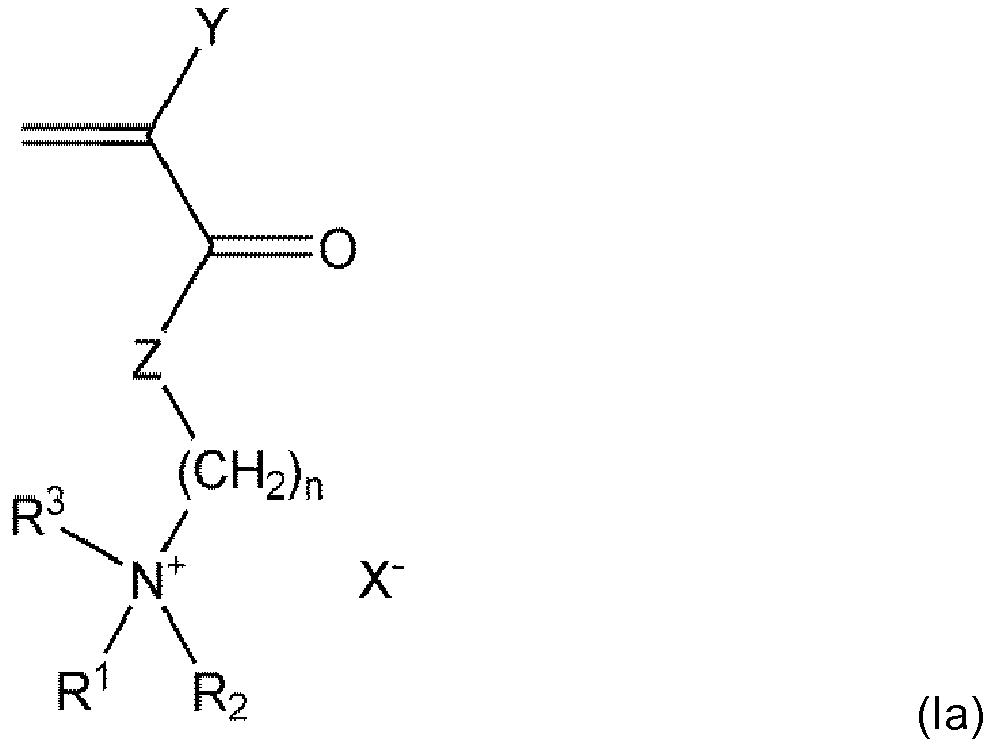
- the first radiation-curable component comprises, preferably is, a compound of Formula la: wherein Y, Z, R 1 , R 2 , R 3 and n are as defined for the compound of Formula I and X - is a counterion for the ammonium function that is not particularly restricted.
- X - is a halogenide ion like F - , Cl - , Br - and/or I - , a pseudohalogenide ion like N 3 - , CN - , NCO - , CNO - , NCS - , CNS - , etc., or another monovalent ion, particularly a counterion that does not interfere in curing, e.g. a halogenide ion like F - , Cl - , Br - and/or I - .
- the first radiation-curable component comprises, preferably is, a compound of Formula II: wherein Y, X, R 1 , R 2 , R 3 and n are as defined for the compound of Formula la.
- the first radiation-curable component comprises, preferably is, a compound of Formula IIa: wherein Y, X and n are as defined for the compound of Formula la, and o, p and q are independently selected from an integer between 0 and 9, preferably between 1 and 6, further preferably between 2 and 5.
- the first radiation-curable component comprises, preferably is, a compound of Formula IIb: wherein Y, X and n are as defined for the compound of Formula la, and m is an integer between 0 and 9, preferably between 1 and 6, further preferably between 2 and 5.
- the first radiation-curable component comprises, preferably is, a compound of Formula III: wherein Y and X are as defined for the compound of Formula Ia.
- the first radiation-curable component comprises, preferably is, a compound of Formula IIIa:
- the first radiation-curable component comprises, preferably is, a compound of Formula IV: wherein Y is H or CH 3 ; Z is NH or CH 2 ; R 1 , R 2 and R 3 are independently selected from optionally substituted alkyl residues with 1 to 10 carbon atoms, and n is an integer between 1 and 20, preferably between 1 and 10.
- first radiation-curable component it is generally possible that more than one compound of Formula IV is present as first radiation-curable component. According to certain embodiments, one compound of Formula IV is present as first radiation-curable component or is the first radiation-curable component.
- Y can be either hydrogen or a methyl group, so that the end group in the respective residue represents an acryl or a methacryl moiety. Both groups are possible, and it is also possible that at least two compounds of Formula IV are used as first radiation-curable component, e.g. one with an acryl moiety and one with a methacryl moiety.
- Z can be NH or CH 2 , and is preferably NH.
- Z is an alkylene chain (CH 2 ) n with 1 to 20 carbon atoms in the chain, preferably 1 to 10 carbon atoms in the chain, further preferably 1 to 6 carbon atoms in the chain, even further preferably 1 to 4 carbon atoms in the chain, e.g. 1 to 3 carbon atoms in the chain, e.g. 1, 2 or 3 carbon atoms.
- a shorter alkylene chain is preferable to enable good solubility, particularly in a polar primer composition.
- R 1 , R 2 and R 3 are independently selected from optionally substituted alkyl residues with 1 to 10 carbon atoms, preferably 1 to 6 carbon atoms, wherein preferably two of the three residues R 1 , R 2 and R 3 are independently selected from short alkyl residues with 1 to 4 carbon atoms, preferably 1, 2 or 3 carbon atoms, and have e.g. 1 carbon atom, e.g. are methyl groups. Again, shorter alkyl chains are preferable from the viewpoint of solubility.
- R 1 , R 2 and R 3 can be linear or branched but are preferably linear so that the charge of the ammonium residue is not blocked too much by the alkyl residues. Furthermore, while R 1 , R 2 and R 3 can be substituted, e.g. by halogenide (e.g. F, CI, Br, I) or pseudohalogenide (e.g. CN, NC, N 3 , CNO, NCO, NCS, CNS, etc.) groups instead of H, they are preferably unsubstituted.
- halogenide e.g. F, CI, Br, I
- pseudohalogenide e.g. CN, NC, N 3 , CNO, NCO, NCS, CNS, etc.
- the first radiation-curable component comprises, preferably is, a compound of Formula IVa: wherein Y, Z, R 1 , R 2 , R 3 and n are as defined for the compound of Formula IV and X - is a counterion for the ammonium function that is not particularly restricted.
- X - is a halogenide ion like F - , Cl - , Br - and/or I - , a pseudohalogenide ion like N 3 - , CN - , NCO - , CNO - , NCS - , CNS - , etc., or another monovalent ion, particularly a counterion that does not interfere in curing, e.g. a halogenide ion like F - , Cl - , Br - and/or I - .
- the first radiation-curable component comprises, preferably is, a compound of Formula V: wherein Y, X, R 1 , R 2 , R 3 and n are as defined for the compound of Formula IVa.
- the first radiation-curable component comprises, preferably is, a compound of Formula Va: wherein Y, X and n are as defined for the compound of Formula IVa, and o, p and q are independently selected from an integer between 0 and 9, preferably between 1 and 6, further preferably between 2 and 5.
- the first radiation-curable component comprises, preferably is, a compound of Formula Vb: wherein Y, X and n are as defined for the compound of Formula IVa, and m is an integer between 0 and 9, preferably between 1 and 6, further preferably between 2 and 5.
- the first radiation-curable component comprises, preferably is, a compound of Formula VI: wherein Y and X are as defined for the compound of Formula IVa.
- the first radiation-curable component comprises, preferably is, a compound of Formula Via:
- a compound of Formula I and a compound of Formula IV are both present.
- a compound of Formula I or a compound of Formula IV is present in the primer composition.
- the amount of the first radiation-curable component comprising at least one cationic NR 4 + and/or PR 4 + group in the present primer composition is not particularly restricted. According to certain embodiments, the amount of the first radiation-curable component in the primer composition is in a range between and including 0,1 and 99 wt.%, preferably between and including 0,5 and 25 wt.%, further preferably between and including 0,8 and 20 wt.%, e.g. between and including 1,0 and 12 wt.%, based on the total weight of the primer composition.
- the primer composition can further comprise components that are usually used in primer compositions for ink and which are not particularly restricted.
- at least a second radiation-curable component, at least one photo initiator, a surfactant, one or more solvents, one or more pH regulators, a biocide, an antioxidant, one or more oxygen scavengers, etc. can be contained in the primer composition.
- the amounts of the further components comprised in the primer composition apart from the first radiation-curable component are not particularly restricted.
- the primer composition further comprises at least a second radiation-curable component and/or at least one photo initiator.
- the second radiation-curable component and the at least one photo initiator are not particularly restricted in this regard.
- the second radiation-curable component comprises or is at least one (meth)acrylate, preferably a substituted (meth)acrylate, further preferably a substituted acrylate.
- the substituted acrylate can be monofunctional or polyfunctional, but preferably is at least difunctional, e.g. difunctional.
- the second radiation-curable component comprises or is at least one di(meth)acrylate, e.g. a diacrylate which can be substituted, e.g. by suitable alkyl groups and/or alkoxy groups, e.g. independently comprising 1 to 40 carbon atoms, e.g. 1 to 20 carbon atoms.
- a substituted glycol di(meth)acrylate like difunctional propoxylated 2 neopentyl glycol diacrylate can be used as or be a second radiation-curable component.
- the amount of the second radiation-curable component is not particularly restricted.
- it can be comprised in an amount between 0 and 99.9 wt.%, preferably between 40 and 97 wt.%, e.g. between 60 and 95 wt.%, based on the total weight of the primer composition.
- the at least one photo initiator is not particularly restricted and can be any photo initiator that can be suitably used in a polymerization reaction, particularly a polymerization that can be started with a suitable radiation, e.g. UV-radiation as defined above.
- a photo initiator can convert absorbed light energy, e.g. UV or visible light, into chemical energy in the form of initiating species, free radicals or cations.
- the photo initiator in the present ink composition is activated by UV light.
- photo initiators as commonly used in primers or printing inks can be used.
- photo initiators two types of photo initiators generally exist based on the mechanism by which initiating radicals are formed, i.e. a type I photo initiator and a type II photo initiator.
- Type I photo initiators are cleaved by irradiation at a reactive bond, yielding free radicals.
- Type II photo initiators are excited by irradiation, and in the excited state the photo initiator interacts with a co-initiator to generate free radicals.
- a type II photo initiator requires a second molecule to interact.
- the type I and type II photo initiators are not particularly limited, and many suitable compounds are known.
- Type I photo initiators comprise, for example, benzoin ethers, benzyl ketals, ⁇ -dialkyloxyacetophenones, ⁇ -hydroxyalkylphenones, ⁇ -aminoalkylphenones and acylphosphine oxides, e.g. 1-hydroxy-cyclohexylphenyl-ketone, and type II photo initiators comprise, for example, benzophenonse/amines and thioxanthones/amines.
- the amount of the one or more photo initiator i.e. all photo initiators present, is not particularly restricted and can be e.g. between 0 and 20 wt%, preferably between 0.1 and 15 wt%, more preferably between 0.25 and 7.5 wt.%, further preferably between 0.5 and 5 wt.%, particularly between 0.7 and 2.5 wt.%, based on the total weight of the primer composition. If more than one photo initiator is used, they can be mixed in a suitable ratio and suitable amounts.
- additives like a surfactant, one or more solvents, one or more pH regulators, a biocide, an antioxidant, one or more oxygen scavengers, and/or a polymerization inhibitor, etc. can be used in the present primer composition in usual amounts.
- one or more surfactants can be contained in the present primer composition to suitably set the viscosity of the primer composition, and to improve the wettability of the surface of a recording medium.
- surfactants are not specifically limited. The following can be cited.
- surfactant examples include nonionic surfactants, cationic surfactants, anionic surfactants, amphoteric surfactants, in particular betaine surfactants, silicone surfactants, and fluorochemical surfactants.
- Examples of a cationic surfactant include: aliphatic amine salts, aliphatic quarternary ammonium salts, benzalkonium salts, benzethonium chloride, pyridinium salts, imidazolinium salts.
- an anionic surfactant examples include: polyoxyethylene alkylether acetic acid salts, dodecylbenzene sulfonic acid salts, lauric acid salts, and salts of polyoxyethylene alkylether sulfate, an aliphatic acid soap, an N-acyl-N-methyl glycin salt, an N-acyl-N-methyl- ⁇ -alanine salt, an N-acylglutamate, an acylated peptide, an alkylsulfonic acid salt, an alkylbezenesulfonic acid salt, an alkylnaphthalenesulfonic acid salt, a dialkylsulfo succinate (e.g.
- DSS sodium dioctyl sulfosuccinate
- DSS sodium dioctyl sulfosuccinate
- AOT docusate sodium, Aerosol OT and AOT
- alkylsulfo acetate alfa-olefin sulfonate
- N-acylmethyl taurine a sulfonated oil
- a higher alcohol sulfate salt a secondary higher alcohol sulfate salt
- an alkyl ether sulfate, a secondary higher alcohol ethoxysulfate a polyoxyethylene alkylphenyl ether sulfate, a monoglysulfate, an aliphatic acid alkylolamido sulfate salt, an alkyl ether phosphate salt and an alkyl phosphate salt.
- amphoteric surfactant examples include: a carboxybetaine type, a sulfobetaine type, an aminocarboxylate salt and an imidazolium betaine.
- nonionic surfactant examples include: polyoxyethylene alkylether, polyoxypropylene polyoxyethylene alkylether, a polyoxyethylene secondary alcohol ether, a polyoxyethylene alkylphenyl ether, a polyoxyethylene sterol ether, a polyoxyethylenelanolin derivative polyoxyethylene polyoxypropylene alkyl ether, polyoxyethylene alkylester, a polyoxyethyleneglycerine aliphatic acid ester, a polyoxyethylene castor oil, a hydrogenated castor oil, a polyoxyethylene sorbitol aliphatic acid ester, a polyethylene glycols aliphatic acid ester, an aliphatic acid monoglyceride, a polyglycerine aliphatic acid ester, a sorbitan aliphatic acid ester, polyoxyethylene sorbitan aliphatic ester, a propylene glycol aliphatic acid ester, a cane sugar aliphatic acid ester, an aliphatic acid alphatic
- fluorochemical surfactants examples include nonionic fluorochemical surfactants, anionic fluorochemical surfactants, and amphoteric fluorochemical surfactants.
- nonionic fluorochemical surfactants include perfluoroalkyl phosphoric acid ester compounds, perfluoroalkyl ethylene oxide adducts, and polyoxyalkylene ether polymer compounds having perfluoroalkyl ether groups as side chains.
- polyoxyalkylene ether polymer compounds having perfluoroalkyl ether groups as side chains are preferable because they are low in foaming property.
- the present primer composition can comprise one or more solvents, which are not particularly limited, and can comprise water and/or organic solvents, e.g. water-soluble organic solvents like polyhydric alcohols, polyhydric alcohol alkyl ethers, polyhydric alcohol aryl ethers, nitrogen-containing heterocyclic compounds, amides, amines, ammonium compounds, sulfur-containing compounds, propylene carbonate, and ethylene carbonate.
- water-soluble organic solvents like polyhydric alcohols, polyhydric alcohol alkyl ethers, polyhydric alcohol aryl ethers, nitrogen-containing heterocyclic compounds, amides, amines, ammonium compounds, sulfur-containing compounds, propylene carbonate, and ethylene carbonate.
- essentially no or no solvent like water, organic solvents, etc., is contained in the present primer composition.
- the present primer composition can further comprise one or more oxygen scavengers, which is not particularly restricted. If an oxygen scavenger is contained, it can be also adapted to a photo initiator used.
- the oxygen scavenger can function - according to certain embodiments - as co-initiator for a type II photo initiator, e.g. when the oxygen scavenger is an amine, e.g. in case the type II photo initiator is a thioxanthone, e.g. isopropylthioxanthone.
- polymerization inhibitors can be contained in the present primer composition for increasing the shelf life thereof.
- the type of polymerization inhibitor is not particularly limited and can be suitably set.
- suitable polymerization inhibitors for acryl-based polymerization systems include phenothiazine and compounds with similar structures, namely, phenoxazine, phenothiazine, promazine, promazine hydrochloride, N,N'-dimethylphenazine, carbazole, N-ethylcarbazole, N-benzylphenothiazine, and N-(1-phenylethyl)phenothiazine, as well as derivatives thereof.
- hindered phenols such as hydroquinone, 4-methoxyphenol, methoxyhydroquinone and BHT can be used.
- Genorad 16, Genorad 18, Genorad 20, Genorad 21 or Genorad 22 can be used.
- Combinations of inhibitors may also be used.
- the amount of the polymerization inhibitor is not particularly limited as long as it enables a polymerization inhibition during storage but does not prevent polymerization during the application and curing process.
- the inhibitor is present in an amount of less than 4wt% based on the total weight of the primer composition, more preferably in an amount of less than 3wt% based on the total weight of the primer composition, such as in an amount of less than 2wt% based on the total weight of the primer composition, for example in an amount of less than 1wt% based on the total weight of the primer composition.
- the further additives are contained in the primer composition in an amount of between 0 and 10 wt.%, e.g. between 0 and 5 wt.%, for example between 0 and 2 wt.%, based on total weight of the primer composition.
- a further aspect of the present invention is directed to a kit, comprising the primer composition of the present invention, and at least one radiation-curable ink composition.
- the at least one radiation-curable ink composition is not particularly restricted, and it is also possible to provide more than one radiation curable ink composition, e.g. for printing different colors.
- the at least one radiation-curable ink composition comprises a radiation-curable gelling ink, which is not particularly restricted.
- a curable gelling ink formulation as disclosed in EP3173447 A1 which is incorporated herein with regard to the gelling ink formulation, can be applied in the present kit as the at least one radiation-curable ink composition.
- other radiation-curable ink compositions can be applied, i.e. also non-gelling radiation-curable inks.
- Another aspect of the present invention relates to a method of applying an image onto a recording medium, comprising the steps of
- steps like media pre-treatment, particularly before applying the present primer composition, and/or drying, e.g. after curing the at least one radiation-curable ink composition, etc., which are used in printing methods can be applied, which are not particularly restricted.
- the recording medium is not particularly restricted. Suitable recording media for use in the present method are not particularly limited to any type.
- the recording/receiving medium may be suitably selected depending on the intended application. Suitable recording/receiving media may be, but are not limited to, paper (plain or recycled, etc.), cardboard, glass, metal foil, and plastic sheets (for example PE, PP, PVC and PET films).
- the recording medium comprises a glass onto which the primer composition is at least partially applied. It was particularly found that the present primer composition can be suitably applied to glass and adheres thereon sufficiently.
- the applying of the present primer composition onto the recording medium is not particularly restricted, and any conventionally known methods can be used.
- Specific examples of an application way include, for example: a roller coating, an ink-jet application, a curtain coating and a spray coating.
- the primer composition is applied in an amount to achieve a thickness of the deposited primer composition of 0.1 to 50 ⁇ m, preferably 1 to 30 ⁇ m further preferably 2 to 20 ⁇ m.
- the primer composition has a thickness after curing of 0.1 to 50 ⁇ m, preferably 1 to 30 ⁇ m further preferably 2 to 20 ⁇ m.
- the optionally curing of the primer composition is also not particularly restricted. It is also possible to cure the primer composition together with the at least one radiation-curable ink composition, i.e. to skip this step.
- the curing can be adapted to the components of the primer composition, e.g. with regard to an applied radiation, an applied temperature, a curing time, etc.
- curing the primer composition is carried out using UV radiation. For this step, any suitable UV generating device can be applied.
- the step of applying at least one radiation-curable ink composition onto the primer composition is not particularly restricted, and any suitable radiation-curable ink composition can be applied.
- at least one radiation-curable ink composition as disclosed with regard to the present kit can be applied.
- the application is not particularly limited as long as the ink composition is deposited on the primer composition on the recording medium.
- the ink composition is jetted on the primer composition on the recording medium, e.g. using ink-jet printing equipment.
- a suitable application method for applying the ink composition, as well as suitable other steps used in printing an ink composition, particularly a gelling UV curable ink composition is e.g.
- the at least one radiation-curable ink composition comprises a radiation-curable gelling ink.
- a UV curable ink is applied in the present method, particularly a UV curable gelling ink.
- Curing the at least one radiation-curable ink composition is also not particularly restricted.
- the curing can be adapted to the components of the ink composition, e.g. with regard to an applied radiation, an applied temperature, a curing time, etc.
- curing the ink composition e.g. also together with the primer composition, is carried out using UV radiation.
- any suitable UV generating device can be applied.
- More than one radiation-curable ink composition can be applied in the present method as well, e.g. for providing different colors, and the different radiation-curable ink compositions can be cured one after the other, together, or in groups, and the curing is not particularly restricted.
- it can be accomplished by applying a suitable radiation, e.g. UV-radiation, for a time sufficient for curing.
- a radiation-curable component comprising at least one cationic NR 4 + and/or PR 4 + group, preferably comprising at least one cationic NR 4 + group, wherein the groups R can be the same or different and can be chosen from substituted or unsubstituted alkyl and/or alkylene groups, wherein at least one group R comprises a radiation-curable residue, in a primer composition for an ink.
- the first radiation-curable component comprising at least one cationic NR 4 + and/or PR 4 + group is not polymeric, i.e. does not contain any repeating units.
- the radiation-curable component comprises or is a compound of Formula I: wherein Y is H or CH 3 ; Z is NH or CH 2 ; R 1 , R 2 and R 3 are independently selected from optionally substituted alkyl residues with 1 to 10 carbon atoms, and n is an integer between 1 and 20, preferably between 1 and 10.
- the radiation-curable component comprises or is a compound of Formula la, preferably comprises or is a compound of Formula II, further preferably comprises or is a compound of Formula Ila, even further preferably comprises or is a compound of Formula IIb, particularly preferably comprises or is a compound of Formula III, e.g. comprises or is a compound of Formula IIIa, wherein the compounds are as defined above with regard to the present primer composition.
- the radiation-curable component comprises or is a compound of Formula IV: wherein Y is H or CH 3 ; Z is NH or CH 2 ; R 1 , R 2 and R 3 are independently selected from optionally substituted alkyl residues with 1 to 10 carbon atoms, and n is an integer between 1 and 20, preferably between 1 and 10.
- the radiation-curable component comprises or is a compound of Formula IVa, preferably comprises or is a compound of Formula V, further preferably comprises or is a compound of Formula Va, even further preferably comprises or is a compound of Formula Vb, particularly preferably comprises or is a compound of Formula VI, e.g. comprises or is a compound of Formula Via, wherein the compounds are as defined above with regard to the present primer composition.
- a reactive quaternary ammonium salt N-[3-Hexyldimethyl-aminopropyl methacrylamide bromide, was synthesized as first radiation-curable component according to a synthetic route shown in scheme 1.
- a primer 3 was produced by mixing it with the further components given in Table 1 below.
- SR9003 propoxylated neopentyl glycol diacrylate
- BDMM, ITX and EPD all obtainable form Rahn USA Corp., were used as photoinitiators.
- UV curable primer solutions 1 and 2 were made with the components given in Table 1 as well: surfactantless primer 1, and primer 2 containing Tegorad 2250 as the wetting agent, see table 1 for amounts.
- Table 1 Components used in the primers in Example 1 (primer 3) and Comparative Examples 1 (primer 1 and 2) Primer No.
- Second radiation-curable component Photo initiators surfactant First radiation-curable component 1 10g Genomer BDMM: 0.24 g Genomer ITX: 0.40 g Genomer EPD: 0.43 g 2 10g Genomer BDMM: 0.24 g Tegorad 2250: 0.07 g Genomer ITX: 0.40 g Genomer EPD: 0.43 g 3 10g Genomer BDMM: 0.24 g 1.25 g Genomer ITX: 0.40 g Genomer EPD: 0.43 g
- All primer solutions were rodcoated on roughly the same portion of different glass slides with a layer thickness of 12 ⁇ m and cured by irradiation with a UV LED source of -395 nm at 100% light intensity and a belt speed of 7.5 m/min for three times.
- the UV LED source is a Phoseon FP300 150x20WC395 lamp having a peak irradiance of 20 W/cm 2 peak at 395 nm wavelength.
- a black ink was rodcoated on top of the cured primer layer slides with a layer thickness of 12 ⁇ m and cured using the same curing conditions, to produce 3 samples (samples 2 to 4). For better visibility not the whole glass slide was coated.
- the black ink was rodcoated on glass slides with a layer thickness of 12 ⁇ m and cured by irradiation with a UV LED source of ⁇ 395 nm at 100% light intensity and a belt speed of 7.5 m/min for three times (sample 1).
- sample 2 was prepared, and with primer 2 sample 3.
- primer 3 i.e. the primer composition of the invention
- sample 4 was prepared.
- the adhesion of the formed films were tested qualitatively by pressing a tape on top of the cured layers and removing the tape in one hard pull. The results thereof are shown in Fig. 1 .
Landscapes
- Chemical & Material Sciences (AREA)
- Life Sciences & Earth Sciences (AREA)
- Engineering & Computer Science (AREA)
- Materials Engineering (AREA)
- Wood Science & Technology (AREA)
- Organic Chemistry (AREA)
- Chemical Kinetics & Catalysis (AREA)
- Paints Or Removers (AREA)
- Inks, Pencil-Leads, Or Crayons (AREA)
Abstract
Description
- The present invention relates to a primer composition for a radiation-curable ink composition, a kit comprising the primer composition, a method of applying an image onto a recording medium using the primer composition.
- Sufficient adhesion of a printing ink on a recording medium is of high importance during printing, wherein a variety of different recording media are encountered. As these recording media vary in surface composition and characteristics, primer compositions can be used to enhance adhesion of the printing ink on the recording medium.
- A variety of different primer compositions have been developed for these purpose. For example, polymeric cations added in an aqueous primer solution are believed to promote adhesion of a deposited top layer, e.g. a printing ink, which is attributed to their ionic interaction with negatively charged surface groups of the substrate and intermingling of the polymer with the polymers of the top layer. However, those polymeric cations are usually insoluble in an acrylate primer or ink vehicle, which makes them less suitable.
-
US 2003/0119939 describes ink compositions with a polyquatenary amine and quaternary ammonium substituted UV absorbing compound. -
EP 2077304 discloses an ink receiving layer of a recording medium comprising a polymer having cationic groups. - Furthermore,
EP 1710282 mentions modifying a substrate by applying a primer comprising a polymer comprising a plurality of cationic groups, such as NR4 + groups. The cationic groups are covalently attached to a polymer. This polymer can be made by reacting an ethylenic group, but the document does not disclose that the primer itself comprises an ethylenic group. - In
US 2017/0342282 A1 a UV curable adhesion promoting inkjet ink is described consisting of at least one photoinitiator, a polmerizable oligomer, a polyfunctional propoxylated acrylate and a carefully choosen monofunctional ethoxylated methacrylate. A colorless ink as adhesion promoting primer on glass is mentioned. - In
WO 2017 208562 A1 a photocurable primer ink composition with good adhesion on non-absorbing base and capable of forming a primer layer of low tackiness is described. - However, there remains a need for a primer composition with improved adhesion on a recording medium that particularly can be easily and uniformly applied, as well as for a method wherein an image can be suitably applied onto a recording medium and has sufficient adhesion.
- The present inventors found that a primer composition can be prepared that sufficiently adheres to a recording medium using at least a first radiation-curable component comprising a quaternary cationic function, e.g. an ammonium function, while the compound is still sufficiently soluble to be evenly distributed, and furthermore can provide sufficient adhesion of an image printed thereon. The inventors further found also an improved adhesion of the printed layer due to the presence of the cationic groups in the first radiation-curable component.
- In a first aspect the present invention relates to a primer composition for an ink, comprising a first radiation-curable component comprising at least one cationic NR4 + and/or PR4 + group, wherein the groups R can be the same or different and can be chosen from substituted or unsubstituted alkyl and/or alkylene groups, wherein at least one group R comprises a radiation-curable residue.
- Furthermore disclosed is a kit, comprising the present primer composition and at least one radiation-curable ink composition.
- In addition the present invention is directed to a method of applying an image onto a recording medium, comprising the steps of
- applying the present primer composition onto the recording medium; and
- optionally curing the primer composition;
- applying at least one radiation-curable ink composition onto the primer composition; and
- curing the at least one radiation-curable ink composition.
- Also disclosed is the use of a radiation-curable component comprising at least one cationic NR4 + and/or PR4 + group, wherein the groups R can be the same or different and can be chosen from substituted or unsubstituted alkyl and/or alkylene groups, wherein at least one group R comprises a radiation-curable residue, in a primer composition for an ink.
- Further aspects and embodiments of the invention are disclosed in the dependent claims and can be taken from the following description, figures and examples, without being limited thereto.
- The present invention will become more fully understood from the detailed description given herein below and accompanying schematic drawings which are given by way of illustration only and are not limitative of the invention, and wherein:
Fig. 1 shows results obtained in the present Examples. - Detailed embodiments of the present invention are disclosed herein; however, it is to be understood that the disclosed embodiments are merely exemplary of the invention, which can be embodied in various forms. Therefore, specific structural and functional details disclosed herein are not to be interpreted as limiting, but merely as a basis for the claims and as a representative basis for teaching one skilled in the art to variously employ the present invention in virtually and appropriately detailed structure. In particular, features presented and described in separate dependent claims may be applied in combination, and any combination of such claims is herewith disclosed.
- Further, the terms and phrases used herein are not intended to be limiting; but rather, to provide an understandable description of the invention. The terms "a" or "an", as used herein, are defined as one or more than one. The term plurality, as used herein, is defined as two or more than two. The term another, as used herein, is defined as at least a second or more. The terms including and/or having, as used herein, are defined as comprising (i.e., open language).
- Unless defined otherwise, technical and scientific terms used herein have the same meaning as commonly understood by one of ordinary skill in the art to which this invention belongs.
- Radiation within the present invention is not particularly restricted and refers to any radiation that can react at least one component of the present primer composition and/or at least one component of the ink composition in the present kit composition and/or used in the present method.
- In the present specification, amounts of a substance are usually given as weight/mass percent (wt%, m%), unless noted otherwise or clear from the context. In the present primer composition, the amounts add up to 100 wt%.
- A first aspect of the present invention relates to a primer composition for an ink, comprising a first radiation-curable component comprising at least one cationic NR4 + and/or PR4 + group, wherein the groups R can be the same or different and can be chosen from substituted or unsubstituted alkyl and/or alkylene groups, wherein at least one group R comprises a radiation-curable residue. According to certain embodiments, the invention relates to a primer composition for an ink, comprising a first radiation-curable component comprising at least one cationic NR4 + group, wherein the groups R can be the same or different and can be chosen from substituted or unsubstituted alkyl and/or alkylene groups, wherein at least one group R comprises a radiation-curable residue.
- According to certain embodiments, the first radiation-curable component comprising at least one cationic NR4 + and/or PR4 + group is not polymeric. The first radiation-curable component preferably comprises at least functional group capable of undergoing a polymerization reaction, such as a vinyl group or a (meth)acrylate group.
- The component comprising at least one cationic NR4 + and/or PR4 + group is not particularly restricted otherwise, as long as at least one residue R, for example one, two, three or four residues R, preferably one residue R - which can be the same or different - comprises a radiation-curable residue. The radiation-curable residue is not particularly restricted and can comprise any structure that can polymerize with radiation. According to certain embodiments, at least one unsaturated bond, e.g. an alkene and/or alkyne function, is contained in the radiation-curable residue. According to certain embodiments, the radiation-curable residue comprises a (meth)acryl function, i.e. an acryl function (CH2-CH-CO-R* with R* being the further residue) and/or a methacryl function. According to certain embodiments, one residue R comprises a (meth)acryl function (CH2-C(CH3)-CO-R* with R* being the further residue). According to certain embodiments, the first radiation-curable component comprises at least one (meth)acrylate group.
- According to certain embodiments the first radiation-curable component is UV-curable. This means that the radiation-curable residue can be cured using UV-light. UV-light therein is radiation in a wavelength region between and encompassing 10 and 410 nm. Preferably the first radiation-curable component is curable with radiation in a wavelength range between and encompassing 100 and 405 nm, further preferably between and encompassing 200 and 405 nm, particularly preferably between and encompassing 315 and 400 nm.
- According to certain embodiments the first radiation-curable component comprises, preferably is, a compound of Formula I:

- It is generally possible that more than one compound of Formula I is present as first radiation-curable component. According to certain embodiments, one compound of Formula I is present as first radiation-curable component or is the first radiation-curable component.
- In Formula I, Y can be either hydrogen or a methyl group, so that the end group in the respective residue represents an acryl or a methacryl moiety. Both groups are possible, and it is also possible that at least two compounds of Formula I are used as first radiation-curable component, e.g. one with an acryl moiety and one with a methacryl moiety.
- Furthermore, Z can be NH or CH2, and is preferably NH. Following the residue Z is an alkylene chain (CH2)n with 1 to 20 carbon atoms in the chain, preferably 1 to 10 carbon atoms in the chain, further preferably 1 to 6 carbon atoms in the chain, even further preferably 1 to 4 carbon atoms in the chain, e.g. 1 to 3 carbon atoms in the chain, e.g. 1, 2 or 3 carbon atoms. A shorter alkylene chain is preferable to enable good solubility, particularly in a polar primer composition.
- R1, R2 and R3 are independently selected from optionally substituted alkyl residues with 1 to 10 carbon atoms, preferably 1 to 6 carbon atoms, wherein preferably two of the three residues R1, R2 and R3 are independently selected from short alkyl residues with 1 to 4 carbon atoms, preferably 1, 2 or 3 carbon atoms, and have e.g. 1 carbon atom, e.g. are methyl groups. Again, shorter alkyl chains are preferable from the viewpoint of solubility.
- R1, R2 and R3 can be linear or branched but are preferably linear so that the charge of the ammonium residue is not blocked too much by the alkyl residues. Furthermore, while R1, R2 and R3 can be substituted, e.g. by halogenide (e.g. F, CI, Br, I) or pseudohalogenide (e.g. CN, NC, N3, CNO, NCO, NCS, CNS, etc.) groups instead of H, they are preferably unsubstituted.
- According to certain embodiments the first radiation-curable component comprises, preferably is, a compound of Formula la:
- According to certain embodiments the first radiation-curable component comprises, preferably is, a compound of Formula II:

- According to certain embodiments the first radiation-curable component comprises, preferably is, a compound of Formula IIa:

- According to certain embodiments the first radiation-curable component comprises, preferably is, a compound of Formula IIb:

- According to certain embodiments the first radiation-curable component comprises, preferably is, a compound of Formula III:

- According to certain embodiments the first radiation-curable component comprises, preferably is, a compound of Formula IIIa:

- According to certain embodiments the first radiation-curable component comprises, preferably is, a compound of Formula IV:

- It is generally possible that more than one compound of Formula IV is present as first radiation-curable component. According to certain embodiments, one compound of Formula IV is present as first radiation-curable component or is the first radiation-curable component.
- In Formula IV, Y can be either hydrogen or a methyl group, so that the end group in the respective residue represents an acryl or a methacryl moiety. Both groups are possible, and it is also possible that at least two compounds of Formula IV are used as first radiation-curable component, e.g. one with an acryl moiety and one with a methacryl moiety.
- Furthermore, Z can be NH or CH2, and is preferably NH. Following the residue Z is an alkylene chain (CH2)n with 1 to 20 carbon atoms in the chain, preferably 1 to 10 carbon atoms in the chain, further preferably 1 to 6 carbon atoms in the chain, even further preferably 1 to 4 carbon atoms in the chain, e.g. 1 to 3 carbon atoms in the chain, e.g. 1, 2 or 3 carbon atoms. A shorter alkylene chain is preferable to enable good solubility, particularly in a polar primer composition.
- R1, R2 and R3 are independently selected from optionally substituted alkyl residues with 1 to 10 carbon atoms, preferably 1 to 6 carbon atoms, wherein preferably two of the three residues R1, R2 and R3 are independently selected from short alkyl residues with 1 to 4 carbon atoms, preferably 1, 2 or 3 carbon atoms, and have e.g. 1 carbon atom, e.g. are methyl groups. Again, shorter alkyl chains are preferable from the viewpoint of solubility.
- R1, R2 and R3 can be linear or branched but are preferably linear so that the charge of the ammonium residue is not blocked too much by the alkyl residues. Furthermore, while R1, R2 and R3 can be substituted, e.g. by halogenide (e.g. F, CI, Br, I) or pseudohalogenide (e.g. CN, NC, N3, CNO, NCO, NCS, CNS, etc.) groups instead of H, they are preferably unsubstituted.
- According to certain embodiments the first radiation-curable component comprises, preferably is, a compound of Formula IVa:

- According to certain embodiments the first radiation-curable component comprises, preferably is, a compound of Formula V:

- According to certain embodiments the first radiation-curable component comprises, preferably is, a compound of Formula Va:

- According to certain embodiments the first radiation-curable component comprises, preferably is, a compound of Formula Vb:

- According to certain embodiments the first radiation-curable component comprises, preferably is, a compound of Formula VI:

- According to certain embodiments the first radiation-curable component comprises, preferably is, a compound of Formula Via:

- In the present primer composition it is also possible that a compound of Formula I and a compound of Formula IV are both present. According to certain embodiments, a compound of Formula I or a compound of Formula IV is present in the primer composition.
- The amount of the first radiation-curable component comprising at least one cationic NR4 + and/or PR4 + group in the present primer composition is not particularly restricted. According to certain embodiments, the amount of the first radiation-curable component in the primer composition is in a range between and including 0,1 and 99 wt.%, preferably between and including 0,5 and 25 wt.%, further preferably between and including 0,8 and 20 wt.%, e.g. between and including 1,0 and 12 wt.%, based on the total weight of the primer composition.
- Apart from the first radiation-curable component the primer composition can further comprise components that are usually used in primer compositions for ink and which are not particularly restricted. For example, at least a second radiation-curable component, at least one photo initiator, a surfactant, one or more solvents, one or more pH regulators, a biocide, an antioxidant, one or more oxygen scavengers, etc. can be contained in the primer composition.
- Also the amounts of the further components comprised in the primer composition apart from the first radiation-curable component are not particularly restricted.
- According to certain embodiments, the primer composition further comprises at least a second radiation-curable component and/or at least one photo initiator. The second radiation-curable component and the at least one photo initiator are not particularly restricted in this regard.
- According to certain embodiments, the second radiation-curable component comprises or is at least one (meth)acrylate, preferably a substituted (meth)acrylate, further preferably a substituted acrylate. The substituted acrylate can be monofunctional or polyfunctional, but preferably is at least difunctional, e.g. difunctional. According to certain embodiments the second radiation-curable component comprises or is at least one di(meth)acrylate, e.g. a diacrylate which can be substituted, e.g. by suitable alkyl groups and/or alkoxy groups, e.g. independently comprising 1 to 40 carbon atoms, e.g. 1 to 20 carbon atoms. For example, a substituted glycol di(meth)acrylate like
difunctional propoxylated 2 neopentyl glycol diacrylate can be used as or be a second radiation-curable component. - The amount of the second radiation-curable component is not particularly restricted. For example, it can be comprised in an amount between 0 and 99.9 wt.%, preferably between 40 and 97 wt.%, e.g. between 60 and 95 wt.%, based on the total weight of the primer composition.
- The at least one photo initiator is not particularly restricted and can be any photo initiator that can be suitably used in a polymerization reaction, particularly a polymerization that can be started with a suitable radiation, e.g. UV-radiation as defined above. A photo initiator can convert absorbed light energy, e.g. UV or visible light, into chemical energy in the form of initiating species, free radicals or cations. Preferably the photo initiator in the present ink composition is activated by UV light. For example, photo initiators as commonly used in primers or printing inks can be used.
- For photo initiators, two types of photo initiators generally exist based on the mechanism by which initiating radicals are formed, i.e. a type I photo initiator and a type II photo initiator. Type I photo initiators are cleaved by irradiation at a reactive bond, yielding free radicals. Type II photo initiators are excited by irradiation, and in the excited state the photo initiator interacts with a co-initiator to generate free radicals. Thus, a type II photo initiator requires a second molecule to interact. The type I and type II photo initiators are not particularly limited, and many suitable compounds are known. Type I photo initiators comprise, for example, benzoin ethers, benzyl ketals, α-dialkyloxyacetophenones, α-hydroxyalkylphenones, α-aminoalkylphenones and acylphosphine oxides, e.g. 1-hydroxy-cyclohexylphenyl-ketone, and type II photo initiators comprise, for example, benzophenonse/amines and thioxanthones/amines.
- The amount of the one or more photo initiator, i.e. all photo initiators present, is not particularly restricted and can be e.g. between 0 and 20 wt%, preferably between 0.1 and 15 wt%, more preferably between 0.25 and 7.5 wt.%, further preferably between 0.5 and 5 wt.%, particularly between 0.7 and 2.5 wt.%, based on the total weight of the primer composition. If more than one photo initiator is used, they can be mixed in a suitable ratio and suitable amounts.
- Furthermore further additives like a surfactant, one or more solvents, one or more pH regulators, a biocide, an antioxidant, one or more oxygen scavengers, and/or a polymerization inhibitor, etc. can be used in the present primer composition in usual amounts.
- For example, one or more surfactants can be contained in the present primer composition to suitably set the viscosity of the primer composition, and to improve the wettability of the surface of a recording medium. Examples of surfactants are not specifically limited. The following can be cited.
- Examples of the surfactant include nonionic surfactants, cationic surfactants, anionic surfactants, amphoteric surfactants, in particular betaine surfactants, silicone surfactants, and fluorochemical surfactants.
- Examples of a cationic surfactant include: aliphatic amine salts, aliphatic quarternary ammonium salts, benzalkonium salts, benzethonium chloride, pyridinium salts, imidazolinium salts.
- Examples of an anionic surfactant include: polyoxyethylene alkylether acetic acid salts, dodecylbenzene sulfonic acid salts, lauric acid salts, and salts of polyoxyethylene alkylether sulfate, an aliphatic acid soap, an N-acyl-N-methyl glycin salt, an N-acyl-N-methyl-β-alanine salt, an N-acylglutamate, an acylated peptide, an alkylsulfonic acid salt, an alkylbezenesulfonic acid salt, an alkylnaphthalenesulfonic acid salt, a dialkylsulfo succinate (e.g. sodium dioctyl sulfosuccinate (DSS); alternative names: docusate sodium, Aerosol OT and AOT), alkylsulfo acetate, alfa-olefin sulfonate, N-acylmethyl taurine, a sulfonated oil, a higher alcohol sulfate salt, a secondary higher alcohol sulfate salt, an alkyl ether sulfate, a secondary higher alcohol ethoxysulfate, a polyoxyethylene alkylphenyl ether sulfate, a monoglysulfate, an aliphatic acid alkylolamido sulfate salt, an alkyl ether phosphate salt and an alkyl phosphate salt.
- Examples of an amphoteric surfactant include: a carboxybetaine type, a sulfobetaine type, an aminocarboxylate salt and an imidazolium betaine.
- Examples of a nonionic surfactant include: polyoxyethylene alkylether, polyoxypropylene polyoxyethylene alkylether, a polyoxyethylene secondary alcohol ether, a polyoxyethylene alkylphenyl ether, a polyoxyethylene sterol ether, a polyoxyethylenelanolin derivative polyoxyethylene polyoxypropylene alkyl ether, polyoxyethylene alkylester, a polyoxyethyleneglycerine aliphatic acid ester, a polyoxyethylene castor oil, a hydrogenated castor oil, a polyoxyethylene sorbitol aliphatic acid ester, a polyethylene glycols aliphatic acid ester, an aliphatic acid monoglyceride, a polyglycerine aliphatic acid ester, a sorbitan aliphatic acid ester, polyoxyethylene sorbitan aliphatic ester, a propylene glycol aliphatic acid ester, a cane sugar aliphatic acid ester, an aliphatic acid alkanol amide, polyoxyethylene alkylamide, a polyoxyethylene aliphatic acid amide, a polyoxyethylene alkylamine, an alkylamine oxide, an acetyleneglycol, an ethoxylated acetylene glycol, acetylene alcohol.
- Examples of the fluorochemical surfactants include nonionic fluorochemical surfactants, anionic fluorochemical surfactants, and amphoteric fluorochemical surfactants. Examples of the nonionic fluorochemical surfactants include perfluoroalkyl phosphoric acid ester compounds, perfluoroalkyl ethylene oxide adducts, and polyoxyalkylene ether polymer compounds having perfluoroalkyl ether groups as side chains. Among these, polyoxyalkylene ether polymer compounds having perfluoroalkyl ether groups as side chains are preferable because they are low in foaming property.
- The present primer composition can comprise one or more solvents, which are not particularly limited, and can comprise water and/or organic solvents, e.g. water-soluble organic solvents like polyhydric alcohols, polyhydric alcohol alkyl ethers, polyhydric alcohol aryl ethers, nitrogen-containing heterocyclic compounds, amides, amines, ammonium compounds, sulfur-containing compounds, propylene carbonate, and ethylene carbonate. According to certain embodiments, essentially no or no solvent, like water, organic solvents, etc., is contained in the present primer composition.
- The present primer composition can further comprise one or more oxygen scavengers, which is not particularly restricted. If an oxygen scavenger is contained, it can be also adapted to a photo initiator used. For example, the oxygen scavenger can function - according to certain embodiments - as co-initiator for a type II photo initiator, e.g. when the oxygen scavenger is an amine, e.g. in case the type II photo initiator is a thioxanthone, e.g. isopropylthioxanthone.
- Also one or more polymerization inhibitors can be contained in the present primer composition for increasing the shelf life thereof. The type of polymerization inhibitor is not particularly limited and can be suitably set. For example, suitable polymerization inhibitors for acryl-based polymerization systems include phenothiazine and compounds with similar structures, namely, phenoxazine, phenothiazine, promazine, promazine hydrochloride, N,N'-dimethylphenazine, carbazole, N-ethylcarbazole, N-benzylphenothiazine, and N-(1-phenylethyl)phenothiazine, as well as derivatives thereof. Alternatively or additionally, hindered phenols, such as hydroquinone, 4-methoxyphenol, methoxyhydroquinone and BHT can be used. Alternatively or additionally, Genorad 16, Genorad 18, Genorad 20, Genorad 21 or Genorad 22 can be used. Combinations of inhibitors may also be used. The amount of the polymerization inhibitor is not particularly limited as long as it enables a polymerization inhibition during storage but does not prevent polymerization during the application and curing process. Preferably, the inhibitor is present in an amount of less than 4wt% based on the total weight of the primer composition, more preferably in an amount of less than 3wt% based on the total weight of the primer composition, such as in an amount of less than 2wt% based on the total weight of the primer composition, for example in an amount of less than 1wt% based on the total weight of the primer composition.
- According to certain embodiments, the further additives are contained in the primer composition in an amount of between 0 and 10 wt.%, e.g. between 0 and 5 wt.%, for example between 0 and 2 wt.%, based on total weight of the primer composition.
- A further aspect of the present invention is directed to a kit, comprising the primer composition of the present invention, and at least one radiation-curable ink composition.
- In the kit the at least one radiation-curable ink composition is not particularly restricted, and it is also possible to provide more than one radiation curable ink composition, e.g. for printing different colors.
- According to certain embodiments, the at least one radiation-curable ink composition comprises a radiation-curable gelling ink, which is not particularly restricted. For example, a curable gelling ink formulation as disclosed in
EP3173447 A1 , which is incorporated herein with regard to the gelling ink formulation, can be applied in the present kit as the at least one radiation-curable ink composition. However, of course also other radiation-curable ink compositions can be applied, i.e. also non-gelling radiation-curable inks. - Another aspect of the present invention relates to a method of applying an image onto a recording medium, comprising the steps of
- applying the present primer composition onto the recording medium;
- optionally curing the primer composition;
- applying at least one radiation-curable ink composition onto the primer composition; and
- curing the at least one radiation-curable ink composition.
- Apart from these steps, also other steps like media pre-treatment, particularly before applying the present primer composition, and/or drying, e.g. after curing the at least one radiation-curable ink composition, etc., which are used in printing methods can be applied, which are not particularly restricted.
- In this method the recording medium is not particularly restricted. Suitable recording media for use in the present method are not particularly limited to any type. The recording/receiving medium may be suitably selected depending on the intended application. Suitable recording/receiving media may be, but are not limited to, paper (plain or recycled, etc.), cardboard, glass, metal foil, and plastic sheets (for example PE, PP, PVC and PET films). According to certain embodiments, the recording medium comprises a glass onto which the primer composition is at least partially applied. It was particularly found that the present primer composition can be suitably applied to glass and adheres thereon sufficiently.
- In the present method, the applying of the present primer composition onto the recording medium is not particularly restricted, and any conventionally known methods can be used. Specific examples of an application way include, for example: a roller coating, an ink-jet application, a curtain coating and a spray coating. There is no specific restriction in the number of times with which the pre-treatment liquid is applied. It may be applied at one time, or it may be applied in two times or more.
- According to certain embodiments, the primer composition is applied in an amount to achieve a thickness of the deposited primer composition of 0.1 to 50 µm, preferably 1 to 30 µm further preferably 2 to 20 µm. According to certain embodiments, the primer composition has a thickness after curing of 0.1 to 50 µm, preferably 1 to 30 µm further preferably 2 to 20 µm.
- The optionally curing of the primer composition is also not particularly restricted. It is also possible to cure the primer composition together with the at least one radiation-curable ink composition, i.e. to skip this step. The curing can be adapted to the components of the primer composition, e.g. with regard to an applied radiation, an applied temperature, a curing time, etc. According to certain embodiments, curing the primer composition is carried out using UV radiation. For this step, any suitable UV generating device can be applied.
- Furthermore the step of applying at least one radiation-curable ink composition onto the primer composition is not particularly restricted, and any suitable radiation-curable ink composition can be applied. For example, at least one radiation-curable ink composition as disclosed with regard to the present kit can be applied. The application is not particularly limited as long as the ink composition is deposited on the primer composition on the recording medium. According to certain embodiments, the ink composition is jetted on the primer composition on the recording medium, e.g. using ink-jet printing equipment. A suitable application method for applying the ink composition, as well as suitable other steps used in printing an ink composition, particularly a gelling UV curable ink composition, is e.g. known from
US 2015/062271 A1 , which is incorporated herein by reference in its entirety, particularly with reference to the printing method. According to certain embodiments, the at least one radiation-curable ink composition comprises a radiation-curable gelling ink. According to certain embodiments, a UV curable ink is applied in the present method, particularly a UV curable gelling ink. - Curing the at least one radiation-curable ink composition is also not particularly restricted. The curing can be adapted to the components of the ink composition, e.g. with regard to an applied radiation, an applied temperature, a curing time, etc. According to certain embodiments, curing the ink composition, e.g. also together with the primer composition, is carried out using UV radiation. For this step, any suitable UV generating device can be applied.
- More than one radiation-curable ink composition can be applied in the present method as well, e.g. for providing different colors, and the different radiation-curable ink compositions can be cured one after the other, together, or in groups, and the curing is not particularly restricted. For example, it can be accomplished by applying a suitable radiation, e.g. UV-radiation, for a time sufficient for curing.
- Also disclosed is the use of a radiation-curable component comprising at least one cationic NR4 + and/or PR4 + group, preferably comprising at least one cationic NR4 + group, wherein the groups R can be the same or different and can be chosen from substituted or unsubstituted alkyl and/or alkylene groups, wherein at least one group R comprises a radiation-curable residue, in a primer composition for an ink.
- According to certain embodiments, the first radiation-curable component comprising at least one cationic NR4 + and/or PR4 + group is not polymeric, i.e. does not contain any repeating units.
- According to certain embodiments, the radiation-curable component comprises or is a compound of Formula I:

- According to certain embodiments, the radiation-curable component comprises or is a compound of Formula IV:

- The above embodiments can be combined arbitrarily, if appropriate. Further possible embodiments and implementations of the invention comprise also combinations of features not explicitly mentioned in the foregoing or in the following with regard to the Examples of the invention. Particularly, a person skilled in the art will also add individual aspects as improvements or additions to the respective basic form of the invention.
- The present invention will now be described in detail with reference to several examples thereof. However, these examples are illustrative and do not limit the scope of the invention.
- A reactive quaternary ammonium salt, N-[3-Hexyldimethyl-aminopropyl methacrylamide bromide, was synthesized as first radiation-curable component according to a synthetic route shown in
scheme 1.

- The synthesis follows thereby the reaction described on page 40, item C in Wahiba Chaibi et al., "Synthesis and characterization of cationic poly(N-[3-hexyldimethylaminopropyl] methacrylamide bromide) water-soluble polymer, Materials Science and Applied Chemistry, 33, 2016, S. 40-44, doi: 10.1515/msac-2016-0008, using chemicals from Sigma Aldrich.
- With this quaternary ammonium salt a
primer 3 was produced by mixing it with the further components given in Table 1 below. SR9003 (propoxylated neopentyl glycol diacrylate) of Sartomer (Arkema Group) was used as second radiation-curable component. BDMM, ITX and EPD, all obtainable form Rahn USA Corp., were used as photoinitiators. - As a reference two UV
curable primer solutions surfactantless primer 1, andprimer 2 containing Tegorad 2250 as the wetting agent, see table 1 for amounts.Table 1: Components used in the primers in Example 1 (primer 3) and Comparative Examples 1 ( primer 1 and 2)Primer No. Second radiation-curable component Photo initiators surfactant First radiation- curable component 1 10g Genomer BDMM: 0.24 g Genomer ITX: 0.40 g Genomer EPD: 0.43 g 2 10g Genomer BDMM: 0.24 g Tegorad 2250: 0.07 g Genomer ITX: 0.40 g Genomer EPD: 0.43 g 3 10g Genomer BDMM: 0.24 g 1.25 g Genomer ITX: 0.40 g Genomer EPD: 0.43 g - All primer solutions were rodcoated on roughly the same portion of different glass slides with a layer thickness of 12 µm and cured by irradiation with a UV LED source of -395 nm at 100% light intensity and a belt speed of 7.5 m/min for three times. The UV LED source is a Phoseon FP300 150x20WC395 lamp having a peak irradiance of 20 W/cm2 peak at 395 nm wavelength. Subsequently a black ink was rodcoated on top of the cured primer layer slides with a layer thickness of 12 µm and cured using the same curing conditions, to produce 3 samples (
samples 2 to 4). For better visibility not the whole glass slide was coated. - For a further comparison as a blank without any primer application, the black ink was rodcoated on glass slides with a layer thickness of 12 µm and cured by irradiation with a UV LED source of ∼395 nm at 100% light intensity and a belt speed of 7.5 m/min for three times (sample 1).
- With
primer 1,sample 2 was prepared, and withprimer 2sample 3. With theprimer 3, i.e. the primer composition of the invention,sample 4 was prepared. The adhesion of the formed films were tested qualitatively by pressing a tape on top of the cured layers and removing the tape in one hard pull. The results thereof are shown inFig. 1 . - As can be seen from
Fig 1 the cured ink was removed insample 1,sample 2 andsample 3. Insample 1 it was even observed that ink went into the tape. In comparison, no ink was removed forsample 4, where also the border is visible where no ink was applied in the first place. Surprisingly, ink was not even removed at the edge of the application of ink.
Claims (13)
- A primer composition for an ink, comprising a first radiation-curable component comprising at least one cationic NR4 + and/or PR4 + group, wherein the groups R can be the same or different and can be chosen from substituted or unsubstituted alkyl and/or alkylene groups, wherein at least one group R comprises a radiation-curable residue.
- The primer composition of claim 1, wherein the first radiation-curable component is UV-curable.
- The primer composition of claim 1 or 2, wherein the first radiation-curable component comprises at least one (meth)acrylate group.
- The primer composition of any one of the preceding claims, wherein the first radiation-curable component comprises a compound of Formula I:

- The primer composition of any one of the preceding claims, further comprising at least a second radiation-curable component and/or at least one photo initiator.
- The primer composition of claim 5, wherein the second radiation-curable component comprises at least one acrylate, preferably a substituted acrylate.
- A kit, comprising
the primer composition of any one of claims 1 to 6, and
at least one radiation-curable ink composition. - The kit of claim 7, wherein the at least one radiation-curable ink composition comprises a radiation-curable gelling ink.
- A method of applying an image onto a recording medium, comprising the steps of- applying the primer composition of any one of claims 1 to 6 onto the recording medium;- optionally curing the primer composition;- applying at least one radiation-curable ink composition onto the primer composition; and- curing the at least one radiation-curable ink composition.
- The method of claim 9, wherein the at least one radiation-curable ink composition comprises a radiation-curable gelling ink.
- The method of claim 9 or 10, wherein the recording medium comprises a glass onto which the primer composition is at least partially applied.
- Use of a radiation-curable component comprising at least one cationic NR4 + and/or PR4 + group, wherein the groups R can be the same or different and can be chosen from substituted or unsubstituted alkyl and/or alkylene groups, wherein at least one group R comprises a radiation-curable residue, in a primer composition for an ink.
- Use of claim 12, wherein the radiation-curable component comprises a compound of Formula I

Priority Applications (1)
| Application Number | Priority Date | Filing Date | Title |
|---|---|---|---|
| EP18179594.9A EP3587511B1 (en) | 2018-06-25 | 2018-06-25 | Improvement of uv ink adhesion |
Applications Claiming Priority (1)
| Application Number | Priority Date | Filing Date | Title |
|---|---|---|---|
| EP18179594.9A EP3587511B1 (en) | 2018-06-25 | 2018-06-25 | Improvement of uv ink adhesion |
Publications (2)
| Publication Number | Publication Date |
|---|---|
| EP3587511A1 true EP3587511A1 (en) | 2020-01-01 |
| EP3587511B1 EP3587511B1 (en) | 2024-04-10 |
Family
ID=62778810
Family Applications (1)
| Application Number | Title | Priority Date | Filing Date |
|---|---|---|---|
| EP18179594.9A Active EP3587511B1 (en) | 2018-06-25 | 2018-06-25 | Improvement of uv ink adhesion |
Country Status (1)
| Country | Link |
|---|---|
| EP (1) | EP3587511B1 (en) |
Citations (9)
| Publication number | Priority date | Publication date | Assignee | Title |
|---|---|---|---|---|
| US20030119939A1 (en) | 2001-11-07 | 2003-06-26 | Xerox Corporation | Ink compositions containing quaternary-substituted lightfastness agents |
| EP1710282A1 (en) | 2005-04-04 | 2006-10-11 | Deutsches Wollforschungsinstitut an der Rheinisch-Westfälischen Technischen Hochschule Aachen e.V. | Method for producing adherent coatings to surfaces |
| EP2077304A1 (en) | 2005-02-15 | 2009-07-08 | Hewlett-packard Development Company, L. P. | Ink set and media for ink-jet printing |
| JP2012046687A (en) * | 2010-08-30 | 2012-03-08 | Kohjin Co Ltd | Active energy ray-curable resin composition and coating agent |
| WO2012170706A2 (en) * | 2011-06-08 | 2012-12-13 | Surmodics, Inc. | Photo-vinyl linking agents |
| US20150062271A1 (en) | 2013-08-27 | 2015-03-05 | Océ-Technologies B.V. | Inkjet printer assembly using a gelling uv curable ink |
| EP3173447A1 (en) | 2015-11-27 | 2017-05-31 | OCE-Technologies B.V. | Uv curable gelling ink formulation with low wax migration in cured state |
| US20170342282A1 (en) | 2014-12-18 | 2017-11-30 | Agfa Graphics Nv | Uv curable inkjet inks for printing on glass |
| WO2017208562A1 (en) | 2016-05-31 | 2017-12-07 | マクセルホールディングス株式会社 | Photocurable inkjet primer ink composition, inkjet ink set and inkjet recording method |
Family Cites Families (2)
| Publication number | Priority date | Publication date | Assignee | Title |
|---|---|---|---|---|
| JP2008006779A (en) * | 2006-06-30 | 2008-01-17 | Daido Kasei Kogyo Kk | Composition for active energy beam curable type ink jet recording material coating, and ink jet recording material |
| CN107107461B (en) * | 2015-01-26 | 2022-03-29 | 科巨希化学股份公司 | Active energy ray-curable resin composition for three-dimensional molded support |
-
2018
- 2018-06-25 EP EP18179594.9A patent/EP3587511B1/en active Active
Patent Citations (9)
| Publication number | Priority date | Publication date | Assignee | Title |
|---|---|---|---|---|
| US20030119939A1 (en) | 2001-11-07 | 2003-06-26 | Xerox Corporation | Ink compositions containing quaternary-substituted lightfastness agents |
| EP2077304A1 (en) | 2005-02-15 | 2009-07-08 | Hewlett-packard Development Company, L. P. | Ink set and media for ink-jet printing |
| EP1710282A1 (en) | 2005-04-04 | 2006-10-11 | Deutsches Wollforschungsinstitut an der Rheinisch-Westfälischen Technischen Hochschule Aachen e.V. | Method for producing adherent coatings to surfaces |
| JP2012046687A (en) * | 2010-08-30 | 2012-03-08 | Kohjin Co Ltd | Active energy ray-curable resin composition and coating agent |
| WO2012170706A2 (en) * | 2011-06-08 | 2012-12-13 | Surmodics, Inc. | Photo-vinyl linking agents |
| US20150062271A1 (en) | 2013-08-27 | 2015-03-05 | Océ-Technologies B.V. | Inkjet printer assembly using a gelling uv curable ink |
| US20170342282A1 (en) | 2014-12-18 | 2017-11-30 | Agfa Graphics Nv | Uv curable inkjet inks for printing on glass |
| EP3173447A1 (en) | 2015-11-27 | 2017-05-31 | OCE-Technologies B.V. | Uv curable gelling ink formulation with low wax migration in cured state |
| WO2017208562A1 (en) | 2016-05-31 | 2017-12-07 | マクセルホールディングス株式会社 | Photocurable inkjet primer ink composition, inkjet ink set and inkjet recording method |
Non-Patent Citations (1)
| Title |
|---|
| WAHIBA CHAIBI ET AL.: "Synthesis and characterization of cationic poly(N-[3-hexyldimethyl-aminopropyl] methacrylamide bromide) water-soluble polymer", MATERIALS SCIENCE AND APPLIED CHEMISTRY, vol. 33, 2016, pages 40 - 44 |
Also Published As
| Publication number | Publication date |
|---|---|
| EP3587511B1 (en) | 2024-04-10 |
Similar Documents
| Publication | Publication Date | Title |
|---|---|---|
| US7625959B2 (en) | Curable jettable liquid for flexography | |
| EP2599842B2 (en) | Light-curable ink composition for ink jet recording and ink jet recording method using the same | |
| EP2915856B1 (en) | Etch-resistant inkjet inks for manufacturing conductive patterns | |
| EP3233511B1 (en) | Uv curable inkjet inks for printing on glass | |
| KR101982902B1 (en) | Photo-reactive binder | |
| US11028280B2 (en) | Composition, cured product, composition stored container, image forming apparatus, and image forming method | |
| EP3327050B1 (en) | Curable composition | |
| TW200706549A (en) | Low extractable radiation curable compositions containing aminoacrylates | |
| TWI760493B (en) | Amino (meth)acrylates, use thereof, and a coating process by applying a composition comprising the same | |
| DE602004004179T2 (en) | Radiation-curable ink compositions suitable for ink-jet printing | |
| EP3210947A1 (en) | Method of manufacturing an etched glass article | |
| JP2008169231A (en) | Active energy ray curing type composition, active energy ray curing type ink, method for curing active energy ray curing type composition and method for forming image | |
| HK89989A (en) | Use of hydroxyalkylphenones as photoinitiators in the curing of aqueous dispersions of prepolymers | |
| EP3587511B1 (en) | Improvement of uv ink adhesion | |
| EP4570867B1 (en) | Acyl phosphine oxide photoinitiators | |
| JP2008163279A (en) | Active ray-curing composition, active ray-curing ink, method for curing the same and method for forming image | |
| JP3889865B2 (en) | Polyurethane resin photocurable composition | |
| JPH09278866A (en) | Actinic-radiation-curing resin composition | |
| EP3929256B1 (en) | Polymeric amino (meth)acrylate | |
| JP2002194052A (en) | Water-soluble curable epoxy (meth)acrylate, its production and use thereof | |
| EP0434098A2 (en) | Photo-curable amine-containing compositions | |
| JP6334054B2 (en) | Aqueous dispersion of gel particles, method for producing the same, and image forming method | |
| JP7260847B2 (en) | Active energy ray-polymerizable initiator, active energy ray-polymerizable composition, active energy ray-polymerizable ink, ink container, image forming method, and image forming apparatus | |
| JP3889866B2 (en) | Polyurethane resin-based photocurable coating agent and photocurable composition | |
| JP2020056036A (en) | Active energy ray-curable inkjet ink composition |
Legal Events
| Date | Code | Title | Description |
|---|---|---|---|
| PUAI | Public reference made under article 153(3) epc to a published international application that has entered the european phase |
Free format text: ORIGINAL CODE: 0009012 |
|
| STAA | Information on the status of an ep patent application or granted ep patent |
Free format text: STATUS: THE APPLICATION HAS BEEN PUBLISHED |
|
| AK | Designated contracting states |
Kind code of ref document: A1 Designated state(s): AL AT BE BG CH CY CZ DE DK EE ES FI FR GB GR HR HU IE IS IT LI LT LU LV MC MK MT NL NO PL PT RO RS SE SI SK SM TR |
|
| AX | Request for extension of the european patent |
Extension state: BA ME |
|
| RAP1 | Party data changed (applicant data changed or rights of an application transferred) |
Owner name: CANON PRODUCTION PRINTING HOLDING B.V. |
|
| STAA | Information on the status of an ep patent application or granted ep patent |
Free format text: STATUS: REQUEST FOR EXAMINATION WAS MADE |
|
| 17P | Request for examination filed |
Effective date: 20200701 |
|
| RBV | Designated contracting states (corrected) |
Designated state(s): AL AT BE BG CH CY CZ DE DK EE ES FI FR GB GR HR HU IE IS IT LI LT LU LV MC MK MT NL NO PL PT RO RS SE SI SK SM TR |
|
| RAP1 | Party data changed (applicant data changed or rights of an application transferred) |
Owner name: CANON PRODUCTION PRINTING HOLDING B.V. |
|
| STAA | Information on the status of an ep patent application or granted ep patent |
Free format text: STATUS: EXAMINATION IS IN PROGRESS |
|
| 17Q | First examination report despatched |
Effective date: 20210715 |
|
| GRAP | Despatch of communication of intention to grant a patent |
Free format text: ORIGINAL CODE: EPIDOSNIGR1 |
|
| STAA | Information on the status of an ep patent application or granted ep patent |
Free format text: STATUS: GRANT OF PATENT IS INTENDED |
|
| INTG | Intention to grant announced |
Effective date: 20231116 |
|
| GRAS | Grant fee paid |
Free format text: ORIGINAL CODE: EPIDOSNIGR3 |
|
| GRAA | (expected) grant |
Free format text: ORIGINAL CODE: 0009210 |
|
| STAA | Information on the status of an ep patent application or granted ep patent |
Free format text: STATUS: THE PATENT HAS BEEN GRANTED |
|
| AK | Designated contracting states |
Kind code of ref document: B1 Designated state(s): AL AT BE BG CH CY CZ DE DK EE ES FI FR GB GR HR HU IE IS IT LI LT LU LV MC MK MT NL NO PL PT RO RS SE SI SK SM TR |
|
| REG | Reference to a national code |
Ref country code: GB Ref legal event code: FG4D |
|
| REG | Reference to a national code |
Ref country code: CH Ref legal event code: EP |
|
| REG | Reference to a national code |
Ref country code: DE Ref legal event code: R096 Ref document number: 602018067779 Country of ref document: DE |
|
| REG | Reference to a national code |
Ref country code: IE Ref legal event code: FG4D |
|
| REG | Reference to a national code |
Ref country code: NL Ref legal event code: FP |
|
| REG | Reference to a national code |
Ref country code: LT Ref legal event code: MG9D |
|
| REG | Reference to a national code |
Ref country code: AT Ref legal event code: MK05 Ref document number: 1674912 Country of ref document: AT Kind code of ref document: T Effective date: 20240410 |
|
| PG25 | Lapsed in a contracting state [announced via postgrant information from national office to epo] |
Ref country code: IS Free format text: LAPSE BECAUSE OF FAILURE TO SUBMIT A TRANSLATION OF THE DESCRIPTION OR TO PAY THE FEE WITHIN THE PRESCRIBED TIME-LIMIT Effective date: 20240810 |
|
| PG25 | Lapsed in a contracting state [announced via postgrant information from national office to epo] |
Ref country code: BG Free format text: LAPSE BECAUSE OF FAILURE TO SUBMIT A TRANSLATION OF THE DESCRIPTION OR TO PAY THE FEE WITHIN THE PRESCRIBED TIME-LIMIT Effective date: 20240410 |
|
| PG25 | Lapsed in a contracting state [announced via postgrant information from national office to epo] |
Ref country code: HR Free format text: LAPSE BECAUSE OF FAILURE TO SUBMIT A TRANSLATION OF THE DESCRIPTION OR TO PAY THE FEE WITHIN THE PRESCRIBED TIME-LIMIT Effective date: 20240410 Ref country code: FI Free format text: LAPSE BECAUSE OF FAILURE TO SUBMIT A TRANSLATION OF THE DESCRIPTION OR TO PAY THE FEE WITHIN THE PRESCRIBED TIME-LIMIT Effective date: 20240410 |
|
| PG25 | Lapsed in a contracting state [announced via postgrant information from national office to epo] |
Ref country code: GR Free format text: LAPSE BECAUSE OF FAILURE TO SUBMIT A TRANSLATION OF THE DESCRIPTION OR TO PAY THE FEE WITHIN THE PRESCRIBED TIME-LIMIT Effective date: 20240711 |
|
| PG25 | Lapsed in a contracting state [announced via postgrant information from national office to epo] |
Ref country code: PT Free format text: LAPSE BECAUSE OF FAILURE TO SUBMIT A TRANSLATION OF THE DESCRIPTION OR TO PAY THE FEE WITHIN THE PRESCRIBED TIME-LIMIT Effective date: 20240812 |
|
| PG25 | Lapsed in a contracting state [announced via postgrant information from national office to epo] |
Ref country code: ES Free format text: LAPSE BECAUSE OF FAILURE TO SUBMIT A TRANSLATION OF THE DESCRIPTION OR TO PAY THE FEE WITHIN THE PRESCRIBED TIME-LIMIT Effective date: 20240410 |
|
| PG25 | Lapsed in a contracting state [announced via postgrant information from national office to epo] |
Ref country code: AT Free format text: LAPSE BECAUSE OF FAILURE TO SUBMIT A TRANSLATION OF THE DESCRIPTION OR TO PAY THE FEE WITHIN THE PRESCRIBED TIME-LIMIT Effective date: 20240410 |
|
| PG25 | Lapsed in a contracting state [announced via postgrant information from national office to epo] |
Ref country code: PL Free format text: LAPSE BECAUSE OF FAILURE TO SUBMIT A TRANSLATION OF THE DESCRIPTION OR TO PAY THE FEE WITHIN THE PRESCRIBED TIME-LIMIT Effective date: 20240410 |
|
| PG25 | Lapsed in a contracting state [announced via postgrant information from national office to epo] |
Ref country code: LV Free format text: LAPSE BECAUSE OF FAILURE TO SUBMIT A TRANSLATION OF THE DESCRIPTION OR TO PAY THE FEE WITHIN THE PRESCRIBED TIME-LIMIT Effective date: 20240410 |
|
| PG25 | Lapsed in a contracting state [announced via postgrant information from national office to epo] |
Ref country code: PT Free format text: LAPSE BECAUSE OF FAILURE TO SUBMIT A TRANSLATION OF THE DESCRIPTION OR TO PAY THE FEE WITHIN THE PRESCRIBED TIME-LIMIT Effective date: 20240812 Ref country code: PL Free format text: LAPSE BECAUSE OF FAILURE TO SUBMIT A TRANSLATION OF THE DESCRIPTION OR TO PAY THE FEE WITHIN THE PRESCRIBED TIME-LIMIT Effective date: 20240410 Ref country code: NO Free format text: LAPSE BECAUSE OF FAILURE TO SUBMIT A TRANSLATION OF THE DESCRIPTION OR TO PAY THE FEE WITHIN THE PRESCRIBED TIME-LIMIT Effective date: 20240710 Ref country code: LV Free format text: LAPSE BECAUSE OF FAILURE TO SUBMIT A TRANSLATION OF THE DESCRIPTION OR TO PAY THE FEE WITHIN THE PRESCRIBED TIME-LIMIT Effective date: 20240410 Ref country code: IS Free format text: LAPSE BECAUSE OF FAILURE TO SUBMIT A TRANSLATION OF THE DESCRIPTION OR TO PAY THE FEE WITHIN THE PRESCRIBED TIME-LIMIT Effective date: 20240810 Ref country code: HR Free format text: LAPSE BECAUSE OF FAILURE TO SUBMIT A TRANSLATION OF THE DESCRIPTION OR TO PAY THE FEE WITHIN THE PRESCRIBED TIME-LIMIT Effective date: 20240410 Ref country code: GR Free format text: LAPSE BECAUSE OF FAILURE TO SUBMIT A TRANSLATION OF THE DESCRIPTION OR TO PAY THE FEE WITHIN THE PRESCRIBED TIME-LIMIT Effective date: 20240711 Ref country code: FI Free format text: LAPSE BECAUSE OF FAILURE TO SUBMIT A TRANSLATION OF THE DESCRIPTION OR TO PAY THE FEE WITHIN THE PRESCRIBED TIME-LIMIT Effective date: 20240410 Ref country code: ES Free format text: LAPSE BECAUSE OF FAILURE TO SUBMIT A TRANSLATION OF THE DESCRIPTION OR TO PAY THE FEE WITHIN THE PRESCRIBED TIME-LIMIT Effective date: 20240410 Ref country code: BG Free format text: LAPSE BECAUSE OF FAILURE TO SUBMIT A TRANSLATION OF THE DESCRIPTION OR TO PAY THE FEE WITHIN THE PRESCRIBED TIME-LIMIT Effective date: 20240410 Ref country code: AT Free format text: LAPSE BECAUSE OF FAILURE TO SUBMIT A TRANSLATION OF THE DESCRIPTION OR TO PAY THE FEE WITHIN THE PRESCRIBED TIME-LIMIT Effective date: 20240410 Ref country code: RS Free format text: LAPSE BECAUSE OF FAILURE TO SUBMIT A TRANSLATION OF THE DESCRIPTION OR TO PAY THE FEE WITHIN THE PRESCRIBED TIME-LIMIT Effective date: 20240710 |
|
| REG | Reference to a national code |
Ref country code: DE Ref legal event code: R097 Ref document number: 602018067779 Country of ref document: DE |
|
| PG25 | Lapsed in a contracting state [announced via postgrant information from national office to epo] |
Ref country code: DK Free format text: LAPSE BECAUSE OF FAILURE TO SUBMIT A TRANSLATION OF THE DESCRIPTION OR TO PAY THE FEE WITHIN THE PRESCRIBED TIME-LIMIT Effective date: 20240410 |
|
| PG25 | Lapsed in a contracting state [announced via postgrant information from national office to epo] |
Ref country code: EE Free format text: LAPSE BECAUSE OF FAILURE TO SUBMIT A TRANSLATION OF THE DESCRIPTION OR TO PAY THE FEE WITHIN THE PRESCRIBED TIME-LIMIT Effective date: 20240410 |
|
| PG25 | Lapsed in a contracting state [announced via postgrant information from national office to epo] |
Ref country code: CZ Free format text: LAPSE BECAUSE OF FAILURE TO SUBMIT A TRANSLATION OF THE DESCRIPTION OR TO PAY THE FEE WITHIN THE PRESCRIBED TIME-LIMIT Effective date: 20240410 |
|
| PG25 | Lapsed in a contracting state [announced via postgrant information from national office to epo] |
Ref country code: SK Free format text: LAPSE BECAUSE OF FAILURE TO SUBMIT A TRANSLATION OF THE DESCRIPTION OR TO PAY THE FEE WITHIN THE PRESCRIBED TIME-LIMIT Effective date: 20240410 Ref country code: RO Free format text: LAPSE BECAUSE OF FAILURE TO SUBMIT A TRANSLATION OF THE DESCRIPTION OR TO PAY THE FEE WITHIN THE PRESCRIBED TIME-LIMIT Effective date: 20240410 |
|
| PG25 | Lapsed in a contracting state [announced via postgrant information from national office to epo] |
Ref country code: SM Free format text: LAPSE BECAUSE OF FAILURE TO SUBMIT A TRANSLATION OF THE DESCRIPTION OR TO PAY THE FEE WITHIN THE PRESCRIBED TIME-LIMIT Effective date: 20240410 |
|
| PG25 | Lapsed in a contracting state [announced via postgrant information from national office to epo] |
Ref country code: SM Free format text: LAPSE BECAUSE OF FAILURE TO SUBMIT A TRANSLATION OF THE DESCRIPTION OR TO PAY THE FEE WITHIN THE PRESCRIBED TIME-LIMIT Effective date: 20240410 Ref country code: SK Free format text: LAPSE BECAUSE OF FAILURE TO SUBMIT A TRANSLATION OF THE DESCRIPTION OR TO PAY THE FEE WITHIN THE PRESCRIBED TIME-LIMIT Effective date: 20240410 Ref country code: RO Free format text: LAPSE BECAUSE OF FAILURE TO SUBMIT A TRANSLATION OF THE DESCRIPTION OR TO PAY THE FEE WITHIN THE PRESCRIBED TIME-LIMIT Effective date: 20240410 Ref country code: EE Free format text: LAPSE BECAUSE OF FAILURE TO SUBMIT A TRANSLATION OF THE DESCRIPTION OR TO PAY THE FEE WITHIN THE PRESCRIBED TIME-LIMIT Effective date: 20240410 Ref country code: DK Free format text: LAPSE BECAUSE OF FAILURE TO SUBMIT A TRANSLATION OF THE DESCRIPTION OR TO PAY THE FEE WITHIN THE PRESCRIBED TIME-LIMIT Effective date: 20240410 Ref country code: CZ Free format text: LAPSE BECAUSE OF FAILURE TO SUBMIT A TRANSLATION OF THE DESCRIPTION OR TO PAY THE FEE WITHIN THE PRESCRIBED TIME-LIMIT Effective date: 20240410 Ref country code: MC Free format text: LAPSE BECAUSE OF FAILURE TO SUBMIT A TRANSLATION OF THE DESCRIPTION OR TO PAY THE FEE WITHIN THE PRESCRIBED TIME-LIMIT Effective date: 20240410 |
|
| REG | Reference to a national code |
Ref country code: CH Ref legal event code: PL |
|
| PG25 | Lapsed in a contracting state [announced via postgrant information from national office to epo] |
Ref country code: IT Free format text: LAPSE BECAUSE OF FAILURE TO SUBMIT A TRANSLATION OF THE DESCRIPTION OR TO PAY THE FEE WITHIN THE PRESCRIBED TIME-LIMIT Effective date: 20240410 |
|
| PLBE | No opposition filed within time limit |
Free format text: ORIGINAL CODE: 0009261 |
|
| STAA | Information on the status of an ep patent application or granted ep patent |
Free format text: STATUS: NO OPPOSITION FILED WITHIN TIME LIMIT |
|
| PG25 | Lapsed in a contracting state [announced via postgrant information from national office to epo] |
Ref country code: LU Free format text: LAPSE BECAUSE OF NON-PAYMENT OF DUE FEES Effective date: 20240625 |
|
| 26N | No opposition filed |
Effective date: 20250113 |
|
| GBPC | Gb: european patent ceased through non-payment of renewal fee |
Effective date: 20240710 |
|
| PG25 | Lapsed in a contracting state [announced via postgrant information from national office to epo] |
Ref country code: IE Free format text: LAPSE BECAUSE OF NON-PAYMENT OF DUE FEES Effective date: 20240625 |
|
| PG25 | Lapsed in a contracting state [announced via postgrant information from national office to epo] |
Ref country code: SI Free format text: LAPSE BECAUSE OF FAILURE TO SUBMIT A TRANSLATION OF THE DESCRIPTION OR TO PAY THE FEE WITHIN THE PRESCRIBED TIME-LIMIT Effective date: 20240410 Ref country code: BE Free format text: LAPSE BECAUSE OF NON-PAYMENT OF DUE FEES Effective date: 20240630 Ref country code: CH Free format text: LAPSE BECAUSE OF NON-PAYMENT OF DUE FEES Effective date: 20240630 |
|
| PG25 | Lapsed in a contracting state [announced via postgrant information from national office to epo] |
Ref country code: FR Free format text: LAPSE BECAUSE OF NON-PAYMENT OF DUE FEES Effective date: 20240630 |
|
| PG25 | Lapsed in a contracting state [announced via postgrant information from national office to epo] |
Ref country code: GB Free format text: LAPSE BECAUSE OF NON-PAYMENT OF DUE FEES Effective date: 20240710 |
|
| REG | Reference to a national code |
Ref country code: BE Ref legal event code: MM Effective date: 20240630 |
|
| PGFP | Annual fee paid to national office [announced via postgrant information from national office to epo] |
Ref country code: NL Payment date: 20250519 Year of fee payment: 8 |
|
| PGFP | Annual fee paid to national office [announced via postgrant information from national office to epo] |
Ref country code: DE Payment date: 20250618 Year of fee payment: 8 |
|
| PG25 | Lapsed in a contracting state [announced via postgrant information from national office to epo] |
Ref country code: SE Free format text: LAPSE BECAUSE OF FAILURE TO SUBMIT A TRANSLATION OF THE DESCRIPTION OR TO PAY THE FEE WITHIN THE PRESCRIBED TIME-LIMIT Effective date: 20240410 |
|
| PG25 | Lapsed in a contracting state [announced via postgrant information from national office to epo] |
Ref country code: CY Free format text: LAPSE BECAUSE OF FAILURE TO SUBMIT A TRANSLATION OF THE DESCRIPTION OR TO PAY THE FEE WITHIN THE PRESCRIBED TIME-LIMIT; INVALID AB INITIO Effective date: 20180625 |
|
| PG25 | Lapsed in a contracting state [announced via postgrant information from national office to epo] |
Ref country code: HU Free format text: LAPSE BECAUSE OF FAILURE TO SUBMIT A TRANSLATION OF THE DESCRIPTION OR TO PAY THE FEE WITHIN THE PRESCRIBED TIME-LIMIT; INVALID AB INITIO Effective date: 20180625 |