EP3584077A1 - Laminated body, method for manufacturing same, packaging body, and packaged article - Google Patents
Laminated body, method for manufacturing same, packaging body, and packaged article Download PDFInfo
- Publication number
- EP3584077A1 EP3584077A1 EP18755021.5A EP18755021A EP3584077A1 EP 3584077 A1 EP3584077 A1 EP 3584077A1 EP 18755021 A EP18755021 A EP 18755021A EP 3584077 A1 EP3584077 A1 EP 3584077A1
- Authority
- EP
- European Patent Office
- Prior art keywords
- layer
- base material
- laminate
- laminate according
- sealant
- Prior art date
- Legal status (The legal status is an assumption and is not a legal conclusion. Google has not performed a legal analysis and makes no representation as to the accuracy of the status listed.)
- Granted
Links
Images
Classifications
-
- B—PERFORMING OPERATIONS; TRANSPORTING
- B32—LAYERED PRODUCTS
- B32B—LAYERED PRODUCTS, i.e. PRODUCTS BUILT-UP OF STRATA OF FLAT OR NON-FLAT, e.g. CELLULAR OR HONEYCOMB, FORM
- B32B27/00—Layered products comprising a layer of synthetic resin
- B32B27/06—Layered products comprising a layer of synthetic resin as the main or only constituent of a layer, which is next to another layer of the same or of a different material
- B32B27/08—Layered products comprising a layer of synthetic resin as the main or only constituent of a layer, which is next to another layer of the same or of a different material of synthetic resin
-
- B—PERFORMING OPERATIONS; TRANSPORTING
- B29—WORKING OF PLASTICS; WORKING OF SUBSTANCES IN A PLASTIC STATE IN GENERAL
- B29C—SHAPING OR JOINING OF PLASTICS; SHAPING OF MATERIAL IN A PLASTIC STATE, NOT OTHERWISE PROVIDED FOR; AFTER-TREATMENT OF THE SHAPED PRODUCTS, e.g. REPAIRING
- B29C48/00—Extrusion moulding, i.e. expressing the moulding material through a die or nozzle which imparts the desired form; Apparatus therefor
-
- B—PERFORMING OPERATIONS; TRANSPORTING
- B32—LAYERED PRODUCTS
- B32B—LAYERED PRODUCTS, i.e. PRODUCTS BUILT-UP OF STRATA OF FLAT OR NON-FLAT, e.g. CELLULAR OR HONEYCOMB, FORM
- B32B15/00—Layered products comprising a layer of metal
- B32B15/04—Layered products comprising a layer of metal comprising metal as the main or only constituent of a layer, which is next to another layer of the same or of a different material
- B32B15/08—Layered products comprising a layer of metal comprising metal as the main or only constituent of a layer, which is next to another layer of the same or of a different material of synthetic resin
- B32B15/082—Layered products comprising a layer of metal comprising metal as the main or only constituent of a layer, which is next to another layer of the same or of a different material of synthetic resin comprising vinyl resins; comprising acrylic resins
-
- B—PERFORMING OPERATIONS; TRANSPORTING
- B32—LAYERED PRODUCTS
- B32B—LAYERED PRODUCTS, i.e. PRODUCTS BUILT-UP OF STRATA OF FLAT OR NON-FLAT, e.g. CELLULAR OR HONEYCOMB, FORM
- B32B15/00—Layered products comprising a layer of metal
- B32B15/04—Layered products comprising a layer of metal comprising metal as the main or only constituent of a layer, which is next to another layer of the same or of a different material
- B32B15/08—Layered products comprising a layer of metal comprising metal as the main or only constituent of a layer, which is next to another layer of the same or of a different material of synthetic resin
- B32B15/085—Layered products comprising a layer of metal comprising metal as the main or only constituent of a layer, which is next to another layer of the same or of a different material of synthetic resin comprising polyolefins
-
- B—PERFORMING OPERATIONS; TRANSPORTING
- B32—LAYERED PRODUCTS
- B32B—LAYERED PRODUCTS, i.e. PRODUCTS BUILT-UP OF STRATA OF FLAT OR NON-FLAT, e.g. CELLULAR OR HONEYCOMB, FORM
- B32B15/00—Layered products comprising a layer of metal
- B32B15/04—Layered products comprising a layer of metal comprising metal as the main or only constituent of a layer, which is next to another layer of the same or of a different material
- B32B15/08—Layered products comprising a layer of metal comprising metal as the main or only constituent of a layer, which is next to another layer of the same or of a different material of synthetic resin
- B32B15/088—Layered products comprising a layer of metal comprising metal as the main or only constituent of a layer, which is next to another layer of the same or of a different material of synthetic resin comprising polyamides
-
- B—PERFORMING OPERATIONS; TRANSPORTING
- B32—LAYERED PRODUCTS
- B32B—LAYERED PRODUCTS, i.e. PRODUCTS BUILT-UP OF STRATA OF FLAT OR NON-FLAT, e.g. CELLULAR OR HONEYCOMB, FORM
- B32B15/00—Layered products comprising a layer of metal
- B32B15/04—Layered products comprising a layer of metal comprising metal as the main or only constituent of a layer, which is next to another layer of the same or of a different material
- B32B15/08—Layered products comprising a layer of metal comprising metal as the main or only constituent of a layer, which is next to another layer of the same or of a different material of synthetic resin
- B32B15/09—Layered products comprising a layer of metal comprising metal as the main or only constituent of a layer, which is next to another layer of the same or of a different material of synthetic resin comprising polyesters
-
- B—PERFORMING OPERATIONS; TRANSPORTING
- B32—LAYERED PRODUCTS
- B32B—LAYERED PRODUCTS, i.e. PRODUCTS BUILT-UP OF STRATA OF FLAT OR NON-FLAT, e.g. CELLULAR OR HONEYCOMB, FORM
- B32B15/00—Layered products comprising a layer of metal
- B32B15/04—Layered products comprising a layer of metal comprising metal as the main or only constituent of a layer, which is next to another layer of the same or of a different material
- B32B15/12—Layered products comprising a layer of metal comprising metal as the main or only constituent of a layer, which is next to another layer of the same or of a different material of paper or cardboard
-
- B—PERFORMING OPERATIONS; TRANSPORTING
- B32—LAYERED PRODUCTS
- B32B—LAYERED PRODUCTS, i.e. PRODUCTS BUILT-UP OF STRATA OF FLAT OR NON-FLAT, e.g. CELLULAR OR HONEYCOMB, FORM
- B32B15/00—Layered products comprising a layer of metal
- B32B15/20—Layered products comprising a layer of metal comprising aluminium or copper
-
- B—PERFORMING OPERATIONS; TRANSPORTING
- B32—LAYERED PRODUCTS
- B32B—LAYERED PRODUCTS, i.e. PRODUCTS BUILT-UP OF STRATA OF FLAT OR NON-FLAT, e.g. CELLULAR OR HONEYCOMB, FORM
- B32B23/00—Layered products comprising a layer of cellulosic plastic substances, i.e. substances obtained by chemical modification of cellulose, e.g. cellulose ethers, cellulose esters, viscose
- B32B23/04—Layered products comprising a layer of cellulosic plastic substances, i.e. substances obtained by chemical modification of cellulose, e.g. cellulose ethers, cellulose esters, viscose comprising such cellulosic plastic substance as the main or only constituent of a layer, which is next to another layer of the same or of a different material
- B32B23/042—Layered products comprising a layer of cellulosic plastic substances, i.e. substances obtained by chemical modification of cellulose, e.g. cellulose ethers, cellulose esters, viscose comprising such cellulosic plastic substance as the main or only constituent of a layer, which is next to another layer of the same or of a different material of metal
-
- B—PERFORMING OPERATIONS; TRANSPORTING
- B32—LAYERED PRODUCTS
- B32B—LAYERED PRODUCTS, i.e. PRODUCTS BUILT-UP OF STRATA OF FLAT OR NON-FLAT, e.g. CELLULAR OR HONEYCOMB, FORM
- B32B27/00—Layered products comprising a layer of synthetic resin
- B32B27/18—Layered products comprising a layer of synthetic resin characterised by the use of special additives
-
- B—PERFORMING OPERATIONS; TRANSPORTING
- B32—LAYERED PRODUCTS
- B32B—LAYERED PRODUCTS, i.e. PRODUCTS BUILT-UP OF STRATA OF FLAT OR NON-FLAT, e.g. CELLULAR OR HONEYCOMB, FORM
- B32B27/00—Layered products comprising a layer of synthetic resin
- B32B27/30—Layered products comprising a layer of synthetic resin comprising vinyl (co)polymers; comprising acrylic (co)polymers
- B32B27/308—Layered products comprising a layer of synthetic resin comprising vinyl (co)polymers; comprising acrylic (co)polymers comprising acrylic (co)polymers
-
- B—PERFORMING OPERATIONS; TRANSPORTING
- B32—LAYERED PRODUCTS
- B32B—LAYERED PRODUCTS, i.e. PRODUCTS BUILT-UP OF STRATA OF FLAT OR NON-FLAT, e.g. CELLULAR OR HONEYCOMB, FORM
- B32B27/00—Layered products comprising a layer of synthetic resin
- B32B27/32—Layered products comprising a layer of synthetic resin comprising polyolefins
-
- B—PERFORMING OPERATIONS; TRANSPORTING
- B32—LAYERED PRODUCTS
- B32B—LAYERED PRODUCTS, i.e. PRODUCTS BUILT-UP OF STRATA OF FLAT OR NON-FLAT, e.g. CELLULAR OR HONEYCOMB, FORM
- B32B27/00—Layered products comprising a layer of synthetic resin
- B32B27/32—Layered products comprising a layer of synthetic resin comprising polyolefins
- B32B27/325—Layered products comprising a layer of synthetic resin comprising polyolefins comprising polycycloolefins
-
- B—PERFORMING OPERATIONS; TRANSPORTING
- B32—LAYERED PRODUCTS
- B32B—LAYERED PRODUCTS, i.e. PRODUCTS BUILT-UP OF STRATA OF FLAT OR NON-FLAT, e.g. CELLULAR OR HONEYCOMB, FORM
- B32B27/00—Layered products comprising a layer of synthetic resin
- B32B27/32—Layered products comprising a layer of synthetic resin comprising polyolefins
- B32B27/327—Layered products comprising a layer of synthetic resin comprising polyolefins comprising polyolefins obtained by a metallocene or single-site catalyst
-
- B—PERFORMING OPERATIONS; TRANSPORTING
- B32—LAYERED PRODUCTS
- B32B—LAYERED PRODUCTS, i.e. PRODUCTS BUILT-UP OF STRATA OF FLAT OR NON-FLAT, e.g. CELLULAR OR HONEYCOMB, FORM
- B32B27/00—Layered products comprising a layer of synthetic resin
- B32B27/34—Layered products comprising a layer of synthetic resin comprising polyamides
-
- B—PERFORMING OPERATIONS; TRANSPORTING
- B32—LAYERED PRODUCTS
- B32B—LAYERED PRODUCTS, i.e. PRODUCTS BUILT-UP OF STRATA OF FLAT OR NON-FLAT, e.g. CELLULAR OR HONEYCOMB, FORM
- B32B27/00—Layered products comprising a layer of synthetic resin
- B32B27/36—Layered products comprising a layer of synthetic resin comprising polyesters
-
- B—PERFORMING OPERATIONS; TRANSPORTING
- B32—LAYERED PRODUCTS
- B32B—LAYERED PRODUCTS, i.e. PRODUCTS BUILT-UP OF STRATA OF FLAT OR NON-FLAT, e.g. CELLULAR OR HONEYCOMB, FORM
- B32B37/00—Methods or apparatus for laminating, e.g. by curing or by ultrasonic bonding
- B32B37/12—Methods or apparatus for laminating, e.g. by curing or by ultrasonic bonding characterised by using adhesives
-
- B—PERFORMING OPERATIONS; TRANSPORTING
- B32—LAYERED PRODUCTS
- B32B—LAYERED PRODUCTS, i.e. PRODUCTS BUILT-UP OF STRATA OF FLAT OR NON-FLAT, e.g. CELLULAR OR HONEYCOMB, FORM
- B32B37/00—Methods or apparatus for laminating, e.g. by curing or by ultrasonic bonding
- B32B37/14—Methods or apparatus for laminating, e.g. by curing or by ultrasonic bonding characterised by the properties of the layers
- B32B37/15—Methods or apparatus for laminating, e.g. by curing or by ultrasonic bonding characterised by the properties of the layers with at least one layer being manufactured and immediately laminated before reaching its stable state, e.g. in which a layer is extruded and laminated while in semi-molten state
- B32B37/153—Methods or apparatus for laminating, e.g. by curing or by ultrasonic bonding characterised by the properties of the layers with at least one layer being manufactured and immediately laminated before reaching its stable state, e.g. in which a layer is extruded and laminated while in semi-molten state at least one layer is extruded and immediately laminated while in semi-molten state
-
- B—PERFORMING OPERATIONS; TRANSPORTING
- B32—LAYERED PRODUCTS
- B32B—LAYERED PRODUCTS, i.e. PRODUCTS BUILT-UP OF STRATA OF FLAT OR NON-FLAT, e.g. CELLULAR OR HONEYCOMB, FORM
- B32B7/00—Layered products characterised by the relation between layers; Layered products characterised by the relative orientation of features between layers, or by the relative values of a measurable parameter between layers, i.e. products comprising layers having different physical, chemical or physicochemical properties; Layered products characterised by the interconnection of layers
- B32B7/04—Interconnection of layers
- B32B7/12—Interconnection of layers using interposed adhesives or interposed materials with bonding properties
-
- B—PERFORMING OPERATIONS; TRANSPORTING
- B65—CONVEYING; PACKING; STORING; HANDLING THIN OR FILAMENTARY MATERIAL
- B65D—CONTAINERS FOR STORAGE OR TRANSPORT OF ARTICLES OR MATERIALS, e.g. BAGS, BARRELS, BOTTLES, BOXES, CANS, CARTONS, CRATES, DRUMS, JARS, TANKS, HOPPERS, FORWARDING CONTAINERS; ACCESSORIES, CLOSURES, OR FITTINGS THEREFOR; PACKAGING ELEMENTS; PACKAGES
- B65D65/00—Wrappers or flexible covers; Packaging materials of special type or form
- B65D65/38—Packaging materials of special type or form
- B65D65/40—Applications of laminates for particular packaging purposes
-
- B—PERFORMING OPERATIONS; TRANSPORTING
- B65—CONVEYING; PACKING; STORING; HANDLING THIN OR FILAMENTARY MATERIAL
- B65D—CONTAINERS FOR STORAGE OR TRANSPORT OF ARTICLES OR MATERIALS, e.g. BAGS, BARRELS, BOTTLES, BOXES, CANS, CARTONS, CRATES, DRUMS, JARS, TANKS, HOPPERS, FORWARDING CONTAINERS; ACCESSORIES, CLOSURES, OR FITTINGS THEREFOR; PACKAGING ELEMENTS; PACKAGES
- B65D81/00—Containers, packaging elements, or packages, for contents presenting particular transport or storage problems, or adapted to be used for non-packaging purposes after removal of contents
- B65D81/24—Adaptations for preventing deterioration or decay of contents; Applications to the container or packaging material of food preservatives, fungicides, pesticides or animal repellants
-
- B—PERFORMING OPERATIONS; TRANSPORTING
- B32—LAYERED PRODUCTS
- B32B—LAYERED PRODUCTS, i.e. PRODUCTS BUILT-UP OF STRATA OF FLAT OR NON-FLAT, e.g. CELLULAR OR HONEYCOMB, FORM
- B32B2255/00—Coating on the layer surface
- B32B2255/10—Coating on the layer surface on synthetic resin layer or on natural or synthetic rubber layer
-
- B—PERFORMING OPERATIONS; TRANSPORTING
- B32—LAYERED PRODUCTS
- B32B—LAYERED PRODUCTS, i.e. PRODUCTS BUILT-UP OF STRATA OF FLAT OR NON-FLAT, e.g. CELLULAR OR HONEYCOMB, FORM
- B32B2255/00—Coating on the layer surface
- B32B2255/20—Inorganic coating
-
- B—PERFORMING OPERATIONS; TRANSPORTING
- B32—LAYERED PRODUCTS
- B32B—LAYERED PRODUCTS, i.e. PRODUCTS BUILT-UP OF STRATA OF FLAT OR NON-FLAT, e.g. CELLULAR OR HONEYCOMB, FORM
- B32B2255/00—Coating on the layer surface
- B32B2255/20—Inorganic coating
- B32B2255/205—Metallic coating
-
- B—PERFORMING OPERATIONS; TRANSPORTING
- B32—LAYERED PRODUCTS
- B32B—LAYERED PRODUCTS, i.e. PRODUCTS BUILT-UP OF STRATA OF FLAT OR NON-FLAT, e.g. CELLULAR OR HONEYCOMB, FORM
- B32B2255/00—Coating on the layer surface
- B32B2255/28—Multiple coating on one surface
-
- B—PERFORMING OPERATIONS; TRANSPORTING
- B32—LAYERED PRODUCTS
- B32B—LAYERED PRODUCTS, i.e. PRODUCTS BUILT-UP OF STRATA OF FLAT OR NON-FLAT, e.g. CELLULAR OR HONEYCOMB, FORM
- B32B2270/00—Resin or rubber layer containing a blend of at least two different polymers
-
- B—PERFORMING OPERATIONS; TRANSPORTING
- B32—LAYERED PRODUCTS
- B32B—LAYERED PRODUCTS, i.e. PRODUCTS BUILT-UP OF STRATA OF FLAT OR NON-FLAT, e.g. CELLULAR OR HONEYCOMB, FORM
- B32B2307/00—Properties of the layers or laminate
- B32B2307/30—Properties of the layers or laminate having particular thermal properties
- B32B2307/31—Heat sealable
-
- B—PERFORMING OPERATIONS; TRANSPORTING
- B32—LAYERED PRODUCTS
- B32B—LAYERED PRODUCTS, i.e. PRODUCTS BUILT-UP OF STRATA OF FLAT OR NON-FLAT, e.g. CELLULAR OR HONEYCOMB, FORM
- B32B2307/00—Properties of the layers or laminate
- B32B2307/40—Properties of the layers or laminate having particular optical properties
- B32B2307/412—Transparent
-
- B—PERFORMING OPERATIONS; TRANSPORTING
- B32—LAYERED PRODUCTS
- B32B—LAYERED PRODUCTS, i.e. PRODUCTS BUILT-UP OF STRATA OF FLAT OR NON-FLAT, e.g. CELLULAR OR HONEYCOMB, FORM
- B32B2307/00—Properties of the layers or laminate
- B32B2307/50—Properties of the layers or laminate having particular mechanical properties
- B32B2307/514—Oriented
- B32B2307/518—Oriented bi-axially
-
- B—PERFORMING OPERATIONS; TRANSPORTING
- B32—LAYERED PRODUCTS
- B32B—LAYERED PRODUCTS, i.e. PRODUCTS BUILT-UP OF STRATA OF FLAT OR NON-FLAT, e.g. CELLULAR OR HONEYCOMB, FORM
- B32B2307/00—Properties of the layers or laminate
- B32B2307/50—Properties of the layers or laminate having particular mechanical properties
- B32B2307/546—Flexural strength; Flexion stiffness
-
- B—PERFORMING OPERATIONS; TRANSPORTING
- B32—LAYERED PRODUCTS
- B32B—LAYERED PRODUCTS, i.e. PRODUCTS BUILT-UP OF STRATA OF FLAT OR NON-FLAT, e.g. CELLULAR OR HONEYCOMB, FORM
- B32B2307/00—Properties of the layers or laminate
- B32B2307/70—Other properties
- B32B2307/724—Permeability to gases, adsorption
- B32B2307/7242—Non-permeable
- B32B2307/7244—Oxygen barrier
-
- B—PERFORMING OPERATIONS; TRANSPORTING
- B32—LAYERED PRODUCTS
- B32B—LAYERED PRODUCTS, i.e. PRODUCTS BUILT-UP OF STRATA OF FLAT OR NON-FLAT, e.g. CELLULAR OR HONEYCOMB, FORM
- B32B2307/00—Properties of the layers or laminate
- B32B2307/70—Other properties
- B32B2307/724—Permeability to gases, adsorption
- B32B2307/7242—Non-permeable
- B32B2307/7246—Water vapor barrier
-
- B—PERFORMING OPERATIONS; TRANSPORTING
- B32—LAYERED PRODUCTS
- B32B—LAYERED PRODUCTS, i.e. PRODUCTS BUILT-UP OF STRATA OF FLAT OR NON-FLAT, e.g. CELLULAR OR HONEYCOMB, FORM
- B32B2307/00—Properties of the layers or laminate
- B32B2307/70—Other properties
- B32B2307/732—Dimensional properties
-
- B—PERFORMING OPERATIONS; TRANSPORTING
- B32—LAYERED PRODUCTS
- B32B—LAYERED PRODUCTS, i.e. PRODUCTS BUILT-UP OF STRATA OF FLAT OR NON-FLAT, e.g. CELLULAR OR HONEYCOMB, FORM
- B32B2307/00—Properties of the layers or laminate
- B32B2307/70—Other properties
- B32B2307/75—Printability
-
- B—PERFORMING OPERATIONS; TRANSPORTING
- B32—LAYERED PRODUCTS
- B32B—LAYERED PRODUCTS, i.e. PRODUCTS BUILT-UP OF STRATA OF FLAT OR NON-FLAT, e.g. CELLULAR OR HONEYCOMB, FORM
- B32B2439/00—Containers; Receptacles
- B32B2439/40—Closed containers
- B32B2439/46—Bags
-
- B—PERFORMING OPERATIONS; TRANSPORTING
- B32—LAYERED PRODUCTS
- B32B—LAYERED PRODUCTS, i.e. PRODUCTS BUILT-UP OF STRATA OF FLAT OR NON-FLAT, e.g. CELLULAR OR HONEYCOMB, FORM
- B32B2439/00—Containers; Receptacles
- B32B2439/70—Food packaging
-
- B—PERFORMING OPERATIONS; TRANSPORTING
- B32—LAYERED PRODUCTS
- B32B—LAYERED PRODUCTS, i.e. PRODUCTS BUILT-UP OF STRATA OF FLAT OR NON-FLAT, e.g. CELLULAR OR HONEYCOMB, FORM
- B32B2553/00—Packaging equipment or accessories not otherwise provided for
-
- B—PERFORMING OPERATIONS; TRANSPORTING
- B32—LAYERED PRODUCTS
- B32B—LAYERED PRODUCTS, i.e. PRODUCTS BUILT-UP OF STRATA OF FLAT OR NON-FLAT, e.g. CELLULAR OR HONEYCOMB, FORM
- B32B37/00—Methods or apparatus for laminating, e.g. by curing or by ultrasonic bonding
- B32B37/0046—Methods or apparatus for laminating, e.g. by curing or by ultrasonic bonding characterised by constructional aspects of the apparatus
- B32B37/0053—Constructional details of laminating machines comprising rollers; Constructional features of the rollers
Definitions
- the present invention relates to a laminate, a method for producing the same, a package, and a packaged article.
- thermoplastic resin is used for its sealant layer.
- a polyethylene resin, a polypropylene resin, and so on are used as the thermoplastic resin, from the viewpoint of being excellent in lamination processability and heat-sealing property.
- polyacrylonitrile resin which is a non-adsorbing material, has been used for sealant layers in laminates used for packaging of foods and medicines.
- PAN polyacrylonitrile resin
- the invention described in Jpn. Pat. Appln. KOKAI Publication No. 2012-86876 aims to provide a packaging bag and a packaging container each having a sealant layer excellent in film-forming property, non-adsorbing property, and heat-sealing property.
- This document describes, in order to achieve the above-mentioned object, using, for a lid member of the packaging bag or packaging container, a laminate in which a base material layer, a linear low density polyethylene resin layer, and a cyclic polyolefin resin composition layer are stacked in this order and the cyclic polyolefin resin composition has a predetermined composition.
- Jpn. Pat. Appln. KOKAI Publication No. 2015-168133 describes a packaging material used for a container for containing food, a medicine, etc.
- the packaging material includes a barrier layer having a gas barrier property between a heat seal layer and a base material layer.
- the heat seal layer contains a layer made of a cyclic olefin copolymer.
- adopted is a structure that contains an ethylene-methacrylic acid copolymer on the barrier layer side and linear low density polyethylene on the heat seal layer side. Thereby, the occurrence of delamination between the barrier layer and the heat seal layer is suppressed.
- An object of the present invention is to provide a laminate which is less likely to cause adsorption and delamination.
- a laminate comprising a base material layer, and a sealant layer provided on the base material layer, the sealant layer comprising a first layer having one main surface constituting one outermost surface of the laminate and the other main surface facing the base material layer, and containing only a cyclic olefin resin as a resin, and a second layer interposed between the base material layer and the first layer and containing an ethylene-methacrylic acid copolymer, wherein a ratio of a thickness of the first layer to a thickness of the second layer is in a range of 1:3 to 6:1.
- a package comprising the laminate according to the first aspect such that the first layer is adjacent to a space for containing contents.
- a packaged article comprising the package according to the second aspect, and contents contained in the package.
- a method for producing the laminate according to the first aspect comprising laminating the second layer and the first layer on the base material layer by extrusion lamination to form the sealant layer.
- a method for producing a laminate comprising forming, on a base material layer by extrusion lamination, a sealant layer which comprises a first layer containing only a cyclic olefin resin as a resin and a second layer containing an ethylene-methacrylic acid copolymer such that the second layer is interposed between the base material layer and the first layer, and a ratio of a thickness of the first layer to a thickness of the second layer is in a range of 1:3 to 6:1.
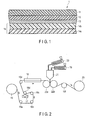
- FIG. 1 is a cross-sectional view schematically showing a laminate according to an embodiment of the present invention.
- the laminate 1 shown in FIG. 1 is used, for example, as a packaging material.
- the laminate 1 includes a base material layer 11, an adhesive resin layer 12, a barrier layer 13, and a sealant layer 14.
- an adhesive layer may be provided between any adjacent layers.
- the base material layer 11 is, for example, a sheet of paper, a resin film, or a combination thereof.
- a resin film a biaxially oriented polypropylene film, a biaxially oriented polyester film, a biaxially oriented nylon film, or a cellophane film can be used, for example.
- a printed layer may be provided on a main surface of the base material layer 11.
- the printed layer may be provided on one of main surfaces of the base material layer 11 on the barrier layer 13 side, may be provided on a back surface of the barrier layer 13, or may be provided on both of them.
- the adhesive resin layer 12 is interposed between the base material layer 11 and the barrier layer 13.
- the adhesive resin layer 12 bonds the base material layer 11 and the barrier layer 13.
- the adhesive resin layer 12 contains, for example, a polyolefin resin such as low density polyethylene and linear low density polyethylene.
- An adhesive layer (not shown) containing an anchor coating agent may be interposed between the base material layer 11 and the adhesive resin layer 12.
- the adhesive layer is obtained by applying an anchor coating agent such as a urethane-based anchor coating agent, onto the main surface of the base material layer 11.
- the adhesive layer further strengthens the adhesion between the base material layer 11 and the adhesive resin layer 12.
- the barrier layer 13 adheres to one main surface of the base material layer 11 via the adhesive resin layer 12.
- the barrier layer 13 suppresses the permeation of gases such as water vapor and oxygen, through the laminate 1.
- the barrier layer 13 is, for example, a layer including an aluminum layer or an inorganic oxide thin film.
- the barrier layer 13 is an aluminum foil, an aluminum vapor deposition film, or a transparent vapor deposition film.
- the thickness of the aluminum foil is preferably in the range of 5 ⁇ m to 15 ⁇ m, and more preferably in the range of 5 ⁇ m to 9 ⁇ m. If the aluminum foil is too thin, handling at the time of bonding it to the base material layer 11 is difficult. If the thickness of the aluminum foil is excessively increased, it cannot be expected to improve the barrier property with an increase in thickness, resulting in high cost. Additionally, in this case, the flexibility of the laminate 1 degrades, and it becomes difficult to handle the laminate 1.
- An aluminum vapor deposition film is a film in which an aluminum layer is vapor-deposited on a resin film.
- the resin film is, for example, a biaxially oriented polyethylene terephthalate film, a biaxially oriented nylon film, or a biaxially oriented polypropylene film.
- the thickness of the resin film is not particularly limited, but is preferably in the range of 3 ⁇ m to 200 ⁇ m, and more preferably in the range of 6 ⁇ m to 30 ⁇ m.
- the thickness of the aluminum vapor deposition layer is preferably in the range of 5 nm to 100 nm. If the aluminum vapor deposition layer is too thin, it may not be possible to sufficiently prevent the entry of gases such as water vapor and oxygen. A thick aluminum vapor deposition layer is not only expensive, but also tends to cause cracks in the deposited layer, which may lead to a degradation in barrier property.
- the transparent vapor deposition film is a film in which an inorganic oxide thin film is formed on a resin film by means of a vacuum evaporation method or sputtering method.
- the same films as those illustrated for the resin film of the aluminum vapor deposition film can be used.
- the inorganic oxide thin film is made of, for example, an inorganic oxide such as a silicon oxide, aluminum oxide, and magnesium oxide. Most of inorganic oxide thin film layers are colorless or very thinly colored transparent layers, and thus, the transparent vapor deposition film is suitable when the laminate 1 is required to have transparency. Furthermore, since the inorganic oxide thin film transmits microwaves unlike metal layers, the laminate 1 including the transparent vapor deposition film as the barrier layer 13 can also be used for packaging materials of foodstuffs which are heated with a microwave oven.
- an inorganic oxide such as a silicon oxide, aluminum oxide, and magnesium oxide.
- Most of inorganic oxide thin film layers are colorless or very thinly colored transparent layers, and thus, the transparent vapor deposition film is suitable when the laminate 1 is required to have transparency. Furthermore, since the inorganic oxide thin film transmits microwaves unlike metal layers, the laminate 1 including the transparent vapor deposition film as the barrier layer 13 can also be used for packaging materials of foodstuffs which are heated with a microwave oven.
- the thickness of the inorganic oxide thin film is preferably in the range of 5 nm to 300 nm, and more preferably in the range of 10 nm to 150 nm. If the inorganic oxide thin film is too thin, a uniform film may not be obtained or the thickness may not be sufficient, and the function as the barrier layer 13 may not be sufficiently fulfilled. If the inorganic oxide thin film is too thick, the inorganic oxide thin film may be cracked when the laminate 1 is bent or applied with tension.
- the transparent vapor deposition film for example, commercially available products such as trade name “GL FILM” and “PRIME BARRIER (registered trademark)” (all are manufactured by TOPPAN PRINTING CO., LTD.) can be used.
- the aluminum vapor deposition layer and the inorganic oxide thin film may be formed on the base material layer 11.
- the adhesive resin layer 12 and the barrier layer 13 may be omitted when the base material layer 11 contains a resin film.
- the sealant layer 14 adheres to one main surface of the barrier layer 13.
- the sealant layer 14 imparts heat-sealing property to the laminate 1.
- the sealant layer 14 includes a first layer 14a and a second layer 14b.
- the sealant layer 14 is a two-layer coextruded film having a first layer 14a and a second layer 14b.
- One main surface of the first layer 14a constitutes one outermost surface of the laminate 1, and the other main surface thereof faces the base material layer 11.
- the first layer 14a plays a role in enhancing the non-adsorbing property of the laminate 1, in particular, the sealant layer 14, in addition to providing the laminate 1 with heat-sealing property.
- the first layer 14a contains only a cyclic olefin resin as a resin. That is, the first layer 14a does not contain any resin other than the cyclic olefin resin. When the first layer 14a contains a resin other than the cyclic olefin resin, the non-adsorbing property of the sealant layer 14 degrades.
- the cyclic olefin resin is preferably a ring-opening metathesis polymerization product (COP) obtained by a metathesis ring-opening polymerization of cyclic olefin, a copolymer of cyclic olefin and ⁇ -olefin (chain olefin), i.e., a cyclic olefin copolymer (COC), or a mixture thereof.
- COP ring-opening metathesis polymerization product
- any cyclic hydrocarbon having an unsaturated hydrocarbon and a bicyclo ring can be used.
- the cyclic olefin is particularly preferably one having a bicyclo[2.2.1]hept-2-ene (norbornene) skeleton.
- a cyclic olefin resin obtained from cyclic olefin having a norbornene skeleton for example, a ring-opening metathesis polymerization product of a norbornene monomer can be used.
- examples of commercially available products of such a ring-opening metathesis polymerization product include "ZEONOR (ZEONOR (registered trademark))” manufactured by ZEON CORPORATION.
- ZEONOR ZEONOR (registered trademark)
- a norbornene cyclic olefin copolymer can be used as the cyclic olefin resin obtained from cyclic olefin having a norbornene skeleton.
- Examples of commercially available products of such a cyclic olefin copolymer include "APEL (registered trademark)” manufactured by MITSUI CHEMICALS, INC., and “TOPAS (registered trademark)” manufactured by TOPAS ADVANCED POLYMERS GmbH) and sold by POLYPLASTICS CO., LTD.
- APEL registered trademark
- TOPAS registered trademark
- Suitable cyclic olefin resins have a glass transition temperature, for example, in the range of 60°C to 100°C.
- the first layer 14a may further contain an additive.
- the additive is, for example, one or more of a lubricant, an antioxidant, an ultraviolet light absorber, a light stabilizer, an antistatic agent, an anti-blocking agent, a flame retardant, a crosslinking agent, and a colorant.
- a lubricant for example, a higher fatty acid metal salt, aliphatic alcohol, polyglycol, triglyceride, wax, phenolic compound, or a mixture containing one or more of them, may be suitably used for the purpose of improving the processability.
- the wax may be a natural substance-derived wax, for example, a mineral wax such as Montan wax, or a synthetic wax such as polyethylene wax.
- cyclic olefin resin for example, a cyclic olefin copolymer, which is a copolymer obtained by copolymerizing ethylene and norbornene, using a metallocene catalyst, can be suitably used. Cyclic polyolefin copolymers have non-adsorbing property equivalent to that of cyclic olefin polymers and are inexpensively available.
- the copolymer obtained by copolymerizing ethylene and norbornene using a metallocene catalyst it is possible to use a copolymer containing a repeating unit represented by formula (a) and a repeating unit represented by formula (b).
- Example of commercially available products of such a cyclic olefin resin include "TOPAS (registered trademark)" manufactured by TOPAS ADVANCED POLYMERS GmbH and sold by POLYPLASTICS CO., LTD.
- the thickness of the first layer 14a is preferably 5 ⁇ m or more.
- the thickness of the first layer 14a is preferably 20 ⁇ m or less. If the first layer 14a is excessively thin, the film formation of the first layer 14a may become unstable, and the effect of suppressing adsorption may be reduced. When the first layer 14a is excessively thick, the improvement in the adsorption suppressing effect accompanied by an increase in the thickness of the first layer 14a is slight.
- the second layer 14b is interposed between the barrier layer 13 and the first layer 14a.
- one main surface of the second layer 14b is in contact with the barrier layer 13, and the other main surface is in contact with the first layer 14a.
- one main surface of the second layer 14b may be in contact with the base material layer 11, and the other main surface may be in contact with the first layer 14a.
- the second layer 14b contains an ethylene-methacrylic acid copolymer (EMAA).
- the second layer 14b imparts heat-sealing property to the laminate 1.
- the second layer 14b exhibits high adhesion strength to both the barrier layer 13 and the first layer 14a.
- a structure may be adopted where the adhesive resin layer 12 and the barrier layer 13 are omitted from the laminate 1, and the second layer 14b is in direct contact with the base material layer 11.
- the ethylene-methacrylic acid copolymer (EMAA) used for the second layer 14b can directly adhere onto the barrier layer 13 when the surface of the barrier layer 13 is made of aluminum. In other words, when the surface of the barrier layer 13 is made of aluminum, the ethylene-methacrylic acid copolymer (EMAA) used for the second layer 14b can adhere onto the barrier layer 13 without providing the adhesive layer.
- the ethylene-methacrylic acid copolymer is, for example, a resin polymerized by a high pressure method.
- An example of a commercially available ethylene-methacrylic acid copolymer is "NUCREL (registered trademark) N1108C" manufactured by DUPONT-MITSUI POLYCHEMICAL CO., LTD.
- the second layer 14b contains only an ethylene-methacrylic acid copolymer as a resin. In the vicinity of the interface between the first layer 14a and the second layer 14b, there is a possibility that their components are unavoidably mixed, but the above expression "contains only” does not exclude such unavoidable mixing.
- the methacrylic acid content (hereinafter, referred to as the acid content) of the ethylene-methacrylic acid copolymer is preferably in the range of 4% by mass to 11% by mass. If the acid content is excessively reduced, the adhesion strength between the second layer 14b and the barrier layer 13 lowers, and a defect such as delamination is more likely to occur after long-term storage. If the acid content is excessively increased, the adhesion strength between the second layer 14b and the first layer 14a lowers.
- MFR melt flow rate
- the term "melt flow rate” means a value obtained by this method under the above-mentioned conditions.
- the ethylene-methacrylic acid copolymer preferably has a melting point in the range of 90°C to 110°C.
- a preferred cyclic olefin resin has a relatively low optimum extrusion temperature.
- the difference between the melting point of the ethylene-methacrylic acid copolymer and the glass transition temperature of the cyclic olefin resin decreases. That is, their optimum extrusion temperatures can be made closer. Therefore, in this case, high quality layers can be formed at high speed.
- the thickness of the second layer 14b is preferably 5 ⁇ m or more.
- the thickness of the second layer 14b is preferably 20 ⁇ m or less.
- the second layer 14b and the barrier layer 13 be in direct contact with each other. That is, it is preferable that a layer containing an anchor coating agent does not exist therebetween. An anchor coating agent deteriorates when stored for a long time, and is liable to cause delamination. When the above-described structure is adopted, the occurrence of delamination due to the deterioration of the anchor coating agent does not occur. Furthermore, when the adhesive resin layer 12 and the barrier layer 13 are omitted from the laminate 1, it is preferable that the second layer 14b and the base material layer 11 be in direct contact with each other.
- the ratio of the thickness of the first layer 14a to the thickness of the second layer 14b is in the range of 1:3 to 6:1, preferably in the range of 1:2 to 4:1. If the ratio is excessively small, adsorption cannot be sufficiently suppressed. If the ratio is excessively large, the film formation of the second layer 14b may become unstable, or in many applications, it will be overdesigned and disadvantageous in cost.
- the thickness of the sealant layer 14 is preferably in the range of 10 ⁇ m to 60 ⁇ m, and more preferably in the range of 10 ⁇ m to 40 ⁇ m. If the thickness of the sealant layer 14 is excessively reduced, sufficient initial seal strength may not be achieved, or degradation in seal strength during a long-term storage may become remarkable. If the thickness of the sealant layer 14 is excessively increased, in many applications, it will be overdesigned and disadvantageous in cost.
- the laminate 1 adopts the above-described configuration for the sealant layer 14. Therefore, the laminate 1 hardly causes adsorption by the sealant layer 14, delamination between the sealant layer 14 and the layer adjacent thereto, and delamination between the layers constituting the sealant layer 14.
- FIG. 2 is a view schematically showing a method for producing a laminate according to an embodiment of the present invention.
- a laminate is produced by a roll-to-roll method.
- an unwind roll 15 unwinds a base material layer 11.
- the unwound base material layer 11 is guided from the unwind roll 15 to an adhesive application unit 17 by guide rolls 16a, 16b and 16c, and passes through the adhesive application unit 17.
- the adhesive application unit 17 applies an adhesive to one main surface of the base material layer 11.
- the adhesive is, for example, the above-mentioned anchor coat agent.
- an adhesive layer is formed on the base material layer 11.
- a laminate including the base material layer 11 and the adhesive layer is referred to as a first laminate.
- the adhesive application unit 17 can be omitted. That is, when the surface of the barrier layer 13 is made of aluminum, a second layer 14b can be bonded onto the barrier layer 13 without providing the adhesive layer.
- the first laminate is guided by guide rolls 16d and 16e from the adhesive application unit 17 to a drying oven 18 and passes through the drying oven 18.
- the drying oven 18 dries the first laminate.
- the dried first laminate is then conveyed between a nip roll 22a and a cooling roll 22b facing each other.
- a material of a first layer 14a is supplied to a T-die 21 from a first extrusion unit 19. Furthermore, a material of a second layer 14b is supplied from a second extrusion unit 20 to the T-die 21.
- the T-die 21 supplies the material of the first layer 14a and the material of the second layer 14b to the gap. By this supply, a sealant layer 14 including the first layer 14a and the second layer 14b is formed on the adhesive layer.
- the laminate to which the material of the first layer 14a and the material of the second layer 14b are supplied is cooled by the cooling roll 22b.
- a laminate 1 is obtained in this way.
- the laminate 1 is then guided to a wind-up roll 23 by a guide roll 16f.
- the wind-up roll 23 winds the laminate 1.
- a base material layer 11 is prepared, and an anchor coating agent is applied to one of the main surfaces thereof to form an adhesive layer.
- the raw material of an adhesive resin layer 12 is heated and melted, and the base material layer 11 and a barrier layer 13 are sandwich laminated with the melted raw material interposed therebetween.
- the lamination is performed so that the adhesive layer formed on the base material layer 11 is in contact with the adhesive resin layer 12.
- the base material layer 11 and the barrier layer 13 may be bonded together by dry lamination.
- a second layer 14b and a first layer 14a are laminated on the barrier layer 13 by extrusion lamination to form a sealant layer 14. That is, the raw material of the second layer 14b and the raw material of the first layer 14a are coextruded on the barrier layer 13 to form the second layer 14b and the first layer 14a.
- the sealant layer 14 is formed on the base material layer 11 by extrusion lamination.
- the second layer 14b and the first layer 14a are laminated on the base material layer 11 by extrusion lamination to form the second layer 14b and the first layer 14a.
- a laminate 1 is obtained as described above.
- the laminate 1 can be produced at a lower cost as compared with a method of separately forming the sealant layer 14 and then laminating the same.
- the laminate 1 can be used, for example, as a packaging material.
- a package including the packaging material includes the above-described laminate 1 so that the first layer 14a is adjacent to a space for containing contents.
- the package may be a bag, or may be a container including a container body having an opening and a lid closing the opening. In the latter case, the laminate 1 can be used as at least a part of the lid.
- any contents may be employed.
- the contents are medicines such as a patch.
- the contents are cosmetics or food.
- this package Since this package has high adhesion strength between the layers in the laminate 1, the performance degradation of the laminate 1 attributable to delamination, etc. hardly occurs, even if the package is stored in a sealed state for a long period of time.
- the sealant layer 14 since the sealant layer 14 hardly causes adsorption, components contained in the contents, for example, liquid or paste-like components, are less likely to be adsorbed by the sealant layer 14. Furthermore, volatile components are also less likely to be adsorbed by the sealant layer 14. That is, this packaged article is less likely to cause deterioration of the contents.
- an adhesive layer may be provided between any adjacent layers.
- a laminate including a base material layer, an adhesive resin layer, a barrier layer, and a sealant layer was produced by the following method.
- a biaxially oriented polyethylene terephthalate film having a thickness of 12 ⁇ m was prepared. Specifically, FE2001 manufactured by FUTAMURA CHEMICAL CO., LTD. was prepared. In addition, an aluminum foil having a thickness of 7 ⁇ m was prepared as a barrier layer.
- an anchor coating agent was applied to one main surface of the base material layer, and then the base material layer and the barrier layer were sandwich-laminated so that the main surface and the barrier layer face each other with the adhesive resin layer interposed therebetween.
- low density polyethylene was used as the material of the adhesive resin layer, and the thickness thereof was set to 15 ⁇ m.
- a sealant layer was formed on the barrier layer. Specifically, a second layer containing an ethylene methacrylic acid copolymer, and a first layer to be provided on the second layer and containing a cyclic polyolefin resin were formed on the barrier layer by extrusion lamination.
- TOPAS registered trademark
- TOPAS 8007F-600 manufactured by TOPAS ADVANCED POLYMERS GmbH and sold by POLYPLASTICS CO., LTD.
- NUCREL registered trademark
- N1108C manufactured by DU PONT-MITSUI POLYCHEMICALS CO., LTD.
- the thicknesses of the first and second layers were set to 15 ⁇ m and 5 ⁇ m, respectively. That is, the ratio of the thickness of the first layer to the thickness of the second layer was set to 3:1, and the thickness of the sealant layer was set to 20 ⁇ m.
- a laminate was obtained as described above.
- a laminate was produced in the same manner as in Example 1 except that the thicknesses of the first layer and the second layer were set to 5 ⁇ m and 15 ⁇ m, respectively. That is, in this example, the ratio of the thickness of the first layer to the thickness of the second layer was set to 1:3.
- a laminate was produced in the same manner as in Example 1 except that the laminating order of the first layer and the second layer was reversed.
- a laminate was produced in the same manner as in Example 1 except that the thicknesses of the first layer and the second layer were set to 18 ⁇ m and 3 ⁇ m, respectively. That is, in this example, the ratio of the thickness of the first layer to the thickness of the second layer was set to 6:1.
- a laminate was produced in the same manner as in Example 1 except that the thicknesses of the first layer and the second layer were set to 3 ⁇ m and 18 ⁇ m, respectively. That is, in this example, the ratio of the thickness of the first layer to the thickness of the second layer was set to 1:6.
- a laminated was produced in the same manner as in Example 1 except that instead of using NUCREL (registered trademark) N1108C manufactured by DU PONT-MITSUI POLYCHEMICALS CO., LTD. as the material of the second layer, NUCREL (registered trademark) N0903HC manufactured by DU PONT-MITSUI POLYCHEMICALS CO., LTD. was used.
- a laminate was produced in the same manner as in Example 1 except that instead of using NUCREL (registered trademark) N1108C manufactured by DU PONT-MITSUI POLYCHEMICALS CO., LTD., NUCREL (registered trademark) AN4221C manufactured by DU PONT-MITSUI POLYCHEMICALS CO., LTD. was used.
- Bags having a dimension of 10 cm in length and 10 cm in width were produced from the laminates according to Examples 1 to 5 and Comparative Examples 1 and 2. Next, these bags were filled with a patch, and these bags were sealed by heat sealing. Next, packaged articles thus obtained were left to stand at room temperature for a certain period of time, and thereafter it was confirmed whether or not the active ingredients of the patch were adsorbed by the sealant layer of each of the laminates.
- the column labeled “Ratio” describes a ratio of the thickness of a first layer to the thickness of a second layer.
- “Laminating Order” represents that a second layer and a first layer were laminated in this order on a barrier layer
- “Reverse” represents that a first layer and a second layer were laminated in this order on a barrier layer.
- Barrier layer/2nd layer and “1st layer/2nd layer” describe evaluation results of the adhesion strength between the barrier layer and the second layer and the adhesion strength between the first layer and the second layer, respectively.
- the active ingredients of the contents were not adsorbed by the sealant layer even after long-term storage.
- the laminates according to Examples 1 to 5 were excellent in both the adhesion strength between the barrier layer and the second layer and the adhesion strength between the first layer and the second layer, and did not cause delamination.
- the laminates according to Examples 1 to 4 were extremely excellent in both the adhesion strength between the barrier layer and the second layer and the adhesion strength between the first layer and the second layer.
- a laminate was produced in the same manner as in Example 1 except that a mixture of 70 parts by mass of a cyclic polyolefin resin and 30 parts by mass of linear low density polyethylene was used as the material of a first layer.
- the same resin as that used in Example 1 was used as the cyclic polyolefin resin.
Landscapes
- Engineering & Computer Science (AREA)
- Mechanical Engineering (AREA)
- Food Science & Technology (AREA)
- Chemical & Material Sciences (AREA)
- Chemical Kinetics & Catalysis (AREA)
- Wrappers (AREA)
- Laminated Bodies (AREA)
Abstract
Description
- The present invention relates to a laminate, a method for producing the same, a package, and a packaged article.
- In a laminate used as a packaging material, etc., a thermoplastic resin is used for its sealant layer. In particular, a polyethylene resin, a polypropylene resin, and so on are used as the thermoplastic resin, from the viewpoint of being excellent in lamination processability and heat-sealing property.
- However, while these resins can achieve high adhesion strength in heat sealing, they tend to adsorb components contained in foods, medicines, etc. Therefore, a package including a sealant layer made of such a resin so as to be adjacent to a space for containing contents is liable to deteriorate or degrade the contents.
- For this reason, polyacrylonitrile resin (PAN), which is a non-adsorbing material, has been used for sealant layers in laminates used for packaging of foods and medicines. However, it is difficult to procure polyacrylonitrile resin films stably, and there is a need to find substitute materials for polyacrylonitrile resins.
- The invention described in Jpn. Pat. Appln. KOKAI Publication No.
2012-86876 - Jpn. Pat. Appln. KOKAI Publication No.
2015-168133 - An object of the present invention is to provide a laminate which is less likely to cause adsorption and delamination.
- According to a first aspect of the present invention, there is provided a laminate comprising a base material layer, and a sealant layer provided on the base material layer, the sealant layer comprising a first layer having one main surface constituting one outermost surface of the laminate and the other main surface facing the base material layer, and containing only a cyclic olefin resin as a resin, and a second layer interposed between the base material layer and the first layer and containing an ethylene-methacrylic acid copolymer, wherein a ratio of a thickness of the first layer to a thickness of the second layer is in a range of 1:3 to 6:1.
- According to a second aspect of the present invention, there is provided a package comprising the laminate according to the first aspect such that the first layer is adjacent to a space for containing contents.
- According to a third aspect of the present invention, there is provided a packaged article comprising the package according to the second aspect, and contents contained in the package.
- According to a fourth aspect of the present invention, there is provided a method for producing the laminate according to the first aspect, comprising laminating the second layer and the first layer on the base material layer by extrusion lamination to form the sealant layer.
- According to a fifth aspect of the present invention, there is provided a method for producing a laminate, comprising forming, on a base material layer by extrusion lamination, a sealant layer which comprises a first layer containing only a cyclic olefin resin as a resin and a second layer containing an ethylene-methacrylic acid copolymer such that the second layer is interposed between the base material layer and the first layer, and a ratio of a thickness of the first layer to a thickness of the second layer is in a range of 1:3 to 6:1.
-
-
FIG. 1 is a cross-sectional view schematically showing a laminate according to an embodiment of the present invention; and -
FIG. 2 is a view schematically showing a method for producing a laminate according to an embodiment of the present invention. - Hereinafter, embodiments of the present invention will be described with reference to the drawings. Elements having the same or a similar function are provided with the same reference sign, and overlapping descriptions thereof are omitted.
-
FIG. 1 is a cross-sectional view schematically showing a laminate according to an embodiment of the present invention. - The
laminate 1 shown inFIG. 1 is used, for example, as a packaging material. - The
laminate 1 includes abase material layer 11, anadhesive resin layer 12, abarrier layer 13, and asealant layer 14. In thelaminate 1, an adhesive layer may be provided between any adjacent layers. - The
base material layer 11 is, for example, a sheet of paper, a resin film, or a combination thereof. As the resin film, a biaxially oriented polypropylene film, a biaxially oriented polyester film, a biaxially oriented nylon film, or a cellophane film can be used, for example. - A printed layer may be provided on a main surface of the
base material layer 11. The printed layer may be provided on one of main surfaces of thebase material layer 11 on thebarrier layer 13 side, may be provided on a back surface of thebarrier layer 13, or may be provided on both of them. - The
adhesive resin layer 12 is interposed between thebase material layer 11 and thebarrier layer 13. Theadhesive resin layer 12 bonds thebase material layer 11 and thebarrier layer 13. Theadhesive resin layer 12 contains, for example, a polyolefin resin such as low density polyethylene and linear low density polyethylene. - An adhesive layer (not shown) containing an anchor coating agent may be interposed between the
base material layer 11 and theadhesive resin layer 12. In this case, the adhesive layer is obtained by applying an anchor coating agent such as a urethane-based anchor coating agent, onto the main surface of thebase material layer 11. The adhesive layer further strengthens the adhesion between thebase material layer 11 and theadhesive resin layer 12. - The
barrier layer 13 adheres to one main surface of thebase material layer 11 via theadhesive resin layer 12. Thebarrier layer 13 suppresses the permeation of gases such as water vapor and oxygen, through thelaminate 1. - The
barrier layer 13 is, for example, a layer including an aluminum layer or an inorganic oxide thin film. For example, thebarrier layer 13 is an aluminum foil, an aluminum vapor deposition film, or a transparent vapor deposition film. - The thickness of the aluminum foil is preferably in the range of 5 µm to 15 µm, and more preferably in the range of 5 µm to 9 µm. If the aluminum foil is too thin, handling at the time of bonding it to the
base material layer 11 is difficult. If the thickness of the aluminum foil is excessively increased, it cannot be expected to improve the barrier property with an increase in thickness, resulting in high cost. Additionally, in this case, the flexibility of thelaminate 1 degrades, and it becomes difficult to handle thelaminate 1. - An aluminum vapor deposition film is a film in which an aluminum layer is vapor-deposited on a resin film.
- The resin film is, for example, a biaxially oriented polyethylene terephthalate film, a biaxially oriented nylon film, or a biaxially oriented polypropylene film. The thickness of the resin film is not particularly limited, but is preferably in the range of 3 µm to 200 µm, and more preferably in the range of 6 µm to 30 µm.
- The thickness of the aluminum vapor deposition layer is preferably in the range of 5 nm to 100 nm. If the aluminum vapor deposition layer is too thin, it may not be possible to sufficiently prevent the entry of gases such as water vapor and oxygen. A thick aluminum vapor deposition layer is not only expensive, but also tends to cause cracks in the deposited layer, which may lead to a degradation in barrier property.
- The transparent vapor deposition film is a film in which an inorganic oxide thin film is formed on a resin film by means of a vacuum evaporation method or sputtering method.
- As the resin film of the transparent vapor deposition film, the same films as those illustrated for the resin film of the aluminum vapor deposition film can be used.
- The inorganic oxide thin film is made of, for example, an inorganic oxide such as a silicon oxide, aluminum oxide, and magnesium oxide. Most of inorganic oxide thin film layers are colorless or very thinly colored transparent layers, and thus, the transparent vapor deposition film is suitable when the
laminate 1 is required to have transparency. Furthermore, since the inorganic oxide thin film transmits microwaves unlike metal layers, thelaminate 1 including the transparent vapor deposition film as thebarrier layer 13 can also be used for packaging materials of foodstuffs which are heated with a microwave oven. - The thickness of the inorganic oxide thin film is preferably in the range of 5 nm to 300 nm, and more preferably in the range of 10 nm to 150 nm. If the inorganic oxide thin film is too thin, a uniform film may not be obtained or the thickness may not be sufficient, and the function as the
barrier layer 13 may not be sufficiently fulfilled. If the inorganic oxide thin film is too thick, the inorganic oxide thin film may be cracked when thelaminate 1 is bent or applied with tension. - As the transparent vapor deposition film, for example, commercially available products such as trade name "GL FILM" and "PRIME BARRIER (registered trademark)" (all are manufactured by TOPPAN PRINTING CO., LTD.) can be used.
- The aluminum vapor deposition layer and the inorganic oxide thin film may be formed on the
base material layer 11. Theadhesive resin layer 12 and thebarrier layer 13 may be omitted when thebase material layer 11 contains a resin film. - The
sealant layer 14 adheres to one main surface of thebarrier layer 13. Thesealant layer 14 imparts heat-sealing property to thelaminate 1. - The
sealant layer 14 includes afirst layer 14a and asecond layer 14b. According to an example, thesealant layer 14 is a two-layer coextruded film having afirst layer 14a and asecond layer 14b. - One main surface of the
first layer 14a constitutes one outermost surface of thelaminate 1, and the other main surface thereof faces thebase material layer 11. Thefirst layer 14a plays a role in enhancing the non-adsorbing property of thelaminate 1, in particular, thesealant layer 14, in addition to providing thelaminate 1 with heat-sealing property. - The
first layer 14a contains only a cyclic olefin resin as a resin. That is, thefirst layer 14a does not contain any resin other than the cyclic olefin resin. When thefirst layer 14a contains a resin other than the cyclic olefin resin, the non-adsorbing property of thesealant layer 14 degrades. - The cyclic olefin resin is preferably a ring-opening metathesis polymerization product (COP) obtained by a metathesis ring-opening polymerization of cyclic olefin, a copolymer of cyclic olefin and α-olefin (chain olefin), i.e., a cyclic olefin copolymer (COC), or a mixture thereof.
- As the cyclic olefin, any cyclic hydrocarbon having an unsaturated hydrocarbon and a bicyclo ring can be used. The cyclic olefin is particularly preferably one having a bicyclo[2.2.1]hept-2-ene (norbornene) skeleton.
- As a cyclic olefin resin obtained from cyclic olefin having a norbornene skeleton, for example, a ring-opening metathesis polymerization product of a norbornene monomer can be used. Examples of commercially available products of such a ring-opening metathesis polymerization product include "ZEONOR (ZEONOR (registered trademark))" manufactured by ZEON CORPORATION. As the cyclic olefin resin obtained from cyclic olefin having a norbornene skeleton, for example, a norbornene cyclic olefin copolymer can be used. Examples of commercially available products of such a cyclic olefin copolymer include "APEL (registered trademark)" manufactured by MITSUI CHEMICALS, INC., and "TOPAS (registered trademark)" manufactured by TOPAS ADVANCED POLYMERS GmbH) and sold by POLYPLASTICS CO., LTD.
- Suitable cyclic olefin resins have a glass transition temperature, for example, in the range of 60°C to 100°C.
- The
first layer 14a may further contain an additive. The additive is, for example, one or more of a lubricant, an antioxidant, an ultraviolet light absorber, a light stabilizer, an antistatic agent, an anti-blocking agent, a flame retardant, a crosslinking agent, and a colorant. As the lubricant, for example, a higher fatty acid metal salt, aliphatic alcohol, polyglycol, triglyceride, wax, phenolic compound, or a mixture containing one or more of them, may be suitably used for the purpose of improving the processability. The wax may be a natural substance-derived wax, for example, a mineral wax such as Montan wax, or a synthetic wax such as polyethylene wax. - As the cyclic olefin resin, for example, a cyclic olefin copolymer, which is a copolymer obtained by copolymerizing ethylene and norbornene, using a metallocene catalyst, can be suitably used. Cyclic polyolefin copolymers have non-adsorbing property equivalent to that of cyclic olefin polymers and are inexpensively available. As the copolymer obtained by copolymerizing ethylene and norbornene using a metallocene catalyst, it is possible to use a copolymer containing a repeating unit represented by formula (a) and a repeating unit represented by formula (b). Example of commercially available products of such a cyclic olefin resin include "TOPAS (registered trademark)" manufactured by TOPAS ADVANCED POLYMERS GmbH and sold by POLYPLASTICS CO., LTD.

- The thickness of the
first layer 14a is preferably 5 µm or more. The thickness of thefirst layer 14a is preferably 20 µm or less. If thefirst layer 14a is excessively thin, the film formation of thefirst layer 14a may become unstable, and the effect of suppressing adsorption may be reduced. When thefirst layer 14a is excessively thick, the improvement in the adsorption suppressing effect accompanied by an increase in the thickness of thefirst layer 14a is slight. - The
second layer 14b is interposed between thebarrier layer 13 and thefirst layer 14a. According to an example, one main surface of thesecond layer 14b is in contact with thebarrier layer 13, and the other main surface is in contact with thefirst layer 14a. When theadhesive resin layer 12 and thebarrier layer 13 are omitted from thelaminate 1, one main surface of thesecond layer 14b may be in contact with thebase material layer 11, and the other main surface may be in contact with thefirst layer 14a. - The
second layer 14b contains an ethylene-methacrylic acid copolymer (EMAA). Thesecond layer 14b imparts heat-sealing property to thelaminate 1. In addition, thesecond layer 14b exhibits high adhesion strength to both thebarrier layer 13 and thefirst layer 14a. A structure may be adopted where theadhesive resin layer 12 and thebarrier layer 13 are omitted from thelaminate 1, and thesecond layer 14b is in direct contact with thebase material layer 11. Furthermore, the ethylene-methacrylic acid copolymer (EMAA) used for thesecond layer 14b can directly adhere onto thebarrier layer 13 when the surface of thebarrier layer 13 is made of aluminum. In other words, when the surface of thebarrier layer 13 is made of aluminum, the ethylene-methacrylic acid copolymer (EMAA) used for thesecond layer 14b can adhere onto thebarrier layer 13 without providing the adhesive layer. - The ethylene-methacrylic acid copolymer is, for example, a resin polymerized by a high pressure method. An example of a commercially available ethylene-methacrylic acid copolymer is "NUCREL (registered trademark) N1108C" manufactured by DUPONT-MITSUI POLYCHEMICAL CO., LTD. According to an example, the
second layer 14b contains only an ethylene-methacrylic acid copolymer as a resin. In the vicinity of the interface between thefirst layer 14a and thesecond layer 14b, there is a possibility that their components are unavoidably mixed, but the above expression "contains only" does not exclude such unavoidable mixing. - The methacrylic acid content (hereinafter, referred to as the acid content) of the ethylene-methacrylic acid copolymer is preferably in the range of 4% by mass to 11% by mass. If the acid content is excessively reduced, the adhesion strength between the
second layer 14b and thebarrier layer 13 lowers, and a defect such as delamination is more likely to occur after long-term storage. If the acid content is excessively increased, the adhesion strength between thesecond layer 14b and thefirst layer 14a lowers. - The ethylene-methacrylic acid copolymer preferably has a melt flow rate (MFR) 190°C and a load of 21.168 N (= 2.16 kgf) in the range of 7.0 g/10 min to 15.0 g/10 min. The melt flow rate (MFR) referred to herein is a measured value obtained by a method in conformity with JIS K7210:1999. The melt flow rate described above for the ethylene-methacrylic acid copolymer is, specifically, the mass of resin discharged in 10 minutes when a load of 21.168 N (= 2.16 kgf) is applied to the resin at 190°C in this method. Hereinafter, unless otherwise stated, the term "melt flow rate" means a value obtained by this method under the above-mentioned conditions.
- When the melt flow rate of the ethylene-methacrylic acid copolymer is largely different from that of the cyclic olefin resin, there may be a case where the film formation becomes unstable when forming the
first layer 14a and thesecond layer 14b by extrusion lamination. - When an ethylene-methacrylic acid copolymer having a melt flow rate falling within the above range is used, physical properties suitable for extrusion lamination can be obtained, and problems hardly occur even when high-speed film formation is conducted. Further, in this case, a homogeneous layer can be formed.
- The ethylene-methacrylic acid copolymer preferably has a melting point in the range of 90°C to 110°C. A preferred cyclic olefin resin has a relatively low optimum extrusion temperature. When as the ethylene-methacrylic acid copolymer, one having a low-melting point is used, the difference between the melting point of the ethylene-methacrylic acid copolymer and the glass transition temperature of the cyclic olefin resin decreases. That is, their optimum extrusion temperatures can be made closer. Therefore, in this case, high quality layers can be formed at high speed.
- The thickness of the
second layer 14b is preferably 5 µm or more. The thickness of thesecond layer 14b is preferably 20 µm or less. When thesecond layer 14b is excessively thinned, the film formation of thesecond layer 14b becomes unstable. If thesecond layer 14b is excessively thickened, adsorption is liable to occur. - It is preferable that the
second layer 14b and thebarrier layer 13 be in direct contact with each other. That is, it is preferable that a layer containing an anchor coating agent does not exist therebetween. An anchor coating agent deteriorates when stored for a long time, and is liable to cause delamination. When the above-described structure is adopted, the occurrence of delamination due to the deterioration of the anchor coating agent does not occur. Furthermore, when theadhesive resin layer 12 and thebarrier layer 13 are omitted from thelaminate 1, it is preferable that thesecond layer 14b and thebase material layer 11 be in direct contact with each other. - In the
sealant layer 14, the ratio of the thickness of thefirst layer 14a to the thickness of thesecond layer 14b is in the range of 1:3 to 6:1, preferably in the range of 1:2 to 4:1. If the ratio is excessively small, adsorption cannot be sufficiently suppressed. If the ratio is excessively large, the film formation of thesecond layer 14b may become unstable, or in many applications, it will be overdesigned and disadvantageous in cost. - The thickness of the
sealant layer 14 is preferably in the range of 10 µm to 60 µm, and more preferably in the range of 10 µm to 40 µm. If the thickness of thesealant layer 14 is excessively reduced, sufficient initial seal strength may not be achieved, or degradation in seal strength during a long-term storage may become remarkable. If the thickness of thesealant layer 14 is excessively increased, in many applications, it will be overdesigned and disadvantageous in cost. - The
laminate 1 adopts the above-described configuration for thesealant layer 14. Therefore, thelaminate 1 hardly causes adsorption by thesealant layer 14, delamination between thesealant layer 14 and the layer adjacent thereto, and delamination between the layers constituting thesealant layer 14. - Hereinafter, an example of a method for producing a laminate according to an embodiment of the present invention will be explained.
-
FIG. 2 is a view schematically showing a method for producing a laminate according to an embodiment of the present invention. - In the method shown in
FIG. 2 , a laminate is produced by a roll-to-roll method. - Specifically, first, an unwind
roll 15 unwinds abase material layer 11. The unwoundbase material layer 11 is guided from the unwind roll 15 to anadhesive application unit 17 byguide rolls adhesive application unit 17. - The
adhesive application unit 17 applies an adhesive to one main surface of thebase material layer 11. The adhesive is, for example, the above-mentioned anchor coat agent. When an adhesive is applied to the main surface of thebase material layer 11, an adhesive layer is formed on thebase material layer 11. Hereinafter, a laminate including thebase material layer 11 and the adhesive layer is referred to as a first laminate. When the surface of abarrier layer 13 is made of aluminum, theadhesive application unit 17 can be omitted. That is, when the surface of thebarrier layer 13 is made of aluminum, asecond layer 14b can be bonded onto thebarrier layer 13 without providing the adhesive layer. - The first laminate is guided by
guide rolls adhesive application unit 17 to a dryingoven 18 and passes through the dryingoven 18. The dryingoven 18 dries the first laminate. - The dried first laminate is then conveyed between a
nip roll 22a and acooling roll 22b facing each other. - A material of a
first layer 14a is supplied to a T-die 21 from afirst extrusion unit 19. Furthermore, a material of asecond layer 14b is supplied from asecond extrusion unit 20 to the T-die 21. The T-die 21 supplies the material of thefirst layer 14a and the material of thesecond layer 14b to the gap. By this supply, asealant layer 14 including thefirst layer 14a and thesecond layer 14b is formed on the adhesive layer. - The laminate to which the material of the
first layer 14a and the material of thesecond layer 14b are supplied is cooled by thecooling roll 22b. Alaminate 1 is obtained in this way. - The
laminate 1 is then guided to a wind-up roll 23 by aguide roll 16f. The wind-up roll 23 winds thelaminate 1. - Next, another example of the method for producing a
laminate 1 will be described. - First, a
base material layer 11 is prepared, and an anchor coating agent is applied to one of the main surfaces thereof to form an adhesive layer. - Next, the raw material of an
adhesive resin layer 12 is heated and melted, and thebase material layer 11 and abarrier layer 13 are sandwich laminated with the melted raw material interposed therebetween. At this time, the lamination is performed so that the adhesive layer formed on thebase material layer 11 is in contact with theadhesive resin layer 12. Thebase material layer 11 and thebarrier layer 13 may be bonded together by dry lamination. - Next, a
second layer 14b and afirst layer 14a are laminated on thebarrier layer 13 by extrusion lamination to form asealant layer 14. That is, the raw material of thesecond layer 14b and the raw material of thefirst layer 14a are coextruded on thebarrier layer 13 to form thesecond layer 14b and thefirst layer 14a. - When the
adhesive resin layer 12 and thebarrier layer 13 are omitted from thelaminate 1, thesealant layer 14 is formed on thebase material layer 11 by extrusion lamination. Specifically, thesecond layer 14b and thefirst layer 14a are laminated on thebase material layer 11 by extrusion lamination to form thesecond layer 14b and thefirst layer 14a. - A
laminate 1 is obtained as described above. - According to this method, the
laminate 1 can be produced at a lower cost as compared with a method of separately forming thesealant layer 14 and then laminating the same. - As described above, the
laminate 1 can be used, for example, as a packaging material. In this case, a package including the packaging material includes the above-describedlaminate 1 so that thefirst layer 14a is adjacent to a space for containing contents. The package may be a bag, or may be a container including a container body having an opening and a lid closing the opening. In the latter case, thelaminate 1 can be used as at least a part of the lid. - In a packaged article including the package and the contents contained therein, any contents may be employed. According to an example, the contents are medicines such as a patch. According to another example, the contents are cosmetics or food.
- Since this package has high adhesion strength between the layers in the
laminate 1, the performance degradation of thelaminate 1 attributable to delamination, etc. hardly occurs, even if the package is stored in a sealed state for a long period of time. In addition, since thesealant layer 14 hardly causes adsorption, components contained in the contents, for example, liquid or paste-like components, are less likely to be adsorbed by thesealant layer 14. Furthermore, volatile components are also less likely to be adsorbed by thesealant layer 14. That is, this packaged article is less likely to cause deterioration of the contents. - Hereinafter, examples of a laminate according to the present invention will be described. In the laminate of the present invention, an adhesive layer may be provided between any adjacent layers.
- (1) An embodiment of the present invention is a laminate comprising: a first base material layer; and a sealant layer provided on the first base material layer, the sealant layer comprising a first layer having one main surface constituting one outermost surface of the laminate, and the other main surface facing the first base material layer, and containing only a cyclic olefin resin as a resin, and a second layer interposed between the first base material layer and the first layer and containing an ethylene-methacrylic acid copolymer, wherein a ratio of a thickness of the first layer to a thickness of the second layer is in a range of 1:3 to 6:1.
- (2) Another embodiment of the present application is the laminate according to the item (1), further comprising a first adhesive layer between the first base material layer and the sealant layer, wherein the first base material layer is a biaxially oriented polypropylene film. In this laminate, for example, one surface of the first adhesive layer is in contact with the first base material layer, and the other surface is in contact with the sealant layer.
- (3) Another embodiment of the present invention is the laminate according to the item (1), further comprising a first adhesive layer between the first base material layer and the sealant layer, wherein the first base material layer is a biaxially oriented polyethylene terephthalate film. In this laminate, for example, one surface of the first adhesive layer is in contact with the first base material layer, and the other surface is in contact with the sealant layer.
- (4) Another embodiment of the present invention is the laminate according to the item (1), further comprising a barrier layer interposed between the first base material layer and the sealant layer; and the first adhesive layer interposed between the first base material layer and the barrier layer, wherein the first base material layer is a biaxially oriented polyethylene terephthalate film, and the barrier layer is an aluminum layer. In this laminate, for example, one surface of the first adhesive layer is in contact with the first base material layer, and the other surface is in contact with the barrier layer. Also, one surface of the barrier layer is in contact with the first base material layer, and the other surface is in contact with the sealant layer.
- (5) Another embodiment of the present invention is the laminate according to the item (1), further comprising a barrier layer interposed between the first base material layer and the sealant layer, the first adhesive layer being interposed between the first base material layer and the barrier layer, and an adhesive resin layer being interposed between the first base material layer and the first adhesive layer, wherein the first base material layer is a biaxially oriented polyethylene terephthalate film, the adhesive resin layer is a polyethylene layer, and the barrier layer is an aluminum layer. In this laminate, for example, one surface of the adhesive resin layer is in contact with the first base material layer, and the other surface is in contact with the first adhesive layer. Also, for example, one surface of the first adhesive layer is in contact with the adhesive resin layer, and the other surface is in contact with the barrier layer. Furthermore, for example, one surface of the barrier layer is in contact with the first adhesive layer, and the other surface is in contact with the sealant layer.
- (6) Another embodiment of the present invention is the laminate according to the item (1), further comprising a barrier layer interposed between the first base material layer and the sealant layer, and the first adhesive layer interposed between the first base material layer and the barrier layer, wherein the first base material layer is a cellophane film, and the barrier layer is an aluminum layer. In this laminate, for example, one surface of the first adhesive layer is in contact with the first base material layer, and the other surface is in contact with the barrier layer. Also, for example, one surface of the barrier layer is in contact with the first adhesive layer, and the other surface is in contact with the sealant layer.
- (7) Another embodiment of the present invention is the laminate according to the item (1), further comprising a barrier layer interposed between the first base material layer and the sealant layer, the first adhesive layer interposed between the first base material layer and the barrier layer, and an adhesive resin layer interposed between the first base material layer and the first adhesive layer, wherein the first base material layer is a cellophane film, the adhesive resin layer is a polyethylene layer, and the barrier layer is an aluminum layer. In this laminate, for example, one surface of the adhesive resin layer is in contact with the first base material layer, and the other surface is in contact with the first adhesive layer. Also, for example, one surface of the first adhesive layer is in contact with the adhesive resin layer, and the other surface is in contact with the barrier layer. Furthermore, for example, one surface of the barrier layer is in contact with the first adhesive layer, and the other surface is in contact with the sealant layer.
- (8) Another embodiment of the present invention is the laminate according to the item (1), further comprising a barrier layer interposed between the first base material layer and the sealant layer, and the first adhesive layer interposed between the first base material layer and the barrier layer, wherein the first base material layer consists of a sheet of paper, a biaxially oriented polyethylene terephthalate film, and an adhesive interposed between the sheet of paper and the biaxially oriented polyethylene terephthalate, and the barrier layer is an aluminum layer. In this laminate, for example, one surface of the first adhesive layer is in contact with the biaxially oriented polyethylene terephthalate film constituting the first base material layer, and the other surface is in contact with the barrier layer. Also, for example, one surface of the barrier layer is in contact with the first adhesive layer, and the other surface is in contact with the sealant layer.
- (9) Another embodiment of the present invention is the laminate according to the item (1), further comprising: a barrier layer interposed between the first base material layer and the sealant layer; the first adhesive layer interposed between the first base material layer and the barrier layer; a second adhesive layer interposed between the barrier layer and the sealant layer; and a second base material layer interposed between the barrier layer and the second adhesive layer, wherein the first base material layer is a sheet of paper, the barrier layer is an aluminum layer, and the second base material layer is a nylon layer. In this laminate, for example, one surface of the first adhesive layer is in contact with the first base material layer, and the other surface is in contact with the barrier layer. Also, for example, one surface of the barrier layer is in contact with the first adhesive layer, and the other surface is in contact with the second base material layer. Furthermore, for example, one surface of the second base material layer is in contact with the barrier layer, and the other surface is in contact with the second adhesive layer. Furthermore, for example, one surface of the second adhesive layer is in contact with the second base material layer, and the other surface is in contact with the sealant layer.
- (10) Another embodiment of the present invention is the laminate according to the item (1), further comprising: a barrier layer interposed between the first base material layer and the sealant layer; the first adhesive layer interposed between the first base material layer and the barrier layer; and an adhesive resin layer interposed between the first base material layer and the first adhesive layer, wherein the first base material layer is a sheet of paper, the barrier layer is an aluminum layer, and the adhesive resin layer is an ethylene-methacrylic acid copolymer layer. In this laminate, for example, one surface of the adhesive resin layer is in contact with the first base material layer, and the other surface is in contact with the first adhesive layer. Also, for example, one surface of the first adhesive layer is in contact with the adhesive resin layer, and the other surface is in contact with the barrier layer. Furthermore, for example, one surface of the barrier layer is in contact with the first adhesive layer, and the other surface is in contact with the sealant layer.
- (11) Another embodiment of the present invention is the laminate according to the item (1), further comprising: a barrier layer interposed between the first base material layer and the sealant layer; the first adhesive layer interposed between the first base material layer and the barrier layer; and an adhesive resin layer interposed between the first base material layer and the first adhesive layer, wherein the first base material layer is a sheet of paper, the barrier layer is an aluminum layer, and the adhesive resin layer is a polyethylene layer. In this laminate, for example, one surface of the adhesive resin layer is in contact with the first base material layer, and the other surface is in contact with the first adhesive layer. Also, for example, one surface of the first adhesive layer is in contact with the adhesive resin layer, and the other surface is in contact with the barrier layer. Furthermore, for example, one surface of the barrier layer is in contact with the first adhesive layer, and the other surface is in contact with the sealant layer.
- Hereinafter, examples of a method for producing a laminate according to the present invention will be described.
- (1) An embodiment of the present invention is a method for producing a laminate, comprising forming, on a base material layer by extrusion lamination, a sealant layer which includes a first layer containing only a cyclic olefin resin as a resin and a second layer containing an ethylene-methacrylic acid copolymer such that the second layer is interposed between the base material layer and the first layer, and a ratio of a thickness of the first layer to a thickness of the second layer is in a range of 1:3 to 6:1.
- (2) Another embodiment of the present invention is the method for producing a laminate according to the item (1), further comprising forming an adhesive layer on the base material layer before forming the sealant layer on the base material layer, wherein the sealant layer is formed on the adhesive layer.
- (3) Another embodiment of the present invention is the method for producing a laminate according to the item (2), wherein a process including the formation of the adhesive layer and the formation of the sealant layer is performed by a roll-to-roll method.
- (4) Another embodiment of the present invention is the method for producing a laminate according to the item (2) or (3), further comprising forming a barrier layer on the adhesive layer before forming the sealant layer on the base material layer and after forming the adhesive layer on the base material layer.
- (5) Another embodiment of the present invention is the method for producing a laminate according to the item (4), wherein the barrier layer contains aluminum.
- (6) Another embodiment of the present invention is the method for producing a laminate according to any one of the items (1) to (5), wherein an acid content of the ethylene-methacrylic acid copolymer is in a range of 4% by mass to 11% by mass.
- (7) Another embodiment of the present invention is the method for producing a laminate according to any one of the items (1) to (6), wherein the ethylene-methacrylic acid copolymer has a melt flow rate at 190°C and a load of 21.168 N in a range of 7.0 g/10 min to 15.0 g/10 min.
- (8) Another embodiment of the present invention is the method for producing a laminate according to any one of the items (1) to (7), wherein the ethylene-methacrylic acid copolymer has a melting point of 100°C or lower.
- (9) Another embodiment of the present invention is the method for producing a laminate according to any one of the items (1) to (10), wherein a thickness of the sealant layer is in a range of 10 µm to 60 µm, and the thickness of each of the first and second layers is 5 µm or more.
- Specific examples are described below.
- A laminate including a base material layer, an adhesive resin layer, a barrier layer, and a sealant layer was produced by the following method.
- First, as a base material layer, a biaxially oriented polyethylene terephthalate film having a thickness of 12 µm was prepared. Specifically, FE2001 manufactured by FUTAMURA CHEMICAL CO., LTD. was prepared. In addition, an aluminum foil having a thickness of 7 µm was prepared as a barrier layer.
- Next, an anchor coating agent was applied to one main surface of the base material layer, and then the base material layer and the barrier layer were sandwich-laminated so that the main surface and the barrier layer face each other with the adhesive resin layer interposed therebetween. Here, low density polyethylene was used as the material of the adhesive resin layer, and the thickness thereof was set to 15 µm.
- Next, a sealant layer was formed on the barrier layer. Specifically, a second layer containing an ethylene methacrylic acid copolymer, and a first layer to be provided on the second layer and containing a cyclic polyolefin resin were formed on the barrier layer by extrusion lamination.
- As a material of the first layer, TOPAS (registered trademark) "TOPAS 8007F-600" manufactured by TOPAS ADVANCED POLYMERS GmbH and sold by POLYPLASTICS CO., LTD. was used. This resin was found to have a melt flow rate at a 230°C and a load of 21.168 N (= 2.16 kgf) of 11 g/10 min, a density of 1.01 g/cm3, and a glass transition temperature of about 80°C.
- As a material of the second layer, NUCREL (registered trademark) N1108C manufactured by DU PONT-MITSUI POLYCHEMICALS CO., LTD. was used. This resin was found to have a melt flow rate at a 190°C and a load of 21.168 N (= 2.16 kgf) of 8 g/10 min, a density of 0.93 g/cm3, a melting point of about 98°C, and a methacrylic acid content of 11% by mass.
- The thicknesses of the first and second layers were set to 15 µm and 5 µm, respectively. That is, the ratio of the thickness of the first layer to the thickness of the second layer was set to 3:1, and the thickness of the sealant layer was set to 20 µm.
- A laminate was obtained as described above.
- A laminate was produced in the same manner as in Example 1 except that the thicknesses of the first layer and the second layer were set to 5 µm and 15 µm, respectively. That is, in this example, the ratio of the thickness of the first layer to the thickness of the second layer was set to 1:3.
- A laminate was produced in the same manner as in Example 1 except that the laminating order of the first layer and the second layer was reversed.
- A laminate was produced in the same manner as in Example 1 except that the thicknesses of the first layer and the second layer were set to 18 µm and 3 µm, respectively. That is, in this example, the ratio of the thickness of the first layer to the thickness of the second layer was set to 6:1.
- A laminate was produced in the same manner as in Example 1 except that the thicknesses of the first layer and the second layer were set to 3 µm and 18 µm, respectively. That is, in this example, the ratio of the thickness of the first layer to the thickness of the second layer was set to 1:6.
- A laminated was produced in the same manner as in Example 1 except that instead of using NUCREL (registered trademark) N1108C manufactured by DU PONT-MITSUI POLYCHEMICALS CO., LTD. as the material of the second layer, NUCREL (registered trademark) N0903HC manufactured by DU PONT-MITSUI POLYCHEMICALS CO., LTD. was used. This resin was found to have a melt flow rate at 190°C and a load of 21.168 N (= 2.16 kgf) of 3 g/10 min, a density of 0.93 g/cm3, a melting point of 99°C, and a methacrylic acid content of 9% by mass.
- A laminate was produced in the same manner as in Example 1 except that instead of using NUCREL (registered trademark) N1108C manufactured by DU PONT-MITSUI POLYCHEMICALS CO., LTD., NUCREL (registered trademark) AN4221C manufactured by DU PONT-MITSUI POLYCHEMICALS CO., LTD. was used. This resin was found to have a melt flow rate at 190°C and a load of 21.168 N (= 2.16 kgf) of 10 g/10 min, a density of 0.94 g/cm3, a melting point of 94°C, and a methacrylic acid content of 12% by mass.
- Bags having a dimension of 10 cm in length and 10 cm in width were produced from the laminates according to Examples 1 to 5 and Comparative Examples 1 and 2. Next, these bags were filled with a patch, and these bags were sealed by heat sealing. Next, packaged articles thus obtained were left to stand at room temperature for a certain period of time, and thereafter it was confirmed whether or not the active ingredients of the patch were adsorbed by the sealant layer of each of the laminates.
- Furthermore, for the laminates according to Examples 1 to 5 and Comparative Examples 1 and 2, the adhesion strength between the barrier layer and the second layer and the adhesion strength between the first layer and the second layer were examined.
- The results are summarized in Table 1 below.
TABLE 1 Thickness Laminating order Second layer Non-adsorbing property Film-forming property Adhesion strength (N/15mm) 1st layer (µm) 2nd layer (µm) Ratio Methacrylic acid content (mass%) Melt flow rate (g/10min) Melting point (°C) 1 week later 6 months later Barrier layer/2nd layer 1st layer/2nd layer Ex.1 15 5 3:1 Forward 11 8 98 ○ ○ ○ 3.8 1.0 Ex.2 5 15 1:3 Forward 11 8 98 ○ ○ ○ 4.0 1.0 Comp. ex.1 15 5 3:1 Reverse 11 8 98 × × ○ <0.1 1.0 Ex.3 18 3 6:1 Forward 11 8 98 ○ ○ Δ 3.5 1.0 Comp. ex.2 3 18 1: 6 Forward 11 8 98 ○ × Δ 4.0 1.0 Ex.4 15 5 3:1 Forward 9 3 99 ○ ○ Δ 3.5 1.2 Ex.5 15 5 3:1 Forward 12 10 94 ○ ○ ○ 4.0 0.8 - In Table 1, the column labeled "Ratio" describes a ratio of the thickness of a first layer to the thickness of a second layer. In the column labeled as "Laminating Order", "Forward" represents that a second layer and a first layer were laminated in this order on a barrier layer, and "Reverse" represents that a first layer and a second layer were laminated in this order on a barrier layer.
- In the column labeled as "Non-Adsorption Property", "o" represents that the active ingredients of the patch were not adsorbed by the sealant layer of the laminate, and "×" represents that the active ingredients of the patch were adsorbed by the sealant layer of the laminate.
- In the column labeled as "Film-Forming Property", "o" indicates that a resulting melt film did not cause an edge waving phenomenon or a neck-in phenomenon when the sealant layer was formed by extrusion lamination, and "Δ" represents that a resulting melt film caused an edge waving phenomenon or a neck-in phenomenon when the sealant layer was formed by extrusion lamination.
- The columns labeled as "Barrier layer/2nd layer" and "1st layer/2nd layer" describe evaluation results of the adhesion strength between the barrier layer and the second layer and the adhesion strength between the first layer and the second layer, respectively.
- As shown in Table 1, in the packaged articles whose bags were manufactured from the laminates according to Examples 1 to 5, the active ingredients of the contents were not adsorbed by the sealant layer even after long-term storage. The laminates according to Examples 1 to 5 were excellent in both the adhesion strength between the barrier layer and the second layer and the adhesion strength between the first layer and the second layer, and did not cause delamination. In particular, the laminates according to Examples 1 to 4 were extremely excellent in both the adhesion strength between the barrier layer and the second layer and the adhesion strength between the first layer and the second layer.
- A laminate was produced in the same manner as in Example 1 except that a mixture of 70 parts by mass of a cyclic polyolefin resin and 30 parts by mass of linear low density polyethylene was used as the material of a first layer. Here, the same resin as that used in Example 1 was used as the cyclic polyolefin resin.
- Bags were produced from the laminates according to Example 1 and Comparative Example 3. Next, these bags were filled with a patch, and these bags were sealed by heat sealing. Next, packaged articles thus obtained were left to stand at room temperature for 3 days, and thereafter, the amount of adsorption by the sealant layer was examined for the active ingredients contained in the patch. The results are summarized in Table 2 below.
TABLE 2 Composition of first layer (parts by mass) Amount of adsorption (mg/m2) Cyclic polyolefin resin Linear low density polyethylene Methyl salicylate 1-menthol DL-camphor Ex.1 100 0 48.0 3.6 0.7 Comp. ex.3 70 30 124.7 33.7 7.6 - As shown in Table 2, when linear low density polyethyline was added to the first layer, for all of methyl salicylate, 1-menthol, and DL-camphor, the amount of adsorption by the sealant layer was significantily increased.
Claims (20)
- A laminate comprising:a base material layer; anda sealant layer provided on the base material layer,the sealant layer comprisinga first layer having one main surface constituting one outermost surface of the laminate and the other main surface facing the base material layer, and containing only a cyclic olefin resin as a resin, anda second layer interposed between the base material layer and the first layer and containing an ethylene-methacrylic acid copolymer,wherein a ratio of a thickness of the first layer to a thickness of the second layer is in a range of 1:3 to 6:1.
- The laminate according to claim 1, wherein the ethylene-methacrylic acid copolymer has an acid content in a range of 4% by mass to 11% by mass.
- The laminate according to claim 1 or 2, wherein the ethylene-methacrylic acid copolymer has a melt flow rate at 190°C and a load of 21.168 N in the range of 7.0 g/10 min to 15.0 g/10 min.
- The laminate according to any one of claims 1 to 3, wherein the ethylene-methacrylic acid copolymer has a melting point of 100°C or lower.
- The laminate according to any one of claims 1 to 4, wherein a thickness of the sealant layer is in a range of 10 µm to 60 µm, and the thickness of each of the first and second layers is 5 µm or more.
- The laminate according to any one of claims 1 to 5, further comprising a barrier layer interposed between the base material layer and the sealant layer, wherein the sealant layer is in contact with the barrier layer.
- The laminate according to claim 6, wherein the barrier layer is selected from an aluminum foil, an aluminum vapor deposition film, and a transparent vapor deposition film.
- The laminate according to claim 6 or 7, wherein the barrier layer includes an aluminum layer.
- A method for producing the laminate according to any one of claims 1 to 8, comprising:
laminating the second layer and the first layer on the base material layer by extrusion lamination to form the sealant layer. - A method for producing a laminate, comprising:
forming, on a base material layer by extrusion lamination, a sealant layer which comprises a first layer containing only a cyclic olefin resin as a resin and a second layer containing an ethylene-methacrylic acid copolymer such that the second layer is interposed between the base material layer and the first layer, and a ratio of a thickness of the first layer to a thickness of the second layer is in a range of 1:3 to 6:1. - The method for producing a laminate according to claim 10, further comprising forming an adhesive layer on the base material layer before forming the sealant layer on the base material layer, wherein the sealant layer is formed on the adhesive layer.
- The method for producing a laminate according to claim 11, wherein a process including forming the adhesive layer and forming the sealant layer is performed by a roll-to-roll method.
- The method for producing a laminate according to claim 11 or 12, further comprising forming a barrier layer on the adhesive layer before forming the sealant layer on the base material layer and after forming the adhesive layer on the base material layer.
- The method for producing a laminate according to claim 13, wherein the barrier layer contains aluminum.
- The method for producing a laminate according to any one of claims 10 to 14, wherein an acid content of the ethylene-methacrylic acid copolymer is in a range of 4% by mass to 11% by mass.
- The method for producing a laminate according to any one of claims 10 to 15, wherein the ethylene-methacrylic acid copolymer has a melt flow rate at 190°C and a load of 21.168 N in a range of 7.0 g/10 min to 15.0 g/10 min.
- The method for producing a laminate according to any one of claims 10 to 16, wherein the ethylene-methacrylic acid copolymer has a melting point of 100°C or lower.
- The method for producing a laminate according to any one of claims 10 to 17, wherein a thickness of the sealant layer is in a range of 10 µm to 60 µm, and the thickness of each of the first and second layers is 5 µm or more.
- A package comprising the laminate according to any one of claims 1 to 8 such that the first layer is adjacent to a space for containing contents.
- A packaged article comprising:the package according to claim 19; andcontents contained in the package.
Applications Claiming Priority (2)
| Application Number | Priority Date | Filing Date | Title |
|---|---|---|---|
| JP2017025731 | 2017-02-15 | ||
| PCT/JP2018/005090 WO2018151159A1 (en) | 2017-02-15 | 2018-02-14 | Laminated body, method for manufacturing same, packaging body, and packaged article |
Publications (3)
| Publication Number | Publication Date |
|---|---|
| EP3584077A1 true EP3584077A1 (en) | 2019-12-25 |
| EP3584077A4 EP3584077A4 (en) | 2020-12-02 |
| EP3584077B1 EP3584077B1 (en) | 2022-11-30 |
Family
ID=63169303
Family Applications (1)
| Application Number | Title | Priority Date | Filing Date |
|---|---|---|---|
| EP18755021.5A Active EP3584077B1 (en) | 2017-02-15 | 2018-02-14 | Laminated body, method for manufacturing same, packaging body, and packaged article |
Country Status (5)
| Country | Link |
|---|---|
| US (1) | US20190329534A1 (en) |
| EP (1) | EP3584077B1 (en) |
| JP (1) | JP7020435B2 (en) |
| CN (1) | CN110300659A (en) |
| WO (1) | WO2018151159A1 (en) |
Families Citing this family (2)
| Publication number | Priority date | Publication date | Assignee | Title |
|---|---|---|---|---|
| EP3996911A1 (en) * | 2019-07-11 | 2022-05-18 | Danapak Flexibles A/S | Laminate methods and products |
| JP2022069936A (en) | 2020-10-26 | 2022-05-12 | 藤森工業株式会社 | Laminate and package |
Family Cites Families (9)
| Publication number | Priority date | Publication date | Assignee | Title |
|---|---|---|---|---|
| JPH08332701A (en) * | 1995-06-08 | 1996-12-17 | Tousero Kk | Fragrant packaging and containers |
| JP2004243523A (en) | 2002-12-17 | 2004-09-02 | Toyo Seikan Kaisha Ltd | Multilayered barrier film and package using the same |
| JP2005008264A (en) * | 2003-06-20 | 2005-01-13 | Dainippon Printing Co Ltd | Pouch |
| JP4888208B2 (en) * | 2007-04-20 | 2012-02-29 | 凸版印刷株式会社 | Liquid paper container with spout |
| JP5685883B2 (en) * | 2010-10-18 | 2015-03-18 | 凸版印刷株式会社 | Liquid paper container |
| JP5930577B2 (en) | 2010-10-20 | 2016-06-08 | 大日本印刷株式会社 | Packaging bags and packaging containers |
| JP6093716B2 (en) * | 2012-01-11 | 2017-03-08 | 藤森工業株式会社 | Resin composition for sealant, laminated film and packaging bag |
| JP6031829B2 (en) * | 2012-05-30 | 2016-11-24 | 大日本印刷株式会社 | Packaging material and paper container comprising the same |
| JP6287364B2 (en) | 2014-03-06 | 2018-03-07 | 大日本印刷株式会社 | Packaging material and packaging container using the same |
-
2018
- 2018-02-14 EP EP18755021.5A patent/EP3584077B1/en active Active
- 2018-02-14 CN CN201880011798.6A patent/CN110300659A/en active Pending
- 2018-02-14 JP JP2018568570A patent/JP7020435B2/en active Active
- 2018-02-14 WO PCT/JP2018/005090 patent/WO2018151159A1/en not_active Ceased
-
2019
- 2019-07-08 US US16/504,799 patent/US20190329534A1/en not_active Abandoned
Also Published As
| Publication number | Publication date |
|---|---|
| US20190329534A1 (en) | 2019-10-31 |
| CN110300659A (en) | 2019-10-01 |
| EP3584077A4 (en) | 2020-12-02 |
| WO2018151159A1 (en) | 2018-08-23 |
| JP7020435B2 (en) | 2022-02-16 |
| JPWO2018151159A1 (en) | 2019-12-12 |
| EP3584077B1 (en) | 2022-11-30 |
Similar Documents
| Publication | Publication Date | Title |
|---|---|---|
| JP6241113B2 (en) | Packaging materials | |
| JP6160340B2 (en) | Packaging materials | |
| JP5787157B2 (en) | Easy tearable multilayer film, method for producing the same, and packaging material using the film | |
| KR102131124B1 (en) | Low-adsorptivity-laminate multilayer film, composite film using same, and packaging material | |
| WO2016021682A1 (en) | Multilayer film, laminated film for packaging material, packaging bag, and standing pouch | |
| JP6241112B2 (en) | Sealant film | |
| US20200001584A1 (en) | Laminate, package, and packaged article | |
| EP3584077B1 (en) | Laminated body, method for manufacturing same, packaging body, and packaged article | |
| JP7207604B2 (en) | Alcohol permeation suppressing film, and packaging material and package using alcohol permeation suppressing film | |
| US11607865B2 (en) | Laminate, package, and packaged article | |
| JP7107028B2 (en) | Laminates, packages and packaged articles | |
| JP5810640B2 (en) | Packaging material and paper container comprising the same | |
| JP7666221B2 (en) | Laminate and its manufacturing method, packaging body and packaged article | |
| WO2023145760A1 (en) | Non-oriented film, laminate, and packaging | |
| JP2022125979A (en) | Low adsorptive and content resistant laminate and manufacturing method thereof | |
| JP2017095106A (en) | Lid material | |
| JP6839924B2 (en) | Lid material | |
| WO2022149423A1 (en) | Sealant film and usage thereof | |
| JP7302153B2 (en) | Low adsorption resin film for packaging |
Legal Events
| Date | Code | Title | Description |
|---|---|---|---|
| STAA | Information on the status of an ep patent application or granted ep patent |
Free format text: STATUS: THE INTERNATIONAL PUBLICATION HAS BEEN MADE |
|
| PUAI | Public reference made under article 153(3) epc to a published international application that has entered the european phase |
Free format text: ORIGINAL CODE: 0009012 |
|
| STAA | Information on the status of an ep patent application or granted ep patent |
Free format text: STATUS: REQUEST FOR EXAMINATION WAS MADE |
|
| 17P | Request for examination filed |
Effective date: 20190722 |
|
| AK | Designated contracting states |
Kind code of ref document: A1 Designated state(s): AL AT BE BG CH CY CZ DE DK EE ES FI FR GB GR HR HU IE IS IT LI LT LU LV MC MK MT NL NO PL PT RO RS SE SI SK SM TR |
|
| AX | Request for extension of the european patent |
Extension state: BA ME |
|
| DAV | Request for validation of the european patent (deleted) | ||
| DAX | Request for extension of the european patent (deleted) | ||
| REG | Reference to a national code |
Ref country code: DE Ref legal event code: R079 Ref document number: 602018043675 Country of ref document: DE Free format text: PREVIOUS MAIN CLASS: B32B0027000000 Ipc: B32B0037150000 |
|
| A4 | Supplementary search report drawn up and despatched |
Effective date: 20201030 |
|
| RIC1 | Information provided on ipc code assigned before grant |
Ipc: B32B 27/28 20060101ALI20201026BHEP Ipc: B65D 81/24 20060101ALI20201026BHEP Ipc: B32B 37/15 20060101AFI20201026BHEP Ipc: B65D 65/40 20060101ALI20201026BHEP Ipc: B32B 27/00 20060101ALI20201026BHEP |
|
| GRAP | Despatch of communication of intention to grant a patent |
Free format text: ORIGINAL CODE: EPIDOSNIGR1 |
|
| STAA | Information on the status of an ep patent application or granted ep patent |
Free format text: STATUS: GRANT OF PATENT IS INTENDED |
|
| INTG | Intention to grant announced |
Effective date: 20220620 |
|
| GRAS | Grant fee paid |
Free format text: ORIGINAL CODE: EPIDOSNIGR3 |
|
| GRAA | (expected) grant |
Free format text: ORIGINAL CODE: 0009210 |
|
| STAA | Information on the status of an ep patent application or granted ep patent |
Free format text: STATUS: THE PATENT HAS BEEN GRANTED |
|
| AK | Designated contracting states |
Kind code of ref document: B1 Designated state(s): AL AT BE BG CH CY CZ DE DK EE ES FI FR GB GR HR HU IE IS IT LI LT LU LV MC MK MT NL NO PL PT RO RS SE SI SK SM TR |
|
| REG | Reference to a national code |
Ref country code: CH Ref legal event code: EP Ref country code: GB Ref legal event code: FG4D |
|
| REG | Reference to a national code |
Ref country code: AT Ref legal event code: REF Ref document number: 1534377 Country of ref document: AT Kind code of ref document: T Effective date: 20221215 |
|
| REG | Reference to a national code |
Ref country code: IE Ref legal event code: FG4D |
|
| REG | Reference to a national code |
Ref country code: DE Ref legal event code: R096 Ref document number: 602018043675 Country of ref document: DE |
|
| REG | Reference to a national code |
Ref country code: LT Ref legal event code: MG9D |
|
| REG | Reference to a national code |
Ref country code: NL Ref legal event code: MP Effective date: 20221130 |
|
| PG25 | Lapsed in a contracting state [announced via postgrant information from national office to epo] |
Ref country code: SE Free format text: LAPSE BECAUSE OF FAILURE TO SUBMIT A TRANSLATION OF THE DESCRIPTION OR TO PAY THE FEE WITHIN THE PRESCRIBED TIME-LIMIT Effective date: 20221130 Ref country code: PT Free format text: LAPSE BECAUSE OF FAILURE TO SUBMIT A TRANSLATION OF THE DESCRIPTION OR TO PAY THE FEE WITHIN THE PRESCRIBED TIME-LIMIT Effective date: 20230331 Ref country code: NO Free format text: LAPSE BECAUSE OF FAILURE TO SUBMIT A TRANSLATION OF THE DESCRIPTION OR TO PAY THE FEE WITHIN THE PRESCRIBED TIME-LIMIT Effective date: 20230228 Ref country code: LT Free format text: LAPSE BECAUSE OF FAILURE TO SUBMIT A TRANSLATION OF THE DESCRIPTION OR TO PAY THE FEE WITHIN THE PRESCRIBED TIME-LIMIT Effective date: 20221130 Ref country code: FI Free format text: LAPSE BECAUSE OF FAILURE TO SUBMIT A TRANSLATION OF THE DESCRIPTION OR TO PAY THE FEE WITHIN THE PRESCRIBED TIME-LIMIT Effective date: 20221130 Ref country code: ES Free format text: LAPSE BECAUSE OF FAILURE TO SUBMIT A TRANSLATION OF THE DESCRIPTION OR TO PAY THE FEE WITHIN THE PRESCRIBED TIME-LIMIT Effective date: 20221130 |
|
| REG | Reference to a national code |
Ref country code: AT Ref legal event code: MK05 Ref document number: 1534377 Country of ref document: AT Kind code of ref document: T Effective date: 20221130 |
|
| PG25 | Lapsed in a contracting state [announced via postgrant information from national office to epo] |
Ref country code: RS Free format text: LAPSE BECAUSE OF FAILURE TO SUBMIT A TRANSLATION OF THE DESCRIPTION OR TO PAY THE FEE WITHIN THE PRESCRIBED TIME-LIMIT Effective date: 20221130 Ref country code: PL Free format text: LAPSE BECAUSE OF FAILURE TO SUBMIT A TRANSLATION OF THE DESCRIPTION OR TO PAY THE FEE WITHIN THE PRESCRIBED TIME-LIMIT Effective date: 20221130 Ref country code: LV Free format text: LAPSE BECAUSE OF FAILURE TO SUBMIT A TRANSLATION OF THE DESCRIPTION OR TO PAY THE FEE WITHIN THE PRESCRIBED TIME-LIMIT Effective date: 20221130 Ref country code: IS Free format text: LAPSE BECAUSE OF FAILURE TO SUBMIT A TRANSLATION OF THE DESCRIPTION OR TO PAY THE FEE WITHIN THE PRESCRIBED TIME-LIMIT Effective date: 20230330 Ref country code: HR Free format text: LAPSE BECAUSE OF FAILURE TO SUBMIT A TRANSLATION OF THE DESCRIPTION OR TO PAY THE FEE WITHIN THE PRESCRIBED TIME-LIMIT Effective date: 20221130 Ref country code: GR Free format text: LAPSE BECAUSE OF FAILURE TO SUBMIT A TRANSLATION OF THE DESCRIPTION OR TO PAY THE FEE WITHIN THE PRESCRIBED TIME-LIMIT Effective date: 20230301 |
|
| PG25 | Lapsed in a contracting state [announced via postgrant information from national office to epo] |
Ref country code: NL Free format text: LAPSE BECAUSE OF FAILURE TO SUBMIT A TRANSLATION OF THE DESCRIPTION OR TO PAY THE FEE WITHIN THE PRESCRIBED TIME-LIMIT Effective date: 20221130 |
|
| PG25 | Lapsed in a contracting state [announced via postgrant information from national office to epo] |
Ref country code: SM Free format text: LAPSE BECAUSE OF FAILURE TO SUBMIT A TRANSLATION OF THE DESCRIPTION OR TO PAY THE FEE WITHIN THE PRESCRIBED TIME-LIMIT Effective date: 20221130 Ref country code: RO Free format text: LAPSE BECAUSE OF FAILURE TO SUBMIT A TRANSLATION OF THE DESCRIPTION OR TO PAY THE FEE WITHIN THE PRESCRIBED TIME-LIMIT Effective date: 20221130 Ref country code: EE Free format text: LAPSE BECAUSE OF FAILURE TO SUBMIT A TRANSLATION OF THE DESCRIPTION OR TO PAY THE FEE WITHIN THE PRESCRIBED TIME-LIMIT Effective date: 20221130 Ref country code: DK Free format text: LAPSE BECAUSE OF FAILURE TO SUBMIT A TRANSLATION OF THE DESCRIPTION OR TO PAY THE FEE WITHIN THE PRESCRIBED TIME-LIMIT Effective date: 20221130 Ref country code: CZ Free format text: LAPSE BECAUSE OF FAILURE TO SUBMIT A TRANSLATION OF THE DESCRIPTION OR TO PAY THE FEE WITHIN THE PRESCRIBED TIME-LIMIT Effective date: 20221130 Ref country code: AT Free format text: LAPSE BECAUSE OF FAILURE TO SUBMIT A TRANSLATION OF THE DESCRIPTION OR TO PAY THE FEE WITHIN THE PRESCRIBED TIME-LIMIT Effective date: 20221130 |
|
| PG25 | Lapsed in a contracting state [announced via postgrant information from national office to epo] |
Ref country code: SK Free format text: LAPSE BECAUSE OF FAILURE TO SUBMIT A TRANSLATION OF THE DESCRIPTION OR TO PAY THE FEE WITHIN THE PRESCRIBED TIME-LIMIT Effective date: 20221130 Ref country code: AL Free format text: LAPSE BECAUSE OF FAILURE TO SUBMIT A TRANSLATION OF THE DESCRIPTION OR TO PAY THE FEE WITHIN THE PRESCRIBED TIME-LIMIT Effective date: 20221130 |
|
| REG | Reference to a national code |
Ref country code: DE Ref legal event code: R097 Ref document number: 602018043675 Country of ref document: DE |
|
| PG25 | Lapsed in a contracting state [announced via postgrant information from national office to epo] |
Ref country code: MC Free format text: LAPSE BECAUSE OF FAILURE TO SUBMIT A TRANSLATION OF THE DESCRIPTION OR TO PAY THE FEE WITHIN THE PRESCRIBED TIME-LIMIT Effective date: 20221130 |
|
| REG | Reference to a national code |
Ref country code: CH Ref legal event code: PL |
|
| PLBE | No opposition filed within time limit |
Free format text: ORIGINAL CODE: 0009261 |
|
| STAA | Information on the status of an ep patent application or granted ep patent |
Free format text: STATUS: NO OPPOSITION FILED WITHIN TIME LIMIT |
|
| REG | Reference to a national code |
Ref country code: BE Ref legal event code: MM Effective date: 20230228 |
|
| GBPC | Gb: european patent ceased through non-payment of renewal fee |
Effective date: 20230228 |
|
| PG25 | Lapsed in a contracting state [announced via postgrant information from national office to epo] |
Ref country code: LU Free format text: LAPSE BECAUSE OF NON-PAYMENT OF DUE FEES Effective date: 20230214 Ref country code: LI Free format text: LAPSE BECAUSE OF NON-PAYMENT OF DUE FEES Effective date: 20230228 Ref country code: CH Free format text: LAPSE BECAUSE OF NON-PAYMENT OF DUE FEES Effective date: 20230228 |
|
| 26N | No opposition filed |
Effective date: 20230831 |
|
| PG25 | Lapsed in a contracting state [announced via postgrant information from national office to epo] |
Ref country code: SI Free format text: LAPSE BECAUSE OF FAILURE TO SUBMIT A TRANSLATION OF THE DESCRIPTION OR TO PAY THE FEE WITHIN THE PRESCRIBED TIME-LIMIT Effective date: 20221130 |
|
| REG | Reference to a national code |
Ref country code: IE Ref legal event code: MM4A |
|
| PG25 | Lapsed in a contracting state [announced via postgrant information from national office to epo] |
Ref country code: GB Free format text: LAPSE BECAUSE OF NON-PAYMENT OF DUE FEES Effective date: 20230228 |
|
| PG25 | Lapsed in a contracting state [announced via postgrant information from national office to epo] |
Ref country code: IE Free format text: LAPSE BECAUSE OF NON-PAYMENT OF DUE FEES Effective date: 20230214 Ref country code: GB Free format text: LAPSE BECAUSE OF NON-PAYMENT OF DUE FEES Effective date: 20230228 Ref country code: FR Free format text: LAPSE BECAUSE OF NON-PAYMENT OF DUE FEES Effective date: 20230228 |
|
| PG25 | Lapsed in a contracting state [announced via postgrant information from national office to epo] |
Ref country code: BE Free format text: LAPSE BECAUSE OF NON-PAYMENT OF DUE FEES Effective date: 20230228 |
|
| PG25 | Lapsed in a contracting state [announced via postgrant information from national office to epo] |
Ref country code: IT Free format text: LAPSE BECAUSE OF FAILURE TO SUBMIT A TRANSLATION OF THE DESCRIPTION OR TO PAY THE FEE WITHIN THE PRESCRIBED TIME-LIMIT Effective date: 20221130 |
|
| PG25 | Lapsed in a contracting state [announced via postgrant information from national office to epo] |
Ref country code: BG Free format text: LAPSE BECAUSE OF FAILURE TO SUBMIT A TRANSLATION OF THE DESCRIPTION OR TO PAY THE FEE WITHIN THE PRESCRIBED TIME-LIMIT Effective date: 20221130 |
|
| PG25 | Lapsed in a contracting state [announced via postgrant information from national office to epo] |
Ref country code: BG Free format text: LAPSE BECAUSE OF FAILURE TO SUBMIT A TRANSLATION OF THE DESCRIPTION OR TO PAY THE FEE WITHIN THE PRESCRIBED TIME-LIMIT Effective date: 20221130 |
|
| PG25 | Lapsed in a contracting state [announced via postgrant information from national office to epo] |
Ref country code: CY Free format text: LAPSE BECAUSE OF FAILURE TO SUBMIT A TRANSLATION OF THE DESCRIPTION OR TO PAY THE FEE WITHIN THE PRESCRIBED TIME-LIMIT; INVALID AB INITIO Effective date: 20180214 |
|
| PG25 | Lapsed in a contracting state [announced via postgrant information from national office to epo] |
Ref country code: HU Free format text: LAPSE BECAUSE OF FAILURE TO SUBMIT A TRANSLATION OF THE DESCRIPTION OR TO PAY THE FEE WITHIN THE PRESCRIBED TIME-LIMIT; INVALID AB INITIO Effective date: 20180214 |
|
| PG25 | Lapsed in a contracting state [announced via postgrant information from national office to epo] |
Ref country code: TR Free format text: LAPSE BECAUSE OF FAILURE TO SUBMIT A TRANSLATION OF THE DESCRIPTION OR TO PAY THE FEE WITHIN THE PRESCRIBED TIME-LIMIT Effective date: 20221130 |
|
| PGFP | Annual fee paid to national office [announced via postgrant information from national office to epo] |
Ref country code: DE Payment date: 20251230 Year of fee payment: 9 |