EP3583644B1 - Electrode materials and processes for their preparation - Google Patents
Electrode materials and processes for their preparation Download PDFInfo
- Publication number
- EP3583644B1 EP3583644B1 EP18753560.4A EP18753560A EP3583644B1 EP 3583644 B1 EP3583644 B1 EP 3583644B1 EP 18753560 A EP18753560 A EP 18753560A EP 3583644 B1 EP3583644 B1 EP 3583644B1
- Authority
- EP
- European Patent Office
- Prior art keywords
- electrode
- compound
- electrode material
- indigo
- active material
- Prior art date
- Legal status (The legal status is an assumption and is not a legal conclusion. Google has not performed a legal analysis and makes no representation as to the accuracy of the status listed.)
- Active
Links
Images











Classifications
-
- H—ELECTRICITY
- H01—ELECTRIC ELEMENTS
- H01M—PROCESSES OR MEANS, e.g. BATTERIES, FOR THE DIRECT CONVERSION OF CHEMICAL ENERGY INTO ELECTRICAL ENERGY
- H01M4/00—Electrodes
- H01M4/02—Electrodes composed of, or comprising, active material
- H01M4/36—Selection of substances as active materials, active masses, active liquids
- H01M4/60—Selection of substances as active materials, active masses, active liquids of organic compounds
-
- H—ELECTRICITY
- H01—ELECTRIC ELEMENTS
- H01M—PROCESSES OR MEANS, e.g. BATTERIES, FOR THE DIRECT CONVERSION OF CHEMICAL ENERGY INTO ELECTRICAL ENERGY
- H01M4/00—Electrodes
- H01M4/02—Electrodes composed of, or comprising, active material
- H01M4/62—Selection of inactive substances as ingredients for active masses, e.g. binders, fillers
- H01M4/624—Electric conductive fillers
-
- C—CHEMISTRY; METALLURGY
- C07—ORGANIC CHEMISTRY
- C07D—HETEROCYCLIC COMPOUNDS
- C07D403/00—Heterocyclic compounds containing two or more hetero rings, having nitrogen atoms as the only ring hetero atoms, not provided for by group C07D401/00
- C07D403/02—Heterocyclic compounds containing two or more hetero rings, having nitrogen atoms as the only ring hetero atoms, not provided for by group C07D401/00 containing two hetero rings
- C07D403/04—Heterocyclic compounds containing two or more hetero rings, having nitrogen atoms as the only ring hetero atoms, not provided for by group C07D401/00 containing two hetero rings directly linked by a ring-member-to-ring-member bond
-
- H—ELECTRICITY
- H01—ELECTRIC ELEMENTS
- H01G—CAPACITORS; CAPACITORS, RECTIFIERS, DETECTORS, SWITCHING DEVICES, LIGHT-SENSITIVE OR TEMPERATURE-SENSITIVE DEVICES OF THE ELECTROLYTIC TYPE
- H01G11/00—Hybrid capacitors, i.e. capacitors having different positive and negative electrodes; Electric double-layer [EDL] capacitors; Processes for the manufacture thereof or of parts thereof
- H01G11/22—Electrodes
- H01G11/26—Electrodes characterised by their structure, e.g. multi-layered, porosity or surface features
- H01G11/28—Electrodes characterised by their structure, e.g. multi-layered, porosity or surface features arranged or disposed on a current collector; Layers or phases between electrodes and current collectors, e.g. adhesives
-
- H—ELECTRICITY
- H01—ELECTRIC ELEMENTS
- H01G—CAPACITORS; CAPACITORS, RECTIFIERS, DETECTORS, SWITCHING DEVICES, LIGHT-SENSITIVE OR TEMPERATURE-SENSITIVE DEVICES OF THE ELECTROLYTIC TYPE
- H01G11/00—Hybrid capacitors, i.e. capacitors having different positive and negative electrodes; Electric double-layer [EDL] capacitors; Processes for the manufacture thereof or of parts thereof
- H01G11/22—Electrodes
- H01G11/30—Electrodes characterised by their material
- H01G11/46—Metal oxides
-
- H—ELECTRICITY
- H01—ELECTRIC ELEMENTS
- H01G—CAPACITORS; CAPACITORS, RECTIFIERS, DETECTORS, SWITCHING DEVICES, LIGHT-SENSITIVE OR TEMPERATURE-SENSITIVE DEVICES OF THE ELECTROLYTIC TYPE
- H01G11/00—Hybrid capacitors, i.e. capacitors having different positive and negative electrodes; Electric double-layer [EDL] capacitors; Processes for the manufacture thereof or of parts thereof
- H01G11/22—Electrodes
- H01G11/30—Electrodes characterised by their material
- H01G11/48—Conductive polymers
-
- H—ELECTRICITY
- H01—ELECTRIC ELEMENTS
- H01G—CAPACITORS; CAPACITORS, RECTIFIERS, DETECTORS, SWITCHING DEVICES, LIGHT-SENSITIVE OR TEMPERATURE-SENSITIVE DEVICES OF THE ELECTROLYTIC TYPE
- H01G11/00—Hybrid capacitors, i.e. capacitors having different positive and negative electrodes; Electric double-layer [EDL] capacitors; Processes for the manufacture thereof or of parts thereof
- H01G11/22—Electrodes
- H01G11/30—Electrodes characterised by their material
- H01G11/50—Electrodes characterised by their material specially adapted for lithium-ion capacitors, e.g. for lithium-doping or for intercalation
-
- H—ELECTRICITY
- H01—ELECTRIC ELEMENTS
- H01G—CAPACITORS; CAPACITORS, RECTIFIERS, DETECTORS, SWITCHING DEVICES, LIGHT-SENSITIVE OR TEMPERATURE-SENSITIVE DEVICES OF THE ELECTROLYTIC TYPE
- H01G11/00—Hybrid capacitors, i.e. capacitors having different positive and negative electrodes; Electric double-layer [EDL] capacitors; Processes for the manufacture thereof or of parts thereof
- H01G11/66—Current collectors
- H01G11/68—Current collectors characterised by their material
-
- H—ELECTRICITY
- H01—ELECTRIC ELEMENTS
- H01G—CAPACITORS; CAPACITORS, RECTIFIERS, DETECTORS, SWITCHING DEVICES, LIGHT-SENSITIVE OR TEMPERATURE-SENSITIVE DEVICES OF THE ELECTROLYTIC TYPE
- H01G11/00—Hybrid capacitors, i.e. capacitors having different positive and negative electrodes; Electric double-layer [EDL] capacitors; Processes for the manufacture thereof or of parts thereof
- H01G11/84—Processes for the manufacture of hybrid or EDL capacitors, or components thereof
- H01G11/86—Processes for the manufacture of hybrid or EDL capacitors, or components thereof specially adapted for electrodes
-
- H—ELECTRICITY
- H01—ELECTRIC ELEMENTS
- H01M—PROCESSES OR MEANS, e.g. BATTERIES, FOR THE DIRECT CONVERSION OF CHEMICAL ENERGY INTO ELECTRICAL ENERGY
- H01M10/00—Secondary cells; Manufacture thereof
- H01M10/05—Accumulators with non-aqueous electrolyte
- H01M10/052—Li-accumulators
- H01M10/0525—Rocking-chair batteries, i.e. batteries with lithium insertion or intercalation in both electrodes; Lithium-ion batteries
-
- H—ELECTRICITY
- H01—ELECTRIC ELEMENTS
- H01M—PROCESSES OR MEANS, e.g. BATTERIES, FOR THE DIRECT CONVERSION OF CHEMICAL ENERGY INTO ELECTRICAL ENERGY
- H01M4/00—Electrodes
- H01M4/02—Electrodes composed of, or comprising, active material
- H01M4/04—Processes of manufacture in general
- H01M4/0402—Methods of deposition of the material
- H01M4/0404—Methods of deposition of the material by coating on electrode collectors
-
- H—ELECTRICITY
- H01—ELECTRIC ELEMENTS
- H01M—PROCESSES OR MEANS, e.g. BATTERIES, FOR THE DIRECT CONVERSION OF CHEMICAL ENERGY INTO ELECTRICAL ENERGY
- H01M4/00—Electrodes
- H01M4/02—Electrodes composed of, or comprising, active material
- H01M4/04—Processes of manufacture in general
- H01M4/0402—Methods of deposition of the material
- H01M4/0407—Methods of deposition of the material by coating on an electrolyte layer
-
- H—ELECTRICITY
- H01—ELECTRIC ELEMENTS
- H01M—PROCESSES OR MEANS, e.g. BATTERIES, FOR THE DIRECT CONVERSION OF CHEMICAL ENERGY INTO ELECTRICAL ENERGY
- H01M4/00—Electrodes
- H01M4/02—Electrodes composed of, or comprising, active material
- H01M4/13—Electrodes for accumulators with non-aqueous electrolyte, e.g. for lithium-accumulators; Processes of manufacture thereof
- H01M4/131—Electrodes based on mixed oxides or hydroxides, or on mixtures of oxides or hydroxides, e.g. LiCoOx
-
- H—ELECTRICITY
- H01—ELECTRIC ELEMENTS
- H01M—PROCESSES OR MEANS, e.g. BATTERIES, FOR THE DIRECT CONVERSION OF CHEMICAL ENERGY INTO ELECTRICAL ENERGY
- H01M4/00—Electrodes
- H01M4/02—Electrodes composed of, or comprising, active material
- H01M4/13—Electrodes for accumulators with non-aqueous electrolyte, e.g. for lithium-accumulators; Processes of manufacture thereof
- H01M4/136—Electrodes based on inorganic compounds other than oxides or hydroxides, e.g. sulfides, selenides, tellurides, halogenides or LiCoFy
-
- H—ELECTRICITY
- H01—ELECTRIC ELEMENTS
- H01M—PROCESSES OR MEANS, e.g. BATTERIES, FOR THE DIRECT CONVERSION OF CHEMICAL ENERGY INTO ELECTRICAL ENERGY
- H01M4/00—Electrodes
- H01M4/02—Electrodes composed of, or comprising, active material
- H01M4/13—Electrodes for accumulators with non-aqueous electrolyte, e.g. for lithium-accumulators; Processes of manufacture thereof
- H01M4/137—Electrodes based on electro-active polymers
-
- H—ELECTRICITY
- H01—ELECTRIC ELEMENTS
- H01M—PROCESSES OR MEANS, e.g. BATTERIES, FOR THE DIRECT CONVERSION OF CHEMICAL ENERGY INTO ELECTRICAL ENERGY
- H01M4/00—Electrodes
- H01M4/02—Electrodes composed of, or comprising, active material
- H01M4/13—Electrodes for accumulators with non-aqueous electrolyte, e.g. for lithium-accumulators; Processes of manufacture thereof
- H01M4/139—Processes of manufacture
- H01M4/1399—Processes of manufacture of electrodes based on electro-active polymers
-
- H—ELECTRICITY
- H01—ELECTRIC ELEMENTS
- H01M—PROCESSES OR MEANS, e.g. BATTERIES, FOR THE DIRECT CONVERSION OF CHEMICAL ENERGY INTO ELECTRICAL ENERGY
- H01M4/00—Electrodes
- H01M4/02—Electrodes composed of, or comprising, active material
- H01M4/36—Selection of substances as active materials, active masses, active liquids
- H01M4/362—Composites
- H01M4/364—Composites as mixtures
-
- H—ELECTRICITY
- H01—ELECTRIC ELEMENTS
- H01M—PROCESSES OR MEANS, e.g. BATTERIES, FOR THE DIRECT CONVERSION OF CHEMICAL ENERGY INTO ELECTRICAL ENERGY
- H01M4/00—Electrodes
- H01M4/02—Electrodes composed of, or comprising, active material
- H01M4/36—Selection of substances as active materials, active masses, active liquids
- H01M4/48—Selection of substances as active materials, active masses, active liquids of inorganic oxides or hydroxides
- H01M4/485—Selection of substances as active materials, active masses, active liquids of inorganic oxides or hydroxides of mixed oxides or hydroxides for inserting or intercalating light metals, e.g. LiTi2O4 or LiTi2OxFy
-
- H—ELECTRICITY
- H01—ELECTRIC ELEMENTS
- H01M—PROCESSES OR MEANS, e.g. BATTERIES, FOR THE DIRECT CONVERSION OF CHEMICAL ENERGY INTO ELECTRICAL ENERGY
- H01M4/00—Electrodes
- H01M4/02—Electrodes composed of, or comprising, active material
- H01M4/36—Selection of substances as active materials, active masses, active liquids
- H01M4/48—Selection of substances as active materials, active masses, active liquids of inorganic oxides or hydroxides
- H01M4/52—Selection of substances as active materials, active masses, active liquids of inorganic oxides or hydroxides of nickel, cobalt or iron
- H01M4/525—Selection of substances as active materials, active masses, active liquids of inorganic oxides or hydroxides of nickel, cobalt or iron of mixed oxides or hydroxides containing iron, cobalt or nickel for inserting or intercalating light metals, e.g. LiNiO2, LiCoO2 or LiCoOxFy
-
- H—ELECTRICITY
- H01—ELECTRIC ELEMENTS
- H01M—PROCESSES OR MEANS, e.g. BATTERIES, FOR THE DIRECT CONVERSION OF CHEMICAL ENERGY INTO ELECTRICAL ENERGY
- H01M4/00—Electrodes
- H01M4/02—Electrodes composed of, or comprising, active material
- H01M4/36—Selection of substances as active materials, active masses, active liquids
- H01M4/58—Selection of substances as active materials, active masses, active liquids of inorganic compounds other than oxides or hydroxides, e.g. sulfides, selenides, tellurides, halogenides or LiCoFy; of polyanionic structures, e.g. phosphates, silicates or borates
- H01M4/5825—Oxygenated metallic salts or polyanionic structures, e.g. borates, phosphates, silicates, olivines
-
- H—ELECTRICITY
- H01—ELECTRIC ELEMENTS
- H01M—PROCESSES OR MEANS, e.g. BATTERIES, FOR THE DIRECT CONVERSION OF CHEMICAL ENERGY INTO ELECTRICAL ENERGY
- H01M4/00—Electrodes
- H01M4/02—Electrodes composed of, or comprising, active material
- H01M4/64—Carriers or collectors
- H01M4/66—Selection of materials
- H01M4/661—Metal or alloys, e.g. alloy coatings
-
- H—ELECTRICITY
- H01—ELECTRIC ELEMENTS
- H01M—PROCESSES OR MEANS, e.g. BATTERIES, FOR THE DIRECT CONVERSION OF CHEMICAL ENERGY INTO ELECTRICAL ENERGY
- H01M10/00—Secondary cells; Manufacture thereof
- H01M10/05—Accumulators with non-aqueous electrolyte
- H01M10/052—Li-accumulators
-
- H—ELECTRICITY
- H01—ELECTRIC ELEMENTS
- H01M—PROCESSES OR MEANS, e.g. BATTERIES, FOR THE DIRECT CONVERSION OF CHEMICAL ENERGY INTO ELECTRICAL ENERGY
- H01M4/00—Electrodes
- H01M4/02—Electrodes composed of, or comprising, active material
- H01M2004/026—Electrodes composed of, or comprising, active material characterised by the polarity
- H01M2004/028—Positive electrodes
-
- H—ELECTRICITY
- H01—ELECTRIC ELEMENTS
- H01M—PROCESSES OR MEANS, e.g. BATTERIES, FOR THE DIRECT CONVERSION OF CHEMICAL ENERGY INTO ELECTRICAL ENERGY
- H01M2220/00—Batteries for particular applications
- H01M2220/20—Batteries in motive systems, e.g. vehicle, ship, plane
-
- H—ELECTRICITY
- H01—ELECTRIC ELEMENTS
- H01M—PROCESSES OR MEANS, e.g. BATTERIES, FOR THE DIRECT CONVERSION OF CHEMICAL ENERGY INTO ELECTRICAL ENERGY
- H01M4/00—Electrodes
- H01M4/02—Electrodes composed of, or comprising, active material
- H01M4/62—Selection of inactive substances as ingredients for active masses, e.g. binders, fillers
- H01M4/621—Binders
- H01M4/622—Binders being polymers
-
- Y—GENERAL TAGGING OF NEW TECHNOLOGICAL DEVELOPMENTS; GENERAL TAGGING OF CROSS-SECTIONAL TECHNOLOGIES SPANNING OVER SEVERAL SECTIONS OF THE IPC; TECHNICAL SUBJECTS COVERED BY FORMER USPC CROSS-REFERENCE ART COLLECTIONS [XRACs] AND DIGESTS
- Y02—TECHNOLOGIES OR APPLICATIONS FOR MITIGATION OR ADAPTATION AGAINST CLIMATE CHANGE
- Y02E—REDUCTION OF GREENHOUSE GAS [GHG] EMISSIONS, RELATED TO ENERGY GENERATION, TRANSMISSION OR DISTRIBUTION
- Y02E60/00—Enabling technologies; Technologies with a potential or indirect contribution to GHG emissions mitigation
- Y02E60/10—Energy storage using batteries
Definitions
- the technical field generally relates to electrode materials and processes for their preparation, for instance, electrode materials comprising an electrochemically active material and an organic additive.
- the present application also relates to the use of the electrode materials for the preparation of electrodes and their use in electrochemical cells.
- Indigo blue is a pigment originally extracted from plants which has been used as a dye for centuries.
- the molecule itself has been studied for various aspects, including its ambipolar organic semiconductor properties.
- indigo blue dye which is basically insoluble in water, has also been reduced to its colorless and soluble leuco-indigo form (indigo white).
- This redox property has been more recently studied in electrochemistry.
- indigo carmine an analog of indigo blue, was tested as a purely organic cathode active material in rechargeable batteries ( Yao M. et al., Scientific Reports, 4, 3650, pages 1-6 ).
- EP 2 876 709 relates to a lithium ion capacitor including a positive electrode, a negative electrode, and an electrolyte.
- the positive electrode comprises a conductive polymer and an oxidation-reduction material having a lower oxidation-reduction potential than the conductive polymer as a positive electrode active material.
- CN 105 206 838 relates to the application of Vat Red 41 as a lithium ion battery organic cathode material, belonging to the field of battery materials.
- WO 2016/087759 relates to organic lithium batteries comprising a positive electrode made or organic redox compounds and an electrolyte comprising a high concentration of lithium salt, and a method for manufacturing the same.
- the present application relates to an electrode material comprising particles of an electrochemically active material and an indigoid compound, for instance, a compound of any one of Formulae I to IV: wherein,
- the compound is of Formula I. In another embodiment, the compound is of Formula II. In a further embodiment, the compound is of Formula III.
- R 2 and R 6 are the same and selected from halogen (e.g. F), optionally halogenated alkyl, - CN, and -SO 2 OM 2 , e.g. -CN.
- R 6 and R 7 are the same and selected from halogen (e.g. F), optionally halogenated alkyl, -CN, and -SO 2 OM 2 , e.g. -CN.
- each of R 1 to R 8 are hydrogen atoms.
- the compound is of Formula IV, for instance, wherein R 2 is selected from halogen (e.g. F), optionally halogenated alkyl, -CN, and -SO 2 OM 2 , e.g. R 2 is -CN.
- R 1 to R 4 are hydrogen atoms.
- the compound is selected from:
- the compound is indigo blue.
- the compound of Formula I is leuco-indigo or a salt thereof.
- the compound is selected from indigo, indigo carmine, isoindigo, indigopurpurin and indolinedione.
- the compound is Compound 6.
- the compound is Compound 7.
- the compound is selected from compounds 8 to 10.
- the compound is selected from compounds 1, 8, 11, 12, and 14.
- the electrode material further comprises particles of an anode electrochemically active material. In a different embodiment, the electrode material further comprises particles of a cathode electrochemically active material.
- the electrochemically active material comprises a material selected from the group consisting of titanates, lithium titanates, lithium metal phosphates, vanadium oxides, or lithium metal oxides.
- the electrochemically active material is selected from TiO 2 , Li 2 TiO 3 , Li 4 Ti 5 O 12 , H 2 Ti 5 O 11 and H 2 Ti 4 O 9 , or a combination thereof, LiM'PO 4 wherein M' is Fe, Ni, Mn, Co, or a combination thereof, LiV 3 O 8 , V 2 O 5 , LiMn 2 O 4 , LiM"O 2 , wherein M" is Mn, Co, Ni, or a combination thereof, Li(NiM′′′)O 2 , wherein M′′′ is Mn, Co, Al, Fe, Cr, Ti, or Zr, and combinations thereof.
- Each of the above active materials may be optionally doped with a compatible element.
- the electrochemically active material is selected from titanates and lithium titanates.
- the electrochemically active material is of the formula LiM'PO 4 wherein M' is Fe, Ni, Mn, Co, optionally doped with optionally doped with a compatible element, for instance an element selected from Mg, Al, B, Ti, V, Cr, Cu, Zn, Mo, Sn, Ca, Sr and W, or a combination thereof, for instance, the element is Mg.
- the electrochemically active material is LiFePO 4 or LiMn x Fe 1-x PO 4 , where 0 ⁇ x ⁇ 1, optionally doped with a compatible element, for instance optionally doped with an element selected from Co, Ni, Mg, Al, B, Ti, V, Cr, Cu, Zn, Mo, Sn, Ca, Sr and W, or a combination thereof, for instance optionally doped with magnesium.
- a compatible element for instance optionally doped with an element selected from Co, Ni, Mg, Al, B, Ti, V, Cr, Cu, Zn, Mo, Sn, Ca, Sr and W, or a combination thereof, for instance optionally doped with magnesium.
- the electrochemically active material is LiM"O 2 , wherein M" is Mn, Co, Ni, or a combination thereof.
- the particles are further coated with a conductive agent.
- the electrode material further comprising a conductive agent.
- the electrode material further comprising a binder, e.g. a water-soluble binder or a non-aqueous polymer binder (e.g. a fluorinated polymer binder such as PVDF or PTFE).
- the binder comprises a cellulose-derived binder, and/or a water-soluble binder.
- the compound is in a concentration from 0.1 wt% to 5 wt%, or in a concentration from 0.1 wt% to 2 wt%, in the electrode material.
- the application relates to a process for producing an electrode comprising an electrode material as herein defined, comprising the steps of:
- the substrate is a current collector consisting of aluminum or an alloy having aluminum as the main component. In another embodiment, the substrate is a conductive polymer.
- the application relates to an electrode comprising the electrode material as herein defined, on a current collector, or an electrode produced by a process as herein defined.
- the current collector is aluminum or an alloy having aluminum as the main component, or the current collector is a conductive polymer.
- the present application relates to an electrochemical cell comprising an electrode as herein defined, an electrolyte and a counter-electrode (an electrode of opposing electrochemical activity).
- the electrode is a positive electrode
- the negative electrode comprises an electrochemically active material selected from metallic lithium, lithium alloys (e.g. Li-Na, Li-Mg, Li-Zn, and the like), Si, SiO x , graphite, and a carbon mixture (graphite-SiO x , graphite-Si, carbon-Si, carbon-SiO x ).
- the negative electrode comprises a lithium titanate as electrochemically active material (e.g. Li 4 Ti 5 O 12 ).
- electrochemical generators and accumulators comprising an electrochemical cell or electrode material as herein defined.
- the present application also further relates the use of the present electrochemical cells and electrodes, for example, in electrical or hybrid vehicles, or in ubiquitous IT devices, and as supercapacitors, for instance, mobile devices, such as mobile phones, cameras, tablets or laptops, in electric or hybrid vehicles, or in renewable energy storage.
- This application relates to a process for the preparation of an electrode material containing indigo blue or a derivative thereof, or a reduced form of said indigo blue or derivative, or a salt thereof, and to electrodes produced by such a process.
- the organic additive of the present application may work with Li+, Na+, K+ containing electrolytes.
- Indigo derivatives such as those used herein may store and release sodium and lithium ions during redox reactions.
- Organic molecules generally have weak Van der Waals type or ⁇ - ⁇ type interactions while inorganic molecules possess strong interactions like 3D electrostatic interactions. The property difference results in the organic molecules being more flexible than inorganic molecules, thereby favoring electrochemical storing of larger charge carriers like Na+ ions.
- physicochemical properties of organic molecules are more easily adjustable.
- the present description relates to the use of organic molecules as additives in electrode materials.
- the organic molecules are indigoid compounds, i.e. indigo blue or a derivative, leuco-indigo form or salt thereof, i.e. a compound of Formula I, II or III: wherein,
- this double bond when c is a double bond, this double bond may have a cis or trans geometry. In one embodiment, the c double bond is of trans geometry.
- X is NH.
- R 1 is identical to R 5
- R 2 is identical to R 6
- R 3 is identical to R 7
- R 4 is identical to R 8 .
- R 1 and R 5 are both hydrogen and/or R 2 and R 6 are both hydrogen atoms.
- R 1 to R 8 is selected from fluorine, cyano and trifluoromethyl.
- R 1 , R 4 , R 5 and R 8 are each hydrogen atoms, and R 2 , R 3 , R 6 and R 7 are as previously defined.
- R 1 , R 4 , R 5 and R 8 are each hydrogen atoms, and R 2 , R 3 , R 6 and R 7 are independently selected from fluorine, cyano and trifluoromethyl.
- M 1 is present and is selected from Li, Na and K.
- Indigo blue or derivative (where a, c and e are double bonds) as defined above may also be converted to its reduced form (where b and d are double bonds), for instance, by alkaline reduction.
- the reduced form of indigo blue is referred to as Leuco-indigo or indigo white and may be in the form of a salt.
- the compound is a precursor of indigo blue such as a indoxyl-sugar or derivative, reduced form or salt thereof and is a compound of Formula IV: wherein,
- the compound used herein is a sugar or polysugar (such as cellulose) complex or conjugate of a compound of Formulae I, II or III.
- the compound is selected from the compounds of the formula:
- the compound is indigo blue or a derivative thereof having substituents on one or both aromatic rings.
- one or more sulfonate groups e.g. indigo carmine
- one or more chlorine or bromine atoms e.g. tyrian purple, ciba blue
- Other derivatives include the replacement of the amine groups by sulfur atoms in the cycle, i.e. wherein X is S (e.g. thioindigo).
- the compound is indigo carmine.
- the compound is isoindigo.
- Another example of a compound is indigo purpurine.
- Another example of an indigoid compound is indolinedione.
- Some of the compounds described herein may be available from commercial sources or may be prepared using known techniques, such as those described in Tanoue et al., Dyes and Pigments, 62, 2004, 101-105 ; Klimovich I.V., J. Mat. Chem., 2014, 2, 7621-7631 ; Horn, R.H., et al., Notes. Journal of the Chemical Society (Resumed), 1950, 2900-2908 ; Vo ⁇ , G. and H. Gerlach, Chemische Berichte, 1989, 122(6), 1199-1201 ; Baltac, T., et al., Revista de Chimie, 2012, 63(6), 618-620 ; Bailey, J.E. and J.
- the present application relates to electrode material comprising a compound as defined herein as an additive.
- the compound is present in a concentration from 0.1 wt% to 5 wt%, or in a concentration from 0.1 wt% to 2 wt%, in the electrode material.
- the electrode is adapted for use in an electrochemical cell, for instance, in a lithium or lithium-ion battery.
- the electrode is adapted for use in a supercapacitor of the redox type.
- the electrode material comprises a compound as defined herein and particles of an electrochemically active material.
- the electrode material comprises a compound as defined herein and particles of an electrochemically active material dispersed in a binder.
- the present invention relates to electrodes comprising an electrode material defined herein coated on a support film, e.g. a current collector.
- the electrode is a cathode, for example, of a lithium-ion battery.
- the present compound may contribute as a capacity reservoir, as an electron conductive agent, as an ion diffusing agent and/or as an overcharge protector.
- the presence of a compound described herein may result in increased battery capacity and/or reduced internal resistance, for instance, when operated at low temperature.
- the present compound may then contribute by increasing electron conductivity and/or ionic diffusion, as an overcharge protector and/or by reducing internal resistance, e.g. at room temperature and below.
- the compound as defined herein may be used to improve ionic and/or electronic conductivity within the electrochemical cell, for instance, when operated at low temperature, e.g. temperatures below room temperature, or ⁇ 25°C, or ⁇ 15°C, or ⁇ 10°C, or ⁇ 0°C, or ⁇ -10°C, whether it is used as an additive in an anode or an cathode, or in both.
- the electrochemical cell is operated at a temperature between -40°C and 25°C.
- Particles of electrochemically active material include inorganic particles such as metal oxides and complex oxides, and carbon particles such as graphite.
- electrochemically active materials include, without limitation, titanates and lithium titanates (e.g. TiO 2 , Li 2 TiO 3 , Li 4 Ti 5 O 12 , H 2 Ti 5 O 11 , H 2 Ti 4 O 9 , or a combination thereof), lithium and metal phosphates (e.g. LiM'PO 4 where M' is Fe, Ni, Mn, Co, or a combination thereof), vanadium oxides (e.g.
- LiV 3 O 8 , V 2 O 5 , LiV 2 O 5 , and the like), and other lithium and metal oxides such as LiMn 2 O 4 , LiM"O 2 (M" being Mn, Co, Ni, or a combination thereof), Li(NiM′′′)O 2 (M′′′ being Mn, Co, Al, Fe, Cr, Ti, Zr, and the like, or a combination thereof), or a combination thereof, or any of the above materials further comprising a compatible doping element selected from Groups 2 to 15 of the periodic table of elements.
- the active material is selected from lithium iron phosphate (LFP), lithium manganese iron phosphate (LMFP), lithium titanate (LTO), graphite, and lithium nickel manganese cobalt oxide (NMC).
- the electrochemically active material is of the formula LiM'PO 4 wherein M' is Fe, Ni, Mn, Co or a combination thereof optionally doped with a compatible element, for instance optionally doped with an element selected from Mg, Al, B, Ti, V, Cr, Cu, Zn, Mo, Sn, Ca, Sr and W, or a combination thereof.
- the electrochemically active material is LiFePO 4 or LiMn x Fe 1-x PO 4 , where 0 ⁇ x ⁇ 1, optionally doped with a compatible element, for instance, optionally doped with an element selected from Co, Ni, Mg, Al, B, Ti, V, Cr, Cu, Zn, Mo, Sn, Ca, Sr and W, or a combination thereof, for instance optionally doped with magnesium.
- electrochemically active materials also include compounds of the formula LiM"O 2 , wherein M" is Mn, Co, Ni, or a combination thereof.
- the electrochemically active material particles are freshly formed or of commercial source. They may be in the form of microparticles or nanoparticles and may further include a carbon coating.
- the electrode material optionally includes additional components like conductive materials, inorganic particles, glass or ceramic particles, salts (e.g. lithium salts), and the like.
- conductive materials include carbon black, Ketjen TM black, acetylene black, graphite, graphene, carbon fibers, nanofibers (e.g. VGCF) or nanotubes, or a combination thereof.
- the electrode further comprises at least one binder.
- binders include water soluble binders such as SBR (styrene butadiene rubber), NBR (butadiene acrylonitrile rubber), HNBR (hydrogenated NBR), CHR (epichlorohydrin rubber), ACM (acrylate rubber), and the like, and cellulose-based binders (e.g. carboxyalkylcellulose, hydroxyalkylcellulose, and combinations), or any combination of two or more of these.
- the carboxyalkylcellulose may be carboxymethylcellulose (CMC) or carboxyethylcellulose. Hydroxypropylcellulose is an example of hydroxyalkylcellulose.
- binders include fluorine-containing polymeric binders such as PVDF and PTFE, and ion-conductive polymer binders such as block copolymers composed of at least one lithium-ion solvating segment and at least one cross-linkable segment.
- the binder comprises a water-soluble binder and a cellulose-based binder, for example, a combination of SBR and CMC.
- the present application also relates to the preparation of an electrode comprising the electrode material as defined herein.
- a compound as defined herein and particles of an electrochemically active material are mixed with a binder and applied on a substrate film (e.g. a current collector), for instance, as a slurry in a compatible solvent, which may also be selected based on the binder used.
- a substrate film e.g. a current collector
- a compatible solvent e.g. a non-aqueous solvent (e.g. NMP) may be used to prepare a slurry with a polymer binder (e.g. a fluorine-containing polymeric binder).
- additives such as conductive materials may also be added to the slurry.
- Solvent if present, is eliminated after coating of the mix or slurry.
- the binder is as defined above and is selected considering the compatibility with the electrochemically active material, additive, current collector, electrolyte, and other parts of the electrochemical cell which could be in contact therewith.
- the slurry can be applied on the substrate film continuously by various methods, such as the comma bar method, the doctor blade method or by slot die casting.
- the electrode produced by the present process is for use in the assembly of an electrochemical cell further comprising an electrolyte and a counter-electrode.
- the material composing the counter-electrode is selected as a function of the electrochemically active material used in the electrode (e.g. electrode/counter-electrode: LFP/LTO, LFP/Li, LFP/Graphite, NMC/Graphite, NMC/LTO, etc.).
- the electrode is a positive electrode
- the counter-electrode is a negative electrode and comprises an electrochemically active material selected from metallic lithium, lithium alloys (e.g.
- the negative electrode comprises a lithium titanate as electrochemically active material (e.g. Li 4 Ti 5 O 12 ).
- the electrolyte may be a liquid, gel or solid polymer electrolyte and, in the case of a lithium or lithium-ion battery, comprises a lithium salt and/or is conductive to lithium ions.
- the electrode described herein may be used in capacitors or supercapacitors, or in batteries such as lithium or lithium-ion batteries.
- Concentrated sulfuric acid 50 mL is placed in a 250 mL flask and indigo power (10 g) is added in one portion. The mixture is vigorously stirred during 15 min at 30°C. Then, the solution is heated to 80°C and it stirred for 2 more hours. It is left until the next day, when an aqueous solution saturated with LiCl is prepared. Ice and then Indigo are added to it and then the solution is filtered. The filtrate is washed with a lithium chloride saturated aqueous solution.
- the compound may also be prepared as its sodium salt in a similar manner.
- Concentrated sulfuric acid (75 mL) was placed in a 250 mL flask and indigo power (10 g) was added in one portion. An air-cooled condenser was installed, and the mixture was swirled and then heated to 160°C. The reaction was terminated by carefully quenching the solution in 300 g of ice. The resulting solution was neutralized by addition of a 50% LiOH solution (with cooling), refrigerated overnight and then filtered to remove the precipitated solids. The precipitate (mostly 5,5'-diSI) was discarded. The mother liquor was diluted to 900 mL and retained for purification by preparative HPLC. The compound may also be prepared as its sodium salt.
- cathodes prepared according to (c) below used as reference or tested indigoid-containing cathodes are listed below in Table 1.
- Table 1 Cathode compositions Cathode Active Weight % No Material Active CBlack CFibers PVdF SBR CMC Indigoid d 1 LFP a 90 5 - 5 - - - 2 LFP a 91 5 - - 2.5 1.5 - 3 LMFP b 90 4 1 5 - - - 4 LMFP b 90 4 1 - 3.125 1.875 - 5 NMC c 90 5 - 5 - - 6 NMC c 91 5 - - 2.5 1.5 - 7 LFP a 90 5 - 4 - - 1 8 LFP a 91 5 - - 1.875 1.125 1 9 LMFP b 89.5 3.75 0.75 5 - - 1 10 LMFP b 89.5 3.75 0.75 - 3.125 1.875 1 11 NMC c 89.5 4.5 - 5
- LFP LiFePO 4 carbon-coated particles, carbon content in LFP being ⁇ 10% by weight b.
- LMFP LiMn 0.75 Fe 0.25 PO 4 doped with 0.5% Mg, carbon-coated particles, carbon content being ⁇ 10% by weight c.
- NMC LiNi 0.6 Mn 0.2 Co 0.2 O 2 d. Indigoid included in cathodes 7 to 12 identified with the letter a: indigo, b: indigo carmine, and c: isoindigo (ex: cathode 7-a, 7-b, etc.).
- Each cell is prepared as a 2032 size coin cell.
- the separator identified in the table is impregnated with a liquid electrolyte composed of 1 mol/kg LiPF 6 in PC/EMC (4/6) or PC/EMC/DMC (4/3/3).
- Table 2 Components of the cells tested are summarized in Table 2 below. Each cell is prepared as a 2032 size coin cell.
- the separator identified in the table is impregnated with a liquid electrolyte composed of 1 mol/kg LiPF 6 in PC/EMC (4/6) or PC/EMC/DMC (4/3/3). Table 2.
- Li lithium metal film; Gr: graphite (commercial); LTO: Li 4 Ti 5 O 12 (LTO) : Carbon Black : SBR : CMC in a weight ratio of 91 : 5 : 2.5 : 1.5 c.
- Cell name will include cathode letter of Table 1 (ex: cathode 7-a: Cell B1-a, etc.).
- the hybrid cathode pastes were prepared by mechanically mixing (Thinky Mixer SR-500) of Indigoid if present (a: indigo, b: indigo carmine, and c: isoindigo, see Table 1), active material, acetylene black (Denka HS-100L) and PVDF (1300 g/mol) in NMP.
- the resulting viscous slurry was cast by the Doctor Blade method uniformly onto an aluminium foil serving as a current collector, dried at 120oC under vacuum and roll-pressed with a Rolling Machine (MSK-2150) at 59 ⁇ m to achieve an electrode active layer density 8 mg/cm 2 . Electrodes were further dried under vacuum at 150°C before to use.
- the hybrid cathode pastes were prepared by mechanically mixing (Thinky Mixer SR-500) of Indigoid if present, LFP (LCP 420B), acetylene black (Denka HS-100L), SBR (BM400B) and CMC (BSH-6) in water.
- the resulting viscous slurry was cast uniformly by the Doctor Blade method onto an aluminium foil serving as a current collector, dried at 80oC under vacuum and roll-pressed with a Rolling Machine (MSK-2150) at 59 ⁇ m to achieve an electrode active layer loading of 8 mg/cm 2 and a volume density of 1.8 mg/cm 3 .
- the electrodes were further dried under vacuum at 150°C before to use.
- the hybrid cathode pastes were prepared by mechanically mixing (Thinky Mixer SR-500) LTO (T30-D8), acetylene black (Denka HS-100L), SBR (BM400B) and CMC (BSH-6) in water.
- the resulting viscous slurry was cast uniformly by the Doctor Blade method onto an aluminium foil serving as a current collector, dried at 80oC under vacuum and roll-pressed with a Rolling Machine (MSK-2150) at 72 ⁇ m to achieve an electrode active layer loading of 10 mg/cm 2 and a volume density of 1.8 mg/cm 3 .
- the electrodes were further dried under vacuum at 150°C before to use.
- the hybrid cathode pastes were prepared by mechanically mixing (Thinky Mixer SR-500) of Indigoid if present, active material, acetylene black (Denka HS-100L), carbon fiber (VGCF-SDH-HC) and PVDF (1300 g/mol) in NMP.
- the resulting viscous slurry was cast by the Doctor Blade method uniformly onto an aluminium foil serving as a current collector, dried at 80oC under vacuum and roll-pressed with a Rolling Machine (MSK-2150) at 63 ⁇ m to achieve an electrode active layer density 8.5 mg/cm 2 . Electrodes were further dried under vacuum at 150°C before to use.
- the hybrid cathode pastes were prepared by mechanically mixing (Thinky Mixer SR-500) of Indigoid if present, active material, acetylene black (Denka HS-100L), carbon fiber (VGCF-SDH-HC), SBR (BM400B) and CMC (BSH-6) in water.
- the resulting viscous slurry was cast uniformly by the Doctor Blade method onto an aluminium foil serving as a current collector, dried at 80oC under vacuum and roll-pressed with a Rolling Machine (MSK-2150) at 63 ⁇ m to achieve an electrode active layer loading of 8.5 mg/cm 2 .
- the electrodes were further dried under vacuum at 150°C before to use.
- the hybrid cathode pastes were prepared by mechanically mixing (Thinky Mixer SR-500) of Indigoid if present, active material, acetylene black (Denka HS-100L), and PVDF (1300 g/mol) in NMP.
- the resulting viscous slurry was cast by the Doctor Blade method uniformly onto an aluminium foil serving as a current collector, dried at 80oC under vacuum and roll-pressed with a Rolling Machine (MSK-2150) at 41 ⁇ m to achieve an electrode active layer density 7.5 mg/cm 2 . Electrodes were further dried under vacuum at 125°C before to use.
- the hybrid cathode pastes were prepared by mechanically mixing (Thinky Mixer SR-500) of Indigoid if present, active material, acetylene black (Denka HS-100L), SBR (BM400B) and CMC (BSH-6) in water.
- the resulting viscous slurry was cast uniformly by the Doctor Blade method onto an aluminium foil serving as a current collector, dried at 80oC under vacuum and roll-pressed with a Rolling Machine (MSK-2150) at 41 ⁇ m to achieve an electrode active layer loading of 7.5 mg/cm 2 .
- the electrodes were further dried under vacuum at 125°C before to use.
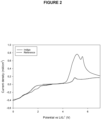
- indigo was included in an electrolyte solution which was tested in half-cells by Linear Scanning Voltammetry (LSV) according to the following conditions (Oxidation vs Al and Reduction VS Cu): LSV oxidation LSV reduction Cells (Al/Li Metal) Cells (Cu/Li Metal) Aluminium: 15pm Cu: 8 ⁇ m Cathode cup : Al Cathode cup : SUS Separator: PE separator (16 microns) Separator: PE separator (16 microns) Electrolyte: PC/EMC (4/6) 1M LiPF 6 Electrolyte: PC/EMC (4/6) 1M LiPF 6 Conditions Conditions Scan rate: 1 mV/s Scan rate: 1 mV/s Maximum potential: 7 V vs. Li/Li+ Maximum potential: OCV Minimum potential: OCV Minimum potential: 0 V vs. Li/Li+ Repeat: 1 scans Repeat: 1 scans Repeat: 1 scans
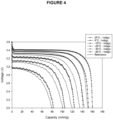
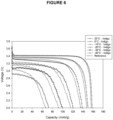
- Figure 4 shows the comparative discharge results of LFP/Li and LFP (+1%) Indigo/Li cells (A1 and B1-a respectively) using a PVDF binder at temperatures ranging from -40°C to 25°C.
- the addition of 1% Indigo in LFP provides an increase in capacity of between 4 and 6% between -40 and 25°C. Table 3.
- Tables 5(a) to 5(c) below summarize capacities and efficiencies of various indigoids tested using a PVDF or SBR-CMC binder. Impedance results in view of the reference cells (without indigoid) are also presented.
- Cells including graphite as anode material were also tested.
- the charge discharge results for Cells A3 and B3-a are shown in Figure 13 .
- a marked irreversibility can be observed at the first cycle in the presence of indigo. After the first cycle, the battery stabilizes more rapidly than for a battery without an indigoid additive.
- An improvement in capacity and a reduction in impedance are also observed in the presence of indigo (see below).
- Impedance results are also presented in Figure 14 for the LFP/Graphite cell with and without indigo (Cells A3 and B3-a).
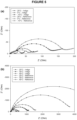
- Electrochemical impedance spectroscopy was also performed using LFP-Li Cells A1, A2, B1-a and B2-a described in Example 2 at SOC 50% at various temperatures ranging from -40°C to 25°C.
- the frequencies used were 1 MHz - 10 mHz, and 1 MHz - 50 mHz at low temperature.
- AC amplitude was 10 mV.
- Figures 5 (a) and 5 (b) for Cells A1 and B1-a
- Figures 7(a) and 7(b) show the results obtained with Cells A2 and B2-a.
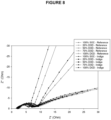
- Figure 5 shows the impedance results for LFP/Li and LFP (1% indigo)/Li with PVDF as binder (Cells A1 and B1-a). In curves showing two half circles, one represents the resistance related to lithium while the other is linked to the LFP resistance. The results show that resistance due to LFP decreases with the presence of indigo at temperatures of 0°C and below.
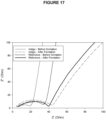
- Figure 17 shows the impedance results of NMC/LTO Cells A9 and B9-a, where a slight increase was observed.
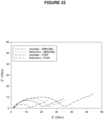
- Figure 22 presents the impedance results for Cells A1, A2, B1-c and B2-c using isoindigo as additive. The reduction in impedance is observed while SBR-CMC is used in combination with isoindigo.
- indigoid generally reduces cell impedance, compared to its indigo-free version when tested at the same temperature. This improvement is true for both binders but particularly significant when SBR:CMC is used as binder.
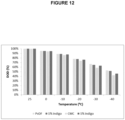
- the depth of discharge (% DOD) was evaluated as a function of temperature, binder and presence or absence of indigo for four cells, appearing in Figure 12 in the following order: Cell A1, Cell B1-a, Cell A2, and Cell B2-a. These comparative results show that the depth of discharge is improved at low temperature in the presence of indigo in LFP especially when combined with the use of CMC-SBR as a binder.
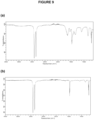
- FIG. 9(a) shows the FTIR of Cell A2 separator. Peaks observed below 2000 cm -1 are typical of electrolyte solvents (carbonates) degradation products. On the other hand, no such peaks linked to the degradation of the electrolyte were observed in Figure 9(b) showing the FTIR spectra of the separator after cycling in the presence of 1% indigo.
Landscapes
- Chemical & Material Sciences (AREA)
- Engineering & Computer Science (AREA)
- Chemical Kinetics & Catalysis (AREA)
- Electrochemistry (AREA)
- General Chemical & Material Sciences (AREA)
- Materials Engineering (AREA)
- Power Engineering (AREA)
- Manufacturing & Machinery (AREA)
- Inorganic Chemistry (AREA)
- Microelectronics & Electronic Packaging (AREA)
- Composite Materials (AREA)
- Organic Chemistry (AREA)
- Crystallography & Structural Chemistry (AREA)
- Battery Electrode And Active Subsutance (AREA)
- Cell Electrode Carriers And Collectors (AREA)
- Electric Double-Layer Capacitors Or The Like (AREA)
- Indole Compounds (AREA)
- Secondary Cells (AREA)
Description
- This application claims priority to
United States provisional application No. 62/459,309 filed on February 15th, 2017 - The technical field generally relates to electrode materials and processes for their preparation, for instance, electrode materials comprising an electrochemically active material and an organic additive. The present application also relates to the use of the electrode materials for the preparation of electrodes and their use in electrochemical cells.
- Indigo blue is a pigment originally extracted from plants which has been used as a dye for centuries. The molecule itself has been studied for various aspects, including its ambipolar organic semiconductor properties.
- The indigo blue dye, which is basically insoluble in water, has also been reduced to its colorless and soluble leuco-indigo form (indigo white). This redox property has been more recently studied in electrochemistry. For instance, indigo carmine, an analog of indigo blue, was tested as a purely organic cathode active material in rechargeable batteries (Yao M. et al., Scientific Reports, 4, 3650, pages 1-6).
EP 2 876 709CN 105 206 838 relates to the application of Vat Red 41 as a lithium ion battery organic cathode material, belonging to the field of battery materials.WO 2016/087759 relates to organic lithium batteries comprising a positive electrode made or organic redox compounds and an electrolyte comprising a high concentration of lithium salt, and a method for manufacturing the same. - In one aspect, the present application relates to an electrode material comprising particles of an electrochemically active material and an indigoid compound, for instance, a compound of any one of Formulae I to IV:


- R1, R2, R3, R4, R5, R6, R7, and R8 are each independently selected from a hydrogen atom, a group selected from halogen (e.g. F), optionally halogenated alkyl, cycloalkyl, or aryl, - CN, -NO2, -SO2OM2, -OP(O)(OM2)2, -P(O)(OM2)2, or -C(O)OM2, wherein M2 is a cation of an alkali or alkaline earth metal, or a -OC(O)alkyl, -SO2NH2, -SO2NHalkyl, or -SO2N(alkyl)2, group; and
- X is, independently in each occurrence, selected from O, S, NH, NR9, and PH (e.g. X is O, S or NH, or X is NH), wherein R9 is selected from natural or synthetic carbohydrate and protective groups, for instance an amine protective group such as trifluoroacetamide, t-butyloxycarbonyl (Boc), benzyloxycarbonyl (Cbz), 9-fluorenylmethyloxycarbonyl (Fmoc), benzyl (Bn), and the like;
- sugar is a natural or synthetic carbohydrate (e.g. mono or disaccharide, oligo and polysaccharides, e,g, β-D-glucose or cellulose); and
- wherein:
- i. a, c and e are single bonds, b and d are double bonds, and M1 is H or a cation of an alkali or alkaline earth metal thereby forming a salt with the oxygen atom it is linked to negatively charged (e.g. M1 is Li+, Na+, K+, Ca2+, or Mg2+) wherein the ratio of cation to the rest of the compound of Formula I provides electroneutrality (e.g. M1 may be Li+ or (Mg2+)½); or
- ii. a, c and e are double bonds, b and d are single bonds, and M1 is absent;
- or an oxime thereof (i.e. where =OM1 is replaced with =NOH in Formulae I, II or III), a compound of Formula IV where the Sugar is replaced by a hydrogen atom, a geometric isomer (e.g. cis or trans) thereof, or a carbohydrate (mono or disaccharide, oligo and polysaccharides, e,g, β-D-glucose or cellulose) complex or conjugate thereof,
- wherein the particles of the electrochemically active material are inorganic particles.
- In one embodiment, the compound is of Formula I. In another embodiment, the compound is of Formula II. In a further embodiment, the compound is of Formula III. For instance, R2 and R6 are the same and selected from halogen (e.g. F), optionally halogenated alkyl, - CN, and -SO2OM2, e.g. -CN. In another example, R6 and R7 are the same and selected from halogen (e.g. F), optionally halogenated alkyl, -CN, and -SO2OM2, e.g. -CN. In one embodiment, each of R1 to R8 are hydrogen atoms.
- In another embodiment, the compound is of Formula IV, for instance, wherein R2 is selected from halogen (e.g. F), optionally halogenated alkyl, -CN, and -SO2OM2, e.g. R2 is -CN. In another example, each of R1 to R4 are hydrogen atoms.
- In one embodiment, the compound is selected from:


- In one embodiment, the compound is indigo blue. In another embodiment, the compound of Formula I is leuco-indigo or a salt thereof. In another embodiment, the compound is selected from indigo, indigo carmine, isoindigo, indigopurpurin and indolinedione. In yet another embodiment, the compound is Compound 6. In a further embodiment, the compound is Compound 7. In another embodiment, the compound is selected from
compounds 8 to 10. In a further embodiment, the compound is selected fromcompounds - In one embodiment, the electrode material further comprises particles of an anode electrochemically active material. In a different embodiment, the electrode material further comprises particles of a cathode electrochemically active material.
- In one embodiment, the electrochemically active material comprises a material selected from the group consisting of titanates, lithium titanates, lithium metal phosphates, vanadium oxides, or lithium metal oxides. For instance, the electrochemically active material is selected from TiO2, Li2TiO3, Li4Ti5O12, H2Ti5O11 and H2Ti4O9, or a combination thereof, LiM'PO4 wherein M' is Fe, Ni, Mn, Co, or a combination thereof, LiV3O8, V2O5, LiMn2O4, LiM"O2, wherein M" is Mn, Co, Ni, or a combination thereof, Li(NiM‴)O2, wherein M‴ is Mn, Co, Al, Fe, Cr, Ti, or Zr, and combinations thereof. Each of the above active materials may be optionally doped with a compatible element.
- For instance, the electrochemically active material is selected from titanates and lithium titanates. According to another example, the electrochemically active material is of the formula LiM'PO4 wherein M' is Fe, Ni, Mn, Co, optionally doped with optionally doped with a compatible element, for instance an element selected from Mg, Al, B, Ti, V, Cr, Cu, Zn, Mo, Sn, Ca, Sr and W, or a combination thereof, for instance, the element is Mg. For instance, the electrochemically active material is LiFePO4 or LiMnxFe1-xPO4, where 0 < x < 1, optionally doped with a compatible element, for instance optionally doped with an element selected from Co, Ni, Mg, Al, B, Ti, V, Cr, Cu, Zn, Mo, Sn, Ca, Sr and W, or a combination thereof, for instance optionally doped with magnesium.
- In a further embodiment, the electrochemically active material is LiM"O2, wherein M" is Mn, Co, Ni, or a combination thereof. For instance, the electrochemically active material is LiNiwMnyCozO2, where w + y + z = 1.
- According to a further embodiment, the particles are further coated with a conductive agent. In a further embodiment, the electrode material further comprising a conductive agent. In yet another embodiment, the electrode material further comprising a binder, e.g. a water-soluble binder or a non-aqueous polymer binder (e.g. a fluorinated polymer binder such as PVDF or PTFE). For instance, the binder comprises a cellulose-derived binder, and/or a water-soluble binder. In a further embodiment, the compound is in a concentration from 0.1 wt% to 5 wt%, or in a concentration from 0.1 wt% to 2 wt%, in the electrode material.
- According to another aspect, the application relates to a process for producing an electrode comprising an electrode material as herein defined, comprising the steps of:
- a) mixing, in any order, the compound, the particles of electrochemically active material, and a binder in a solvent (e.g. aqueous or non-aqueous solvent) to obtain a slurry;
- b) casting the slurry obtained in step (a) on a substrate (e.g. current collector or separator); and
- c) drying the casted slurry.
- In one embodiment, the substrate is a current collector consisting of aluminum or an alloy having aluminum as the main component. In another embodiment, the substrate is a conductive polymer.
- According to a further aspect, the application relates to an electrode comprising the electrode material as herein defined, on a current collector, or an electrode produced by a process as herein defined. For instance, the current collector is aluminum or an alloy having aluminum as the main component, or the current collector is a conductive polymer.
- According to yet a further aspect, the present application relates to an electrochemical cell comprising an electrode as herein defined, an electrolyte and a counter-electrode (an electrode of opposing electrochemical activity). For instance, the electrode is a positive electrode, and the negative electrode comprises an electrochemically active material selected from metallic lithium, lithium alloys (e.g. Li-Na, Li-Mg, Li-Zn, and the like), Si, SiOx, graphite, and a carbon mixture (graphite-SiOx, graphite-Si, carbon-Si, carbon-SiOx). In another example, the negative electrode comprises a lithium titanate as electrochemically active material (e.g. Li4Ti5O12).
- In a further aspect, electrochemical generators and accumulators comprising an electrochemical cell or electrode material as herein defined.
- According to a further aspect, the present application also further relates the use of the present electrochemical cells and electrodes, for example, in electrical or hybrid vehicles, or in ubiquitous IT devices, and as supercapacitors, for instance, mobile devices, such as mobile phones, cameras, tablets or laptops, in electric or hybrid vehicles, or in renewable energy storage.
- Other features and advantages of the present technology will be better understood upon reading of the description herein below with reference to the appended drawings.
-
-
Figure 1 shows the redox forms of indigo. -
Figure 2 shows the Linear Scanning Voltammetry (LSV) results for a 1M LiPF6 solution in PC/EMC (4/6) and a 1M LiPF6 solution in PC/EMC (4/6) with 10 mMol indigo (Oxidation vs Al and Reduction vs Cu). -
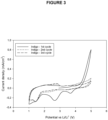
Figure 3 shows the cyclic voltammetry (CV) results for a 1M LiPF6 solution in PC/EMC (4/6) containing 10 mM indigo. -
Figure 4 shows the discharge of LFP/Li and LFP (+1%) Indigo/Li cells using a PVDF binder at temperatures between -40°C to 25°C. -
Figure 5 shows the impedance results for LFP/Li and LFP (+1%) Indigo /Li with PVDF as a binder at: (a) 25°C, 0°C, and -10°C; and (b) -20°C, -30°C, and -40°C. -
Figure 6 shows discharge results for LFP/Li and LFP (+1%) Indigo/Li cells using a SBR-CMC binder and 1M LiPF6 solution in PC/EMC (4/6) at temperatures between -40°C to 25°C. -
Figure 7 shows the impedance results for LFP/Li and LFP (+1%) Indigo /Li with SBR-CMC as a binder at: (a) 25°C, 0°C, and -10°C; and (b) -20°C, -30°C, and -40°C. -
Figure 8 shows impedance results at 25°C for LFP/Li and LFP (+1%) Indigo/Li with SBR-CMC as a binder at different %SOC or %DOD. -
Figure 9 shows the Fourier transform infrared (FTIR) spectra of the separator after cycling of an LFP/Li cell (a) without the use of indigo and (b) in the presence of 1% indigo. -
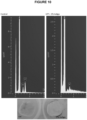
Figure 10 shows results of energy-dispersive X-ray spectroscopy of the surface of the separators after cycling without indigo (left) and with indigo (right) in LFP/Li cells with SBR-CMC as binder (photos of separators shown underneath the graphs). -
Figure 11 shows scanning electronic microscopy (SEM) images of the cathode surface (on the electrolyte separator side) after cycling of a LFP/Li cell (a) without indigo and (b) with 1% indigo. -
Figure 12 shows the DOD (%) results as a function of the binder used with 1% or without Indigo. -
Figure 13 presents charge-discharge results for LFP/Gr and LFP (+1%) Indigo/Gr cells using a SBR-CMC binder and 1M LiPF6 solution in PC/EMC (4/6). -
Figure 14 shows impedance results for LFP/Gr and LFP (+1%) Indigo /Gr with SBR-CMC as a binder. -
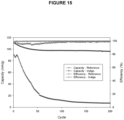
Figure 15 presents the cycling data (capacity and efficiency) for NMC/Li and NMC(1% indigo)/Li cells using SBR-CMC as binder and 1M LiPF6 solution in PC/EMC (4/6) as electrolyte. -
Figure 16 shows charge-discharge results for NMC/LTO and NMC (+1%) Indigo/LTO cells using a SBR-CMC binder and 1M LiPF6 solution in PC/EMC (4/6). -
Figure 17 shows the impedance results for NMC/LTO and NMC (+1%) Indigo/LTO cells with SBR-CMC as a binder. -
Figure 18 shows the cyclic voltammetry (CV) results for a 1M LiPF6 solution in PC/EMC (4/6) containing isoindigo (10mM). -
Figure 19 presents the Linear Scanning Voltammetry (LSV) results for a 1M LiPF6 solution in PC/EMC (4/6) and a 1M LiPF6 solution in PC/EMC (4/6) with 10 mM isoindigo (Oxidation vs Al and Reduction vs Cu). -
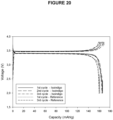
Figure 20 presents charge-discharge results for LFP/Li and LFP (+1%) isoindigo/Li cells using PVDF as binder and 1M LiPF6 solution in PC/EMC/DMC (4/3/3). -
Figure 21 presents charge-discharge results for LFP/Li and LFP (+1%) isoindigo/Li cells using SBR-CMC as binder and 1M LiPF6 solution in PC/EMC (4/6). -
Figure 22 shows the impedance results for LFP/Li and LFP (+1%) isoindigo/Li cells using PVDF as binder and 1M LiPF6 solution in PC/EMC/DMC (4/3/3), and for LFP/Li and LFP (+1%) Isoindigo/Li cells using SBR-CMC as binder and 1M LiPF6 solution in PC/EMC (4/6). -
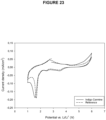
Figure 23 shows the cyclic voltammetry (CV) results for a 1M LiPF6 solution in PC/EMC/DMC (4/3/3) containing indigo carmine (10mM). -
Figure 24 presents the Linear Scanning Voltammetry (LSV) results for a 1M LiPF6 solution in PC/EMC (4/3/3) and a 1M LiPF6 solution in PC/EMC (4/3/3) with 10 mM indigo carmine (Oxidation vs Al and Reduction vs Cu). -
Figure 25 shows the charge-discharge results of LMFP/LTO and LMFP (+1%) indigo carmine/LTO cells using SBR-CMC as binder and 1M LiPF6 solution in PC/EMC/DMC (4/3/3). -
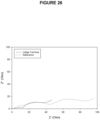
Figure 26 presents the impedance results for LMFP/LTO and LMFP (+1%) indigo carmine/LTO cells using SBR-CMC as binder and 1M LiPF6 solution in PC/EMC/DMC (4/3/3). - This application relates to a process for the preparation of an electrode material containing indigo blue or a derivative thereof, or a reduced form of said indigo blue or derivative, or a salt thereof, and to electrodes produced by such a process.
- For instance, the organic additive of the present application may work with Li+, Na+, K+ containing electrolytes. Indigo derivatives such as those used herein may store and release sodium and lithium ions during redox reactions. Organic molecules generally have weak Van der Waals type or π-π type interactions while inorganic molecules possess strong interactions like 3D electrostatic interactions. The property difference results in the organic molecules being more flexible than inorganic molecules, thereby favoring electrochemical storing of larger charge carriers like Na+ ions. Furthermore, physicochemical properties of organic molecules are more easily adjustable.
- For example, the present description relates to the use of organic molecules as additives in electrode materials. For instance, the organic molecules are indigoid compounds, i.e. indigo blue or a derivative, leuco-indigo form or salt thereof, i.e. a compound of Formula I, II or III:


- R1, R2, R3, R4, R5, R6, R7, and R8 are each independently selected from a hydrogen atom, a group selected from halogen (e.g. F), optionally halogenated alkyl, cycloalkyl, or aryl, - CN, -NO2, -SO2OM2, -OP(O)(OM2)2, -P(O)(OM2)2, or -C(O)OM2, wherein M2 is a cation of an alkali or alkaline earth metal, or a -OC(O)alkyl, -SO2NH2, -SO2NHalkyl, or -SO2N(alkyl)2, group;
- X is, independently in each occurrence, selected from O, S, NH, NR9, and PH, wherein R9 is selected from natural or synthetic carbohydrate and protective groups, for instance an amine protective group such as trifluoroacetamide, t-butyloxycarbonyl (Boc), benzyloxycarbonyl (Cbz), 9-fluorenylmethyloxycarbonyl (Fmoc), benzyl (Bn), and the like; and
- i. a, c and e are single bonds, b and d are double bonds, and M1 is H or a cation of an alkali or alkaline earth metal thereby forming a salt with the oxygen atom it is linked to negatively charged (e.g. M1 is Li+, Na+, K+, Ca2+, or Mg2+) wherein the ratio of cation to the rest of the compound of Formula I provides electroneutrality (e.g. M1 may be Li+ or (Mg2+)½); or
- ii. a, c and e are double bonds, b and d are single bonds, and M1 is absent;
- or an oxime thereof (i.e. where =OM1 is replaced with =NOH in Formulae I, II or III), a geometric isomer (e.g. cis or trans) thereof, or a carbohydrate (mono or disaccharide, oligo and polysaccharides, e,g, β-D-glucose or cellulose) complex or conjugate thereof.
- In one embodiment, when c is a double bond, this double bond may have a cis or trans geometry. In one embodiment, the c double bond is of trans geometry. In another embodiment, X is NH. In a further embodiment, R1 is identical to R5, and/or R2 is identical to R6, and/or R3 is identical to R7, and/or R4 is identical to R8. In another embodiment, R1 and R5 are both hydrogen and/or R2 and R6 are both hydrogen atoms.
- In one embodiment, at least one of R1 to R8 is selected from fluorine, cyano and trifluoromethyl. In another embodiment, R1, R4, R5 and R8 are each hydrogen atoms, and R2, R3, R6 and R7 are as previously defined. In another embodiment, R1, R4, R5 and R8 are each hydrogen atoms, and R2, R3, R6 and R7 are independently selected from fluorine, cyano and trifluoromethyl.
- In a further embodiment, M1 is present and is selected from Li, Na and K.
- The Indigo blue or derivative (where a, c and e are double bonds) as defined above may also be converted to its reduced form (where b and d are double bonds), for instance, by alkaline reduction. For instance, the reduced form of indigo blue is referred to as Leuco-indigo or indigo white and may be in the form of a salt.
- In another example, the compound is a precursor of indigo blue such as a indoxyl-sugar or derivative, reduced form or salt thereof and is a compound of Formula IV:

- R1, R2, R3, R4, and X are as previously defined; and
- Sugar is a natural or synthetic carbohydrate (e.g. mono or disaccharide, oligo and polysaccharides, e,g, β-D-glucose or cellulose).
- An analog of the compound of Formula IV, where the sugar is replaced with a hydrogen atom is also contemplated.
- In one embodiment, the compound used herein is a sugar or polysugar (such as cellulose) complex or conjugate of a compound of Formulae I, II or III.
- In one example, the compound is selected from the compounds of the formula:


- According to some examples, the compound is indigo blue or a derivative thereof having substituents on one or both aromatic rings. For example, one or more sulfonate groups (e.g. indigo carmine), one or more chlorine or bromine atoms (e.g. tyrian purple, ciba blue) or one or more nitrile groups. Other derivatives include the replacement of the amine groups by sulfur atoms in the cycle, i.e. wherein X is S (e.g. thioindigo). In another example, the compound is indigo carmine. In yet another example, the compound is isoindigo. Another example of a compound is indigo purpurine. Another example of an indigoid compound is indolinedione.
- Some of the compounds described herein may be available from commercial sources or may be prepared using known techniques, such as those described in Tanoue et al., Dyes and Pigments, 62, 2004, 101-105; Klimovich I.V., J. Mat. Chem., 2014, 2, 7621-7631; Horn, R.H., et al., Notes. Journal of the Chemical Society (Resumed), 1950, 2900-2908; Voβ, G. and H. Gerlach, Chemische Berichte, 1989, 122(6), 1199-1201; Baltac, T., et al., Revista de Chimie, 2012, 63(6), 618-620; Bailey, J.E. and J. Travis, Dyes and Pigments, 1985, 6(2), 135-154; Leclerc, S., et al., J. Biol. Chem., 2001, 276(1), 251-260; and Karapetyan G. et al., Chem, Med. Chem., 2011, 6, 25-37.
- According to another aspect, the present application relates to electrode material comprising a compound as defined herein as an additive. For instance, the compound is present in a concentration from 0.1 wt% to 5 wt%, or in a concentration from 0.1 wt% to 2 wt%, in the electrode material. In one embodiment, the electrode is adapted for use in an electrochemical cell, for instance, in a lithium or lithium-ion battery. In a further embodiment, the electrode is adapted for use in a supercapacitor of the redox type.
- In another example, the electrode material comprises a compound as defined herein and particles of an electrochemically active material. In another embodiment, the electrode material comprises a compound as defined herein and particles of an electrochemically active material dispersed in a binder. For instance, the present invention relates to electrodes comprising an electrode material defined herein coated on a support film, e.g. a current collector.
- In one embodiment, the electrode is a cathode, for example, of a lithium-ion battery. The present compound may contribute as a capacity reservoir, as an electron conductive agent, as an ion diffusing agent and/or as an overcharge protector. For instance, the presence of a compound described herein may result in increased battery capacity and/or reduced internal resistance, for instance, when operated at low temperature.
- Similarly, when the electrode is an anode, for example, of a lithium-ion battery, the present compound may then contribute by increasing electron conductivity and/or ionic diffusion, as an overcharge protector and/or by reducing internal resistance, e.g. at room temperature and below.
- For instance, the compound as defined herein may be used to improve ionic and/or electronic conductivity within the electrochemical cell, for instance, when operated at low temperature, e.g. temperatures below room temperature, or ≤ 25°C, or ≤ 15°C, or ≤ 10°C, or ≤ 0°C, or ≤ -10°C, whether it is used as an additive in an anode or an cathode, or in both. For instance, the electrochemical cell is operated at a temperature between -40°C and 25°C.
- Particles of electrochemically active material include inorganic particles such as metal oxides and complex oxides, and carbon particles such as graphite. Examples of electrochemically active materials include, without limitation, titanates and lithium titanates (e.g. TiO2, Li2TiO3, Li4Ti5O12, H2Ti5O11, H2Ti4O9, or a combination thereof), lithium and metal phosphates (e.g. LiM'PO4 where M' is Fe, Ni, Mn, Co, or a combination thereof), vanadium oxides (e.g. LiV3O8, V2O5, LiV2O5, and the like), and other lithium and metal oxides such as LiMn2O4, LiM"O2 (M" being Mn, Co, Ni, or a combination thereof), Li(NiM‴)O2 (M‴ being Mn, Co, Al, Fe, Cr, Ti, Zr, and the like, or a combination thereof), or a combination thereof, or any of the above materials further comprising a compatible doping element selected from
Groups 2 to 15 of the periodic table of elements. For instance, the active material is selected from lithium iron phosphate (LFP), lithium manganese iron phosphate (LMFP), lithium titanate (LTO), graphite, and lithium nickel manganese cobalt oxide (NMC). - According to another example, the electrochemically active material is of the formula LiM'PO4 wherein M' is Fe, Ni, Mn, Co or a combination thereof optionally doped with a compatible element, for instance optionally doped with an element selected from Mg, Al, B, Ti, V, Cr, Cu, Zn, Mo, Sn, Ca, Sr and W, or a combination thereof. For instance, the electrochemically active material is LiFePO4 or LiMnxFe1-xPO4, where 0 < x < 1, optionally doped with a compatible element, for instance, optionally doped with an element selected from Co, Ni, Mg, Al, B, Ti, V, Cr, Cu, Zn, Mo, Sn, Ca, Sr and W, or a combination thereof, for instance optionally doped with magnesium. Examples of electrochemically active materials also include compounds of the formula LiM"O2, wherein M" is Mn, Co, Ni, or a combination thereof. For instance, the electrochemically active material is LiNiwMnyCozO2, where w + y + z = 1.
- The electrochemically active material particles are freshly formed or of commercial source. They may be in the form of microparticles or nanoparticles and may further include a carbon coating.
- The electrode material optionally includes additional components like conductive materials, inorganic particles, glass or ceramic particles, salts (e.g. lithium salts), and the like. Examples of conductive materials include carbon black, Ketjen™ black, acetylene black, graphite, graphene, carbon fibers, nanofibers (e.g. VGCF) or nanotubes, or a combination thereof.
- In one embodiment, the electrode further comprises at least one binder. Examples of binders include water soluble binders such as SBR (styrene butadiene rubber), NBR (butadiene acrylonitrile rubber), HNBR (hydrogenated NBR), CHR (epichlorohydrin rubber), ACM (acrylate rubber), and the like, and cellulose-based binders (e.g. carboxyalkylcellulose, hydroxyalkylcellulose, and combinations), or any combination of two or more of these. For instance, the carboxyalkylcellulose may be carboxymethylcellulose (CMC) or carboxyethylcellulose. Hydroxypropylcellulose is an example of hydroxyalkylcellulose.
- Other examples of binders include fluorine-containing polymeric binders such as PVDF and PTFE, and ion-conductive polymer binders such as block copolymers composed of at least one lithium-ion solvating segment and at least one cross-linkable segment.
- In one embodiment, the binder comprises a water-soluble binder and a cellulose-based binder, for example, a combination of SBR and CMC.
- The present application also relates to the preparation of an electrode comprising the electrode material as defined herein. In one example, a compound as defined herein and particles of an electrochemically active material are mixed with a binder and applied on a substrate film (e.g. a current collector), for instance, as a slurry in a compatible solvent, which may also be selected based on the binder used. For example, water may be used to prepare a slurry with a water-soluble binder and a cellulose-based binder. In another example, a non-aqueous solvent (e.g. NMP) may be used to prepare a slurry with a polymer binder (e.g. a fluorine-containing polymeric binder). Further additives, such as conductive materials may also be added to the slurry. Solvent, if present, is eliminated after coating of the mix or slurry. The binder is as defined above and is selected considering the compatibility with the electrochemically active material, additive, current collector, electrolyte, and other parts of the electrochemical cell which could be in contact therewith.
- The slurry can be applied on the substrate film continuously by various methods, such as the comma bar method, the doctor blade method or by slot die casting.
- The electrode produced by the present process is for use in the assembly of an electrochemical cell further comprising an electrolyte and a counter-electrode. The material composing the counter-electrode is selected as a function of the electrochemically active material used in the electrode (e.g. electrode/counter-electrode: LFP/LTO, LFP/Li, LFP/Graphite, NMC/Graphite, NMC/LTO, etc.). For instance, the electrode is a positive electrode, and the counter-electrode is a negative electrode and comprises an electrochemically active material selected from metallic lithium, lithium alloys (e.g. Li-Na, Li-Mg, Li-Zn, and the like), Si, SiOx, graphite, and a carbon mixture (graphite-SiOx, graphite-Si, carbon-Si, carbon-SiOx). In another example, the negative electrode comprises a lithium titanate as electrochemically active material (e.g. Li4Ti5O12).
- The electrolyte may be a liquid, gel or solid polymer electrolyte and, in the case of a lithium or lithium-ion battery, comprises a lithium salt and/or is conductive to lithium ions. For instance, the electrode described herein may be used in capacitors or supercapacitors, or in batteries such as lithium or lithium-ion batteries.
- The following non-limiting examples are illustrative embodiments and should not be construed as limiting the scope of the present application. These examples will be better understood with reference to the accompanying figures.
- The procedure used here is based on the method described in Tanoue et al., Supra.
-
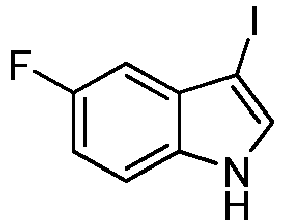
- To a solution of 5-fluoroindole (100 mg, 0.74 mmol) and sodium hydroxide (29.6 mg, 0.74 mmol) in methanol (10 mL) were added iodine (188 mg, 0.74 mmol) and an aqueous solution (1 mL) of potassium iodide (123 mg, 0.74 mmol). After the mixture was stirred at room temperature for 3h, water (20 mL) was added. The resulting precipitate was collected by filtration, washed with water, and dried under reduced pressure to obtain 5-fluoro-3-iodoindole (153 mg, 0.584 mmol), which was used for the following reaction without purification.
-

- Silver acetate (146 mg, 0.876 mmol) was added to a solution of 5-fluoro-3-iodoindole from step (a) in acid acetic (10 mL). After stirring for 1 h at 90°C, the mixture was cooled to room temperature and filtered. The filtrate was evaporated to dryness under reduced pressure. The residue was chromatographed on silica gel with chloroform to give 3-acetoxy-5-fluoroindole (73 mg, 51% yield).
-

- To a solution of 3-acetoxy-5-fluoroindole (51 mg, 0.262 mmol) from step (b) in ethanol (5 mL) was added aqueous 1M sodium hydroxide (10 mL). After the mixture was stirred at room temperature for 2h, water was added. The resulting precipitate was collected by filtration, washed with water, and dried to give 5,5'-difluoroindigo (Compound 3).
- This method was also used for the preparation of
Compounds - The procedure used here is based on the methods described in Klimovitch, Horn et al., and Voβ and Gerlach, Supra.

- The nitrobenzaldehyde (3.2×10⁻² mol) derivative and nitromethane (1.1 eq.) in 15 mL of methanol were treated slowly at 0°C with a solution of sodium methoxide (from sodium (1.2 eq.) and methanol (10 mL)). After 12h at 0°C, the yellow crystalline sodium salt of 2-nitro-1-o-nitrophenylethylalcohol was collected and washed with ether. This salt was dissolved in water, 15 mL of sodium hydroxide solution (2N) was added, and sodium dithionite (1.1 eq) was then added slowly with stirring. A thick precipitate of indigo was formed at once collected and purified by vacuum-sublimation.
- Examples of compounds prepared using this procedure:
Compound 3: R': H R": F Compound 4: R': F R": H Compound 5: R': CF3 R": H Compound 6: R': CN R": H Compound 7 R': H R": CN - The procedure used below is based on the method described in Batlach et al., Supra.

- Concentrated sulfuric acid (50 mL) is placed in a 250 mL flask and indigo power (10 g) is added in one portion. The mixture is vigorously stirred during 15 min at 30°C. Then, the solution is heated to 80°C and it stirred for 2 more hours. It is left until the next day, when an aqueous solution saturated with LiCl is prepared. Ice and then Indigo are added to it and then the solution is filtered. The filtrate is washed with a lithium chloride saturated aqueous solution. The compound may also be prepared as its sodium salt in a similar manner.
- The following procedure is based on the method described in Bailey and Travis, Supra.

- Concentrated sulfuric acid (75 mL) was placed in a 250 mL flask and indigo power (10 g) was added in one portion. An air-cooled condenser was installed, and the mixture was swirled and then heated to 160°C. The reaction was terminated by carefully quenching the solution in 300 g of ice. The resulting solution was neutralized by addition of a 50% LiOH solution (with cooling), refrigerated overnight and then filtered to remove the precipitated solids. The precipitate (mostly 5,5'-diSI) was discarded. The mother liquor was diluted to 900 mL and retained for purification by preparative HPLC. The compound may also be prepared as its sodium salt.
- The composition of cathodes prepared according to (c) below used as reference or tested indigoid-containing cathodes are listed below in Table 1.
Table 1. Cathode compositions Cathode Active Weight % No Material Active CBlack CFibers PVdF SBR CMC Indigoid d 1 LFPa 90 5 - 5 - - - 2 LFPa 91 5 - - 2.5 1.5 - 3 LMFPb 90 4 1 5 - - - 4 LMFPb 90 4 1 - 3.125 1.875 - 5 NMCc 90 5 - 5 - - - 6 NMCc 91 5 - - 2.5 1.5 - 7 LFPa 90 5 - 4 - - 1 8 LFPa 91 5 - - 1.875 1.125 1 9 LMFPb 89.5 3.75 0.75 5 - - 1 10 LMFPb 89.5 3.75 0.75 - 3.125 1.875 1 11 NMCc 89.5 4.5 - 5 - - 1 12 NMCc 91 5 - - 1.125 1.875 1 a. LFP: LiFePO4 carbon-coated particles, carbon content in LFP being <10% by weight
b. LMFP: LiMn0.75Fe0.25PO4 doped with 0.5% Mg, carbon-coated particles, carbon content being <10% by weight
c. NMC: LiNi0.6Mn0.2Co0.2O2
d. Indigoid included incathodes 7 to 12 identified with the letter a: indigo, b: indigo carmine, and c: isoindigo (ex: cathode 7-a, 7-b, etc.). - Components of the cells tested are summarized in Table 2 below. Each cell is prepared as a 2032 size coin cell. The separator identified in the table is impregnated with a liquid electrolyte composed of 1 mol/kg LiPF6 in PC/EMC (4/6) or PC/EMC/DMC (4/3/3).
Table 2. Cells compositions Cell No Cathode Separatora Anodeb Cell No Cathodec Separatora Anodeb A1 1 I Li B1 7 I Li A2 2 I Li B2 8 I Li A3 2 I Gr B3 8 I Gr A4 3 II Li B4 9 II Li A5 4 II Li B5 10 II Li A6 5 I Li B6 11 I Li A7 6 I Li B7 12 I Li A8 4 II LTO B8 10 II LTO A9 6 I LTO B9 12 I LTO A10 3 II LTO B10 9 II LTO A11 5 I LTO B11 11 I LTO a. I: Polyethylene based 16 µm; II: polyethylene and polyethylene terephthalate based 12 µm
b. Li: lithium metal film; Gr: graphite (commercial); LTO: Li4Ti5O12 (LTO) : Carbon Black : SBR : CMC in a weight ratio of 91 : 5 : 2.5 : 1.5
c. Cell name will include cathode letter of Table 1 (ex: cathode 7-a: Cell B1-a, etc.). - c) Methods for the preparation of electrodes (see Table 1 above for weight ratios):

- The hybrid cathode pastes were prepared by mechanically mixing (Thinky Mixer SR-500) of Indigoid if present (a: indigo, b: indigo carmine, and c: isoindigo, see Table 1), active material, acetylene black (Denka HS-100L) and PVDF (1300 g/mol) in NMP. The resulting viscous slurry was cast by the Doctor Blade method uniformly onto an aluminium foil serving as a current collector, dried at 120ºC under vacuum and roll-pressed with a Rolling Machine (MSK-2150) at 59 µm to achieve an electrode
active layer density 8 mg/cm2. Electrodes were further dried under vacuum at 150°C before to use.
- The hybrid cathode pastes were prepared by mechanically mixing (Thinky Mixer SR-500) of Indigoid if present, LFP (LCP 420B), acetylene black (Denka HS-100L), SBR (BM400B) and CMC (BSH-6) in water. The resulting viscous slurry was cast uniformly by the Doctor Blade method onto an aluminium foil serving as a current collector, dried at 80ºC under vacuum and roll-pressed with a Rolling Machine (MSK-2150) at 59 µm to achieve an electrode active layer loading of 8 mg/cm2 and a volume density of 1.8 mg/cm3. The electrodes were further dried under vacuum at 150°C before to use.

- The hybrid cathode pastes were prepared by mechanically mixing (Thinky Mixer SR-500) LTO (T30-D8), acetylene black (Denka HS-100L), SBR (BM400B) and CMC (BSH-6) in water. The resulting viscous slurry was cast uniformly by the Doctor Blade method onto an aluminium foil serving as a current collector, dried at 80ºC under vacuum and roll-pressed with a Rolling Machine (MSK-2150) at 72 µm to achieve an electrode active layer loading of 10 mg/cm2 and a volume density of 1.8 mg/cm3. The electrodes were further dried under vacuum at 150°C before to use.

- The hybrid cathode pastes were prepared by mechanically mixing (Thinky Mixer SR-500) of Indigoid if present, active material, acetylene black (Denka HS-100L), carbon fiber (VGCF-SDH-HC) and PVDF (1300 g/mol) in NMP. The resulting viscous slurry was cast by the Doctor Blade method uniformly onto an aluminium foil serving as a current collector, dried at 80ºC under vacuum and roll-pressed with a Rolling Machine (MSK-2150) at 63 µm to achieve an electrode active layer density 8.5 mg/cm2. Electrodes were further dried under vacuum at 150°C before to use.

- The hybrid cathode pastes were prepared by mechanically mixing (Thinky Mixer SR-500) of Indigoid if present, active material, acetylene black (Denka HS-100L), carbon fiber (VGCF-SDH-HC), SBR (BM400B) and CMC (BSH-6) in water. The resulting viscous slurry was cast uniformly by the Doctor Blade method onto an aluminium foil serving as a current collector, dried at 80ºC under vacuum and roll-pressed with a Rolling Machine (MSK-2150) at 63 µm to achieve an electrode active layer loading of 8.5 mg/cm2. The electrodes were further dried under vacuum at 150°C before to use.

- The hybrid cathode pastes were prepared by mechanically mixing (Thinky Mixer SR-500) of Indigoid if present, active material, acetylene black (Denka HS-100L), and PVDF (1300 g/mol) in NMP. The resulting viscous slurry was cast by the Doctor Blade method uniformly onto an aluminium foil serving as a current collector, dried at 80ºC under vacuum and roll-pressed with a Rolling Machine (MSK-2150) at 41 µm to achieve an electrode active layer density 7.5 mg/cm2. Electrodes were further dried under vacuum at 125°C before to use.

- The hybrid cathode pastes were prepared by mechanically mixing (Thinky Mixer SR-500) of Indigoid if present, active material, acetylene black (Denka HS-100L), SBR (BM400B) and CMC (BSH-6) in water. The resulting viscous slurry was cast uniformly by the Doctor Blade method onto an aluminium foil serving as a current collector, dried at 80ºC under vacuum and roll-pressed with a Rolling Machine (MSK-2150) at 41 µm to achieve an electrode active layer loading of 7.5 mg/cm2. The electrodes were further dried under vacuum at 125°C before to use.
- To illustrate the electrochemical properties of the present additives, indigo was included in an electrolyte solution which was tested in half-cells by Linear Scanning Voltammetry (LSV) according to the following conditions (Oxidation vs Al and Reduction VS Cu):
LSV oxidation LSV reduction Cells (Al/Li Metal) Cells (Cu/Li Metal) Aluminium: 15pm Cu: 8µm Cathode cup : Al Cathode cup : SUS Separator: PE separator (16 microns) Separator: PE separator (16 microns) Electrolyte: PC/EMC (4/6) 1M LiPF6 Electrolyte: PC/EMC (4/6) 1M LiPF6 Conditions Conditions Scan rate: 1 mV/s Scan rate: 1 mV/s Maximum potential: 7 V vs. Li/Li+ Maximum potential: OCV Minimum potential: OCV Minimum potential: 0 V vs. Li/Li+ Repeat: 1 scans Repeat: 1 scans - Results are shown in
Figure 2 . Oxidation of indigo may be observed after 4V, while the two reduction reactions occur at about 2V and 1.3V. The two reduction reactions are the LFP/LTO electrochemical window while the indigo oxidation would not happen in this system. LSV results are also shown for isoindigo (Figure 19 ) and indigo carmine (Figure 24 ). - The same electrochemical solution was also tested by cyclic voltammetry (CV) results for a 1M LiPF6 solution in PC/EMC (4/6) with 10 mMol indigo (same half-cell as for LSV oxidation) at a scan rate of 2 mV/s, a maximum voltage of 6V, a minimum voltage of 1V, and for 3 scans (see
Figure 3 ). One non-reversible oxidation occurs after 4V and two partially reversible reductions occur in the same analysis conditions. The various oxidation states of indigo are illustrated inFigure 1 . CV results are also presented for isoindigo (Figure 18 ) and indigo carmine (Figure 23 ). - Prior to the cycling test, batteries were charged and discharged twice at 0.1 C at 25 °C, where xC is the current that can fully charge/discharge cell capacity in 1/x hour. Charge in CC-CV (Constant current constant voltage) mode. Conditions used:
- Cells A1, A2, B1, B2 (LFP/Li Metal)
- Voltage: 3.8 V Current: 0.2 C
- Discharge: CC (Constant current) mode 0.2 C
- Cut-off voltage: 2 V Current: 0.01 C
- Cells A3 and B3 (LFP/Gr)
- Voltage: 3.6 V Current: 0.2 C
- Discharge: CC (Constant current) mode 0.2 C
- Cut-off voltage: 2 V Current: 0.01 C
- Cells A4, A5, B4 and B5 (LMFP-Li)
- Voltage: 4.5 V Current: 0.2 C
- Discharge: CC (Constant current) mode 0.2 C
- Cut-off voltage: 2 V Current: 0.02 C
- Cells A6, A7, B6 and B7 (NMC-Li)
- Voltage: 4.2 V Current: 0.2 C
- Discharge: CC (Constant current) mode 0.2 C
- Cut-off voltage: 2.5 V Current: 0.01 C
- Cells A8, A10, B8 and B10 (LMFP-LTO)
- Voltage: 3 V Current: 0.2 C
- Discharge: CC (Constant current) mode 0.2 C
- Cut-off voltage: 0.5 V Current: 0.02 C
- Cells A9, A11, B9 and B11 (NMC-LTO)
- Voltage: 2.7 V Current: 0.2 C
- Discharge: CC (Constant current) mode 0.2 C
- Cut-off voltage: 0.5 V Current: 0.01 C
- The results at various temperatures are shown in
Figure 4 (Cells A1 and B1-a) andFigure 6 (Cells A2 and B2-a). - For instance,
Figure 4 shows the comparative discharge results of LFP/Li and LFP (+1%) Indigo/Li cells (A1 and B1-a respectively) using a PVDF binder at temperatures ranging from -40°C to 25°C. As can be observed in Table 3 below, the addition of 1% Indigo in LFP provides an increase in capacity of between 4 and 6% between -40 and 25°C.Table 3. Capacity of Cells A1 and B1-a at varying temperatures Temperature (°C) -40 -30 -20 -10 0 25 Cell A1 79.41 101.18 119.8 135.32 144.45 151.4 Cell B1-a 82.61 104.78 124.41 141.99 152.44 160.47 % 4 3.6 3.85 4.93 5.53 6 - The discharge results for LFP/Li and LFP (+1%) Indigo/Li cells (A2 and B2-a respectively) using a SBR-CMC binder at temperatures between -40°C to 25°C are shown in
Figure 6 . Table 4 shows that a 1% addition of Indigo in the LFP cathode provides an increase in capacity between 1 and 10% at temperatures from -40 to 25°C.Table 4. Capacity of Cells A2 and B2-a at varying temperatures Temperature (°C) -40 -30 -20 -10 0 25 Cell A2 66.51 92.18 115.34 135.32 147.51 156.62 Cell B2-a 72.73 99.77 120.65 138.6 149.98 158.53 % 9.35 8.22 4.6 2.4 1.7 1.2 - Tables 5(a) to 5(c) below summarize capacities and efficiencies of various indigoids tested using a PVDF or SBR-CMC binder. Impedance results in view of the reference cells (without indigoid) are also presented.
Table 5(a) LFP-Li Capacity (mAh/g) Efficiency (%) Impedance vs Ref PVDF SBR/CMC PVDF SBR/CMC PVDF SBR/ CMC Compound 1 162 168 99 98 >> < Compound 8169 162 100 99 >> >> Compound 11 - 161 - 94 - < Compound 12165 159 99 98 < >> Compound 14164 163 96 99 >> >> Reference 160 163 99 97 - - Table 5(b) NMC-Li Capacity (mAh/g) Efficiency (%) Impedance vs Ref PVDF SBR/CMC PVDF SBR/CMC PVDF SBR/ CMC Compound 1 165 166 93 99 > << Compound 8 - 158 - 99 - < Compound 11 - - - - - - Compound 12 - 165 - 96 - << Compound 14 - 162 - 100 - > Reference 165 161 95 98 - - Table 5(c) LMFP-Li Capacity (mAh/g) Efficiency (%) Impedance vs Ref PVDF SBR/CMC PVDF SBR/CMC PVDF SBR/ CMC Compound 1 158 156 99 98 > < Compound 8160 - 99 - > - Compound 11 - - - - - - Compound 12161 - 99 - < - Compound 14160 - 100 - > - Reference 158 158 99 97 - - - Cycling data are also presented in Table 6 below, which summarizes retention rate as well as efficiency of a Cell B1-a compared to a Cell A1. It can be observed that the lithium cell containing LFP and indigo as an additive exhibit a reduced capacity loss. It was also observed that the indigo-containing cell had a more stable efficiency.
Table 6 Indigo Reference No cycles Retention Efficiency Retention Efficiency 1 99 96 99 99 21 95 98 95 98 25 93 97 79 98 30 90 95 65 86 50 53 94 27 94 - Cells including graphite as anode material were also tested. The charge discharge results for Cells A3 and B3-a are shown in
Figure 13 . A marked irreversibility can be observed at the first cycle in the presence of indigo. After the first cycle, the battery stabilizes more rapidly than for a battery without an indigoid additive. An improvement in capacity and a reduction in impedance are also observed in the presence of indigo (see below). Impedance results are also presented inFigure 14 for the LFP/Graphite cell with and without indigo (Cells A3 and B3-a). - Cells A7 and B7-a, where the cathode material used was NMC (6/2/2). Cycling results are shown in
Figure 15 . It is worth noting that it is normally very difficult to obtain a NMC-Li battery with cycling capabilities. As can be observed fromFigure 15 , nearly all capacity is lost after 50 cycles (see reference). On the other hand, when indigo is used as an additive in the NMC cathode, a stable capacity as well as a stable efficiency are obtained over 200 cycles. Charge and discharge results are also shown for NMC/LTO cells A9 and B9-a inFigure 16 . - Charge-discharge results are shown for LFP-Li cells A1 and B1-c with or without isoindigo in
Figure 20 (PVdF binder) and for LFP-Li cells A2 and B2-c with or without isoindigo inFigure 21 (SBR-CMC binder). - Finally, charge discharge results are presented in
Figure 25 , for Cells A8 and B8-b using indigo carmine as additive in a LMFP cathode when using LTO as anode material. The addition of indigo carmine in the cathode material was shown to limit the voltage fading typically observed with LMFP. - Electrochemical impedance spectroscopy (EIS) was also performed using LFP-Li Cells A1, A2, B1-a and B2-a described in Example 2 at
SOC 50% at various temperatures ranging from -40°C to 25°C. The frequencies used were 1 MHz - 10 mHz, and 1 MHz - 50 mHz at low temperature. AC amplitude was 10 mV. The results are shown inFigures 5 (a) and 5 (b) for Cells A1 and B1-a, whileFigures 7(a) and 7(b) show the results obtained with Cells A2 and B2-a. -
Figure 5 shows the impedance results for LFP/Li and LFP (1% indigo)/Li with PVDF as binder (Cells A1 and B1-a). In curves showing two half circles, one represents the resistance related to lithium while the other is linked to the LFP resistance. The results show that resistance due to LFP decreases with the presence of indigo at temperatures of 0°C and below. - Similar impedance results are presented in
Figure 7 for LFP/Li and LFP (1% indigo)/Li with SBR-CMC as a binder (Cells A2 and B2-a). The results show that resistance due to LFP decreases with the presence of indigo at all temperatures tested. - Impedance of Cells A2 and B2-a at 25°C was also tested at different state of charge (% SOC).
Figure 8 shows these impedance results. In summary, this experiment serves to demonstrate that the diffusion of lithium ions is improved in LFP with the presence of indigo during charge and discharge, especially at 100% or 80% SOC. - Impedance results are also presented in
Figure 14 for the LFP/Graphite cell with and without indigo (Cells A3 and B3-a). A reduction of impedance was also observed in the presence of indigo when graphite was used as the anode. -
Figure 17 shows the impedance results of NMC/LTO Cells A9 and B9-a, where a slight increase was observed.Figure 22 presents the impedance results for Cells A1, A2, B1-c and B2-c using isoindigo as additive. The reduction in impedance is observed while SBR-CMC is used in combination with isoindigo. - Finally, impedance results are presented in
Figure 26 , for Cells A8 and B8-b using indigo carmine as additive in a LMFP cathode when using LTO as anode material. The addition of indigo carmine in the cathode material was shown to greatly reduce the internal battery resistance. - As can be observed, the presence of an indigoid generally reduces cell impedance, compared to its indigo-free version when tested at the same temperature. This improvement is true for both binders but particularly significant when SBR:CMC is used as binder.
- The depth of discharge (% DOD) was evaluated as a function of temperature, binder and presence or absence of indigo for four cells, appearing in
Figure 12 in the following order: Cell A1, Cell B1-a, Cell A2, and Cell B2-a. These comparative results show that the depth of discharge is improved at low temperature in the presence of indigo in LFP especially when combined with the use of CMC-SBR as a binder. - Cells A2 and B2-a were opened after cycling for a visual evaluation of the separator (see
Figure 10 , underneath the graphs). Traces of impurities were observed on the surface of the separator in contact with the LFP cathode in the cell not containing indigo (left-hand image), while such impurities were not present when indigo was used as an additive (righthand image). - The separator of both cells was then analysed by Fourier transform infrared (FTIR) spectra.
Figure 9(a) shows the FTIR of Cell A2 separator. Peaks observed below 2000 cm-1 are typical of electrolyte solvents (carbonates) degradation products. On the other hand, no such peaks linked to the degradation of the electrolyte were observed inFigure 9(b) showing the FTIR spectra of the separator after cycling in the presence of 1% indigo. - EDS results shown in
Figure 10 also demonstrate that the separator of a LFP-Li cell after cycling without indigo (left) presents a much higher content in F and P atoms at its surface than the corresponding cell with indigo (right). These impurities are typical of electrolyte degradation (LiPF6). - Finally, the cathode surface in contact with the battery separator was analysed by SEM in both Cell B2-a and control Cell A2 after cycling. Images obtained are presented in
Figures 11 (a) and (b) respectively. When looking at the cell without indigo (Figure 11(a) ), dark zones typically resulting from electrolyte degradation are observed. The image ofFigure 11(b) showing the material using indigo as an additive does not present electrolyte degradation.
Claims (21)
- An electrode material comprising particles of an electrochemically active material and a compound of any one of Formulae I to IV:

 R1, R2, R3, R4, R5, R6, R7, and R8 are each independently selected from a hydrogen atom, a group selected from halogen (e.g. F), optionally halogenated alkyl, cycloalkyl, or aryl, -CN, -NO2, -SO2OM2, -OP(O)(OM2)2, -P(O)(OM2)2, or -C(O)OM2, wherein M2 is a cation of an alkali or alkaline earth metal, or a -OC(O)alkyl, - SO2NH2, -SO2NHalkyl, or -SO2N(alkyl)2, group; andX is, independently in each occurrence, selected from O, S, NH, NR9, and PH, wherein R9 is selected from natural or synthetic carbohydrate and protective groups, for instance an amine protective group such as trifluoroacetamide, t-butyloxycarbonyl (Boc), benzyloxycarbonyl (Cbz), 9-fluorenylmethyloxycarbonyl (Fmoc), benzyl (Bn), and the like;sugar is a natural or synthetic carbohydrate (e.g. mono or disaccharide, oligo and polysaccharides, e,g, β-D-glucose or cellulose); andwherein:i. a, c and e are single bonds, b and d are double bonds, and M1 is H or a cation of an alkali or alkaline earth metal thereby forming a salt with the oxygen atom it is linked to negatively charged (e.g. M1 is Li+, Na+, K+, Ca2+, or Mg2+) wherein the ratio of cation to the rest of the compound of Formula I provides electroneutrality (e.g. M1 may be Li+ or (Mg2+)½); orii. a, c and e are double bonds, b and d are single bonds, and M1 is absent;or an oxime thereof (i.e. where =OM1 is replaced with =NOH in Formulae I, II or III), a compound of Formula IV where the Sugar is replaced by a hydrogen atom, a geometric isomer (e.g. cis or trans) thereof, or a carbohydrate (mono or disaccharide, oligo and polysaccharides, e,g, β-D-glucose or cellulose) complex or conjugate thereof,wherein the particles of the electrochemically active material are inorganic particles.
 - The electrode material of claim 1, wherein X is O, S or NH, preferably X is NH.
- The electrode material of claim 1 or 2, wherein the compound is of Formula I, II, or III, and- R2 and R6 are the same and selected from halogen (e.g. F), optionally halogenated alkyl, -CN, and -SO2OM2, e.g. -CN; and/or- R6 and R7 are the same and selected from halogen (e.g. F), optionally halogenated alkyl, -CN, and -SO2OM2, e.g. -CN; and/or- R1 to R8 are each a hydrogen atom.
- The electrode material of claim 1 or 2, wherein the compound is of Formula IV and:- R2 is selected from halogen (e.g. F), optionally halogenated alkyl, -CN, and - SO2OM2, e.g. R2 is -CN; or- each of R1 to R4 are each a hydrogen atom.
- The electrode material of claim 1, wherein the compound is selected from:


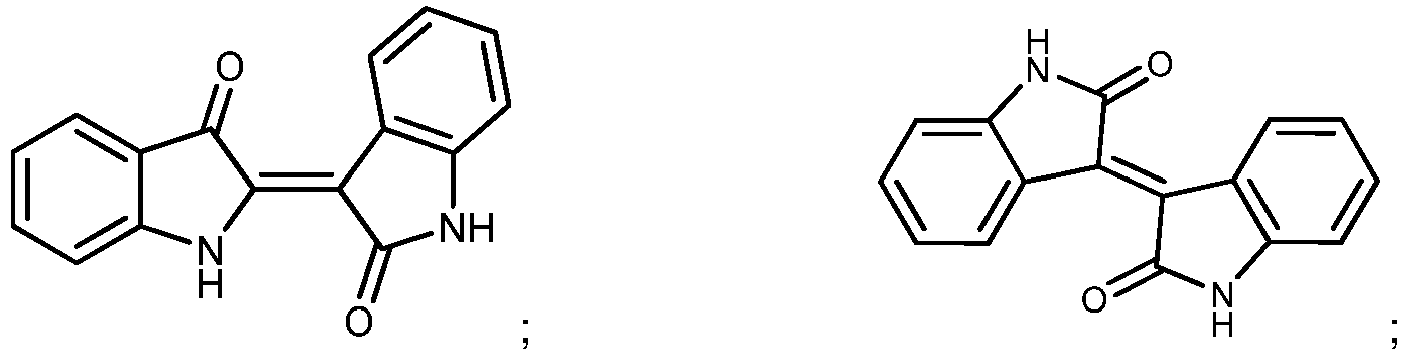
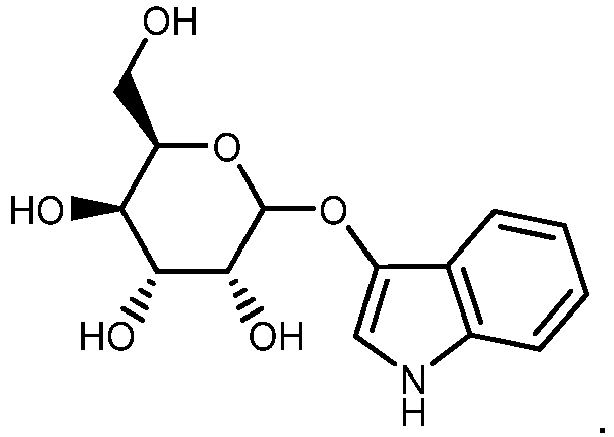
- The electrode material of claim 1, wherein the compound is selected from indigo blue, indigo carmine, isoindigo, indigopurpurin, indolinedione, and leuco-indigo or a salt thereof.
- The electrode material of any one of claims 1 to 6, wherein the electrochemically active material comprises a material selected from the group consisting of titanates, lithium titanates, lithium metal phosphates, vanadium oxides, or lithium metal oxides.
- The electrode material of any one of claims 1 to 6, wherein the electrochemically active material is selected from TiO2, Li2TiO3, Li4Ti5O12, H2Ti5O11 and H2Ti4O9, or a combination thereof, LiM'PO4 wherein M' is Fe, Ni, Mn, Co, or a combination thereof, LiV3O8, V2O5, LiMn2O4, LiM"O2, wherein M" is Mn, Co, Ni, or a combination thereof, Li(NiM‴)O2, wherein M‴ is Mn, Co, Al, Fe, Cr, Ti, or Zr, and combinations thereof, each being optionally doped with a compatible element.
- The electrode material of claim 7, wherein said electrochemically active material is selected from titanates and lithium titanates.
- The electrode material of claim 8, wherein said electrochemically active material is of the formula LiM'PO4 wherein M' is Fe, Ni, Mn, Co, or a combination thereof, optionally doped with a compatible element, for instance, optionally doped with an element selected from Mg, Al, B, Ti, V, Cr, Cu, Zn, Mo, Sn, Ca, Sr and W, or a combination thereof, preferably wherein the electrochemically active material is LiFePO4.
- The electrode material of claim 10, wherein said electrochemically active material is LiMnxFe1-xPO4, wherein 0 < x < 1, the electrochemically active material being optionally doped with a compatible element, for instance an element selected from Co, Ni, Mg, Al, B, Ti, V, Cr, Cu, Zn, Mo, Sn, Ca, Sr and W, or a combination thereof, for instance optionally doped with magnesium.
- The electrode material of claim 8, wherein said electrochemically active material is LiM"O2, wherein M" is Mn, Co, Ni, or a combination thereof, preferably wherein the electrochemically active material is LiNiwMnyCozO2, wherein w + y + z = 1.
- The electrode material of any one of claims 1 to 12, wherein said particles are further coated with a conductive agent.
- The electrode material of any one of claims 1 to 13, further comprising- a conductive agent; and/or- a binder, preferably wherein the binder comprises a cellulose-derived binder, a water-soluble binder, or a fluorine-containing polymeric binder.
- The electrode material of any one of claims 1 to 14, wherein said compound is in a concentration from 0.1 wt% to 5 wt%, preferably from 0,1 wt% to 2 wt%, in the electrode material.
- A process for producing an electrode comprising an electrode material as defined in any one of claims 1 to 15, comprising the steps of:a) mixing, in any order, the compound, the particles of electrochemically active material, and a binder in a solvent to obtain a slurry;b) casting the slurry obtained in step (a) on a substrate (e.g. current collector or separator); andc) drying the casted slurry.
- An electrode comprising the electrode material as defined in any one of claims 1 to 15, on a current collector.
- The electrode of claim 17, wherein the current collector is aluminum or an alloy having aluminum as the main component or a conductive polymer.
- An electrochemical cell comprising an electrode as defined in claim 17 or 18, an electrolyte and a counter-electrode.
- An electrochemical generator or an electrochemical accumulator comprising an electrochemical cell as defined in claim 19 or an electrode as defined in claim 17 or 18.
- Use of an electrochemical cell of claim 19, electrochemical generator or electrochemical accumulator of claim 20, in mobile devices, electric or hybrid vehicles, or renewable energy storage.
Applications Claiming Priority (2)
| Application Number | Priority Date | Filing Date | Title |
|---|---|---|---|
| US201762459309P | 2017-02-15 | 2017-02-15 | |
| PCT/CA2018/050172 WO2018148833A1 (en) | 2017-02-15 | 2018-02-15 | Electrode materials and processes for their preparation |
Publications (3)
| Publication Number | Publication Date |
|---|---|
| EP3583644A1 EP3583644A1 (en) | 2019-12-25 |
| EP3583644A4 EP3583644A4 (en) | 2020-11-11 |
| EP3583644B1 true EP3583644B1 (en) | 2024-08-07 |
Family
ID=63169476
Family Applications (1)
| Application Number | Title | Priority Date | Filing Date |
|---|---|---|---|
| EP18753560.4A Active EP3583644B1 (en) | 2017-02-15 | 2018-02-15 | Electrode materials and processes for their preparation |
Country Status (9)
| Country | Link |
|---|---|
| US (1) | US11114668B2 (en) |
| EP (1) | EP3583644B1 (en) |
| JP (3) | JP7282681B2 (en) |
| KR (1) | KR102582873B1 (en) |
| CN (1) | CN110291668B (en) |
| CA (1) | CA3050796A1 (en) |
| HU (1) | HUE068922T2 (en) |
| PL (1) | PL3583644T3 (en) |
| WO (1) | WO2018148833A1 (en) |
Families Citing this family (13)
| Publication number | Priority date | Publication date | Assignee | Title |
|---|---|---|---|---|
| CN112567551B (en) * | 2018-08-15 | 2024-09-06 | 魁北克电力公司 | Electrode materials and methods for their preparation |
| WO2020065832A1 (en) * | 2018-09-27 | 2020-04-02 | 株式会社村田製作所 | Electrically conductive substance, positive electrode, and secondary battery |
| US11616232B2 (en) * | 2019-10-16 | 2023-03-28 | Hcm Co., Ltd. | Doped lithium manganese iron phosphate-based particulate, doped lithium manganese iron phosphate-based powdery material including the same, and method for preparing powdery material |
| CN111326725A (en) * | 2020-03-05 | 2020-06-23 | 青海民族大学 | Lithium ion organic positive electrode material, preparation method and application |
| CN111349237A (en) * | 2020-03-09 | 2020-06-30 | 江西科技师范大学 | Polyfluoro functional polybenzazole electrode material applied to supercapacitor and preparation method thereof |
| US11715844B2 (en) | 2021-03-04 | 2023-08-01 | Uchicago Argonne, Llc | Isatin derivative redoxmer for electrochemical device |
| WO2022234810A1 (en) * | 2021-05-07 | 2022-11-10 | ダイキン工業株式会社 | Positive electrode mixture, positive electrode and secondary battery |
| CN115566260B (en) * | 2021-07-01 | 2024-03-19 | 北京理工大学 | Polymer gel electrolyte and preparation method thereof |
| US20240372063A1 (en) * | 2021-10-28 | 2024-11-07 | Nippon Telegraph And Telephone Corporation | Primary Battery |
| CN114105209A (en) * | 2021-11-22 | 2022-03-01 | 江南大学 | Doped modified lithium manganate lithium ion battery positive electrode material and preparation method thereof |
| US20250140863A1 (en) * | 2021-12-27 | 2025-05-01 | Panasonic Intellectual Property Management Co., Ltd. | Secondary battery electrode, method for manufacturing secondary battery electrode, and secondary battery |
| CN118738285B (en) * | 2024-08-29 | 2025-02-07 | 宁德时代新能源科技股份有限公司 | Lithium-ion battery, positive electrode sheet and power-consuming device |
| WO2026076640A1 (en) * | 2024-10-10 | 2026-04-16 | 宁德时代新能源科技股份有限公司 | Secondary battery, manufacturing method therefor, and electrical apparatus |
Family Cites Families (23)
| Publication number | Priority date | Publication date | Assignee | Title |
|---|---|---|---|---|
| US2665323A (en) * | 1950-09-02 | 1954-01-05 | Nat Lead Co | Negative plate material for storage batteries |
| JPS56123672A (en) * | 1980-03-05 | 1981-09-28 | Nippon Telegr & Teleph Corp <Ntt> | Battery |
| US7041239B2 (en) | 2003-04-03 | 2006-05-09 | Valence Technology, Inc. | Electrodes comprising mixed active particles |
| EP1939968A1 (en) | 2005-09-28 | 2008-07-02 | Ebara Corporation | Biological power plant, and method of treating organic solid contaminant-containing waste, method of treating organic high molecular substance-containing liquid waste and method of treating organic substance-containing liquid waste by using the biological power plant, and apparatus for conducting these methods |
| JP2007103530A (en) | 2005-09-30 | 2007-04-19 | Nippon Chemicon Corp | Electrochemistry capacitor |
| JP5105401B2 (en) * | 2006-09-28 | 2012-12-26 | 日本ケミコン株式会社 | Electrode active material and electrochemical device using the same |
| JP4420123B2 (en) | 2007-06-18 | 2010-02-24 | 東洋インキ製造株式会社 | Battery composition |
| JP5446178B2 (en) | 2008-09-03 | 2014-03-19 | 東洋インキScホールディングス株式会社 | Positive electrode mixture paste for lithium secondary battery |
| JP5417867B2 (en) | 2009-01-28 | 2014-02-19 | 日産自動車株式会社 | Bipolar secondary battery |
| JP2011103260A (en) * | 2009-11-12 | 2011-05-26 | National Institute Of Advanced Industrial Science & Technology | Positive electrode active material for nonaqueous secondary battery |
| JP5609800B2 (en) * | 2011-07-19 | 2014-10-22 | 住友金属鉱山株式会社 | Dye-sensitized solar cell |
| JP2013080639A (en) * | 2011-10-05 | 2013-05-02 | National Institute Of Advanced Industrial & Technology | Nonaqueous secondary battery |
| JP2013149416A (en) | 2012-01-18 | 2013-08-01 | Tokushiki:Kk | Active material dispersion liquid for formation of electrode of lithium ion secondary battery, electrode, and lithium ion secondary battery |
| JP5273274B1 (en) | 2012-04-27 | 2013-08-28 | 東洋インキScホールディングス株式会社 | Lithium secondary battery electrode forming composition, secondary battery electrode |
| KR101658510B1 (en) * | 2013-09-02 | 2016-09-21 | 주식회사 엘지화학 | The Cathode Electrodes For Secondary Battery and the Secondary Battery Comprising the Same |
| JP2015103602A (en) * | 2013-11-22 | 2015-06-04 | 株式会社船井電機新応用技術研究所 | Lithium ion capacitor |
| EP2876709A1 (en) * | 2013-11-22 | 2015-05-27 | Funai Electric Co., Ltd. | Lithium ion capacitor |
| JP6539978B2 (en) | 2014-10-16 | 2019-07-10 | 東洋インキScホールディングス株式会社 | CONDUCTIVE COMPOSITION, ELECTRODE FOR STORAGE DEVICE, AND STORAGE DEVICE |
| FR3029360B1 (en) | 2014-12-01 | 2019-04-26 | Blue Solutions | ORGANIC LITHIUM BATTERY |
| FR3030122B1 (en) * | 2014-12-10 | 2017-01-13 | Blue Solutions | ORGANIC LITHIUM BATTERY |
| WO2016102069A2 (en) * | 2014-12-23 | 2016-06-30 | Cambridge Display Technology, Ltd. | Organic flow cell batteries and materials for use in same |
| JP6740566B2 (en) * | 2015-03-19 | 2020-08-19 | 東洋インキScホールディングス株式会社 | Electric storage device electrode forming composition, electric storage device electrode, and electric storage device |
| CN105206838B (en) * | 2015-09-11 | 2017-11-03 | 北京工业大学 | Vat red 41 as the organic positive electrode of lithium ion battery application |
-
2018
- 2018-02-15 CN CN201880011964.2A patent/CN110291668B/en active Active
- 2018-02-15 CA CA3050796A patent/CA3050796A1/en active Pending
- 2018-02-15 EP EP18753560.4A patent/EP3583644B1/en active Active
- 2018-02-15 WO PCT/CA2018/050172 patent/WO2018148833A1/en not_active Ceased
- 2018-02-15 US US16/485,490 patent/US11114668B2/en active Active
- 2018-02-15 HU HUE18753560A patent/HUE068922T2/en unknown
- 2018-02-15 JP JP2019543762A patent/JP7282681B2/en active Active
- 2018-02-15 KR KR1020197026953A patent/KR102582873B1/en active Active
- 2018-02-15 PL PL18753560.4T patent/PL3583644T3/en unknown
-
2023
- 2023-05-17 JP JP2023081615A patent/JP7826244B2/en active Active
-
2025
- 2025-05-27 JP JP2025087988A patent/JP2025113431A/en active Pending
Also Published As
| Publication number | Publication date |
|---|---|
| JP2025113431A (en) | 2025-08-01 |
| US11114668B2 (en) | 2021-09-07 |
| JP2023096082A (en) | 2023-07-06 |
| JP2020508543A (en) | 2020-03-19 |
| EP3583644A4 (en) | 2020-11-11 |
| KR102582873B1 (en) | 2023-09-27 |
| WO2018148833A1 (en) | 2018-08-23 |
| PL3583644T3 (en) | 2025-01-20 |
| CA3050796A1 (en) | 2018-08-23 |
| CN110291668A (en) | 2019-09-27 |
| CN110291668B (en) | 2023-03-07 |
| US20200052302A1 (en) | 2020-02-13 |
| EP3583644A1 (en) | 2019-12-25 |
| JP7282681B2 (en) | 2023-05-29 |
| HUE068922T2 (en) | 2025-02-28 |
| JP7826244B2 (en) | 2026-03-09 |
| KR20190120256A (en) | 2019-10-23 |
Similar Documents
| Publication | Publication Date | Title |
|---|---|---|
| JP7826244B2 (en) | Electrode materials and processes for their preparation | |
| US9257235B2 (en) | Electrochemical capacitor | |
| JP2019059912A (en) | Solid polymer electrolyte based on modified cellulose, and application thereof in lithium or sodium secondary battery | |
| US9666866B2 (en) | Transition metal hexacyanometallate electrode with water-soluble binder | |
| CN112567551B (en) | Electrode materials and methods for their preparation | |
| Carbonari et al. | Synthesis and characterization of Si nanoparticles wrapped by V2O5 nanosheets as a composite anode material for lithium-ion batteries | |
| WO2021039371A1 (en) | Active material layer for positive electrode of power storage device, positive electrode of power storage device, and power storage device | |
| EP3817106A1 (en) | Positive-electrode active material, positive electrode, power storage device, and method for manufacturing positive-electrode active material | |
| JP6528982B2 (en) | Lithium ion secondary battery | |
| JP2008288049A (en) | Lithium ion secondary battery | |
| WO2014006973A1 (en) | Electrode for electricity storage devices, electricity storage device using same, and method for producing same | |
| JP2014072129A (en) | Electrode for power storage device and power storage device using the same | |
| CN116130775A (en) | Nonaqueous electrolyte, preparation method and battery | |
| JP4076748B2 (en) | Lithium battery and electrolyte for lithium ion battery, electrolyte solution or solid electrolyte thereof, and lithium battery or lithium ion battery | |
| WO2019208733A1 (en) | Positive electrode for power storage device and power storage device | |
| TW200830606A (en) | Electrolyte for lithium ion batteries | |
| KR20250135569A (en) | Preparation of electrolyte for high voltage aqueous lithium-ion battery and their application in lithium-ion batteries | |
| WO2020196747A1 (en) | Energy storage device, and method for manufacturing energy storage device | |
| JP4076735B2 (en) | Lithium battery and electrolyte for lithium ion battery, electrolyte solution or solid electrolyte thereof, and lithium battery or lithium ion battery | |
| WO2019208735A1 (en) | Positive electrode for electricity storage devices, and electricity storage device |
Legal Events
| Date | Code | Title | Description |
|---|---|---|---|
| STAA | Information on the status of an ep patent application or granted ep patent |
Free format text: STATUS: THE INTERNATIONAL PUBLICATION HAS BEEN MADE |
|
| PUAI | Public reference made under article 153(3) epc to a published international application that has entered the european phase |
Free format text: ORIGINAL CODE: 0009012 |
|
| STAA | Information on the status of an ep patent application or granted ep patent |
Free format text: STATUS: REQUEST FOR EXAMINATION WAS MADE |
|
| 17P | Request for examination filed |
Effective date: 20190902 |
|
| AK | Designated contracting states |
Kind code of ref document: A1 Designated state(s): AL AT BE BG CH CY CZ DE DK EE ES FI FR GB GR HR HU IE IS IT LI LT LU LV MC MK MT NL NO PL PT RO RS SE SI SK SM TR |
|
| AX | Request for extension of the european patent |
Extension state: BA ME |
|
| DAV | Request for validation of the european patent (deleted) | ||
| DAX | Request for extension of the european patent (deleted) | ||
| A4 | Supplementary search report drawn up and despatched |
Effective date: 20201014 |
|
| RIC1 | Information provided on ipc code assigned before grant |
Ipc: H01M 4/60 20060101AFI20201008BHEP Ipc: H01M 10/052 20100101ALI20201008BHEP Ipc: H01M 10/00 20060101ALI20201008BHEP Ipc: H01M 4/13 20100101ALI20201008BHEP Ipc: H01M 10/054 20100101ALI20201008BHEP |
|
| STAA | Information on the status of an ep patent application or granted ep patent |
Free format text: STATUS: EXAMINATION IS IN PROGRESS |
|
| 17Q | First examination report despatched |
Effective date: 20230522 |
|
| GRAP | Despatch of communication of intention to grant a patent |
Free format text: ORIGINAL CODE: EPIDOSNIGR1 |
|
| STAA | Information on the status of an ep patent application or granted ep patent |
Free format text: STATUS: GRANT OF PATENT IS INTENDED |
|
| INTG | Intention to grant announced |
Effective date: 20240311 |
|
| GRAS | Grant fee paid |
Free format text: ORIGINAL CODE: EPIDOSNIGR3 |
|
| GRAA | (expected) grant |
Free format text: ORIGINAL CODE: 0009210 |
|
| STAA | Information on the status of an ep patent application or granted ep patent |
Free format text: STATUS: THE PATENT HAS BEEN GRANTED |
|
| P01 | Opt-out of the competence of the unified patent court (upc) registered |
Free format text: CASE NUMBER: APP_35137/2024 Effective date: 20240612 |
|
| AK | Designated contracting states |
Kind code of ref document: B1 Designated state(s): AL AT BE BG CH CY CZ DE DK EE ES FI FR GB GR HR HU IE IS IT LI LT LU LV MC MK MT NL NO PL PT RO RS SE SI SK SM TR |
|
| REG | Reference to a national code |
Ref country code: GB Ref legal event code: FG4D |
|
| REG | Reference to a national code |
Ref country code: CH Ref legal event code: EP |
|
| REG | Reference to a national code |
Ref country code: IE Ref legal event code: FG4D |
|
| REG | Reference to a national code |
Ref country code: DE Ref legal event code: R096 Ref document number: 602018072767 Country of ref document: DE |
|
| REG | Reference to a national code |
Ref country code: SE Ref legal event code: TRGR |
|
| REG | Reference to a national code |
Ref country code: LT Ref legal event code: MG9D |
|
| REG | Reference to a national code |
Ref country code: NL Ref legal event code: MP Effective date: 20240807 |
|
| PG25 | Lapsed in a contracting state [announced via postgrant information from national office to epo] |
Ref country code: NO Free format text: LAPSE BECAUSE OF FAILURE TO SUBMIT A TRANSLATION OF THE DESCRIPTION OR TO PAY THE FEE WITHIN THE PRESCRIBED TIME-LIMIT Effective date: 20241107 |
|
| REG | Reference to a national code |
Ref country code: AT Ref legal event code: MK05 Ref document number: 1711957 Country of ref document: AT Kind code of ref document: T Effective date: 20240807 |
|
| PG25 | Lapsed in a contracting state [announced via postgrant information from national office to epo] |
Ref country code: PT Free format text: LAPSE BECAUSE OF FAILURE TO SUBMIT A TRANSLATION OF THE DESCRIPTION OR TO PAY THE FEE WITHIN THE PRESCRIBED TIME-LIMIT Effective date: 20241209 Ref country code: FI Free format text: LAPSE BECAUSE OF FAILURE TO SUBMIT A TRANSLATION OF THE DESCRIPTION OR TO PAY THE FEE WITHIN THE PRESCRIBED TIME-LIMIT Effective date: 20240807 Ref country code: NL Free format text: LAPSE BECAUSE OF FAILURE TO SUBMIT A TRANSLATION OF THE DESCRIPTION OR TO PAY THE FEE WITHIN THE PRESCRIBED TIME-LIMIT Effective date: 20240807 Ref country code: GR Free format text: LAPSE BECAUSE OF FAILURE TO SUBMIT A TRANSLATION OF THE DESCRIPTION OR TO PAY THE FEE WITHIN THE PRESCRIBED TIME-LIMIT Effective date: 20241108 |
|
| PG25 | Lapsed in a contracting state [announced via postgrant information from national office to epo] |
Ref country code: BG Free format text: LAPSE BECAUSE OF FAILURE TO SUBMIT A TRANSLATION OF THE DESCRIPTION OR TO PAY THE FEE WITHIN THE PRESCRIBED TIME-LIMIT Effective date: 20240807 |
|
| PG25 | Lapsed in a contracting state [announced via postgrant information from national office to epo] |
Ref country code: LV Free format text: LAPSE BECAUSE OF FAILURE TO SUBMIT A TRANSLATION OF THE DESCRIPTION OR TO PAY THE FEE WITHIN THE PRESCRIBED TIME-LIMIT Effective date: 20240807 |
|
| PG25 | Lapsed in a contracting state [announced via postgrant information from national office to epo] |
Ref country code: AT Free format text: LAPSE BECAUSE OF FAILURE TO SUBMIT A TRANSLATION OF THE DESCRIPTION OR TO PAY THE FEE WITHIN THE PRESCRIBED TIME-LIMIT Effective date: 20240807 Ref country code: IS Free format text: LAPSE BECAUSE OF FAILURE TO SUBMIT A TRANSLATION OF THE DESCRIPTION OR TO PAY THE FEE WITHIN THE PRESCRIBED TIME-LIMIT Effective date: 20241207 |
|
| PG25 | Lapsed in a contracting state [announced via postgrant information from national office to epo] |
Ref country code: HR Free format text: LAPSE BECAUSE OF FAILURE TO SUBMIT A TRANSLATION OF THE DESCRIPTION OR TO PAY THE FEE WITHIN THE PRESCRIBED TIME-LIMIT Effective date: 20240807 |
|
| PG25 | Lapsed in a contracting state [announced via postgrant information from national office to epo] |
Ref country code: RS Free format text: LAPSE BECAUSE OF FAILURE TO SUBMIT A TRANSLATION OF THE DESCRIPTION OR TO PAY THE FEE WITHIN THE PRESCRIBED TIME-LIMIT Effective date: 20241107 Ref country code: ES Free format text: LAPSE BECAUSE OF FAILURE TO SUBMIT A TRANSLATION OF THE DESCRIPTION OR TO PAY THE FEE WITHIN THE PRESCRIBED TIME-LIMIT Effective date: 20240807 |
|
| PG25 | Lapsed in a contracting state [announced via postgrant information from national office to epo] |
Ref country code: RS Free format text: LAPSE BECAUSE OF FAILURE TO SUBMIT A TRANSLATION OF THE DESCRIPTION OR TO PAY THE FEE WITHIN THE PRESCRIBED TIME-LIMIT Effective date: 20241107 Ref country code: PT Free format text: LAPSE BECAUSE OF FAILURE TO SUBMIT A TRANSLATION OF THE DESCRIPTION OR TO PAY THE FEE WITHIN THE PRESCRIBED TIME-LIMIT Effective date: 20241209 Ref country code: NO Free format text: LAPSE BECAUSE OF FAILURE TO SUBMIT A TRANSLATION OF THE DESCRIPTION OR TO PAY THE FEE WITHIN THE PRESCRIBED TIME-LIMIT Effective date: 20241107 Ref country code: NL Free format text: LAPSE BECAUSE OF FAILURE TO SUBMIT A TRANSLATION OF THE DESCRIPTION OR TO PAY THE FEE WITHIN THE PRESCRIBED TIME-LIMIT Effective date: 20240807 Ref country code: LV Free format text: LAPSE BECAUSE OF FAILURE TO SUBMIT A TRANSLATION OF THE DESCRIPTION OR TO PAY THE FEE WITHIN THE PRESCRIBED TIME-LIMIT Effective date: 20240807 Ref country code: IS Free format text: LAPSE BECAUSE OF FAILURE TO SUBMIT A TRANSLATION OF THE DESCRIPTION OR TO PAY THE FEE WITHIN THE PRESCRIBED TIME-LIMIT Effective date: 20241207 Ref country code: HR Free format text: LAPSE BECAUSE OF FAILURE TO SUBMIT A TRANSLATION OF THE DESCRIPTION OR TO PAY THE FEE WITHIN THE PRESCRIBED TIME-LIMIT Effective date: 20240807 Ref country code: GR Free format text: LAPSE BECAUSE OF FAILURE TO SUBMIT A TRANSLATION OF THE DESCRIPTION OR TO PAY THE FEE WITHIN THE PRESCRIBED TIME-LIMIT Effective date: 20241108 Ref country code: FI Free format text: LAPSE BECAUSE OF FAILURE TO SUBMIT A TRANSLATION OF THE DESCRIPTION OR TO PAY THE FEE WITHIN THE PRESCRIBED TIME-LIMIT Effective date: 20240807 Ref country code: ES Free format text: LAPSE BECAUSE OF FAILURE TO SUBMIT A TRANSLATION OF THE DESCRIPTION OR TO PAY THE FEE WITHIN THE PRESCRIBED TIME-LIMIT Effective date: 20240807 Ref country code: BG Free format text: LAPSE BECAUSE OF FAILURE TO SUBMIT A TRANSLATION OF THE DESCRIPTION OR TO PAY THE FEE WITHIN THE PRESCRIBED TIME-LIMIT Effective date: 20240807 Ref country code: AT Free format text: LAPSE BECAUSE OF FAILURE TO SUBMIT A TRANSLATION OF THE DESCRIPTION OR TO PAY THE FEE WITHIN THE PRESCRIBED TIME-LIMIT Effective date: 20240807 |
|
| REG | Reference to a national code |
Ref country code: HU Ref legal event code: AG4A Ref document number: E068922 Country of ref document: HU |
|
| PG25 | Lapsed in a contracting state [announced via postgrant information from national office to epo] |
Ref country code: RO Free format text: LAPSE BECAUSE OF FAILURE TO SUBMIT A TRANSLATION OF THE DESCRIPTION OR TO PAY THE FEE WITHIN THE PRESCRIBED TIME-LIMIT Effective date: 20240807 Ref country code: DK Free format text: LAPSE BECAUSE OF FAILURE TO SUBMIT A TRANSLATION OF THE DESCRIPTION OR TO PAY THE FEE WITHIN THE PRESCRIBED TIME-LIMIT Effective date: 20240807 Ref country code: SM Free format text: LAPSE BECAUSE OF FAILURE TO SUBMIT A TRANSLATION OF THE DESCRIPTION OR TO PAY THE FEE WITHIN THE PRESCRIBED TIME-LIMIT Effective date: 20240807 |
|
| PG25 | Lapsed in a contracting state [announced via postgrant information from national office to epo] |
Ref country code: EE Free format text: LAPSE BECAUSE OF FAILURE TO SUBMIT A TRANSLATION OF THE DESCRIPTION OR TO PAY THE FEE WITHIN THE PRESCRIBED TIME-LIMIT Effective date: 20240807 |
|
| PG25 | Lapsed in a contracting state [announced via postgrant information from national office to epo] |
Ref country code: CZ Free format text: LAPSE BECAUSE OF FAILURE TO SUBMIT A TRANSLATION OF THE DESCRIPTION OR TO PAY THE FEE WITHIN THE PRESCRIBED TIME-LIMIT Effective date: 20240807 |
|
| PG25 | Lapsed in a contracting state [announced via postgrant information from national office to epo] |
Ref country code: SK Free format text: LAPSE BECAUSE OF FAILURE TO SUBMIT A TRANSLATION OF THE DESCRIPTION OR TO PAY THE FEE WITHIN THE PRESCRIBED TIME-LIMIT Effective date: 20240807 |
|
| REG | Reference to a national code |
Ref country code: DE Ref legal event code: R097 Ref document number: 602018072767 Country of ref document: DE |
|
| PLBE | No opposition filed within time limit |
Free format text: ORIGINAL CODE: 0009261 |
|
| STAA | Information on the status of an ep patent application or granted ep patent |
Free format text: STATUS: NO OPPOSITION FILED WITHIN TIME LIMIT |
|
| 26N | No opposition filed |
Effective date: 20250508 |
|
| PG25 | Lapsed in a contracting state [announced via postgrant information from national office to epo] |
Ref country code: MC Free format text: LAPSE BECAUSE OF FAILURE TO SUBMIT A TRANSLATION OF THE DESCRIPTION OR TO PAY THE FEE WITHIN THE PRESCRIBED TIME-LIMIT Effective date: 20240807 |
|
| PG25 | Lapsed in a contracting state [announced via postgrant information from national office to epo] |
Ref country code: LU Free format text: LAPSE BECAUSE OF NON-PAYMENT OF DUE FEES Effective date: 20250215 |
|
| REG | Reference to a national code |
Ref country code: BE Ref legal event code: MM Effective date: 20250228 |
|
| PG25 | Lapsed in a contracting state [announced via postgrant information from national office to epo] |
Ref country code: BE Free format text: LAPSE BECAUSE OF NON-PAYMENT OF DUE FEES Effective date: 20250228 |
|
| PG25 | Lapsed in a contracting state [announced via postgrant information from national office to epo] |
Ref country code: IT Free format text: LAPSE BECAUSE OF FAILURE TO SUBMIT A TRANSLATION OF THE DESCRIPTION OR TO PAY THE FEE WITHIN THE PRESCRIBED TIME-LIMIT Effective date: 20240807 |
|
| REG | Reference to a national code |
Ref country code: CH Ref legal event code: U11 Free format text: ST27 STATUS EVENT CODE: U-0-0-U10-U11 (AS PROVIDED BY THE NATIONAL OFFICE) Effective date: 20260301 |
|
| PGFP | Annual fee paid to national office [announced via postgrant information from national office to epo] |
Ref country code: HU Payment date: 20260127 Year of fee payment: 9 |
|
| PGFP | Annual fee paid to national office [announced via postgrant information from national office to epo] |
Ref country code: SE Payment date: 20260227 Year of fee payment: 9 |
|
| PGFP | Annual fee paid to national office [announced via postgrant information from national office to epo] |
Ref country code: GB Payment date: 20260227 Year of fee payment: 9 |
|
| PGFP | Annual fee paid to national office [announced via postgrant information from national office to epo] |
Ref country code: DE Payment date: 20260227 Year of fee payment: 9 Ref country code: IE Payment date: 20260227 Year of fee payment: 9 |
|
| PGFP | Annual fee paid to national office [announced via postgrant information from national office to epo] |
Ref country code: FR Payment date: 20260225 Year of fee payment: 9 |
|
| PGFP | Annual fee paid to national office [announced via postgrant information from national office to epo] |
Ref country code: CH Payment date: 20260301 Year of fee payment: 9 |
|
| PGFP | Annual fee paid to national office [announced via postgrant information from national office to epo] |
Ref country code: PL Payment date: 20260121 Year of fee payment: 9 |
|
| PG25 | Lapsed in a contracting state [announced via postgrant information from national office to epo] |
Ref country code: CY Free format text: LAPSE BECAUSE OF FAILURE TO SUBMIT A TRANSLATION OF THE DESCRIPTION OR TO PAY THE FEE WITHIN THE PRESCRIBED TIME-LIMIT Effective date: 20240807 |
|
| PG25 | Lapsed in a contracting state [announced via postgrant information from national office to epo] |
Ref country code: LT Free format text: LAPSE BECAUSE OF FAILURE TO SUBMIT A TRANSLATION OF THE DESCRIPTION OR TO PAY THE FEE WITHIN THE PRESCRIBED TIME-LIMIT Effective date: 20240807 |
|
| PG25 | Lapsed in a contracting state [announced via postgrant information from national office to epo] |
Ref country code: TR Free format text: LAPSE BECAUSE OF FAILURE TO SUBMIT A TRANSLATION OF THE DESCRIPTION OR TO PAY THE FEE WITHIN THE PRESCRIBED TIME-LIMIT Effective date: 20240807 |