EP3583150B1 - Glycidyl amine epoxy resins based on ames negative amines - Google Patents
Glycidyl amine epoxy resins based on ames negative amines Download PDFInfo
- Publication number
- EP3583150B1 EP3583150B1 EP18825768.7A EP18825768A EP3583150B1 EP 3583150 B1 EP3583150 B1 EP 3583150B1 EP 18825768 A EP18825768 A EP 18825768A EP 3583150 B1 EP3583150 B1 EP 3583150B1
- Authority
- EP
- European Patent Office
- Prior art keywords
- formula
- aliphatic
- group
- aromatic
- substituted
- Prior art date
- Legal status (The legal status is an assumption and is not a legal conclusion. Google has not performed a legal analysis and makes no representation as to the accuracy of the status listed.)
- Active
Links
Classifications
-
- C—CHEMISTRY; METALLURGY
- C08—ORGANIC MACROMOLECULAR COMPOUNDS; THEIR PREPARATION OR CHEMICAL WORKING-UP; COMPOSITIONS BASED THEREON
- C08G—MACROMOLECULAR COMPOUNDS OBTAINED OTHERWISE THAN BY REACTIONS ONLY INVOLVING UNSATURATED CARBON-TO-CARBON BONDS
- C08G59/00—Polycondensates containing more than one epoxy group per molecule; Macromolecules obtained by polymerising compounds containing more than one epoxy group per molecule using curing agents or catalysts which react with the epoxy groups
- C08G59/02—Polycondensates containing more than one epoxy group per molecule
- C08G59/10—Polycondensates containing more than one epoxy group per molecule of polyamines with epihalohydrins or precursors thereof
-
- C—CHEMISTRY; METALLURGY
- C08—ORGANIC MACROMOLECULAR COMPOUNDS; THEIR PREPARATION OR CHEMICAL WORKING-UP; COMPOSITIONS BASED THEREON
- C08G—MACROMOLECULAR COMPOUNDS OBTAINED OTHERWISE THAN BY REACTIONS ONLY INVOLVING UNSATURATED CARBON-TO-CARBON BONDS
- C08G59/00—Polycondensates containing more than one epoxy group per molecule; Macromolecules obtained by polymerising compounds containing more than one epoxy group per molecule using curing agents or catalysts which react with the epoxy groups
- C08G59/02—Polycondensates containing more than one epoxy group per molecule
- C08G59/04—Polycondensates containing more than one epoxy group per molecule of polyhydroxy compounds with epihalohydrins or precursors thereof
- C08G59/06—Polycondensates containing more than one epoxy group per molecule of polyhydroxy compounds with epihalohydrins or precursors thereof of polyhydric phenols
- C08G59/066—Polycondensates containing more than one epoxy group per molecule of polyhydroxy compounds with epihalohydrins or precursors thereof of polyhydric phenols with chain extension or advancing agents
-
- C—CHEMISTRY; METALLURGY
- C08—ORGANIC MACROMOLECULAR COMPOUNDS; THEIR PREPARATION OR CHEMICAL WORKING-UP; COMPOSITIONS BASED THEREON
- C08G—MACROMOLECULAR COMPOUNDS OBTAINED OTHERWISE THAN BY REACTIONS ONLY INVOLVING UNSATURATED CARBON-TO-CARBON BONDS
- C08G59/00—Polycondensates containing more than one epoxy group per molecule; Macromolecules obtained by polymerising compounds containing more than one epoxy group per molecule using curing agents or catalysts which react with the epoxy groups
- C08G59/18—Macromolecules obtained by polymerising compounds containing more than one epoxy group per molecule using curing agents or catalysts which react with the epoxy groups ; e.g. general methods of curing
- C08G59/20—Macromolecules obtained by polymerising compounds containing more than one epoxy group per molecule using curing agents or catalysts which react with the epoxy groups ; e.g. general methods of curing characterised by the epoxy compounds used
- C08G59/22—Di-epoxy compounds
- C08G59/28—Di-epoxy compounds containing acyclic nitrogen atoms
-
- C—CHEMISTRY; METALLURGY
- C08—ORGANIC MACROMOLECULAR COMPOUNDS; THEIR PREPARATION OR CHEMICAL WORKING-UP; COMPOSITIONS BASED THEREON
- C08G—MACROMOLECULAR COMPOUNDS OBTAINED OTHERWISE THAN BY REACTIONS ONLY INVOLVING UNSATURATED CARBON-TO-CARBON BONDS
- C08G59/00—Polycondensates containing more than one epoxy group per molecule; Macromolecules obtained by polymerising compounds containing more than one epoxy group per molecule using curing agents or catalysts which react with the epoxy groups
- C08G59/18—Macromolecules obtained by polymerising compounds containing more than one epoxy group per molecule using curing agents or catalysts which react with the epoxy groups ; e.g. general methods of curing
- C08G59/20—Macromolecules obtained by polymerising compounds containing more than one epoxy group per molecule using curing agents or catalysts which react with the epoxy groups ; e.g. general methods of curing characterised by the epoxy compounds used
- C08G59/32—Epoxy compounds containing three or more epoxy groups
- C08G59/3227—Compounds containing acyclic nitrogen atoms
-
- C—CHEMISTRY; METALLURGY
- C08—ORGANIC MACROMOLECULAR COMPOUNDS; THEIR PREPARATION OR CHEMICAL WORKING-UP; COMPOSITIONS BASED THEREON
- C08G—MACROMOLECULAR COMPOUNDS OBTAINED OTHERWISE THAN BY REACTIONS ONLY INVOLVING UNSATURATED CARBON-TO-CARBON BONDS
- C08G59/00—Polycondensates containing more than one epoxy group per molecule; Macromolecules obtained by polymerising compounds containing more than one epoxy group per molecule using curing agents or catalysts which react with the epoxy groups
- C08G59/18—Macromolecules obtained by polymerising compounds containing more than one epoxy group per molecule using curing agents or catalysts which react with the epoxy groups ; e.g. general methods of curing
- C08G59/40—Macromolecules obtained by polymerising compounds containing more than one epoxy group per molecule using curing agents or catalysts which react with the epoxy groups ; e.g. general methods of curing characterised by the curing agents used
- C08G59/50—Amines
-
- C—CHEMISTRY; METALLURGY
- C08—ORGANIC MACROMOLECULAR COMPOUNDS; THEIR PREPARATION OR CHEMICAL WORKING-UP; COMPOSITIONS BASED THEREON
- C08G—MACROMOLECULAR COMPOUNDS OBTAINED OTHERWISE THAN BY REACTIONS ONLY INVOLVING UNSATURATED CARBON-TO-CARBON BONDS
- C08G59/00—Polycondensates containing more than one epoxy group per molecule; Macromolecules obtained by polymerising compounds containing more than one epoxy group per molecule using curing agents or catalysts which react with the epoxy groups
- C08G59/18—Macromolecules obtained by polymerising compounds containing more than one epoxy group per molecule using curing agents or catalysts which react with the epoxy groups ; e.g. general methods of curing
- C08G59/40—Macromolecules obtained by polymerising compounds containing more than one epoxy group per molecule using curing agents or catalysts which react with the epoxy groups ; e.g. general methods of curing characterised by the curing agents used
- C08G59/62—Alcohols or phenols
- C08G59/621—Phenols
-
- C—CHEMISTRY; METALLURGY
- C08—ORGANIC MACROMOLECULAR COMPOUNDS; THEIR PREPARATION OR CHEMICAL WORKING-UP; COMPOSITIONS BASED THEREON
- C08G—MACROMOLECULAR COMPOUNDS OBTAINED OTHERWISE THAN BY REACTIONS ONLY INVOLVING UNSATURATED CARBON-TO-CARBON BONDS
- C08G65/00—Macromolecular compounds obtained by reactions forming an ether link in the main chain of the macromolecule
- C08G65/02—Macromolecular compounds obtained by reactions forming an ether link in the main chain of the macromolecule from cyclic ethers by opening of the heterocyclic ring
- C08G65/26—Macromolecular compounds obtained by reactions forming an ether link in the main chain of the macromolecule from cyclic ethers by opening of the heterocyclic ring from cyclic ethers and other compounds
- C08G65/2618—Macromolecular compounds obtained by reactions forming an ether link in the main chain of the macromolecule from cyclic ethers by opening of the heterocyclic ring from cyclic ethers and other compounds the other compounds containing nitrogen
- C08G65/2621—Macromolecular compounds obtained by reactions forming an ether link in the main chain of the macromolecule from cyclic ethers by opening of the heterocyclic ring from cyclic ethers and other compounds the other compounds containing nitrogen containing amine groups
- C08G65/2624—Macromolecular compounds obtained by reactions forming an ether link in the main chain of the macromolecule from cyclic ethers by opening of the heterocyclic ring from cyclic ethers and other compounds the other compounds containing nitrogen containing amine groups containing aliphatic amine groups
-
- C—CHEMISTRY; METALLURGY
- C09—DYES; PAINTS; POLISHES; NATURAL RESINS; ADHESIVES; COMPOSITIONS NOT OTHERWISE PROVIDED FOR; APPLICATIONS OF MATERIALS NOT OTHERWISE PROVIDED FOR
- C09D—COATING COMPOSITIONS, e.g. PAINTS, VARNISHES OR LACQUERS; FILLING PASTES; CHEMICAL PAINT OR INK REMOVERS; INKS; CORRECTING FLUIDS; WOODSTAINS; PASTES OR SOLIDS FOR COLOURING OR PRINTING; USE OF MATERIALS THEREFOR
- C09D163/00—Coating compositions based on epoxy resins; Coating compositions based on derivatives of epoxy resins
Definitions
- the present disclosure relates to epoxy resin(s) and to a process for the production of epoxy resin(s). Specifically, the disclosure relates to epoxy resin(s) which is/are free from Bisphenol A (BPA) and Bisphenol F (BPF) and are based on AMES negative amine precursors.
- BPA Bisphenol A
- BPF Bisphenol F
- Epoxy resins are a class of reactive prepolymers and polymers which contain more than one epoxide group. Epoxy resins are converted by reaction with suitable curing agents or by polymerization of epoxide groups into thermosets or cured epoxy resins. Epoxy resins are widely used in structural adhesives, casting resins, electrical laminates, coatings, 3D-Printing resins, and powder coating materials.
- Epoxy resins also find application in various coating compositions in packaging industry especially in packaging of food and beverages, due to their excellent mechanical and chemical properties, such as high impact strength, high abrasion resistance, chemical resistance, and high electrical insulation capacity.
- the general purpose of such coating systems is to protect metal surface from corrosion due to low pH conditions of variety of food products or ingredients such as soft drinks, tomato juice or beer.
- These protective coatings are also applied to the interior of food and beverage containers to prevent corrosion in the container headspace between the food products fill line and the container lid, which is particularly problematic with high salt content food products.
- Amines and amine derivatives are the most diverse group of epoxy curing agents. Amine compounds were among the earliest reactants used with epoxy resins to produce useful products. Aromatic diamines are frequently used as coatings on surfaces subject to mechanical wear. These amines are one of the chemical classes in which the structural and molecular basis of carcinogenicity is most clearly understood. The evidence regarding the carcinogenic potential of amines in animals are available. The evidence in experimental animals has been crucial in the classification of some aromatic amines for their carcinogenicity to humans. Benzidine-based compounds and MOCA (4,4'-methylene bis-2-chloroaniline) were classified by the International Agency for Research on Cancer (IARC) as probable carcinogens based on strong evidence in animals.
- IARC International Agency for Research on Cancer
- US4978791 discloses 2,2'-dichloro-6,6'-diethylmethylene-bis-aniline or mixtures thereof with at least one compound of the formula: wherein R1, R2, R3 and R4 are the same or different and are straight-chained or branched alkyl radicals having 2 to 4 C atoms, or R1 and/or R3 are chlorine.
- R1, R2, R3 and R4 are the same or different and are straight-chained or branched alkyl radicals having 2 to 4 C atoms, or R1 and/or R3 are chlorine.
- US4978791 teaches that the 2,2'-dichloro-6,6'-diethylmethylene-bis-aniline or said mixtures are useful as AMES-test-negative chain extension agents or cross-linking agent for epoxide resins.
- an epoxy resin coating compositions containing an epoxy resin which have excellent coating performance, but at the same time is completely free of BPA and BPF and are non-carcinogenic in nature.
- Such epoxy resins should be particularly useful in the coating containers such as those used in packaging of food and beverages.
- the present disclosure relates to glycidyl amine epoxy resin(s).
- the invention concerns a glycidyl amine epoxy resin of a structural Formula (II) obtained by reaction of a diamine of a structural Formula (I) with epichlorohydrin, wherein the structure of Formula (II) is represented by: wherein the structure of the diamine of the structural Formula (I) is represented by: wherein
- the present invention also relates to a glycidyl amine epoxy resin of a structural Formula (III A) represented by: wherein
- the present invention also relates to a glycidyl amine epoxy resin of a structural Formula (III B) represented by: wherein Formula (III B) is a reaction product of the diamine of Formula (I) as defined hereinbefore with a diglycidyl compound of Formula (IV), wherein
- the present disclosure relates to glycidyl amine epoxy resin(s) and to a process for the production of said glycidyl amine epoxy resin(s).
- the glycidyl amine epoxy resin has a structural Formula (II): wherein
- the glycidyl amine epoxy resin having the structural Formula (II) is a reaction product of epichlorohydrin with an AMES negative diamine of structural Formula (I).
- the diamine of the structural Formula (I) is represented by the structure: wherein
- the glycidyl amine epoxy resin having the Formula (II) is free from Bisphenol A or Bisphenol F, as the diamines of Formula (I) are free from Bisphenol A/Bisphenol F precursors.
- the glycidyl amine epoxy resin of Formula (II) is also AMES negative, as the diamines of structural Formula (I) are derived from AMES negative diamines.
- AMES negative in the context of the present disclosure means those amines which are non-carcinogenic in nature. Accordingly, to be AMES negative involves biological assay to assess the mutagenic or carcinogenic potential of the diamine. A negative test confirms that the diamine is non-carcinogenic and is safe for use.
- the diamine of the structural Formula (I) is selected from the group consisting of a compound of Formula (V), a compound of Formula (VI) or a compound of Formula (VII) represented by: or
- the amine groups in the compound of Formula (V) are hindered due to a branched aliphatic alkyl group directly connected to the amine group.
- the compound of Formula (VI) and the compound of Formula (VII) are hindered, either due to the ortho substitution on aromatic ring with respect to the position of carbon atom attached to the amine group.
- the diamine having Formula (V), Formula (VI) and Formula (VII) is epoxidized to form the glycidyl amine of Formula (IX), a glycidyl amine of Formula (X) and a glycidyl amine of Formula (XI) represented by: or
- the process for preparing the glycidyl amine epoxy resin is also disclosed.
- the diamine of the structural Formula (I) is directly epoxidized with epichlorohydrin to prepare the glycidyl amine epoxy resin of Formula (II).
- the process for producing the glycidyl amine epoxy resin having a Formula (II) comprising reacting epichlorohydrin with the compound selected from a group having Formula (I).
- the reaction produces a compound 4, 4'-di(alkyl amino) diphenyl methane diglycidyl ether.
- the compound is a mixture of monomeric and oligomeric 4, 4'-di(alkyl amino) diphenyl methane diglycidyl ether.
- monomeric 4,4'-di(alkyl amino) diphenyl methane diglycidyl ether can be separated from oligomeric 4,4'-di(alkyl amino)diphenyl methane diglycidyl ether by means of separation techniques.
- the separation techniques include but are not limited to chromatography, extractive distillation.
- the glycidyl amine epoxy resin has a Formula (III A): wherein
- the glycidyl amine epoxy resin having the Formula (III A) is an oligomeric reaction product of the diamine of Formula (I) with the glycidyl amine of Formula (II).
- the epoxy resin having the Formula (III A) is also free from Bisphenol A, as neither the diamine of Formula (I) nor the glycidyl amines of Formula (II) have free Bisphenol A or are synthesized from a Bisphenol A precursor.
- These epoxy resins having the Formula (III A) are also derived from AMES negative diamines of Formula (I), as the diamines of Formula (I) are non-carcinogenic diamines.
- the fusion reaction between the diamine of structural Formula (I) with the glycidyl amine of structural Formula (II) takes place in the presence of a catalyst.
- the catalyst is represented by the Formula (VII): X-R 10 -Y Formula VII wherein
- the catalyst is a mono or difunctional acidic catalyst.
- the catalyst is a di-substituted acidic catalyst.
- the acid dissociation constant value (pKa) of the catalyst is in the range of -3 to 5. In a preferred embodiment, the pKa value of catalyst is 2.97 to 4.6.
- the catalyst may include but not limited to salicylic acid, oxalic acid, p-toluene sulphonic acid, oxalic acid and benzoic acid.
- reaction may also take place in the absence of the catalyst.
- the fusion reaction between the diamine of Formula (I) and the glycidyl amine of Formula (II) produces a mixture of monomeric and oligomeric products when the molar concentration of the glycidyl amine of Formula (II) is more than the diamine of Formula (I).
- the EEW: AHEW of the glycidyl amine of Formula (II) to the diamine of Formula (I) is 1:1.14.
- the fusion reaction between the diamine of Formula (I) and the glycidyl amine of Formula (II) takes place at a temperature in the range of 50 to 200°C.
- the temperature is in the range of at 150 to 200°C.
- the kinetics of the fusion reaction can be controlled by decreasing or increasing the quantity of mono-functional or di-functional acidic catalyst of Formula (VIII) between 0 to 1% by weight of the diamine of Formula (I).
- the glycidyl amine epoxy resin has the Formula (III B).
- the epoxy resin having the Formula (III B) is a reaction product of the diamine of Formula (I) as defined hereinbefore and a diglycidyl compound of Formula (IV). wherein
- the glycidyl amine epoxy resin having the Formula (III B) is also free from Bisphenol A or Bisphenol F, as neither the glycidyl ether or ester of Formula (IV) nor the diamine of Formula (I) have Bisphenol A or Bisphenol F, or are synthesized from Bisphenol A or Bisphenol F precursor.
- These epoxy resins having the Formula (III B) are also derived from AMES negative diamines, as the diamines of Formula (I) are non-carcinogenic diamine.
- the diglycidyl compound of Formula (IV) includes any Bisphenol A Non-intent (BPA-NI) free diepoxy monomers.
- the diglycidyl compound of Formula (IV) is a glycidyl ether, a glycidyl ester or a glycidyl amine.
- BPA-NI epoxy monomers of Formula (IV) include any branched or unbranched, aliphatic or aromatic or araliphatic glycidyl ether or glycidyl ether with at least two epoxy groups.
- Examples of such diglycidyl compound of Formula (IV) based on straight chain or branched aliphatic chain (C1-C34) include polypropyleneglycol glycidyl ether, neopentyl glycidyl ether, hexanediolglycidyl ether, cycloaliphatic rings, e.g. hydrogenated bisphenols, and hexahydrophthalic anhydride based glycidyl ester.
- aromatic glycidyl ethers examples include resorcinol glycidyl ether and biphenyl type glycidyl ethers.
- hindered aromatic glycidyl ethers or hindered araliphatic rings include tetramethyl bisphenols, glycidyl ester and glycidyl amines of Formula (II).
- the diglycidyl compound of Formula (IV) includes a glycidyl ether of tetramethyl bisphenol F, a diglycidyl ether of ring-hydrogenated bisphenol A, a diglycidyl ether of ring-hydrogenated bisphenol F, and a novolac epoxy resin.
- the diglycidyl compound of Formula (IV) is a diglycidyl ether of Formula (IVA) or a diglycidyl ester of Formula (IVB) having at least two epoxy groups per molecule represented by: wherein
- the glycidyl amine epoxy resin having Formula (IIIA) and Formula (IIIB) may further include step-growth linkages, for example condensation linkages other than amine linkages. These step-growth linkages may be in addition to, or in place of, the amine linkages.
- the step-growth linkages include amide linkages, carbonate linkages, ester linkages, urea linkages, and urethane linkages.
- the epoxy resin having Formula (III) may include both amine and urea linkages. In some embodiments, the epoxy resin having Formula (III) does not include any condensation linkages or other step-growth linkages other than amine linkages.
- the fusion reaction between the diamine of Formula (I) and the diglycidyl compound of Formula (IV) can be done by adding the diamine of Formula (I) either in a single step or in multiple steps to control the exotherm and increase in molecular weight.
- a sub stoichiometric amount of the diamine of Formula (I) is used with the diglycidyl compound of Formula (IV), to bring about an average of more than 1.9 epoxide group(s) per molecule in the epoxy resin in the resultant product having Formula (IIIB).
- the epoxy resin has a number average molecular weight (M n ) of at least 2,000 to 10000.
- M n is at least 3,000 to 10000.
- M n is at least 4000 to 8000.
- the M n of the epoxy resin may be as high as much as that is needed for the desired application. In accordance with an embodiment, the M n of epoxy resin may not exceed about 10000.
- the present disclosure further discloses a curable coating system comprising the glycidyl amine-based epoxy resin of Formula (IIIA) or Formula (IIIB).
- the curable coating system comprises the epoxy resin of Formula (IIIA) or Formula (IIIB), cured with a hardener.
- the curable coating system is BPA-NI type resin, as both the epoxy resin of Formula (IIIA) or Formula (IIIB) and the hardener of the curable coating system is free from bisphenols having estrogenic activity.
- the curable coating system is also based on precursors which are non-carcinogenic i.e., is "AMES negative" since the diamine used for preparing Formula (IIIA) or Formula (IIIB) as well as the hardener used in formulating a coating system is selected from the group consisting of "AMES negative" type amino curing agent or a "AMES negative” type phenolic resin.
- the epoxy resin of Formula (IIIA) or Formula (IIIB) is capable of forming a covalent linkage with functional group/s present on amino or phenolic type hardeners.
- the hardener is a phenolic type harder.
- the ratio of Epoxy Equivalent Weight (EEW) to (Amine Hydrogen Equivalent Weight) AHEW may vary from 1 to 2. In a specific embodiment, the ratio is 1.1 to 1.18.
- N,N'-bis(sec-butyl amino) diphenyl methane 70 grams, 0.22 moles
- epichlorohydrin 371.2 grams, 18 moles
- water 49 grams
- the reaction mixture was heated to 80 °C and under nitrogen atmosphere. Reaction temperature was maintained at 80 °C for 8 hours.
- Sodium hydroxide 32 grams, 0.40 moles
- water 32 ml
- the water and excess epichlorohydrin were removed by evaporation at 70°C, under vacuum, from crude N, N'-bis (sec-butyl amino) diphenyl methane diglycidyl ether.
- the crude was mixed with toluene (95 grams) and water (78 grams). Inorganic salt was removed. Solution was concentrated.
- Table: 1 Effect of N, N'-bis (sec-butyl amino) diphenyl methane: CHDMDGE ratio on Mn & Mw Exp.2 Exp.
- glycidyl amine epoxy resin are based on either direct epoxidation of AMES negative diamine of Formula (I), or, they are reaction product of BPA.NI diglycidyl ether of Formula (IV) and AMES negative diamine of Formula (I).
- BPA-NI diepoxy glycidyl ether defined here are neither derived from bisphenol A and F precursors nor on bisphenol A and F glycidyl ethers.
- Curing agents for the purposes of the invention are compounds suitable for producing crosslinking of resins of this new invention and ideally AMES negative. Reaction with curing agents can be used to convert polyepoxide compounds of current invention into infusible, three-dimensionally "crosslinked", thermoset materials.
- Curing reactions were conducted with selective resins of this invention. Oligomers containing hydroxyl groups and aromatic contents in the range similar to a conventional "type 9" resins were synthesized and further evaluated for coating purpose on metal surface. Examples of such resins are oligomers produced from reaction of advancement of N, N'-bis (sec-butyl amino) diphenyl methane with cyclohexane dimethanol diglycidyl ether with diamines (I) as defined in current invention.
- Oligomer from example 9 was used without further work-up as the epoxy resin for producing coatings from cured epoxy resin on tin plate.
- Epoxy resin solution in methoxypropyl acetate (MPA) with 40% solids wt. /wt. was prepared.
- the epoxy resin solutions were then mixed with a phenolic resin (Phenodur PR 516/60B Cytec Industries Inc.) as curing agent and with a phosphoric acid-based catalyst
- the proportions of the resin: hardener mixtures in weight % on the overall mixture are compiled in table 6.
- the formulations mixtures were then applied by bar coater, 20 ⁇ m wire doctor, 80 mm/s drawing speed) onto the previously degreased substrate (E 2.8/2.8, a tinplate coated on both sides with 2.8 g of tin per m 2 , as commonly used for the production of cans for foodstuffs).
- the coatings were baked at 200° C. for 12 minutes. A dry film thickness of 5 to 6 ⁇ m was established. Baking on the galvanized steel sheet produced a golden yellow coloration of the coating, of the kind customary for interior can coatings (gold varnish).
- Such glycidyl amine epoxy resin wherein the diamine of structural Formula (I) is selected from a group comprising a compound of Formula (V), a compound of Formula (VI) or a compound of Formula (VI) represented by: or
- Such glycidyl amine epoxy resin wherein the glycidyl amine epoxy resin of structural Formula (II) is selected from a group comprising a glycidyl amine of Formula (IX), a glycidyl amine of Formula (X) or a glycidyl amine of Formula (XI) represented by:
- Such glycidyl amine epoxy resin wherein the diglycidyl compound of Formula (IV) is selected from the group comprising of a glycidyl ether of tetramethyl bisphenol F, a diglycidyl ether of ring-hydrogenated bisphenol A, a diglycidyl ether of ring-hydrogenated bisphenol F, and a novolac epoxy resin.
- Such glycidyl amine epoxy resin wherein the a diglycidyl compound of Formula (IV) is selected from the group comprising a diglycidyl ether of Formula (IVA) or a diglycidyl ester of Formula (IVB) represented by:
- Such curable coating system wherein the hardener is selected from the group consisting of an amino curing agent or an phenolic curing agent.
- the glycidyl amine epoxy resins produced in accordance with the present disclosure are meant for safe use in civil, coating, electronic or composite applications.
- the glycidyl amine epoxy resins are synthesized from on AMES negative diamines and Bisphenol free precursors, which infuse safety at the time of product design stage.
- AMES negative diamines and Bisphenol free precursors which infuse safety at the time of product design stage.
- need for safer substitutes has been felt and end customer need safe products.
- Such novel resin have potential to reduce regulatory pressures on one side and better acceptability and reduced approval time at customer end.
- These resins can be used to get resins of any desired molecular weight and can be useful for multiple applications including engineering polymers.
- the curable coating composition based on glycidyl amine epoxy resin of the present disclosure have comparable or superior performance in a number of critical coating performance characteristics, including corrosion resistance, application, with minimal environmental impact.
- glycidyl amine epoxy resins based on AMES negative diamines of Formula (I) can have large positive commercial impact on business.
- the present application discloses glycidyl amine epoxy resins which may be made in a variety of molecular weights that suit for efficient application of the coating system to a metals substrate. Such resins meet basic performance criteria, e.g. no misting or blocking, suitable to achieve good compatibility with other copolymers or materials e.g. thermoplastic materials such as PVC that may be present in the coating system.
- the epoxy resins in accordance with the present disclosure provides coating compositions for food containers that are free from Bisphenol A diglycidyl ether (BPA) and Bisphenol F diglycidyl ether (BPF) and does not contain extractible quantities of such compounds.
- the coating composition of the present invention are suitable for use in food contact situations and can be used on the inside of such cans. This is particularly useful in the case of foods which would absorb and chemically alter metal coverings.
- the coating composition possesses desirable properties that are specially required as coating compositions for food containers. The desirable properties include a coating that does not contain bisphenol A or any other endocrine disruptor.
Landscapes
- Chemical & Material Sciences (AREA)
- Organic Chemistry (AREA)
- Health & Medical Sciences (AREA)
- Chemical Kinetics & Catalysis (AREA)
- Medicinal Chemistry (AREA)
- Polymers & Plastics (AREA)
- Life Sciences & Earth Sciences (AREA)
- Engineering & Computer Science (AREA)
- Materials Engineering (AREA)
- Wood Science & Technology (AREA)
- Epoxy Resins (AREA)
- Paints Or Removers (AREA)
Description
- The present disclosure relates to epoxy resin(s) and to a process for the production of epoxy resin(s). Specifically, the disclosure relates to epoxy resin(s) which is/are free from Bisphenol A (BPA) and Bisphenol F (BPF) and are based on AMES negative amine precursors.
- Epoxy resins are a class of reactive prepolymers and polymers which contain more than one epoxide group. Epoxy resins are converted by reaction with suitable curing agents or by polymerization of epoxide groups into thermosets or cured epoxy resins. Epoxy resins are widely used in structural adhesives, casting resins, electrical laminates, coatings, 3D-Printing resins, and powder coating materials.
- Epoxy resins also find application in various coating compositions in packaging industry especially in packaging of food and beverages, due to their excellent mechanical and chemical properties, such as high impact strength, high abrasion resistance, chemical resistance, and high electrical insulation capacity. When used in such packaging the general purpose of such coating systems is to protect metal surface from corrosion due to low pH conditions of variety of food products or ingredients such as soft drinks, tomato juice or beer. These protective coatings are also applied to the interior of food and beverage containers to prevent corrosion in the container headspace between the food products fill line and the container lid, which is particularly problematic with high salt content food products.
- The majority of the epoxy resins that are used for coating applications are conventionally manufactured by using bisphenol like diglycidyl ether of Bisphenol A (BPA) or Bisphenol F (BPF), or the corresponding oligomers. However, the use of epoxy resins containing trace levels of free BPA or BPF is being considered as a suspected health hazard especially in food contact applications, thermal papers etc. This health concerns are mainly because BPA or BPF containing epoxy resins have are suspected to cause endocrine disruption and therefore fall in the category of substance of very high concern (SVHC). Although the scientific data available to date indicates that small trace amounts of these compounds that may be released from existing coatings do not pose any health risks to humans, these compounds are nevertheless perceived by the global regulatory food safety agencies as being potentially harmful to human health.
- In light of these health concerns, manufacturers and food companies have now started showing interest in replacing BPA-based epoxy coatings with alternatives such as acrylic and polyester coatings. However, most of these alternative coatings are either more expensive than epoxy coatings or do not display the same array of characteristics performance properties with respect to their corrosion protection properties, hydrolytic stability to withstand retort conditions and applicability. Some of the alternative coatings also do not show high performance characteristics in terms of odor and leaching properties when compared to the coatings formulated with epoxy resin. As a result, they are not able to serve as functional replacements for the wide variety of products and processes for which epoxy coatings have been developed.
- Amines and amine derivatives are the most diverse group of epoxy curing agents. Amine compounds were among the earliest reactants used with epoxy resins to produce useful products. Aromatic diamines are frequently used as coatings on surfaces subject to mechanical wear. These amines are one of the chemical classes in which the structural and molecular basis of carcinogenicity is most clearly understood. The evidence regarding the carcinogenic potential of amines in animals are available. The evidence in experimental animals has been crucial in the classification of some aromatic amines for their carcinogenicity to humans. Benzidine-based compounds and MOCA (4,4'-methylene bis-2-chloroaniline) were classified by the International Agency for Research on Cancer (IARC) as probable carcinogens based on strong evidence in animals.
-
US4978791 discloses 2,2'-dichloro-6,6'-diethylmethylene-bis-aniline or mixtures thereof with at least one compound of the formula:
US4978791 teaches that the 2,2'-dichloro-6,6'-diethylmethylene-bis-aniline or said mixtures are useful as AMES-test-negative chain extension agents or cross-linking agent for epoxide resins. - Therefore, there is a need for an epoxy resin, coating compositions containing an epoxy resin which have excellent coating performance, but at the same time is completely free of BPA and BPF and are non-carcinogenic in nature. Such epoxy resins should be particularly useful in the coating containers such as those used in packaging of food and beverages.
- The present disclosure relates to glycidyl amine epoxy resin(s). In an aspect, the invention concerns a glycidyl amine epoxy resin of a structural Formula (II) obtained by reaction of a diamine of a structural Formula (I) with epichlorohydrin, wherein the structure of Formula (II) is represented by:

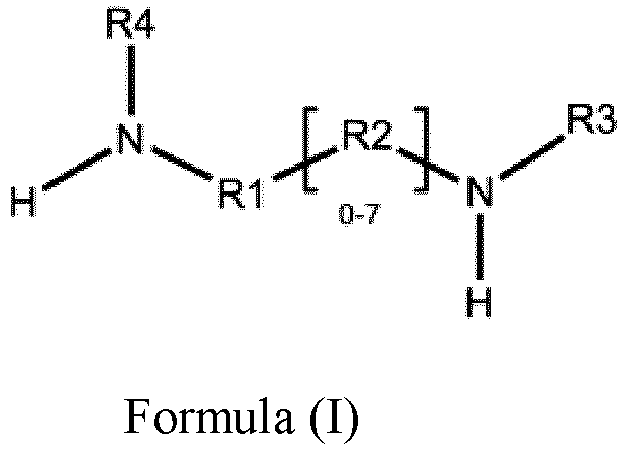
- the diamine of formula (I) has at least two amine groups with at least one labile hydrogen on each nitrogen;
- at least one nitrogen atom is directly attached to an aromatic ring on one side;
- at least one amine group is a hindered amine either due to hindered aromatic ring having at least one substitution on ring at ortho position to carbon which is directly attached to amine group or due to branched aliphatic carbon directly attached to amine group;
- at least one group out of R1, R2, R3 and R4 is independently hindered aromatic or branched aliphatic or substituted branched aliphatic;
- R1, R2, R3, and R4 are independently selected from the group consisting of hydrogen, alkyl, branched alkyl, aromatic, ortho substituted aromatic, ar-aliphatic, substituted ar-aliphatic, and substituted aliphatic;
- R1 and R4, or, R2 and R3 may be connected; and
- wherein the diamine of structural Formula (I) is AMES negative.
- The present invention also relates to a glycidyl amine epoxy resin of a structural Formula (III A) represented by:

- R1, R2, R3, and R4 are independently selected from the group consisting of hydrogen, alkyl, branched alkyl, aromatic, ortho substituted aromatic, ar-aliphatic, substituted ar-aliphatic, and substituted aliphatic; and
- n is 1 to 20,
- wherein Formula (III A) is obtained by the reaction of the glycidyl amine epoxy resin of Formula (II) as defined hereinbefore with a diamine of Formula (I);
- wherein Formula (I) is

- the diamine of formula (I) has at least two amine groups with at least one labile hydrogen on each nitrogen;
- at least one nitrogen atom is directly attached to an aromatic ring on one side;
- at least one amine group is a hindered amine, either due to hindered aromatic ring having at least one substitution on ring at ortho position to carbon which is directly attached to amine group or due to branched aliphatic carbon directly attached to amine group;
- at least one group out of R1, R2, R3 and R4 is independently hindered aromatic or branched aliphatic, or substituted branched aliphatic;
- R1, R2, R3, and R4 are independently selected from the group consisting of hydrogen, alkyl, branched alkyl, aromatic, ortho substituted aromatic, ar-aliphatic, substituted ar-aliphatic, and substituted aliphatic;
- R1 and R4, or, R2 and R3 may be connected;
- wherein the diamine of Formula (I) is Ames negative.
- The present invention also relates to a glycidyl amine epoxy resin of a structural Formula (III B) represented by:

wherein - R1, R2, R3, and R4 are independently selected from the group consisting of hydrogen, alkyl, branched alkyl, aromatic, ortho substituted aromatic, ar-aliphatic, substituted ar-aliphatic, and substituted aliphatic; and
- R5 and R6 are the same or different;
- R5 and R6 are independently selected from the group consisting of C1-14 branched aliphatic alkyl, C1-14 unbranched aliphatic alkyl, cycloaliphatic, aromatic, and substituted aromatic, wherein the diamine of Formula (I) is Ames negative, and
- wherein the diglycidyl compound of Formula (IV) is selected from:
- (a) the group consisting of a diglycidyl ether of Formula (IVA) or a diglycidyl ester of Formula (IVB) represented by:

- wherein R5 and R6 are the same or different,
- wherein R5 and R6 are independently selected from the group consisting of C1-14 branched aliphatic alkyl, C1-14 unbranched aliphatic alkyl, cycloaliphatic, aromatic or substituted aromatic,
- wherein Q and A are independently selected from C (=O) O, O, and NH; or
- (b) the group consisting of a glycidyl ether of tetramethyl bisphenol F, a diglycidyl ether of ring-hydrogenated bisphenol A, a diglycidyl ether of ring-hydrogenated bisphenol F, and a novolac epoxy resin.
- (a) the group consisting of a diglycidyl ether of Formula (IVA) or a diglycidyl ester of Formula (IVB) represented by:
- For the purpose of promoting an understanding of the principles of the invention, reference will now be made to embodiments and specific language will be used to describe the same.
- Reference throughout this specification to "one embodiment" "an embodiment" or similar language means that a particular feature, structure, or characteristic described in connection with the embodiment is included in at least one embodiment of the present invention. Thus, appearances of the phrase "in one embodiment", "in an embodiment" and similar language throughout this specification may, but do not necessarily, all refer to the same embodiment.
- The present disclosure relates to glycidyl amine epoxy resin(s) and to a process for the production of said glycidyl amine epoxy resin(s).
- The glycidyl amine epoxy resin has a structural Formula (II):

- R1, R2, R3, and R4 are independently selected from the group consisting of hydrogen, alkyl, branched alkyl, aromatic, ortho substituted aromatic, ar-aliphatic, and substituted ar-aliphatic;
- R1 and R4, or, R2 and R3 may be connected; and
- at least one group out of R1, R2, R3 and R4 is independently hindered aromatic or branched aliphatic or substituted branched aliphatic.
- The glycidyl amine epoxy resin having the structural Formula (II) is a reaction product of epichlorohydrin with an AMES negative diamine of structural Formula (I).
- The diamine of the structural Formula (I) is represented by the structure:

- the diamine of Formula (I) is AMES negative amine;
- the diamine of Formula (I) has at least two amine groups with at least one labile hydrogen on each nitrogen;
- at least one nitrogen atom is directly attached to an aromatic ring on one side;
- at least one amine group is a hindered amine, either due to hindered aromatic ring having at least one substitution on ring at ortho position to carbon which is directly attached to amine group or due to branched aliphatic carbon directly attached to amine group;
- at least one group out of R1, R2, R3 and R4 is independently hindered aromatic or branched aliphatic, or substituted branched aliphatic;
- R1, R2, R3, and R4 are independently selected from the group consisting of hydrogen, alkyl, branched alkyl, aromatic, ortho substituted aromatic, ar-aliphatic, substituted ar-aliphatic, and substituted aliphatic; and
- R1 and R4, or, R2 and R3 may be connected.
- The glycidyl amine epoxy resin having the Formula (II) is free from Bisphenol A or Bisphenol F, as the diamines of Formula (I) are free from Bisphenol A/Bisphenol F precursors. The glycidyl amine epoxy resin of Formula (II) is also AMES negative, as the diamines of structural Formula (I) are derived from AMES negative diamines. The term "AMES negative" in the context of the present disclosure means those amines which are non-carcinogenic in nature. Accordingly, to be AMES negative involves biological assay to assess the mutagenic or carcinogenic potential of the diamine. A negative test confirms that the diamine is non-carcinogenic and is safe for use.
- In accordance with an embodiment, the diamine of the structural Formula (I) is selected from the group consisting of a compound of Formula (V), a compound of Formula (VI) or a compound of Formula (VII) represented by:


- In accordance with an embodiment, the amine groups in the compound of Formula (V) are hindered due to a branched aliphatic alkyl group directly connected to the amine group. The compound of Formula (VI) and the compound of Formula (VII) are hindered, either due to the ortho substitution on aromatic ring with respect to the position of carbon atom attached to the amine group.
- In accordance with an embodiment, the diamine having Formula (V), Formula (VI) and Formula (VII), is epoxidized to form the glycidyl amine of Formula (IX), a glycidyl amine of Formula (X) and a glycidyl amine of Formula (XI) represented by:


- The process for preparing the glycidyl amine epoxy resin is also disclosed.
- In accordance with an embodiment, the diamine of the structural Formula (I) is directly epoxidized with epichlorohydrin to prepare the glycidyl amine epoxy resin of Formula (II).
- The process for producing the glycidyl amine epoxy resin having a Formula (II) comprising reacting epichlorohydrin with the compound selected from a group having Formula (I).
- The reaction is as follows:

- In accordance with an embodiment, the reaction produces a compound 4, 4'-di(alkyl amino) diphenyl methane diglycidyl ether. In a specific embodiment the compound is a mixture of monomeric and oligomeric 4, 4'-di(alkyl amino) diphenyl methane diglycidyl ether.
- If an excess amount of epichlorohydrin is used, then greater is the fraction of monomeric 4, 4'-di(alkyl amino) diphenyl methane diglycidyl ether. Further, monomeric 4,4'-di(alkyl amino)diphenyl methane diglycidyl ether can be separated from oligomeric 4,4'-di(alkyl amino)diphenyl methane diglycidyl ether by means of separation techniques. In accordance with an embodiment, the separation techniques include but are not limited to chromatography, extractive distillation.
- In accordance with an alternate embodiment, the glycidyl amine epoxy resin has a Formula (III A):

- R1, R2, R3, and R4 are independently selected from the group consisting of hydrogen, alkyl, branched alkyl, aromatic, ortho substituted aromatic, ar-aliphatic, substituted ar-aliphatic, and substituted aliphatic,
- n=1 to 20.
- The glycidyl amine epoxy resin having the Formula (III A) is an oligomeric reaction product of the diamine of Formula (I) with the glycidyl amine of Formula (II).
- In accordance with an embodiment, synthesis of epoxy resin of Formula (IIIA) is more specifically explained by way of examples in the present disclosure. By way of a specific example, the 4,4'-di(alkyl amino) diphenyl methane diglycidyl ether-based polymers are prepared by a fusion process in reaction of a monomeric or oligomeric 4,4'-di(alkyl amino)diphenyl methane diglycidyl ether of the Formula (II) (n=0-2), with a diamine of Formula (I), e.g. 4, 4'-di(alkyl amino) diphenyl methane as a chain extender to obtain a high molecular weight resin.
- The epoxy resin having the Formula (III A) is also free from Bisphenol A, as neither the diamine of Formula (I) nor the glycidyl amines of Formula (II) have free Bisphenol A or are synthesized from a Bisphenol A precursor. These epoxy resins having the Formula (III A) are also derived from AMES negative diamines of Formula (I), as the diamines of Formula (I) are non-carcinogenic diamines.
- The fusion reaction between the diamine of structural Formula (I) with the glycidyl amine of structural Formula (II) takes place in the presence of a catalyst. The catalyst is represented by the Formula (VII):
X-R10-Y Formula VII
wherein - R10 = aryl, aryl alkyl, alkyl, or unsaturated alkyl;
- X= OH, COOH, or H; and
- Y= COOH, or SO3H.
- In accordance with an embodiment, the catalyst is a mono or difunctional acidic catalyst.
- In accordance with a specific embodiment, the catalyst is a di-substituted acidic catalyst.
- In accordance with an embodiment, the acid dissociation constant value (pKa) of the catalyst is in the range of -3 to 5. In a preferred embodiment, the pKa value of catalyst is 2.97 to 4.6.
- The catalyst may include but not limited to salicylic acid, oxalic acid, p-toluene sulphonic acid, oxalic acid and benzoic acid.
- In accordance with an embodiment, the reaction may also take place in the absence of the catalyst.
- The fusion reaction between the diamine of Formula (I) and the glycidyl amine of Formula (II) produces a mixture of monomeric and oligomeric products when the molar concentration of the glycidyl amine of Formula (II) is more than the diamine of Formula (I). In accordance with an embodiment, the EEW: AHEW of the glycidyl amine of Formula (II) to the diamine of Formula (I) is 1:1.14.
- In accordance with an embodiment, the fusion reaction between the diamine of Formula (I) and the glycidyl amine of Formula (II) takes place at a temperature in the range of 50 to 200°C. In specific embodiment, the temperature is in the range of at 150 to 200°C.
- The kinetics of the fusion reaction can be controlled by decreasing or increasing the quantity of mono-functional or di-functional acidic catalyst of Formula (VIII) between 0 to 1% by weight of the diamine of Formula (I).
- In accordance with an alternate embodiment, the glycidyl amine epoxy resin has the Formula (III B). The epoxy resin having the Formula (III B) is a reaction product of the diamine of Formula (I) as defined hereinbefore and a diglycidyl compound of Formula (IV).

- R1, R2, R3, and R4 are independently selected from the group consisting of hydrogen, alkyl, branched alkyl, aromatic, ortho substituted aromatic, ar-aliphatic, and substituted ar-aliphatic;
- R5 and R6 are the same or different;
- R5 and R6 are independently selected from the group consisting of C1-14 branched aliphatic alkyl, C1-14 unbranched aliphatic alkyl, cycloaliphatic, aromatic, and substituted aromatic;
- wherein the diamine of formula (I) is AMES negative, and
- wherein the diglycidyl compound of Formula (IV) is selected from:
- (a) the group consisting of a diglycidyl ether of Formula (IVA) or a diglycidyl ester of Formula (IVB) represented by:

- wherein R5 and R6 are the same or different,
- wherein R5 and R6 are independently selected from the group consisting of C1-14 branched aliphatic alkyl, C1-14 unbranched aliphatic alkyl, cycloaliphatic, aromatic or substituted aromatic,
- wherein Q and A are independently selected from C (=O) O, O, and NH; or
- (b) the group consisting of a glycidyl ether of tetramethyl bisphenol F, a diglycidyl ether of ring-hydrogenated bisphenol A, a diglycidyl ether of ring-hydrogenated bisphenol F, and a novolac epoxy resin.
- (a) the group consisting of a diglycidyl ether of Formula (IVA) or a diglycidyl ester of Formula (IVB) represented by:
- The glycidyl amine epoxy resin having the Formula (III B) is also free from Bisphenol A or Bisphenol F, as neither the glycidyl ether or ester of Formula (IV) nor the diamine of Formula (I) have Bisphenol A or Bisphenol F, or are synthesized from Bisphenol A or Bisphenol F precursor. These epoxy resins having the Formula (III B) are also derived from AMES negative diamines, as the diamines of Formula (I) are non-carcinogenic diamine.
- In accordance with an embodiment, the diglycidyl compound of Formula (IV) includes any Bisphenol A Non-intent (BPA-NI) free diepoxy monomers. In a specific embodiment, the diglycidyl compound of Formula (IV) is a glycidyl ether, a glycidyl ester or a glycidyl amine. Examples of such BPA-NI epoxy monomers of Formula (IV) include any branched or unbranched, aliphatic or aromatic or araliphatic glycidyl ether or glycidyl ether with at least two epoxy groups.
- Examples of such diglycidyl compound of Formula (IV) based on straight chain or branched aliphatic chain (C1-C34) include polypropyleneglycol glycidyl ether, neopentyl glycidyl ether, hexanediolglycidyl ether, cycloaliphatic rings, e.g. hydrogenated bisphenols, and hexahydrophthalic anhydride based glycidyl ester.
- Examples of aromatic glycidyl ethers include resorcinol glycidyl ether and biphenyl type glycidyl ethers.
- Examples of hindered aromatic glycidyl ethers or hindered araliphatic rings include tetramethyl bisphenols, glycidyl ester and glycidyl amines of Formula (II).
- In a specific embodiment, the diglycidyl compound of Formula (IV) includes a glycidyl ether of tetramethyl bisphenol F, a diglycidyl ether of ring-hydrogenated bisphenol A, a diglycidyl ether of ring-hydrogenated bisphenol F, and a novolac epoxy resin.
- In accordance with an embodiment, the diglycidyl compound of Formula (IV) is a diglycidyl ether of Formula (IVA) or a diglycidyl ester of Formula (IVB) having at least two epoxy groups per molecule represented by:

- R5 and R6 are the same or different;
- R5 and R6 are independently selected from the group consisting of C1-14 branched aliphatic alkyl, C1-14 unbranched aliphatic alkyl, cycloaliphatic, aromatic, and substituted aromatic,
- Q and A are independently selected from C(=O)O, O, and NH.
- In accordance with an embodiment, the glycidyl amine epoxy resin having Formula (IIIA) and Formula (IIIB) may further include step-growth linkages, for example condensation linkages other than amine linkages. These step-growth linkages may be in addition to, or in place of, the amine linkages. The step-growth linkages include amide linkages, carbonate linkages, ester linkages, urea linkages, and urethane linkages. In accordance with an embodiment, the epoxy resin having Formula (III) may include both amine and urea linkages. In some embodiments, the epoxy resin having Formula (III) does not include any condensation linkages or other step-growth linkages other than amine linkages.
- The fusion reaction between the diamine of Formula (I) and the diglycidyl compound of Formula (IV) can be done by adding the diamine of Formula (I) either in a single step or in multiple steps to control the exotherm and increase in molecular weight.
- In accordance with an embodiment, a sub stoichiometric amount of the diamine of Formula (I) is used with the diglycidyl compound of Formula (IV), to bring about an average of more than 1.9 epoxide group(s) per molecule in the epoxy resin in the resultant product having Formula (IIIB).
- In accordance with an embodiment, the epoxy resin has a number average molecular weight (Mn) of at least 2,000 to 10000. In specific embodiment, the Mn is at least 3,000 to 10000. In a more specific preferred embodiment, Mn is at least 4000 to 8000. The Mn of the epoxy resin may be as high as much as that is needed for the desired application. In accordance with an embodiment, the Mn of epoxy resin may not exceed about 10000.
- The present disclosure further discloses a curable coating system comprising the glycidyl amine-based epoxy resin of Formula (IIIA) or Formula (IIIB).
- In accordance with an embodiment, the curable coating system comprises the epoxy resin of Formula (IIIA) or Formula (IIIB), cured with a hardener. The curable coating system is BPA-NI type resin, as both the epoxy resin of Formula (IIIA) or Formula (IIIB) and the hardener of the curable coating system is free from bisphenols having estrogenic activity. The curable coating system is also based on precursors which are non-carcinogenic i.e., is "AMES negative" since the diamine used for preparing Formula (IIIA) or Formula (IIIB) as well as the hardener used in formulating a coating system is selected from the group consisting of "AMES negative" type amino curing agent or a "AMES negative" type phenolic resin.
- In accordance with an embodiment, the epoxy resin of Formula (IIIA) or Formula (IIIB) is capable of forming a covalent linkage with functional group/s present on amino or phenolic type hardeners. In a specific embodiment, the hardener is a phenolic type harder.
- In accordance with an embodiment, the ratio of Epoxy Equivalent Weight (EEW) to (Amine Hydrogen Equivalent Weight) AHEW may vary from 1 to 2. In a specific embodiment, the ratio is 1.1 to 1.18.
- N,N'-bis(sec-butyl amino) diphenyl methane (70 grams, 0.22 moles), epichlorohydrin (371.2 grams, 18 moles) and water (49 grams) were added in 1-L 4 neck flask fitted with condenser, a heater, a stirrer, and the thermometer. The reaction mixture was heated to 80 °C and under nitrogen atmosphere. Reaction temperature was maintained at 80 °C for 8 hours. Sodium hydroxide (32 grams, 0.40 moles) in water (32 ml) was added over a period of 30 minutes at 60 °C, with simultaneous azeotropic removal of water. After complete sodium hydroxide addition, reaction was maintained at same temperature for 30 minutes. The water and excess epichlorohydrin were removed by evaporation at 70°C, under vacuum, from crude N, N'-bis (sec-butyl amino) diphenyl methane diglycidyl ether.
- The crude was mixed with toluene (95 grams) and water (78 grams). Inorganic salt was removed. Solution was concentrated.
- 269.5 grams diglycidyl ether of N, N'-bis (sec-butyl amino) diphenyl methane with hydrolysable halogen content 6.2% was obtained. Product was further refined to achieve epoxy value of 0.322 equivalent weight per 100 grams with suitable hydrolysable halogen content with 91% yield.
- To a 4-neck round-bottomed flask equipped with a mechanical stirrer, a nitrogen inlet to maintain a nitrogen purging, condenser, a thermocouple and heating mantle was added 250 parts of cyclohexane dimethanol diglycidyl ether (CHDM DGE) (Epoxy value = 0.617 eq/100 g), 124 parts of N,N'-bis(sec-butyl amino) diphenyl methane and 1.06 part of catalyst. This mixture was heated with stirring to 160 °C, then heated at 160 °C for 4 hours until the epoxy value was 0.2 eq/100 g. At this 88.8 part of N, N'-bis (sec-butyl amino) diphenyl methane were added to the mixture while cooling the mixture to 130 °C. This mixture was heated with stirring to 160 °C, then heated at 160 °C for 4 hours. The batch was discharged at epoxy value = 0.0393 eq/100 g and viscosity = 257 centipoise at 25 °C.
- The procedure of example 1 was repeated, except that quantity of was increased. Material was discharged at epoxy value = 0.0327 eq/100 g, to get resin of high molecular weight.
- To a 4-neck round-bottom flask equipped with a mechanical stirrer, a nitrogen inlet, condenser, a thermocouple and heating mantle, was added 686.5 parts of cyclohexane dimethanol diglycidyl ether (CHDM DGE) (Epoxy value = 0.617 eq/100 g), 481.2 parts of N,N'-bis(sec-butyl amino) diphenyl methane and 3.1 part of catalyst. This mixture was heated with stirring to 160 °C, then maintained at 160 °C for 4 hours until the epoxy value was 0.1 eq/100 g. At this 132.3 part of N, N'-bis (sec-butyl amino) diphenyl methane were added to the mixture while cooling the mixture to 130 °C. This mixture was heated with stirring to 170 °C, then heated at 170 °C for 6 hours. The batch was discharged affording resin with epoxy value = 0.0266 eq/100 g and viscosity = 411.9 centipoise.
Table: 1: Effect of N, N'-bis (sec-butyl amino) diphenyl methane: CHDMDGE ratio on Mn & Mw Exp.2 Exp. 3 Exp.4 Ratio of CHDM DGE / MDBA (% by weight) 54.02/45.98 53.77/46.23 52.81/47.19 Catalyst (ppm on N,N'-bis(sec-butyl amino) diphenyl methane) 5000 5000 5000 CHDM DGE (g) 250 400 686.5 Diamine (N,N'-bis(sec-butyl amino) diphenyl methane) (MDBA)(g) 212.8 344 613.5 catalyst (g) 1.06 1.7 3.1 Product EEW (g/eq) 2544 3056 3753 Softening point (°C) hump 60.9 71.3 Viscosity at 25°C (cPs) 257 301.9 411.9 Mn 2148 3074 2826 Mw 4263 6,469 4905 - To a 4-neck round-bottom flask equipped with a mechanical stirrer, a nitrogen inlet, condenser, a thermocouple and heating mantle, was added 300 parts of hydrogenated bisphenol A diglycidyl ether (HBPA DGE) (Epoxy value = 0.448 eq/100 g), 88.8 parts of N,N'-bis(sec-butyl amino) diphenyl methane and 0.9 part of catalyst. This mixture was heated with stirring to 160 °C, then heated at 160 °C for 2 to 3 hours until the epoxy value was 0.2 eq/100 g. At this point, 91.8 part of N, N'-bis (sec-butyl amino) diphenyl methane were added to the mixture while cooling the mixture to 130 °C. This mixture was heated with stirring to 160 °C, then heated at 160 °C for 6 hours. The batch was discharged affording epoxy value = 0.042 eq/100 g and viscosity = 407.9 centipoise.
- The procedure of example 4 was repeated, except increase in quantity of N, N'-bis (sec-butyl amino) diphenyl methane after Epoxy value = 0.2 eq/100 g, to thereby get the resin with high molecular weight.
- To a 4-neck round-bottom flask equipped with a mechanical stirrer, a nitrogen inlet to maintain a nitrogen purging, condenser, a thermocouple and heating mantle was added 736.8 parts of hydrogenated bisphenol A diglycidyl ether (HBPA DGE) (Epoxy value = 0.453 eq/100 g), 353.4 parts of N,N'-bis(sec-butyl amino) diphenyl methane and 2.4 part of catalyst. This mixture was heated with stirring to 160 °C for 8 hours until the epoxy value was 0.1 eq/100 g. At this point, 122 part of N, N'-bis (sec-butyl amino) diphenyl methane were added to the mixture while cooling the mixture to 130 °C. This mixture was heated with stirring to 170 °C for 4 hours and after that temperature was raised to 180 °C for 4 hours. The batch was discharged at epoxy value = 0.023 eq/100 g and viscosity = 941.8 centipoise.
Data and results are summarized in Table 2.TABLE 2: Synthesis of HBPA and N, N'-bis (sec-butyl amino) diphenyl methane based epoxy resins and reaction conditions Exp.5 Exp.6 Exp.7 Ratio of HBPA GE / MDBA (% by weight) 62.42/37.58 62.14/37.86 60.71/39.29 Catalyst Quantity on MDBA (ppm) 5000 5000 5000 HBPA GE (g) 300 400 736.8 N,N'-bis(sec-butyl amino) diphenyl methane (MDBA) (g) 180.6 243.65 475.4 catalyst (g) 0.9 1.2 2.4 Product EEW (g/eq) 2362 2707 4302 Softening point (°C) 80.5 86.9 101 Viscosity at 25°C (cPs) 407.9 569.9 941.8 Mn 2727 3155 3429 MW 4991 6125 6204 - To a 4-neck round-bottom flask equipped with a mechanical stirrer, a nitrogen inlet, condenser, a thermocouple and heating mantle was added 129.2 parts of cyclohexane dimethanol diglycidyl ether (CHDM DGE) (Epoxy value = 0.617 eq/100 g), 110.1 parts of N,N'-bis(sec-butyl amino) diphenyl methane and 0.55 part of salicylic acid as a catalyst. This mixture was heated with stirring to 160 °C, then heated at 160 °C for 7 hours. The batch was discharged to get resin with epoxy value = 0.0393 eq/100 g.
- To a 4-neck round-bottom flask equipped with a mechanical stirrer, a nitrogen inlet to maintain a nitrogen purging, condenser, a thermocouple and heating mantle was added 129.2 parts of cyclohexane dimethanol diglycidyl ether (CHDM DGE) (Epoxy value = 0.617 eq/100 g), 110.1 parts of N,N'-bis(sec-butyl amino) diphenyl methane. This mixture was heated with stirring to 160 °C, then heated at 160 °C for 9 hours. The batch was discharged affording epoxy value = 0.039 eq/100 g.
- The procedure of example 7 was repeated, only type of catalyst was changed at same molar ratio. The reaction time to reach set target epoxide equivalent weight was monitored to understand the effect of catalyst on reaction kinetics.
Data and results are summarized in Table 3.TABLES: Synthesis of CHDM DGE and N, N'-bis (sec-butyl amino) diphenyl methane based glycidyl amine resins with different catalyst/s Exp.7 Exp.8 Exp.9 Exp.10 Exp.11 Exp.12 Exp.13 Ratio of CHDM DGE / MDBA (% by weight) 54.02/45.98 54.02/45.98 54.02/45.98 54.02/45.98 54.02/45.98 54.02/45.98 54.02/45.98 Catalyst Salicylic acid - Benzoic acid p-hydroxy benzoic acid p-toluene sulfonic acid Adipic acid Oxalic acid CHDM DGE (g) 129.2 129.2 129.2 108.1 129.2 129.2 129.2 N,N'-bis(sec-butyl amino) diphenyl methane (MDBA) (g) 110.1 110.1 110.1 92 110.1 110.1 110.1 Catalyst (g) 0.55 - 0.49 0.46 0.76 0.58 0.5 Reaction time (hours) 7 9 7 7 8.3 7 9 Product EEW (g/eq) 2285 2542 2732 2704.7 2616 2614 2666 Tg(°C) 26.91 27.23 22.76 28.57 34.74 28.4 27.62 2420 2370 2492 2549 2486 2560 2460 Mw 3941 3933 4278 4364 4428 4289 4302 - The procedure of example 9 was repeated with cyclohexane dimethanol diglycidyl ether of higher purity.
TABLE 4: Synthesis of Glycidyl amine based on High purity CHDM DGE and N, N'-bis (sec-butyl amino) diphenyl methane for High Mw glycidyl amines Exp 15 Ratio of CHDM-DGEMDBA (% by weight) 49.18 / 50.82 Purity of CHDM-DGE (%) 88 Catalyst No CHDM-DGE (g) 120 MDBA (g) 124 Catalyst (g) - Reaction time (hours) 12 Product EEW (g/eq) 2,384 Mn 3,510 Mw 6,191 - The procedure of example 15 was repeated with ratio of CHDM-DGE: MDBA adjusted at EEW/HEW = 1 and cyclohexane dimethanol diglycidyl ether with different purities were used.
TABLE 5 Exp 16 Exp 17 Exp 18 Ratio of CHDM-DGE/MDBA 45.86 / 54.14 45.58 / 54.42 45.28 / 54.72 Purity of CHDM-DGE (%) 90 96 98 CHDM-DGE (g) 615 161.6 150 MDBA (g) 726 192.9 181.3 Reaction time (hours) 16 21 13 Product EEW (g/eq) ND 13,178 12,593 Mn 3,044 6,968 5,921 Mw 11,394 29,015 24,135 - Above glycidyl amine epoxy resin are based on either direct epoxidation of AMES negative diamine of Formula (I), or, they are reaction product of BPA.NI diglycidyl ether of Formula (IV) and AMES negative diamine of Formula (I).
- BPA-NI diepoxy glycidyl ether defined here are neither derived from bisphenol A and F precursors nor on bisphenol A and F glycidyl ethers.
- Above novel epoxy resins can be used to formulate curable compositions with curing agents. Curing agents for the purposes of the invention are compounds suitable for producing crosslinking of resins of this new invention and ideally AMES negative. Reaction with curing agents can be used to convert polyepoxide compounds of current invention into infusible, three-dimensionally "crosslinked", thermoset materials.
- Curing reactions were conducted with selective resins of this invention. Oligomers containing hydroxyl groups and aromatic contents in the range similar to a conventional "type 9" resins were synthesized and further evaluated for coating purpose on metal surface. Examples of such resins are oligomers produced from reaction of advancement of N, N'-bis (sec-butyl amino) diphenyl methane with cyclohexane dimethanol diglycidyl ether with diamines (I) as defined in current invention.
- Experimental product, from advancement of cyclohexane dimethanol diglycidyl ether with N, N'-bis (sec-butyl amino) diphenyl methane (MDBA) was prepared as per procedure of example 9 and tested for performance properties as per can coating test protocol.
- Oligomer from example 9, was used without further work-up as the epoxy resin for producing coatings from cured epoxy resin on tin plate.
- Epoxy resin solution in methoxypropyl acetate (MPA) with 40% solids wt. /wt. was prepared. The epoxy resin solutions were then mixed with a phenolic resin (Phenodur PR 516/60B Cytec Industries Inc.) as curing agent and with a phosphoric acid-based catalyst The proportions of the resin: hardener mixtures in weight % on the overall mixture are compiled in table 6. The formulations mixtures were then applied by bar coater, 20 µm wire doctor, 80 mm/s drawing speed) onto the previously degreased substrate (E 2.8/2.8, a tinplate coated on both sides with 2.8 g of tin per m2, as commonly used for the production of cans for foodstuffs).
- The coatings were baked at 200° C. for 12 minutes. A dry film thickness of 5 to 6 µm was established. Baking on the galvanized steel sheet produced a golden yellow coloration of the coating, of the kind customary for interior can coatings (gold varnish).
- For comparison, coating based on standard bisphenol A- based "type 9" epoxy resin (EPOTEC 909, EEW: 2500 - 2800 g/eq; from Aditya Birla Chemicals (Thailand) was used in similar manner and results were compared.
Resin Resin name XY17 BPANI /AN EEW (g/eq) 3,753 3,753 3,753 3,753 3,753 Resin solution Solvents / Ratio Butyl cellusolve+Xylene 1:1 Butyl cellusolve+Xylene 1:1 Butyl cellusolve+Xylene 1:1 Butyl cellusolve+Xylene 1:1 Butyl cellusolve+Xylene 1:1 %NV (∼40%) 39.5 34.5 39.2 39.4 39 Formulation Resin/croslinker ratio Resin Resin solution (g) 50.52 50.52 43.8 43_8 37.07 cross linker Cymel 659 (g) 4.68 2.34 13.1 9_83 16.85 Cymel 303LF (g) 3.44 5.15 - 2.41 - Cymel 659 : Cymel 303LF 50:50 25:75 100 75:25 100 Catalyst Catalyst 1 1 1 1 1 Solvent DBE (g) 41.16 41.78 42.92 43.79 45.93 Properties %NV 23.51 13.59 23.62 23.28 22.56 Coating Substrate Tin plate Tin plate Tin plate Tin plate Tin plate temoerature(°C)/time(min) 200/10 200/10 200/10 200/10 200/10 Bar no 3 3 3 3 3 Testing Film thickness(µm) 13-15 13-15 13-15 13-15 13-15 MEK DR (times) >100,>100 >100,>100 12, 15 >100,>100 >100,>100 Adhesion, cross cut(%remove) 0.0 0.0 0,0 0,0 0.0 Wedge bend (%) 70,71 65,72 84,88 68,69 74,75 - A glycidyl amine epoxy resin of a structural Formula (II) obtained by reaction of a diamine of a structural Formula (I) with epichlorohydrin, wherein the structure of Formula (II) is represented by:
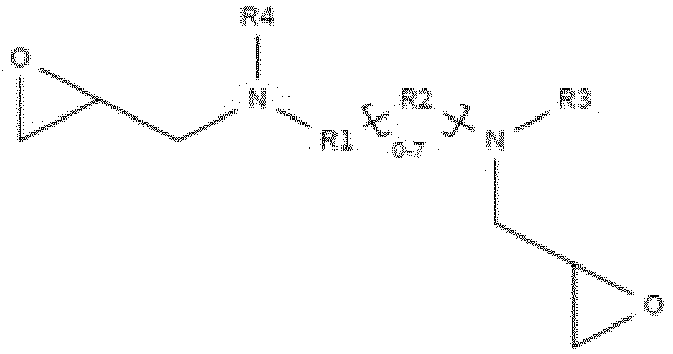

- the diamine of structural formula (I) has at least two amine group with at least one labile hydrogen on each nitrogen;
- at least one nitrogen atom is directly attached to an aromatic ring on one side;
- at least one amine group is hindered amine;
- either due to hindered aromatic ring having at least one substitution on ring at ortho position to carbon which is directly attached to amine group or due to branched aliphatic carbon directly attached to amine group;
- at least one group out of R1, R2, R3 or R4 is independently hindered aromatic or branched aliphatic; substituted branched aliphatic;
- R1, R2, R3, R4 independently can be hydrogen, alkyl, branched alkyl, aromatic, ortho substituted aromatic; ar-aliphatic; substituted ar aliphatic, substituted aliphatic;
- R1 and R4, or, R2 and R3 may be connected; and
- wherein the diamine of structural Formula (I) is AMES negative.
- Such glycidyl amine epoxy resin, wherein the diamine of structural Formula (I) is selected from a group comprising a compound of Formula (V), a compound of Formula (VI) or a compound of Formula (VI) represented by:


- Such glycidyl amine epoxy resin, wherein the glycidyl amine epoxy resin of structural Formula (II) is selected from a group comprising a glycidyl amine of Formula (IX), a glycidyl amine of Formula (X) or a glycidyl amine of Formula (XI) represented by:


- Such glycidyl amine epoxy resin of a structural Formula (III A) represented by:

- wherein R1, R2, R3, R4 independently can be hydrogen, alkyl, branched alkyl, aromatic, ortho substituted aromatic; ar-aliphatic; substituted ar Aliphatic, substituted aliphatic; and n is 1 to 20,
- wherein Formula (III A) is obtained by the reaction of the glycidyl amine epoxy resin of Formula (II) with diamine of Formula (I);
- wherein Formula (I) is

- the diamine of formula (I) has at least two amine group with at least one labile hydrogen on each nitrogen;
- at least one nitrogen atom is directly attached to an aromatic ring on one side;
- at least one amine group is hindered amine, either due to hindered aromatic ring having at least one substitution on ring at ortho position to carbon which is directly attached to amine group or due to branched aliphatic carbon directly attached to amine group;
- at least one group out of R1, R2, R3 or R4 is independently hindered aromatic or branched aliphatic; substituted branched aliphatic;
- R1, R2, R3, R4 independently can be hydrogen, alkyl, branched alkyl, aromatic, ortho substituted aromatic; ar-aliphatic; substituted ar-aliphatic, substituted aliphatic;
- R1 and R4, or, R2 and R3 may be connected;
- wherein diamine of Formula I is Ames negative.
- Such glycidyl amine epoxy resin of a structural Formula (III B) represented by:

wherein - R1, R2, R3, R4 independently can be hydrogen, alkyl, branched alkyl, aromatic, ortho substituted aromatic; Ar-aliphatic; substituted Ar Aliphatic, substituted aliphatic; and
- R5 and R6 can be same or different; R5 and R6 are independently, C1-14 branched aliphatic alkyl; C1-14 unbranched aliphatic alkyl, cycloaliphatic, aromatic, substituted aromatic.
- Q and A can be independently C (=O) O, O, NH
- wherein diamine of Formula I is Ames negative.
- Such glycidyl amine epoxy resin, wherein the diglycidyl compound of Formula (IV) is selected from the group comprising of a glycidyl ether of tetramethyl bisphenol F, a diglycidyl ether of ring-hydrogenated bisphenol A, a diglycidyl ether of ring-hydrogenated bisphenol F, and a novolac epoxy resin.
- Such glycidyl amine epoxy resin, wherein the a diglycidyl compound of Formula (IV) is selected from the group comprising a diglycidyl ether of Formula (IVA) or a diglycidyl ester of Formula (IVB) represented by:

- wherein R5 and R6 can be same or different; R5 and R6 are independently, C1-14 branched aliphatic alkyl; C1-14 unbranched aliphatic alkyl, cycloaliphatic, aromatic, substituted aromatic.
- Q and A can be independently C (=O) O, O, NH
- A curable coating system comprising a reaction product of any one of epoxy resin of Formula (IIIA) and Formula (IIIB), cured with a hardener.
- Such curable coating system, wherein the hardener is selected from the group consisting of an amino curing agent or an phenolic curing agent.
- The glycidyl amine epoxy resins produced in accordance with the present disclosure are meant for safe use in civil, coating, electronic or composite applications. The glycidyl amine epoxy resins are synthesized from on AMES negative diamines and Bisphenol free precursors, which infuse safety at the time of product design stage. In recent past due to restriction on bisphenol-based resins for food contact application, need for safer substitutes has been felt and end customer need safe products. Such novel resin have potential to reduce regulatory pressures on one side and better acceptability and reduced approval time at customer end. These resins can be used to get resins of any desired molecular weight and can be useful for multiple applications including engineering polymers. The curable coating composition based on glycidyl amine epoxy resin of the present disclosure have comparable or superior performance in a number of critical coating performance characteristics, including corrosion resistance, application, with minimal environmental impact. Hence glycidyl amine epoxy resins based on AMES negative diamines of Formula (I) can have large positive commercial impact on business. The present application discloses glycidyl amine epoxy resins which may be made in a variety of molecular weights that suit for efficient application of the coating system to a metals substrate. Such resins meet basic performance criteria, e.g. no misting or blocking, suitable to achieve good compatibility with other copolymers or materials e.g. thermoplastic materials such as PVC that may be present in the coating system. The epoxy resins in accordance with the present disclosure provides coating compositions for food containers that are free from Bisphenol A diglycidyl ether (BPA) and Bisphenol F diglycidyl ether (BPF) and does not contain extractible quantities of such compounds. The coating composition of the present invention are suitable for use in food contact situations and can be used on the inside of such cans. This is particularly useful in the case of foods which would absorb and chemically alter metal coverings. The coating composition possesses desirable properties that are specially required as coating compositions for food containers. The desirable properties include a coating that does not contain bisphenol A or any other endocrine disruptor.
Claims (7)
- A glycidyl amine epoxy resin of a structural Formula (II) obtained by reaction of a diamine of a structural Formula (I) with epichlorohydrin, wherein the structure of Formula (II) is represented by:

 the diamine of formula (I) has at least two amine groups with at least one labile hydrogen on each nitrogen;at least one nitrogen atom is directly attached to an aromatic ring on one side;at least one amine group is a hindered amine either due to hindered aromatic ring having at least one substitution on ring at ortho position to carbon which is directly attached to amine group or due to branched aliphatic carbon directly attached to amine group;at least one group out of R1, R2, R3 and R4 is independently hindered aromatic or branched aliphatic or substituted branched aliphatic;R1, R2, R3, and R4 are independently selected from the group consisting of hydrogen, alkyl, branched alkyl, aromatic, ortho substituted aromatic, ar-aliphatic, substituted ar-aliphatic, and substituted aliphatic;R1 and R4, or, R2 and R3 may be connected; andwherein the diamine of structural Formula (I) is AMES negative.
 - The glycidyl amine epoxy resin as claimed in claim 1, wherein the diamine of structural Formula (I) is selected from the group consisting of a compound of Formula (V), a compound of Formula (VI) or a compound of Formula (VII) represented by:


- The glycidyl amine epoxy resin as claimed in claim 2, wherein the glycidyl amine epoxy resin of structural Formula (II) is selected from the group consisting of a glycidyl amine of Formula (IX), a glycidyl amine of Formula (X) or a glycidyl amine of Formula (XI) represented by:


- A glycidyl amine epoxy resin of a structural Formula (III A) represented by:
 wherein R1, R2, R3, and R4 are independently selected from the group consisting of hydrogen, alkyl, branched alkyl, aromatic, ortho substituted aromatic, ar-aliphatic, substituted ar-aliphatic, and substituted aliphatic; andn is 1 to 20,wherein Formula (III A) is obtained by the reaction of the glycidyl amine epoxy resin of Formula (II) as defined in claim 1 with a diamine of Formula (I);wherein Formula (I) is:
 wherein:the diamine of formula (I) has at least two amine groups with at least one labile hydrogen on each nitrogen;at least one nitrogen atom is directly attached to an aromatic ring on one side;at least one amine group is a hindered amine, either due to hindered aromatic ring havingat least one substitution on ring at ortho position to carbon which is directly attached to amine group or due to branched aliphatic carbon directly attached to amine groups;at least one group out of R1, R2, R3 and R4 is independently hindered aromatic or branched aliphatic or substituted branched aliphatic;R1, R2, R3, and R4 are independently selected from the group consisting of hydrogen, alkyl, branched alkyl, aromatic, ortho substituted aromatic, ar-aliphatic, substituted ar-aliphatic, and substituted aliphatic;R1 and R4, or, R2 and R3 may be connected;wherein the diamine of Formula (I) is Ames negative.
 - A glycidyl amine epoxy resin of a structural Formula (III B) represented by:

whereinR1, R2, R3, and R4 are independently selected from the group consisting of hydrogen, alkyl, branched alkyl, aromatic, ortho substituted aromatic, ar-aliphatic, substituted ar-aliphatic, and substituted aliphatic;R5 and R6 are the same or different;R5 and R6 are independently selected from the group consisting of C1-14 branched aliphatic alkyl, C1-14 unbranched aliphatic alkyl, cycloaliphatic, aromatic, and substituted aromatic,wherein the diamine of Formula (I) is Ames negative, andwherein the diglycidyl compound of Formula (IV) is selected from:(a) the group consisting of a diglycidyl ether of Formula (IVA) or a diglycidyl ester of Formula (IVB) represented by: wherein R5 and R6 are the same or different,wherein R5 and R6 are independently selected from the group consisting of C1-14 branched aliphatic alkyl, C1-14 unbranched aliphatic alkyl, cycloaliphatic, aromatic and substituted aromatic,wherein Q and A are independently selected from C (=O) O, O, and NH; or(b) the group consisting of a glycidyl ether of tetramethyl bisphenol F, a diglycidyl ether of ring-hydrogenated bisphenol A, a diglycidyl ether of ring-hydrogenated bisphenol F, and a novolac epoxy resin.
 - A curable coating system comprising a reaction product of a glycidyl amine epoxy resin of Formula (IIIA) according to claim 4 or Formula (IIIB) according to claim 5, cured with a hardener.
- A curable coating system as claimed in claim 6, wherein the hardener is selected from the group consisting of an amino curing agent or an phenolic curing agent.
Applications Claiming Priority (2)
| Application Number | Priority Date | Filing Date | Title |
|---|---|---|---|
| IN201711036901 | 2017-10-17 | ||
| PCT/IB2018/058056 WO2019077523A1 (en) | 2017-10-17 | 2018-10-17 | Glycidyl amine epoxy resins based on ames negative amines |
Publications (3)
| Publication Number | Publication Date |
|---|---|
| EP3583150A1 EP3583150A1 (en) | 2019-12-25 |
| EP3583150C0 EP3583150C0 (en) | 2023-06-07 |
| EP3583150B1 true EP3583150B1 (en) | 2023-06-07 |
Family
ID=64755586
Family Applications (1)
| Application Number | Title | Priority Date | Filing Date |
|---|---|---|---|
| EP18825768.7A Active EP3583150B1 (en) | 2017-10-17 | 2018-10-17 | Glycidyl amine epoxy resins based on ames negative amines |
Country Status (6)
| Country | Link |
|---|---|
| US (1) | US11548976B2 (en) |
| EP (1) | EP3583150B1 (en) |
| JP (1) | JP6910464B2 (en) |
| KR (1) | KR102372154B1 (en) |
| CN (1) | CN110494468B (en) |
| WO (1) | WO2019077523A1 (en) |
Families Citing this family (1)
| Publication number | Priority date | Publication date | Assignee | Title |
|---|---|---|---|---|
| WO2021175972A1 (en) * | 2020-03-06 | 2021-09-10 | Byk-Chemie Gmbh | Amphiphilic block copolymer |
Family Cites Families (19)
| Publication number | Priority date | Publication date | Assignee | Title |
|---|---|---|---|---|
| GB816923A (en) * | 1954-12-06 | 1959-07-22 | Bayer Ag | Process for the production of basic n,n-diepoxides |
| NL210860A (en) * | 1955-10-04 | |||
| US3538039A (en) | 1966-12-27 | 1970-11-03 | Shell Oil Co | Powdered heat-curable compositions of (1) an epoxy-amine adduct,(2) an anhydride and (3) an imidazole |
| CH660358A5 (en) * | 1984-07-06 | 1987-04-15 | Lonza Ag | SUBSTITUTED P, P'-METHYLENE BISANILINE. |
| JPS62187737A (en) * | 1986-02-14 | 1987-08-17 | Matsushita Electric Works Ltd | Epoxy resin prepreg and epoxy resin laminate |
| US4861810A (en) | 1986-06-09 | 1989-08-29 | Shell Oil Company | Resin materials based on amines |
| US4812487A (en) * | 1988-03-15 | 1989-03-14 | The Goodyear Tire & Rubber Company | Ames-negative diamine curative for polyurethanes |
| JPH01247416A (en) * | 1988-03-30 | 1989-10-03 | Dainippon Ink & Chem Inc | Curable epoxy resin composition |
| JPH01247417A (en) * | 1988-03-30 | 1989-10-03 | Dainippon Ink & Chem Inc | Epoxy resin composition |
| US4886867A (en) * | 1988-11-14 | 1989-12-12 | Texaco Chemical Company | Novel compositions from polyoxyalkylene amines and epoxides |
| DE3918795A1 (en) * | 1989-06-08 | 1990-12-13 | Fraunhofer Ges Forschung | Epoxide] with built-in amine curing gps. - used in mfr. of one-component adhesives |
| GB9028037D0 (en) * | 1990-12-24 | 1991-02-13 | Dow Rheinmuenster | Stable amine advanced epoxy resin compositions |
| DE4410785A1 (en) | 1994-03-28 | 1995-10-05 | Hoechst Ag | Amine modified epoxy resin composition |
| DE19628409A1 (en) | 1996-07-15 | 1998-01-22 | Hoechst Ag | Amine modified epoxy resin composition |
| JP2003238658A (en) * | 2002-02-21 | 2003-08-27 | Toray Ind Inc | Epoxy resin composition for fiber reinforced composite material and method for producing fiber reinforced composite material |
| EP3131965B1 (en) * | 2014-04-14 | 2024-06-12 | Swimc Llc | Methods of preparing compositions for containers and other articles and methods of using same |
| CN104098755A (en) * | 2014-07-23 | 2014-10-15 | 程玉萍 | Preparation method of epoxy resin |
| WO2016203084A1 (en) * | 2015-06-15 | 2016-12-22 | Acondicionamiento Tarrasense | Method for preventing biological corrosion on surfaces |
| WO2016208344A1 (en) * | 2015-06-26 | 2016-12-29 | 三菱瓦斯化学株式会社 | Coating film having chemical resistance |
-
2018
- 2018-10-17 JP JP2019551585A patent/JP6910464B2/en active Active
- 2018-10-17 WO PCT/IB2018/058056 patent/WO2019077523A1/en not_active Ceased
- 2018-10-17 KR KR1020207006865A patent/KR102372154B1/en active Active
- 2018-10-17 US US16/634,504 patent/US11548976B2/en active Active
- 2018-10-17 CN CN201880024570.0A patent/CN110494468B/en active Active
- 2018-10-17 EP EP18825768.7A patent/EP3583150B1/en active Active
Also Published As
| Publication number | Publication date |
|---|---|
| EP3583150C0 (en) | 2023-06-07 |
| EP3583150A1 (en) | 2019-12-25 |
| JP2020516703A (en) | 2020-06-11 |
| CN110494468A (en) | 2019-11-22 |
| WO2019077523A1 (en) | 2019-04-25 |
| US20200239624A1 (en) | 2020-07-30 |
| KR20200035452A (en) | 2020-04-03 |
| JP6910464B2 (en) | 2021-07-28 |
| KR102372154B1 (en) | 2022-03-07 |
| US11548976B2 (en) | 2023-01-10 |
| CN110494468B (en) | 2022-08-23 |
Similar Documents
| Publication | Publication Date | Title |
|---|---|---|
| EP3170849B1 (en) | Nitrogen-containing heterocyclic epoxy curing agents, compositions and methods | |
| EP3134475B1 (en) | Polycyclocarbonate compounds and polymers and compositions formed therefrom | |
| EP2621992B1 (en) | Epoxy resin adducts and thermosets thereof | |
| EP2507325B1 (en) | Coating compositions | |
| CN104768999B (en) | The glycidyl ether derivatives and its oligomer of 2- phenyl -1,3- propylene glycol as curable epoxy | |
| CN102585669A (en) | BIS epoxy polyesters and food cans coated with a composition comprising same | |
| EP0758660B1 (en) | Advanced polyamine adduct epoxy resin curing agent for use in two component waterborne coating systems | |
| EP2787017A2 (en) | Epoxy resin adducts and thermosets thereof | |
| JP2014516117A (en) | Aqueous amine curing agents for curable resin systems | |
| US20150141548A1 (en) | Low viscosity epoxy resins and low voc curable formulations therefrom | |
| EP4010397B1 (en) | A modified epoxy resin | |
| US11548976B2 (en) | Glycidyl amine epoxy resins based on AMES negative amines | |
| EP4288477B1 (en) | Epoxy curing agents and uses thereof | |
| AU604855B2 (en) | Process for the preparation of a modified epoxy resin | |
| EP2384347B1 (en) | Hydroxyl-functional polyethers and a preparation process therefor | |
| US2965611A (en) | Polyphenol glycidyl ethers | |
| US20240425641A1 (en) | Epoxy resins | |
| HK1170521A (en) | Coating compositions |
Legal Events
| Date | Code | Title | Description |
|---|---|---|---|
| STAA | Information on the status of an ep patent application or granted ep patent |
Free format text: STATUS: UNKNOWN |
|
| STAA | Information on the status of an ep patent application or granted ep patent |
Free format text: STATUS: THE INTERNATIONAL PUBLICATION HAS BEEN MADE |
|
| PUAI | Public reference made under article 153(3) epc to a published international application that has entered the european phase |
Free format text: ORIGINAL CODE: 0009012 |
|
| STAA | Information on the status of an ep patent application or granted ep patent |
Free format text: STATUS: REQUEST FOR EXAMINATION WAS MADE |
|
| 17P | Request for examination filed |
Effective date: 20190918 |
|
| AK | Designated contracting states |
Kind code of ref document: A1 Designated state(s): AL AT BE BG CH CY CZ DE DK EE ES FI FR GB GR HR HU IE IS IT LI LT LU LV MC MK MT NL NO PL PT RO RS SE SI SK SM TR |
|
| AX | Request for extension of the european patent |
Extension state: BA ME |
|
| STAA | Information on the status of an ep patent application or granted ep patent |
Free format text: STATUS: EXAMINATION IS IN PROGRESS |
|
| 17Q | First examination report despatched |
Effective date: 20200811 |
|
| DAV | Request for validation of the european patent (deleted) | ||
| DAX | Request for extension of the european patent (deleted) | ||
| GRAP | Despatch of communication of intention to grant a patent |
Free format text: ORIGINAL CODE: EPIDOSNIGR1 |
|
| STAA | Information on the status of an ep patent application or granted ep patent |
Free format text: STATUS: GRANT OF PATENT IS INTENDED |
|
| INTG | Intention to grant announced |
Effective date: 20220722 |
|
| RIN1 | Information on inventor provided before grant (corrected) |
Inventor name: CHANGSARN, NALINTIP Inventor name: NOGHAN, SUPHANSA Inventor name: CHAMONGKOLPRADIT, WORAKAN Inventor name: SAMUTHSEN, PATCHARIN Inventor name: KUNWONG, DAPAWAN Inventor name: NOIPHOM, NOK Inventor name: NAIYAWAT, THIPA Inventor name: SUCKLEY, DANIEL Inventor name: KHULLAR, ALOK Inventor name: DUBEY, PRADIP KUMAR |
|
| GRAJ | Information related to disapproval of communication of intention to grant by the applicant or resumption of examination proceedings by the epo deleted |
Free format text: ORIGINAL CODE: EPIDOSDIGR1 |
|
| STAA | Information on the status of an ep patent application or granted ep patent |
Free format text: STATUS: EXAMINATION IS IN PROGRESS |
|
| INTC | Intention to grant announced (deleted) | ||
| GRAP | Despatch of communication of intention to grant a patent |
Free format text: ORIGINAL CODE: EPIDOSNIGR1 |
|
| STAA | Information on the status of an ep patent application or granted ep patent |
Free format text: STATUS: GRANT OF PATENT IS INTENDED |
|
| INTG | Intention to grant announced |
Effective date: 20221108 |
|
| GRAS | Grant fee paid |
Free format text: ORIGINAL CODE: EPIDOSNIGR3 |
|
| GRAA | (expected) grant |
Free format text: ORIGINAL CODE: 0009210 |
|
| STAA | Information on the status of an ep patent application or granted ep patent |
Free format text: STATUS: THE PATENT HAS BEEN GRANTED |
|
| AK | Designated contracting states |
Kind code of ref document: B1 Designated state(s): AL AT BE BG CH CY CZ DE DK EE ES FI FR GB GR HR HU IE IS IT LI LT LU LV MC MK MT NL NO PL PT RO RS SE SI SK SM TR |
|
| REG | Reference to a national code |
Ref country code: GB Ref legal event code: FG4D |
|
| REG | Reference to a national code |
Ref country code: CH Ref legal event code: EP Ref country code: AT Ref legal event code: REF Ref document number: 1574863 Country of ref document: AT Kind code of ref document: T Effective date: 20230615 Ref country code: DE Ref legal event code: R096 Ref document number: 602018051416 Country of ref document: DE |
|
| U01 | Request for unitary effect filed |
Effective date: 20230623 |
|
| U07 | Unitary effect registered |
Designated state(s): AT BE BG DE DK EE FI FR IT LT LU LV MT NL PT SE SI Effective date: 20230629 |
|
| REG | Reference to a national code |
Ref country code: LT Ref legal event code: MG9D |
|
| PG25 | Lapsed in a contracting state [announced via postgrant information from national office to epo] |
Ref country code: NO Free format text: LAPSE BECAUSE OF FAILURE TO SUBMIT A TRANSLATION OF THE DESCRIPTION OR TO PAY THE FEE WITHIN THE PRESCRIBED TIME-LIMIT Effective date: 20230907 Ref country code: ES Free format text: LAPSE BECAUSE OF FAILURE TO SUBMIT A TRANSLATION OF THE DESCRIPTION OR TO PAY THE FEE WITHIN THE PRESCRIBED TIME-LIMIT Effective date: 20230607 |
|
| PG25 | Lapsed in a contracting state [announced via postgrant information from national office to epo] |
Ref country code: RS Free format text: LAPSE BECAUSE OF FAILURE TO SUBMIT A TRANSLATION OF THE DESCRIPTION OR TO PAY THE FEE WITHIN THE PRESCRIBED TIME-LIMIT Effective date: 20230607 Ref country code: HR Free format text: LAPSE BECAUSE OF FAILURE TO SUBMIT A TRANSLATION OF THE DESCRIPTION OR TO PAY THE FEE WITHIN THE PRESCRIBED TIME-LIMIT Effective date: 20230607 Ref country code: GR Free format text: LAPSE BECAUSE OF FAILURE TO SUBMIT A TRANSLATION OF THE DESCRIPTION OR TO PAY THE FEE WITHIN THE PRESCRIBED TIME-LIMIT Effective date: 20230908 |
|
| U20 | Renewal fee for the european patent with unitary effect paid |
Year of fee payment: 6 Effective date: 20231030 |
|
| PG25 | Lapsed in a contracting state [announced via postgrant information from national office to epo] |
Ref country code: SK Free format text: LAPSE BECAUSE OF FAILURE TO SUBMIT A TRANSLATION OF THE DESCRIPTION OR TO PAY THE FEE WITHIN THE PRESCRIBED TIME-LIMIT Effective date: 20230607 |
|
| PG25 | Lapsed in a contracting state [announced via postgrant information from national office to epo] |
Ref country code: IS Free format text: LAPSE BECAUSE OF FAILURE TO SUBMIT A TRANSLATION OF THE DESCRIPTION OR TO PAY THE FEE WITHIN THE PRESCRIBED TIME-LIMIT Effective date: 20231007 |
|
| PG25 | Lapsed in a contracting state [announced via postgrant information from national office to epo] |
Ref country code: SM Free format text: LAPSE BECAUSE OF FAILURE TO SUBMIT A TRANSLATION OF THE DESCRIPTION OR TO PAY THE FEE WITHIN THE PRESCRIBED TIME-LIMIT Effective date: 20230607 Ref country code: SK Free format text: LAPSE BECAUSE OF FAILURE TO SUBMIT A TRANSLATION OF THE DESCRIPTION OR TO PAY THE FEE WITHIN THE PRESCRIBED TIME-LIMIT Effective date: 20230607 Ref country code: RO Free format text: LAPSE BECAUSE OF FAILURE TO SUBMIT A TRANSLATION OF THE DESCRIPTION OR TO PAY THE FEE WITHIN THE PRESCRIBED TIME-LIMIT Effective date: 20230607 Ref country code: IS Free format text: LAPSE BECAUSE OF FAILURE TO SUBMIT A TRANSLATION OF THE DESCRIPTION OR TO PAY THE FEE WITHIN THE PRESCRIBED TIME-LIMIT Effective date: 20231007 Ref country code: CZ Free format text: LAPSE BECAUSE OF FAILURE TO SUBMIT A TRANSLATION OF THE DESCRIPTION OR TO PAY THE FEE WITHIN THE PRESCRIBED TIME-LIMIT Effective date: 20230607 |
|
| PG25 | Lapsed in a contracting state [announced via postgrant information from national office to epo] |
Ref country code: PL Free format text: LAPSE BECAUSE OF FAILURE TO SUBMIT A TRANSLATION OF THE DESCRIPTION OR TO PAY THE FEE WITHIN THE PRESCRIBED TIME-LIMIT Effective date: 20230607 |
|
| REG | Reference to a national code |
Ref country code: DE Ref legal event code: R097 Ref document number: 602018051416 Country of ref document: DE |
|
| PLBE | No opposition filed within time limit |
Free format text: ORIGINAL CODE: 0009261 |
|
| STAA | Information on the status of an ep patent application or granted ep patent |
Free format text: STATUS: NO OPPOSITION FILED WITHIN TIME LIMIT |
|
| 26N | No opposition filed |
Effective date: 20240308 |
|
| PG25 | Lapsed in a contracting state [announced via postgrant information from national office to epo] |
Ref country code: MC Free format text: LAPSE BECAUSE OF FAILURE TO SUBMIT A TRANSLATION OF THE DESCRIPTION OR TO PAY THE FEE WITHIN THE PRESCRIBED TIME-LIMIT Effective date: 20230607 |
|
| REG | Reference to a national code |
Ref country code: CH Ref legal event code: PL |
|
| PG25 | Lapsed in a contracting state [announced via postgrant information from national office to epo] |
Ref country code: CH Free format text: LAPSE BECAUSE OF NON-PAYMENT OF DUE FEES Effective date: 20231031 |
|
| PG25 | Lapsed in a contracting state [announced via postgrant information from national office to epo] |
Ref country code: CH Free format text: LAPSE BECAUSE OF NON-PAYMENT OF DUE FEES Effective date: 20231031 |
|
| PG25 | Lapsed in a contracting state [announced via postgrant information from national office to epo] |
Ref country code: IE Free format text: LAPSE BECAUSE OF NON-PAYMENT OF DUE FEES Effective date: 20231017 |
|
| PG25 | Lapsed in a contracting state [announced via postgrant information from national office to epo] |
Ref country code: IE Free format text: LAPSE BECAUSE OF NON-PAYMENT OF DUE FEES Effective date: 20231017 |
|
| U20 | Renewal fee for the european patent with unitary effect paid |
Year of fee payment: 7 Effective date: 20241016 |
|
| PG25 | Lapsed in a contracting state [announced via postgrant information from national office to epo] |
Ref country code: CY Free format text: LAPSE BECAUSE OF FAILURE TO SUBMIT A TRANSLATION OF THE DESCRIPTION OR TO PAY THE FEE WITHIN THE PRESCRIBED TIME-LIMIT; INVALID AB INITIO Effective date: 20181017 |
|
| PG25 | Lapsed in a contracting state [announced via postgrant information from national office to epo] |
Ref country code: HU Free format text: LAPSE BECAUSE OF FAILURE TO SUBMIT A TRANSLATION OF THE DESCRIPTION OR TO PAY THE FEE WITHIN THE PRESCRIBED TIME-LIMIT; INVALID AB INITIO Effective date: 20181017 |
|
| U20 | Renewal fee for the european patent with unitary effect paid |
Year of fee payment: 8 Effective date: 20251024 |
|
| PGFP | Annual fee paid to national office [announced via postgrant information from national office to epo] |
Ref country code: GB Payment date: 20251021 Year of fee payment: 8 |
|
| PGFP | Annual fee paid to national office [announced via postgrant information from national office to epo] |
Ref country code: TR Payment date: 20251003 Year of fee payment: 8 |