EP3582422A1 - Hybrid automatic repeat request feedback method and device - Google Patents
Hybrid automatic repeat request feedback method and device Download PDFInfo
- Publication number
- EP3582422A1 EP3582422A1 EP17898787.1A EP17898787A EP3582422A1 EP 3582422 A1 EP3582422 A1 EP 3582422A1 EP 17898787 A EP17898787 A EP 17898787A EP 3582422 A1 EP3582422 A1 EP 3582422A1
- Authority
- EP
- European Patent Office
- Prior art keywords
- terminal device
- information
- network device
- data
- feedback
- Prior art date
- Legal status (The legal status is an assumption and is not a legal conclusion. Google has not performed a legal analysis and makes no representation as to the accuracy of the status listed.)
- Withdrawn
Links
Images


Classifications
-
- H—ELECTRICITY
- H04—ELECTRIC COMMUNICATION TECHNIQUE
- H04L—TRANSMISSION OF DIGITAL INFORMATION, e.g. TELEGRAPHIC COMMUNICATION
- H04L1/00—Arrangements for detecting or preventing errors in the information received
- H04L1/12—Arrangements for detecting or preventing errors in the information received by using return channel
- H04L1/16—Arrangements for detecting or preventing errors in the information received by using return channel in which the return channel carries supervisory signals, e.g. repetition request signals
- H04L1/18—Automatic repetition systems, e.g. Van Duuren systems
- H04L1/1867—Arrangements specially adapted for the transmitter end
- H04L1/1896—ARQ related signaling
-
- H—ELECTRICITY
- H04—ELECTRIC COMMUNICATION TECHNIQUE
- H04L—TRANSMISSION OF DIGITAL INFORMATION, e.g. TELEGRAPHIC COMMUNICATION
- H04L1/00—Arrangements for detecting or preventing errors in the information received
- H04L1/12—Arrangements for detecting or preventing errors in the information received by using return channel
- H04L1/16—Arrangements for detecting or preventing errors in the information received by using return channel in which the return channel carries supervisory signals, e.g. repetition request signals
- H04L1/1607—Details of the supervisory signal
- H04L1/1685—Details of the supervisory signal the supervisory signal being transmitted in response to a specific request, e.g. to a polling signal
-
- H—ELECTRICITY
- H04—ELECTRIC COMMUNICATION TECHNIQUE
- H04L—TRANSMISSION OF DIGITAL INFORMATION, e.g. TELEGRAPHIC COMMUNICATION
- H04L1/00—Arrangements for detecting or preventing errors in the information received
- H04L1/12—Arrangements for detecting or preventing errors in the information received by using return channel
- H04L1/16—Arrangements for detecting or preventing errors in the information received by using return channel in which the return channel carries supervisory signals, e.g. repetition request signals
- H04L1/18—Automatic repetition systems, e.g. Van Duuren systems
- H04L1/1812—Hybrid protocols; Hybrid automatic repeat request [HARQ]
- H04L1/1819—Hybrid protocols; Hybrid automatic repeat request [HARQ] with retransmission of additional or different redundancy
-
- H—ELECTRICITY
- H04—ELECTRIC COMMUNICATION TECHNIQUE
- H04L—TRANSMISSION OF DIGITAL INFORMATION, e.g. TELEGRAPHIC COMMUNICATION
- H04L1/00—Arrangements for detecting or preventing errors in the information received
- H04L1/12—Arrangements for detecting or preventing errors in the information received by using return channel
- H04L1/16—Arrangements for detecting or preventing errors in the information received by using return channel in which the return channel carries supervisory signals, e.g. repetition request signals
- H04L1/1607—Details of the supervisory signal
- H04L1/1671—Details of the supervisory signal the supervisory signal being transmitted together with control information
-
- H—ELECTRICITY
- H04—ELECTRIC COMMUNICATION TECHNIQUE
- H04L—TRANSMISSION OF DIGITAL INFORMATION, e.g. TELEGRAPHIC COMMUNICATION
- H04L1/00—Arrangements for detecting or preventing errors in the information received
- H04L1/12—Arrangements for detecting or preventing errors in the information received by using return channel
- H04L1/16—Arrangements for detecting or preventing errors in the information received by using return channel in which the return channel carries supervisory signals, e.g. repetition request signals
- H04L1/18—Automatic repetition systems, e.g. Van Duuren systems
- H04L1/1812—Hybrid protocols; Hybrid automatic repeat request [HARQ]
-
- H—ELECTRICITY
- H04—ELECTRIC COMMUNICATION TECHNIQUE
- H04L—TRANSMISSION OF DIGITAL INFORMATION, e.g. TELEGRAPHIC COMMUNICATION
- H04L1/00—Arrangements for detecting or preventing errors in the information received
- H04L1/12—Arrangements for detecting or preventing errors in the information received by using return channel
- H04L1/16—Arrangements for detecting or preventing errors in the information received by using return channel in which the return channel carries supervisory signals, e.g. repetition request signals
- H04L1/18—Automatic repetition systems, e.g. Van Duuren systems
- H04L1/1867—Arrangements specially adapted for the transmitter end
- H04L1/188—Time-out mechanisms
-
- H—ELECTRICITY
- H04—ELECTRIC COMMUNICATION TECHNIQUE
- H04L—TRANSMISSION OF DIGITAL INFORMATION, e.g. TELEGRAPHIC COMMUNICATION
- H04L5/00—Arrangements affording multiple use of the transmission path
- H04L5/003—Arrangements for allocating sub-channels of the transmission path
- H04L5/0053—Allocation of signalling, i.e. of overhead other than pilot signals
- H04L5/0055—Physical resource allocation for ACK/NACK
-
- H—ELECTRICITY
- H04—ELECTRIC COMMUNICATION TECHNIQUE
- H04W—WIRELESS COMMUNICATION NETWORKS
- H04W76/00—Connection management
- H04W76/10—Connection setup
- H04W76/11—Allocation or use of connection identifiers
-
- H—ELECTRICITY
- H04—ELECTRIC COMMUNICATION TECHNIQUE
- H04W—WIRELESS COMMUNICATION NETWORKS
- H04W80/00—Wireless network protocols or protocol adaptations to wireless operation
- H04W80/02—Data link layer protocols
-
- H—ELECTRICITY
- H04—ELECTRIC COMMUNICATION TECHNIQUE
- H04W—WIRELESS COMMUNICATION NETWORKS
- H04W88/00—Devices specially adapted for wireless communication networks, e.g. terminals, base stations or access point devices
- H04W88/02—Terminal devices
-
- H—ELECTRICITY
- H04—ELECTRIC COMMUNICATION TECHNIQUE
- H04L—TRANSMISSION OF DIGITAL INFORMATION, e.g. TELEGRAPHIC COMMUNICATION
- H04L1/00—Arrangements for detecting or preventing errors in the information received
- H04L1/12—Arrangements for detecting or preventing errors in the information received by using return channel
- H04L1/16—Arrangements for detecting or preventing errors in the information received by using return channel in which the return channel carries supervisory signals, e.g. repetition request signals
- H04L1/18—Automatic repetition systems, e.g. Van Duuren systems
- H04L1/1829—Arrangements specially adapted for the receiver end
- H04L1/1861—Physical mapping arrangements
Definitions
- Embodiments of the present application relate to a field of communication, and more particularly, to a method and device for hybrid automatic repeat request feedback.
- Uplink Hybrid Automatic Repeat Request (HARQ) transmission in a Long Term Evolution (LTE) system is synchronous and non-adaptive, wherein synchronization refers to that retransmission is transmitted at a specified fixed time, and non-adaptive refers to that retransmission uses Physical Resource Block (PRB) and Modulation and Coding Scheme (MCS) the same as those for previous transmission.
- PRB Physical Resource Block
- MCS Modulation and Coding Scheme
- a base station performs a Cyclic Redundancy Check (CRC) on received uplink data to determine whether a retransmission is required. If the CRC is successful and a User Equipment (UE) still has uplink data to be transmitted, the UE performs new transmission. If the CRC fails, the UE performs retransmission.
- CRC Cyclic Redundancy Check
- a conclusion reached at the 95th meeting of the 3rd generation partnership project (3GPP) Radio Access Network (RAN) indicates that uplink HARQ transmission in the future communication system (e.g., 5th Generation, 5G) is asynchronous adaptive HARQ transmission.
- 3GPP 3rd generation partnership project
- RAN Radio Access Network
- DCI Downlink Control Information
- PDCCH Physical Downlink Control Channel
- the base station will continuously schedule the UE and authorize a specific HARQ Process to the UE, and the UE can acquire feedback of the base station by decoding the PDCCH.
- the base station stops authorizing the UE the UE will lose feedback of the base station, and the UE cannot determine whether to perform new transmission or retransmission.
- the application provides a method and device for Hybrid Automatic Repeat Request (HARQ) feedback, which can be applied to uplink asynchronous adaptive HARQ transmission, so that even if a network device stops authorizing a terminal device, the terminal device can still acquire feedback of the network device, thereby improving system efficiency.
- HARQ Hybrid Automatic Repeat Request
- a method for hybrid automatic repeat request feedback includes: sending, by a terminal device, data to be transmitted to a network device; and sending, by the terminal device, feedback request information to the network device if the terminal device determines that feedback information for the data to be transmitted is not received in a first target time period, wherein the feedback request information is used for requesting the network device to send feedback information for the data to be transmitted, a start time point of the first target time period is a time point that the terminal device finishes sending the data to be transmitted, and a time length of the first target time period is a first time length.
- the terminal device determines whether to send feedback request information to the network device according to whether feedback information sent by the network device for the data to be transmitted is received in a target time period, which can be applied to a communication system adopting asynchronous adaptive HARQ in uplink, and even if the network device stops authorizing the terminal device, the terminal device can still acquire the feedback information of the network device by sending the feedback request information, thus improving system efficiency.
- the feedback request information includes an Identification (ID) of the terminal device and an ID of a target HARQ process; wherein sending, by the terminal device, the data to be transmitted to the network device includes: sending, by the terminal device, the data to be transmitted to the network device by using the target HARQ process.
- ID an Identification
- ID of a target HARQ process an ID of a target HARQ process
- sending, by the terminal device, the feedback request information to the network device includes: sending, by the terminal device, the feedback request information to the network device on a dedicated resource, the dedicated resource is a resource allocated by the network device to the terminal device for sending the feedback request information; or, sending, by the terminal device, the feedback request information to the network device on a preset common resource.
- the preset common resource is a resource used for Grant Free transmission.
- the method further includes: receiving, by the terminal device, feedback information sent by the network device for the data to be transmitted.
- the feedback information is acknowledgement (ACK) information
- the ACK information includes the ID of the target HARQ process
- receiving, by the terminal device, the feedback information sent by the network device for the data to be transmitted includes: receiving, by the terminal device, a medium access control protocol data unit (MAC PDU) sent by the network device, and the MAC PDU includes the ACK information.
- MAC PDU medium access control protocol data unit
- the feedback information is ACK information
- the ACK information includes the ID of the target HARQ process and the ID of the terminal device
- receiving, by the terminal device, the feedback information sent by the network device for the data to be transmitted includes: receiving, by the terminal device, system information sent by the network device, and the system information includes the ACK information.
- the feedback information is negative acknowledgement (NACK) information
- the NACK information includes information related to retransmission of the data to be transmitted
- receiving, by the terminal device, the feedback information sent by the network device for the data to be transmitted includes: receiving, by the terminal device, a PDCCH sent by the network device, and the PDCCH includes the NACK information.
- NACK negative acknowledgement
- the method further includes: determining, by the terminal device, the first time length according to round-trip time (RTT) of an HARQ process in an existing protocol version; or, determining, by the terminal device, the first time length according to a time length corresponding to the feedback information sent by the network device and received before sending the data to be transmitted to the network device.
- RTT round-trip time
- a method for hybrid automatic repeat request (HARQ) feedback method which includes: receiving, by a network device, data to be transmitted sent by a terminal device; and sending, by the network device, feedback information for the data to be transmitted to the terminal device if the network device determines that a target condition is satisfied.
- HARQ hybrid automatic repeat request
- a network device determines whether to send feedback information to the terminal device for the data to be transmitted according to whether a target condition is satisfied, so that the method for HARQ feedback can be applied to a communication system adopting asynchronous adaptive HARQ in uplink, and even if the network device stops authorizing the terminal device, the terminal device can still acquire the feedback information of the network device, thereby improving system efficiency.
- the target condition is that the network device receives feedback request information sent by the terminal device, and the feedback request information is used for requesting the network device to send feedback information for the data to be transmitted to the terminal device; or, the target condition is that the network device does not need to send downlink data to the terminal device in a second target time period or does not receive a scheduling request sent by the UE in the second time period, a start time point of the second target time period is a time point that the network device successfully decodes the data to be transmitted, and the time length of the second target time period is a second time length.
- the feedback request information includes an identification (ID) of the terminal device and an ID of a target HARQ process; wherein receiving, by the network device, the data to be transmitted sent by the terminal device includes: receiving, by the network device, the data to be transmitted sent by the terminal device using the target HARQ process.
- the method further includes: receiving, by the network device, the feedback request information sent by the terminal device on a dedicated resource, the dedicated resource is a resource allocated by the network device to the terminal device for sending the feedback request information; or, receiving, by the network device, the feedback request information sent by the terminal device on a preset common resource.
- the feedback information is acknowledgement (ACK) information
- the ACK information includes the ID of the target HARQ process
- sending, by the network device, the feedback information for the data to be sent to the terminal device includes: sending, by the network device, a medium access control protocol data unit (MAC PDU) to the terminal device, and the MAC PDU includes the ACK information.
- MAC PDU medium access control protocol data unit
- the feedback information is ACK information
- the ACK information includes the ID of the target HARQ process and the ID of the terminal device
- sending, by the network device, the feedback information for the data to be transmitted to the terminal device includes: sending, by the network device, system information to the terminal device, and the system information includes the ACK information.
- the feedback information is negative acknowledgement (NACK) information
- the NACK information includes information related to retransmission of the data to be transmitted
- sending, by the network device, the feedback information for the data to be transmitted to the terminal device includes: sending, by the network device, a physical downlink control channel (PDCCH) to the terminal device, and the PDCCH includes the NACK information.
- NACK negative acknowledgement
- PDCCH physical downlink control channel
- a terminal device which is used for performing the method in the above first aspect or any possible implementation mode of the first aspect.
- the terminal device includes function modules used for executing the method in the first aspect or any possible implementation mode of the first aspect described above.
- a network device which is used for performing the method in the above second aspect or any possible implementation mode of the second aspect.
- the network device includes function modules for executing the method in the second aspect or in any possible implementation mode of the second aspect described above.
- a terminal device which includes a processor, a memory, and a transceiver.
- the processor, the memory, and the transceiver communicate with each other through internal connection paths to transfer control and/or data signals, so that the terminal device implements the method in the first aspect or any possible implementation mode of the first aspect described above.
- a network device which includes a processor, a memory, and a transceiver.
- the processor, the memory, and the transceiver communicate with each other through internal connection paths to transfer control and/or data signals, so that the network device implements the method in the second aspect or any possible implementation mode of the second aspect described above.
- a computer readable medium for storing a computer program.
- the computer program includes instructions used for implementing the method of the first aspect or the method of any possible implementation mode of the first aspect.
- a computer readable medium for storing a computer program.
- the computer program includes instructions used for implementing the method of the second aspect or the method of any possible implementation mode of the second aspect.
- GSM Global System of Mobile communication
- CDMA Code Division Multiple Access
- WCDMA Wideband Code Division Multiple Access
- GPRS General Packet Radio Service
- LTE Long Term Evolution
- FDD Frequency Division Duplex
- TDD Time Division Duplex
- UMTS Universal Mobile Telecommunication System
- WiMAX Worldwide Interoperability for Microwave Access
- a terminal device may include, but not limited to, a Mobile Station (MS), a Mobile Terminal, a Mobile Phone, User Equipment (UE), a handset, portable device, a vehicle, and so on.
- the terminal device may communicate with one or more core networks through a Radio Access Network (RAN).
- RAN Radio Access Network
- the terminal device may be a Mobile Phone (or "Cellular" phone), a computer with wireless communication functions, etc., and the terminal device may further be a portable, pocket, handheld, computer built-in or on-board mobile device.
- a network device is a device deployed in a wireless access network to provide wireless communication functions for a terminal device.
- the network device may be a base station, which may include various forms of macro base stations, micro base stations, relay stations, access points, etc.
- name of a device with base station function may be different.
- eNB evolved node B
- 3G 3rd Generation
- FIG. 1 shows a method for hybrid automatic repeat request feedback according to an embodiment of the present application. As shown in FIG. 1 , the method 100 includes acts S110 and S120.
- a terminal device sends data to be transmitted to a network device.
- the terminal device determines that feedback information for the data to be transmitted is not received in a first target time period, the terminal device sends feedback request information to the network device, the feedback request information is used for requesting the network device to send feedback information for the data to be transmitted, a start time point of the first target time period is a time point that the terminal device finishes sending the data to be transmitted, and a time length of the first target time period is a first time length.
- the terminal device determines whether to send feedback request information to the network device according to whether feedback information sent by the network device for the data to be transmitted is received in a target time period, which can be applied to a communication system adopting asynchronous adaptive HARQ in uplink, and even if that the network device stops authorizing the terminal device, the terminal device can still acquire the feedback information of the network device by sending the feedback request information, thereby improving system efficiency.
- the terminal device if the terminal device does not receive feedback of the network device in a first target time period which starts from a time point that the terminal device finishes sending the last piece of data to be transmitted, the terminal device sends feedback request information to the network device, requesting the network device to send feedback information for the last piece of data to be transmitted, thereby avoiding waste of resource and improving system efficiency.
- the terminal device sends the data to be transmitted to the network device by using a target HARQ process.
- the feedback request information sent by the terminal device to the network device includes an ID of the terminal device and an ID of the target HARQ process.
- the network device may determine that feedback is required for the data to be transmitted that is received, or it may be understood that the network device needs to send feedback information corresponding to the target HARQ process to the terminal device.
- the terminal device sends feedback request information to the network device on a dedicated resource or a pre-configured common resource
- the dedicated resource may be a resource allocated by the network device to the terminal device for sending feedback request information, for example, the network device may allocate this dedicated resource to the terminal device through system information.
- the pre-configured common resource may be a resource pre-configured by the network device for Grant-Free transmission.
- the terminal device After the terminal device sends the feedback request information to the network device, the terminal device receives feedback information sent by the network device for the data to be transmitted.
- the feedback information is Acknowledgement (ACK) information including the ID of the target HARQ process
- the terminal device may determine that ACK information received is the ACK information for the data to be transmitted according to the ID of the target HARQ process, and determine that retransmission of the data to be transmitted is not required.
- ACK Acknowledgement
- the terminal device receives a Medium Access Control (MAC) Protocol Data Unit (PDU) sent by the network device, and the MAC PDU includes ACK information.
- MAC Medium Access Control
- PDU Protocol Data Unit
- ACK information is carried in a Subheader portion of the MAC PDU, or ACK information is carried in a MAC Control Element (CE) portion, or ACK information is carried in a MAC Service Data Unit (SDU) portion.
- CE MAC Control Element
- SDU MAC Service Data Unit
- the terminal device receives system information sent by the network device, and the system information includes ACK information.
- the ACK information includes the ID of the terminal device in addition to the ID of the target HARQ process.
- feedback information is Negative Acknowledgment (NACK) information
- the NACK information includes information related to retransmitting the data to be transmitted.
- the information related to retransmission of the data to be transmitted includes information such as a Modulation and Coding Scheme (MCS), a Physical Resource Block (PRB) and the like required for retransmission of the data to be transmitted.
- MCS Modulation and Coding Scheme
- PRB Physical Resource Block
- the terminal device After receiving the NACK information, the terminal device retransmits the data to be transmitted to the network device according to the information related to retransmitting the data to be transmitted.
- the terminal device receives a Physical Downlink Control Channel (PDCCH) sent by the network device, and the PDCCH carries the NACK information.
- PDCCH Physical Downlink Control Channel
- the first time length may be a time length agreed in a protocol, or the first time length may be a time length determined by the terminal device.
- the terminal device may determine a time length of Round-Trip Time (RTT) in the prior art as the first time length, or the terminal device may determine the first time length according to a time length corresponding to the feedback information sent by the network device and received before the terminal device sends the data to be transmitted to the network device.
- RTT Round-Trip Time
- the terminal device has already sent three data packets to the network device before sending the data to be transmitted to the network device, a time length between a time point that the terminal device finished sending a first data packet and a time point that the terminal device received feedback information for the first data packet is 8ms, a time length between a time point that the terminal device finished sending a second data packet and a time point that the terminal device received feedback information for the second data packet is 10ms, and a time length between a time point that the terminal device finished sending a third data packet and a time point that the terminal device received feedback information for the second data packet is 12ms.
- the terminal device may determine an average value of above three time lengths as the first time length, or the terminal device may determine a maximum value or a minimum value of the three time lengths as the first time length.
- the terminal device is provided with a timer, and when the terminal device finishes sending data to be transmitted, the timer starts timing, and the timing length is the first time length.
- a method for hybrid automatic repeat request feedback according to an embodiment of the present application is described in detail above from a terminal device side in combination with FIG. 1 , and a method for hybrid automatic repeat request feedback according to an embodiment of the present application will be described in detail below from a network device side in combination with FIG. 2 . It should be understood that interactions between a network device and a terminal device described from the network device side is the same as that described from the terminal device side, and relevant descriptions are omitted appropriately to avoid repetition.
- FIG. 2 is a method for hybrid automatic repeat request feedback according to another embodiment of the present application. As shown in FIG. 2 , the method 200 includes acts S210 and S220.
- a network device receives data to be transmitted sent by a terminal device.
- the network device determines that a target condition is satisfied, the network device sends feedback information for the data to be transmitted to the terminal device.
- a network device determines whether to send feedback information to the terminal device for the data to be transmitted according to whether a target condition is satisfied, which can be applied to a communication system adopting asynchronous adaptive HARQ in uplink, and even if the network device stops authorizing the terminal device, the terminal device can still acquire the feedback information of the network device, thereby improving system efficiency.
- the target condition is that the network device receives feedback request information sent by the terminal device, and the feedback request information is used for requesting the network device to send feedback information for the data to be transmitted to the terminal device; or, the target condition is that the network device does not need to send downlink data to the terminal device in a second target time period or does not receive a scheduling request sent by the terminal device in the second time period, a start time point of the second target time period is a time point that the network device successfully decodes the data to be transmitted, and a time length of the second target time period is a second time length.
- the network device does not need to send downlink data to the terminal device in a second target time period or does not receive the scheduling request sent by the terminal device in the second time period can be understood as that the network device does not need to send a PDCCH to the terminal device in the second target time period.
- the network device may determine the second time length according to a time length between a time point when a piece of data is successfully decoded and a time point when feedback information for the piece of data is sent, before the data to be transmitted is successfully decoded.
- the feedback request information includes an ID of the terminal device and an ID of a target HARQ process.
- S210 specifically is that the network device receives the data to be transmitted sent by the terminal device using the target HARQ process.
- the method further includes: the network device receives the feedback request information sent by the terminal device on a dedicated resource, the dedicated resource is a resource allocated by the network device to the terminal device for sending the feedback request information; or, the network device receives the feedback request information sent by the terminal device on a preset common resource.
- the feedback information is acknowledgement (ACK) information
- the ACK information includes the ID of the target HARQ process.
- the network device sends feedback information for the data to be transmitted to the terminal device, including: the network device sends a medium access control protocol data unit (MAC PDU) to the terminal device, and the MAC PDU includes the ACK information.
- MAC PDU medium access control protocol data unit
- the feedback information is ACK information
- the ACK information includes the ID of the target HARQ process and the ID of the terminal device.
- the network device sends feedback information for the data to be transmitted to the terminal device, including: the network device sends system information to the terminal device, and the system information includes the ACK information.
- the feedback information is negative acknowledgement (NACK) information
- NACK information includes information related to retransmission of the data to be transmitted.
- the network device sends feedback information for the data to be transmitted to the terminal device, including: the network device sends a physical downlink control channel (PDCCH) to the terminal device, and the PDCCH includes the NACK information.
- PDCCH physical downlink control channel
- a terminal device 10 includes a transceiving module 11 and a processing module 12.
- the transceiving module 11 is used for sending data to be transmitted to a network device.
- the processing module 12 is used for determining whether the transceiving module 11 receives feedback information for the data to be transmitted in a first target time period, a start time point of the first target time period is a time point that the transceiving module 11 finishes sending the data to be transmitted, and a time length of the first target time period is a first time length.
- the transceiving module 11 is further used for sending feedback request information to the network device if the processing module 12 determines that the transceiving module 11 does not receive feedback information for the data to be transmitted in the first target time period, and the feedback request information is used for requesting the network device to send feedback information for the data to be transmitted.
- the terminal device determines whether to send feedback request information to the network device according to whether it receives feedback information sent by the network device for the data to be transmitted in a target time period, which can be applied to a communication system adopting asynchronous adaptive HARQ in uplink, and even if the network device stops authorizing the terminal device, the terminal device can still acquire feedback information of the network device by sending feedback request information, thus improving system efficiency.
- the feedback request information includes an ID of the terminal device and an ID of a target HARQ process.
- the transceiving module 11 is specifically used for sending the data to be transmitted to the network device by using the target HARQ process.
- the transceiving module 11 is specifically used for sending the feedback request information to the network device on a dedicated resource, the dedicated resource being a resource allocated by the network device to the terminal device for sending the feedback request information; or, sending the feedback request information to the network device on a preset common resource.
- the transceiving module 11 is further used for receiving feedback information for the data to be transmitted sent by the network device.
- the feedback information is ACK information
- the ACK information includes the ID of the target HARQ process.
- the transceiving module 11 is specifically used for receiving a medium access control protocol data unit (MAC PDU) sent by the network device, and the MAC PDU includes the ACK information.
- MAC PDU medium access control protocol data unit
- the feedback information is ACK information
- the ACK information includes the ID of the target HARQ process and the ID of the terminal device.
- the transceiving module 11 is specifically used for receiving system information sent by the network device, and the system information includes the ACK information.
- the feedback information is negative acknowledgement (NACK) information
- NACK information includes information related to retransmission of the data to be transmitted.
- the transceiving module 11 is specifically used for receiving a physical downlink control channel (PDCCH) sent by the network device, and the PDCCH includes the NACK information.
- PDCCH physical downlink control channel
- the processing module 12 is further used for determining the first time length according to round-trip time (RTT) of an HARQ process in an existing protocol version; or, the first time length is determined according to a time length corresponding to the feedback information sent by the network device and received by the transceiving module 11 before sending the data to be transmitted to the network device.
- RTT round-trip time
- the terminal device may refer to the flow of the method 100 corresponding to the embodiment of the present application, and various units/modules in the terminal device and other operations and/or functions described above are respectively for realizing the corresponding flow in the method 100, and will not be repeated herein for brevity.
- FIG. 4 shows a network device according to an embodiment of the present application.
- a network device 20 includes a transceiving module 21 and a processing module 22.
- the transceiving module 21 is used for receiving data to be transmitted sent by a terminal device.
- the processing module 22 is used for determining whether the network device satisfies a target condition.
- the transceiving module 21 is further used for sending feedback information for the data to be transmitted to the terminal device if the processing module 22 determines that the network device satisfies the target condition.
- a network device determines whether to send feedback information for the data to be transmitted to the terminal device according to whether a target condition is satisfied, which can be applied to a communication system adopting asynchronous adaptive HARQ in uplink, and enables the terminal device to acquire feedback information of the network device even if the network device stops authorizing the terminal device, thereby improving system efficiency.
- the target condition is that the transceiving module receives feedback request information sent by the terminal device, and the feedback request information is used for requesting the network device to send feedback information for the data to be transmitted to the terminal device; or, the target condition is that the transceiving module does not need to send downlink data to the terminal device in a second target time period or does not receive a scheduling request sent by the UE in the second time period, a start time point of the second target time period is a time point that the processing module successfully decodes the data to be transmitted, and a time length of the second target time period is a second time length.
- the feedback request information includes an ID of the terminal device and an ID of a target HARQ process.
- the transceiving module 21 is specifically used for receiving the data to be transmitted sent by the terminal device using the target HARQ process.
- the transceiving module 21 is further used for receiving the feedback request information sent by the terminal device on a dedicated resource, the dedicated resource being a resource allocated by the network device to the terminal device for sending the feedback request information; or, receiving the feedback request information sent by the terminal device on a preset common resource.
- the feedback information is ACK information
- the ACK information includes the ID of the target HARQ process.
- the transceiving module 21 is specifically used for sending a medium access control protocol data unit (MAC PDU) to the terminal device, and the MAC PDU includes the ACK information.
- MAC PDU medium access control protocol data unit
- the feedback information is ACK information
- the ACK information includes the ID of the target HARQ process and the ID of the terminal device.
- the transceiving module 21 is specifically used for sending system information to the terminal device, and the system information includes the ACK information.
- the feedback information is negative acknowledgement (NACK) information
- NACK information includes information related to retransmission of the data to be transmitted.
- the transceiving module 21 is specifically used for sending a physical downlink control channel (PDCCH) to the terminal device, and the PDCCH includes the NACK information.
- PDCCH physical downlink control channel
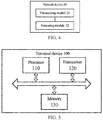
- FIG. 5 shows a terminal device according to another embodiment of the present application.
- a terminal device 100 includes a processor 110 and a transceiver 120.
- the processor 110 is connected to the transceiver 120.
- the network device 100 further includes a memory 130, the memory 130 is connected to the processor 110, wherein the processor 110, the memory 130, and the transceiver 120 may communicate with each other through an internal connection path.
- the transceiver 120 is used for sending data to be transmitted to a network device.
- the processor 110 is used for determining whether the transceiver 120 receives feedback information for the data to be transmitted in a first target time period, a start time point of the first target time period is a time point that the transceiver 120 finishes transmitting the data to be transmitted, and a time length of the first target time period is a first time length.
- the transceiver 120 is further used for sending feedback request information to the network device if the processor 110 determines that the transceiver 120 does not receive feedback information for the data to be transmitted in the first target time period, and the feedback request information is used for requesting the network device to send feedback information for the data to be transmitted.
- the terminal device determines whether to send feedback request information to the network device according to whether it receives feedback information sent by the network device for the data to be transmitted in a target time period, which can be applied to a communication system adopting asynchronous adaptive HARQ in uplink, and even if the network device stops authorizing the terminal device, the terminal device can still acquire feedback information of the network device by sending feedback request information, thus improving system efficiency.
- the terminal device 100 may refer to the terminal device 10 corresponding to the embodiment of the present application, and various units/modules in the terminal device and other operations and/or functions described above are respectively for realizing the corresponding flow in the method 100, and will not be repeated here for brevity.
- FIG. 6 shows a schematic block diagram of a network device according to another embodiment of the present application.
- a network device 200 includes a processor 210 and a transceiver 220, the processor 210 is connected to the transceiver 220, optionally, the terminal device 200 further includes a memory 230 connected to the processor 210, wherein the processor 210, the memory 230, and the transceiver 220 may communicate with each other through an internal connection path.
- the transceiver 220 is used for receiving data to be transmitted sent by a terminal device.
- the processor 210 is used for determining whether the network device satisfies a target condition; and the transceiver 210 is further used for sending feedback information for the data to be transmitted to the terminal device if the processor 210 determines that the network device satisfies the target condition.
- a network device determines whether to send feedback information for the data to be transmitted to the terminal device according to whether a target condition is satisfied, which can be applied to a communication system adopting asynchronous adaptive HARQ in uplink, and enables the terminal device to acquire feedback information of the network device even if the network device stops authorizing the terminal device, thereby improving system efficiency.
- the network device 200 may refer to the network device 20 corresponding to the embodiment of the present application, and various units/modules in the network device and other operations and/or functions described above are respectively for realizing the corresponding flow in the method 200, and will not be repeated here for brevity.
- the processor in embodiments of the present application may be an integrated circuit chip with a capability for processing signals.
- the above processor may be a general purpose processor, a digital signal processor (DSP), an application specific integrated circuit (ASIC), a field programmable gate array (FPGA), or other programmable logic device, discrete gate or transistor logic device, or discrete hardware component.
- DSP digital signal processor
- ASIC application specific integrated circuit
- FPGA field programmable gate array
- the processor may implement various methods, acts and logic block diagrams disclosed in embodiments of the present application.
- the general purpose processor may be a microprocessor or the processor may be any conventional processor or the like.
- the storage in embodiments of the present application may be a transitory memory or non-transitory memory, or may include both transitory memory and non-transitory memory.
- the non-transitory memory may be a read-only memory (ROM), programmable ROM (PROM), an erasable programmable ROM (EPROM), an electrically erasable programmable ROM (EEPROM), or a flash memory.
- the transitory memory may be a random access memory (RAM) which serves as an external cache.
- RAMs such as a static random access memory (SRAM), a dynamic random access memory (DRAM), a synchronous dynamic random access memory (SDRAM), a double data rate SDRAM (DDR SDRAM), an enhanced SDRAM (ESDRAM), a Synchlink DRAM (SLDRAM), and a Direct Rambus RAM (DR RAM).
- SRAM static random access memory
- DRAM dynamic random access memory
- SDRAM synchronous dynamic random access memory
- DDR SDRAM double data rate SDRAM
- ESDRAM enhanced SDRAM
- SLDRAM Synchlink DRAM
- DR RAM Direct Rambus RAM
- the disclosed system, apparatus and method may be implemented in other ways.
- the apparatus embodiments described above are only illustrative, for example, the division of the units is only a logical function division, and there may be other division manners in actual realization. For example, multiple units or components may be combined or integrated into another system, or some features may be ignored or not executed.
- the mutual coupling or direct coupling or communication connection shown or discussed may be indirect coupling or communication connection through some interfaces, devices or units, and may be in electrical, mechanical or other forms.
- the units described as separated components may or may not be physically separated, and the component shown as a unit may or may not be a physical unit, i.e., it may be located in one place or may be allocated over multiple network units. Some or all of the units may be selected according to practical needs to achieve a purpose of the embodiments.
- various functional units in various embodiments of the present application may be integrated in one processing unit, or various units may be physically present separately, or two or more units may be integrated in one unit.
- the function may be stored in a computer readable storage medium if implemented in a form of software functional unit and sold or used as a separate product.
- the technical solution of the embodiment of the present application in essence, or the part contributing to the related art, or the part of the technical solution, may be embodied in the form of a software product stored in a storage medium, including several instructions for causing a computer device (which may be a personal computer, a server, or a network device, etc.) to perform all or part of the acts of the methods described in various embodiments of the present application.
- the aforementioned storage media include U disk, mobile hard disk, read-only memory (ROM), random access memory (RAM), magnetic disk or optical disk, and other media capable of storing program codes.
Landscapes
- Engineering & Computer Science (AREA)
- Signal Processing (AREA)
- Computer Networks & Wireless Communication (AREA)
- Mobile Radio Communication Systems (AREA)
- Detection And Prevention Of Errors In Transmission (AREA)
- Communication Control (AREA)
Abstract
Description
- Embodiments of the present application relate to a field of communication, and more particularly, to a method and device for hybrid automatic repeat request feedback.
- Uplink Hybrid Automatic Repeat Request (HARQ) transmission in a Long Term Evolution (LTE) system is synchronous and non-adaptive, wherein synchronization refers to that retransmission is transmitted at a specified fixed time, and non-adaptive refers to that retransmission uses Physical Resource Block (PRB) and Modulation and Coding Scheme (MCS) the same as those for previous transmission. A base station performs a Cyclic Redundancy Check (CRC) on received uplink data to determine whether a retransmission is required. If the CRC is successful and a User Equipment (UE) still has uplink data to be transmitted, the UE performs new transmission. If the CRC fails, the UE performs retransmission.
- A conclusion reached at the 95th meeting of the 3rd generation partnership project (3GPP) Radio Access Network (RAN) indicates that uplink HARQ transmission in the future communication system (e.g., 5th Generation, 5G) is asynchronous adaptive HARQ transmission. When a UE sends a data packet to a base station, the base station will carry Downlink Control Information (DCI) in a Physical Downlink Control Channel (PDCCH) to instruct the UE to perform new transmission or retransmission. The base station will continuously schedule the UE and authorize a specific HARQ Process to the UE, and the UE can acquire feedback of the base station by decoding the PDCCH. However, when the base station stops authorizing the UE, the UE will lose feedback of the base station, and the UE cannot determine whether to perform new transmission or retransmission.
- Therefore, it is needed to provide a method for HARQ feedback that can be applied to uplink asynchronous adaptive HARQ transmission, so that the UE can still acquire the feedback of the base station even if the base station stops authorizing the UE, thereby improving system efficiency.
- The application provides a method and device for Hybrid Automatic Repeat Request (HARQ) feedback, which can be applied to uplink asynchronous adaptive HARQ transmission, so that even if a network device stops authorizing a terminal device, the terminal device can still acquire feedback of the network device, thereby improving system efficiency.
- In a first aspect, a method for hybrid automatic repeat request feedback is provided, which includes: sending, by a terminal device, data to be transmitted to a network device; and sending, by the terminal device, feedback request information to the network device if the terminal device determines that feedback information for the data to be transmitted is not received in a first target time period, wherein the feedback request information is used for requesting the network device to send feedback information for the data to be transmitted, a start time point of the first target time period is a time point that the terminal device finishes sending the data to be transmitted, and a time length of the first target time period is a first time length.
- According to the HARQ feedback method of the present application, after a terminal device sends data to be transmitted to a network device, the terminal device determines whether to send feedback request information to the network device according to whether feedback information sent by the network device for the data to be transmitted is received in a target time period, which can be applied to a communication system adopting asynchronous adaptive HARQ in uplink, and even if the network device stops authorizing the terminal device, the terminal device can still acquire the feedback information of the network device by sending the feedback request information, thus improving system efficiency.
- In combination with the first aspect, in one implementation mode of the first aspect, the feedback request information includes an Identification (ID) of the terminal device and an ID of a target HARQ process; wherein sending, by the terminal device, the data to be transmitted to the network device includes: sending, by the terminal device, the data to be transmitted to the network device by using the target HARQ process.
- In combination with the first aspect and the above implementation mode, in another implementation mode of the first aspect, wherein sending, by the terminal device, the feedback request information to the network device includes: sending, by the terminal device, the feedback request information to the network device on a dedicated resource, the dedicated resource is a resource allocated by the network device to the terminal device for sending the feedback request information; or, sending, by the terminal device, the feedback request information to the network device on a preset common resource.
- Optionally, the preset common resource is a resource used for Grant Free transmission.
- In combination with the first aspect and the above implementation mode, in another implementation mode of the first aspect, the method further includes: receiving, by the terminal device, feedback information sent by the network device for the data to be transmitted.
- In combination with the first aspect and the above implementation mode, in another implementation mode of the first aspect, the feedback information is acknowledgement (ACK) information, and the ACK information includes the ID of the target HARQ process; wherein receiving, by the terminal device, the feedback information sent by the network device for the data to be transmitted includes: receiving, by the terminal device, a medium access control protocol data unit (MAC PDU) sent by the network device, and the MAC PDU includes the ACK information.
- In combination with the first aspect and the above implementation mode, in another implementation mode of the first aspect, the feedback information is ACK information, and the ACK information includes the ID of the target HARQ process and the ID of the terminal device; wherein receiving, by the terminal device, the feedback information sent by the network device for the data to be transmitted includes: receiving, by the terminal device, system information sent by the network device, and the system information includes the ACK information.
- In combination with the first aspect and the above implementation mode, in another implementation mode of the first aspect, the feedback information is negative acknowledgement (NACK) information, and the NACK information includes information related to retransmission of the data to be transmitted; wherein receiving, by the terminal device, the feedback information sent by the network device for the data to be transmitted includes: receiving, by the terminal device, a PDCCH sent by the network device, and the PDCCH includes the NACK information.
- In combination with the first aspect and the above implementation mode, in another implementation mode of the first aspect, the method further includes: determining, by the terminal device, the first time length according to round-trip time (RTT) of an HARQ process in an existing protocol version; or, determining, by the terminal device, the first time length according to a time length corresponding to the feedback information sent by the network device and received before sending the data to be transmitted to the network device.
- In a second aspect, a method for hybrid automatic repeat request (HARQ) feedback method is provided, which includes: receiving, by a network device, data to be transmitted sent by a terminal device; and sending, by the network device, feedback information for the data to be transmitted to the terminal device if the network device determines that a target condition is satisfied.
- According to the method for HARQ feedback of the present application, after receiving data to be transmitted sent by a terminal device, a network device determines whether to send feedback information to the terminal device for the data to be transmitted according to whether a target condition is satisfied, so that the method for HARQ feedback can be applied to a communication system adopting asynchronous adaptive HARQ in uplink, and even if the network device stops authorizing the terminal device, the terminal device can still acquire the feedback information of the network device, thereby improving system efficiency.
- In combination with the second aspect, in one implementation mode of the second aspect, the target condition is that the network device receives feedback request information sent by the terminal device, and the feedback request information is used for requesting the network device to send feedback information for the data to be transmitted to the terminal device; or, the target condition is that the network device does not need to send downlink data to the terminal device in a second target time period or does not receive a scheduling request sent by the UE in the second time period, a start time point of the second target time period is a time point that the network device successfully decodes the data to be transmitted, and the time length of the second target time period is a second time length.
- In combination with the second aspect and the above implementation mode, in another implementation mode of the second aspect, the feedback request information includes an identification (ID) of the terminal device and an ID of a target HARQ process; wherein receiving, by the network device, the data to be transmitted sent by the terminal device includes: receiving, by the network device, the data to be transmitted sent by the terminal device using the target HARQ process.
- In combination with the second aspect and the above implementation mode, in another implementation mode of the second aspect, the method further includes: receiving, by the network device, the feedback request information sent by the terminal device on a dedicated resource, the dedicated resource is a resource allocated by the network device to the terminal device for sending the feedback request information; or, receiving, by the network device, the feedback request information sent by the terminal device on a preset common resource.
- In combination with the second aspect and the above implementation mode, in another implementation mode of the second aspect, the feedback information is acknowledgement (ACK) information, and the ACK information includes the ID of the target HARQ process; wherein sending, by the network device, the feedback information for the data to be sent to the terminal device includes: sending, by the network device, a medium access control protocol data unit (MAC PDU) to the terminal device, and the MAC PDU includes the ACK information.
- In combination with the second aspect and the above implementation mode, in another implementation mode of the second aspect, the feedback information is ACK information, and the ACK information includes the ID of the target HARQ process and the ID of the terminal device; wherein sending, by the network device, the feedback information for the data to be transmitted to the terminal device includes: sending, by the network device, system information to the terminal device, and the system information includes the ACK information.
- According to the second aspect and the above implementation mode, in another implementation mode of the second aspect, the feedback information is negative acknowledgement (NACK) information, and the NACK information includes information related to retransmission of the data to be transmitted; wherein sending, by the network device, the feedback information for the data to be transmitted to the terminal device includes: sending, by the network device, a physical downlink control channel (PDCCH) to the terminal device, and the PDCCH includes the NACK information.
- In a third aspect, a terminal device is provided, which is used for performing the method in the above first aspect or any possible implementation mode of the first aspect. Specifically, the terminal device includes function modules used for executing the method in the first aspect or any possible implementation mode of the first aspect described above.
- In a fourth aspect, a network device is provided, which is used for performing the method in the above second aspect or any possible implementation mode of the second aspect. Specifically, the network device includes function modules for executing the method in the second aspect or in any possible implementation mode of the second aspect described above.
- In a fifth aspect, a terminal device is provided, which includes a processor, a memory, and a transceiver. The processor, the memory, and the transceiver communicate with each other through internal connection paths to transfer control and/or data signals, so that the terminal device implements the method in the first aspect or any possible implementation mode of the first aspect described above.
- In a sixth aspect, a network device is provided, which includes a processor, a memory, and a transceiver. The processor, the memory, and the transceiver communicate with each other through internal connection paths to transfer control and/or data signals, so that the network device implements the method in the second aspect or any possible implementation mode of the second aspect described above.
- In a seventh aspect, a computer readable medium is provided for storing a computer program. The computer program includes instructions used for implementing the method of the first aspect or the method of any possible implementation mode of the first aspect.
- In an eighth aspect, a computer readable medium is provided for storing a computer program. The computer program includes instructions used for implementing the method of the second aspect or the method of any possible implementation mode of the second aspect.
-
-
FIG. 1 is a schematic flow chart of a method for hybrid automatic repeat request feedback according to an embodiment of the present application. -
FIG. 2 is a schematic flow chart of a method for hybrid automatic repeat request feedback according to another embodiment of the present application. -
FIG. 3 is a schematic block diagram of a terminal device according to an embodiment of the present application. -
FIG. 4 is a schematic block diagram of a network device according to an embodiment of the present application. -
FIG. 5 is a schematic block diagram of a terminal device according to another embodiment of the present application. -
Fig. 6 is a schematic block diagram of a network device according to another embodiment of the present application. - Technical schemes in embodiments of the present application will be clearly and completely described below with reference to the drawings in the embodiments of the present application.
- It should be understood that the technical solutions of the embodiments of the present application may be applied to various communication systems, such as, a Global System of Mobile communication (GSM) system, a Code Division Multiple Access (CDMA) system, a Wideband Code Division Multiple Access (WCDMA) system, a General Packet Radio Service (GPRS) system, a Long Term Evolution (LTE) system, a LTE Frequency Division Duplex (FDD) system, a LTE Time Division Duplex (TDD) system, a Universal Mobile Telecommunication System (UMTS) system, a Worldwide Interoperability for Microwave Access (WiMAX) communication system, a 5G system, or a New Radio (NR) System.
- In embodiments of the present application, a terminal device may include, but not limited to, a Mobile Station (MS), a Mobile Terminal, a Mobile Phone, User Equipment (UE), a handset, portable device, a vehicle, and so on. The terminal device may communicate with one or more core networks through a Radio Access Network (RAN). For example, the terminal device may be a Mobile Phone (or "Cellular" phone), a computer with wireless communication functions, etc., and the terminal device may further be a portable, pocket, handheld, computer built-in or on-board mobile device.
- In the embodiments of the present application, a network device is a device deployed in a wireless access network to provide wireless communication functions for a terminal device. The network device may be a base station, which may include various forms of macro base stations, micro base stations, relay stations, access points, etc. In systems adopting different radio access technologies, name of a device with base station function may be different. For example, in a LTE network, it is called evolved node B (eNB or eNodeB), and in 3rd Generation (3G) network, it is called node B, etc.
-
FIG. 1 shows a method for hybrid automatic repeat request feedback according to an embodiment of the present application. As shown inFIG. 1 , themethod 100 includes acts S110 and S120. - In
S I 10, a terminal device sends data to be transmitted to a network device. - In S120, if the terminal device determines that feedback information for the data to be transmitted is not received in a first target time period, the terminal device sends feedback request information to the network device, the feedback request information is used for requesting the network device to send feedback information for the data to be transmitted, a start time point of the first target time period is a time point that the terminal device finishes sending the data to be transmitted, and a time length of the first target time period is a first time length.
- According to a method for HARQ feedback of the present application, after a terminal device sends data to be transmitted to a network device, the terminal device determines whether to send feedback request information to the network device according to whether feedback information sent by the network device for the data to be transmitted is received in a target time period, which can be applied to a communication system adopting asynchronous adaptive HARQ in uplink, and even if that the network device stops authorizing the terminal device, the terminal device can still acquire the feedback information of the network device by sending the feedback request information, thereby improving system efficiency.
- It can be understood that, according to the feedback method in the prior art, when data to be transmitted is a last piece of data to be transmitted that the terminal device needs to send to the network device, if the network device successfully decodes the last piece of data to be transmitted, the network device will stop scheduling the terminal device, which causes the terminal device to be unable to know whether the last piece of data to be transmitted needs to be retransmitted or not, such that the terminal device will store the last piece of data to be transmitted in the retransmission buffer all the time, and the resource is wasted and system efficiency is affected. However, according to the method for HARQ feedback of the embodiment of the present application, if the terminal device does not receive feedback of the network device in a first target time period which starts from a time point that the terminal device finishes sending the last piece of data to be transmitted, the terminal device sends feedback request information to the network device, requesting the network device to send feedback information for the last piece of data to be transmitted, thereby avoiding waste of resource and improving system efficiency.
- Optionally, in S110, the terminal device sends the data to be transmitted to the network device by using a target HARQ process. In this case, in S120, the feedback request information sent by the terminal device to the network device includes an ID of the terminal device and an ID of the target HARQ process. According to the ID of the terminal device and the ID of the target HARQ process, the network device may determine that feedback is required for the data to be transmitted that is received, or it may be understood that the network device needs to send feedback information corresponding to the target HARQ process to the terminal device.
- Optionally, in S120, the terminal device sends feedback request information to the network device on a dedicated resource or a pre-configured common resource, wherein the dedicated resource may be a resource allocated by the network device to the terminal device for sending feedback request information, for example, the network device may allocate this dedicated resource to the terminal device through system information. The pre-configured common resource may be a resource pre-configured by the network device for Grant-Free transmission.
- It can be understood that after the terminal device sends the feedback request information to the network device, the terminal device receives feedback information sent by the network device for the data to be transmitted.
- Specifically, in some embodiments, if the network device correctly decodes the data to be transmitted, the feedback information is Acknowledgement (ACK) information including the ID of the target HARQ process, and the terminal device may determine that ACK information received is the ACK information for the data to be transmitted according to the ID of the target HARQ process, and determine that retransmission of the data to be transmitted is not required.
- Optionally, the terminal device receives a Medium Access Control (MAC) Protocol Data Unit (PDU) sent by the network device, and the MAC PDU includes ACK information. For example, ACK information is carried in a Subheader portion of the MAC PDU, or ACK information is carried in a MAC Control Element (CE) portion, or ACK information is carried in a MAC Service Data Unit (SDU) portion.
- Alternatively, the terminal device receives system information sent by the network device, and the system information includes ACK information. At this time, the ACK information includes the ID of the terminal device in addition to the ID of the target HARQ process.
- Specifically, in other embodiments, if the network device fails to decode the data to be transmitted, feedback information is Negative Acknowledgment (NACK) information, and the NACK information includes information related to retransmitting the data to be transmitted. The information related to retransmission of the data to be transmitted includes information such as a Modulation and Coding Scheme (MCS), a Physical Resource Block (PRB) and the like required for retransmission of the data to be transmitted. After receiving the NACK information, the terminal device retransmits the data to be transmitted to the network device according to the information related to retransmitting the data to be transmitted.
- Optionally, the terminal device receives a Physical Downlink Control Channel (PDCCH) sent by the network device, and the PDCCH carries the NACK information.
- In all the above embodiments, optionally, the first time length may be a time length agreed in a protocol, or the first time length may be a time length determined by the terminal device. For example, the terminal device may determine a time length of Round-Trip Time (RTT) in the prior art as the first time length, or the terminal device may determine the first time length according to a time length corresponding to the feedback information sent by the network device and received before the terminal device sends the data to be transmitted to the network device.
- For example, the terminal device has already sent three data packets to the network device before sending the data to be transmitted to the network device, a time length between a time point that the terminal device finished sending a first data packet and a time point that the terminal device received feedback information for the first data packet is 8ms, a time length between a time point that the terminal device finished sending a second data packet and a time point that the terminal device received feedback information for the second data packet is 10ms, and a time length between a time point that the terminal device finished sending a third data packet and a time point that the terminal device received feedback information for the second data packet is 12ms. The terminal device may determine an average value of above three time lengths as the first time length, or the terminal device may determine a maximum value or a minimum value of the three time lengths as the first time length.
- In all the above embodiments, optionally, the terminal device is provided with a timer, and when the terminal device finishes sending data to be transmitted, the timer starts timing, and the timing length is the first time length.
- A method for hybrid automatic repeat request feedback according to an embodiment of the present application is described in detail above from a terminal device side in combination with
FIG. 1 , and a method for hybrid automatic repeat request feedback according to an embodiment of the present application will be described in detail below from a network device side in combination withFIG. 2 . It should be understood that interactions between a network device and a terminal device described from the network device side is the same as that described from the terminal device side, and relevant descriptions are omitted appropriately to avoid repetition. -
FIG. 2 is a method for hybrid automatic repeat request feedback according to another embodiment of the present application. As shown inFIG. 2 , themethod 200 includes acts S210 and S220. - In S210, a network device receives data to be transmitted sent by a terminal device.
- In S220, if the network device determines that a target condition is satisfied, the network device sends feedback information for the data to be transmitted to the terminal device.
- According to a method for HARQ feedback of the present application, after receiving data to be transmitted sent by a terminal device, a network device determines whether to send feedback information to the terminal device for the data to be transmitted according to whether a target condition is satisfied, which can be applied to a communication system adopting asynchronous adaptive HARQ in uplink, and even if the network device stops authorizing the terminal device, the terminal device can still acquire the feedback information of the network device, thereby improving system efficiency.
- In an embodiment of the present application, optionally, the target condition is that the network device receives feedback request information sent by the terminal device, and the feedback request information is used for requesting the network device to send feedback information for the data to be transmitted to the terminal device; or, the target condition is that the network device does not need to send downlink data to the terminal device in a second target time period or does not receive a scheduling request sent by the terminal device in the second time period, a start time point of the second target time period is a time point that the network device successfully decodes the data to be transmitted, and a time length of the second target time period is a second time length.
- Optionally, that the network device does not need to send downlink data to the terminal device in a second target time period or does not receive the scheduling request sent by the terminal device in the second time period can be understood as that the network device does not need to send a PDCCH to the terminal device in the second target time period.
- Optionally, the network device may determine the second time length according to a time length between a time point when a piece of data is successfully decoded and a time point when feedback information for the piece of data is sent, before the data to be transmitted is successfully decoded.
- In an embodiment of the present application, optionally, the feedback request information includes an ID of the terminal device and an ID of a target HARQ process.
- Herein S210 specifically is that the network device receives the data to be transmitted sent by the terminal device using the target HARQ process.
- In an embodiment of the application, optionally, the method further includes: the network device receives the feedback request information sent by the terminal device on a dedicated resource, the dedicated resource is a resource allocated by the network device to the terminal device for sending the feedback request information; or, the network device receives the feedback request information sent by the terminal device on a preset common resource.
- In an embodiment of the present application, optionally, the feedback information is acknowledgement (ACK) information, and the ACK information includes the ID of the target HARQ process.
- Herein in S220, the network device sends feedback information for the data to be transmitted to the terminal device, including: the network device sends a medium access control protocol data unit (MAC PDU) to the terminal device, and the MAC PDU includes the ACK information.
- In an embodiment of the present application, optionally, the feedback information is ACK information, and the ACK information includes the ID of the target HARQ process and the ID of the terminal device.
- Herein in S220, the network device sends feedback information for the data to be transmitted to the terminal device, including: the network device sends system information to the terminal device, and the system information includes the ACK information.
- In the embodiment of the present application, optionally, the feedback information is negative acknowledgement (NACK) information, and the NACK information includes information related to retransmission of the data to be transmitted.
- Herein in S220, the network device sends feedback information for the data to be transmitted to the terminal device, including: the network device sends a physical downlink control channel (PDCCH) to the terminal device, and the PDCCH includes the NACK information.
- Methods for hybrid automatic repeat request feedback according to embodiments of the present application are described in detail above with reference to
FIG. 1 and FIG. 2 . A terminal device according to an embodiment of the present application will be described in detail below with reference toFIG. 3 . As shown inFIG. 3 , aterminal device 10 includes atransceiving module 11 and aprocessing module 12. - The
transceiving module 11 is used for sending data to be transmitted to a network device. - The
processing module 12 is used for determining whether thetransceiving module 11 receives feedback information for the data to be transmitted in a first target time period, a start time point of the first target time period is a time point that thetransceiving module 11 finishes sending the data to be transmitted, and a time length of the first target time period is a first time length. - The
transceiving module 11 is further used for sending feedback request information to the network device if theprocessing module 12 determines that thetransceiving module 11 does not receive feedback information for the data to be transmitted in the first target time period, and the feedback request information is used for requesting the network device to send feedback information for the data to be transmitted. - Therefore, according to an embodiment of the present application, after a terminal device sends data to be transmitted to a network device, the terminal device determines whether to send feedback request information to the network device according to whether it receives feedback information sent by the network device for the data to be transmitted in a target time period, which can be applied to a communication system adopting asynchronous adaptive HARQ in uplink, and even if the network device stops authorizing the terminal device, the terminal device can still acquire feedback information of the network device by sending feedback request information, thus improving system efficiency.
- In an embodiment of the present application, optionally, the feedback request information includes an ID of the terminal device and an ID of a target HARQ process.
- Herein the
transceiving module 11 is specifically used for sending the data to be transmitted to the network device by using the target HARQ process. - In an embodiment of the present application, optionally, the
transceiving module 11 is specifically used for sending the feedback request information to the network device on a dedicated resource, the dedicated resource being a resource allocated by the network device to the terminal device for sending the feedback request information; or, sending the feedback request information to the network device on a preset common resource. - In an embodiment of the present application, optionally, the
transceiving module 11 is further used for receiving feedback information for the data to be transmitted sent by the network device. - In an embodiment of the present application, optionally, the feedback information is ACK information, and the ACK information includes the ID of the target HARQ process.
- Herein the
transceiving module 11 is specifically used for receiving a medium access control protocol data unit (MAC PDU) sent by the network device, and the MAC PDU includes the ACK information. - In an embodiment of the present application, optionally, the feedback information is ACK information, and the ACK information includes the ID of the target HARQ process and the ID of the terminal device.
- Herein the
transceiving module 11 is specifically used for receiving system information sent by the network device, and the system information includes the ACK information. - In an embodiment of the present application, optionally, the feedback information is negative acknowledgement (NACK) information, and the NACK information includes information related to retransmission of the data to be transmitted.
- Herein the
transceiving module 11 is specifically used for receiving a physical downlink control channel (PDCCH) sent by the network device, and the PDCCH includes the NACK information. - In an embodiment of the present application, optionally, the
processing module 12 is further used for determining the first time length according to round-trip time (RTT) of an HARQ process in an existing protocol version; or, the first time length is determined according to a time length corresponding to the feedback information sent by the network device and received by thetransceiving module 11 before sending the data to be transmitted to the network device. - The terminal device according to embodiment of the present application may refer to the flow of the
method 100 corresponding to the embodiment of the present application, and various units/modules in the terminal device and other operations and/or functions described above are respectively for realizing the corresponding flow in themethod 100, and will not be repeated herein for brevity. -
FIG. 4 shows a network device according to an embodiment of the present application. As shown inFIG. 4 , anetwork device 20 includes atransceiving module 21 and aprocessing module 22. - The
transceiving module 21 is used for receiving data to be transmitted sent by a terminal device. - The
processing module 22 is used for determining whether the network device satisfies a target condition. - The
transceiving module 21 is further used for sending feedback information for the data to be transmitted to the terminal device if theprocessing module 22 determines that the network device satisfies the target condition. - Therefore, according to the embodiment of the present application, after receiving data to be transmitted sent by a terminal device, a network device determines whether to send feedback information for the data to be transmitted to the terminal device according to whether a target condition is satisfied, which can be applied to a communication system adopting asynchronous adaptive HARQ in uplink, and enables the terminal device to acquire feedback information of the network device even if the network device stops authorizing the terminal device, thereby improving system efficiency.
- In an embodiment of the present application, optionally, the target condition is that the transceiving module receives feedback request information sent by the terminal device, and the feedback request information is used for requesting the network device to send feedback information for the data to be transmitted to the terminal device; or, the target condition is that the transceiving module does not need to send downlink data to the terminal device in a second target time period or does not receive a scheduling request sent by the UE in the second time period, a start time point of the second target time period is a time point that the processing module successfully decodes the data to be transmitted, and a time length of the second target time period is a second time length.
- In an embodiment of the present application, optionally, the feedback request information includes an ID of the terminal device and an ID of a target HARQ process.
- Herein the
transceiving module 21 is specifically used for receiving the data to be transmitted sent by the terminal device using the target HARQ process. - In an embodiment of the present application, optionally, the
transceiving module 21 is further used for receiving the feedback request information sent by the terminal device on a dedicated resource, the dedicated resource being a resource allocated by the network device to the terminal device for sending the feedback request information; or, receiving the feedback request information sent by the terminal device on a preset common resource. - In an embodiment of the present application, optionally, the feedback information is ACK information, and the ACK information includes the ID of the target HARQ process.
- Herein the
transceiving module 21 is specifically used for sending a medium access control protocol data unit (MAC PDU) to the terminal device, and the MAC PDU includes the ACK information. - In an embodiment of the present application, optionally, the feedback information is ACK information, and the ACK information includes the ID of the target HARQ process and the ID of the terminal device.
- Herein the
transceiving module 21 is specifically used for sending system information to the terminal device, and the system information includes the ACK information. - In an embodiment of the present application, optionally, the feedback information is negative acknowledgement (NACK) information, and the NACK information includes information related to retransmission of the data to be transmitted.
- Herein the
transceiving module 21 is specifically used for sending a physical downlink control channel (PDCCH) to the terminal device, and the PDCCH includes the NACK information. -
FIG. 5 shows a terminal device according to another embodiment of the present application. As shown inFIG. 5 , aterminal device 100 includes aprocessor 110 and atransceiver 120. Theprocessor 110 is connected to thetransceiver 120. Optionally, thenetwork device 100 further includes amemory 130, thememory 130 is connected to theprocessor 110, wherein theprocessor 110, thememory 130, and thetransceiver 120 may communicate with each other through an internal connection path. Thetransceiver 120 is used for sending data to be transmitted to a network device. Theprocessor 110 is used for determining whether thetransceiver 120 receives feedback information for the data to be transmitted in a first target time period, a start time point of the first target time period is a time point that thetransceiver 120 finishes transmitting the data to be transmitted, and a time length of the first target time period is a first time length. Thetransceiver 120 is further used for sending feedback request information to the network device if theprocessor 110 determines that thetransceiver 120 does not receive feedback information for the data to be transmitted in the first target time period, and the feedback request information is used for requesting the network device to send feedback information for the data to be transmitted. - Therefore, according to the embodiment of the present application, after a terminal device sends data to be transmitted to a network device, the terminal device determines whether to send feedback request information to the network device according to whether it receives feedback information sent by the network device for the data to be transmitted in a target time period, which can be applied to a communication system adopting asynchronous adaptive HARQ in uplink, and even if the network device stops authorizing the terminal device, the terminal device can still acquire feedback information of the network device by sending feedback request information, thus improving system efficiency.
- The
terminal device 100 according to the embodiment of the present application may refer to theterminal device 10 corresponding to the embodiment of the present application, and various units/modules in the terminal device and other operations and/or functions described above are respectively for realizing the corresponding flow in themethod 100, and will not be repeated here for brevity. -
FIG. 6 shows a schematic block diagram of a network device according to another embodiment of the present application. As shown inFIG. 6 , anetwork device 200 includes aprocessor 210 and atransceiver 220, theprocessor 210 is connected to thetransceiver 220, optionally, theterminal device 200 further includes a memory 230 connected to theprocessor 210, wherein theprocessor 210, the memory 230, and thetransceiver 220 may communicate with each other through an internal connection path. Thetransceiver 220 is used for receiving data to be transmitted sent by a terminal device. Theprocessor 210 is used for determining whether the network device satisfies a target condition; and thetransceiver 210 is further used for sending feedback information for the data to be transmitted to the terminal device if theprocessor 210 determines that the network device satisfies the target condition. - Therefore, according to the embodiment of the present application, after receiving data to be transmitted sent by a terminal device, a network device determines whether to send feedback information for the data to be transmitted to the terminal device according to whether a target condition is satisfied, which can be applied to a communication system adopting asynchronous adaptive HARQ in uplink, and enables the terminal device to acquire feedback information of the network device even if the network device stops authorizing the terminal device, thereby improving system efficiency.
- The
network device 200 according to the embodiment of the present application may refer to thenetwork device 20 corresponding to the embodiment of the present application, and various units/modules in the network device and other operations and/or functions described above are respectively for realizing the corresponding flow in themethod 200, and will not be repeated here for brevity. - It should be understood that the processor in embodiments of the present application may be an integrated circuit chip with a capability for processing signals. The above processor may be a general purpose processor, a digital signal processor (DSP), an application specific integrated circuit (ASIC), a field programmable gate array (FPGA), or other programmable logic device, discrete gate or transistor logic device, or discrete hardware component. The processor may implement various methods, acts and logic block diagrams disclosed in embodiments of the present application. The general purpose processor may be a microprocessor or the processor may be any conventional processor or the like.
- The storage in embodiments of the present application may be a transitory memory or non-transitory memory, or may include both transitory memory and non-transitory memory. The non-transitory memory may be a read-only memory (ROM), programmable ROM (PROM), an erasable programmable ROM (EPROM), an electrically erasable programmable ROM (EEPROM), or a flash memory. The transitory memory may be a random access memory (RAM) which serves as an external cache. As an example, but not as a limitation, many forms of RAMs are available, such as a static random access memory (SRAM), a dynamic random access memory (DRAM), a synchronous dynamic random access memory (SDRAM), a double data rate SDRAM (DDR SDRAM), an enhanced SDRAM (ESDRAM), a Synchlink DRAM (SLDRAM), and a Direct Rambus RAM (DR RAM). It should be noted that the memories of the systems and methods described herein are intended to include, but are not limited to, these and any other suitable types of memories.
- Those of ordinary skill in the art will appreciate that the exemplary units and algorithm acts described in connection with the embodiments disclosed herein can be implemented in electronic hardware, or a combination of computer software and electronic hardware. Whether these functions are implemented in hardware or software depends on a specific application and design constraint of the technical solution. Skilled artisans may use different methods to realize the described functions for each particular application, but such realization should not be considered to be beyond the scope of the present application.
- Those skilled in the art may clearly understand that for convenience and conciseness of description, specific working process of the system, apparatus and unit described above may refer to corresponding process in the aforementioned embodiments of methods, and details are not described herein again.
- In several embodiments provided by the present application, it should be understood that the disclosed system, apparatus and method may be implemented in other ways. The apparatus embodiments described above are only illustrative, for example, the division of the units is only a logical function division, and there may be other division manners in actual realization. For example, multiple units or components may be combined or integrated into another system, or some features may be ignored or not executed. On the other hand, the mutual coupling or direct coupling or communication connection shown or discussed may be indirect coupling or communication connection through some interfaces, devices or units, and may be in electrical, mechanical or other forms.
- The units described as separated components may or may not be physically separated, and the component shown as a unit may or may not be a physical unit, i.e., it may be located in one place or may be allocated over multiple network units. Some or all of the units may be selected according to practical needs to achieve a purpose of the embodiments.
- In addition, various functional units in various embodiments of the present application may be integrated in one processing unit, or various units may be physically present separately, or two or more units may be integrated in one unit.
- The function may be stored in a computer readable storage medium if implemented in a form of software functional unit and sold or used as a separate product. Based on this understanding, the technical solution of the embodiment of the present application, in essence, or the part contributing to the related art, or the part of the technical solution, may be embodied in the form of a software product stored in a storage medium, including several instructions for causing a computer device (which may be a personal computer, a server, or a network device, etc.) to perform all or part of the acts of the methods described in various embodiments of the present application. The aforementioned storage media include U disk, mobile hard disk, read-only memory (ROM), random access memory (RAM), magnetic disk or optical disk, and other media capable of storing program codes.
- The foregoing are merely exemplary embodiments of the present application, but the protection scope of the present application is not limited thereto. Any person skilled in the art can easily conceive variations or substitutions within the technical scope disclosed by the present application, which should be included within the protection scope of the present application. Therefore, the protection scope of the present application should be subject to the protection scope of the claims.
Claims (30)
- A method for hybrid automatic repeat request (HARQ) feedback, comprising:sending, by a terminal device, data to be transmitted to a network device; andsending, by the terminal device, feedback request information to the network device if the terminal device determines that feedback information for the data to be transmitted is not received in a first target time period, wherein the feedback request information is used for requesting the network device to send feedback information for the data to be transmitted, a start time point of the first target time period is a time point that the terminal device finishes sending the data to be transmitted, and a time length of the first target time period is a first time length.
- The method of claim 1, wherein the feedback request information comprises an identification (ID) of the terminal device and an ID of a target HARQ process;
wherein sending, by the terminal device, the data to be transmitted to the network device comprises:
sending, by the terminal device, the data to be transmitted to the network device by using the target HARQ process. - The method of claim 2, wherein sending, by the terminal device, the feedback request information to the network device comprises:sending, by the terminal device, the feedback request information to the network device on a dedicated resource, the dedicated resource being a resource allocated by the network device to the terminal device for sending the feedback request information; or,sending, by the terminal device, the feedback request information to the network device on a preset common resource.
- The method of claim 2 or 3, further comprising:
receiving, by the terminal device, feedback information sent by the network device for the data to be transmitted. - The method of claim 4, wherein the feedback information is acknowledgement (ACK) information, and the ACK information comprises the ID of the target HARQ process;
wherein receiving, by the terminal device, the feedback information sent by the network device for the data to be transmitted comprises:
receiving, by the terminal device, a medium access control protocol data unit (MAC PDU) sent by the network device, and the MAC PDU comprises the ACK information. - The method of claim 4, wherein the feedback information is ACK information, and the ACK information comprises the ID of the target HARQ process and the ID of the terminal device;
wherein receiving, by the terminal device, the feedback information sent by the network device for the data to be transmitted comprises:
receiving, by the terminal device, system information sent by the network device, and the system information comprises the ACK information. - The method of claim 4, wherein the feedback information is negative acknowledgement (NACK) information, and the NACK information comprises information related to retransmission of the data to be transmitted;
wherein receiving, by the terminal device, the feedback information sent by the network device for the data to be transmitted comprises:
receiving, by the terminal device, a physical downlink control channel (PDCCH) sent by the network device, and the PDCCH comprises the NACK information. - The method of any one of claims 1 to 7, further comprising:determining, by the terminal device, the first time length according to round-trip time (RTT) of an HARQ process in an existing protocol version; or,determining, by the terminal device, the first time length according to a time length corresponding to feedback information sent by the network device and received before sending the data to be transmitted to the network device.
- A method for hybrid automatic repeat request (HARQ) feedback, comprising:receiving, by a network device, data to be transmitted sent by a terminal device; andsending, by the network device, feedback information for the data to be transmitted to the terminal device if the network device determines that a target condition is satisfied.
- The method of claim 9, wherein the target condition is that the network device receives feedback request information sent by the terminal device, and the feedback request information is used for requesting the network device to send feedback information for the data to be transmitted to the terminal device; or,
the target condition is that the network device does not need to send downlink data to the terminal device in a second target time period or does not receive a scheduling request sent by the UE in the second time period, a start time point of the second target time period is a time point that the network device successfully decodes the data to be transmitted, and a time length of the second target time period is a second time length. - The method of claim 9 or claim 10, wherein the feedback request information comprises an identification (ID) of the terminal device and an ID of a target HARQ process;
wherein receiving, by the network device, the data to be transmitted sent by the terminal device comprises:
receiving, by the network device, the data to be transmitted sent by the terminal device using the target HARQ process. - The method of claim 11, further comprising:receiving, by the network device, the feedback request information sent by the terminal device on a dedicated resource, the dedicated resource being a resource allocated by the network device to the terminal device for sending the feedback request information; or,receiving, by the network device, the feedback request information sent by the terminal device on a preset common resource.
- The method of claim 11 or claim 12, wherein the feedback information is acknowledgement (ACK) information, and the ACK information comprises the ID of the target HARQ process;
wherein sending, by the network device, the feedback information for the data to be sent to the terminal device comprises:
sending, by the network device, a medium access control protocol data unit (MAC PDU) to the terminal device, and the MAC PDU comprises the ACK information. - The method of claim 11 or claim 12, wherein the feedback information is ACK information, and the ACK information comprises the ID of the target HARQ process and the ID of the terminal device;
wherein sending, by the network device, the feedback information for the data to be transmitted to the terminal device comprises:
sending, by the network device, system information to the terminal device, and the system information comprises the ACK information. - The method of claim 11 or claim 12, wherein the feedback information is negative acknowledgement (NACK) information, and the NACK information comprises information related to retransmission of the data to be transmitted;
wherein sending, by the network device, the feedback information for the data to be transmitted to the terminal device comprises:
sending, by the network device, a physical downlink control channel (PDCCH) to the terminal device, and the PDCCH comprises the NACK information. - A terminal device, comprising: a transceiving module and a processing module; wherein
the transceiving module is configured to send data to be transmitted to a network device;
the processing module is configured to determine whether the transceiving module receives feedback information for the data to be transmitted in a first target time period, wherein a start time point of the first target time period is a time point that the transceiving module finishes sending the data to be transmitted, and a time length of the first target time period is a first time length;
the transceiving module is further configured to send feedback request information to the network device if the processing module determines that the transceiving module does not receive feedback information for the data to be transmitted in the first target time period, wherein the feedback request information is configured to request the network device to send feedback information for the data to be transmitted. - The terminal device of claim 16, wherein the feedback request information comprises an identification (ID) of the terminal device and an ID of a target HARQ process;
wherein the transceiving module is specifically configured to:
send the data to be transmitted to the network device by using the target HARQ process. - The terminal device of claim 16, wherein the transceiving module is specifically configured to:send the feedback request information to the network device on a dedicated resource, the dedicated resource being a resource allocated by the network device to the terminal device for sending the feedback request information; or,send the feedback request information to the network device on a preset common resource.
- The terminal device of claim 16 or 18, wherein the transceiving module is further configured to:
receive feedback information sent by the network device for the data to be transmitted. - The terminal device of claim 19, wherein the feedback information is ACK information, and the ACK information comprises the ID of the target HARQ process;
wherein the transceiving module is specifically configured to:
receive a medium access control protocol data unit (MAC PDU) sent by the network device, the MAC PDU comprising the ACK information. - The terminal device of claim 19, wherein the feedback information is ACK information, and the ACK information comprises the ID of the target HARQ process and the ID of the terminal device;
wherein the transceiving module is specifically configured to:
receive system information sent by the network device, the system information comprising the ACK information. - The terminal device of claim 19, wherein the feedback information is NACK information, and the NACK information comprises information related to retransmission of the data to be transmitted;
wherein the transceiving module is specifically configured to:
receive a PDCCH sent by the network device, the PDCCH comprising the NACK information. - The terminal device of any one of claims 16 to 22, wherein the processing module is further configured to:determine the first time length according to round-trip time (RTT) of an HARQ process in an existing protocol version; or,determine the first time length according to a time length corresponding to feedback information sent by the network device and received by the transceiving module before sending the data to be transmitted to the network devices.
- A network device, comprising: a transceiving module and a processing module; wherein
the transceiving module is configured to receive data to be transmitted sent by a terminal device;
the processing module is configured to determine whether the network device satisfies a target condition;
the transceiving module is further configured to send feedback information for the data to be transmitted to the terminal device if the processing module determines that the network device satisfies the target condition. - The network device of claim 24, wherein the target condition is that the transceiving module receives feedback request information sent by the terminal device, and the feedback request information is configured to request the network device to send feedback information for the data to be transmitted to the terminal device; or,
the target condition is that the transceiving module does not need to send downlink data to the terminal device in a second target time period or does not receive a scheduling request sent by the UE in the second time period, a start time point of the second target time period is a time point that the processing module successfully decodes the data to be transmitted, and a time length of the second target time period is a second time period. - The network device of claim 24 or claim 25, wherein the feedback request information comprises an ID of the terminal device and an ID of a target HARQ process;
wherein the transceiving module is specifically configured to:
receive the data to be transmitted sent by the terminal device using the target HARQ process. - The network device of claim 26, wherein the receiving module is further configured to:receive the feedback request information sent by the terminal device on a dedicated resource, the dedicated resource being a resource allocated by the network device to the terminal device for sending the feedback request information; or,receiving the feedback request information sent by the terminal device on a preset common resource.
- The network device of claim 26 or 27, wherein the feedback information is ACK information, and the ACK information comprises the ID of the target HARQ process;
wherein the transceiving module is specifically configured to:
send a medium access control protocol data unit (MAC PDU) to the terminal device, the MAC PDU comprising the ACK information. - The network device of claim 26 or claim 27, wherein the feedback information is ACK information, and the ACK information comprises the ID of the target HARQ process and the ID of the terminal device;
wherein the transceiving module is specifically configured to:
send system information to the terminal device, the system information comprising the ACK information. - The network device of claim 26 or claim 27, wherein the feedback information is NACK information, and the NACK information comprises information related to retransmission of the data to be transmitted;
wherein the transceiving module is specifically configured to:
send a physical downlink control channel (PDCCH) to the terminal devices, the PDCCH comprising the NACK information.
Applications Claiming Priority (1)
| Application Number | Priority Date | Filing Date | Title |
|---|---|---|---|
| PCT/CN2017/075241 WO2018157295A1 (en) | 2017-02-28 | 2017-02-28 | Hybrid automatic repeat request feedback method and device |
Publications (2)
| Publication Number | Publication Date |
|---|---|
| EP3582422A1 true EP3582422A1 (en) | 2019-12-18 |
| EP3582422A4 EP3582422A4 (en) | 2020-03-04 |
Family
ID=63369552
Family Applications (1)
| Application Number | Title | Priority Date | Filing Date |
|---|---|---|---|
| EP17898787.1A Withdrawn EP3582422A4 (en) | 2017-02-28 | 2017-02-28 | HYBRID AUTOMATIC REPEAT REQUIREMENT FEEDBACK METHOD AND DEVICE |
Country Status (6)
| Country | Link |
|---|---|
| US (1) | US11133899B2 (en) |
| EP (1) | EP3582422A4 (en) |
| JP (1) | JP6987143B2 (en) |
| KR (1) | KR20190116449A (en) |
| CN (1) | CN110291738B (en) |
| WO (1) | WO2018157295A1 (en) |
Families Citing this family (11)
| Publication number | Priority date | Publication date | Assignee | Title |
|---|---|---|---|---|
| CN110890944B (en) * | 2018-09-11 | 2022-10-28 | 中兴通讯股份有限公司 | Method for realizing automatic retransmission function and related site |
| CN114342431B (en) * | 2019-11-15 | 2024-11-29 | Oppo广东移动通信有限公司 | Wireless communication method, terminal device and network device |
| WO2021102851A1 (en) * | 2019-11-28 | 2021-06-03 | 华为技术有限公司 | Data transmission method, and device |
| CN115396947B (en) | 2020-03-19 | 2024-07-09 | Oppo广东移动通信有限公司 | Side-by-side data transmission method, terminal device and network device |
| CN113923712B (en) * | 2020-07-09 | 2025-07-15 | 维沃移动通信有限公司 | Data processing method and device |
| WO2022027669A1 (en) * | 2020-08-07 | 2022-02-10 | Oppo广东移动通信有限公司 | Method for transmitting feedback information, terminal device, and network device |
| CN115225219B (en) * | 2021-04-16 | 2024-12-10 | 展讯通信(上海)有限公司 | Feedback method, device and equipment |
| CN116366208A (en) * | 2021-12-23 | 2023-06-30 | 维沃移动通信有限公司 | Information transmission method, information transmission instruction method, device and terminal |
| CN118555038B (en) * | 2024-05-24 | 2026-02-27 | 北京玄戒技术有限公司 | Communication method, device, communication equipment, storage medium and chip |
| CN119383655B (en) * | 2024-12-06 | 2025-07-11 | 荣耀终端股份有限公司 | Data transmission method and related device |
| CN121486889A (en) * | 2026-01-06 | 2026-02-06 | 荣耀终端股份有限公司 | Communication method and related device |
Family Cites Families (17)
| Publication number | Priority date | Publication date | Assignee | Title |
|---|---|---|---|---|
| JPS62239735A (en) * | 1986-04-11 | 1987-10-20 | Iwatsu Electric Co Ltd | Data transmission system |
| US7584397B2 (en) | 2004-06-10 | 2009-09-01 | Interdigital Technology Corporation | Method and apparatus for dynamically adjusting data transmission parameters and controlling H-ARQ processes |
| ES2377652T3 (en) * | 2005-08-16 | 2012-03-29 | Panasonic Corporation | Method and apparatus for reconfiguring a number of transmission sequences (NST) |
| WO2008135238A1 (en) * | 2007-05-02 | 2008-11-13 | Nokia Siemens Networks Oy | Robust acknowledgement handling |
| US8351380B2 (en) * | 2007-05-09 | 2013-01-08 | Samsung Electronics Co., Ltd | Method and apparatus for layer 2 ARQ for packets |
| CN101414900B (en) * | 2007-10-15 | 2011-08-31 | 电信科学技术研究院 | Mixing automatic re-transmission method and apparatus for TDD system |
| CN101414901B (en) * | 2007-10-16 | 2012-12-19 | 电信科学技术研究院 | Control method, system and equipment for down data link of TDD HSDPA system |
| CN101488906B (en) | 2008-01-14 | 2011-12-07 | 中兴通讯股份有限公司 | Resource allocation method for real-time service transmission and real-time service transmission method |
| WO2009116788A1 (en) * | 2008-03-17 | 2009-09-24 | Lg Electronics Inc. | Method of transmitting rlc data |
| US8386870B2 (en) | 2008-07-03 | 2013-02-26 | Wi-Lan, Inc. | Fractional HARQ re-transmission |
| CN103220091A (en) * | 2012-01-20 | 2013-07-24 | 华为技术有限公司 | Data transmission method and device |
| CN104348595B (en) | 2013-07-26 | 2017-07-21 | 普天信息技术有限公司 | The transmission method and system of a kind of hybrid automatic repeat request feedback information |
| WO2016060599A1 (en) * | 2014-10-13 | 2016-04-21 | Telefonaktiebolaget L M Ericsson (Publ) | Flexible configuration of harq process feedback |
| US9935742B2 (en) | 2014-10-20 | 2018-04-03 | Apple Inc. | Adaptive HARQ for half duplex operation for battery and antenna constrained devices |
| US10270579B2 (en) * | 2015-02-05 | 2019-04-23 | Qualcomm Incorporated | Efficient ACK/NACK transmission |
| US20170099660A1 (en) * | 2015-10-01 | 2017-04-06 | Electronics And Telecommunications Research Institute | Method and apparatus for transmitting uplink data |
| WO2018012809A1 (en) * | 2016-07-11 | 2018-01-18 | 엘지전자 주식회사 | Method for transmitting or receiving ack/nack signal in wireless communication system and apparatus for same |
-
2017
- 2017-02-28 US US16/487,076 patent/US11133899B2/en active Active
- 2017-02-28 CN CN201780085892.1A patent/CN110291738B/en active Active
- 2017-02-28 WO PCT/CN2017/075241 patent/WO2018157295A1/en not_active Ceased
- 2017-02-28 KR KR1020197027123A patent/KR20190116449A/en not_active Withdrawn
- 2017-02-28 EP EP17898787.1A patent/EP3582422A4/en not_active Withdrawn
- 2017-02-28 JP JP2019544823A patent/JP6987143B2/en active Active
Also Published As
| Publication number | Publication date |
|---|---|
| CN110291738A (en) | 2019-09-27 |
| KR20190116449A (en) | 2019-10-14 |
| EP3582422A4 (en) | 2020-03-04 |
| WO2018157295A1 (en) | 2018-09-07 |
| JP2020511057A (en) | 2020-04-09 |
| US20190379490A1 (en) | 2019-12-12 |
| JP6987143B2 (en) | 2021-12-22 |
| US11133899B2 (en) | 2021-09-28 |
| CN110291738B (en) | 2021-11-23 |
Similar Documents
| Publication | Publication Date | Title |
|---|---|---|
| US11133899B2 (en) | Hybrid automatic repeat request feedback method and device | |
| CN112910601B (en) | FOUNTAIN HARQ for reliable low-latency communication | |
| CN109792680B (en) | Method and terminal device for transmitting data | |
| CN116405171A (en) | Uplink transmission method, terminal equipment and network equipment | |
| CN107548159A (en) | Apparatus and method for processing uplink transmission | |
| US11483098B2 (en) | Method and device for information transmission | |
| CN112260807A (en) | Data transmission method, terminal equipment and network equipment | |
| US20240129066A1 (en) | Hybrid automatic repeat request feedback method and apparatus | |
| CN112135352A (en) | Method and terminal for transmitting data | |
| CN104321997B (en) | Method, base station and the user equipment of transmission data | |
| EP4290794B1 (en) | Survival time processing method, and terminal device | |
| KR20170095354A (en) | Wireless data transmission method, network side device, user equipment, and system | |
| CN103096494A (en) | Data transmission method, user equipment and base station based on cross-carrier scheduling | |
| CN113519195A (en) | Method and device for random machine access | |
| US20160174216A1 (en) | Wireless communication apparatus and method for harq buffer management | |
| CN112586064A (en) | Data transmission method and terminal equipment | |
| US12308975B2 (en) | HARQ information feedback method and device | |
| CN116527212A (en) | Control information transmission method and device and terminal equipment | |
| CN109644088B (en) | Feedback method and device based on carrier aggregation | |
| CN111988117A (en) | Time slot aggregation processing method and communication equipment | |
| CN107113113A (en) | Method, user equipment and the base station of information transfer | |
| HK40011976A (en) | Hybrid automatic repeat request feedback method and device | |
| CN105264950B (en) | A TTI handover method, base station and user equipment |
Legal Events
| Date | Code | Title | Description |
|---|---|---|---|
| STAA | Information on the status of an ep patent application or granted ep patent |
Free format text: STATUS: THE INTERNATIONAL PUBLICATION HAS BEEN MADE |
|
| PUAI | Public reference made under article 153(3) epc to a published international application that has entered the european phase |
Free format text: ORIGINAL CODE: 0009012 |
|
| STAA | Information on the status of an ep patent application or granted ep patent |
Free format text: STATUS: REQUEST FOR EXAMINATION WAS MADE |
|
| 17P | Request for examination filed |
Effective date: 20190913 |
|
| AK | Designated contracting states |
Kind code of ref document: A1 Designated state(s): AL AT BE BG CH CY CZ DE DK EE ES FI FR GB GR HR HU IE IS IT LI LT LU LV MC MK MT NL NO PL PT RO RS SE SI SK SM TR |
|
| AX | Request for extension of the european patent |
Extension state: BA ME |
|
| A4 | Supplementary search report drawn up and despatched |
Effective date: 20200131 |
|
| RIC1 | Information provided on ipc code assigned before grant |
Ipc: H04L 1/16 20060101AFI20200127BHEP |
|
| DAV | Request for validation of the european patent (deleted) | ||
| DAX | Request for extension of the european patent (deleted) | ||
| STAA | Information on the status of an ep patent application or granted ep patent |
Free format text: STATUS: EXAMINATION IS IN PROGRESS |
|
| 17Q | First examination report despatched |
Effective date: 20210628 |
|
| STAA | Information on the status of an ep patent application or granted ep patent |
Free format text: STATUS: THE APPLICATION HAS BEEN WITHDRAWN |
|
| 18W | Application withdrawn |
Effective date: 20220228 |