EP3581561A1 - Biaryl compound, preparation method and use therefor - Google Patents
Biaryl compound, preparation method and use therefor Download PDFInfo
- Publication number
- EP3581561A1 EP3581561A1 EP18751791.7A EP18751791A EP3581561A1 EP 3581561 A1 EP3581561 A1 EP 3581561A1 EP 18751791 A EP18751791 A EP 18751791A EP 3581561 A1 EP3581561 A1 EP 3581561A1
- Authority
- EP
- European Patent Office
- Prior art keywords
- mmol
- mixture
- added
- dichloro
- biphenyl
- Prior art date
- Legal status (The legal status is an assumption and is not a legal conclusion. Google has not performed a legal analysis and makes no representation as to the accuracy of the status listed.)
- Withdrawn
Links
- -1 Biaryl compound Chemical class 0.000 title claims description 32
- 238000002360 preparation method Methods 0.000 title abstract description 8
- 150000001875 compounds Chemical class 0.000 claims abstract description 71
- 206010028980 Neoplasm Diseases 0.000 claims abstract description 30
- 108091008778 RORγ2 Proteins 0.000 claims abstract description 23
- 201000010099 disease Diseases 0.000 claims abstract description 14
- 208000037265 diseases, disorders, signs and symptoms Diseases 0.000 claims abstract description 14
- 239000003814 drug Substances 0.000 claims abstract description 12
- 238000011282 treatment Methods 0.000 claims abstract description 10
- 208000036142 Viral infection Diseases 0.000 claims abstract description 5
- 230000009385 viral infection Effects 0.000 claims abstract description 5
- 229910052739 hydrogen Inorganic materials 0.000 claims description 45
- 239000001257 hydrogen Substances 0.000 claims description 45
- 125000000592 heterocycloalkyl group Chemical group 0.000 claims description 26
- UFHFLCQGNIYNRP-UHFFFAOYSA-N Hydrogen Chemical compound [H][H] UFHFLCQGNIYNRP-UHFFFAOYSA-N 0.000 claims description 24
- 229910052736 halogen Inorganic materials 0.000 claims description 21
- 150000002367 halogens Chemical class 0.000 claims description 21
- 150000002431 hydrogen Chemical class 0.000 claims description 21
- 150000003839 salts Chemical class 0.000 claims description 20
- 125000006552 (C3-C8) cycloalkyl group Chemical class 0.000 claims description 15
- 125000003118 aryl group Chemical group 0.000 claims description 15
- 125000004093 cyano group Chemical group *C#N 0.000 claims description 15
- 125000004169 (C1-C6) alkyl group Chemical class 0.000 claims description 14
- 125000000876 trifluoromethoxy group Chemical group FC(F)(F)O* 0.000 claims description 14
- 125000002023 trifluoromethyl group Chemical group FC(F)(F)* 0.000 claims description 14
- 125000003545 alkoxy group Chemical group 0.000 claims description 12
- 125000000217 alkyl group Chemical group 0.000 claims description 12
- 125000001072 heteroaryl group Chemical group 0.000 claims description 12
- 239000008194 pharmaceutical composition Substances 0.000 claims description 11
- 229940079593 drug Drugs 0.000 claims description 10
- 229910052757 nitrogen Inorganic materials 0.000 claims description 9
- 125000004209 (C1-C8) alkyl group Chemical group 0.000 claims description 8
- 125000005913 (C3-C6) cycloalkyl group Chemical group 0.000 claims description 8
- 125000004122 cyclic group Chemical group 0.000 claims description 8
- 125000002496 methyl group Chemical group [H]C([H])([H])* 0.000 claims description 8
- QVGXLLKOCUKJST-UHFFFAOYSA-N atomic oxygen Chemical group [O] QVGXLLKOCUKJST-UHFFFAOYSA-N 0.000 claims description 7
- 125000005356 cycloalkylalkenyl group Chemical group 0.000 claims description 7
- 239000001301 oxygen Substances 0.000 claims description 7
- 229910052760 oxygen Inorganic materials 0.000 claims description 7
- 125000001997 phenyl group Chemical group [H]C1=C([H])C([H])=C(*)C([H])=C1[H] 0.000 claims description 7
- 125000004178 (C1-C4) alkyl group Chemical group 0.000 claims description 6
- 125000005842 heteroatom Chemical group 0.000 claims description 6
- 125000004435 hydrogen atom Chemical group [H]* 0.000 claims description 6
- 125000004433 nitrogen atom Chemical group N* 0.000 claims description 5
- 125000006273 (C1-C3) alkyl group Chemical group 0.000 claims description 4
- 125000006528 (C2-C6) alkyl group Chemical group 0.000 claims description 4
- 125000000753 cycloalkyl group Chemical group 0.000 claims description 4
- 125000002887 hydroxy group Chemical group [H]O* 0.000 claims description 4
- 125000004430 oxygen atom Chemical group O* 0.000 claims description 4
- 239000000018 receptor agonist Substances 0.000 claims description 4
- 229940044601 receptor agonist Drugs 0.000 claims description 4
- 230000002265 prevention Effects 0.000 claims description 3
- 125000003226 pyrazolyl group Chemical group 0.000 claims description 3
- 125000004076 pyridyl group Chemical group 0.000 claims description 3
- 125000000714 pyrimidinyl group Chemical group 0.000 claims description 3
- 125000000168 pyrrolyl group Chemical group 0.000 claims description 3
- 125000006559 (C1-C3) alkylamino group Chemical group 0.000 claims description 2
- 125000004769 (C1-C4) alkylsulfonyl group Chemical group 0.000 claims description 2
- 125000004739 (C1-C6) alkylsulfonyl group Chemical group 0.000 claims description 2
- 125000002252 acyl group Chemical group 0.000 claims description 2
- 125000004423 acyloxy group Chemical group 0.000 claims description 2
- 150000001408 amides Chemical class 0.000 claims description 2
- LVWZTYCIRDMTEY-UHFFFAOYSA-N metamizole Chemical group O=C1C(N(CS(O)(=O)=O)C)=C(C)N(C)N1C1=CC=CC=C1 LVWZTYCIRDMTEY-UHFFFAOYSA-N 0.000 claims description 2
- HNJBEVLQSNELDL-UHFFFAOYSA-N pyrrolidin-2-one Chemical group O=C1CCCN1 HNJBEVLQSNELDL-UHFFFAOYSA-N 0.000 claims description 2
- 229940124530 sulfonamide Drugs 0.000 claims description 2
- 210000000068 Th17 cell Anatomy 0.000 abstract description 17
- 102000013691 Interleukin-17 Human genes 0.000 abstract description 15
- 108050003558 Interleukin-17 Proteins 0.000 abstract description 15
- 230000000694 effects Effects 0.000 abstract description 10
- 230000004913 activation Effects 0.000 abstract description 9
- 230000004069 differentiation Effects 0.000 abstract description 5
- 238000004519 manufacturing process Methods 0.000 abstract description 4
- 125000005841 biaryl group Chemical group 0.000 abstract description 3
- 239000000126 substance Substances 0.000 abstract description 3
- XEKOWRVHYACXOJ-UHFFFAOYSA-N Ethyl acetate Chemical compound CCOC(C)=O XEKOWRVHYACXOJ-UHFFFAOYSA-N 0.000 description 487
- YMWUJEATGCHHMB-UHFFFAOYSA-N Dichloromethane Chemical compound ClCCl YMWUJEATGCHHMB-UHFFFAOYSA-N 0.000 description 337
- 239000000203 mixture Substances 0.000 description 329
- HEDRZPFGACZZDS-MICDWDOJSA-N Trichloro(2H)methane Chemical compound [2H]C(Cl)(Cl)Cl HEDRZPFGACZZDS-MICDWDOJSA-N 0.000 description 204
- 239000000047 product Substances 0.000 description 158
- 230000015572 biosynthetic process Effects 0.000 description 147
- 238000003786 synthesis reaction Methods 0.000 description 147
- XLYOFNOQVPJJNP-UHFFFAOYSA-N water Chemical compound O XLYOFNOQVPJJNP-UHFFFAOYSA-N 0.000 description 141
- OKKJLVBELUTLKV-UHFFFAOYSA-N Methanol Chemical compound OC OKKJLVBELUTLKV-UHFFFAOYSA-N 0.000 description 135
- 239000007787 solid Substances 0.000 description 135
- JGFZNNIVVJXRND-UHFFFAOYSA-N N,N-Diisopropylethylamine (DIPEA) Chemical compound CCN(C(C)C)C(C)C JGFZNNIVVJXRND-UHFFFAOYSA-N 0.000 description 129
- VYPSYNLAJGMNEJ-UHFFFAOYSA-N Silicium dioxide Chemical compound O=[Si]=O VYPSYNLAJGMNEJ-UHFFFAOYSA-N 0.000 description 129
- 238000005160 1H NMR spectroscopy Methods 0.000 description 122
- 239000000741 silica gel Substances 0.000 description 108
- 229910002027 silica gel Inorganic materials 0.000 description 108
- 238000006243 chemical reaction Methods 0.000 description 101
- HIXDQWDOVZUNNA-UHFFFAOYSA-N 2-(3,4-dimethoxyphenyl)-5-hydroxy-7-methoxychromen-4-one Chemical compound C=1C(OC)=CC(O)=C(C(C=2)=O)C=1OC=2C1=CC=C(OC)C(OC)=C1 HIXDQWDOVZUNNA-UHFFFAOYSA-N 0.000 description 96
- RTZKZFJDLAIYFH-UHFFFAOYSA-N ether Substances CCOCC RTZKZFJDLAIYFH-UHFFFAOYSA-N 0.000 description 96
- 239000003208 petroleum Substances 0.000 description 96
- 239000012044 organic layer Substances 0.000 description 90
- 239000002904 solvent Substances 0.000 description 90
- LFQSCWFLJHTTHZ-UHFFFAOYSA-N Ethanol Chemical compound CCO LFQSCWFLJHTTHZ-UHFFFAOYSA-N 0.000 description 74
- 239000012043 crude product Substances 0.000 description 74
- 239000007821 HATU Substances 0.000 description 55
- 239000000243 solution Substances 0.000 description 55
- 238000004809 thin layer chromatography Methods 0.000 description 49
- WEVYAHXRMPXWCK-UHFFFAOYSA-N Acetonitrile Chemical compound CC#N WEVYAHXRMPXWCK-UHFFFAOYSA-N 0.000 description 48
- WYURNTSHIVDZCO-UHFFFAOYSA-N Tetrahydrofuran Chemical compound C1CCOC1 WYURNTSHIVDZCO-UHFFFAOYSA-N 0.000 description 48
- 239000000463 material Substances 0.000 description 41
- FAPWRFPIFSIZLT-UHFFFAOYSA-M Sodium chloride Chemical class [Na+].[Cl-] FAPWRFPIFSIZLT-UHFFFAOYSA-M 0.000 description 38
- BWHMMNNQKKPAPP-UHFFFAOYSA-L potassium carbonate Chemical compound [K+].[K+].[O-]C([O-])=O BWHMMNNQKKPAPP-UHFFFAOYSA-L 0.000 description 38
- PMZURENOXWZQFD-UHFFFAOYSA-L Sodium Sulfate Chemical compound [Na+].[Na+].[O-]S([O-])(=O)=O PMZURENOXWZQFD-UHFFFAOYSA-L 0.000 description 34
- 238000000034 method Methods 0.000 description 33
- KDLHZDBZIXYQEI-UHFFFAOYSA-N Palladium Chemical compound [Pd] KDLHZDBZIXYQEI-UHFFFAOYSA-N 0.000 description 31
- SNGCPVPUQNZUSS-UHFFFAOYSA-N 5-(4-amino-2,6-dichlorophenyl)-2-(2-methylpropyl)benzonitrile Chemical compound NC1=CC(=C(C(=C1)Cl)C1=CC(=C(C=C1)CC(C)C)C#N)Cl SNGCPVPUQNZUSS-UHFFFAOYSA-N 0.000 description 29
- CDBYLPFSWZWCQE-UHFFFAOYSA-L Sodium Carbonate Chemical compound [Na+].[Na+].[O-]C([O-])=O CDBYLPFSWZWCQE-UHFFFAOYSA-L 0.000 description 29
- VEXZGXHMUGYJMC-UHFFFAOYSA-N Hydrochloric acid Chemical compound Cl VEXZGXHMUGYJMC-UHFFFAOYSA-N 0.000 description 28
- 210000004027 cell Anatomy 0.000 description 28
- 235000019441 ethanol Nutrition 0.000 description 25
- 239000000706 filtrate Substances 0.000 description 25
- SCVFZCLFOSHCOH-UHFFFAOYSA-M potassium acetate Chemical compound [K+].CC([O-])=O SCVFZCLFOSHCOH-UHFFFAOYSA-M 0.000 description 24
- YLQBMQCUIZJEEH-UHFFFAOYSA-N tetrahydrofuran Natural products C=1C=COC=1 YLQBMQCUIZJEEH-UHFFFAOYSA-N 0.000 description 24
- FJOLLUNLZJLQMN-UHFFFAOYSA-N 2-(4-ethylsulfonylphenyl)acetic acid Chemical compound CCS(=O)(=O)C1=CC=C(CC(O)=O)C=C1 FJOLLUNLZJLQMN-UHFFFAOYSA-N 0.000 description 22
- DLFVBJFMPXGRIB-UHFFFAOYSA-N Acetamide Chemical compound CC(N)=O DLFVBJFMPXGRIB-UHFFFAOYSA-N 0.000 description 22
- NLXLAEXVIDQMFP-UHFFFAOYSA-N Ammonia chloride Chemical class [NH4+].[Cl-] NLXLAEXVIDQMFP-UHFFFAOYSA-N 0.000 description 22
- 239000003921 oil Substances 0.000 description 22
- 235000019198 oils Nutrition 0.000 description 22
- 239000011541 reaction mixture Substances 0.000 description 22
- QTBSBXVTEAMEQO-UHFFFAOYSA-N Acetic acid Chemical compound CC(O)=O QTBSBXVTEAMEQO-UHFFFAOYSA-N 0.000 description 21
- IAZDPXIOMUYVGZ-UHFFFAOYSA-N Dimethylsulphoxide Chemical compound CS(C)=O IAZDPXIOMUYVGZ-UHFFFAOYSA-N 0.000 description 21
- RYHBNJHYFVUHQT-UHFFFAOYSA-N 1,4-Dioxane Chemical compound C1COCCO1 RYHBNJHYFVUHQT-UHFFFAOYSA-N 0.000 description 20
- 229910002666 PdCl2 Inorganic materials 0.000 description 20
- PIBWKRNGBLPSSY-UHFFFAOYSA-L palladium(II) chloride Chemical compound Cl[Pd]Cl PIBWKRNGBLPSSY-UHFFFAOYSA-L 0.000 description 20
- 229910000027 potassium carbonate Inorganic materials 0.000 description 19
- KZPYGQFFRCFCPP-UHFFFAOYSA-N 1,1'-bis(diphenylphosphino)ferrocene Chemical compound [Fe+2].C1=CC=C[C-]1P(C=1C=CC=CC=1)C1=CC=CC=C1.C1=CC=C[C-]1P(C=1C=CC=CC=1)C1=CC=CC=C1 KZPYGQFFRCFCPP-UHFFFAOYSA-N 0.000 description 18
- YKIOKAURTKXMSB-UHFFFAOYSA-N adams's catalyst Chemical compound O=[Pt]=O YKIOKAURTKXMSB-UHFFFAOYSA-N 0.000 description 17
- OKKJLVBELUTLKV-MZCSYVLQSA-N Deuterated methanol Chemical compound [2H]OC([2H])([2H])[2H] OKKJLVBELUTLKV-MZCSYVLQSA-N 0.000 description 16
- ZMXDDKWLCZADIW-UHFFFAOYSA-N N,N-Dimethylformamide Chemical compound CN(C)C=O ZMXDDKWLCZADIW-UHFFFAOYSA-N 0.000 description 15
- 229920001213 Polysorbate 20 Polymers 0.000 description 15
- YXFVVABEGXRONW-UHFFFAOYSA-N Toluene Chemical compound CC1=CC=CC=C1 YXFVVABEGXRONW-UHFFFAOYSA-N 0.000 description 15
- 201000001441 melanoma Diseases 0.000 description 15
- 239000000256 polyoxyethylene sorbitan monolaurate Substances 0.000 description 15
- 235000010486 polyoxyethylene sorbitan monolaurate Nutrition 0.000 description 15
- 238000012746 preparative thin layer chromatography Methods 0.000 description 14
- 241000699666 Mus <mouse, genus> Species 0.000 description 13
- 239000012298 atmosphere Substances 0.000 description 13
- IPWKHHSGDUIRAH-UHFFFAOYSA-N bis(pinacolato)diboron Chemical compound O1C(C)(C)C(C)(C)OB1B1OC(C)(C)C(C)(C)O1 IPWKHHSGDUIRAH-UHFFFAOYSA-N 0.000 description 12
- UORVGPXVDQYIDP-UHFFFAOYSA-N borane Chemical compound B UORVGPXVDQYIDP-UHFFFAOYSA-N 0.000 description 12
- FJDQFPXHSGXQBY-UHFFFAOYSA-L caesium carbonate Chemical compound [Cs+].[Cs+].[O-]C([O-])=O FJDQFPXHSGXQBY-UHFFFAOYSA-L 0.000 description 12
- 230000002401 inhibitory effect Effects 0.000 description 12
- 239000000543 intermediate Substances 0.000 description 12
- 235000011056 potassium acetate Nutrition 0.000 description 12
- CXNIUSPIQKWYAI-UHFFFAOYSA-N xantphos Chemical compound C=12OC3=C(P(C=4C=CC=CC=4)C=4C=CC=CC=4)C=CC=C3C(C)(C)C2=CC=CC=1P(C=1C=CC=CC=1)C1=CC=CC=C1 CXNIUSPIQKWYAI-UHFFFAOYSA-N 0.000 description 12
- 229910000029 sodium carbonate Inorganic materials 0.000 description 11
- 238000003756 stirring Methods 0.000 description 11
- IJGRMHOSHXDMSA-UHFFFAOYSA-N nitrogen Substances N#N IJGRMHOSHXDMSA-UHFFFAOYSA-N 0.000 description 10
- FCDBEIIBODDDEJ-UHFFFAOYSA-N 1,3-dichloro-2-iodo-5-nitrobenzene Chemical compound [O-][N+](=O)C1=CC(Cl)=C(I)C(Cl)=C1 FCDBEIIBODDDEJ-UHFFFAOYSA-N 0.000 description 9
- KWYUFKZDYYNOTN-UHFFFAOYSA-M Potassium hydroxide Chemical compound [OH-].[K+] KWYUFKZDYYNOTN-UHFFFAOYSA-M 0.000 description 9
- 125000001424 substituent group Chemical group 0.000 description 9
- YKQXROMICPMQBZ-UHFFFAOYSA-N 3-chloro-4-(4,4,5,5-tetramethyl-1,3,2-dioxaborolan-2-yl)aniline Chemical compound O1C(C)(C)C(C)(C)OB1C1=CC=C(N)C=C1Cl YKQXROMICPMQBZ-UHFFFAOYSA-N 0.000 description 8
- 238000002619 cancer immunotherapy Methods 0.000 description 8
- PQVSTLUFSYVLTO-UHFFFAOYSA-N ethyl n-ethoxycarbonylcarbamate Chemical compound CCOC(=O)NC(=O)OCC PQVSTLUFSYVLTO-UHFFFAOYSA-N 0.000 description 8
- GLXDVVHUTZTUQK-UHFFFAOYSA-M lithium hydroxide monohydrate Substances [Li+].O.[OH-] GLXDVVHUTZTUQK-UHFFFAOYSA-M 0.000 description 8
- 229940040692 lithium hydroxide monohydrate Drugs 0.000 description 8
- UCPYLLCMEDAXFR-UHFFFAOYSA-N triphosgene Chemical compound ClC(Cl)(Cl)OC(=O)OC(Cl)(Cl)Cl UCPYLLCMEDAXFR-UHFFFAOYSA-N 0.000 description 8
- 108091008773 RAR-related orphan receptors γ Proteins 0.000 description 7
- 235000011054 acetic acid Nutrition 0.000 description 7
- 229960000583 acetic acid Drugs 0.000 description 7
- 125000004432 carbon atom Chemical group C* 0.000 description 7
- SBNKFTQSBPKMBZ-UHFFFAOYSA-N ethenzamide Chemical compound CCOC1=CC=CC=C1C(N)=O SBNKFTQSBPKMBZ-UHFFFAOYSA-N 0.000 description 7
- 238000002474 experimental method Methods 0.000 description 7
- 239000012299 nitrogen atmosphere Substances 0.000 description 7
- SLAFBMBRXKFTDS-UHFFFAOYSA-N (4-ethylsulfonylphenyl)methanamine Chemical compound CCS(=O)(=O)C1=CC=C(CN)C=C1 SLAFBMBRXKFTDS-UHFFFAOYSA-N 0.000 description 6
- BXUPNYRNYQXEAA-UHFFFAOYSA-N 2-(bromomethyl)-5-(2,6-dichloro-4-nitrophenyl)benzonitrile Chemical compound BrCC1=C(C=C(C=C1)C1=C(C=C(C=C1Cl)[N+](=O)[O-])Cl)C#N BXUPNYRNYQXEAA-UHFFFAOYSA-N 0.000 description 6
- PCLIMKBDDGJMGD-UHFFFAOYSA-N N-bromosuccinimide Chemical compound BrN1C(=O)CCC1=O PCLIMKBDDGJMGD-UHFFFAOYSA-N 0.000 description 6
- HEMHJVSKTPXQMS-UHFFFAOYSA-M Sodium hydroxide Chemical compound [OH-].[Na+] HEMHJVSKTPXQMS-UHFFFAOYSA-M 0.000 description 6
- 210000001744 T-lymphocyte Anatomy 0.000 description 6
- ZMANZCXQSJIPKH-UHFFFAOYSA-N Triethylamine Chemical compound CCN(CC)CC ZMANZCXQSJIPKH-UHFFFAOYSA-N 0.000 description 6
- HCHKCACWOHOZIP-UHFFFAOYSA-N Zinc Chemical compound [Zn] HCHKCACWOHOZIP-UHFFFAOYSA-N 0.000 description 6
- 239000000556 agonist Substances 0.000 description 6
- VZTDIZULWFCMLS-UHFFFAOYSA-N ammonium formate Chemical compound [NH4+].[O-]C=O VZTDIZULWFCMLS-UHFFFAOYSA-N 0.000 description 6
- 239000012300 argon atmosphere Substances 0.000 description 6
- 229910000085 borane Inorganic materials 0.000 description 6
- 229910000024 caesium carbonate Inorganic materials 0.000 description 6
- 201000011510 cancer Diseases 0.000 description 6
- 125000002915 carbonyl group Chemical group [*:2]C([*:1])=O 0.000 description 6
- DNJIEGIFACGWOD-UHFFFAOYSA-N ethanethiol Chemical compound CCS DNJIEGIFACGWOD-UHFFFAOYSA-N 0.000 description 6
- 238000004895 liquid chromatography mass spectrometry Methods 0.000 description 6
- NLKNQRATVPKPDG-UHFFFAOYSA-M potassium iodide Chemical compound [K+].[I-] NLKNQRATVPKPDG-UHFFFAOYSA-M 0.000 description 6
- 125000002924 primary amino group Chemical group [H]N([H])* 0.000 description 6
- LPXPTNMVRIOKMN-UHFFFAOYSA-M sodium nitrite Chemical compound [Na+].[O-]N=O LPXPTNMVRIOKMN-UHFFFAOYSA-M 0.000 description 6
- QAOWNCQODCNURD-UHFFFAOYSA-N sulfuric acid Substances OS(O)(=O)=O QAOWNCQODCNURD-UHFFFAOYSA-N 0.000 description 6
- 239000003826 tablet Substances 0.000 description 6
- VZGDMQKNWNREIO-UHFFFAOYSA-N tetrachloromethane Chemical compound ClC(Cl)(Cl)Cl VZGDMQKNWNREIO-UHFFFAOYSA-N 0.000 description 6
- FYSNRJHAOHDILO-UHFFFAOYSA-N thionyl chloride Chemical compound ClS(Cl)=O FYSNRJHAOHDILO-UHFFFAOYSA-N 0.000 description 6
- ZAZPDOYUCVFPOI-UHFFFAOYSA-N 2-methylpropylboronic acid Chemical compound CC(C)CB(O)O ZAZPDOYUCVFPOI-UHFFFAOYSA-N 0.000 description 5
- KJDYGASXLFQARP-UHFFFAOYSA-N 3,5-dichloro-4-[3-cyano-4-(2-methylpropyl)phenyl]benzoic acid Chemical compound ClC1=C(C(=CC(=C1)C(=O)O)Cl)C1=CC(=C(C=C1)CC(C)C)C#N KJDYGASXLFQARP-UHFFFAOYSA-N 0.000 description 5
- SZUQZLIAEBRJGC-UHFFFAOYSA-N 5-(4-amino-2,6-dichlorophenyl)-2-[(dimethylamino)methyl]benzonitrile Chemical compound NC1=CC(=C(C(=C1)Cl)C1=CC(=C(C=C1)CN(C)C)C#N)Cl SZUQZLIAEBRJGC-UHFFFAOYSA-N 0.000 description 5
- VNEOTUBHKMTXHV-UHFFFAOYSA-N 5-bromo-2-(diethoxyphosphorylmethyl)benzonitrile Chemical compound BrC1=CC(=C(CP(OCC)(OCC)=O)C=C1)C#N VNEOTUBHKMTXHV-UHFFFAOYSA-N 0.000 description 5
- 229910021589 Copper(I) bromide Inorganic materials 0.000 description 5
- 241001529936 Murinae Species 0.000 description 5
- 241000699670 Mus sp. Species 0.000 description 5
- 230000001270 agonistic effect Effects 0.000 description 5
- 125000003178 carboxy group Chemical group [H]OC(*)=O 0.000 description 5
- NKNDPYCGAZPOFS-UHFFFAOYSA-M copper(i) bromide Chemical compound Br[Cu] NKNDPYCGAZPOFS-UHFFFAOYSA-M 0.000 description 5
- LFGREXWGYUGZLY-UHFFFAOYSA-N phosphoryl Chemical group [P]=O LFGREXWGYUGZLY-UHFFFAOYSA-N 0.000 description 5
- 238000010791 quenching Methods 0.000 description 5
- 125000000475 sulfinyl group Chemical group [*:2]S([*:1])=O 0.000 description 5
- 125000000472 sulfonyl group Chemical group *S(*)(=O)=O 0.000 description 5
- 210000001519 tissue Anatomy 0.000 description 5
- YBJHBAHKTGYVGT-ZKWXMUAHSA-N (+)-Biotin Chemical compound N1C(=O)N[C@@H]2[C@H](CCCCC(=O)O)SC[C@@H]21 YBJHBAHKTGYVGT-ZKWXMUAHSA-N 0.000 description 4
- MWUBMLMAPCUJQZ-UHFFFAOYSA-N (5-ethylsulfonylpyridin-2-yl)methanamine Chemical compound CCS(=O)(=O)c1ccc(CN)nc1 MWUBMLMAPCUJQZ-UHFFFAOYSA-N 0.000 description 4
- 0 *C(*)(*)C(CN)=CC=C Chemical compound *C(*)(*)C(CN)=CC=C 0.000 description 4
- KXLDUVNEDDRBPV-UHFFFAOYSA-N 1-bromo-4-(2-methylpropyl)-2-(trifluoromethyl)benzene Chemical compound BrC1=C(C=C(C=C1)CC(C)C)C(F)(F)F KXLDUVNEDDRBPV-UHFFFAOYSA-N 0.000 description 4
- ZRHVPSJSUOYNOY-UHFFFAOYSA-N 2-(1-methylpyrazol-3-yl)acetic acid Chemical compound CN1C=CC(CC(O)=O)=N1 ZRHVPSJSUOYNOY-UHFFFAOYSA-N 0.000 description 4
- BUEJONJMFDVIMZ-UHFFFAOYSA-N 2-(2-methylpyrazol-3-yl)acetic acid Chemical compound CN1N=CC=C1CC(O)=O BUEJONJMFDVIMZ-UHFFFAOYSA-N 0.000 description 4
- NTWDDGQGIFTJQQ-UHFFFAOYSA-N 2-(4-benzylsulfanylphenyl)acetic acid Chemical compound C1=CC(CC(=O)O)=CC=C1SCC1=CC=CC=C1 NTWDDGQGIFTJQQ-UHFFFAOYSA-N 0.000 description 4
- ABZJKVFTHIAEMZ-UHFFFAOYSA-N 4-[2-[3,5-dichloro-4-[3-cyano-4-(2-methylpropyl)phenyl]anilino]-2-oxoethyl]benzoic acid Chemical compound ClC1=C(C(=CC(=C1)NC(CC1=CC=C(C(=O)O)C=C1)=O)Cl)C1=CC(=C(C=C1)CC(C)C)C#N ABZJKVFTHIAEMZ-UHFFFAOYSA-N 0.000 description 4
- RPQAJIVYLBTILC-UHFFFAOYSA-N 5-bromo-2-(bromomethyl)benzonitrile Chemical compound BrCC1=CC=C(Br)C=C1C#N RPQAJIVYLBTILC-UHFFFAOYSA-N 0.000 description 4
- XKRFYHLGVUSROY-UHFFFAOYSA-N Argon Chemical compound [Ar] XKRFYHLGVUSROY-UHFFFAOYSA-N 0.000 description 4
- ROSDSFDQCJNGOL-UHFFFAOYSA-N Dimethylamine Chemical compound CNC ROSDSFDQCJNGOL-UHFFFAOYSA-N 0.000 description 4
- UIIMBOGNXHQVGW-UHFFFAOYSA-M Sodium bicarbonate Chemical class [Na+].OC([O-])=O UIIMBOGNXHQVGW-UHFFFAOYSA-M 0.000 description 4
- XSQUKJJJFZCRTK-UHFFFAOYSA-N Urea Chemical compound NC(N)=O XSQUKJJJFZCRTK-UHFFFAOYSA-N 0.000 description 4
- 239000004480 active ingredient Substances 0.000 description 4
- UENWRTRMUIOCKN-UHFFFAOYSA-N benzyl thiol Chemical compound SCC1=CC=CC=C1 UENWRTRMUIOCKN-UHFFFAOYSA-N 0.000 description 4
- 150000005347 biaryls Chemical class 0.000 description 4
- 230000024245 cell differentiation Effects 0.000 description 4
- 239000012230 colorless oil Substances 0.000 description 4
- 229910001873 dinitrogen Inorganic materials 0.000 description 4
- ZUOUZKKEUPVFJK-UHFFFAOYSA-N diphenyl Chemical group C1=CC=CC=C1C1=CC=CC=C1 ZUOUZKKEUPVFJK-UHFFFAOYSA-N 0.000 description 4
- 238000010992 reflux Methods 0.000 description 4
- IOGXOCVLYRDXLW-UHFFFAOYSA-N tert-butyl nitrite Chemical compound CC(C)(C)ON=O IOGXOCVLYRDXLW-UHFFFAOYSA-N 0.000 description 4
- 239000012414 tert-butyl nitrite Substances 0.000 description 4
- GZNAASVAJNXPPW-UHFFFAOYSA-M tin(4+) chloride dihydrate Chemical compound O.O.[Cl-].[Sn+4] GZNAASVAJNXPPW-UHFFFAOYSA-M 0.000 description 4
- FWPIDFUJEMBDLS-UHFFFAOYSA-L tin(II) chloride dihydrate Substances O.O.Cl[Sn]Cl FWPIDFUJEMBDLS-UHFFFAOYSA-L 0.000 description 4
- VMNXLLDFGVEBLE-UHFFFAOYSA-N (4-methylsulfonylphenyl)methanamine Chemical compound CS(=O)(=O)C1=CC=C(CN)C=C1 VMNXLLDFGVEBLE-UHFFFAOYSA-N 0.000 description 3
- NATPCJSXWSQTHP-UHFFFAOYSA-N 1-[3,5-dichloro-4-[3-cyano-4-(2-methylpropyl)phenyl]phenyl]-3-[(5-methylsulfonylpyridin-2-yl)methyl]urea Chemical compound ClC1=C(C(=CC(=C1)NC(=O)NCC1=NC=C(C=C1)S(=O)(=O)C)Cl)C1=CC(=C(C=C1)CC(C)C)C#N NATPCJSXWSQTHP-UHFFFAOYSA-N 0.000 description 3
- TXZVCDJZNRCDKW-UHFFFAOYSA-N 2-(4-methoxycarbonylphenyl)acetic acid Chemical compound COC(=O)C1=CC=C(CC(O)=O)C=C1 TXZVCDJZNRCDKW-UHFFFAOYSA-N 0.000 description 3
- HGGWOSYNRVOQJH-UHFFFAOYSA-N 2-(4-methylsulfonylphenyl)acetic acid Chemical compound CS(=O)(=O)C1=CC=C(CC(O)=O)C=C1 HGGWOSYNRVOQJH-UHFFFAOYSA-N 0.000 description 3
- QPJTUQFLBNVDHG-UHFFFAOYSA-N 2-(cyclobutylidenemethyl)-5-(2,6-dichloro-4-nitrophenyl)benzonitrile Chemical compound ClC1=C(C(=CC(=C1)[N+](=O)[O-])Cl)C1=CC(=C(C=C1)C=C1CCC1)C#N QPJTUQFLBNVDHG-UHFFFAOYSA-N 0.000 description 3
- FDFIYSWAUDPBJN-UHFFFAOYSA-N 2-(cyclopentylidenemethyl)-5-(2,6-dichloro-4-nitrophenyl)benzonitrile Chemical compound ClC1=C(C(=CC(=C1)[N+](=O)[O-])Cl)C1=CC(=C(C=C1)C=C1CCCC1)C#N FDFIYSWAUDPBJN-UHFFFAOYSA-N 0.000 description 3
- WRJDWCYYGZQRCU-UHFFFAOYSA-N 2-[4-[[[3,5-dichloro-4-[3-cyano-4-(2-methylpropyl)phenyl]phenyl]carbamoylamino]methyl]phenyl]acetic acid Chemical compound ClC1=C(C(=CC(=C1)NC(NCC1=CC=C(C=C1)CC(=O)O)=O)Cl)C1=CC(=C(C=C1)CC(C)C)C#N WRJDWCYYGZQRCU-UHFFFAOYSA-N 0.000 description 3
- CAKVYVFXTNQXMC-UHFFFAOYSA-N 3,5-dichloro-4-[3-cyano-4-[(dimethylamino)methyl]phenyl]benzoic acid Chemical compound ClC1=C(C(=CC(=C1)C(=O)O)Cl)C1=CC(=C(C=C1)CN(C)C)C#N CAKVYVFXTNQXMC-UHFFFAOYSA-N 0.000 description 3
- JIWSXQJJTPHGHW-UHFFFAOYSA-N 3-chloro-4-[4-(2-methylpropyl)-2-(trifluoromethyl)phenyl]aniline Chemical compound ClC1=C(C=CC(=C1)N)C1=C(C=C(C=C1)CC(C)C)C(F)(F)F JIWSXQJJTPHGHW-UHFFFAOYSA-N 0.000 description 3
- PPQCXHDYTFULNU-UHFFFAOYSA-N 4-(2-methylpropyl)-2-(trifluoromethoxy)aniline Chemical compound C(C(C)C)C1=CC(=C(N)C=C1)OC(F)(F)F PPQCXHDYTFULNU-UHFFFAOYSA-N 0.000 description 3
- KHEDVLDXDKKVQO-UHFFFAOYSA-N 4-(2-methylpropyl)-2-(trifluoromethyl)aniline Chemical compound C(C(C)C)C1=CC(=C(N)C=C1)C(F)(F)F KHEDVLDXDKKVQO-UHFFFAOYSA-N 0.000 description 3
- QOWSWEBLNVACCL-UHFFFAOYSA-N 4-Bromophenyl acetate Chemical compound OC(=O)CC1=CC=C(Br)C=C1 QOWSWEBLNVACCL-UHFFFAOYSA-N 0.000 description 3
- QLYHPNUFNZJXOQ-UHFFFAOYSA-N 4-bromo-3-chloroaniline Chemical compound NC1=CC=C(Br)C(Cl)=C1 QLYHPNUFNZJXOQ-UHFFFAOYSA-N 0.000 description 3
- SKVKWPKVYAHTOM-UHFFFAOYSA-N 5-(2,6-dichloro-4-nitrophenyl)-2-(2-methylprop-1-enyl)benzonitrile Chemical compound ClC1=C(C(=CC(=C1)[N+](=O)[O-])Cl)C1=CC(=C(C=C1)C=C(C)C)C#N SKVKWPKVYAHTOM-UHFFFAOYSA-N 0.000 description 3
- ISQUIXFLDUDULT-UHFFFAOYSA-N 5-(4-amino-2,6-dichlorophenyl)-2-(diethylaminomethyl)benzonitrile Chemical compound NC1=CC(=C(C(=C1)Cl)C1=CC(=C(C=C1)CN(CC)CC)C#N)Cl ISQUIXFLDUDULT-UHFFFAOYSA-N 0.000 description 3
- LNXBMWBKHDYMAY-UHFFFAOYSA-N 5-bromo-2-(2-methylpropyl)benzonitrile Chemical compound CC(C)CC1=CC=C(Br)C=C1C#N LNXBMWBKHDYMAY-UHFFFAOYSA-N 0.000 description 3
- WNVUTFDOGUGEIS-UHFFFAOYSA-N 5-bromo-2-methylbenzonitrile Chemical compound CC1=CC=C(Br)C=C1C#N WNVUTFDOGUGEIS-UHFFFAOYSA-N 0.000 description 3
- NUESGSZTWBNLPP-UHFFFAOYSA-N 5-ethylsulfanylpyridine-2-carbonitrile Chemical compound CCSC1=CC=C(C#N)N=C1 NUESGSZTWBNLPP-UHFFFAOYSA-N 0.000 description 3
- CSCPPACGZOOCGX-UHFFFAOYSA-N Acetone Chemical compound CC(C)=O CSCPPACGZOOCGX-UHFFFAOYSA-N 0.000 description 3
- 239000004342 Benzoyl peroxide Substances 0.000 description 3
- 210000001266 CD8-positive T-lymphocyte Anatomy 0.000 description 3
- RDZGVLXQNMQXTP-UHFFFAOYSA-N N-[3,5-dichloro-4-[3-cyano-4-(2-methylpropyl)phenyl]phenyl]-2-(4-ethylsulfonylphenyl)acetamide Chemical compound ClC1=C(C(=CC(=C1)NC(CC1=CC=C(C=C1)S(=O)(=O)CC)=O)Cl)C1=CC(=C(C=C1)CC(C)C)C#N RDZGVLXQNMQXTP-UHFFFAOYSA-N 0.000 description 3
- NKJZREKPSJFLQS-UHFFFAOYSA-N N-[3,5-dichloro-4-[3-cyano-4-(diethylaminomethyl)phenyl]phenyl]-2-(4-methylsulfonylphenyl)acetamide Chemical compound ClC1=C(C(=CC(=C1)NC(CC1=CC=C(C=C1)S(=O)(=O)C)=O)Cl)C1=CC(=C(C=C1)CN(CC)CC)C#N NKJZREKPSJFLQS-UHFFFAOYSA-N 0.000 description 3
- 238000005481 NMR spectroscopy Methods 0.000 description 3
- RWRDLPDLKQPQOW-UHFFFAOYSA-N Pyrrolidine Chemical compound C1CCNC1 RWRDLPDLKQPQOW-UHFFFAOYSA-N 0.000 description 3
- 108091008680 RAR-related orphan receptors Proteins 0.000 description 3
- NINIDFKCEFEMDL-UHFFFAOYSA-N Sulfur Chemical group [S] NINIDFKCEFEMDL-UHFFFAOYSA-N 0.000 description 3
- 230000002378 acidificating effect Effects 0.000 description 3
- 239000007864 aqueous solution Substances 0.000 description 3
- 125000003710 aryl alkyl group Chemical group 0.000 description 3
- 125000004429 atom Chemical group 0.000 description 3
- 235000019400 benzoyl peroxide Nutrition 0.000 description 3
- 239000003937 drug carrier Substances 0.000 description 3
- 239000000975 dye Substances 0.000 description 3
- RWYGRTMBEQBSHK-UHFFFAOYSA-N ethyl 2-(1-methylpyrazol-3-yl)acetate Chemical compound CCOC(=O)CC=1C=CN(C)N=1 RWYGRTMBEQBSHK-UHFFFAOYSA-N 0.000 description 3
- AITYYBKZFQEBAX-UHFFFAOYSA-N ethyl 2-(2-methylpyrazol-3-yl)acetate Chemical compound CCOC(=O)CC1=CC=NN1C AITYYBKZFQEBAX-UHFFFAOYSA-N 0.000 description 3
- 239000000499 gel Substances 0.000 description 3
- 238000009169 immunotherapy Methods 0.000 description 3
- 239000007924 injection Substances 0.000 description 3
- 238000002347 injection Methods 0.000 description 3
- 239000007788 liquid Substances 0.000 description 3
- OCICDTOQZOSSQU-UHFFFAOYSA-N methyl 2-[4-(aminomethyl)phenyl]acetate Chemical compound COC(=O)CC1=CC=C(CN)C=C1 OCICDTOQZOSSQU-UHFFFAOYSA-N 0.000 description 3
- ZQBCSMQUUVHGNV-UHFFFAOYSA-N methyl 3,5-dichloro-4-iodobenzoate Chemical compound COC(=O)C1=CC(Cl)=C(I)C(Cl)=C1 ZQBCSMQUUVHGNV-UHFFFAOYSA-N 0.000 description 3
- 125000002950 monocyclic group Chemical group 0.000 description 3
- 239000006187 pill Substances 0.000 description 3
- 125000006413 ring segment Chemical group 0.000 description 3
- 235000010288 sodium nitrite Nutrition 0.000 description 3
- HPALAKNZSZLMCH-UHFFFAOYSA-M sodium;chloride;hydrate Chemical class O.[Na+].[Cl-] HPALAKNZSZLMCH-UHFFFAOYSA-M 0.000 description 3
- 239000011593 sulfur Chemical group 0.000 description 3
- 229910052717 sulfur Chemical group 0.000 description 3
- 208000024891 symptom Diseases 0.000 description 3
- 238000012360 testing method Methods 0.000 description 3
- XEHNFWVIZMCCBK-UHFFFAOYSA-N (5-methylsulfonylpyridin-2-yl)methanamine Chemical compound CS(=O)(=O)C1=CC=C(CN)N=C1 XEHNFWVIZMCCBK-UHFFFAOYSA-N 0.000 description 2
- ZKBQRHRSEWWIMM-UHFFFAOYSA-N 1,3-dichloro-2-[3-fluoro-4-(2-methylpropyl)phenyl]-5-nitrobenzene Chemical group ClC1=C(C(=CC(=C1)[N+](=O)[O-])Cl)C1=CC(=C(C=C1)CC(C)C)F ZKBQRHRSEWWIMM-UHFFFAOYSA-N 0.000 description 2
- PDTXRRJZQLHZCO-UHFFFAOYSA-N 1,3-dichloro-2-[4-(2-methylpropyl)phenyl]-5-nitrobenzene Chemical group ClC1=C(C(=CC(=C1)[N+](=O)[O-])Cl)C1=CC=C(C=C1)CC(C)C PDTXRRJZQLHZCO-UHFFFAOYSA-N 0.000 description 2
- FDOBREZCQZUWDH-UHFFFAOYSA-N 1-[3,5-dichloro-4-[3-cyano-4-(2-methylpropyl)phenyl]phenyl]-3-[(4-ethylsulfonylphenyl)methyl]urea Chemical compound ClC1=C(C(=CC(=C1)NC(=O)NCC1=CC=C(C=C1)S(=O)(=O)CC)Cl)C1=CC(=C(C=C1)CC(C)C)C#N FDOBREZCQZUWDH-UHFFFAOYSA-N 0.000 description 2
- YOPFUGHJSRULHR-UHFFFAOYSA-N 1-[3,5-dichloro-4-[3-cyano-4-(2-methylpropyl)phenyl]phenyl]-3-[(4-methylsulfonylphenyl)methyl]urea Chemical compound ClC1=C(C(=CC(=C1)NC(=O)NCC1=CC=C(C=C1)S(=O)(=O)C)Cl)C1=CC(=C(C=C1)CC(C)C)C#N YOPFUGHJSRULHR-UHFFFAOYSA-N 0.000 description 2
- OOTQQTCCCULVDB-UHFFFAOYSA-N 1-[3,5-dichloro-4-[3-cyano-4-[(dimethylamino)methyl]phenyl]phenyl]-3-[(4-ethylsulfonylphenyl)methyl]urea Chemical compound ClC1=C(C(=CC(=C1)NC(=O)NCC1=CC=C(C=C1)S(=O)(=O)CC)Cl)C1=CC(=C(C=C1)CN(C)C)C#N OOTQQTCCCULVDB-UHFFFAOYSA-N 0.000 description 2
- ZEMHEYWINMTYSS-UHFFFAOYSA-N 1-[3,5-dichloro-4-[3-cyano-4-[(dimethylamino)methyl]phenyl]phenyl]-3-[(4-methylsulfonylphenyl)methyl]urea Chemical compound ClC1=C(C(=CC(=C1)NC(=O)NCC1=CC=C(C=C1)S(=O)(=O)C)Cl)C1=CC(=C(C=C1)CN(C)C)C#N ZEMHEYWINMTYSS-UHFFFAOYSA-N 0.000 description 2
- LHFPISOGYLMOLC-UHFFFAOYSA-N 1-bromo-4-(2-methylpropyl)-2-(trifluoromethoxy)benzene Chemical compound BrC1=C(C=C(C=C1)CC(C)C)OC(F)(F)F LHFPISOGYLMOLC-UHFFFAOYSA-N 0.000 description 2
- NTVKSUPEUFXUGS-UHFFFAOYSA-N 2-(1h-pyrazol-5-yl)acetic acid Chemical compound OC(=O)CC=1C=CNN=1 NTVKSUPEUFXUGS-UHFFFAOYSA-N 0.000 description 2
- SSITUPYZZXZPCE-UHFFFAOYSA-N 2-(1h-pyrazol-5-yl)acetohydrazide Chemical compound NNC(=O)CC1=CC=NN1 SSITUPYZZXZPCE-UHFFFAOYSA-N 0.000 description 2
- WQMWORFVUCDFRK-UHFFFAOYSA-N 2-(2,6-dichloro-4-nitrophenyl)-5-(2-methylpropyl)benzonitrile Chemical compound ClC1=C(C(=CC(=C1)[N+](=O)[O-])Cl)C=1C(=CC(=CC=1)CC(C)C)C#N WQMWORFVUCDFRK-UHFFFAOYSA-N 0.000 description 2
- COWWLUILDVEEIN-UHFFFAOYSA-N 2-(2-cyanophenyl)-N-[3,5-dichloro-4-[3-cyano-4-(2-methylpropyl)phenyl]phenyl]acetamide Chemical compound C(#N)C1=C(C=CC=C1)CC(=O)NC1=CC(=C(C(=C1)Cl)C1=CC(=C(C=C1)CC(C)C)C#N)Cl COWWLUILDVEEIN-UHFFFAOYSA-N 0.000 description 2
- XTFWTTXBDVAGHI-UHFFFAOYSA-N 2-(2-methylprop-1-enyl)-5-(4,4,5,5-tetramethyl-1,3,2-dioxaborolan-2-yl)benzonitrile Chemical compound CC(=CC1=C(C#N)C=C(C=C1)B1OC(C(O1)(C)C)(C)C)C XTFWTTXBDVAGHI-UHFFFAOYSA-N 0.000 description 2
- SYTVZDZXEXCQFF-UHFFFAOYSA-N 2-(2-methylpropyl)-5-nitrobenzonitrile Chemical compound CC(C)CC1=CC=C([N+]([O-])=O)C=C1C#N SYTVZDZXEXCQFF-UHFFFAOYSA-N 0.000 description 2
- WDBDXHWRDJICHI-UHFFFAOYSA-N 2-(4-amino-2,6-dichlorophenyl)-5-(2-methylpropyl)benzonitrile Chemical compound NC1=CC(=C(C(=C1)Cl)C=1C(=CC(=CC=1)CC(C)C)C#N)Cl WDBDXHWRDJICHI-UHFFFAOYSA-N 0.000 description 2
- FQSSPHAFXLRJBR-UHFFFAOYSA-N 2-(4-chlorosulfonylphenyl)acetic acid Chemical compound OC(=O)CC1=CC=C(S(Cl)(=O)=O)C=C1 FQSSPHAFXLRJBR-UHFFFAOYSA-N 0.000 description 2
- SZXUTWZGZGPYHA-UHFFFAOYSA-N 2-(4-dimethylphosphorylphenyl)acetic acid Chemical compound CP(=O)(C)C1=CC=C(C=C1)CC(=O)O SZXUTWZGZGPYHA-UHFFFAOYSA-N 0.000 description 2
- ZVLYXVZYZDRFND-UHFFFAOYSA-N 2-(4-ethylsulfanylphenyl)acetic acid Chemical compound CCSC1=CC=C(CC(O)=O)C=C1 ZVLYXVZYZDRFND-UHFFFAOYSA-N 0.000 description 2
- ONVURFJRZJXWDD-UHFFFAOYSA-N 2-(4-sulfamoylphenyl)acetic acid Chemical compound NS(=O)(=O)C1=CC=C(CC(O)=O)C=C1 ONVURFJRZJXWDD-UHFFFAOYSA-N 0.000 description 2
- BYFZQSVHQSNVDU-UHFFFAOYSA-N 2-(5-bromopyridin-2-yl)-N-[3,5-dichloro-4-[3-cyano-4-(2-methylpropyl)phenyl]phenyl]acetamide Chemical compound BrC=1C=CC(=NC=1)CC(=O)NC1=CC(=C(C(=C1)Cl)C1=CC(=C(C=C1)CC(C)C)C#N)Cl BYFZQSVHQSNVDU-UHFFFAOYSA-N 0.000 description 2
- XKPJULDZLXWTEJ-UHFFFAOYSA-N 2-(6-oxo-1h-pyridin-3-yl)acetic acid Chemical compound OC(=O)CC1=CC=C(O)N=C1 XKPJULDZLXWTEJ-UHFFFAOYSA-N 0.000 description 2
- DGVOEQDPXDVACW-UHFFFAOYSA-N 2-(azetidin-1-ylmethyl)-5-(2,6-dichloro-4-nitrophenyl)benzonitrile Chemical compound N1(CCC1)CC1=C(C=C(C=C1)C1=C(C=C(C=C1Cl)[N+](=O)[O-])Cl)C#N DGVOEQDPXDVACW-UHFFFAOYSA-N 0.000 description 2
- YADQWAFZQCQYJM-UHFFFAOYSA-N 2-(cyclobutylidenemethyl)-5-(4,4,5,5-tetramethyl-1,3,2-dioxaborolan-2-yl)benzonitrile Chemical compound C1(CCC1)=CC1=C(C#N)C=C(C=C1)B1OC(C(O1)(C)C)(C)C YADQWAFZQCQYJM-UHFFFAOYSA-N 0.000 description 2
- UNVRLMHLBZTZEF-UHFFFAOYSA-N 2-(cyclopentylidenemethyl)-5-(4,4,5,5-tetramethyl-1,3,2-dioxaborolan-2-yl)benzonitrile Chemical compound C1(CCCC1)=CC1=C(C#N)C=C(C=C1)B1OC(C(O1)(C)C)(C)C UNVRLMHLBZTZEF-UHFFFAOYSA-N 0.000 description 2
- ZWEHNKRNPOVVGH-UHFFFAOYSA-N 2-Butanone Chemical compound CCC(C)=O ZWEHNKRNPOVVGH-UHFFFAOYSA-N 0.000 description 2
- RIOAJXKQRKYGAY-JLHYYAGUSA-N 2-[(E)-2-methylbut-1-enyl]-5-(4,4,5,5-tetramethyl-1,3,2-dioxaborolan-2-yl)benzonitrile Chemical compound C\C(=C/C1=C(C#N)C=C(C=C1)B1OC(C(O1)(C)C)(C)C)\CC RIOAJXKQRKYGAY-JLHYYAGUSA-N 0.000 description 2
- RIOAJXKQRKYGAY-RAXLEYEMSA-N 2-[(Z)-2-methylbut-1-enyl]-5-(4,4,5,5-tetramethyl-1,3,2-dioxaborolan-2-yl)benzonitrile Chemical compound C/C(=C/C1=C(C#N)C=C(C=C1)B1OC(C(O1)(C)C)(C)C)/CC RIOAJXKQRKYGAY-RAXLEYEMSA-N 0.000 description 2
- RBTQVTBGPZKNCK-UHFFFAOYSA-N 2-[(dimethylamino)methyl]-5-(4,4,5,5-tetramethyl-1,3,2-dioxaborolan-2-yl)benzonitrile Chemical compound CN(C)CC1=C(C=C(C=C1)B1OC(C)(C)C(C)(C)O1)C#N RBTQVTBGPZKNCK-UHFFFAOYSA-N 0.000 description 2
- ZXDNTWJBNNPRLP-UHFFFAOYSA-N 2-[4-(methylsulfamoyl)phenyl]acetic acid Chemical compound CNS(=O)(=O)C1=CC=C(CC(O)=O)C=C1 ZXDNTWJBNNPRLP-UHFFFAOYSA-N 0.000 description 2
- CCSWNJKARHURDH-UHFFFAOYSA-N 2-[4-[2-[3,5-dichloro-4-[3-cyano-4-(2-methylpropyl)phenyl]anilino]-2-oxoethyl]phenyl]acetic acid Chemical compound ClC1=C(C(=CC(=C1)NC(CC1=CC=C(C=C1)CC(=O)O)=O)Cl)C1=CC(=C(C=C1)CC(C)C)C#N CCSWNJKARHURDH-UHFFFAOYSA-N 0.000 description 2
- UJHWUQQGPKTQLF-UHFFFAOYSA-N 2-amino-5-(2-methylpropyl)benzonitrile Chemical compound CC(C)CC1=CC=C(N)C(C#N)=C1 UJHWUQQGPKTQLF-UHFFFAOYSA-N 0.000 description 2
- DEFLFHGSBMGPMI-UHFFFAOYSA-N 2-bromo-5-(2-methylpropyl)benzonitrile Chemical compound BrC1=C(C#N)C=C(C=C1)CC(C)C DEFLFHGSBMGPMI-UHFFFAOYSA-N 0.000 description 2
- CBDXQLUSFRCQCK-UHFFFAOYSA-N 2-fluoro-1-(2-methylpropyl)-4-nitrobenzene Chemical compound C(C(C)C)C1=C(C=C(C=C1)[N+](=O)[O-])F CBDXQLUSFRCQCK-UHFFFAOYSA-N 0.000 description 2
- WXENCUOINPORPY-UHFFFAOYSA-N 2-methyl-5-(4,4,5,5-tetramethyl-1,3,2-dioxaborolan-2-yl)benzonitrile Chemical compound C1=C(C#N)C(C)=CC=C1B1OC(C)(C)C(C)(C)O1 WXENCUOINPORPY-UHFFFAOYSA-N 0.000 description 2
- PVUYNFQZHNNZLT-UHFFFAOYSA-N 2-propan-2-yloxy-5-(4,4,5,5-tetramethyl-1,3,2-dioxaborolan-2-yl)benzonitrile Chemical compound C1=C(C#N)C(OC(C)C)=CC=C1B1OC(C)(C)C(C)(C)O1 PVUYNFQZHNNZLT-UHFFFAOYSA-N 0.000 description 2
- SYKHDPPKZOCNEZ-UHFFFAOYSA-N 3,5-dichloro-4-[3-cyano-4-(2-methylpropyl)phenyl]-N-[(5-ethylsulfonylpyridin-2-yl)methyl]benzamide Chemical compound ClC1=C(C(=CC(=C1)C(=O)NCC1=NC=C(C=C1)S(=O)(=O)CC)Cl)C1=CC(=C(C=C1)CC(C)C)C#N SYKHDPPKZOCNEZ-UHFFFAOYSA-N 0.000 description 2
- NSRPTDYKHHTOIC-UHFFFAOYSA-N 3,5-dichloro-4-[3-cyano-4-(2-methylpropyl)phenyl]-N-[(5-methylsulfonylpyridin-2-yl)methyl]benzamide Chemical compound ClC1=C(C(=CC(=C1)C(=O)NCC1=NC=C(C=C1)S(=O)(=O)C)Cl)C1=CC(=C(C=C1)CC(C)C)C#N NSRPTDYKHHTOIC-UHFFFAOYSA-N 0.000 description 2
- CDCAPHLYVSCUAE-UHFFFAOYSA-N 3,5-dichloro-4-[3-fluoro-4-(2-methylpropyl)phenyl]aniline Chemical group NC1=CC(=C(C(=C1)Cl)C1=CC(=C(C=C1)CC(C)C)F)Cl CDCAPHLYVSCUAE-UHFFFAOYSA-N 0.000 description 2
- PYXZULOKIMINLV-UHFFFAOYSA-N 3,5-dichloro-4-[4-(2-methylpropyl)phenyl]aniline Chemical compound ClC1=C(C(=CC(=C1)N)Cl)C1=CC=C(C=C1)CC(C)C PYXZULOKIMINLV-UHFFFAOYSA-N 0.000 description 2
- QNSGDQZRDPAUTG-UHFFFAOYSA-N 3,5-dichloro-4-iodobenzoic acid Chemical compound OC(=O)C1=CC(Cl)=C(I)C(Cl)=C1 QNSGDQZRDPAUTG-UHFFFAOYSA-N 0.000 description 2
- IYVZHHQVKOUJRI-UHFFFAOYSA-N 3,5-dichloro-4-iodobenzonitrile Chemical compound ClC1=CC(C#N)=CC(Cl)=C1I IYVZHHQVKOUJRI-UHFFFAOYSA-N 0.000 description 2
- KLKJVZOJKHWVRW-UHFFFAOYSA-N 3-fluoro-4-(2-methylpropyl)aniline Chemical compound CC(C)CC1=CC=C(N)C=C1F KLKJVZOJKHWVRW-UHFFFAOYSA-N 0.000 description 2
- AGEMDQAWPNGQLE-UHFFFAOYSA-N 4-ethylsulfonylbenzonitrile Chemical compound CCS(=O)(=O)C1=CC=C(C#N)C=C1 AGEMDQAWPNGQLE-UHFFFAOYSA-N 0.000 description 2
- YSAFUPFCQFKNIT-UHFFFAOYSA-N 5-(2,6-dichloro-4-nitrophenyl)-2-(diethylaminomethyl)benzonitrile Chemical compound ClC1=C(C(=CC(=C1)[N+](=O)[O-])Cl)C1=CC(=C(C=C1)CN(CC)CC)C#N YSAFUPFCQFKNIT-UHFFFAOYSA-N 0.000 description 2
- XSOXSIVMWSXMGK-UHFFFAOYSA-N 5-(2,6-dichloro-4-nitrophenyl)-2-(pyrrolidin-1-ylmethyl)benzonitrile Chemical compound ClC1=C(C(=CC(=C1)[N+](=O)[O-])Cl)C1=CC(=C(C=C1)CN1CCCC1)C#N XSOXSIVMWSXMGK-UHFFFAOYSA-N 0.000 description 2
- KXRWOGGNBWFZGE-IZZDOVSWSA-N 5-(2,6-dichloro-4-nitrophenyl)-2-[(E)-2-methylbut-1-enyl]benzonitrile Chemical compound ClC1=C(C(=CC(=C1)[N+](=O)[O-])Cl)C1=CC(=C(C=C1)\C=C(\CC)/C)C#N KXRWOGGNBWFZGE-IZZDOVSWSA-N 0.000 description 2
- KXRWOGGNBWFZGE-WDZFZDKYSA-N 5-(2,6-dichloro-4-nitrophenyl)-2-[(Z)-2-methylbut-1-enyl]benzonitrile Chemical compound ClC1=C(C(=CC(=C1)[N+](=O)[O-])Cl)C1=CC(=C(C=C1)\C=C(/CC)\C)C#N KXRWOGGNBWFZGE-WDZFZDKYSA-N 0.000 description 2
- JDAVFHBEFSCXJR-UHFFFAOYSA-N 5-(2,6-dichloro-4-nitrophenyl)-2-[(dimethylamino)methyl]benzonitrile Chemical compound ClC1=C(C(=CC(=C1)[N+](=O)[O-])Cl)C1=CC(=C(C=C1)CN(C)C)C#N JDAVFHBEFSCXJR-UHFFFAOYSA-N 0.000 description 2
- ZXUXACLZLFJWRB-UHFFFAOYSA-N 5-(2,6-dichloro-4-nitrophenyl)-2-[[ethyl(methyl)amino]methyl]benzonitrile Chemical compound ClC1=C(C(=CC(=C1)[N+](=O)[O-])Cl)C1=CC(=C(C=C1)CN(C)CC)C#N ZXUXACLZLFJWRB-UHFFFAOYSA-N 0.000 description 2
- CEXUNYBYXPOKFR-UHFFFAOYSA-N 5-(2,6-dichloro-4-nitrophenyl)-2-methylbenzonitrile Chemical compound ClC1=C(C(=CC(=C1)[N+](=O)[O-])Cl)C1=CC(=C(C=C1)C)C#N CEXUNYBYXPOKFR-UHFFFAOYSA-N 0.000 description 2
- GSWKCUSTRQCAGJ-UHFFFAOYSA-N 5-(2,6-dichloro-4-nitrophenyl)-2-propan-2-yloxybenzonitrile Chemical compound ClC1=C(C(=CC(=C1)[N+](=O)[O-])Cl)C1=CC(=C(C=C1)OC(C)C)C#N GSWKCUSTRQCAGJ-UHFFFAOYSA-N 0.000 description 2
- PJGDQZWOFIORKS-UHFFFAOYSA-N 5-(2-methylpropyl)-2-(4,4,5,5-tetramethyl-1,3,2-dioxaborolan-2-yl)benzonitrile Chemical compound C(C(C)C)C=1C=CC(=C(C#N)C=1)B1OC(C(O1)(C)C)(C)C PJGDQZWOFIORKS-UHFFFAOYSA-N 0.000 description 2
- RRELDSMDBKKOMN-UHFFFAOYSA-N 5-(2-methylpropyl)-2-nitrobenzonitrile Chemical compound C(C(C)C)C=1C=CC(=C(C#N)C=1)[N+](=O)[O-] RRELDSMDBKKOMN-UHFFFAOYSA-N 0.000 description 2
- BGYYVPPNOROMNH-UHFFFAOYSA-N 5-(4-amino-2,6-dichlorophenyl)-2-(2-methylbut-1-enyl)benzonitrile Chemical compound NC1=CC(=C(C(=C1)Cl)C1=CC(=C(C=C1)C=C(CC)C)C#N)Cl BGYYVPPNOROMNH-UHFFFAOYSA-N 0.000 description 2
- UKQDCIWOAXWNDG-UHFFFAOYSA-N 5-(4-amino-2,6-dichlorophenyl)-2-(2-methylbutyl)benzonitrile Chemical compound NC1=CC(=C(C(=C1)Cl)C1=CC(=C(C=C1)CC(CC)C)C#N)Cl UKQDCIWOAXWNDG-UHFFFAOYSA-N 0.000 description 2
- SKUDXTKVUPUPJC-UHFFFAOYSA-N 5-(4-amino-2,6-dichlorophenyl)-2-(2-methylprop-1-enyl)benzonitrile Chemical compound NC1=CC(=C(C(=C1)Cl)C1=CC(=C(C=C1)C=C(C)C)C#N)Cl SKUDXTKVUPUPJC-UHFFFAOYSA-N 0.000 description 2
- YJOMHQZIAGVHHQ-UHFFFAOYSA-N 5-(4-amino-2,6-dichlorophenyl)-2-(azetidin-1-ylmethyl)benzonitrile Chemical compound NC1=CC(=C(C(=C1)Cl)C1=CC(=C(C=C1)CN1CCC1)C#N)Cl YJOMHQZIAGVHHQ-UHFFFAOYSA-N 0.000 description 2
- YTBCXQUPXYKMMS-UHFFFAOYSA-N 5-(4-amino-2,6-dichlorophenyl)-2-(cyclobutylidenemethyl)benzonitrile Chemical compound NC1=CC(=C(C(=C1)Cl)C1=CC(=C(C=C1)C=C1CCC1)C#N)Cl YTBCXQUPXYKMMS-UHFFFAOYSA-N 0.000 description 2
- GHQSUIWOTLZYJD-UHFFFAOYSA-N 5-(4-amino-2,6-dichlorophenyl)-2-(cyclobutylmethyl)benzonitrile Chemical compound NC1=CC(=C(C(=C1)Cl)C1=CC(=C(C=C1)CC1CCC1)C#N)Cl GHQSUIWOTLZYJD-UHFFFAOYSA-N 0.000 description 2
- DOHVTXHNDJTDQS-UHFFFAOYSA-N 5-(4-amino-2,6-dichlorophenyl)-2-(cyclopentylidenemethyl)benzonitrile Chemical compound NC1=CC(=C(C(=C1)Cl)C1=CC(=C(C=C1)C=C1CCCC1)C#N)Cl DOHVTXHNDJTDQS-UHFFFAOYSA-N 0.000 description 2
- CRNNRLIJKLVUMS-UHFFFAOYSA-N 5-(4-amino-2,6-dichlorophenyl)-2-(cyclopentylmethyl)benzonitrile Chemical compound NC1=CC(=C(C(=C1)Cl)C1=CC(=C(C=C1)CC1CCCC1)C#N)Cl CRNNRLIJKLVUMS-UHFFFAOYSA-N 0.000 description 2
- UMZVMLKZMNEHKH-UHFFFAOYSA-N 5-(4-amino-2,6-dichlorophenyl)-2-(pyrrolidin-1-ylmethyl)benzonitrile Chemical compound NC1=CC(=C(C(=C1)Cl)C1=CC(=C(C=C1)CN1CCCC1)C#N)Cl UMZVMLKZMNEHKH-UHFFFAOYSA-N 0.000 description 2
- AXYJZFUELCQJIQ-UHFFFAOYSA-N 5-(4-amino-2,6-dichlorophenyl)-2-[[ethyl(methyl)amino]methyl]benzonitrile Chemical compound NC1=CC(=C(C(=C1)Cl)C1=CC(=C(C=C1)CN(C)CC)C#N)Cl AXYJZFUELCQJIQ-UHFFFAOYSA-N 0.000 description 2
- OUIURPLCUZNGOE-UHFFFAOYSA-N 5-(4-amino-2,6-dichlorophenyl)-2-propan-2-yloxybenzonitrile Chemical compound NC1=CC(=C(C(=C1)Cl)C1=CC(=C(C=C1)OC(C)C)C#N)Cl OUIURPLCUZNGOE-UHFFFAOYSA-N 0.000 description 2
- FKEDJYHEQUVIPG-UHFFFAOYSA-N 5-(4-amino-2-chlorophenyl)-2-(2-methylpropyl)benzonitrile Chemical compound NC1=CC(=C(C=C1)C1=CC(=C(C=C1)CC(C)C)C#N)Cl FKEDJYHEQUVIPG-UHFFFAOYSA-N 0.000 description 2
- GGMUPGXNMNJLHS-UHFFFAOYSA-N 5-bromo-2-(2-methylprop-1-enyl)benzonitrile Chemical compound BrC=1C=CC(=C(C#N)C=1)C=C(C)C GGMUPGXNMNJLHS-UHFFFAOYSA-N 0.000 description 2
- XPIZPGUAQDJYKX-UHFFFAOYSA-N 5-bromo-2-(cyclobutylidenemethyl)benzonitrile Chemical compound BrC=1C=CC(=C(C#N)C=1)C=C1CCC1 XPIZPGUAQDJYKX-UHFFFAOYSA-N 0.000 description 2
- MYNKZFKSIQAIPD-UHFFFAOYSA-N 5-bromo-2-(cyclopentylidenemethyl)benzonitrile Chemical compound BrC=1C=CC(=C(C#N)C=1)C=C1CCCC1 MYNKZFKSIQAIPD-UHFFFAOYSA-N 0.000 description 2
- NNYSVQJGBNIMEM-RMKNXTFCSA-N 5-bromo-2-[(E)-2-methylbut-1-enyl]benzonitrile Chemical compound BrC=1C=CC(=C(C#N)C=1)\C=C(\CC)/C NNYSVQJGBNIMEM-RMKNXTFCSA-N 0.000 description 2
- NNYSVQJGBNIMEM-TWGQIWQCSA-N 5-bromo-2-[(Z)-2-methylbut-1-enyl]benzonitrile Chemical compound BrC=1C=CC(=C(C#N)C=1)\C=C(/CC)\C NNYSVQJGBNIMEM-TWGQIWQCSA-N 0.000 description 2
- ABPPZHDAUANIRB-UHFFFAOYSA-N 5-bromo-2-[(dimethylamino)methyl]benzonitrile Chemical compound CN(C)Cc1ccc(Br)cc1C#N ABPPZHDAUANIRB-UHFFFAOYSA-N 0.000 description 2
- IFEKGMOFZSQNNI-UHFFFAOYSA-N 5-ethylsulfonylpyridine-2-carbonitrile Chemical compound C(C)S(=O)(=O)C=1C=CC(=NC=1)C#N IFEKGMOFZSQNNI-UHFFFAOYSA-N 0.000 description 2
- RZVAJINKPMORJF-UHFFFAOYSA-N Acetaminophen Chemical compound CC(=O)NC1=CC=C(O)C=C1 RZVAJINKPMORJF-UHFFFAOYSA-N 0.000 description 2
- VTYYLEPIZMXCLO-UHFFFAOYSA-L Calcium carbonate Chemical compound [Ca+2].[O-]C([O-])=O VTYYLEPIZMXCLO-UHFFFAOYSA-L 0.000 description 2
- 206010025323 Lymphomas Diseases 0.000 description 2
- ILWRVHJUEHGHMO-UHFFFAOYSA-N N-[3,5-dichloro-4-[2-cyano-4-(2-methylpropyl)phenyl]phenyl]-2-(4-ethylsulfonylphenyl)acetamide Chemical compound ClC1=C(C(=CC(=C1)NC(CC1=CC=C(C=C1)S(=O)(=O)CC)=O)Cl)C1=C(C=C(C=C1)CC(C)C)C#N ILWRVHJUEHGHMO-UHFFFAOYSA-N 0.000 description 2
- GWSQVBLZIJWSTD-UHFFFAOYSA-N N-[3,5-dichloro-4-[3-cyano-4-(2-methylbutyl)phenyl]phenyl]-2-(4-ethylsulfonylphenyl)acetamide Chemical compound ClC1=C(C(=CC(=C1)NC(CC1=CC=C(C=C1)S(=O)(=O)CC)=O)Cl)C1=CC(=C(C=C1)CC(CC)C)C#N GWSQVBLZIJWSTD-UHFFFAOYSA-N 0.000 description 2
- ZYSGHQYIUOGVGE-UHFFFAOYSA-N N-[3,5-dichloro-4-[3-cyano-4-(2-methylprop-1-enyl)phenyl]phenyl]-2-(4-ethylsulfonylphenyl)acetamide Chemical compound ClC1=C(C(=CC(=C1)NC(CC1=CC=C(C=C1)S(=O)(=O)CC)=O)Cl)C1=CC(=C(C=C1)C=C(C)C)C#N ZYSGHQYIUOGVGE-UHFFFAOYSA-N 0.000 description 2
- DATAAGGVTGNEDG-UHFFFAOYSA-N N-[3,5-dichloro-4-[3-cyano-4-(2-methylpropyl)phenyl]phenyl]-2-(4-sulfamoylphenyl)acetamide Chemical compound ClC1=C(C(=CC(=C1)NC(CC1=CC=C(C=C1)S(N)(=O)=O)=O)Cl)C1=CC(=C(C=C1)CC(C)C)C#N DATAAGGVTGNEDG-UHFFFAOYSA-N 0.000 description 2
- JTZPMYNTXVPCKU-UHFFFAOYSA-N N-[3,5-dichloro-4-[3-cyano-4-(2-methylpropyl)phenyl]phenyl]-2-(5-ethylsulfonylpyridin-2-yl)acetamide Chemical compound ClC1=C(C(=CC(=C1)NC(CC1=NC=C(C=C1)S(=O)(=O)CC)=O)Cl)C1=CC(=C(C=C1)CC(C)C)C#N JTZPMYNTXVPCKU-UHFFFAOYSA-N 0.000 description 2
- RYBZPZVCUNBCOR-UHFFFAOYSA-N N-[3,5-dichloro-4-[3-cyano-4-(2-methylpropyl)phenyl]phenyl]-2-pyridin-2-ylacetamide Chemical compound ClC1=C(C(=CC(=C1)NC(CC1=NC=CC=C1)=O)Cl)C1=CC(=C(C=C1)CC(C)C)C#N RYBZPZVCUNBCOR-UHFFFAOYSA-N 0.000 description 2
- URVYGKAJIGSPLV-UHFFFAOYSA-N N-[3,5-dichloro-4-[3-cyano-4-(2-methylpropyl)phenyl]phenyl]propanamide Chemical compound ClC1=C(C(=CC(=C1)NC(CC)=O)Cl)C1=CC(=C(C=C1)CC(C)C)C#N URVYGKAJIGSPLV-UHFFFAOYSA-N 0.000 description 2
- KYJURGQVQGNCMT-UHFFFAOYSA-N N-[3,5-dichloro-4-[3-cyano-4-(cyclobutylidenemethyl)phenyl]phenyl]-2-(4-ethylsulfonylphenyl)acetamide Chemical compound ClC1=C(C(=CC(=C1)NC(CC1=CC=C(C=C1)S(=O)(=O)CC)=O)Cl)C1=CC(=C(C=C1)C=C1CCC1)C#N KYJURGQVQGNCMT-UHFFFAOYSA-N 0.000 description 2
- XXGXFDMVOBYJCU-UHFFFAOYSA-N N-[3,5-dichloro-4-[3-cyano-4-(cyclobutylmethyl)phenyl]phenyl]-2-(4-ethylsulfonylphenyl)acetamide Chemical compound ClC1=C(C(=CC(=C1)NC(CC1=CC=C(C=C1)S(=O)(=O)CC)=O)Cl)C1=CC(=C(C=C1)CC1CCC1)C#N XXGXFDMVOBYJCU-UHFFFAOYSA-N 0.000 description 2
- UAZSCRNEDKJXST-UHFFFAOYSA-N N-[3,5-dichloro-4-[3-cyano-4-(cyclopentylidenemethyl)phenyl]phenyl]-2-(4-ethylsulfonylphenyl)acetamide Chemical compound ClC1=C(C(=CC(=C1)NC(CC1=CC=C(C=C1)S(=O)(=O)CC)=O)Cl)C1=CC(=C(C=C1)C=C1CCCC1)C#N UAZSCRNEDKJXST-UHFFFAOYSA-N 0.000 description 2
- KRTDGDXVPDKZOI-UHFFFAOYSA-N N-[3,5-dichloro-4-[3-cyano-4-(cyclopentylmethyl)phenyl]phenyl]-2-(4-ethylsulfonylphenyl)acetamide Chemical compound ClC1=C(C(=CC(=C1)NC(CC1=CC=C(C=C1)S(=O)(=O)CC)=O)Cl)C1=CC(=C(C=C1)CC1CCCC1)C#N KRTDGDXVPDKZOI-UHFFFAOYSA-N 0.000 description 2
- WLRYJVWQWQQYOS-UHFFFAOYSA-N N-[3,5-dichloro-4-[3-cyano-4-[(dimethylamino)methyl]phenyl]phenyl]-2-(4-ethylsulfonylphenyl)acetamide Chemical compound ClC1=C(C(=CC(=C1)NC(CC1=CC=C(C=C1)S(=O)(=O)CC)=O)Cl)C1=CC(=C(C=C1)CN(C)C)C#N WLRYJVWQWQQYOS-UHFFFAOYSA-N 0.000 description 2
- HTCKKCVSQOCYJG-UHFFFAOYSA-N N-[3,5-dichloro-4-[3-cyano-4-[(dimethylamino)methyl]phenyl]phenyl]-2-(4-methylsulfonylphenyl)acetamide Chemical compound ClC1=C(C(=CC(=C1)NC(CC1=CC=C(C=C1)S(=O)(=O)C)=O)Cl)C1=CC(=C(C=C1)CN(C)C)C#N HTCKKCVSQOCYJG-UHFFFAOYSA-N 0.000 description 2
- IBMSXIHKTPRRNG-UHFFFAOYSA-N N-[3,5-dichloro-4-[3-cyano-4-[[ethyl(methyl)amino]methyl]phenyl]phenyl]-2-(4-ethylsulfonylphenyl)acetamide Chemical compound ClC1=C(C(=CC(=C1)NC(CC1=CC=C(C=C1)S(=O)(=O)CC)=O)Cl)C1=CC(=C(C=C1)CN(C)CC)C#N IBMSXIHKTPRRNG-UHFFFAOYSA-N 0.000 description 2
- CVMXAIJIDNDXFE-UHFFFAOYSA-N N-[3,5-dichloro-4-[3-fluoro-4-(2-methylpropyl)phenyl]phenyl]-2-(4-ethylsulfonylphenyl)acetamide Chemical compound ClC1=C(C(=CC(=C1)NC(CC1=CC=C(C=C1)S(=O)(=O)CC)=O)Cl)C1=CC(=C(C=C1)CC(C)C)F CVMXAIJIDNDXFE-UHFFFAOYSA-N 0.000 description 2
- FSZSSYNXYPBAEL-UHFFFAOYSA-N N-[3,5-dichloro-4-[4-(2-methylpropyl)phenyl]phenyl]-2-(4-ethylsulfonylphenyl)acetamide Chemical compound ClC1=C(C(=CC(=C1)NC(CC1=CC=C(C=C1)S(=O)(=O)CC)=O)Cl)C1=CC=C(C=C1)CC(C)C FSZSSYNXYPBAEL-UHFFFAOYSA-N 0.000 description 2
- JULOPFBNPRXTAG-UHFFFAOYSA-N N-[4-[4-(azetidin-1-ylmethyl)-3-cyanophenyl]-3,5-dichlorophenyl]-2-(4-ethylsulfonylphenyl)acetamide Chemical compound N1(CCC1)CC1=C(C=C(C=C1)C1=C(C=C(C=C1Cl)NC(CC1=CC=C(C=C1)S(=O)(=O)CC)=O)Cl)C#N JULOPFBNPRXTAG-UHFFFAOYSA-N 0.000 description 2
- 108020005497 Nuclear hormone receptor Proteins 0.000 description 2
- 235000019502 Orange oil Nutrition 0.000 description 2
- 108070000031 Orphan receptors Proteins 0.000 description 2
- 102000016978 Orphan receptors Human genes 0.000 description 2
- NFHFRUOZVGFOOS-UHFFFAOYSA-N Pd(PPh3)4 Substances [Pd].C1=CC=CC=C1P(C=1C=CC=CC=1)C1=CC=CC=C1.C1=CC=CC=C1P(C=1C=CC=CC=1)C1=CC=CC=C1.C1=CC=CC=C1P(C=1C=CC=CC=1)C1=CC=CC=C1.C1=CC=CC=C1P(C=1C=CC=CC=1)C1=CC=CC=C1 NFHFRUOZVGFOOS-UHFFFAOYSA-N 0.000 description 2
- 108091008779 RORγ1 Proteins 0.000 description 2
- 238000006069 Suzuki reaction reaction Methods 0.000 description 2
- 239000002253 acid Substances 0.000 description 2
- 230000000259 anti-tumor effect Effects 0.000 description 2
- 229910052786 argon Inorganic materials 0.000 description 2
- METKIMKYRPQLGS-UHFFFAOYSA-N atenolol Chemical compound CC(C)NCC(O)COC1=CC=C(CC(N)=O)C=C1 METKIMKYRPQLGS-UHFFFAOYSA-N 0.000 description 2
- WPYMKLBDIGXBTP-UHFFFAOYSA-N benzoic acid Chemical compound OC(=O)C1=CC=CC=C1 WPYMKLBDIGXBTP-UHFFFAOYSA-N 0.000 description 2
- 229960002685 biotin Drugs 0.000 description 2
- 235000020958 biotin Nutrition 0.000 description 2
- 239000011616 biotin Substances 0.000 description 2
- 235000010290 biphenyl Nutrition 0.000 description 2
- 239000002775 capsule Substances 0.000 description 2
- 239000004202 carbamide Substances 0.000 description 2
- 229910052799 carbon Inorganic materials 0.000 description 2
- 150000001732 carboxylic acid derivatives Chemical class 0.000 description 2
- 239000000969 carrier Substances 0.000 description 2
- 238000002659 cell therapy Methods 0.000 description 2
- 125000001309 chloro group Chemical group Cl* 0.000 description 2
- 238000004440 column chromatography Methods 0.000 description 2
- QTMDXZNDVAMKGV-UHFFFAOYSA-L copper(ii) bromide Chemical compound [Cu+2].[Br-].[Br-] QTMDXZNDVAMKGV-UHFFFAOYSA-L 0.000 description 2
- NZNMSOFKMUBTKW-UHFFFAOYSA-N cyclohexanecarboxylic acid Chemical compound OC(=O)C1CCCCC1 NZNMSOFKMUBTKW-UHFFFAOYSA-N 0.000 description 2
- LJOODBDWMQKMFB-UHFFFAOYSA-N cyclohexylacetic acid Chemical compound OC(=O)CC1CCCCC1 LJOODBDWMQKMFB-UHFFFAOYSA-N 0.000 description 2
- BGTOWKSIORTVQH-UHFFFAOYSA-N cyclopentanone Chemical compound O=C1CCCC1 BGTOWKSIORTVQH-UHFFFAOYSA-N 0.000 description 2
- 210000004443 dendritic cell Anatomy 0.000 description 2
- 238000011161 development Methods 0.000 description 2
- 230000018109 developmental process Effects 0.000 description 2
- 230000009977 dual effect Effects 0.000 description 2
- 150000002168 ethanoic acid esters Chemical class 0.000 description 2
- MZLKPCAZQWMXFD-UHFFFAOYSA-N ethyl 2-(1h-pyrazol-5-yl)acetate Chemical compound CCOC(=O)CC1=CC=NN1 MZLKPCAZQWMXFD-UHFFFAOYSA-N 0.000 description 2
- ATERQTMYDSHVLR-UHFFFAOYSA-N ethyl 2-(4-dimethylphosphorylphenyl)acetate Chemical compound CP(=O)(C)C1=CC=C(C=C1)CC(=O)OCC ATERQTMYDSHVLR-UHFFFAOYSA-N 0.000 description 2
- GLFFKIVJNHWDNB-UHFFFAOYSA-N ethyl 2-(4-ethylsulfanylphenyl)acetate Chemical compound CCOC(=O)CC1=CC=C(SCC)C=C1 GLFFKIVJNHWDNB-UHFFFAOYSA-N 0.000 description 2
- BPVFNVADDRBUAL-UHFFFAOYSA-N ethyl 2-(4-ethylsulfonylphenyl)acetate Chemical compound CCOC(=O)CC1=CC=C(S(=O)(=O)CC)C=C1 BPVFNVADDRBUAL-UHFFFAOYSA-N 0.000 description 2
- YDJDSUNRSIVGMI-UHFFFAOYSA-N ethyl 2-(4-iodophenyl)acetate Chemical compound CCOC(=O)CC1=CC=C(I)C=C1 YDJDSUNRSIVGMI-UHFFFAOYSA-N 0.000 description 2
- 238000000684 flow cytometry Methods 0.000 description 2
- 238000002866 fluorescence resonance energy transfer Methods 0.000 description 2
- 125000001153 fluoro group Chemical group F* 0.000 description 2
- 239000008187 granular material Substances 0.000 description 2
- 210000000987 immune system Anatomy 0.000 description 2
- 230000001024 immunotherapeutic effect Effects 0.000 description 2
- 238000010212 intracellular staining Methods 0.000 description 2
- PGHMRUGBZOYCAA-ADZNBVRBSA-N ionomycin Chemical compound O1[C@H](C[C@H](O)[C@H](C)[C@H](O)[C@H](C)/C=C/C[C@@H](C)C[C@@H](C)C(/O)=C/C(=O)[C@@H](C)C[C@@H](C)C[C@@H](CCC(O)=O)C)CC[C@@]1(C)[C@@H]1O[C@](C)([C@@H](C)O)CC1 PGHMRUGBZOYCAA-ADZNBVRBSA-N 0.000 description 2
- PGHMRUGBZOYCAA-UHFFFAOYSA-N ionomycin Natural products O1C(CC(O)C(C)C(O)C(C)C=CCC(C)CC(C)C(O)=CC(=O)C(C)CC(C)CC(CCC(O)=O)C)CCC1(C)C1OC(C)(C(C)O)CC1 PGHMRUGBZOYCAA-UHFFFAOYSA-N 0.000 description 2
- GWYFCOCPABKNJV-UHFFFAOYSA-N isovaleric acid Chemical compound CC(C)CC(O)=O GWYFCOCPABKNJV-UHFFFAOYSA-N 0.000 description 2
- OWZKPLVEECROKR-UHFFFAOYSA-N methyl 2-(4-benzylsulfanylphenyl)acetate Chemical compound C1=CC(CC(=O)OC)=CC=C1SCC1=CC=CC=C1 OWZKPLVEECROKR-UHFFFAOYSA-N 0.000 description 2
- MFNAEDWMLRNDKH-UHFFFAOYSA-N methyl 2-(4-chlorosulfonylphenyl)acetate Chemical compound COC(=O)CC1=CC=C(S(Cl)(=O)=O)C=C1 MFNAEDWMLRNDKH-UHFFFAOYSA-N 0.000 description 2
- LQDKSCZYBNYPOS-UHFFFAOYSA-N methyl 2-(4-sulfamoylphenyl)acetate Chemical compound COC(=O)CC1=CC=C(S(N)(=O)=O)C=C1 LQDKSCZYBNYPOS-UHFFFAOYSA-N 0.000 description 2
- WDAIQYFBXLZOHA-UHFFFAOYSA-N methyl 2-[4-(2-methoxy-2-oxoethyl)phenyl]acetate Chemical compound COC(=O)CC1=CC=C(CC(=O)OC)C=C1 WDAIQYFBXLZOHA-UHFFFAOYSA-N 0.000 description 2
- VSKPHCJMRQVRTF-UHFFFAOYSA-N methyl 2-[4-[[[3,5-dichloro-4-[3-cyano-4-(2-methylpropyl)phenyl]phenyl]carbamoylamino]methyl]phenyl]acetate Chemical compound ClC1=C(C(=CC(=C1)NC(NCC1=CC=C(C=C1)CC(=O)OC)=O)Cl)C1=CC(=C(C=C1)CC(C)C)C#N VSKPHCJMRQVRTF-UHFFFAOYSA-N 0.000 description 2
- NFMCTMSDSAEKBI-UHFFFAOYSA-N methyl 3,5-dichloro-4-[3-cyano-4-[(dimethylamino)methyl]phenyl]benzoate Chemical compound ClC1=C(C(=CC(=C1)C(=O)OC)Cl)C1=CC(=C(C=C1)CN(C)C)C#N NFMCTMSDSAEKBI-UHFFFAOYSA-N 0.000 description 2
- QAQYBHOZQQRJBA-UHFFFAOYSA-N methyl 4-(2-methoxy-2-oxoethyl)benzoate Chemical compound COC(=O)CC1=CC=C(C(=O)OC)C=C1 QAQYBHOZQQRJBA-UHFFFAOYSA-N 0.000 description 2
- 238000002156 mixing Methods 0.000 description 2
- QJGQUHMNIGDVPM-UHFFFAOYSA-N nitrogen group Chemical group [N] QJGQUHMNIGDVPM-UHFFFAOYSA-N 0.000 description 2
- 208000002154 non-small cell lung carcinoma Diseases 0.000 description 2
- 108020004017 nuclear receptors Proteins 0.000 description 2
- 102000006255 nuclear receptors Human genes 0.000 description 2
- 239000010502 orange oil Substances 0.000 description 2
- WLJVXDMOQOGPHL-UHFFFAOYSA-N phenylacetic acid Chemical compound OC(=O)CC1=CC=CC=C1 WLJVXDMOQOGPHL-UHFFFAOYSA-N 0.000 description 2
- GEHJYWRUCIMESM-UHFFFAOYSA-L sodium sulfite Chemical compound [Na+].[Na+].[O-]S([O-])=O GEHJYWRUCIMESM-UHFFFAOYSA-L 0.000 description 2
- 230000004936 stimulating effect Effects 0.000 description 2
- 230000000638 stimulation Effects 0.000 description 2
- 230000004083 survival effect Effects 0.000 description 2
- 239000000725 suspension Substances 0.000 description 2
- 230000001988 toxicity Effects 0.000 description 2
- 231100000419 toxicity Toxicity 0.000 description 2
- 208000029729 tumor suppressor gene on chromosome 11 Diseases 0.000 description 2
- NWZSZGALRFJKBT-KNIFDHDWSA-N (2s)-2,6-diaminohexanoic acid;(2s)-2-hydroxybutanedioic acid Chemical compound OC(=O)[C@@H](O)CC(O)=O.NCCCC[C@H](N)C(O)=O NWZSZGALRFJKBT-KNIFDHDWSA-N 0.000 description 1
- NRXMOYDZMKXKMJ-UHFFFAOYSA-N (4-methylsulfonylphenyl)methylazanium;chloride Chemical compound [Cl-].CS(=O)(=O)C1=CC=C(C[NH3+])C=C1 NRXMOYDZMKXKMJ-UHFFFAOYSA-N 0.000 description 1
- 125000003837 (C1-C20) alkyl group Chemical group 0.000 description 1
- AZYQMHQOHNGPRR-UHFFFAOYSA-N 1-bromo-2-fluoro-4-nitrobenzene Chemical compound [O-][N+](=O)C1=CC=C(Br)C(F)=C1 AZYQMHQOHNGPRR-UHFFFAOYSA-N 0.000 description 1
- QLHZKPQKYARBGT-UHFFFAOYSA-N 2-(2-cyanophenyl)acetic acid Chemical compound OC(=O)CC1=CC=CC=C1C#N QLHZKPQKYARBGT-UHFFFAOYSA-N 0.000 description 1
- LTRBXYKPFBXHMV-UHFFFAOYSA-N 2-(3-cyanophenyl)-N-[3,5-dichloro-4-[3-cyano-4-(2-methylpropyl)phenyl]phenyl]acetamide Chemical compound C(#N)C=1C=C(C=CC=1)CC(=O)NC1=CC(=C(C(=C1)Cl)C1=CC(=C(C=C1)CC(C)C)C#N)Cl LTRBXYKPFBXHMV-UHFFFAOYSA-N 0.000 description 1
- ZNXMNKGBHYVNNE-UHFFFAOYSA-N 2-(3-cyanophenyl)acetic acid Chemical compound OC(=O)CC1=CC=CC(C#N)=C1 ZNXMNKGBHYVNNE-UHFFFAOYSA-N 0.000 description 1
- RUGDYDBEYAHJCD-UHFFFAOYSA-N 2-(3-methylsulfonylphenyl)acetic acid Chemical compound CS(=O)(=O)C1=CC=CC(CC(O)=O)=C1 RUGDYDBEYAHJCD-UHFFFAOYSA-N 0.000 description 1
- DEEAFAQTJSNWCC-UHFFFAOYSA-N 2-(4-cyanophenyl)-N-[3,5-dichloro-4-[3-cyano-4-(2-methylpropyl)phenyl]phenyl]acetamide Chemical compound C(#N)C1=CC=C(C=C1)CC(=O)NC1=CC(=C(C(=C1)Cl)C1=CC(=C(C=C1)CC(C)C)C#N)Cl DEEAFAQTJSNWCC-UHFFFAOYSA-N 0.000 description 1
- WEBXRQONNWEETE-UHFFFAOYSA-N 2-(4-cyanophenyl)acetic acid Chemical compound OC(=O)CC1=CC=C(C#N)C=C1 WEBXRQONNWEETE-UHFFFAOYSA-N 0.000 description 1
- ATKULCGQSLCGEK-UHFFFAOYSA-N 2-(5-bromopyridin-2-yl)acetic acid Chemical compound OC(=O)CC1=CC=C(Br)C=N1 ATKULCGQSLCGEK-UHFFFAOYSA-N 0.000 description 1
- XWVPSJPQWOVRHJ-UHFFFAOYSA-N 2-(6-chloropyridin-3-yl)acetic acid Chemical compound OC(=O)CC1=CC=C(Cl)N=C1 XWVPSJPQWOVRHJ-UHFFFAOYSA-N 0.000 description 1
- PBXYNWPYMVWJAH-UHFFFAOYSA-N 2-(oxan-4-yl)acetic acid Chemical compound OC(=O)CC1CCOCC1 PBXYNWPYMVWJAH-UHFFFAOYSA-N 0.000 description 1
- NXGHPGRGRJKLJS-UHFFFAOYSA-N 2-[3-fluoro-4-(2-methylpropyl)phenyl]-4,4,5,5-tetramethyl-1,3,2-dioxaborolane Chemical compound CC(C)Cc1ccc(cc1F)B1OC(C)(C)C(C)(C)O1 NXGHPGRGRJKLJS-UHFFFAOYSA-N 0.000 description 1
- WVVPRJHNZUMZTJ-UHFFFAOYSA-N 2-[4-(1-methoxyethoxy)phenyl]acetic acid Chemical compound COC(C)OC1=CC=C(C=C1)CC(=O)O WVVPRJHNZUMZTJ-UHFFFAOYSA-N 0.000 description 1
- MIHNILQBIBKVAX-UHFFFAOYSA-N 2-[4-(2-methoxy-2-oxoethyl)phenyl]acetic acid Chemical compound COC(=O)CC1=CC=C(CC(O)=O)C=C1 MIHNILQBIBKVAX-UHFFFAOYSA-N 0.000 description 1
- SLWIPPZWFZGHEU-UHFFFAOYSA-N 2-[4-(carboxymethyl)phenyl]acetic acid Chemical compound OC(=O)CC1=CC=C(CC(O)=O)C=C1 SLWIPPZWFZGHEU-UHFFFAOYSA-N 0.000 description 1
- MTLOQGGMIMURGU-UHFFFAOYSA-N 2-cyclohexyl-N-[3,5-dichloro-4-[3-cyano-4-(2-methylpropyl)phenyl]phenyl]acetamide Chemical compound C1(CCCCC1)CC(=O)NC1=CC(=C(C(=C1)Cl)C1=CC(=C(C=C1)CC(C)C)C#N)Cl MTLOQGGMIMURGU-UHFFFAOYSA-N 0.000 description 1
- 125000003229 2-methylhexyl group Chemical group [H]C([H])([H])C([H])([H])C([H])([H])C([H])([H])C([H])(C([H])([H])[H])C([H])([H])* 0.000 description 1
- PAEXAIBDCHBNDC-UHFFFAOYSA-N 2-pyridin-4-ylacetic acid Chemical compound OC(=O)CC1=CC=NC=C1 PAEXAIBDCHBNDC-UHFFFAOYSA-N 0.000 description 1
- BPSNETAIJADFTO-UHFFFAOYSA-N 2-pyridinylacetic acid Chemical compound OC(=O)CC1=CC=CC=N1 BPSNETAIJADFTO-UHFFFAOYSA-N 0.000 description 1
- GGQPWRFCMJJGQW-UHFFFAOYSA-N 3,5-dichloro-4-[3-cyano-4-(2-methylpropyl)phenyl]-N-[(4-ethylsulfonylphenyl)methyl]benzamide Chemical compound ClC1=C(C(=CC(=C1)C(=O)NCC1=CC=C(C=C1)S(=O)(=O)CC)Cl)C1=CC(=C(C=C1)CC(C)C)C#N GGQPWRFCMJJGQW-UHFFFAOYSA-N 0.000 description 1
- WFDMAELMTSXDOA-UHFFFAOYSA-N 3,5-dichloro-4-[3-cyano-4-[(dimethylamino)methyl]phenyl]-N-[(4-ethylsulfonylphenyl)methyl]benzamide Chemical compound ClC1=C(C(=CC(=C1)C(=O)NCC1=CC=C(C=C1)S(=O)(=O)CC)Cl)C1=CC(=C(C=C1)CN(C)C)C#N WFDMAELMTSXDOA-UHFFFAOYSA-N 0.000 description 1
- OCHRLSNMENCZFD-UHFFFAOYSA-N 3,5-dichloro-4-[3-cyano-4-[(dimethylamino)methyl]phenyl]-N-[(4-methylsulfonylphenyl)methyl]benzamide Chemical compound ClC1=C(C(=CC(=C1)C(=O)NCC1=CC=C(C=C1)S(=O)(=O)C)Cl)C1=CC(=C(C=C1)CN(C)C)C#N OCHRLSNMENCZFD-UHFFFAOYSA-N 0.000 description 1
- GWYFCOCPABKNJV-UHFFFAOYSA-M 3-Methylbutanoic acid Natural products CC(C)CC([O-])=O GWYFCOCPABKNJV-UHFFFAOYSA-M 0.000 description 1
- BMYNFMYTOJXKLE-UHFFFAOYSA-N 3-azaniumyl-2-hydroxypropanoate Chemical compound NCC(O)C(O)=O BMYNFMYTOJXKLE-UHFFFAOYSA-N 0.000 description 1
- FDHGFMIYVFWLTQ-UHFFFAOYSA-N 3-chloro-4-[4-(2-methylpropyl)-2-(trifluoromethoxy)phenyl]aniline Chemical compound ClC1=C(C=CC(=C1)N)C1=C(C=C(C=C1)CC(C)C)OC(F)(F)F FDHGFMIYVFWLTQ-UHFFFAOYSA-N 0.000 description 1
- NHQDETIJWKXCTC-UHFFFAOYSA-N 3-chloroperbenzoic acid Chemical compound OOC(=O)C1=CC=CC(Cl)=C1 NHQDETIJWKXCTC-UHFFFAOYSA-N 0.000 description 1
- WGNUNYPERJMVRM-UHFFFAOYSA-N 3-pyridylacetic acid Chemical compound OC(=O)CC1=CC=CN=C1 WGNUNYPERJMVRM-UHFFFAOYSA-N 0.000 description 1
- DMEDOWYXHVUPMO-UHFFFAOYSA-N 4-(carboxymethyl)benzoic acid Chemical compound OC(=O)CC1=CC=C(C(O)=O)C=C1 DMEDOWYXHVUPMO-UHFFFAOYSA-N 0.000 description 1
- COFNCCWGWXFACE-UHFFFAOYSA-N 4-amino-3,5-dichlorobenzonitrile Chemical compound NC1=C(Cl)C=C(C#N)C=C1Cl COFNCCWGWXFACE-UHFFFAOYSA-N 0.000 description 1
- QVILSWLYJYMGRN-UHFFFAOYSA-N 4-bromo-2-(trifluoromethoxy)aniline Chemical compound NC1=CC=C(Br)C=C1OC(F)(F)F QVILSWLYJYMGRN-UHFFFAOYSA-N 0.000 description 1
- PHXGKHTWEOPCEW-UHFFFAOYSA-N 4-bromo-2-(trifluoromethyl)aniline Chemical compound NC1=CC=C(Br)C=C1C(F)(F)F PHXGKHTWEOPCEW-UHFFFAOYSA-N 0.000 description 1
- HVSRSGBLEFGLHE-UHFFFAOYSA-N 4-bromo-2-fluoro-1-(2-methylpropyl)benzene Chemical compound CC(C)CC1=CC=C(Br)C=C1F HVSRSGBLEFGLHE-UHFFFAOYSA-N 0.000 description 1
- DBMFYTQPPBBKHI-UHFFFAOYSA-N 4-cyanobenzenesulfonyl chloride Chemical compound ClS(=O)(=O)C1=CC=C(C#N)C=C1 DBMFYTQPPBBKHI-UHFFFAOYSA-N 0.000 description 1
- KXRWOGGNBWFZGE-UHFFFAOYSA-N 5-(2,6-dichloro-4-nitrophenyl)-2-(2-methylbut-1-enyl)benzonitrile Chemical compound ClC1=C(C(=CC(=C1)[N+](=O)[O-])Cl)C1=CC(=C(C=C1)C=C(CC)C)C#N KXRWOGGNBWFZGE-UHFFFAOYSA-N 0.000 description 1
- OSGSSPDKCDXYJU-UHFFFAOYSA-N 5-[2,6-dichloro-4-[2-(4-methylsulfonylphenyl)ethylamino]phenyl]-2-(2-methylpropyl)benzonitrile Chemical compound ClC1=C(C(=CC(=C1)NCCC1=CC=C(C=C1)S(=O)(=O)C)Cl)C1=CC(=C(C=C1)CC(C)C)C#N OSGSSPDKCDXYJU-UHFFFAOYSA-N 0.000 description 1
- FQJQLWAWISGUHE-UHFFFAOYSA-N 5-[2,6-dichloro-4-[2-(4-methylsulfonylphenyl)ethylamino]phenyl]-2-[(dimethylamino)methyl]benzonitrile Chemical compound C1(=C(C=CC(=C1)C1=C(Cl)C=C(NCCC2=CC=C(S(=O)(=O)C)C=C2)C=C1Cl)CN(C)C)C#N FQJQLWAWISGUHE-UHFFFAOYSA-N 0.000 description 1
- VAWTVSTXVGCVJW-UHFFFAOYSA-N 5-amino-2-bromobenzonitrile Chemical compound NC1=CC=C(Br)C(C#N)=C1 VAWTVSTXVGCVJW-UHFFFAOYSA-N 0.000 description 1
- LCNNOEPOXHHUQG-UHFFFAOYSA-N 5-bromo-2-nitrobenzonitrile Chemical compound [O-][N+](=O)C1=CC=C(Br)C=C1C#N LCNNOEPOXHHUQG-UHFFFAOYSA-N 0.000 description 1
- YRPPYKWHWKFYGJ-UHFFFAOYSA-N 5-bromo-2-propan-2-yloxybenzonitrile Chemical compound CC(C)OC1=CC=C(Br)C=C1C#N YRPPYKWHWKFYGJ-UHFFFAOYSA-N 0.000 description 1
- DMSHUVBQFSNBBL-UHFFFAOYSA-N 5-bromopyridine-2-carbonitrile Chemical compound BrC1=CC=C(C#N)N=C1 DMSHUVBQFSNBBL-UHFFFAOYSA-N 0.000 description 1
- XKWSQIMYNVLGBO-UHFFFAOYSA-N 5-nitro-1h-pyridin-2-one Chemical compound OC1=CC=C([N+]([O-])=O)C=N1 XKWSQIMYNVLGBO-UHFFFAOYSA-N 0.000 description 1
- HBAQYPYDRFILMT-UHFFFAOYSA-N 8-[3-(1-cyclopropylpyrazol-4-yl)-1H-pyrazolo[4,3-d]pyrimidin-5-yl]-3-methyl-3,8-diazabicyclo[3.2.1]octan-2-one Chemical class C1(CC1)N1N=CC(=C1)C1=NNC2=C1N=C(N=C2)N1C2C(N(CC1CC2)C)=O HBAQYPYDRFILMT-UHFFFAOYSA-N 0.000 description 1
- QTBSBXVTEAMEQO-UHFFFAOYSA-M Acetate Chemical compound CC([O-])=O QTBSBXVTEAMEQO-UHFFFAOYSA-M 0.000 description 1
- VHUUQVKOLVNVRT-UHFFFAOYSA-N Ammonium hydroxide Chemical compound [NH4+].[OH-] VHUUQVKOLVNVRT-UHFFFAOYSA-N 0.000 description 1
- 239000005711 Benzoic acid Substances 0.000 description 1
- OMPJBNCRMGITSC-UHFFFAOYSA-N Benzoylperoxide Chemical compound C=1C=CC=CC=1C(=O)OOC(=O)C1=CC=CC=C1 OMPJBNCRMGITSC-UHFFFAOYSA-N 0.000 description 1
- OOQFGRWRPOHSDL-UHFFFAOYSA-N C(C(C)O)O.CS Chemical compound C(C(C)O)O.CS OOQFGRWRPOHSDL-UHFFFAOYSA-N 0.000 description 1
- WOZYUFDKFURFJS-UHFFFAOYSA-N CC(C)Cc(ccc(-c(c(Cl)cc(NC(Cc(cc1)ccc1S(C)(=O)=O)=O)c1)c1Cl)c1)c1C#N Chemical compound CC(C)Cc(ccc(-c(c(Cl)cc(NC(Cc(cc1)ccc1S(C)(=O)=O)=O)c1)c1Cl)c1)c1C#N WOZYUFDKFURFJS-UHFFFAOYSA-N 0.000 description 1
- RVWORTYZKPWNMV-UHFFFAOYSA-N CC(C)Cc(ccc(-c(c(Cl)cc(NC(Cc1ccncc1)=O)c1)c1Cl)c1)c1C#N Chemical compound CC(C)Cc(ccc(-c(c(Cl)cc(NC(Cc1ccncc1)=O)c1)c1Cl)c1)c1C#N RVWORTYZKPWNMV-UHFFFAOYSA-N 0.000 description 1
- FITHLNWDMQDPRR-UHFFFAOYSA-N CCS(c1ccc(CC(Nc2cc(Cl)c(-c(cc3)cc(C#N)c3OC(C)C)c(Cl)c2)=O)cc1)(=O)=O Chemical compound CCS(c1ccc(CC(Nc2cc(Cl)c(-c(cc3)cc(C#N)c3OC(C)C)c(Cl)c2)=O)cc1)(=O)=O FITHLNWDMQDPRR-UHFFFAOYSA-N 0.000 description 1
- VMZTZWWGRODGHA-UHFFFAOYSA-N CCS(c1ccc(CCNc2cc(Cl)c(-c3cc(C#N)c(CN(C)C)cc3)c(Cl)c2)cc1)(=O)=O Chemical compound CCS(c1ccc(CCNc2cc(Cl)c(-c3cc(C#N)c(CN(C)C)cc3)c(Cl)c2)cc1)(=O)=O VMZTZWWGRODGHA-UHFFFAOYSA-N 0.000 description 1
- PIKZAUHWSYVCPP-UHFFFAOYSA-N CCS(c1ccc(CNC(Nc2cc(Cl)c(-c3ccc(CC(C)C)c(C#N)c3)c(Cl)c2)=O)nc1)(=O)=O Chemical compound CCS(c1ccc(CNC(Nc2cc(Cl)c(-c3ccc(CC(C)C)c(C#N)c3)c(Cl)c2)=O)nc1)(=O)=O PIKZAUHWSYVCPP-UHFFFAOYSA-N 0.000 description 1
- LRZLENGHBJOGTJ-UHFFFAOYSA-N CCS(c1ccc(CNC(c(cc2C)cc(Cl)c2-c2cc(C#N)c(CN(C)C)cc2)=O)cc1)(=O)=O Chemical compound CCS(c1ccc(CNC(c(cc2C)cc(Cl)c2-c2cc(C#N)c(CN(C)C)cc2)=O)cc1)(=O)=O LRZLENGHBJOGTJ-UHFFFAOYSA-N 0.000 description 1
- GHOCGTZDUNSEKV-UHFFFAOYSA-N CN(C)Cc(c(C#N)c1)ccc1-c(c(Cl)cc(NCCc(cc1)ccc1S=O)c1)c1Cl Chemical compound CN(C)Cc(c(C#N)c1)ccc1-c(c(Cl)cc(NCCc(cc1)ccc1S=O)c1)c1Cl GHOCGTZDUNSEKV-UHFFFAOYSA-N 0.000 description 1
- CMNFQOGEEZKNBI-UHFFFAOYSA-N CN(C)Cc(ccc(-c(c(Cl)cc(NCC(Cc(cc1)ccc1S(C)(=O)=O)=O)c1)c1Cl)c1)c1C#N Chemical compound CN(C)Cc(ccc(-c(c(Cl)cc(NCC(Cc(cc1)ccc1S(C)(=O)=O)=O)c1)c1Cl)c1)c1C#N CMNFQOGEEZKNBI-UHFFFAOYSA-N 0.000 description 1
- 101150015280 Cel gene Proteins 0.000 description 1
- 108010083700 Chemokine CCL20 Proteins 0.000 description 1
- 102000006432 Chemokine CCL20 Human genes 0.000 description 1
- 229910021590 Copper(II) bromide Inorganic materials 0.000 description 1
- YZCKVEUIGOORGS-OUBTZVSYSA-N Deuterium Chemical compound [2H] YZCKVEUIGOORGS-OUBTZVSYSA-N 0.000 description 1
- 239000004097 EU approved flavor enhancer Substances 0.000 description 1
- 108010010803 Gelatin Proteins 0.000 description 1
- 206010061218 Inflammation Diseases 0.000 description 1
- 241000124008 Mammalia Species 0.000 description 1
- 241001465754 Metazoa Species 0.000 description 1
- JCCINAIHGWKJNN-UHFFFAOYSA-N N-[3,5-dichloro-4-[3-cyano-4-(2-methylbut-1-enyl)phenyl]phenyl]-2-(4-ethylsulfonylphenyl)acetamide Chemical compound ClC1=C(C(=CC(=C1)NC(CC1=CC=C(C=C1)S(=O)(=O)CC)=O)Cl)C1=CC(=C(C=C1)C=C(CC)C)C#N JCCINAIHGWKJNN-UHFFFAOYSA-N 0.000 description 1
- GQMUWPJMTAQJSQ-UHFFFAOYSA-N N-[3,5-dichloro-4-[3-cyano-4-(2-methylpropyl)phenyl]phenyl]-2-(5-ethylsulfanylpyridin-2-yl)acetamide Chemical compound ClC1=C(C(=CC(=C1)NC(CC1=NC=C(C=C1)SCC)=O)Cl)C1=CC(=C(C=C1)CC(C)C)C#N GQMUWPJMTAQJSQ-UHFFFAOYSA-N 0.000 description 1
- JZGRHOOFRUPUDE-UHFFFAOYSA-N N-[3,5-dichloro-4-[3-cyano-4-(2-methylpropyl)phenyl]phenyl]-2-(6-oxo-1H-pyridin-3-yl)acetamide Chemical compound ClC1=C(C(=CC(=C1)NC(CC1=CNC(C=C1)=O)=O)Cl)C1=CC(=C(C=C1)CC(C)C)C#N JZGRHOOFRUPUDE-UHFFFAOYSA-N 0.000 description 1
- CHMVPUSARLYSJX-UHFFFAOYSA-N N-[3,5-dichloro-4-[3-cyano-4-(2-methylpropyl)phenyl]phenyl]-2-phenylacetamide Chemical compound ClC1=C(C(=CC(=C1)NC(CC1=CC=CC=C1)=O)Cl)C1=CC(=C(C=C1)CC(C)C)C#N CHMVPUSARLYSJX-UHFFFAOYSA-N 0.000 description 1
- ALPIPAXBLUCOIT-UHFFFAOYSA-N N-[3,5-dichloro-4-[3-cyano-4-(2-methylpropyl)phenyl]phenyl]-2-pyridin-3-ylacetamide Chemical compound ClC1=C(C(=CC(=C1)NC(CC=1C=NC=CC=1)=O)Cl)C1=CC(=C(C=C1)CC(C)C)C#N ALPIPAXBLUCOIT-UHFFFAOYSA-N 0.000 description 1
- UOWDMRCTSXLQOG-UHFFFAOYSA-N N-[3,5-dichloro-4-[3-cyano-4-(2-methylpropyl)phenyl]phenyl]-3-methylbutanamide Chemical compound ClC1=C(C(=CC(=C1)NC(CC(C)C)=O)Cl)C1=CC(=C(C=C1)CC(C)C)C#N UOWDMRCTSXLQOG-UHFFFAOYSA-N 0.000 description 1
- ATCZCLAIPBETQM-UHFFFAOYSA-N N-[3,5-dichloro-4-[3-cyano-4-(2-methylpropyl)phenyl]phenyl]benzamide Chemical compound ClC1=C(C(=CC(=C1)NC(C1=CC=CC=C1)=O)Cl)C1=CC(=C(C=C1)CC(C)C)C#N ATCZCLAIPBETQM-UHFFFAOYSA-N 0.000 description 1
- OMCRPPPDVVASCJ-UHFFFAOYSA-N N-[3,5-dichloro-4-[3-cyano-4-(2-methylpropyl)phenyl]phenyl]cyclohexanecarboxamide Chemical compound ClC1=C(C(=CC(=C1)NC(=O)C1CCCCC1)Cl)C1=CC(=C(C=C1)CC(C)C)C#N OMCRPPPDVVASCJ-UHFFFAOYSA-N 0.000 description 1
- NGCKYGRJOLUJIG-UHFFFAOYSA-N N-[3-chloro-4-[3-cyano-4-(2-methylpropyl)phenyl]phenyl]-2-(4-ethylsulfonylphenyl)acetamide Chemical compound ClC1=C(C=CC(=C1)NC(CC1=CC=C(C=C1)S(=O)(=O)CC)=O)C1=CC(=C(C=C1)CC(C)C)C#N NGCKYGRJOLUJIG-UHFFFAOYSA-N 0.000 description 1
- OZBGSLJFPSBCEJ-UHFFFAOYSA-N N-[3-chloro-4-[4-(2-methylpropyl)-2-(trifluoromethyl)phenyl]phenyl]-2-(4-ethylsulfonylphenyl)acetamide Chemical compound ClC1=C(C=CC(=C1)NC(CC1=CC=C(C=C1)S(=O)(=O)CC)=O)C1=C(C=C(C=C1)CC(C)C)C(F)(F)F OZBGSLJFPSBCEJ-UHFFFAOYSA-N 0.000 description 1
- YNPNZTXNASCQKK-UHFFFAOYSA-N Phenanthrene Natural products C1=CC=C2C3=CC=CC=C3C=CC2=C1 YNPNZTXNASCQKK-UHFFFAOYSA-N 0.000 description 1
- 235000014443 Pyrus communis Nutrition 0.000 description 1
- 108091008731 RAR-related orphan receptors α Proteins 0.000 description 1
- 108091008730 RAR-related orphan receptors β Proteins 0.000 description 1
- SKZKKFZAGNVIMN-UHFFFAOYSA-N Salicilamide Chemical compound NC(=O)C1=CC=CC=C1O SKZKKFZAGNVIMN-UHFFFAOYSA-N 0.000 description 1
- UIIMBOGNXHQVGW-DEQYMQKBSA-M Sodium bicarbonate-14C Chemical class [Na+].O[14C]([O-])=O UIIMBOGNXHQVGW-DEQYMQKBSA-M 0.000 description 1
- DWAQJAXMDSEUJJ-UHFFFAOYSA-M Sodium bisulfite Chemical class [Na+].OS([O-])=O DWAQJAXMDSEUJJ-UHFFFAOYSA-M 0.000 description 1
- 229920002472 Starch Polymers 0.000 description 1
- 210000000447 Th1 cell Anatomy 0.000 description 1
- 108091023040 Transcription factor Proteins 0.000 description 1
- 102000040945 Transcription factor Human genes 0.000 description 1
- 102000004887 Transforming Growth Factor beta Human genes 0.000 description 1
- 108090001012 Transforming Growth Factor beta Proteins 0.000 description 1
- YZCKVEUIGOORGS-NJFSPNSNSA-N Tritium Chemical compound [3H] YZCKVEUIGOORGS-NJFSPNSNSA-N 0.000 description 1
- DGEZNRSVGBDHLK-UHFFFAOYSA-N [1,10]phenanthroline Chemical compound C1=CN=C2C3=NC=CC=C3C=CC2=C1 DGEZNRSVGBDHLK-UHFFFAOYSA-N 0.000 description 1
- YZSPHVWALUJQNK-UHFFFAOYSA-N [4-(2-methylpropyl)phenyl]boronic acid Chemical compound CC(C)CC1=CC=C(B(O)O)C=C1 YZSPHVWALUJQNK-UHFFFAOYSA-N 0.000 description 1
- 238000010521 absorption reaction Methods 0.000 description 1
- 229940022663 acetate Drugs 0.000 description 1
- 239000000443 aerosol Substances 0.000 description 1
- 235000011114 ammonium hydroxide Nutrition 0.000 description 1
- 125000002178 anthracenyl group Chemical group C1(=CC=CC2=CC3=CC=CC=C3C=C12)* 0.000 description 1
- 230000005809 anti-tumor immunity Effects 0.000 description 1
- 239000012131 assay buffer Substances 0.000 description 1
- 230000005784 autoimmunity Effects 0.000 description 1
- HONIICLYMWZJFZ-UHFFFAOYSA-N azetidine Chemical compound C1CNC1 HONIICLYMWZJFZ-UHFFFAOYSA-N 0.000 description 1
- 235000010233 benzoic acid Nutrition 0.000 description 1
- 125000002619 bicyclic group Chemical group 0.000 description 1
- 125000001246 bromo group Chemical group Br* 0.000 description 1
- 239000007853 buffer solution Substances 0.000 description 1
- 125000000484 butyl group Chemical group [H]C([*])([H])C([H])([H])C([H])([H])C([H])([H])[H] 0.000 description 1
- 229910000019 calcium carbonate Inorganic materials 0.000 description 1
- 239000001506 calcium phosphate Substances 0.000 description 1
- 229910000389 calcium phosphate Inorganic materials 0.000 description 1
- 235000011010 calcium phosphates Nutrition 0.000 description 1
- 230000005880 cancer cell killing Effects 0.000 description 1
- 230000010261 cell growth Effects 0.000 description 1
- 239000001913 cellulose Substances 0.000 description 1
- 229920002678 cellulose Polymers 0.000 description 1
- 229940047583 cetamide Drugs 0.000 description 1
- 239000003795 chemical substances by application Substances 0.000 description 1
- 238000002512 chemotherapy Methods 0.000 description 1
- 239000012069 chiral reagent Substances 0.000 description 1
- 238000004587 chromatography analysis Methods 0.000 description 1
- 239000008199 coating composition Substances 0.000 description 1
- 239000003086 colorant Substances 0.000 description 1
- 238000001816 cooling Methods 0.000 description 1
- SHQSVMDWKBRBGB-UHFFFAOYSA-N cyclobutanone Chemical compound O=C1CCC1 SHQSVMDWKBRBGB-UHFFFAOYSA-N 0.000 description 1
- 125000001995 cyclobutyl group Chemical group [H]C1([H])C([H])([H])C([H])(*)C1([H])[H] 0.000 description 1
- VZFUCHSFHOYXIS-UHFFFAOYSA-N cycloheptane carboxylic acid Natural products OC(=O)C1CCCCCC1 VZFUCHSFHOYXIS-UHFFFAOYSA-N 0.000 description 1
- 125000000113 cyclohexyl group Chemical group [H]C1([H])C([H])([H])C([H])([H])C([H])(*)C([H])([H])C1([H])[H] 0.000 description 1
- 125000002433 cyclopentenyl group Chemical group C1(=CCCC1)* 0.000 description 1
- 125000001511 cyclopentyl group Chemical group [H]C1([H])C([H])([H])C([H])([H])C([H])(*)C1([H])[H] 0.000 description 1
- 125000001559 cyclopropyl group Chemical group [H]C1([H])C([H])([H])C1([H])* 0.000 description 1
- 210000001151 cytotoxic T lymphocyte Anatomy 0.000 description 1
- 230000002950 deficient Effects 0.000 description 1
- 230000001419 dependent effect Effects 0.000 description 1
- 229910052805 deuterium Inorganic materials 0.000 description 1
- 239000003085 diluting agent Substances 0.000 description 1
- 238000010790 dilution Methods 0.000 description 1
- 239000012895 dilution Substances 0.000 description 1
- WQAWEUZTDVWTDB-UHFFFAOYSA-N dimethyl(oxo)phosphanium Chemical compound C[P+](C)=O WQAWEUZTDVWTDB-UHFFFAOYSA-N 0.000 description 1
- XBDQKXXYIPTUBI-UHFFFAOYSA-N dimethylselenoniopropionate Natural products CCC(O)=O XBDQKXXYIPTUBI-UHFFFAOYSA-N 0.000 description 1
- 239000002270 dispersing agent Substances 0.000 description 1
- 238000011978 dissolution method Methods 0.000 description 1
- 239000008298 dragée Substances 0.000 description 1
- 239000003480 eluent Substances 0.000 description 1
- 238000004945 emulsification Methods 0.000 description 1
- 239000003995 emulsifying agent Substances 0.000 description 1
- 239000000839 emulsion Substances 0.000 description 1
- 238000005516 engineering process Methods 0.000 description 1
- 230000002708 enhancing effect Effects 0.000 description 1
- 238000009505 enteric coating Methods 0.000 description 1
- 239000002702 enteric coating Substances 0.000 description 1
- CFNDVXUTYPXOPG-UHFFFAOYSA-N ethyl 2-(4-aminophenyl)acetate Chemical compound CCOC(=O)CC1=CC=C(N)C=C1 CFNDVXUTYPXOPG-UHFFFAOYSA-N 0.000 description 1
- 125000001495 ethyl group Chemical group [H]C([H])([H])C([H])([H])* 0.000 description 1
- LIWAQLJGPBVORC-UHFFFAOYSA-N ethylmethylamine Chemical compound CCNC LIWAQLJGPBVORC-UHFFFAOYSA-N 0.000 description 1
- 238000001914 filtration Methods 0.000 description 1
- 239000012467 final product Substances 0.000 description 1
- 235000019264 food flavour enhancer Nutrition 0.000 description 1
- 235000003599 food sweetener Nutrition 0.000 description 1
- 238000009472 formulation Methods 0.000 description 1
- 238000004108 freeze drying Methods 0.000 description 1
- 125000002541 furyl group Chemical group 0.000 description 1
- 239000008273 gelatin Substances 0.000 description 1
- 229920000159 gelatin Polymers 0.000 description 1
- 235000019322 gelatine Nutrition 0.000 description 1
- 235000011852 gelatine desserts Nutrition 0.000 description 1
- 238000005469 granulation Methods 0.000 description 1
- 230000003179 granulation Effects 0.000 description 1
- 238000000227 grinding Methods 0.000 description 1
- 210000002216 heart Anatomy 0.000 description 1
- 210000002443 helper t lymphocyte Anatomy 0.000 description 1
- 125000000623 heterocyclic group Chemical group 0.000 description 1
- 125000004051 hexyl group Chemical group [H]C([H])([H])C([H])([H])C([H])([H])C([H])([H])C([H])([H])C([H])([H])* 0.000 description 1
- IKDUDTNKRLTJSI-UHFFFAOYSA-N hydrazine monohydrate Substances O.NN IKDUDTNKRLTJSI-UHFFFAOYSA-N 0.000 description 1
- 125000001183 hydrocarbyl group Chemical group 0.000 description 1
- 230000007062 hydrolysis Effects 0.000 description 1
- 238000006460 hydrolysis reaction Methods 0.000 description 1
- 125000002883 imidazolyl group Chemical group 0.000 description 1
- 210000002865 immune cell Anatomy 0.000 description 1
- 230000028993 immune response Effects 0.000 description 1
- 230000036039 immunity Effects 0.000 description 1
- 239000002955 immunomodulating agent Substances 0.000 description 1
- 229940121354 immunomodulator Drugs 0.000 description 1
- 238000000338 in vitro Methods 0.000 description 1
- 230000004054 inflammatory process Effects 0.000 description 1
- 230000005764 inhibitory process Effects 0.000 description 1
- 230000024949 interleukin-17 production Effects 0.000 description 1
- 238000007918 intramuscular administration Methods 0.000 description 1
- 238000007912 intraperitoneal administration Methods 0.000 description 1
- 238000001990 intravenous administration Methods 0.000 description 1
- 125000002346 iodo group Chemical group I* 0.000 description 1
- HVTICUPFWKNHNG-UHFFFAOYSA-N iodoethane Chemical compound CCI HVTICUPFWKNHNG-UHFFFAOYSA-N 0.000 description 1
- INQOMBQAUSQDDS-UHFFFAOYSA-N iodomethane Chemical compound IC INQOMBQAUSQDDS-UHFFFAOYSA-N 0.000 description 1
- 125000000959 isobutyl group Chemical group [H]C([H])([H])C([H])(C([H])([H])[H])C([H])([H])* 0.000 description 1
- 125000001972 isopentyl group Chemical group [H]C([H])([H])C([H])(C([H])([H])[H])C([H])([H])C([H])([H])* 0.000 description 1
- 125000001449 isopropyl group Chemical group [H]C([H])([H])C([H])(*)C([H])([H])[H] 0.000 description 1
- 125000005956 isoquinolyl group Chemical group 0.000 description 1
- 239000007951 isotonicity adjuster Substances 0.000 description 1
- 125000000842 isoxazolyl group Chemical group 0.000 description 1
- 239000010410 layer Substances 0.000 description 1
- 239000003446 ligand Substances 0.000 description 1
- 210000004185 liver Anatomy 0.000 description 1
- 244000144972 livestock Species 0.000 description 1
- 230000005923 long-lasting effect Effects 0.000 description 1
- 210000004072 lung Anatomy 0.000 description 1
- OHTZXQYRHDVXLJ-UHFFFAOYSA-N methyl 2-(4-cyanophenyl)acetate Chemical compound COC(=O)CC1=CC=C(C#N)C=C1 OHTZXQYRHDVXLJ-UHFFFAOYSA-N 0.000 description 1
- KXFNPAVGRJHQQH-UHFFFAOYSA-N methyl 3,5-dichloro-4-[3-cyano-4-(2-methylprop-1-enyl)phenyl]benzoate Chemical compound ClC1=C(C(=CC(=C1)C(=O)OC)Cl)C1=CC(=C(C=C1)C=C(C)C)C#N KXFNPAVGRJHQQH-UHFFFAOYSA-N 0.000 description 1
- HPDDHGOLFHUPGK-UHFFFAOYSA-N methyl 3,5-dichloro-4-[3-cyano-4-(2-methylpropyl)phenyl]benzoate Chemical compound COC(=O)C1=CC(=C(C(=C1)Cl)C1=CC(=C(C=C1)CC(C)C)C#N)Cl HPDDHGOLFHUPGK-UHFFFAOYSA-N 0.000 description 1
- 239000004005 microsphere Substances 0.000 description 1
- 230000001483 mobilizing effect Effects 0.000 description 1
- 238000012986 modification Methods 0.000 description 1
- 230000004048 modification Effects 0.000 description 1
- DUWWHGPELOTTOE-UHFFFAOYSA-N n-(5-chloro-2,4-dimethoxyphenyl)-3-oxobutanamide Chemical compound COC1=CC(OC)=C(NC(=O)CC(C)=O)C=C1Cl DUWWHGPELOTTOE-UHFFFAOYSA-N 0.000 description 1
- 125000004108 n-butyl group Chemical group [H]C([H])([H])C([H])([H])C([H])([H])C([H])([H])* 0.000 description 1
- 125000001280 n-hexyl group Chemical group C(CCCCC)* 0.000 description 1
- 125000000740 n-pentyl group Chemical group [H]C([H])([H])C([H])([H])C([H])([H])C([H])([H])C([H])([H])* 0.000 description 1
- 125000004123 n-propyl group Chemical group [H]C([H])([H])C([H])([H])C([H])([H])* 0.000 description 1
- 125000001624 naphthyl group Chemical group 0.000 description 1
- 125000001971 neopentyl group Chemical group [H]C([*])([H])C(C([H])([H])[H])(C([H])([H])[H])C([H])([H])[H] 0.000 description 1
- 239000002674 ointment Substances 0.000 description 1
- 238000011275 oncology therapy Methods 0.000 description 1
- 239000003960 organic solvent Substances 0.000 description 1
- 125000002971 oxazolyl group Chemical group 0.000 description 1
- 230000003647 oxidation Effects 0.000 description 1
- 238000007254 oxidation reaction Methods 0.000 description 1
- 210000000496 pancreas Anatomy 0.000 description 1
- 125000001147 pentyl group Chemical group C(CCCC)* 0.000 description 1
- 239000000546 pharmaceutical excipient Substances 0.000 description 1
- 238000009520 phase I clinical trial Methods 0.000 description 1
- 239000013612 plasmid Substances 0.000 description 1
- 229920001223 polyethylene glycol Polymers 0.000 description 1
- CBPYOHALYYGNOE-UHFFFAOYSA-M potassium;3,5-dinitrobenzoate Chemical compound [K+].[O-]C(=O)C1=CC([N+]([O-])=O)=CC([N+]([O-])=O)=C1 CBPYOHALYYGNOE-UHFFFAOYSA-M 0.000 description 1
- 239000000843 powder Substances 0.000 description 1
- 239000003755 preservative agent Substances 0.000 description 1
- 230000000770 proinflammatory effect Effects 0.000 description 1
- 230000001737 promoting effect Effects 0.000 description 1
- 235000019260 propionic acid Nutrition 0.000 description 1
- 125000001436 propyl group Chemical group [H]C([*])([H])C([H])([H])C([H])([H])[H] 0.000 description 1
- 210000002307 prostate Anatomy 0.000 description 1
- 102000004169 proteins and genes Human genes 0.000 description 1
- 108090000623 proteins and genes Proteins 0.000 description 1
- 238000000746 purification Methods 0.000 description 1
- 125000003373 pyrazinyl group Chemical group 0.000 description 1
- 125000002098 pyridazinyl group Chemical group 0.000 description 1
- 125000002943 quinolinyl group Chemical group N1=C(C=CC2=CC=CC=C12)* 0.000 description 1
- 238000001959 radiotherapy Methods 0.000 description 1
- 230000001105 regulatory effect Effects 0.000 description 1
- 108090000064 retinoic acid receptors Proteins 0.000 description 1
- 102000003702 retinoic acid receptors Human genes 0.000 description 1
- 150000004492 retinoid derivatives Chemical class 0.000 description 1
- 229920006395 saturated elastomer Polymers 0.000 description 1
- 229930195734 saturated hydrocarbon Natural products 0.000 description 1
- 125000002914 sec-butyl group Chemical group [H]C([H])([H])C([H])([H])C([H])(*)C([H])([H])[H] 0.000 description 1
- 230000003248 secreting effect Effects 0.000 description 1
- 239000000377 silicon dioxide Substances 0.000 description 1
- 210000002027 skeletal muscle Anatomy 0.000 description 1
- 239000002002 slurry Substances 0.000 description 1
- 150000003384 small molecules Chemical class 0.000 description 1
- 239000011734 sodium Substances 0.000 description 1
- 229910000030 sodium bicarbonate Inorganic materials 0.000 description 1
- 235000017557 sodium bicarbonate Nutrition 0.000 description 1
- 235000010265 sodium sulphite Nutrition 0.000 description 1
- 125000003003 spiro group Chemical group 0.000 description 1
- 210000000952 spleen Anatomy 0.000 description 1
- 239000003381 stabilizer Substances 0.000 description 1
- 238000010186 staining Methods 0.000 description 1
- 238000007447 staining method Methods 0.000 description 1
- 239000008107 starch Substances 0.000 description 1
- 235000019698 starch Nutrition 0.000 description 1
- 239000007858 starting material Substances 0.000 description 1
- 238000007920 subcutaneous administration Methods 0.000 description 1
- 238000006467 substitution reaction Methods 0.000 description 1
- 235000000346 sugar Nutrition 0.000 description 1
- 238000009495 sugar coating Methods 0.000 description 1
- 150000008163 sugars Chemical class 0.000 description 1
- YBBRCQOCSYXUOC-UHFFFAOYSA-N sulfuryl dichloride Chemical compound ClS(Cl)(=O)=O YBBRCQOCSYXUOC-UHFFFAOYSA-N 0.000 description 1
- 239000000829 suppository Substances 0.000 description 1
- 239000004094 surface-active agent Substances 0.000 description 1
- 238000001356 surgical procedure Methods 0.000 description 1
- 239000000375 suspending agent Substances 0.000 description 1
- 239000003765 sweetening agent Substances 0.000 description 1
- 238000002626 targeted therapy Methods 0.000 description 1
- 125000000999 tert-butyl group Chemical group [H]C([H])([H])C(*)(C([H])([H])[H])C([H])([H])[H] 0.000 description 1
- 210000001550 testis Anatomy 0.000 description 1
- 125000003554 tetrahydropyrrolyl group Chemical group 0.000 description 1
- ZRKFYGHZFMAOKI-QMGMOQQFSA-N tgfbeta Chemical compound C([C@H](NC(=O)[C@H](C(C)C)NC(=O)CNC(=O)[C@H](CCC(O)=O)NC(=O)[C@H](CCCNC(N)=N)NC(=O)[C@H](CC(N)=O)NC(=O)[C@H](CC(C)C)NC(=O)[C@H]([C@@H](C)O)NC(=O)[C@H](CCC(O)=O)NC(=O)[C@H]([C@@H](C)O)NC(=O)[C@H](CC(C)C)NC(=O)CNC(=O)[C@H](C)NC(=O)[C@H](CO)NC(=O)[C@H](CCC(N)=O)NC(=O)[C@@H](NC(=O)[C@H](C)NC(=O)[C@H](C)NC(=O)[C@@H](NC(=O)[C@H](CC(C)C)NC(=O)[C@@H](N)CCSC)C(C)C)[C@@H](C)CC)C(=O)N[C@@H]([C@@H](C)O)C(=O)N[C@@H](C(C)C)C(=O)N[C@@H](CC=1C=CC=CC=1)C(=O)N[C@@H](C)C(=O)N1[C@@H](CCC1)C(=O)N[C@@H]([C@@H](C)O)C(=O)N[C@@H](CC(N)=O)C(=O)N[C@@H](CCC(O)=O)C(=O)N[C@@H](C)C(=O)N[C@@H](CC=1C=CC=CC=1)C(=O)N[C@@H](CCCNC(N)=N)C(=O)N[C@@H](C)C(=O)N[C@@H](CC(C)C)C(=O)N1[C@@H](CCC1)C(=O)N1[C@@H](CCC1)C(=O)N[C@@H](CCCNC(N)=N)C(=O)N[C@@H](CCC(O)=O)C(=O)N[C@@H](CCCNC(N)=N)C(=O)N[C@@H](CO)C(=O)N[C@@H](CCCNC(N)=N)C(=O)N[C@@H](CC(C)C)C(=O)N[C@@H](CC(C)C)C(O)=O)C1=CC=C(O)C=C1 ZRKFYGHZFMAOKI-QMGMOQQFSA-N 0.000 description 1
- 230000001225 therapeutic effect Effects 0.000 description 1
- 125000001544 thienyl group Chemical group 0.000 description 1
- 210000001541 thymus gland Anatomy 0.000 description 1
- 230000000699 topical effect Effects 0.000 description 1
- 238000012546 transfer Methods 0.000 description 1
- 125000001425 triazolyl group Chemical group 0.000 description 1
- QORWJWZARLRLPR-UHFFFAOYSA-H tricalcium bis(phosphate) Chemical compound [Ca+2].[Ca+2].[Ca+2].[O-]P([O-])([O-])=O.[O-]P([O-])([O-])=O QORWJWZARLRLPR-UHFFFAOYSA-H 0.000 description 1
- BDZBKCUKTQZUTL-UHFFFAOYSA-N triethyl phosphite Chemical compound CCOP(OCC)OCC BDZBKCUKTQZUTL-UHFFFAOYSA-N 0.000 description 1
- 229910052722 tritium Inorganic materials 0.000 description 1
- 210000004881 tumor cell Anatomy 0.000 description 1
- 235000015112 vegetable and seed oil Nutrition 0.000 description 1
- 239000008158 vegetable oil Substances 0.000 description 1
- 239000003981 vehicle Substances 0.000 description 1
- 239000000080 wetting agent Substances 0.000 description 1
Images


Classifications
-
- C—CHEMISTRY; METALLURGY
- C07—ORGANIC CHEMISTRY
- C07C—ACYCLIC OR CARBOCYCLIC COMPOUNDS
- C07C311/00—Amides of sulfonic acids, i.e. compounds having singly-bound oxygen atoms of sulfo groups replaced by nitrogen atoms, not being part of nitro or nitroso groups
- C07C311/15—Sulfonamides having sulfur atoms of sulfonamide groups bound to carbon atoms of six-membered aromatic rings
- C07C311/16—Sulfonamides having sulfur atoms of sulfonamide groups bound to carbon atoms of six-membered aromatic rings having the nitrogen atom of at least one of the sulfonamide groups bound to hydrogen atoms or to an acyclic carbon atom
-
- C—CHEMISTRY; METALLURGY
- C07—ORGANIC CHEMISTRY
- C07D—HETEROCYCLIC COMPOUNDS
- C07D213/00—Heterocyclic compounds containing six-membered rings, not condensed with other rings, with one nitrogen atom as the only ring hetero atom and three or more double bonds between ring members or between ring members and non-ring members
- C07D213/02—Heterocyclic compounds containing six-membered rings, not condensed with other rings, with one nitrogen atom as the only ring hetero atom and three or more double bonds between ring members or between ring members and non-ring members having three double bonds between ring members or between ring members and non-ring members
- C07D213/04—Heterocyclic compounds containing six-membered rings, not condensed with other rings, with one nitrogen atom as the only ring hetero atom and three or more double bonds between ring members or between ring members and non-ring members having three double bonds between ring members or between ring members and non-ring members having no bond between the ring nitrogen atom and a non-ring member or having only hydrogen or carbon atoms directly attached to the ring nitrogen atom
- C07D213/60—Heterocyclic compounds containing six-membered rings, not condensed with other rings, with one nitrogen atom as the only ring hetero atom and three or more double bonds between ring members or between ring members and non-ring members having three double bonds between ring members or between ring members and non-ring members having no bond between the ring nitrogen atom and a non-ring member or having only hydrogen or carbon atoms directly attached to the ring nitrogen atom with hetero atoms or with carbon atoms having three bonds to hetero atoms with at the most one bond to halogen, e.g. ester or nitrile radicals, directly attached to ring carbon atoms
- C07D213/62—Oxygen or sulfur atoms
- C07D213/63—One oxygen atom
- C07D213/64—One oxygen atom attached in position 2 or 6
-
- A—HUMAN NECESSITIES
- A61—MEDICAL OR VETERINARY SCIENCE; HYGIENE
- A61P—SPECIFIC THERAPEUTIC ACTIVITY OF CHEMICAL COMPOUNDS OR MEDICINAL PREPARATIONS
- A61P31/00—Antiinfectives, i.e. antibiotics, antiseptics, chemotherapeutics
- A61P31/12—Antivirals
-
- A—HUMAN NECESSITIES
- A61—MEDICAL OR VETERINARY SCIENCE; HYGIENE
- A61P—SPECIFIC THERAPEUTIC ACTIVITY OF CHEMICAL COMPOUNDS OR MEDICINAL PREPARATIONS
- A61P35/00—Antineoplastic agents
-
- C—CHEMISTRY; METALLURGY
- C07—ORGANIC CHEMISTRY
- C07C—ACYCLIC OR CARBOCYCLIC COMPOUNDS
- C07C255/00—Carboxylic acid nitriles
- C07C255/49—Carboxylic acid nitriles having cyano groups bound to carbon atoms of six-membered aromatic rings of a carbon skeleton
- C07C255/58—Carboxylic acid nitriles having cyano groups bound to carbon atoms of six-membered aromatic rings of a carbon skeleton containing cyano groups and singly-bound nitrogen atoms, not being further bound to other hetero atoms, bound to the carbon skeleton
- C07C255/60—Carboxylic acid nitriles having cyano groups bound to carbon atoms of six-membered aromatic rings of a carbon skeleton containing cyano groups and singly-bound nitrogen atoms, not being further bound to other hetero atoms, bound to the carbon skeleton at least one of the singly-bound nitrogen atoms being acylated
-
- C—CHEMISTRY; METALLURGY
- C07—ORGANIC CHEMISTRY
- C07C—ACYCLIC OR CARBOCYCLIC COMPOUNDS
- C07C275/00—Derivatives of urea, i.e. compounds containing any of the groups, the nitrogen atoms not being part of nitro or nitroso groups
- C07C275/28—Derivatives of urea, i.e. compounds containing any of the groups, the nitrogen atoms not being part of nitro or nitroso groups having nitrogen atoms of urea groups bound to carbon atoms of six-membered aromatic rings of a carbon skeleton
- C07C275/42—Derivatives of urea, i.e. compounds containing any of the groups, the nitrogen atoms not being part of nitro or nitroso groups having nitrogen atoms of urea groups bound to carbon atoms of six-membered aromatic rings of a carbon skeleton being further substituted by carboxyl groups
-
- C—CHEMISTRY; METALLURGY
- C07—ORGANIC CHEMISTRY
- C07C—ACYCLIC OR CARBOCYCLIC COMPOUNDS
- C07C317/00—Sulfones; Sulfoxides
- C07C317/26—Sulfones; Sulfoxides having sulfone or sulfoxide groups and nitrogen atoms, not being part of nitro or nitroso groups, bound to the same carbon skeleton
- C07C317/32—Sulfones; Sulfoxides having sulfone or sulfoxide groups and nitrogen atoms, not being part of nitro or nitroso groups, bound to the same carbon skeleton with sulfone or sulfoxide groups bound to carbon atoms of six-membered aromatic rings of the carbon skeleton
-
- C—CHEMISTRY; METALLURGY
- C07—ORGANIC CHEMISTRY
- C07C—ACYCLIC OR CARBOCYCLIC COMPOUNDS
- C07C317/00—Sulfones; Sulfoxides
- C07C317/26—Sulfones; Sulfoxides having sulfone or sulfoxide groups and nitrogen atoms, not being part of nitro or nitroso groups, bound to the same carbon skeleton
- C07C317/32—Sulfones; Sulfoxides having sulfone or sulfoxide groups and nitrogen atoms, not being part of nitro or nitroso groups, bound to the same carbon skeleton with sulfone or sulfoxide groups bound to carbon atoms of six-membered aromatic rings of the carbon skeleton
- C07C317/34—Sulfones; Sulfoxides having sulfone or sulfoxide groups and nitrogen atoms, not being part of nitro or nitroso groups, bound to the same carbon skeleton with sulfone or sulfoxide groups bound to carbon atoms of six-membered aromatic rings of the carbon skeleton having sulfone or sulfoxide groups and amino groups bound to carbon atoms of six-membered aromatic rings being part of the same non-condensed ring or of a condensed ring system containing that ring
- C07C317/38—Sulfones; Sulfoxides having sulfone or sulfoxide groups and nitrogen atoms, not being part of nitro or nitroso groups, bound to the same carbon skeleton with sulfone or sulfoxide groups bound to carbon atoms of six-membered aromatic rings of the carbon skeleton having sulfone or sulfoxide groups and amino groups bound to carbon atoms of six-membered aromatic rings being part of the same non-condensed ring or of a condensed ring system containing that ring with the nitrogen atom of at least one amino group being part of any of the groups, X being a hetero atom, Y being any atom, e.g. N-acylaminosulfones
- C07C317/40—Y being a hydrogen or a carbon atom
-
- C—CHEMISTRY; METALLURGY
- C07—ORGANIC CHEMISTRY
- C07C—ACYCLIC OR CARBOCYCLIC COMPOUNDS
- C07C317/00—Sulfones; Sulfoxides
- C07C317/44—Sulfones; Sulfoxides having sulfone or sulfoxide groups and carboxyl groups bound to the same carbon skeleton
-
- C—CHEMISTRY; METALLURGY
- C07—ORGANIC CHEMISTRY
- C07D—HETEROCYCLIC COMPOUNDS
- C07D205/00—Heterocyclic compounds containing four-membered rings with one nitrogen atom as the only ring hetero atom
- C07D205/02—Heterocyclic compounds containing four-membered rings with one nitrogen atom as the only ring hetero atom not condensed with other rings
- C07D205/04—Heterocyclic compounds containing four-membered rings with one nitrogen atom as the only ring hetero atom not condensed with other rings having no double bonds between ring members or between ring members and non-ring members
-
- C—CHEMISTRY; METALLURGY
- C07—ORGANIC CHEMISTRY
- C07D—HETEROCYCLIC COMPOUNDS
- C07D207/00—Heterocyclic compounds containing five-membered rings not condensed with other rings, with one nitrogen atom as the only ring hetero atom
- C07D207/02—Heterocyclic compounds containing five-membered rings not condensed with other rings, with one nitrogen atom as the only ring hetero atom with only hydrogen or carbon atoms directly attached to the ring nitrogen atom
- C07D207/04—Heterocyclic compounds containing five-membered rings not condensed with other rings, with one nitrogen atom as the only ring hetero atom with only hydrogen or carbon atoms directly attached to the ring nitrogen atom having no double bonds between ring members or between ring members and non-ring members
- C07D207/08—Heterocyclic compounds containing five-membered rings not condensed with other rings, with one nitrogen atom as the only ring hetero atom with only hydrogen or carbon atoms directly attached to the ring nitrogen atom having no double bonds between ring members or between ring members and non-ring members with hydrocarbon radicals, substituted by hetero atoms, attached to ring carbon atoms
- C07D207/09—Radicals substituted by nitrogen atoms, not forming part of a nitro radical
-
- C—CHEMISTRY; METALLURGY
- C07—ORGANIC CHEMISTRY
- C07D—HETEROCYCLIC COMPOUNDS
- C07D213/00—Heterocyclic compounds containing six-membered rings, not condensed with other rings, with one nitrogen atom as the only ring hetero atom and three or more double bonds between ring members or between ring members and non-ring members
- C07D213/02—Heterocyclic compounds containing six-membered rings, not condensed with other rings, with one nitrogen atom as the only ring hetero atom and three or more double bonds between ring members or between ring members and non-ring members having three double bonds between ring members or between ring members and non-ring members
- C07D213/04—Heterocyclic compounds containing six-membered rings, not condensed with other rings, with one nitrogen atom as the only ring hetero atom and three or more double bonds between ring members or between ring members and non-ring members having three double bonds between ring members or between ring members and non-ring members having no bond between the ring nitrogen atom and a non-ring member or having only hydrogen or carbon atoms directly attached to the ring nitrogen atom
- C07D213/24—Heterocyclic compounds containing six-membered rings, not condensed with other rings, with one nitrogen atom as the only ring hetero atom and three or more double bonds between ring members or between ring members and non-ring members having three double bonds between ring members or between ring members and non-ring members having no bond between the ring nitrogen atom and a non-ring member or having only hydrogen or carbon atoms directly attached to the ring nitrogen atom with substituted hydrocarbon radicals attached to ring carbon atoms
- C07D213/54—Radicals substituted by carbon atoms having three bonds to hetero atoms with at the most one bond to halogen, e.g. ester or nitrile radicals
- C07D213/56—Amides
-
- C—CHEMISTRY; METALLURGY
- C07—ORGANIC CHEMISTRY
- C07D—HETEROCYCLIC COMPOUNDS
- C07D213/00—Heterocyclic compounds containing six-membered rings, not condensed with other rings, with one nitrogen atom as the only ring hetero atom and three or more double bonds between ring members or between ring members and non-ring members
- C07D213/02—Heterocyclic compounds containing six-membered rings, not condensed with other rings, with one nitrogen atom as the only ring hetero atom and three or more double bonds between ring members or between ring members and non-ring members having three double bonds between ring members or between ring members and non-ring members
- C07D213/04—Heterocyclic compounds containing six-membered rings, not condensed with other rings, with one nitrogen atom as the only ring hetero atom and three or more double bonds between ring members or between ring members and non-ring members having three double bonds between ring members or between ring members and non-ring members having no bond between the ring nitrogen atom and a non-ring member or having only hydrogen or carbon atoms directly attached to the ring nitrogen atom
- C07D213/60—Heterocyclic compounds containing six-membered rings, not condensed with other rings, with one nitrogen atom as the only ring hetero atom and three or more double bonds between ring members or between ring members and non-ring members having three double bonds between ring members or between ring members and non-ring members having no bond between the ring nitrogen atom and a non-ring member or having only hydrogen or carbon atoms directly attached to the ring nitrogen atom with hetero atoms or with carbon atoms having three bonds to hetero atoms with at the most one bond to halogen, e.g. ester or nitrile radicals, directly attached to ring carbon atoms
- C07D213/62—Oxygen or sulfur atoms
- C07D213/70—Sulfur atoms
- C07D213/71—Sulfur atoms to which a second hetero atom is attached
-
- C—CHEMISTRY; METALLURGY
- C07—ORGANIC CHEMISTRY
- C07D—HETEROCYCLIC COMPOUNDS
- C07D231/00—Heterocyclic compounds containing 1,2-diazole or hydrogenated 1,2-diazole rings
- C07D231/02—Heterocyclic compounds containing 1,2-diazole or hydrogenated 1,2-diazole rings not condensed with other rings
- C07D231/10—Heterocyclic compounds containing 1,2-diazole or hydrogenated 1,2-diazole rings not condensed with other rings having two or three double bonds between ring members or between ring members and non-ring members
- C07D231/12—Heterocyclic compounds containing 1,2-diazole or hydrogenated 1,2-diazole rings not condensed with other rings having two or three double bonds between ring members or between ring members and non-ring members with only hydrogen atoms, hydrocarbon or substituted hydrocarbon radicals, directly attached to ring carbon atoms
-
- C—CHEMISTRY; METALLURGY
- C07—ORGANIC CHEMISTRY
- C07D—HETEROCYCLIC COMPOUNDS
- C07D295/00—Heterocyclic compounds containing polymethylene-imine rings with at least five ring members, 3-azabicyclo [3.2.2] nonane, piperazine, morpholine or thiomorpholine rings, having only hydrogen atoms directly attached to the ring carbon atoms
- C07D295/04—Heterocyclic compounds containing polymethylene-imine rings with at least five ring members, 3-azabicyclo [3.2.2] nonane, piperazine, morpholine or thiomorpholine rings, having only hydrogen atoms directly attached to the ring carbon atoms with substituted hydrocarbon radicals attached to ring nitrogen atoms
- C07D295/14—Heterocyclic compounds containing polymethylene-imine rings with at least five ring members, 3-azabicyclo [3.2.2] nonane, piperazine, morpholine or thiomorpholine rings, having only hydrogen atoms directly attached to the ring carbon atoms with substituted hydrocarbon radicals attached to ring nitrogen atoms substituted by carbon atoms having three bonds to hetero atoms with at the most one bond to halogen, e.g. ester or nitrile radicals
- C07D295/155—Heterocyclic compounds containing polymethylene-imine rings with at least five ring members, 3-azabicyclo [3.2.2] nonane, piperazine, morpholine or thiomorpholine rings, having only hydrogen atoms directly attached to the ring carbon atoms with substituted hydrocarbon radicals attached to ring nitrogen atoms substituted by carbon atoms having three bonds to hetero atoms with at the most one bond to halogen, e.g. ester or nitrile radicals with the ring nitrogen atoms and the carbon atoms with three bonds to hetero atoms separated by carbocyclic rings or by carbon chains interrupted by carbocyclic rings
-
- C—CHEMISTRY; METALLURGY
- C07—ORGANIC CHEMISTRY
- C07D—HETEROCYCLIC COMPOUNDS
- C07D309/00—Heterocyclic compounds containing six-membered rings having one oxygen atom as the only ring hetero atom, not condensed with other rings
- C07D309/02—Heterocyclic compounds containing six-membered rings having one oxygen atom as the only ring hetero atom, not condensed with other rings having no double bonds between ring members or between ring members and non-ring members
- C07D309/04—Heterocyclic compounds containing six-membered rings having one oxygen atom as the only ring hetero atom, not condensed with other rings having no double bonds between ring members or between ring members and non-ring members with only hydrogen atoms, hydrocarbon or substituted hydrocarbon radicals, directly attached to ring carbon atoms
- C07D309/06—Radicals substituted by oxygen atoms
-
- C—CHEMISTRY; METALLURGY
- C07—ORGANIC CHEMISTRY
- C07F—ACYCLIC, CARBOCYCLIC OR HETEROCYCLIC COMPOUNDS CONTAINING ELEMENTS OTHER THAN CARBON, HYDROGEN, HALOGEN, OXYGEN, NITROGEN, SULFUR, SELENIUM OR TELLURIUM
- C07F9/00—Compounds containing elements of Groups 5 or 15 of the Periodic Table
- C07F9/02—Phosphorus compounds
- C07F9/28—Phosphorus compounds with one or more P—C bonds
-
- C—CHEMISTRY; METALLURGY
- C07—ORGANIC CHEMISTRY
- C07F—ACYCLIC, CARBOCYCLIC OR HETEROCYCLIC COMPOUNDS CONTAINING ELEMENTS OTHER THAN CARBON, HYDROGEN, HALOGEN, OXYGEN, NITROGEN, SULFUR, SELENIUM OR TELLURIUM
- C07F9/00—Compounds containing elements of Groups 5 or 15 of the Periodic Table
- C07F9/02—Phosphorus compounds
- C07F9/28—Phosphorus compounds with one or more P—C bonds
- C07F9/50—Organo-phosphines
- C07F9/53—Organo-phosphine oxides; Organo-phosphine thioxides
- C07F9/5325—Aromatic phosphine oxides or thioxides (P-C aromatic linkage)
-
- C—CHEMISTRY; METALLURGY
- C07—ORGANIC CHEMISTRY
- C07C—ACYCLIC OR CARBOCYCLIC COMPOUNDS
- C07C2601/00—Systems containing only non-condensed rings
- C07C2601/04—Systems containing only non-condensed rings with a four-membered ring
-
- C—CHEMISTRY; METALLURGY
- C07—ORGANIC CHEMISTRY
- C07C—ACYCLIC OR CARBOCYCLIC COMPOUNDS
- C07C2601/00—Systems containing only non-condensed rings
- C07C2601/06—Systems containing only non-condensed rings with a five-membered ring
- C07C2601/08—Systems containing only non-condensed rings with a five-membered ring the ring being saturated
-
- C—CHEMISTRY; METALLURGY
- C07—ORGANIC CHEMISTRY
- C07C—ACYCLIC OR CARBOCYCLIC COMPOUNDS
- C07C2601/00—Systems containing only non-condensed rings
- C07C2601/12—Systems containing only non-condensed rings with a six-membered ring
- C07C2601/14—The ring being saturated
Definitions
- R 8 is selected from a group consisting of C 1 -C 8 alkyl, C 3 -C 8 cycloallcyl, C 3 -C 8 oxoheterocycloalkyl, phenyl substituted with one or more R 31 , pyridyl substituted with one or more R 31 , pyrimidinyl substituted with one or more R 31 , pyridone substituted with one or more R 31 , pyrazolyl substituted with one or more R 31 , pyrrolyl substituted with one or more R 31 , pyrrolidone substituted with one or more R 31 .
- alkyl means a straight or branched saturated hydrocarbon group consisting of carbon atoms and hydrogen atoms, such as a C 1 -C 20 alkyl group, preferably a C 1 -C 6 alkyl, for example, methyl, ethyl, propyl (including n-propyl and isopropyl), butyl (including n-butyl, isobutyl, sec-butyl or tert-butyl), pentyl (including n-pentyl, isopentyl, neopentyl), n-hexyl, and 2-methylhexyl, etc.
- the present invention further provides a pharmaceutical composition, comprising the compound as described above or a pharmaceutically acceptable salt thereof as an active ingredient, and one or more pharmaceutically acceptable carriers.
- Step 2 Synthesis of N -(2,6-dichloro-3'-cyano-4'-isobutyl-[1,1'-biphenyl]-4-yl)-2-(6-oxo-1,6-dihydropyridin-3-yl)ace tamide
- 2,2'-(1,4-Phenylene)diacetic acid 200 mg, 1.0 mmol
- methanol (10 mL) methanol (10 mL)
- concentrated sulfuric acid 1 mL
- saturated aqueous solution of sodium carbonate was added to neutralize the solution, and the mixture was extracted with ethyl acetate to obtain a crude product (white solid, 230 mg), with a yield of 100%.
- Step 7 Synthesis of N -(2,6-dichloro-2'-cyano-4'-isobutyl-[1,1'-biphenyl]-4-yl)-2-(4-(ethylsulfonyl)phenyl)acetamide
- the method is the same as in example 1.
- Step 6 N -(2,6-Dichloro-3'-cyano-4'-((diethylamino)methyl)-[1,1'-biphenyl]-4-yl)-2-(4-(methylsulfonyl )phenyl)acetamide
- Step 1 Synthesis of 2',6'-dichloro-4-((dimethylamino)methyl)-4'-nitro-[1,1'-biphenyl]-3-carbonitrile
- Step 3 Synthesis of N -(2,6-dichloro-3'-cyano-4'-((dimethylamino)methyl)-[1,1'-biphenyl]-4-yl)-2-(4-(methylsulfony l)phenyl)acetamide
- Step 1 Synthesis of 2',6'-dichloro-4-((ethyl(methyl)amino)methyl)-4'-nitro-[1,1'-biphenyl]-3-carbonitrile
- Step 3 Synthesis of ( E )-2',6'-dichloro-4-(2-methylbut-1-en-1-yl)-4'-nitro-[1,1'-biphenyl]-3-carbonitrile and ( Z )-2',6'-dichloro-4-(2-methylbut-1-en-1-yl)-4'-nitro-[1,1'-biphenyl]-3-carbonitrile
- Mouse lymphoma EL4 cells transfected with RORyt plasmid were cultured at 37 °C under an atmosphere with 5% CO 2 , with a test compound added simultaneously. After 24 hours, the generation efficiency of IL-17A was analyzed. Before collection of cells, PMA at 50 ng/mL and ionomycin at 500 ng/mL were added for stimulation for 4 hours. The proportion of IL-17 was detected by intracellular staining and flow cytometry. Meanwhile, Live/Dead Cell Dye (Invitrogen) staining was used to analyze the cell survival rate and to judge whether the drug had toxicity to cells. The activation rate of IL-17 generated by EL4 cells for the compound was measured at a concentration of 2 ⁇ M.
- Example 67 Determination of the inhibition on B16F10 mouse melanoma cell
- mice B16F10 mouse melanoma cells (ATCC) were subcutaneously injected on both flanks of C57/BL6 mice (2*10 5 cells/flank). Eight days after injection, the mice were dosed intraperitoneally with drugs at 50 mg/kg daily or vehicle (solvent control). Starting from the 8 th day after tumor injection, tumor sizes were measured every two days using caliper, and the tumor volumes were calculated by the formula 0.5*length*width 2 . Mice were sacrificed when tumor volume reached 1500 mm 3 , which is the ethical end point of experiment.
Landscapes
- Chemical & Material Sciences (AREA)
- Organic Chemistry (AREA)
- Health & Medical Sciences (AREA)
- Life Sciences & Earth Sciences (AREA)
- General Health & Medical Sciences (AREA)
- Medicinal Chemistry (AREA)
- Nuclear Medicine, Radiotherapy & Molecular Imaging (AREA)
- Pharmacology & Pharmacy (AREA)
- General Chemical & Material Sciences (AREA)
- Animal Behavior & Ethology (AREA)
- Chemical Kinetics & Catalysis (AREA)
- Public Health (AREA)
- Veterinary Medicine (AREA)
- Molecular Biology (AREA)
- Biochemistry (AREA)
- Virology (AREA)
- Communicable Diseases (AREA)
- Oncology (AREA)
- Pharmaceuticals Containing Other Organic And Inorganic Compounds (AREA)
- Pyrane Compounds (AREA)
- Acyclic And Carbocyclic Compounds In Medicinal Compositions (AREA)
- Organic Low-Molecular-Weight Compounds And Preparation Thereof (AREA)
- Pyridine Compounds (AREA)
Abstract
Description
- The present invention belongs to the technical field of chemical pharmaceuticals, and relates to biaryl derivatives with RORγt activation activity and a preparation process thereof, and the present invention further relates to uses of such biaryl derivatives in preparing drugs for treating RORγt-related diseases.
- The prior art discloses that tumor immunotherapy controls and attacks tumor cells by mobilizing the body's immune system and enhancing the anti-tumor immunity within tumor microenvironment. The tumor immunotherapy is targeted at the immune system of human body rather than being targeted directly at the tumor. Tumor immunotherapy has attracted much attention in recent years and is the focus of the field of cancer therapy. Cancer immunotherapy has showed strong anti-tumor activity in the treatment of some types of tumor such as melanoma, non-small cell lung cancer (NSCLC) and the like. And some monoclonal antibodies for cancer immunotherapy have been approved by FDA in US. Cancer immunotherapy was named as the most important scientific breakthrough of the year 2013 by the journal Science due to its excellent efficacy and high innovation. Cancer immunotherapy is expected to be an innovation in the field of cancer treatment following after surgery, chemotherapy, radiotherapy and targeted therapy.
-
T helper 17 cells (Th17) are newly discovered subtype of helper T cells that mainly secrete interleukin-17 (IL-17). Th17 cells were found to play an important role in the development of autoimmunity and inflammation. Current studies have revealed that Th17 cells exist extensively in tumor tissues, however the function of Th17 in tumor tissues is still unknown. In 2009, Professor Chen Dong published an article in Immunity and mainly analyzed that Th17 cells could promote the activation of cytotoxic T cells and thus played a role in the cancer immunotherapeutic. It was found that IL-17A deficient mice are more susceptible to developing lung melanoma (a kind of cancer). If the mice were treated with adoptive T-cell therapy using T cells secreting IL-17A, the occurrence of tumors would be prevented effectively. More importantly, with the help of IL-17A, Th17 cells showed stronger therapeutic effects than Th1 cells. Even more surprisingly, treating with Th17 cells also could effectively activate the tumor-specific CD8+ T cells, which are essential anti-tumor cells. Studies have shown that Th17 cells could recruit dendritic cells into tumor tissues and allow CD8α+ dendritic cells to accumulate in the tumor tissues. In addition, Th17 cells could activate the chemokine CCL20 of tumor tissues. In general, Th17 cells could effectively promote the activity of tumor-specific CD8+ T cells, and these new findings have broadened the horizon of cancer immunotherapy. - The prior art also discloses retinoic acid receptor-related orphan receptors (retinoid-related orphan receptors, RORs), also known as NR1F, which are members of the ligand-dependent transcription factor nuclear receptor (NR) superfamily. The RORs subfamily mainly includes three members: RORα, RORβ and RORγ. There are two different subtypes of ROPγ RORγ1 and RORγt (also known as RORγ2). RORγ1 is distributed in skeletal muscle, thymus, testis, pancreas, prostate, heart, and liver, etc., while RORγ2 (RORγt) is only expressed in some immune cells. RORγt is specifically expressed in Th17 cells and the activation of RORγt could promote the differentiation of Th17 cells to produce the pro-inflammatory cytokine IL-17. Therefore, increase in Th17 cell differentiation through RORγt activation will theoretically produce cancer immunotherapeutic effects by stimulating the activity of tumor-specific CD8+ T cells.
- On June 9, 2015, Celgene reached an agreement with Lycera on a T-cell drug against cancer with an advance payment of $82.5 million plus a recent payment of $22.5 million. Lycera is a company derived from the University of Michigan. In February 2015, Lycera announced it had substantial evidence that oral RORγ agonists could improve the efficacy of T cell therapy, by increasing the production of IL-17, promoting the activation of Tc cells, and thereby stimulating the immune response to cancer cells and bringing about a long-lasting cancer cell killing effect. In January 2017, the drug has officially entered phase I clinical trials. This cooperation fully demonstrates the great potential of RORγt agonists for cancer immunotherapy.
- Therefore, RORγt can be used as a potential target for cancer immunotherapy. It is of great significance to search for small molecule agonists for RORγt and use them in the treatment of viral infections and cancers.
- The present invention is directed to provide a class of biaryl compounds represented by general formula (I) or (II) and pharmaceutically acceptable salts thereof:

- R1, R2 and R3 are each independently selected from a group consisting of hydrogen, R11-substituted C1-C6 alkyl, R11-substituted C3-C8 cycloalkyl, R11-substituted C3-C8 heterocycloalkyl, -C(O)R9, -C(O)NR9R10, -NR9C(O)R10, -OR9 and -NR9R10; or any two of R1, R2 and R3 form C2-C8 alkyl alkenyl or C3-C7 cycloalkyl alkenyl, or R1, R2 and R3 form C2-C6 alkyl alkynyl; or any two of R1, R2 and R3 form C3-C8 cycloalkyl or C3-C8 heterocycloalkyl;
- R1' is selected from a group consisting of hydrogen, C1-C6 alkyl, C1-C6 cycloalkyl, C3-C6 heterocycloalkyl and C1-C6 alkyl acyl;
- R4 is optionally selected from a group consisting of hydrogen, -OCF3, -OCHF2, -CF3, halogen, -CN, C1-C3 alkyl, C1-C3 alkoxyl, aryl, heteroaryl, and -OR9-substituted heterocyclo alkyl;
- X, Y are each independently selected from a group consisting of hydrogen, halogen, -CN, -OCF3, -CF3, C1-C6 alkyl, C3-C8 cycloalkyl, C3-C8 heterocycloalkyl, aryl, heteroaryl, C1-C3 alkoxyl, C1-C3 alkyl amino, C1-C3 acyl, C1-C3 acyloxyl and C1-C3 amide;
- R5 is optionally selected from


- R6 and R7 are each independently selected from a group consisting of hydrogen, hydroxyl, halogen, -CN, -OCF3, -CF3 and C1-C3 alkyl; or R6 and R7 form C3-C8 cycloalkyl or C3-C8 heterocycloalkyl;
- R8 is optionally selected from a group consisting of C1-C8 alkyl, C3-C8 cycloalkyl, C3-C8 heterocycloalkyl, phenyl substituted with one or more R31, and heteroaryl substituted with one or more R31;
- R9, R10 are each independently selected from a group consisting of hydrogen, C1-C6 alkyl, C3-C6 cycloalkyl and C3-C8 heterocycloalkyl, or R9 and R10 form a cyclic group having four to seven ring members together with the nitrogen atom to which they attach; the cyclic group contains or does not contain a second heteroatom selected from oxygen as a ring member;
- R11 is optionally selected from a group consisting of halogen, -CN, -OCF3, -CF3, C1-C4 alkyl acyl, C1-C4 alkyl amide, C1-C4 alkyl sulfonyl, C1-C4 alkyl sulfonamide, C1-C4 alkyl phosphoryl, C1-C4 alkoxyl and C1-C4 alkyl ester;
- R31 is optionally selected from a group consisting of hydrogen, C1-C8 alkyl, C3-C8 cycloalkyl, halogenated C1-C8 alkyl, halogen, -CN, -CF3, -OCF3, C1-C6 alkyl sulfonyl, -SO2NR9R10, -P(O)R9R10, -OR9, -C(O)OR9, -C(O)R9, -C(O)NR9R10, -NR9R10, -NR9SO2R10 and -NR9C(O)R10;
- m is selected from 0, 1, 2, 3 or 4.
- Preferably, R1, R2 and R3 are each independently selected from a group consisting of hydrogen, C3-C5 alkyl, C3-C6 cycloalkyl, C3-C6 heterocycloalkyl containing one oxygen atom, and -NR9R10, or any two of R1, R2 and R3 form C2-C6 alkyl alkenyl or C3-C7 cycloalkyl alkenyl, or R1, R2 and R3 form C2-C6 alkyl alkynyl; wherein, R9, R10 are each independently selected from a group consisting of hydrogen, C1-C6 alkyl, C3-C6 cycloalkyl and C3-C8 heterocycloalkyl, or R9 and R10 form a cyclic group having four to seven ring members together with the nitrogen atom to which they attach; the cyclic group contains or does not contain a second heteroatom selected from oxygen as a ring member;
- Preferably, wherein R8 is selected from a group consisting of C1-C8 alkyl, C3-C8 cycloallcyl, C3-C8 oxoheterocycloalkyl, phenyl substituted with one or more R31, pyridyl substituted with one or more R31, pyrimidinyl substituted with one or more R31, pyridone substituted with one or more R31, pyrazolyl substituted with one or more R31, pyrrolyl substituted with one or more R31, pyrrolidone substituted with one or more R31.
- Preferably, R1 is selected from a group consisting of hydrogen, C3-C5 alkyl, C3-C6 cycloalkyl, C3-C6 heterocycloalkyl containing one oxygen atom, and -NR9R10, meanwhile R2 and R3 are both hydrogens; or any two of R1, R2 and R3 form C2-C6 alkyl alkenyl or C3-C7 cycloalkyl alkenyl, or R1, R2 and R3 form C2-C6 alkyl alkynyl.
- Preferably, R6 is hydrogen.
- Preferably, X, Y are each independently selected from hydrogen, halogen, -CN, -OCF3, -CF3, or -CH3.
- Preferably, m is 1 and R4 is hydrogen, -OCF3, -OCHF2, -CF3, halogen, -CN or -CH3.
- Preferably, R1, R2 and R3 are each independently selected from a group consisting of hydrogen, R11-substituted C1-C6 alkyl, R11-substituted C3-C8 cycloalkyl, R11-substituted C3-C8 heterocycloalkyl without nitrogen atom, -C(O)R9, -C(O)NR9R10, -NR9C(O)R10, -OR9 and -NR9R10; or any two of R1, R2 and R3 form C2-C8 alkyl alkenyl or C3-C7 cycloalkyl alkenyl, or R1, R2 and R3 form C2-C6 alkyl alkynyl; or any two of R1, R2 and R3 form C3-C8 cycloalkyl or C3-C8 heterocycloalkyl.
- Preferably, the biaryl compounds provided in the present invention include, but are not limited to, the following specific compound examples:














- The present invention further provides a pharmaceutical composition comprising the above-mentioned compound or a pharmaceutically acceptable salt thereof.
- The present invention further provides a use of the above-mentioned compound or a pharmaceutically acceptable salt thereof in preparing RORγt receptor agonists.
- The present invention further provides a use of the above-mentioned compound or a pharmaceutically acceptable salt thereof in preparing drugs for treatment or prevention of RORγt receptor-related diseases. In particular, the diseases are selected from viral infections or cancers.
- The present invention further provides a method for preparing birayl derivatives, including the following synthesis schemes.

Tween 20/H2O, K2CO3, 50□-80□; b) Pd/C or platinum dioxide, hydrogen gas, methanol, or ammonium formate, zinc powder, methanol; c) HATU, N,N-diisopropylethylamine, methylene chloride, room temperature; - 1) Compounds of formulas 1-1 and 1-2 are subjected to a Suzuki coupling reaction in the presence of PdCl2(dtbpf), 2 wt%
Tween 20/H2O, and K2CO3 at 50□-80□ to obtain a product of formula 1-3; - 2) The compound of formula 1-3 is reduced by Pd/C and hydrogen gas in methanol at room temperature, or platinum dioxide and hydrogen gas in methanol at room temperature, or ammonium formate and zinc powder in methanol at 60 □, to obtain a product of formula 1-4;
- 3) The compound of formula 1-4 is condensed with the carboxylic acid of formula 1-5 in the presence of HATU, N,N-diisopropylethylamine in methylene chloride at room temperature to obtain a final product of formula 1-A.


- Conditions: a) PdCl2(dtbpf), 2
wt% Tween 20/H2O, K2CO3, 50□-80□; b) KOH, EtOH/H2O, 50□;
c) HATU, N,N-diisopropylethylamine, methylene chloride, room temperature; - 1) Compounds of formulas 2-1 and 2-2 are subjected to a Suzuki coupling reaction in the presence of PdCl2(dtbpf), 2
wt% Tween 20/H2O, and K2CO3 at 50 °C-80 °C to obtain a productof formula 2-3; - 2) The compound of formula 2-3 is hydrolyzed with potassium hydroxide at 50 □ to obtain a product of formula 2-4;
- 3) The compound of formula 2-4 is condensed with the carboxylic acid of formula 2-5 in the presence of HATU and N,N-diisopropylethylamine in methylene chloride at room temperature to obtain a product of formula 2-A.

- A compound of formula 3-1 is reacted with a compound of formula 3-2 in the presence of triphosgene and N,N-diisopropylethylamine at a temperature of 0 °C to room temperature to obtain a product of formula 3-A.

- A compound of formula 4-1 is reduced by borane at room temperature to obtain a product of formula 4-A.
- Unless otherwise stated, the groups and terms used in the above synthesis schemes have the same meanings as those in the compounds represented by general formula (I) or (II).
- The above synthesis schemes are merely illustrative of the preparation methods for some of the compounds in the present invention. For those skilled in the art, with the common knowledge in the art, and based on the above synthesis schemes, the compounds of the present invention can be synthesized by a similar method.
- The "compound", as used herein, includes all stereoisomers, geometric isomers, tautomers and isotopes.
- The "compound", as used herein, may be asymmetric, for example, having one or more stereoisomers. Unless otherwise stated, all stereoisomers include, for example, enantiomers and diastereomers. The compound containing an asymmetric carbon atom herein can be separated in an optically active pure form or in a racemic form. The optically active pure form can be resolved from racemic mixtures or can be synthesized with chiral materials or chiral reagents.
- The "compound", as used herein, further includes tautomeric forms. The tautomeric form is derived from the exhange of a single bond with an adjacent double bond, accompanying with transfer of a proton.
- The invention also includes atoms of all isotopes, whether in an intermediate or a final compound. The atoms of an isotope include those having the same number of atoms but different mass numbers. For example, isotopes of hydrogen include deuterium and tritium.
- In the present invention, the terms used have the following meanings unless otherwise specified.
- The term "halogen" means fluoro, chloro, bromo or iodo, preferably fluoro or chloro. The term "hydroxyl" means -OH.
- The term "alkyl" means a straight or branched saturated hydrocarbon group consisting of carbon atoms and hydrogen atoms, such as a C1-C20 alkyl group, preferably a C1-C6 alkyl, for example, methyl, ethyl, propyl (including n-propyl and isopropyl), butyl (including n-butyl, isobutyl, sec-butyl or tert-butyl), pentyl (including n-pentyl, isopentyl, neopentyl), n-hexyl, and 2-methylhexyl, etc. The alkyl group may be unsubstituted, or substituted by one or more substituents including, but not limited to, alkyl, alkoxyl, cyano, hydroxyl, carbonyl, carboxyl, aryl, heteroaryl, amino, halogen, sulfonyl, sulfinyl, and phosphoryl.
- The term "cycloalkyl" means a monocyclic, fused, spiro or bridged ring which solely consists of carbon atoms, such as cyclopropyl, cyclobutyl, cyclopentyl, cyclopentenyl, cyclohexyl, spiro[3.4]octyl, and bicyclic [3.1.1] hexyl. The cycloalkyl group may be unsubstituted, or substituted by one or more substituents including, but not limited to, alkyl, alkoxyl, cyano, hydroxyl, carbonyl, carboxyl, aryl, heteroaryl, amino, halogen, sulfonyl, sulfinyl, and phosphoryl.
- The term "heterocycloalkyl" means a monocyclic or fused ring containing one or more heteroatoms selected from the group consisting of nitrogen, oxygen and sulfur, typically, a five to six membered heterocyclyl containing one or more heteroatoms selected from the group consisting of nitrogen, oxygen and sulfur, such as piperazino, morpholino, piperidino, pyrrolidinyl and derivatives thereof. The heterocycloalkyl group may be unsubstituted, or substituted by one or more substituents including, but not limited to, alkyl, alkoxyl, cyano, hydroxyl, carbonyl, carboxyl, aryl, heteroaryl, amino, halogen, sulfonyl, sulfinyl, and phosphoryl.
- The term "aryl" means an all-carbon monocyclic or fused ring having a fully conjugated π-electron system, generally having six to fourteen carbon atoms, preferably having six to twelve carbon atoms, and most preferably having six carbon atoms. The aryl group may be unsubstituted, or substituted by one or more substituents including, but not limited to, alkyl, alkoxyl, cyano, hydroxyl, carbonyl, carboxyl, aryl, aralkyl, amino, halogen, sulfonyl, sulfinyl, and phosphoryl. The examples of unsubstituted aryl groups include, but are not limited to, phenyl, naphthyl, and anthracenyl.
- The term "heteroaryl" means a monocyclic or fused ring of five to twelve ring atoms, which contains one to four ring atoms selected from the group consisting of nitrogen, oxygen and sulfur, the remaining ring atoms being carbon atoms, and has a fully conjugated π - electron system, including but not limited to, pyrrolyl, furyl, thienyl, imidazolyl, oxazolyl, isoxazolyl, pyrazolyl, pyridyl, pyrimidinyl, pyrazinyl, pyridazinyl, quinolinyl, isoquinolyl, triazolyl, and tetrahydropyrrolyl. The heteroaryl may be unsubstituted, or substituted, the substituents including but not limited to alkyl, alkoxyl, aryl, aralkyl, amino, halogen, hydroxyl, cyano, nitro, carbonyl and heteroalicyclic group. The heteroaryl group may be unsubstituted, or substituted by one or more substituents including, but not limited to, alkyl, alkoxyl, cyano, hydroxyl, carbonyl, carboxyl, aryl, aralkyl, amino, halogen, sulfonyl, sulfinyl, and phosphoryl
- The term "treatment" means any treatment of diseases in mammals, including: (1) preventing diseases, that is, causing the symptoms of clinical diseases not to develop; (2) inhibiting diseases, that is, arresting the development of clinical symptoms; (3) relieving diseases, that is, causing regression of clinical symptoms.
- The present invention further provides a pharmaceutical composition, comprising the compound as described above or a pharmaceutically acceptable salt thereof as an active ingredient, and one or more pharmaceutically acceptable carriers.
- A "pharmaceutical composition", as used herein, means a formulation of one or more compounds of the present invention or salt thereof and a carrier generally accepted in the art for delivering a biologically active compound to an organism (for example, a human). The purpose of the pharmaceutical composition is to facilitate administering and delivering a drug to the organism.
- The term "pharmaceutically acceptable carrier" means a substance which is co-administered with an active ingredient and facilitates the administration of the active ingredient, including but not limited to any of acceptable glidants, sweeteners, diluents, preservatives, dyes/colorants, flavor enhancers, surfactants, wetting agents, dispersing agents, disintegrating agents, suspending agents, stabilizers, isotonic agents, solvents or emulsifiers which can be used in human or animals (for example, livestock), for example, including but not limited to calcium carbonate, calcium phosphate, various sugars and various types of starch, cellulose derivatives, gelatin, vegetable oils, and polyethylene glycols.
- The pharmaceutical composition of the present invention can be formulated into solid, semi-solid, liquid or gaseous preparations, such as tablets, pills, capsules, powders, granules, ointments, emulsions, suspensions, solutions, suppositories, injections, inhalants, gels, microspheres and aerosols, etc.
- The pharmaceutical composition of the present invention can be produced by a method known in the art, such as a conventional mixing method, a dissolution method, a granulation method, a sugar coating pill method, a grinding method, an emulsification method, a freeze drying method, etc.
- The route of administration of a compound or a pharmaceutically acceptable salt thereof or a pharmaceutical composition thereof in the present invention includes but not limited to oral, rectal, transmucosal, enteral, or topical, transdermal, inhalation, parenteral, sublingual, intravaginal, intranasal, intraocular, intraperitoneal, intramuscular, subcutaneous, or intravenous administration. Preferably, the route of administration is oral administration.
- For oral administration, the pharmaceutical composition can be formulated by mixing the active compound with a pharmaceutically acceptable carrier which is known in the art. With these carriers, the compounds can be formulated into tablets, pills, troches, dragees, capsules, liquids, gels, slurries, suspensions or the like for oral administration to a patient. For example, for a pharmaceutical composition for oral administration, a tablet can be obtained by the following way: combining the active ingredient with one or more solid carriers, granulating the resulting mixture if necessary, and adding a small amount of an excipient if necessary to from a mixture or granule, to form a tablet or a tablet core. The tablet core may be combined with an optional enteric coating material, and processed into a form of a coating formulation that is more advantageous for absorption by an organism such as a human.
- The present invention further provides an application of the foregoing described compound, or a pharmaceutically acceptable salt thereof in preparing RORγt receptor agonists.
- The present invention further provides use of the foregoing described compound, or a pharmaceutically acceptable salt thereof or their pharmaceutical compositions as RORγt receptor agonists in preparing drugs for treatment or prevention of RORγt-related diseases.
- Preferably, the aforementioned RORγt receptor-related diseases are selected from viral infections and cancers. The present invention provides a class of biaryl compounds having structural characteristics of general formula (I) or (II). Studies have shown that, this class of compounds can effectively activate the RORγt protein receptor, thereby regulating the differentiation of Th17 cells and increasing the production of IL-17, and can be used as immunomodulators for the treatment of Th17 cell differentiation related diseases.
-
-
Figure 1 shows an experimental curve of the compound prepared in example 16 in inhibiting B16F10 murine melanoma cells. -
Figure 2 shows an experimental curve of the compound prepared in example 17 in inhibiting B16F10 murine melanoma cells. -
Figure 3 shows an experimental curve of the compound prepared in example 19 in inhibiting B16F10 murine melanoma cells. -
Figure 4 shows an experimental curve of the compound prepared in example 20 in inhibiting B16F10 murine melanoma cells. -
Figure 5 shows an experimental curve of the compound prepared inembodiment 21 in inhibiting B16F10 murine melanoma cells. - The following embodiments further describe the technical solutions of the present invention, while the protection scope of the present invention is not limited to these embodiments. All modifications or equivalents that do not depart from the inventive concept of the present invention are intended to fall within the scope of protection of the present invention.
- In the process for preparing the target compounds provided in the present invention, the column chromatography adopts the silica gels (300-400 mesh) produced by Rushan Sun Desiccant Co., Ltd.; the thin layer chromatography adopts GF254 (0.25 mm); the nuclear magnetic resonance chromatography (NMR) adopts Varian-400 nuclear magnetic resonance spectrometer; and the LC/MS adopts an Agilent Technologi ESI 6120 LC/MS system.
- In addition, all operations involving materials that are susceptible to oxidation or hydrolysis are carried out under the protection of nitrogen gas. Unless otherwise stated, the starting materials used herein are commercially available materials that can be used directly without further purification.
-
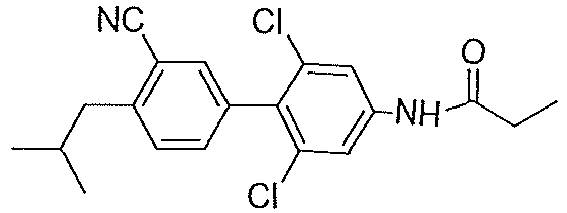
- 5-Bromo-2-methylbenzonitrile (30 g, 153 mmol), N-bromosuccinimide (28.6 g, 161 mmol), benzoyl peroxide (1.85 g, 7.6 mmol) and carbon tetrachloride (300 mL) were added in a 500 mL single-neck flask, and the mixture was heated to react at 90□ for 4 hours. After completion of the reaction according to TLC, the mixture was cooled, and filtered, and the filtrate was concentrated in vacuo to remove the solvent. The residue was separated by a silica gel column (petroleum ether: ethyl acetate = 300:1) to give a product (white solid, 30 g), with a yield of 71.4%. 1H NMR (400 MHz, CDCl3) δ 7.79 (s, 1H), 7.71 (dd, J = 8.4, 1.9 Hz, 1H), 7.43 (d, J = 8.4 Hz, 1H), 4.58 (s, 2H).
- 5-Bromo-2-(bromomethyl)benzonitrile (36 g, 131 mmol) and triethyl phosphite (33.6 mL, 261 mmol) were added to a 500 mL single-neck flask, and the mixture was heated to react at 155□ for 2 hours. After completion of the reaction, the mixture was cooled, mixed directly with silica gel, and then was separated by a silica gel column (petroleum ether:ethyl acetate = 10:1- 1:2) to give a product (yellow liquid, 28.4 g), with a yield of 77.8%. 1H NMR (400 MHz, CDCl3) δ 7.76 (s, 1H), 7.67 (dd, J = 8.3, 1.5 Hz, 1H), 7.41 (dd, J = 8.4, 2.6 Hz, 1H), 4.12 - 4.06 (m, 4H), 3.36 (s, 1H), 3.31 (s, 1H), 1.28 (t, J = 7.1 Hz, 6H).
- Diethyl (4-bromo-2-cyanobenzyl)phosphonate (8 g, 24 mmol) and anhydrous tetrahydrofuran (80 mL) were added in a 150 mL single-neck flask, and stirred for 5 minutes under an ice bath, and then NaH (1.15 g, 28.8 mmol) was added in portions, and the mixture was reacted in an ice bath for 30 munites. Acetone (2.78 g, 48 mmol) diluted in anhydrous tetrahydrofuran (5 mL) was dropped into the reaction mixture, then the ice bath was removed. The reaction was continued at room temperature overnight under nitrogen atmosphere. After completion of the reaction, water was added to quench the reaction, and the solution was extracted with ethyl acetate (3∗100 mL) and the extract was concentrated in vacuo to remove the solvent. The residue was separated by a silica gel column (petroleum ether: ethyl acetate =100:1) to give a product (white solid, 3.9 g), with a yield of 68.7%. 1H NMR (400 MHz, CDCl3) δ 7.74 (d, J = 2.0 Hz, 1H), 7.63 (dd, J = 8.4, 2.0 Hz, 1H), 7.22 (d, J = 8.4 Hz, 1H), 6.35 (s, 1H), 1.95 (d, J = 0.9 Hz, 3H), 1.79 (s, 3H).
- 5-Bromo-2-(2-methylprop-1-en-1-yl)benzonitrile (3.9 g, 16.5 mmol), bis(pinacolato)diboron (4.48 g, 19.8 mmol), Pd (dppf)Cl2 (603 mg, 0.83 mmol), potassium acetate (4.85 g, 49.5 mmol), and 1,4-dioxane (50 mL) were added to a microwave tube, then nitrogen gas was bubbled through the mixture for 5 minutes, and the mixture was reacted for 1 hour under microwave at 110 °C. After completion of the reaction, the mixture was cooled and extracted with ethyl acetate (3∗50 mL). The organic layers were combined, washed once with saturated sodium chloride, and concentrated in vacuo to remove the solvent. The residue was separated by a silica gel column (ethyl acetate: petroleum ether = 10:1) to give a product (white solid, 3.6 g), with a yield of 77.1%. 1H NMR (400 MHz, CDCl3) δ 8.06 (s, 1H), 7.91 (d, J = 7.8 Hz, 1H), 7.35 (d, J = 7.8 Hz, 1H), 6.45 (s, 1H), 1.96 (s, 3H), 1.81 (s, 3H), 1.34 (s, 12H).
- 2-(2-Methylprop-1-en-1-yl)-5-(4,4,5,5-tetramethyl-1,3,2-dioxaborolan-2-yl) benzonitrile (2 g, 7.1 mmol), 1,3-dichloro-2-iodo-5-nitrobenzene (2.69 g, 8.5 mmol), sodium carbonate (2.36 g, 21.3 mmol), PdCl2(dtbpf) (231 mg, 0.36 mmol) and
2wt% Tween 20 in H2O (30 mL) were added in a 100 mL single-neck flask, then nitrogen gas was bubbled through the mixture for 5 minutes, and the mixture was reacted for 0.5 hour under microwave at 80°C. After completion of the reaction, the mixture was extracted with ethyl acetate (5∗20 mL). The organic layers were combined, washed with saturated sodium chloride, and concentrated in vacuo to remove the solvent. The residue was separated by a silica gel column (petroleum ether: ethyl acetate = 100:1-50:1) to give a product (white solid, 2.1 g), with a yield of 85.7%. 1H NMR (400 MHz, CDCl3) δ 8.30 (s, 2H), 7.54 (d, J = 1.5 Hz, 1H), 7.52 (d, J = 8.2 Hz, 1H), 7.41 (dd, J = 8.1, 1.6 Hz, 1H), 6.50 (s, 1H), 2.02 (d, J = 0.9 Hz, 3H), 1.90 (d, J = 0.9 Hz, 3H). - 2',6'-Dichloro-4-(2-methylprop-1-en-1-yl)-4'-nitro-[1,1'-biphenyl]-3-carbonitrile (1.4 g, 4 mmol), platinum dioxide (100 mg), and methanol (10 mL) were added in a 50 mL single-neck flask, and the mixture was stirred at room temperature under hydrogen atmosphere for 30 minutes, and then additional platinum dioxide (50 mg) was added. The reaction was monitored by LC-MS, and was stopped immediately when it was completed. The mixture was filtered through Celite, and the filtrate was concentrated in vacuo. The residue was separated by a silica gel column (petroleum ether: ethyl acetate =20:1-10:1) to give a product (white solid, 850 mg), with a yield of 56.7%. 1H NMR (400 MHz, CDCl3) δ 7.50 (d, J = 1.6 Hz, 1H), 7.38 (dd, J = 8.0, 1.8 Hz, 1H), 7.32 (d, J = 8.0 Hz, 1H), 6.74 (s, 2H), 2.76 (d, J = 7.3 Hz, 2H), 2.10 - 2.00 (m, 1H), 0.99 (d, J = 6.6 Hz, 6H).
- 4'-Amino-2',6'-dichloro-4-isobutyl-[1,1'-biphenyl]-3-carbonitrile (40 mg, 0.13 mmol), propanoic acid (19 mg, 0.26 mmol), HATU (99 mg, 0.26 mmol), N,N-diisopropylethylamine (50 mg, 0.39 mmol) and dichloromethane (2 mL) were added in a 25 mL single-neck flask, and the mixture was reacted at room temperature overnight. After the materials had all reacted when being determined by TLC, dichloromethane (20 mL) was added, and the mixture was washed with saturated ammonium chloride (30 mL), and then the organic layer was concentrated in vacuo to remove the solvent. The resulting crude product was separated by preparative thin layer chromatography (petroleum ether: ethyl acetate = 10:1) to give the product (white solid, 43 mg), with a yield of 67.6%. 1H NMR (400 MHz, CDCl3) δ 7.90 (s, 1H), 7.69 (s, 2H), 7.48 (s, 1H), 7.35 (q, J = 8.0 Hz, 2H), 2.75 (d, J = 7.3 Hz, 2H), 2.42 (q, J = 7.5 Hz, 2H), 1.85 (m, 1H), 1.24 (t, J = 7.3, 3H), 0.97 (d, J = 6.6 Hz, 6H). MS (ESI) m/z: 375.0 (M+1).
-

- The method is the same as in Example 1.
4'-Amino-2',6'-dichloro-4-isobutyl-[1,1'-biphenyl]-3-carbonitrile (40 mg, 0.13 mmol), cyclohexanecarboxylic acid (19 mg, 0.15 mmol), HATU (57 mg, 0.15 mmol), N,N-diisopropylethylamine (50 mg, 0.39 mmol) and dichloromethane (2 mL) were reacted at room temperature overnight to give a product (white solid, 50 mg), with a yield of 94.3%.1H NMR (400 MHz, CDCl3) δ 8.01 (s, 1H), 7.71 (s, 2H), 7.49 (s, 1H), 7.40 - 7.33 (m, 2H), 2.77 (d, J = 7.3 Hz, 2H), 2.34 - 2.24 (m, 1H), 1.94 (d, J = 13.0 Hz, 2H), 1.85 (d, J = 11.9 Hz, 2H), 1.80 - 1.67 (m, 3H), 1.62 - 1.49 (m, 2H), 1.36 - 1.29 (m, 2H), 0.99 (d, J = 6.6 Hz, 6H). MS (ESI) m/z: 426.9(M-1). -

- The method is the same as in Example 1.
4'-Amino-2',6'-dichloro-4-isobutyl-[1,1'-biphenyl]-3-carbonitrile (50 mg, 0.16 mmol), benzoic acid (23 mg, 0.19 mmol), HATU (72 mg, 0.19 mmol), N,N-diisopropylethylamine (62 mg, 0.48 mmol) and dichloromethane (2 mL) were reacted at room temperature overnight to give a product (white solid, 10 mg), with a yield of 14.7%. 1H NMR (400 MHz, CDCl3) δ 7.81 (s, 1H), 7.67 (d, J = 7.4 Hz, 2H), 7.64 - 7.58 (m, 2H), 7.39 (t, J = 7.2 Hz, 1H), 7.30 (d, J = 10.0 Hz, 3H), 7.18 (dd, J = 17.7, 7.9 Hz, 2H), 2.57 (d, J = 7.3 Hz, 2H), 1.85 (m, 1H), 0.79 (d, J = 6.5 Hz, 6H). MS (ESI) m/z: 422.9 (M+1). -

- The method is the same as in Example 1.
4'-Amino-2',6'-dichloro-4-isobutyl-[1,1'-biphenyl]-3-carbonitrile (50 mg, 0.16 mmol), 3-methylbutanoic acid (27 mg, 0.26 mmol), HATU (99 mg, 0.26 mmol), N,N-diisopropylethylamine (50 mg, 0.39 mmol) and dichloromethane (2 mL) were reacted at room temperature overnight to give a product (white solid, 35mg), with a yield of 67.3%. 1H NMR (400 MHz, CDCl3) δ 7.68 (s, 2H), 7.48 (d, J = 10.3 Hz, 2H), 7.35 (q, J = 8.1 Hz, 2H), 2.76 (d, J = 7.3 Hz, 2H), 2.29 - 2.16 (m, 3H), 1.52 - 1.39 (m, 1H), 1.02 (d, J = 6.1 Hz, 6H), 0.98 (d, J = 6.6 Hz, 6H). MS (ESI) m/z: 403.0 (M+1). -

- The method is the same as in Example 1.
4'-Amino-2',6'-dichloro-4-isobutyl-[1,1'-biphenyl]-3-carbonitrile (40 mg, 0.13 mmol), 2-cyclohexylacetic acid (21 mg, 0.16 mmol), HATU (60 mg, 0.16 mmol), N,N-diisopropylethylamine (50 mg, 0.39 mmol) and dichloromethane (2 mL) were reacted at room temperature overnight to give a product (white solid, 10 mg), with a yield of 22.2%. 1H NMR (400 MHz, CDCl3) δ 7.69 (s, 2H), 7.63 (s, 1H), 7.50 (s, 1H), 7.42 - 7.32 (m, 2H), 2.77 (d, J = 7.3 Hz, 2H), 2.26 (d, J = 7.0 Hz, 2H), 2.12 - 2.02 (m, 1H), 1.95 - 1.84 (m, 1H), 1.80 (d, J = 12.7 Hz, 2H), 1.72 (d, J = 15.0 Hz, 3H), 1.36 - 1.24 (m, 3H), 1.21 - 1.14 (m, 1H), 1.04 (d, J = 11.9 Hz, 1H), 0.99 (d, J = 6.5 Hz, 6H). MS (ESI) m/z: 443.0(M+1). -

- The method is the same as in Example 1.
4'-Amino-2',6'-dichloro-4-isobutyl-[1,1'-biphenyl]-3-carbonitrile (40 mg, 0.13 mmol), 2-(tetrahydro-2H-pyran-4-yl)acetic acid (37 mg, 0.26 mmol), HATU (99 mg, 0.26 mmol), N,N-diisopropylethylamine (50 mg, 0.39 mmol) and dichloromethane (2 mL) were reacted at room temperature overnight to give a product (white solid, 20 mg), with a yield of 33.9%. 1H NMR (400 MHz, CDCl3) δ 9.10 (s, 1H), 7.77 (s, 2H), 7.50 (s, 1H), 7.42 - 7.33 (m, 2H), 3.97 (dd, J = 11.2, 3.6 Hz, 2H), 3.43 (t, J = 11.7 Hz, 2H), 2.77 (d, J = 7.2 Hz, 2H), 2.35 (d, J = 7.1 Hz, 2H), 2.17 (dd, J = 9.2, 5.5 Hz, 1H), 2.12 - 1.99 (m, 1H), 1.71 (d, J = 12.5 Hz, 2H), 1.45 - 1.34 (m, 2H), 1.00 (d, J= 6.6 Hz, 6H). MS (ESI) m/z: 444.9 (M+1). -

- The method is the same as in Example 1.
4'-Amino-2',6'-dichloro-4-isobutyl-[1,1'-biphenyl]-3-carbonitrile (50 mg, 0.16 mmol), 2-phenylacetic acid (26 mg, 0.19 mmol), HATU (72 mg, 0.19 mmol), N,N-diisopropylethylamine (62 mg, 0.48 mmol) and dichloromethane (2 mL) were reacted at room temperature for 2 hours to give a product (white solid, 40 mg), with a yield of 58.8%. 1H NMR (400 MHz, CDCl3) δ 8.06 (s, 1H), 7.50 (s, 2H), 7.35 (s, 1H), 7.26 - 7.24 (m, 1H), 7.22 - 7.20 (m, 3H), 7.19 - 7.15 (m, 4H), 3.60 (s, 2H), 2.66 (d, J = 7.3 Hz, 2H), 2.01 - 1.85 (m, 1H), 0.88 (d, J = 6.6 Hz, 6H). MS (ESI) m/z: 437.2 (M+1). -

- 2-(6-Chloropyridin-3-yl)acetic acid (220 mg, 1.3 mmol), H2O (0.6 mL) and acetic acid (2.2 mL) were added in a microwave tube, and the mixture was reacted under microwave at 160□ for 1 hour. After completion of the reaction, solvent was removed in vacuo to afford a product as white solid, which was used for the next step directly. MS (ESI) m/z: 229.0 (M+1).
- The method is the same as in Example 1.
4'-Amino-2',6'-dichloro-4-isobutyl-[1,1'-biphenyl]-3-carbonitrile (50 mg, 0.16 mmol), 2-(6-oxo-1,6-dihydropyridin-3-yl)acetic acid (41 mg, 0.19 mmol), HATU (72 mg, 0.19 mmol), N,N-diisopropylethylamine (62 mg, 0.48 mmol) and dichloromethane (3 mL) were reacted at room temperature for 3 hours to give a product (white solid, 32 mg), with a yield of 42.2%. 1H NMR (400 MHz, CDCl3) δ 9.49 (s, 1H), 7.65 (s, 2H), 7.49 (d, J = 8.3 Hz, 1H), 7.41 (s, 2H), 7.33 - 7.28 (m, 2H), 7.25 (s, 1H), 6.51 (d, J = 8.0 Hz, 1H), 3.49 (s, 2H), 2.73 (d, J = 6.6 Hz, 2H), 2.04 - 1.94 (m, 1H), 0.95 (d, J = 6.5 Hz, 6H). MS (ESI) m/z: 453.9 (M+1). -

- 5-Nitropyridin-2-ol (2 g, 14.3 mmol) and hydrazine hydrate (5 mL) were added in a 25 mL single-neck flask, and the mixture was heated to react at 100□ for 3 hours. After completion of the reaction, solvent was removed in vacuo to afford a product (red oil, 2 g), which was used for the next step directly.
- 2-(1H-Pyrazol-3-yl)acetohydrazide (2 g, 14.2 mmol) and concentrated hydrochloric acid (50 mL) were added in a 25 mL single-neck flask, and the mixture was heated to react at 100□ for 3 hours. After completion of the reaction, insoluble solids were removed by filtration and the filtrate was concentrated in vacuo to obtain a product as yellow solid, which was used for the next step directly.
- 2-(1H-Pyrazol-3-yl)acetic acid (200 mg, 1.59 mmol), anhydrous ethyl alcohol (20 mL) and concentrated sulfuric acid (0.5 mL) were added in a 25 mL single-neck flask, and the mixture was heated to react at 80□ overnight. After completion of the reaction, the solution was cooled to room temperature, neutralized with saturated sodium bicarbonate, extracted with ethyl acetate (3∗20 mL), and purified by a silica gel column to afford a product (orange oil, 180 mg), with a yield of 73.7%. 1H NMR (400 MHz, CDCl3) δ 7.54 (s, 1H), 6.25 (s, 1H), 4.18 (q, J = 7.1 Hz, 2H), 3.74 (s, 2H), 1.26 (t, J = 7.1 Hz, 3H). MS (ESI) m/z: 155.1 (M+1).
- Ethyl 2-(1H-pyrazol-3-yl)acetate (180 mg, 1.17 mmol), caesium carbonate (762 mg, 2.34 mmol) and N,N-dimethylformamide (2 mL) were added in a 25 mL single-neck flask. After cooling in an ice bath, methyl iodide (332 mg, 2.34 mmol) was added dropwise, and the reaction was continued for 2 hours in an ice bath. After completion of the reaction monitored by TLC, water (20 mL) was added. Then mixture was extracted with ethyl acetate (3∗10 mL), and the organic layers were combined and dried over anhydrous sodium sulfate. Solvent was removed in vacuo to afford a mixture of ethyl 2-(1-methyl-1H-pyrazol-3-yl)acetate and ethyl 2-(1-methyl-1H-pyrazol-5-yl)acetate (yellow oil, 136 mg).
- The mixture of ethyl 2-(1-methyl-1H-pyrazol-3-yl)acetate and ethyl 2-(1-methyl-1H-pyrazol-5-yl)acetate (136 mg, 0.81 mmol), lithium hydroxide monohydrate (102 mg, 2.43 mmol) and ethanol/H2O (2 mL/0.5 mL) were added in a 25 mL single-neck flask, and the mixture was reacted at room temperature for 0.5 hour. After completion of the reaction, ethanol was removed under reduced pressure, then water (2 mL) was added. The mixture was adjusted to pH 3 with 1N hydrochloric acid and extracted with ethyl acetate (3∗10 mL). The organic layers were combined, dried over anhydrous sodium sulfate, and concentrated in vacuo to remove the solvent to give a product (yellow oil, 100 mg).
- 4'-Amino-2',6'-dichloro-4-isobutyl-[1,1'-biphenyl]-3-carbonitrile (40 mg, 0.13 mmol), the mixture of 2-(1-methyl-1H-pyrazol-5-yl)acetic acid and 2-(1-methyl-1H-pyrazol-3-yl)acetic acid (44 mg, 0.32 mmol), HATU (118 mg, 0.38 mmol), N,N-diisopropylethylamine (50 mg, 0.39 mmol) and dichloromethane (2 mL) were added in a 25 mL single-neck flask, and the mixture was reacted at room temperature for 4 hours. The resulting crude product was separated by preparative thin layer chromatography (petroleum ether: ethyl acetate = 1:1) to give N-(2,6-dichloro-3'-cyano-4'-isobutyl-[1,1'-biphenyl]-4-yl)-2-(1-methyl-1H-pyrazol-3-yl)acetami de (white aolid, 26 mg), 1H NMR (400 MHz, CDCl3) δ 9.23 (s, 1H), 7.66 (s, 2H), 7.47 (s, 1H), 7.33 (t, J = 7.4 Hz, 4H), 6.19 (s, 1H), 3.93 (s, 3H), 3.75 (s, 2H), 2.75 (d, J = 7.3 Hz, 2H), 2.02 - 1.97 (m, 1H), 0.97 (d, J = 6.6 Hz, 6H). MS (ESI) m/z: 441.0 (M+1) and N-(2,6-dichloro-3'-cyano-4'-isobutyl-[1,1'-biphenyl]-4-yl)-2-(1-methyl-1H-pyrazol-5-yl)acetami de (white aolid, 27 mg), 1H NMR (400 MHz, CDCl3) δ 8.26 (s, 1H), 7.63 (s, 2H), 7.47 (d, J = 3.3 Hz, 2H), 7.34 (s, 2H), 6.26 (s, 1H), 3.87 (s, 3H), 3.80 (s, 2H), 2.75 (d, J = 7.3 Hz, 2H), 1.97 - 1.88 (m, 1H), 0.97 (d, J = 6.6 Hz, 6H). MS (ESI) m/z: 440.9 (M+1).
-

- 4'-Amino-2',6'-dichloro-4-isobutyl-[1,1'-biphenyl]-3-carbonitrile (30 mg, 0.09 mmol), 2-(4-cyanophenyl)acetic acid (18 mg, 0.11 mmol), HATU (43 mg, 0.11 mmol), N,N-diisopropylethylamine (47 µL, 0.28 mmol) and dichloromethane (5 mL) were added in a single-neck flask, and the mixture was reacted at room temperature overnight. After the materials had all reacted when being determined by TLC, dichloromethane (20 mL) was added, and the mixture was washed with saturated ammonium chloride (30 mL), and the organic layer was concentrated in vacuo to remove the solvent. The resulting crude product was separated by a silica gel column (petroleum ether: ethyl acetate =2:1) to give a product (white solid, 20 mg), with a yield of 48.1%. 1H NMR (400 MHz, CDCl3) δ 7.93 (s, 1H), 7.69 - 7.57 (m, 5H), 7.47 (s, 1H), 7.42 - 7.37 (m, 2H), 7.35 (s, 1H), 3.79 (s, 2H), 2.76 (d, J = 7.2 Hz, 2H), 2.04 (q, J = 13.6, 6.6 Hz, 1H), 0.98 (d, J = 6.6 Hz, 6H).MS (ESI) m/z: 462.1(MH+)
-

- The method is the same as in Example 1.
4'-Amino-2',6'-dichloro-4-isobutyl-[1,1'-biphenyl]-3-carbonitrile (50 mg, 0.16 mmol), 2-(2-cyanophenyl)acetic acid (30 mg, 0.19 mmol), HATU (72 mg, 0.19 mmol), N,N-diisopropylethylamine (62 mg, 0.48 mmol) and dichloromethane (2 mL) were reacted at room temperature overnight, and the crude product was separated by a silica gel column (petroleum ether: ethyl acetate =1:1) to give a product (white solid, 60 mg), with a yield of 83.3%. 1H NMR (400 MHz, CDCl3) δ 7.86 (d, J = 54.7 Hz, 1H), 7.71 (d, J = 7.7 Hz, 1H), 7.68 (s, 2H), 7.64 (d, J = 7.4 Hz, 1H), 7.60 (d, J = 7.7 Hz, 1H), 7.51 - 7.41 (m, 2H), 7.35 (s, 2H), 3.96 (s, 2H), 2.77 (d, J = 7.3 Hz, 2H), 2.11 - 1.99 (m, 1H), 0.99 (d, J = 6.5 Hz, 6H). MS (ESI) m/z: 462.0 (M+1). -

- The method is the same as in Example 1.
4'-Amino-2',6'-dichloro-4-isobutyl-[1,1'-biphenyl]-3-carbonitrile (50 mg, 0.16 mmol), 2-(3-cyanophenyl)acetic acid (30 mg, 0.19 mmol), HATU (72 mg, 0.19 mmol), N,N-diisopropylethylamine (62 mg, 0.48 mmol) and dichloromethane (2 mL) were reacted at room temperature overnight, and the crude product was separated by a silica gel column (petroleum ether: ethyl acetate =1:1) to give a product (white solid, 64 mg), with a yield of 88.9%. 1H NMR (400 MHz, CDCl3) δ 7.69 - 7.60 (m, 5H), 7.52 (t, J = 7.0 Hz, 2H), 7.49 (s, 1H), 7.36 (s, 2H), 3.78 (s, 2H), 2.77 (d, J = 7.1 Hz, 2H), 2.10 - 2.01 (m, 1H), 0.99 (d, J = 6.4 Hz, 6H). MS (ESI) m/z: 462.0 (M+1). -

- The method is the same as in Example 1.
4'-Amino-2',6'-dichloro-4-isobutyl-[1,1'-biphenyl]-3-carbonitrile (50 mg, 0.16 mmol), 2-(pyridin-2-yl)acetic acid (33 mg, 0.19 mmol), HATU (72 mg, 0.19 mmol), N,N-diisopropylethylamine (62 mg, 0.48 mmol), dichloromethane (2 mL) were reacted at room temperature for 3 hours, and the crude product was separated by a silica gel column (petroleum ether: ethyl acetate =2:1-1:1) to give a product (white solid, 17 mg), with a yield of 25%. 1H NMR (400 MHz, CDCl3) δ 10.51 (s, 1H), 8.64 (d, J = 4.7 Hz, 1H), 7.76 (d, J = 7.7 Hz, 1H), 7.72 (s, 2H), 7.50 (s, 1H), 7.42 - 7.27 (m, 4H), 3.90 (s, 2H), 2.77 (d, J = 7.3 Hz, 2H), 2.11 - 2.01 (m, 1H), 0.99 (d, J = 6.6 Hz, 6H). MS (ESI) m/z: 438.0 (M+1). -

- The method is the same as in Example 1.
4'-Amino-2',6'-dichloro-4-isobutyl-[1,1'-biphenyl]-3-carbonitrile (50 mg, 0.16 mmol), 2-(pyridin-3-yl)acetic acid (33 mg, 0.19 mmol), HATU (72 mg, 0.19 mmol), N,N-diisopropylethylamine (62 mg, 0.48 mmol) and dichloromethane (2 mL) were reacted at room temperature for 3 hours, and the crude product was separated by a silica gel column (petroleum ether: ethyl acetate =2:1-1:1) to give a product (white solid, 44 mg), with a yield of 64.7%. 1H NMR (400 MHz, CDCl3) δ 9.16 (s, 1H), 8.51 (d, J = 17.2 Hz, 2H), 7.82 (d, J = 7.5 Hz, 1H), 7.70 (s, 2H), 7.47 (s, 1H), 7.41 - 7.31 (m, 3H), 3.73 (s, 2H), 2.76 (d, J = 7.1 Hz, 2H), 2.11-1.96 (m, 1H), 0.98 (d, J = 6.3 Hz, 6H). MS (ESI) m/z: 438.0 (M+1). -

- The method is the same as in Example 1.
4'-Amino-2',6'-dichloro-4-isobutyl-[1,1'-biphenyl]-3-carbonitrile (50 mg, 0.16 mmol), 2-(pyridin-4-yl)acetic acid (33 mg, 0.19 mmol), HATU (72 mg, 0.19 mmol), N,N-diisopropylethylamine (62 mg, 0.48 mmol) and dichloromethane (2 mL) were reacted at room temperature for 3 hours, and the crude product was separated by a silica gel column (petroleum ether: ethyl acetate =1:1-1:2) to give a product (white solid, 35 mg), with a yield of 51.5%. 1H NMR (400 MHz, CDCl3) δ 8.99 (s, 1H), 8.58 (d, J = 5.0 Hz, 2H), 7.71 (s, 2H), 7.50 (s, 1H), 7.38 (s, 2H), 7.33 (d, J = 5.0 Hz, 2H), 3.77 (s, 2H), 2.79 (d, J = 7.3 Hz, 2H), 2.12 - 1.99 (m, 1H), 1.01 (d, J = 6.6 Hz, 6H). MS (ESI) m/z: 438.0 (M+1). -

- 2-(4-Bromophenyl)acetic acid (8.22 g, 38.2 mmol), Xantphos (1.17 g, 2.0 mmol), N,N-diisopropylethylamine (13.4 mL, 76.4 mmol) in 1,4-dioxane (100 mL) were adde to a 250 mL single-neck flask in sequence, and then Pd2(dba)3 (887 mg, 0.96 mmol) and ethyl mercaptan (3.45 mL, 45.9 mmol) were added under nitrogen atomosphere. The mixture was heated and reacted at reflux overnight. After the materials had all reacted when being determined by TLC, solvent was removed in vacuo, and the resulting crude product was separated by a silica gel column (petroleum ether: ethyl acetate = 1:1) to give a product (yellow solid, 5.95g), with a yield of 80.0%. MS (ESI) m/z: 195.1(M-1).
- 2-(4-(Ethylthio)phenyl)acetic acid (5.99 g, 30.5 mmol), anhydrous ethanol (100 mL), and concentrated sulfuric acid (2 mL) were added in a 250 mL single-neck flask. The mixture was heated in an oil bath to react at 90□ for 2 hours. After the materials had all reacted when being determined by TLC, solvent was removed in vacuo, and ethyl acetate (30 mL) was added. The mixture was washed with saturated sodium carbonate (50 mL) and dried over anhydrous sodium sulfate. The filtrate was concentrated in vacuo to remove the solvent to givea product (yellow oil, 6.8 g), with a yield of 99.5%.
- Ethyl 2-(4-(ethylthio)phenyl)acetate (6.8 g, 30.4 mmol) and dichloromethane (100 mL) were added in a 250 mL single-neck flask, m-chloroperoxybenzoic acid (5.23 g, 30.4 mmol) was added slowly under an ice bath. The reaction solution was gradually warmed to room temperature, and stirred overnight. After the materials had all reacted when being determined by TLC, the reaction mixture was washed with saturated sodium carbonate (50 mL), extracted repeatedly with dichloromethane (20 mL), and the extract was dried over anhydrous sodium sulfate. The organic layers were concentrated in vacuo to remove the solvent to obtain a crude product. The crude product was separated by a silica gel column to give a product (yellow solid, 5.3 g), with a yield of 68.2%. MS (ESI) m/z: 257.1(M+1).
- Ethyl 2-(4-(ethylsulfonyl)phenyl)acetate (5.3 g, 20.7 mmol), ethanol (20 mL) and H2O (20 mL) were added in a 100 mL single-neck flask, and then sodium hydroxide (200 mg, 5.0 mmol) was added slowly, and the mixture was stirred for 4 hours. After the materials had all reacted when being determined by TLC, the organic solvent was removed in vacuo, then the solution was adjusted to pH 2∼3 using diluted hydrochloric acid. White solids were precipitated, filtered and dried in vacuo overnight to givea product (white solid, 4.5 g), with a yield of 95.6%. 1H NMR (400 MHz, DMSO) δ 12.56 (s, 1H), 7.88 (d, J = 8.3 Hz, 2H), 7.61 (d, J = 8.3 Hz, 2H), 3.80 (s, 2H), 3.34 (dd, J = 7.4 Hz, 2H), 1.15 (t, J = 7.4 Hz, 2H).
- 4'-Amino-2',6'-dichloro-4-isobutyl-[1,1'-biphenyl]-3-carbonitrile (100 mg, 0.31 mmol), 2-(4-(ethylsulfonyl)phenyl)acetic acid (79 mg, 0.34 mmol), HATU (141 mg, 0.37 mmol), N,N-diisopropylethylamine (120 mg, 0.93 mmol) and dichloromethane (5 mL) were reacted at room temperature overnight. After the materials had all reacted when being determined by TLC, dichloromethane (20 mL) was added, and the mixture was washed with saturated ammonium chloride (30 mL). The organic layer was concentrated in vacuo to obtain a crude product, and the crude product was separated by a silica gel column (petroleum ether: ethyl acetate =2:1-1:1) to give a product (white solid, 40 mg), with a yield of 24.5%. 1H NMR (400 MHz, CD3OD) δ 7.87 (d, J = 8.1 Hz, 2H), 7.77 (s, 2H), 7.61 (d, J = 8.1 Hz, 2H), 7.53 (s, 1H), 7.44 (q, J = 8.1 Hz, 2H), 3.84 (s, 2H), 3.18 (q, J = 7.4 Hz, 2H), 2.75 (d, J = 7.3 Hz, 2H), 2.02 - 1.95 (m, 1H), 1.20 (t, J = 7.4 Hz, 3H), 0.97 (d, J = 6.6 Hz, 6H). MS (ESI) m/z: 529.0(M+1).
-

- 4'-Amino-2',6'-dichloro-4-isobutyl-[1,1'-biphenyl]-3-carbonitrile (30 mg, 0.09 mmol), 2-(4-(methylsulfonyl)phenyl)acetic acid (40 mg, 0.19 mmol), HATU (72 mg, 0.19 mmol), N,N-diisopropylethylamine (47 µL, 0.28 mmol) and dichloromethane (5 mL) were added in a 25 mL single-neck flask, and the mixture was reacted at room temperature overnight. After the materials had all reacted when being determined by TLC, dichloromethane (20 mL) was added, and the mixture was washed with saturated ammonium chloride (30 mL). The organic layer was concentrated in vacuo to obtain a crude product, and the crude product was separated by a silica gel column (petroleum ether: ethyl acetate =1:1) to give the product (white solid, 25 mg), with a yield of 45.6%.1H NMR (400 MHz, CDCl3) δ 7.92 (d, J = 8.2 Hz, 2H), 7.88 (s, 1H), 7.67 (s, 2H), 7.54 (d, J = 8.1 Hz, 2H), 7.49 (d, 1H), 2.76 (d, J = 7.3 Hz, 2H), 2.10 - 1.99 (m, 1H), 0.99 (d, J = 6.6 Hz, 6H). MS (ESI) m/z: 515.1 (MH+).
-

- The method is the same as in example 1.
4'-Amino-2',6'-dichloro-4-isobutyl-[1,1'-biphenyl]-3-carbonitrile (50 mg, 0.16 mmol), 2-(3-(methylsulfonyl)phenyl)acetic acid (41 mg, 0.19 mmol), HATU (72 mg, 0.19 mmol), N,N-diisopropylethylamine (62 mg, 0.48 mmol) and dichloromethane (3 mL) were reacted at room temperature for 3 hours. The crude product was separated by a silica gel column (petroleum ether: ethyl acetate =1:1-1:2) to give a product (white solid, 82 mg), with a yield of 99.0%. 1H NMR (400 MHz, CDCl3) δ 8.92 (s, 1H), 7.96 (s, 1H), 7.87 (d, J = 7.8 Hz, 1H), 7.75 - 7.65 (m, 3H), 7.56 (t, J = 7.7 Hz, 1H), 7.47 (s, 1H), 7.35 (s, 2H), 3.82 (s, 2H), 3.11 (s, 3H), 2.76 (d, J = 7.2 Hz, 2H), 2.15 - 1.97 (m, 1H), 0.99 (d, J = 6.5 Hz, 6H). MS (ESI) m/z: 512.8 (M-1). -
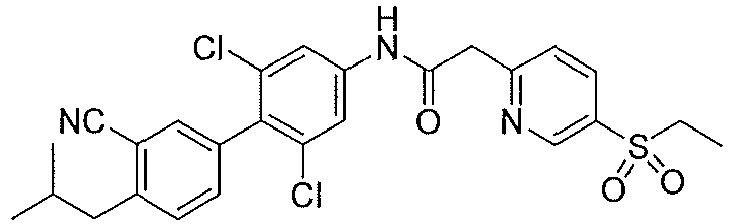
- 2-(5-bromopyridin-2-yl)-N-(2,6-dichloro-3'-cyano-4'-isobutyl-[1,1'-biphenyl]-4-yl)acetamide 4'-Amino-2',6'-dichloro-4-isobutyl-[1,1'-biphenyl]-3-carbonitrile (100 mg, 0.31 mmol), 2-(5-bromopyridin-2-yl)acetic acid (80 mg, 0.37 mmol), HATU (141 mg, 0.37 mmol), N,N-diisopropylethylamine (120 mg, 0.93 mmol) and dichloromethane (5 mL) were added in a 25 mL single-neck flask, and the mixture was reacted at room temperature for 3 hours. Then dichloromethane (10 mL) was added, and the mixture was washed with saturated ammonium chloride, and then with saturated sodium chloride solution. The organic layer was dried over anhydrous sodium sulfate and concentrated in vacuo to remove the solvent to obtain a crude product (200 mg), which was used for the next step directly.
- 2-(5-Bromopyridin-2-yl)-N-(2,6-dichloro-3'-cyano-4'-isobutyl-[1,1'-biphenyl]-4-yl)acetamide (200 mg, 0.39 mmol), N,N-diisopropylethylamine (101 mg, 0.78 mmol), Xantphos (11 mg, 0.02 mmol), Pd2(dba)3 (16 mg, 0.02 mmol), ethyl mercaptan (36 mg) and 1,4-dioxane (5 mL) were added in a microwave tube, and the mixture was reacted for 2 hours under microwave at 120 °C. The mixture was separated by a silica gel column (petroleum ether: ethyl acetate = 5:1) to give a product (yellow oil, 150 mg), with a total yield of 96.1% for these two steps. 1H NMR (400 MHz, CDCl3) δ 10.47 (s, 1H), 8.72 (s, 1H), 7.91 - 7.85 (m, 3H), 7.66 (s, 1H), 7.53 (q, J = 8.0 Hz, 2H), 7.46 (d, J = 7.9 Hz, 1H), 7.42 (d, J = 1.0 Hz, 1H), 4.07 (s, 2H), 3.17 (q, J = 7.4 Hz, 2H), 2.93 (d, J = 7.2 Hz, 2H), 2.26 - 2.22 (m, 1H), 1.52 (t, J = 7.4 Hz, 3H), 1.16 (d, J = 6.5 Hz, 6H). MS (ESI) m/z: 498.0 (M+1).
- N-(2,6-Dichloro-3'-cyano-4'-isobutyl-[1,1'-biphenyl]-4-yl)-2-(5-(ethylthio)pyridin-2-yl)acetami de (50 mg, 0.1 mmol) amd dichloromethane (2 mL) were added in a 25 mL single-neck flask, then mCPBA (35 mg, 0.2 mmol) was added under an ice bath. The reaction was continued for 2 hours at room temperature under nitrogen atmosphere. After completion of the reaction, the mixture was washed with 2N sodium carbonate solution, and then with saturated sodium chloride solution. Solvent was removed in vacuo, and the residue was separated by preparative thin layer chromatography (petroleum ether: ethyl acetate = 1:2) to give a product (white solid, 20 mg), with a yield of 37.8%. 1H NMR (400 MHz, CDCl3) δ 9.60 (s, 1H), 9.03 (s, 1H), 8.15 (d, J = 8.1 Hz, 1H), 7.63 (s, 2H), 7.53 (d, J = 8.1 Hz, 1H), 7.42 (s, 1H), 7.33 - 7.24 (m, 2H), 3.96 (s, 2H), 3.13 (q, J = 7.4 Hz, 2H), 2.70 (d, J = 7.2 Hz, 2H), 1.97 - 1.91 (m, 1H), 1.31 - 1.26 (m, 3H), 0.92 (d, J = 6.5 Hz, 7H). MS (ESI) m/z: 530.0(M+1).
-

- (300 mg, 0.6 mmol), N,N-diisopropylethylamine (156 mg, 1.2 mmol), Xantphos (18 mg, 0.03 mmol), Pd2(dba)3 (24 mg, 0.03 mmol), methyl mercaptan propylene glycol solution (10%, 0.5 mL) and 1,4-dioxane (5 mL) were added in a microwave tube, and the mixture was reacted for 2 hours under microwave at 100 °C. The mixture was separated by a silica gel column (petroleum ether: ethyl acetate = 2:1-1:2) to give a product (yellow oil, 220 mg), with a yield of 75.9%. 1H NMR (400 MHz, CDCl3) δ 10.20 (s, 1H), 8.50 (d, J = 2.1 Hz, 1H), 7.69 (s, 2H), 7.60 (dd, J = 8.2, 2.4 Hz, 1H), 7.49 (d, J = 1.3 Hz, 1H), 7.38 - 7.31 (m, 2H), 7.23 (d, J = 8.2 Hz, 1H), 3.84 (s, 2H), 2.75 (d, J = 7.3 Hz, 2H), 2.53 (s, 3H), 2.03 - 1.98 (m, 1H), 0.98 (d, J = 6.6 Hz, 6H). MS (ESI) m/z: 484.0 (M+1).
- N-(2,6-Dichloro-3'-cyano-4'-isobutyl-[1,1'-biphenyl]-4-yl)-2-(5-(ethylthio)pyridin-2-yl)acetami de (48 mg, 0.1 mmol) amd dichloromethane (2 mL) were added in a 25 mL single-neck flask, then mCPBA (35 mg, 0.2 mmol) was added under an ice bath. The mixture was reacted for 2 hours at room temperature under nitrogen atmosphere. After completion of the reaction, the mixture was washed with 2N sodium carbonate solution, and then with saturated sodium chloride solution. Solvent was removed in vacuo, and the residue was separated by preparative thin layer chromatography (petroleum ether: ethyl acetate = 1:1) to give a product (white solid, 18 mg), with a yield of 34.6%. 1H NMR (400 MHz, CDCl3) δ 9.60 (s, 1H), 9.15 (d, J = 2.1 Hz, 1H), 8.26 (dd, J = 8.2, 2.3 Hz, 1H), 7.69 (s, 2H), 7.59 (d, J = 8.2 Hz, 1H), 7.48 (s, 1H), 7.39 - 7.30 (m, 2H), 4.02 (s, 2H), 3.14 (s, 3H), 2.75 (d, J = 7.3 Hz, 2H), 2.03 - 1.97 (m, 1H), 0.97 (d, J = 6.6 Hz, 6H). MS (ESI) m/z: 515.8(M+1).
-
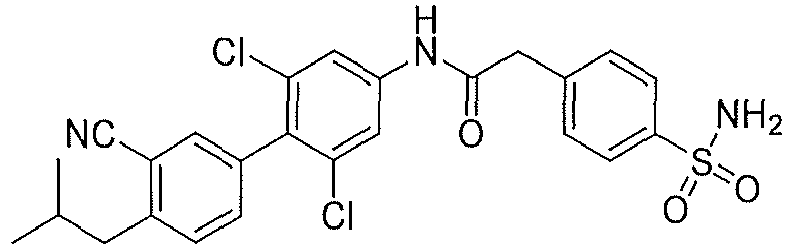
- 2-(4-Bromophenyl)acetic acid (1 g, 4.65 mmol), N,N-diisopropylethylamine (960 mg, 7.44 mmol), Xantphos (135 mg, 0.23 mmol), Pd2(dba)3 (95 mg, 0.12 mmol), phenylmethanethiol (577 mg, 4.65 mmol) and 1,4-dioxane (50 mL) were added in a 100 mL single-neck flask, and the mixture was heated to react at 100□ for 6 hours. After completion of the reaction, solvent was removed directly in vacuo, and the residue was mixed with silica gel and separated by a silica gel column (dichloromethane: methanol = 20:1) to give a product (yellow solid, 1.5 g), with a yield of 62.5%. 1H NMR (400 MHz, DMSO-d 6) δ 12.30 (s, 1H), 7.32 (d, J = 7.6 Hz, 2H), 7.29 - 7.21 (m, 4H), 7.20 (d, J = 7.2 Hz, 1H), 7.14 (d, J = 8.1 Hz, 2H), 4.18 (s, 2H), 3.48 (s, 2H).
- 2-(4-(Benzylthio)phenyl)acetic acid (1 g, 3.87 mmol), methanol (10 mL) and sulfuryl chloride (0.5 mL) were added in a 25 mL single-neck flask, and the mixture was heated to react at 60□ for 3 hours. After completion of the reaction, solvent was removed in vacuo, and water (20 mL) was added, then the mixture was extracted with ethyl acetate (3∗10 mL). The combined organic layers were dried over anhydrous sodium sulfate, and concentrated in vacuo to remove the solvent to obtain a product (yellow solid, 1g), with a yield 95.2%. MS (ESI) m/z: 273.0(M+1).
- Methyl 2-(4-(benzylthio)phenyl)acetate (544 mg, 2 mmol), tetrahydrofuran (5 mL), acetic acid (0.58 mL) and H2O (0.14 mmol) were added in a 25 mL single-neck flask. The mixture was stirred under an ice bath for 5 minutes, then thionyl chloride (0.64 mmol) was added dropwise slowly. After completion of addition, the mixture was kept in an ice bath for 5 minutes and then reacted at room temperature for 2 hours. After completion of the reaction, the mixture was extracted with ethyl acetate (3∗20 mL), and separated by a silica gel column (petroleum ether: ethyl acetate =20:1) to give a product (orange oil, 330 mg). 1H NMR (400 MHz, CDCl3) δ 8.00 (d, J = 8.5 Hz, 2H), 7.54 (d, J = 8.4 Hz, 2H), 3.75 (s, 2H), 3.73 (s, 3H).
- Methyl 2-(4-(chlorosulfonyl)phenyl)acetate (330 mg, 1.33 mmol), tetrahydrofuran (5 mL) and triethylamine (267 mg, 2.66 mmol) were added in a 25 mL single-neck flask, then ammonia water (150 mg, 2.66 mmol) was added under stirring, and the mixture was reacted at room temperature for 10 minutes. After completion of the reaction according to TLC, water (10 mL) was added, and the mixture was extracted with ethyl acetate (3∗10 mL), and the extract was washed once with saturated sodium chloride, dried over anhydrous sodium sulfate, and concentrated in vacuo to obtain a product (white solid, 300 mg), with a yield of 98.7%. 1H NMR (400 MHz, DMSO-d 6) δ 7.78 (d, J = 6.6 Hz, 2H), 7.47 (d, J = 7.6 Hz, 2H), 3.81 (s, 2H), 3.64 (s, 3H). MS (ESI) m/z: 230.0(M+1).
- Methyl 2-(4-sulfamoylphenyl)acetate (50 mg, 0.22 mmol), lithium hydroxide monohydrate (28 mg, 0.66 mmol) and ethanol/ H2O (1 mL/0.2 mL) were added in a 25 mL single-neck flask, and the mixture was reacted at room temperature for 30 minutes. After completion of the reaction according to TLC, the mixture was concentrated in vacuo to remove ethanol, and water (10 mL) was added. Then the solution was adjusted to acidic with 1N hydrochloric acid, extracted with ethyl acetate (3∗10 mL), washed with saturated sodium chloride, and concentrated in vacuo to remove the solvent to afford a product (white solid, 35 mg), with a yield of 74.5%. 1H NMR (400 MHz, DMSO-d 6) δ 12.44 (s, 1H), 7.72 (d, J = 8.2 Hz, 2H), 7.41 (d, J = 8.2 Hz, 2H), 7.29 (s, 2H), 3.65 (s, 2H).
- 4'-Amino-2',6'-dichloro-4-isobutyl-[1,1'-biphenyl]-3-carbonitrile (53 mg, 0.17 mmol), 2-(4-sulfamoylphenyl)acetic acid (30 mg, 0.14 mmol), HATU (65 mg, 0.17 mmol), N,N-diisopropylethylamine (54 mg, 0.42 mmol) and dichloromethane (2 mL) were reacted at room temperature for 3 hours, and the crude product was separated by a silica gel column (petroleum ether: ethyl acetate =1:2) to give a product (white solid, 58 mg), with a yield of 80.5%. 1H NMR (400 MHz, DMSO-d 6) δ 10.67 (s, 1H), 7.82 (s, 2H), 7.79 (d, J = 8.2 Hz, 2H), 7.75 (s, 1H), 7.54 (s, 2H), 7.51 (d, J = 8.1 Hz, 3H), 7.35 (s, 2H), 3.81 (s, 2H), 2.73 (d, J = 7.3 Hz, 2H), 2.03 - 1.93 (m, 1H), 0.93 (d, J = 6.6 Hz, 6H). MS (ESI) m/z: 513.8(M-1).
-

- 2-(4-Bromophenyl)acetic acid (500 mg, 2.3 mmol), Xantphos (266 mg, 0.46 mmol) and N,N-diisopropylethylamine (0.9 mL, 4.66 mmol) in 1,4-dioxane (10 mL) were added to a 50 mL single-neck flask in sequence, and then Pd2(dba)3 (210 mg, 0.23 mmol) and phenylmethanethiol (0.33 mL, 2.8 mmol) were added under argon atmosphere. The mixture was heated to reflux for 8 hours. After the materials had all reacted when being determined by TLC, solvent was removed in vacuo to obtain a crude product, and saturated brine (20 mL) was added, then the mixture was washed with ethyl acetate (10 mL). The combined organic layers were concentrated in vacuo to give a product (yellow green solid, 400 mg), with a yield of 66.5%. MS (ESI)m/z: 257.1(M-1).
- 2-(4-(Benzylthio)phenyl)acetic acid (400 mg, 1.6 mmol), dichloromethane (10 mL), H2O (86 µL, 6.2 mmol), acetic acid (341 µL, 7.8 mmol) and thionyl chloride (387 µL, 6.2 mmol) were added to a 50 mL single-neck flask under an ice bath. The mixture was stirred under an ice bath for 5 minutes, then warmed to room temperature and reacted for 20 minutes. After the materials had all reacted when being determined by TLC, water (1 mL) was added to quench the reaction, and the mixture was extracted with ethyl acetate. The combined organic layers were concentrated in vacuo to obtain a crude product, which was used for next step directly. MS (ESI) m/z: 233.0(M-1).
- 2-(4-(Chlorosulfonyl)phenyl)acetic acid (1.6 mmol) and methylamino alcohol solution (1 mL) were added to a 50 mL single-neck flask under an ice bath, and the mixture was reacted for 1 hour. After completion of the reaction according to TLC, water (10 mL) was added and the mixture was extracted with dichloromethane (5 mL). The organic layers were combined and concentrated in vacuo. The crude product was separated by a silica gel column (petroleum ether: ethyl acetate =4:1) to give a product (90 mg), with a yield of 24.5%. MS (ESI) m/z: 230.0(MH+).
- 4'-Amino-2',6'-dichloro-4-isobutyl-[1,1'-biphenyl]-3-carbonitrile (125 mg, 0.39 mmol), 2-(4-(N-methylsulfamoyl)phenyl)acetic acid (90 mg, 0.39 mmol), HATU (180 mg, 0.47 mmol), N,N-diisopropylethylamine (135 µL, 0.79 mmol) and dichloromethane (5 mL) were added in a 25 mL single-neck flask. The mixture was reacted at room temperature for 4 hours. After the materials had all reacted when being determined by TLC, dichloromethane (20 mL) was added, and the mixture was washed with saturated ammonium chloride (30 mL). The organic layer was concentrated in vacuo to remove the solvent, and the resulting crude product was separated by a silica gel column (petroleum ether: ethyl acetate =1:1.5) to give a product (white solid, 18 mg), with a yield of 8.7%. 1H NMR (400 MHz, CDCl3) δ 8.36 (s, 1H), 7.83 (d, J = 7.9 Hz, 2H), 7.69 (s, 2H), 7.50 (d, J = 8.0 Hz, 2H), 7.47 (s, 1H), 7.35 (s, 2H), 3.81 (s, 2H), 2.76 (d, J = 7.3 Hz, 2H), 2.67 (s, 3H), 2.09 - 2.00 (m, 1H), 0.98 (d, J = 6.6 Hz, 6H). MS (ESI) m/z: 530.1(M+1).
-

- Ethyl 2-(4-aminophenyl)acetate (895 mg, 5 mmol), water (8 mL) and concentrated sulfuric acid (1.2 mL) were added in a 50 mL single-neck flask, and the mixture was cooled to 0□, then a solution of sodium nitrite (414 mg, 6 mmol) in water (2 mL) was added slowly. The reaction mixture was kept at 0□ for 0.5 hours, then a cooled solution of potassium iodide (1.66 g, 10 mmol) in water (6 mL) was added, and the reaction was continued at 0□ for 2.5 hours. The reaction mixture was extracted with ethyl acetate (3∗50 mL), and the organic layers were combined, washed with 5% aqueous HCl (2∗20 mL) and then with saturated sodium bisulfite (2∗50 mL), dried over anhydrous sodium sulfate, and filtered. The filtrate was concentrated in vacuo to remove the solvent, and the residue was separated by a silica gel column (petroleum ether: ethyl acetate =10:1-1:1) to give a product (white solid, 942 mg), with a yield of 65%, which was used for the next step directly.
- Ethyl 2-(4-iodophenyl)acetate (290 mg, 1 mmol), dimethylphosphine oxide (156 mg, 2 mmol), Pd2(dba)3 (4.5 mg, 0.005 mmol), Xantphos (5.8 mg, 0.01 mmol), triethylamine (303 mg, 3 mmol) and 1,4-dioxane (5 mL) were added in a 25 mL single-neck flask, and the mixture was reacted at room temperature for 2 hours. Then solvent was removed in vacuo, and the crude product was separated by a silica gel column (petroleum ether: ethyl acetate =10:1-1:1) to give a product (oil, 200 mg), with a yield of 83.3. MS (ESI) m/z: 241(M+1).
- Ethyl 2-(4-(dimethylphosphoryl)phenyl)acetate (0.72 g, 3 mmol) and methanol/H2O (4:1, 10 mL) were added in a 25 mL single-neck flask, then 3N aqueous sodium hydroxide solution (5 mL, 15 mmol) was added slowly at room temperature. The reaction was continued at room temperature for 4 hours, and the mixture was filtred to afford a crude product (whild solid, 450 mg), with a yield of 70.7%. The product was not further purified but used for the next step directly. MS (ESI) m/z: 235(M+Na).
- The method is the same as in example 1.
4'-Amino-2',6'-dichloro-4-isobutyl-[1,1'-biphenyl]-3-carbonitrile (60 mg, 0.19 mmol), 2-(4-(dimethylphosphoryl)phenyl)acetic acid (60 mg, 0.28 mmol), HATU (144 mg, 0.38 mmol), N,N-diisopropylethylamine (74 mg, 0.57 mmol) and dichloromethane (5 mL) were reacted at room temperature for 3 hours. The crude product was separated by silico gell column and preparative thin layer chromatography to give a product (white solid, 60 mg), with a yield of 61.8%. 1H NMR (400 MHz, CDCl3) δ 9.14 (s, 1H), 7.78 (s, 2H), 7.66 (dd, J = 11.5, 8.0 Hz, 2H), 7.50 (d, J = 7.0 Hz, 2H), 7.47 (s, 1H), 7.35 (s, 2H), 3.81 (s, 2H), 3.74 - 3.64 (m, 1H), 3.16 (d, J = 7.4 Hz, 1H), 2.76 (d, J = 7.3 Hz, 2H), 1.79 (d, J = 13.1 Hz, 7H), 0.99 (d, J = 6.6 Hz, 6H). MS (ESI) m/z: 510.9(M-1). -

- 4-(Carboxymethyl)benzoic acid (200 mg, 1.1 mmol), methanol (10 mL) and concentrated sulfuric acid (1 mL) were added in a 25 mL single-neck flask, and the mixture was heated to reflux overnight. After the materials had all reacted when being determined by TLC, saturated sodium carbonate aqueous solution was added to neutralize the acid and the solution was extracted with ethyl acetate to obtain a crude product (white solid, 210 mg), with a yield 91.0%. 1H NMR (400 MHz, CDCl3) δ 7.98 (d, J = 8.2 Hz, 2H), 7.34 (d, J = 8.1 Hz, 2H), 3.89 (s, 3H), 3.68 (s, 3H).
- Methyl 4-(2-methoxy-2-oxoethyl)benzoate (100 mg, 0.48 mmol), methanol (1.5 mL), water (1.5 mL) and anhydrous potassium carbonate (116 mg, 0.72 mmol) were added in a 10 mL single-neck flask, and the mixture was stirred at room temperature for 1.5 hours. After the materials had all reacted when being determined by TLC, solvent was removed in vacuo, and the residue was redissolved in ethyl acetate (1 mL) and separated by preparative thin layer chromatography (petroleum ether: ethyl acetate = 1:1) to give a product (white solid, 60 mg), with a yield of 64.4%. 1H NMR (400 MHz, CDCl3) δ 8.00 (d, J = 8.1 Hz, 2H), 7.35 (d, J = 8.0 Hz, 2H), 3.91 (s, 3H), 3.70 (s, 2H).
- 4-(2-((2,6-dichloro-3'-cyano-4'-isobutyl-[1,1'-biphenyl]-4-yl)amino)-2-oxoethyl)benzoate 4'-Amino-2',6'-dichloro-4-isobutyl-[1,1'-biphenyl]-3-carbonitrile (20 mg, 0.06 mmol), 2-(4-(methoxycarbonyl)phenyl)acetic acid (14.6 mg, 0.08 mmol), HATU (29 mg, 0.08 mmol), N,N-diisopropylethylamine (22 µL, 0.13 mmol) and dichloromethane (2 mL) were added into a 25 mL microwave tube, and the mixture was reacted at 80□ for 1 hour under microwave. After the materials had all reacted when being determined by TLC, dichloromethane (20 mL) was added, and the mixture was washed with saturated ammonium chloride (30 mL). The organic layer was concentrated in vacuo to remove the solvent. The resulting crude product was separated by preparative thin layer chromatography (petroleum ether: ethyl acetate =4:1) to give a product (white solid, 17 mg), with a yield of 57.2%. MS (ESI) m/z: 495.1(M+1).
- 4-(2-((2,6-dichloro-3'-cyano-4'-isobutyl-[1,1'-biphenyl]-4-yl)amino)-2-oxoethyl)benzoate (17 mg, 0.03 mmol), lithium hydroxide monohydrate (20 mg), ethanol (4 mL), H2O (2mL) amd tetrahydrofuran (0.5 mL) were added in a 25 mL single-neck flask. The reaction mixture was stirred at room temperature overnight. After the materials had all reacted when being determined by TLC, dilute hydrochloric acid was added to acidify the solution to pH 2∼3, and solids were precipitated from the solution, filtered and dried in vacuo overnight to afford a product (white solid, 7.4 mg), with a yield of 51.4%. 1H NMR (400 MHz, CDCl3) δ 8.15 (d, J = 8.0 Hz, 2H), 7.60 (s, 2H), 7.50 - 7.41 (m, 3H), 7.35 (s, 2H), 7.14 (s, 1H), 3.84 (s, 2H), 2.77 (d, J = 7.2 Hz, 2H), 2.27 - 2.19 (m, 1H), 0.99 (d, J = 6.5 Hz, 6H). MS (ESI) m/z: 479.1(M-1).
-

- 2,2'-(1,4-Phenylene)diacetic acid (200 mg, 1.0 mmol), methanol (10 mL), concentrated sulfuric acid (1 mL) were added in a 25 mL single-neck flask, and the mixture was heated to reflux overnight. After the materials had all reacted when being determined by TLC, saturated aqueous solution of sodium carbonate was added to neutralize the solution, and the mixture was extracted with ethyl acetate to obtain a crude product (white solid, 230 mg), with a yield of 100%.
- Dimethyl 2,2'-(1,4-phenylene)diacetate (230 mg, 1.0 mmol), methanol (1 mL), water (1 mL), tetrahydrofuran (1 mL) and lithium hydroxide monohydrate (20 mg) were added to a 10 mL single-neck flask, and the mixture was stirred at room temperature for 1 hour. After the materials had all reacted when being determined by TLC, solvent was removed in vacuo, and the residue was redissolved in ethyl acetate (1 mL) and separated by preparative thin layer chromatography (petroleum ether: ethyl acetate = 1:1) to give a product (white solid, 100 mg), with a yield of 48.0%. MS (ESI) m/z: 207.1(M-1).
- 4'-Amino-2',6'-dichloro-4-isobutyl-[1,1'-biphenyl]-3-carbonitrile (70 mg, 0.22 mmol), 2-(4-(methoxy)carbonyl)phenyl)acetic acid (59 mg, 0.28 mmol), HATU (106 mg, 0.28 mmol), N,N-diisopropylethylamine (98 µL, 0.56 mmol) and dichloromethane (2 mL) were added into a 25 mL microwave tube, and the mixture was reacted at 80□ for 1 hour under microwave. After the materials had all reacted when being determined by TLC, dichloromethane (20 mL) was added, and the mixture was washed with saturated ammonium chloride (30 mL). The organic layer was concentrated in vacuo to remove the solvent. The resulting crude product was separated by preparative thin layer chromatography (petroleum ether: ethyl acetate =4:1) to give a product (white solid, 32 mg), with a yield of 28.6%. MS (ESI) m/z: 509.1 (MH+).
- 2-(4-(2-((2,6-dichloro-3'-cyano-4'-isobutyl-[1,1'-biphenyl]-4-yl)amino)-2-oxoethyl)phenyl )acetate (32 mg, 0.06 mmol), lithium hydroxide monohydrate (20 mg), ethanol (4 mL), water (2 mL) and tetrahydrofuran (0.5 mL) were added in a 25 mL single-neck flask, and the mixture was stirred at room temperature overnight. After the materials had all reacted when being determined by TLC, dilute hydrochloric acid was added to acidify the solution to pH 2∼3, and solids were precipitated from the solution, filtered and dried in vacuo overnight to afford a product (white solid, 11 mg), with a yield of 37.1%. 1H NMR (400 MHz, CDCl3) δ 7.57 (s, 2H), 7.47 (s, 1H), 7.39 - 7.33 (m, 4H), 7.33 - 7.28 (m, 2H), 3.75 (s, 2H), 3.70 (s, 2H), 2.76 (d, J = 7.4 Hz, 2H), 2.08 - 1.98 (m, 1H), 0.98 (d, J = 6.6 Hz, 6H). MS (ESI) m/z: 493.1(M-1).
-

- (4-Isobutylphenyl)boronic acid (300 mg, 1.68 mmol), 1,3-dichloro-2-iodo-5-nitrobenzene (636 mg, 2 mmol), potassium carbonate (680 mg, 5 mmol), PdCl2(dtbpf) (55 mg, 0.08 mmol) and 2
wt% Tween 20 in water (10 mL) were added in a 20 mL single-neck flask, and the mixture was heated to react at 80□ for 1 hour. After completion of the reaction, the mixture was extracted with ethyl acetate (3∗10 mL). The combined organic layers were concentrated in vacuo to remove the solvent, and the residue was separated by a silica gel column (elutent: petroleum ether) to give a product (colorless oil, 300 mg), with a yield of 54.9%. - 2,6-Dichloro-4'-isobutyl-4-nitro-1,1'-biphenyl (265 mg, 0.82 mmol), ammonium formate (515 mg, 8.2 mmol) and methanol/H2O (10 mL/2 mL) were added in a 25 mL single-neck flask, and zinc powder (266 mg, 4.1 mmol) was added under stirring, then the mixture was heated to react at 80□ for 2 hours. After completion of the reaction, the mixture was cooled to room temperature and extracted with ethyl acetate (3∗30 mL) to afford a product (colorless oil, 260 mg), with a yield of 94.9%.
- 2,6-Dichloro-4'-isobutyl-[1,1'-biphenyl]-4-amine (100 mg, 0.34 mmol), 2-(4-(ethylsulfonyl)phenyl)acetic acid (93 mg, 0.41 mmol), HATU (156 mg, 0.41 mmol), N,N-diisopropylethylamine (144 mg, 1.12 mmol) and dichloromethane (5 mL) were reacted at room temperature for 3 hours. The crude product was separated by a silica gel column (petroleum ether: ethyl acetate =1:2) to give a product (white solid, 46 mg), with a yield of 26.9%. 1H NMR (400 MHz, CDCl3) δ 8.67 (s, 1H), 7.81 (d, J = 8.2 Hz, 2H), 7.66 (s, 2H), 7.51 (d, J = 8.2 Hz, 2H), 7.20 (d, J = 8.0 Hz, 2H), 7.10 (d, J = 8.0 Hz, 2H), 3.80 (s, 2H), 3.12 (q, J = 7.4 Hz, 2H), 2.84 (s, 3H), 2.52 (d, J = 7.2 Hz, 2H), 1.91 (dt, J = 13.5, 6.8 Hz, 1H), 0.93 (d, J = 6.6 Hz, 6H). MS (ESI) m/z: 504.0(M+1).
-

- 1-Bromo-2-fluoro-4-nitrobenzene (1.1 g, 5 mmol), isobutylboronic acid (0.61 g, 6 mmol), caesium carbonate (4.1 g, 12.5 mmol), Pd(dppf)Cl2 (370 mg, 0.5 mmol) and toluene/water (30 mL/ 3 mL) were added to a 50 mL single-neck flask, and the mixture was heated to react at 100□ for 1 hour. After completion of the reaction, water (50 mL) was added, and the mixture was extracted with ethyl acetate (3∗30 mL). The organic layers were concentrated in vacuo, and the residue was separated by a silica gel column (petroleum ether: ethyl acetate = 20:1-10:1) to give a product (yellow oil, 1.05 g), with a yield of 99%. 1H NMR (400 MHz, CDCl3) 87.96 (d, J = 8.4 Hz, 1H), 7.88 (dd, J = 9.4, 1.8 Hz, 1H), 7.33 (t, J = 7.8 Hz, 1H), 2.61 (d, J = 7.2 Hz, 2H), 1.94 (m, 1H), 0.95(s, 3H), 0.93(s, 3H).
- 1-Isobutyl-2-fluoro-4-nitrobenzene (1.05 g, 5.3 mmol), Pd/C (5%) and methanol/H2O (15 mL/5 mL) were added in a 50 mL single-neck flask, and the mixture was stirred overnight under hydrogen atmosphere. After completion of the reaction, the mixture was cooled and filtered to afford a product (yellow solid, 806 mg), with a yield of 66%. 1H NMR (400 MHz, CDCl3) δ 6.91 (t, J = 7.8 Hz, 1H), 6.39 (t, J = 9.4 Hz, 2H), 3.59 (s, 2H), 2.41 (d, J = 6.2 Hz, 2H), 1.96 - 1.70 (m, 1H), 0.92 (s, 3H), 0.91 (s, 3H).
- To a solution of 3-fluoro-4-isobutylaniline (806 mg, 4.8 mmol) in acetonitrile/dimethylformamide (10 mL/5 mL) in a 50 mL single-neck flask was added a solution of tert-butyl nitrite (0.68 g, 5.8 mmol) in acetonitrile (2 mL) after cooled in an ice bath. The mixture was reacted in the ice bath for 20 minutes, then cuprous bromide (1.29 g, 5.8 mmol) was added, and the reaction was continued at room temperature overnight. After completion of the reaction, water (20 mL) was added, and the mixture was extracted with ethyl acetate (3∗20 mL). The organic layers were concentrated in vacuo to remove the solvent to afford a crude product, which was used for the next step directly.
- 1-(4,4,5,5-tetramethyl-1,3,2-dioxaborolan-2-yl)-3-fluoro-4-isobutylbenzene 4-Bromo-2-fluoro-1-isobutylbenzene (806 mg, 3.49 mmol), bis(pinacolato)diboron (1.2 g, 4.76 mmol), potassium acetate (1.02 g, 10.5 mmol), PdCl2(dppf) (255 mg, 0.35 mmol) and 1,4-dioxane (10 mL) were added in a microwave tube, and the mixture was reacted at 110□ under microwave for 2 hours. After completion of the reaction, water (20 mL) was added, and the mixture was extracted with ethyl acetate (3∗20 mL). The organic layers were concentrated in vacuo, combined, and separated by a silica gel column to give a product (yellow oil, 834.5 mg), with a yield of 86.0%.
- 1-(4,4,5,5-Tetramethyl-1,3,2-dioxaborolan-2-yl)-3-fluoro-4-isobutylbenzene (834.5 mg, 3.0 mmol), 1,3-dichloro-2-iodo-5-nitrobenzene (1.14 g, 3.6 mmol), potassium carbonate (1.24 g, 9 mmol), PdCl2(dtbpf) (98 mg, 0.15 mmol) and 2
wt% Tween 20 in water (5 mL) were added in a 20 mL single-neclc flask, and the mixture was heated to react at 80□ for 3 hours. After completion of the reaction, the mixture was extracted with ethyl acetate (3∗10 mL), and the organic layers were combined and concentrated in vacuo to remove the solvent. The residue was separated by a silica gel column (petroleum ether: ethyl acetate = 50:1-20:1) to give a product (orange solid, 822.3 mg), with a yield of 80.1%. 1H NMR (400 MHz, CDCl3) δ 8.24 (s, 2H), 8.09 (s, 1H), 7.27-7.23 (m, 1H), 6.89 (d, J = 7.6 Hz, 1H), 2.55 (d, J = 7.1 Hz, 2H), 1.97-1.90 (m, 1H), 0.94 (s, 3H), 0.92 (s, 3H). - 2',6'-Dichloro-3-fluoro-4-isobutyl-4'-nitro-1,1'-biphenyl (822.3 mg), methanol (5 mL) and platinum dioxide (82 mg) were added in a 25 mL single-neck flask, and the mixture was reacted at room temperature for 2 hours under hydrogen atmosphere. After completion of the reaction according to TLC, the mixture was filtered through Celite, and the filtrate was concentrated in vacuo to afford a crude product 608 mg, which was used in the next step directly.
- The method is the same as in example 1.
4'-Amino-2',6'-dichloro-3-fluoro-4-isobutyl-1,1'-biphenyl (100 mg, 0.32 mmol), 2-(4-(ethylsulfonyl)phenyl)acetic acid (77 mg, 0.34 mmol), HATU (146 mg, 0.38 mmol), N,N-diisopropylethylamine (120 mg, 0.93 mmol) and dichloromethane (5 mL) were reacted at room temperature for 3 hours. The crude product was separated by a silica gel column (petroleum ether: ethyl acetate = 2:1-1:1) to give a product (white solid, 70 mg), with a yield of 41.8%. 1H NMR (400 MHz, CDCl3) δ 8.04 (s, 1H), 7.81 (d, J = 8.1 Hz, 2H), 7.64 (s, 2H), 7.49 (d, J = 8.0 Hz, 2H), 7.19 (t, J = 8.0 Hz, 1H), 6.88 (t, J = 8.4 Hz, 1H), 3.80 (s, 2H), 3.12 (t, J = 7.4 Hz, 2H), 2.54 (d, J = 7.2 Hz, 2H), 1.94 (dt, J = 13.5, 6.8 Hz, 1H), 1.27 (d, J = 7.4 Hz, 3H), 0.94 (d, J = 6.6 Hz, 6H). MS (ESI) m/z: 522.0(M+1). -
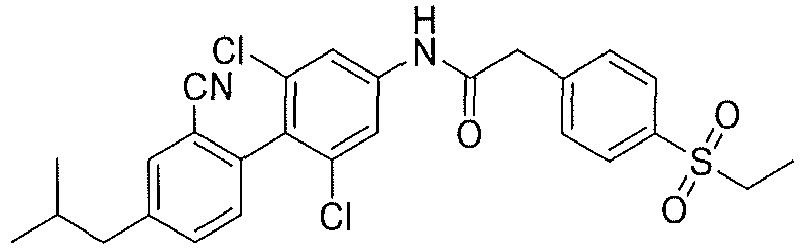
- 5-Bromo-2-nitrobenzonitrile (2.27 g, 10 mmol), isobutylboronic acid (1.53 g, 15 mmol), caesium carbonate (9.78 g, 30 mmol), Pd(dppf)Cl2 (370 mg, 0.5 mmol) and toluene/water (100 mL/ 10 mL) were added in a 100 mL single-neck flask, and the mixture was heated to react at 110□ for 1 hour. After completion of the reaction, water (50 mL) was added, and the mixture was extracted with ethyl acetate (3∗30 mL). The organic layers were concentrated in vacuo and the residue was separated by a silica gel column (petroleum ether: ethyl acetate = 20:1-10:1) to give a product (yellow oil, 1.5 g), with a yield of 75.0%. 1H NMR (400 MHz, CDCl3) δ 8.22 (d, J = 8.5 Hz, 1H), 7.64 (d, J = 1.2 Hz, 1H), 7.61 - 7.52 (m, 1H), 2.61 (d, J = 7.2 Hz, 2H), 1.97 - 1.85 (m, 1H), 0.90 (d, J = 6.6 Hz, 6H).
- 5-Isobutyl-2-nitrobenzonitrile (1.5 g, 7.35 mmol), ammonium formate (4.63 g, 73.5 mmol) and methanol/H2O (20 mL/2 mL) were added in a 25 mL single-neck flask, then zinc powder (2.38 g, 36.7 mmol) was added under stirring. The reaction mixture was heated to react at 80□ for 1 hour. After completion of the reaction, the mixture was cooled to room temperature, and extracted with ethyl acetate (3∗30 mL) to give a crude product (yellow solid, 1.3 g), with a yield of 100.0%. 1H NMR (400 MHz, CDCl3) δ 7.13 (s, 1H), 7.10 (dd, J = 8.4, 1.7 Hz, 1H), 6.66 (d, J = 8.4 Hz, 1H), 4.27 (s, 2H), 2.33 (d, J = 7.2 Hz, 2H), 1.83 - 1.66 (m, 1H), 0.86 (d, J = 6.6 Hz, 6H). MS (ESI) m/z: 176.1(M+1).
- To a solution of 2-amino-5-isobutylbenzonitrile (1.3 g, 7.4 mmol) in acetonitrile/dimethylformamide (10 mL/5 mL) in a 50 mL single-neck flask was added a solution of tert-butyl nitrite (1.04 g, 8.88 mmol) in acetonitrile (2 mL) after cooled in an ice bath. The mixture was reacted in the ice bath for 20 minutes, then cuprous bromide (1.98 g, 8.88 mmol) was added, and the reaction was continued at room temperature overnight. After completion of the reaction, water (20 mL) was added, and the mixture was extracted with ethyl acetate (3∗20 mL) and concentrated in vacuo to remove the solvent. The crude product was separated by a silica gel column (petroleum ether: ethyl acetate = 10:1- 5:1) to give a product (yellow solid, 500 mg), with a yield of 82.4%. 1H NMR (400 MHz, CDCl3) δ 7.56 (d, J = 8.3 Hz, 1H), 7.42 (d, J = 1.8 Hz, 1H), 7.22 (dd, J = 8.3, 2.1 Hz, 1H), 2.45 (d, J = 7.2 Hz, 2H), 1.91 - 1.77 (m, 1H), 0.89 (d, J = 6.6 Hz, 6H).
- 2-Bromo-5-isobutylbenzonitrile (450 mg, 1.89 mmol), bis(pinacolato)diboron (855 mg, 3.78 mmol), potassium acetate (556 mg, 5.67 mmol), PdCl2(dppf) (70 mg, 0.095 mmol) and 1,4-dioxane (10 mL) were added in a microwave tube, and the mixture was reacted at 110□ under microwave for 2 hours. After completion of the reaction, water (20 mL) was added, and the mixture was extracted with ethyl acetate (3∗20 mL). The combined organic layers were concentrated in vacuo to remove the solvent, and the residue was separated by a silica gel column to give a product (yellow oil, 420 mg), with a yield of 83.6%. 1H NMR (400 MHz, CDCl3) δ 7.77 (d, J = 7.7 Hz, 1H), 7.46 (s, 1H), 7.33 (dd, J = 7.7, 1.3 Hz, 1H), 2.49 (d, J = 7.2 Hz, 2H), 1.36 (s, 12H), 1.26-1.23 (m, 1H), 0.87 (d, J = 6.6 Hz, 6H).
- 5-Isobutyl-2-(4,4,5,5-tetramethyl-1,3,2-dioxaborolan-2-yl)benzonitrile (100 mg, 0.35 mmol), 1,3-dichloro-2-iodo-5-nitrobenzene (133 mg, 1.2 mmol), potassium carbonate (143 mg, 1.05 mmol), PdCl2(dtbpf) (11 mg, 0.02 mmol) and 2
wt% Tween 20 in water (3 mL) were added in a 20 mL single-neck flask, and the mixture was heated to react at 80□ for 3 hours. After completion of the reaction, the mixture was extracted with ethyl acetate (3∗10 mL), and the organic layers were combined and comcentrated in vacuo to remove the solvent. The residue was separated by a silica gel column (petroleum ether: ethyl acetate = 50:1-20:1) to give a product (orange solid, 110mg), with a yield of 90.1%. 1H NMR (400 MHz, CDCl3) δ 8.32 (s, 2H), 7.60 (s, 1H), 7.52 (d, J = 7.9 Hz, 1H), 7.24 (d, J = 9.0 Hz, 1H), 2.59 (d, J = 7.2 Hz, 2H), 2.00 - 1.88 (m, 1H), 0.95 (d, J = 6.6 Hz, 6H). - 2',6'-Dichloro-4-isobutyl-4'-nitro-[1,1'-biphenyl]-2-carbonitrile (110 mg), methanol (2 mL) and platinum dioxide (11 mg) were added in a 25 mL single-neck flask with a hydrogen balloon equipped. The mixture was reacted at room temperature for 2 hours. After completion of the reaction according to TLC, the mixture was filtered through Celite, and the filtrate was concentrated in vacuo to afford a crude product (100 mg), which was used in the next step directly. MS (ESI) m/z: 319.0(M+1).
- 4'-Amino-2',6'-dichloro-4-isobutyl-[1,1'-biphenyl]-2-carbonitrile (100 mg, 0.31 mmol), 2-(4-(ethylsulfonyl)phenyl)acetic acid (93 mg, 0.41 mmol), HATU (156 mg, 0.41 mmol), N,N-diisopropylethylamine (120 mg, 0.93 mmol) and dichloromethane (5 mL) were reacted at room temperature for 3 hours. The crude product was separated by a silica gel column (petroleum ether: ethyl acetate = 2:1-1:1) to give a product (white solid, 73 mg), with a yield of 44.8%. 1H NMR (400 MHz, DMSO-d 6) δ 10.72 (s, 1H), 7.83 (d, J = 6.6 Hz, 4H), 7.77 (s, 1H), 7.59 (d, J = 8.1 Hz, 3H), 7.36 (d, J = 7.9 Hz, 1H), 3.84 (s, 2H), 3.25 (q, J = 7.4 Hz, 2H), 2.54 (d, J = 7.2 Hz, 2H), 1.96 - 1.83 (m, 1H), 1.07 (t, J = 7.3 Hz, 3H), 0.85 (d, J = 6.6 Hz, 6H). MS (ESI) m/z: 526.9(M-1).
-

- To a mixture of 4-bromo-2-(trifluoromethyl)aniline (960 mg, 4 mmol), isobutylboronic acid (612 mg, 6 mmol), caesium carbonate (612 mg, 6 mmol) and toluene/water (10:1, 10 mL) in a microwave tube was added Pd(dppf)Cl2 (146 mg, 5% eq) under argon atmosphere. The reaction mixture was heated to react at 120□ for 1 hour under microwave. After completion of the reaction, the mixture was filtered through Celite and washed with dichloromethane. The filtrate was concentrated in vacuo to remove the solvent, and the residue was purified by a silica gel column to give a product 4-isobutyl-2-(trifluoromethyl)aniline (583.9 mg), with a yield of 67.2%. MS (ESI) m/z: 218 (M+1).
- To a solution of 4-isobutyl-2-(trifluoromethyl)aniline (545 mg, 2.5 mmol) in acetonitrile (10 mL) in an ice bath was added cuprous bromide (640 mg, 2.85 mmol) slowly, and the mixture was kept in the ice bath for 20 minutes. Then a solution of tert-butyl nitrite (375 mg, 3.65 mmol) in acetonitrile (10 mL) was added under nitrogen atmosphere, and the mixture was stirred at room temperature for 5 hours. After completion of the reaction, the reaction mixture was poured into saturated sodium bicarbonate solution (40 mL) and extracted with ethyl acetate (3*20 mL). The combined organic layers were concentrated in vacuo and purified by a silica gel column to afford 1-bromo-4-isobutyl-2-(trifluoromethyl)benzene (450 mg), with a yield of 63.8%. 1H NMR (400 MHz, CD3OD) δ 7.68 (d, 1H), 7.53 (s, 1H), 7.30 (d, 1H), 2.54-2.52 (d, 2H), 1.89-1.85 (m, 1H), 0.91-0.90 (d, 6H). MS (ESI) m/z: 282 (M+1).
- To a mixture of 4-bromo-3-chloroaniline (413 mg, 2 mmol), bis(pinacolato)diboron (762 mg, 3 mmol), potassium acetate (762 mg, 3 mmol) and 1,4-dioxane (10 mL) in a microwave tube was added Pd(dppf) Cl2 (80 mg, 5% eq) under argon atmosphere. The mixture was heated to react at 100□ under microwave for 1 hour. After completion of the reaction, the mixture was filtered through Celite and washed with dichloromethane. The organic layer was concentrated in vacuo, and the residue was purified by a silica gel column to give 3-chloro-4-(4,4,5,5-tetramethyl-1,3,2-dioxaborolan-2-yl)aniline (230 mg), with a yield of 46%. MS (ESI) m/z: 254 (M+1).
- To a mixture of 3-chloro-4-(4,4,5,5-tetramethyl-1,3,2-dioxaborolan-2-yl)aniline (127 mg, 0.5 mmol), 1-bromo-4-isobutyl-2-(trifluoromethyl)benzene (223 mg, 0.75 mmol), sodium carbonate (106 mg, 1 mmol) and anhydrous 1,4-dioxane/water (10:1, 8 mL) in a microwave tube was added Pd(PPh3)4 (5.8 mg, 1% eq) under argon atomaphere. The mixture was heated to react at 100□ for 1 hour under microwave. After completion of the reaction, the mixture was filtered through Celite and washed with dichloromethane. The organic layer was concentrated in vacuo, and the residue was purified by a silica gel column to give 2-chloro-4'-isobutyl-2'-(trifluoromethyl)-[1,1'-biphenyl]-4-amine (80 mg), with a yield of 48%. MS (ESI) m/z: 328 (M+1).
- 2-(4-(Ethylsulfonyl)phenyl)acetic acid (61.3 mg, 0.27 mmol), HATU (140 mg, 0.37 mmol), DIPEA (47.3 mg, 0.37 mmol) and DCM (5 mL) were added in an pear flask, and the mixture was stirred for 10 minutes. Then 2-chloro-4'-isobutyl-2'-(trifluoromethyl)-[1,1'-biphenyl]- 4-aniline (80 mg, 0.24 mmol) was added. The mixture was stirred at room temperature for 8 hours. After completion of the reaction, the reaction mixture was diluted with ethyl acetate (25 mL), and washed with water and then with saturated brine. The organic layer was concentrated in vacuo, and the residue was purified by a silica gel column to give N-(2-chloro-4'-isobutyl-2'-(trifluoromethyl)-[1,1'-biphenyl]-4-yl)-2-(4-(ethylsulfonyl)phenyl)acetamide (90 mg), with a yield of 68.6%. 1H NMR (400 MHz, CDCl3) δ 7.80-7.78 (d, 2H), 7.65 (s, 1H), 7.46-7.41 (m, 3H), 7.31-7.23 (m, 2H), 7.21-7.19 (d, 1H), 7.15-7.13 (m, 2H), 3.82 (s, 2H), 3.16-3.10 (q, 2H), 2.58-2.56 (d, 2H), 1.96-1.89 (m, 1H), 1.31-1.26 (t, 3H), 0.95-0.94 (d, 6H). MS (ESI) m/z: 536.2 (M-1).
-

- To a mixture of 4-bromo-2-(trifluoromethoxy)aniline (1024 mg, 4 mmol), isobutylboronic acid (612 mg, 6 mmol), caesium carbonate (612 mg, 6 mmol) and toluene/water (10:1, 10 mL) in a microwave tube was added Pd(dppf)Cl2 (146 mg, 5% eq) under argon atmosphere. The reaction mixture was reacted at 120□ for 1 hour under microwave. After completion of the reaction, the mixture was filtered through Celite and washed with dichloromethane. The organic layer was concentrated in vacuo, and the residue was purified by a silica gel column to give 4-isobutyl-2-(trifluoromethoxy)aniline (662.8 mg), with a yield of 67.2%. MS (ESI) m/z: 255.9 (M+1).
- To a solution of 4-isobutyl-2-(trifluoromethoxy)aniline (585 mg, 2.5 mmol) in acetonitrile (10 mL) in an ice bath was added cuprous bromide (640 mg, 2.85 mmol) slowly, and the mixture was kept in an ice bath for 20 minutes. Then a solution of tert-butyl nitrite (375 mg, 3.65 mmol) in acetonitrile (10 mL) was added under nitrogen atmosphere, and the mixture was stirred at room temperature for 5 hours. After completion of the reaction, the reaction mixture was poured into saturated sodium bicarbonate solution (40 mL) and extracted with ethyl acetate (3∗20 mL). The combined organic layers were concentrated in vacuo, and the residue was purified by a silica gel column to give 1-bromo-4-isobutyl-2-(trifluoromethoxy)benzene (475.6 mg), with a yield of 63.8%. MS (ESI) m/z: 297 (M+1).
- To a mixture of 4-bromo-3-chloroaniline (413 mg, 2 mmol), bis(pinacolato)diboron (762 mg, 3 mmol), potassium acetate (762 mg, 3 mmol) and anhydrous 1,4-dioxane (10 mL) in a microwave tube was added Pd(dppf) Cl2 (80 mg, 5% eq) under argon atmosphere. The mixture was heated to react at 100□ under microwave for 1 hour. After completion of the reaction, the mixture was filtered through Celite and washed with dichloromethane. The organic layer was concentrated in vacuo, and the residue was purified by a silica gel column to give 3-chloro-4-(4,4,5,5-tetramethyl-1,3,2-dioxaborolan-2-yl)aniline (230 mg), with a yield of 46%. MS (ESI) m/z: 254 (M+1).
- To a mixture of 3-chloro-4-(4,4,5,5-tetramethyl-1,3,2-dioxaborolan-2-yl)aniline (127 mg, 0.5 mmol), 1-bromo-4-isobutyl-2-(trifluoromethyl)benzene (235.7 mg, 0.75 mmol), sodium carbonate (106 mg, 1 mmol) and anhydrous 1,4-dioxane/water (10:1, 8 mL) in a microwave tube was added Pd(PPh3)4 (5.8 mg, 1% eq) under argon atomaphere. The mixture was heated to react at 100□ for 1 hour under microwave. After completion of the reaction, the mixture was filtered through Celite and washed with dichloromethane. The organic layer was concentrated in vacuo, and the residue was purified by a silica gel column to give 2-chloro-4'-isobutyl-2'-(trifluoromethyl)-[1,1'-biphenyl]-4-amine (80 mg), with a yield of 48%. MS (ESI) m/z: 328 (M+1).
- 2-(4-(Ethylsulfonyl)phenyl)acetic acid (61.3 mg, 0.27 mmol), HATU (140 mg, 0.37 mmol), DIPEA (47.3 mg, 0.37 mmol) and DCM (5 mL) were added in an pear-shaped flask, and the mixture was stirred for 10 minutes. Then 2-chloro-4'-isobutyl-2'-(trifluoromethoxy)-[1,1'-biphenyl]-4-aniline (84 mg, 0.24 mmol) was added, and the mixture was stirred at room temperature for 8 hours. After completion of the reaction, the reaction mixture was diluted with ethyl acetate (25 mL), and washed with water and then with saturated brine. The organic layer was concentrated in vacuo, and the residue was purified by a silica gel column to give N-(2-chloro-4'-isobutyl-2'-(trifluoromethoxy)-[1,1'-biphenyl]-4-yl)-2-(4-(ethylsulfonyl)phenyl)a cetamide (93 mg), with a yield of 68.7%. 1H NMR (400 MHz, CDCl3) δ 7.91-7.89 (d, 2H), 7.73 (s, 1H), 7.56-7.54 (d, 2H), 7.42-7.41 (d, 2H), 7.21-7.18 (m, 1H), 7.12-7.11 (d, 2H), 3.83 (s, 2H), 3.16-3.10 (q, 2H), 2.54-2.52 (d, 2H), 1.92-1.89 (m, 1H), 1.32-1.28 (t, 3H), 0.95-0.93 (d, 6H). MS (ESI) m/z: 552.1 (M+1).
-

- To a mixture of 4-bromo-3-chloroaniline (1 g, 9.7 mmol), bis(pinacolato)diboron (1.85 g, 14.56 mmol), potassium acetate (2.8 g, 29 mmol) and 1,4-dioxane (10 mL) in a 20 mL microwave tube was added Pd(dppf)Cl2 (196 mg, 0.27 mmol) under nitrogen atmosphere, and the mixture was reacted at 100□ under microwave for 1 hour. After completion of the reaction, solvent was removed in vacuo, then saturated sodium chloride (20 mL) was added. The mixture was washed with ethyl acetate (8 mL) and dried over anhydrous sodium sulfate. The organic layers were combined and concentrated in vacuo, and the crude product was separated by a silica gel column (petroleum ether: ethyl acetate = 5:1) to give a product (white solid, 1 g), with a yield of 54.3%. MS (ESI) m/z: 254.1 (M+1).
- To a mixture of 5-amino-2-bromobenzonitrile (1 g, 5.1 mmol), isobutylboronic acid (1.2 g, 11.8 mmol), caesium carbonate (2 g, 6.1 mmol), toluene (10 mL) and water (0.3 mL) in a 20 mL microwave tube was added Pd(dppf)Cl2 (350 mg, 0.48 mmol) under nitrogen atmosphere, and the mixture was heated to react at 120□ under microwave for 2 hours. After completion of the reaction, solvent was removed in vacuo, then saturated sodium chloride (20 mL) was added. The mixture was extracted with ethyl acetate (8 mL), dried over anhydrous sodium sulfate. The organic layers were combined and concentrated in vacuo, and the crude product was separated by a silica gel column (petroleum ether: ethyl acetate = 10:1) to give a product (white solid, 0.5 g), with a yield of 56.3%. MS (ESI) m/z:175.1(M+1).
- To a mixture of 2-isobutyl-5-nitrobenzonitrile (500 mg, 2.9 mmol), cuprous bromide (86 mg, 0.6 mmol), cupric bromide (1.3 g, 5.8 mmol), hydrobromic acid (364 µL, 6.7 mmol) and acetonitrile (20 mL) in a 100 mL single-neck flask cooled in an ice bath was added a solution of sodium nitrite (242 mg, 3.0 mmol) in acetonitrile slowly. After stirred in the ice bath for half an hour, the mixture was slowly warmed to room temperature and stirred overnight. After the materials had all reacted when being determined by TLC, solvent was removed in vacuo, and saturated sodium chloride (20 mL) was added. The mixture was extracted with ethyl aceate (8 mL) and dried over anhydrous sodium sulfate. The organic layers were combined and concentrated in vacuo, and the cruded product was separated by a silica gel column (eluent: 100% of petroleum ether) to give a product (white solid, 260 mg), with a yield of 37.8%. 1H NMR (400 MHz, CDCl3) δ 7.72 (s, 1H), 7.61 (d, J = 8.4 Hz, 1H), 7.16 (d, J = 8.4 Hz, 1H), 2.66 (d, J = 7.3 Hz, 2H), 2.01 - 1.88 (m, 1H), 0.94 (d, J = 6.6 Hz, 6H).
- To a mixture of 5-bromo-2-isobutylbenzonitrile (180 mg, 0.76 mmol), 3-chloro-4-(4,4,5,5-tetramethyl-1,3,2-dioxaborolan-2-yl)aniline (280 mg, 1.11 mmol) and sodium carbonate (110 mg, 1.0 mmol) in a 20 mL microwave reaction tube were added Pd(dppf)Cl2 (30 mg, 0.04 mmol), 1,4-dioxane (5 mL) and water (1.25 mL) under argon atmosphere. The mixture was heated to react at 100□ under microwave for 2 hours. Then solvent was removed in vacuo, and saturated sodium chloride (20 mL) was added. The mixture was extracted with ethyl acetate (8 mL), and dried over anhydrous sodium sulfate. The organic layers were combined and concentrated in vacuo, and the crude product was separated by a silica gel column (petroleum ether: ethyl acetate = 10: 1) to give a product (white solid, 80 mg), with a yield of 37.0%. MS (ESI) m/z:285.1(M+1).
- 4'-Amino-2'-chloro-4-isobutyl-[1,1'-biphenyl]-3-carbonitrile (80 mg, 0.28 mmol), 2-(4-(ethylsulfonyl)phenyl)acetic acid (75 mg, 0.28 mmol), HATU (114 mg, 0.30 mmol), N,N-diisopropylethylamine (96 µL, 0.6 mmol) and dichloromethane (20 mL) were added in a 25 mL single-neck flask, and the reaction mixture was stirred at room temperature overnight. The crude product was separated by a silica gel column (petroleum ether: ethyl acetate =1:2) to give a product (white solid, 70 mg), with a yield of 50.6%. 1H NMR (400 MHz, CDCl3) δ 8.19 (s, 1H), 7.84 (d, J = 8.1 Hz, 2H), 7.76 (s, 1H), 7.63 (s, 1H), 7.57 - 7.47 (m, 4H), 7.31 (d, J = 8.1 Hz, 1H), 7.23 (d, J = 8.4 Hz, 1H), 3.81 (s, 2H), 3.11 (q, J = 7.4 Hz, 2H), 2.74 (d, J = 7.2 Hz, 2H), 2.02 - 1.96 (m, 1H), 1.28 (t, J = 7.4 Hz, 3H), 0.97 (d, J = 6.6 Hz, 6H). MS (ESI) m/z: 493.1(M-1).
-
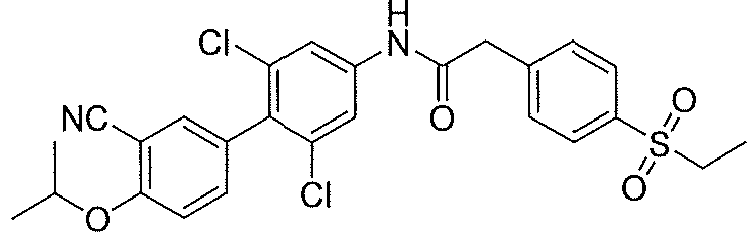
- 5-Bromo-2-isopropoxybenzonitrile (1 g, 4.17 mmol), bis(pinacolato)diboron (1.41 g, 6.25 mmol), potassium acetate (1.22 g, 12.5 mmol), PdCl2(dppf) (153 mg, 0.21 mmol) and 1,4-dioxane (10 mL) were added in a microwave tube, and the mixture was reacted at 110□ under microwave for 2 hours. After completion of the reaction, water (20 mL) was added, and the mixture was extracted with ethyl acetate (3∗20 mL). The organic layers were combined and concentrated in vacuo, and the residue was separated by a silica gel column (petroleum ether: ethyl acetate = 5:1-1:1) to give a product (yellow oil, 400 mg), with a yield of 33.3%.
- 2-Isopropoxy-5-(4,4,5,5-tetramethyl-1,3,2-dioxaborolan-2-yl)benzonitrile (400 mg, 1.39 mmol), 1,3-dichloro-2-iodo-5-nitrobenzene (531 mg, 1.67 mmol), potassium carbonate (567 mg, 4.17 mmol), PdCl2(dtbpf) (45 mg, 0.07 mmol) and 2
wt% Tween 20 in water (10 mL) were added in a 20 mL single-neck flask. The mixture was heated to react at 80□ for 2 hours, After completion of the reaction, the mixture was extracted with ethyl acetate (3∗10 mL), and the combined organic layers were concentrated in vacuo to remove the solvent. The residue was separated by a silica gel column (petroleum ether: ethyl acetate = 10:1- 5:1) to give a product (orange solid, 120 mg), with a yield of 24.6%. 1H NMR (400 MHz, CDCl3) δ 8.28 (s, 2H), 7.46 (d, J = 2.0 Hz, 1H), 7.39 (dd, J = 8.8, 2.2 Hz, 1H), 7.07 (d, J = 8.8 Hz, 1H), 4.78 - 4.67 (m, 1H), 1.46 (d, J= 6.1 Hz, 6H), 1.25 (t, J= 7.2 Hz, 4H). - 2',6'-Dichloro-4-isopropoxy-4'-nitro-[1,1'-biphenyl]-3-carbonitrile (120 mg), methanol (2 mL) and platinum dioxide (12 mg) were added in a 25 mL single-neck flask with a hydrogen balloon equipped. The mixture was reacted at room temperature for 1 hour. After completion of the reaction according to TLC, the mixture was filtered through Celite, and the filtrate was concentrated in vacuo to afford a crude product (100 mg), which was used in the next step directly. MS (ESI) m/z: 321.0 (M+1).
- The method is the same as in example 1.
4'-Amino-2',6'-dichloro-4-isopropoxy-[1,1'-biphenyl]-3-carbonitrile (100 mg, 0.31 mmol), 2-(4-(ethylsulfonyl)phenyl)acetic acid (93 mg, 0.41 mmol), HATU (156 mg, 0.41 mmol), N,N-diisopropylethylamine (120 mg, 0.93 mmol) and dichloromethane (5 mL) were reacted at room temperature for 3 hours, and the crude product was separated by a silica gel column (petroleum ether: ethyl acetate =2:1-1:1) to give a product (white solid, 90 mg), with a yield of 54.9%. 1H NMR (400 MHz, CDCl3) δ 8.75 (s, 1H), 7.82 (d, J = 8.1 Hz, 2H), 7.71 (s, 2H), 7.54 (d, J = 8.1 Hz, 2H), 7.43 (d, J = 2.0 Hz, 1H), 7.37 (dd, J = 8.8, 2.1 Hz, 1H), 7.04 (d, J = 8.9 Hz, 1H), 4.71 (dt, J = 12.1, 6.1 Hz, 1H), 3.82 (s, 2H), 3.14 (q, J = 7.4 Hz, 2H), 1.44 (d, J = 6.0 Hz, 6H), 1.29 (t, J = 7.4 Hz, 3H). MS (ESI) m/z: 528.8(M+1). -
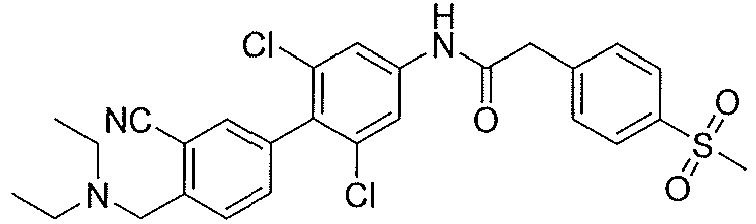
- 5-Bromo-2-methylbenzonitrile (40 g, 204 mmol), bis(pinacolato)diboron (69.2 g, 306 mmol), potassium acetate (60 g, 612 mmol), PdCl2(dppf) (7.6 g, 20.8 mmol) and 1,4-dioxane (500 mL) were added in a 1 L single-neck flask, and the reaction mixture was heated to react at 100□ for 2 hours. After completion of the reaction, the mixture was cooled to room temperature, then water (250 mL) was added. The mixture was extracted with ethyl acetate (3∗250 mL), and the organic layers were concentrated in vacuo to remove the solvent. The residue was separated by a silica gel column (petroleum ether: ethyl acetate = 30:1) to give a product (white solid, 30 g), with a yield of 61.2%. 1H NMR (400 MHz, CDCl3) δ 8.03 (s, 1H), 7.87 (d, J = 7.7 Hz, 1H), 7.31 (d, J = 7.7 Hz, 1H), 2.55 (s, 4H), 1.34 (s, 12H).
- 2-Methyl-5-(4,4,5,5-tetramethyl-1,3,2-dioxaborolan-2-yl)benzonitrile (20 g, 82.4 mmol), 1,3-dichloro-2-iodo-5-nitrobenzene (28.5 g, 90.6 mmol), potassium carbonate (26.3 g, 247.2 mmol), PdCl2(dtbpf) (1.34 g, 2.06 mmol) and 2
wt% Tween 20 in water (200 mL) were added in a 500 mL single-neck flask, and the reaction mixture was heated to react at 80□ for 6 hours. After completion of the reaction, the mixture was extracted with ethyl acetate (3∗100 mL), and the organic layers were combined and concentrated to remove the solvent. The residue was separated by a silica gel column (petroleum ether: ethyl acetate = 10:1) to give a product (orange solid, 25 g), with a yield of 79.1%. - 2',6'-Dichloro-4-methyl-4'-nitro-[1,1'-biphenyl]-3-carbonitrile (5.07 g, 16.5 mmol), NBS (3.42 g, 19.2 mmol), BPO (198 mg, 0.83 mmol) and carbon tetrachloride (70 mL) were added in a 100 mL single-flask mouth, and the mixture was heated to react at 90□ overnight. After completion of the reaction, solvent was removed in vacuo, and the residue was separated by a silica gel column (petroleum ether: ethyl acetate = 50:1-20:1) to give a product (3.1 g), with a yield of 49.6%. 1H NMR (400 MHz, CDCl3) δ 8.31 (s, 2H), 7.72 (d, J= 8.1 Hz, 1H), 7.58 (d, J= 1.6 Hz, 1H), 7.49 (dd, J = 8.1, 1.8 Hz, 1H), 4.71 (s, 2H).
- 4-(Bromomethyl)-2',6'-dichloro-4'-nitro-[1,1'-biphenyl]-3-carbonitrile (150 mg, 0.39 mmol), diethylamine hydrochloride (85 mg, 0.78 mmol), potassium carbonate (265 mg, 1.95 mmol) and acetonitrile (5 mL) were added in a 25 mL single-neck flask, and the mixture was heated to react at 80□ for 2 hours. After completion of the reaction, water was added (20 mL), and the mixture was extracted with ethyl acetate (3∗10 mL). The organic layers were combined, washed with saturated sodium chloride, dried over anhydrous sodium sulfate, and concentrated in vacuo to remove the solvent to obtain a crude product (yellow solid, 170 mg), which was used for the next step directly.
1H NMR (400 MHz, CDCl3) δ 8.30 (s, 2H), 7.82 (d, J = 7.3 Hz, 1H), 7.52 (s, 1H), 7.44 (d, J = 8.1 Hz, 1H), 3.85 (s, 2H), 2.63 (q, J = 6.8 Hz, 4H), 1.09 (t, J= 7.0 Hz, 6H). - 2',6'-Dichloro-4-((diethylamino)methyl)-4'-nitro-[1,1'-biphenyl]-3-carbonitrile (150 mg, 0.4 mmol), ammonium formate (252 mg, 4 mmol) and methanol/H2O (5 mL/5 mL) were added in a 25 mL single-neck flask, then zinc powder (130 mg, 2 mmol) was added under stirring. The mixture was heated to react at 80□ for 2 hours. After completion of the reaction, the mixture was cooled to room temperature and extracted with ethyl acetate (3∗10 mL) to afford a product (yellow solid, 120 mg), which was used for the next step directly.
- The method is the same as in example 1.
4'-Amino-2',6'-dichloro-4-((diethylamino)methyl)-[1,1'-biphenyl]-3-carbonitrile (100 mg, 0.29 mmol), 2-(4-(methylsulfonyl)phenyl)acetic acid (74 mg, 0.34 mmol), HATU (129 mg, 0.34 mmol), N,N-diisopropylethylamine (112 mg, 0.87 mmol) and dichloromethane (3 mL) were reacted at room temperature for 2 hours, and the crude product was separated by a silica gel column (petroleum ether: ethyl acetate =1:1-1:2) to give a product (white solid, 157 mg), with a yield of 99.0%. 1H NMR (400 MHz, CDCl3) δ 8.84 (d, J = 8.9 Hz, 1H), 7.89 (d, J = 8.2 Hz, 2H), 7.76 - 7.70 (m, 3H), 7.55 (d, J = 8.2 Hz, 2H), 7.49 (s, 1H), 7.42 (dd, J = 8.1, 1.5 Hz, 1H), 3.83 (s, 4H), 3.07 (s, 3H), 2.63 (q, J = 7.1 Hz, 4H), 1.09 (t, J = 7.1 Hz, 6H). MS (ESI) m/z: 543.8 (M+1). -
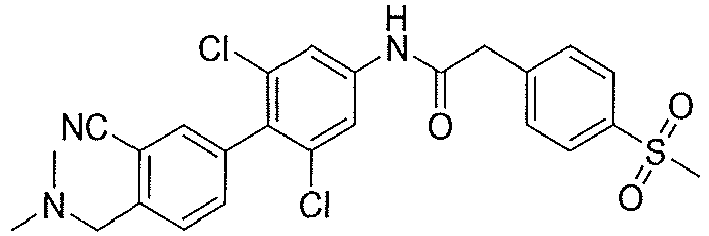
- 4-(Bromomethyl)-2',6'-dichloro-4'-nitro-[1,1'-biphenyl]-3-carbonitrile (1.2 g, 3.1 mmol), a solution of dimethylamine in tetrahydrofuran (4.5 mL, 9.3 mmol), potassium carbonate (1.27 g, 9.3 mmol) and acetonitrile (10 mL) were added in a 25 mL single-neck flask, and the mixture was reacted at room temperature for 2 hours. After completion of the reaction, water (20 mL) was added, and the mixture was extracted with ethyl acetate (3∗10 mL). The organic layers were combined, washed with saturated sodium chloride, dried over anhydrous sodium sulfate, and concentrated in vacuo to remove the solvent. The crude was separated by a silica gel column (petroleum ether: acetic acid ester = 10:1-5:1) to give a product (yellow oil, 800 mg), with a yield 73.4%. 1H NMR (400 MHz, CDCl3) δ 8.33 (s, 2H), 7.76 (d, J= 8.0 Hz, 1H), 7.58 (s, 1H), 7.49 (d, J= 7.9 Hz, 1H), 3.75 (s, 2H), 2.39 (s, 6H).
- 2',6'-Dichloro-4-((dimethylamino)methyl)-4'-nitro-[1,1'-biphenyl]-3-carbonitrile (800 mg, 2.29 mmol), ammonium formate (1.56 g, 22.9 mmol) and methanol/H2O (10 mL/10 mL) were added in a 25 mL single-neck flask, then zinc powder (813 mg, 11.4 mmol) was added under stirring, and the reaction mixture was heated to react at 80□ for 2 hours. After completion of the reaction, the mixture was cooled to room temperature and extracted with ethyl acetate (3∗20 mL), to afford a product (yellow solid, 450 mg), with a yield of 61.6%.
- The method is the same as in example 1.
4'-Amino-2',6'-dichloro-4-((dimethylamino)methyl)-[1,1'-biphenyl]-3-carbonitrile (200 mg, 0.63 mmol), 2-(4-(methylsulfonyl)phenyl)acetic acid (161 mg, 0.75 mmol), HATU (285 mg, 0.75 mmol), N,N-diisopropylethylamine (244 mg, 1.89 mmol) and dichloromethane (5 mL) were reacted at room temperature for 2 hours. The crude product was separated by a silica gel column (dichloromethane: methanol=50:1) to give a product (white solid, 310 mg), with a yield of 96.3%. 1H NMR (400 MHz, CDCl3) δ 7.95 (s, 1H), 7.72 (d, J = 8.1 Hz, 2H), 7.54 (s, 2H), 7.41 (t, J = 8.5 Hz, 4H), 7.32 (s, 1H), 7.24 (d, J = 8.0 Hz, 1H), 3.66 (s, 2H), 3.51(s, 2H) , 2.87 (s, 3H), 2.16 (s, 6H). MS (ESI) m/z: 515.9(M+1). -

- 4'-Amino-2',6'-dichloro-4-((dimethylamino)methyl)-[1,1'-biphenyl]-3-carbonitrile (70 mg, 0.22 mmol), 2-(4-(ethylsulfonyl)phenyl)acetic acid (52 mg, 0.23 mmol), HATU (105 mg, 0.28 mmol), N,N-diisopropylethylamine (77 µL, 0.56 mmol) and dichloromethane (2 mL) were added in a 10 mL microwave tube. The mixture was reacted at 80□ under microwave for 1 hour. After completion of the reaction according to TLC, dichloromethane (20 mL) was added, and the mixture was washed with saturated ammonium chloride (30 mL). The organic layer was concentrated in vacuo to remove the solvent, and the resulting crude product was separated by a silica gel column (petroleum ether: ethyl acetate = 1:1) to give a product (yellow solid, 120 mg), with a yield of 100%. 1H NMR (400 MHz, CDCl3) δ 7.90 (s, 1H), 7.89 (d, J = 7.9 Hz, 2H), 7.69 (s, 2H), 7.54 (d, 2H), 7.53 (s, 1H), 7.44 (d, J = 7.9 Hz, 1H), 3.84 (s, 2H), 3.75 (s, 2H), 3.13 (q, J = 7.2 Hz, 2H), 2.38 (s, 6H), 1.30 (t, J = 7.5 Hz, 3H).MS (ESI) m/z: 530.1(M+1).
-

- 4-(Bromomethyl)-2',6'-dichloro-4'-nitro-[1,1'-biphenyl]-3-carbonitrile (629 mg, 1.6 mmol), N-ethylmethylamine (280 µ, 3.3 mmol), potassium carbonate (675 mg, 4.9 mmol) and acetonitrile (5 mL) were added in a 15 mL microwave tube, and the mixture was heated to react at 80□ for 2 hours under microwave. After completion of the reaction, solvent was removed in vacuo, then water (20 mL) was added, and the mixture was extracted with ethyl acetate (3∗10 mL). The organic layers were combined, washed with saturated sodium chloride, dried over anhydrous sodium sulfate, and concentrated in vacuo to remove the solvent. The residue was separated by a silica gel column (petroleum ether: acetic acid ester = 10:1) to give a product (yellow solid, 230 mg), with a yield 39.5%. MS (ESI) m/z:364.1(M+1).
- 2',6'-Dichloro-4-((ethyl(methyl)amino)methyl)-4'-nitro-[1,1'-biphenyl]-3-carbonitrile (230 mg, 0.63 mmol), platinum dioxide (50 mg) and methanol (20 mL) were added in a 50 mL single-neck flask, and the mixture was stirred at room temperature for 1 hour under hydrogen atmosphere. After completion of the reaction, the mixture was filtered through Celite, and concentrated in vacuo to remove the solvent to afford a product (yellow solid, 130 mg), with a yield of 62.0%.
- 4'-Amino-2',6'-dichloro-4-((ethyl(methyl)amino)methyl)-[1,1'-biphenyl]-3-carbonitrile (130 mg, 0.39 mmol), 2-(4-(ethylsulfonyl)phenyl)acetic acid (220 mg, 0.82 mmol), HATU (312 mg, 0.82 mmol), N,N-diisopropylethylamine (244 mg, 1.89 mmol) and dichloromethane (20 mL) were added in a 50 mL single-neck flask, and the reaction mixture was stirred at room temperature overnight. The crude product was separated by a silica gel column (dichloromethane: methanol=200:3) to give a product (white solid, 70 mg), with a yield of 33.0%. 1H NMR (400 MHz, CDCl3) δ 8.15 (s, 1H), 7.85 (d, J = 6.4 Hz, 2H), 7.71 (s, 2H), 7.65 (d, J = 6.9 Hz, 1H), 7.56 (d, J = 6.4 Hz, 2H), 7.50 (s, 1H), 7.42 (d, J = 4.5 Hz, 1H), 3.83 (s, 2H), 3.77 (s, 2H), 3.74 - 3.60 (m, 2H), 3.19 - 3.10 (m, 3H), 2.61 (d, J = 6.8 Hz, 2H), 2.29 (s, 3H), 1.30 - 1.27 (m, 3H), 1.19 - 1.12 (m, 3H). MS (ESI) m/z:544.1 (M+1).
-

- The method is the same as in example 1.
4'-Amino-2',6'-dichloro-4-((diethylamino)methyl)-[1,1'-biphenyl]-3-carbonitrile (80 mg, 0.23 mmol), 2-(4-(ethylsulfonyl)phenyl)acetic acid (63 mg, 0.27 mmol), HATU (103 mg, 0.27 mmol), N,N-diisopropylethylamine (89 mg, 0.69 mmol) and dichloromethane (5 mL) were reacted at room temperature for 1 hour, and the crude product was separated by a silica gel column (petroleum ether: ethyl acetate = 1:1-1:2) to give a product (white solid, 60 mg), with a yield of 46.8%. 1H NMR (400 MHz, CDCl3) δ 9.14 (s, 1H), 7.82 (d, J = 8.0 Hz, 2H), 7.74 (s, 2H), 7.71 (d, J = 8.1 Hz, 1H), 7.54 (d, J = 8.0 Hz, 2H), 7.49 (s, 1H), 7.41 (d, J= 8.1 Hz, 1H), 3.82 (s, 2H), 3.16 - 3.11 (m, 2H), 2.84 (s, 2H), 2.61 (q, J = 7.0 Hz, 4H), 1.28 (s, 3H), 1.08 (t, J = 7.1 Hz, 6H). MS (ESI) m/z: 558.2 (M+1). -

- 4-(Bromomethyl)-2',6'-dichloro-4'-nitro-[1,1'-biphenyl]-3-carbonitrile (200 mg, 0.52 mmol), azetidine (61 mg, 1.04 mmol), potassium carbonate (212 mg, 1.56 mmol), acetonitrile (5 mL) were added in a 25 mL single-neck flask, and the mixture was reacted at room temperature for 1 hour. After completion of the reaction, water (20 mL) was added, and the mixture was extracted with ethyl acetate (3∗10 mL). The organic layers were combined, washed with saturated sodium chloride, dried over anhydrous sodium sulfate, and concentrated in vacuo to remove the solvent to obtain a crude product (yellow oil, 160 mg), with a yield of 85.1%. 1H NMR (400 MHz, CDCl3) δ 8.29 (s, 2H), 7.69 (d, J = 8.1 Hz, 1H), 7.52 (s, 1H), 7.44 (dd, J = 8.0, 1.4 Hz, 1H), 3.87 (s, 2H), 3.37 (t, J = 7.0 Hz, 4H), 2.21 - 2.11 (m, 2H).
- 4-(Azetidin-1-ylmethyl)-2',6'-dichloro-4'-nitro-[1,1'-biphenyl]-3-carbonitrile (160 mg, 0.44 mmol), methanol (2 mL) and platinum dioxide (16 mg) were added in a 25 mL single-neck flask with a hydrogen balloon equipped, and the mixture was reacted at room temperature for 20 minutes under hydrogen atmosphere. The mixture was filtered through Celite, and concentrated to remove the solvent to afford a product (yellow oil, 150 mg). 1H NMR (400 MHz, CDCl3) δ 7.62 - 7.50 (m, 2H), 7.44 (d, J = 8.1 Hz, 1H), 6.71 (s, 2H), 3.90 (s, 2H), 3.84 (s, 2H), 3.36 (t, J = 7.0 Hz, 4H), 2.20 - 2.10 (m, 2H). MS (ESI) m/z: 332.0(M+1).
- The method is the same as in example 1.
4'-Amino-4-(azetidin-1-ylmethyl)-2',6'-dichloro-[1,1'-biphenyl]-3-carbonitrile (80 mg, 0.24 mmol), 2-(4-(ethylsulfonyl)phenyl)acetic acid (66 mg, 0.28 mmol), HATU (106 mg, 0.28 mmol), N,N-diisopropylethylamine (93 mg, 0.72 mmol) and dichloromethane (5 mL) were reacted at room temperature for 3 hours, and the crude product was separated by a silica gel column (dichloromethane: methanol = 20:1) to give a product (white solid, 54 mg), with a yield of 41.8%. MS (ESI) m/z: 542.0 (M+1). -

- 4-(Bromomethyl)-2',6'-dichloro-4'-nitro-[1,1'-biphenyl]-3-carbonitrile (200 mg, 0.52 mmol), pyrrolidine (74 mg, 1.04 mmol), potassium carbonate (212 mg, 1.56 mmol) and acetonitrile (5 mL) were added in a 25 mL single-neck flask, and the mixture was stirred at room temperature for 3 hours. After completion of the reaction, water (20 mL) was added, and the mixture was extracted with ethyl acetate (3∗10 mL). The organic layers were combined, washed with saturated sodium chloride, dried over anhydrous sodium sulfate, and concentrated in vacuo to remove the solvent to obtain a crude product (yellow oil, 150 mg), with a yield 76.5%. 1H NMR (400 MHz, CDCl3) δ 8.31 (s, 1H), 7.80 (d, J = 7.9 Hz, 1H), 7.54 (s, 1H), 7.46 (d, J = 7.9 Hz, 1H), 3.95 (s, 2H), 2.67 (s, 4H), 1.86 (s, 4H).
- 2',6'-Dichloro-4'-nitro-4-(pyrrolidin-1-ylmethyl)-[1,1'-biphenyl]-3-carbonitrile (150 mg, 0.40 mmol), methanol (2 mL) and platinum dioxide (15 mg) were added in a 25 mL single-neck flask with a hydrogen balloon equipped, and the mixture was reacted at room temperature for 2 hours under hydrogen atmosphere. Then the mixture was filtered through Celite, and solvent was removed to afford a product (yellow oil, 120 mg). 1H NMR (400 MHz, CDCl3) δ 7.64 (d, J = 8.0 Hz, 1H), 7.53 (s, 1H), 7.44 (d, J = 8.0 Hz, 1H), 6.71 (s, 2H), 3.90 (s, 4H), 2.64 (s, 4H), 1.83 (s, 4H). MS (ESI) m/z: 346.0 (M+1).
- The method is the same as in example 1.
4'-Amino-4-(pyrrolidin-1-ylmethyl)-2',6'-dichloro-[1,1'-biphenyl]-3-carbonitrile (100 mg, 0.29 mmol), 2-(4-(ethylsulfonyl)phenyl)acetic acid (80 mg, 0.35 mmol), HATU (133 mg, 0.35 mmol), N,N-diisopropylethylamine (112 mg, 0.87 mmol) and dichloromethane (5 mL) were reacted at room temperature for 3 hours, and the crude product was separated by a silica gel column (petroleum ether: ethyl acetate = 1:2) to give a product (white solid, 96 mg), with a yield of 75.0%. 1H NMR (400 MHz, CDCl3) δ 9.40 (s, 1H), 7.80 (d, J = 7.7 Hz, 2H), 7.72 (s, 2H), 7.63 (d, J = 8.0 Hz, 1H), 7.53 (d, J = 7.8 Hz, 2H), 7.48 (s, 1H), 7.40 (d, J = 8.0 Hz, 1H), 3.86 (s, 2H), 3.80 (s, 2H), 3.10 (q, J = 7.3 Hz, 2H), 2.60 (s, 4H), 1.79 (s, 4H), 1.25 (t, J = 7.4 Hz, 3H). MS (ESI) m/z: 556.0 (M+1). -

- 2',6'-Dichloro-4-(2-methylprop-1-en-1-yl)-4'-nitro-[1,1'-biphenyl]-3-carbonitrile (200 mg, 0.58 mmol), tin(II) chloride dihydrate (550 mg, 1.73 mmol), ethanol (10 mL) and concentrated hydrochloric acid (0.25 mL) were added in a 100 mL single-neck flask, then the mixture was heated to react at 60□ for 1 hour. After the materials had all reacted when being determined by TLC, the mixture was concentrated in vacuo to remove ethanol, and the mixture was adjusted to pH 9 with saturated sodium carbonate solution and extracted with ethyl acetate (3∗20 mL). The combined organic layers were washed with saturated sodium chloride, dried over anhydrous sodium sulfate, and filtered. The filtrate was concentrated in vacuo to remove the solvent to give a product (yellow solid, 120 mg), which was used for the next reaction directly.
- 4'-Amino-2',6'-dichloro-4-(2-methylprop-1-en-1-yl)-[1,1'-biphenyl]-3-carbonitrile (110 mg, 0.35 mmol), 2-(4-(ethylsulfonyl)phenyl)acetic acid (95 mg, 0.42 mmol), HATU (160 mg, 0.42 mmol), N,N-diisopropylethylamine (135 mg, 1.05 mmol) and dichloromethane (5 mL) were added in a 25 mL single-neck flask, and the mixture was reacted at room temperature for 3 hours. After the materials had all reacted when being determined by TLC, dichloromethane (20 mL) was added, and the mixture was washed with saturated ammonium chloride (30 mL). The organic layer was concentrated in vacuo to remove the solvent, and the resulting crude product was separated by a silica gel column (petroleum ether: ethyl acetate = 2:1-1:1) to give a product (white solid, 140 mg), with a yield of 76.5%. 1H NMR (400 MHz, CDCl3) δ 7.84 (t, J = 10.8 Hz, 3H), 7.68 (s, 2H), 7.56 - 7.49 (m, 3H), 7.44 2H), 1.99 (s, 3H), 1.88 (s, 3H), 1.30 (t, J = 7.4 Hz, 3H). MS(ESI)m/z:524.8 (M-1).
-

- Diethyl (4-bromo-2-cyanobenzyl)phosphonate (8 g, 24 mmol) and anhydrous tetrahydrofuran (80 mL) were added in a 250 mL single-neck flask, and the mixture was stirred and cooled in an ice bath for 5 minutes. NaH (1.15 g, 28.6 mmol) was added in portions and the reaction was continued in the ice bath for 30 minutes. Then a solution of butan-2-one (3.45 g, 48 mmol) diluted with anhydrous tetrahydrofuran (5 mL) was added dropwise to the reaction mixture. The ice bath was removed and the mixture was stirred at room temperature overnight. Water was added to quench the reaction, and the mixture was extracted with ethyl acetate (3∗30 mL). The organic layers were concentrated in vacuo to remove the solvent, and separated by a silica gel column (petroleum ether: ethyl acetate = 100:1) to give a mixture of cis-trans isomers at a ratio of 3:1 (colorless oil, 3.5 g), with a yield of 58.3%. 1H NMR (400 MHz, CDCl3) δ 7.74 (d, J = 2.0 Hz, 1H), 7.63 (dd, J = 8.5, 1.8 Hz, 1H), 7.23 (d, J = 8.4 Hz, 0.8H), 7.19 (d, J = 8.4 Hz, 0.27H), 6.34 (s, 0.8H), 6.31 (s, 0.21H), 2.23 (t, J= 7.4 Hz, 1.84H), 2.15 (d, J = 7.6 Hz, 0.68H), 1.93 (d, J= 1.4 Hz, 0.9H), 1.79 (d, J = 1.1 Hz, 2.68H), 1.14 (t, J= 7.5 Hz, 2.7H), 1.07 (t, J = 7.6 Hz, 0.9H).
- A mixture of (E)-5-bromo-2-(2-methylbut-1-en-1-yl)benzonitrile and (Z)-5-bromo-2-(2-methylbut-1-en-1-yl)benzonitrile (2.5 g, 9.5 mmol), bis(pinacolato)diboron (2.59 g, 11.4 mmol), Pd(dppf)Cl2 (347 mg, 0.48 mmol), potassium acetate (2.79 g, 28.5 mmol) and 1,4-dioxane (40 mL) were added in a microwave tube, and the mixture was heated to react at 120□ under microwave for 3 hours. After completion of the reaction, the mixture was cooled to room temperature, extracted with ethyl acetate (3∗20 mL), and washed with saturated sodium chloride. The organic layers were concentrated in vacuo to remove the solvent, and the residue was separated by a silica gel column (petroleum ether: ethyl acetate = 100:1) to give a product (white solid, 2.8 g), with a yield of 95.2%. 1H NMR (400 MHz, CDCl3) δ 8.05 (s, 1H), 7.90 (d, J= 7.8 Hz, 1H), 7.35 (d, J= 7.8 Hz, 0.74H), 7.31 (d, J= 7.8 Hz, 0.26H), 6.43 (s, 0.74H), 6.41 (s, 0.26H), 2.24 (q, J = 7.4 Hz, 1.48H), 2.16 (q, J = 7.7 Hz, 0.52H), 1.94 (s, 0.78H), 1.80 (s, 2.22H), 1.34 (s, 12H), 1.14 (t, J= 7.5 Hz, 2.22H), 1.05 (t, J= 7.5 Hz, 0.78H).
- A mixture of (E)-2-(2-methylbut-1-en-1-yl)-5-(4,4,5,5-tetramethyl-1,3,2-dioxaborolan-2-yl)benzonitrile and (Z)-2-(2-methylbut-1-en-1-yl)-5-(4,4,5,5-tetramethyl-1,3,2-dioxaborolan-2-yl)benzonitrile (4.5 g, 15.2 mmol), 1,3-dichloro-2-iodo-5-nitrobenzene (5.78 g, 18.2 mmol), sodium carbonate (4.8 g, 45.6 mmol), PdCl2(dtbpf) (495 mg, 0.76 mmol) and 2
wt% Tween 20 in water (50 mL) were added in a 100 mL single-neck flask, and the mixture was heated to react at 80□ for 30 minutes. After completion of the reaction, the mixture was extracted with ethyl acetate (5∗20 mL). The organic layers were combined, washed with saturated sodium chloride, and concentrated in vacuo to remove the solvent. The residue was separated by a silica gel column (petroleum ether: ethyl acetate = 10:1) to give a product (yellow oil, 3.9 g), with a yield of 91.7%. 1H NMR (400 MHz, CDCl3) δ 8.30 (s, 2H), 7.53 (d, J= 8.4 Hz, 1.74H), 7.47 (s, 0.24H), 7.41 (dd, J = 8.2, 1.7 Hz, 1H), 6.50 (s, 0.74H), 6.46 (s, 0.26H), 2.36 - 2.20 (m, 2H), 1.99 (s, 0.78H), 1.90 (s, 2.22), 1.18 (t, J = 7.5 Hz, 2.22H), 1.14 (t, J= 7.6 Hz, 0.78H). - A mixture of (E)-2',6'-dichloro-4-(2-methylbut-1-en-1-yl)-4'-nitro-[1,1'-biphenyl]-3-carbonitrile and (Z)-2',6'-dichloro-4-(2-methylbut-1-en-1-yl)-4'-nitro-[1,1'-biphenyl]-3-carbonitrile (600 mg, 1.66 mmol), platinum dioxide (50 mg) and methanol (10 mL) were added in a 50 mL single-neck flask, and the mixture was reacted at room temperature for 30 minutes under hydrogen atmosphere, then additional platinum dioxide (50 mg) was added. The reaction was monitored by LC-MS, and was stopped immediately after completion. The mixture was filtered through Celite, and the filtrate was concentrated in vacuo. The residue was separated by a silica gel column (petroleum ether: ethyl acetate = 50:1- 10:1) to give a product (white solid, 280 mg), with a yield of 50.6%. 1H NMR (400 MHz, CDCl3) δ 7.49 (d, J = 1.3 Hz, 1H), 7.37 (dd, J = 8.0, 1.7 Hz, 1H), 7.30 (d, J = 8.1 Hz, 1H), 6.73 (s, 2H), 2.98 (d, J = 7.6 Hz, 3H), 2.70 (dt, J = 15.4, 7.8 Hz, 1H), 2.13 - 2.06 (m, 2H), 1.89 - 1.78 (m, 4H). MS (ESI) m/z: 333.1(MH+).
- 4'-Amino-2',6'-dichloro-4-(2-methylbutyl)-[1,1'-biphenyl]-3-carbonitrile (80 mg, 0.24 mmol), 2-(4-(ethylsulfonyl)phenyl)acetic acid (65 mg, 0.28 mmol), HATU (106 mg, 0.28 mmol), N,N-diisopropylethylamine (93 mg, 0.72 mmol) and dichloromethane (5 mL) were added in a 25 mL single-neck flask, the mixture was reacted at room temperature overnight. After the materials had all reacted when being determined by TLC, dichloromethane (20 mL) was added, and the mixture was washed with saturated ammonium chloride (30 mL) and concentrated in vacuo to afford a crude product, which was separated by preparative thin layer chromatography (petroleum ether: ethyl acetate = 2:1-1:1) to give a product (white solid, 110 mg), with a yield of 84.6%. 1H NMR (400 MHz, CD3OD) δ 7.86 (d, J = 8.2 Hz, 2H), 7.76 (s, 2H), 7.61 (d, J = 8.1 Hz, 2H), 7.51 (s, 1H), 7.45 (d, J = 8.0 Hz, 1H), 7.41 (d, J = 8.0 Hz, 1H), 3.84 (s, 2H), 3.18 (q, J = 7.4 Hz, 2H), 2.92 (dd, J = 13.4, 6.0 Hz, 1H), 2.62 (dd, J= 13.3, 8.6 Hz, 1H), 1.79 (dq, J = 13.8, 6.9 Hz, 1H), 1.49 - 1.39 (m, 1H), 1.33 - 1.27 (m, 1H), 1.19 (t, J= 7.4 Hz, 3H), 0.95 (t, J= 7.4 Hz, 3H), 0.90 (d, J= 6.6 Hz, 3H). MS (ESI) m/z: 540.8 (M-1).
-

- 2',6'-Dichloro-4-(2-methylbut-1-en-1-yl)-4'-nitro-[1,1'-biphenyl]-3-carbonitrile (200 mg, 0.55 mmol), tin(II) chloride dihydrate (375 mg, 1.66 mmol), ethanol (5 mL) and concentrated hydrochloric acid (0.20 mL) were added in a 100 mL single-neck flask, and the mixture was heated to react at 60□ for 1 hour. After the materials had all reacted when being determined by TLC, the mixture was concentrated in vacuo to remove ethanol, then the mixture was adjusted to pH 9 with saturated sodium carbonate solution and extracted with ethyl acetate (3∗20 mL). The organic layers were combined, washed with saturated sodium chloride, dried over anhydrous sodium sulfate, filtered, and concentrated in vacuo to remove the solvent to give a product (white solid, 120 mg), with a yield of 65.2%.
- 4'-Amino-2',6'-dichloro-4-(2-methylbut-1-en-1-yl)-[1,1'-biphenyl]-3-carbonitrile (80 mg, 0.24 mmol), 2-(4-(ethylsulfonyl)phenyl)acetic acid (66 mg, 0.29 mmol), HATU (110 mg,
- 0.29 mmol), N,N-diisopropylethylamine (93 mg, 0.72 mmol) and dichloromethane (5 mL) were added in a 25 mL single-neck flask, and the mixture was reacted at room temperature for 3 hours. After the materials had all reacted when being determined by TLC, dichloromethane (20 mL) was added, and the mixture was washed with saturated ammonium chloride (30 mL). The organic layer was concentrated to remove the solvent, and the resulting crude product was separated by a silica gel column (petroleum ether: ethyl acetate =1:1-1:2) to give a product (white solid, 95 mg), with a yield of 87.7%. 1H NMR (400 MHz, CDCl3) δ 7.86 (d, J = 8.2 Hz, 2H), 7.68 (s, 2H), 7.52 (dd, J = 7.2, 4.9 Hz, 3H), 7.45 (d, J = 8.1 Hz, 1H), 7.39 (dd, J = 7.9, 1.8 Hz, 1H), 6.46 (d, J = 12.8 Hz, 1H), 3.83 (s, 2H), 3.14 (q, J = 7.4 Hz, 2H), 2.28 (q, J = 7.3 Hz, 2H), 1.92 (s, 3H), 1.30 (t, J = 7.4 Hz, 3H), 1.20 - 1.08 (t, J = 7.3 Hz ,3H). MS (ESI) m/z: 538.8 (M-1).
-

- Diethyl (4-bromo-2-cyanobenzyl)phosphonate (6 g, 18 mmol) and anhydrous tetrahydrofuran (60 mL) were added in a 150 mL single-neck flask, and the mixture was cooled in an ice bath under stirring for 5 minutes. NaH (434 mg, 10.8 mmol) was added in portions, and the reaction was continued in the ice bath for 30 minutes. Then cyclobutanone (1.26 g, 18 mmol) diluted in anhydrous tetrahydrofuran (5 mL) was added to the reaction mixture dropwise, then the ice bath was removed and the mixture was stirred at room temperature overnight. Water was added to quench the reaction, and the mixture was extracted with ethyl acetate (3∗30 mL) and the organic layers were concentrated in vacuo to remove the solvent. The residue was separated by a silica gel column (petroleum ether: ethyl acetate = 100:1) to give a product (white solid, 3.3 g), with a yield of 49.1%. 1H NMR (400 MHz, CDCl3) δ 7.70 (d, J = 2.0 Hz, 1H), 7.59 (dd, J = 8.6, 2.0 Hz, 1H), 7.23 (d, J = 8.6 Hz, 1H), 6.45 - 6.38 (m, 1H), 3.00 (t, J = 7.8 Hz, 2H), 2.93 (dd, J = 12.2, 4.7 Hz, 2H), 2.21 - 2.09 (m, 2H).
- 5-Bromo-2-(cyclobutylidenemethyl)benzonitrile (3 g, 12.1 mmol), bis(pinacolato)diboron (4.2 g, 18.1 mmol), Pd(dppf)Cl2 (438 mg, 0.6 mmol), potassium acetate (3.56 g, 36.3 mmol) and N,N-dimethylformamide (20 mL) were added in a microwave tube, then nitrogen gas was bubbled through the mixture for 5 minutes, and the mixture was reacted at 120□ under microwave for 1 hour. After completion of the reaction, the mixture was cooled, diluted with ethyl acetate (20 mL), and washed with water for five times and then with saturated sodium chloride once. The organic layers were combined and concentrated in vacuo to remove the solvent. The residue was separated by a silica gel column (petroleum ether: ethyl acetate = 10:1) to give a product (white solid, 3.7 g), with a yield of 94.4%. 1H NMR (400 MHz, CDCl3) δ 8.03 (s, 1H), 7.87 (d, J = 8.0 Hz, 1H), 7.35 (d, J = 8.0 Hz, 1H), 6.53 - 6.46 (m, 1H), 3.05 (t, J = 7.4 Hz, 2H), 2.95 (t, J = 7.6 Hz, 2H), 2.14 (p, J = 7.9 Hz, 2H), 1.34 (s, 13H).
- 2-(Cyclobutylidenemethyl)-5-(4,4,5,5-tetramethyl-1,3,2-dioxaborolan-2-yl)benzonitrile (3 g, 10.1 mmol), 1,3-dichloro-2-iodo-5-nitrobenzene (2.68 g, 8.4 mmol), sodium carbonate (2.67 g, 25.2 mmol), PdCl2(dtbpf) (273 mg, 0.42 mmol) and 2
wt% Tween 20 in water (30 mL) were added in a 100 mL single-neck flask, and the mixture was heated to react at 80□under microwave for 2 hours. After completion of the reaction, the mixture was extracted with ethyl acetate (5∗20 mL). The organic layers were combined and washed with saturated sodium chloride, and concentrated in vacuo to remove the solvent. The residue was separated by a silica gel column (petroleum ether: ethyl acetate = 10:1) to give a product (yellow solid, 2.4 g), with a yield of 82.3%. 1H NMR (400 MHz, CDCl3) δ 8.30 (s, 2H), 7.52 (d, J = 8.3 Hz, 2H), 7.38 (dd, J = 8.2, 1.7 Hz, 1H), 6.56 (s, 1H), 3.10 (d, J = 7.9 Hz, 2H), 2.99 (d, J = 7.9 Hz, 2H), 2.24 - 2.14 (m, 3H). - 2',6'-Dichloro-4-(cyclobutylidenemethyl)-4'-nitro-[1,1'-biphenyl]-3-carbonitrile (500 mg, 1.39 mmol), platinum dioxide (50 mg) and methanol (10 mL) were added in a 50 mL single-neck flask, and the mixture was reacted at room temperature for 30 minutes under hydrogen atmosphere, then additional platinum dioxide (50 mg) was added. The reaction was monitored by LC-MS, and was stopped immediately after completion. The mixture was filtered through Celite, and the filtrate was concentrated in vacuo and separated by a silica gel column (petroleum ether: ethyl acetate =10:1) to give a product (white solid, 202 mg), with a yield of 21.7%. 1H NMR (400 MHz, CDCl3) δ 7.49 (d, J = 1.3 Hz, 1H), 7.37 (dd, J = 8.0, 1.7 Hz, 1H), 7.30 (d, J = 8.1 Hz, 1H), 6.73 (s, 2H), 2.98 (d, J = 7.6 Hz, 3H), 2.70 (dt, J = 15.4, 7.8 Hz, 1H), 2.13 - 2.06 (m, 2H), 1.89 - 1.78 (m, 4H). MS (ESI) m/z: 331.1 (MH+).
- 4'-Amino-2',6'-dichloro-4-(cyclobutylmethyl)-[1,1'-biphenyl]-3-carbonitrile (45 mg, 0.13 mmol), 2-(4-(ethylsulfonyl)phenyl)acetic acid (37 mg, 0.16 mmol), HATU (61 mg, 0.16 mmol), N,N-diisopropylethylamine (50 mg, 0.39 mmol) and dichloromethane (2 mL) were added in a 25 mL single-neck flask, and the mixture was reacted at room temperature overnight. After the materials had all reacted when being determined by TLC, dichloromethane (20 mL) was added, and the mixture was washed with saturated ammonium chloride (30 mL). The organic layer was concentrated in vacuo to remove the solvent, and the resulting crude product was separated by preparative thin layer chromotography (petroleum ether: ethyl acetate =1:1) to give a product (white solid, 50 mg), with a yield of 67.6%. 1H NMR (400 MHz, CDCl3) δ 8.59 (s, 1H), 7.80 (d, J = 8.0 Hz, 2H), 7.70 (s, 2H), 7.50 (d, J = 8.0 Hz, 2H), 7.46 (s, 1H), 7.34 (s, 2H), 3.80 (s, 2H), 3.13 (q, J = 7.4 Hz, 2H), 2.97 (d, J = 7.5 Hz, 2H), 2.75 - 2.63 (m, 1H), 2.07 (dd, J = 7.7, 2.9 Hz, 2H), 1.90 - 1.76 (m, 4H), 1.28 (t, J = 7.4 Hz, 3H). MS (ESI) m/z: 538.8 (M-1).
-

- 2',6'-Dichloro-4-(cyclobutylidenemethyl)-4'-nitro-[1,1'-biphenyl]-3-carbonitrile (200 mg, 0.56 mmol), tin(II) chloride dihydrate (381 mg, 1.68 mmol), ethanol (5 mL) and concentrated hydrochloric acid (0.20 mL) were added in a 100 mL single-neck flask, and the mixture was heated to react at 60□ for 1 hour. After the materials had all reacted when being determined by TLC, the mixture was concentrated in vacuo to remove ethanol, then the mixture was adjusted to pH 9 with saturated sodium carbonate solution and extracted with ethyl acetate (3∗20 mL). The organic layers were combined, washed once with saturated sodium chloride, dried over anhydrous sodium sulfate, filtered, and concentrated in vacuo to remove the solvent to give a product (white solid, 160 mg), with a yield of 87.4%.
- 4'-Amino-2',6'-dichloro-4-(cyclobutylidenemethyl)-[1,1'-biphenyl]-3-carbonitrile (80 mg, 0.24 mmol), 2-(4-(ethylsulfonyl)phenyl)acetic acid (67 mg, 0.29 mmol), HATU (148 mg, 0.39 mmol), N,N-diisopropylethylamine (93 mg, 0.72 mmol) and dichloromethane (5 mL) were added in a 25 mL single-neck flask, and the mixture was reacted at room temperature for 3 hours. After the materials had all reacted when being determined by TLC, dichloromethane (20 mL) was added, and the mixture was washed with saturated ammonium chloride (30 mL). The organic layer was concentrated in vacuo to remove the solvent, and the resulting crude product was separated by a silica gel column (petroleum ether: ethyl acetate =1:1-1:2) to give a product (white solid, 114 mg), with a yield of 87.0%. 1H NMR (400 MHz, CDCl3) δ 8.23 (s, 1H), 7.82 (d, J = 8.0 Hz, 2H), 7.69 (s, 2H), 7.51 (d, J = 8.0 Hz, 2H), 7.46 (d, J = 3.1 Hz, 1H), 7.45 (d, J = 8.5 Hz, 1H), 7.35 (d, J = 8.2 Hz, 1H), 6.52 (s, 1H), 3.81 (s, 2H), 3.17 - 3.11 (q, J = 7.4 Hz, 2H), 3.11 - 3.05 (m, 2H), 2.97 (t, J = 7.3 Hz, 2H), 2.22 - 2.10 (m, 2H), 1.29 (t, J = 7.4 Hz, 3H). MS (ESI) m/z: 536.8 (M-1).
-
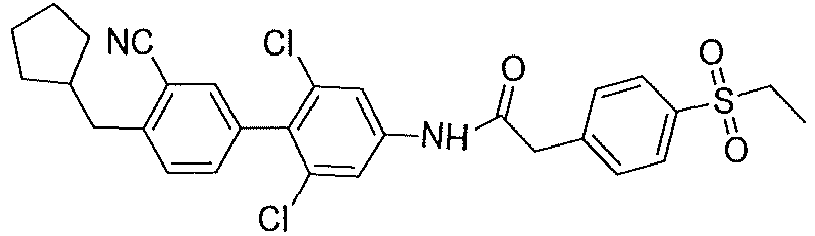
- Diethyl (4-bromo-2-cyanobenzyl)phosphonate (7 g, 21 mmol) and anhydrous tetrahydrofuran (70 mL) were added in a 150 mL single-neck flask, and the mixture was cooled in an ice bath under stirring for 5 minutes. NaH (1 g, 25 mmol) was added in portions, and the mixture was stirred in the ice bath for 30 minutes. Then cyclopentanone (3.53 g, 21 mmol) diluted in anhydrous tetrahydrofuran (5 mL) was added to the reaction mixture dropwise, then the ice bath was removed and the mixture was reacted at room temperature overnight. Water was added to quench the reaction, and the mixture was extracted with ethyl acetate (3∗30 mL). The organic layers were concentrated in vacuo to remove the solvent, and the residue was separated by a silica gel column (petroleum ether: ethyl acetate = 100:1) to give a product (colorless oil, 2.5 g), with a yield of 45.5%. 1H NMR (400 MHz, CDCl3) δ 7.71 (d, J = 2.1 Hz, 1H), 7.61 (dd, J = 8.6, 2.0 Hz, 1H), 7.38 (d, J = 8.6 Hz, 1H), 6.63 - 6.58 (m, 1H), 2.54 (t, J = 7.2 Hz, 2H), 2.46 (t, J = 7.1 Hz, 2H), 1.83 - 1.75 (m, 2H), 1.74 - 1.66 (m, 2H).
- 5-Bromo-2-(cyclopentylidenemethyl)benzonitrile (2.5 g, 9.5 mmol), bis(pinacolato)diboron (2.59 g, 11.4 mmol), Pd(dppf)Cl2 (347 mg, 0.48 mmol), potassium acetate (2.79 g, 28.5 mmol) and 1,4-dioxane (40 mL) were added in a microwave tube, and the mixture was heated to react at 120□ under microwave for 3 hours. After completion of the reaction, the mixture was cooled, extracted with ethyl acetate (3∗20 mL), and washed once with saturated sodium chloride. The organic layer was concentrated in vacuo to remove the solvent, and the residue was separated by a silica gel column (petroleum ether: ethyl acetate = 100:1) to give a product (white solid, 2.8 g), with a yield of 95.2%. 1H NMR (400 MHz, CDCl3) δ 8.04 (s, 1H), 7.90 (d, J = 8.0 Hz, 1H), 7.51 (d, J = 8.0 Hz, 1H), 6.70 (s, 1H), 2.57 (t, J = 7.1 Hz, 2H), 2.52 (t, J = 7.1 Hz, 2H), 1.83 - 1.74 (m, 2H), 1.74 - 1.66 (m, 2H), 1.34 (s, 12H).
- 2-(Cyclopentylidenemethyl)-5-(4,4,5,5-tetramethyl-1,3,2-dioxaborolan-2-yl)benzonitrile (2.8 g, 9.1 mmol), 1,3-dichloro-2-iodo-5-nitrobenzene (3.46 g, 10.9 mmol), sodium carbonate (2.89 g, 27.3 mmol), PdCl2(dtbpf) (297 mg, 0.46 mmol) and 2
wt% Tween 20 in water (30 mL) were added in a 100 mL single-neck flask, and the mixture was heated to react at 80□ for 30 minutes. After completion of the reaction, the mixture was extracted with ethyl acetate (5∗30 mL). The organic layers were combined, washed with saturated sodium chloride, and concentrated in vacuo to remove the solvent. The residue was separated by a silica gel column (petroleum ether: ethyl acetate = 10:1) to give a product (white solid, 1.1 g), with a yield of 76.5%. 1H NMR (400 MHz, CDCl3) δ 8.30 (s, 2H), 7.68 (d, J = 8.3 Hz, 1H), 7.52 (d, J = 1.4 Hz, 1H), 7.41 (d, J = 8.3 Hz, 1H), 6.77 (s, 1H), 2.61 (dd, J = 16.4, 8.0 Hz, 5H), 1.90 - 1.79 (m, 2H), 1.78 - 1.67 (m, 2H). - 2',6'-Dichloro-4-(cyclopentylidenemethyl)-4'-nitro-[1,1'-biphenyl]-3-carbonitrile (400 mg, 1.07 mmol), platinum dioxide (100 mg) and methanol (10 mL) were added in a 50 mL single-neck flask, and the mixture was reacted at room temperature for 30 minutes under hydrogen atmosphere, then additional platinum dioxide (50 mg) was added. The reaction was monitored by LC-MS, and was stopped immediately after completion. The mixture was filtered through Celite, and the filtrate was concentrated in vacuo and separated by a silica gel column (petroleum ether: ethyl acetate =50:1-10:1) to give a product (white solid, 170 mg), with a yield of 45.9%. MS (ESI) m/z: 345.1 (MH+).
- 4'-Amino-2',6'-dichloro-4-(cyclopentylmethyl)-[1,1'-biphenyl]-3-carbonitrile (70 mg, 0.2 mmol), 2-(4-(ethylsulfonyl)phenyl)acetic acid (56 mg, 0.24 mmol), HATU (91 mg, 0.24 mmol), N,N-diisopropylethylamine (77 mg, 0.6 mmol) and dichloromethane (5 mL) were added in a 25 mL single-neck flask, and the mixture was reacted at room temperature for 1 hour. After the materials had all reacted when being determined by TLC, dichloromethane (20 mL) was added, and the mixture was washed with saturated ammonium chloride (30 mL). The organic layer was concentrated in vacuo to remove the solvent, and the resulting crude product was separated by a silica gel column (petroleum ether: ethyl acetate =2:1-1:1) to give a product (white solid, 90 mg), with a yield of 79.6%. 1H NMR (400 MHz, CD3OD) δ 7.88 (d, J = 8.3 Hz, 2H), 7.78 (s, 2H), 7.62 (d, J = 8.3 Hz, 2H), 7.53 (d, J = 1.3 Hz, 1H), 7.50 (d, J = 8.1 Hz, 1H), 7.43 (dd, J = 8.1, 1.6 Hz, 1H), 3.85 (s, 2H), 3.19 (q, J = 7.4 Hz, 2H), 2.89 (d, J = 7.5 Hz, 2H), 2.22 (dq, J = 15.2, 7.5 Hz, 1H), 1.80 - 1.64 (m, 4H), 1.63 - 1.51 (m, 2H), 1.35 - 1.28 (m, 2H), 1.21 (t, J = 11.7, 4.1 Hz, 3H).MS (ESI) m/z: 552.8 (M-1).
-

- 2',6'-Dichloro-4-(cyclopentylidenemethyl)-4'-nitro-[1,1'-biphenyl]-3-carbonitrile (200 mg, 0.56 mmol), tin(II) chloride dihydrate (381 mg,1.68 mmol), ethanol (5 mL) and concentrated hydrochloric acid (0.20 mL) were added in a 100 mL single-neck flask, and the mixture was heated to react at 60□ for 1 hour. After the materials had all reacted when being determined by TLC, the mixture was concentrated in vacuo to remove ethanol, then the mixture was adjusted to pH 9 with saturated sodium carbonate solution and extracted with ethyl acetate (3∗20 mL). The organic layers were combined, washed once with saturated sodium chloride, dried over anhydrous sodium sulfate, filtered, and concentrated in vacuo to remove the solvent to give a product (white solid, 120 mg), with a yield of 87.0%.
- 4'-Amino-2',6'-dichloro-4-(cyclopentylidenemethyl)-[1,1'-biphenyl]-3-carbonitrile (120 mg, 0.35 mmol), 2-(4-(ethylsulfonyl)phenyl)acetic acid (95 mg, 0.42 mmol), HATU (160 mg, 0.42 mmol), N,N-diisopropylethylamine (135 mg, 1.05 mmol) and dichloromethane (5 mL) were added in a 25 mL single-neck flask, and the mixture was reacted at room temperature for 3 hours. After the materials had all reacted when being determined by TLC, dichloromethane (20 mL) was added, and the mixture was washed with saturated ammonium chloride (30 mL). The organic layer was concentrated to afford a crude product, which was separated by a silica gel column (petroleum ether: ethyl acetate =1:1-1:2) to give a product (white solid, 114 mg), with a yield of 59.1%. 1H NMR (400 MHz, CDCl3) δ 8.00 (s, 1H), 7.86 (d, J = 8.2 Hz, 2H), 7.69 (s, 2H), 7.61 (d, J = 8.3 Hz, 1H), 7.53 (d, J = 8.2 Hz, 2H), 7.49 (d, J = 1.5 Hz, 1H), 7.39 (dd, J = 8.2, 1.5 Hz, 1H), 6.74 (s, 1H), 3.83 (s, 2H), 3.13 (q, J= 7.4 Hz, 2H), 2.58 (q, J= 8.0 Hz, 4H), 1.86 - 1.77 (m, 2H), 1.76 - 1.71 (m, 3H), 1.30 (t, J= 7.4 Hz, 3H). MS (ESI) m/z: 550.7(M-1).
-
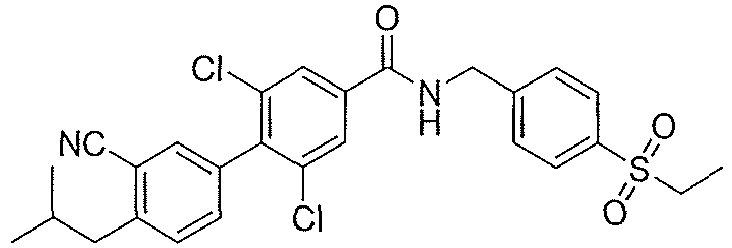
- 4-Amino-3,5-dichlorobenzonitrile (3 g, 16 mmol), acetic acid (20 mL) and concentrated sulfuric acid (8 mL) were added in a 100 mL single-neck flask A. The mixture was stirred in an ice bath for 10 minutes, then a solution of sodium nitrite (1.55 g, 22 mmol) in H2O (5 mL) was added dropwise into flask A. After the addition, the reaction was continued in the ice bath for 30 minutes. To a 250 mL single-neck flask B were added ice, urea (0.5 g) and potassium iodide (2.66 g, 16 mmol). The solution in flask A was added into flask B slowly. After the addition, the mixture was reacted at room temperature for 3 hours. After completion of the reaction, the mixture was filtered and the filtrate was discarded. While the resulting solid was dissolved in ethyl acetate, and the solution was washed once with saturated sodium chloride, dried over anhydrous sodium sulfate, and concentrated in vacuo to remove the solvent to give a product (yellow solid, 4.5 g), with a yield of 95.7%.
- 3,5-Dichloro-4-iodobenzonitrile (1.5 g, 5 mmol), potassium hydroxide (846 mg, 15 mmol), and ethanol/H2O (15 mL/ 3 mL) were added in a 25 mL single-neck flask, and the mixture was reacted at 80□ overnight. After completion of the reaction, the mixture was concentrated in vacuo to remove ethanol, then water (5 mL) was added. The mixture was adjusted to pH 2∼3 with 2N hydrochloric acid, and a large amount of white solid precipitated, which was filtered and dried in vacuo to afford a product (1.5 g), with a yield of 93.8%. 1H NMR (400 MHz, DMSO) δ 13.71 (s, 1H), 7.86 (t, J = 7.4 Hz, 2H).
- 3,5-Dichloro-4-iodobenzoic acid (1.5 g, 4.7 mmol), methanol (10 mL)and thionyl chloride (0.5 mL) were added in a 25 mL single-neck flask, and the mixture was heated to react at 60□ overnight. After completion of the reaction, the mixture was concentrated in vacuo to remove methanol, and water (20 mL) was added. The mixture was extracted with ethyl acetate (3∗30 mL), dried over anhydrous sodium sulfate, and concentrated in vacuo to remove the solvent to give a product (orange solid, 1.53 g), with a yield of 98.1%. 1H NMR (400 MHz, CDCl3) δ 7.94 (s, 2H), 3.92 (s, 3H).
- (1.53 g, 5.4 mmol, example 1, step 4), methyl 3,5-dichloro-4-iodobenzoate (1.5 g, 4.5 mmol), potassium carbonate (1.84 g, 13.5 mmol), PdCl2(dtbpf) (147 mg, 0.23 mmol) and 2
wt% Tween 20/H2O (20 mL) were added in a 100 mL single-neck flask, and the mixture was heated to react at 80□ for 1 hour under microwave. After completion of the reaction, the mixture was extracted with ethyl acetate (5∗20 mL). The organic layers were combined, washed with saturated sodium chloride, and concentrated in vacuo to remove the solvent. The redidue was separated by a silica gel column (petroleum ether: ethyl acetate =20:1-5:1) to give a product (white solid, 1 g), with a yield of 60.2%. 1H NMR (400 MHz, CDCl3) δ 8.07 (s, 2H), 7.55 (s, 1H), 7.48 (d, J= 8.1 Hz, 1H), 7.42 (d, J= 7.9 Hz, 1H), 6.49 (s, 1H), 3.97 (s, 3H), 2.01 (s, 3H), 1.90 (s, 3H). - Methyl 2,6-dichloro-3'-cyano-4'-(2-methylprop-1-en-1-yl)-[1,1'-biphenyl]-4-carboxylate (500 mg), methanol (5 mL) and platinum dioxide (15 mg) were added in a 25 mL single-neck flask with a hydrogen balloon equipped, and the mixture was reacted at room temperature for 2 hours under hydrogen atmosphere. The mixture was filtered through Celite, and the crude product was separated by a silica gel column (petroleum ether: ethyl acetate = 100:1) to give a product (white solid, 340 mg), with a yield of 37.8%. 1H NMR (400 MHz, CDCl3) δ 8.08 (d, J = 1.1 Hz, 2H), 7.53 (s, 1H), 7.40 (s, 3H), 3.97 (s, 3H), 2.80 (d, J = 7.1 Hz, 2H), 2.08 (td, J = 13.3, 6.8 Hz, 1H), 1.01 (d, J = 6.6 Hz, 6H).
- Step 6: Synthesis of 2,6-dichloro-3'-cyano-4'-isobutyl-[1,1'-biphenyl]-4-carboxylic acid Methyl 2,6-dichloro-3'-cyano-4'-isobutyl-[1,1'-biphenyl]-4-carboxylate (190 mg, 0.52 mmol), lithium hydroxide monohydrate (66 mg, 1.56 mmol) and ethanol/H2O (2 mL/0.5 mL) were added in a 25 mL single-neck flask, and the mixture was heated to react at 50□ for 20 minutes. After completion of the reaction, the mixture was concentrated in vacuo to remove ethanol, then water (5 mL) was added. The mixture was adjusted to acidic pH with 2N hydrochloric acid, and extracted with ethyl acetate (3∗10 mL). The organic layers were combined, dried over anhydrous sodium sulfate, and concentrated in vacuo to remove the solvent to give a product (white solid, 165 mg), with a yield of 90.6%. 1H NMR (400 MHz, DMSO) δ 8.02 (s, 2H), 7.84 (s, 1H), 7.60 (s, 2H), 2.75 (d, J = 7.3 Hz, 2H), 1.99 (t, J = 6.7 Hz, 1H), 0.94 (d, J = 6.6 Hz, 6H). MS (ESI) m/z: 348.0(M+1).
- 4-Cyanobenzenesulfonyl chloride (1 g, 4.97 mmol), water (15 mL), sodium bicarbonate (835 mg, 9.94 mmol) and sodium sulfite (689 mg, 5.47 mmol) were added to a 100 mL single-neck flask, and the mixture was stirred at 70°C for 4 hours. The mixture was concentrated in vacuo to remove the solvent, and the residue was dissolved in N,N-dimethylformamide (20 mL), then iodoethane (1.2 mL) was added, and the mixture was stirred at 70°C for another 4 hours. The mixture was cooled to room temperature, then water (30 mL) was added, and the mixture was extracted with ethyl acetate (30 mL∗3). The organic layers were combined, washed with saturated sodium chloride, dried over anhydrous sodium sulfate, and filtered. The filtrate was concentrated in vacuo to remove the solvent to afford a crude product, which was separated by a silica gel column (ethyl acetate: petroleum ether = 1:4-1:2) to give a product (yellow solid, 630 mg), with a yield of 65.0%. 1H NMR (400 MHz, CDCl3) δ 8.04 (d, J = 8.5 Hz, 2H), 7.89 (d, J = 8.6 Hz, 2H), 3.16 (q, J = 7.4 Hz, 2H), 1.30 (t, J = 7.4 Hz, 3H).
- 4-(Ethylsulfonyl)benzonitrile (630 mg, 3.23 mmol), methanol (10 mL) and Pd/C (100 mg, 10%) were added in a 25 mL single-neck flask, and the mixture was stirred at room temperature for 1 hour. The mixture was filtered through Celite, and concentrated in vacuo to remove the solvent to afford a product (white solid, 500 mg), with a yield of 77.9%. 1H NMR (400 MHz, CDCl3) δ 7.86 (d, J = 8.3 Hz, 2H), 7.53 (d, J = 8.2 Hz, 2H), 3.99 (s, 2H), 3.10 (d, J = 7.4 Hz, 2H), 1.27 (t, J = 7.4 Hz, 3H).
- (4-(Ethylsulfonyl)phenyl)methanamine (27 mg, 0.14 mmol), 2,6-dichloro-3'-cyano-4'-isobutyl-[1,1'-biphenyl]-4-carboxylic acid (40 mg, 0.11 mmol), HATU (53 mg, 0.14 mmol), N,N-diisopropylethylamine (43 mg, 0.33 mmol) and dichloromethane (3 mL) were added in a 25 mL single-neck flask, and the mixture was reacted at room temperature for 3 hours. After the materials had all reacted when being determined by TLC, dichloromethane (20 mL) was added, and the mixture was washed with saturated ammonium chloride (30 mL). The organic layer was concentrated in vacuo to afford a crude prooduct, which was separated by a silica gel column (petroleum ether: ethyl acetate =1:1-1:2) to give a product (white solid, 60 mg), with a yield of 98.7%. 1H NMR (400 MHz, CDCl3) δ 7.97 (s, 2H), 7.69 (d, J = 5.8 Hz, 1H), 7.66 (d, J = 8.0 Hz, 2H), 7.50 (s, 1H), 7.43 (d, J = 8.0 Hz, 2H), 7.39 (s, 2H), 4.72 (d, J = 5.7 Hz, 2H), 3.07 (q, J = 7.4 Hz, 2H), 2.79 (s, 2H), 2.13 - 2.00 (m, 1H), 1.23 (t, J= 7.4 Hz, 3H), 0.99 (d, J= 6.6 Hz, 6H). MS (ESI) m/z: 529.0(M+1).
-

- (4-(Methylsulfonyl)phenyl)methanamine hydrochloride (31 mg, 0.14 mmol), 2,6-dichloro-3'-cyano-4'-isobutyl-[1,1'-biphenyl]-4-carboxylic acid (40 mg, 0.11 mmol), HATU (53 mg, 0.14 mmol), N,N-diisopropylethylamine (43 mg, 0.33 mmol) and dichloromethane (3 mL) were added in a 25 mL single-neck flask, and the mixture was reacted at room temperature for 3 hours. After the materials had all reacted when being determined by TLC, dichloromethane (20 mL) was added, and the mixture was washed with saturated ammonium chloride (30 mL). The organic layer was concentrated in vacuo to afford a crude product, which was separated by a silica gel column (petroleum ether: ethyl acetate =1:1-1:2) to give a product (white solid, 50 mg), with a yield of 87.7%. 1H NMR (400 MHz, CDCl3) δ 7.89 (d, J = 8.7 Hz, 4H), 7.55 (s, 1H), 7.52 (d, J = 6.6 Hz, 2H), 7.40 (s, 2H), 6.81 (s, 1H), 4.76 (d, J = 5.5 Hz, 2H), 3.05 (s, 3H), 2.79 (d, J = 7.3 Hz, 2H), 2.06 (td, J= 13.2, 6.3 Hz, 1H), 1.00 (d, J= 6.6 Hz, 6H). MS (ESI) m/z: 515.0(M+1).
-

- 5-Bromo-2-picolinonitrile (940 mg, 5.14 mmol), ethyl mercaptan (505 mg, 6.01 mmol), potassium carbonate (981 mg, 7.11 mmol) and NMP (10 mL) were added in a 50 mL single-neck flask, and the mixture was stirred at room temperature overnight. Water (20 mL) was added, then the mixture was extracted with ethyl acetate (3∗30 mL). The organic layers were concentrated in vacuo to afford a product 5-(ethylthio)picolinonitrile (900 mg), with a yield of 100%. MS (ESI) m/z: 165.1 (MH+).
- 5-(Ethylthio)picolinonitrile (800 mg, 4.88 mmol) and dichloromethane (20 mL) were added in a 25 mL single-neck flask and stirred in an ice bath for 10 minutes. mCPBA (1.84 g, 10.7 mmol) was added in portions into the reaction mixture, and then the mixture was reacted at room temperature overnight. The mixture was washed with 2N sodium carbonate aqueous solution, and the organic layer was concentrated in vacuo to remove the solvent. The residue was separated by a silica gel column (petroleum ether: ethyl acetate = 2:1- 1:1) to give a product (900 mg), with a yield of 90.0%. 1H NMR (400 MHz, CDCl3) δ 9.18 (d, J = 1.2 Hz, 1H), 8.37 (dd, J = 8.0, 1.8 Hz, 1H), 7.93 (d, J = 8.0 Hz, 1H), 3.21 (q, J = 7.4 Hz, 2H), 1.34 (t, J = 7.4 Hz, 3H). MS (ESI) m/z: 197.1(M+1).
- 5-(Ethylsulfonyl)-2-picolinonitrile (200 mg, 1 mmol), methanol (10 mL) and Pd/C (100 mg, 10%) were added in a 25 mL single-neck flask, and the reaction mixture was stirred at room temperature for 30 minutes under hydrogen atmosphere. The mixture was filtered through Celite, and the filtrate was concentrated in vacuo to afford a product (white solid, 110 mg), with a yield of 53.9%. MS (ESI) m/z: 201.1(M+1).
- (5-(Ethylsulfonyl)pyridin-2-yl)methanamine (28 mg, 0.14 mmol), 2,6-dichloro-3'-cyano-4'-isobutyl-[1,1'-biphenyl]-4-carboxylic acid (40 mg, 0.11 mmol), HATU (53 mg, 0.14 mmol), N,N-diisopropylethylamine (43 mg, 0.33 mmol) and dichloromethane (3 mL) were added in a 25 mL single-neck flask, and the mixture was reacted at room temperature for 3 hours. After the materials had all reacted when being determined by TLC, dichloromethane (20 mL) was added, and the mixture was washed with saturated ammonium chloride (30 mL). The organic layer was concentrated in vacuo to afford a crude product, which was separated by a silica gel column (petroleum ether: ethyl acetate =1:1) to give a product (white solid, 55 mg), with a yield of 90.2%. 1H NMR (400 MHz, CDCl3) δ 9.05 (s, 1H), 8.18 (d, J = 8.1 Hz, 1H), 7.93 (s, 2H), 7.74 (s, 1H), 7.56 (d, J = 8.2 Hz, 1H), 7.53 (s, 1H), 7.41 (s, 2H), 4.89 (d, J = 4.8 Hz, 2H), 3.18 (q, J = 7.3 Hz, 2H), 2.79 (s, 2H), 2.07 (dt, J = 13.5, 6.7 Hz, 1H), 1.33 (t, J = 7.3 Hz, 3H), 1.01 (d, J = 6.5 Hz, 6H). MS (ESI) m/z: 530.0(M+1).
-

- (5-(Methylsulfonyl)-pyridin-2-yl)methylamine (26 mg, 0.14 mmol), 2,6-dichloro-3'-cyano-4'-isobutyl-[1,1'-biphenyl]-4-carboxylic acid (40 mg, 0.11 mmol), HATU (53 mg, 0.14 mmol), N,N-diisopropylethylamine (43 mg, 0.33 mmol) and dichloromethane (3 mL) were added in a 25 mL single-neck flask, and the mixture was reacted at room temperature for 3 hours. After the materials had all reacted when being determined by TLC, dichloromethane (20 mL) was added, and the mixture was washed with saturated ammonium chloride (30 mL). The organic layer was concentrated in vacuo to afford a crude product, which was separated by a silica gel column (petroleum ether: ethyl acetate =1:1-1:2) to give a product (white solid, 44 mg), with a yield of 74.6%. 1H NMR (400 MHz, CDCl3) δ 9.05 (s, 1H), 8.19 (d, J = 8.2 Hz, 1H), 7.96 - 7.89 (m, 2H), 7.80 (s, 1H), 7.55 (d, J = 8.2 Hz, 1H), 7.50 (s, 1H), 7.39 (s, 2H), 4.85 (d, J = 4.7 Hz, 2H), 3.15 - 3.06 (m, 3H), 2.77 (d, J = 7.1 Hz, 2H), 2.12 - 1.98 (m, 1H), 0.98 (d, J = 6.5 Hz, 6H). MS (ESI) m/z: 516.0(M+1).
-

- 5-Bromo-2-methylbenzonitrile (10 g, 5.1 mmol), NBS(9.99 g, 5.6 mmol), BPO (0.63 g, 0.26 mmol) and carbon tetrachloride (100 mL) were added in a 250 mL single-neck flask, and the mixture was heated to react at 90□ overnight. After completion of the reaction, the mixture was cooled to room temperature and filtered. The filtrate was concentrated in vacuo to remove the solvent, and the residue was separated by a silica gel column (petroleum ether: ethyl acetate = 30:1) to give a product (white solid, 8.5 g), with a yield of 60.7%.
- 5-Bromo-2-(bromomethyl)benzonitrile (2 g, 7.3 mmol), a solution of dimethylamine in tetrahydrofuran (11 mL, 21.9 mmol), potassium carbonate (2.97 g, 21.9 mmol) and acetonitrile (20 mL) were added in a 25 mL single-neck flask, and the mixture was reacted at 90□ overnight. After completion of the reaction, water (20 mL) was added, and the mixture was extracted with ethyl acetate (3∗10 mL). The organic layers were combined, washed with saturated sodium chloride, dried over anhydrous sodium sulfate, and concentrated in vacuo to remove the solvent. The residue was separated by a silica gel column (petroleum ether: ethyl acetate = 10:1) to give a product (yellow oil, 1.5 g), with a yield of 88.3%. 1H NMR (400 MHz, CDCl3) δ 7.77 (s, 1H), 7.69 (d, J = 8.4 Hz, 1H), 7.45 (d, J = 8.3 Hz, 1H), 3.59 (s, 2H), 2.29 (s, 7H).
- 5-Bromo-2-((dimethylamino)methyl)benzonitrile (1.2 g, 5 mmol), bis(pinacolato)diboron (1.7 g, 7.5 mmol), potassium acetate (1.48 g, 15 mmol), PdCl2(dppf) (182 mg, 0.25 mmol) and 1,4-dioxane (10 mL) were added in a microwave tube, and the mixture was reacted at 120□ under microwave for 1 hour. After completion of the reaction, water (20 mL) was added, and the mixture was extracted with ethyl acetate (3∗20 mL). The organic layer was concentrated in vacuo, and the residue was separated by a silica gel column (petroleum ether: ethyl acetate = 5:1-1:1) to give a product (yellow oil, 720 mg), with a yield of 55.6%. 1H NMR (400 MHz, CDCl3) δ 8.08 (s, 1H), 7.97 (d, J = 7.7 Hz, 1H), 7.57 (d, J = 7.7 Hz, 1H), 3.66 (s, 2H), 2.29 (s, 6H), 1.35 (s, 12H).
- 2-((Dimethylamino)methyl)-5-(4,4,5,5-tetramethyl-1,3,2-dioxaborolan-2-yl)benzonitrile (367 mg, 1.28 mmol), methyl 3,5-dichloro-4-iodobenzoate (340 mg, 1.07 mmol), potassium carbonate (437 mg, 3.21 mmol) ), PdCl2(dtbpf) (33 mg, 0.05 mmol) and 2
wt% Tween 20/H2O (10 mL) were added in a 50 mL single-neck flask, and the mixture was heated to react at 80□ for 1 hour under microwave. After completion of the reaction, the mixture was extracted with ethyl acetate (3∗20 mL). The organic layers were combined, washed with saturated sodium chloride, and concentrated in vacuo to remove the solvent. The redidue was separated by a silica gel column (petroleum ether: ethyl acetate =10:1) to give a product (yellow oil, 150 mg), with a yield of 40.3%. 1H NMR (400 MHz, CDCl3) δ 8.08 (s, 2H), 7.71 (d, J = 7.9 Hz, 1H), 7.56 (s, 1H), 7.47 (d, J = 8.0 Hz, 1H), 3.97 (s, 3H), 3.73 (s, 2H), 2.37 (s, 6H). - Methyl 2,6-dichloro-3'-cyano-4'-((dimethylamino)methyl)-[1,1'-biphenyl]-4-carboxylate (150 mg, 0.41 mmol), lithium hydroxide monohydrate (52 mg, 1.23 mmol) and ethanol/H2O (5 mL/1 mL) were added in a 25 mL single-neck flask, and the mixture was heated to react at 50□ for 20 minutes. After completion of the reaction according to TLC, the mixture was concerntrated to remove ethanol, and pH of the mixture was adjusted by 1N hydrochloric acid. A large amount of yellow solid was precipitated, filtered, and dried in vacuo to give a product (yellow solid, 120 mg), with a yield of 83.3%. 1H NMR (400 MHz, DMSO) δ 7.95 (s, 2H), 7.83 (s, 1H), 7.69 (d, J = 7.8 Hz, 1H), 7.62 (d, J = 7.5 Hz, 1H), 3.63 (s, 2H), 2.23 (s, 6H).
- 2,6-Dichloro-3'-cyano-4'-((dimethylamino)methyl)-[1,1'-biphenyl]-4-carboxylic acid (55 mg, 0.16 mmol), (4-(ethylsulfonyl)phenyl)methanamine (38 mg, 0.19 mmol), HATU (72 mg, 0.19 mmol), N,N-diisopropylethylamine (62 mg, 0.48 mmol) and dichloromethane (5 mL) were added in a 25 mL single-neck flask, and the mixture was reacted at room temperature for 3 hours. After the materials had all reacted when being determined by TLC, dichloromethane (5 mL) was added, and the mixture was washed with saturated ammonium chloride (30 mL). The organic layer was concentrated in vacuo to afford a crude product, which was separated by a silica gel column (petroleum ether: ethyl acetate =1:1-1:2) to give a product (white solid, 35 mg), with a yield of 83.5%. 1H NMR (400 MHz, CDCl3) δ 7.98 (s, 2H), 7.73 - 7.63 (m, 3H), 7.55 (s, 2H), 7.47 (d, J = 7.8 Hz, 1H), 7.43 (d, J = 8.0 Hz, 2H), 4.74 (d, J = 5.7 Hz, 2H), 3.72 (s, 2H), 3.08 (q, J = 7.3 Hz, 2H), 2.36 (s, 6H), 1.25 (t, J = 7.4 Hz, 3H). MS (ESI) m/z: 530.0(M+1).
-
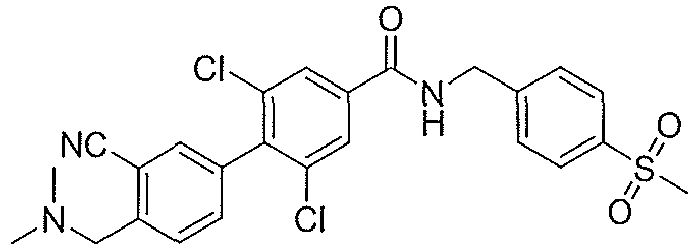
- 2,6-Dichloro-3'-cyano-4'-((dimethylamino)methyl)-[1,1'-biphenyl]-4-carboxylic acid (55 mg, 0.16 mmol), (4-(methylsulfonyl)phenyl)methanamine (43 mg, 0.19 mmol), HATU (72 mg, 0.19 mmol), N,N-diisopropylethylamine (62 mg, 0.48 mmol) and dichloromethane (3 mL) were added in a 25 mL single-neck flask, and the mixture was reacted at room temperature for 3 hours. After the materials had all reacted when being determined by TLC, dichloromethane (5 mL) was added, and the mixture was washed with saturated ammonium chloride (10 mL). The organic layer was concentrated in vacuo to remove the solvent to afford a crude product, which was separated by a silica gel column (petroleum ether: ethyl acetate =1:1-1:2) to give a product (white solid, 35 mg), with a yield of 43.2%. 1H NMR (400 MHz, DMSO) δ 9.46 (s, 1H), 8.08 (s, 2H), 7.96 - 7.84 (m, 3H), 7.69 (d, J= 8.1 Hz, 1H), 7.66 - 7.53 (m, 3H), 4.58 (s, 2H), 3.61 (s, 2H), 3.18 (s, 3H), 2.21 (s, 6H). MS (ESI) m/z: 516.0(M+1).
-

- 4'-Amino-2',6'-dichloro-4-isobutyl-[1,1'-biphenyl]-3-carbonitrile (50 mg, 0.16 mmol), dichloromethane (2 mL) and DIEA (62 mg, 0.48 mmol) were added in a 25 mL single-neck flask and stirred in an ice bath for 5 minutes. Then triphosgene (19 mg, 0.064 mmol) was added and the mixture was stirred in the ice bath for 30 minutes. And then (4-(ethylsulfonyl)phenyl)methanamine (37 mg, 0.19 mmol) was added, and the mixture was stirred at room temperature for 30 minutes. Water (10 mL) was added, and the mixture was extracted with dichloromethane (3∗10 mL). The organic layers were combined, washed with saturated sodium chloride (10 mL), dried over anhydrous sodium sulfate, and filtered. The filtrate was concentrated in vacuo to obtain a crude product, which was separated by a silica gel column (petroleum ether: ethyl acetate =1:1-1:2) to give a product (white solid, 82 mg), with a yield of 96.4%. 1H NMR (400 MHz, CDCl3) δ 7.85 (s, 1H), 7.69 (d, J = 7.6 Hz, 2H), 7.51 (s, 2H), 7.45 (d, J = 13.7 Hz, 1H), 7.39 (d, J = 7.7 Hz, 2H), 7.35 (s, 2H), 6.23 (s, 1H), 4.48 (d, J = 4.8 Hz, 2H), 3.14 (q, J= 7.0 Hz, 2H), 2.76 (d, J= 6.9 Hz, 2H), 2.01 (m, 1H), 1.28 (t, J= 7.0 Hz, 3H), 0.99 (d, J= 6.2 Hz, 6H). MS (ESI) m/z: 544.0(M+1).
-

- 4'-Amino-2',6'-dichloro-4-isobutyl-[1,1'-biphenyl]-3-carbonitrile (50 mg, 0.16 mmol), dichloromethane (2 mL) and DIEA (62 mg, 0.48 mmol) were added in a 25 mL single-neck flask, and stirred in an ice bath for 5 minutes. Then triphosgene (19 mg, 0.064 mmol) was added, and the mixture was stirred in the ice bath for 10 minutes. And then (4-(methylsulfonyl)phenyl)methanamine (43 mg, 0.19 mmol) was added, and the mixture was stirred at room temperature for 30 minutes. Water (10 mL) was added, and the mixture was extracted with dichloromethane (3∗10 mL) The organic layers were combined, washed with saturated sodium chloride (10 mL), dried over anhydrous sodium sulfate, and filtered. The filtrate was concentrated in vacuo to obtain a crude product, which was separated by a silica gel column (dichloromethane: methanol =100:1-50:1) to give a product (white solid, 43 mg), with a yield of 51.8%. 1H NMR (400 MHz, CD3OD) δ 7.89 (d, J = 7.9 Hz, 2H), 7.57 (d, J = 6.9 Hz, 4H), 7.51 (s, 1H), 7.48 - 7.38 (m, 2H), 4.49 (s, 2H), 3.08 (s, 3H), 2.74 (d, J = 7.2 Hz, 2H), 2.11 - 1.90 (m, 1H), 0.97 (d, J= 6.6 Hz, 6H). MS (ESI) m/z: 530.0(M+1).
-

- 4'-Amino-2',6'-dichloro-4-isobutyl-[1,1'-biphenyl]-3-carbonitrile (50 mg, 0.16 mmol), dichloromethane (2 mL) and DIEA (62 mg, 0.48 mmol) were added in a 25 mL single-neck flask, and was stirred in an ice bath for 5 minutes. Then triphosgene (19 mg, 0.064 mmol) was added, and the mixture was stirred in the ice bath for 10 minutes. And then (5-(ethylsulfonyl)pyridin-2-yl)methanamine (43 mg, 0.19 mmol) was added, and the mixture was stirred at room temperature for 30 minutes. Water (10 mL) was added, and the mixture was extracted with dichloromethane (3∗10 mL). The organic layers were combined, washed with saturated sodium chloride (10 mL), dried over anhydrous sodium sulfate, and filtered. The filtrate was concentrated in vacuo to obtain a crude product, which was separated by a silica gel column (dichloromethane: methanol =100:1) to give a product (white solid, 48 mg), with a yield of 56.5%. 1H NMR (400 MHz, CD3OD) δ 9.00 (s, 1H), 8.29 (d, J = 8.1 Hz, 1H), 7.69 (d, J = 8.0 Hz, 1H), 7.63 (s, 2H), 7.56 (s, 1H), 7.53 - 7.41 (m, 2H), 4.65 (s, 3H), 3.30 (q, J = 7.4 Hz, 2H), 2.79 (d, J = 7.3 Hz, 2H), 2.05 (m, 1H), 1.27 (t, J = 7.4 Hz, 3H), 1.01 (d, J = 6.5 Hz, 6H). MS (ESI) m/z: 544.8(M+1).
-

- 4'-Amino-2',6'-dichloro-4-isobutyl-[1,1'-biphenyl]-3-carbonitrile (50 mg, 0.16 mmol), dichloromethane (2 mL) and DIEA (62 mg, 0.48 mmol) were added in a 25 mL single-neck flask, and was stirred in an ice bath for 5 minutes. Then triphosgene (17 mg, 0.056 mmol) was added, and the mixture was stirred in the ice bath for 10 minutes. And then (5-(methylsulfonyl)pyridin-2-yl)methanamine (36 mg, 0.19 mmol) was added, and the mixture was stirred at room temperature for 30 minutes. Water (10 mL) was added, and the mixture was extracted with dichloromethane (3∗10 mL). The organic layers were combined, washed with saturated sodium chloride (10 mL), dried over anhydrous sodium sulfate, and filtered. The filtrate was concentrated in vacuo to obtain a crude product, which was separated by a silica gel column (dichloromethane: methanol =100:1) to give a product (white solid, 45 mg), with a yield of 54.2%. 1H NMR (400 MHz, CD3OD) δ 9.00 (s, 1H), 8.28 (d, J = 8.3 Hz, 1H), 7.64 (d, J = 8.3 Hz, 1H), 7.57 (s, 2H), 7.51 (s, 1H), 7.42 (q, J = 8.2 Hz, 2H), 4.61 (s, 2H), 3.18 (s, 3H), 2.75 (d, J = 7.2 Hz, 2H), 2.11 - 1.94 (m, 1H), 0.97 (d, J = 6.6 Hz, 6H). MS (ESI) m/z: 528.8 (M-1).
-

- Methyl 2-(4-cyanophenyl)acetate (200 mg, 1.14 mmol), methanol (2 mL), Pd/C (a small amount) and 2 drops of concentrated hydrochloric acid were added in a 25 mL single-neck flask with a hydrogen balloon equipped, and the mixture was stirred at room temperature for 3 hours under hydrogen atmosphere. After completion of the reaction according to TLC, the mixture was filtered and the filtrate was concentrated to afford a product methyl 2-(4-(aminomethyl)phenyl)acetate (white solid, 178 mg), with a yield of 74.2%. 1H NMR (400 MHz, DMSO) δ 8.22 (s, 2H), 7.44 (d, J = 8.1 Hz, 2H), 7.30 (d, J = 8.1 Hz, 2H), 3.98 (s, 2H), 3.71 (s, 2H), 3.61 (s, 3H). MS (ESI) m/z: 180.1 (M+1).
- 4'-Amino-2',6'-dichloro-4-isobutyl-[1,1'-biphenyl]-3-carbonitrile (50 mg, 0.16 mmol), dichloromethane (2 mL) and DIEA (62 mg, 0.48 mmol) were added in a 25 mL single-neck flask, and the mixture was stirred in an ice bath for 5 minutes. Then triphosgene (19 mg, 0.064 mmol) was added, and the mixture was stirred in the ice bath for 10 minutes. And then methyl 2-(4-(aminomethyl)phenyl)acetate (34 mg, 0.19 mmol) was added, and the mixture was stirred at room temperature for 30 minutes. Water (10 mL) was added, and the mixture was extracted with dichloromethane (3∗10 mL). The organic layers were combined, washed with saturated sodium chloride (10 mL), dried over anhydrous sodium sulfate, and filtered. The filtrate was concentrated in vacuo to obtain a crude product, which was separated by a silica gel column (petroleum ether: ethyl acetate =5:1-3:1) to give a product (white solid, 70 mg), with a yield of 83.3%. MS (ESI) m/z: 524.2 (M+1).
- Methyl 2-(4-((3-(2,6-dichloro-3'-cyano-4'-isobutyl-[1,1'-biphenyl]-4-yl)ureido)methyl)phenyl)-acetate (65 mg, 0.13 mmol), lithium hydroxide monohydrate (17 mg, 0.39 mmol) and ethanol/H2O (2 mL/0.5 mL) were added in a 25 mL single-neck flask, and the mixture was stirred at room teperature for 3 hours. After completion of the reaction, ethanol was removed, water (5 mL) was added and pH of the mixture was adjusted to acidic with 2N hydrochloric acid. The mixture was extracted with ethyl acetate (3∗10 mL), the organic layers were dried over anhydrous sodium sulfate, and concentrated in vacuo to give a product (yellow solid, 65 mg), with a yield 98.5%. 1H NMR (400 MHz, DMSO) δ 9.20 (s, 1H), 7.72 (s, 1H), 7.66 (s, 2H), 7.53 (s, 2H), 7.27 - 7.20 (m, 4H), 6.96 (s, 1H), 4.29 (d, J = 5.7 Hz, 2H), 3.54 (s, 2H), 2.73 (d, J = 7.3 Hz, 2H), 1.98 (m, 1H), 0.93 (d, J= 6.5 Hz, 6H). MS (ESI) m/z: 510.0 (M+1).
-

- 4'-Amino-2',6'-dichloro-4-((dimethylamino)methyl)-[1,1'-biphenyl]-3-carbonitrile (100 mg, 0.31 mmol), dichloromethane (5 mL) and DIEA (120 mg, 0.93 mmol) were added in a 25 mL single-neck flask, and the mixture was stirred in an ice bath for 5 minutes. Then triphosgene (32 mg, 0.11 mmol) was added and the mixture was stirred in the ice bath for 10 minutes. And then (4-(ethylsulfonyl)phenyl)methanamine (75 mg, 0.38 mmol) was added, and the mixture was stirred at room temperature for 1 hour. Water (10 mL) was added, and the mixture was extracted with dichloromethane (3∗10 mL).The organic layers were combined, washed with saturated sodium chloride (10 mL), dried over anhydrous sodium sulfate, and filtered. The filtrate was concentrated in vacuo to obtain a crude product, which was separated by a silica gel column (dichloromethane: methanol =50:1) to give a product (white solid, 87 mg), with a yield of 51.2%. 1H NMR (400 MHz, CDCl3) δ 7.70 (d, J = 8.1 Hz, 2H), 7.66 (d, J = 8.3 Hz, 2H), 7.58 (s, 2H), 7.54 (s, 1H), 7.45 (d, J = 7.9 Hz, 1H), 7.40 (d, J = 8.0 Hz, 2H), 6.10 (t, J = 6.0 Hz, 1H), 4.53 (d, J = 5.2 Hz, 2H), 3.74 (s, 2H), 3.17 (d, J = 7.4 Hz, 2H), 2.39 (s, 6H), 1.31 (t, J = 7.4 Hz, 3H). MS (ESI) m/z: 545.0 (M+1).
-

- 4'-Amino-2',6'-dichloro-4-((dimethylamino)methyl)-[1,1'-biphenyl]-3-carbonitrile (50 mg, 0.16 mmol), dichloromethane (2 mL) and DIEA (62 mg, 0.48 mmol) were added in a 25 mL single-neck flask, and the mixture was stirred in an ice bath for 5 minutes. Then triphosgene (17 mg, 0.056 mmol) was added and the mixture was stirred in the ice bath for 10 minutes. And then (4-(methylsulfonyl)phenyl)methanamine (43 mg, 0.19 mmol) was added, and the mixture was stirred at room temperature for 1 hours. Water (10 mL) was added, and the mixture was extracted with dichloromethane (3∗10 mL). The organic layers were combined, washed with saturated sodium chloride (10 mL), dried over anhydrous sodium sulfate, and filtered. The filtrate was concentrated in vacuo to obtain a crude product, which was separated by a silica gel column (dichloromethane: methanol =50:1) to give a product (white solid, 44 mg), with a yield of 53.1%. 1H NMR (400 MHz, CD3OD) δ 7.89 (d, J = 8.0 Hz, 2H), 7.67 - 7.63 (m, 1H), 7.57 (d, J = 9.0 Hz, 5H), 7.50 (d, J = 7.9 Hz, 1H), 4.49 (s, 2H), 3.70 (s, 2H), 3.08 (s, 3H), 2.32 (s, 6H). MS (ESI) m/z:531.0(M+1).
-

- N-(2,6-Dichloro-3'-cyano-4'-isobutyl-[1,1'-biphenyl]-4-yl)-2-(4-(ethylsulfonyl)phenyl)acet amide (65 mg, 0.12 mmol) and tetrahydrofuran (1 mL) were added in a 25 mL single-neck flask, then a solution of borane in tetrahydrofuran (0.36 mL, 1M) was added under stirring, and the mixture was stirred at room temperature for 1 hour. Then additional solution of borane in tetrahydrofuran (0.2 mL, 1M) was added, and the mixture was stirred at room temperature for another 1 hour. After completion of the reaction, methanol (10 mL) was added, and the mixture was heated to react at 70□ for 30 minutes. The mixture was concentrated in vacuo to remove the solvent, and the residue was separated by preparative thin layer chromatography to give a product (white solid, 28 mg), with a yield of 45.1%. 1H NMR (400 MHz, CDCl3) δ 7.84 (d, J = 6.1 Hz, 2H), 7.47 (s, 1H), 7.45 - 7.33 (m, 3H), 7.30 (s, 1H), 6.59 (s, 2H), 3.43 (s, 2H), 3.10 (d, J = 6.0 Hz, 2H), 3.01 (s, 2H), 2.73 (d, J= 5.0 Hz, 2H), 2.02 (s, 1H), 1.66 (s, 1H), 1.26 (s, 3H), 0.96 (d, J = 4.1 Hz, 6H). MS (ESI) m/z: 514.8(M+1).
-

- N-(2,6-Dichloro-3'-cyano-4'-isobutyl-[1,1'-biphenyl]-4-yl)-2-(4-(methylsulfonyl)phenyl)acetam ide (50 mg, 0.10 mmol) and tetrahydrofuran (1 mL) were added in a 25 mL single-neck flask, then a solution of borane in tetrahydrofuran (0.36 mL, 1M) was added under stirring, and the mixture was stirred at room temperature for 1 hour. Then methanol (10 mL) was added, and the mixture was heated to react at 70□ for 30 minutes. The mixture was concentrated in vacuo to remove the solvent, and the residue was separated by preparative thin layer chromatography (petroleum ether: ethyl acetate = 10:1) to give a product (white solid, 15 mg), with a yield of 30.0%. 1H NMR (400 MHz, CDCl3) δ 7.94 (d, J = 8.1 Hz, 2H), 7.52 (s, 1H), 7.46 (d, J = 8.1 Hz, 2H), 7.40 (d, J = 8.2 Hz, 1H), 7.34 (d, J = 8.0 Hz, 1H), 6.64 (s, 2H), 3.48 (t, J = 6.8 Hz, 2H), 3.09 (s, 3H), 3.06 (t, J = 6.8 Hz, 2H), 2.78 (d, J = 7.3 Hz, 2H), 2.07 (dt, J = 13.3, 6.6 Hz, 1H), 1.01 (d, J = 6.6 Hz, 6H).MS (ESI) m/z: 500.8 (M+1).
-

- N-(2,6-Dichloro-3'-cyano-4'-((dimethylamino)methyl)-[1,1'-biphenyl]-4-yl)-2-(4-(ethylsulfonyl )phenyl)acetamide (30 mg, 0.057 mmol) and tetrahydrofuran (1 mL) were added in a 25 mL single-neck flask, then a solution of borane in tetrahydrofuran (0.17 mL, 1M) was added under stirring, and the mixture was stirred at room temperature for 1 hour. Then methanol (10 mL) was added, and the mixture was heated to react at 70□ for 30 minutes. The mixture was concentrated in vacuo to remove the solvent, and the residue was separated by preparative thin layer chromatography (petroleum ether: ethyl acetate = 1:2) to give a product (white solid, 20 mg), with a yield of 69.0%. 1H NMR (400 MHz, CDCl3) δ 7.86 (d, J = 7.8 Hz, 2H), 7.61 (d, J = 7.6 Hz, 1H), 7.54 (s, 1H), 7.44 (t, J = 9.0 Hz, 3H), 6.62 (s, 2H), 3.70 (s, 2H), 3.46 (d, J = 5.7 Hz, 2H), 3.12 (dd, J = 14.6, 7.3 Hz, 2H), 3.03 (t, J = 6.3 Hz, 2H), 2.35 (s, 6H), 1.29 (t, J = 7.1 Hz, 5H). MS (ESI) m/z:516.0 (M+1).
-

- N-(2,6-Dichloro-3'-cyano-4'-((dimethylamino)methyl)-[1,1'-biphenyl]-4-yl)-2-(4-(methylsulfon yl)phenyl)acetamide (52 mg, 0.1 mmol), and tetrahydrofuran (1 mL) were added in a 25 mL single-neck flask, then a solution of borane in tetrahydrofuran (0.17 mL, 1M) was added under stirring, and the mixture was stirred at room temperature for 2 hours. Then methanol (10 mL) was added, and the mixture was heated to react at 70□ for 30 minutes. The mixture was concentrated in vacuo to remove the solvent, and the residue was separated by preparative thin layer chromatography (petroleum ether: ethyl acetate = 1:1) to give a product (white solid, 20 mg), with a yield of 20.6%. 1H NMR (400 MHz, CDCl3) δ 7.92 (d, J = 7.5 Hz, 2H), 7.62 (s, 1H), 7.55 (s, 1H), 7.45 (t, J = 8.9 Hz, 3H), 6.62 (s, 2H), 3.72 (s, 2H), 3.47 (d, J = 5.8 Hz, 2H), 3.09 - 3.01 (m, 5H), 2.37 (s, 6H). MS (ESI) m/z:502.0 (M+1).
- Example 64: Determination of agonistic activities of compounds on RORγ receptors in vitro The agonistic activities of compounds described herein on RORγ receptor were determined by dual fluorescence resonance energy transfer (dual FRET) experiments. The agonistic activity was expressed by half maximum effect concentration (EC50).
- 100 mL of buffer solution was well mixed with 10 L DTT for use.
- The concentrations of compound solutions started from 7.5 mM, which were gradually diluted to form ten concentrations in total with a ration of 1:3 for every dilution.
-
- a) 40 nM B-RORγ LBD solution was mixed well with 20 nM SA-APC solution and incubated for 15 minutes at room temperature. Then the resulting misture was further mixted well with 400 nM Biotin and incubated for another 10 minutes at room temperature.
- b) 40 nM Bioin-SRC1 solution was mixed well with 10 nM SA-eu solution and was incubated for 15 minutes at room temperature. Then the resulting mixture was further mixed well with 200 nM Biotin and was incubated for another 10 minutes at room temperature.
- c) The above-described two pre-mixes (mixtures from steps a) and b)) were gently mixed together with a ratio of 1:1, and incubated for 5 minutes at room temperature.
- d) A mixture (25 µL) of β-RORγ LBD/SA-APC and Bioin-SRCl/SA-eu together with a test compound was added to one of the wells of a 384-well plate, and then the plate was centrifuged for one minute at 1000 rpm, and incubated at room temperature for one hour. The data were read on an Envision microplate detector and EC50 values were calculated. The results showed that the compounds of the present invention had good agonistic activities on RORγ protein receptor (see Table 1).
- Mouse lymphoma EL4 cells transfected with RORyt plasmid were cultured at 37 °C under an atmosphere with 5% CO2, with a test compound added simultaneously. After 24 hours, the generation efficiency of IL-17A was analyzed. Before collection of cells, PMA at 50 ng/mL and ionomycin at 500 ng/mL were added for stimulation for 4 hours. The proportion of IL-17 was detected by intracellular staining and flow cytometry. Meanwhile, Live/Dead Cell Dye (Invitrogen) staining was used to analyze the cell survival rate and to judge whether the drug had toxicity to cells. The activation rate of IL-17 generated by EL4 cells for the compound was measured at a concentration of 2 µM. The results showed that the compounds of the present invention had good abilities to increase IL-17 generation (see Table 2).
Table 2. Determination of the activation of IL-17 generated by EL4 cells Example No. +act% Example No. +act% Example No. +act% Example No. +act% 2 ** 17 *** 33 ** 47 * 5 * 19 ** 34 *** 49 * 6 ** 20 *** 35 *** 53 ** 9A * 21 ** 36 *** 55 ** 11 * 24 * 37 ** 58 ** 13 * 26 * 40 *** 60 ** 16 *** 32 ** 41 *** 62 ** • ***means +act%@ 2 µM > 50%; **means +act%@ 2 µM between 20%-50%; *means +act%@ 2 µM < 20%. - Experimental methods: Mouse spleen CD4+T cells were separated and differentiated into Th17 cells. CD4+T cells were cultured in the environment containing anti-CD3 (0.25 µg/mL), anti-CD28 (1 µg/mL), anti-IL4 (2 µg/mL), anti-IFN-γ (2 µg/mL), TGF-β (5 ng/mL), and IL6 (20 ng/mL), with a test compound added at the same time. After 96 hours, the differentiation efficiency of Thl7 was analyzed. Before collection of cells, PMA at 50 ng/mL and ionomycin at 500 ng/mL were added for stimulation for 4 hours, and the proportion of IL-17 was detected by intracellular staining and flow cytometry. Meanwhile, we used Live/Dead Cell Dye (Invitrogen) staining method to analyze the cell survival rate and to judge whether the drug had toxicity to cells, and determined the half-maximal effect concentration EC50 of the compounds. The results showed that the compounds of the present invention had good abilities to induce Th17 differentiation and increase IL-17 production (see Table 3).
Table 3. EC50 results of mouse Th17 cell differentiation experiments Example No. EC50 Example No. EC50 Example No. EC 5016 *** 20 * 36 * 17 *** 21 *** 41 * 19 ** 32 *** 43 ** • ***means EC50 value < 50 nM; **means EC50 value between 50 nM to 150 nM; *means EC50 value > 150 nM. - Experimental methods: B16F10 mouse melanoma cells (ATCC) were subcutaneously injected on both flanks of C57/BL6 mice (2*105 cells/flank). Eight days after injection, the mice were dosed intraperitoneally with drugs at 50 mg/kg daily or vehicle (solvent control). Starting from the 8th day after tumor injection, tumor sizes were measured every two days using caliper, and the tumor volumes were calculated by the formula 0.5*length*width2. Mice were sacrificed when tumor volume reached 1500 mm3, which is the ethical end point of experiment.
- An experimental curve of the compound prepared in example 16 in inhibiting B16F10 mouse melanoma cells is shown in
Figure 1 . An experimental curve of the compound prepared in example 17 in inhibiting B16F10 mouse melanoma cells is shown inFigure 2 . An experimental curve of the compound prepared in example 19 in inhibiting B16F10 mouse melanoma cells is shown inFigure 3 . An experimental curve of the compound prepared in example 20 in inhibiting B16F10 mouse melanoma cells is shown inFigure 4 . An experimental curve of the compound prepared in example 21 in inhibiting B16F10 mouse melanoma cells is shown inFigure 5 . The results showed that the compounds of the present invention had good abilities in inhibiting B16F10 mouse melanoma cell growth. - The present invention describes a series of biaryl derivatives having particular structural type as RORyt agonists for cancer immunotherapy. The structures of the biaryl derivatives are characterized by a para-substitution of (R1R2R3)C- or R1'O- on the outer aromatic ring, and only if the substituent (R1R2R3)C- or R1'O- is on the para position of the outer aryl ring of the biaryl group and the substituent (R1R2R3)C- or R1'O- is of the right property and size, can the compound exhibit RORyt agonist activities. If the substituent (R1R2R3)C- or R1'O- is too large or too small or inappropriate in property, the compound will loss the RORyt agonist activity.
| Example No. | EC50 | Example No. | EC50 | Example No. | EC50 | Example No. | EC50 |
| 1 | ***** | 9A | ***** | 16 | ***** | 24 | ****** |
| 2 | ***** | 9B | ***** | 17 | ***** | 25 | ****** |
| 3 | **** | 10 | ***** | 18 | ***** | 26 | ***** |
| 4 | ***** | 11 | ***** | 19 | ***** | 27 | ***** |
| 5 | ***** | 12 | ***** | 20 | ***** | 28 | ***** |
| 6 | ***** | 13 | ***** | 21 | ****** | 29 | ***** |
| 7 | ***** | 14 | ***** | 22 | ***** | 30 | ***** |
| 8 | ***** | 15 | ***** | 23 | ***** | 31 | ****** |
| Example No. | EC50 | Example No. | EC50 | Example No. | EC50 | Example No. | EC50 |
| 32 | ***** | 40 | ***** | 48 | **** | 56 | ***** |
| 33 | ***** | 41 | ***** | 49 | **** | 57 | ***** |
| 34 | ***** | 42 | ***** | 50 | **** | 58 | ***** |
| 35 | ***** | 43 | ***** | 51 | *** | 59 | ***** |
| 36 | ***** | 44 | ***** | 52 | ** | 60 | ***** |
| 37 | ***** | 45 | ***** | 53 | ***** | 61 | ***** |
| 38 | * | 46 | ***** | 54 | ***** | 62 | ****** |
| 39 | ***** | 47 | **** | 55 | ***** | 63 | ****** |
| • EC50 value is an average of at least two independent experiments. • ******means EC50< 10 nM; *****means 10 nM≤EC50< 50 nM; ****means 50 nM≤EC50< 100 nM; ***means 100 nM≤EC50< 500 nM; **means 500 nM≤EC50< 1000 nM; *means EC50 ≥1000 nM. |
Claims (12)
- A compound of formula (I) or (II) or a pharmaceutically acceptable salt thereof:
 R1, R2 and R3 are each independently selected from a group consisting of hydrogen, R11-substituted C1-C6 alkyl, R11-substituted C3-C8 cycloalkyl, R11-substituted C3-C8 heterocycloalkyl, -C(O)R9, -C(O)NR9R10, -NR9C(O)R10, -OR9 and -NR9R10; or any two of R1, R2 and R3 form C2-C8 alkyl alkenyl or C3-C7 cycloalkyl alkenyl, or R1, R2 and R3 form C2-C6 alkyl alkynyl; or any two of R1, R2 and R3 form C3-C8 cycloalkyl or C3-C8 heterocycloalkyl;R1' is selected from a group consisting of hydrogen, C1-C6 alkyl, C1-C6 cycloalkyl, C3-C6 heterocycloalkyl and C1-C6 alkyl acyl;R4 is optionally selected from a group consisting of hydrogen, -OCF3, -OCHF2, -CF3, halogen, -CN, C1-C3 alkyl, C1-C3 alkoxyl, aryl, heteroaryl, and -OR9-substituted heterocycloalkyl;X, Y are each independently selected from a group consisting of hydrogen, halogen, -CN, -OCF3, -CF3, C1-C6 alkyl, C3-C8 cycloalkyl, C3-C8 heterocycloalkyl, aryl, heteroaryl, C1-C3 alkoxyl, C1-C3 alkyl amino, C1-C3 acyl, C1-C3 acyloxyl and C1-C3 amide;R5 is optionally selected from
 R8 is optionally selected from a group consisting of C1-C8 alkyl, C3-C8 cycloalkyl, C3-C8 heterocycloalkyl, phenyl substituted with one or more R31, and heteroaryl substituted with one or more R31;R9, R10 are each independently selected from a group consisting of hydrogen, C1-C6 alkyl, C3-C6 cycloalkyl and C3-C8 heterocycloalkyl, or R9 and R10 form a cyclic group having four to seven ring members together with the nitrogen atom to which they attach; the cyclic group contains or does not contain a second heteroatom selected from oxygen as a ring member;R11 is optionally selected from a group consisting of halogen, -CN, -OCF3, -CF3, C1-C4 alkyl acyl, C1-C4 alkyl amide, C1-C4 alkyl sulfonyl, C1-C4 alkyl sulfonamide, C1-C4 alkyl phosphoryl, C1-C4 alkoxyl and C1-C4 alkyl ester;R31 is optionally selected from a group consisting of hydrogen, C1-C8 alkyl, C3-C8 cycloalkyl, halogenated C1-C8 alkyl, halogen, -CN, -CF3, -OCF3, C1-C6 alkyl sulfonyl, -SO2NR9R10, -P(O)R9R10, -OR9, -C(O)OR9, -C(O)R9, -C(O)NR9R10, -NR9R10, -NR9SO2R10 and -NR9C(O)R10;m is selected from 0, 1, 2, 3 or 4.
 - The compound of Formula (I) or (II) or the pharmaceutically acceptable salt thereof according to claim 1, wherein:R1, R2 and R3 are each independently selected from a group consisting of hydrogen, C3-C5 alkyl, C3-C6 cycloalkyl, C3-C6 heterocycloalkyl containing one oxygen atom, and -NR9R10, or any two of R1, R2 and R3 form C2-C6 alkyl alkenyl or C3-C7 cycloalkyl alkenyl, or R1, R2 and R3 form C2-C6 alkyl alkynyl;wherein, R9, R10 are each independently selected from a group consisting of hydrogen, C1-C6 alkyl, C3-C6 cycloalkyl and C3-C8 heterocycloalkyl, or R9 and R10 form a cyclic group having four to seven ring members together with the nitrogen atom to which they attach; the cyclic group contains or does not contain a second heteroatom selected from oxygen as a ring member.
- The compound of Formula (I) or (II) or the pharmaceutically acceptable salt thereof according to claim 2, wherein R8 is selected from a group consisting of C1-C8 alkyl, C3-C8 cycloalkyl, C3-C8 oxoheterocycloalkyl, phenyl substituted with one or more R31, pyridyl substituted with one or more R31, pyrimidinyl substituted with one or more R31, pyridone substituted with one or more R31, pyrazolyl substituted with one or more R31, pyrrolyl substituted with one or more R31, and pyrrolidone substituted with one or more R31.
- The compound of Formula (I) or (II) or the pharmaceutically acceptable salt thereof according to claim 3, wherein:
R1 is selected from a group consisting of hydrogen, C3-C5 alkyl, C3-C6 cycloalkyl, C3-C6 heterocycloalkyl containing one oxygen atom, and -NR9R10, meanwhile R2 and R3 are both hydrogens; or any two of R1, R2 and R3 form C2-C6 alkyl alkenyl or C3-C7 cycloalkyl alkenyl, or R1, R2 and R3 form C2-C6 alkyl alkynyl. - The compound of Formula (I) or (II) or the pharmaceutically acceptable salt thereof according to claim 1, wherein R6 is hydrogen.
- The compound of Formula (I) or (II) or the pharmaceutically acceptable salt thereof according to claim 1, wherein X, Y are each independently selected from hydrogen, halogen, -CN, -OCF3, -CF3, or -CH3.
- The compound of Formula (I) or (II) or the pharmaceutically acceptable salt thereof according to claim 1, wherein m is 1 and R4 is -H, -OCF3, -OCHF2, -CF3, halogen, -CN or -CH3.
- The compound of Formula (I) or (II) or the pharmaceutically acceptable salt thereof according to claim 1, wherein the compound is selected from the following structures:


- A pharmaceutical composition comprising the compound or pharmaceutically acceptable salt thereof according to any one of claims 1 to 8.
- Use of the compound or pharmaceutically acceptable salt thereof according to any one of claims 1 to 8 in preparing RORγt receptor agonists.
- Use of the compound or pharmaceutically acceptable salt thereof according to any one of claims 1 to 8 in preparing drugs for the treatment or prevention of RORγt receptor related diseases.
- The use according to claim 10, wherein the diseases are viral infections or cancers.
Applications Claiming Priority (3)
| Application Number | Priority Date | Filing Date | Title |
|---|---|---|---|
| CN201710071130 | 2017-02-09 | ||
| CN201710339397 | 2017-05-15 | ||
| PCT/CN2018/075905 WO2018145653A1 (en) | 2017-02-09 | 2018-02-09 | Biaryl compound, preparation method and use therefor |
Publications (2)
| Publication Number | Publication Date |
|---|---|
| EP3581561A1 true EP3581561A1 (en) | 2019-12-18 |
| EP3581561A4 EP3581561A4 (en) | 2020-12-09 |
Family
ID=63107894
Family Applications (1)
| Application Number | Title | Priority Date | Filing Date |
|---|---|---|---|
| EP18751791.7A Withdrawn EP3581561A4 (en) | 2017-02-09 | 2018-02-09 | BIARYL COMPOUND, MANUFACTURING METHOD AND USE THEREOF |
Country Status (4)
| Country | Link |
|---|---|
| US (1) | US10844017B2 (en) |
| EP (1) | EP3581561A4 (en) |
| JP (1) | JP6953538B2 (en) |
| WO (1) | WO2018145653A1 (en) |
Families Citing this family (4)
| Publication number | Priority date | Publication date | Assignee | Title |
|---|---|---|---|---|
| CA3155875A1 (en) * | 2019-09-30 | 2021-04-08 | Shanghai Litedd Co., Ltd. | Sulfo-substituted biaryl compounds or salts thereof and preparation method and use thereof |
| CN113072538B (en) * | 2020-01-06 | 2024-04-05 | 广东东阳光药业股份有限公司 | ROR gamma t inhibitor and application thereof in medicines |
| CN113072521B (en) * | 2020-01-06 | 2024-04-05 | 广东东阳光药业股份有限公司 | ROR gamma t inhibitor and application thereof in medicines |
| TW202136237A (en) * | 2020-01-06 | 2021-10-01 | 大陸商廣東東陽光藥業有限公司 | ROR[gamma]T inhibitor, preparation method therefor and use thereof |
Family Cites Families (13)
| Publication number | Priority date | Publication date | Assignee | Title |
|---|---|---|---|---|
| DE85988C (en) * | ||||
| WO2007009083A2 (en) * | 2005-07-12 | 2007-01-18 | Acadia Pharmaceuticals Inc. | Compounds with activity at retinoic acid receptors |
| US7956216B2 (en) * | 2006-12-21 | 2011-06-07 | The Walter And Eliza Hall Institute Of Medical Research | Alpha-helical mimetics |
| WO2010116263A2 (en) * | 2009-04-07 | 2010-10-14 | Taminco, Naamloze Vennootschap | Abscission and crop storage agent |
| WO2012158784A2 (en) * | 2011-05-16 | 2012-11-22 | Theodore Mark Kamenecka | Modulators of the nuclear hormone receptor ror |
| WO2013029338A1 (en) * | 2011-09-01 | 2013-03-07 | Glaxo Group Limited | Novel compounds |
| US20130190356A1 (en) * | 2011-12-22 | 2013-07-25 | Genentech, Inc. | Benzyl sulfonamide derivatives as rorc modulators |
| WO2013171729A2 (en) | 2013-01-08 | 2013-11-21 | Glenmark Pharmaceuticals S.A. | Aryl and heteroaryl amide compounds as rorgamat modulator |
| EP3066072B1 (en) * | 2013-11-07 | 2021-11-03 | The University of Kansas | Biphenylamide derivative hsp90 inhibitors |
| DE102014203011A1 (en) * | 2014-02-19 | 2015-08-20 | Beiersdorf Ag | Cosmetic or dermatological preparations containing one or more biphenylamine derivatives and use of one or more biphenylamine derivatives for tanning the skin |
| CN105272904B (en) * | 2014-07-18 | 2019-04-09 | 中国科学院广州生物医药与健康研究院 | N-phenylamide compounds and their applications |
| JP2016108257A (en) * | 2014-12-03 | 2016-06-20 | 第一三共株式会社 | Indoline derivative |
| EP3101008A1 (en) * | 2015-06-05 | 2016-12-07 | Lead Pharma Cel Models IP B.V. | Ror gamma (rory) modulators |
-
2018
- 2018-02-09 US US16/484,184 patent/US10844017B2/en not_active Expired - Fee Related
- 2018-02-09 EP EP18751791.7A patent/EP3581561A4/en not_active Withdrawn
- 2018-02-09 WO PCT/CN2018/075905 patent/WO2018145653A1/en not_active Ceased
- 2018-02-09 JP JP2019543099A patent/JP6953538B2/en not_active Expired - Fee Related
Also Published As
| Publication number | Publication date |
|---|---|
| US20200002280A1 (en) | 2020-01-02 |
| JP2020508981A (en) | 2020-03-26 |
| WO2018145653A1 (en) | 2018-08-16 |
| EP3581561A4 (en) | 2020-12-09 |
| US10844017B2 (en) | 2020-11-24 |
| JP6953538B2 (en) | 2021-10-27 |
Similar Documents
| Publication | Publication Date | Title |
|---|---|---|
| EP3495358B1 (en) | Amide-substituted heterocyclic compounds useful as modulators of il-12, il-23 and/or ifn alpha responses | |
| CN107556317B (en) | A kind of imidazopyrazinamine phenyl derivative and use thereof | |
| AU2004220357A1 (en) | Novel process for the preparation of roflumilast | |
| RS59125B1 (en) | Alkyl-amide-substituted pyridyl compounds useful as modulators of il-12, il-23 and/or ifnalpha responses | |
| MXPA06002551A (en) | Phenyl or pyridyl amide compounds as prostaglandin e2 antagonists. | |
| WO2011113366A1 (en) | Method for preparing deuterated diphenylurea | |
| EP3581561A1 (en) | Biaryl compound, preparation method and use therefor | |
| JP2005537231A (en) | Novel glucagon antagonist | |
| CN105358546A (en) | Substituted tetrahydrocarbazole and carbazole carboxamide compounds useful as kinase inhibitors | |
| CN108863850B (en) | Biaryl compound and its preparation method and use | |
| KR20070091301A (en) | Pyridine Compounds for Treatment of Prostaglandin Mediated Diseases | |
| CN112851557B (en) | Sulfo-substituted biaryl compound or salt thereof, and preparation method and application thereof | |
| CN107074856A (en) | CaMKII inhibitor and application thereof | |
| ES2907746T3 (en) | Amide compounds and use thereof | |
| US10851050B2 (en) | Biaryl urea derivative or salt thereof and preparation process and use for the same | |
| AU2021411658A1 (en) | 2-pyridone derivative, and preparation method therefor and pharmaceutical application thereof | |
| CN110483487A (en) | A kind of 2-thiomethylpyrazole pyrimidinone compound, its preparation method, pharmaceutical composition and application | |
| CN103435562B (en) | 6-replaces Benzodiazepine-2,4-cyclohexadione compounds and uses thereof | |
| CN110023310A (en) | Biaryl compositions and methods for modulating kinase cascades | |
| CN107522641B (en) | Biaryl urea derivatives or salts thereof, preparation method and use thereof | |
| CN107459491A (en) | Benzamide compound containing 1,2,3 triazole structures and application thereof | |
| CN107522634B (en) | Biaryl urea carboxylic acid derivatives or salts thereof, preparation method and use thereof | |
| HK40097518A (en) | Deuterated dhodh inhibitors | |
| CN118026880A (en) | Arylamide compound, pharmaceutical composition containing the same and use thereof | |
| HK40051806A (en) | Sulfo-substituted biaryl compounds or salts thereof, process for preparing the same and uses thereof |
Legal Events
| Date | Code | Title | Description |
|---|---|---|---|
| STAA | Information on the status of an ep patent application or granted ep patent |
Free format text: STATUS: THE INTERNATIONAL PUBLICATION HAS BEEN MADE |
|
| PUAI | Public reference made under article 153(3) epc to a published international application that has entered the european phase |
Free format text: ORIGINAL CODE: 0009012 |
|
| STAA | Information on the status of an ep patent application or granted ep patent |
Free format text: STATUS: REQUEST FOR EXAMINATION WAS MADE |
|
| 17P | Request for examination filed |
Effective date: 20190822 |
|
| AK | Designated contracting states |
Kind code of ref document: A1 Designated state(s): AL AT BE BG CH CY CZ DE DK EE ES FI FR GB GR HR HU IE IS IT LI LT LU LV MC MK MT NL NO PL PT RO RS SE SI SK SM TR |
|
| AX | Request for extension of the european patent |
Extension state: BA ME |
|
| RIN1 | Information on inventor provided before grant (corrected) |
Inventor name: TANG, TING Inventor name: WANG, YONGHUI Inventor name: HUANG, YAFEI Inventor name: QIU, RUOMENG |
|
| DAV | Request for validation of the european patent (deleted) | ||
| DAX | Request for extension of the european patent (deleted) | ||
| REG | Reference to a national code |
Ref country code: DE Ref legal event code: R079 Free format text: PREVIOUS MAIN CLASS: C07C0253300000 Ipc: C07C0255600000 |
|
| A4 | Supplementary search report drawn up and despatched |
Effective date: 20201111 |
|
| RIC1 | Information provided on ipc code assigned before grant |
Ipc: C07C 317/44 20060101ALI20201105BHEP Ipc: A61P 35/00 20060101ALI20201105BHEP Ipc: C07D 295/155 20060101ALI20201105BHEP Ipc: C07C 317/32 20060101ALI20201105BHEP Ipc: C07C 311/16 20060101ALI20201105BHEP Ipc: C07D 213/64 20060101ALI20201105BHEP Ipc: A61K 31/277 20060101ALI20201105BHEP Ipc: A61P 31/12 20060101ALI20201105BHEP Ipc: C07C 255/60 20060101AFI20201105BHEP Ipc: C07C 275/42 20060101ALI20201105BHEP Ipc: C07D 309/04 20060101ALI20201105BHEP Ipc: C07D 205/04 20060101ALI20201105BHEP Ipc: C07F 9/53 20060101ALI20201105BHEP Ipc: C07D 231/12 20060101ALI20201105BHEP Ipc: C07D 213/56 20060101ALI20201105BHEP Ipc: C07D 213/71 20060101ALI20201105BHEP |
|
| STAA | Information on the status of an ep patent application or granted ep patent |
Free format text: STATUS: THE APPLICATION IS DEEMED TO BE WITHDRAWN |
|
| 18D | Application deemed to be withdrawn |
Effective date: 20240903 |