EP3581431A1 - Charging control device for charging electric vehicle - Google Patents
Charging control device for charging electric vehicle Download PDFInfo
- Publication number
- EP3581431A1 EP3581431A1 EP18751538.2A EP18751538A EP3581431A1 EP 3581431 A1 EP3581431 A1 EP 3581431A1 EP 18751538 A EP18751538 A EP 18751538A EP 3581431 A1 EP3581431 A1 EP 3581431A1
- Authority
- EP
- European Patent Office
- Prior art keywords
- charging
- switch
- control signal
- unit
- control
- Prior art date
- Legal status (The legal status is an assumption and is not a legal conclusion. Google has not performed a legal analysis and makes no representation as to the accuracy of the status listed.)
- Pending
Links
Images


Classifications
-
- B—PERFORMING OPERATIONS; TRANSPORTING
- B60—VEHICLES IN GENERAL
- B60L—PROPULSION OF ELECTRICALLY-PROPELLED VEHICLES; SUPPLYING ELECTRIC POWER FOR AUXILIARY EQUIPMENT OF ELECTRICALLY-PROPELLED VEHICLES; ELECTRODYNAMIC BRAKE SYSTEMS FOR VEHICLES IN GENERAL; MAGNETIC SUSPENSION OR LEVITATION FOR VEHICLES; MONITORING OPERATING VARIABLES OF ELECTRICALLY-PROPELLED VEHICLES; ELECTRIC SAFETY DEVICES FOR ELECTRICALLY-PROPELLED VEHICLES
- B60L53/00—Methods of charging batteries, specially adapted for electric vehicles; Charging stations or on-board charging equipment therefor; Exchange of energy storage elements in electric vehicles
- B60L53/10—Methods of charging batteries, specially adapted for electric vehicles; Charging stations or on-board charging equipment therefor; Exchange of energy storage elements in electric vehicles characterised by the energy transfer between the charging station and the vehicle
- B60L53/14—Conductive energy transfer
- B60L53/16—Connectors, e.g. plugs or sockets, specially adapted for charging electric vehicles
-
- B—PERFORMING OPERATIONS; TRANSPORTING
- B60—VEHICLES IN GENERAL
- B60L—PROPULSION OF ELECTRICALLY-PROPELLED VEHICLES; SUPPLYING ELECTRIC POWER FOR AUXILIARY EQUIPMENT OF ELECTRICALLY-PROPELLED VEHICLES; ELECTRODYNAMIC BRAKE SYSTEMS FOR VEHICLES IN GENERAL; MAGNETIC SUSPENSION OR LEVITATION FOR VEHICLES; MONITORING OPERATING VARIABLES OF ELECTRICALLY-PROPELLED VEHICLES; ELECTRIC SAFETY DEVICES FOR ELECTRICALLY-PROPELLED VEHICLES
- B60L50/00—Electric propulsion with power supplied within the vehicle
- B60L50/50—Electric propulsion with power supplied within the vehicle using propulsion power supplied by batteries or fuel cells
- B60L50/60—Electric propulsion with power supplied within the vehicle using propulsion power supplied by batteries or fuel cells using power supplied by batteries
-
- B—PERFORMING OPERATIONS; TRANSPORTING
- B60—VEHICLES IN GENERAL
- B60L—PROPULSION OF ELECTRICALLY-PROPELLED VEHICLES; SUPPLYING ELECTRIC POWER FOR AUXILIARY EQUIPMENT OF ELECTRICALLY-PROPELLED VEHICLES; ELECTRODYNAMIC BRAKE SYSTEMS FOR VEHICLES IN GENERAL; MAGNETIC SUSPENSION OR LEVITATION FOR VEHICLES; MONITORING OPERATING VARIABLES OF ELECTRICALLY-PROPELLED VEHICLES; ELECTRIC SAFETY DEVICES FOR ELECTRICALLY-PROPELLED VEHICLES
- B60L53/00—Methods of charging batteries, specially adapted for electric vehicles; Charging stations or on-board charging equipment therefor; Exchange of energy storage elements in electric vehicles
- B60L53/10—Methods of charging batteries, specially adapted for electric vehicles; Charging stations or on-board charging equipment therefor; Exchange of energy storage elements in electric vehicles characterised by the energy transfer between the charging station and the vehicle
- B60L53/14—Conductive energy transfer
- B60L53/18—Cables specially adapted for charging electric vehicles
-
- B—PERFORMING OPERATIONS; TRANSPORTING
- B60—VEHICLES IN GENERAL
- B60L—PROPULSION OF ELECTRICALLY-PROPELLED VEHICLES; SUPPLYING ELECTRIC POWER FOR AUXILIARY EQUIPMENT OF ELECTRICALLY-PROPELLED VEHICLES; ELECTRODYNAMIC BRAKE SYSTEMS FOR VEHICLES IN GENERAL; MAGNETIC SUSPENSION OR LEVITATION FOR VEHICLES; MONITORING OPERATING VARIABLES OF ELECTRICALLY-PROPELLED VEHICLES; ELECTRIC SAFETY DEVICES FOR ELECTRICALLY-PROPELLED VEHICLES
- B60L53/00—Methods of charging batteries, specially adapted for electric vehicles; Charging stations or on-board charging equipment therefor; Exchange of energy storage elements in electric vehicles
- B60L53/30—Constructional details of charging stations
- B60L53/305—Communication interfaces
-
- B—PERFORMING OPERATIONS; TRANSPORTING
- B60—VEHICLES IN GENERAL
- B60L—PROPULSION OF ELECTRICALLY-PROPELLED VEHICLES; SUPPLYING ELECTRIC POWER FOR AUXILIARY EQUIPMENT OF ELECTRICALLY-PROPELLED VEHICLES; ELECTRODYNAMIC BRAKE SYSTEMS FOR VEHICLES IN GENERAL; MAGNETIC SUSPENSION OR LEVITATION FOR VEHICLES; MONITORING OPERATING VARIABLES OF ELECTRICALLY-PROPELLED VEHICLES; ELECTRIC SAFETY DEVICES FOR ELECTRICALLY-PROPELLED VEHICLES
- B60L53/00—Methods of charging batteries, specially adapted for electric vehicles; Charging stations or on-board charging equipment therefor; Exchange of energy storage elements in electric vehicles
- B60L53/60—Monitoring or controlling charging stations
- B60L53/66—Data transfer between charging stations and vehicles
-
- H—ELECTRICITY
- H02—GENERATION; CONVERSION OR DISTRIBUTION OF ELECTRIC POWER
- H02J—ELECTRIC POWER NETWORKS; CIRCUIT ARRANGEMENTS OR SYSTEMS FOR SUPPLYING OR DISTRIBUTING ELECTRIC POWER; SYSTEMS FOR STORING ELECTRIC ENERGY
- H02J7/00—Circuit arrangements for charging or discharging batteries or for supplying loads from batteries
- H02J7/60—Circuit arrangements for charging or discharging batteries or for supplying loads from batteries including safety or protection arrangements
- H02J7/685—Circuit arrangements for charging or discharging batteries or for supplying loads from batteries including safety or protection arrangements using connection detecting circuits
-
- B—PERFORMING OPERATIONS; TRANSPORTING
- B60—VEHICLES IN GENERAL
- B60Y—INDEXING SCHEME RELATING TO ASPECTS CROSS-CUTTING VEHICLE TECHNOLOGY
- B60Y2200/00—Type of vehicle
- B60Y2200/90—Vehicles comprising electric prime movers
- B60Y2200/91—Electric vehicles
-
- Y—GENERAL TAGGING OF NEW TECHNOLOGICAL DEVELOPMENTS; GENERAL TAGGING OF CROSS-SECTIONAL TECHNOLOGIES SPANNING OVER SEVERAL SECTIONS OF THE IPC; TECHNICAL SUBJECTS COVERED BY FORMER USPC CROSS-REFERENCE ART COLLECTIONS [XRACs] AND DIGESTS
- Y02—TECHNOLOGIES OR APPLICATIONS FOR MITIGATION OR ADAPTATION AGAINST CLIMATE CHANGE
- Y02T—CLIMATE CHANGE MITIGATION TECHNOLOGIES RELATED TO TRANSPORTATION
- Y02T10/00—Road transport of goods or passengers
- Y02T10/60—Other road transportation technologies with climate change mitigation effect
- Y02T10/70—Energy storage systems for electromobility, e.g. batteries
-
- Y—GENERAL TAGGING OF NEW TECHNOLOGICAL DEVELOPMENTS; GENERAL TAGGING OF CROSS-SECTIONAL TECHNOLOGIES SPANNING OVER SEVERAL SECTIONS OF THE IPC; TECHNICAL SUBJECTS COVERED BY FORMER USPC CROSS-REFERENCE ART COLLECTIONS [XRACs] AND DIGESTS
- Y02—TECHNOLOGIES OR APPLICATIONS FOR MITIGATION OR ADAPTATION AGAINST CLIMATE CHANGE
- Y02T—CLIMATE CHANGE MITIGATION TECHNOLOGIES RELATED TO TRANSPORTATION
- Y02T10/00—Road transport of goods or passengers
- Y02T10/60—Other road transportation technologies with climate change mitigation effect
- Y02T10/7072—Electromobility specific charging systems or methods for batteries, ultracapacitors, supercapacitors or double-layer capacitors
-
- Y—GENERAL TAGGING OF NEW TECHNOLOGICAL DEVELOPMENTS; GENERAL TAGGING OF CROSS-SECTIONAL TECHNOLOGIES SPANNING OVER SEVERAL SECTIONS OF THE IPC; TECHNICAL SUBJECTS COVERED BY FORMER USPC CROSS-REFERENCE ART COLLECTIONS [XRACs] AND DIGESTS
- Y02—TECHNOLOGIES OR APPLICATIONS FOR MITIGATION OR ADAPTATION AGAINST CLIMATE CHANGE
- Y02T—CLIMATE CHANGE MITIGATION TECHNOLOGIES RELATED TO TRANSPORTATION
- Y02T90/00—Enabling technologies or technologies with a potential or indirect contribution to GHG emissions mitigation
- Y02T90/10—Technologies relating to charging of electric vehicles
- Y02T90/12—Electric charging stations
-
- Y—GENERAL TAGGING OF NEW TECHNOLOGICAL DEVELOPMENTS; GENERAL TAGGING OF CROSS-SECTIONAL TECHNOLOGIES SPANNING OVER SEVERAL SECTIONS OF THE IPC; TECHNICAL SUBJECTS COVERED BY FORMER USPC CROSS-REFERENCE ART COLLECTIONS [XRACs] AND DIGESTS
- Y02—TECHNOLOGIES OR APPLICATIONS FOR MITIGATION OR ADAPTATION AGAINST CLIMATE CHANGE
- Y02T—CLIMATE CHANGE MITIGATION TECHNOLOGIES RELATED TO TRANSPORTATION
- Y02T90/00—Enabling technologies or technologies with a potential or indirect contribution to GHG emissions mitigation
- Y02T90/10—Technologies relating to charging of electric vehicles
- Y02T90/14—Plug-in electric vehicles
-
- Y—GENERAL TAGGING OF NEW TECHNOLOGICAL DEVELOPMENTS; GENERAL TAGGING OF CROSS-SECTIONAL TECHNOLOGIES SPANNING OVER SEVERAL SECTIONS OF THE IPC; TECHNICAL SUBJECTS COVERED BY FORMER USPC CROSS-REFERENCE ART COLLECTIONS [XRACs] AND DIGESTS
- Y02—TECHNOLOGIES OR APPLICATIONS FOR MITIGATION OR ADAPTATION AGAINST CLIMATE CHANGE
- Y02T—CLIMATE CHANGE MITIGATION TECHNOLOGIES RELATED TO TRANSPORTATION
- Y02T90/00—Enabling technologies or technologies with a potential or indirect contribution to GHG emissions mitigation
- Y02T90/10—Technologies relating to charging of electric vehicles
- Y02T90/16—Information or communication technologies improving the operation of electric vehicles
Definitions
- the present invention relates to an electric vehicle, and more specifically, to charging of an electric vehicle.
- Eco-friendly vehicles such as electric vehicles (EVs) or plug-in hybrid electric vehicles (PHEVs), use electric vehicle supply equipment (EVSE) installed at supplies to charge batteries.
- EVs electric vehicles
- PHEVs plug-in hybrid electric vehicles
- EVSE electric vehicle supply equipment
- an electric vehicle charging controller (EVCC) is installed in the EV and communicates with the EV and the EVSE to control charging of the EV.
- the EVCC when the EVCC receives a signal for instructing to start charging from the EV, the EVCC may control so as to start charging, and when the EVCC receives a signal for instructing to finish charging from the EV, the EVCC may control so as to finish the charging.
- the EV may be charged through a slow charging method or fast charging method.
- slow charging a charging time period of about seven hours is needed
- fast charging a charging time period of about thirty minutes is needed. Accordingly, in a case in which a user is not present at a time point at which the slow charging or fast charging is finished, since a process for finishing the charging cannot proceed normally, a state in which the EV is connected to a charging control device is maintained, and thus there is a problem in that a current is unnecessarily wasted.
- the present invention is directed to providing a charging control device for charging an electric vehicle.
- One aspect of the present invention provides a charging control device of an electric vehicle, which includes: a charging flap switch; a charging stop switch; a main controller which operates in a sleep mode or a wake-up mode, and controls charging of a battery of the electric vehicle; load switches which detect an on-state or off-state of the charging flap switch and an on-state or off-state of the charging stop switch; a power supply unit which supplies power to the main controller; and an auxiliary controller which enables or disables the power supply unit, wherein, in a case in which the main controller operates in the sleep mode, when the auxiliary controller detects the on-state of the charging flap switch and the on-state of the charging stop switch or detects the on-state of the charging flap switch and the off-state of the charging stop switch, the auxiliary controller enables the power supply unit to operate the main controller in a wake-up mode.
- the main controller When the main controller detects the on-state of the charging flap switch and the off-state of the charging stop switch, the main controller may transmit a signal for turning on a main power supply of the electric vehicle to the outside.
- the charging flap switch may be connected to a charging flap and a motor which opens or closes the charging flap.
- the main controller may generate a control signal such that the motor opens the charging flap.
- the auxiliary controller may maintain an enabled state of the power supply unit.
- the charging stop switch may be connected to the charging flap switch and the load switches in series, and connected to a resistor having a preset value in parallel.
- the load switches may include a first load switch and a second load switch, wherein the first load switch may be disabled when the second load switch is enabled, the second load switch may be disabled when the first load switch is enabled, the first load switch may be connected to the main controller, and the second load switch may be connected to the auxiliary controller.
- a charging control device for charging an electric vehicle which includes a first switch unit which receives a first control signal from the outside, a first control unit which receives the first control signal through the first switch unit, a second switch unit which receives a second control signal from the outside, a second control unit which is woken up by the first control unit and receives the second control signal through the second switch unit, and a motor control unit which is controlled by the second control unit and controls driving of a motor for a charging flap, wherein, when the second control unit is woken up by the first control unit, the second control unit disables the first switch and enables the second switch.
- the first control signal may be a control signal for instructing to start charging or a control signal for instructing to finish charging.
- the first control signal When the first control signal is the control signal for instructing to start charging, the first control signal may have a falling edge which falls from a first voltage value to a second voltage value.
- the first control unit When the first control unit recognizes the falling edge, the first control unit may wake up the second control unit in a sleep state.
- the first control signal When the first control signal is the control signal for instructing to finish charging, the first control signal may have a rising edge which rises from a third voltage value to a fourth voltage value.
- the first control unit may wake up the second control unit in the sleep state.
- the first control signal and the second control signal may be control signals output through one line.
- the first control signal and the second control signal may be set so as to be output through a charging stop button of the electric vehicle, and the charging stop button of the electric vehicle may be set so as to be connected to a charging flap button of the electric vehicle.
- Still another aspect of the present invention provides a charging control method of a charging control device for charging an electric vehicle, which includes receiving, by a first switch unit, a first control signal, which is a control signal for instructing to start charging or a control signal for instructing to finish charging, from an electric vehicle; detecting, by an auxiliary controller in a wake-up state, the first control signal input through the first switch unit; enabling, by the auxiliary controller, a power supply unit which supplies power to a main controller to wake up the main controller that is in a sleep state; disabling, by the main controller, the first switch unit and enabling a second switch unit; and controlling, by the main controller, charging of the electric vehicle when the main controller detects a second control signal input through the second switch unit, wherein the control signal for instructing to start charging is a signal which indicates that an on-state of a charging flap switch and an on-state of a charging stop switch are detected, and the control signal for instructing to finish charging is a signal which indicates that the on-state of the charging flap
- the charging control method may further include transmitting, by the main controller, a signal for turning on a main power supply of the electric vehicle to the outside in a case in which the first control signal is the control signal for instructing to finish charging.
- the charging control method may further include generating, by the main controller, a control signal for causing a motor, which opens or closes a charging flap, to open the charging flap in a case in which the first control signal is the control signal for instructing to start charging.
- the power supply unit may maintain an enabled state.
- the first switch unit may be disabled when the second switch unit is enabled, and the second switch unit may be disabled when the first switch unit is enabled.
- the control signal for instructing to start charging may be a signal having a falling edge
- the control signal for instructing to finish charging may be a signal having a rising edge
- a structure of a charging control device can be simplified, a structure of an electric vehicle can also be simplified, and thus manufacturing costs can be reduced.
- the charging control device does not unnecessarily consume a current while the electric vehicle is charged or is not charged. In particular, even in a case in which a control signal for instructing to finish charging cannot be transmitted normally to the charging control device because a user is not present at a time point at which charging should be finished, unnecessary consumption of current due to operation of a microcontroller unit (MCU) of the charging control device can be prevented.
- MCU microcontroller unit
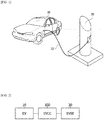
- FIGS. 1 to 3 are views illustrating a charging system of an electric vehicle (EV) according to one embodiment of the present invention.
- an EV 10 may be charged by electric vehicle supply equipment (EVSE) 20.
- a charging cable 22 connected to the EVSE 20 may be connected to an inlet of the EV 10.
- the EVSE 20 is an apparatus which supplies an alternating current (AC) or direct current (DC), and may be disposed at a supply or home, or may also be portably implemented.
- the EVSE 20 may also be referred to as a supply, an AC supply, a DC supply, a socket-outlet, or the like.
- An electric vehicle charging controller (EVCC) 100 is installed in and connected to the EV 10.
- the EVCC 100 may be installed in a trunk of the EV 10, but is not limited thereto.
- the EVCC 100 may communicate with the EV 10 and the EVSE 20.
- the EVCC 100 includes a charging control device 200 and a power supply unit 300.
- the charging control device 200 is connected to the EV 10 and the EVSE 20.
- the charging control device 200 may be connected to the EV 10 and the EVSE 20 through a plurality of pins.
- the charging control device 200 may include 20 pins connected to the EVSE 20 and communicates with the EVSE 20 through the 20 pins.
- one pin may be a pin for a control pilot (CP) port for receiving a CP signal from the EVSE 20
- another pin may be a pin for a proximity detection (PD) port for detecting whether a charging cable connector is close
- another pin may be a pin for a protective earth (PE) port connected to a ground of the EVSE 20.
- Another pin among the 20 pins may be a pin for driving a motor to open a flap of an inlet
- another pin may be a pin for sensing a motor
- another pin may be a pin for sensing a temperature.
- Another pin may be a pin for sensing a light-emitting diode (LED), and another pin may be a pin for controller area network (CAN) communication.
- LED light-emitting diode
- CAN controller area network
- the charging control device 200 may include 12 pins connected to the EV 10 and may communicate with the EV 10 through the 12 pins.
- one pin may be a pin for a voltage line applied from a collision detection sensor in the EV 10
- another pin may be a battery pin in the EV 10
- another pin may be a pin for CAN communication
- another pin may be a pin connected to a ground
- another pin may be a pin for high voltage protection.
- the number of pins and functions of the pins are not limited thereto and may be variously changed.
- Power is supplied to a battery 14 of the EV 10 by the power supply unit 300 of the EVCC 100 through two high voltage lines of the EVSE 20, and turn-on and turn-off of the high voltage lines may be controlled by the charging control device 200.
- the charging control device 200 may communicate with an electronic control unit (ECU) 12 of the EV 10, and control the power supply unit 300 which transmits power supplied from the EVSE 20 to the battery 12 of the EV 10 according to respective signals received from the EV 10 and the EVSE 20.
- ECU electronice control unit
- FIG. 4 is a block diagram illustrating the charging control device according to one embodiment of the present invention.
- the charging control device 200 includes a first control unit 210 and a second control unit 220.
- the first control unit 210 may also be referred to as a sub microcontroller (MCU), an auxiliary control unit, an auxiliary controller, or the like
- the second control unit 220 may also be referred to as a main MCU, a main control unit, and a main controller.
- the MCU may be a computer in which a microprocessor and input and output modules are integrated in one chip to perform a predetermined function.
- the MCU may be implemented as a device such as an electronic control unit (ECU), and an automobile engine, an automatic transmission, and various parts of an anti-lock braking system (ABS) are controlled by a computer.
- ECU electronice control unit
- ABS anti-lock braking system
- the MCU according to the embodiment of the present invention may be applied in the charging control device 200 to charge the EV and divided into a sub MCU and a main MCU.
- the sub MCU which is the first control unit 210 may be a unit which is separately formed from the main MCU which is the second control unit 220.
- the MCUs applied in the charging control device 200 generally control the charging of the EV, power consumption may be large. Since the MCUs use a battery voltage of the EV, power consumption of the MCUs may be a big issue.
- the MCUs may be divided into the sub MCU which is the first control unit 210 and the main MCU which is the second control unit 220, the second control unit 220 may be operated in a sleep mode or wake-up mode and may generally perform an operation for controlling charging of the EV, and unnecessary current consumption may be prevented in a sleep state in which charging is not performed.
- the first control unit 210 which consumes a relatively small current is in a wake-up state normally, and when an issue occurs, for example, in a case in which a control signal for instructing to start charging is received or a control signal for instructing to finish charging, the first control unit 210 may serve to wake up the second control unit 220.
- the charging control device 200 may further include a first switch unit 230 which receives a first control signal from the outside and is connected to the first control unit 210 and a second switch unit 240 which receives a second control signal from the outside and is connected to the second control unit 220.
- the first switch unit 230 may be disabled when the second switch unit 240 is enabled, and the second switch unit 240 may be disabled when the first switch unit 230 is disabled.
- the first control signal input to the first switch unit 230 and the second control signal input to the second switch unit 240 may be control signals output through one line.
- the first control signal and the second control signal may be signals for indicating an on-state or off-state of a charging flap button 16 and a charging stop button 18.
- the charging flap button 16 may also be referred to as a charging flap button
- the charging stop button 18 may also be referred to as a charging stop button.
- the first switch unit 230 and the second switch unit 240 may also be referred to as load switches.
- the first control unit 210 may monitor the first switch unit 230, and when the first control unit 210 receives the first control signal through the first switch unit 230, the first control unit 210 may enable a power supply unit 260 which supplies power to the second control unit 220 to wake up the second control unit 220.
- the power supply unit 260 may be disposed between the first control unit 210 and the second control unit 220 and enabled or disabled by the first control unit 210.
- the second control unit 220 may disable the first switch unit 230 and enable the second switch unit 240. Accordingly, the second control unit 220 may monitor the second switch unit 240 and receive the second control signal through the second switch unit 240.
- the first control signal may be a control signal for instructing to start charging or a control signal for instructing to finish charging, and the first control signal may be a signal output from the outside of the charging control device 200, that is, from the EV 10.
- the EV 10 may include the charging flap button 16 and the charging stop button 18, the charging flap button 16 and the charging stop button 18 may be connected to each other, and the charging stop button 18 may be connected to the first switch unit 230 and the second switch unit 240.
- the user may press the charging flap button 16.
- the first control signal may be input to the first switch unit 230 through the charging stop button 18.
- the second control unit 220 woken up by the first control unit 210 disables the first switch unit 230, enables the second switch unit 240, monitors the second control signal input through the second switch unit 240, and controls a motor control unit 250 at the same time.
- the motor control unit 250 may control driving of a motor to open a charging flap, that is, the inlet. Accordingly, the inlet may be opened, and a charging process of the EV 10 may be performed.
- the second control unit 220 reenters a sleep state.
- each of the charging control device 200 and the ECU 12 of the EV 10 may enter a sleep state.
- the first control unit 210 monitors the first control signal input through the first switch unit 230 in a wake-up state.
- a control signal for instructing to finish charging is input to the first control unit 210 through the first switch unit 230, and accordingly, the first control unit 210 wakes up the second control unit 220.
- the second control unit 220 woken up by the first control unit 210 disables the first switch unit 230, enables the second switch unit 240, monitors the second control signal input through the second switch unit 240, and wakes up the ECU 12 of the EV 10 at the same time.
- FIG. 5 is one example of an operational scenario of the charging control device according to one embodiment of the present invention
- FIG. 6 is another example of an operational scenario of the charging control device according to one embodiment of the present invention.
- the first control unit 210 which is the sub MCU is in a wake-up state (S500), and the second control unit 220 which is the main MCU is in a sleep state (S510). Accordingly, the main MCU can prevent unnecessary power consumption.
- the first control unit 210 detects a control signal for instructing to start charging (S520).
- the control signal for instructing to start charging may be a control signal having a falling edge.
- the first control unit 210 When the first control unit 210 detects the control signal for instructing to start charging, the first control unit 210 wakes up the second control unit 220 (S530).
- the woken up second control unit 220 detects that the charging flap button 16 is pressed (S540), and controls driving of the motor to open the inlet (S550).
- the first control unit 210 which is the sub MCU is in a wake-up state (S600), and the second control unit 220 which is the main MCU enters a sleep state (S610). Accordingly, power consumption of the main MCU can be prevented.
- the first control unit 210 detects a control signal for instructing to finish charging (S620).
- the control signal for instructing to finish charging may be a control signal having a rising edge.
- the first control unit 210 When the first control unit 210 detects the control signal for instructing to finish charging, the first control unit 210 wakes up the second control unit 220 (S630).
- the woken-up second control unit 220 detects that the charging stop button 18 is pressed (S640), and wakes up the ECU 12 of the EV 10 (S640).
- FIG. 7 is a view for describing a process in which the charging control device operates according to one embodiment of the present invention.
- the EV 10 includes the charging flap button 16 and the charging stop button 18, and the charging control device 200 includes the first control unit 210, the second control unit 220, the first switch unit 230, the second switch unit 240, and the motor control unit 250.
- the charging flap button 16 is connected to the inlet and a motor M to open the inlet, the motor M is connected to the charging control device 200 through two pins CC_FlapM- and CC_FlapM+, the charging control device 200 outputs signals for controlling driving of the motor M to open the inlet through the two pins CC_FlapM- and CC_FlapM+.
- the inlet may also be referred to as a charging flap or a flap.
- the charging stop button 18 is connected to the charging control device 200 through one pin Inlet flap st, and the charging stop button 18 outputs a control signal for instructing to start charging or a control signal for instructing to finish charging to the charging control device 200 through the one pin Inlet_flap_st.
- a switch S1 of the charging flap button 16 may also be referred to as a charging flap switch or the like, and a switch S2 of the charging stop button 18 may also be referred to as a charging stop switch or the like.
- the switch S1 of the charging flap button 16 is opened, and the switch S2 of the charging stop button 18 is closed.
- the charging flap button 16 and the charging stop button 18 are disconnected, and accordingly, the first switch unit 230 may be set such that a predetermined voltage value, for example 5 V, is input to the first switch unit 230.
- the second control unit 220 is in a sleep state, and the first control unit 210 continuously monitors the first switch unit 230 in a wake-up state.
- the user presses the charging flap button 16. Accordingly, the switch S1 of the charging flap button 16 is closed, and the charging flap button 16 is connected to the charging stop button 18. Since the switch S2 of the charging stop button 18 is still closed, and the charging stop button 18 is connected to a ground through the charging flap button 16, a voltage of 0 V may be input to the first switch unit 230 from the charging stop button 18.
- the first switch unit 230 may be a low active load switch, and accordingly, in a case in which a value of the voltage input to the first switch unit 230 is lowered from 5V to 0 V, that is, the first control signal input to the first switch unit 230 has a falling edge, the first control unit 210 may wake up the second control unit 220. That is, in a case in which both of the switch S1 of the charging flap button 16 and the switch S2 of the charging stop button 18 are detected as being in on-states, the first control unit 210 may enable the power supply unit 260 such that the second control unit 220 is operated in a wake-up mode.
- the first control unit 210 may include an interrupt port I_P and an analog-to-digital conversion (ADC) port ADC_P and monitor control signals applied through the interrupt port I_P and the ADC port ADC P.
- the interrupt port I_P may be a port which wakes up at a predetermined cycle and may monitor whether there are a change in a voltage value, a rising edge, and a falling edge of a signal applied to the first control unit 210.
- the ADC port ADC_P may be a port which continuously wakes up and may monitor the voltage value of the signal applied to the first control unit 210.
- the first control unit 210 When the first control unit 210 detects the falling edge using the interrupt port I_P or ADC port ADC_P, the first control unit 210 enables a power supply (5V low dropout (LDO)) which supplies power to the second control unit 220 to wake up the second control unit 220.
- a power supply 5V low dropout (LDO)
- the second control unit 220 may disable the first switch unit 230 and enable the second switch unit 240. To this end, the second control unit 220 may disable the first switch unit 230 using a general-purpose input/output 3 (GPIO3) port and enable the second switch unit 240 using a general-purpose input/output 2 (GPIO2) port.
- GPIO3 general-purpose input/output 3
- GPIO2 general-purpose input/output 2
- the second control signal is applied from the charging stop button 18 through the second switch unit 240, and the second control unit 220 monitors the second control signal using the ADC port.
- the second control signal is a control signal which instructs to start charging, that is, the charging flap button 16 is pressed
- the second control unit 220 may control a motor integrated circuit (IC) block which is the motor control unit 250, and accordingly, the motor control unit 250 may output a control signal to drive a motor to open the inlet.
- IC motor integrated circuit
- the first control unit 210 may maintain an enabled state of the power supply unit 260.
- the second control unit 220 may enable the first switch unit 230, disable the second switch unit 240, and enter a sleep state after informing that the second control unit 220 will enter the sleep state to the first control unit 210.
- the ECU 12 of the EV 10 may also enter a sleep state.
- the first control unit 210 monitors the first control signal applied through the first switch unit 230.
- the first control signal continuously has a voltage of 0 V.
- the first control signal may have a voltage greater than 0 V and less than 5 V, for example 3.5 V, due to a resistor R of the charging stop button 18.
- the first control unit 210 may rewake the second control unit 220. That is, in a case in which it is detected that the switch S1 of the charging flap button 16 is in an on-state, and the switch S2 of the charging stop button 18 is in an off-state, the first control unit 210 may enable the power supply unit 260 to operate the second control unit 220 in a wake-up mode.
- the first control unit 210 may enable a 5V LDO for the second control unit 220 to wake up the second control unit 220.
- the second control unit 220 may disable the first switch unit 230 and enable the second switch unit 240. To this end, the second control unit 220 may disable the first switch unit 230 using the GPIO3 port and enable the second switch unit 240 using the GPIO2 port.
- the second control signal is applied from the charging stop button 18 through the second switch unit 240, and the second control unit 220 monitors the second control signal using the ADC port.
- the second control signal is a control signal which instructs to finish charging, that is, the charging stop button 18 is pressed
- the second control unit 220 may transmit a signal for turning on the main power supply of the EV 10 to the outside, and wake up the ECU 12 to perform remaining processes to finish the charging.
- the charging flap button 16 is disconnected from the charging stop button 18. Since the switch S2 of the charging stop button 18 is still in the closed state, a predetermined voltage, for example, 5 V may be input to the first switch unit 230. Even if the first control unit 210 recognizes a rising edge which rises from 0 V to 5 V, since the charging is finished normally, an additional process in which the first control unit 210 wakes up the second control unit 220 is not performed.
- FIG. 7 the example in which the switch S2 of the charging stop button 18 is connected to the switch S1 of the charging flap button 16 and a DC-Box in series and connected to a resistor R having a predetermined value in parallel has been shown, but the present invention is not limited thereto, and a structure of the switch and resistor of the charging stop button 18 may be variously changed.
- FIG. 8 is a view illustrating a structure of a charging stop button according to another embodiment of the present invention.
- a charging stop button 18 may include a first resistor R1 and a second resistor R2, and a switch S3 may be set to be connected to the first resistor R1 or the second resistor R2.
- the first resistor R1 may be a resistor for detecting that a charging flap button 16 is pressed
- the second resistor R2 may be a resistor for detecting that the charging stop button 18 is pressed.
- the first resistor R1 may have a resistance value lower than that of the second resistor R2.
- the first resistor R1 may have a resistance value of about several to several hundred ohms
- the second resistor R2 may have a resistance value of several to several hundred kilo-ohms.
- the switch S3 of the charging stop button 18 may be connected to the first resistor R1 in a state in which the charging stop button 18 is not pressed, and connected to the second resistor R2 in a state in which the charging stop button 18 is pressed.
- values of voltages applied to the first switch unit 230 and the second switch unit 240 may be variously changed.
Landscapes
- Engineering & Computer Science (AREA)
- Power Engineering (AREA)
- Transportation (AREA)
- Mechanical Engineering (AREA)
- Life Sciences & Earth Sciences (AREA)
- Sustainable Development (AREA)
- Sustainable Energy (AREA)
- Charge And Discharge Circuits For Batteries Or The Like (AREA)
- Electric Propulsion And Braking For Vehicles (AREA)
Abstract
Description
- The present invention relates to an electric vehicle, and more specifically, to charging of an electric vehicle.
- Eco-friendly vehicles, such as electric vehicles (EVs) or plug-in hybrid electric vehicles (PHEVs), use electric vehicle supply equipment (EVSE) installed at supplies to charge batteries.
- To this end, an electric vehicle charging controller (EVCC) is installed in the EV and communicates with the EV and the EVSE to control charging of the EV.
- For example, when the EVCC receives a signal for instructing to start charging from the EV, the EVCC may control so as to start charging, and when the EVCC receives a signal for instructing to finish charging from the EV, the EVCC may control so as to finish the charging.
- Here, the EV may be charged through a slow charging method or fast charging method. When slow charging is performed, a charging time period of about seven hours is needed, and when fast charging is performed, a charging time period of about thirty minutes is needed. Accordingly, in a case in which a user is not present at a time point at which the slow charging or fast charging is finished, since a process for finishing the charging cannot proceed normally, a state in which the EV is connected to a charging control device is maintained, and thus there is a problem in that a current is unnecessarily wasted.
- The present invention is directed to providing a charging control device for charging an electric vehicle.
- One aspect of the present invention provides a charging control device of an electric vehicle, which includes: a charging flap switch; a charging stop switch; a main controller which operates in a sleep mode or a wake-up mode, and controls charging of a battery of the electric vehicle; load switches which detect an on-state or off-state of the charging flap switch and an on-state or off-state of the charging stop switch; a power supply unit which supplies power to the main controller; and an auxiliary controller which enables or disables the power supply unit, wherein, in a case in which the main controller operates in the sleep mode, when the auxiliary controller detects the on-state of the charging flap switch and the on-state of the charging stop switch or detects the on-state of the charging flap switch and the off-state of the charging stop switch, the auxiliary controller enables the power supply unit to operate the main controller in a wake-up mode.
- When the main controller detects the on-state of the charging flap switch and the off-state of the charging stop switch, the main controller may transmit a signal for turning on a main power supply of the electric vehicle to the outside.
- The charging flap switch may be connected to a charging flap and a motor which opens or closes the charging flap.
- When the main controller detects the on-state of the charging flap switch, the main controller may generate a control signal such that the motor opens the charging flap.
- In a case in which the main controller is in the wake-up mode, the auxiliary controller may maintain an enabled state of the power supply unit.
- The charging stop switch may be connected to the charging flap switch and the load switches in series, and connected to a resistor having a preset value in parallel.
- The load switches may include a first load switch and a second load switch, wherein the first load switch may be disabled when the second load switch is enabled, the second load switch may be disabled when the first load switch is enabled, the first load switch may be connected to the main controller, and the second load switch may be connected to the auxiliary controller.
- Another aspect of the present invention provides a charging control device for charging an electric vehicle, which includes a first switch unit which receives a first control signal from the outside, a first control unit which receives the first control signal through the first switch unit, a second switch unit which receives a second control signal from the outside, a second control unit which is woken up by the first control unit and receives the second control signal through the second switch unit, and a motor control unit which is controlled by the second control unit and controls driving of a motor for a charging flap, wherein, when the second control unit is woken up by the first control unit, the second control unit disables the first switch and enables the second switch.
- The first control signal may be a control signal for instructing to start charging or a control signal for instructing to finish charging.
- When the first control signal is the control signal for instructing to start charging, the first control signal may have a falling edge which falls from a first voltage value to a second voltage value.
- When the first control unit recognizes the falling edge, the first control unit may wake up the second control unit in a sleep state.
- When the first control signal is the control signal for instructing to finish charging, the first control signal may have a rising edge which rises from a third voltage value to a fourth voltage value.
- When the first control unit recognizes the rising edge, the first control unit may wake up the second control unit in the sleep state.
- The first control signal and the second control signal may be control signals output through one line.
- The first control signal and the second control signal may be set so as to be output through a charging stop button of the electric vehicle, and the charging stop button of the electric vehicle may be set so as to be connected to a charging flap button of the electric vehicle.
- Still another aspect of the present invention provides a charging control method of a charging control device for charging an electric vehicle, which includes receiving, by a first switch unit, a first control signal, which is a control signal for instructing to start charging or a control signal for instructing to finish charging, from an electric vehicle; detecting, by an auxiliary controller in a wake-up state, the first control signal input through the first switch unit; enabling, by the auxiliary controller, a power supply unit which supplies power to a main controller to wake up the main controller that is in a sleep state; disabling, by the main controller, the first switch unit and enabling a second switch unit; and controlling, by the main controller, charging of the electric vehicle when the main controller detects a second control signal input through the second switch unit, wherein the control signal for instructing to start charging is a signal which indicates that an on-state of a charging flap switch and an on-state of a charging stop switch are detected, and the control signal for instructing to finish charging is a signal which indicates that the on-state of the charging flap switch and an off-state of the charging stop switch are detected.
- The charging control method may further include transmitting, by the main controller, a signal for turning on a main power supply of the electric vehicle to the outside in a case in which the first control signal is the control signal for instructing to finish charging.
- The charging control method may further include generating, by the main controller, a control signal for causing a motor, which opens or closes a charging flap, to open the charging flap in a case in which the first control signal is the control signal for instructing to start charging.
- In a case in which the main controller is woken up, the power supply unit may maintain an enabled state.
- The first switch unit may be disabled when the second switch unit is enabled, and the second switch unit may be disabled when the first switch unit is enabled.
- The control signal for instructing to start charging may be a signal having a falling edge, and the control signal for instructing to finish charging may be a signal having a rising edge.
- According to an embodiment, since a control signal for instructing to start charging and a control signal for instructing to finish charging can be monitored through one line, a structure of a charging control device can be simplified, a structure of an electric vehicle can also be simplified, and thus manufacturing costs can be reduced.
- The charging control device does not unnecessarily consume a current while the electric vehicle is charged or is not charged. In particular, even in a case in which a control signal for instructing to finish charging cannot be transmitted normally to the charging control device because a user is not present at a time point at which charging should be finished, unnecessary consumption of current due to operation of a microcontroller unit (MCU) of the charging control device can be prevented.
-
-
FIGS. 1 to 3 are views illustrating a charging system of an electric vehicle according to one embodiment of the present invention. -
FIG. 4 is a block diagram illustrating a charging control device according to one embodiment of the present invention. -
FIG. 5 is one example of an operational scenario of the charging control device according to one embodiment of the present invention. -
FIG. 6 is another example of an operational scenario of the charging control device according to one embodiment of the present invention. -
FIG. 7 is a view for describing a process in which the charging control device operates according to one embodiment of the present invention. -
FIG. 8 is a view illustrating a structure of a charging stop button according to another embodiment of the present invention. - As the present invention allows for various changes and numerous embodiments, specific embodiments will be illustrated in the drawings and described in detail in the written description. However, this is not intended to limit the present invention to specific embodiments, and it is to be appreciated that all changes, equivalents, and substitutes that do not depart from the spirit and technical scope of the present invention are encompassed in the present invention.
- It will be understood that, although the terms "first," "second," etc. may be used herein to describe various elements, these elements should not be limited by these terms. These terms are only used to distinguish one element from another. For example, a first element could be termed a second element, and a second element could similarly be termed a first element without departing from the scope of the present invention. As used herein, the term "and/or" includes combinations or any one of a plurality of associated listed items.
- It will be understood that when an element is referred to as being "connected" or "coupled" to another element, it can be directly connected or coupled to another element or intervening elements may be present. In contrast, when an element is referred to as being "directly connected" or "directly coupled" to another element, there are no intervening elements.
- The terminology used herein to describe the embodiments of the present invention is not intended to limit the scope of the present invention. The articles "a," and "an" are singular in that they have a single referent, however, the use of the singular form in the present document should not preclude the presence of more than one referent. In other words, elements of the present invention referred to in the singular may number one or more, unless the context clearly indicates otherwise. It will be further understood that the terms "comprise," "comprising," "include," and/or "including," when used herein, specify the presence of stated features, numbers, steps, operations, elements, components, and/or combinations thereof, but do not preclude the presence or addition of one or more other features, numbers, steps, operations, elements, components, and/or combinations thereof.
- Unless otherwise defined, all terms (including technical and scientific terms) used herein are to be interpreted as is customary in the art to which this invention belongs. It should be further understood that terms in common usage should also be interpreted as is customary in the relevant art and not in an idealized or overly formal sense unless expressly so defined herein.
- Embodiments of the invention will be described below in more detail with reference to the accompanying drawings. Components that are the same or are corresponding to each other are denoted by the same reference numeral regardless of the figure number, and redundant description will be omitted.
-
FIGS. 1 to 3 are views illustrating a charging system of an electric vehicle (EV) according to one embodiment of the present invention. - Referring to
FIGS. 1 to 3 , anEV 10 may be charged by electric vehicle supply equipment (EVSE) 20. To this end, acharging cable 22 connected to the EVSE 20 may be connected to an inlet of theEV 10. Here, the EVSE 20 is an apparatus which supplies an alternating current (AC) or direct current (DC), and may be disposed at a supply or home, or may also be portably implemented. TheEVSE 20 may also be referred to as a supply, an AC supply, a DC supply, a socket-outlet, or the like. - An electric vehicle charging controller (EVCC) 100 is installed in and connected to the
EV 10. For example, theEVCC 100 may be installed in a trunk of theEV 10, but is not limited thereto. - Here, the
EVCC 100 may communicate with theEV 10 and theEVSE 20. - According to the embodiment of the present invention, the
EVCC 100 includes a chargingcontrol device 200 and apower supply unit 300. - The charging
control device 200 is connected to theEV 10 and theEVSE 20. The chargingcontrol device 200 may be connected to theEV 10 and theEVSE 20 through a plurality of pins. - For example, the charging
control device 200 may include 20 pins connected to theEVSE 20 and communicates with theEVSE 20 through the 20 pins. For example, among the 20 pins, one pin may be a pin for a control pilot (CP) port for receiving a CP signal from theEVSE 20, another pin may be a pin for a proximity detection (PD) port for detecting whether a charging cable connector is close, and another pin may be a pin for a protective earth (PE) port connected to a ground of theEVSE 20. Another pin among the 20 pins may be a pin for driving a motor to open a flap of an inlet, another pin may be a pin for sensing a motor, and another pin may be a pin for sensing a temperature. Another pin may be a pin for sensing a light-emitting diode (LED), and another pin may be a pin for controller area network (CAN) communication. However, the number of pins and functions of the pins are not limited thereto and may be variously changed. - In addition, the charging
control device 200 may include 12 pins connected to theEV 10 and may communicate with theEV 10 through the 12 pins. For example, among the 12 pins, one pin may be a pin for a voltage line applied from a collision detection sensor in theEV 10, another pin may be a battery pin in theEV 10, another pin may be a pin for CAN communication, another pin may be a pin connected to a ground, and another pin may be a pin for high voltage protection. However, the number of pins and functions of the pins are not limited thereto and may be variously changed. - Power is supplied to a
battery 14 of theEV 10 by thepower supply unit 300 of theEVCC 100 through two high voltage lines of theEVSE 20, and turn-on and turn-off of the high voltage lines may be controlled by the chargingcontrol device 200. - That is, the charging
control device 200 may communicate with an electronic control unit (ECU) 12 of theEV 10, and control thepower supply unit 300 which transmits power supplied from theEVSE 20 to thebattery 12 of theEV 10 according to respective signals received from theEV 10 and theEVSE 20. -
FIG. 4 is a block diagram illustrating the charging control device according to one embodiment of the present invention. - Referring to
FIG. 4 , the chargingcontrol device 200 includes afirst control unit 210 and asecond control unit 220. In the present specification, thefirst control unit 210 may also be referred to as a sub microcontroller (MCU), an auxiliary control unit, an auxiliary controller, or the like, and thesecond control unit 220 may also be referred to as a main MCU, a main control unit, and a main controller. Here, the MCU may be a computer in which a microprocessor and input and output modules are integrated in one chip to perform a predetermined function. In a case in which the MCU is installed in a vehicle, the MCU may be implemented as a device such as an electronic control unit (ECU), and an automobile engine, an automatic transmission, and various parts of an anti-lock braking system (ABS) are controlled by a computer. The MCU according to the embodiment of the present invention may be applied in the chargingcontrol device 200 to charge the EV and divided into a sub MCU and a main MCU. - According to the embodiment of the present invention, the sub MCU which is the
first control unit 210 may be a unit which is separately formed from the main MCU which is thesecond control unit 220. Generally, since the MCUs applied in the chargingcontrol device 200 generally control the charging of the EV, power consumption may be large. Since the MCUs use a battery voltage of the EV, power consumption of the MCUs may be a big issue. According to the embodiment of the present invention, the MCUs may be divided into the sub MCU which is thefirst control unit 210 and the main MCU which is thesecond control unit 220, thesecond control unit 220 may be operated in a sleep mode or wake-up mode and may generally perform an operation for controlling charging of the EV, and unnecessary current consumption may be prevented in a sleep state in which charging is not performed. In addition, thefirst control unit 210 which consumes a relatively small current is in a wake-up state normally, and when an issue occurs, for example, in a case in which a control signal for instructing to start charging is received or a control signal for instructing to finish charging, thefirst control unit 210 may serve to wake up thesecond control unit 220. - To this end, the charging
control device 200 may further include afirst switch unit 230 which receives a first control signal from the outside and is connected to thefirst control unit 210 and asecond switch unit 240 which receives a second control signal from the outside and is connected to thesecond control unit 220. Thefirst switch unit 230 may be disabled when thesecond switch unit 240 is enabled, and thesecond switch unit 240 may be disabled when thefirst switch unit 230 is disabled. - Here, the first control signal input to the
first switch unit 230 and the second control signal input to thesecond switch unit 240 may be control signals output through one line. The first control signal and the second control signal may be signals for indicating an on-state or off-state of acharging flap button 16 and a chargingstop button 18. In the present specification, the chargingflap button 16 may also be referred to as a charging flap button, and the chargingstop button 18 may also be referred to as a charging stop button. In addition, thefirst switch unit 230 and thesecond switch unit 240 may also be referred to as load switches. - In a case in which the
second control unit 220 is in a sleep state, thefirst control unit 210 may monitor thefirst switch unit 230, and when thefirst control unit 210 receives the first control signal through thefirst switch unit 230, thefirst control unit 210 may enable apower supply unit 260 which supplies power to thesecond control unit 220 to wake up thesecond control unit 220. To this end, thepower supply unit 260 may be disposed between thefirst control unit 210 and thesecond control unit 220 and enabled or disabled by thefirst control unit 210. - When the
second control unit 220 in the sleep state is woken up by thefirst control unit 210, thesecond control unit 220 may disable thefirst switch unit 230 and enable thesecond switch unit 240. Accordingly, thesecond control unit 220 may monitor thesecond switch unit 240 and receive the second control signal through thesecond switch unit 240. - Here, the first control signal may be a control signal for instructing to start charging or a control signal for instructing to finish charging, and the first control signal may be a signal output from the outside of the charging
control device 200, that is, from theEV 10. - For example, the
EV 10 may include the chargingflap button 16 and the chargingstop button 18, the chargingflap button 16 and the chargingstop button 18 may be connected to each other, and the chargingstop button 18 may be connected to thefirst switch unit 230 and thesecond switch unit 240. - In a case in which a user wants to open the inlet to start charging of the
EV 10, the user may press the chargingflap button 16. When the chargingflap button 16 is pressed, the first control signal may be input to thefirst switch unit 230 through the chargingstop button 18. - In a case in which the first control signal is a control signal for instructing to start charging, the
second control unit 220 woken up by thefirst control unit 210 disables thefirst switch unit 230, enables thesecond switch unit 240, monitors the second control signal input through thesecond switch unit 240, and controls amotor control unit 250 at the same time. Themotor control unit 250 may control driving of a motor to open a charging flap, that is, the inlet. Accordingly, the inlet may be opened, and a charging process of theEV 10 may be performed. - Meanwhile, in a case in which a user is not present when charging is finished, the user cannot immediately press the charging
stop button 18. When a predetermined time period has passed in a state in which the user does not take any action after the charging is finished, thesecond control unit 220 reenters a sleep state. Here, each of the chargingcontrol device 200 and theECU 12 of theEV 10 may enter a sleep state. In the case in which thesecond control unit 220 enters the sleep state, thefirst control unit 210 monitors the first control signal input through thefirst switch unit 230 in a wake-up state. - Then, when the user presses the charging
stop button 18, a control signal for instructing to finish charging is input to thefirst control unit 210 through thefirst switch unit 230, and accordingly, thefirst control unit 210 wakes up thesecond control unit 220. Thesecond control unit 220 woken up by thefirst control unit 210 disables thefirst switch unit 230, enables thesecond switch unit 240, monitors the second control signal input through thesecond switch unit 240, and wakes up theECU 12 of theEV 10 at the same time. -
FIG. 5 is one example of an operational scenario of the charging control device according to one embodiment of the present invention, andFIG. 6 is another example of an operational scenario of the charging control device according to one embodiment of the present invention. - Referring to
FIG. 5 , in a state in which charging of theEV 10 is not started, thefirst control unit 210 which is the sub MCU is in a wake-up state (S500), and thesecond control unit 220 which is the main MCU is in a sleep state (S510). Accordingly, the main MCU can prevent unnecessary power consumption. - When the user presses the charging
flap button 16 of theEV 10 to start charging, thefirst control unit 210 detects a control signal for instructing to start charging (S520). Here, the control signal for instructing to start charging may be a control signal having a falling edge. - When the
first control unit 210 detects the control signal for instructing to start charging, thefirst control unit 210 wakes up the second control unit 220 (S530). - Accordingly, the woken up
second control unit 220 detects that the chargingflap button 16 is pressed (S540), and controls driving of the motor to open the inlet (S550). - Meanwhile, referring to
FIG. 6 , in a case in which the user does not perform an operation to finish charging for a predetermined time period in a state in which charging of theEV 10 is finished, thefirst control unit 210 which is the sub MCU is in a wake-up state (S600), and thesecond control unit 220 which is the main MCU enters a sleep state (S610). Accordingly, power consumption of the main MCU can be prevented. - When the user presses the charging
stop button 18 of theEV 10 to finish the charging, thefirst control unit 210 detects a control signal for instructing to finish charging (S620). Here, the control signal for instructing to finish charging may be a control signal having a rising edge. - When the
first control unit 210 detects the control signal for instructing to finish charging, thefirst control unit 210 wakes up the second control unit 220 (S630). - Accordingly, the woken-up
second control unit 220 detects that the chargingstop button 18 is pressed (S640), and wakes up theECU 12 of the EV 10 (S640). - Hereinafter, a process in which the charging control device according to the embodiment of the present invention performs an operation according to a control signal to start charging and a control signal to finish charging will be described in more detail.
-
FIG. 7 is a view for describing a process in which the charging control device operates according to one embodiment of the present invention. - Referring to
FIG. 7 , theEV 10 includes the chargingflap button 16 and the chargingstop button 18, and the chargingcontrol device 200 includes thefirst control unit 210, thesecond control unit 220, thefirst switch unit 230, thesecond switch unit 240, and themotor control unit 250. - The charging
flap button 16 is connected to the inlet and a motor M to open the inlet, the motor M is connected to the chargingcontrol device 200 through two pins CC_FlapM- and CC_FlapM+, the chargingcontrol device 200 outputs signals for controlling driving of the motor M to open the inlet through the two pins CC_FlapM- and CC_FlapM+. In the present specification, the inlet may also be referred to as a charging flap or a flap. - The charging
stop button 18 is connected to the chargingcontrol device 200 through one pin Inlet flap st, and the chargingstop button 18 outputs a control signal for instructing to start charging or a control signal for instructing to finish charging to the chargingcontrol device 200 through the one pin Inlet_flap_st. - In the present specification, a switch S1 of the charging
flap button 16 may also be referred to as a charging flap switch or the like, and a switch S2 of the chargingstop button 18 may also be referred to as a charging stop switch or the like. - Normally, that is, in a state in which charging is not performed, the switch S1 of the charging
flap button 16 is opened, and the switch S2 of the chargingstop button 18 is closed. At this time, the chargingflap button 16 and the chargingstop button 18 are disconnected, and accordingly, thefirst switch unit 230 may be set such that a predetermined voltage value, for example 5 V, is input to thefirst switch unit 230. Here, thesecond control unit 220 is in a sleep state, and thefirst control unit 210 continuously monitors thefirst switch unit 230 in a wake-up state. - In a case in which the user wants to open the inlet to start charging, the user presses the charging
flap button 16. Accordingly, the switch S1 of the chargingflap button 16 is closed, and the chargingflap button 16 is connected to the chargingstop button 18. Since the switch S2 of the chargingstop button 18 is still closed, and the chargingstop button 18 is connected to a ground through the chargingflap button 16, a voltage of 0 V may be input to thefirst switch unit 230 from the chargingstop button 18. - The
first switch unit 230 may be a low active load switch, and accordingly, in a case in which a value of the voltage input to thefirst switch unit 230 is lowered from 5V to 0 V, that is, the first control signal input to thefirst switch unit 230 has a falling edge, thefirst control unit 210 may wake up thesecond control unit 220. That is, in a case in which both of the switch S1 of the chargingflap button 16 and the switch S2 of the chargingstop button 18 are detected as being in on-states, thefirst control unit 210 may enable thepower supply unit 260 such that thesecond control unit 220 is operated in a wake-up mode. - To this end, the
first control unit 210 may include an interrupt port I_P and an analog-to-digital conversion (ADC) port ADC_P and monitor control signals applied through the interrupt port I_P and the ADC port ADC P. The interrupt port I_P may be a port which wakes up at a predetermined cycle and may monitor whether there are a change in a voltage value, a rising edge, and a falling edge of a signal applied to thefirst control unit 210. The ADC port ADC_P may be a port which continuously wakes up and may monitor the voltage value of the signal applied to thefirst control unit 210. - When the
first control unit 210 detects the falling edge using the interrupt port I_P or ADC port ADC_P, thefirst control unit 210 enables a power supply (5V low dropout (LDO)) which supplies power to thesecond control unit 220 to wake up thesecond control unit 220. - When the
second control unit 220 wakes up, thesecond control unit 220 may disable thefirst switch unit 230 and enable thesecond switch unit 240. To this end, thesecond control unit 220 may disable thefirst switch unit 230 using a general-purpose input/output 3 (GPIO3) port and enable thesecond switch unit 240 using a general-purpose input/output 2 (GPIO2) port. - Accordingly, the second control signal is applied from the charging
stop button 18 through thesecond switch unit 240, and thesecond control unit 220 monitors the second control signal using the ADC port. In a case in which the second control signal is a control signal which instructs to start charging, that is, the chargingflap button 16 is pressed, thesecond control unit 220 may control a motor integrated circuit (IC) block which is themotor control unit 250, and accordingly, themotor control unit 250 may output a control signal to drive a motor to open the inlet. - Here, in a case in which the
second control unit 220 is in a wake-up mode, thefirst control unit 210 may maintain an enabled state of thepower supply unit 260. - Then, in a case in which a user does not take a predetermined action for a predetermined time period after the charging is finished, that is, the user does not press the charging
stop button 18 for the predetermined time period after the charging is finished, thesecond control unit 220 may enable thefirst switch unit 230, disable thesecond switch unit 240, and enter a sleep state after informing that thesecond control unit 220 will enter the sleep state to thefirst control unit 210. In addition, theECU 12 of theEV 10 may also enter a sleep state. - In addition, the
first control unit 210 monitors the first control signal applied through thefirst switch unit 230. Here, since both of the switch S1 of the chargingflap button 16 and the switch S2 of the chargingstop button 18 are still in closed states, the first control signal continuously has a voltage of 0 V. - In a case in which the user returns and immediately presses the charging
stop button 18, the switch S2 of the chargingstop button 18 is opened in a state in which the switch S1 of the chargingflap button 16 is closed. The first control signal may have a voltage greater than 0 V and less than 5 V, for example 3.5 V, due to a resistor R of the chargingstop button 18. - In a case in which a voltage input to the
first switch unit 230 has risen to 3.5 V from 0 V, that is, the first control signal input to thefirst switch unit 230 has the rising edge, thefirst control unit 210 may rewake thesecond control unit 220. That is, in a case in which it is detected that the switch S1 of the chargingflap button 16 is in an on-state, and the switch S2 of the chargingstop button 18 is in an off-state, thefirst control unit 210 may enable thepower supply unit 260 to operate thesecond control unit 220 in a wake-up mode. - To this end, the
first control unit 210 may enable a 5V LDO for thesecond control unit 220 to wake up thesecond control unit 220. - When the
second control unit 220 is woken up, thesecond control unit 220 may disable thefirst switch unit 230 and enable thesecond switch unit 240. To this end, thesecond control unit 220 may disable thefirst switch unit 230 using the GPIO3 port and enable thesecond switch unit 240 using the GPIO2 port. - Accordingly, the second control signal is applied from the charging
stop button 18 through thesecond switch unit 240, and thesecond control unit 220 monitors the second control signal using the ADC port. In a case in which the second control signal is a control signal which instructs to finish charging, that is, the chargingstop button 18 is pressed, thesecond control unit 220 may transmit a signal for turning on the main power supply of theEV 10 to the outside, and wake up theECU 12 to perform remaining processes to finish the charging. - Meanwhile, in a case in which the charging is finished normally, that is, the user presses the charging
flap button 16 again to open the switch S1 of the chargingflap button 16 after the charging is finished, the chargingflap button 16 is disconnected from the chargingstop button 18. Since the switch S2 of the chargingstop button 18 is still in the closed state, a predetermined voltage, for example, 5 V may be input to thefirst switch unit 230. Even if thefirst control unit 210 recognizes a rising edge which rises from 0 V to 5 V, since the charging is finished normally, an additional process in which thefirst control unit 210 wakes up thesecond control unit 220 is not performed. - Meanwhile, in
FIG. 7 , the example in which the switch S2 of the chargingstop button 18 is connected to the switch S1 of the chargingflap button 16 and a DC-Box in series and connected to a resistor R having a predetermined value in parallel has been shown, but the present invention is not limited thereto, and a structure of the switch and resistor of the chargingstop button 18 may be variously changed. -
FIG. 8 is a view illustrating a structure of a charging stop button according to another embodiment of the present invention. - Referring to
FIG. 8 , a chargingstop button 18 may include a first resistor R1 and a second resistor R2, and a switch S3 may be set to be connected to the first resistor R1 or the second resistor R2. - Here, the first resistor R1 may be a resistor for detecting that a charging
flap button 16 is pressed, and the second resistor R2 may be a resistor for detecting that the chargingstop button 18 is pressed. To this end, the first resistor R1 may have a resistance value lower than that of the second resistor R2. For example, the first resistor R1 may have a resistance value of about several to several hundred ohms, and the second resistor R2 may have a resistance value of several to several hundred kilo-ohms. - Accordingly, the switch S3 of the charging
stop button 18 may be connected to the first resistor R1 in a state in which the chargingstop button 18 is not pressed, and connected to the second resistor R2 in a state in which the chargingstop button 18 is pressed. - When the resistance values of the first resistor R1 and the second resistor R2 included in the charging
stop button 18 are adjusted, values of voltages applied to thefirst switch unit 230 and thesecond switch unit 240 may be variously changed. - While the present invention has been described with reference to exemplary embodiments thereof, it will be understood by those skilled in the art that various changes may be made therein without departing from the spirit and scope of the invention as defined by the appended claims
-
- 10: ELECTRIC VEHICLE
- 20: ELECTRIC VEHICLE SUPPLY EQUIPMENT
- 22: CHARGING CABLE
- 100: CHARGING CONTROLLER
- 200: CHARGING CONTROL DEVICE
Claims (17)
- A charging control device of an electric vehicle, comprising:a charging flap switch;a charging stop switch;a main controller which operates in a sleep mode or a wake-up mode and controls charging of a battery of the electric vehicle;load switches which detect an on-state or off-state of the charging flap switch and an on-state or off-state of the charging stop switch;a power supply unit which supplies power to the main controller; andan auxiliary controller which enables or disables the power supply unit,wherein, in a case in which the main controller operates in the sleep mode, when the auxiliary controller detects the on-state of the charging flap switch and the on-state of the charging stop switch or detects the on-state of the charging flap switch and the off-state of the charging stop switch, the auxiliary controller enables the power supply unit to operate the main controller in a wake-up mode.
- The charging control device of claim 1, wherein, when the main controller detects the on-state of the charging flap switch and the off-state of the charging stop switch, the main controller transmits a signal for turning on a main power supply of the electric vehicle to the outside.
- The charging control device of claim 1, wherein the charging flap switch is connected to a charging flap and a motor which opens or closes the charging flap.
- The charging control device of claim 3, wherein, when the main controller detects the on-state of the charging flap switch, the main controller generates a control signal such that the motor opens the charging flap.
- The charging control device of claim 1, wherein, in a case in which the main controller is in the wake-up mode, the auxiliary controller maintains an enabled state of the power supply unit.
- The charging control device of claim 1, wherein the charging stop switch is connected to the charging flap switch and the load switches in series and connected to a resistor having a preset value in parallel.
- The charging control device of claim 1, wherein the load switches include a first load switch and a second load switch,
wherein the first load switch is disabled when the second load switch is enabled,
the second load switch is disabled when the first load switch is enabled,
the first load switch is connected to the main controller, and
the second load switch is connected to the auxiliary controller. - A charging control device for charging an electric vehicle, comprising:a first switch unit which receives a first control signal from the outside;a first control unit which receives the first control signal through the first switch unit;a second switch unit which receives a second control signal from the outside;a second control unit which is woken up by the first control unit and receives the second control signal through the second switch unit; anda motor control unit which is controlled by the second control unit and controls driving of a motor for a charging flap,wherein, when the second control unit is woken up by the first control unit, the second control unit disables the first switch and enables the second switch.
- The charging control device of claim 8, wherein the first control signal is a control signal for instructing to start charging or a control signal for instructing to finish charging.
- The charging control device of claim 9, wherein, when the first control signal is the control signal for instructing to start charging, the first control signal has a falling edge which falls from a first voltage value to a second voltage value.
- The charging control device of claim 10, wherein, when the first control unit recognizes the falling edge, the first control unit wakes up the second control unit in a sleep state.
- A charging control method of a charging control device for charging an electric vehicle, the charging control method comprising:receiving, by a first switch unit, a first control signal, which is a control signal for instructing to start charging or a control signal for instructing to finish charging, from an electric vehicle;detecting, by an auxiliary controller in a wake-up state, the first control signal input through the first switch unit;enabling, by the auxiliary controller, a power supply unit which supplies power to a main controller to wake up the main controller that is in a sleep state;disabling, by the main controller, the first switch unit and enabling a second switch unit; andcontrolling, by the main controller, charging of the electric vehicle when the main controller detects a second control signal input through the second switch unit,wherein the control signal for instructing to start charging is a signal which indicates that an on-state of a charging flap switch and an on-state of a charging stop switch are detected, andthe control signal for instructing to finish charging is a signal which indicates that the on-state of the charging flap switch and an off-state of the charging stop switch are detected.
- The charging control device of claim 12, further comprising transmitting, by the main controller, a signal for turning on a main power supply of the electric vehicle to the outside in a case in which the first control signal is the control signal for instructing to finish charging,.
- The charging control device of claim 12, further comprising generating, by the main controller, a control signal for causing a motor, which opens or closes a charging flap, to open the charging flap in a case in which the first control signal is the control signal for instructing to start charging.
- The charging control device of claim 12, wherein, in a case in which the main controller is woken up, the power supply unit maintains an enabled state.
- The charging control device of claim 12, wherein:the first switch unit is disabled when the second switch unit is enabled; andthe second switch unit is disabled when the first switch unit is enabled.
- The charging control method of claim 12, wherein:the control signal for instructing to start charging is a signal having a falling edge; andthe control signal for instructing to finish charging is a signal having a rising edge.
Applications Claiming Priority (2)
| Application Number | Priority Date | Filing Date | Title |
|---|---|---|---|
| KR1020170017434A KR102690900B1 (en) | 2017-02-08 | 2017-02-08 | Charging control apparatus for electric vehicle |
| PCT/KR2018/001650 WO2018147635A1 (en) | 2017-02-08 | 2018-02-07 | Charging control device for charging electric vehicle |
Publications (2)
| Publication Number | Publication Date |
|---|---|
| EP3581431A1 true EP3581431A1 (en) | 2019-12-18 |
| EP3581431A4 EP3581431A4 (en) | 2021-01-06 |
Family
ID=63106882
Family Applications (1)
| Application Number | Title | Priority Date | Filing Date |
|---|---|---|---|
| EP18751538.2A Pending EP3581431A4 (en) | 2017-02-08 | 2018-02-07 | ELECTRIC VEHICLE CHARGING CONTROL DEVICE |
Country Status (6)
| Country | Link |
|---|---|
| US (1) | US11192457B2 (en) |
| EP (1) | EP3581431A4 (en) |
| JP (1) | JP7155130B2 (en) |
| KR (2) | KR102690900B1 (en) |
| CN (1) | CN110267843B (en) |
| WO (1) | WO2018147635A1 (en) |
Cited By (4)
| Publication number | Priority date | Publication date | Assignee | Title |
|---|---|---|---|---|
| EP3753777A4 (en) * | 2018-02-13 | 2021-10-20 | LG Innotek Co., Ltd. | ELECTRIC VEHICLE CHARGING CONTROL DEVICE |
| WO2023001899A1 (en) * | 2021-07-20 | 2023-01-26 | Vulog | Process and system for modifying the standby duration and/or the reactivation frequency and/or the wake duration of on-board computing devices in vehicles |
| WO2023001908A1 (en) * | 2021-07-20 | 2023-01-26 | Vulog | Method and system for modifying the standby duration and/or the reactivation frequency and/or the wake duration of a computing device on board a vehicle belonging to a fleet of shared vehicles |
| WO2023021059A1 (en) * | 2021-08-20 | 2023-02-23 | Vitesco Technologies GmbH | A computer-implemented method and device for triggering a high-level communication between an electric vehicle and a charging station |
Families Citing this family (20)
| Publication number | Priority date | Publication date | Assignee | Title |
|---|---|---|---|---|
| CN109624774A (en) * | 2018-12-24 | 2019-04-16 | 北京新能源汽车股份有限公司 | Charging control method and system and automobile |
| KR20200082098A (en) | 2018-12-28 | 2020-07-08 | (주)클린일렉스 | Charging connector for electric vehicle and over-heating preventing device for connector |
| CN109921489A (en) * | 2019-03-27 | 2019-06-21 | 广州高新兴机器人有限公司 | A kind of contact low-voltage direct automatic charging system and method |
| KR102730540B1 (en) * | 2019-05-22 | 2024-11-13 | 현대자동차주식회사 | System and method for reserved charging battery of vehicle |
| CN110979068A (en) * | 2019-12-27 | 2020-04-10 | 漳州揽胜智能科技有限公司 | Fill electric pile with vehicle recognition function |
| KR102868008B1 (en) * | 2020-02-06 | 2025-10-10 | 엘지이노텍 주식회사 | Electric vehicle charging controller |
| CN113942414B (en) * | 2020-06-30 | 2023-10-13 | 比亚迪股份有限公司 | Charging systems, charging adapters and vehicles |
| CN113858986B (en) * | 2020-06-30 | 2023-06-13 | 比亚迪股份有限公司 | Charging switching device, vehicle and method for identifying charging and discharging modes of vehicle |
| CN112744101B (en) * | 2020-12-25 | 2023-02-17 | 中国第一汽车股份有限公司 | Charging and discharging control system and method and vehicle |
| CN112848937A (en) * | 2021-02-05 | 2021-05-28 | 上海阪辉新能源科技有限公司 | Charging control device and charging control method |
| KR20220114796A (en) * | 2021-02-09 | 2022-08-17 | 엘지이노텍 주식회사 | Electric vehicle charging controller |
| CN113085643A (en) * | 2021-04-26 | 2021-07-09 | 长春捷翼汽车零部件有限公司 | Charging device, charging cover control device, charging system, and related method |
| CN113276700B (en) * | 2021-05-26 | 2022-11-01 | 西安领充创享新能源科技有限公司 | Charger system and charger awakening dormancy control method |
| CN113442750B (en) * | 2021-06-16 | 2023-07-14 | 岚图汽车科技有限公司 | A method for controlling a charging port cover, a charging pile, a vehicle, a medium, and equipment |
| FI20215764A1 (en) * | 2021-06-28 | 2022-12-29 | Liikennevirta Oy / Virta Ltd | Control and terminal device for charging electric vehicles |
| CN215897346U (en) * | 2021-09-10 | 2022-02-22 | 长春捷翼汽车零部件有限公司 | Charging wake-up circuit, charging seat and electric vehicle |
| CN114179649B (en) * | 2021-11-24 | 2025-06-17 | 深圳威迈斯新能源(集团)股份有限公司 | A double-edge trigger circuit for OBC charging wake-up |
| CN115837860B (en) * | 2022-10-08 | 2024-11-22 | 宁德时代新能源科技股份有限公司 | BMS sleep wake-up circuit, method, BMS and electrical equipment |
| CN116788099A (en) * | 2023-06-26 | 2023-09-22 | 深蓝汽车科技有限公司 | Vehicle charging control method, device, equipment and storage medium |
| WO2025183412A1 (en) * | 2024-02-27 | 2025-09-04 | 엘지이노텍 주식회사 | Charging control device for electric vehicle and charging control method thereof |
Family Cites Families (24)
| Publication number | Priority date | Publication date | Assignee | Title |
|---|---|---|---|---|
| JPH09285022A (en) * | 1996-04-10 | 1997-10-31 | Honda Motor Co Ltd | Electric vehicle charging display device |
| JP2011087408A (en) * | 2009-10-15 | 2011-04-28 | Toyota Motor Corp | Power supply system of vehicle |
| JP5518618B2 (en) * | 2010-08-02 | 2014-06-11 | 本田技研工業株式会社 | Vehicle charging lid structure |
| DE102011000094B4 (en) * | 2011-01-11 | 2021-09-02 | Huf Hülsbeck & Fürst Gmbh & Co. Kg | System for access control to a vehicle charging device |
| JP2012205314A (en) * | 2011-03-23 | 2012-10-22 | Denso Corp | Vehicle control system |
| JP5908675B2 (en) * | 2011-03-23 | 2016-04-26 | 株式会社デンソー | Vehicle control system |
| KR20120133481A (en) * | 2011-05-31 | 2012-12-11 | 엘에스전선 주식회사 | A system of charging an electric vehicle and a method of communicating thereof |
| EP2631102B1 (en) * | 2011-11-17 | 2016-04-27 | Toyota Jidosha Kabushiki Kaisha | Vehicle and power supply system |
| US9333864B2 (en) * | 2012-05-31 | 2016-05-10 | Lear Corporation | Wake-by-control pilot circuit for onboard battery charger |
| FR2996376B1 (en) * | 2012-10-03 | 2015-11-06 | Renault Sas | METHOD FOR CHARGING A BATTERY BATTERY OF A MOTOR VEHICLE |
| GB2510821B (en) * | 2013-02-13 | 2015-08-19 | Jaguar Land Rover Ltd | Charging Method |
| DE102013005072B3 (en) * | 2013-03-22 | 2014-09-04 | Volkswagen Aktiengesellschaft | Method and device for checking a control pilot line |
| DE102013010283A1 (en) * | 2013-06-19 | 2014-12-24 | Audi Ag | Connection device for an electrical system of a vehicle and method for its operation |
| JP6112033B2 (en) * | 2014-02-12 | 2017-04-12 | トヨタ自動車株式会社 | Electric power transfer control device |
| DE102014102622A1 (en) * | 2014-02-27 | 2015-08-27 | Illinois Tool Works Inc. | Tank or loading trough |
| CN105691217B (en) * | 2014-11-29 | 2018-03-06 | 中山大洋电机股份有限公司 | A kind of integrated charge is with driving vehicle electric system and its control method in one |
| JP2016220397A (en) * | 2015-05-20 | 2016-12-22 | トヨタ自動車株式会社 | Electric vehicle |
| KR101902292B1 (en) * | 2015-07-09 | 2018-11-22 | 주식회사 유라코퍼레이션 | Apparatus for charging battery in electric vehicle and power supplying method using the same |
| DE102016202215A1 (en) * | 2016-02-12 | 2017-08-17 | Brose Fahrzeugteile Gmbh & Co. Kg, Coburg | Adjusting device with a power-operated adjustable flap |
| DE102017201365B4 (en) * | 2017-01-27 | 2021-02-04 | Audi Ag | Charging connection device for a motor vehicle |
| DE102017109013A1 (en) * | 2017-04-27 | 2018-10-31 | Dr. Ing. H.C. F. Porsche Aktiengesellschaft | A method of wireless communication between a vehicle and an external service facility |
| US11305658B2 (en) * | 2017-06-02 | 2022-04-19 | Engineer & Artist Pty Ltd | Charger for charging an electric vehicle |
| KR102516435B1 (en) * | 2017-10-17 | 2023-03-31 | 엘지이노텍 주식회사 | Electric Vehicle Charging Controller |
| DE102019123231A1 (en) * | 2019-03-21 | 2020-09-24 | Illinois Tool Works Inc. | CHARGING or FUEL TANK FOR INSERTION IN A BODY OPENING OF A VEHICLE |
-
2017
- 2017-02-08 KR KR1020170017434A patent/KR102690900B1/en active Active
-
2018
- 2018-02-07 CN CN201880010627.1A patent/CN110267843B/en active Active
- 2018-02-07 EP EP18751538.2A patent/EP3581431A4/en active Pending
- 2018-02-07 JP JP2019542380A patent/JP7155130B2/en active Active
- 2018-02-07 US US16/482,510 patent/US11192457B2/en active Active
- 2018-02-07 WO PCT/KR2018/001650 patent/WO2018147635A1/en not_active Ceased
-
2024
- 2024-07-29 KR KR1020240100243A patent/KR20240118731A/en active Pending
Cited By (9)
| Publication number | Priority date | Publication date | Assignee | Title |
|---|---|---|---|---|
| EP3753777A4 (en) * | 2018-02-13 | 2021-10-20 | LG Innotek Co., Ltd. | ELECTRIC VEHICLE CHARGING CONTROL DEVICE |
| US11440422B2 (en) | 2018-02-13 | 2022-09-13 | Lg Innotek Co., Ltd. | Charging control device for electric vehicle |
| US11787301B2 (en) | 2018-02-13 | 2023-10-17 | Lg Innotek Co., Ltd. | Charging control device for electric vehicle |
| US12296700B2 (en) | 2018-02-13 | 2025-05-13 | Lg Innotek Co., Ltd. | Charging control device for electric vehicle |
| EP4628349A3 (en) * | 2018-02-13 | 2025-10-22 | Lg Innotek Co., Ltd. | Charging control device for electric vehicle |
| WO2023001899A1 (en) * | 2021-07-20 | 2023-01-26 | Vulog | Process and system for modifying the standby duration and/or the reactivation frequency and/or the wake duration of on-board computing devices in vehicles |
| WO2023001908A1 (en) * | 2021-07-20 | 2023-01-26 | Vulog | Method and system for modifying the standby duration and/or the reactivation frequency and/or the wake duration of a computing device on board a vehicle belonging to a fleet of shared vehicles |
| WO2023021059A1 (en) * | 2021-08-20 | 2023-02-23 | Vitesco Technologies GmbH | A computer-implemented method and device for triggering a high-level communication between an electric vehicle and a charging station |
| US20240190283A1 (en) * | 2021-08-20 | 2024-06-13 | Vitesco Technologies GmbH | Computer-Implemented Method and Device for Triggering a High-Level Communication between an Electric Vehicle and a Charging |
Also Published As
| Publication number | Publication date |
|---|---|
| CN110267843A (en) | 2019-09-20 |
| KR20180092091A (en) | 2018-08-17 |
| KR102690900B1 (en) | 2024-08-02 |
| JP2020509725A (en) | 2020-03-26 |
| KR20240118731A (en) | 2024-08-05 |
| US11192457B2 (en) | 2021-12-07 |
| EP3581431A4 (en) | 2021-01-06 |
| US20200009981A1 (en) | 2020-01-09 |
| CN110267843B (en) | 2023-02-17 |
| JP7155130B2 (en) | 2022-10-18 |
| WO2018147635A1 (en) | 2018-08-16 |
Similar Documents
| Publication | Publication Date | Title |
|---|---|---|
| US11192457B2 (en) | Charging control device for charging electric vehicle | |
| CN112319259B (en) | Control system and control method for alternating-current charging electronic lock of electric automobile | |
| CN108819779B (en) | Charging system and electric automobile | |
| CN107264309B (en) | Vehicle charging and discharging control method and device and automobile | |
| CN110614930A (en) | Charging and discharging method, system, controller and electric automobile | |
| CN212654235U (en) | Charging control system of low-voltage storage battery | |
| EP3753777B1 (en) | Charging control device for electric vehicle | |
| US10377257B2 (en) | Vehicle-mounted charging device and vehicle charging system | |
| US9789771B2 (en) | Single battery architecture for electrification vehicle | |
| US20240262245A1 (en) | Vehicle Control Method and Apparatus, and Vehicle | |
| US20120032634A1 (en) | Proximity detection circuit for on-board vehicle charger | |
| US20120065839A1 (en) | Communications system for vehicle | |
| KR20160039940A (en) | Vehicle charger and method for controlling power thereof | |
| KR20220095505A (en) | Apparatus of controlling on-board charger for electric vehicle and method thereof | |
| CN101961998B (en) | Low-power consumption control system of automobile electric trunk system and control method thereof | |
| US10759295B2 (en) | Proximity detection circuit for on-board vehicle charger | |
| CN113602145B (en) | Power supply management device and management method for supplementing power to storage battery of electric logistics vehicle | |
| CN212709048U (en) | Wake-up and dormancy circuit of AC charging CP signal | |
| GB2559819B (en) | Methods and systems for energy management in vehicles | |
| CN215552558U (en) | Electric automobile low pressure power supply circuit and electric automobile | |
| CN214626426U (en) | Automatic dormancy protection control device of lithium cell group | |
| KR20250131704A (en) | Charging control apparatus for electric vehicle and charging control method of the same | |
| CN220172840U (en) | Low-power protection circuit of two-wheel vehicle instrument | |
| KR20260025637A (en) | Charging control apparatus for electric vehicle and charging control method of the same | |
| CN119928659A (en) | Vehicle power supply system, battery charging control method and device |
Legal Events
| Date | Code | Title | Description |
|---|---|---|---|
| STAA | Information on the status of an ep patent application or granted ep patent |
Free format text: STATUS: THE INTERNATIONAL PUBLICATION HAS BEEN MADE |
|
| PUAI | Public reference made under article 153(3) epc to a published international application that has entered the european phase |
Free format text: ORIGINAL CODE: 0009012 |
|
| STAA | Information on the status of an ep patent application or granted ep patent |
Free format text: STATUS: REQUEST FOR EXAMINATION WAS MADE |
|
| 17P | Request for examination filed |
Effective date: 20190730 |
|
| AK | Designated contracting states |
Kind code of ref document: A1 Designated state(s): AL AT BE BG CH CY CZ DE DK EE ES FI FR GB GR HR HU IE IS IT LI LT LU LV MC MK MT NL NO PL PT RO RS SE SI SK SM TR |
|
| AX | Request for extension of the european patent |
Extension state: BA ME |
|
| DAV | Request for validation of the european patent (deleted) | ||
| DAX | Request for extension of the european patent (deleted) | ||
| A4 | Supplementary search report drawn up and despatched |
Effective date: 20201208 |
|
| RIC1 | Information provided on ipc code assigned before grant |
Ipc: B60L 50/60 20190101ALI20201202BHEP Ipc: B60L 53/16 20190101AFI20201202BHEP Ipc: B60L 53/30 20190101ALI20201202BHEP Ipc: B60L 53/18 20190101ALI20201202BHEP |
|
| STAA | Information on the status of an ep patent application or granted ep patent |
Free format text: STATUS: EXAMINATION IS IN PROGRESS |
|
| 17Q | First examination report despatched |
Effective date: 20220719 |
|
| GRAP | Despatch of communication of intention to grant a patent |
Free format text: ORIGINAL CODE: EPIDOSNIGR1 |
|
| STAA | Information on the status of an ep patent application or granted ep patent |
Free format text: STATUS: GRANT OF PATENT IS INTENDED |
|
| INTG | Intention to grant announced |
Effective date: 20260119 |