EP3579587B1 - Edge node and method to deliver content at an edge of a mesh network - Google Patents
Edge node and method to deliver content at an edge of a mesh network Download PDFInfo
- Publication number
- EP3579587B1 EP3579587B1 EP19181830.1A EP19181830A EP3579587B1 EP 3579587 B1 EP3579587 B1 EP 3579587B1 EP 19181830 A EP19181830 A EP 19181830A EP 3579587 B1 EP3579587 B1 EP 3579587B1
- Authority
- EP
- European Patent Office
- Prior art keywords
- content
- edge node
- network entity
- attribute
- network
- Prior art date
- Legal status (The legal status is an assumption and is not a legal conclusion. Google has not performed a legal analysis and makes no representation as to the accuracy of the status listed.)
- Active
Links
Images



Classifications
-
- H—ELECTRICITY
- H04—ELECTRIC COMMUNICATION TECHNIQUE
- H04L—TRANSMISSION OF DIGITAL INFORMATION, e.g. TELEGRAPHIC COMMUNICATION
- H04L67/00—Network arrangements or protocols for supporting network services or applications
- H04L67/50—Network services
- H04L67/60—Scheduling or organising the servicing of application requests, e.g. requests for application data transmissions using the analysis and optimisation of the required network resources
- H04L67/63—Routing a service request depending on the request content or context
-
- H—ELECTRICITY
- H04—ELECTRIC COMMUNICATION TECHNIQUE
- H04W—WIRELESS COMMUNICATION NETWORKS
- H04W4/00—Services specially adapted for wireless communication networks; Facilities therefor
- H04W4/60—Subscription-based services using application servers or record carriers, e.g. SIM application toolkits
-
- H—ELECTRICITY
- H04—ELECTRIC COMMUNICATION TECHNIQUE
- H04L—TRANSMISSION OF DIGITAL INFORMATION, e.g. TELEGRAPHIC COMMUNICATION
- H04L67/00—Network arrangements or protocols for supporting network services or applications
- H04L67/50—Network services
- H04L67/52—Network services specially adapted for the location of the user terminal
-
- H—ELECTRICITY
- H04—ELECTRIC COMMUNICATION TECHNIQUE
- H04L—TRANSMISSION OF DIGITAL INFORMATION, e.g. TELEGRAPHIC COMMUNICATION
- H04L67/00—Network arrangements or protocols for supporting network services or applications
- H04L67/50—Network services
- H04L67/55—Push-based network services
-
- H—ELECTRICITY
- H04—ELECTRIC COMMUNICATION TECHNIQUE
- H04L—TRANSMISSION OF DIGITAL INFORMATION, e.g. TELEGRAPHIC COMMUNICATION
- H04L67/00—Network arrangements or protocols for supporting network services or applications
- H04L67/50—Network services
- H04L67/56—Provisioning of proxy services
- H04L67/568—Storing data temporarily at an intermediate stage, e.g. caching
-
- H—ELECTRICITY
- H04—ELECTRIC COMMUNICATION TECHNIQUE
- H04L—TRANSMISSION OF DIGITAL INFORMATION, e.g. TELEGRAPHIC COMMUNICATION
- H04L67/00—Network arrangements or protocols for supporting network services or applications
- H04L67/50—Network services
- H04L67/60—Scheduling or organising the servicing of application requests, e.g. requests for application data transmissions using the analysis and optimisation of the required network resources
- H04L67/62—Establishing a time schedule for servicing the requests
-
- H—ELECTRICITY
- H04—ELECTRIC COMMUNICATION TECHNIQUE
- H04M—TELEPHONIC COMMUNICATION
- H04M1/00—Substation equipment, e.g. for use by subscribers
- H04M1/72—Mobile telephones; Cordless telephones, i.e. devices for establishing wireless links to base stations without route selection
- H04M1/724—User interfaces specially adapted for cordless or mobile telephones
- H04M1/72403—User interfaces specially adapted for cordless or mobile telephones with means for local support of applications that increase the functionality
- H04M1/72406—User interfaces specially adapted for cordless or mobile telephones with means for local support of applications that increase the functionality by software upgrading or downloading
-
- H—ELECTRICITY
- H04—ELECTRIC COMMUNICATION TECHNIQUE
- H04M—TELEPHONIC COMMUNICATION
- H04M1/00—Substation equipment, e.g. for use by subscribers
- H04M1/72—Mobile telephones; Cordless telephones, i.e. devices for establishing wireless links to base stations without route selection
- H04M1/724—User interfaces specially adapted for cordless or mobile telephones
- H04M1/72403—User interfaces specially adapted for cordless or mobile telephones with means for local support of applications that increase the functionality
- H04M1/72445—User interfaces specially adapted for cordless or mobile telephones with means for local support of applications that increase the functionality for supporting Internet browser applications
-
- H—ELECTRICITY
- H04—ELECTRIC COMMUNICATION TECHNIQUE
- H04W—WIRELESS COMMUNICATION NETWORKS
- H04W84/00—Network topologies
- H04W84/18—Self-organising networks, e.g. ad-hoc networks or sensor networks
Definitions
- the field of this invention relates generally to an edge node, a mesh network and a method to deliver content at an edge of the mesh network.
- some example embodiments of the invention provide for a cloud and an edge node that are configured to push or pull content from the cloud based on a characteristic of the content.
- IP internet protocol
- IPv6 internet protocol
- Directed mesh topology is an example of a small network where there is at least one 'sink' node that provides connectivity into the network.
- 3 types of devices End nodes, Mesh routers, and Edge nodes.
- End nodes are communication devices that communicate using mesh transport technology (typically WiFiTM) to either an edge node or a mesh router.
- An end node device provides no routing functionality for data from other devices.
- End node devices may obtain an Internet Protocol (e.g. IPv6) prefix (address) from router advertisements sent from an edge node, which may be relayed through mesh routers.
- End node communication devices do not have routing capability and can only operate as, say, 'leaves' in the mesh network.
- Mesh router devices are communication devices that communicate using mesh transport technology (also typically WiFiTM) to either an edge node or another mesh router.
- Mesh routers are able to support routing in the mesh network, i.e. they can relay traffic from a second node (either an end node or another mesh router) towards the edge node.
- Mesh router devices provide routing functionality for data from other devices, which may be either an end node or another mesh router.
- Mesh router devices also obtain an IPv6 prefix (address) from router advertisements sent from an edge node, which may be relayed through other mesh routers.
- Edge nodes not only manage the mesh network and communicate with either end nodes or mesh routers, but also provide routing into the wider IP network, typically a cellular network or the public internet via a backhaul link, thereby linking the mesh network to the public internet and routing traffic between the two technologies.
- a backhaul link can be accomplished by a number of technologies for example a wired Ethernet connection, WiFiTM link or possibly a cellular technology connection. This results in networks that have to be planned.
- Edge nodes act as a requesting router in IPv6 prefix (address) delegation to obtain an IPv6 prefix, which it uses in router advertisements advertising this prefix value into the mesh network.
- IPv6 prefix address
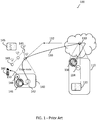
- the known architecture 100 includes a cloud processing entity 110 that includes a cloud-based management entity 120 that stores content.
- the principal mechanism for storing large volumes of content in the architecture 100 of FIG. 1 has typically required cloud based services, due to the ability to centralise the control, management, indexing and retrieval of content.
- Cloud storage uses what is referred to as a cloud computing model, in which data is stored on remote servers accessed from the Internet, or the so-called 'cloud.' It is maintained, operated and managed by a cloud storage service provider typically on a number of storage servers that are built on virtualization techniques.
- the principal drawback of centralising content in a cloud storage architecture in the manner of FIG. 1 is that good communication links to the network edge are required in order to retrieve, download and stream content that is managed centrally. If content is likely to be retrieved on an ad-hoc basis, at any time, and on-demand, then storing this content centrally works well.
- the cloud processing entity 110 of FIG. 1 includes a content scheduler 114 and a cache of content 116.
- the cloud processing entity 110 includes a backhaul link 130 to a plurality of edge nodes (or edge routers), such as edge node 140.
- the backhaul link 130 may be wired e.g. broadband, or wireless e.g. cellular.
- Edge node 140 includes a content agent 142 that routes downloaded content 132 to a content store (e.g. a cache) 145.
- a content store e.g. a cache
- a dedicated or 3 rd party application resides and serves content via a wireless link 150 to mobile subscriber device 160.
- the edge node 140 has access to a dedicated local management of content at a cache 145, as well as being connected to other edge nodes and mesh router devices 141, 143 in order to disseminate content locally.
- the edge node 140 acts as both an agent for content 132 downloaded from the cloud and a content scheduler for other nodes, e.g.
- a node can be either a principal node at the network edge or a subordinate node in the mesh.
- the edge node 140 allows the combination of edge storage, deployed applications and connectivity for devices that consume content.
- the edge node may also support a mesh capability to extend the reach of content 132 at the network edge.
- Applications on general purpose edge nodes, applications in the cloud and mobile applications each co-ordinate delivery of content to network edge.
- a mechanism is required to improve the management and delivery of stored content in current and future networks, particularly to the edges of networks and to edge nodes.
- a mechanism is also needed to address a problem where there may be new content available in a central storage, such as in a cloud system, but the edge node does not know that it is there unless a manual check is made.
- a mechanism is needed where an edge node may have an 'app' to run the content, but not the most appropriate 'app' to run content that has been downloaded.
- US 2013/246560 A1 describes a publish-subscribe distributed system for a specific dataset.
- US 2010/198977 A1 describes an edge node that downloads content from a network entity.
- the invention is defined by an independent device claim 1 and an independent method claim 6. Further embodiments are specified by the dependent claims.
- a mechanism to improve the management and delivery of stored content in current and future networks is described, particularly to the edges of networks and to edge nodes.
- a mechanism to address the problem where there may be new content available in a central storage location, such as in a cloud system, but the edge node does not know that it is there unless a manual check is made is achieved.
- a mechanism is provided to address a problem where an edge node may have an 'app' to run the content, but where the most appropriate 'app' to run content has not previously been downloaded.
- the content may always be used with the most appropriate application for that specific content.
- Example embodiments of the present invention are described with respect to resolving an observation by the inventors that content delivery may be improved based on one or more characteristics of the content to be delivered.
- examples of the invention recognise and resolve some problems when deploying cloud services at a network edge, for example in a mesh network. For example, certain characteristics related to some content and data that are to be downloaded, for example from a cloud storage, may lead to a desire to store the content at, or coupled to, an edge node, for example in a mesh network. In this manner, it may be possible to avoid a penalty on the network when downloading such content with these characteristics.
- a first content characteristic that may be taken into account in the delivery and storage of content is content that is requested in a predictable manner. As an example of this first content characteristic, there are schemes that will automatically download content, e.g., a web cache.
- a second content characteristic that may be taken into account in the delivery and storage of content is content that can be naturally scheduled and made available for a limited period. Broadcast television is an example of this second content characteristic.
- a third content characteristic that may be taken into account in the delivery and storage of content is content that is always or specifically required because, say, it is uniquely associated with the network edge.
- content may be geographically limited. For example, a code for a discount voucher in a particular shop or chain of shops may be downloaded, such that it can only be used at that location. According to examples of the invention, these characteristics may be used in an attribute or tag, which may be attached to the content itself or an application for running the content.
- Examples of the invention propose a mechanism to deploy cloud services and provide content at an edge node that is managed both centrally, e.g. in a 'cloud' location, and locally in (or connected to) the edge node.
- a content agent registry is provided and configured first to hold (e.g. record) content 'attributes' or 'tags'.
- the content agent registry may also be configured, in a second function, to specify an application to run on an edge node for this content.
- the content agent registry may also be configured (in a third function, in some cases) to additionally download the application to run on the mobile device for this content.
- the edge node application is downloaded immediately, if it is not already present at the edge node, and the content installed. If the application is already present on the edge node, there is no need to install it.
- the application may be a media streaming service and the content a video clip that is preferably viewed by that media streaming service. The final decision whether to download content or an application is made by the edge node.
- the reply from the network to the edge node indicates that there is content available and also that an application is available (with the details of the application). In this manner, the edge node will know whether or not the application should be downloaded. Similarly, in the network-initiated case, when the network indicates to the edge node that new content is available, there will be details of the application. The edge node knows what applications it has (and which version) and so can decide whether or not to download it.
- the mobile app may also be downloaded immediately, if it is not present, and stored on the edge node, for example pulled by the edge node when it realizes that it does not have the up to date app.
- the edge node typically through a web portal or another dedicated app
- the user may be provided with the option to view the content in the associated mobile app. If this option is selected then the mobile app is downloaded and then runs to show the content.
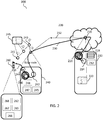
- the network architecture 200 includes a network entity 210 configured to perform cloud functionality.
- the network entity 210 includes a cloud-based management entity 220 that stores content.
- the network entity 210 configured to perform cloud functionality includes one or more processors 212, a content scheduler 214 and a cache 216 of content.
- the network entity 210 includes a content agent registry 218.
- content agent registry 218 may be considered as a register of the meta-data associated with the content, but where the meta-data is also used to organise the content in the cache. In some examples, therefore, there are 'tags' or attributes within the meta-data associated with the content.
- the content agent registry 218 is configured to perform at least three primary functions. A first function involves the content agent registry 218 recording the tags or attributes associated with one or more edge node(s). A second function involves the content agent registry 218 ordering the content by attributes.
- Ordering content on a per attribute basis allows an edge node to be able to select content that is suitable. Aggregating other meta-data with the content allows the edge node content agent 242 to perform further processing, for example downloading any associated applications (for the edge node or mobile device) that are required to make use of the content.
- a third function involves the content agent registry 218 also associating the meta-data with the content.
- the content agent registry 218 records attributes or 'tags' related to edge nodes (such as edge node 240) and other nodes and devices, which may be provisioned remotely and recorded/stored in the content agent registry 218.
- the attributes or 'tags' may be used by the edge nodes (such as edge node 240) to query the content to be downloaded.
- Examples of the invention describe a variety of mechanisms for the content to be 'pushed' from the network entity to the edge node 240 based on a characteristic of the content, which is identified by the attribute or tag, examples of which are described in FIG. 5 and FIG. 6 . Further examples of the invention also describe an example mechanism for the content to be 'pulled' from the network entity by the edge node 240 based on a characteristic of the content, which is identified by the attribute or tag, one example being described in FIG. 4 .
- the network entity 210 includes a backhaul link 230 to a plurality of edge nodes (or edge routers), such as edge node 240.
- the backhaul link 230 may be wired e.g. broadband, or wireless e.g. cellular.
- Edge node 240 includes a content agent 242 that routes downloaded content 232 to a content store (e.g. a cache) 246.
- a dedicated or 3 rd party application resides within the edge node and serves content via a wireless link 250 to mobile subscriber device 260.
- the edge node has access to a dedicated local management of content at a cache 245, as well as being connected to other edge nodes and mesh router devices 241, 243 in order to disseminate content locally.
- the edge node 240 acts as both an agent for content 232 downloaded from the cloud and a content scheduler for other nodes 241, 243 at the network edge. This avoids each node 241, 243 in the edge network from having to download content 232 from the cloud direct.
- a node can be either a principal node at the network edge or a subordinate node in the mesh.
- attributes or 'tags' that are provisioned at the edge node 240 may be used to query the content agent registry 218 that is located in, or connected to, the cloud in order to determine the (or suitable) content to be downloaded based on the attribute(s) or tag(s).
- the content agent registry 218 may also use those attributes to determine whether the cache 216 contains any other content that matches the attribute(s) or tag(s).
- the content agent registry 218 may also use those attributes to determine whether the cache 216 contains any similar content, identified under the same attribute(s) or tag(s).
- the content may be updated with an attribute or tag based on the content characteristic, and the attribute or tag recorded in the content agent registry 218, which in this example would tag the news content as being (e.g.) daily in nature.
- the edge node 240 sees that it has received a request from the content store 246.
- the edge node 240 knows that the content is required on a daily basis (because of the tag) then it can autonomously download the new content at a particular rate, e.g. daily.
- the edge node 240 is able to autonomously schedule content download based on a characteristic of the content, which in this context example is a time-limited use of the content that it downloads.
- the edge node 240 may register for daily content, and have it pushed by, say, a processor 212 in the network entity 210 that performs cloud-based functionality.
- the management of content is now distributed between the central network entity 210 and the edge node 240, as the cloud content agent registry 218 has all the information about the content and edge nodes, such as edge node 240 that are able to register for content that they are interested in.
- edge nodes such as edge node 240 that are able to register for content that they are interested in.
- a content application at the edge node 240 that registers with this attribute will have content automatically downloaded. For example, a 'historic homes' attribute is assigned to content and an application registers with this attribute. The content associated with this attribute is downloaded. Any new content that is tagged at the network entity 210, and recorded in content agent registry 218 with this attribute, is also automatically downloaded, where a trigger is an indication from the network entity 210 that new content in which the edge node 240 has previously indicated an interest is available, as illustrated in FIG. 5 .
- the application may be running on an edge node deployed at a national trust site. One problem that is being solved is that there may be new content available but the edge nodes do not know that it is there.
- One advantage of examples of the invention is that the management of the content has changed so that it is not cached manually, but instead it is predictive and also scheduled (e.g. at a quiet time).
- a further advantage of using attributes or tags to identify content characteristics facilitates a processor 212 located in the network entity 210 being able to 'push' the desired content, or recognize similar content, identified under the same tag or attribute, and 'push' that content, to the edge node 240.
- the edge node 240 has previously indicated that it is interested in content of a particular type indicated by a tag. So, the edge node 240 has in effect requested content to be pushed, as it becomes available.
- a further advantage of using attributes or tags to identify content characteristics facilitates edge nodes being able to 'pull' the desired content, or recognize similar content, identified under the same tag or attribute, and 'pull' that content, by indicating to the Content Agent Registry 218 that it wants content.
- a communication device such as the subscriber device 260 or a network device such as edge node 240 is described.
- the communication device comprises: a processor 245, 265, that is operably coupleable to a content store; and a receiver (e.g. as part of transceiver 262 in subscriber device 260) coupled to the processor 245, 265 and configured to download content from the content store, wherein the downloaded content has an attribute associated with the content and wherein the receiver is further configured to download a mobile application associated with the content.
- the processor 245, 265 is configured to delete both the mobile application and the downloaded content in response to the processor determining that the attribute associated with the content is no longer applicable.
- the communication device may further comprise a timer 247, 267 coupled to the processor 245, 265 and configured to monitor whether the time-limit of the time-limited tag has expired; and the processor 245, 265 is configured to delete both the mobile application and the downloaded content in response to the processor determining that an expiry of the time-limited tag has occurred.
- the communication device may further comprise a location circuit 248, 268 coupled to the processor 245, 265 and configured to monitor a geographical location of the communication device, wherein the processor 245, 265 is configured to delete both the mobile application and the downloaded content in response to the processor determining that the communication device has moved outside of the geographical location that is associated with the downloaded content.
- a location circuit 248, 268 coupled to the processor 245, 265 and configured to monitor a geographical location of the communication device, wherein the processor 245, 265 is configured to delete both the mobile application and the downloaded content in response to the processor determining that the communication device has moved outside of the geographical location that is associated with the downloaded content.
- an edge node 300 such as an edge node in a mesh network modified by the functionality herein described, is illustrated in accordance with some example embodiments of the present invention.
- the edge node 300 has been modified such that it receives and handles content differently, dependent upon at least one content characteristic.
- the edge node 300 may be configured to receive and handle content differently, dependent upon whether the content is delivered in a predictable manner; content that is scheduled; content that is made available for a limited period of time; content that is made available for a particular geographic location.
- the edge node 300 has been configured to assign a tag or attribute to content of interest to the edge node, or edge node user, related to a type of content.
- the edge node 300 may be configured to send a query to the network entity regarding content that is stored in a cache connected to a network entity, for example in a cloud system, based on the assigned tag or attribute. In some examples, based on a network entity response to the query, the edge node 300 may be configured to pull content from the cache.
- the edge node 300 is described in terms of both a wireless communication device and a wireline connected device, such as a computer, network server, laptop, etc.
- the edge node 300 contains one or more antenna(e) 302 for communicating via various wireless technologies.
- the one or more antenna(e) 302 (coupled via a wireless interface 308 with associated transmit and receive circuitry) is configured to radiate and receive radiated signals 332 on WiFiTM frequencies or Bluetooth BTTM frequencies or cellular frequencies, e.g. LTETM over a cellular network (not shown).
- the one or more antenna(e) 302 is coupled to an antenna switch or duplexer 304 that provides isolation between receive and transmit chains within the edge node 300, as well as providing isolation between circuits targeted for the specific technologies being supported, e.g. LTETM, WiFiTM, BTTM.
- One or more receiver chains include receiver front-end circuitry 306 (effectively providing reception, filtering and intermediate or base-band frequency conversion).
- the receiver front-end circuitry 306 is coupled to a signal processor 328 (generally realized by a digital signal processor (DSP)).
- DSP digital signal processor
- a controller 314 maintains overall operational control of the edge node 300.
- the controller 314 is also coupled to the receiver front-end circuitry 306 and the signal processor 328.
- a timer 318 is operably coupled to the controller 314 to control the timing of operations (e.g. transmission or reception of time-dependent signals) within the edge node 300.
- controller 314 is connected to an internet protocol (IP) circuit/function 311, which is coupled to a cache 316 and one or more IP routing tables and/or routing protocol software 312.
- IP internet protocol
- the controller 314 may be operably coupled to other devices and nodes via a wireline interface 309 using a wireline connection 310, such as Ethernet.
- the signal processor 328 of the router node 300 may encompass much more functionality than the IP circuit/function 311 and IP routing tables and/or routing protocol software 312. In particular, in some examples, it is assumed that signal processor 328 may handle some or all of the higher layer functionality.
- the controller 314 is coupled to a cache 316 configured to store content.
- the content includes a tag or an attribute that is associated with the content.
- the tag or attribute may relate to a characteristic of the content, for example whether the content is delivered in a predictable manner; content that is scheduled; content that is made available for a limited period of time; content that is made available for a particular geographic location.
- the tags or attributes associated with the various contents may be organized in families or hierarchies, for example high order tags that encompass more content that has some relationship or low level tags or attributes indicating relatively specific content.
- the cache 316 is also configured to store an app associated with running the content, which may be downloadable to the edge node as well as the content.
- the cache 316 may also store operating regimes, such as decoding/encoding functions, synchronization patterns, code sequences, and the like to assist wireless communications.
- this essentially includes the signal processor 328 being coupled through one or more transmitter/modulation circuits 322 and one or more power amplifiers 324 to the one or more antenna(e) 302, which may be in a form of an antenna array, or a plurality of antennas.
- the transmitter/modulation circuits 322 and the power amplifiers 324 are operationally responsive to the controller 314.
- edge node 300 and in particular signal processor 328 of edge node 300, has been configured to respond to an user input of tag/attribute information.
- the user may provision attributes (or tags) in the edge node that identify what future content the user desires or needs.
- the signal processor 328 and transmitter circuity of the edge node 300 sends a query to the network's (cloud's) content agent register, such as content agent register 218 in FIG. 4 .
- the signal processor 328 may 'pull' the content from a cache connected to the network entity, such as network entity 210 of FIG. 2 , in the cloud.
- edge node 300 and in particular signal processor 328 of edge node 300 has been configured to support a wireless and/or a wireline connection such as Ethernet.
- signal processor 328 may perform all of the functions required of the edge node 300, or in other examples the signal processor 328 may encompass multiple signal processors, for example dedicated to the various technologies being supported.
- signal processor 328 supporting wireless may be implemented as distinct from a signal processor supporting ethernetTM communication.
- a single processor may be used to support each technology.
- the various components within the edge node 300 can be realized in discrete or integrated component form, with an ultimate structure therefore being an application-specific or design selection.
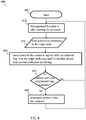
- FIG. 4 illustrates an example flowchart 400 of an operation for the 'pull' of content from a cache in the network to an edge node, such as edge node 240 in FIG. 2 , in accordance with some example embodiments of the present invention.
- the flowchart 400 starts at 405 and the management processor of the edge node is in an idle mode of operation and waiting for an event to occur in 410.
- a user provisions attributes or tags in the edge node, for example via subscriber device 260 in FIG. 2 .
- the edge node sends a query to the network registry, such as content agent registry 218 of cloud 210 in FIG. 2 .
- the edge node may optionally indicate, say via a flag, that it wants to receive content with an identical tag related to similar content in the future, and the attributes or tags may be optionally set in the network registry to indicate that the edge server is interested in receiving similar content that is identified by the same attribute or tag, for example for future downloads.
- the tags may be organized in families or hierarchies, where, for example, if the edge node indicates interest in a high order tag, it would receive more content.
- a low level detailed tag is indicated, then only very specific content may be selected. For example, a user may register a desire to receive financial or stock market updates content via a finance news tag, whereas similar content on business news may be defined under the same tag, if it is a high level tag. In this instance, the content of both can be downloaded.
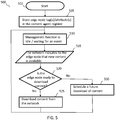
- FIG. 5 illustrates a first example flowchart 500 of an operation for the 'push' of content from the network to an edge node, such as edge node 240 in FIG. 2 , in accordance with some example embodiments of the present invention.
- the edge node If the edge node is ready to receive data, then it can immediately retrieve the content if the cloud 'pushes' the content to the edge node. Alternatively, if the edge node is ready to receive data, the network may be configured to schedule a download of the content at a future time.
- the flowchart 500 starts at 502 and, in accordance with this example, the edge node tag(s)/attribute(s) are stored in the cloud/content agent register at 505.
- the network is able to target the edge node for downloading specific new content, based on the stored tag(s)/attribute(s).
- the management processor of the edge node is in an idle mode of operation and waiting for an event to occur in 510.
- the network (such as a processor 212 located in the cloud network entity 210) indicates to the edge node, such as edge node 240 in FIG. 2 , that new content is available.
- a determination is made as to whether the edge node is ready to download the content from the network, i.e. from cache 216 in the cloud 210 in the example of FIG. 2 .
- a future download of the content is scheduled at 530, for example by a local scheduler, such as content scheduler 214 in cloud 210 from FIG. 2 .
- the flowchart then loops to 510. If, at 520, the determination is that the edge node is ready to download the content from the network, a download of the content is performed at 525 and the flowchart loops to 510.
- FIG. 6 illustrates a second example flowchart 600 of an operation for the 'push' of content from the network to an edge node, such as edge node 240 in FIG. 2 , in accordance with some example embodiments of the present invention.
- the flowchart 600 starts at 605 and the management processor of the edge node is in an idle mode of operation and waiting for an event to occur in 610.
- the user provisions attributes (tags) in the edge node. In some examples, the user may also indicate whether future content like this is desired.
- the edge node sends a query to the network's (e.g. cloud's) content agent register, such as content agent register 224 in FIG. 2 .
- the network's e.g. cloud's
- this query may contain tag(s) indicating desired content and optionally the identifier (ID) of the edge node.
- the edge node receives a reply from the network to its query.
- a determination is made as to whether any content with provisioned tags is/are available. If no content with provisioned tags is/are available at 630, the process loops back to 610. If content with provisioned tags is/are available at 630, the content is downloaded 'pushed' by the network at 635, i.e. from a cache 216 in the cloud network entity 210 in the example of FIG. 2 . The process then loops back to 610. In some examples, the 'pushing' of content may be scheduled by content scheduler 214 in cloud network entity 210 from FIG. 2 .
- a mobile application (often referred to as an 'app') that is downloaded at a network edge, for example by a subscriber device, such as subscriber device 260, connected to an edge node, such as edge node 240 of FIG. 2 , of, say, a mesh network.
- an appropriate app needs to be present on the mobile device.
- Generic applications such as web browsers, support many types of content.
- the inventor of the present invention has recognized and appreciated that the ability to download a specific mobile app from the network edge may greatly improve the user experience. In known scenarios, the user of subscriber device 260 would normally have to choose to download the app in advance and then view the content.
- the user of subscriber device 260 may view a video in a website and be told that they need to download, say, Adobe flash playerTM, to view it locally.
- the subscriber device 260 is provisioned with the ability to download both content and a specific mobile app associated with the content as a bundle.
- the app is configured to be 'transparent', so that the user is able to experience a content-centric experience.
- the app may only be bundled if it is not already present.
- the app may be identified in the content registry on its own, so may not be bundled explicitly, only if required.
- a mobile app and/or a web-app may also be included in the bundle.
- a web-app may be stored on the edge node and subsequently downloaded to a mobile browser.
- a mobile app may be stored on the content device and also downloaded to the mobile by any suitable means, which may also be a through a web page or similar.
- the mobile app or web-app may be configured to remain on the subscriber device indefinitely. Alternatively, in accordance with some further examples, the mobile app or web-app may be configured to remain on the subscriber device for a defined period or until a defined trigger occurs. In this context, the subscriber device or the mobile app itself, may be configured to delete the app, and/or associated content, based on a time period, for example an expiry of a timer, or based on a geographical location of the subscriber device, or any other suitable triggered event. For example, a mobile 'news' app is downloaded to a subscriber device at, say, a train station and the user is thereafter able to read the news for that particular day.
- the mobile app and content may be removed, e.g. deleted automatically, at the end of the day when not in use or, alternatively, removed when the user moves away from the area and the application is no longer in use.
- This joint app and content deletion mechanism based on a location trigger or a time period, is illustrated in FIG. 7 .
- a flowchart 700 illustrates an example of an operation of communication device.
- the communication device may be an edge node and include a content manager in the edge node, such as content manager 245 coupled to edge node 240 in FIG. 2 , in accordance with some example embodiments of the present invention.
- the communication device may be a subscriber device, such as subscriber device 260 communicating 250 with a network device such as edge node 240 in FIG. 2 , in accordance with some example embodiments of the present invention.
- the flowchart 700 starts at 702 and, in accordance with this example, the edge node tag(s)/attribute(s) are stored in the cloud/content agent register at 705. In this manner, the network is able to target the edge node for downloading specific new content.
- the management processor is in an idle mode of operation and waiting for an event to occur in 710.
- an external trigger event occurs.
- a determination is made as to whether a 'delete app' trigger event has occurred.
- the trigger event may result from a variety of different causes, for example an expiry of a timer or a geographical trigger with the user moving out of a geographical area.
- the flowchart loops back to 710. However, if at 720, a determination is made that a 'delete app' trigger event has occurred, the flowchart moves to 725 where a determination is made as to whether the specific mobile app that requires deletion is running. If, at 725, the determination is made that the specific mobile app that requires deletion is running, then the flowchart loops to 725 until the app is no longer in use. However, if at 730 the determination is made that the specific mobile app that requires deletion is not, or no longer, running, then the app and the locally stored content are deleted at 730 and the flowchart loops back to 710.
- the communication device is a subscriber device
- a similar processor and receiver located in the subscriber device are configured to perform the functions of FIG. 7 .
- the communication device may be configured to download content from a content store, wherein the downloaded content has an attribute associated with the content; download with the content a mobile application associated with the content; determine whether the attribute associated with the content is still applicable; and delete both the mobile application and the downloaded content in response to determining that the attribute associated with the content is no longer applicable.
- the communication device may further comprise a timer coupled to the processor and configured to monitor whether the time-limit of the time-limited tag has expired; and wherein the processor is configured to delete both the mobile application and the downloaded content in response to the processor determining that an expiry of the time-limited tag has occurred.
- the communication device may further comprise a location circuit coupled to the processor and configured to monitor a geographical location of the communication device, wherein the processor is configured to delete both the mobile application and the downloaded content in response to the processor determining that the communication device has moved outside of the geographical location that is associated with the downloaded content.
- aspects of the invention may be implemented in any suitable form including hardware, software, firmware or any combination of these.
- the invention may optionally be implemented, at least partly, as computer software running on one or more data processors and/or digital signal processors.
- the elements and components of an embodiment of the invention may be physically, functionally and logically implemented in any suitable way. Indeed, the functionality may be implemented in a single unit, in a plurality of units or as part of other functional units. Those skilled in the art will recognize that the functional blocks and/or logic elements herein described may be implemented in an integrated circuit for incorporation into one or more of the communication units.
- logic blocks are merely illustrative and that alternative embodiments may merge logic blocks or circuit elements or impose an alternate composition of functionality upon various logic blocks or circuit elements.
- small wireless mesh networks depicted herein are merely exemplary, and that in fact many other small wireless mesh network or architectures can be implemented that achieve the same functionality.
Landscapes
- Engineering & Computer Science (AREA)
- Computer Networks & Wireless Communication (AREA)
- Signal Processing (AREA)
- Information Transfer Between Computers (AREA)
- Mobile Radio Communication Systems (AREA)
Description
- The field of this invention relates generally to an edge node, a mesh network and a method to deliver content at an edge of the mesh network. In particular, some example embodiments of the invention provide for a cloud and an edge node that are configured to push or pull content from the cloud based on a characteristic of the content.
- A recent development in wireless communications is long term evolved (LTE™), which supports the operation of internet protocol (IP) techniques, such as IPv6, as well as other wireline communications. Using IPv6 in a wireless or wireline communication system is convenient to allow for internet protocol (IP) connectivity for many end user devices, possibly in a number of different subnets so that they can receive large volumes of content quickly.
- Directed mesh topology is an example of a small network where there is at least one 'sink' node that provides connectivity into the network. Within this context there are 3 types of devices: End nodes, Mesh routers, and Edge nodes.
- End nodes are communication devices that communicate using mesh transport technology (typically WiFi™) to either an edge node or a mesh router. An end node device provides no routing functionality for data from other devices. End node devices may obtain an Internet Protocol (e.g. IPv6) prefix (address) from router advertisements sent from an edge node, which may be relayed through mesh routers. End node communication devices do not have routing capability and can only operate as, say, 'leaves' in the mesh network.
- Mesh router devices are communication devices that communicate using mesh transport technology (also typically WiFi™) to either an edge node or another mesh router. Mesh routers are able to support routing in the mesh network, i.e. they can relay traffic from a second node (either an end node or another mesh router) towards the edge node. Mesh router devices provide routing functionality for data from other devices, which may be either an end node or another mesh router. Mesh router devices also obtain an IPv6 prefix (address) from router advertisements sent from an edge node, which may be relayed through other mesh routers.
- Edge nodes not only manage the mesh network and communicate with either end nodes or mesh routers, but also provide routing into the wider IP network, typically a cellular network or the public internet via a backhaul link, thereby linking the mesh network to the public internet and routing traffic between the two technologies. A backhaul link can be accomplished by a number of technologies for example a wired Ethernet connection, WiFi™ link or possibly a cellular technology connection. This results in networks that have to be planned.
- Edge nodes act as a requesting router in IPv6 prefix (address) delegation to obtain an IPv6 prefix, which it uses in router advertisements advertising this prefix value into the mesh network. There is at least one edge node in each mesh cluster. In a home environment, the edge node must be placed in a central location so as to provide connectivity throughout the house.
- Referring now to
FIG. 1 , an overview of aknown architecture 100 of content being delivered and stored at the network edge is shown. Theknown architecture 100 includes acloud processing entity 110 that includes a cloud-basedmanagement entity 120 that stores content. The principal mechanism for storing large volumes of content in thearchitecture 100 ofFIG. 1 has typically required cloud based services, due to the ability to centralise the control, management, indexing and retrieval of content. Cloud storage uses what is referred to as a cloud computing model, in which data is stored on remote servers accessed from the Internet, or the so-called 'cloud.' It is maintained, operated and managed by a cloud storage service provider typically on a number of storage servers that are built on virtualization techniques. - The principal drawback of centralising content in a cloud storage architecture in the manner of
FIG. 1 is that good communication links to the network edge are required in order to retrieve, download and stream content that is managed centrally. If content is likely to be retrieved on an ad-hoc basis, at any time, and on-demand, then storing this content centrally works well. - The
cloud processing entity 110 ofFIG. 1 includes acontent scheduler 114 and a cache ofcontent 116. Thecloud processing entity 110 includes abackhaul link 130 to a plurality of edge nodes (or edge routers), such asedge node 140. Thebackhaul link 130 may be wired e.g. broadband, or wireless e.g. cellular. -
Edge node 140 includes acontent agent 142 that routes downloadedcontent 132 to a content store (e.g. a cache) 145. Within the edge node, a dedicated or 3rd party application resides and serves content via awireless link 150 tomobile subscriber device 160. Theedge node 140 has access to a dedicated local management of content at acache 145, as well as being connected to other edge nodes andmesh router devices direct backhaul link 130 that can receivecontent 132. Effectively, theedge node 140 acts as both an agent forcontent 132 downloaded from the cloud and a content scheduler for other nodes,e.g. nodes node content 132 from thecloud 110 direct. In principle, a node can be either a principal node at the network edge or a subordinate node in the mesh. - The
edge node 140 allows the combination of edge storage, deployed applications and connectivity for devices that consume content. The edge node may also support a mesh capability to extend the reach ofcontent 132 at the network edge. Applications on general purpose edge nodes, applications in the cloud and mobile applications each co-ordinate delivery of content to network edge. - Also well-known is the concept of a software 'container'. An example of a 'container' based on an open standard is Docker™. Docker™ containers wrap a piece of software in a complete filesystem that contains everything needed to run: code, runtime, system tools, etc.
- A mechanism is required to improve the management and delivery of stored content in current and future networks, particularly to the edges of networks and to edge nodes. A mechanism is also needed to address a problem where there may be new content available in a central storage, such as in a cloud system, but the edge node does not know that it is there unless a manual check is made. Furthermore, a mechanism is needed where an edge node may have an 'app' to run the content, but not the most appropriate 'app' to run content that has been downloaded.
US 2013/246560 A1 describes a publish-subscribe distributed system for a specific dataset.US 2010/198977 A1 describes an edge node that downloads content from a network entity. - The invention is defined by an independent device claim 1 and an independent method claim 6. Further embodiments are specified by the dependent claims.
- In this manner, a mechanism to improve the management and delivery of stored content in current and future networks is described, particularly to the edges of networks and to edge nodes. In this manner, a mechanism to address the problem where there may be new content available in a central storage location, such as in a cloud system, but the edge node does not know that it is there unless a manual check is made is achieved. Furthermore, in this manner, a mechanism is provided to address a problem where an edge node may have an 'app' to run the content, but where the most appropriate 'app' to run content has not previously been downloaded.
- In this manner, the content may always be used with the most appropriate application for that specific content.
- Further details, aspects and embodiments of the invention will be described, by way of example only, with reference to the drawings. In the drawings, like reference numbers are used to identify like or functionally similar elements. Elements in the figures are illustrated for simplicity and clarity and have not necessarily been drawn to scale.
-
FIG. 1 illustrates an overview of a known network architecture for content download. -
FIG. 2 illustrates an example overview of a network architecture for content download, in accordance with some example embodiments of the present invention. -
FIG. 3 illustrates an example of an edge node, such as a router node in a mesh network, in accordance with some example embodiments of the present invention. -
FIG. 4 illustrates a flowchart of an example of an operation for the 'pull' of content by an edge node in a mesh network, in accordance with some example embodiments of the present invention. -
FIG. 5 illustrates a flowchart of a first example of an operation for a 'push' of content from, say, a cloud-based network entity to an edge node in a mesh network, in accordance with some example embodiments of the present invention. -
FIG. 6 illustrates a flowchart of a second example of an operation for a 'push' of content from, say, a cloud-based network entity to an edge node in a mesh network, in accordance with some example embodiments of the present invention. -
FIG. 7 illustrates a flowchart of an example operation of a content manager in an edge node in accordance with some example embodiments of the present invention. - Skilled artisans will appreciate that elements in the figures are illustrated for simplicity and clarity and have not necessarily been drawn to scale. For example, the dimensions and/or relative positioning of some of the elements in the figures may be exaggerated relative to other elements to help to improve understanding of various embodiments of the present invention. Also, common but well-understood elements that are useful or necessary in a commercially feasible embodiment are often not depicted in order to facilitate a less obstructed view of these various embodiments of the present invention. It will further be appreciated that certain actions and/or steps may be described or depicted in a particular order of occurrence while those skilled in the art will understand that such specificity with respect to sequence is not actually required. It will also be understood that the terms and expressions used herein have the ordinary technical meaning as is accorded to such terms and expressions by persons skilled in the technical field as set forth above except where different specific meanings have otherwise been set forth herein.
- Example embodiments of the present invention are described with respect to resolving an observation by the inventors that content delivery may be improved based on one or more characteristics of the content to be delivered. In particular, examples of the invention recognise and resolve some problems when deploying cloud services at a network edge, for example in a mesh network. For example, certain characteristics related to some content and data that are to be downloaded, for example from a cloud storage, may lead to a desire to store the content at, or coupled to, an edge node, for example in a mesh network. In this manner, it may be possible to avoid a penalty on the network when downloading such content with these characteristics.
- A first content characteristic that may be taken into account in the delivery and storage of content is content that is requested in a predictable manner. As an example of this first content characteristic, there are schemes that will automatically download content, e.g., a web cache. A second content characteristic that may be taken into account in the delivery and storage of content is content that can be naturally scheduled and made available for a limited period. Broadcast television is an example of this second content characteristic. A third content characteristic that may be taken into account in the delivery and storage of content is content that is always or specifically required because, say, it is uniquely associated with the network edge. In this context, content may be geographically limited. For example, a code for a discount voucher in a particular shop or chain of shops may be downloaded, such that it can only be used at that location. According to examples of the invention, these characteristics may be used in an attribute or tag, which may be attached to the content itself or an application for running the content.
- Examples of the invention propose a mechanism to deploy cloud services and provide content at an edge node that is managed both centrally, e.g. in a 'cloud' location, and locally in (or connected to) the edge node. In other examples of the invention, a recognition that an edge node, or a subscriber device connected to the edge node, may not have the most appropriate or best application 'app' running on the node or device, for example in a small wireless mesh network, sometimes referred to as a home network, is addressed. In this example, a content agent registry is provided and configured first to hold (e.g. record) content 'attributes' or 'tags'. The content agent registry may also be configured, in a second function, to specify an application to run on an edge node for this content. The content agent registry may also be configured (in a third function, in some cases) to additionally download the application to run on the mobile device for this content. In the case of holding content 'attributes', the edge node application is downloaded immediately, if it is not already present at the edge node, and the content installed. If the application is already present on the edge node, there is no need to install it. For example, the application may be a media streaming service and the content a video clip that is preferably viewed by that media streaming service. The final decision whether to download content or an application is made by the edge node. In the edge node-initiated case, the reply from the network to the edge node indicates that there is content available and also that an application is available (with the details of the application). In this manner, the edge node will know whether or not the application should be downloaded. Similarly, in the network-initiated case, when the network indicates to the edge node that new content is available, there will be details of the application. The edge node knows what applications it has (and which version) and so can decide whether or not to download it.
- In the case of the third function, the mobile app may also be downloaded immediately, if it is not present, and stored on the edge node, for example pulled by the edge node when it realizes that it does not have the up to date app. Alternatively, when a mobile device accesses the edge node (typically through a web portal or another dedicated app) then the user may be provided with the option to view the content in the associated mobile app. If this option is selected then the mobile app is downloaded and then runs to show the content.
- Referring now to
FIG. 2 , an example overview of anetwork architecture 200 for improved content delivery is illustrated, in accordance with some example embodiments of the present invention. Example embodiments of the present invention are described with respect to a distributed management of content. Example embodiments of the present invention are also described with respect to a content delivery based on one or more characteristic of the content. Thenetwork architecture 200 includes anetwork entity 210 configured to perform cloud functionality. Thenetwork entity 210 includes a cloud-basedmanagement entity 220 that stores content. - The
network entity 210 configured to perform cloud functionality includes one ormore processors 212, acontent scheduler 214 and acache 216 of content. In accordance with example embodiments of the invention, thenetwork entity 210 includes acontent agent registry 218. In accordance with example embodiments,content agent registry 218 may be considered as a register of the meta-data associated with the content, but where the meta-data is also used to organise the content in the cache. In some examples, therefore, there are 'tags' or attributes within the meta-data associated with the content. Thecontent agent registry 218 is configured to perform at least three primary functions. A first function involves thecontent agent registry 218 recording the tags or attributes associated with one or more edge node(s). A second function involves thecontent agent registry 218 ordering the content by attributes. Ordering content on a per attribute basis allows an edge node to be able to select content that is suitable. Aggregating other meta-data with the content allows the edgenode content agent 242 to perform further processing, for example downloading any associated applications (for the edge node or mobile device) that are required to make use of the content. A third function involves thecontent agent registry 218 also associating the meta-data with the content. - In accordance with example embodiments of the invention, the
content agent registry 218 records attributes or 'tags' related to edge nodes (such as edge node 240) and other nodes and devices, which may be provisioned remotely and recorded/stored in thecontent agent registry 218. In this manner, the attributes or 'tags' may be used by the edge nodes (such as edge node 240) to query the content to be downloaded. Examples of the invention describe a variety of mechanisms for the content to be 'pushed' from the network entity to theedge node 240 based on a characteristic of the content, which is identified by the attribute or tag, examples of which are described inFIG. 5 andFIG. 6 . Further examples of the invention also describe an example mechanism for the content to be 'pulled' from the network entity by theedge node 240 based on a characteristic of the content, which is identified by the attribute or tag, one example being described inFIG. 4 . - The
network entity 210 includes abackhaul link 230 to a plurality of edge nodes (or edge routers), such asedge node 240. Thebackhaul link 230 may be wired e.g. broadband, or wireless e.g. cellular. -
Edge node 240 includes acontent agent 242 that routes downloadedcontent 232 to a content store (e.g. a cache) 246. In this example, a dedicated or 3rd party application resides within the edge node and serves content via awireless link 250 tomobile subscriber device 260. The edge node has access to a dedicated local management of content at acache 245, as well as being connected to other edge nodes andmesh router devices direct backhaul link 230 that can receivecontent 232. Effectively, theedge node 240 acts as both an agent forcontent 232 downloaded from the cloud and a content scheduler forother nodes node content 232 from the cloud direct. In principle, a node can be either a principal node at the network edge or a subordinate node in the mesh. - In accordance with examples of the invention, attributes or 'tags' that are provisioned at the
edge node 240 may be used to query thecontent agent registry 218 that is located in, or connected to, the cloud in order to determine the (or suitable) content to be downloaded based on the attribute(s) or tag(s). In some examples, thecontent agent registry 218 may also use those attributes to determine whether thecache 216 contains any other content that matches the attribute(s) or tag(s). In some examples, thecontent agent registry 218 may also use those attributes to determine whether thecache 216 contains any similar content, identified under the same attribute(s) or tag(s). - Traditionally, content delivered to an edge node would be delivered to a cache and remain there until accessed, used/viewed and deleted. However, in accordance with example embodiments of the invention, a determination is made as to the status of the at least one characteristic of the content that is requested/delivered. For example, a determination may be made as to whether the content is being delivered in a substantially 'predictable' manner. If that content is delivered in a substantially 'predictable' manner, e.g. content delivered, say, daily in nature, such as news, a new download would take place and the previous content deleted. In accordance with examples of the invention, the content may be updated with an attribute or tag based on the content characteristic, and the attribute or tag recorded in the
content agent registry 218, which in this example would tag the news content as being (e.g.) daily in nature. Theedge node 240 sees that it has received a request from thecontent store 246. In accordance with examples of the invention, now that theedge node 240 knows that the content is required on a daily basis (because of the tag) then it can autonomously download the new content at a particular rate, e.g. daily. In this manner, theedge node 240 is able to autonomously schedule content download based on a characteristic of the content, which in this context example is a time-limited use of the content that it downloads. Alternatively, in other examples, it is envisaged that theedge node 240 may register for daily content, and have it pushed by, say, aprocessor 212 in thenetwork entity 210 that performs cloud-based functionality. - Furthermore, in some examples, it is possible to automatically predict what new content is needed based on what content is already contained in the
content store 246, for example that the data/content may be out of date/past its time-limited threshold, according to the attribute or tag. In this manner, the management of content is now distributed between thecentral network entity 210 and theedge node 240, as the cloudcontent agent registry 218 has all the information about the content and edge nodes, such asedge node 240 that are able to register for content that they are interested in. Thus, there is no longer a need to perpetually update edge nodes specifically, as the combination of thecontent agent registry 218 and edge node algorithms provide the distributed dissemination. - Therefore a content application at the
edge node 240 that registers with this attribute will have content automatically downloaded. For example, a 'historic homes' attribute is assigned to content and an application registers with this attribute. The content associated with this attribute is downloaded. Any new content that is tagged at thenetwork entity 210, and recorded incontent agent registry 218 with this attribute, is also automatically downloaded, where a trigger is an indication from thenetwork entity 210 that new content in which theedge node 240 has previously indicated an interest is available, as illustrated inFIG. 5 . The application may be running on an edge node deployed at a national trust site. One problem that is being solved is that there may be new content available but the edge nodes do not know that it is there. - One advantage of examples of the invention is that the management of the content has changed so that it is not cached manually, but instead it is predictive and also scheduled (e.g. at a quiet time). A further advantage of using attributes or tags to identify content characteristics facilitates a
processor 212 located in thenetwork entity 210 being able to 'push' the desired content, or recognize similar content, identified under the same tag or attribute, and 'push' that content, to theedge node 240. Here, theedge node 240 has previously indicated that it is interested in content of a particular type indicated by a tag. So, theedge node 240 has in effect requested content to be pushed, as it becomes available. A further advantage of using attributes or tags to identify content characteristics facilitates edge nodes being able to 'pull' the desired content, or recognize similar content, identified under the same tag or attribute, and 'pull' that content, by indicating to theContent Agent Registry 218 that it wants content. - In some examples, a communication device, such as the
subscriber device 260 or a network device such asedge node 240 is described. The communication device comprises: aprocessor transceiver 262 in subscriber device 260) coupled to theprocessor processor - In some examples, the communication device may further comprise a
timer processor processor - In some examples, the communication device may further comprise a
location circuit processor processor - Referring now to
FIG. 3 , an example of anedge node 300, such as an edge node in a mesh network modified by the functionality herein described, is illustrated in accordance with some example embodiments of the present invention. In example embodiments of the invention theedge node 300 has been modified such that it receives and handles content differently, dependent upon at least one content characteristic. For example, theedge node 300 may be configured to receive and handle content differently, dependent upon whether the content is delivered in a predictable manner; content that is scheduled; content that is made available for a limited period of time; content that is made available for a particular geographic location. In some examples, theedge node 300 has been configured to assign a tag or attribute to content of interest to the edge node, or edge node user, related to a type of content. In some examples, theedge node 300 may be configured to send a query to the network entity regarding content that is stored in a cache connected to a network entity, for example in a cloud system, based on the assigned tag or attribute. In some examples, based on a network entity response to the query, theedge node 300 may be configured to pull content from the cache. - In practice, purely for the purposes of explaining embodiments of the invention, the
edge node 300 is described in terms of both a wireless communication device and a wireline connected device, such as a computer, network server, laptop, etc. In a wireless sense, theedge node 300 contains one or more antenna(e) 302 for communicating via various wireless technologies. In one example, the one or more antenna(e) 302 (coupled via awireless interface 308 with associated transmit and receive circuitry) is configured to radiate and receive radiatedsignals 332 on WiFi™ frequencies or Bluetooth BT™ frequencies or cellular frequencies, e.g. LTE™ over a cellular network (not shown). - In a wireless example, the one or more antenna(e) 302 is coupled to an antenna switch or
duplexer 304 that provides isolation between receive and transmit chains within theedge node 300, as well as providing isolation between circuits targeted for the specific technologies being supported, e.g. LTE™, WiFi™, BT™. One or more receiver chains, as known in the art, include receiver front-end circuitry 306 (effectively providing reception, filtering and intermediate or base-band frequency conversion). The receiver front-end circuitry 306 is coupled to a signal processor 328 (generally realized by a digital signal processor (DSP)). A skilled artisan will appreciate that the level of integration of receiver circuits or components may be, in some instances, implementation-dependent. Acontroller 314 maintains overall operational control of theedge node 300. Thecontroller 314 is also coupled to the receiver front-end circuitry 306 and thesignal processor 328. Atimer 318 is operably coupled to thecontroller 314 to control the timing of operations (e.g. transmission or reception of time-dependent signals) within theedge node 300. - In this example,
controller 314 is connected to an internet protocol (IP) circuit/function 311, which is coupled to acache 316 and one or more IP routing tables and/orrouting protocol software 312. In a wireline sense, thecontroller 314 may be operably coupled to other devices and nodes via awireline interface 309 using awireline connection 310, such as Ethernet. In some examples, thesignal processor 328 of therouter node 300 may encompass much more functionality than the IP circuit/function 311 and IP routing tables and/orrouting protocol software 312. In particular, in some examples, it is assumed thatsignal processor 328 may handle some or all of the higher layer functionality. - There are a number of different approaches that are envisaged that can be employed for content storage in the
edge node 300. Thus, in some examples, thecontroller 314 is coupled to acache 316 configured to store content. In examples of the invention, the content includes a tag or an attribute that is associated with the content. In some examples, the tag or attribute may relate to a characteristic of the content, for example whether the content is delivered in a predictable manner; content that is scheduled; content that is made available for a limited period of time; content that is made available for a particular geographic location. In some examples, the tags or attributes associated with the various contents may be organized in families or hierarchies, for example high order tags that encompass more content that has some relationship or low level tags or attributes indicating relatively specific content. In some examples, thecache 316 is also configured to store an app associated with running the content, which may be downloadable to the edge node as well as the content. - In some examples, the
cache 316 may also store operating regimes, such as decoding/encoding functions, synchronization patterns, code sequences, and the like to assist wireless communications. As regards the transmit chain, this essentially includes thesignal processor 328 being coupled through one or more transmitter/modulation circuits 322 and one ormore power amplifiers 324 to the one or more antenna(e) 302, which may be in a form of an antenna array, or a plurality of antennas. The transmitter/modulation circuits 322 and thepower amplifiers 324 are operationally responsive to thecontroller 314. - In accordance with example embodiments,
edge node 300, and inparticular signal processor 328 ofedge node 300, has been configured to respond to an user input of tag/attribute information. For example, the user may provision attributes (or tags) in the edge node that identify what future content the user desires or needs. In some examples, thesignal processor 328 and transmitter circuity of theedge node 300 sends a query to the network's (cloud's) content agent register, such ascontent agent register 218 inFIG. 4 . In some examples, based on a response to the query, thesignal processor 328 may 'pull' the content from a cache connected to the network entity, such asnetwork entity 210 ofFIG. 2 , in the cloud. - In addition,
edge node 300 and inparticular signal processor 328 ofedge node 300 has been configured to support a wireless and/or a wireline connection such as Ethernet. In some examples,signal processor 328 may perform all of the functions required of theedge node 300, or in other examples thesignal processor 328 may encompass multiple signal processors, for example dedicated to the various technologies being supported. In this regard,signal processor 328 supporting wireless may be implemented as distinct from a signal processor supporting ethernet™ communication. Alternatively, a single processor may be used to support each technology. Clearly, the various components within theedge node 300 can be realized in discrete or integrated component form, with an ultimate structure therefore being an application-specific or design selection. -
FIG. 4 illustrates anexample flowchart 400 of an operation for the 'pull' of content from a cache in the network to an edge node, such asedge node 240 inFIG. 2 , in accordance with some example embodiments of the present invention. Theflowchart 400 starts at 405 and the management processor of the edge node is in an idle mode of operation and waiting for an event to occur in 410. At 415, a user provisions attributes or tags in the edge node, for example viasubscriber device 260 inFIG. 2 . At 420, the edge node sends a query to the network registry, such ascontent agent registry 218 ofcloud 210 inFIG. 2 . In some examples, the edge node may optionally indicate, say via a flag, that it wants to receive content with an identical tag related to similar content in the future, and the attributes or tags may be optionally set in the network registry to indicate that the edge server is interested in receiving similar content that is identified by the same attribute or tag, for example for future downloads. In some examples, it is envisaged that the tags may be organized in families or hierarchies, where, for example, if the edge node indicates interest in a high order tag, it would receive more content. On the other hand if a low level detailed tag, is indicated, then only very specific content may be selected. For example, a user may register a desire to receive financial or stock market updates content via a finance news tag, whereas similar content on business news may be defined under the same tag, if it is a high level tag. In this instance, the content of both can be downloaded. - At 425, a determination is made as to whether any content with any provision attributes or tags is available to download from the edge node. If, at 425, there is no content with any provision attributes or tags available to download from the edge node, the flowchart loops to 410. However, if at 425, there is content with provision attributes or tags available to download from the edge node, the content is downloaded by the edge node and the flowchart loops to 410.
-
FIG. 5 illustrates afirst example flowchart 500 of an operation for the 'push' of content from the network to an edge node, such asedge node 240 inFIG. 2 , in accordance with some example embodiments of the present invention. If the edge node is ready to receive data, then it can immediately retrieve the content if the cloud 'pushes' the content to the edge node. Alternatively, if the edge node is ready to receive data, the network may be configured to schedule a download of the content at a future time. Theflowchart 500 starts at 502 and, in accordance with this example, the edge node tag(s)/attribute(s) are stored in the cloud/content agent register at 505. In this manner, the network is able to target the edge node for downloading specific new content, based on the stored tag(s)/attribute(s). The management processor of the edge node is in an idle mode of operation and waiting for an event to occur in 510. At 515, the network (such as aprocessor 212 located in the cloud network entity 210) indicates to the edge node, such asedge node 240 inFIG. 2 , that new content is available. At 520 a determination is made as to whether the edge node is ready to download the content from the network, i.e. fromcache 216 in thecloud 210 in the example ofFIG. 2 . If, at 520, the determination is that the edge node is not ready to download the content from the network, a future download of the content is scheduled at 530, for example by a local scheduler, such ascontent scheduler 214 incloud 210 fromFIG. 2 . The flowchart then loops to 510. If, at 520, the determination is that the edge node is ready to download the content from the network, a download of the content is performed at 525 and the flowchart loops to 510. -
FIG. 6 illustrates asecond example flowchart 600 of an operation for the 'push' of content from the network to an edge node, such asedge node 240 inFIG. 2 , in accordance with some example embodiments of the present invention. Theflowchart 600 starts at 605 and the management processor of the edge node is in an idle mode of operation and waiting for an event to occur in 610. At 615, the user provisions attributes (tags) in the edge node. In some examples, the user may also indicate whether future content like this is desired. At 620, the edge node sends a query to the network's (e.g. cloud's) content agent register, such as content agent register 224 inFIG. 2 . In some examples, this query may contain tag(s) indicating desired content and optionally the identifier (ID) of the edge node. At 625, the edge node receives a reply from the network to its query. At 630, a determination is made as to whether any content with provisioned tags is/are available. If no content with provisioned tags is/are available at 630, the process loops back to 610. If content with provisioned tags is/are available at 630, the content is downloaded 'pushed' by the network at 635, i.e. from acache 216 in thecloud network entity 210 in the example ofFIG. 2 . The process then loops back to 610. In some examples, the 'pushing' of content may be scheduled bycontent scheduler 214 incloud network entity 210 fromFIG. 2 . - Further examples of the invention are described with respect to a mobile application (often referred to as an 'app') that is downloaded at a network edge, for example by a subscriber device, such as
subscriber device 260, connected to an edge node, such asedge node 240 ofFIG. 2 , of, say, a mesh network. In order to consume content at the network edge, an appropriate app needs to be present on the mobile device. Generic applications, such as web browsers, support many types of content. However, the inventor of the present invention has recognized and appreciated that the ability to download a specific mobile app from the network edge may greatly improve the user experience. In known scenarios, the user ofsubscriber device 260 would normally have to choose to download the app in advance and then view the content. Alternatively, the user ofsubscriber device 260 may view a video in a website and be told that they need to download, say, Adobe flash player™, to view it locally. In contrast, according to example embodiments of the invention, thesubscriber device 260 is provisioned with the ability to download both content and a specific mobile app associated with the content as a bundle. In this manner, the app is configured to be 'transparent', so that the user is able to experience a content-centric experience. In some examples, the app may only be bundled if it is not already present. In some examples, the app may be identified in the content registry on its own, so may not be bundled explicitly, only if required. - Thus, in accordance with some examples, along with the content to be downloaded either a mobile app and/or a web-app may also be included in the bundle. In some examples, a web-app may be stored on the edge node and subsequently downloaded to a mobile browser. In some examples, a mobile app may be stored on the content device and also downloaded to the mobile by any suitable means, which may also be a through a web page or similar.
- In some examples, the mobile app or web-app may be configured to remain on the subscriber device indefinitely. Alternatively, in accordance with some further examples, the mobile app or web-app may be configured to remain on the subscriber device for a defined period or until a defined trigger occurs. In this context, the subscriber device or the mobile app itself, may be configured to delete the app, and/or associated content, based on a time period, for example an expiry of a timer, or based on a geographical location of the subscriber device, or any other suitable triggered event. For example, a mobile 'news' app is downloaded to a subscriber device at, say, a train station and the user is thereafter able to read the news for that particular day. In this example, the mobile app and content may be removed, e.g. deleted automatically, at the end of the day when not in use or, alternatively, removed when the user moves away from the area and the application is no longer in use. One example of this joint app and content deletion mechanism, based on a location trigger or a time period, is illustrated in
FIG. 7 . - Referring now to
FIG. 7 , aflowchart 700 illustrates an example of an operation of communication device. In some examples, the communication device may be an edge node and include a content manager in the edge node, such ascontent manager 245 coupled toedge node 240 inFIG. 2 , in accordance with some example embodiments of the present invention. In some examples, the communication device may be a subscriber device, such assubscriber device 260 communicating 250 with a network device such asedge node 240 inFIG. 2 , in accordance with some example embodiments of the present invention. - The
flowchart 700 starts at 702 and, in accordance with this example, the edge node tag(s)/attribute(s) are stored in the cloud/content agent register at 705. In this manner, the network is able to target the edge node for downloading specific new content. The management processor is in an idle mode of operation and waiting for an event to occur in 710. At 715, an external trigger event occurs. At 720, a determination is made as to whether a 'delete app' trigger event has occurred. In some examples, the trigger event may result from a variety of different causes, for example an expiry of a timer or a geographical trigger with the user moving out of a geographical area. If, at 720, a determination is made that a 'delete app' trigger event has not occurred, the flowchart loops back to 710. However, if at 720, a determination is made that a 'delete app' trigger event has occurred, the flowchart moves to 725 where a determination is made as to whether the specific mobile app that requires deletion is running. If, at 725, the determination is made that the specific mobile app that requires deletion is running, then the flowchart loops to 725 until the app is no longer in use. However, if at 730 the determination is made that the specific mobile app that requires deletion is not, or no longer, running, then the app and the locally stored content are deleted at 730 and the flowchart loops back to 710. - In the example where the communication device is a subscriber device, a similar processor and receiver located in the subscriber device are configured to perform the functions of
FIG. 7 . Thus, in essence, the communication device may be configured to download content from a content store, wherein the downloaded content has an attribute associated with the content; download with the content a mobile application associated with the content; determine whether the attribute associated with the content is still applicable; and delete both the mobile application and the downloaded content in response to determining that the attribute associated with the content is no longer applicable. - In some examples, the communication device may further comprise a timer coupled to the processor and configured to monitor whether the time-limit of the time-limited tag has expired; and wherein the processor is configured to delete both the mobile application and the downloaded content in response to the processor determining that an expiry of the time-limited tag has occurred.
- In some examples, the communication device may further comprise a location circuit coupled to the processor and configured to monitor a geographical location of the communication device, wherein the processor is configured to delete both the mobile application and the downloaded content in response to the processor determining that the communication device has moved outside of the geographical location that is associated with the downloaded content.
- It will be further appreciated that, for clarity purposes, the described embodiments of the invention with reference to different functional units and processors may be modified or reconfigured with any suitable distribution of functionality between different functional units or processors is possible, without detracting from the invention. For example, functionality illustrated to be performed by separate processors or controllers may be performed by the same processor or controller. Hence, references to specific functional units are only to be seen as references to suitable means for providing the described functionality, rather than indicative of a strict logical or physical structure or organization.
- Aspects of the invention may be implemented in any suitable form including hardware, software, firmware or any combination of these. The invention may optionally be implemented, at least partly, as computer software running on one or more data processors and/or digital signal processors.
- Thus, the elements and components of an embodiment of the invention may be physically, functionally and logically implemented in any suitable way. Indeed, the functionality may be implemented in a single unit, in a plurality of units or as part of other functional units. Those skilled in the art will recognize that the functional blocks and/or logic elements herein described may be implemented in an integrated circuit for incorporation into one or more of the communication units.
- Furthermore, it is intended that boundaries between logic blocks are merely illustrative and that alternative embodiments may merge logic blocks or circuit elements or impose an alternate composition of functionality upon various logic blocks or circuit elements. It is further intended that the small wireless mesh networks depicted herein are merely exemplary, and that in fact many other small wireless mesh network or architectures can be implemented that achieve the same functionality.
- Although the present invention has been described in connection with some example embodiments, it is not intended to be limited to the specific form set forth herein. Rather, the scope of the present invention is limited only by the accompanying claims.
Claims (6)
- An edge node (240) for a mesh network that is configured to support cloud services, wherein the edge node (240) comprises:a processor, operably coupleable to a content store; wherein the edge node (240) comprisesa user input means coupled to the processor and configured to enable a user of the edge node (240) or a user of a device coupled to the edge node (240) to provision at least one attribute that identifies what future content the user desires or needs, wherein the at least one attribute is based on a characteristic of the content;a transmitter coupled to the processor and configured to send the at least one attribute to a network entity (210) that comprises a content agent registry (218) to record and identify content to be delivered to the edge node based on the at least one attribute received by the network entity (210); anda receiver configured to receive the identified content;wherein the processor and receiver are configured to pull a mobile application in addition to the content from the network entity (210) thereby enabling a subscriber device (260) to run downloaded identified content delivered to the edge node (240).
- The edge node (240) of Claim 1 wherein the characteristic is associated with content that is to be delivered according to at least one of the following:content that is delivered in a manner that is predicted;content that is scheduled;content that is made available for a limited period of time;content that is made available for a particular geographic location.
- The edge node (240) of Claim 1 or Claim 2 wherein the processor and transmitter are configured to perform at least one of the following:send a query to the network entity's content agent register for content to be downloaded;pull the content from the network entity (210) based on a response to the query received from the network entity (210).
- The edge node of any preceding Claim wherein the processor and transmitter are configured to send a query to the network entity's content agent register for content to be downloaded.
- The edge node of any preceding Claim wherein the processor and transmitter are configured to pull the content from the network entity based on a response to the query received from the network entity.
- A method for an edge node (240) of a mesh network that is configured to support cloud services, wherein the method comprises:enabling a user of the edge node (240) or a user of a device coupled to the edge node (240) to provision at least one attribute that identifies what future content the user desires or needs, wherein the at least one attribute is based on a characteristic of the content;sending the at least one attribute to a network entity (210) that comprises a content agent registry (218) to record and identify content to be delivered to the edge node based on the at least one attribute received by the network entity (210); andpulling a mobile application in addition to the identified content from the network entity (210) thereby enabling a subscriber device (260) to run downloaded identified content delivered to the edge node (240).
Priority Applications (1)
| Application Number | Priority Date | Filing Date | Title |
|---|---|---|---|
| EP21169930.1A EP3890280B1 (en) | 2016-12-23 | 2017-12-21 | Edge node and method to deliver content at an edge of a mesh network |
Applications Claiming Priority (2)
| Application Number | Priority Date | Filing Date | Title |
|---|---|---|---|
| GBGB1622098.0A GB201622098D0 (en) | 2016-12-23 | 2016-12-23 | Edge node, mesh network and method to deliver content at an edge of a mesh network |
| EP17209308.0A EP3340579B1 (en) | 2016-12-23 | 2017-12-21 | Content delivery at an edge of a mesh network |
Related Parent Applications (2)
| Application Number | Title | Priority Date | Filing Date |
|---|---|---|---|
| EP17209308.0A Division EP3340579B1 (en) | 2016-12-23 | 2017-12-21 | Content delivery at an edge of a mesh network |
| EP17209308.0A Division-Into EP3340579B1 (en) | 2016-12-23 | 2017-12-21 | Content delivery at an edge of a mesh network |
Related Child Applications (2)
| Application Number | Title | Priority Date | Filing Date |
|---|---|---|---|
| EP21169930.1A Division-Into EP3890280B1 (en) | 2016-12-23 | 2017-12-21 | Edge node and method to deliver content at an edge of a mesh network |
| EP21169930.1A Division EP3890280B1 (en) | 2016-12-23 | 2017-12-21 | Edge node and method to deliver content at an edge of a mesh network |
Publications (3)
| Publication Number | Publication Date |
|---|---|
| EP3579587A2 EP3579587A2 (en) | 2019-12-11 |
| EP3579587A3 EP3579587A3 (en) | 2020-03-18 |
| EP3579587B1 true EP3579587B1 (en) | 2021-06-02 |
Family
ID=58360539
Family Applications (3)
| Application Number | Title | Priority Date | Filing Date |
|---|---|---|---|
| EP21169930.1A Active EP3890280B1 (en) | 2016-12-23 | 2017-12-21 | Edge node and method to deliver content at an edge of a mesh network |
| EP17209308.0A Active EP3340579B1 (en) | 2016-12-23 | 2017-12-21 | Content delivery at an edge of a mesh network |
| EP19181830.1A Active EP3579587B1 (en) | 2016-12-23 | 2017-12-21 | Edge node and method to deliver content at an edge of a mesh network |
Family Applications Before (2)
| Application Number | Title | Priority Date | Filing Date |
|---|---|---|---|
| EP21169930.1A Active EP3890280B1 (en) | 2016-12-23 | 2017-12-21 | Edge node and method to deliver content at an edge of a mesh network |
| EP17209308.0A Active EP3340579B1 (en) | 2016-12-23 | 2017-12-21 | Content delivery at an edge of a mesh network |
Country Status (4)
| Country | Link |
|---|---|
| US (1) | US12058229B2 (en) |
| EP (3) | EP3890280B1 (en) |
| ES (2) | ES2887925T3 (en) |
| GB (1) | GB201622098D0 (en) |
Families Citing this family (4)
| Publication number | Priority date | Publication date | Assignee | Title |
|---|---|---|---|---|
| CN110191007B (en) * | 2019-06-27 | 2022-05-03 | 广州虎牙科技有限公司 | Node management method, system and computer readable storage medium |
| CN110620815A (en) * | 2019-09-12 | 2019-12-27 | 北京笔新互联网科技有限公司 | Distributed micro-service system based on side car mode |
| US11516199B2 (en) * | 2020-07-17 | 2022-11-29 | Cisco Technology, Inc. | Zero trust for edge devices |
| US20240028720A1 (en) * | 2022-07-25 | 2024-01-25 | Vmware, Inc. | Secure block cloning on resilient file systems |
Family Cites Families (24)
| Publication number | Priority date | Publication date | Assignee | Title |
|---|---|---|---|---|
| US6832230B1 (en) | 1999-12-22 | 2004-12-14 | Nokia Corporation | Apparatus and associated method for downloading an application with a variable lifetime to a mobile terminal |
| JP4202622B2 (en) * | 2001-07-13 | 2008-12-24 | 富士通株式会社 | Content distribution method, content information processing apparatus, and program |
| US20050268343A1 (en) | 2004-05-14 | 2005-12-01 | Onoda Sen Ichi | Application management device and its method |
| US8320952B2 (en) * | 2005-07-25 | 2012-11-27 | Motorola Mobility Llc | Method and apparatus to facilitate download scheduling |
| US20070197196A1 (en) | 2006-02-22 | 2007-08-23 | Michael Shenfield | Apparatus, and associated method, for facilitating delivery and processing of push content |
| US20100198977A1 (en) * | 2006-09-27 | 2010-08-05 | Adobe Systems Incorporated | Automatic live stream trees |
| US7890124B2 (en) * | 2006-09-28 | 2011-02-15 | At&T Intellectual Property I, L.P. | Location based information delivery |
| US8498628B2 (en) * | 2007-03-27 | 2013-07-30 | Iocast Llc | Content delivery system and method |
| US20090187593A1 (en) * | 2008-01-17 | 2009-07-23 | Qualcomm Incorporated | Methods and Apparatus for Targeted Media Content Delivery and Acquisition in a Wireless Communication Network |
| US20100211535A1 (en) * | 2009-02-17 | 2010-08-19 | Rosenberger Mark Elliot | Methods and systems for management of data |
| US9215423B2 (en) * | 2009-03-30 | 2015-12-15 | Time Warner Cable Enterprises Llc | Recommendation engine apparatus and methods |
| US8214740B2 (en) * | 2009-10-30 | 2012-07-03 | Apple Inc. | Song flow methodology in random playback |
| WO2011085076A1 (en) * | 2010-01-06 | 2011-07-14 | Wakeupcall.Tv, Llc | Informational video delivery software and associated methods |
| US8626718B2 (en) * | 2010-10-29 | 2014-01-07 | Verizon Patent And Licensing Inc. | Content caching based on refresh and expiration times |
| US8782395B1 (en) | 2011-09-29 | 2014-07-15 | Riverbed Technology, Inc. | Monitoring usage of WAN optimization devices integrated with content delivery networks |
| US8509816B2 (en) * | 2011-11-11 | 2013-08-13 | International Business Machines Corporation | Data pre-fetching based on user demographics |
| US9485300B2 (en) * | 2012-03-13 | 2016-11-01 | Yahoo! Inc. | Publish-subscribe platform for cloud file distribution |
| CN103841510B (en) * | 2012-11-20 | 2017-07-21 | 财团法人资讯工业策进会 | Location-based service provides system and method |
| US9973565B2 (en) * | 2013-05-06 | 2018-05-15 | Samsung Electronics Co., Ltd. | Temporary applications for mobile devices |
| US9898759B2 (en) * | 2014-03-28 | 2018-02-20 | Joseph Khoury | Methods and systems for collecting driving information and classifying drivers and self-driving systems |
| US10033784B2 (en) * | 2014-07-14 | 2018-07-24 | International Business Machines Corporation | Predictive management of offline storage content for mobile applications and optimized network usage for mobile devices |
| US10341414B2 (en) * | 2014-10-31 | 2019-07-02 | Vmware, Inc. | File sharing using remote applications |
| CN105979298B (en) | 2016-06-22 | 2019-01-18 | 上海文广科技(集团)有限公司 | The full link safety management of video file and distribution method and system based on cloud |
| US10339583B2 (en) * | 2016-11-30 | 2019-07-02 | Bank Of America Corporation | Object recognition and analysis using augmented reality user devices |
-
2016
- 2016-12-23 GB GBGB1622098.0A patent/GB201622098D0/en not_active Ceased
-
2017
- 2017-12-21 EP EP21169930.1A patent/EP3890280B1/en active Active
- 2017-12-21 ES ES19181830T patent/ES2887925T3/en active Active
- 2017-12-21 US US15/850,332 patent/US12058229B2/en active Active
- 2017-12-21 EP EP17209308.0A patent/EP3340579B1/en active Active
- 2017-12-21 EP EP19181830.1A patent/EP3579587B1/en active Active
- 2017-12-21 ES ES17209308T patent/ES2784709T3/en active Active
Non-Patent Citations (1)
| Title |
|---|
| None * |
Also Published As
| Publication number | Publication date |
|---|---|
| EP3340579A1 (en) | 2018-06-27 |
| EP3890280C0 (en) | 2024-07-31 |
| GB201622098D0 (en) | 2017-02-08 |
| US12058229B2 (en) | 2024-08-06 |
| EP3579587A3 (en) | 2020-03-18 |
| ES2784709T3 (en) | 2020-09-30 |
| EP3890280B1 (en) | 2024-07-31 |
| US20180183896A1 (en) | 2018-06-28 |
| ES2887925T3 (en) | 2021-12-29 |
| EP3890280A3 (en) | 2022-02-16 |
| EP3340579B1 (en) | 2020-02-12 |
| EP3579587A2 (en) | 2019-12-11 |
| EP3890280A2 (en) | 2021-10-06 |
Similar Documents
| Publication | Publication Date | Title |
|---|---|---|
| JP5296221B2 (en) | Method for installing application in NFC-compatible device, NFC-compatible device, server node, computer-readable medium, and computer program | |
| CN107211341B (en) | System, device and method for distributed content prefetching for user equipment | |
| US20200220943A1 (en) | Content storage and processing in network base stations and methods for content delivery in a mesh network | |
| EP3340579B1 (en) | Content delivery at an edge of a mesh network | |
| US10042626B2 (en) | Software updates using client self-reporting and a hierarchical data structure | |
| US8972517B2 (en) | Method and apparatus for maintaining and migrating a distributed cache in a networked environment | |
| CN101626385B (en) | media service method and system | |
| US9406070B2 (en) | Apparatus and method for managing advertisement application | |
| MX2007002056A (en) | Apparatus, and associated method, for facilitating delivery and processing of push content . | |
| EP3220612B1 (en) | Wireless communication unit and method for sharing delay tolerant content | |
| CN108475386A (en) | Advertisement display control method, terminal and advertisement server | |
| JP2013542681A (en) | Content sharing method and apparatus using group change information in content-centric network environment | |
| CN104025147A (en) | Method of displaying contents by using device identifier of wireless communication device, method of providing contents, user terminal for performing the contents displaying method, and system for providing contents to perform the contents providing method | |
| CN102404616B (en) | Method and system for pushing data cloud based on digital television network | |
| JP2015170125A (en) | Content acquisition program, apparatus, and method | |
| JP2008537619A (en) | Method, apparatus, and program for efficiently extending a peer-to-peer (P2P) network | |
| EP2802108A9 (en) | Data-oriented communication system, node, and data transfer method | |
| JP6421676B2 (en) | Content acquisition program, apparatus, and method | |
| CN101997885B (en) | User data scheduling method, server and data center | |
| EP3711281B1 (en) | Selecting from a plurality of items which match an interest | |
| US20170286562A1 (en) | Information processing apparatus, data providing system, and data providing method | |
| US9842481B1 (en) | Apparatus and method to collect device information published in past times via a network of gateways | |
| EP2997489B1 (en) | Method and device for efficient mobile data transmission | |
| KR100594951B1 (en) | How to send content using an NS card | |
| US20180227220A1 (en) | Router Cooperation |
Legal Events
| Date | Code | Title | Description |
|---|---|---|---|
| PUAI | Public reference made under article 153(3) epc to a published international application that has entered the european phase |
Free format text: ORIGINAL CODE: 0009012 |
|
| STAA | Information on the status of an ep patent application or granted ep patent |
Free format text: STATUS: THE APPLICATION HAS BEEN PUBLISHED |
|
| AC | Divisional application: reference to earlier application |
Ref document number: 3340579 Country of ref document: EP Kind code of ref document: P |
|
| AK | Designated contracting states |
Kind code of ref document: A2 Designated state(s): AL AT BE BG CH CY CZ DE DK EE ES FI FR GB GR HR HU IE IS IT LI LT LU LV MC MK MT NL NO PL PT RO RS SE SI SK SM TR |
|
| PUAL | Search report despatched |
Free format text: ORIGINAL CODE: 0009013 |
|
| AK | Designated contracting states |
Kind code of ref document: A3 Designated state(s): AL AT BE BG CH CY CZ DE DK EE ES FI FR GB GR HR HU IE IS IT LI LT LU LV MC MK MT NL NO PL PT RO RS SE SI SK SM TR |
|
| RIC1 | Information provided on ipc code assigned before grant |
Ipc: H04W 84/18 20090101ALI20200207BHEP Ipc: H04W 4/60 20180101AFI20200207BHEP Ipc: H04L 29/08 20060101ALI20200207BHEP |
|
| STAA | Information on the status of an ep patent application or granted ep patent |
Free format text: STATUS: REQUEST FOR EXAMINATION WAS MADE |
|
| 17P | Request for examination filed |
Effective date: 20200918 |
|
| RBV | Designated contracting states (corrected) |
Designated state(s): AL AT BE BG CH CY CZ DE DK EE ES FI FR GB GR HR HU IE IS IT LI LT LU LV MC MK MT NL NO PL PT RO RS SE SI SK SM TR |
|
| GRAP | Despatch of communication of intention to grant a patent |
Free format text: ORIGINAL CODE: EPIDOSNIGR1 |
|
| STAA | Information on the status of an ep patent application or granted ep patent |
Free format text: STATUS: GRANT OF PATENT IS INTENDED |
|
| INTG | Intention to grant announced |
Effective date: 20201215 |
|
| RIN1 | Information on inventor provided before grant (corrected) |
Inventor name: JELBERT, NICHOLAS Inventor name: CANNON, MARK JOSEPH |
|
| GRAS | Grant fee paid |
Free format text: ORIGINAL CODE: EPIDOSNIGR3 |
|
| GRAA | (expected) grant |
Free format text: ORIGINAL CODE: 0009210 |
|
| STAA | Information on the status of an ep patent application or granted ep patent |
Free format text: STATUS: THE PATENT HAS BEEN GRANTED |
|
| REG | Reference to a national code |
Ref country code: CH Ref legal event code: EP |
|
| AC | Divisional application: reference to earlier application |
Ref document number: 3340579 Country of ref document: EP Kind code of ref document: P |
|
| AK | Designated contracting states |
Kind code of ref document: B1 Designated state(s): AL AT BE BG CH CY CZ DE DK EE ES FI FR GB GR HR HU IE IS IT LI LT LU LV MC MK MT NL NO PL PT RO RS SE SI SK SM TR |
|
| REG | Reference to a national code |
Ref country code: GB Ref legal event code: FG4D |
|
| REG | Reference to a national code |
Ref country code: AT Ref legal event code: REF Ref document number: 1399590 Country of ref document: AT Kind code of ref document: T Effective date: 20210615 |
|
| REG | Reference to a national code |
Ref country code: IE Ref legal event code: FG4D |
|
| REG | Reference to a national code |
Ref country code: DE Ref legal event code: R096 Ref document number: 602017039894 Country of ref document: DE |
|
| REG | Reference to a national code |
Ref country code: LT Ref legal event code: MG9D |
|
| PG25 | Lapsed in a contracting state [announced via postgrant information from national office to epo] |
Ref country code: BG Free format text: LAPSE BECAUSE OF FAILURE TO SUBMIT A TRANSLATION OF THE DESCRIPTION OR TO PAY THE FEE WITHIN THE PRESCRIBED TIME-LIMIT Effective date: 20210902 Ref country code: FI Free format text: LAPSE BECAUSE OF FAILURE TO SUBMIT A TRANSLATION OF THE DESCRIPTION OR TO PAY THE FEE WITHIN THE PRESCRIBED TIME-LIMIT Effective date: 20210602 Ref country code: LT Free format text: LAPSE BECAUSE OF FAILURE TO SUBMIT A TRANSLATION OF THE DESCRIPTION OR TO PAY THE FEE WITHIN THE PRESCRIBED TIME-LIMIT Effective date: 20210602 Ref country code: HR Free format text: LAPSE BECAUSE OF FAILURE TO SUBMIT A TRANSLATION OF THE DESCRIPTION OR TO PAY THE FEE WITHIN THE PRESCRIBED TIME-LIMIT Effective date: 20210602 |
|
| REG | Reference to a national code |
Ref country code: NL Ref legal event code: MP Effective date: 20210602 |
|
| REG | Reference to a national code |
Ref country code: AT Ref legal event code: MK05 Ref document number: 1399590 Country of ref document: AT Kind code of ref document: T Effective date: 20210602 |
|
| PG25 | Lapsed in a contracting state [announced via postgrant information from national office to epo] |
Ref country code: GR Free format text: LAPSE BECAUSE OF FAILURE TO SUBMIT A TRANSLATION OF THE DESCRIPTION OR TO PAY THE FEE WITHIN THE PRESCRIBED TIME-LIMIT Effective date: 20210903 Ref country code: LV Free format text: LAPSE BECAUSE OF FAILURE TO SUBMIT A TRANSLATION OF THE DESCRIPTION OR TO PAY THE FEE WITHIN THE PRESCRIBED TIME-LIMIT Effective date: 20210602 Ref country code: PL Free format text: LAPSE BECAUSE OF FAILURE TO SUBMIT A TRANSLATION OF THE DESCRIPTION OR TO PAY THE FEE WITHIN THE PRESCRIBED TIME-LIMIT Effective date: 20210602 Ref country code: NO Free format text: LAPSE BECAUSE OF FAILURE TO SUBMIT A TRANSLATION OF THE DESCRIPTION OR TO PAY THE FEE WITHIN THE PRESCRIBED TIME-LIMIT Effective date: 20210902 Ref country code: SE Free format text: LAPSE BECAUSE OF FAILURE TO SUBMIT A TRANSLATION OF THE DESCRIPTION OR TO PAY THE FEE WITHIN THE PRESCRIBED TIME-LIMIT Effective date: 20210602 Ref country code: RS Free format text: LAPSE BECAUSE OF FAILURE TO SUBMIT A TRANSLATION OF THE DESCRIPTION OR TO PAY THE FEE WITHIN THE PRESCRIBED TIME-LIMIT Effective date: 20210602 |
|
| REG | Reference to a national code |
Ref country code: ES Ref legal event code: FG2A Ref document number: 2887925 Country of ref document: ES Kind code of ref document: T3 Effective date: 20211229 |
|
| PG25 | Lapsed in a contracting state [announced via postgrant information from national office to epo] |
Ref country code: CZ Free format text: LAPSE BECAUSE OF FAILURE TO SUBMIT A TRANSLATION OF THE DESCRIPTION OR TO PAY THE FEE WITHIN THE PRESCRIBED TIME-LIMIT Effective date: 20210602 Ref country code: AT Free format text: LAPSE BECAUSE OF FAILURE TO SUBMIT A TRANSLATION OF THE DESCRIPTION OR TO PAY THE FEE WITHIN THE PRESCRIBED TIME-LIMIT Effective date: 20210602 Ref country code: SM Free format text: LAPSE BECAUSE OF FAILURE TO SUBMIT A TRANSLATION OF THE DESCRIPTION OR TO PAY THE FEE WITHIN THE PRESCRIBED TIME-LIMIT Effective date: 20210602 Ref country code: PT Free format text: LAPSE BECAUSE OF FAILURE TO SUBMIT A TRANSLATION OF THE DESCRIPTION OR TO PAY THE FEE WITHIN THE PRESCRIBED TIME-LIMIT Effective date: 20211004 Ref country code: NL Free format text: LAPSE BECAUSE OF FAILURE TO SUBMIT A TRANSLATION OF THE DESCRIPTION OR TO PAY THE FEE WITHIN THE PRESCRIBED TIME-LIMIT Effective date: 20210602 Ref country code: RO Free format text: LAPSE BECAUSE OF FAILURE TO SUBMIT A TRANSLATION OF THE DESCRIPTION OR TO PAY THE FEE WITHIN THE PRESCRIBED TIME-LIMIT Effective date: 20210602 Ref country code: SK Free format text: LAPSE BECAUSE OF FAILURE TO SUBMIT A TRANSLATION OF THE DESCRIPTION OR TO PAY THE FEE WITHIN THE PRESCRIBED TIME-LIMIT Effective date: 20210602 Ref country code: EE Free format text: LAPSE BECAUSE OF FAILURE TO SUBMIT A TRANSLATION OF THE DESCRIPTION OR TO PAY THE FEE WITHIN THE PRESCRIBED TIME-LIMIT Effective date: 20210602 |
|
| REG | Reference to a national code |
Ref country code: DE Ref legal event code: R097 Ref document number: 602017039894 Country of ref document: DE |
|
| PLBE | No opposition filed within time limit |
Free format text: ORIGINAL CODE: 0009261 |
|
| STAA | Information on the status of an ep patent application or granted ep patent |
Free format text: STATUS: NO OPPOSITION FILED WITHIN TIME LIMIT |
|
| PG25 | Lapsed in a contracting state [announced via postgrant information from national office to epo] |
Ref country code: DK Free format text: LAPSE BECAUSE OF FAILURE TO SUBMIT A TRANSLATION OF THE DESCRIPTION OR TO PAY THE FEE WITHIN THE PRESCRIBED TIME-LIMIT Effective date: 20210602 |
|
| 26N | No opposition filed |
Effective date: 20220303 |
|
| PG25 | Lapsed in a contracting state [announced via postgrant information from national office to epo] |
Ref country code: AL Free format text: LAPSE BECAUSE OF FAILURE TO SUBMIT A TRANSLATION OF THE DESCRIPTION OR TO PAY THE FEE WITHIN THE PRESCRIBED TIME-LIMIT Effective date: 20210602 |
|
| PG25 | Lapsed in a contracting state [announced via postgrant information from national office to epo] |
Ref country code: MC Free format text: LAPSE BECAUSE OF FAILURE TO SUBMIT A TRANSLATION OF THE DESCRIPTION OR TO PAY THE FEE WITHIN THE PRESCRIBED TIME-LIMIT Effective date: 20210602 |
|
| REG | Reference to a national code |
Ref country code: CH Ref legal event code: PL |
|
| REG | Reference to a national code |
Ref country code: BE Ref legal event code: MM Effective date: 20211231 |
|
| PG25 | Lapsed in a contracting state [announced via postgrant information from national office to epo] |
Ref country code: LU Free format text: LAPSE BECAUSE OF NON-PAYMENT OF DUE FEES Effective date: 20211221 Ref country code: IE Free format text: LAPSE BECAUSE OF NON-PAYMENT OF DUE FEES Effective date: 20211221 |
|
| PG25 | Lapsed in a contracting state [announced via postgrant information from national office to epo] |
Ref country code: BE Free format text: LAPSE BECAUSE OF NON-PAYMENT OF DUE FEES Effective date: 20211231 |
|
| PG25 | Lapsed in a contracting state [announced via postgrant information from national office to epo] |
Ref country code: LI Free format text: LAPSE BECAUSE OF NON-PAYMENT OF DUE FEES Effective date: 20211231 Ref country code: CH Free format text: LAPSE BECAUSE OF NON-PAYMENT OF DUE FEES Effective date: 20211231 |
|
| PG25 | Lapsed in a contracting state [announced via postgrant information from national office to epo] |
Ref country code: CY Free format text: LAPSE BECAUSE OF FAILURE TO SUBMIT A TRANSLATION OF THE DESCRIPTION OR TO PAY THE FEE WITHIN THE PRESCRIBED TIME-LIMIT Effective date: 20210602 |
|
| PG25 | Lapsed in a contracting state [announced via postgrant information from national office to epo] |
Ref country code: HU Free format text: LAPSE BECAUSE OF FAILURE TO SUBMIT A TRANSLATION OF THE DESCRIPTION OR TO PAY THE FEE WITHIN THE PRESCRIBED TIME-LIMIT; INVALID AB INITIO Effective date: 20171221 |
|
| PGFP | Annual fee paid to national office [announced via postgrant information from national office to epo] |
Ref country code: FR Payment date: 20231227 Year of fee payment: 7 |
|
| PG25 | Lapsed in a contracting state [announced via postgrant information from national office to epo] |
Ref country code: MK Free format text: LAPSE BECAUSE OF FAILURE TO SUBMIT A TRANSLATION OF THE DESCRIPTION OR TO PAY THE FEE WITHIN THE PRESCRIBED TIME-LIMIT Effective date: 20210602 |
|
| PGFP | Annual fee paid to national office [announced via postgrant information from national office to epo] |
Ref country code: DE Payment date: 20231229 Year of fee payment: 7 |
|
| PGFP | Annual fee paid to national office [announced via postgrant information from national office to epo] |
Ref country code: IT Payment date: 20240122 Year of fee payment: 7 |
|
| PG25 | Lapsed in a contracting state [announced via postgrant information from national office to epo] |
Ref country code: TR Free format text: LAPSE BECAUSE OF FAILURE TO SUBMIT A TRANSLATION OF THE DESCRIPTION OR TO PAY THE FEE WITHIN THE PRESCRIBED TIME-LIMIT Effective date: 20210602 |
|
| PG25 | Lapsed in a contracting state [announced via postgrant information from national office to epo] |
Ref country code: MT Free format text: LAPSE BECAUSE OF FAILURE TO SUBMIT A TRANSLATION OF THE DESCRIPTION OR TO PAY THE FEE WITHIN THE PRESCRIBED TIME-LIMIT Effective date: 20210602 |
|
| REG | Reference to a national code |
Ref country code: DE Ref legal event code: R119 Ref document number: 602017039894 Country of ref document: DE |
|
| GBPC | Gb: european patent ceased through non-payment of renewal fee |
Effective date: 20241221 |
|
| PGFP | Annual fee paid to national office [announced via postgrant information from national office to epo] |
Ref country code: ES Payment date: 20250801 Year of fee payment: 8 |
|
| PG25 | Lapsed in a contracting state [announced via postgrant information from national office to epo] |
Ref country code: DE Free format text: LAPSE BECAUSE OF NON-PAYMENT OF DUE FEES Effective date: 20250701 |
|
| PG25 | Lapsed in a contracting state [announced via postgrant information from national office to epo] |
Ref country code: IT Free format text: LAPSE BECAUSE OF NON-PAYMENT OF DUE FEES Effective date: 20241221 |
|
| PG25 | Lapsed in a contracting state [announced via postgrant information from national office to epo] |
Ref country code: GB Free format text: LAPSE BECAUSE OF NON-PAYMENT OF DUE FEES Effective date: 20241221 |
|
| PG25 | Lapsed in a contracting state [announced via postgrant information from national office to epo] |
Ref country code: FR Free format text: LAPSE BECAUSE OF NON-PAYMENT OF DUE FEES Effective date: 20241231 |
|
| REG | Reference to a national code |
Ref country code: GB Ref legal event code: S28 Free format text: APPLICATION FILED |
|
| REG | Reference to a national code |
Ref country code: GB Ref legal event code: S28 Free format text: RESTORATION ALLOWED Effective date: 20260223 |
|
| PG25 | Lapsed in a contracting state [announced via postgrant information from national office to epo] |
Ref country code: GB Free format text: LAPSE BECAUSE OF NON-PAYMENT OF DUE FEES Effective date: 20241221 |
|
| PGFP | Annual fee paid to national office [announced via postgrant information from national office to epo] |
Ref country code: GB Payment date: 20260204 Year of fee payment: 9 |
|
| PGRI | Patent reinstated in contracting state [announced from national office to epo] |
Ref country code: GB Effective date: 20260223 |