EP3579102A1 - Automatic upgrade using total run count data on availability of new software - Google Patents
Automatic upgrade using total run count data on availability of new software Download PDFInfo
- Publication number
- EP3579102A1 EP3579102A1 EP19178814.0A EP19178814A EP3579102A1 EP 3579102 A1 EP3579102 A1 EP 3579102A1 EP 19178814 A EP19178814 A EP 19178814A EP 3579102 A1 EP3579102 A1 EP 3579102A1
- Authority
- EP
- European Patent Office
- Prior art keywords
- idle time
- count
- software
- next idle
- server device
- Prior art date
- Legal status (The legal status is an assumption and is not a legal conclusion. Google has not performed a legal analysis and makes no representation as to the accuracy of the status listed.)
- Withdrawn
Links
Images


Classifications
-
- G—PHYSICS
- G06—COMPUTING OR CALCULATING; COUNTING
- G06F—ELECTRIC DIGITAL DATA PROCESSING
- G06F8/00—Arrangements for software engineering
- G06F8/60—Software deployment
- G06F8/65—Updates
- G06F8/656—Updates while running
-
- B—PERFORMING OPERATIONS; TRANSPORTING
- B66—HOISTING; LIFTING; HAULING
- B66B—ELEVATORS; ESCALATORS OR MOVING WALKWAYS
- B66B1/00—Control systems of elevators in general
- B66B1/34—Details, e.g. call counting devices, data transmission from car to control system, devices giving information to the control system
- B66B1/3407—Setting or modification of parameters of the control system
-
- B—PERFORMING OPERATIONS; TRANSPORTING
- B66—HOISTING; LIFTING; HAULING
- B66B—ELEVATORS; ESCALATORS OR MOVING WALKWAYS
- B66B1/00—Control systems of elevators in general
- B66B1/34—Details, e.g. call counting devices, data transmission from car to control system, devices giving information to the control system
- B66B1/3415—Control system configuration and the data transmission or communication within the control system
- B66B1/3446—Data transmission or communication within the control system
- B66B1/3453—Procedure or protocol for the data transmission or communication
-
- B—PERFORMING OPERATIONS; TRANSPORTING
- B66—HOISTING; LIFTING; HAULING
- B66B—ELEVATORS; ESCALATORS OR MOVING WALKWAYS
- B66B25/00—Control of escalators or moving walkways
- B66B25/003—Methods or algorithms therefor
-
- B—PERFORMING OPERATIONS; TRANSPORTING
- B66—HOISTING; LIFTING; HAULING
- B66B—ELEVATORS; ESCALATORS OR MOVING WALKWAYS
- B66B5/00—Applications of checking, fault-correcting, or safety devices in elevators
-
- G—PHYSICS
- G06—COMPUTING OR CALCULATING; COUNTING
- G06F—ELECTRIC DIGITAL DATA PROCESSING
- G06F8/00—Arrangements for software engineering
- G06F8/60—Software deployment
- G06F8/65—Updates
-
- G—PHYSICS
- G06—COMPUTING OR CALCULATING; COUNTING
- G06N—COMPUTING ARRANGEMENTS BASED ON SPECIFIC COMPUTATIONAL MODELS
- G06N20/00—Machine learning
-
- H—ELECTRICITY
- H04—ELECTRIC COMMUNICATION TECHNIQUE
- H04L—TRANSMISSION OF DIGITAL INFORMATION, e.g. TELEGRAPHIC COMMUNICATION
- H04L67/00—Network arrangements or protocols for supporting network services or applications
- H04L67/34—Network arrangements or protocols for supporting network services or applications involving the movement of software or configuration parameters
Definitions
- a method for automatically updating software of a computing device of a transportation device includes performing, by a server device, machine learning on run count performance data of the transportation device to determine a next idle time.
- the method includes publishing, by the server device, software availability information to the computing device of the transportation device with the next idle time.
- the method includes causing, by the server device, an automatic upgrade of the software of the computing device of the transportation device at the next idle time.
- the method can include sending, by the server device, the software availability information to a distribution service to retrieve the run count performance data.
- the run count performance data can be stored in the distribution service on one or more servers or databases accessible by the server device.
- the run count performance data can include a count of every time the transportation device operates and a time stamp associated with each count instance.
- determining the next idle time can include determining a total run count over a time period and when a count or an average count per day is equal to or less than a threshold as the next idle time.
- the method can include publishing the software availability information to a plurality of computing devices through a distribution service.
- the transportation device can include an elevator or an escalator.
- a system for automatically updating software of a computing device of a transportation device includes the computing device of the transportation device.
- the system includes a server device performing machine learning on run count performance data of the transportation device to determine a next idle time, publishing software availability information to the computing device of the transportation device with the next idle time, and causing an automatic upgrade of the software of the computing device of the transportation device at the next idle time.
- the server device can send the software availability information to a distribution service to retrieve the run count performance data.
- the run count performance data can be stored in the distribution service on one or more servers or databases accessible by the server device.
- the run count performance data can include a count of every time the transportation device operates and a time stamp associated with each count instance.
- the server device can determine the next idle time by determining a total run count over a time period and when a count or an average count per day is equal to or less than a threshold as the next idle time.
- the server device can publish the software availability information to a plurality of computing devices through a distribution service.
- the transportation device can include an elevator or an escalator.
- one or more embodiments include a system utilizing machine learning on run count performance data to determine idle time for elevators and executing an automatic upgrade of software for computing devices of the elevators during the idle time. Further, the system can also schedule other types of elevator services during the idle time.
- the technical effect and benefits of the one or more embodiments include predicting actual idle time of the elevators based on machine learning of previous accumulated performance run count data; automatically scheduling the upgrade of software for computing devices of the elevators without any manual intervention; minimalizing or eliminating down time of the elevators due to the upgrade as the elevators are idle; and minimalizing a load on the system as the automatic software upgrade is directly tied to idle time availability.
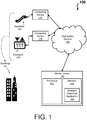
- the architecture 100 comprises one or more buildings 101.
- the one or more buildings 101 can be any building or facility comprising one or more transportation devices, such as one or more elevators 105 and one or more escalators 109.
- Examples of the one or more buildings 101 include, but are not limited to, high-rise buildings, sky-scrapers, shopping malls, stadiums, convention centers, train stations, and airports.
- Each of the one or more elevators 105 and one or more escalators 109 can be controlled by at least one computing device 115 and 119 with a processor and a memory, such as a common platform interface boards (CPIBs), controllers, and/or elevator sub-systems.
- the common platform interface boards (CPIBs), controllers, and/or elevator sub-systems comprise software that operates and manages the one or more elevators 105 and the one or more escalators 109, respectively.
- the architecture 100 comprises a distribution service 150 communicatively coupled to the one or more elevators 105 and one or more escalators 109 (e.g., the at least one computing device 115 and 119).
- the distribution service 150 is also communicatively coupled to a server device 160 comprising at least a processor 161 and a memory 162.
- the distribution service 150 and the server device 160 can be any computing platform and/or device comprising one or more central processing units (e.g., the processor 161).
- the distribution service is a cloud computing environment providing one or more of software as a service, infrastructure as a service, and platform as a service.
- the one or more central processing units also referred to as a processing circuit, are coupled via a system bus to a system memory (e.g., the memory 162) and various other components.
- the system memory can include a read only memory (ROM) and a random access memory (RAM).
- the ROM is coupled to the system bus and may include a basic input/output system (BIOS), which controls certain basic functions of the distribution service 150 and the server device 160.
- the RAM is read-write memory coupled to the system bus for use by the one or more central processing units.
- the system memory is an example of a tangible storage medium readable by the one or more central processing units.
- the system memory can store software (e.g., a software download application 164) as instructions for execution by the one or more central processing units to cause the distribution service 150 and the server device 160 to operate, such as is described herein with reference to FIGS. 2-3 .
- the distribution service 150 and the server device 160 can communicate internally and/or with any external system through wired or wireless connections utilizing any communication protocol.
- the process flow 200 is an example of performing machine learning on run count performance data of the one or more elevators 105 (referred herein as the elevator 105) and one or more escalators 109 (referred herein as the escalators 109) to determine idle time.
- the process flow 200 begins at block 210, where the server device 160 sends software availability information to the distribution service 150.
- the architecture 100 performs machine learning on run count performance data of the elevator 105 and/or the escalator 109 to determine a next idle time for each.
- the distribution service 150 or the server device 160 can execute this determination of the next idle time.
- the run count performance data can be stored in the distribution service 150, on servers and/or databases accessible by the server device 160.
- the run count performance data can include a count of every time the elevator 105 and/or the escalator 109 operates (moves in any direction) and a time stamp associated with each count instance.
- the architecture 100 determines a total run count over a time period and further determines when a count or an average count per day is equal to or less than a threshold. For example, the elevator 105 an average count per day over a certain portion of the time period is equal to or less than five, which means the elevator 105 was in use five time during that potion. An average count that is equal to or less than five indicates an idle time.
- the architecture 100 publishes software availability information to the at least one computing device 115 and 119 with the next idle time.
- a same version is published to the at least one computing device 115 and 119 with respective future idle times, during with the upgrade is performed.
- all elevators can be upgraded at a same idle time or sequentially during the next idle time of the grouped elevators.
- the architecture 100 automatically executes an upgrade at the next idle time.
- the distribution service 150 or the server device 160 can cause an automatic upgrade of the software of the computing device 115 (e.g., the common platform interface board) of the elevator 115 at the next idle time.
- the computing device 115 at the received next idle time can also automatically request the software upgrade from the distribution service 150 or the server device 160.
- FIG. 3 a schematic flow 300 of the architecture 100 is depicted in accordance with one or more embodiments.
- the software download application 164 sends new software to the distribution system 150.
- the common platform interface board (CPIB) 315 sends a request for a firmware upgrade at a future idle time to the distribution system 150.
- the distribution system 150 sends a next idle time to the common platform interface board 315.
- the distribution system 150 pushes the new software at the next idle time to the common platform interface board 315.
Landscapes
- Engineering & Computer Science (AREA)
- Software Systems (AREA)
- Theoretical Computer Science (AREA)
- Automation & Control Theory (AREA)
- General Engineering & Computer Science (AREA)
- Physics & Mathematics (AREA)
- General Physics & Mathematics (AREA)
- Computer Networks & Wireless Communication (AREA)
- Computer Security & Cryptography (AREA)
- Artificial Intelligence (AREA)
- Computer Vision & Pattern Recognition (AREA)
- Data Mining & Analysis (AREA)
- Evolutionary Computation (AREA)
- Medical Informatics (AREA)
- Computing Systems (AREA)
- Mathematical Physics (AREA)
- Signal Processing (AREA)
- Indicating And Signalling Devices For Elevators (AREA)
Abstract
Description
- In general, conventional elevator systems observe that in multiple scenarios a user is unaware of an idle time of an elevator of the conventional elevator systems. Further, due to this lack of awareness, the user will arbitrarily attempt to upgrade software of the conventional elevator systems in real time. However, software upgrade impact a functioning of the elevator when the elevator is in a running mode rather than idle.
- In accordance with one or more embodiments, a method for automatically updating software of a computing device of a transportation device is provided herein. The method includes performing, by a server device, machine learning on run count performance data of the transportation device to determine a next idle time. The method includes publishing, by the server device, software availability information to the computing device of the transportation device with the next idle time. The method includes causing, by the server device, an automatic upgrade of the software of the computing device of the transportation device at the next idle time.
- In accordance with one or more embodiments and the method embodiment above, the method can include sending, by the server device, the software availability information to a distribution service to retrieve the run count performance data.
- In accordance with one or more embodiments and the any of the method embodiments above, the run count performance data can be stored in the distribution service on one or more servers or databases accessible by the server device.
- In accordance with one or more embodiments and the any of the method embodiments above, the run count performance data can include a count of every time the transportation device operates and a time stamp associated with each count instance.
- In accordance with one or more embodiments and the any of the method embodiments above, determining the next idle time can include determining a total run count over a time period and when a count or an average count per day is equal to or less than a threshold as the next idle time.
- In accordance with one or more embodiments and the any of the method embodiments above, the method can include publishing the software availability information to a plurality of computing devices through a distribution service.
- In accordance with one or more embodiments and the any of the method embodiments above, the transportation device can include an elevator or an escalator.
- In accordance with one or more embodiments, a system for automatically updating software of a computing device of a transportation device is provided. The system includes the computing device of the transportation device. The system includes a server device performing machine learning on run count performance data of the transportation device to determine a next idle time, publishing software availability information to the computing device of the transportation device with the next idle time, and causing an automatic upgrade of the software of the computing device of the transportation device at the next idle time.
- In accordance with one or more embodiments and the system embodiment above, the server device can send the software availability information to a distribution service to retrieve the run count performance data.
- In accordance with one or more embodiments and the any of the system embodiments above, the run count performance data can be stored in the distribution service on one or more servers or databases accessible by the server device.
- In accordance with one or more embodiments and the any of the system embodiments above, the run count performance data can include a count of every time the transportation device operates and a time stamp associated with each count instance.
- In accordance with one or more embodiments and the any of the system embodiments above, the server device can determine the next idle time by determining a total run count over a time period and when a count or an average count per day is equal to or less than a threshold as the next idle time.
- In accordance with one or more embodiments and the any of the system embodiments above, the server device can publish the software availability information to a plurality of computing devices through a distribution service.
- In accordance with one or more embodiments and the any of the system embodiments above, the transportation device can include an elevator or an escalator.
- The following descriptions should not be considered limiting in any way. With reference to the accompanying drawings, like elements are numbered alike:
-
FIG. 1 depicts an architecture in accordance with one or more embodiments; -
FIG. 2 depicts a process flow of an architecture in accordance with one or more embodiments; and -
FIG. 3 depicts a schematic flow of an architecture in accordance with one or more embodiments. - A detailed description of one or more embodiments of the disclosed apparatus and method are presented herein by way of exemplification and not limitation with reference to the Figures.
- In general, one or more embodiments include a system utilizing machine learning on run count performance data to determine idle time for elevators and executing an automatic upgrade of software for computing devices of the elevators during the idle time. Further, the system can also schedule other types of elevator services during the idle time. The technical effect and benefits of the one or more embodiments include predicting actual idle time of the elevators based on machine learning of previous accumulated performance run count data; automatically scheduling the upgrade of software for computing devices of the elevators without any manual intervention; minimalizing or eliminating down time of the elevators due to the upgrade as the elevators are idle; and minimalizing a load on the system as the automatic software upgrade is directly tied to idle time availability.
- Turning now to
FIG. 1 , anarchitecture 100 is depicted in accordance with one or more embodiments. Thearchitecture 100 comprises one ormore buildings 101. The one ormore buildings 101 can be any building or facility comprising one or more transportation devices, such as one ormore elevators 105 and one ormore escalators 109. Examples of the one ormore buildings 101 include, but are not limited to, high-rise buildings, sky-scrapers, shopping malls, stadiums, convention centers, train stations, and airports. Each of the one ormore elevators 105 and one ormore escalators 109 can be controlled by at least onecomputing device more elevators 105 and the one ormore escalators 109, respectively. - The
architecture 100 comprises adistribution service 150 communicatively coupled to the one ormore elevators 105 and one or more escalators 109 (e.g., the at least onecomputing device 115 and 119). Thedistribution service 150 is also communicatively coupled to aserver device 160 comprising at least aprocessor 161 and amemory 162. - The
distribution service 150 and theserver device 160 can be any computing platform and/or device comprising one or more central processing units (e.g., the processor 161). In accordance with one or more embodiments, the distribution service is a cloud computing environment providing one or more of software as a service, infrastructure as a service, and platform as a service. The one or more central processing units, also referred to as a processing circuit, are coupled via a system bus to a system memory (e.g., the memory 162) and various other components. The system memory can include a read only memory (ROM) and a random access memory (RAM). The ROM is coupled to the system bus and may include a basic input/output system (BIOS), which controls certain basic functions of thedistribution service 150 and theserver device 160. The RAM is read-write memory coupled to the system bus for use by the one or more central processing units. - In accordance with one or more embodiments, the system memory is an example of a tangible storage medium readable by the one or more central processing units. The system memory can store software (e.g., a software download application 164) as instructions for execution by the one or more central processing units to cause the
distribution service 150 and theserver device 160 to operate, such as is described herein with reference toFIGS. 2-3 . Thedistribution service 150 and theserver device 160 can communicate internally and/or with any external system through wired or wireless connections utilizing any communication protocol. - Turning now to
FIG. 2 , aprocess flow 200 of thearchitecture 100 is depicted in accordance with one or more embodiments. Theprocess flow 200 is an example of performing machine learning on run count performance data of the one or more elevators 105 (referred herein as the elevator 105) and one or more escalators 109 (referred herein as the escalators 109) to determine idle time. Theprocess flow 200 begins atblock 210, where theserver device 160 sends software availability information to thedistribution service 150. - At
block 220, thearchitecture 100 performs machine learning on run count performance data of theelevator 105 and/or theescalator 109 to determine a next idle time for each. Thedistribution service 150 or theserver device 160 can execute this determination of the next idle time. The run count performance data can be stored in thedistribution service 150, on servers and/or databases accessible by theserver device 160. The run count performance data can include a count of every time theelevator 105 and/or theescalator 109 operates (moves in any direction) and a time stamp associated with each count instance. In this way, thearchitecture 100 determines a total run count over a time period and further determines when a count or an average count per day is equal to or less than a threshold. For example, theelevator 105 an average count per day over a certain portion of the time period is equal to or less than five, which means theelevator 105 was in use five time during that potion. An average count that is equal to or less than five indicates an idle time. - At
block 230, thearchitecture 100 publishes software availability information to the at least onecomputing device elevator 105 and theescalator 109, a same version is published to the at least onecomputing device - At
block 240, thearchitecture 100 automatically executes an upgrade at the next idle time. For example, thedistribution service 150 or theserver device 160 can cause an automatic upgrade of the software of the computing device 115 (e.g., the common platform interface board) of theelevator 115 at the next idle time. Thecomputing device 115 at the received next idle time can also automatically request the software upgrade from thedistribution service 150 or theserver device 160. - Turning now to
FIG. 3 , aschematic flow 300 of thearchitecture 100 is depicted in accordance with one or more embodiments. In theschematic flow 300, as indicated byarrow 310, thesoftware download application 164 sends new software to thedistribution system 150. Then, as indicated byarrow 320, the common platform interface board (CPIB) 315 sends a request for a firmware upgrade at a future idle time to thedistribution system 150. Next, as indicated byarrow 330, thedistribution system 150 sends a next idle time to the commonplatform interface board 315. Then, as indicated byarrow 340, thedistribution system 150 pushes the new software at the next idle time to the commonplatform interface board 315. - The term "about" is intended to include the degree of error associated with measurement of the particular quantity based upon the equipment available at the time of filing the application.
- The terminology used herein is for the purpose of describing particular embodiments only and is not intended to be limiting of the present disclosure. As used herein, the singular forms "a", "an" and "the" are intended to include the plural forms as well, unless the context clearly indicates otherwise. It will be further understood that the terms "comprises" and/or "comprising," when used in this specification, specify the presence of stated features, integers, steps, operations, elements, and/or components, but do not preclude the presence or addition of one or more other features, integers, steps, operations, element components, and/or groups thereof.
- While the present disclosure has been described with reference to an exemplary embodiment or embodiments, it will be understood by those skilled in the art that various changes may be made and equivalents may be substituted for elements thereof without departing from the scope of the present disclosure. In addition, many modifications may be made to adapt a particular situation or material to the teachings of the present disclosure without departing from the essential scope thereof. Therefore, it is intended that the present disclosure not be limited to the particular embodiment disclosed as the best mode contemplated for carrying out this present disclosure, but that the present disclosure will include all embodiments falling within the scope of the claims.
Claims (14)
- A method for automatically updating software of a computing device of a transportation device, the method comprising:performing, by a server device, machine learning on run count performance data of the transportation device to determine a next idle time;publishing, by the server device, software availability information to the computing device of the transportation device with the next idle time; andcausing, by the server device, an automatic upgrade of the software of the computing device of the transportation device at the next idle time.
- The method of claim 1, wherein the method comprises:
sending, by the server device, the software availability information to a distribution service to retrieve the run count performance data. - The method of claim 1 or 2, wherein the run count performance data is stored in the distribution service on one or more servers or databases accessible by the server device.
- The method of claim 1, 2 or 3, wherein the run count performance data comprises a count of every time the transportation device operates and a time stamp associated with each count instance.
- The method of any preceding claim, wherein determining the next idle time comprises:
determining a total run count over a time period and when a count or an average count per day is equal to or less than a threshold as the next idle time. - The method of any preceding claim, wherein the method comprises:
publishing the software availability information to a plurality of computing devices through a distribution service. - The method of any preceding claim, wherein the transportation device comprises an elevator or an escalator.
- A system for automatically updating software of a computing device of a transportation device, the system comprising:the computing device of the transportation device; anda server device performing machine learning on run count performance data of the transportation device to determine a next idle time, publishing software availability information to the computing device of the transportation device with the next idle time, and causing an automatic upgrade of the software of the computing device of the transportation device at the next idle time.
- The system of claim 8, wherein the server device sends the software availability information to a distribution service to retrieve the run count performance data.
- The system of claim 8 or 9, wherein the run count performance data is stored in the distribution service on one or more servers or databases accessible by the server device.
- The system of claim 8, 9 or 10, wherein the run count performance data comprises a count of every time the transportation device operates and a time stamp associated with each count instance.
- The system of any of claims 8 to 11, wherein the server device determines the next idle time by determining a total run count over a time period and when a count or an average count per day is equal to or less than a threshold as the next idle time.
- The system of any of claims 8 to 12, wherein the server device publishes the software availability information to a plurality of computing devices through a distribution service.
- The system of any of claims 8 to 13, wherein the transportation device comprises an elevator or an escalator.
Applications Claiming Priority (1)
| Application Number | Priority Date | Filing Date | Title |
|---|---|---|---|
| IN201811021167 | 2018-06-06 |
Publications (1)
| Publication Number | Publication Date |
|---|---|
| EP3579102A1 true EP3579102A1 (en) | 2019-12-11 |
Family
ID=66826827
Family Applications (1)
| Application Number | Title | Priority Date | Filing Date |
|---|---|---|---|
| EP19178814.0A Withdrawn EP3579102A1 (en) | 2018-06-06 | 2019-06-06 | Automatic upgrade using total run count data on availability of new software |
Country Status (3)
| Country | Link |
|---|---|
| US (1) | US11016751B2 (en) |
| EP (1) | EP3579102A1 (en) |
| CN (1) | CN110569048A (en) |
Families Citing this family (4)
| Publication number | Priority date | Publication date | Assignee | Title |
|---|---|---|---|---|
| WO2020079310A1 (en) * | 2018-10-16 | 2020-04-23 | Kone Corporation | Automatic commissioning for an elevator signalization network device |
| CN113979252B (en) * | 2021-10-19 | 2023-09-26 | 日立楼宇技术(广州)有限公司 | Method and device for upgrading elevator main control program, elevator and storage medium |
| KR102798634B1 (en) * | 2022-12-01 | 2025-04-23 | 현대엘리베이터주식회사 | Elevator management system |
| CN120793651B (en) * | 2025-05-23 | 2026-03-24 | 九龙仓(长沙)置业有限公司 | An AI-based elevator update control method and system |
Citations (1)
| Publication number | Priority date | Publication date | Assignee | Title |
|---|---|---|---|---|
| US20080148268A1 (en) * | 2006-12-15 | 2008-06-19 | Canon Kabushiki Kaisha | Data processing apparatus, data processing system, method therefor, and program |
Family Cites Families (18)
| Publication number | Priority date | Publication date | Assignee | Title |
|---|---|---|---|---|
| JPS51121582A (en) | 1975-04-15 | 1976-10-23 | Sato Zoki Co Ltd | Skin peeling apparatus for scallion |
| US4568909A (en) | 1983-12-19 | 1986-02-04 | United Technologies Corporation | Remote elevator monitoring system |
| US5168136A (en) | 1991-10-15 | 1992-12-01 | Otis Elevator Company | Learning methodology for improving traffic prediction accuracy of elevator systems using "artificial intelligence" |
| US7006820B1 (en) * | 2001-10-05 | 2006-02-28 | At Road, Inc. | Method for determining preferred conditions for wireless programming of mobile devices |
| CN100349116C (en) * | 2003-08-05 | 2007-11-14 | 华为技术有限公司 | Method for device for improving computer furction for accessing internet |
| JP2006056677A (en) | 2004-08-20 | 2006-03-02 | Hitachi Ltd | Elevator operation status monitoring system |
| US10637724B2 (en) | 2006-09-25 | 2020-04-28 | Remot3.It, Inc. | Managing network connected devices |
| JP5346906B2 (en) | 2010-11-11 | 2013-11-20 | 株式会社日立ビルシステム | Software update method for remote monitoring client terminal |
| CN103466397A (en) | 2013-09-11 | 2013-12-25 | 昆山新金福精密电子有限公司 | Method for identifying elevator group control traffic mode based on support vector machine |
| CN103677946B (en) | 2013-12-30 | 2017-02-01 | 广州日滨科技发展有限公司 | Method and system for updating elevator device control programs |
| WO2015112172A1 (en) * | 2014-01-27 | 2015-07-30 | Otis Elevator Company | Charge algorithm for battery propelled elevator |
| US9767441B2 (en) | 2014-10-14 | 2017-09-19 | Xicore Inc. | System for monitoring elevators and maintaining elevators |
| JP5996703B1 (en) | 2015-03-31 | 2016-09-21 | 東芝エレベータ株式会社 | Elevator software update system |
| EP3295263B1 (en) | 2015-05-12 | 2023-08-23 | Otis Elevator Company | Method to update safety related software |
| CN204999449U (en) | 2015-08-26 | 2016-01-27 | 四川九鼎智远知识产权运营有限公司 | Intelligence elevator and intelligence control system |
| CN105819290B (en) | 2016-05-09 | 2017-12-29 | 上海新时达电气股份有限公司 | Elevator and its control method |
| US10683189B2 (en) * | 2016-06-23 | 2020-06-16 | Intel Corporation | Contextual awareness-based elevator management |
| CN107643901A (en) | 2017-09-29 | 2018-01-30 | 深圳市盛浜泰科技有限公司 | The method and device that a kind of elevator display unit remotely updates |
-
2019
- 2019-06-05 US US16/432,090 patent/US11016751B2/en active Active
- 2019-06-05 CN CN201910485708.3A patent/CN110569048A/en active Pending
- 2019-06-06 EP EP19178814.0A patent/EP3579102A1/en not_active Withdrawn
Patent Citations (1)
| Publication number | Priority date | Publication date | Assignee | Title |
|---|---|---|---|---|
| US20080148268A1 (en) * | 2006-12-15 | 2008-06-19 | Canon Kabushiki Kaisha | Data processing apparatus, data processing system, method therefor, and program |
Also Published As
| Publication number | Publication date |
|---|---|
| CN110569048A (en) | 2019-12-13 |
| US11016751B2 (en) | 2021-05-25 |
| US20190377567A1 (en) | 2019-12-12 |
Similar Documents
| Publication | Publication Date | Title |
|---|---|---|
| US11016751B2 (en) | Automatic upgrade on total run count data on availability of new software | |
| RU2654162C2 (en) | Vehicle management and computation system | |
| CN113627792B (en) | Unmanned vehicle scheduling management method, device, equipment, storage medium and program | |
| WO2020119674A1 (en) | Scheduling method, scheduling apparatus, computer-readable storage medium and electronic device | |
| CN110963378B (en) | Multi-elevator scheduling method | |
| CN112723052B (en) | Elevator dispatching method and device | |
| CN112422977A (en) | Distribution method and distribution device for audio and video transcoding tasks | |
| CN116261120B (en) | A method and system for dynamic migration of V2X services based on cloud-edge-device collaboration | |
| CN111080048A (en) | Order dispatching method and device for reserving order of taxi taking, electronic equipment and storage medium | |
| WO2016155996A1 (en) | Production system and method for controlling same | |
| CN112416568A (en) | Duration estimation method and duration estimation device for audio and video transcoding tasks | |
| CN107463357A (en) | Task scheduling system, dispatching method, Simulation of Brake system and emulation mode | |
| CN107943579B (en) | Resource bottleneck prediction method, device, system and readable storage medium | |
| CN104580194A (en) | Virtual resource management method and device oriented to video applications | |
| CN111376953B (en) | Method and system for issuing plan for train | |
| CN117707737A (en) | Task scheduling optimization method, device, equipment and storage medium thereof | |
| CN108829516A (en) | A kind of graphics processor resource virtualizing dispatching method | |
| CN111400028A (en) | Load balancing processing method for train management | |
| CN110377427B (en) | Task monitoring method, device and system | |
| CN113784285A (en) | Intelligent calling method and device based on Bluetooth device, electronic device and medium | |
| CN113253692A (en) | Tour method, tour device, tour equipment and readable storage medium for AGV | |
| CN114626913B (en) | Order processing method, device and electronic equipment | |
| CN112116259A (en) | Intelligent scheduling method and device based on time interval rule automatic queuing | |
| CN113044684B (en) | Delivery device allocation method and device, electronic device and computer readable medium | |
| CN118446868A (en) | Illegal event processing method, product, equipment and medium |
Legal Events
| Date | Code | Title | Description |
|---|---|---|---|
| PUAI | Public reference made under article 153(3) epc to a published international application that has entered the european phase |
Free format text: ORIGINAL CODE: 0009012 |
|
| STAA | Information on the status of an ep patent application or granted ep patent |
Free format text: STATUS: THE APPLICATION HAS BEEN PUBLISHED |
|
| AK | Designated contracting states |
Kind code of ref document: A1 Designated state(s): AL AT BE BG CH CY CZ DE DK EE ES FI FR GB GR HR HU IE IS IT LI LT LU LV MC MK MT NL NO PL PT RO RS SE SI SK SM TR |
|
| AX | Request for extension of the european patent |
Extension state: BA ME |
|
| STAA | Information on the status of an ep patent application or granted ep patent |
Free format text: STATUS: REQUEST FOR EXAMINATION WAS MADE |
|
| 17P | Request for examination filed |
Effective date: 20200611 |
|
| RBV | Designated contracting states (corrected) |
Designated state(s): AL AT BE BG CH CY CZ DE DK EE ES FI FR GB GR HR HU IE IS IT LI LT LU LV MC MK MT NL NO PL PT RO RS SE SI SK SM TR |
|
| STAA | Information on the status of an ep patent application or granted ep patent |
Free format text: STATUS: THE APPLICATION HAS BEEN WITHDRAWN |
|
| 18W | Application withdrawn |
Effective date: 20210427 |