EP3579007A1 - Method and apparatus for estimating a state of charge of a battery - Google Patents
Method and apparatus for estimating a state of charge of a battery Download PDFInfo
- Publication number
- EP3579007A1 EP3579007A1 EP18176500.9A EP18176500A EP3579007A1 EP 3579007 A1 EP3579007 A1 EP 3579007A1 EP 18176500 A EP18176500 A EP 18176500A EP 3579007 A1 EP3579007 A1 EP 3579007A1
- Authority
- EP
- European Patent Office
- Prior art keywords
- battery
- charge
- state
- value
- correlation
- Prior art date
- Legal status (The legal status is an assumption and is not a legal conclusion. Google has not performed a legal analysis and makes no representation as to the accuracy of the status listed.)
- Granted
Links
Images

Classifications
-
- G—PHYSICS
- G01—MEASURING; TESTING
- G01R—MEASURING ELECTRIC VARIABLES; MEASURING MAGNETIC VARIABLES
- G01R31/00—Arrangements for testing electric properties; Arrangements for locating electric faults; Arrangements for electrical testing characterised by what is being tested not provided for elsewhere
- G01R31/36—Arrangements for testing, measuring or monitoring the electrical condition of accumulators or electric batteries, e.g. capacity or state of charge [SoC]
- G01R31/367—Software therefor, e.g. for battery testing using modelling or look-up tables
-
- G—PHYSICS
- G01—MEASURING; TESTING
- G01R—MEASURING ELECTRIC VARIABLES; MEASURING MAGNETIC VARIABLES
- G01R31/00—Arrangements for testing electric properties; Arrangements for locating electric faults; Arrangements for electrical testing characterised by what is being tested not provided for elsewhere
- G01R31/36—Arrangements for testing, measuring or monitoring the electrical condition of accumulators or electric batteries, e.g. capacity or state of charge [SoC]
- G01R31/378—Arrangements for testing, measuring or monitoring the electrical condition of accumulators or electric batteries, e.g. capacity or state of charge [SoC] specially adapted for the type of battery or accumulator
-
- G—PHYSICS
- G01—MEASURING; TESTING
- G01R—MEASURING ELECTRIC VARIABLES; MEASURING MAGNETIC VARIABLES
- G01R31/00—Arrangements for testing electric properties; Arrangements for locating electric faults; Arrangements for electrical testing characterised by what is being tested not provided for elsewhere
- G01R31/36—Arrangements for testing, measuring or monitoring the electrical condition of accumulators or electric batteries, e.g. capacity or state of charge [SoC]
- G01R31/382—Arrangements for monitoring battery or accumulator variables, e.g. SoC
- G01R31/3828—Arrangements for monitoring battery or accumulator variables, e.g. SoC using current integration
-
- G—PHYSICS
- G01—MEASURING; TESTING
- G01R—MEASURING ELECTRIC VARIABLES; MEASURING MAGNETIC VARIABLES
- G01R31/00—Arrangements for testing electric properties; Arrangements for locating electric faults; Arrangements for electrical testing characterised by what is being tested not provided for elsewhere
- G01R31/36—Arrangements for testing, measuring or monitoring the electrical condition of accumulators or electric batteries, e.g. capacity or state of charge [SoC]
- G01R31/382—Arrangements for monitoring battery or accumulator variables, e.g. SoC
- G01R31/3842—Arrangements for monitoring battery or accumulator variables, e.g. SoC combining voltage and current measurements
-
- G—PHYSICS
- G01—MEASURING; TESTING
- G01R—MEASURING ELECTRIC VARIABLES; MEASURING MAGNETIC VARIABLES
- G01R31/00—Arrangements for testing electric properties; Arrangements for locating electric faults; Arrangements for electrical testing characterised by what is being tested not provided for elsewhere
- G01R31/36—Arrangements for testing, measuring or monitoring the electrical condition of accumulators or electric batteries, e.g. capacity or state of charge [SoC]
- G01R31/385—Arrangements for measuring battery or accumulator variables
- G01R31/387—Determining ampere-hour charge capacity or SoC
- G01R31/388—Determining ampere-hour charge capacity or SoC involving voltage measurements
-
- H—ELECTRICITY
- H01—ELECTRIC ELEMENTS
- H01M—PROCESSES OR MEANS, e.g. BATTERIES, FOR THE DIRECT CONVERSION OF CHEMICAL ENERGY INTO ELECTRICAL ENERGY
- H01M10/00—Secondary cells; Manufacture thereof
- H01M10/05—Accumulators with non-aqueous electrolyte
- H01M10/052—Li-accumulators
-
- H—ELECTRICITY
- H01—ELECTRIC ELEMENTS
- H01M—PROCESSES OR MEANS, e.g. BATTERIES, FOR THE DIRECT CONVERSION OF CHEMICAL ENERGY INTO ELECTRICAL ENERGY
- H01M10/00—Secondary cells; Manufacture thereof
- H01M10/42—Methods or arrangements for servicing or maintenance of secondary cells or secondary half-cells
- H01M10/48—Accumulators combined with arrangements for measuring, testing or indicating the condition of cells, e.g. the level or density of the electrolyte
- H01M10/486—Accumulators combined with arrangements for measuring, testing or indicating the condition of cells, e.g. the level or density of the electrolyte for measuring temperature
Definitions
- the disclosed embodiments generally relate a method and apparatus for estimating a state of charge of a rechargeable battery.
- Rechargeable batteries have become increasingly important mainly to supply energy storages in stationary or e-mobility applications, i.e. electric vehicles such as cars and aircrafts, or electronic equipment such as mobile devices.
- a state of charge value or SoC value indicates a usable capacity of the battery. This value is usually provided in percentage of a full capacity of the battery for maintenance personnel or an end user such as driver or a pilot.
- the state of charge cannot be measured directly as a quantity, it is rather estimated instead.
- a Battery Management System or BMS is usually responsible for the estimation of the state of charge, which is crucial to be sufficient and reliable in safety- and life-critical applications.
- the state of charge estimation may be provided by the Battery Management System using data from voltage measurements of each battery cell potential and a load or charge current measurements imposed on the battery or a battery pack.
- a terminal voltage value - i.e. a voltage of a battery while loads connected to the battery - is measured, an upper voltage limit defining the end of the battery charging cycle and a lower voltage limit defining the end of the battery discharging cycle.
- a non-linear behavior of the battery is considered by an estimation algorithm applying a non-linear battery model as a correlation - or mathematically: a function - of a voltage value over the state of charge.
- Such battery model used for estimating the state of charge of a battery in operation may be provided beforehand using for example, empirical methods of experimentally obtaining a function of an open circuit voltage value - i.e.
- the state of charge of a battery to be estimated may then be inferred by measuring the open circuit voltage and determining a respective state of charge according to the battery model. Instead of determining the open circuit voltage of the battery under regular conditions, a normal discharge process may be done, thereby adding a correction to the measured terminal voltage in order to determine open circuit voltage characteristics.
- a major drawback of this method heretofore known is caused by an indeterminacy in inferring the state of charge derived from the non-linear function by a currently measured voltage value, as the function of the voltage value over the state of charge provided by the battery model may not always return a single state of charge value for a given voltage value. In other words, the function of the voltage value over the state of charge may return more than one state of charge value for a given voltage value.
- Embodiments for estimating a state of charge as described herein generally involve applying a battery model for estimating a state of charge of the battery by measuring at least a terminal voltage of the battery.
- a method for estimating a state of charge of a battery including the steps of:
- the proposed method uses a correlation - or mathematically: a function - included in a battery model wherein, according to the correlation, each terminal voltage value is dependent on a state of charge value.
- the inverse correlation - or mathematically: inverse function - has to be determined, i.e. the state of charge value depending on the measured terminal voltage value.
- the inverse correlation of the voltage value over the state of charge value is not biunique as it may return more than one state of charge value for a given voltage value.
- this problem is resolved by an approach of segmenting the correlation of terminal voltage values depending on a state of charge value into sections, wherein the correlation exhibits a monotonic dependence.
- a monotonic dependence is either a monotonic increasing or a monotonic decreasing of the curve progression.
- Each function segment within such a section-wise defined function of terminal voltage values depending on state of charge values is mathematically spoken a biunique function suitable for transformation into an inverse function defined within the section.
- the proposed method provides a step of measuring the terminal voltage value of the battery, followed by a step of identifying the suitable section of the battery model, wherein the identification of the section is based on at least one operational condition of the battery. Subsequently, a state of charge value correlating to the measured terminal voltage is determined within the identified section of the battery model. Finally, the determined state of charge value is returned as an estimated state of charge of the battery.
- the estimated state of charge is refined by a correction factor imposed to the determined state of charge.
- This correction factor is determined by coulometry principle wherein the quantity of energy delivered to or by the battery are determined and wherein a value of the remaining battery charge available for delivery is obtained from the difference between a nominal battery capacity and the energy delivered by the battery. The remaining battery charge so obtained is used for correcting the estimated state of charge.
- an iterative feedback loop of estimating the state of charge is applied, wherein the battery capacity and the estimated state of charge is refined at each time interval or cycle by operating as an iterative feedback loop projecting forward the refined battery capacity at the previous cycle to the current cycle and using the refined battery capacity at the previous cycle as one of the operational conditions for identifying one of said sections of the battery model.
- the terminal voltage values of the battery model are expressed by equivalent open circuit voltage values, wherein the equivalent open circuit voltage values are compensated by a voltage drop in an internal impedance of the battery.
- the operational conditions of the battery include one or more of a current load on the battery, a deemed open circuit voltage of the battery, an internal resistance or impedance of the battery and/or a temperature of the battery.
- a battery management system for estimating a state of charge of a battery including a battery model, a measuring module, an indexing module, a correlation module and an output module. Said modules are carrying out the method for estimating the state of charge according to the embodiments as described above.
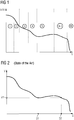
- Fig. 2 shows a graph of an open circuit voltage of a battery as a correlation or function of the state of charge of the battery whereby parameters of this correlation may be stored in a battery model and used by a battery management system according to the state of the art.
- the curve depicted in FIG. 2 shows an exemplary correlation of a battery voltage in dependency of its state of charge for a given battery operating at a pre-determined temperature.
- This correlation has been pre-emptively determined for a particular battery type and the parameter values of the correlation have been stored in a parameter value resource - optionally a lookup table - of a battery model modelling the behavior of the battery according to the curve depicted in FIG. 2 .
- the pre-emptive determination of the parameter values may have been carried out either experimentally, derived empirically or semi-empirically based on tests of standard cells, by a deductive approach considering chemical and physical properties of the battery, or by a combination of said determination approaches.
- a voltage value V on the ordinate of the coordinate system shown in FIG. 2 is dependent on a state of charge value S on the abscissa.
- This method - which is also referred to as Open Circuit Voltage-based (OCV) method - is based on the voltage measurement of a battery potential. Every battery technology has its own, distinct voltage characteristic, which has many dependencies. The most conspicuous dependency is the open circuit voltage, i.e. the voltage of a battery without load, depending on a state of charge of the battery. By measurements, this characteristic can be obtained. Measuring the voltage of the battery without load, the state of charge can be determined with good accuracy.
- a major drawback of this method is that it can be used only with batteries in an idle operation and not during discharging or charging the battery, since the impedance of the battery alters the voltage significantly with the load current. Another drawback in using this method is a property of the voltage characteristics which curve progression is not monotonically decreasing. This property will be addressed hereinafter further below.
- the parameter values of the correlation are stored in a parameter value resource of a battery model.
- the battery model now serves for an estimation of the state of charge.
- the inverse correlation - or mathematically: inverse function - has to be determined, i.e. the state of charge value S depending on the measured terminal voltage value V.
- the inverse correlation of the voltage value over the state of charge value is not biunique as it returns more than one state of charge value S1, S2 for a at least one voltage value V1 as depicted in the drawing.
- the reason for that is that the curve progression of the terminal voltage value V as a function of the state of charge value S is not monotonically decreasing, but in some parts forms an increasing curve progression. This leads to a situation where the inverse function produces more than one state of charge value S1,S2 for a given voltage value V1, inhibiting a unique determination of the state of charge value for this voltage value V1.
- Li-Ion batteries lithium-polymer (Li-Po) batteries, or lithium-iron-phosphate (Li-Fe-Po) batteries
- Li-Ion batteries lithium-polymer (Li-Po) batteries
- Li-Fe-Po lithium-iron-phosphate
- inverse function - of the discharge voltage characteristic of the cell is a function of state of charge or, alternatively, the Depth of Discharge (DoD).
- CC Coulomb-Counting
- the Coulomb-Counting is based on continuous measurements of discharge and/or charge currents on the battery. The current values are integrated over time in order to determine the already used capacity of the battery. Comparing this value to the nominal capacity, the state of charge can be estimated.
- a major drawback of this method is a drift error in the estimated capacity which is caused by a constantly accumulated deviation due to the integration.
- FIG. 1 shows a section-wise defined correlation of a voltage of a battery as a function of the state of charge of the battery as used in a battery model according to an embodiment.
- This embodiment is essentially based on the idea of splitting the curve of the voltage characteristics of the battery known from FIG. 2 into a multiplicity of sections 1,2,3,...M-1, M, as a function of a state of charge.
- the sections 1,2,3,...M-1, M are symbolized by an encircled ordinal number in the drawing.
- the embodiment according to FIG. 1 uses an equivalent open circuit voltage EOV as a unit on the ordinate of the depicted coordinate system.
- EOV equivalent open circuit voltage
- the resulting characteristic is hereinafter called »Equivalent Open Circuit Voltage Characteristic « or EOCVC.
- Equivalent open circuit means, that the voltage characteristic of the battery is compensated in order to be independent from any currents, which may be due to impedance.
- the terminal voltage values of the battery model in other words are expressed by equivalent open circuit voltage values EOV, wherein the equivalent open circuit voltage values EOV are compensated by a voltage drop in an internal impedance of the battery caused by a current drained off the battery.
- Each function segment within such a section-wise defined function of equivalent open circuit voltage values EOV depending on state of charge values S is mathematically spoken a biunique function suitable for transformation into an inverse function defined within the section 1,2,3,...M-1,M.
- the embodiment provides a step of measuring the terminal voltage value or the open circuit voltage values EOV of the battery, followed by a step of identifying the suitable section 1,2,3,...M-1, M of the battery model, wherein the identification of the section 1,2,3,...M-1,M is based on at least one operational condition of the battery. Subsequently, a state of charge value S correlating to the measured terminal voltage is determined within the identified section 1,2,3,...M-1, M of the battery model.
- FIG. 3 shows a diagram illustrating an operational flowchart according to a further embodiment.
- the estimated state of charge is continuously refined by an iterative feedback loop CYC including a measurement of parameters and retrieving of parameters within the battery model, wherein refined estimated state of charge values at a previous cycle are projected forward to the current cycle.
- a step 101 of measuring a terminal voltage value of the battery a step 102 of measuring a current drained of the battery and a step 103 of determining a battery capacity is provided.
- the battery capacity - which usually expresses a difference between a nominal capacity of the battery and the hitherto used capacity - used in the current cycle of the iterative feedback loop CYC was determined in a previous cycle.
- a step 201 of inputting the terminal voltage value and the current value into a battery model is provided.
- An equivalent open circuit voltage value 402 is determined by a difference of the terminal voltage value of the battery measured in step 101 and the voltage drop in a known internal impedance caused by the current value drained off the battery measured in step 102.
- the known internal impedance and/or resistance is included in the battery model and retrieved therefrom.
- a sequence of identifying a section within the battery model based on at least one operational condition of the battery is provided.
- the operational condition may include a battery capacity of a previous cycle in order to coarsely identify the location on an abscissa of the correlation represented within the battery model, thereby uniquely identifying the section on the state of charge portion of the abscissa.
- a first decision is made of whether the first section within the battery model is applicable. If the first section is applicable, which is represented by a branch Y (»Yes«) pointing vertically downward from decision step 301, a subsequent step 401 is carried out. If the first section is not applicable, represented by a branch N (»No«) pointing horizontally to the right from decision step 301, a subsequent decision step 302 is carried out. In the subsequent second decision step 302, a second decision is made of whether the second section within the battery model is applicable. If the second section is applicable, which is represented by a branch Y (»Yes«) pointing vertically downward from the second decision step 302, the subsequent step 401 is carried out.
- the step of indexing 401 by an indexing module returns the identified section number within the battery model.
- the state of charge value 404 correlating to the measured terminal voltage is retrieved within the identified section of the battery model, thereby using the equivalent open circuit voltage value 402. This state of charge value retrieved within the identified section of the battery model is returned as estimated state of charge 404 of the battery.
- a battery capacity 405 determined in the current cycle of the iterative feedback loop is calculated using a differentially used capacity - i.e. a capacity used in the currently operated cycle - by integrating over time the current value measured by step 102 and the battery capacity 103 which was determined in the previous cycle and delivered by step 103.
- the calculated battery capacity 405 is the battery capacity 405 in the current cycle.
- a refined state of charge, derived as a quotient of the calculated battery capacity 405 and the nominal battery capacity, is returned by step 605.
- the determined state of charge derived by the battery charge 405 in the current cycle and the estimated state of charge 404 are used to calculate a correction factor 501.
- the correction factor 501 is calculated as a difference between the estimated state of charge 404 and the determined state of charge derived by the battery charge 405 in the current cycle, as symbolized by the »+ « and »- « symbols in the drawing.
- the correction factor 501 is fed to a refining step 502 for refining the battery capacity 503 delivered by step 103 from the previous cycle by refining the battery capacity 503 from the previous cycle with the correction factor 501.
- the refined battery capacity determined within the current cycle is returned by step 604. This refined battery capacity determined within the current cycle is returned by step 604 to the subsequent cycle CYC wherein it will be used
- a step 601 of triggering new measurements steps 602,603 and repeating the cycle by a feedback loop CYC is carried out.
- These new measurement steps include a step 602 of measuring the terminal voltage value of the battery and the step 603 of measuring the actual current drained of the battery.
- the steps 602,603 are equivalently used as steps 101,102 in the preceding cycle.
- the steps described above are preferably executed by a battery management system interfacing a digital and/or analog data representation of a battery model 201, a - not shown - measuring module configured to carry out the steps 101,102,602,603, a - not shown - indexing module operable to carry out the steps 301,302,303,401, a - not shown - correlation module operable to carry out the step 403 and an output module to carry out the step 604.
- a state of charge of a battery is estimated by a battery model specific to the battery, the battery model providing a section-wise defined correlation of terminal voltage values depending on state of charge values wherein each of said sections of the battery model delimits a monotonic dependence of the correlation from others of said sections.
- the estimated state of charge is continuously refined by an iterative feedback loop including a coulomb counting for estimating a battery charge value, wherein refined estimated battery charge values state of charge values at a previous cycle are projected forward to the current cycle.
- a - not shown - iterative feedback loop execution unit is executing an iterative feedback loop CYC projecting forward the battery charge at a previous cycle to the current cycle and using a correction factor in order to return a refined estimated state of charge of the battery.
- the steps 407, 502 of calculating the correction factor and refining the estimated state of charge by the correction factor are executed by a - not shown - correction module.
- the coulomb counting step 406 is executed by a - not shown - coulomb counting module.
- the proposed embodiments allow for an easy implementation in a battery management system due to the fact that complex computation time and power demanding operations are not necessary.
- the embodiments provide reliable state of charge values even in implementations where a signal-to-noise-ratio (SNR) of the voltage and current measurements is of a rather low quality.
- SNR signal-to-noise-ratio
- the embodiments are of an adaptable and scalable nature. Merely by changing certain parts modules - particularly the battery model - the modules may be re-used for all kinds of battery technologies. Even the implemented algorithm is independent from voltage and current levels, so that it can re-used for battery cells, battery packs or modules as well.
Landscapes
- Physics & Mathematics (AREA)
- General Physics & Mathematics (AREA)
- Engineering & Computer Science (AREA)
- Manufacturing & Machinery (AREA)
- Chemical & Material Sciences (AREA)
- Chemical Kinetics & Catalysis (AREA)
- Electrochemistry (AREA)
- General Chemical & Material Sciences (AREA)
- Secondary Cells (AREA)
Abstract
Description
- The disclosed embodiments generally relate a method and apparatus for estimating a state of charge of a rechargeable battery.
- Rechargeable batteries have become increasingly important mainly to supply energy storages in stationary or e-mobility applications, i.e. electric vehicles such as cars and aircrafts, or electronic equipment such as mobile devices.
- A state of charge value or SoC value indicates a usable capacity of the battery. This value is usually provided in percentage of a full capacity of the battery for maintenance personnel or an end user such as driver or a pilot. The state of charge cannot be measured directly as a quantity, it is rather estimated instead. As part of an energy storage system, a Battery Management System or BMS is usually responsible for the estimation of the state of charge, which is crucial to be sufficient and reliable in safety- and life-critical applications.
- Continuous monitoring of the state of charge of batteries by means which are as accurate as possible is necessary for users in many applications to avoid a stoppage or an interruption of the operation of the equipment served by such batteries. Existing battery cell capacities can only be fully utilized by state-of-charge monitoring.
- Devices for estimating the state of charge of batteries are known in the art. The state of charge estimation may be provided by the Battery Management System using data from voltage measurements of each battery cell potential and a load or charge current measurements imposed on the battery or a battery pack.
- According to a method heretofore known, a terminal voltage value - i.e. a voltage of a battery while loads connected to the battery - is measured, an upper voltage limit defining the end of the battery charging cycle and a lower voltage limit defining the end of the battery discharging cycle. Between these ends, a non-linear behavior of the battery is considered by an estimation algorithm applying a non-linear battery model as a correlation - or mathematically: a function - of a voltage value over the state of charge. Such battery model used for estimating the state of charge of a battery in operation may be provided beforehand using for example, empirical methods of experimentally obtaining a function of an open circuit voltage value - i.e. the voltage of a battery without load - of a reference battery depending on its state of charge. The state of charge of a battery to be estimated may then be inferred by measuring the open circuit voltage and determining a respective state of charge according to the battery model. Instead of determining the open circuit voltage of the battery under regular conditions, a normal discharge process may be done, thereby adding a correction to the measured terminal voltage in order to determine open circuit voltage characteristics.
- A major drawback of this method heretofore known is caused by an indeterminacy in inferring the state of charge derived from the non-linear function by a currently measured voltage value, as the function of the voltage value over the state of charge provided by the battery model may not always return a single state of charge value for a given voltage value. In other words, the function of the voltage value over the state of charge may return more than one state of charge value for a given voltage value.
- Accordingly there is a need in the art for uniquely determining a state of charge estimation of a battery using a battery model for a given voltage value.
- Embodiments for estimating a state of charge as described herein generally involve applying a battery model for estimating a state of charge of the battery by measuring at least a terminal voltage of the battery.
- In one embodiment a method for estimating a state of charge of a battery is disclosed, including the steps of:
- a) providing a battery model specific to the battery, the battery model providing a section-wise defined correlation of terminal voltage values depending on state of charge values wherein each of said sections of the battery model delimits a monotonic dependence of the correlation from others of said sections;
- b) measuring a terminal voltage value of the battery;
- c) identifying one of said sections of the battery model based on at least one operational condition of the battery;
- d) retrieving, within the identified section of the battery model, a state of charge value correlating to the measured terminal voltage, and;
- e) returning the retrieved state of charge value as an estimated state of charge of the battery.
- The proposed method uses a correlation - or mathematically: a function - included in a battery model wherein, according to the correlation, each terminal voltage value is dependent on a state of charge value.
- As the terminal voltage is known by a measurement in step b), the inverse correlation - or mathematically: inverse function - has to be determined, i.e. the state of charge value depending on the measured terminal voltage value. However, the inverse correlation of the voltage value over the state of charge value is not biunique as it may return more than one state of charge value for a given voltage value.
- Mathematically expressed, a transformation into an inverse function is not possible for a function in which the curve progression of the dependent value - the voltage value - is not strictly monotonically increasing or decreasing. In fact a typical curve progression of the terminal voltage value as a function of the state of charge value is not monotonically decreasing, but in some parts forms a constant progression or even an increasing curve progression as illustrated in
Fig. 2 of the drawing. This leads to a situation where the inverse function produces more than one state of charge value for a given voltage value, inhibiting a unique determination of the state of charge value for a given voltage value. - According to an embodiment of the invention this problem is resolved by an approach of segmenting the correlation of terminal voltage values depending on a state of charge value into sections, wherein the correlation exhibits a monotonic dependence. A monotonic dependence is either a monotonic increasing or a monotonic decreasing of the curve progression.
- Each function segment within such a section-wise defined function of terminal voltage values depending on state of charge values is mathematically spoken a biunique function suitable for transformation into an inverse function defined within the section.
- This means that the section-wise defined inverse correlation of the state of charge values depending on the known terminal voltage values produces exactly one state of charge value for one given terminal voltage value.
- Applying said section-wise defined correlation within the battery model the proposed method provides a step of measuring the terminal voltage value of the battery, followed by a step of identifying the suitable section of the battery model, wherein the identification of the section is based on at least one operational condition of the battery. Subsequently, a state of charge value correlating to the measured terminal voltage is determined within the identified section of the battery model. Finally, the determined state of charge value is returned as an estimated state of charge of the battery.
- According to an embodiment, the estimated state of charge is refined by a correction factor imposed to the determined state of charge. This correction factor is determined by coulometry principle wherein the quantity of energy delivered to or by the battery are determined and wherein a value of the remaining battery charge available for delivery is obtained from the difference between a nominal battery capacity and the energy delivered by the battery. The remaining battery charge so obtained is used for correcting the estimated state of charge.
- According to a preferred embodiment, an iterative feedback loop of estimating the state of charge is applied, wherein the battery capacity and the estimated state of charge is refined at each time interval or cycle by operating as an iterative feedback loop projecting forward the refined battery capacity at the previous cycle to the current cycle and using the refined battery capacity at the previous cycle as one of the operational conditions for identifying one of said sections of the battery model.
- According to an embodiment, the terminal voltage values of the battery model are expressed by equivalent open circuit voltage values, wherein the equivalent open circuit voltage values are compensated by a voltage drop in an internal impedance of the battery.
- According to an embodiment, the operational conditions of the battery include one or more of a current load on the battery, a deemed open circuit voltage of the battery, an internal resistance or impedance of the battery and/or a temperature of the battery.
- In another embodiment a battery management system for estimating a state of charge of a battery is disclosed, the battery management system including a battery model, a measuring module, an indexing module, a correlation module and an output module. Said modules are carrying out the method for estimating the state of charge according to the embodiments as described above.
- The objects as well as further advantages of the present embodiments will become more apparent and readily appreciated from the following description of the preferred embodiments, taken in conjunction with the accompanying drawing in which:
- FIG. 1
- shows a section-wise defined correlation of a voltage of a battery as a function of the state of charge of the battery as used in a battery model according to an embodiment;
- FIG. 2
- shows a graph of a voltage of a battery as a function of the state of charge of the battery according to the state of the art; and;
- FIG. 3
- shows a diagram illustrating an operational flowchart according to an embodiment.
-
Fig. 2 shows a graph of an open circuit voltage of a battery as a correlation or function of the state of charge of the battery whereby parameters of this correlation may be stored in a battery model and used by a battery management system according to the state of the art. - The curve depicted in
FIG. 2 shows an exemplary correlation of a battery voltage in dependency of its state of charge for a given battery operating at a pre-determined temperature. This correlation has been pre-emptively determined for a particular battery type and the parameter values of the correlation have been stored in a parameter value resource - optionally a lookup table - of a battery model modelling the behavior of the battery according to the curve depicted inFIG. 2 . - The pre-emptive determination of the parameter values may have been carried out either experimentally, derived empirically or semi-empirically based on tests of standard cells, by a deductive approach considering chemical and physical properties of the battery, or by a combination of said determination approaches. According to the exemplary correlation, a voltage value V on the ordinate of the coordinate system shown in
FIG. 2 is dependent on a state of charge value S on the abscissa. - This method - which is also referred to as Open Circuit Voltage-based (OCV) method - is based on the voltage measurement of a battery potential. Every battery technology has its own, distinct voltage characteristic, which has many dependencies. The most conspicuous dependency is the open circuit voltage, i.e. the voltage of a battery without load, depending on a state of charge of the battery. By measurements, this characteristic can be obtained. Measuring the voltage of the battery without load, the state of charge can be determined with good accuracy. A major drawback of this method is that it can be used only with batteries in an idle operation and not during discharging or charging the battery, since the impedance of the battery alters the voltage significantly with the load current. Another drawback in using this method is a property of the voltage characteristics which curve progression is not monotonically decreasing. This property will be addressed hereinafter further below.
- After the pre-emptive determination of the correlation of a battery voltage in dependency of its state of charge for a given battery has been stored has been finished, the parameter values of the correlation are stored in a parameter value resource of a battery model. The battery model now serves for an estimation of the state of charge.
- As the open circuit voltage value V may be measured, the inverse correlation - or mathematically: inverse function - has to be determined, i.e. the state of charge value S depending on the measured terminal voltage value V. However, the inverse correlation of the voltage value over the state of charge value is not biunique as it returns more than one state of charge value S1, S2 for a at least one voltage value V1 as depicted in the drawing. The reason for that is that the curve progression of the terminal voltage value V as a function of the state of charge value S is not monotonically decreasing, but in some parts forms an increasing curve progression. This leads to a situation where the inverse function produces more than one state of charge value S1,S2 for a given voltage value V1, inhibiting a unique determination of the state of charge value for this voltage value V1.
- Methods for a state of charge estimation using a battery model encounter a number of limitations which arise from the necessity of determining the inverse correlation:
- Certain types of batteries have a behavior - not shown in
FIG. 2 - in that there are more state of charge values belonging to the same voltage value in some circumstances. In the case of Lithium-ion or Li-Ion batteries, for example, when operated at low - particularly temperatures below 0° C - temperatures, a unique determination of the state of charge value for a measured voltage value is not possible. In other words: the inverse correlation of the voltage value over the state of charge value is not biunique for Li-Ion batteries operated at temperatures below 0° C. However, Li-Ion batteries operated at room temperature allow for a unique determination of the state of charge value for a measured voltage value. In other words: the inverse correlation of the voltage value over the state of charge value is biunique for Li-Ion batteries operated at room temperature. Other examples of batteries which allow for a unique determination of the state of charge value for a measured voltage value only in certain temperature ranges include LiFePo, LiPo, NiMH, NiZn, Lead-acid and NiCd batteries. In the latter case of NiCd batteries a unique determination is dependent of an absence of overcharging effects, which means that a unique determination is not possible when overcharging effects occur or have occurred. - Other types of batteries, e.g. lithium-sulfur or Li-S batteries, have a behavior - shown in
FIG. 2 - where there are more state of charge values belonging to the same voltage value in all circumstances. In other words: the inverse correlation of the voltage value over the state of charge value is not biunique for Li-S batteries for all conditions. - Known methods of estimating the state of charge are partially applicable for widely used lithium-based batteries, for example Li-Ion batteries, lithium-polymer (Li-Po) batteries, or lithium-iron-phosphate (Li-Fe-Po) batteries, because their behavior is such that there is one definite state of charge value belonging to one voltage level in some circumstances, meaning the inverse correlation - or mathematically: inverse function - of the discharge voltage characteristic of the cell is a function of state of charge or, alternatively, the Depth of Discharge (DoD).
- Apart from the model-based method shown above, further methods of estimating the state of charge of a battery are known in the art, including a Coulomb-Counting (CC) method. The Coulomb-Counting is based on continuous measurements of discharge and/or charge currents on the battery. The current values are integrated over time in order to determine the already used capacity of the battery. Comparing this value to the nominal capacity, the state of charge can be estimated. A major drawback of this method is a drift error in the estimated capacity which is caused by a constantly accumulated deviation due to the integration.
-
FIG. 1 shows a section-wise defined correlation of a voltage of a battery as a function of the state of charge of the battery as used in a battery model according to an embodiment. - This embodiment is essentially based on the idea of splitting the curve of the voltage characteristics of the battery known from
FIG. 2 into a multiplicity ofsections sections - Unlike the example shown in conjunction with
FIG. 2 , the embodiment according toFIG. 1 uses an equivalent open circuit voltage EOV as a unit on the ordinate of the depicted coordinate system. The resulting characteristic is hereinafter called »Equivalent Open Circuit Voltage Characteristic« or EOCVC. - Equivalent open circuit means, that the voltage characteristic of the battery is compensated in order to be independent from any currents, which may be due to impedance. The terminal voltage values of the battery model, in other words are expressed by equivalent open circuit voltage values EOV, wherein the equivalent open circuit voltage values EOV are compensated by a voltage drop in an internal impedance of the battery caused by a current drained off the battery.
- Splitting the Equivalent Open Circuit Voltage Characteristic results in a number M of
sections FIG. 1 , the curve is strictly monotonic decreasing insections 1,2,4, M-1 and M and strictly monotonic increasing insection 5. By applying mathematical derivation methods, such as dEOV/dS or derivations of a higher order a sufficient number of sections can be determined. It can be stated, that the more sections can be distinguished, the more accurate the estimation of the state of charge will be. - Each function segment within such a section-wise defined function of equivalent open circuit voltage values EOV depending on state of charge values S is mathematically spoken a biunique function suitable for transformation into an inverse function defined within the
section - This means that the section-wise defined inverse correlation of the state of charge values S depending on the known open circuit voltage values EOV produces exactly one state of charge value for one given terminal voltage value within the actually selected
section - Applying said section-wise defined correlation within the battery model the embodiment provides a step of measuring the terminal voltage value or the open circuit voltage values EOV of the battery, followed by a step of identifying the
suitable section section section - Of course, the section-wise defined correlation within the battery model is beneficial for both types of batteries as stated above, including both:
- types of batteries which have a behavior in that there are more state of charge values belonging to the same voltage value in some circumstances, e.g. Li-Ion batteries; and;
- types of batteries which have a behavior in that there are more state of charge values belonging to the same voltage value in all circumstances, e.g. Li-S batteries.
- The benefits of the section-wise defined correlation are due to the fact that operational circumstances are not to be regarded for applying the inverse correlation. These circumstances are advantageously considered within the battery model.
-
FIG. 3 shows a diagram illustrating an operational flowchart according to a further embodiment. According to this embodiment, the estimated state of charge is continuously refined by an iterative feedback loop CYC including a measurement of parameters and retrieving of parameters within the battery model, wherein refined estimated state of charge values at a previous cycle are projected forward to the current cycle. - Within a first section S1 of the operational flowchart, a step 101 of measuring a terminal voltage value of the battery, a
step 102 of measuring a current drained of the battery and astep 103 of determining a battery capacity is provided. The battery capacity - which usually expresses a difference between a nominal capacity of the battery and the hitherto used capacity - used in the current cycle of the iterative feedback loop CYC was determined in a previous cycle. - Within a second section S2 of the operational flowchart, a
step 201 of inputting the terminal voltage value and the current value into a battery model is provided. An equivalent opencircuit voltage value 402 is determined by a difference of the terminal voltage value of the battery measured in step 101 and the voltage drop in a known internal impedance caused by the current value drained off the battery measured instep 102. According to an embodiment, the known internal impedance and/or resistance is included in the battery model and retrieved therefrom. - Within a third section S3 of the operational flowchart, a sequence of identifying a section within the battery model based on at least one operational condition of the battery is provided. The operational condition may include a battery capacity of a previous cycle in order to coarsely identify the location on an abscissa of the correlation represented within the battery model, thereby uniquely identifying the section on the state of charge portion of the abscissa.
- In a
first decision step 301, a first decision is made of whether the first section within the battery model is applicable. If the first section is applicable, which is represented by a branch Y (»Yes«) pointing vertically downward fromdecision step 301, asubsequent step 401 is carried out. If the first section is not applicable, represented by a branch N (»No«) pointing horizontally to the right fromdecision step 301, asubsequent decision step 302 is carried out. In the subsequentsecond decision step 302, a second decision is made of whether the second section within the battery model is applicable. If the second section is applicable, which is represented by a branch Y (»Yes«) pointing vertically downward from thesecond decision step 302, thesubsequent step 401 is carried out. If the second section is not applicable, represented by a branch N (»No«) pointing horizontally to the right from thesecond decision step 302, a subsequent - not shown - decision step betweendecision step 302 anddecision step 303 is carried out. The sequence of decision steps continues - symbolized by three dots in the drawing - until an ordinal number equal to the number M of sections of the battery model has been reached. In the final (M-1)th decision step 303, a decision is made of whether the (M-1)th section within the battery model is applicable. Regardless of whether the (M-1)th section is applicable or not - which is represented by a branch Y (»Yes«) and a branch N (»No«), both pointing vertically downward from the final decision step 303 - thesubsequent step 401 is carried out. - Within a fourth section S4 of the operational flowchart, the step of indexing 401 by an indexing module returns the identified section number within the battery model. In
step 403, the state ofcharge value 404 correlating to the measured terminal voltage is retrieved within the identified section of the battery model, thereby using the equivalent opencircuit voltage value 402. This state of charge value retrieved within the identified section of the battery model is returned as estimated state ofcharge 404 of the battery. - In a coulomb counting step 406 a
battery capacity 405 determined in the current cycle of the iterative feedback loop is calculated using a differentially used capacity - i.e. a capacity used in the currently operated cycle - by integrating over time the current value measured bystep 102 and thebattery capacity 103 which was determined in the previous cycle and delivered bystep 103. The calculatedbattery capacity 405 is thebattery capacity 405 in the current cycle. A refined state of charge, derived as a quotient of the calculatedbattery capacity 405 and the nominal battery capacity, is returned bystep 605. - By a calculation step 407 - symbolized by a crossed circle in the drawing - the determined state of charge derived by the
battery charge 405 in the current cycle and the estimated state ofcharge 404 are used to calculate acorrection factor 501. According to an embodiment, thecorrection factor 501 is calculated as a difference between the estimated state ofcharge 404 and the determined state of charge derived by thebattery charge 405 in the current cycle, as symbolized by the »+« and »-« symbols in the drawing. - Within a fifth section S5 of the operational flowchart, the
correction factor 501 is fed to arefining step 502 for refining thebattery capacity 503 delivered bystep 103 from the previous cycle by refining thebattery capacity 503 from the previous cycle with thecorrection factor 501. According to an embodiment, therefining step 502 includes the calculation of
- QB(N)
- denotes the refined battery capacity determined within the current cycle N;
- QB(N-1)
- denotes the
battery capacity 503 delivered bystep 103 from the previous cycle N-1; - CF
- denotes the
correction factor 501; - The refined battery capacity determined within the current cycle is returned by
step 604. This refined battery capacity determined within the current cycle is returned bystep 604 to the subsequent cycle CYC wherein it will be used - equivalently to the former step 103 - as a new value for the battery capacity in the subsequent circle. In the index counting used in the formula above, this subsequent cycle would have an index of N+1. In other words, the step of refinement is updating the value of the nominal capacity, which and that is looped back to the
Coulomb Counter 406 in the next step. - Within a sixth section S6 of the operational flowchart, a
step 601 of triggering new measurements steps 602,603 and repeating the cycle by a feedback loop CYC is carried out. These new measurement steps include astep 602 of measuring the terminal voltage value of the battery and thestep 603 of measuring the actual current drained of the battery. The steps 602,603 are equivalently used as steps 101,102 in the preceding cycle. - The steps described above are preferably executed by a battery management system interfacing a digital and/or analog data representation of a
battery model 201, a - not shown - measuring module configured to carry out the steps 101,102,602,603, a - not shown - indexing module operable to carry out the steps 301,302,303,401, a - not shown - correlation module operable to carry out thestep 403 and an output module to carry out thestep 604. - According to the proposed embodiments a state of charge of a battery is estimated by a battery model specific to the battery, the battery model providing a section-wise defined correlation of terminal voltage values depending on state of charge values wherein each of said sections of the battery model delimits a monotonic dependence of the correlation from others of said sections. By segmenting the correlation of terminal voltage values depending on a state of charge value into sections, each segment within such the section-wise defined correlation of terminal voltage values depending on state of charge values is mathematically spoken a bi-unique function suitable for transformation into an inverse function defined within the section.
- According to an embodiment, the estimated state of charge is continuously refined by an iterative feedback loop including a coulomb counting for estimating a battery charge value, wherein refined estimated battery charge values state of charge values at a previous cycle are projected forward to the current cycle.
- According to an embodiment, a - not shown - iterative feedback loop execution unit is executing an iterative feedback loop CYC projecting forward the battery charge at a previous cycle to the current cycle and using a correction factor in order to return a refined estimated state of charge of the battery.
- According to an embodiment, the
steps - According to an embodiment, the
coulomb counting step 406 is executed by a - not shown - coulomb counting module. - The proposed embodiments allow for an easy implementation in a battery management system due to the fact that complex computation time and power demanding operations are not necessary. The embodiments provide reliable state of charge values even in implementations where a signal-to-noise-ratio (SNR) of the voltage and current measurements is of a rather low quality.
- As the embodiments solely use simple mathematical operations along with scalar values - instead of using matrix operations like in Kalman filters - an implementation in real-time systems using standard microcontroller-based battery management systems is suitable and advantageously results in low costs for development.
- The embodiments are of an adaptable and scalable nature. Merely by changing certain parts modules - particularly the battery model - the modules may be re-used for all kinds of battery technologies. Even the implemented algorithm is independent from voltage and current levels, so that it can re-used for battery cells, battery packs or modules as well.
- In order to customize to a specific application with a specific battery cell, only a parameterization update is needed. Changing the battery technology only requires a parameter table update within the battery model.
- It is to be understood that the elements and features recited in the appended claims may be combined in different ways to produce new claims that likewise fall within the scope of the present invention. Thus, whereas the dependent claims appended below depend from only a single independent or dependent claim, it is to be understood that these dependent claims can, alternatively, be made to depend in the alternative from any preceding or following claim, whether independent or dependent, and that such new combinations are to be understood as forming a part of the present specification.
- While the present invention has been described above by reference to various embodiments, it should be understood that many changes and modifications can be made to the described embodiments. It is therefore intended that the foregoing description be regarded as illustrative rather than limiting, and that it be understood that all equivalents and/or combinations of embodiments are intended to be included in this description.
Claims (7)
- A method for estimating a state of charge of a battery, including the steps of:a) providing a battery model specific to the battery, the battery model providing a section-wise defined correlation of terminal voltage values depending on state of charge values wherein each of said sections of the battery model delimits a monotonic dependence of the correlation from others of said sections;b) measuring a terminal voltage value of the battery;c) identifying one of said sections of the battery model based on at least one operational condition of the battery;d) retrieving, within the identified section of the battery model, a state of charge value correlating to the measured terminal voltage, and;e) returning the retrieved state of charge value as an estimated state of charge of the battery.
- The method according to claim 1, including the steps of:- determining a used capacity within a current cycle by integrating a measured current drained of the battery over time within a current cycle;- determining a battery capacity in the current cycle by using a battery capacity of a preceding cycle and the used capacity within the current cycle;- calculating a correction factor using the battery capacity in the actual cycle and the state of charge value determined by step d); and;- refining the battery capacity determined within the current cycle by multiplying the determined battery capacity with the correction factor.
- The method according to claim 2, refining the battery capacity at each cycle by operating as an iterative feedback loop projecting forward the battery capacity at a previous cycle to the current cycle and using a correction factor in order to return a refined battery capacity.
- The method according to one of the aforementioned claims, wherein the terminal voltage values of the battery model are expressed by equivalent open circuit voltage values, the equivalent open circuit voltage values being compensated by a voltage drop in an internal impedance of the battery.
- The method according to one of the aforementioned claims, wherein the operational condition of the battery includes one or more of:- a current load on the battery;- a deemed open circuit voltage of the battery;- an internal impedance and/or resistance of the battery;- a temperature of the battery.
- A battery management system for estimating a state of charge of a battery, including:- a battery model specific to the battery, the battery model providing a section-wise defined correlation of terminal voltage values depending on state of charge values wherein each of said sections of the battery model delimits a monotonic dependence of the correlation from others of said sections;- a measuring module configured to measure a terminal voltage value of the battery;- an indexing module operable to identify one of said sections of the battery model based on an operational condition of the battery; and;- a correlation module operable to retrieve, within the identified section of the battery model, a state of charge value correlating to the terminal voltage; and;- an output module for returning the retrieved state of charge value as an estimated state of charge of the battery.
- The battery management system according to claim 6 including
an iterative feedback loop execution unit for executing an iterative feedback loop CYC projecting forward a battery capacity value at a previous cycle to a current cycle and using a correction factor in order to return a refined estimated state of charge of the battery.
Priority Applications (4)
| Application Number | Priority Date | Filing Date | Title |
|---|---|---|---|
| EP18176500.9A EP3579007B1 (en) | 2018-06-07 | 2018-06-07 | Method and apparatus for estimating a state of charge of a battery |
| US17/056,417 US11598813B2 (en) | 2018-06-07 | 2019-06-06 | Method and apparatus for estimating a state of charge of a battery |
| PCT/EP2019/064853 WO2019234181A1 (en) | 2018-06-07 | 2019-06-06 | Method and apparatus for estimating a state of charge of a battery |
| CN201980038182.2A CN112513656A (en) | 2018-06-07 | 2019-06-06 | Method and apparatus for estimating state of charge of battery |
Applications Claiming Priority (1)
| Application Number | Priority Date | Filing Date | Title |
|---|---|---|---|
| EP18176500.9A EP3579007B1 (en) | 2018-06-07 | 2018-06-07 | Method and apparatus for estimating a state of charge of a battery |
Publications (2)
| Publication Number | Publication Date |
|---|---|
| EP3579007A1 true EP3579007A1 (en) | 2019-12-11 |
| EP3579007B1 EP3579007B1 (en) | 2022-08-17 |
Family
ID=62567438
Family Applications (1)
| Application Number | Title | Priority Date | Filing Date |
|---|---|---|---|
| EP18176500.9A Active EP3579007B1 (en) | 2018-06-07 | 2018-06-07 | Method and apparatus for estimating a state of charge of a battery |
Country Status (4)
| Country | Link |
|---|---|
| US (1) | US11598813B2 (en) |
| EP (1) | EP3579007B1 (en) |
| CN (1) | CN112513656A (en) |
| WO (1) | WO2019234181A1 (en) |
Cited By (1)
| Publication number | Priority date | Publication date | Assignee | Title |
|---|---|---|---|---|
| EP3919926A4 (en) * | 2020-03-30 | 2022-04-27 | Contemporary Amperex Technology Co., Limited | METHOD AND APPARATUS FOR ESTIMATING PERFORMANCE PARAMETERS OF A BATTERY, DEVICE AND MEDIA |
Families Citing this family (1)
| Publication number | Priority date | Publication date | Assignee | Title |
|---|---|---|---|---|
| CN114264957B (en) * | 2021-12-02 | 2024-05-07 | 东软集团股份有限公司 | Abnormal monomer detection method and related equipment thereof |
Citations (4)
| Publication number | Priority date | Publication date | Assignee | Title |
|---|---|---|---|---|
| US20130027047A1 (en) * | 2010-06-07 | 2013-01-31 | Mitsubishi Electric Corporation | State-of-charge estimating apparatus |
| JP2013134962A (en) * | 2011-12-27 | 2013-07-08 | Toyota Motor Corp | Lithium ion secondary battery system |
| EP3064952A1 (en) * | 2015-03-05 | 2016-09-07 | GS Yuasa International Ltd. | Energy storage device management apparatus, energy storage device management method, energy storage device module, energy storage device management program, and movable body |
| WO2017122758A1 (en) * | 2016-01-15 | 2017-07-20 | 株式会社Gsユアサ | Device for managing storage element, storage element module, vehicle, and method for managing storage element |
Family Cites Families (10)
| Publication number | Priority date | Publication date | Assignee | Title |
|---|---|---|---|---|
| JP3986992B2 (en) * | 2003-03-31 | 2007-10-03 | 矢崎総業株式会社 | Battery dischargeable capacity estimation method and apparatus |
| KR100669470B1 (en) * | 2005-12-22 | 2007-01-16 | 삼성에스디아이 주식회사 | SOO correction method of battery and battery management system using same |
| KR100970841B1 (en) * | 2008-08-08 | 2010-07-16 | 주식회사 엘지화학 | Battery capacity deterioration estimation apparatus and method using battery voltage behavior |
| US20110264390A1 (en) * | 2010-04-22 | 2011-10-27 | Ayman Shabra | Method and apparatus for determining state of charge values for an electrical power cell |
| US9052368B2 (en) * | 2010-12-15 | 2015-06-09 | Maxim Integrated Products, Inc. | Negative peak voltage detection for enhanced FuelGauge empty voltage prediction |
| FR2991076B1 (en) * | 2012-05-24 | 2015-03-13 | Commissariat Energie Atomique | METHOD FOR PROCESSING A SET OF QUADRUPLETS OF VALUES RELATING TO OPERATING POINTS OF AN ELECTROCHEMICAL ACCUMULATOR, METHOD FOR DETERMINING A STATE OF ENERGY FROM DATA DERIVED FROM THE PROCESSING PROCESS, RECORDING MEDIUM, COMPUTER PROGRAM AND DEVICE |
| GB2537406B (en) * | 2015-04-16 | 2017-10-18 | Oxis Energy Ltd | Method and apparatus for determining the state of health and state of charge of lithium sulfur batteries |
| CN106405421A (en) * | 2015-07-27 | 2017-02-15 | 中兴通讯股份有限公司 | Battery state-of-charge (SOC) value evaluation method and device |
| US10114079B2 (en) * | 2016-02-24 | 2018-10-30 | Ford Global Technologies, Llc | System and method for identifying vehicle battery decay |
| CN110927605B (en) * | 2017-04-18 | 2021-02-23 | 华为技术有限公司 | Method and device for estimating battery state of health |
-
2018
- 2018-06-07 EP EP18176500.9A patent/EP3579007B1/en active Active
-
2019
- 2019-06-06 US US17/056,417 patent/US11598813B2/en active Active
- 2019-06-06 WO PCT/EP2019/064853 patent/WO2019234181A1/en not_active Ceased
- 2019-06-06 CN CN201980038182.2A patent/CN112513656A/en active Pending
Patent Citations (5)
| Publication number | Priority date | Publication date | Assignee | Title |
|---|---|---|---|---|
| US20130027047A1 (en) * | 2010-06-07 | 2013-01-31 | Mitsubishi Electric Corporation | State-of-charge estimating apparatus |
| JP2013134962A (en) * | 2011-12-27 | 2013-07-08 | Toyota Motor Corp | Lithium ion secondary battery system |
| EP3064952A1 (en) * | 2015-03-05 | 2016-09-07 | GS Yuasa International Ltd. | Energy storage device management apparatus, energy storage device management method, energy storage device module, energy storage device management program, and movable body |
| WO2017122758A1 (en) * | 2016-01-15 | 2017-07-20 | 株式会社Gsユアサ | Device for managing storage element, storage element module, vehicle, and method for managing storage element |
| DE112017000371T5 (en) * | 2016-01-15 | 2018-09-27 | Gs Yuasa International Ltd. | DEVICE FOR MANAGING A MEMORY ELEMENT, MEMORY MODULE MODULE, VEHICLE AND METHOD FOR MANAGING A MEMORY ELEMENT |
Cited By (2)
| Publication number | Priority date | Publication date | Assignee | Title |
|---|---|---|---|---|
| EP3919926A4 (en) * | 2020-03-30 | 2022-04-27 | Contemporary Amperex Technology Co., Limited | METHOD AND APPARATUS FOR ESTIMATING PERFORMANCE PARAMETERS OF A BATTERY, DEVICE AND MEDIA |
| US11573273B2 (en) | 2020-03-30 | 2023-02-07 | Contemporary Amperex Technology Co., Limited | Method, apparatus, device and medium for estimating performance parameters of a battery |
Also Published As
| Publication number | Publication date |
|---|---|
| CN112513656A (en) | 2021-03-16 |
| US11598813B2 (en) | 2023-03-07 |
| WO2019234181A1 (en) | 2019-12-12 |
| US20210215762A1 (en) | 2021-07-15 |
| EP3579007B1 (en) | 2022-08-17 |
Similar Documents
| Publication | Publication Date | Title |
|---|---|---|
| Sun et al. | Estimation of state-of-charge and state-of-power capability of lithium-ion battery considering varying health conditions | |
| EP2325658B1 (en) | Device and method for estimating battery resistance characteristics using battery voltage behaviour | |
| CN107102263B (en) | Method, device and battery management system for detecting battery health state | |
| Liu et al. | Integrated system identification and state-of-charge estimation of battery systems | |
| EP3306735B1 (en) | Device for estimating degree of battery degradation, and estimation method | |
| KR102572652B1 (en) | Method for estimating state of charge of battery | |
| JP2023523370A (en) | Method and apparatus for detecting lithium plating and method and apparatus for obtaining polarization ratio | |
| EP3165934A1 (en) | Apparatus for estimating charge state of secondary battery and method therefor | |
| CN115684956B (en) | Methods, apparatus, and computer programs for estimating battery memory life. | |
| KR20180047768A (en) | Method and appratus for caculating state of health(soh) of a battery | |
| CN108279385A (en) | State of charge evaluation method, device and the electronic equipment of battery | |
| US11698414B2 (en) | Battery current limits estimation based on RC model | |
| KR20060107535A (en) | How to calculate the power capacity of a battery pack using advanced cell model prediction technology | |
| EP3889626B1 (en) | Battery management controllers capable of estimating state of charge | |
| EP4084187A1 (en) | Battery control device and battery system | |
| CN110383094A (en) | Battery power status estimation method and battery status monitor system | |
| CN104833917B (en) | Determination of nominal cell resistance for real-time estimation of state of charge in lithium batteries | |
| JP2016090322A (en) | Battery parameter estimation device | |
| Lee et al. | Maximum pulse current estimation for high accuracy power capability prediction of a Li-Ion battery | |
| KR102892944B1 (en) | Discharge voltage graph prediction method and battery system using same | |
| EP3579007B1 (en) | Method and apparatus for estimating a state of charge of a battery | |
| WO2006057469A1 (en) | Method and system for joint battery stateand parameter estimation | |
| Qiu et al. | Battery hysteresis modeling for state of charge estimation based on Extended Kalman Filter | |
| WO2018029849A1 (en) | Estimation device, estimation program, and charging control device | |
| WO2024236604A1 (en) | Battery states co-estimation technique using dual square root unscented kalman filter |
Legal Events
| Date | Code | Title | Description |
|---|---|---|---|
| PUAI | Public reference made under article 153(3) epc to a published international application that has entered the european phase |
Free format text: ORIGINAL CODE: 0009012 |
|
| STAA | Information on the status of an ep patent application or granted ep patent |
Free format text: STATUS: THE APPLICATION HAS BEEN PUBLISHED |
|
| AK | Designated contracting states |
Kind code of ref document: A1 Designated state(s): AL AT BE BG CH CY CZ DE DK EE ES FI FR GB GR HR HU IE IS IT LI LT LU LV MC MK MT NL NO PL PT RO RS SE SI SK SM TR |
|
| AX | Request for extension of the european patent |
Extension state: BA ME |
|
| RAP1 | Party data changed (applicant data changed or rights of an application transferred) |
Owner name: ROLLS-ROYCE DEUTSCHLAND LTD & CO KG |
|
| STAA | Information on the status of an ep patent application or granted ep patent |
Free format text: STATUS: REQUEST FOR EXAMINATION WAS MADE |
|
| 17P | Request for examination filed |
Effective date: 20200609 |
|
| RBV | Designated contracting states (corrected) |
Designated state(s): AL AT BE BG CH CY CZ DE DK EE ES FI FR GB GR HR HU IE IS IT LI LT LU LV MC MK MT NL NO PL PT RO RS SE SI SK SM TR |
|
| REG | Reference to a national code |
Ref country code: DE Ref legal event code: R079 Ref document number: 602018039313 Country of ref document: DE Free format text: PREVIOUS MAIN CLASS: G01R0031360000 Ipc: G01R0031367000 |
|
| GRAP | Despatch of communication of intention to grant a patent |
Free format text: ORIGINAL CODE: EPIDOSNIGR1 |
|
| STAA | Information on the status of an ep patent application or granted ep patent |
Free format text: STATUS: GRANT OF PATENT IS INTENDED |
|
| RIC1 | Information provided on ipc code assigned before grant |
Ipc: H01M 10/48 20060101ALI20220214BHEP Ipc: G01R 31/378 20190101ALI20220214BHEP Ipc: G01R 31/3842 20190101ALI20220214BHEP Ipc: G01R 31/3828 20190101ALI20220214BHEP Ipc: G01R 31/367 20190101AFI20220214BHEP |
|
| INTG | Intention to grant announced |
Effective date: 20220309 |
|
| GRAS | Grant fee paid |
Free format text: ORIGINAL CODE: EPIDOSNIGR3 |
|
| GRAA | (expected) grant |
Free format text: ORIGINAL CODE: 0009210 |
|
| STAA | Information on the status of an ep patent application or granted ep patent |
Free format text: STATUS: THE PATENT HAS BEEN GRANTED |
|
| AK | Designated contracting states |
Kind code of ref document: B1 Designated state(s): AL AT BE BG CH CY CZ DE DK EE ES FI FR GB GR HR HU IE IS IT LI LT LU LV MC MK MT NL NO PL PT RO RS SE SI SK SM TR |
|
| REG | Reference to a national code |
Ref country code: CH Ref legal event code: EP |
|
| REG | Reference to a national code |
Ref country code: DE Ref legal event code: R096 Ref document number: 602018039313 Country of ref document: DE |
|
| REG | Reference to a national code |
Ref country code: IE Ref legal event code: FG4D |
|
| REG | Reference to a national code |
Ref country code: AT Ref legal event code: REF Ref document number: 1512526 Country of ref document: AT Kind code of ref document: T Effective date: 20220915 |
|
| REG | Reference to a national code |
Ref country code: NL Ref legal event code: MP Effective date: 20220817 |
|
| REG | Reference to a national code |
Ref country code: LT Ref legal event code: MG9D |
|
| PG25 | Lapsed in a contracting state [announced via postgrant information from national office to epo] |
Ref country code: SE Free format text: LAPSE BECAUSE OF FAILURE TO SUBMIT A TRANSLATION OF THE DESCRIPTION OR TO PAY THE FEE WITHIN THE PRESCRIBED TIME-LIMIT Effective date: 20220817 Ref country code: RS Free format text: LAPSE BECAUSE OF FAILURE TO SUBMIT A TRANSLATION OF THE DESCRIPTION OR TO PAY THE FEE WITHIN THE PRESCRIBED TIME-LIMIT Effective date: 20220817 Ref country code: PT Free format text: LAPSE BECAUSE OF FAILURE TO SUBMIT A TRANSLATION OF THE DESCRIPTION OR TO PAY THE FEE WITHIN THE PRESCRIBED TIME-LIMIT Effective date: 20221219 Ref country code: NO Free format text: LAPSE BECAUSE OF FAILURE TO SUBMIT A TRANSLATION OF THE DESCRIPTION OR TO PAY THE FEE WITHIN THE PRESCRIBED TIME-LIMIT Effective date: 20221117 Ref country code: NL Free format text: LAPSE BECAUSE OF FAILURE TO SUBMIT A TRANSLATION OF THE DESCRIPTION OR TO PAY THE FEE WITHIN THE PRESCRIBED TIME-LIMIT Effective date: 20220817 Ref country code: LV Free format text: LAPSE BECAUSE OF FAILURE TO SUBMIT A TRANSLATION OF THE DESCRIPTION OR TO PAY THE FEE WITHIN THE PRESCRIBED TIME-LIMIT Effective date: 20220817 Ref country code: LT Free format text: LAPSE BECAUSE OF FAILURE TO SUBMIT A TRANSLATION OF THE DESCRIPTION OR TO PAY THE FEE WITHIN THE PRESCRIBED TIME-LIMIT Effective date: 20220817 Ref country code: FI Free format text: LAPSE BECAUSE OF FAILURE TO SUBMIT A TRANSLATION OF THE DESCRIPTION OR TO PAY THE FEE WITHIN THE PRESCRIBED TIME-LIMIT Effective date: 20220817 |
|
| REG | Reference to a national code |
Ref country code: AT Ref legal event code: MK05 Ref document number: 1512526 Country of ref document: AT Kind code of ref document: T Effective date: 20220817 |
|
| PG25 | Lapsed in a contracting state [announced via postgrant information from national office to epo] |
Ref country code: PL Free format text: LAPSE BECAUSE OF FAILURE TO SUBMIT A TRANSLATION OF THE DESCRIPTION OR TO PAY THE FEE WITHIN THE PRESCRIBED TIME-LIMIT Effective date: 20220817 Ref country code: IS Free format text: LAPSE BECAUSE OF FAILURE TO SUBMIT A TRANSLATION OF THE DESCRIPTION OR TO PAY THE FEE WITHIN THE PRESCRIBED TIME-LIMIT Effective date: 20221217 Ref country code: HR Free format text: LAPSE BECAUSE OF FAILURE TO SUBMIT A TRANSLATION OF THE DESCRIPTION OR TO PAY THE FEE WITHIN THE PRESCRIBED TIME-LIMIT Effective date: 20220817 Ref country code: GR Free format text: LAPSE BECAUSE OF FAILURE TO SUBMIT A TRANSLATION OF THE DESCRIPTION OR TO PAY THE FEE WITHIN THE PRESCRIBED TIME-LIMIT Effective date: 20221118 |
|
| PG25 | Lapsed in a contracting state [announced via postgrant information from national office to epo] |
Ref country code: SM Free format text: LAPSE BECAUSE OF FAILURE TO SUBMIT A TRANSLATION OF THE DESCRIPTION OR TO PAY THE FEE WITHIN THE PRESCRIBED TIME-LIMIT Effective date: 20220817 Ref country code: RO Free format text: LAPSE BECAUSE OF FAILURE TO SUBMIT A TRANSLATION OF THE DESCRIPTION OR TO PAY THE FEE WITHIN THE PRESCRIBED TIME-LIMIT Effective date: 20220817 Ref country code: ES Free format text: LAPSE BECAUSE OF FAILURE TO SUBMIT A TRANSLATION OF THE DESCRIPTION OR TO PAY THE FEE WITHIN THE PRESCRIBED TIME-LIMIT Effective date: 20220817 Ref country code: DK Free format text: LAPSE BECAUSE OF FAILURE TO SUBMIT A TRANSLATION OF THE DESCRIPTION OR TO PAY THE FEE WITHIN THE PRESCRIBED TIME-LIMIT Effective date: 20220817 Ref country code: CZ Free format text: LAPSE BECAUSE OF FAILURE TO SUBMIT A TRANSLATION OF THE DESCRIPTION OR TO PAY THE FEE WITHIN THE PRESCRIBED TIME-LIMIT Effective date: 20220817 Ref country code: AT Free format text: LAPSE BECAUSE OF FAILURE TO SUBMIT A TRANSLATION OF THE DESCRIPTION OR TO PAY THE FEE WITHIN THE PRESCRIBED TIME-LIMIT Effective date: 20220817 |
|
| REG | Reference to a national code |
Ref country code: DE Ref legal event code: R097 Ref document number: 602018039313 Country of ref document: DE |
|
| PG25 | Lapsed in a contracting state [announced via postgrant information from national office to epo] |
Ref country code: SK Free format text: LAPSE BECAUSE OF FAILURE TO SUBMIT A TRANSLATION OF THE DESCRIPTION OR TO PAY THE FEE WITHIN THE PRESCRIBED TIME-LIMIT Effective date: 20220817 Ref country code: EE Free format text: LAPSE BECAUSE OF FAILURE TO SUBMIT A TRANSLATION OF THE DESCRIPTION OR TO PAY THE FEE WITHIN THE PRESCRIBED TIME-LIMIT Effective date: 20220817 |
|
| PLBE | No opposition filed within time limit |
Free format text: ORIGINAL CODE: 0009261 |
|
| STAA | Information on the status of an ep patent application or granted ep patent |
Free format text: STATUS: NO OPPOSITION FILED WITHIN TIME LIMIT |
|
| PG25 | Lapsed in a contracting state [announced via postgrant information from national office to epo] |
Ref country code: AL Free format text: LAPSE BECAUSE OF FAILURE TO SUBMIT A TRANSLATION OF THE DESCRIPTION OR TO PAY THE FEE WITHIN THE PRESCRIBED TIME-LIMIT Effective date: 20220817 |
|
| P01 | Opt-out of the competence of the unified patent court (upc) registered |
Effective date: 20230528 |
|
| 26N | No opposition filed |
Effective date: 20230519 |
|
| PG25 | Lapsed in a contracting state [announced via postgrant information from national office to epo] |
Ref country code: SI Free format text: LAPSE BECAUSE OF FAILURE TO SUBMIT A TRANSLATION OF THE DESCRIPTION OR TO PAY THE FEE WITHIN THE PRESCRIBED TIME-LIMIT Effective date: 20220817 |
|
| PG25 | Lapsed in a contracting state [announced via postgrant information from national office to epo] |
Ref country code: MC Free format text: LAPSE BECAUSE OF FAILURE TO SUBMIT A TRANSLATION OF THE DESCRIPTION OR TO PAY THE FEE WITHIN THE PRESCRIBED TIME-LIMIT Effective date: 20220817 |
|
| PG25 | Lapsed in a contracting state [announced via postgrant information from national office to epo] |
Ref country code: MC Free format text: LAPSE BECAUSE OF FAILURE TO SUBMIT A TRANSLATION OF THE DESCRIPTION OR TO PAY THE FEE WITHIN THE PRESCRIBED TIME-LIMIT Effective date: 20220817 |
|
| REG | Reference to a national code |
Ref country code: CH Ref legal event code: PL |
|
| REG | Reference to a national code |
Ref country code: BE Ref legal event code: MM Effective date: 20230630 |
|
| PG25 | Lapsed in a contracting state [announced via postgrant information from national office to epo] |
Ref country code: LU Free format text: LAPSE BECAUSE OF NON-PAYMENT OF DUE FEES Effective date: 20230607 |
|
| REG | Reference to a national code |
Ref country code: IE Ref legal event code: MM4A |
|
| PG25 | Lapsed in a contracting state [announced via postgrant information from national office to epo] |
Ref country code: LU Free format text: LAPSE BECAUSE OF NON-PAYMENT OF DUE FEES Effective date: 20230607 |
|
| PG25 | Lapsed in a contracting state [announced via postgrant information from national office to epo] |
Ref country code: IE Free format text: LAPSE BECAUSE OF NON-PAYMENT OF DUE FEES Effective date: 20230607 |
|
| PG25 | Lapsed in a contracting state [announced via postgrant information from national office to epo] |
Ref country code: IE Free format text: LAPSE BECAUSE OF NON-PAYMENT OF DUE FEES Effective date: 20230607 Ref country code: CH Free format text: LAPSE BECAUSE OF NON-PAYMENT OF DUE FEES Effective date: 20230630 |
|
| PG25 | Lapsed in a contracting state [announced via postgrant information from national office to epo] |
Ref country code: IT Free format text: LAPSE BECAUSE OF FAILURE TO SUBMIT A TRANSLATION OF THE DESCRIPTION OR TO PAY THE FEE WITHIN THE PRESCRIBED TIME-LIMIT Effective date: 20220817 Ref country code: BE Free format text: LAPSE BECAUSE OF NON-PAYMENT OF DUE FEES Effective date: 20230630 |
|
| PG25 | Lapsed in a contracting state [announced via postgrant information from national office to epo] |
Ref country code: BG Free format text: LAPSE BECAUSE OF FAILURE TO SUBMIT A TRANSLATION OF THE DESCRIPTION OR TO PAY THE FEE WITHIN THE PRESCRIBED TIME-LIMIT Effective date: 20220817 |
|
| PG25 | Lapsed in a contracting state [announced via postgrant information from national office to epo] |
Ref country code: BG Free format text: LAPSE BECAUSE OF FAILURE TO SUBMIT A TRANSLATION OF THE DESCRIPTION OR TO PAY THE FEE WITHIN THE PRESCRIBED TIME-LIMIT Effective date: 20220817 |
|
| PGFP | Annual fee paid to national office [announced via postgrant information from national office to epo] |
Ref country code: DE Payment date: 20250626 Year of fee payment: 8 |
|
| PGFP | Annual fee paid to national office [announced via postgrant information from national office to epo] |
Ref country code: GB Payment date: 20250617 Year of fee payment: 8 |
|
| PGFP | Annual fee paid to national office [announced via postgrant information from national office to epo] |
Ref country code: FR Payment date: 20250624 Year of fee payment: 8 |
|
| PG25 | Lapsed in a contracting state [announced via postgrant information from national office to epo] |
Ref country code: CY Free format text: LAPSE BECAUSE OF FAILURE TO SUBMIT A TRANSLATION OF THE DESCRIPTION OR TO PAY THE FEE WITHIN THE PRESCRIBED TIME-LIMIT; INVALID AB INITIO Effective date: 20180607 |
|
| PG25 | Lapsed in a contracting state [announced via postgrant information from national office to epo] |
Ref country code: HU Free format text: LAPSE BECAUSE OF FAILURE TO SUBMIT A TRANSLATION OF THE DESCRIPTION OR TO PAY THE FEE WITHIN THE PRESCRIBED TIME-LIMIT; INVALID AB INITIO Effective date: 20180607 |
|
| PG25 | Lapsed in a contracting state [announced via postgrant information from national office to epo] |
Ref country code: TR Free format text: LAPSE BECAUSE OF FAILURE TO SUBMIT A TRANSLATION OF THE DESCRIPTION OR TO PAY THE FEE WITHIN THE PRESCRIBED TIME-LIMIT Effective date: 20220817 |