EP3576322A1 - Detection for digital radio mondiale plus in hybrid broadcasting mode - Google Patents
Detection for digital radio mondiale plus in hybrid broadcasting mode Download PDFInfo
- Publication number
- EP3576322A1 EP3576322A1 EP18174706.4A EP18174706A EP3576322A1 EP 3576322 A1 EP3576322 A1 EP 3576322A1 EP 18174706 A EP18174706 A EP 18174706A EP 3576322 A1 EP3576322 A1 EP 3576322A1
- Authority
- EP
- European Patent Office
- Prior art keywords
- drm
- frequency
- plus
- station
- radio receiver
- Prior art date
- Legal status (The legal status is an assumption and is not a legal conclusion. Google has not performed a legal analysis and makes no representation as to the accuracy of the status listed.)
- Withdrawn
Links
- 238000001514 detection method Methods 0.000 title description 4
- 230000006870 function Effects 0.000 claims abstract description 4
- 238000000034 method Methods 0.000 description 14
- 230000008569 process Effects 0.000 description 10
- 230000005540 biological transmission Effects 0.000 description 6
- 230000004048 modification Effects 0.000 description 3
- 238000012986 modification Methods 0.000 description 3
- 238000010586 diagram Methods 0.000 description 2
- 230000003595 spectral effect Effects 0.000 description 2
- 238000001228 spectrum Methods 0.000 description 2
- 238000002604 ultrasonography Methods 0.000 description 2
- 238000004458 analytical method Methods 0.000 description 1
- 238000005516 engineering process Methods 0.000 description 1
- 230000007717 exclusion Effects 0.000 description 1
- 238000004519 manufacturing process Methods 0.000 description 1
- 230000000737 periodic effect Effects 0.000 description 1
- 230000004044 response Effects 0.000 description 1
- 230000007704 transition Effects 0.000 description 1
- 230000000007 visual effect Effects 0.000 description 1
Images

Classifications
-
- H—ELECTRICITY
- H04—ELECTRIC COMMUNICATION TECHNIQUE
- H04H—BROADCAST COMMUNICATION
- H04H60/00—Arrangements for broadcast applications with a direct linking to broadcast information or broadcast space-time; Broadcast-related systems
- H04H60/35—Arrangements for identifying or recognising characteristics with a direct linkage to broadcast information or to broadcast space-time, e.g. for identifying broadcast stations or for identifying users
- H04H60/38—Arrangements for identifying or recognising characteristics with a direct linkage to broadcast information or to broadcast space-time, e.g. for identifying broadcast stations or for identifying users for identifying broadcast time or space
- H04H60/41—Arrangements for identifying or recognising characteristics with a direct linkage to broadcast information or to broadcast space-time, e.g. for identifying broadcast stations or for identifying users for identifying broadcast time or space for identifying broadcast space, i.e. broadcast channels, broadcast stations or broadcast areas
-
- H—ELECTRICITY
- H04—ELECTRIC COMMUNICATION TECHNIQUE
- H04H—BROADCAST COMMUNICATION
- H04H60/00—Arrangements for broadcast applications with a direct linking to broadcast information or broadcast space-time; Broadcast-related systems
- H04H60/25—Arrangements for updating broadcast information or broadcast-related information
-
- H—ELECTRICITY
- H04—ELECTRIC COMMUNICATION TECHNIQUE
- H04H—BROADCAST COMMUNICATION
- H04H20/00—Arrangements for broadcast or for distribution combined with broadcast
- H04H20/53—Arrangements specially adapted for specific applications, e.g. for traffic information or for mobile receivers
- H04H20/57—Arrangements specially adapted for specific applications, e.g. for traffic information or for mobile receivers for mobile receivers
-
- H—ELECTRICITY
- H04—ELECTRIC COMMUNICATION TECHNIQUE
- H04H—BROADCAST COMMUNICATION
- H04H60/00—Arrangements for broadcast applications with a direct linking to broadcast information or broadcast space-time; Broadcast-related systems
- H04H60/27—Arrangements for recording or accumulating broadcast information or broadcast-related information
-
- H—ELECTRICITY
- H04—ELECTRIC COMMUNICATION TECHNIQUE
- H04H—BROADCAST COMMUNICATION
- H04H2201/00—Aspects of broadcast communication
- H04H2201/10—Aspects of broadcast communication characterised by the type of broadcast system
- H04H2201/12—Aspects of broadcast communication characterised by the type of broadcast system digital radio mondiale [DRM]
Definitions
- Digital Radio Mondiale is a set of digital audio broadcasting technologies designed to work over the frequency bands currently used for analog radio broadcasting including Amplitude Modulation (AM) broadcasting, particularly shortwave, and Frequency Modulation (FM) broadcasting. DRM is more spectrally efficient than AM and FM, allowing more stations, at higher quality, into a given amount of bandwidth, using various MPEG-4 audio coding formats.
- AM Amplitude Modulation
- FM Frequency Modulation
- Modern radio receiver systems typically include a visual display to display information to users. This information may include list of stations in different categories such as AM stations, FM stations and DRM stations. Program information associated with each program being broadcasted may also be included in the display.
- the broadcast stations are scanned separately to obtain a list of different types of stations in a geographical area and the list must be updated in the case when a radio receiver system is mounted in a moving vehicle.
- the receiver When a DRM receiver receives a FM signal, the receiver is unable to judge that the received signal is not a DRM plus signal. The receiver continuously tries to decode the signal as false alarm and the power consumption increases. In addition, the receiver is unable to display the information about the channel quickly to the user.
- a radio receiver in one embodiment, includes an analog tuner and a baseband processor to provide radio functions.
- the baseband processor is coupled to the analog tuner.
- the radio receiver further includes a memory, a controller coupled to the analog tuner, the baseband processor and the memory.
- the controller is configured to perform an operation, the operation includes causing the analog tuner to analyze a selected FM frequency to determine if the selected FM frequency is associated with a digital radio management (DRM) plus station by first coarsely determine if the selected FM frequency may be associated with a DRM plus station and if coarse determination fails, marking the FM frequency as not being associated with a DRM plus station, wherein if the coarse determination is successful, retrying a selected number of times to continue to determine if the selected FM frequency is associated with a DRM plus station.
- DRM digital radio management
- the coarse determination is performed by determining if the selected FM frequency is not associated with a FM channel. If the coarse determination results in success, the operation further includes attempting to decode primary control channel. If the primary control channel decoding is successful, the operation further includes decoding service info and payload data.
- the operation further includes playing the decoded payload data on a speaker. But, if the primary control channel decoding fails, the operation further includes invoking FM tuning and analyzing tuner metrics to determine that the selected FM frequency may be associated with a DRM plus station. And after analyzing, for a preselected number of times, the selected FM frequency for a DRM plus station using different occurrences of primary control channel each time, if a definite determination that the selected FM frequency is a DRM plus station fails, storing the selected FM frequency as a non DRM plus station in the memory.
- a hybrid FM radio transmission uses FM frequency band for both FM and DRM plus channels.
- a DRM plus radio receiver needs to distinguish between a FM station and a DRM plus station. Detection of a DRM plus station is an involved process that typically takes approximately 300ms.
- the embodiments herein use a coarse step to tentatively identify a radio station as DRM plus station by detecting signal characteristics that are unusual for a FM channel. For example, if a channel being analyzed exhibits higher modulation index than a typical FM channel or exhibits an erroneous metrics for ultrasound noise level (i.e., level of frequency components above 20KHz audible spectra), the channel may be a DRM plus channel.
- the FM tuning of the FM station will show modulation index reduced to half and bandwidth reduced to half.
- a DRM plus station is detected by detecting the presence of an Orthogonal Frequency Division Multiplexing (OFDM) signal using correlation of guard period with the payload and the decoding the control information conveyed in Fast Access Channel (FAC).
- OFDM Orthogonal Frequency Division Multiplexing
- FAC Fast Access Channel
- the embodiments disclosed herein make use of a two step process in which analog AM and FM tuners are used for making a list of possible DRM stations during the identification of AM and FM stations.
- the DRM station identification process is then performed on this short list of possible DRM stations, thereby making the overall station identification process faster.
- it takes approximately 300ms to determine if a particular station is a DRM station.
- a spectral band may contain 100+ stations, therefore it may take up to 30+ seconds to scan the entire spectral band to make a list of DRM stations.
- the embodiments described herein uses an analog tuner to identify an AM station or a FM station that takes approximately 30ms per station. If a particular station is either AM or FM station, it cannot be a DRM station. This pre-exclusion of stations that are not DRM stations limits the DRM station identification routine to run on a limited number of stations, thus making the overall process faster.
- FIG. 1 shows a simple block diagram of an improved radio receiver 100.
- the radio receiver 100 includes an analog tuner 102, a baseband processor 106, a memory 108 and a controller 110.
- the radio receiver 100 may also include a decoder 112 for decoding received digital transmission.
- the baseband processor 106 manages radio functions such as signal modulation/demodulation, encoding, radio frequency shifting, etc.
- the baseband processor 106 may include its own memory and an internal processor and can be built in a separate chip or may also be fabricated on a same chip as the controller 110.
- the baseband processor 106 may include preferably a real-time operating system stored in its own memory and to be executed by the internal processor of the baseband processor 106.
- the analog tuner 102 is coupled to an antenna 116 and a speaker 118 via an audio driver 104.
- the analog tuner is used to receive AM/FM signals and based on a user selection of a station, one of the analog tuner 102 may receive programming from the selected station and play the programming on the speaker 118.
- the radio receiver 100 may include a user interface (UI) driver 114 to provide display signals to a user interface of the radio receiver 100.
- the audio driver 104 may convert signals received from the AM/FM tuners through driving a coil of the speaker 118, thus to convert electrical signals into sound waves.
- the controller 100 performs overall coordination for playing a radio station by sending tune commands to the AM/FM tuners, and validating responses from the tuners to determine if the tuning is operational.
- the controller 110 may request the baseband processor 106 to send periodic notifications on signal quality and associated parameters.
- the decoded radio signal is forwarded by the baseband processor 106 to the controller 110 for source decoding and for the final presentation of the decoded data (that may include, audio data and program information data including pictures and videos) to the speaker 118 or to the user interface.
- DRM plus stations use the same frequency band (or share part of the frequency band) of FM transmission.
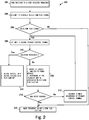
- Figure 2 shows a method 200 performed by the radio receiver 100 for efficiently identifying when a tuned frequency is associated with a FM station or a DRM plus station.
- a user tunes the radio receiver 100 to a particular frequency.
- the radio receiver 100 attempt to coarsely determine if the frequency is associated with a DRM plus station, as described above. For example, if a channel being analyzed exhibits higher modulation index than a typical FM channel or exhibits an erroneous metrics for ultrasound noise level, the channel may be a DRM plus channel.
- the radio receiver 100 attempt to determine further if the frequency is associated with a DRM plus station by decoding primary control channel (e.g. FAC decoding).
- decoding primary control channel e.g. FAC decoding
- the radio receiver 100 determines if the decoding is successful. If yes, at step 214, the service info and payload data is decoded and content is played. If at decision step 212, the decoding is not successful, at step 216, the radio receiver 100 attempts to invoke FM tuning and analyzes FM tuner metrics to determine if the frequency may still be a DRM plus station.
- the control moves to step 210 where next occurrence of primary control channel is set and the control moves to step 208 to repeat the process for a preselected retries before the frequency is conclusively identifies as associated with a DRM plus station.
- the frequency is marked as not a DRM plus station.
- DRM uses COFDM (Coded Orthogonal Frequency Division Multiplexing) with QAM (Quadrature Amplitude Modulation). Removing "band pass noise" stations in the list of possible DRM station may involve attempting to decode the signal. Only a real DRM station will have signals that contains encoded data. Hence, multiple iterations may be needed to conclusively determine if the frequency is associated with a DRM plus station.
- COFDM Coded Orthogonal Frequency Division Multiplexing
- QAM Quadrature Amplitude Modulation
Landscapes
- Engineering & Computer Science (AREA)
- Signal Processing (AREA)
- Circuits Of Receivers In General (AREA)
Abstract
A radio receiver is disclosed. The radio receiver includes an analog tuner and a baseband processor to provide radio functions. The baseband processor is coupled to the analog tuner. The radio receiver further includes a memory, a controller coupled to the analog tuner, the baseband processor and the memory. The controller is configured to perform an operation, the operation includes causing the analog tuner to analyze a selected FM frequency to determine if the selected FM frequency is associated with a digital radio mondiale (DRM) plus station by first coarsely determine if the selected FM frequency may be associated with a DRM plus station and if coarse determination fails, marking the FM frequency as not being associated with a DRM plus station, wherein if the coarse determination is successful, retrying a selected number of times to continue to determine if the selected FM frequency is associated with a DRM plus station.
Description
- Digital Radio Mondiale (DRM) is a set of digital audio broadcasting technologies designed to work over the frequency bands currently used for analog radio broadcasting including Amplitude Modulation (AM) broadcasting, particularly shortwave, and Frequency Modulation (FM) broadcasting. DRM is more spectrally efficient than AM and FM, allowing more stations, at higher quality, into a given amount of bandwidth, using various MPEG-4 audio coding formats.
- Modern radio receiver systems typically include a visual display to display information to users. This information may include list of stations in different categories such as AM stations, FM stations and DRM stations. Program information associated with each program being broadcasted may also be included in the display.
- Typically, the broadcast stations are scanned separately to obtain a list of different types of stations in a geographical area and the list must be updated in the case when a radio receiver system is mounted in a moving vehicle.
- When a DRM receiver receives a FM signal, the receiver is unable to judge that the received signal is not a DRM plus signal. The receiver continuously tries to decode the signal as false alarm and the power consumption increases. In addition, the receiver is unable to display the information about the channel quickly to the user.
- This Summary is provided to introduce a selection of concepts in a simplified form that are further described below in the Detailed Description. This Summary is not intended to identify key features or essential features of the claimed subject matter, nor is it intended to be used to limit the scope of the claimed subject matter.
- In one embodiment, a radio receiver is disclosed. The radio receiver includes an analog tuner and a baseband processor to provide radio functions. The baseband processor is coupled to the analog tuner. The radio receiver further includes a memory, a controller coupled to the analog tuner, the baseband processor and the memory. The controller is configured to perform an operation, the operation includes causing the analog tuner to analyze a selected FM frequency to determine if the selected FM frequency is associated with a digital radio mondiale (DRM) plus station by first coarsely determine if the selected FM frequency may be associated with a DRM plus station and if coarse determination fails, marking the FM frequency as not being associated with a DRM plus station, wherein if the coarse determination is successful, retrying a selected number of times to continue to determine if the selected FM frequency is associated with a DRM plus station.
- In some examples, the coarse determination is performed by determining if the selected FM frequency is not associated with a FM channel. If the coarse determination results in success, the operation further includes attempting to decode primary control channel. If the primary control channel decoding is successful, the operation further includes decoding service info and payload data.
- If the attempt to decode primary control channel is successful, the operation further includes playing the decoded payload data on a speaker. But, if the primary control channel decoding fails, the operation further includes invoking FM tuning and analyzing tuner metrics to determine that the selected FM frequency may be associated with a DRM plus station. And after analyzing, for a preselected number of times, the selected FM frequency for a DRM plus station using different occurrences of primary control channel each time, if a definite determination that the selected FM frequency is a DRM plus station fails, storing the selected FM frequency as a non DRM plus station in the memory.
- So that the manner in which the above recited features of the present invention can be understood in detail, a more particular description of the invention, briefly summarized above, may be had by reference to embodiments, some of which are illustrated in the appended drawings. It is to be noted, however, that the appended drawings illustrate only typical embodiments of this invention and are therefore not to be considered limiting of its scope, for the invention may admit to other equally effective embodiments. Advantages of the subject matter claimed will become apparent to those skilled in the art upon reading this description in conjunction with the accompanying drawings, in which like reference numerals have been used to designate like elements, and in which:
-
FIG. 1 shows a block diagram of a radio receiver in accordance with one or more embodiments; and -
FIG. 2 shows a method of identifying DRM stations in accordance with one or more embodiments. - Note that figures are not drawn to scale. Intermediate steps between figure transitions have been omitted so as not to obfuscate the disclosure. Those intermediate steps are known to a person skilled in the art.
- Many well-known manufacturing steps, components, and connectors have been omitted or not described in detail in the description so as not to obfuscate the present disclosure.
- A hybrid FM radio transmission uses FM frequency band for both FM and DRM plus channels. A DRM plus radio receiver needs to distinguish between a FM station and a DRM plus station. Detection of a DRM plus station is an involved process that typically takes approximately 300ms. To quickly if a hybrid transmission mode is being employed, the embodiments herein use a coarse step to tentatively identify a radio station as DRM plus station by detecting signal characteristics that are unusual for a FM channel. For example, if a channel being analyzed exhibits higher modulation index than a typical FM channel or exhibits an erroneous metrics for ultrasound noise level (i.e., level of frequency components above 20KHz audible spectra), the channel may be a DRM plus channel.
- If the FM station is adjacent to a DRM plus station (i.e., half of the 200 KHz bandwidth is being used for FM channels and the remaining half for DRM plus channels) in a hybrid transmission mode, the FM tuning of the FM station will show modulation index reduced to half and bandwidth reduced to half.
- After a presence of a DRM plus station is coarsely determined in a hybrid transmission mode, conventional receiver algorithms for find the symbol time, channel estimation, compensating for frequency and timing drifts, decoding the control and data channels may be used to make a determination if the station is actually a DRM plus station. Conventionally, a DRM plus station is detected by detecting the presence of an Orthogonal Frequency Division Multiplexing (OFDM) signal using correlation of guard period with the payload and the decoding the control information conveyed in Fast Access Channel (FAC). This process typically takes approximately 300ms per channel per iteration (typically it takes more than one iteration to conclusively identify a channel as a DRM plus channel before marking a channel as non DRM channel). Therefore, by quickly identifying if a channel is "not" a DRM plus channel, the overall detection time can be reduced because the expensive fine detection process is then performed only on those channels there were coarsely identified as DRM plus channel previously.
- In a radio receiver, broadcast bands are scanned frequently to identify AM, FM and DRM stations. In a modern radio receiver, the information obtained through the identification process is displayed on a user interface or display for a user. Identification of DRM stations is a relatively time consuming process when the entire broadcast spectrum needs to be scanned for the identification of DRM plus stations.
- The embodiments disclosed herein make use of a two step process in which analog AM and FM tuners are used for making a list of possible DRM stations during the identification of AM and FM stations. In the second step, the DRM station identification process is then performed on this short list of possible DRM stations, thereby making the overall station identification process faster. Typically, it takes approximately 300ms to determine if a particular station is a DRM station. A spectral band may contain 100+ stations, therefore it may take up to 30+ seconds to scan the entire spectral band to make a list of DRM stations. The embodiments described herein uses an analog tuner to identify an AM station or a FM station that takes approximately 30ms per station. If a particular station is either AM or FM station, it cannot be a DRM station. This pre-exclusion of stations that are not DRM stations limits the DRM station identification routine to run on a limited number of stations, thus making the overall process faster.
-
Figure 1 shows a simple block diagram of an improvedradio receiver 100. As shown, theradio receiver 100 includes ananalog tuner 102, abaseband processor 106, amemory 108 and acontroller 110. Theradio receiver 100 may also include adecoder 112 for decoding received digital transmission. Thebaseband processor 106 manages radio functions such as signal modulation/demodulation, encoding, radio frequency shifting, etc. Thebaseband processor 106 may include its own memory and an internal processor and can be built in a separate chip or may also be fabricated on a same chip as thecontroller 110. Thebaseband processor 106 may include preferably a real-time operating system stored in its own memory and to be executed by the internal processor of thebaseband processor 106. - The
analog tuner 102 is coupled to anantenna 116 and aspeaker 118 via anaudio driver 104. The analog tuner is used to receive AM/FM signals and based on a user selection of a station, one of theanalog tuner 102 may receive programming from the selected station and play the programming on thespeaker 118. Theradio receiver 100 may include a user interface (UI)driver 114 to provide display signals to a user interface of theradio receiver 100. Theaudio driver 104 may convert signals received from the AM/FM tuners through driving a coil of thespeaker 118, thus to convert electrical signals into sound waves. - In one example, the
controller 100 performs overall coordination for playing a radio station by sending tune commands to the AM/FM tuners, and validating responses from the tuners to determine if the tuning is operational. Thecontroller 110 may request thebaseband processor 106 to send periodic notifications on signal quality and associated parameters. In some embodiments, the decoded radio signal is forwarded by thebaseband processor 106 to thecontroller 110 for source decoding and for the final presentation of the decoded data (that may include, audio data and program information data including pictures and videos) to thespeaker 118 or to the user interface. It should be noted that DRM plus stations use the same frequency band (or share part of the frequency band) of FM transmission. -
Figure 2 shows amethod 200 performed by theradio receiver 100 for efficiently identifying when a tuned frequency is associated with a FM station or a DRM plus station. Accordingly, atstep 202, a user tunes theradio receiver 100 to a particular frequency. Atstep 204, theradio receiver 100 attempt to coarsely determine if the frequency is associated with a DRM plus station, as described above. For example, if a channel being analyzed exhibits higher modulation index than a typical FM channel or exhibits an erroneous metrics for ultrasound noise level, the channel may be a DRM plus channel. - Ate
decision step 206, if the frequency is coarsely determined to be associated with a DRM plus station, atstep 208, theradio receiver 100 attempt to determine further if the frequency is associated with a DRM plus station by decoding primary control channel (e.g. FAC decoding). Atdecision step 212, theradio receiver 100 determines if the decoding is successful. If yes, atstep 214, the service info and payload data is decoded and content is played. If atdecision step 212, the decoding is not successful, atstep 216, theradio receiver 100 attempts to invoke FM tuning and analyzes FM tuner metrics to determine if the frequency may still be a DRM plus station. If the analysis results in a successful determination that the frequency may be a DRM plus station and atdecision step 218, if it is determined that max retries has not reached, the control moves to step 210 where next occurrence of primary control channel is set and the control moves to step 208 to repeat the process for a preselected retries before the frequency is conclusively identifies as associated with a DRM plus station. However, after the maximum tries have exhausted, atstep 220, the frequency is marked as not a DRM plus station. - DRM uses COFDM (Coded Orthogonal Frequency Division Multiplexing) with QAM (Quadrature Amplitude Modulation). Removing "band pass noise" stations in the list of possible DRM station may involve attempting to decode the signal. Only a real DRM station will have signals that contains encoded data. Hence, multiple iterations may be needed to conclusively determine if the frequency is associated with a DRM plus station.
- Some or all of these embodiments may be combined, some may be omitted altogether, and additional process steps can be added while still achieving the products described herein. Thus, the subject matter described herein can be embodied in many different variations, and all such variations are contemplated to be within the scope of what is claimed.
- While one or more implementations have been described by way of example and in terms of the specific embodiments, it is to be understood that one or more implementations are not limited to the disclosed embodiments. To the contrary, it is intended to cover various modifications and similar arrangements as would be apparent to those skilled in the art. Therefore, the scope of the appended claims should be accorded the broadest interpretation so as to encompass all such modifications and similar arrangements.
- The use of the terms "a" and "an" and "the" and similar referents in the context of describing the subject matter (particularly in the context of the following claims) are to be construed to cover both the singular and the plural, unless otherwise indicated herein or clearly contradicted by context. Recitation of ranges of values herein are merely intended to serve as a shorthand method of referring individually to each separate value falling within the range, unless otherwise indicated herein, and each separate value is incorporated into the specification as if it were individually recited herein. Furthermore, the foregoing description is for the purpose of illustration only, and not for the purpose of limitation, as the scope of protection sought is defined by the claims as set forth hereinafter together with any equivalents thereof entitled to. The use of any and all examples, or exemplary language (e.g., "such as") provided herein, is intended merely to better illustrate the subject matter and does not pose a limitation on the scope of the subject matter unless otherwise claimed. The use of the term "based on" and other like phrases indicating a condition for bringing about a result, both in the claims and in the written description, is not intended to foreclose any other conditions that bring about that result. No language in the specification should be construed as indicating any non-claimed element as essential to the practice of the invention as claimed.
- Preferred embodiments are described herein, including the best mode known to the inventor for carrying out the claimed subject matter. Of course, variations of those preferred embodiments will become apparent to those of ordinary skill in the art upon reading the foregoing description. The inventor expects skilled artisans to employ such variations as appropriate, and the inventor intends for the claimed subject matter to be practiced otherwise than as specifically described herein. Accordingly, this claimed subject matter includes all modifications and equivalents of the subject matter recited in the claims appended hereto as permitted by applicable law. Moreover, any combination of the above-described elements in all possible variations thereof is encompassed unless otherwise indicated herein or otherwise clearly contradicted by context.
Claims (7)
- A radio receiver, comprising:an analog tuner (102);a baseband processor (106) to provide radio functions, wherein the baseband processor (106) is coupled to the analog tuner (102);a memory (108); anda controller (110) coupled to the analog tuner (102), the baseband processor (106) and the memory (108), wherein the controller (110) is configured to perform an operation, the operation includes causing the analog tuner (102) to analyze a selected FM frequency to determine if the selected FM frequency is associated with a digital radio mondiale, DRM, plus station by first coarsely determine if the selected FM frequency may be associated with a DRM plus station and if coarse determination fails, marking the FM frequency as not being associated with a DRM plus station, wherein if the coarse determination is successful, retrying a selected number of times to continue to determine if the selected FM frequency is associated with a DRM plus station.
- The radio receiver of claim 1, wherein the coarse determination is performed by determining if the selected FM frequency is not associated with a FM channel.
- The radio receiver of claim 1 or claim 2, wherein if the coarse determination results in success, the operation further includes attempting to decode primary control channel.
- The radio receiver of claim 3, wherein if the primary control channel decoding is successful, the operation further includes decoding service info and payload data.
- The radio receiver of claim 4, wherein the operation further includes playing the decoded payload data on a speaker (118).
- The radio receiver of any one of the claims 3 to 5, wherein if the primary control channel decoding fails, the operation further includes invoking FM tuning and analyzing tuner metrics to determine that the selected FM frequency may be associated with a DRM plus station.
- The radio receiver of claim 6, wherein after analyzing, for a preselected number of times, the selected FM frequency for a DRM plus station using different occurrences of primary control channel each time, if a definite determination that the selected FM frequency is a DRM plus station fails, storing the selected FM frequency as a non DRM plus station in the memory (108).
Priority Applications (2)
| Application Number | Priority Date | Filing Date | Title |
|---|---|---|---|
| EP18174706.4A EP3576322A1 (en) | 2018-05-29 | 2018-05-29 | Detection for digital radio mondiale plus in hybrid broadcasting mode |
| US16/420,417 US10790918B2 (en) | 2018-05-29 | 2019-05-23 | Detection for digital radio mondiale plus in hybrid broadcasting mode |
Applications Claiming Priority (1)
| Application Number | Priority Date | Filing Date | Title |
|---|---|---|---|
| EP18174706.4A EP3576322A1 (en) | 2018-05-29 | 2018-05-29 | Detection for digital radio mondiale plus in hybrid broadcasting mode |
Publications (1)
| Publication Number | Publication Date |
|---|---|
| EP3576322A1 true EP3576322A1 (en) | 2019-12-04 |
Family
ID=62486405
Family Applications (1)
| Application Number | Title | Priority Date | Filing Date |
|---|---|---|---|
| EP18174706.4A Withdrawn EP3576322A1 (en) | 2018-05-29 | 2018-05-29 | Detection for digital radio mondiale plus in hybrid broadcasting mode |
Country Status (2)
| Country | Link |
|---|---|
| US (1) | US10790918B2 (en) |
| EP (1) | EP3576322A1 (en) |
Citations (2)
| Publication number | Priority date | Publication date | Assignee | Title |
|---|---|---|---|---|
| EP1998447A2 (en) * | 2007-05-28 | 2008-12-03 | Vestel Elektronik Sanayi ve Ticaret A.S. | Method for estimating the type of broadcast for minimizing the time for channel installation |
| WO2010007581A1 (en) * | 2008-07-14 | 2010-01-21 | Nxp B.V. | Method and apparatus for detecting analogue and digital signals |
Family Cites Families (2)
| Publication number | Priority date | Publication date | Assignee | Title |
|---|---|---|---|---|
| US6490235B1 (en) | 1997-08-07 | 2002-12-03 | Sony Corporation | Storage and reproduction apparatus with rotary control element for controlling operations |
| KR101327959B1 (en) * | 2011-12-27 | 2013-11-12 | 전자부품연구원 | Appratus and Method for Detecting Broadcasting Signal |
-
2018
- 2018-05-29 EP EP18174706.4A patent/EP3576322A1/en not_active Withdrawn
-
2019
- 2019-05-23 US US16/420,417 patent/US10790918B2/en active Active
Patent Citations (2)
| Publication number | Priority date | Publication date | Assignee | Title |
|---|---|---|---|---|
| EP1998447A2 (en) * | 2007-05-28 | 2008-12-03 | Vestel Elektronik Sanayi ve Ticaret A.S. | Method for estimating the type of broadcast for minimizing the time for channel installation |
| WO2010007581A1 (en) * | 2008-07-14 | 2010-01-21 | Nxp B.V. | Method and apparatus for detecting analogue and digital signals |
Non-Patent Citations (1)
| Title |
|---|
| SEONG-JUN KIM ET AL: "Detection method for digital radio mondiale plus in hybrid broadcasting mode", IEEE TRANSACTIONS ON CONSUMER ELECTRONICS, IEEE SERVICE CENTER, NEW YORK, NY, US, vol. 59, no. 1, 1 February 2013 (2013-02-01), pages 9 - 15, XP011499398, ISSN: 0098-3063, DOI: 10.1109/TCE.2013.6490235 * |
Also Published As
| Publication number | Publication date |
|---|---|
| US20190372694A1 (en) | 2019-12-05 |
| US10790918B2 (en) | 2020-09-29 |
Similar Documents
| Publication | Publication Date | Title |
|---|---|---|
| EP1919151A1 (en) | System, apparatus, and method for processing a received orthogonal frequency division multiplexing signal | |
| US12063102B2 (en) | Broadcast signal detecting method and broadcast signal detecting device | |
| JP5174623B2 (en) | Broadcast receiving circuit and broadcast receiving apparatus | |
| US7787842B2 (en) | Radio broadcast receiver, automatic tuning device for radio broadcast and method for receiving radio broadcast | |
| US10790918B2 (en) | Detection for digital radio mondiale plus in hybrid broadcasting mode | |
| US10122482B1 (en) | Radio receiver system | |
| JP2003069907A (en) | Digital terrestrial broadcasting receiver | |
| US10211935B2 (en) | Verification of radio station watermarking with software defined radios | |
| US9065577B2 (en) | Digital radio receiver system and method | |
| JP4637265B2 (en) | Digital broadcast receiver | |
| US20070049223A1 (en) | Radio Receiver and Radio Receiving Method | |
| JP2004236076A (en) | Receiving device and receiving method | |
| US8160523B2 (en) | Channel detecting method for digital broadcast and receiver using the same | |
| JP4466592B2 (en) | Broadcast receiving apparatus, channel scanning method, and control program | |
| EP2837116B1 (en) | Receiver | |
| EP2858253B1 (en) | Reception device, reception method, and program | |
| US20150116599A1 (en) | Reception device, reception method, and program | |
| JP2013016960A (en) | Broadcast receiver | |
| JP5717934B2 (en) | Broadcast receiver for mobile objects | |
| JP2006108919A (en) | In-vehicle digital broadcast receiver | |
| JP2006279271A (en) | Automatic channel selection method, and radio receiver with automatic channel selection function | |
| KR20060104812A (en) | Auto channel search method | |
| JP2008053968A (en) | Terrestrial digital voice broadcast receiver and its channel selection control method | |
| KR20100113840A (en) | Apparatus for processing multi screen and control method thereof | |
| KR20120010844A (en) | Digital Multimedia Broadcasting Receiver and Channel Search Method Therefor |
Legal Events
| Date | Code | Title | Description |
|---|---|---|---|
| PUAI | Public reference made under article 153(3) epc to a published international application that has entered the european phase |
Free format text: ORIGINAL CODE: 0009012 |
|
| STAA | Information on the status of an ep patent application or granted ep patent |
Free format text: STATUS: THE APPLICATION HAS BEEN PUBLISHED |
|
| AK | Designated contracting states |
Kind code of ref document: A1 Designated state(s): AL AT BE BG CH CY CZ DE DK EE ES FI FR GB GR HR HU IE IS IT LI LT LU LV MC MK MT NL NO PL PT RO RS SE SI SK SM TR |
|
| AX | Request for extension of the european patent |
Extension state: BA ME |
|
| STAA | Information on the status of an ep patent application or granted ep patent |
Free format text: STATUS: THE APPLICATION IS DEEMED TO BE WITHDRAWN |
|
| 18D | Application deemed to be withdrawn |
Effective date: 20200605 |