EP3575303B1 - Imidazopyridazine compound - Google Patents
Imidazopyridazine compound Download PDFInfo
- Publication number
- EP3575303B1 EP3575303B1 EP18745152.1A EP18745152A EP3575303B1 EP 3575303 B1 EP3575303 B1 EP 3575303B1 EP 18745152 A EP18745152 A EP 18745152A EP 3575303 B1 EP3575303 B1 EP 3575303B1
- Authority
- EP
- European Patent Office
- Prior art keywords
- alkyl
- compound
- group
- amino
- halogen
- Prior art date
- Legal status (The legal status is an assumption and is not a legal conclusion. Google has not performed a legal analysis and makes no representation as to the accuracy of the status listed.)
- Active
Links
Classifications
-
- A—HUMAN NECESSITIES
- A61—MEDICAL OR VETERINARY SCIENCE; HYGIENE
- A61P—SPECIFIC THERAPEUTIC ACTIVITY OF CHEMICAL COMPOUNDS OR MEDICINAL PREPARATIONS
- A61P35/00—Antineoplastic agents
-
- A—HUMAN NECESSITIES
- A61—MEDICAL OR VETERINARY SCIENCE; HYGIENE
- A61K—PREPARATIONS FOR MEDICAL, DENTAL OR TOILETRY PURPOSES
- A61K31/00—Medicinal preparations containing organic active ingredients
- A61K31/33—Heterocyclic compounds
- A61K31/395—Heterocyclic compounds having nitrogen as a ring hetero atom, e.g. guanethidine or rifamycins
- A61K31/495—Heterocyclic compounds having nitrogen as a ring hetero atom, e.g. guanethidine or rifamycins having six-membered rings with two or more nitrogen atoms as the only ring heteroatoms, e.g. piperazine or tetrazines
- A61K31/50—Pyridazines; Hydrogenated pyridazines
- A61K31/5025—Pyridazines; Hydrogenated pyridazines ortho- or peri-condensed with heterocyclic ring systems
-
- A—HUMAN NECESSITIES
- A61—MEDICAL OR VETERINARY SCIENCE; HYGIENE
- A61K—PREPARATIONS FOR MEDICAL, DENTAL OR TOILETRY PURPOSES
- A61K31/00—Medicinal preparations containing organic active ingredients
- A61K31/33—Heterocyclic compounds
- A61K31/395—Heterocyclic compounds having nitrogen as a ring hetero atom, e.g. guanethidine or rifamycins
- A61K31/495—Heterocyclic compounds having nitrogen as a ring hetero atom, e.g. guanethidine or rifamycins having six-membered rings with two or more nitrogen atoms as the only ring heteroatoms, e.g. piperazine or tetrazines
- A61K31/505—Pyrimidines; Hydrogenated pyrimidines, e.g. trimethoprim
- A61K31/519—Pyrimidines; Hydrogenated pyrimidines, e.g. trimethoprim ortho- or peri-condensed with heterocyclic rings
-
- C—CHEMISTRY; METALLURGY
- C07—ORGANIC CHEMISTRY
- C07D—HETEROCYCLIC COMPOUNDS
- C07D487/00—Heterocyclic compounds containing nitrogen atoms as the only ring hetero atoms in the condensed system, not provided for by groups C07D451/00 - C07D477/00
- C07D487/22—Heterocyclic compounds containing nitrogen atoms as the only ring hetero atoms in the condensed system, not provided for by groups C07D451/00 - C07D477/00 in which the condensed system contains four or more hetero rings
-
- C—CHEMISTRY; METALLURGY
- C07—ORGANIC CHEMISTRY
- C07B—GENERAL METHODS OF ORGANIC CHEMISTRY; APPARATUS THEREFOR
- C07B2200/00—Indexing scheme relating to specific properties of organic compounds
- C07B2200/07—Optical isomers
Definitions
- the present invention relates to an imidazopyridazine compound and a use thereof, and in particular, to an imidazopyridazine compound having cell growth inhibitory activity, and a pharmaceutical composition for preventing or treating cancer or a tumor including the same.
- Kinases mediate a reaction of transferring a high energy molecule, particularly a phosphate group of ATP, to a substrate.
- Kinases perform a role of stabilizing a phosphoric anhydride bond, and increasing a reaction rate by positioning the substrate and the phosphate group at a specific position.
- a transition state obtained by an interaction with a negatively-charged phosphate group is electrostatically stabilized through positively-charged surrounding amino acids, and some kinases form a coordinate bond with the phosphate group using a metal cofactor.
- Kinases may be divided into various groups such as protein kinases, lipid kinases or carbohydrate kinases depending on the substrate and characteristics. Protein, lipid or carbohydrate may vary in the activity, reactivity, and ability to bond to other molecules depending on the phosphorylation state. Kinases widely affect intracellular signal transduction, and regulate complex biological mechanisms within the cell. Some molecules have their activity strengthened or inhibited through phosphorylation, and their abilities to interact with other molecules may be regulated. Since many kinases respond to environmental conditions or signals, a cell may control molecules in the cell through kinases depending on circumstances. Accordingly, kinases perform a very crucial role in cell growth, differentiation, proliferation, survival, metabolism, signal transduction, cell transport, secretion and many other cell reaction pathways.
- kinases have been found in a variety of species ranging from bacteria to fungi, insects and mammals, and more than 500 kinases have been found in humans to date.
- Protein kinases either increase or decrease activity of a protein, stabilize or become a marker for degrading a protein, place a protein in a specific cell compartment, or initiate or disturb interactions with other proteins. Protein kinases are known to occupy the majority of all kinases, and have been an important subject of researches. With phosphatases, protein kinases perform a role of regulating a protein and an enzyme as well as cell signal transduction. A cell protein is a target of numerous covalent bonds, however, since there are not many reversible covalent bonds like a phosphorylation reaction, protein phosphorylation is explained to have a regulatory function. Protein kinases often have multiple substrates, and sometimes a particular protein functions as a substrate for one or more kinases.
- protein kinases are named using a factor regulating its own activity.
- calmodulin-dependent protein kinase is regulated by calmodulin.
- Kinases are sometimes divided into subgroups.
- type 1 and type 2 cyclic AMP-dependent protein kinases are formed with the same enzyme subunits, but are regulated by other regulating subunits binding to the cyclic AMP.
- Protein kinases are enzymes catalyzing phosphorylation of a hydroxy group located on tyrosine, serine and threonine residues of a protein, and perform an important role in transducing a growth factor signal inducing cell growth, differentiation and proliferation ( Irena Melnikova and James Golden, Nature Reviews Drug Discovery 3, 993, 2004 ), and abnormal expression or mutation of specific kinases has been reported to be frequent in cancer cells.
- Human protein kinases are estimated to have 518 species present corresponding to approximately 1.7% of total human genes ( Manning et al., Science, 2002, 298, 1912 ), and are largely divided into tyrosine protein kinases (90 species or more) and serine/threonine protein kinases.
- Tyrosine protein kinases may be divided into 58 species of receptor tyrosine kinases divided by 20 subtypes and 32 species of cytoplasm/non-receptor divided by 10 subtypes, and tyrosine kinases (TK) are one type of enzymes transferring one phosphate group from ATP to a hydroxyphenyl group of tyrosine.
- Tyrosine kinases clearly perform an important role in normal cell growth, which directly participates in a cell signal transduction process.
- RTK Receptor tyrosine kinases
- a domain having tyrosine kinase activity in a C-terminal region exposed in the cell is present, and when a specific ligand attaches to the extracellular portion, kinase enzyme of the tyrosine kinase domain at the C-terminal exposed to the cytoplasmic portion of the receptor protein is activated thereby phosphorylating tyrosine at the C-terminus of each other on the duplex.
- a tyrosine phosphorylation process becomes the most important process transducing signals for extracellular stimuli into the cell.
- Receptors having tyrosine kinase activity transducing extracellular stimuli into the cell with such a mechanism are widely known. Representative examples thereof may include SRC-1, EGFR, PDGFR, IR, IGFR, c-fms, VEGFR, FGFR and the like.
- WO 2016/146651 and KR 10-2015-0133765 relate to macrocyclic compounds and compositions containing said compounds acting as kinase inhibitors.
- WO 2010/009155 discloses a compound having histone deacetylase (HDAC) and/or cyclin-dependent kinase (CDK) inhibitory activity.
- WO 02/066481 relates to pyrimidine derivatives for inhibition of cell-proliferation.
- QSAR quantitative structure - activity relationship
- CDK2 inhibitors were identified ( Padavala Ajay Babu et al., QSAR Comb. Sci. 27, 1362, 2008 ).
- Certain imidazo[1,2- b ]pyridazines are said to be a potent and selective class of CDK2 inhibitors ( Kate F. Byth et al., Biorg. Med. Chem Lett. 14, 2249, 2004 ).
- the present invention is directed to providing a novel imidazopyridazine compound having excellent cell growth inhibitory activity.
- the present invention is also directed to providing a pharmaceutical composition including the compound as an active ingredient.
- the present invention is also directed to providing a pharmaceutical composition for preventing or treating cancer or a tumor including the compound as an active ingredient.
- one aspect of the present invention provides an imidazopyridazine compound of the following Chemical Formula 1, or an optical isomer thereof: wherein, in Chemical Formula 1,
- a second aspect of the present invention provides a pharmaceutical composition and a pharmaceutical formulation including the compound as an active ingredient.
- a third aspect of the present invention provides the pharmaceutical composition of the second aspect for use in a method of preventing or treating cancer or a tumor.
- An imidazopyridazine compound of Chemical Formula 1 according to the present invention is capable of exhibiting cell growth inhibitory activity, and therefore, is useful as an agent for preventing or treating cancer or a tumor.
- 'halogen used in the present specification means, unless mentioned otherwise, any one of fluorine, chlorine, bromine, iodine, or all of these.
- alkyl' used in the present specification refers to, unless mentioned otherwise, a saturated linear or branched hydrocarbon radical that may be expressed by a chemical formula of C n H 2n+1 when having n carbon atoms, and specifically, refers to a saturated linear or branched hydrocarbon radical each including carbon atoms between 1 to 6, 1 to 8, 1 to 10, or 1 to 20.
- these radicals include methyl, ethyl, propyl, isopropyl, n-butyl, tert-butyl, neopentyl, n-hexyl, heptyl and octyl radicals, but are not limited thereto.
- alkenyl' used in the present specification refers to, unless mentioned otherwise, a monovalent group derived from unsaturated linear or branched hydrocarbon that has at least one carbon-carbon double bond and may be expressed by a chemical formula of C n H 2n-1 when having n carbon atoms, and specifically, refers to an unsaturated linear or branched monovalent group each including carbon atoms between 2 to 6, 2 to 8, 2 to 10, or 2 to 20. Examples thereof include ethenyl, propenyl, butenyl, 1-methyl-2-buten-1-yl, heptenyl and octenyl radicals, but are not limited thereto.
- 'cycloalkyl' used in the present specification refers to, unless mentioned otherwise, a monovalent hydrocarbon group derived from a monocyclic or polycyclic saturated or unsaturated carbocyclic compound.
- examples of C 3- C 8 -cycloalkyl include, but are not limited to, cyclopropyl, cyclobutyl, cyclopentyl, cyclohexyl, cyclopentyl and cyclooctyl; and examples of C 3 -C 12 -cycloalkyl include, but are not limited to, cyclopropyl, cyclobutyl, cyclopentyl, cyclohexyl, bicyclo[2.2.1]heptyl, and bicyclo[2.2.2]octyl.
- a monovalent group derived from a monocyclic or polycyclic compound having at least one carbon-carbon double bond obtained by removing a single hydrogen atom is also considered.
- Examples of such a group include, but are not limited to, cyclopropenyl, cyclobutenyl, cyclopentenyl, cyclohexenyl and cycloheptenyl, cyclooctenyl and the like.
- 'cycloalkylalkyl refers to, unless mentioned otherwise, a monovalent hydrocarbon radical in which one or more hydrogens of the alkyl group according to the definition described above are substituted with the cycloalkyl group according to the definition described above.
- Examples of the C 3-10 cycloalkylC 1-6 alkyl group include, but are not limited to, cyclopropylmethyl, cyclopropylethyl, cyclohexylmethyl and the like.
- 'aryl' used in the present specification refers to, unless mentioned otherwise, a mono- or polycyclic hydrocarbon radical having fused or non-fused one or more aromatic rings, and although not limited thereto, includes phenyl, naphthyl, tetrahydronaphthyl, indenyl, indenyl and the like.
- heterocyclic radical' used in the present specification includes unsaturated, saturated, aromatic, aliphatic groups and the like such as heteroatom-including cycloalkyl, cycloalkenyl, cycloalkynyl or heteroaryl.
- 'arylalkyl' used in the present specification refers to, unless mentioned otherwise, a radical in which one or more hydrogens of the alkyl group according to the definition described above are substituted with the aryl group, and although not limited thereto, examples thereof include benzyl, phenethyl and the like.
- heterocycloalkyl refers to, unless mentioned otherwise, a saturated or partially unsaturated 3-membered to 10-membered mono or polycyclic substituent containing one or more, for example, 1 to 4 heteroatoms selected from among N, O and S.
- monocyclic heterocycloalkyl may include piperidinyl, morpholinyl, thiamorpholinyl, pyrrolidinyl, imidazolidinyl, tetrahydrofuranyl, piperazinyl and groups similar thereto, but are not limited thereto.
- heteroaryl used in the present specification means, unless mentioned otherwise, a 5-membered to 12-membered mono or polycyclic aromatic monovalent radical containing one or more, for example, 1 to 4 heteroatoms selected from among O, N and S.
- Examples of the monocyclic heteroaryl may include thiazolyl, oxazolyl, thiophenyl, furanyl, pyrrolyl, imidazolyl, isoxazolyl, pyrazolyl, triazolyl, thiadiazolyl, tetrazolyl, oxadiazolyl, pyridinyl, pyridazinyl, pyrimidinyl, pyrazinyl and groups similar thereto, but are not limited thereto.
- bicyclic heteroaryl may include indolyl, benzothiophenyl, benzofuranyl, benzimidazolyl, benzoxazolyl, benzisoxazolyl, benzothiazolyl, benzothiadiazolyl, benzotriazolyl, quinolinyl, isoquinolinyl, furinyl, furopyridinyl and groups similar thereto, but are not limited thereto.
- heteroarylalkyl refers to, unless mentioned otherwise, a radical in which one or more hydrogens of the alkyl group according to the definition described above are substituted with the heteroaryl group, and although not limited thereto, examples thereof include pyridinylmethyl, pyrimidinylethyl and the like.
- expression of the number of carbons used before the name of the functional group indicates that the corresponding functional group (aryl) contains the expressed number (6 to 12) of carbon atoms.
- Such expression of the number of carbons may also be used in presenting one complex functional group obtained by bonding with a plurality of functional groups, and for example, C 6-12 arylC 1-6 alkyl indicates that one hydrogen of an alkyl group formed with 1 to 6 carbon atoms is substituted with C 6-12 aryl.
- the present invention relates to an imidazopyridazine compound of Chemical Formula 1, or an optical isomer thereof, having cell growth inhibitory activity.
- R 1 may be H or halogen.
- R 2 of Chemical Formula 1 may be -O-(CH 2 ) n -, and n may be 0, 1 or 2.
- W may be piperidinyl, piperazinyl, pyrrolidinyl or morpholine each of which is unsubstituted or substituted with one or more types of same or different substituents selected from the group consisting of halogen, cyano, linear or branched C 1-6 alkyl, C 3-10 cycloalkyl, haloC 1-5 alkyl, hydroxyC 1-6 alkyl, amino, mono or diC 1-6 alkylamino, oxo, hydroxy, C 1-6 alkoxy and sulfonyl.
- the compound of Chemical Formula 1 may be 1-(2-(((1 5 Z ,5 Z )-2 5 -fluoro-3-aza-1(3,6)-imidazo[1,2- b ]pyridazina-2(4,2)pyrimidina-4(1,3)-benzenacyclohexapan-5-en-4 5 -yl)oxy)ethyl)-piperidin-4-ol, but is not limited thereto.
- Example 1 1-(2-(((1 5 Z ,5 Z )-2 5 -Fluoro-3-aza-1(3,6)-imidazo[1,2- b ]pyridazina-2(4,2)pyrimidina-4(1,3)-benzenacyclohexapan-5-en-4 5 -yl)oxy)ethyl)-piperidin-4-ol
- 2,4-Dichloropyrimidine 25 g, 149.7 mmol was introduced to PEG400 (150 mL), and triethylamine (22 mL, 157.2 mmol), butyl vinyl ether (20.4 mL, 157.2 mmol) and palladium acetate (2.36 g, 10.48 mmol) were added thereto.
- the reaction mixture was stirred for 2 hours at 80°C. After the reaction was completed, the result was cooled to 0°C, and diethyl ether was added thereto.
- Step 9) Preparation of 1-(2-(((1 5 Z ,5 Z )-2 5 -fluoro-3-aza-1(3,6)-imidazo[1,2- b ]pyridazina-2(4,2)pyrimidina-4(1,3)-benzenacyclohexapan-5-en-4 5 -yl)oxy)ethyl)-piperidin-4-ol
- Test Example 1 Evaluation on SK-CO-1 cell line
- SK-CO-1 cell line purchased from the American Type Culture Collection (ATCC, USA) was cultured at 30°C with an EMEM medium (10% FBS, 1% penicillin/streptomycin) under the presence of 5% CO 2 .
- the cultured SK-CO-1 cell line was prepared in 5 ⁇ 10 4 /100 ⁇ l, placed in a 96 well-plate, and cultured for one day. After that, the test compound was stepwise diluted in a ratio of 1/10 from 10 ⁇ M to 0.1 nM in the same EMEM medium, and then cultured for 3 days.
- a sulforhodamine B colorimetric (SRB, sigma Cat. S1402) test method was used.
- trichloroacetic acid (TCA, Sigma Cat. T0699) was introduced to each well, and the cell line was fixed for 30 minutes to 1 hour, then washed with distilled water, and exposed in the air to dry the plate. After that, 100 ⁇ l of 0.4% SRB solution was introduced to each well, and the cell line was stained for 30 minutes at room temperature, and the plate was washed with distilled water and 1% acetic acid, and then dried in the air. 150 ⁇ l of 10 nM trizma base solution was introduced to each well, and after dissolving the solid SRB therein, absorbance was measured at 540 nM using a microplate-reader.
- TCA trichloroacetic acid
- the growth inhibition value (GI 50 ) of the cell line was calculated using a GraphPad Prism software. The results are shown in the following Table 1. Table 1 Cell growth inhibitory activity of imidazopyridazine compound Compound GI 50 , nM Example 1 21
Landscapes
- Health & Medical Sciences (AREA)
- Chemical & Material Sciences (AREA)
- Organic Chemistry (AREA)
- General Health & Medical Sciences (AREA)
- Pharmacology & Pharmacy (AREA)
- Life Sciences & Earth Sciences (AREA)
- Animal Behavior & Ethology (AREA)
- Medicinal Chemistry (AREA)
- Public Health (AREA)
- Veterinary Medicine (AREA)
- Epidemiology (AREA)
- Chemical Kinetics & Catalysis (AREA)
- General Chemical & Material Sciences (AREA)
- Nuclear Medicine, Radiotherapy & Molecular Imaging (AREA)
- Pharmaceuticals Containing Other Organic And Inorganic Compounds (AREA)
- Nitrogen Condensed Heterocyclic Rings (AREA)
Description
- The present invention relates to an imidazopyridazine compound and a use thereof, and in particular, to an imidazopyridazine compound having cell growth inhibitory activity, and a pharmaceutical composition for preventing or treating cancer or a tumor including the same.
- Kinases mediate a reaction of transferring a high energy molecule, particularly a phosphate group of ATP, to a substrate. Kinases perform a role of stabilizing a phosphoric anhydride bond, and increasing a reaction rate by positioning the substrate and the phosphate group at a specific position. In most cases, a transition state obtained by an interaction with a negatively-charged phosphate group is electrostatically stabilized through positively-charged surrounding amino acids, and some kinases form a coordinate bond with the phosphate group using a metal cofactor.
- Kinases may be divided into various groups such as protein kinases, lipid kinases or carbohydrate kinases depending on the substrate and characteristics. Protein, lipid or carbohydrate may vary in the activity, reactivity, and ability to bond to other molecules depending on the phosphorylation state. Kinases widely affect intracellular signal transduction, and regulate complex biological mechanisms within the cell. Some molecules have their activity strengthened or inhibited through phosphorylation, and their abilities to interact with other molecules may be regulated. Since many kinases respond to environmental conditions or signals, a cell may control molecules in the cell through kinases depending on circumstances. Accordingly, kinases perform a very crucial role in cell growth, differentiation, proliferation, survival, metabolism, signal transduction, cell transport, secretion and many other cell reaction pathways.
- Kinases have been found in a variety of species ranging from bacteria to fungi, insects and mammals, and more than 500 kinases have been found in humans to date.
- Protein kinases either increase or decrease activity of a protein, stabilize or become a marker for degrading a protein, place a protein in a specific cell compartment, or initiate or disturb interactions with other proteins. Protein kinases are known to occupy the majority of all kinases, and have been an important subject of researches. With phosphatases, protein kinases perform a role of regulating a protein and an enzyme as well as cell signal transduction. A cell protein is a target of numerous covalent bonds, however, since there are not many reversible covalent bonds like a phosphorylation reaction, protein phosphorylation is explained to have a regulatory function. Protein kinases often have multiple substrates, and sometimes a particular protein functions as a substrate for one or more kinases. For this reason, protein kinases are named using a factor regulating its own activity. For example, calmodulin-dependent protein kinase is regulated by calmodulin. Kinases are sometimes divided into subgroups. For example, type 1 and type 2 cyclic AMP-dependent protein kinases are formed with the same enzyme subunits, but are regulated by other regulating subunits binding to the cyclic AMP.
- Protein kinases are enzymes catalyzing phosphorylation of a hydroxy group located on tyrosine, serine and threonine residues of a protein, and perform an important role in transducing a growth factor signal inducing cell growth, differentiation and proliferation (Irena Melnikova and James Golden, Nature Reviews Drug Discovery 3, 993, 2004), and abnormal expression or mutation of specific kinases has been reported to be frequent in cancer cells.
- Human protein kinases are estimated to have 518 species present corresponding to approximately 1.7% of total human genes (Manning et al., Science, 2002, 298, 1912), and are largely divided into tyrosine protein kinases (90 species or more) and serine/threonine protein kinases. Tyrosine protein kinases may be divided into 58 species of receptor tyrosine kinases divided by 20 subtypes and 32 species of cytoplasm/non-receptor divided by 10 subtypes, and tyrosine kinases (TK) are one type of enzymes transferring one phosphate group from ATP to a hydroxyphenyl group of tyrosine. Tyrosine kinases clearly perform an important role in normal cell growth, which directly participates in a cell signal transduction process.
- As one of general methods for a cell to recognize external stimuli, recognition through tyrosine kinase, a receptor present in a cell membrane, is known. Receptor tyrosine kinases (RTK) are formed with an extracellular portion exposed outside the cell, an intracellular portion exposed to cytoplasm inside the cell, and a membrane passing portion passing through a plasma membrane located in the middle. The extracellular portion of the receptor is a part where a specific ligand binds, and the intracellular portion performs a role of transducing active signals of the receptor activated by the ligand into the cell. In the receptor tyrosine kinases, a domain having tyrosine kinase activity in a C-terminal region exposed in the cell is present, and when a specific ligand attaches to the extracellular portion, kinase enzyme of the tyrosine kinase domain at the C-terminal exposed to the cytoplasmic portion of the receptor protein is activated thereby phosphorylating tyrosine at the C-terminus of each other on the duplex. Such a tyrosine phosphorylation process becomes the most important process transducing signals for extracellular stimuli into the cell. Receptors having tyrosine kinase activity transducing extracellular stimuli into the cell with such a mechanism are widely known. Representative examples thereof may include SRC-1, EGFR, PDGFR, IR, IGFR, c-fms, VEGFR, FGFR and the like.
- There are numerous signal transduction systems in the cell, and each of these signal transduction systems is organically connected to each other to regulate cell proliferation, growth, death and the like through forming a complex mechanism (William G. Kaelin Jr, Nature Reviews Cancer 5, 689, 2005). Accordingly, when an intracellular regulatory function is out of balance due to genetic or environmental influences, amplification or extinction of abnormal signal transduction appears destroying the signal transduction system (mainly a state in which in-vivo signal transduction continues), which causes various diseases such as cancer, inflammation, metabolic diseases or brain diseases.
-
WO 2016/146651 andKR 10-2015-0133765 WO 2010/009155 discloses a compound having histone deacetylase (HDAC) and/or cyclin-dependent kinase (CDK) inhibitory activity.WO 02/066481 -
- Irena Melnikova and James Golden, Nature Reviews Drug Discovery 3, 993, 2004; Manning et al., Science, 2002, 298, 1912;
- William G. Kaelin Jr, Nature Reviews Cancer 5, 689, 2005;
-
WO 2016/146651 ; -
KR 10-2015-0133765 -
WO 2010/009155 ; -
WO 02/066481 - Padavala Ajay Babu et al., QSAR Comb. Sci. 27, 1362, 2008;
- Kate F. Byth et al., Biorg. Med. Chem Lett. 14, 2249, 2004.
- The present invention is directed to providing a novel imidazopyridazine compound having excellent cell growth inhibitory activity.
- The present invention is also directed to providing a pharmaceutical composition including the compound as an active ingredient.
- The present invention is also directed to providing a pharmaceutical composition for preventing or treating cancer or a tumor including the compound as an active ingredient.
- In view of the above, one aspect of the present invention provides an imidazopyridazine compound of the following Chemical Formula 1, or an optical isomer thereof:

- R1 is H or halogen;
- L is selected from the group consisting of -CH=CH-, -(CH2)p- and -(CH2)p-O-;
- p is an integer of 1 to 3;
- R2 is a bond, or -(CH2)n-, -CO-, -NR4-(CH2)n- or -O-(CH2)n-;
- n is an integer of 0 to 3;
- R4 is H or C1-6alkyl;
- W is saturated or partially unsaturated 5- to 8-membered unsubstituted monocyclic heterocycloalkyl containing 1 to 4 heteroatoms selected from among N, O and S, or W is piperidinyl, piperazinyl, pyrrolidinyl or morpholine, wherein each of the piperidinyl, piperazinyl, pyrrolidinyl and morpholine groups is substituted with one or more types of same or different substituents selected from the group consisting of halogen, cyano, linear or branched C1-6alkyl, C3-10cycloalkyl, haloC1-5alkyl, hydroxyC1-6alkyl, amino, mono or diC1-6alkylamino, oxo, hydroxy, C1-6alkoxy and sulfonyl; and
- R3 is selected from the group consisting of H, halogen, linear or branched C1-6alkyl, linear or branched C2-10alkenyl, C3-10cycloalkyl, haloC1-5alkyl, hydroxyC1-6alkyl, amino, mono or di(C1-6alkyl)amino, hydroxy, C1-6alkoxy, C3-10ocycloalkylC1-6alkyl, (mono or di(C1-6alkyl)amino)heterocycloalkyl, (hydroxyC1-6alkyl)heterocycloalkyl, heterocycloalkyl and hydroxyheterocycloalkyl.
- A second aspect of the present invention provides a pharmaceutical composition and a pharmaceutical formulation including the compound as an active ingredient.
- A third aspect of the present invention provides the pharmaceutical composition of the second aspect for use in a method of preventing or treating cancer or a tumor.
- An imidazopyridazine compound of Chemical Formula 1 according to the present invention is capable of exhibiting cell growth inhibitory activity, and therefore, is useful as an agent for preventing or treating cancer or a tumor.
- Definitions listed below are definitions of various terms used for describing the present invention. These definitions are used throughout the specification individually or as a part of terms including these unless limited otherwise.
- The term 'halogen' used in the present specification means, unless mentioned otherwise, any one of fluorine, chlorine, bromine, iodine, or all of these.
- The term 'alkyl' used in the present specification refers to, unless mentioned otherwise, a saturated linear or branched hydrocarbon radical that may be expressed by a chemical formula of CnH2n+1 when having n carbon atoms, and specifically, refers to a saturated linear or branched hydrocarbon radical each including carbon atoms between 1 to 6, 1 to 8, 1 to 10, or 1 to 20. Examples of these radicals include methyl, ethyl, propyl, isopropyl, n-butyl, tert-butyl, neopentyl, n-hexyl, heptyl and octyl radicals, but are not limited thereto.
- The term 'alkenyl' used in the present specification refers to, unless mentioned otherwise, a monovalent group derived from unsaturated linear or branched hydrocarbon that has at least one carbon-carbon double bond and may be expressed by a chemical formula of CnH2n-1 when having n carbon atoms, and specifically, refers to an unsaturated linear or branched monovalent group each including carbon atoms between 2 to 6, 2 to 8, 2 to 10, or 2 to 20. Examples thereof include ethenyl, propenyl, butenyl, 1-methyl-2-buten-1-yl, heptenyl and octenyl radicals, but are not limited thereto.
- The term 'cycloalkyl' used in the present specification refers to, unless mentioned otherwise, a monovalent hydrocarbon group derived from a monocyclic or polycyclic saturated or unsaturated carbocyclic compound. For example, examples of C3-C8-cycloalkyl include, but are not limited to, cyclopropyl, cyclobutyl, cyclopentyl, cyclohexyl, cyclopentyl and cyclooctyl; and examples of C3-C12-cycloalkyl include, but are not limited to, cyclopropyl, cyclobutyl, cyclopentyl, cyclohexyl, bicyclo[2.2.1]heptyl, and bicyclo[2.2.2]octyl. A monovalent group derived from a monocyclic or polycyclic compound having at least one carbon-carbon double bond obtained by removing a single hydrogen atom is also considered. Examples of such a group include, but are not limited to, cyclopropenyl, cyclobutenyl, cyclopentenyl, cyclohexenyl and cycloheptenyl, cyclooctenyl and the like.
- The term 'cycloalkylalkyl' used in the present specification refers to, unless mentioned otherwise, a monovalent hydrocarbon radical in which one or more hydrogens of the alkyl group according to the definition described above are substituted with the cycloalkyl group according to the definition described above. Examples of the C3-10cycloalkylC1-6alkyl group include, but are not limited to, cyclopropylmethyl, cyclopropylethyl, cyclohexylmethyl and the like.
- The term 'aryl' used in the present specification refers to, unless mentioned otherwise, a mono- or polycyclic hydrocarbon radical having fused or non-fused one or more aromatic rings, and although not limited thereto, includes phenyl, naphthyl, tetrahydronaphthyl, indenyl, indenyl and the like.
- The term 'heterocyclic radical' used in the present specification includes unsaturated, saturated, aromatic, aliphatic groups and the like such as heteroatom-including cycloalkyl, cycloalkenyl, cycloalkynyl or heteroaryl.
- The term 'arylalkyl' used in the present specification refers to, unless mentioned otherwise, a radical in which one or more hydrogens of the alkyl group according to the definition described above are substituted with the aryl group, and although not limited thereto, examples thereof include benzyl, phenethyl and the like.
- The term 'heterocycloalkyl' used in the present specification refers to, unless mentioned otherwise, a saturated or partially unsaturated 3-membered to 10-membered mono or polycyclic substituent containing one or more, for example, 1 to 4 heteroatoms selected from among N, O and S. Examples of the monocyclic heterocycloalkyl may include piperidinyl, morpholinyl, thiamorpholinyl, pyrrolidinyl, imidazolidinyl, tetrahydrofuranyl, piperazinyl and groups similar thereto, but are not limited thereto.
- The term 'heteroaryl' used in the present specification means, unless mentioned otherwise, a 5-membered to 12-membered mono or polycyclic aromatic monovalent radical containing one or more, for example, 1 to 4 heteroatoms selected from among O, N and S. Examples of the monocyclic heteroaryl may include thiazolyl, oxazolyl, thiophenyl, furanyl, pyrrolyl, imidazolyl, isoxazolyl, pyrazolyl, triazolyl, thiadiazolyl, tetrazolyl, oxadiazolyl, pyridinyl, pyridazinyl, pyrimidinyl, pyrazinyl and groups similar thereto, but are not limited thereto. Examples of the bicyclic heteroaryl may include indolyl, benzothiophenyl, benzofuranyl, benzimidazolyl, benzoxazolyl, benzisoxazolyl, benzothiazolyl, benzothiadiazolyl, benzotriazolyl, quinolinyl, isoquinolinyl, furinyl, furopyridinyl and groups similar thereto, but are not limited thereto.
- The term 'heteroarylalkyl' used in the present specification refers to, unless mentioned otherwise, a radical in which one or more hydrogens of the alkyl group according to the definition described above are substituted with the heteroaryl group, and although not limited thereto, examples thereof include pyridinylmethyl, pyrimidinylethyl and the like.
- In the present specification, expression of the number of carbons used before the name of the functional group, for example, C6-12 of the C6-12aryl, indicates that the corresponding functional group (aryl) contains the expressed number (6 to 12) of carbon atoms. Such expression of the number of carbons may also be used in presenting one complex functional group obtained by bonding with a plurality of functional groups, and for example, C6-12arylC1-6alkyl indicates that one hydrogen of an alkyl group formed with 1 to 6 carbon atoms is substituted with C6-12aryl.
- Hereinafter, the present invention will be described in more detail.
- The present invention relates to an imidazopyridazine compound of Chemical Formula 1, or an optical isomer thereof, having cell growth inhibitory activity.
- In one specific embodiment of the present invention, L may be -CH=CH- or -(CH2)2-.
- In one specific embodiment of the present invention, R1 may be H or halogen.
- In one specific embodiment of the present invention, R2 of Chemical Formula 1 may be -O-(CH2)n-, and n may be 0, 1 or 2.
- In one specific embodiment of the present invention, W may be piperidinyl, piperazinyl, pyrrolidinyl or morpholine each of which is unsubstituted or substituted with one or more types of same or different substituents selected from the group consisting of halogen, cyano, linear or branched C1-6alkyl, C3-10cycloalkyl, haloC1-5alkyl, hydroxyC1-6alkyl, amino, mono or diC1-6alkylamino, oxo, hydroxy, C1-6alkoxy and sulfonyl.
- In one specific embodiment of the present invention, the compound of Chemical Formula 1 may be 1-(2-(((15 Z,5Z)-25-fluoro-3-aza-1(3,6)-imidazo[1,2-b]pyridazina-2(4,2)pyrimidina-4(1,3)-benzenacyclohexapan-5-en-45-yl)oxy)ethyl)-piperidin-4-ol, but is not limited thereto.
- Hereinafter, the present invention will be described in more detail with reference to the following preparation examples and examples; however, these are for illustrative purposes only, and the scope of the present invention is not limited thereto.
-

- 2-Amino-5-nitrophenol (25 g, 162 mmol) was dissolved in acetonitrile (1.0 L), and N-bromosuccinimide (28.8 g, 170 mmol) was slowly added thereto. The result was stirred for 2 hours at room temperature, and the solvent was removed under vacuum. The result was stirred in a mixed solution of ethyl acetate/hexane (1:1), and produced solids were filtered to obtain a target compound (31.5 g, 83%).
- 1H-NMR (300 MHz, DMSO-d6): δ 10.66 (s, 1H), 7.83 (s, 1H), 7.46 (s, 1H), 6.15 (s, 2H).
-

- 2-Amino-3-bromo-5-nitrophenol (75.6 g, 0.32 mmol) prepared in Step 1) was dissolved in ethanol (1.5 L), and the mixture was cooled to -10°C. Sulfuric acid (62.3 mL, 1.17 mmol) was added thereto over 30 minutes at -10°C to -2°C. The temperature of the reaction mixture was raised to 50°C to 55°C, sodium nitrite was slowly added thereto over 30 minutes. The temperature of the reaction mixture was raised to 80°C, and the result was refluxed for 3 hours. After the reaction was completed, the solvent was removed under vacuum, and water and ethyl acetate were added thereto. The organic layer was extracted three times, and washed with salt water. The result was dried with anhydrous sodium sulfate, and concentrated under vacuum. The residue was purified using column chromatography (ethyl acetate:hexane = 0.5:10 (v/v)) to obtain a target compound (60 g, 85% yield).
- 1H-NMR (300 MHz, DMSO-d6): δ 10.90 (s, 1H), 7.75 (s, 1H), 7.51 (s, 1H), 7.36 (s, 1H).
-
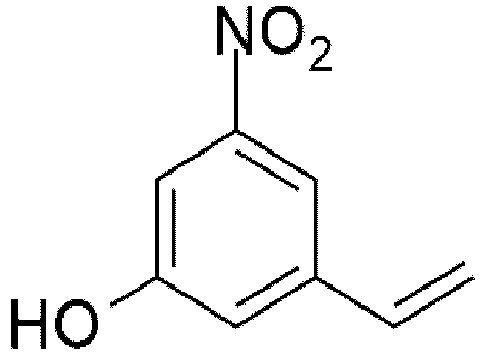
- 3-Bromo-5-nitrophenol (5 g, 22.93 mmol) prepared in Step 2), potassium vinyltrifluoroborate (9 g, 68.80 mmol), Pd(dppf)Cl2-CH2Cl2 (1.8 g, 2.29 mmol) and triethylamine (9.5 mL, 68.80 mmol) were dissolved in 2-propanol/THF (5:1, 60 mL), and nitrogen was blown thereinto. The reaction mixture was sealed, and, after raising the temperature to 100°C, stirred under reflux for 12 hours. After the reaction was completed, the result was cooled to room temperature, filtered using a filter filled with celite, and washed with ethyl acetate. The organic layer was separated, washed with salt water, and dried with anhydrous sodium sulfate. The solvent was removed under vacuum, and the residue was purified using column chromatography (ethyl acetate:hexane = 1:10 (v/v)) to obtain a target compound (3.27 g, 43%).
- 1H-NMR (300 MHz, CDCl3): δ 7.84 (s, 1H), 7.57 (s, 1H), 7.18 (s, 1H), 6.64 (dd, 1H), 5.82 (d, 1H), 5.41 (d, 1H).
-

- 3-Nitro-5-vinylphenol (15 g, 83.71 mmol) prepared in Step 3) and 1,2-dibromoethane (8.6 mL, 100.46 mmol) were dissolved in acetonitrile (150 mL), and Cs2CO3 (40.9 g, 125.5 mmol) was added thereto. The reaction mixture was stirred for 12 hours at room temperature. After the reaction was completed, water and ethyl acetate were added thereto. The organic layer was separated, then washed with salt water, dried with anhydrous sodium sulfate, and concentrated under vacuum. The residue was dissolved in DMF (150 mL), and 4-hydroxypiperidine (16.9 g, 167.4 mmol) and potassium carbonate (23.1 g, 167.4 mmol) were added thereto. The reaction mixture was stirred for 2 hours after raising the temperature to 90°C. After the reaction was completed, water and ethyl acetate were added thereto. The organic layer was separated, washed twice with water, washed with salt water, then dried with anhydrous sodium sulfate, and the solvent was removed under vacuum. The residue was purified using column chromatography (dichloromethane:methanol = 10:1 (v/v)) to obtain a target compound (15 g, 58% yield).
-

- 50% ethanol was introduced to iron (Fe powder, 1.59 g, 28.4 mmol), and after slowly adding concentrated hydrochloric acid (conc. HCl, 0.24 mL, 0.27 mmol) thereto, the result was refluxed for 1 hour at 120°C to be activated. 1-(2-(3-Nitro-5-vinylphenoxy)ethyl)piperidin-4-ol (1.66 g, 5.68 mmol) prepared in Step 4) was added to the activated iron mixture, and the result was refluxed for 1 hour at 120°C. After the reaction was completed, the result was filtered using a filter filled with celite, and to the filtrate, a mixed solution of chloroform/2-propanol (4:1) and a saturated aqueous sodium bicarbonate solution were introduced. The organic layer was separated, then washed with salt water, dried with anhydrous sodium sulfate, and concentrated under vacuum to obtain a target compound (1.2 g, 81% yield).
- 1H-NMR (300 MHz, CDCl3): δ 6.61-6.52 (m, 1H), 6.39 (s, 1H), 6.34 (s, 1H), 6.17-6.16 (m, 1H), 5.69-5.63 (m, 1H), 5.21-5.17 (m, 1H), 4.08-4.04 (t, 2H), 3.71-3.65 (m, 3H), 2.88-2.83 (m, 2H), 2.80-2.76 (t, 2H), 2.31-2.24 (m, 2), 1.93-1.87 (m, 2H), 1.66-1.58 (m, 3H).
-

- 2,4-Dichloropyrimidine (25 g, 149.7 mmol) was introduced to PEG400 (150 mL), and triethylamine (22 mL, 157.2 mmol), butyl vinyl ether (20.4 mL, 157.2 mmol) and palladium acetate (2.36 g, 10.48 mmol) were added thereto. The reaction mixture was stirred for 2 hours at 80°C. After the reaction was completed, the result was cooled to 0°C, and diethyl ether was added thereto. The organic layer was separated, washed three times with water, washed with salt water, then dried with anhydrous magnesium sulfate, and the solvent was removed under vacuum. The residue was purified using column chromatography (n-hexane:ethyl acetate = 20:1 (v/v)) to obtain a target compound (13.7 g, 40% yield).
- 1H-NMR (300 MHz, CDCl3): δ 8.20 (m, 1H), 8.00-7.96 (d, 1H), 5.91-5.87 (d, 1H), 4.02-3.98 (t, 2H), 1.77-1.70 (m, 2H), 1.50-1.40 (m, 1H), 0.98-0.93 (t, 3H).
-

- (E)-4-(2-Butoxyvinyl)-2-chloro-5-fluoropyrimidine (2 g, 8.67 mmol) prepared in Step 6) was dissolved in a mixed solution of 1,4-dioxane/distilled water (3:1, 40 mL), and N-bromosuccinimide (1.54 g, 8.67 mmol) was added thereto. The reaction mixture was stirred for 1 hour at room temperature. After adding 3-amino-6-chloropyridazine (1.12 g, 8.67 mmol) thereto, the reaction mixture was stirred for 2 hours after raising the temperature to 85°C. After the reaction was completed, the result was cooled to room temperature, neutralized (pH=7) by adding a saturated sodium bicarbonate solution thereto, and stirred for 30 minutes at room temperature. Produced solids were filtered and dried to obtain a target compound (1.3 g, 53% yield).
- 1H-NMR (300 MHz, DMSO-d6): δ 9.03 (m, 1H), 8.47 (m, 1H), 8.45-8.41 (d, 1H), 7.66-7.63 (d, 1H).
-

- 1-(2-(3-Amino-5-vinylphenoxy)ethyl)piperidin-4-ol (260 mg, 0.99 mmol) and 6-chloro-3-(2-chloro-5-fluoropyrimidin-4-yl)imidazo[1,2-b]pyridazine (282 mg, 0.99 mol) prepared in Steps 5) and 7), respectively, were dissolved in 2-butanol, and p-toluenesulfonic acid (p-TsOH; 189 mg, 0.99 mol) was added thereto. The reaction mixture was refluxed for 17 hours at 120°C. After the reaction was completed, the result was cooled to room temperature, and a mixed solution of chloroform/2-propanol (4:1) and a saturated aqueous sodium bicarbonate solution were introduced thereto. The organic layer was separated, then washed with salt water, dried with anhydrous sodium sulfate, and concentrated under vacuum. The obtained residue was purified using column chromatography (CHCl3:MeOH = 10:1 (v/v)) to obtain a target compound (185 mg, 37% yield).
- 1H-NMR (300 MHz, CDCl3): δ 8.46 (s, 1H), 8.36 (s, 1H), 8.07-8.04 (d, 1H), 7.40 (m, 1H), 7.29-7.21 (m, 3H), 6.73-6.63 (m, 2H), 5.76-5.70 (d, 1H), 5.27-5.24 (d, 1H), 4.16-4.12 (m, 2H), 3.77-3.72 (m, 1H), 2.90-2.81 (m, 3H), 2.35-2.28 (m, 2H), 1.95-1.90 (m, 2H), 1.69-1.65 (m, 3H).
-

- 1-(2-(3-((4-(6-Chloroimidazo[1,2-b]pyridazin-3-yl)-5-fluoropyrimidin-2-yl)amino)-5-vinylphenoxy)ethyl)piperidin-4-ol (55 mg, 0.108 mmol) prepared in Step 8) was dissolved in PEG400 (2 mL), and triethylamine (16 µL, 0.113 mmol) and palladium acetate (2 mg, 0.008 mmol) were added thereto. The reaction mixture was stirred for 4 hours at 85°C. After the reaction was completed, the result was cooled to room temperature, water was added thereto, and the result was extracted three times with ethyl acetate. The organic layer was separated, then washed with salt water, dried with anhydrous sodium sulfate, and concentrated under vacuum. The obtained residue was purified using column chromatography (CHCl3:MeOH = 10:1 (v/v)) to obtain a target compound (12 mg, 24% yield).
- MS: [M+H]+ m/z 473.2;
- 1H-NMR (300 MHz, DMSO-d6): δ 11.14 (bs, 1H), 9.86 (s, 1H), 8.63-8.61 (d, 1H), 8.50-8.49 (d, 1H), 8.31-8.28 (m, 1H), 7.62-7.59 (m, 1H), 6.95-6.90 (m, 1H), 6.75-6.60 (m, 3H), 4.60 (m, 1H), 4.05-4.01 (m, 2H), 2.79-2.71 (m, 2H), 2.67-2.63 (t, 2H), 2.15-2.07 (m, 2H), 1.71-1.67 (m, 2H), 1.39-1.35 (m, 3H).
- For the compounds prepared in the example, cell growth inhibitory activity results were obtained as follows.
- SK-CO-1 cell line purchased from the American Type Culture Collection (ATCC, USA) was cultured at 30°C with an EMEM medium (10% FBS, 1% penicillin/streptomycin) under the presence of 5% CO2. The cultured SK-CO-1 cell line was prepared in 5×10⁴/100 µl, placed in a 96 well-plate, and cultured for one day. After that, the test compound was stepwise diluted in a ratio of 1/10 from 10 µM to 0.1 nM in the same EMEM medium, and then cultured for 3 days. In order to measure viability of the cell, a sulforhodamine B colorimetric (SRB, sigma Cat. S1402) test method was used. After discarding the medium, 0.1 ml of 10% trichloroacetic acid (TCA, Sigma Cat. T0699) was introduced to each well, and the cell line was fixed for 30 minutes to 1 hour, then washed with distilled water, and exposed in the air to dry the plate. After that, 100 µl of 0.4% SRB solution was introduced to each well, and the cell line was stained for 30 minutes at room temperature, and the plate was washed with distilled water and 1% acetic acid, and then dried in the air. 150 µl of 10 nM trizma base solution was introduced to each well, and after dissolving the solid SRB therein, absorbance was measured at 540 nM using a microplate-reader. The growth inhibition value (GI50) of the cell line was calculated using a GraphPad Prism software. The results are shown in the following Table 1.
Table 1 Cell growth inhibitory activity of imidazopyridazine compound Compound GI50, nM Example 1 21 - As shown in Table 1, it was seen that the compound of the present invention had excellent cell growth inhibitory activity.
- Hereinbefore, the present invention has been described with reference to the examples; however, it is to be understood that these are for illustrative purposes only, and, in the present invention, various modifications and equivalent other examples obvious to those skilled in the art may be implemented within the scope of the appended claims.
Claims (8)
- An imidazopyridazine compound of the following Chemical Formula 1, or an optical isomer thereof:
 R1 is H or halogen;L is selected form the group consisting of -CH=CH-, -(CH2)p- and -(CH2)p-O-;p is an integer of 1 to 3;R2 is a bond, or -(CH2)n-, -CO-, -NR4-(CH2)n- or -O-(CH2)n-;n is an integer of 0 to 3;R4 is H or C1-6alkyl;W is saturated or partially unsaturated 5- to 8-membered unsubstituted monocyclic heterocycloalkyl containing 1 to 4 heteroatoms selected from among N, O and S, or W is piperidinyl, piperazinyl, pyrrolidinyl or morpholine, wherein each of the piperidinyl, piperazinyl, pyrrolidinyl and morpholine groups is substituted with one or more types of same or different substituents selected from the group consisting of halogen, cyano, linear or branched C1-6alkyl, C3-10cycloalkyl, haloC1-5alkyl, hydroxyC1-6alkyl, amino, mono or diC1-6alkylamino, oxo, hydroxy, C1-6alkoxy and sulfonyl; andR3 is selected from the group consisting of H, halogen, linear or branched C1-6alkyl, linear or branched C2-10alkenyl, C3-10cycloalkyl, haloC1-5alkyl, hydroxyC1-6alkyl, amino, mono or di(C1-6alkyl)amino, hydroxy, C1-6alkoxy, C3-10cycloalkylC1-6alkyl, (mono or di(C1-6alkyl)amino)heterocycloalkyl, (hydroxyC1-6alkyl)heterocycloalkyl, heterocycloalkyl and hydroxyheterocycloalkyl.
 - The compound of Claim 1, wherein R1 is H or halogen.
- The compound of Claim 1, wherein L is -CH=CH- or -(CH2)2-.
- The compound of Claim 1, wherein R2 is -O-(CH2)n-, and n is 0, 1 or 2.
- The compound of Claim 1, wherein W is a piperidinyl group.
- The compound of Claim 1, wherein the compound of Chemical Formula 1 is 1-(2-(((15 Z,5Z)-25-fluoro-3-aza-1(3,6)-imidazo[1,2-b]pyridazina-2(4,2)pyrimidina-4(1,3)-benzenacyclohexapan-5-en-45-yl)oxy)ethyl)piperidin-4-ol.
- A pharmaceutical composition comprising the compound of any one of Claims 1 to 6 as an active ingredient.
- The pharmaceutical composition of Claim 7 for use in a method of preventing or treating cancer or a tumor.
Applications Claiming Priority (2)
| Application Number | Priority Date | Filing Date | Title |
|---|---|---|---|
| KR1020170012767A KR102719387B1 (en) | 2017-01-26 | 2017-01-26 | Imidazopyridazine compound |
| PCT/KR2018/000982 WO2018139825A2 (en) | 2017-01-26 | 2018-01-23 | Imidazopyridazine compound |
Publications (3)
| Publication Number | Publication Date |
|---|---|
| EP3575303A2 EP3575303A2 (en) | 2019-12-04 |
| EP3575303A4 EP3575303A4 (en) | 2020-08-12 |
| EP3575303B1 true EP3575303B1 (en) | 2022-07-06 |
Family
ID=62979376
Family Applications (1)
| Application Number | Title | Priority Date | Filing Date |
|---|---|---|---|
| EP18745152.1A Active EP3575303B1 (en) | 2017-01-26 | 2018-01-23 | Imidazopyridazine compound |
Country Status (10)
| Country | Link |
|---|---|
| US (1) | US10781217B2 (en) |
| EP (1) | EP3575303B1 (en) |
| JP (1) | JP7057366B2 (en) |
| KR (1) | KR102719387B1 (en) |
| CN (1) | CN110234653B (en) |
| AU (1) | AU2018212151B2 (en) |
| BR (1) | BR112019015400A2 (en) |
| ES (1) | ES2923387T3 (en) |
| RU (1) | RU2765099C2 (en) |
| WO (1) | WO2018139825A2 (en) |
Families Citing this family (1)
| Publication number | Priority date | Publication date | Assignee | Title |
|---|---|---|---|---|
| KR102047623B1 (en) * | 2019-04-17 | 2019-11-21 | 동주산업주식회사 | Spindle and coupling assembly equipment of rolling mill |
Family Cites Families (7)
| Publication number | Priority date | Publication date | Assignee | Title |
|---|---|---|---|---|
| GB0103926D0 (en) | 2001-02-17 | 2001-04-04 | Astrazeneca Ab | Chemical compounds |
| EP1674466A1 (en) * | 2004-12-27 | 2006-06-28 | 4Sc Ag | 2,5- and 2,6-disubstituted benzazole analogues useful as protein kinase inhibitors |
| NZ602832A (en) | 2008-07-14 | 2014-04-30 | Gilead Sciences Inc | Fused heterocyclic hdac inhibitor compounds |
| NZ630719A (en) | 2012-03-09 | 2017-01-27 | Lexicon Pharmaceuticals Inc | Imidazo [1, 2 - b] pyridazine - based compounds, compositions comprising them, and uses thereof |
| US20160024114A1 (en) | 2013-03-15 | 2016-01-28 | Oncodesign S.A. | Macrocyclic rip2 kinase inhibitors |
| HRP20192334T1 (en) | 2014-09-17 | 2020-03-20 | Oncodesign S.A. | MACROCYCLIC RIP2 KINASE INHIBITORS |
| WO2016146651A1 (en) | 2015-03-16 | 2016-09-22 | Oncodesign Sa | Macrocyclic activin-like receptor kinase inhibitors |
-
2017
- 2017-01-26 KR KR1020170012767A patent/KR102719387B1/en active Active
-
2018
- 2018-01-23 AU AU2018212151A patent/AU2018212151B2/en active Active
- 2018-01-23 US US16/480,758 patent/US10781217B2/en active Active
- 2018-01-23 CN CN201880008607.0A patent/CN110234653B/en active Active
- 2018-01-23 EP EP18745152.1A patent/EP3575303B1/en active Active
- 2018-01-23 JP JP2019540331A patent/JP7057366B2/en active Active
- 2018-01-23 WO PCT/KR2018/000982 patent/WO2018139825A2/en not_active Ceased
- 2018-01-23 ES ES18745152T patent/ES2923387T3/en active Active
- 2018-01-23 RU RU2019126379A patent/RU2765099C2/en active
- 2018-01-23 BR BR112019015400-0A patent/BR112019015400A2/en not_active Application Discontinuation
Also Published As
| Publication number | Publication date |
|---|---|
| RU2019126379A3 (en) | 2021-03-31 |
| CN110234653B (en) | 2022-02-08 |
| US10781217B2 (en) | 2020-09-22 |
| JP2020505401A (en) | 2020-02-20 |
| EP3575303A2 (en) | 2019-12-04 |
| CA3051665A1 (en) | 2018-08-02 |
| WO2018139825A2 (en) | 2018-08-02 |
| RU2019126379A (en) | 2021-02-26 |
| AU2018212151B2 (en) | 2021-10-21 |
| EP3575303A4 (en) | 2020-08-12 |
| JP7057366B2 (en) | 2022-04-19 |
| CN110234653A (en) | 2019-09-13 |
| KR20180088113A (en) | 2018-08-03 |
| BR112019015400A2 (en) | 2020-03-31 |
| US20190389872A1 (en) | 2019-12-26 |
| KR102719387B1 (en) | 2024-10-21 |
| AU2018212151A1 (en) | 2019-09-12 |
| RU2765099C2 (en) | 2022-01-25 |
| ES2923387T3 (en) | 2022-09-27 |
| WO2018139825A3 (en) | 2018-09-27 |
Similar Documents
| Publication | Publication Date | Title |
|---|---|---|
| EP2079726B1 (en) | Substituted amides, method of making, and method of use thereof | |
| CN117222640A (en) | Heterocyclic compounds as FGFR inhibitors and their applications | |
| US10301304B2 (en) | Selective inhibitor of phosphatidylinositol 3-kinase-gamma | |
| WO2010068806A1 (en) | Amide derivatives as btk inhibitors in the treatment of allergic, autoimmune and inflammatory disorders as well as cancer | |
| JP2016518316A (en) | MK2 inhibitors and their use | |
| WO2009137596A1 (en) | Substituted amides, method of making, and use as btk inhibitors | |
| WO2010068810A2 (en) | Certain substituted amides, method of making, and method of use thereof | |
| DE102007012645A1 (en) | Substituted imidazo and triazolopyrimidines | |
| WO2010068788A1 (en) | Heterocyclic amides as btk inhibitors | |
| KR20090061655A (en) | Pyrimidine derivatives and their use as kinase inhibitors | |
| TWI822868B (en) | FGFR4 inhibitors, pharmaceutical compositions containing them and uses thereof | |
| KR102394934B1 (en) | Salt form and crystal form thereof as Akt inhibitor | |
| AU2018212151B2 (en) | Imidazopyridazine compound | |
| EP4141004A1 (en) | Polycyclic amide derivative as cdk9 inhibitor, preparation method therefor and use thereof | |
| CA3051665C (en) | Imidazopyridazine compound | |
| Lee et al. | 3, 5-Bis (aminopyrimidinyl) indole Derivatives: Synthesis and Evaluation of Pim Kinase Inhibitory Activities. | |
| Carrasco et al. | Structure-activity studies of novel di-substituted [1, 2, 5] oxadiazolo [3, 4-b] pyrazine analogs targeting the A-loop regulatory site of p38 MAP kinase | |
| Carrasco Romero et al. | Structure-Activity Studies of Novel di-substituted [1, 2, 5] oxadiazolo [3, 4-b] pyrazine Analogs Targeting the A-loop Regulatory Site of p38 MAP Kinase | |
| US20220213086A1 (en) | Azole compounds as irak inhibitors, preparation methods and medicinal uses thereof | |
| CN116063325A (en) | Macrocyclic compounds with BTK modulating effect and uses thereof | |
| EP4194450A1 (en) | Cdk9 inhibitor and use thereof | |
| HK1227408B (en) | A selective inhibitor of phosphatidylinositol 3-kinase-gamma |
Legal Events
| Date | Code | Title | Description |
|---|---|---|---|
| STAA | Information on the status of an ep patent application or granted ep patent |
Free format text: STATUS: THE INTERNATIONAL PUBLICATION HAS BEEN MADE |
|
| PUAI | Public reference made under article 153(3) epc to a published international application that has entered the european phase |
Free format text: ORIGINAL CODE: 0009012 |
|
| STAA | Information on the status of an ep patent application or granted ep patent |
Free format text: STATUS: REQUEST FOR EXAMINATION WAS MADE |
|
| 17P | Request for examination filed |
Effective date: 20190826 |
|
| AK | Designated contracting states |
Kind code of ref document: A2 Designated state(s): AL AT BE BG CH CY CZ DE DK EE ES FI FR GB GR HR HU IE IS IT LI LT LU LV MC MK MT NL NO PL PT RO RS SE SI SK SM TR |
|
| AX | Request for extension of the european patent |
Extension state: BA ME |
|
| DAV | Request for validation of the european patent (deleted) | ||
| DAX | Request for extension of the european patent (deleted) | ||
| A4 | Supplementary search report drawn up and despatched |
Effective date: 20200714 |
|
| RIC1 | Information provided on ipc code assigned before grant |
Ipc: A61K 31/5025 20060101ALI20200708BHEP Ipc: A61K 31/519 20060101ALI20200708BHEP Ipc: A61P 35/00 20060101ALI20200708BHEP Ipc: C07D 487/22 20060101AFI20200708BHEP |
|
| STAA | Information on the status of an ep patent application or granted ep patent |
Free format text: STATUS: EXAMINATION IS IN PROGRESS |
|
| 17Q | First examination report despatched |
Effective date: 20210527 |
|
| GRAP | Despatch of communication of intention to grant a patent |
Free format text: ORIGINAL CODE: EPIDOSNIGR1 |
|
| STAA | Information on the status of an ep patent application or granted ep patent |
Free format text: STATUS: GRANT OF PATENT IS INTENDED |
|
| INTG | Intention to grant announced |
Effective date: 20220211 |
|
| GRAS | Grant fee paid |
Free format text: ORIGINAL CODE: EPIDOSNIGR3 |
|
| GRAA | (expected) grant |
Free format text: ORIGINAL CODE: 0009210 |
|
| STAA | Information on the status of an ep patent application or granted ep patent |
Free format text: STATUS: THE PATENT HAS BEEN GRANTED |
|
| AK | Designated contracting states |
Kind code of ref document: B1 Designated state(s): AL AT BE BG CH CY CZ DE DK EE ES FI FR GB GR HR HU IE IS IT LI LT LU LV MC MK MT NL NO PL PT RO RS SE SI SK SM TR |
|
| REG | Reference to a national code |
Ref country code: AT Ref legal event code: REF Ref document number: 1502819 Country of ref document: AT Kind code of ref document: T Effective date: 20220715 Ref country code: CH Ref legal event code: EP |
|
| REG | Reference to a national code |
Ref country code: DE Ref legal event code: R096 Ref document number: 602018037596 Country of ref document: DE |
|
| REG | Reference to a national code |
Ref country code: IE Ref legal event code: FG4D |
|
| REG | Reference to a national code |
Ref country code: ES Ref legal event code: FG2A Ref document number: 2923387 Country of ref document: ES Kind code of ref document: T3 Effective date: 20220927 |
|
| REG | Reference to a national code |
Ref country code: LT Ref legal event code: MG9D |
|
| REG | Reference to a national code |
Ref country code: NL Ref legal event code: MP Effective date: 20220706 |
|
| PG25 | Lapsed in a contracting state [announced via postgrant information from national office to epo] |
Ref country code: SE Free format text: LAPSE BECAUSE OF FAILURE TO SUBMIT A TRANSLATION OF THE DESCRIPTION OR TO PAY THE FEE WITHIN THE PRESCRIBED TIME-LIMIT Effective date: 20220706 Ref country code: RS Free format text: LAPSE BECAUSE OF FAILURE TO SUBMIT A TRANSLATION OF THE DESCRIPTION OR TO PAY THE FEE WITHIN THE PRESCRIBED TIME-LIMIT Effective date: 20220706 Ref country code: PT Free format text: LAPSE BECAUSE OF FAILURE TO SUBMIT A TRANSLATION OF THE DESCRIPTION OR TO PAY THE FEE WITHIN THE PRESCRIBED TIME-LIMIT Effective date: 20221107 Ref country code: NO Free format text: LAPSE BECAUSE OF FAILURE TO SUBMIT A TRANSLATION OF THE DESCRIPTION OR TO PAY THE FEE WITHIN THE PRESCRIBED TIME-LIMIT Effective date: 20221006 Ref country code: NL Free format text: LAPSE BECAUSE OF FAILURE TO SUBMIT A TRANSLATION OF THE DESCRIPTION OR TO PAY THE FEE WITHIN THE PRESCRIBED TIME-LIMIT Effective date: 20220706 Ref country code: LV Free format text: LAPSE BECAUSE OF FAILURE TO SUBMIT A TRANSLATION OF THE DESCRIPTION OR TO PAY THE FEE WITHIN THE PRESCRIBED TIME-LIMIT Effective date: 20220706 Ref country code: LT Free format text: LAPSE BECAUSE OF FAILURE TO SUBMIT A TRANSLATION OF THE DESCRIPTION OR TO PAY THE FEE WITHIN THE PRESCRIBED TIME-LIMIT Effective date: 20220706 Ref country code: FI Free format text: LAPSE BECAUSE OF FAILURE TO SUBMIT A TRANSLATION OF THE DESCRIPTION OR TO PAY THE FEE WITHIN THE PRESCRIBED TIME-LIMIT Effective date: 20220706 |
|
| REG | Reference to a national code |
Ref country code: AT Ref legal event code: MK05 Ref document number: 1502819 Country of ref document: AT Kind code of ref document: T Effective date: 20220706 |
|
| PG25 | Lapsed in a contracting state [announced via postgrant information from national office to epo] |
Ref country code: PL Free format text: LAPSE BECAUSE OF FAILURE TO SUBMIT A TRANSLATION OF THE DESCRIPTION OR TO PAY THE FEE WITHIN THE PRESCRIBED TIME-LIMIT Effective date: 20220706 Ref country code: IS Free format text: LAPSE BECAUSE OF FAILURE TO SUBMIT A TRANSLATION OF THE DESCRIPTION OR TO PAY THE FEE WITHIN THE PRESCRIBED TIME-LIMIT Effective date: 20221106 Ref country code: HR Free format text: LAPSE BECAUSE OF FAILURE TO SUBMIT A TRANSLATION OF THE DESCRIPTION OR TO PAY THE FEE WITHIN THE PRESCRIBED TIME-LIMIT Effective date: 20220706 Ref country code: GR Free format text: LAPSE BECAUSE OF FAILURE TO SUBMIT A TRANSLATION OF THE DESCRIPTION OR TO PAY THE FEE WITHIN THE PRESCRIBED TIME-LIMIT Effective date: 20221007 |
|
| REG | Reference to a national code |
Ref country code: DE Ref legal event code: R097 Ref document number: 602018037596 Country of ref document: DE |
|
| PG25 | Lapsed in a contracting state [announced via postgrant information from national office to epo] |
Ref country code: SM Free format text: LAPSE BECAUSE OF FAILURE TO SUBMIT A TRANSLATION OF THE DESCRIPTION OR TO PAY THE FEE WITHIN THE PRESCRIBED TIME-LIMIT Effective date: 20220706 Ref country code: RO Free format text: LAPSE BECAUSE OF FAILURE TO SUBMIT A TRANSLATION OF THE DESCRIPTION OR TO PAY THE FEE WITHIN THE PRESCRIBED TIME-LIMIT Effective date: 20220706 Ref country code: DK Free format text: LAPSE BECAUSE OF FAILURE TO SUBMIT A TRANSLATION OF THE DESCRIPTION OR TO PAY THE FEE WITHIN THE PRESCRIBED TIME-LIMIT Effective date: 20220706 Ref country code: CZ Free format text: LAPSE BECAUSE OF FAILURE TO SUBMIT A TRANSLATION OF THE DESCRIPTION OR TO PAY THE FEE WITHIN THE PRESCRIBED TIME-LIMIT Effective date: 20220706 Ref country code: AT Free format text: LAPSE BECAUSE OF FAILURE TO SUBMIT A TRANSLATION OF THE DESCRIPTION OR TO PAY THE FEE WITHIN THE PRESCRIBED TIME-LIMIT Effective date: 20220706 |
|
| PLBE | No opposition filed within time limit |
Free format text: ORIGINAL CODE: 0009261 |
|
| STAA | Information on the status of an ep patent application or granted ep patent |
Free format text: STATUS: NO OPPOSITION FILED WITHIN TIME LIMIT |
|
| PG25 | Lapsed in a contracting state [announced via postgrant information from national office to epo] |
Ref country code: SK Free format text: LAPSE BECAUSE OF FAILURE TO SUBMIT A TRANSLATION OF THE DESCRIPTION OR TO PAY THE FEE WITHIN THE PRESCRIBED TIME-LIMIT Effective date: 20220706 Ref country code: EE Free format text: LAPSE BECAUSE OF FAILURE TO SUBMIT A TRANSLATION OF THE DESCRIPTION OR TO PAY THE FEE WITHIN THE PRESCRIBED TIME-LIMIT Effective date: 20220706 |
|
| 26N | No opposition filed |
Effective date: 20230411 |
|
| PG25 | Lapsed in a contracting state [announced via postgrant information from national office to epo] |
Ref country code: AL Free format text: LAPSE BECAUSE OF FAILURE TO SUBMIT A TRANSLATION OF THE DESCRIPTION OR TO PAY THE FEE WITHIN THE PRESCRIBED TIME-LIMIT Effective date: 20220706 |
|
| P01 | Opt-out of the competence of the unified patent court (upc) registered |
Effective date: 20230602 |
|
| PG25 | Lapsed in a contracting state [announced via postgrant information from national office to epo] |
Ref country code: SI Free format text: LAPSE BECAUSE OF FAILURE TO SUBMIT A TRANSLATION OF THE DESCRIPTION OR TO PAY THE FEE WITHIN THE PRESCRIBED TIME-LIMIT Effective date: 20220706 |
|
| REG | Reference to a national code |
Ref country code: CH Ref legal event code: PL |
|
| PG25 | Lapsed in a contracting state [announced via postgrant information from national office to epo] |
Ref country code: LU Free format text: LAPSE BECAUSE OF NON-PAYMENT OF DUE FEES Effective date: 20230123 |
|
| REG | Reference to a national code |
Ref country code: BE Ref legal event code: MM Effective date: 20230131 |
|
| PG25 | Lapsed in a contracting state [announced via postgrant information from national office to epo] |
Ref country code: LI Free format text: LAPSE BECAUSE OF NON-PAYMENT OF DUE FEES Effective date: 20230131 Ref country code: CH Free format text: LAPSE BECAUSE OF NON-PAYMENT OF DUE FEES Effective date: 20230131 |
|
| PG25 | Lapsed in a contracting state [announced via postgrant information from national office to epo] |
Ref country code: BE Free format text: LAPSE BECAUSE OF NON-PAYMENT OF DUE FEES Effective date: 20230131 |
|
| PG25 | Lapsed in a contracting state [announced via postgrant information from national office to epo] |
Ref country code: IE Free format text: LAPSE BECAUSE OF NON-PAYMENT OF DUE FEES Effective date: 20230123 |
|
| PG25 | Lapsed in a contracting state [announced via postgrant information from national office to epo] |
Ref country code: MC Free format text: LAPSE BECAUSE OF FAILURE TO SUBMIT A TRANSLATION OF THE DESCRIPTION OR TO PAY THE FEE WITHIN THE PRESCRIBED TIME-LIMIT Effective date: 20220706 |
|
| PG25 | Lapsed in a contracting state [announced via postgrant information from national office to epo] |
Ref country code: MC Free format text: LAPSE BECAUSE OF FAILURE TO SUBMIT A TRANSLATION OF THE DESCRIPTION OR TO PAY THE FEE WITHIN THE PRESCRIBED TIME-LIMIT Effective date: 20220706 |
|
| PG25 | Lapsed in a contracting state [announced via postgrant information from national office to epo] |
Ref country code: BG Free format text: LAPSE BECAUSE OF FAILURE TO SUBMIT A TRANSLATION OF THE DESCRIPTION OR TO PAY THE FEE WITHIN THE PRESCRIBED TIME-LIMIT Effective date: 20220706 |
|
| PG25 | Lapsed in a contracting state [announced via postgrant information from national office to epo] |
Ref country code: BG Free format text: LAPSE BECAUSE OF FAILURE TO SUBMIT A TRANSLATION OF THE DESCRIPTION OR TO PAY THE FEE WITHIN THE PRESCRIBED TIME-LIMIT Effective date: 20220706 |
|
| PG25 | Lapsed in a contracting state [announced via postgrant information from national office to epo] |
Ref country code: CY Free format text: LAPSE BECAUSE OF FAILURE TO SUBMIT A TRANSLATION OF THE DESCRIPTION OR TO PAY THE FEE WITHIN THE PRESCRIBED TIME-LIMIT; INVALID AB INITIO Effective date: 20180123 |
|
| PG25 | Lapsed in a contracting state [announced via postgrant information from national office to epo] |
Ref country code: HU Free format text: LAPSE BECAUSE OF FAILURE TO SUBMIT A TRANSLATION OF THE DESCRIPTION OR TO PAY THE FEE WITHIN THE PRESCRIBED TIME-LIMIT; INVALID AB INITIO Effective date: 20180123 |
|
| PG25 | Lapsed in a contracting state [announced via postgrant information from national office to epo] |
Ref country code: TR Free format text: LAPSE BECAUSE OF FAILURE TO SUBMIT A TRANSLATION OF THE DESCRIPTION OR TO PAY THE FEE WITHIN THE PRESCRIBED TIME-LIMIT Effective date: 20220706 |
|
| PGFP | Annual fee paid to national office [announced via postgrant information from national office to epo] |
Ref country code: GB Payment date: 20251222 Year of fee payment: 9 |
|
| PGFP | Annual fee paid to national office [announced via postgrant information from national office to epo] |
Ref country code: FR Payment date: 20251223 Year of fee payment: 9 |
|
| PGFP | Annual fee paid to national office [announced via postgrant information from national office to epo] |
Ref country code: ES Payment date: 20260212 Year of fee payment: 9 |
|
| PGFP | Annual fee paid to national office [announced via postgrant information from national office to epo] |
Ref country code: DE Payment date: 20251222 Year of fee payment: 9 |
|
| PGFP | Annual fee paid to national office [announced via postgrant information from national office to epo] |
Ref country code: IT Payment date: 20251223 Year of fee payment: 9 |