EP3575289A1 - Alkanolamine, friction-reducing agent, and lubricating oil composition - Google Patents
Alkanolamine, friction-reducing agent, and lubricating oil composition Download PDFInfo
- Publication number
- EP3575289A1 EP3575289A1 EP18744436.9A EP18744436A EP3575289A1 EP 3575289 A1 EP3575289 A1 EP 3575289A1 EP 18744436 A EP18744436 A EP 18744436A EP 3575289 A1 EP3575289 A1 EP 3575289A1
- Authority
- EP
- European Patent Office
- Prior art keywords
- friction
- group
- reducing agent
- carbon atoms
- alkanolamine
- Prior art date
- Legal status (The legal status is an assumption and is not a legal conclusion. Google has not performed a legal analysis and makes no representation as to the accuracy of the status listed.)
- Granted
Links
Classifications
-
- C—CHEMISTRY; METALLURGY
- C07—ORGANIC CHEMISTRY
- C07D—HETEROCYCLIC COMPOUNDS
- C07D241/00—Heterocyclic compounds containing 1,4-diazine or hydrogenated 1,4-diazine rings
- C07D241/02—Heterocyclic compounds containing 1,4-diazine or hydrogenated 1,4-diazine rings not condensed with other rings
- C07D241/04—Heterocyclic compounds containing 1,4-diazine or hydrogenated 1,4-diazine rings not condensed with other rings having no double bonds between ring members or between ring members and non-ring members
-
- C—CHEMISTRY; METALLURGY
- C07—ORGANIC CHEMISTRY
- C07D—HETEROCYCLIC COMPOUNDS
- C07D295/00—Heterocyclic compounds containing polymethylene-imine rings with at least five ring members, 3-azabicyclo [3.2.2] nonane, piperazine, morpholine or thiomorpholine rings, having only hydrogen atoms directly attached to the ring carbon atoms
- C07D295/04—Heterocyclic compounds containing polymethylene-imine rings with at least five ring members, 3-azabicyclo [3.2.2] nonane, piperazine, morpholine or thiomorpholine rings, having only hydrogen atoms directly attached to the ring carbon atoms with substituted hydrocarbon radicals attached to ring nitrogen atoms
- C07D295/08—Heterocyclic compounds containing polymethylene-imine rings with at least five ring members, 3-azabicyclo [3.2.2] nonane, piperazine, morpholine or thiomorpholine rings, having only hydrogen atoms directly attached to the ring carbon atoms with substituted hydrocarbon radicals attached to ring nitrogen atoms substituted by singly bound oxygen or sulfur atoms
- C07D295/084—Heterocyclic compounds containing polymethylene-imine rings with at least five ring members, 3-azabicyclo [3.2.2] nonane, piperazine, morpholine or thiomorpholine rings, having only hydrogen atoms directly attached to the ring carbon atoms with substituted hydrocarbon radicals attached to ring nitrogen atoms substituted by singly bound oxygen or sulfur atoms with the ring nitrogen atoms and the oxygen or sulfur atoms attached to the same carbon chain, which is not interrupted by carbocyclic rings
- C07D295/088—Heterocyclic compounds containing polymethylene-imine rings with at least five ring members, 3-azabicyclo [3.2.2] nonane, piperazine, morpholine or thiomorpholine rings, having only hydrogen atoms directly attached to the ring carbon atoms with substituted hydrocarbon radicals attached to ring nitrogen atoms substituted by singly bound oxygen or sulfur atoms with the ring nitrogen atoms and the oxygen or sulfur atoms attached to the same carbon chain, which is not interrupted by carbocyclic rings to an acyclic saturated chain
-
- C—CHEMISTRY; METALLURGY
- C10—PETROLEUM, GAS OR COKE INDUSTRIES; TECHNICAL GASES CONTAINING CARBON MONOXIDE; FUELS; LUBRICANTS; PEAT
- C10M—LUBRICATING COMPOSITIONS; USE OF CHEMICAL SUBSTANCES EITHER ALONE OR AS LUBRICATING INGREDIENTS IN A LUBRICATING COMPOSITION
- C10M125/00—Lubricating compositions characterised by the additive being an inorganic material
- C10M125/10—Metal oxides, hydroxides, carbonates or bicarbonates
-
- C—CHEMISTRY; METALLURGY
- C10—PETROLEUM, GAS OR COKE INDUSTRIES; TECHNICAL GASES CONTAINING CARBON MONOXIDE; FUELS; LUBRICANTS; PEAT
- C10M—LUBRICATING COMPOSITIONS; USE OF CHEMICAL SUBSTANCES EITHER ALONE OR AS LUBRICATING INGREDIENTS IN A LUBRICATING COMPOSITION
- C10M133/00—Lubricating compositions characterised by the additive being an organic non-macromolecular compound containing nitrogen
- C10M133/02—Lubricating compositions characterised by the additive being an organic non-macromolecular compound containing nitrogen having a carbon chain of less than 30 atoms
- C10M133/04—Amines, e.g. polyalkylene polyamines; Quaternary amines
- C10M133/06—Amines, e.g. polyalkylene polyamines; Quaternary amines having amino groups bound to acyclic or cycloaliphatic carbon atoms
- C10M133/08—Amines, e.g. polyalkylene polyamines; Quaternary amines having amino groups bound to acyclic or cycloaliphatic carbon atoms containing hydroxy groups
-
- C—CHEMISTRY; METALLURGY
- C10—PETROLEUM, GAS OR COKE INDUSTRIES; TECHNICAL GASES CONTAINING CARBON MONOXIDE; FUELS; LUBRICANTS; PEAT
- C10M—LUBRICATING COMPOSITIONS; USE OF CHEMICAL SUBSTANCES EITHER ALONE OR AS LUBRICATING INGREDIENTS IN A LUBRICATING COMPOSITION
- C10M133/00—Lubricating compositions characterised by the additive being an organic non-macromolecular compound containing nitrogen
- C10M133/02—Lubricating compositions characterised by the additive being an organic non-macromolecular compound containing nitrogen having a carbon chain of less than 30 atoms
- C10M133/38—Heterocyclic nitrogen compounds
- C10M133/40—Six-membered ring containing nitrogen and carbon only
-
- C—CHEMISTRY; METALLURGY
- C10—PETROLEUM, GAS OR COKE INDUSTRIES; TECHNICAL GASES CONTAINING CARBON MONOXIDE; FUELS; LUBRICANTS; PEAT
- C10M—LUBRICATING COMPOSITIONS; USE OF CHEMICAL SUBSTANCES EITHER ALONE OR AS LUBRICATING INGREDIENTS IN A LUBRICATING COMPOSITION
- C10M137/00—Lubricating compositions characterised by the additive being an organic non-macromolecular compound containing phosphorus
- C10M137/02—Lubricating compositions characterised by the additive being an organic non-macromolecular compound containing phosphorus having no phosphorus-to-carbon bond
- C10M137/04—Phosphate esters
- C10M137/10—Thio derivatives
-
- C—CHEMISTRY; METALLURGY
- C10—PETROLEUM, GAS OR COKE INDUSTRIES; TECHNICAL GASES CONTAINING CARBON MONOXIDE; FUELS; LUBRICANTS; PEAT
- C10M—LUBRICATING COMPOSITIONS; USE OF CHEMICAL SUBSTANCES EITHER ALONE OR AS LUBRICATING INGREDIENTS IN A LUBRICATING COMPOSITION
- C10M139/00—Lubricating compositions characterised by the additive being an organic non-macromolecular compound containing atoms of elements not provided for in groups C10M127/00 - C10M137/00
-
- C—CHEMISTRY; METALLURGY
- C10—PETROLEUM, GAS OR COKE INDUSTRIES; TECHNICAL GASES CONTAINING CARBON MONOXIDE; FUELS; LUBRICANTS; PEAT
- C10M—LUBRICATING COMPOSITIONS; USE OF CHEMICAL SUBSTANCES EITHER ALONE OR AS LUBRICATING INGREDIENTS IN A LUBRICATING COMPOSITION
- C10M141/00—Lubricating compositions characterised by the additive being a mixture of two or more compounds covered by more than one of the main groups C10M125/00 - C10M139/00, each of these compounds being essential
- C10M141/12—Lubricating compositions characterised by the additive being a mixture of two or more compounds covered by more than one of the main groups C10M125/00 - C10M139/00, each of these compounds being essential at least one of them being an organic compound containing atoms of elements not provided for in groups C10M141/02 - C10M141/10
-
- C—CHEMISTRY; METALLURGY
- C10—PETROLEUM, GAS OR COKE INDUSTRIES; TECHNICAL GASES CONTAINING CARBON MONOXIDE; FUELS; LUBRICANTS; PEAT
- C10M—LUBRICATING COMPOSITIONS; USE OF CHEMICAL SUBSTANCES EITHER ALONE OR AS LUBRICATING INGREDIENTS IN A LUBRICATING COMPOSITION
- C10M2201/00—Inorganic compounds or elements as ingredients in lubricant compositions
- C10M2201/06—Metal compounds
- C10M2201/062—Oxides; Hydroxides; Carbonates or bicarbonates
-
- C—CHEMISTRY; METALLURGY
- C10—PETROLEUM, GAS OR COKE INDUSTRIES; TECHNICAL GASES CONTAINING CARBON MONOXIDE; FUELS; LUBRICANTS; PEAT
- C10M—LUBRICATING COMPOSITIONS; USE OF CHEMICAL SUBSTANCES EITHER ALONE OR AS LUBRICATING INGREDIENTS IN A LUBRICATING COMPOSITION
- C10M2201/00—Inorganic compounds or elements as ingredients in lubricant compositions
- C10M2201/08—Inorganic acids or salts thereof
-
- C—CHEMISTRY; METALLURGY
- C10—PETROLEUM, GAS OR COKE INDUSTRIES; TECHNICAL GASES CONTAINING CARBON MONOXIDE; FUELS; LUBRICANTS; PEAT
- C10M—LUBRICATING COMPOSITIONS; USE OF CHEMICAL SUBSTANCES EITHER ALONE OR AS LUBRICATING INGREDIENTS IN A LUBRICATING COMPOSITION
- C10M2215/00—Organic non-macromolecular compounds containing nitrogen as ingredients in lubricant Compositions
- C10M2215/02—Amines, e.g. polyalkylene polyamines; Quaternary amines
- C10M2215/04—Amines, e.g. polyalkylene polyamines; Quaternary amines having amino groups bound to acyclic or cycloaliphatic carbon atoms
- C10M2215/042—Amines, e.g. polyalkylene polyamines; Quaternary amines having amino groups bound to acyclic or cycloaliphatic carbon atoms containing hydroxy groups; Alkoxylated derivatives thereof
-
- C—CHEMISTRY; METALLURGY
- C10—PETROLEUM, GAS OR COKE INDUSTRIES; TECHNICAL GASES CONTAINING CARBON MONOXIDE; FUELS; LUBRICANTS; PEAT
- C10M—LUBRICATING COMPOSITIONS; USE OF CHEMICAL SUBSTANCES EITHER ALONE OR AS LUBRICATING INGREDIENTS IN A LUBRICATING COMPOSITION
- C10M2215/00—Organic non-macromolecular compounds containing nitrogen as ingredients in lubricant Compositions
- C10M2215/22—Heterocyclic nitrogen compounds
- C10M2215/221—Six-membered rings containing nitrogen and carbon only
-
- C—CHEMISTRY; METALLURGY
- C10—PETROLEUM, GAS OR COKE INDUSTRIES; TECHNICAL GASES CONTAINING CARBON MONOXIDE; FUELS; LUBRICANTS; PEAT
- C10M—LUBRICATING COMPOSITIONS; USE OF CHEMICAL SUBSTANCES EITHER ALONE OR AS LUBRICATING INGREDIENTS IN A LUBRICATING COMPOSITION
- C10M2223/00—Organic non-macromolecular compounds containing phosphorus as ingredients in lubricant compositions
- C10M2223/02—Organic non-macromolecular compounds containing phosphorus as ingredients in lubricant compositions having no phosphorus-to-carbon bonds
- C10M2223/04—Phosphate esters
- C10M2223/045—Metal containing thio derivatives
-
- C—CHEMISTRY; METALLURGY
- C10—PETROLEUM, GAS OR COKE INDUSTRIES; TECHNICAL GASES CONTAINING CARBON MONOXIDE; FUELS; LUBRICANTS; PEAT
- C10M—LUBRICATING COMPOSITIONS; USE OF CHEMICAL SUBSTANCES EITHER ALONE OR AS LUBRICATING INGREDIENTS IN A LUBRICATING COMPOSITION
- C10M2227/00—Organic non-macromolecular compounds containing atoms of elements not provided for in groups C10M2203/00, C10M2207/00, C10M2211/00, C10M2215/00, C10M2219/00 or C10M2223/00 as ingredients in lubricant compositions
-
- C—CHEMISTRY; METALLURGY
- C10—PETROLEUM, GAS OR COKE INDUSTRIES; TECHNICAL GASES CONTAINING CARBON MONOXIDE; FUELS; LUBRICANTS; PEAT
- C10M—LUBRICATING COMPOSITIONS; USE OF CHEMICAL SUBSTANCES EITHER ALONE OR AS LUBRICATING INGREDIENTS IN A LUBRICATING COMPOSITION
- C10M2227/00—Organic non-macromolecular compounds containing atoms of elements not provided for in groups C10M2203/00, C10M2207/00, C10M2211/00, C10M2215/00, C10M2219/00 or C10M2223/00 as ingredients in lubricant compositions
- C10M2227/06—Organic compounds derived from inorganic acids or metal salts
-
- C—CHEMISTRY; METALLURGY
- C10—PETROLEUM, GAS OR COKE INDUSTRIES; TECHNICAL GASES CONTAINING CARBON MONOXIDE; FUELS; LUBRICANTS; PEAT
- C10M—LUBRICATING COMPOSITIONS; USE OF CHEMICAL SUBSTANCES EITHER ALONE OR AS LUBRICATING INGREDIENTS IN A LUBRICATING COMPOSITION
- C10M2227/00—Organic non-macromolecular compounds containing atoms of elements not provided for in groups C10M2203/00, C10M2207/00, C10M2211/00, C10M2215/00, C10M2219/00 or C10M2223/00 as ingredients in lubricant compositions
- C10M2227/06—Organic compounds derived from inorganic acids or metal salts
- C10M2227/066—Organic compounds derived from inorganic acids or metal salts derived from Mo or W
-
- C—CHEMISTRY; METALLURGY
- C10—PETROLEUM, GAS OR COKE INDUSTRIES; TECHNICAL GASES CONTAINING CARBON MONOXIDE; FUELS; LUBRICANTS; PEAT
- C10N—INDEXING SCHEME ASSOCIATED WITH SUBCLASS C10M RELATING TO LUBRICATING COMPOSITIONS
- C10N2030/00—Specified physical or chemical properties which is improved by the additive characterising the lubricating composition, e.g. multifunctional additives
- C10N2030/06—Oiliness; Film-strength; Anti-wear; Resistance to extreme pressure
-
- C—CHEMISTRY; METALLURGY
- C10—PETROLEUM, GAS OR COKE INDUSTRIES; TECHNICAL GASES CONTAINING CARBON MONOXIDE; FUELS; LUBRICANTS; PEAT
- C10N—INDEXING SCHEME ASSOCIATED WITH SUBCLASS C10M RELATING TO LUBRICATING COMPOSITIONS
- C10N2040/00—Specified use or application for which the lubricating composition is intended
- C10N2040/25—Internal-combustion engines
Definitions
- the present invention relates to an alkanolamine, a friction-reducing agent and a lubricating oil composition.
- the techniques to improve fuel efficiency in the automobile field are to reduce engine loss, auxiliary loss, drive train loss and running resistance comprising rolling resistance, air resistance and inertial resistance, and improvement of fuel efficiency is realized by combining various techniques.
- the engine loss includes friction loss
- reduction of engine or drive train loss includes reduction of friction loss e.g. by an engine oil, in addition to mechanical factors.
- Reduction of friction loss by an engine oil is chiefly achieved by reducing flow resistance by lowering the viscosity of the oil.
- the oil film becomes thin, and even at a speed at which an oil having a usual viscosity is in a hydrodynamic lubrication region, a low viscosity oil is in a boundary lubrication region, friction may rather increase and friction loss may occur, or machines may be damaged by abrasion.
- various additives are blended in a fuel-efficient engine oil.
- a friction-reducing agent to be added to a fuel-efficient engine oil is adsorbed on a metal surface to form a coating film, thereby to prevent direct contact of metal members to reduce friction.
- typical friction-reducing agents for example, a suspension of a molybdenum compound and an alkali sulfide, molybdenum oxysulfide dithiocarbamate obtained by reacting carbon disulfide, a secondary amine and a mineral acid (for example, Patent Document 1), molybdenum oxysulfide dithiophosphate (for example, Patent Document 2), a phosphorus molybdenum compound obtained by reducing a hexavalent molybdenum compound with a reducing agent, neutralizing it with a mineral acid containing no phosphorus atom and then reacting it with an acidic phosphoric acid ester (for example, Patent Document 3), an amine salt of molybdic acid obtained by reacting a molybdenum compound and a secondary amine (for example, Patent
- Patent Documents 1 to 3 which contain sulfur or phosphorus, may corrode metals at high temperature or may poison an exhaust gas catalyst.
- the present inventors have conducted extensive studies to achieve the above object and as a result, found that a specific alkanolamine has excellent friction-reducing properties due to its structural characteristics, and accomplished the present invention.
- the present invention provides the following embodiments.
- an alkanolamine suitable for a friction-reducing agent, a friction-reducing agent excellent in the friction-reducing properties, and a lubricating oil composition are provided.
- the alkanolamine and the friction-reducing agent of the present invention are characterized by containing no sulfur nor phosphorus and having low environmental burden.
- the alkanolamine of the present invention is characterized by being represented by the formula (1).
- a 1 and A 2 are each independently a hydroxy group or a hydrogen atom, and A 1 and A 2 are not hydrogen atoms at the same time. With a view to obtaining favorable friction-reducing properties, A 1 and A 2 in the formula (1) are particularly preferably both hydroxy groups.
- R 1 is a hydrocarbon group having at most 30 carbon atoms
- R 2 to R 6 are each independently a hydrogen atom or a hydrocarbon group having at most 30 carbon atoms.
- the hydrocarbon having at most 30 carbon atoms may, for example, be an alkyl group, an alkenyl group, an aryl group, a cycloalkyl group or a cycloalkenyl group, having at most 30 carbon atoms.
- the alkyl group having at most 30 carbon atoms may, for example, be a methyl group, an ethyl group, or a linear or branched propyl group, butyl group, pentyl group, hexyl group, heptyl group, octyl group, nonyl group, decyl group, undecyl group, dodecyl group, tridecyl group, tetradecyl group, pentadecyl group, hexadecyl group, heptadecyl group, octadecyl group, nonadecyl group, eicosyl group, heneicosyl group, docosyl group, tricosyl group or tetracosyl group.
- the alkenyl group having at most 30 carbon atoms may, for example, be a propenyl group, a butenyl group, a pentenyl group, a hexenyl group, a heptenyl group, an octenyl group, a nonenyl group, a decenyl group, an undecenyl group or a dodecenyl group.
- the aryl group having at most 30 carbon atoms may, for example, be a phenyl group, a toluyl group, a xylyl group, a cumenyl group, a mesityl group, a benzyl group, a phenethyl group, a styryl group, a cinnamyl group, a benzhydryl group, a trityl group, an ethylphenyl group, a propylphenyl group, a butylphenyl group, a pentylphenyl group, a hexylphenyl group, a heptylphenyl group, an octylphenyl group, a nonylphenyl group, a decylphenyl group, an undecylphenyl group, a dodecylphenyl group, a styrenated phenyl group, a
- the cycloalkyl group and cycloalkenyl group, having at most 30 carbon atoms may, for example, be a cyclopentyl group, a cyclohexyl group, a cycloheptyl group, a methylcyclopentyl group, a methylcyclohexyl group, a methylcycloheptyl group, a cyclopentenyl group, a cyclohexenyl group, a cycloheptenyl group, a methylcyclopentenyl group, a methylcyclohexenyl group or a methylcycloheptenyl group.
- R 1 to R 6 are preferably an alkyl group having at most 30 carbon atoms, more preferably a C 8-24 alkyl group.
- R 2 to R 6 are hydrogen atoms, in view of easy preparation of the alkanolamine.
- R 1 is, in view of excellent oil solubility of the alkanolamine, preferably a C 8-24 alkyl group, more preferably an octyl group, a nonyl group, a decyl group, an undecyl group, a dodecyl group, a tridecyl group, a tetradecyl group, a pentadecyl group, a hexadecyl group, a heptadecyl group, an octadecyl group, a nonadecyl group, an eicosyl group, a heneicosyl group, a docosyl group, a tricosyl group or a tetracosyl group.
- the alkanolamine in the present invention may, for example, be specifically 3-(4-octyl-1-piperazinyl)-1,2-propanediol, 3-(4-(2-ethylhexyl)-1-piperazinyl)-1,2-propanediol, 3-(4-nonyl-1-piperazinyl)-1,2-propanediol, 3-(4-decyl-1-piperazinyl)-1,2-propanediol, 3-(4-undecyl-1-piperazinyl)-1,2-propanediol, 3-(4-dodecyl-1-piperazinyl)-1,2-propanediol, 3-(4-tridecyl-1-piperazinyl)-1,2-propanediol, 3-(4-tetradecyl-1-piperazinyl)-1,2-propanediol, 3-(4-hexa
- the alkanolamine of the present invention may be produced by reacting a raw material alkanolamine with a halide or an epoxy compound. Further, the raw material alkanolamine may be produced by reacting a raw material amine with a halide containing a hydroxy group or an epoxy compound.
- the reaction temperature is not particularly limited, however, with a view to obtaining a desired product with a favorable yield, it is preferably from 40°C to 200°C, particularly preferably from 60°C to 150°C.
- a solvent may be used.
- the solvent is not particularly limited and may, for example, be a hydrocarbon organic solvent such as hexane, cyclohexane, octane, isooctane, benzene, toluene, xylene or paraffin, an alcohol organic solvent such as methanol, ethanol, isopropanol, butanol, ethylene glycol or propylene glycol, or an aprotic polar solvent such as diethyl ether, dibutyl ether, ethylene glycol dimethyl ether, diethylene glycol dimethyl ether, tetrahydrofuran, dimethylformamide or dimethylsufoxide. They may be used alone or as a mixture of two or more.
- a catalyst may be used.
- the catalyst is not particularly limited and may, for example, be an alkali metal carbonate such as potassium carbonate, sodium carbonate, lithium carbonate or cesium carbonate, an alkaline earth metal carbonate such as magnesium carbonate or calcium carbonate, an alkali metal hydrogen carbonate such as sodium hydrogen carbonate or potassium hydrogen carbonate, an alkali metal hydroxide such as sodium hydroxide, potassium hydroxide or lithium hydroxide, an alkaline earth metal hydroxide such as magnesium hydroxide or calcium hydroxide, or a basic substance such as sodium methoxide or sodium ethoxide.
- an alkali metal carbonate such as potassium carbonate, sodium carbonate, lithium carbonate or cesium carbonate
- an alkaline earth metal carbonate such as magnesium carbonate or calcium carbonate
- an alkali metal hydrogen carbonate such as sodium hydrogen carbonate or potassium hydrogen carbonate
- an alkali metal hydroxide such as sodium hydroxide, potassium hydroxide or lithium hydroxide
- the raw material amine used for production of the alkanolamine of the present invention is not particularly limited and may, for example, be piperazine or a piperazine derivative. Specifically, although it is not particularly limited, it may, for example, be piperazine, 2-methyl-piperazine, 1-octyl-piperazine, 1-(2-ethylhexyl)-piperazine, 1-nonyl-piperazine, 1-decyl-piperazine, 1-undecyl-piperazine, 1-dodecyl-piperazine, 1-tridecyl-piperazine, 1-tetradecyl-piperazine, 1-tetradecyl-piperazine, 1-hexadecyl-piperazine, 1-heptadecyl-piperazine, 1-octadecyl-piperazine, 1-nonadecyl-piperazine, 1-eicosyldecyl-piperazine, 1-heneicosyldecyl-pipe
- the raw material alkanolamine used for production of the alkanolamine of the present invention is not particularly limited and may, for example, be 3-(1-piperazinyl)-1, 2-propanediol, 4-(1-piperazinyl)-1, 3-butanediol, 4-(1-piperazinyl)-2, 3-butanediol, 5-(1-piperazinyl)-1, 2-pentanediol, 6-(1-piperazinyl)-1, 2-hexanediol, 8-(1-piperazinyl)-1, 2-octanediol, 1-piperazinemethanol, 1-piperazineethanol, 1-piperazinepropanol, 1-piperazinebutanol, 1-piperazinepentanol, 1-piperazinehexanol, 1-piperazineheptanol or 1-piperazineoctanol.
- the halide used for production of the alkanolamine of the present invention is not particularly limited and may, for example, be a brominated hydrocarbon, chlorinated hydrocarbon, iodinated hydrocarbon or fluorinated hydrocarbon, having at most 30 carbon atoms, and they may have one or two hydroxy groups in its molecule.
- the epoxy compound used for production of the alkanolamine of the present invention is not particularly limited and may be an epoxy hydrocarbon group having at most 10 carbon atoms, and may have one hydroxy group in its molecule. It may, for example, be specifically, glycidol, ethylene oxide or propylene oxide.
- the alkanolamine of the present invention can be obtained by means of a conventional purification method such as extraction, filtration, crystallization, distillation or chromatography by itself or suitably in combination.
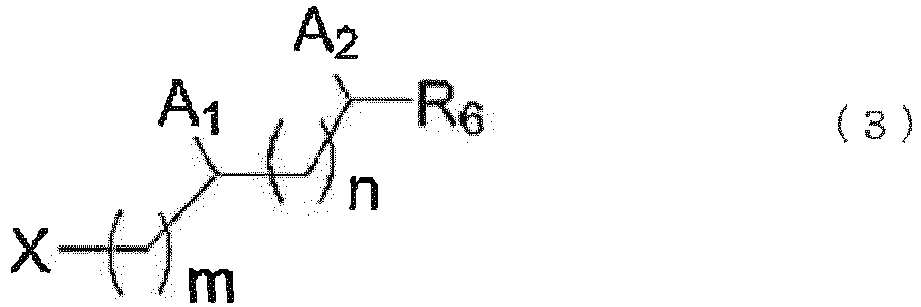
- a specific method for producing the alkanolamine of the present invention is not particularly limited and may, for example, be a method of reacting a raw material amine represented by the following formula (2) with a halide represented by the following formula (3) or an epoxy compound represented by the following formula (4) and further with a halide represented by the following formula (5) or a method of reacting a raw material amine represented by the following formula (2) with a halide represented by the following formula (5) and further with a halide represented by the following formula (3) or an epoxy compound represented by the following formula (4).
- R 2 to R 5 are each independently a hydrogen atom or a hydrocarbon group having at most 30 carbon atoms; wherein A 1 and A 2 are each independently a hydroxy group or a hydrogen atom, provided that A 1 and A 2 are not hydrogen atoms at the same time, R 6 is a hydrogen atom or a hydrocarbon group having at most 30 carbon atoms, X is a halogen atom, and m and n are each independently an integer of from 0 to 10; wherein A 2 is a hydroxy group or a hydrogen atom, R 6 is a hydrogen atom or a hydrocarbon group having at most 30 carbon atoms, and n is an integer of from 0 to 10; R 1 -X (5) wherein R 1 is a hydrocarbon group having at most 30 carbon atoms, and X is a halogen atom.
- X is a halogen atom
- the halogen atom is not particularly limited and may, for example, be a bromine atom, a chlorine atom, an iodine atom or a fluorine atom.
- the alkanolamine compound of the present invention may be used as a composition or an additive of a lubricating oil.
- a composition containing the alkanolamine of the present invention and a molybdenum compound may be used as a friction-reducing agent for a lubricating oil, although it is not particularly limited.
- the friction-reducing agent of present invention is preferably a composition containing the above alkanolamine and a molybdenum compound, and the composition preferably contains the molybdenum compound in a content of from 0.1 to 3 mol as calculated as molybdenum atoms in the molybdenum compound per 1 mol of the alkanolamine.
- the molybdenum content is, in view of excellent friction-reducing properties, preferably from 0.5 to 1.5 mol. If the amount of the molybdenum atoms is less than 0.1 mol, no satisfactory friction-reducing properties will be obtained, and if it exceeds 3 mol, the oil solubility may decrease.
- the molybdenum compound in the friction-reducing agent of the present invention is a compound having molybdenum in its molecule and is not particularly limited. It may, for example, be molybdenum trioxide, molybdic acid, an alkali metal molybdate or ammonium molybdate. They may be used alone or as a mixture of two or more. Considering the oil solubility and friction properties, among them, molybdenum trioxide is particularly preferred.
- the method for producing the friction-reducing agent of the present invention is not particularly limited and may, for example, be a method of mixing the alkanolamine of the present invention and the molybdenum compound in a content of the molybdenum compound of from 0.1 to 3 mol as calculated as molybdenum atoms in the molybdenum compound per 1 mol of the alkanolamine, and heating the mixture.
- the temperature at the time of heating is not particularly limited, and is preferably from 40°C to 200°C, particularly preferably from 60°C to 120°C, whereby a composition having favorable oil solubility is obtained.
- a solvent may be used, and a solvent which can be used is not particularly limited and may, for example, be a hydrocarbon organic solvent such as hexane, cyclohexane, octane, isooctane, benzene, toluene, xylene or paraffin, an alcohol organic solvent such as methanol, ethanol, isopropanol, butanol, ethylene glycol or propylene glycol, an aprotic polar solvent such as diethylene ether, dibutyl ether, ethylene glycol dimethyl ether, diethylene glycol dimethyl ether, tetrahydrofuran, dimethylformamide or dimethylsulfoxide, a fuel oil such as gasoline, gas oil, kerosene, mineral oil or polybutene, a lubricating oil such as a mineral oil, a synthetic oil, a vegetable oil or an animal oil (including an unmixed lubricating oil, and a lubricating oil, and
- the solvent may be removed e.g. by vacuum distillation, or the mixture may be used as it is without removing the solvent.
- the lubricating oil composition of the present invention is characterized by containing the friction-reducing agent of the present invention and the lubricating oil (including an unmixed lubricating oil and a lubricating oil containing additives).
- the lubricating oil is not particularly limited and may, for example, be an automobile lubricating oil such as a gasoline engine oil, a Diesel engine oil or a vehicle gear oil, a ship lubricating oil such as a ship engine oil, or an industrial lubricating oil such as a machine oil, a metal processing oil or an electrical insulating oil.
- the lubricating oil composition of the present invention may contain an abrasion inhibitor other than the friction-reducing agent of the present invention, within a range not to impair the effects of the present invention, whereby the lubricating oil composition will have more favorable friction-reducing properties.
- an abrasion inhibitor is preferably a zinc dithiophosphate abrasion inhibitor, and may, for example, be zinc dialkyldithiophosphate, zinc diaryldithiophosphate or zinc alkylaryldithiophosphate.
- Lz 677A, Lz 1095, Lz 1097, Lz 1370, Lz 1371, Lz 1373 and Lz 1395 commercially available from The Lubrizol Corporation
- OLOA 260, OLOA 262, OLOA 267 and OLOA 269R commercially available from Chevron Oronite
- HITEC 7169 and HITEC 7197 commercially available from Afton Chemical Corporation
- ADEKA KIKU-LUBE Z-112 available from ADEKA CORPORATION.
- the friction-reducing agent of the present invention may further contain a boron compound, whereby more favorable friction-reducing properties at low temperature will be obtained.
- the boron compound used is not particularly limited and may, for example, be an aminoborane compound such as tris(dimethylamino)borane or tris(diethylamino)borane, a borate ester such as trimethyl borate, triethyl borate, tripropyl borate, tributyl borate, tripentyl borate, trihexyl borate, trioctyl borate, tridecyl borate, tritetradecyl borate, triphenyl borate, triethanolamine borate, triisopropanolamine borate, 2-ethoxy-4,4,5,5-tetramethyl-1,3,2-dioxoborolane, 2-isopropoxy-4,4,5,5-tetramethyl-1,3,2-dioxoborolane, 2-isopropoxy-4,4,6-tri
- the amount of the boron compound blended (that is, the content in the friction-reducing agent) is preferably within a range of from 0.01 to 3.0 wt%, particularly preferably within a range of from 0.05 to 2.0 wt%, in view of excellent balance between the friction-reducing properties particularly at low temperature and oil solubility.
- NMR measuring apparatus VARIAN Gemini-200.
- Elemental analyzer automatic elemental analysis apparatus 2400II, manufactured by Perkin Elmer Japan Co., Ltd.
- Oxygen flask combustion IC measurement method Ion Chromatograph IC-2001 manufactured by TOSOH CORPORATION.
- the obtained amine molybdate composition was mixed with toluene so that the concentration of the amine molybdate concentration would be 1 wt%, followed by stirring with heating at 80°C for dissolution. The state of the solution after left to stand overnight was visually observed and taken as the index of the oil solubility.
- the obtained friction-reducing agent was blended with base oil (C-1, manufactured by Exxon Mobil Corporation, SpectraSyn Plus 6) so that the molybdenum concentration would be 500 ppm. Further, zinc dialkyldithiophosphate (ZnDTP, manufactured by ADEKA CORPORATION, KIKU-LUBE Z-112) as an abrasion inhibitor was blended so that the zinc concentration would be 1,000 ppm.
- base oil C-1, manufactured by Exxon Mobil Corporation, SpectraSyn Plus 6
- ZnDTP zinc dialkyldithiophosphate
- the coefficient of friction was evaluated by using Friction Player (manufactured by RHESCA CO., LTD., FPR2100) by ball-on-disk method at 120°C at a rotational speed of 477.5 rpm under a load of 10 N.
- Friction Player manufactured by RHESCA CO., LTD., FPR2100
- ball-on-disk method at 120°C at a rotational speed of 477.5 rpm under a load of 10 N.
- lapped SUJ2 was used for the ball and the disk.
- the average of coefficients of friction measured for one hour was calculated.
- the coefficient of friction was evaluated by using Friction Player (manufactured by RHESCA CO., LTD., FPR2100) by ball-on-disk method at 80°C at a rotational speed of 477.5 rpm under a load of 10 N.
- Friction Player manufactured by RHESCA CO., LTD., FPR2100
- ball-on-disk method 80°C at a rotational speed of 477.5 rpm under a load of 10 N.
- lapped SUJ2 was used for the ball and the disk.
- the average of coefficients of friction measured for 3 hours was calculated.
- the friction-reducing agent (A-2) was excellent in oil solubility, had a low coefficient of friction and had favorable friction-reducing properties.
- the friction-reducing agent (A-3) was excellent in oil solubility, had a low coefficient of friction and had favorable friction-reducing properties.
- the friction-reducing agent (A-4) was excellent in oil solubility, had a low coefficient of friction and had favorable friction-reducing properties.
- the friction-reducing agent (A-5) was excellent in oil solubility, had a low coefficient of friction and had favorable friction-reducing properties.
- the friction-reducing agent (A-6) was excellent in oil solubility, had a low coefficient of friction and had favorable friction-reducing properties.
- the friction-reducing agent (A-7) was excellent in oil solubility, had a low coefficient of friction and had favorable friction-reducing properties.
- the friction-reducing agent (A-8) was excellent in oil solubility, had a low coefficient of friction and had favorable friction-reducing properties.
- the friction-reducing agent (A-9) was blended with base oil (C-1) so that the molybdenum concentration would be 500 ppm, and tris(dimethylamino)borane as a boron compound was blended at a concentration of 0.1 wt%, and further, zinc dialkyldithiophosphate (ZnDTP, manufactured by ADEKA CORPORATION, KIKU-LUBE Z-112) as an abrasion inhibitor was blended so that the zinc concentration would be 1,000 ppm, to prepare a blended oil. Using the obtained blended oil, oil solubility and low temperature friction properties were evaluated. The results are shown in Table 3.
- Example 9 Example 10
- Example 11 Friction-reducing agent A-9 A-9 A-9 Amine Name 3-(4-(2-decyltetradecyl))-1-piperazinyl)-1,2-propanediol 3-(4-(2-decyltetradecyl))-1-piperazinyl)-1,2-propanediol 3-(4-(2-decyltetradecyl))-1-piperazinyl)-1,2-propanediol Structural formula Molybdenum MoO 3 MoO 3 MoO 3 Mo/amine (molar ratio) 1.05 1.05 1.05 Mo content (wt%) 14.0 14.0 14.0 Boron compound Name Tris(dimethylamino) borane Tris(dimethylamino) borane Tris(dimethylamino) borane Amount blended [wt%]
- a blended oil was prepared in the same manner as in Example 9 except that the amount of tris(dimethylamino)borane as a boron compound blended was 0.5 wt%, and oil solubility and low temperature friction properties were evaluated. The results are shown in Table 3.
- the obtained blended oil was excellent in oil solubility, had a low coefficient of friction and had favorable low temperature friction properties.
- a blended oil was prepared in the same manner as in Example 9 except that the amount of tris(dimethylamino)borane as a boron compound blended was 1.0 wt%, and oil solubility and low temperature friction properties were evaluated. The results are shown in Table 3.
- the obtained blended oil was excellent in oil solubility, had a low coefficient of friction and had favorable low temperature friction properties.
- friction-reducing agent (B-1) comprising base oil (C-1) and zinc dialkyldithiophosphate (ZnDTP, manufactured by ADEKA CORPORATION, KIKU-LUBE Z-112) as an abrasion inhibitor blended so that the zinc concentration would be 1,000 ppm, oil solubility and friction properties were evaluated, and the results are shown in Table 4.
- the friction-reducing agent (B-1) had a high coefficient of friction and was inferior in friction-reducing properties.
- friction-reducing agent (B-2) comprising base oil (C-1) and 3-(1-piperazinyl)-1,2-propanediol blended at a concentration of 0.1 wt%
- oil solubility and friction properties were evaluated, and the results are shown in Table 4.
- the friction-reducing agent (B-2) was inferior in oil solubility and was separated from the base oil, and the friction properties could not be evaluated.
- the friction-reducing agent (B-3) was suspended in the base oil, had a high coefficient of friction and was inferior in friction-reducing properties.
- friction-reducing agent (B-4) comprising base oil (C-1) and molybdenum oxysulfide dithiocarbamate (MoDTC, manufactured by ADEKA CORPORATION, SAKURA-LUBE 525, Mo content: 10.0 wt%) blended so that the molybdenum concentration would be 500 ppm, oil solubility and friction properties were evaluated, and the results are shown in Table 4.
- the friction-reducing agent (B-4) had a high coefficient of friction and was inferior in friction-reducing properties.
- the friction-reducing agent of the present invention is excellent in friction-reducing properties and is thereby suitable as an additive for a lubricating oil. It is particularly useful as an additive for a gasoline engine oil, a Diesel engine oil, a jet engine oil and a gear oil.
Landscapes
- Chemical & Material Sciences (AREA)
- Organic Chemistry (AREA)
- Chemical Kinetics & Catalysis (AREA)
- General Chemical & Material Sciences (AREA)
- Oil, Petroleum & Natural Gas (AREA)
- Inorganic Chemistry (AREA)
- Lubricants (AREA)
Abstract
Description
- The present invention relates to an alkanolamine, a friction-reducing agent and a lubricating oil composition.
- In recent years, reduction of carbon dioxide gas which has an impact on global warming among environmental problems has been strongly desired. An automobile field is responsible for about one-fifth of carbon dioxide gas emission sources, and trials regarding the improvement of fuel efficiency to reduce carbon dioxide gas have been actively conducted. The techniques to improve fuel efficiency in the automobile field are to reduce engine loss, auxiliary loss, drive train loss and running resistance comprising rolling resistance, air resistance and inertial resistance, and improvement of fuel efficiency is realized by combining various techniques. The engine loss includes friction loss, and reduction of engine or drive train loss includes reduction of friction loss e.g. by an engine oil, in addition to mechanical factors.
- Reduction of friction loss by an engine oil is chiefly achieved by reducing flow resistance by lowering the viscosity of the oil. However, simply by lowering the viscosity, the oil film becomes thin, and even at a speed at which an oil having a usual viscosity is in a hydrodynamic lubrication region, a low viscosity oil is in a boundary lubrication region, friction may rather increase and friction loss may occur, or machines may be damaged by abrasion. Accordingly, for the purpose of reducing such friction and abrasion, various additives are blended in a fuel-efficient engine oil.
- A friction-reducing agent to be added to a fuel-efficient engine oil is adsorbed on a metal surface to form a coating film, thereby to prevent direct contact of metal members to reduce friction. As typical friction-reducing agents, for example, a suspension of a molybdenum compound and an alkali sulfide, molybdenum oxysulfide dithiocarbamate obtained by reacting carbon disulfide, a secondary amine and a mineral acid (for example, Patent Document 1), molybdenum oxysulfide dithiophosphate (for example, Patent Document 2), a phosphorus molybdenum compound obtained by reducing a hexavalent molybdenum compound with a reducing agent, neutralizing it with a mineral acid containing no phosphorus atom and then reacting it with an acidic phosphoric acid ester (for example, Patent Document 3), an amine salt of molybdic acid obtained by reacting a molybdenum compound and a secondary amine (for example, Patent Document 4), etc. have been proposed.
- The friction-reducing agents disclosed in Patent Documents 1 to 3, which contain sulfur or phosphorus, may corrode metals at high temperature or may poison an exhaust gas catalyst.
- Further, although the friction-reducing agent disclosed in Patent Document 4 does not contain sulfur or phosphorus, it had problems such that it is inferior in the oil solubility and it is not necessarily sufficient in the friction-reducing properties.
-
- Patent Document 1:
JP-A-H07-53983 - Patent Document 2:
JP-A-2001-40383 - Patent Document 3:
JP-A-2008-37860 - Patent Document 4:
JP-A-S61-285292 - Under these circumstances, it is an object of the present invention to provide a friction-reducing agent containing no sulfur nor phosphorus and being excellent in the friction-reducing properties, and a lubricating oil composition containing it.
- The present inventors have conducted extensive studies to achieve the above object and as a result, found that a specific alkanolamine has excellent friction-reducing properties due to its structural characteristics, and accomplished the present invention.
- That is, the present invention provides the following embodiments.
- [1] An alkanolamine represented by the following formula (1):

- [2] The alkanolamine according to [1], wherein in the formula (1), R1 is a hydrocarbon group having at least 8 and at most 24 carbon atoms, all of R2 to R6 are hydrogen atoms, m=1 and n=0.
- [3] The alkanolamine according to [1] or [2], wherein A1 and A2 are both hydroxy groups.
- [4] A method for producing the alkanolamine as defined in [1] or [2], which comprises reacting a raw material amine represented by the following formula (2) with a halide represented by the following formula (3) or an epoxy compound represented by the following formula (4) and further with a halide represented by the following formula (5):


R1-X (5)
wherein R1 is a hydrocarbon group having at most 30 carbon atoms, and X is a halogen atom. - [5] A method for producing the alkanolamine as defined in [1] or [2], which comprises reacting a raw material amine represented by the following formula (2) with a halide represented by the following formula (5) and further with a halide represented by the following formula (3) or an epoxy compound represented by the following formula (4):

R1-X (5)
wherein R1 is a hydrocarbon group having at most 30 carbon atoms, and X is a halogen atom;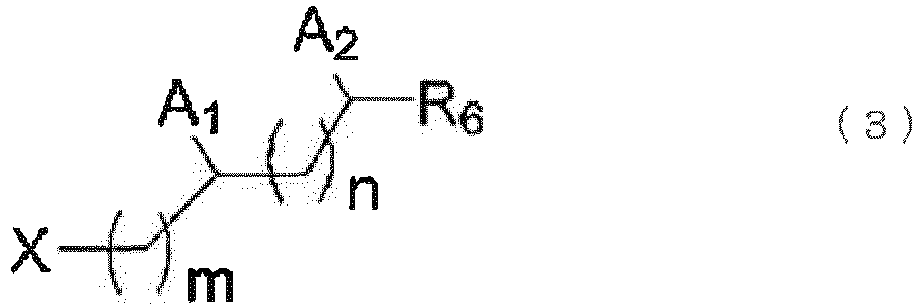

- [6] A friction-reducing agent comprising the alkanolamine as defined in any one of [1] to [3] and a molybdenum compound, in a content of the molybdenum compound of from 0.1 to 3 mol as calculated as molybdenum atoms in the molybdenum compound per 1 mol of the alkanolamine.
- [7] The friction-reducing agent according to [6], wherein the molybdenum compound is at least one molybdenum compound selected from the group consisting of molybdenum trioxide, molybdic acid and a molybdate.
- [8] The friction-reducing agent according to [6], which further contains a boron compound.
- [9] A method for producing the friction-reducing agent as defined in [6] or [7], which comprises mixing an alkanolamine represented by the following formula (1):

with a molybdenum compound in a content of the molybdenum compound of from 0.1 to 3 mol as calculated as molybdenum atoms in the molybdenum compound per 1 mol of the alkanolamine, and heating the mixture. - [10] A lubricating oil composition comprising the friction-reducing agent as defined in any one of [6] to [8] and a lubricating oil.
- [11] The lubricating oil composition according to [10], which further contains a zinc dithiophosphate-based abrasion inhibitor.
- [12] A lubricating oil containing the alkanolamine as defined in [1] or [3].
- According to the present invention, an alkanolamine suitable for a friction-reducing agent, a friction-reducing agent excellent in the friction-reducing properties, and a lubricating oil composition are provided. The alkanolamine and the friction-reducing agent of the present invention are characterized by containing no sulfur nor phosphorus and having low environmental burden.
- Now, the present invention will be described in further detail.
- The alkanolamine of the present invention is characterized by being represented by the formula (1).
- In the formula (1), A1 and A2 are each independently a hydroxy group or a hydrogen atom, and A1 and A2 are not hydrogen atoms at the same time. With a view to obtaining favorable friction-reducing properties, A1 and A2 in the formula (1) are particularly preferably both hydroxy groups.
- In the formula (1), R1 is a hydrocarbon group having at most 30 carbon atoms, and R2 to R6 are each independently a hydrogen atom or a hydrocarbon group having at most 30 carbon atoms.
- The hydrocarbon having at most 30 carbon atoms may, for example, be an alkyl group, an alkenyl group, an aryl group, a cycloalkyl group or a cycloalkenyl group, having at most 30 carbon atoms.
- The alkyl group having at most 30 carbon atoms may, for example, be a methyl group, an ethyl group, or a linear or branched propyl group, butyl group, pentyl group, hexyl group, heptyl group, octyl group, nonyl group, decyl group, undecyl group, dodecyl group, tridecyl group, tetradecyl group, pentadecyl group, hexadecyl group, heptadecyl group, octadecyl group, nonadecyl group, eicosyl group, heneicosyl group, docosyl group, tricosyl group or tetracosyl group.
- The alkenyl group having at most 30 carbon atoms may, for example, be a propenyl group, a butenyl group, a pentenyl group, a hexenyl group, a heptenyl group, an octenyl group, a nonenyl group, a decenyl group, an undecenyl group or a dodecenyl group.
- The aryl group having at most 30 carbon atoms may, for example, be a phenyl group, a toluyl group, a xylyl group, a cumenyl group, a mesityl group, a benzyl group, a phenethyl group, a styryl group, a cinnamyl group, a benzhydryl group, a trityl group, an ethylphenyl group, a propylphenyl group, a butylphenyl group, a pentylphenyl group, a hexylphenyl group, a heptylphenyl group, an octylphenyl group, a nonylphenyl group, a decylphenyl group, an undecylphenyl group, a dodecylphenyl group, a styrenated phenyl group, a p-cumylphenyl group, a phenylphenyl group, a benzylphenyl group, an α-naphthyl group or a β-naphthyl group.
- The cycloalkyl group and cycloalkenyl group, having at most 30 carbon atoms, may, for example, be a cyclopentyl group, a cyclohexyl group, a cycloheptyl group, a methylcyclopentyl group, a methylcyclohexyl group, a methylcycloheptyl group, a cyclopentenyl group, a cyclohexenyl group, a cycloheptenyl group, a methylcyclopentenyl group, a methylcyclohexenyl group or a methylcycloheptenyl group.
- Among these hydrocarbon groups, R1 to R6 are preferably an alkyl group having at most 30 carbon atoms, more preferably a C8-24 alkyl group.
- It is preferred that all of R2 to R6 are hydrogen atoms, in view of easy preparation of the alkanolamine.
- R1 is, in view of excellent oil solubility of the alkanolamine, preferably a C8-24 alkyl group, more preferably an octyl group, a nonyl group, a decyl group, an undecyl group, a dodecyl group, a tridecyl group, a tetradecyl group, a pentadecyl group, a hexadecyl group, a heptadecyl group, an octadecyl group, a nonadecyl group, an eicosyl group, a heneicosyl group, a docosyl group, a tricosyl group or a tetracosyl group.
- In the formula (1), m and n represent the number of methylene groups, and are each independently an integer of from 0 to 10. It is preferred that m and n are each independently an integer of from 0 to 3, and in view of excellent friction-reducing properties, it is particularly preferred that m=1 and n=0.
- The alkanolamine in the present invention may, for example, be specifically 3-(4-octyl-1-piperazinyl)-1,2-propanediol, 3-(4-(2-ethylhexyl)-1-piperazinyl)-1,2-propanediol, 3-(4-nonyl-1-piperazinyl)-1,2-propanediol, 3-(4-decyl-1-piperazinyl)-1,2-propanediol, 3-(4-undecyl-1-piperazinyl)-1,2-propanediol, 3-(4-dodecyl-1-piperazinyl)-1,2-propanediol, 3-(4-tridecyl-1-piperazinyl)-1,2-propanediol, 3-(4-tetradecyl-1-piperazinyl)-1,2-propanediol, 3-(4-hexadecyl-1-piperazinyl)-1,2-propanediol, 3-(4-heptadecyl-1-piperazinyl)-1,2-propanediol, 3-(4-octadecy)-1-piperaziny))-1,2-propanediol, 3-(4-nonadecyl-1-piperazinyl)-1,2-propanediol, 3-(4-eicosyldecyl-1-piperazinyl)-1,2-propanediol, 3-(4-heneicosy)decyl-1-piperaziny))-1,2-propanediol, 3-(4-docosyl-1-piperazinyl)-1,2-propanediol, 3-(4-tricosyl-1-piperazinyl)-1,2-propanediol, 3-(4-tetracosyl-1-piperazinyl)-1,2-propanediol, 3-(4-phenyl-1-piperazinyl)-1,2-propanediol, 3-(4-benzyl-1-piperazinyl)-1,2-propanediol, 3-(4-cyclohexyl-1-piperazinyl)-1,2-propanediol, 4-(4-dodecyl-1-piperazinyl)-1,2-butanediol, 4-(4-dodecyl-1-piperazinyl)-1,3-butanediol, 4-(4-dodecyl-1-piperazinyl)-2,3-butanediol, 5-(4-dodecyl-1-piperazinyl)-1,2-pentanediol, 6-(4-dodecyl-1-piperazinyl)-1,2-hexanediol, 8-(4-dodecyl-1-piperazinyl)-1,2-octanediol, 4-dodecyl-1-piperazineethanol, 4-dodecyl-1-piperazinepropanol, 3-(4-(2-octyldodecyl)-1-piperazinyl)-1,2-propanediol, 3-(4-(2-hexyldecyl)-1-piperazinyl)-1,2-propanediol, 3-(4-(2-decyltetradecyl)-1-piperazinyl)-1,2-propanediol, 3-(4-isostearyl-1-piperazinyl)-1,2-propanediol or 3-(4-oleyl-1-piperazinyl)-1,2-propanediol.
- The alkanolamine of the present invention may be produced by reacting a raw material alkanolamine with a halide or an epoxy compound. Further, the raw material alkanolamine may be produced by reacting a raw material amine with a halide containing a hydroxy group or an epoxy compound.
- In the above reaction, the reaction temperature is not particularly limited, however, with a view to obtaining a desired product with a favorable yield, it is preferably from 40°C to 200°C, particularly preferably from 60°C to 150°C.
- For the reaction, a solvent may be used. The solvent is not particularly limited and may, for example, be a hydrocarbon organic solvent such as hexane, cyclohexane, octane, isooctane, benzene, toluene, xylene or paraffin, an alcohol organic solvent such as methanol, ethanol, isopropanol, butanol, ethylene glycol or propylene glycol, or an aprotic polar solvent such as diethyl ether, dibutyl ether, ethylene glycol dimethyl ether, diethylene glycol dimethyl ether, tetrahydrofuran, dimethylformamide or dimethylsufoxide. They may be used alone or as a mixture of two or more.
- For the reaction, a catalyst may be used. The catalyst is not particularly limited and may, for example, be an alkali metal carbonate such as potassium carbonate, sodium carbonate, lithium carbonate or cesium carbonate, an alkaline earth metal carbonate such as magnesium carbonate or calcium carbonate, an alkali metal hydrogen carbonate such as sodium hydrogen carbonate or potassium hydrogen carbonate, an alkali metal hydroxide such as sodium hydroxide, potassium hydroxide or lithium hydroxide, an alkaline earth metal hydroxide such as magnesium hydroxide or calcium hydroxide, or a basic substance such as sodium methoxide or sodium ethoxide.
- The raw material amine used for production of the alkanolamine of the present invention is not particularly limited and may, for example, be piperazine or a piperazine derivative. Specifically, although it is not particularly limited, it may, for example, be piperazine, 2-methyl-piperazine, 1-octyl-piperazine, 1-(2-ethylhexyl)-piperazine, 1-nonyl-piperazine, 1-decyl-piperazine, 1-undecyl-piperazine, 1-dodecyl-piperazine, 1-tridecyl-piperazine, 1-tetradecyl-piperazine, 1-tetradecyl-piperazine, 1-hexadecyl-piperazine, 1-heptadecyl-piperazine, 1-octadecyl-piperazine, 1-nonadecyl-piperazine, 1-eicosyldecyl-piperazine, 1-heneicosyldecyl-piperazine, 1-docosyl-piperazine, 1-tricosyl-piperazine, 1-tetracosyl-piperazine, 1-phenyl-piperazine, 1-benzyl-piperazine or 1-cyclohexyl-piperazine.
- The raw material alkanolamine used for production of the alkanolamine of the present invention is not particularly limited and may, for example, be 3-(1-piperazinyl)-1, 2-propanediol, 4-(1-piperazinyl)-1, 3-butanediol, 4-(1-piperazinyl)-2, 3-butanediol, 5-(1-piperazinyl)-1, 2-pentanediol, 6-(1-piperazinyl)-1, 2-hexanediol, 8-(1-piperazinyl)-1, 2-octanediol, 1-piperazinemethanol, 1-piperazineethanol, 1-piperazinepropanol, 1-piperazinebutanol, 1-piperazinepentanol, 1-piperazinehexanol, 1-piperazineheptanol or 1-piperazineoctanol.
- The halide used for production of the alkanolamine of the present invention is not particularly limited and may, for example, be a brominated hydrocarbon, chlorinated hydrocarbon, iodinated hydrocarbon or fluorinated hydrocarbon, having at most 30 carbon atoms, and they may have one or two hydroxy groups in its molecule.
- The epoxy compound used for production of the alkanolamine of the present invention is not particularly limited and may be an epoxy hydrocarbon group having at most 10 carbon atoms, and may have one hydroxy group in its molecule. It may, for example, be specifically, glycidol, ethylene oxide or propylene oxide.
- After completion of the reaction, the alkanolamine of the present invention can be obtained by means of a conventional purification method such as extraction, filtration, crystallization, distillation or chromatography by itself or suitably in combination.
- A specific method for producing the alkanolamine of the present invention is not particularly limited and may, for example, be a method of reacting a raw material amine represented by the following formula (2) with a halide represented by the following formula (3) or an epoxy compound represented by the following formula (4) and further with a halide represented by the following formula (5) or a method of reacting a raw material amine represented by the following formula (2) with a halide represented by the following formula (5) and further with a halide represented by the following formula (3) or an epoxy compound represented by the following formula (4).


R1-X (5)
wherein R1 is a hydrocarbon group having at most 30 carbon atoms, and X is a halogen atom. - In the formulae (3) and (5), X is a halogen atom, and the halogen atom is not particularly limited and may, for example, be a bromine atom, a chlorine atom, an iodine atom or a fluorine atom.
- The alkanolamine compound of the present invention may be used as a composition or an additive of a lubricating oil. A composition containing the alkanolamine of the present invention and a molybdenum compound may be used as a friction-reducing agent for a lubricating oil, although it is not particularly limited.
- The friction-reducing agent of present invention is preferably a composition containing the above alkanolamine and a molybdenum compound, and the composition preferably contains the molybdenum compound in a content of from 0.1 to 3 mol as calculated as molybdenum atoms in the molybdenum compound per 1 mol of the alkanolamine. The molybdenum content is, in view of excellent friction-reducing properties, preferably from 0.5 to 1.5 mol. If the amount of the molybdenum atoms is less than 0.1 mol, no satisfactory friction-reducing properties will be obtained, and if it exceeds 3 mol, the oil solubility may decrease.
- The molybdenum compound in the friction-reducing agent of the present invention is a compound having molybdenum in its molecule and is not particularly limited. It may, for example, be molybdenum trioxide, molybdic acid, an alkali metal molybdate or ammonium molybdate. They may be used alone or as a mixture of two or more. Considering the oil solubility and friction properties, among them, molybdenum trioxide is particularly preferred.
- The method for producing the friction-reducing agent of the present invention is not particularly limited and may, for example, be a method of mixing the alkanolamine of the present invention and the molybdenum compound in a content of the molybdenum compound of from 0.1 to 3 mol as calculated as molybdenum atoms in the molybdenum compound per 1 mol of the alkanolamine, and heating the mixture. The temperature at the time of heating is not particularly limited, and is preferably from 40°C to 200°C, particularly preferably from 60°C to 120°C, whereby a composition having favorable oil solubility is obtained. In the method, a solvent may be used, and a solvent which can be used is not particularly limited and may, for example, be a hydrocarbon organic solvent such as hexane, cyclohexane, octane, isooctane, benzene, toluene, xylene or paraffin, an alcohol organic solvent such as methanol, ethanol, isopropanol, butanol, ethylene glycol or propylene glycol, an aprotic polar solvent such as diethylene ether, dibutyl ether, ethylene glycol dimethyl ether, diethylene glycol dimethyl ether, tetrahydrofuran, dimethylformamide or dimethylsulfoxide, a fuel oil such as gasoline, gas oil, kerosene, mineral oil or polybutene, a lubricating oil such as a mineral oil, a synthetic oil, a vegetable oil or an animal oil (including an unmixed lubricating oil, and a lubricating oil containing additives such as a detergent dispersant, an antioxidant, a load carrying additive, a rust inhibitor, a corrosion inhibitor, a viscosity index improver, a pour point depressant, an anti-foam additive, an emulsifying agent, an anti-emulsifying agent, and a microbiocide), or water. They may be used alone or as a mixture of two or more.
- In production of the friction-reducing agent of the present invention, after mixing and heating, as the case requires, the solvent may be removed e.g. by vacuum distillation, or the mixture may be used as it is without removing the solvent.
- The lubricating oil composition of the present invention is characterized by containing the friction-reducing agent of the present invention and the lubricating oil (including an unmixed lubricating oil and a lubricating oil containing additives). The lubricating oil is not particularly limited and may, for example, be an automobile lubricating oil such as a gasoline engine oil, a Diesel engine oil or a vehicle gear oil, a ship lubricating oil such as a ship engine oil, or an industrial lubricating oil such as a machine oil, a metal processing oil or an electrical insulating oil.
- The lubricating oil composition of the present invention may contain an abrasion inhibitor other than the friction-reducing agent of the present invention, within a range not to impair the effects of the present invention, whereby the lubricating oil composition will have more favorable friction-reducing properties. Such an abrasion inhibitor is preferably a zinc dithiophosphate abrasion inhibitor, and may, for example, be zinc dialkyldithiophosphate, zinc diaryldithiophosphate or zinc alkylaryldithiophosphate. As commercial products, specifically, Lz 677A, Lz 1095, Lz 1097, Lz 1370, Lz 1371, Lz 1373 and Lz 1395 commercially available from The Lubrizol Corporation, OLOA 260, OLOA 262, OLOA 267 and OLOA 269R commercially available from Chevron Oronite, HITEC 7169 and HITEC 7197 commercially available from Afton Chemical Corporation, and ADEKA KIKU-LUBE Z-112 available from ADEKA CORPORATION.
- The friction-reducing agent of the present invention may further contain a boron compound, whereby more favorable friction-reducing properties at low temperature will be obtained. The boron compound used is not particularly limited and may, for example, be an aminoborane compound such as tris(dimethylamino)borane or tris(diethylamino)borane, a borate ester such as trimethyl borate, triethyl borate, tripropyl borate, tributyl borate, tripentyl borate, trihexyl borate, trioctyl borate, tridecyl borate, tritetradecyl borate, triphenyl borate, triethanolamine borate, triisopropanolamine borate, 2-ethoxy-4,4,5,5-tetramethyl-1,3,2-dioxoborolane, 2-isopropoxy-4,4,5,5-tetramethyl-1,3,2-dioxoborolane, 2-isopropoxy-4,4,6-trimethyl-1,3,2-dioxaborinane, 2-methoxy-4,4,5,5-tetramethyl-1,3,2-dioxoborolane, 2,4,6-trimethylboroxine, tris(trimethylsilyl)borate or tris(2-cyanoethyl)borate, a boronic acid compound such as ethyl boronate, propyl boronate, butyl boronate, pentyl boronate, hexyl boronate, octyl boronate, decyl boronate, dodecyl boronate, tridecyl boronate, tetradecyl boronate, cyclohexyl boronate, cyclopentyl boronate or 1-cyclopentenyl boronate, or a boron dispersed alkenyl succinimide. The amount of the boron compound blended (that is, the content in the friction-reducing agent) is preferably within a range of from 0.01 to 3.0 wt%, particularly preferably within a range of from 0.05 to 2.0 wt%, in view of excellent balance between the friction-reducing properties particularly at low temperature and oil solubility.
- Now, the present invention will be described in further detail with reference to Examples. However, it should be understood that the present invention is by no means restricted to such specific Examples. Reagents etc. used were commercial products unless otherwise specified.
- Analytical instruments and evaluation methods employed in Examples are described below.
- NMR measuring apparatus: VARIAN Gemini-200.
- Elemental analyzer: automatic elemental analysis apparatus 2400II, manufactured by Perkin Elmer Japan Co., Ltd.
- Oxygen flask combustion IC measurement method: Ion Chromatograph IC-2001 manufactured by TOSOH CORPORATION.
- The obtained amine molybdate composition was mixed with toluene so that the concentration of the amine molybdate concentration would be 1 wt%, followed by stirring with heating at 80°C for dissolution. The state of the solution after left to stand overnight was visually observed and taken as the index of the oil solubility.
-
- A: A solution state without precipitates or suspension.
- B: A suspension state.
- C: A state with separation or precipitates observed.
- The obtained friction-reducing agent was blended with base oil (C-1, manufactured by Exxon Mobil Corporation, SpectraSyn Plus 6) so that the molybdenum concentration would be 500 ppm. Further, zinc dialkyldithiophosphate (ZnDTP, manufactured by ADEKA CORPORATION, KIKU-LUBE Z-112) as an abrasion inhibitor was blended so that the zinc concentration would be 1,000 ppm.
- Of a blended oil prepared in the after-described Examples, the coefficient of friction was evaluated by using Friction Player (manufactured by RHESCA CO., LTD., FPR2100) by ball-on-disk method at 120°C at a rotational speed of 477.5 rpm under a load of 10 N. For the ball and the disk, lapped SUJ2 was used. The average of coefficients of friction measured for one hour was calculated.
-
- A: Coefficient of friction being less than 0.075.
- B: Coefficient of friction being at least 0.075 and less than 0.10.
- C: Coefficient of friction being at least 0.10.
- Of a blended oil prepared in the after-described Examples, the coefficient of friction was evaluated by using Friction Player (manufactured by RHESCA CO., LTD., FPR2100) by ball-on-disk method at 80°C at a rotational speed of 477.5 rpm under a load of 10 N. For the ball and the disk, lapped SUJ2 was used. The average of coefficients of friction measured for 3 hours was calculated.
-
- A: Coefficient of friction being less than 0.075.
- B: Coefficient of friction being at least 0.075 and less than 0.10.
- C: Coefficient of friction being at least 0.10.
- Into a 1 L four-necked flask equipped with a stirring machine and a condenser tube, 74.4 g (0.47 mol) of 3-(1-piperazinyl)-1,2-propanediol, 38.6 g (0.16 mol) of dodecyl bromide, isopropanol (500 g) and 17.3 g (0.16 mol) of sodium carbonate were added, followed by heating at 90°C for 8 hours in a stream of nitrogen. After completion of heating, sodium carbonate was removed by filtration, and 2-propanol was removed by vacuum distillation. Then, only the oil layer was collected by extraction with chloroform, which was subjected to vacuum distillation and vacuum drying to obtain 48.58 g (yield: 95.4%) of white crystalline 3-(4-dodecyl-1-piperazinyl)-1,2-propanediol. Identification was conducted from the results of 1H-NMR measurement, 13C-NMR measurement and elemental analysis.
1H-NMR(CDCl3): 3.72-3.84(m,2H), 3.48-3.53(dd,1H), 2.29-2.70(m,12H), 1.47(s,2H), 1.19-1.26(m,18H), 0.86-0.90(t,3H) [ppm]
13C-NMR(CDCl3):66.85, 65.00, 60.44, 58.73, 53.35, 53.23, 31.86, 29.61, 29.58, 29.56, 29.53, 29.29, 27.56, 26.81, 22.63, 14.05 [ppm]
Elemental analysis (calculated value): C=69.5, H=12.3, N=8.5,
Elemental analysis (measured value): C=69.6, H=12.8, N=8.5. - Then, into a 100 mL round bottom flask, 3.29 g of 3-(4-dodecyl-1-piperazinyl)-1,2-propanediol and 10 g of toluene were added, followed by heating at 80°C for dissolution, and an aqueous molybdenum dispersion having 1.51 g of molybdenum trioxide dispersed in 10 g of water was dropwise added. On that occasion, the Mo atom/amine (molar ratio) was 1.05. Then, the reaction mixture was aged at 80°C for 2 hours and at 110°C for 1 hour. After completion, unreacted molybdenum trioxide was removed by filtration, and the solvent was removed by vacuum distillation and vacuum drying to obtain 3.58 g of liver brown solid friction-reducing agent (A-1). The molybdenum content in the friction-reducing agent (A-1) was 13.2 wt%.
- Using the obtained friction-reducing agent (A-1), oil solubility and friction properties were evaluated, and the results are shown in Table 1. The friction-reducing agent (A-1) was excellent in oil solubility, had a low coefficient of friction and had favorable friction-reducing properties.
[Table 1] Example 1 Example 2 Example 3 Example 4 Friction-reducing agent A-1 A-2 A-3 A-4 Amine Name 3-(4-dodecyl-1-piperazinyl)-1,2-propanediol 3-(4-hexadecyl-1-piperazinyl)-1,2-propanediol 3-(4-octadecyl-1-piperazinyl)-1,2-propanediol 3-(4-dodecyl-1-piperazinyl)-1,2-propanediol Structural formula 


Molybdenum MoO3 MoO3 MoO3 MoO3 Mo/amine (molar ratio) 1.05 0.5 1.05 1.5 Mo content (wt%) 13.2 9.3 8.2 21.7 Oil solubility Results Soluble Soluble Soluble Soluble Evaluation A A A A Friction properties Coefficient of friction 0.052 0.044 0.072 0.069 Evaluation A A A A [Table 2] Example 5 Example 6 Example 7 Example 8 Friction-reducing agent A-5 A-6 A-7 A-8 Amine Name 3-(4-(2-ethylhexyl))-1-piperazinyl)-1,2-propanediol 4-dodecyl-1-piperazineethanol 3-(4-(2-decyltetradecyl))-1-piperazinyl)-1,2-propanediol 3-(4-(2-decyltetradecyl))-1-piperazinyl)-1,2-propanediol Structural formula 


Molybdenum MoO3 MoO3 MoO3 MoO3 Mo/amine (molar ratio) 1.05 1.05 1.05 0.75 Mo content (wt%) 16.3 6.4 12.7 8.8 Oil solubility Results Soluble Soluble Soluble Soluble Evaluation A A A A Friction properties Coefficient of friction 0.089 0.066 0.045 0.051 Evaluation B A A A - Into a 1 L four-necked flask equipped with a stirring machine and a condenser tube, 74.4 g (0.47 mol) of 3-(1-piperazinyl)-1,2-propanediol, 47.3 g (0.16 mol) of hexadecyl bromide, isopropanol (500 g) and 17.3 g (0.16 mol) of sodium carbonate were added, followed by heating at 90°C for 8 hours in a stream of nitrogen. After completion of heating, sodium carbonate was removed by filtration, and 2-propanol was removed by vacuum distillation. Then, only the oil layer was collected by extraction with chloroform, which was subjected to vacuum distillation and vacuum drying to obtain 56.6 g (yield: 94.9%) of white crystalline 3-(4-hexadecyl-1-piperazinyl)-1,2-propanediol.
- Identification was conducted from the results of 1H-NMR measurement, 13C-NMR measurement and elemental analysis.
1H-NMR(CDCl3): 3.72-3.86(m,2H), 3.43-3.54(dd,1H), 2.34-2.75(m,12H), 1.50(s,2H), 1.19-1.26(m,26H), 0.86-0.90(t,3H) [ppm].
13C-NMR(CDCl3): 67.25, 65.26, 60.76, 58.89, 53.28, 32.16, 29.93, 29.90, 29.85, 29.82, 29.79, 29.60, 27.78, 26.88, 22.92, 14.36 [ppm].
Elemental analysis (calculated value): C=71.8, H=12.6, N=7.3,
Elemental analysis (measured value): C=71.8, H=12.8, N=7.3. - Then, into a 100 mL round bottom flask, 3.85 g of 3-(4-hexadecyl-1-piperazinyl)-1,2-propanediol and 10 g of toluene were added, followed by heating at 80°C for dissolution, and an aqueous molybdenum dispersion having 0.72 g of molybdenum trioxide dispersed in 10 g of water was dropwise added. On that occasion, the Mo atom/amine (molar ratio) was 0.5. Then, the reaction mixture was aged at 80°C for 2 hours and at 110°C for 1 hour. After completion, unreacted molybdenum trioxide was removed by filtration, and the solvent was removed by vacuum distillation and vacuum drying to obtain 4.35 g of deep green solid friction-reducing agent (A-2). The molybdenum content in the friction-reducing agent (A-2) was 9.2 wt%.
- Using the obtained friction-reducing agent (A-2), oil solubility and friction properties were evaluated, and the results are shown in Table 1. The friction-reducing agent (A-2) was excellent in oil solubility, had a low coefficient of friction and had favorable friction-reducing properties.
- Into a 1 L four-necked flask equipped with a stirring machine and a condenser tube, 38.4 g (0.24 mol) of 3-(1-piperazinyl)-1,2-propanediol, 25.8 g (0.08 mol) of octadecyl bromide, isopropanol (250 g) and 8.65 g (0.08 mol) of sodium carbonate were added, followed by heating at 90°C for 8 hours in a stream of nitrogen. After completion of heating, sodium carbonate was removed by filtration, and 2-propanol was removed by vacuum distillation. Then, only the oil layer was collected by extraction with chloroform, which was subjected to vacuum distillation and vacuum drying to obtain 30.8 g (yield: 95.9%) of white crystalline 3-(4-octadecyl-1-piperazinyl)-1,2-propanediol.
- Identification was conducted from the results of 1H-NMR measurement, 13C-NMR measurement and elemental analysis.
1H-NMR(CDCl3): 3.71-3.90(m,2H), 3.49-3.55(dd,1H), 2.43-2.84(m,12H), 1.55(s,2H), 1.19-1.25(m,30H), 0.86-0.90(t,3H) [ppm].
13C-NMR(CDCl3): 67.36, 65.07, 60.54, 58.67, 52.96, 32.17, 29.95, 29.91, 29.85, 29.82, 29.74, 29.61, 27.68, 26.53, 22.94, 14.37 [ppm].
Elemental analysis (calculated value): C=72.8, H=12.7, N=6.8,
Elemental analysis (calculated value): C=73.0, H=13.0, N=6.8. - Then, into a 100 mL round bottom flask, 4.13 g of 3-(4-octadecyl-1-piperazinyl)-1,2-propanediol and 10 g of toluene were added, followed by heating at 80°C for dissolution, and an aqueous molybdenum dispersion having 1.51 g of molybdenum trioxide dispersed in 10 g of water was dropwise added. On that occasion, the Mo atom/amine (molar ratio) was 1.05. Then, the reaction mixture was aged at 80°C for 2 hours and at 110°C for 1 hour. After completion, unreacted molybdenum trioxide was removed by filtration, and the solvent was removed by vacuum distillation and vacuum drying to obtain 4.74 g of deep green solid friction-reducing agent (A-3). The molybdenum content in the friction-reducing agent (A-3) was 8.2 wt%.
- Using the obtained friction-reducing agent (A-3), oil solubility and friction properties were evaluated, and the results are shown in Table 1. The friction-reducing agent (A-3) was excellent in oil solubility, had a low coefficient of friction and had favorable friction-reducing properties.
- Into a 100 mL round bottom flask, 3.29 g of 3-(4-dodecyl-1-piperazinyl)-1,2-propanediol prepared in Example 1 and 10 g of toluene were added, followed by heating at 80°C for dissolution, and an aqueous molybdenum dispersion having 2.15 g of molybdenum trioxide dispersed in 10 g of water was dropwise added. On that occasion, the Mo atom/amine (molar ratio) was 1.5. Then, the reaction mixture was aged at 80°C for 2 hours and at 110°C for 1 hour. After completion, unreacted molybdenum trioxide was removed by filtration, and the solvent was removed by vacuum distillation and vacuum drying to obtain 4.12 g of liver brown solid friction-reducing agent (A-4). The molybdenum content in the friction-reducing agent (A-4) was 21.7 wt%.
- Using the obtained friction-reducing agent (A-4), oil solubility and friction properties were evaluated, and the results are shown in Table 1. The friction-reducing agent (A-4) was excellent in oil solubility, had a low coefficient of friction and had favorable friction-reducing properties.
- Into a 1 L four-necked flask equipped with a stirring machine and a condenser tube, 38.4 g (0.24 mol) of 3-(1-piperazinyl)-1,2-propanediol, 15.4 g (0.08 mol) of 2-ethylhexyl bromide, isopropanol (250 g) and 8.65 g (0.08 mol) of sodium carbonate were added, followed by heating at 90°C for 8 hours in a stream of nitrogen. After completion of heating, sodium carbonate was removed by filtration, and 2-propanol was removed by vacuum distillation. Then, only the oil layer was collected by extraction with chloroform, which was subjected to vacuum distillation and vacuum drying to obtain 20.1 g (yield: 92.2%) of white crystalline 3-(4-(2-ethylhexyl)-1-piperazinyl)-1,2-propanediol.
- Identification was conducted from the results of 1H-NMR measurement, 13C-NMR measurement and elemental analysis.
1H-NMR(CDCl3): 3.69-3.86(m,2H), 3.49-3.55(dd,1H), 2.14-2.70(m,12H), 1.26-1.46(m,9H), 0.82-0.89(m,6H) [ppm].
13C-NMR(CDCl3): 67.18, 65.32, 63.07, 60.78, 53.66, 36.30, 31.62, 29.13, 24.81, 23.35, 14.38, 10.95 [ppm].
Elemental analysis (calculated value): C=66.1, H=11.8, N=10.3,
Elemental analysis (measured value): C=66.2, H=12.0, N=10.4. - Then, into a 100 mL round bottom flask, 3.54 g of 3-(4-(2-ethylhexyl)-1-piperazinyl)-1,2-propanediol and 10 g of toluene were added, followed by heating at 80°C for dissolution, and an aqueous molybdenum dispersion having 1.97 g of molybdenum trioxide dispersed in 10 g of water was dropwise added. On that occasion, the Mo atom/amine (molar ratio) was 1.05. Then, the reaction mixture was aged at 80°C for 2 hours and at 110°C for 1 hour. After completion, unreacted molybdenum trioxide was removed by filtration, and the solvent was removed by vacuum distillation and vacuum drying to obtain 3.39 g of deep green solid friction-reducing agent (A-5). The molybdenum content in the friction-reducing agent (A-5) was 16.3 wt%.
- Using the obtained friction-reducing agent (A-5), oil solubility and friction properties were evaluated, and the results are shown in Table 2. The friction-reducing agent (A-5) was excellent in oil solubility, had a low coefficient of friction and had favorable friction-reducing properties.
- Into a 1 L four-necked flask equipped with a stirring machine and a condenser tube, 31.2 g (0.24 mol) of 1-piperazineethanol, 19.3 g (0.08 mol) of dodecyl bromide, isopropanol (250 g) and 8.65 g (0.08 mol) of sodium carbonate were added, followed by heating at 90°C for 8 hours in a stream of nitrogen. After completion of heating, sodium carbonate was removed by filtration, and 2-propanol was removed by vacuum distillation. Then, only the oil layer was collected by extraction with chloroform, which was subjected to vacuum distillation and vacuum drying to obtain 23.55 g (yield: 94.2%) of white crystalline 4-dodecyl-1-piperazineethanol.
- Identification was conducted from the results of 1H-NMR measurement, 13C-NMR measurement and elemental analysis.
1H-NMR(CDCl3): 3.67-3.70(t,2H), 2.80(m,8H), 2.65-2.68(t,2H), 2.51-2.56(t,2H), 1.61(s,2H), 1.19-1.26(m,18H), 0.86-0.90(t,3H) [ppm].
13C-NMR(CDCl3): 59.52, 58.43, 57.88, 52.54, 52.12, 32.09, 29.81, 29.75, 29.60, 29.56, 29.52, 27.52, 26.08, 22.86, 14.32 [ppm].
Elemental analysis (calculated value): C=72.4, H=12.8, N=9.4,
Elemental analysis (measured value): C=72.4, H=12.9, N=9.4. - Then, into a 100 mL round bottom flask, 4.48 g of 4-dodecyl-1-piperazineethanol and 15 g of toluene were added, followed by heating at 80°C for dissolution, and an aqueous molybdenum dispersion having 2.16 g of molybdenum trioxide dispersed in 15 g of water was dropwise added. On that occasion, the Mo atom/amine (molar ratio) was 1.05. Then, the reaction mixture was aged at 80°C for 2 hours and at 110°C for 1 hour. After completion, unreacted molybdenum trioxide was removed by filtration, and the solvent was removed by vacuum distillation and vacuum drying to obtain 4.34 g of deep green solid friction-reducing agent (A-6). The molybdenum content in the friction-reducing agent (A-6) was 6.4 wt%.
- Using the obtained friction-reducing agent (A-6), oil solubility and friction properties were evaluated, and the results are shown in Table 2. The friction-reducing agent (A-6) was excellent in oil solubility, had a low coefficient of friction and had favorable friction-reducing properties.
- Into a 1 L four-necked flask equipped with a stirring machine and a condenser tube, 19.0 g (0.12 mol) of 3-(1-piperazinyl)-1,2-propanediol, 16.7 g (0.04 mol) of 1-bromo-2-decyl-tetradecane, isopropanol (200 g) and 4.45 g (0.042 mol) of sodium carbonate were added, followed by heating at 90°C for 8 hours in a stream of nitrogen. After completion of heating, sodium carbonate was removed by filtration, and 2-propanol was removed by vacuum distillation. Then, only the oil layer was collected by extraction with chloroform, which was subjected to vacuum distillation and vacuum drying to obtain 18.9 g (yield: 95.1%) of pale yellow oil 3-(4-(2-decyltetradecyl)-1-piperazinyl)-1,2-propanediol.
- Identification was conducted from the results of 1H-NMR measurement, 13C-NMR measurement and elemental analysis.
1H-NMR(CDCl3): 3.68-3.84(m,2H), 3.48-3.53(dd,1H), 2.11-2.65(m,12H), 1.48(s,1H), 1.19-1.26(m,40H), 0.86-0.90(t,6H) [ppm].
13C-NMR(CDCl3): 67.19, 65.34, 63.63, 60.81, 53.90, 35.04, 32.60, 32.18, 30.36, 29.96, 29.92, 29.62, 26.84, 22.94, 14.37 [ppm].
Elemental analysis (calculated value): C=74.9, H=13.0, N=5.6,
Elemental analysis (measured value): C=75.0, H=13.4, N=5.7. - Then, into a 100 mL round bottom flask, 4.97 g of 3-(4-(2-decyltetradecyl)-1-piperazinyl)-1,2-propanediol and 12 g of toluene were added, followed by heating at 80°C for dissolution, and an aqueous molybdenum dispersion having 1.44 g of molybdenum trioxide dispersed in 12 g of water was dropwise added. On that occasion, the Mo atom/amine (molar ratio) was 1.05. Then, the reaction mixture was aged at 80°C for 2 hours and at 110°C for 1 hour. After completion, unreacted molybdenum trioxide was removed by filtration, and the solvent was removed by vacuum distillation and vacuum drying to obtain 6.23 g of a deep green solid friction-reducing agent (A-7). The molybdenum content in the friction-reducing agent (A-7) was 12.7 wt%.
- Using the obtained friction-reducing agent (A-7), oil solubility and friction properties were evaluated, and the results are shown in Table 2. The friction-reducing agent (A-7) was excellent in oil solubility, had a low coefficient of friction and had favorable friction-reducing properties.
- Into a 100 mL round bottom flask, 4.97 g of 3-(4-(2-decyltetradecyl)-1-piperazinyl)-1,2-propanediol prepared in Example 7 and 12 g of toluene were added, followed by heating at 80°C for dissolution, and an aqueous molybdenum dispersion having 0.96 g of molybdenum trioxide dispersed in 12 g of water was dropwise added. On that occasion, the Mo atom/amine (molar ratio) was 0.75. Then, the reaction mixture was aged at 80°C for 2 hours and at 110°C for 1 hour. After completion, unreacted molybdenum trioxide was removed by filtration, and the solvent was removed by vacuum distillation and vacuum drying to obtain 5.45 g of a deep green solid friction-reducing agent (A-8). The molybdenum content in the friction-reducing agent (A-8) was 8.8 wt%.
- Using the obtained friction-reducing agent (A-8), oil solubility and friction properties were evaluated, and the results are shown in Table 2. The friction-reducing agent (A-8) was excellent in oil solubility, had a low coefficient of friction and had favorable friction-reducing properties.
- Into a 1 L four-necked flask equipped with a stirring machine and a condenser tube, 70.9 g (0.20 mol) of 2-decyl-1-tetradecanol, 22.3 g (0.22 mol) of triethylamine and 1,320 g of dichloromethane were added, 25.2 g (0.22 mol) of methanesulfonyl chloride was dropwise added in a stream of nitrogen in a state cooled to -10°C to 0°C, and the reaction mixture was aged at from -10 to 0°C for 30 minutes and at 25°C for 17 hours. Then, extraction with a saturated salt solution and removal of the solvent were carried out to obtain 93.0 g of an intermediate.
- Then, into a 1 L four-necked flask equipped with a stirring machine and a condenser tube, 92.6 g of the intermediate, 124.4 g (0.54 mol) of 3-(1-piperazinyl)-1,2-propanediol and 150 g of ethanol were added, followed by reaction at 150°C for 13 hours in a stream of nitrogen. Then, only the oil layer was collected by extraction with chloroform, which was subjected to vacuum distillation and vacuum drying to obtain 81.8 g (yield: 94.0%) of pale yellow oil 3-(4-(2-decyltetradecyl)-1-piperazinyl)-1,2-propanediol.
- Identification was conducted from the results of 1H-NMR measurement, 13C-NMR measurement and elemental analysis.
1H-NMR(CDCl3): 3.71-3.82(m,2H), 3.50-3.53(dd,1H), 2.12-2.66(m,12H), 1.48(s,1H), 1.20-1.26(m,40H), 0.86-0.90(t,6H) [ppm].
13C-NMR(CDCl3): 66.76, 65.04, 63.40, 60.37, 53.71, 34.82, 32.37, 31.94, 30.11, 29.72, 29.69, 29.38, 26.61, 22.70, 14.13 [ppm].
Elemental analysis (calculated value): C=74.9, H=13.0, N=5.6,
Elemental analysis (measured value): C=75.0, H=13.1, N=5.7. - Then, into a 100 mL round bottom flask, 9.94 g of 3-(4-(2-decyltetradecyl)-1-piperazinyl)-1,2-propanediol and 25 g of toluene were added, followed by heating at 80°C for dissolution, and an aqueous molybdenum dispersion having 3.02 g of molybdenum trioxide dispersed in 25 g of water was dropwise added. On that occasion, the Mo atom/amine (molar ratio) was 1.05. Then, the reaction mixture was aged at 110°C for 1 hour. After completion, unreacted molybdenum trioxide was removed by filtration, and the solvent was removed by vacuum distillation and vacuum drying to obtain 11.5 g of a deep green solid friction-reducing agent (A-9). The molybdenum content in the friction-reducing agent (A-9) was 14.0 wt%.
- The friction-reducing agent (A-9) was blended with base oil (C-1) so that the molybdenum concentration would be 500 ppm, and tris(dimethylamino)borane as a boron compound was blended at a concentration of 0.1 wt%, and further, zinc dialkyldithiophosphate (ZnDTP, manufactured by ADEKA CORPORATION, KIKU-LUBE Z-112) as an abrasion inhibitor was blended so that the zinc concentration would be 1,000 ppm, to prepare a blended oil. Using the obtained blended oil, oil solubility and low temperature friction properties were evaluated. The results are shown in Table 3.
- The obtained blended oil was excellent in oil solubility, had a low coefficient of friction and had favorable low temperature friction properties.
[Table 3] Example 9 Example 10 Example 11 Friction-reducing agent A-9 A-9 A-9 Amine Name 3-(4-(2-decyltetradecyl))-1-piperazinyl)-1,2-propanediol 3-(4-(2-decyltetradecyl))-1-piperazinyl)-1,2-propanediol 3-(4-(2-decyltetradecyl))-1-piperazinyl)-1,2-propanediol Structural formula 


Molybdenum MoO3 MoO3 MoO3 Mo/amine (molar ratio) 1.05 1.05 1.05 Mo content (wt%) 14.0 14.0 14.0 Boron compound Name Tris(dimethylamino) borane Tris(dimethylamino) borane Tris(dimethylamino) borane Amount blended [wt%] 0.10 0.50 1.0 Oil solubility Results Soluble Soluble Soluble Evaluation A A A Low temperature friction properties Coefficient of friction 0.070 0.071 0.070 Evaluation A A A - A blended oil was prepared in the same manner as in Example 9 except that the amount of tris(dimethylamino)borane as a boron compound blended was 0.5 wt%, and oil solubility and low temperature friction properties were evaluated. The results are shown in Table 3.
- The obtained blended oil was excellent in oil solubility, had a low coefficient of friction and had favorable low temperature friction properties.
- A blended oil was prepared in the same manner as in Example 9 except that the amount of tris(dimethylamino)borane as a boron compound blended was 1.0 wt%, and oil solubility and low temperature friction properties were evaluated. The results are shown in Table 3.
- The obtained blended oil was excellent in oil solubility, had a low coefficient of friction and had favorable low temperature friction properties.
- Using friction-reducing agent (B-1) comprising base oil (C-1) and zinc dialkyldithiophosphate (ZnDTP, manufactured by ADEKA CORPORATION, KIKU-LUBE Z-112) as an abrasion inhibitor blended so that the zinc concentration would be 1,000 ppm, oil solubility and friction properties were evaluated, and the results are shown in Table 4. The friction-reducing agent (B-1) had a high coefficient of friction and was inferior in friction-reducing properties.
[Table 4] Comparative Example 1 Comparative Example 2 Comparative Example 3 Comparative Example 4 Friction-reducing agent B-1 B-2 B-3 B-4 Amine Name - 3-(1-piperazinyl)-1,2-propanediol 2,2'-(dodecylimino) bisethanol Molybdenum oxysulfide dithiocarbamate Structural formula - 

- Molybdenum - - MoO3 - Mo/amine (molar ratio) - - 1.05 - Mo content (wt%) - - 19.3 10.0 Oil solubility Results Soluble Separated Suspended Soluble Evaluation A C B A Friction properties Coefficient of friction 0.156 Evaluation impossible 0.131 0.101 Evaluation C C C C - Using friction-reducing agent (B-2) comprising base oil (C-1) and 3-(1-piperazinyl)-1,2-propanediol blended at a concentration of 0.1 wt%, oil solubility and friction properties were evaluated, and the results are shown in Table 4. The friction-reducing agent (B-2) was inferior in oil solubility and was separated from the base oil, and the friction properties could not be evaluated.
- Into a 100 mL round bottom flask, 3.42 g of 2,2'-(dodecylimino)bis-ethanol and 15 g of toluene were added, followed by heating at 80°C for dissolution, and an aqueous molybdenum dispersion having 1.89 g of molybdenum trioxide dispersed in 15 g of water was dropwise added. On that occasion, the Mo atom/amine (molar ratio) was 1.05. Then, the reaction mixture was aged at 80°C for 2 hours and at 110°C for 1 hour. After completion, unreacted molybdenum trioxide was removed by filtration, and the solvent was removed by vacuum distillation and vacuum drying to obtain 3.63 g of deep green solid friction-reducing agent (B-3). The molybdenum content in the friction-reducing agent (B-3) was 19.3 wt%.
- Using the obtained friction-reducing agent (B-3), oil solubility and friction properties were evaluated, and the results are shown in Table 4. The friction-reducing agent (B-3) was suspended in the base oil, had a high coefficient of friction and was inferior in friction-reducing properties.
- Using friction-reducing agent (B-4) comprising base oil (C-1) and molybdenum oxysulfide dithiocarbamate (MoDTC, manufactured by ADEKA CORPORATION, SAKURA-LUBE 525, Mo content: 10.0 wt%) blended so that the molybdenum concentration would be 500 ppm, oil solubility and friction properties were evaluated, and the results are shown in Table 4. The friction-reducing agent (B-4) had a high coefficient of friction and was inferior in friction-reducing properties.
- The present invention was described in detail with reference to specific embodiments, however, it is obvious for the person skilled in the art that various changes and modifications are possible without departing from the intention and the scope of the present invention.
- The friction-reducing agent of the present invention is excellent in friction-reducing properties and is thereby suitable as an additive for a lubricating oil. It is particularly useful as an additive for a gasoline engine oil, a Diesel engine oil, a jet engine oil and a gear oil.
Claims (12)
- An alkanolamine represented by the following formula (1):

- The alkanolamine according to Claim 1, wherein in the formula (1), R1 is a hydrocarbon group having at least 8 and at most 24 carbon atoms, all of R2 to R6 are hydrogen atoms, m=1 and n=0.
- The alkanolamine according to Claim 1 or 2, wherein A1 and A2 are both hydroxy groups.
- A method for producing the alkanolamine as defined in Claim 1 or 2, which comprises reacting a raw material amine represented by the following formula (2) with a halide represented by the following formula (3) or an epoxy compound represented by the following formula (4) and further with a halide represented by the following formula (5):


R1-X (5)
wherein R1 is a hydrocarbon group having at most 30 carbon atoms, and X is a halogen atom. - A method for producing the alkanolamine as defined in Claim 1 or 2, which comprises reacting a raw material amine represented by the following formula (2) with a halide represented by the following formula (5) and further with a halide represented by the following formula (3) or an epoxy compound represented by the following formula (4):

R1-X ( 5)
wherein R1 is a hydrocarbon group having at most 30 carbon atoms, and X is a halogen atom;

- A friction-reducing agent comprising the alkanolamine as defined in any one of Claims 1 to 3 and a molybdenum compound, in a content of the molybdenum compound of from 0.1 to 3 mol as calculated as molybdenum atoms in the molybdenum compound per 1 mol of the alkanolamine.
- The friction-reducing agent according to Claim 6, wherein the molybdenum compound is at least one molybdenum compound selected from the group consisting of molybdenum trioxide, molybdic acid and a molybdate.
- The friction-reducing agent according to Claim 6, which further contains a boron compound.
- A method for producing the friction-reducing agent as defined in Claim 6 or 7, which comprises mixing an alkanolamine represented by the following formula (1):

with a molybdenum compound in a content of the molybdenum compound of from 0.1 to 3 mol as calculated as molybdenum atoms in the molybdenum compound per 1 mol of the alkanolamine, and heating the mixture. - A lubricating oil composition comprising the friction-reducing agent as defined in any one of Claims 6 to 8 and a lubricating oil.
- The lubricating oil composition according to Claim 10, which further contains a zinc dithiophosphate-based abrasion inhibitor.
- A lubricating oil containing the alkanolamine as defined in Claim 1 or 3.
Applications Claiming Priority (3)
| Application Number | Priority Date | Filing Date | Title |
|---|---|---|---|
| JP2017012379 | 2017-01-26 | ||
| JP2017115863 | 2017-06-13 | ||
| PCT/JP2018/001322 WO2018139326A1 (en) | 2017-01-26 | 2018-01-18 | Alkanolamine, friction-reducing agent, and lubricating oil composition |
Publications (3)
| Publication Number | Publication Date |
|---|---|
| EP3575289A1 true EP3575289A1 (en) | 2019-12-04 |
| EP3575289A4 EP3575289A4 (en) | 2020-07-29 |
| EP3575289B1 EP3575289B1 (en) | 2023-04-19 |
Family
ID=62978411
Family Applications (1)
| Application Number | Title | Priority Date | Filing Date |
|---|---|---|---|
| EP18744436.9A Active EP3575289B1 (en) | 2017-01-26 | 2018-01-18 | Alkanolamine, friction-reducing agent, and lubricating oil composition |
Country Status (5)
| Country | Link |
|---|---|
| US (1) | US10927084B2 (en) |
| EP (1) | EP3575289B1 (en) |
| JP (1) | JP2018199665A (en) |
| CN (1) | CN110198932B (en) |
| WO (1) | WO2018139326A1 (en) |
Families Citing this family (4)
| Publication number | Priority date | Publication date | Assignee | Title |
|---|---|---|---|---|
| JP2019189567A (en) * | 2018-04-26 | 2019-10-31 | 東ソー株式会社 | Alkanolamine, molybdenum composition, and lubricant composition |
| JP2020050830A (en) * | 2018-09-28 | 2020-04-02 | 東ソー株式会社 | Lubricating oil composition |
| CN111979011B (en) * | 2020-08-31 | 2021-10-15 | 上海交通大学 | A kind of nitrogen-containing non-sulfur-phosphorus organic lubricating oil anti-wear agent and its preparation method and application |
| CA3203304A1 (en) * | 2020-12-16 | 2022-06-23 | Huntsman Petrochemical Llc | Reaction product of an organic amine and glycidol and its use as a friction modifier |
Family Cites Families (34)
| Publication number | Priority date | Publication date | Assignee | Title |
|---|---|---|---|---|
| BE624723A (en) * | ||||
| US3163649A (en) * | 1964-12-29 | Substituteb phenyl-piperazine | ||
| GB834300A (en) | 1957-03-22 | 1960-05-04 | Wellcome Found | Improvements in and relating to quinoline derivatives and the manufacture thereof |
| US3173917A (en) * | 1960-11-25 | 1965-03-16 | American Cyanamid Co | Method of preparing substituted phenylpiperazines |
| US3446808A (en) * | 1964-05-25 | 1969-05-27 | Universal Oil Prod Co | Borates of n-hydroxyalkyl-nitrogen-heterocyclic saturated compounds |
| GB1139934A (en) * | 1966-08-18 | 1969-01-15 | Delalande Sa | Cinnamylpiperazine preparations |
| US3872171A (en) | 1971-05-24 | 1975-03-18 | Pfizer | Polyamines as antiviral agents in animals |
| US4491583A (en) | 1970-08-07 | 1985-01-01 | Pfizer Inc. | Interferon induction in animals by amines |
| US4258061A (en) * | 1970-08-07 | 1981-03-24 | Pfizer Inc. | Interferon induction in animals by amines |
| US4034040A (en) | 1971-05-24 | 1977-07-05 | Pfizer Inc. | Xylene-diamines as antiviral agents |
| US4087552A (en) | 1973-02-06 | 1978-05-02 | Pfizer Inc. | Interferon induction in animals by amines |
| US4248720A (en) * | 1979-05-03 | 1981-02-03 | Exxon Research & Engineering Co. | Organo molybdenum friction-reducing antiwear additives |
| JPS56150068A (en) | 1980-04-23 | 1981-11-20 | Nisshin Flour Milling Co Ltd | Nonaprenylamine derivative |
| JPS58150068A (en) * | 1982-03-02 | 1983-09-06 | Honda Motor Co Ltd | Engine fuel pump device |
| JPS58162625A (en) * | 1982-03-23 | 1983-09-27 | Toyo Soda Mfg Co Ltd | Catalyst for polyurethane production |
| JPH064866B2 (en) | 1985-06-12 | 1994-01-19 | 旭電化工業株式会社 | Lubricant composition containing molybdenum |
| JPS632904A (en) * | 1986-06-20 | 1988-01-07 | Ss Pharmaceut Co Ltd | Plant growth regulator |
| US4734350A (en) * | 1986-12-29 | 1988-03-29 | Xerox Corporation | Positively charged developer compositions with modified charge enhancing additives containing amino alcohols |
| US4885300A (en) * | 1988-03-03 | 1989-12-05 | Ortho Pharmaceutical Corporation | 4-Substituted pyrazolo[3,4-D]pyrimidine derivatives |
| JP3495764B2 (en) | 1993-08-13 | 2004-02-09 | 旭電化工業株式会社 | Powdered oxymolybdenum dithiocarbamic acid composition in powder form, process for producing the same, and grease composition containing the same |
| JP4351765B2 (en) | 1999-07-29 | 2009-10-28 | 株式会社Adeka | Lubricant composition for engine oil and engine oil |
| JP2002244310A (en) * | 2001-02-21 | 2002-08-30 | Tosoh Corp | Resist stripper |
| JP4140292B2 (en) * | 2002-07-01 | 2008-08-27 | コニカミノルタホールディングス株式会社 | Photopolymerizable composition and photosensitive lithographic printing plate |
| JP4645051B2 (en) * | 2004-03-25 | 2011-03-09 | 勤 竹内 | Dibenzosuberylpiperazine derivative and pharmaceutical composition containing the same |
| JP2007153946A (en) * | 2005-12-01 | 2007-06-21 | Adeka Corp | Friction reducing agent and lubricating oil composition |
| JP5059470B2 (en) | 2006-07-10 | 2012-10-24 | 株式会社Adeka | Phosphorus molybdenum compound and method for producing the same |
| US20110097720A1 (en) | 2008-01-02 | 2011-04-28 | Alnylam Pharmaceuticals, Inc. | Screening method for selected amino lipid-containing compositions |
| JP5749494B2 (en) * | 2008-01-02 | 2015-07-15 | テクミラ ファーマシューティカルズ コーポレイション | Improved compositions and methods for delivery of nucleic acids |
| US8633141B2 (en) | 2008-07-15 | 2014-01-21 | Ian D. Smith | Thermally stable subsea control hydraulic fluid compositions |
| CN102639686B (en) | 2009-07-29 | 2014-09-03 | 东友Fine-Chem股份有限公司 | Cleaning fluid composition and a cleaning method for a panel using the same |
| US20120202723A1 (en) * | 2011-02-04 | 2012-08-09 | Abbey Kirk J | Polyols and their use in hydrocarbon lubricating and drilling fluids |
| JP5838628B2 (en) | 2011-07-25 | 2016-01-06 | 東ソー株式会社 | Process for producing N-alkylpiperazines |
| CN106459806A (en) * | 2014-06-24 | 2017-02-22 | 出光兴产株式会社 | Additive for lubricating oil, method for producing same, and lubricating oil composition using same |
| JP2017159288A (en) | 2016-03-07 | 2017-09-14 | 東ソー株式会社 | Polymer membrane, production method of the same and separation method of carbon dioxide |
-
2018
- 2018-01-18 WO PCT/JP2018/001322 patent/WO2018139326A1/en not_active Ceased
- 2018-01-18 EP EP18744436.9A patent/EP3575289B1/en active Active
- 2018-01-18 JP JP2018006178A patent/JP2018199665A/en active Pending
- 2018-01-18 US US16/478,496 patent/US10927084B2/en active Active
- 2018-01-18 CN CN201880007806.XA patent/CN110198932B/en active Active
Also Published As
| Publication number | Publication date |
|---|---|
| EP3575289B1 (en) | 2023-04-19 |
| WO2018139326A1 (en) | 2018-08-02 |
| US10927084B2 (en) | 2021-02-23 |
| US20200039942A1 (en) | 2020-02-06 |
| EP3575289A4 (en) | 2020-07-29 |
| CN110198932A (en) | 2019-09-03 |
| JP2018199665A (en) | 2018-12-20 |
| CN110198932B (en) | 2023-04-07 |
Similar Documents
| Publication | Publication Date | Title |
|---|---|---|
| US10927084B2 (en) | Alkanolamine, friction-reducing agent, and lubricating oil composition | |
| CN1117838C (en) | Composition of wearing-resistant hydraulic oil and lubricating oil | |
| EP2688992B1 (en) | Ionic-liquid-based lubricants and lubrication additives comprising ions | |
| US3711412A (en) | Low-water sensitive hydraulic fluids containing borate esters and formals | |
| US8188017B2 (en) | Organic molybdenum compounds and oil compositions containing the same | |
| CN102311841A (en) | Carbamic acid molybdenum lubricating grease additive, its preparation method and application | |
| CA2223256A1 (en) | Lubricating oil composition | |
| US4392966A (en) | Molybdenum-zinc dialkyldithiophosphates as lubricant additives | |
| FI64163C (en) | PREPARATION BESTAOENDE AV EN BLANDNING AV 0,0'-DI (PRIMAERA OCH SEUNDAERA) ALKYLDITIOPHOSFORSYRORS ZINKSALTER | |
| JP2020037647A (en) | Lubricant composition | |
| CN106947567A (en) | A kind of sulphur phosphorus nitrogen boron type extreme pressure anti-wear additives, its preparation method and gear oil | |
| JPS6254429B2 (en) | ||
| KR20090076982A (en) | Inmolybdenum compound, manufacturing method thereof, lubricant additive and lubricant composition containing the compound | |
| US3383315A (en) | Polyalkylene glycol-diorthosilicic acid ester lubricants and power transmitting fluids | |
| JP2020050830A (en) | Lubricating oil composition | |
| JP2007204451A (en) | Polyether compound and lubricating oil base oil and lubricating oil composition containing the same | |
| US8791056B2 (en) | Alkylphosphorofluoridothioates having low wear volume and methods for synthesizing and using same | |
| JP6933010B2 (en) | Friction reducer and lubricating oil composition | |
| JP7206710B2 (en) | Dithiocarbamic acid compound, organic molybdenum complex, and lubricating oil composition | |
| CN110317663A (en) | Lubricant composition for gasoline engine and preparation method thereof | |
| KR101827503B1 (en) | Dicarboxylic acid derivatives containing dialkyldithiophosphate group and antiwear additives and lubricant compositions comprising the same | |
| JPS5924794A (en) | Functional fluid composition | |
| KR101785337B1 (en) | Free-metal dicarboxylic acid derivatives and antiwear additives and lubricant compositions comprising the same | |
| JP2017008229A (en) | Lubricating oil composition for sliding surfaces | |
| RU2164517C1 (en) | Method of preparing multifunctional additive for lubricating oils |
Legal Events
| Date | Code | Title | Description |
|---|---|---|---|
| STAA | Information on the status of an ep patent application or granted ep patent |
Free format text: STATUS: THE INTERNATIONAL PUBLICATION HAS BEEN MADE |
|
| PUAI | Public reference made under article 153(3) epc to a published international application that has entered the european phase |
Free format text: ORIGINAL CODE: 0009012 |
|
| STAA | Information on the status of an ep patent application or granted ep patent |
Free format text: STATUS: REQUEST FOR EXAMINATION WAS MADE |
|
| 17P | Request for examination filed |
Effective date: 20190715 |
|
| AK | Designated contracting states |
Kind code of ref document: A1 Designated state(s): AL AT BE BG CH CY CZ DE DK EE ES FI FR GB GR HR HU IE IS IT LI LT LU LV MC MK MT NL NO PL PT RO RS SE SI SK SM TR |
|
| AX | Request for extension of the european patent |
Extension state: BA ME |
|
| DAV | Request for validation of the european patent (deleted) | ||
| DAX | Request for extension of the european patent (deleted) | ||
| A4 | Supplementary search report drawn up and despatched |
Effective date: 20200630 |
|
| RIC1 | Information provided on ipc code assigned before grant |
Ipc: C10M 141/12 20060101ALI20200624BHEP Ipc: C10N 40/25 20060101ALI20200624BHEP Ipc: C10M 141/06 20060101ALI20200624BHEP Ipc: C10N 30/06 20060101ALI20200624BHEP Ipc: C10M 133/10 20060101ALI20200624BHEP Ipc: C10M 137/10 20060101ALI20200624BHEP Ipc: C10N 40/20 20060101ALI20200624BHEP Ipc: C10N 10/04 20060101ALI20200624BHEP Ipc: C07D 295/088 20060101AFI20200624BHEP Ipc: C10N 40/16 20060101ALI20200624BHEP Ipc: C10M 125/10 20060101ALI20200624BHEP Ipc: C10N 10/12 20060101ALI20200624BHEP Ipc: C10N 40/04 20060101ALI20200624BHEP |
|
| STAA | Information on the status of an ep patent application or granted ep patent |
Free format text: STATUS: EXAMINATION IS IN PROGRESS |
|
| 17Q | First examination report despatched |
Effective date: 20220608 |
|
| GRAP | Despatch of communication of intention to grant a patent |
Free format text: ORIGINAL CODE: EPIDOSNIGR1 |
|
| STAA | Information on the status of an ep patent application or granted ep patent |
Free format text: STATUS: GRANT OF PATENT IS INTENDED |
|
| INTG | Intention to grant announced |
Effective date: 20221219 |
|
| GRAS | Grant fee paid |
Free format text: ORIGINAL CODE: EPIDOSNIGR3 |
|
| GRAA | (expected) grant |
Free format text: ORIGINAL CODE: 0009210 |
|
| STAA | Information on the status of an ep patent application or granted ep patent |
Free format text: STATUS: THE PATENT HAS BEEN GRANTED |
|
| AK | Designated contracting states |
Kind code of ref document: B1 Designated state(s): AL AT BE BG CH CY CZ DE DK EE ES FI FR GB GR HR HU IE IS IT LI LT LU LV MC MK MT NL NO PL PT RO RS SE SI SK SM TR |
|
| REG | Reference to a national code |
Ref country code: GB Ref legal event code: FG4D |
|
| REG | Reference to a national code |
Ref country code: CH Ref legal event code: EP |
|
| REG | Reference to a national code |
Ref country code: DE Ref legal event code: R096 Ref document number: 602018048585 Country of ref document: DE |
|
| REG | Reference to a national code |
Ref country code: IE Ref legal event code: FG4D |
|
| REG | Reference to a national code |
Ref country code: AT Ref legal event code: REF Ref document number: 1561099 Country of ref document: AT Kind code of ref document: T Effective date: 20230515 |
|
| P01 | Opt-out of the competence of the unified patent court (upc) registered |
Effective date: 20230316 |
|
| REG | Reference to a national code |
Ref country code: LT Ref legal event code: MG9D |
|
| REG | Reference to a national code |
Ref country code: NL Ref legal event code: MP Effective date: 20230419 |
|
| REG | Reference to a national code |
Ref country code: AT Ref legal event code: MK05 Ref document number: 1561099 Country of ref document: AT Kind code of ref document: T Effective date: 20230419 |
|
| PG25 | Lapsed in a contracting state [announced via postgrant information from national office to epo] |
Ref country code: NL Free format text: LAPSE BECAUSE OF FAILURE TO SUBMIT A TRANSLATION OF THE DESCRIPTION OR TO PAY THE FEE WITHIN THE PRESCRIBED TIME-LIMIT Effective date: 20230419 |
|
| PG25 | Lapsed in a contracting state [announced via postgrant information from national office to epo] |
Ref country code: SE Free format text: LAPSE BECAUSE OF FAILURE TO SUBMIT A TRANSLATION OF THE DESCRIPTION OR TO PAY THE FEE WITHIN THE PRESCRIBED TIME-LIMIT Effective date: 20230419 Ref country code: PT Free format text: LAPSE BECAUSE OF FAILURE TO SUBMIT A TRANSLATION OF THE DESCRIPTION OR TO PAY THE FEE WITHIN THE PRESCRIBED TIME-LIMIT Effective date: 20230821 Ref country code: NO Free format text: LAPSE BECAUSE OF FAILURE TO SUBMIT A TRANSLATION OF THE DESCRIPTION OR TO PAY THE FEE WITHIN THE PRESCRIBED TIME-LIMIT Effective date: 20230719 Ref country code: ES Free format text: LAPSE BECAUSE OF FAILURE TO SUBMIT A TRANSLATION OF THE DESCRIPTION OR TO PAY THE FEE WITHIN THE PRESCRIBED TIME-LIMIT Effective date: 20230419 Ref country code: AT Free format text: LAPSE BECAUSE OF FAILURE TO SUBMIT A TRANSLATION OF THE DESCRIPTION OR TO PAY THE FEE WITHIN THE PRESCRIBED TIME-LIMIT Effective date: 20230419 |
|
| PG25 | Lapsed in a contracting state [announced via postgrant information from national office to epo] |
Ref country code: RS Free format text: LAPSE BECAUSE OF FAILURE TO SUBMIT A TRANSLATION OF THE DESCRIPTION OR TO PAY THE FEE WITHIN THE PRESCRIBED TIME-LIMIT Effective date: 20230419 Ref country code: PL Free format text: LAPSE BECAUSE OF FAILURE TO SUBMIT A TRANSLATION OF THE DESCRIPTION OR TO PAY THE FEE WITHIN THE PRESCRIBED TIME-LIMIT Effective date: 20230419 Ref country code: LV Free format text: LAPSE BECAUSE OF FAILURE TO SUBMIT A TRANSLATION OF THE DESCRIPTION OR TO PAY THE FEE WITHIN THE PRESCRIBED TIME-LIMIT Effective date: 20230419 Ref country code: LT Free format text: LAPSE BECAUSE OF FAILURE TO SUBMIT A TRANSLATION OF THE DESCRIPTION OR TO PAY THE FEE WITHIN THE PRESCRIBED TIME-LIMIT Effective date: 20230419 Ref country code: IS Free format text: LAPSE BECAUSE OF FAILURE TO SUBMIT A TRANSLATION OF THE DESCRIPTION OR TO PAY THE FEE WITHIN THE PRESCRIBED TIME-LIMIT Effective date: 20230819 Ref country code: HR Free format text: LAPSE BECAUSE OF FAILURE TO SUBMIT A TRANSLATION OF THE DESCRIPTION OR TO PAY THE FEE WITHIN THE PRESCRIBED TIME-LIMIT Effective date: 20230419 Ref country code: GR Free format text: LAPSE BECAUSE OF FAILURE TO SUBMIT A TRANSLATION OF THE DESCRIPTION OR TO PAY THE FEE WITHIN THE PRESCRIBED TIME-LIMIT Effective date: 20230720 Ref country code: AL Free format text: LAPSE BECAUSE OF FAILURE TO SUBMIT A TRANSLATION OF THE DESCRIPTION OR TO PAY THE FEE WITHIN THE PRESCRIBED TIME-LIMIT Effective date: 20230419 |
|
| PG25 | Lapsed in a contracting state [announced via postgrant information from national office to epo] |
Ref country code: FI Free format text: LAPSE BECAUSE OF FAILURE TO SUBMIT A TRANSLATION OF THE DESCRIPTION OR TO PAY THE FEE WITHIN THE PRESCRIBED TIME-LIMIT Effective date: 20230419 |
|
| PG25 | Lapsed in a contracting state [announced via postgrant information from national office to epo] |
Ref country code: SK Free format text: LAPSE BECAUSE OF FAILURE TO SUBMIT A TRANSLATION OF THE DESCRIPTION OR TO PAY THE FEE WITHIN THE PRESCRIBED TIME-LIMIT Effective date: 20230419 |
|
| REG | Reference to a national code |
Ref country code: DE Ref legal event code: R097 Ref document number: 602018048585 Country of ref document: DE |
|
| PG25 | Lapsed in a contracting state [announced via postgrant information from national office to epo] |
Ref country code: SM Free format text: LAPSE BECAUSE OF FAILURE TO SUBMIT A TRANSLATION OF THE DESCRIPTION OR TO PAY THE FEE WITHIN THE PRESCRIBED TIME-LIMIT Effective date: 20230419 Ref country code: SK Free format text: LAPSE BECAUSE OF FAILURE TO SUBMIT A TRANSLATION OF THE DESCRIPTION OR TO PAY THE FEE WITHIN THE PRESCRIBED TIME-LIMIT Effective date: 20230419 Ref country code: RO Free format text: LAPSE BECAUSE OF FAILURE TO SUBMIT A TRANSLATION OF THE DESCRIPTION OR TO PAY THE FEE WITHIN THE PRESCRIBED TIME-LIMIT Effective date: 20230419 Ref country code: EE Free format text: LAPSE BECAUSE OF FAILURE TO SUBMIT A TRANSLATION OF THE DESCRIPTION OR TO PAY THE FEE WITHIN THE PRESCRIBED TIME-LIMIT Effective date: 20230419 Ref country code: DK Free format text: LAPSE BECAUSE OF FAILURE TO SUBMIT A TRANSLATION OF THE DESCRIPTION OR TO PAY THE FEE WITHIN THE PRESCRIBED TIME-LIMIT Effective date: 20230419 Ref country code: CZ Free format text: LAPSE BECAUSE OF FAILURE TO SUBMIT A TRANSLATION OF THE DESCRIPTION OR TO PAY THE FEE WITHIN THE PRESCRIBED TIME-LIMIT Effective date: 20230419 |
|
| PLBE | No opposition filed within time limit |
Free format text: ORIGINAL CODE: 0009261 |
|
| STAA | Information on the status of an ep patent application or granted ep patent |
Free format text: STATUS: NO OPPOSITION FILED WITHIN TIME LIMIT |
|
| 26N | No opposition filed |
Effective date: 20240122 |
|
| PG25 | Lapsed in a contracting state [announced via postgrant information from national office to epo] |
Ref country code: SI Free format text: LAPSE BECAUSE OF FAILURE TO SUBMIT A TRANSLATION OF THE DESCRIPTION OR TO PAY THE FEE WITHIN THE PRESCRIBED TIME-LIMIT Effective date: 20230419 |
|
| PG25 | Lapsed in a contracting state [announced via postgrant information from national office to epo] |
Ref country code: SI Free format text: LAPSE BECAUSE OF FAILURE TO SUBMIT A TRANSLATION OF THE DESCRIPTION OR TO PAY THE FEE WITHIN THE PRESCRIBED TIME-LIMIT Effective date: 20230419 Ref country code: IT Free format text: LAPSE BECAUSE OF FAILURE TO SUBMIT A TRANSLATION OF THE DESCRIPTION OR TO PAY THE FEE WITHIN THE PRESCRIBED TIME-LIMIT Effective date: 20230419 |
|
| PG25 | Lapsed in a contracting state [announced via postgrant information from national office to epo] |
Ref country code: MC Free format text: LAPSE BECAUSE OF FAILURE TO SUBMIT A TRANSLATION OF THE DESCRIPTION OR TO PAY THE FEE WITHIN THE PRESCRIBED TIME-LIMIT Effective date: 20230419 |
|
| PG25 | Lapsed in a contracting state [announced via postgrant information from national office to epo] |
Ref country code: MC Free format text: LAPSE BECAUSE OF FAILURE TO SUBMIT A TRANSLATION OF THE DESCRIPTION OR TO PAY THE FEE WITHIN THE PRESCRIBED TIME-LIMIT Effective date: 20230419 |
|
| REG | Reference to a national code |
Ref country code: CH Ref legal event code: PL |
|
| PG25 | Lapsed in a contracting state [announced via postgrant information from national office to epo] |
Ref country code: LU Free format text: LAPSE BECAUSE OF NON-PAYMENT OF DUE FEES Effective date: 20240118 |
|
| PG25 | Lapsed in a contracting state [announced via postgrant information from national office to epo] |
Ref country code: LU Free format text: LAPSE BECAUSE OF NON-PAYMENT OF DUE FEES Effective date: 20240118 |
|
| PG25 | Lapsed in a contracting state [announced via postgrant information from national office to epo] |
Ref country code: BE Free format text: LAPSE BECAUSE OF NON-PAYMENT OF DUE FEES Effective date: 20240131 |
|
| PG25 | Lapsed in a contracting state [announced via postgrant information from national office to epo] |
Ref country code: CH Free format text: LAPSE BECAUSE OF NON-PAYMENT OF DUE FEES Effective date: 20240131 |
|
| PG25 | Lapsed in a contracting state [announced via postgrant information from national office to epo] |
Ref country code: CH Free format text: LAPSE BECAUSE OF NON-PAYMENT OF DUE FEES Effective date: 20240131 Ref country code: BE Free format text: LAPSE BECAUSE OF NON-PAYMENT OF DUE FEES Effective date: 20240131 |
|
| REG | Reference to a national code |
Ref country code: BE Ref legal event code: MM Effective date: 20240131 |
|
| PG25 | Lapsed in a contracting state [announced via postgrant information from national office to epo] |
Ref country code: BG Free format text: LAPSE BECAUSE OF FAILURE TO SUBMIT A TRANSLATION OF THE DESCRIPTION OR TO PAY THE FEE WITHIN THE PRESCRIBED TIME-LIMIT Effective date: 20230419 |
|
| PG25 | Lapsed in a contracting state [announced via postgrant information from national office to epo] |
Ref country code: BG Free format text: LAPSE BECAUSE OF FAILURE TO SUBMIT A TRANSLATION OF THE DESCRIPTION OR TO PAY THE FEE WITHIN THE PRESCRIBED TIME-LIMIT Effective date: 20230419 |
|
| PG25 | Lapsed in a contracting state [announced via postgrant information from national office to epo] |
Ref country code: IE Free format text: LAPSE BECAUSE OF NON-PAYMENT OF DUE FEES Effective date: 20240118 |
|
| PG25 | Lapsed in a contracting state [announced via postgrant information from national office to epo] |
Ref country code: IE Free format text: LAPSE BECAUSE OF NON-PAYMENT OF DUE FEES Effective date: 20240118 |
|
| PG25 | Lapsed in a contracting state [announced via postgrant information from national office to epo] |
Ref country code: CY Free format text: LAPSE BECAUSE OF FAILURE TO SUBMIT A TRANSLATION OF THE DESCRIPTION OR TO PAY THE FEE WITHIN THE PRESCRIBED TIME-LIMIT; INVALID AB INITIO Effective date: 20180118 |
|
| PG25 | Lapsed in a contracting state [announced via postgrant information from national office to epo] |
Ref country code: HU Free format text: LAPSE BECAUSE OF FAILURE TO SUBMIT A TRANSLATION OF THE DESCRIPTION OR TO PAY THE FEE WITHIN THE PRESCRIBED TIME-LIMIT; INVALID AB INITIO Effective date: 20180118 |
|
| PG25 | Lapsed in a contracting state [announced via postgrant information from national office to epo] |
Ref country code: TR Free format text: LAPSE BECAUSE OF FAILURE TO SUBMIT A TRANSLATION OF THE DESCRIPTION OR TO PAY THE FEE WITHIN THE PRESCRIBED TIME-LIMIT Effective date: 20230419 |
|
| PGFP | Annual fee paid to national office [announced via postgrant information from national office to epo] |
Ref country code: GB Payment date: 20251127 Year of fee payment: 9 |
|
| PGFP | Annual fee paid to national office [announced via postgrant information from national office to epo] |
Ref country code: FR Payment date: 20251128 Year of fee payment: 9 |
|
| PGFP | Annual fee paid to national office [announced via postgrant information from national office to epo] |
Ref country code: DE Payment date: 20251203 Year of fee payment: 9 |