EP3573354A1 - Vehicle to person communication with interaction-modes selected basded on hesitation by the person - Google Patents
Vehicle to person communication with interaction-modes selected basded on hesitation by the person Download PDFInfo
- Publication number
- EP3573354A1 EP3573354A1 EP19176106.3A EP19176106A EP3573354A1 EP 3573354 A1 EP3573354 A1 EP 3573354A1 EP 19176106 A EP19176106 A EP 19176106A EP 3573354 A1 EP3573354 A1 EP 3573354A1
- Authority
- EP
- European Patent Office
- Prior art keywords
- interaction
- person
- mode
- message
- hesitation
- Prior art date
- Legal status (The legal status is an assumption and is not a legal conclusion. Google has not performed a legal analysis and makes no representation as to the accuracy of the status listed.)
- Granted
Links
Images


Classifications
-
- H—ELECTRICITY
- H04—ELECTRIC COMMUNICATION TECHNIQUE
- H04W—WIRELESS COMMUNICATION NETWORKS
- H04W4/00—Services specially adapted for wireless communication networks; Facilities therefor
- H04W4/30—Services specially adapted for particular environments, situations or purposes
- H04W4/40—Services specially adapted for particular environments, situations or purposes for vehicles, e.g. vehicle-to-pedestrians [V2P]
-
- G—PHYSICS
- G08—SIGNALLING
- G08G—TRAFFIC CONTROL SYSTEMS
- G08G1/00—Traffic control systems for road vehicles
- G08G1/005—Traffic control systems for road vehicles including pedestrian guidance indicator
-
- G—PHYSICS
- G06—COMPUTING OR CALCULATING; COUNTING
- G06F—ELECTRIC DIGITAL DATA PROCESSING
- G06F3/00—Input arrangements for transferring data to be processed into a form capable of being handled by the computer; Output arrangements for transferring data from processing unit to output unit, e.g. interface arrangements
- G06F3/01—Input arrangements or combined input and output arrangements for interaction between user and computer
- G06F3/011—Arrangements for interaction with the human body, e.g. for user immersion in virtual reality
-
- G—PHYSICS
- G06—COMPUTING OR CALCULATING; COUNTING
- G06F—ELECTRIC DIGITAL DATA PROCESSING
- G06F3/00—Input arrangements for transferring data to be processed into a form capable of being handled by the computer; Output arrangements for transferring data from processing unit to output unit, e.g. interface arrangements
- G06F3/14—Digital output to display device ; Cooperation and interconnection of the display device with other functional units
-
- G—PHYSICS
- G06—COMPUTING OR CALCULATING; COUNTING
- G06F—ELECTRIC DIGITAL DATA PROCESSING
- G06F3/00—Input arrangements for transferring data to be processed into a form capable of being handled by the computer; Output arrangements for transferring data from processing unit to output unit, e.g. interface arrangements
- G06F3/16—Sound input; Sound output
-
- G—PHYSICS
- G06—COMPUTING OR CALCULATING; COUNTING
- G06V—IMAGE OR VIDEO RECOGNITION OR UNDERSTANDING
- G06V40/00—Recognition of biometric, human-related or animal-related patterns in image or video data
- G06V40/20—Movements or behaviour, e.g. gesture recognition
- G06V40/23—Recognition of whole body movements, e.g. for sport training
- G06V40/25—Recognition of walking or running movements, e.g. gait recognition
-
- G—PHYSICS
- G08—SIGNALLING
- G08G—TRAFFIC CONTROL SYSTEMS
- G08G1/00—Traffic control systems for road vehicles
- G08G1/09—Arrangements for giving variable traffic instructions
- G08G1/096—Arrangements for giving variable traffic instructions provided with indicators in which a mark progresses showing the time elapsed, e.g. of green phase
-
- G—PHYSICS
- G08—SIGNALLING
- G08G—TRAFFIC CONTROL SYSTEMS
- G08G1/00—Traffic control systems for road vehicles
- G08G1/09—Arrangements for giving variable traffic instructions
- G08G1/0962—Arrangements for giving variable traffic instructions having an indicator mounted inside the vehicle, e.g. giving voice messages
- G08G1/0968—Systems involving transmission of navigation instructions to the vehicle
- G08G1/096877—Systems involving transmission of navigation instructions to the vehicle where the input to the navigation device is provided by a suitable I/O arrangement
-
- H—ELECTRICITY
- H04—ELECTRIC COMMUNICATION TECHNIQUE
- H04W—WIRELESS COMMUNICATION NETWORKS
- H04W4/00—Services specially adapted for wireless communication networks; Facilities therefor
- H04W4/30—Services specially adapted for particular environments, situations or purposes
- H04W4/40—Services specially adapted for particular environments, situations or purposes for vehicles, e.g. vehicle-to-pedestrians [V2P]
- H04W4/48—Services specially adapted for particular environments, situations or purposes for vehicles, e.g. vehicle-to-pedestrians [V2P] for in-vehicle communication
-
- G—PHYSICS
- G08—SIGNALLING
- G08G—TRAFFIC CONTROL SYSTEMS
- G08G1/00—Traffic control systems for road vehicles
- G08G1/16—Anti-collision systems
- G08G1/166—Anti-collision systems for active traffic, e.g. moving vehicles, pedestrians, bikes
Definitions
- This disclosure generally relates to a system for operating an automated vehicle, and more particularly relates to a system that operates an output-device in a first-interaction-mode to convey a message to a person, and if the person hesitates, then operates an output-device in a second-interaction-mode to convey the message.
- 'One or more' includes a function being performed by one element, a function being performed by more than one element, e.g., in a distributed fashion, several functions being performed by one element, several functions being performed by several elements, or any combination of the above.
- first, second, etc. are, in some instances, used herein to describe various elements, these elements should not be limited by these terms. These terms are only used to distinguish one element from another.
- a first contact could be termed a second contact, and, similarly, a second contact could be termed a first contact, without departing from the scope of the various described embodiments.
- the first contact and the second contact are both contacts, but they are not the same contact.
- the term “if' is, optionally, construed to mean “when” or “upon” or “in response to determining” or “in response to detecting,” depending on the context.
- the phrase “if it is determined” or “if [a stated condition or event] is detected” is, optionally, construed to mean “upon determining” or “in response to determining” or “upon detecting [the stated condition or event]” or “in response to detecting [the stated condition or event],” depending on the context.
- Fig. 1 illustrates a non-limiting example of a system 10 for operating an automated vehicle, e.g. a host-vehicle 12.
- the host-vehicle 12 may be characterized as an automated vehicle, i.e. an automated-mobility-on-demand (AMOD) type of vehicle.
- AMOD automated-mobility-on-demand
- the term automated vehicle may apply to instances when the host-vehicle 12 is being operated in an automated-mode, i.e. a fully autonomous mode, where a human-operator 14 of the host-vehicle 12 may do little more than designate a destination to operate the host-vehicle 12, i.e. automation operates the vehicle-controls 22 (e.g. steering, accelerator, brakes) of the host-vehicle 12.
- vehicle-controls 22 e.g. steering, accelerator, brakes
- one novel aspect of the autonomous operation of the system 10 described herein is how the host-vehicle 12 or the system 10 interacts with a person 24, for example, a pedestrian 16 walking past the host-vehicle 12, a passenger 18 residing or traveling in the host-vehicle 12, a client 20 preparing to enter the host-vehicle 12, and/or the operator 14 controlling some aspect of the operation of the host-vehicle 12.
- a person 24 for example, a pedestrian 16 walking past the host-vehicle 12, a passenger 18 residing or traveling in the host-vehicle 12, a client 20 preparing to enter the host-vehicle 12, and/or the operator 14 controlling some aspect of the operation of the host-vehicle 12.
- this disclosure teaches how the interaction between the host-vehicle 12 (or the system 10) and the person 24 is varied or adjusted when the person 24 seems to exhibit some form of a hesitation 26 responding to instructions or inquires output by the system 10.
- the system 10 includes an output-device 28 configured to convey a message 30 to the person 24.
- the output-device 28 include, but are not limited to: a speaker, horn, buzzer, chime, a light-pattern device (e.g. something comparable to a red/yellow/green traffic signal), a reconfigurable graphics display, or any combination thereof.
- the output-device 28 may be mounted on the exterior and/or the interior of the host-vehicle 12 so persons inside and/or outside of the host-vehicle 12 can observe and/or hear the output-device 28.
- the output-device 28 may be or may include a smart-phone carried by the person 24, which may be in communication with the system 10 by way of, but not limited to: BLUETOOTH®, a cellular phone network, or a Wi-Fi. Furthermore, the output-device 28 may be or may include an actuator (not shown) configured to move all or part of the host-vehicle 12. For example, the actuator may operate a door of the host-vehicle 12 to invite a potential instance of a client 20 to enter the host-vehicle 12, or may operate one or more suspension components to animate the host-vehicle 12 in a manner that, for example, invites the pedestrian 16 to proceed in front of the host-vehicle 12.
- the actuator may operate a door of the host-vehicle 12 to invite a potential instance of a client 20 to enter the host-vehicle 12, or may operate one or more suspension components to animate the host-vehicle 12 in a manner that, for example, invites the pedestrian 16 to proceed
- the message 30 may include, but is not limited to: an indication that the host-vehicle 12 is available for hire, a name or identification of the client 20 who requested transportation by the host-vehicle 12, a request that the client 20 enter the host-vehicle 12, a statement of, or request to provide, an identification and/or a destination of the client 20 or the passenger 18.
- the system 10 includes a perception-device 32 configured to detect a reaction 34 to the message 30 by the person 24.
- the perception-device 32 may include, but is not limited to: a camera, a microphone, or an input device such as a keypad, a touch-screen, a button, or a switch, or any combination thereof. If the person 24 understands the message 30 and/or has prior knowledge about how to react to the message 30 from the host-vehicle 12, then the reaction 34 by the person 24 is expected to be predictable and timely.
- the reaction 34 may be classified as a hesitation 26 because the person 24 did not react in a timely manner and/or as expected.
- the system 10 may try a different mode (e.g. audible instead of visible, visible instead of audible, or a combination of audible and visible with optional enhancements) of communicating the message 30, as will be explained in more detail below.
- the system 10 includes a controller-circuit 36 in communication with the output-device 28 by way of an input 42 and the perception-device 32 by way of an output 44.
- the controller-circuit 36 hereafter sometimes referred to as the controller 36, may include one or more instances of a processor 38 such as one or more instances of a microprocessor or other control circuitry such as analog and/or digital control circuitry including an application specific integrated circuit (ASIC) for processing data as should be evident to those in the art.
- ASIC application specific integrated circuit
- the controller 36 may include memory 40, i.e. non-transitory computer-readable storage-medium, including non-volatile memory, such as electrically erasable programmable read-only memory (EEPROM) for storing one or more routines, thresholds, and captured data.
- the memory 40 may be part of the processor 38, or part of the controller 36, or separate from the controller 36 such as remote memory stored in the cloud, i.e. cloud-memory.
- the one or more routines may be executed by the controller 36 or the processor 38 to perform steps to output the message 30 based on signals received from, but not limited to, the perception-device 32.
- the controller 36 (or the processor 38) is configured to operate the output-device 28 in accordance with a first-interaction-mode 46 to convey the message 30.
- the first-interaction-mode 46 may be characterized as operating the speaker only, or the display only, or the phone only, and the message 30 may be the name or identification of the client 20 who requested transportation by way of an app on a phone carried by the client 20. If the person 24 (operator 14, pedestrian 16, passenger 18, and/or client 20) responds in a timely manner and in accordance with expectations, e.g. the client 20 enters the host-vehicle 12 without delay, then the system 10 continues to operate normally. However, if the person 24 exhibits hesitation 26, then the system 10 tries to communicate with the person 24 in a manner different from the first-interaction-mode 46.
- the controller 36 uses information from the perception-device 32 to determine if/when the reaction 34 corresponds to hesitation 26 by the person 24. Hesitation 26 may be exhibited in different ways, such as, an extended gaze (e.g. more than three seconds) at the host-vehicle 12 without any action/movement by the person 24, certain facial expressions (e.g. open mouth, change in eye opening profile) by the person 24 which may be indicative of distressed or confused emotional state, or a reversal of motion from towards the host-vehicle 12 to away from the host-vehicle 12, e.g. a back and forth motion by the pedestrian 16.
- an extended gaze e.g. more than three seconds
- certain facial expressions e.g. open mouth, change in eye opening profile
- the client 20 may exhibit hesitation 26 because the client 20 may not see the message because of a crowd of people, or the client 20 may be blind.
- the pedestrian 16 may exhibit hesitation 26 because the pedestrian 16 may not hear the message because excess ambient noise, or the pedestrian 16 may be deaf.
- the controller 36 or the processor 38 may operate the output-device 28 in accordance with a second-interaction-mode 48 to convey the message 30 in accordance with a second-interaction-mode 48, where the second-interaction-mode 48 is characterized as different from the first-interaction-mode 46.
- One option for changing interaction-modes is to simply switch between an audible (e.g. speaker) and a visible (e.g. display) form of the message 30 depending on which was used for the first-interaction-mode 46.
- Another option for the second-interaction-mode 48 is to vary the intensity and/or content of the message 30, but use the same configuration of the output-device that was used for the first-interaction-mode 46.
- the second-interaction-mode 48 may be or include operating the speaker at a louder volume and/or change audible message. If the display was used by the first-interaction-mode 46, the second-interaction-mode 48 may be or include, displaying the message 30 in a different format/color and/or by flashing the display, or both. It is recognized that there are innumerable options for changing how the message 30 is conveyed to the person 24.
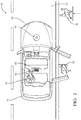
- Fig. 2 illustrates a non-limiting example of a scenario 50 where the host-vehicle 12 has a passenger 18 present in the host-vehicle 12, and the host-vehicle 12 has stopped to pick-up the client 20.
- the pedestrian 16 who has approached the edge of the roadway 52 traveled by the host-vehicle 12, has stopped at the location shown, and is about to cross in front of the host-vehicle 12. If the speaker 54 is used in the first-interaction-mode 46 to convey the message 30 to tell the pedestrian 16 to proceed in front of the host-vehicle 12, but the pedestrian 16 exhibits hesitation 26 by making no reaction 34 to the message 30 for more than a delay-threshold 56, e.g.
- the system 10 may flash the headlights 58 and/or operate an exterior-display (not shown) to convey the message 30 in accordance with the second-interaction-mode 48.
- the display 60 may flash with bright colors and repeat the message, or a chime (not shown) may be activated as part of the second-interaction-mode 48 to attract the attention of the passenger 18 to the interior-display 60.
- the controller-circuit 36 may be configured to continue to operate the output-device 28 in accordance with the first-interaction-mode 46 to convey a confirmation 64 in response to a determination that the reaction 34 does not correspond to hesitation 26 by the person 24.
- the confirmation 64 to the pedestrian 16 may continue to use the external-display to, for example, indicate a detected position of pedestrian 18 as the means to convey the confirmation 64.
- an arrow may be displayed that points to an area forward of the pedestrian 16 to encourage the pedestrian 16 to continue walking in front of the host-vehicle 12.
- a string of lights (not shown) across the front of the host-vehicle 12 may be illuminated in a pattern that the pedestrian 16 would perceived to be an invitation to continue walking in front of the host-vehicle 12.
- the message 30 to the passenger 18 using the first-interaction-mode 46 is audible (e.g. "please enter destination"), and there is no hesitation by the passenger 18 when entering the destination, then the same audible means is used to convey the confirmation 64 of destination provided by passenger 18.
- the system 10 may also convey the confirmation 64 using second-interaction-mode 48 when the pedestrian 16 responds to the message 30 that was conveyed in the second-interaction-mode 48. That is, the controller-circuit 36 may be configured to operate the output-device 28 in accordance with the second-interaction-mode 48 to convey a confirmation 64 in response to a determination that the reaction 34 to the message 30 conveyed in the second-interaction-mode 48 does not correspond to hesitation 26 (i.e. further hesitation) by the person 24.
- the system 10 may also be configured to store information regarding instances when the hesitation 26 was detected, and what interaction-modes were in use when the hesitation 26 was detected, the information may be stored on-board the host-vehicle 12, or stored in the cloud-memory.
- the stored information may include, for example, a demographic characterization of the person and/or the location where the interaction caused the hesitation 26. This information may be used by the host-vehicle 12 and other AMODs to avoid hesitation at future interaction events.
- Fig. 3 illustrates a non-limit example of a method 100 of operating the system 10.
- Step 105 CONVEY MESSAGE WITH FIRST-INTERACTION-MODE, may include conveying, using the output-device 28, (i.e. operating the output-device 28 to convey) a message 30 from a host-vehicle 12 to a person 24, where the output-device 28 is operated in accordance with a first-interaction-mode 46 to convey the message 30.
- a first-interaction-mode 46 could be configured to convey the message 30 to the person 24.
- Step 110 HESITATION?, may include using a perception-device for detecting a reaction 34 to the message by the person 24, and determining if the reaction corresponds to hesitation 26 by the person 24.
- step 110 may include the step PERSON REACTION TIME > DELAY-THRESHOLD?, which may include monitoring movement by the person 24, where in this example the hesitation 26 is characterized as no reaction to the message 30 by the person 24 for more than a delay-threshold 56.
- other indicators of hesitation e.g. confusion, may be detected by analyzing images of the face of the person 24 to check for certain facial expressions that are an indication of confusion which can lead to hesitation.
- the method 100 proceeds to step 115.
- the method proceeds to step 120 where the message 30 is repeated using a different interaction-mode, e.g. the second-interaction-mode 48.
- Step 115 CONVEY CONFIRMATION WITH FIRST-INTERACTION-MODE, may include operating the output-device 28 in accordance with the first-interaction-mode 46 to convey a confirmation 64 in response to a determination that the reaction 34 does not correspond to hesitation 26 by the person 24. That is, if the person 24 does not hesitate to the message 30 delivered using the first-interaction-mode 46, then the first-interaction-mode 46 is used to deliver the confirmation 64.
- the confirmation 64 may be any response to an expected and timely reaction to the message 30, e.g. entering the host-vehicle 12 by the client 20, or crossing in front of the host-vehicle 12 by the pedestrian 16.
- Step 120 CONVEY MESSAGE WITH SECOND-INTERACTION-MODE, may include, in response to hesitation 26 by the person 24, using the output-device 28 to convey the message 30 from a host-vehicle 12 to the person 24 in accordance with a second-interaction-mode 48. That is, the output-device 28 is operated in accordance with the second-interaction-mode 48 to convey the message 30.
- the second-interaction-mode 48 is different from the first-interaction-mode 46.
- Step 125 FURTHER HESITATION?, may include detecting, using the perception-device 32, the reaction 34 to the message 30 by the person 24 when the message 30 is sent using the second-interaction-mode 48.
- Step 123 may also include determining that the reaction 34 corresponds to hesitation 26, which may include, for example, executing the step PERSON REACTION TIME > DELAY-THRESHOLD? This step detects when the hesitation 26 is characterized as no reaction to the message 30 by the person 24 for more time than a delay-threshold 56.
- the hesitation 26 may be based on the detection of a facial expression by the person 24.
- Step 130 CONVEY CONFIRMATION WITH SECOND-INTERACTION-MODE, may include operating the output-device 28 in accordance with the second-interaction-mode 48 to convey a confirmation 64 in response to a determination that the reaction 34 to the message 30 conveyed using the second-interaction-mode 48 does not correspond to further hesitation by the person 24. That is, the confirmation 64 is output using the second-interaction-mode 48 if the person 24 properly responds to an instance of the message 30 that was conveyed using the second-interaction-mode 48 because the first-interaction-mode 46 was apparently ineffective to convey the message 30.
- Step 135, CONVEY MESSAGE WITH THIRD-INTERACTION-MODE may include conveying the message using yet a third-interaction-mode.
- the third-interaction-mode may be entirely different from the first-interaction-mode 46 and the second-interaction-mode 48, or may combine elements/features from either of the two modes with entirely new elements/features.
- Step 135, FURTHER HESITATION? may include again determining if the person 24 is exhibiting signs of hesitation 26, and routing the logic path of the method 100 accordingly. If the third-interaction-mode is finally successful in getting the person 24 to respond, the method 100 proceeds to step 140. However, if the person 24 still exhibits signs of hesitation, the method 100 show here starts again with the first-interaction-mode. Alternatively, the method 100 could try yet a fourth-interaction-mode, or just give up trying to convey the message 30 to the person 24.
- Step 140 CONVEY CONFIRMATION WITH THRID-INTERACTION-MODE, may include using the third-interaction-method to convey the message 30 since the third-interaction-method was apparently effective at getting a proper and timely response from the person 24.
- Step 150 may include storing data regarding the interaction such as which if the interaction modes worked to convey the message 30 to the person 24.
- the data stored may also include available information about the person such as sex, age, race, etc.
- the data stored may also include information about the location and ambient conditions, e.g. daytime or nighttime, and/or various weather data.
- Step 155, OPERATE HOST-VEHICLE may include the controller 36 autonomously operating the host-vehicle 12 to travel to a destination specified by the person 24.
- a first device 36 that includes one or more processors 38; memory 40; and one or more programs 105-150 stored in memory 40, the one or more programs including instructions for performing all or part of the method 100.
- non-transitory computer-readable storage-medium 40 comprising one or more programs 105-150 for execution by one or more processors 38 of a first device 36, the one or more programs 105-150 including instructions which, when executed by the one or more processors 38, cause the first device 36 to perform all or part of the method 100.
- a system 10, a controller 36 for the system 10, and a method 100 of operating the system 10 are provided.
- the teachings disclosed herein provide for an automated vehicle (e.g. the host-vehicle) that can adapt to situations when a person 24 apparently does not understand or does not perceive instructions or inquiries output by the automated vehicle, where those instructions or inquiries are useful for the automated operation of the automated vehicle
Landscapes
- Engineering & Computer Science (AREA)
- Physics & Mathematics (AREA)
- General Physics & Mathematics (AREA)
- Theoretical Computer Science (AREA)
- General Engineering & Computer Science (AREA)
- Human Computer Interaction (AREA)
- Remote Sensing (AREA)
- Radar, Positioning & Navigation (AREA)
- General Health & Medical Sciences (AREA)
- Health & Medical Sciences (AREA)
- Computer Networks & Wireless Communication (AREA)
- Signal Processing (AREA)
- Audiology, Speech & Language Pathology (AREA)
- Computer Vision & Pattern Recognition (AREA)
- Psychiatry (AREA)
- Social Psychology (AREA)
- Multimedia (AREA)
- Traffic Control Systems (AREA)
- User Interface Of Digital Computer (AREA)
Abstract
Description
- This disclosure generally relates to a system for operating an automated vehicle, and more particularly relates to a system that operates an output-device in a first-interaction-mode to convey a message to a person, and if the person hesitates, then operates an output-device in a second-interaction-mode to convey the message.
- The present invention will now be described, by way of example with reference to the accompanying drawings, in which:
-
Fig. 1 is a diagram of a system in accordance with one embodiment; -
Fig. 2 is an illustration of a scenario encountered by the system of Fig. s in accordance with one embodiment; and -
Fig. 3 is method of operating the system ofFig. 1 in accordance with one embodiment. - Reference will now be made in detail to embodiments, examples of which are illustrated in the accompanying drawings. In the following detailed description, numerous specific details are set forth in order to provide a thorough understanding of the various described embodiments. However, it will be apparent to one of ordinary skill in the art that the various described embodiments may be practiced without these specific details. In other instances, well-known methods, procedures, components, circuits, and networks have not been described in detail so as not to unnecessarily obscure aspects of the embodiments.
- 'One or more' includes a function being performed by one element, a function being performed by more than one element, e.g., in a distributed fashion, several functions being performed by one element, several functions being performed by several elements, or any combination of the above.
- It will also be understood that, although the terms first, second, etc. are, in some instances, used herein to describe various elements, these elements should not be limited by these terms. These terms are only used to distinguish one element from another. For example, a first contact could be termed a second contact, and, similarly, a second contact could be termed a first contact, without departing from the scope of the various described embodiments. The first contact and the second contact are both contacts, but they are not the same contact.
- The terminology used in the description of the various described embodiments herein is for the purpose of describing particular embodiments only and is not intended to be limiting. As used in the description of the various described embodiments and the appended claims, the singular forms "a", "an" and "the" are intended to include the plural forms as well, unless the context clearly indicates otherwise. It will also be understood that the term "and/or" as used herein refers to and encompasses any and all possible combinations of one or more of the associated listed items. It will be further understood that the terms "includes," "including," "comprises," and/or "comprising," when used in this specification, specify the presence of stated features, integers, steps, operations, elements, and/or components, but do not preclude the presence or addition of one or more other features, integers, steps, operations, elements, components, and/or groups thereof.
- As used herein, the term "if' is, optionally, construed to mean "when" or "upon" or "in response to determining" or "in response to detecting," depending on the context. Similarly, the phrase "if it is determined" or "if [a stated condition or event] is detected" is, optionally, construed to mean "upon determining" or "in response to determining" or "upon detecting [the stated condition or event]" or "in response to detecting [the stated condition or event]," depending on the context.
-
Fig. 1 illustrates a non-limiting example of asystem 10 for operating an automated vehicle, e.g. a host-vehicle 12. The host-vehicle 12 may be characterized as an automated vehicle, i.e. an automated-mobility-on-demand (AMOD) type of vehicle. As used herein, the term automated vehicle may apply to instances when the host-vehicle 12 is being operated in an automated-mode, i.e. a fully autonomous mode, where a human-operator 14 of the host-vehicle 12 may do little more than designate a destination to operate the host-vehicle 12, i.e. automation operates the vehicle-controls 22 (e.g. steering, accelerator, brakes) of the host-vehicle 12. However, full automation is not a requirement. It is contemplated that the teachings presented herein are useful when the host-vehicle 12 is operated in a manual-mode where the degree or level of automation may be something less than fully autonomous operation. As will be describe in more detail below, one novel aspect of the autonomous operation of thesystem 10 described herein is how the host-vehicle 12 or thesystem 10 interacts with aperson 24, for example, apedestrian 16 walking past the host-vehicle 12, apassenger 18 residing or traveling in the host-vehicle 12, aclient 20 preparing to enter the host-vehicle 12, and/or theoperator 14 controlling some aspect of the operation of the host-vehicle 12. Here after these examples may be generally referred to as theperson 24. In particular, this disclosure teaches how the interaction between the host-vehicle 12 (or the system 10) and theperson 24 is varied or adjusted when theperson 24 seems to exhibit some form of ahesitation 26 responding to instructions or inquires output by thesystem 10. - The
system 10 includes an output-device 28 configured to convey amessage 30 to theperson 24. Non-limiting examples of the output-device 28 include, but are not limited to: a speaker, horn, buzzer, chime, a light-pattern device (e.g. something comparable to a red/yellow/green traffic signal), a reconfigurable graphics display, or any combination thereof. The output-device 28 may be mounted on the exterior and/or the interior of the host-vehicle 12 so persons inside and/or outside of the host-vehicle 12 can observe and/or hear the output-device 28. The output-device 28 may be or may include a smart-phone carried by theperson 24, which may be in communication with thesystem 10 by way of, but not limited to: BLUETOOTH®, a cellular phone network, or a Wi-Fi. Furthermore, the output-device 28 may be or may include an actuator (not shown) configured to move all or part of the host-vehicle 12. For example, the actuator may operate a door of the host-vehicle 12 to invite a potential instance of aclient 20 to enter the host-vehicle 12, or may operate one or more suspension components to animate the host-vehicle 12 in a manner that, for example, invites thepedestrian 16 to proceed in front of the host-vehicle 12. - The
message 30 may include, but is not limited to: an indication that the host-vehicle 12 is available for hire, a name or identification of theclient 20 who requested transportation by the host-vehicle 12, a request that theclient 20 enter the host-vehicle 12, a statement of, or request to provide, an identification and/or a destination of theclient 20 or thepassenger 18. - The
system 10 includes a perception-device 32 configured to detect areaction 34 to themessage 30 by theperson 24. The perception-device 32 may include, but is not limited to: a camera, a microphone, or an input device such as a keypad, a touch-screen, a button, or a switch, or any combination thereof. If theperson 24 understands themessage 30 and/or has prior knowledge about how to react to themessage 30 from the host-vehicle 12, then thereaction 34 by theperson 24 is expected to be predictable and timely. However, if theperson 24 is confused or for some reason did not receive/detect themessage 30 because, for example, themessage 30 was audible but there was too much ambient noise or the person is deaf, or the message was visible and theperson 24 was looking away or is blind, thereaction 34 may be classified as ahesitation 26 because theperson 24 did not react in a timely manner and/or as expected. In response to thehesitation 26 by theperson 24, thesystem 10 may try a different mode (e.g. audible instead of visible, visible instead of audible, or a combination of audible and visible with optional enhancements) of communicating themessage 30, as will be explained in more detail below. - The
system 10 includes a controller-circuit 36 in communication with the output-device 28 by way of aninput 42 and the perception-device 32 by way of an output 44. The controller-circuit 36, hereafter sometimes referred to as thecontroller 36, may include one or more instances of a processor 38 such as one or more instances of a microprocessor or other control circuitry such as analog and/or digital control circuitry including an application specific integrated circuit (ASIC) for processing data as should be evident to those in the art. While thesystem 10 described herein is generally described in terms of having a single instance of thecontroller 36, it is recognized that the functions of thecontroller 36 may be shared or distributed among several instances of controllers that are each configured for some specific task. Hereafter, any reference to thecontroller 36 being configured for something is to also be interpreted as suggesting that the processor 38 may also be configured for the same thing. It is also recognized that there may be multiple instance of processors in any instance of thecontroller 36. Thecontroller 36 may includememory 40, i.e. non-transitory computer-readable storage-medium, including non-volatile memory, such as electrically erasable programmable read-only memory (EEPROM) for storing one or more routines, thresholds, and captured data. Thememory 40 may be part of the processor 38, or part of thecontroller 36, or separate from thecontroller 36 such as remote memory stored in the cloud, i.e. cloud-memory. The one or more routines may be executed by thecontroller 36 or the processor 38 to perform steps to output themessage 30 based on signals received from, but not limited to, the perception-device 32. - As a first attempt to communicate the
message 30 to theperson 24, the controller 36 (or the processor 38) is configured to operate the output-device 28 in accordance with a first-interaction-mode 46 to convey themessage 30. By way of example and not limitation, the first-interaction-mode 46 may be characterized as operating the speaker only, or the display only, or the phone only, and themessage 30 may be the name or identification of theclient 20 who requested transportation by way of an app on a phone carried by theclient 20. If the person 24 (operator 14,pedestrian 16,passenger 18, and/or client 20) responds in a timely manner and in accordance with expectations, e.g. theclient 20 enters the host-vehicle 12 without delay, then thesystem 10 continues to operate normally. However, if theperson 24 exhibitshesitation 26, then thesystem 10 tries to communicate with theperson 24 in a manner different from the first-interaction-mode 46. - The controller 36 (or the processor 38) uses information from the perception-
device 32 to determine if/when thereaction 34 corresponds tohesitation 26 by theperson 24.Hesitation 26 may be exhibited in different ways, such as, an extended gaze (e.g. more than three seconds) at the host-vehicle 12 without any action/movement by theperson 24, certain facial expressions (e.g. open mouth, change in eye opening profile) by theperson 24 which may be indicative of distressed or confused emotional state, or a reversal of motion from towards the host-vehicle 12 to away from the host-vehicle 12, e.g. a back and forth motion by thepedestrian 16. As a specific example, if themessage 30 is only displayed on a reconfigurable display on the exterior of the host-vehicle 12, theclient 20 may exhibithesitation 26 because theclient 20 may not see the message because of a crowd of people, or theclient 20 may be blind. Similarly, if themessage 30 is only emitted by a speaker on the exterior of the host-vehicle 12, thepedestrian 16 may exhibithesitation 26 because thepedestrian 16 may not hear the message because excess ambient noise, or thepedestrian 16 may be deaf. - In response to the
hesitation 26 by theperson 24, thecontroller 36 or the processor 38 may operate the output-device 28 in accordance with a second-interaction-mode 48 to convey themessage 30 in accordance with a second-interaction-mode 48, where the second-interaction-mode 48 is characterized as different from the first-interaction-mode 46. One option for changing interaction-modes is to simply switch between an audible (e.g. speaker) and a visible (e.g. display) form of themessage 30 depending on which was used for the first-interaction-mode 46. Another option for the second-interaction-mode 48 is to vary the intensity and/or content of themessage 30, but use the same configuration of the output-device that was used for the first-interaction-mode 46. For example, if the speaker was used by the first-interaction-mode 46, the second-interaction-mode 48 may be or include operating the speaker at a louder volume and/or change audible message. If the display was used by the first-interaction-mode 46, the second-interaction-mode 48 may be or include, displaying themessage 30 in a different format/color and/or by flashing the display, or both. It is recognized that there are innumerable options for changing how themessage 30 is conveyed to theperson 24. -
Fig. 2 illustrates a non-limiting example of ascenario 50 where the host-vehicle 12 has apassenger 18 present in the host-vehicle 12, and the host-vehicle 12 has stopped to pick-up theclient 20. There is also an instance of thepedestrian 16 who has approached the edge of theroadway 52 traveled by the host-vehicle 12, has stopped at the location shown, and is about to cross in front of the host-vehicle 12. If thespeaker 54 is used in the first-interaction-mode 46 to convey themessage 30 to tell thepedestrian 16 to proceed in front of the host-vehicle 12, but thepedestrian 16exhibits hesitation 26 by making noreaction 34 to themessage 30 for more than a delay-threshold 56, e.g. three seconds (3s), then thesystem 10 may flash theheadlights 58 and/or operate an exterior-display (not shown) to convey themessage 30 in accordance with the second-interaction-mode 48. As another example, if thepassenger 18 has failed to enter or specify a destination after the interior-display 60 has displayed themessage 30 in accordance with the first-interaction-mode 46 asking thepassenger 18 to do so using thekeyboard 62 or a phone (not shown) possessed by thepassenger 18, then thedisplay 60 may flash with bright colors and repeat the message, or a chime (not shown) may be activated as part of the second-interaction-mode 48 to attract the attention of thepassenger 18 to the interior-display 60. - If/when the
person 24 does respond to themessage 30 in some expected/useful and timely manner, the controller-circuit 36 may be configured to continue to operate the output-device 28 in accordance with the first-interaction-mode 46 to convey aconfirmation 64 in response to a determination that thereaction 34 does not correspond tohesitation 26 by theperson 24. For example, if an external-display (not shown) was used as the first-interaction-mode 46 to convey themessage 30 to thepedestrian 18, and there is no hesitation detection, theconfirmation 64 to thepedestrian 16 may continue to use the external-display to, for example, indicate a detected position ofpedestrian 18 as the means to convey theconfirmation 64. If the external-display is a reconfigurable type of display, an arrow may be displayed that points to an area forward of thepedestrian 16 to encourage thepedestrian 16 to continue walking in front of the host-vehicle 12. Alternatively, a string of lights (not shown) across the front of the host-vehicle 12 may be illuminated in a pattern that thepedestrian 16 would perceived to be an invitation to continue walking in front of the host-vehicle 12. Similarly, if themessage 30 to thepassenger 18 using the first-interaction-mode 46 is audible (e.g. "please enter destination"), and there is no hesitation by thepassenger 18 when entering the destination, then the same audible means is used to convey theconfirmation 64 of destination provided bypassenger 18. - However, if there is hesitation on the part of the
person 24 when themessage 30 is conveyed using the first-interaction-mode 46, so thesystem 10 uses the second-interaction-mode 48 to convey themessage 30, then thesystem 10 may also convey theconfirmation 64 using second-interaction-mode 48 when thepedestrian 16 responds to themessage 30 that was conveyed in the second-interaction-mode 48. That is, the controller-circuit 36 may be configured to operate the output-device 28 in accordance with the second-interaction-mode 48 to convey aconfirmation 64 in response to a determination that thereaction 34 to themessage 30 conveyed in the second-interaction-mode 48 does not correspond to hesitation 26 (i.e. further hesitation) by theperson 24. - The
system 10 may also be configured to store information regarding instances when thehesitation 26 was detected, and what interaction-modes were in use when thehesitation 26 was detected, the information may be stored on-board the host-vehicle 12, or stored in the cloud-memory. The stored information may include, for example, a demographic characterization of the person and/or the location where the interaction caused thehesitation 26. This information may be used by the host-vehicle 12 and other AMODs to avoid hesitation at future interaction events. -
Fig. 3 illustrates a non-limit example of amethod 100 of operating thesystem 10. -
Step 105, CONVEY MESSAGE WITH FIRST-INTERACTION-MODE, may include conveying, using the output-device 28, (i.e. operating the output-device 28 to convey) amessage 30 from a host-vehicle 12 to aperson 24, where the output-device 28 is operated in accordance with a first-interaction-mode 46 to convey themessage 30. As noted above, there are innumerably ways the first-interaction-mode 46 could be configured to convey themessage 30 to theperson 24. -
Step 110, HESITATION?, may include using a perception-device for detecting areaction 34 to the message by theperson 24, and determining if the reaction corresponds tohesitation 26 by theperson 24. As a specific non-limiting example, step 110 may include the step PERSON REACTION TIME > DELAY-THRESHOLD?, which may include monitoring movement by theperson 24, where in this example thehesitation 26 is characterized as no reaction to themessage 30 by theperson 24 for more than a delay-threshold 56. Alternatively, other indicators of hesitation, e.g. confusion, may be detected by analyzing images of the face of theperson 24 to check for certain facial expressions that are an indication of confusion which can lead to hesitation. Ifhesitation 26 is not detected, themethod 100 proceeds to step 115. However, if hesitation is detected, the method proceeds to step 120 where themessage 30 is repeated using a different interaction-mode, e.g. the second-interaction-mode 48. -
Step 115, CONVEY CONFIRMATION WITH FIRST-INTERACTION-MODE, may include operating the output-device 28 in accordance with the first-interaction-mode 46 to convey aconfirmation 64 in response to a determination that thereaction 34 does not correspond tohesitation 26 by theperson 24. That is, if theperson 24 does not hesitate to themessage 30 delivered using the first-interaction-mode 46, then the first-interaction-mode 46 is used to deliver theconfirmation 64. Theconfirmation 64 may be any response to an expected and timely reaction to themessage 30, e.g. entering the host-vehicle 12 by theclient 20, or crossing in front of the host-vehicle 12 by thepedestrian 16. -
Step 120, CONVEY MESSAGE WITH SECOND-INTERACTION-MODE, may include, in response tohesitation 26 by theperson 24, using the output-device 28 to convey themessage 30 from a host-vehicle 12 to theperson 24 in accordance with a second-interaction-mode 48. That is, the output-device 28 is operated in accordance with the second-interaction-mode 48 to convey themessage 30. The second-interaction-mode 48 is different from the first-interaction-mode 46. -
Step 125, FURTHER HESITATION?, may include detecting, using the perception-device 32, thereaction 34 to themessage 30 by theperson 24 when themessage 30 is sent using the second-interaction-mode 48. Step 123 may also include determining that thereaction 34 corresponds tohesitation 26, which may include, for example, executing the step PERSON REACTION TIME > DELAY-THRESHOLD? This step detects when thehesitation 26 is characterized as no reaction to themessage 30 by theperson 24 for more time than a delay-threshold 56. Alternatively, thehesitation 26 may be based on the detection of a facial expression by theperson 24. -
Step 130, CONVEY CONFIRMATION WITH SECOND-INTERACTION-MODE, may include operating the output-device 28 in accordance with the second-interaction-mode 48 to convey aconfirmation 64 in response to a determination that thereaction 34 to themessage 30 conveyed using the second-interaction-mode 48 does not correspond to further hesitation by theperson 24. That is, theconfirmation 64 is output using the second-interaction-mode 48 if theperson 24 properly responds to an instance of themessage 30 that was conveyed using the second-interaction-mode 48 because the first-interaction-mode 46 was apparently ineffective to convey themessage 30. -
Step 135, CONVEY MESSAGE WITH THIRD-INTERACTION-MODE, may include conveying the message using yet a third-interaction-mode. The third-interaction-mode may be entirely different from the first-interaction-mode 46 and the second-interaction-mode 48, or may combine elements/features from either of the two modes with entirely new elements/features. -
Step 135, FURTHER HESITATION?, may include again determining if theperson 24 is exhibiting signs ofhesitation 26, and routing the logic path of themethod 100 accordingly. If the third-interaction-mode is finally successful in getting theperson 24 to respond, themethod 100 proceeds to step 140. However, if theperson 24 still exhibits signs of hesitation, themethod 100 show here starts again with the first-interaction-mode. Alternatively, themethod 100 could try yet a fourth-interaction-mode, or just give up trying to convey themessage 30 to theperson 24. -
Step 140, CONVEY CONFIRMATION WITH THRID-INTERACTION-MODE, may include using the third-interaction-method to convey themessage 30 since the third-interaction-method was apparently effective at getting a proper and timely response from theperson 24. -
Step 150, STORE INTERACTION HISTORY, may include storing data regarding the interaction such as which if the interaction modes worked to convey themessage 30 to theperson 24. The data stored may also include available information about the person such as sex, age, race, etc. The data stored may also include information about the location and ambient conditions, e.g. daytime or nighttime, and/or various weather data. -
Step 155, OPERATE HOST-VEHICLE, may include thecontroller 36 autonomously operating the host-vehicle 12 to travel to a destination specified by theperson 24. - Described herein is a
first device 36 that includes one or more processors 38;memory 40; and one or more programs 105-150 stored inmemory 40, the one or more programs including instructions for performing all or part of themethod 100. Also, described herein is non-transitory computer-readable storage-medium 40 comprising one or more programs 105-150 for execution by one or more processors 38 of afirst device 36, the one or more programs 105-150 including instructions which, when executed by the one or more processors 38, cause thefirst device 36 to perform all or part of themethod 100. - Accordingly, a
system 10, acontroller 36 for thesystem 10, and amethod 100 of operating thesystem 10 are provided. The teachings disclosed herein provide for an automated vehicle (e.g. the host-vehicle) that can adapt to situations when aperson 24 apparently does not understand or does not perceive instructions or inquiries output by the automated vehicle, where those instructions or inquiries are useful for the automated operation of the automated vehicle - While this invention has been described in terms of the preferred embodiments thereof, it is not intended to be so limited, but rather only to the extent set forth in the claims that follow.
Claims (14)
- A system (10) for operating an automated vehicle, said system (10) comprising:an output-device (28) configured to convey a message (30) from a host-vehicle (12) to a person (24);a perception-device (32) configured to detect a reaction (34) to the message (30) by the person (24);a controller-circuit (36) in communication with the output-device (28) and the perception-device (32), said controller-circuit (36) configured to operate the output-device (28) in accordance with a first-interaction-mode (46) to convey the message (30), determine that the reaction (34) corresponds to hesitation (26) by the person (24), and in response to hesitation (26) by the person (24), operate the output-device (28) in accordance with a second-interaction-mode (48) to convey the message (30), said second-interaction-mode (48) characterized as different from the first-interaction-mode (46).
- The system (10) in accordance with claim 1, wherein the hesitation (26) is characterized as no reaction (34) to the message (30) by the person (24) for more than a delay-threshold (56).
- The system (10) in accordance with any of the previous claims, wherein the controller-circuit (36) is configured to operate the output-device (28) in accordance with the first-interaction-mode (46) to convey a confirmation (64) in response to a determination that the reaction (34) does not correspond to hesitation (26) by the person (24).
- The system (10) in accordance with any of the previous claims, wherein the controller-circuit (36) is configured to operate the output-device (28) in accordance with the second-interaction-mode (48) to convey a confirmation (64) in response to a determination that the reaction (34) to the message (30) in the second-interaction-mode (48) does not correspond to further hesitation (26) by the person (24).
- A controller-circuit (36) for operating an automated vehicle, said controller-circuit (36) comprising:an output (44) configured to communicate with an output-device (28) that is configured to convey a message (30) from a host-vehicle (12) to a person (24);an input (42) configured to communicate with a perception-device (32) that is configured to detect a reaction (34) to the message (30) by the person (24);a processor (38) in communication with the output-device (28) and the perception-device (32), said processor (38) configured to operate the output-device (28) in accordance with a first-interaction-mode (46) to convey the message (30), determine that the reaction (34) corresponds to hesitation (26) by the person (24), and in response to hesitation (26) by the person (24), operate the output-device (28) in accordance with a second-interaction-mode (48) to convey the message (30), said second-interaction-mode (48) characterized as different from the first-interaction-mode (46).
- The controller-circuit (36) in accordance with claim 5, wherein the hesitation (26) is characterized as no reaction (34) to the message (30) by the person (24) for more than a delay-threshold (56).
- The controller-circuit (36) in accordance with any of the previous claims, wherein the processor (38) is configured to operate the output-device (28) in accordance with the first-interaction-mode (46) to convey a confirmation (64) in response to a determination that the reaction (34) does not correspond to hesitation (26) by the person (24).
- The controller-circuit (36) in accordance with any of the previous claims, wherein the processor (38) is configured to operate the output-device (28) in accordance with the second-interaction-mode (48) to convey a confirmation (64) in response to a determination that the reaction (34) to the message (30) in the second-interaction-mode (48) does not correspond to further hesitation (26) by the person (24).
- A method (100) of operating an automated vehicle, said method (100) comprising:conveying (105), using an output-device (28), a message (30) from a host-vehicle (12) to a person (24), wherein the output-device (28) is operated in accordance with a first-interaction-mode (46) to convey the message (30);detecting (110), using a perception-device (32), a reaction (34) to the message (30) by the person (24);determining (110) that the reaction (34) corresponds to hesitation (26) by the person (24); andin response to hesitation (26) by the person (24), conveying (120), using an output-device (28), a message (30) from a host-vehicle (12) to a person (24), wherein the output-device (28) is operated in accordance with a second-interaction-mode (48), said second-interaction-mode (48) characterized as different from the first-interaction-mode (46).
- The method (100) in accordance with claim 9, wherein the hesitation (26) is characterized as no reaction (34) to the message (30) by the person (24) for more than a delay-threshold (56).
- The method (100) in accordance with any of the previous claims, wherein the method (100) includes
operating (115) the output-device (28) in accordance with the first-interaction-mode (46) to convey a confirmation (64) in response to a determination that the reaction (34) does not correspond to hesitation (26) by the person (24). - The method (100) in accordance with any of the previous claims, wherein the method (100) includes
operating (130) the output-device (28) in accordance with the second-interaction-mode (48) to convey a confirmation (64) in response to a determination that the reaction (34) to the message (30) in the second-interaction-mode (48) does not correspond to further hesitation (26) by the person (24). - A first device (36) comprising:one or more processors (38);memory (40); andone or more programs (105-155) stored in memory (40), the one or more programs (105) including instructions for performing the method (100) of any one of claims 9-12.
- A non-transitory computer-readable storage-medium (40) comprising one or more programs (105-155) for execution by one or more processors (38) of a first device (36), the one or more programs (105-155) including instructions which, when executed by the one or more processors (38), cause the first device (36) to perform the method (100) of any one of claims 9-12.
Applications Claiming Priority (2)
| Application Number | Priority Date | Filing Date | Title |
|---|---|---|---|
| US201862675811P | 2018-05-24 | 2018-05-24 | |
| US15/989,258 US10726716B2 (en) | 2018-05-24 | 2018-05-25 | Vehicle to person communication with interaction-modes selected based on hesitation by the person |
Publications (2)
| Publication Number | Publication Date |
|---|---|
| EP3573354A1 true EP3573354A1 (en) | 2019-11-27 |
| EP3573354B1 EP3573354B1 (en) | 2023-07-12 |
Family
ID=66826807
Family Applications (1)
| Application Number | Title | Priority Date | Filing Date |
|---|---|---|---|
| EP19176106.3A Active EP3573354B1 (en) | 2018-05-24 | 2019-05-23 | Vehicle to person communication with selectable interaction-modes |
Country Status (3)
| Country | Link |
|---|---|
| US (1) | US10726716B2 (en) |
| EP (1) | EP3573354B1 (en) |
| CN (1) | CN110531845B (en) |
Families Citing this family (2)
| Publication number | Priority date | Publication date | Assignee | Title |
|---|---|---|---|---|
| WO2017043101A1 (en) * | 2015-09-08 | 2017-03-16 | ソニー株式会社 | Information processing device, information processing method, and program |
| US11688184B2 (en) * | 2020-06-17 | 2023-06-27 | Toyota Motor Engineering & Manufacturing North America, Inc. | Driving automation external communication location change |
Citations (2)
| Publication number | Priority date | Publication date | Assignee | Title |
|---|---|---|---|---|
| WO2014172334A1 (en) * | 2013-04-15 | 2014-10-23 | Flextronics Ap, Llc | User gesture control of vehicle features |
| CN104571998A (en) * | 2015-01-13 | 2015-04-29 | 安徽农业大学 | Adaptive human-computer interaction vehicle instrument panel display system and display method thereof |
Family Cites Families (15)
| Publication number | Priority date | Publication date | Assignee | Title |
|---|---|---|---|---|
| US6140938A (en) * | 1995-04-14 | 2000-10-31 | Flick; Kenneth E. | Remote control system suitable for a vehicle and having remote transmitter verification |
| US7477135B2 (en) * | 2002-01-22 | 2009-01-13 | Belcher Brian E | Access control for vehicle-mounted communications device |
| US8738280B2 (en) * | 2011-06-09 | 2014-05-27 | Autotalks Ltd. | Methods for activity reduction in pedestrian-to-vehicle communication networks |
| US9196164B1 (en) * | 2012-09-27 | 2015-11-24 | Google Inc. | Pedestrian notifications |
| WO2014172322A1 (en) * | 2013-04-15 | 2014-10-23 | Flextronics Ap, Llc | Vehicle intruder alert detection and indication |
| DE102013207223A1 (en) * | 2013-04-22 | 2014-10-23 | Ford Global Technologies, Llc | Method for detecting non-motorized road users |
| US20160267335A1 (en) * | 2015-03-13 | 2016-09-15 | Harman International Industries, Incorporated | Driver distraction detection system |
| US9694736B2 (en) * | 2015-09-30 | 2017-07-04 | Nissan North America, Inc. | Vehicle state indication system |
| US9878659B2 (en) * | 2015-09-30 | 2018-01-30 | Nissan North America, Inc. | Vehicle state indication system |
| MX2018005768A (en) * | 2015-12-08 | 2018-09-17 | Ford Global Tech Llc | Extended range vehicle horn. |
| US9868391B1 (en) * | 2016-02-26 | 2018-01-16 | Waymo Llc | Scenario based audible warnings for autonomous vehicles |
| US9989966B2 (en) * | 2016-05-20 | 2018-06-05 | Delphi Technologies, Inc. | Intersection cross-walk navigation system for automated vehicles |
| US9928734B2 (en) * | 2016-08-02 | 2018-03-27 | Nio Usa, Inc. | Vehicle-to-pedestrian communication systems |
| US9881503B1 (en) * | 2016-09-08 | 2018-01-30 | GM Global Technology Operations LLC | Vehicle-to-pedestrian-communication systems and methods for using the same |
| US10471896B2 (en) * | 2016-10-20 | 2019-11-12 | Google Llc | Automated pacing of vehicle operator content interaction |
-
2018
- 2018-05-25 US US15/989,258 patent/US10726716B2/en active Active
-
2019
- 2019-05-23 EP EP19176106.3A patent/EP3573354B1/en active Active
- 2019-05-23 CN CN201910433727.1A patent/CN110531845B/en active Active
Patent Citations (2)
| Publication number | Priority date | Publication date | Assignee | Title |
|---|---|---|---|---|
| WO2014172334A1 (en) * | 2013-04-15 | 2014-10-23 | Flextronics Ap, Llc | User gesture control of vehicle features |
| CN104571998A (en) * | 2015-01-13 | 2015-04-29 | 安徽农业大学 | Adaptive human-computer interaction vehicle instrument panel display system and display method thereof |
Also Published As
| Publication number | Publication date |
|---|---|
| US10726716B2 (en) | 2020-07-28 |
| CN110531845A (en) | 2019-12-03 |
| CN110531845B (en) | 2024-09-20 |
| EP3573354B1 (en) | 2023-07-12 |
| US20190362626A1 (en) | 2019-11-28 |
Similar Documents
| Publication | Publication Date | Title |
|---|---|---|
| US10166981B2 (en) | Traveling control device, on-vehicle display device, and traveling control system | |
| CN107787282B (en) | Cognitive driver assistance with variable assistance for automated vehicles | |
| US11985578B2 (en) | System and method to detect driver intent and employ safe driving actions | |
| US9881503B1 (en) | Vehicle-to-pedestrian-communication systems and methods for using the same | |
| CN109313858B (en) | Communication of vehicle intent to another traffic participant | |
| CN112158132B (en) | Cognitive driver assistance using variable alerts for automated vehicles | |
| US9514629B2 (en) | Vehicle door opening warning system and vehicle door opening warning method | |
| US20180292820A1 (en) | System limits of an automatic control | |
| EP3597503B1 (en) | Verification of vehicle operator awareness before transition from autonomous-mode to manual-mode | |
| US20180204452A1 (en) | Concept for warning at least one road user located within a parking facility | |
| CN112585051A (en) | Method of assisting autonomous vehicle and apparatus therefor | |
| US20170305335A1 (en) | Indent-Indication System For An Automated Vehicle | |
| CN105825621A (en) | Method and device for driving motor vehicle able to be driven in an at least partially automated manner | |
| JP7211707B2 (en) | Agent cooperation method | |
| US20180154896A1 (en) | Travel control apparatus and travel control method | |
| US11904900B2 (en) | Autonomous vehicle for blind people | |
| CN106898149B (en) | control of the vehicle | |
| EP3560785A1 (en) | System and method to notify operator of host-vehicle of takeover-event in another-vehicle | |
| EP3573354B1 (en) | Vehicle to person communication with selectable interaction-modes | |
| CN118810608A (en) | Vehicle cut-in threat detection and mitigation between leader and follower platoons | |
| CN106335366A (en) | Emergency vehicle control device | |
| CN111051174A (en) | Method for operating a driver assistance system of a motor vehicle and motor vehicle | |
| JP2022541223A (en) | Determining the Signal State of Traffic Signals | |
| US20190221117A1 (en) | Agent cooperation system, agent cooperation method, and non-transitory storage medium | |
| CN110114809B (en) | Method and apparatus for alerting driver to start at light signaling device with varying output function |
Legal Events
| Date | Code | Title | Description |
|---|---|---|---|
| PUAI | Public reference made under article 153(3) epc to a published international application that has entered the european phase |
Free format text: ORIGINAL CODE: 0009012 |
|
| STAA | Information on the status of an ep patent application or granted ep patent |
Free format text: STATUS: THE APPLICATION HAS BEEN PUBLISHED |
|
| AK | Designated contracting states |
Kind code of ref document: A1 Designated state(s): AL AT BE BG CH CY CZ DE DK EE ES FI FR GB GR HR HU IE IS IT LI LT LU LV MC MK MT NL NO PL PT RO RS SE SI SK SM TR |
|
| AX | Request for extension of the european patent |
Extension state: BA ME |
|
| STAA | Information on the status of an ep patent application or granted ep patent |
Free format text: STATUS: REQUEST FOR EXAMINATION WAS MADE |
|
| 17P | Request for examination filed |
Effective date: 20200525 |
|
| RBV | Designated contracting states (corrected) |
Designated state(s): AL AT BE BG CH CY CZ DE DK EE ES FI FR GB GR HR HU IE IS IT LI LT LU LV MC MK MT NL NO PL PT RO RS SE SI SK SM TR |
|
| STAA | Information on the status of an ep patent application or granted ep patent |
Free format text: STATUS: EXAMINATION IS IN PROGRESS |
|
| 17Q | First examination report despatched |
Effective date: 20210615 |
|
| RAP3 | Party data changed (applicant data changed or rights of an application transferred) |
Owner name: APTIV TECHNOLOGIES LIMITED |
|
| GRAP | Despatch of communication of intention to grant a patent |
Free format text: ORIGINAL CODE: EPIDOSNIGR1 |
|
| STAA | Information on the status of an ep patent application or granted ep patent |
Free format text: STATUS: GRANT OF PATENT IS INTENDED |
|
| INTG | Intention to grant announced |
Effective date: 20230421 |
|
| GRAS | Grant fee paid |
Free format text: ORIGINAL CODE: EPIDOSNIGR3 |
|
| GRAA | (expected) grant |
Free format text: ORIGINAL CODE: 0009210 |
|
| STAA | Information on the status of an ep patent application or granted ep patent |
Free format text: STATUS: THE PATENT HAS BEEN GRANTED |
|
| AK | Designated contracting states |
Kind code of ref document: B1 Designated state(s): AL AT BE BG CH CY CZ DE DK EE ES FI FR GB GR HR HU IE IS IT LI LT LU LV MC MK MT NL NO PL PT RO RS SE SI SK SM TR |
|
| REG | Reference to a national code |
Ref country code: CH Ref legal event code: EP |
|
| REG | Reference to a national code |
Ref country code: DE Ref legal event code: R096 Ref document number: 602019032424 Country of ref document: DE |
|
| REG | Reference to a national code |
Ref country code: IE Ref legal event code: FG4D |
|
| REG | Reference to a national code |
Ref country code: LT Ref legal event code: MG9D |
|
| REG | Reference to a national code |
Ref country code: NL Ref legal event code: MP Effective date: 20230712 |
|
| REG | Reference to a national code |
Ref country code: AT Ref legal event code: MK05 Ref document number: 1588352 Country of ref document: AT Kind code of ref document: T Effective date: 20230712 |
|
| PG25 | Lapsed in a contracting state [announced via postgrant information from national office to epo] |
Ref country code: NL Free format text: LAPSE BECAUSE OF FAILURE TO SUBMIT A TRANSLATION OF THE DESCRIPTION OR TO PAY THE FEE WITHIN THE PRESCRIBED TIME-LIMIT Effective date: 20230712 |
|
| PG25 | Lapsed in a contracting state [announced via postgrant information from national office to epo] |
Ref country code: GR Free format text: LAPSE BECAUSE OF FAILURE TO SUBMIT A TRANSLATION OF THE DESCRIPTION OR TO PAY THE FEE WITHIN THE PRESCRIBED TIME-LIMIT Effective date: 20231013 |
|
| PG25 | Lapsed in a contracting state [announced via postgrant information from national office to epo] |
Ref country code: ES Free format text: LAPSE BECAUSE OF FAILURE TO SUBMIT A TRANSLATION OF THE DESCRIPTION OR TO PAY THE FEE WITHIN THE PRESCRIBED TIME-LIMIT Effective date: 20230712 |
|
| PG25 | Lapsed in a contracting state [announced via postgrant information from national office to epo] |
Ref country code: IS Free format text: LAPSE BECAUSE OF FAILURE TO SUBMIT A TRANSLATION OF THE DESCRIPTION OR TO PAY THE FEE WITHIN THE PRESCRIBED TIME-LIMIT Effective date: 20231112 |
|
| PG25 | Lapsed in a contracting state [announced via postgrant information from national office to epo] |
Ref country code: SE Free format text: LAPSE BECAUSE OF FAILURE TO SUBMIT A TRANSLATION OF THE DESCRIPTION OR TO PAY THE FEE WITHIN THE PRESCRIBED TIME-LIMIT Effective date: 20230712 Ref country code: RS Free format text: LAPSE BECAUSE OF FAILURE TO SUBMIT A TRANSLATION OF THE DESCRIPTION OR TO PAY THE FEE WITHIN THE PRESCRIBED TIME-LIMIT Effective date: 20230712 Ref country code: PT Free format text: LAPSE BECAUSE OF FAILURE TO SUBMIT A TRANSLATION OF THE DESCRIPTION OR TO PAY THE FEE WITHIN THE PRESCRIBED TIME-LIMIT Effective date: 20231113 Ref country code: NO Free format text: LAPSE BECAUSE OF FAILURE TO SUBMIT A TRANSLATION OF THE DESCRIPTION OR TO PAY THE FEE WITHIN THE PRESCRIBED TIME-LIMIT Effective date: 20231012 Ref country code: LV Free format text: LAPSE BECAUSE OF FAILURE TO SUBMIT A TRANSLATION OF THE DESCRIPTION OR TO PAY THE FEE WITHIN THE PRESCRIBED TIME-LIMIT Effective date: 20230712 Ref country code: LT Free format text: LAPSE BECAUSE OF FAILURE TO SUBMIT A TRANSLATION OF THE DESCRIPTION OR TO PAY THE FEE WITHIN THE PRESCRIBED TIME-LIMIT Effective date: 20230712 Ref country code: IS Free format text: LAPSE BECAUSE OF FAILURE TO SUBMIT A TRANSLATION OF THE DESCRIPTION OR TO PAY THE FEE WITHIN THE PRESCRIBED TIME-LIMIT Effective date: 20231112 Ref country code: HR Free format text: LAPSE BECAUSE OF FAILURE TO SUBMIT A TRANSLATION OF THE DESCRIPTION OR TO PAY THE FEE WITHIN THE PRESCRIBED TIME-LIMIT Effective date: 20230712 Ref country code: GR Free format text: LAPSE BECAUSE OF FAILURE TO SUBMIT A TRANSLATION OF THE DESCRIPTION OR TO PAY THE FEE WITHIN THE PRESCRIBED TIME-LIMIT Effective date: 20231013 Ref country code: FI Free format text: LAPSE BECAUSE OF FAILURE TO SUBMIT A TRANSLATION OF THE DESCRIPTION OR TO PAY THE FEE WITHIN THE PRESCRIBED TIME-LIMIT Effective date: 20230712 Ref country code: ES Free format text: LAPSE BECAUSE OF FAILURE TO SUBMIT A TRANSLATION OF THE DESCRIPTION OR TO PAY THE FEE WITHIN THE PRESCRIBED TIME-LIMIT Effective date: 20230712 Ref country code: AT Free format text: LAPSE BECAUSE OF FAILURE TO SUBMIT A TRANSLATION OF THE DESCRIPTION OR TO PAY THE FEE WITHIN THE PRESCRIBED TIME-LIMIT Effective date: 20230712 |
|
| PG25 | Lapsed in a contracting state [announced via postgrant information from national office to epo] |
Ref country code: PL Free format text: LAPSE BECAUSE OF FAILURE TO SUBMIT A TRANSLATION OF THE DESCRIPTION OR TO PAY THE FEE WITHIN THE PRESCRIBED TIME-LIMIT Effective date: 20230712 |
|
| REG | Reference to a national code |
Ref country code: DE Ref legal event code: R097 Ref document number: 602019032424 Country of ref document: DE |
|
| PG25 | Lapsed in a contracting state [announced via postgrant information from national office to epo] |
Ref country code: SM Free format text: LAPSE BECAUSE OF FAILURE TO SUBMIT A TRANSLATION OF THE DESCRIPTION OR TO PAY THE FEE WITHIN THE PRESCRIBED TIME-LIMIT Effective date: 20230712 Ref country code: RO Free format text: LAPSE BECAUSE OF FAILURE TO SUBMIT A TRANSLATION OF THE DESCRIPTION OR TO PAY THE FEE WITHIN THE PRESCRIBED TIME-LIMIT Effective date: 20230712 Ref country code: EE Free format text: LAPSE BECAUSE OF FAILURE TO SUBMIT A TRANSLATION OF THE DESCRIPTION OR TO PAY THE FEE WITHIN THE PRESCRIBED TIME-LIMIT Effective date: 20230712 Ref country code: DK Free format text: LAPSE BECAUSE OF FAILURE TO SUBMIT A TRANSLATION OF THE DESCRIPTION OR TO PAY THE FEE WITHIN THE PRESCRIBED TIME-LIMIT Effective date: 20230712 Ref country code: CZ Free format text: LAPSE BECAUSE OF FAILURE TO SUBMIT A TRANSLATION OF THE DESCRIPTION OR TO PAY THE FEE WITHIN THE PRESCRIBED TIME-LIMIT Effective date: 20230712 Ref country code: SK Free format text: LAPSE BECAUSE OF FAILURE TO SUBMIT A TRANSLATION OF THE DESCRIPTION OR TO PAY THE FEE WITHIN THE PRESCRIBED TIME-LIMIT Effective date: 20230712 |
|
| PLBE | No opposition filed within time limit |
Free format text: ORIGINAL CODE: 0009261 |
|
| STAA | Information on the status of an ep patent application or granted ep patent |
Free format text: STATUS: NO OPPOSITION FILED WITHIN TIME LIMIT |
|
| PG25 | Lapsed in a contracting state [announced via postgrant information from national office to epo] |
Ref country code: IT Free format text: LAPSE BECAUSE OF FAILURE TO SUBMIT A TRANSLATION OF THE DESCRIPTION OR TO PAY THE FEE WITHIN THE PRESCRIBED TIME-LIMIT Effective date: 20230712 |
|
| 26N | No opposition filed |
Effective date: 20240415 |
|
| PGFP | Annual fee paid to national office [announced via postgrant information from national office to epo] |
Ref country code: GB Payment date: 20240527 Year of fee payment: 6 |
|
| PGFP | Annual fee paid to national office [announced via postgrant information from national office to epo] |
Ref country code: DE Payment date: 20240516 Year of fee payment: 6 |
|
| PG25 | Lapsed in a contracting state [announced via postgrant information from national office to epo] |
Ref country code: SI Free format text: LAPSE BECAUSE OF FAILURE TO SUBMIT A TRANSLATION OF THE DESCRIPTION OR TO PAY THE FEE WITHIN THE PRESCRIBED TIME-LIMIT Effective date: 20230712 |
|
| PGFP | Annual fee paid to national office [announced via postgrant information from national office to epo] |
Ref country code: FR Payment date: 20240524 Year of fee payment: 6 |
|
| PG25 | Lapsed in a contracting state [announced via postgrant information from national office to epo] |
Ref country code: BG Free format text: LAPSE BECAUSE OF FAILURE TO SUBMIT A TRANSLATION OF THE DESCRIPTION OR TO PAY THE FEE WITHIN THE PRESCRIBED TIME-LIMIT Effective date: 20230712 |
|
| PG25 | Lapsed in a contracting state [announced via postgrant information from national office to epo] |
Ref country code: BG Free format text: LAPSE BECAUSE OF FAILURE TO SUBMIT A TRANSLATION OF THE DESCRIPTION OR TO PAY THE FEE WITHIN THE PRESCRIBED TIME-LIMIT Effective date: 20230712 |
|
| REG | Reference to a national code |
Ref country code: CH Ref legal event code: PL |
|
| PG25 | Lapsed in a contracting state [announced via postgrant information from national office to epo] |
Ref country code: MC Free format text: LAPSE BECAUSE OF FAILURE TO SUBMIT A TRANSLATION OF THE DESCRIPTION OR TO PAY THE FEE WITHIN THE PRESCRIBED TIME-LIMIT Effective date: 20230712 |
|
| PG25 | Lapsed in a contracting state [announced via postgrant information from national office to epo] |
Ref country code: LU Free format text: LAPSE BECAUSE OF NON-PAYMENT OF DUE FEES Effective date: 20240523 |
|
| PG25 | Lapsed in a contracting state [announced via postgrant information from national office to epo] |
Ref country code: MC Free format text: LAPSE BECAUSE OF FAILURE TO SUBMIT A TRANSLATION OF THE DESCRIPTION OR TO PAY THE FEE WITHIN THE PRESCRIBED TIME-LIMIT Effective date: 20230712 Ref country code: LU Free format text: LAPSE BECAUSE OF NON-PAYMENT OF DUE FEES Effective date: 20240523 Ref country code: CH Free format text: LAPSE BECAUSE OF NON-PAYMENT OF DUE FEES Effective date: 20240531 |
|
| REG | Reference to a national code |
Ref country code: BE Ref legal event code: MM Effective date: 20240531 |
|
| PG25 | Lapsed in a contracting state [announced via postgrant information from national office to epo] |
Ref country code: IE Free format text: LAPSE BECAUSE OF NON-PAYMENT OF DUE FEES Effective date: 20240523 |
|
| PG25 | Lapsed in a contracting state [announced via postgrant information from national office to epo] |
Ref country code: BE Free format text: LAPSE BECAUSE OF NON-PAYMENT OF DUE FEES Effective date: 20240531 |
|
| REG | Reference to a national code |
Ref country code: DE Ref legal event code: R081 Ref document number: 602019032424 Country of ref document: DE Owner name: APTIV TECHNOLOGIES AG, CH Free format text: FORMER OWNER: APTIV TECHNOLOGIES LIMITED, ST. MICHAEL, BB |
|
| PG25 | Lapsed in a contracting state [announced via postgrant information from national office to epo] |
Ref country code: CY Free format text: LAPSE BECAUSE OF FAILURE TO SUBMIT A TRANSLATION OF THE DESCRIPTION OR TO PAY THE FEE WITHIN THE PRESCRIBED TIME-LIMIT; INVALID AB INITIO Effective date: 20190523 |
|
| PG25 | Lapsed in a contracting state [announced via postgrant information from national office to epo] |
Ref country code: HU Free format text: LAPSE BECAUSE OF FAILURE TO SUBMIT A TRANSLATION OF THE DESCRIPTION OR TO PAY THE FEE WITHIN THE PRESCRIBED TIME-LIMIT; INVALID AB INITIO Effective date: 20190523 |
|
| REG | Reference to a national code |
Ref country code: DE Ref legal event code: R119 Ref document number: 602019032424 Country of ref document: DE |
|
| GBPC | Gb: european patent ceased through non-payment of renewal fee |
Effective date: 20250523 |
|
| PG25 | Lapsed in a contracting state [announced via postgrant information from national office to epo] |
Ref country code: GB Free format text: LAPSE BECAUSE OF NON-PAYMENT OF DUE FEES Effective date: 20250523 |
|
| PG25 | Lapsed in a contracting state [announced via postgrant information from national office to epo] |
Ref country code: DE Free format text: LAPSE BECAUSE OF NON-PAYMENT OF DUE FEES Effective date: 20251202 |
|
| PG25 | Lapsed in a contracting state [announced via postgrant information from national office to epo] |
Ref country code: FR Free format text: LAPSE BECAUSE OF NON-PAYMENT OF DUE FEES Effective date: 20250531 |