EP3573284A1 - Distance-revealing encryption - Google Patents
Distance-revealing encryption Download PDFInfo
- Publication number
- EP3573284A1 EP3573284A1 EP18174333.7A EP18174333A EP3573284A1 EP 3573284 A1 EP3573284 A1 EP 3573284A1 EP 18174333 A EP18174333 A EP 18174333A EP 3573284 A1 EP3573284 A1 EP 3573284A1
- Authority
- EP
- European Patent Office
- Prior art keywords
- elements
- values
- message
- random function
- pseudo
- Prior art date
- Legal status (The legal status is an assumption and is not a legal conclusion. Google has not performed a legal analysis and makes no representation as to the accuracy of the status listed.)
- Granted
Links
- 238000000034 method Methods 0.000 claims abstract description 28
- 239000013598 vector Substances 0.000 abstract description 7
- 230000006870 function Effects 0.000 description 28
- 238000011156 evaluation Methods 0.000 description 5
- 238000010801 machine learning Methods 0.000 description 4
- 238000010586 diagram Methods 0.000 description 3
- 238000010276 construction Methods 0.000 description 2
- 125000004122 cyclic group Chemical group 0.000 description 2
- 238000012986 modification Methods 0.000 description 2
- 230000004048 modification Effects 0.000 description 2
- 230000003595 spectral effect Effects 0.000 description 2
- 238000003491 array Methods 0.000 description 1
- 238000000354 decomposition reaction Methods 0.000 description 1
- 238000001514 detection method Methods 0.000 description 1
- 238000009792 diffusion process Methods 0.000 description 1
- 238000013507 mapping Methods 0.000 description 1
- 238000012545 processing Methods 0.000 description 1
- 230000011218 segmentation Effects 0.000 description 1
- 230000035945 sensitivity Effects 0.000 description 1
- 238000012549 training Methods 0.000 description 1
- 238000012795 verification Methods 0.000 description 1
Images

Classifications
-
- H—ELECTRICITY
- H04—ELECTRIC COMMUNICATION TECHNIQUE
- H04L—TRANSMISSION OF DIGITAL INFORMATION, e.g. TELEGRAPHIC COMMUNICATION
- H04L9/00—Cryptographic mechanisms or cryptographic arrangements for secret or secure communications; Network security protocols
- H04L9/30—Public key, i.e. encryption algorithm being computationally infeasible to invert or user's encryption keys not requiring secrecy
Definitions
- Various exemplary embodiments disclosed herein relate generally to distance-revealing encryption.
- Distance-revealing encryption is a primitive related to functional encryption (FE), a generalization of public-key encryption which allows a party to learn a function of the input plaintext (or multiple plaintexts in the case of multi-input functional encryption (MIFE)). More specifically, distance-revealing encryption adds the useful feature that given any two ciphertexts, the Euclidean distance between the corresponding plaintexts-viewed as vectors-can be evaluated publicly; that is, without the knowledge of the private decryption key.
- FE functional encryption
- MIFE multi-input functional encryption
- n is the number of components in the message by: choosing a random value r ; computing a plurality of values of the pseudo random function; and computing a first plurality of ciphertext values based upon g 1 , the random value r , the first plurality of elements, the second plurality of elements, the plurality of values of the pseudo random function, and message x ; and computing a second plurality of ciphertext values based upon g 2 , the random value r, the first plurality of elements, the second plurality of elements, the plurality of values of the pseudo random function, and message x .
- n is the number of elements in the message by: choosing a random value r ; computing a plurality of values of the pseudo random function; and computing a plurality of ciphertext values based upon g , the random value r , the first plurality of elements, the second plurality of elements, the plurality of values of the pseudo random function, and message x .
- FIG. 1 illustrates a flow diagram of the distance-revealing encryption method.
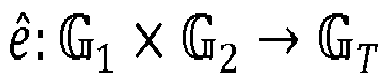
- bilinear maps There are two forms of bilinear maps commonly used in the cryptography literature. The first are of the form e ⁇ : G 1 ⁇ G 2 ⁇ G T , where 1 , 2 and T are cyclic groups of prime order p . The second are of the form e ⁇ : G ⁇ G ⁇ G T where and T are cyclic groups of prime order p .
- a good encryption scheme should be such that its output is uniformly distributed over the ciphertext space.
- M 0 1 l n .
- F K 0 1 * ⁇ 0 1 n ⁇ Z p , indexed by a secret key K.
- FIG. 1 illustrates a flow diagram of a distance revealing encryption method.
- the method 100 begins at 105.
- a tuple including specific points and a mapping function is generated 110.
- the method 100 then randomly selects a first and second plurality of elements 115.
- the method 100 defines a parameter h based upon the generated tuple 120.
- the method 110 selects a pseudo random function family 125.
- the method 100 sets the public and private parameters 130, which are essentially a public and private key.
- the method 100 then encrypts a message 135.
- the method 100 evaluates the distance between two encrypted messages 140.
- the method 100 ends at 145. Further, details for the two embodiments will be provided below.
- Embodiments will now be described that aim at providing solutions so that only the distance between plaintexts can be inferred from the ciphertexts.
- Two schemes are proposed. The first one makes use of asymmetric pairings and the second one of symmetric pairings.
- the first scheme may be described by the following steps.
- n indicates the number of components in the message (viewed as a vector of dimension n ) to be encrypted.
- the Setup (1 ⁇ , n ) algorithm selects a pseudo-random function family, F K : F K : 0 1 * ⁇ 1 , ... , n ⁇ Z p , indexed by a secret key and randomly chooses K KeyGen (1 K )
- the Eval ( pp, ) algorithm parses as c 1 , 1 , c 1 , 2 , ... , c n , 1 , c n , 2 d 1 , 1 , d 1 , 2 , ... , d n , 1 , d n , 2 ⁇ and as c ′ 1 , 1 , c ′ 1 , 2 , ... , c ′ n , 1 , c ′ n , 2 , d ′ 1 , 1 , d ′ 1 , 2 , ... , d ′ n , 1 , d ′ n , 2 , ⁇ ′ .
- the second scheme may be described by the following steps.
- the Setup (1 ⁇ , n ) algorithm selects a pseudo-random function family, F K : 0 1 * ⁇ 1 , ... , n ⁇ Z p , indexed by a secret key and randomly chooses K ⁇ $ KeyGen 1 ⁇ .
- Eval ( pp, , ) algorithm parses as c 1 , 1 , c 1 , 2 , c 1 , 3 , c 1 , 4 , c 1 , 5 , c 1 , 6 , ... , c n , 1 , c n , 2 , c n , 3 , c n , 4 , c n , 5 , c n , 6 ⁇ and as c ′ 1 , 1 , c ′ 1 , 2 , c ′ 1 , 3 , c ′ 1 , 4 , c ′ 1 , 5 , c ′ 1 , 6 , ... , c ′ n , 1 , c ′ n , 2 , c ′ n , 3 , c ′ n , 4 , c ′ n , 1 , c ′ , 6 , ... ,
- the embodiments described above may be used in various applications.
- the evaluation of distance between two vectors serves many different applications. Two categories are focused on: (i) evaluation of distance between two vectors for machine learning algorithms; and (ii) evaluation of physical proximity.
- Gaussian kernel may be applied with the form e ⁇ ⁇ x ⁇ ⁇ y ⁇ ⁇ 2 2 ⁇ 2 to separate points lying on concentric circles using a linear classifier.
- a central service is proposed that users may enroll in to get notifications when they are in proximity to a friend, similar to features supported nowadays by social networks.
- Two users U i and U j who are interested in discovering when they are near one another, enroll in the service after generating a shared key. They occasionally submit their coordinates to the server, encrypted using the schemes described above, using the pre-shared key and a common tag.
- the pseudo random function used to generate the common tag may incorporate the time in order to prevent evaluating the distance with a prior location ciphertext.
- the server evaluates distances for all pairs i , j that share a common tag, and notifies users whose distance from one another is below a specified threshold.
- Such a service eliminates the need to broadcast location to all social contacts, and instead just send it to the server.
- Biometric patterns matching has to allow for small mismatches due to the fuzzy nature of biometric credentials.
- the matching of biometric credentials therefore measures whether the distance between the stored reference pattern, and the reading is below a certain predefined threshold.
- a biometric authentication system may include a central service with a database that stores encrypted biometric credentials, smart-IDs (electronic tokens) distributed to users, and biometric readers. An important point is that the biometric readers do not store any data in the clear, but rather encrypt it using encryption keys provided by the smart-IDs.
- non-transitory machine-readable storage medium will be understood to exclude a transitory propagation signal but to include all forms of volatile and non-volatile memory.
- processor will be understood to encompass a variety of devices such as microprocessors, field-programmable gate arrays (FPGAs), application-specific integrated circuits (ASICs), and other similar processing devices. When software is implemented on the processor, the combination becomes a single specific machine.
Landscapes
- Engineering & Computer Science (AREA)
- Computing Systems (AREA)
- Theoretical Computer Science (AREA)
- Computer Security & Cryptography (AREA)
- Computer Networks & Wireless Communication (AREA)
- Signal Processing (AREA)
- Storage Device Security (AREA)
- Mobile Radio Communication Systems (AREA)
Abstract
Description
- Various exemplary embodiments disclosed herein relate generally to distance-revealing encryption.
- Distance-revealing encryption is a primitive related to functional encryption (FE), a generalization of public-key encryption which allows a party to learn a function of the input plaintext (or multiple plaintexts in the case of multi-input functional encryption (MIFE)). More specifically, distance-revealing encryption adds the useful feature that given any two ciphertexts, the Euclidean distance between the corresponding plaintexts-viewed as vectors-can be evaluated publicly; that is, without the knowledge of the private decryption key.
- A brief summary of various exemplary embodiments is presented below. Some simplifications and omissions may be made in the following summary, which is intended to highlight and introduce some aspects of the various exemplary embodiments, but not to limit the scope of the invention. Detailed descriptions of an exemplary embodiment adequate to allow those of ordinary skill in the art to make and use the inventive concepts will follow in later sections.
- Various embodiments relate to method for performing distance revealing encryption, including: generating a tuple(1,
 2,
2, T , ê), where

 T are groups whose order is

 T is a bilinear pairing and is non-degenerate; randomly select a first plurality elements and a second plurality of elements; defining a parameter h that is based upon ê, g 1, g 2, and the first plurality of elements; selecting a pseudo-random function family indexed by a secret key K; setting public parameters as ê,
 1,
1, 2,
2, T , p, h; setting private parameters as g 1, g 2, the first plurality of elements, the second plurality of elements, the pseudo-random function family, and the secret key K; encrypting a message
x = (x 1, ..., xn ), when n is the number of components in the message by: choosing a random value r; computing a plurality of values of the pseudo random function; and computing a first plurality of ciphertext values based upon g 1, the random value r, the first plurality of elements, the second plurality of elements, the plurality of values of the pseudo random function, and messagex ; and computing a second plurality of ciphertext values based upon g 2, the random value r, the first plurality of elements, the second plurality of elements, the plurality of values of the pseudo random function, and messagex . - Further various embodiments relate to a non-transitory machine-readable storage medium encoded with instructions for execution by a processor for performing distance revealing encryption, including: instructions for generating a tuple (1,
 2,
2, T , ê), where

 T are groups whose order is


 1,
1, 2,
2, T , p, h; instructions for setting private parameters as g 1, g 2, the first plurality of elements, the second plurality of elements, the pseudo-random function family, and the secret key K; instructions for encrypting a message
x = (x 1, ... , xn ), when n is the number of components in the message by: choosing a random value r; computing a plurality of values of the pseudo random function; and computing a first plurality of ciphertext values based upon g 1, the random value r, the first plurality of elements, the second plurality of elements, the plurality of values of the pseudo random function, and messagex ; and computing a second plurality of ciphertext values based upon g 2, the random value r, the first plurality of elements, the second plurality of elements, the plurality of values of the pseudo random function, and messagex . - Various embodiments are described, wherein the first plurality of elements are α, β, ξ, η and are selected such that (α + β)ξη ≢ 0 (mod p), and the second plurality of elements are µ 1, ..., µn and are selected such that

- Various embodiments are described, wherein the parameter h = ê(g 1,g 2)(α+β)ξη .
- Various embodiments are described, wherein the first plurality of ciphertext values are calculated as c i,1 = g 1 ξ(x
i +ti )+rµi and c i,2 = g 1 αξ(xi +ti )-βrµi for 1 ≤ i ≤ n, where ti are the plurality of values of the pseudo random function, and the second plurality of ciphertext values are calculated as d i,1 = g 2 βη(xi +ti )-αrµi and d i,2 = g 2 η(xi +ti )+rµi for 1 ≤ i ≤ n. - Various embodiments are described, wherein ti = F K (τ,i) where tag τ is a value associated with the message
x . - Various embodiments are described, further including determining the distance between two encrypted messages
x andx ' by calculating: Z: =
- Further various embodiments relate to a method for performing distance revealing encryption, including: generating a tuple (,
 T , ê), where
 T are groups whose order is

 ,
, T , p, h, setting private parameters as g, the first plurality of elements, the second plurality of elements, the pseudo-random function family, and the secret key K; encrypting a message
x = (x 1, ..., xn ), when n is the number of elements in the message by: choosing a random value r; computing a plurality of values of the pseudo random function; and computing a plurality of ciphertext values based upon g, the random value r, the first plurality of elements, the second plurality of elements, the plurality of values of the pseudo random function, and messagex . - Further various embodiments relate to a non-transitory machine-readable storage medium encoded with instructions for execution by a processor for performing distance revealing encryption, including: instructions for generating a tuple (,
 T , ê), where
 T are groups whose order is

 ,
, T , p, h, instructions for setting private parameters as g, the first plurality of elements, the second plurality of elements, the pseudo-random function family, and the secret key K; instructions for encrypting a message
x = (x 1, ..., xn ), when n is the number of elements in the message by: choosing a random value r; computing a plurality of values of the pseudo random function; and computing a plurality of ciphertext values based upon g, the random value r, the first plurality of elements, the second plurality of elements, the plurality of values of the pseudo random function, and messagex . - Various embodiments are described, wherein the first plurality of elements are α, β, ξ, η and are selected such that (α + β)ξη ≢ 0 (mod p), and the second plurality of elements are µ 1, ..., µn and are selected such that

- Various embodiments are described, wherein the parameter h = ê(g 1,g 2)(α+β)ξη .
- Various embodiments are described, wherein the first plurality of ciphertext values are calculated as c i,1 = g 1 ξ(xi +ti )+rµi and c i,2 = g 1 αξ(xi +ti )-βrµi for 1 ≤ i ≤ n, where ti are the plurality of values of the pseudo random function, and the second plurality of ciphertext values are calculated as d i,1 = g 2 βη(xi +ti )-αrµi and d i,2 = g 2 η(xi +ti )+rµi for 1 ≤ i ≤ n.
- Various embodiments are described, wherein ti = F K (τ,i) where tag τ is a value associated with the message
x . - Various embodiments are described, further including determining the distance between two encrypted messages
x andx ' by calculating: Z: =
- In order to better understand various exemplary embodiments, reference is made to the accompanying drawings, wherein:
FIG. 1 illustrates a flow diagram of the distance-revealing encryption method. - To facilitate understanding, identical reference numerals have been used to designate elements having substantially the same or similar structure and/or substantially the same or similar function.
- The description and drawings illustrate the principles of the invention. It will thus be appreciated that those skilled in the art will be able to devise various arrangements that, although not explicitly described or shown herein, embody the principles of the invention and are included within its scope. Furthermore, all examples recited herein are principally intended expressly to be for pedagogical purposes to aid the reader in understanding the principles of the invention and the concepts contributed by the inventor(s) to furthering the art, and are to be construed as being without limitation to such specifically recited examples and conditions. Additionally, the term, "or," as used herein, refers to a non-exclusive or (i.e., and/or), unless otherwise indicated (e.g., "or else" or "or in the alternative"). Also, the various embodiments described herein are not necessarily mutually exclusive, as some embodiments can be combined with one or more other embodiments to form new embodiments.
- Two embodiments of distance-revealing encryption schemes are described below. These schemes make use of non-degenerate bilinear maps. Those maps may be constructed from pairings over elliptic curves. These two embodiments provide for a secure and computationally efficient method for encrypting data that can then be processed to determine the distance between two data points from their encrypted values, without ever decrypting.
- There are two forms of bilinear maps commonly used in the cryptography literature. The first are of the form
 1,
1, 2 and
2 and T are cyclic groups of prime order p. The second are of the form
 and
and T are cyclic groups of prime order p.
- The second form can be seen as a particular case of the first one by setting

- Let


- The non-degeneracy property implies that ê(g 1,g 2) is a generator of the target group; that is,

- By construction, a good encryption scheme should be such that its output is uniformly distributed over the ciphertext space. Assume the message space is the set of n-dimension vectors whose components are ℓ-bit strings,


- Then the (square of) distance between any two plaintexts, given their ciphertexts


- While this encryption scheme is very efficient, this encryption scheme leaks to much information. In particular, it provides the difference between any two components of plaintexts; namely, ci - c'i = xi - x'i (mod p) for any i ∈ {1, ..., n}. In turn, this implies that the knowledge of a single pair of plaintext/ciphertext allows one to decrypt any ciphertext.
-
FIG. 1 illustrates a flow diagram of a distance revealing encryption method. Themethod 100 begins at 105. Next, a tuple including specific points and a mapping function is generated 110. Themethod 100 then randomly selects a first and second plurality ofelements 115. Next, themethod 100 defines a parameter h based upon the generatedtuple 120. Themethod 110 then selects a pseudorandom function family 125. Next, themethod 100 sets the public andprivate parameters 130, which are essentially a public and private key. Themethod 100 then encrypts amessage 135. Finally, themethod 100 evaluates the distance between twoencrypted messages 140. Themethod 100 then ends at 145. Further, details for the two embodiments will be provided below. - Embodiments will now be described that aim at providing solutions so that only the distance between plaintexts can be inferred from the ciphertexts. Two schemes are proposed. The first one makes use of asymmetric pairings and the second one of symmetric pairings.
- The first scheme may be described by the following steps.
- First, define a Setup (1 κ , n) algorithm. The value n indicates the number of components in the message (viewed as a vector of dimension n) to be encrypted. On the input security parameter 1 κ , the Setup (1 κ , n) algorithm generates the tuple (1;
 2,
2, T, ê) where
 T are (multiplicatively written) groups whose order is

 is a subset of (
 p ) n ; for example,


- Next, the Setup (1 κ , n) algorithm defines

 KeyGen (1 K )
- The public parameters are pp = (ê,1,
 2,
2, T , p, h) and the secret key is sk = (g 1, g 2, α, β, ξ, η, {µi }1≤i≤n , F K , K). This is public key and the private key.
- Next, define an Enc (sk,
x , τ) algorithm. The encryption of messagex =
- 1) choose uniformly at random

- 2) for 1 ≤ i ≤ n, compute ti = F K (τ,i) and

- The ciphertext is


 ) algorithm. The Eval (pp,
 ) algorithm parses
 as
as


as ,
, ) algorithm returns ⊥. Otherwise, if τ' = τ, the Eval (pp,
 ,
, ) algorithm evaluates the product

- The Eval (pp,,
 ) algorithm then obtains
 T .
T .
- The correctness of the Eval (pp,,
 ) algorithm is easily verified. From
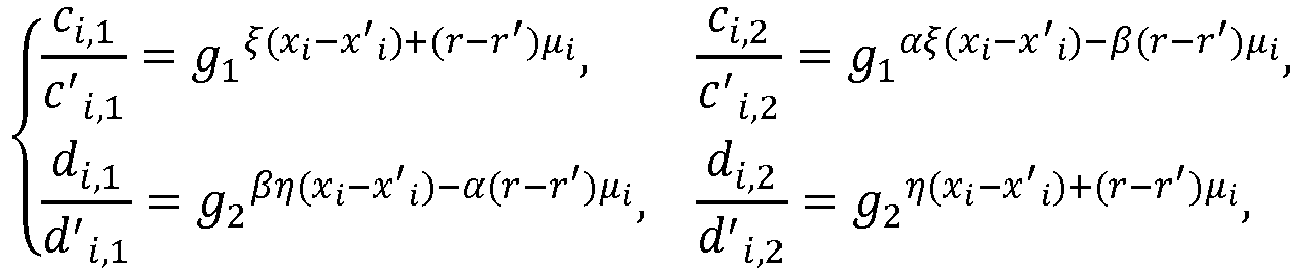

- As a result, the following is obtained:

- The second scheme may be described by the following steps.
- First, define a Setup (1 κ , n) algorithm. On input security parameter 1 κ , the Setup (1 κ , n) algorithm generates the tuple (,
 T , ê) where
 T are (multiplicatively written) groups whose order is

 is a subset of (
 p ) n . The Setup (1 κ , n) algorithm also selects n + 6 elements


- The Setup (1 κ , n) algorithm defines


- The public parameters are pp = (ê,,
 T , p, h) and the secret key is sk = (g, α, β, γ, δ, ξ, η, {µi }1≤i≤n , F K, K). This is the public key and the private key.
- Next, define a Enc (sk,
x , τ) algorithm. The encryption of messagex =
- 1) choose uniformly at random

- 2) for 1 ≤ i ≤ n, compute ti = F K (τ, i) and

- The ciphertext is


- Finally, define an Eval (pp,,
 ) algorithm. The Eval (pp,
 ,
, ) algorithm parses
 as
as
 as
as

- If τ' ≠ τ, the EvaI (pp,
 ) algorithm returns ⊥. Otherwise, if τ' = τ, it evaluates the product

- The Eval (pp,
 ) algorithm then obtains
 T .
T .
- The correctness of the Eval (pp,
 ) algorithm is easily verified. From


- As a result, the following is obtained:

- The embodiments described above may be used in various applications. For example, in privacy-preserving applications, the evaluation of distance between two vectors serves many different applications. Two categories are focused on: (i) evaluation of distance between two vectors for machine learning algorithms; and (ii) evaluation of physical proximity.
- First, application of the embodiments to machine learning will be described. Very large sample sets can require a lot of storage and computational resources in order to carry out the algorithm. In order to be able to handle large datasets, the computation will be offloaded to a datacenter such a cloud computing platform. However, the raw data or feature vectors can often constitute a valuable training set that cannot be released due to privacy concerns, financial value, etc. Therefore machine learning on the data should be performed without actually exposing the data to the server.
- Many useful machine learning algorithms for clustering and classification of data use the distance between data-points or the feature vectors extracted from the data. These include known spectral clustering and classification methods. For instance the Gaussian kernel may be applied with the form

- Distances are used to calculate adjacency matrices which are used to compute Laplacian or diffusion matrices. The spectral decomposition of these matrices and choice of the eigenvectors corresponding to the largest eigenvalues result in an often useful non-linear dimensionality reduction of the data. Non-linear dimensionality reduction has been successfully applied to such tasks as computer vision, image classification and segmentation, speaker identification and verification, anomaly detection, etc.
- Second, application of the embodiments to private evaluation of geo-proximity will be described. A central service is proposed that users may enroll in to get notifications when they are in proximity to a friend, similar to features supported nowadays by social networks. Two users Ui and Uj, who are interested in discovering when they are near one another, enroll in the service after generating a shared key. They occasionally submit their coordinates to the server, encrypted using the schemes described above, using the pre-shared key and a common tag. The pseudo random function used to generate the common tag may incorporate the time in order to prevent evaluating the distance with a prior location ciphertext.
- The server evaluates distances for all pairs i,j that share a common tag, and notifies users whose distance from one another is below a specified threshold. Such a service eliminates the need to broadcast location to all social contacts, and instead just send it to the server.
- Next, application of the embodiments to two-factor biometric and digital authentication is described. It is proposed to use distance evaluation for fuzzy-matching of biometric credentials. Biometric patterns matching has to allow for small mismatches due to the fuzzy nature of biometric credentials. The matching of biometric credentials therefore measures whether the distance between the stored reference pattern, and the reading is below a certain predefined threshold.
- Due to the sensitivity of biometric credentials, it is desirable to avoid storing the biometric credentials in the clear in a central database. A biometric authentication system may include a central service with a database that stores encrypted biometric credentials, smart-IDs (electronic tokens) distributed to users, and biometric readers. An important point is that the biometric readers do not store any data in the clear, but rather encrypt it using encryption keys provided by the smart-IDs.
- Any combination of specific software running on a processor to implement the embodiments of the invention, constitute a specific dedicated machine.
- As used herein, the term "non-transitory machine-readable storage medium" will be understood to exclude a transitory propagation signal but to include all forms of volatile and non-volatile memory. Further, as used herein, the term "processor" will be understood to encompass a variety of devices such as microprocessors, field-programmable gate arrays (FPGAs), application-specific integrated circuits (ASICs), and other similar processing devices. When software is implemented on the processor, the combination becomes a single specific machine.
- It should be appreciated by those skilled in the art that any block diagrams herein represent conceptual views of illustrative circuitry embodying the principles of the invention.
- Although the various exemplary embodiments have been described in detail with particular reference to certain exemplary aspects thereof, it should be understood that the invention is capable of other embodiments and its details are capable of modifications in various obvious respects. As is readily apparent to those skilled in the art, variations and modifications can be effected while remaining within the spirit and scope of the invention. Accordingly, the foregoing disclosure, description, and figures are for illustrative purposes only and do not in any way limit the invention, which is defined only by the claims.
Claims (13)
- A method for performing distance revealing encryption, comprising:generating a tuple (1,
 2,
2, T , ê), where
 T are groups whose order is

 randomly select a first plurality of elements and a second plurality of elements;defining a parameter h that is based upon ê, g 1, g 2, and the first plurality of elements;selecting a pseudo-random function family indexed by a secret key K;setting public parameters as ê,1,
 2,
2, T , p, h;
 setting private parameters as g 1, g 2, the first plurality of elements, the second plurality of elements, the pseudo-random function family, and the secret key K;encrypting a message
x = (x 1, ..., xn ), when n is the number of components in the message by:choosing a random value r;computing a plurality of values of the pseudo random function; andcomputing a first plurality of ciphertext values based upon g 1, the random value r, the first plurality of elements, the second plurality of elements, the plurality of values of the pseudo random function, and messagex ; andcomputing a second plurality of ciphertext values based upon g 2, the random value r, the first plurality of elements, the second plurality of elements, the plurality of values of the pseudo random function, and messagex . - The method of claim 1, wherein
the first plurality of elements are α, β, ξ, η and are selected such that (α + β)ξη ≢ 0 (mod p), and
the second plurality of elements are µ 1, ..., µn and are selected such that
- The method of claim 2, wherein the parameter h = ê(g 1,g 2)(α+β)ξη .
- The method of claim 3, wherein
the first plurality of ciphertext values are calculated as c i,1 = g 1 ξ(xi +ti )+rµi and c i,2 = g 1 αξ(xi +ti )-βrµi for 1 ≤ i ≤ n, where ti are the plurality of values of the pseudo random function, and
the second plurality of ciphertext values are calculated as d i,1 = g 2 βη(xi +ti )-αrµi and d i,2 = g 2 η(xi +ti )+rµi for 1 ≤ i ≤ n. - The method of claim 4, wherein ti = F K (τ,i) where tag τ is a value associated with the message
x . - The method of claim 4 or 5, further comprising determining the distance between two encrypted messages
x andx ' by calculating:
- A method for performing distance revealing encryption, comprising:generating a tuple (,
 T , ê), where
 T are groups whose order is

 randomly select a first plurality of elements and a second plurality of elements;defining a parameter h that is based upon ê, g, and the first plurality of elements;selecting a pseudo-random function family indexed by a secret key K;setting public parameters as ê,,
 T , p, h,
 setting private parameters as g, the first plurality of elements, the second plurality of elements, the pseudo-random function family, and the secret key K;encrypting a message
x = (x 1, ..., xn ), when n is the number of elements in the message by:choosing a random value r;computing a plurality of values of the pseudo random function; andcomputing a plurality of ciphertext values based upon g, the random value r, the first plurality of elements, the second plurality of elements, the plurality of values of the pseudo random function, and messagex . - The method of claim 7, wherein
the first plurality of elements are α, β, γ, δ, ξ, η and are selected such that (1 + α2 + γ2)ξ2 + (1 + β 2 + δ 2)η 2 ≢ 0 (mod p), and
the second plurality of elements are µ 1, ..., µn and are selected such that
- The method of claim 8, wherein the parameter h = ê(g,g)(1+α
2 +γ2 )ξ2 +(1+β2 +δ2 )η2 . - The method of claim 9, wherein
the plurality of ciphertext values are calculated as c i,1 = g ξ(xi +ti )-(αδ-βγ) rµi, c i,2 = g η(xi +ti )-(αδ-βγ)rµi , c i,3 = g αξ(xi +ti )+(γ+δ)rµi , c i,4 = g -βη(xi +ti )+(γ+δ)rµi , c i,5 = g -γξ(xi +ti )-(α+β)rµi , and c i,6 = g δη(xi +ti )+(α+β)rµi , for 1 ≤ i ≤ n, where ti are the plurality of values of the pseudo random function. - The method of claim 10, wherein ti = F K (τ,i) where tag τ is a value associated with the message
x . - The method of claim 10 or 11, further comprising determining the distance between two encrypted messages
x andx ' by calculating:
- A non-transitory machine-readable storage medium encoded with instructions for execution by a processor for performing distance revealing encryption, wherein said instructions, when executed, carry out the method of any preceding claim.
Priority Applications (1)
| Application Number | Priority Date | Filing Date | Title |
|---|---|---|---|
| EP18174333.7A EP3573284B1 (en) | 2018-05-25 | 2018-05-25 | Distance-revealing encryption |
Applications Claiming Priority (1)
| Application Number | Priority Date | Filing Date | Title |
|---|---|---|---|
| EP18174333.7A EP3573284B1 (en) | 2018-05-25 | 2018-05-25 | Distance-revealing encryption |
Publications (2)
| Publication Number | Publication Date |
|---|---|
| EP3573284A1 true EP3573284A1 (en) | 2019-11-27 |
| EP3573284B1 EP3573284B1 (en) | 2020-12-02 |
Family
ID=62386128
Family Applications (1)
| Application Number | Title | Priority Date | Filing Date |
|---|---|---|---|
| EP18174333.7A Not-in-force EP3573284B1 (en) | 2018-05-25 | 2018-05-25 | Distance-revealing encryption |
Country Status (1)
| Country | Link |
|---|---|
| EP (1) | EP3573284B1 (en) |
Citations (1)
| Publication number | Priority date | Publication date | Assignee | Title |
|---|---|---|---|---|
| EP3002904A1 (en) * | 2014-10-01 | 2016-04-06 | Thomson Licensing | Method for ciphering/deciphering and processing vectors of dimension n, where n is an integer greater or equal to 1 |
-
2018
- 2018-05-25 EP EP18174333.7A patent/EP3573284B1/en not_active Not-in-force
Patent Citations (1)
| Publication number | Priority date | Publication date | Assignee | Title |
|---|---|---|---|---|
| EP3002904A1 (en) * | 2014-10-01 | 2016-04-06 | Thomson Licensing | Method for ciphering/deciphering and processing vectors of dimension n, where n is an integer greater or equal to 1 |
Non-Patent Citations (2)
| Title |
|---|
| SAM KIM ET AL: "Function-Hiding Inner Product Encryption is Practical", INTERNATIONAL ASSOCIATION FOR CRYPTOLOGIC RESEARCH,, vol. 20160507:001353, 7 May 2016 (2016-05-07), pages 1 - 33, XP061020901 * |
| UNAGAMI YUJI ET AL: "Private similarity searchable encryption for Euclidean distance", 2016 INTERNATIONAL SYMPOSIUM ON INFORMATION THEORY AND ITS APPLICATIONS (ISITA), IEICE, 30 October 2016 (2016-10-30), pages 718 - 722, XP033057239 * |
Also Published As
| Publication number | Publication date |
|---|---|
| EP3573284B1 (en) | 2020-12-02 |
Similar Documents
| Publication | Publication Date | Title |
|---|---|---|
| US11595210B2 (en) | Accurate, real-time and secure privacy-preserving verification of biometrics or other sensitive information | |
| US8958552B2 (en) | Data processing device | |
| US10129029B2 (en) | Proofs of plaintext knowledge and group signatures incorporating same | |
| US9973342B2 (en) | Authentication via group signatures | |
| US8837727B2 (en) | Method for privacy preserving hashing of signals with binary embeddings | |
| Hsien et al. | A Survey of Public Auditing for Secure Data Storage in Cloud Computing. | |
| Francati et al. | Identity-based matchmaking encryption without random oracles | |
| US10764048B2 (en) | Privacy-preserving evaluation of decision trees | |
| EP2228942B1 (en) | Securing communications sent by a first user to a second user | |
| Yasuda et al. | Practical packing method in somewhat homomorphic encryption | |
| CN105046234B (en) | Sparse representation-based human face image secret identification method in cloud environment | |
| US20120045056A1 (en) | Cryptographic processing system | |
| JP2014126865A (en) | Device and method for encryption processing | |
| Erkin et al. | Privacy-preserving distributed clustering | |
| US10411891B2 (en) | Distance-revealing encryption | |
| Rahulamathavan et al. | Efficient privacy-preserving facial expression classification | |
| Barnett et al. | Image classification using non-linear support vector machines on encrypted data | |
| EP3002904A1 (en) | Method for ciphering/deciphering and processing vectors of dimension n, where n is an integer greater or equal to 1 | |
| Abd-Elhafiez et al. | Image encryption algorithm methodology based on multi-mapping image pixel | |
| JP2014157354A (en) | Cryptographic devices and methods for generating and verifying linearly homomorphic structure-preserving signatures | |
| Carpov et al. | Illuminating the Dark or how to recover what should not be seen in FE-based classifiers | |
| Taheri et al. | Face authentication in encrypted domain based on correlation filters | |
| Wang et al. | Gmatch: Secure and privacy-preserving group matching in social networks | |
| US20170359177A1 (en) | Method and System for Cryptographic Decision-making of Set Membership | |
| EP3573284B1 (en) | Distance-revealing encryption |
Legal Events
| Date | Code | Title | Description |
|---|---|---|---|
| PUAI | Public reference made under article 153(3) epc to a published international application that has entered the european phase |
Free format text: ORIGINAL CODE: 0009012 |
|
| STAA | Information on the status of an ep patent application or granted ep patent |
Free format text: STATUS: THE APPLICATION HAS BEEN PUBLISHED |
|
| AK | Designated contracting states |
Kind code of ref document: A1 Designated state(s): AL AT BE BG CH CY CZ DE DK EE ES FI FR GB GR HR HU IE IS IT LI LT LU LV MC MK MT NL NO PL PT RO RS SE SI SK SM TR |
|
| AX | Request for extension of the european patent |
Extension state: BA ME |
|
| STAA | Information on the status of an ep patent application or granted ep patent |
Free format text: STATUS: REQUEST FOR EXAMINATION WAS MADE |
|
| 17P | Request for examination filed |
Effective date: 20200527 |
|
| RBV | Designated contracting states (corrected) |
Designated state(s): AL AT BE BG CH CY CZ DE DK EE ES FI FR GB GR HR HU IE IS IT LI LT LU LV MC MK MT NL NO PL PT RO RS SE SI SK SM TR |
|
| RIC1 | Information provided on ipc code assigned before grant |
Ipc: H04L 9/30 20060101AFI20200618BHEP |
|
| GRAP | Despatch of communication of intention to grant a patent |
Free format text: ORIGINAL CODE: EPIDOSNIGR1 |
|
| STAA | Information on the status of an ep patent application or granted ep patent |
Free format text: STATUS: GRANT OF PATENT IS INTENDED |
|
| INTG | Intention to grant announced |
Effective date: 20200828 |
|
| GRAS | Grant fee paid |
Free format text: ORIGINAL CODE: EPIDOSNIGR3 |
|
| GRAA | (expected) grant |
Free format text: ORIGINAL CODE: 0009210 |
|
| STAA | Information on the status of an ep patent application or granted ep patent |
Free format text: STATUS: THE PATENT HAS BEEN GRANTED |
|
| AK | Designated contracting states |
Kind code of ref document: B1 Designated state(s): AL AT BE BG CH CY CZ DE DK EE ES FI FR GB GR HR HU IE IS IT LI LT LU LV MC MK MT NL NO PL PT RO RS SE SI SK SM TR |
|
| REG | Reference to a national code |
Ref country code: GB Ref legal event code: FG4D |
|
| REG | Reference to a national code |
Ref country code: AT Ref legal event code: REF Ref document number: 1342120 Country of ref document: AT Kind code of ref document: T Effective date: 20201215 Ref country code: CH Ref legal event code: EP |
|
| REG | Reference to a national code |
Ref country code: IE Ref legal event code: FG4D |
|
| REG | Reference to a national code |
Ref country code: DE Ref legal event code: R096 Ref document number: 602018010265 Country of ref document: DE |
|
| PG25 | Lapsed in a contracting state [announced via postgrant information from national office to epo] |
Ref country code: RS Free format text: LAPSE BECAUSE OF FAILURE TO SUBMIT A TRANSLATION OF THE DESCRIPTION OR TO PAY THE FEE WITHIN THE PRESCRIBED TIME-LIMIT Effective date: 20201202 Ref country code: FI Free format text: LAPSE BECAUSE OF FAILURE TO SUBMIT A TRANSLATION OF THE DESCRIPTION OR TO PAY THE FEE WITHIN THE PRESCRIBED TIME-LIMIT Effective date: 20201202 Ref country code: NO Free format text: LAPSE BECAUSE OF FAILURE TO SUBMIT A TRANSLATION OF THE DESCRIPTION OR TO PAY THE FEE WITHIN THE PRESCRIBED TIME-LIMIT Effective date: 20210302 Ref country code: GR Free format text: LAPSE BECAUSE OF FAILURE TO SUBMIT A TRANSLATION OF THE DESCRIPTION OR TO PAY THE FEE WITHIN THE PRESCRIBED TIME-LIMIT Effective date: 20210303 |
|
| REG | Reference to a national code |
Ref country code: NL Ref legal event code: MP Effective date: 20201202 |
|
| REG | Reference to a national code |
Ref country code: AT Ref legal event code: MK05 Ref document number: 1342120 Country of ref document: AT Kind code of ref document: T Effective date: 20201202 |
|
| PG25 | Lapsed in a contracting state [announced via postgrant information from national office to epo] |
Ref country code: BG Free format text: LAPSE BECAUSE OF FAILURE TO SUBMIT A TRANSLATION OF THE DESCRIPTION OR TO PAY THE FEE WITHIN THE PRESCRIBED TIME-LIMIT Effective date: 20210302 Ref country code: PL Free format text: LAPSE BECAUSE OF FAILURE TO SUBMIT A TRANSLATION OF THE DESCRIPTION OR TO PAY THE FEE WITHIN THE PRESCRIBED TIME-LIMIT Effective date: 20201202 Ref country code: LV Free format text: LAPSE BECAUSE OF FAILURE TO SUBMIT A TRANSLATION OF THE DESCRIPTION OR TO PAY THE FEE WITHIN THE PRESCRIBED TIME-LIMIT Effective date: 20201202 Ref country code: SE Free format text: LAPSE BECAUSE OF FAILURE TO SUBMIT A TRANSLATION OF THE DESCRIPTION OR TO PAY THE FEE WITHIN THE PRESCRIBED TIME-LIMIT Effective date: 20201202 |
|
| PG25 | Lapsed in a contracting state [announced via postgrant information from national office to epo] |
Ref country code: NL Free format text: LAPSE BECAUSE OF FAILURE TO SUBMIT A TRANSLATION OF THE DESCRIPTION OR TO PAY THE FEE WITHIN THE PRESCRIBED TIME-LIMIT Effective date: 20201202 Ref country code: HR Free format text: LAPSE BECAUSE OF FAILURE TO SUBMIT A TRANSLATION OF THE DESCRIPTION OR TO PAY THE FEE WITHIN THE PRESCRIBED TIME-LIMIT Effective date: 20201202 |
|
| REG | Reference to a national code |
Ref country code: LT Ref legal event code: MG9D |
|
| PG25 | Lapsed in a contracting state [announced via postgrant information from national office to epo] |
Ref country code: PT Free format text: LAPSE BECAUSE OF FAILURE TO SUBMIT A TRANSLATION OF THE DESCRIPTION OR TO PAY THE FEE WITHIN THE PRESCRIBED TIME-LIMIT Effective date: 20210405 Ref country code: SK Free format text: LAPSE BECAUSE OF FAILURE TO SUBMIT A TRANSLATION OF THE DESCRIPTION OR TO PAY THE FEE WITHIN THE PRESCRIBED TIME-LIMIT Effective date: 20201202 Ref country code: RO Free format text: LAPSE BECAUSE OF FAILURE TO SUBMIT A TRANSLATION OF THE DESCRIPTION OR TO PAY THE FEE WITHIN THE PRESCRIBED TIME-LIMIT Effective date: 20201202 Ref country code: LT Free format text: LAPSE BECAUSE OF FAILURE TO SUBMIT A TRANSLATION OF THE DESCRIPTION OR TO PAY THE FEE WITHIN THE PRESCRIBED TIME-LIMIT Effective date: 20201202 Ref country code: SM Free format text: LAPSE BECAUSE OF FAILURE TO SUBMIT A TRANSLATION OF THE DESCRIPTION OR TO PAY THE FEE WITHIN THE PRESCRIBED TIME-LIMIT Effective date: 20201202 Ref country code: CZ Free format text: LAPSE BECAUSE OF FAILURE TO SUBMIT A TRANSLATION OF THE DESCRIPTION OR TO PAY THE FEE WITHIN THE PRESCRIBED TIME-LIMIT Effective date: 20201202 Ref country code: EE Free format text: LAPSE BECAUSE OF FAILURE TO SUBMIT A TRANSLATION OF THE DESCRIPTION OR TO PAY THE FEE WITHIN THE PRESCRIBED TIME-LIMIT Effective date: 20201202 |
|
| PG25 | Lapsed in a contracting state [announced via postgrant information from national office to epo] |
Ref country code: AT Free format text: LAPSE BECAUSE OF FAILURE TO SUBMIT A TRANSLATION OF THE DESCRIPTION OR TO PAY THE FEE WITHIN THE PRESCRIBED TIME-LIMIT Effective date: 20201202 |
|
| REG | Reference to a national code |
Ref country code: DE Ref legal event code: R097 Ref document number: 602018010265 Country of ref document: DE |
|
| PG25 | Lapsed in a contracting state [announced via postgrant information from national office to epo] |
Ref country code: IS Free format text: LAPSE BECAUSE OF FAILURE TO SUBMIT A TRANSLATION OF THE DESCRIPTION OR TO PAY THE FEE WITHIN THE PRESCRIBED TIME-LIMIT Effective date: 20210402 |
|
| PLBE | No opposition filed within time limit |
Free format text: ORIGINAL CODE: 0009261 |
|
| STAA | Information on the status of an ep patent application or granted ep patent |
Free format text: STATUS: NO OPPOSITION FILED WITHIN TIME LIMIT |
|
| PG25 | Lapsed in a contracting state [announced via postgrant information from national office to epo] |
Ref country code: AL Free format text: LAPSE BECAUSE OF FAILURE TO SUBMIT A TRANSLATION OF THE DESCRIPTION OR TO PAY THE FEE WITHIN THE PRESCRIBED TIME-LIMIT Effective date: 20201202 Ref country code: IT Free format text: LAPSE BECAUSE OF FAILURE TO SUBMIT A TRANSLATION OF THE DESCRIPTION OR TO PAY THE FEE WITHIN THE PRESCRIBED TIME-LIMIT Effective date: 20201202 |
|
| 26N | No opposition filed |
Effective date: 20210903 |
|
| PG25 | Lapsed in a contracting state [announced via postgrant information from national office to epo] |
Ref country code: SI Free format text: LAPSE BECAUSE OF FAILURE TO SUBMIT A TRANSLATION OF THE DESCRIPTION OR TO PAY THE FEE WITHIN THE PRESCRIBED TIME-LIMIT Effective date: 20201202 Ref country code: DK Free format text: LAPSE BECAUSE OF FAILURE TO SUBMIT A TRANSLATION OF THE DESCRIPTION OR TO PAY THE FEE WITHIN THE PRESCRIBED TIME-LIMIT Effective date: 20201202 |
|
| REG | Reference to a national code |
Ref country code: CH Ref legal event code: PL |
|
| PG25 | Lapsed in a contracting state [announced via postgrant information from national office to epo] |
Ref country code: ES Free format text: LAPSE BECAUSE OF FAILURE TO SUBMIT A TRANSLATION OF THE DESCRIPTION OR TO PAY THE FEE WITHIN THE PRESCRIBED TIME-LIMIT Effective date: 20201202 Ref country code: LI Free format text: LAPSE BECAUSE OF NON-PAYMENT OF DUE FEES Effective date: 20210531 Ref country code: LU Free format text: LAPSE BECAUSE OF NON-PAYMENT OF DUE FEES Effective date: 20210525 Ref country code: MC Free format text: LAPSE BECAUSE OF FAILURE TO SUBMIT A TRANSLATION OF THE DESCRIPTION OR TO PAY THE FEE WITHIN THE PRESCRIBED TIME-LIMIT Effective date: 20201202 Ref country code: CH Free format text: LAPSE BECAUSE OF NON-PAYMENT OF DUE FEES Effective date: 20210531 |
|
| REG | Reference to a national code |
Ref country code: BE Ref legal event code: MM Effective date: 20210531 |
|
| PG25 | Lapsed in a contracting state [announced via postgrant information from national office to epo] |
Ref country code: IE Free format text: LAPSE BECAUSE OF NON-PAYMENT OF DUE FEES Effective date: 20210525 |
|
| PG25 | Lapsed in a contracting state [announced via postgrant information from national office to epo] |
Ref country code: IS Free format text: LAPSE BECAUSE OF FAILURE TO SUBMIT A TRANSLATION OF THE DESCRIPTION OR TO PAY THE FEE WITHIN THE PRESCRIBED TIME-LIMIT Effective date: 20210402 |
|
| PG25 | Lapsed in a contracting state [announced via postgrant information from national office to epo] |
Ref country code: BE Free format text: LAPSE BECAUSE OF NON-PAYMENT OF DUE FEES Effective date: 20210531 |
|
| PGFP | Annual fee paid to national office [announced via postgrant information from national office to epo] |
Ref country code: FR Payment date: 20220421 Year of fee payment: 5 Ref country code: DE Payment date: 20220420 Year of fee payment: 5 |
|
| GBPC | Gb: european patent ceased through non-payment of renewal fee |
Effective date: 20220525 |
|
| PG25 | Lapsed in a contracting state [announced via postgrant information from national office to epo] |
Ref country code: GB Free format text: LAPSE BECAUSE OF NON-PAYMENT OF DUE FEES Effective date: 20220525 |
|
| PG25 | Lapsed in a contracting state [announced via postgrant information from national office to epo] |
Ref country code: CY Free format text: LAPSE BECAUSE OF FAILURE TO SUBMIT A TRANSLATION OF THE DESCRIPTION OR TO PAY THE FEE WITHIN THE PRESCRIBED TIME-LIMIT Effective date: 20201202 |
|
| PG25 | Lapsed in a contracting state [announced via postgrant information from national office to epo] |
Ref country code: HU Free format text: LAPSE BECAUSE OF FAILURE TO SUBMIT A TRANSLATION OF THE DESCRIPTION OR TO PAY THE FEE WITHIN THE PRESCRIBED TIME-LIMIT; INVALID AB INITIO Effective date: 20180525 |
|
| REG | Reference to a national code |
Ref country code: DE Ref legal event code: R119 Ref document number: 602018010265 Country of ref document: DE |
|
| PG25 | Lapsed in a contracting state [announced via postgrant information from national office to epo] |
Ref country code: MK Free format text: LAPSE BECAUSE OF FAILURE TO SUBMIT A TRANSLATION OF THE DESCRIPTION OR TO PAY THE FEE WITHIN THE PRESCRIBED TIME-LIMIT Effective date: 20201202 Ref country code: DE Free format text: LAPSE BECAUSE OF NON-PAYMENT OF DUE FEES Effective date: 20231201 |
|
| PG25 | Lapsed in a contracting state [announced via postgrant information from national office to epo] |
Ref country code: FR Free format text: LAPSE BECAUSE OF NON-PAYMENT OF DUE FEES Effective date: 20230531 |
|
| PG25 | Lapsed in a contracting state [announced via postgrant information from national office to epo] |
Ref country code: TR Free format text: LAPSE BECAUSE OF FAILURE TO SUBMIT A TRANSLATION OF THE DESCRIPTION OR TO PAY THE FEE WITHIN THE PRESCRIBED TIME-LIMIT Effective date: 20201202 |
|
| PG25 | Lapsed in a contracting state [announced via postgrant information from national office to epo] |
Ref country code: MT Free format text: LAPSE BECAUSE OF FAILURE TO SUBMIT A TRANSLATION OF THE DESCRIPTION OR TO PAY THE FEE WITHIN THE PRESCRIBED TIME-LIMIT Effective date: 20201202 |