EP3572930A1 - Random number generation device, method, and program - Google Patents
Random number generation device, method, and program Download PDFInfo
- Publication number
- EP3572930A1 EP3572930A1 EP18741800.9A EP18741800A EP3572930A1 EP 3572930 A1 EP3572930 A1 EP 3572930A1 EP 18741800 A EP18741800 A EP 18741800A EP 3572930 A1 EP3572930 A1 EP 3572930A1
- Authority
- EP
- European Patent Office
- Prior art keywords
- random number
- exp
- lap
- predetermined
- function
- Prior art date
- Legal status (The legal status is an assumption and is not a legal conclusion. Google has not performed a legal analysis and makes no representation as to the accuracy of the status listed.)
- Granted
Links
Images



Classifications
-
- G—PHYSICS
- G06—COMPUTING OR CALCULATING; COUNTING
- G06F—ELECTRIC DIGITAL DATA PROCESSING
- G06F7/00—Methods or arrangements for processing data by operating upon the order or content of the data handled
- G06F7/58—Random or pseudo-random number generators
- G06F7/582—Pseudo-random number generators
- G06F7/586—Pseudo-random number generators using an integer algorithm, e.g. using linear congruential method
-
- G—PHYSICS
- G06—COMPUTING OR CALCULATING; COUNTING
- G06F—ELECTRIC DIGITAL DATA PROCESSING
- G06F7/00—Methods or arrangements for processing data by operating upon the order or content of the data handled
- G06F7/58—Random or pseudo-random number generators
-
- G—PHYSICS
- G06—COMPUTING OR CALCULATING; COUNTING
- G06F—ELECTRIC DIGITAL DATA PROCESSING
- G06F17/00—Digital computing or data processing equipment or methods, specially adapted for specific functions
- G06F17/10—Complex mathematical operations
- G06F17/18—Complex mathematical operations for evaluating statistical data, e.g. average values, frequency distributions, probability functions, regression analysis
Definitions
- the present invention relates to a technique for generating random numbers.
- Patent Literature 1 has been known as a noise addition method that has been conventionally used in anonymization, one of privacy protection techniques (for example, Non-patent literatures 1, 2, 3 4 and 5).
- a subject in the above patent literature is to generate random numbers according to an arbitrary probability distribution of an arbitrary dimension.
- Patent literature 1 Japanese Patent Application Laid-Open No. 2014-081545
- One of methods for protecting privacy of personal data in a database is anonymization.
- Laplace distribution In order to anonymize numerical attributes, an anonymization method of causing each attribute value to transition to another attribute value using a random number according to a probability distribution called Laplace distribution (Non-patent literatures 2, 3 and 4) may be used.
- Laplace distribution As an example of numerical attribute personal data, an example of position information (latitude/longitude) about a person will be considered. Though there is almost no possibility that a person exists in an area of the sea other than routes, it may seem as if a person existed in the area due to anonymization.
- a category attribute which is not a numerical attribute
- an anonymization method of causing the discrete attribute value to transition to another attribute value with a probability ⁇ may be used (Non-patent literatures 1 and 5).
- the category attribute purchase information about a person will be considered. Though there cannot be a person who purchases a movie ticket of a high school student price and an alcoholic drink, it may seem as if such a person that belongs to the category area existed due to anonymization.
- a reason why such state transition of a numerical attribute and a category attribute occurs is that a random number included in the impossible area is generated.
- the present invention is intended to provide a random number generation apparatus, method and program for generating random numbers according to a multidimensional probability distribution such that a probability in a predetermined area is zero.
- a random number generation apparatus comprises:
- a random number generation apparatus comprises:
- a distribution function that generates random numbers included in an impossible area is called a basic distribution function f(x 1 ,...,x D ), and a distribution function that does not generate random numbers included in an impossible area is called a corrected distribution function f(x 1 ,...,x D ), where, ⁇ D ⁇ N + ⁇ 0 ⁇ .
- D is a predetermined positive integer.
- a hole An impossible area of a random variable is called "a hole", and the area of the hole is given as a parameter, for example, as shown below.
- the present invention is to generate a random number r ⁇ R D according to an arbitrary D-dimensional probability distribution function f(x 1 ,...,x D ).
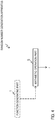
- a random number generation apparatus of a first embodiment is provided with a first random number generating part 2, a second random number generating part 3 and a determining part 4 as shown in Fig. 1 .
- the random number generation apparatus may be further provided with a function generating part 1 indicated by a broken line in Fig. 1 .
- a random number generation method of the first embodiment is realized by each part of the random number generation apparatus performing processes from step S2 to step S4 illustrated in Fig. 2 and described below.
- a probability H of a basic distribution function f(x 1 , ..., x D ) in the hole [h] is defined as below.
- H ⁇ x 1 ⁇ h 1 ⁇ ⁇ x D ⁇ h D f x 1 ⁇ x D dx 1 ⁇ dx D
- the random number generation apparatus is provided with the function generating part 1 that calculates the probability H and the corrected distribution function f'(x 1 ..., x D ), and the function generating part 1 calculates the probability H and the corrected distribution f'(x 1 ..., x D ) in advance before subsequent processes are performed (step S1).
- the random number generation apparatus may not be provided with the function generating part 1. In this case, in subsequent processes, as the probability H and the corrected distribution function f'(x 1 ..., x D ), the random number generation apparatus uses those calculated by another apparatus in advance.
- the generated random number u is outputted to the determining part 4.
- the second random number generating part 3 generates a random number v ⁇ [0,f' max ] (step S3).
- the second random number generating part 3 generates a uniform random number v ⁇ [0,f' max ] as the random number v.
- the generated random number v is outputted to the determining part 4.
- a multidimensional random number according to a multidimensional probability distribution such that a probability in the hole [h], which is a predetermined area, is zero can be generated. If an expression of a multidimensional probability distribution can be obtained, it is possible to generate random numbers not only from a multidimensional probability distribution such that a probability in an impossible area is zero but from an arbitrary probability distribution.
- Attributes in a database to be anonymized are not necessarily independent but may be dependent on one another.
- anonymization is applicable only when attributes in a database are independent and cannot be trivially extended to a multidimensional probability distribution such that there are attributes dependent on one another.
- Fig. 3 shows the above this.
- Fig. 3(a) is a perspective view
- Fig. 3(b) is a view from above. From Fig. 3 , transition to a possible area is also prevented, which is different from what is to be achieved here.
- One of the points is to assume a simultaneous probability distribution and use a probability distribution having a hole from the simultaneous probability distribution to solve the above.
- this random number generation method is applicable to an arbitrary probability distribution and, therefore, can be used for privacy protection other than anonymization.
- a procedure for generating a random number r ⁇ R D the processing speed of which is faster than that of the procedure of the first embodiment will be shown below.
- this procedure a technique of an inverse function method is used.
- a random number generation apparatus of the second embodiment is provided with an arithmetic operation part 5 as shown in Fig. 4 .
- the random number generation apparatus may be further provided with a function generating part 1 indicated by a broken line in Fig. 4 .
- a random number generation method of the second embodiment is realized by each part of the random number generation apparatus performing a process of step S5 illustrated in Fig. 5 and described below.
- a probability H of a basic distribution function f(x 1 , ..., x D ) in the hole [h] is defined as below.
- H ⁇ x 1 ⁇ h 1 ⁇ ⁇ x D ⁇ h D f x 1 ⁇ x D dx 1 ⁇ dx D
- the random number generation apparatus is provided with the function generating part 1 that calculates the probability H and the corrected distribution function f'(x 1 ..., x D ), and the function generating part 1 calculates the probability H and the corrected distribution f'(x 1 ..., x D ) in advance before subsequent processes are performed (step S1).
- the random number generation apparatus may not be provided with the function generating part 1. In this case, in subsequent processes, as the probability H and the corrected distribution function f'(x 1 ..., x D ), the random number generation apparatus uses those calculated by another apparatus in advance.
- the arithmetic operation part 5 may perform processes from step S50 to step S57 below to perform step S5.
- the arithmetic operation part 5 derives a peripheral distribution f'(x 1 ) of f'(x 1 ,x 2 ,...,x D ) of x 1 (step S51).
- f ′ x 1 ⁇ ⁇ ⁇ ⁇ ⁇ ⁇ ⁇ ⁇ ⁇ f ′ x 1 ⁇ x D dx 2 ⁇ d D
- the arithmetic operation part 5 derives a cumulative density function F(t 1 ) (step S52).
- F t 1 ⁇ ⁇ ⁇ t 1 f ′ x 1 dx 1
- the arithmetic operation part 5 derives F -1 (t 1 ) which is an inverse function of F(t 1 ) (step S53).
- the arithmetic operation part 5 generates a random number u 1 ⁇ [0,1] (step S54).
- the arithmetic operation part 5 generates, for example, a uniform random number u 1 ⁇ [0,1] as the random number u 1 .
- the arithmetic operation part 5 substitutes r 1 for x 1 of f'(x 1 ,...,x D ) to obtain f'(x 2 ,...,x D
- x 1 r 1 ) (step S56).
- the arithmetic operation part 5 performs an operation similar to steps S51 to S56 described above for f'(x i ,...,x D
- a multidimensional probability distribution may be converted to one-dimensional peripheral distributions to sequentially generate random numbers using an inverse function method.
- N is a predetermined positive integer
- N predetermined possible ranges [h i ] for the random variable x i are N predetermined possible ranges.
- the number of holes is to be N.
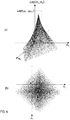
- ( ⁇ x1 ,2 ⁇ x1 2 ) and ( ⁇ x2 ,2 ⁇ x2 2 ) are predetermined parameters, and the basic distribution function f(x1, ..., x D ) is Laplace distribution Lap(x 1 ,x 2 ) defined by Expression (3).
- the Laplace distribution Lap(x 1 ,x 2 ) is shown in Fig. 6.
- Fig. 6(a) is a perspective view
- Fig. 6(b) is a view from above.
- Lap x 1 x 2 1 2 ⁇ x 1 exp ⁇ x 1 ⁇ ⁇ x 1 ⁇ x 1 1 2 ⁇ x 2 exp ⁇ x 2 ⁇ ⁇ x 2 ⁇ x 2
- the sign(a) is a function that outputs a sign ⁇ +,- ⁇ of an input a
- a function g(s,e) is defined by Expressions (5) and (6) when s ⁇ e
- H is defined by Expression (4)
- the corrected distribution function f' is Lap'(x 1 ,x 2 ) defined by Expressions (7) and (8).
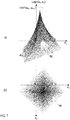
- the corrected distribution function f is Lap'(x 1 ,x 2 ) with one hole [h] that is shown in Fig. 7.
- Fig. 7(a) is a perspective view
- Fig. 7(b) is a view from above.
- a first area S 1 is (x 1 ⁇ x1 ) ⁇ (x 2 ⁇ x2 )
- a second area S 2 is (x 1 ⁇ x1 ) ⁇ (x 2 ⁇ x2 )
- a third area S 3 is (x 1 ⁇ x1 ) ⁇ (x 2 ⁇ x2 )
- a fourth area S 4 is (x 1 ⁇ x1 ) ⁇ (x 2 ⁇ x2 ).
- a peripheral distribution of x 1 will be considered in order to obtain a random number r 1 .
- the corrected distribution function f is Lap'(x 1 ) defined by Expressions (9) and (10).
- Lap ′ x 1 ⁇ 4 ⁇ x 1 exp ⁇ x 1 ⁇ ⁇ x 1 ⁇ x 1 2 ⁇ exp ⁇ c + ⁇ x 2 ⁇ x 2 + exp ⁇ d + ⁇ x 2 ⁇ x 2 if a ⁇ x 1 ⁇ b
- Lap ′ x 1 ⁇ 2 ⁇ x 1 exp ⁇ x 1 ⁇ ⁇ x 1 ⁇ x 1 otherwise
- the corrected distribution function f' is Lap'(x 1 ) defined by Expressions (11) and (12).
- Lap ′ x 1 ⁇ 4 ⁇ x 1 exp ⁇ x 1 ⁇ ⁇ x 1 ⁇ x 1 2 + exp c ⁇ ⁇ x 2 ⁇ x 2 ⁇ exp d ⁇ ⁇ x 2 ⁇ x 2 if a ⁇ x 1 ⁇ b
- Lap ′ x 1 ⁇ 2 ⁇ x 1 exp ⁇ x 1 ⁇ ⁇ x 1 ⁇ x 1 otherwise
- ⁇ 2 ⁇ exp ⁇ c + ⁇ x 2 ⁇ x 2 + exp ⁇ d + ⁇ x 2 ⁇ x 2
- ⁇ exp ⁇ r 1 ⁇ ⁇ x 1 ⁇ x 1
- the program in which the processing content is written can be recorded to a computer-readable recording medium.
- a computer-readable recording medium any recording medium, for example, a magnetic recording device, an optical disk, magneto-optical recording medium or a semiconductor memory is possible.
- Each processing part may be configured by causing a predetermined program to be executed on the computer, or at least a part of processing content of the processing part may be realized as hardware.
Landscapes
- Engineering & Computer Science (AREA)
- Physics & Mathematics (AREA)
- General Physics & Mathematics (AREA)
- Theoretical Computer Science (AREA)
- Computational Mathematics (AREA)
- Mathematical Analysis (AREA)
- Mathematical Optimization (AREA)
- Pure & Applied Mathematics (AREA)
- Data Mining & Analysis (AREA)
- General Engineering & Computer Science (AREA)
- Mathematical Physics (AREA)
- Bioinformatics & Cheminformatics (AREA)
- Bioinformatics & Computational Biology (AREA)
- Evolutionary Biology (AREA)
- Operations Research (AREA)
- Probability & Statistics with Applications (AREA)
- Algebra (AREA)
- Life Sciences & Earth Sciences (AREA)
- Databases & Information Systems (AREA)
- Software Systems (AREA)
- Complex Calculations (AREA)
Abstract
Description
- The present invention relates to a technique for generating random numbers.
-
Patent Literature 1 has been known as a noise addition method that has been conventionally used in anonymization, one of privacy protection techniques (for example, Non-patentliteratures - A subject in the above patent literature is to generate random numbers according to an arbitrary probability distribution of an arbitrary dimension.
- Patent literature 1: Japanese Patent Application Laid-Open No.
2014-081545 -
- Non-patent literature 1: Dai Ikarashi, Koji Chida, Katsumi Takahashi, "Efficient Privacy-preserving Cross Tabulation for Multi-valued Attributes", Papers of Information Processing Society Symposium, Volume 2008, No. 8, 1st Volume, pp. 497-502, October 8, 2008
- Non-patent literature 2: Dai Ikarashi, Koji Chida, Katsumi Takahashi, "A Probabilistic Extension of k-Anonimity", CSS2009, Volume 2009, pp. 1-6, October 2009
- Non-patent literature 3: Dai Ikarashi, Koji Chida, Katsumi Takahashi, "Randomized k-Anonymization for Numeric Attributes", CSS2011, Volume 2011, No. 3, pp. 450-455, October 12, 2011
- Non-patent literature 4: Dai Ikarashi, Satoshi Hasegawa, Tatsuya Osame, Ryo Kikuchi, Koji Chida, "A Privacy Preserving Cross-tabulation which Guarantees k-Anonymity by Randomization for Numeric Attributes", Volume 2012, No. 3, pp. 639-646, October 23, 2012
- Non-patent literature 5: Ryo Kikuchi, Dai Igarashi, Koji Chida, Koki Hamada, "Data-Dependent Pk-Anonymization Method for Publishing Useful Anonymized Table", SCIS2013
- One of methods for protecting privacy of personal data in a database is anonymization.
- In order to anonymize numerical attributes, an anonymization method of causing each attribute value to transition to another attribute value using a random number according to a probability distribution called Laplace distribution (Non-patent
literatures - In order to anonymize a discrete attribute called a category attribute, which is not a numerical attribute, an anonymization method of causing the discrete attribute value to transition to another attribute value with a probability ρ may be used (Non-patent
literatures 1 and 5). As an example of the category attribute, purchase information about a person will be considered. Though there cannot be a person who purchases a movie ticket of a high school student price and an alcoholic drink, it may seem as if such a person that belongs to the category area existed due to anonymization. - A reason why such state transition of a numerical attribute and a category attribute occurs is that a random number included in the impossible area is generated.
- In order to prevent such impossible state transition, it is necessary to generate random numbers according to a multidimensional probability distribution of an arbitrary dimension such that a probability in an impossible area is zero. A method for generating such random numbers, however, has not been proposed yet.
- The present invention is intended to provide a random number generation apparatus, method and program for generating random numbers according to a multidimensional probability distribution such that a probability in a predetermined area is zero.
- A random number generation apparatus according to one aspect of the present invention comprises:
- a first random number generating part generating a random number u=(u1,...,uD)T ∈ [-∞,∞]D;
- a second random number generating part generating a random number v ∈ [0,f'max]; and
- a determining part determining whether f'(x1=u1,...,xD=uD)≥v or not, and, if f'(x1=u1,...,xD=uD)≥v, adopting u as a random number according to f'(x1,...,xD), wherein
- D is a predetermined positive integer, for i=1,...,D, [hi] is a predetermined possible range for a random variable xi, a hole [h] is [h]=([h1],...,[hD])T, H is a probability of a predetermined basic distribution function f(x1,...,xD) in the hole [h], α=1/(1-H), a corrected distribution function f'(x1,...,xD) is defined by Expressions (1) and (2):
[Formula 1]

- A random number generation apparatus according to another aspect of the present invention comprises:
- an arithmetic operation part obtaining r=(r1,...,rD)T in the end, by performing, for each of i=1,...,D, a process for generating a random number ui ∈ [0,1], obtaining a random number ri=F-1(ui) according to f'(xi) using the generated ui, and xi=ri, wherein
- D is a predetermined positive integer, for i=1,...,D, [hi] is a predetermined possible range for a random variable xi, a hole [h] is [h]=([h1],...,[hD])T, H is a probability of a predetermined basic distribution function f(x1,...,xD) in the hole [h], α=1/(1-H), a corrected distribution function f'(x1,...,xD) is defined by Expressions (1) and (2):
[Formula 2]



- It is possible to generate random numbers according to a multidimensional distribution such that a probability in a predetermined area is zero.
-
-
Fig. 1 is a block diagram for illustrating an example of a random number generation apparatus of a first embodiment; -
Fig. 2 is a flowchart for illustrating an example of a random number generation method of the first embodiment; -
Fig. 3 is a diagram for illustrating a prior-art technique; -
Fig. 4 is a block diagram for illustrating an example of a random number generation apparatus of a second embodiment; -
Fig. 5 is a flowchart for illustrating an example of a random number generation method of the second embodiment; -
Fig. 6 is a diagram for illustrating a specific example 1; and -
Fig. 7 is a diagram for illustrating a specific example 2. - Embodiments of the present invention will be described below with reference to drawings.
- Hereinafter, a distribution function that generates random numbers included in an impossible area is called a basic distribution function f(x1,...,xD), and a distribution function that does not generate random numbers included in an impossible area is called a corrected distribution function f(x1,...,xD), where, ∀D∈N+\{0}. In other words, D is a predetermined positive integer.
- An impossible area of a random variable is called "a hole", and the area of the hole is given as a parameter, for example, as shown below.
- A hole [h]=([h1],...,[hD]T is a hypercube in D-dimensional space, and each [hi] indicates a range [si,ei] for a random variable xi.
- The present invention is to generate a random number r ∈ RD according to an arbitrary D-dimensional probability distribution function f(x1,...,xD). Intuitively, the process of the present invention is to express the function f(x1,...,xD) as D one-dimensional probability distribution functions, sequentially generate a random number ri ∈ R D times, and obtain r=(r1,...,rD)T, a set of ri, in the end.
- For example, a random number generation apparatus of a first embodiment is provided with a first random
number generating part 2, a second randomnumber generating part 3 and a determiningpart 4 as shown inFig. 1 . The random number generation apparatus may be further provided with afunction generating part 1 indicated by a broken line inFig. 1 . - For example, a random number generation method of the first embodiment is realized by each part of the random number generation apparatus performing processes from step S2 to step S4 illustrated in
Fig. 2 and described below. - Hereinafter, when the basic distribution function f is given, a procedure for generating a random number r ∈ RD of the first embodiment will be shown below. In this procedure, a technique of a rejection method is used. Hereinafter, a maximum value of the corrected distribution function f' is indicated by f'max.
- The random number generation apparatus outputs a D-dimensional random number r=(r1,...,rD)T with the basic distribution function f and the hole [h] as input.
- A probability H of a basic distribution function f(x1, ..., xD) in the hole [h] is defined as below.

- When α=1/(1-H), a corrected distribution function f'(x1, ..., xD) is defined by Expressions (1) and (2).
[Formula 5]

- For example, the random number generation apparatus is provided with the
function generating part 1 that calculates the probability H and the corrected distribution function f'(x1 ..., xD), and thefunction generating part 1 calculates the probability H and the corrected distribution f'(x1 ..., xD) in advance before subsequent processes are performed (step S1). The random number generation apparatus may not be provided with thefunction generating part 1. In this case, in subsequent processes, as the probability H and the corrected distribution function f'(x1 ..., xD), the random number generation apparatus uses those calculated by another apparatus in advance. - The first random
number generating part 2 generates a random number u=(u1,...,uD)T ∈ [-∞,∞]D (step S2). The first randomnumber generating part 2 generates, for example, a uniform random number u=(u1,... ,UD)T ∈ [-∞,∞]D as the random number u. The generated random number u is outputted to the determiningpart 4. - The second random
number generating part 3 generates a random number v ∈ [0,f'max] (step S3). The second randomnumber generating part 3 generates a uniform random number v ∈ [0,f'max] as the random number v. The generated random number v is outputted to the determiningpart 4. - The determining
part 4 determines whether f'(x1=u1,...,xD=uD)≥v or not. If f'(x1=u1,...,xD=uD)≥v, the determiningpart 4 adopts the u as a random number according to f'(x1,...,xD) and outputs the random number u (step S4). - If f'(x1=u1,...,xD=uD)<v, the determining
part 4 causes the first randomnumber generating part 2 and the second randomnumber generating part 3 to perform the processes of steps S2 and S3, respectively, again. In other words, the determiningpart 4 causes the first randomnumber generating part 2 and the second randomnumber generating part 3 to perform the processes of steps S2 and S3, respectively, until f'(x1=u1,...,xD=uD)≥v. - By the above processes, a multidimensional random number according to a multidimensional probability distribution such that a probability in the hole [h], which is a predetermined area, is zero can be generated. If an expression of a multidimensional probability distribution can be obtained, it is possible to generate random numbers not only from a multidimensional probability distribution such that a probability in an impossible area is zero but from an arbitrary probability distribution.
- For example, by using this random number generation method, personal data that is impossible in a real society is not generated when anonymization of a database that includes personal data having a plurality of attributes is performed.
- Attributes in a database to be anonymized are not necessarily independent but may be dependent on one another. In
Non-patent literature 1, anonymization is applicable only when attributes in a database are independent and cannot be trivially extended to a multidimensional probability distribution such that there are attributes dependent on one another.Fig. 3 shows the above this.Fig. 3(a) is a perspective view, andFig. 3(b) is a view from above. FromFig. 3 , transition to a possible area is also prevented, which is different from what is to be achieved here. One of the points is to assume a simultaneous probability distribution and use a probability distribution having a hole from the simultaneous probability distribution to solve the above. Of course, this random number generation method is applicable to an arbitrary probability distribution and, therefore, can be used for privacy protection other than anonymization. - A procedure for generating a random number r ∈ RD the processing speed of which is faster than that of the procedure of the first embodiment will be shown below. In this procedure, a technique of an inverse function method is used.
- For example, a random number generation apparatus of the second embodiment is provided with an
arithmetic operation part 5 as shown inFig. 4 . The random number generation apparatus may be further provided with afunction generating part 1 indicated by a broken line inFig. 4 . - For example, a random number generation method of the second embodiment is realized by each part of the random number generation apparatus performing a process of step S5 illustrated in
Fig. 5 and described below. - The random number generation apparatus outputs a D-dimensional random number r=(r1,...,rD)T with the basic distribution function f and the hole [h] as input.
- A probability H of a basic distribution function f(x1, ..., xD) in the hole [h] is defined as below.
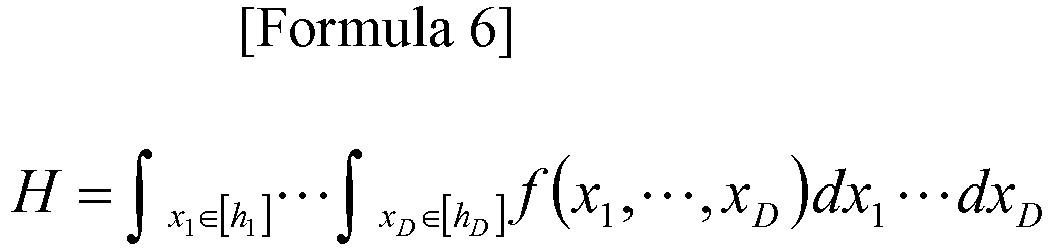
- When α=1/(1-H), a corrected distribution function f'(x1, ..., xD) is defined by Expressions (1) and (2).
[Formula 7]

- For example, the random number generation apparatus is provided with the
function generating part 1 that calculates the probability H and the corrected distribution function f'(x1..., xD), and thefunction generating part 1 calculates the probability H and the corrected distribution f'(x1 ..., xD) in advance before subsequent processes are performed (step S1). The random number generation apparatus may not be provided with thefunction generating part 1. In this case, in subsequent processes, as the probability H and the corrected distribution function f'(x1 ..., xD), the random number generation apparatus uses those calculated by another apparatus in advance. - By performing, for each of i=1, ..., D, a process for generating a random number ui ∈ [0,1], obtaining a random number ri=F-1(ui) according to f(xi) using the generated ui, and xi=ri, the
arithmetic operation part 5 obtains r=(r1,...,rD)T in the end (step S5), wherein f(xi) is a peripheral distribution of f'(x1,...,xD) of xi, F(ti) is a function defined by Expression (2')

- The
arithmetic operation part 5 may perform processes from step S50 to step S57 below to perform step S5. - For example, first, for i=1 (step S50), the
arithmetic operation part 5 derives a peripheral distribution f'(x1) of f'(x1,x2,...,xD) of x1 (step S51).
- Then, the
arithmetic operation part 5 derives a cumulative density function F(t1) (step S52).
- Then, the
arithmetic operation part 5 derives F-1(t1) which is an inverse function of F(t1) (step S53). - Then, the
arithmetic operation part 5 generates a random number u1 ∈ [0,1] (step S54). Thearithmetic operation part 5 generates, for example, a uniform random number u1 ∈ [0,1] as the random number u1. - Then, the
arithmetic operation part 5 obtains a random number r1=F-1(u1) according to f'(x1) using the generated u1 (step S55). That is, thearithmetic operation part 5 calculates an output value in the case of inputting the generated u1 to F-1(t1) and sets the output value as r1. - Then, the
arithmetic operation part 5 substitutes r1 for x1 of f'(x1,...,xD) to obtain f'(x2,...,xD|x1=r1) (step S56). - Then, for integers ∀i ∈ [2,D], the
arithmetic operation part 5 performs an operation similar to steps S51 to S56 described above for f'(xi,...,xD|x1=r1,...,xi-1=ri-1) to obtain r=(r1,...,rD)T (step S57). - As described above, a multidimensional probability distribution may be converted to one-dimensional peripheral distributions to sequentially generate random numbers using an inverse function method.
- It is possible to generate random numbers according to a multidimensional probability distribution such that a probability in the hole [h], which is a predetermined area, is zero by the second embodiment as like as the first embodiment though the procedure for generating random numbers of the second embodiment is different from that of the first embodiment.
- An example of the corrected distribution function f' in the case of D=2 will be described below.
- Where, N is a predetermined positive integer, and there are N predetermined possible ranges [hi] for the random variable xi. The N predetermined possible ranges are
{[hi]}i=1 N={([h1]i,[h2]i)T}i=1 N={([(s1)i,(e1)i],[(s2)i,(e2)i])T}i=1 N. As described above, the number of holes is to be N. - Further, (µx1,2σx1 2) and (µx2,2σx2 2) are predetermined parameters, and the basic distribution function f(x1, ..., xD) is Laplace distribution Lap(x1,x2) defined by Expression (3). The Laplace distribution Lap(x1,x2) is shown in
Fig. 6. Fig. 6(a) is a perspective view, andFig. 6(b) is a view from above.
[Formula 11]
- The sign(a) is a function that outputs a sign {+,-} of an input a, a function g(s,e) is defined by Expressions (5) and (6) when s≤e, and H is defined by Expression (4), then the corrected distribution function f' is Lap'(x1,x2) defined by Expressions (7) and (8).


- Where, an example of the processes from step S50 to step S56 of the second embodiment will be described.
- The corrected distribution function f is Lap'(x1,x2) with one hole [h] that is shown in
Fig. 7. Fig. 7(a) is a perspective view, andFig. 7(b) is a view from above. As shown inFig. 7 , in the specific example 2, the number of [h] is one, and [h]=([h1],[h2])=([(a),(b)],[(c),(d)]). - Where, a first area S1 is (x1≥µx1)∧(x2≥µx2), a second area S2 is (x1≤µx1)∧(x2≥µx2), a third area S3 is (x1≥µx1)∧(x2≤µx2) and a fourth area S4 is (x1≤µx1)∧(x2≤µx2).
- First, a peripheral distribution of x1 will be considered in order to obtain a random number r1.
- 1. If the hole [h] is in the first area S1 or the second area S2, the corrected distribution function f is Lap'(x1) defined by Expressions (9) and (10).
[Formula 15]

- 2. If the hole [h] is in the third area S3 or the fourth area S4, the corrected distribution function f' is Lap'(x1) defined by Expressions (11) and (12).
[Formula 16]

- If a hole is across areas, the
above cases 1. and 2. can be combined. Next, in order to generate a random number r1, inverse functions shown by Expressions (13), (14), (15) and (16) are derived from the cumulative density function:
- Hereinafter,

- i) When -∞≤t1≤µx1:
[Formula 19]
- ii) When µx1≤t1≤a:
[Formula 20]
- iii) When a≤t1≤b:
[Formula 21]
- iv) When b≤t1:
[Formula 22]
- By substituting u1 ∈ [0,1] according to a uniform distribution U[0,1] for F(t1) of Expressions (13), (14), (15) and (16), the random number r1=t1 according to Expressions (9) and (10) is generated. A probability density function Lap'(x2|x1=r1) in the case of x1=r1 is as follows:
[Formula 23]

- Where, γ is defined by the following expression:

- At this time, in order to generate a random number r2, inverse functions shown in Expressions (19), (20) and (21) are derived from the cumulative density function:
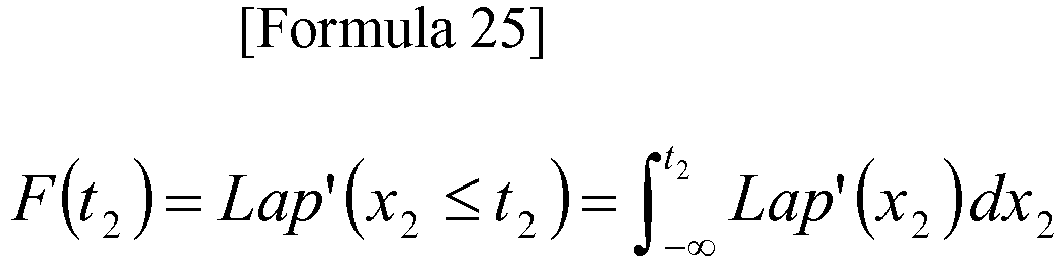
- i) When -∞≤t2≤µx2:
[Formula 26]
- ii) When µx2≤t2≤c:
[Formula 27]
- iii) When c≤t2≤d, F(t2) is determined regardless of t2. Therefore, an inverse function does not exist. That is, random numbers within this range are not generated.
- iv) When d≤t2:
[Formula 28]
- By substituting u2 ∈ [0,1] according to a uniform distribution U[0,1] for F(t2) of Expressions (19), (20) and (21), the random number r2=t2 according to Expressions (17) and (18) is generated. In this way, r=(r1,r2)T is generated.
- When each process of the random number generation apparatus is realized by a computer, processing content of functions that the random number generation apparatus should have is written by a program. By executing the program by computer, the processes of the random number generation apparatus are realized on the computer.
- The program in which the processing content is written can be recorded to a computer-readable recording medium. As the computer-readable recording medium, any recording medium, for example, a magnetic recording device, an optical disk, magneto-optical recording medium or a semiconductor memory is possible.
- Each processing part may be configured by causing a predetermined program to be executed on the computer, or at least a part of processing content of the processing part may be realized as hardware.
- It goes without saying that the present invention can be appropriately modified within a range not departing from the spirit of the invention.
Claims (7)
- A random number generation apparatus, comprising:a first random number generating part generating a random number u=(u1,...,uD)T ∈ [-∞,∞]D;a second random number generating part generating a random number v ∈ [0,f'max]; anda determining part determining whether f'(x1=u1,...,xD=uD)≥v or not, and, if f'(x1=u1,...,xD=uD)≥v, adopting u as a random number according to f'(x1,...,xD), whereinD is a predetermined positive integer, for i=1,...,D, [hi] is a predetermined possible range for a random variable xi, a hole [h] is [h]=([h1],...,[hD])T, H is a probability of a predetermined basic distribution function f(x1,...,xD) in the hole [h], α=1/(1-H), a corrected distribution function f'(x1,...,xD) is defined by Expressions (1) and (2):
[Formula 29]

- A random number generation apparatus comprising:an arithmetic operation part obtaining r=(r1,...,rD)T in the end, by performing, for each of i=1,...,D, a process for generating a random number ui ∈ [0,1], obtaining a random number ri=F-1(ui) according to f(xi) using the generated ui, and xi=ri, whereinD is a predetermined positive integer, for i=1,...,D, [hi] is a predetermined possible range for a random variable xi, a hole [h] is [h]=([h1],...,[hD])T, H is a probability of a predetermined basic distribution function f(x1,...,xD) in the hole [h], α=1/(1-H), a corrected distribution function f'(x1,...,xD) is defined by Expressions (1) and (2):
[Formula 30]


- The random number generation apparatus according to Claim 1 or 2, wherein
when D=2, N is a predetermined positive integer, there are N predetermined possible ranges [hi] for the random variable xi, the N predetermined possible ranges are {[hi]}i=1 N={([h1]i,[h2]i)T}i=1 N={([(s1)i,(e1)i],[(s2)i,(e2)i])T}i=1 N, (µx1,2σx1 2),(µx2,2σx2 2) are predetermined parameters, the basic distribution function f(x1,...,xD) is Lap(x1,x2) defined by Expression (3), sign(a) is a function that outputs a sign {+,-} of an input a, a function g(s,e) is defined by Expressions (5) and (6) when s≤e, H described above is defined by Expression (4), and the corrected distribution function f' is Lap'(x1,x2) defined by Expressions (7) and (8):
[Formula 32]





- The random number generation apparatus according to Claim 2, wherein
when D=2, the predetermined possible range [hi] for the random variable xi is [hi]= ([h1]i,[h2]i)T=([a,b],[c,d])T, (µx1,2σx1 2) and (µx2,2σx2 2) are predetermined parameters, a first area S1 is (x1≥µx1)∧(x2≥µx2), a second area S2 is (x1≤µx1)∧(x2≥µx2), a third area S3 is (x1≥µx1)∧(x2≤µx2), and a fourth area S4 is (x1≤µx1)∧(x2≤µx2), if the hole [h] is in the first area S1 or the second area S2, the corrected distribution function f' is Lap'(x1) defined by Expressions (9) and (10), and if the hole [h] is in the third area S3 or the fourth area S4, the corrected distribution function f' is Lap'(x1) defined by Expressions (11) and (12):
[Formula 36]


- A random number generation method comprising:a first random number generating step of a first random number generating part generating a random number u=(u1,...,uD)T ∈ [-∞,∞]D;a second random number generating step of a second random number generating part generating a random number v ∈ [0,f'max]; anda determining step of a determining part determining whether f'(x1=u1,...,xD=uD)≥v or not, and, if f'(x1=u1,...,xD=uD)≥v, adopting u as a random number according to f'(x1,...,xD), whereinD is a predetermined positive integer, for i=1,...,D, [hi] is a predetermined possible range for a random variable xi, a hole [h] is [h]=([h1],...,[hD])T, H is a probability of a predetermined basic distribution function f(x1,...,xD) in the hole [h], α=1/(1-H), a corrected distribution function f'(x1,...,xD) is defined by Expressions (1) and (2):
[Formula 37]

- A random number generation method, comprising:an arithmetic operation step of an arithmetic operation part obtaining r=(r1,...,rD)T in the end, by performing, for each of i=1,...,D, a process for generating a random number ui ∈ [0,1], obtaining a random number ri=F-1(ui) according to f(xi) using the generated ui, and xi=ri, whereinD is a predetermined positive integer, for i=1,...,D, [hi] is a predetermined possible range for a random variable xi, a hole [h] is [h]=([h1],...,[hD])T, H is a probability of a predetermined basic distribution function f(x1,...,xD) in the hole [h], α=1/(1-H), a corrected distribution function f'(x1,...,xD) is defined by Expressions (1) and (2):
[Formula 38]


- A program for causing a computer to function as each part of the random number generation apparatus according to any of Claims 1 to 4.
Applications Claiming Priority (2)
| Application Number | Priority Date | Filing Date | Title |
|---|---|---|---|
| JP2017007827 | 2017-01-19 | ||
| PCT/JP2018/001472 WO2018135601A1 (en) | 2017-01-19 | 2018-01-12 | Random number generation device, method, and program |
Publications (3)
| Publication Number | Publication Date |
|---|---|
| EP3572930A1 true EP3572930A1 (en) | 2019-11-27 |
| EP3572930A4 EP3572930A4 (en) | 2020-10-28 |
| EP3572930B1 EP3572930B1 (en) | 2021-09-08 |
Family
ID=62908073
Family Applications (1)
| Application Number | Title | Priority Date | Filing Date |
|---|---|---|---|
| EP18741800.9A Active EP3572930B1 (en) | 2017-01-19 | 2018-01-12 | Random number generation device, method, and program |
Country Status (4)
| Country | Link |
|---|---|
| US (1) | US20210286593A1 (en) |
| EP (1) | EP3572930B1 (en) |
| JP (1) | JP6766183B2 (en) |
| WO (1) | WO2018135601A1 (en) |
Family Cites Families (4)
| Publication number | Priority date | Publication date | Assignee | Title |
|---|---|---|---|---|
| JP2002189589A (en) * | 2000-12-22 | 2002-07-05 | Aizakku:Kk | Distribution random number generation method and circuit |
| DE10154200C1 (en) * | 2001-11-07 | 2003-03-06 | Infineon Technologies Ag | Random number sequence generation method for simulation of noise using computer program product and computer program |
| JP6044628B2 (en) * | 2012-02-15 | 2016-12-14 | 日本電気株式会社 | Random number generation device, random number generation method, object placement device, and computer program |
| JP6021178B2 (en) | 2012-10-17 | 2016-11-09 | 日本電信電話株式会社 | Noise adding device, noise adding method, and program |
-
2018
- 2018-01-12 JP JP2018562438A patent/JP6766183B2/en active Active
- 2018-01-12 EP EP18741800.9A patent/EP3572930B1/en active Active
- 2018-01-12 US US16/476,728 patent/US20210286593A1/en not_active Abandoned
- 2018-01-12 WO PCT/JP2018/001472 patent/WO2018135601A1/en not_active Ceased
Also Published As
| Publication number | Publication date |
|---|---|
| EP3572930A4 (en) | 2020-10-28 |
| EP3572930B1 (en) | 2021-09-08 |
| US20210286593A1 (en) | 2021-09-16 |
| JPWO2018135601A1 (en) | 2019-11-07 |
| JP6766183B2 (en) | 2020-10-07 |
| WO2018135601A1 (en) | 2018-07-26 |
Similar Documents
| Publication | Publication Date | Title |
|---|---|---|
| Liao et al. | Sig‐Wasserstein GANs for conditional time series generation | |
| Wu et al. | Bayesian annealed sequential importance sampling: an unbiased version of transitional Markov chain Monte Carlo | |
| Lei | Adaptive global testing for functional linear models | |
| Barrientos et al. | A feasibility study of differentially private summary statistics and regression analyses with evaluations on administrative and survey data | |
| EP3910556A1 (en) | Generative adversarial networks for synthetic data generation satisfying differential privacy | |
| Krief | Semi‐linear mode regression | |
| Ghosh et al. | When fair classification meets noisy protected attributes | |
| Katori et al. | Three phases of multiple SLE driven by non-colliding Dyson’s Brownian motions | |
| Aydin et al. | Analyzing the factors affecting the use of digital signature system with the technology acceptance model | |
| Nemirovsky et al. | Providing actionable feedback in hiring marketplaces using generative adversarial networks | |
| Marra et al. | Regression spline bivariate probit models: a practical approach to testing for exogeneity | |
| EP3572930B1 (en) | Random number generation device, method, and program | |
| Liu et al. | Well-posedness of fractional stochastic complex Ginzburg-Landau equations driven by regular additive noise. | |
| Golovkine et al. | On the estimation of the number of components in multivariate functional principal component analysis | |
| US9652477B2 (en) | Determining probability that an object belongs to a topic using sample items selected from object and probability distribution profile of the topic | |
| Triedman et al. | " Having Confidence in My Confidence Intervals": How Data Users Engage with Privacy-Protected Wikipedia Data | |
| Shillair | Mind the gap: perceived self-efficacy, domain knowledge and their effects on responses to a cybersecurity compliance message | |
| Hashimoto | Moment matching priors for non-regular models | |
| Kim et al. | Conditions for generating synthetic data to investigate characteristics of fluctuating quantities | |
| Recasens et al. | In-Context Bias Propagation in LLM-Based Tabular Data Generation | |
| Bourrée et al. | On the relevance of APIs facing fairwashed audits | |
| Peng et al. | Objective Bayesian testing for the correlation coefficient under divergence-based priors | |
| Fadzil et al. | TCNSyst: A kindergarten information management system for Tadika Cahaya Nurani with data anonymization | |
| Thaine et al. | Perfectly Privacy-Preserving AI What is it and how do we achieve it? | |
| García Recasens et al. | In-context bias propagation in LLM-based tabular data generation |
Legal Events
| Date | Code | Title | Description |
|---|---|---|---|
| STAA | Information on the status of an ep patent application or granted ep patent |
Free format text: STATUS: THE INTERNATIONAL PUBLICATION HAS BEEN MADE |
|
| PUAI | Public reference made under article 153(3) epc to a published international application that has entered the european phase |
Free format text: ORIGINAL CODE: 0009012 |
|
| STAA | Information on the status of an ep patent application or granted ep patent |
Free format text: STATUS: REQUEST FOR EXAMINATION WAS MADE |
|
| 17P | Request for examination filed |
Effective date: 20190819 |
|
| AK | Designated contracting states |
Kind code of ref document: A1 Designated state(s): AL AT BE BG CH CY CZ DE DK EE ES FI FR GB GR HR HU IE IS IT LI LT LU LV MC MK MT NL NO PL PT RO RS SE SI SK SM TR |
|
| AX | Request for extension of the european patent |
Extension state: BA ME |
|
| DAV | Request for validation of the european patent (deleted) | ||
| DAX | Request for extension of the european patent (deleted) | ||
| A4 | Supplementary search report drawn up and despatched |
Effective date: 20200924 |
|
| RIC1 | Information provided on ipc code assigned before grant |
Ipc: G06F 7/58 20060101AFI20200918BHEP |
|
| GRAP | Despatch of communication of intention to grant a patent |
Free format text: ORIGINAL CODE: EPIDOSNIGR1 |
|
| STAA | Information on the status of an ep patent application or granted ep patent |
Free format text: STATUS: GRANT OF PATENT IS INTENDED |
|
| INTG | Intention to grant announced |
Effective date: 20210330 |
|
| GRAS | Grant fee paid |
Free format text: ORIGINAL CODE: EPIDOSNIGR3 |
|
| GRAA | (expected) grant |
Free format text: ORIGINAL CODE: 0009210 |
|
| STAA | Information on the status of an ep patent application or granted ep patent |
Free format text: STATUS: THE PATENT HAS BEEN GRANTED |
|
| AK | Designated contracting states |
Kind code of ref document: B1 Designated state(s): AL AT BE BG CH CY CZ DE DK EE ES FI FR GB GR HR HU IE IS IT LI LT LU LV MC MK MT NL NO PL PT RO RS SE SI SK SM TR |
|
| REG | Reference to a national code |
Ref country code: GB Ref legal event code: FG4D |
|
| REG | Reference to a national code |
Ref country code: CH Ref legal event code: EP Ref country code: AT Ref legal event code: REF Ref document number: 1429178 Country of ref document: AT Kind code of ref document: T Effective date: 20210915 |
|
| REG | Reference to a national code |
Ref country code: DE Ref legal event code: R096 Ref document number: 602018023272 Country of ref document: DE |
|
| REG | Reference to a national code |
Ref country code: IE Ref legal event code: FG4D |
|
| REG | Reference to a national code |
Ref country code: LT Ref legal event code: MG9D |
|
| REG | Reference to a national code |
Ref country code: NL Ref legal event code: MP Effective date: 20210908 |
|
| PG25 | Lapsed in a contracting state [announced via postgrant information from national office to epo] |
Ref country code: LT Free format text: LAPSE BECAUSE OF FAILURE TO SUBMIT A TRANSLATION OF THE DESCRIPTION OR TO PAY THE FEE WITHIN THE PRESCRIBED TIME-LIMIT Effective date: 20210908 Ref country code: BG Free format text: LAPSE BECAUSE OF FAILURE TO SUBMIT A TRANSLATION OF THE DESCRIPTION OR TO PAY THE FEE WITHIN THE PRESCRIBED TIME-LIMIT Effective date: 20211208 Ref country code: NO Free format text: LAPSE BECAUSE OF FAILURE TO SUBMIT A TRANSLATION OF THE DESCRIPTION OR TO PAY THE FEE WITHIN THE PRESCRIBED TIME-LIMIT Effective date: 20211208 Ref country code: RS Free format text: LAPSE BECAUSE OF FAILURE TO SUBMIT A TRANSLATION OF THE DESCRIPTION OR TO PAY THE FEE WITHIN THE PRESCRIBED TIME-LIMIT Effective date: 20210908 Ref country code: SE Free format text: LAPSE BECAUSE OF FAILURE TO SUBMIT A TRANSLATION OF THE DESCRIPTION OR TO PAY THE FEE WITHIN THE PRESCRIBED TIME-LIMIT Effective date: 20210908 Ref country code: ES Free format text: LAPSE BECAUSE OF FAILURE TO SUBMIT A TRANSLATION OF THE DESCRIPTION OR TO PAY THE FEE WITHIN THE PRESCRIBED TIME-LIMIT Effective date: 20210908 Ref country code: FI Free format text: LAPSE BECAUSE OF FAILURE TO SUBMIT A TRANSLATION OF THE DESCRIPTION OR TO PAY THE FEE WITHIN THE PRESCRIBED TIME-LIMIT Effective date: 20210908 Ref country code: HR Free format text: LAPSE BECAUSE OF FAILURE TO SUBMIT A TRANSLATION OF THE DESCRIPTION OR TO PAY THE FEE WITHIN THE PRESCRIBED TIME-LIMIT Effective date: 20210908 |
|
| REG | Reference to a national code |
Ref country code: AT Ref legal event code: MK05 Ref document number: 1429178 Country of ref document: AT Kind code of ref document: T Effective date: 20210908 |
|
| PG25 | Lapsed in a contracting state [announced via postgrant information from national office to epo] |
Ref country code: LV Free format text: LAPSE BECAUSE OF FAILURE TO SUBMIT A TRANSLATION OF THE DESCRIPTION OR TO PAY THE FEE WITHIN THE PRESCRIBED TIME-LIMIT Effective date: 20210908 Ref country code: GR Free format text: LAPSE BECAUSE OF FAILURE TO SUBMIT A TRANSLATION OF THE DESCRIPTION OR TO PAY THE FEE WITHIN THE PRESCRIBED TIME-LIMIT Effective date: 20211209 |
|
| PG25 | Lapsed in a contracting state [announced via postgrant information from national office to epo] |
Ref country code: AT Free format text: LAPSE BECAUSE OF FAILURE TO SUBMIT A TRANSLATION OF THE DESCRIPTION OR TO PAY THE FEE WITHIN THE PRESCRIBED TIME-LIMIT Effective date: 20210908 |
|
| PG25 | Lapsed in a contracting state [announced via postgrant information from national office to epo] |
Ref country code: IS Free format text: LAPSE BECAUSE OF FAILURE TO SUBMIT A TRANSLATION OF THE DESCRIPTION OR TO PAY THE FEE WITHIN THE PRESCRIBED TIME-LIMIT Effective date: 20220108 Ref country code: SM Free format text: LAPSE BECAUSE OF FAILURE TO SUBMIT A TRANSLATION OF THE DESCRIPTION OR TO PAY THE FEE WITHIN THE PRESCRIBED TIME-LIMIT Effective date: 20210908 Ref country code: SK Free format text: LAPSE BECAUSE OF FAILURE TO SUBMIT A TRANSLATION OF THE DESCRIPTION OR TO PAY THE FEE WITHIN THE PRESCRIBED TIME-LIMIT Effective date: 20210908 Ref country code: RO Free format text: LAPSE BECAUSE OF FAILURE TO SUBMIT A TRANSLATION OF THE DESCRIPTION OR TO PAY THE FEE WITHIN THE PRESCRIBED TIME-LIMIT Effective date: 20210908 Ref country code: PT Free format text: LAPSE BECAUSE OF FAILURE TO SUBMIT A TRANSLATION OF THE DESCRIPTION OR TO PAY THE FEE WITHIN THE PRESCRIBED TIME-LIMIT Effective date: 20220110 Ref country code: PL Free format text: LAPSE BECAUSE OF FAILURE TO SUBMIT A TRANSLATION OF THE DESCRIPTION OR TO PAY THE FEE WITHIN THE PRESCRIBED TIME-LIMIT Effective date: 20210908 Ref country code: NL Free format text: LAPSE BECAUSE OF FAILURE TO SUBMIT A TRANSLATION OF THE DESCRIPTION OR TO PAY THE FEE WITHIN THE PRESCRIBED TIME-LIMIT Effective date: 20210908 Ref country code: EE Free format text: LAPSE BECAUSE OF FAILURE TO SUBMIT A TRANSLATION OF THE DESCRIPTION OR TO PAY THE FEE WITHIN THE PRESCRIBED TIME-LIMIT Effective date: 20210908 Ref country code: CZ Free format text: LAPSE BECAUSE OF FAILURE TO SUBMIT A TRANSLATION OF THE DESCRIPTION OR TO PAY THE FEE WITHIN THE PRESCRIBED TIME-LIMIT Effective date: 20210908 Ref country code: AL Free format text: LAPSE BECAUSE OF FAILURE TO SUBMIT A TRANSLATION OF THE DESCRIPTION OR TO PAY THE FEE WITHIN THE PRESCRIBED TIME-LIMIT Effective date: 20210908 |
|
| REG | Reference to a national code |
Ref country code: DE Ref legal event code: R097 Ref document number: 602018023272 Country of ref document: DE |
|
| PLBE | No opposition filed within time limit |
Free format text: ORIGINAL CODE: 0009261 |
|
| STAA | Information on the status of an ep patent application or granted ep patent |
Free format text: STATUS: NO OPPOSITION FILED WITHIN TIME LIMIT |
|
| PG25 | Lapsed in a contracting state [announced via postgrant information from national office to epo] |
Ref country code: DK Free format text: LAPSE BECAUSE OF FAILURE TO SUBMIT A TRANSLATION OF THE DESCRIPTION OR TO PAY THE FEE WITHIN THE PRESCRIBED TIME-LIMIT Effective date: 20210908 |
|
| 26N | No opposition filed |
Effective date: 20220609 |
|
| PG25 | Lapsed in a contracting state [announced via postgrant information from national office to epo] |
Ref country code: SI Free format text: LAPSE BECAUSE OF FAILURE TO SUBMIT A TRANSLATION OF THE DESCRIPTION OR TO PAY THE FEE WITHIN THE PRESCRIBED TIME-LIMIT Effective date: 20210908 Ref country code: MC Free format text: LAPSE BECAUSE OF FAILURE TO SUBMIT A TRANSLATION OF THE DESCRIPTION OR TO PAY THE FEE WITHIN THE PRESCRIBED TIME-LIMIT Effective date: 20210908 |
|
| REG | Reference to a national code |
Ref country code: CH Ref legal event code: PL |
|
| REG | Reference to a national code |
Ref country code: BE Ref legal event code: MM Effective date: 20220131 |
|
| PG25 | Lapsed in a contracting state [announced via postgrant information from national office to epo] |
Ref country code: LU Free format text: LAPSE BECAUSE OF NON-PAYMENT OF DUE FEES Effective date: 20220112 |
|
| PG25 | Lapsed in a contracting state [announced via postgrant information from national office to epo] |
Ref country code: BE Free format text: LAPSE BECAUSE OF NON-PAYMENT OF DUE FEES Effective date: 20220131 |
|
| PG25 | Lapsed in a contracting state [announced via postgrant information from national office to epo] |
Ref country code: LI Free format text: LAPSE BECAUSE OF NON-PAYMENT OF DUE FEES Effective date: 20220131 Ref country code: CH Free format text: LAPSE BECAUSE OF NON-PAYMENT OF DUE FEES Effective date: 20220131 |
|
| PG25 | Lapsed in a contracting state [announced via postgrant information from national office to epo] |
Ref country code: IT Free format text: LAPSE BECAUSE OF FAILURE TO SUBMIT A TRANSLATION OF THE DESCRIPTION OR TO PAY THE FEE WITHIN THE PRESCRIBED TIME-LIMIT Effective date: 20210908 Ref country code: IE Free format text: LAPSE BECAUSE OF NON-PAYMENT OF DUE FEES Effective date: 20220112 |
|
| PG25 | Lapsed in a contracting state [announced via postgrant information from national office to epo] |
Ref country code: MK Free format text: LAPSE BECAUSE OF FAILURE TO SUBMIT A TRANSLATION OF THE DESCRIPTION OR TO PAY THE FEE WITHIN THE PRESCRIBED TIME-LIMIT Effective date: 20210908 Ref country code: CY Free format text: LAPSE BECAUSE OF FAILURE TO SUBMIT A TRANSLATION OF THE DESCRIPTION OR TO PAY THE FEE WITHIN THE PRESCRIBED TIME-LIMIT Effective date: 20210908 |
|
| PG25 | Lapsed in a contracting state [announced via postgrant information from national office to epo] |
Ref country code: HU Free format text: LAPSE BECAUSE OF FAILURE TO SUBMIT A TRANSLATION OF THE DESCRIPTION OR TO PAY THE FEE WITHIN THE PRESCRIBED TIME-LIMIT; INVALID AB INITIO Effective date: 20180112 |
|
| PG25 | Lapsed in a contracting state [announced via postgrant information from national office to epo] |
Ref country code: TR Free format text: LAPSE BECAUSE OF FAILURE TO SUBMIT A TRANSLATION OF THE DESCRIPTION OR TO PAY THE FEE WITHIN THE PRESCRIBED TIME-LIMIT Effective date: 20210908 |
|
| PG25 | Lapsed in a contracting state [announced via postgrant information from national office to epo] |
Ref country code: MT Free format text: LAPSE BECAUSE OF FAILURE TO SUBMIT A TRANSLATION OF THE DESCRIPTION OR TO PAY THE FEE WITHIN THE PRESCRIBED TIME-LIMIT Effective date: 20210908 |
|
| REG | Reference to a national code |
Ref country code: DE Ref legal event code: R081 Ref document number: 602018023272 Country of ref document: DE Owner name: NTT, INC., JP Free format text: FORMER OWNER: NIPPON TELEGRAPH AND TELEPHONE CORPORATION, TOKYO, JP Ref country code: DE Ref legal event code: R082 Ref document number: 602018023272 Country of ref document: DE Representative=s name: DENNEMEYER & ASSOCIATES RECHTSANWALTSGESELLSCH, DE |
|
| PGFP | Annual fee paid to national office [announced via postgrant information from national office to epo] |
Ref country code: GB Payment date: 20260123 Year of fee payment: 9 |
|
| PGFP | Annual fee paid to national office [announced via postgrant information from national office to epo] |
Ref country code: DE Payment date: 20260121 Year of fee payment: 9 |
|
| PGFP | Annual fee paid to national office [announced via postgrant information from national office to epo] |
Ref country code: FR Payment date: 20260123 Year of fee payment: 9 |