EP3572406A1 - Acid addition salt of elagolix and related compounds - Google Patents
Acid addition salt of elagolix and related compounds Download PDFInfo
- Publication number
- EP3572406A1 EP3572406A1 EP18201039.7A EP18201039A EP3572406A1 EP 3572406 A1 EP3572406 A1 EP 3572406A1 EP 18201039 A EP18201039 A EP 18201039A EP 3572406 A1 EP3572406 A1 EP 3572406A1
- Authority
- EP
- European Patent Office
- Prior art keywords
- formula
- unsubstituted
- substituted
- addition salt
- acid addition
- Prior art date
- Legal status (The legal status is an assumption and is not a legal conclusion. Google has not performed a legal analysis and makes no representation as to the accuracy of the status listed.)
- Withdrawn
Links
- 239000002253 acid Substances 0.000 title claims abstract description 113
- 150000003839 salts Chemical class 0.000 title claims abstract description 89
- HEAUOKZIVMZVQL-VWLOTQADSA-N Elagolix Chemical compound COC1=CC=CC(C=2C(N(C[C@H](NCCCC(O)=O)C=3C=CC=CC=3)C(=O)N(CC=3C(=CC=CC=3F)C(F)(F)F)C=2C)=O)=C1F HEAUOKZIVMZVQL-VWLOTQADSA-N 0.000 title claims abstract description 67
- 229950004823 elagolix Drugs 0.000 title claims description 62
- 150000001875 compounds Chemical class 0.000 title claims description 40
- 238000000034 method Methods 0.000 claims abstract description 85
- 230000008569 process Effects 0.000 claims abstract description 66
- 150000002148 esters Chemical class 0.000 claims abstract description 37
- 238000002360 preparation method Methods 0.000 claims abstract description 13
- 238000001914 filtration Methods 0.000 claims abstract description 11
- XEKOWRVHYACXOJ-UHFFFAOYSA-N Ethyl acetate Chemical compound CCOC(C)=O XEKOWRVHYACXOJ-UHFFFAOYSA-N 0.000 claims description 35
- QAOWNCQODCNURD-UHFFFAOYSA-N Sulfuric acid Chemical compound OS(O)(=O)=O QAOWNCQODCNURD-UHFFFAOYSA-N 0.000 claims description 34
- ZMANZCXQSJIPKH-UHFFFAOYSA-N Triethylamine Chemical compound CCN(CC)CC ZMANZCXQSJIPKH-UHFFFAOYSA-N 0.000 claims description 30
- 125000006239 protecting group Chemical group 0.000 claims description 28
- 239000001257 hydrogen Substances 0.000 claims description 22
- 229910052739 hydrogen Inorganic materials 0.000 claims description 22
- 239000000203 mixture Substances 0.000 claims description 19
- -1 tert-butyl- Chemical group 0.000 claims description 19
- 239000002904 solvent Substances 0.000 claims description 18
- 229910052736 halogen Inorganic materials 0.000 claims description 17
- 150000002367 halogens Chemical class 0.000 claims description 16
- BWHMMNNQKKPAPP-UHFFFAOYSA-L potassium carbonate Chemical compound [K+].[K+].[O-]C([O-])=O BWHMMNNQKKPAPP-UHFFFAOYSA-L 0.000 claims description 16
- CDBYLPFSWZWCQE-UHFFFAOYSA-L Sodium Carbonate Chemical compound [Na+].[Na+].[O-]C([O-])=O CDBYLPFSWZWCQE-UHFFFAOYSA-L 0.000 claims description 14
- 239000008194 pharmaceutical composition Substances 0.000 claims description 14
- 125000000217 alkyl group Chemical group 0.000 claims description 13
- 235000019439 ethyl acetate Nutrition 0.000 claims description 13
- DTQVDTLACAAQTR-UHFFFAOYSA-N Trifluoroacetic acid Chemical compound OC(=O)C(F)(F)F DTQVDTLACAAQTR-UHFFFAOYSA-N 0.000 claims description 12
- 150000007522 mineralic acids Chemical class 0.000 claims description 12
- 150000007524 organic acids Chemical group 0.000 claims description 12
- 125000001997 phenyl group Chemical group [H]C1=C([H])C([H])=C(*)C([H])=C1[H] 0.000 claims description 12
- JGFZNNIVVJXRND-UHFFFAOYSA-N N,N-Diisopropylethylamine (DIPEA) Chemical compound CCN(C(C)C)C(C)C JGFZNNIVVJXRND-UHFFFAOYSA-N 0.000 claims description 11
- 239000012535 impurity Substances 0.000 claims description 11
- 125000002496 methyl group Chemical group [H]C([H])([H])* 0.000 claims description 10
- 239000012296 anti-solvent Substances 0.000 claims description 9
- 229940093499 ethyl acetate Drugs 0.000 claims description 9
- KFZMGEQAYNKOFK-UHFFFAOYSA-N Isopropanol Chemical group CC(C)O KFZMGEQAYNKOFK-UHFFFAOYSA-N 0.000 claims description 8
- 150000002431 hydrogen Chemical class 0.000 claims description 8
- 125000004435 hydrogen atom Chemical group [H]* 0.000 claims description 8
- 229910000027 potassium carbonate Inorganic materials 0.000 claims description 8
- 239000011973 solid acid Substances 0.000 claims description 8
- 201000009273 Endometriosis Diseases 0.000 claims description 7
- UFHFLCQGNIYNRP-UHFFFAOYSA-N Hydrogen Chemical compound [H][H] UFHFLCQGNIYNRP-UHFFFAOYSA-N 0.000 claims description 7
- 206010046798 Uterine leiomyoma Diseases 0.000 claims description 7
- 201000010260 leiomyoma Diseases 0.000 claims description 7
- 229910000029 sodium carbonate Inorganic materials 0.000 claims description 7
- 125000000229 (C1-C4)alkoxy group Chemical group 0.000 claims description 6
- 125000003118 aryl group Chemical group 0.000 claims description 6
- 125000001424 substituent group Chemical group 0.000 claims description 6
- QCQCHGYLTSGIGX-GHXANHINSA-N 4-[[(3ar,5ar,5br,7ar,9s,11ar,11br,13as)-5a,5b,8,8,11a-pentamethyl-3a-[(5-methylpyridine-3-carbonyl)amino]-2-oxo-1-propan-2-yl-4,5,6,7,7a,9,10,11,11b,12,13,13a-dodecahydro-3h-cyclopenta[a]chrysen-9-yl]oxy]-2,2-dimethyl-4-oxobutanoic acid Chemical compound N([C@@]12CC[C@@]3(C)[C@]4(C)CC[C@H]5C(C)(C)[C@@H](OC(=O)CC(C)(C)C(O)=O)CC[C@]5(C)[C@H]4CC[C@@H]3C1=C(C(C2)=O)C(C)C)C(=O)C1=CN=CC(C)=C1 QCQCHGYLTSGIGX-GHXANHINSA-N 0.000 claims description 5
- BDAGIHXWWSANSR-UHFFFAOYSA-N Formic acid Chemical compound OC=O BDAGIHXWWSANSR-UHFFFAOYSA-N 0.000 claims description 5
- 125000003178 carboxy group Chemical group [H]OC(*)=O 0.000 claims description 5
- 239000003814 drug Substances 0.000 claims description 5
- 230000002265 prevention Effects 0.000 claims description 5
- 238000001035 drying Methods 0.000 claims description 4
- 235000019253 formic acid Nutrition 0.000 claims description 4
- 125000001072 heteroaryl group Chemical group 0.000 claims description 4
- 125000000623 heterocyclic group Chemical group 0.000 claims description 4
- 125000002887 hydroxy group Chemical group [H]O* 0.000 claims description 4
- 125000004178 (C1-C4) alkyl group Chemical group 0.000 claims description 3
- 125000002924 primary amino group Chemical class [H]N([H])* 0.000 claims description 3
- HJEZRYIJNHAIGY-UHFFFAOYSA-N tert-butyl 4-bromobutanoate Chemical compound CC(C)(C)OC(=O)CCCBr HJEZRYIJNHAIGY-UHFFFAOYSA-N 0.000 claims description 3
- 125000003837 (C1-C20) alkyl group Chemical group 0.000 claims description 2
- 125000006652 (C3-C12) cycloalkyl group Chemical group 0.000 claims description 2
- 125000003860 C1-C20 alkoxy group Chemical group 0.000 claims description 2
- PXGOKWXKJXAPGV-UHFFFAOYSA-N Fluorine Chemical compound FF PXGOKWXKJXAPGV-UHFFFAOYSA-N 0.000 claims description 2
- 125000003342 alkenyl group Chemical group 0.000 claims description 2
- 125000002877 alkyl aryl group Chemical group 0.000 claims description 2
- 125000005213 alkyl heteroaryl group Chemical group 0.000 claims description 2
- 150000005347 biaryls Chemical group 0.000 claims description 2
- 150000001602 bicycloalkyls Chemical group 0.000 claims description 2
- 125000004093 cyano group Chemical group *C#N 0.000 claims description 2
- 239000003937 drug carrier Substances 0.000 claims description 2
- 229910052731 fluorine Inorganic materials 0.000 claims description 2
- 239000011737 fluorine Substances 0.000 claims description 2
- 125000000592 heterocycloalkyl group Chemical group 0.000 claims description 2
- 229910052701 rubidium Inorganic materials 0.000 claims description 2
- 125000002023 trifluoromethyl group Chemical group FC(F)(F)* 0.000 claims description 2
- DNFZVYVRMDCVTG-VWLOTQADSA-N C(F)(F)(F)C1=C(CN2C(=O)N(C(=O)C(=C2C)C2=C(F)C(OC)=CC=C2)C[C@H](N2C(=O)CCC2)C2=CC=CC=C2)C(F)=CC=C1 Chemical compound C(F)(F)(F)C1=C(CN2C(=O)N(C(=O)C(=C2C)C2=C(F)C(OC)=CC=C2)C[C@H](N2C(=O)CCC2)C2=CC=CC=C2)C(F)=CC=C1 DNFZVYVRMDCVTG-VWLOTQADSA-N 0.000 abstract description 6
- 230000015572 biosynthetic process Effects 0.000 abstract description 6
- 238000002955 isolation Methods 0.000 abstract description 5
- 238000007792 addition Methods 0.000 description 46
- 238000006243 chemical reaction Methods 0.000 description 32
- VEXZGXHMUGYJMC-UHFFFAOYSA-N Hydrochloric acid Chemical compound Cl VEXZGXHMUGYJMC-UHFFFAOYSA-N 0.000 description 16
- WEVYAHXRMPXWCK-UHFFFAOYSA-N Acetonitrile Chemical compound CC#N WEVYAHXRMPXWCK-UHFFFAOYSA-N 0.000 description 15
- 239000000543 intermediate Substances 0.000 description 15
- 239000002585 base Substances 0.000 description 10
- 239000007787 solid Substances 0.000 description 9
- ZMXDDKWLCZADIW-UHFFFAOYSA-N N,N-Dimethylformamide Chemical compound CN(C)C=O ZMXDDKWLCZADIW-UHFFFAOYSA-N 0.000 description 8
- HEMHJVSKTPXQMS-UHFFFAOYSA-M Sodium hydroxide Chemical compound [OH-].[Na+] HEMHJVSKTPXQMS-UHFFFAOYSA-M 0.000 description 8
- 125000000999 tert-butyl group Chemical group [H]C([H])([H])C(*)(C([H])([H])[H])C([H])([H])[H] 0.000 description 8
- WQDUMFSSJAZKTM-UHFFFAOYSA-N Sodium methoxide Chemical compound [Na+].[O-]C WQDUMFSSJAZKTM-UHFFFAOYSA-N 0.000 description 7
- 150000007513 acids Chemical class 0.000 description 7
- IXCSERBJSXMMFS-UHFFFAOYSA-N hydrogen chloride Substances Cl.Cl IXCSERBJSXMMFS-UHFFFAOYSA-N 0.000 description 7
- 239000007858 starting material Substances 0.000 description 7
- XLYOFNOQVPJJNP-UHFFFAOYSA-N water Substances O XLYOFNOQVPJJNP-UHFFFAOYSA-N 0.000 description 7
- IJGRMHOSHXDMSA-UHFFFAOYSA-N Atomic nitrogen Chemical compound N#N IJGRMHOSHXDMSA-UHFFFAOYSA-N 0.000 description 6
- CURLTUGMZLYLDI-UHFFFAOYSA-N Carbon dioxide Chemical compound O=C=O CURLTUGMZLYLDI-UHFFFAOYSA-N 0.000 description 6
- CSNNHWWHGAXBCP-UHFFFAOYSA-L Magnesium sulfate Chemical compound [Mg+2].[O-][S+2]([O-])([O-])[O-] CSNNHWWHGAXBCP-UHFFFAOYSA-L 0.000 description 6
- KWYUFKZDYYNOTN-UHFFFAOYSA-M Potassium hydroxide Chemical compound [OH-].[K+] KWYUFKZDYYNOTN-UHFFFAOYSA-M 0.000 description 6
- 125000000524 functional group Chemical group 0.000 description 6
- 235000011167 hydrochloric acid Nutrition 0.000 description 6
- 229910000041 hydrogen chloride Inorganic materials 0.000 description 6
- 238000000634 powder X-ray diffraction Methods 0.000 description 6
- 159000000000 sodium salts Chemical class 0.000 description 6
- 239000000243 solution Substances 0.000 description 6
- IAZDPXIOMUYVGZ-WFGJKAKNSA-N Dimethyl sulfoxide Chemical compound [2H]C([2H])([2H])S(=O)C([2H])([2H])[2H] IAZDPXIOMUYVGZ-WFGJKAKNSA-N 0.000 description 5
- IAZDPXIOMUYVGZ-UHFFFAOYSA-N Dimethylsulphoxide Chemical compound CS(C)=O IAZDPXIOMUYVGZ-UHFFFAOYSA-N 0.000 description 5
- ISAKRJDGNUQOIC-UHFFFAOYSA-N Uracil Chemical group O=C1C=CNC(=O)N1 ISAKRJDGNUQOIC-UHFFFAOYSA-N 0.000 description 5
- 230000007062 hydrolysis Effects 0.000 description 5
- 238000006460 hydrolysis reaction Methods 0.000 description 5
- 229910052757 nitrogen Inorganic materials 0.000 description 5
- 150000003141 primary amines Chemical class 0.000 description 5
- 238000000746 purification Methods 0.000 description 5
- LFQSCWFLJHTTHZ-UHFFFAOYSA-N Ethanol Chemical compound CCO LFQSCWFLJHTTHZ-UHFFFAOYSA-N 0.000 description 4
- IMNFDUFMRHMDMM-UHFFFAOYSA-N N-Heptane Chemical compound CCCCCCC IMNFDUFMRHMDMM-UHFFFAOYSA-N 0.000 description 4
- NBIIXXVUZAFLBC-UHFFFAOYSA-N Phosphoric acid Chemical compound OP(O)(O)=O NBIIXXVUZAFLBC-UHFFFAOYSA-N 0.000 description 4
- UIIMBOGNXHQVGW-UHFFFAOYSA-M Sodium bicarbonate Chemical compound [Na+].OC([O-])=O UIIMBOGNXHQVGW-UHFFFAOYSA-M 0.000 description 4
- FAPWRFPIFSIZLT-UHFFFAOYSA-M Sodium chloride Chemical compound [Na+].[Cl-] FAPWRFPIFSIZLT-UHFFFAOYSA-M 0.000 description 4
- 150000001412 amines Chemical class 0.000 description 4
- 239000007864 aqueous solution Substances 0.000 description 4
- 239000007795 chemical reaction product Substances 0.000 description 4
- 208000037265 diseases, disorders, signs and symptoms Diseases 0.000 description 4
- 239000000499 gel Substances 0.000 description 4
- 238000004895 liquid chromatography mass spectrometry Methods 0.000 description 4
- 238000005580 one pot reaction Methods 0.000 description 4
- 108090000765 processed proteins & peptides Proteins 0.000 description 4
- 239000011541 reaction mixture Substances 0.000 description 4
- UIUJIQZEACWQSV-UHFFFAOYSA-N succinic semialdehyde Chemical compound OC(=O)CCC=O UIUJIQZEACWQSV-UHFFFAOYSA-N 0.000 description 4
- 235000011149 sulphuric acid Nutrition 0.000 description 4
- 238000003786 synthesis reaction Methods 0.000 description 4
- HWOYBTXJJMLYSH-NDEPHWFRSA-N tert-butyl 4-[[(1R)-2-[5-(2-fluoro-3-methoxyphenyl)-3-[[2-fluoro-6-(trifluoromethyl)phenyl]methyl]-4-methyl-2,6-dioxopyrimidin-1-yl]-1-phenylethyl]amino]butanoate Chemical compound FC1=C(C=CC=C1OC)C1=C(N(C(N(C1=O)C[C@@H](C1=CC=CC=C1)NCCCC(=O)OC(C)(C)C)=O)CC1=C(C=CC=C1C(F)(F)F)F)C HWOYBTXJJMLYSH-NDEPHWFRSA-N 0.000 description 4
- 230000009466 transformation Effects 0.000 description 4
- 125000004169 (C1-C6) alkyl group Chemical group 0.000 description 3
- 238000005160 1H NMR spectroscopy Methods 0.000 description 3
- GQHTUMJGOHRCHB-UHFFFAOYSA-N 2,3,4,6,7,8,9,10-octahydropyrimido[1,2-a]azepine Chemical compound C1CCCCN2CCCN=C21 GQHTUMJGOHRCHB-UHFFFAOYSA-N 0.000 description 3
- QTBSBXVTEAMEQO-UHFFFAOYSA-N Acetic acid Chemical compound CC(O)=O QTBSBXVTEAMEQO-UHFFFAOYSA-N 0.000 description 3
- CSCPPACGZOOCGX-UHFFFAOYSA-N Acetone Chemical compound CC(C)=O CSCPPACGZOOCGX-UHFFFAOYSA-N 0.000 description 3
- NLXLAEXVIDQMFP-UHFFFAOYSA-N Ammonia chloride Chemical compound [NH4+].[Cl-] NLXLAEXVIDQMFP-UHFFFAOYSA-N 0.000 description 3
- XKRFYHLGVUSROY-UHFFFAOYSA-N Argon Chemical compound [Ar] XKRFYHLGVUSROY-UHFFFAOYSA-N 0.000 description 3
- 238000005481 NMR spectroscopy Methods 0.000 description 3
- 229910052799 carbon Inorganic materials 0.000 description 3
- 229910002092 carbon dioxide Inorganic materials 0.000 description 3
- 150000001732 carboxylic acid derivatives Chemical class 0.000 description 3
- UAOMVDZJSHZZME-UHFFFAOYSA-N diisopropylamine Chemical compound CC(C)NC(C)C UAOMVDZJSHZZME-UHFFFAOYSA-N 0.000 description 3
- 238000001704 evaporation Methods 0.000 description 3
- 230000008020 evaporation Effects 0.000 description 3
- 238000000605 extraction Methods 0.000 description 3
- XLXSAKCOAKORKW-AQJXLSMYSA-N gonadorelin Chemical compound C([C@@H](C(=O)NCC(=O)N[C@@H](CC(C)C)C(=O)N[C@@H](CCCNC(N)=N)C(=O)N1[C@@H](CCC1)C(=O)NCC(N)=O)NC(=O)[C@H](CO)NC(=O)[C@H](CC=1C2=CC=CC=C2NC=1)NC(=O)[C@H](CC=1N=CNC=1)NC(=O)[C@H]1NC(=O)CC1)C1=CC=C(O)C=C1 XLXSAKCOAKORKW-AQJXLSMYSA-N 0.000 description 3
- 229920003088 hydroxypropyl methyl cellulose Polymers 0.000 description 3
- JMMWKPVZQRWMSS-UHFFFAOYSA-N isopropyl acetate Chemical compound CC(C)OC(C)=O JMMWKPVZQRWMSS-UHFFFAOYSA-N 0.000 description 3
- 125000001449 isopropyl group Chemical group [H]C([H])([H])C([H])(*)C([H])([H])[H] 0.000 description 3
- 229910052943 magnesium sulfate Inorganic materials 0.000 description 3
- 235000019341 magnesium sulphate Nutrition 0.000 description 3
- 238000004519 manufacturing process Methods 0.000 description 3
- 239000000463 material Substances 0.000 description 3
- VLKZOEOYAKHREP-UHFFFAOYSA-N n-Hexane Chemical compound CCCCCC VLKZOEOYAKHREP-UHFFFAOYSA-N 0.000 description 3
- QJGQUHMNIGDVPM-UHFFFAOYSA-N nitrogen group Chemical group [N] QJGQUHMNIGDVPM-UHFFFAOYSA-N 0.000 description 3
- 235000011007 phosphoric acid Nutrition 0.000 description 3
- 239000011148 porous material Substances 0.000 description 3
- 102000004196 processed proteins & peptides Human genes 0.000 description 3
- 239000000047 product Substances 0.000 description 3
- 230000002829 reductive effect Effects 0.000 description 3
- 150000003335 secondary amines Chemical class 0.000 description 3
- 238000003797 solvolysis reaction Methods 0.000 description 3
- 239000000126 substance Substances 0.000 description 3
- 238000000844 transformation Methods 0.000 description 3
- 238000010518 undesired secondary reaction Methods 0.000 description 3
- 125000004191 (C1-C6) alkoxy group Chemical group 0.000 description 2
- 125000000171 (C1-C6) haloalkyl group Chemical group 0.000 description 2
- JWUJQDFVADABEY-UHFFFAOYSA-N 2-methyltetrahydrofuran Chemical compound CC1CCCO1 JWUJQDFVADABEY-UHFFFAOYSA-N 0.000 description 2
- HBAQYPYDRFILMT-UHFFFAOYSA-N 8-[3-(1-cyclopropylpyrazol-4-yl)-1H-pyrazolo[4,3-d]pyrimidin-5-yl]-3-methyl-3,8-diazabicyclo[3.2.1]octan-2-one Chemical class C1(CC1)N1N=CC(=C1)C1=NNC2=C1N=C(N=C2)N1C2C(N(CC1CC2)C)=O HBAQYPYDRFILMT-UHFFFAOYSA-N 0.000 description 2
- CPELXLSAUQHCOX-UHFFFAOYSA-M Bromide Chemical compound [Br-] CPELXLSAUQHCOX-UHFFFAOYSA-M 0.000 description 2
- FERIUCNNQQJTOY-UHFFFAOYSA-N Butyric acid Chemical compound CCCC(O)=O FERIUCNNQQJTOY-UHFFFAOYSA-N 0.000 description 2
- VEXZGXHMUGYJMC-UHFFFAOYSA-M Chloride anion Chemical compound [Cl-] VEXZGXHMUGYJMC-UHFFFAOYSA-M 0.000 description 2
- XDTMQSROBMDMFD-UHFFFAOYSA-N Cyclohexane Chemical compound C1CCCCC1 XDTMQSROBMDMFD-UHFFFAOYSA-N 0.000 description 2
- KRHYYFGTRYWZRS-UHFFFAOYSA-M Fluoride anion Chemical compound [F-] KRHYYFGTRYWZRS-UHFFFAOYSA-M 0.000 description 2
- 229940127445 Gonadotropin Releasing Hormone Receptor Antagonists Drugs 0.000 description 2
- 239000000579 Gonadotropin-Releasing Hormone Substances 0.000 description 2
- WMFOQBRAJBCJND-UHFFFAOYSA-M Lithium hydroxide Chemical compound [Li+].[OH-] WMFOQBRAJBCJND-UHFFFAOYSA-M 0.000 description 2
- BZLVMXJERCGZMT-UHFFFAOYSA-N Methyl tert-butyl ether Chemical compound COC(C)(C)C BZLVMXJERCGZMT-UHFFFAOYSA-N 0.000 description 2
- KDLHZDBZIXYQEI-UHFFFAOYSA-N Palladium Chemical compound [Pd] KDLHZDBZIXYQEI-UHFFFAOYSA-N 0.000 description 2
- 101000857870 Squalus acanthias Gonadoliberin Proteins 0.000 description 2
- WYURNTSHIVDZCO-UHFFFAOYSA-N Tetrahydrofuran Chemical compound C1CCOC1 WYURNTSHIVDZCO-UHFFFAOYSA-N 0.000 description 2
- 230000002378 acidificating effect Effects 0.000 description 2
- 150000001299 aldehydes Chemical class 0.000 description 2
- 150000001338 aliphatic hydrocarbons Chemical class 0.000 description 2
- 235000019270 ammonium chloride Nutrition 0.000 description 2
- 150000001450 anions Chemical class 0.000 description 2
- 229910052786 argon Inorganic materials 0.000 description 2
- 150000004945 aromatic hydrocarbons Chemical class 0.000 description 2
- 125000003710 aryl alkyl group Chemical group 0.000 description 2
- 125000004432 carbon atom Chemical group C* 0.000 description 2
- 239000001569 carbon dioxide Substances 0.000 description 2
- 239000003054 catalyst Substances 0.000 description 2
- 239000003153 chemical reaction reagent Substances 0.000 description 2
- 239000003795 chemical substances by application Substances 0.000 description 2
- 238000004587 chromatography analysis Methods 0.000 description 2
- 238000003776 cleavage reaction Methods 0.000 description 2
- 239000003085 diluting agent Substances 0.000 description 2
- 201000010099 disease Diseases 0.000 description 2
- GUVUOGQBMYCBQP-UHFFFAOYSA-N dmpu Chemical compound CN1CCCN(C)C1=O GUVUOGQBMYCBQP-UHFFFAOYSA-N 0.000 description 2
- 238000000132 electrospray ionisation Methods 0.000 description 2
- 125000004185 ester group Chemical group 0.000 description 2
- 125000001495 ethyl group Chemical group [H]C([H])([H])C([H])([H])* 0.000 description 2
- 239000012467 final product Substances 0.000 description 2
- 239000012458 free base Substances 0.000 description 2
- 238000004108 freeze drying Methods 0.000 description 2
- 229940035638 gonadotropin-releasing hormone Drugs 0.000 description 2
- 238000004128 high performance liquid chromatography Methods 0.000 description 2
- 239000001866 hydroxypropyl methyl cellulose Substances 0.000 description 2
- UFVKGYZPFZQRLF-UHFFFAOYSA-N hydroxypropyl methyl cellulose Chemical compound OC1C(O)C(OC)OC(CO)C1OC1C(O)C(O)C(OC2C(C(O)C(OC3C(C(O)C(O)C(CO)O3)O)C(CO)O2)O)C(CO)O1 UFVKGYZPFZQRLF-UHFFFAOYSA-N 0.000 description 2
- 235000010979 hydroxypropyl methyl cellulose Nutrition 0.000 description 2
- 238000004949 mass spectrometry Methods 0.000 description 2
- 230000007246 mechanism Effects 0.000 description 2
- 230000008018 melting Effects 0.000 description 2
- 238000002844 melting Methods 0.000 description 2
- 150000002772 monosaccharides Chemical class 0.000 description 2
- XTEGVFVZDVNBPF-UHFFFAOYSA-N naphthalene-1,5-disulfonic acid Chemical compound C1=CC=C2C(S(=O)(=O)O)=CC=CC2=C1S(O)(=O)=O XTEGVFVZDVNBPF-UHFFFAOYSA-N 0.000 description 2
- 125000004433 nitrogen atom Chemical group N* 0.000 description 2
- 239000000825 pharmaceutical preparation Substances 0.000 description 2
- 238000006303 photolysis reaction Methods 0.000 description 2
- 230000015843 photosynthesis, light reaction Effects 0.000 description 2
- 230000004962 physiological condition Effects 0.000 description 2
- 229920000191 poly(N-vinyl pyrrolidone) Polymers 0.000 description 2
- 229920001467 poly(styrenesulfonates) Polymers 0.000 description 2
- 229920000642 polymer Polymers 0.000 description 2
- 229920000036 polyvinylpyrrolidone Polymers 0.000 description 2
- 235000013855 polyvinylpyrrolidone Nutrition 0.000 description 2
- 235000015320 potassium carbonate Nutrition 0.000 description 2
- 239000000376 reactant Substances 0.000 description 2
- 229940044551 receptor antagonist Drugs 0.000 description 2
- 239000002464 receptor antagonist Substances 0.000 description 2
- 230000009467 reduction Effects 0.000 description 2
- 238000006722 reduction reaction Methods 0.000 description 2
- 230000007017 scission Effects 0.000 description 2
- 239000011734 sodium Substances 0.000 description 2
- DQYGXRQUFSRDCH-UHFFFAOYSA-M sodium 4-[[2-[5-(2-fluoro-3-methoxyphenyl)-3-[[2-fluoro-6-(trifluoromethyl)phenyl]methyl]-4-methyl-2,6-dioxopyrimidin-1-yl]-1-phenylethyl]amino]butanoate Chemical compound [Na+].COc1cccc(c1F)-c1c(C)n(Cc2c(F)cccc2C(F)(F)F)c(=O)n(CC(NCCCC([O-])=O)c2ccccc2)c1=O DQYGXRQUFSRDCH-UHFFFAOYSA-M 0.000 description 2
- 235000017557 sodium bicarbonate Nutrition 0.000 description 2
- 229910000030 sodium bicarbonate Inorganic materials 0.000 description 2
- 235000017550 sodium carbonate Nutrition 0.000 description 2
- 239000011780 sodium chloride Substances 0.000 description 2
- 238000003756 stirring Methods 0.000 description 2
- 238000012799 strong cation exchange Methods 0.000 description 2
- 238000004809 thin layer chromatography Methods 0.000 description 2
- RYHBNJHYFVUHQT-UHFFFAOYSA-N 1,4-Dioxane Chemical compound C1COCCO1 RYHBNJHYFVUHQT-UHFFFAOYSA-N 0.000 description 1
- OEQPGRHPUFBKBO-UHFFFAOYSA-N 2-cyclohexyl-1,4-diazabicyclo[2.2.2]octane Chemical compound C1CCC(CC1)C1CN2CCN1CC2 OEQPGRHPUFBKBO-UHFFFAOYSA-N 0.000 description 1
- AEOBYHAZFRJFPZ-QFIPXVFZSA-N 3-[(2r)-2-amino-2-phenylethyl]-5-(2-fluoro-3-methoxyphenyl)-1-[[2-fluoro-6-(trifluoromethyl)phenyl]methyl]-6-methylpyrimidine-2,4-dione Chemical compound COC1=CC=CC(C=2C(N(C[C@H](N)C=3C=CC=CC=3)C(=O)N(CC=3C(=CC=CC=3F)C(F)(F)F)C=2C)=O)=C1F AEOBYHAZFRJFPZ-QFIPXVFZSA-N 0.000 description 1
- 125000004921 3-methyl-3-pentyl group Chemical group CC(CC)(CC)* 0.000 description 1
- OSWFIVFLDKOXQC-UHFFFAOYSA-N 4-(3-methoxyphenyl)aniline Chemical compound COC1=CC=CC(C=2C=CC(N)=CC=2)=C1 OSWFIVFLDKOXQC-UHFFFAOYSA-N 0.000 description 1
- GRHQDJDRGZFIPO-UHFFFAOYSA-N 4-bromobutanoic acid Chemical compound OC(=O)CCCBr GRHQDJDRGZFIPO-UHFFFAOYSA-N 0.000 description 1
- 0 CC(*(Cc(c(N)ccc1)c1N)C(*(C[C@](*(CCCC(O*)=O)C=C)c1ccccc1)C1=O)=O)=C1c1cccc(OC)c1N Chemical compound CC(*(Cc(c(N)ccc1)c1N)C(*(C[C@](*(CCCC(O*)=O)C=C)c1ccccc1)C1=O)=O)=C1c1cccc(OC)c1N 0.000 description 1
- 102000004190 Enzymes Human genes 0.000 description 1
- 108090000790 Enzymes Proteins 0.000 description 1
- 101000996727 Homo sapiens Gonadotropin-releasing hormone receptor Proteins 0.000 description 1
- CPELXLSAUQHCOX-UHFFFAOYSA-N Hydrogen bromide Chemical compound Br CPELXLSAUQHCOX-UHFFFAOYSA-N 0.000 description 1
- DGAQECJNVWCQMB-PUAWFVPOSA-M Ilexoside XXIX Chemical compound C[C@@H]1CC[C@@]2(CC[C@@]3(C(=CC[C@H]4[C@]3(CC[C@@H]5[C@@]4(CC[C@@H](C5(C)C)OS(=O)(=O)[O-])C)C)[C@@H]2[C@]1(C)O)C)C(=O)O[C@H]6[C@@H]([C@H]([C@@H]([C@H](O6)CO)O)O)O.[Na+] DGAQECJNVWCQMB-PUAWFVPOSA-M 0.000 description 1
- 102000008238 LHRH Receptors Human genes 0.000 description 1
- 108010021290 LHRH Receptors Proteins 0.000 description 1
- AFVFQIVMOAPDHO-UHFFFAOYSA-N Methanesulfonic acid Chemical compound CS(O)(=O)=O AFVFQIVMOAPDHO-UHFFFAOYSA-N 0.000 description 1
- CTQNGGLPUBDAKN-UHFFFAOYSA-N O-Xylene Chemical compound CC1=CC=CC=C1C CTQNGGLPUBDAKN-UHFFFAOYSA-N 0.000 description 1
- 229910019020 PtO2 Inorganic materials 0.000 description 1
- VYPSYNLAJGMNEJ-UHFFFAOYSA-N Silicium dioxide Chemical compound O=[Si]=O VYPSYNLAJGMNEJ-UHFFFAOYSA-N 0.000 description 1
- 125000002777 acetyl group Chemical group [H]C([H])([H])C(*)=O 0.000 description 1
- YBCVMFKXIKNREZ-UHFFFAOYSA-N acoh acetic acid Chemical compound CC(O)=O.CC(O)=O YBCVMFKXIKNREZ-UHFFFAOYSA-N 0.000 description 1
- 230000010933 acylation Effects 0.000 description 1
- 238000005917 acylation reaction Methods 0.000 description 1
- YKIOKAURTKXMSB-UHFFFAOYSA-N adams's catalyst Chemical compound O=[Pt]=O YKIOKAURTKXMSB-UHFFFAOYSA-N 0.000 description 1
- 229910052783 alkali metal Inorganic materials 0.000 description 1
- 150000008044 alkali metal hydroxides Chemical class 0.000 description 1
- 150000001340 alkali metals Chemical class 0.000 description 1
- 125000003545 alkoxy group Chemical group 0.000 description 1
- PNEYBMLMFCGWSK-UHFFFAOYSA-N aluminium oxide Inorganic materials [O-2].[O-2].[O-2].[Al+3].[Al+3] PNEYBMLMFCGWSK-UHFFFAOYSA-N 0.000 description 1
- 229910000147 aluminium phosphate Inorganic materials 0.000 description 1
- 150000001413 amino acids Chemical class 0.000 description 1
- 239000005557 antagonist Substances 0.000 description 1
- 239000012300 argon atmosphere Substances 0.000 description 1
- 239000012298 atmosphere Substances 0.000 description 1
- SRSXLGNVWSONIS-UHFFFAOYSA-N benzenesulfonic acid Chemical compound OS(=O)(=O)C1=CC=CC=C1 SRSXLGNVWSONIS-UHFFFAOYSA-N 0.000 description 1
- 229940092714 benzenesulfonic acid Drugs 0.000 description 1
- NNTOJPXOCKCMKR-UHFFFAOYSA-N boron;pyridine Chemical compound [B].C1=CC=NC=C1 NNTOJPXOCKCMKR-UHFFFAOYSA-N 0.000 description 1
- 125000000484 butyl group Chemical group [H]C([*])([H])C([H])([H])C([H])([H])C([H])([H])[H] 0.000 description 1
- 150000001720 carbohydrates Chemical class 0.000 description 1
- 235000014633 carbohydrates Nutrition 0.000 description 1
- 125000002843 carboxylic acid group Chemical group 0.000 description 1
- 238000009903 catalytic hydrogenation reaction Methods 0.000 description 1
- 150000001768 cations Chemical class 0.000 description 1
- 238000005119 centrifugation Methods 0.000 description 1
- 238000001311 chemical methods and process Methods 0.000 description 1
- 239000003638 chemical reducing agent Substances 0.000 description 1
- 238000004440 column chromatography Methods 0.000 description 1
- 238000009833 condensation Methods 0.000 description 1
- 230000005494 condensation Effects 0.000 description 1
- 239000000470 constituent Substances 0.000 description 1
- 238000004320 controlled atmosphere Methods 0.000 description 1
- 229910052593 corundum Inorganic materials 0.000 description 1
- 230000008878 coupling Effects 0.000 description 1
- 238000010168 coupling process Methods 0.000 description 1
- 238000005859 coupling reaction Methods 0.000 description 1
- 239000013078 crystal Substances 0.000 description 1
- 239000002178 crystalline material Substances 0.000 description 1
- 238000002425 crystallisation Methods 0.000 description 1
- 230000008025 crystallization Effects 0.000 description 1
- 125000000753 cycloalkyl group Chemical group 0.000 description 1
- 125000001559 cyclopropyl group Chemical group [H]C1([H])C([H])([H])C1([H])* 0.000 description 1
- DEZRYPDIMOWBDS-UHFFFAOYSA-N dcm dichloromethane Chemical compound ClCCl.ClCCl DEZRYPDIMOWBDS-UHFFFAOYSA-N 0.000 description 1
- 238000007257 deesterification reaction Methods 0.000 description 1
- 238000010511 deprotection reaction Methods 0.000 description 1
- 238000011161 development Methods 0.000 description 1
- 125000004342 dicyclopropylmethyl group Chemical group [H]C1([H])C([H])([H])C1([H])C([H])(*)C1([H])C([H])([H])C1([H])[H] 0.000 description 1
- 229940043279 diisopropylamine Drugs 0.000 description 1
- UXGNZZKBCMGWAZ-UHFFFAOYSA-N dimethylformamide dmf Chemical compound CN(C)C=O.CN(C)C=O UXGNZZKBCMGWAZ-UHFFFAOYSA-N 0.000 description 1
- 125000005982 diphenylmethyl group Chemical group [H]C1=C([H])C([H])=C(C([H])=C1[H])C([H])(*)C1=C([H])C([H])=C([H])C([H])=C1[H] 0.000 description 1
- 208000035475 disorder Diseases 0.000 description 1
- 238000010494 dissociation reaction Methods 0.000 description 1
- 230000005593 dissociations Effects 0.000 description 1
- 238000004090 dissolution Methods 0.000 description 1
- UZZWBUYVTBPQIV-UHFFFAOYSA-N dme dimethoxyethane Chemical compound COCCOC.COCCOC UZZWBUYVTBPQIV-UHFFFAOYSA-N 0.000 description 1
- CETRZFQIITUQQL-UHFFFAOYSA-N dmso dimethylsulfoxide Chemical compound CS(C)=O.CS(C)=O CETRZFQIITUQQL-UHFFFAOYSA-N 0.000 description 1
- 229940079593 drug Drugs 0.000 description 1
- 230000000694 effects Effects 0.000 description 1
- 239000003480 eluent Substances 0.000 description 1
- 150000002085 enols Chemical class 0.000 description 1
- 230000002255 enzymatic effect Effects 0.000 description 1
- 238000010931 ester hydrolysis Methods 0.000 description 1
- 230000032050 esterification Effects 0.000 description 1
- 238000005886 esterification reaction Methods 0.000 description 1
- OLAMWIPURJGSKE-UHFFFAOYSA-N et2o diethylether Chemical compound CCOCC.CCOCC OLAMWIPURJGSKE-UHFFFAOYSA-N 0.000 description 1
- AFAXGSQYZLGZPG-UHFFFAOYSA-N ethanedisulfonic acid Chemical compound OS(=O)(=O)CCS(O)(=O)=O AFAXGSQYZLGZPG-UHFFFAOYSA-N 0.000 description 1
- CCIVGXIOQKPBKL-UHFFFAOYSA-M ethanesulfonate Chemical compound CCS([O-])(=O)=O CCIVGXIOQKPBKL-UHFFFAOYSA-M 0.000 description 1
- OCLXJTCGWSSVOE-UHFFFAOYSA-N ethanol etoh Chemical compound CCO.CCO OCLXJTCGWSSVOE-UHFFFAOYSA-N 0.000 description 1
- 238000006266 etherification reaction Methods 0.000 description 1
- 125000004494 ethyl ester group Chemical group 0.000 description 1
- 125000000816 ethylene group Chemical group [H]C([H])([*:1])C([H])([H])[*:2] 0.000 description 1
- OJCSPXHYDFONPU-UHFFFAOYSA-N etoac etoac Chemical compound CCOC(C)=O.CCOC(C)=O OJCSPXHYDFONPU-UHFFFAOYSA-N 0.000 description 1
- 239000006260 foam Substances 0.000 description 1
- 239000007789 gas Substances 0.000 description 1
- 230000014509 gene expression Effects 0.000 description 1
- 230000008570 general process Effects 0.000 description 1
- 229910052734 helium Inorganic materials 0.000 description 1
- 239000001307 helium Substances 0.000 description 1
- SWQJXJOGLNCZEY-UHFFFAOYSA-N helium atom Chemical compound [He] SWQJXJOGLNCZEY-UHFFFAOYSA-N 0.000 description 1
- 238000004896 high resolution mass spectrometry Methods 0.000 description 1
- 239000012456 homogeneous solution Substances 0.000 description 1
- 239000013029 homogenous suspension Substances 0.000 description 1
- 102000057996 human GNRHR Human genes 0.000 description 1
- XMBWDFGMSWQBCA-UHFFFAOYSA-N hydrogen iodide Chemical compound I XMBWDFGMSWQBCA-UHFFFAOYSA-N 0.000 description 1
- 238000005984 hydrogenation reaction Methods 0.000 description 1
- QAOWNCQODCNURD-UHFFFAOYSA-M hydrogensulfate Chemical compound OS([O-])(=O)=O QAOWNCQODCNURD-UHFFFAOYSA-M 0.000 description 1
- 125000001841 imino group Chemical group [H]N=* 0.000 description 1
- 238000011065 in-situ storage Methods 0.000 description 1
- 239000011261 inert gas Substances 0.000 description 1
- 229910052500 inorganic mineral Inorganic materials 0.000 description 1
- 238000011835 investigation Methods 0.000 description 1
- INQOMBQAUSQDDS-UHFFFAOYSA-N iodomethane Chemical compound IC INQOMBQAUSQDDS-UHFFFAOYSA-N 0.000 description 1
- 150000002500 ions Chemical class 0.000 description 1
- SYJRVVFAAIUVDH-UHFFFAOYSA-N ipa isopropanol Chemical compound CC(C)O.CC(C)O SYJRVVFAAIUVDH-UHFFFAOYSA-N 0.000 description 1
- 125000000959 isobutyl group Chemical group [H]C([H])([H])C([H])(C([H])([H])[H])C([H])([H])* 0.000 description 1
- 229940011051 isopropyl acetate Drugs 0.000 description 1
- GWYFCOCPABKNJV-UHFFFAOYSA-N isovaleric acid Chemical compound CC(C)CC(O)=O GWYFCOCPABKNJV-UHFFFAOYSA-N 0.000 description 1
- 150000003951 lactams Chemical class 0.000 description 1
- 239000007788 liquid Substances 0.000 description 1
- 230000014759 maintenance of location Effects 0.000 description 1
- COTNUBDHGSIOTA-UHFFFAOYSA-N meoh methanol Chemical compound OC.OC COTNUBDHGSIOTA-UHFFFAOYSA-N 0.000 description 1
- 125000004092 methylthiomethyl group Chemical group [H]C([H])([H])SC([H])([H])* 0.000 description 1
- 235000010755 mineral Nutrition 0.000 description 1
- 239000011707 mineral Substances 0.000 description 1
- 125000004108 n-butyl group Chemical group [H]C([H])([H])C([H])([H])C([H])([H])C([H])([H])* 0.000 description 1
- 125000004123 n-propyl group Chemical group [H]C([H])([H])C([H])([H])C([H])([H])* 0.000 description 1
- KVBGVZZKJNLNJU-UHFFFAOYSA-N naphthalene-2-sulfonic acid Chemical compound C1=CC=CC2=CC(S(=O)(=O)O)=CC=C21 KVBGVZZKJNLNJU-UHFFFAOYSA-N 0.000 description 1
- 230000007935 neutral effect Effects 0.000 description 1
- 238000006386 neutralization reaction Methods 0.000 description 1
- 230000003472 neutralizing effect Effects 0.000 description 1
- 239000012299 nitrogen atmosphere Substances 0.000 description 1
- 235000005985 organic acids Nutrition 0.000 description 1
- 150000002894 organic compounds Chemical class 0.000 description 1
- 239000012074 organic phase Substances 0.000 description 1
- 125000001181 organosilyl group Chemical group [SiH3]* 0.000 description 1
- 230000003647 oxidation Effects 0.000 description 1
- 238000007254 oxidation reaction Methods 0.000 description 1
- 229910052760 oxygen Inorganic materials 0.000 description 1
- 229910052763 palladium Inorganic materials 0.000 description 1
- 238000011170 pharmaceutical development Methods 0.000 description 1
- 239000000546 pharmaceutical excipient Substances 0.000 description 1
- 239000012071 phase Substances 0.000 description 1
- ABLZXFCXXLZCGV-UHFFFAOYSA-N phosphonic acid group Chemical group P(O)(O)=O ABLZXFCXXLZCGV-UHFFFAOYSA-N 0.000 description 1
- BASFCYQUMIYNBI-UHFFFAOYSA-N platinum Chemical compound [Pt] BASFCYQUMIYNBI-UHFFFAOYSA-N 0.000 description 1
- 239000001267 polyvinylpyrrolidone Substances 0.000 description 1
- 235000011181 potassium carbonates Nutrition 0.000 description 1
- 230000003389 potentiating effect Effects 0.000 description 1
- 238000001556 precipitation Methods 0.000 description 1
- 238000012545 processing Methods 0.000 description 1
- 102000004169 proteins and genes Human genes 0.000 description 1
- 108090000623 proteins and genes Proteins 0.000 description 1
- 230000005588 protonation Effects 0.000 description 1
- 238000006268 reductive amination reaction Methods 0.000 description 1
- 238000006894 reductive elimination reaction Methods 0.000 description 1
- 238000010992 reflux Methods 0.000 description 1
- 230000001105 regulatory effect Effects 0.000 description 1
- MHOVAHRLVXNVSD-UHFFFAOYSA-N rhodium atom Chemical compound [Rh] MHOVAHRLVXNVSD-UHFFFAOYSA-N 0.000 description 1
- 238000007363 ring formation reaction Methods 0.000 description 1
- 238000007127 saponification reaction Methods 0.000 description 1
- 125000002914 sec-butyl group Chemical group [H]C([H])([H])C([H])([H])C([H])(*)C([H])([H])[H] 0.000 description 1
- 125000000467 secondary amino group Chemical group [H]N([*:1])[*:2] 0.000 description 1
- 230000035945 sensitivity Effects 0.000 description 1
- 239000000741 silica gel Substances 0.000 description 1
- 229910002027 silica gel Inorganic materials 0.000 description 1
- 239000002002 slurry Substances 0.000 description 1
- 229910052708 sodium Inorganic materials 0.000 description 1
- WGRULTCAYDOGQK-UHFFFAOYSA-M sodium;sodium;hydroxide Chemical compound [OH-].[Na].[Na+] WGRULTCAYDOGQK-UHFFFAOYSA-M 0.000 description 1
- 239000011343 solid material Substances 0.000 description 1
- 239000012453 solvate Substances 0.000 description 1
- 238000001694 spray drying Methods 0.000 description 1
- 238000010561 standard procedure Methods 0.000 description 1
- IIACRCGMVDHOTQ-UHFFFAOYSA-N sulfamic acid group Chemical class S(N)(O)(=O)=O IIACRCGMVDHOTQ-UHFFFAOYSA-N 0.000 description 1
- 125000000542 sulfonic acid group Chemical group 0.000 description 1
- 239000000725 suspension Substances 0.000 description 1
- 125000005931 tert-butyloxycarbonyl group Chemical group [H]C([H])([H])C(OC(*)=O)(C([H])([H])[H])C([H])([H])[H] 0.000 description 1
- WHRNULOCNSKMGB-UHFFFAOYSA-N tetrahydrofuran thf Chemical compound C1CCOC1.C1CCOC1 WHRNULOCNSKMGB-UHFFFAOYSA-N 0.000 description 1
- 125000003718 tetrahydrofuranyl group Chemical group 0.000 description 1
- 125000001412 tetrahydropyranyl group Chemical group 0.000 description 1
- WROMPOXWARCANT-UHFFFAOYSA-N tfa trifluoroacetic acid Chemical compound OC(=O)C(F)(F)F.OC(=O)C(F)(F)F WROMPOXWARCANT-UHFFFAOYSA-N 0.000 description 1
- IMNIMPAHZVJRPE-UHFFFAOYSA-N triethylenediamine Chemical compound C1CN2CCN1CC2 IMNIMPAHZVJRPE-UHFFFAOYSA-N 0.000 description 1
- 238000010626 work up procedure Methods 0.000 description 1
- 239000008096 xylene Substances 0.000 description 1
- 229910001845 yogo sapphire Inorganic materials 0.000 description 1
Images


Classifications
-
- C—CHEMISTRY; METALLURGY
- C07—ORGANIC CHEMISTRY
- C07D—HETEROCYCLIC COMPOUNDS
- C07D239/00—Heterocyclic compounds containing 1,3-diazine or hydrogenated 1,3-diazine rings
- C07D239/02—Heterocyclic compounds containing 1,3-diazine or hydrogenated 1,3-diazine rings not condensed with other rings
- C07D239/24—Heterocyclic compounds containing 1,3-diazine or hydrogenated 1,3-diazine rings not condensed with other rings having three or more double bonds between ring members or between ring members and non-ring members
- C07D239/28—Heterocyclic compounds containing 1,3-diazine or hydrogenated 1,3-diazine rings not condensed with other rings having three or more double bonds between ring members or between ring members and non-ring members with hetero atoms or with carbon atoms having three bonds to hetero atoms with at the most one bond to halogen, directly attached to ring carbon atoms
- C07D239/46—Two or more oxygen, sulphur or nitrogen atoms
- C07D239/52—Two oxygen atoms
- C07D239/54—Two oxygen atoms as doubly bound oxygen atoms or as unsubstituted hydroxy radicals
-
- A—HUMAN NECESSITIES
- A61—MEDICAL OR VETERINARY SCIENCE; HYGIENE
- A61P—SPECIFIC THERAPEUTIC ACTIVITY OF CHEMICAL COMPOUNDS OR MEDICINAL PREPARATIONS
- A61P5/00—Drugs for disorders of the endocrine system
- A61P5/02—Drugs for disorders of the endocrine system of the hypothalamic hormones, e.g. TRH, GnRH, CRH, GRH, somatostatin
Definitions
- the present invention relates to processes for the preparation of acid addition salts of the gonadotropin-releasing hormone receptor antagonist elagolix and related compounds and pharmaceutical compositions comprising same. It also refers to said pharmaceutical compositions for use in a medical treatment.
- Elagolix is an orally available gonadotropin-releasing hormone (GnRH) receptor antagonist currently under investigation in clinical phase III trials for the treatment of endometriosis and uterine fibroids.
- GnRH gonadotropin-releasing hormone
- the chemical name of elagolix is 4-[[(1 R)-2-[5-(2-fluoro-3-methoxyphenyl)-3-[[2-fluoro-6-(trifluoromethyl)phenyl]methyl]-3,6-dihydro-4-methyl-2,6-dioxo-1(2H)-pyrimidinyl]-1-phenylethyl]amino]butanoic acid.
- Elagolix is an uracil derivative which can be represented by the chemical structure according to Formula (Ia)
- Related compounds of elagolix and their preparation are disclosed in WO 2005/007165 A1 and WO 2009/062087 A1 , respectively.
- Related compounds of elagolix have the general Formula (1) or Formula (I): wherein the substituents are as defined for the acid addition salt of Formula (2) and Formula (II) herein, respectively.
- Elagolix has received regulatory approval recently in US and is now marketed as tablets comprising its amorphous sodium salt.
- WO 2005/007165 A1 discloses pyrimidine-2,4-dione derivatives as gonadotropin-releasing hormone receptor antagonists.
- the compound elagolix is disclosed as one example of pyrimidine-2,4-dione derivatives.
- Example 1 H of said application elagolix free acid was formed as an intermediate during production of the elagolix sodium salt and was described as a white gel after extraction with ethyl acetate and evaporation of the solvent. The gel was passed through a DOWEX MSC-1 macroporous strong cation- exchange column to convert the acid to the sodium salt. Finally, lyophilization gave the sodium salt of elagolix as a white solid.
- elagolix free acid was either obtained as white foam or as gel after extraction with ethyl acetate and subsequent evaporation of the solvent.
- the gel was passed through a DOWEX MSC-1 macroporous strong cation-exchange column to convert it to the sodium salt, which was obtained as white solid after lyophilization.
- WO 2009/062087 A1 describes processes for the preparation of uracil derivatives, a class of gonadotropin-releasing hormone receptor antagonists including elagolix.
- Elagolix free acid Example 4, final product of step 4B
- its sodium salt Example 5, final product of step 5B and alternate step 5B
- Example 5B and alternate step 5B were both obtained as off-white solids.
- the application describes the compounds of the application as amorphous solids and goes on to suggest that the compounds of the application are formulated as amorphous co-solutions, for example by spray-drying with excipients such as PVP (polyvinyl pyrrolidone, Kollidons) or HPMC (hydroxypropylmethylcellulose).
- PVP polyvinyl pyrrolidone, Kollidons
- HPMC hydroxypropylmethylcellulose
- Amorphous elagolix sodium is described as preferred for that purpose and in Example 9 a solid amorphous mixture was prepared from elagolix sodium and polymers such as HPMC and Kollidon, wherein an excess of polymer at a weight ratio of 1:3 has been used.
- elagolix or related compounds
- pharmaceutically acceptable salts have not been obtained as crystalline materials so far during pharmaceutical development despite what must have been considerable efforts. Even worse, elagolix sodium is highly hygroscopic and was found to deliquesce upon moisture contact. Such properties requiring special care and precautionary measures, such as controlled atmosphere during pharmaceutical processing, which renders manufacturing cumbersome and expensive.
- salts of elagolix with strong acids in particular wherein the stoichiometry of elagolix : anion is about 1:1, can be obtained which do not deliquesce and /or show unexpected low hygroscopicity, in particular when compared to the widely used salts of elagolix with a base, like the elagolix sodium salt.
- elagolix-like compounds have a strong tendency towards auto-cyclization, thus generating lactames corresponding to compound Va as an impurity in detectable amounts.
- Elagolix or related compounds prepared by the processes disclosed in the prior art are obtained as sodium salts, formed by alkaline cleavage of an ethyl ester.
- elagolix (Formula IIa)
- this transformation involved formation of elagolix free acid.
- the corresponding impurities of Formula (5)/(V) can be expected to occur when preparing an acid addition salt of a compound of Formula (1) / I by a process that proceeds via the related free undissociated form of Formula (1)/(I), as well.
- alkyl means a straight chain or branched, noncyclic or cyclic hydrocarbon.
- Representative straight chain alkyls include methyl, ethyl, n-propyl, n-butyl, and the like; branched alkyls include isopropyl, sec-butyl, isobutyl, tert-butyl, and the like; while cyclic alkyls include cyclopropyl and the like.
- alkoxy means "-O-alkyl
- halogen means fluoride, chloride, bromide or iodide, preferably fluoride, chloride or bromide.
- alkanediyl means a divalent alkyl from which two hydrogen atoms are taken from the same carbon atom or from different carbon atoms, for example -CH 2 -, -CH 2 CH 2 -, -CH 2 CH 2 CH 2 -, -CH(CH 3 )CH 2 CH 2 -, or -CH 2 C(CH 3 ) 2 CH 2 -.
- Protecting groups may be present and should protect the functional groups concerned against unwanted secondary reactions, such as acylations, etherifications, esterifications, oxidations, solvolysis, and similar reactions. It is a characteristic of protecting groups that they lend themselves readily, i.e. without undesired secondary reactions, to removal, typically by solvolysis, reduction, photolysis or also by enzyme activity, for example under conditions analogous to physiological conditions, and that they are not present in the end-products. The specialist knows, or can easily establish, which protecting groups are suitable with the reactions mentioned hereinabove and hereinafter.
- two or more protecting groups are present in one intermediate mentioned herein, they are chosen so that, if one of the groups needs to be removed, this can be done selectively, e.g., using two or more different protecting groups that are cleavable under different conditions, e.g. one class by mild hydrolysis, the other by hydrolysis under harder conditions, one class by hydrolysis in the presence of an acid, the other by hydrolysis in the presence of a base, or one class by reductive cleavage (e.g., by catalytic hydrogenation), the other by hydrolysis, or the like.
- two or more protecting groups that are cleavable under different conditions, e.g. one class by mild hydrolysis, the other by hydrolysis under harder conditions, one class by hydrolysis in the presence of an acid, the other by hydrolysis in the presence of a base, or one class by reductive cleavage (e.g., by catalytic hydrogenation), the other by hydrolysis, or the like.
- Nitrogen protecting groups as defined above, can be introduced/removed according to standard methods of organic chemistry known in the art, in particular reference is made to conventional nitrogen protecting group methods described in J. F. W. McOmie, "Protective Groups in Organic Chemistry", Plenum Press, London and New York 1973 , T. W. Greene and P. G. M. Wuts, "Greene's Protective Groups in Organic Synthesis", Fourth Edition, Wiley, New York 2007 ; and in Richard C. Larock, “Comprehensive Organic Transformations: A Guide to Functional Group Preparations", Second Edition, Wiley-VCH Verlag GmbH, 2000 . Hydroxyl protecting groups can be introduced/removed according to known methods; standard conditions for such methods are described, for example in reference books above-mentioned for nitrogen protecting groups.
- spontaneousification reagent is to be understood as a base which is able to hydrolyze an ester to form an alcohol and the salt of a carboxylic acid, e.g., an alkali metal hydroxide such as KOH or NaOH.
- group which can be saponified is to be understood as an ester group -CO2R wherein R is alkyl, aryl or arylalkyl, which can be hydrolized, for example under basic conditions (e.g. alkalimetal base such as. NaOH, LiOH or KOH) or under acidic conditions (e.g., by the use of mineral acids, such as HCl, H2SO4, HBr, H3PO4) to provide a carboxylic acid.
- basic conditions e.g. alkalimetal base such as. NaOH, LiOH or KOH
- acidic conditions e.g., by the use of mineral acids, such as HCl, H2SO4, HBr, H3PO4
- group which can be saponified can also include an ester group -CO2R wherein R is aryl or arylalkyl, which can be reacted by use of a hydrogenation catalyst (e.g., Pd/C, Pt/C, Rh/C, Pd/Al2O3, PtO2), in the presence of an acid (e.g., acetic acid) or a base (e.g., triethylamine) or under neutral conditions, to provide a carboxylic acid.
- a hydrogenation catalyst e.g., Pd/C, Pt/C, Rh/C, Pd/Al2O3, PtO2
- ester refers to ester which can be selectively cleaved by treatment with a sufficiently strong acid under mild conditions without affecting other functional groups.
- esters e.g., are tertiary butyl, methylthiomethyl, tetrahydropyranyl, tetrahydrofuranyl, methoxyethoxymethyl, benzyloxymethyl, 1-methyl-1-phenylethyl, 3-methyl-3-pentyl, dicyclopropylmethyl, diphenylmethyl. Additional guidance can be found in e.g. J. F. W. McOmie, "Protective Groups in Organic Chemistry", Plenum Press, London and New York 1973 ; in T. W. Greene and P. G. M. Wuts, "Greene's Protective Groups in Organic Synthesis", Fourth Edition, Wiley, New York 2007 .
- Sufficiently strong acids means that they are able to essentially quantitatively protonate the secondary amine in elagolix (and related compounds, respectively) and mediate ester cleavage at a reasonable rate.
- Such acids are are characterized by a pKa value of ⁇ 4, preferably are characterized by a pKa value of ⁇ 3, most preferably are characterized by a pKa value ⁇ 2.
- the pKa as used herein refers to the negative logarithmic of the dissociation constant Ka for an acid in water at 20°C.
- one-pot means that in a series (i.e. in a succession) of reactions, for example two or more successive reactions, each reaction product is provided for the next reaction without isolation and purification.
- the one-pot processes defined herein encompass not only a series (i.e. a succession) of reactions conducted in a single reaction vessel, but also a series (i.e. a succession) of reactions conducted in a plurality of reaction vessels (e.g., by transferring the reaction mixture from one vessel to other) without isolation and purification.
- the one-pot process is conducted in a single reaction vessel.
- step-wise process means that in a series (i.e a succession) of reactions, each reaction product is provided for the next reaction with isolation and optionally purification.
- work-up means the work of isolation and/or purification which is carried out once the reaction is finished.
- room temperature or “ambient temperature” means a temperature of from 15 to 30°C, such as from 20 to 30°C, such as from 20 to 25°C.
- inert means unreactive with any of the reactants, solvents, or other components of the reaction mixture. Such inert conditions are generally accomplished by using inert gas such as carbon dioxide, helium, nitrogen, argon, among other gases.
- the compounds of the present invention can possess one or more asymmetric centers.
- the preferred absolute configurations are as indicated herein specifically.
- any possible pure enantiomer, pure diastereoisomer, or mixtures thereof, e.g., mixtures of enantiomers, such as racemates, are encompassed by the present invention.
- the term " “, " " “ or “ “ on a C-sp3 represents a covalent bond wherein the stereochemistry of the bond is not defined. This means that the term “ “ or “ “ “ on a C-sp3 comprises an (S) configuration as well as an (R) configuration of the respective chiral centre.
- mixtures are also encompassed, e.g., mixtures of enantiomers, such as racemates, are encompassed by the present invention.
- the term " “ or " " on a C-sp2 represents a covalent bond, wherein the stereochemistry or the geometry of the bond is not defined. This means that the term “ “ “ “ on a C-sp2 comprises a cis (Z) configuration as well as a trans (E) configuration of the respective double bond. Furthermore, mixtures are also encompassed, e.g., mixtures of double bond isomers are encompassed by the present invention. In the formulae of the present application, the term “ " indicates a Csp3-Csp3 bond or a Csp2-Csp2 bond.
- the compounds of the present invention can possess one or more asymmetric centers.
- the preferred absolute configurations are as indicated herein specifically.
- the term " " on a C-sp3 indicates the absolute stereochemistry, either (R) or (S).
- the term " on a C-sp3 indicates the absolute stereochemistry, either (R) or (S).
- stereomeric purity at a given percentage means that the designated stereoisomer predominates at that given percentage in a mixture of stereoisomers.
- tautomer refers in particular to the aldehyde tautomer of compounds of the present invention, where such compounds can exists in either an enol or aldehyde form, or mixtures thereof.
- Salts are especially pharmaceutically acceptable salts or generally salts of any of the intermediates mentioned herein, where salts are not excluded for chemical reasons the skilled person will readily understand. They can be formed where salt forming groups, such as basic or acidic groups, are present that can exist in dissociated form at least partially, e.g. in a pH range from 4 to 10 in aqueous solutions, or can be isolated especially in solid, especially crystalline, form. Such salts are formed, for example, as acid addition salts, preferably with organic or inorganic acids, from compounds or any of the intermediates mentioned herein with a basic nitrogen atom (e.g. imino or amino), especially the pharmaceutically acceptable salts.
- salt forming groups such as basic or acidic groups
- Such salts are formed, for example, as acid addition salts, preferably with organic or inorganic acids, from compounds or any of the intermediates mentioned herein with a basic nitrogen atom (e.g. imino or amino), especially the pharmaceutically acceptable salts.
- Suitable inorganic acids are acids having a pKa of at most 4.0, for example, halogen acids such as hydrochloric acid or sulfuric acid.
- Suitable organic acids are acids having a pKa of at most 4.0, for example, certain carboxylic, phosphonic, sulfonic or sulfamic acids. For example methane- or ethane-sulfonic acid, ethane-1,2-disulfonic acid, benzenesulfonic acid, 2-naphthalenesulfonic acid, 1,5-naphthalene-disulfonic acid, formic acid or trifluoroacetic acid.
- any of the intermediates mentioned herein may also form internal salts.
- any reference to "compounds", “starting materials” and “intermediates” hereinbefore and hereinafter is to be understood as referring also to one or more salts thereof or a mixture of a corresponding free compound, intermediate or starting material and one or more salts thereof, each of which is intended to include also any solvate or salt of any one or more of these, as appropriate and expedient and if not explicitly mentioned otherwise.
- Different crystal forms may be obtainable and then are also included.
- substituted most preferably means that 1-3 substituents are present, which are independently selected from halogen, C 1-6 alkyl, C 1-6 haloalkyl, -N(C 1-6 alkyl) 2 , CN and C 1-6 alkoxy.
- the present invention relates to a process starting from an acid sensitive ester of Formula (3) or Formula (III) or Formula (IIIa) comprising:
- a process for the preparation of an acid addition salt of elagolix comprising
- a process of the invention wherein the solvent is selected from isoropanol, ethanol, acetonitrile, EtOAc, THF, dioxane or mixtures thereof, preferably, isopropanol, EtOAc or mixtures thereof.
- a process of the invention wherein the acid is selected from HCl, H2SO4, TFA or HCOOH, preferably, HCl or H2SO4.
- a process of the invention wherein optionally an anti-solvent selected from H2O, aliphatic or aromatic hydrocarbons, preferably, H2O, heptane, cyclohexane.
- an anti-solvent selected from H2O, aliphatic or aromatic hydrocarbons, preferably, H2O, heptane, cyclohexane.
- the process is performed at ambient temperature or elevated temperature in a range of 30 °C to 70 °C, preferably, the process is performed at ambient temperature.
- the amount of the acid used ranges from 1.1 to 10, equivalent, preferable from 2 to 5 equivalents.
- the skilled person will appreciate that a slight molar excess of acid is best used to fully protonate the secondary amine and then also acid-catalyze ester hydrolysis.
- the acid-sensitive ester of elagolix can be prepared according processes described in WO2005/007165 (e.g., Step 7I of Example 7) and WO2009/062087 (e.g., Example 4, Step 4A) starting from the primary amine (Formula IV) comprising
- tert-butyl ester of elagolix (Formula IIIaa) can be prepared comprising:
- solvent is selected from DMF, DMSO, DMPU or acetonitrile, preferably solvent is DMF or acetonitrile.
- the base is selected from K 2 CO 3 , Na 2 CO 3 , DIEA or TEA, preferably, the base is K2CO3 or DIEA.
- the process is preferably performed at ambient temperature or elevated temperature in a range of 40 °C to 70 °C, preferably, the reaction is performed between 40 and 65 °C.
- the acid sensitive ester can be prepared by reaction of an amine of Formula (4) or (IV) or (IVa) with an acid-sensitive ester of 4-oxobutanoic acid in the presence of an reductive agent such as e.g., NaBH3CN, Na(OAc)3BH or borane pyridine complex.
- an reductive agent such as e.g., NaBH3CN, Na(OAc)3BH or borane pyridine complex.
- protecting groups may be used where appropriate or desired, even if this is not mentioned specifically, to protect functional groups that are not intended to take part in a given reaction, and they can be introduced and/or removed at appropriate or desired stages. Reactions comprising the use of protecting groups are therefore included as possible wherever reactions without specific mentioning of protection and/or deprotection are described in this specification. However, reactions without protecting groups are preferred in the context of the present invention.
- protecting group a readily removable group that is not a constituent of the particular desired end product.
- the protection of functional groups by such protecting groups, the protecting groups themselves, and the reactions appropriate for their introduction and removal are described for example in standard reference works, such as J. F. W. McOmie, "Protective Groups in Organic Chemistry", Plenum Press, London and New York 1973 , in T. W. Greene and P. G. M. Wuts, "Protective Groups in Organic Synthesis", Third edition, Wiley, New York 1999 , in “ The Peptides”; Volume 3 (editors: E. Gross and J.
- protecting groups are those that they can be removed readily (i.e. without the occurrence of undesired secondary reactions) for example by solvolysis, reduction, photolysis or alternatively under physiological conditions (e.g., by enzymatic cleavage). Different protecting groups can be selected so that they can be removed selectively at different steps while other protecting groups remain intact. The corresponding alternatives can be selected readily by the person skilled in the art from those given in the standard reference works mentioned above or the description or the Examples given herein.
- reaction mixtures especially in order to isolate desired compounds or intermediates, follows customary procedures and steps, e.g. selected from the group comprising but not limited to extraction, neutralization, crystallization, chromatography, evaporation, drying, filtration, centrifugation and the like.
- the invention relates also to those forms of the process in which a compound obtainable as intermediate at any stage of the process is used as starting material and the remaining process steps are carried out, or in which a starting material is formed under the reaction conditions or is used in the form of a derivative, for example in protected form or in the form of a salt, or a compound obtainable by the process according to the invention is produced under the process conditions and processed further in situ.
- those starting materials are preferably used which result in compounds of formula 1/I/Ia which are described as being preferred. Special preference is given to reaction conditions that are identical or analogous to those mentioned in the Examples.
- the invention relates also to novel starting compounds and intermediates described herein, especially those leading to compounds mentioned as preferred herein.
- the invention especially relates to any of the methods described hereinbefore and hereinafter that leads to the product, or a pharmaceutically acceptable salt thereof.
- Example 1 tert-butyl (R)-4-((2-(5-(2-fluoro-3-methoxyphenyl)-3-(2-fluoro-6-(trifluoromethyl)-benzyl)-4-methyl-2,6-dioxo-3,6-dihydropyrimidin-1(2H)-yl)-1-phenylethyl)amino)butanoate (elagolix tert-butyl ester)
- reaction mixture was diluted with ethyl acetate and washed with an aqueous 1M HCI solution. Layers were separated and the organic phase was dried over magnesium sulfate, the solvent was evaporated together with silica gel and purified via column chromatography using hexane/ethyl acetate as an eluent (from 0% to 30%) providing 50.0 g (56.4%) of pure (99.8%) title compound.
- Example 2 Amorphous acid addition salt of elagolix with sulfuric acid from tert-butyl (R)-4-((2-(5-(2-fluoro-3-methoxyphenyl)-3-(2-fluoro-6-(trifluoromethyl)benzyl)-4-methyl-2,6-dioxo-3,6-dihydropyrimidin-1(2H)-yl)-1-phenylethyl)amino)butanoate (hydrogen sulfate salt):
- Reference example 1 Crystalline acid addition salt of elagolix with sulfuric acid (hydrogen sulfate salt)
- Amorphous elagolix (200 mg, for example prepared according to the procedure disclosed in WO 2009/062087 A1 , example 4B) was dissolved in 3.0 mL ethyl acetate, followed by filtration with the aid of a syringe filter (pore size 0.45 microns). Sulfuric acid (95-97 w-% aqueous solution, 1.05 mol equivalent, 18.8 microliter) was diluted with 1.0 mL ethyl acetate and added dropwise to the elagolix solution under stirring. The thus obtained mixture was further stirred at room temperature for 18 hours, leading to the formation of a homogeneous suspension.
- the solid material was collected by filtration, washed with a little amount of ethyl acetate and dried under vacuum (30 mbar) at room temperature for 16 hours, yielding the acid addition salt of elagolix with sulfuric acid as a white solid.
- the obtained material was crystalline as confirmed by the PXRD depicted in Figure 2 herein.
- Reference example 2 Amorphous acid addition salt of elagolix with hydrochloric acid (hydrochloride salt)
- Amorphous elagolix (300 mg, for example prepared according to the procedure disclosed in WO 2009/062087 A1 , example 4B) was dissolved in 4.2 mL acetonitrile/water (volume ratio 1:1). Hydrochloric acid fuming (37 w-% aqueous solution, 1.0 mol equivalent, 39.4 microliter) was diluted with 1.5 mL acetonitrile/water (volume ratio 1:1) and added to the elagolix solution. The thus obtained solution was shaken at room temperature and afterwards allowed to stand without shaking for about 10 min before it was filtered with the aid of a syringe filter (pore size 0.45 microns).
- the homogeneous solution was frozen in a bath of liquid nitrogen and lyophilized at room temperature and a pressure below 2 mbar, yielding acid addition salt of elagolix with hydrochloric acid as a white solid.
- the obtained material was amorphous as confirmed by the PXRD depicted in Figure 3 herein.
- Amorphous elagolix (51 mg, for example prepared according to the procedure disclosed in WO 2009/062087 A1 , example 4B) was dissolved in acetone (0.6 mL) at RT. In order to accelerate dissolution the mixture was additionally sonicated in a VWR Ultrasonic Cleaner apparatus. The solution was filtrated with the aid of a syringe filter (pore size 0.45 microns) and stirred at room temperature. After 10 days of stirring precipitation took place yielding to a homogenous suspension. The white solid was collected by filtration and dried at room temperature under vacuum (30 mbar) for 16 hours. The obtained material was crystalline as confirmed by the PXRD depicted in Figure 5 herein.
- Table 2 Reflection list and corresponding relative intensities of crystalline (actually not elagolix but lactam derivative of elagolix) between 2.0 and 30.0° 2-Theta Angle [ ⁇ 0.2 °2-Theta] Relative Intensity [%] Angle [ ⁇ 0.2 °2-Theta] Relative Intensity [%] 6.3 4 20.6 2 8.7 100 20.9 9 9.3 34 21.4 7 9.8 4 21.9 2 12.3 39 22.4 14 12.7 20 22.9 38 13.1 8 23.4 25 13.8 10 23.6 8 14.4 31 23.9 26 14.6 3 24.7 20 14.7 3 25.2 20 15.1 32 25.6 4 15.4 34 26.0 3 16.0 26 26.5 44 16.5 32 26.9 10 17.1 25 27.3 4 17.4 61 27.5 4 18.1 7 28.2 9 18.6 16 28.5 6 19.1 6 28.8 6 19.7 37 29.3 3 20.1 13 29.7 3
Landscapes
- Chemical & Material Sciences (AREA)
- Organic Chemistry (AREA)
- Health & Medical Sciences (AREA)
- Medicinal Chemistry (AREA)
- Engineering & Computer Science (AREA)
- Diabetes (AREA)
- Chemical Kinetics & Catalysis (AREA)
- General Chemical & Material Sciences (AREA)
- Bioinformatics & Cheminformatics (AREA)
- Nuclear Medicine, Radiotherapy & Molecular Imaging (AREA)
- Endocrinology (AREA)
- Pharmacology & Pharmacy (AREA)
- Life Sciences & Earth Sciences (AREA)
- Animal Behavior & Ethology (AREA)
- General Health & Medical Sciences (AREA)
- Public Health (AREA)
- Veterinary Medicine (AREA)
- Plural Heterocyclic Compounds (AREA)
Abstract
The current invention discloses preparation of acid addition salts of 4-[2-[5-(2-Fluoro-3-methoxyphenyl)-3-[2-fluoro-6-(trifluoromethyl)benzyl]-4-methyl-2,6-dioxo-1,2,3,6-tetrahydro-1-pyrimidinyl]-1(R)-phenylethylamino]butyric acid by treatment of an acid-sensitive ester of , 4-[2-[5-(2-Fluoro-3-methoxyphenyl)-3-[2-fluoro-6-(trifluoromethyl)benzyl]-4-methyl-2,6-dioxo-1,2,3,6-tetrahydro-1-pyrimidinyl]-1 (R)-phenylethylamino]butyric acid with a sufficiently strong acid and subsequent isolation by filtration. The process of the invention prevents formation of (R)-5-(2-fluoro-3-methoxyphenyl)-1-(2-fluoro-6-(trifluoromethyl)benzyl)-6-methyl-3-(2-(2-oxopyrrolidin-1-yl)-2-phenylethyl)pyrimidine-2,4(1H,3H)-dione (Va).
Description
- The present invention relates to processes for the preparation of acid addition salts of the gonadotropin-releasing hormone receptor antagonist elagolix and related compounds and pharmaceutical compositions comprising same. It also refers to said pharmaceutical compositions for use in a medical treatment.
- Elagolix is an orally available gonadotropin-releasing hormone (GnRH) receptor antagonist currently under investigation in clinical phase III trials for the treatment of endometriosis and uterine fibroids. The chemical name of elagolix is 4-[[(1 R)-2-[5-(2-fluoro-3-methoxyphenyl)-3-[[2-fluoro-6-(trifluoromethyl)phenyl]methyl]-3,6-dihydro-4-methyl-2,6-dioxo-1(2H)-pyrimidinyl]-1-phenylethyl]amino]butanoic acid. Elagolix is an uracil derivative which can be represented by the chemical structure according to Formula (Ia)

- Related compounds of elagolix and their preparation are disclosed in
WO 2005/007165 A1 andWO 2009/062087 A1 , respectively. Related compounds of elagolix have the general Formula (1) or Formula (I):

- Elagolix has received regulatory approval recently in US and is now marketed as tablets comprising its amorphous sodium salt.
-
WO 2005/007165 A1 discloses pyrimidine-2,4-dione derivatives as gonadotropin-releasing hormone receptor antagonists. The publication mentions onpage 12 that said compounds may generally be used as the free acid or free base or alternatively in form of acid or base addition salts followed by a long list of potentially suitable acids and bases. The compound elagolix is disclosed as one example of pyrimidine-2,4-dione derivatives. In Example 1 H of said application elagolix free acid was formed as an intermediate during production of the elagolix sodium salt and was described as a white gel after extraction with ethyl acetate and evaporation of the solvent. The gel was passed through a DOWEX MSC-1 macroporous strong cation- exchange column to convert the acid to the sodium salt. Finally, lyophilization gave the sodium salt of elagolix as a white solid. - According to Chen C. et al. "Discovery of Sodium R-(+)-4-{2-[5-(2-Fluoro-3-methoxyphenyl)-3-(2-fluoro-6-[trifluoromethyl]benzyl)-4-methyl-2,6-dioxo-3,6-dihydro-2H-pyrimidin-1-yl]-1-phenylethylamino}butyrate (Elagolix), a Potent and Orally Available Nonpeptide Antagonist of the Human Gonadotropin-Releasing Hormone Receptor" J. Med. Chem., 2008, 51 (23), 7478-7485 elagolix free acid was either obtained as white foam or as gel after extraction with ethyl acetate and subsequent evaporation of the solvent. As already previously described in
WO 2005/007165 A1 the gel was passed through a DOWEX MSC-1 macroporous strong cation-exchange column to convert it to the sodium salt, which was obtained as white solid after lyophilization. -
WO 2009/062087 A1 describes processes for the preparation of uracil derivatives, a class of gonadotropin-releasing hormone receptor antagonists including elagolix. Elagolix free acid (Example 4, final product of step 4B) and its sodium salt (Example 5, final product of step 5B and alternate step 5B) were both obtained as off-white solids. Onpage 6, the application describes the compounds of the application as amorphous solids and goes on to suggest that the compounds of the application are formulated as amorphous co-solutions, for example by spray-drying with excipients such as PVP (polyvinyl pyrrolidone, Kollidons) or HPMC (hydroxypropylmethylcellulose). Amorphous elagolix sodium is described as preferred for that purpose and in Example 9 a solid amorphous mixture was prepared from elagolix sodium and polymers such as HPMC and Kollidon, wherein an excess of polymer at a weight ratio of 1:3 has been used. - It is noteworthy that elagolix (or related compounds) or its pharmaceutically acceptable salts have not been obtained as crystalline materials so far during pharmaceutical development despite what must have been considerable efforts. Even worse, elagolix sodium is highly hygroscopic and was found to deliquesce upon moisture contact. Such properties requiring special care and precautionary measures, such as controlled atmosphere during pharmaceutical processing, which renders manufacturing cumbersome and expensive.
- In the unpublished application
PCT/EP2018/059218 - Elagolix or related compounds prepared by the processes disclosed in the prior art are obtained as sodium salts, formed by alkaline cleavage of an ethyl ester. When these were transformed into acid additions salt of e.g., elagolix (Formula IIa), this transformation involved formation of elagolix free acid.
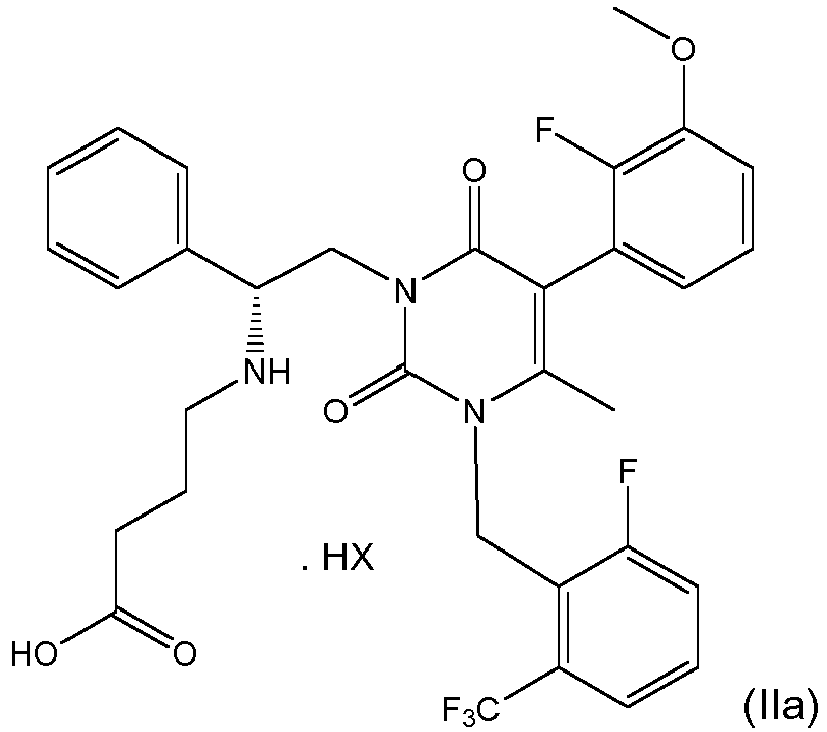
- It came as a surprise that elagolix in free undissociated form, however, transforms auto-catalytically into the lactame of Formula (Va), (R)-5-(2-fluoro-3-methoxyphenyl)-1-(2-fluoro-6-(trifluoromethyl)benzyl)-6-methyl-3-(2-(2-oxopyrrolidin-1-yl)-2-phenylethyl)pyrimidine-2,4(1H,3H)-dione, which therefore has to be considered as an intrinsic impurity formed in the course of this process.

- The corresponding impurities of Formula (5)/(V) can be expected to occur when preparing an acid addition salt of a compound of Formula (1) / I by a process that proceeds via the related free undissociated form of Formula (1)/(I), as well.


- Without wishing to be bound by any theory, it is possible that the particular spatial conformation of the secondary amino group of elagolix, being in proximity to the uracil ring, might be responsible for this extraordinary sensitivity towards lactame formation.
- In order to prevent the formation of these impurities, we aimed at development of a process for the preparation of acid addition salts of elagolix and related compounds - compounds of formula (1) / I - without involving the free undissociated form of the acid. This was realized by treatment of an acid-sensitive ester of elagolix (Formula IIIa) with a sufficiently strong acid (pKa <4, preferably <3, particularly preferred <2), which first, by a very fast protonation reaction, masks the secondary amine by forming the intermediate of Formula (IIIb) and thereby prevents it to engage in lactame formation. Then, at a much lower rate the sufficiently strong acid cleaves the acid-sensitive ester by forming the acid addition salt of elagolix.


- Listed below are definitions of various terms used to describe the present invention. These definitions, either by replacing one, more than one or all general expressions or symbols used in the present disclosure and thus yielding preferred embodiments of the invention, preferably apply to the terms as they are used throughout the specification unless they are otherwise limited in specific instances either individually or as part of a larger group.
- The term "alkyl" means a straight chain or branched, noncyclic or cyclic hydrocarbon. Representative straight chain alkyls include methyl, ethyl, n-propyl, n-butyl, and the like; branched alkyls include isopropyl, sec-butyl, isobutyl, tert-butyl, and the like; while cyclic alkyls include cyclopropyl and the like.
- The term "alkoxy" means "-O-alkyl".
- The term "halogen" means fluoride, chloride, bromide or iodide, preferably fluoride, chloride or bromide.
- The term "alkanediyl" means a divalent alkyl from which two hydrogen atoms are taken from the same carbon atom or from different carbon atoms, for example -CH2-, -CH2CH2-, -CH2CH2CH2-, -CH(CH3)CH2CH2-, or -CH2C(CH3)2CH2-.
- Protecting groups may be present and should protect the functional groups concerned against unwanted secondary reactions, such as acylations, etherifications, esterifications, oxidations, solvolysis, and similar reactions. It is a characteristic of protecting groups that they lend themselves readily, i.e. without undesired secondary reactions, to removal, typically by solvolysis, reduction, photolysis or also by enzyme activity, for example under conditions analogous to physiological conditions, and that they are not present in the end-products. The specialist knows, or can easily establish, which protecting groups are suitable with the reactions mentioned hereinabove and hereinafter. Preferably, if two or more protecting groups are present in one intermediate mentioned herein, they are chosen so that, if one of the groups needs to be removed, this can be done selectively, e.g., using two or more different protecting groups that are cleavable under different conditions, e.g. one class by mild hydrolysis, the other by hydrolysis under harder conditions, one class by hydrolysis in the presence of an acid, the other by hydrolysis in the presence of a base, or one class by reductive cleavage (e.g., by catalytic hydrogenation), the other by hydrolysis, or the like.
- Nitrogen protecting groups, as defined above, can be introduced/removed according to standard methods of organic chemistry known in the art, in particular reference is made to conventional nitrogen protecting group methods described in J. F. W. McOmie, "Protective Groups in Organic Chemistry", Plenum Press, London and New York 1973, T. W. Greene and P. G. M. Wuts, "Greene's Protective Groups in Organic Synthesis", Fourth Edition, Wiley, New York 2007; and in Richard C. Larock, "Comprehensive Organic Transformations: A Guide to Functional Group Preparations", Second Edition, Wiley-VCH Verlag GmbH, 2000.
Hydroxyl protecting groups can be introduced/removed according to known methods; standard conditions for such methods are described, for example in reference books above-mentioned for nitrogen protecting groups. - The term "saponification reagent" is to be understood as a base which is able to hydrolyze an ester to form an alcohol and the salt of a carboxylic acid, e.g., an alkali metal hydroxide such as KOH or NaOH.
- The term "group which can be saponified" is to be understood as an ester group -CO2R wherein R is alkyl, aryl or arylalkyl, which can be hydrolized, for example under basic conditions (e.g. alkalimetal base such as. NaOH, LiOH or KOH) or under acidic conditions (e.g., by the use of mineral acids, such as HCl, H2SO4, HBr, H3PO4) to provide a carboxylic acid. As an extension, the term "group which can be saponified" can also include an ester group -CO2R wherein R is aryl or arylalkyl, which can be reacted by use of a hydrogenation catalyst (e.g., Pd/C, Pt/C, Rh/C, Pd/Al2O3, PtO2), in the presence of an acid (e.g., acetic acid) or a base (e.g., triethylamine) or under neutral conditions, to provide a carboxylic acid.
- The term acid-sensitive ester refers to ester which can be selectively cleaved by treatment with a sufficiently strong acid under mild conditions without affecting other functional groups. Such esters e.g., are tertiary butyl, methylthiomethyl, tetrahydropyranyl, tetrahydrofuranyl, methoxyethoxymethyl, benzyloxymethyl, 1-methyl-1-phenylethyl, 3-methyl-3-pentyl, dicyclopropylmethyl, diphenylmethyl. Additional guidance can be found in e.g. J. F. W. McOmie, "Protective Groups in Organic Chemistry", Plenum Press, London and New York 1973; in T. W. Greene and P. G. M. Wuts, "Greene's Protective Groups in Organic Synthesis", Fourth Edition, Wiley, New York 2007.
- Sufficiently strong acids means that they are able to essentially quantitatively protonate the secondary amine in elagolix (and related compounds, respectively) and mediate ester cleavage at a reasonable rate. Such acids are are characterized by a pKa value of <4, preferably are characterized by a pKa value of <3, most preferably are characterized by a pKa value <2.
- The pKa as used herein refers to the negative logarithmic of the dissociation constant Ka for an acid in water at 20°C.
- The term "one-pot" "or "one-pot process" means that in a series (i.e. in a succession) of reactions, for example two or more successive reactions, each reaction product is provided for the next reaction without isolation and purification. The one-pot processes defined herein encompass not only a series (i.e. a succession) of reactions conducted in a single reaction vessel, but also a series (i.e. a succession) of reactions conducted in a plurality of reaction vessels (e.g., by transferring the reaction mixture from one vessel to other) without isolation and purification. Preferably, the one-pot process is conducted in a single reaction vessel.
- The term "step-wise process" means that in a series (i.e a succession) of reactions, each reaction product is provided for the next reaction with isolation and optionally purification.
- The term "work-up" means the work of isolation and/or purification which is carried out once the reaction is finished.
- As used herein, unless specified otherwise, the term "room temperature" or "ambient temperature" means a temperature of from 15 to 30°C, such as from 20 to 30°C, such as from 20 to 25°C.
- The term "inert" as used throughout this application, means unreactive with any of the reactants, solvents, or other components of the reaction mixture. Such inert conditions are generally accomplished by using inert gas such as carbon dioxide, helium, nitrogen, argon, among other gases.
- The compounds of the present invention can possess one or more asymmetric centers. The preferred absolute configurations are as indicated herein specifically. However, any possible pure enantiomer, pure diastereoisomer, or mixtures thereof, e.g., mixtures of enantiomers, such as racemates, are encompassed by the present invention.
In the formulae of the present application the term "", " " or "
 " on a C-sp3 represents a covalent bond wherein the stereochemistry of the bond is not defined. This means that the term "
 " or "
 " on a C-sp3 comprises an (S) configuration as well as an (R) configuration of the respective chiral centre. Furthermore, mixtures are also encompassed, e.g., mixtures of enantiomers, such as racemates, are encompassed by the present invention.
- In the formulae of the present application the term "" or "
 " on a C-sp2 represents a covalent bond, wherein the stereochemistry or the geometry of the bond is not defined. This means that the term "
 " on a C-sp2 comprises a cis (Z) configuration as well as a trans (E) configuration of the respective double bond. Furthermore, mixtures are also encompassed, e.g., mixtures of double bond isomers are encompassed by the present invention.
In the formulae of the present application, the term "" indicates a Csp3-Csp3 bond or a Csp2-Csp2 bond.
- The compounds of the present invention can possess one or more asymmetric centers. The preferred absolute configurations are as indicated herein specifically.
In the formulae of the present application the term "" on a C-sp3 indicates the absolute stereochemistry, either (R) or (S).
In the formulae of the present application the term "" on a C-sp3 indicates the absolute stereochemistry, either (R) or (S).
- Terms d,l and meso are used herein following stereodescriptor nomenclature according to: Gutsche, C. D.; Pasto, D. J. Fundamentals of Organic Chemistry, Prentice-Hall, Inc., Englewood Cliffs, New Jersey, 1975 and, Eliel, E. L.; Wilen, S. H. Stereochemistry of Organic Compounds, John Wiley & Sons, Inc. 1994.
- The term "stereomeric purity" at a given percentage means that the designated stereoisomer predominates at that given percentage in a mixture of stereoisomers.
- The term "tautomer" refers in particular to the aldehyde tautomer of compounds of the present invention, where such compounds can exists in either an enol or aldehyde form, or mixtures thereof.
- Salts are especially pharmaceutically acceptable salts or generally salts of any of the intermediates mentioned herein, where salts are not excluded for chemical reasons the skilled person will readily understand. They can be formed where salt forming groups, such as basic or acidic groups, are present that can exist in dissociated form at least partially, e.g. in a pH range from 4 to 10 in aqueous solutions, or can be isolated especially in solid, especially crystalline, form.
Such salts are formed, for example, as acid addition salts, preferably with organic or inorganic acids, from compounds or any of the intermediates mentioned herein with a basic nitrogen atom (e.g. imino or amino), especially the pharmaceutically acceptable salts. - Suitable inorganic acids are acids having a pKa of at most 4.0, for example, halogen acids such as hydrochloric acid or sulfuric acid. Suitable organic acids are acids having a pKa of at most 4.0, for example, certain carboxylic, phosphonic, sulfonic or sulfamic acids. For example methane- or ethane-sulfonic acid, ethane-1,2-disulfonic acid, benzenesulfonic acid, 2-naphthalenesulfonic acid, 1,5-naphthalene-disulfonic acid, formic acid or trifluoroacetic acid.
- When a basic group and an acid group are present in the same molecule, any of the intermediates mentioned herein may also form internal salts.
- In view of the close relationship between the compounds and intermediates in free form and in the form of their salts, including those salts that can be used as intermediates, for example in the purification or identification of the compounds or salts thereof, any reference to "compounds", "starting materials" and "intermediates" hereinbefore and hereinafter is to be understood as referring also to one or more salts thereof or a mixture of a corresponding free compound, intermediate or starting material and one or more salts thereof, each of which is intended to include also any solvate or salt of any one or more of these, as appropriate and expedient and if not explicitly mentioned otherwise. Different crystal forms may be obtainable and then are also included.
- Where the plural form is used for compounds, starting materials, intermediates, salts, pharmaceutical preparations, diseases, disorders and the like, this is intended to mean one (preferred) or more single compound(s), salt(s), pharmaceutical preparation(s), disease(s), disorder(s) or the like, where the singular or the indefinite article ("a", "an") is used, this is not intended to exclude the plural, but only preferably means "one".
- The term "substituted" preferably means that 1-3 substituents are present, which are independently selected from halogen, -OH, -COOH, C1-6 alkyl, C1-6 haloalkyl, -N(C1-6 alkyl)2, -NH(C1-6 alkyl), =O, CN, C1-6 alkoxy and NH2.
- The term "substituted" most preferably means that 1-3 substituents are present, which are independently selected from halogen, C1-6 alkyl, C1-6 haloalkyl, -N(C1-6 alkyl)2, CN and C1-6 alkoxy.
-
- µm
- micrometre
- µL
- microlitre
- aq
- aqueous
- ar
- aromatic
- arom
- aromatic
- Ac
- acetyl
- AcOH
- acetic acid
- Boc
- tert-butoxycarbonyl
- CO2
- carbon dioxide
- Cy
- cyclohexyl
- DABCO
- 1,4-diazobicyclo[2.2.2]octane
- DBU
- 1,8-diazabicyclo[5,4,0]undec-7-ene
- DCM
- dichloromethane
- DIEA
- N-ethyldiisopropylamine
- DME
- 1,2-dimethoxyethane
- DMF = dmf
- dimethylformamide
- DMPU
- 1,3-dimethyl-3,4,5,6-tetrahedrao-2(1H)-pyrimidinone
- DMSO
- dimethylsulfoxide
- DMSO-d6
- dimethylsulfoxide deuterated
- ee
- enantiomeric excess
- equiv
- equivalent
- ES
- electrospray
- ES+
- positive electrospray ionisation
- ESI
- electrospray ionisation
- Et
- ethyl
- Et2O
- diethyl ether
- EtOAc
- ethyl acetate
- EtOH
- ethanol
- g
- gram(s)
- GC
- gass chromatography
- h
- hour(s)
- HCl
- hydrochloric acid
- HCl(aq)
- hydrogen chloride aqueous solution
- 1HNMR
- proton nuclear magnetic resonance
- HPLC
- high performance liquid chromatography
- H3PO4
- phosphoric acid
- HRMS
- high resolution mass spectroscopy
- H2SO4
- sulfuric acid
- Hz
- hertz
- iPr
- isopropyl
- iPrOAc
- isopropyl acetate
- iPrOH
- isopropanol
- IR
- infrared
- J
- coupling constant
- K2CO3
- potassium carbonate
- L
- litre
- LC-MS
- liquid chromatography-mass spectrometry
- LCMS
- liquid chromatography-mass spectrometry
- LRMS
- low resolution mass spectroscopy
- m/e
- mass-to-charge ratio
- mg
- milligram
- min
- minute(s)
- mL
- millilitre
- mmol(s)
- millimole(s)
- mol(s)
- mole(s)
- monosub.
- monosubstituted
- mp
- melting point
- m.p.
- melting point
- m/z
- mass-to-charge ratio
- M
- molarity/molar
- Me
- methyl
- 2-MeTHF
- 2-methyltetrahydrofuran
- Mel
- methyl iodide
- MeOH
- methanol
- MeONa
- sodium methoxide
- MgSO4
- magnesium sulfate
- MS
- mass spectrometry
- MTBE
- tertbutylmethylether
- nm
- nanometre
- N
- nitrogen atom
- N2
- nitrogen
- NaCl
- sodium chloride
- Na2CO3
- sodium carbonate
- NaHCO3
- sodium bicarbonate
- NaOH
- sodium hydroxide
- NaOMe
- sodium methoxide
- NH4Cl
- ammonium chloride
- NMR
- nuclear magnetic resonance
- ppm
- parts per million
- RT = rt
- room temperature
- temp.
- temperature
- T
- temperature
- tR
- retention time
- tert-butyl
- tertiary-butyl
- TEA
- triethylamine
- TFA
- trifluoroacetic acid
- THF
- tetrahydrofuran
- TLC
- thin layer chromatography
- UV
- ultraviolet light
- vol.
- volume
- wt.
- weight
- Xyl
- xylene
- Standard conditions for group transformations are described, for example, in the relevant chapters in Richard C. Larock, "Comprehensive Organic Transformations: A Guide to Functional Group Preparations", Second Edition, Wiley-VCH Verlag GmbH, 2000.
- General reactions and mechanisms in organic chemistry are described, for example, in Smith, M., B.; March, J.; March's Advanced Organic Chemistry: Reactions, Mechanisms and Structure, 6th Edition, John Wiley & Sons, Inc., 2007; in particular as described in the relevant chapters thereof;
- Protecting groups are described, for example, in
J. F. W. McOmie, "Protective Groups in Organic Chemistry", Plenum Press, London and New York 1973; in T. W. Greene and P. G. M. Wuts, "Greene's Protective Groups in Organic Synthesis", Fourth Edition, Wiley, New York 2007; in "The Peptides"; Volume 3 (editors: E. Gross and J. Meienhofer), Academic Press, London and New York 1981, and in "Methoden der organischen Chemie" (Methods of Or-ganic Chemistry), Houben-Weyl, 4th edition, . - Pharmaceutical Salts are described, for example, in
Handbook of Pharmaceutical Salts: Properties, Selection, and Use Edited by P. Heinrich Stahl and Camile G. Wermuth. VHCA, Verlag Helvetica Chimica Acta, Zurich, Switzerland, and Wiley-VCH, Weinheim, Germany. 2002. -
-
FIG. 1 : 1H NMR of tert-butyl (R)-4-((2-(5-(2-fluoro-3-methoxyphenyl)-3-(2-fluoro-6-(trifluoromethyl)benzyl)-4-methyl-2,6-dioxo-3,6-dihydropyrimidin-1(2H)-yl)-1-phenylethyl)-amino)butanoate (tert-butyl ester of elagolix) in d6-DMSO obtained from Example 1. -
FIG. 2 : illustrates a representative PXRD of the crystalline acid addition salt of elagolix with sulfuric acid of the present invention. The x-axis shows the scattering angle in °2-Theta, the y-axis shows the intensity of the scattered X-ray beam in counts of detected photons. -
FIG. 3 : illustrates a representative PXRD of the amorphous acid addition salt of elagolix with hydrochloric acid of the present invention. The x-axis shows the scattering angle in °2-Theta, the y-axis shows the intensity of the scattered X-ray beam in counts of detected photons. -
FIG. 4 : 1H NMR of (R)-5-(2-fluoro-3-methoxyphenyl)-1-(2-fluoro-6-(trifluoromethyl)benzyl)-6-methyl-3-(2-(2-oxopyrrolidin-1-yl)-2-phenylethyl)pyrimidine-2,4(1H,3H)-dione in d6-DMSO obtained from Example 4. -
FIG. 5 : illustrates a representative PXRD of (R)-5-(2-fluoro-3-methoxyphenyl)-1-(2-fluoro-6-(trifluoromethyl)benzyl)-6-methyl-3-(2-(2-oxopyrrolidin-1-yl)-2-phenylethyl)pyrimidine-2,4(1H,3H)-dione in d6-DMSO obtained from Example 4. The x-axis shows the scattering angle in °2-Theta, the y-axis shows the intensity of the scattered X-ray beam in counts of detected photons. - The present invention relates to a process starting from an acid sensitive ester of Formula (3) or Formula (III) or Formula (IIIa) comprising:
- a) dissolve an acid-sensitive ester of Formula (3), or Formula (III), or Formula (IIIa) in a solvent
- b) add an acid sufficiently strong to cleave the acid-sensitive ester
- c) optionally, add an anti-solvent
- d) isolate the solid acid addition salt of elagolix by filtration
- e) optionally, dry the acid addition salt of Formula (2), or Formula (II) or Formula (IIa).
- The invention also refers to the following aspects:
A process for the preparation of an acid addition salt of elagolix comprising - a) dissolve the t-butyl ester of elagolix of Formula (IIIaa) in a solvent
- b) add an acid sufficiently strong to cleave the acid-sensitive ester
- c) optionally, add an anti-solvent
- d) isolate the solid acid addition salt of elagolix by filtration
- e) optionally, dry the acid addition salt of elagolix.
- A process of the invention wherein the solvent is selected from isoropanol, ethanol, acetonitrile, EtOAc, THF, dioxane or mixtures thereof, preferably, isopropanol, EtOAc or mixtures thereof.
- A process of the invention wherein the acid is selected from HCl, H2SO4, TFA or HCOOH, preferably, HCl or H2SO4.
- A process of the invention wherein optionally an anti-solvent selected from H2O, aliphatic or aromatic hydrocarbons, preferably, H2O, heptane, cyclohexane.
- The process is performed at ambient temperature or elevated temperature in a range of 30 °C to 70 °C, preferably, the process is performed at ambient temperature.
- The amount of the acid used ranges from 1.1 to 10, equivalent, preferable from 2 to 5 equivalents.The skilled person will appreciate that a slight molar excess of acid is best used to fully protonate the secondary amine and then also acid-catalyze ester hydrolysis.
- The acid-sensitive ester of elagolix can be prepared according processes described in
WO2005/007165 (e.g., Step 7I of Example 7) andWO2009/062087 (e.g., Example 4, Step 4A) starting from the primary amine (Formula IV) comprising - a) Reacting the primary amine of Formula (IVa) (or the related compounds of Formula (4), or of Formula (IV) in a solvent with an acid-sensitive ester of a 4-halobutyric acid, in the presence of amine
- b) Optionally, isolate the acid sensitive ester of elagolix or a related compound (Formula IIIa/III/3).
- More specifically the tert-butyl ester of elagolix (Formula IIIaa) can be prepared comprising:
- a) Reacting the primary amine of Formula (IVa) in in a solvent with tert-butyl 4-bromobutyrate, in the presence of an amine, preferentially K2CO3, Na2CO3, DIEA or TEA
- b) Optionally, isolate the acid-sensitive tert-butyl ester of elagolix (Formula IIIaa).
- The process for the preparation of the tert-butyl ester (Formula IIIaa) is summarized in Scheme1.

- The process wherein the solvent is selected from DMF, DMSO, DMPU or acetonitrile, preferably solvent is DMF or acetonitrile.
- The process wherein the base is selected from K2CO3, Na2CO3, DIEA or TEA, preferably, the base is K2CO3 or DIEA.
- The process is preferably performed at ambient temperature or elevated temperature in a range of 40 °C to 70 °C, preferably, the reaction is performed between 40 and 65 °C.
- Alternatively, the acid sensitive ester can be prepared by reaction of an amine of Formula (4) or (IV) or (IVa) with an acid-sensitive ester of 4-oxobutanoic acid in the presence of an reductive agent such as e.g., NaBH3CN, Na(OAc)3BH or borane pyridine complex.
- The following, in accordance with the knowledge of a person skilled in the art about possible limitations in the case of single reactions, applies in general to all processes mentioned hereinbefore and hereinafter, while reaction conditions specifically mentioned above or below are preferred.
- In any of the reactions mentioned hereinbefore and hereinafter, protecting groups may be used where appropriate or desired, even if this is not mentioned specifically, to protect functional groups that are not intended to take part in a given reaction, and they can be introduced and/or removed at appropriate or desired stages. Reactions comprising the use of protecting groups are therefore included as possible wherever reactions without specific mentioning of protection and/or deprotection are described in this specification. However, reactions without protecting groups are preferred in the context of the present invention.
- Within the scope of this disclosure only a readily removable group that is not a constituent of the particular desired end product is designated a "protecting group", unless the context indicates otherwise. The protection of functional groups by such protecting groups, the protecting groups themselves, and the reactions appropriate for their introduction and removal are described for example in standard reference works, such as J. F. W. McOmie, "Protective Groups in Organic Chemistry", Plenum Press, London and New York 1973, in T. W. Greene and P. G. M. Wuts, "Protective Groups in Organic Synthesis", Third edition, Wiley, New York 1999, in "The Peptides"; Volume 3 (editors: E. Gross and J. Meienhofer), Academic Press, London and New York 1981, in "Methoden der organischen Chemie" (Methods of Organic Chemistry), Houben Weyl, 4th edition, , in H.-D. Jakubke and H. Jesch-keit, "Aminosäuren, Peptide, Proteine" (Amino acids, Peptides, Proteins), Verlag Chemie, Weinheim, Deerfield Beach, and Basel 1982, in "Protecting Groups", Philip J. Kocienski, 3rd Edition, GeorgThieme Verlag, Stuttgart, ISBN 3-13-137003-3 and in Jochen Lehmann, "Chemie der Kohlenhydrate: Monosaccharide und Derivate" (Chemistry of Carbohydrates: Monosaccharides and Derivatives), Georg Thieme Verlag, Stuttgart 1974, in particular in the relevant chapters thereof. A characteristic of protecting groups is that they can be removed readily (i.e. without the occurrence of undesired secondary reactions) for example by solvolysis, reduction, photolysis or alternatively under physiological conditions (e.g., by enzymatic cleavage). Different protecting groups can be selected so that they can be removed selectively at different steps while other protecting groups remain intact. The corresponding alternatives can be selected readily by the person skilled in the art from those given in the standard reference works mentioned above or the description or the Examples given herein.
- All the above-mentioned process steps can be carried out under standard reaction conditions known in the art, unless otherwise specified, preferably those mentioned specifically, in the absence or, customarily, in the presence of solvents or diluents, preferably solvents or diluents that are inert towards the reagents used and dissolve them, in the absence or presence of catalysts, condensation or neutralizing agents, for example ion exchangers, such as cation exchangers, e.g. in the H+ form, depending on the nature of the reaction and/or of the reactants at reduced, normal or elevated temperature, for example in a temperature range of from about -100 °C to about 190 °C, preferably from approximately -80 °C to approximately 150 °C, for example at from -80 to -60°C, at room temperature, at from -20 to 40 °C or at reflux temperature, under atmospheric pressure or in a closed vessel, where appropriate under pressure, and/or in an inert atmosphere, for example under an argon or nitrogen atmosphere.
- Where required, the working-up of reaction mixtures, especially in order to isolate desired compounds or intermediates, follows customary procedures and steps, e.g. selected from the group comprising but not limited to extraction, neutralization, crystallization, chromatography, evaporation, drying, filtration, centrifugation and the like.
- The invention relates also to those forms of the process in which a compound obtainable as intermediate at any stage of the process is used as starting material and the remaining process steps are carried out, or in which a starting material is formed under the reaction conditions or is used in the form of a derivative, for example in protected form or in the form of a salt, or a compound obtainable by the process according to the invention is produced under the process conditions and processed further in situ. In the process of the present invention those starting materials are preferably used which result in compounds of
formula 1/I/Ia which are described as being preferred. Special preference is given to reaction conditions that are identical or analogous to those mentioned in the Examples. The invention relates also to novel starting compounds and intermediates described herein, especially those leading to compounds mentioned as preferred herein. - The invention especially relates to any of the methods described hereinbefore and hereinafter that leads to the product, or a pharmaceutically acceptable salt thereof.
- The following Examples serve to illustrate the invention without limiting the scope thereof, while they on the other hand represent preferred embodiments of the reaction steps, intermediates and/or the process of manufacture of the product in free base form or as a pharmaceutically acceptable salt thereof.
-
- 1. Process for the preparation of an acid addition salt of Formula (2)


n = 1 or 2;
Ra and Rb are independently of each other a substituted or unsubstituted C1-20 alkyl, substituted or unsubstituted C1-20 alkoxy, substituted or unsubstituted C1-20 alkenyl, substituted or unsubstituted C3-12 cycloalkyl, substituted or unsubstituted C6-12 aryl, substituted or unsubstituted C5-12 heteroaryl, substituted or unsubstituted C7-12 alkylheteroaryl, substituted or unsubstituted C7-12 alkylaryl, substituted or unsubstituted C3-12 heterocycloalkyl, substituted or unsubstituted C5-12 heterobicycle, substituted or unsubstituted C5-12 biaryl, substituted or unsubstituted C5-12 bicycloaryl, substituted or unsubstituted C5-12 bicycloalkyl, substituted or unsubstituted -C3-7 cycloalkyl-C3-7 heterocycle, substituted or unsubstituted -C3-7 aryl-C3-7 heterocycle, or substituted or unsubstituted -C3-7 heterocycloalkyl-C3-7 heteroaryl;
R3 = hydrogen or methyl;
R4 = substituted or unsubstituted phenyl, substituted or unsubstituted C3-7 alkyl, hydrogen, -C1-6 alkanediyl-COOH, or -C(=O)O-(t-butyl);
HX = organic or inorganic acid;
preferably of Formula (II)
n = 1 or 2, preferably n = 1:- R1a, R1b and R1c are independently selected from hydrogen, halogen, substituted or unsubstituted C1-4 alkyl, hydroxy, substituted or unsubstituted C1-4 alkoxy, or R1a, and R1b when taken together form -OCH2O- or -OCH2CH2-; preferably, R1a, R1b and R1c are independently selected from hydrogen, halogen, unsubstituted C1-4 alkyl, hydroxy, and unsubstituted C1-4 alkoxy;
- R2a, and R2b are independently selected from hydrogen, halogen, trifluoromethyl, cyano, or -SO2CH3;
- R3 = hydrogen or methyl;
- R4 = substituted or unsubstituted phenyl, substituted or unsubstituted C3-7 alkyl, hydrogen, -C1-6-alkanediyl-COOH, or -C(=O)O-(t-butyl);
- HX = (sufficiently strong) organic or inorganic acid;
- comprising the steps of:
- a) dissolving an (acid sensitive) ester of Formula (3), preferably of Formula (III)


wherein R5 is a protective group,
wherein R5 is a protective group,
in a solvent; - b) adding an organic or inorganic acid to cleave the ester of Formula (3) or Formula (III)
- c) optionally, adding an anti-solvent;
- d) isolating a solid acid addition salt of Formula (2) or Formula (II) by filtration; and
- e) optionally, drying the solid acid addition salt of Formula (2) or Formula (II).
- a) dissolving an (acid sensitive) ester of Formula (3), preferably of Formula (III)
- 2. The process of
item 1, wherein the protection group R5 in Formula (3) or Formula (III) is selected from the group consisting of tert-butyl-, triphenylmethyl-, and trialkylsilyl- (e.g., tri(C1-6alkyl)silyl-, for example trimethylsilyl-). - 3. The process of
item - n = 1;
- R1a, = halogen, preferably fluorine;
- R1b = unsubstituted C1-4 alkoxy;
- R1c = hydrogen;
- R2a, and R2b are independently selected from hydrogen, and halogen;
- R3 = hydrogen or methyl;
- R4 = unsubstituted phenyl or phenyl substituted with halogen, or unsubstituted C3-7 alkyl; preferably unsubstituted phenyl, or unsubstituted C3-7 alkyl;
- HX = organic or inorganic acid, preferably HCl, or H2SO4.
- 4. The process of any one of the preceding items, wherein the substituents in Formula (II) are defined as follows:
- n = 1;
- R1a, = halogen,
- R1b = unsubstituted C1-4 alkoxy
- R1c = hydrogen;
- R2a, and R2b are independently selected from hydrogen, and halogen;
- R3 = hydrogen or methyl;
- R4 = unsubstituted phenyl;
- HX = organic or inorganic acid, preferably HCI, or H2SO4.
- 5. The process of
item 
wherein the (acid sensitive) ester of Formula (III) is an ester of elagolix and has the Formula (IIIa)
item - 6. The process of any of the preceding items, wherein the solvent is isopropanol, ethylacetate (EtOAc) or mixtures thereof.
- 7. The process of any of the preceding items, wherein the (sufficiently strong) acid is selected from HCI, trifluoroacetic acid (TFA), HCOOH, H2SO4 and mixtures thereof.
- 8. The process of any of the preceding items, wherein the ester of Formula (III), preferably (IIIa), is prepared by a process comprising the steps of:
- aa) reacting the primary amine of the compound of Formula (4), preferably Formula (IV), further preferred of Formula (IVa)


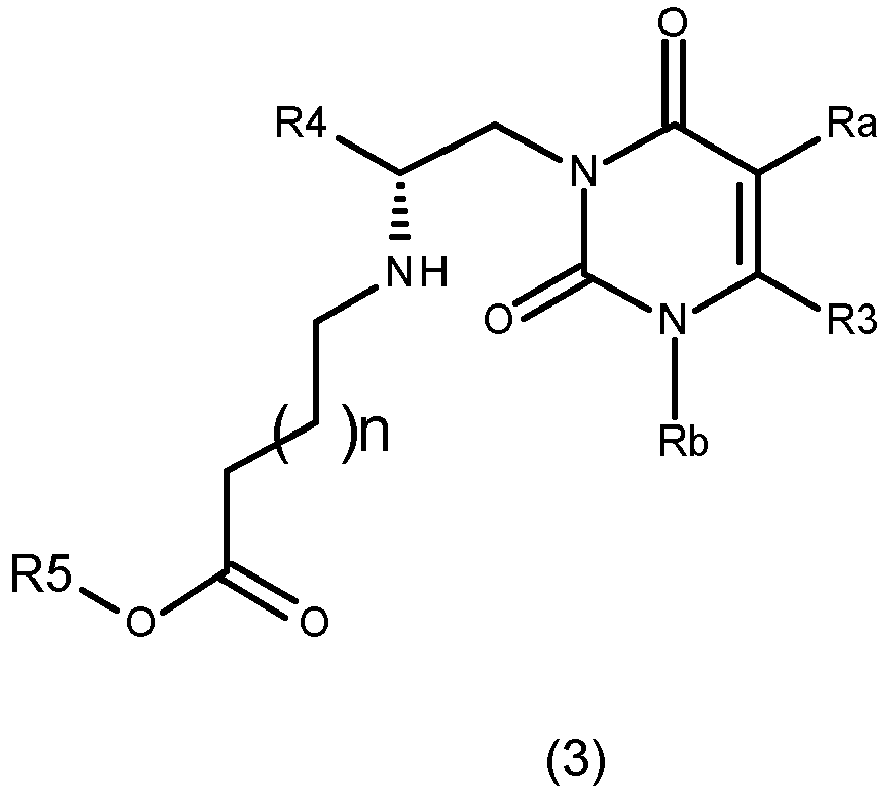
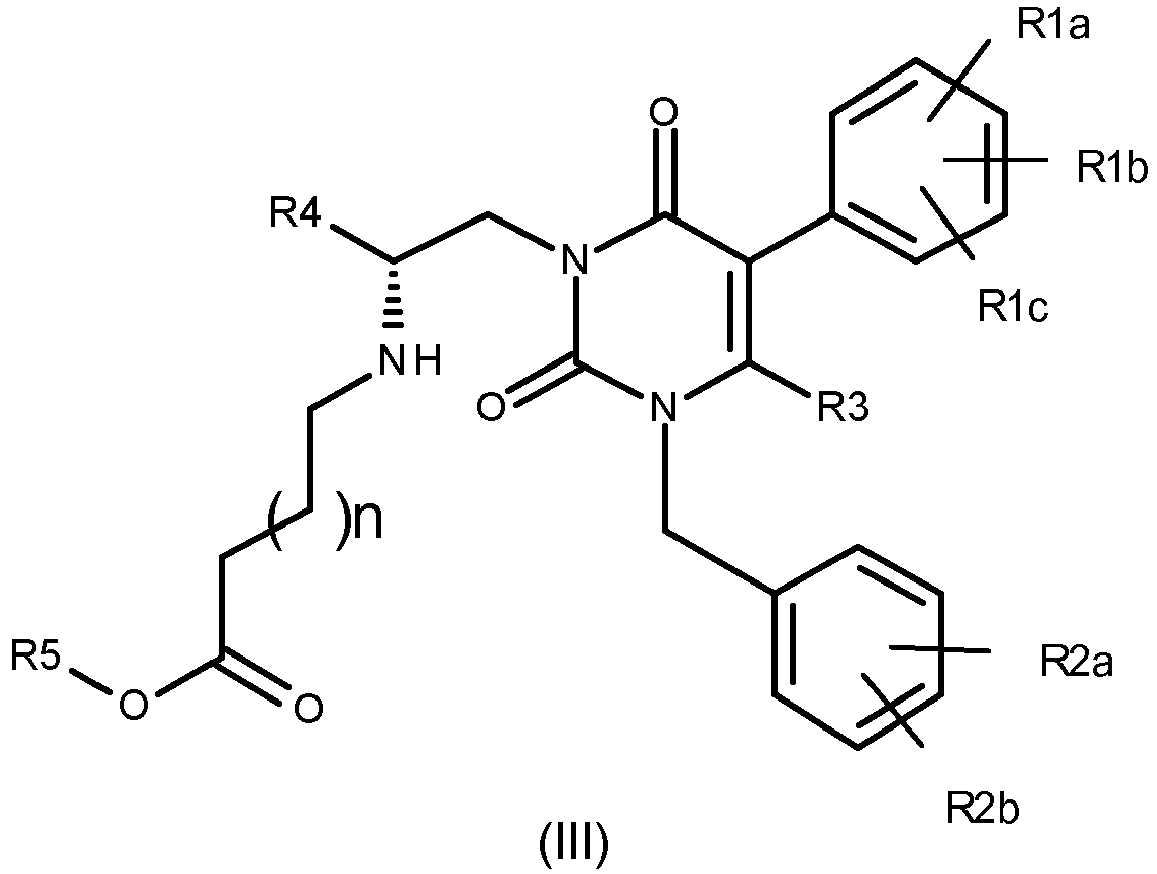

- bb) optionally, isolating the ester of Formula (3)/(III), preferably of Formula (IIIa).
- aa) reacting the primary amine of the compound of Formula (4), preferably Formula (IV), further preferred of Formula (IVa)
- 9. The process of any of one of
items 1 to 7, wherein an acid addition salt of elagolix is isolated, which is an amorphous or crystalline hydrogensulfate salt, or amorphous or crystalline hydrochloride salt. - 10. Acid addition salt of Formula (2), of Formula (II) or Formula (IIa) as defined in any of the preceding items, wherein HX is HCI, and H2SO4.
- 11. Acid addition salt of Formula (2), of Formula (II) or Formula (IIa) as defined in any of the preceding items,
wherein the acid addition salt of Formula (2) contains an impurity according to Formula (5)
wherein the acid addition salt of Formula (II) contains an impurity according to Formula (V)

- 12. Pharmaceutical composition comprising an acid addition salt of
item - 13. Pharmaceutical composition of
item 12 for use as medicament. - 14. Pharmaceutical composition of
item 12 for use in a method of treatment or prevention of endometriosis and uterine fibroids. - 15. The process of any of items 1-9, wherein the acid-sensitive ester is a tert-butyl ester of Formula (IIIaa)

- 16. The process of any of
items 1 to 9 and 15, wherein the acid is HCI, or H2SO4, preferably H2SO4. - 17. The process of any of
items 1 to 9 and 15-16, wherein an anti-solvent is added, preferably wherein the anti-solvent is water. - 18. The process of any of
items 1 to 9 and 15-17, wherein the anti-solvent is an aliphatic or aromatic hydrocarbon, preferably heptane or cyclohexane. - 19. The process of any of
items 1 to 9 and 15-18, wherein the primary amine of Formula (4), Formula (IV) or (IVa) is reacted with an acid-sensitive ester of a 4-halobutyric acid, in the presence of amine, preferentially K2CO3, Na2CO3, DIEA or TEA at preferably elevated temperature (e.g., above 30°C, or above 50°C). - 20. The process of any of
items 1 to 9 and 15-19, wherein the ester of Formula (4), of Formula (III) and Formula (IIIa), respectively, is prepared by reductive amination of the compound of Formula (IV) and Formula (IVa), respectively, with an acid sensitive ester of 4-oxobutanoic acid in the presence of a reducing agent. - 21. The process of any of
items 1 to 9 and 15-20, wherein the isolated acid addition salt of Formula (2), Formula (II) and Formula (IIa), respectively, is dried under reduced pressure. - 22. The process of any of
items 1 to 9 and 15-21, wherein the isolated acid addition salt of Formula (2), of Formula (II) and Formula (IIa), respectively, is amorphous. - 23. The process of any of
items 1 to 9 and 15-22, wherein the isolated wherein the isolated acid addition salt of Formula (2), of Formula (II) and Formula (IIa), respectively, is the amorphous hydrochloride salt. - 24. The process of any of
items 1 to 9 and 15-22, wherein the isolated wherein the isolated acid addition salt of Formula (2), of Formula (II) and Formula (IIa), respectively, is the amorphous hydrogensulfate salt. - 25. The process of any of
items 1 to 9 and 15-21, wherein the isolated wherein the isolated acid addition salt of Formula (2), of Formula (II) and Formula (IIa), respectively, is crystalline. - 26. The process of any of
items 1 to 9 and 15-21, wherein the isolated wherein the isolated acid addition salt of Formula (2), of Formula (II) and Formula (IIa), respectively, is a crystalline hydrogensulfate salt. - 27. Use of the ester of Formula (3), of Formula (III) and Formula (IIIa), respectively, for the preparation of an acid addition salt of of Formula (2), Formula (II) or (IIa), preferably by using the process as defined in any of items 1-9 and 15-26.
- 28. Pharmaceutical compositions comprising an acid addition salt of Formula (2), of Formula (II) and Formula (IIa), respectively, prepared by a process of any of one of
items 1 to 9 and 15-27. - 29. Pharmaceutical compositions comprising an amorphous hydrochloride salt of elagolix for Formula (IIa), prepared by a process of any of one of
embodiments 5 to 9 and 15 to 23. - 30. Pharmaceutical compositions comprising an amorphous hydrogensulfate salt of elagolix of Formula (IIa), prepared by a process of any of one of
embodiments 5 to 9 and 15 to 22. - 31. Use of pharmaceutical composition of
item 12 for the treatment or prevention of endometriosis and uterine fibroids. - 32. Method of treating a patient by using the pharmaceutical compositions of the present invention, in particular patients suffering from endometriosis and uterine fibroids.
- 33. The process, use, pharmaceutical compositions, or method of any preceding items, wherein the acid addition salt is in an about 1:1 stoichiometry of the drug compound and HX.
- 34. Acid addition salt of Formula (2), Formula (II), or Formula (IIa) of the invention for use as medicament, preferably for use in a method of treatment or prevention of endometriosis and uterine fibroids.
- 35. The process of any one of items 1-6 or 15, wherein the pKa of the acid added in step (b) is at most 4.0, preferably at most 3.0, more preferably at most 2.0.
- 36. The acid addition salt of
item 11, wherein the conjugated acid of the anion in the acid addition salt has a pKa of at most 4.0, preferably at most 3.0, more preferably at most 2.0. - (R)-3-(2-amino-2-phenylethyl)-5-(2-fluoro-3-methoxyphenyl)-1-(2-fluoro-6-(trifluoromethyl)-benzyl)-6-methylpyrimidine-2,4(1H,3H)-dione (71.5 g) prepared according to the procedure disclosed in
WO 2009/062087 A1 , tBu 4-bromobutyrate (35.69 g), and DIPEA (29.7 mL) in a round bottom flask (2L) were dissolved in DMF (358 mL) and stirred at 60°C until reaction was completed. Then the reaction mixture was diluted with ethyl acetate and washed with an aqueous 1M HCI solution. Layers were separated and the organic phase was dried over magnesium sulfate, the solvent was evaporated together with silica gel and purified via column chromatography using hexane/ethyl acetate as an eluent (from 0% to 30%) providing 50.0 g (56.4%) of pure (99.8%) title compound. - Tert-butyl (R)-4-((2-(5-(2-fluoro-3-methoxyphenyl)-3-(2-fluoro-6-(trifluoromethyl)benzyl)-4-methyl-2,6-dioxo-3,6-dihydropyrimidin-1(2H)-yl)-1-phenylethyl)amino)butanoate (218mg) was dissolved in isopropanol (4 mL) and sulfuric acid (1,88 mL) was added. The resulting mixture was stirred at room temperature for 15 h. Then water was slowly added to obtain a slurry. Amorphous elagolix hydrogen sulfate was then isolated by filtration and dried in vacuo. The acid addition salt is highly pure with a low content of the lactam impurity.
- Amorphous elagolix (200 mg, for example prepared according to the procedure disclosed in
WO 2009/062087 A1 , example 4B) was dissolved in 3.0 mL ethyl acetate, followed by filtration with the aid of a syringe filter (pore size 0.45 microns). Sulfuric acid (95-97 w-% aqueous solution, 1.05 mol equivalent, 18.8 microliter) was diluted with 1.0 mL ethyl acetate and added dropwise to the elagolix solution under stirring. The thus obtained mixture was further stirred at room temperature for 18 hours, leading to the formation of a homogeneous suspension. The solid material was collected by filtration, washed with a little amount of ethyl acetate and dried under vacuum (30 mbar) at room temperature for 16 hours, yielding the acid addition salt of elagolix with sulfuric acid as a white solid. The obtained material was crystalline as confirmed by the PXRD depicted inFigure 2 herein. The corresponding reflection list is provided in Table 1 below:Angle [°2-Theta] Relative Intensity [%] Angle [°2-Theta] Relative Intensity [%] 7.6 41 21.0 13 8.6 100 21.3 20 9.1 17 22.1 15 10.0 62 22.5 5 11.7 2 22.9 11 12.1 6 23.5 4 13.8 7 24.1 11 14.2 28 24.4 19 14.8 18 25.0 17 15.5 71 25.2 17 16.5 16 25.5 27 16.7 8 26.0 14 17.6 6 26.4 7 18.1 48 27.6 13 18.6 10 28.1 4 19.0 21 28.7 9 19.5 3 29.0 6 20.1 33 29.7 4 - Amorphous elagolix (300 mg, for example prepared according to the procedure disclosed in
WO 2009/062087 A1 , example 4B) was dissolved in 4.2 mL acetonitrile/water (volume ratio 1:1). Hydrochloric acid fuming (37 w-% aqueous solution, 1.0 mol equivalent, 39.4 microliter) was diluted with 1.5 mL acetonitrile/water (volume ratio 1:1) and added to the elagolix solution. The thus obtained solution was shaken at room temperature and afterwards allowed to stand without shaking for about 10 min before it was filtered with the aid of a syringe filter (pore size 0.45 microns). The homogeneous solution was frozen in a bath of liquid nitrogen and lyophilized at room temperature and a pressure below 2 mbar, yielding acid addition salt of elagolix with hydrochloric acid as a white solid. The obtained material was amorphous as confirmed by the PXRD depicted inFigure 3 herein. - Amorphous elagolix (51 mg, for example prepared according to the procedure disclosed in
WO 2009/062087 A1 , example 4B) was dissolved in acetone (0.6 mL) at RT. In order to accelerate dissolution the mixture was additionally sonicated in a VWR Ultrasonic Cleaner apparatus. The solution was filtrated with the aid of a syringe filter (pore size 0.45 microns) and stirred at room temperature. After 10 days of stirring precipitation took place yielding to a homogenous suspension. The white solid was collected by filtration and dried at room temperature under vacuum (30 mbar) for 16 hours. The obtained material was crystalline as confirmed by the PXRD depicted inFigure 5 herein.Table 2: Reflection list and corresponding relative intensities of crystalline (actually not elagolix but lactam derivative of elagolix) between 2.0 and 30.0° 2-Theta Angle [± 0.2 °2-Theta] Relative Intensity [%] Angle [± 0.2 °2-Theta] Relative Intensity [%] 6.3 4 20.6 2 8.7 100 20.9 9 9.3 34 21.4 7 9.8 4 21.9 2 12.3 39 22.4 14 12.7 20 22.9 38 13.1 8 23.4 25 13.8 10 23.6 8 14.4 31 23.9 26 14.6 3 24.7 20 14.7 3 25.2 20 15.1 32 25.6 4 15.4 34 26.0 3 16.0 26 26.5 44 16.5 32 26.9 10 17.1 25 27.3 4 17.4 61 27.5 4 18.1 7 28.2 9 18.6 16 28.5 6 19.1 6 28.8 6 19.7 37 29.3 3 20.1 13 29.7 3
Claims (15)
- Process for the preparation of an acid addition salt of Formula (2)

n = 1 or 2;
Ra and Rb are independently of each other a substituted or unsubstituted C1-20 alkyl, substituted or unsubstituted C1-20 alkoxy, substituted or unsubstituted C1-20 alkenyl, substituted or unsubstituted C3-12 cycloalkyl, substituted or unsubstituted C6-12 aryl, substituted or unsubstituted C5-12 heteroaryl, substituted or unsubstituted C7-12 alkylheteroaryl, substituted or unsubstituted C7-12 alkylaryl, substituted or unsubstituted C3-12 heterocycloalkyl, substituted or unsubstituted C5-12 heterobicycle, substituted or unsubstituted C5-12 biaryl, substituted or unsubstituted C5-12 bicycloaryl, substituted or unsubstituted C5-12 bicycloalkyl, substituted or unsubstituted -C3-7 cycloalkyl-C3-7 heterocycle, substituted or unsubstituted -C3-7 aryl-C3-7 heterocycle, or substituted or unsubstituted -C3-7 heterocycloalkyl-C3-7 heteroaryl;
R3 = hydrogen or methyl;
R4 = substituted or unsubstituted phenyl, substituted or unsubstituted C3-7 alkyl, hydrogen, -C1-6 alkanediyl-COOH, or -C(=O)O-(t-butyl);
HX = organic or inorganic acid;
comprising the steps of:a) dissolving an ester of Formula (3)
wherein R5 is a protective group,
in a solvent;b) adding an organic or inorganic acid having a pKa of <4.0 to cleave the ester of Formula (3)c) optionally, adding an anti-solvent;d) isolating a solid acid addition salt of Formula (2) by filtration; ande) optionally, drying the solid acid addition salt of Formula (2). - The process of claim 1, wherein the acid addition salt has the Formula (II)

n = 1 or 2;
R1a, R1b and R1c are independently selected from hydrogen, halogen, substituted or unsubstituted C1-4 alkyl, hydroxy, substituted or unsubstituted C1-4 alkoxy, or R1a, and R1b when taken together form -OCH2O- or -OCH2CH2-;
R2a, and R2b are independently selected from hydrogen, halogen, trifluoromethyl, cyano, or -SO2CH3;
R3 = hydrogen or methyl;
R4 = substituted or unsubstituted phenyl, substituted or unsubstituted C3-7 alkyl, hydrogen, -C1-6 alkanediyl-COOH, or -C(=O)O-(t-butyl);
HX = organic or inorganic acid, and wherein the process comprises the steps of:a) dissolving an ester of Formula (III)
wherein R5 is a protective group,
in a solvent;b) adding an organic or inorganic acid to cleave the ester of Formula (III)c) optionally, adding an anti-solvent;d) isolating a solid acid addition salt of Formula (II) by filtration; ande) optionally, drying the solid acid addition salt of Formula (II). - The process of claim 1 or 2, wherein the protection group R5 in Formula (3) or Formula (III) is selected from the group consisting of tert-butyl-, triphenylmethyl-, and trialkylsilyl-.
- The process of any of the preceding claims, wherein the substituents in Formula (II) are defined as follows:n = 1;R1a, = halogen, preferably fluorine;R1b = unsubstituted C1-4 alkoxy;R1c = hydrogen;R2a, and R2b are independently selected from hydrogen, and halogen;R3 = hydrogen or methyl;R4 = unsubstituted phenyl or phenyl substituted with halogen, or unsubstituted C3-7 alkyl;preferably unsubstituted phenyl, or unsubstituted C3-7 alkyl;HX = organic or inorganic acid, preferably HCl, or H2SO4.
- The process of claim 1 or 3, wherein the acid addition salt of Formula (II) is an acid addition salt of elagolix and has the Formula (IIa)


- The process of any of the preceding claims, wherein the solvent is isopropanol, ethylacetate (EtOAc) or mixtures thereof.
- The process of any of the preceding claims, wherein the acid is selected from HCI, trifluoroacetic acid (TFA), HCOOH, H2SO4 and mixtures thereof.
- The process of any of the preceding claims, wherein the ester of Formula (3), preferably Formula (III), further preferred Formula (IIIa), is prepared by a process comprising the steps of:aa) reacting the primary amine of the compound of Formula (4), preferably Formula (IV), further preferred of Formula (IVa)


 bb) optionally, isolating the ester of Formula (3), of Formula (III), preferably of Formula (IIIa).
 - The process of any of one of claims 1 to 7, wherein an acid addition salt of elagolix is isolated, which is an amorphous or crystalline hydrogensulfate salt, or amorphous or crystalline hydrochloride salt.
- Acid addition salt of Formula (2), Formula (II), or Formula (IIa) as defined in any of the preceding claims, wherein HX is HCl, and H2SO4.
- Acid addition salt of Formula (2), Formula (II), or Formula (IIa) as defined in any of the preceding claims,
wherein the acid addition salt of Formula (2) contains an impurity according to Formula (5)
wherein the acid addition salt of Formula (II) contains an impurity according to Formula (V)

- Pharmaceutical composition comprising an acid addition salt of claim 10 or 11 and a pharmaceutically acceptable carrier.
- Pharmaceutical composition of claim 12 for use as medicament.
- Pharmaceutical composition of claim 12 for use in a method of treatment or prevention of endometriosis and uterine fibroids.
- Acid addition salt of Formula (2), Formula (II), or Formula (IIa) of claim 10 or 11 for use as medicament, preferably for use in a method of treatment or prevention of endometriosis and uterine fibroids.
Priority Applications (1)
| Application Number | Priority Date | Filing Date | Title |
|---|---|---|---|
| EP18201039.7A EP3572406A1 (en) | 2018-10-17 | 2018-10-17 | Acid addition salt of elagolix and related compounds |
Applications Claiming Priority (1)
| Application Number | Priority Date | Filing Date | Title |
|---|---|---|---|
| EP18201039.7A EP3572406A1 (en) | 2018-10-17 | 2018-10-17 | Acid addition salt of elagolix and related compounds |
Publications (1)
| Publication Number | Publication Date |
|---|---|
| EP3572406A1 true EP3572406A1 (en) | 2019-11-27 |
Family
ID=63878567
Family Applications (1)
| Application Number | Title | Priority Date | Filing Date |
|---|---|---|---|
| EP18201039.7A Withdrawn EP3572406A1 (en) | 2018-10-17 | 2018-10-17 | Acid addition salt of elagolix and related compounds |
Country Status (1)
| Country | Link |
|---|---|
| EP (1) | EP3572406A1 (en) |
Cited By (5)
| Publication number | Priority date | Publication date | Assignee | Title |
|---|---|---|---|---|
| CN111116490A (en) * | 2020-01-15 | 2020-05-08 | 奥锐特药业股份有限公司 | Preparation and purification method of oxalagogri intermediate salicylate |
| WO2021088616A1 (en) * | 2019-11-08 | 2021-05-14 | 上海迪赛诺化学制药有限公司 | Crystal form of elagolix acid sulfate, preparation thereof and application thereof |
| US11273128B1 (en) | 2021-04-15 | 2022-03-15 | Sandoz Ag | Elagolix formulation |
| CN114790178A (en) * | 2022-03-03 | 2022-07-26 | 福安药业集团宁波天衡制药有限公司 | Preparation method of oxa-goril sodium |
| CN114835649A (en) * | 2021-02-01 | 2022-08-02 | 上海漠澳浩医药科技有限公司 | Oxagolide salt, crystal, preparation method and application thereof |
Citations (3)
| Publication number | Priority date | Publication date | Assignee | Title |
|---|---|---|---|---|
| WO2005007165A1 (en) | 2003-07-07 | 2005-01-27 | Neurocrine Biosciences, Inc. | Pyrimidine-2, 4-dione derivatives as gonadotropin-releasing hormone receptor antagonists |
| WO2009062087A1 (en) | 2007-11-07 | 2009-05-14 | Neurocrine Biosciences, Inc. | Processes for the preparation of uracil derivatives |
| WO2018224063A2 (en) * | 2017-06-08 | 2018-12-13 | Zentiva, K.S. | Solid forms of elagolix |
-
2018
- 2018-10-17 EP EP18201039.7A patent/EP3572406A1/en not_active Withdrawn
Patent Citations (3)
| Publication number | Priority date | Publication date | Assignee | Title |
|---|---|---|---|---|
| WO2005007165A1 (en) | 2003-07-07 | 2005-01-27 | Neurocrine Biosciences, Inc. | Pyrimidine-2, 4-dione derivatives as gonadotropin-releasing hormone receptor antagonists |
| WO2009062087A1 (en) | 2007-11-07 | 2009-05-14 | Neurocrine Biosciences, Inc. | Processes for the preparation of uracil derivatives |
| WO2018224063A2 (en) * | 2017-06-08 | 2018-12-13 | Zentiva, K.S. | Solid forms of elagolix |
Non-Patent Citations (16)
Cited By (7)
| Publication number | Priority date | Publication date | Assignee | Title |
|---|---|---|---|---|
| WO2021088616A1 (en) * | 2019-11-08 | 2021-05-14 | 上海迪赛诺化学制药有限公司 | Crystal form of elagolix acid sulfate, preparation thereof and application thereof |
| CN111116490A (en) * | 2020-01-15 | 2020-05-08 | 奥锐特药业股份有限公司 | Preparation and purification method of oxalagogri intermediate salicylate |
| CN114835649A (en) * | 2021-02-01 | 2022-08-02 | 上海漠澳浩医药科技有限公司 | Oxagolide salt, crystal, preparation method and application thereof |
| US11273128B1 (en) | 2021-04-15 | 2022-03-15 | Sandoz Ag | Elagolix formulation |
| EP4074308A1 (en) | 2021-04-15 | 2022-10-19 | Sandoz Ag | Elagolix formulation |
| CN114790178A (en) * | 2022-03-03 | 2022-07-26 | 福安药业集团宁波天衡制药有限公司 | Preparation method of oxa-goril sodium |
| CN114790178B (en) * | 2022-03-03 | 2024-04-09 | 福安药业集团宁波天衡制药有限公司 | Preparation method of oxaagoli sodium |
Similar Documents
| Publication | Publication Date | Title |
|---|---|---|
| EP1819683B1 (en) | Potassium salt of an hiv integrase inhibitor | |
| US7153967B2 (en) | Preparation of 1H-imidazo [4,5-C] quinolin-4-amines via 1H-imidazo [4,5-C] quinolin-4-phthalimide intermediates | |
| AU707075B2 (en) | Carbocyclic intermediates and process of manufacture thereof | |
| JP5439168B2 (en) | Rosuvastatin zinc salt | |
| EP1694678A2 (en) | Process for preparing hexahydropyrimido 1,2-a¨azepine-2-carboxylates and related compounds | |
| US8981095B2 (en) | Intermediate compounds and process for the preparation of lurasidone and salts thereof | |
| EP0694547A2 (en) | 2-(2-amino-1,6-dihydro-6-oxo-purin-9-yl)methoxy-1,3-propanediol derivative | |
| EP2794610B1 (en) | Processes and intermediates for preparing pralatrexate | |
| KR20090106633A (en) | 6-benzyl-2,3,4,7-tetrahydro-indolo [2,3-c] quinoline compounds useful as PDE5 inhibitors | |
| EP3891133A1 (en) | Improved process for preparing ozanimod | |
| EP1999106B1 (en) | A hydride reduction process for preparing quinolone intermediates | |
| US6177564B1 (en) | Process for the synthesis of N-benzyl-3-(4-fluorophenyl)-1-4-oxazin-2-one | |
| JP7379381B2 (en) | Intermediates and processes for the manufacture of linagliptin and its salts | |
| WO2023226900A1 (en) | 2-(piperazine-2-yl) acetonitrile derivative, preparation method for, and use thereof | |
| US7718806B2 (en) | Process for production of carbostyril compound | |
| KR20230022874A (en) | Synthesis of (2S,5R)-5-(2-chlorophenyl)-1-(2'-methoxy-[1,1'-biphenyl]-4-carbonyl)pyrrolidine-2-carboxylic acid | |
| CN101611026A (en) | Preparation method of (3R,4R) -N- (4-chlorphenyl) -1- (2, 2-difluoroethyl) -N' - [ 2-fluoro-4- (2-oxo-1 (2H) -pyridyl) phenyl ] -3, 4-pyrrolidine dicarboxamide | |
| MXPA05002734A (en) | Acyl derivatives of 5- (2-(4 -(1, 2 benzisothiazole -3- yl)-1- piperazinyl) ethyl)- 6-chloro -1, 3-dihydro -2h -indol-2 -one having neuroleptic activity. | |
| US20210395200A1 (en) | Synthetic processes for the production of 1-((3s,4r)-4-(2,6-difluoro-4-methoxyphenyl)-2-oxopyrrolidin-3-yl)-3-phenylurea | |
| WO2016027077A1 (en) | Processes for the preparation of dabigatran etexilate and intermediates thereof | |
| US20050143400A1 (en) | Process for preparing famciclovir | |
| US20030069423A1 (en) | Novel processes for the preparation of adenosine compounds and intermediates thereto | |
| KR101896349B1 (en) | Process for the preparation of dimiracetam | |
| US9040697B2 (en) | Process for the production of moxonidine | |
| EP1699764B1 (en) | Bis-dicarboxylic acid salts of benazepril and preparation of benazepril via these salts |
Legal Events
| Date | Code | Title | Description |
|---|---|---|---|
| PUAI | Public reference made under article 153(3) epc to a published international application that has entered the european phase |
Free format text: ORIGINAL CODE: 0009012 |
|
| AK | Designated contracting states |
Kind code of ref document: A1 Designated state(s): AL AT BE BG CH CY CZ DE DK EE ES FI FR GB GR HR HU IE IS IT LI LT LU LV MC MK MT NL NO PL PT RO RS SE SI SK SM TR |
|
| AX | Request for extension of the european patent |
Extension state: BA ME |
|
| STAA | Information on the status of an ep patent application or granted ep patent |
Free format text: STATUS: THE APPLICATION IS DEEMED TO BE WITHDRAWN |
|
| 18D | Application deemed to be withdrawn |
Effective date: 20200603 |