EP3572382A1 - Lithium containing glass with high oxidized iron content and method of making same - Google Patents
Lithium containing glass with high oxidized iron content and method of making same Download PDFInfo
- Publication number
- EP3572382A1 EP3572382A1 EP19185626.9A EP19185626A EP3572382A1 EP 3572382 A1 EP3572382 A1 EP 3572382A1 EP 19185626 A EP19185626 A EP 19185626A EP 3572382 A1 EP3572382 A1 EP 3572382A1
- Authority
- EP
- European Patent Office
- Prior art keywords
- glass
- range
- feo
- molten
- infrared absorbing
- Prior art date
- Legal status (The legal status is an assumption and is not a legal conclusion. Google has not performed a legal analysis and makes no representation as to the accuracy of the status listed.)
- Granted
Links
Images

Classifications
-
- G—PHYSICS
- G02—OPTICS
- G02B—OPTICAL ELEMENTS, SYSTEMS OR APPARATUS
- G02B5/00—Optical elements other than lenses
- G02B5/20—Filters
- G02B5/22—Absorbing filters
- G02B5/226—Glass filters
-
- B—PERFORMING OPERATIONS; TRANSPORTING
- B32—LAYERED PRODUCTS
- B32B—LAYERED PRODUCTS, i.e. PRODUCTS BUILT-UP OF STRATA OF FLAT OR NON-FLAT, e.g. CELLULAR OR HONEYCOMB, FORM
- B32B17/00—Layered products essentially comprising sheet glass, or glass, slag, or like fibres
- B32B17/06—Layered products essentially comprising sheet glass, or glass, slag, or like fibres comprising glass as the main or only constituent of a layer, next to another layer of a specific material
- B32B17/10—Layered products essentially comprising sheet glass, or glass, slag, or like fibres comprising glass as the main or only constituent of a layer, next to another layer of a specific material of synthetic resin
- B32B17/10005—Layered products essentially comprising sheet glass, or glass, slag, or like fibres comprising glass as the main or only constituent of a layer, next to another layer of a specific material of synthetic resin laminated safety glass or glazing
- B32B17/10009—Layered products essentially comprising sheet glass, or glass, slag, or like fibres comprising glass as the main or only constituent of a layer, next to another layer of a specific material of synthetic resin laminated safety glass or glazing characterized by the number, the constitution or treatment of glass sheets
- B32B17/10036—Layered products essentially comprising sheet glass, or glass, slag, or like fibres comprising glass as the main or only constituent of a layer, next to another layer of a specific material of synthetic resin laminated safety glass or glazing characterized by the number, the constitution or treatment of glass sheets comprising two outer glass sheets
- B32B17/10045—Layered products essentially comprising sheet glass, or glass, slag, or like fibres comprising glass as the main or only constituent of a layer, next to another layer of a specific material of synthetic resin laminated safety glass or glazing characterized by the number, the constitution or treatment of glass sheets comprising two outer glass sheets with at least one intermediate layer consisting of a glass sheet
-
- B—PERFORMING OPERATIONS; TRANSPORTING
- B32—LAYERED PRODUCTS
- B32B—LAYERED PRODUCTS, i.e. PRODUCTS BUILT-UP OF STRATA OF FLAT OR NON-FLAT, e.g. CELLULAR OR HONEYCOMB, FORM
- B32B17/00—Layered products essentially comprising sheet glass, or glass, slag, or like fibres
- B32B17/06—Layered products essentially comprising sheet glass, or glass, slag, or like fibres comprising glass as the main or only constituent of a layer, next to another layer of a specific material
- B32B17/10—Layered products essentially comprising sheet glass, or glass, slag, or like fibres comprising glass as the main or only constituent of a layer, next to another layer of a specific material of synthetic resin
- B32B17/10005—Layered products essentially comprising sheet glass, or glass, slag, or like fibres comprising glass as the main or only constituent of a layer, next to another layer of a specific material of synthetic resin laminated safety glass or glazing
- B32B17/10009—Layered products essentially comprising sheet glass, or glass, slag, or like fibres comprising glass as the main or only constituent of a layer, next to another layer of a specific material of synthetic resin laminated safety glass or glazing characterized by the number, the constitution or treatment of glass sheets
- B32B17/10064—Layered products essentially comprising sheet glass, or glass, slag, or like fibres comprising glass as the main or only constituent of a layer, next to another layer of a specific material of synthetic resin laminated safety glass or glazing characterized by the number, the constitution or treatment of glass sheets comprising at least two glass sheets, only one of which being an outer layer
-
- B—PERFORMING OPERATIONS; TRANSPORTING
- B32—LAYERED PRODUCTS
- B32B—LAYERED PRODUCTS, i.e. PRODUCTS BUILT-UP OF STRATA OF FLAT OR NON-FLAT, e.g. CELLULAR OR HONEYCOMB, FORM
- B32B17/00—Layered products essentially comprising sheet glass, or glass, slag, or like fibres
- B32B17/06—Layered products essentially comprising sheet glass, or glass, slag, or like fibres comprising glass as the main or only constituent of a layer, next to another layer of a specific material
- B32B17/10—Layered products essentially comprising sheet glass, or glass, slag, or like fibres comprising glass as the main or only constituent of a layer, next to another layer of a specific material of synthetic resin
- B32B17/10005—Layered products essentially comprising sheet glass, or glass, slag, or like fibres comprising glass as the main or only constituent of a layer, next to another layer of a specific material of synthetic resin laminated safety glass or glazing
- B32B17/10009—Layered products essentially comprising sheet glass, or glass, slag, or like fibres comprising glass as the main or only constituent of a layer, next to another layer of a specific material of synthetic resin laminated safety glass or glazing characterized by the number, the constitution or treatment of glass sheets
- B32B17/10082—Properties of the bulk of a glass sheet
- B32B17/10119—Properties of the bulk of a glass sheet having a composition deviating from the basic composition of soda-lime glass, e.g. borosilicate
-
- B—PERFORMING OPERATIONS; TRANSPORTING
- B32—LAYERED PRODUCTS
- B32B—LAYERED PRODUCTS, i.e. PRODUCTS BUILT-UP OF STRATA OF FLAT OR NON-FLAT, e.g. CELLULAR OR HONEYCOMB, FORM
- B32B17/00—Layered products essentially comprising sheet glass, or glass, slag, or like fibres
- B32B17/06—Layered products essentially comprising sheet glass, or glass, slag, or like fibres comprising glass as the main or only constituent of a layer, next to another layer of a specific material
- B32B17/10—Layered products essentially comprising sheet glass, or glass, slag, or like fibres comprising glass as the main or only constituent of a layer, next to another layer of a specific material of synthetic resin
- B32B17/10005—Layered products essentially comprising sheet glass, or glass, slag, or like fibres comprising glass as the main or only constituent of a layer, next to another layer of a specific material of synthetic resin laminated safety glass or glazing
- B32B17/10009—Layered products essentially comprising sheet glass, or glass, slag, or like fibres comprising glass as the main or only constituent of a layer, next to another layer of a specific material of synthetic resin laminated safety glass or glazing characterized by the number, the constitution or treatment of glass sheets
- B32B17/10128—Treatment of at least one glass sheet
- B32B17/10137—Chemical strengthening
-
- C—CHEMISTRY; METALLURGY
- C03—GLASS; MINERAL OR SLAG WOOL
- C03B—MANUFACTURE, SHAPING, OR SUPPLEMENTARY PROCESSES
- C03B5/00—Melting in furnaces; Furnaces so far as specially adapted for glass manufacture
- C03B5/16—Special features of the melting process; Auxiliary means specially adapted for glass-melting furnaces
- C03B5/173—Apparatus for changing the composition of the molten glass in glass furnaces, e.g. for colouring the molten glass
-
- C—CHEMISTRY; METALLURGY
- C03—GLASS; MINERAL OR SLAG WOOL
- C03C—CHEMICAL COMPOSITION OF GLASSES, GLAZES OR VITREOUS ENAMELS; SURFACE TREATMENT OF GLASS; SURFACE TREATMENT OF FIBRES OR FILAMENTS MADE FROM GLASS, MINERALS OR SLAGS; JOINING GLASS TO GLASS OR OTHER MATERIALS
- C03C1/00—Ingredients generally applicable to manufacture of glasses, glazes, or vitreous enamels
- C03C1/004—Refining agents
-
- C—CHEMISTRY; METALLURGY
- C03—GLASS; MINERAL OR SLAG WOOL
- C03C—CHEMICAL COMPOSITION OF GLASSES, GLAZES OR VITREOUS ENAMELS; SURFACE TREATMENT OF GLASS; SURFACE TREATMENT OF FIBRES OR FILAMENTS MADE FROM GLASS, MINERALS OR SLAGS; JOINING GLASS TO GLASS OR OTHER MATERIALS
- C03C3/00—Glass compositions
- C03C3/04—Glass compositions containing silica
- C03C3/062—Glass compositions containing silica with less than 40% silica by weight
-
- C—CHEMISTRY; METALLURGY
- C03—GLASS; MINERAL OR SLAG WOOL
- C03C—CHEMICAL COMPOSITION OF GLASSES, GLAZES OR VITREOUS ENAMELS; SURFACE TREATMENT OF GLASS; SURFACE TREATMENT OF FIBRES OR FILAMENTS MADE FROM GLASS, MINERALS OR SLAGS; JOINING GLASS TO GLASS OR OTHER MATERIALS
- C03C3/00—Glass compositions
- C03C3/04—Glass compositions containing silica
- C03C3/062—Glass compositions containing silica with less than 40% silica by weight
- C03C3/064—Glass compositions containing silica with less than 40% silica by weight containing boron
- C03C3/068—Glass compositions containing silica with less than 40% silica by weight containing boron containing rare earths
-
- C—CHEMISTRY; METALLURGY
- C03—GLASS; MINERAL OR SLAG WOOL
- C03C—CHEMICAL COMPOSITION OF GLASSES, GLAZES OR VITREOUS ENAMELS; SURFACE TREATMENT OF GLASS; SURFACE TREATMENT OF FIBRES OR FILAMENTS MADE FROM GLASS, MINERALS OR SLAGS; JOINING GLASS TO GLASS OR OTHER MATERIALS
- C03C3/00—Glass compositions
- C03C3/04—Glass compositions containing silica
- C03C3/076—Glass compositions containing silica with 40% to 90% silica, by weight
-
- C—CHEMISTRY; METALLURGY
- C03—GLASS; MINERAL OR SLAG WOOL
- C03C—CHEMICAL COMPOSITION OF GLASSES, GLAZES OR VITREOUS ENAMELS; SURFACE TREATMENT OF GLASS; SURFACE TREATMENT OF FIBRES OR FILAMENTS MADE FROM GLASS, MINERALS OR SLAGS; JOINING GLASS TO GLASS OR OTHER MATERIALS
- C03C3/00—Glass compositions
- C03C3/04—Glass compositions containing silica
- C03C3/076—Glass compositions containing silica with 40% to 90% silica, by weight
- C03C3/083—Glass compositions containing silica with 40% to 90% silica, by weight containing aluminium oxide or an iron compound
-
- C—CHEMISTRY; METALLURGY
- C03—GLASS; MINERAL OR SLAG WOOL
- C03C—CHEMICAL COMPOSITION OF GLASSES, GLAZES OR VITREOUS ENAMELS; SURFACE TREATMENT OF GLASS; SURFACE TREATMENT OF FIBRES OR FILAMENTS MADE FROM GLASS, MINERALS OR SLAGS; JOINING GLASS TO GLASS OR OTHER MATERIALS
- C03C3/00—Glass compositions
- C03C3/04—Glass compositions containing silica
- C03C3/076—Glass compositions containing silica with 40% to 90% silica, by weight
- C03C3/083—Glass compositions containing silica with 40% to 90% silica, by weight containing aluminium oxide or an iron compound
- C03C3/085—Glass compositions containing silica with 40% to 90% silica, by weight containing aluminium oxide or an iron compound containing an oxide of a divalent metal
-
- C—CHEMISTRY; METALLURGY
- C03—GLASS; MINERAL OR SLAG WOOL
- C03C—CHEMICAL COMPOSITION OF GLASSES, GLAZES OR VITREOUS ENAMELS; SURFACE TREATMENT OF GLASS; SURFACE TREATMENT OF FIBRES OR FILAMENTS MADE FROM GLASS, MINERALS OR SLAGS; JOINING GLASS TO GLASS OR OTHER MATERIALS
- C03C3/00—Glass compositions
- C03C3/04—Glass compositions containing silica
- C03C3/076—Glass compositions containing silica with 40% to 90% silica, by weight
- C03C3/095—Glass compositions containing silica with 40% to 90% silica, by weight containing rare earths
-
- C—CHEMISTRY; METALLURGY
- C03—GLASS; MINERAL OR SLAG WOOL
- C03C—CHEMICAL COMPOSITION OF GLASSES, GLAZES OR VITREOUS ENAMELS; SURFACE TREATMENT OF GLASS; SURFACE TREATMENT OF FIBRES OR FILAMENTS MADE FROM GLASS, MINERALS OR SLAGS; JOINING GLASS TO GLASS OR OTHER MATERIALS
- C03C4/00—Compositions for glass with special properties
- C03C4/08—Compositions for glass with special properties for glass selectively absorbing radiation of specified wave lengths
- C03C4/082—Compositions for glass with special properties for glass selectively absorbing radiation of specified wave lengths for infrared absorbing glass
-
- C—CHEMISTRY; METALLURGY
- C03—GLASS; MINERAL OR SLAG WOOL
- C03C—CHEMICAL COMPOSITION OF GLASSES, GLAZES OR VITREOUS ENAMELS; SURFACE TREATMENT OF GLASS; SURFACE TREATMENT OF FIBRES OR FILAMENTS MADE FROM GLASS, MINERALS OR SLAGS; JOINING GLASS TO GLASS OR OTHER MATERIALS
- C03C4/00—Compositions for glass with special properties
- C03C4/10—Compositions for glass with special properties for infrared transmitting glass
-
- F—MECHANICAL ENGINEERING; LIGHTING; HEATING; WEAPONS; BLASTING
- F41—WEAPONS
- F41H—ARMOUR; ARMOURED TURRETS; ARMOURED OR ARMED VEHICLES; MEANS OF ATTACK OR DEFENCE, e.g. CAMOUFLAGE, IN GENERAL
- F41H5/00—Armour; Armour plates
- F41H5/02—Plate construction
- F41H5/04—Plate construction composed of more than one layer
- F41H5/0407—Transparent bullet-proof laminatesinformative reference: layered products essentially comprising glass in general B32B17/06, e.g. B32B17/10009; manufacture or composition of glass, e.g. joining glass to glass C03; permanent multiple-glazing windows, e.g. with spacing therebetween, E06B3/66
-
- G—PHYSICS
- G02—OPTICS
- G02B—OPTICAL ELEMENTS, SYSTEMS OR APPARATUS
- G02B13/00—Optical objectives specially designed for the purposes specified below
- G02B13/14—Optical objectives specially designed for the purposes specified below for use with infrared or ultraviolet radiation
-
- B—PERFORMING OPERATIONS; TRANSPORTING
- B32—LAYERED PRODUCTS
- B32B—LAYERED PRODUCTS, i.e. PRODUCTS BUILT-UP OF STRATA OF FLAT OR NON-FLAT, e.g. CELLULAR OR HONEYCOMB, FORM
- B32B17/00—Layered products essentially comprising sheet glass, or glass, slag, or like fibres
- B32B17/06—Layered products essentially comprising sheet glass, or glass, slag, or like fibres comprising glass as the main or only constituent of a layer, next to another layer of a specific material
- B32B17/10—Layered products essentially comprising sheet glass, or glass, slag, or like fibres comprising glass as the main or only constituent of a layer, next to another layer of a specific material of synthetic resin
-
- B—PERFORMING OPERATIONS; TRANSPORTING
- B32—LAYERED PRODUCTS
- B32B—LAYERED PRODUCTS, i.e. PRODUCTS BUILT-UP OF STRATA OF FLAT OR NON-FLAT, e.g. CELLULAR OR HONEYCOMB, FORM
- B32B2307/00—Properties of the layers or laminate
- B32B2307/40—Properties of the layers or laminate having particular optical properties
- B32B2307/412—Transparent
-
- B—PERFORMING OPERATIONS; TRANSPORTING
- B32—LAYERED PRODUCTS
- B32B—LAYERED PRODUCTS, i.e. PRODUCTS BUILT-UP OF STRATA OF FLAT OR NON-FLAT, e.g. CELLULAR OR HONEYCOMB, FORM
- B32B2605/00—Vehicles
- B32B2605/08—Cars
-
- B—PERFORMING OPERATIONS; TRANSPORTING
- B32—LAYERED PRODUCTS
- B32B—LAYERED PRODUCTS, i.e. PRODUCTS BUILT-UP OF STRATA OF FLAT OR NON-FLAT, e.g. CELLULAR OR HONEYCOMB, FORM
- B32B2605/00—Vehicles
- B32B2605/18—Aircraft
-
- C—CHEMISTRY; METALLURGY
- C03—GLASS; MINERAL OR SLAG WOOL
- C03B—MANUFACTURE, SHAPING, OR SUPPLEMENTARY PROCESSES
- C03B5/00—Melting in furnaces; Furnaces so far as specially adapted for glass manufacture
- C03B5/16—Special features of the melting process; Auxiliary means specially adapted for glass-melting furnaces
-
- C—CHEMISTRY; METALLURGY
- C03—GLASS; MINERAL OR SLAG WOOL
- C03C—CHEMICAL COMPOSITION OF GLASSES, GLAZES OR VITREOUS ENAMELS; SURFACE TREATMENT OF GLASS; SURFACE TREATMENT OF FIBRES OR FILAMENTS MADE FROM GLASS, MINERALS OR SLAGS; JOINING GLASS TO GLASS OR OTHER MATERIALS
- C03C10/00—Devitrified glass ceramics, i.e. glass ceramics having a crystalline phase dispersed in a glassy phase and constituting at least 50% by weight of the total composition
- C03C10/0018—Devitrified glass ceramics, i.e. glass ceramics having a crystalline phase dispersed in a glassy phase and constituting at least 50% by weight of the total composition containing SiO2, Al2O3 and monovalent metal oxide as main constituents
- C03C10/0027—Devitrified glass ceramics, i.e. glass ceramics having a crystalline phase dispersed in a glassy phase and constituting at least 50% by weight of the total composition containing SiO2, Al2O3 and monovalent metal oxide as main constituents containing SiO2, Al2O3, Li2O as main constituents
-
- C—CHEMISTRY; METALLURGY
- C03—GLASS; MINERAL OR SLAG WOOL
- C03C—CHEMICAL COMPOSITION OF GLASSES, GLAZES OR VITREOUS ENAMELS; SURFACE TREATMENT OF GLASS; SURFACE TREATMENT OF FIBRES OR FILAMENTS MADE FROM GLASS, MINERALS OR SLAGS; JOINING GLASS TO GLASS OR OTHER MATERIALS
- C03C21/00—Treatment of glass, not in the form of fibres or filaments, by diffusing ions or metals in the surface
- C03C21/001—Treatment of glass, not in the form of fibres or filaments, by diffusing ions or metals in the surface in liquid phase, e.g. molten salts, solutions
- C03C21/002—Treatment of glass, not in the form of fibres or filaments, by diffusing ions or metals in the surface in liquid phase, e.g. molten salts, solutions to perform ion-exchange between alkali ions
-
- C—CHEMISTRY; METALLURGY
- C03—GLASS; MINERAL OR SLAG WOOL
- C03C—CHEMICAL COMPOSITION OF GLASSES, GLAZES OR VITREOUS ENAMELS; SURFACE TREATMENT OF GLASS; SURFACE TREATMENT OF FIBRES OR FILAMENTS MADE FROM GLASS, MINERALS OR SLAGS; JOINING GLASS TO GLASS OR OTHER MATERIALS
- C03C2204/00—Glasses, glazes or enamels with special properties
-
- C—CHEMISTRY; METALLURGY
- C03—GLASS; MINERAL OR SLAG WOOL
- C03C—CHEMICAL COMPOSITION OF GLASSES, GLAZES OR VITREOUS ENAMELS; SURFACE TREATMENT OF GLASS; SURFACE TREATMENT OF FIBRES OR FILAMENTS MADE FROM GLASS, MINERALS OR SLAGS; JOINING GLASS TO GLASS OR OTHER MATERIALS
- C03C27/00—Joining pieces of glass to pieces of other inorganic material; Joining glass to glass other than by fusing
- C03C27/06—Joining glass to glass by processes other than fusing
- C03C27/10—Joining glass to glass by processes other than fusing with the aid of adhesive specially adapted for that purpose
-
- C—CHEMISTRY; METALLURGY
- C03—GLASS; MINERAL OR SLAG WOOL
- C03C—CHEMICAL COMPOSITION OF GLASSES, GLAZES OR VITREOUS ENAMELS; SURFACE TREATMENT OF GLASS; SURFACE TREATMENT OF FIBRES OR FILAMENTS MADE FROM GLASS, MINERALS OR SLAGS; JOINING GLASS TO GLASS OR OTHER MATERIALS
- C03C4/00—Compositions for glass with special properties
- C03C4/08—Compositions for glass with special properties for glass selectively absorbing radiation of specified wave lengths
-
- Y—GENERAL TAGGING OF NEW TECHNOLOGICAL DEVELOPMENTS; GENERAL TAGGING OF CROSS-SECTIONAL TECHNOLOGIES SPANNING OVER SEVERAL SECTIONS OF THE IPC; TECHNICAL SUBJECTS COVERED BY FORMER USPC CROSS-REFERENCE ART COLLECTIONS [XRACs] AND DIGESTS
- Y02—TECHNOLOGIES OR APPLICATIONS FOR MITIGATION OR ADAPTATION AGAINST CLIMATE CHANGE
- Y02P—CLIMATE CHANGE MITIGATION TECHNOLOGIES IN THE PRODUCTION OR PROCESSING OF GOODS
- Y02P40/00—Technologies relating to the processing of minerals
- Y02P40/50—Glass production, e.g. reusing waste heat during processing or shaping
- Y02P40/57—Improving the yield, e-g- reduction of reject rates
Definitions
- This invention relates to a glass having a high oxidized iron content, and to methods of making such glasses, and more particularly, to a method of changing from a Campaign making a high infrared absorbing glass, i.e., a glass having high reduced iron content, to a Campaign making a low infrared absorbing glass, i.e., a glass having low reduced iron content, and the glasses made thereby. Also disclosed herein is a method of changing from a Campaign making a low infrared absorbing glass, i.e., a glass having low reduced iron content, to a Campaign making a high infrared absorbing glass, i.e., a glass having high reduced iron content, and the glasses made thereby.
- Campaign means making a predetermined amount of glass, e.g. but not limited to a flat glass ribbon, having a predetermined range of properties, e.g. but not limited to optical and colored properties using a predetermined amount of glass batch materials or ingredients.
- lithium containing glasses are usually used as a substrate to make ion exchanged strengthened glass.
- One type of lithium containing glass is disclosed in U.S. Patent No. 4,156,755 (“hereinafter also referred to as "USPN '755"), which patent is incorporated herein by reference.
- iron is not a required ingredient to make lithium containing glass for the ion exchange process, however, small amounts of iron are usually present in the lithium containing glass as an impurity in the glass batch ingredients, or the iron is added to the glass batch materials to provide a lithium containing glass having desired properties, e.g. but not limited to optical and/or colored properties.
- Total iron oxide content as Fe 2 O 3 in commercial glasses depends on the product requirements but are commonly in the range of 50-1200 parts per million ⁇ hereinafter also referred to as "PPM" ⁇ or 0.005-0.12% of the total iron by weight on the oxide basis (hereinafter referred to as "percent by weight" or "wt%”) for what are considered clear glass compositions.
- iron can be made as ferrous iron (FeO) or as ferric iron (Fe 2 O 3 ).
- FeO ferrous iron
- Fe 2 O 3 ferric iron
- a lithium containing glass sheet (hereinafter also referred to as a "lithium glass sheet”) is to be heated, e.g. but not limiting to the discussion, prior to bending and shaping, the composition of the lithium glass sheet usually includes ferrous oxide (FeO) in the range of 0.02 to 0.04 wt%, and the lithium glass sheet has a redox ratio (discussed in detail below) of 0.2 to 0.4.
- FeO ferrous oxide
- the lithium glass sheet has a redox ratio (discussed in detail below) of 0.2 to 0.4.
- a lithium containing glass (hereinafter also referred to as "lithium glass”) is to be used in the practice of the invention as a viewing window for infrared equipment, e.g.
- the ferrous oxide is preferably in the range of 0.001 to 0.010 wt%, and the lithium glass has a preferred redox ratio in the range of 0.005 to 0.10.
- the wt% of ferrous oxide is higher for the lithium glass sheet to be heated to increase the absorption of the infrared wavelengths to decrease the heating time of the lithium glass sheet to reach the bending temperatures.
- the wt% of the ferrous oxide is low for the lithium glass to be used for a viewing window for infrared equipment in accordance to the teachings of the invention to increase the percent transmittance of infrared energy through the viewing window.
- HIRA high infrared absorbing
- LIRA low infrared absorbing
- One non-limiting embodiment of the invention relates to a glass composition including, among other things, Component Range SiO 2 60-63 wt% Na 2 O 10-12 wt% Li 2 O 4-5.5 wt% Al 2 O 3 17-19 wt% ZrO 2 3.5-5 wt% (Al 2 O 3 + ZrO 2 ) 21.5-24 wt% FeO 0.0005-0.015 wt% Fe 2 O 3 (total iron) 50-1200 ppm; or 0.005-0.12 wt% and an oxidizer selected from the group of cerium oxide in the range of greater than 0 to 0.50 wt%, manganese oxide in the range of greater than 0 to 0.75 wt% and mixtures thereof, and a redox ratio in the range of 0.005-0.15.
- a device for viewing radiated infrared energy comprising a housing having at least one passageway, the passageway having a first open end and a second open end, a lens system mounted within the passageway for viewing radiated infrared energy, the improvement comprising: a chemically tempered ballistic glass lens mounted adjacent to one end of the passageway, the ballistic glass lens comprising a first surface, an opposite second surface and a glass segment between the first and the second surfaces of the ballistic glass lens, the glass segment including, among other things, Component Range SiO 2 60-63 wt% Na 2 O 10-12 wt% Li 2 O 4-5.5 wt% Al 2 O 3 17-19 wt% ZrO 2 3.5-5 wt% (Al 2 O 3 + ZrO 2 ) 21.5-24 wt% FeO 0.0005-0.015 wt% Fe 2 O 3 (total iron) 50-1200 ppm; or 0.005-012 wt%; and
- another non-limiting embodiment of the invention relates to a method of changing molten glass in a furnace from a molten high infrared absorbing lithium glass composition having FeO in the range of 0.02 to 0.04 wt% and a redox ratio in the range of 0.2 to 0.4 to a molten low infrared absorbing lithium glass composition having FeO in the range of 0.0005 to 0.015 wt%, a redox ratio in the range of 0.005 to 0.15 and a predetermined amount of a first oxidizer to oxidize the FeO, the method includes, among other things:
- a non-limiting embodiment of the invention relates to a laminated transparency, e.g. an aircraft and land vehicle windshield comprising a plurality of glass sheets, wherein at least one of the glass sheets is chemically strengthened and optionally plastic sheets, wherein the glass sheets and the plastic sheets are laminated together by plastic interlayers and at least one of the glass sheets has a glass composition including, among other things: Component Range SiO 2 60-63 wt% Na 2 O 10-12 wt% Li 2 O 4-5.5 wt% Al 2 O 3 17-19 wt% ZrO 2 3.5-5 wt% (Al 2 O 3 + ZrO 2 ) 21.5-24% FeO 0.0005-0.015 wt% Fe 2 O 3 (total iron) 50-1200 ppm; and an oxidizer selected from the group of cerium oxide in the range of greater than 0 to 0.50 wt%, manganese oxide in the range of greater than 0 to 0.75 wt% and mixtures thereof, and a redox ratio
- the invention relates to a method of changing molten glass in a furnace from a molten low infrared absorbing lithium glass composition having FeO in the range of 0.0005 to 0.015 wt%, and a redox ratio in the range of 0.005 to 0.10 to a high infrared absorbing lithium glass composition having FeO in the range of 0.02 to 0.04 wt% and a redox ratio in the range of 0.2 to 0.4, by, among other things, feeding glass batch material having ingredients to provide the molten high infrared absorbing lithium glass composition and the predetermined amount of a first reducing agent to increase the FeO; adding a second reducing agent to the glass batch material in an amount equal to one or two times the amount of the first reducing agent for a predetermined period of time to increase the FeO in the molten glass in the furnace, and ceasing the practice of the preceding steps after the predetermined period of time.
- each numerical parameter should at least be construed in light of the number of reported significant digits and by applying ordinary rounding techniques.
- all ranges disclosed herein are to be understood to encompass any and all subranges subsumed therein.
- a stated range of "1 to 10" should be considered to include any and all subranges between and inclusive of the minimum value of 1 and the maximum value of 10; that is, all subranges beginning with a minimum value of 1 or more and ending with a maximum value of 10 or less, e.g., 1 to 6.7, or 3.2 to 8.1, or 5.5 to 10.
- the term “mounted over” means mounted over but not necessarily in surface contact with.
- one article or component of an article “mounted over” another article or component of an article does not preclude the presence of materials between the articles, or between components of the article, respectively.
- the non-limiting embodiments of the invention are disclosed using the lithium glass compositions disclosed in USPN '755, however, the invention is not limited thereto, and the invention can be practiced to change from one Campaign making a soda-lime-silicate glass having a high oxidized iron content, e.g. but not limited to ferrous oxide in the range of 0.02 to 0.04 wt%, and a redox ratio in the range of 0.2 to 0.4, to another Campaign making a soda-lime-silicate glass having a low oxidized iron content, e.g. but not limited to ferrous oxide in the range of 0.001 to 0.010 wt%, and a redox ratio in the range of 0.005 to 0.15.
- a high oxidized iron content e.g. but not limited to ferrous oxide in the range of 0.02 to 0.04 wt%
- a redox ratio in the range of 0.2 to 0.4 e.g. but not limited to ferrous oxide in the range of 0.001
- Fe 2 O 3 and/or FeO can be added as a colorant or a property modifier.
- the total amount of iron present in the lithium glasses disclosed herein is expressed in terms of Fe 2 O 3 in accordance with standard analytical practice but that does not imply that all of the iron is actually in the form of Fe 2 O 3 .
- the amount of iron in the ferrous state is reported as FeO even though it may not actually be present in the glass as FeO.
- the term "redox ratio” shall mean the amount of iron in the ferrous state expressed as FeO divided by the amount of total iron expressed as Fe 2 O 3 .
- total iron in this specification shall mean total iron expressed in terms of Fe 2 O 3 and the term “FeO” shall mean iron in the ferrous state expressed in terms of FeO.
- the weight percent of all the oxides in the glass except for lithium are measured using X-Ray Fluorescence Spectroscopy (also known as "XRFS").
- the weight percent of lithium oxide in the glass is measured by atomic absorption.
- Minor quantities (up to about 5% by weight total) of other glass forming materials and glass modifiers or colorants can be included, e.g. MgO, MnO, TiO 2 , Sb 2 O 3 , As 2 O 3 , K 2 O, PbO, ZnO and CaO, and mixtures thereof.
- Sb 2 O 3 and As 2 O 3 are oxidizers for the glass sheet drawing process, but are not compatible for use in the float glass process because the reducing conditions of the float glass chamber reduces the Sb 2 O 3 and As 2 O 3 to antimony and arsenic metals, respectively.
- the lithium glass composition when the lithium glass sheet having the composition of Table 1 is to be heated, e.g. but not limiting to the discussion, prior to bending and/or shaping of the sheet, the lithium glass composition contains the ingredients of Table 1 plus ferrous oxide in the range of 0.02 to 0.05 wt%, and preferably in the range of 0.03 to 0.038 wt%, and a redox ratio in the range of 0.2 to 0.4 and preferably in the range of 0.2 to 0.35 (hereinafter the preceding glass is also referred to as "high infrared absorbing lithium glass" or "HIRA lithium glass”).
- HIRA lithium glass high infrared absorbing lithium glass
- additions of sulfates and carbon are made to the glass batch ingredients. The sulfates and carbon additions are made to increase the ferrous oxide content to maintain the molten glass within the desired redox ratio range.
- the lithium containing glass having the composition of Table 1 when used as a viewing window for infrared equipment, e.g. but not limited to infrared night goggles, scopes, e.g. rifle scopes, the lithium glass composition contains the ingredients of Table 1.
- oxides of iron are not listed as a component, however, as is appreciated by those skilled in the art, it is expected that oxides of iron, e.g. ferrous iron will be present in the glass as a tramp material found in the batch materials, e.g. glass cullet.
- the invention contemplates that the glass of the invention will include the composition of Table 1 plus ferrous oxide in the range of 0.0005 to 0.015 wt%, and preferably in the range of 0.001 to 0.010 wt%, and a redox ratio in the range of 0.005 to 0.15 and preferably in the range of 0.005 to 0.10 (hereinafter the preceding glass is also referred to as "low infrared absorbing lithium containing glass” or "LIRA lithium glass”). It is expected that the total iron (Fe 2 O 3 ) will be in the range of 50 to 200 ppm Fe 2 O 3 .
- oxidizers compatible with the selected glass making processes are added to the glass, e.g. cerium oxide, manganese oxide, antimony oxide, arsenic oxide and combinations thereof are added to the glass batch ingredients to maintain the molten glass within the redox ratio range for a LIRA lithium glass.
- the wt% of ferrous oxide is higher for the HIRA lithium glass to increase the absorption of the infrared wavelengths to decrease the heating time of the glass to reach the bending temperatures or to provide a level of solar heat control, and the wt% of the ferrous iron is lower for the LIRA lithium glass to reduce the absorption of infrared energy in the infrared viewing range and increase the percent transmittance of the infrared energy in the infrared viewing range to enhance the viewing of the infrared generating objects.
- the ultraviolet wavelength range is 300 to 380 nanometers (hereinafter also referred to as "nm"); the visible wavelength range is 380 to 780 nm; and the near infrared wavelength range is 800 to 2100 nm; of the electromagnetic spectrum.
- the infrared viewing wavelength range is device dependent. In one non-limiting embodiment of the invention, the infrared viewing wavelength range is 400 to 920 nm of the electromagnetic spectrum.
- the LIRA lithium glass preferably has a visible transmission of equal to and greater than 88%, more preferably a visible transmission of greater than 89% and most preferably a visible transmission of greater than 90%; an infrared transmission of equal to and greater than 80%, more preferably an infrared transmission of greater than 85% and most preferably an infrared transmission of equal to and greater than 90%; an infrared viewing transmission of equal to and greater than 80%, more preferably an infrared viewing transmission of greater than 85% and most preferably an infrared viewing transmission of greater than 90%.
- the HIRA lithium glass has a visible transmission of less than 88%; an infrared transmission of less than 75%; an infrared viewing transmission of less than 80%.
- the spectral properties of the LIRA lithium glass given above are reported at a thickness of 0.223 inch (5.7 millimeters).
- the visible transmission is determined using CIE Standard Illuminant A with a 2° observer over a wavelength range of 380 to 780 nanometers.
- the infrared transmittance is determined using Parry Moon air mass 2.0 direct solar irradiance data over a wavelength range of 800 to 2100 nm.
- the viewing transmittance is determined using the relative spectral irradiance of CIE Standard Illuminant A and the response function of the viewing device over the wavelength range 400 to 930 nm.
- the LIRA and HIRA lithium glasses of the invention can be made using a conventional non-vacuum refiner float glass system, e.g. but not limited to the type shown in Figs. 1 and 2 , or using a vacuum refiner float glass system, e.g. but not limited to the type disclosed in U.S. Patent Nos. 4,792,536 and 5,030,594 , which patents are hereby incorporated by reference).
- conventional continuously fed, cross-tank fired, glass melting and non-vacuum refining furnace 20 includes an enclosure formed by a bottom 22, roof 24, and sidewalls 26 made of refractory materials.
- the HIRA or the LIRA lithium glass batch materials 28 are introduced through inlet opening 30 (see Fig. 2 ) in an extension 32 of the furnace 20 known as the fill doghouse in any convenient or usual manner to form a blanket 34 floating on surface 36 of molten glass 38 (see Fig. 2 ).
- Overall progression of the glass as shown in Figs. 1A and 1B is from left to right in the figures, toward entrance end 39 of a glass forming chamber 40 (see Fig. 1B ) of the type used in the art to make float flat glass.
- Flames (not shown) to melt the batch materials 28 and to heat the molten glass 38 issue from burner ports 42 spaced along the sidewalls 26 (see Fig. 2 ) and are directed onto and across the surface 36 of the molten glass 38.
- the flames issue from a nozzle 43 (see Fig. 2 ) in each of the ports on one side of the tank 20, as the exhaust of the furnace moves through the ports on the opposite side of the furnace.
- the function of the ports is reversed, and the exhaust ports are the firing ports, and the firing ports are the exhaust ports.
- the firing cycle for furnaces of the type shown in Figs. 1A, 1B and 2 are well known in the art and no further discussion is deemed necessary.
- the invention contemplates using a mixture of air and fuel gas, or a mixture of oxygen and fuel gas, to generate the flames to heat the batch materials and the molten glass.
- a mixture of air and fuel gas or a mixture of oxygen and fuel gas
- the invention contemplates using a mixture of air and fuel gas, or a mixture of oxygen and fuel gas, to generate the flames to heat the batch materials and the molten glass.
- the glass batch materials 28 moving downstream from the batch feeding end or doghouse end wall 46 are melted in the melting section 48 of the furnace 20, and the molten glass 38 moves through waist 54 (see Fig. 1B ) to refining section 56 of the furnace 20.
- the refining section 56 bubbles in the molten glass 38 are removed, and the molten glass 38 is mixed or homogenized as the molten glass passes through the refining section 56.
- the molten glass 38 is delivered in any convenient or usual manner from the refining section 56 onto a pool of molten metal (not shown) contained in the glass-forming chamber 40. As the delivered molten glass 38 moves through the glass-forming chamber 40 on the pool of molten metal (not shown), the molten glass is sized and cooled.
- a dimensionally stable sized glass ribbon moves out of the glass-forming chamber 40 into an annealing lehr (not shown).
- Glass making apparatus of the type shown in Figs. 1A, 1B and 2 , and of the type discussed above are well known in the art and no further discussion is deemed necessary.
- the ferrous iron in the molten HIRA lithium glass contained in the furnace 20 at the end of the Campaign for making HIRA lithium glass is preferably decreased to a range of 0.0005 to 0.015 wt%, and more preferably to a range of 0.001-0.010 wt%, and the redox ratio is preferably reduced to a range of 0.005-0.15 and more preferably to a range of 0.005-0.10.
- the conversion of the molten HIRA lithium glass in the furnace e.g. 1850 tons
- to molten LIRA lithium glass is made in 3 to 4 days, whereas to make the conversion by adding only LIRA lithium glass batch ingredients without oxidizers would take about two weeks.
- the change from molten HIRA lithium glass to molten LIRA lithium glass can be made in 3 to 4 days using an oxidizing agent.
- cerium oxide (CeO 2 ) and/or manganese oxide (MnO 2 ) is/are used to oxidize the ferrous iron to the ferric iron because, as discussed above, they are compatible with the glass making process shown in Figs. 1A, 1B and 2 .
- cerium oxide (CeO 2 ) is used to oxidize the ferrous iron to the ferric iron because cerium oxide (CeO 2 ) is a more effective oxidizer than manganese oxide (MnO 2 ) as shown by a conducted experiment.
- Samples 1-5 are the Cerium Samples having varying amounts of cerium oxide
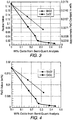
- Samples 6 and 7 are the Manganese Samples having varying amounts of manganese oxide.
- Fig. 3 is a plot showing the redox ratio and approximate FeO content
- Fig. 4 is a plot showing the ferrous oxide content, of the Control Sample and the Samples 1-7 on the ordinate (y axis) and the wt% of the cerium oxide and manganese oxide on the abscissa (x axis).
- the control sample data point is on the y axis.
- cerium oxide is used to oxidize the ferrous iron to the ferric iron because as shown in Figs. 3 and 4 the cerium oxide is a more effective oxidizer than manganese oxide, and the cerium oxide "decolorizes" the glass.
- cerium oxide is not a colorant in glass, but cerium oxide is a powerful oxidizing agent in glass, and its function in decolorized glass is to oxidize the iron in the ferrous state (Fe++) to iron in the ferric (Fe+++) state.
- cerium oxide is useful to decolorize the remaining traces of ferrous iron, the use of cerium oxide has limitations, e.g. but not limiting to the discussion, exposing the LIRA lithium glass to the sun has a solarizing effect on the glass, which results from the photo-oxidation of Ce+++ to Ce++++ and the photo-reduction of Fe+++ to Fe++.
- the solarization effect of cerium and the photo-reduction of Fe+++ to Fe++ reduces the transmission, and increases the absorption of the glass in the visible and the IR ranges of the electromagnetic spectrum. Because the reduction in visible and infrared transmission is less than 1%, cerium oxide is preferred to oxidize the ferrous iron. Nevertheless, the invention contemplates adding manganese oxide instead of cerium oxide and adding mixtures of manganese oxide and cerium oxide.
- cerium oxide in the range of greater than 0 to 0.50 wt% can be used; in the range of 0.02 to 0.45 wt% is preferred, and in the range of 0.04 to 0.40 wt% is more preferred.
- Other ranges for cerium oxide include but are not limited to 0.01 to 0.15 wt%; 0.02 to 0.10 wt% and 0.03 to 0.07 wt%.
- Manganese oxide in the range of greater than 0 to 0.75 wt% can be used, in the range of 0.02 to 0.50 wt% is preferred, and in the amount of 0.04 to 0.45 wt% is more preferred.
- a mixture of CeO 2 and MnO 2 can be used in the practice of the invention to oxidize the ferrous iron.
- one part of CeO 2 replaces 1.10 to 1.50 parts of MnO 2
- 1.10 to1.5 parts of MnO 2 replaces one part of CeO 2 .
- Glasses of lower total iron content can use lower amounts of cerium oxide or manganese oxide.
- the amount of cerium oxide or manganese oxide in this specification shall mean total cerium or manganese, respectively, expressed in terms of CeO 2 or MnO 2 , even though these components may not actually be present in the glass as CeO 2 or MnO 2 .
- Campaign A is active to make HIRA lithium glass.
- Campaign A is designated to end and Campaign B started to make LIRA lithium glass.
- the composition of the HIRA lithium glass being made and the composition of the LIRA lithium glass to be made are shown in TABLE 3.
- the HIRA lithium glass batch materials are fed into the furnace 20 (see Figs. 1A, 1B and 2 ), melted, refined and the refined glass moved into the glass forming chamber 40 as discussed above to make the HIRA lithium glass having the composition shown in TABLE 3.
- the glass batch materials for the LIRA lithium glass are moved into the melting section 48 of the furnace 20 as discussed above to start Campaign B.
- the batch materials for the LIRA lithium glass are formulated to provide a lithium glass having cerium oxide in the range of 0.04-0.90 wt%, i.e. twice the cerium oxide specified for the lithium glass of TABLE 3.
- the batch materials for the LIRA lithium glass are formulated to provide a lithium glass having cerium oxide in the range of 0.02-0.45 wt% (see TABLE 3).
- cerium carbonate is added to the batch materials to provide the cerium oxide in the glass.
- cerium carbonate in the range of 0.033-0.75 wt% is added to the batch materials.
- cerium carbonate in the range of 0.066-1.50 wt% is added to the batch materials.
- the cerium carbonate is reduced to a range of 0.033-0.75 wt% to run Campaign B to make the LIRA lithium glass of TABLE 3.
- the additional cerium carbonate during the first thirty six hour period of Campaign B is made to oxidize the ferrous iron in the melting section 26 and in the refining section 56 of the furnace 20.
- the glass batch materials for the LIRA lithium glass are moved into the melting section 46 of the furnace 20 as discussed above.
- a glass being made has sufficient UV absorber, e.g. cerium oxide, after the thirty-six hour pulse, no further additions of cerium carbonate are necessary if sufficiently low iron batch, e.g. but not limiting to the invention batch having less than 0.0005 wt% is used to make the glass not having a UV absorber.
- sufficiently low iron batch e.g. but not limiting to the invention batch having less than 0.0005 wt% is used to make the glass not having a UV absorber.
- the invention is not limited to the number or the length of the pulses, or the wt% of the cerium oxide in the pulses.
- the wt% of cerium oxide in the pulse is usually 2 to 3 times the wt% of cerium oxide in the LIRA lithium glass batch, and the number of pulses is usually one or two.
- the time period of each pulse can be varied as needed.
- the above procedure directed to the use of CeO 2 to oxidize the ferrous iron when changing from Campaign A to Campaign B is applicable to the practice of the invention using MnO 2 , or a mixture of CeO 2 and MnO 2 , to change from Campaign A making HIRA lithium glass to Campaign B making LIRA lithium glass.
- the procedure is the same, the wt% of MnO 2 , and of the mixture of CeO 2 and MnO 2 is increased because the cerium oxide is a more effective oxidizer than manganese oxide.
- the invention is not limited to the additions of the oxidizers, e.g. but not limited to CeO 2 , MnO 2 , and mixtures of CeO 2 and MnO 2 to the batch materials, and the invention contemplates adding the additional oxidizer to the molten glass in the refiner 56 or to the molten glass in the melter 36 at a position upstream from the waist 54.
- the oxidizers e.g. but not limited to CeO 2 , MnO 2 , and mixtures of CeO 2 and MnO 2 to the batch materials
- the invention contemplates adding the additional oxidizer to the molten glass in the refiner 56 or to the molten glass in the melter 36 at a position upstream from the waist 54.
- a campaign making LIRA lithium glass is changed to a campaign making HIRA lithium glass by making additions of a reducing agent to reduce the ferric iron to ferrous iron.
- Reducing agents that can be used in the practice of the invention include, but are not limited to carbon, carbon containing materials, e.g. but not limited to graphite, sucrose (C 12 H 22 O 11 ), coal, silicon metal and tin oxide (SnO 2 ).
- Additional non-limiting embodiments of the invention include, but are not limited to changing campaigns for making different types of soda-lime silicate glasses or any other types of glasses, e.g. going from a HIRA or LIRA lithium glass to a soda-lime silicate glass, or visa versa.
- HIRA lithium glass, and the LIRA lithium glass, of the invention made during Campaigns A and B is not limiting to the invention and can be processed for use in windows for land, air, space, above water and below water, vehicles; transparencies for commercial and residential windows, covers for solar collectors, and for ballistic viewing windows.
- the HIRA lithium glass is generally used for viewing windows using a source that provides visible light, and is generally not recommended for viewing infrared energy from objects, e.g. the use of HIRA lithium glasses is not recommended for night goggles.
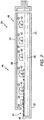
- the LIRA lithium glass is recommended to protect the lens system of the night vision equipment, e.g. but not limited to night vision goggles and night vision scopes. More particularly and with reference to Fig.
- a night vision rifle scope 70 having a tube 72 and a night vision magnifying lens system 74 mounted in passageway 76 of the tube 72.
- a ballistic lens 78 made of a chemically strengthened LIRA lithium glass is mounted at an end of the tube spaced from the lens system 74. With this arrangement, the lens system 74 is protected against breakage by the chemically strengthened LIRA lithium glass lens of the invention.
- LIRA lithium glass can also be used for specialty applications, including but not limiting to the invention its use in furniture, appliances, and shower doors.
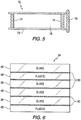
- the window 84 includes a plurality of LIRA lithium chemically strengthened glass sheets 86 and plastic sheets 88 laminated together by plastic interlayer material 90 of the type used in the laminating art.
- the LIRA and HIRA lithium glasses can be uncoated or coated with any type of coating, e.g. but not limited to an environmental coating to selectively pass predetermined wavelength ranges of light and energy, a photocatalytic film or water-reducing film, or a transparent conducting oxide e.g. of the types disclosed in U.S. Patent Nos. 5,873,203 and 5,469,657 , which patents are incorporated herein by reference.
- any type of coating e.g. but not limited to an environmental coating to selectively pass predetermined wavelength ranges of light and energy, a photocatalytic film or water-reducing film, or a transparent conducting oxide e.g. of the types disclosed in U.S. Patent Nos. 5,873,203 and 5,469,657 , which patents are incorporated herein by reference.
- the present disclosure relates inter alia , without being limited thereto, to the following aspects:
- a glass composition comprising: Component Range SiO 2 60-63 wt% Na 2 O 10-12 wt% Li 2 O 4-5.5 wt% Al 2 O 3 17-19 wt% ZrO 2 3.5-5 wt% (Al 2 O 3 + ZrO 2 ) 21.5-24 wt% FeO 0.0005-0.015 wt% Fe 2 O 3 (total iron) 50-1200 ppm; and an oxidizer selected from the group of cerium oxide in the range of greater than 0 to 0.50 wt%, manganese oxide in the range of greater than 0 to 0.75 wt% and mixtures thereof, and a redox ratio in the range of 0.005-0.15. 2.
- cerium oxide is in the range of 0.01 to 0.15 wt%. 3.
- the FeO is in the range of 0.001 -0.010 wt%.
- the Fe 2 O 3 total iron is in the range of 50 to 200 ppm.
- the redox ratio is in the range of 0.005 to 0.10.
- the oxidizer is selected from the group of cerium oxide in the range of 0.02 to 0.45 wt%, manganese oxide in the range of 0.02 to 0.50 wt% and mixtures thereof. 7.
- a device for viewing radiated infrared energy comprising a housing having at least one passageway, the passageway having a first open end and a second open end, a lens system for viewing radiated infrared energy, the improvement comprising: a chemically tempered ballistic glass lens mounted adjacent to one end of the passageway, the ballistic glass lens comprising a first surface, an opposite second surface and a glass segment between the first and the second surfaces of the ballistic glass lens, the glass segment comprising: Component Range SiO 2 60-63 wt% Na 2 O 10-12 wt% Li 2 O 4-5.5 wt% Al 2 O 3 17-19 wt% ZrO 2 3.5-5 wt% (Al 2 O 3 + ZrO 2 ) 21.5-24 wt% FeO 0.0005-0.015 wt% Fe 2 O 3 (total iron) 50-1200 ppm; and an oxidizer selected from the group of cerium oxide in the range of greater than 0 to 0.50 wt%, manganes
- the lens has a visible transmission of greater than 88%, an infrared transmission of greater than 80%, and an infrared viewing transmission of greater than 80%, the transmissions are for a glass lens having a thickness 0.223 inch (5.7 millimeter).
- the FeO of the glass segment is in the range of 0.001-0.010 wt%.
- the redox ratio of the glass segment is in the range of 0.005 to 0.10.
- the oxidizer is selected from the group of cerium oxide in the range of 0.02 to 0.45 wt%, manganese oxide in the range of 0.02 to 0.50 wt% and mixtures thereof.
Landscapes
- Chemical & Material Sciences (AREA)
- Engineering & Computer Science (AREA)
- General Chemical & Material Sciences (AREA)
- Chemical Kinetics & Catalysis (AREA)
- Materials Engineering (AREA)
- Organic Chemistry (AREA)
- Life Sciences & Earth Sciences (AREA)
- Geochemistry & Mineralogy (AREA)
- Physics & Mathematics (AREA)
- General Physics & Mathematics (AREA)
- Optics & Photonics (AREA)
- Toxicology (AREA)
- Health & Medical Sciences (AREA)
- General Engineering & Computer Science (AREA)
- Glass Compositions (AREA)
Abstract
Description
- This application claims the benefits of United States Provisional Patent Application Serial No.
61/602,909 filed February 24, 2012 61/602,909 - This invention relates to a glass having a high oxidized iron content, and to methods of making such glasses, and more particularly, to a method of changing from a Campaign making a high infrared absorbing glass, i.e., a glass having high reduced iron content, to a Campaign making a low infrared absorbing glass, i.e., a glass having low reduced iron content, and the glasses made thereby. Also disclosed herein is a method of changing from a Campaign making a low infrared absorbing glass, i.e., a glass having low reduced iron content, to a Campaign making a high infrared absorbing glass, i.e., a glass having high reduced iron content, and the glasses made thereby. As used herein the term "Campaign" means making a predetermined amount of glass, e.g. but not limited to a flat glass ribbon, having a predetermined range of properties, e.g. but not limited to optical and colored properties using a predetermined amount of glass batch materials or ingredients.
- Of particular interest in the following discussion is the manufacture of lithium containing glasses. As is appreciated by those skilled in the art, lithium containing glasses are usually used as a substrate to make ion exchanged strengthened glass. One type of lithium containing glass is disclosed in
U.S. Patent No. 4,156,755 ("hereinafter also referred to as "USPN '755"), which patent is incorporated herein by reference. - In general, iron is not a required ingredient to make lithium containing glass for the ion exchange process, however, small amounts of iron are usually present in the lithium containing glass as an impurity in the glass batch ingredients, or the iron is added to the glass batch materials to provide a lithium containing glass having desired properties, e.g. but not limited to optical and/or colored properties. Total iron oxide content as Fe2O3 in commercial glasses depends on the product requirements but are commonly in the range of 50-1200 parts per million {hereinafter also referred to as "PPM"} or 0.005-0.12% of the total iron by weight on the oxide basis (hereinafter referred to as "percent by weight" or "wt%") for what are considered clear glass compositions. More particularly, the addition of iron can be made as ferrous iron (FeO) or as ferric iron (Fe2O3). During the melting of the glass batch materials, equilibrium is reached between the ferric form of iron (Fe+++) and the ferrous form of iron (Fe++) with about 25-30 wt% of the iron in the ferrous form (Fe++) and 70-75 wt% of the iron in the ferric form (Fe+++). The ferric oxide, Fe2O3, is a strong ultraviolet radiation absorber and operates as a yellow colorant in the glass, and the ferrous oxide, FeO, is a strong infrared radiation absorber and operates as a blue colorant in the glass. Of particular interest in the present discussion is the ferrous oxide, FeO.
- In the instance when a glass sheet, for example but not limiting to the discussion, a lithium containing glass sheet (hereinafter also referred to as a "lithium glass sheet") is to be heated, e.g. but not limiting to the discussion, prior to bending and shaping, the composition of the lithium glass sheet usually includes ferrous oxide (FeO) in the range of 0.02 to 0.04 wt%, and the lithium glass sheet has a redox ratio (discussed in detail below) of 0.2 to 0.4. In the instance when a lithium containing glass (hereinafter also referred to as "lithium glass") is to be used in the practice of the invention as a viewing window for infrared equipment, e.g. but not limited to, infrared night goggles, or as components of transparent armor or aerospace windows, the ferrous oxide is preferably in the range of 0.001 to 0.010 wt%, and the lithium glass has a preferred redox ratio in the range of 0.005 to 0.10. The wt% of ferrous oxide is higher for the lithium glass sheet to be heated to increase the absorption of the infrared wavelengths to decrease the heating time of the lithium glass sheet to reach the bending temperatures. The wt% of the ferrous oxide is low for the lithium glass to be used for a viewing window for infrared equipment in accordance to the teachings of the invention to increase the percent transmittance of infrared energy through the viewing window.
- One of the drawbacks with going from a Campaign making a high infrared absorbing (hereinafter also referred to as "HIRA") lithium glass to a Campaign making low infrared absorbing (hereinafter also referred to as "LIRA") lithium glass of the invention, and/or going from a Campaign making a LIRA lithium glass of the invention to a Campaign making HIRA lithium glass, is the quantity of glass produced during the period starting at the end of one Campaign, e.g. the end of the Campaign to make HIRA lithium glass, and ending at the start of the next Campaign, e.g. the start of the Campaign to make LIRA lithium glass that meets the specifications for LIRA lithium glass or HIRA lithium glass. The glass that is out of specifications for use as LIRA lithium glass and HIRA lithium glass is usually scrapped or used as cullet. It can now be appreciated by those skilled in the art that discarding the glass made during the change from one Campaign to another Campaign is costly due to the relatively high batch cost for lithium glass and to the time wasted making unusable glass or glass of marginal quality.
- It is advantageous, therefore, to provide a method of minimizing or eliminating the drawbacks associated with changing from a Campaign making useable HIRA lithium glass or useable LIRA lithium glass to a Campaign making useable LIRA lithium glass or useable HIRA lithium glass, respectively.
- One non-limiting embodiment of the invention relates to a glass composition including, among other things,
Component Range SiO2 60-63 wt% Na2O 10-12 wt% Li2O 4-5.5 wt% Al2O3 17-19 wt% ZrO2 3.5-5 wt% (Al2O3 + ZrO2) 21.5-24 wt% FeO 0.0005-0.015 wt% Fe2O3 (total iron) 50-1200 ppm; or 0.005-0.12 wt% - Another non limiting embodiment of the invention relates to a device for viewing radiated infrared energy, the device comprising a housing having at least one passageway, the passageway having a first open end and a second open end, a lens system mounted within the passageway for viewing radiated infrared energy, the improvement comprising:
a chemically tempered ballistic glass lens mounted adjacent to one end of the passageway, the ballistic glass lens comprising a first surface, an opposite second surface and a glass segment between the first and the second surfaces of the ballistic glass lens, the glass segment including, among other things,Component Range SiO2 60-63 wt% Na2O 10-12 wt% Li2O 4-5.5 wt% Al2O3 17-19 wt% ZrO2 3.5-5 wt% (Al2O3 + ZrO2) 21.5-24 wt% FeO 0.0005-0.015 wt% Fe2O3 (total iron) 50-1200 ppm; or 0.005-012 wt%; - Further, another non-limiting embodiment of the invention relates to a method of changing molten glass in a furnace from a molten high infrared absorbing lithium glass composition having FeO in the range of 0.02 to 0.04 wt% and a redox ratio in the range of 0.2 to 0.4 to a molten low infrared absorbing lithium glass composition having FeO in the range of 0.0005 to 0.015 wt%, a redox ratio in the range of 0.005 to 0.15 and a predetermined amount of a first oxidizer to oxidize the FeO, the method includes, among other things:
- feeding glass batch material having ingredients to provide the molten low infrared absorbing lithium glass composition having FeO in the range of 0.0005 to 0.015 wt%, a redox ratio in the range of 0.005 to 0.15 and the predetermined amount of a first oxidizer to oxidize the FeO;
- adding a second oxidizer to the glass batch material in an amount equal to one or two times the amount of the first oxidizer for a predetermined period of time to oxidize the FeO in the molten glass in the furnace, and
- ceasing the practice of the above steps after the predetermined period of time.
- Still further, a non-limiting embodiment of the invention relates to a laminated transparency, e.g. an aircraft and land vehicle windshield comprising a plurality of glass sheets, wherein at least one of the glass sheets is chemically strengthened and optionally plastic sheets, wherein the glass sheets and the plastic sheets are laminated together by plastic interlayers and at least one of the glass sheets has a glass composition including, among other things:
Component Range SiO2 60-63 wt% Na2O 10-12 wt% Li2O 4-5.5 wt% Al2O3 17-19 wt% ZrO2 3.5-5 wt% (Al2O3 + ZrO2) 21.5-24% FeO 0.0005-0.015 wt% Fe2O3 (total iron) 50-1200 ppm; - In addition the invention relates to a method of changing molten glass in a furnace from a molten low infrared absorbing lithium glass composition having FeO in the range of 0.0005 to 0.015 wt%, and a redox ratio in the range of 0.005 to 0.10 to a high infrared absorbing lithium glass composition having FeO in the range of 0.02 to 0.04 wt% and a redox ratio in the range of 0.2 to 0.4, by, among other things, feeding glass batch material having ingredients to provide the molten high infrared absorbing lithium glass composition and the predetermined amount of a first reducing agent to increase the FeO; adding a second reducing agent to the glass batch material in an amount equal to one or two times the amount of the first reducing agent for a predetermined period of time to increase the FeO in the molten glass in the furnace, and ceasing the practice of the preceding steps after the predetermined period of time.
-
-
Figs. 1A and 1B are plane views in cross section of a glassmelting furnace connected to a glass-forming chamber of the type used to make a float glass ribbon in accordance to the teachings of the invention. -
Fig. 2 is an elevated cross sectional side view of the glass melting chamber shown inFig. 1A . -
Fig. 3 is a graph showing the redox value and approximate ferrous iron (FeO) content as a result of the oxidation of FeO by different amounts of CeO2 and MnO2. -
Fig. 4 is a graph showing the oxidation of ferrous iron (FeO) by different amounts of CeO2 and MnO2. -
Fig. 5 is a cross sectional side view of a night vision scope of the invention having a protective lens made in accordance to the teachings of the invention. -
Fig. 6 is a side elevated view of a laminated ballistic lens or window incorporating features of the invention. - As used herein, spatial or directional terms such as "inner", "outer", "left", "right", "up", "down", "horizontal", "vertical", and the like, relate to the invention as it is shown in the drawing on the figures. However, it is to be understood that the invention can assume various alternative orientations and, accordingly, such terms are not to be considered as limiting. Further, all numbers expressing dimensions, physical characteristics, and so forth, used in the specification and claims are to be understood as being modified in all instances by the term "about". Accordingly, unless indicated to the contrary, the numerical values set forth in the following specification and claims can vary depending upon the property desired and/or sought to be obtained by the present invention. At the very least, and not as an attempt to limit the application of the doctrine of equivalents to the scope of the claims, each numerical parameter should at least be construed in light of the number of reported significant digits and by applying ordinary rounding techniques. Moreover, all ranges disclosed herein are to be understood to encompass any and all subranges subsumed therein. For example, a stated range of "1 to 10" should be considered to include any and all subranges between and inclusive of the minimum value of 1 and the maximum value of 10; that is, all subranges beginning with a minimum value of 1 or more and ending with a maximum value of 10 or less, e.g., 1 to 6.7, or 3.2 to 8.1, or 5.5 to 10. Also, as used herein, the term "mounted over" means mounted over but not necessarily in surface contact with. For example, one article or component of an article "mounted over" another article or component of an article does not preclude the presence of materials between the articles, or between components of the article, respectively.
- Before discussing several non-limiting embodiments of the invention, it is understood that the invention is not limited in its application to the details of the particular non-limiting embodiments shown and discussed herein since the invention is capable of other embodiments. Further, the terminology used herein to discuss the invention is for the purpose of description and is not of limitation. Still further, unless indicated otherwise, in the following discussion like numbers refer to like elements.
- The non-limiting embodiments of the invention are disclosed using the lithium glass compositions disclosed in USPN '755, however, the invention is not limited thereto, and the invention can be practiced to change from one Campaign making a soda-lime-silicate glass having a high oxidized iron content, e.g. but not limited to ferrous oxide in the range of 0.02 to 0.04 wt%, and a redox ratio in the range of 0.2 to 0.4, to another Campaign making a soda-lime-silicate glass having a low oxidized iron content, e.g. but not limited to ferrous oxide in the range of 0.001 to 0.010 wt%, and a redox ratio in the range of 0.005 to 0.15.
- As can now be appreciated, Fe2O3 and/or FeO can be added as a colorant or a property modifier. The total amount of iron present in the lithium glasses disclosed herein is expressed in terms of Fe2O3 in accordance with standard analytical practice but that does not imply that all of the iron is actually in the form of Fe2O3. Likewise, the amount of iron in the ferrous state is reported as FeO even though it may not actually be present in the glass as FeO. In order to reflect the relative amounts of ferrous and ferric iron in the glass compositions disclosed herein, the term "redox ratio" shall mean the amount of iron in the ferrous state expressed as FeO divided by the amount of total iron expressed as Fe2O3. Furthermore, unless stated otherwise, the term "total iron" in this specification shall mean total iron expressed in terms of Fe2O3 and the term "FeO" shall mean iron in the ferrous state expressed in terms of FeO.
- The ranges of materials or ingredients of the lithium containing glass disclosed in USPN '755 are listed in following Table 1.
TABLE 1 Component Range Preferred Range SiO2 59-63 wt% 60-63 wt% Na2O 10-13 wt% 10-12 wt% Li2O 4-5.5 wt% 4-5.5 wt% Al2O3 15-23 wt% 17-19 wt% ZrO2 2-5 wt% 3.5-5% (Al2O3 + ZrO2) 19-25 wt% 21.5-24 wt% - The weight percent of all the oxides in the glass except for lithium are measured using X-Ray Fluorescence Spectroscopy (also known as "XRFS"). The weight percent of lithium oxide in the glass is measured by atomic absorption.
- Minor quantities (up to about 5% by weight total) of other glass forming materials and glass modifiers or colorants can be included, e.g. MgO, MnO, TiO2, Sb2O3, As2O3, K2O, PbO, ZnO and CaO, and mixtures thereof. As is appreciated by those skilled in the art, Sb2O3 and As2O3 are oxidizers for the glass sheet drawing process, but are not compatible for use in the float glass process because the reducing conditions of the float glass chamber reduces the Sb2O3 and As2O3 to antimony and arsenic metals, respectively.
- In one non-limiting embodiment of the invention, when the lithium glass sheet having the composition of Table 1 is to be heated, e.g. but not limiting to the discussion, prior to bending and/or shaping of the sheet, the lithium glass composition contains the ingredients of Table 1 plus ferrous oxide in the range of 0.02 to 0.05 wt%, and preferably in the range of 0.03 to 0.038 wt%, and a redox ratio in the range of 0.2 to 0.4 and preferably in the range of 0.2 to 0.35 (hereinafter the preceding glass is also referred to as "high infrared absorbing lithium glass" or "HIRA lithium glass"). During the Campaign to make the HIRA lithium glass, additions of sulfates and carbon are made to the glass batch ingredients. The sulfates and carbon additions are made to increase the ferrous oxide content to maintain the molten glass within the desired redox ratio range.
- In another non-limiting embodiment of the invention, when the lithium containing glass having the composition of Table 1 is used as a viewing window for infrared equipment, e.g. but not limited to infrared night goggles, scopes, e.g. rifle scopes, the lithium glass composition contains the ingredients of Table 1. As noted, oxides of iron are not listed as a component, however, as is appreciated by those skilled in the art, it is expected that oxides of iron, e.g. ferrous iron will be present in the glass as a tramp material found in the batch materials, e.g. glass cullet. To the extent ferrous iron can be present, the invention contemplates that the glass of the invention will include the composition of Table 1 plus ferrous oxide in the range of 0.0005 to 0.015 wt%, and preferably in the range of 0.001 to 0.010 wt%, and a redox ratio in the range of 0.005 to 0.15 and preferably in the range of 0.005 to 0.10 (hereinafter the preceding glass is also referred to as "low infrared absorbing lithium containing glass" or "LIRA lithium glass"). It is expected that the total iron (Fe2O3) will be in the range of 50 to 200 ppm Fe2O3. During the Campaign to make the LIRA lithium glass, additions of oxidizers compatible with the selected glass making processes are added to the glass, e.g. cerium oxide, manganese oxide, antimony oxide, arsenic oxide and combinations thereof are added to the glass batch ingredients to maintain the molten glass within the redox ratio range for a LIRA lithium glass.
- As discussed above, the wt% of ferrous oxide is higher for the HIRA lithium glass to increase the absorption of the infrared wavelengths to decrease the heating time of the glass to reach the bending temperatures or to provide a level of solar heat control, and the wt% of the ferrous iron is lower for the LIRA lithium glass to reduce the absorption of infrared energy in the infrared viewing range and increase the percent transmittance of the infrared energy in the infrared viewing range to enhance the viewing of the infrared generating objects. For purposes of clarity, the ultraviolet wavelength range is 300 to 380 nanometers (hereinafter also referred to as "nm"); the visible wavelength range is 380 to 780 nm; and the near infrared wavelength range is 800 to 2100 nm; of the electromagnetic spectrum. The infrared viewing wavelength range is device dependent. In one non-limiting embodiment of the invention, the infrared viewing wavelength range is 400 to 920 nm of the electromagnetic spectrum. In the practice of the invention, the LIRA lithium glass preferably has a visible transmission of equal to and greater than 88%, more preferably a visible transmission of greater than 89% and most preferably a visible transmission of greater than 90%; an infrared transmission of equal to and greater than 80%, more preferably an infrared transmission of greater than 85% and most preferably an infrared transmission of equal to and greater than 90%; an infrared viewing transmission of equal to and greater than 80%, more preferably an infrared viewing transmission of greater than 85% and most preferably an infrared viewing transmission of greater than 90%.
- Further, In the practice of the invention, the HIRA lithium glass has a visible transmission of less than 88%; an infrared transmission of less than 75%; an infrared viewing transmission of less than 80%.
- The spectral properties of the LIRA lithium glass given above are reported at a thickness of 0.223 inch (5.7 millimeters). The visible transmission is determined using CIE Standard Illuminant A with a 2° observer over a wavelength range of 380 to 780 nanometers. The infrared transmittance is determined using Parry Moon air mass 2.0 direct solar irradiance data over a wavelength range of 800 to 2100 nm. The viewing transmittance is determined using the relative spectral irradiance of CIE Standard Illuminant A and the response function of the viewing device over the wavelength range 400 to 930 nm.
- The LIRA and HIRA lithium glasses of the invention can be made using a conventional non-vacuum refiner float glass system, e.g. but not limited to the type shown in
Figs. 1 and2 , or using a vacuum refiner float glass system, e.g. but not limited to the type disclosed inU.S. Patent Nos. 4,792,536 and5,030,594 , which patents are hereby incorporated by reference). - Referring to
Figs.1A, 1B and2 , conventional continuously fed, cross-tank fired, glass melting andnon-vacuum refining furnace 20 includes an enclosure formed by a bottom 22,roof 24, and sidewalls 26 made of refractory materials. The HIRA or the LIRA lithiumglass batch materials 28 are introduced through inlet opening 30 (seeFig. 2 ) in anextension 32 of thefurnace 20 known as the fill doghouse in any convenient or usual manner to form ablanket 34 floating onsurface 36 of molten glass 38 (seeFig. 2 ). Overall progression of the glass as shown inFigs. 1A and 1B is from left to right in the figures, towardentrance end 39 of a glass forming chamber 40 (seeFig. 1B ) of the type used in the art to make float flat glass. - Flames (not shown) to melt the
batch materials 28 and to heat themolten glass 38 issue fromburner ports 42 spaced along the sidewalls 26 (seeFig. 2 ) and are directed onto and across thesurface 36 of themolten glass 38. As is known by those skilled in the art, during the first half of a heating cycle, the flames issue from a nozzle 43 (seeFig. 2 ) in each of the ports on one side of thetank 20, as the exhaust of the furnace moves through the ports on the opposite side of the furnace. During the second half of the heating cycle, the function of the ports is reversed, and the exhaust ports are the firing ports, and the firing ports are the exhaust ports. The firing cycle for furnaces of the type shown inFigs. 1A, 1B and2 are well known in the art and no further discussion is deemed necessary. - As can be appreciated by those skilled in the art, the invention contemplates using a mixture of air and fuel gas, or a mixture of oxygen and fuel gas, to generate the flames to heat the batch materials and the molten glass. For a discussion of using oxygen and fuel gas in a glass melting furnace, reference can be made to
U.S. Patent Application Publication No. 2009-0205711 A1 titled "Use of Photovoltaic for Waste Heat Recovery", which Publication is incorporated herein by reference). - The
glass batch materials 28 moving downstream from the batch feeding end ordoghouse end wall 46 are melted in themelting section 48 of thefurnace 20, and themolten glass 38 moves through waist 54 (seeFig. 1B ) torefining section 56 of thefurnace 20. In therefining section 56, bubbles in themolten glass 38 are removed, and themolten glass 38 is mixed or homogenized as the molten glass passes through therefining section 56. Themolten glass 38 is delivered in any convenient or usual manner from therefining section 56 onto a pool of molten metal (not shown) contained in the glass-formingchamber 40. As the deliveredmolten glass 38 moves through the glass-formingchamber 40 on the pool of molten metal (not shown), the molten glass is sized and cooled. A dimensionally stable sized glass ribbon (not shown) moves out of the glass-formingchamber 40 into an annealing lehr (not shown). Glass making apparatus of the type shown inFigs. 1A, 1B and2 , and of the type discussed above are well known in the art and no further discussion is deemed necessary. - As can now be appreciated by those skilled in the art, when changing from a Campaign making HIRA lithium glass to a Campaign making LIRA lithium glass, the ferrous iron in the molten HIRA lithium glass contained in the furnace 20 (see
Figs. 1A, 1B and2 ) at the end of the Campaign for making HIRA lithium glass is preferably decreased to a range of 0.0005 to 0.015 wt%, and more preferably to a range of 0.001-0.010 wt%, and the redox ratio is preferably reduced to a range of 0.005-0.15 and more preferably to a range of 0.005-0.10. In the practice of the invention, the conversion of the molten HIRA lithium glass in the furnace, e.g. 1850 tons, to molten LIRA lithium glass is made in 3 to 4 days, whereas to make the conversion by adding only LIRA lithium glass batch ingredients without oxidizers would take about two weeks. - In the practice of the invention, the change from molten HIRA lithium glass to molten LIRA lithium glass can be made in 3 to 4 days using an oxidizing agent. In one non-limiting embodiment of the invention, cerium oxide (CeO2) and/or manganese oxide (MnO2) is/are used to oxidize the ferrous iron to the ferric iron because, as discussed above, they are compatible with the glass making process shown in
Figs. 1A, 1B and2 . In the preferred practice of the invention, cerium oxide (CeO2) is used to oxidize the ferrous iron to the ferric iron because cerium oxide (CeO2) is a more effective oxidizer than manganese oxide (MnO2) as shown by a conducted experiment. - More particularly, samples of the glass shown in Table 2 (also referred to as "Control Sample"); samples of the glass shown in Table 1 with additions of CeO2 (also referred to as "Cerium Samples"), and samples of the glass shown in Table 1 with additions of MnO2 (also referred to as "Manganese Samples"), were made. Samples 1-5 are the Cerium Samples having varying amounts of cerium oxide, and Samples 6 and 7 are the Manganese Samples having varying amounts of manganese oxide.
TABLE 2 SAMPLE Ingredient Control 1 2 3 4 5 6 7 (wt%) CeO 20 0.165 0.245 0.270 0.375 0.437 0 0 MnO 20 0 0 0 0 0 0.175 0.325 FeO 0.017 0.007 0.004 0.002 0.001 0.001 0.012 0.007 FeO/Fe2O3 0.189 0.083 0.044 0.020 0.019 0.009 0.132 0.072 -
Fig. 3 is a plot showing the redox ratio and approximate FeO content, andFig. 4 is a plot showing the ferrous oxide content, of the Control Sample and the Samples 1-7 on the ordinate (y axis) and the wt% of the cerium oxide and manganese oxide on the abscissa (x axis). The control sample data point is on the y axis. In the preferred practice of the invention, cerium oxide is used to oxidize the ferrous iron to the ferric iron because as shown inFigs. 3 and 4 the cerium oxide is a more effective oxidizer than manganese oxide, and the cerium oxide "decolorizes" the glass. More particularly, cerium oxide is not a colorant in glass, but cerium oxide is a powerful oxidizing agent in glass, and its function in decolorized glass is to oxidize the iron in the ferrous state (Fe++) to iron in the ferric (Fe+++) state. Although cerium oxide is useful to decolorize the remaining traces of ferrous iron, the use of cerium oxide has limitations, e.g. but not limiting to the discussion, exposing the LIRA lithium glass to the sun has a solarizing effect on the glass, which results from the photo-oxidation of Ce+++ to Ce++++ and the photo-reduction of Fe+++ to Fe++. As is appreciated by those skilled in the art, the solarization effect of cerium and the photo-reduction of Fe+++ to Fe++ reduces the transmission, and increases the absorption of the glass in the visible and the IR ranges of the electromagnetic spectrum. Because the reduction in visible and infrared transmission is less than 1%, cerium oxide is preferred to oxidize the ferrous iron. Nevertheless, the invention contemplates adding manganese oxide instead of cerium oxide and adding mixtures of manganese oxide and cerium oxide. - In the practice of the invention, cerium oxide in the range of greater than 0 to 0.50 wt% can be used; in the range of 0.02 to 0.45 wt% is preferred, and in the range of 0.04 to 0.40 wt% is more preferred. Other ranges for cerium oxide include but are not limited to 0.01 to 0.15 wt%; 0.02 to 0.10 wt% and 0.03 to 0.07 wt%. Manganese oxide in the range of greater than 0 to 0.75 wt% can be used, in the range of 0.02 to 0.50 wt% is preferred, and in the amount of 0.04 to 0.45 wt% is more preferred. As can be appreciated, a mixture of CeO2 and MnO2 can be used in the practice of the invention to oxidize the ferrous iron. Generally for the given range of MnO2, one part of CeO2 replaces 1.10 to 1.50 parts of MnO2, and for the given range of CeO2, 1.10 to1.5 parts of MnO2 replaces one part of CeO2. Glasses of lower total iron content can use lower amounts of cerium oxide or manganese oxide. The amount of cerium oxide or manganese oxide in this specification shall mean total cerium or manganese, respectively, expressed in terms of CeO2 or MnO2, even though these components may not actually be present in the glass as CeO2 or MnO2.
- In the following non-limiting embodiment of the invention, Campaign A is active to make HIRA lithium glass. Campaign A is designated to end and Campaign B started to make LIRA lithium glass. The composition of the HIRA lithium glass being made and the composition of the LIRA lithium glass to be made are shown in TABLE 3.
TABLE 3 Component HIRA Lithium glass LIRA Lithium glass Campaign A Campaign B SiO2 59-63 wt% 60-63 wt% Na2O 10-13 wt% 10-12 wt% Li2O 4-5.5 wt% 4-5.5 wt% Al2O3 15-23 wt% 17-19 wt% ZrO2 2-5 wt% 3.5-5 wt% (Al2O3 + ZrO2) 19-25 wt% 21.5-24 wt% FeO 0.02-0.05 wt% 0.001-0.010 wt% FeO/Fe2O3 0.2-0.4 0.005-0.10 CeO2 0.00 0.02-0.45 wt% Fe2O3 (total iron) 800-1200 ppm 50-1200 ppm - During the running of Campaign A, the HIRA lithium glass batch materials are fed into the furnace 20 (see
Figs. 1A, 1B and2 ), melted, refined and the refined glass moved into theglass forming chamber 40 as discussed above to make the HIRA lithium glass having the composition shown in TABLE 3. At the designated time when Campaign A is to end, the glass batch materials for the LIRA lithium glass are moved into themelting section 48 of thefurnace 20 as discussed above to start Campaign B. During the first 36 hour period of Campaign B, the batch materials for the LIRA lithium glass are formulated to provide a lithium glass having cerium oxide in the range of 0.04-0.90 wt%, i.e. twice the cerium oxide specified for the lithium glass of TABLE 3. After the thirty six hour period, the batch materials for the LIRA lithium glass are formulated to provide a lithium glass having cerium oxide in the range of 0.02-0.45 wt% (see TABLE 3). - In one embodiment of the invention, cerium carbonate is added to the batch materials to provide the cerium oxide in the glass. To make the LIRA lithium glass of TABLE 3 cerium carbonate in the range of 0.033-0.75 wt% is added to the batch materials. With the initial LIRA lithium glass batch materials (the first thirty six hour period of Campaign B), cerium carbonate in the range of 0.066-1.50 wt% is added to the batch materials. At the end of the initial thirty six hour period of Campaign B, the cerium carbonate is reduced to a range of 0.033-0.75 wt% to run Campaign B to make the LIRA lithium glass of TABLE 3. The additional cerium carbonate during the first thirty six hour period of Campaign B is made to oxidize the ferrous iron in the
melting section 26 and in therefining section 56 of thefurnace 20. At the end of the initial thirty six hour period, the glass batch materials for the LIRA lithium glass are moved into themelting section 46 of thefurnace 20 as discussed above. - In another non-limiting embodiment of the invention, if a glass being made has sufficient UV absorber, e.g. cerium oxide, after the thirty-six hour pulse, no further additions of cerium carbonate are necessary if sufficiently low iron batch, e.g. but not limiting to the invention batch having less than 0.0005 wt% is used to make the glass not having a UV absorber.
- The invention is not limited to the number or the length of the pulses, or the wt% of the cerium oxide in the pulses. In the practice of the invention, the wt% of cerium oxide in the pulse is usually 2 to 3 times the wt% of cerium oxide in the LIRA lithium glass batch, and the number of pulses is usually one or two. The time period of each pulse can be varied as needed. The above procedure directed to the use of CeO2 to oxidize the ferrous iron when changing from Campaign A to Campaign B is applicable to the practice of the invention using MnO2, or a mixture of CeO2 and MnO2, to change from Campaign A making HIRA lithium glass to Campaign B making LIRA lithium glass. Although the procedure is the same, the wt% of MnO2, and of the mixture of CeO2 and MnO2 is increased because the cerium oxide is a more effective oxidizer than manganese oxide.
- The invention is not limited to the additions of the oxidizers, e.g. but not limited to CeO2, MnO2, and mixtures of CeO2 and MnO2 to the batch materials, and the invention contemplates adding the additional oxidizer to the molten glass in the
refiner 56 or to the molten glass in themelter 36 at a position upstream from thewaist 54. - In another non-limiting embodiment of the invention, a campaign making LIRA lithium glass is changed to a campaign making HIRA lithium glass by making additions of a reducing agent to reduce the ferric iron to ferrous iron. Reducing agents that can be used in the practice of the invention include, but are not limited to carbon, carbon containing materials, e.g. but not limited to graphite, sucrose (C12H22O11), coal, silicon metal and tin oxide (SnO2). Additional non-limiting embodiments of the invention include, but are not limited to changing campaigns for making different types of soda-lime silicate glasses or any other types of glasses, e.g. going from a HIRA or LIRA lithium glass to a soda-lime silicate glass, or visa versa.
- The use of the HIRA lithium glass, and the LIRA lithium glass, of the invention made during Campaigns A and B is not limiting to the invention and can be processed for use in windows for land, air, space, above water and below water, vehicles; transparencies for commercial and residential windows, covers for solar collectors, and for ballistic viewing windows. The HIRA lithium glass is generally used for viewing windows using a source that provides visible light, and is generally not recommended for viewing infrared energy from objects, e.g. the use of HIRA lithium glasses is not recommended for night goggles. For night vision equipment, the LIRA lithium glass is recommended to protect the lens system of the night vision equipment, e.g. but not limited to night vision goggles and night vision scopes. More particularly and with reference to
Fig. 5 , there is a shown a nightvision rifle scope 70 having atube 72 and a night vision magnifyinglens system 74 mounted inpassageway 76 of thetube 72. Aballistic lens 78 made of a chemically strengthened LIRA lithium glass is mounted at an end of the tube spaced from thelens system 74. With this arrangement, thelens system 74 is protected against breakage by the chemically strengthened LIRA lithium glass lens of the invention. LIRA lithium glass can also be used for specialty applications, including but not limiting to the invention its use in furniture, appliances, and shower doors. - With reference to
Fig. 6 , there is shown a non-limiting embodiment of a ballistic lens orwindow 84. Thewindow 84 includes a plurality of LIRA lithium chemically strengthenedglass sheets 86 andplastic sheets 88 laminated together byplastic interlayer material 90 of the type used in the laminating art. - In the practice of the non-limiting embodiments of the invention, the LIRA and HIRA lithium glasses can be uncoated or coated with any type of coating, e.g. but not limited to an environmental coating to selectively pass predetermined wavelength ranges of light and energy, a photocatalytic film or water-reducing film, or a transparent conducting oxide e.g. of the types disclosed in
U.S. Patent Nos. 5,873,203 and5,469,657 , which patents are incorporated herein by reference. - The invention is not limited to the embodiments of the invention presented and discussed above which are presented for illustration purposes only, and the scope of the invention is only limited by the scope of the following claims and any additional claims that are added to applications having direct or indirect linage to this application.
- Further, the present disclosure relates inter alia, without being limited thereto, to the following aspects:
- 1. A glass composition comprising:
Component Range SiO2 60-63 wt% Na2O 10-12 wt% Li2O 4-5.5 wt% Al2O3 17-19 wt% ZrO2 3.5-5 wt% (Al2O3 + ZrO2) 21.5-24 wt% FeO 0.0005-0.015 wt% Fe2O3 (total iron) 50-1200 ppm;
2. The glass composition according to aspect 1, wherein cerium oxide is in the range of 0.01 to 0.15 wt%.
3. The glass composition according to aspect 1, wherein the FeO is in the range of 0.001 -0.010 wt%.
4. The glass composition according to aspect 1, wherein the Fe2O3 (total iron) is in the range of 50 to 200 ppm.
5. The glass composition according to aspect 1, wherein the redox ratio is in the range of 0.005 to 0.10.
6. The glass composition according to aspect 1, wherein the oxidizer is selected from the group of cerium oxide in the range of 0.02 to 0.45 wt%, manganese oxide in the range of 0.02 to 0.50 wt% and mixtures thereof.
7. The glass composition according to aspect 1, wherein the FeO is in the range of 0.001 -0.010 wt%; the total iron is in the range of 50 to 200 ppm; the redox ratio is in the range of 0.005 to 0.10 and the oxidizer is selected from the group of cerium oxide in the range of 0.02 to 0.45 wt%, manganese oxide in the range of 0.02 to 0.50 wt% and mixtures thereof.
8. A device for viewing radiated infrared energy, the device comprising a housing having at least one passageway, the passageway having a first open end and a second open end, a lens system for viewing radiated infrared energy, the improvement comprising:
a chemically tempered ballistic glass lens mounted adjacent to one end of the passageway, the ballistic glass lens comprising a first surface, an opposite second surface and a glass segment between the first and the second surfaces of the ballistic glass lens, the glass segment comprising:Component Range SiO2 60-63 wt% Na2O 10-12 wt% Li2O 4-5.5 wt% Al2O3 17-19 wt% ZrO2 3.5-5 wt% (Al2O3 + ZrO2) 21.5-24 wt% FeO 0.0005-0.015 wt% Fe2O3 (total iron) 50-1200 ppm;
9. The device according to aspect 8, wherein the lens has a visible transmission of greater than 88%, an infrared transmission of greater than 80%, and an infrared viewing transmission of greater than 80%, the transmissions are for a glass lens having a thickness 0.223 inch (5.7 millimeter).
10. The device according to aspect 8, wherein the FeO of the glass segment is in the range of 0.001-0.010 wt%.
11. The device according to aspect 10, wherein the redox ratio of the glass segment is in the range of 0.005 to 0.10.
12. The device according to aspect 8, wherein the oxidizer is selected from the group of cerium oxide in the range of 0.02 to 0.45 wt%, manganese oxide in the range of 0.02 to 0.50 wt% and mixtures thereof.
13. A method of changing molten glass in a furnace from a molten high infrared absorbing lithium glass composition having FeO in the range of 0.02 to 0.04 wt% and a redox ratio in the range of 0.2 to 0.4 to a molten low infrared absorbing lithium glass composition having FeO in the range of 0.0005 to 0.015 wt%, a redox ratio in the range of 0.005 to 0.10 and a predetermined amount of a first oxidizer to oxidize the FeO, comprising: - feeding glass batch material having ingredients to provide the molten low infrared absorbing lithium glass composition having FeO in the range of 0.0005 to 0.015 wt%, a redox ratio in the range of 0.005 to 0.10 and the predetermined amount of a first oxidizer to oxidize the FeO;
- adding a second oxidizer to the glass batch material in an amount equal to one or two times the amount of the first oxidizer for a predetermined period of time to oxidize the FeO in the molten glass in the furnace, and
- ceasing the practice of the preceding steps after the predetermined period of time.
- feeding glass batch material having ingredients to provide the molten high infrared absorbing lithium glass composition and the predetermined amount of a first reducing agent to increase the FeO;
- adding a second reducing agent to the glass batch material in an amount equal to one or two times the amount of the first reducing agent for a predetermined period of time to increase the FeO in the molten glass in the furnace, and
- ceasing the practice of the preceding step after the predetermined period of time.
15. The method of aspect 14, wherein the first and the second oxidizers are each CeO2.
16. The method of aspect 14, wherein the first and the second oxidizers are each MnO2.
17. A glass made according to the method of aspect 13, the glass made from the molten low infrared absorbing lithium glass composition having FeO in the range of 0.001 to 0.010 wt%, a redox ratio in the range of 0.005 to 0.10 and a predetermined amount of a first oxidizer.
18. A laminated transparency comprising a plurality of chemically strengthened glass sheets and optionally plastic sheets laminated together by plastic interlayers, wherein at least one of the glass sheets has a glass composition comprising:
| Component | Range |
| SiO2 | 60-63 wt% |
| Na2O | 10-12 wt% |
| Li2O | 4-5.5 wt% |
| Al2O3 | 17-19 wt% |
| ZrO2 | 3.5-5 wt% |
| (Al2O3 + ZrO2) | 21.5-24 wt% |
| FeO | 0.0005-0.015 wt% |
| Fe2O3 (total iron) | 50-1200 ppm; |
19. The laminated transparency according to aspect 18, wherein the laminated transparency is selected from the group of aircraft windows, and land, air, space, on the water and below the water vehicle windows.
20. The laminated transparency according to aspect 18, wherein the window is a windshield.
21. The glass composition according to aspect 18, wherein the FeO is in the range of 0.001-0.010 wt%; the total iron is in the range of 50 to 200 ppm; the redox ratio is in the range of 0.005 to 0.10 and the oxidizer is selected from the group of cerium oxide in the range of 0.02 to 0.45 wt%, manganese oxide in the range of 0.02 to 0.50 wt% and mixtures thereof.
22. A method of changing molten glass in a furnace from a molten low infrared absorbing lithium glass composition having FeO in the range of 0.0005 to 0.015 wt%, and a redox ratio in the range of 0.005 to 0.10 to a high infrared absorbing lithium glass composition having FeO in the range of 0.02 to 0.04 wt% and a redox ratio in the range of 0.2 to 0.4, comprising:
Claims (7)
- A method of changing molten glass in a furnace from a molten high infrared absorbing lithium glass composition having FeO in the range of 0.02 to 0.04 wt% and a redox ratio in the range of 0.2 to 0.4 to a molten low infrared absorbing lithium glass composition having FeO in the range of 0.0005 to 0.015 wt%, a redox ratio in the range of 0.005 to 0.10 and a predetermined amount of a first oxidizer to oxidize the FeO, comprising:feeding glass batch material having ingredients to provide the molten low infrared absorbing lithium glass composition having FeO in the range of 0.0005 to 0.015 wt%, a redox ratio in the range of 0.005 to 0.10 and the predetermined amount of a first oxidizer to oxidize the FeO;adding a second oxidizer to the glass batch material in an amount equal to one or two times the amount of the first oxidizer for a predetermined period of time to oxidize the FeO in the molten glass in the furnace, andceasing the practice of the preceding steps after the predetermined period of time.
- The method of claim 1, wherein the first and the second oxidizers are selected from the group of CeO2 and MnO2.and mixtures thereof.
- The method of claim 2, wherein the first and the second oxidizers are each CeO2.
- The method of claim 3, wherein the first and the second oxidizers are each MnO2.
- A glass made according to the method of claim 1, the glass made from the molten low infrared absorbing lithium glass composition having FeO in the range of 0.001 to 0.010 wt%, a redox ratio in the range of 0.005 to 0.10 and a predetermined amount of a first oxidizer.
- A method of changing molten glass in a furnace from a molten low infrared absorbing lithium glass composition having FeO in the range of 0.0005 to 0.015 wt%, and a redox ratio in the range of 0.005 to 0.10 to a high infrared absorbing lithium glass composition having FeO in the range of 0.02 to 0.04 wt% and a redox ratio in the range of 0.2 to 0.4, comprising:feeding glass batch material having ingredients to provide the molten high infrared absorbing lithium glass composition and the predetermined amount of a first reducing agent to increase the FeO;adding a second reducing agent to the glass batch material in an amount equal to one or two times the amount of the first reducing agent for a predetermined period of time to increase the FeO in the molten glass in the furnace, andceasing the practice of the preceding step after the predetermined period of time.
- A method of changing molten glass in a furnace from a molten high infrared absorbing lithium glass composition having FeO in the range of 0.02 to 0.05 wt% and a redox ratio in the range of 0.2 to 0.4 or a molten low infrared absorbing lithium glass composition having FeO in the range of 0.0005 to 0.015 wt% and a redox ratio in the range of 0.005 to 0.10 to a molten soda-lime silicate glass, or vice versa, comprising:(a) feeding glass batch material having ingredients to provide the target molten glass composition and a predetermined amount of (i) a first reducing agent, if the target molten glass has a higher FeO content than the starting molten glass or (ii) a first oxidizer, if the target molten glass has a lower FeO content than the starting molten glass,(b) adding (i) a second reducing agent or (ii) a second oxidizer to the glass batch material in an amount equal to one or two times the amount of the first reducing agent or the first oxidizer, respectively, for a predetermined period of time to adjust the FeO content in the molten glass in the furnace, and(c) ceasing the practice of the preceding step (b) after the predetermined period of time.
Applications Claiming Priority (4)
| Application Number | Priority Date | Filing Date | Title |
|---|---|---|---|
| US201261602909P | 2012-02-24 | 2012-02-24 | |
| US13/768,030 US9658437B2 (en) | 2012-02-24 | 2013-02-15 | Lithium containing glass with high oxidized iron content and having specified base, colorant, and oxidizer |
| PCT/US2013/026344 WO2013126282A1 (en) | 2012-02-24 | 2013-02-15 | Lithium containing glass with high oxidized iron content and method of making same |
| EP13707752.5A EP2817267B1 (en) | 2012-02-24 | 2013-02-15 | Lithium containing glass with high oxidized iron content and method of making same |
Related Parent Applications (2)
| Application Number | Title | Priority Date | Filing Date |
|---|---|---|---|
| EP13707752.5A Division-Into EP2817267B1 (en) | 2012-02-24 | 2013-02-15 | Lithium containing glass with high oxidized iron content and method of making same |
| EP13707752.5A Division EP2817267B1 (en) | 2012-02-24 | 2013-02-15 | Lithium containing glass with high oxidized iron content and method of making same |
Publications (2)
| Publication Number | Publication Date |
|---|---|
| EP3572382A1 true EP3572382A1 (en) | 2019-11-27 |
| EP3572382B1 EP3572382B1 (en) | 2024-10-02 |
Family
ID=47827440
Family Applications (2)
| Application Number | Title | Priority Date | Filing Date |
|---|---|---|---|
| EP13707752.5A Active EP2817267B1 (en) | 2012-02-24 | 2013-02-15 | Lithium containing glass with high oxidized iron content and method of making same |
| EP19185626.9A Active EP3572382B1 (en) | 2012-02-24 | 2013-02-15 | Method of making a lithium containing glass with high oxidized iron content |
Family Applications Before (1)
| Application Number | Title | Priority Date | Filing Date |
|---|---|---|---|
| EP13707752.5A Active EP2817267B1 (en) | 2012-02-24 | 2013-02-15 | Lithium containing glass with high oxidized iron content and method of making same |
Country Status (8)
| Country | Link |
|---|---|
| US (5) | US9658437B2 (en) |
| EP (2) | EP2817267B1 (en) |
| JP (1) | JP5927308B2 (en) |
| CN (1) | CN104136386B (en) |
| CA (1) | CA2864823C (en) |
| RU (1) | RU2580857C1 (en) |
| TW (1) | TWI557085B (en) |
| WO (1) | WO2013126282A1 (en) |
Families Citing this family (11)
| Publication number | Priority date | Publication date | Assignee | Title |
|---|---|---|---|---|
| EP2817267B1 (en) * | 2012-02-24 | 2019-08-21 | PPG Industries Ohio, Inc. | Lithium containing glass with high oxidized iron content and method of making same |
| US10202302B2 (en) | 2012-02-24 | 2019-02-12 | Ppg Industries Ohio, Inc. | Lithium containing glass with high and low oxidized iron content, and products using same |
| FR3020359B1 (en) * | 2014-04-29 | 2016-05-06 | Eurokera | PARTIALLY CRYSTALLIZED GLASS PLATE |
| ES2985048T3 (en) * | 2014-05-20 | 2024-11-04 | Ppg Ind Ohio Inc | Lithium-containing glass with high and low oxidized iron content, manufacturing method thereof and products using same |
| US11440832B2 (en) * | 2016-11-10 | 2022-09-13 | Nippon Sheet Glass Company, Limited | Glass filler and method for producing the same |
| WO2019069628A1 (en) * | 2017-10-06 | 2019-04-11 | セントラル硝子株式会社 | Laminated glass for automobile, and method for manufacturing same |
| KR102752872B1 (en) | 2018-11-26 | 2025-01-09 | 오웬스 코닝 인텔렉츄얼 캐피탈 엘엘씨 | High-performance fiberglass compositions having improved elastic modulus |
| EP3887328A2 (en) | 2018-11-26 | 2021-10-06 | Owens Corning Intellectual Capital, LLC | High performance fiberglass composition with improved specific modulus |
| WO2020190504A1 (en) | 2019-03-15 | 2020-09-24 | Corning Incorporated | Chemically durable aluminosilicate glass compositions and glass articles formed therefrom |
| US11697608B2 (en) * | 2019-10-01 | 2023-07-11 | Owens-Brockway Glass Container Inc. | Selective chemical fining of small bubbles in glass |
| CN119200067A (en) * | 2024-11-26 | 2024-12-27 | 衣金光学科技南通有限公司 | A near infrared absorption filter |
Citations (15)
| Publication number | Priority date | Publication date | Assignee | Title |
|---|---|---|---|---|
| US3869270A (en) * | 1972-06-16 | 1975-03-04 | A C I Operations | Glass colour changes |
| US4156755A (en) | 1978-04-19 | 1979-05-29 | Ppg Industries, Inc. | Lithium containing ion exchange strengthened glass |
| US4792536A (en) | 1987-06-29 | 1988-12-20 | Ppg Industries, Inc. | Transparent infrared absorbing glass and method of making |
| US5006144A (en) * | 1990-06-25 | 1991-04-09 | Ppg Industries, Inc. | Melting glass with oxidation control and lowered emissions |
| US5030594A (en) | 1990-06-29 | 1991-07-09 | Ppg Industries, Inc. | Highly transparent, edge colored glass |
| US5469657A (en) | 1993-02-23 | 1995-11-28 | Drew Roger Charles | Security-transfer systems |
| US5873203A (en) | 1997-09-02 | 1999-02-23 | Ppg Industries, Inc. | Photoelectrolytically-desiccating multiple-glazed window units |
| US6664204B1 (en) * | 2000-08-15 | 2003-12-16 | High Performance Glass Innovations | Solar inhibiting glasses with increased redox and iron |
| US20040121896A1 (en) * | 2002-01-28 | 2004-06-24 | Guardian Industries Corp. | Clear glass composition with high visible transmittance |
| US20070213196A1 (en) * | 2006-03-13 | 2007-09-13 | Jones James V | High transmission grey glass composition with reduced iron |
| US20090205711A1 (en) | 2008-02-14 | 2009-08-20 | Ppg Industries Ohio, Inc. | Use of photovoltaics for waste heat recovery |
| US20090223252A1 (en) * | 2008-03-06 | 2009-09-10 | Guardian Industries Corp. | Photovoltaic device having low iron high transmission glass with lithium oxide for reducing seed free time and corresponding method |
| US20100126218A1 (en) * | 2008-11-21 | 2010-05-27 | Ppg Industries Ohio, Inc. | Method of reducing redox ratio of molten glass and the glass made thereby |
| US20100252787A1 (en) * | 2009-04-03 | 2010-10-07 | Zeledyne, Llc | High Visible/Infrared Transmittance Glass Composition |
| WO2011103799A1 (en) * | 2010-02-26 | 2011-09-01 | 肖特玻璃科技(苏州)有限公司 | Thin li-al-si glass used for three dimension precise molding and suitable for strengthening |
Family Cites Families (32)
| Publication number | Priority date | Publication date | Assignee | Title |
|---|---|---|---|---|
| FR2059657B1 (en) | 1969-08-25 | 1976-02-06 | Ppg Ind Inc Us | |
| US4078107A (en) | 1976-06-28 | 1978-03-07 | Ppg Industries, Inc. | Lightweight window with heating circuit and anti-static circuit and a method for its preparation |
| US4610771A (en) | 1984-10-29 | 1986-09-09 | Ppg Industries, Inc. | Sputtered films of metal alloy oxides and method of preparation thereof |
| US4623389A (en) | 1985-04-22 | 1986-11-18 | Ppg Industries, Inc. | Electroconductive silver composition |
| US4806220A (en) | 1986-12-29 | 1989-02-21 | Ppg Industries, Inc. | Method of making low emissivity film for high temperature processing |
| US4902875A (en) | 1988-11-04 | 1990-02-20 | Ppg Industries, Inc. | Power discontinuity sensor for a dual feed heatable windshield |
| JP2544035B2 (en) * | 1991-08-14 | 1996-10-16 | セントラル硝子株式会社 | High iron content / high reduction rate frit glass and blue heat ray absorbing glass using the same |
| JPH05221683A (en) * | 1992-02-12 | 1993-08-31 | Masashi Hayakawa | Transparent plate glass controlled in radiation transmittance |
| US5821001A (en) | 1996-04-25 | 1998-10-13 | Ppg Industries, Inc. | Coated articles |
| US5851940A (en) * | 1997-07-11 | 1998-12-22 | Ford Motor Company | Blue glass with improved UV and IR absorption |
| ES2239813T3 (en) | 1997-10-20 | 2005-10-01 | Ppg Industries Ohio, Inc. | BLUE GLASS COMPOSITION THAT ABSORBES INFRARED AND ULTRAVIOLET RADIATIONS. |
| WO1999033759A1 (en) * | 1997-12-26 | 1999-07-08 | Nippon Sheet Glass Co., Ltd. | Ultraviolet/infrared absorbent glass, ultraviolet/infrared absorbent glass plate, ultraviolet/infrared absorbent glass plate coated with colored film, and window glass for vehicle |
| FR2774085B3 (en) | 1998-01-26 | 2000-02-25 | Saint Gobain Vitrage | PROCESS FOR MELTING AND REFINING VITRIFIABLE MATERIALS |
| US6582799B1 (en) | 1999-06-02 | 2003-06-24 | Ppg Industries Ohio, Inc. | Laminated transparency |
| US6844280B2 (en) * | 2000-03-06 | 2005-01-18 | Nippon Sheet Glass Company, Limited | Flat glass having high transmittance |
| US6667472B2 (en) | 2001-07-20 | 2003-12-23 | Itt Manufacturing Enterprises, Inc. | Night vision device with antireflection coating on cathode window |
| US7144837B2 (en) | 2002-01-28 | 2006-12-05 | Guardian Industries Corp. | Clear glass composition with high visible transmittance |
| US6610622B1 (en) * | 2002-01-28 | 2003-08-26 | Guardian Industries Corp. | Clear glass composition |
| US6962887B2 (en) | 2003-05-14 | 2005-11-08 | Ppg Industries Ohio, Inc. | Transparent glass having blue edge color |
| US7727917B2 (en) * | 2003-10-24 | 2010-06-01 | Schott Ag | Lithia-alumina-silica containing glass compositions and glasses suitable for chemical tempering and articles made using the chemically tempered glass |
| FR2881739B1 (en) | 2005-02-08 | 2007-03-30 | Saint Gobain | GLASS COMPOSITION FOR THE MANUFACTURE OF GLAZES ABSORBING ULTRAVIOLET AND INFRARED RADIATION. |
| FR2886935B1 (en) | 2005-06-10 | 2007-08-10 | Saint Gobain | GLASS SUBSTRATE WITH LOW INFRARED TRANSMISSION FOR DISPLAY SCREEN. |
| JP2009167018A (en) | 2006-04-26 | 2009-07-30 | Nippon Sheet Glass Co Ltd | Infrared absorbing glass composition |
| DE102006023115A1 (en) * | 2006-05-16 | 2007-11-22 | Schott Ag | Backlight system with IR absorption properties |
| DE102007011337A1 (en) | 2007-03-06 | 2008-09-11 | Hermsdorfer Institut Für Technische Keramik E.V. | Veneer ceramics for dental restorations made of yttria-stabilized zirconia and method for veneering dental restorations made of yttria-stabilized zirconia |
| FR2921357B1 (en) | 2007-09-21 | 2011-01-21 | Saint Gobain | SILICO-SODO-CALCIUM GLASS COMPOSITION |
| US8981265B2 (en) | 2008-12-30 | 2015-03-17 | Ppg Industries Ohio, Inc. | Electric circuit and sensor for detecting arcing and a transparency having the circuit and sensor |
| DE102010009585B4 (en) | 2010-02-26 | 2012-04-19 | Schott Ag | High modulus lithium aluminosilicate glass, process for its preparation and use |
| DE102010013641A1 (en) | 2010-04-01 | 2011-10-06 | Schott Ag | Transparent glass-polymer composite |
| US8664132B2 (en) | 2010-09-03 | 2014-03-04 | Ppg Industries Ohio, Inc. | High transmittance glass |
| EP2817267B1 (en) * | 2012-02-24 | 2019-08-21 | PPG Industries Ohio, Inc. | Lithium containing glass with high oxidized iron content and method of making same |
| US10202302B2 (en) * | 2012-02-24 | 2019-02-12 | Ppg Industries Ohio, Inc. | Lithium containing glass with high and low oxidized iron content, and products using same |
-
2013
- 2013-02-15 EP EP13707752.5A patent/EP2817267B1/en active Active
- 2013-02-15 JP JP2014558773A patent/JP5927308B2/en active Active
- 2013-02-15 CA CA2864823A patent/CA2864823C/en active Active
- 2013-02-15 RU RU2014138475/03A patent/RU2580857C1/en active
- 2013-02-15 US US13/768,030 patent/US9658437B2/en active Active
- 2013-02-15 EP EP19185626.9A patent/EP3572382B1/en active Active
- 2013-02-15 WO PCT/US2013/026344 patent/WO2013126282A1/en not_active Ceased
- 2013-02-15 CN CN201380010473.3A patent/CN104136386B/en active Active
- 2013-02-23 TW TW102106453A patent/TWI557085B/en active
-
2017
- 2017-05-01 US US15/583,253 patent/US10191256B2/en active Active
-
2018
- 2018-12-06 US US16/211,269 patent/US10613304B2/en active Active
-
2020
- 2020-02-04 US US16/781,567 patent/US11150389B2/en active Active
-
2021
- 2021-09-15 US US17/475,711 patent/US11754764B2/en active Active
Patent Citations (16)
| Publication number | Priority date | Publication date | Assignee | Title |
|---|---|---|---|---|
| US3869270A (en) * | 1972-06-16 | 1975-03-04 | A C I Operations | Glass colour changes |
| US4156755A (en) | 1978-04-19 | 1979-05-29 | Ppg Industries, Inc. | Lithium containing ion exchange strengthened glass |
| US4792536A (en) | 1987-06-29 | 1988-12-20 | Ppg Industries, Inc. | Transparent infrared absorbing glass and method of making |
| US5006144A (en) * | 1990-06-25 | 1991-04-09 | Ppg Industries, Inc. | Melting glass with oxidation control and lowered emissions |
| US5030594A (en) | 1990-06-29 | 1991-07-09 | Ppg Industries, Inc. | Highly transparent, edge colored glass |
| US5469657A (en) | 1993-02-23 | 1995-11-28 | Drew Roger Charles | Security-transfer systems |
| US5873203A (en) | 1997-09-02 | 1999-02-23 | Ppg Industries, Inc. | Photoelectrolytically-desiccating multiple-glazed window units |
| US6664204B1 (en) * | 2000-08-15 | 2003-12-16 | High Performance Glass Innovations | Solar inhibiting glasses with increased redox and iron |
| US20040121896A1 (en) * | 2002-01-28 | 2004-06-24 | Guardian Industries Corp. | Clear glass composition with high visible transmittance |
| US20070213196A1 (en) * | 2006-03-13 | 2007-09-13 | Jones James V | High transmission grey glass composition with reduced iron |
| US20090205711A1 (en) | 2008-02-14 | 2009-08-20 | Ppg Industries Ohio, Inc. | Use of photovoltaics for waste heat recovery |
| US20090223252A1 (en) * | 2008-03-06 | 2009-09-10 | Guardian Industries Corp. | Photovoltaic device having low iron high transmission glass with lithium oxide for reducing seed free time and corresponding method |
| US20100126218A1 (en) * | 2008-11-21 | 2010-05-27 | Ppg Industries Ohio, Inc. | Method of reducing redox ratio of molten glass and the glass made thereby |
| US20100252787A1 (en) * | 2009-04-03 | 2010-10-07 | Zeledyne, Llc | High Visible/Infrared Transmittance Glass Composition |
| WO2011103799A1 (en) * | 2010-02-26 | 2011-09-01 | 肖特玻璃科技(苏州)有限公司 | Thin li-al-si glass used for three dimension precise molding and suitable for strengthening |
| EP2540682A1 (en) * | 2010-02-26 | 2013-01-02 | Schott Glass Technologies (Suzhou) Co. Ltd. | Thin li-al-si glass used for three dimension precise molding and suitable for strengthening |
Non-Patent Citations (1)
| Title |
|---|
| TRIER W ED - TRIER W: "GLASS FURNACES, DESIGN CONSTRUCTION AND OPERATION; PASSAGE", 1 January 1984, GLASS FURNACES : DESIGN, CONSTRUCTION AND OPERATION. TRANSLATION OF GLASSCHMELZOFEN : KONSTRUKTION UND BETRIEBSVERHALTEN, SPRINGER VERLAG 1984, SHEFFIELD, SOC. OF GLASS TECHNOLOGY, GB, PAGE(S) 164 - 169, XP002030682 * |
Also Published As
| Publication number | Publication date |
|---|---|
| US20140029088A1 (en) | 2014-01-30 |
| TWI557085B (en) | 2016-11-11 |
| EP2817267B1 (en) | 2019-08-21 |
| US20200283330A1 (en) | 2020-09-10 |
| RU2580857C1 (en) | 2016-04-10 |
| TW201343589A (en) | 2013-11-01 |
| US11754764B2 (en) | 2023-09-12 |
| WO2013126282A1 (en) | 2013-08-29 |
| EP2817267A1 (en) | 2014-12-31 |
| US20220075105A1 (en) | 2022-03-10 |
| US20170227743A1 (en) | 2017-08-10 |
| US9658437B2 (en) | 2017-05-23 |
| US10613304B2 (en) | 2020-04-07 |
| CN104136386B (en) | 2018-06-05 |
| CN104136386A (en) | 2014-11-05 |
| US11150389B2 (en) | 2021-10-19 |
| EP3572382B1 (en) | 2024-10-02 |
| CA2864823A1 (en) | 2013-08-29 |
| US20190101733A1 (en) | 2019-04-04 |
| CA2864823C (en) | 2017-08-22 |
| US10191256B2 (en) | 2019-01-29 |
| JP2015509477A (en) | 2015-03-30 |
| JP5927308B2 (en) | 2016-06-01 |
Similar Documents
| Publication | Publication Date | Title |
|---|---|---|
| US11754764B2 (en) | Lithium containing glass with high oxidized iron content and specified redox ratio | |
| EP2611748B1 (en) | High transmittance glass | |
| EP2414298B1 (en) | Low iron high transmission glass with boron oxide for improved optics, durability and refining | |
| EP2817269B1 (en) | Transparent low-colour lithium aluminium silicate glass ceramic and the use thereof | |
| US11084753B2 (en) | Glass composition, glass sheet, and vehicle window including glass sheet | |
| US20160194239A1 (en) | Glass composition and strengthened glass sheet | |
| EP3145882B1 (en) | Lithium containing glass with high and low oxidized iron content, method of making same and products using same | |
| US10202302B2 (en) | Lithium containing glass with high and low oxidized iron content, and products using same | |
| US11459267B2 (en) | Glass plate | |
| ES2747199T3 (en) | Glass containing lithium with a high content of oxidized iron and its manufacturing method | |
| JP2024036265A (en) | Non-sheet shaped glass |
Legal Events
| Date | Code | Title | Description |
|---|---|---|---|
| PUAI | Public reference made under article 153(3) epc to a published international application that has entered the european phase |
Free format text: ORIGINAL CODE: 0009012 |
|
| STAA | Information on the status of an ep patent application or granted ep patent |
Free format text: STATUS: THE APPLICATION HAS BEEN PUBLISHED |
|
| AC | Divisional application: reference to earlier application |
Ref document number: 2817267 Country of ref document: EP Kind code of ref document: P |
|
| AK | Designated contracting states |
Kind code of ref document: A1 Designated state(s): AL AT BE BG CH CY CZ DE DK EE ES FI FR GB GR HR HU IE IS IT LI LT LU LV MC MK MT NL NO PL PT RO RS SE SI SK SM TR |
|
| RIN1 | Information on inventor provided before grant (corrected) |
Inventor name: HARRIS, CAROLINE S. Inventor name: SHELESTAK, LARRY J. Inventor name: ARBAB, MEHRAN Inventor name: GOODWIN, GEORGE B. |
|
| STAA | Information on the status of an ep patent application or granted ep patent |
Free format text: STATUS: REQUEST FOR EXAMINATION WAS MADE |
|
| 17P | Request for examination filed |
Effective date: 20200520 |
|
| RBV | Designated contracting states (corrected) |
Designated state(s): AL AT BE BG CH CY CZ DE DK EE ES FI FR GB GR HR HU IE IS IT LI LT LU LV MC MK MT NL NO PL PT RO RS SE SI SK SM TR |
|
| P01 | Opt-out of the competence of the unified patent court (upc) registered |
Effective date: 20230525 |
|
| STAA | Information on the status of an ep patent application or granted ep patent |
Free format text: STATUS: EXAMINATION IS IN PROGRESS |
|
| 17Q | First examination report despatched |
Effective date: 20230727 |
|
| GRAP | Despatch of communication of intention to grant a patent |
Free format text: ORIGINAL CODE: EPIDOSNIGR1 |
|
| STAA | Information on the status of an ep patent application or granted ep patent |
Free format text: STATUS: GRANT OF PATENT IS INTENDED |
|
| INTG | Intention to grant announced |
Effective date: 20240606 |
|
| GRAS | Grant fee paid |
Free format text: ORIGINAL CODE: EPIDOSNIGR3 |
|
| GRAA | (expected) grant |
Free format text: ORIGINAL CODE: 0009210 |
|
| STAA | Information on the status of an ep patent application or granted ep patent |
Free format text: STATUS: THE PATENT HAS BEEN GRANTED |
|
| AC | Divisional application: reference to earlier application |
Ref document number: 2817267 Country of ref document: EP Kind code of ref document: P |
|
| AK | Designated contracting states |
Kind code of ref document: B1 Designated state(s): AL AT BE BG CH CY CZ DE DK EE ES FI FR GB GR HR HU IE IS IT LI LT LU LV MC MK MT NL NO PL PT RO RS SE SI SK SM TR |
|
| REG | Reference to a national code |
Ref country code: GB Ref legal event code: FG4D |
|
| REG | Reference to a national code |
Ref country code: CH Ref legal event code: EP |
|
| REG | Reference to a national code |
Ref country code: IE Ref legal event code: FG4D |
|
| REG | Reference to a national code |
Ref country code: DE Ref legal event code: R096 Ref document number: 602013086146 Country of ref document: DE |
|
| REG | Reference to a national code |
Ref country code: ES Ref legal event code: FG2A Ref document number: 2989739 Country of ref document: ES Kind code of ref document: T3 Effective date: 20241127 |
|
| REG | Reference to a national code |
Ref country code: LT Ref legal event code: MG9D |
|
| REG | Reference to a national code |
Ref country code: NL Ref legal event code: MP Effective date: 20241002 |
|
| REG | Reference to a national code |
Ref country code: AT Ref legal event code: MK05 Ref document number: 1728367 Country of ref document: AT Kind code of ref document: T Effective date: 20241002 |
|
| PG25 | Lapsed in a contracting state [announced via postgrant information from national office to epo] |
Ref country code: NL Free format text: LAPSE BECAUSE OF FAILURE TO SUBMIT A TRANSLATION OF THE DESCRIPTION OR TO PAY THE FEE WITHIN THE PRESCRIBED TIME-LIMIT Effective date: 20241002 |
|
| PG25 | Lapsed in a contracting state [announced via postgrant information from national office to epo] |
Ref country code: NL Free format text: LAPSE BECAUSE OF FAILURE TO SUBMIT A TRANSLATION OF THE DESCRIPTION OR TO PAY THE FEE WITHIN THE PRESCRIBED TIME-LIMIT Effective date: 20241002 |
|
| PG25 | Lapsed in a contracting state [announced via postgrant information from national office to epo] |
Ref country code: PT Free format text: LAPSE BECAUSE OF FAILURE TO SUBMIT A TRANSLATION OF THE DESCRIPTION OR TO PAY THE FEE WITHIN THE PRESCRIBED TIME-LIMIT Effective date: 20250203 Ref country code: IS Free format text: LAPSE BECAUSE OF FAILURE TO SUBMIT A TRANSLATION OF THE DESCRIPTION OR TO PAY THE FEE WITHIN THE PRESCRIBED TIME-LIMIT Effective date: 20250202 Ref country code: HR Free format text: LAPSE BECAUSE OF FAILURE TO SUBMIT A TRANSLATION OF THE DESCRIPTION OR TO PAY THE FEE WITHIN THE PRESCRIBED TIME-LIMIT Effective date: 20241002 |
|
| PG25 | Lapsed in a contracting state [announced via postgrant information from national office to epo] |
Ref country code: FI Free format text: LAPSE BECAUSE OF FAILURE TO SUBMIT A TRANSLATION OF THE DESCRIPTION OR TO PAY THE FEE WITHIN THE PRESCRIBED TIME-LIMIT Effective date: 20241002 |
|
| PG25 | Lapsed in a contracting state [announced via postgrant information from national office to epo] |
Ref country code: BG Free format text: LAPSE BECAUSE OF FAILURE TO SUBMIT A TRANSLATION OF THE DESCRIPTION OR TO PAY THE FEE WITHIN THE PRESCRIBED TIME-LIMIT Effective date: 20241002 |
|
| PG25 | Lapsed in a contracting state [announced via postgrant information from national office to epo] |
Ref country code: NO Free format text: LAPSE BECAUSE OF FAILURE TO SUBMIT A TRANSLATION OF THE DESCRIPTION OR TO PAY THE FEE WITHIN THE PRESCRIBED TIME-LIMIT Effective date: 20250102 |
|
| PG25 | Lapsed in a contracting state [announced via postgrant information from national office to epo] |
Ref country code: AT Free format text: LAPSE BECAUSE OF FAILURE TO SUBMIT A TRANSLATION OF THE DESCRIPTION OR TO PAY THE FEE WITHIN THE PRESCRIBED TIME-LIMIT Effective date: 20241002 Ref country code: LV Free format text: LAPSE BECAUSE OF FAILURE TO SUBMIT A TRANSLATION OF THE DESCRIPTION OR TO PAY THE FEE WITHIN THE PRESCRIBED TIME-LIMIT Effective date: 20241002 Ref country code: GR Free format text: LAPSE BECAUSE OF FAILURE TO SUBMIT A TRANSLATION OF THE DESCRIPTION OR TO PAY THE FEE WITHIN THE PRESCRIBED TIME-LIMIT Effective date: 20250103 |
|
| PG25 | Lapsed in a contracting state [announced via postgrant information from national office to epo] |
Ref country code: CZ Free format text: LAPSE BECAUSE OF FAILURE TO SUBMIT A TRANSLATION OF THE DESCRIPTION OR TO PAY THE FEE WITHIN THE PRESCRIBED TIME-LIMIT Effective date: 20241002 Ref country code: PL Free format text: LAPSE BECAUSE OF FAILURE TO SUBMIT A TRANSLATION OF THE DESCRIPTION OR TO PAY THE FEE WITHIN THE PRESCRIBED TIME-LIMIT Effective date: 20241002 |
|
| PG25 | Lapsed in a contracting state [announced via postgrant information from national office to epo] |
Ref country code: RS Free format text: LAPSE BECAUSE OF FAILURE TO SUBMIT A TRANSLATION OF THE DESCRIPTION OR TO PAY THE FEE WITHIN THE PRESCRIBED TIME-LIMIT Effective date: 20250102 |
|
| PG25 | Lapsed in a contracting state [announced via postgrant information from national office to epo] |
Ref country code: SM Free format text: LAPSE BECAUSE OF FAILURE TO SUBMIT A TRANSLATION OF THE DESCRIPTION OR TO PAY THE FEE WITHIN THE PRESCRIBED TIME-LIMIT Effective date: 20241002 |
|
| REG | Reference to a national code |
Ref country code: DE Ref legal event code: R097 Ref document number: 602013086146 Country of ref document: DE |
|
| PG25 | Lapsed in a contracting state [announced via postgrant information from national office to epo] |
Ref country code: DK Free format text: LAPSE BECAUSE OF FAILURE TO SUBMIT A TRANSLATION OF THE DESCRIPTION OR TO PAY THE FEE WITHIN THE PRESCRIBED TIME-LIMIT Effective date: 20241002 |
|
| PG25 | Lapsed in a contracting state [announced via postgrant information from national office to epo] |
Ref country code: EE Free format text: LAPSE BECAUSE OF FAILURE TO SUBMIT A TRANSLATION OF THE DESCRIPTION OR TO PAY THE FEE WITHIN THE PRESCRIBED TIME-LIMIT Effective date: 20241002 |
|
| PG25 | Lapsed in a contracting state [announced via postgrant information from national office to epo] |
Ref country code: RO Free format text: LAPSE BECAUSE OF FAILURE TO SUBMIT A TRANSLATION OF THE DESCRIPTION OR TO PAY THE FEE WITHIN THE PRESCRIBED TIME-LIMIT Effective date: 20241002 |
|
| PG25 | Lapsed in a contracting state [announced via postgrant information from national office to epo] |
Ref country code: SK Free format text: LAPSE BECAUSE OF FAILURE TO SUBMIT A TRANSLATION OF THE DESCRIPTION OR TO PAY THE FEE WITHIN THE PRESCRIBED TIME-LIMIT Effective date: 20241002 |
|
| PLBE | No opposition filed within time limit |
Free format text: ORIGINAL CODE: 0009261 |
|
| STAA | Information on the status of an ep patent application or granted ep patent |
Free format text: STATUS: NO OPPOSITION FILED WITHIN TIME LIMIT |
|
| REG | Reference to a national code |
Ref country code: DE Ref legal event code: R119 Ref document number: 602013086146 Country of ref document: DE |
|
| PG25 | Lapsed in a contracting state [announced via postgrant information from national office to epo] |
Ref country code: SE Free format text: LAPSE BECAUSE OF FAILURE TO SUBMIT A TRANSLATION OF THE DESCRIPTION OR TO PAY THE FEE WITHIN THE PRESCRIBED TIME-LIMIT Effective date: 20241002 |
|
| 26N | No opposition filed |
Effective date: 20250703 |
|
| PG25 | Lapsed in a contracting state [announced via postgrant information from national office to epo] |
Ref country code: MC Free format text: LAPSE BECAUSE OF FAILURE TO SUBMIT A TRANSLATION OF THE DESCRIPTION OR TO PAY THE FEE WITHIN THE PRESCRIBED TIME-LIMIT Effective date: 20241002 |
|
| REG | Reference to a national code |
Ref country code: CH Ref legal event code: PL |
|
| PG25 | Lapsed in a contracting state [announced via postgrant information from national office to epo] |
Ref country code: LU Free format text: LAPSE BECAUSE OF NON-PAYMENT OF DUE FEES Effective date: 20250215 |
|
| PG25 | Lapsed in a contracting state [announced via postgrant information from national office to epo] |
Ref country code: CH Free format text: LAPSE BECAUSE OF NON-PAYMENT OF DUE FEES Effective date: 20250228 |
|
| GBPC | Gb: european patent ceased through non-payment of renewal fee |
Effective date: 20250215 |
|
| REG | Reference to a national code |
Ref country code: BE Ref legal event code: MM Effective date: 20250228 |
|
| PG25 | Lapsed in a contracting state [announced via postgrant information from national office to epo] |
Ref country code: DE Free format text: LAPSE BECAUSE OF NON-PAYMENT OF DUE FEES Effective date: 20250902 |
|
| PG25 | Lapsed in a contracting state [announced via postgrant information from national office to epo] |
Ref country code: GB Free format text: LAPSE BECAUSE OF NON-PAYMENT OF DUE FEES Effective date: 20250215 |
|
| PG25 | Lapsed in a contracting state [announced via postgrant information from national office to epo] |
Ref country code: FR Free format text: LAPSE BECAUSE OF NON-PAYMENT OF DUE FEES Effective date: 20250228 Ref country code: IT Free format text: LAPSE BECAUSE OF NON-PAYMENT OF DUE FEES Effective date: 20250215 |
|
| PG25 | Lapsed in a contracting state [announced via postgrant information from national office to epo] |
Ref country code: BE Free format text: LAPSE BECAUSE OF NON-PAYMENT OF DUE FEES Effective date: 20250228 |
|
| PG25 | Lapsed in a contracting state [announced via postgrant information from national office to epo] |
Ref country code: IE Free format text: LAPSE BECAUSE OF NON-PAYMENT OF DUE FEES Effective date: 20250215 |
|
| REG | Reference to a national code |
Ref country code: ES Ref legal event code: FD2A Effective date: 20260401 |
|
| PG25 | Lapsed in a contracting state [announced via postgrant information from national office to epo] |
Ref country code: ES Free format text: LAPSE BECAUSE OF NON-PAYMENT OF DUE FEES Effective date: 20250216 |