EP3571605B1 - Including metadata in data resources - Google Patents
Including metadata in data resources Download PDFInfo
- Publication number
- EP3571605B1 EP3571605B1 EP18703125.7A EP18703125A EP3571605B1 EP 3571605 B1 EP3571605 B1 EP 3571605B1 EP 18703125 A EP18703125 A EP 18703125A EP 3571605 B1 EP3571605 B1 EP 3571605B1
- Authority
- EP
- European Patent Office
- Prior art keywords
- party
- resource
- metadata
- server system
- user
- Prior art date
- Legal status (The legal status is an assumption and is not a legal conclusion. Google has not performed a legal analysis and makes no representation as to the accuracy of the status listed.)
- Active
Links
Images




Classifications
-
- G—PHYSICS
- G06—COMPUTING OR CALCULATING; COUNTING
- G06F—ELECTRIC DIGITAL DATA PROCESSING
- G06F11/00—Error detection; Error correction; Monitoring
- G06F11/07—Responding to the occurrence of a fault, e.g. fault tolerance
- G06F11/14—Error detection or correction of the data by redundancy in operations
- G06F11/1446—Point-in-time backing up or restoration of persistent data
- G06F11/1448—Management of the data involved in backup or backup restore
- G06F11/1451—Management of the data involved in backup or backup restore by selection of backup contents
-
- G—PHYSICS
- G06—COMPUTING OR CALCULATING; COUNTING
- G06F—ELECTRIC DIGITAL DATA PROCESSING
- G06F11/00—Error detection; Error correction; Monitoring
- G06F11/07—Responding to the occurrence of a fault, e.g. fault tolerance
- G06F11/14—Error detection or correction of the data by redundancy in operations
- G06F11/1446—Point-in-time backing up or restoration of persistent data
- G06F11/1458—Management of the backup or restore process
- G06F11/1464—Management of the backup or restore process for networked environments
-
- G—PHYSICS
- G06—COMPUTING OR CALCULATING; COUNTING
- G06F—ELECTRIC DIGITAL DATA PROCESSING
- G06F16/00—Information retrieval; Database structures therefor; File system structures therefor
- G06F16/10—File systems; File servers
- G06F16/18—File system types
- G06F16/182—Distributed file systems
-
- H—ELECTRICITY
- H04—ELECTRIC COMMUNICATION TECHNIQUE
- H04L—TRANSMISSION OF DIGITAL INFORMATION, e.g. TELEGRAPHIC COMMUNICATION
- H04L67/00—Network arrangements or protocols for supporting network services or applications
- H04L67/01—Protocols
- H04L67/10—Protocols in which an application is distributed across nodes in the network
- H04L67/1095—Replication or mirroring of data, e.g. scheduling or transport for data synchronisation between network nodes
-
- G—PHYSICS
- G06—COMPUTING OR CALCULATING; COUNTING
- G06F—ELECTRIC DIGITAL DATA PROCESSING
- G06F2201/00—Indexing scheme relating to error detection, to error correction, and to monitoring
- G06F2201/84—Using snapshots, i.e. a logical point-in-time copy of the data
Definitions
- resources may include for example: files such as spreadsheets, word processing documents, slide presentations, images, videos, etc.; stored communication histories such as emails, IM chat history, etc.; user profile information such as contact details, social media profiles, etc.; and/or sites such as websites, document sharing sites, etc.
- files such as spreadsheets, word processing documents, slide presentations, images, videos, etc.
- stored communication histories such as emails, IM chat history, etc.
- user profile information such as contact details, social media profiles, etc.
- sites such as websites, document sharing sites, etc.
- Such resources may originate from a variety of applications installed on the users' terminals and/or hosted online, such as word processing applications, spreadsheet applications, social media applications, file sharing applications, etc.
- Online storage has grown in popularity. Using online storage such resources can be stored online on the "cloud", meaning the resources are stored on a server system accessible via the Internet, the server system typically comprising multiple server units implemented in more than one data centre and/or geographic location. Techniques for distributed storage and processing via a network such as the Internet are known in the art.
- US2014/279893A1 discloses a cloud storage service that distributes to user terminals a copy of data files and a metadata directory.
- the metadata directory contains a metadata file per user per data file, enabling simultaneous updates of data or metadata by user devices.
- the local copy of the metadata at the user terminals is synchronized with a metadata cloud database at the cloud storage service.
- a server system comprising: a respective storage area for each of a plurality of respective parties including a first party and a second party, and a manager function for managing the storage.
- Each of at least some of the storage areas stores a primary instance of one or more data resources of the respective party.
- the manager function is configured so as, in response to the second party forming a relationship with one of the resources of the first party, to establish a secondary copy of said one of the resources of the first party in the respective storage area of the second party.
- the manager function also includes personal metadata describing one or more attributes of the relationship between the second party and the resource.
- FIG. 1 shows a server system in accordance with embodiments of the present disclosure.
- the server system comprises a plurality of server units 104, each for example being a distinct module (separate casing) on a server rack, or being located in a different room or data centre. Some or all of the server units 104 may even be located at different geographic locations, including the possibility of different towns, cities, counties, states, countries or even continents.
- Each server unit comprises a respective memory 105 formed of one or more memory devices, which may comprise for example one or more magnetic memory devices such as one or more hard drives and/or one or more electronic memory devices such as one or more solid state drives (SSD), or a combination of any such memory devices.
- SSD solid state drives
- server units 104i, 104ii, 104iii and their respective memories 105i, 105ii, 105iii are shown in Figure 1 , but it will be appreciated that many more may in fact be included in the system.
- the server units 104 are networked together via a suitable packet-switched network 101, e.g. a wide-area internetwork such as that commonly referred to as the Internet, or a private intranet.
- Network may be implemented by any suitable wired and or wireless communication medium or media, e.g. the wired infrastructure of the internet, and/or one or more wireless networks such as a wireless cellular network, wireless local area network(s), etc.
- the network 101 enables the server units 104 to act together to provide a distributed storage system accessible to users 103 from their respective user terminals 102 via the network 101.
- Each user terminal 102 may take any suitable for accessing the network 101 via a wired or wireless connection, e.g.
- FIG. 1 Two particular users 103a (a first user, Alice) and 103b (a second user, Bob) and their respective user terminals 102a, 102b are shown in Figure 1 by way of illustration, but again it will be appreciated that the system may serve many more users 103 who access the system from many respective user terminals 102.
- the server system may be arranged to provide storage services to a plurality of organizations being customers or "tenants" of the provider of the system.
- the server system stores data resources 201, where each data resources may comprise any item or collection of digital information, e.g. a file, a stored communication, user profile information, or a site of some kind.
- files include word processing documents, spreadsheets, slide decks, images, videos, etc.
- stored communications include emails, or IM (instant messaging) chat histories.
- user profile information include contact details (e.g. "contact cards") and social media profiles.
- sites include document sharing sites, websites, and collaborative sites. Anywhere where a resource is referred to herein, this may refer to any of the above-mentioned resources or others (and the different resources need not all by of the same type).
- the memories 105 of the server units 104 store the resources 201 (e.g. files, emails, etc.) of the various users 103, wherein the users can make these stored resources available to others of the users within the organization to enable them perform a certain activity or activities, such as to view or modify the resources to which they have access.
- the user may be described as having relationship with that resource, wherein the relationship may be qualified in terms of what activity the user is permitted to perform (e.g. view, modify) and/or the means by which the user came into contact with the resource (e.g. shared with the user, trending around the user, etc.).
- the server system maintains a graph of all the relationships between users and resources in the organization. The graph also records the qualities of the relationships, i.e. the manner in which the user is related to the resource (viewed by the user, modified by the user, shared with the user, trending around the user, etc.).
- the graph is maintained by a manager function 106.
- the manager function 106 is implemented in the form of a distributed function, i.e. with a respective instance of the manager function 106i, 106ii, 106iii running on each of the server units 104i, 104ii, 104iii.
- Each instance of the manager function 106 takes the form of software stored on part of the memory 105 of the respective server unit 104 and arranged to run on a respective processing apparatus (not shown) of the respective server unit 104 (the processing apparatus comprising one or more microprocessors each with one or more cores).
- the possibility of a centralized manager function is not excluded.
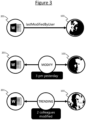
- FIG. 3 illustrates an example of a basic relationship, which is a direct navigation from one object to another. That is, the relationship defines how a user 103 is related to the resource 201 in question, for instance an action the user 103 has performed in relation to the resource 201 (e.g. the fact that the resource was last modified by that user), and/or the manner in which the user 103 has come into contact with the resource 201 (e.g. shared with the user by another user).
- Another example of such a relationship is when the user 103 has subscribed to a given resource 201. In this case the user 103 registers with the manager function 106 to receive a notification whenever the specified resource 201 is updated by another user, and the manager function 106 automatically provides the notification when such an update occurs.
- the middle diagram in Figure 3 shows and example of a rich relationship.
- a rich relationship is one supplemented by metadata, and can connect to one or more objects.
- the metadata may for example define a time at which the user 103 performed a certain action (activity) in relation to the resource 201, such as the time at which it was last modified by that user.
- the bottom diagram in Figure 3 shows an example of an "insight".
- An insight is an inferred rich relationship created automatically by an intelligence layer of the manager function 106.
- An example of an inferred relationship is trending. Trending occurs when beyond a threshold number of predefined actions are detected by the manager function 106 to have been performed in relation to a given resource 201 by one or more predefined other users associated with the user 103 in question.
- the predefined users may be the contacts of the target user 103, or users in a same group such as the same department within the organization or the same interest group. So for example, if a given resource 201 (e.g. file) has been viewed more than X times by the user's contacts or other users in a certain specified group, the resource will be declared as trending around that user.
- the graph could only grow by adding more powerful hardware, such as more powerful CPUs, more RAM etc.
- the presently-disclosed system provides a solution to this by instead partitioning and partially replicating portions of the graph across many per-user mailboxes, thus allowing the graph size to be scaled by adding further server units instead of upgrading the computing power of a given unit.
- the graph is conceptually a global interconnected graph across an organization ("tenancy"). However, in accordance with the presently disclosed techniques it is also divided into personal, user site specific graphs with personalized views.
- each of the users 103 is allocated his/her own home partition 107, or "shard", in the memory of one or the server units 104.
- This partition comprises a personal mailbox of the respective user.
- the graph is divided into a personal view 501 of the graph for each user 103 (see Figure 5 ), and this fragment of the graph along with the resources 201 to which the respective user 103 is related via this fragment 501 of the graph are stored in the respective mailbox 107 of that user.
- the resource is copied into the mailbox of one of the users.
- the primary copy of the resource 201 is stored in the mailbox of the user that owns the data, and a secondary copy is stored in the mailbox of each other user 103 having a relationship in the graph with the resource 201.
- a tenant-wide graph such as that shown in Figure 4 , showing lots of users, files, other items and the user's actions on the objects, is split into mailboxes ("shards") as represented in Figure 5 .
- shards mailboxes
- Each of the mailboxes 107 is implemented on a physically separate respective region of memory.
- the mailboxes 107a, 107b of any two given users 102a, 102b may be implemented in the memories 105i, 105ii of different server units 104i, 104ii, which may be in different separately removable and replaceable physical modules in the same data centre, or different data centres, or even different geographical regions such as different towns, cities, counties, states or countries or even continents.
- the various server units 104 are networked together via the network 101 and controlled by the distributed manager function 106 in order to work together to provide the functionality described herein.
- the mailboxes of any two given users may happen be found in different physical regions of the memory 105 of the same server unit, but the mailboxes are still kept with distinct views 501 of the graph and distinct copies of the respective resources 201 in distinct areas of memory.
- the manager function 106 is configured to establish a respective copy of any resource (file, email, etc.) that is common (within the graph) to more than one user 103 in each of the users' mailboxes 107.
- the copy in the mailbox of the user that owns the resource is deemed the primary copy, or synonymously the "master" copy.
- the owner may for example be the author of the resource or the user that first introduced the resource into the system.
- the manager function 106 is configured with a set of one or more ownership rules for defining who is the owner of a given resource 201 and where the master (i.e. primary) instance of each resources is to be stored (i.e. which user's mailbox 107 or "shard"). Examples of these ownership rules will be discussed in more detail shortly.
- the copy in any other user's mailbox 107 is deemed a secondary copy.
- any such other user wishes to access the resource such as to view the resource, they view the copy in their own mailbox 107. If there is any subsequent modification to the resource, the modification is made to the primary copy and the manager 106 is configured to then automatically propagate the modification to each secondary copy connected to the primary copy of the graph.
- each of the mailboxes can be implemented on any server unit an moved between server units 104 in a modular fashion.
- the provider can simply add more server units 104 and redistribute the mailboxes 107 of different users 103 between server units 104 as necessary.
- the mailbox 107 of a given user 103 is located on a server unit 104 that is located in a same geographic region as that respective user 103. If the manager function 106 is informed or detects (e.g. from persistent use of a new IP address) that the user 103 has moved home to a new geographic location, it may migrate the mailbox 107 to a new geographic location within that new geographic region accordingly. This can be readily effected because the mailboxes 107 are all modular in fashion.
- Each copy in each mailbox also comprises metadata (i.e. a "tag" or label) recording one or more properties of the resource, e.g. qualifying the relationship between the respective user and the resource, and/or some absolute property of the resource such as the last time it was modified by any user. Metadata qualifying the relationship is stored as a property on the direct object of the relationship.
- the primary copy may comprise a list defining which other users or groups of users are allowed to access the resource. I.e. not all users can necessarily obtain a secondary copy of a given resource 201 - the manager function 106 may be configured to consult this list to determine whether a given other user is entitled to be connected to the resource in the graph and obtain a secondary copy in his/her mailbox.
- the graph is limited to a given organization (e.g. company), such that user's outside the organization cannot form relationships with, nor gain access to, the resources of users within the organization.
- a given organization e.g. company
- the provider provides storage services to two rival cola companies, the companies would want to keep their data firmly secret form one another.
- the graph could span multiple organizations or even be global to all users.
- one, some or all of the mailboxes could in fact be that of a particular group of users such as a team within an organization.
- group data such as group conversations, collaborative documents or collaborative work sites may be stored in group mailboxes, and such group content may be shared with other users or other groups.
- a user is referred to in this description, this could more generally be any party consisting of a single user or a defined group of users.
- emailbox in the description herein does not mean the resources 201 are limited to being emails or any other form of mail.
- the resources 201 of which primary and secondary copies are stored in the various users' mailboxes 107 may take any of a variety of forms such as files, communications, sites and/or user profile information.
- the manager function 106 uses email as the medium by which to send the data from one user's storage area 107 to another's in order to create the secondary copy from the primary copy, and/or as the medium by which to propagate changes in the primary copy to the secondary copy. This does not mean the end-user 103 receives an email, but rather the manager function 106 uses email "behind the scenes”.
- email e.g. consider the creation of a secondary copy of a resource into a mailbox 107b of a second user 103b on a second server unit 104ii from a primary copy in a mailbox 107a of a first user 103a on a first server unit 104a, or the propagation of a modification from the primary to the secondary copy.
- the instance of the manager function 106i on the first server unit 104i sends an email to the instance 106ii on the second server unit 104ii, the email containing the data for making the secondary copy or for propagating the change, and the receiving instance 106ii of the manager function intercepts this email and acts upon it, without the email being actually presented as a received email to the end-user 103b of the receiving mailbox 107ii.
- the graph is partitioned down into email mailboxes to enable it to be implemented through an email platform.
- the email platform provides a persistent messaging queue for maintaining secondary copies by asynchronous messaging.
- the manager function 106 implements ownership rules for determining where resources 201 are mastered, and rules for establishing and maintaining secondary copies.
- the ownership rules define which user 103 is the owner of each given resource 201 and therefore whose mailbox 107 stores the primary copy.
- the disclosed server system including the manager function 106 and the graph it maintains, are configured to work in conjunction with an underlying file system operated by the provider of the server system, and/or to work in conjunction with a partner file system operated by a third party, or such like. E.g. these could include a cloud storage service, a file sharing service or site, a collaborative document sharing site, etc.
- the server system may be configured to work in conjunction with a local file system on each of one or more of the user's user terminals 102.
- the ownership rules implemented by the manager function 106 by being configured to map resources in the user's local or online file libraries, accounts, and/or sites, etc. onto primary instances in the mailboxes 107 of the user 103, thereby creating a consistent mapping of nodes and relationships in a global graph down to the mailboxes 107 (or more generally storage areas or "shards").
- a given user 103 may have a file library comprising one or more folders stored locally on his/her computer, or on an online cloud storage service.
- the ownership rules may define that any and all files in that file library, or one or more selected folders within that file library, are to have their primary instance stored in the mailbox 107 of that user 103. Any other user 103 who has access to any of those files will have a secondary copy maintained in his/her mailbox 107.
- a given user 103 may have an online file sharing account comprising one or more folders.
- the rules may define that any and all files in that file sharing account, or one or more selected folders within that file sharing account, are to have their primary instance stored in the mailbox 107 of that user 103.
- any other user 103 who has access to that one of these files will have a secondary copy maintained in his/her mailbox 107.
- a given user 103 may have an account on an online collaborate workspace of site comprising one or more folders, and the rules may define that any and all files in the user's workspace, site or collection of sites, or one or more selected folders within the workspace, site or sites, are owned by that user and therefore have their primary copies in that user's mailbox.
- ownership rules may apply to any resource repository, e.g. file library, collection of files, site, site collection, workspace, etc.
- ownership or ownership rules are referred to herein, or such like, this does not necessarily mean the user is the owner in any other sense than he or she is the user having the primary copy stored in his/her mailbox (i.e. storage area) 107.
- the user is the copyright holder.
- some resources or libraries etc. may be owned in a legal sense by the organization and not to one user.
- anything described herein in relation to an individual user can also relate to a group of users.
- the resource 201 is not owned by an individual user even in the sense of having the primary copy stored in the mailbox of an individual user, but rather it may be stored in a mailbox "belonging" to multiple users, e.g.
- the system may create "arbitration mailboxes", i.e. mailboxes not owned by any user in particular, and may map each library (at some level) deterministically into one such mailbox.
- the manager function 106 also applies one or more further rules for creating and maintaining secondary copies.
- the ownership rules and/or further rules may be configured to favour performance and/or locality.
- the "right" objects are made available locally according to simple rules.
- every resource 201 a given user 103 ever accessed is in his/her respective mailbox 107.
- resources 201 deemed to "trend-around" that user 103 may be included in his/her respective mailbox 107 as well.
- the trending resources may be generated based on an activity subscription mechanism. For instance, the user gets all activity of the 40 people who he/she works the most with, and when deemed interesting locally, the related items are copied (secondary copies established) in the user's mailbox 107.
- Figure 2 illustrates a logical model and a physical model of the system, mapping from online storage libraries to mailboxes.
- the top diagram shows the logical model and the bottom diagram shows the physical model.
- Figure 2 also illustrates examples of properties that are shared and synced across mailboxes 107, and by contrast personal properties which are specific to a given user's mailbox.
- Figure 2 illustrates these concepts by reference to an example involving a first user 103a (Alice) having a respective mailbox 107a instantiated on a first of the server units 104i, and a second user (Bob) having a separate respective mailbox 107b which may happen to be instantiated on a second of the server units 104ii.
- a first file 201A (“File A”)
- a second file 201B (“File B”
- File C third file 201C
- the mailboxes 107 may in fact store many more resources than this, and that there may also be many a more complex web of many more relationships involving many more users.
- the resources are not limited to files. This particular example of the two users and three files is given only by way of illustration.
- File A and File B belong to Alice.
- the master (primary) copy 201AI, 201AII of each of File A and File B are each stored in Alice's mailbox 107a.
- File C belongs to Bob and hence the master (primary) copy 201CI is stored in Bob's mailbox 107b.
- Alice has had been connected with File B, for example Alice shared File B with Bob, or Bob received a notification about File B as a result of a subscription (e.g. because it was trending, or because Bob has subscribed to all content from Alice, or searched for content from Alice, etc.).
- the manager function 106 automatically creates a secondary copy of File B in Bob's mailbox 107b.
- the manager function 106 automatically creates a secondary copy of File C in Alice's mailbox 107a.
- the system allows another user other than the owner to modify a resource 201, e.g. to make changes to a document despite the fact that he/she is not the author.
- the other user modifies the primary copy 201I, i.e. the owner's copy, and the manager function 106 then propagates the modification back down to the other user's mailbox 107.
- Alice authored or published File B Bob can edit it, in which case he edits the primary copy 201B in Alice's mailbox 107a, and then the edits are propagated back to his secondary copy on his own mailbox 107b.
- Bob views File B however, he views the local, secondary copy from his own mailbox 107b.
- one or both of the primary and secondary copies 201I, 201II of any given resource could be absolute copies. That is, the actual data content of the file is stored explicitly (i.e. directly) in the respective mailbox 107 itself (as opposed to being stored in the form of a link).
- an alternative possibility is that one or both of the primary and secondary copies 201I, 201II of any given resource could be "shallow" copies.
- a shallow copy is a copy that is stored in the respective mailbox 107 in the form of a link, linking to the actual data content of the resource stored elsewhere, e.g. externally to the server system (e.g. a third party server).
- copy does not necessarily refer to a full duplication of the actual data content of a resource, and could also refer to a copy stored in the form of a link.
- one, some or all of the primary copies 201I could be stored as absolute copies, and the respective secondary copies could be stored as shallow copies linking to the absolute primary copies.
- one some or all of the primary copies themselves could be shallow copies linking to the content of the respective resource as stored elsewhere, such as an online file system.
- the ultimate source to which the primary copy links could be an underlying online cloud file system or file sharing service run by a provider of the server system, or a third-party file sharing or cloud-storage service.
- each of the primary and secondary copies 201I, 201II comprises metadata.
- the metadata comprises at least a first portion of metadata 202, which may be referred to as connecting metadata.
- This metadata 202 specifies whether the copy is a primary (i.e. master) copy or a secondary copy, and if it is a primary copy what secondary copies there are (if any), or if it is a secondary copy then which is the primary copy.
- the former may be specified in terms of which user(s) 103 have a secondary copy (if any), and the latter may be specified in terms of which user 103 owns the primary copy.
- This metadata is preferably always stored in absolute terms (i.e. directly/explicitly) on the respective mailbox 107 itself (i.e. not in the form of a link), regardless of whether the content of the resource is stored in absolute terms or shallow form.
- the metadata also comprises common metadata 203 which is common across all primary and secondary instances 201I, 201II of the same resource 201.
- An example is the last time or date when the resource 201 was modified by any user, the identity of the last user to modify the resource 201, the title of the resource 201, and/or the file size. This information is the same regardless of whose mailbox 107 the copy is in. Hence this metadata could be stored in absolute terms or shallow form.
- the metadata comprises personal metadata 204 (personal in the sense that it is specific to a particular user, not necessarily in the sense of being private).
- An example is the last time or date when the resource 201 was modified by the particular user 103 whose mailbox 107 the particular copy in question is stored in (so the last time modified by Bob in the case of the secondary copy of File B, for instance).
- Such metadata is specific to the individual user 103 whose mailbox 107 the copy is stored in.
- this metadata is preferably always stored in absolute terms (i.e. directly/explicitly) on the respective mailbox 107 itself (i.e. not in the form of a link), regardless of whether the content of the resource is stored in absolute terms or shallow form.
- the manager function is configured to treat the two different categories of metadata differently when establishing a secondary copy 201II, and also to treat the two different categories of metadata differently when propagating modifications from the primary copy 201I to the secondary copies 201II.
- the manager function 106 makes a copy of the primary copy 201I of a resource 201 from the owner's mailbox 107, copied into the mailbox of the other user(s) 103, then the manager function copies over only the common metadata 203, i.e. the metadata that is common across different instances 201I, 201II of a given resource 201.
- the connecting metadata 202 and the personal metadata 204 will be specific to the particular secondary copy 201II, and hence the manager function 106 will instead create dedicated values of these metadata element for the particular secondary copy 201II currently being created.
- the manager function 106 propagates a modification of the primary copy 201I of a resource 201 from the owner's mailbox 107, being propagated to the mailbox(es) 107 of the other user(s) 103, then the manager function 106 propagates only the modification to the common metadata 203, i.e. again the metadata that is common across different instances 201I, 201II of a given resource 201.
- the connecting metadata 202 and the personal metadata 204 are specific to each particular secondary copy 201II, the manager function 106 will not overwrite the values of these metadata values in secondary copies 201II when propagating changes.
- File B when File B is modified, e.g. by Alice, this change is not propagated through to Bob's mailbox 107b. Or if Bob modifies File B, the personal last-modified value is not modified in Alice's personal metadata 204 on the primary copy.
- Figure 2 shows the logical model vs. the physical model, and how copies are synched and also have local (user specific) properties.
- Documents A and B (201A, 201B) are in stored in Alice's online storage account. This means that in the graph they are mastered in Alice's mailbox 107a (or "shard"). Any update of the properties of the documents are coming from Alice's cloud storage to Alice's mailbox 107a and propagated to the secondary copies from there.
- document C (201C) is mastered in Bob's mailbox 107b since it is coming from, e.g., an online storage account of Bob.
- LastAccessByUser On document C in Bob's mailbox 107b there is a property LastAccessByUser with the value 3rd Dec, representing the fact that Bob accessed the file on 3rd December. In Alice's mailbox 107b the same property (LastAccessByUser) has the value 13th Dec and represents that Alice's last access to the document happened 13th December. These properties are personalized, de-normalized and mastered on the actor shard 107a, 107b respectively. Similarly document C is mastered in Bob's shard 107b and a copy is kept up to date on Alice's shard 107a.
- the manager function 106 is mastering personalized information on a secondary copy 2011 of the document 201 that is mastered on another shard 107.
- the manager function When storing a relationship between a user (actor) and a document (direct object), the manager function stores that relationship as part of the document in the actor's shard. Thus there is provided an “in-lined “storage of relationships on the direct object.
- the actor is the actor of the relationship, and the user whose copy the relationship is stored in.
- properties of the relationship are de-normalized onto properties of the direct object to facilitate effective lookup.
- computing data is said to be normalized if there is only one instance of that data.
- Each copy of each resource 201 may have we have personalized metadata 204 describing a set of one or more in-lined and de-normalized relationships on direct objects that facilitate effective lookups.
- the de-normalization performed in order to facilitate the effective look-up there are two aspects to the de-normalization performed in order to facilitate the effective look-up.
- the first is creating secondary copies of the files (or resources) 201. This makes sure that at least some look-up scenarios can be served from one machine, i.e. one server unit 104. If only the personal relationships were stored in the actor's mailbox, and not a secondary copy of the resource itself, then the system would need to first look up the relationship there and then refer to a list of server units 104 hosting the primaries. This would be less efficient computationally.
- the second, optional aspect to the de-normalization is to copy key information of the relationship out of the relationship list (metadata stored on the file or resource) and store that key information in a signal property on the file object, and then create a database index over that information. This will speed up the queries since the index is dense and single purpose, at the cost of de-normalization.
- the set of possible relationships may for example comprise one or more of: AccessAction (the actor has viewed the document), ModifyAction (the actor has edited the document), LastAccessed (the time and/or date the resource was last accessed by the actor), LastModified (the time and/or date the document was last modified by the actor), TrendingAroundWeight (the document trends around the actor with a certain weight), and/or ReuseWeight (the likelihood of the user to reuse part of the document).
- AccessAction the actor has viewed the document
- ModifyAction the actor has edited the document
- LastAccessed the time and/or date the resource was last accessed by the actor
- LastModified the time and/or date the document was last modified by the actor
- TrendingAroundWeight the document trends around the actor with a certain weight
- ReuseWeight the likelihood of the user to reuse part of the document.
- the time or date on which a resource 201 was last accessed or last modified by a given user 103 is an example of a rich relationship, i.e. the record of the relationship in-lined in the metadata comprises at least one parameter qualifying the action (in this case the date on which the action was performed).
- TrendingAroundWeight and ReUseWeight are examples of inferred relationships.
- the trending weight is a score which quantifies how much a given resource is trending around a given user, e.g. Alice.
- the manager function 106 is arranged to detect this based on signals from people working closely around Alice who are viewing and/or modifying the resources.
- the people from whom signals are taken to determine whether a resource 201 is trending "around" a certain user 103 may be a specific subgroup of other users, e.g. a list of contacts, colleagues or friends.
- the re-use weight is a measure of how likely resource 201 (e.g. document) is to be cited in another resource.
- the manager function 106 can detect this based on its visibility of the other resources in the system.
- the inline relationships are stored on a document or other resource, that is done that in the actor's shard 107.
- This is independent of the master (primary) location of the document, and the system is able to master the relationships on both primary and secondary versions of the document.
- Some parts of the document are updated from the master copy while others are only stored on the secondary, thus the relationships are personalized to the actor.
- the properties of a resource are divided into shared (e.g. global) data 203 that is common to all instances of a given resource, and personal data 204 which is unique to the relationship between the actor 103 and the resource 201.
- the manager function 106 is configured to accept a search query from any of the user terminals 102, each search query including at least one search criterion.
- the manager function 106 may be configured to accept a value or range for one or more of the elements of personal metadata 204 as a search criterion or criteria.
- Alice wishes to search for a certain document.
- a search criterion she may search for all documents that were last accessed by her (specifically by her, not just any user) on a certain specified date or within a certain specified date range.
- the manager function 106 returns all the resources 201 accessed by Alice on the date, or within the date rate, specified in the personal metadata 204.
- a similar search could be performed based on the last modified date.
- search need not be performed by Alice herself. Rather, a user could search for resources 201 based on the personal metadata of another user. So e.g. Bob could search for all documents accessed or modified by Alice on a certain date or in a certain date range, or vice versa.
- the search may be based on an inferred relationship. For instance Alice may search for all resources 201 trending around her, or another user may search for all resources 201 trending around Alice.
- the metadata may comprise a list of multiple (e.g. all) past accesses, and/or a list of multiple (e.g. all) past modifications. These could be the past accesses by any user (common metadata), and/or the past accesses by the particular user whose mailbox (or shard) 107 the respective copy is stored in, and similarly for the modifications.
- the search functionality of the manager function 106 enables a user to search for a resource 201 based on the last accessed or last modified date (either local or global), and then, when a particular search resource is found and selected based on this, the manager function 106 will look up the corresponding list of past modifications or past accesses and/or modifications in the metadata of the resource that has been found. This provides for a more effective look up.
- the user can only search based on the last accessed and/or last modified date, but once a search rut is found then this is used to look up preceding past accesses and/or modifications (not the most recent) based on this.
- a server system comprising: a respective storage area for each of a plurality of respective parties including a first party and a second party, each of at least some of the storage areas storing a primary instance of one or more data resources of the respective party; and a manager function configured to perform operations of: in response to the second party forming a relationship with one of the resources of the first party, establishing a secondary copy of said one of the resources of the first party in the respective storage area of the second party; and in the secondary copy, including personal metadata describing one or more attributes of the relationship between the second party and the resource.
- the primary instance may also comprises personal metadata comprising values of said one or more aspects specific to the first party; and the manager function may be further configured so as, when the primary instance is updated with a modification comprising a first change to content of the primary instance and/or the non-personal metadata of the first party, and a second change to the personal metadata of the first party, to propagate the first change to the secondary copy but not to propagate the change to the personal metadata of the second party in the secondary copy.
- the manager function is further configured to include, in the secondary copy, non-personal metadata which is common to both the primary any the secondary copy.
- the primary instance also comprises personal metadata comprising values of said one or more aspects specific to the first party; and the manager function may be further configured so as, when the primary instance is updated with a modification comprising a first change to content of the primary instance and/or the non-personal metadata of the first party and a second change to the personal metadata of the first party, to propagate the first change to the secondary copy but not to propagate the change to the personal metadata of the second party in the secondary copy.
- the relationship described by said personal metadata may comprise an action performed by the second party on the resource.
- the action described by the personal metadata may comprise the second party having viewed the resource.
- the action described by the personal metadata comprises the second party having modified the resource.
- the personal metadata information may describe at least one parameter of the action.
- the parameter of the action described by the personal metadata may comprise a time and/or date at which the action was performed by the second party.
- the time and/or date described by the personal metadata may comprise a time and/or date at which the resource was last accessed by the second party.
- the time and/or date described by the personal metadata may comprise a time and/or date at which the resource was last modified by the second party.
- the attribute described by the metadata may comprise an inferred attribute of the relationship, the manager function being configured to infer the inferred attribute based on activity occurring within the server system.
- the inferred attribute may comprise trending, the activity based upon which the manager function is configured to infer the trending comprising beyond a threshold number of accesses to the resource by one or more others of the parties related to the second party by a predetermined relationship.
- the inferred attribute may comprise a re-use score quantifying a number of times the resource has been cited in others of the resources, the activity based upon which the manager function is configured to infer the re-use score comprising said citations.
- non-personal metadata may comprise a time and/or date last accessed by any of the parties, and/or a time and/or date last modified by any of the parties.
- the personal metadata may comprise a list of multiple past accesses or modifications to the resource by the second party.
- the manager function may be configured to enable the second party to search for the resource based on the most recent access or modification, and based thereon to look up the list of multiple past accesses or modifications.
- the manager function may be configured such that the second party can only search by the most recent access or modification, not the other past accesses or modifications.
- At least some of the separate storage areas may be implemented on separate server units in separate housings, rooms, buildings or geographic locations.
- the manager function may be implemented in a distributed form comprising a respective instance of the manager function at each of the server units.
- the secondary copy may be stored in the storage area of the second party in the form of a link to the resource.
- the secondary copy may be stored on the storage area as an absolute copy comprising a duplication of the content of the primary instance.
- the primary instance may be stored in the storage area of the first party in the form of a link to the resource stored elsewhere.
- the primary instance may be an absolute instantiation comprising the content of the resource stored on the storage area of the first party.
- each of the resources may comprise any one of a set of resource types, the set of resource types comprising any two or more of: files, stored communications, sites, and/or user profile information.
- the storage area of each of multiple of said parties may store a primary instance of one or more of the party's own respective resources with which a respective one or more others of the parties have a relationship, the manager function storing a respective one or more secondary copies in the storage areas of the respective other parties.
- the manager function may be configured to propagate changes to any of the primary instances to each of the respective secondary copies, to maintain a graph of the relationships between parties and the resources, and to use said graph to perform said propagation.
- said relationship or relationships between parties and resources may be constrained to within a given organization.
- each of one, some or all of the parties, including at least the first and/or second party may be an individual user. In embodiments each of one, some or all of the parties, including at least the first and/or second party, may be a group of users.
- a method of operating a server system comprising: providing a respective storage area for each of a plurality of respective parties including a first party and a second party; on each of at least some of the storage areas, storing a primary instance of one or more data resources of the respective party; in response to the second party forming a relationship with one of the resources of the first party, establishing a secondary copy of said one of the resources of the first party in the respective storage area of the second party; and including in the secondary copy personal metadata describing one or more aspects of the relationship between the second user and the resource.
- the method may comprise operations corresponding to any of the above system features.
Landscapes
- Engineering & Computer Science (AREA)
- Theoretical Computer Science (AREA)
- Physics & Mathematics (AREA)
- General Engineering & Computer Science (AREA)
- General Physics & Mathematics (AREA)
- Quality & Reliability (AREA)
- Data Mining & Analysis (AREA)
- Databases & Information Systems (AREA)
- Computer Networks & Wireless Communication (AREA)
- Signal Processing (AREA)
- Information Retrieval, Db Structures And Fs Structures Therefor (AREA)
Description
- As the number of users and applications around the world grows, there is an ever increasing need for more and more data storage for storing various resources. These resources may include for example: files such as spreadsheets, word processing documents, slide presentations, images, videos, etc.; stored communication histories such as emails, IM chat history, etc.; user profile information such as contact details, social media profiles, etc.; and/or sites such as websites, document sharing sites, etc. Such resources may originate from a variety of applications installed on the users' terminals and/or hosted online, such as word processing applications, spreadsheet applications, social media applications, file sharing applications, etc.
- Online storage has grown in popularity. Using online storage such resources can be stored online on the "cloud", meaning the resources are stored on a server system accessible via the Internet, the server system typically comprising multiple server units implemented in more than one data centre and/or geographic location. Techniques for distributed storage and processing via a network such as the Internet are known in the art.
- It is also known for users to make their own resources available to other users, such as those within the same organization (e.g. company). For instance this may allow one or more other users to view the resource, subscribe to updates to the resource, or even modify the resource.
-
US2014/279893A1 discloses a cloud storage service that distributes to user terminals a copy of data files and a metadata directory. The metadata directory contains a metadata file per user per data file, enabling simultaneous updates of data or metadata by user devices. The local copy of the metadata at the user terminals is synchronized with a metadata cloud database at the cloud storage service. - In conventional systems there is a single master copy of a given resource stored in a single storage location associated with the user who owns the resource (e.g. file, site, etc.). If the resource is made available to one or more other users to view, modify, or the like, then all users access the same centralized master copy. However, if metadata such as a last-modified date is to be included in the resource, the metadata is the same for all users accessing the resource. It would be desirable to provide a model that allows for more personalized approach to metadata.
- The scope of the invention is defined in the appended claims.
- According to one aspect disclosed herein, there is provided a server system comprising: a respective storage area for each of a plurality of respective parties including a first party and a second party, and a manager function for managing the storage. Each of at least some of the storage areas stores a primary instance of one or more data resources of the respective party. The manager function is configured so as, in response to the second party forming a relationship with one of the resources of the first party, to establish a secondary copy of said one of the resources of the first party in the respective storage area of the second party. In the secondary copy, the manager function also includes personal metadata describing one or more attributes of the relationship between the second party and the resource.
- This Summary is provided to introduce a selection of concepts in a simplified form that are further described below in the Detailed Description. This Summary is not intended to identify key features or essential features of the claimed subject matter, nor is it intended to be used to limit the scope of the claimed subject matter. Nor is the claimed subject matter limited to implementations that solve any or all of the disadvantages noted herein.
- To assist understanding of the present disclosure and to show how embodiments may be put into effect, reference is made by way of example to the accompanying drawings in which:
-
Figure 1 is a schematic block diagram of a storage system, -
Figure 2 is a schematic illustration of a logical and physical model of the storage system, -
Figure 3 is a schematic illustration of example relationships between a user and a resource, -
Figure 4 schematically illustrates a graph of relationships between users and resources, and -
Figure 5 schematically illustrations a partitioning of the graph ofFigure 4 . -
Figure 1 shows a server system in accordance with embodiments of the present disclosure. The server system comprises a plurality of server units 104, each for example being a distinct module (separate casing) on a server rack, or being located in a different room or data centre. Some or all of the server units 104 may even be located at different geographic locations, including the possibility of different towns, cities, counties, states, countries or even continents. Each server unit comprises a respective memory 105 formed of one or more memory devices, which may comprise for example one or more magnetic memory devices such as one or more hard drives and/or one or more electronic memory devices such as one or more solid state drives (SSD), or a combination of any such memory devices. By way of illustration only threeserver units 104i, 104ii, 104iii and theirrespective memories 105i, 105ii, 105iii are shown inFigure 1 , but it will be appreciated that many more may in fact be included in the system. - The server units 104 are networked together via a suitable packet-switched
network 101, e.g. a wide-area internetwork such as that commonly referred to as the Internet, or a private intranet. Network may be implemented by any suitable wired and or wireless communication medium or media, e.g. the wired infrastructure of the internet, and/or one or more wireless networks such as a wireless cellular network, wireless local area network(s), etc. By whatever means implemented, thenetwork 101 enables the server units 104 to act together to provide a distributed storage system accessible tousers 103 from their respective user terminals 102 via thenetwork 101. Each user terminal 102 may take any suitable for accessing thenetwork 101 via a wired or wireless connection, e.g. a desktop computer, laptop computer, tablet, smartphone, smartwatch or a pair of smart-glasses (and the different user terminals do not all have to take the same form). Twoparticular users 103a (a first user, Alice) and 103b (a second user, Bob) and theirrespective user terminals 102a, 102b are shown inFigure 1 by way of illustration, but again it will be appreciated that the system may serve manymore users 103 who access the system from many respective user terminals 102. - By way of example, the server system may be arranged to provide storage services to a plurality of organizations being customers or "tenants" of the provider of the system.
- Referring also to
Figure 4 , the server system storesdata resources 201, where each data resources may comprise any item or collection of digital information, e.g. a file, a stored communication, user profile information, or a site of some kind. Examples of files include word processing documents, spreadsheets, slide decks, images, videos, etc. Examples of stored communications include emails, or IM (instant messaging) chat histories. Examples of user profile information include contact details (e.g. "contact cards") and social media profiles. Examples of sites include document sharing sites, websites, and collaborative sites. Anywhere where a resource is referred to herein, this may refer to any of the above-mentioned resources or others (and the different resources need not all by of the same type). - The memories 105 of the server units 104 store the resources 201 (e.g. files, emails, etc.) of the
various users 103, wherein the users can make these stored resources available to others of the users within the organization to enable them perform a certain activity or activities, such as to view or modify the resources to which they have access. Where a user has access to a certain resource, the user may be described as having relationship with that resource, wherein the relationship may be qualified in terms of what activity the user is permitted to perform (e.g. view, modify) and/or the means by which the user came into contact with the resource (e.g. shared with the user, trending around the user, etc.). The server system maintains a graph of all the relationships between users and resources in the organization. The graph also records the qualities of the relationships, i.e. the manner in which the user is related to the resource (viewed by the user, modified by the user, shared with the user, trending around the user, etc.). - The graph is maintained by a manager function 106. In accordance with embodiments disclosed herein, the manager function 106 is implemented in the form of a distributed function, i.e. with a respective instance of the
manager function 106i, 106ii, 106iii running on each of theserver units 104i, 104ii, 104iii. Each instance of the manager function 106 takes the form of software stored on part of the memory 105 of the respective server unit 104 and arranged to run on a respective processing apparatus (not shown) of the respective server unit 104 (the processing apparatus comprising one or more microprocessors each with one or more cores). Note also that the possibility of a centralized manager function is not excluded. - Some examples of graph relationships are illustrated schematically in
Figure 3 . The top diagram inFigure 3 illustrates an example of a basic relationship, which is a direct navigation from one object to another. That is, the relationship defines how auser 103 is related to theresource 201 in question, for instance an action theuser 103 has performed in relation to the resource 201 (e.g. the fact that the resource was last modified by that user), and/or the manner in which theuser 103 has come into contact with the resource 201 (e.g. shared with the user by another user). Another example of such a relationship is when theuser 103 has subscribed to a givenresource 201. In this case theuser 103 registers with the manager function 106 to receive a notification whenever thespecified resource 201 is updated by another user, and the manager function 106 automatically provides the notification when such an update occurs. - The middle diagram in
Figure 3 shows and example of a rich relationship. A rich relationship is one supplemented by metadata, and can connect to one or more objects. The metadata may for example define a time at which theuser 103 performed a certain action (activity) in relation to theresource 201, such as the time at which it was last modified by that user. - The bottom diagram in
Figure 3 shows an example of an "insight". An insight is an inferred rich relationship created automatically by an intelligence layer of the manager function 106. An example of an inferred relationship is trending. Trending occurs when beyond a threshold number of predefined actions are detected by the manager function 106 to have been performed in relation to a givenresource 201 by one or more predefined other users associated with theuser 103 in question. For instance the predefined users may be the contacts of thetarget user 103, or users in a same group such as the same department within the organization or the same interest group. So for example, if a given resource 201 (e.g. file) has been viewed more than X times by the user's contacts or other users in a certain specified group, the resource will be declared as trending around that user. - All such information is maintained in the graph by the manager function 106, being updated when relationships are created or changed.
- If the graph was to be implemented as a single organization-wide graph, then to scale a large system with many users, the graph could only grow by adding more powerful hardware, such as more powerful CPUs, more RAM etc. The presently-disclosed system provides a solution to this by instead partitioning and partially replicating portions of the graph across many per-user mailboxes, thus allowing the graph size to be scaled by adding further server units instead of upgrading the computing power of a given unit.
- The graph is conceptually a global interconnected graph across an organization ("tenancy"). However, in accordance with the presently disclosed techniques it is also divided into personal, user site specific graphs with personalized views.
- Referring again to
Figure 1 , each of theusers 103 is allocated his/her own home partition 107, or "shard", in the memory of one or the server units 104. This partition comprises a personal mailbox of the respective user. Further, the graph is divided into apersonal view 501 of the graph for each user 103 (seeFigure 5 ), and this fragment of the graph along with theresources 201 to which therespective user 103 is related via thisfragment 501 of the graph are stored in the respective mailbox 107 of that user. Where two users are related to thesame resource 201, the resource is copied into the mailbox of one of the users. The primary copy of theresource 201 is stored in the mailbox of the user that owns the data, and a secondary copy is stored in the mailbox of eachother user 103 having a relationship in the graph with theresource 201. - Thus, a tenant-wide graph such as that shown in
Figure 4 , showing lots of users, files, other items and the user's actions on the objects, is split into mailboxes ("shards") as represented inFigure 5 . - Each of the mailboxes 107 is implemented on a physically separate respective region of memory. The
mailboxes users 102a, 102b may be implemented in thememories 105i, 105ii ofdifferent server units 104i, 104ii, which may be in different separately removable and replaceable physical modules in the same data centre, or different data centres, or even different geographical regions such as different towns, cities, counties, states or countries or even continents. The various server units 104 are networked together via thenetwork 101 and controlled by the distributed manager function 106 in order to work together to provide the functionality described herein. Sometimes, the mailboxes of any two given users may happen be found in different physical regions of the memory 105 of the same server unit, but the mailboxes are still kept withdistinct views 501 of the graph and distinct copies of therespective resources 201 in distinct areas of memory. - Wherever the
mailboxes user 103 in each of the users' mailboxes 107. - The copy in the mailbox of the user that owns the resource is deemed the primary copy, or synonymously the "master" copy. The owner may for example be the author of the resource or the user that first introduced the resource into the system. In embodiments the manager function 106 is configured with a set of one or more ownership rules for defining who is the owner of a given
resource 201 and where the master (i.e. primary) instance of each resources is to be stored (i.e. which user's mailbox 107 or "shard"). Examples of these ownership rules will be discussed in more detail shortly. - The copy in any other user's mailbox 107 is deemed a secondary copy. When any such other user wishes to access the resource such as to view the resource, they view the copy in their own mailbox 107. If there is any subsequent modification to the resource, the modification is made to the primary copy and the manager 106 is configured to then automatically propagate the modification to each secondary copy connected to the primary copy of the graph.
- In contrast with the present disclosure, in conventional systems there would be only one single master instance of any given resource, whereby, if made available to other users, all users would access that same single master copy. This would suffer from the scalability issue similar to that described above. However, with a
respective fragment 501 of the graph and copies of therespective resources 201 replicated across separate mailboxes 107 of eachrespective user 103, then each of the mailboxes can be implemented on any server unit an moved between server units 104 in a modular fashion. Hence to expand the system to accommodate more connections in the graph, the provider can simply add more server units 104 and redistribute the mailboxes 107 ofdifferent users 103 between server units 104 as necessary. - Preferably the mailbox 107 of a given
user 103 is located on a server unit 104 that is located in a same geographic region as thatrespective user 103. If the manager function 106 is informed or detects (e.g. from persistent use of a new IP address) that theuser 103 has moved home to a new geographic location, it may migrate the mailbox 107 to a new geographic location within that new geographic region accordingly. This can be readily effected because the mailboxes 107 are all modular in fashion. - Each copy in each mailbox also comprises metadata (i.e. a "tag" or label) recording one or more properties of the resource, e.g. qualifying the relationship between the respective user and the resource, and/or some absolute property of the resource such as the last time it was modified by any user. Metadata qualifying the relationship is stored as a property on the direct object of the relationship. When the secondary copy is created, some (but not necessarily all) of the metadata from the primary copy is duplicated in the secondary copy; and when the primary copy is modified, some (but not necessarily all) of any corresponding changes in the metadata is propagated to the secondary copy/copies. This will be described in more detail shortly with reference to
Figure 2 . - The primary copy may comprise a list defining which other users or groups of users are allowed to access the resource. I.e. not all users can necessarily obtain a secondary copy of a given resource 201 - the manager function 106 may be configured to consult this list to determine whether a given other user is entitled to be connected to the resource in the graph and obtain a secondary copy in his/her mailbox.
- In embodiments, the graph is limited to a given organization (e.g. company), such that user's outside the organization cannot form relationships with, nor gain access to, the resources of users within the organization. This advantageously allows the provider of the server system to provide storage services to multiple organizations without disclosure of potentially sensitive information between organizations. E.g. if the provider provides storage services to two rival cola companies, the companies would want to keep their data firmly secret form one another. However it is not excluded that in other embodiments the graph could span multiple organizations or even be global to all users.
- On a point of terminology, note that the term "copy" is used herein in the sense of one of multiple instances of the same document or other such resource. "Primary copy" or "master copy" does not necessarily mean the primary or master instance is a copy in the sense of a duplicate or reproduction from some other original. The master/primary copy could be the original instance, or could be originated from an original instance stored elsewhere (not part of the graph system) such that the master copy is the master within the graph but not the ultimate original copy, and could e.g. contain just extracted text or other content from the original instance, or could include a link to the content of the original instance. "Secondary" however does mean that the secondary copy is generated from the master (primary copy).
- Note also, while embodiments are described herein in terms of
individual users 103, one, some or all of the mailboxes (and the copies of theresources 201 and fragment of thegraph 501 stored therein) could in fact be that of a particular group of users such as a team within an organization. Hence group data such as group conversations, collaborative documents or collaborative work sites may be stored in group mailboxes, and such group content may be shared with other users or other groups. Wherever a user is referred to in this description, this could more generally be any party consisting of a single user or a defined group of users. - Further, use of the term "mailbox" in the description herein does not mean the
resources 201 are limited to being emails or any other form of mail. As discussed above, theresources 201 of which primary and secondary copies are stored in the various users' mailboxes 107 may take any of a variety of forms such as files, communications, sites and/or user profile information. - In embodiments the manager function 106 uses email as the medium by which to send the data from one user's storage area 107 to another's in order to create the secondary copy from the primary copy, and/or as the medium by which to propagate changes in the primary copy to the secondary copy. This does not mean the end-
user 103 receives an email, but rather the manager function 106 uses email "behind the scenes". E.g. consider the creation of a secondary copy of a resource into amailbox 107b of asecond user 103b on a second server unit 104ii from a primary copy in amailbox 107a of afirst user 103a on a first server unit 104a, or the propagation of a modification from the primary to the secondary copy. The instance of themanager function 106i on thefirst server unit 104i sends an email to the instance 106ii on the second server unit 104ii, the email containing the data for making the secondary copy or for propagating the change, and the receiving instance 106ii of the manager function intercepts this email and acts upon it, without the email being actually presented as a received email to the end-user 103b of the receiving mailbox 107ii. Hence in embodiments, the graph is partitioned down into email mailboxes to enable it to be implemented through an email platform. The email platform provides a persistent messaging queue for maintaining secondary copies by asynchronous messaging. - However, this is not limiting, and in other embodiments other communication media could be used, e.g. a proprietary protocol for propagating the secondary copies and modifications. For avoidance of doubt, anywhere a mailbox is referred to in the present description, this may equally be replaced with an alternate term such as "storage area", "user area", "storage compartment" or the like. In accordance with terminology introduced herein, this may also be referred to as a "shard".
- Regardless of the medium by which changes are propagated, the manager function 106 implements ownership rules for determining where
resources 201 are mastered, and rules for establishing and maintaining secondary copies. - The ownership rules define which
user 103 is the owner of each givenresource 201 and therefore whose mailbox 107 stores the primary copy. In embodiments the disclosed server system, including the manager function 106 and the graph it maintains, are configured to work in conjunction with an underlying file system operated by the provider of the server system, and/or to work in conjunction with a partner file system operated by a third party, or such like. E.g. these could include a cloud storage service, a file sharing service or site, a collaborative document sharing site, etc. Alternatively or additionally, the server system may be configured to work in conjunction with a local file system on each of one or more of the user's user terminals 102. The ownership rules implemented by the manager function 106 by being configured to map resources in the user's local or online file libraries, accounts, and/or sites, etc. onto primary instances in the mailboxes 107 of theuser 103, thereby creating a consistent mapping of nodes and relationships in a global graph down to the mailboxes 107 (or more generally storage areas or "shards"). - For instance, a given
user 103 may have a file library comprising one or more folders stored locally on his/her computer, or on an online cloud storage service. The ownership rules may define that any and all files in that file library, or one or more selected folders within that file library, are to have their primary instance stored in the mailbox 107 of thatuser 103. Anyother user 103 who has access to any of those files will have a secondary copy maintained in his/her mailbox 107. As another example, a givenuser 103 may have an online file sharing account comprising one or more folders. The rules may define that any and all files in that file sharing account, or one or more selected folders within that file sharing account, are to have their primary instance stored in the mailbox 107 of thatuser 103. Again anyother user 103 who has access to that one of these files will have a secondary copy maintained in his/her mailbox 107. As another example, a givenuser 103 may have an account on an online collaborate workspace of site comprising one or more folders, and the rules may define that any and all files in the user's workspace, site or collection of sites, or one or more selected folders within the workspace, site or sites, are owned by that user and therefore have their primary copies in that user's mailbox. Generally such ownership rules may apply to any resource repository, e.g. file library, collection of files, site, site collection, workspace, etc. - Note that where ownership or ownership rules are referred to herein, or such like, this does not necessarily mean the user is the owner in any other sense than he or she is the user having the primary copy stored in his/her mailbox (i.e. storage area) 107. For example it does not necessarily mean the user is the copyright holder. Alternatively for instance, some resources or libraries etc. may be owned in a legal sense by the organization and not to one user. Furthermore, as mentioned, anything described herein in relation to an individual user can also relate to a group of users. Hence for some
resources 201, theresource 201 is not owned by an individual user even in the sense of having the primary copy stored in the mailbox of an individual user, but rather it may be stored in a mailbox "belonging" to multiple users, e.g. a team within the organization or even the organization as a whole. For these libraries, the system may create "arbitration mailboxes", i.e. mailboxes not owned by any user in particular, and may map each library (at some level) deterministically into one such mailbox. - As well as ownership rules, the manager function 106 also applies one or more further rules for creating and maintaining secondary copies. The ownership rules and/or further rules may be configured to favour performance and/or locality. For locality, the "right" objects are made available locally according to simple rules. For example, according to one preferred rule implemented by the manager function 106, every resource 201 a given
user 103 ever accessed is in his/her respective mailbox 107. In embodiments,resources 201 deemed to "trend-around" thatuser 103 may be included in his/her respective mailbox 107 as well. The trending resources may be generated based on an activity subscription mechanism. For instance, the user gets all activity of the 40 people who he/she works the most with, and when deemed interesting locally, the related items are copied (secondary copies established) in the user's mailbox 107. -
Figure 2 illustrates a logical model and a physical model of the system, mapping from online storage libraries to mailboxes. The top diagram shows the logical model and the bottom diagram shows the physical model.Figure 2 also illustrates examples of properties that are shared and synced across mailboxes 107, and by contrast personal properties which are specific to a given user's mailbox. -
Figure 2 illustrates these concepts by reference to an example involving afirst user 103a (Alice) having arespective mailbox 107a instantiated on a first of theserver units 104i, and a second user (Bob) having a separaterespective mailbox 107b which may happen to be instantiated on a second of the server units 104ii. In the example shown there are three resources: afirst file 201A ("File A"), asecond file 201B ("File B") and athird file 201C ("File C"). It will be appreciated that in practice the mailboxes 107 may in fact store many more resources than this, and that there may also be many a more complex web of many more relationships involving many more users. Also the resources are not limited to files. This particular example of the two users and three files is given only by way of illustration. - File A and File B belong to Alice. Hence the master (primary) copy 201AI, 201AII of each of File A and File B are each stored in Alice's
mailbox 107a. File C belongs to Bob and hence the master (primary) copy 201CI is stored in Bob'smailbox 107b. At some point Alice has had been connected with File B, for example Alice shared File B with Bob, or Bob received a notification about File B as a result of a subscription (e.g. because it was trending, or because Bob has subscribed to all content from Alice, or searched for content from Alice, etc.). In response the manager function 106 automatically creates a secondary copy of File B in Bob'smailbox 107b. - Similarly, at some point Alice has come into contact with File C, Bob's file. Again this could for example be because Bob shared File C with Alice, or because of a subscription that Alice has notifying her of content from Bob, or as a result of a search query, etc. In response, the manager function 106 automatically creates a secondary copy of File C in Alice's
mailbox 107a. - Note that in embodiments the system allows another user other than the owner to modify a
resource 201, e.g. to make changes to a document despite the fact that he/she is not the author. In this case the other user modifies the primary copy 201I, i.e. the owner's copy, and the manager function 106 then propagates the modification back down to the other user's mailbox 107. So if Alice authored or published File B, Bob can edit it, in which case he edits theprimary copy 201B in Alice'smailbox 107a, and then the edits are propagated back to his secondary copy on hisown mailbox 107b. When Bob views File B however, he views the local, secondary copy from hisown mailbox 107b. - In embodiments further, one or both of the primary and secondary copies 201I, 201II of any given resource could be absolute copies. That is, the actual data content of the file is stored explicitly (i.e. directly) in the respective mailbox 107 itself (as opposed to being stored in the form of a link). However, an alternative possibility is that one or both of the primary and secondary copies 201I, 201II of any given resource could be "shallow" copies. A shallow copy is a copy that is stored in the respective mailbox 107 in the form of a link, linking to the actual data content of the resource stored elsewhere, e.g. externally to the server system (e.g. a third party server). Note therefore that the term "copy" as used herein does not necessarily refer to a full duplication of the actual data content of a resource, and could also refer to a copy stored in the form of a link. In one particular example, one, some or all of the primary copies 201I could be stored as absolute copies, and the respective secondary copies could be stored as shallow copies linking to the absolute primary copies. As another example, one some or all of the primary copies themselves could be shallow copies linking to the content of the respective resource as stored elsewhere, such as an online file system. For example the ultimate source to which the primary copy links could be an underlying online cloud file system or file sharing service run by a provider of the server system, or a third-party file sharing or cloud-storage service.
- Irrespective of whether the content of the
resource 201 is stored in absolute terms or as a shallow copy, each of the primary and secondary copies 201I, 201II comprises metadata. - The metadata comprises at least a first portion of
metadata 202, which may be referred to as connecting metadata. Thismetadata 202 specifies whether the copy is a primary (i.e. master) copy or a secondary copy, and if it is a primary copy what secondary copies there are (if any), or if it is a secondary copy then which is the primary copy. E.g. the former may be specified in terms of which user(s) 103 have a secondary copy (if any), and the latter may be specified in terms of whichuser 103 owns the primary copy. This metadata is preferably always stored in absolute terms (i.e. directly/explicitly) on the respective mailbox 107 itself (i.e. not in the form of a link), regardless of whether the content of the resource is stored in absolute terms or shallow form. - The metadata also comprises
common metadata 203 which is common across all primary and secondary instances 201I, 201II of thesame resource 201. An example is the last time or date when theresource 201 was modified by any user, the identity of the last user to modify theresource 201, the title of theresource 201, and/or the file size. This information is the same regardless of whose mailbox 107 the copy is in. Hence this metadata could be stored in absolute terms or shallow form. - Additionally, the metadata comprises personal metadata 204 (personal in the sense that it is specific to a particular user, not necessarily in the sense of being private). An example is the last time or date when the
resource 201 was modified by theparticular user 103 whose mailbox 107 the particular copy in question is stored in (so the last time modified by Bob in the case of the secondary copy of File B, for instance). Such metadata is specific to theindividual user 103 whose mailbox 107 the copy is stored in. Hence this metadata is preferably always stored in absolute terms (i.e. directly/explicitly) on the respective mailbox 107 itself (i.e. not in the form of a link), regardless of whether the content of the resource is stored in absolute terms or shallow form. - The reference numerals for the different portions of
metadata Figure 2 , but it will be understood that similar metadata maybe present in each instance of each file or resource. - As some of the metadata is shared between different instances of the
same resource 201, whereas some is specific to the particular copy 201I, 201II, then the manager function is configured to treat the two different categories of metadata differently when establishing a secondary copy 201II, and also to treat the two different categories of metadata differently when propagating modifications from the primary copy 201I to the secondary copies 201II. - That is, when the manager function 106 makes a copy of the primary copy 201I of a
resource 201 from the owner's mailbox 107, copied into the mailbox of the other user(s) 103, then the manager function copies over only thecommon metadata 203, i.e. the metadata that is common across different instances 201I, 201II of a givenresource 201. The connectingmetadata 202 and the personal metadata 204 will be specific to the particular secondary copy 201II, and hence the manager function 106 will instead create dedicated values of these metadata element for the particular secondary copy 201II currently being created. - Furthermore, when the manager function 106 propagates a modification of the primary copy 201I of a
resource 201 from the owner's mailbox 107, being propagated to the mailbox(es) 107 of the other user(s) 103, then the manager function 106 propagates only the modification to thecommon metadata 203, i.e. again the metadata that is common across different instances 201I, 201II of a givenresource 201. As the connectingmetadata 202 and the personal metadata 204 are specific to each particular secondary copy 201II, the manager function 106 will not overwrite the values of these metadata values in secondary copies 201II when propagating changes. - By way of example, consider File B shown in
Figure 2 , of which Alice is the owner and Bob has a secondary copy 201BII. Themetadata 203 indicating when the resource was last modified (globally) is common to both the primary copy 201BI and the secondary copy 201BII. When File B is modified (e.g. by Alice), on 3 December, this new value of this common data is propagated through the graph to all secondary copies including Bob's secondary copy 201BII. On the other hand, the metadata 204 indicating when the resource was last accessed specifically by Alice is locally relevant only to Alice'sown mailbox 107a, and the corresponding value of that metadata 204 indicating specifically when Bob last accessed the resource is relevant only to Bob'sown mailbox 107b. Hence when File B is modified, e.g. by Alice, this change is not propagated through to Bob'smailbox 107b. Or if Bob modifies File B, the personal last-modified value is not modified in Alice's personal metadata 204 on the primary copy. - When distributing and storing a graph in a system partitioned by user partition, it would be desirable to strike a balance between fan out on read and fan out on write. In addition, to get best possible query performance for key scenarios, locality of the data would be beneficial. The consequence of these is a conflict between a desire to have secondary copies of data and a desire to have only single copies of data. If there are multiple copies of the same data, then those need to be kept updated.
-
Figure 2 shows the logical model vs. the physical model, and how copies are synched and also have local (user specific) properties. For instance, Documents A and B (201A, 201B) are in stored in Alice's online storage account. This means that in the graph they are mastered in Alice'smailbox 107a (or "shard"). Any update of the properties of the documents are coming from Alice's cloud storage to Alice'smailbox 107a and propagated to the secondary copies from there. Likewise is document C (201C) is mastered in Bob'smailbox 107b since it is coming from, e.g., an online storage account of Bob. On document C in Bob'smailbox 107b there is a property LastAccessByUser with the value 3rd Dec, representing the fact that Bob accessed the file on 3rd December. In Alice'smailbox 107b the same property (LastAccessByUser) has the value 13th Dec and represents that Alice's last access to the document happened 13th December. These properties are personalized, de-normalized and mastered on theactor shard shard 107b and a copy is kept up to date on Alice'sshard 107a. - Thus the manager function 106 is mastering personalized information on a
secondary copy 2011 of thedocument 201 that is mastered on another shard 107. - When storing a relationship between a user (actor) and a document (direct object), the manager function stores that relationship as part of the document in the actor's shard. Thus there is provided an "in-lined "storage of relationships on the direct object. The actor is the actor of the relationship, and the user whose copy the relationship is stored in.
- In addition, properties of the relationship are de-normalized onto properties of the direct object to facilitate effective lookup. In computing data is said to be normalized if there is only one instance of that data. Hence by creating secondary copies of a resource in each user's mailbox or "shard" 107, along with a respective instance of metadata describing the individual relationship of the respective user with the that resource, the data is de-normalized.
- Each copy of each
resource 201 may have we have personalized metadata 204 describing a set of one or more in-lined and de-normalized relationships on direct objects that facilitate effective lookups. - In embodiments, there are two aspects to the de-normalization performed in order to facilitate the effective look-up. The first is creating secondary copies of the files (or resources) 201. This makes sure that at least some look-up scenarios can be served from one machine, i.e. one server unit 104. If only the personal relationships were stored in the actor's mailbox, and not a secondary copy of the resource itself, then the system would need to first look up the relationship there and then refer to a list of server units 104 hosting the primaries. This would be less efficient computationally.
- The second, optional aspect to the de-normalization is to copy key information of the relationship out of the relationship list (metadata stored on the file or resource) and store that key information in a signal property on the file object, and then create a database index over that information. This will speed up the queries since the index is dense and single purpose, at the cost of de-normalization.
- The set of possible relationships may for example comprise one or more of: AccessAction (the actor has viewed the document), ModifyAction (the actor has edited the document), LastAccessed (the time and/or date the resource was last accessed by the actor), LastModified (the time and/or date the document was last modified by the actor), TrendingAroundWeight (the document trends around the actor with a certain weight), and/or ReuseWeight (the likelihood of the user to reuse part of the document).
- The time or date on which a
resource 201 was last accessed or last modified by a givenuser 103 is an example of a rich relationship, i.e. the record of the relationship in-lined in the metadata comprises at least one parameter qualifying the action (in this case the date on which the action was performed). - TrendingAroundWeight and ReUseWeight are examples of inferred relationships. The trending weight is a score which quantifies how much a given resource is trending around a given user, e.g. Alice. The manager function 106 is arranged to detect this based on signals from people working closely around Alice who are viewing and/or modifying the resources. The people from whom signals are taken to determine whether a
resource 201 is trending "around" acertain user 103 may be a specific subgroup of other users, e.g. a list of contacts, colleagues or friends. The re-use weight is a measure of how likely resource 201 (e.g. document) is to be cited in another resource. The manager function 106 can detect this based on its visibility of the other resources in the system. - When the inline relationships are stored on a document or other resource, that is done that in the actor's shard 107. This is independent of the master (primary) location of the document, and the system is able to master the relationships on both primary and secondary versions of the document. Some parts of the document are updated from the master copy while others are only stored on the secondary, thus the relationships are personalized to the actor. To do this and to keep things updated across shards 107, the properties of a resource are divided into shared (e.g. global)
data 203 that is common to all instances of a given resource, and personal data 204 which is unique to the relationship between theactor 103 and theresource 201. - As mentioned, the in-lined personal metadata 204 in the de-normalized resources facilitates effective lookups. The manager function 106 is configured to accept a search query from any of the user terminals 102, each search query including at least one search criterion. According to embodiments disclosed herein, the manager function 106 may be configured to accept a value or range for one or more of the elements of personal metadata 204 as a search criterion or criteria. E.g. Alice wishes to search for a certain document. As a search criterion she may search for all documents that were last accessed by her (specifically by her, not just any user) on a certain specified date or within a certain specified date range. In response, the manager function 106 returns all the
resources 201 accessed by Alice on the date, or within the date rate, specified in the personal metadata 204. A similar search could be performed based on the last modified date. - Also, the search need not be performed by Alice herself. Rather, a user could search for
resources 201 based on the personal metadata of another user. So e.g. Bob could search for all documents accessed or modified by Alice on a certain date or in a certain date range, or vice versa. - As another example of using personal metadata 204 for searching, the search may be based on an inferred relationship. For instance Alice may search for all
resources 201 trending around her, or another user may search for allresources 201 trending around Alice. - Such searches would not be possible if only a single instance of each resource was maintained with only global metadata, such as a single last accessed date, last modified date or the like. By de-normalizing and adding personal metadata to resources, then more effective searches can be performed. Put another way, the primary of the relationship is stored on the secondary of the file (or resource) 201.
- In further embodiments, the metadata may comprise a list of multiple (e.g. all) past accesses, and/or a list of multiple (e.g. all) past modifications. These could be the past accesses by any user (common metadata), and/or the past accesses by the particular user whose mailbox (or shard) 107 the respective copy is stored in, and similarly for the modifications. In embodiments, the search functionality of the manager function 106 enables a user to search for a
resource 201 based on the last accessed or last modified date (either local or global), and then, when a particular search resource is found and selected based on this, the manager function 106 will look up the corresponding list of past modifications or past accesses and/or modifications in the metadata of the resource that has been found. This provides for a more effective look up. In embodiments, the user can only search based on the last accessed and/or last modified date, but once a search rut is found then this is used to look up preceding past accesses and/or modifications (not the most recent) based on this. - It will be appreciated that the above embodiments have been described by way of example only.
- More generally, according to one aspect disclosed herein there is provided a server system comprising: a respective storage area for each of a plurality of respective parties including a first party and a second party, each of at least some of the storage areas storing a primary instance of one or more data resources of the respective party; and a manager function configured to perform operations of: in response to the second party forming a relationship with one of the resources of the first party, establishing a secondary copy of said one of the resources of the first party in the respective storage area of the second party; and in the secondary copy, including personal metadata describing one or more attributes of the relationship between the second party and the resource.
- In embodiments, the primary instance may also comprises personal metadata comprising values of said one or more aspects specific to the first party; and the manager function may be further configured so as, when the primary instance is updated with a modification comprising a first change to content of the primary instance and/or the non-personal metadata of the first party, and a second change to the personal metadata of the first party, to propagate the first change to the secondary copy but not to propagate the change to the personal metadata of the second party in the secondary copy.
- In accordance with the claimed invention, the manager function is further configured to include, in the secondary copy, non-personal metadata which is common to both the primary any the secondary copy.
- In the claimed invention, the primary instance also comprises personal metadata comprising values of said one or more aspects specific to the first party; and the manager function may be further configured so as, when the primary instance is updated with a modification comprising a first change to content of the primary instance and/or the non-personal metadata of the first party and a second change to the personal metadata of the first party, to propagate the first change to the secondary copy but not to propagate the change to the personal metadata of the second party in the secondary copy.
- In embodiments, the relationship described by said personal metadata may comprise an action performed by the second party on the resource.
- In embodiments, the action described by the personal metadata may comprise the second party having viewed the resource.
- In embodiments, the action described by the personal metadata comprises the second party having modified the resource.
- In embodiments, the personal metadata information may describe at least one parameter of the action.
- In embodiments, the parameter of the action described by the personal metadata may comprise a time and/or date at which the action was performed by the second party.
- In embodiments, the time and/or date described by the personal metadata may comprise a time and/or date at which the resource was last accessed by the second party.
- In embodiments, the time and/or date described by the personal metadata may comprise a time and/or date at which the resource was last modified by the second party.
- In embodiments, the attribute described by the metadata may comprise an inferred attribute of the relationship, the manager function being configured to infer the inferred attribute based on activity occurring within the server system.
- In embodiments, the inferred attribute may comprise trending, the activity based upon which the manager function is configured to infer the trending comprising beyond a threshold number of accesses to the resource by one or more others of the parties related to the second party by a predetermined relationship.
- In embodiments, the inferred attribute may comprise a re-use score quantifying a number of times the resource has been cited in others of the resources, the activity based upon which the manager function is configured to infer the re-use score comprising said citations.
- In embodiments, wherein the non-personal metadata may comprise a time and/or date last accessed by any of the parties, and/or a time and/or date last modified by any of the parties.
- In embodiments, the personal metadata may comprise a list of multiple past accesses or modifications to the resource by the second party.
- In embodiments, the manager function may be configured to enable the second party to search for the resource based on the most recent access or modification, and based thereon to look up the list of multiple past accesses or modifications.
- In embodiments, the manager function may be configured such that the second party can only search by the most recent access or modification, not the other past accesses or modifications.
- In embodiments, at least some of the separate storage areas, including at least the respective storage areas of the first and second parties, may be implemented on separate server units in separate housings, rooms, buildings or geographic locations.
- In embodiments, the manager function may be implemented in a distributed form comprising a respective instance of the manager function at each of the server units.
- In embodiments, the secondary copy may be stored in the storage area of the second party in the form of a link to the resource. Alternatively the secondary copy may be stored on the storage area as an absolute copy comprising a duplication of the content of the primary instance.
- In embodiments, the primary instance may be stored in the storage area of the first party in the form of a link to the resource stored elsewhere. Alternatively, the primary instance may be an absolute instantiation comprising the content of the resource stored on the storage area of the first party.
- In embodiments, each of the resources may comprise any one of a set of resource types, the set of resource types comprising any two or more of: files, stored communications, sites, and/or user profile information.
- In embodiments, the storage area of each of multiple of said parties, including the first party and a plurality of further parties, may store a primary instance of one or more of the party's own respective resources with which a respective one or more others of the parties have a relationship, the manager function storing a respective one or more secondary copies in the storage areas of the respective other parties. The manager function may be configured to propagate changes to any of the primary instances to each of the respective secondary copies, to maintain a graph of the relationships between parties and the resources, and to use said graph to perform said propagation.
- In embodiments said relationship or relationships between parties and resources may be constrained to within a given organization.
- In embodiments each of one, some or all of the parties, including at least the first and/or second party, may be an individual user. In embodiments each of one, some or all of the parties, including at least the first and/or second party, may be a group of users.
- According to another aspect disclosed herein, there is provided a method of operating a server system, the method comprising: providing a respective storage area for each of a plurality of respective parties including a first party and a second party; on each of at least some of the storage areas, storing a primary instance of one or more data resources of the respective party; in response to the second party forming a relationship with one of the resources of the first party, establishing a secondary copy of said one of the resources of the first party in the respective storage area of the second party; and including in the secondary copy personal metadata describing one or more aspects of the relationship between the second user and the resource.
- In embodiments the method may comprise operations corresponding to any of the above system features.
- Other applications and variants of the techniques disclosed herein may become apparent to a person skilled in the art once given the present disclosure. The scope of the present disclosure is not limited by the above-described embodiments but only by the accompanying claims.
Claims (14)
- A server system (104), the server system being accessible to a first and a second party (103a, 103b) from their respective user terminals (102) via a network (101), the server system comprising:a respective storage area for each of a plurality of respective parties including the first party (103a) and the second party (103b), wherein the respective storage area (107a) of the first party stores a primary instance of a data resource of the first party, the primary instance including common metadata of the data resource and personal metadata of the first party describing one or more attributes of a relationship between the first party and the data resource; anda manager function configured to perform operations of:in response to the second party forming a relationship with the data resource of the first party, establishing a secondary copy of the primary instance in the respective storage area (107b) of the second party, wherein the storage area (107a) of the first party and the storage area (107b) of the second party are implemented on a physically separate respective region of memory, wherein:
the secondary copy includes only the common metadata of the data resource and personal metadata of the second party specific to the secondary copy, the personal metadata of the second party describing one or more attributes of the relationship between the second party and the data resource; andin response to detecting a modification of the primary instance that includes a change to the common metadata of the data resource and the personal metadata of the first party, propagating the modification of the primary instance including the change to the common metadata to the secondary copy without propagating the change to the personal metadata of the first party. - The server system of claim 1, wherein the manager function is further configured so as, when the primary instance is updated with a modification comprising a change to content of the primary instance, to propagate the change to the secondary copy.
- The server system of claim 1, wherein the primary instance also comprises personal metadata comprising values of one or more aspects specific to the first party.
- The server system of any preceding claim, wherein the relationship described by said personal metadata comprises an action performed by the second party on the resource.
- The server system of claim 4, wherein the action described by the personal metadata comprises one of:the second party having viewed the resource, orthe second party having modified the resource.
- The server system of claim 4 or 5, wherein the personal metadata describes at least one parameter of the action.
- The server system of claim 6, wherein the parameter of the action described by the personal metadata comprises a time and/or date at which the action was performed by the second party.
- The server system of claim 7, wherein the time and/or date described by the personal metadata comprises one of:a time and/or date at which the resource was last accessed by the second party, ora time and/or date at which the resource was last modified by the second party.
- The server system of any preceding claim, wherein the attribute described by the metadata comprises an inferred attribute of the relationship, the manager function being configured to infer the inferred attribute based on activity occurring within the server system.
- The server system of claim 9, wherein the inferred attribute comprises one of:trending, the activity based upon which the manager function is configured to infer the trending comprising beyond a threshold number of accesses to the resource by one or more others of the parties related to the second party by a predetermined relationship; ora re-use score quantifying a number of times the resource has been cited in others of the resources, the activity based upon which the manager function is configured to infer the re-use score comprising said citations.
- The server system of claim 1 or any subsequent claim when dependent thereon, wherein the non-personal metadata comprises a time and/or date last accessed by any of the parties, and/or a time and/or date last modified by any of the parties.
- The server system of any preceding claim, wherein the personal metadata comprises a list of multiple past accesses or modifications to the resource by the second party.
- The server system of claim 12, wherein the manager function is configured to enable the second party to search for the resource based on the most recent access or modification, and based thereon to look up the list of multiple past accesses or modifications.
- A method of operating a server system (104), the server system being accessible to a first and a second party (103a, 103b) from their respective user terminals (102) via a network (101), the method comprising:providing a respective storage area for each of a plurality of respective parties including the first party (103a) and the second party (103b), wherein the respective storage area (107a) of the first party stores a primary instance of a data resource of the first party, the primary instance including common metadata of the data resource and personal metadata of the first party describing one or more attributes of a relationship between the first party and the data resource;in response to the second party forming a relationship with the data resource of the first party, establishing a secondary copy of the primary instance in the respective storage area of the second party, wherein the storage area (107a) of the first party and the storage area (107b) of the second party are implemented on a physically separate respective region of memory, wherein:
the secondary copy includes only the common metadata of the data resource and personal metadata of the second party specific to the secondary copy, the personal metadata of the second party describing one or more aspects of the relationship between the second party and the data resource; andin response to detecting a modification of the primary instance that includes a change to the common metadata of the data resource and the personal metadata of the first party, propagating the modification of the primary instance including the change to the common metadata to the secondary copy without propagating the change to the personal metadata of the first party.
Applications Claiming Priority (2)
| Application Number | Priority Date | Filing Date | Title |
|---|---|---|---|
| US15/409,451 US10838819B2 (en) | 2017-01-18 | 2017-01-18 | Including personal relationship metadata within duplicated resources shared across partitioned storage |
| PCT/US2018/013679 WO2018136343A1 (en) | 2017-01-18 | 2018-01-13 | Including metadata in data resources |
Publications (2)
| Publication Number | Publication Date |
|---|---|
| EP3571605A1 EP3571605A1 (en) | 2019-11-27 |
| EP3571605B1 true EP3571605B1 (en) | 2025-01-08 |
Family
ID=61157314
Family Applications (1)
| Application Number | Title | Priority Date | Filing Date |
|---|---|---|---|
| EP18703125.7A Active EP3571605B1 (en) | 2017-01-18 | 2018-01-13 | Including metadata in data resources |
Country Status (4)
| Country | Link |
|---|---|
| US (2) | US10838819B2 (en) |
| EP (1) | EP3571605B1 (en) |
| CN (1) | CN110199277B (en) |
| WO (1) | WO2018136343A1 (en) |
Families Citing this family (5)
| Publication number | Priority date | Publication date | Assignee | Title |
|---|---|---|---|---|
| US12019684B2 (en) | 2017-01-18 | 2024-06-25 | Microsoft Technology Licensing, Llc | Application programming interface arranged to interface with a plurality of data sources |
| US10542088B2 (en) | 2017-01-18 | 2020-01-21 | Microsoft Technology Licensing, Llc | Modifying data resources within party-partitioned storage areas |
| US10536465B2 (en) | 2017-01-18 | 2020-01-14 | Microsoft Technology Licensing, Llc | Security for accessing stored resources |
| US11182372B1 (en) * | 2017-11-08 | 2021-11-23 | Amazon Technologies, Inc. | Tracking database partition change log dependencies |
| US11233852B1 (en) | 2021-04-06 | 2022-01-25 | Microsoft Technology Licensing, Llc | Computing system for co-controlling presentation of content |
Family Cites Families (122)
| Publication number | Priority date | Publication date | Assignee | Title |
|---|---|---|---|---|
| US5220657A (en) | 1987-12-02 | 1993-06-15 | Xerox Corporation | Updating local copy of shared data in a collaborative system |
| US5555371A (en) | 1992-12-17 | 1996-09-10 | International Business Machines Corporation | Data backup copying with delayed directory updating and reduced numbers of DASD accesses at a back up site using a log structured array data storage |
| US6493731B1 (en) * | 1999-01-27 | 2002-12-10 | Xerox Corporation | Document management system for recording and viewing the history of document use |
| US7849140B2 (en) | 2002-08-29 | 2010-12-07 | Oracle America, Inc. | Peer-to-peer email messaging |
| US20040068523A1 (en) | 2002-10-07 | 2004-04-08 | Keith Robert Olan | Method and system for full asynchronous master-to-master file synchronization |
| US20050044246A1 (en) | 2003-08-06 | 2005-02-24 | Konica Minolta Business Technologies, Inc. | Data management server, data management method and computer program |
| US7263537B1 (en) | 2004-02-09 | 2007-08-28 | Unisys Corporation | System and method for creating multiple QUIESCE database copies at a single server |
| US20060101064A1 (en) * | 2004-11-08 | 2006-05-11 | Sharpcast, Inc. | Method and apparatus for a file sharing and synchronization system |
| US7647346B2 (en) * | 2005-03-29 | 2010-01-12 | Microsoft Corporation | Automatic rules-based device synchronization |
| CA2506303A1 (en) | 2005-04-14 | 2005-09-15 | Rajesh Kapur | Method for validating system changes safely by use of a replicated system as a system testbed |
| US9135304B2 (en) | 2005-12-02 | 2015-09-15 | Salesforce.Com, Inc. | Methods and systems for optimizing text searches over structured data in a multi-tenant environment |
| WO2007120360A2 (en) | 2005-12-29 | 2007-10-25 | Blue Jungle | Information management system |
| US7877409B2 (en) | 2005-12-29 | 2011-01-25 | Nextlabs, Inc. | Preventing conflicts of interests between two or more groups using applications |
| US7730478B2 (en) * | 2006-10-04 | 2010-06-01 | Salesforce.Com, Inc. | Method and system for allowing access to developed applications via a multi-tenant on-demand database service |
| US7792789B2 (en) | 2006-10-17 | 2010-09-07 | Commvault Systems, Inc. | Method and system for collaborative searching |
| US20080208963A1 (en) | 2006-10-19 | 2008-08-28 | Aviv Eyal | Online File Sharing |
| US20080228771A1 (en) | 2006-12-22 | 2008-09-18 | Commvault Systems, Inc. | Method and system for searching stored data |
| US7797335B2 (en) * | 2007-01-18 | 2010-09-14 | International Business Machines Corporation | Creation and persistence of action metadata |
| CN100518131C (en) | 2007-03-15 | 2009-07-22 | 上海交通大学 | Grid Data Copy Management System |
| AU2008200752B2 (en) | 2007-03-29 | 2010-10-28 | Aristocrat Technologies Australia Pty Limited | A storage method for a gaming machine |
| US8396838B2 (en) | 2007-10-17 | 2013-03-12 | Commvault Systems, Inc. | Legal compliance, electronic discovery and electronic document handling of online and offline copies of data |
| US8595381B2 (en) | 2007-10-31 | 2013-11-26 | Caseware International Inc. | Hierarchical file synchronization method, software and devices |
| US20100269158A1 (en) | 2007-12-17 | 2010-10-21 | Ramius Corporation | Social networking site and system |
| US8181111B1 (en) | 2007-12-31 | 2012-05-15 | Synchronoss Technologies, Inc. | System and method for providing social context to digital activity |
| US8099463B2 (en) | 2008-07-16 | 2012-01-17 | Yahoo! Inc. | Method and apparatus for sharing concurrent ad hoc web content between users visiting the same web pages |
| WO2010027477A1 (en) | 2008-09-02 | 2010-03-11 | Belarc, Inc. | System and method for software usage discovery |
| WO2010037201A1 (en) | 2008-09-30 | 2010-04-08 | Wicksoft Corporation | System and method for secure management of mobile user access to enterprise network resources |
| US8832023B2 (en) * | 2009-01-30 | 2014-09-09 | Apple Inc. | System for managing distributed assets and metadata |
| JP2010197359A (en) | 2009-02-27 | 2010-09-09 | Hamamatsu Photonics Kk | Apparatus and method for measuring signal waveform |
| US8315981B2 (en) * | 2009-03-31 | 2012-11-20 | Commvault Systems, Inc. | Data mining systems and methods for heterogeneous data sources |
| US20150294377A1 (en) | 2009-05-30 | 2015-10-15 | Edmond K. Chow | Trust network effect |
| US8990725B2 (en) | 2009-09-11 | 2015-03-24 | Global Graphics Software Limited | System and method for processes enabled by metadata associated with documents within a binder file |
| US8479103B2 (en) | 2009-09-15 | 2013-07-02 | International Business Machines Corporation | Visualization of real-time social data informatics |
| US20110258461A1 (en) * | 2010-04-16 | 2011-10-20 | Twinstrata, Inc | System and method for resource sharing across multi-cloud arrays |
| US8527496B2 (en) | 2010-02-11 | 2013-09-03 | Facebook, Inc. | Real time content searching in social network |
| US8250145B2 (en) | 2010-04-21 | 2012-08-21 | Facebook, Inc. | Personalizing a web page outside of a social networking system with content from the social networking system |
| US8880905B2 (en) * | 2010-10-27 | 2014-11-04 | Apple Inc. | Methods for processing private metadata |
| CA2856524A1 (en) | 2010-11-24 | 2012-05-31 | Skai, Inc. | System and method for access control and identity management |
| US8819236B2 (en) | 2010-12-16 | 2014-08-26 | Microsoft Corporation | Resource optimization for online services |
| US8612688B2 (en) | 2010-12-30 | 2013-12-17 | Facebook, Inc. | Distributed cache for graph data |
| US9128768B2 (en) | 2011-01-27 | 2015-09-08 | Microsoft Technology Licensing, LCC | Cloud based master data management |
| US8510379B2 (en) | 2011-02-23 | 2013-08-13 | Rockmelt, Inc. | Display of content interaction data in a browser |
| US8381120B2 (en) | 2011-04-11 | 2013-02-19 | Credibility Corp. | Visualization tools for reviewing credibility and stateful hierarchical access to credibility |
| US9396242B2 (en) | 2011-04-11 | 2016-07-19 | Salesforce.Com, Inc. | Multi-master data replication in a distributed multi-tenant system |
| US9781540B2 (en) | 2011-07-07 | 2017-10-03 | Qualcomm Incorporated | Application relevance determination based on social context |
| US8849996B2 (en) * | 2011-09-12 | 2014-09-30 | Microsoft Corporation | Efficiently providing multiple metadata representations of the same type |
| US9002790B2 (en) | 2011-09-14 | 2015-04-07 | Google Inc. | Hosted storage locking |
| US9179171B2 (en) | 2011-11-30 | 2015-11-03 | Verizon Patent And Licensing Inc. | Content recommendation for a unified catalog |
| US9721039B2 (en) | 2011-12-16 | 2017-08-01 | Palo Alto Research Center Incorporated | Generating a relationship visualization for nonhomogeneous entities |
| US9406090B1 (en) | 2012-01-09 | 2016-08-02 | Google Inc. | Content sharing system |
| US8922579B2 (en) | 2012-03-05 | 2014-12-30 | Microsoft Corporation | Deterministic visual indication of user data context |
| US8990263B2 (en) | 2012-03-15 | 2015-03-24 | International Business Machines Corporation | Policy-based management of storage functions in data replication environments |
| US9286327B2 (en) * | 2012-03-30 | 2016-03-15 | Commvault Systems, Inc. | Data storage recovery automation |
| US9148429B2 (en) | 2012-04-23 | 2015-09-29 | Google Inc. | Controlling access by web applications to resources on servers |
| US9779260B1 (en) | 2012-06-11 | 2017-10-03 | Dell Software Inc. | Aggregation and classification of secure data |
| CN103533006B (en) * | 2012-07-06 | 2019-09-24 | 中兴通讯股份有限公司 | A kind of joint cloud disk client, server, system and joint cloud disk service method |
| KR101860058B1 (en) | 2012-11-27 | 2018-05-24 | 네이버 주식회사 | System and method for online fan meeting |
| US20140181438A1 (en) * | 2012-12-21 | 2014-06-26 | Commvault Systems, Inc. | Filtered reference copy of secondary storage data in a data storage system |
| US9367646B2 (en) * | 2013-03-14 | 2016-06-14 | Appsense Limited | Document and user metadata storage |
| US9424330B2 (en) | 2013-03-15 | 2016-08-23 | Tactile, Inc. | Database sharding by shard levels |
| US20140298207A1 (en) | 2013-03-29 | 2014-10-02 | Intertrust Technologies Corporation | Systems and Methods for Managing Documents and Other Electronic Content |
| US9569476B2 (en) * | 2013-04-02 | 2017-02-14 | International Business Machines Corporation | Intelligent data routing and storage provisioning |
| US20150033140A1 (en) | 2013-07-23 | 2015-01-29 | Salesforce.Com, Inc. | Providing active screen sharing links in an information networking environment |
| EP3049923B1 (en) | 2013-09-26 | 2021-04-14 | Twitter, Inc. | Method and system for distributed processing in a messaging platform |
| US10061789B2 (en) | 2013-10-28 | 2018-08-28 | Excalibur Ip, Llc | Dynamic database indexes for entity attribute value stores |
| US9590914B2 (en) | 2013-11-05 | 2017-03-07 | Cisco Technology, Inc. | Randomized per-packet port channel load balancing |
| US20150149410A1 (en) * | 2013-11-27 | 2015-05-28 | Microsoft Corporation | Publishing to a content delivery system |
| WO2015089171A1 (en) | 2013-12-11 | 2015-06-18 | Intralinks, Inc. | Customizable secure data exchange environment |
| US10685037B2 (en) | 2013-12-18 | 2020-06-16 | Amazon Technology, Inc. | Volume cohorts in object-redundant storage systems |
| US9219736B1 (en) | 2013-12-20 | 2015-12-22 | Google Inc. | Application programming interface for rendering personalized related content to third party applications |
| US9652554B2 (en) | 2013-12-26 | 2017-05-16 | Facebook, Inc. | Systems and methods for adding users to a networked computer system |
| US9390281B2 (en) | 2013-12-30 | 2016-07-12 | Open Invention Network, Llc | Protecting data in insecure cloud storage |
| US20150215390A1 (en) | 2014-01-30 | 2015-07-30 | Crytek Gmbh | Apparatus and Method for Multi-User Editing of Computer-Generated Content |
| US9594734B2 (en) | 2014-02-27 | 2017-03-14 | International Business Machines Corporation | Meta tag ownership and control |
| CN103825950B (en) | 2014-02-28 | 2018-12-07 | 惠州Tcl移动通信有限公司 | A kind of method and system based on the synchronous contact person of cloud platform |
| US9390159B2 (en) | 2014-03-10 | 2016-07-12 | Zephyr Health, Inc. | Database architecture for storing multi-structured data |
| US9633026B2 (en) | 2014-03-13 | 2017-04-25 | Commvault Systems, Inc. | Systems and methods for protecting email data |
| US9823978B2 (en) | 2014-04-16 | 2017-11-21 | Commvault Systems, Inc. | User-level quota management of data objects stored in information management systems |
| US10296263B2 (en) | 2014-04-30 | 2019-05-21 | International Business Machines Corporation | Dispersed bloom filter for determining presence of an object |
| US9836587B2 (en) | 2014-05-20 | 2017-12-05 | 2236008 Ontario Inc. | System and method for granting permission for a machine action |
| US20150347447A1 (en) * | 2014-05-27 | 2015-12-03 | Acer Cloud Technology Inc. | Method and architecture for synchronizing files |
| US9760446B2 (en) | 2014-06-11 | 2017-09-12 | Micron Technology, Inc. | Conveying value of implementing an integrated data management and protection system |
| US9722958B2 (en) | 2014-07-18 | 2017-08-01 | International Business Machines Corporation | Recommendation of a location resource based on recipient access |
| US20160019224A1 (en) | 2014-07-18 | 2016-01-21 | Commvault Systems, Inc. | File system content archiving based on third-party application archiving rules and metadata |
| KR102312336B1 (en) * | 2014-07-29 | 2021-10-14 | 삼성전자주식회사 | Method for sharing data and apparatus thereof |
| US9977810B2 (en) * | 2014-08-21 | 2018-05-22 | Dropbox, Inc. | Multi-user search system with methodology for personal searching |
| US9940377B1 (en) | 2014-09-16 | 2018-04-10 | Amazon Technologies, Inc. | Instant copies of storage volumes |
| US9405928B2 (en) * | 2014-09-17 | 2016-08-02 | Commvault Systems, Inc. | Deriving encryption rules based on file content |
| CN104361034A (en) | 2014-10-27 | 2015-02-18 | 浪潮(北京)电子信息产业有限公司 | File management method and device based on cloud storage |
| US20160179855A1 (en) * | 2014-12-23 | 2016-06-23 | Yahoo! Inc. | Ubiquitous content access and management |
| US9838348B2 (en) | 2014-12-31 | 2017-12-05 | Yahoo Holdings, Inc. | Electronic message search system and method |
| US9747319B2 (en) * | 2014-12-31 | 2017-08-29 | Nexenta Systems, Inc. | Read-modify-write processing of chunks at the storage server level in a distributed object storage system |
| US10050968B2 (en) * | 2014-12-31 | 2018-08-14 | Shenzhen University | Method, apparatus, and system for access control of shared data |
| US9588849B2 (en) * | 2015-01-20 | 2017-03-07 | Commvault Systems, Inc. | Synchronizing selected portions of data in a storage management system |
| US10146702B2 (en) | 2015-03-09 | 2018-12-04 | Intel Corporation | Memcached systems having local caches |
| US9298355B1 (en) | 2015-03-23 | 2016-03-29 | Dropbox, Inc. | Content item templates |
| US9990506B1 (en) | 2015-03-30 | 2018-06-05 | Quest Software Inc. | Systems and methods of securing network-accessible peripheral devices |
| US9984330B2 (en) * | 2015-04-10 | 2018-05-29 | Microsoft Technology Licensing, Llc. | Predictive trending of digital entities |
| US9842220B1 (en) | 2015-04-10 | 2017-12-12 | Dell Software Inc. | Systems and methods of secure self-service access to content |
| US9842218B1 (en) | 2015-04-10 | 2017-12-12 | Dell Software Inc. | Systems and methods of secure self-service access to content |
| CN105025084B (en) * | 2015-06-10 | 2018-11-16 | 国网智能电网研究院 | A kind of cloud storage system based on sync agent and mixing storage |
| US10382426B2 (en) | 2015-07-02 | 2019-08-13 | Adobe Inc. | Authentication context transfer for accessing computing resources via single sign-on with single use access tokens |
| US9740566B2 (en) * | 2015-07-31 | 2017-08-22 | Netapp, Inc. | Snapshot creation workflow |
| US10394660B2 (en) * | 2015-07-31 | 2019-08-27 | Netapp, Inc. | Snapshot restore workflow |
| US10033702B2 (en) | 2015-08-05 | 2018-07-24 | Intralinks, Inc. | Systems and methods of secure data exchange |
| US9686263B2 (en) | 2015-08-14 | 2017-06-20 | Quixey, Inc. | Search result relevance based on user account information |
| US9881040B2 (en) * | 2015-08-20 | 2018-01-30 | Vmware, Inc. | Tracking data of virtual disk snapshots using tree data structures |
| US10192065B2 (en) | 2015-08-31 | 2019-01-29 | Commvault Systems, Inc. | Automated intelligent provisioning of data storage resources in response to user requests in a data storage management system |
| US9378303B1 (en) | 2015-09-18 | 2016-06-28 | Linkedin Corporation | Representing compound relationships in a graph database |
| US9378241B1 (en) | 2015-09-18 | 2016-06-28 | Linkedin Corporation | Concatenated queries based on graph-query results |
| US9847994B1 (en) | 2015-09-30 | 2017-12-19 | Surfdash | System and method for providing a secure network |
| US10749854B2 (en) | 2015-11-12 | 2020-08-18 | Microsoft Technology Licensing, Llc | Single sign-on identity management between local and remote systems |
| US10339198B2 (en) | 2015-12-18 | 2019-07-02 | Bitly, Inc. | Systems and methods for benchmarking online activity via encoded links |
| US9954684B2 (en) | 2016-02-29 | 2018-04-24 | PreVeil LLC | Secure sharing |
| US9952767B2 (en) * | 2016-04-29 | 2018-04-24 | Netapp, Inc. | Consistency group management |
| US20170315878A1 (en) * | 2016-04-29 | 2017-11-02 | Netapp, Inc. | Method for low overhead, space tracking, high performance snapshots and clones by transfer of extent ownership |
| US10540516B2 (en) | 2016-10-13 | 2020-01-21 | Commvault Systems, Inc. | Data protection within an unsecured storage environment |
| US10678758B2 (en) | 2016-11-21 | 2020-06-09 | Commvault Systems, Inc. | Cross-platform virtual machine data and memory backup and replication |
| US10346762B2 (en) | 2016-12-21 | 2019-07-09 | Ca, Inc. | Collaborative data analytics application |
| US12019684B2 (en) | 2017-01-18 | 2024-06-25 | Microsoft Technology Licensing, Llc | Application programming interface arranged to interface with a plurality of data sources |
| US10542088B2 (en) | 2017-01-18 | 2020-01-21 | Microsoft Technology Licensing, Llc | Modifying data resources within party-partitioned storage areas |
| US10536465B2 (en) | 2017-01-18 | 2020-01-14 | Microsoft Technology Licensing, Llc | Security for accessing stored resources |
-
2017
- 2017-01-18 US US15/409,451 patent/US10838819B2/en active Active
-
2018
- 2018-01-13 CN CN201880007478.3A patent/CN110199277B/en not_active Expired - Fee Related
- 2018-01-13 EP EP18703125.7A patent/EP3571605B1/en active Active
- 2018-01-13 WO PCT/US2018/013679 patent/WO2018136343A1/en not_active Ceased
-
2020
- 2020-07-23 US US16/936,812 patent/US11675666B2/en active Active
Also Published As
| Publication number | Publication date |
|---|---|
| EP3571605A1 (en) | 2019-11-27 |
| US11675666B2 (en) | 2023-06-13 |
| US20180203770A1 (en) | 2018-07-19 |
| US20200356444A1 (en) | 2020-11-12 |
| CN110199277A (en) | 2019-09-03 |
| WO2018136343A1 (en) | 2018-07-26 |
| CN110199277B (en) | 2023-09-12 |
| US10838819B2 (en) | 2020-11-17 |
Similar Documents
| Publication | Publication Date | Title |
|---|---|---|
| US11675666B2 (en) | Including metadata in data resources | |
| US10536465B2 (en) | Security for accessing stored resources | |
| CA2900498C (en) | Hive table links | |
| US12019684B2 (en) | Application programming interface arranged to interface with a plurality of data sources | |
| EP2143051B1 (en) | In-memory caching of shared customizable multi-tenant data | |
| US10542088B2 (en) | Modifying data resources within party-partitioned storage areas | |
| JP7374232B2 (en) | Content item sharing with context | |
| CN105869057B (en) | Comment storage device, comment reading, comment writing method and device | |
| US20220318426A1 (en) | Knowledge graph privacy management | |
| CN108898362A (en) | Fill user contact's entry | |
| US11822513B2 (en) | Work spaces including links to content items in their native storage location | |
| US20090234902A1 (en) | System, method and apparatus for making content available over multiple devices | |
| US10855637B2 (en) | Architecture for large data management in communication applications through multiple mailboxes | |
| US20130304802A1 (en) | Asynchronous, passive knowledge sharing system and method | |
| US11074515B2 (en) | Query and ranking prediction using network action | |
| US9288243B2 (en) | Social sharing of contacts information | |
| US20170083870A1 (en) | Social planning | |
| US8745144B2 (en) | Persisting contact information in mailbox | |
| CN112189195A (en) | Application programming interface for identifying, using and managing trusted sources in online and network content | |
| US20250005094A1 (en) | Confidentiality preserving intraorganizational expert search | |
| WO2022212025A1 (en) | Knowledge graph privacy management | |
| Pak et al. | A Group Data Synchronization Protocol in Mobile Environments | |
| Ziegler et al. | Futures-Perspective in American Education: Planning and Problems |
Legal Events
| Date | Code | Title | Description |
|---|---|---|---|
| STAA | Information on the status of an ep patent application or granted ep patent |
Free format text: STATUS: UNKNOWN |
|
| STAA | Information on the status of an ep patent application or granted ep patent |
Free format text: STATUS: THE INTERNATIONAL PUBLICATION HAS BEEN MADE |
|
| PUAI | Public reference made under article 153(3) epc to a published international application that has entered the european phase |
Free format text: ORIGINAL CODE: 0009012 |
|
| STAA | Information on the status of an ep patent application or granted ep patent |
Free format text: STATUS: REQUEST FOR EXAMINATION WAS MADE |
|
| 17P | Request for examination filed |
Effective date: 20190718 |
|
| AK | Designated contracting states |
Kind code of ref document: A1 Designated state(s): AL AT BE BG CH CY CZ DE DK EE ES FI FR GB GR HR HU IE IS IT LI LT LU LV MC MK MT NL NO PL PT RO RS SE SI SK SM TR |
|
| AX | Request for extension of the european patent |
Extension state: BA ME |
|
| DAV | Request for validation of the european patent (deleted) | ||
| DAX | Request for extension of the european patent (deleted) | ||
| STAA | Information on the status of an ep patent application or granted ep patent |
Free format text: STATUS: EXAMINATION IS IN PROGRESS |
|
| 17Q | First examination report despatched |
Effective date: 20211004 |
|
| RAP3 | Party data changed (applicant data changed or rights of an application transferred) |
Owner name: MICROSOFT TECHNOLOGY LICENSING, LLC |
|
| REG | Reference to a national code |
Ref country code: DE Ref legal event code: R079 Ref document number: 602018078322 Country of ref document: DE Free format text: PREVIOUS MAIN CLASS: G06F0017300000 Ipc: G06F0016182000 |
|
| RIC1 | Information provided on ipc code assigned before grant |
Ipc: G06F 16/182 20190101AFI20240704BHEP |
|
| GRAP | Despatch of communication of intention to grant a patent |
Free format text: ORIGINAL CODE: EPIDOSNIGR1 |
|
| STAA | Information on the status of an ep patent application or granted ep patent |
Free format text: STATUS: GRANT OF PATENT IS INTENDED |
|
| INTG | Intention to grant announced |
Effective date: 20240809 |
|
| P01 | Opt-out of the competence of the unified patent court (upc) registered |
Free format text: CASE NUMBER: APP_50069/2024 Effective date: 20240903 |
|
| GRAS | Grant fee paid |
Free format text: ORIGINAL CODE: EPIDOSNIGR3 |
|
| GRAA | (expected) grant |
Free format text: ORIGINAL CODE: 0009210 |
|
| STAA | Information on the status of an ep patent application or granted ep patent |
Free format text: STATUS: THE PATENT HAS BEEN GRANTED |
|
| AK | Designated contracting states |
Kind code of ref document: B1 Designated state(s): AL AT BE BG CH CY CZ DE DK EE ES FI FR GB GR HR HU IE IS IT LI LT LU LV MC MK MT NL NO PL PT RO RS SE SI SK SM TR |
|
| REG | Reference to a national code |
Ref country code: GB Ref legal event code: FG4D |
|
| REG | Reference to a national code |
Ref country code: CH Ref legal event code: EP |
|
| REG | Reference to a national code |
Ref country code: DE Ref legal event code: R096 Ref document number: 602018078322 Country of ref document: DE |
|
| REG | Reference to a national code |
Ref country code: IE Ref legal event code: FG4D |
|
| REG | Reference to a national code |
Ref country code: LT Ref legal event code: MG9D |
|
| REG | Reference to a national code |
Ref country code: NL Ref legal event code: MP Effective date: 20250108 |
|
| REG | Reference to a national code |
Ref country code: AT Ref legal event code: MK05 Ref document number: 1758796 Country of ref document: AT Kind code of ref document: T Effective date: 20250108 |
|
| PG25 | Lapsed in a contracting state [announced via postgrant information from national office to epo] |
Ref country code: NL Free format text: LAPSE BECAUSE OF FAILURE TO SUBMIT A TRANSLATION OF THE DESCRIPTION OR TO PAY THE FEE WITHIN THE PRESCRIBED TIME-LIMIT Effective date: 20250108 |
|
| PG25 | Lapsed in a contracting state [announced via postgrant information from national office to epo] |
Ref country code: RS Free format text: LAPSE BECAUSE OF FAILURE TO SUBMIT A TRANSLATION OF THE DESCRIPTION OR TO PAY THE FEE WITHIN THE PRESCRIBED TIME-LIMIT Effective date: 20250408 |
|
| PG25 | Lapsed in a contracting state [announced via postgrant information from national office to epo] |
Ref country code: FI Free format text: LAPSE BECAUSE OF FAILURE TO SUBMIT A TRANSLATION OF THE DESCRIPTION OR TO PAY THE FEE WITHIN THE PRESCRIBED TIME-LIMIT Effective date: 20250108 |
|
| PG25 | Lapsed in a contracting state [announced via postgrant information from national office to epo] |
Ref country code: PL Free format text: LAPSE BECAUSE OF FAILURE TO SUBMIT A TRANSLATION OF THE DESCRIPTION OR TO PAY THE FEE WITHIN THE PRESCRIBED TIME-LIMIT Effective date: 20250108 |
|
| PG25 | Lapsed in a contracting state [announced via postgrant information from national office to epo] |
Ref country code: ES Free format text: LAPSE BECAUSE OF FAILURE TO SUBMIT A TRANSLATION OF THE DESCRIPTION OR TO PAY THE FEE WITHIN THE PRESCRIBED TIME-LIMIT Effective date: 20250108 |
|
| PG25 | Lapsed in a contracting state [announced via postgrant information from national office to epo] |
Ref country code: NO Free format text: LAPSE BECAUSE OF FAILURE TO SUBMIT A TRANSLATION OF THE DESCRIPTION OR TO PAY THE FEE WITHIN THE PRESCRIBED TIME-LIMIT Effective date: 20250408 Ref country code: IS Free format text: LAPSE BECAUSE OF FAILURE TO SUBMIT A TRANSLATION OF THE DESCRIPTION OR TO PAY THE FEE WITHIN THE PRESCRIBED TIME-LIMIT Effective date: 20250508 |
|
| PG25 | Lapsed in a contracting state [announced via postgrant information from national office to epo] |
Ref country code: HR Free format text: LAPSE BECAUSE OF FAILURE TO SUBMIT A TRANSLATION OF THE DESCRIPTION OR TO PAY THE FEE WITHIN THE PRESCRIBED TIME-LIMIT Effective date: 20250108 |
|
| PG25 | Lapsed in a contracting state [announced via postgrant information from national office to epo] |
Ref country code: LV Free format text: LAPSE BECAUSE OF FAILURE TO SUBMIT A TRANSLATION OF THE DESCRIPTION OR TO PAY THE FEE WITHIN THE PRESCRIBED TIME-LIMIT Effective date: 20250108 Ref country code: PT Free format text: LAPSE BECAUSE OF FAILURE TO SUBMIT A TRANSLATION OF THE DESCRIPTION OR TO PAY THE FEE WITHIN THE PRESCRIBED TIME-LIMIT Effective date: 20250508 |
|
| PG25 | Lapsed in a contracting state [announced via postgrant information from national office to epo] |
Ref country code: GR Free format text: LAPSE BECAUSE OF FAILURE TO SUBMIT A TRANSLATION OF THE DESCRIPTION OR TO PAY THE FEE WITHIN THE PRESCRIBED TIME-LIMIT Effective date: 20250409 Ref country code: BG Free format text: LAPSE BECAUSE OF FAILURE TO SUBMIT A TRANSLATION OF THE DESCRIPTION OR TO PAY THE FEE WITHIN THE PRESCRIBED TIME-LIMIT Effective date: 20250108 |
|
| PG25 | Lapsed in a contracting state [announced via postgrant information from national office to epo] |
Ref country code: AT Free format text: LAPSE BECAUSE OF FAILURE TO SUBMIT A TRANSLATION OF THE DESCRIPTION OR TO PAY THE FEE WITHIN THE PRESCRIBED TIME-LIMIT Effective date: 20250108 |
|
| REG | Reference to a national code |
Ref country code: CH Ref legal event code: PL |
|
| PG25 | Lapsed in a contracting state [announced via postgrant information from national office to epo] |
Ref country code: SE Free format text: LAPSE BECAUSE OF FAILURE TO SUBMIT A TRANSLATION OF THE DESCRIPTION OR TO PAY THE FEE WITHIN THE PRESCRIBED TIME-LIMIT Effective date: 20250108 |
|
| PG25 | Lapsed in a contracting state [announced via postgrant information from national office to epo] |
Ref country code: LU Free format text: LAPSE BECAUSE OF NON-PAYMENT OF DUE FEES Effective date: 20250113 |
|
| PG25 | Lapsed in a contracting state [announced via postgrant information from national office to epo] |
Ref country code: SM Free format text: LAPSE BECAUSE OF FAILURE TO SUBMIT A TRANSLATION OF THE DESCRIPTION OR TO PAY THE FEE WITHIN THE PRESCRIBED TIME-LIMIT Effective date: 20250108 |
|
| REG | Reference to a national code |
Ref country code: DE Ref legal event code: R097 Ref document number: 602018078322 Country of ref document: DE |
|
| PG25 | Lapsed in a contracting state [announced via postgrant information from national office to epo] |
Ref country code: DK Free format text: LAPSE BECAUSE OF FAILURE TO SUBMIT A TRANSLATION OF THE DESCRIPTION OR TO PAY THE FEE WITHIN THE PRESCRIBED TIME-LIMIT Effective date: 20250108 |
|
| PG25 | Lapsed in a contracting state [announced via postgrant information from national office to epo] |
Ref country code: MC Free format text: LAPSE BECAUSE OF FAILURE TO SUBMIT A TRANSLATION OF THE DESCRIPTION OR TO PAY THE FEE WITHIN THE PRESCRIBED TIME-LIMIT Effective date: 20250108 |
|
| PG25 | Lapsed in a contracting state [announced via postgrant information from national office to epo] |
Ref country code: BE Free format text: LAPSE BECAUSE OF NON-PAYMENT OF DUE FEES Effective date: 20250131 |
|
| PG25 | Lapsed in a contracting state [announced via postgrant information from national office to epo] |
Ref country code: CH Free format text: LAPSE BECAUSE OF NON-PAYMENT OF DUE FEES Effective date: 20250131 |
|
| PG25 | Lapsed in a contracting state [announced via postgrant information from national office to epo] |
Ref country code: CZ Free format text: LAPSE BECAUSE OF FAILURE TO SUBMIT A TRANSLATION OF THE DESCRIPTION OR TO PAY THE FEE WITHIN THE PRESCRIBED TIME-LIMIT Effective date: 20250108 Ref country code: EE Free format text: LAPSE BECAUSE OF FAILURE TO SUBMIT A TRANSLATION OF THE DESCRIPTION OR TO PAY THE FEE WITHIN THE PRESCRIBED TIME-LIMIT Effective date: 20250108 |
|
| REG | Reference to a national code |
Ref country code: BE Ref legal event code: MM Effective date: 20250131 |
|
| PG25 | Lapsed in a contracting state [announced via postgrant information from national office to epo] |
Ref country code: RO Free format text: LAPSE BECAUSE OF FAILURE TO SUBMIT A TRANSLATION OF THE DESCRIPTION OR TO PAY THE FEE WITHIN THE PRESCRIBED TIME-LIMIT Effective date: 20250108 |
|
| PG25 | Lapsed in a contracting state [announced via postgrant information from national office to epo] |
Ref country code: SK Free format text: LAPSE BECAUSE OF FAILURE TO SUBMIT A TRANSLATION OF THE DESCRIPTION OR TO PAY THE FEE WITHIN THE PRESCRIBED TIME-LIMIT Effective date: 20250108 |
|
| PLBE | No opposition filed within time limit |
Free format text: ORIGINAL CODE: 0009261 |
|
| STAA | Information on the status of an ep patent application or granted ep patent |
Free format text: STATUS: NO OPPOSITION FILED WITHIN TIME LIMIT |
|
| 26N | No opposition filed |
Effective date: 20251009 |
|
| PGFP | Annual fee paid to national office [announced via postgrant information from national office to epo] |
Ref country code: GB Payment date: 20251219 Year of fee payment: 9 |
|
| PG25 | Lapsed in a contracting state [announced via postgrant information from national office to epo] |
Ref country code: FR Free format text: LAPSE BECAUSE OF NON-PAYMENT OF DUE FEES Effective date: 20250308 |
|
| PG25 | Lapsed in a contracting state [announced via postgrant information from national office to epo] |
Ref country code: IE Free format text: LAPSE BECAUSE OF NON-PAYMENT OF DUE FEES Effective date: 20250113 |
|
| PG25 | Lapsed in a contracting state [announced via postgrant information from national office to epo] |
Ref country code: IT Free format text: LAPSE BECAUSE OF FAILURE TO SUBMIT A TRANSLATION OF THE DESCRIPTION OR TO PAY THE FEE WITHIN THE PRESCRIBED TIME-LIMIT Effective date: 20250108 |
|
| PGFP | Annual fee paid to national office [announced via postgrant information from national office to epo] |
Ref country code: DE Payment date: 20251217 Year of fee payment: 9 |