EP3570969B2 - Method for feeding a fluid to a gas phase polymerization reactor - Google Patents
Method for feeding a fluid to a gas phase polymerization reactor Download PDFInfo
- Publication number
- EP3570969B2 EP3570969B2 EP17818531.0A EP17818531A EP3570969B2 EP 3570969 B2 EP3570969 B2 EP 3570969B2 EP 17818531 A EP17818531 A EP 17818531A EP 3570969 B2 EP3570969 B2 EP 3570969B2
- Authority
- EP
- European Patent Office
- Prior art keywords
- reactor
- antistatic composition
- weight
- fluidized bed
- compound
- Prior art date
- Legal status (The legal status is an assumption and is not a legal conclusion. Google has not performed a legal analysis and makes no representation as to the accuracy of the status listed.)
- Active
Links
Images

Classifications
-
- B—PERFORMING OPERATIONS; TRANSPORTING
- B01—PHYSICAL OR CHEMICAL PROCESSES OR APPARATUS IN GENERAL
- B01J—CHEMICAL OR PHYSICAL PROCESSES, e.g. CATALYSIS OR COLLOID CHEMISTRY; THEIR RELEVANT APPARATUS
- B01J8/00—Chemical or physical processes in general, conducted in the presence of fluids and solid particles; Apparatus for such processes
- B01J8/18—Chemical or physical processes in general, conducted in the presence of fluids and solid particles; Apparatus for such processes with fluidised particles
- B01J8/24—Chemical or physical processes in general, conducted in the presence of fluids and solid particles; Apparatus for such processes with fluidised particles according to "fluidised-bed" technique
-
- C—CHEMISTRY; METALLURGY
- C08—ORGANIC MACROMOLECULAR COMPOUNDS; THEIR PREPARATION OR CHEMICAL WORKING-UP; COMPOSITIONS BASED THEREON
- C08F—MACROMOLECULAR COMPOUNDS OBTAINED BY REACTIONS ONLY INVOLVING CARBON-TO-CARBON UNSATURATED BONDS
- C08F2/00—Processes of polymerisation
-
- B—PERFORMING OPERATIONS; TRANSPORTING
- B01—PHYSICAL OR CHEMICAL PROCESSES OR APPARATUS IN GENERAL
- B01J—CHEMICAL OR PHYSICAL PROCESSES, e.g. CATALYSIS OR COLLOID CHEMISTRY; THEIR RELEVANT APPARATUS
- B01J8/00—Chemical or physical processes in general, conducted in the presence of fluids and solid particles; Apparatus for such processes
- B01J8/18—Chemical or physical processes in general, conducted in the presence of fluids and solid particles; Apparatus for such processes with fluidised particles
-
- B—PERFORMING OPERATIONS; TRANSPORTING
- B01—PHYSICAL OR CHEMICAL PROCESSES OR APPARATUS IN GENERAL
- B01J—CHEMICAL OR PHYSICAL PROCESSES, e.g. CATALYSIS OR COLLOID CHEMISTRY; THEIR RELEVANT APPARATUS
- B01J8/00—Chemical or physical processes in general, conducted in the presence of fluids and solid particles; Apparatus for such processes
- B01J8/18—Chemical or physical processes in general, conducted in the presence of fluids and solid particles; Apparatus for such processes with fluidised particles
- B01J8/1818—Feeding of the fluidising gas
-
- C—CHEMISTRY; METALLURGY
- C08—ORGANIC MACROMOLECULAR COMPOUNDS; THEIR PREPARATION OR CHEMICAL WORKING-UP; COMPOSITIONS BASED THEREON
- C08F—MACROMOLECULAR COMPOUNDS OBTAINED BY REACTIONS ONLY INVOLVING CARBON-TO-CARBON UNSATURATED BONDS
- C08F10/00—Homopolymers and copolymers of unsaturated aliphatic hydrocarbons having only one carbon-to-carbon double bond
-
- C—CHEMISTRY; METALLURGY
- C08—ORGANIC MACROMOLECULAR COMPOUNDS; THEIR PREPARATION OR CHEMICAL WORKING-UP; COMPOSITIONS BASED THEREON
- C08F—MACROMOLECULAR COMPOUNDS OBTAINED BY REACTIONS ONLY INVOLVING CARBON-TO-CARBON UNSATURATED BONDS
- C08F2/00—Processes of polymerisation
- C08F2/01—Processes of polymerisation characterised by special features of the polymerisation apparatus used
-
- C—CHEMISTRY; METALLURGY
- C08—ORGANIC MACROMOLECULAR COMPOUNDS; THEIR PREPARATION OR CHEMICAL WORKING-UP; COMPOSITIONS BASED THEREON
- C08F—MACROMOLECULAR COMPOUNDS OBTAINED BY REACTIONS ONLY INVOLVING CARBON-TO-CARBON UNSATURATED BONDS
- C08F2/00—Processes of polymerisation
- C08F2/44—Polymerisation in the presence of compounding ingredients, e.g. plasticisers, dyestuffs, fillers
-
- B—PERFORMING OPERATIONS; TRANSPORTING
- B01—PHYSICAL OR CHEMICAL PROCESSES OR APPARATUS IN GENERAL
- B01J—CHEMICAL OR PHYSICAL PROCESSES, e.g. CATALYSIS OR COLLOID CHEMISTRY; THEIR RELEVANT APPARATUS
- B01J2208/00—Processes carried out in the presence of solid particles; Reactors therefor
- B01J2208/00796—Details of the reactor or of the particulate material
- B01J2208/00938—Flow distribution elements
-
- B—PERFORMING OPERATIONS; TRANSPORTING
- B01—PHYSICAL OR CHEMICAL PROCESSES OR APPARATUS IN GENERAL
- B01J—CHEMICAL OR PHYSICAL PROCESSES, e.g. CATALYSIS OR COLLOID CHEMISTRY; THEIR RELEVANT APPARATUS
- B01J2208/00—Processes carried out in the presence of solid particles; Reactors therefor
- B01J2208/00796—Details of the reactor or of the particulate material
- B01J2208/00991—Disengagement zone in fluidised-bed reactors
Definitions
- the present disclosure pertains to the field of gas phase processes for the polymerization of olefins. More particularly, it relates to a method for feeding a fluid antistatic composition into a fluidized bed gas phase polymerization reactor. It also relates to a process for the polymerization of olefins carried out in the presence of an antistatic compound fed to the polymerization reactor with the method of the invention.
- Examples of fluids to be fed into a fluidized bed gas phase polymerization reactor are those with antifouling and/or antistatic effect.
- the stability of fluidized-bed gas-phase polymerization reactors can be negatively affected by a variety of factors. Among others, the presence of electrostatic charges, hot spots, and low polymer flowability. All those factors may jeopardize the operation of the reactor itself with fouling, sheeting and ultimately blockage of the discharge valve(s), resulting in a shut down. This is true of all types of gas phase polymerization reactors, both in fluidized, fast-fluidized and non-fluidized form (i.e. moving packed beds).
- Antistatic agents are used in processes for the polymerization of olefins to avoid electrostatic charging in order to reduce wall sheeting and formation of polymer agglomerates in the polymerization reactor or in downstream equipment such as degassing and recovery vessels.
- antistatic agents are also called antifouling agents, polymerization process aids, activity inhibitors, productivity inhibitors or kinetic modifiers.
- the antistatic agents comprise antistatically-acting compounds which have polar functional groups such as acid or ester groups, amine or amide groups or hydroxyl or ether groups.
- antistatically-acting compounds are polysulfone copolymers, polymeric polyamines, polyalcohols, hydroxyesters of polyalcohols, salts of alkylaryl-sulfonic acids, polysiloxanes, alkoxyamines, polyglycol ethers, etc.
- EP 1 083 192 A1 discloses a process for a gas phase polymerization of a polymer using at least one liquid olefinic monomer in the presence of a catalyst, wherein the at least one liquid olefinic monomer is directly added to a fluidized reactor at one or more points located between 5% and 90% of the fluidized bed height above a distributor plate positioned at or near the bottom of the reactor by means of at least one nozzle or tube positioned to protrude into the fluidized bed at least 2 inches and at least 20% of the radius of the reactor.
- EP 856 530 A2 discloses a polymerization catalyst comprising supported neodymium a co-catalyst selected from alkyl-aluminum compounds.
- the catalyst is preferably fed into the reactor at a point 20 to 40 percent of the reactor diameter away from the reactor wall and at a height of about 5 to about 30 percent of the height of the bed.
- US-A-6 111 034 discloses the addition of water to a gas phase olefin polymerization reactor in amounts greater than 3 ppmv thereby increasing the level of condensable gas, facilitating operation of the reactor at an elevated dew point by ameliorating electrostatic phenomena in the reactor and inhibiting sheeting.
- the tip of the catalyst injection tube extends 3.75 inches from the reactor wall into the fluid bed at about the 1 foot level above the distributor plate.
- the present disclosure provides a method for feeding a fluid antistatic composition comprising (with respect to the total weight of the antistatic composition):
- the present disclosure further provides a process for the preparation of polyolefins in the presence of an antistatic compound said process comprising the step of feeding a fluid antistatic composition comprising (with respect to the total weight of the antistatic composition):
- Fluidized-bed polymerization reactors are reactors in which the polymerization takes place in a bed of polymer particles which is maintained in a fluidized state by feeding in gas at the lower end of a reactor, for example below a gas distribution grid having the function of dispensing the gas flow, and taking off the gas again at its upper end.
- the reactor gas is then returned to the lower end to the reactor via a recycle line equipped with a compressor and a heat exchanger.
- the circulated reactor gas is, for example, a mixture of the olefins to be polymerized, inert gases such as nitrogen and/or lower alkanes such as ethane, propane, butane, pentane or hexane and optionally a molecular weight regulator such as hydrogen.
- nitrogen or propane can be used as inert gas, if appropriate in combination with further lower alkanes.
- the velocity of the reactor gas has to be sufficiently high firstly to fluidize the mixed bed of finely divided polymer present in the tube serving as polymerization zone and secondly to remove the heat of polymerization effectively.
- the polymerization can also be carried out in a condensed or super-condensed mode, in which part of the circulating reaction gas is cooled to below the dew point and returned to the reactor separately as a liquid and a gas-phase or together as a two-phase mixture in order to make additional use of the enthalpy of vaporization for cooling the reaction gas.
- the present invention requires that d/D > 0.020; wherein d is the distance of the distributor's discharge end from the wall of the reactor, and D is the diameter of the reactor in the fluidized bed zone.
- a head loss is generated through appropriate orifices in the distributor such that a Reynolds number (Re) of from 20000 to 500000, or from 30000 to 300000 is achieved.
- Re Reynolds number
- the fluid is an antistatic composition comprising (with respect to the total weight of the antistatic composition):
- the compound (a) of formula R-OH is water.
- the compound (a) of formula R-OH is an alcohol selected from methanol, ethanol, 1-propanol, 1-butanol, 1-pentanol, 1-hexanol, 1-heptanol, 1-octanol, 1-nonanol, 1-decanol, undecan-1-ol, dodecan-1-ol, tridecan-1-ol, 1-tetradecanol, pentadecan-1-ol, isobutanol, isoamyl alcohol, 2-methyl-1-propanol, phenethyl alcohol, tryptophol, isopropanol, 2-butanol, 2-pentanol, 2-hexanol, 2-heptanol, cyclohexanol, tert-butyl alcohol, tert-amyl alcohol, 2-methyl-2-pentanol, 2-methylhexan-2-o
- the oligomeric or polymeric organic compound (b) has a viscosity at 40°C (DIN 51562) of 30-2000 mm 2 /sec, or of 50-1500 mm 2 /sec, or of 100-1000 mm 2 /sec, or of 150-500 mm 2 /sec, or of 200-400 mm 2 /sec, or of 250-300 mm 2 /sec, or of 260-285 mm 2 /sec.
- the preferred viscosity at 40°C (DIN 51562) of the oligomeric or polymeric organic compound (b) is in the range of 260 to 285 mm 2 /sec.
- the oligomeric or polymeric organic compound (b) is selected from alcohols, polyethers, polyalcohols, hydroxyesters of polyalcohols, polyglycol ethers, polyglycol esters and derivatives thereof.
- the oligomeric or polymeric organic compound (b) is a polyether and, more specifically, an alkylene-oxide-derived polymer comprising on average from 10 to 200 repeating units --(CH 2 -CHR-O)-, with R being hydrogen or an alkyl group having from 1 to 6 carbon atoms.
- all of terminal groups of the alkylene-oxide-derived polymer are -OH groups.
- the alkylene-oxide-derived polymer is a random copolymer of ethylene oxide and of other alkylene oxides, and the repeating units --(CH 2 -CH 2 -O) n - derived from ethylene oxide to repeating units --(CH 2 -CHR'-O) m - derived from the other alkylene oxides, with R' being an alkyl group having from 1 to 6 carbon atoms, are present in a ratio n : m in the range of from 6 : 1 to 1 : 1, or in the range of from 5 : 1 to 1.5 : 1, or further in the range of from 4 : 1 to 2 : 1.
- the alkylene-oxide-derived polymer is a linear polymer of general formula (I) HO-(CH 2 -CH 2 -O) n -(CH 2 -CHR'-O) m -H (I) wherein R' is an alkyl group having from 1 to 6 carbon atoms, or an alkyl group having from 1 to 3 carbon atoms, or a methyl group; n is in the range of from 10 to 180, or from 20 to 100, or from 30 to 50; m is in the range of from 2 to 120, or from 10 to 80, or from 10 to 40; n and m denoting the average number of repeating units.
- R' is an alkyl group having from 1 to 6 carbon atoms, or an alkyl group having from 1 to 3 carbon atoms, or a methyl group
- n is in the range of from 10 to 180, or from 20 to 100, or from 30 to 50
- m is in the range of from 2 to 120, or from 10 to 80,
- alkylene-oxide-derived polymer is a random copolymer of ethylene oxide and propylene oxide.
- the ethylene oxide/propylene oxide copolymer is a linear ethylene oxide/propylene oxide copolymer of general formula (II) HO-(CH 2 -CH 2 -O) n -(CH 2 -CH(CH 3 )-O) m -H (II) wherein n is in the range of from 10 to 180, or from 20 to 100, or from 30 to 50 and m is in the range of from 2 to 120, or from 10 to 80, or from 10 to 40.
- general formula (II) HO-(CH 2 -CH 2 -O) n -(CH 2 -CH(CH 3 )-O) m -H
- Alkylene-oxide-derived polymers for use in the process of the present disclosure can be prepared by reacting ethylene oxide and the other alkylene oxides, such as propylene oxide, with polyhydric alcohols like diols, e.g. ethylene glycol, triols, e.g. glycerol, or polyols such as e.g. pentaerythritol. The reaction with diols results in linear polymers.
- diols e.g. ethylene glycol
- triols e.g. glycerol
- polyols such as e.g. pentaerythritol
- the oligomeric or polymeric organic compound (b) is water-soluble.
- water-soluble means soluble in water at room temperature, i.e. at about 23°C.
- the amount of antistatic composition introduced into the polymerization reactor is from 1 to 5000 ppm per weight, or from 10 to 3000 ppm per weight, or from 50 to 1000 ppm per weight referring to the weight of the prepared polyolefin.
- the amount of component (a) introduced into the polymerization reactor is from 1 to 70 ppm per weight, or from 1 to 50 ppm per weight, or from 2 to 40 ppm per weight, or from 2 to 30 ppm per weight, or from 3 to 30 ppm per weight, or from 3 to 20 ppm per weight referring to the weight of the prepared polyolefin.
- the amount of component (a) in the antistatic composition introduced into the polymerization reactor is from 0.5 to 50 % by weight, or from 3 to 30 % by weight, or from 5 to 15 % by weight with respect to the total weight of antistatic composition.
- the amount of component (b) in the antistatic composition introduced into the polymerization reactor is from 50 to 99.5 % by weight, or from 70 to 97 % by weight, or from 85 to 95 % by weight with respect to the total weight of antistatic composition.
- the antistatic composition can be fed to the polymerization reactor in a flow of saturated or unsaturated hydrocarbon having from 2 to 6 carbon atoms that, according to an embodiment, can be a monomer, such as propylene, and, according to another embodiment, an alkane, such as propane.
- the monomer and the alkane can be either in liquid or gas form.
- the antistatic composition and the hydrocarbon are homogenized at short distance from the distributor by means of customary mixing/homogenizing/dispersing systems, such as static mixers or atomizers/nebulizers, so to create an emulsion or fog of small droplets of the antistatic dispersed phase into the hydrocarbon continuous phase.
- customary mixing/homogenizing/dispersing systems such as static mixers or atomizers/nebulizers
- the antistatic composition and the hydrocarbon are homogenized inside the distributor, whereby the distributor itself acts as a mixing/homogenizing/dispersing system, such as static mixer or atomizer/nebulizer, so to create an emulsion or fog of small droplets of the antistatic dispersed phase into the hydrocarbon continuous phase.
- the distributor itself acts as a mixing/homogenizing/dispersing system, such as static mixer or atomizer/nebulizer, so to create an emulsion or fog of small droplets of the antistatic dispersed phase into the hydrocarbon continuous phase.
- Typical 1-olefins are linear or branched 1-alkenes having from 2 to 12 carbon atoms, in particular linear 1-alkenes having from 2 to 10 carbon atoms such as ethylene, propylene, 1-butene, 1-pentene, 1-hexene, 1-heptene, 1-octene, 1-decene or branched 1-alkenes having from 2 to 10 carbon atoms such as 4-methyl-1-pentene, conjugated and non-conjugated dienes such as 1,3-butadiene, 1,4-hexadiene or 1,7-octadiene or vinyl-aromatic compounds such as styrene or substituted styrene.
- Olefins that can be polymerized with the process of the present disclosure include those in which the double bond is part of a cyclic structure which can have one or more ring systems. Examples are cyclopentene, norbornene, tetracyclododecene or methylnorbornene or dienes such as 5-ethylidene-2-norbornene, norbornadiene or ethylnorbornadiene. It is also possible to polymerize mixtures of two or more olefins.
- the process can be used for the homopolymerization or copolymerization of ethylene or for the homopolymerization or copolymerization of propylene.
- comonomers for use in ethylene polymerization are 1-alkenes having from 3 to 8 carbon atoms such as 1-butene, 1-pentene, 1-hexene and/or 1-octene in amount of up to 20 wt.% or from 0.01 wt.% to 15 wt.%, or from 0.05 wt.% to 12 wt.%.
- comonomers for use in propylene polymerization are ethylene and/or 1 butene and/or 1-hexene in amount of up to 40 wt.% or from 0.5 wt.% to 35 wt.%.
- the process of the present disclosure allows the preparation of any types of common olefin polymers.
- the prepared olefin polymers can be broad molecular weight olefin polymers and, particularly, multimodal olefin polymers whereby the term multimodal refers to the modality of the molecular weight distribution.
- multimodal shall include bimodal.
- Such polymers can be obtained from polymerizing olefins in a cascade of two or more polymerization reactors or in different zones of a multizone reactor under different reaction conditions.
- the "modality" indicates how many different polymerization conditions were utilized to prepare the polyolefin, independently whether this modality of the molecular weight distribution can be recognized as separated maxima in a gel permeation chromatography (GPC) curve or not.
- the olefin polymer can also have a comonomer distribution.
- the average comonomer content of polymer chains with a higher molecular weight is higher than the average comonomer content of polymer chains with a lower molecular weight. It is however also possible to employ identical or very similar reaction conditions in all polymerization reactors of the reaction cascade and so prepare narrow molecular weight or monomodal olefin polymers.
- the polymerization of olefins can be carried out using customary olefin polymerization catalysts. That means the polymerization can be carried out using titanium-based Ziegler-Natta-catalysts, Phillips catalysts based on chromium oxide, or single-site catalysts.
- single-site catalysts are catalysts based on chemically uniform transition metal coordination compounds.
- mixtures of two or more of these catalysts for the polymerization of olefins.
- Such mixed catalysts may be designated as hybrid catalysts.
- catalysts for the process of the present disclosure are Ziegler-Natta catalysts comprising:
- Component (i) can be prepared by contacting a magnesium halide, a titanium compound having at least a Ti-halogen bond, and optionally an electron donor compound.
- the magnesium halide can be MgCl 2 in active form which is widely known from the patent literature as a support for Ziegler-Natta catalysts.
- the titanium compounds can be TiCl 4 or TiCl 3 .
- Ti-haloalcoholates of formula Ti(OR) n - y X y , where n is the valence of titanium, y is a number between 1 and n-1 X is halogen and R is a hydrocarbon radical having from 1 to 10 carbon atoms, can also be used.
- Electron donor compounds for preparing Ziegler type catalysts are for example alcohols, glycols, esters, ketones, amines, amides, nitriles, alkoxysilanes and aliphatic ethers. These electron donor compounds can be used alone or in mixtures with other electron donor compounds.
- solid catalyst components which may be used are those based on a chromium oxide supported on a refractory oxide, such as silica, and activated by a heat treatment.
- Catalysts obtainable from those components consist of chromium (VI) trioxide chemically fixed on silica gel. These catalysts are produced under oxidizing conditions by heating the silica gels that have been doped with chromium(III)salts (precursor or precatalyst). During this heat treatment, the chromium(III) oxidizes to chromium(VI), the chromium(VI) is fixed and the silica gel hydroxyl group is eliminated as water.
- Still other solid catalyst components which may be used are single-site catalysts supported on a carrier, such as metallocene catalysts comprising:
- the molar ratio of component (a) to alkylaluminum compound introduced into the polymerization reactor is from 0.05 to 3, or from 0.1 to 2, or from 0.5 to 1.
- the catalysts may be optionally subjected to prepolymerization before being fed to the polymerization reactor.
- the prepolymerization occurs in a loop reactor.
- the prepolymerization of the catalyst system may be carried out at a low temperature, for instance in a range of from 0°C to 60°C.
- the process of the present disclosure can be carried in two or more cascade reactors, giving rise to a sequential multistage polymerization process.
- the fluidized bed gas phase reactor can be preceded and/or followed by one or more liquid-phase and/or gas-phase polymerization reactors.
- liquid-phase reactors are loop reactors and continuously stirred tank reactors (CSTR).
- gas-phase reactors include fluidized bed reactors, stirred bed reactors and reactors having two interconnected polymerization zones as described in EP 0782587 and EP 1012195 .
- a fluidized bed reactor can be used to prepare a first polymer component, which is successively fed to a gas-phase reactor having two interconnected polymerization zones to prepare a second and a third polymer component.
- a first fluidized bed reactor can be used to prepare a first polymer component, which is successively fed to a second fluidized bed reactor to prepare a second polymer component and then to a third fluidized bed reactor to prepare a third polymer component.
- an olefin polymer endowed with a multi-modal molecular weight distribution can be obtained, as well as an olefin copolymer comprising two or more components having a different comonomer content.
- Gas-phase polymerization reactors other than fluidized bed gas-phase reactors can be, for example, horizontally or vertically stirred reactor or multizone circulating reactors.
- Multizone circulating reactors are gas-phase reactors in which two polymerization zones are linked to one another and the polymer is passed alternately a plurality of times through these two zones.
- Such reactors are, for example, described in WO 97/04015 A1 and WO 00/02929 A1 and have two interconnected polymerization zones, a riser, in which the growing polymer particles flow upward under fast fluidization or transport conditions and a downcomer, in which the growing polymer particles flow in a densified form under the action of gravity.
- the polymer particles leaving the riser enter the downcomer and the polymer particles leaving the downcomer are reintroduced into the riser, thus establishing a circulation of polymer between the two polymerization zones and the polymer is passed alternately a plurality of times through these two zones. It is further also possible to operate the two polymerization zones of one multizone circulating reactor with different polymerization conditions by establishing different polymerization conditions in its riser and its downcomer.
- the gas mixture leaving the riser and entraining the polymer particles can be partially or totally prevented from entering the downcomer. This can for example be achieved by feeding a barrier fluid in form of a gas and/or a liquid mixture into the downcomer, in the upper part thereof according to an embodiment.
- the barrier fluid should have an appropriate composition, different from that of the gas mixture present in the riser.
- the amount of added barrier fluid can be adjusted in a way that an upward flow of gas countercurrent to the flow of the polymer particles is generated, particularly at the top thereof, acting as a barrier to the gas mixture entrained among the particles coming from the riser. In this manner it is possible to obtain two different gas composition zones in one multizone circulating reactor.
- make-up monomers, comonomers, molecular weight regulator such as hydrogen and/or inert fluids at any point of the downcomer, below the barrier feeding point according to an embodiment.
- the solid polymers are obtained from a gas-phase of the monomer or the monomers.
- gas-phase polymerizations may be carried out at pressures of from 0.1 to 20 MPa, or from 0.5 to 10 MPa, or from 1.0 to 5 MPa and polymerization temperatures from 40 to 150°C or from 65 to 125°C.
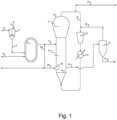
- FIG. 1 is a diagrammatic representation and has to be considered illustrative and not limitative of the scope of the invention.
- a solid catalyst component 1 a stream 2 containing the cocatalyst and an external donor compound, optionally in the presence of propylene, are fed to a precontacting vessel 3 together with a diluent, such as propane.
- a diluent such as propane
- the obtained catalyst system is continuously fed via line 4 to a loop prepolymerization reactor 5, and simultaneously liquid propylene is fed to the reactor 5 via line 6, optionally together with an alkane, such as propane.
- the prepolymerized catalyst system discharged from the loop reactor 5 is fed via line 7 to a fluidized bed reactor 8.
- the fluidized bed reactor 8 of Fig. 1 comprises a fluidized bed 9 of growing polymer particles, a fluidization plate 10 and a velocity reduction zone 11.
- the velocity reduction zone 11 is generally of increased diameter compared to the diameter of the fluidized bed portion of the reactor.
- the gaseous stream leaving the top of the velocity reduction zone 11 is transferred via the recycle line 12 to a compressor 13 and then to a heat exchanger 14.
- the recycle line 12 is equipped with a line 15 for feeding propylene, hydrogen, inert gases and, optionally comonomers. Passing through the heat exchanger 14, the gaseous stream is cooled and then fed to the bottom of the fluidized bed reactor 8. In this way the upwardly flowing gas continuously maintains the bed of polymer particles in fluidization conditions.
- the polymer obtained reactor 8 is discharged from the lower part of the fluidized bed 9 and is fed via line 16 to a solid/gas separator 17. Said gaseous mixture is fed back to the recycle line 12 through line 18, while the separated polymer is fed via line 19 to the next sections of the plant.
- the antistatic composition can be added into the fluidized bed reactor 8 via line 20 through a distributor 21 protruding into the fluidized bed zone 9 of the reactor. Additionally, it can be added via an injection point 22 on line 7 exiting from the prepolymerization reactor 5 and entering the fluidized bed reactor 8.
- the gas-phase polymerization processes according to the present disclosure are carried out in the presence of an alkane having from 3 to 5 carbon atoms as polymerization diluent, e.g. in the presence of propane.
- the process of the present disclosure provides a possibility for preparing an olefin polymer by gas-phase polymerization in a polymerization reactor in which the formation of polymer agglomerates in the polymerization reactors and fluctuations in the fluid-dynamics of the reactor are prevented or considerably reduced. Because of the reduced electrostatics, the tendency of the olefin polymer particles to stick to the reactor walls is reduced. This does not only reduce the risk of forming chunks or wall sheeting, which mostly leads to an unavoidable shut-down of the polymerization reactor because of plugging the discharge line, but also improves the fluid-dynamics of the reactor and avoids their fluctuations.
- an antistatic composition does not only result in a process for the polymerization of olefins which is simple to carry out, but the polymerization process has also a good operability. That means that the tendency for forming polymer deposits on the rector wall, i.e. reactor fouling, for forming lumps and for forming fines, i.e. for forming very small polyolefin particles, is reduced. Moreover, the activity of the catalyst is improved or at least not impaired and the product properties of the prepared polyolefins are not deteriorated.
- the content of ethylene comonomer was determined by infrared spectroscopy by collecting the IR spectrum of the sample vs. an air background with a Fourier Transform Infrared spectrometer (FTIR).
- FTIR Fourier Transform Infrared spectrometer
- a calibration straight line for ethylene obtained by using samples of known amount of ethylene is needed and was obtained by plotting AC2/At versus ethylene molar percent (%C2m).
- the slope GC2 was calculated from a linear regression.
- microspheroidal MgCl 2 •2.8C 2 H 5 OH adduct was prepared according to the method described in Example 2 of WO98/44009 , but operating on larger scale. The so-obtained adduct was then partially dealcoholated in a nitrogen flow until the alcohol content reached the value of 50%wt based on the total weight of the adduct.
- TiCl4 300 ml of TiCl4 were introduced at room temperature under nitrogen atmosphere into a 500 ml round bottom flask, equipped with mechanical stirrer, cooler and thermometer. After cooling to 0°C, while stirring, diisobutylphthalate (internal donor) and 9.0 g of the adduct prepared as described above were sequentially added into the flask. The amount of internal donor added was such as to meet a Mg/donor molar ratio of 8. The temperature was raised to 100°C and maintained for 2 hours. Thereafter, stirring was stopped, the solid product was allowed to settle and the supernatant liquid was si-phoned off at 100°C. After the supernatant was removed, additional fresh TiCl4 was added to reach the initial liquid volume again.
- the mixture was then heated at 120°C and kept at this temperature for 1 hour. Stirring was stopped again, the solid was allowed to settle and the supernatant liquid was si-phoned off. The solid was washed with anhydrous hexane six times in temperature gradient down to 60°C and one time at room temperature. The obtained solid was then dried under vacuum and analyzed.
- the solid catalyst component prepared as described above was contacted with aluminum-triethyl (TEAL) and with dicyclopentyl-dimethoxysilane (donor D) under the conditions reported in Table 1.
- TEAL aluminum-triethyl
- donor D dicyclopentyl-dimethoxysilane
- the activated catalyst discharged from the activation vessel was continuously fed, together with liquid propylene, to a prepolymerization loop reactor operated at a temperature of 20°C and a residence time of 7 minutes.
- the polymerization run was conducted in continuous mode in a fluidized bed gas-phase reactor as illustrated in Figure 1 , having a diameter of 40 cm in the fluidized bed zone.
- the prepolymerized catalyst was discharged from the prepolymerization reactor and was continuously fed to a fluidized bed gas-phase reactor where an ethylene-propylene copolymer was prepared.
- Liquid propylene, ethylene and hydrogen as molecular weight regulator were fed to reactor 8 via line 15 into the recycle line 12.
- An antistatic composition comprising 7 %w of water and 93 %w of Polyglykol PE-K 270 commercialized by Clariant was fed into the polymer bed partly through an injection point 22 on line 7 exiting from the prepolymerization reactor 5 and entering the fluidized bed reactor 8 and partly via a distributor 21 protruding into fluidized bed zone 9 and terminating with a discharge end positioned 10 cm from the wall of the reactor.
- the flow rate of the antistatic composition feed was such as to obtain in the polymer the amounts of antistatic indicated in Table 1 and was split 50/50 between the two injection points.
- the gas phase propylene, ethylene and hydrogen
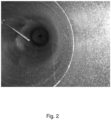
- the antistatic composition proved to be effective. Also, visual inspection of the reactor surface ( Figure 2 ) showed that its wall were clean, namely there was no formation of sheeting or adhesion of polymer particles. The addition of the antistatic composition ensured a very stable operation of the plant for the duration of the trial, as evidenced by the absence of problems at the reactor discharge. Also, the presence of the antistatic agent did not negatively affect the catalyst activity.
- Example 1 was repeated with slight condition differences indicated in Table 1 and with the additional difference that the antistatic composition was fed into the polymer bed only via the injection point 22 on line 7 exiting from the prepolymerization reactor 5. In this case, the antistatic effect was lower, as reported in Table 1 below. Visual inspection of the reactor surface ( Figure 3 ) showed that it was found severely fouled.
Landscapes
- Chemical & Material Sciences (AREA)
- Organic Chemistry (AREA)
- Chemical Kinetics & Catalysis (AREA)
- Health & Medical Sciences (AREA)
- Medicinal Chemistry (AREA)
- Polymers & Plastics (AREA)
- Engineering & Computer Science (AREA)
- Combustion & Propulsion (AREA)
- Addition Polymer Or Copolymer, Post-Treatments, Or Chemical Modifications (AREA)
- Polymerisation Methods In General (AREA)
Description
- The present disclosure pertains to the field of gas phase processes for the polymerization of olefins. More particularly, it relates to a method for feeding a fluid antistatic composition into a fluidized bed gas phase polymerization reactor. It also relates to a process for the polymerization of olefins carried out in the presence of an antistatic compound fed to the polymerization reactor with the method of the invention.
- Whenever a controlled flow rate of a fluid needs to be fed into the polymer bed of a fluidized bed gas phase polymerization reactor, it is desirable that such fluid contacts the polymer particles as uniformly as possible.
- Examples of fluids to be fed into a fluidized bed gas phase polymerization reactor are those with antifouling and/or antistatic effect.
- The stability of fluidized-bed gas-phase polymerization reactors can be negatively affected by a variety of factors. Among others, the presence of electrostatic charges, hot spots, and low polymer flowability. All those factors may jeopardize the operation of the reactor itself with fouling, sheeting and ultimately blockage of the discharge valve(s), resulting in a shut down. This is true of all types of gas phase polymerization reactors, both in fluidized, fast-fluidized and non-fluidized form (i.e. moving packed beds).
- Antistatic agents are used in processes for the polymerization of olefins to avoid electrostatic charging in order to reduce wall sheeting and formation of polymer agglomerates in the polymerization reactor or in downstream equipment such as degassing and recovery vessels. In the context of olefin polymerization, antistatic agents are also called antifouling agents, polymerization process aids, activity inhibitors, productivity inhibitors or kinetic modifiers. The antistatic agents comprise antistatically-acting compounds which have polar functional groups such as acid or ester groups, amine or amide groups or hydroxyl or ether groups. Examples of antistatically-acting compounds are polysulfone copolymers, polymeric polyamines, polyalcohols, hydroxyesters of polyalcohols, salts of alkylaryl-sulfonic acids, polysiloxanes, alkoxyamines, polyglycol ethers, etc.
- Another case where a good distribution in a gas phase reactor is required is whenever a liquid co-catalyst has to be fed and a good dispersion will guarantee the required product homogeneity.
-
EP 1 083 192 A1 discloses a process for a gas phase polymerization of a polymer using at least one liquid olefinic monomer in the presence of a catalyst, wherein the at least one liquid olefinic monomer is directly added to a fluidized reactor at one or more points located between 5% and 90% of the fluidized bed height above a distributor plate positioned at or near the bottom of the reactor by means of at least one nozzle or tube positioned to protrude into the fluidized bed at least 2 inches and at least 20% of the radius of the reactor. -
EP 856 530 A2 point 20 to 40 percent of the reactor diameter away from the reactor wall and at a height of about 5 to about 30 percent of the height of the bed. -
US-A-6 111 034 discloses the addition of water to a gas phase olefin polymerization reactor in amounts greater than 3 ppmv thereby increasing the level of condensable gas, facilitating operation of the reactor at an elevated dew point by ameliorating electrostatic phenomena in the reactor and inhibiting sheeting. The tip of the catalyst injection tube extends 3.75 inches from the reactor wall into the fluid bed at about the 1 foot level above the distributor plate. - It is thus desirable to provide a method for feeding a fluid into the polymer bed of a fluidized bed gas phase polymerization reactor in a manner that such fluid contacts the polymer particles as uniformly as possible.
- The present disclosure provides a method for feeding a fluid antistatic composition comprising (with respect to the total weight of the antistatic composition):
- (a) from 0.5 to 50 % by weight of a compound of formula R-OH wherein R represents hydrogen or a linear or branched, saturated alkyl group having from 1 to 15 carbon atoms; and
- (b) from 50 to 99.5 % by weight of an oligomeric or polymeric organic compound having one or more terminal hydroxyl groups and a viscosity at 40°C of at least 20 mm2/sec (DIN 51562)
- d is the distance of the distributor's discharge end from the wall of the reactor,
- D is the diameter of the reactor in the fluidized bed zone, and
- wherein a head loss is generated through appropriate orifices in the distributor such that a Reynolds number (Re) of from 10000 to 700000.
- The present disclosure further provides a process for the preparation of polyolefins in the presence of an antistatic compound said process comprising the step of feeding a fluid antistatic composition comprising (with respect to the total weight of the antistatic composition):
- (a) from 0.5 to 50 % by weight of a compound of formula R-OH wherein R represents hydrogen or a linear or branched, saturated alkyl group having from 1 to 15 carbon atoms; and
- (b) from 50 to 99.5 % by weight of an oligomeric or polymeric organic compound having one or more terminal hydroxyl groups and a viscosity at 40°C of at least 20 mm2/sec (DIN 51562)
- d is the distance of the distributor's discharge end from the wall of the reactor,
- D is the diameter of the reactor in the fluidized bed zone, and
- wherein a head loss is generated through appropriate orifices in the distributor such that a Reynolds number (Re) of from 10000 to 700000.
-
-
Figure 1 depicts schematically an illustrative set-up of a fluidized bed gas phase polymerization reactor for carrying out the process for the preparation of polyolefins of the present disclosure, without however restricting the invention to the embodiments illustrated therein. -
Figure 2 shows the inner reactor surface after the polymerization run of Example 1. -
Figure 3 shows the inner reactor surface after the polymerization run of Comparative Example 2. - Fluidized-bed polymerization reactors are reactors in which the polymerization takes place in a bed of polymer particles which is maintained in a fluidized state by feeding in gas at the lower end of a reactor, for example below a gas distribution grid having the function of dispensing the gas flow, and taking off the gas again at its upper end. The reactor gas is then returned to the lower end to the reactor via a recycle line equipped with a compressor and a heat exchanger. The circulated reactor gas is, for example, a mixture of the olefins to be polymerized, inert gases such as nitrogen and/or lower alkanes such as ethane, propane, butane, pentane or hexane and optionally a molecular weight regulator such as hydrogen. According to an embodiment, nitrogen or propane can be used as inert gas, if appropriate in combination with further lower alkanes. The velocity of the reactor gas has to be sufficiently high firstly to fluidize the mixed bed of finely divided polymer present in the tube serving as polymerization zone and secondly to remove the heat of polymerization effectively. The polymerization can also be carried out in a condensed or super-condensed mode, in which part of the circulating reaction gas is cooled to below the dew point and returned to the reactor separately as a liquid and a gas-phase or together as a two-phase mixture in order to make additional use of the enthalpy of vaporization for cooling the reaction gas.
- The present invention requires that d/D > 0.020; wherein d is the distance of the distributor's discharge end from the wall of the reactor, and D is the diameter of the reactor in the fluidized bed zone.
- In some embodiments, a head loss is generated through appropriate orifices in the distributor such that a Reynolds number (Re) of from 20000 to 500000, or from 30000 to 300000 is achieved.
- The fluid is an antistatic composition comprising (with respect to the total weight of the antistatic composition):
- (a) from 0.5 to 50 % by weight of a compound of formula R-OH wherein R represents hydrogen or a linear or branched, saturated alkyl group having from 1 to 15 carbon atoms; and
- (b) from 50 to 99.5 % by weight of an oligomeric or polymeric organic compound having one or more terminal hydroxyl groups and a viscosity at 40°C of at least 20 mm2/sec (DIN 51562).
- In one embodiment, the compound (a) of formula R-OH is water. According to other embodiments, the compound (a) of formula R-OH is an alcohol selected from methanol, ethanol, 1-propanol, 1-butanol, 1-pentanol, 1-hexanol, 1-heptanol, 1-octanol, 1-nonanol, 1-decanol, undecan-1-ol, dodecan-1-ol, tridecan-1-ol, 1-tetradecanol, pentadecan-1-ol, isobutanol, isoamyl alcohol, 2-methyl-1-propanol, phenethyl alcohol, tryptophol, isopropanol, 2-butanol, 2-pentanol, 2-hexanol, 2-heptanol, cyclohexanol, tert-butyl alcohol, tert-amyl alcohol, 2-methyl-2-pentanol, 2-methylhexan-2-ol, 2-methylheptan-2-ol, 3-methyl-3-pentanol and 3-methyloctan-3-ol.
- In some embodiments, the oligomeric or polymeric organic compound (b) has a viscosity at 40°C (DIN 51562) of 30-2000 mm2/sec, or of 50-1500 mm2/sec, or of 100-1000 mm2/sec, or of 150-500 mm2/sec, or of 200-400 mm2/sec, or of 250-300 mm2/sec, or of 260-285 mm2/sec. The preferred viscosity at 40°C (DIN 51562) of the oligomeric or polymeric organic compound (b) is in the range of 260 to 285 mm2/sec.
- In some embodiments, the oligomeric or polymeric organic compound (b) is selected from alcohols, polyethers, polyalcohols, hydroxyesters of polyalcohols, polyglycol ethers, polyglycol esters and derivatives thereof.
- In some embodiments, the oligomeric or polymeric organic compound (b) is a polyether and, more specifically, an alkylene-oxide-derived polymer comprising on average from 10 to 200 repeating units --(CH2-CHR-O)-, with R being hydrogen or an alkyl group having from 1 to 6 carbon atoms.
- In some embodiments, all of terminal groups of the alkylene-oxide-derived polymer are -OH groups.
- In some embodiments, the alkylene-oxide-derived polymer is a random copolymer of ethylene oxide and of other alkylene oxides, and the repeating units --(CH2-CH2-O)n- derived from ethylene oxide to repeating units --(CH2-CHR'-O)m- derived from the other alkylene oxides, with R' being an alkyl group having from 1 to 6 carbon atoms, are present in a ratio n : m in the range of from 6 : 1 to 1 : 1, or in the range of from 5 : 1 to 1.5 : 1, or further in the range of from 4 : 1 to 2 : 1.
- In some embodiments, the alkylene-oxide-derived polymer is a linear polymer of general formula (I)
HO-(CH2-CH2-O)n-(CH2-CHR'-O)m-H (I)
wherein R' is an alkyl group having from 1 to 6 carbon atoms, or an alkyl group having from 1 to 3 carbon atoms, or a methyl group; n is in the range of from 10 to 180, or from 20 to 100, or from 30 to 50; m is in the range of from 2 to 120, or from 10 to 80, or from 10 to 40; n and m denoting the average number of repeating units. - In some embodiments, alkylene-oxide-derived polymer is a random copolymer of ethylene oxide and propylene oxide.
- In some embodiments, the ethylene oxide/propylene oxide copolymer is a linear ethylene oxide/propylene oxide copolymer of general formula (II)
HO-(CH2-CH2-O)n-(CH2-CH(CH3)-O)m-H (II)
wherein n is in the range of from 10 to 180, or from 20 to 100, or from 30 to 50 and m is in the range of from 2 to 120, or from 10 to 80, or from 10 to 40. - Alkylene-oxide-derived polymers for use in the process of the present disclosure can be prepared by reacting ethylene oxide and the other alkylene oxides, such as propylene oxide, with polyhydric alcohols like diols, e.g. ethylene glycol, triols, e.g. glycerol, or polyols such as e.g. pentaerythritol. The reaction with diols results in linear polymers.
- In some embodiments, the oligomeric or polymeric organic compound (b) is water-soluble. In the contest of the present description, "water-soluble" means soluble in water at room temperature, i.e. at about 23°C.
- According to embodiments of the disclosure, the amount of antistatic composition introduced into the polymerization reactor is from 1 to 5000 ppm per weight, or from 10 to 3000 ppm per weight, or from 50 to 1000 ppm per weight referring to the weight of the prepared polyolefin.
- According to embodiments of the disclosure, the amount of component (a) introduced into the polymerization reactor is from 1 to 70 ppm per weight, or from 1 to 50 ppm per weight, or from 2 to 40 ppm per weight, or from 2 to 30 ppm per weight, or from 3 to 30 ppm per weight, or from 3 to 20 ppm per weight referring to the weight of the prepared polyolefin.
- According to embodiments of the disclosure, the amount of component (a) in the antistatic composition introduced into the polymerization reactor is from 0.5 to 50 % by weight, or from 3 to 30 % by weight, or from 5 to 15 % by weight with respect to the total weight of antistatic composition.
- According to embodiments of the disclosure, the amount of component (b) in the antistatic composition introduced into the polymerization reactor is from 50 to 99.5 % by weight, or from 70 to 97 % by weight, or from 85 to 95 % by weight with respect to the total weight of antistatic composition.
- In a method of operation, the antistatic composition can be fed to the polymerization reactor in a flow of saturated or unsaturated hydrocarbon having from 2 to 6 carbon atoms that, according to an embodiment, can be a monomer, such as propylene, and, according to another embodiment, an alkane, such as propane. The monomer and the alkane can be either in liquid or gas form.
- According to an embodiment, the antistatic composition and the hydrocarbon are homogenized at short distance from the distributor by means of customary mixing/homogenizing/dispersing systems, such as static mixers or atomizers/nebulizers, so to create an emulsion or fog of small droplets of the antistatic dispersed phase into the hydrocarbon continuous phase.
- According to another embodiment, the antistatic composition and the hydrocarbon are homogenized inside the distributor, whereby the distributor itself acts as a mixing/homogenizing/dispersing system, such as static mixer or atomizer/nebulizer, so to create an emulsion or fog of small droplets of the antistatic dispersed phase into the hydrocarbon continuous phase.
- The present disclosure provides a process for the polymerization of olefins, such as 1-olefins, i.e. hydrocarbons having terminal double bonds, without being restricted thereto. Typical 1-olefins are linear or branched 1-alkenes having from 2 to 12 carbon atoms, in particular linear 1-alkenes having from 2 to 10 carbon atoms such as ethylene, propylene, 1-butene, 1-pentene, 1-hexene, 1-heptene, 1-octene, 1-decene or branched 1-alkenes having from 2 to 10 carbon atoms such as 4-methyl-1-pentene, conjugated and non-conjugated dienes such as 1,3-butadiene, 1,4-hexadiene or 1,7-octadiene or vinyl-aromatic compounds such as styrene or substituted styrene. It is also possible to polymerize mixtures of various 1-olefins. Olefins that can be polymerized with the process of the present disclosure include those in which the double bond is part of a cyclic structure which can have one or more ring systems. Examples are cyclopentene, norbornene, tetracyclododecene or methylnorbornene or dienes such as 5-ethylidene-2-norbornene, norbornadiene or ethylnorbornadiene. It is also possible to polymerize mixtures of two or more olefins.
- According to an embodiment, the process can be used for the homopolymerization or copolymerization of ethylene or for the homopolymerization or copolymerization of propylene. According to an embodiment, comonomers for use in ethylene polymerization are 1-alkenes having from 3 to 8 carbon atoms such as 1-butene, 1-pentene, 1-hexene and/or 1-octene in amount of up to 20 wt.% or from 0.01 wt.% to 15 wt.%, or from 0.05 wt.% to 12 wt.%. According to another embodiment, comonomers for use in propylene polymerization are ethylene and/or 1 butene and/or 1-hexene in amount of up to 40 wt.% or from 0.5 wt.% to 35 wt.%.
- The process of the present disclosure allows the preparation of any types of common olefin polymers. According to an embodiment, the prepared olefin polymers can be broad molecular weight olefin polymers and, particularly, multimodal olefin polymers whereby the term multimodal refers to the modality of the molecular weight distribution. As used in the art, and also used herein, multimodal shall include bimodal. Such polymers can be obtained from polymerizing olefins in a cascade of two or more polymerization reactors or in different zones of a multizone reactor under different reaction conditions. Thus, the "modality" indicates how many different polymerization conditions were utilized to prepare the polyolefin, independently whether this modality of the molecular weight distribution can be recognized as separated maxima in a gel permeation chromatography (GPC) curve or not. In addition to the molecular weight distribution, the olefin polymer can also have a comonomer distribution. In an embodiment the average comonomer content of polymer chains with a higher molecular weight is higher than the average comonomer content of polymer chains with a lower molecular weight. It is however also possible to employ identical or very similar reaction conditions in all polymerization reactors of the reaction cascade and so prepare narrow molecular weight or monomodal olefin polymers.
- The polymerization of olefins can be carried out using customary olefin polymerization catalysts. That means the polymerization can be carried out using titanium-based Ziegler-Natta-catalysts, Phillips catalysts based on chromium oxide, or single-site catalysts. For the purposes of the present disclosure, single-site catalysts are catalysts based on chemically uniform transition metal coordination compounds. Furthermore, it is also possible to use mixtures of two or more of these catalysts for the polymerization of olefins. Such mixed catalysts may be designated as hybrid catalysts.
- According to an embodiment, catalysts for the process of the present disclosure are Ziegler-Natta catalysts comprising:
- (i) a solid catalyst component comprising Mg, Ti, an halogen and a first electron donor compound (internal donor),
- (ii) an alkylaluminum compound, and
- (iii) optionally, a second electron-donor compound (external donor).
- Component (i) can be prepared by contacting a magnesium halide, a titanium compound having at least a Ti-halogen bond, and optionally an electron donor compound. The magnesium halide can be MgCl2 in active form which is widely known from the patent literature as a support for Ziegler-Natta catalysts. The titanium compounds can be TiCl4 or TiCl3. Ti-haloalcoholates of formula Ti(OR)n-yXy, where n is the valence of titanium, y is a number between 1 and n-1 X is halogen and R is a hydrocarbon radical having from 1 to 10 carbon atoms, can also be used.
- Electron donor compounds for preparing Ziegler type catalysts are for example alcohols, glycols, esters, ketones, amines, amides, nitriles, alkoxysilanes and aliphatic ethers. These electron donor compounds can be used alone or in mixtures with other electron donor compounds.
- Other solid catalyst components which may be used are those based on a chromium oxide supported on a refractory oxide, such as silica, and activated by a heat treatment. Catalysts obtainable from those components consist of chromium (VI) trioxide chemically fixed on silica gel. These catalysts are produced under oxidizing conditions by heating the silica gels that have been doped with chromium(III)salts (precursor or precatalyst). During this heat treatment, the chromium(III) oxidizes to chromium(VI), the chromium(VI) is fixed and the silica gel hydroxyl group is eliminated as water.
- Still other solid catalyst components which may be used are single-site catalysts supported on a carrier, such as metallocene catalysts comprising:
- at least a transition metal compound containing at least one n bond; and
- at least a cocatalyst selected from an alumoxane or a compound able to form an alkylmetallocene cation.
- According to embodiments of the disclosure, when the catalyst includes an alkylaluminum compound, such as in Ziegler Natta catalysts, the molar ratio of component (a) to alkylaluminum compound introduced into the polymerization reactor is from 0.05 to 3, or from 0.1 to 2, or from 0.5 to 1.
- The catalysts may be optionally subjected to prepolymerization before being fed to the polymerization reactor. In an embodiment the prepolymerization occurs in a loop reactor. The prepolymerization of the catalyst system may be carried out at a low temperature, for instance in a range of from 0°C to 60°C.
- The process of the present disclosure can be carried in two or more cascade reactors, giving rise to a sequential multistage polymerization process. The fluidized bed gas phase reactor can be preceded and/or followed by one or more liquid-phase and/or gas-phase polymerization reactors. Examples of liquid-phase reactors are loop reactors and continuously stirred tank reactors (CSTR). Examples of gas-phase reactors include fluidized bed reactors, stirred bed reactors and reactors having two interconnected polymerization zones as described in
EP 0782587 andEP 1012195 . - For instance, a fluidized bed reactor can be used to prepare a first polymer component, which is successively fed to a gas-phase reactor having two interconnected polymerization zones to prepare a second and a third polymer component. Or a first fluidized bed reactor can be used to prepare a first polymer component, which is successively fed to a second fluidized bed reactor to prepare a second polymer component and then to a third fluidized bed reactor to prepare a third polymer component. Accordingly, an olefin polymer endowed with a multi-modal molecular weight distribution can be obtained, as well as an olefin copolymer comprising two or more components having a different comonomer content.
- Gas-phase polymerization reactors other than fluidized bed gas-phase reactors can be, for example, horizontally or vertically stirred reactor or multizone circulating reactors.
- Multizone circulating reactors are gas-phase reactors in which two polymerization zones are linked to one another and the polymer is passed alternately a plurality of times through these two zones. Such reactors are, for example, described in
WO 97/04015 A1 WO 00/02929 A1 - In a gas-phase polymerization process, the solid polymers are obtained from a gas-phase of the monomer or the monomers. Such gas-phase polymerizations may be carried out at pressures of from 0.1 to 20 MPa, or from 0.5 to 10 MPa, or from 1.0 to 5 MPa and polymerization temperatures from 40 to 150°C or from 65 to 125°C.
- A fluidized bed gas phase polymerization reactor, representing an embodiment of the disclosure, will now be described in detail with reference to the enclosed
Figure 1 , which is a diagrammatic representation and has to be considered illustrative and not limitative of the scope of the invention. - In such embodiment, schematically, a solid catalyst component 1, a stream 2 containing the cocatalyst and an external donor compound, optionally in the presence of propylene, are fed to a precontacting vessel 3 together with a diluent, such as propane.
- The obtained catalyst system is continuously fed via line 4 to a loop prepolymerization reactor 5, and simultaneously liquid propylene is fed to the reactor 5 via line 6, optionally together with an alkane, such as propane.
- The prepolymerized catalyst system discharged from the loop reactor 5 is fed via line 7 to a fluidized bed reactor 8.
- The fluidized bed reactor 8 of
Fig. 1 comprises a fluidized bed 9 of growing polymer particles, afluidization plate 10 and avelocity reduction zone 11. Thevelocity reduction zone 11 is generally of increased diameter compared to the diameter of the fluidized bed portion of the reactor. The gaseous stream leaving the top of thevelocity reduction zone 11 is transferred via therecycle line 12 to acompressor 13 and then to a heat exchanger 14. Therecycle line 12 is equipped with aline 15 for feeding propylene, hydrogen, inert gases and, optionally comonomers. Passing through the heat exchanger 14, the gaseous stream is cooled and then fed to the bottom of the fluidized bed reactor 8. In this way the upwardly flowing gas continuously maintains the bed of polymer particles in fluidization conditions. - The polymer obtained reactor 8 is discharged from the lower part of the fluidized bed 9 and is fed via
line 16 to a solid/gas separator 17. Said gaseous mixture is fed back to therecycle line 12 throughline 18, while the separated polymer is fed vialine 19 to the next sections of the plant. - The antistatic composition can be added into the fluidized bed reactor 8 via
line 20 through adistributor 21 protruding into the fluidized bed zone 9 of the reactor. Additionally, it can be added via aninjection point 22 on line 7 exiting from the prepolymerization reactor 5 and entering the fluidized bed reactor 8. - According to an embodiment, the gas-phase polymerization processes according to the present disclosure are carried out in the presence of an alkane having from 3 to 5 carbon atoms as polymerization diluent, e.g. in the presence of propane.
- The process of the present disclosure provides a possibility for preparing an olefin polymer by gas-phase polymerization in a polymerization reactor in which the formation of polymer agglomerates in the polymerization reactors and fluctuations in the fluid-dynamics of the reactor are prevented or considerably reduced. Because of the reduced electrostatics, the tendency of the olefin polymer particles to stick to the reactor walls is reduced. This does not only reduce the risk of forming chunks or wall sheeting, which mostly leads to an unavoidable shut-down of the polymerization reactor because of plugging the discharge line, but also improves the fluid-dynamics of the reactor and avoids their fluctuations.
- Using an antistatic composition does not only result in a process for the polymerization of olefins which is simple to carry out, but the polymerization process has also a good operability. That means that the tendency for forming polymer deposits on the rector wall, i.e. reactor fouling, for forming lumps and for forming fines, i.e. for forming very small polyolefin particles, is reduced. Moreover, the activity of the catalyst is improved or at least not impaired and the product properties of the prepared polyolefins are not deteriorated.
- The following examples are given to illustrate the present invention without any limiting purpose.
- Determined according to ISO 1133 (230°C, 2.16 Kg)
- The content of ethylene comonomer was determined by infrared spectroscopy by collecting the IR spectrum of the sample vs. an air background with a Fourier Transform Infrared spectrometer (FTIR). The instrument data acquisition parameters were:
- purge time: 30 seconds minimum
- collect time: 3 minutes minimum
- apodization: Happ-Genzel
- resolution: 2 cm-1.
- Sample Preparation - Using a hydraulic press, a thick sheet was obtained by pressing about g 1 of sample between two aluminum foils. A small portion was cut from this sheet to mold a film. Recommended film thickness ranges between 0.02 and 0.05 cm (8 - 20 mils). Pressing temperature was 180 ± 10°C (356°F) and about 10 kg/cm2 (142.2 PSI) pressure for about one minute. The pressure was released, the sample removed from the press and cooled to room temperature.
- The spectrum of pressed film sample was recorded in absorbance vs. wavenumbers (cm-1). The following measurements were used to calculate ethylene content:
- Area (At) of the combination absorption bands between 4482 and 3950 cm-1, used for spectrometric normalization of film thickness;
- Area (AC2) of the absorption band between 750-700 cm-1 after two proper consecutive spectroscopic subtractions of an isotactic non-additivated polypropylene spectrum and then of a reference spectrum of an ethylene-propylene random copolymer in the range 800-690 cm-1;
- Height (DC4) of the absorption band at 769 cm-1 (maximum value), after two proper consecutive spectroscopic subtractions of an isotactic non-additivated polypropylene spectrum and then of a reference spectrum of an ethylene-propylene random copolymer in the range 800-690 cm-1.
- In order to calculate the ethylene content, a calibration straight line for ethylene obtained by using samples of known amount of ethylene is needed and was obtained by plotting AC2/At versus ethylene molar percent (%C2m). The slope GC2 was calculated from a linear regression.
- The spectra of the unknown samples were recorded and then (At), (AC2) and (DC4) of the unknown sample calculated. The ethylene content by weight was obtained from the ethylene content (% molar fraction C2m) of the sample calculated as follows:

- Determined as follows: 2.5 g of polymer and 250 ml of xylene were introduced in a glass flask equipped with a refrigerator and a magnetic stirrer. The temperature was raised in 30 minutes up to the boiling point of the solvent. The clear solution so obtained was then kept under reflux and stirring for further 30 minutes. The closed flask was then kept in thermostatic water bath at 25° C for 30 minutes. The so formed solid was filtered on quick filtering paper. 100 ml of the filtered liquid was poured in a previously weighed aluminum container, which was heated on a heating plate under nitrogen flow, to remove the solvent by evaporation. The container was then kept in an oven at 80° C under vacuum until constant weight was obtained. The weight percentage of polymer soluble in xylene at room temperature was then calculated.
- An initial amount of microspheroidal MgCl2•2.8C2H5OH adduct was prepared according to the method described in Example 2 of
WO98/44009 - 300 ml of TiCl4 were introduced at room temperature under nitrogen atmosphere into a 500 ml round bottom flask, equipped with mechanical stirrer, cooler and thermometer. After cooling to 0°C, while stirring, diisobutylphthalate (internal donor) and 9.0 g of the adduct prepared as described above were sequentially added into the flask. The amount of internal donor added was such as to meet a Mg/donor molar ratio of 8. The temperature was raised to 100°C and maintained for 2 hours. Thereafter, stirring was stopped, the solid product was allowed to settle and the supernatant liquid was si-phoned off at 100°C. After the supernatant was removed, additional fresh TiCl4 was added to reach the initial liquid volume again. The mixture was then heated at 120°C and kept at this temperature for 1 hour. Stirring was stopped again, the solid was allowed to settle and the supernatant liquid was si-phoned off. The solid was washed with anhydrous hexane six times in temperature gradient down to 60°C and one time at room temperature. The obtained solid was then dried under vacuum and analyzed.
- Before introducing it into the polymerization reactors, the solid catalyst component prepared as described above was contacted with aluminum-triethyl (TEAL) and with dicyclopentyl-dimethoxysilane (donor D) under the conditions reported in Table 1.
- The activated catalyst discharged from the activation vessel was continuously fed, together with liquid propylene, to a prepolymerization loop reactor operated at a temperature of 20°C and a residence time of 7 minutes.
- The polymerization run was conducted in continuous mode in a fluidized bed gas-phase reactor as illustrated in
Figure 1 , having a diameter of 40 cm in the fluidized bed zone. The prepolymerized catalyst was discharged from the prepolymerization reactor and was continuously fed to a fluidized bed gas-phase reactor where an ethylene-propylene copolymer was prepared. Liquid propylene, ethylene and hydrogen as molecular weight regulator were fed to reactor 8 vialine 15 into therecycle line 12. - An antistatic composition comprising 7 %w of water and 93 %w of Polyglykol PE-K 270 commercialized by Clariant was fed into the polymer bed partly through an
injection point 22 on line 7 exiting from the prepolymerization reactor 5 and entering the fluidized bed reactor 8 and partly via adistributor 21 protruding into fluidized bed zone 9 and terminating with a discharge end positioned 10 cm from the wall of the reactor. The flow rate of the antistatic composition feed was such as to obtain in the polymer the amounts of antistatic indicated in Table 1 and was split 50/50 between the two injection points. The gas phase (propylene, ethylene and hydrogen) was continuously analyzed via gas-chromatography. At the end of the run the powder was discharged and dried under a nitrogen flow. - The main polymerization conditions and polymer features are reported in Table 1 together with the effect of the antistatic composition.
- The antistatic composition proved to be effective. Also, visual inspection of the reactor surface (
Figure 2 ) showed that its wall were clean, namely there was no formation of sheeting or adhesion of polymer particles. The addition of the antistatic composition ensured a very stable operation of the plant for the duration of the trial, as evidenced by the absence of problems at the reactor discharge. Also, the presence of the antistatic agent did not negatively affect the catalyst activity. - Prepared in accordance with example 1 of
EP 728770 - Example 1 was repeated with slight condition differences indicated in Table 1 and with the additional difference that the antistatic composition was fed into the polymer bed only via the
injection point 22 on line 7 exiting from the prepolymerization reactor 5. In this case, the antistatic effect was lower, as reported in Table 1 below. Visual inspection of the reactor surface (Figure 3 ) showed that it was found severely fouled.Table 1 Example 1 2C Precontact Temperature (°C) 20 20 Residence time (min) 10 10 TEAL/catalyst (g/g) 4 4 TEAL/donor ratio (g/g) 4 10 Prepolymerization Temperature (°C) 20 20 Residence time (min) 35 35 Gas-Phase reactor Temperature (°C) 70 70 Pressure (barg) 17 18 Residence time (min) 50 58 C2 -/C2 -+C3 - (mol/mol) 0.027 0.026 H2/C3 - (mol/mol) 0.006 0.004 Mileage (kg/g) 4600 2500 Antistatic composition (ppm wt) 135 140 Polymer analysis MFR "L" (dg/min) 1.8 6.8 Ethylene content (wt%) 3.4 3.2 Xylene solubles (wt%) 4.2 5.5 Effect of antistatic composition Reactor surface Clean fouled -
Effect of antistatic composition Operability Stable unstable Notes: C2 = ethylene; C3 - = propylene; H2 = hydrogen; Split = amount of polymer prepared in the concerned reactor referred to the total weight; Mileage = amount of obtained polymer per amount of catalyst fed to the polymerization.


Claims (8)
- A method for feeding a fluid antistatic composition comprising (with respect to the total weight of the antistatic composition):(a) from 0.5 to 50 % by weight of a compound of formula R-OH wherein R represents hydrogen or a linear or branched, saturated alkyl group having from 1 to 15 carbon atoms; and(b) from 50 to 99.5 % by weight of an oligomeric or polymeric organic compound having one or more terminal hydroxyl groups and a viscosity at 40°C of at least 20 mm2/sec (DIN 51562)into a polymer bed of a fluidized bed gas phase polymerization reactor, the method comprising introducing a controlled and continuous flow rate of the fluid antistatic composition into the polymer bed through a distributor protruding into the fluidized bed zone of the reactor and terminating with a discharge end positioned so that the following equation is fulfilled:
 - d is the distance of the distributor's discharge end from the wall of the reactor, and D is the diameter of the reactor in the fluidized bed zone; and- a head loss is generated through appropriate orifices in the distributor such that a Reynolds number (Re) of from 10000 to 700000 is achieved.
 - The method according to claim 1, comprising feeding the antistatic composition or individual components thereof to the polymerization reactor in a flow of saturated or unsaturated hydrocarbon having from 2 to 6 carbon atoms.
- The method according to claim 1 or 2, wherein the compound (a) of formula R-OH is water.
- The method according to any of claims 1 to 3, wherein the oligomeric or polymeric organic compound (b) is an alkylene-oxide-derived polymer comprising on average from 10 to 200 repeating units --(CH2-CHR-O)-, with R being hydrogen or an alkyl group having from 1 to 6 carbon atoms.
- The method according to any of claims 1 to 4, wherein the amount of component (a) in the antistatic composition introduced into the polymerization reactor is from 0.5 to 50 % by weight with respect to the total weight of antistatic composition, and the amount of component (b) in the antistatic composition introduced into the polymerization reactor is from 50 to 99.5 % by weight with respect to the total weight of antistatic composition.
- The method according to any of the preceding claims, comprising homogenizing inside the distributor the antistatic composition or components and the hydrocarbon.
- A process for the preparation of polyolefins in the presence of an antistatic compound comprising the step of feeding a fluid antistatic composition comprising (with respect to the total weight of the antistatic composition):(a) from 0.5 to 50 % by weight of a compound of formula R-OH wherein R represents hydrogen or a linear or branched, saturated alkyl group having from 1 to 15 carbon atoms; and(b) from 50 to 99.5 % by weight of an oligomeric or polymeric organic compound having one or more terminal hydroxyl groups and a viscosity at 40°C of at least 20 mm2/sec (DIN 51562)into a polymer bed of a fluidized bed gas phase polymerization reactor by introducing a controlled and continuous flow rate of the fluid antistatic composition into the polymer bed through a distributor protruding into the fluidized bed zone of the reactor and terminating with a discharge end positioned so that the following equation is fulfilled:
 - d is the distance of the distributor's discharge end from the wall of the reactor, and D is the diameter of the reactor in the fluidized bed zone; and- a head loss is generated through appropriate orifices in the distributor such that a Reynolds number (Re) of from 10000 to 700000 is achieved.
 - The process according to claim 7, wherein a Ziegler-Natta catalyst is used comprising:(i) a solid catalyst component comprising Mg, Ti, an halogen and a first electron donor compound named internal donor,(ii) an alkylaluminum compound, and(iii) optionally, a second electron-donor compound named external donor.
Priority Applications (1)
| Application Number | Priority Date | Filing Date | Title |
|---|---|---|---|
| PL17818531.0T PL3570969T5 (en) | 2017-01-20 | 2017-12-15 | Method for feeding a fluid to a gas phase polymerization reactor |
Applications Claiming Priority (2)
| Application Number | Priority Date | Filing Date | Title |
|---|---|---|---|
| EP17152464 | 2017-01-20 | ||
| PCT/EP2017/082977 WO2018134007A1 (en) | 2017-01-20 | 2017-12-15 | Method for feeding a fluid to a gas phase polymerization reactor |
Publications (3)
| Publication Number | Publication Date |
|---|---|
| EP3570969A1 EP3570969A1 (en) | 2019-11-27 |
| EP3570969B1 EP3570969B1 (en) | 2021-03-10 |
| EP3570969B2 true EP3570969B2 (en) | 2024-05-15 |
Family
ID=58053975
Family Applications (1)
| Application Number | Title | Priority Date | Filing Date |
|---|---|---|---|
| EP17818531.0A Active EP3570969B2 (en) | 2017-01-20 | 2017-12-15 | Method for feeding a fluid to a gas phase polymerization reactor |
Country Status (10)
| Country | Link |
|---|---|
| US (1) | US10792637B2 (en) |
| EP (1) | EP3570969B2 (en) |
| CN (1) | CN110114133B (en) |
| BR (1) | BR112019012967B1 (en) |
| ES (1) | ES2864133T5 (en) |
| FI (1) | FI3570969T4 (en) |
| HU (1) | HUE054322T2 (en) |
| PL (1) | PL3570969T5 (en) |
| PT (1) | PT3570969T (en) |
| WO (1) | WO2018134007A1 (en) |
Families Citing this family (4)
| Publication number | Priority date | Publication date | Assignee | Title |
|---|---|---|---|---|
| FI3570969T4 (en) | 2017-01-20 | 2024-06-07 | Basell Poliolefine Italia Srl | Method for feeding a fluid to a gas phase polymerization reactor |
| CN113993919B (en) * | 2020-05-26 | 2024-04-05 | 株式会社Lg化学 | Process for preparing carboxylic acid modified nitrile copolymer latex |
| US11618793B2 (en) * | 2020-08-27 | 2023-04-04 | Exxonmobil Chemical Patents Inc. | Optimized inert gas partial pressure in a gas phase polymerization process |
| EP4335877A1 (en) * | 2022-09-09 | 2024-03-13 | Basell Polyolefine GmbH | Continuous olefin polymerization process in the presence of an antistatic agent |
Citations (5)
| Publication number | Priority date | Publication date | Assignee | Title |
|---|---|---|---|---|
| US5693727A (en) † | 1996-06-06 | 1997-12-02 | Union Carbide Chemicals & Plastics Technology Corporation | Method for feeding a liquid catalyst to a fluidized bed polymerization reactor |
| US5962606A (en) † | 1997-02-19 | 1999-10-05 | Union Carbide Chemicals & Plastics Technology Corporation | Control of solution catalyst droplet size with an effervescent spray nozzle |
| US6075101A (en) † | 1997-02-19 | 2000-06-13 | Union Carbide Chemicals & Plastics Technology Corporation | Control of solution catalyst droplet size with a perpendicular spray nozzle |
| US6689847B2 (en) † | 2000-12-04 | 2004-02-10 | Univation Technologies, Llc | Polymerization process |
| WO2016150997A1 (en) † | 2015-03-26 | 2016-09-29 | Basell Polyolefine Gmbh | Polymerization process in the presence of antistatic agent |
Family Cites Families (15)
| Publication number | Priority date | Publication date | Assignee | Title |
|---|---|---|---|---|
| ZA943399B (en) | 1993-05-20 | 1995-11-17 | Bp Chem Int Ltd | Polymerisation process |
| US5453471B1 (en) * | 1994-08-02 | 1999-02-09 | Carbide Chemicals & Plastics T | Gas phase polymerization process |
| IT1274253B (en) | 1995-02-21 | 1997-07-15 | Himont Inc | PROCESS FOR THE PREPARATION OF SOLID CATALYTIC COMPONENTS FOR THE POLYMERIZATION OF OLEFINE |
| IT1275573B (en) | 1995-07-20 | 1997-08-07 | Spherilene Spa | PROCESS AND EQUIPMENT FOR GAS PHASE POMIMERIZATION OF ALPHA-OLEFINS |
| DE69821710T2 (en) | 1997-03-29 | 2005-01-13 | Basell Poliolefine Italia S.P.A. | MAGNESIUM DIHALOGENIDE / ALCOHOL ADDUCTS, METHOD FOR THE PRODUCTION THEREOF, AND CATALYST COMPONENTS THEREFOR |
| RO122040B1 (en) | 1998-07-08 | 2008-11-28 | Montell Technology Company B.V. | Process and installation for the gas-phase catalytic polymerization |
| US6111034A (en) | 1998-12-31 | 2000-08-29 | Union Carbide Chemicals & Plastics Technology Corporation | Static control in olefin polymerization |
| EP1083192A1 (en) * | 1999-09-10 | 2001-03-14 | Union Carbide Chemicals & Plastics Technology Corporation | Process for feeding liquid comonomer to a polymerization conducted in a fluidized bed reactor |
| JP4755094B2 (en) * | 2003-08-07 | 2011-08-24 | ウエストレイク ロングビュー コーポレイション | Polymerization method and related apparatus |
| US20060130870A1 (en) * | 2004-12-21 | 2006-06-22 | Ping Cai | Method for sonic cleaning of reactor with reduced acoustic wave cancellation |
| JP4652316B2 (en) * | 2006-11-28 | 2011-03-16 | 株式会社大阪チタニウムテクノロジーズ | Method for producing silicon chloride |
| EP2938642A4 (en) * | 2012-12-31 | 2016-09-14 | Reliance Ind Ltd | Heterogeneous ziegler-natta catalyst system and a process for olefin polymerization using the same |
| CN105646758B (en) * | 2016-03-25 | 2017-12-26 | 浙江大学 | A kind of method for preparing polymer |
| CN205650181U (en) * | 2016-05-27 | 2016-10-19 | 西北大学 | Spout bed with stand pipe |
| FI3570969T4 (en) | 2017-01-20 | 2024-06-07 | Basell Poliolefine Italia Srl | Method for feeding a fluid to a gas phase polymerization reactor |
-
2017
- 2017-12-15 FI FIEP17818531.0T patent/FI3570969T4/en active
- 2017-12-15 US US16/477,283 patent/US10792637B2/en active Active
- 2017-12-15 ES ES17818531T patent/ES2864133T5/en active Active
- 2017-12-15 HU HUE17818531A patent/HUE054322T2/en unknown
- 2017-12-15 WO PCT/EP2017/082977 patent/WO2018134007A1/en not_active Ceased
- 2017-12-15 PT PT178185310T patent/PT3570969T/en unknown
- 2017-12-15 EP EP17818531.0A patent/EP3570969B2/en active Active
- 2017-12-15 CN CN201780080226.9A patent/CN110114133B/en active Active
- 2017-12-15 PL PL17818531.0T patent/PL3570969T5/en unknown
- 2017-12-15 BR BR112019012967-7A patent/BR112019012967B1/en active IP Right Grant
Patent Citations (5)
| Publication number | Priority date | Publication date | Assignee | Title |
|---|---|---|---|---|
| US5693727A (en) † | 1996-06-06 | 1997-12-02 | Union Carbide Chemicals & Plastics Technology Corporation | Method for feeding a liquid catalyst to a fluidized bed polymerization reactor |
| US5962606A (en) † | 1997-02-19 | 1999-10-05 | Union Carbide Chemicals & Plastics Technology Corporation | Control of solution catalyst droplet size with an effervescent spray nozzle |
| US6075101A (en) † | 1997-02-19 | 2000-06-13 | Union Carbide Chemicals & Plastics Technology Corporation | Control of solution catalyst droplet size with a perpendicular spray nozzle |
| US6689847B2 (en) † | 2000-12-04 | 2004-02-10 | Univation Technologies, Llc | Polymerization process |
| WO2016150997A1 (en) † | 2015-03-26 | 2016-09-29 | Basell Polyolefine Gmbh | Polymerization process in the presence of antistatic agent |
Also Published As
| Publication number | Publication date |
|---|---|
| ES2864133T3 (en) | 2021-10-13 |
| PT3570969T (en) | 2021-06-07 |
| HUE054322T2 (en) | 2021-08-30 |
| ES2864133T5 (en) | 2024-09-20 |
| US10792637B2 (en) | 2020-10-06 |
| CN110114133A (en) | 2019-08-09 |
| EP3570969A1 (en) | 2019-11-27 |
| EP3570969B1 (en) | 2021-03-10 |
| US20190336930A1 (en) | 2019-11-07 |
| BR112019012967A2 (en) | 2019-11-26 |
| FI3570969T4 (en) | 2024-06-07 |
| PL3570969T3 (en) | 2021-10-11 |
| PL3570969T5 (en) | 2024-06-17 |
| CN110114133B (en) | 2021-08-27 |
| BR112019012967B1 (en) | 2022-09-06 |
| WO2018134007A1 (en) | 2018-07-26 |
Similar Documents
| Publication | Publication Date | Title |
|---|---|---|
| EP3570969B1 (en) | Method for feeding a fluid to a gas phase polymerization reactor | |
| US20150232588A1 (en) | Process for the gas-phase polymerization of olefins | |
| EP3394110B1 (en) | Olefin polymerization process in the presence of antistatic composition | |
| KR20210072836A (en) | Process for gas-phase polymerization of olefins | |
| US10358509B2 (en) | Continuous gas-phase polymerization processes | |
| US12104001B2 (en) | Catalyst and preparation thereof | |
| EP3283533B1 (en) | Olefin polymerization process | |
| CN104903365A (en) | Process for preparing propylene copolymers | |
| US20180298124A1 (en) | Polyethylene composition and process for polymerizing the same | |
| EP4372016A1 (en) | Olefin polymerization process comprising the use of an antistatic composition | |
| US11098143B2 (en) | Process for gas-phase polymerization of olefins | |
| CN102325798A (en) | Broadening the molecular weight distribution of polyolefin materials produced in horizontally stirred gas phase reactors | |
| WO2025017061A1 (en) | Multistage process for the polymerization of olefins | |
| KR20260015870A (en) | Olefin polymerization method | |
| WO2024246273A1 (en) | Process for the polymerization of olefins |
Legal Events
| Date | Code | Title | Description |
|---|---|---|---|
| STAA | Information on the status of an ep patent application or granted ep patent |
Free format text: STATUS: UNKNOWN |
|
| STAA | Information on the status of an ep patent application or granted ep patent |
Free format text: STATUS: THE INTERNATIONAL PUBLICATION HAS BEEN MADE |
|
| PUAI | Public reference made under article 153(3) epc to a published international application that has entered the european phase |
Free format text: ORIGINAL CODE: 0009012 |
|
| STAA | Information on the status of an ep patent application or granted ep patent |
Free format text: STATUS: REQUEST FOR EXAMINATION WAS MADE |
|
| 17P | Request for examination filed |
Effective date: 20190709 |
|
| AK | Designated contracting states |
Kind code of ref document: A1 Designated state(s): AL AT BE BG CH CY CZ DE DK EE ES FI FR GB GR HR HU IE IS IT LI LT LU LV MC MK MT NL NO PL PT RO RS SE SI SK SM TR |
|
| AX | Request for extension of the european patent |
Extension state: BA ME |
|
| DAV | Request for validation of the european patent (deleted) | ||
| DAX | Request for extension of the european patent (deleted) | ||
| STAA | Information on the status of an ep patent application or granted ep patent |
Free format text: STATUS: EXAMINATION IS IN PROGRESS |
|
| 17Q | First examination report despatched |
Effective date: 20200604 |
|
| GRAP | Despatch of communication of intention to grant a patent |
Free format text: ORIGINAL CODE: EPIDOSNIGR1 |
|
| STAA | Information on the status of an ep patent application or granted ep patent |
Free format text: STATUS: GRANT OF PATENT IS INTENDED |
|
| INTG | Intention to grant announced |
Effective date: 20201008 |
|
| GRAS | Grant fee paid |
Free format text: ORIGINAL CODE: EPIDOSNIGR3 |
|
| GRAA | (expected) grant |
Free format text: ORIGINAL CODE: 0009210 |
|
| STAA | Information on the status of an ep patent application or granted ep patent |
Free format text: STATUS: THE PATENT HAS BEEN GRANTED |
|
| AK | Designated contracting states |
Kind code of ref document: B1 Designated state(s): AL AT BE BG CH CY CZ DE DK EE ES FI FR GB GR HR HU IE IS IT LI LT LU LV MC MK MT NL NO PL PT RO RS SE SI SK SM TR |
|
| REG | Reference to a national code |
Ref country code: GB Ref legal event code: FG4D |
|
| REG | Reference to a national code |
Ref country code: CH Ref legal event code: EP Ref country code: AT Ref legal event code: REF Ref document number: 1369217 Country of ref document: AT Kind code of ref document: T Effective date: 20210315 |
|
| REG | Reference to a national code |
Ref country code: FI Ref legal event code: FGE |
|
| REG | Reference to a national code |
Ref country code: IE Ref legal event code: FG4D |
|
| REG | Reference to a national code |
Ref country code: DE Ref legal event code: R096 Ref document number: 602017034468 Country of ref document: DE |
|
| REG | Reference to a national code |
Ref country code: NL Ref legal event code: FP |
|
| REG | Reference to a national code |
Ref country code: GR Ref legal event code: EP Ref document number: 20210401041 Country of ref document: GR Effective date: 20210519 |
|
| REG | Reference to a national code |
Ref country code: PT Ref legal event code: SC4A Ref document number: 3570969 Country of ref document: PT Date of ref document: 20210607 Kind code of ref document: T Free format text: AVAILABILITY OF NATIONAL TRANSLATION Effective date: 20210602 |
|
| REG | Reference to a national code |
Ref country code: LT Ref legal event code: MG9D |
|
| PG25 | Lapsed in a contracting state [announced via postgrant information from national office to epo] |
Ref country code: LT Free format text: LAPSE BECAUSE OF FAILURE TO SUBMIT A TRANSLATION OF THE DESCRIPTION OR TO PAY THE FEE WITHIN THE PRESCRIBED TIME-LIMIT Effective date: 20210310 Ref country code: BG Free format text: LAPSE BECAUSE OF FAILURE TO SUBMIT A TRANSLATION OF THE DESCRIPTION OR TO PAY THE FEE WITHIN THE PRESCRIBED TIME-LIMIT Effective date: 20210610 Ref country code: HR Free format text: LAPSE BECAUSE OF FAILURE TO SUBMIT A TRANSLATION OF THE DESCRIPTION OR TO PAY THE FEE WITHIN THE PRESCRIBED TIME-LIMIT Effective date: 20210310 Ref country code: NO Free format text: LAPSE BECAUSE OF FAILURE TO SUBMIT A TRANSLATION OF THE DESCRIPTION OR TO PAY THE FEE WITHIN THE PRESCRIBED TIME-LIMIT Effective date: 20210610 |
|
| REG | Reference to a national code |
Ref country code: HU Ref legal event code: AG4A Ref document number: E054322 Country of ref document: HU |
|
| PG25 | Lapsed in a contracting state [announced via postgrant information from national office to epo] |
Ref country code: SE Free format text: LAPSE BECAUSE OF FAILURE TO SUBMIT A TRANSLATION OF THE DESCRIPTION OR TO PAY THE FEE WITHIN THE PRESCRIBED TIME-LIMIT Effective date: 20210310 Ref country code: LV Free format text: LAPSE BECAUSE OF FAILURE TO SUBMIT A TRANSLATION OF THE DESCRIPTION OR TO PAY THE FEE WITHIN THE PRESCRIBED TIME-LIMIT Effective date: 20210310 Ref country code: RS Free format text: LAPSE BECAUSE OF FAILURE TO SUBMIT A TRANSLATION OF THE DESCRIPTION OR TO PAY THE FEE WITHIN THE PRESCRIBED TIME-LIMIT Effective date: 20210310 |
|
| REG | Reference to a national code |
Ref country code: ES Ref legal event code: FG2A Ref document number: 2864133 Country of ref document: ES Kind code of ref document: T3 Effective date: 20211013 |
|
| PG25 | Lapsed in a contracting state [announced via postgrant information from national office to epo] |
Ref country code: CZ Free format text: LAPSE BECAUSE OF FAILURE TO SUBMIT A TRANSLATION OF THE DESCRIPTION OR TO PAY THE FEE WITHIN THE PRESCRIBED TIME-LIMIT Effective date: 20210310 Ref country code: EE Free format text: LAPSE BECAUSE OF FAILURE TO SUBMIT A TRANSLATION OF THE DESCRIPTION OR TO PAY THE FEE WITHIN THE PRESCRIBED TIME-LIMIT Effective date: 20210310 Ref country code: SM Free format text: LAPSE BECAUSE OF FAILURE TO SUBMIT A TRANSLATION OF THE DESCRIPTION OR TO PAY THE FEE WITHIN THE PRESCRIBED TIME-LIMIT Effective date: 20210310 |
|
| REG | Reference to a national code |
Ref country code: AT Ref legal event code: UEP Ref document number: 1369217 Country of ref document: AT Kind code of ref document: T Effective date: 20210310 |
|
| PG25 | Lapsed in a contracting state [announced via postgrant information from national office to epo] |
Ref country code: IS Free format text: LAPSE BECAUSE OF FAILURE TO SUBMIT A TRANSLATION OF THE DESCRIPTION OR TO PAY THE FEE WITHIN THE PRESCRIBED TIME-LIMIT Effective date: 20210710 Ref country code: RO Free format text: LAPSE BECAUSE OF FAILURE TO SUBMIT A TRANSLATION OF THE DESCRIPTION OR TO PAY THE FEE WITHIN THE PRESCRIBED TIME-LIMIT Effective date: 20210310 Ref country code: SK Free format text: LAPSE BECAUSE OF FAILURE TO SUBMIT A TRANSLATION OF THE DESCRIPTION OR TO PAY THE FEE WITHIN THE PRESCRIBED TIME-LIMIT Effective date: 20210310 |
|
| REG | Reference to a national code |
Ref country code: DE Ref legal event code: R026 Ref document number: 602017034468 Country of ref document: DE |
|
| PLBI | Opposition filed |
Free format text: ORIGINAL CODE: 0009260 |
|
| PLAX | Notice of opposition and request to file observation + time limit sent |
Free format text: ORIGINAL CODE: EPIDOSNOBS2 |
|
| REG | Reference to a national code |
Ref country code: FI Ref legal event code: MDE Opponent name: THE DOW CHEMICAL COMPANY |
|
| 26 | Opposition filed |
Opponent name: THE DOW CHEMICAL COMPANY Effective date: 20211201 |
|
| PG25 | Lapsed in a contracting state [announced via postgrant information from national office to epo] |
Ref country code: DK Free format text: LAPSE BECAUSE OF FAILURE TO SUBMIT A TRANSLATION OF THE DESCRIPTION OR TO PAY THE FEE WITHIN THE PRESCRIBED TIME-LIMIT Effective date: 20210310 Ref country code: AL Free format text: LAPSE BECAUSE OF FAILURE TO SUBMIT A TRANSLATION OF THE DESCRIPTION OR TO PAY THE FEE WITHIN THE PRESCRIBED TIME-LIMIT Effective date: 20210310 |
|
| PG25 | Lapsed in a contracting state [announced via postgrant information from national office to epo] |
Ref country code: SI Free format text: LAPSE BECAUSE OF FAILURE TO SUBMIT A TRANSLATION OF THE DESCRIPTION OR TO PAY THE FEE WITHIN THE PRESCRIBED TIME-LIMIT Effective date: 20210310 |
|
| PLBB | Reply of patent proprietor to notice(s) of opposition received |
Free format text: ORIGINAL CODE: EPIDOSNOBS3 |
|
| PG25 | Lapsed in a contracting state [announced via postgrant information from national office to epo] |
Ref country code: IT Free format text: LAPSE BECAUSE OF FAILURE TO SUBMIT A TRANSLATION OF THE DESCRIPTION OR TO PAY THE FEE WITHIN THE PRESCRIBED TIME-LIMIT Effective date: 20210310 |
|
| PG25 | Lapsed in a contracting state [announced via postgrant information from national office to epo] |
Ref country code: IS Free format text: LAPSE BECAUSE OF FAILURE TO SUBMIT A TRANSLATION OF THE DESCRIPTION OR TO PAY THE FEE WITHIN THE PRESCRIBED TIME-LIMIT Effective date: 20210710 |
|
| PG25 | Lapsed in a contracting state [announced via postgrant information from national office to epo] |
Ref country code: MC Free format text: LAPSE BECAUSE OF FAILURE TO SUBMIT A TRANSLATION OF THE DESCRIPTION OR TO PAY THE FEE WITHIN THE PRESCRIBED TIME-LIMIT Effective date: 20210310 |
|
| REG | Reference to a national code |
Ref country code: CH Ref legal event code: PL |
|
| GBPC | Gb: european patent ceased through non-payment of renewal fee |
Effective date: 20211215 |
|
| PG25 | Lapsed in a contracting state [announced via postgrant information from national office to epo] |
Ref country code: LU Free format text: LAPSE BECAUSE OF NON-PAYMENT OF DUE FEES Effective date: 20211215 Ref country code: IE Free format text: LAPSE BECAUSE OF NON-PAYMENT OF DUE FEES Effective date: 20211215 Ref country code: GB Free format text: LAPSE BECAUSE OF NON-PAYMENT OF DUE FEES Effective date: 20211215 |
|
| PG25 | Lapsed in a contracting state [announced via postgrant information from national office to epo] |
Ref country code: LI Free format text: LAPSE BECAUSE OF NON-PAYMENT OF DUE FEES Effective date: 20211231 Ref country code: CH Free format text: LAPSE BECAUSE OF NON-PAYMENT OF DUE FEES Effective date: 20211231 |
|
| P01 | Opt-out of the competence of the unified patent court (upc) registered |
Effective date: 20230414 |
|
| PG25 | Lapsed in a contracting state [announced via postgrant information from national office to epo] |
Ref country code: CY Free format text: LAPSE BECAUSE OF FAILURE TO SUBMIT A TRANSLATION OF THE DESCRIPTION OR TO PAY THE FEE WITHIN THE PRESCRIBED TIME-LIMIT Effective date: 20210310 |
|
| PUAH | Patent maintained in amended form |
Free format text: ORIGINAL CODE: 0009272 |
|
| STAA | Information on the status of an ep patent application or granted ep patent |
Free format text: STATUS: PATENT MAINTAINED AS AMENDED |
|
| PG25 | Lapsed in a contracting state [announced via postgrant information from national office to epo] |
Ref country code: MK Free format text: LAPSE BECAUSE OF FAILURE TO SUBMIT A TRANSLATION OF THE DESCRIPTION OR TO PAY THE FEE WITHIN THE PRESCRIBED TIME-LIMIT Effective date: 20210310 |
|
| REG | Reference to a national code |
Ref country code: CH Ref legal event code: PK Free format text: DIE PUBLIKATION VOM 17.04.2024 WURDE AM 24.04.2024 IRRTUEMLICHERWEISE ERNEUT PUBLIZIERT. LA PUBLICATION DU 17.04.2024 A ETE REPUBLIEE PAR ERREUR LE 24.04.2024. LA PUBBLICAZIONE DEL 17.04.2024 E STATA ERRONEAMENTE RIPUBBLICATA IL 24.04.2024. |
|
| 27A | Patent maintained in amended form |
Effective date: 20240515 |
|
| AK | Designated contracting states |
Kind code of ref document: B2 Designated state(s): AL AT BE BG CH CY CZ DE DK EE ES FI FR GB GR HR HU IE IS IT LI LT LU LV MC MK MT NL NO PL PT RO RS SE SI SK SM TR |
|
| REG | Reference to a national code |
Ref country code: DE Ref legal event code: R102 Ref document number: 602017034468 Country of ref document: DE |
|
| REG | Reference to a national code |
Ref country code: NL Ref legal event code: FP |
|
| REG | Reference to a national code |
Ref country code: GR Ref legal event code: EP Ref document number: 20240401365 Country of ref document: GR Effective date: 20240716 |
|
| REG | Reference to a national code |
Ref country code: ES Ref legal event code: DC2A Ref document number: 2864133 Country of ref document: ES Kind code of ref document: T5 Effective date: 20240920 |
|
| PG25 | Lapsed in a contracting state [announced via postgrant information from national office to epo] |
Ref country code: MT Free format text: LAPSE BECAUSE OF FAILURE TO SUBMIT A TRANSLATION OF THE DESCRIPTION OR TO PAY THE FEE WITHIN THE PRESCRIBED TIME-LIMIT Effective date: 20210310 |
|
| PGFP | Annual fee paid to national office [announced via postgrant information from national office to epo] |
Ref country code: PL Payment date: 20240917 Year of fee payment: 8 |
|
| PGFP | Annual fee paid to national office [announced via postgrant information from national office to epo] |
Ref country code: PT Payment date: 20241125 Year of fee payment: 8 |
|
| PGFP | Annual fee paid to national office [announced via postgrant information from national office to epo] |
Ref country code: GR Payment date: 20241125 Year of fee payment: 8 |
|
| PGFP | Annual fee paid to national office [announced via postgrant information from national office to epo] |
Ref country code: HU Payment date: 20241204 Year of fee payment: 8 |
|
| PGFP | Annual fee paid to national office [announced via postgrant information from national office to epo] |
Ref country code: ES Payment date: 20250116 Year of fee payment: 8 |
|
| PG25 | Lapsed in a contracting state [announced via postgrant information from national office to epo] |
Ref country code: TR Free format text: LAPSE BECAUSE OF FAILURE TO SUBMIT A TRANSLATION OF THE DESCRIPTION OR TO PAY THE FEE WITHIN THE PRESCRIBED TIME-LIMIT Effective date: 20210310 |
|
| PGFP | Annual fee paid to national office [announced via postgrant information from national office to epo] |
Ref country code: NL Payment date: 20251113 Year of fee payment: 9 |
|
| PGFP | Annual fee paid to national office [announced via postgrant information from national office to epo] |
Ref country code: DE Payment date: 20251118 Year of fee payment: 9 |
|
| PGFP | Annual fee paid to national office [announced via postgrant information from national office to epo] |
Ref country code: AT Payment date: 20251125 Year of fee payment: 9 |
|
| PGFP | Annual fee paid to national office [announced via postgrant information from national office to epo] |
Ref country code: FI Payment date: 20251126 Year of fee payment: 9 |
|
| PGFP | Annual fee paid to national office [announced via postgrant information from national office to epo] |
Ref country code: FR Payment date: 20251111 Year of fee payment: 9 |
|
| PGFP | Annual fee paid to national office [announced via postgrant information from national office to epo] |
Ref country code: BE Payment date: 20251114 Year of fee payment: 9 |
|
| REG | Reference to a national code |
Ref country code: AT Ref legal event code: UEP Ref document number: 1369217 Country of ref document: AT Kind code of ref document: T Effective date: 20240515 |